Ephesians 4:2
Ephesians 4:3
Ephesians 4:4
Ephesians 4:5
Ephesians 4:6
Ephesians 4:7
Ephesians 4:8
Ephesians 4:9
Ephesians 4:10
Ephesians 4:11
Ephesians 4:12
Ephesians 4:13
Ephesians 4:14
Ephesians 4:15
Ephesians 4:16
Ephesians 4:17
Ephesians 4:18
Ephesians 4:19
Ephesians 4:20
Ephesians 4:21
Ephesians 4:22
Ephesians 4:23
Ephesians 4:24
Ephesians 4:25
Ephesians 4:26
Ephesians 4:27
Ephesians 4:28
Ephesians 4:29
Ephesians 4:30
Ephesians 4:31
Ephesians 4:32

EPHESIANS - CHRIST AND THE CHURCH
Click chart to enlarge
Charts from Jensen's Survey of the NT - used by permission
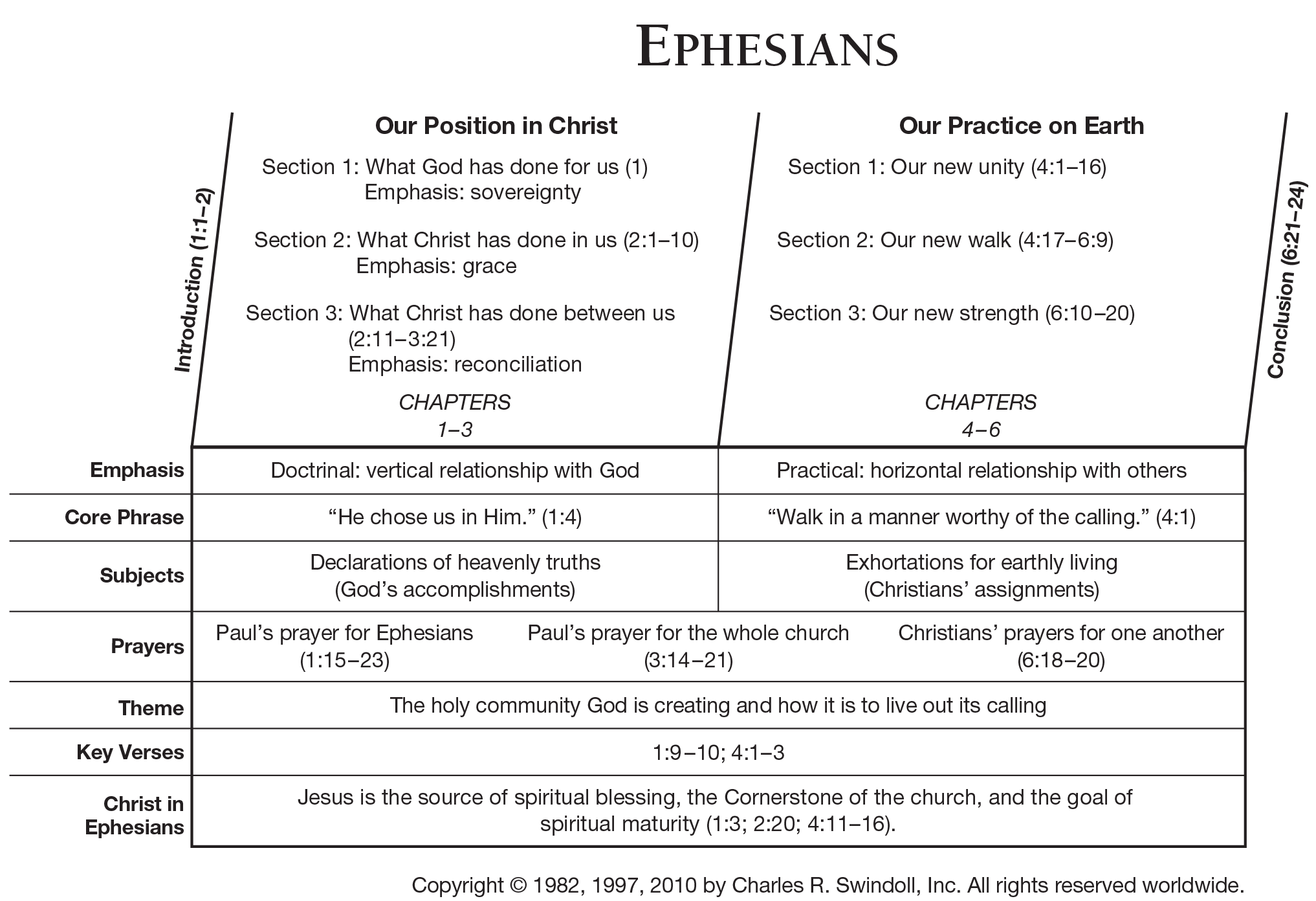
Click chart by Charles Swindoll -Note "EMPHASIS" --
Ephesians 1-3 = Doctrinal: vertical relationship with God
Ephesians 4-6 = Practical: horizontal relationship with others
Ephesians 4:7 But to each one of us grace was given according to the measure of Christ's gift. (NASB: Lockman)
Greek: Eni de hekasto hemon edothe (3SAPI) e charis kata to metron tes doreas tou Christou.
BGT Ἑνὶ δὲ ἑκάστῳ ἡμῶν ἐδόθη ἡ χάρις κατὰ τὸ μέτρον τῆς δωρεᾶς τοῦ Χριστοῦ.
Amplified: Yet grace (God’s unmerited favor) was given to each of us individually [not indiscriminately, but in different ways] in proportion to the measure of Christ’s [rich and bounteous] gift. (Amplified Bible - Lockman)
BBE But to every one of us has grace been given in the measure of the giving of Christ.
CSB Now grace was given to each one of us according to the measure of the Messiah's gift.
ESV But grace was given to each one of us according to the measure of Christ's gift.
GWN God's favor has been given to each of us. It was measured out to us by Christ who gave it.
KJV But unto every one of us is given grace according to the measure of the gift of Christ.
NKJ But to each one of us grace was given according to the measure of Christ's gift.
NET But to each one of us grace was given according to the measure of the gift of Christ.
NRS But each of us was given grace according to the measure of Christ's gift.
NAB But grace was given to each of us according to the measure of Christ's gift.
NJB On each one of us God's favour has been bestowed in whatever way Christ allotted it.
NIV But to each one of us grace has been given as Christ apportioned it.
NLT (revised) However, he has given each one of us a special gift through the generosity of Christ.
NLT: However, he has given each one of us a special gift according to the generosity of Christ. (NLT - Tyndale House)
Phillips: Naturally there are different gifts and functions; individually grace is given to us in different ways out of the rich diversity of Christ's giving. (Phillips: Touchstone)
Wuest: But to each one of us there was given the grace in the measure of the gift of the Christ. (Eerdmans)
Weymouth - Yet to each of us individually grace was given, measured out with the munificence of Christ.
Young's Literal: Yet to each of us individually grace was given, measured out with the munificence of Christ.
BUT TO EACH ONE OF US GRACE WAS GIVEN: Eni de hekasto hemon edothe (3SAPI) e charis
- To each one - Eph 4:8-14; Mt 25:15; Ro 12:6-8; 1Cor 12:8-11,28-30
- Grace was given Ep 3:8; 2Co 6:1; 1Pe 4:10
- Ephesians 4 Resources - Multiple Sermons and Commentaries
- Ephesians 4:7-10 Christ's Purpose for His Church - Steven Cole
- Ephesians 4:7-12 - Wayne Barber
- Ephesians 4:7-10: Preserving the Unity of the Spirit -2 - Wayne Barber
- Ephesians 4:7-11 The Gifts of Christ to His Church - John MacArthur
Ephesians 4:7-16 (See Hiebert's Outline below)
Related Passages:
John 7:38-39+ (GIFT PROMISED) “He who believes in Me, as the Scripture said, ‘From his innermost being will flow rivers of living water.’” 39 But this He spoke of the Spirit, whom those who believed in Him were to receive; for the Spirit was not yet given, because Jesus was not yet glorified.
Luke 24:49+ (GIFT PROMISED) “And behold, I am sending forth the promise of My Father (Acts 1:4) upon you; but you are to stay in the city until you are clothed with power from on high.”
Acts 2:33+ (PROMISE HAS BEEN FULFILLED AT PENTECOST) Therefore having been exalted to the right hand of God, and having received from the Father the promise of the Holy Spirit, He has poured forth this which you both see and hear.
International Children's Bible - Jesus was lifted up to heaven and is now at God's right side. The Father has given the Holy Spirit to Jesus as he promised. So now Jesus has poured out that Spirit. This is what you see and hear.
Acts 2:38+ (PROMISE WILL BE FULFILLED IN EVERY BELIEVER) Peter said to them, “Repent, and each of you be baptized in the name of Jesus Christ for the forgiveness of your sins; and you will receive the gift (same word used in Eph 4:7 - dorea) of the Holy Spirit.
Matthew 25:15 “To one he gave five talents, to another, two, and to another, one, each according to his own ability; and he went on his journey.
Ephesians 3:8 To me, the very least of all saints, this grace was given, to preach to the Gentiles the unfathomable riches of Christ,
1 Corinthians 15:9-10 For I am the least of the apostles, and not fit to be called an apostle, because I persecuted the church of God. 10 But by the grace of God I am what I am, and His grace toward me did not prove vain; but I labored even more than all of them, yet not I, but the grace of God with me.
2 Corinthians 6:1 And working together with Him, we also urge you not to receive the grace of God in vain–
1 Peter 4:10 As each one has received a special gift, employ it in serving one another as good stewards of the manifold grace of God.
GOD'S PLAN FOR
CHURCH GROWTH
Paul has explained in Eph 1-3 how Jews and Gentiles were now "mysteriously" revealed as one body, one new man in Christ, Who, as the personification of peace, miraculously broke down the walls of enmity between these two formerly hostile groups. Now that they are one in Christ, Paul proceeds to describe how this oneness is to be lived out in real life. And so in Ephesians 4:1-6 he described the basis for the new unity in Christ, calling for concordant conduct in Eph 4:1-3, conduct designed to preserve the unity and conduct founded on the firm foundation of the seven-fold oneness in Eph 4:4-6. In this next section, Eph 4:7-16, he describes how the Body is to preserve the unity in Christ.
There has been a great deal of emphasis at the beginning of the 21st Century in American Christianity regarding church growth, especially regarding the utilization of man-made methods to attract "seekers" and hopefully keep them attending. What Paul is doing in Ephesians 4:7-16 is giving God's plan for church growth, not so much in numbers, but in ever increasing spiritual maturity of the members of the Body of Christ. I would subtitle this section "Church Growth 101". God's principles are proven and cannot be improved upon! One could write a huge book on church growth but never have greater R.O.I. (return on investment) than the eternal truths in Ephesians 4:7-16.
THOUGHT - Why is it that so many in the modern church don't seem to fully trust God's trustworthy method for growing churches? One reason may be because they are more focused on the numbers than on maturity of the numbers. May God grant that many local bodies composing the universal body of Christ complete His course on church growth with "flying colors"! The "grades" will be distributed at the Bema Seat of Christ (1Cor 3:7-14+, 2Cor 5:10+).
R Kent Hughes adds that "During the last twenty years much has been written on the subject of growing churches. But Paul's Ephesian treatise (ED: especially Eph 4:7-16) is still the book, for it is radically true in its principles and unfailing in its effectiveness." (See Ephesians: The Mystery of the Body of Christ)
THOUGHT - Do you want to grow your church or more accurately do you want the Spirit of Christ to grow Christ's church where you are privileged to pastor? We are speaking of course not about quantity, but quality, growth in maturity, growth in Christ-likeness. This should be the goal of every shepherd of the sheep entrusted to him. It is not about personal reputation, but "personnel" transformation. And a major component of that transformation is informing your sheep about their need to use their spiritual gifts. Dr Howard Hendricks once said that "If you don’t know what your gift is, and if you are not using it to serve the body of Christ, you are crippling your spiritual life" And I would add, you are "shortchanging" the local body you are attending. Sitting and soaking (like many saints do especially if they like the pastor's preaching or style) should be reserved for summer vacations at the beach!
But to each (hekastos) one of us grace (charis) was given according to the measure (metron) of Christ's gift (dorea) - Here Paul begins with a description of spiritual gifts, which are a manifestation of his sovereign grace. Literally this passage reads "Yet to each of us individually grace was given." Even in this opening one sees the benevolent hand of God for grace is something given, not something merited, but to be received and to be lived out for the glory of the Sovereign Giver. But (contrast) expresses the thought "on the other hand" or "in spite of that" (in spite of that unity just described). With this but Paul passes from the church as a whole to its individual members. He will explain the seemingly paradoxical truth that in the unity of the body, there is diversity in the body. He has just described unity in Ep 4:1-6 and now begins to describe the individuals that compose the unity. As MacArthur says Paul moves from unity to uniqueness. The seven fold foundation of Eph 4:1-6 is followed by an introduction to the variety of spiritual gifts. He will now explain why the call for unity is not a call to uniformity and why unity does not not obliterate individuality. He is not calling for the individual members of the body of Christ to be absolutely identical. Unity is oneness and harmony but it is not sameness and absence of variation. He explains here, and in related passages in 1 Corinthians 12 and Romans 12, that unity is perfectly consistent with a diversity of spiritual gifts among the members of the one body. The paradox is that the differences of individual members contribute to the harmonious functionality of the Body and are actually the means by which the unity is preserved. John Stott adds that "The unity of the church is due to charis, God’s grace having reconciled us to himself; but the diversity of the church is due to charismata, God’s gifts distributed to church members." (See The Message of Ephesians)
Paul moves from the unity of believers to the uniqueness of believers.
--John MacArthur
Ephesians 4:6 ended with emphasis on all, specifically "one God and Father of all who is over all and through all and in all." Now Paul moves from the "all" to the components of the "all" which is "each one." As Eadie says "Unity is not uniformity, for it is quite consistent with variety of gifts and offices in the church." Paul actually uses two Greek terms, ((hekastos = each one and heis = one) to make it very clear that this is each and every one, including Paul (as noted by the change of the pronoun from "you" in Eph 4:1 to "us" here in Eph 4:7). Each one refers to each and every believer who has received a gift but as other passages teach, the gifts are diverse. Think about a football team where there is great physical diversity with goal being unity of purpose - to score! And yet the call has been for unity. This is possible because the Spirit gives the gifts (in a sense the Spirit is the "Summum Bonum", the greatest gift Christ has given us - cf Acts 2:33) and Christ is the Head and He makes all the parts of the body function together, the Spirit providing the unity in the bond of peace. In effect this is a spiritual example of the famous phrase "E Pluribus Unum!"
E pluribus unum – Latin for "Out of many, one"[1][2] (also translated as "One out of many"[3] or "One from many"[4]) – is a traditional motto of the United States, appearing on the Great Seal along with Annuit cœptis (Latin for "he approves the undertaking [lit. 'things undertaken']") and Novus ordo seclorum (Latin for "New order of the ages"); its inclusion on the seal was approved by an Act of Congress in 1782.[2]
Each one of us - at first this statement seems to shatter the seven fold unity Paul has just outlined in Eph 4:4-6. Yes, all believers are one in Christ, all one in respect to our salvation and relationship to God as His children. But even though we are all of one family, we are not identical and this is the very point that Paul has been stressing - Jews and Gentiles now reconciled in one body (Eph 2:16), created as one new man (Eph 2:15), but still composed of different individuals (in ethnic, economic, etc terms). And so Paul introduces diversity within the background of unity, a unity in diversity if you will, a unity that comprehends variation and variability. As believers we are essentially one, but in many respects we differ and we must keep these two principles constantly in our minds. The diversity does not destroy the unity and conversely the unity does not do away with the diversity.
Unity does not mean uniformity but harmony.
-- Harold Hoehner
John Stott - The contrast between verses 6 and 7 is striking. Verse 6 speaks of God as the Father of us all, who is above all, through all and in all. Verse 7, however, begins: But grace was given to each of us … Thus Paul turns from ‘all of us’ to ‘each of us’, and so from the unity to the diversity of the church. (See The Message of Ephesians)
MacDonald comments on the diversity in the body of Christ - No two members are alike, and no two have exactly the same function. (See Believer's Bible Commentary: Second Edition)
The question naturally arises as to how our unity which has been so strongly emphasized in the preceding six verses be preserved in the light of this diversity and variation? The answer is found beginning in verse 7 through verse 16 in which Paul marvelously explains how the body of Christ is characterized by and held together in the face of both unity and diversity.
Observe also that in Ephesians 4 Paul moves from his focus on unity (Eph 4:4-6) to diversity in Eph 4:7-10, and back again to unity in Ephesians 4:11-16.
Grace (charis) was given (divine passive) according to the measure (metron) of Christ's gift (dorea) - Grace was given indicates that the spiritual gift is an act of God's grace. With this statement Paul explains that the reason unity and diversity can coexist in one body is because the Lord Jesus Christ Himself is the Head of that body (Eph 1:22-23) and as such He is the Giver of the variety of gifts which are enjoyed by the Church as a whole and by every single member in particular. This principle guarantees the unity in the diversity! Paul explains this same controlling principle using the metaphor of a human body in 1 Corinthians 12 writing "Now there are varieties of gifts, but the same Spirit. And there are varieties of ministries, and the same Lord." (1Cor 12:4-5+) Notice that here in Eph 4:7 the gift is said to be from Christ, not the Spirit, but as F F Bruce says "There is, of course, no essential contradiction in this: the Holy Spirit Himself is given by the exalted Christ to His Church (Acts 2:33+, cf Jn 7:37-39+), and so the gifts of the Spirit may also be thought of as gifts of the exalted Christ." (The Epistle to the Ephesians: A Verse by Verse Exposition)
Here in Ephesians 4 Paul goes on to what amounts to a parenthesis in Eph 4:8-10 (the parenthesis mark could just as easily have been placed before verse 8, but the translators choose verse 9). This divinely inspired "parenthesis" not only ascribes proper glory to the Giver but also explains how Christ came into the position of being able to be the Head of the church and the Giver of all gifts.
Each one (1538) (hekastos form hékas = separate) refers each one separately and thus refers to the individual members of the body who were to be diligent to keep the unity of the Spirit. Here Paul is saying that unity does not negate diversity of the members of the body. Every member of the body is given this grace in the form of a gift from the Head of the body, Christ. Every believer has received the gift, the divine enablement, the divine endowment, the divine capacity to minister to the Body. For more discussion on spiritual gifts, including some ideas about how you can discern your spiritual gift click here for summary chart.
Although Paul could have used just the word hekastos (each one separately) Paul adds the Greek word "heis" or one, the first cardinal numeral. Hekastos (‘to each one’) by itself would have conveyed the sense of his appeal to individual believers but the addition of heis (‘to one’) strengthens the point. The Greek sentence literally reads "Yet to each one of us individually". In addition Paul's use of heis connects this verse with the preceding seven fold repetition of "one" (see notes Ephesians 4:4; 4:5; 4:6). The point is that this added word emphasizes unity in the midst of diversity.
S Lewis Johnson writes that this verse makes "a striking statement, because it means that every single individual in the body of Christ has a specific spiritual gift. Do you know what your spiritual gift is? Are you sure that you’re ministering your spiritual gift in the body of Christ?... Four chapters in the Bible are devoted to spiritual gifts simply in the listing of them: Romans chapter 12, 1 Corinthians chapter 12, Ephesians chapter 4, 1 Peter chapter 4 (two twelves, two fours; that’s easy to remember). (Ephesians 4:7-12 The Work of the Ministry - I)
J Vernon McGee - God has given gifts to believers, as we see in Romans 12 and again in 1Corinthians, chapters 12 -- 14. Although believers are to give diligence to maintain the unity of the Spirit, this does not mean that each is a carbon copy of the other. Each believer is given a gift so that he may function in the body of believers in a particular way. Paul writes, "But the manifestation of the Spirit is given to every man to profit withal" (1Cor. 12:7). This means that a gift is the Spirit of God doing something through the believer for the purpose of building up the body of believers. It is for the profit of the whole body of believers. No gift is given to you to develop you spiritually. A gift is given to you in order that you might function in the body of believers to benefit and bless the church. Many folks say, "Dr. McGee, we do not speak in tongues in the church. We do it for our private devotions." I can say to them categorically from the Word of God that they are wrong. Gifts are given to profit the church. No gift is to be used selfishly for personal profit. In fact, it is not a gift if it is being used that way. A gift is given to every member of the body to enable him to function for a very definite reason in his position in the body. Suppose my eyes would tell me that they are sleepy and will not get up with me. Suppose my legs say they won't carry me downstairs to my study. I need both my eyes and my legs, and I hope my brain cooperates too. In fact, all the members of my body need to work together, each member doing the job it's supposed to do. Each believer is given a gift so that he may function in the body of believers in a particular way. When he does this, the body functions. That is where we find the unity of the Spirit. Along with the gift it says every one of us is given grace to exercise that gift in the power and fullness of the Spirit of God. When each believer functions in his peculiar gift, it produces a harmony, as does each member of the human body. However, when one member of the body suffers, the whole body suffers. This means, my friend, that if you do not exercise your gift in the body, you throw us all out of tune. (Ephesians 4 Commentary)
Each one (hekastos) is used in each of the four primary discussions on spiritual gifts and serves to reiterate that each and every member of the body of Christ has received a spiritual gift. Before we go any further we want to make absolutely certain that we clearly distinguish between “spiritual gifts” and natural abilities (talents) you were born with. In the spiritual realm, each believer has at least one spiritual gift independent of their natural abilities. A spiritual gift is a sovereignly given, supernatural ability to serve God and other Christians in such a way that other believers are edified and Christ the Head is glorified.
Romans 12:3+ For through the grace given to me I say to every man among you not to think more highly of himself than he ought to think; but to think so as to have sound judgment, as God has allotted to each (hekastos) a measure of faith.
1Cor 12:7 But to each one (hekastos) is given the manifestation of the Spirit for the common good.
1Cor 12:11 But one and the same Spirit works all these things, distributing to each one (hekastos) individually (idios - related to oneself, one's own) just as He wills.
1Cor 12:18 But now God has placed the members, each (hekastos) ne (heis) of them, in the body, just as He desired.
Comment: The designation indicates that God's relation is not just to all but is a personal relationship with each one and represents a personal ministry through each one.
Ephesians 4:16+ from whom the whole body, being fitted and held together by that which every joint supplies, according to the proper working of each (hekastos) individual (heis) part, causes the growth of the body for the building up of itself in love.
1Pet 4:10+ As each one (hekastos) has received a special gift, employ it in serving one another, as good stewards of the manifold grace of God.
THOUGHT - If you are born again you can NEVER say that you do not have a ministry for God in the Body of Christ. And we have all received a ministry from God for the ultimate purpose of bringing glory to God (1Pe 4:11, Eph 3:21, cf Eph 3:10) and thus will all be held accountable for our stewardship of this ministry (cf Mt 25:13,14, 19, 21, cf 1Co 4:1-2+) You may be saying, well I don't know my spiritual gift. Then you should make it a priority to discover it so that you can use it before the Master returns to "settle accounts!" (Mt 25:19).
Grace was given - a more detailed discussion of grace is presented below, but note that this reference to grace is not so much the grace that saves but the grace that enables one to live the supernatural life and in context to exercise one's spiritual gifts. Here grace is the supernatural ability to perform or carry out the task to which God has called each of us. There is a parallel in Romans 12 where Paul writes that
"we have gifts that differ according to the grace given to us" (Ro 12:6+)
Paul had a similar use earlier in Ephesians writing that in regard to the gospel...
I was made a minister, according to the gift of God's grace which was given to me according to the working of His power. To me, the very least of all saints, this grace was given, to preach to the Gentiles the unfathomable riches of Christ (See note Ephesians 3:7; 3:8) (Note that Paul is enabled by this grace to preach. Can any preacher today preach in any other way except by His grace!).
Naught have I gotten but what I received;
Grace hath bestowed it since I have believed.
--James M Gray
Wayne Barber on the gift of grace - What was the supreme gift of grace? (ED: See preceding comment) It was the Spirit of God. God gives the Spirit of God, and the Spirit of God is the One who gives out the gifts. But remember, it is God’s idea. The source of it all is the Lord Jesus and what He did for us in His finished work on Calvary, in His resurrection, His ascension and ultimate glorification. Christ became the Source of all of our diversity. When Paul says "to each one of us grace was given," he is talking about grace gifts. Those grace gifts, as you know from I Corinthians 12 and Romans 12, are there to minister within the body.
William MacDonald adds that "If Christ's gift here means the Holy Spirit (John 14:16, 17; Acts 2:38, 39), then the thought is that the Holy Spirit is the One who assigns some gift to every saint (SEE PRECEDING NOTE BY F F BRUCE), and who also gives the ability to exercise that gift." (See Believer's Bible Commentary)
Grace (5485) (charis from chairo = to rejoice, be glad) (Click word study on charis) in this context refers to God's unmerited favor and supernatural enablement and empowerment for salvation and for daily sanctification. When we begin to understand the word "grace" there is a rejoicing in our heart. And so to an extent grace can be defined by what it causes, including joy, pleasure, delight, gratification, favor and acceptance.
THOUGHT- If you feel the urge to sing click here for links to over 50 marvelous hymns by Isaac Watts, all of which include some mention of grace.
The God of grace is a God Who freely gives, which describes a gift which (because it is from grace) has nothing to do with anything we have done. Grace is God’s self–motivated, self–generated, sovereign act of giving. The grace of God is undeserved, unsought, and unbought (that is we paid nothing for it but it was paid for with the precious blood of the Lamb of God 1Pe 1:19, Jn 19:30). As Paul explains the infinitely high price of redemption was paid for by "the grace of our Lord Jesus Christ, that though He was rich, yet for your sake He became poor (His incarnation), that you through His poverty might become rich (spiritual riches that Jesus gives to all who place their trust in Him)." (2Cor 8:9+)
The grace of God is described as...
- Glorious (Eph 1:6+)
- Abundant (Acts 4:33+)
- Rich (Eph 1:7+)
- Manifold (many-sided, multi-colored, variegated) (1 Peter 4:10+)
- Sufficient (sufficing, enough, adequate - there is never a shortage) (2Cor 12:9+)
R Kent Hughes rightly points out that this is not saving grace but "enabling grace," which is "measured out to be consistent with what is necessary for the operation of Christ’s gift. Each of us has received this enabling grace in the exact proportion that Christ gave it." (See Ephesians: The Mystery of the Body of Christ)
Kenneth Wuest adds that although grace is free, grace is not license to do as we please for "grace in the form of salvation is so adjusted that the one who receives it, turns from sin to serve the living God and live a holy life, for grace includes not only the bestowal of a righteousness, but the inward transformation consisting of the power of indwelling sin broken and the divine nature implanted, which liberates the believer from the compelling power of sin and makes him hate sin, love holiness, and gives him the power to obey the Word of God." (Wuest's Word Studies from the Greek New Testament: Eerdmans)
In the context of Ephesians 4:7, while Wuest gives wonderful description of the enabling power of grace for daily living, as noted above in this passage Paul is speaking primarily of the enabling power for using our spiritual gift. Obviously there is some interaction of the two, which simply reflects the fact that grace is multi-faceted as described by Peter (1Pe 4:10). As A. Skevington Wood says this grace in Eph 4:7 is "equipping rather than saving grace (Eph 2:8) that Paul describes." (See The Expositor's Bible Commentary)
Given (1325) (didomi) means it was granted based on a decision of the will of the giver and not on the merit of the recipient. The passive voice indicates the the subject (each one) receives the action of the verb, thus the giving was from an outside source, Christ, the Head of the Body (thus it is the divine passive) The point is reiterated in 1Cor 12:7 below making it is clear that every gift is totally and absolutely given by God (here in Ephesians by Christ and in 1Corinthians 12 by the Spirit) and individual believers don't have anything to do with choosing the spiritual gift. One can conclude that there is no indication here that gifts should be sought.
John Stott comments on charis giving rise to "charismata from which the adjective ‘charismatic’ is derived. The so-called ‘charismatic movement’, although controversial in a number of its distinctive emphases, has without doubt been used by God to bring spiritual renewal to many churches and individual Christians. Nevertheless, we should register a biblical protest against the designation ‘charismatic movement’, whether its adherents themselves chose it or were given it. ‘Charismatic’ is not a term which can be accurately applied to any group or movement within the church, since according to the New Testament the whole church is a charismatic community. It is the body of Christ, every single member of which has a gift (charisma) to exercise or function to perform. (See The Message of Ephesians) (Bolding added)
Hoehner adds a note on the association of charis with charisma noting that charis "is a particular enablement given to each believer to empower them for ministry. It is very closely connected with charisma, “grace-gift,” which is used in the parallel passage on gifts (1Cor 12:4, 9, 28, 30, 31). Furthermore, Paul places the two terms side by side in two passages (1Cor 1:4, 7; Ro 12:6). Thus, it can be deduced that charisma is a particular manifestation of God’s enabling χάρις for various types of ministry."
Related Resource:
Calling of the Church (Eph 1:1-3:21)
Conduct of the Church (Eph 4:1-6:24)
Walk in Unity (Eph 4:1-16)
Basis of Unity (Eph 4:1-6)
Exhortation to Unity (Eph 4:1-3)
Elements of Unity (Eph 4:4-6)
Preservation of Unity (Eph 4:7-16)
The Donation of Gifts (Eph 4:7-10)
- Description of the Giving of Gifts (Eph 4:7)
- Validation for the Giving of Gifts (Eph 4:8)
- Interpretation of the Giving of Gifts (Eph 4:9-10)
The Distribution of the Gifts (Eph 4:11-16)
- The Provision: Gifted Persons (Eph 4:11)
- The Immediate Purpose: Prepare for Ministry (Eph 4:11)
- The Final Goal: Attain Maturity (Eph 4:13)
- The Ultimate Purpose: Grow in Unity (Eph 4:14-16)
Walk in Holiness (Eph 4:17-32)
Walk in Love (Eph 5:1-6)
Walk in Light (Eph 5:7-14)
Walk in Wisdom (Eph 5:15-6:9)
Stand in Warfare (Eph 6:10-20)
Conclusion (Eph 6:21-24)
D Edmond Hiebert's Outline of Ephesians 4:1-16 (An Introduction to the New Testament, Volume 2: The Pauline Epistles)
PRACTICAL: THE LIFE OF BELIEVERS HERE ON EARTH (Eph 4:1–6:20)
1. The walk of believers as God’s saints (Eph 4:1–5:21)
a. The exhortation to walk worthily, in inward realization of Christian unity (Eph 4:1–16)
i. The appeal for a walk worthy of their calling (Eph 4:1)
ii. The duty of keeping the unity of the Spirit (Eph 4:2–3)
iii. The description of this unity (Eph 4:4–6)
iv. The achievement of spiritual unity (Eph 4: 7–16)
a. The gifts of Christ to His Church (Eph 4:7–11)
1. The diversity of the gifts to the members (Eph 4:7)
2. The gifts as the outcome of Christs victory (Eph 4:8–10)
i. The quotation of Scripture (Eph 4:8)
ii. The inferences from the Scripture (Eph 4:9–10)
3. The enumeration of the gifts to the Church (Eph 4:11)
b. The achievement of unity as the purpose of the gifts (Eph 4:12–13)
1. The purpose in reference to the individual saint (Eph 4:12)
2. The purpose in reference to the whole Church (Eph 4:13)
c. The results of the unity achieved (Eph 4:14–16)
1. Negative—The results avoided (Eph 4:14)
2. Positive—The results achieved (Eph 4:15–16)
i. The result for the individual (Eph 4:15)
ii. The result for the whole Body (Eph 4:16)
ACCORDING TO THE MEASURE OF CHRIST'S GIFT: kata to metron tes doreas tou Christou:
- According to the measure of Christ's gift - Eph 3:2; Jn 3:34; Ro 12:3; 2Co 10:13, 14, 15
- Ephesians 4 Resources - Multiple Sermons and Commentaries
- Ephesians 4:7-10 Christ's Purpose for His Church - Steven Cole
- Ephesians 4:7-12 - Wayne Barber
- Ephesians 4:7-10: Preserving the Unity of the Spirit -2 - Wayne Barber
- Ephesians 4:7-11 The Gifts of Christ to His Church - John MacArthur
Related Passage:
Ephesians 3:2+ if indeed you have heard of the stewardship of God’s grace which was given to me for you;
Romans 12:3+ For through the grace given to me I say to everyone among you not to think more highly of himself than he ought to think; but to think so as to have sound judgment, as God has allotted (merizo) to each a measure (metron) of faith.
CHRIST'S GIFT
TO EACH BELIEVER
According to the measure (metron) of Christ's (Christos) gift (dorea) - NIV = "grace has been given as Christ apportioned it." Phillips paraphrase has "individually grace is given to us in different ways out of the rich diversity of Christ's giving." NJB = "God's favour has been bestowed in whatever way Christ allotted it." ICB = "Each one received what Christ wanted to give him." As noted, this gift is not restricted to a special few or to leaders, but is bestowed on every believer. No exception clauses when it comes to this gift! But that also means you have no excuses for not knowing and using the gift for your good (faithful use will be rewarded eternally - don't miss out on your "once in a lifetime" opportunity - cf Jn 15:16), the good of the body (1Co 12:7+) and the glory of God (1Pe 4:11+)!
Earlier Paul alluded to this gift out of Christ's infinite largess writing that "To me, the very least of all saints, this grace was given, to preach to the Gentiles the unfathomable riches of Christ." (Eph 3:8+) Paul expanded on the riches of Christ writing that in Him "are hidden all the treasures of wisdom and knowledge." (Col 2:3+) As an aside, since the gift is measured out by Christ the Head, there should be no jealousy in the individual members of His Body. How sad when one believer covets the gift of another believer, which in a sense questions the fairness and wisdom of Christ Who gave the gift. Another word to describe this is apportioned which is the idea of separating something into shares with care and accuracy and distribute it among a number.
F F Bruce comments on according to the measure of this grace - "The grace which each believer has received for the discharge of his particular function in the community is proportionate to the gift which he has freely received from his glorified Lord. (Ibid)
Harold Hoehner on according to the measure - "Each believer is to function in Christ’s body by God’s enablement, proportionate to the gift (spiritual ability) bestowed on him, no more and no less. (See page 634 in the Bible Knowledge Commentary)
Hoehner in his exegetical work writes according to the measure "conveys that Christ not only gives each believer a gift but he also determines the amount of the gift." (Exegetical Commentary)
Max Anders - Each of us received a spiritual gift by the grace of God. That grace has not been apportioned equally. Rather Christ has chosen how to divide grace to each member. Each is distinct and different. (See Holman New Testament Commentary - Galatians, Ephesians, Colossians)
Blaikie on according to the measure - In the Church all do not get alike; grace is not given in equal measures as the manna in the wilderness; Christ, as the great Bestower, measures out his gifts, and each receives according to his measure. Compare parable of talents. "Grace" does not refer merely to supernatural gifts, but also to the ordinary spiritual gifts of men. These are varied, because what each gets he gets for the good of the rest; the Church is a fellowship or brotherhood, where each has an interest in all and all in each, and is bound to act accordingly. (Ephesians 4 Commentary)
Wayne Barber on measure "The idea of "measure" is a neat word.is the idea of portioning something out. Someone in the church told me something that I think it is a great idea. He said, "Sometimes we would have pie left from a meal. We knew we had enough for two pieces but it had not been cut yet. We always let one of our children cut the pie, but the other one got the first choice of the piece." Now I like that. That means it is going to be cut evenly. You had better believe it is going to be cut evenly because if you cut it unevenly, and the other one gets the first choice, you get the smallest piece. Paul is saying it is Christ who cut the pie. Don’t you wish sometimes that you had a bigger piece of the pie? I mean, you look around and see what others get to do that has a kind of glamour to it. Then you look at your own piece of pie and say, "Wait a minute. I got short-changed. How come my piece of the pie is so small and their piece of the pie is so large?" Friend, what he is saying here is, we haven’t got a thing to say about it. Christ is the one who made sure that the pie was cut. He is the one who made those kinds of decisions. You see, so often in the body of Christ, we don’t realize that. We are jealous of others. We are envious of others. We want somebody else’s ministry. We want somebody else’s gifts without realizing anything short of hell is grace. Just to have a gift at all is certainly beyond what any of us deserve. The word for grace, charis, means that which you don’t deserve. It is Christ who is the source of every bit of it. Again, unity is not uniformity. We are all diversified in our gifts as to the amount and as to the gifts themselves.
Peter O'Brien writes that...Within the unity of the body each member has a distinctive service to render for the effective functioning of the whole. The ability to perform this service is due to the ‘grace’ given by the ascended Christ to each one. Grace is viewed in terms of its outworking in a variety of ways in the lives of individuals, and thus comes to signify much the same as charisma does in the parallel passages in Paul (1Cor 12:4+; Ro 12:6+). Perhaps the use of charis here, rather than charisma, is to stress the source of divine grace in providing the gifts. Not all believers, however, have the same abilities or receive the same gift. Grace was distributed in varied measure to each individual, and this is ultimately due to Christ’s sovereign distribution. The proportionate allocation of gifts is underscored elsewhere by the apostle: according to 1Cor 12:11+ it is the Spirit who ‘apportions to each one individually as He wills’, while in Romans 12:3+ the similar notion of God measuring out different degrees of faith appears. In Ephesians 4 this measuring, like the giving in general, is the work of the ascended Christ. So grace was given to the apostle Paul for his ministry to Gentiles (cf. Eph 3:2, 7, 8+); now it is said to be given to each individual Christian for the benefit of the whole body. (See The Letter to the Ephesians)
Thomas Constable comments that "Whereas each believer has received grace (unmerited favor and divine enablement) from God (Eph 3:2+) God does not give each Christian the same measure of grace. Paul spoke of God’s gift of grace here as ability to serve God. Though Jews and Gentiles both receive enabling grace from God, God gives this ability to different individuals differently (Ephesians Expository Notes)
John MacArthur explains that the term measure means that the "specific portion given is by sovereign design from the Head of the church. The Lord has measured out the exact proportion of each believer’s gift (compare Paul’s use of the phrase “the measure of faith” in Ro 12;3+). The exact proportion of enabling grace on the part of God is linked with the exact proportion of enacting faith on the part of each believer; and God is the source of both. The sum of this is that God gives both the grace and the faith to energize whatever gift He gives to the full intent of His purpose. In light of the truth just stated it is clear that since they sovereignly given (cf. 1Cor. 12:4-7, 11), no gifts should be sought; that since they are essential elements in God’s plan (cf. 1Cor. 12:18, 22, 25), no gifts should be unused; and that since they come from the Lord, no gifts should be exalted (cf. Ro 12:3).(See The MacArthur New Testament Commentary)
Kenneth Wuest makes an intriguing distinction on grace in this context writing that "This grace which is in the form of the enabling and empowering of the Holy Spirit, is given the saint “according to the measure of the gift of Christ.” Expositors explains as follows: “Each gets the grace which Christ has to give, and each gets it in the proportion in which the Giver is pleased to bestow it; one having it in larger measure and another in smaller, but each getting it from the same Hand and with the same purpose.” We must be careful to note that this grace has to do with the exercise of special gifts for service, not the grace for daily living. The former is limited, and is adjusted to the kind of gift and the extent to which the Holy Spirit desires to use that gift in the believer’s service. The latter is unlimited and subject only to the limitations which the believer puts upon it by a lack of yieldedness to the Spirit. The context here, (Eph 4:11, 12), is one of service, not of general Christian experience (Ibid)
Measure (3358) (metron) refers to a measure of capacity, that by which anything is measured. A unit of measurement, either length or volume. (1) as an instrument for measuring measure, measure of capacity (Mt 7.2, Mk 4:24, Lk 6:38) or linear measure (Rev 21:15); (2) as the result of measuring = quantity, number, measure; figuratively limit, extent ("a measure of faith" = Ro 12.3, "according to the measure of Christ's gift" = Eph 4:7; "Spirit without measure" = Jn 3:34)
Note that while metron is used only 12 times in the NT, it is found 3 times in this crucial section on God's strategy for "church growth" - Eph. 4:7; Eph. 4:13; Eph. 4:16
Christ's (5547) (Christos from chrio = to anoint, rub with oil, consecrate to an office) is the Anointed One, the Messiah, Christos being the Greek equivalent of the transliterated Hebrew word Messiah. As a Jew learned the Torah, now the Christian learns Christ!
There are 4 major passages on spiritual gifts in Scripture - Romans 12:3-8, 1Corinthians 12, Ephesians 4:11ff, and 1Peter 4:10-11, (they are easy to remember for there are 2 twelves and 2 fours).
Romans 12:3-8+
(PAUL BEGINS WITH A WARNING REGARDING YOUR GRACE GIFT!) For through the grace given to me I say to every man among you not to think more highly of himself than he ought to think; but to think so as to have sound judgment, as God has allotted to each a measure of faith. 4 For just as we have many members in one body (1Co 12:12, 14) and all the members do not have the same function, 5 so we, who are many, are one body in Christ, and individually members one of another. 6 And since we have gifts that differ according to the grace given to us, let each exercise them accordingly: if prophecy, according to the proportion of his faith 7 if service, in his serving; or he who teaches, in his teaching; 8 or he who exhorts, in his exhortation (ISN'T THAT WHAT PAUL IS DOING IN VERSE 3 - "THE GRACE GIVEN TO ME..."?); he who gives, with liberality; he who leads, with diligence; he who shows mercy, with cheerfulness.
THOUGHT - DEAR READER ARE YOU EXERCISING YOUR GIFT? DON'T PROCRASTINATE. GIFTS FAITHFULLY EXERCISED WILL BE REWARDED (YOU MAY WANT TO READ JESUS' WORDS - Mt 25:12-29 esp Mt 25:29, cf Mt 6:19-21+ - WHERE IS YOUR HEART BELOVED?). HOW SAD THAT THROUGHOUT ETERNITY YOU WILL MISS SOMETHING THAT COULD HAVE BEEN YOUR REWARD TO ENJOY -- WHATEVER "REWARDS" WILL LOOK LIKE IN ETERNITY BUT IF A GOOD GOD GIVES THEM, THEY WILL BE INESTIMABLY GOOD! KNOW FOR CERTAIN, THAT YOUR GOOD WORKS USING GOD'S GRACE GIFTS WILL ENDURE FOREVER - SEE JESUS' PROMISE - Jn 15:16).
1 Corinthians 12:4-31+
12:4 Now there are varieties (diaresis from diaireo = divides and so distributions - not merely that the Spirit bestows different gifts, but bestows certain gifts to certain people, not the same to all) of gifts (charisma = -ma speaking of the result or effect of grace, always of the gifts of the Spirit), but the same Spirit (cf, the "unity of the Spirit", or the unity which the Spirit gives, see notes Ephesians 4:3, "one Spirit" Ephesians 4:4).
Stott comments - some people speak and write of ‘the nine gifts of the Spirit’, presumably to make a neat but artificial parallel with the Spirit’s ninefold fruit. Others seem to be pre-occupied, even obsessed, with only three of the more spectacular gifts (‘tongues’, ‘prophecy’ and ‘healing’). In fact, however, the five lists given in the New Testament mention between them at least twenty distinct gifts, some of which are very prosaic and unsensational (like ‘doing acts of mercy’, Rom. 12:8). Moreover, each list diverges widely from the others, and gives its selection of gifts in an apparently haphazard fashion. This suggests not only that no one list is complete, but that even all five together do not represent an exhaustive catalogue. Doubtless there are many more which are unlisted. (16 June 2019 - John Stott)
5 And there are varieties of ministries, and the same Lord (cf "one Lord", see note Ephesians 4:5).
6 And there are varieties of effects (energema - suffix –ma makes it the result or effect of energeia = energy.), but the same God (note the Triune God in spiritual gifts, cf "one God" Ephesians 4:6) Who works (energeo - energizes) all things in all persons (no matter how well trained and experienced or how unselfishly motivated, we cannot exercise our gifts in our own power. Spiritual gifts are supernatural abilities, sovereignly given and divinely energized. Regarding effects note that every exercise of a spiritual gift does not produce the same effect each time. The same message given in several different circumstances will not produce the same results. It is God's choice).
12:7 But to each one (the repeated emphasis found in all four groups of passages on spiritual gifts) is given (passive voice) the manifestation (making visible or observable, open to sight, making known or evident - others can spot your gift - this truth should help you discern your specific gift or gifts - see Discovering and Using Your Gift) of the Spirit (each gift is a visible evidence of the Spirit's activity) for the common good (sumphero from sun = with speaking of intimacy and phero = bring, literally bring together, and then confer a benefit, profit or advantage. Not only does the exercise of our spiritual gifts minister to others but it also helps them to better use their own gifts - As we each minister our own gifts we help others to better minister theirs. On the other hand, as we fail to minister our own gifts we hinder others in ministering theirs. A Christian who does not exercise his spiritual gifts cripples his own ministry and the ministry of others—to say nothing of forfeiting the blessing and reward that would have come to his own life).
12:8 For to one is given the word of wisdom through the Spirit, and to another the word of knowledge according to the same Spirit;
9 to another faith by the same Spirit (This does not refer to saving faith but the ability for example to see something that needs to be done and to believe that God will do it even though it looks impossible. Trusting that sense of faith, a person with this gift moves out and accomplishes the "impossible" task in God's name and for His glory), and to another gifts of healing by the one Spirit,
10 and to another the effecting of miracles, and to another prophecy, and to another the distinguishing of spirits, to another various kinds of tongues, and to another the interpretation of tongues.
12:11 But one and the same Spirit (cf, "one Spirit" Ephesians 4:4) works (energeo - energizes and makes effective - idea is that we allow God to work through us by power of the Spirit) all these things, distributing (diaireo - dividing, assigning, apportioning) to each one individually (idios - pertaining to a private person, an individual) just as He wills (carries stronger idea of choosing one thing over another).
12:12 (The metaphor of the human body) For even as the body is one and yet has many members, and all the members of the body, though they are many, are one body, so also is Christ.
12:13 (Paul explains the origin and composition of the spiritual body of Christ) For by one Spirit we (only believers) were all baptized (identified with, brought into union with Christ and each other) into one body, whether Jews or Greeks, whether slaves or free, and we were all made to drink of one Spirit.
12:14 For the body is not one member, but many.
15 If the foot should say, "Because I am not a hand, I am not a part of the body," it is not for this reason any the less a part of the body.
16 And if the ear should say, "Because I am not an eye, I am not a part of the body," it is not for this reason any the less a part of the body.
17 If the whole body were an eye, where would the hearing be? If the whole were hearing, where would the sense of smell be?
18 But now God has placed the members, each one of them, in the body, just as He desired.
19 And if they were all one member, where would the body be?
20 But now there are many members, but one body.
21 And the eye cannot say to the hand, "I have no need of you"; or again the head to the feet, "I have no need of you."
22 On the contrary, it is much truer that the members of the body which seem to be weaker are necessary;
23 and those members of the body, which we deem less honorable, on these we bestow more abundant honor, and our unseemly members come to have more abundant seemliness,
24 whereas our seemly members have no need of it. But God has so composed the body, giving more abundant honor to that member which lacked,
25 that there should be no division in the body, but that the members should have the same care for one another.
26 And if one member suffers, all the members suffer with it; if one member is honored, all the members rejoice with it.
27 Now you are Christ's body, and individually members of it.
28 And God has appointed in the church, first apostles, second prophets, third teachers, then miracles, then gifts of healings, helps, administrations, various kinds of tongues.
29 All are not apostles, are they? All are not prophets, are they? All are not teachers, are they? All are not workers of miracles, are they?
30 All do not have gifts of healings, do they? All do not speak with tongues, do they? All do not interpret, do they?
31 But earnestly desire the greater gifts. And I show you a still more excellent way.
1Peter 4:10-11
1 Peter 4:10 As each one (hekastos) has received (aorist tense = past completed, effective action; indicative mood = a reality) a special gift (charisma - the result of grace), [employ it] in serving (diakoneo - render assistance or help by performing certain duties often of a humble or menial nature) one another, as good stewards (speaks of responsibility of proper use of that which the owner has entrusted to another) of the manifold (variegated, multicolored) grace of God.
1Peter 4:11 Whoever speaks, let him speak, as it were, the utterances of God (be sure that the words he speaks are, as if were, the very words God would have him say on that particular occasion - closer one sticks to Scripture, the better!); whoever serves, let him do so as by the strength (ischus - latent power, God's capability to function effectively) which God supplies; so that in all things God may be glorified (the ultimate purpose of the exercise of our gifts) through Jesus Christ (His mediatorial or function as our Great High Priest), to Whom belongs the glory and dominion forever and ever. Amen. (See notes 1 Peter 4:10, 4:11)
Comment on 1Peter 4:10-11: One conclusion from 1 Peter 4:10 is that believers are not meant to be the terminals of God’s gifts like the Dead Sea that has no outlet. When His grace flows into us is is not to end with us. We are intended to be channels through whom His grace associated with that specific gift [edification, encouragement, etc] can flow to others in the body of Christ, so that the body might be healthy and fully functional. In other words, when a believer does not minister his or her gift properly as God’s steward, God’s work suffers to that degree—because God has not called or gifted another Christian in exactly the same way or for exactly the same work. That is why no Christian is to be a spectator. Every believer is on the team, part of the body, and is strategic in God’s plan, with his or her own unique skills, position, and responsibilities.
Boice writes that...
the gifts are given to each Christian—that is, everyone has at least one gift—and for that reason, the church is only fully vigorous and healthy when all are ministering. It has been a failure to see this truth which more than anything else has led in church history to what John Stott calls “the clerical denomination of the laity.” As Stott points out, there has developed within the church (for a variety of reasons) a division between “clergy” and “laity” in which the clergy are supposed to lead and do the work of ministry while the people (which is what the word “laity” means) are to follow docilely—and, of course, give money to support the clergy and their work. (Boice, J. M.: Ephesians: An Expositional Commentary)
Gift (1431) (dorea from didomi = to give) refers to a free gift and emphasizes the gratuitous character of the gift. Dorea describes that which is given or transferred freely by one person to another. It is something bestowed freely, without price or compensation.
In context Paul is referring to a supernatural gift, commonly referred to as a spiritual gift. In ancient Rome we we find dorea used in an Imperial during the time of Hadrian referring to the Emperor's beneficium (in Roman law this referred to some special privilege or favor granted) to the soldiers.
Dorea emphasizes the freeness of His grace and gifts, whereas charisma (gift) highlights the gracious aspect of what God has done. Dorea does not focus on the undeservedness of the gift as does charismata (the special “gifts”; see above 1Cor. 12:4; cf 1 Peter 4:10 - notes) nor on the spiritual source of the gift as does pneumatikon (“spiritual gifts,” literally spiritual things as in 1Cor. 12:1). In other words, dorea places the stress on "free" and does not emphasis the quality or character of the gift as much as it does the gratuitous nature.
Vine - dōrean, from dōrea, = “a gift,” something bestowed freely, without price, or compensation, as in John 4:10; Acts 2:38; 2 Corinthians 9:15, e.g. Hence dōrean also means “freely,” “gratuitously,” as in Matthew 10:8; Romans 3:24; 2 Corinthians 11:7; 2 Thessalonians 3:8; Revelation 21:6; 22:17. But it also = “gratuitously” in the sense of causelessly, as in John 15:25, of the hatred of the Jews for the Lord Jesus, and “vainly,” or without either purpose or result, as here.
The English words bounty and largess pick up the idea as it speaks of something given generously or liberally.
Peter used dorea 4 times in Acts to refer to the gift of the Spirit...
Acts 2:38 And Peter said to them (to the Jews), "Repent, and let each of you be baptized in the name of Jesus Christ for the forgiveness of your sins; and you shall receive the gift (dorea) of the Holy Spirit. (Comment: Contrary to much contemporary teaching, Peter attached no condition to receiving the Spirit except repentance. Nor did he promise that any supernatural phenomena would accompany their reception of the Spirit)
Acts 8:20 But Peter (to Simon the Sorcerer) said to him, "May your silver perish (ruin of all that gives worth to existence) with you, because you thought you could obtain the gift (dorea) of God with money (source of our English word simony - he buying or selling of a church office, pardons or other ecclesiastical privileges)!
Acts 10:45 And all the circumcised believers (born again Jews) who had come with Peter were amazed, because the gift (dorea) of the Holy Spirit had been poured out upon the Gentiles also (Roman centurion Cornelius and those with him - they discerned the Gentiles had the gift because they spoke in tongues - God wanted the Jews to know that the church was to be composed of Jews and Gentiles on equal grounds at the foot of the Cross!).
Acts 11:17 "If God therefore gave to them (the Gentiles who believed in Messiah) the same gift (dorea) as He gave to us (Jews at Pentecost, Acts 2) also after believing in the Lord Jesus Christ, who was I that I could stand in God's way?"
Here are the other 9 NT uses (4 uses in the Septuagint - Da 2:6, 48; 5:17; 11:39) of dorea...
John 4:10 Jesus answered and said to her, "If you knew the gift (dorea) of God, and who it is who says to you, 'Give Me a drink,' you would have asked Him, and He would have given you living water (fulfilled in New life through the Spirit, as in John 7:37-39)."
Romans 5:15 (note) But the free gift (charisma) is not like the transgression. For if by the transgression of the one the many died, much more did the grace of God and the gift (dorea) by the grace of the one Man, Jesus Christ, abound to the many (who received Him by faith).
Romans 5:17 (note) For if by the transgression of the one, death reigned through the one, much more those who receive the abundance of grace and of the gift (dorea) of righteousness will reign in life (especially as they supernaturally experience power over their former master "Sin") through the One, Jesus Christ.
2Corinthians 9:15 Thanks be to God for His indescribable (incapable of being adequately uttered or expressed) gift (dorea)!
Ephesians 3:7 (note) (Paul speaking of the gospel through which the mystery of Jew and Gentile in one body was revealed says that in regard to this gospel) I was made a minister, according to the gift (dorea) of God's grace which was given to me according to the working of His power.
Hebrews 6:4 (note) For in the case of those who have once been enlightened and have tasted of the heavenly gift (dorea) and have been made partakers of the Holy Spirit,
Ray Stedman summarizes this introductory passage in Ephesians 4:7 on Church Growth 101 writing...
In that brief sentence there is a reference to two tremendous things: (1) the gift of the Holy Spirit for ministry, which is given to every true Christian without exception, and (2) the new and remarkable power by which that gift may be exercised. We will look carefully at both of these in due order, but let us begin with the gift of the Spirit, which Paul refers to as a "grace."
The word "grace" in the original language is charis, from which the English adjective, charismatic, is derived. This "grace" is a God-given capacity for service which we have received as Christians, and which we did not possess before we became Christians. This "grace" is given to all true Christians, without exception.
Paul himself, in Ephesians 3:8, refers to one of his own gifts or "graces" of the Spirit:
"To me, though I am the very least of all the saints, this grace [charis] was given."
What was the grace? He goes on:
"To preach to the Gentiles the unsearchable riches of Christ."
Clearly one of his gifts was that of preaching--or, as it is called in other places, the gift of prophesying. When Paul writes to his young son in the faith, Timothy, he uses a closely related word and says to him,
"Hence I remind you to rekindle the gift [charisma] of God that is within you" (2 Tim. 1:6).
There seems little doubt that this is where the early church began with new converts. Whenever anyone, by faith in Jesus Christ, passed from the kingdom and power of Satan into the kingdom of God's love, he was immediately taught that the Holy Spirit of God had not only imparted to him the life of Jesus Christ, but had also equipped him with a spiritual gift or gifts which he was then responsible to discover and exercise. The apostle Peter writes, "As each has received a gift, employ it for one another, as good stewards of God's varied grace" (1 Peter 4:10). And again, in 1Corinthians 12:7, Paul writes:
"To each is given the manifestation of the Spirit for the common good."
It is significant that in each place where the gifts of the Spirit are described in Scripture, the emphasis is placed upon the fact that each Christian has at least one. That gift may be lying dormant within you, embryonic and unused. You may not know what it is, but it is there. The Holy Spirit makes no exceptions to this basic equipping of each believer. No Christian can say, "I can't serve God; I don't have any capacity or ability to serve Him." We have all, as authentic followers of Christ, been gifted with a "grace" of the Spirit.
It is vitally essential that you discover the gift or gifts which you possess. The value of your life as a Christian will be determined by the degree to which you use the gift God has given you. (Body Life -- Ch 4- All God's Children Have Gifts - Ephesians 4:7)