
EPHESIANS - CHRIST AND THE CHURCH
Click chart to enlarge
Charts from Jensen's Survey of the NT - used by permission
| SYMMETRY OF EPHESIANS |
|
| EPHESIANS 1-3 | EPHESIANS 4-6 |
|
The Root |
The Fruit |
|
Spiritual Wealth |
Spiritual Walk |
|
Christian Privilege |
Christian Conduct |
|
The Position |
The Practice |
|
God Sees |
World Sees |
|
Privilege |
Practice |
|
Doctrine |
Duty |
|
Doctrinal |
Practical |
|
Revelation |
Responsibility |
|
Christian |
Christian |
|
Belief |
Behavior |
|
Privileges |
Responsibilities |
|
Our Heritage |
Our Life |
|
Know your |
Live by faith in the light of your |
|
The Finished Work |
The Faithful Walk |
|
Work |
Work |
|
We |
Christ |
|
Word |
Walk |
|
Heavenly |
Earthly |
|
Who You Are |
Whose You Are |
|
Identity |
Responsibility |
|
Theology |
Ethics |
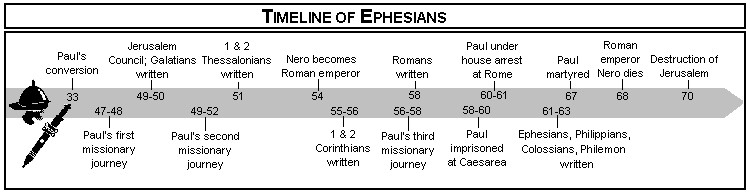
Ryrie Study Bible - NAS
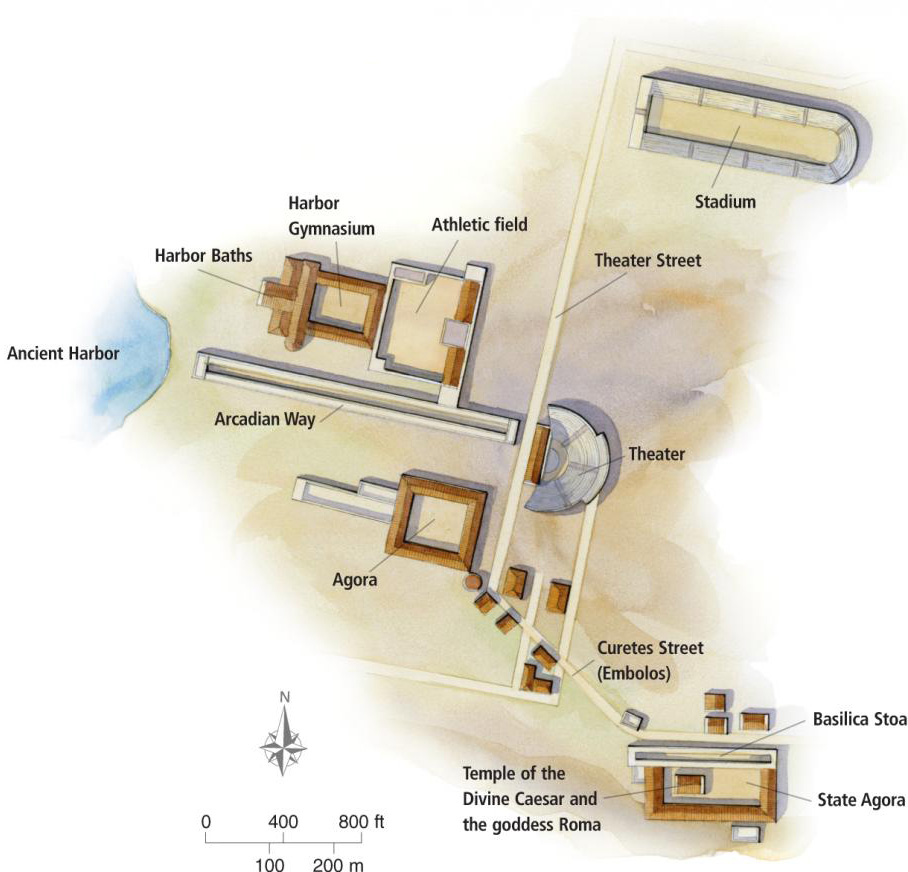
Ephesus in the Time of Paul (c. A.D. 60)
(Click to Enlarge)
Note: These Study Notes roughly correspond with the 10 Lessons of the Precept Upon Precept study of the Book of Ephesians (ESV format, NASB format). They are not meant to replace your personal study of the Word, which is the most important thing you can do if you want to get the Word of Ephesians in your heart and live it out in your walk. (Samples of Lesson 1 Pdf ESV, Lesson 1 Pdf NASB)
- Ephesians Study Questions Lesson 1 - Covers Introduction - Author & Recipients
- Ephesians Study Questions Lesson 2 - Covers Ephesians 1:1-14
- Ephesians Study Questions Lesson 3 - Covers Ephesians 1:15-2:10
- Ephesians Study Questions Lesson 4 - Covers Ephesians 2:11-22
- Ephesians Study Questions Lesson 5 - Covers Ephesians 3:1-21
- Ephesians Study Questions Lesson 6 - Covers Ephesians 4:1-6
- Ephesians Study Questions Lesson 7 - Covers Ephesians 4:7-16
Ephesians 2:11-12
Remember!
Ephesians 2:11 Therefore remember, that formerly you, the Gentiles in the flesh, who are called "Uncircumcision" by the so-called "Circumcision," which is performed in the flesh by human hands-- 2:12 remember that you were at that time separate from Christ, excluded from the commonwealth of Israel, and strangers to the covenants of promise, having no hope and without God in the world.
Ephesians 2:11 How does Paul begin this section?
Therefore - a term of conclusion which causes the careful observer of the Scriptures to asks "What leads up to this conclusion?" Although commentators debate the specifics, the immediate context would be Ephesians 2:1-10, describing the former dead spiritual state of the Gentiles and then God in mercy making them alive in Christ, all a work of grace.
Ephesians 2:11 Who is Paul addressing? What does Paul want his readers to do? Why?
Paul is speaking to Gentiles and charges them to remember (keep on continually remembering = present imperative) their former spiritually dead condition (in Adam and outside of Christ), God's salvation by grace through faith and God's giving them purpose in this life as His workmanship in Christ Jesus.
Remembering these things should create in believers an attitude of gratitude and of humility regarding what God has done for us.
As those who have been redeemed, we are prone to forget what God has accomplished for us (See Ephesians 1:3-14).
Ephesians 2:11 How were the Gentiles described?
Gentiles were described by Jews ("Circumcision", which is performed in the flesh by human hands" - to indicate that he is not referring to a "spiritual circumcision" of their heart by the Spirit) with the derogatory term "Uncircumcision".
Ephesians 2:11 What was the past relationship of the Gentiles to God?
1) Separate from Christ - Christ is the Greek word for Messiah
Comment: "Separated from Christ" does not refer to the fact that Gentiles were not saved (which they of course were not) but that they had no exposure to Christ as did the Jews throughout their history. Remember that the term Christ is synonymous with Messiah (John recording "He found first his own brother Simon, and said to him, "We have found the Messiah" which translated means Christ." John 1:41).
Paul's point is that the Jews had this Messianic hope and expectation, even though most did not receive Him. The Gentiles by contrast had no exposure to the Messianic prophecies and promises and thus had no expectation or hope of a Messiah to redeem them from their state of death and enslavement to Sin and Satan.
2) Excluded from the commonwealth of Israel -
3) Strangers to the covenants of promise -
4) Having no hope -
5) Without God in the world -
Have ever felt separate, excluded, without hope, without God?
(1) Abrahamic Covenant
Genesis 12:1-3
1 Now the LORD said to Abram, "Go forth from your country, And from your relatives And from your father's house, To the land which I will show you;
2 And I will make you a great nation, And I will bless you, And make your name great; And so you shall be a blessing;
3 And I will bless those who bless you, And the one who curses you I will curse. And in you all the families of the earth shall be blessed."
Genesis 12:1-3: What did God promise Abraham?
God promised to
· bless Abram
· make his name great
· bless those who blessed Abram
· curse those who cursed him
· in Abram all families of the earth would be blessed
Age 75 (Ge 12:4) (Sarai = 65).God told him He would make Abe a father of many nations.
Ge 15
Age 86 (Ge 16:16) Abe went into Hagar producing Ishmael,
Age 99 (Ge 17:1, 17:17) In Ge12:3 God preached the gospel to Abraham (Gal 3:8), and not only would the Jews find salvation but so would the Gentiles. The seed that God promised was in fact Jesus Christ, [Ga3:16]
Genesis 15:1-18
After these things the word of the LORD came to Abram in a vision, saying, "Do not fear, Abram, I am a shield to you; Your reward shall be very great." 2 And Abram said, "O Lord GOD, what wilt Thou give me, since I am childless, and the heir of my house is Eliezer of Damascus?" 3 And Abram said, "Since Thou hast given no offspring to me, one born in my house is my heir." 4 Then behold, the word of the LORD came to him, saying, "This man will not be your heir; but one who shall come forth from your own body, he shall be your heir." 5 And He took him outside and said, "Now look toward the heavens, and count the stars, if you are able to count them." And He said to him, "So shall your descendants be." 6 Then he believed in the LORD; and He reckoned it to him as righteousness. 7 And He said to him, "I am the LORD who brought you out of Ur of the Chaldeans, to give you this land to possess it." 8 And he said, "O Lord GOD, how may I know that I shall possess it?" 9 So He said to him, "Bring Me a three year old heifer, and a three year old female goat, and a three year old ram, and a turtledove, and a young pigeon." 10 Then he brought all these to Him and cut them in two, and laid each half opposite the other; but he did not cut the birds. 11 And the birds of prey came down upon the carcasses, and Abram drove them away. 12 Now when the sun was going down, a deep sleep fell upon Abram; and behold, terror and great darkness fell upon him. 13 And God said to Abram, "Know for certain that your descendants will be strangers in a land that is not theirs, where they will be enslaved and oppressed four hundred years. 14 "But I will also judge the nation whom they will serve; and afterward they will come out with many possessions. 15 "And as for you, you shall go to your fathers in peace; you shall be buried at a good old age. 16 "Then in the fourth generation they shall return here, for the iniquity of the Amorite is not yet complete." 17 And it came about when the sun had set, that it was very dark, and behold, there appeared a smoking oven and a flaming torch which passed between these pieces. 18 On that day the LORD made a covenant with Abram, saying, "To your descendants I have given this land, From the river of Egypt as far as the great river, the river Euphrates:
Genesis 15:1-18: What was "problem", God's promise and Abraham's response? What was God's response?
Abram was childless, but God promised a son from his own body.
He believed the Lord and was counted righteous.
Abraham was declared righteous or saved by faith not works.
On that day, the Lord made a covenant with him and his descendants to give them the land after they came from Egypt.
Galatians 3:5-9, 16
Does He then, who provides you with the Spirit and works miracles among you, do it by the works of the Law, or by hearing with faith? 6 Even so Abraham BELIEVED GOD, AND IT WAS RECKONED TO HIM AS RIGHTEOUSNESS. 7 Therefore, be sure that it is those who are of faith who are sons of Abraham. 8 And the Scripture, foreseeing that God would justify the Gentiles by faith, preached the gospel beforehand to Abraham, saying, "ALL THE NATIONS SHALL BE BLESSED IN YOU." 9 So then those who are of faith are blessed with Abraham, the believer....16 Now the promises were spoken to Abraham and to his seed. He does not say, "And to seeds," as referring to many, but rather to one, "And to your seed," that is, Christ.
Galatians 3:5-9, 16: What did Abraham believe according to Paul?
Abraham believed the Gospel (Gal 3:8)
He believed the promise regarding his seed, Christ (Gal 3:16)
Comment: And although we do not fully comprehend the specific facts Abraham was aware of concerning Messiah, we see that in Genesis 15:6 Abraham believed the good news and ultimately believed in the Seed that would could from his line. He was looking forward to the Cross in faith. Believers today look back to the Cross in faith. Salvation in both the Old and New Testaments has always been by faith alone, in Christ alone. Abram was childless, but God promised a son of faith from his own body. He believed the Lord and was counted righteous. Abraham was declared righteous or saved by faith not works
Genesis 17:1-14
1 Now when Abram was ninety-nine years old, the LORD appeared to Abram and said to him, "I am God Almighty; Walk before Me, and be blameless.
2 "And I will establish My covenant between Me and you, And I will multiply you exceedingly."
3 And Abram fell on his face, and God talked with him, saying,
4 "As for Me, behold, My covenant is with you, And you shall be the father of a multitude of nations.
5 "No longer shall your name be called Abram, But your name shall be Abraham; For I will make you the father of a multitude of nations.
6 "And I will make you exceedingly fruitful, and I will make nations of you, and kings shall come forth from you.
7 "And I will establish My covenant between Me and you and your descendants after you throughout their generations for an everlasting covenant, to be God to you and to your descendants after you.
8 "And I will give to you and to your descendants after you, the land of your sojournings, all the land of Canaan, for an everlasting possession; and I will be their God."
9 God said further to Abraham, "Now as for you, you shall keep My covenant, you and your descendants after you throughout their generations. 10 "This is My covenant, which you shall keep, between Me and you and your descendants after you: every male among you shall be circumcised. 11 And you shall be circumcised in the flesh of your foreskin; and it shall be the sign of the covenant between Me and you. 12 And every male among you who is eight days old shall be circumcised throughout your generations, a servant who is born in the house or who is bought with money from any foreigner, who is not of your descendants. 13 A servant who is born in your house or who is bought with your money shall surely be circumcised; thus shall My covenant be in your flesh for an everlasting covenant. 14 But an uncircumcised male who is not circumcised in the flesh of his foreskin, that person shall be cut off from his people; he has broken My covenant."
Genesis 17:1-14: What fact did God add about His covenant with Abraham? What did He instruct Abraham to do?
The Abrahamic Covenant is everlasting.
Instructed him to circumcise all male offspring = sign of the covenant
Genesis 17:7-8: What did God promise?
God promised that He would be their God, and they would be His people.
Circumcision was the sign of this “Abrahamic” Covenant. Circumcision was to serve as an outward sign of inward dedication to God. In itself, it was neither efficacious, nor unique to Israel. Circumcision thereby became the physical demonstration (sign) of the obedient faith of Abram and his descendants. The Jews perverted the meaning, making the sign in essence the "end". In other words they bypassed the need for internal circumcision of the heart by the Spirit and placed their faith in the externals. Not only that, but they became proud of their "covenant sign" and looked down on Gentiles using the derogatory term "Uncircumcision" to refer to them.
Constable has an interesting note
The references to the “covenant” in this chapter have caused some confusion. The Abrahamic Covenant (ch. 15) is in view (vv. 4, 7, 11, 19, 21) but also the outward sign of that covenant that was the covenant of circumcision (vv. 2, 9, 10, 13, 14). Thus Moses used the word “covenant” with two different references here. Whereas the Abrahamic Covenant was unconditional, the covenant of circumcision depended on Abram’s obedience (vv. 1–2).
Paul explained that Abraham...
"received the sign of circumcision, a seal of the righteousness of the faith which he had while uncircumcised, that he might be the father of all who believe without being circumcised, that righteousness might be reckoned to them" (Ro 4:11) (Comment: Believers have a "seal", the Holy Spirit.)
(2) The New Covenant
Jeremiah 31:31-34
"Behold, days are coming," declares the LORD, "when I will make a new covenant with the house of Israel and with the house of Judah, 32 not like the covenant which I made with their fathers in the day I took them by the hand to bring them out of the land of Egypt, My covenant which they broke, although I was a husband to them," declares the LORD. 33 "But this is the covenant which I will make with the house of Israel after those days," declares the LORD, "I will put My law within them, and on their heart I will write it; and I will be their God, and they shall be My people. 34 And they shall not teach again, each man his neighbor and each man his brother, saying, 'Know the LORD,' for they shall all know Me, from the least of them to the greatest of them," declares the LORD, "for I will forgive their iniquity, and their sin I will remember no more."
Jeremiah 31:31-34: What did God promise and to whom did He give the promise?
God offered the covenant to Israel and Judah
Promises included...
Putting His Law within
Be their God
Be His people
They shall all know Him
Forgive their iniquity
Remember their sin no more
Note: The New Covenant not given to the "Church" as is commonly misunderstood
Ezekiel 36:26-27
"Moreover, I will give you a new heart and put a new spirit within you; and I will remove the heart of stone from your flesh and give you a heart of flesh. 27 "And I will put My Spirit within you and cause you to walk in My statutes, and you will be careful to observe My ordinances.
Ezekiel 36:26-27: What promises does Ezekiel add regarding the New Covenant?
New heart and spirit
Remove heart of stone and give heart of flesh
Put the Spirit within - cause you to walk in My statutes (God's part) and you will be careful to observe My ordinances (Man's part)
NOTE: Although the name "New Covenant" is not found in Ezekiel's prophecy, but comparing Scripture with Scripture indicates this prophecy describes the new covenant.
Luke 22:14, 19-20
And when the hour had come He reclined at the table, and the apostles with Him...19 And when He had taken some bread and given thanks, He broke it, and gave it to them, saying, "This is My body which is given for you; do this in remembrance of Me." 20 And in the same way He took the cup after they had eaten, saying, "This cup which is poured out for you is the new covenant in My blood.
Luke 22:14, 19-20 How was the New Covenant fulfilled?
At the last supper, the Passover, the night before He was crucified, He symbolically inaugurated the New Covenant.
Jesus’ body was the offering which is the fulfillment of this New Covenant. His blood was the blood of this covenant.
NOTE: At the "Last Supper" (the Passover) Jesus shared with His disciples, He explained to them that what they were about to partake of was symbolic of His coming sacrifice on the Cross. When Jesus offered His body as the perfect sin offering, the New Covenant was inaugurated, His blood representing the blood of the New Covenant. Remembering that this covenant was initially offered to Jews in the OT and was inaugurated in the presence of Jesus' Jewish disciples, we begin to understand the import of the declaration that they Gentiles were "strangers to the covenants of promise."
(3) The Davidic Covenant
2 Samuel 7:12-13,16
"When your days are complete and you lie down with your fathers, I will raise up your descendant after you, who will come forth from you, and I will establish his kingdom (fulfilled first in Solomon but ultimately fulfilled in the Messiah as explained below). 13 He shall build a house for My name, and I will establish the throne of his kingdom forever... 16 And your house and your kingdom shall endure before Me forever; your throne shall be established forever."
2 Samuel 7:12-13,16: What did God promise King David?
God promised to establish David's throne and kingdom forever.
2 Chronicles 21:7
Yet the LORD was not willing to destroy the house of David because of the covenant which He had made with David, and since He had promised to give a lamp to him and his sons forever.
2 Chronicles 21:7: How do we know this was a covenant promise?
Scripture calls it a covenant.
Paul, a bond-servant of Christ Jesus, called as an apostle, set apart for the gospel of God, 2 which He promised beforehand through His prophets in the holy Scriptures, 3 concerning His Son, who was born of a descendant of David according to the flesh, 4 who was declared the Son of God with power by the resurrection from the dead, according to the Spirit of holiness, Jesus Christ our Lord, 5 through Whom we have received grace and apostleship to bring about the obedience of faith among all the Gentiles, for His name's sake (See notes Romans 1:1; 1:2; 1:3; 1:4; 1:5)
Romans 1:1; 1:2; 1:3; 1:4; 1:5 How does this passage help us understand the covenant promise to David?
The fulfillment of the Davidic Covenant which was promised "forever" would of necessity have to pass through the line of David, a lineage which Paul summarizes in the opening verses of Romans
on His robe and on His thigh He has a name written, "KING OF KINGS, AND LORD OF LORDS."
Revelation 19:16 What does this passage teach regarding the fulfillment of the Davidic Covenant?
Jesus Christ was in the line of David and it would be through Him that the covenant promises of an everlasting kingdom would be fulfilled. The apostle John elaborates on this fulfillment in the Revelation, explaining that when Jesus returns at the end of this age He returns as King of kings.
And I saw thrones, and they sat upon them, and judgment was given to them. And I saw the souls of those who had been beheaded because of the testimony of Jesus and because of the word of God, and those who had not worshiped the beast or his image, and had not received the mark upon their forehead and upon their hand; and they came to life and reigned with Christ for a thousand years
Revelation 20:4 What does this passage teach about the fulfillment of the Davidic Covenant?
The King of kings begins His reign on earth for 1000 years (Millennium, Part 2, Part 3) after His defeat of the Antichrist.
Ephesians 2:13 But now in Christ Jesus you who formerly were far off have been brought near by the blood of Christ.
14 For He Himself is our peace, who made both groups into one, and broke down the barrier of the dividing wall,
15 by abolishing in His flesh the enmity, which is the Law of commandments contained in ordinances, that in Himself He might make the two into one new man, thus establishing peace,
16 and might reconcile them both in one body to God through the cross, by it having put to death the enmity.
17 AND HE CAME AND PREACHED PEACE TO YOU WHO WERE FAR AWAY, AND PEACE TO THOSE WHO WERE NEAR;
18 for through Him we both have our access in one Spirit to the Father.
Ephesians 2:13 How does Paul introduce this section? Who was "formerly far off"? How were they "far off"?
But now - a dramatic contrast (see note) or "turn-around" compared to the aforementioned Christ-less, country-less, covenant-less, hope-less and God-less condition they had experienced as unbelieving Gentiles = those who were "formerly far off" from Israel's privileges of which Paul had just enumerated five.
Compare this introduction with the dramatic reversal introduced by "but God" in (Ephesians 2:4), where the Gentiles went from those dead in sin to those alive in Christ.
Why does Paul repeatedly use "formerly"? What is he emphasizing?
Clearly he does not want them to forget where they've come from, and certainly he does not want them walk in the manner they did formerly ,but motivated by gratitude regarding their privileged position in Christ to walk worthy of their calling.
Note: "Formerly" is a key word (note) in Ephesians 2, used 4 times (2:2, 2:3, 2:11, 2:13. It is used once more in Eph 5:8). Observe the fifth synonymous phrase "at that time" in Ephesians 2:12.
Ephesians 2:13 Where are the Gentiles now? What is their position?
In Christ Jesus = speaks of their inseparable union with Christ.
Note: Remember positional truth is the foundation for the practical walk Paul calls for in the last 3 chapters.
Ephesians 2:13 How did this miraculous change transpire?
They had been brought near by the blood of Christ (the Cross). The power which has changed farness into nearness, resides in the blood of Christ.
Ephesians 2:14 How does Paul explain the Gentiles "brought near by the blood of Christ"? How does this truth parallel Isaiah 9:6?
Christ Himself is our peace.
Jesus as the Prince of Peace (Isaiah 9:6) brought the believing Gentiles near to God and to the believing Jews.
Note: Messiah's title "Prince of peace" indicates He is the very first leader Who will bring true peace to the world. He is the One Who brings peace in the fullest sense of wholeness, prosperity, and tranquillity. As Paul explains individuals can now know His peace, and one day the world will experience it as well.
Peace (1515)(eirene from verb eiro = to join or bind together that which has been separated) literally pictures the binding or joining together again of that which had been separated or divided and thus setting at one again.
A REAL LIFE ILLUSTRATION OF "PEACE" - Jim Walton was translating the NT for the Muinane people of La Sabana in the jungles of Colombia. But he was having trouble with the word peace. During this time, Fernando, the village chief, was promised a 20-minute plane ride to a location that would have taken him 3 days to travel by walking. The plane was delayed in arriving at La Sabana, so Fernando departed on foot. When the plane finally came, a runner took off to bring Fernando back. But by the time he had returned, the plane had left. Fernando was livid because of the mix-up. He went to Jim and launched into an angry tirade. Fortunately, Walton had taped the chief's diatribe. When he later translated it, he discovered that the chief kept repeating the phrase, "I don't have one heart." Jim asked other villagers what having "one heart" meant, and he found that it was like saying, "There is nothing between you and the other person." That, Walton realized, was just what he needed to translate the word peace. To have peace with God means that there is nothing--no sin, no guilt, no condemnation--that separates us. And that peace with God is possible only through Christ (see note Romans 5:1). Do you have "one heart" with God today?
Ephesians 2:14 What did the One Who is Himself peace accomplish?
1) Made both (Jew & Gentile) one
2) Broke down the barrier of the dividing wall (Click discussion of the barrier of the dividing wall)
Ephesians 2:15 How did He break the barrier?
Abolished in His flesh the enmity (between Jew & Gentile)
Note: Abolished (2673) (katargeo) literally means to reduce to inactivity. The idea is to make the force of something ineffective and so to render it powerless or to reduce it to inactivity. Here the Law and ordinances were fulfilled in Christ and thus they were no longer needed to carry out the function they had carried out before Christ came. The Law was a tutor to lead us to Christ. The ordinances which includes special days like the Sabbath were fulfilled in Christ.
Enmity (2189) (echthra from echthros = speaks of an enemy in an active sense, of one who is hostile to another) means antagonistic, expressing enmity (this word suggests positive hatred which may be open or concealed), expressing deep-rooted hatred or irreconcilable hostility (this word suggests an enmity showing itself in attacks or aggression) or expressing antagonism (actively expressed opposition or hostility). In its essence echthra is the opposite of love. It describes being the enemy of another and is used in Ephesians 2:11-22 twice, first to describe the antagonism and hostility between Jew and Gentile (Ephesians 2:15) and secondly to describe the hostility of unsaved sinners toward God (Ephesians 2:16). The sinner is a rebel against God and in active hostility to Him. If any proof were needed, it is seen most clearly in the crucifixion of the Lord Jesus Christ, the very act which opened the door for reconciliation!
Ephesians 2:15 What was the source of this enmity according to this verse?
The Law of commandments in ordinances - they resulted in enmity between Jew and Gentile. The Law had been given to be a light to expose evil and a guard to restrain evil. The Law can never change the heart but it did serve as a tutor to lead men to Christ, Who in the new covenant in His blood, gives sinners a new heart.
In abolishing this enmity, Christ nullified or made ineffective the commandments and ordinances, one purpose of which had been to create a moral or ethical separation between Israel and all the other nations of the world. The purpose was not to exclude the Gentiles forever, but that by this very separation, the Gentiles would see the moral/ethical advantages of Israel and would be attracted to them and ultimately to God.
Now let's look at some background for why enmity existed between Jew and Gentile.
LEVITICUS 20:22-26
Leviticus 20:22'You are therefore to keep all My statutes and all My ordinances (the Mosaic or Old Covenant) and do them, so that the land to which I am bringing you to live will not spew you out (Note that the sins of the people can defile the land). 23 'Moreover, you shall not follow the customs of the (Gentile) nation which I shall drive out before you (i.e., the land was spewing the Canaanites out because of the vile actions), for they did all these things, and therefore I have abhorred them. 24 'Hence I have said to you, "You are to possess their land, and I Myself will give it to you to possess it, a land flowing with milk and honey." I am the LORD your God, Who has separated you from the peoples ("Gentiles"). 25 'You are therefore (term of conclusion) to make a distinction between the clean animal and the unclean, and between the unclean bird and the clean; and you shall not make yourselves detestable by animal or by bird or by anything that creeps on the ground, which I have separated for you as unclean. 26 'Thus you are to be holy (set apart from profane and unto God) to Me, for I the LORD am holy; and I have set you apart from the peoples to be Mine. (Comment: As God's chosen and separated people, Israel was obligated to make a difference between the clean and the unclean and not to live like the pagans around them. An excellent cross reference expressing the purpose and privilege of the nation of Israel is found in Deut 26:18-19 "And the LORD has today declared you to be His people, a treasured possession, as He promised you, and that you should keep all His commandments; and that He shall set you high above all nations which He has made, for praise, fame, and honor; and that you shall be a consecrated people to the LORD your God, as He has spoken." )
Leviticus 20:22-26: What do these OT passages teach about God's purpose for the ordinances? What truth does God emphasize regarding His people?
These passages reiterate God's desire for His possession to be separated, set apart and holy. One purpose of "the Law of commandments contained in ordinances" was to separate Israel from the Gentiles so that Israel might be holy as God was holy. God did not desire to shut out the Gentiles from eternal life, but to use Israel's separateness, distinctiveness, and holiness (especially in the moral/ethical realm) to attract and draw the Gentiles to the true and living God. The problem was Israel became smug and began to focus on the externals (external circumcision rather than internal heart circumcision, possession of the Law rather than obedience to it from the heart, and excessive attention to clean and unclean foods rather than to the ethical conduct God desired). And so Israel failed (for the most part) to be a light to the Gentiles and instead created "religious" barriers rather than righteous bridges that the Gentiles might walk across!
COLOSSIANS 2:16-17
Colossians 2:16 Therefore let no one act as your judge in regard to food or drink or in respect to a festival or a new moon or a Sabbath day--2:17 things which are a mere shadow of what is to come; but the substance belongs to Christ.
Colossians 2:16-2:17 What had Israel done with the ordinances such as ones that addressed special days like the Sabbath, etc?
Israel had turned ordinances that God had meant to only be "shadows" into the the "substance". Israel forgot that things like the Sabbath (rest) pointed to the perfect rest in Jesus Christ, Who was the fulfillment of all the shadows in the festivals, new moon, Sabbath, etc. These ordinances became the means by which Israel felt morally superior to the Gentiles and this created enmity between Jews and Gentiles. (See notes Colossians 2:16, 2:17) Israel did the same thing with ordinances in the Law that had to do with "clean" and "unclean" things.
ACTS 11:1-15
Acts 11:1 Now the apostles and the brethren who were throughout Judea heard that the Gentiles also had received the word of God. 2 And when Peter came up to Jerusalem, those who were circumcised took issue with him, 3 saying, "You went to uncircumcised men and ate with them."
4 But Peter began speaking and proceeded to explain to them in orderly sequence, saying, 5 "I was in the city of Joppa praying; and in a trance I saw a vision, a certain object coming down like a great sheet lowered by four corners from the sky; and it came right down to me, 6 and when I had fixed my gaze upon it and was observing it I saw the four-footed animals of the earth and the wild beasts and the crawling creatures and the birds of the air. 7 And I also heard a voice saying to me, 'Arise, Peter; kill and eat.' 8 But I said, 'By no means, Lord, for nothing unholy or unclean has ever entered my mouth.' 9 But a voice from heaven answered a second time, 'What God has cleansed, no longer consider unholy.' 10 "And this happened three times, and everything was drawn back up into the sky. 11 And behold, at that moment three men appeared before the house in which we were staying, having been sent to me from Caesarea. 12 And the Spirit told me to go with them without misgivings. And these six brethren also went with me, and we entered the man's house. 13 And he reported to us how he had seen the angel standing in his house, and saying, 'Send to Joppa, and have Simon, who is also called Peter, brought here; 14 and he shall speak words to you by which you will be saved, you and all your household.'
15 And as I began to speak, the Holy Spirit fell upon them, just as He did upon us at the beginning. 16 And I remembered the word of the Lord, how He used to say, 'John baptized with water, but you shall be baptized with the Holy Spirit.' 17 If God therefore gave to them the same gift as He gave to us also after believing in the Lord Jesus Christ, who was I that I could stand in God's way? 18 And when they heard this, they quieted down, and glorified God, saying, "Well then, God has granted to the Gentiles also the repentance that leads to life."
Acts 11:1-18 What problem were the Jewish leaders addressing and how did their solution support Paul's statement that Christ abolished the enmity between them in His flesh?
The problem was that circumcised believers (Jewish) were eating with uncircumcised men (Gentiles). Peter related his vision in which God told him it was okay to eat "unclean" foods. He explained how the Gentiles had received salvation (this occurred about 8 years after the events of Pentecost when the Spirit fell on the Jews in Jerusalem and they spoke in tongues) and the gift of the Spirit in the same manner as had the Jews at Pentecost some 8 years earlier. Upon hearing Peter's testimony, the Jewish leaders "quieted down, and glorified God, saying, "Well then, God has granted to the Gentiles also the repentance that leads to life." (Acts 11:18) Their "enmity" abated because of clear evidence that the Gentiles were also saved.
Ephesians 2:15 What new entity resulted from Christ's death, abolishing in His flesh the enmity?
1) Jew and Gentile became one new (see note below) man
2) Established peace (between believing Jew and Gentile - now one in Christ, our Peace)
Note: New (2537) (kainos) refers to that which is new kind (unprecedented, novel, uncommon, unheard of). Kainos signifies qualitatively new in contrast to néos which indicates temporally new or new with respect to age. Neos is new simply in point of time; a thing which is neos has come into existence recently, but there may well have been thousands of the same thing in existence before. A pencil produced in the factory this week is neos, but there already exist millions exactly like it. Kainos on the other hand is new in point of quality, new in sense that it brings into the world a new quality of thing which did not exist before.
Ephesians 2:16 What did the Cross accomplish for both Jew and Gentile in their relationship to God?
They were reconciled in one body to God
The enmity (between man and God) was put to death -
Note: Reconcile (apokatallasso) from apó = from or state to be left behind + katallasso = reconcile <> from katá = an intensifier + allásso = change <>) is an intensified reconciliation (stronger than katallasso) and pictures the total, complete, and full restoration of the relationship of disturbed peace. The Greeks spoke of people in opposition to each other being “reconciled” or being made friends again. When people change from being at enmity with each other to being at peace, they are said to be reconciled. Reconciliation takes someone who is hostile towards someone else, and changes that into a friendly relationship. This word means to change thoroughly. The double use of prepositions as prefixes (apo, kata) emphasizes the totality of the reconciliation.
Enmity here is same word echthros as in (Ephesians 2:16) - Click for discussion of echthros
ROMANS 5:6-10
Romans 5:6 (see notes) For while we were still helpless, at the right time Christ died for the ungodly. 5:7 For one will hardly die for a righteous man; though perhaps for the good man someone would dare even to die. 5:8 But God demonstrates His own love toward us, in that while we were yet sinners, Christ died for us. 5:9 Much more then, having now been justified by His blood, we shall be saved from the wrath of God through Him. 5:10 For if while we were enemies, we were reconciled to God through the death of His Son, much more, having been reconciled, we shall be saved by His life.
Romans 5:6, 5:7, 5:8, 5:9 , 5:10 Why did Jews and Gentiles need to be reconciled to God? When and how did this reconciliation occur?
We were helpless, ungodly (5:6), sinners (5:8) and enemies (5:10).
God reconciled us to Himself when we were His enemies (echthros = from échthos = enmity, the same word used by Paul in Ephesians 2:15-16)
We reconciled through the death of God's Son (cf "through the cross by it having put to death the enmity")
Note: Reconciliation produces restoration of a relationship of peace which has been disturbed. Where was it first disturbed? In the garden of Eden (See Genesis 3:15 where God said to Satan "And I will put enmity Between you and the woman, and between your seed and her seed...") Sinful man is reconciled in that his attitude of enmity toward God is changed to one of friendship. To reconcile is to take someone who is hostile towards someone else and change that attitude into a friendly relationship. Unsaved ungodly man is an enemy of God and is hostile toward Him. But God took the initiative in this estranged relationship and sent Jesus to be our Mediator Who based on our faith in His sacrificial death and resurrection life brings us into a friendly relationship with God. This great truth is worth pondering and then praising and then proclaiming to all who have ears to hear!
COLOSSIANS 1:18-23
Colossians 1:18 (see notes) He is also head of the body, the church; and He is the beginning, the first-born from the dead; so that He Himself might come to have first place in everything. 19 For it was the Father's good pleasure for all the fulness to dwell in Him, 20 and through Him to reconcile all things to Himself, having made peace through the blood of His cross; through Him, I say, whether things on earth or things in heaven. 21 And although you were formerly alienated and hostile in mind, engaged in evil deeds, 22 yet He has now reconciled you in His fleshly body through death, in order to present you before Him holy and blameless and beyond reproach-- 23 if indeed you continue in the faith firmly established and steadfast, and not moved away from the hope of the gospel that you have heard, which was proclaimed in all creation under heaven, and of which I, Paul, was made a minister.
Colossians 1:20, 22: What does Paul state is the remedy for alienation from God? Why does he say men needed reconciliation? What is God's purpose in reconciling sinners?
Through Christ, the blood of His cross ("in His fleshly body through death" v21), all things will be reconciled
Mankind need reconciliation to God because we "were formerly alienated and hostile in mind, engaged in evil deeds"
God's ultimate purpose for reconciliation of alienated, hostile men and women is that He might present us "before (directly in front of) Him
(1) holy (compare notes on Ephesians 1:4) and
(2) blameless (without blemish, fault or spot - used of Jesus in 1 Peter 1:19 -note) and
(3) beyond reproach (anegkletos - word study = having no blot on one's life for which one could be accused, arraigned, and disqualified)" (Col 1:21 - note)
Note: Christ's death on the cross not only paid the price for man's redemption. but also for that of the whole universe. Because of sin. the creation is under the great curse, as it "groans and suffers the pains of childbirth together" (see note Romans 8:22) so it also must be reconciled to God. Note the past. present and future aspects of the work of Christ with respect to the entire universe. First by Him all things were created as a completed work of the past (Genesis 2:1-3). Secondly, He is now upholding all things which He created (see notes Colossians 1:17; Hebrews 1:3). Finally, He will reconcile everything back to God. Creation. conservation, consummation is the cosmic scope of the work of Christ!
2CORINTHIANS 5:17-21
2Cor 5:17 Therefore if any man is in Christ, he is a new creature; the old things passed away; behold, new things have come. 18 Now all these things are from God, Who reconciled us to Himself through Christ, and gave us the ministry of reconciliation, 19 namely, that God was in Christ reconciling the world to Himself, not counting their trespasses against them, and He has committed to us the word of reconciliation. 20 Therefore, we are ambassadors for Christ, as though God were entreating through us; we beg you on behalf of Christ, be reconciled to God. 21 He made Him who knew no sin to be sin on our behalf, that we might become the righteousness of God in Him.
2Cor 5:17-21 Who reconciled us? How? Why?
God reconciled us to Himself
We were reconciled through Christ - God was in Christ reconciling the world to Himself
God then gave the "reconcilees" a ministry of reconciliation
2Cor 5:17-21 How does Paul explain the believer's ministry of reconciliation?
God committed to us the "word of reconciliation"
We are now ambassadors for Christ (as if God entreats through us)
We beg others on behalf of Christ to be reconciled to God (parallels Ephesians 2:17 where Christ "came and preached peace to" Jews and Gentiles... He preaches through those He has reconciled!)
NOTE: Reconciliation has reference to a change in relationship from hostility to love, acceptance, and friendship. The Cross of Christ accomplished two things (among many other things): (1) The cross propitiated or satisfied the wrath of God and made possible the reconciliation of man to God. The marvelous truth is that God has already reconciled sinners to Himself by virtue of the sacrifice of His Son. The problem now is that sinners are not yet reconciled to Him. (2) He has committed to us "the ministry of reconciliation" and "the word of reconciliation" (2 Corinthians 5:18,19), as His ambassadors, to beseech men to accept His Son and His great work of salvation. This is "the Great Commission." When a sinner responds in repentance and faith in the Lord Jesus, he is reconciled to God and his basic relationship is changed from that of an enemy of God to that of a friend of God.
Ephesians 2:17 What did the Christ do for both groups? How?
Preached peace to those far away (Gentile) and preached peace to those near (Jew)
As alluded to above, Christ preached through His "ambassadors" who spoke forth "the word of reconciliation".
Ephesians 2:18 How does Paul explain the nearness both Jew and Gentile can now experience?
Through Jesus both now have access in one Spirit to the Father. (Note the "Trinity" here and in Ephesians 2:22)
NOTE: The word access is worth studying as its background helps understand what Paul is saying in this verse. Access (4318) (prosagoge from pros = toward + ago = bring) literally means "a bringing near" or providing access (freedom, permission and/or the ability to enter) and approach in this case to one we could never approach in our mortal unredeemed flesh. In the secular use a "status factor" is implied as in the statement "access to Cyrus for an audience". Prosagoge is used only three times in the New Testament, in each case referring to the believer’s access to God (see also Romans 5:2; Ephesians 3:12).
Prosagoge was the word used for the right granted someone to enter into the King's presence. You couldn't just waltz into a king's presence. To do so would invite death. Prosagoge pictures provision of access into the presence of One Whom we would normally be restricted from approaching. In the Orient, one who came to see a king needed both access—the right to come and an introduction—the proper presentation. The story of Esther in the Old Testament contains a beautiful illustration of this idea. Esther desires to plead with King Ahasuerus for the safety of her Jewish countrymen. But she knows what can happen if she goes into his presence without an introduction (Esther 4:11). Esther risked her life by doing this, not knowing beforehand whether Ahasuerus would grant her an "introduction." Fortunately for her, he granted her grace.
Prosagoge carries the idea not of possessing access in our own right but of being granted the right to come to God with boldness, knowing we will be welcomed. It is only through our Savior’s shedding of His blood in sacrificial death on Calvary and by faith in Him that we have union in His Holy Spirit and have access to the Father. The Spirit is at work to draw us continually to God (Rom. 8:15-17; Gal. 4:6-7). Both and one spirit emphasize again the commonality of Jew and Gentile.
Prosagoge pictures fellowship and communion (see communion, fellowship) eternally available to redeemed rebels! The French word for this is entree meaning freedom of entry or access. And that is exactly what our Lord Jesus provided for a believing Gentiles (and Jews), who were formerly Christ-less, country-less, covenant-less, hope-less and God-less. Christ clothes him with Himself as his righteousness, cleanses him in His precious blood, and brings him into the full unmerited favor (grace) of God the Father. This is a every saved sinner's eternal entree in Christ!
(see note)
Ephesians 2:19 So then you are no longer strangers and aliens, but you are fellow citizens with the saints, and are of God's household,
20 having been built upon the foundation of the apostles and prophets, Christ Jesus Himself being the corner stone,
21 in Whom the whole building, being fitted together is growing into a holy temple in the Lord;
22 in Whom you also are being built together (present tense) into a dwelling of God in the Spirit.
Ephesians 2:19 How does Paul begin this next section? What is the before/after picture?
So then - a term of conclusion - Paul had begun Eph 2:1-3 and Eph 2:11-12 by reminding the Gentiles of their spiritually dead state of separation from God, he now sums up their new relationship to God in figurative language (metaphors)...the first metaphor speaks of a "country" (kingdom of God) and the second of a house, a household or a family (family of God).
As an added exercise - how does the new truth about Gentile believers in this verse compare with the things that were formerly true of them in Ephesians 2:12 (Christ-less, country-less, covenant-less, hope-less and God-less)?
|
GENTILE |
|
|
BEFORE |
AFTER |
|
Strangers |
Fellow citizens with saints (Jewish) |
Ephesians 2:20 How is God's house composed? What is the practical significance of this foundation? What was the most important part of the building?
The foundation includes the apostles and the prophets - What foundation? This has to refer to the divine revelation which they taught and which they recorded for all future saints to be nourished by so that they might grow in grace and knowledge of our Lord and Savior Jesus Christ (see note 2 Peter 3:18)
Jesus comprises the most important aspect of the building -- the Corner Stone, a beautiful metaphor.
NOTE: The corner stone of a building had to be strong enough to support what was built on it, and it had to be precisely laid, because every other part of the structure was oriented to it. The cornerstone was the support, the stone that oriented all other stone, and the unifier of the entire building. It follows, that this is what Jesus Christ is to God’s building, the new man, the body of Christ, the Church.
Ephesians 2:20 Who is Paul referring to when he says "prophets"? Old Testament prophets or New Testament prophets?
First note that they are listed after "apostles" suggesting a chronological relationship. Also comparing Scripture with Scripture, later in this letter Paul notes that Jesus gave to the church "apostles and some as prophets" (See notes on Ephesians 3:5 and Ephesians 4:11) indicating that the reference in verse 20 is to New Testament prophets not Old Testament prophets.
Ephesians 2:21 What metaphor does Paul add to "God's household"?
A holy Temple
NOTE: The Greek word for Temple is naos not hieron, latter depicting the entire temple complex whereas naos describes the inner sanctuary, the most holy place, the place of most intimate communion with God)
Ephesians 2:21, 2:22 What is happening to the building?
First note that "having been built" is in the aorist tense which depicts a past completed action. All of the succeeding three verbs are in the present tense. indicating that they are "works in progress".
Bring fitted together (continually)
Growing (continually) into a holy temple of the Lord
Being built together (continually) into a dwelling of God in the Spirit
Summary of this section: Through the blood, the suffering flesh, the cross, and the death of the Lord Jesus Christ, aliens become citizens, strangers become family, idolaters become the temple of the true God, the hopeless inherit the promises of God, those without Christ become one in Christ, those far off are brought near, and the godless are reconciled to God. Therein is the reconciliation of men to God and of men to men. Hallelujah!
OT PROPHECIES
Psalms 118:22 The stone which the builders rejected Has become the chief corner stone. (Comment: The question is whether the cornerstone of Scripture is a foundation stone or a stone which crowns the building. Isaiah 28:16 seems to refer to the former and Ps 118:22 [rosh pinnah - rosh means head, top, uppermost height of an object] to the latter. It is somewhat ironic that verses from Psalm 118 were sung by the Jewish multitude as Jesus entered Jerusalem on a donkey on "Psalm Sunday", see Mt 21:9! This psalm clearly predicts the "Jewish builders" rejection of their "Stone", the Messiah, this rejection culminating in their cries "Crucify Him! Crucify Him!" Luke 23:21)
Isaiah 8:13 "It is the LORD of hosts Whom you should regard as holy. And He shall be your fear, and He shall be your dread. 14 "Then He shall become a sanctuary; But to both the houses of Israel, a stone to strike and a rock to stumble over (Paul wrote "we preach Christ crucified, to Jews a stumbling block [skandalon - see note] " 1Cor 1:23), and a snare and a trap for the inhabitants of Jerusalem.
Isaiah 28:16 Therefore thus says the Lord GOD, "Behold, I am laying in Zion a stone, a tested stone, A costly cornerstone (pinnah) for the foundation, firmly placed. He who believes (aman - basic root idea is firmness or certainty. Faith is not a blind leap into the dark but a confident commitment to the One about Whom abundant evidence bears ample testimony of His eternal, immutable trustworthiness) in it will not be disturbed (agitated, LXX = kataischuno = caused to be much ashamed, disgraced, dishonored, also conveys the sense of disappointed).
What do the the OT prophecies state regarding the Corner Stone?
Psalm 118:22 prophesied He would be rejected by the builders (Israel) but would still be the chief corner stone of the building.
Isaiah 8:13-15 prophesied that the stone would be to some (believing remnant) a Sanctuary, a set apart place (Person) -- a place and a Person they could worship.
On the other hand, those who rejected the Stone and refused to believe in Him would find Him to be a Stone that cause men to stumble, a Rock that makes them fall, a Snare and a Trap.
Is Jesus a "Sanctuary" of rest or a "Stone" of stumbling for you?
Will you stumble over Him into a Christ-less eternity?
Isaiah 28:16 God ordains His Son to be a stone, a tested stone, a costly cornerstone for the foundation, firmly placed. He who believes in it will not be disturbed (Lxx = disappointed).
NOTE: Ancient cornerstones were not the same as modern western ones. They were the largest and most determinative stone in the foundation of a building. Builders oriented the rest of the foundation in reference to this stone, and it supported the major portion of the superstructure.
OT PROPHECIES and NT FULFILLMENTS
Jesus after telling the Jewish chief priests and elders of the Jewish people the parable of the Vineyard, then quoted from Psalm 118:22-23 explaining that the Stone rejected by the Jewish builders was chosen of God as the Head of the corner. Matthew records our Lord's words...
Jesus said to them, "Did you never read in the Scriptures, 'THE STONE WHICH THE BUILDERS REJECTED (speaks of His rejection by the Jews and His crucifixion fulfilling the OT prophecy), THIS BECAME THE CHIEF CORNER stone (anticipates His resurrection and exaltation); THIS CAME ABOUT FROM THE LORD, AND IT IS MARVELOUS IN OUR EYES'? (Matthew 21:42 quoting Psalm 118:22-23) 43 Therefore I say to you, the kingdom of God will be taken away from you (Jews), and be given to a nation (Gentiles) producing the fruit of it. 44 And he who falls on this stone (Christ) will be broken to pieces; but on whomever it falls, it will scatter him like dust." (Comment: In the context of the preceding parable Jesus' quotation might seem irrelevant at first glance. However if one remembers that it is taken from a Messianic psalm, it becomes clear that Jesus cited it to suggest to the Jewish chief priests and elders that the Son who was killed and thrown out of the vineyard was also “the chief cornerstone” in God’s redemptive plan! It is also interesting to ponder that although in modern parlance the CORNERSTONE is placed at the foundation of a building, in ancient Israel the CAPSTONE was placed at the very top - a true ''HEAD'' STONE. Jesus is the STONE that serves as both the alignment and the completion of our lives, the Author and Perfecter, the Beginning and the End, the Alpha and the Omega!)
Paul in explaining God's sovereign plan for salvation of the Jews and Gentiles (in Romans 9-11) quotes in part from Isaiah 8:13-14 and Isaiah 28:16 writing...
What shall we say then? That Gentiles, who did not pursue righteousness, attained righteousness, even the righteousness which is by faith; 31 but Israel, pursuing a law of righteousness, did not arrive at that law. 32 Why? Because they did not pursue it by faith, but as though it were by works. They stumbled over the stumbling stone, 33 just as it is written, "BEHOLD, I LAY IN ZION A STONE OF STUMBLING AND A ROCK OF OFFENSE, AND HE WHO BELIEVES IN HIM WILL NOT BE DISAPPOINTED." (See notes Romans 9:30; 9:31; 9:32; 9:33) (Comment: Israel's rejection of their Messiah resulted in God setting Israel aside for a time and turning to the Gentiles.)
Peter filled with (controlled by) the Holy Spirit when asked by the Jewish priests, rulers and elders by what power or in what name was he preaching unabashedly, boldly declared...
"He (Christ the Messiah) is the STONE WHICH WAS REJECTED by you (the Jewish priests and leader), THE BUILDERS, but WHICH BECAME THE VERY CORNER stone. And there is salvation in no one else (absolute negation); for there is no other Name under heaven that has been given among men, by which we must be saved." (Acts 4:11,12)
Peter reiterated this important truth about Christ Jesus the Corner Stone in his first epistle explaining to his readers...
1 Peter 2:4 And coming to Him (Christ) as to a Living Stone, rejected by men, but choice and precious in the sight of God,
2:5 you also, as living stones, are being built up as a spiritual house for a holy priesthood, to offer up spiritual sacrifices acceptable to God through Jesus Christ.
2:6 For this is contained in Scripture: "BEHOLD I LAY IN ZION A CHOICE STONE, A PRECIOUS CORNER stone, AND HE WHO BELIEVES IN HIM SHALL NOT BE DISAPPOINTED." (quoting Isaiah 28:16)
2:7 This precious value, then, is for you who believe. But for those who disbelieve, "THE STONE WHICH THE BUILDERS REJECTED, THIS BECAME THE VERY CORNER stone,"
2:8 and, "A STONE OF STUMBLING AND A ROCK OF OFFENSE"; for they stumble because they are disobedient to the word, and to this doom they were also appointed.
2:9 But you are A CHOSEN RACE, A royal PRIESTHOOD, A HOLY NATION, A PEOPLE FOR God's OWN POSSESSION (KJV = "a peculiar people" = a people for possession), that you may proclaim the excellencies of Him who has called you out of darkness into His marvelous light;
2:10 for you once were NOT A PEOPLE (In Hosea it is Israel who is not God's people; in Romans 9:25; 9:26 it is the Gentiles to whom Paul applies Hosea's words. Thus in 1 Peter the words could apply to both Jews before they met their Messiah & pagan Gentiles before the sanctifying work of the Holy Spirit), but now you are THE PEOPLE OF GOD; you had NOT RECEIVED MERCY, but now you have RECEIVED MERCY.
1 Peter 2:5 How does Peter's description of believers help explain the fact that the building is (continually) growing in Ephesians 2:21?
Believers are "living stones being built up as a spiritual house for a holy priesthood, to offer up spiritual sacrifices acceptable to God through Jesus Christ"
NOTE: Christ’s Body will not be complete until every person who will believe in Him has done so. Every new believer is a new stone in Christ’s building, His holy temple. Thus Paul says the temple is growing because believers are continually being added.
What does Peter emphasize about Jesus the "precious Corner Stone"?
Those who believe in Him shall not be disappointed
What about those who disbelieve or refuse to believe in Jesus?
He becomes a Stone of stumbling and a Rock of offense
1 Peter 2:10 What was the former state of Peter's readers?
Once not a people but now the people of God
Once we had not received mercy, but now we have received mercy (cf, "But God, being rich in mercy, because of His great love with which He loved us" see notes Ephesians 2:4)
1 Peter 2:9 What is our present status in Christ?
Chosen race
Royal priesthood
Holy nation
People for God’s possession
Called out of darkness into His marvelous light
1 Peter 2:9 What work which God prepared beforehand in Christ Jesus are we to work out in our daily walk?
Proclaim the excellencies of Him Who called us out of darkness into His marvelous light
What are some of His excellencies from Ephesians 1 and 2?
As Paul has beautifully expressed, everything changes when Christ comes into a life. In Ephesians 1, he emphasized the spiritual blessings that are our present reality because of our position in Christ. In Ephesians 2, he has given these incredible spiritual blessing as added emphasis by contrasting them with what we were like before. Every believer must make certain not to forget the awesome changes which Jesus has wrought in our life.
How is your memory regarding the glorious truths
in these first two great contrasting chapters?