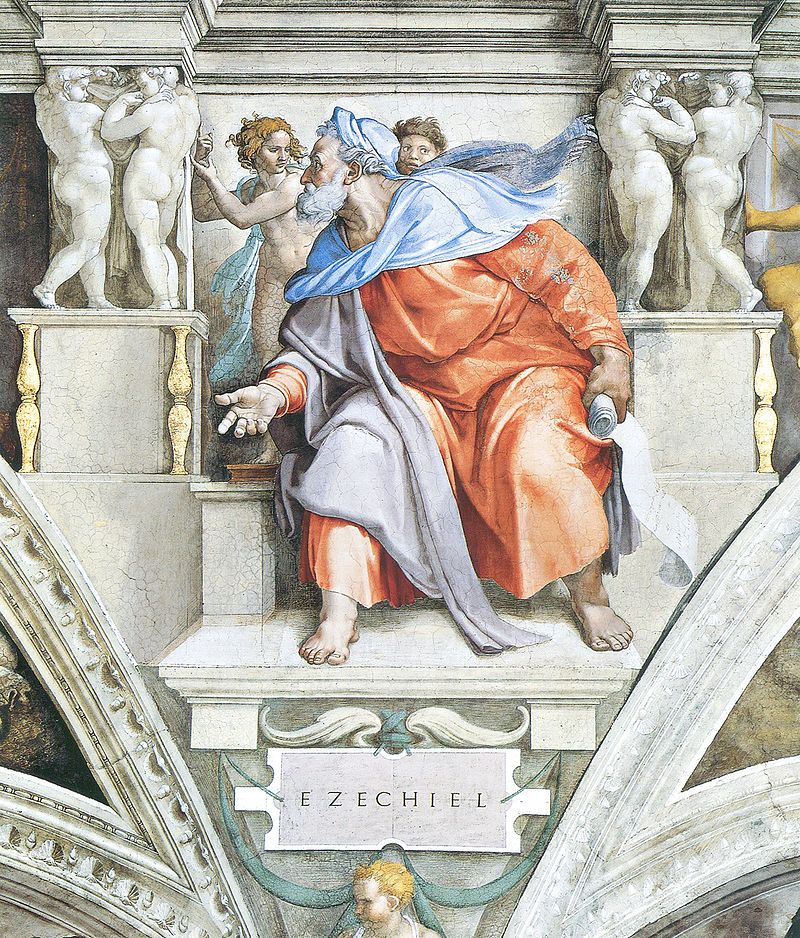
Michelangelo's Ezekiel on the Sistine Chapel
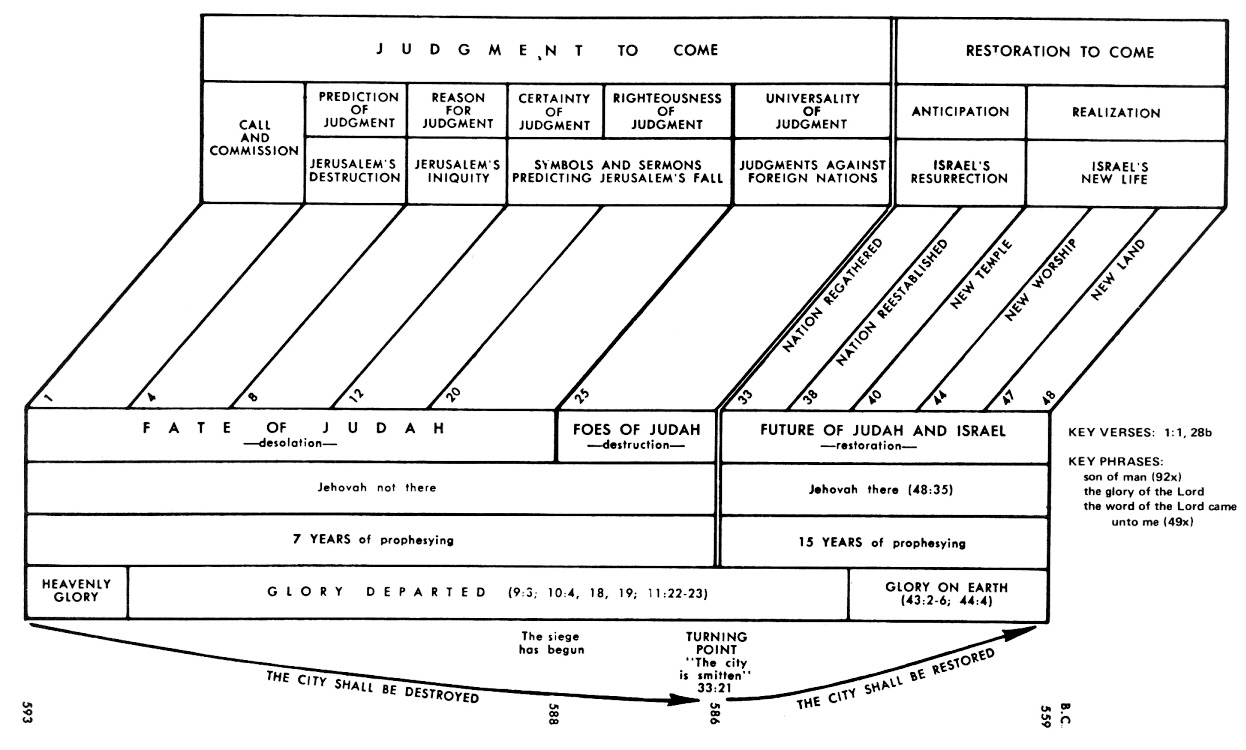
Click chart to enlarge
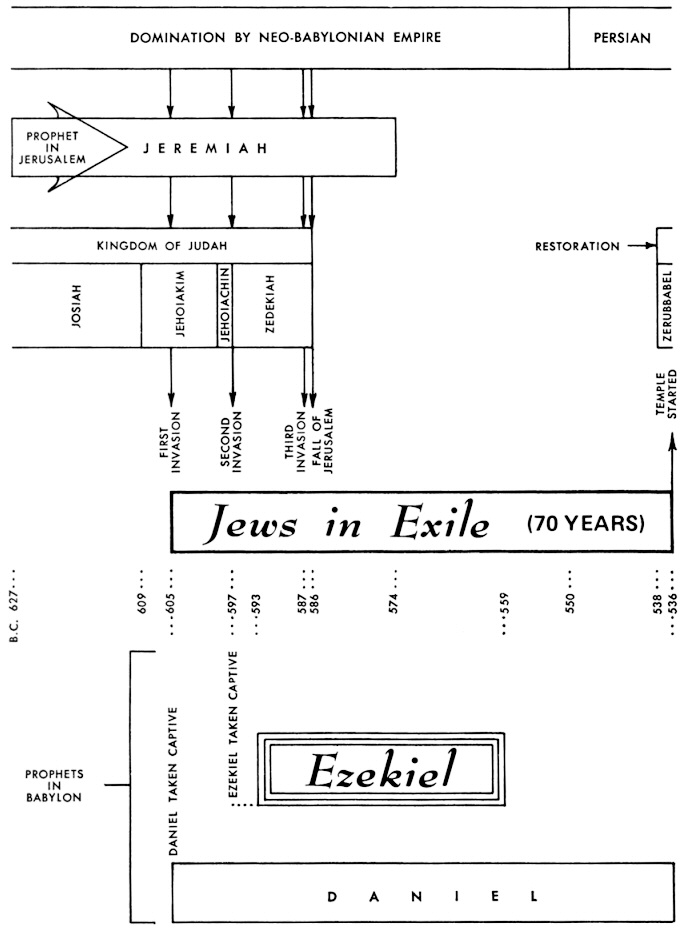
Click chart to enlarge
Chart from recommended resource Jensen's Survey of the OT - used by permission
Ezekiel Chart on right side of page from Charles Swindoll
|
PROPHECY OF |
PROPHECY OF |
|||
| FATE OF JUDAH Before the Siege |
FOES OF JUDAH During the Siege |
FUTURE OF JUDAH After the Siege |
||
|
593-588 BC |
587-586 |
586-571 |
||
|
7 YEARS |
15 YEARS |
|||
| Ezekiel 1:1-3:27 Ezekiel Sees the Glory & Receives the Call |
Ezekiel 4:1-24:27 Judgments Against Judah |
Ezekiel 25:1-32:32 Judgments Against the Gloating Nations |
Ezekiel 33:1-39:29 Restoration of Israel to the LORD |
Ezekiel 40:1-48:35 Visions of the Temple Jehovah Shammah |
Hannah's Bible Outlines.
The condemnation of Judah and Jerusalem (4:1-24:27)
- The prediction of Jerusalem's overthrow (Ezekiel 4:1-7:27)
- The symbolic actions against Jerusalem (Ezekiel 4:1-5:17)
- The symbols presented (Ezekiel 4:1-5:4)
- The symbol of the brick (Ezekiel 4:1-3)
- The symbol of the prophet's position (Ezekiel 4:4-8)
- The symbol of famine (Ezekiel 4:9-17)
- The symbol of shaved head and divided hair (Ezekiel 5:1-4)
- The symbols explained (Ezekiel 5:5-17)
- The cause of judgment (Ezekiel 5:5-7)
- The surety of judgment (Ezekiel 5:8-11)
- The description of judgment (Ezekiel 5:12-17)
- The symbols presented (Ezekiel 4:1-5:4)
- The judgments upon the mountains (Ezekiel 6:1-14)
- The fate of the high places (Ezekiel 6:1-7)
- The sparing of a remnant (Ezekiel 6:8-10)
- The desolation of the land (Ezekiel 6:11-14)
- The dirge over Judah's doom (Ezekiel 7:1-27)
- The wrath of the Lord (Ezekiel 7:1-4)
- The imminence of the judgment (Ezekiel 7:5-9)
- The inescapability of the judgment (Ezekiel 7:10-13)
- The horrors of the judgment (Ezekiel 7:14-27)
- The symbolic actions against Jerusalem (Ezekiel 4:1-5:17)
- The transgression and fall of Jerusalem (Ezekiel 8:1-11:25)
- The vision of abominations in the temple (Ezekiel 8:1-18)
- The introduction (Ezekiel 8:1-4)
- The image of jealousy (Ezekiel 8:5-6)
- The idolatry of the elders (Ezekiel 8:7-13)
- The worship of Tammuz (Ezekiel 8:14-15)
- The worship of the sun (Ezekiel 8:16-17)
- The wrath of the Lord (Ezekiel 8:18)
- The vision of the slain by divine avengers (Ezekiel 9:1-11)
- The summons of the executioners (Ezekiel 9:1-2)
- The command to mark and destroy (Ezekiel 9:3-7)
- The consternation of the prophet (Ezekiel 9:8-10)
- The completion of the task (Ezekiel 9:11)
- The vision of the coals of fire (Ezekiel 10:1-22)
- The instruction to the man clothed in linen (Ezekiel 10:1-2)
- The movement of God's glory to the threshold (Ezekiel 10:3-5)
- The action of the cherub (Ezekiel 10:6-8)
- The description of the cherubim (Ezekiel 10:9-17)
- The movement of God's glory to the east gate (Ezekiel 10:18-19)
- The identification of the cherubim (Ezekiel 10:20-22)
- The vision of the destruction and restoration of the city (Ezekiel 11:1-25)
- The condemnation of the leaders (Ezekiel 11:1-12)
- Ezekiel's departure to the leaders (Ezekiel 11:1)
- Ezekiel's instruction to prophesy (Ezekiel 11:2-3)
- Ezekiel's warning of judgment (Ezekiel 11:4-12)
- The consternation of the prophet (Ezekiel 11:13)
- The restoration of the nation (Ezekiel 11:14-21)
- The departure of God's glory (Ezekiel 11:22-23)
- The transportation of the prophet (Ezekiel 11:24-25)
- The condemnation of the leaders (Ezekiel 11:1-12)
- The vision of abominations in the temple (Ezekiel 8:1-18)
- The cause of Judah's destruction (Ezekiel 12:1-19:14)
Ezekiel 6:8 "However, I will leave a remnant, for you will have those who escaped the sword among the nations when you are scattered among the countries. (NASB: Lockman)
LXE When there are some of you escaping from the sword among the Gentiles, and when ye are scattered in the countries;
Comment: The Lxx translates yathar with the verb anasozo which means to be rescued or delivered from and so to be preserved. It is the verb used in 2Ki 19:31 and Zechariah 8:7.
CSB "Yet I will leave a remnant when you are scattered among the nations, for throughout the countries there will be some of you who will escape the sword.
ESV "Yet I will leave some of you alive. When you have among the nations some who escape the sword, and when you are scattered through the countries,
GWT: "'But I will let some people live. Some people will escape the battle among the nations and be scattered throughout the countries.
KJV Yet will I leave a remnant, that ye may have some that shall escape the sword among the nations, when ye shall be scattered through the countries.
NET "'But I will spare some of you. Some will escape the sword when you are scattered in foreign lands.
NIV "'But I will spare some, for some of you will escape the sword when you are scattered among the lands and nations.
NKJV: "Yet I will leave a remnant, so that you may have some who escape the sword among the nations, when you are scattered through the countries.
NLT "But I will let a few of my people escape destruction, and they will be scattered among the nations of the world.
WBC: when your survivors of the sword are present among the nations, when you are dispersed among other countries.
Young's Literal: And I have caused some to remain, In their being to you the escaped of the sword among nations, In your being scattered through lands.
HOWEVER I WILL LEAVE A REMNANT, FOR YOU WILL HAVE THOSE WHO ESCAPED THE SWORD AMONG THE NATIONS WHEN YOU ARE SCATTERED AMONG THE COUNTRIES:
- Isa 6:13; Ro 9:27; 11:5,6
Remnant (03498) (yathar) (although 4 different Hebrew words express the concept of remnant) refers to one portion of a quantity which has been divided and generally refers to the smaller part remaining. Remnant can mean that which is spared, preserved, escaped, survived, and thus that which is not in a condition of danger or death. The idea of the remnant is “those being left” or “having escaped,” especially a portion of a community which has escaped a devastating calamity and will form the basis for a new community.
- See Ro 11:5ff commentary
- See study of another Hebrew word for "remnant" (07604) sha'ar/sa'ar
- Detailed Study - Remnant of Israel
Meaning of yathar: 1) to be left over, remain, remain over, leave 1a) (Qal) remainder (participle) 1b) (Niphal) to be left over, remain over, be left behind 1c) (Hiphil) 1c1) to leave over, leave 1c2) to save over, preserve alive 1c3) to excel, show pre-eminence 1c4) to show excess, have more than enough, have an excess
TWOT - Yathar refers to one portion of a quantity which has been divided. Generally it is the smaller part and sometimes it is the part of less quality. It may refer to the portion less in quality but more in quantity (Jdg 7:6); e.g., in Neh it includes the people besides the priest, nobles and officials (Neh 2:16; 4:14, 19,). It may also be used in the sense of “advantage” or “more than.” The concept of remain occurs in a wide variety of contexts with many connotations. Food left over is an indication that one’s need has been abundantly met (Ru 2:14; 2Chr 31:10). The people gave liberally for the building of the tabernacle so that items were left over (Ex 36:7). Most of the sacrifices were to be eaten on the day offered; any leftovers were to be consumed (Ex 12:10; Lev 8:32). But a votive or freewill offering was allowed to remain three days before being consumed (Lev 7:16f.). (The Theological Wordbook).
John Witmer adds that "A remnant is the residue of something that is left after the majority of it is taken away… a remnant of a bolt of cloth… The apostle Paul made it clear that a remnant of Israel, including himself, was "chosen by grace" (Ro 11:5-note) to be saved as part of the church. The church, however, is not the remnant of Israel, nor has God abandoned His plan for His people Israel (Jer 31:35, 36, 37). In God's plans, however, only a remnant of Israel (Isa 10:21, 22, Ro 9:27-note) as well as of all humanity (Acts 15:16, 17, 18) will be saved. (The Theological Wordbook. Page 295).
Gilbrant - Yathar has the main meaning of "to be left over." The causative meaning becomes, "to leave," either in the sense of "to leave behind" or "to have left over." Though the term occurs over 200 times, most of the occasions of this verb do not involve theological meanings, but are quite ordinary. After the plague of locusts, there was not anything green, "left behind" in the trees (Exo. 10:15). The thank offering was to be eaten on the day of its giving. Nothing was to be left over the next day (Lev. 22:30). The word is also used to describe any number of items, including: survivors after a battle (Judg. 8:10); remaining inventory (Jer. 27:21); the remainder of the acts of the kings (2 Ki. 15:11, 15, 21, etc.); surviving children after the death of a father (Deut. 28:54); leftovers from a meal (Ruth 2:14). While the concept of "the remnant" after the exile is usually communicated using shāʾar (HED #8080) and its cognates, some instances of yāthar refer to "the remnant" or "those remaining" of the Israelites after judgment (Ezek. 6:8; Isa. 4:3; Zech. 14:2). Isaiah is chiefly the prophet who defines the concept of "the remnant," introducing the usage in Isa. 1:8f. Most of the prophetic usage refers to this idea, although some references to survivors of an attack are not speaking of those who will be restored (Amos 6:9). Though decimation and scattering took place, restoration was also promised. All those remaining throughout the world will one day celebrate the Feast of Tabernacles at Jerusalem (Zech. 14:16). (Complete Biblical Library Hebrew-English Dictionary)
Yathar - 101 verses - NAS Usage - abound(1), had some left(1), had left(1), have preeminence(1), leave(3), leave a remnant(1), leave of it over(1), leaving(1), left(47), left behind(1), left over(6), let remain(1), more than enough(1), preserve(1), prosper you abundantly(1), remain(2), remainder(7), remained(2), remaining(2), remains(3), reserved(2), rest(18), spare(1), surviving(2).Ge 30:36; 32:24; 44:20; 49:4; Ex 10:15; 12:10; 16:19f; 28:10; 29:34; 36:7; Lev 2:3, 10; 6:16; 7:16f; 8:32; 10:12, 16; 14:18, 29; 19:6; 22:30; 27:18; Num 26:65; 33:55; Deut 28:11, 54; 30:9; Josh 11:11, 22; 17:2, 6; 18:2; 21:5, 20, 26, 34, 40; Judg 8:10; 9:5; 21:7, 16; Ruth 2:14, 18; 1 Sam 2:36; 15:15; 25:34; 30:9; 2 Sam 8:4; 9:1; 13:30; 17:12; 1 Kgs 9:20f; 15:18; 17:17; 18:22; 19:10, 14; 20:30; 2 Kgs 4:7, 43f; 20:17; 1 Chr 6:61, 70, 77; 18:4; 24:20; 2 Chr 8:7f; 31:10; Neh 6:1; Ps 79:11; 106:11; Prov 2:21; Isa 1:8f; 4:3; 7:22; 30:17; 39:6; Jer 27:18f, 21; 34:7; 44:7; Ezek 6:8; 12:16; 14:22; 34:18; 39:14, 28; 48:15, 18, 21; Dan 10:13; Amos 6:9; Zech 13:8; 14:16.
In Scripture Remnant the meaning of the word depends on the context and sometimes refers only to a physical remnant. As used here in Ezekiel and many places in the OT, remnant is used in a "spiritual" sense and refers to individual Jews in the nation of Israel who over the past 4000+ years placed their faith in the Messiah (see Gal 3:8, 16) and were reckoned RIGHTEOUS. The tragedy is that the majority of Israel over this same time period refused to receive Yeshua as Savior and Redeemer. However, the fact that there has always been a believing REMNANT of Israel reflects God’s faithfulness to keep His Covenant promises made to Abraham (see related topic Covenant: Abrahamic versus Mosaic) This spiritual remnant of Israel Paul defines as
"a Jew… inwardly (by) circumcision (which) is that which is of the heart, by the Spirit, not by the letter; and his praise is not from men, but from God." (see notes Romans 2:29) (see related topic Scriptures on Circumcision)
Jeremiah prophesies that ""In those days and at that time (be alert for expressions of time, stopping and asking when? In this case it is when Messiah returns to set up His earthly kingdom and rule from Jerusalem) declares the LORD, 'search will be made for the iniquity of Israel, but there will be none (because only Jews who have expressed faith in Messiah will enter the Messianic kingdom); and for the sins of Judah, but they will not be found; for I shall pardon (God's sovereign pleasure chooses to pardon some sinners instead of destroying them all) those whom I leave as a remnant." (Jer 50:20)
J Vernon McGee has as usual some very pithy comments on the doctrine of the "remnant" writing that
Never throughout the long history of Israel did 100 percent of the nation worship God. Always only a remnant was faithful to Him. God always preserved a remnant. Actually, it was a remnant of those which came out of Egypt that entered the land. Practically the entire generation that came out of Egypt died in the wilderness. It was their children who entered the land. God preserved a remnant. Even in Elijah’s day God had a faithful remnant. Elijah was very pessimistic. He cried, “Lord, I only am left” (see 1Ki 19:10). But God told him, “You aren’t the only one; I have seven thousand in these mountains who have not bowed the knee to Baal.” Because they were hiding from Ahab and Jezebel, Elijah didn’t know about them (And I am of the opinion that in our day there are more believers than we think there are. There are many believers like those seven thousand. Although we don’t hear about them, they are true believers.) Also, there was a remnant of believers at the coming of Christ; although the leaders of the nation rejected Him and had Him crucified, there was a remnant that received Him. Later, on the Day of Pentecost, a great company turned to Christ; yet it was a remnant. It always has been a remnant. Coming down to our day, there is a remnant even in the church that bears His name. Although I have made the statement that I think there are more believers in our world than we realize, it is also true that in the church there is only a remnant of true believers in Christ.
Many of us would be surprised if we knew how few church members were genuine believers even though they are quite active in Christian circles and in Christian service. Many people in our affluent society have become church members. We are living in a period that has produced a lot of pseudo-saints. They are not genuine by any means. They have not been born again. The Book of Hebrews makes it very clear that “… whom the Lord loveth he chasteneth …” (He 12:6). And every son whom He receives, He is going to put through the fire. He is going to test him. If you have some metal which you think is gold, you can take it to the assayer’s office. He will put the metal under heat so that you will find out whether what you have is gold or something else. And God puts the heat to those who are His own. The day of persecution is going to come to church members, and it will reveal quickly who are the true believers and who are not. God has a remnant in the church today.
Also in our day there is a remnant of believers among the people of Israel—probably more than we realize. In every nation there is a remnant of true believers, although they may not be identified with a local church. Unfortunately, the actions of some church members are shutting the door to a great many believers. Yet God always has His faithful remnant. The word remnant in Scripture is very important; don’t just rush over it. (McGee, J V: Thru the Bible Commentary: Thomas Nelson)
The Tyndale Bible Dictionary summarizes the remnant concisely explaining that it refers to a "group of people who survive a catastrophe brought about by God, ordinarily in judgment for sin. This group becomes the nucleus for the continuation of mankind or the people of God; the future existence of the larger group depends on this purified, holy remnant that has undergone and survived the judgment of God. The remnant concept is found in all periods of redemptive history where catastrophe—be it natural disaster, disease, warfare, or other instruments—threatens the continuity of God’s purposes. From the Creation account to the end of the OT, the concept is progressively sharpened. (Elwell, W. A., & Comfort, P. W. Tyndale Bible Dictionary. Wheaton, Ill.: Tyndale House Publishers)
Nelson's New Illustrated Bible Dictionary defines remnant as "the part of a community or nation that remains after a dreadful judgment or devastating calamity, especially those who have escaped and remain to form the nucleus of a new community. The survival of a righteous remnant rests solely on God’s providential care for His Chosen People and His faithfulness to keep His Covenant promises. The concept of the remnant has its roots in the Book of Deuteronomy (Dt 4:27, 28, 29, 30, 31), where Moses warned the people of Israel that they would be scattered among the nations. But God also promised that He would bring the people back from captivity and establish them again in the land of their fathers. This concept was picked up by the prophets, who spoke of the Assyrian and Babylonian captivities. The concept was extended to apply also to the gathering of a righteous remnant at the time when the Messiah came to establish His kingdom." (Youngblood, R. F., Bruce, F. F., Harrison, R. K., & Thomas Nelson Publishers. Nelson's New Illustrated Bible Dictionary)
In the previous chapter, God presented a picture which "previewed" the doctrine of the remnant instructing Ezekiel to
take one third (of the shaved hair) and strike it with the sword all around the city and one third you shall scatter to the wind; and I will unsheathe a sword behind them" and then to "Take also a few in number (this suggests the remnant) from them and bind them in the edges of your robes." (Ezek 5:2-3)
In Ezekiel 12 God says
But I shall spare a few of them (remnant) from the sword, the famine, and the pestilence that they may tell all their abominations among the nations (Gentiles) where they go, and may know that I am the LORD. (this latter phrase suggesting that they are not just a preserved physical remnant but a spiritual remnant who trust in Jehovah) (Ezek 12:16)
Later God elaborates on the remnant explaining to Ezekiel that
survivors will be left (a remnant) in it who will be brought out, both sons and daughters. Behold, they are going to come forth to you and you will see their conduct and actions; then you will be comforted for the calamity which I have brought against Jerusalem for everything which I have brought upon it. Then they will comfort you when you see their conduct and actions (they are a god fearing remnant who believe in God's promise of a Messiah Who is to be their Redeemer), for you will know that I have not done in vain whatever I did to it," declares the Lord GOD. (Ezek 14:22-23)
Matthew Henry has an excellent comment (but he should be read with discernment when he comments on Old Testament eschatology [future or prophetic events] for he is prone to interpret the promises to Israel as now applying primarily to the church, which can lead to great confusion in studying the Old Testament. This same general caution applies to most of the pre-1900 commentaries! The most literal is that by Jamieson, Fausset, Brown)
Judgment had hitherto triumphed, but in these verses mercy rejoices against judgment. A sad end is made of this provoking people, but not a full end. The ruin seems to be universal, and yet will I leave a remnant, a little remnant, distinguished from the body of the people, a few of many, such as are left when the rest perish; and it is God that leaves them. This intimates that they deserved to be cut off with the rest, and would have been cut off if God had not left them… (God will leave) some who will have escaped the sword. God said (Ezek 5:12) that he would draw a sword after those who were scattered, that destruction should pursue them in their dispersion; but here is mercy remembered in the midst of that wrath, and a promise that some of the Jews of the dispersion, as they were afterwards called, should escape the sword.
I will leave a remnant - This declarative promise by the Covenant Keeping God reflects His sovereign choice as well as His mercy and compassion to not destroy all of Israel but to preserve part of the nation as a godly line of Abraham who expressed faith in His promised Messiah even though most rejected Him.
Isaiah records that
Unless the LORD of hosts Had left us a few survivors (a remnant), we would be like Sodom, we would be like Gomorrah. (annihilated, obliterated, blotted out)" (Isa 1:9) and later adds "In that day (at the inception of Christ's millennial kingdom reign on earth) the Branch of the LORD will be beautiful and glorious, and the fruit of the earth will be the pride and the adornment of the survivors of Israel (the remnant). And it will come about that he who is left in Zion and remains in Jerusalem (the remnant) will be called holy (solely because God has chosen them and they have expressed saving faith in the Messiah) -- everyone who is recorded for life (the remnant) in Jerusalem. When the Lord has washed away the filth of the daughters of Zion and purged the bloodshed of Jerusalem from her midst, by the spirit of judgment and the spirit of burning (those left after the washing, purging & burning will be "the remnant")" (Isa 4:2-4-note).
Isaiah 10 records that a small nucleus of God’s people, preserved by His sovereign grace will form a righteous remnant in the midst of national apostasy. Isaiah in context is prophesying of Israel's coming destruction by Assyria, but moves from the near fulfillment of a physical remnant to speak of a future believing Jewish remnant…
Now it will come about in that day (the immediate context referred to the Assyrian invasion of Israel which prefigured a future day of destruction, the time of Jacob's distress, brought to an end by return of Messiah) that the remnant of Israel, and those of the house of Jacob who have escaped (the remnant), will never again rely on the one who struck them, but will truly rely on the LORD, the Holy One of Israel (Note this has yet to be fulfilled as most of modern Israel remains in unbelief in their Messiah). A remnant will return, the remnant of Jacob (Israel), to the mighty God (a remnant who has placed their faith in the Messiah). For though your people, O Israel, may be like the sand of the sea, only a remnant (those who by grace through faith are saved) within them will return; a destruction is determined (in essence "predetermined," reflecting God's sovereign control over the events of human history), overflowing with righteousness. For a complete destruction, one that is decreed, the Lord GOD of hosts will execute in the midst of the whole land (referring to the Great Tribulation, the last three and one half years before Messiah returns to put an end to the ruthless reign of the man of sin, the antichrist)." (Isa 10:20-23-note)
Paul quotes Isaiah 10:22 in (Ro 9:27-note) to explain that not every Jew born physically belongs to the "remnant" of Jews who are born spiritually by the Spirit of God. (cf Ro 9:6-note)
Old Testament scholar Richard Patterson commenting on the remnant in Micah 2:12-13 explains
God’s promise to preserve a segment of his people through the punishment of his divine judgment for covenant trespass introduces the remnant theme (Mic 2:12), prominent in Old Testament prophetic literature (e.g., Isaiah, who popularized the idea by naming his son Shear-jashub, or “a remnant will return,” Isa 7:3). The remnant motif implies both judgment and deliverance. The very existence of a remnant of Hebrews is based on the mercy of God. The Old Testament prophets apply the remnant motif to three types of groups:
(1) the historical remnant composed of survivors of the catastrophe of God’s judgment (Jer 23:3);
(2) the faithful remnant of Hebrews who maintain a true faith relationship with Yahweh (Amos 5:15); and
(3) an eschatological remnant of Hebrews and Gentiles who will participate in the blessing of the restored Davidic kingdom (Amos 9:12; cf. NIDOTTE 4.14–15).
Micah refers to a “remnant” (sheerith [07611]) five times (Micah 2:12; 4:7; 5:7, 8; 7:18), and each is connected with oracles of hope (see Waltke’s discussion in NIDOTTE 4.938–939). The remnant purified, who go out strong as a lion (Mic 5:7–8), represent the eschatological remnant who will share in the blessing of the restored Davidic kingdom (cf. Mic 5:2–5). The remaining four references to the Hebrew remnant appear to combine type one (a historical remnant of those who survive the Assyrian and Babylonian exiles) and type three (an eschatological remnant who will be purified and experience the restoration of the Davidic kingdom). Such telescoping of near historical fulfillment and distant eschatological fulfillment is not uncommon in biblical prophecy.
Theologically, the remnant theme is important because it mediates the tension of the Abrahamic and Mosaic covenants. The first “guaranteed Israel an everlasting status in God’s program of redemption,” while the second “threatened a sinful nation with death” (NIDOTTE 4.938). God’s true prophets resolved the theological tension by espousing the doctrine that he would preserve a godly remnant of Israelites through the judgment associated with the curses of the Mosaic covenant (Deut 28; cf. Dt 30:1–5).
The remnant theme testifies to God’s faithfulness in keeping his covenant promises (Ps 145:13; Da 9:4), and it displays his great mercy because He does not remain angry with rebellious Israel forever (Isa 57:16; Jer 3:12). In the NT, the remnant of Israel (i.e., the Jews) is not displaced or eliminated, but stands united with those Gentiles (or wild olive branches grafted into Abraham’s tree, Ro 11:17) called to be one people of God (cf. Ro 9–11). (Minor Prophets- Hosea through Malachi Cornerstone Biblical Commentary- Andrew E. Hill, Richard D. Patterson, Philip W. Comfort)
The remnant as discussed in more detail below are the true children of God, a doctrine Paul refers to in explaining what will happen to the Jews --
In the same way then, there has also come to be at the present time a remnant (referring to Jews who have placed their faith in the Righteous Messiah not in their unrighteous "good deeds") according to God's gracious choice (they are saved by grace not by works lest they boast). (Ro 11:5-note)
Stated another way, the remnant is a living reflection and continual reminder of the unmerited favor of Almighty God.
The number of the remnant is always small. In Zechariah 13:8 it is a third of all Israel. In Isaiah 6:13 it is only a tenth of the total and in Ezekiel 5:3 the remnant is pictured as only a few hairs wrapped in a fold of a garment.
After the siege and fall of Jerusalem, Nebuchadnezzar
led away into exile all Jerusalem and all the captains and all the mighty men of valor, ten thousand captives, and all the craftsmen and the smiths. None remained except the poorest people of the land. (2 Ki 24:14)
So in one sense these poor who remained in Judah were a physical remnant. There are several instances when Ezekiel mentions the remnant that would escape the destruction of Jerusalem and would be scattered from the Promised Land (Ezekiel 5:10; 11:13; 14:22).
As alluded to above, in Deuteronomy we find Moses first prophesy that Israel would be removed from "the promised land" if she proved disobedient, and yet in the same prophecy God promised that if Israel would return to Him, He would be merciful and restore her (Dt 30:1-5).
Isaiah predicted the northern 10 tribes would be removed by Assyria.
Ezekiel prophesies of a removal of most of the Southern kingdom, with only a small physical remnant left in Jerusalem. Israel experienced both of these removals in the Assyrian (722BC) and Babylonian (586BC) captivities as well as after the destruction of Jerusalem by Rome in 70AD, at which time the people of Israel were scattered throughout the Gentile nations, in fulfillment of Moses' prophecy that…
the LORD will scatter you among the peoples (the Gentile nations) and you shall be left few in number among the nations, where the LORD shall drive you. (this refers to a physical remnant of Jews who were dispersed in 70AD - even today there are only a relatively small number of Jews scattered throughout the world) And there you will serve gods, the work of man's hands, wood and stone, which neither see nor hear nor eat nor smell. But from there you will seek the LORD your God, and you will find Him if you search for Him with all your heart and all your soul. When you are in distress (most completely fulfilled during the last half of Daniel's Seventieth Week) and all these things have come upon you, in the latter days (we are in the last days now and they will culminate in the final restoration of the believing remnant of Israel at the second coming of Christ predicted by Zech 13:8, 13:9 this believing remnant of "one-third" equating with Paul's "all Israel will be saved" - Ro 11:25-29-see note, you will return to the LORD your God and listen to His voice. For the LORD your God is a compassionate God; He will not fail you nor destroy you nor forget the covenant with your fathers which He swore to them. (Deut 4:27-31).
C I Scofield writes that one major key to unlocking prophecy is a proper understanding of the doctrine of the remnant which he summarizes as follows
In the history of Israel, a "remnant" may be discerned, a spiritual Israel within the national Israel. In Elijah's time 7,000 had not bowed the knee to Baal 1Ki 19:18. In Isaiah's time it was the "very small remnant" for whose sake God still forbore to destroy the nation Isaiah 1:9. During the captivities the remnant appears in Jews like Ezekiel, Daniel, Shadrach, Meshach, and Abednego, Esther, and Mordecai. At the end of the 70 years of Babylonian captivity it was the remnant which returned under Ezra and Nehemiah. At the advent of our Lord, John the Baptist, Simeon, Anna, and "them that looked for redemption in Jerusalem" Lk 2:38 were the remnant. During the church-age the remnant is composed of believing Jews - Ro 11:4,5-see notes Ro 11:4; 11:5. But the chief interest in the remnant is prophetic. During the great tribulation a remnant out of all Israel will turn to Jesus as Messiah… (Rev 7:3-8-note). Some of these will undergo martyrdom (Re 6:9-11-note) some will be spared to enter the millennial kingdom Zech 12:6, 7, 8, 9, 10, 13:9, 13:8, 13:9. Many of the Psalms express, prophetically, the joys and sorrows of the tribulation remnant.
In sum, the majority of physical Jews have been unbelieving and thus rejected by Jehovah, but grace and mercy have been given to a godly group, the remnant. There never has been nor ever will be a complete end to Israel as is spuriously taught in "replacement theology." The spiritual (believing, righteous by faith) remnant is those Jews who have in the past or will in the future place their trust in the Messiah, regardless of whether they lived before or after the Cross, for "there is salvation in no one else; for there is no other name under heaven that has been given among men, by which we must be saved." (Acts 4:12) When the Messiah returns to set up His righteous kingdom, He will regather and cleanse the final Jewish remnant and fulfill God’s covenant promises to Abraham, Isaac and Jacob.
- NOTE: The notes on "remnant" have been revised and are now located at Remnant of Israel
Related Resources on The Believing Remnant of Israel:
- The Remnant and the Future based on Micah 5:7-9 - S. Lewis Johnson (Other articles by Dr Johnson that mention the remnant)
- The Doctrine of the Remnant and the Salvation of Israel in Romans 9-11- Steve Lewis
- The Remnant from a Jewish Perspective - Tony Garland
- Romans 9:25-33 - A Remnant will be Saved - Tony Garland
- Romans 11:1-6 - God Has Not Cast Away the Jews - Tony Garland
- Israel remnant Diagram - Tony Garland
- Journal Articles on The Remnant
- Remnant by George Livingston
- Doctrine of Remnant - Arnold Fruchtenbaum
- I Dolphin's article The Concept of the Remnant
- The Jewish question by A C Gaebelein - 157 page book
- The Jewish Problem by Jewish believer David Baron (1891)
- Bridgeway Bible Dictionary Remnant
- Baker Evangelical Dictionary Remnant
- Thompson Chain Reference Remnant of Israel
- Holman Bible Dictionary Remnant
- Hastings' Dictionary of the Bible Remnant
- Hastings' Dictionary of the NT Remnant
- King James Dictionary Remnant
- Morrish Bible Dictionary Remnant
- Vines' Expository Dictionary Remnant
- Webster Dictionary Remnant
- International Standard Bible Encyclopedia Remnant
- The Jewish Encyclopedia Remnant of Israel
Wiersbe - Repentance (6:8–10). In grace, God would spare a remnant that would remember Him and repent of their sins. The sin that breaks the heart of God should break our hearts as well.(Borrow copy of With the Word)
Ezekiel 6:9 "Then those of you who escape will remember Me among the nations to which they will be carried captive, how I have been hurt by their adulterous hearts which turned away from Me, and by their eyes which played the harlot after their idols; and they will loathe themselves in their own sight for the evils which they have committed, for all their abominations. (NASB: Lockman)
GWT: Then those who escape will remember me among the nations where they are taken captive. I was hurt by their adulterous hearts, which turned away from me, and by their eyes, which lusted after idols. They will hate themselves for the evil and disgusting things that they have done. (GWT)
NKJV: "Then those of you who escape will remember Me among the nations where they are carried captive, because I was crushed by their adulterous heart which has departed from Me, and by their eyes which play the harlot after their idols; they will loathe themselves for the evils which they committed in all their abominations.
WBC: Then your survivors will remember me among the nations where they are held captive, how stricken I was by their wanton hearts that had lost faith in me and by their wanton eyes that had followed their idols. They will regard themselves with disgust for all their shocking rites.
Young's Literal: And remembered Me have your escaped among nations, Whither they have been taken captive, Because I have been broken with their heart that is going a-whoring, That hath turned aside from off Me, And with their eyes they are going a-whoring after their idols, And they have been loathsome in their own faces, For the evils that they have done -- all their abominations.
THEN THOSE OF YOU WHO ESCAPE WILL REMEMBER ME AMONG THE NATIONS TO WHICH THEY WILL BE CARRIED CAPTIVE:
- Deut 4:29-31; Ps 137:1; Jer 51:50
Then in the nations where they have been carried captive, those who escape will remember me. (NIV),
Then those who have escaped will remember me. They will be living among the nations where they have been taken as captives (ICB)
Those of you who escape will remember Me - It is worth noting that the verb "Remember" (zakar) is actually the first word in the original Hebrew sentence (and is translated this way in Young's Literal above).
The question is when will they remember Jehovah? While anytime a Jew recognizes Messiah as their Redeemer they are in effect remembering the Lord. The final remembrance will occur for the remnant of Israel in the end times. Moses gives a similar prophecy in Dt 4:27-31 (see commentary)
The LORD will scatter you among the peoples, and you will be left few in number among the nations where the LORD drives you. 28 “There you will serve gods, the work of man’s hands, wood and stone, which neither see nor hear nor eat nor smell. “But from there you will seek the LORD your God, and you will find Him if you search for Him with all your heart and all your soul. 30“When you are in distress and all these things have come upon you, in the latter days (end times, just prior to return of the Messiah) you will return to the LORD your God and listen to His voice. 31 “For the LORD your God is a compassionate God; He will not fail you nor destroy you nor forget the covenant with your fathers which He swore to them.
Remember (record, mention) (02142)(zakar) means to recall, call to mind or to be brought to remembrance. The first use of zakar is wonderful for it says "God remembered Noah" remembering His covenant (Ge 6:18), declaring later "I will remember My covenant, which is between Me and you and every living creature of all flesh; and never again shall the water become a flood to destroy all flesh. 16 “When the bow is in the cloud, then I will look upon it, to remember the everlasting covenant between God and every living creature of all flesh that is on the earth.” (Ge 9:15-16)
Remember is the idea bringing to mind or of thinking again of an image or idea from the past, of recalling information or events, of keeping in the forefront of one's mind for attention and lastly of considering something with a focus on responding in an appropriate manner to that which is "remembered". It is interesting that the Hebrew verb (zakar) is the root word for derivative noun (zeker) which is translated "memorial"!
What "memorials" have you "erected" along your spiritual journey that you can quickly recall to your mind?
How critical is this "spiritual discipline" for all saints of all ages -- to "remember Me"… to recall to one's mind the manifold kindnesses of God all the days of our lives.
Dearly beloved, as one born from above and now a child of the living God, have you allowed yourself to slowly drift into the practices and preferences of the "Canaanites" in the midst of whom you live? Have you like Ephesus left your first love?
If so it is good to come back to where you began your spiritual journey, to that "memorial" representing the sweet time you first truly heard His voice and were swept into His kingdom by faith by His Spirit. Jesus addressing the church at Ephesus declares
"I have this against you, that you have left (not lost… believers have been brought into an unconditional covenant and are kept by the power of God and cannot lose salvation) your first love." (note the first action our Lord "recommends" to remedy the problem of "drifting") " Remember therefore from where you have fallen and repent and do the deeds you did at first; or else I am coming to you, and will remove your lampstand out of its place-- unless you repent." (see note Revelation 2:4)
A good way to begin each new day and to end each night is by remembering what He has done for you and "offer up a sacrifice of praise to God, that is, the fruit of lips that give thanks to His name." (Heb 13:15 - see note Hebrews 13:15)
In Leviticus 26 after a long litany of "cursing" for disobedience, God holds out the hope for blessing
If they confess their iniquity and the iniquity of their forefathers, in their unfaithfulness which they committed against Me, and also in their acting with hostility against Me--I also was acting with hostility against them, to bring them into the land of their enemies-- or if their uncircumcised heart becomes humbled (which equates with a "new heart" [Ezek 18:31, 36:26, 27] which is circumcised by faith not works - Ro 2:28, 29-notes) so that they then make amends for their iniquity, then I will remember My covenant with Jacob, and I will remember also My covenant with Isaac, and My covenant with Abraham as well, and I will remember the land." (Lev 26:40-42-note)
The prophet Daniel did exactly what Ezekiel alludes to --
"in the first year of his reign I, Daniel, observed in the books the number of the years which was revealed as the word of the LORD to Jeremiah the prophet for the completion of the desolations of Jerusalem, namely, seventy years. So I gave my attention to the Lord God to seek Him by prayer and supplications, with fasting, sackcloth, and ashes." (Da 9:2 9:3)
Daniel remembered God and poured out his heart in confession in one of the most incredible prayers in the Bible. And God responded with one of the most incredible prophecies in all of Scripture (See Da 9:24, 25, 26, 27-notes Da 9:24 25 26 27) . (see Daniel's Seventieth Week)
Zechariah records God's prediction that
"When I scatter them among the peoples, They will remember Me in far countries, and they with their children will live and come back. I will bring them back from the land of Egypt, and gather them from Assyria; and I will bring them into the land of Gilead and Lebanon, until no room can be found for them." (Zechariah 10:9-10)
Walter Kaiser - Even after Israel had been restored to the land after the Babylonian exile, the prospect of a regathered, reunited nation still appeared in Zechariah 10:9-12. The importance of this passage and its late postexilic date should not be lost by those who interpret the promise of the land spiritually or as a temporal blessing which has since been forfeited by a rebellious nation due to her failure to keep her part of the conditional covenant. On the contrary, this hope burned brighter as Israel became more and more hopelessly scattered. (Ed: And it will be consummated at the Second Coming when Israel finally receives the land promised not just to Abraham, but to Isaac and Jacob.)
Matthew Henry commenting of "those who escape of shall remember Me" writes "to those whom god designs for life He will give repentance unto life. They are reprieved, and escape the sword, that they may have time to return to God. Note, God’s patience both leaves room for repentance and is an encouragement to sinners to repent. Where God designs grace to repent He allows space to repent; yet many who have the space want the grace, many who escape the sword do not forsake the sin, as it is promised that these shall do. This remnant, here marked for salvation, is a type of the remnant reserved out of the body of mankind to be monuments of mercy, who are made safe in the same way that these were, by being brought to repentance… The root and principle of their repentance: They shall remember Me among the nations. Those who forgot God in the land of their peace and prosperity, who waxed fat and kicked, were brought to remember Him in the land of their captivity. The prodigal son never bethought himself of his father’s house till he was ready to perish for hunger in the far country. Their remembering God was the first step they took in returning to him. Note then there begins to be some hope for sinners when they (begin to) enquire, "Where is God my Maker?" Sin takes rise in forgetting God, see Jer 3:21. Repentance takes rise from the remembrance of Him and of our obligations to him. God says, They shall remember Me, that is, "I will give them grace to do so;’’ for otherwise they would for ever forget Him. That grace shall find them out wherever they are, and by bringing God to their mind shall bring them to their right mind. The prodigal, when he remembered his father, remembered how he has sinned against Heaven and before him; so do these penitents."
HOW I HAVE BEEN HURT BY THEIR ADULTEROUS HEARTS WHICH TURNED AWAY FROM ME, AND BY THEIR EYES WHICH PLAYED THE HARLOT AFTER THEIR IDOLS:
- Ezekiel 5:13; 16:43; Isa 7:13; 43:24; Jer 3:6,13; Amos 2:13
"They will recognize how grieved I am by their unfaithful hearts and lustful eyes that long for other gods" (NLT)
"when I shall have broken their whorish heart, which hath departed from me me, and their eyes, which go a whoring after their idols" (Darby)
"how I have been grieved by their adulterous hearts, which have turned away from me, and by their eyes, which have lusted after their idols" (NIV)
"They will remember how I was hurt because they were unfaithful to me. They had turned away from me. They will remember how I was hurt because they desired to worship their idols." (ICB)
BREAKING
THE HEART OF GOD
I have been hurt - KJV = because I am broken with their whorish heart" NKJV = "I was crushed by their adulterous heart which has departed from Me".
G. Campbell Morgan wrote that there are two kinds of fear:
- The fear that God will hurt me; but that is a selfish fear.
- The fear that I will hurt Him; a fear founded in love and producing holiness of character and righteousness of conduct.
NET Note - Hebrew “how I was broken by their adulterous heart.” The image of God being “broken” is startling, but perfectly natural within the metaphorical framework of God as offended husband (cf Isa 54:5, Jer 31:32+, Hos 2:19) The idiom must refer to the intense grief that Israel’s unfaithfulness caused God. For a discussion of the syntax and semantics of the Hebrew text, see M. Greenberg, Ezekiel (AB), 1:134.
Hurt (07665)(shabar) means to break in pieces, to shatter, to smash. The first biblical occurrence of shabar is in Ge 19:9, where the men of Sodom "pressed hard against Lot and came near to break the door." In another use, God says "I will also break down your pride of power" (Lev 26:19). In Ezekiel 6:9 God describes how He has "been hurt (broken) by their adulterous hearts which turned away from" Him "and by their eyes which played the harlot after their idols" (describing faithless Judah now in captivity in Babylon).
The Lxx often translates shabar with suntribo (although not here in Ezek 6:9) which means to cause destruction of something by making it come apart (by shattering, smashing or crushing) and figuratively to be severely damaged psychologically and thus to be broken (as used in Lxx to describe the "brokenhearted" in Isa 61:1, Ps 34:18, Ps 147:3)
Baker - The word is most often used to express bursting or breaking. Other meanings include God’s actions against stubborn pride (Lev. 26:19); or a metaphor for deliverance expressed figuratively by the breaking of a yoke (Jer. 28:2). In a figurative sense, the word describes the breaking of Pharaoh’s arms (Ezek. 30:21, 22). It also depicts the literal smashing or shattering of the tablets of the commandments (Ex. 32:19). Further expressions of the word can mean to bring to the moment of birth (Isa. 66:9); to break down or destroy a people (Isa. 14:25); to break objects of material quality (Gen. 19:9; Lev. 6:28; Jer. 49:35). (Word Study OT)
Vine - Usage Notes: "to break, shatter, smash, crush." This word is frequently used in ancient Akkadian and Ugaritic, and is common throughout out Hebrew. It is found almost 150 times in the Hebrew Bible. The first biblical occurrence of shābar is in Gen. 19:9, which tells how the men of Sodom threatened to "break" Lot's door to take his house guests.The common word for "breaking" things, shābar describes the breaking of earthen vessels (Judg. 7:20; Jer. 19:10), of bows (Hos. 1:5), of swords (Hos. 2:18), of bones (Exod. 12:46), and of yokes or bonds (Jer. 28:10, 12-13). Sometimes it is used figuratively to describe a "shattered" heart or emotion (Psa. 69:20; Ezek. 6:9). In its intensive sense, shābar connotes "shattering" something, such as the tablest of the Law (Exod. 32:19) or idol images (2 Kings 11:18), or the "shattering" of trees by hail (Exod. 9:25). (Vine's Expository Dictionary of Old Testament and New Testament Words)
Shabar - 145 verses - NAS Usage: abolish(1), break(25), break down(1), breaking in pieces(1), breaks(5), breaks in pieces(1), bring to the point(1), broke(9), broke in pieces(6), broke the in pieces(1), broke down(1), broken(55), broken down(1), broken off(1), brokenhearted*(3), collapse(1), crush(2), crushed(2), demolished(1), destroy(2), fractured(1), hurt(2), injured(1), pieces(1), placed(1), point of birth(1), quench(1), shatter(2), shattered(13), smash(3), smashed(2), tore down(1), torn(2). Ge 19:9; Ex 9:25; 12:46; 22:10, 14; 23:24; 32:19; 34:1, 13; Lev 6:28; 11:33; 15:12; 22:22; 26:13, 19, 26; Num 9:12; Deut 7:5; 9:17; 10:2; 12:3; Jdg 7:20; 1 Sam 4:18; 1 Kgs 13:26, 28; 19:11; 22:48; 2Kgs 11:18; 18:4; 23:14f; 25:13; 2Chr 14:3, 13; 20:37; 23:17; 31:1; 34:4; Job 24:20; 29:17; 31:22; 38:10, 15; Ps 3:7; 10:15; 29:5; 34:18, 20; 37:15, 17; 46:9; 48:7; 51:17; 69:20; 74:13; 76:3; 104:11; 105:16, 33; 107:16; 124:7; 147:3; Pr 6:15; 25:15; 29:1; Eccl 12:6; Isa 8:15; 14:5, 25, 29; 21:9; 24:10; 27:11; 28:13; 30:14; 38:13; 42:3; 45:2; 61:1; 65:14; 66:9; Jer 2:13, 20; 5:5; 8:21; 14:17; 17:18; 19:10f; 22:20; 23:9; 28:2, 4, 10ff; 30:8; 43:13; 48:4, 17, 25, 38; 49:35; 50:23; 51:8, 30; 52:17; Lam 1:15; 2:9; 3:4; Ezek 4:16; 5:16; 6:4, 6, 9; 14:13; 26:2; 27:26, 34; 29:7; 30:8, 18, 21f, 24; 31:12; 32:28; 34:4, 16, 27; Dan 8:7f, 22, 25; 11:4, 20, 22, 26; Hos 1:5; 2:18; Amos 1:5; Jonah 1:4; Nah 1:13; Zech 11:16
The Hebrew verb for "hurt" or "broken" is shabar (shavar) which literally means to burst, break into pieces and figuratively is used by David in the penitential psalm 51 to describe "a broken spirit… broken heart" (Ps 51:17 see note below).
Beloved, does this thought not grip your imagination and stir you deep within… this picture that our sin can "break" the heart of the omnipotent "I Am" Who needs no one or nothing because He is sufficient in Himself! This is a "preventative" thought worth "remembering" the next time that surreptitious snake named "temptation" slithers into your eye gate or ear gate, trying to deceive and draw your heart and mind into that "sin which so easily entangles" you. (He 12:1-note)
"Adulterous" and "played the harlot" are the same Hebrew verb (zanah), this repetition "writing" a sad commentary on God's "treasured possession" and used more in this book than in any other in the OT (Click for the 19 out of 69 OT uses in Ezekiel).
Played the harlot (02181)(zanah) is a verb meaning to fornicate, to prostitute and refers to marital infidelity or unfaithfulness. It was word used elsewhere in the OT to describe prostitution (Lev 21:7, Pr 7:10). Many of the uses of zanah are figurative describing Israel 's (Jehovah's "wife") commission of "spiritual prostitution" by having "intercourse" so to speak with other gods (cp 1 Co 6:16). Indeed, idolatry is looked upon as prostitution (Isa 50:1, 2, 3; 54:6, 7, 8; Jer 2:1, 2, 3; 3:1ff; Hos 2:1ff; Jas 4:4-note; Rev 2:4-note). In addition zanah describes Israel’s improper relationships with other nations (Isa. 23:17; Ezek. 23:30; Nah. 3:4). "The thought seems to be of having relations with these nations for the sake of political and monetary benefit, although in the case of Nineveh the added element of alluring, deceitful tactics leading on to oppressive dominance is implied." (TWOT) "A third figurative meaning is found in Isa 1:21, where the Israelites’ departure from God’s approved moral standards is called harlotry." (TWOT)
The main idea of zanah is to commit illicit sexual intercourse and especially used to describe the action of women (only 2 OT uses refer to men - Ex 34:16 Nu 25:1), which is notable as throughout the OT Israel is portrayed as the wife of Jehovah Elohim. The verb zanah means to prostitute one's self by having sex with partners to whom one is not married and to do so for bribes, favors, or other kinds of payment! Scripture uses zanah often to describe illegal, illicit contact between Israel and other nations and especially their "gods". The idea of zanah then is that God's wife, Israel, was unfaithful to her husband, God, as shown by her "spiritual harlotry" which broke her covenant relationship with Jehovah (See topic Covenant in Marriage). And Israel's rejection of God as her "Husband" (Hebrew = "ba'al") (Isa 54:5) in turn "broke God's heart".
Beloved, how we as new covenant believers need to take stock of the impact of our sin on the heart of our loving heavenly Father. In exile the people would come to their senses and loathe themselves for what they had done. Have you ever grieved over your sin to the point of shedding tears and loathing yourself?
The old Puritans would often implore God for what they referred to as "the gift of tears" which is the fruit of "a broken and a contrite heart" that God "wilt not despise." (Ps 51:17)
Would God be so gracious as to give us all such a tender heart and sensitive spirit, that we might be empowered to discipline (ourselves) for the purpose of godliness" recognizing that "bodily discipline is only of little profit, but godliness is profitable for all things, since it holds promise for the present life and also for the life to come. (1Ti 4:7, 8, 9, 10-see notes 1Ti 4:7; 4:8; 4:9; 4:10)
The psalmist records how Israel "rebelled against Him in the wilderness, and grieved (hurt, pained) Him in the desert!" (Ps 78:40)
Isaiah says that "they rebelled And grieved His Holy Spirit; Therefore, He turned Himself to become their enemy, He fought against them." (Isa 63:10)
Matthew Henry commenting upon their adulterous hearts explains that the heart which "departs from Him is as the treacherous elopement of a wife from her husband or the rebellious revolt of a subject from his sovereign. Their eyes also go after their idols; they doted on them, and had great expectations from them… Now the malignity of this sin is that it is spiritual whoredom; it is a whorish heart that departs from God; and they are eyes that go a whoring after their idols. Note that idolatry is spiritual whoredom and is the breach of a marriage-covenant with God. It is the setting of the affections upon that which is a rival with Him, and the indulgence of a base lust, which deceives and defiles the soul, and is a great wrong to God in His honor, They remember what a grief this was to God and how he resented it… (and was) broken with their whorish heart and their eyes that are full of this spiritual adultery, not only angry at it, but grieved, as a husband is at the lewdness of a wife whom he dearly loved, grieved to such a degree that He is broken with it; it breaks His heart to think that He should be so disingenuously dealt with; He is broken as an aged father is with the undutiful behavior of a rebellious and disobedient son, which sinks His spirits and makes Him to stoop. Forty years long was I grieved with this generation, (Ps 95:10)… This they shall remember in the day of their repentance, and it shall affect and humble them more than any thing, not so much that their peace was broken, and their country broken, as that God was broken by their sin… Note, Nothing grieves a true penitent so much as to think that his sin has been a grief to God and to the Spirit of his grace."
AND THEY WILL LOATHE THEMSELVES IN THEIR OWN SIGHT FOR THE EVILS WHICH THEY HAVE COMMITTED, FOR ALL THEIR ABOMINATIONS:
- Ezekiel 14:4, 5, 6, 7; 20:7, 20:24 20:28; 23:14, 15, 16; Nu 15:39; 2Pe 2:14
- Ezekiel 7:16; 12:16; 16:63; 20:43; 36:31, 36:32; Lev 26:39; Job 42:6; Jer 30:18, 30:19)
"Then at last they will hate themselves for all their wickedness" (NLT),
"they will be full of hate for themselves because of the evil things which they have done in all their disgusting ways" (BBE),
"They will loathe themselves for the evil they have done and for all their detestable practices." (NIV)
"they shall mourn (Greek word that means to beat one's breast as act of mourning, lamenting or grief) over themselves for all their abominations (Greek = extremely detestable & from root word = "to stink"!)" (Lxx)
"They will hate themselves because of the evil things they did that I hate" (ICB)
A PROPHECY OF
REDEMPTION OF A REMNANT
Loathe (06962) (qut) to abhor, detest. To despise, to feel a revulsion toward something or someone. Job despised his condition (Job 10:1). God loathed, abhorred His rebellious people (Ps. 95:10). The righteous person loathes those who do not keep God’s Word (Ps. 119:158; 139:21)
Qut indicates that the Israelites had an utter disgust of themselves because of their evil abominations.
Gilbrant - This Hebrew verb qôt, meaning "to loathe," "to be disgusted" in the Qal and Niphal stems and "to loath," "to disgust" in the Hithpolel, is present in Ugarit also in a cognate, meaning "to trespass" "to infringe" or "to feel disgust or loathing." Koehler-Baumgartner list ten references for the word in the OT with "to feel disgust or loathing" as the essential meaning in all three stems. In Ps. 95:10, the Lord asserts his loathing for the rebellious generation that perished in the wilderness, journeying there for forty years. The Niphal stem is found in the Book of Job, describing Job's loathing for his own life (Job 10:1). The word describes the loathing or disgust the rebellious Israelites would have for themselves after the Lord turned them back to himself (Ezek. 6:9; 36:31). The reflexive stem (Hithpolel) is used by the psalmist to describe his own disgust with those who do not keep the Lord's commands and laws (Ps 119:158; 139:21). This word describes the disposition of the Lord about the acts of his disobedient people. (Complete Biblical Library Hebrew-English Dictionary)
Qut - 7v - Job 10:1, Ps 95:10; 119:158; 139:21; Ezek 6:9; 20:43; 36:31
The Septuagint (Lxx) translates the Hebrew verb qut in this verse with the verb kopto (also translates qut in Ezek 20:43). Kopto pictures one who beats their breast in grief, mourning, remorse or lament (in the present context representing grief over their sins).
A PROPHECY
Notice that this is a prophecy so the question can be asked "When will this take place?" Ezekiel 20 below gives us some help but for a definitive answer we need to go to Zechariah 12:10-14-commentary which takes place in the last days, at the end of this present evil age (Gal 1:4-note, cf Da 12:13-note)
(God says) I will pour out on the house of David and on the inhabitants of Jerusalem, the Spirit of grace and of supplication, so that they will look on Me (MESSIAH) whom they have pierced; and they will mourn for Him (MESSIAH), as one mourns for an only son, and they will weep bitterly over Him like the bitter weeping over a firstborn (CP "THEY WILL LOATHE THEMSELVES"). 11 “In that day there will be great mourning in Jerusalem, like the mourning of Hadadrimmon in the plain of Megiddo. 12 “The land will mourn, every family by itself; the family of the house of David by itself and their wives by themselves; the family of the house of Nathan by itself and their wives by themselves; 13the family of the house of Levi by itself and their wives by themselves; the family of the Shimeites by itself and their wives by themselves; 14 all the families that remain, every family by itself and their wives by themselves.
Then Zechariah 13:1-commentary says
"In that day (WHAT DAY? THE ONE HE HAS JUST DESCRIBED - SEE Zech 12:11 "IN THAT DAY" - RECALL THAT CHAPTER BREAKS ARE NOT INSPIRED AND THIS ONE IS NOT A GOOD CHAPTER BREAK BECAUSE Zech 13:1 CLEARLY CONTINUES THE FLOW OF THOUGHT) a fountain will be opened for the house of David and for the inhabitants of Jerusalem, for sin and for impurity. (THEIR MOURNING AND REPENTANCE AND LOOKING TO MESSIAH WITH EYES OF FAITH WILL RESULT IN SALVATION FOR 1/3 OF THE NATION OF ISRAEL "IN THAT DAY" - see Zech 13:8-9-note)
In Ezekiel 20 God says to Israel that
33 "As I live," declares the Lord GOD, "surely with a mighty hand and with an outstretched arm and with wrath poured out, I shall be king over you. 34 "And I shall bring you out from the peoples and gather you from the lands where you are scattered, with a mighty hand and with an outstretched arm and with wrath poured out; 35 and I shall bring you into the wilderness of the peoples, and there I shall enter into judgment with you face to face. 36 "As I entered into judgment with your fathers in the wilderness of the land of Egypt, so I will enter into judgment with you," declares the Lord GOD. 37 "And I shall make you pass under the rod, and I shall bring you into the bond of the covenant; 38 and I shall purge from you the rebels and those who transgress against Me; I shall bring them out of the land where they sojourn, but they will not enter the land of Israel. Thus you will know that I am the LORD. 39 "As for you, O house of Israel," thus says the Lord GOD, "Go, serve everyone his idols; but later, you will surely listen to Me, and My holy name you will profane no longer with your gifts and with your idols. 40 "For on My holy mountain, on the high mountain of Israel," declares the Lord GOD, "there the whole house of Israel, all of them, will serve Me in the land; there I shall accept them, and there I shall seek your contributions and the choicest of your gifts, with all your holy things. 41 "As a soothing aroma I shall accept you, when I bring you out from the peoples and gather you from the lands where you are scattered; and I shall prove Myself holy among you in the sight of the nations. 42 "And you will know that I am the LORD, when I bring you into the land of Israel, into the land which I swore to give to your forefathers (reference to the Abrahamic Covenant - God keeps His covenant promises here the one referring specifically to "the land" cf Ge 13:14-18). 43 "And there you will remember your ways and all your deeds, with which you have defiled yourselves; and you will loathe yourselves in your own sight for all the evil things that you have done. 44 "Then you will know that I am the LORD when I have dealt with you for My name's sake, not according to your evil ways or according to your corrupt deeds, O house of Israel," declares the Lord GOD.'" (Ezekiel 20:33-44)
MacArthur: Ezekiel 20:33-44 speak of His regathering Israel to their land in the future time of Christ's Second Advent.
Comment: In context this section in Ezek 20:33-44 describes the coming judgment of those Jews who will be living at the conclusion of the Great Tribulation period when Christ returns to earth (Mt 24:30 31-note, Rev 19:11-18-note). The Chief Shepherd will examine His flock (pass under the rod, Ezek 20:37), and will purge…the rebels (Ezek 20:38), and bring the faithful remnant into the blessings of the new covenant and in the Messianic/Millennial kingdom. At this same time, at the termination of the three and one-half years of the "great tribulation" Mt 24:21-note, Gentile survivors of the tribulation period will also be judged (at what is referred to by some as the "Judgment of the Sheep and the Goats" described in Mt 25:31-46) so that all who live through that time of the pouring out of God's wrath will at its conclusion either enter into the Messianic/Millennial kingdom, populating it in unresurrected bodies (Jewish & Gentile believers) or alternatively will be cast into hell (Jews & Gentiles who reject God's kind offer of salvation through faith in Messiah). (Click events described in this section in timeline form) Thus, at the very beginning of the Millennium, all who enter it in earthly bodies will have proved through these two judgments that they are redeemed by the blood of the Lamb of God Who takes away their sin. Are you confused? Skeptical? Then keep studying through these notes on Ezekiel and you will discover that interwoven all through this apocalyptic book are allusions to end time events.
Matthew Henry commenting on "they will loathe themselves" writes that
"True penitents see sin to be an abominable thing, that abominable thing which the Lord hates and which makes sinners, and even their services, odious to him, (Jer 44:4 Isa1:11). It defiles the sinner’s own conscience, and makes him, unless he be past feeling, an abomination to himself. An idol is particularly called an abomination, ( Isa 44:19). Those gratifications which the hearts of sinners were set upon as delectable things the hearts of penitents are turned against as detestable things… Penitents quarrel with themselves, and can never be reconciled to themselves till they have some ground to hope that God is reconciled to them; nay, then they shall lie down in their shame, when he is pacified towards them, (Ezek 16:63).
Isaiah records that
"Surely, you will be ashamed of the oaks which you have desired, and you will be embarrassed at the gardens which you have chosen." (Isa 1:29- note)
Ezekiel has one other instructive use of "loathe" in Chapter 36, where God says to the Jews
Then (Be alert for expressions of time When is then? Read Ezekiel 36:1-38 for context) you will remember your evil ways and your deeds that were not good, and you will loathe yourselves in your own sight for your iniquities and your abominations." God goes on to add that "On the day that I cleanse you from all your iniquities, I will cause the cities to be inhabited, and the waste places will be rebuilt (Ezek 36:31-see commentary)
Comment: So in the description of the remnant who loathe themselves in Ezekiel 20:43 and Ezek 36:31, it seems clear that these are those Jews who will place their faith in the Messiah.
A parallel passage that helps understand the effect of Divine discipline on Israel is Deuteronomy where God says that
when all of these things have come upon you (What things? He goes on to explain), the blessing and the curse which I have set before you, and you call them to mind in all nations where the LORD your God has banished you (What makes them remember? When they experience God's discipline which will reach its peak in the time of Jacob's distress, the Great Tribulation), and you return (not all the Jews will return [see Zech 13:7-8 - 2/3's will be cut off, 1/3 will remain] but a remnant will return) to the LORD your God and obey Him with all your heart and soul according to all that I command you today (Ed: The only way this could be fulfilled is when they are regenerated and receive a new heart - which will not happen until the Great Tribulation, cp Ro 11:26-27-in depth commentary), you and your sons, then the LORD your God will restore you from captivity, and have compassion on you, and will gather you again from all the peoples (Gentile nations) where the LORD your God has scattered you (Even today with Israel back in the Land, there are Jews scattered throughout the world, so this is a prophecy that awaits a future fulfillment when Messiah returns). If your outcasts are at the ends of the earth, from there the LORD your God will gather you, and from there He will bring you back. and the LORD your God will bring you into the land (Be alert for this phrase in the OT - it is often a designation for the "Promised Land" -- notice it is not the Church who is going to be brought back into THE LAND, but the scattered nation of Israel -- furthermore our "father" did not possess this land -- so even one postulates we are children of Abraham which is true, we are still not children of Isaac or of Jacob!) which your fathers possessed, and you shall possess it; and He will prosper you and multiply you more than your fathers (Note again "fathers" plural -- not referring only to Abraham, the only "father" that Scripture says is a Gentile believers father!). Moreover the LORD your God will circumcise your heart (Regeneration - see Excursus on Circumcision) and the heart of your descendants, (Paul explains this circumcision of the heart equates with putting one's faith in Messiah which reflects those who are "circumcised with a circumcision made without hands, in the removal of the body of the flesh by the circumcision of Christ." Col 2:11-note, cp Ro 2:28-29-note) to love the LORD your God with all your heart and with all your soul, in order that you may live." (Deut 30:1-6-note , another explanatory note)
In Zechariah God declares
(Messiah is speaking) I will pour out on the house of David and on the inhabitants of Jerusalem (this is the spiritual remnant discussed above), the Spirit of grace and of supplication, so that (God explains the purpose for this outpouring without which no man would seek Him) they will look on Me whom they have pierced; and they will mourn for Him, as one mourns for an only son, and they will weep bitterly over Him, like the bitter weeping over a first-born. In that day there will be great mourning in Jerusalem, like the mourning of Hadadrimmon in the plain of Megiddo. And the land will mourn, every family by itself… In that day a fountain will be opened for the house of David and for the inhabitants of Jerusalem, for sin and for impurity." (Zech 12:10-14, 13:1-note)
Abominations (detestable, loathsome) (08441) (toebah) refers to an abominable custom or thing. Abomination. Loathsome. Detestable thing. Something or someone who is loathsome and abhorrent.
Baker notes that toebah "is primarily understood in the context of the Law. It identifies unclean food (Dt. 14:3); the activity of the idolater (Isa. 41:24); the practice of child sacrifice (Dt. 12:31); intermarriage by the Israelites (Mal. 2:11); the religious activities of the wicked (Pr 21:27); and homosexual behavior (Lev. 18:22). In a broader sense, the word is used to identify anything offensive (Pr 8:7)." (The Complete Word Study Dictionary: OT)
Sometimes toebah is used as a synonym for idol, a repulsive thing, a worship object, with a focus that it is an item to be rejected (Dt 32:16; 2Ch 34:33; Isa 44:19, Jer 16:18; Eze 5:9; 7:20; 11:18, 21; 16:36). Toebah is even used for a specific pagan deity, as in 2Ki 23:13 where Milcom is called "the abomination of the Ammonites." And even prayer is an abomination when offered by one who refuses to obey God's Word (Pr 28:9).
Ezekiel 6:10 Then they will know that I am the LORD; I have not said in vain that I would inflict this disaster on them. (NASB: Lockman)
GWT: Then you will know that I am the LORD and that the disaster I promised was not an empty threat. (GWT)
NKJV: "And they shall know that I am the LORD; I have not said in vain that I would bring this calamity upon them."
WBC: Then they will realize that I am Yahweh; I did not threaten without due cause to inflict on them such a disaster.
Young's Literal: And they have known that I am Jehovah, Not for nought have I spoken to do to them this evil.
THEN THEY WILL KNOW THAT I AM THE LORD; I HAVE NOT SAID IN VAIN THAT I WOULD INFLICT THIS DISASTER ON THEM:
- Je 5:12, 13, 14; 44:28; Da 9:12; Zech 1:6
Then - When? When they loathe themselves. When they see it was because of their evil that such evil had come upon their nation and their person.
Will know that I am the LORD - This phrase occurs four times in Ezekiel 6 (Ezekiel 6:7, 10, 13, 14). Ezekiel makes frequent use of this recognition formula (See all OT uses). And so as a result of their calamitous experiences and their loathing, the remnant will come to know Jehovah experientially (The Septuagint uses the verb epiginosko. which pictures a deeper knowing. They won't wonder. They will know!)
I have not said in vain - I did not bring this terrible thing on them for no reason. (ICB) God will use this evil for good by saving a remnant from Israel.
NET Note - “not in vain did I speak to do to them this catastrophe.” The wording of the last half of v. 10 parallels God’s declaration after the sin of the golden calf (Exod 32:14).
Daniel affirms that God's promises of calamity and disaster were not empty threats for
"He has confirmed His words which He had spoken against us and against our rulers who ruled us, to bring on us great calamity… ".(Da 9:12)
Matthew Henry explains that what God has said was not done in vain because they will find out what God had spoken "is made good, and made to work for good, and to answer a good intention, and that it was not without just provocation that they were thus threatened and thus punished. One way or other God will make sinners to know and own that he is the Lord, either by their repentance or by their ruin. All true penitents are brought to acknowledge both the equity and the efficacy of the word of God, particularly the threatenings of the word, and to justify God (agree that God is righteous) in them and in the accomplishment of them."
Ezekiel 6:11 Thus says the Lord GOD, 'Clap your hand, stamp your foot and say, "Alas, because of all the evil abominations of the house of Israel, which will fall by sword, famine and plague! (NASB: Lockman)
GWT: "'This is what the Almighty LORD says: Clap your hands, stomp your feet, and say, "Oh no!" because the people of Israel have done evil and disgusting things. So they will die in wars, famines, and plagues. (GWT)
NKJV: 'Thus says the Lord GOD: "Pound your fists and stamp your feet, and say, 'Alas, for all the evil abominations of the house of Israel! For they shall fall by the sword, by famine, and by pestilence.
WBC: “Here is a message from the Lord Yahweh. Clap your hands and stamp your foot, and bemoan all the shocking rites of the community of Israel, who are to fall victim to sword, famine, and pestilence.
Young's Literal: Thus said the Lord Jehovah: 'Smite with thy palm, and stamp with thy foot, And say: Alas, for all the evil abominations of the house of Israel, Who by sword, by famine, and by pestilence do fall.
THUS SAYS THE LORD GOD, 'CLAP YOUR HAND, STAMP YOUR FOOT:
- Ezek 21:14, 15, 16, 17; Isa 58:1; Jer 9:1 9:10)
In Ezek 6:11, 12, 13, 14, we see a repetition of the threatenings expounded in earlier. In this verse God tells Ezekiel to use gestures (clap, stomp) to express a deep sense of woe over the iniquities and of the calamities of the house of Israel. Ezekiel's actions would also emphasize that he believed that the destructions which he was predicting would indeed come to pass. On one hand these actions would point out Ezekiel's just displeasure at the sins and on the other the just dread in light of the coming judgments.
The IVP Bible Background Commentary – Gestures and body language take on different meanings in different cultures. In current Western society, clapping hands can be used to show appreciation, to summon subordinates or children, to get someone's attention, to accompany music or to express frustration (one clap). There were also several functions in the ancient world. Clapping could be used in praise (Ps 47:1) or applause (2 Kings 11:12), or as a gesture of anger or derision (Num 24:10; Job 27:23). Variations may exist in the precise movement involved: compare the different significations in western culture of (1) striking the palms together parallel to the body on a horizontal plain (applause); (2) slapping the palms together in a roughly vertical movement (frustration); and (3) striking the palms together perpendicular to the body while alternating which hand is on top and which is on bottom (as if knocking the dust off). Ezekiel is instructed by God to perform a series of symbolic gestures (clapping, stomping his foot and uttering an exclamation) that display God's wrath. Stomping one's foot is often a sign of frustration or anger, as in the Ugaritic Epic of Aqhat. In that tale the hero refuses to give his bow to the goddess Anat, telling her hunting weapons are for men. She is so angry that she violently stamps her foot and goes off in a rush to seek revenge from the gods. The exclamation (niv: “Alas”) that is used indicates that someone will get what's coming to them (“you'll be sorry!”), reinforcing this scene of impending divine punishment.
NET Note - By the sword and by famine and by pestilence. A similar trilogy of punishments is mentioned in Lev 26:25–26 (note). See also Jer 14:12; 21:9; 27:8, 13; 29:18).
AND SAY, "ALAS, BECAUSE OF ALL THE EVIL ABOMINATIONS OF THE HOUSE OF ISRAEL, WHICH WILL FALL BY SWORD, FAMINE AND PLAGUE:
- Ezek 9:4; Am 5:16; Rev 18:10,16
- Ezek 5:12; 14:21; Jer 15:2, 15:3; 16:4; 24:10)
Alas (Oh no! Woe!) - This marker signals an emphasis and cry of alarm or of emphasis, especially pertaining to pain, despondency, or grief.
Jeremiah uses a similar interjection declaring
Alas! for that day is great, there is none like it; and it is the time of Jacob's distress (ultimately fulfilled in the "Great Tribulation" and brought to an end by the return of Messiah - see Daniel's Seventieth Week) but he will be saved from it." (Jeremiah 30:7)
Joel foreseeing the terrible day of the LORD interjects
Alas for the day! For the day of the LORD (See Day of the LORD) is near, and it will come as destruction from the Almighty." (Joel 1:15)
Matthew Henry notes that in this "alas" statement there are
"Two things the prophet must thus lament:—1. National sins. Alas! for all the evil abominations of the house of Israel. Note, The sins of sinners are the sorrows of God’s faithful servants… Alas! What will be in the end hereof? 2. National judgments. To punish them for these abominations they shall fall by the sword, by the famine, and by the pestilence. Note that it is our duty to be affected not only with our own sins and sufferings, but with the sins and sufferings of others; and to look with compassion upon the miseries that wicked people bring upon themselves; as Christ beheld Jerusalem and wept over it." (Mt 23:37)
Alas, are you grieving over the heinous sins unashamedly pervading every aspect of this land that claims "In God We Trust"? "Righteousness exalts a nation, but sin is a disgrace to any people. (Proverbs 14:34-note)
Evil abominations - Abominations would have been sufficient but Ezekiel adds evil abominations, as if any abominations are not evil!
Abominations (detestable, loathsome) (08441)(toebah -word study) refers to an abominable custom or thing. Abomination. Loathsome. Detestable thing. Something or someone who is loathsome and abhorrent. The Lxx translates Abomination in this verse with bdelugma - (derived from bdelusso [see word study] = emit foul odor, turn away from something or someone on account of the "stench". A loathing or disgust, abhor in turn derived from bdeo = to stink; see word study on related - bdekluktos) which describes something foul, that which is extremely hated, disgusted, detested or abhorred. The first NT use of bdelugma is in Mt 24:15 which is fitting as it describes the "Abomination (bdelugma) of desolation" (the Antichrist) (cp Mk 13:14). The other 4 uses of bdelugma are - Lk 16:15, Rev 17:4, 5, Rev 21:27.
Baker notes that toebah "is primarily understood in the context of the Law. It identifies unclean food (Dt. 14:3); the activity of the idolater (Isa. 41:24); the practice of child sacrifice (Dt. 12:31); intermarriage by the Israelites (Mal. 2:11); the religious activities of the wicked (Pr 21:27); and homosexual behavior (Lev. 18:22). In a broader sense, the word is used to identify anything offensive (Pr 8:7)." (The Complete Word Study Dictionary: OT)
Sometimes toebah is used as a synonym for idol, a repulsive thing, a worship object, with a focus that it is an item to be rejected (Dt 32:16; 2Ch 34:33; Isa 44:19, Jer 16:18; Eze 5:9; 7:20; 11:18, 21; 16:36). Toebah is even used for a specific pagan deity, as in 2Ki 23:13 where Milcom is called "the abomination of the Ammonites." And even prayer is an abomination when offered by one who refuses to obey God's Word (Pr 28:9).
Ronald Youngblood - As with the verb, so also with the noun (toebah) the abomination may be of a physical, ritual or ethical nature and may be abhorred by God or man. Sharing a meal with a Hebrew was ritually offensive to an Egyptian (Gen 43:32), as was offering certain kinds of sacrifices (Ex 8:22). homosexuality and other perversions are repugnant to God and fall under his judgment (Lev 18:22–30; 20:13). Idolatry (Deut 7:25), human sacrifice (Deut 12:31), eating ritually unclean animals (Deut 14:3–8), sacrificing defective animals (Deut 17:1), conducting one’s business dishonestly (Deut 25:13–16), practicing ritual prostitution (1Kgs 14:23f.), and similar acts of disobedience (for seven more abominations, see the list in Pr 6:16–19) were sure to bring God’s wrath on those who perpetrated them. Twelve times the book of Proverbs uses the phrase, “is an abomination to the Lord.” In Ps 88, a prayer for help written by a man close to death, the physically repulsive appearance of a tôēbâ is stressed; the man’s former friends avoid him because they consider him to be a thing of horror (Ps 88:8). (Theological Wordbook of the Old Testament)
Toebah - 112v in NAS -
Gen 43:32; 46:34; Ex 8:26; Lev 18:22, 26f, 29f; 20:13; Deut 7:25f; 12:31; 13:14; 14:3; 17:1, 4; 18:9, 12; 20:18; 22:5; 23:18; 24:4; 25:16; 27:15; 32:16; 1 Kgs 14:24; 2Kgs 16:3; 21:2, 11; 23:13; 2Chr 28:3; 33:2; 34:33; 36:8, 14; Ezra 9:1, 11, 14; Ps 88:8; Pr 3:32; 6:16; 8:7; 11:1, 20; 12:22; 13:19; 15:8f, 26; 16:5, 12; 17:15; 20:10, 23; 21:27; 24:9; 26:25; 28:9; 29:27; Isa 1:13; 41:24; 44:19; Jer 2:7; 6:15; 7:10; 8:12; 16:18; 32:35; 44:4, 22; Mal 2:11
Notice the preponderance of uses of toebah in Ezekiel - Ezek 5:9, 11; 6:9, 11; 7:3f, 8f, 20; 8:6, 9, 13, 15, 17; 9:4; 11:18, 21; 12:16; 14:6; 16:2, 22, 36, 43, 47, 50f, 58; 18:12f, 24; 20:4; 22:2, 11; 23:36; 33:26, 29; 36:31; 43:8; 44:6f, 13;
Vine sees three major uses for toebah..
(1) Something or someone as essentially unique in the sense of being “dangerous,” “sinister,” and “repulsive” to another individual. (Ge 43:32) for to the Egyptians, eating bread with foreigners was repulsive because of their cultural or social differences (cf. Ge 46:34; Ps. 88:8). Another clear illustration of this essential clash of disposition appears in Pr. 29:27. When used with reference to God, this nuance of the word describes people, things, acts, relationships, and characteristics that are “detestable” to Him because they are contrary to His nature. Things related to death and idolatry are loathsome to God (Deut. 14:3). People with habits loathsome to God are themselves detestable to Him (Dt. 22:5).
(2) Describes pagan practices and objects (Dt. 7:25-26). In other contexts, toebah describes the repeated failures to observe divine regulations (Ezek. 5:7, 9). Toebah may represent the pagan cultic practices themselves, as in Dt. 12:31, or the people who perpetrate such practices (Dt. 18:12). If Israelites are guilty of such idolatry, however, their fate will be worse than exile: death by stoning (Dt. 17:2-5).
(3) In the sphere of jurisprudence and of family or tribal relationships. Certain acts or characteristics are destructive of societal and familial harmony; both such things and the people who do them are described by toebah (Pr. 6:16-19). God says, “The scorner is an abomination to men” (Pr. 24:9) because he spreads his bitterness among God’s people, disrupting unity and harmony
Ezekiel 6:12 He who is far off will die by the plague, and he who is near will fall by the sword, and he who remains and is besieged will die by the famine. Thus will I spend My wrath on them. (NASB: Lockman)
GWT: Plagues will kill those who are far away. Those who are near will die in wars, and anyone who is left and has escaped will die in famines. This is how I will unleash my anger. (GWT)
NKJV: 'He who is far off shall die by the pestilence, he who is near shall fall by the sword, and he who remains and is besieged shall die by the famine. Thus will I spend My fury upon them.
WBC: Those far away will die of pestilence, those nearby will fall to the sword, while those who escape the one or survive the other will die of famine, and then I will have exhausted my fury against them
Young's Literal: The far-off by pestilence dieth, And the near by sword falleth, And the left and the besieged by famine dieth, And I have completed my fury upon them.
HE WHO IS FAR OFF WILL DIE BY THE PLAGUE AND HE WHO IS NEAR WILL FALL BY THE SWORD, AND HE WHO REMAINS AND IS BESIEGED WILL DIE BY THE FAMINE.
- Da 9:7
- Ezekiel 5:13; Isa 40:2; La 4:11, 4:22
Far off… near… remains - The message is clear. No escape! There will be no place to hide, for God's righteous judgments will run them down and ruin them in a variety of ways which will find them out and follow them wherever they are. "He who is far off" and therefore thinks that he is out of danger, because out of the reach of the Babylonian’ arrows, will find himself not out of the reach of God’s arrows, which fly day and night! (Ps 91:5)
Spend (finish, complete) indicates that God will accomplish His fury and bring about all against Judah and Jerusalem which He had purposed and prophesied.
Although this installment of His wrath is accomplished (Babylonians Exile), there remains yet more wrath of God to be poured out on Israel, until it is completely accomplished in the last days, during the Great Tribulation, the time of Jacob's distress (Jer 30:7-note). Notice the important phrase "But he will be saved from it." How? When the Deliverer, the Messiah returns to save the believing remnant (the "all Israel" = all that truly believe) - Ro 11:26-27-see in depth commentary.
Ezekiel 6:13 Then you will know that I am the LORD, when their slain are among their idols around their altars, on every high hill, on all the tops of the mountains, under every green tree and under every leafy oak --the places where * they offered soothing aroma to all their idols. (NASB: Lockman)
GWT: Then you will know that I am the LORD. "'Those who are killed will lie beside the idols around their altars. They will lie on every high hill, on all the mountaintops, and under every large tree and every leafy oak. These are the places where they made offerings to their disgusting idols. (GWT)
NKJV: 'Then you shall know that I am the LORD, when their slain are among their idols all around their altars, on every high hill, on all the mountaintops, under every green tree, and under every thick oak, wherever they offered sweet incense to all their idols.
WBC: and you will realize that I am Yahweh, when their slain lie among their idols round their altars on every high hill, on all the tops of the mountains, and under every luxuriant tree and under every leafy terebinth, wherever they presented fragrant offerings to appease all their idols.
Young's Literal: And ye have known that I am Jehovah, In their wounded being in the midst of their idols, Round about their altars, On every high hill, on all tops of mountains, And under every green tree, and under every thick oak, The place where they gave sweet fragrance to all their idols.
THEN YOU WILL KNOW THAT I AM THE LORD:
- Isa 37:20,36, 37, 38) (Ezekiel 20:28; 1Ki 14:23; Isa 57:5, 6, 7; 66:17; Jer 2:20; 3:6; Hos 4:13
Then - When? always take note of what this important expression of time is emphasizing. Then is especially important to observe and query in prophetic passages.
Will know that I am the LORD" occurs four times in this chapter alone (Ezek 6:7, 10, 13, 14). Ezekiel makes frequent use of this “recognition formula” (see all uses).
This evil was not restricted to the common people, and so we see that King Ahaz "sacrificed and burned incense on the high places and on the hills and under every green tree." (2Ki 16:4)
Isaiah gives a graphic description recording that Israel is "A people who continually provoke Me to My face, Offering sacrifices in gardens and burning incense on bricks; Who sit among graves, and spend the night in secret places; Who eat swine's flesh, And the broth of unclean meat is in their pots." (Isa 65:3, 4)
When their slain are among their idols around their altars, on every high hill, on all the tops of the mountains, under every green tree and under every leafy oak --the places where * they offered soothing aroma to all their idols.
The IVP Bible Background Commentary – The degree to which idolatry has spread is emphasized in this reference to cultic shrines beneath the branches of every spreading oak (see the comment on Deut 12:2-3 on Canaanite “outdoor shrines”). Hosea 4:13 also uses this image of hilltop and leafy glade as places of idol worship.
NET Note - By referring to every high hill … all the mountaintops … under every green tree and every leafy oak Ezekiel may be expanding on the phraseology of Deut 12:2 (see 1 Kgs 14:23; 2 Kgs 16:4; 17:10; Jer 2:20; 3:6, 13; 2 Chr 28:4).
Ezekiel 6:14 So throughout all their habitations I will stretch out My hand against them and make the land more desolate and waste than the wilderness toward Diblah; thus they will know that I am the LORD." (NASB: Lockman)
GWT: I will use my power against them and destroy the land, from the desert to Diblah. Then they will know that I am the LORD.'" (GWT)
NKJV: 'So I will stretch out My hand against them and make the land desolate, yes, more desolate than the wilderness toward Diblah, in all their dwelling places. Then they shall know that I am the LORD.'" ' "
WBC: I will deal them a blow and reduce the country to wrack and ruin wherever they live, from the wilderness to Riblah. Then they will realize that I am Yahweh.”
Young's Literal: And I have stretched out my hand against them, And have made the land a desolation, Even a desolation from the wilderness to Diblath, In all their dwellings, And they have known that I am Jehovah!'
SO THROUGHOUT ALL THEIR HABITATIONS I WILL STRETCH OUT MY HAND AGAINST THEM:
- Ezekiel 16:27; Isaiah 5:25; 10:4; 26:11
Ezekiel records a similar description of God writing - As I live,"declares the Lord GOD, "surely with a mighty hand and with an outstretched arm and with wrath poured out, I shall be king over you. And I shall bring you out from the peoples and gather you from the lands where you are scattered, with a mighty hand and with an outstretched arm and with wrath poured out and I shall bring you into the wilderness of the peoples, and there I shall enter into judgment with you face to face. (Ezekiel 20:33-35)
Stretch out My hand - an anthropomorphic description of God's wrath. This phrase occurs 16x in 16v in the OT (some refer to men not God) with most uses in Ezekiel
Exod. 3:20; Exod. 7:5; 1 Sam. 24:6; 1 Sam. 24:10; 1 Sam. 26:11; 1 Sam. 26:23; Jer. 6:12; Jer. 15:6; Jer. 51:25; Ezek. 6:14; Ezek. 14:9; Ezek. 14:13; Ezek. 25:13; Ezek. 25:16; Ezek. 35:3; Zeph. 1:4
AND MAKE THE LAND MORE DESOLATE AND WASTE THAN THE WILDERNESS TOWARD DIBLAH:
Make the land… desolate and waste - The bitter irony and tragedy of this verse is that the "land that (God Himself) had selected for them, flowing with milk and honey, which is the glory of all lands" (Ezek 20:6), "a pleasant land, the most beautiful inheritance of the nations" (Jer 3:19), God Himself would now make "desolate" (in a state of utter ruin with a stress on the horror caused by the desolation & so often translated as that which causes dismay or is appalling, one of Jeremiah's "favorite" words) and "waste" (dried up place that has no water, implying desolation, a horror or something ugly and terrible to look at, and so an object or event of scorn). The same Hebrew word translated "waste" in this verse is translated "object of horror" in (Ezek 5:15) And what God had made a beautiful land, He would now make an "object of horror", because the Jews had "despised the pleasant land (and)… did not believe in His word" (Ps 106:24) until their was no other remedy other then for the land to spew them out.
Diblah - The name occurs only in Ezek 6:14 and the place has not been identified.
God's warning in Leviticus helps one understand God's judgment on "the land". Through His prophet Moses God had instructed Israel
Do not defile yourselves by any of these things (abominations such as child sacrifices, sexual perversions, etc described in the previous verses); for by all these the (pagan, Gentile) nations which I am casting out before you have become defiled. For the land has become defiled, therefore I have visited its punishment upon it, so the land has spewed out its inhabitants. But as for you, you are to keep My statutes and My judgments, and shall not do any of these abominations, … (for the men of the land who have been before you have done all these abominations, and the land has become defiled) so that the land may not spew you out, should you defile it, as it has spewed out the nation which has been before you. For whoever does any of these abominations, those persons who do so shall be cut off from among their people. Thus you are to keep My charge, that you do not practice any of the abominable customs which have been practiced before you, so as not to defile yourselves with them; I am the LORD your God.' (Lev 18:24-30-note)
THUS THEY WILL KNOW THAT I AM THE LORD:
Thus - Introduces a conclusion. When disaster falls they will know that it was Jehovah Who orchestrated the events.
Will know that I am the LORD - occurs four times in this chapter alone (Ezek 6:7, 10, 13, 14). Ezekiel makes frequent use of this “recognition formula."
Here are all 77 verses with the phrase "know that I am the LORD.'
Exodus 6:7 'Then I will take you for My people, and I will be your God; and you shall know that I am the LORD your God, who brought you out from under the burdens of the Egyptians.
Exodus 7:5 "The Egyptians shall know that I am the LORD, when I stretch out My hand on Egypt and bring out the sons of Israel from their midst."
17 'Thus says the LORD, "By this you shall know that I am the LORD: behold, I will strike the water that is in the Nile with the staff that is in my hand, and it will be turned to blood.
Exodus 10:2 and that you may tell in the hearing of your son, and of your grandson, how I made a mockery of the Egyptians and how I performed My signs among them, that you may know that I am the LORD."
Exodus 14:4 "Thus I will harden Pharaoh's heart, and he will chase after them; and I will be honored through Pharaoh and all his army, and the Egyptians will know that I am the LORD." And they did so.
18 "Then the Egyptians will know that I am the LORD, when I am honored through Pharaoh, through his chariots and his horsemen."
Exodus 16:12 "I have heard the grumblings of the sons of Israel; speak to them, saying, 'At twilight you shall eat meat, and in the morning you shall be filled with bread; and you shall know that I am the LORD your God.'"
Exodus 29:46 "They shall know that I am the LORD their God who brought them out of the land of Egypt, that I might dwell among them; I am the LORD their God.
Exodus 31:13 "But as for you, speak to the sons of Israel, saying, 'You shall surely observe My sabbaths; for this is a sign between Me and you throughout your generations, that you may know that I am the LORD who sanctifies you.
Deuteronomy 29:6 "You have not eaten bread, nor have you drunk wine or strong drink, in order that you might know that I am the LORD your God.
1 Kings 20:13 ¶ Now behold, a prophet approached Ahab king of Israel and said, "Thus says the LORD, 'Have you seen all this great multitude? Behold, I will deliver them into your hand today, and you shall know that I am the LORD.'"
28 Then a man of God came near and spoke to the king of Israel and said, "Thus says the LORD, 'Because the Arameans have said, "The LORD is a god of the mountains, but He is not a god of the valleys," therefore I will give all this great multitude into your hand, and you shall know that I am the LORD.'"
Isaiah 49:23 "Kings will be your guardians, And their princesses your nurses. They will bow down to you with their faces to the earth And lick the dust of your feet; And you will know that I am the LORD; Those who hopefully wait for Me will not be put to shame.
Ezekiel 6:7 "The slain will fall among you, and you will know that I am the LORD.
10 "Then they will know that I am the LORD; I have not said in vain that I would inflict this disaster on them."'
13 "Then you will know that I am the LORD, when their slain are among their idols around their altars, on every high hill, on all the tops of the mountains, under every green tree and under every leafy oak-- the places where they offered soothing aroma to all their idols.
14 "So throughout all their habitations I will stretch out My hand against them and make the land more desolate and waste than the wilderness toward Diblah; thus they will know that I am the LORD."'"
Ezekiel 7:4 'For My eye will have no pity on you, nor will I spare you, but I will bring your ways upon you, and your abominations will be among you; then you will know that I am the LORD!'
27 'The king will mourn, the prince will be clothed with horror, and the hands of the people of the land will tremble. According to their conduct I will deal with them, and by their judgments I will judge them. And they will know that I am the LORD.'"
Ezekiel 11:10 "You will fall by the sword. I will judge you to the border of Israel; so you shall know that I am the LORD.
12 "Thus you will know that I am the LORD; for you have not walked in My statutes nor have you executed My ordinances, but have acted according to the ordinances of the nations around you."'"
Ezekiel 12:15 "So they will know that I am the LORD when I scatter them among the nations and spread them among the countries.
16 "But I will spare a few of them from the sword, the famine and the pestilence that they may tell all their abominations among the nations where they go, and may know that I am the LORD."
20 "The inhabited cities will be laid waste and the land will be a desolation. So you will know that I am the LORD."'"
Ezekiel 13:9 "So My hand will be against the prophets who see false visions and utter lying divinations. They will have no place in the council of My people, nor will they be written down in the register of the house of Israel, nor will they enter the land of Israel, that you may know that I am the Lord GOD.
14 "So I will tear down the wall which you plastered over with whitewash and bring it down to the ground, so that its foundation is laid bare; and when it falls, you will be consumed in its midst. And you will know that I am the LORD.
21 "I will also tear off your veils and deliver My people from your hands, and they will no longer be in your hands to be hunted; and you will know that I am the LORD.
23 therefore, you women will no longer see false visions or practice divination, and I will deliver My people out of your hand. Thus you will know that I am the LORD."
Ezekiel 14:8 "I will set My face against that man and make him a sign and a proverb, and I will cut him off from among My people. So you will know that I am the LORD.
Ezekiel 15:7 and I set My face against them. Though they have come out of the fire, yet the fire will consume them. Then you will know that I am the LORD, when I set My face against them.
Ezekiel 16:62 "Thus I will establish My covenant with you, and you shall know that I am the LORD,
Ezekiel 17:24 "All the trees of the field will know that I am the LORD; I bring down the high tree, exalt the low tree, dry up the green tree and make the dry tree flourish. I am the LORD; I have spoken, and I will perform it."
Ezekiel 20:12 "Also I gave them My sabbaths to be a sign between Me and them, that they might know that I am the LORD who sanctifies them.
20 'Sanctify My sabbaths; and they shall be a sign between Me and you, that you may know that I am the LORD your God.'
26 and I pronounced them unclean because of their gifts, in that they caused all their firstborn to pass through the fire so that I might make them desolate, in order that they might know that I am the LORD."'
38 and I will purge from you the rebels and those who transgress against Me; I will bring them out of the land where they sojourn, but they will not enter the land of Israel. Thus you will know that I am the LORD.
42 "And you will know that I am the LORD, when I bring you into the land of Israel, into the land which I swore to give to your forefathers.
44 "Then you will know that I am the LORD when I have dealt with you for My name's sake, not according to your evil ways or according to your corrupt deeds, O house of Israel," declares the Lord GOD.'"
Ezekiel 22:16 "You will profane yourself in the sight of the nations, and you will know that I am the LORD."'"
Ezekiel 23:49 'Your lewdness will be requited upon you, and you will bear the penalty of worshiping your idols; thus you will know that I am the Lord GOD.'"
Ezekiel 24:24 'Thus Ezekiel will be a sign to you; according to all that he has done you will do; when it comes, then you will know that I am the Lord GOD.'"
27 'On that day your mouth will be opened to him who escaped, and you will speak and be mute no longer. Thus you will be a sign to them, and they will know that I am the LORD.'"
Ezekiel 25:5 "I will make Rabbah a pasture for camels and the sons of Ammon a resting place for flocks. Thus you will know that I am the LORD."
7 therefore, behold, I have stretched out My hand against you and I will give you for spoil to the nations. And I will cut you off from the peoples and make you perish from the lands; I will destroy you. Thus you will know that I am the LORD."
11 "Thus I will execute judgments on Moab, and they will know that I am the LORD."
17 "I will execute great vengeance on them with wrathful rebukes; and they will know that I am the LORD when I lay My vengeance on them."'"
Ezekiel 26:6 'Also her daughters who are on the mainland will be slain by the sword, and they will know that I am the LORD.'"
Ezekiel 28:22 and say, 'Thus says the Lord GOD, "Behold, I am against you, O Sidon, And I will be glorified in your midst. Then they will know that I am the LORD when I execute judgments in her, And I will manifest My holiness in her.
23 "For I will send pestilence to her And blood to her streets, And the wounded will fall in her midst By the sword upon her on every side; Then they will know that I am the LORD.
24 ¶ "And there will be no more for the house of Israel a prickling brier or a painful thorn from any round about them who scorned them; then they will know that I am the Lord GOD."
26 "They will live in it securely; and they will build houses, plant vineyards and live securely when I execute judgments upon all who scorn them round about them. Then they will know that I am the LORD their God."'"
Ezekiel 29:6 ¶ "Then all the inhabitants of Egypt will know that I am the LORD, Because they have been only a staff made of reed to the house of Israel.
9 ¶ "The land of Egypt will become a desolation and waste. Then they will know that I am the LORD. Because you said, 'The Nile is mine, and I have made it,'
16 "And it will never again be the confidence of the house of Israel, bringing to mind the iniquity of their having turned to Egypt. Then they will know that I am the Lord GOD."'"
21 ¶ "On that day I will make a horn sprout for the house of Israel, and I will open your mouth in their midst. Then they will know that I am the LORD."
Ezekiel 30:8 "And they will know that I am the LORD, When I set a fire in Egypt And all her helpers are broken.
19 "Thus I will execute judgments on Egypt, And they will know that I am the LORD."'"
25 'Thus I will strengthen the arms of the king of Babylon, but the arms of Pharaoh will fall. Then they will know that I am the LORD, when I put My sword into the hand of the king of Babylon and he stretches it out against the land of Egypt.
26 'When I scatter the Egyptians among the nations and disperse them among the lands, then they will know that I am the LORD.'"
Ezekiel 32:15 "When I make the land of Egypt a desolation, And the land is destitute of that which filled it, When I smite all those who live in it, Then they shall know that I am the LORD.
Ezekiel 33:29 "Then they will know that I am the LORD, when I make the land a desolation and a waste because of all their abominations which they have committed."'
Ezekiel 34:27 "Also the tree of the field will yield its fruit and the earth will yield its increase, and they will be secure on their land. Then they will know that I am the LORD, when I have broken the bars of their yoke and have delivered them from the hand of those who enslaved them.
Ezekiel 35:4 "I will lay waste your cities And you will become a desolation. Then you will know that I am the LORD.
9 "I will make you an everlasting desolation and your cities will not be inhabited. Then you will know that I am the LORD.
15 "As you rejoiced over the inheritance of the house of Israel because it was desolate, so I will do to you. You will be a desolation, O Mount Seir, and all Edom, all of it. Then they will know that I am the LORD."'
Ezekiel 36:11 'I will multiply on you man and beast; and they will increase and be fruitful; and I will cause you to be inhabited as you were formerly and will treat you better than at the first. Thus you will know that I am the LORD.
23 "I will vindicate the holiness of My great name which has been profaned among the nations, which you have profaned in their midst. Then the nations will know that I am the LORD," declares the Lord GOD, "when I prove Myself holy among you in their sight.
38 "Like the flock for sacrifices, like the flock at Jerusalem during her appointed feasts, so will the waste cities be filled with flocks of men. Then they will know that I am the LORD."'"
Ezekiel 37:6 'I will put sinews on you, make flesh grow back on you, cover you with skin and put breath in you that you may come alive; and you will know that I am the LORD.'"
13 "Then you will know that I am the LORD, when I have opened your graves and caused you to come up out of your graves, My people.
28 "And the nations will know that I am the LORD who sanctifies Israel, when My sanctuary is in their midst forever."'"
Ezekiel 38:23 "I will magnify Myself, sanctify Myself, and make Myself known in the sight of many nations; and they will know that I am the LORD."'
Ezekiel 39:6 "And I will send fire upon Magog and those who inhabit the coastlands in safety; and they will know that I am the LORD.
7 ¶ "My holy name I will make known in the midst of My people Israel; and I will not let My holy name be profaned anymore. And the nations will know that I am the LORD, the Holy One in Israel.
22 "And the house of Israel will know that I am the LORD their God from that day onward.
28 "Then they will know that I am the LORD their God because I made them go into exile among the nations, and then gathered them again to their own land; and I will leave none of them there any longer.
Joel 3:17 Then you will know that I am the LORD your God, Dwelling in Zion, My holy mountain. So Jerusalem will be holy, And strangers will pass through it no more.