Galatians 5:2
Galatians 5:3
Galatians 5:4
Galatians 5:5
Galatians 5:6
Galatians 5:7
Galatians 5:8
Galatians 5:9
Galatians 5:10
Galatians 5:11
Galatians 5:12
Galatians 5:13
Galatians 5:14
Galatians 5:15
Galatians 5:16
Galatians 5:17
Galatians 5:18
Galatians 5:19
Galatians 5:20
Galatians 5:21
Galatians 5:22
Galatians 5:23
Galatians 5:24
Galatians 5:25
Galatians 5:26
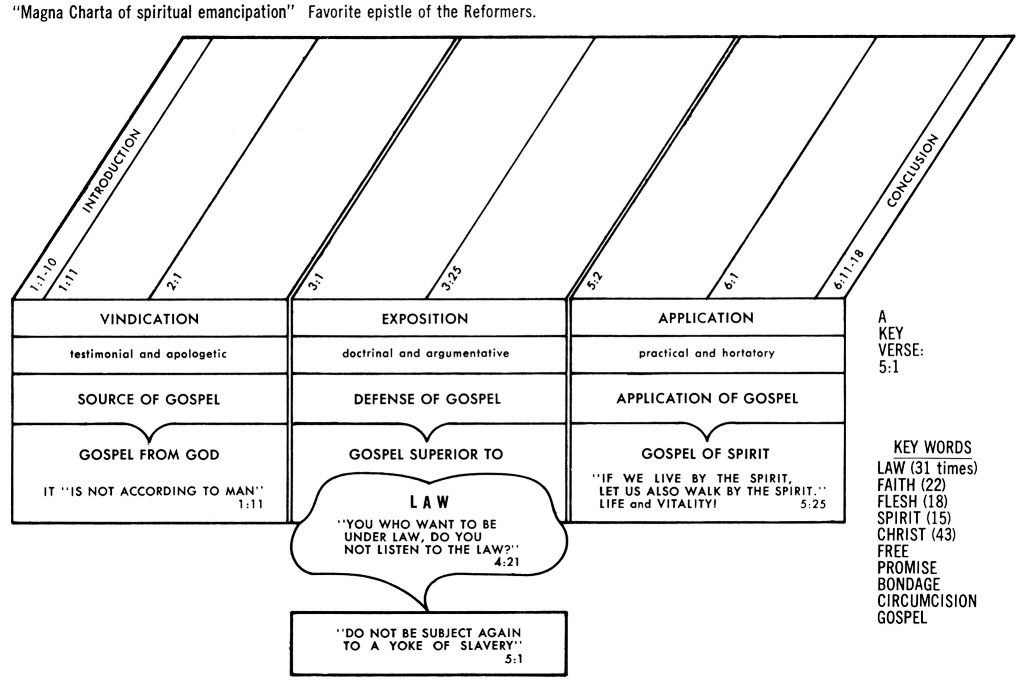
Magna Carta of Spiritual Emancipation
Click chart to enlarge
Charts from Jensen's Survey of the NT - used by permission
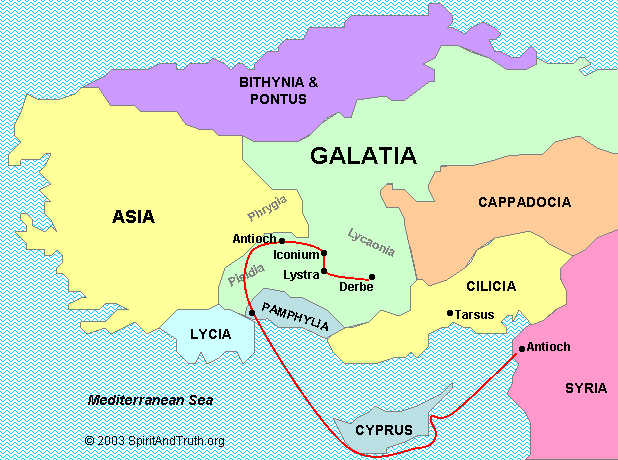
Click to Enlarge
See Also:
Paul's First Missionary Journey
Paul's Second Missionary Journey
Paul's Third Missionary Journey
Maps from Holman Bible Atlas (digital book; Hardcover/Paperback version) copyright © 1998 B&H Publishing Group, used by permission, all rights reserved.
This is one of the best resources for Bible maps as the maps also include helpful short descriptions of the events portrayed on the maps.
| SUMMARY CHART: EPISTLE TO THE GALATIANS |
|||||||
| Gospel of Grace Defended |
Gospel of Grace Explained |
Gospel of Grace Applied |
|||||
| Defense of the Gospel Gal 1:1-2:21 |
Freedom from Legalism Gal 3:1-4:31 |
Freedom to Love and to Serve Gal 5:1-6:18 |
|||||
| Labor | Liberty | Life | |||||
| Authority Not Opinion |
Freedom Not Bondage |
Spirit Not Flesh |
|||||
| Personal Autobiography |
Doctrinal Accuracy |
Practical Application |
|||||
| Paul the Apostle (Gal 1:1-24) |
Paul's Authority (Gal 2:1-21) |
Justified by Faith not Works (Gal 3:1-9) |
Justified by Faith not the Law (Gal 3:10-4:20) |
Grace and Law Cannot Co-Exist (Gal 4:21-31) |
Position and Practice of Liberty (Gal 5:1-15) |
Power of Liberty
(Gal 5:16-26) |
Performance in Liberty
(Gal 6:1-18) |
| Vindication | Exposition | Application | |||||
| Testimonial and Apologetic |
Doctrinal and Argumentative |
Practical and Hortatory |
|||||
| Biographical Explanation |
Doctrinal Exposition |
Practical Exhortation |
|||||
| Authentication of Liberty |
Argumentation for Liberty |
Application of Liberty |
|||||
|
Style or Tone: Vigorous, blunt, aggressive, direct, corrective, urgent, brief, righteous anger, strong words |
|||||||
|
Theme: Justification by Faith and not by Works of the Law |
|||||||
|
Author: Paul in large letters (Gal 6:11) |
|||||||
|
Recipients: Churches in Galatia (Gal 1:2) (Most likely the Southern Region) |
|||||||
|
Christ in Galatians: Jesus is the Source and Power for the believer's New Life. (Gal 2:20, 5:16) |
|||||||
Related Resource: Purpose of the Law
An Outline of Galatians - D Edmond Hiebert
THE INTRODUCTION (Galatians 1:1-10)
1. The salutation (Galatians 1:1-5)
a. The writer (Galatians 1:1-2a)
i. Paul, the Apostle (Galatians 1: 1)
ii. The brethren with him (Galatians 1:2a)
b. The readers (Galatians 1:2b)
c. The greeting (Galatians 1:3-5)
i. The contents of the greeting (Galatians 1:3a)
ii. The source of the grace and peace (Galatians 1:3b-4)
iii. The doxology (Galatians 1:5)
2. The rebuke (Galatians 1:6-10)
a. His astonishment at their fickleness (Galatians 1:6-7)
i. The reason for the astonishment (Galatians 1:6)
ii. The explanation of the departure (Galatians 1:7)
b. His assertion about its seriousness Galatians 1:8-9)
i. The seriousness asserted (Galatians 1:8)
ii. The seriousness reaffirmed (Galatians 1:9)
c. His attitude in the matter (Galatians 1:10)
I. PERSONAL: THE VINDICATION OF HIS APOSTOLIC AUTHORITY (Galatians 1:11-2:21)
1. How he got his Gospel (Galatians 1:11-24)
a. The origin of his Gospel through revelation (Galatians 1: 11-12)
i. The assertion as to its nature (Galatians 1:11)
ii. The manner of its reception (Galatians 1:12)
b. The previous conduct of the one given the revelation (Galatians 1:13-14)
i. The manner of his former life known to them Galatians 1:13a)
ii. The description of his former life (Galatians 1:13b-14)
a. In relation to the Church of God (Galatians 1:13b)
b. In relation to Judaism (Galatians 1:14)
c. The description of the revelation received (Galatians 1:15-17)
i. The source of the revelation (Galatians 1:15)
ii. The subject of the revelation (Galatians 1:16a)
iii. The purpose of the revelation (Galatians 1:16b)
iv. The response to the revelation (Galatians 1:16c-17)
d. His independence of the Jerusalem apostles (Galatians 1:18-24)
i. The first visit to Jerusalem (Galatians 1:18-20)
a. The time of the visit (Galatians 1:18a)
b. The purpose of the visit (Galatians 1:18b)
c. The duration of the visit (Galatians 1:18c)
d. The scope of contacts during the visit (Galatians 1:19-20)
ii. The subsequent absence from Jerusalem (Galatians 1:21-24)
a. The place of his withdrawal (Galatians 1:21)
b. The lack of acquaintance with the Judean churches (Galatians 1:22)
c. The response of the churches to reports about him (Galatians 1:23-24)
2. How his Gospel was confirmed by the apostles at Jerusalem (Galatians 2:1-10)
a. The circumstances of its presentation to them (Galatians 2:1-2)
i. The journey to Jerusalem (Galatians 2:1-2a)
ii. The presentation made at Jerusalem (Galatians 2:2b)
b. The outcome of his presentation of his Gospel to them (Galatians 2:3-10)
i. The maintenance of his position, as seen in Titus Galatians 2:3)
ii. The conflict with the false brethren (Galatians 2:4-5)
a. The presence of the false brethren (Galatians 2:4)
b. The refusal to yield to their demands (Galatians 2:5)
iii. The approval of his Gospel by the Jerusalem leaders (Galatians 2:6-10)
a. Their failure to add anything to his Gospel (Galatians 2:6)
b. Their approval of his Gospel in full (Galatians 2:7-10)
1. The basis of their approval (Galatians 2:7-9a)
2. The expression of their approval (Galatians 2:9b)
3. The one request with their approval (Galatians 2:10)
3. How he rebuked Peter's inconsistent conduct (Galatians 2:11-21)
a. The circumstances when giving the rebuke (Galatians 2:11-13)
i. The fact of his rebuke of Peter (Galatians 2:11)
ii. The reason for his rebuke of Peter (Galatians 2:12)
iii. The effect of the inconsistent conduct of Peter (Galatians 2:13)
b. The justification for giving the rebuke (Galatians 2:14-21)
i. His question of rebuke to Peter (Galatians 2:14)
ii. His explanation of his doctrinal position (Galatians 2:15-21)
a. The insufficiency of the law (Galatians 2:15-18)
1. The discovery of believing Jews about justification (Galatians 2:15-16)
2. The rejection of a conclusion from Peter's action (Galatians 2:17)
3. The significance of a return to law-works (Galatians 2:18)
b. The new life in Christ (Galatians 2:19-21)
1. The effect of the law led to the new life (Galatians 2:19)
2. The nature of the new life (Galatians 2:20)
3. The grace of God nullified by law-keeping (Galatians 2:21)
II. DOCTRINAL: THE EXPOSITION OF JUSTIFICATION BY FAITH (Galatians 3:1-4:31)
1. The elaboration of the doctrine of justification (Galatians 3:1-4:7)
a. The nature of justification as by faith, not law (Galatians 3:1-14)
i. The inconsistency of their conduct (Galatians 3:1-5)
a. The question about their turning from the crucified Christ (Galatians 3:1)
b. The question about the beginning of their Christian life (Galatians 3:2)
c. The question about their method of perfection (Galatians 3:3)
d. The question about their sufferings as believers (Galatians 3:4)
e. The question about the basis of God's work among them (Galatians 3:5)
ii. The example of Abraham's justification (Galatians 3:6-9)
a. The means of Abraham's justification (Galatians 3:6)
b. The identity of the sons of Abraham (Galatians 3:7)
c. The announcement to Abraham concerning Gentile justification by faith (Galatians 3:8)
d. The sharers in the blessings of Abraham (Galatians 3:9)
iii. The deliverance from law-works through Christ (Galatians 3:10-14)
a. The curse upon those under law-works (Galatians 3:10)
b. The inability of law-works to justify (Galatians 3:11-12)
c. The deliverance from the curse through Christ (Galatians 3:13-14)
1. The fact of our deliverance through Christ (Galatians 3:13a)
2. The means of our deliverance from the curse (Galatians 3:13b)
3. The purpose in our deliverance from the curse (Galatians 3:14)
b. The limitations of the law and its relations to faith (Galatians 3:15-4:7)
i. The covenant with Abraham unaltered by the law (Galatians 3:15-18)
a. The illustration of a man's covenant as binding (Galatians 3:15)
b. The fact illustrated is the divine promise to Abraham (Galatians 3:16)
c. The application of the principle of an unalterable covenant (Galatians 3:17-18)
1. The law did not alter the promise (Galatians 3:17)
2. The inheritance is not through law but promise (Galatians 3:18)
ii. The true place and purpose of the law (Galatians 3:19-29)
a. The temporary nature of the law (Galatians 3:19-20)
1. The reason for the adding of the law (Galatians 3:19a)
2. The time limit for the law (Galatians 3:19b)
3. The manner of the establishment of the law (Galatians 3:19c-20)
b. The inability of the law to produce life (Galatians 3:21-22)
1. The law not contrary to the promise (Galatians 3:21a)
2. The law unable to produce life (Galatians 3:21b)
3. The Scripture shut up all to faith in Christ (Galatians 3:22)
c. The law as a child-leader to Christ with His blessings (Galatians 3:23-29)
1. The old position under law (Galatians 3:23-24)
a. The position of confinement under law (Galatians 3:23)
b. The function of the law as child-leader to Christ (Galatians 3:24)
2. The new position in Christ (Galatians 3:25-29)
a. The nature of the new position (Galatians 3:25-26)
b. The entry into the new life (Galatians 3:27)
c. The effect of the new life (Galatians 3:28)
d. The fulfillment of the promise to Abraham (Galatians 3:29)
iii. The contrasted position under law and faith (Galatians 4:1-7)
a. The illustration of the position of the heir as a minor (Galatians 4:1-2)
b. The application of the illustration to believers (Galatians 4:3-6)
1. The condition of bondage as minors (Galatians 4:3)
2. The position as free sons through God's Son (Galatians 4:4-6)
a. The sending of the Son of God (Galatians 4:4-5)
b. The sending of the Spirit of God (Galatians 4:6)
3. The conclusion for the believer (Galatians 4:7)
2. The appeal for them to drop their legalism (Galatians 4:8-31)
a. The acceptance of Jewish legalism is a return to bondage (Galatians 4:8-11)
i. Their past condition of bondage (Galatians 4:8)
ii. Their present deliverance from bondage (Galatians 4:9a)
iii. Their legalism as a return to bondage (Galatians 4:9b-10)
iv. Their action a cause of concern to him (Galatians 4:11)
b. The appeal from his relations to them (Galatians 4:12-20)
i. The appeal for them to adopt his position (Galatians 4:12a)
ii. The reminder of his past relations to them (Galatians 4:12b-14)
iii. The change in their relation to him (Galatians 4:15-18)
iv. The travail he is undergoing for them (Galatians 4:19-20)
c. The appeal from the two contrasted covenants (Galatians 4:21-31)
i. The question to those desiring to be under law (Galatians 4:21)
ii. The story of Abraham's two sons (Galatians 4:22-23)
iii. The allegorical interpretation of the story (Galatians 4:24-30)
a. The two mothers representing two covenants (Galatians 4:24a)
b. The description of the two covenants (Galatians 4:24b-28)
1. The one representing a covenant of bondage (Galatians 4:24b-25)
2. The other representing a covenant of freedom (Galatians 4:26-28)
c. The expulsion of the slave woman and her son (Galatians 4:29-30)
iv. The conclusion from the story (Galatians 4:31)
III. PRACTICAL: THE LIFE OF CHRISTIAN LIBERTY (Galatians 5:1-6:10)
1. The call to maintain their Christian liberty (Galatians 5:1)
2. The peril to Christian liberty (Galatians 5:2-12)
a. The peril to them in circumcision (Galatians 5:2-6)
i. The consequences of accepting circumcision (Galatians 5:2-4)
a. It renders Christ useless to them (Galatians 5:2)
b. It makes a man debtor to do the whole law (Galatians 5:3)
c. It severs them from Christ (Galatians 5:4a)
d. It constitutes a fall from grace (Galatians 5:4b)
ii. The attitude of the true believer (Galatians 5:5-6)
b. The condemnation of the false teacher (Galatians 5:7-12)
i. The explanation for their defection (Galatians 5:7)
ii. The characterization of the teaching (Galatians 5:8-9)
iii. The condemnation of the one troubling them (Galatians 5:10-12)
a. The confidence he has in them (Galatians 5:10a)
b. The troubler will bear his judgment (Galatians 5:10b)
c. The refutation of charges that he preaches circumcision (Galatians 5:11)
d. The wish that these teachers would go to the consistent end (Galatians 5:12)
3. The life of Christian liberty (Galatians 5:13-6:10)
a. It is directed by love (Galatians 5:13-15)
i. The believer called to liberty (Galatians 5:13a)
ii. The use of Christian liberty (Galatians 5:13b)
iii. The fulfillment of the law through love (Galatians 5:14)
iv. The results of the lack of love (Galatians 5:15)
b. It is a walk in the Spirit, not in the flesh (Galatians 5:16-25)
i. The command to walk by the Spirit (Galatians 5:16)
ii. The conflict between the Spirit and the flesh (Galatians 5:17-18)
iii. The contrasted products of the flesh and the Spirit (Galatians 5:19-23)
a. The works of the flesh (Galatians 5:19-21)
b. The fruit of the Spirit (Galatians 5:22-23)
iv. The persons living by the Spirit (Galatians 5:24-25)
c. It is a life of mutual burden-bearing (Galatians 5:26-6:10)
i. The burden of moral faults (Galatians 5:26-6:5)
a. The warning against wrong attitudes towards others (Galatians 5:26)
b. The attitude of humility in restoring the fallen (Galatians 6:1)
c. The duty of mutual burden-bearing (Galatians 6:2)
d. The proper attitude toward self (Galatians 6:3-5)
ii. The burden of temporal needs (Galatians 6:6-10)
a. The exhortation to communicate with their teachers (Galatians 6:6)
b. The law of the spiritual harvest (Galatians 6:7-8)
c. The encouragement to welldoing (Galatians 6:9-10)
THE CONCLUSION (Galatians 6:11-17)
1. His reference to his large letters (Galatians 6:11)
2. His rebuke of his adversaries (Galatians 6:12-13)
3. His confidence in the cross (Galatians 6:14-16)
a. His glorying only in the cross (Galatians 6:14a)
b. His crucifixion through the cross (Galatians 6:14b)
c. His evaluation of things through the cross (Galatians 6:15)
d. His benediction upon those accepting this principle (Galatians 6:16)
4. His marks of apostleship (Galatians 6:17)
THE BENEDICTION (Galatians 6:18)
Galatians 5:24 Now those who belong to Christ Jesus have crucified the flesh with its passions and desires. (NASB: Lockman)
Greek: oi de tou Christou [Iesou] ten sarka estaurosan (3PAAI) sun tois pathemasin kai tais epithumiais
Amplified: And those who belong to Christ Jesus (the Messiah) have crucified the flesh (the godless human nature) with its passions and appetites and desires. (Amplified Bible - Lockman)
Barclay: Those who belong to Jesus Christ have crucified their own unregenerate selves along with all their passions and their desires. (Westminster Press)
KJV: And they that are Christ's have crucified the flesh with the affections and lusts.
NLT: Those who belong to Christ Jesus have nailed the passions and desires of their sinful nature to his cross and crucified them there. (NLT - Tyndale House)
Phillips: Those who belong to Christ have crucified their old nature with all that it loved and lusted for. (Phillips: Touchstone)
Weymouth: Against such things as these there is no law. Now those who belong to Christ Jesus have crucified their lower nature with its passions and appetites.
Wuest: And they who belong to Christ Jesus crucified the evil nature with its dispositions and cravings once for all.
Young's Literal: and those who are Christ's, the flesh did crucify with the affections, and the desires;
NOW THOSE WHO BELONG TO CHRIST JESUS HAVE CRUCIFIED THE FLESH WITH ITS PASSIONS AND DESIRES: oi de tou Christou [Iesou] ten sarka estaurosan (3PAAI) sun tois pathemasin kai tais epithumiais:
- Gal 3:29; Romans 8:9; 1Cor 3:23; 15:23; 2Cor 10:7
- Crucified - Gal 5:16, 17, 18, 19 ,20; 6:14; Ro 6:6; 8:13; 13:14; 1Peter 2:11
- Galatians 5 Resources - Multiple Sermons and Commentaries
TO WHOM DO
YOU BELONG?
Now those who belong to Christ Jesus - A long phrase which is a great description of every believer = one who belongs to Jesus! How have you done this past week? Living as if you belong to Him or as one who thinks they you are still your own, and can still live "independent" of your Master and Owner? This phrase also implies that a costly price (His precious blood) has been paid to redeem us as His very own possession.
Matthew Henry says these are...
those who are Christians indeed, not only in show and profession, but in sincerity and truth
Paul refers to belong in Romans 8 explaining that...
you are not in the flesh but in the Spirit, if indeed the Spirit of God dwells in you. But if anyone does not have the Spirit of Christ, he does not belong to Him. (See note Romans 8:9)
I wonder if we truly live with the profound thought in mind that we are those who belong to Christ? As Paul asked the Corinthians...
Do you not know that your body is a temple of the Holy Spirit Who is in you, Whom you have from God, and that you are not your own? For (term of explanation - always pause and ponder. Ask what is being explained. How? Why? etc - Upshot is that you are learning the powerful neglected discipline of Biblical Meditation) you have been bought with a price: therefore glorify (doxazo) God in your body. (1Cor 6:19 , 1Cor 6:20)
Paul expressed this same idea of the "divine possession" of believers in several other passages...
And if (since) you belong to Christ, then you are Abraham's offspring, heirs according to promise. (Galatians 3:29)
(Christ) gave Himself for (in our place = substitution, the doctrine of substitutionary atonement) us, that He might redeem (lutroo = paid the price of His precious blood to set slaves free from bondage to sin) us from every lawless deed and purify (katharizo) for Himself a people for His own possession (periousios), zealous for Good Deeds. (Titus 2:14)
For if we live, we live for the Lord; and if we die, we die for the Lord. Therefore, whether we live or die, we are the Lord’s (Ro 14:8).
And you belong to Christ, and Christ belongs to God (1Cor 3:23)
But each in his own turn: Christ, the firstfruits; then, when He comes, those who belong to Him. (1Cor 15:23, NIV)
Eadie comments on the phrase those who belong to Christ Jesus speaks of possession "they belong to Him as bought by Him, delivered by Him, and possessed by Him, through His Spirit producing such fruit. “Christ liveth in me.” They who are Christ's cannot but be characterized by the fruit of the Spirit, for they crucified the flesh (Galatians 5 Commentary)
Lightfoot has an interesting aside on this verse noting that "Several of the Greek fathers strangely connected the Christ with the flesh, ‘these persons have crucified the flesh of Christ,’ explaining it in various ways... (St. Paul's Epistle to the Galatians) (Comment: This is clearly not the correct rendering of the passage, but is mentioned lest we rely too heavily on human interpretation, including the so-called Early Church Fathers--they may have been "early" but they were not always "right"!)
Have crucified the flesh - There are two ways that this verse has been interpreted and there are excellent expositors and commentators on both sides: (1) believers have been crucified (past tense) with Christ and are in union with and identified with Christ; (2) believers are to (effectively) "crucify" or mortify the flesh which, although crucified in the past when we died with Christ, is still active in every believer.
(1) speaks of a believer's position in Christ, while (2) speaks of the the believer's experience made possible because of our position in Christ. To a degree both interpretations are reasonable, and are like two inseparable sides of a coin. However, if one examines the context closely, interpretation (1) which speaks of our position in Christ is followed immediately by a verse that speaks of our experience in Christ and exhorts us to live out that experience by keeping in step with the Spirit (our experience), something that would not be possible if we had not been crucified with Christ (our position).
With this brief introduction the following analysis will present both sides of the coin as seen by a number of respected Christian preachers and expositors. You will notice that some of the interpretations subtly merge or overlap into an "amalgamation" of interpretations (1) and (2).
THE FIRST INTERPRETATION OF
"HAVE CRUCIFIED THE FLESH"
This interpretation holds that if you are a Christian, you have already died. Crucified is therefore the believer's present position, possession, power and potential to live as more than a conqueror over Sin, the flesh and the devil. Crucifixion is something God does, not us. It happened when we were crucified with Christ (Ro 6:6). Have crucified is past tense and for all who are true followers of Christ, this is what has happened to us. Our flesh—that old rebellious, unbelieving, self-centered person we were apart from Christ—was crucified. When? This occurred when we put our faith in Christ and were united to Him so that what He experienced, we experienced (Ro 6:5). His death became our death, so that His life might become our life. To reiterate, when we died with Christ, the old unregenerate totally depraved person we were before salvation died. It was reckoned as true in us ("placed on our spiritual account") when we by grace through faith received Jesus' as Savior and Lord. The decisive blow against the enemy of our lives was struck and the victory was secured in Christ.
Kenneth Wuest explains that when we first believed, it was at that moment we "received the actual benefits of our identification with Christ in His death on the Cross, which benefits were only potential at the time He was crucified. The Christian’s identification with Christ in His death, resulted in the breaking of the power of the sinful nature over the life. This victory over sin which the Lord Jesus procured for us at the Cross, is made actual and operative in our lives as we yield to the Holy Spirit and trust Him for that victory. It is the Holy Spirit’s ministry that applies the salvation from the power of the sinful nature which God the Son procured at the Cross for us (Ed note: cp Gal 5:16). Thus the Holy Spirit has a two-fold ministry in the saint, that of making actually operative in the life of the Christian, the victory over sin which the Lord Jesus procured for us at the Cross, and that of producing in the Christian’s experience, His fruit (cp Gal 5:22; Gal 5:23; Ro 7:4). But this He is only able to do in a full and rich measure as the saint puts himself definitely under subjection to the Spirit. This initial act of faith in the Lord Jesus which resulted in the crucifixion (putting to death) of the affections and lusts of the totally depraved nature, is followed during the life of that Christian, by the free action of his liberated will in counting himself as having died to (having been separated from the power of) the evil nature with the result that he says NO to sin and stops yielding himself and his members to sin (Ed: But be careful here -- believers in their own strength do not have the power to say "no" to the fallen flesh. However as they walk by the Spirit and are empowered by the Spirit, they are able to say "no" to the lusts of the fallen flesh. But don't turn Gal 5:16 around for you will be frustrated and will fail to have victory of whatever temptation with which the flesh was assaulting you!) (Galatians Commentary - Verse by Verse)
In other passages Paul refers to the believer's crucifixion...
knowing this, that our old self was crucified with Him, that our body of sin might be done away with, that we should no longer be slaves to sin (Ro 6:6)
Even so consider yourselves to be dead to sin, but alive to God in Christ Jesus. (Ro 6:11)
I have been crucified with (verb is sustauroo = combination of sun = with + stauroo = crucify) Christ; and it is no longer I who live, but Christ lives in me (How? His Spirit - see Ro 8:9); and the life which I now live in the flesh (my mortal, physical body) I live by faith in the Son of God, who loved me, and delivered Himself up for me. (Gal 2:20)
Comment: In short, because of Paul's crucifixion with Christ, he was positionally dead to the Law (that was a historical fact). His life was no longer that of self-effort to keep the law, but was a life empowered by the indwelling Spirit of Christ.
Paul's point is that the Christian life is not primarily a set of rules and regulations to be obeyed (legalism), but is a Person living His life in and through the believer. This is what Paul meant in Colossians writing that this supernatural life is...
Christ in you, the hope of glory (Col 1:27)
and...
Christ...is our life (Col 3:4)
John echoes this tremendous truth of Christ our life writing...
but these have been written that you may believe that Jesus is the Christ, the Son of God; and that believing you may have life in His name. (John 20:31)
Comment: Where is our life? In His name - His name is all that Christ is and it is He Alone in Whom we can now experience supernatural life. The Person of Christ is our life. Think about our new name "Christian". What happens when we remove Christ from that name? On the other hand, take the letter "a" and move it to the front [I realize this a bit forced, but it does make the point] - "A Christ in"!
And the witness is this, that God has given us eternal life, and this life is in His Son. He who has the Son has the life; he who does not have the Son of God does not have the life. (1John 5:11,12)
Observe Paul's desire for the believers in Galatians 4...
My children, with whom I am again in labor until Christ is formed in you (Galatians 4:19)
Comment: The verb formed is morphoo which describes the shaping of one's outward expression which proceeds from and is truly representative of one’s inward character and nature, which in Col 1:27 is "Christ in you". Paul desires that the lives of these believers [and of each of us dear reader] may be so surrendered to the Lord Jesus, that He may give outward expression of His own glorious Person in our thoughts, words, and deeds. What we are on the outside is to be continually becoming more representative of what we truly are on the inside. For example, is not the "fruit of the Spirit" in a believer's life in its essence a manifestation of Christ's character being "formed" in us? Fruit in our life is clear evidence that we are walking by the Spirit and that the life of Christ is being manifested in and though our mortal flesh.
Compare...
(We believers are) always carrying about in the body the dying of Jesus, that the life of Jesus also may be manifested in our body (the "Christ life"). For we who live are constantly being delivered over to death for Jesus' sake, that the life of Jesus also may be manifested in our mortal flesh. (2Corinthians 4:10,11)
John MacArthur agrees with this interpretation writing...
In each of those three passages, “crucified” is simply a vivid and dramatic way to say “killed,” or “executed.” In the first two passages Paul is teaching that at salvation his old, sinful, unregenerate self was executed and he was born a new man in Christ Jesus. In the third passage he is saying that the world has been executed and is now dead to him, so that it is no longer his master, holding him in bondage. He is therefore now free to serve the Lord.
Obviously, in none of those passages does Paul mean to imply that the crucifixion analogy carries the idea of total death, in which all influence ceases. Sin was still a reality in his life, and so was the temptation of the world. But there was a sense in which the power of the old self and of the world was broken. Those influences no longer dominated him.
In the text of Galatians 5:24, Paul is saying that the flesh has been executed. But how could that be in light of what he has just said in this chapter about believers having a constant war with the ever-present flesh? In what sense is the flesh killed at conversion?
It cannot be in the actual, complete, present sense or it would contradict the reality of the continual spiritual conflict with the flesh indicated here and in Romans 7:14-25. And it cannot be that Paul has some future sense in mind or he would have used a future verb form, saying, “shall crucify the flesh,” referring to the time of glorification.
The best understanding is to see have crucified as an allusion to the cross of Jesus Christ, which, as a past event, fits the aorist tense used here by Paul. It looks back to the cross, the time at which the death of the flesh was actually accomplished. Yet, because we are still alive on the earth and still possess our humanness, we have not yet entered into the future fullness of that past event.
Meanwhile, the flesh with its passions (or affections) and desires is dead in the sense of no longer reigning over us or of holding us in inescapable bondage. Like a chicken with its head cut off, the flesh has been dealt a death blow, although it continues to flop around the barnyard of earth until the last nerve is stilled.
Because the flesh is defeated forever, and we now live in the realm where Christ reigns over us by His Spirit, we should live according to the Spirit and not the flesh. (MacArthur, J. Galatians. Chicago: Moody Press)
A T Robertson interprets have crucified as "Definite event, first aorist active indicative of stauroō as in Gal 2:19 (mystical union with Christ). Paul uses sarx (flesh) here in the same sense as in verses 16, 17, 19, “the force in men that makes for evil” (Burton). With sun = “Together with,” emphasizing “the completeness of the extermination of this evil force” and the guarantee of victory over one’s passions and dispositions toward evil. (Comment: Robertson uses the word "extermination" might lead some to think the flesh no longer had power, which Paul has already taught is clearly not the case.)
Vincent writes "The line of thought as regards death to sin is the same as in Ro 6:2, 3, 4, 5, 6, 7, 11; as regards death to the law, the same as in Ro 7:1, 2, 3, 4, 5, 6.
UBS Handbook writes that have crucified "is, of course, a figurative expression, suggesting a connection between this action of the believer and the death of Jesus Christ on the cross. The verb is in the aorist tense, suggesting either that the action took place in the past (at conversion...) or that the action resulted in a complete and decisive change...this action is presently reflected in the experience of every believer... (The United Bible Societies' New Testament Handbook Series)
John Piper has an interesting way of explaining crucifixion of the flesh...
Picture your flesh—that old ego with the mentality of merit and craving for power and reputation and self-reliance—picture it as a dragon living in some cave of your soul. Then you hear the gospel, and in it Jesus Christ comes to you and says, “I will make you mine and take possession of the cave and slay the dragon. Will you yield to my possession? It will mean a whole new way of thinking and feeling and acting.” You say: “But that dragon is me. I will die.” He says, “And you will rise to newness of life, for I will take its plan; I will make my mind and my will and my heart your own.” You say, “What must I do?” He answers, “Trust me and do as I say. As long as you trust me, we cannot lose.” Overcome by the beauty and power of Christ you bow and swear eternal loyalty and trust. And as you rise, he puts a great sword in your hand and says, “Follow me.” He leads you to the mouth of the cave and says, “Go in, slay the dragon.” But you look at him bewildered, “I cannot. Not without you.” He smiles. “Well said. You learn quickly. Never forget: my commands for you to do something are never commands to do it alone.” Then you enter the cave together. A horrible battle follows and you feel Christ’s hand on yours. At last the dragon lies limp. You ask, “Is it dead?” His answer is this: “I have come to give you new life. This you received when you yielded to my possession and swore faith and loyalty to me. And now with my sword and my hand you have felled the dragon of the flesh. It is a mortal wound. It will die. That is certain. But it has not yet bled to death, and it may yet revive with violent convulsions and do much harm. So you must treat it as dead and seal the cave as a tomb. The Lord of darkness may cause earthquakes in your soul to shake the stones loose, but you build them up again. And have this confidence: with my sword and my hand on yours this dragon’s doom is sure, he is finished, and your new life is secure.”
I think that is the meaning of Gal 5:24, “Those who belong to Christ have crucified the flesh with its passions and desires.” Christ has taken possession of our soul. Our old self has been dealt a mortal wound and stripped of its power to have dominion. The Christian life, the fruit of the Spirit, is a constant reckoning of the flesh as dead (piling stones on its tomb) and a constant relying on the present Spirit of Christ to produce love, joy, and peace within. The difference between the Christian life and popular American morality is that Christians will not take one step unless the hand of Christ holds the hand that wields the sword of righteousness. (Read Dr Piper's full sermon on Galatians 5:19-26: Walk by the Spirit)
Matthew Poole writes that "They that are Christ’s - those who are engrafted into Christ by faith, united to Him, and so His members; have crucified the flesh by virtue of a power derived from the cross of Christ, have got their unregenerate part in a great measure mortified; with the affections and lusts with the inordinate desires, affections, and passions of it: not that they have wholly put off these, (they are men still), but the inordinateness of them is corrected, mortified, and subdued. (Matthew Poole. Matthew Poole's Commentary on the New Testament)
Jameison, Fausset, Brown explain that "They nailed it to the cross once for all when they became Christ’s, on believing and being baptized (Ro 6:3, 4): they keep it now in a state of crucifixion (Ro 6:6): so that the Spirit can produce in them, comparatively uninterrupted by it, “the fruit of the Spirit” (Gal 5:22). “Man, by faith, is dead to the former standing point of a sinful life, and rises to a new life (Gal 5:25) of communion with Christ (Col 3:3). The act by which they have crucified the flesh with its lust, is already accomplished ideally in principle. But the practice, or outward conformation of the life, must harmonize with the tendency given to the inward life” (Gal 5:25) [Neander]. We are to be executioners, dealing cruelly with the body of sin, which has caused the acting of all cruelties on Christ’s body. (Commentary)
John Calvin - "The word crucified is employed to point out that the mortification of the flesh is the effect of the cross of Christ. This work does not belong to man. By the grace of Christ “we have been planted together in the likeness of his death” (Romans 6:5,) that we no longer might live unto ourselves. If we are buried with Christ, by true self-denial, and by the destruction of the old man, we shall then enjoy the privilege of the sons of God. The flesh is not yet indeed entirely destroyed; but it has no right to exercise dominion, and ought to yield to the Spirit. The flesh itself is the depravity of corrupt nature, from which all evil actions proceed. (Matthew 15:19; Mark 7:21.) Hence it follows, that the members of Christ have cause to complain, if they are still held to be in bondage to the law, from which all who have been regenerated by his Spirit are set free. (Commentary)
Beet "Notice three crucifixions in this Epistle; of Paul, of the flesh and its desires, and of the world. Each of these implies the others. In each case crucified denotes death in virtue of Christ’s death on the cross and by union with the Crucified: ()
Constable - The Christian has crucified the flesh in the sense that when he or she trusted Christ God broke the domination of his or her sinful nature. While we still have a sinful human nature, it does not control us as it did before we trusted in Christ (cf. Ro 6:6–7). Paul said we, not God, have crucified it. We did this when we trusted in Jesus Christ as our Savior (cf. Gal 2:20). Therefore it is inconsistent for us to return to the flesh. “Passions” (Gr. pathemata, cf. Ro 7:5) are the outward expression of inner “desires” (Gr. epithumiai, cf. Gal 5:16). In another sense we need to continually crucify the flesh by choosing to yield to the Spirit (Gal 5:16, 18, 25; Ro 8:13; Col. 3:5). (Galatians)
Longenecker - those who belong to Christ Jesus have crucified the flesh with its passions and desires,” and so cannot live in a libertine fashion; the second (cast inhortatory form) in v 25, that “since we live by the Spirit, let us keep in step with the Spirit,” so high lighting the Christian life as one lived by the Spirit’s direction and enablement... For Paul, to claim identification with Christ in his crucifixion means that one cannot espouse a lifestyle that expresses either a legalistic or a libertine orientation. For in being crucified with Christ both the demands of the law and the impulses of the flesh have been crucified as well (cf. notes Romans 7:1; 7:2; 7:3; 7:4; 7:5; 7:6; Colossians 2:13; 14; 15). (Longenecker, R. N. . Vol. 41: Word Biblical Commentary : Galatians. Word Biblical Commentary. Page 264. Dallas: Word, Incorporated)
F F Bruce explains that...
It is because they are Christ’s in the sense of being members of Christ, incorporated in Christ, that they have ‘crucified the flesh’. The aorist probably indicates their participation in Christ’s historical crucifixion. When Paul said earlier (he was crucified with Christ) (Galatians 2:20), he meant that the cross of Christ severed his relation to the law. Here he says that the cross of Christ severs believers’ relation to the ‘flesh’. For Paul, as we have seen already, the law and the flesh belong to the same pre-Christian order. But the cross of Christ severed Paul’s relation to the law only as he himself was ‘crucified with Christ’, thus becoming ‘dead to the law’ that he might live to God; so also the cross severs the relation of believers in general to the flesh only as they reckon themselves to have been crucified in the historical crucifixion of Christ. The crucifixion of the former self-centred ego, that it may be replaced by the new Christ-centred mind—’it is no longer I who live, but Christ lives in me’ (Gal 2:20 )—is not materially different from the crucifixion of the flesh, that it may be replaced b a Spirit-imparted life and a Spirit-directed conduct. Cf. Ro 8:13 (note). ‘if by the Spirit you put to death the deeds of the body, you will live’.
Those who belong to Christ, then, those who acknowledge his lordship in no merely formal way (cf. Ro 14:8), have made a clean break with what they formerly were (cf. Ro 6:6); they have been delivered from the ‘present evil age’ (Gal 1:4) and have become members of the new creation (Gal 6:15). It is the cross of Christ that makes this clean break. As truly as law and flesh are bound up for Paul with the present evil age, so truly is the indwelling Spirit the witness that the age to come has already broken in through the Christ-event.
‘Ideally, we must understand, this crucifixion of the flesh is involved in Christ’s crucifixion; really, it is effected by it. Whoever sees into the secret of Calvary…is conscious that the doom of sin is in it; to take it as real, and to stand in any real relation to it, is death to the flesh with its passions and desires’ (J. Denney, The Death of Christ, 162).
Alongside such a historical statement as this, in the indicative, stands the hortatory counterpart, in the imperative, as in Ro 6:11 (note) (‘reckon yourselves to be dead to sin but alive to God in Christ Jesus’); Col 3:5 (note) (‘put to death therefore your members that are on earth…’). What has been effected once for all by the cross of Christ must be worked out in practice. (Bruce, F. F. The Epistle to the Galatians: A commentary on the Greek Text. Grand Rapids, Mich: W. B. Eerdmans. 1982)
KJV Bible Commentary commenting on has been crucified notes that...
This is a settled matter (Gal 2:20 ), but the very fact that the flesh and the Spirit are in constant conflict shows that the flesh is very active. When one puts his trust in Christ, he receives the actual benefits of identification with Christ, resulting in breaking the power of cancelled sin and in setting the prisoner free. The Christian is to daily give outward expression of his inward experience and in order to do this, he must constantly reckon (Ed note: present imperative) himself “to be dead indeed unto sin, but alive unto God through our Lord Jesus Christ” (Ro 6:11). (Dobson, E G, Charles Feinberg, E Hindson, Woodrow Kroll, H L. Wilmington: KJV Bible Commentary: Nelson)
Dr Grant Richison explains that...
Crucified is not self-crucifixion but our positional crucifixion in Christ. This is something that God does, not us. When Christ died on the cross, He died there for our sins. God identifies Christians with Christ’s death and resurrection. Our part is to apply that work of Christ to sin in our lives. We do this by placing faith in Christ initially at salvation and progressively through confessing sins by faith.
Flesh is that force that makes us violate a holy God. Jesus crucified the flesh. The grammar here (aorist indicative) indicates a definite and decisive act. This does not say that this is something that we must do. He did not say, “Those who are Christ’s should crucify the flesh.” The reality of crucifixion took place when we put our faith in the finished work of Christ on the cross.
Jesus settled the issue of our sins on the cross and we believed Him. When we recognize this as an ongoing fact, we make victory actual in our experience. Christ made the positional truth of a crucified flesh actual on the cross. We make it real to ourselves by faith.
Neither does this mean that Christ eradicated the present active function of our sin capacity on the cross. It simply means that God judged our sins by Christ’s death on the cross in a judicial or positional sense...
It is vital that we recognize that Christ crucified the flesh, that it was His work on the cross that did this. Jesus settled the issue there. This means Christ’s crucifixion is our crucifixion. We do not try to do what is already done; we do not crucify ourselves. We believe that Christ crucified us.
When we appeal to the cross by faith, we draw on the finished work of Christ to live the Christian life. Faith takes hold of God’s facts and appropriates them to experience. When we lay hold on the naked Word of God, we honour God’s promises.
We do not have to pray about being crucified; we are crucified with Christ. This is the crux of how we get victory in the Christian life. If we do not know our position in Christ, we do not know how to live the Christian life. Many sincere Christians try to crucify themselves but they always end in frustration. It is oh so unnecessary because it is already an accomplished fact. (Galatians 5:24)
J Vernon McGee asks...
When was the flesh crucified? When they reckon that when Christ died, they died, they will yield themselves on that basis. In Ro 6:13 (note) Paul says, “Neither yield ye your members as instruments of unrighteousness unto sin: but yield yourselves unto God, as those that are alive from the dead, and your members as instruments of righteousness unto God.”
“For ye are dead, and your life is hid with Christ in God” (see note Colossians 3:3). “I am crucified with Christ: nevertheless I live; yet not I, but Christ liveth in me: and the life which I now live in the flesh I live by the faith of the Son of God, who loved me, and gave himself for me” (see note Galatians 2:20). In all of these passages the thought is that when Christ was crucified, the believer was crucified at the same time. The believer is now joined to the living Christ, and the victory is not by struggling but by surrendering to Christ. The scriptural word is yield; it is an act of the will. (McGee, J V: Thru the Bible Commentary: Thomas Nelson)
C Norman Bartlett explains that...
Positionally we died to sin with Christ on the Cross
I am crucified with Christ: nevertheless I live; yet not I, but Christ liveth in me: and the life which I now live in the flesh I live by the faith of the Son of God, who loved me, and gave himself for me" (Galatians 2:20)
A STIMULUS
NOT A SEDATIVE
FOR HOLY LIVING
Is this great truth of identification with Jesus in His death a mighty pulsating dynamic in our lives? It should prove a stimulant and not a sedative for holy living. (C. Norman Bartlett: Galatians and You: Studies in the Epistle of Paul to the Galatians, 1948)
C H Spurgeon expresses an interpretation that is essentially a combination of interpretations (1) and (2). The following are selections from his sermon on Galatians 5:24: Doctrine of Justification by Faith (read the entire sermon).
Now, try to catch the following thought. — When you believe, you accept Christ as standing instead of you, and profess that what he did he did for you, but what did Christ do upon the tree? He was crucified and died. Follow the thought, and note well that by faith you regard yourself as dead with Him — crucified with Him. You have not really grasped what faith means unless you have grasped this. With Him you suffered the wrath of God, for He suffered in your stead: you are now in Him — crucified with Him, dead with Him, buried with Him, risen with Him, and gone into the glory with Him — because He represents you, and your faith has accepted the representation. Do you see, then, that you did, in the moment when you believed in Christ, register a declaration that you were henceforth dead unto sin. Who shall say that our gospel teaches men to live in sin, when the faith which is essential to salvation involves an avowal of death to it? The convert begins with agreeing to be regarded as dead with Christ to sin: have we not here the foundation stone of holiness?...
I shall now state my own experience when I believed in Jesus; and while I am doing so I rejoice to remember that there are hundreds, if not thousands in this place who have experienced the same, and millions in this world, and millions more in heaven, who know the truth of what I declare. When I believed that Jesus was the Christ, and rested my soul in him, I felt in my heart from that moment an intense hatred to sin of every kind. I had loved sin before, some sins particularly, but those sins became from that moment the most obnoxious to me, and, though the propensity to them was still there, yet the love of them was clean gone; and when I at any time transgressed I felt an inward grief and horror at myself for doing the things which aforetime I had allowed and even enjoyed. My relish for sin was gone. The things I once loved I abhorred, and blushed to think of...
CRUCIFY THE FLESH
When a man believes in Jesus the first point that helps him to crucify the flesh is that he has seen the evil of sin, inasmuch as he has seen Jesus, his Lord, die because of it. Men think that sin is nothing; but what will sin do? What will it not do? The virus of sin, what wilt it poison? Ay, what will it not poison? Its influence has been baleful upon the largest conceivable scale. Sin has flooded the world with blood and tears through red-handed war; sin has covered the world with oppression, and so has crushed the manhood of many, and broken the hearts of myriads; sin begat slavery, and tyranny, and priestcraft, and rebellion, and slander, and persecution; sin has been at the bottom of all human sorrows; but the crowning culminating point of sin’s villainy was when God himself came down to earth in human form — pure, perfect, intent on an errand of love — came to work miracles of mercy, and redemption. Then sinful man could never rest till he had crucified his incarnate God. They coined a word when the Parliamentary party executed the king in England, and called the king’s destroyers “regicides,” and now we must make a word to describe sin: sin is a deicide. Every sinner, if he could, would kill God, for he says in his heart, “No God.” He means he wishes there were none. He would be rejoiced indeed if he could learn for certain that there was no God. In fact, that is the bugbear of his life, that there is a God, and a just God, Who will bring him into judgment. His secret wish is that there were no religion and no God, for he might then live as he pleased.
Now, when a man is made to see that sin in its essence is the murderer of Emmanuel, God with us, his heart being renewed (Ed note: Having been crucified with Christ, etc), he hates sin from that very moment. “No,” he says, “I cannot continue in such evil. If that be the true meaning of every offense against the law of God — that it would put God Himself out of His own world if it could — I cannot bear it.” His spirit recoils with horror, as he feels —
“My sins have pulled the vengeance down
Upon his guiltless head:
Break, break, my heart, oh burst mine eyes!
And let my sorrows bleed.Strike, mighty Groom my flinty soul,
Till melting waters flow,
And deep repentance drown mine eyes
In undissembled (genuine) woe.”
Then the believer has also seen in the death of Christ an amazing instance of the great grace of God; for if sin be an attempt to murder God — and it is all that — then how wonderful it is that the creatures who committed this sin were not destroyed at once. How remarkable that God should consider it worth His while to devise a plan for their restoration; and yet He did, with matchless skill, contrive a way which involved the giving up of His only-begotten and well-beloved Son. Though this was an expense unequalled, yet He did not withdraw from it. He “so loved the world, that he gave his only begotten Son, that whosoever believeth in him might not perish, but have everlasting life:” and this for a race of men who were the enemies of their good and gracious God. “Henceforth,” saw the believer in Christ, “I can have nothing to do with sin, since it does despite to so gracious a God. O, thou accursed sin, to drive thy dagger at the heart of him who was all grace and mercy! This makes sin to be exceedingly sinful.”...
When we once are filled with love to thee, O Jesus, sin becomes the dragon against which we wage a lifelong warfare; holiness becomes our noblest aspiration, and we seek after it with all our heart and soul and strength. If candid minds will but honestly consider the religion of Jesus Christ, they will see that Christian men must hate sin if they are sincere in their faith.
Spurgeon in the Christian Illustrator wrote the following on Crucifixion of the flesh...
Crucifixion of the flesh: — Men who believe in Jesus become purer, holier, better. They are saved from living as they used to live — saved from licentiousness, dishonesty, drunkenness, selfishness, and any other sin they may have lived in. They are different men. There is a change in their heart and soul, conduct and conversation.
I. THE RECEPTION OF JESUS CHRIST BY FAITH IS, IN ITSELF, AN AVOWAL THAT WE HAVE CRUCIFIED THE FLESH, WITH THE AFFECTIONS AND LUSTS.
Christ died in our room and stead. By faith we regard ourselves as dead with Him.
II. AS A MATTER OF FACT, THE RECEPTION OF CHRIST IS ATTENDED WITH THE CRUCIFIXION OF SIN.
Every truly converted man is a proof of this.
III. THE RECEPTION OF JESUS CHRIST INTO THE HEART BY SIMPLE FAITH IS CALCULATED TO CRUCIFY THE FLESH.
1. The believer has seen the evil of sin. It is a deicide — a killing of God.
2. He has seen in the death of Christ an amazing instance of the great grace of God.
3. He has had a view of the justice of God.
4. He has seen the amazing love of Jesus. How, then, can he go on grieving and offending Him?
IV. THE HOLY SPIRIT IS WITH THE GOSPEL, AND WHERE HE IS HOLINESS MUST BE PROMOTED.
Wherever Jesus Christ is preached, there is present One sublime in rank and high in degree — the ever-blessed Spirit of God. He takes of the things of Christ, and shows them unto men. His power changes the current of men’s desires, making them crucify the flesh and its affections, and love things holy, just, and true.
Matthew Henry writes that although Paul...
...here only mentions the crucifying of the flesh with the affections and lusts, as the care and character of real Christians, yet, no doubt, it is also implied that, on the other hand, we should show forth those fruit of the Spirit which he had just before been specifying; this is no less our duty than that, nor is it less necessary to evidence our sincerity in religion. It is not enough that we cease to do evil, but we must learn to do well. Our Christianity obliges us not only to die unto sin, but to live unto righteousness; not only to oppose the works of the flesh, but to bring forth the fruits of the Spirit too. If therefore we would make it appear that we do indeed belong to Christ, this must be our sincere care and endeavour as well as the other; and that it was the design of the apostle to represent both the one and the other of these as our duty, and as necessary to support our character as Christians, may be gathered from what follows where he adds, If we live in the Spirit, let us also walk in the Spirit; that is, "If we profess to have received the Spirit of Christ, or that we are renewed in the Spirit of Christ, or that we are renewed in the spirit of our minds, and endued with a principle of spiritual life, let us make it appear by the proper fruits of the Spirit in our lives"...
Our conversation (walk, behavior) will always be answerable to the principle which we are under the guidance and government of -- as those that are after the flesh do mind the things of the flesh, so those that are after the Spirit do mind the things of the Spirit, Ro 8:5 (note). If therefore we would have it appear that we are Christ’s, and that we are partakers of His Spirit, it must be by our walking not after the flesh, but after the spirit. We must set ourselves in good earnest both to mortify the deeds of the body, and to walk in newness of life.
Kistemaker writes...
Let them therefore be what they are. Let them be in practice what they are in principle, for in principle they had crucified their old human nature, together with its sinful yearnings, whether these be viewed more passively as passions (probably the evil promptings working within their subconsciousness) or actively as desires (the wicked cravings which they consciously support and enliven). Because of the supreme importance of living a consistent Christian life, that is, of being in practice what one is already in principle, this thought is now rephrased as (Galatians 5:25) (Hendriksen, W., & Kistemaker, S. J. NT Commentary Set. Exposition of Galatians Baker Book)
Norman Harrison adds...
What a portrait of a Christian! In His crucifixion for me Christ included my flesh-life -- not merely the sins but the sin principle (Ed: Virtually every mention of the word "sin" in Romans 6 and Romans 7 refers to the "sin principle" - see Sin principle). This is true of every believer. "Knowing this, that our old man is crucified with" Christ (Ro 6:6). Insert the word "jointly" to get the full force of the Greek. Our old self-life was on the Cross with Christ, jointly dealt with in His death to sin. To His Cross He took my temper, my passions, my tendency to evil. Thus Christ accomplished a victory for me over every moving, every prompting of my flesh-life.
This is simply wonderful. But if I say on Our Side of the cross the flesh still lives and appeals. Failing to enter into His victory I must do the best the "I" can. But life on His Side of the cross is totally different. Here the Spirit is constantly checking out for me the values of this accomplished victory of self-crucifixion. I'm not doing it; He is doing it. My responsibility, since I "live in the Spirit," is to "also walk in the Spirit" (Gal 5:25). If I give expression to Him momentarily He will momentarily see to it that I do not "fulfill the lust of the flesh." CHRIST's victory for me is now the Spirit's victory in me. (Galatians 5:16ff Spirit versus Flesh)
Wycliffe Bible Commentary merges the two interpretations of Galatians 5:24 writing that......
Those who are truly Christ’s must be like Him in that they participate in His cross. They have crucified the flesh. Ideally, this points to their identification with Christ in His death (Gal 2:20). Practically, it emphasizes, the need of carrying the Cross principle into the redeemed life, since the flesh, with its affections and desires is still an ever present reality (cf. Gal 5:16, 17). (Pfeiffer, C F: Wycliffe Bible Commentary. 1981. Moody)
THE SECOND INTERPRETATION OF
"HAVE CRUCIFIED THE FLESH"
The second interpretation (which I personally do not favor) calls for believer to work out their salvation by denying self and taking up their cross as the practical outworking of the fact that the flesh of believers has been crucified. Below are several authors who favor this interpretation.
The highly respected expositor John Stott interprets Galatians 5:24 to mean that
We must crucify the flesh...This verse is frequently misunderstood. Please notice that the ‘crucifixion’ of the flesh described here is something that is done not to us but by us. It is we ourselves who are said to ‘have crucified the flesh’.
Perhaps I can best expose the popular misconception by saying that Galatians 5:24 does not teach the same truth as Galatians 2:20 or Romans 6:6. In those verses we are told that by faith-union with Christ we have been crucified with Him. But here it is we who have taken action. We ‘have crucified’ our old nature. It is not now a ‘dying’ which we have experienced through union with Christ; it is rather a deliberate ‘putting to death’.
What does it mean? Paul borrows the image of crucifixion, of course, from Christ Himself who said:
If any man would come after Me, let him deny himself and take up his cross and follow Me (Mk. 8:34)
To ‘take up the cross’ was our Lord’s vivid figure of speech for self-denial. Every follower of Christ is to behave like a condemned criminal and carry his cross to the place of execution. Now Paul takes the metaphor to its logical conclusion. We must not only take up our cross and walk with it, but actually see that the execution takes place. We are actually to take the flesh, our willful and wayward self, and (metaphorically speaking) nail it to the cross. This is Paul’s graphic description of repentance, of turning our back on the old life of selfishness and sin, repudiating it finally and utterly...
The Greek verb is in the aorist tense, indicating that this is something we did decisively at the moment of conversion. When we came to Jesus Christ, we repented. We ‘crucified’ everything we knew to be wrong. We took our old self-centred nature, with all its sinful passions and desires, and nailed it to the cross. And this repentance of ours was decisive, as decisive as a crucifixion. So, Paul says, if we crucified the flesh, we must leave it there to die. We must renew every day this attitude towards sin of ruthless and uncompromising rejection. In the language of Jesus, as Luke records it, every Christian must take up his cross daily (Luke 9:23). (Stott, J. R. W. The Message of Galatians: Only one way. Leicester, England; Downer's Grove, Ill., U.S.A.: Inter-Varsity Press)
George explains that Galatians 5:24...
and the one that follows it serve as a dual conclusion to Paul’s two catalogs of vices and virtues. If the Christian life is a continuous tug-of-war between the flesh and the Spirit, are not believers consigned to a spiritually meager existence of perpetual defeat and minimal growth? In these verses Paul asserted the sufficiency of the Spirit to deal with the flesh by pointing the way to Christian victory. That way is the path of sanctification Paul described here in terms of the dual process of mortification, daily dying to the flesh, and vivification, continuous growth in grace through the new life of the Spirit.
Many commentators interpret these verses in terms of Paul’s earlier testimony of having been crucified with Christ and made alive through faith (2:20). The language in these two passages is strikingly similar, but there is a noticeable difference in meaning. In Gal 2:20 the verb is passive, “I have been crucified with Christ.” This refers to a past act, a fait accompli, something done to the Christian and for the Christian by someone else. We have been crucified with Christ in that he died in our place on the cross and on the basis of which we are declared righteous by God through faith. In 5:24, however, the passive voice has given way to an active construction. Crucifixion of the flesh is described here not as something done to us but rather something done by us. Believers themselves are the agents of this crucifixion. Paul was here describing the process of mortification, the daily putting to death of the flesh through the disciplines of prayer, fasting, repentance, and self-control.
The basic demand of Christian discipleship is that we take up our cross daily and follow Christ (Luke 9:23). Paul stretched this metaphor further by saying that “we must not only take up our cross and walk with it, but actually see that the execution takes place.” The mortifying work of self-crucifixion is a continuous, lifelong process, for this side of heaven we dwell in mortal bodies and are bound by inordinate desires. J. Brown describes the continual putting to death of the flesh with all its sinful passions and desires in this way:
“Crucifixion … produced death not suddenly but gradually. … True Christians do not succeed in completely destroying it (that is the flesh) while here below; but they have fixed it to the cross and they are determined to keep it there till it expires.”
This verse tells us that there is no shortcut to spiritual victory in the life of the Christian. No second blessing, or rededication, or spiritual quick-fix can take the place of consistent, obedient, vigilant renunciation of the world and mortification of the flesh. (George, T. Galatians: The New American Commentary. Nashville: Broadman & Holman Publishers)
Guzik explains that crucifixion in this context
...is not, the sovereign, “unilateral” work of God. It is something that the believer does, being directed and empowered by the Spirit of God.
The Old Man, the self inherited from Adam, is crucified with Jesus as the sovereign work of God when we are born again. Romans 6:6 says, Knowing this, that our old man was crucified with Him. We are simply told to reckon, or account, the old man as dead (see note Romans 6:11), we are not told to put him to death. But the flesh is another matter. We are called to choose to work with God to do to the flesh exactly what God did all by Himself to the old man: crucify the flesh.
When Christ came in the flesh, we crucified him; when he comes into our hearts, he crucifies us. (Trapp)
James Montgomery Boice explains that in Galatians 5:24 Paul...
reminds his readers that when they came to Christ, they repented fully of the works of the flesh and indeed turned their backs on them forever. This act they must sustain. In speaking of this radical repentance, Paul uses the vivid image of crucifixion. This is an image he has used in other places; it was a favorite with him. But here he uses it in a slightly different way from the way he used it in Romans 6:6 or Galatians 2:20, for example. In these other instances, the verb is in the passive voice ("was crucified," "have been crucified"), and the reference is to what has been done for the believer as a result of Christ's death.
But in this passage the verb is in the active voice ("have crucified") and points rather to what the believer has himself done and must continue to regard as being done. The proper term to describe this act is repentance. Thus the believer in Christ has already repented of his former way of life to the degree of actually having executed the old nature. This does not mean that the battle is thereby over forever. As in an actual crucifixion, life lingers even though the criminal has been nailed to the cross. Nevertheless, the believer is to regard the decisive act as having been done. He is not to seek to remove from the cross what has once been nailed there. (Gaebelein, F, Editor: Expositor's Bible Commentary 6-Volume New Testament. Zondervan Publishing)
Burton agrees writing that crucifixion in this verse...
suggests that it is the death of Jesus on the cross which has impelled us to slay the power within us that makes for unrighteousness. Cf. Ro 6:6, 7, 8, 9, 10, 11 and Galatians 2:20, where, however, a somewhat different use is made of the figure of crucifixion. (Burton, E. D. W. A Critical and Exegetical Commentary on the Epistle to the Galatians. Page 320. New York: C. Scribner's Sons. 1920)
Barton addresses the question of how a believer "crucifies" the flesh...
1. Belong to Christ. The process begins when we recognize our old self as crucified with Christ in the historical sacrifice at Calvary. We personalize Christ’s death: If he died for sinners, then He died for me. He is Lord of my life. I belong to Him.
2. Crucify our sinful desires. We treat our self-centered ego as dead and unresponsive to sin, while at the same time we foster our new life of fellowship with Christ (see note Colossians 3:3). We have exchanged a self-centered life for a Christ-centered life. We restrain our sinful desires by relying on the words of Christ, example of Christ, and love of Christ.
3. Live by the Spirit. As we have been joined with Christ in his death, we have risen with him to a new life (Galatians 2:20, 21). We have the Holy Spirit’s power to live each day as he produces His fruit in us.
4. Keep in step with the Spirit. We don’t have to keep recrucifying the old self. That was done once for all when we trusted Christ (Romans 6:3, 4, 5, 6). But we must restrain our sinful desires (Ed note: And this is possible only in the power of the Spirit and the grace in which we stand! Just try to pull this off in your own strength!). We must continuously harmonize our life with the Spirit’s guidance and actively pursue His interests.
Like a real crucifixion, the death of our sinful human desires is slow and painful…and lifelong. In many ways, our sinful human desires may need to be “recrucified” daily (Ed: I'm not sure I agree with this -- it sounds like too much of what "I" must do and not enough of what "He" has already done! Very subtle!). But the picture conveyed by this “crucifixion of the flesh” shows us that God has broken the power of sin at work in our body. That remains a fact even when it may not feel that way to us. We need no longer live under sin’s power or control. God does not take us out of the world or make us robots; we will still experience the temptation to sin, and sometimes we will sin. Before we were saved, we were slaves to our sinful desires, but now we can freely choose to live for Christ (see also Col 2:11; Col 3:9). (The Life Application Bible Commentary New Testament )
Martin Luther also favors the second view writing...
True believers are no hypocrites. Therefore, let no man deceive himself; for whoever belongs to Christ has crucified the flesh with all the vices and lusts thereof. For the saints are inclined to sin, and do neither fear nor love God so perfectly as they ought to do. They are provoked to anger, to envy, to impatience, to carnal lust, and such emotions, but they do not yield to them because they crucify the flesh with all the passions and vices thereof. (Ed: How can frail men "crucify" the flesh?) They do this... when they walk according to the Spirit; that is, when they, being armed with the Word of God, with faith and with prayer, do not obey the lusts of the flesh.
When they resist the flesh, they nail it to the Cross with the affections and desires thereof, so that although the flesh is yet alive, yet can it not perform that which it would do, forasmuch as it is bound both hand and foot, and fast nailed to the Cross. The faithful then so long as they live here crucify the flesh; that is to say, they feel the lusts thereof, but they obey them not (Ed: Empowered by the Spirit!). (Luther, M.. Commentary on Galatians)
Crucified (4717) (stauroo from stauros = cross, an instrument of capital punishment; an upright pointed stake often intersected by a crossbeam) according to Thayer has 2 primary literal meanings (1) to stake or drive down stakes or (2) to fortify with driven stakes. It means to nail or otherwise fix or fasten someone to a cross and so to crucify them. See study of related verb sustauroo.
Stauroo is used figuratively in this verse in Galatians as well as in Galatians 6:14. In these figurative uses, stauroo speaks of the destruction of the flesh nature by virtue of the believer's co-crucifixion with Christ.
TDNT writes that...
The Persians seem to have invented this form of execution. Alexander the Great and his successors use it, and then the Romans, although not officially for citizens. Josephus mentions mass crucifixions of rebels in Judea.
The condemned person carries the cross-beam to the place of execution, is fastened to it with ropes or nails, and is then hoisted on the stake, which is already erected. About the middle of the post a wooden block supports the suspended body. The height of the cross varies. A tablet hung around the victim states the cause of execution, and this is then affixed to the cross. Scourging often precedes crucifixion and the victim is exposed to mockery. Crucifixion takes place publicly, and the body may be left to rot on the cross. The death is extremely slow and agonizing. Constantine ends this form of punishment.
Jewish law does not impose crucifixion. Persons stoned are hanged on trees to show that they die accursed by God. Judaism applies this principle to those who are crucified. (Kittel, G., Friedrich, G., & Bromiley, G. W. Theological Dictionary of the New Testament. Eerdmans)
For more discussion of the history of crucifixion the reader is referred to the dictionary articles on (1) Crucifixion or (2) Cross or (3) Cross, Crucifixion in Baker's Evangelical Dictionary of Biblical Theology
Stauroo is used 44 times in the NT and twice in the Septuagint...
Esther 7:9 Then Harbonah, one of the eunuchs who were before the king said, "Behold indeed, the gallows standing at Haman's house fifty cubits high, which Haman made for Mordecai who spoke good on behalf of the king!" And the king said, "Hang him on it." (also in Esther 8:12).
Matthew 20:19 and will deliver Him to the Gentiles to mock and scourge and crucify Him, and on the third day He will be raised up."
Matthew 23:34 "Therefore, behold, I am sending you prophets and wise men and scribes; some of them you will kill and crucify, and some of them you will scourge in your synagogues, and persecute from city to city,
Matthew 26:2 "You know that after two days the Passover is coming, and the Son of Man is to be delivered up for crucifixion."
Matthew 27:22 Pilate said to them, "Then what shall I do with Jesus who is called Christ?" They all said, "Let Him be crucified!"
Matthew 27:23 And he said, "Why, what evil has He done?" But they kept shouting all the more, saying, "Let Him be crucified!"
Matthew 27:26 Then he released Barabbas for them; but after having Jesus scourged, he delivered Him to be crucified.
Matthew 27:31 And after they had mocked Him, they took His robe off and put His garments on Him, and led Him away to crucify Him.
Matthew 27:35 And when they had crucified Him, they divided up His garments among themselves, casting lots;
Matthew 27:38 At that time two robbers were crucified with Him, one on the right and one on the left.
Matthew 28:5 And the angel answered and said to the women, "Do not be afraid; for I know that you are looking for Jesus who has been crucified.
Mark 15:13 And they shouted back, "Crucify Him!"
Mark 15:14 But Pilate was saying to them, "Why, what evil has He done?" But they shouted all the more, "Crucify Him!"
Mark 15:15 And wishing to satisfy the multitude, Pilate released Barabbas for them, and after having Jesus scourged, he delivered Him to be crucified.
Mark 15:20 And after they had mocked Him, they took the purple off Him, and put His garments on Him. And they led Him out to crucify Him.
Mark 15:24 And they crucified Him, and divided up His garments among themselves, casting lots for them, to decide what each should take.
Mark 15:25 And it was the third hour when they crucified Him.
Mark 15:27 And they crucified two robbers with Him, one on His right and one on His left.
Mark 16:6 And he said to them, "Do not be amazed; you are looking for Jesus the Nazarene, who has been crucified. He has risen; He is not here; behold, here is the place where they laid Him.
Luke 23:21 but they kept on calling out, saying, "Crucify, crucify Him!"
Luke 23:23 But they were insistent, with loud voices asking that He be crucified. And their voices began to prevail.
Luke 23:33 And when they came to the place called The Skull, there they crucified Him and the criminals, one on the right and the other on the left.
Luke 24:7 saying that the Son of Man must be delivered into the hands of sinful men, and be crucified, and the third day rise again."
Luke 24:20 and how the chief priests and our rulers delivered Him up to the sentence of death, and crucified Him.
John 19:6 When therefore the chief priests and the officers saw Him, they cried out, saying, "Crucify, crucify!" Pilate said to them, "Take Him yourselves, and crucify Him, for I find no guilt in Him."
John 19:10 Pilate therefore said to Him, "You do not speak to me? Do You not know that I have authority to release You, and I have authority to crucify You?"
John 19:15 They therefore cried out, "Away with Him, away with Him, crucify Him!" Pilate said to them, "Shall I crucify your King?" The chief priests answered, "We have no king but Caesar."
John 19:16 So he then delivered Him to them to be crucified.
John 19:18 There they crucified Him, and with Him two other men, one on either side, and Jesus in between.
John 19:20 Therefore this inscription many of the Jews read, for the place where Jesus was crucified was near the city; and it was written in Hebrew, Latin, and in Greek.
John 19:23 The soldiers therefore, when they had crucified Jesus, took His outer garments and made four parts, a part to every soldier and also the tunic; now the tunic was seamless, woven in one piece.
John 19:41 Now in the place where He was crucified there was a garden; and in the garden a new tomb, in which no one had yet been laid.
Acts 2:36 "Therefore let all the house of Israel know for certain that God has made Him both Lord and Christ-- this Jesus whom you crucified."
Acts 4:10 let it be known to all of you, and to all the people of Israel, that by the name of Jesus Christ the Nazarene, Whom you crucified, whom God raised from the dead-- by this name this man stands here before you in good health.
1 Corinthians 1:13 Has Christ been divided? Paul was not crucified for you, was he? Or were you baptized in the name of Paul?
1 Corinthians 1:23 but we preach Christ crucified, to Jews a stumbling block, and to Gentiles foolishness,
1 Corinthians 2:2 For I determined to know nothing among you except Jesus Christ, and Him crucified.
1 Corinthians 2:8 the wisdom which none of the rulers of this age has understood; for if they had understood it, they would not have crucified the Lord of glory;
2 Corinthians 13:4 For indeed He was crucified because of weakness, yet He lives because of the power of God. For we also are weak in Him, yet we shall live with Him because of the power of God directed toward you.
Galatians 3:1 You foolish Galatians, who has bewitched you, before whose eyes Jesus Christ was publicly portrayed as crucified?
Galatians 5:24 Now those who belong to Christ Jesus have crucified the flesh with its passions and desires.
Galatians 6:14 But may it never be that I should boast, except in the cross of our Lord Jesus Christ, through which the world has been crucified (perfect tense = happened at a point in time in the past - when Paul was crucified with Christ and that was appropriated by faith. But the perfect tense means that Paul [and every believer] stands permanently crucified with Christ and this will be our status before God eternally) to me, and I to the world. 15 For (explains how he now can boast only in the Cross) neither is circumcision anything, nor uncircumcision, but a new creation (this is why he can boast only in the Cross - he is a new creation in Christ. In a sense Paul doesn’t live anymore. Christ lives through him as he describes in Galatians 2:20 [note])
Comment: When something is crucified it is despised and scorned, and that in essence is what happened to the world in Paul's mind when he met Christ by grace through faith. The believer by virtue of his or her inseparable union to the Lord Jesus has died on the Cross and has no regard for the kind of life that belongs to this world. This does not mean that Christians are free of the influence of the world, but it does mean that believers are no longer subject to bondage to the world system. Practically speaking, the greater the cross looks to us as believers, the less the world can lure us and seduce us. Beloved, let us meditate deeply on the old rugged Cross, so that we might enjoy experientially the freedom from the world system that we have positionally.
I think Grant Richison (ref) is correct when he says that "When our soul feeds on the cross, it closes down our heart for the world. The more our heart feeds on the world, the less our hearts care about the cross."
John Piper explains that "What the world meant to Paul before meeting Christ died on that day. And the Paul that loved the world more than Christ died on that day. A new Paul—believing Christ, trusting Christ, loving Christ, treasuring Christ, honoring Christ—was born (or created) on that day. That is what it means to become a Christian." see his sermon Class, Culture and Ethnic Identity in Christ) (C H Spurgeon's 3 sermons on Galatians 6:14 - [1] Three Crosses - Pdf; [2] The Cross our Glory - Pdf; [3] Grand Glorying)
Revelation 11:8 (note) And their dead bodies will lie in the street of the great city which mystically is called Sodom and Egypt, where also their Lord was crucified.
Flesh (4561) (sarx) literally refers to the physical body ("flesh and blood") but Paul's use here in Galatians 5 is figurative (as are most of his uses) and refers to a moral outlook which is orientated toward self, is prone to commit sin, is opposed to God and which incessantly seeks its own ends. Flesh is the urge within us toward total autonomy (self-directing freedom and especially moral independence). Flesh is our unredeemed humanness which is still even a part of every believer and which will remain with us until we receive our glorified body.
The flesh with its passions and desires - It is as though these passions and desires were dead for believers, and have no power over us, unless we choose to walk according to the flesh and thereby "energize" them! Therefore, spiritual conflict is a certainty, spiritual perfection an impossibility, spiritual victory a reality (which we can enter into by keeping in set with the Spirit).
Passions (3804) (pathema) describes what happens to a person and must be endured, here referring not to suffering as in most NT uses (14/16 = suffering) but to impulses as those strong inward inflamed, aroused emotions that drive an individual. Passions are intense, driving, or overmastering feelings that compel one to action. Passions are emotions which are deeply stirring and/or ungovernable (or barely controllable).
The essence of both passions and desires (of fleshly origin) is that both seek self gratification independent of God.
Lightfoot comments that "The two words are chiefly distinguished as presenting vice on its passive and its active side respectively. (St. Paul's Epistle to the Galatians)
Eadie agrees writing that passions "are mental states more passive in character, and epithumia are desires more active in pursuit." (Galatians 5 Commentary)
Desires (1939) (epithumia from epi = at, toward {the preposition "epi-" in the compound is directive conveying the picture of "having one’s passion toward" } + thumos = passion. The root verb epithumeo = set heart upon) is a neutral term denoting the presence of strong desires or impulses, longings or passionate craving (whether it is good or evil is determined by the context) directed toward an object. (Click article in ISBE)
Desires (lusts - epithumia) have several very instructive epithets...
- Evil desire (Col 3:5) - their character
- Fleshy lusts (1Pe 2:11) - their source
- Lusts of deceit (Ep 4:22) - there subtlety
- Corruption...by lust (Lit. "desire of corruption" - 2Pe 1:4) - their effect
Desires occur in our mind and are not physical actions per se although they may (and frequently do) lead to physical actions. Thus James warns us of the evil character of desires (he refers to them as lusts) writing that
each one is tempted when he is carried away and enticed by his own lust. Then when lust has conceived, it gives birth to sin and when sin is accomplished, it brings forth death. (James 1:14-15)
Desires denote the varied cravings of fallen human nature pursued in the interest of self in self-sufficient independence of God. Oswald Chambers wrote that
"Love can wait and worship endlessly; lust says, "I must have it at once."
Steve Zeisler adds that...
What Paul is saying, finally, is, "Despite the reality of the conflict, despite the fact that every day the flesh wants to overthrow us while the Spirit woos us to follow him--and we need to be disciplined and thorough in following him--despite all that the fight is not fair. The outcome has been determined already. If you truly belong to Christ you cannot lose this fight. If you belong to Christ Jesus, 'the flesh has been crucified with its passions and desires.'" The great, powerful hooks by which the flesh holds us-- the strong passions, the ownership it once exerted over us--has been crucified. We are no longer, essentially, in the inner man, fleshly. We are new creatures in Christ. Our destiny is not an open question.
Our destiny is to be with the Lord. If we belong to him, the magnificent sacrifice of Jesus Christ is ours as well. The flesh has been crucified; the war has been won. But it is still a fight, a fight that is going to last all our lives because, although the flesh has been crucified, it has not been eradicated; and it will not be eradicated until we are given new bodies, new histories to begin.
So the fight remains. We are called on to take this conflict seriously: to learn to follow the Spirit, to serve one another through love, to lay down our lives for love's sake for each other, to walk by the Spirit day in and day out in the little things as well as the big things, to be ruthless in our estimations of what is happening. Is the flesh producing its death or is the Spirit producing its fruit? Having said all that, we live with confidence. The victory over evil was accomplished on the Cross. The Lord died for us and He was raised again to life, and those who belong to Jesus have crucified the flesh. We are now free to fight the good fight, to get on about the business of living with the conflict, not foolishly, but filled with hope, in serious and wise concern for each other. (See his entire sermon Fight the Good Fight)
Galatians 5:25 If we live by the Spirit, let us also walk by the Spirit. (NASB: Lockman)
Greek: ei zomen (1PPAI) pneumati, pneumati kai stoichomen. (1PPAS)
Amplified: If we live by the [Holy] Spirit, let us also walk by the Spirit. [If by the Holy Spirit we have our life in God, let us go forward walking in line, our conduct controlled by the Spirit.] (Amplified Bible - Lockman)
Barclay: If we are living in the Spirit let us also keep step with the Spirit. (Westminster Press)
KJV: If we live in the Spirit, let us also walk in the Spirit.
NEB: ‘If the Spirit is the source of our life, let the Spirit also direct our course’
NLT: If we are living now by the Holy Spirit, let us follow the Holy Spirit's leading in every part of our lives. (NLT - Tyndale House)
Phillips: If our lives are centred in the Spirit, let us be guided by the Spirit. (Phillips: Touchstone)
Thayer: If the Holy Spirit animates us, let us exhibit that control of the Spirit in our life,
Weymouth: If we are living by the Spirit's power, let our conduct also be governed by the Spirit's power.
Wuest: In view of the fact that we are being sustained in spiritual life by the Spirit, by means of the Spirit let us go on ordering our conduct.
Young's Literal: if we may live in the Spirit, in the Spirit also we may walk;
IF WE LIVE BY THE SPIRIT, LET US ALSO WALK BY THE SPIRIT: ei zomen (1PPAI) pneumati, pneumati kai stoichomen (1PPAS):
- John 6:63; Romans 8:2,10; 1Corinthians 15:45; 2 Corinthians 3:6; 1Peter 4:6; Revelation 11:11
- Gal 5:16; Romans 8:4,5
- Galatians 5 Resources - Multiple Sermons and Commentaries
The literal rendering brings out the fact that the phrases "by the Spirit, by the Spirit" are juxtaposed in the center of the passage and thus receive the strongest emphasis.
If we live by the Spirit, by the Spirit let us also walk.
In view of the fact that we are being sustained in spiritual life by the Spirit, by means of the Spirit let us go on ordering our conduct. (Wuest)
Kistemaker writes that the meaning is "If the source of our life is the Spirit, the Spirit must also be allowed to direct our steps, so that we make progress, advancing step by step toward the goal of perfect consecration to the Lord. This walking by the Spirit is the only way to administer the finishing touch to that which has already been dealt a mortal blow. It is the only way to deal with “the flesh along with its passions and desires.” We should destroy the power of the negative by means of The Invincible Positive, the Holy Spirit. (Ibid)
If we live - The "if" introduces a first class conditional statement, which assumes that what follows is true or actual fact. It can be rendered as "since" or "in view of the fact that...". The idea of "if" however does convey the sense of "if they claim to live by the Spirit, let them prove it by keeping in step with the Spirit." If the Spirit is the grounds of my new life in Christ, would not it be most reasonable to stay in close contact with Him, getting in line with Him, so that His direction becomes my directions in everyday experience?
“The Spirit has given you life.
Now let Him direct your steps.”
John Eadie explains that...
The apostle announces a general maxim, and puts himself among those whom he addressed. He takes for granted that his first principle will not be disputed, that the one source of life is the Spirit; and his argument then is: If we live by the Spirit, if the flesh being crucified there springs up a new life, and if that inner life be originated and fostered by the Spirit, let our whole conduct be in harmony with the character and workings of this holy Life-giver. Should not the outer life be in unison with its inner source? Should not the fruit of the Spirit adorn him who lives by the Spirit?
It would be grievous inconsistency for us to admit as an undoubted fact that we live by the Spirit, and yet to be producing the works of the flesh. Though we had the law, we could not live up to the law, the sarx (flesh) was only irritated and condemned by it. But with this higher principle of life within us, let us walk according to His guidance and strength. He gives ability to follow His impulses, for He enjoins no duty for the performance of which He does not implant sufficient grace. Nay, if we walk by the Spirit, it then becomes an impossibility for us to fulfil the lusts of the flesh: (See Galatians 5:16 note). (Galatians 5 Commentary)
Warren Wiersbe distinguishes living and walking as follows "“If we live in the Spirit” (this is salvation, being made alive by the Spirit), “let us also walk in the Spirit” (this is sanctification, allowing the Spirit to command and control our lives). Compare Eph 5:18, 19, 20, 21, 22, 23, 24 with Col. 3:15, 16, 17, 18, 19 and you will see that to be filled with the Spirit is to be controlled by the Word of God, for the results are identical. “Walking in the Spirit” is not some emotional experience, detached from everyday life. It is the daily experience of the believer who feeds on the Word, prays, and obeys what the Bible says. (Wiersbe, W. W. Wiersbe's Expository Outlines on the New Testament. Wheaton, Ill.: Victor Books) (Bolding added for emphasis).
F F Bruce explains it this way...
That their new life in Christ was lived by the Spirit they knew; the moral corollary of this, Paul reminds them, is that their conduct should be governed by the Spirit: they should march in line (keep in step) with Him... Here too we have the characteristic Pauline interplay between indicative and imperative: we live by the Spirit (granted); therefore let us keep in step with the Spirit. He does not suggest that it is possible to do the former without also doing the latter.
Walking by the Spirit (Galatians 5:16) is the outward manifestation, in action and speech, of living by the Spirit. Living by the Spirit is the root; walking by the Spirit is the fruit, and that fruit is nothing less than the practical reproduction of the character (and therefore the conduct) of Christ in the lives of His people...
It is those whose conduct is directed by the Spirit who are, in Paul’s estimation, the true ("spiritual" cf. Gal 6:1), in contrast to those who claimed to have reached a stage in spirituality where ethical considerations lost their relevance. (Ibid)
John Calvin was correct when he wrote that "According to his usual custom, the apostle draws from the doctrine a practical exhortation. The death of the flesh is the life of the Spirit. If God’s Spirit lives in us, let Him govern all our actions. There will always be many persons daring enough to make a false boast of living in the Spirit, but the apostle challenges them to a proof of the fact. As the soul does not remain idle in the body, but gives motion and rigour to every member and part, so the Spirit of God cannot dwell in us without manifesting himself by the outward effects. By the life is here meant the inward power, and by the walk the outward actions. The metaphorical use of the word walk, which frequently occurs, describes works as evidences of the spiritual life." (Commentary on Galatians 5:22-26)
Hansen remarks that...
The fact of warfare against the sinful nature, described in Galatians 5:17, indicates that the sinful nature is never fully eradicated in this life and therefore this no must be continually renewed. But the fact of the execution of the sinful nature described in Galatians 5:24 shows that goal of the war against the sinful nature is not a negotiated peace but final execution.
Both the continuous war against the sinful nature and the absolute execution of the sinful nature must be kept in mind if we are to have the full picture. The perfectionists who talk as if the sinful nature has been or can be totally conquered in this life have lost sight of the need to fight the war every day. The pessimists who are halfhearted in battling the flesh because they never expect victory have lost sight of the victory that is ours through active identification with Christ on the cross.
The active execution of the sinful nature is followed by an active expression of new life in the Spirit (Hansen, G. W. Galatians. The IVP New Testament Commentary Series. Downers Grove, Ill.: InterVarsity Press)
We live by the Spirit - We derive our life from Him. It is His life (not the Law) Who transforms our behavior Life, and as you yield our will to the desire of the Spirit, Christ’s life is manifest in and through us as the fruit of the Spirit.
The Spirit is the source of life, of guidance, and of all superiority to the works of the flesh. Since it is true that the Spirit has given us life, it follows that He should also control our lives.
J B Phillips - Every time we say, ‘I believe in the Holy Spirit,’ we mean that we believe there is a living God able and willing to enter human personality and change it. (Ed note: Praise God!)
Matthew Poole writes...
If we live in the Spirit if (as we profess) there is a union between the Holy Spirit of God and us, so as that Holy Spirit is to its the principle of our life, and we live more from him than from any principle in ourselves;
let us also walk in the Spirit let us manage all our conversation according to the guidance and direction of the same Spirit. Operations naturally follow the principle of life from which they proceed, so that as those who only live in the flesh, walk in and after the flesh, and its inclination (Ed note: this is a description of unbelievers, since this is their only sphere of operation); so those who live in the Spirit ought to produce, and will produce, effects suitable to the cause of them, and the principle from which they flow. (Matthew Poole. Matthew Poole's Commentary on the New Testament)
Live (2198) (zao) refers to carrying on one's natural physical life and metaphorically refers to one's conduct. The present tense speaks of this being our lifestyle.
We walk - Notice that Paul is not some super saint, but includes himself in this exhortation. He is saying that believers are not to be passive and sit idly by trusting in the power of the indwelling Spirit to propel them along in the Christian life. Instead, Paul calls us to active participation in this process, so that just as we have received Christ Jesus the Lord, so now we should walk in Him (see note Colossians 2:6). This is a repeated NT picture of the tension between the positional and experiential reality of believers as new creations in Christ, a tension which is summarized in Philippians...
So then, my beloved, just as you have always obeyed, not as in my presence only, but now much more in my absence, (our responsibility) work out your salvation with fear and trembling, (God's sovereign work) for it is God who is at work in you, both to will and to work for His good pleasure. (See note Philippians 2:12; 2:13)
Wycliffe Bible Commentary - The same tension between divine provision and human appropriation is found regarding the Spirit. We live in the Spirit by God’s arrangement, by means of the gift of the Spirit at conversion. But we walk in the Spirit as a matter of personal volition, taking each step in dependence upon him. If one is walking thus, he will not be desirous of vainglory—ambitious for self and frustrated when unsuccessful. (Pfeiffer, C F: Wycliffe Bible Commentary. 1981. Moody)
STEP BY STEP
Like the song of late Christian singer Rich Mullins says, "step by step", the believer's walk or conduct should conform to the Spirit’s direction and enablement, lest we fall into the subtle trap of the flesh and begin boasting, challenging and envying one another (which "supplement" the picture presented in Galatians 5:19; 20; 21 [notes] of walking in the flesh).
Let us walk by the Spirit - This exhortation to live in accordance with the believer’s relation to the Spirit, is not the inevitable or automatic consequence.
See Kistemaker's note above
Walk (4748) (stoicheo from stoichos = row, line, rank; see word study of stoicheion = elements, basic foundational things like letters of the alphabet) is literally to walk in line, walk in a straight line, proceed in a row, to follow in someone’s footsteps. To keep in rank and file. To march in in file or in battle order.
BDAG writes that stoicheo means...
to be in line with a person or thing considered as standard for one’s conduct,
Figuratively it means to behave properly, to conduct one’s life, to live in conformity with some presumed standard or set of customs (cf Acts 21:24; Php 3:16). To live in harmony or agreement with, to live in conformity with (eg, with the Spirit, as in Galatians 5:25).
The word was used for movement in a definite line, as in military formation or dancing.
Notice that stoicheo is in the present tense which points to continual and habitual action in the believer's life. To walk in line with the Spirit is our continual need!
Vine comments that...
The walk of Galatians 5:16 is the general manner of the life of the individual believer considered in itself; here it is his manner of life in relation with others. That is an exhortation to walk boldly and firmly as guided and enabled by the Holy Spirit; this (Galatians 5:25) is an exhortation to keep step with one another in the same strength and guidance. Submission of heart (for the comprehensive use of this word in the Scriptures 1Thessalonians 2:4) to the Holy Spirit alone secures peace to the individual and harmony to the church. He who walks by the Spirit in his private life is the man who, by the same Spirit, keeps step with his brethren. The obvious way to uniformity of step is that each should keep step with the leader of all, that is, with Christ. To be in step with Him is to be in step with all who walk with Him. Hence in order to attain to unity in the church each is to watch not his brother, but his Lord. (Bolding added) (Vine, W. Collected writings of W. E. Vine. Nashville: Thomas Nelson)
Paul had used the related noun stoicheion (see word study) twice in Galatians 4...
So also we, while we were children, were held in bondage under the elemental things of the world. (Galatians 4:3) (Ryrie explains that in context this refers to "the bondage of a legalistic practice of Judaism or for Gentiles the bondage of heathenism" - The Ryrie Study Bible) (The idea is that they were in bondage to laws, rituals, ceremonies, etc [whether the Law for Jews or pagan teachings for Gentiles], that they felt they must perform in order to accepted by or pleasing to God.)
But now that you have come to know God, or rather to be known by God, how is it that you turn back again to the weak and worthless elemental things, to which you desire to be enslaved all over again? (Galatians 4:9)
UBS Handbook writes that stoicheo as "used here can be literally translated “to walk in a straight line” and probably means in this context “to behave properly according to accepted standards.”
Eadie writes that stoicheo "signifies to advance in order or in a row—in battle order, and hence, ethically, to walk according to rule; perhaps, from its literal meaning, having the sense of a more definite walk than the vaguer peripateo. (Galatians 5 Commentary)
Paul says we need to keep in step with the Holy Spirit. Just like when we were children and played the game, now as Christians it is not a game but a vital necessity to "follow the Leader” and understand that He is truly in charge. If we "get out of step" (eg, we ignore the prompting of the Spirit) we will be unable to resist the passions and desires of our flesh.
George writes that stoicheo...
In Hellenistic philosophical circles... was used to mean “follow someone’s philosophical principles.” It suggests, therefore, the basic idea of discipleship: conformity to Christ under the leadership of the Spirit. Therefore, just as we put to death the old existence of the flesh in mortification, so too we move forward in the life of faith by keeping in step with the Spirit in our attitudes, conduct, and lifestyle. (Ibid)
There are only 5 uses of stoicheo in the NT (once in Lxx of Eccl 11:6)...
Acts 21:24 take them and purify yourself along with them, and pay their expenses in order that they may shave their heads; and all will know that there is nothing to the things which they have been told about you, but that you yourself also walk orderly, keeping the Law.
Comment: The point is to be in the ranks of those who keep the Law
Romans 4:12 (note) and the father of circumcision to those who not only are of the circumcision, but who also follow in the steps of the faith of our father Abraham which he had while uncircumcised.
Vine comments that "The word in the original here is stoicheo, which signifies the general conduct of a person in relation to others. The more frequent word peripateo signifies activities and conduct of the individual life, that is to say, apart from relation to others. (Vine, W. Collected writings of W. E. Vine. Nashville: Thomas Nelson)
Galatians 5:25 If we live by the Spirit, let us also walk by the Spirit.
Galatians 6:16 And those who will walk by this rule (see context Gal 6:14-15), peace and mercy be upon them, and upon the Israel of God.
Philippians 3:16 (note) however, let us keep living by that same standard (this word added by translators; one could substitute "path") to which we have attained. (Let our conduct be consistent with what we have already attained. Believers must keep to the spiritual path that they have been following.)
Vincent writes that "The idea of a regulative standard is implied".
A T Robertson says "Paul means simply this that, having come thus far, the thing to do is to go “in the same path” in which we have been travelling so far. A needed lesson for Christians weary with the monotony of routine in religious life and work."
Vine writes that " Keeping step with one another depends upon keeping step with Christ, the leader of all. To be in step with Him is to be in step with all who walk with Him. Accordingly the apostle enjoins upon the church at Philippi the maintenance of a walk in unison in regard to the oneness of aim to which they have attained. Let them act according to the example set by him. (Ibid)
Spurgeon - If our spiritual life is the result of a divine work, let our actions be in harmony with it
J Vernon McGee has an excellent practical note on what it means to "keep in step with the Spirit" writing that...
A professor in a theological seminary called my attention to the word walk in this verse several years ago, and it has meant a great deal to me. As you recall, back in verse 16 a “walk in the Spirit” is peripateo (click word study), but here “walk” is a different Greek word. It is stoichomen, which is basic and elemental, meaning “to proceed or step in order.” In verse 16 we were given the principle of walk; here in verse 25 it means to learn to walk. Just as we learned to walk physically by the trial and error method, so are we to begin to walk by the Spirit—it is a learning process.
Let me illustrate this principle with a ridiculous illustration. What is walking? Walking is putting one foot in front of the other. You may have heard about the knock-kneed girl. One knee said to the other, “If you let me by this time, I will let you by next time.” That is walking, putting one foot in front of the other. This means to learn to walk. How did you learn to walk? Were you given a lecture on the subject? Did you go to a school and take a course in learning to walk? One summer my grandson, who was about twelve months old at the time, stayed with us for a time. He was just standing and wobbling along. I did not put him in his high chair and tell him about the physical mechanism of the foot. I did not give him a lecture on the psychology of walking or the sociological implications of walking. If I had explained all of these things to my grandson, could he have lifted the tray of his high chair and walked off? No, my friend, that is not the way you learn to walk. You learn to walk by trial and error. One time my grandson fell down hard, and he had a big knot on his forehead. He fell many times, but before long he was walking and running and climbing as surefooted as a mountain goat. He learned to do it by just doing it, by trial and error.
This is the way we are to learn to walk in the Spirit—by trial and error. I know people who have attended Keswick conferences, spiritual life conferences, and Bible conferences; they have their notebooks filled with notes on how to live the Christian life. Still they are not living it. What is the problem?
You have to learn to walk in the Spirit, which means you are to start out. Why not start now? Say, “I am going to walk in the Spirit. I am going to depend upon the Holy Spirit to produce the fruits in my life.” Perhaps you are thinking that you might fall down. I have news for you—you are going to fall. It will hurt. You say, “How many times will I fall?” I don’t know. I am still falling. But that is the way you are going to walk in the Spirit, and that’s the only way. My friend, you need to step out today and begin leaning upon the Spirit of God. Yield yourself to Him; it is an act of the will.
Every day I start my day by saying, “Lord, I can’t live today in a way that pleases You, and I want You to do it through me.” I find there are times when I don’t get but a few blocks from home when something happens. One morning a woman in a Volkswagen cut in front of me. I had been so nice and sweet up to then, but I drove up beside her car and I told her what she had done. And she told me a thing or two right back. When she drove off, I thought, My, I sure fell on my face! When I do that, I just get up and start over again." (McGee, J V: Thru the Bible Commentary: Thomas Nelson)
Wuest - We do not appropriate the control of the Spirit unless we desire Him to control us. A desire for His control will include among other things, a desire that He cause us to judge sin in our lives, a desire that He put sin out of our lives and keep it out, a desire that He separate us from all the ties we might have with that system of evil called the world, a desire that He dethrone our self-life and enthrone the Lord Jesus as absolute Lord and Master, a desire that He produce in us His own fruit, a desire that He make us Christlike, a desire that He lead us and teach us. Such a desire is a serious thing. It involves crucifixion of self (Ed note: Cp Luke 9:23 "Let him deny himself and take up his cross daily" - The cross was an instrument of death and death speaks of separation, in Luke 9:23 referring possibly to physical death but also to death to the old self life initiated and empowered by the flesh), and self dies hard. The Spirit-controlled life is a crucified life. (Wuest, K. S. Wuest's Word Studies from the Greek New Testament: Eerdmans)
C Norman Bartlett - "If we live in the Spirit, let us also walk in the Spirit." The word, "walk" in this verse means "to march in rank or keep in step with." This teaches that compliance with the will of the SPIRIT is no less important than reliance on the grace of the SPIRIT. If we expect to win major victories for CHRIST in the crucial battles of life, it is imperative that we obey the Spirit’s bidding day in and day out. (C. Norman Bartlett: Galatians and You: Studies in the Epistle of Paul to the Galatians, 1948)
C H Spurgeon's Devotional entitled "Live in the Spirit "on Galatians 5:25
The two most important things in our holy religion are the life of faith and the walk of faith. He who shall rightly understand these is not far from being a master in experimental theology, for they are vital points to a Christian. You will never find true faith unattended by true godliness; on the other hand, you will never discover a truly holy life which has not for its root a living faith upon the righteousness of Christ. Woe unto those who seek after the one without the other! There are some who cultivate faith and forget holiness; these may be very high in orthodoxy, but they shall be very deep in condemnation, for they hold the truth in unrighteousness; and there are others who have strained after holiness of life, but have denied the faith, like the Pharisees of old, of whom the Master said, they were "whitewashed sepulchres." We must have faith, for this is the foundation; we must have holiness of life, for this is the superstructure. Of what service is the mere foundation of a building to a man in the day of tempest? Can he hide himself therein? He wants a house to cover him, as well as a foundation for that house. Even so we need the superstructure of spiritual life if we would have comfort in the day of doubt. But seek not a holy life without faith, for that would be to erect a house which can afford no permanent shelter, because it has no foundation on a rock. Let faith and life be put together, and, like the two abutments of an arch, they will make our piety enduring. Like light and heat streaming from the same sun, they are alike full of blessing. Like the two pillars of the temple, they are for glory and for beauty. They are two streams from the fountain of grace; two lamps lit with holy fire; two olive trees watered by heavenly care. O Lord, give us this day life within, and it will reveal itself without to thy glory.
Galatians 5:26 Let us not become boastful, challenging one another, envying one another. (NASB: Lockman)
Greek: me ginometha (1PPMS) kenodoxoi, allelous prokaloumenoi, (PMPMPN) allelois phthonountes. (PAPMPN)
Amplified: Let us not become vainglorious and self-conceited, competitive and challenging and provoking and irritating to one another, envying and being jealous of one another. (Amplified Bible - Lockman)
Barclay: Don’t become seekers after empty reputation; don’t provoke each other; don’t envy each other. (Westminster Press)
Kistemaker: Let us neither brag about that which we have (or think we have), thereby calling forth equally pretentious swagger on the part of the person to whom we are speaking, nor grudge that other person what he has. (Baker Books)
KJV: Let us not be desirous of vain glory, provoking one another, envying one another.
NLT: Let us not become conceited, or irritate one another, or be jealous of one another. (NLT - Tyndale House)
Phillips: Let us not be ambitious for our own reputations, for that only means making each other jealous. (Phillips: Touchstone)
Weymouth: Let us not become vain-glorious, challenging one another, envying one another.
Wuest: Let us stop becoming vain-glorious, provoking one another, envying one another
Young's Literal: let us not become vain-glorious--one another provoking, one another envying!
LET US NOT BECOME BOASTFUL, CHALLENGING ONE ANOTHER, ENVYING ONE ANOTHER: me ginometha (1PPMS) kenodoxoi, allelous prokaloumenoi, (PMPMPN) allelois phthonountes. (PAPMPN):
- Luke 14:10; 1Corinthians 3:7; Philippians 2:1, 2, 3; James 4:16) (Gal 5:15; James 3:14, 15, 16; 1Peter 5:5
- Galatians 5 Resources - Multiple Sermons and Commentaries
Let us not become boastful - This verse marks one of those unfortunate chapter divisions which is somewhat misleading. The exhortation here is better considered as an introduction to the contrasting behavior Paul calls for in Galatians 6:1-6. In that section Paul warned that in "bearing one another's burdens" there is the ever present temptation to deal with church members (especially if they are in sin) out of a self-righteous, judgmental attitude rather than from a humble and righteous concern for the purity of the Body of Christ.
Matthew Poole agrees writing that...
Possibly this verse might more properly have been made the first of the next chapter, (as Luther maketh it), where the apostle goeth on, pressing further spiritual duties common to all Christians. (Ibid)
Let us not become - Based on the truth that we now have the power to walk and an exhortation to walk in a brand new way with our brethren in Christ, Paul exhorts them to be alert to the ever present tendency in all of us to "slip back" into fleshly thoughts, words and deeds. If the brethren manifest these sinful attitudes and actions toward one another they are not living like those who have been crucified with Christ and who are keeping in step with the Spirit.
Become (1096) (ginomai) is in the present tense, subjunctive mood which in this context conveys the idea "Let us cease becoming vainglorious", boasting where we literally have nothing to boast about!
Spurgeon observes that...
We call it glory, but if vain glory it is marred by vanity if it arises from anything done by us. Glory for you or for me because of anything that we can do is too absurd an idea to be entertained for a moment.
(Why is this to be avoided?) For, whenever a man is proud, and blustering, and vain-glorious, he is sure to provoke somebody or other, and then they who are so provoked fall into another sin, viz., the sin of envying one another.
Do Christian people need to be talked to like this? Ay, that they do, for the best of men are but men at their best, and the godliest saint is liable to fall into the fondest sin unless the grace of God prevent. (Ed note: Cannot we all identify with Spurgeon's wise warnings?) Oh, that we could expel from the Church of Christ all vain glorying, all provoking of one another, and all envying of one another!
How often, if one Christian brother does a little more than his fellow-workers, they begin to find fault with him; and if one is blessed with greater success than others are, how frequently that success is disparaged and spoken of slightingly!
This spirit of envy is, more or less, in us all; and though, perhaps we are not exhibiting it just now, it only needs a suitable opportunity for its display, and it would be manifested. No man here has any idea of how bad he really is. You do not know how good the grace of God can make you, nor how bad you are by nature, nor how bad you might become if that nature were left to itself.
Stott has written
This is a very instructive verse because it shows that our conduct to others is determined by our opinion of ourselves. (Only One Way)
John Calvin wrote that...
Of many evils existing in society at large, and particularly in the church, ambition is the mother. Paul therefore directs us to guard against it, for the vain-glory of which he speaks is nothing else than ambition or the desire of honor, by which every one desires to excel all others. The heathen philosophers do not condemn every desire of glory; but among Christians, whoever is desirous of glory departs from true glory, and therefore is justly charged with idle and foolish ambition. It is not lawful for us to glow but in God alone. Every other kind of glorying is pure vanity. Mutual provocations and envyings are the daughters of ambition. He who aspires to the highest rank must of necessity envy all others, and disrespectful, biting, stinging language is the unavoidable consequence. (Commentary on Galatians 5:22-26) (Are we not all convicted by Calvin's pithy, "meddlesome" comments!)
Lightfoot comments that...
There is a gradation in the phrases used here. Vainglory provokes contention; contention produces envy. (St. Paul's Epistle to the Galatians)
Boastful (2755) (kenodoxos from kenos = empty or vain + doxa = glory or praise) is an adjective which refers literally to empty glory and thus describes those who are vainly glorifying (glorying without reason, glory without basis), self-conceited (or conceit), desirous of vain-glory or eager for empty glory. This word describes one who has an exaggerated self-image, boasting where he or she has literally nothing to boast about! Kenodoxos reflects the attitude of being puffed up with pride, arrogant, boastful and of “setting value on things not really valuable”.
We need to continually guard against the desire of the flesh which wants to make a name for itself or to have a certain reputation (such as one who is very "spiritual").
Martin Luther wrote that...
Love of vainglory is a common vice the whole world through, in all conditions. No village so small but there be one or two peasants therein, that will fain be taken for wiser and better than the rest. It is so pleasant to be pointed at with the finger and hear it said: “See, there is a man that is fit for anything!” This vice is common, yet nowhere does it such harm as to those who fulfil a spiritual function and service in the Church.
Spurgeon once wrote...
I recollect a little town where there was a chapel, the people connected with which thought that if they could only buy a chandelier that was on sale, they would cut out all the other chapels entirely, and everybody would feel that they were made weighty and respectable people, and that the place would be filled with people to see the chandelier. I believe for a time it was, but its light grew dim, and they found that was not the way in which the light of the kingdom of God was to be spread.
Matthew Henry warns that Paul...
cautions them against being desirous of vain-glory, or giving way to an undue affectation of the esteem and applause of men, because this, if it were indulged, would certainly lead them to provoke one another and to envy one another.
Proverbs reminds (and forewarns) us that...
The crucible is for silver and the furnace for gold, And a man is tested by the praise accorded him. (Pr 27:21) (Ryrie comments that "A man's response to praise is a test of his character. Self-depreciation may reflect false pride." Ryrie Study Bible)
The related noun kenodoxia is used in Philippians where Paul instructs the believers in the church at Philippi to
Do nothing from selfishness or empty conceit (kenodoxia), but with humility of mind let each of you regard one another as more important than himself do not merely look out for your own personal interests, but also for the interests of others. Have this attitude (present imperative) in yourselves which was also in Christ Jesus, (See notes Philippians 2:3; 2:4; 2:5)
Notice from this previous passage that the antidote here for boasting is humility manifest by considering others more important and looking out for their personal interests. This supernatural attitude is found in Christ and is commanded of His followers! But here in Galatians, we see that it is only possible by yielding to the Spirit, step by step.
The sad commentary is this word describes a person who is void of real worth but who wants to be admired by others. This is the only NT use (none in LXX) of kenodoxos.
Vincent writes that kenodoxos...
means having a vain conceit of possessing a rightful claim to honour. Suidas defines any vain thinking about one’s self. It implies a contrast with the state of mind which seeks the glory of God. The modes in which vainglory may show itself are pointed out in the two following participles, provoking and envying. (Word Studies in the New Testament)
Matthew Poole - ambition or vain-glory is a natural corruption, disposing us to boast and commend ourselves, and to seek the honour and applause of men. (Matthew Poole's Commentary on the New Testament)
Hogg and Vine - Vainglorying challenges competition, to which the stronger-natured respond in kind, while those who are weaker are moved to envy” (Hogg and Vine, Galatians, p. 305).
MacDonald - Men living under law often become proud of their miserable achievements, and taunt those who do not come up to their standards, and legalistic Christians will often run down other Christians who don’t have the same lists of borderline things that they condemn... Law-keepers desire false glory. True greatness is to serve unnoticed, to labor unseen. (MacDonald, W & Farstad, A. Believer's Bible Commentary: Thomas Nelson)
Barton gives a needed caution writing that...
Pride makes us perpetually vulnerable to temptation. When Satan can’t stop our spiritual growth, his tactic immediately changes to using pride. As soon as we notice progress, we should expect pride to set in. This will especially be true if we measure our growth against the progress others are making. Growth should be cause not for pride but for humility and thanksgiving because it comes from God. (The Life Application Bible Commentary New Testament )
George draws out a practical and pithy application noting that...
The translation of the KJV, “Let us not be desirous of vainglory,” suggests that some of the Galatians were preoccupied with seeking popular acclaim and the high esteem of others. Such an attitude belongs to the world of the flesh, not to the life of the Spirit. In any event, this lust for the limelight led to disastrous results for the fellowship of the Galatian churches: they began to provoke and envy one another...
There is another implication of this verse that has particular relevance for us today. Galatians was written as a circular letter addressed to several congregations within a particular geographical region. Some of the provocation and envy Paul condemned in Galatians 5:26 may have taken place not only within local churches but also among them. Today how much pride-filled glorying and invidious competition there is among ministers, churches, seminaries, and denominations. How we love to glory in our distinctions even, nay especially, when they are about such trivial, nonessential matters as personality, style, and social standing. How all of this must blunt our witness, harden the lost, and grieve the Holy Spirit! May God deliver us all from such vainglory and cause us to only glory in the cross of our Lord Jesus Christ (Galatians 6:14). (Ibid)
Challenging (4292) (prokaleo [in the middle voice = prokaleomai] from pro = before, forward + kaleo = call) literally means to call forth or call before (middle voice = call before oneself), and thus to invite or challenge to combat, to contest, to provoke or to irritate. This is the only NT use of prokaleo.
Vincent comments that proskaleo means "calling forth, challenging, and so stirring up strife. Very common in Classical Greek writings.
Bruce writes that prokaleomai "used of mutual challenges to combat or athletic contest; it can be extended to other areas of life, as in Philo’s story of Demosthenes who, when challenged to a slanging match, declined because, as he said, the winner would come off worse than the loser (De Agricultura [Philo] 110). The spirit which Paul here deprecates has a refined manifestation in challenge to theological debate; perhaps it was in this way that the Galatians were challenging one another. (Ibid)
Hansen surmises that "In their concentration on keeping the law, the Galatian believers had become very competitive in their spiritual life, attempting to outdo each other. To provoke means to challenge to a contest. Some were so sure of their spiritual superiority that they wanted to prove it in a contest. (Hansen, G. W. Galatians. The IVP New Testament Commentary Series. Downers Grove, Ill.: InterVarsity Press)
Matthew Poole writes...
Provoking one another is an effect of the former, disposing us, out of hope of victory, to challenge others to a contest with us. Or it may be understood of provoking others by injuries and wrongs done them; which is contrary to the duty of love. (Matthew Poole. Matthew Poole's Commentary on the New Testament)
One another (240) (allelon) means each other and speaks of a mutuality or sharing of sentiments between two persons or groups of persons, in this case evil or malignant sentiments! As each one challenges and envies the other, the effect is not edifying but but is like Paul described in Galatians 5:14 as "biting and devouring one another", a picture of saints who are not walking by the Spirit, but being empowered by the flesh, the end of which is they consume one another.
Envying (5354)(phthoneo from phthonos) (See Paul's use of the noun in the "vice list" - see notes Galatians 5:21) means to envy which is defined as an emotionally painful or resentful awareness of an advantage enjoyed by another joined with a desire to possess the same advantage. To envy is to feel a grudging discontent aroused by the possessions, achievements, or qualities of another along with the desire to have for oneself something possessed by another. To envy another is to show spiteful malice and resentment over another’s advantage. To envy is to possess a discontented feeling that arises in one's selfish heart (and thus a fleshly trait like the vice list in Galatians 5:19, 20, 21) in view of the superiority of another, and being nearly tantamount to the expression of jealousy. The one who envies possesses a malignant passion that sees in another qualities that it covets, and can even degenerate into hatred for their possessor. When we feel envy towards others our basic desire is to degrade them, not so much because we aspires after elevation as because we delight in obscuring those who are more deserving. It follows that envying while seemingly just an "innocent" sin is in fact one of the most odious and detestable of all vices.
The word envy is interesting as it is derived from the Latin in = against and video = to look, “to look with ill-will,” etc., toward another, and obviously is an evil strongly condemned in both the Old Testament and the New Testament.
Eadie writes that "The provocations (challenging one another) referred to (above) excited responsive envyings; the strong challenged the weak, and the weak envied them in turn...The apostle in this verse “works around,” as Lightfoot observes, to the subject of Galatians 5:15 ("But if you bite and devour one another, take care lest you be consumed by one another."). The divisions in the church were naturally destructive of brother-love, and showed themselves in those works of the flesh—hatred, strife, jealousy, angers, intrigues, divisions, separations, envyings. But against these are ranged the fruit of the Spirit—love, joy, peace, long-suffering, gentleness, goodness, trustfulness—graces specially needed by the Galatian churches in this crisis, as they were tempted to vainglory, to challenge and envy one another. (Galatians 5 Commentary)
Jealousy and envy are close in meaning, but nevertheless are expressive of distinct attitudes, for jealousy makes us fear to lose what we possess, while envy creates sorrow that others have what we do not have. In other words, we are jealous of our own possessions, but we are envious of another man’s possessions. Jealousy fears to lose what it has, while envy is pained at seeing another have it!
This sin is especially sad among believers, where the envying party is resentful of the spiritual accomplishments freely and graciously bestowed upon another brother or sister in Christ. Instead we should rejoice with them, but ultimately we can only do this when we are walking by the Spirit.
The writer of Proverbs warns of the powerful and corrupting aspects on the one who envies...
A sound heart is the life of the flesh: but envy (Hebrew = qin'ah = expresses a very strong emotion whereby some quality or possession of the object is desired by the subject) the rottenness (pictures decay) of the bones. (Pr 14:30, KJV).
Comment: Matthew Henry writes "A fretful, envious, discontented spirit, is its own punishment; it consumes the flesh, preys upon the animal spirits, makes the countenance pale, and is the rottenness of the bones. Those that see the prosperity of others and are grieved, let them gnash with their teeth and melt away, Ps. 112:10. Rumpatur, quisquis rumpitur invidia. Whoever bursts for envy, let him burst.)
Wrath is cruel, and anger is outrageous; but who is able to stand before envy? (Pr 27:4, KJV)
Comment: We probably all need to read this verse again. What is the implication? What is even worse than wrath and anger? Envy!
Matthew Henry comments on the second part of Proverbs 27:4 noting that "rooted malice, which is as much worse than the former as coals of juniper are worse than a fire of thorns. Wrath (it is true) is cruel, and does many a barbarous thing, and anger is outrageous; but a secret enmity at the person of another, an envy at his prosperity, and a desire of revenge for some injury or affront, are much more mischievous. One may avoid a sudden heat, as David escaped Saul's javelin, but when it grows, as Saul's did, to a settled envy, there is no standing before it; it will pursue; it will overtake. He that grieves at the good of another will be still contriving to do him hurt, and will keep his anger for ever." I don't think I fully understood the danger of envying!)
One also recalls the detrimental effect of envy (and jealousy) in the lives of Joseph's brothers when he was shown favor (see Ge 37:12-36, Acts 7:9) and Saul's animosity toward David for the favor he was shown by God (cp 1Samuel 18).
And notice that ultimately envy if unchecked (and only the Spirit can check envy) will lead to gradual corruption of one's soul and to a destructive, remorse filled way of life as indicated by Paul in Romans 1...
And just as they did not see fit to acknowledge God any longer, God gave them over to a depraved mind, to do those things which are not proper, 29 being filled with all unrighteousness, wickedness, greed, evil; full of envy, murder, strife, deceit, malice; they are gossips, 30 slanderers, haters of God, insolent, arrogant, boastful, inventors of evil, disobedient to parents, 31 without understanding, untrustworthy, unloving, unmerciful; 32 and, although they know the ordinance of God, that those who practice such things are worthy of death, they not only do the same, but also give hearty approval to those who practice them. (See notes Romans 1:28; 29; 30; 31; 32)
Even the lost world sees the futility of envy as shown in these quotes...
Nothing sharpens sight like envy —Thomas Fuller
Our envy always lasts much longer than the happiness of those we envy—Duc de la Rochefoucauld
Even success softens not the heart of the envious —Pindar
C Norman Bartlett writes that...
We need not labor the point that self-assertion makes for a divided church, whereas self effacement makes for a united church. But the trouble is, in many churches there is an over-eager willingness to let a very small minority have a monopoly in the exercise of selflessness. Were the majority of members actuated by humility and unselfishness, how vastly different and how much more harmonious church life would be! Like frozen glue or mortar, self-centeredness needs to be softened into the selflessness commanded in Phil 2:5 (note), "Let this mind be in you, which was also in Christ Jesus" before much can be accomplished in the building of a truly unified church, knit together in love. (C. Norman Bartlett: Galatians and You: Studies in the Epistle of Paul to the Galatians, 1948)
J Vernon McGee sums up this last section writing...
“Let us not be desirous of vain glory”—you and I are never going to be wonderful saints of God. He is wonderful. Oh, how wonderful He is! He is worthy of our worship. Let’s start walking, depending on Him like little children. That’s what He wants us to do.
“Provoking one another” is challenging one another. We are not to challenge and envy one another. We are to get down from our high chairs and start walking in the Spirit. The Christian life is not a balloon ascension with some great overpowering experience of soaring to the heights. Rather it is a daily walk; it is a matter of putting one foot ahead of the other, in dependence upon the Holy Spirit. (McGee, J V: Thru the Bible Commentary: Thomas Nelson)