Hebrews 10:1
Hebrews 10:2
Hebrews 10:3
Hebrews 10:4
Hebrews 10:5
Hebrews 10:6
Hebrews 10:7
Hebrews 10:8
Hebrews 10:9
Hebrews 10:10
Hebrews 10:11
Hebrews 10:12
Hebrews 10:13
Hebrews 10:14
Hebrews 10:15
Hebrews 10:16
Hebrews 10:17
Hebrews 10:18
Hebrews 10:19
Hebrews 10:20
Hebrews 10:21
Hebrews 10:22
Hebrews 10:23
Hebrews 10:24
Hebrews 10:25
Hebrews 10:26
Hebrews 10:27
Hebrews 10:28
Hebrews 10:29
Hebrews 10:30
Hebrews 10:31
Hebrews 10:32
Hebrews 10:33
Hebrews 10:34
Hebrews 10:35
Hebrews 10:36
Hebrews 10:37
Hebrews 10:38
Hebrews 10:39
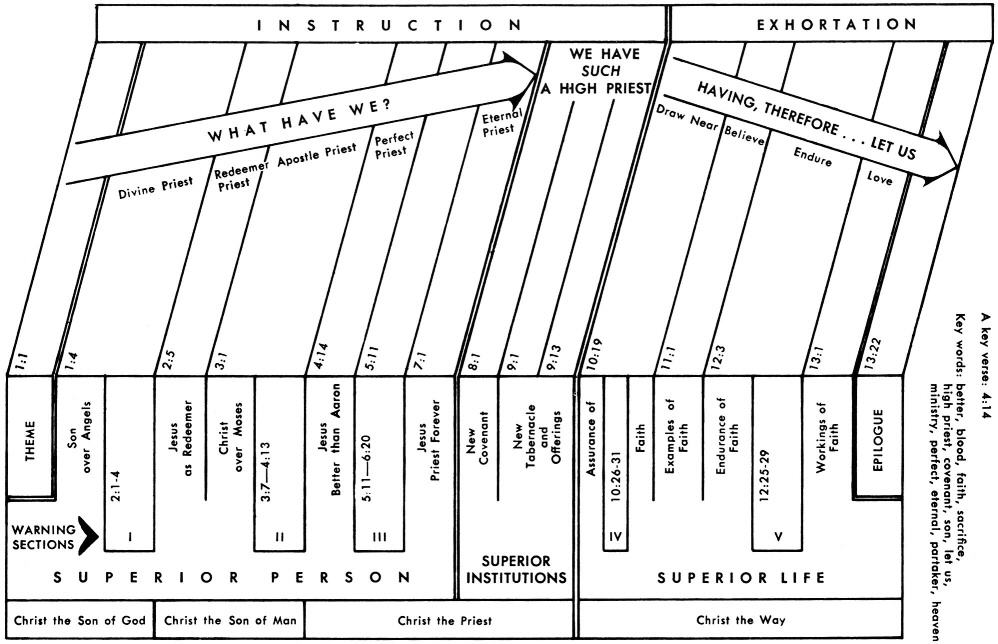
CONSIDER JESUS OUR GREAT HIGH PRIEST
Click chart to enlarge
Charts from Jensen's Survey of the NT - used by permission
Swindoll's Chart, Interesting Pictorial Chart of Hebrews, Another Chart
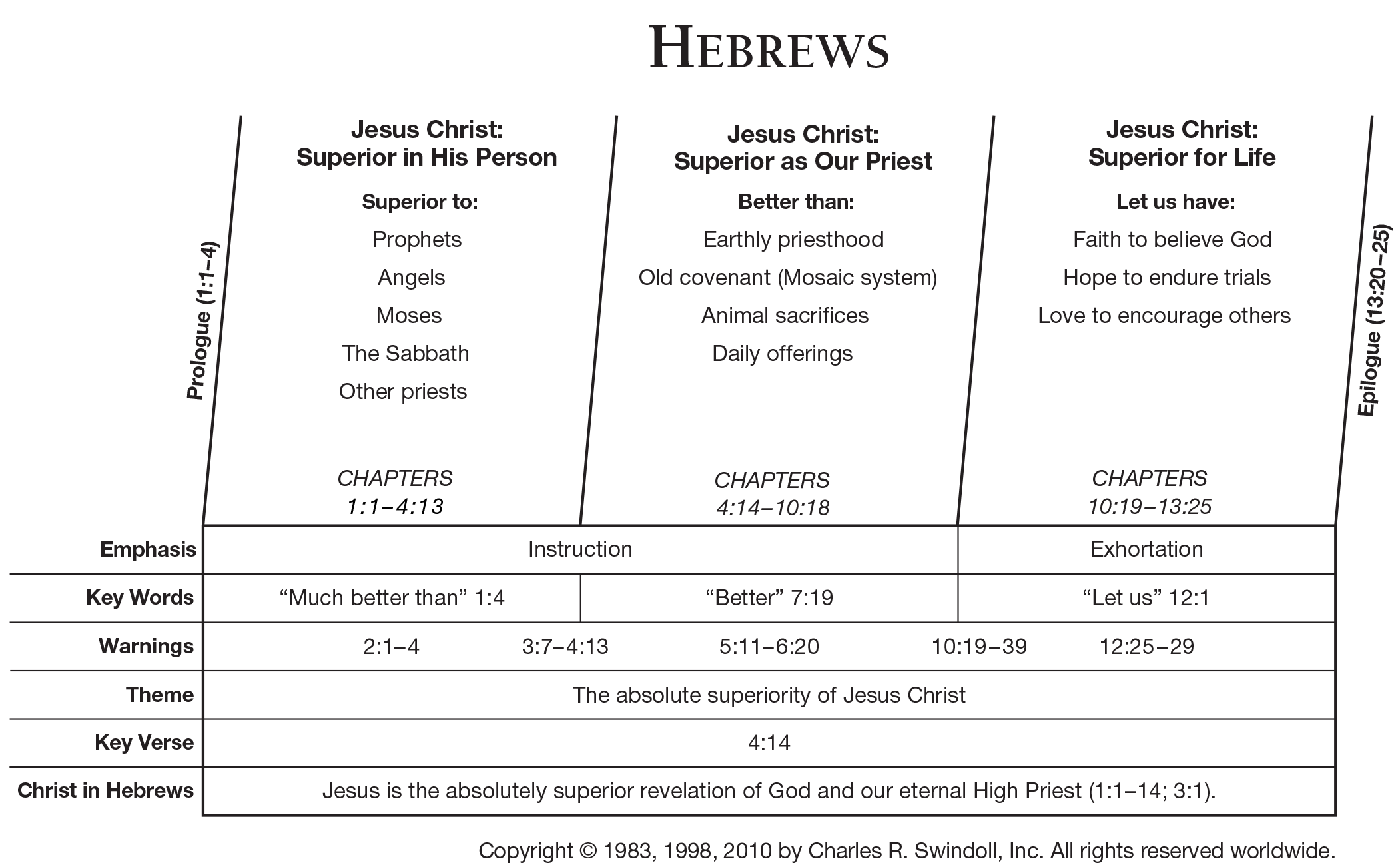
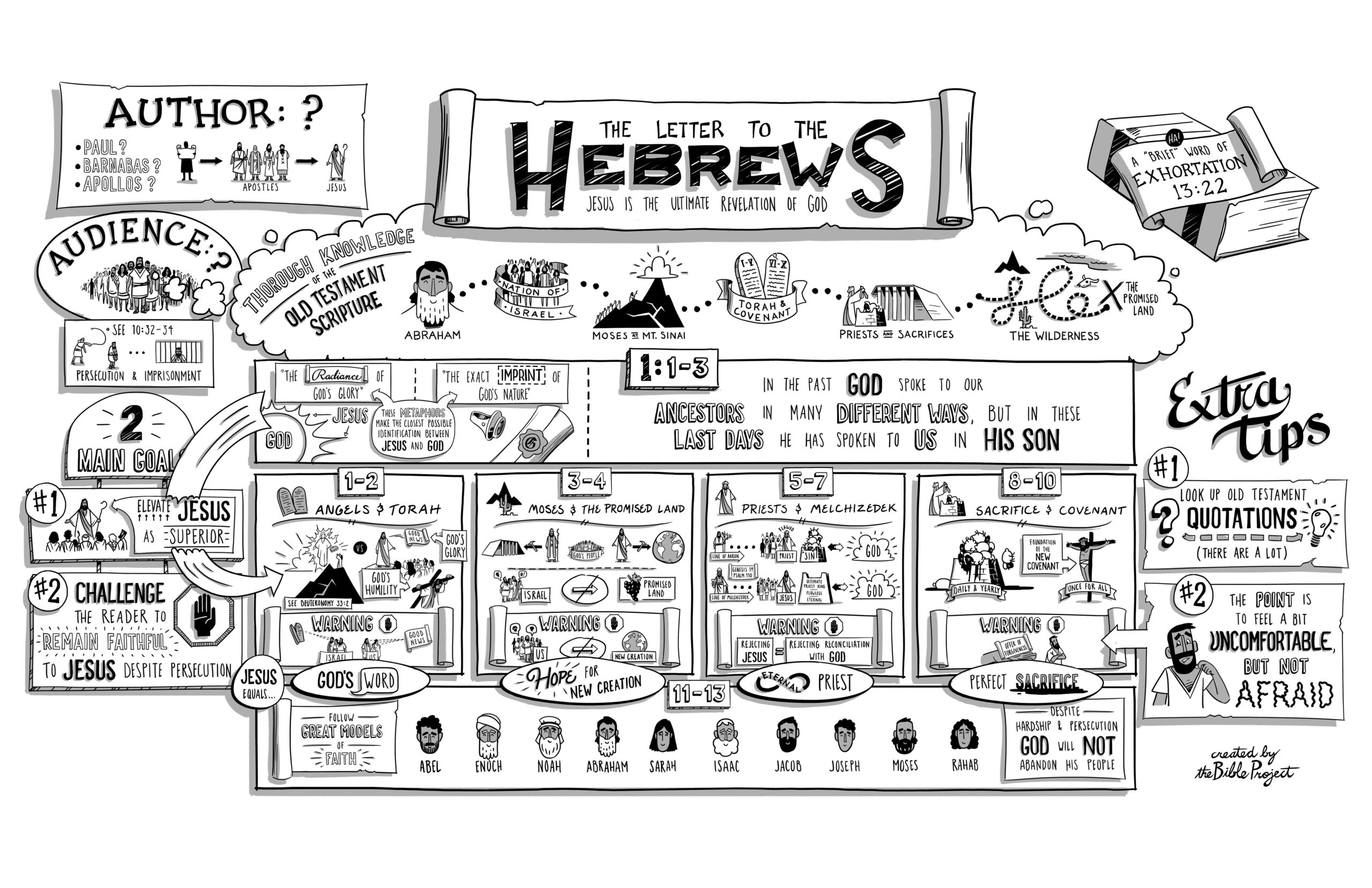
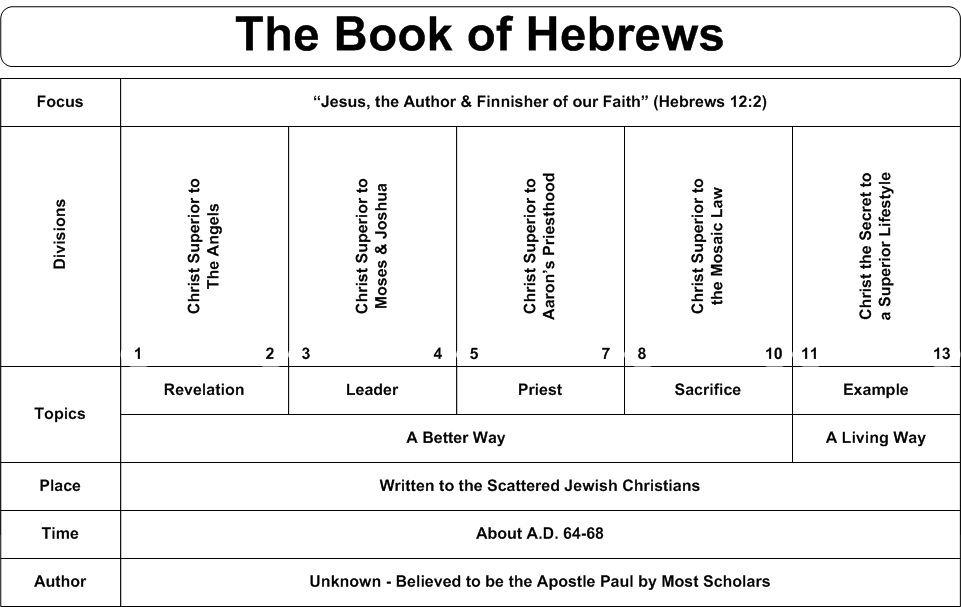
|
The Epistle |
||||
| INSTRUCTION Hebrews 1-10:18 |
EXHORTATION Hebrews 10:19-13:25 |
|||
| Superior Person of Christ Hebrews 1:1-4:13 |
Superior Priest in Christ Hebrews 4:14-10:18 |
Superior Life In Christ Hebrews 10:19-13:25 |
||
| BETTER THAN PERSON Hebrews 1:1-4:13 |
BETTER PRIESTHOOD Heb 4:14-7:28 |
BETTER COVENANT Heb 8:1-13 |
BETTER SACRIFICE Heb 9:1-10:18 |
BETTER LIFE |
| MAJESTY OF CHRIST |
MINISTRY OF CHRIST |
MINISTERS FOR CHRIST |
||
|
DOCTRINE |
DUTY |
|||
|
DATE WRITTEN: |
||||

See ESV Study Bible "Introduction to Hebrews"
(See also MacArthur's Introduction to Hebrews)
Borrow Ryrie Study Bible
Hebrews 10:11 Every priest stands daily * ministering and offering time after time the same sacrifices, which can never take away sins; (NASB: Lockman)
Greek: Kai pas men iereus esteken (3SRAI) kath' emeran leitourgon (PAPMSN) kai tas autas pollakis prospheron (PAPMSN) thusias, aitines oudepote dunantai (3PPPI) perielein (AAN) hamartias
BGT Καὶ πᾶς μὲν ἱερεὺς ἕστηκεν καθ᾽ ἡμέραν λειτουργῶν καὶ τὰς αὐτὰς πολλάκις προσφέρων θυσίας, αἵτινες οὐδέποτε δύνανται περιελεῖν ἁμαρτίας,
Amplified: Furthermore, every [human] priest stands [at his altar of service] ministering daily, offering the same sacrifices over and over again, which never are able to strip [from every side of us] the sins [that envelop us] and take them away— (Amplified Bible - Lockman)
Barclay: Again, every priest stands every day engaged upon his service; he stands offering the same sacrifices over and over again, and they are sacrifices of such a kind that they can never take away sins. (Westminster Press)
NLT: Under the old covenant, the priest stands before the altar day after day, offering sacrifices that can never take away sins. (NLT - Tyndale House)
KJV And every priest standeth daily ministering and offering oftentimes the same sacrifices, which can never take away sins:
NKJ And every priest stands ministering daily and offering repeatedly the same sacrifices, which can never take away sins.
NET And every priest stands day after day serving and offering the same sacrifices again and again– sacrifices that can never take away sins.
CSB Every priest stands day after day ministering and offering the same sacrifices time after time, which can never take away sins.
ESV And every priest stands daily at his service, offering repeatedly the same sacrifices, which can never take away sins.
NIV Day after day every priest stands and performs his religious duties; again and again he offers the same sacrifices, which can never take away sins.
Phillips: Every human priest stands day by day performing his religious duties and offering time after time the same sacrifices - which can never actually remove sins. (Phillips: Touchstone)
Wuest: And indeed every priest has stood and continues to remain in that same position, day by day performing his sacred service and often offering the same sacrifices which are of such a nature that they cannot take away sins.
Young's Literal: and every priest, indeed, hath stood daily serving, and the same sacrifices many times offering, that are never able to take away sins.
- Daily - He 7:27; Exodus 29:38,39; Numbers 28:3,24; 29:6; Ezekiel 45:4; Da 8:11; 9:21,27;11:31; 12:11; Luke 1:9,10
- Which can never - Heb 10:4; Ps 50:8, 9, 10, 11, 12, 13; Isaiah 1:11
- Hebrews 10 Resources - Multiple Sermons and Commentaries
- Click for 5W/H Study Questions — ideal for leading a group or personal study of Hebrews
DAILY DUTY BUT NEVER
DIVINE DELIVERANCE
The author of Hebrews uses repetition to drive his point home. He has already told us the bulk of what he tells us in this verse. Hebrews 10:11-18 concludes the main argument of the Book of Hebrews and “expresses the very heart” of the book. Having affirmed that believers are sanctified once for all through Christ’s offering (Heb 10:10), the writer now contrasts that perfect, finished work with the endless, ineffective ministry of the Levitical priests. Under the old covenant, the priest’s work was never done — he stood daily, continually offering sacrifices that could never remove sin. His posture was one of unceasing labor; there was no chair in the Tabernacle because the work of atonement was never complete. These repeated rituals served as a vivid reminder of humanity’s guilt, not its removal. In this verse, the author paints a picture of perpetual motion without progress — religion without rest — highlighting the futility of the old system and the finality of Christ’s cross.
Every priest (hiereus) stands daily * ministering (leitourgeo) and offering (prosphero - technical term for presenting a sacrifice at the altar) time after time the same sacrifices (thusia), which can never (oudepote - absolutely at no time) take away (periaireo - take away completely, strip off) sins (hamartia) - Stands implies continual service — priests were always busy, never sitting, because their work was never finished. In contrast, later in Hebrews, Christ is said to have “sat down” after offering His sacrifice (Heb. 10:12), symbolizing that His work was complete. Ministering (leitourgeo) and offering (prosphero) are both in the present tense depicting the priests continually performing religious service before God, emphasizing the ongoing ritual activity of the old covenant priesthood. The repetition “time after time the same sacrifices” points to the ineffectiveness of the Levitical system — the sacrifices had to be repeated daily, showing they never truly resolved sin. The repeated animal sacrifices could never completely remove or erase sin — they could only cover it temporarily. This sets us up for the contrast in the next verse (Heb. 10:12).
Steven Cole writes "If the original readers were to go back to Judaism, with its sacrificial system, they would forfeit the tremendous benefits that Jesus Christ secured for them. His death on the cross fulfilled all that the old system pointed toward. What it could not do completely, He did, namely, provide total forgiveness for those who draw near to God through Him. The old system, by its very design, barred the average worshiper from drawing near to God’s presence. Only the high priest could go into the Holy of Holies, and that only once a year. But in Christ, every believer has free access to God’s presence because Christ’s once-and-for-all sacrifice of Himself provides perfect standing with God. The author piles up a number of synonymous phrases which show either negatively what the Law with its sacrifices could not do, or positively what Christ’s sacrifice did accomplish. Note:
Heb 10:1: The sacrifices of the Law could never “make perfect those who draw near.”
Heb 10:2: Those sacrifices could not completely cleanse the worshipers and take away their consciousness of sins.
Heb 10:3: Those sacrifices provided a yearly reminder of sins.
Heb 10:4: Those sacrifices could not take away sins.
Heb 10:10: By God’s will through the cross, “we have been sanctified” once for all. (Justification - Past Tense Salvation - see Three Tenses of Salvation)
Heb 10:12: Christ “offered one sacrifice for sins for all time.”
Heb 10:14: “By one offering He has perfected for all time those who are being sanctified.” (Sanctification - Present Tense Salvation see Three Tenses of Salvation)
Heb 10:17: God promises to remember their sins and lawless deeds no more.
Heb 10:18: “Where there is forgiveness…” “there is no longer any offering for sin.”
All of these phrases add up to news that sounds too good to be true, and yet is true: In Christ we receive a complete, final, once for all pardon for all of our sins, past, present, and future! We’re prone to say, “What’s the catch?” There’s no such thing as an absolutely free lunch, but there is such a thing as God’s absolutely free pardon from all of our sins. It is totally free to us, because Christ bore the awful penalty that we deserved to pay. (Hebrews 10:1-18 Total Forgiveness)
🙏 THOUGHT - Most of us reading these deep doctrinal truths are not Jews and so are not tempted to return to the rituals and traditions of Judaism (my son's father-in-law is Jewish and very "non-religious" but each year he is compelled to have a Passover Seder in his home - pray for him!). And yet we are so often prone to subtly fall back under the law - e.g., when we make a list of do's and don't's we are beginning to practice legalism (and place ourselves under the law which actually arouses the old flesh - see Ro 7:5NLT+) and there are many other subtle ways we fall into this trap. You say, what is so bad about that? Beloved, we have been set free from the law, not free to live lawlessly but now free and empowered to keep the law as enabled by the indwelling Spirit of grace (Heb 10:29+). He is the "Secret" that so many believers have overlooked or minimized. The Spirit needs to be Maximized in our lives! We need to learn to make the most of the Spirit of Christ (so to speak)! Jesus gave Him to us as a precious Gift (Jn 14:16, Lk 24:49+) and the first thing He said to His disciples was that when the Spirit was given, they would receive power (dunamis) to be supernatural witnesses, something they could never do in their own natural strength. And this same principle applies to every aspect of our Christian life. Remember Jesus' words at the end of the Great Commission, "Lo I am with you always even to the end of the age." (Mt 28:20) Every day for the rest of our lives, Jesus is with us making His Spirit available to us throughout the day (cf "be continually filed with the Spirit" - Eph 5:18+), so that we might live not just life, but abundant life (Jn 10:10 where the Greek word means "beyond what is anticipated," "exceeding expectation," "going past expected limits."). It is by living an abundant supernatural life in the natural world that Jesus is glorified (cf Jn 16:14). Why or how? Because others (lost and saved) see our supernatural life in the midst of the natural trials, tribulations and afflictions we all experience and yet they see us experiencing them in an "unnatural" way, indeed a "supernatural" way, a way made possible only as we learn to daily discard our fleshly self-reliance and rely wholly on the Holy Spirit to energize and enable us to obey the law now written on our hearts and minds! So just as the first century Jews were tempted to go back to their old ways, so too we as NT believers are continually tempted to go back to our old ways, including trying to keep the law in our own strength. We need to remember the wonderfully liberating truth that we are no longer "under (the power of) law but under (the power of) grace." (Ro 6:14+). Paul described this life in Galatians 2:20+ “I have been crucified with Christ; and it is no longer I who live, but Christ lives in me (HOW? BY THE SPIRIT OF CHRIST, cf "Christ...our life" - Col 3:4+); and the (SUPERNATURAL) life which I now live in the flesh I live by faith in the Son of God, Who loved me (Jn 3:16) and gave Himself up for (IN MY PLACE = SUBSTITUTIONARY ATONEMENT) me." Hallelujah! Thank You Jesus!
We stood condemned with none to plea,
He bore our blame on Calvary.
And every priest stands daily ministering and offering time after time - Notice the time phrases daily and time after time. Why? Because as he tells us these animal sacrifices could never take away sin either from our conscience or from our "debt ledger" before God (Ro 6:23)!
We owed a sin we could not pay
He paid a debt He did not owe!
Every day, so long as the Temple stood, continual sacrifices had to be carried out
And you shall say to them, 'This is the offering by fire which you shall offer to the LORD; two male lambs one year old without defect as a continual burnt offering every day. 4 'You shall offer the one lamb in the morning, and the other lamb you shall offer at twilight; 5 also a tenth of an ephah of fine flour for a grain offering, mixed with a fourth of a hin of beaten oil. 6 'It is a continual burnt offering which was ordained in Mount Sinai as a soothing aroma, an offering by fire to the LORD. 7 'Then the libation with it shall be a fourth of a hin for each lamb, in the holy place you shall pour out a libation of strong drink to the LORD. 8 'And the other lamb you shall offer at twilight; as the grain offering of the morning and as its libation, you shall offer it, an offering by fire, a soothing aroma to the LORD. (Numbers 28:3-8+).
Every morning and every evening a male lamb of one year old, without spot and blemish, was offered as a burnt-offering. Along with it there was offered a meat-offering, which consisted of one tenth of an ephah of fine flour mixed with a quarter of a hin of pure oil. There was also a drink-offering, which consisted of a quarter of a hin of wine. Added to that there was the daily meat-offering of the High Priest; it consisted of one-tenth of an ephah of fine flour, mixed with oil, and baked in a flat pan; half was offered in the morning and half in the evening. In addition there was an offering of incense before these offerings in the morning and after them in the evening. There was a kind of priestly tread-mill of sacrifice.
As Ray Stedman says "One peculiarity of the tabernacle was that it contained no chairs. The priests were not permitted to sit, but performed their ministries while standing. Our author maintains in verses 11-12 that this symbolically shows that their work was unfinished, so their repeated sacrifices could not finally remove sins." (Hebrews 10:1-39 Let Us Go On!)
No seat in the sanctuary,
because there was no rest in religion.
Levitical laborers in an endless loop,
perpetually performing powerless rites.
Moffatt speaks of "the Levitical drudges" speaking of the Levitical priests who, day in day out, kept offering these sacrifices. This vividly captures the endless, wearying labor of the priests under the old covenant. Day after day, the Levitical priests toiled in repetition — their work never done, their conscience never at rest.
The priest stood daily with blood-stained hands;
The Savior eternally sits with nail-scarred hands.
Wuest - The priests were still ministering in the temple at Jerusalem, which fact shows that the book was written before A.D. 70, at which date Jerusalem was destroyed by Rome. The standing position of the priests is set in vivid contrast to the seated posture of Messiah (Heb 10:12), indicating the fact that the work of the former was never finished and that of the latter was complete. This was apostasy on the part of the leaders of Israel. They had had an unmistakable demonstration of the fact that the First Testament was annulled and fulfilled, and thus set aside by the New Testament (Heb 9:7, 8). Yet in defiance of the clear will of God, they kept on offering sacrifices. (Hebrews Commentary online)
C H Spurgeon - There were many priests at the same time—the sacrifices of the temple were too numerous to have been all of them performed by one man. All the descendants of Aaron were set apart to this work, and even then they required the aid of the Levites in certain inferior duties. And as there were many priests at one time, so there were many in succession. As a priest died, he was succeeded by his sons. By reason of infirmity, they were not able to continue in their office even through the whole of their lifetime; there was a certain period at which they were commanded to surrender their office to younger men. By reason of mortality the priesthood was perpetually changing—one high priest died, and was succeeded by another. Now the reason for the existence of many priests was this: no one priest had accomplished the work of expiation. The good man has gone to his fathers and offered up the last of the morning lambs—but the morning lambs must still be offered. The high priest is dead, and there shall be no more opportunity for him to enter into that which is within the veil, but there must be a new high priest appointed, for the work is not finished. The sacrifice was offered once, but sin was not put away, and therefore had to be offered again. The great day of atonement came every year, when sin was afresh brought to remembrance. There was a day of atonement last year, but the people are unforgiven, and there must be a day of atonement this year. When that day is over and the priest has come forth in his holy and beautiful apparel, with the breastplate gleaming in the light of God, Israel may rejoice for a while, but there is one thought that will sadden her: there must be an atonement day next year. Sin still remains on Israel, despite all that the house of Aaron can do by all their sacrifices.
THE FUTILITY OF
FORMER SACRIFICES
Which can never (oudepote - absolutely at no time) take away (periaireo - take away completely, strip off) sins (hamartia) - Can is dunamai in the present tense and with the negative modifier never emphasizes the total, absolute inability of animal sacrifices to effect true atonement of sins. The sacrifices under the Old Covenant could never cure the sin problem. The sacrifices of the Old Covenant could cover sin but not cure it. The old sacrifices only masked the malady; they soothed but could not save. They left the sinner like a patient who must continually take medicine but never finds healing — or like a weed with its head plucked off, while the root remains beneath the surface.
Repetition was God’s reminder:
“This cannot remove sin.”
John Piper comments that "the point is clear: the prescribed repetition of sacrifices for sin in the Old Testament Law was a built-in testimony to their inadequacy. They did not perfect the people. They did not deal with sin decisively, finally, once for all." (Sermon)(Bold added)
He took my sin, my shame, my fall,
And gave His life — once for all.
Spurgeon - There was the lamb for the morning; the innocent victim was slaughtered and burned. But the morning sacrifice did not put away the day’s sin, for as the sun began to descend in the west another victim must be brought, and so on each morning and each night. Victim, victim, victim, sacrifice, sacrifice, sacrifice, because the expiation was always incomplete. But our blessed Lord, “the Lamb of God who takes away the sin of the world” (John 1:19), was sacrificed but once, and that one sacrifice has completed His expiatory work. In every truth, His was a sacrifice of nobler name and richer blood than theirs.How could the blood of bulls and of goats put away sin? What conceivable connection can there be, except in symbol, between the death pangs of a beast and the sin of a man before God? The principle of substitution was by the legal sacrifices clearly set forth, but that was all. Those offerings did not and could not provide the actual substitute. The principle of vicarious sacrifice they plainly unfolded, but they provided no real sin offering. How could they? Where but in the Christ of God could a propitiation be found? Where else is there one who could in our nature make recompense to the injured law of God?
Each day he stood, the same refrain,
The blood was spilled, yet guilt remained.
The smoke ascended, hearts still sore,
Forgiveness sought, but never sure.
Gromacki - He finished His sacrificial work (Heb 10:11–13)
This passage contains a series of obvious contrasts between the unfinished work of the Jewish high priests and the finished redemptive work of Christ. First, the legal system had many priests (“every priest”), but the new covenant needs only one (“this man”).
Second, the priests always stood in their service (“standeth”), but Christ “sat down on the right hand of God” after He offered Himself. There were no chairs in the Mosaic tabernacle or Solomonic temple. The posture indicated an interminable ministry. The seating of the Savior, on the other hand, indicates the completion of His task (Heb 1:3, 13).
Third, the work of the priests went on “daily,” even on the sabbaths, but Christ completed His work in one day, namely the hours of His crucifixion.
Fourth, the priests were continually “ministering and offering,” but Christ “offered” only one sacrifice once.
Fifth, the priests offered “oftentimes the same sacrifices,” but Christ offered just “one” sacrifice.
Sixth, the value of each sacrifice under the old system lasted only until the repetition of that sacrifice. It thus was temporary, but the value of Christ’s death will last “forever.”
Seventh, the animal sacrifices could “never take away sins,” but Christ produced a perfect vicarious atonement when He suffered “for sins.” The verb (“take away”) literally means “to lift up from around” (perielein). It connotes expiation. The verbal concept is based upon the metaphor of stripping off a soiled garment closely wrapped around a body.
Eighth, the priests perceived no ultimate triumph from their ministry, but Christ fully expected that His death and resurrection would eventually establish the kingdom of God on earth (Heb 10:13). Christ viewed His own crucifixion as a victory to achieve over Satan and sin (1 Cor. 15:24–28).
The point is that animal blood sacrifices could never take away sins. That is what the writer had just explained noting that…
it is impossible for the blood of bulls and goats to take away sins. (Heb 10:4+)
Even the Day of Atonement and the Scapegoat being led away into the wilderness to never be seen again was only a shadow pointing to the reality of the substance of the once for all perfect blood sacrifice of the perfect, sinless Lamb of God, Who Alone forever "takes away the sins of the world" (John 1:29)
In the OT Moses records the necessity of unceasing sacrifices under the Levitical system…
Now this is what you shall offer on the altar: two one year old lambs each day, continuously. The one lamb you shall offer in the morning, and the other lamb you shall offer at twilight; (Exodus 29:38,39)
And you shall say to them, 'This is the offering by fire which you shall offer to the LORD; two male lambs one year old without defect as a continual burnt offering every day. (Numbers 28:3)
'After this manner you shall present daily, for seven days, the food of the offering by fire, of a soothing aroma to the LORD; it shall be presented with its libation in addition to the continual burnt offering. (Numbers 28:24)
besides the burnt offering of the new moon, and its grain offering, and the continual burnt offering and its grain offering, and their libations, according to their ordinance, for a soothing aroma, an offering by fire to the LORD. (Nu 29:6)
The Lord Jesus Christ our Great High Priest…
does not need daily, like those high priests, to offer up sacrifices, first for His own sins, and then for the sins of the people, because this He did once for all when He offered up Himself. (see note Hebrews 7:27)
The Psalmist reiterates the problem with the OT sacrifices, noting that the problem was not with the gift per se but with the giver…
"I do not reprove you for your sacrifices, And your burnt offerings are continually before Me. I shall take no young bull out of your house, Nor male goats out of your folds. For every beast of the forest is Mine, The cattle on a thousand hills. I know every bird of the mountains, And everything that moves in the field is Mine. If I were hungry, I would not tell you; for the world is Mine, and all it contains. Shall I eat the flesh of bulls, or drink the blood of male goats? (Then what did God want in the OT?) Offer to God a sacrifice of thanksgiving, and pay your vows to the Most High and call upon Me in the day of trouble; I shall rescue you, and you will honor Me." (Psalms 50:8-13)
Comment: God did not reprove them for failing to bring their offerings, but in this context for bringing them with the motive of trying to make the God who owns everything dependent on their generosity.
He Sat Down Once for All
1 The priests stood daily, work undone,
Their altars stained and red;
But Christ, the Lamb, the Father’s Son,
Once offered, bowed His head.
Refrain
Once for all, O perfect Lamb,
Finished forever, great I AM;
The priests stood daily—He sat down,
Our Savior wears the victor’s crown.
2 No more the endless, weary round,
No more the smoke or flame;
For full atonement now is found
In Jesus’ holy name.
3 He rose in pow’r, His task complete,
And took His rightful throne;
At God’s right hand He took His seat—
The work of grace alone.
4 Forever done, forever sure,
His blood speaks still today;
Our souls are cleansed, our hope secure—
The debt is washed away.
Priest (2409)(hiereus from hieros = sacred, holy, consecrated to God, used as a noun to mean a sacred place or temple, cp Mark 11:11; cp English derivative "hierarchy" = leadership) is a sacred or consecrated person who serves deity. Priests in the NT refer primarily to the ceremonial officials of Jesus' day, that group of men who offered Temple sacrifices and carried out the other sacred rites associated with the Jewish Temple and Jewish people (cp Heb 8:4) . Most of the uses of hiereus refer to Jewish priests.
Hierus in Hebrews - Heb. 5:6; Heb. 7:1; Heb. 7:3; Heb. 7:11; Heb. 7:14; Heb. 7:15; Heb. 7:17; Heb. 7:21; Heb. 7:23; Heb. 8:4; Heb. 9:6; Heb. 10:11; Heb. 10:21;
Stands (2476) (histemi) refers to literally standing and the perfect tense speaks of the continued need to stand (because there was no chair in the Holy Place or the Holy of Holies!). Standing is a picture of the priest's work as never finished, never done, never completed. There were no chairs in the Tabernacle furnishings! They were not needed because the priests were always standing and sacrificing. Heb. 10:9; Heb. 10:11
Ministering (present tense = continually)(3008)(leitourgeo from léïtos of the people + érgon = work) means to minister publicly in sacred office. Leitourgeo was used in classical Greek to mean, “to supply public offices at one’s own cost”; then generally, “to serve the state,” “to do a service.” It means to minister in an official (technical, authorized) capacity, also on behalf of the community. There are only 3 NT uses of this verb - here, Acts 13:2 and Ro 15:27.
Gilbrant - In classical literature leitourgeō was used in three ways. In a political sense it was first used to refer to those who served society in a political office at their own expense. Later it referred to anyone who served in public office. In reference to religion leitourgeō is used to refer to those involved in the pagan religions, including temple employees as well as priests. This verb is also used in a general sense to refer to the rendering of any service to another, such as slaves to masters, employees to employers, and even friends to one another. The Septuagint uses leitourgeō to refer to the service of the priests who were to “minister in the holy place” (Exodus 29:30) and of the ministry of the Levites (Numbers 18:2). (Complete Biblical Library)
Offering (present tense = continually)(4374) (prosphero from prós = to, toward + phéro = bring) means to carry or bring something into the presence of someone usually implying a transfer of something to that person carry to. It refers to an offering, whether of gifts, prayers, or sacrifices.
Prosphero in Hebrews - Heb. 5:1; Heb. 5:3; Heb. 5:7; Heb. 8:3; Heb. 8:4; Heb. 9:7; Heb. 9:9; Heb. 9:14; Heb. 9:25; Heb. 9:28; Heb. 10:1; Heb. 10:2; Heb. 10:8; Heb. 10:11; Heb. 10:12; Heb. 11:4; Heb. 11:17; Heb. 12:7
No chair was there where priests could rest,
For endless labor marked their quest.
Never (3763) (oudepote from oude = not even + poté = ever) not even at any time, never at all, neither at any time, never, nothing at any time.
For the Law, since it has only a shadow of the good things to come and not the very form of things, can never (oudepote) by the same sacrifices year by year, which they offer continually, make perfect those who draw near. (Heb 10:1-note)
Take away (aorist expresses finality, not possible with animal sacrifices)(4014) (periaireo from perí = all around, suggests completeness, encompassing + hairéo = in sense of take, seize, grasp) means to take away from around something (picture it binding and constricting one's movement) and so to remove that which envelops, to totally remove (comprehensively). The completely separate. To leave behind entirely. In secular Greek it was a nautical term meaning to cast lose by taking up the anchors from both sides of the ship in preparation for departing. To take away altogether or entirely. In a secular Greek writing it was used of taking off from oneself, as taking off one's helmet and of taking off the cover of a letter (and thus opening it).
In Heb 10:11 the idea is inability "to take away sins completely (the complete expiation wrought by Christ on Calvary)." (A T Robertson) Sin is so deeply embedded in humans and so completely "envelops" them that the OT economy was powerless to root it out.
Gromacki - The verbal concept (of "take away" - periareo) is based upon the metaphor of stripping off a soiled garment closely wrapped around a body.
Sin lingered under the Law
but was lifted at the Cross.
This vivid verb (periaireō) describes the act of removing or stripping away something that surrounds a person. It evokes the image of peeling off an outer garment or covering — much like one would remove a heavy coat in a warm room. The idea conveys complete and final removal, not mere covering. Hebrews teaches that the Old Testament sacrifices could never peel away the guilt of sin. Even after countless offerings, sin still clung to the conscience of worshipers. But Christ, through His single, once-for-all sacrifice, permanently removed the sin that hindered intimate fellowship with God. What the Law could only cover, the Lamb completely cleared away.
Periareo means to completely remove, i.e., all that goes with "the besetting sin" and the many restrictions it brings. The atonement of Christ overcomes all encumbrances imposed by sin because Jesus absolutely overcame sin (2 Cor 5:21+)!
🙏THOUGHT - Metaphorically as used in this verse periaireo means to take away completely that with which one is, as it were, enveloped, which is the guilt of sin and the penalty of sin. What a picture of sin's effect to function like a deadly "atmosphere" that envelops a person! Oh yes, the penalty and guilt of our sins has been taken away in Christ, but daily sins still entangle us and trip us up and give us a sense of guilt. Oh, beloved, does this truth of the guilt of sin enveloping us not motivate us to want to confess and repent quickly? It should!
From death to life my soul He freed,
By dying once for all my need.
🙏THOUGHT - Periaireo means to make complete expiation for sin. Picture sin as an anchor of one's soul weighing you down and preventing you from sailing off into the life God has prepared for you in Christ Jesus. Only the blood of Christ sets you free from the heavy weight that binds you! Beloved of God is there some "weight" that you have been set free from because of your acceptance of Christ's perfect sacrifice and yet you still cling to so that it envelops and restricts your freedom in Christ? Is there some wrong done to you, some wrong you did to another, some unforgiveness, some ungratefulness, etc that envelops you and restricts your life in Christ? Christ is the anchor of your soul Who can set you free from that which binds you. He has done that positionally, but we are still called to daily confess our sins lest they envelop us! Does that make sense?
Vincent writes that periaireo "literally means to strip off all round. See Ge 41:42 (of a ring): Ge 38:14; Dt 21:13 (of clothes). Comp. euperistatos ("entangles") Hebrews 12:1+, and perikeitai astheneias is compassed about with weakness, Heb 5:2+. See also clothed with shame, and with cursing, Ps 35:26; Ps 109:18. [Comments on periaireo in 2 Cor 3:16] The verb occurs twice in Acts [Acts 27:20, 40] of the taking away of hope, and of the unfastening of the anchors in Paul’s shipwreck; and in Heb. 10:11, of the taking away of sins. There is an allusion here [2Cor 3:16] to the removal of the veil from Moses’ face whenever he returned to commune with God. See Ex 34:34. (Word Studies in the New Testament).
Periaireo is used 51 times in the Septuagint (LXX) Gen. 38:14, 19; 41:42; Exod. 8:8, 11, 31; 10:17; 32:2f, 24; 33:6; Ex 34:34; Lev. 3:4, 9f, 15; 4:8f, 19, 31, 35; 7:4; Nu 17:5; 30:12f, 15; Deut. 7:15; 21:13; Jos. 24:14, 23; 1 Sam. 1:14; 7:3f; 28:3; 2 Sa 3:10; 1 Chr. 21:8; 2 Chr. 32:12; 33:15; 34:33; Est. 3:10; Ps. 119:22, 39, 43; Pr. 4:24; 27:22; Jer. 4:1; Jon. 3:6; Zeph. 3:11, 15; Zech. 10:11)
Periaireo - 4 times in the NT…
Acts 27:20 And since neither sun nor stars appeared for many days, and no small storm was assailing us, from then on all hope of our being saved was gradually abandoned (periaireo)…
Acts 27:40 And casting off (they let go the ropes that held the anchors and thus "abandoned" them) the anchors , they left them in the sea while at the same time they were loosening the ropes of the rudders, and hoisting the foresail to the wind, they were heading for the beach.
2 Corinthians 3:16 but whenever a man turns to the Lord, the veil is taken away. (Periaireo is used in Ex 34:34)
Hebrews 10:11 And every priest stands daily ministering and offering time after time the same sacrifices, which can never take away sins;
ILLUSTRATION - Sir Arthur Conan Doyle, the author of the Sherlock Holmes detective novels, was a practical joker. One time he sent a telegram to twelve famous people in London whom he knew. It read: “Flee at once. All is discovered.” Although all twelve were upright citizens, they all quickly left the country. That story may be fictitious, but it illustrates the fact that a guilty conscience is a common thing. Even in the church many are uncertain about their standing before God because of past sins. These ghosts from the past stay out of sight for a while, but then they come out of nowhere to haunt them. They wonder if anyone else knows what they have done. They’re fearful that the truth may leak out. But even more seriously, they wonder if God has truly forgiven them. They’re not sure how it will go when they stand before Him someday. Will God punish them in this life or in eternity for the terrible things that they have done? Such people need the assurance that our text hammers home = Through Christ’s obedience to God’s will at the cross, new covenant believers receive what those under the Law could not receive: Total forgiveness. (Steven Cole)
QUESTION - Why did God require animal sacrifices in the Old Testament? WATCH VIDEO
ANSWER - God required animal sacrifices to provide a temporary covering of sins and to foreshadow the perfect and complete sacrifice of Jesus Christ (Leviticus 4:35, 5:10). Animal sacrifice is an important theme found throughout Scripture because “without the shedding of blood there is no forgiveness” (Hebrews 9:22). When Adam and Eve sinned, animals were killed by God to provide clothing for them (Genesis 3:21). After the flood receded, Noah sacrificed animals to God (Genesis 8:20-21).
God commanded the nation of Israel to perform numerous sacrifices according to certain procedures prescribed by God. First, the animal had to be spotless. Second, the person offering the sacrifice had to identify with the animal. Third, the person offering the animal had to inflict death upon it. When done in faith, this sacrifice provided a temporary covering of sins. Another sacrifice called for on the Day of Atonement, described in Leviticus 16, demonstrates forgiveness and the removal of sin. The high priest was to take two male goats for a sin offering. One of the goats was sacrificed as a sin offering for the people of Israel (Leviticus 16:15), while the other goat was released into the wilderness (Leviticus 16:20-22). The sin offering provided forgiveness, while the other goat provided the removal of sin.
Why, then, do we no longer offer animal sacrifices today? Animal sacrifices have ended because Jesus Christ was the ultimate and perfect sacrifice. John the Baptist recognized this when he saw Jesus coming to be baptized and said, “Look, the lamb of God who takes away the sin of the world!” (John 1:29). You may be asking yourself, why animals? What did they do wrong? That is the point—since the animals did no wrong, they died in place of the one performing the sacrifice. Jesus Christ also did no wrong but willingly gave Himself to die for the sins of mankind (1 Timothy 2:6). Jesus Christ took our sin upon Himself and died in our place. As 2 Corinthians 5:21 says, “God made him [Jesus] who had no sin to be sin for us, so that in him we might become the righteousness of God.” Through faith in what Jesus Christ accomplished on the cross, we can receive forgiveness.
In summation, animal sacrifices were commanded by God so that the individual could experience forgiveness of sin. The animal served as a substitute—that is, the animal died in place of the sinner, but only temporarily, which is why the sacrifices needed to be offered over and over. Animal sacrifices have stopped with Jesus Christ. Jesus Christ was the ultimate sacrificial substitute once for all time (Hebrews 7:27) and is now the only mediator between God and humanity (1 Timothy 2:5). Animal sacrifices foreshadowed Christ’s sacrifice on our behalf. The only basis on which an animal sacrifice could provide forgiveness of sins is Christ who would sacrifice Himself for our sins, providing the forgiveness that animal sacrifices could only illustrate and foreshadow.
Related Resources:
- How did the animal sacrifices foreshadow the death of Christ?
- What is the Day of Atonement (Yom Kippur)?
- Why did the sacrificial system require a blood sacrifice?
- What is a sin offering?
- What were the various sacrifices in the Old Testament?
|
THE PRIESTHOOD |
|
| THE OLD | THE NEW |
| Many priests | One Priest |
| Levitical High Priests | Christ the Great High Priest |
| Shadow of Reality |
True Reality |
| Continually standing |
Sitting down |
| Repeated offerings |
Once-for-all Offering |
| Temporary Due to mortality |
Eternal Due to immortality |
| Animal sacrifices | Offered Himself |
| Ineffectual sacrifices |
Effective sacrifice |
| Unable to Perfect those who draw near |
Saves completely, Makes perfect forever |
| Entered Earthly Sanctuary |
Entered Heavenly Sanctuary |
| Only covered sin |
Completely removes sin |
| Limited Access to God |
Full Access to God |
| 100 Memorable Contrasts Between the Old Covenant and the New Covenant | |
HEBREWS 10:11—Did OT sacrifices make atonement for sins?
PROBLEM: Leviticus 17:11 affirmed that God gave blood sacrifices “to make atonement” for our souls. But Hebrews seems to contradict that, insisting that the Aaronic priest “stands ministering daily and offering repeatedly the same sacrifices, which can never take away sins” (Heb 10:11).
Old Testament offerings had, as it were, an IOU attached to them,
awaiting the price to be paid by the “Lamb of God"
SOLUTION: The sacrifices in the OT were not intended to take away sin, but only to cover over sin until Christ came who could do away with it. Each blood sacrifice before Christ looked forward to Christ. The passover lamb was a type that anticipated fulfillment in “Christ, our Passover, [who] was sacrificed for us” (1 Cor. 5:7). They provided only a temporary covering for sins until Christ could bring in the permanent solution to the sin question. Old Testament offerings had, as it were, an IOU attached to them, awaiting the price to be paid by the “Lamb of God who takes away the sin of the world” (John 1:29).
- Endless effort, no eternal effect.
- Many animal sacrifices, but no divine satisfaction.
- Repetition revealed religion’s ruin.
- Forms without faith foster failure.
- He stood repeatedly where Christ now sits permanently.
- Laboring priests, lingering guilt.
- Ceremony without cleansing cannot change the soul.
- The altar was active, but atonement awaited the cross.
- The offerings were many, but the offering was One.
- The lambs were slain, but the Lamb was still to come.
- The shadow worked daily; the Savior finished forever.
- The blood of beasts could cover sin’s cost, but only Christ could cancel it.
- External customs covered internal corruption.
Robert Hawker - .—Hebrews 10:11, 12.
The morning portion was the finishing cry of Jesus on the cross. This, my soul, I hope thou didst, as it were, hear with the ear of faith; beholding with the eye of faith the Lord of life and glory, as retreating from the field of battle, having gotten himself the victory, and by that “one offering of himself, once offered, for ever perfected them that are sanctified.” Fold up, then, the blessed object for thy nightly pillow, as for thy morning meditation; and let it be continually brought forth by thee, for thine unceasing joy and peace in believing, that (as the Holy Ghost hath in this scripture, for thy present enjoyment, sweetly set it forth) when all the priests in their daily ministry could accomplish nothing, this man, this God-man, this thy Jesus, whose name is Wonderful, hath “by his one offering,” for ever put away sin, and is “sat down on the right hand of God,” to see the purchase of his redemption, by price and by power, fully compensated to all his people. But here lies the blessed effects of thy Jesus’s redemption; and do thou mark it, and bring it forward constantly in thy pleadings for acceptance with the Father in the Beloved, that so rich, so precious, so inestimable and invaluable is the redemption of God’s dear Son, that it never can be fully compensated to his people. A whole eternity will not be sufficient to pay, nor can all the glories of heaven constitute a sufficient recompense; for after millions of ages are past, and millions of redemption-blessings have been given in them, such is the infinite merit, and such is the infinite glory of the Son of God’s righteousness, and blood, and sacrifice, that there must still remain a surplus unpaid, a redundancy still unaccounted for. Jesus will have brought in such everlasting revenues of glory to Jehovah, by the redemption of sinners, and in the honour done to his justice, love, and wisdom, by accomplishing the work the Father gave him to do, as will never be fully recompensed; yea, the merit of his cross alone will, to all eternity, shine with such splendour as to fill heaven with songs of endless praise. The sons of God, we are told, shouted for joy, when beholding the six days’ work of creation. But the six hours which Jesus hung on the cross wrought a more glorious work of redemption to Jehovah’s praise, and will call up the unceasing adoration of angels and men to all eternity. What sayest thou, my soul, to this view of the wonderful subject? Let such be thy meditation day by day, and may thine eyes prevent the night-watches to be fully occupied in it. Take thy stand at the foot of the cross; there, by faith behold Him on whom the eye of Jehovah is unceasingly fixed: and when thou hast followed the Lamb from the cross to the throne, where Jesus is now for ever sat down on the right hand of God, catch the notes of the hymn which the redeemed are now singing in glory before him, and in which, ere long, thou wilt assuredly join: “To him that sitteth upon the throne, and to the Lamb that was slain, be glory and honour for ever and ever. Amen.”
ILLUSTRATIONS -
The Endless Painter
A man paints the same fence every day because the paint never dries. No matter how diligently he works, the job is never done.
So the priests stood daily, applying another coat of sacrifice that could never permanently cover sin. Only Christ’s blood made it final and complete.
The Rewinding Clock
Each evening, a man winds an old clock. Every morning it ticks down again, demanding attention.
So the priests, day after day, reoffered sacrifices—ritual maintenance of a system that could never bring rest. But when Christ finished His work, time itself was redeemed.
The Perpetual Fire
On Israel’s altar, the fire was never to go out—because sin was never fully dealt with. The smoke of sacrifice rose continually.
But when Christ died once for all, the fire of judgment was quenched forever for those who believe.
The Washer Who Can’t Remove the Stain
A woman scrubs the same garment daily, yet the deep stain remains. The washing is endless and ineffective.
The priests’ sacrifices could cleanse ceremonially but never purify the conscience. Only the blood of Christ makes the heart clean.
The Marathon Without a Finish Line
Runners circle the same track endlessly, but the finish line is never in sight. The effort exhausts, but never completes.
So the old covenant system—unceasing motion, no completion. Christ crossed the finish line and sat down in triumph.
The Candle That Burns but Never Lights the Room
The priest’s sacrifices gave flickers of light—temporary, partial—but darkness returned.
When Christ came, the true Light shone, and there was no more need for the dim glow of ritual. The shadow fled before the sunrise of salvation.
Hebrews 10:12 but He, having offered one sacrifice for sins for all time, SAT DOWN AT THE RIGHT HAND OF GOD, (NASB: Lockman)
Greek: outos de mian uper amartion prosenegkas (AAPMSN) thusian eis to dienekes ekathisen (3SAAI) en decia tou theou
BGT οὗτος δὲ μίαν ὑπὲρ ἁμαρτιῶν προσενέγκας θυσίαν εἰς τὸ διηνεκὲς ἐκάθισεν ἐν δεξιᾷ τοῦ θεοῦ,
Amplified: Whereas this One [Christ], after He had offered a single sacrifice for our sins [that shall avail] for all time, sat down at the right hand of God, (Amplified Bible - Lockman)
Barclay: But he offered one single sacrifice for sin and then took his seat for ever at the right hand of God, (Westminster Press)
NLT: But our High Priest offered himself to God as one sacrifice for sins, good for all time. Then he sat down at the place of highest honor at God's right hand. (NLT - Tyndale House)
KJV But this man, after he had offered one sacrifice for sins for ever, sat down on the right hand of God;
NKJ But this Man, after He had offered one sacrifice for sins forever, sat down at the right hand of God,
NET But when this priest had offered one sacrifice for sins for all time, he sat down at the right hand of God,
CSB But this man, after offering one sacrifice for sins forever, sat down at the right hand of God.
ESV But when Christ had offered for all time a single sacrifice for sins, he sat down at the right hand of God,
NIV But when this priest had offered for all time one sacrifice for sins, he sat down at the right hand of God.
Phillips: But this man, after offering one sacrifice for sins for ever, took his seat at God's right hand, (Phillips: Touchstone)
Wuest: But this priest, having offered one sacrifice for sins, sat down in perpetuity on the right hand of God,
Young's Literal: And He, for sin one sacrifice having offered -- to the end, did sit down on the right hand of God,--
- Having offered...sat down - Heb 1:3; Heb 8:1; Heb 9:12; Acts 2:33,34; Ro 8:34; Col 3:1
- Hebrews 10 Resources - Multiple Sermons and Commentaries
- Click for 5W/H Study Questions — ideal for leading a group or personal study of Hebrews
Related Passages:
Hebrews 1:3+ (WORK OF REDEMPTION FINISHED) And He is the radiance of His glory and the exact representation of His nature, and upholds all things by the word of His power. When He had made purification of sins, He sat down at the right hand of the Majesty on high,
Hebrews 8:1+ Now the main point in what has been said is this: we have such a high priest, who has taken His seat at the right hand of the throne of the Majesty in the heavens,
Romans 8:34+ Who is the one who condemns? Christ Jesus is He who died, yes, rather Who was raised, Who is at the right hand of God, who also intercedes for us.
Colossians 3:1+ Therefore if you have been raised up with Christ, keep seeking the things above, where Christ is, seated at the right hand of God.
"TETELESTAI"
THE WORK IS FINISHED!
In a single, sweeping statement, the writer contrasts the futility of the Levitical priesthood with the finality of Christ’s priestly work. The priests stood daily offering sacrifices that could never remove sin (Heb 10:11); but Christ offered one sacrifice that accomplished eternal redemption and then sat down — the posture of completion, authority, and rest. His sitting at the right hand of God signifies not inactivity but enthronement; not cessation of care, but the certainty of accomplishment. The offering of Himself was once for all time — never to be repeated, never to lose its power. What the old covenant could only symbolize, the new covenant has secured forever. Here we behold the triumphant contrast: the standing priest versus the seated Savior; the endless ritual versus the eternal redemption.
But - Term of contrast. This is one of the greatest contrasts in the Bible, Levitical priests working, but our Great High Priest resting! Clear contrast of the New with the Old, the Priesthood of Jesus is better than the Levitical priesthood. This highlights the striking contrast with the need for repetitive sacrifices under the Old Covenant.
John MacArthur points out that in Hebrews 10:11-12 we have not just one contrast but "a series of contrasts—the many priests with the one Priest, the continual standing of the old priests with the sitting down of the new, the repeated offerings with the once-for-all offering, and the ineffective sacrifices that only covered sin with the effective sacrifice that completely removes sin (ED: See 100 Contrasts between old and new).The Levitical system had twenty-four orders, in each of which were hundreds of priests who took turns serving at the altar. This system did not lack for priests, but it did lack effectiveness. All the priests together could not make an effective sacrifice for sin. Christ was but one priest, yet His work was perfectly and permanently effective. (See Hebrews Commentary - Page 255)
He (Jesus) having offered (prosphero - brought near, presented) one (singular, sufficient, final) sacrifice (thusia) for (huper) sins (hamartia) for all time (dienekes) - Having offered is in the aorist tense emphasizing a completed, once-for-all action in the past. Jesus is both the Priest and the Offering. He brought not an animal, but Himself (offered is active voice = choice of His will!), to God as the perfect and final presentation for sin (cf. Eph 5:2+; Heb 9:14+). When Jesus the Great High Priest had offered up the only Lamb that God would find an acceptable (propitiating) sacrifice, He cried out Tetelestai, meaning "It is finished!," the price of redemption has been "Paid in full." Sacrifice (thusia) underscores the costly nature of the offering, for something of supreme worth—perfect, precious and unblemished (1Pe 1:19+)—had to be given up and consumed (Heb 9:28+).
One offering—forever effectual
One Savior—forever faithful
One act—forever enough
For (huper) sins (hamartia) means "on behalf of," "in place of," or "for the sake of." Christ took responsibility for our sins, bore their penalty, or acted as our representative so that we could be reconciled to God. Thus For (huper) sins (hamartia) expresses the substitutionary or representative nature of Christ’s sacrifice. He didn’t die because of His own sins for He was sinless (Heb 4:15, Ro 8:3), but for the sake of ours, on our behalf, in our place, bearing the consequence of sin we should have borne. This echoes 1 Corinthians 15:3+ Christ died for (huper) our sins.
He bore the curse, He paid the price,
He was the Lamb, the sacrifice.
And when the cross had done its part,
He sat — the sign of God’s full heart.
SAT DOWN (kathizo) AT THE RIGHT (dexios) HAND OF GOD (theos) -- SAT DOWN (kathizo) is in the aorist tense emphasizing a completed, once-for-all action in the past. After rising from the dead, he sat at the right hand of God, the place of highest honor - from the grave to the throne, from cross to crown, from tomb to throne, rom sepulcher to sovereignty! The slain Savior became the seated Sovereign!
Once on the cross the Savior bled,
Once for our sins His blood was shed;
No altar burns, no priest remains—
Jesus has borne our guilt and broken our chains.
Jesus taking His seat at the right hand of God fulfills the prophecy of Ps 110:1 where David writes "The LORD (God the Father) says to my Lord (God the Son): "Sit at My right hand, until I make Thine enemies a footstool for Thy feet." This Messianic psalm is quoted as such at least 12 times in the NT. In Mt 22:43-45 Christ specifically applies Psalm 110:1 to Himself claiming that He is not just the son of David but David's Lord. In short, Psalm 110 pictures the Messiah as King, Priest and victorious Warrior.
Now seated at the Father’s side,
Our Priest, our Savior, glorified;
He waits until His foes shall fall,
Beneath His feet—the Lord of all.Psalm 110:1 is quoted 5 times in the NT -- Mk 12:36, Lk 20:42; Acts 2:34, Heb 1:13 and Heb 10:12.
Ps 110:4 has been used by our writer multiple times to prove Christ’s priesthood after the order of Melchizedek (Heb. 5:6, 10; 6:20; 7:11, 15, 17, 21).
There are 15 other Scriptural references to Christ seated at the right hand of God: Ps 16:11 [KJV "at Thy right hand"], Mt 26:64+; Mk 14:62+; Mk 16:19+; Lk 22:69+; Acts 7:55,56+, Ro 8:34+; Ep 1:20+; Col 3:1+; 1Pe 3:22+ and the 4 verses in Hebrews - see below.)
The writer of Hebrews obviously considers this teaching about the position of Christ Jesus our Great High Priest at the right hand of His Father as very important for he records this truth four times, at the beginning, in the middle and toward the end of his epistle…
Hebrews 1:3+ And He is the radiance of His glory and the exact representation of His nature, and upholds all things by the word of His power. When He had made purification of sins, He sat down at the right hand of the Majesty on high
Hebrews 1:13+ But to which of the angels has He ever said, "SIT AT MY RIGHT HAND, UNTIL I MAKE THINE ENEMIES A FOOTSTOOL FOR THY FEET"?
Hebrews 8:1+ Now the main point in what has been said is this: we have such a High Priest, Who has taken His seat at the right hand of the throne of the Majesty in the heavens
Hebrews 12:2+ fixing our eyes on Jesus, the Author and Perfecter of faith, Who for the joy set before Him endured the cross, despising the shame, and has sat down at the right hand of the throne of God.
Considering the importance of the truth (in view of its repetition some 21 times in Scripture) that Christ is now at the right hand of God, it is not surprising that the Antichrist, the counterfeit ''Christ'' sits down' in the Holy of holies where no priest had ever been allowed to sit nor could sit because there was no chair! Paul warns the believers at Thessalonica to…
Let no one in any way deceive you, for it will not come unless the apostasy comes first, and the man of lawlessness is revealed, the son of destruction, who opposes and exalts himself above every so-called god or object of worship, so that he takes his seat in the temple of God, displaying himself as being God. (2 Th 2:3-4+)
In this sense the Antichrist mimics Christ's finished work on the Cross ("It is finished" Jn 19:30) which gives Him Alone the right to be seated at the right hand of God (the Holy of holies symbolizing the throne of God in heaven).
To reiterate the significance of Christ sitting indicates that His work of offering sacrifice is done. He does not stand daily to offer sacrifices for sin. The one sacrifice of Himself was perfectly complete. God is forever satisfied (propitiated by the Lamb's blood on the "mercy seat" Ro 3:24,25+) with the sacrifice of His Son. God honors His Son with the seat at His right hand to show how fully He is satisfied with the debt paid for sin. This is a great picture to encourage us that our sins are fully dealt with. Christ's sitting also indicates that He, together with His Father, is the sovereign ruler over all His enemies.
“Sinner, thou thinkest that because of thy sins and infirmities
I cannot save thy soul, but behold my Son is by Me,
and upon Him I look, and not on thee,
and will deal with thee according as I am pleased with Him.”
(Amen)
--John Bunyan
Leon Morris - We should notice further that to be seated at God’s right hand is to be in the place of highest honor. Even angels are not said to have attained to this; they stand in God’s presence (Luke 1:19). When Jesus claimed this place for himself, the high priest tore his robe at what he regarded as blasphemy (Mark 14:62–63). (See The Expositor's Bible Commentary - Abridged Edition- Page 1318)
🙏 THOUGHT - One of the most amazing aspects of grace to me is this: while even angels never sit in the presence of God, saved sinners have been granted the unspeakable privilege of sitting with Christ on His throne (Rev 3:21+). Meditate on this truth, beloved—especially when this godless world weighs you down. Like Asaph, we may often be tempted to cry, “Surely in vain I have kept my heart pure” (Ps. 73:13; cf. Ps 73:2–12). But everything changed “when he came into the sanctuary of God” and perceived the end of the wicked (Ps. 73:17). So take heart—your best life is yet to come! Praise the Lord!
When the world feels dark and faith grows dim,
Step into the sanctuary and fix your eyes on Him.
What now seems wrong will be made right —
The best is coming, beyond our sight.
Praise the Lord, for Christ still reigns —
Our sorrow soon will turn to gains.And oh, what grace our hearts have known,
That sinners, saved, are called His own;
For angels stand before His throne—
But we shall sit with Him alone.So lift your gaze when trials come,
Remember where your rest is from;
The cross secured, the work is done—
Your best is yet to come!
Simon Kistemaker says Christ "entered a period of rest after accomplishing his work, much the same as God rested from his labors upon concluding his work of creation. Christ entered heaven and took his seat of honor at the right hand of God. He was fully entitled to that place as the priest who has fulfilled his task of removing sin and as the king who has conquered sin and death. What a difference between the priest who performed his religious duties at the sanctuary and Christ, who sat down next to God. The priest of the Old Testament stands timid and uneasy in the holy place, anxiously performing his awful service there, and hastening to depart when service is done, as from a place where he has no free access, and can never feel at home; whereas Christ sits down in everlasting rest and blessedness at the right hand of Majesty in the holy of holies, His work accomplished, and He awaiting its reward." (BORROW Exposition of the Epistle to the Hebrews PAGE 280)
Spurgeon - You see the stars and the moon in their brightness, but suddenly they are all eclipsed and lost in a superior light. What can this glory be, which has paled their fires? It is the sun rising in His strength. So while we are beholding the priesthood of Aaron with all its excellence, it suddenly ceases to shine, because of the glory that excels—the radiant presence of one for whom, like heaven’s manna, it is not easy to find one fully descriptive name. Shall we call Him “man”? Blessed be His name; He is so, our near kinsman, the “Son of Man.” Shall we call Him “priest”? He is so. Blessed be His name; He is the true Melchizedek. Shall we call Him “God”? Well may we do so, for He counts it not robbery to be equal with God. But this one divinely mysterious person, this unique and solitary high-priest, accomplishes what the many priests of Aaron’s race could not compass. They were weak, but He is all-sufficient. He has wrought out eternal redemption, and made an end of sin. What a blessed doctrine this is—that the one offering of Christ has done what the tens of thousands of offerings under the old law never could accomplish! All the work of man is but the spinning of a righteousness that is undone as quickly as it is spun. But Christ has finished the seamless and spotless robe of His righteousness that is to last forever. By His one sacrifice, He has ended all the fruitless labor of the ages. And now as many of us as have received Him have all the benefits of His perfect work. On Him their sins were laid, and He was numbered with the transgressors. (Isa 53:12KJV) There He, in their stead, suffered what was due to the righteousness of God and made atonement to divine justice for the sins of His people. This was done, not by many offerings, but by one sacrifice, and that one alone. Jesus offered no other sacrifice: He had never made one before, nor since, nor will He present another sacrifice in the future. His sin offering is one. Our Lord sits down because there is no more sacrificial work to do. Atonement is complete; He has finished his task. There were no seats in the tabernacle. Observe the Levitical descriptions and you will see that there were no resting places for the priests in the holy place. Not only were none allowed to sit, but there was nothing whatever to sit upon. According to the rabbis, the king might sit in the holy places, and perhaps David did sit there; if so, he was a striking type of Christ sitting as king. A priest never sat in the tabernacle. He was under a dispensation that did not afford rest and was not intended to give it, a covenant of works that gives the soul no repose. Jesus sits in the holy of holies, and herein we see that His work is finished. (Sermon - The Only Atoning Priest)
Kenneth Wuest on for all time - Greek authorities are divided as to whether the word “forever” (Heb 10:12KJV) is to be construed with the offering of one sacrifice, or to the act of Messiah sitting down on the right hand of God. Both facts are true. His offering of Himself on the Cross was an act that has never-ending results and that needs no repetition. This is in contrast to the oft-repeated offerings of the Levitical priests. It is also true that our Lord seated Himself forever at the right hand of God. This is in contrast to the perpetual standing posture of the First Testament priests. Without insisting upon his opinion, the present writer leans toward the latter meaning, since the word “one” modifying the word “sacrifice,” is enough to contrast Messiah’s one sacrifice with the many offerings of the Aaronic priests. (Hebrews Commentary online)
Sat down at the right hand of God - The position of authority and prestige. To sit at the right hand of God is to be associated in His sovereign rule, and to share in His sovereign power. The right hand of God is the place of supreme honor, power and authority. (Ps 110:1; Ephesians 1:20; Colossians 3:1; Hebrews 8:1; 10:12; 12:2) All powers are subject unto Him. Angels, demons, even Satan himself is subject to our Lord.
A seated priest is the guarantee
of a finished work and an accepted sacrifice.
--F F Bruce
John Piper adds that "The sitting of Christ at God's right hand means at least three things here:
(1) One is that the work is done (Ed: cf Tetelestai). He does not "stand daily" to offer sacrifices for sin. The one sacrifice of Himself was perfectly complete.
(2) Second, it means that God is satisfied with the sacrifice (Ed: Propitiated). God honors Christ with the seat at his right hand to show how fully he is satisfied with the debt paid for sin. This is a great picture to encourage us that our sins are fully dealt with.
(3) Third, it means that Christ, together with his Father, is the sovereign ruler over all His enemies. They will be defeated." (Ed: cf "the Almighty" = pantokrator in Rev 1:8+) (Sermon) (Bold added)
Piper goes on to focus his practical application on Hebrews 10:14...
Now we come to our focus in verse 14: "For by one offering He has perfected for all time those who are being sanctified." Turn your eyes upon Jesus here and see two things about Jesus that relate directly to your life today.
1. First notice that Christ has perfected his people, and it is already complete. "For by one offering He has perfected for all time those who are being sanctified." He "has" done it. And he has done it "for all time." The perfecting of his people is complete and it is complete forever. Does this mean that Christians don't sin? Don't get sick? Don't make mathematical errors in school? That we are already perfect in our behavior and attitudes?
There is one clear reason in this very verse for knowing that is not the case. What is it? It's the last phrase. Who are the people that have been perfected for all time? It is those who "are being sanctified." This is why the tense is so important. Now "those who are being sanctified" are not yet fully sanctified in the sense of committing no more sin. Otherwise they would not need to go on being sanctified. So here we have the shocking combination: the very people who "have been perfected" are the ones who "are being sanctified." Besides, you can also remember from chapters 5 and 6, that these Christians he is writing to are anything but perfect. For example, in 5:11 he says, "You have become dull of hearing." So we may safely say that "perfected" does not mean that we are sinlessly perfect in this life.
Well what does it mean? The answer is given in the next verses (15-18). The writer explains what he means by quoting Jeremiah again on the new covenant, namely, that in the new covenant which Christ has sealed now by his blood, there is total forgiveness for all our sins. Verses 17-18 "Their sins and their lawless deeds I will remember no more. Now where there is forgiveness of these things, there is no longer any offering for sin." So he explains the present perfection in terms of forgiveness. Christ's people are perfected now in the sense that God puts away all our sin (9:26), forgives them, and never brings them to mind again as a ground of condemnation. In this sense we stand before him perfect. When he looks on us he does not impute any of our sins against us, past, present or future. He does not count our sins against us.
2. Verse 14 tells us plainly: "By one offering he has perfected for all time those who are being sanctified." So notice, secondly, for whom Christ has done this perfecting work on the cross. You can put it provocatively like this: Christ has perfected once and for all those who are being perfected. Or you could say (and the writer does say as much in Heb 10:10): Christ has fully sanctified those who are now being sanctified. Or Christ has fully accomplished and guaranteed the holiness of those who are now being made holy.
What this means is that you can know that you stand perfect in the eyes of your heavenly Father if you are moving away from your present imperfection toward more and more holiness by faith in his future grace. Let me say that again, because it is full of encouragement for imperfect sinners like us, and full of motivation for holiness. This verse means that you can have assurance that you stand perfected and completed in the eyes of your heavenly Father not because you are perfect now, but precisely because you are not perfect now but are "being sanctified", "being made holy", that, by faith in God's promises, you are moving away from your lingering imperfection toward more and more holiness. (See Hebrews 10:32-35; 11:24-26 etc. for examples of how faith in future grace sanctifies.)
Does Your Faith Make You Eager
to Make Progress in Holiness?Last week we asked: does your faith make you eager for the Second Coming of Christ?
Today I ask: does your faith make you eager to forsake sin and make progress in holiness?
That is the kind of faith that in the midst of imperfection can look to Christ and say: "You have already perfected me in your sight." This faith says, "Christ, today I have sinned. But I hate my sin. For you have written the law on my heart, and I long to do it. And you are working in me what is pleasing in your sight. And so I hate the sin that I still do, and the sinful thoughts that I contemplate. And in this hatred of my sin, and in my meager advancements in holiness I rejoice that, according to your promise in Hebrews 10:14, I have been perfected for all time by a single offering, your precious self."
This is the true and realistic faith that saves. It is not the boast of the strong. It is the cry of the weak in need of a Savior. I invite you and urge you to be weak enough to trust Christ in this way. (Sermon)
All time (1336) (dienekes from dia = through + phéro = carry, bear) means carried through. It is used in the Greek idiomatic phrase "eis to dienekes" which means unlimited duration of time with particular focus upon the future, and therefore means always, forever, forever and ever, eternally, continually. The writer used this same phrase earlier in his description of the priesthood of Melchizedek writing…
Hebrews 7:3+ Without father, without mother, without genealogy, having neither beginning of days nor end of life, but made like the Son of God, he abides a priest perpetually. (eis to dienekes)
Comment: No mere earthly king was ever "made like unto the Son of God," nor was there ever one who "abides a priest perpetually" or "forever". These descriptions strongly suggest that the Lord Jesus Christ came to encourage Abraham in a unique, pre-incarnate experience, assuming a human form "made like" that which He would assume forever when He became the incarnate Son of God.
This phrase eis to dienekes is used two other times in Hebrews 10…
Hebrews 10:1+ For the Law, since it has only a shadow of the good things to come and not the very form of things, can never, by the same sacrifices which they offer continually year by year, make perfect those who draw near.
Hebrews 10:14+ For by one offering He has perfected for all time those who are sanctified.
Right (1188) dexios from root dek - right) means right as opposed to left (Mt 5:30; Ac 3:7; Rev 10:2), the right side (Jn 21:6), the right hand (Mt 6:3; Rev 1:17, 20), the right eye (Mt 5:29), give the right hand as a pledge of mutual trust or agreement (Gal 2:9), on the right side (Mt 20:21, 23), weapons for the right side, for offense (metaphorically) (2Co 6:7), idiom = sit on the right side = high position or honored position (Mt 20:21, Eph 1:20). A person of high rank who puts someone on his right hand gives him equal honor with himself and recognizes him as of equal dignity (Matt. 20:21, 23; 22:44; 26:64; 27:38; Mark 12:36; 14:62; 16:19; Luke 20:42; 22:69; Acts 2:33, 34; 5:31; 7:55, 56; Rom. 8:34; Eph. 1:20; Col. 3:1; Heb. 1:3, 13; 8:1; 10:12; 12:2; 1 Pet. 3:22; 1 Kings 2:19; Ps. 45:9).
Dictionary of Biblical Imagery, page 2444 - RIGHT, RIGHT HAND - The predominance of right-handedness provided a ready basis for metaphors and geographic perspective in the Ancient Near East. Geographically, a natural orientation toward the Eastern sunrise put south on the right. In social concourse, oaths and agreements were affirmed with the right hand (Gen 14:22; Ezek 17:18; Dan 12:7), expressions of fellowship were sealed with a right-handed handshake (Ezra 10:19), and giving and receiving were done with the right hand (Ps 26:10; Gal 2:9).
All of this provides ready imagery whenever particular emphasis, distinct identification or full and energetic participation of a biblical protagonist is intended. Particularly instructive is the instance of the consecration of Aaron and his sons to the priesthood. In recounting this event the narrator takes great pains to prepare the reader for the climactic portion of the ceremony—the symbolic seal of ordination. The blood of the sacrificial ram for ordination is placed on the right earlobe, right thumb and big toe of the right foot of the new priests (Lev 8:23–24). By this action each is reminded of his solemn duty to hear and obey God’s Word, undertake his holy work and walk in his ways. Similar emphases may be found in the ritual for cleansing of the leper (Lev 14:14–18, 25–29).
The right hand is the preferred one in patriarchal blessings (Gen 48:17–20); solemn oaths are made via the uplifted right hand (Is 62:8; Rev 10:5–7); and the risen Christ is portrayed as holding seven stars (the “angels” of the seven churches) in his right hand, before placing his right hand of comfort on the awe-struck, prostrate John (Rev 1:16–17).
The right hand is used particularly as a synecdoche to emphasize God’s person and actions. God’s right hand is said to be “filled with righteousness” (Ps 48:10) and effective might (Ps 80:15–16; 89:13). With his right hand he delivered Israel out of Egypt (note Ex 15:6, 12, where the right-hand motif forms an important stitching device) and brought them into the land of promise (Ps 44:1–3). God is a saving God (Ps 2:6; 98:1) who judges his foes (Hab 2:16) and delivers trusting believers from theirs (Ps 17:7). Accordingly, believers can find in God a source of omnipresent help and strength (Ps 139:10; Is 41:10), for in him they can expect present security (Ps 10:8), protection (Ps 121:5; 138:7), sustenance (Ps 18:35; 63:8; 73:23) and joyous victory (Ps 18:15–16) as well as the hope of eternal pleasures (Ps 16:11).
To be at the right side is to be identified as being in the special place of honor (1 Kings 2:19; Ps 45:9). Thus the full participation of the risen Christ in God’s honor and glory is emphasized by his being at God’s right hand (Acts 2:33–34; Heb 1:3). From there he will return to judge the world, welcoming believers to blessings on his right while assigning the wicked to the left (Mt 25:31–46).
This last text, Matthew 25:31–46, forms part of a well-attested right hand/left hand motif emphasizing completeness or totality, often with concentration on a fixed goal. Citizens of Nineveh “cannot tell their right hand from their left” and thus are totally spiritually ignorant (Jon 4:11 NIV), whereas godly wisdom offers long life in the right hand, riches and honor in the left (Prov 3:16). The wise person chooses the right path (Gen 24:49; Eccles 10:2) and thus avoids such spiritual dangers as idolatry (Deut 28:14; Josh 23:6–8) and lawlessness (Deut 17:8–12). Above all, godly individuals, and especially spiritual leaders, are to let their lives be ruled by God’s Word, not deviating toward the right or toward the left, so that they may enjoy proper success (Deut 5:32; 17:18–20; Josh 1:6–9). See also HAND; LEFT, LEFT-HANDED; SOUTH.
Spurgeon - Men will do far more from love than we might dare to ask as a matter of duty. Napoleon’s soldiers frequently achieved exploits under the influence of fervid attachment for him that no law could have required them to attempt. Had there been cold-blooded orders issued by some domineering officer who said, “You shall do this and you shall do that,” they would have mutinied against such tyranny. Yet when the favorite little corporal seized the standard and cried, “Come on,” they rushed even to the cannon’s mouth out of love to the person of their gallant leader. This is the difference between the law and the Gospel. The law says, “You shall or you shall be punished;” but the Gospel says, “I have loved you with an everlasting love (Jer 31:3); I have forgiven all your trespasses; now my love shall sweetly constrain you, and the influence of inward principle shall guide you in my ways, my law shall be written not upon stone but upon the fleshy tablets of your hearts.”
- The priest stood endlessly; the Savior sat eternally.
- One sacrifice secured everlasting salvation.
- Christ sat because sin was settled.
- Finished work, exalted seat.
- He who once bore sin now bears the scepter.
- The standing priest pictured incompletion; the seated Christ proclaimed perfection.
- He sat down — not in surrender, but in supreme sovereignty.
Burnt Ground
But Christ gave himself to God for our sins … one sacrifice for all time. (Hebrews 10:12)
(Bob Glass) I once gave a questionnaire to my former congregation in Bangor, Maine, asking, “If you were to suddenly die and stand before God and He should ask, ‘Why should I let you into Heaven?’ What would you tell Him?” You wouldn’t believe the answers I got. The best came form a teenager who wrote, “I’d say I’m standing on the finished work of Christ. No less will avail and no more is needed!” She got it right!
In the Old Testament the priests were commanded to take the ashes of the burnt sin offering, sprinkle them on the ground, and then stand on them. They were standing on the finished work! In the early days of the American West one of the greatest fears the wagon trains had was prairie fires. The hot sun could start them, and before you knew it you were engulfed in flames. But a wise wagon master would immediately give the order to back up the horses and the wagons onto the ground that had already been burnt. The fire could not come where the fire had already been!
At Calvary, Jesus “took the heat” for every one of us. Peter says, “He bore our sins in his own body on the tree” (1 Peter 2:24). Charles Wesley wrote, “Payment God will not twice demand, first at my bleeding Surety’s hand, and then again at mine.”
IF THE DEVIL IS BEATING YOU UP BECAUSE OF YOUR FAULTS AND FAILURES TODAY, JUST LOOK AT HIM AND SAY,
“I’M NOT PERFECT—JUST FORGIVEN!”
In an Our Daily Bread devotional entitled "A Unique Sacrifice" we read…
What do you think of when you hear the word sacrifice? We may use the term when we see parents who follow a strict budget and drive an old car so they can send their children to college. It certainly is a good word to describe the selfless action of a soldier who throws himself on a live grenade to take the full brunt of the explosion and save the lives of his companions.
Such noble sacrifices, however, pale when compared to what our Savior did for us on the cross. His sacrifice was unique. Jesus suffered and died "for our sins, and not for ours only but also for the whole world" (1Jn. 2:2). Because of His death and resurrection, all who accept His offer of salvation receive complete forgiveness and eternal life (Jn. 3:16).
In Hebrews 10, the Bible speaks about the animal offerings of the Old Testament and compares them to the death of Jesus. Verse 4 states, "It is not possible that the blood of bulls and goats could take away sins." Those sacrifices pointed to the need for Christ's death.
The substitutionary sacrifice of Jesus Christ provides full salvation to all who have placed their trust in Him. Hallelujah, what a Savior! --H V Lugt (Our Daily Bread, Copyright RBC Ministries, Grand Rapids, MI. Reprinted by permission. All rights reserved)
Bearing shame and scoffing rude,
In my place condemned He stood;
Sealed my pardon with His blood,
Hallelujah! What a Savior!
--P Bliss
(Play Hallelujah! What a Savior)
Believing Christ died--that's history;
believing He died for me--that's salvation!
Adrian Rogers - Nowhere in all the Bible can you find a place where a person is ever saved twice—any more than you can find a place where a person was born physically twice. Just as you were born physically once, you are born spiritually once.
When you were saved, you were marked with a stamp that said, "Good for one salvation only." If you were ever to lose that salvation—as if you could—then Jesus would have to die again for you to be saved again. You are saved as many times as Jesus died for you. Once and only once!
Charles Stanley - Grace Plus Nothing
SCRIPTURE READING: 1 Corinthians 15:1–28
KEY VERSE: Hebrews 10:12 This Man, after He had offered one sacrifice for sins forever, sat down at the right hand of God.
Many Christians lack joy because they are not sure of their relationship with Christ. The Jews of Jesus’ day believed the only way they could be sure of their standing with God was by keeping the law. It provided measurable evidence of their devotion.
However, Jesus offered a new theology, one based on God’s unconditional love and acceptance. The Jewish leaders were bound by the law and refused to accept salvation as being a gift of grace. Imagine their dismay when Jesus told them that He was the fulfillment of the law. Through Christ, we have personal access to God the Father without bearing the burden of the law and its consequences. Only grace secures our position with God.
Jesus told Nicodemus, “You must be born again” (John 3:7). His words indicated a need for a spiritual rebirth or regeneration. It is something human hands cannot achieve. There is nothing we can do to earn salvation. Salvation equals grace plus nothing.
The next time you are tempted to doubt your salvation, think of the Cross where grace paid the eternal price for all of our sins. We are saved and sure by the power of His grace—nothing more, nothing less.
Father, I am saved by grace—nothing more, nothing less. I accept it. Thank You!
Robert Neighbour - From Anticipation to Realization
"But this Man, after He had offered one sacrifice for sins for ever, sat down on the right hand of God;
"From henceforth expecting till His enemies be made His footstool" (Heb. 10:12, 13).
There is a glorious sense in which our Lord passed from anticipation to realization.
1. The Lord Jesus passed from the anticipation of His passion, to the realization of the completed task. By this we mean that Jesus Christ had lived with the Cross constantly before Him. Its shadows had fallen on His pathway far back in eternity, for He was a Lamb slain from before the foundation of the world.
Jesus Christ had marked every foreshadowing of His Cross from the day of the creation of Adam to the day of the immaculate conception.
Jesus Christ had been born of Mary with His Cross in full view. He knew He was destined to die. In His ministry He constantly spoke of that fact. He lived thirty-three years among men anticipating the drinking of the bitter cup — the death of the Cross.
However, a glorious day came; it was the day when Christ passed from anticipation to realization. When Christ rose from the dead and ascended into Heaven He sat down on the right hand of the Majesty on high.
He sat down because His work of redemption was consummated, completed. He knew that the task which the Father had given Him to do, was done — He had passed from anticipation to realization.
2. The believer, in union with Christ in His ascension, has passed from the anticipation of the eternal judgment into the realization of perfect peace. Before every sinner is a certain looking for of fiery judgment and indignation which will consume the adversary.
The sinner lives under the condemnation of God — he that believeth not, is condemned already.
The sinner has no peace now and anticipates no peace by and by. He is like the troubled sea when it cannot rest, whose waters continually cast up mire and dirt.
The unbeliever anticipates the very wrath that Christ anticipated; only this — Christ anticipated wrath, because of the sins of others, and the unbeliever anticipates wrath because of his own sins.
When salvation comes, the believer passes up with Christ far above the realms of fear and dread of judgment into the realization of peace, perfect peace. "Therefore being justified by faith, we have peace."
He knows that Christ completed his redemption; he knows that he is both saved and safe; saved from wrath and safe from the storm. He is anchored in a haven of rest.
He is just as far above the woes of coming wrath, as Christ is far above the woes of Calvary. Christ having died, dieth no more, death hath no more dominion over Him; the believer having died with Christ, dieth no more, death hath no more dominion over him.
What a bane is the anticipation of the sinner; what a blessing is the realization of the saint.
Charles Swindoll - The Satisfaction of Being Thorough Hebrews 10:12
I HAVE JUST TAKEN MY Webster’s Dictionary off the shelf and looked up thorough. It means, “carried through to completion, careful about detail, complete in all respects.”
Thorough is my kind of word! I learned the importance of being thorough from my parents while growing up in south Texas. Most weren’t so fortunate.
Few people thoroughly finish what they start. I’m not suggesting a neurotic fanaticism of extreme, unpractical, and unbalanced preoccupation with only the details. Not the trees-in-the-forest syndrome. I’m talking about the rare but satisfying experience of carrying out a task to its completion —and doing it with excellence.
My wife and I often quote one of Solomon’s proverbs around our house when we finish a job thoroughly: “Desire accomplished is sweet to the soul” (Proverbs 13:19, KJV).
I find few other things in life more satisfying than completely finishing a task.
Here’s another proverb to consider: “Lazy people want much but get little, but those who work hard will prosper” (Proverbs 13:4).
What are you waiting for?
Does your dining room need painting? Paint it —and do a thorough job! Does your garage need a thorough cleaning? How about your car? Clean it —this weekend! Does your spouse need some time away? Why not make the reservations today? (And pay close attention to the finer details!) Have you followed through on your commitment to spend time in the Word with the Savior? Return immediately. You’ll never regret it.
Ultimately, Jesus is our example. He “offered himself to God as a single sacrifice [that means thorough and complete] for sins, good for all time. Then he sat down in the place of honor at God’s right hand” (Hebrews 10:12). He did what He came to do, then He sat down. Mission accomplished.
Aren’t you glad He thoroughly accomplished everything that was necessary for your salvation? Stop being satisfied with a half-hearted, incomplete approach to things you need to do! Shock those around you by thoroughly accomplishing that project you started.
Today in the Word - A recent television commercial for a cleanser boasted that this product could remove stains with one application. Why, the commercial hinted, would anyone choose another product that required repeated washing and scrubbing when one time was enough with this detergent? Hebrews asks us a similar question regarding Jesus’ sacrifice. His sacrifice is superior because it had to be offered only one time and was powerful enough to cleanse us all. (MBI - Today in the Word)
Not works of my hands nor deeds I have done,
But faith in the finished work of the Son.
The Law could not cleanse, though often it tried;
In Jesus alone I now abide.
Alexander Maclaren
To that tremendous assertion the whole New Testament is committed. Peter, Paul, John, the writer of this book—all teach that the Jesus who died on Calvary now sits at the right hand of God. This is no case of distance casting a halo round the person of a simple teacher, for six weeks after Calvary, on the Day of Pentecost, Peter declared that Jesus, ‘exalted at the right hand of God,’ had ‘shed forth this,’ the gift of that Divine Spirit. This is no case of enthusiastic disciples going beyond their Master’s teaching, for all the evangelists who record our Lord’s trial before the Sanhedrin concur in saying that the turning-point of it, which led to His condemnation, was the declaration, ‘Ye shall see the Son of Man sitting at the right hand of power.’ The rulers interpreted the assertion to mean an assertion of divinity, and therefore condemned Him to death. Christ was silent, and the silence witnessed that they interpreted His meaning aright. So, then, for good or evil, we have Jesus making the tremendous assertion, which His followers but repeated. Let us try to look at these words, and draw from them some of the rich fulness of their meaning. Communion, calm repose, participation in divine power and dominion, and much besides, are implied in this great symbol. And I desire to dwell upon the various aspects of it for a few moments now.
I. Here We Have The Attestation Of The Completeness, The Sufficiency, And The Perpetuity Of Christ’s Sacrifice.
Look at the context. Mark the strong words which immediately precede the last clause of my text. ‘This Man, after He had offered one sacrifice for sins for ever, sat down on the right hand of God.’ The writer has just been arguing that all Jewish sacrifice, which he regarded as being of divine appointment, was inadequate, and derived its whole importance from being a prophetic shadow of the perfect sacrifice of Jesus Christ. And he points, first, in proof of his thesis, to the entire disparity of the two things—the taking away of sin, and the blood of bulls and of goats. And then he adds a subsidiary consideration, saying in effect,’ The very fact that day after day the sacrifices are continued, shows that they had no power to do the thing for which they were offered—viz., to quiet consciences.’ For, if the consciences were quieted, then the sacrifice would cease to be offered. And so he draws a sharp contrast between the priests who stand daily ministering and ‘offering oftentimes the same sacrifice,’ which by their very repetition are demonstrated to be inadequate to effect their purpose, and Jesus. Instead of these priests standing, offering, and doing over and over again their impotent sacrifices, ‘this Man’ offered His once. That was enough, and for ever. And the token that the one sacrifice was adequate, really could take away sin, would never, through all the rolling ages of the world’s history, lose its efficacy, lies here—He sits at the right hand of God.
Brethren, in that session, which the Lord Himself commanded us to believe, is the divine answer and endorsement of the triumphant cry upon the Cross, ‘It is finished,’ and it is God’s last, loudest, and ever-reverberating proclamation to all the world, in all its generations, ‘This is My beloved Son, in whom I am well pleased.’
Do you think of Christ’s mission and Christ’s work as this writer thought of it, finding the vital centre in its sacrificial efficacy, seeing it as being mainly a work caused by, in relation to, and victorious over, man’s sin and my sin, and as attested as sufficient for all sin, for the sins of the world, in all generations, by the fact that, having offered it once, the High Priest, as this same writer says in another place, sat at the right hand of God? These two things, the high Scriptural notion of the essential characteristic and efficacy of Christ’s work as being sacrificial, and the high Scriptural notion of His present session at the right hand of God; these two things are correlated and bound inseparably together. If you only think of Jesus Christ as being a great teacher, a blessed example, the very flower and crown of immaculate humanity, if you listen go His words, and rejoice over the beauty of His character, but do not see that the thing which He, and He alone, does, is to deal with the tremendous reality of human transgression, and to annihilate it, both in regard of its guilt and of its power, then the notion of His session at the right hand of God becomes surplusage and superstition. But if we see, as I pray God that we may each see for ourselves, that when He came, He ‘came not to be ministered unto, but to minister,’ and that even that does not exhaust the significance of His Person, and the purpose of His mission, but that He came ‘to give His life a ransom for many,’ then, oh! then, when my conscience asks in agony,’ Is there a way of getting rid of my transgressions?’ and when my weak will asks, in tremulous indecision, ‘Is there a way by which I can shake off the tyranny of this usurping evil power that has fixed its claws in my character and my habits?’ then I turn and look to the Christ enthroned at the right hand of power, and I say, ‘This Man has offered one sacrifice for sins for ever’; and there, in that calm session at God’s right hand, is the attestation that His sacrifice is complete, is sufficient, and is perpetual.
II. We Have Here The Revelation Of Our Lord’s Calm Repose.
That is expressed, of course, by the very attitude in which, in the symbol, He is represented. Away down in the Egyptian desert there sit, moulded in colossal calm, two giant figures, with hands laid restfully in their laps, and wide-open eyes gazing out over the world. There they have sat for millenniums, the embodiment of majestic repose. So Christ ‘sitteth at the right hand of God’ rapt in the fulness of eternal calm. But that tranquillity is parallel with the Scriptural representation of the rest of God after creation, which neither indicates previous exhaustion nor connotes present idleness, but expresses the completion of the work and the correspondence of the reality with the ideal which was in the Maker’s mind.
In like manner, as I have been trying to point out to you, Christ’s rest means the completeness of His finished work, and carries along with it, as that divine rest after creation does in its region, the conception of continuous activity, for just as little as the continuous phenomena of nature can be conceived of, apart from the immanent activity of the ever-working God, and just as the last word of all physical science is that, beneath the so-called causes and so-called forces there must lie a personal will, the only cause known to man, and preservation is a continuous creation, and the changes in nature are the result of the will of the active God, so the past work of Christ, of which He said, when He died, ‘It is finished!’ is prolonged into, and carried on through, the ages by the continuous activity of the ever-working Christ. ‘He sitteth at the right hand of God’; and to that session may be applied in full truth what He said Himself, in the vindication of His work on the Sabbath day—‘My Father worketh hitherto, and I work.’
So the dying martyr looked up in the council chamber, and beyond the vaulted roof saw the heavens opened, and with a significant variation in the symbolical attitude, saw ‘the Son of Man standing at the right hand of God.’ The seated Christ, we might say, had sprung to His feet, in answer to the dying martyr’s faith and prayer, and granted him the vision, not of calm repose, but of intensest activity for his help and sustaining.
The appendix to Mark’s Gospel, in like manner, unites these two conceptions of undisturbed tranquillity and of energetic work. For he says that the Lord ‘was received up into heaven, and sat at the right hand of God, and they went everywhere preaching the word.’ Then did the Commander-in-chief send His soldiers out into the battlefield, and Himself retire to the safe shelter of the hill? By no means. For the two halves of the picture which look so unlike one another—the Lord seated there, and the servants wandering about and toiling here—are brought to-gether into the one solid reality, ‘they went forth and preached everywhere, the Lord ’—seated up yonder—‘working with them.’ So constant activity is the very essence and inseparable accompaniment of the undisturbed tranquillity of the seated Christ. In other places in Scripture we get the same blending together of the two ideas, as, for instance, when Paul says ‘It is Christ that died, yea, rather, that is risen again, who is even at the right hand of God, who also maketh intercession for us.’ And in like manner, in Peter’s utterance upon Pentecost, already referred to, you find the same idea. ‘Being at the right hand of God exalted, He hath showed forth this which ye now see and hear.’ So, working with us, working in us, working for us, working through us, the ever active Christ is with His people, and seated at the right hand of God, shares in all their labours, in all their difficulties, in all their warfare.
III. Lastly, We Have Here The Revelation Of Christ’s Participation In Divine Power And Dominion.
There is a very remarkable and instructive variety in the forms of expression conveying this idea in various parts of the New Testament. We read from His own lips, ‘seated at the right hand of power.’ We read usually ‘at the right hand of God.’ We read in this Epistle ‘at the right hand of the Majesty of the Highest,’ and also ‘at the right hand of the throne of the Majesty in the heavens.’ So you see our Lord Himself dwelt mainly on the conception of participation in power. And these other passages which I have quoted deal mainly with the conception of the participation in royal authority and dominion. And these two go together.
Then there is another observation to be made, and that is that this sitting at God’s right hand is to be interpreted as purely symbolical. For you cannot localise ‘the right hand of God.’ That ‘right hand’ is everywhere, wherever the divine power is working. So that, though I, for my part, believe that the human corporeity of Jesus Christ, with which He ascended into the heavens, does abide in a locality, it is not that localisation which is meant by this great symbol of my text, but it is the declaration of a state, rather than of a place—participation in the power that belongs to God, and not a session in a given locality.
There is another remark also to be made, and that is that, according to the full-toned belief of the Christian Church when Jesus Christ in His ascension returned to the Father, from whom He had come, He carried with Him this great difference between His then—that is to say, His present,-state, and the pre-incarnate state, viz., that now He has carried into unity with the Father the glorified manhood which He assumed on earth, and there is no difference between the glory which He had with the Father before the world was, and the glory in which He now sits. Humanity is thus gathered into divinity.
Now, brethren, I am not going to dwell upon these thoughts, for they go far beyond the powers of my speech; but I am bound by my own conceptions of what Christ Himself has taught us, to reiterate that here we have the plainest teaching, founded on His Own express statement, that He is participant of divine fellowship, so close as that it is represented either by being in the bosom of the Father, or by sitting at the right hand of God, and that ‘all power is given unto Him in heaven and on earth,’ so as that He is the Administrator of the universe. The hands that were pierced with the nails, and into one of which was thrust, in mockery, the reed for a sceptre, now carry the sceptre of the universe, and He is ‘King of kings and Lord of lords.’ ‘He sitteth at the right hand of the Throne of the Majesty in the heavens.’
Now all this should have a very strong practical effect upon us. ‘If ye then be risen with Christ, seek the things where Christ is, sitting at the right hand of God.’ Oh, brethren! if we carried with us day by day into all our difficulties and struggles, and amidst the glittering fascinations and temptations of this earthly life that great thought, and if we kept the heavens open—for we can do so—and keep before our eyes that vision, how small the difficulties, what molehills the mountains, and how void of charm the seducing temptations would then be! Christ seen—like the popular idea of the sunshine streaming down upon a coal fire—puts out the fuliginous flame of earth’s temptations, and dims the kindled brightness of earth’s light. And if we really, and not as a mere dogma, had incorporated this faith into our lives, how different that last moment, and what lies beyond it, would look. I do not know how it may be with others, but to me the conception of eternity is chill and awful and repellent; it seems no blessing to live for ever. But if we people the waste future with the one figure of the living Christ exalted for us, it all becomes different, and, like the sunrise on snowy summits, the chill heights, not to be trodden by human foot, flash up into rosy beauty that draws men’s desires. ‘I go to prepare a place for you’; and He prepares it by being there Himself, for then, then it becomes Home. ‘And if I go to prepare a place for you I will come again, and receive you to Myself, that where I am there ye may be also’—‘sitting on My throne, as I overcame, and am sat down with My Father on His throne.’
Hebrews 10:13 waiting from that time onward UNTIL HIS ENEMIES BE MADE A FOOTSTOOL FOR HIS FEET. (NASB: Lockman)
Greek: to loipon ekdechomenos (PMPMSN) eos tethosin (3PAPS) oi echthroi autou upopodion ton podon autou
BGT τὸ λοιπὸν ἐκδεχόμενος ἕως τεθῶσιν οἱ ἐχθροὶ αὐτοῦ ὑποπόδιον τῶν ποδῶν αὐτοῦ.
Amplified: Then to wait until His enemies should be made a stool beneath His feet. [Ps. 110:1.] (Amplified Bible - Lockman)
Barclay: and for the future he waits until his enemies are made the footstool of his feet. (Westminster Press)
NLT: There he waits until his enemies are humbled as a footstool under his feet. (NLT - Tyndale House)
KJV From henceforth expecting till his enemies be made his footstool.
NKJ from that time waiting till His enemies are made His footstool.
NET where he is now waiting until his enemies are made a footstool for his feet.
CSB He is now waiting until His enemies are made His footstool.
ESV waiting from that time until his enemies should be made a footstool for his feet.
NIV Since that time he waits for his enemies to be made his footstool,
Phillips: from that time offering no more sacrifice, but waiting until "his enemies be made his footstool". (Phillips: Touchstone)
Wuest: from henceforth expecting until His enemies be set down as a footstool for His feet,
Young's Literal: as to the rest, expecting till He may place his enemies as his footstool,
- Heb 1:13; Ps 110:1; Daniel 2:44; Matthew 22:44; Mark 12:36; Luke 20:43; Acts 2:35; 1Cor 15:25
- Hebrews 10 Resources - Multiple Sermons and Commentaries
- Click for 5W/H Study Questions — ideal for leading a group or personal study of Hebrews
Related Passages:
Daniel 2:44+ (CHRIST'S FOOTSTOOL!) “In the days of those kings the God of heaven will set up a kingdom which will never be destroyed, and that kingdom will not be left for another people; it will crush and put an end to all these kingdoms, but it will itself endure forever.
Colossians 2:15+ When He had disarmed the rulers and authorities, He made a public display of them, having triumphed over them through Him.
1 Corinthians 15:25+ For He must reign until He has put all His enemies under His feet.
Matthew 24:30+ “And then the sign of the Son of Man will appear in the sky, and then all the tribes of the earth will mourn, and they will see the SON OF MAN COMING ON THE CLOUDS OF THE SKY with power and great glory.
Philippians 2:9-11+ (ALL WILL BOW SOMEDAY!) For this reason also, God highly exalted Him, and bestowed on Him the name which is above every name, 10 so that at the name of Jesus EVERY KNEE WILL BOW, of those who are in heaven and on earth and under the earth, 11 and that every tongue will confess that Jesus Christ is Lord, to the glory of God the Father.
KING JESUS WAITING
FOR HIS KINGDOM
Having described the seated Savior (Heb 10:12), the writer now unveils His sovereign posture of triumph. Christ’s work of redemption is finished, but His work of dominion continues. From His exalted position at the right hand of God, He awaits the appointed hour when every enemy — sin, Satan, and death — will be fully subdued beneath His feet. This is not the waiting of uncertainty but of inevitability. The victory is certain; its consummation is unfolding in time, soon and very soon! The image is a quote from Psalm 110:1, “Sit at My right hand until I make Your enemies a footstool for Your feet.” The one who once stood condemned in our place now sits enthroned in majesty, awaiting the final vindication of His rule.
Waiting (ekdechomai) from that time onward UNTIL HIS ENEMIES (echthros) BE MADE A FOOTSTOOL (hupopodion) FOR HIS FEET - Waiting (ekdechomai) signifies waiting with confident expectation, not passive delay but assured anticipation. The war has been won at the cross, but the full conquest is being progressively manifested in history. Christ's waiting is the interval between the accomplished redemption (Heb 10:12) and the completed return to reign as King of kings and Lord of lords. (Rev 19:11–16+). ENEMIES (echthros) describe those are actively opposed to God and His purposes. In effect there are multiple "enemies" including sin, Satan, death, and every rebellious heart. Paul echoes this in 1 Corinthians 15:25–27+ writing that Christ "must reign UNTIL He has put all His enemies under His feet. The last enemy that will be abolished is death.” Every hostile power is already defeated judicially at the cross (Col. 2:15+) and will be defeated historically at Christ's return (Rev 19:16-21+) and finally at the end of His Millennial reign (Satan defeated - Rev 20:7-10+) and His great white throne judgment (Rev 20:11-14+) when all enemies are banished forever into eternal punishment! MADE A FOOTSTOOL (hupopodion) FOR HIS FEET symbolizes the total and final triumph of His kingdom. What began at Calvary will culminate in conquest at His return. Every rival power whether human or demonic will be brought under His sovereign feet.
The One who once stooped to wash feet
will one day have all feet bow beneath His!
Don't miss the little conjunction UNTIL (heos) which marks a point of completion or limit in time, after which a new condition or state is realized. To say it another way, the UNTIL "looks ahead," so to speak, to the time or event that brings the waiting to its consummation, in this case Christ's return as conquering King. In a since, this UNTIL spans the entire church agehe time between Christ’s session (enthronement) and His second coming in glory.
🙏 THOUGHT- Christ waits — not because the outcome is in doubt, but because boundless mercy and amazing grace is still available and still at work in a world filled with eternally lost souls. The UNTIL of Hebrews 10:13 is the span of mercy in which His enemies (every believer was once His enemy!) may yet become His friends through the Gospel. This begs the question dearly beloved of God, are you eagerly, anxiously, expectantly waiting for His glorious return as King of kings and Lord of lords (Rev 19:16+, Mt 24:30+, Rev 1:7+)? If not take a moment to ponder Vertical Vision. It will (should) radically impact your horizontal living!
The writer is again quoting Ps 110:1 - "The LORD says to my Lord: "Sit at My right hand, Until I make Thine enemies a footstool for Thy feet."
The priests stood daily, their work incomplete;
But Jesus sat down — His victory sweet.
The blood of the Lamb has settled my debt;
Forgiven forever, I’ll never forget.
Spurgeon on His enemies - They are crushed already. Sin, which is the sting of death, has been removed, and the law, which was the strength of sin, has been satisfied. Sin being put away by Christ’s death, He has effectually broken the teeth of all His enemies. When Jesus Christ offered Himself unto God He fulfilled that ancient promise, “The offspring of the woman will strike the serpent’s head” (Gen 3:15). Christ has set His foot upon the old dragon’s head and crushed out His power (cf Ro 16:20+). Still, however, a feeble fight is kept up. Feeble, I say, for so it is to Christ, though to us it seems vigorous. Sin and Satan within us, and all Christ’s enemies without us, including death itself, are vainly raging against the Christ of God, for every day they are being put beneath His feet. Every day as the battle rages the victory turns unto the enthroned Christ.
John MacArthur - When Jesus died on the cross, He dealt a death-blow to all His enemies. First of all, He conquered “him who had the power of death, that is, the devil” (Heb. 2:14). Second, He also triumphed over all the other fallen angels (Col. 2:14–15). Third, He disarmed and triumphed over all rulers and authorities of all ages who have rejected and opposed God (Col. 2:15). He is now only waiting until all His enemies be made a footstool, that is, until they acknowledge His lordship by bowing at His feet (Phil. 2:10). Jesus Christ will stand above all those who were His enemies. He won the victory over them at the cross. There, all the enemies of God throughout the ages gathered together to inflict on Him their worst, which was death. But Jesus conquered death just as He conquered the other enemies. He went in one side of death and out the other. Not only that, but He conquered death for all who ever have and ever will believe in God. Jesus Christ turned Satan’s worst into God’s best.(Hebrews Commentary - Page 255)
He waits, not weary, but assured,
The victory His blood secured.
And we who watch His patience long,
Will join His triumph, loud and strong.
Who are His enemies? (Heb 2:14, 15-note) for one enemy rendered powerless. Surely the fallen flesh is an enemy of Christ and His righteousness! In 1 Cor 15:26 Paul describes the last enemy, death. Satan, who now has "the power of death" over sinners will one day be incarcerated and punished forever in the "lake of fire" (Rev 20:10+).
I know I'm a sinner and Christ is my need;
His death is my ransom, no merit I plead.
His work is sufficient, on Him I believe;
I have life eternal when Him I receive.
—Anon.
Grant Osborne on enemies subjugated - This is the moment every true follower of Christ longs for, when the powers of evil are brought to their knees, and the dark kingdom is destroyed. The “enemies” are all the purveyors of sin and debauchery in this world, beginning with Satan and the cosmic forces of darkness. The picture in Psalm 110:1 depicts Christ sitting on the heavenly throne at God’s right hand, but it also includes him sitting on the white horse as conquering King (Rev 19:11–21). (ED: NOTE THIS INTERESTING COMMENT!) As this segues into the warning against apostasy (Heb 10:26–31), the weak believers are challenged to recognize that they, too, could become enemies of Christ. (See Hebrews Verse by Verse - Page lxxxvi)
John Phillips - There is, of course, the expectation of a perfect reign for Him. He is from “henceforth expecting till his enemies be made his footstool” (Heb 10:13). What “great expectations” there are in the heart of God’s beloved Son as He sits upon His throne! Those mysterious “times or the seasons, which the Father hath put in his own power” (Acts 1:7+) are still being worked out on earth. The Bride is being made ready; the world is ripening fast for judgment; and the Lord Jesus is waiting, eagerly anticipating the day when He can call home His Bride and turn His attention to those who for so long have scorned Him and mismanaged His world. The day is surely coming when He will deal with his enemies, no matter who or where they are, and usher in that glorious kingdom so long heralded by the prophets of old. (Borrow Exploring Hebrews page 124)
The King Awaits
Upon His throne He waits in grace,
With calm delight upon His face;
The times and seasons still unfold,
As prophets’ dreams from days of old.
His Bride is trimmed, her heart made pure,
The world grows ripe—its end is sure;
Till enemies beneath are lain,
He waits to rise and rule again.
What joy shall break that hallowed morn,
When crowns are cast and earth reborn!
The King shall stand, His will complete—
All foes beneath His conquering feet.
Waiting (1551) (ekdechomai from ek = from + dechomai = receive kindly, accept deliberately and readily; related prosdechomai) means literally to receive or accept from some source. The preposition ek in this compound may have a perfective idea indicating that one is read and prepared to deal with the situation when it arrives. It means to remain in a place or state and await an event or the arrival of someone. The idea is to look or tarry for, to watch for, expect, be about to receive from any quarter. In regard to of future events it means to wait for them expecting them to happen.
Ekdechomai is used 8 times in the Septuagint (LXX) (Ge 43:9; 44:32; Ps. 119:122; Is 57:1; Ho 8:7; 9:6; Mic. 2:12; Nah. 3:18)
Ekdechomai - 7 times in the NT…John 5:3 In these lay a multitude of those who were sick, blind, lame, and withered, waiting for the moving of the waters;
Acts 17:16+ Now while Paul was waiting for them at Athens, his spirit was being provoked within him as he was beholding the city full of idols.
1 Corinthians 11:33 So then, my brethren, when you come together to eat, wait for one another.
1 Corinthians 16:11 Let no one therefore despise him. But send him on his way in peace, so that he may come to me; for I expect him with the brethren.
Hebrews 10:13 waiting from that time onward until His enemies be made a footstool for His feet.
Hebrews 11:10+ for he was looking for the city which has foundations, whose architect and builder is God.
James 5:7+ Be patient, therefore, brethren, until the coming of the Lord. Behold, the farmer waits for the precious produce of the soil, being patient about it, until it gets the early and late rains.
Enemies (2190) (echthros from échthos = hatred, enmity) means (in the active sense) to be hateful, hostile toward, at enmity with or adversary of someone. In the passive sense echthros pertains to being subjected to hostility, to be hated or to be regarded as an enemy. An enemy is one that is antagonistic to another; especially seeking to injure, overthrow, or confound the opponent. Scripture often uses echthros as a noun describing "the adversary", Satan! Like father like son!
Footstool (5286) (hupopodion from hupopódios = underfoot from hupo = under + pous = foot) is literally something under the feet and thus a foot rest or foot stool. The Jewish synagogue in the 2-3rd century had a stone bench running along the walls, with a lower tier or footstool for the feet of those sitting on the bench.
Hupopodion is used 9 times in the NT…
Matthew 5:35 or by the earth, for it is the footstool of His feet, or by Jerusalem, for it is the city of the great King.
Matthew 22:44 'The Lord said to my LORD, "Sit at My right hand, Until I put Thine enemies beneath Thy feet "'?
Mark 12:36 "David himself said in the Holy Spirit, 'The Lord said to my LORD, "Sit at My right hand, Until I put Thine enemies beneath Thy feet.'"
Luke 20:43 Until I make Thine enemies a footstool for Thy feet."'
Acts 2:35+ Until I make Thine enemies a footstool for Thy feet."'
Acts 7:49+ 'Heaven is My throne, And earth is the footstool of My feet; What kind of house will you build for Me?' says the Lord; 'Or what place is there for My repose?
Hebrews 1:13 But to which of the angels has He ever said, "Sit at My right hand, Until I make Thine enemies A footstool for Thy feet "?
Hebrews 10:13 waiting from that time onward until His enemies be made a footstool for His feet.
James 2:3 and you pay special attention to the one who is wearing the fine clothes, and say, "You sit here in a good place," and you say to the poor man, "You stand over there, or sit down by my footstool,"
Hupopodion is used 4 times in the Septuagint (LXX) (Ps. 99:5; Psalm 110:1; Is 66:1; Lam. 2:1)…
Psalm 99:5 Exalt ye the Lord our God, and worship at his footstool; for he is holy.
Lamentations 2:1 How the Lord has covered the daughter of Zion With a cloud in His anger! He has cast from heaven to earth The glory of Israel, And has not remembered His footstool In the day of His anger.
Isaiah 66:1 Thus says the LORD, "Heaven is My throne, and the earth is My footstool. Where then is a house you could build for Me? And where is a place that I may rest?
- The cross secured the victory; the throne awaits its visibility.
- The Redeemer rests while rebellion runs its brief course.
- The throne is occupied, the outcome ordained.
- The seated Christ will soon stand to subdue.
Daily Light on the Daily Path - God . . . calls you into his own kingdom and glory.
“My kingdom is not of this world. If my kingdom were of this world, my servants would have been fighting. . . . But my kingdom is not from the world.”—Waiting from that time until his enemies should be made a footstool for his feet.—“The kingdom of the world has become the kingdom of our Lord and of his Christ, and he shall reign forever and ever.”—“And you have made them a kingdom and priests to our God, and they shall reign on the earth.”—Then I saw thrones, and seated on them were those to whom the authority to judge was committed. . . . They came to life and reigned with Christ for a thousand years.—“Then the righteous will shine like the sun in the kingdom of their Father.”—“Fear not, little flock, for it is your Father’s good pleasure to give you the kingdom.”
“And I assign to you, as my Father assigned to me, a kingdom, that you may eat and drink at my table in my kingdom and sit on thrones judging the twelve tribes of Israel.”—“Your kingdom come.”
1 Thess. 2:12; John 18:36; Heb. 10:13; Rev. 11:15; Rev. 5:10; Rev. 20:4; Matt. 13:43; Luke 12:32; Luke 22:29–30; Matt. 6:10
Spurgeon - Christ exalted (sermon) - Many of us are expecting that Christ will come; we cannot tell you when, we believe it to be folly to pretend to guess the time, but we are expecting that even in our life the Son of God will appear, and we know that when he shall appear he will tread his foes beneath his feet, and reign from pole to pole, and from the river even to the ends of the earth. Not long shall antichrist sit on her seven hills; not long shall the false prophet delude his millions; not long shall idol gods mock their worshippers with eyes that cannot see, and hands that cannot handle, and ears that cannot hear—“Lo! He comes, with clouds descending;” In the winds I see his chariot wheels; I know that he approaches, and when he approaches he “breaks the bow and cuts the spear in sunder, and burns the chariot in the fire;” and Christ Jesus shall then be king over the whole world. He is king now, virtually; but he is to have another kingdom; I cannot see how it is to be a spiritual one, for that is come already; he is as much king spiritually now as he ever will be in his Church, although his kingdom will assuredly be very extensive; but the kingdom that is to come, I take it, will be something even greater than the spiritual kingdom; it will be a visible kingdom of Christ on earth. Then kings must bow their necks before his feet; then at his throne the tribes of earth shall bend; then the rich and mighty, the merchants of Tyre, and the travellers where gold is found, shall bring their spices and myrrh before him, and lay their gold and gems at his feet;
“Jesus shall reign where’er the sun
Does his successive journeys run;
His kingdom stretch from shore to shore,
Till moons shall wax and wane no more.”
Andrew Murray Hebrews 10:11-14
IN the last verses of Hebrews 7., where the eternal priesthood of Jesus had been set forth, He was spoken of as one who needeth not daily to offer, for this He did once for all, when He offered up Himself--a Son, perfected for evermore. And so in Hebrews 9., with its teaching of the efficacy of His blood, we had the thought repeated, Christ entered in once for all. Not that He should offer Himself often, else must He have often suffered; now once hath He been manifested; Christ once offered shall appear a second time. The contrast is put as strongly as possible between the sacrifices ever repeated, and the offering of Christ once for all. So, too, in the beginning of our chapter the impotence of the sacrifices year by year continually is proved from the fact, that the conscience once cleansed would need no new sacrifice; as a fact, they only renewed the remembrance of sins. And now, in the concluding verses of the argument, the thought is summed up and pressed home anew. The priest standeth day by day offering often-times; Christ offered one sacrifice for ever. By one offering He hath perfected for ever them that are sanctified. The once of Christ's work is the secret of its being for ever: the more clear the acceptance of that divine once for all, the more sure the experience of that divine for ever, the continually abiding working of the power of the endless life.
Once and for ever: see how the two go together in the work of Christ in its two principal manifestations. In His death, His sacrifice, His blood-shedding, it is once for all. The propitiation for sin, the bearing and the putting away of it, was so complete that of His suffering again, or offering Himself again, there never can be any thought. God now remembers the sin no more for ever. He has offered one sacrifice for ever; He hath perfected us for ever. No less is it so in His resurrection and ascension into heaven. He entered once for all through His blood into the Holiest. When He had offered one sacrifice for ever, He sat down on the right hand of God. The once for all of His death is the secret of the for ever of the power of His sacrifice. The once for all of His entering through the blood, the power of the for ever of His sitting on the throne.
What is true of Christ is true of His people. The law of His life is the law of theirs. Of the once for all and the for ever of His work on earth and in heaven, their lives and spiritual experience will feel the power and bear the mark. See it in conversion. How many have struggled for years in doubt and fear, simply because they did not apprehend the once for all of Christ's atonement. They could not understand how it was possible for a sinner once for all to believe and be saved. No sooner was it made plain to them that the punishment was borne, that the debt was paid, once for all, all became clear and they counted it their duty and joy at once to accept what was so finished and so sure. And they could see, too, how the once was for ever--the power of the endless life bearing them on into the for ever of God's presence.
And no otherwise is it with the believers entering within the veil, into a life of unclouded and unbroken fellowship. We saw in Christ's work the two manifestations of the once and the for ever. It was not only in the death and blood-shedding, but in the entering into the Holiest and the blood-sprinkling in heaven. To many it appears at variance with all the laws of growth and development, that there should be a once for all of an entrance within the veil. And yet there are witnesses not a few who can testify that when the once of Christ's entering in was revealed in its infinite power as theirs, all doubt vanished, and not only boldness but power of access was given, which brought them into an experience of the eternal and unchanging power of the heavenly priesthood, and of the kingdom within as set up and kept by the Holy Spirit, which they never had thought of. And that once was followed by the for ever of the continually abiding, which the priesthood of Jesus was meant to secure.
But He, when He had offered one sacrifice for sins for ever, sat down on the right hand of God; from henceforth expecting till His enemies be made the footstool of His feet. We have said before, the Epistle would fill us with the thought of a heavenly Christ; nothing less than the knowledge of that can enable us to live as the partakers of a heavenly calling. Let us fix our eyes here again upon Christ as King. The once of sacrifice and death issues in the for ever of the nearness and the power of God. The once of our entrance into the death of Christ and His life, brings us back to the fellowship with Christ in the love and power of the Father in heaven. His for ever is one of victory', and of the blessed expectation of its full manifestation in the subjugation of every enemy. Our life within the veil may he one too of possession and expectation combined; the enjoyment of the overcoming life, with the going on from strength to strength in the victory over every foe. Between these two pillars--on the one hand, this ONCE FOR ALL, on the other this FOR EVER, the way into the Holiest passes and brings us to the throne of God and of the Lamb.
1. The time when the long and patient preparation was perfected in this once for all was in God's hands. Christ waited on the Father. Even so, our full participation in it is not something we can count a thing to be grasped; in the faith of it we bide God's time, seeking each day to live in a redemption that is perfected and eternal. Through faith and longsuffering we inherit the promises.
2. Once for all. That covers my past completely--my past not only of guilt, but of sin with all its consequences. For ever. That covers my future, with all its possible needs. Between these two, in the present moment, the Now of daily life, I am saved with an everlasting salvation; the To-day of the Eternal Spirit, even as the Holy Ghost saith, To-day--makes the Once and the for ever a daily present reality. Andrew Murray. The Holiest of All