Hebrews 4:2
Hebrews 4:3
Hebrews 4:4
Hebrews 4:5
Hebrews 4:6
Hebrews 4:7
Hebrews 4:8
Hebrews 4:9
Hebrews 4:10
Hebrews 4:11
Hebrews 4:12
Hebrews 4:13
Hebrews 4:14
Hebrews 4:15
Hebrews 4:16
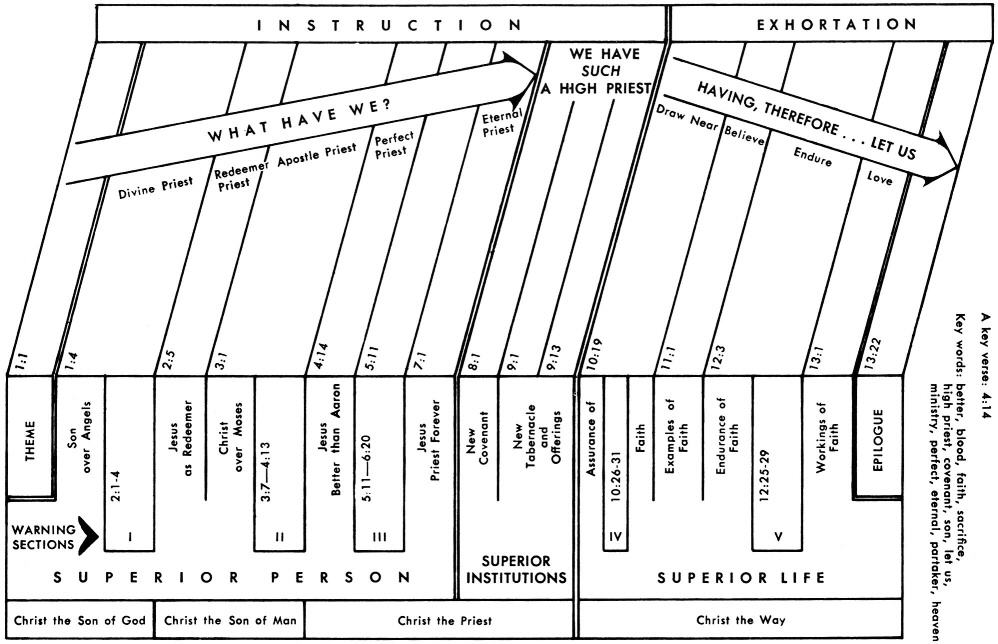
CONSIDER JESUS OUR GREAT HIGH PRIEST
Click chart to enlarge
Charts from Jensen's Survey of the NT - used by permission
Swindoll's Chart, Interesting Pictorial Chart of Hebrews, Another Chart
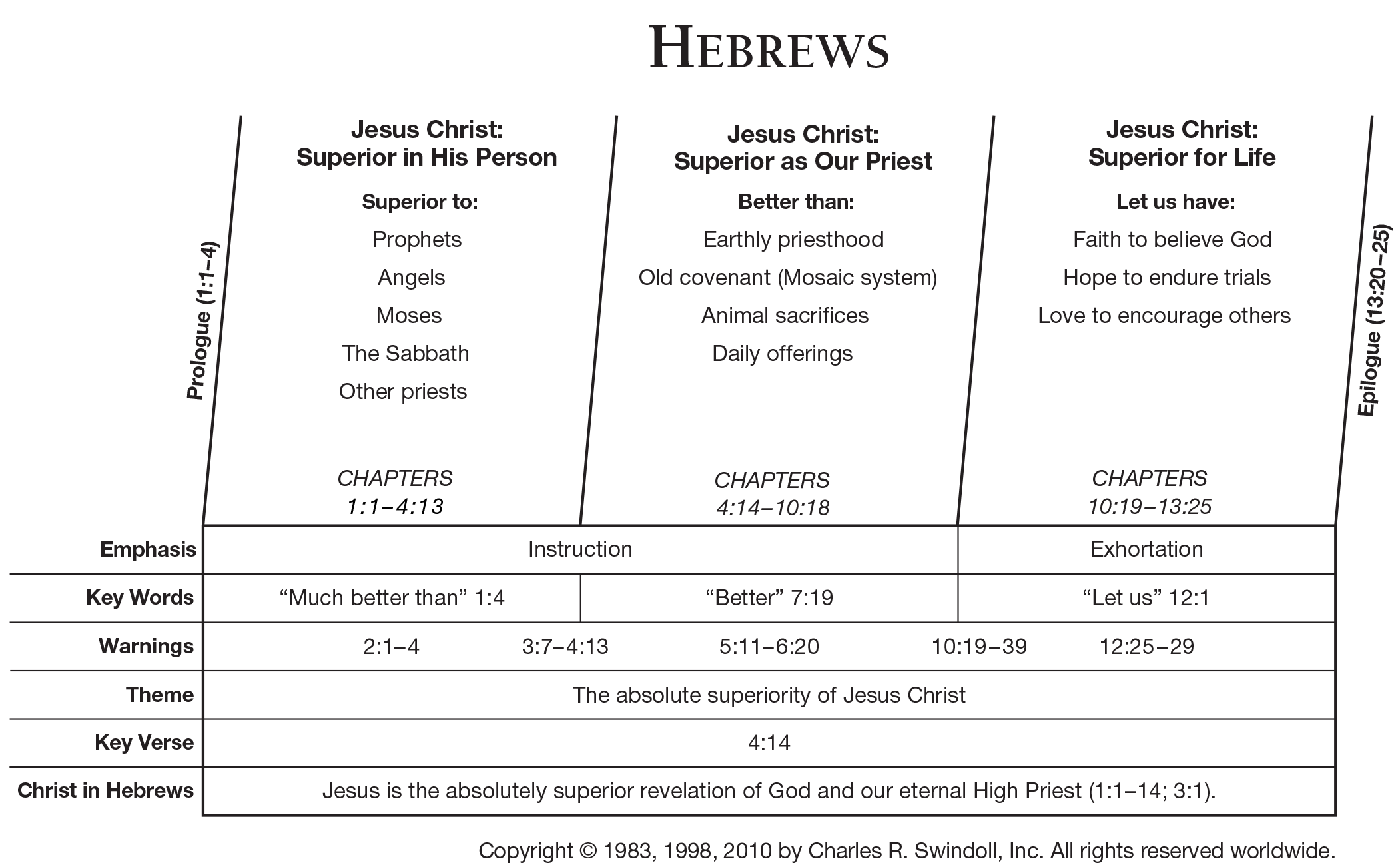

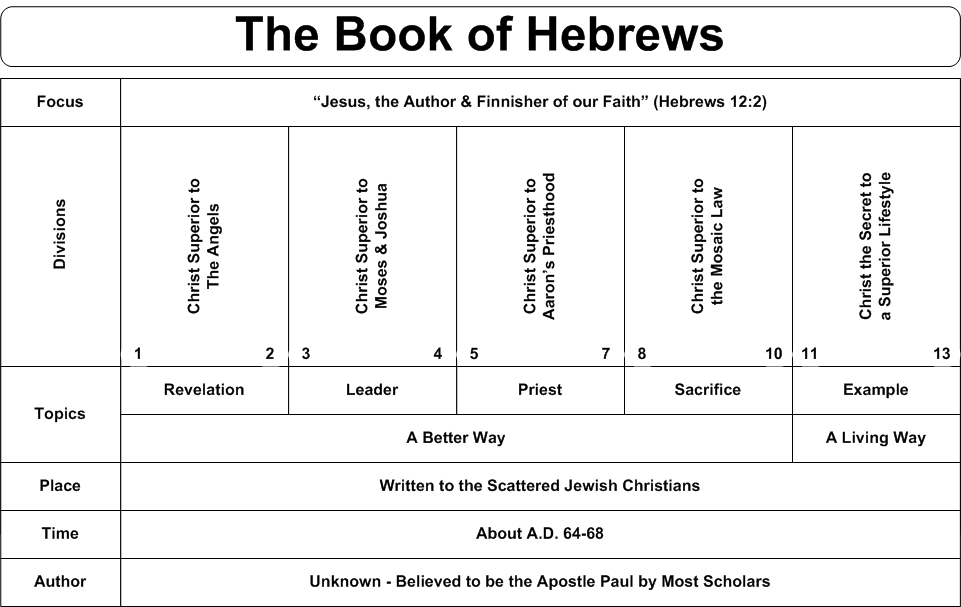
|
The Epistle |
||||
| INSTRUCTION Hebrews 1-10:18 |
EXHORTATION Hebrews 10:19-13:25 |
|||
| Superior Person of Christ Hebrews 1:1-4:13 |
Superior Priest in Christ Hebrews 4:14-10:18 |
Superior Life In Christ Hebrews 10:19-13:25 |
||
| BETTER THAN PERSON Hebrews 1:1-4:13 |
BETTER PRIESTHOOD Heb 4:14-7:28 |
BETTER COVENANT Heb 8:1-13 |
BETTER SACRIFICE Heb 9:1-10:18 |
BETTER LIFE |
| MAJESTY OF CHRIST |
MINISTRY OF CHRIST |
MINISTERS FOR CHRIST |
||
|
DOCTRINE |
DUTY |
|||
|
DATE WRITTEN: |
||||

See ESV Study Bible "Introduction to Hebrews"
(See also MacArthur's Introduction to Hebrews)
Borrow Ryrie Study Bible
Hebrews 4:13 And there is no creature hidden from His sight, but all things are open and laid bare to the eyes of Him with whom we have to do (NASB: Lockman)
Greek: kai ouk estin (3SPAI) ktisis aphanes enopion autou, panta de gumna kai tetrachelismena (RPPNPN) tois ophthalmois autou, pros on hemin ho logos.
BGT καὶ οὐκ ἔστιν κτίσις ἀφανὴς ἐνώπιον αὐτοῦ, πάντα δὲ γυμνὰ καὶ τετραχηλισμένα τοῖς ὀφθαλμοῖς αὐτοῦ, πρὸς ὃν ἡμῖν ὁ λόγος.
Amplified: And not a creature exists that is concealed from His sight, but all things are open and exposed, naked and defenseless to the eyes of Him with Whom we have to do. (Amplified Bible - Lockman)
Barclay: No created thing can ever remain hidden from his sight; everything is naked to him and is compelled to meet the eyes of him with whom we have to reckon. (Westminster Press)
NLT: Nothing in all creation can hide from him. Everything is naked and exposed before his eyes. This is the God to whom we must explain all that we have done. (NLT - Tyndale House)
Phillips: No creature has any cover from the sight of God; everything lies naked and exposed before the eyes of him with whom we have to do. (Phillips: Touchstone)
Wuest: And there is not a thing created which is hidden from His sight. But all things are naked and laid bare to His eyes, to whom we must give account.
Young's Literal: and there is not a created thing not manifest before Him, but all things are naked and open to His eyes—with whom is our reckoning.
KJV Neither is there any creature that is not manifest in his sight: but all things are naked and opened unto the eyes of him with whom we have to do.
NKJ And there is no creature hidden from His sight, but all things are naked and open to the eyes of Him to whom we must give account.
NET And no creature is hidden from God, but everything is naked and exposed to the eyes of him to whom we must render an account.
CSB No creature is hidden from Him, but all things are naked and exposed to the eyes of Him to whom we must give an account.
ESV And no creature is hidden from his sight, but all are naked and exposed to the eyes of him to whom we must give account.
NIV Nothing in all creation is hidden from God's sight. Everything is uncovered and laid bare before the eyes of him to whom we must give account.
MIT There is not a creature concealed from his presence; all are naked and susceptible to scrutiny by the eyes of the one whose word is meant for us.
NJB No created thing is hidden from him; everything is uncovered and stretched fully open to the eyes of the one to whom we must give account of ourselves.
NRS And before him no creature is hidden, but all are naked and laid bare to the eyes of the one to whom we must render an account.
RSV And before him no creature is hidden, but all are open and laid bare to the eyes of him with whom we have to do.
NAB No creature is concealed from him, but everything is naked and exposed to the eyes of him to whom we must render an account.
GWN No creature can hide from God. Everything is uncovered and exposed for him to see. We must answer to him.
BBE And there is nothing made which is not completely clear to him; there is nothing covered, but all things are open to the eyes of him with whom we have to do.
ASV And there is no creature that is not manifest in his sight: but all things are naked and laid open before the eyes of him with whom we have to do.
- No creature hidden - 1Sa 16:7; 1Chr 28:9; 2Chrs 6:30; Ps 7:9; 33:13-15; 44:21; 90:8; 139:11; Ps 139:12; Pr 15:3,11; Jer 17:10,23,24; Jn 2:24; 21:17; 1Co 4:5; Rev 2:23
- Nothing is hidden from God - 2Ki 19:27; Mt 9:4; Jn 2:24, 25
- Open - Job 26:6 34:21 38:17
- To the eyes of Him with whom we have to do: Ec 12:14 Mt 7:21,22 25:31,32 Jn 5:22-29 Ac 17:31 Ro 2:16 Ro 14:9-12 2Co 5:10 Rev 20:11-15
- Hebrews 4 Resources - Multiple Sermons and Commentaries
Related Passages:
1 Samuel 16:7 But the Lord said to Samuel, “Do not look at his appearance or at the height of his stature, because I have rejected him; for God sees not as man sees, for man looks at the outward appearance, but the Lord looks at the heart.”
2 Chronicles 6:30 then hear from heaven Your dwelling place, and forgive, and render to each according to all his ways, whose heart You know for You alone know the hearts of the sons of men,
Job 34:21-22 For His eyes are upon the ways of a man, And He sees all his steps. There is no darkness or deep shadow Where the workers of iniquity may hide themselves.
Psalm 7:9 O let the evil of the wicked come to an end, but establish the righteous; For the righteous God tries the hearts and minds.
Psalms 11:4 The Lord is in His holy temple; the Lord's throne is in heaven; His eyes behold, His eyelids test the sons of men.
Spurgeon: His eyes behold. The eternal Watcher never slumbers; his eyes never know a sleep. His eyelids try the children of men: he narrowly inspects their actions, words, and thoughts. As men, when intently and narrowly inspecting some very minute object, almost close their eyelids to exclude every other object, so will the Lord look all men through and through. God sees each man as much and as perfectly as if there were no other creature in the universe. He sees us always; he never removes his eye from us; he sees us entirely, reading the recesses of the soul as readily as the glancings of the eye. Is not this a sufficient ground of confidence, and an abundant answer to the solicitations of despondency? My danger is not hid from him; he knows my extremity, and I may rest assured that he will not suffer me to perish while I rely alone on him. Wherefore, then, should I take wings of a timid bird, and flee from the dangers which beset me?
Psalm 33:13-15 The Lord looks from heaven; He sees all the sons of men. From His dwelling place He looks out on all the inhabitants of the earth, He who fashions the hearts of them all, He who understands all their works.
Spurgeon: The Lord is represented as dwelling above and looking down below; seeing all things, but peculiarly observing and caring for those who trust in him. It is one of our choicest privileges to be always under our Father's eye, to be never out of sight of our best Friend. He beholdeth all the sons of men. All Adam's sons are as well watched as was Adam himself, their lone progenitor in the garden. Ranging from the frozen pole to the scorching equator, dwelling in hills and valleys, in huts and palaces, alike doth the divine eye regard all the members of the family of man. The Lord is represented as dwelling above and looking down below; seeing all things, but peculiarly observing and caring for those who trust in him. It is one of our choicest privileges to be always under our Father's eye, to be never out of sight of our best Friend. He beholdeth all the sons of men. All Adam's sons are as well watched as was Adam himself, their lone progenitor in the garden. Ranging from the frozen pole to the scorching equator, dwelling in hills and valleys, in huts and palaces, alike doth the divine eye regard all the members of the family of man.
Psalm 44:21 Would not God find this out? (What? Ps 44:20) For He knows the secrets of the heart.
Spurgeon: Shall not God search this out? Could such idolatry be concealed from him? Would he not with holy indignation have detected unfaithfulness to itself, even had it been hidden in the heart and unrevealed in the life? For he knoweth the secrets of the heart. He is acquainted with the inner workings of the mind, and therefore this could not have escaped him. Not the heart only which is secret, but the secrets of the heart, which are secrets of the most secret thing, are as open to God as a book to a reader.
Psalm 90:8 You have placed our iniquities before You, our secret sins in the light of Your presence.
Spurgeon: There are no secrets before God; He unearths man's hidden things, and exposes them to the light. There can be no more powerful luminary than the face of God, yet, in that strong light, the Lord set the hidden sins of Israel. Sunlight can never be compared with the light of Him who made the sun, of whom it is written, "God is light, and in him is no darkness at all." If by His countenance is here meant His love and favour, it is not possible for the heinousness of sin to be more clearly manifested than when it is seen to involve ingratitude to one so infinitely good and kind. Rebellion in the light of justice is black, but in the light of love it is devilish. How can we grieve so good a God? The children of Israel had been brought out of Egypt with a high hand, fed in the wilderness with a liberal hand, and guided with a tender hand, and their sins were peculiarly atrocious. We, too, having been redeemed by the blood of Jesus, and saved by abounding grace, will be verily guilty if we forsake the Lord. What manner of persons ought we to be? How ought we to pray for cleansing from secret faults?
Proverbs 15:3+ The eyes of the Lord are in every place, watching the evil and the good.
Proverbs 15:11 Sheol and Abaddon lie open before the Lord, How much more the hearts of men!
Jeremiah 17:9-10 “The heart is more deceitful than all else And is desperately sick; Who can understand it?“I, the Lord, search the heart, I test the mind, even to give to each man according to his ways, according to the results of his deeds.
Jeremiah 23:24 "Can a man hide himself in hiding places So I do not see him?" declares the Lord. "Do I not fill the heavens and the earth?" declares the Lord.
Revelation 2:23+ And I will kill her children with pestilence, and all the churches will know that I am He who searches the minds and hearts; and I will give to each one of you according to your deeds.
Matthew 10:26+ “Therefore do not fear them, for there is nothing concealed that will not be revealed, or hidden that will not be known.
1 Corinthians 4:5+ (NOTHING HIDDEN FROM GOD) Therefore do not go on passing judgment before the time, but wait until the Lord comes who will both bring to light the things hidden in the darkness and disclose the motives of men’s hearts; and then each man’s praise will come to him from God.
Revelation 3:17+ ‘Because you say, “I am rich, and have become wealthy, and have need of nothing,” and you do not know that you are wretched and miserable and poor and blind and naked,
Daniel 2:22+ “It is He who reveals the profound and hidden things; He knows what is in the darkness, And the light dwells with Him.
NO SECRET SINS BEFORE
THE ALL SEEING JUDGE!
And (kai) there is no (ou) creature (ktisis) hidden (aphanes) from His sight (enopion) - And (kai) serves as a continuative and keeps the thought moving forward from the penetrating work of God’s Word (v. 12) to the penetrating gaze of God Himself (v. 13). The writer is showing that the same truth about the Word’s ability to discern the innermost being is inseparably linked to God’s omniscience. In other words, kai signals that the searching Word and the seeing God are united in purpose.
No (ou) creature (ktisis) hidden (aphanes) means absolutely no exceptions! Every living being—human, angelic, or otherwise—is fully visible to God. The old saying is apropos - "You can run but you cannot hide"! Why not? Because God sees all—every thought, every action, and every hidden motive of the heart—nothing is unknown to Him, even if it is concealed from our closest loved one. Contemplate what the writer is saying. Not a single created thing in the entire universe, in the whole of creation, is unexposed before God's omniscient eye! God's Word is like a microscope that can lay bare the smallest microbe of doubt and sin. From His sight (enopion) emphasizes that there is no point, place, or dimension, physical or spiritual, where God’s gaze does not reach. As emphasized above, there is a natural transition or flow from “the word of God” in Hebrews 4:12 to “God” Himself here, for His Word is not only His activity but also His self-revelation. And so tying verses 12-13, we see the Word of God penetrating the deepest part of our being, exposing our innermost motives which God’s gaze perceives with perfect clarity.
Phillip E Hughes explains the somewhat mysterious link of God's Word (v12) with God's gaze (v13) - As God is its source (His Word) so also He is its fulfilment, and there is therefore the closest association between God and the word by which He effectively acts and reveals Himself. "The author passes insensibly," says Spicq, "from the notion of the word of God to God Himself, and finally identifies them, since the Word was truly in the place of the omniscient and omnipresent God, and received its power and its qualities only from Him." Clearly, as God is by His word the Creator and Sustainer of the whole order of creation, all, that is, all things which includes all men, are open and laid bare to Him. There is not and cannot be any part of reality which is unknown or incomprehensible to Him Who is the Source of all being and the fount of all knowledge. Every creaturely covering and pretext is stripped away. There is no recess, no dark depth, that is not wide open before Him (cf. 1Co 4:5).This profound and solemn truth is one that man in his fallenness does not like to face. (See A Commentary on the Epistle to the Hebrews - Page 167)
🙏 THOUGHT - No one can evade His perception; even secret sins are exposed before Him. This truth should make us all shudder, for even if we have not outwardly committed a secret sin, our (secret) sinful thoughts—fully known to God—still render us guilty before Him. In light of this truth Spurgeon says "We should earnestly labour to be right, for no deceptions will avail. The Lord's word lays us bare and opens up our secret selves. Oh, to be clean before the Lord! This we can never be except by faith." Remember that...
Secret sin on earth,
is open scandal in heaven!
But all things are open (gumnos) and laid bare (trachelizo) to the eyes (ophthalmos) of Him with whom we have to do (logos) - But is a term of contrast which should always prompt the question what change of direction is the writer making. Here, the contrast is striking—nothing hidden, but everything open and laid bare! All (pas) means “all without exception,” reinforcing the “no exceptions” (no creature hidden) stated earlier in the verse. The all-knowing God is fully aware of our actions, locations, thoughts, words, ways, and even our motives (1Co 4:5+). In context, this description refers to God's Word, which penetrates like a sharp sword into the deepest part of our being, leaving no detail or aspect of our life hidden from His relentless gaze.
Open (gumnos - naked, unclothed, bare, exposed) and laid bare (trachelizo) to the eyes (ophthalmos) paints a vivid picture of total exposure before the omniscient God, like one stripped of every covering (gumnos), neck bent back in complete submission(trachelizo), under the unblinking and discerning gaze of the One from whom nothing is hidden. The picture is one who is stark naked! Stripped down! Without clothing! We can hide from others. We can even do a good job of hiding from ourselves. But how do we hide from the One before Whom all hearts are open and all desires known? We cannot -- We cannot hide from God. Given that we are naked before Him, there is nothing to hide in or behind.
Laid bare (trachelizo) was used of wrestlers gripping an opponent’s neck, forcing the head back, fully exposing the face and throat and used to describe sacrificial animals whose necks were bent back for slaughter! The picture is of one who is fully exposed, vulnerable, and defenseless before another. God’s penetrating gaze renders us as if pinned down and completely vulnerable before Him—no ability to resist or hide.
In Hebrews 4:13, eyes is an anthropomorphic description of God, portraying Him as the One who sees all and knows all. Nothing can be hidden from Him—whether by the saved or the unsaved sinner. Similarly, in the Septuagint’s rendering of Proverbs 15:3+, Solomon reminds us, “The eyes (ophthalmos) of the LORD are in every place, watching the evil and the good.”
We see the effects of this divine exposure in the book of beginnings where Moses writes that before the fall "the man and his wife were both naked and were not ashamed. (Ge 2:25+) After the fall we read "Then the eyes of both of them were opened, and they knew that they were naked (Lxx = gumnos); and they sewed fig leaves together and made themselves loin coverings. They heard the sound of the Lord God walking in the garden in the cool of the day, and the man and his wife hid themselves from the presence of the Lord God among the trees of the garden. Then the Lord God called to the man, and said to him, "Where are you?" He said, "I heard the sound of You in the garden, and I was afraid because I was naked (gumnos); so I hid myself." (Ge 3:7-10+)
Phillip E Hughes elaborates on the condition of man after the fall noting that "Anyone with any spiritual awareness is made very uneasy by the thought of God's searching gaze. Remember the scene in the garden after Adam and Eve had first sinned. In their original state, before they fell into sin, they were "naked and were not ashamed" (Ge 2:25+). With no sin to condemn them, they delighted in the gaze of their loving Creator. But after the fall, they hid their shame even from one another, pathetically sewing on fig leaves for garments. Even more, they dreaded the presence of God, fleeing and hiding from Him as He approached. This is how many Christians feel in their relationship with God. The thought of His gaze chills their bones. They are willing to do anything but deal with God Himself, skulking around the edges of His light rather than drawing near to Him. They struggle to pray and seldom do unless forced by circumstances. It is this paralyzing fear that the writer of Hebrews now addresses.....Sinners are no longer commanded to keep their distance in fear and trembling, but on the contrary are now invited to draw near, and to do so with confidence." (See A Commentary on the Epistle to the Hebrews)
A W Tozer - God knows instantly and effortlessly all matter and all matters, all mind and every mind, all spirit and all spirits, all being and every being, all creaturehood and all creatures, every plurality and all pluralities, all law and every law, all relations, all causes, all thoughts, all mysteries, all enigmas, all feeling, all desires, every unuttered secret, all thrones, and dominions, all personalities, all things visible and invisible in heaven and in earth, motion, space, time, life, death, good, evil, heaven, and hell. (Tozer, A. W. from The Knowledge Of The Holy)
The prophet Daniel founded his prayer (the answer to which formed the very basis for God's plan for the ages!) on the truth that all things are open to the eyes of God affirming that "It is He who reveals the profound and hidden things; He knows what is in the darkness, and the light dwells with Him. (Daniel 2:22+) Jamieson rightly exhorts based on the truth in this passage "Show, O man, shame and fear towards thy God, for no veil, no twisting, bending, coloring, or disguise, can cover unbelief"
Both soul and body are effectively "naked" to the eyes of God. Remember that truth the next time you commit a willful, premeditated sin beloved. You are sinning against great grace, great light, a great God! (Ge 39:9) As it is the same sun that melts the wax which hardens the clay, so it is the same Word of God that leads some on to salvation, and turns others who will have none of it away into outer darkness (contrast these two reactions to truth - Jn 3:19, 20+ versus Jn 3:21+)
🙏 THOUGHT - Dear believer, are you in the Word daily that your thoughts, words and deeds might be exposed and shown for what they truly are? If not you need to be, for as Jesus said
He who has bathed (Gk = louo = wash all over, the whole body, picturing the once for all bath of "regeneration") needs (literally "has need" where "has" = present tense expressing this as a continual necessity = the Word of God that first made us holy positionally, must be "washed in" so that it might continue to daily make us holy in practice, i.e., progressive sanctification, the walk of holiness, growth in Christ-likeness - Jn 17:17+) only to wash (Not louo but nipto = wash a part of the body) his feet (cp "washing of water with the word" Ep 5:26+), but is completely clean (positionally clean equating with the once for all "cleansing" that occurs when by grace through faith we are justified or declared righteous in standing before God - Ro 3:24+; Ro 5:1+, Ro 5:2+); and you are clean, but not all of you. (Jn 13:10+)
William Barclay explains that "What he is saying is that as far as men are concerned we may be able to wear our outward trappings and disguises; but in the presence of God these things are stripped away and we have to meet Him as we are. (Hebrews 4 Commentary)
David Guzik writes that open (gumnos) or "Naked reminds us of the way God saw through Adam’s feeble hiding (Ge 3:7-9+). God sees through our hiding the same way.
Even the pagan mind understood this concept of inability to hide from God, Seneca writing that
"We ought always to so conduct ourselves as if we lived in public; we ought to think as if someone could see what is passing in our inmost breast; and there is one who does thus behold us. Of what avail is it, then, that any deed is concealed from man? Nothing can be hidden from God. He is present with our very souls, and penetrates our inmost thoughts, and, indeed, is never absent from us. (Seneca, Epistle 83)
William Newell - At a great camp-meeting I attended many years ago, there was a great deal of prayer. Some 1500 Christians had come together from all over the United States and Canada. I remember Fanny Crosby sitting in the second seat from the front, a dear saint, with Heaven upon her face. One day some one had preached the Word with power in the afternoon, and the people were dispersing. But a man of color came running up to the altar, dropped on his knees, and began to cry mightily to God. I truly believe his voice could have been heard a mile. We gathered around him to comfort him, but it was as if we were not in existence. The Word of God had pierced even to the dividing of soul and spirit. Our singing, our talk, meant nothing to the man. He had been a backslidden church member, and as he afterwards told it, “I saw myself before God’s judgment bar! yea, slipping into hell, and the voices of earth meant nothing.” Alas, we forget that many come to meetings, enjoy the singing and the organ, yea, the eloquence of the preacher; but never experience dividing of soul and spirit. All is “soulical” to them. There is no direct dealing with God.
Albert Barnes - The design of the remark here is, to guard those to whom the apostle was writing from self-deception --since they could conceal nothing from God.
PONDER THE PHRASE:
"WITH WHOM WE HAVE TO DO"
Warren Wiersbe - God uses the Word to enable us to see the sin and unbelief in our own hearts. The Word exposes our hearts; and then, if we trust God, the Word enables our hearts to obey God and claim His promises. This is why each believer should be diligent to apply himself to hear and heed God's Word. In the Word we see God, and we also see how God sees us. We see ourselves as we really are. This experience enables us to be honest with God, to trust His will, and to obey Him. (Bible Exposition Commentary)
R Kent Hughes gives this illustration - God sees everything. This can be discomforting if we have something to hide. This was the experience of some boys who were stealing apples, because as they were in the act it so happened that the great American astronomer Samuel Alfred Mitchell was observing the sun through his telescope as it descended, and just as it set there came into view the crest of an orchard-covered hill some seven miles distant where Dr. Mitchell watched the two boys—one picking apples while the other stood guard making sure they were not seen! (from Walter Baxendale, Dictionary of Illustrations for Pulpit and Platform - online) (See Hebrews: An Anchor for the Soul)
To do (3056) (logos) means an account or something said. Literally the Greek reads "to whom the account is to us", "to whom is our word" or "with whom our matter is". The idea is with whom our final reckoning has to be made. I think the ESV and the NIV renderings are much easier to understand reading "to whom we must give account." "This is the God to Whom we must explain all that we have done (NLT - first edition, not the revision); "with whom is our reckoning or to whom we have to give account." (Marvin Vincent)
David Guzik exhorts us to "Remember the context. The writer to the Hebrews trusts that he has pierced the hearts of his audience, who were contemplating “giving up” on Jesus. In this passage, he has made it plain that they can’t give up on Jesus can keep it “hidden” from God. The word of God has discovered and exposed their condition. (David Guzik. The Enduring Word Commentary Series)
Charles Ryrie writes that it is to do (logos) is "A play on the Greek term for "word"; i.e., if our lives conform to "the word of God" (Heb 4:12), then our word (account) in the day of judgment will be acceptable to God. (Borrow Ryrie Study Bible)
Phillip E Hughes applies this truth commenting that "The man who acknowledges that he is now and that he will be hereafter "naked and exposed to the eyes of the One with whom we have to reckon" (NEB), and that the discernment of God is always without error and His judgment righteous and equitable (Isaiah 11:3f), is a man who is standing on the threshold of divine grace; for it is against the background of human guilt and powerlessness that the grace of God which, in Christ, brings forgiveness and victory is most particularly displayed. (See A Commentary on the Epistle to the Hebrews - Page 168)
In the final words of Ecclesiastes, Solomon writes…
The conclusion, when all has been heard, is: fear God and keep His commandments, because this applies to every person. For God will bring every act to judgment, everything which is hidden, whether it is good or evil. (Ecclesiastes 12:13, 14+)
God “shall illuminate the crypts of the darkness
which naturally fills the self deceiving heart.”
Phillip E Hughes writes that "In that day of manifestation both the hypocritical and the hypercritical will be shown for What they really are. (Paul's Second Epistle to the Corinthians: The English Text- Page 180)
C H Spurgeon - However great a revealer the Word may be, however clear a discerner of the thoughts and intents of the heart, the God who gave the Word is even more so. We should earnestly labor to be right, for no deceptions will avail. The Lord’s word lays us bare and opens up our secret selves. Oh, to be clean before the Lord! This we can never be except by faith.
William Newell - The Word of God brings everything out into the light: All things are naked and laid open before the eyes of Him with Whom we have to do. As David said to Solomon, “Know thou the God of thy father, and serve Him with a perfect heart and with a willing mind; for Jehovah searcheth all hearts, and understandeth all the imaginations of the thoughts” (1 Chron. 28:9). And Hannah, in her great prayer: “Jehovah is a God of knowledge, and by Him actions are weighed.” And Solomon, in his prayer of dedication: “Render unto every man according to all his ways, whose heart Thou knowest (for Thou, even Thou only, knowest the hearts of all the children of men).”
ULTIMATE, FINAL
ACCOUNTABILITY
We must give a personal account to God for what we have said and done in our own lives (cp at the Bema Seat 2Cor 5:10, Ro 14:10, 11, 12+, cp 1Co 3:11, 12, 13, 14, 15); non-believers at the Great White Throne Judgment - Re 20:11+, Re 20:12+, Re 20:13+, Re 20:14+, Re 20:15+). A personal relationship to God requires personal responsibility. Every time you read the Word, you are exposed to His pure light and revelation always calls for a response. Do not be deceived, for dear Bible believing, Bible church attending Christian, to whom much is given, much is expected (Lk 12:48, cp the same principle in Jas 3:1)! Everyone, must render an account to God for the life they lived while on earth (cp the motivation in 1Pe 1:17+). This is one appointment we will not be allowed to miss (even if we wanted to) and this certainty should motivate us to reverential, loving, obedience as we ponder the truth that nothing can be concealed from God.
We all should emulate C H Spurgeon who when ask for permission to write his life story replied, "You may write my life in the skies—I have nothing to hide!"
Thomas Lea says that…Ending with this solemn thought causes us to ask, "Who can represent guilty sinners before a God who sees everything?" This leads to the next section on the high-priestly work of Christ (He 4:14, 15, 16, etc) and its provision of mercy and help for wandering sinners. (See Holman New Testament Commentary - Hebrews & James)
Creature (2937) (ktisis from ktizo = create, form or found) stresses work of original formation of object and represents something which has undergone a process of creation.
While all of mankind represents a creation of God, but not all of God's creations are God's children, contrary to popular teaching in many churches today. Remember that in God's sight there are only two families, the family of God (Jn 1:12, 13, 1Jn 3:7, 8, 9, 10) and (as unpopular as truth is) the family of the Devil (1Jn 3:10, Jn 8:44), children of light (Jn 12:36, Lk 16:8, Ep 5:8+, 1Th 5:5+, 1Th 5:6+, Ro 13:12+) and children of darkness (Col 1:13+, 1Pe 2:9+, cp 2Co 6:14, 15, 16, 17, 18), sons of obedience (Ro 6:16+, He 5:9+, 1Pe 1:2, 3+) and sons of disobedience (Ep 2:2+, Col 3:6KJV+, Ro 2:8+, 2Th 1:8, 9, 10, 1Pe 4:17+ - +: Obedience per se does not save. Only faith in Christ results in genuine salvation. But the faith that is real and effective saving faith is a faith that shows itself real in one's grace enabled obedience. This obedience is not legalism, nor is it perfection, but instead it shows itself to be real by one's general "direction" toward the light, toward righteousness, toward heaven. 2Pe 1:10,11 +; 2Co 13:5, 1Co 6:9, 10, 11). There is no middle ground!
KTISIS - 19x in 19v - created thing(1), creation(14), creature(3), institution(1). - Mark 10:6; 13:19; 16:15; Rom 1:20, 25; 8:19ff, 39; 2 Cor 5:17; Gal 6:15; Col 1:15, 23; Heb 4:13; 9:11; 1 Pet 2:13; 2 Pet 3:4; Rev 3:14.
Hidden (852) (aphanes from a = without + phaino = to appear) means literally not appearing and so not manifest or non-apparent, concealed, invisible. out of sight, hidden, unable to be known about. English - Aphanite, a close-textured dark rock.
Sight (1799) (enopion from en = in + ops = ace, eye, countenance) means in the face of, in front of, before, in the sight of. (1) before - Lk 1:19; Ac 10:30; Rev 3:8; 7:15. (2) in the sight or presence of - Lk 23:14; Jn 20:30; Ac 10:33; 1Ti 6:12; Rev 3:5 ; Rev13:13 (3) in the opinion or judgment of - Lk 16:15; 2Co 8:21 (4) Various uses: simply = to Ac 6:5; 2Cor 7:12. Among in Lk 15:10. Against in Lk 15:18, 21. By the authority of, on behalf of Rev 13:12, 14.
FRIBERG - (in sight or in front); used as an improper preposition with the genitive; (1) of place before, in front of (Rev 4.10); (2) of doing something in someone's presence = in the presence of, in the sight of, before (Jn 20.30); (3) metaphorically in the sight of, in the eyes of (Gal 1.20); (4) as acknowledging the opinion or judgment of another = in the opinion of, in the eyes of (Acts 4.19); (5) special uses; (a) with sin or do wrong against (Lk 15.18); (b) by the authority of, on behalf of (Rev 13.12, 14; 19.20) (Borrow Analytical Lexicon of the Greek New Testament )
ENOPION IN HEBREWS - Hebrews 4:13, Hebrews 13:21
Open (1131) (gumnos/gymnos cp English gym) means not covered, but nude or naked however not necessarily descriptive of absolute nakedness as it was used of a person wearing only an under-tunic (descriptive of the mode of dress in the ancient gymnasiums in Greece and Rome). As such it could mean one who was comparatively naked or scantily dressed. It was used of one poorly dressed (Jas 2:15). Gumnos can refer to being inadequately clothed (Mt 25:36, 38, 43,44) or lightly clothed (Jn 21:7) Figuratively in this Hebrews 4:13 gumnos means uncovered, manifest, disclosed, exposed, not hidden and easy to be known. The point is that nothing is hidden from God’s sight; every aspect of our being—thoughts, motives, and deeds—is fully revealed to Him.
GUMNOS - 15X/15V - bare(1), naked(11), open(1), stripped(1), without clothing(1). Matt. 25:36; Matt. 25:38; Matt. 25:43; Matt. 25:44; Mk. 14:51; Mk. 14:52; Jn. 21:7; Acts 19:16; 1 Co. 15:37; 2 Co. 5:3; Heb. 4:13; Jas. 2:15; Rev. 3:17; Rev. 16:15; Rev. 17:16
GUMNOS - 35v in Lxx - Gen 2:25; 3:7, 10f; 27:16; 1 Sam 19:24; 2Chr 28:15; Job 1:21; 22:6; 24:7, 10; 26:6; 31:19; Prov 23:31; Eccl 5:15; Isa 20:2ff; 32:11; 58:7; Ezek 16:7, 22, 39; 18:7, 16; 23:29; Dan 4:33; Hos 2:3; Amos 2:16; 4:3; Mic 1:8;
Friberg - (1) literally; (a) naked, unclothed, bare; substantivally naked person (Mk 14.52); (b) poorly dressed, (partially) naked (James 2.15); (c) without an outer garment, thus unpresentable for public appearance (Jn 21.7); (2) figuratively; (a) without bodily form, without body (2Cor 5.3); (b) of things disclosed easy to be known, exposed, not hidden (Heb 4.13); (c) substantivally person spiritually unprepared (Rev 3.17) (Borrow Analytical Lexicon of the Greek New Testament )
Liddell-Scott (LS) says in secular Greek gumnos could mean unarmed so that parts are not covered by armor = the exposed parts. LS - of things - e.g., an uncovered bow, i.e. taken out of the case. LS = in common language meant lightly clad, i.e. in the tunic only without the mantle.
The first use in the Septuagint describes Adam and Eve as "naked and were not ashamed." (Ge 2:25) but when sin entered through Adam (Ro 5:12), "they knew that they were naked," (Ge 3:7) and sought to cover themselves. Similarly because of his sin Adam realized he was naked and tried to hide from God (Ge 3:10-11). In one of the more famous uses of gumnos in the Lxx Job declared "Naked I came from my mother's womb, And naked I shall return there. The LORD gave and the LORD has taken away. Blessed be the name of the LORD." (Job 1:21, cp Lxx use of gumnos in Eccl 5:15) "Naked is Sheol before" God alludes to His all seeing eye (Job 26:6).
Laid bare (5136) (trachelizo from trachelos = neck) means to bend back the neck as the surgeon does for operating, as the anesthesiologist does that he might be able to see the vocal cords thus enabling him to insert the tube that conducts life giving oxygen thru the airway! “to seize by the throat,” “to bend back the neck,” or “to expose the throat.” Figuratively as used in Hebrews 4:13 (the only NT use), trachelizo means to lay bare or open and the perfect tense pictures this effect as enduring or permanent. Trachelizo was also used to describe the bending back of the neck of an animal to be slaughtered for an offering in order to expose the throat. It may refer to the wrestler’s art of seizing one by the throat, rendering him limp and powerless.
Wuest writes that trachelizo "means “to seize and twist the neck or throat.” It was used of combatants who handled their antagonists in that way. It meant also “to bend back the neck of the victim to be slain, to lay bare or expose by bending back.” Hence the verb came to mean “to lay bare, to uncover, to expose.” (Hebrews Commentary)
Vincent - The exact metaphor, however, it is impossible to determine. The following are the principal explanations proposed: taken by the throat, as an athlete grasps an adversary; exposed, as a malefactor’s neck is bent back, and his face exposed to the spectators; or, as the necks of victims at the altar are drawn back and exposed to the knife. The idea at the root seems to be the bending back of the neck, and the last explanation, better than any other, suits the previous figure of the sword. The custom of drawing back the victim’s neck for sacrifice is familiar to all classical students. See Hom. Il. i. 459; ii. 422; Pindar, Ol. xiii. 114. The victim’s throat bared to the sacrificial knife is a powerful figure of the complete exposure of all created intelligence to the eye of him whose word is as a two-edged sword. (Vincent, M. R. (2002). Word Studies in the New Testament 4:429)
Friberg writes that trachelizo means "strictly take hold of by the neck; only passive in the NT, as a metaphor drawn from ancient custom, either of making an enemy face his conquerors by a sword fixed under his chin, of fastening a lock grip on an opponent in wrestling, or of bending back the head of a sacrificial victim, ready for the knife be exposed, i.e. be easily known. (Borrow Analytical Lexicon of the Greek New Testament )
Vine writes that trachelizo "literally means to have the throat exposed. It is taken from the games, and signified to bend back the neck. Here the metaphor may be taken either from the sacrifice of a victim or from a mode of punishment. Whatever the metaphorical sense is, the warning is that there is no hiding oneself in any part of our being from God. (Collected writings of W. E. Vine)
MacArthur adds that trachelizo had two distinct uses in ancient times: "It was used of a wrestler taking his opponent by the throat. In this position the two men were unavoidably face to face. The other use was in regard to a criminal trial. A sharp dagger would be bound to the neck of the accused, with the point just below his chin, so that he could not bow his head, but had to face the court. Both uses had to do with grave face-to-face situations. When an unbeliever comes under the scrutiny of God’s Word, he will be unavoidably face-to-face with the perfect truth about God and about himself. (See Hebrews MacArthur New Testament Commentary - Page 105)
Thayer has the following entry for trachelizo - 1. to seize and twist the neck or throat; used of combatants who handle thus their antagonists (Philo, Plutarch, Diogenes Laërt, others). 2. to bend back the neck of the victim to be slain, to lay bare or expose by bending back; hence, tropically, to lay bare, uncover, expose
God's sharp Word shows us where we are wrong not only in what we do, but in how we think and feel. We would like to hide our guilt but we cannot. God has perfect knowledge of what is going on in His world, even to the point of knowing the very thoughts of our hearts. This calls us to repent before we have to face the final judgment.
William Barclay summarizes the three potential meanings of trachelizo writing… (i) It was a wrestler’s word and was used for seizing an opponent by the throat in such a way that he could not move. We may escape God for long enough but in the end he grips us in such a way that we cannot help meeting him face to face. God is one issue that no man can finally evade. (ii) It was the word that was used for flaying animals. Animals were hung up and the hide was taken off them. Men may judge us by our outer conduct and appearance but God sees into the inmost secrets of our hearts. (iii) Sometimes when a criminal was being led to judgment or to execution, a dagger, with point upwards, was so fixed below his chin that he could not bow his head in concealment but had to keep it up so that all could see his face and know his dishonour. When that was done, a man was said to be tetrachēlismenos. In the end we have to meet the eyes of God. We may avert our gaze from people we are ashamed to meet; but we are compelled to look God in the face. Kermit Eby writes in The God in You: “At some time or other, a man must stop running from himself and his God—possibly because there is just no other place to run to.” There comes a time to every man when he has to meet that God from whose eyes nothing ever can be concealed (Hebrews 4 Commentary)
Eyes (3788) (opthalmos) most often describes literal eyes which give sight, but occasionally is used figuratively to describe the eyes as the source of spiritual sight (or lack thereof). Thayer - metaphorically of the eyes of the mind, the faculty of knowing.
Jesus use opthalmos several times in the Sermon on the Mount - eye makes you stumble tear it out (Mt 5:29+, 18:9, Mk 9:47), in reference to the saying "an eye for an eye, " (Mt 5:38-+), the eye as "the lamp of the body" (Mt 6:22-23+, Lk 11:34), figuratively of judging another by looking at "the speck that is in your brother's eye" and not see the "log that is in your own eye," (Mt 7:3-5+, Lk 6:41-42). Used of opening eyes of blind (Mt 9:30, Mk 8:25, Jn 9:6, 10-11 - "opened" = regained sense of sight - similar uses in context - Jn 9:14,17, 21, 26, 30, 32, 10:21, 11:37). Figuratively the Jews had "closed their (spiritual) eyes" (Mt 13:15, cp Mk 8:18, Acts 28:27, Ro 11:8, 10+ cp "He has blinded their [spiritual] eyes" Jn 12:40 - don't misunderstand for while blinding their eyes was part of God's sovereign plan, those blinded were still responsible - see Jn 8:24 - mysterious? Yes!) in contrast to the blessing of the "eyes" that see spiritual truth (in context understand who Jesus was). Now the great need for all who are spiritually blind is "eye salve to anoint your eyes so that you may see" (Rev 3:18+). Even those who refuse the "eye salve" to see Christ for salvation, will yet see the Messiah at His Second Coming when "every (Greek means all without exception!) eye will see Him, even those who pierced Him." (Rev 1:7+)
Jesus speaks figuratively of an envious "eye" an eye that is jealous. (Mt 20:15), with opthalmos actually translated as envy in Mk 7:21-+. "Eyes were heavy" refers to becoming sleepy or tired (Mt 26:43, Mk 14:40). "Lifted up His eyes" means to turn His gaze toward His disciples (Lk 6:20). The "tax collector, standing some distance away, was even unwilling to lift up his eyes to heaven," expressive of his humility, brokenness, contrition over sin. (Lk 18:13) "Hidden from your eyes" is Jesus' figurative use, where the spiritual truth was hidden from the understanding of the Jews (Lk 19:42). The disciples on the road to Emmaus spiritual "eyes were prevented from recognizing Him." (Lk 24:16), but later "their eyes (spiritual understanding) were opened and they recognized" their resurrected Lord.
In Acts 1:9 as Jesus' disciples were looking on "a cloud received Him out of their sight (opthalmos)." Saul "eyes were open, he could see nothing." (Acts 9:8, he was "without sight" or blinded - Acts 9:9) until something like scales "fell from his eyes." (Acts 9:18) Tabitha's opening of "her eyes" was the first sign she had been brought back from the dead (Acts 9:40). Paul was chosen and sent by Jesus especially to the Gentiles "to open their eyes (of their heart, of their spiritual understanding) so that they may turn from darkness to light and from the dominion of Satan to God, that they may receive forgiveness of sins and an inheritance among those who have been sanctified by faith in Me (Jesus is speaking to Paul)." No fear of God "before their eyes" means before their spiritual eyes (which were really spiritually blind eyes) (Ro 3:18+). Paul uses "eye" metaphorically to describe the different members of the body of Christ (1Cor 12:16, 17, 21). The eye blinks were rapidly and so Paul uses the phrase "In the twinkling of an eye" to depict the rapidity with which our glorification will occur. In one of Paul's great prayers (one with which we should all be continually interceding for one another) "Eyes full of adultery" is surely also a figure to describe their hearts full of adultery, the eye gate being the conduit to the heart. (2Pe 2:14+).
John uses eye figuratively in the phrase "the darkness has (spiritually) blinded his eyes" (referring to the one who habitually hates his brother) (1Jn 2:11+). In 1Jn 2:16+) the "lust (epithumia) of the eyes" depicts man's natural eyes as the "open windows" that allow temptation to enter, which in turn is able to stimulate the evil cravings (lusts) that lodge in our fallen nature (our "anti-God" flesh). Hiebert adds that "the reference is not merely to physical sight but includes intellectual visualization." Eve fell prey to the "lust of her eyes" for she "saw the tree was good for food." (Ge 3:6 - Note the Lxx uses opthalmos three times, once in each verse - Ge 3:6-8 - It was our EYES which were critical in bringing about the first sin! And our eyes are still the main sense tempting us to sin against God!). In a related use of opthalmos in the Septuagint we read that Job declared "I have made a covenant with my eyes (Lxx = opthalmos). How then could I gaze (Hebrew = bin/biyn = not just a casual or accidental, unavoidable glance, but careful consideration. Lxx uses suniemi = to understand!) at a virgin?" (Job 31:1-see comment. See also a similar principle regarding the vital importance of guarding one's heart in Pr 4:23+, cp Pr 4:25-27)
Eyes refers to God's eyes in only two passages - Heb 4:13+, 1Pe 3:12+. Eyes describes the four living creatures around the throne of God (Rev 4:8+, Rev 5:6+). In two of my favorite (albeit somewhat mysterious) passages in Revelation we read that "God will wipe every tear from their eyes." (Rev 7:17+, Rev 21:4+). Eyes like fire repeatedly describe the risen, glorified King (Rev 1:14+, Rev 2:18+, Rev 19:12+).
Liddell-Scott- Eyes were painted on the bows of ancient vessels. Phrases in secular Greek that use opthalmos - to have before one's eyes, what is before one's eyes, what was ridiculous to the eye, to get out of any one's sight, to tell one to one's face, to accuse him to his face; the eye of a master or ruler. Figuratively - the dearest, best, as the eye is the most precious part of the body, hence of men, eye or bud of a plant or tree, in Persia the king's eye was a confidential officer, through whom he beheld his kingdom and subjects.
Spiros Zodhiates - In phrases, ophthalmós haploús (haploús [573], single, without folds), meaning a sound eye, as contrasted to ophthalmós ponērós (ponērós [4190], evil), an unsound, evil or diseased eye (Matt. 6:22, 23). With anoígō (455), to open, to open the eyes (Acts 9:8, 40), means either one’s own eyes or those of another, i.e., to cause to see, to restore sight (Matt. 9:30; 20:33; John 9:10, 14, 17, 21, 26, 30, 32; 10:21; 11:37; Sept.: Is. 35:5; 37:23; 42:7); metaphorically, it means to open the eyes of the mind, i.e., cause to perceive and understand (Acts 26:18). With dianoígō (1272), to open wide the eyes, means to cause to see what was not seen before (Luke 24:31; Sept.: 2 Kgs. 6:17); with exorússō (1846), to dig out, denotes entire devotedness (Gal. 4:15; Sept.: 1 Sam. 11:2); with epaírō (1869), to raise up, to lift up the eyes, means to look upon (Matt. 17:8; Luke 6:20; 16:23; 18:13; John 4:35; 6:5; 17:1; Sept.: Gen. 13:10; Ezek. 18:6); with kamnúō (2576), to shut down, to close the eyes so as not to see (Matt. 13:15; Acts 28:27, quoted from Is. 6:10). In 1 Pet. 3:12, “The eyes of the Lord are over the righteous” means the eyes of the Lord are directed upon the righteous implying affection, quoted from Ps. 34:15. In 2 Pet. 2:14 “eyes full of adultery” indicates one who looks at others with adulterous desire. Heb. 4:13, “naked and open in his eyes” (a.t.), means uncovered, manifest. See also Sept.: Job 27:19. (BORROW The Complete Word Study Dictionary: New Testament page 1080)
Ophthalmos - 100x in 85v translated envy*(1), eye(29), eyes(68), gaze(1), sight(1).-Matt 5:29, 38; 6:22-23; 7:3-5; 9:29-30; 13:15-16; 17:8; 18:9; 20:15, 33; 21:42; 26:43; Mark 7:22; 8:18, 25; 9:47; 12:11; 14:40; Luke 2:30; 4:20; 6:20, 41f; 10:23; 11:34; 16:23; 18:13; 19:42; 24:16, 31; John 4:35; 6:5; 9:6, 10-11, 14-15, 17, 21, 26, 30, 32; 10:21; 11:37, 41; 12:40; 17:1; Acts 1:9; 9:8, 18, 40; 26:18; 28:27; Ro 3:18; 11:8, 10; 1Cor 2:9; 12:16f, 21; 15:52; Gal 3:1; 4:15; Eph 1:18; Heb 4:13; 1 Pet 3:12; 2 Pet 2:14; 1John 1:1; 2:11, 16; Rev 1:7, 14; 2:18; 3:18; 4:6, 8; 5:6; 7:17; 19:12; 21:4
Opthalmos in Lxx - over 500 times so only Genesis and Psalms noted - Gen 3:5-7; 13:10, 14; Ge 18:2; 21:19; Ge 22:4, 13; 24:63f; 27:1; 29:17; 31:10, 12, 40; 37:25; 39:7; 43:29; 45:12, 20; 46:4; 48:10; 49:12
Here are the uses of opthalmos in the Psalms which would make an interesting study! Ps. 5:5; Ps. 6:7; Ps. 10:8; Ps. 11:4; Ps. 13:3; Ps. 14:3; Ps. 17:2; Ps. 17:8; Ps. 17:11; Ps. 18:24; Ps. 18:27; Ps. 19:8; Ps. 25:15; Ps. 26:3; Ps. 31:9; Ps. 31:22; Ps. 32:8; Ps. 33:18; Ps. 34:15; Ps. 35:19; Ps. 35:21; Ps. 36:1; Ps. 38:10; Ps. 54:7; Ps. 66:7; Ps. 69:3; Ps. 69:23; Ps. 77:4; Ps. 79:10; Ps. 88:9; Ps. 90:4; Ps. 91:8; Ps. 92:11; Ps. 94:9; Ps. 101:3; Ps. 101:5; Ps. 101:6; Ps. 101:7; Ps. 115:5; Ps. 116:8; Ps. 118:23; Ps. 119:18; Ps. 119:37; Ps. 119:82; Ps. 119:123; Ps. 119:136; Ps. 119:148; Ps. 121:1; Ps. 123:1; Ps. 123:2; Ps. 131:1; Ps. 132:4; Ps. 135:16; Ps. 139:16; Ps. 141:8; Ps. 145:15.
Here's a short summary of God's eyes in Psalms - God’s Eyes as Instruments of Moral Discernment - Eyes that see moral reality clearly – God’s gaze distinguishes righteousness from wickedness (Ps. 5:5; 11:4; 18:24, 27; 26:3; 33:18; 34:15; 94:9; 101:3, 5–7).Eyes offended by evil – Wickedness and deceit cannot stand before His sight (Ps. 5:5; 36:1; 101:3). Eyes that test and examine hearts – God’s look penetrates beyond outward appearances to weigh motives (Ps. 11:4; 17:2; 139:16). God’s Eyes as Protective and Delivering - Watching over the righteous – His eye is on those who fear Him, hope in Him, and call to Him (Ps. 33:18; 34:15; 121:1–2; 123:1–2; 141:8; 145:15). The “apple of His eye” – His most cherished and protected ones are under constant watch (Ps. 17:8). Deliverance and rescue – God’s eye attends to His people’s plight, bringing salvation (Ps. 32:8; 54:7; 116:8; 118:23). God’s Eyes as Instruments of Judgment - Observing the wicked – The Lord’s eyes note the violent, deceitful, and rebellious to bring justice (Ps. 10:8; 35:19, 21; 69:23; 77:4; 79:10; 92:11; 94:9). Exposure and recompense – None can hide from His gaze; He sees the plots, oppression, and mockery of the proud (Ps. 35:21; 66:7; 92:11; 101:5–7). Judgment upon refusal to see – Hardened eyes and blinded vision are a sign of divine judgment (Ps. 69:23).
Here are just a few of the wonderful uses of opthalmos in the Septuagint - In one of the most fascinating uses of eye (Lxx = opthalmos) is all of Scripture Daniel 4 describes what I personally believe was the conversion of Nebuchadnezzar to the true and living God, the Most High God, this previously pagan king after a seven year period of humbling, making the choice (enabled by grace) to declare "At the end of that period I, Nebuchadnezzar, raised my eyes (Lxx = opthalmos) toward heaven, and my reason returned to me, and I blessed the Most High and praised and honored Him who lives forever; For His dominion is an everlasting dominion, And His kingdom [endures] from generation to generation." (Da 4:34+) From this testimony of Nebuchadnezzar, John Piper invokes the principle that when we raise our eyes Godward, our reason returns! Are you eyes fixed on your current turmoil, which is clouding your ability to reason clearly? Then look to Jesus and your reason will return. In another "eye raising" scene as he was about to slay his only son, the son of his love, Isaac, "Abraham raised his eyes (Lxx = opthalmos) and looked, and behold, behind [him] a ram caught in the thicket by his horns; and Abraham went and took the ram, and offered him up for a burnt offering in the place of his son." Again in Joshua 5:13-14 we read "Now it came about when Joshua was by Jericho, that he lifted up his eyes and looked, and behold, a man was standing opposite him with his sword drawn in his hand" and this one was the Captain of the Hosts, a pre-incarnate appearance of Christ (Christophany, see discussion of the Angel of the LORD). In Dt 32:10 says "He (the LORD) kept him (His Chosen People) as the apple (pupil) of his eye (opthalmos)." Ruth the Moabitess found favor in the eyes of Boaz (Ruth 2:2, 9-10, 13).
God's eyes see all the facts in our inmost hearts. There is neither wall nor veil to God's eye, nor thinnest film of obscurity. Surely every servant of Christ today needs to gaze into this revealing mirror and be honest with himself and God, Who knows us better than we know ourselves!
In the Revelation, on the isle of Patmos the apostle John has a face to face encounter with the risen, glorified Christ writing…
His head and His hair were white like white wool, like snow; and His eyes were like a flame of fire. (Re 1:14+)
Comment: John's description is that of a penetrating discernment that is able to search the inmost depths of our soul. His gaze is searching, revealing and infallible, thereby revealing with piercing clarity the reality of everything there is to know. John had seen these same eyes filled with tears when He wept at the grave of Lazarus (Jn 11:35), but now the aged apostle sees that these are the eyes of the Righteous Judge before whom all creation is laid bare (cp 2Ti 4:1+, 2Ti 4:8+).
Tony Garland commenting on Rev 1:14 writes: His eyes are singled out as being like a flame of fire . This evokes the image of a gaze which instantly pierces the deepest darkness to lay bear all sin. It is a reference to His omniscience, omnipresence, and judgment. There is no evil activity of men which Jesus does not see (Job 28:24; Ps. 90:8; 94:9; 139:23; Pr 15:3). There is no den of iniquity so dark that Jesus is not there (Job 34:22; Ps. 139:7; Jer. 23:24; Am 9:2). There is no work of man which will go unjudged by His piercing gaze (1Co 3:15; 2Co 5:10; He 4:13). Truly, God is an all-consuming fire (Num. 11:1; Dt 5:25; 9:3; 2Ki 1:10; Ps 50:3; 78:63; Is 33:14; Lk 9:54; He 12:29; Re 11:5). When speaking to the church at Thyatira, after mentioning His “eyes like a flame of fire” (Re 2:18), Jesus continues, “I know your works” (Re 2:19). He says to the same church, “all the churches shall know that I am He who searches the minds and hearts. And I will give to each one of you according to your works” (Re 2:23). His piercing eyes are an identifying description in Re 19:12. It is impossible to escape His gaze! “And there is no creature hidden from His sight, but all things are naked and open to the eyes of Him to whom we must give account” (He 4:13).
Related Resources:
- Omniscient
- See online Dictionary of Biblical Imagery - 5 page discussion on "Eye, Sight"
In Genesis we read…Now when Abram was ninety-nine years old, the LORD appeared to Abram and said to him,
"I am God Almighty (El Shaddai). Walk (a command - Interesting that the Lxx instead of using a verb for "walk" substitutes the verb "be pleasing" in the present imperative = command calling for continual obedience see need to depend on the Holy Spirit to obey) before Me, and be blameless." (Genesis 17:1+)
God's charge to Abraham was to walk before Him, in God's sight, indeed living in the consciousness and knowledge that the eyes of God were always upon him.
🙏 THOUGHT - What difference beloved would it make in our walk if we conducted ourselves continually with a conscious sense of God's presence? Would it not serve as a holy impediment to sin on one hand (cp Job 1:1, Ge 39:9) and a desire to walk worthy of our calling to please Him on the other hand (cp Ep 4:1+, 1Th 2:12+, Acts 24:16+)?
Moses wrote Numbers 32:23+ “But if you will not do so, behold, you have sinned against the LORD, and be sure your sin will find you out." Achan experienced the truth of this passage when he took some of the the banned spoil from defeated Jericho (the spoil was to be for God) and then hid it in his tent (hidden from man but not from God!)
Joshua 7:21+ (NOTE THE PROGRESSION - BEGINS WITH HIS SIGHT!) when I saw among the spoil a beautiful mantle from Shinar and two hundred shekels of silver and a bar of gold fifty shekels in weight, then I coveted them and took them; and behold, they are concealed in the earth inside my tent with the silver underneath it.” … Josh 7:25+ Joshua said, "Why have you troubled us? The Lord will trouble you this day." And all Israel stoned them with stones; and they burned them with fire after they had stoned them with stones. (Compare the similar sad saga of Elisha's servant Gehazi whose greed prompted him to sin by taking booty from Naaman - read 2Ki 5:15-27)
Related ResourceS:
- God's Omniscience
- Secret Sins - C H Spurgeon on Ps 19:12KJV
- Proverbs 5:21 For the ways of a man are before the eyes of the LORD, and He watches all his paths.
- Proverbs 15:3 (See commentary) The eyes of the LORD are in every place, Watching the evil and the good.
J J Knapp - Naked and Opened Heb. 4:13
In the verse preceding this one the apostle spoke of the judging power of the Word of God. Sharper than any two-edged sword, it pierces into the very essence of us and it judges our secret thoughts and the hidden considerations of the heart. After all, no creature is invisible to God, but the revealing light of the divine eye shines through all coverings—all things are naked and opened before the eyes of Him with whom we have to do.
Naked and opened! Probably this image is borrowed from the Old-Testament dispensation, in particular from the sacrificial service, which was performed by the priests and Levites in the outer court of the sanctuary. The sacrificial animal was brought to them, covered with its natural fleece, to be examined whether it showed any defect which would make it unfit for the altar. Whenever there was any blemish or defect, it was not allowed to be used as a sacrifice, the animal had to completely satisfy the demands of the law. Some defect could easily hide under the beautiful fleece that covered the animal. Therefore, first of all, the priest quickly shore off the heavy fleece, and, when the body lay completely naked before him, a hidden blemish all of a sudden would became clearly visible. However, this was not all. Inwardly there also might be an unacceptable defect in the more honourable parts. Therefore, the butchering knife was placed into the shorn body and it was cut open from the neck to the intestines, and so it did not only lay naked but also opened before the discerning and judging eye of the priest.
Similarly, all things, not the least we, lay opened and naked before the eyes of Him with whom we have to do. Before Him the nicest fleece, used by us to cover our sins, falls away mercilessly. He shaves away the white wool that maybe serves us as a mask, till the last shock and He also opens our innermost being. Everything hidden within, of unrighteousness and unbelief, of world conformity and sinful lust, of doubt and suspicion,—it cannot remain covered before Him. He opens the inner chambers of our heart, walks through them with His all-seeing eye, and makes us to experience in our conscience that He is not just a calm observer, but that we have to do with Him. What it means to have to do with Him in judgment, we can see at Golgotha, where the wrath of God against sin was revealed. However, let this discerning glance cause us to shelter with our secret sins in the shadow of the cross, decidedly trusting that He, with whom we have to do, shall be gracious to us for Christ’s sake and shall take mercy for righteousness.
JUDGMENT
In an effort to avoid fines and an outstanding traffic warrant; 36 year-old Kimberly Du allegedly sent a letter to local authorities stating she had died. Her bad driving habits eventually exposed the lie and landed the Iowa woman in jail, when authorities realized she was still alive.
Court papers allege Du sent a letter to court authorities in December, purportedly from her mother, stating she had died. The letter included the printout of a death notice reportedly taken from the website of a local newspaper. The judge threw out Du's warrant when he received the notice and thought the case was closed. The lie fell apart when courthouse clerks discovered two new tickets issued to Du for speeding and driving with a suspended license, issued a month after her supposed December death.
The subsequent investigation found the obituary had never actually appeared on the newspaper's website, and Du's funeral had never occurred. Du is now in jail facing up to two years in prison for allegedly forging her mother's name on the letter to the court.
—http://desmoinesregister.com/apps/pbcs.dll/article?AID=/20060301/NEWS01/603010357Submitted by Jim Sandell.
Hebrews 4:13 (CEV) "Nothing is hidden from God! He sees through everything, and we will have to tell him the truth."
The early American Indians had a unique practice of training young braves. On the night of a boy's thirteenth birthday, after learning hunting, scouting, and fishing skills, he was put to one final test. He was placed in a dense forest to spend the entire night alone. Until then, he had never been away from the security of the family and the tribe. But on this night, he was blindfolded and taken several miles away. When he took off the blindfold, he was in the middle of a thick woods and he was terrified! Every time a twig snapped, he visualized a wild animal ready to pounce. After what seemed like an eternity, dawn broke and the first rays of sunlight entered the interior of the forest. Looking around, the boy saw flowers, trees, and the outline of the path. Then, to his utter astonishment, he beheld the figure of a man standing just a few feet away, armed with a bow and arrow. It was his father. He had been there all night long.
We sometimes feel like that boy—alone, fearful, engulfed by darkness. But in the thickest gloom is the all-seeing eye of our Father God. We have no reason to fear. —D. J. D.
IN THE DARK OF THE NIGHT, GOD IS THE LIGHT.
New techniques to detect and identify fingerprints are making it easier to apprehend and convict criminals. One of these methods uses a laser, which causes latent prints to glow when scanned by a laser. Body oils and perspiration, even on porous materials, leave traces that respond to laser light to such an extent that they can be photographed. Variation in color helps to determine the age of the prints, revealing the time sequence of a crime. Even very old prints that cannot be detected by powders and chemicals can be seen clearly by this new technique. For example, a forty-year-old fingerprint was detected on a postcard written during World War II.
If finite man can invent such methods of detection, what must be the infinite capacities of our God? He sees and knows everything! It is a frightening discovery to the sinner to realize that every thought and deed is known to God. But how reassuring to the child of God who is under the loving eye and gracious hand of his heavenly Father! —P R. V (Reprinted by permission from Our Daily Bread Ministries. Please do not repost the full devotional without their permission.)
KNOWING THAT GOD SEES EVERYTHING WILL EITHER GIVE CONVICTION OR CONFIDENCE.
Nothing Hidden
There is a story of a photographer who went to the docks to take a picture of the The Great Eastern. Its hull was black, having been coated with tar. That same day the man went to his own darkroom to develop the film and print it. As the picture of the ship began to take form, the word Lewis appeared on the hull. Immediately the photographer returned to the wharf to see whether that name actually was on the vessel. But it wasn't visible. Astonished, he contacted the office of the shipping company and inquired about this strange phenomenon. He was told that the word Lewis could be found underneath the tar. The camera's powerful lens and the sensitive film had picked it up.
In the incident recorded in Luke 7, the Lord was thoroughly aware that the woman who had come to anoint His feet in the Pharisee's house had led a wicked life. He did not ignore her past but tactfully referred to her sin and then forgave it. Nothing was hidden from His eye.
A Spherion Workplace poll asked 1,601 employed adults, "If you knew your employer could see content from your social network website—such as MySpace, Friendster, or Facebook—would you remove any content from it?" The results:
Yes: 33 percent
No: 37 percent
Neutral: 30 percent
—Jae Yang and Robert Ahrens,USA Today
God of Our Worst Moments
God, who sees us in our worst moments, does not measure us by them.
Quote: God or Chance?
Nothing that happens in the world happens by chance. God is a God of order. Everything is arranged upon definite priciples and never at random.
Job 31:1 A COVENANT WITH MY EYES
Our friend is a computer “techie.” One night when our family was at his house, I noticed a verse taped to his monitor: “I have made a covenant with my eyes” (Job 31:1). Evidently, he understood the potential danger of spending hours alone in front of a computer with easy access to indecent images.
Our friend’s “reminder verse” is a quote from Job, and it continues, “Why then should I look upon a young woman?” Like many of us, Job had promised himself to stay free of lust. Reflecting on that oath, he said, “Does [God] not see my ways, and count all my steps?” (Job 31:4, cp Pr 15:3-note, 1Pe 1:17-note). The Bible assures us that God does (Heb 4:13-note), and that we are accountable to Him. This is why believers must “abstain from sexual immorality” (1Th. 4:3-note). While some want to debate the boundaries of morality, the Bible says, “Whoever looks at a woman to lust for her has already committed adultery with her in his heart” (Mt 5:28-note).
If you have made a covenant with your eyes, consider how Scripture might help you keep this pledge. Post a verse on your computer screen, television, or the dashboard of your car, and remember, “God did not call us to uncleanness” but to holiness (1Th. 4:7-note). -- February 11, 2012 - by Jennifer Benson Schuldt (Reprinted by permission from Our Daily Bread Ministries. Please do not repost the full devotional without their permission.)
When lustful thoughts assail your mind
To play with immorality,
Remember that God’s will for you
Is holiness and purity.
-Sper
A look that lingers can lead to lust.
Does He not see my ways and number all my steps?
Job 31:4
The book of Job records the conversations Job had with friends who visited him during his troubles. Though wanting to help, they added insult to injury by accusing Job of wrongdoing.
In chapters 26-31, Job defended himself. Without claiming to be sinless, he told them he had lived an upright life. In chapter 31, he spoke of his personal commitment to purity and to divert his eyes continually from any provocative scene: "I have made a covenant with my eyes. How then could I look at a young woman?" In other words, Job had made a commitment to himself and to God that he wouldn't let his eyes linger on sensuality. Addition-ally, in verses 9-12, he told them of his decision to remain faithful to his wife.
The reason for this commitment to purity is given in Job 31:4: "Does He not see my ways and number all my steps?" A constant awareness of God's perpetual presence and of His oversight is a great deterrent to sin. The same Lord who counts every hair on your head each morning also counts every step you take during the day. He knows all your ways, so be holy in all you do. (Reprinted by permission from Our Daily Bread Ministries. Please do not repost the full devotional without their permission.)
He sees all our steps (Job 31:4).
He counts all the hairs on our heads (Matt. 10:30). He reads all our thoughts (Ps. 139:2).
He knows all our ways (Ps. 139:3). He hears all our words (Ps. 139:4).
Nothing in all creation is hidden from God's sight (Heb. 4:13 NIV).
Adrian Rogers - There’s nothing—absolutely nothing—you can hide from the risen Christ. Let me give you a verse—Hebrews 4:13: “Neither is there any creature that is not manifest in his sight: [for,] but all things are naked and opened unto the eyes of him with whom we have to do.” (Hebrews 4:13) “All things are naked.” (Hebrews 4:13) He strips away all of the veneer, all of the hypocrisy. “His eyes [are like] a flame of fire.” (Revelation 1:14) He knows you. You can hide things from your pastor; you can hide things from your wife, but you can’t hide from this Savior.
Did you know the Lord Jesus Christ right now sees your heart this moment? Did you know He knows what you’re thinking this very second? His eyes—like a flame of fire. He cannot be deceived. He cannot be disputed. He cannot be discredited.
He knows the imagination of your heart right now. He knows exactly, precisely things that you’ve long since hidden; things that you did, perhaps, in Vietnam; things that you uttered in secret—lust and hate. He sees right through that. Our Lord God knows all of these things. Put it down, my dear friend: He cannot be deceived; He cannot be disputed; He cannot be discredited. He has what I want to call “unhindered scrutiny.” “His eyes [are like] a flame of fire.” (Revelation 1:14)
GLASS HIVES Hebrews 4:13
One of the best ways to teach children the genius of God’s creation is with an observation hive —a glassed-in colony of bees, all organized, busy, and productive. Each bee (with a brain the size of a grass seed) works with the others as wax producer, comb builder, honey maker, floral pollinator, military guard, and hive custodian. Observant children can even detect the bees’ communication patterns with the “bee dance.”
Perhaps you’ve seen a glass hive at a county fair or science exhibition. The queen bee, worker bees, drones, and offspring bustle about, unaware that observant eyes are watching their every move. Their hive, being glass, is open and revealed to all who see it.
In the same way, the Lord looks down on our world. He sees all our actions, hears all our words, and knows all our thoughts. “A man’s ways are in full view of the LORD, and He examines all his paths” (Proverbs 5:21, NIV). Remember that the Lord is watching you today. May the words of our mouths and the meditation of our hearts be pleasing in His sight (Psalm 19:14).
I trust in God wherever I may be, upon the land or on the rolling sea; for come what may, from day to day, my heav’nly Father watches over me. WILLIAM C. MARTIN
Our Sins Not Hidden From God—Heb. 4:13.
Professor Mitchel was once taking observations on the sun, and as it neared the horizon, the great eye of his telescope took in a hill-top, some seven miles away. On that hill were some apple trees, and in one of them two boys were stealing apples. They looked this way and that, but no one was in sight. They thought themselves unobserved; but there, in his observatory, seven miles away, sat the professor, noting every movement.
What an illustration of the power of that eye which never slumbers, but which compasses “our down-sittings and uprisings, and is acquainted with all our ways.” We may learn from it, too, that unseen eyes, which we least suspect, are watching us all the time. There are telescopic eyes which take note of our actions when we are far away, and suppose that we are lost in the throngs; but they know our goings out and our comings in. We may go to the theater just once, and fancy our example will hurt no one, for none of our acquaintance will know it; “but a bird of the air shall carry it.” We may change our habitation to one far remote from a former home, hoping that the story of evil deeds will not follow us; but before we are aware of it, all is open as the noonday. The Lord has detectives ever at work, whom no vigilance can elude. Often in the moment of greatest apparent security the exposure comes with overwhelming force.
Let us think of these unseen eyes when we are tempted to walk in winding ways, instead of in the great highway of holiness. Not only is our departure from the right set down against us in God’s book, but it will stand against us in the memory of many who will be encouraged by it in their own evil doings.—Mrs. J. E. McConaughy.
Wayne Grudem - page 151 of Systematic Theology online - God Knows All Things Actual. The definition also says that God knows “all things actual.” This means all things that exist and all things that happen. This applies to creation, for God is the one before whom “no creature is hidden from his sight, but all are naked and exposed to the eyes of him to whom we must give account” (Heb. 4:13; cf. 2 Chron. 16:9; Job 28:24; Matt. 10:29–30). God also knows the future, for he is the one who can say, “I am God, and there is none like me, declaring the end from the beginning and from ancient times things not yet done” (Isa. 46:9–10; cf. 42:8–9 and frequent passages in the Old Testament prophets). He knows the tiny details of every one of our lives, for Jesus tells us, “Your Father knows what you need before you ask him” (Matt. 6:8), and “Even the hairs of your head are all numbered” (Matt. 10:30).
In Psalm 139 David reflects on the amazing detail of God’s knowledge of our lives. He knows our actions and thoughts: “O LORD, you have searched me and known me! You know when I sit down and when I rise up; you discern my thoughts from afar” (Ps. 139:1–2). He knows the words we will say before they are spoken: “Even before a word is on my tongue, behold, O LORD, you know it altogether” (Ps. 139:4). And he knows all the days of our lives even before we are born: “Your eyes saw my unformed substance; in your book were written, every one of them, the days that were formed for me, when as yet there was none of them” (Ps. 139:16).
c. God Knows All Things Possible. The definition of God’s knowledge given above also specifies that God knows “all things possible.” This is because there are some instances in Scripture where God gives information about events that might happen but that do not actually come to pass. For example, when David was fleeing from Saul he rescued the city of Keilah from the Philistines and then stayed for a time at Keilah. He decided to ask God whether Saul would come to Keilah to attack him and, if Saul came, whether the men of Keilah would surrender him into Saul’s hand. David said,
“Will Saul come down, as your servant has heard? O LORD, the God of Israel, please tell your servant.” And the LORD said, “He will come down.” Then David said, “Will the men of Keilah surrender me and my men into the hand of Saul?” And the LORD said, “They will surrender you.” Then David and his men, who were about six hundred, arose and departed from Keilah, and they went wherever they could go. When Saul was told that David had escaped from Keilah, he gave up the expedition. (1 Sam. 23:11–13)
Similarly, Jesus could state that Tyre and Sidon would have repented if Jesus’ own miracles had been done there in former days: “Woe to you, Chorazin! Woe to you, Bethsaida! For if the mighty works done in you had been done in Tyre and Sidon, they would have repented long ago in sackcloth and ashes” (Matt. 11:21). Similarly, he says, “And you, Capernaum, will you be exalted to heaven? You will be brought down to Hades. For if the mighty works done in you had been done in Sodom, it would have remained until this day” (Matt. 11:23; cf. 2 Kings 13:19, where Elisha tells what would have happened if King Joash had struck the ground five or six times with the arrows).
The fact that God knows all things possible can also be deduced from God’s full knowledge of himself. If God fully knows himself, he knows everything he is able to do, which includes all things that are possible. This fact is indeed amazing. God has made an incredibly complex and varied universe—as is evident, for example, when we observe the remarkable variety of animals in a zoo or fish in an aquarium. But there are thousands upon thousands of other variations or kinds of animals and fish and other things that God could have created but did not. God’s infinite knowledge includes detailed knowledge of what each of those other possible creations would have been like and what would have happened in each of them! “Such knowledge is too wonderful for me; it is high; I cannot attain it” (Ps. 139:6). “For as the heavens are higher than the earth, so are my ways higher than your ways and my thoughts than your thoughts” (Isa. 55:9).5
d. God Is Always Aware of Everything. Our definition of God’s knowledge speaks of God knowing everything in one “simple act.” Here again the word simple is used in the sense “not divided into parts.” This means that God is always fully aware of everything. If he should wish to tell us the number of grains of sand on the seashore or the number of stars in the sky, he would not have to count them all quickly like some kind of giant computer, nor would he have to call the number to mind because it was something he had not thought about for a time. Rather, he always knows all things at once. All of these facts and all other things that he knows are always fully present in his consciousness. He does not have to reason to conclusions or ponder carefully before he answers, for he knows the end from the beginning, and he never learns and never forgets anything (cf. Ps. 90:4; 2 Peter 3:8; and the verses cited above on God’s perfect knowledge). Every bit of God’s knowledge is always fully present in his consciousness; it never grows dim or fades into his nonconscious memory. Finally, the definition talks about God’s knowledge as not only a simple act but also an “eternal act.” This means that God’s knowledge never changes or grows. If he were ever to learn something new, he would not have been omniscient beforehand. From all eternity God has known all things that would happen and all things that he would do.
Someone may object that God promises to forget our sins. For example, he says, “I will not remember your sins” (Isa. 43:25). Yet passages like this can certainly be understood to mean that God will never again let the knowledge of these sins play any part in the way he relates to us: he will “forget” them in his relationship to us. Another objection to the biblical teaching about God’s omniscience has been brought from Jeremiah 7:31; 19:5; and 31:35, where God refers to the horrible practices of parents who burn to death their own children in the sacrificial fires of the pagan god Baal, and says, “which I did not command, nor did it come into my mind” (Jer. 7:31). Does this mean that before the time of Jeremiah God had never thought of the possibility that parents would sacrifice their own children? Certainly not, for that very practice had occurred a century earlier in the reigns of Ahaz (2 Kings 16:3) and Hoshea (2 Kings 17:17), and God himself had forbidden the practice eight hundred years earlier under Moses (Lev. 18:21). The verses in Jeremiah are probably better translated quite literally, “nor did it enter into my heart” (KJV),6 giving the sense, “nor did I wish for it, desire it, think of it in a positive way.”7
HE KNOWS EVERYTHING —Hebrews 4:13
God’s understanding is limitless … His knowledge is perfect, and … there isn’t a creature anywhere in the universe that isn’t plainly visible to His sight. Nothing is shut before the eyes of God. That is what is called divine omniscience, one of the attributes of God. An attribute, as I have said before, is something which God has declared to be true about Himself.
God has declared by divine revelation that He is omniscient, that He knows everything. The human mind staggers under this truth when we consider how much there is to know and how little we know….
When I received one of the honorary degrees that have been bestowed on me, I said, “The only thing that is learned about me is this pair of glasses.” If a man has his hair slicked back and a pair of learned-looking glasses, they call him a doctor. We don’t know very much, really, and when we consider the great God who knows all there is to know with perfection of knowledge, we stagger under that. The weight of the truth is too much for our minds.
I stagger and am challenged, but I take comfort in knowing that You know all things. I rest in Your perfect knowledge today. Amen.
Football Player Vindicated after Being Accused of Rape
Genesis 50:20; Isaiah 40:28; Hebrews 4:13
Preaching Themes: Eschatology_LastJudgment, God_Knowledge, God_Sovereignty, Injustice, Judgment, Justice
In 2002, a high school girl falsely accused a football star named Brian Banks of rape. That accusation caused the loss of several college scholarships. Instead of going to college to play football, Banks served a five-year sentence. He likely could have played professional football with a brilliant career full of honors, records, etc., but we will never know. He served five years in prison, and was still on parole in 2012 when his accuser admitted that she had made a false accusation. He tried out with a few teams, but didn’t make it in the end. In 2014 he got a job working at the National Football League offices in New York.
Brian Banks’ name was cleared, but is that enough to compensate for the loss of time and potential opportunities he may have had? Is he getting justice? Joseph experienced the same kind of injustice (see Gen 39). How did he handle it? A day is coming when God will judge the liar and vindicate the accused.—Jim L. Wilson and David Mills
GOD’S PERSPECTIVE
MANY a person checks the traffic reports before they head out onto the roads to go to work. By listening to the traffic report, they can figure out which freeways are clogged up and determine how much time needs to be allotted to getting to their destination or which route is best to take.
Any traffic report worth its salt is given from a helicopter. Somebody up in the sky looks down at the whole situation and can give direction to drivers so they know how they ought to proceed. Now, a person can say, “I am not listening to the traffic report. I am going to take my chances.” The only problem is that when they are in traffic, they can’t see what’s going on. All they will know is that there is a long line and they will be stuck in it.
Now which is better? Does it make more sense to try and make the traffic decision on one’s own and possibly get stuck or does it make better sense to follow the instructions from the helicopter? Of course, following the helicopter makes more sense because the person flying above in the chopper sees the big picture.399
[Holy Spirit, Guidance; Perspective, Importance of; Perspective, Power of] Ps. 33:13; Heb. 4:13
Nothing Is Hidden Topics: GOD’S OMNISCIENCE, SIN Bible Verses: Psalm 33:13–14; Hebrews 4:13
On May 7, 2003, David Horton attended a Cincinnati Reds Baseball game with his girlfriend. During the game, he decided to kiss her and the roving camera crew “Kiss Cam” caught it and flashed the picture of the couple on the scoreboard.
Now David was a wanted man and his parole officer also was in attendance at the game and saw the couple smooching.
The parole officer and a police officer arrested Horton, 24, in his front-row seat.
“Out of all the coincidences, we had 20- or 30-thousand people at the ballpark and who do they put on the ‘Kiss Cam’? And then, who is there but his parole officer?” said Richard Goldberg, Horton’s attorney.
Horton, of Cincinnati, was convicted of felonious assault in 1999 for stabbing two men. He was granted release after serving two years of a four-year prison sentence.
Horton had been arrested March 27, 2003 and was indicted for trafficking and possession of cocaine. He also failed to appear in court on those charges. He was convicted and sentenced to four and a half years in prison.
Similarly, nothing is hidden from the eyes of God.
A Reason to Do Right Hebrews 4:13 NIV Hope for Each Day Morning and Evening Devotions - Page 304
Do people who have died and gone to Heaven know what happens on Earth? The Bible doesn’t give us an absolutely clear answer about this, but it does hint that they may be aware of what takes place here on Earth.
The writer of Hebrews reminds us of some great Old Testament heroes who lived for God, often despite great opposition (Hebrews 11). Then he concludes, “Since we are surrounded by such a great cloud of witnesses, let us throw off everything that hinders and the sin that so easily entangles, and let us run with perseverance the race marked out for us” (12:1 NIV).
Here the writer paints a picture of a stadium filled with spectators, perhaps watching us as we live out our lives and cheering us on as we stretch toward the finish line. So perhaps those who have entered Heaven are watching us, even now.
What we do know for sure is that God sees us—and that should be enough to encourage us to live for Christ and do what is right.
Getting Comfortable with Sin Hebrews 4:13
I make it my policy to never lift up the cushions on our sofa. Before this policy was in place, I once made the mistake of looking for a pen under those cushions. What I discovered was a nightmare of leftover cookies, popcorn, used tissues, a smashed doughnut and the wise man we’d been missing from our nativity scene for three Christmases. And I was faced with the unhappy prospect of having to clean up the mess.
It has been said that the Bible will keep you from sin, or sin will keep you from the Bible. It’s true. Scripture exposes the underneath places of our lives, those places we would rather not see, and exposed sin requires that we allow Christ to clean up the mess. That’s not always easy, especially if we’ve become comfortable with our disobedience.
REFLECT: Do you find yourself unwilling to expose yourself to the probing light of God’s Word? Perhaps it is for fear of what you might discover.
Duffy Robbins
Joni E Tada - Nothing Hidden — HEBREWS 4:13 Pearls of Great Price: 366 Daily Devotional Readings - Page 23
My friend Sherrill and I used to sit with each other in our wheelchairs and talk about heaven. We spoke fondly and wistfully about the day when we would take that first heavenly step on strong resurrected legs. But Sherrill had one reservation. It was that part where the Bible says of the Lord that “everything is uncovered and laid bare” before his eyes. She shuddered at the idea. “Joni, I’m so worried about all the mistakes I’ve made — the failures and the awful sins.”
I understand. The fear of the Lord is a deterrent to sin. Our Father in heaven tells us to be holy, as he is holy. Shedding sinful habits is a key and critical sign that we’re truly growing in the Lord. But that doesn’t mean Sherrill needs to be afraid. On the contrary, think of the flipside of Hebrews 4:13. God’s eyes don’t miss the good you do, either. The times you hold your tongue … the times you patiently endure suffering, leaning on Jesus … the times you hold up under pressure with a godly response … the times you give, secretly, with no thought of return … the times you offer an encouraging word when you are bone tired — all is laid bare before his searching gaze.
Maybe Sherrill’s solitary and lonely apartment seemed hidden away from the sight of others, but nothing was hidden from God’s sight. He took note of her patience, her endurance, and her faithfulness.
Fear the Lord; it’s the beginning of wisdom. But then do the wise thing: fall in love afresh with your Savior, your High Priest, who has been tested in every way like you. Live life under his gaze, knowing beyond all doubt that it’s a look of love.
Lord, the servant girl Hagar once named you “the One who sees me.” That was after you rescued her and provided for her in your kindness. Help me to remember today, that you never, never lose sight of me.
Your Father who sees in secret will reward you openly. —Matthew 6:18
Not far from my house, authorities have rigged a camera to snap pictures of drivers who race through red lights. The offenders later receive in the mail a ticket along with a “red-light photo,” which is visual proof of their traffic violation.
Sometimes I think of God in the same way I think of that camera—He’s up there, just waiting to catch me doing the wrong thing. While God does see our sin (Heb. 4:13), He sees and takes interest in our good deeds as well. Due to His supernatural surveillance, God sees the size of our sacrifice when we give money to the church or to those in need (Mark 12:41-44). He hears our private prayers (Matt. 6:6). And when we fast, we can carry on as usual being assured that our “Father . . . sees in secret” (v.18).
Knowing that God sees everything frees us from thinking about the watchful eyes of others. When we do what is right, we need no applause from onlookers; when we sin, we do not need to worry about our reputation once we settle the issue with God and anyone we’ve harmed. We can rest knowing that “the eyes of the LORD run to and fro throughout the whole earth, to show Himself strong on behalf of those whose heart is loyal to Him” (2 Chron. 16:9).
Lord, thank You for Your all-seeing nature. You know everything I think and do. Help me to value Your approval and live according to Your standards, no matter what anyone else may think. Others see what we do, but God sees why we do it.
Allen Ross - Proverbs 15:3 “Divine Omniscience”
The eyes of the LORD are everywhere, keeping watch on the ungodly and the good.
The proverb is reminding us of the biblical truth that the LORD knows everyone completely. The thought is continuous through the two parallel lines, and uses anthropomorphic language to stress God’s exacting knowledge.
Similar language is used in Psalm 11:4, which says “His eyes behold, His eyelids examine, the sons of men.” The imagery is of God’s squinting (and thereby involving His eyelids) in a close examination of people’s lives. And Psalm 121 reminds us in similar human terms that God never slumbers of sleeps. A bolder anthropomorphic expression is found in Genesis 19:21 where the Lord tells Abraham that he will go down to Sodom and see if it is as bad as he has heard. This is designed to say that God does not judge people on a whim. These expressions are the ways that humans would act. But God is omniscient; He knows everything equally well (Ps. 139:1-6; see also Heb. 4:13). He does not have to take a closer look, or study the matter, to see what it is like. And so in this proverb when it says that his eyes are everywhere, it is a way of saying that he knows everything--nothing escapes his vision, as it were.
For the righteous, the truly good people on the earth, this is comforting. But for the ungodly this should be a warning that God knows everything they do. The verse is not merely making a theological statement; it is designed to prompt people to right conduct. The righteous will always be conscious of the LORD’s keeping watch over them, and this will both bring them comfort and security and also motivate them to greater righteousness.
"GOD LOOKED AT THAT!"
The eyes of the Lord are in every place, beholding the evil and the good. Proverbs 15:3
The fact of God's omnipresence is not only a real comfort but also an arresting thought. It is wonderful to say with Hagar in times of distress, "Thou God seest me." No matter where we might go, we are never lost to the loving eye of our Heavenly Father. This truth should also cause us to govern carefully the things we say and do. Some time ago I came across a story which underscores this. It seems that a little boy of low mentality was treated most unkindly by other lads and often ridiculed by adults. They would laugh at his comments and mimic his odd behavior. Although tending to be imbecilic, he did at times sense their derision. Lacking the ability to properly defend himself, he would simply say to his offenders, "Ah! God looked at that." He would then repeat it with added emphasis, "Ah, God looked at that!" This made a deep impression on a young lady who saw the unkind deeds and heard the helpless child's simple retort. She mentioned that later whenever she witnessed any injustice, there would come to her mind this lad and his graphic sermon: "God looked at that!" Although mentally deficient, that small boy knew how to preach! He got the point across. The Scripture agrees with his observations; for we read, "Neither is there any creature that is not manifest in his sight" (Heb. 4:13). The writer of Proverbs exclaims, "Sheol and destruction are before the Lord; how much more, then, the hearts of . . . men" (Prov. 15:11).
What a difference it would make if before acting we would always stop to consider that the Lord is observing us. Whenever a thing is done, we too must face the fact—"God looked at that!"
There is an Eye that never sleeps
Beneath the wings of night;
Soul, guard thy ways and words today,
For thou art in His sight!
—Anon.
Live innocently, God is watching! —Linnaeus
Nothing in all creation is hidden from God’s sight. Hebrews 4:13
Read: Hebrews 4:12–16
In 2015 an international research company stated that there were 245 million surveillance cameras installed worldwide, and the number was growing by 15 percent every year. In addition, multiplied millions of people with smartphones capture daily images ranging from birthday parties to bank robberies. Whether we applaud the increased security or denounce the diminished privacy, we live in a global, cameras-everywhere society.
The New Testament book of Hebrews says that in our relationship with God, we experience a far greater level of exposure and accountability than anything surveillance cameras may see. His Word, like a sharp, two-edged sword, penetrates to the deepest level of our being where it “judges the thoughts and attitudes of the heart. Nothing in all creation is hidden from God’s sight. Everything is uncovered and laid bare before the eyes of him to whom we must give account” (Hebrews 4:12–13).
Because Jesus our Savior experienced our weaknesses and temptations but did not sin, we can “approach God’s throne of grace with confidence, so that we may receive mercy and find grace to help us in our time of need” (vv. 15–16). We don’t need to fear Him but can be assured we’ll find grace when we come to Him. —David McCasland
Nothing is hidden from God’s sight. Nothing is greater than God’s love. Nothing is stronger than God’s mercy and grace. Nothing is too hard for God’s power.
No part of our lives is hidden from God’s grace and power.
Insight -- We can be thankful for the Scriptures and all they teach about the wisdom and heart of our Father. His ultimate expression of Himself, however, came in the person of Jesus, who lived in flesh on this earth and showed us all we could ever need to know about our God. Why is it important that God became flesh and lived among us? In Hebrews 4:15-16 how does it help to know we can approach God in “our time of need
Job 31:1
The cartoon depicted a frustrated father changing a flat tire in the rain. His two children were peering out the car window. In response to their complaining, he said, "Don't you understand? This is life. This is what's happening. We can't switch to another channel!" Television and reality-does the former distort the latter? After 10 years of research, media analyst Kenneth Curtis measured TV's impact on society. He concluded that the omnipresent, flickering screen constantly tries to tell us what behavior and attitudes are desirable. He described the effect of TV as a subtle process that has become a significant force in defining reality. If this is true, we had better be careful about what we watch. The networks are not committed to portraying Christian values. Many things that are presented as acceptable are in fact dangerous. Furthermore, watching TV makes us passive observers rather than active participants in solving life's problems. The violence, sex, and materialism on TV can make us insensitive to our calling as Christians to be salt and light in a sinful world. Only as we meditate on God's Word (Psalm 1:2) can we have the right perspective. To avoid a distorted view of life, we must allow God's truth to define reality. -MRD II
Our thoughts are shaped by what we see,
And thoughts affect our soul;
So if we'd profit from TV,
We must be in control.
-DJD
The Bible is the best TV guide.
He's Watching - In this age of electronics, we have all become aware of bugging devices. A person's office, hotel room, or telephone can be monitored so that every sound is picked up. This is accomplished through highly sensitive microphones that are so small they can easily be hidden. Heads of state, government officials, and business people in strategic positions must be exceedingly careful of what they say, especially when entering a strange setting. The awareness that they might be overheard is sure to make them think twice before they speak.
Did you ever stop to think that God sees everything we do and hears everything we say every moment of the day? Hebrews 4:13 says that "all things are naked and open to the eyes of Him to whom we must give account."
This truth is both comforting and sobering--comforting because God stands ready to deliver us when we are in trouble (Ps. 33:18-19), and sobering because "the eyes of the Lord are in every place, keeping watch on the evil and the good" (Prov. 15:3). What a profound effect this should have on the way we live!
The next time you are tempted or in trouble, remember that God is watching and listening. —Richard De Haan (Our Daily Bread, Copyright RBC Ministries, Grand Rapids, MI. Reprinted by permission. All rights reserved)
There is no time of day or night,
No place on land or sea
That God, whose eye is never dim,
Does not see you and me. --DJD
To know that God sees us brings both conviction and comfort
Today in the Word (click here) has the following devotional…
Wednesday, April 8, 1998
Read: Hebrews 4:12-16
In [Christ] and through faith in him we may approach God with freedom and confidence. - Ephesians 3:12
TODAY IN THE WORD - The British pastor Charles Spurgeon once made this observation about our need for the application of the Scriptures: ""When a soldier is wounded in battle, it is of little use for him to know that there are those at the hospital who can bind his wounds and medicines there to ease all the pains which he now suffers. What he needs is to be taken there and the remedies applied. It is thus with our souls. To meet this need there is one, the Spirit of truth, who takes of the things of Jesus and applies them to us.""
Although the writer of Hebrews may not specifically have had the comforting power of God's Word in mind here, Spurgeon's point is helpful. Only the Word of God, applied with surgical precision by the Spirit of God, can meet the needs of the human heart.
Why did the author mention the Scriptures at this point (v. 12)? Because sin is so deceitful (Heb. 3:13) and the danger of drifting away so real that our only safe guide is the Word of God.
The Word is so potent that it can expose the deepest motives of our hearts. We need this penetrating work desperately, as did the Hebrews, because ""the heart is deceitful above all things and beyond cure. Who can understand it?"" (Jer. 17:9). God's Word can reveal our tendency toward waywardness and help keep us on the path of faithfulness to Christ.
We have another source of help and strength in our struggle. In addition to the living written Word, we have the living incarnate Word in the Person of Jesus Christ.
In verse 14, Jesus is presented in His ministering role as our great High Priest. Jesus took the blood of His sacrifice into the heavenly sanctuary, just as Israel's high priest took the blood of animal sacrifices into the inner sanctuary of the temple to make atonement for sin.
We are encouraged to approach Jesus in our weakness because He was tempted in every way that we are tempted (v. 15). The difference, of course, is that Jesus never succumbed to temptation. He never sinned.
Instead of Jesus' sinlessness being a barrier between Him and us, we are encouraged to come to Him for mercy and grace in our time of need (v. 16).
TODAY ALONG THE WAY - With today's passage we begin the second section of our study, the superiority of Christ's priesthood (see the April 1 study for our brief outline of the book of Hebrews).
We're in for several weeks of encouragement and blessing as we consider Christ's priestly work on our behalf. That ministry is available to you today, especially if you are facing a time of need. Bring your burden, problem, or sin to the Lord right now and thank Him for His mercy and grace to deal with it.