Isaiah 2:2
Isaiah 2:3
Isaiah 2:4
Isaiah 2:5
Isaiah 2:6
Isaiah 2:7
Isaiah 2:8
Isaiah 2:9
Isaiah 2:10
Isaiah 2:11
Isaiah 2:12
Isaiah 2:13
Isaiah 2:14
Isaiah 2:15
Isaiah 2:16
Isaiah 2:17
Isaiah 2:18
Isaiah 2:19
Isaiah 2:20
Isaiah 2:21
Isaiah 2:22
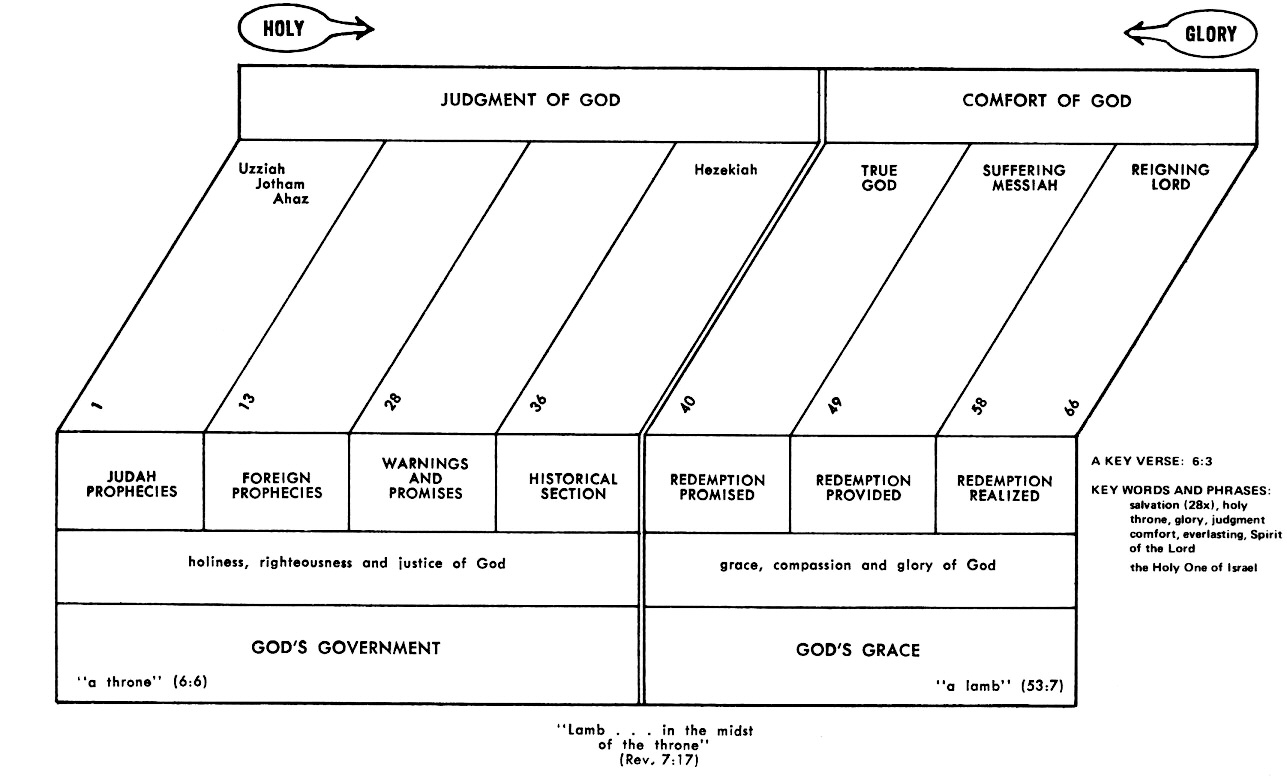
Click chart to enlarge
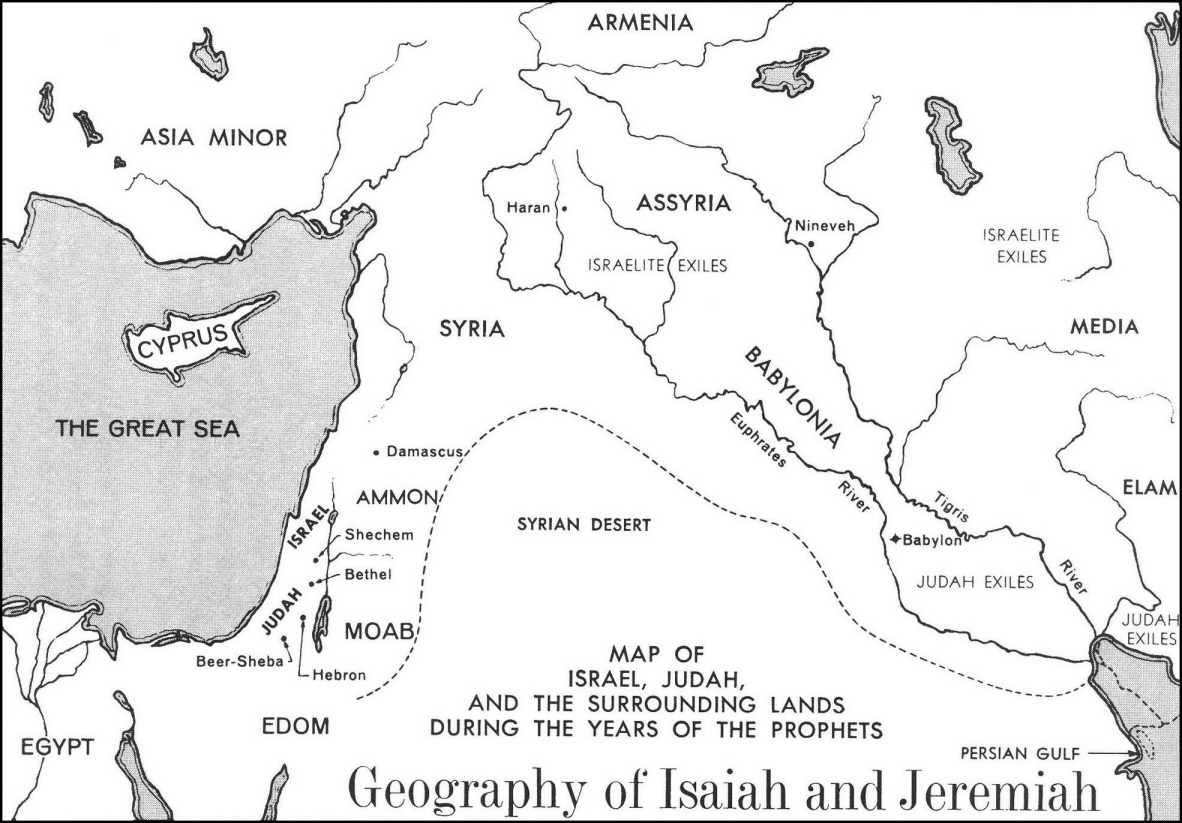
Click chart to enlarge
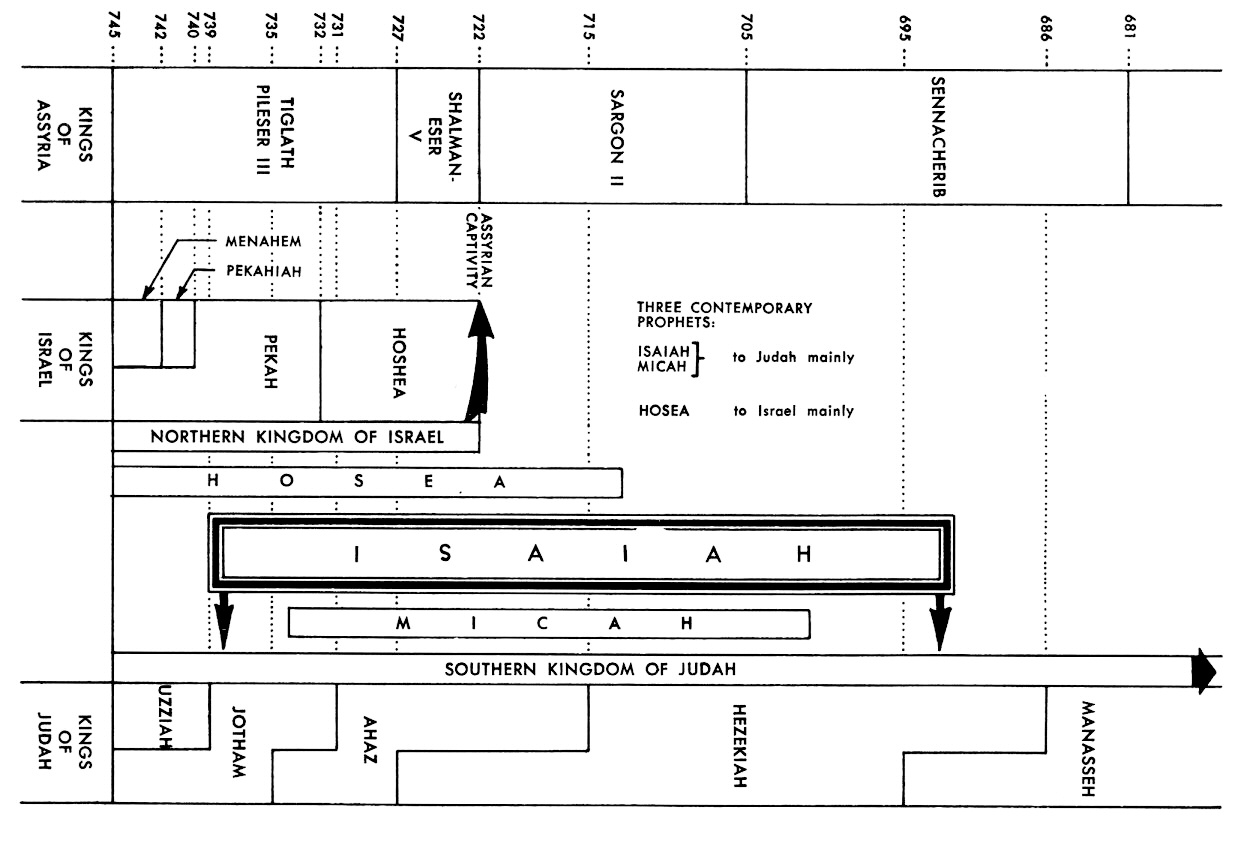
Chart from recommended resource Jensen's Survey of the OT - used by permission
Another Isaiah Chart see on right side
| ISAIAH ("Jehovah is Salvation") See Excellent Timeline for Isaiah - page 39 |
||||||
| JEHOVAH'S Judgment & Character (Isaiah 1-39) |
JEHOVAH'S Comfort & Redemption (Isaiah 40-66) |
|||||
| Uzziah Jotham Ahaz 1-12 |
13-27 |
28-35 |
Hezekiah's Salvation & Blessing 36-39 |
True God 40-48 |
Suffering Messiah 49-57 |
Reigning Lord 58-66 |
| Prophecies Regarding Judah & Jerusalem Is 1:1-12:6 |
Prophecies Against the Nations |
Warnings & Promises |
Historical Section |
Redemption Promised: Israel's Deliverance |
Redemption Provided: Israel's Deliverer |
Redemption Realized: Israel's Glorious Future |
| Prophetic | Historic | Messianic | ||||
| Holiness, Righteousness & Justice of Jehovah | Grace, Compassion & Glory of Jehovah | |||||
| God's Government "A throne" Is 6:1 |
God's Grace "A Lamb" Is 53:7 |
|||||
| Time 740-680BC |
||||||
Isaiah 2:1 The word which Isaiah the son of Amoz saw concerning Judah and Jerusalem. (NASB: Lockman)
English Translation of the Greek (Septuagint): The word which came to Esaias the son of Amos concerning Judea, and concerning Jerusalem.
Amplified: THE WORD which Isaiah son of Amoz saw [revealed] concerning Judah and Jerusalem. (Amplified Bible - Lockman)
KJV: The word that Isaiah the son of Amoz saw concerning Judah and Jerusalem. And he shall judge among the nations, and shall rebuke many people: and they shall beat their swords into plowshares, and their spears into pruning hooks: nation shall not lift up sword against nation, neither shall they learn war any more.
NET: Here is the message about Judah and Jerusalem that was revealed to Isaiah son of Amoz. (NET Bible)
NJB: The vision of Isaiah son of Amoz, concerning Judah and Jerusalem. (NJB)
NLT: This is another vision that Isaiah son of Amoz saw concerning Judah and Jerusalem: (NLT - Tyndale House)
Young's Literal: The thing that Isaiah son of Amoz hath seen concerning Judah and Jerusalem:
The word which Isaiah the son of Amoz saw concerning Judah and Jerusalem:
- Isaiah 1:1; 13:1; Amos 1:1; Micah 1:1; 6:9; Habakkuk 1:1
THE WORD ISAIAH
SAW
Isaiah 2:1 marks the beginning of a new section which runs through Isaiah 4:6 and is generally an "upbeat" hope filled section with several glorious divine promises to Israel (and by way of application to all those who are in Christ by grace through faith.)
The vision of Isaiah 1:1 is now the word, a message describing the glorious eschatological future of Israel (assuming you read and interpret the text literally!) The word which Isaiah...saw (cf Amos 1:1; Micah 1:1-note; Hab 1:1-note) suggests that God gave His prophet a vision which he reduced into words for all saints of all ages to "see" the glorious future God has planned for His little nation of Israel, not because they are so good, but because God is so good and so faithful to keep His covenant promises to Abraham, Isaac and Jacob (See Covenant: Abrahamic versus Mosaic).
Michael Rydelnik notes that "The prophet announced what he had seen concerning Jerusalem and Judah. The picture of Israel in chap. 2 inspires hope that God will bring about His promised blessing by making the temple mount, or the mountain of the house of the LORD (Isa 2:2, cf. v. 3), the highest of the mountains." (Moody Bible Commentary)
J M Riddle - Isaiah 2 marks the beginning of a new section in the prophecy: "The word that Isaiah the son of Amoz saw concerning Judah and Jerusalem" (v. 1). There is an interesting difference between Isaiah 1:1 and Isaiah 2:1. In the first case, it was "The vision of Isaiah the son of Amoz, which he saw concerning Judah and Jerusalem". In the second case, it is "The word that Isaiah the son of Amoz saw concerning Judah and Jerusalem". This was a divinely-given guard against misinterpretation of the prophecy. Chapters 2-4 form a unit with two major sections, both of which describe the coming glory of Jerusalem. The unit begins and ends with a description of Jerusalem's coming glory, but the emphases are different. The unit commences by describing her administrative glory (Isaiah 2:1-5), and concludes by describing her ultimate moral glory (Isaiah 4:2-6). The intervening verses describe the way in which her moral glory will be achieved. Jerusalem's coming glory, described in Isaiah 2:1-5, will only be attained after sin has been thoroughly judged. There must be purging before blessing. Prophecy has been defined as "history written in advance". A prophet has been described as a man who "addresses the present in the light of the future". The accuracy of these definitions is supported from the opening section of this chapter. We have a clear description of Jerusalem as God's capital city in the millennial earth (Isaiah 2:1-4), and a strong appeal for appropriate conduct now in view of future events: "O house of Jacob, come ye, and let us walk in the light of the Lord" (Isiaah 2:5). .(What the Bible Teaches – Song of Solomon and Isaiah)
John Walvoord comments that in this section we see that "Isaiah predicted the future kingdom of the Messiah. He wrote, “In the last days the mountain of the Lord’s temple will be established as chief among the mountains; it will be raised above the hills, and all nations will stream to it” (Is 2:2; Zech. 14:16). Jerusalem was described as the capital of the world in a time of peace rather than war, a time when the Lord will teach His ways (Isa. 2:3, 4, 5). This will be fulfilled in the Millennium. (Walvoord, J. F. The Prophecy Knowledge Handbook. Wheaton, Ill.: Victor Books)
This is virtually identical to Isa 1:1 - "The vision of Isaiah the son of Amoz, concerning Judah and Jerusalem" but now Isaiah substitutes word for vision.
Word… saw - This suggest Isaiah saw a vision of future events that deal with Judah and Jerusalem. Compare Isaiah's statement with the fact that John turned to see the voice that spoke with him Revelation 1:12 (note). In addition the fact that Isaiah saw the word suggests that the revelation contained both visionary and verbal elements.
Judah and Jerusalem - This prophecy which actually continues through Isaiah 4 is directed towards the southern kingdom Judah and its capital Jerusalem. Keep in mind the recipients of these prophecies when you interpret these passages or read other commentaries -- these promises are not given to the church but to Judah and Jerusalem. Dr Raymond Ortlund wrote a very popular commentary on Isaiah (Preaching the Word: Isaiah - God Saves Sinners - 4.5 stars see the reviews!) in which he gives an example of the widespread influence of non-literal interpretation and spiritualization of Bible texts, writing on Isaiah 2 that "What follows in the rest of chapter 2 is a poem on the transforming power of hope and humility.....in the latter days the nations will abandon their worldviews and ideologies and gladly give to the church their esteem as the world’s leader in worship." Beloved, is this really what Isaiah's great prophecy in chapter 2 teaches? I think not! I fail to see a single mention of the word "church" in Isaiah 2. Could Isaiah's description of his intended audience be any clearer beloved? This genre of interpretation is very reminiscent of the tragic teaching of replacement theology / supersessionism, a "doctrine" which smacks of subtle Anti-Semitism. To miss Israel in the OT is to miss one of God's keys to interpreting all of Biblical prophecy, for as someone has said "Israel is 'God's Timepiece.'" Keep your eye on Israel in the Bible and God's Plan for the Ages will beautifully unfold from Genesis to Revelation. Replace Israel with the Church and Biblical prophecy becomes hopelessly mired in confusion and is virtually uninterpretable! And what is one result of this confusion? Many churches shy away from preaching prophetic passages (Excuses I have heard -- too much disagreement, is not practical or applicable to real life, "Who knows which interpretation is correct?", etc) which is tragic since 25% of Scripture was recorded originally as prophecy and 80% has been perfectly fulfilled leaving 20% which will be perfectly fulfilled! It follows that sadly many saints in the modern church are virtually completely ignorant concerning the remaining 20%! See more detailed comments on Ortlund's comments on Isaiah's prophecy in Isaiah 34-35 - non-literal interpretation of Isaiah 34.
John Martin - "The prophets in Israel had at one time been called ”seers“ because of their divinely given power to ”see“ or foretell what would happen (1Sa 9:9). Here Isaiah was foretelling the future of Jerusalem and Judah. In the prophecies of restoration which are prominent in Isaiah’s book, he was not specific as to the exact time when they would be fulfilled (perhaps he did not know; cf. 1Pe 1:10, 11-note). Here he simply said in the last days . Other Bible passages make it clear that these predictions will be fulfilled in the Millennium, Christ’s 1,000-year reign on the earth. Because of God’s covenant promises to Abraham, Moses, and David, Isaiah knew that Israel will again be in the land and will again have a superior position among the nations. (Walvoord, J. F., Zuck, R. B., et al: The Bible Knowledge Commentary. 1985. Victor)
Isaiah 2:2 Now it will come about that In the last days the mountain of the house of the LORD Will be established as the chief of the mountains, and will be raised above the hills; and all the nations will stream to it. (NASB: Lockman)
English Translation of the Greek (Septuagint): For in the last days the mountain of the Lord shall be glorious, and the house of God shall be on the top of the mountains, and it shall be exalted above the hills; and all nations shall come to it.
Amplified: It shall come to pass in the latter days that the mountain of the Lord’s house shall be [firmly] established as the highest of the mountains and shall be exalted above the hills, and all nations shall flow to it. (Amplified Bible - Lockman)
KJV: And it shall come to pass in the last days, that the mountain of the Lord's house shall be established in the top of the mountains, and shall be exalted above the hills; and all nations shall flow unto it.
NET: In the future the mountain of the LORD's temple will endure as the most important of mountains, and will be the most prominent of hills. All the nations will stream to it, (NET Bible)
NJB: It will happen in the final days that the mountain of Yahweh's house will rise higher than the mountains and tower above the heights. Then all the nations will stream to it, (NJB)
NLT: In the last days, the Temple of the LORD in Jerusalem will become the most important place on earth. People from all over the world will go there to worship. (NLT - Tyndale House)
Young's Literal: And it hath come to pass, In the latter end of the days, Established is the mount of Jehovah's house, Above the top of the mounts, And it hath been lifted up above the heights, And flowed unto it have all the nations.
Now it will come about that In the last days:
- Micah 4:1-3-note
- Last days - Ge 49:1; Nu 24:14; Job 19:25; Je 23:20; 30:24; 48:47; 49:39; Ezek 38:16; Da 2:28; 10:14; Acts 2:17; 2Ti 3:1; He 1:2; 2Pe 3:3
Related Resources:
Prophetic Passage - Isaiah 2:1-4 is a prophecy which will be fulfilled at the Second Coming of Christ at the end of the last half of Daniel's Seventieth Week, at the end of the 3.5 year period ( the Great Tribulation) at which time the Messiah establishes His literal, earthly Millennial Kingdom. As an aside, note that all of the Jews who enter Messiah's (Millennial) Kingdom will be regenerate or born again (cp Zec 13:1, 8, 9-note, Ro 11:26, 27-note).
Micah a contemporary prophet of Isaiah gives a virtually identical prophecy - And it will come about in the last days That the mountain of the house of the LORD Will be established as the chief of the mountains. It will be raised above the hills, And the peoples will stream to it. 2 And many nations will come and say, "Come and let us go up to the mountain of the LORD And to the house of the God of Jacob, That He may teach us about His ways And that we may walk in His paths." For from Zion will go forth the law, Even the word of the LORD from Jerusalem. 3 And He will judge between many peoples And render decisions for mighty, distant nations. Then they will hammer their swords into plowshares And their spears into pruning hooks; Nation will not lift up sword against nation, And never again will they train for war. (Micah 4:1-3-note)
Grogan adds that "If we accept supernatural inspiration (Ed: Which I accept!), then we cannot exclude the possibility of independent revelation in the case of each prophet." (Isaiah: Expositor's Bible Commentary 7-Volume Old Testament. Zondervan Publishing)
In view of the truth that ALL Scripture is God breathed (2Ti 3:16-note) and that the Holy Spirit moved in men of old to speak God's word (2Pe 1:21-note), this repetition in Isaiah and Micah emphasizes the supreme importance of this great truth concerning Jerusalem's future. It behooves believers to pay close attention to such repetition and not to ignore it (or become involved in wrangling about words or speculation such as who wrote first, whether one prophet copied the other, etc - cp Paul's admonition to his young disciple Timothy - 2Ti 2:14-note, 2Ti 2:23-note). As emphasized so often, one of the important aspects of prophecy is to give believers a future and a hope, and to motivate a godly, holy life (cp 1Ti 4:7, 8-note, 1Ti 4:9, 10, 11-note , 1Pe 1:14-note, 1Pe 1:15, 16-note, 1Pe 1:17-note; 2Co 7:1-note) in this present evil age (Gal 1:4). What you are looking for (forward to) will greatly influence what you are living for (1Jn 3:2-note, 1Jn 3:3-note, cp 2Co 5:7-note, 2Co 4:16-note, 2Co 4:17-note, 2Co 4:18-note, Titus 2:12-note, Titus 2:13-note, Gal 5:5)
Chuck Smith writes that…
In the Kingdom Age Jesus Christ will establish His throne on Mt. Zion. We will also go there to be taught by Him. (Rev.1:6-note, Rev 3:21-note, Rev 19:15-note, Rev 5:9,10-note.)
So Isaiah goes from the dark, bleak history and now he jumps forward to a day yet future when Jesus Christ the Messiah comes and establishes the kingdom. And the Jews, as the scripture said, will look upon Him whom they have pierced, and they will recognize Him and they will weep over Him. Weep over their national blindness and their failure to recognize that He was their Messiah. And He will establish His kingdom there on the top of the mountains in Jerusalem.
Traditionally, it is felt that the top of Mount Zion will be the place of the throne of Jesus Christ in the Kingdom Age. And this is going ahead now to the Kingdom Age. All nations show flow unto it. (Chuck Smith Commentary - see Isaiah under Sermon Notes)
S Lewis Johnson rightly reminds us "One thing that we can say about prophecies is that it provides us not simply satisfaction for our curiosity concerning the future, but it is designed ultimately to give us consolation and edification through the knowledge of the future. (Messianic Prophecies in Isaiah)
The last days (See also related discussion of the synonymous phrase "latter days" in the notes on Daniel 2:28 and notes on Daniel 10:14) - The last days is a term which is also found in the NT. In Hebrews 1:2-note and Acts 2:17 latter days seems to begin with the first coming of Christ. And passages such as Isa 2:2 and Micah 4:1 identify events that will occur in the last days, specifically that Christ will come a second time (see Second Coming) to establish His Millennial Kingdom.
John MacArthur writes that in the New Testament the term last days speaks of "the period beginning with the first advent of Jesus Christ (Ac 2:17; 2Ti 3:1-note; He 1:2-note; Jas 5:3; 2Pe 3:3-note). Old Testament prophets, being without a clear word regarding the time between the Messiah’s two advents, linked the expression to the Messiah’s return to establish His earthly kingdom, i.e., the millennial kingdom spoken about in Re 20:1-10-note
Grogan explains that the last days "is a technical eschatological expression… The NT, making explicit the fact that the Messiah comes twice, applies the phrase both to the period of His first advent (e.g., Acts 2:17; Heb 1:2) and to His second (e.g., James 5:3; 1Peter 1:5-note). (Ibid)
The writer of Hebrews in one sentence encompasses the first and second comings of Christ, which in effect define "the last days" - "So Christ also, having been offered once (First coming - beginning of "the last days") to bear the sins of many , shall appear a second time (see Second Coming- which marks the termination of "the last days") for salvation without reference to sin, to those who eagerly await Him. (He 9:28-note)
Below are all the uses of the phrase the last days in the NAS…
Jeremiah 23:20 "The anger of the LORD will not turn back Until He has performed and carried out the purposes of His heart; In the last days (latter days = Je 23:20ESV) you will clearly understand it.
Jeremiah 49:39 'But it will come about in the last days (latter days = Je 30:24ESV) That I shall restore the fortunes of Elam,'" Declares the LORD.
Ezekiel 38:16 and you will come up against My people Israel like a cloud to cover the land. It will come about in the last days (latter days = Ezek 38:16ESV) that I shall bring you against My land, in order that the nations may know Me when I shall be sanctified through you before their eyes, O Gog."
Hosea 3:5 (See Hos 3:4 for context) Afterward the sons of Israel will return and seek the LORD their God and David their king; and they will come trembling to the LORD and to His goodness in the last days (latter days = Ho 3:5ESV).
KJV Study Bible - In God’s appointed time Israel will come to its senses and will have a national regeneration (cf. Jer. 31:31–34)… Although Christ will reign as sovereign in the kingdom, it is not clear whether He is the only One on the throne. Several passages suggest that David will reign in the Millennium (Is. 55:3, 4; Jer. 30:9; 33:15, 17, 20, 21; Ezek. 34:23, 24; 37:24, 25; Hos. 3:5; Amos 9:11).
Constable - They (Israel) would approach the Lord with a healthy sense of fear because of His rich blessings. This would happen “in the last days,” namely, the days of Israel’s national restoration (i.e., the Millennium; cf. Deut. 4:30; Isa. 2:2; Mic. 4:1).
Micah 4:1 And it will come about in the last days (latter days = Micah 4:1ESV) That the mountain of the house of the LORD Will be established as the chief of the mountains. It will be raised above the hills, And the peoples will stream to it.
Acts 2:17 'And it shall be in the last days,' God says, 'That I will pour forth of My Spirit upon all mankind; And your sons and your daughters shall prophesy, And your young men shall see visions, And your old men shall dream dreams;
2 Timothy 3:1 But realize this, that in the last days difficult times will come.
Hebrews 1:2 in these last days has spoken to us in His Son, whom He appointed heir of all things, through whom also He made the world.
James 5:3 Your gold and your silver have rusted; and their rust will be a witness against you and will consume your flesh like fire. It is in the last days that you have stored up your treasure!
2Peter 3:3 Know this first of all, that in the last days mockers will come with their mocking, following after their own lusts,
Another Biblical phrase which has eschatological overtones and is virtually synonymous with the last days is the phrase the latter days (7 occurrences in the NAS)…
Deuteronomy 4:30 (For the context read Dt 4:26-29, 31 below) "When you are in distress (ESV = "tribulation" Dt 4:30ESV, but Lxx does not use thlipsis) and all these things have come upon you, in the latter days, you will return to the LORD your God and listen to His voice.
MacArthur on the latter days - Lit. “the end of days.” Moses saw in the distant future a time when repentant Israel would turn again to the Lord and obey Him. Throughout the Pentateuch, “the latter days” refers to the time when Messiah will establish His kingdom (see Ge 49:1, 8–12; Nu 24:14–24 [Ed: esp Nu 24:17]; Dt 32:39–43).
Context (Keep Context King) is important for accurate interpretation of Dt 4:30 - Deut 4:26 I call heaven and earth to witness against you today, that you shall surely perish quickly from the land where you are going over the Jordan to possess it. You shall not live long on it, but shall be utterly destroyed. 27 “And the LORD will scatter you among the peoples (Gentiles), and you shall be left few in number among the nations, where the LORD shall drive you (Ed: Israel’s 10 northern tribes were deported in 722BC by the Assyrians, Judah and Benjamin were taken by the Babylonians in 605, 597, 586BC and finally Israel was dispersed by Rome in AD70). 28 “And there you will serve gods, the work of man’s hands, wood and stone, which neither see nor hear nor eat nor smell (Divine [righteous] sarcasm! Today the "idols" are even more subtle and seductive - money, power, prestige!). 29 “But from there you will seek the LORD your God, and you will find Him if you search for Him with all your heart and all your soul (Lxx adds “in your affliction” = thlipsis used in Da 12:1-note; See why they will seek Him in Zech 12:10) Deut 4:31 "FOR (term of explanation) the LORD your God is a compassionate God; He will not fail you nor destroy you nor forget the COVENANT with YOUR FATHERS (Abraham, Isaac, and Jacob - see Ex 2:24) which He swore to them." (His covenant includes “THE LAND” - see Ex 33:1; Dt 6:10 - so much for so-called "replacement theology" - the church is never promised the actual land of Israel!)
Deuteronomy 31:29 "For I know that after my death you will act corruptly and turn from the way which I have commanded you; and evil will befall you in the latter days, for you will do that which is evil in the sight of the LORD, provoking Him to anger with the work of your hands."
Job 42:12 And the LORD blessed the latter days of Job more than his beginning, and he had 14,000 sheep, and 6,000 camels, and 1,000 yoke of oxen, and 1,000 female donkeys. (This is clearly not a prophetic allusion, but is included for completeness)
Jeremiah 30:24 The fierce anger of the LORD will not turn back, Until He has performed, and until He has accomplished The intent of His heart; In the latter days you will understand this.
Jeremiah 48:47 "Yet I will restore the fortunes of Moab In the latter days," declares the LORD. Thus far the judgment on Moab.
Daniel 2:28-note "However, there is a God in heaven who reveals mysteries, and He has made known to King Nebuchadnezzar what will take place in the latter days. (which is essentially God's Plan for the Ages!) This was your dream and the visions in your mind while on your bed.
Daniel 10:14-note "Now I have come to give you an understanding of what will happen to your people in the latter days, for the vision pertains to the days yet future."
A third related phrase is the days to come…
Genesis 49:1 (see notes) Then Jacob summoned his sons and said, "Assemble yourselves that I may tell you what shall befall you in the days to come. (NET Bible has "in the future")
NET Note - The expression “in the future” (אַחֲרִית הַיָּמִים, ’akharit hayyamim, “in the end of days”) is found most frequently in prophetic passages; it may refer to the end of the age, the eschaton, or to the distant future. The contents of some of the sayings in this chapter stretch from the immediate circumstances to the time of the settlement in the land to the coming of Messiah.
Carl Armerding - Keil says that this “in prophetic language denotes not the future generally but the last future, the Messianic age of consummation.” According to Delitzsch the expression refers to “the future which forms the close of the course of history. The notion is eschatological, but limited by the horizon of the speaker.” Gesenius refers to it as a “prophetic formula” which means “in the future time, in the last days.”8 It occurs also in Numbers 24:14, Deuteronomy 4:30 and 31:29, and about a dozen times in the Prophets. In each case the definitions given above would suit the context well. If, as Leupold remarks, “Jacob can see in one picture the occupation of Canaan and the Messiah’s kingdom but hardly anything that lies between,” we need not be surprised to find in the passage an intermingling of the near future with that which is more remote." (Bib Sac 112:448 - Oct 55)
Numbers 24:14 (to help interpret see context = Nu 24:17) "And now behold, I am going to my people; come, and I will advise you what this people will do to your people in the days to come ("the latter days" = Nu 24:14ESV)."
Isaiah 27:6 In the days to come Jacob will take root, Israel will blossom and sprout; and they will fill the whole world with fruit.
The ESV Study Bible comments that the phrase the last days "sometimes refers specifically to the time of the Messiah (Hosea 3:5). It is not immediately clear here whether Isaiah is so specific, but the way Isa 11:4 echoes Isa 2:4 shows that the oracle speaks of the Messianic era. NT authors use the various Greek translations of the expression (generally rendered “in the last days”) in the belief that, since Jesus inaugurated His Messianic kingship by His resurrection, the latter days have arrived in a decisive way, while at the same time the last days await their complete realization and final fulfillment at the end of the age (Ac 2:17; 2Ti 3:1; He 1:2; Jas 5:3; 2Pe 3:3; and probably 1Pe 1:20; 1Jn 2:18). (ESV Study Bible Crossway)
House (01004 )(bayit) means house, dwelling, temple, household (family). In context this refers to the rebuilt Jewish Temple (see Ezekiel 40:5ff)
The mountain of the house of the LORD will be established as the chief of the mountains, and will be raised above the hills; and all the nations will stream to it:
- Is 30:29; Ps 68:15,16; Da 2:35,45; Zec 8:3; Re 20:4; 21:10-27
- The mountain of the house of the LORD will be established as the chief of the mountains- Isa 11:10; 27:13; 49:6; 60:11,12; Ps 2:8; 22:27; 72:8,17, 18, 19; 86:9; Je 3:17; Mal 3:12; Re 11:15
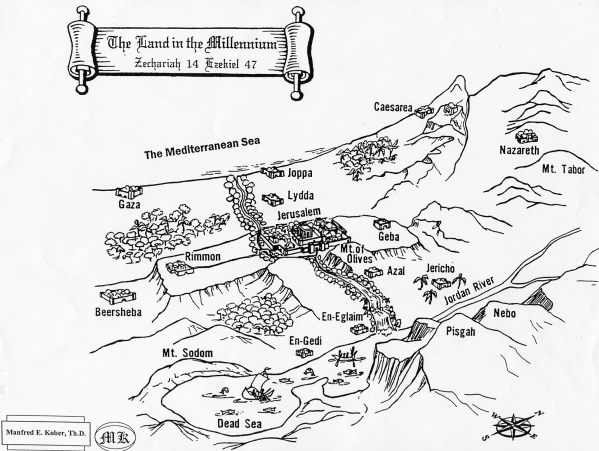
Used by permission Middletown Bible Church
The sons of Korah write
Beautiful in elevation, the joy of the whole earth, Is Mount Zion in the far north, the city of the (BROTHERS AND SISTERS, OUR!) great King. (Ps 48:2) (O Worship the KIng all glorious above)
Zechariah has a parallel prophetic promise from Jehovah
“Thus says the LORD, ‘I will return to Zion and will dwell in the midst of Jerusalem. Then Jerusalem will be called the City of Truth, and the mountain of the LORD of hosts will be called the Holy Mountain.’(Zec 8:3)
Zechariah describes this city of the great King in more detail
In that day (Day of the LORD, in context when He judges the Gentile armies - Zech 14:1-3-note) His (MESSIAH'S) feet will stand on the Mount of Olives, which is in front of Jerusalem on the east; and the Mount of Olives will be split in its middle from east to west by a very large valley, so that half of the mountain will move toward the north and the other half toward the south....8 And in that day living waters will flow out of Jerusalem, half of them toward the eastern sea and the other half toward the western sea; it will be in summer as well as in winter. 9 And the LORD (MESSIAH) will be king over all the earth (KING OF KINGS - Rev 19:16); in that day the LORD will be the only one (LORD OF LORDS), and His Name the only one. 10 All the land will be changed into a plain from Geba to Rimmon south of Jerusalem; but Jerusalem will rise and remain on its site from Benjamin’s Gate as far as the place of the First Gate to the Corner Gate, and from the Tower of Hananel to the king’s wine presses. 11 People will live in it, and there will no longer be a curse, for Jerusalem will dwell in security. (Zechariah 14:4, 8-11-note)
Isaiah writes
Then in that day The nations will resort to the root of Jesse, Who will stand as a signal for the peoples; And His resting place will be glorious. (Isaiah 11:10-note)
The mountain of the house of the LORD- The house of the LORD refers to the rebuilt Temple which will be situated on the mount, specifically on Temple Mount (another pix) the site in Jerusalem which is currently under Muslim control. In other words, the mountain of the house of the LORD (cp Ezek 40:2 - Ezekiel receives a vision and describes the Millennial Temple in Ezek 40-48) is a reference to the site of Messiah's Millennial Temple, from which He shall rule and reign for 1000 years (Rev 20:4-note). Isaiah frequently calls Mt. Zion the “holy mountain” (Is 11:9; 27:13; 56:7; 57:13; 65:11,25; 66:20).
At present, Jerusalem is not "established in the chief of the mountains" but is the world's chief city of strife as two major world religions (Jews, Muslims) contend over this city as their city. In fact, the city is God's and it will once again become a city of peace in the Millennium.
There is a similar description of the mountain in Chronicles where we read that…
He (Manasseh after coming to know Jehovah Elohim - 2Chr 33:13) also removed the foreign gods and the idol from the house of the Lord, as well as all the altars which he had built on the mountain of the house of the Lord (i.e., he removed the pagan altars on the Temple Mount area) and in Jerusalem, and he threw them outside the city. (2Ch 33:15)
There is another aspect to keep in mind when interpreting mountain… mountains, for elsewhere in Scripture mountain is used figuratively as a symbol of a kingdom…
Then the iron, the clay, the bronze, the silver and the gold were crushed all at the same time and became like chaff from the summer threshing floors; and the wind carried them away so that not a trace of them was found. But the stone (Christ) that struck the statue (representative of all the kingdoms of the ages) became a great mountain (The Millennial Kingdom) and filled the whole earth (cp Isaiah's phrase "the chief of the mountains"). (Da 2:35-note, Da 2:44-45-note)
Hear this word, you cows of Bashan who are on the mountain of Samaria, who oppress the poor, who crush the needy, who say to your husbands, “Bring now, that we may drink!” (Am 4:1).
Constable alludes to the two meanings of mountain writing that "If Isaiah was using “mountain” as a figure of speech, he meant that Israel and her God would be the most highly exalted in the earth eventually. This will be the case during Messiah’s earthly reign. The reference to “the mountain of the house of Yahweh” (Is 2:2), however, may indicate that the prophet had a more literal meaning in mind. He may have meant that the actual mountain on which the temple stood would be thrust higher in elevation. This may happen (cf. Ezek 40:2; Zec 14:4, 10), but the primary implication seems to be that Israel and Yahweh will be exalted in the world. (Isaiah - Expository Notes)
The ESV Study Bible comments that mountain of the house of the LORD refers to "The Temple Mount in Jerusalem, though unimpressive from the lofty gaze of human religion, was God's choice (Ps 68:15, 16) and the true hope of the world (Ps 48:1, 2). (ESV Study Bible Crossway)
Criswell - The mountain of the Lord's house is a reference to Mount Zion not as a geographical location, but as the very center of God's government over the world. Zion at the end of days will be not merely the center of Israel's national worship, but the very fountain of the spiritual life of the nations. (Criswell, W A. Believer's Study Bible: New King James Version. 1991. Thomas Nelson)
Guzik - During the Millennium, Israel will be the "superpower" of the world. It will be the leading nation in all the earth, and the center of Israel will be the mountain of the LORD's house - the Temple Mount, which will be the "capital" of the government of the Messiah. All nations shall flow to the "capital" of the government of Jesus. (Isaiah 2 - David Guzik's Commentaries on the Bible)
Martin - This phrase refers to the reign of the Lord. The term “mountain” can represent a kingdom or kingship, as in Jer 51:25 where the kingdom of Babylon is thus referred to (cf. DBI 572–574). References to Mount Zion are common in Isaiah (cf. Isaiah 11:9; 27:13; 56:7; 57:13; 65:25; 66:20), and God will ultimately elevate Zion as the spiritual center of the world. Mountains and mountain imagery pervade the history of revelation. For example, the law was given at Mount Sinai, and at the Mount of Transfiguration, God again gave a blinding revelation reminiscent of Sinai (Peter responded by calling it the holy mountain; 2Pet 1:16–18). Also there was the Sermon on the Mount (Mt 5:1ff); the Mount Olivet discourse (Matt 24); and the Ascension. Christ built his church as a city on a hill, to give light to the world (Matt 5:14; cf. Isa 60:3 Ed: Jesus ascended to heaven from the Mount of Olives and will return there - Acts 1:9-11, 12, Zech 14:4). (Cornerstone Bible Commentary)
The chief of the mountains and will be raised above the hills - In pagan religions, the so-called gods (cp 2Chr 13:9, Acts 19:26, Ga 4:8) were often associated with mountains (cp "high places" [some passages refer to the True God], the mountains being the "homes" of the gods. Isaiah states that the Temple Mount on which sets the Holy Temple in which sits the Holy One of Israel is to be the foremost site of worship.
Nu 22:41; 33:52; Deut 32:13; 33:29; Jdg 5:18; 2 Sam 1:19, 25; 22:34; 1 Kgs 3:2f; 12:31f; 13:2, 32f; 14:23; 15:14; 22:43; 2 Kgs 12:3; 14:4; 15:4, 35; 16:4; 17:9, 11, 29, 32; 18:4, 22; 21:3; 23:5, 8f, 13, 19f; 2Chr 11:15; 14:3, 5; 15:17; 17:6; 20:33; 21:11; 28:4, 25; 31:1; 32:12; 33:3, 17, 19; 34:3; Ps 18:33; 78:58; Pr 9:14; Isa 15:2; 36:7; Jer 7:31; 17:3; 19:5; 26:18; 32:35; Ezek 6:3, 6; 16:16, 39; Hos 10:8; Am 4:13; 7:9; Mic 1:3; 3:12; Hab 3:19),
Martin emphasizes that "The theme of the prominence of the temple mount in Jerusalem is repeated often in Isaiah’s prophecies all the way to the end of the book (Isa 11:9; 25:6, 7; 27:13; 30:29; 56:7; 57:13; 65:11, 25; 66:20). Isaiah clearly wanted his readers to be aware that God will protect His covenant nation despite their spiritual insensitivity and even though they would go into captivity." (Ibid)
Henry Morris - In such prophecies, mountains are symbolic of kingdoms. In the coming kingdom age, the Lord will be acknowledged as King over all the earth (Isaiah 9:6,7), with His throne at Jerusalem (Isaiah 2:3; Zech 14:9). (Morris, Henry: Defenders Study Bible. Online. World Publishing)
Charles Ryrie echoes Morris writing that "As in Mic 4:1-5, a description of the Millennial Kingdom. God's government (mountain) will be established over all the kingdoms of this world; Gentiles (nations) and Jews (peoples) will do the will of God; justice and peace will reign. (The Ryrie Study Bible: New American Standard Translation: 1995. Moody Publishers)
The Reformation Study Bible - The prophet spoke of the temple mount as a metaphor for the Lord’s kingdom that will be exalted above all other kingdoms (cf. 11:9; 65:25; 66:20). Mount Zion and the temple on it were symbols of heaven and the heavenly sanctuary (Heb. 9:24). These earthly representations have passed away (Heb. 8:13); through the priesthood of the ascended Lord, the church comes directly to the heavenly reality (Heb. 12:22–24). (Isa 2-2 - Reformation Study Bible)
Ed comment - This note is included to remind you to be an Acts 17:11 Berean -- Has the "earthly representation" of the Temple Mount "passed away?" Clearly it has not, but if you do not accept a literal rebuilt millennial temple, you have to spiritualize the passage. This passage makes absolutely no mention about the church. Be very cautious when reading commentaries that insert the church in place of Israel. It is tragic when respected resources replace the passages clearly written to Israel as now applying to the Church!
All the nations will stream to it - Nations in the OT almost always is a synonym for the Gentiles (but always check the context) and here Isaiah states that even the Gentiles (all of the Gentile nations) will come to Jerusalem where presumably they will worship the Holy One of Israel.
The stream "flows" the opposite direction in Jeremiah…
I will punish Bel in Babylon, And I will make what he has swallowed come out of his mouth; And the nations will no longer stream to him. Even the wall of Babylon has fallen down! (Je 51:44).
The ESV Study Bible has an picturesque comment on the nations streaming to Temple Mount writing that "by miraculous magnetism, a river of humanity will flow uphill to worship the One true God (cp Jn 12:32)." (ESV Online Study Bible Crossway)
Matthew Henry is an example of a godly commentator who for the most part fails to take the promises to Israel as literal and therefore ends up with an interpretation that completely ignores the covenant keeping God's faithfulness to His promises to Abraham, Isaac and Jacob. In place of Israel, Henry substitutes the church. As we have discussed in these notes the church is neither mentioned nor prophesied in the Old Testament for in Ephesians Paul writes…
that by revelation (apokalupsis [word study] = an exposing to full view that which was hidden) there was made known to me the mystery (musterion [word study] = a truth heretofore unknown to men and knowable only by supernatural revelation from God), as I wrote before in brief. And by referring to this, when you read you can understand my insight into the mystery of Christ, which in other generations was not made known to the sons of men (Ed: And this would include "other generations" and "sons of men" such as the prophet Isaiah!) as it has now (the first century AD) been revealed (verb apokalupto - that which was previously hidden had the veil removed) to His holy apostles and prophets in the Spirit; to be specific, that the Gentiles are fellow heirs and fellow members of the body (Ed: The body = Jews + Gentiles = The church), and fellow partakers of the promise in Christ Jesus through the gospel, of which I was made a minister, according to the gift of God's grace which was given to me according to the working of His power. (Eph 3:1, 2, 3-note, Ep 3:4, 5-note, Ep 3:6, 7-note)
Keeping this background in mind, Matthew Henry comments…
Now the prophet here foretells, the setting up of the Christian church, and the planting of the Christian religion, in the world (Ed: That Henry's interpretation is not accurate is made clear by Paul's teaching in Eph 3:1-7). Christianity shall then be the mountain of the Lord's house (Temple Mount was literal when Isaiah recorded this prophecy and is a literal place in our own time. It will be a literal place when Messiah returns and reigns from this sacred mountain!); where that is professed God will grant his presence, receive his people's homage, and grant instruction and blessing, as he did of old in the temple of Mount Zion. (Ed: Can you see how confusing this statement is? Henry substitutes a literal "profession" ["where that is professed"] for the literal place! God's presence, etc, is then explained as a spiritual presence rather than a literal [and spiritual] presence.)
The gospel church, incorporated by Christ's charter, shall then be the rendezvous of all the spiritual seed of Abraham (Ed: To mistake Isaiah's prophecy as speaking of the NT Church can only lead to further misinterpretation as we see in Henry's comments that follow). Now it is here promised, I. That Christianity shall be openly preached and professed; it shall be prepared (so the margin reads it) in the top of the mountains, in the view and hearing of all. Hence Christ's disciples are compared to a city on a hill, which cannot be hid, Matthew 5:14 (Ed: This is a true statement by Jesus in the Sermon on the Mount but it does not relate specifically to Isaiah's prophecy!)… 2. That it (Ed: Henry is still referring to the Church) shall be firmly fixed and rooted; it shall be established on the top of the everlasting mountains, built upon a rock, so that the gates of hell shall not prevail against it (Ed: This is an allusion to Jesus' announcement of the Church [Mt 16:18], which represents the first revelation of the church in Scripture. However, even Jesus did not further explain the nature of the church, but left that job for Paul to complete), unless they could pluck up mountains by the roots.
The point of highlighting Matthew Henry's comments is to caution the reader to be very careful and discerning (Maintaining an Acts 17:11 "Berean" mindset) when utilizing the "older commentaries" (especially those written prior to 1900 including those by Adam Clarke, Matthew Henry, John Gill, Albert Barnes - these commentaries are widely available free of charge on the internet and are the primary commentaries available at popular sites like studylight.org, blueletterbible.org, et al). On the other hand one of the better "older" commentaries in my opinion is Jamieson, Fausset and Brown (JFB) (Critical and Explanatory on the Whole Bible). Below are some of JFB's comments on Isaiah 2:1-4 and notice there is no association whatsoever with the NT church…
last days--that is, Messiah's: especially the days yet to come, to which all prophecy hastens, when "the house of the God of Jacob," namely, at Jerusalem, shall be the center to which the converted nations shall flock together (Mt 13:32; Lk 2:31, 32; Ac 1:6, 7); where "the kingdom" of Israel (Ed: not "of the church") is regarded as certain and the time alone uncertain (Ps 68:15, 16; 72:8, 11)…
Isa 2:3. If the curse foretold against Israel has been literally fulfilled, so shall the promised blessing be literal. We Gentiles must not, while giving them the curse, deny them their peculiar blessing by spiritualizing it. (Ed: Bolding added for emphasis) The Holy Ghost shall be poured out for a general conversion then (Jer 50:5; Zec 8:21, 23; Joe 2:28).
from Jerusalem-- (Lk 24:47) an earnest of the future relations of Jerusalem to Christendom (Ro 11:12, 15).
RECOMMENDED WEB BASED
COMMENTARIES
- Isaiah Commentaries - most have a designation regarding whether they are literal
- COMMENTARIES BELOW ARE MORE MODERN COMMENTARIES ALL FROM LITERAL PERSPECTIVE
- David Guzik's Commentaries on the Bible, although comments are generally brief.
- Paul Apple's Jehovah is Salvation
- Thomas Constable - Isaiah Expository Notes
- David Cooper - The Message of Isaiah
- F C Jennings - Studies in Isaiah (Plymouth Brethren)
- Henry Morris - Defender's Study Bible Notes
- J Vernon McGee - Mp3 Thru the Bible; Separate Isaiah Commentary
- S Lewis Johnson - Sermon Series on Isaiah
- H. Van Dyke Parunak - Isaiah Commentary
- Ron Teed Isaiah Commentary
- David Thompson - Sermon Series on Isaiah
- As mentioned elsewhere one of the "older" commentaries that tends to take a more literal approach to interpretation is Jamieson, Fausset, and Brown's Commentary Critical and Explanatory on the Whole Bible.
Ed Young (professor of Old Testament, Westminster Theological Seminary) has written what many would consider the most authoritative commentary on Isaiah (The Book of Isaiah, Volume 1-3) and indeed it is a laudatory work as Young comments on Isaiah verse by verse and even phrase by phrase, which makes it easy to study his comments. While I would agree with many of his commentary notes (and will utilize them where appropriate in these verse by verse notes), unfortunately Young approaches the interpretation of Isaiah from a non-literal perspective. For example in his concluding remarks on Isaiah 2:2 he writes…
In the light of the New Testament we may say that the reference of this prophecy (Ed: He is referring specifically to Isaiah 2:1-4) is to the church which Jesus Christ founded. Beginning at Jerusalem the disciples went throughout the world proclaiming the true salvation. (Young, Ed: The Book of Isaiah - Volume 1, Chapters 1-18. Page 102. Eerdmans Pub. 1992) (Bolding added)
And so as one reads Young's comments on Isaiah's prophecies, one encounters a distinct tendency to avoid a literal interpretation of Israel, etc, instead interpreting the passages as speaking of and being fulfilled in the church. For example in his comments on Isa 2:3, Young feels that…
Zion is the center of truth. If a man wishes to hear the truth he must go to the place where the truth is to be found, namely, the church of the living God, where the truth of the gospel is taught. (Ibid, Page 103).
And so according to Ed Young, Zion is not really Zion but the church! This genre of spiritualization (or allegorizing) of Isaiah, makes it very difficult to comprehend the original intent of his prophecies, given the fact that they were clearly spoken to Judah and Jerusalem (Is 1:1, 2:1). (See Dr Tony Garland's discussions [1] A The Art and Science of Interpretation, [2] The Rise of Allegorical Interpretation) [3] Understanding Symbols and Figures)
Raymond Ortlund, an excellent writer (far better than the one you are reading in these notes), in the generally excellent series of commentaries edited by R K Hughes, entitled "Preaching the Word," is the author of the series' commentary on Isaiah. Unfortunately, Ortlund like Young takes a non-literal approach and often "spiritualizes" the interpretation of eschatological passages in Isaiah. Observe for example Ortlund's comments on Isaiah 2:2…
in the latter days the nations will abandon their worldviews and ideologies and gladly give to the church their esteem as the world’s leader in worship. (Ortlund, Raymond: Isaiah God Saves Sinners - Preaching the Word. Crossway. 2005) (Bolding added for emphasis).
Non-literal commentators encounter considerable difficulty when they come to passages like Isaiah 2:4 which are clearly unfulfilled prophecy and which clearly speaks of a Person Who in context can only logically be interpreted as the Messiah. Ortlund has an interesting approach to such a clear cut Messianic passage writing…
Look how desirable it is, from a universally human point of view, to be allured to Christ (Ed: So far this sounds like a literal interpretation but read on)… When the gospel finally sweeps over the world, there will be neither the practice of nor even the inclination to engage in war. No widows and orphans will be left behind by a fallen soldier, no money consumed on military hardware, as Jesus settles our disputes with perfectly satisfying justice and mercy. All that money and talent and genius and effort will be deployed for life-enriching purposes. That is God’s promise. It is our only hope. And what is the power of that hope right now? (Ibid, page 52).
And so Ortlund literally (and I think correctly) states that the Messiah will settle disputes, but there is no explanation of where Jesus will be when He accomplishes this wonderful objective. And because Ortlund never makes mention of the Millennial Kingdom in 496 pages (!), he is forced to be somewhat vague.
Dear reader, before you castigate me for being too harsh on these respected and learned men (and I am not being facetious), please understand that my intent is not to denigrate a dear brother in Christ. All who are in Christ are on the same team and serve the same Lord. Furthermore in contrast to Ed Young and Raymond Ortlund, I have not had years of seminary training and therefore the reader should be cautious when reading my verse by verse comments on Isaiah (cp Bereans in Acts 17:11-note). My approach to Isaiah may be too simple and too literal, but it is the only way that I can logically interpret Isaiah's prophecies that he himself definitely states are given specifically to Judah and Jerusalem (Is 1:1-note, Isa 2:1). He does not state they are given to the New Testament Church. I should also state that I am not a dispensationalist, but a "simplistic literalist". So if the plain sense of Isaiah's words make good sense, I will not attempt to make some other sense out of his prophecies (eg, by allegorizing or spiritualizing) for fear that I may end up with comments that are essentially nonsense. I will make every attempt to avoid speculation, although there will be some speculative remarks because of the obscure nature of some of Isaiah's statements (I will try to identify any speculative remarks). Finally, non-literal works like those of Young and Ortlund often have excellent application to the NT Church and it would be a serious mistake to discount their contributions to the body of Christ. For this reason, as stated earlier I will occasionally quote from these as well as other non-literal works. I realize that many of the writers I quote are dispensational (John Walvoord, H A Ironside, Dwight Pentecost, S Lewis Johnson, Thomas Constable, et al), and the primary reason that they are utilized is because they tend to interpret the Scriptures more literally.
Isaiah 2:3 And many peoples will come and say, "Come, let us go up to the mountain of the LORD, to the house of the God of Jacob; that He may teach us concerning His ways and that we may walk in His paths." For the law will go forth from Zion and the word of the LORD from Jerusalem. (NASB: Lockman)
English Translation of the Greek (Septuagint): And many nations shall go and say, Come, and let us go up to the mountain of the Lord, and to the house of the God of Jacob; and he will tell us his way, and we will walk in it: for out of Sion shall go forth the law, and the word of the Lord out of Jerusalem.
Amplified: And many people shall come and say, Come, let us go up to the mountain of the Lord, to the house of the God of Jacob, that He may teach us His ways and that we may walk in His paths. For out of Zion shall go forth the law and instruction, and the word of the Lord from Jerusalem. (Amplified Bible - Lockman)
KJV: And many people shall go and say, Come ye, and let us go up to the mountain of the LORD, to the house of the God of Jacob; and he will teach us of his ways, and we will walk in his paths: for out of Zion shall go forth the law, and the word of the LORD from Jerusalem.
NET: many peoples will come and say, "Come, let us go up to the LORD's mountain, to the temple of the God of Jacob, so he can teach us his requirements, and we can follow his standards." For Zion will be the center for moral instruction; the LORD will issue edicts from Jerusalem. (NET Bible)
NJB: many peoples will come to it and say, 'Come, let us go up to the mountain of Yahweh, to the house of the God of Jacob that he may teach us his ways so that we may walk in his paths.' For the Law will issue from Zion and the word of Yahweh from Jerusalem. (NJB)
NLT: Many nations will come and say, "Come, let us go up to the mountain of the LORD, to the Temple of the God of Israel. There he will teach us his ways, so that we may obey him." For in those days the Lord's teaching and his word will go out from Jerusalem. (NLT - Tyndale House)
Young's Literal: And gone have many peoples and said, 'Come, and we go up unto the mount of Jehovah, Unto the house of the God of Jacob, And He doth teach us of His ways, And we walk in His paths, For from Zion goeth forth a law, And a word of Jehovah from Jerusalem.
And many peoples will come and say, "Come, let us go up to the mountain of the LORD, to the house of the God of Jacob:
- Jer 31:6; 50:4,5; Zec 8:20,21,22,23
- Isaiah 2 Resources - Multiple Sermons and Commentaries
Play these beautiful songs…
- Paul Wilbur - Up to Jerusalem
- Paul Wilbur - Praise Adonai
- Paul Wilbur - I Lift Up My Eyes
- Paul Wilbur - Kadosh
- Paul Wilbur - Hinei ma Tov (Behold How Good) - for brothers to dwell together in unity
- Paul Wilbur - Who is like the Lord
In the Millennial Kingdom, the peoples of the earth will seek the God of Jacob (cp Is 14:1, 27:13, 66:23, Zec 8:23, Zec 14:16) in His holy habitation, the Millennial Temple in Jerusalem.
And many peoples will come - This is a dramatic reversal from the events that will have transpired just prior to the Lord's return to judge the godless Gentile nations. Zechariah 14:2 records in the Day of the LORD (which is the "last" of the last days) that Jehovah "will gather all the nations against Jerusalem to battle, and the city will be captured, the houses plundered, the women ravished and half of the city exiled, but the rest of the people will not be cut off from the city." (Zech 14:2-note) Joel records Jehovah's prophetic promise - "I will gather all the nations and bring them down to the valley of Jehoshaphat. Then I will enter into judgment with them there On behalf of My people and My inheritance, Israel, Whom they have scattered among the nations; And they have divided up My land." (Joel 3:2-note)
But you might be asking if the nations or Gentiles are judged then who are these Gentiles who will seek to come and see the LORD on His holy mountain? First, note that while most of the world will not be saved by the eternal Gospel (Rev 14:6-note) but will receive the mark of the beast (Rev 13:16-17-note), the Antichrist (the Man of Lawlessness - 2 Th 2:3-note), during Daniel's Seventieth Week, the last 7 years, which ends with 3.5 years of horrible time of the Great Tribulation (Begins - Mt 24:15-note, named - Mt 24:21-note) which will be terminated by Messiah's return (Mt 24:22-note). Second, not all Gentiles will receive the mark of the Beast. When Jesus returns to earth as the Righteous Judge, He will carry out the judgment of the sheep and the goats Jesus Himself giving this prophecy...
“But when the Son of Man comes in His glory, and all the angels with Him, then He will sit on His glorious throne. 32 “All the nations (GENTILES) will be gathered before Him (THESE ARE THE GENTILES NOT KILLED WHEN MESSIAH DESTROYS THE ARMIES OF THE WORLD IN Rev 19:17-21-note); and He will separate them from one another, as the shepherd separates the sheep from the goats; 33 and He will put the sheep on His right (SAVED GENTILES), and the goats on the left (UNSAVED GENTILES). 34 “Then the King will say to those on His right, ‘Come, you who are blessed of My Father, inherit the kingdom prepared for you from the foundation of the world. 35 ‘For I was hungry, and you gave Me something to eat; I was thirsty, and you gave Me something to drink; I was a stranger, and you invited Me in; 36 naked, and you clothed Me; I was sick, and you visited Me; I was in prison, and you came to Me.’ 37 “Then the righteous will answer Him, ‘Lord, when did we see You hungry, and feed You, or thirsty, and give You something to drink? 38 ‘And when did we see You a stranger, and invite You in, or naked, and clothe You? 39 ‘When did we see You sick, or in prison, and come to You?’ 40 “The King will answer and say to them, ‘Truly I say to you, to the extent that you did it to one of these brothers of Mine (THE JEWS LIVING DURING THE TRIBULATION), even the least of them, you did it to Me.’ 41 “Then He will also say to those on His left, ‘Depart from Me, accursed ones, into the eternal fire which has been prepared for the devil and his angels; 42 for I was hungry, and you gave Me nothing to eat; I was thirsty, and you gave Me nothing to drink; 43 I was a stranger, and you did not invite Me in; naked, and you did not clothe Me; sick, and in prison, and you did not visit Me.’ 44 “Then they themselves also will answer, ‘Lord, when did we see You hungry, or thirsty, or a stranger, or naked, or sick, or in prison, and did not take care of You?’ 45 “Then He will answer them, ‘Truly I say to you, to the extent that you did not do it to one of the least of these, you did not do it to Me.’ 46“These will go away into eternal punishment, but the righteous into eternal life.” (Mt 25:31-46) (The Judgment of the Nations, Part 2)
Those Gentiles who are judged by Christ as Sheep will enter into His Millennial Kingdom. It is these Gentiles who will say "Come, let us go...."
"Come, let us go up to the mountain of the LORD, to the house of the God of Jacob - Gentiles in the Millennial Kingdom will desire to go to the mountain of the LORD, for this will be where the King of kings, our Lord Jesus Christ, will reign in power and glory.
Note that Isaiah does not say ALL PEOPLES but MANY PEOPLES - Apparently not all will go up to the mountain. Are these people who are born during the Millennium and who do not believe in Messiah? We cannot say for sure, but we know that this will occur because of Rev 20:7-10-note. We can say that Zechariah's prophecy suggest that not ALL will go up to the mountain...
Then it will come about that any who are left of all the nations (GENTILES) that went against Jerusalem will go up from year to year to worship the King, the LORD of hosts, and to celebrate the Feast of Booths. 17 And it will be that whichever of the families of the earth does not go up to Jerusalem to worship the King, the LORD of hosts, there will be no rain on them. 18 If the family of Egypt does not go up or enter, then no rain will fall on them; it will be the plague with which the LORD smites the nations who do not go up to celebrate the Feast of Booths. 19 This will be the punishment of Egypt, and the punishment of all the nations who do not go up to celebrate the Feast of Booths. (Zech 14:16-19-note)
The mountain of the LORD - This is the location currently known as Temple Mount, the site of previous Jewish Temples (of Solomon and Herod) and the site of the Lord's Temple in the Millennium, the site currently (2018) under Muslim dominion, but that will change in the future!
The house of the God of Jacob - The Temple of Messiah. See Ezekiel's vision of the Millennial Temple.
How will the peoples come to the mountain of the LORD? Isaiah mentions a highway of holiness (Isa. 11:16; 19:23; 35:8) which will be a literal highway from Egypt to Assyria, on which the nations will travel the temple where Messiah be reigns (Is 9:6, 7-note; Ezek. 43:7; Zec 14:1, 2, 3, 4, 5,9,16, 17, 18, 19, 20, 21).
And why will they come? The next phrase explains what attracts the nations to the Holy One in the Holy City.
That He may teach us concerning His ways and that we may walk in His paths:
- Dt 6:1; Ps 25:8,9; Mt 7:24; Lk 11:28; Jn 7:17; Acts 10:33; Jas 1:25
- Isaiah 2 Resources - Multiple Sermons and Commentaries
THE PURPOSE OF MANY
PEOPLES PILGRIMAGE
That He may teach us - This what every house of the LORD should be, a place where His pure Word is taught! And this is why the nations will be attracted to the mountain of the LORD. It is only fitting that the Lord Jesus Christ Himself and His personal teaching should be the primary attraction. What a privilege we have today in the Church Age to sit at the feet of Jesus in His Word, taught by His Spirit, Who in turn empowers to walk according to His teachings, walking worthy of the Lord. (Eph 4:1-note).
NET Note on His paths - In this context God's "ways" are the standards of moral conduct he decrees that people should live by.
Teach us… we may walk in His paths - Messiah will teach the Jewish believers and they will walk in His paths (cp Ezek 36:27). Note that sound doctrine (His ways) precedes sacred duty (walk in His paths). To think lightly of the study of sound doctrine is to jeopardize our fulfillment of God's command for us to be holy as He is holy (Lv 11:44, 45 1Pe 1:14-note, 1Pe 1:15, 16-note). Remember that as D L Moody once said "A holy life will make the deepest impression. Lighthouses blow no horns, they just shine."
Isaiah records…
Pay attention to Me, O My people, and give ear to Me, O My nation; for a law will go forth from Me, and I will set My justice for a light of the peoples. (Is 51:4)
He will teach all (both Jews and Gentiles) who are in the Millennial Kingdom for Isaiah writes that…
the earth will be full of the knowledge of the LORD as the waters cover the sea. (Is 11:9)
From Zion… from Jerusalem - These are synonyms in this passage (cp Is 4:3; 40:9; 52:1; 62:1). Isaiah refers to Zion more than any other OT writer…
Zion - 46 of 154 uses in the OT are by Isaiah - see in depth study of Zion
Isa. 1:8, 27; 2:3; 3:16, 17, 4:3, 4, 5; 8:18; 10:12, 24, 32; 12:6; 14:32; 16:1; 18:7; 24:23; 28:16; 29:8; 30:19; 31:4, 9; 33:5, 14, 20; 34:8; 35:10; 37:22, 32; 40:9; 41:27; 46:13; 49:14; 51:3, 11, 16; 52:1f, 7f; 59:20; 60:14; 61:3; 62:1, 11; 64:10; 66:8
He may teach us - Who? In context the God of Jacob, the Messiah. When comparing Scripture with Scripture, this is a reference to the rule and reign of Christ as King in the Millennium, ruling in Zion or Jerusalem.
Dwelling Places of God
In the Garden of Eden, God walked with Adam and Eve (cp Ge 3:8) and then man (Enoch, Noah) walked with God (Ge 5:22, 24; 6:9). Then God desired to dwell with him (Ex 25:8, 29:45, cp 1Ki 6:12, 13). His glory came to the tabernacle (Ex. 40:34), but when Israel sinned, the glory departed (1Sa 4:21, 22). The glory dwelt in the temple (1Ki 8:10,11), but then departed again because of the sins of the people (Ezek 11:22,23 - see related study on the Glory of the LORD: Past, Present, Future). God's promise to Israel was that He would dwell in their midst (Zech 2:10 partially fulfilled in Jn 1:14, but the complete fulfillment including Zec 2:11, 12 awaiting His glorious return to take His throne in Jerusalem, Mt 25:31, Rev 20:4-note, Zech 8:21, 14:16, 17, Isa 2:3-note). The glory came in the person of Jesus Christ (Jn 1:14) but His own rejected Him (Jn 1:11). Today He dwells now in believers individually (1Co 6:19, 20-note) and the church collectively (1Co 3:16, Ep 2:20, 21, 22-note). In the Millennium Jehovah will reveal Himself as Jehovah Shammah - The LORD is There (Ezek 48:35) taking His throne in the earthly city of Jerusalem. And finally one wonderful day God’s glory will be revealed in the New Heaven and the New Earth and the perfect city, a heavenly Jerusalem, where His people will dwell forever (Rev. 21:3-note, Re 21:22-note).
For the law will go forth from Zion and the word of the LORD from Jerusalem:
- Is 51:4,5; Ps 110:2; Lk 24:47; Ac 1:8; 13:46,47,48; Ro 10:18
For = term of explanation. What is Isaiah explaining?
John Walvoord comments that…
Jesus Christ (is) the supreme King of the millennial kingdom. In Psalm 2:6, in spite of the opposition of the kings of the earth, God declares His purpose: “Yet I have set my king upon my holy hill of Zion.” This purpose will be fulfilled in the millennial kingdom in the reign of Jesus Christ as the Son of David. As Lewis Sperry Chafer has succinctly stated: Every Old Testament prophecy on the kingdom anticipates His kingly office:
(a) Christ will yet sit on the throne as David’s heir (2Sa 7:16; Ps 89:20–37; Is 11:1-16; Je 33:19, 20, 21).
(b) He came as a King (Luke 1:32, 33).
(c) He was rejected as a King (Mk 15:12, 13; Lk 19:14; cf. Ge 37:8; Ex 2:14).
(d) He died as a King (Matt 27:37).
(e) When He comes again, it is as a King (Rev 19:16; cf. Lk 1:32–33)” (L. S. Chafer, Systematic Theology, VII, 233).
The fact that Christ will reign over the earth is of course imbedded in practically every prophecy concerning the millennial kingdom. The absolute character of His reign is indicated in Isaiah 11:3–5. This central prophecy is confirmed by the angel to Mary in announcing the coming birth of Christ in these words: “He shall be great, and shall be called the Son of the Most High: and the Lord God shall give unto him the throne of his father David: and he shall reign over the house of Jacob forever; and of his kingdom there shall be no end” (Luke 1:32–33). It should be clear from the details surrounding these predictions that these prophecies are not being fulfilled in the present age, nor are they a description of the sovereignty of God in the heavenly sphere. Many other Scriptures can be cited to substantiate the reign of Christ as King in the millennium of which the following are representative: Isaiah 2:1–4; 9:6, 7; 11:1, 2, 3, 4, 5, 6, 7, 8, 9, 10; 16:5; 24:23; 32:2; 40:1, 2, 3, 4, 5, 6, 7, 8, 9, 10, 11; 42:3, 4; 52:7, 8, 9, 10, 11, 12, 13, 14, 15; 55:4 ; Da 2:44; 7:27 ; Mic 4:1, 2, 3, 4, 5, 6, 7, 8; 5:2, 3, 4, 5 ; Zech 9:9; 14:16, 17 . These passages if interpreted in the ordinary literal meaning lead to the conclusion that Christ is the King who will reign over the earth in the millennial period. (The Doctrine of the Millennium — Part I The Righteous Government of the Millennium)
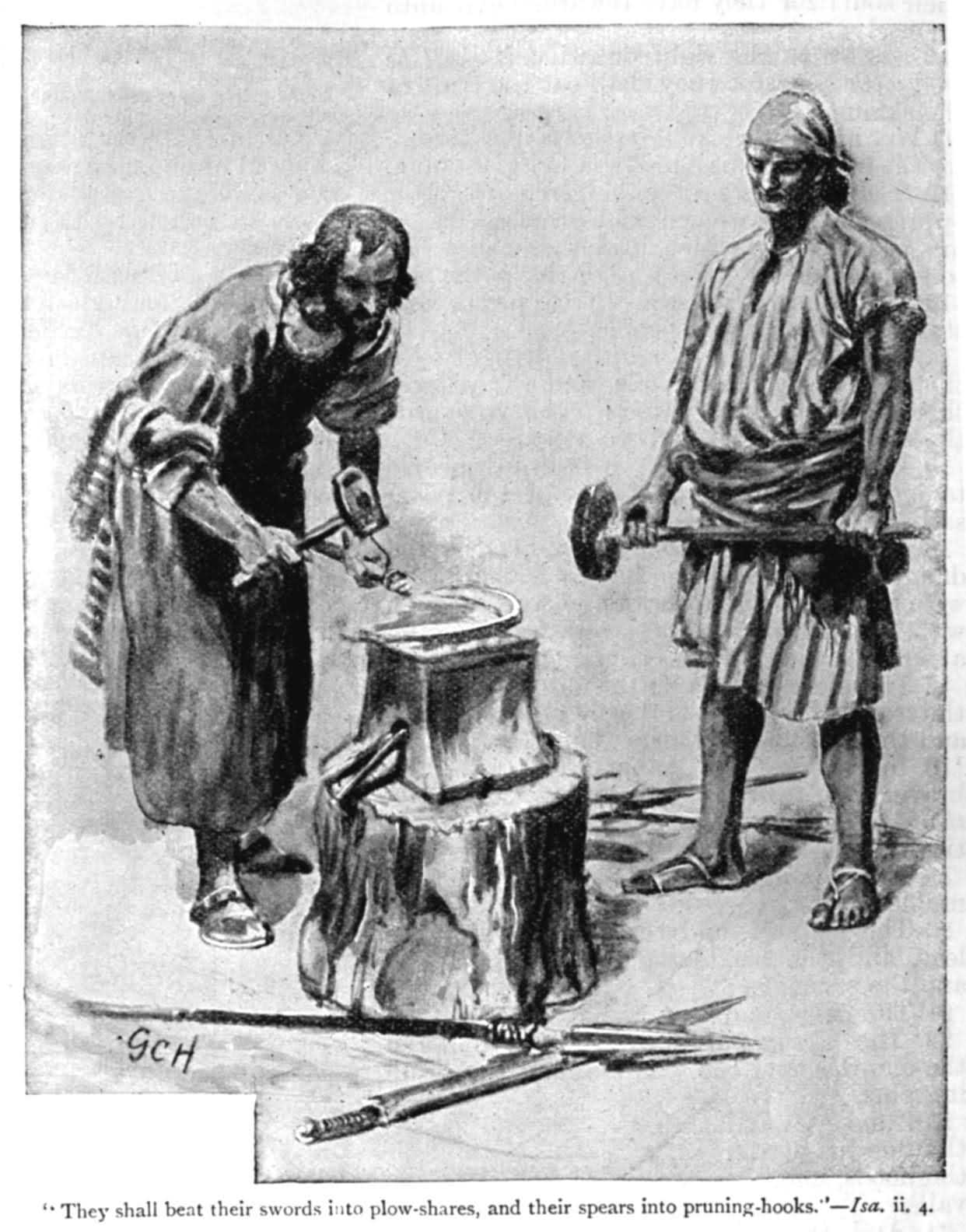
Isaiah 2:4 And He will judge between the nations, and will render decisions for many peoples; and they will hammer their swords into plowshares and their spears into pruning hooks. Nation will not lift up sword against nation, and never again will they learn war. (NASB: Lockman)
English Translation of the Greek (Septuagint): And he shall judge among the nations, and shall rebuke many people: and they shall beat their swords into plow-shares, and their spears into sickles: and nation shall not take up sword against nation, neither shall they learn to war any more.
Amplified: And He shall judge between the nations and shall decide [disputes] for many peoples; and they shall beat their swords into plowshares and their spears into pruning hooks. Nation shall not lift up sword against nation, neither shall they learn war any more. [Mic. 4:1-3.] (Amplified Bible - Lockman)
KJV: And he shall judge among the nations, and shall rebuke many people: and they shall beat their swords into plowshares, and their spears into pruninghooks: nation shall not lift up sword against nation, neither shall they learn war any more.
NET: He will judge disputes between nations; he will settle cases for many peoples. They will beat their swords into plowshares, and their spears into pruning hooks. Nations will not take up the sword against other nations, and they will no longer train for war. (NET Bible)
NJB: Then he will judge between the nations and arbitrate between many peoples. They will hammer their swords into ploughshares and their spears into sickles. Nation will not lift sword against nation, no longer will they learn how to make war. (NJB)
NLT: The LORD will settle international disputes. All the nations will beat their swords into plowshares and their spears into pruning hooks. All wars will stop, and military training will come to an end. (NLT - Tyndale House)
Young's Literal: And He hath judged between the nations, And hath given a decision to many peoples, And they have beat their swords to ploughshares, And their spears to pruning-hooks, Nation doth not lift up sword unto nation, Nor do they learn any more -- war.
And He will judge between the nations, and will render decisions for many peoples:
- Is 11:3,4; 1Samuel 2:10; Psalms 82:8; 96:13; 110:6; John 16:8, 9, 10, 11; Acts 17:31; Revelation 19:11
- Isaiah 2 Resources - Multiple Sermons and Commentaries
A HYMN
and
A PRAYER…
Come, Lord, and tarry not;
Bring the long looked for day;
O, why these years of waiting here,
These ages of delay?
Come, and begin Thy reign
Of everlasting peace;
Come, take the kingdom to Thyself,
Great King of righteousness.
(Cp, Ps 122:6 - Pray for the peace of Jerusalem… ;
Mt 6:10 [note] - Thy kingdom come… )
He will judge - This is clearly not yet fulfilled. This describes the glorious reign of the Messiah. Clearly even in the Millennial reign of Christ, nations will still have disagreements with one another (so there will be sinners in the Millennial age!), but instead of settling them by conflicts as in the current age, differences will be settled by the just Judge, whose decisions are perfectly righteous. In Proverbs we read "By me kings reign, and rulers decree justice." (Pr 8:15)
Psalm 2:8-9 Ask of Me, and I will surely give the nations as Your inheritance, And the very ends of the earth as Your possession. ‘You shall break them with a rod of iron, You shall shatter them like earthenware.’” (note)
Will Judge (08199)(shaphat) is a verb that means to judge or govern. While it frequently translated judge, this is somewhat misleading as shaphat is not typical of the modern concept of judge (as in a court of law), but is much more inclusive -- to function as ruler or governor - individuals (Jdg. 16:31; 1 Sa 7:16), king (1 Ki. 3:9) and in the present context refers to God Himself, the Messiah, (Ps. 50:6; 75:7) because He is the source of authority and will eventually conduct all judgments (Ps. 96:13). In the new age Messiah will arbitrate decisions.
Render decisions (NET "settle causes")(03198)(yakach) is a verb meaning to argue, to convince, to convict, to judge, to reprove. Yakach denotes education and discipline as a result of God's judicial actions. This embraces all aspects of education from the conviction of the sinner to chastisement and punishment, from the instruction of the righteous by severe tests to his direction by teaching and admonition
Baker - The word usually refers to the clarification of people's moral standing, which may involve arguments being made for them (Job 13:15; Isa. 11:4) or against them (Job 19:5; Ps. 50:21). The word may refer to the judgment of a case between people (Gen. 31:37, 42) or even (in the days before Christ) to someone desired to mediate between God and humankind (Job 9:33). The word may also refer to physical circumstances being used to reprove sin (2 Sam 7:14; Hab. 1:12). Reproving sin, whether done by God (Prov. 3:12) or persons (Lev. 19:17), was pictured as a demonstration of love, but some people were too rebellious or scornful to be reproved (Prov. 9:7; 15:12; Ezek. 3:26). In Genesis 24:14, 44, the word referred to God's appointment (or judgment) of Rebekah as the one to be married to Isaac. (The Complete Word Study Dictionary – Old Testament)
Yakach is translated in Isa 2:4 with the verb elegcho which literally means bring to the light, to expose and in the NT, generally as showing someone that he has done something wrong and summoning him to repent bring to light, expose (JN 3.20); convince,
Gilbrant on yakach -
Occurring both in Hebrew and in Jewish Aramaic, this verb has as its basic meaning "to set right," "to show what is right" or "to decide." It never occurs in the Qal stem, but appears three times in the Niphal (Gen. 20:16; Job 23:7; Isa. 1:18), fifty-four times in the Hiphil, and once each in the Hophal (Job 33:19) and Hithpael (Mic. 6:2).
This word is sometimes used in a legal sense, "to render judgment" as a judge (cf. the Arabic cognate). One of the clearest instances is Gen. 31:37, where Jacob scolds Laban for accusing him of theft: "Whereas thou hast searched all my stuff, what hast thou found of all thy household stuff? Set it here before my brethren and thy brethren, that they may judge betwixt us both." In v. 42, he refers to the dream the previous night where God warned Laban not to harm Jacob: "God hath seen mine affliction and the labour of my hands, and rebuked thee yesternight." The NASB translates here, "So He rendered judgment last night."
Similar meanings are also found in 1 Chr. 12:17 and Isa. 11:3. Job 9:33 uses the participle form to describe the one who gives a judicial decision, translated "judge." The word is used in a non-judicial context in Gen. 24:14, 44 to describe God's choice or appointment of Rebekah as a bride for Isaac.
Sometimes the word is followed by le ; the combination means "to decide for" someone (Isa. 2:4; 11:4; Mic. 4:3). In Gen. 31:37, it is used with bayin , "to decide between."
A second category of usages falls into the forensic category, "to accuse" or "to bring a charge," acting in the role of a lawyer. In this sense, the verb may be followed by an accusative to show the accusation and le to describe the person charged (Job 19:5). See also Job 13:15; 15:3. (The Ethiopic cognate can be used in non-judicial contexts, meaning "to start an argument.")
Yahweh is sometimes the One Who brings charges against his people Israel, because they have repeatedly broken the provisions of his Covenant with them. Isaiah 1:18 can be explained in this way. After listing the broken stipulations of the Covenant, Isaiah calls the nation to repentance. "Come let us reason together" thus means "Come let us debate our case in court." Micah 6:2 similarly pictures the Lord indicting Israel, arguing the case against her. Isaiah 11:3f explains that the Messiah, the Branch, "shall not judge after the sight of his eyes neither reprove after the hearing of his ears." He carries out his part of the Covenant with perfect knowledge and justice, so that He can legitimately condemn people who break their part.
A third meaning of the word falls into the moral or pedagogical category, "to rebuke" or "to correct." No longer is this a public judicial circumstance; these uses take place in relationships between individuals. Often, the word carries the idea of a verbal rebuke. Sometimes, God does the rebuking (2 Ki. 19:4; 1 Chr. 16:21; Job 22:4; Pss. 50:8; 105:14; Isa. 37:4). More often, people are the ones who reprove those around them (Gen. 21:25; Job 6:25f; 40:2; Prov. 9:7f; 15:12; 19:25; 24:25; 28:23; Isa. 29:21; 25:12; Jer. 2:19; Ezek. 3:26; Hos. 4:4; Amos 5:10). Leviticus 19:17 explains that it is a positive duty to confront neighbors when they sin: "Thou shalt surely rebuke your neighbor" (ASV). The context explains the reasons for rebuking the neighbor: to maintain the holiness of God (v. 2), to avoid complicity in his sin and to demonstrate love rather than hate for him (v. 18). The purpose of rebuking is to call a person to repentance and restoration, not for destructive or selfish ends.
Rebuke can extend to actual correction or chastisement. Second Samuel 7:14 says that God will "chasten him with the rod of men, and with the stripes of the children of men." The same meaning occurs in Job 13:10 and Ps. 141:5. These verses obviously go beyond verbal reproof to actual chastening by some disciplinary action. Scripture teaches that a follower of God can consider such correction to be a blessing (Job 5:17) because it demonstrates God's love for the person (Prov. 3:12; cf. Heb. 12:5f). The psalmist does, however, ask God not to discipline in anger (Pss. 6:1; 38:1). (Complete Biblical Library Hebrew-English Dictionary)
Yakach - 55v - adjudicates(1), appointed(2), argue(3), argument prove(1), chastened(1), cleared(1), complained(1), correct(2), decide(3), dispute(1), make a decision(1), offer reproof(1), plead(1), prove(1), reason(2), rebuke(6), rebukes(2), refuted(1), render decisions(2), rendered judgment(1), reprove(9), reproved(2), reprover(1), reproves(7), surely reprove(2), umpire(1). Gen. 20:16; Gen. 21:25; Gen. 24:14; Gen. 24:44; Gen. 31:37; Gen. 31:42; Lev. 19:17; 2 Sam. 7:14; 2 Ki. 19:4; 1 Chr. 12:17; 1 Chr. 16:21; Job 5:17; Job 6:25; Job 6:26; Job 9:33; Job 13:3; Job 13:10; Job 13:15; Job 15:3; Job 16:21; Job 19:5; Job 22:4; Job 23:7; Job 32:12; Job 33:19; Job 40:2; Ps. 6:1; Ps. 38:1; Ps. 50:8; Ps. 50:21; Ps. 94:10; Ps. 105:14; Ps. 141:5; Prov. 3:12; Prov. 9:7; Prov. 9:8; Prov. 15:12; Prov. 19:25; Prov. 24:25; Prov. 25:12; Prov. 28:23; Prov. 30:6; Isa. 1:18; Isa. 2:4; Isa. 11:3; Isa. 11:4; Isa. 29:21; Isa. 37:4; Jer. 2:19; Ezek. 3:26; Hos. 4:4; Amos 5:10; Mic. 4:3; Mic. 6:2; Hab. 1:12
Between the nations… peoples - both terms often refer to Gentiles in the OT.
Thus there is no uneasy calm but peace based on righteousness (cf. Is 11:1-9+; Ps 72). In the abolition of every cause of conflict, war itself disappears; and peace, with its economic consequences (cf. Isa 2:4 with passages like Isa 35:1-2+), takes its place. The words "swords" and "plowshares" occur in reverse order in Joel 3:10.
Chuck Smith writes that "When Jesus reigns in the Kingdom Age no one will have to fear war anymore."
And they will hammer their swords into plowshares and their spears into pruning hooks:
- Is 9:7; 11:6, 7, 8, 9; Ps 46:9; Ho 2:18; Joel 3:10; Mic 4:3; Zec 9:10
- Is 60:17,18; Ps 72:3, 4, 5, 6, 7
- Isaiah 2 Resources - Multiple Sermons and Commentaries
NOT WAR AND PEACE
BUT FROM WAR TO PEACE!
Isaiah 2:4
Hammer their swords into plowshares - The opposite of Joel 3:10 (Time context of Joel's prophecy = nations of the world are exhorted to prepare for war at the Second Coming). This action reflects the nature of Messiah's millennial kingdom of peace.
Plowshare - Instead of referring to the large plow as a whole, the plowshare is simply the metal tip which actually breaks the earth and cuts the furrow. (NET Note)
Pruning hooks - This implement was used to prune the vines, i.e., to cut off extra leaves and young shoots (H. Wildberger, Isaiah, 1:93; M. Klingbeil, NIDOTTE 1:1117–18). It was a short knife with a curved hook at the end sharpened on the inside like a sickle. Breaking weapons and fashioning agricultural implements indicates a transition from fear and stress to peace and security. (NET Note)
Beat your plowshares into swords, And your pruning hooks into spears; Let the weak say, "I am a mighty man."
Gary Smith rightly reasons that "All war preparations can end when people focus on God, Who is the true source of their security. (New American Commentary – Volume 15a: Isaiah 1-39.)
Guzik - During the reign of the Messiah, there will be no more war. There will still be conflicts between nations and individuals, but they will be justly and decisively resolved by the Messiah and those who reign with Him (He shall judge between the nations, and shall rebuke many people). It isn't the reign of the Messiah itself that will change the heart of man. Citizens of earth will still need to trust in Jesus and His work on their behalf for their personal salvation during the millennium. But war and armed conflict will not be tolerated.(Isaiah 2 - David Guzik's Commentaries on the Bible)
Nation will not lift up sword against nation, and never again will they learn war:
- Play Paul Wilbur's beautiful rendition of SHALOM JERUSALEM
- Isaiah 2 Resources - Multiple Sermons and Commentaries
NO MORE WARS!
HALLELUJAH! AMEN!
Never again learn war - This is the peace filled "New Age" which this perennially contentious world has longed for throughout history but has never up to this point been realized. It is only when the Prince of Peace (Is 9:6) reigns and rules that this world with perfect righteousness, that the world will experience this time of blessing and bliss.
MacDonald - As a result, there will be universal disarmament. (This verse—minus the opening words about God—are inscribed on the United Nations Building in New York City) The funds formerly spent on munitions will be spent on agricultural equipment. (MacDonald, W & Farstad, A. Believer's Bible Commentary: Thomas Nelson)
Guzik comments that "It is important to see that this is not the peace of capitulation. This is the peace of enforced righteousness. There is no more war, and no more need for swords and spears, so why not make them into plowshares and pruning hooks? But there is no more war because there is a new ruler on earth, Jesus Christ. Psalm 2:9 tells us what the Messiah will do to the disobedient in that day: You shall break them with a rod of iron; You shall dash them to pieces like a potter's vessel. We long for the day when there is no more need for a military budget, when the money that goes for weapons and armies can go to schools and parks. But we are only safe doing that when the Messiah reigns among us! "Men yearn for peace, but they will not acknowledge the hopelessness of their own efforts to achieve it. It is only when the word of the Lord goes forth from Jerusalem, when He Himself is reigning over the nations, that lasting peace will come." (Martin) (Isaiah 2 - David Guzik's Commentaries on the Bible)
Walvoord concludes that based on Is 2:1-4…
it is evident that Jerusalem is to be the capitol of the world, that from Zion the law will go forth, and all nations will be under the sway of this righteous government.
J. Dwight Pentecost gives an excellent summary of the important place of Israel in the millennium in the following statement: “Israel will become the subjects of the King’s reign (Isa 9:6–7; 33:17, 22; 44:6 ;Je 23:5; Mic 2:13; 4:7 ; Da 4:3; 7:14, 22, 27 ).
In order to be subjects,
Israel, first, will have been converted and restored to the land, as has already been shown.
Second, Israel will be reunited as a nation (Jer 3:18; 33:14 ; Ezek 20:40; 37:15-22; 39:25; Ho 1:11).
Third, the nation will again be related to Jehovah by marriage (Is 54:1–17; 62:2, 3,4, 5 ; Ho 2:14–23).
Fourth, she will be exalted above the Gentiles (Isa 14:1, 2; 49:22, 23; 60:14, 15, 16, 17; 61:6, 7).
Fifth, Israel will be made righteous (Isa 1:25; 2:4; 44:22–24; 45:17–25; 48:17; 55:7; 57:18,19; 63:16; Jer 31:11; 33:8; 50:20, 34; Ezek 36:25, 26; Hos 14:4; Joel 3:21; Mic 7:18, 19; Zech 13:9; Mal 3:2, 3).
Sixth, the nation will become God’s witnesses during the millennium (Isa 44:8, 21; 61:6; 66:21; Jer 16:19, 20, 21; Mic 5:7; Zeph 3:20; Zec 4:1–7; 4:11–14; Zec 8:23).
Seventh, Israel will be beautified to bring glory to Jehovah (Isa 62:3; Jer 32:41; Hos 14:5, 6; Zeph 3:16, 17; Zech 9:16, 17)” (“Biblical Eschatology,” unpublished Doctor’s dissertation, pp. 651-52).
The lesser role of Gentiles in the millennium is the subject of many Old Testament Scriptures such as the following: Isa 2:4; 11:12; 16:1, 2, 3, 4, 5; 18:1–7; 19:16-25; 23:18; 42:1; 45:14; 49:6, 22; 59:6–8; 60:1–14; 61:8, 9; 62:2; 66:18–19; Jeremiah 3:17; 16:19–21; 49:6; 49:39 ; Ezek 38:23; Amos 9:12; Micah 7:16, 17; Zeph 2:11; 3:9; Zechariah 8:20–22; 9:10; 10:11, 12; 14:16, 17, 18, 19 (cf., Pentecost, ibid., p. 652). Outstanding in these Scriptures is the fact that, first, the Gentiles will share many of the spiritual and economic blessings of the millennial reign of Christ. Second, they will, however, occupy a subordinate role to Israel (Isa 14:1, 2; 49:22-23; 61:5, 6, 7, 8, 9). Third, as indicated previously, only Gentiles who are declared righteous by the King will be allowed entrance into the millennial kingdom at its beginning. (The Doctrine of the Millennium — Part I The Righteous Government of the Millennium)
- The Doctrine of the Millennium—Part I:The Righteous Government of the Millennium
- The Doctrine of the Millennium—Part II:Spiritual Life in the Millennium
- The Doctrine of the Millennium—Part III:Social and Economic Aspects of the Millennium
- Millennium 1 - summary including overview of Rev 19:11-21:3, history of how it has been interpreted
- Millennium 2 - events leading up to the millennium, including Great Tribulation and Chart of 70th week
- Millennium 3 - description of this time on earth, primarily from the OT prophets
A World At Peace - READ: Isaiah 2:1-9 - Nation shall not lift up sword against nation, neither shall they learn war anymore. --Isaiah 2:4
President Woodrow Wilson was a staunch idealist whose hope for world peace was deeply embedded in his thinking. Therefore, when he declared war on Germany in 1917, his decision cut to his very heart. It is said that when he returned to the White House, he put his head down on a table and sobbed.
World War I was seen by many as "the war to end all wars." Wilson himself became the leading advocate for the League of Nations, which he hoped would ensure peace. But World War II and many subsequent wars have dashed such hopes.
So the question remains: Can this world ever know true peace? The Bible answers, "Yes!" Two Old Testament prophets describe a future disarmament unlike any in man's history (Isaiah 2:1-4; Micah 4:1-5). And Revelation 20 declares that Satan will be bound and unable to deceive the nations when Jesus Christ comes to reign in righteousness.
What about right now? When individuals trust Jesus as their Savior, they are reconciled to God and are motivated to be peacemakers in their own world of relationships—even with their enemies. God's peace in believers' hearts is a present reality, and the Lord's return to earth is the world's only hope for lasting peace. And it will come! — Dennis J. De Haan
God gives me peace and I long to share it—
With Christ's gospel message I'll go;
I'll speak of His grace and joy that He gives me
Till He comes, then world peace we'll know. —Cetas
Only the Prince of Peace can bring lasting peace.
Hope For The World - Isaiah 2:1-5 - "Looking for the blessed hope and glorious appearing of our great God and Savior Jesus Christ" Titus 2:13
PEACE TALKS FALL APART AGAIN. UNEMPLOYMENT RATE RISES. TORNADO RIPS THROUGH TOWN.
These newspaper headlines selected at random tend to lead us to despair. There just doesn't seem to be any hope for this world. And yet, according to the Scriptures, the dream of abolishing war is not merely wishful thinking. The idea of prosperity for all is more than a political gimmick. The Bible tells us that the eventual taming of nature is a certainty.
The hope for this world, however, is not to be found in human efforts but in the return of Jesus Christ. He alone can solve the problems that are baffling mankind.
The prophet Isaiah said that someday "nation shall not lift up sword against nation, neither shall they learn war anymore" (Isaiah 2:4). This glorious prospect will become a reality when the Lord Jesus Himself returns as "King of kings and Lord of lords" (1Ti 6:15) to set up His kingdom of peace and righteousness. We are to be "looking for the blessed hope and glorious appearing of our great God and Savior Jesus Christ" (Titus 2:13). Because we have this hope, we can be optimistic even in the deepening gloom of this age. Keep looking up! — Richard De Haan
The only hope for world peace is the coming of the Prince of Peace.
Mark Eastman has some interesting background regarding the time of Messiah's Coming…
One of the most interesting aspects of rabbinic Messianic speculation has to do with the time of his coming. Following the Babylonian captivity, which was from 606- 537 B.C.E., the rabbis began to pore through the scriptures to find clues regarding the time of Messiah's coming. As we shall see, there were many prophecies which they believed were specific indicators of the time when Messiah would be expected.
Some have stated that there have always been intense Messianic expectations throughout the ages, and that those expectations were no different during the time period of the ministry of Jesus of Nazareth. However, a study of such expectations reveals this is not the case. During the first two quarters of the first century C.E., more than at any time in history, Messianic expectations were very high. Why was this so?
Was this great Messianic expectation at the time of Jesus simply because the Jews were suffering severely under the Roman yoke? Or was it because Bible prophecy pointed to that period of time as the time of Israel's appointment with Messiah?
In the book by Rabbi Abba Hillel Silver, A History of Messianic Speculation in Israel, we read about the tremendous expectations at the time of Jesus Christ that the Messiah would come soon. The reasons for this hope are explained in the following quotes:
"Prior to the first century (C.E.) the Messianic interest was not excessive… The First Century, however, especially the generation before the destruction [of the Second Temple] witnessed a remarkable outburst of Messianic emotionalism. This is to be attributed, as we shall see, not to an intensification of Roman persecution, but to the prevalent belief induced by the popular chronology of that day that the age was on the threshold of the Millennium… when Jesus came into Galilee, 'spreading the gospel of the kingdom of God and saying the 'time is fulfilled' and the Kingdom of God is at hand,' he was voicing the opinion universally held that… the age of the kingdom of God-was at hand… it was this chronological fact which inflamed the Messianic hope rather than the Roman persecutions… Jesus appeared in the procuratorship of Pontius Pilate (26-36 c.e.)… It seems likely, therefore, that in the minds of the people the Millennium was to begin around the year 30 C.E. Be it remembered that it is not the Messiah who brings about the Millennium. It is the inevitable advent of the Millennium which carries along with it the Messiah and his appointed activities. The Messiah was expected around the second quarter of the First Century C.E. because the Millennium was at hand. Prior to that time he was not expected, because according to the chronology of the day the Millennium was still considerably removed."[A History of Messianic Speculation in Israel, Rabbi Abba Hillel Silver, 1927, Macmillan Co., pg 5-7, ISBN 0-8446-2937-5]…
… The millennium, the one thousand year reign of the Messiah, is discussed by Rabbi Kattina in the Babylonian Talmud, Sanhedrin 96b-99a:
"The world endures 6000 years and one thousand it shall be laid waste, that is, the enemies of God shall be laid waste, whereof it is said ,'the Lord alone shall be exalted in that day.' As out of seven years every seventh is a year of remission, so out of the seven thousand years of the world, the seventh millennium shall be the 1000 years of remission, that God alone my be exalted in that day."
Later in the Sanhedrin we see another reference to the world week:
"Rabbi Kattina said: six thousand years shall the world exist, and one thousand it shall be desolate, as it is written, and the Lord shall alone be exalted in that day (a reference to Isaiah 2:2). Rabbi Abaye said: it will be desolate two thousand years, as it is said, after two days will he revive us: in the third day, he will raise us up, and we shall live in his sight (a reference to Hosea 6:1). It has been taught in accordance with Rabbi Kattina: just as the seventh year is one year of release in seven, so is the world: one thousand years out of seven shall be fallow, as it is written and the Lord shall alone be exalted in that day."[Sanhedrin 97a & b] (Excerpt from Chapter 6 - The Time of the Messiah's Coming - Mark Eastman - Index to entire book)