James 1:2 Commentary
James 1:3 Commentary
James 1:4 Commentary
James 1:5 Commentary
James 1:6 Commentary
James 1:7 Commentary
James 1:8 Commentary
James 1:9 Commentary
James 1:10 Commentary
James 1:11 Commentary
James 1:12 Commentary
James 1:13 Commentary
James 1:14 Commentary
James 1:15 Commentary
James 1:16 Commentary
James 1:17 Commentary
James 1:18 Commentary
James 1:19 Commentary
James 1:20 Commentary
James 1:21 Commentary
James 1:22 Commentary
James 1:23 Commentary
James 1:24 Commentary
James 1:25 Commentary
James 1:26 Commentary
James 1:27 Commentary
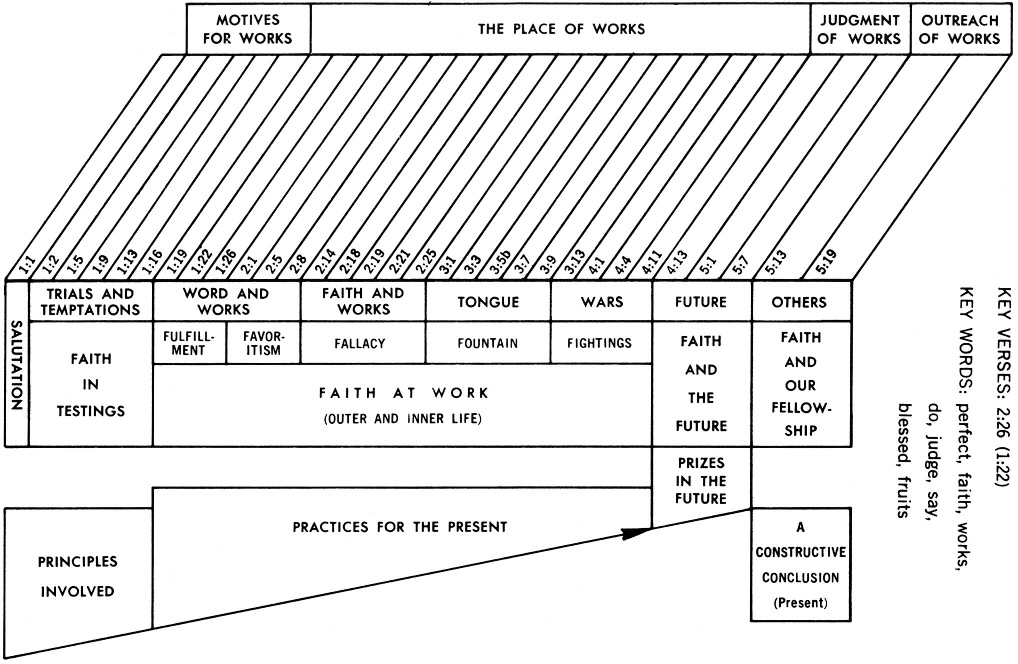
Click chart to enlarge
Chart from recommended resource Jensen's Survey of the NT - used by permission
See also Overview Chart by Charles Swindoll
|
JAMES |
|||||||
| Motives for Works |
The Place of Works: Outward Demonstration of Inner Faith |
Outreach of Works |
|||||
| Jas 1:1-18 | Jas 1:19-2:13 | Jas 2:14-25 | Jas 3:1-12 | Jas 3:13-4:12 | Jas 4:13-5:12 | Jas 5:13-19 | |
| Trials & Temptations |
Word & Works |
Faith & Works |
Tongue | Wars | Future | Others | |
|
Faith |
Fulfill |
Favor |
Fallacy |
Fountain |
Factions |
Faith |
Faith |
|
FAITH AT WORK |
|||||||
The Theme: The Testings of Personal Faith
The trials of the believer (James 1:2–12)
A. The proper attitude toward trials (James 1:2–4)
1. The attitude commanded (James 1:2)
2. The reason indicated (James 1:3)
3. The outcome to be realized (James 1:4)
B. The use of prayer amid trials (James 1:5–8)
1. The need for wisdom (James 1:5a)
2. The request for wisdom (James 1:5b)
3. The bestowal of wisdom (James 1:5c–8)
a. The divine response (James 1:5c)
b. The human obligation (James 1:6–8)
(1) The necessary attitude (James 1:6a)
(2) The rejected character (James 1:6b–8)
C. The correct attitude toward life by the tried (James 1:9–11)
1. The attitude of the lowly brother (James 1:9)
2. The attitude of the rich (James 1:10–11)
a. The reason for the attitude (James 1:10a)
b. The illustration from the flower (James 1:11a)
c. The application to the rich (James 1:11b)
D. The result of enduring trials (James 1:12)
1. The blessedness of endurance (v 12a)
2. The reward of endurance (James 1:12b)
The nature of human temptation (James 1:13–16)
A. The source of human temptation (James 1:13–14)
1. The repudiation of a divine source (James 1:13)
a. The rejection stated (James 1:13a)
b. The rejection vindicated (James 1:13b)
2. The reality of the human source (James 1:14)
B. The consequences of yielding to temptation (James 1:15)
C. The warning against being deceived (James 1:16)
The activity of God in human affairs (James 1:17–18)
A. The Giver of all good gifts (James 1:17)
B. The Author of the believer's regeneration (James 1:18)
The Test Marks of a Living Faith
Faith tested by its response to the Word of God (James 1:19–27)
A. The reactions to the Word (James 1:19–20)
1. The knowledge possessed (James 1:19a)
2. The reaction demanded (James 1:19b)
3. The reason stated (James 1:20)
B. The reception of the Word (James 1:21)
1. The stripping off of sins (James 1:21a)
2. The appropriation of the Word (James 1:21b)
C. The obedience to the Word (James 1:22–27)
1. The demand for active obedience (James 1:22–25)
a. The statement of the requirement (James 1:22)
b. The illustration of the requirement (James 1:23–25)
(1) The negative portrayal (James 1:23–24)
(2) The positive portrayal (James 1:25)
2. The nature of acceptable obedience (James 1:26–27)
a. The futility of activity without inner control (James 1:26)
b. Acceptable service with inner control (James 1:27) (from Hiebert - James Commentary)
James 1:25 But one who looks intently at the perfect law, the law of liberty, and abides by it, not having become a forgetful hearer but an effectual doer, this man will be blessed in what he does. (NASB: Lockman)
Greek: o de parakupsas (AAPMSN) eis nomon teleion ton tes eleutherias kai parameinas, (AAPMSN) ouk akroates epilesmones genomenos (AMPMSN) alla poietes ergou, houtos makarios en te poiesei autou estai. (3SFMI)
BGT ὁ δὲ παρακύψας εἰς νόμον τέλειον τὸν τῆς ἐλευθερίας καὶ παραμείνας, οὐκ ἀκροατὴς ἐπιλησμονῆς γενόμενος ἀλλὰ ποιητὴς ἔργου, οὗτος μακάριος ἐν τῇ ποιήσει αὐτοῦ ἔσται.
Amplified: But he who looks carefully into the faultless law, the [law] of liberty, and is faithful to it and perseveres in looking into it, being not a heedless listener who forgets but an active doer [who obeys], he shall be blessed in his doing (his life of obedience). (Amplified Bible - Lockman)
ASV: But he that looketh into the perfect law, the law of liberty, and so continueth, being not a hearer that forgetteth but a doer that worketh, this man shall be blessed in his doing.
CSB But the one who looks intently into the perfect law of freedom and perseveres in it, and is not a forgetful hearer but one who does good works-- this person will be blessed in what he does.
ESV But the one who looks into the perfect law, the law of liberty, and perseveres, being no hearer who forgets but a doer who acts, he will be blessed in his doing.
Hiebert: But the man who looks intently into the perfect law that gives freedom, and continues to do this, not forgetting what he has heard, but doing it—he will be blessed in what he does.
KJV: But whoso looketh into the perfect law of liberty, and continueth therein, he being not a forgetful hearer, but a doer of the work, this man shall be blessed in his deed.
NET But the one who peers into the perfect law of liberty and fixes his attention there, and does not become a forgetful listener but one who lives it out– he will be blessed in what he does.
NIV But the man who looks intently into the perfect law that gives freedom, and continues to do this, not forgetting what he has heard, but doing it--he will be blessed in what he does.
NLT: But if you keep looking steadily into God's perfect law—the law that sets you free—and if you do what it says and don't forget what you heard, then God will bless you for doing it. (NLT - Tyndale House)
NLT But if you look carefully into the perfect law that sets you free, and if you do what it says and don't forget what you heard, then God will bless you for doing it. (Revised Version)
Phillips: But the man who looks into the perfect mirror of God's law, the law of liberty (or freedom), and makes a habit of so doing, is not the man who sees and forgets. He puts that law into practice and he wins true happiness. (Phillips: Touchstone)
Wuest: But he who with eagerness and concentration has pored over the perfect law, the law of liberty, and has continued in it, not having been a hearer who forgets but a doer who works, this person shall be prospered spiritually in his doing.
Young's Literal: and he who did look into the perfect law--that of liberty, and did continue there, this one--not a forgetful hearer becoming, but a doer of work--this one shall be happy in his doing.
- One who looks - Pr 14:15; Is 8:20; 2Co 13:5; He 12:15
- perfect law: Jas 2:12 Ps 19:7-10 Ps 119:32,45,96-105 Ro 7:12,22,23
- The Law of Liberty - Jn 8:32,36; Ro 8:15; 2Co 3:17,18; Gal 5:1; 1Pe 2:16
- Abides by it - 1 Samuel 12:14; John 8:31; John 15:9,10; Acts 2:42; Acts 13:43; Acts 26:22; Ro 2:7,8; Romans 11:22; Col 1:23; 1Ti 2:15; 1 Timothy 4:16; 1Jn 2:24
- James 1 Resources - Multiple Sermons and Commentaries

But (de) introduces an "about face" or a contrast with the non-doing hearer of the Word of Truth James has just described in Jas 1:22-24.
One who looks intently (parakupto) at (eis - into, implying more than just surface knowledge) the perfect (teleios) law (nomos), the law (nomos) of liberty (eleutheria), and abides (parameno) by it, not having become a forgetful (epilesmone) hearer (akroates) but an effectual (ergon) doer (poietes), this man will be blessed (makarios) in what he does (poiesis) - James concludes this section by describing the person who not only hears God's Word but who looks carefully at it and is profoundly transformed by it. In contrast to the self-deceived hearer of Jas 1:23, this believer gazes intently into God's Word, perseveres in obedient response, and experiences the blessing that always accompanies a life shaped by Scripture. James traces a clear progression from careful observation to continued perseverance to faithful obedience and the reward of divine blessing.
To look into the mirror of the Word of God
involves an obligation
Ronald Blue observes that "To look into the mirror of the Word of God involves an obligation. One must look intently into the perfect Law that gives freedom. The intent and sustained look with a ready response is the key to spiritual strength and continued maturity. The word for "looks intently into" (parakypsas) literally means "to stoop down" in order to have a good close look. The "Law that gives freedom" seems like a paradox. Law seems to imply restraint and therefore a lack of freedom. Not so with God's Law. His perfect Law provides true freedom. "Hold to My teaching," Christ said, "then you will know the truth, and the truth will set you free" (John 8:31–32). One who does what God decrees will find full liberty and will be blessed in what he does. ." (The Bible Knowledge Commentary - Page 28)
William Barclay - This is the kind of passage in James which Luther so much disliked. He disliked the idea of law altogether, for with Paul he would have said, "Christ is the end of the law" (Romans 10:4). "James," said Luther, "drives us to law and works." And yet beyond all doubt there is a sense in which James is right. There is an ethical law which the Christian must seek to put into action. That law is to be found first in the Ten Commandments and then in the teaching of Jesus. (Ed: I would add to Barclay's comment that the God Who gives us the Law, has given us of His Spirit that we might be enabled to keep the Law. We dare not regress to dependence upon the flesh to keep the Law, for we will surely fail to do so in our own power!) (Borrow Daily Study Bible or James 1 - Daily Study Bible)
The law of the Lord is perfect - It is complete and expressive of totality (as opposed to partial or limited). It meets the highest standard (perfection). The idea of the perfect law is that of consummate soundness, wholeness, completeness, finished, reaching its end, wanting nothing. It is God's final word and it is complete, embodying the full revelation of God in Christ Jesus.
I agree with Dr. MacArthur's interpretation that the law is perfect "because Scripture is inerrant, sufficient, and comprehensive (cf. Ps. 19:7, 8, 9) (and) encompasses all of God's revealed Word.
William Barclay - He calls it the perfect law. There are three reasons why the law is perfect. (a) It is God's law, given and revealed by him. The way of life which Jesus laid down for his followers is in accordance with the will of God. (b) It is perfect in that it cannot be bettered. The Christian law is the law of love; and the demand of love can never be satisfied. We know well, when we love some one, that even though we gave them all the world and served them for a lifetime, we still could not satisfy or deserve their love. (c) But there is still another sense in which the Christian law is perfect. The Greek word is teleios which nearly always describes perfection towards some given end. Now, if a man obeys the law of Christ (Ed: in dependence upon the indwelling Spirit of Christ!), he will fulfil the purpose for which God sent him into the world; he will be the person he ought to be and will make the contribution to the world he ought to make. He will be perfect in the sense that he will, by obeying the law of God, realize his God-given destiny. (James 1 - Daily Study Bible)
D Edmond Hiebert - In calling the Word "a law," James refers to that authoritative body of truth that is the foundation of the Christian faith. It is the message contained in the apostolic preaching and now embodied in the New Testament. Christians accept this body of truth as the authoritative standard by which life is to be regulated. This title for the Word of God is in keeping with James's stress upon the importance of doing the things found in the Word. (Commentary on James)
John MacArthur says that "by referring to the Word as the law of liberty, James focused on its redemptive power in freeing believers from the bondage of sin and then freeing them to righteous obedience (John 8:34, 35, 36). It allows us to serve God not out of fear or mere sense of duty, but out of gratitude and love. One day it also will free us from this world and its corruption; from our fallenness; from our flesh; from temptation; and from the curses of sin, death, and hell." (see James MacArthur New Testament Commentary - Page 85)
D Edmond Hiebert - The genitive "of liberty" is subjective, denoting that this law "gives" the experience of freedom in the lives of those who voluntarily observe it. The definite article with "liberty" "the liberty," points to the well-known Christian freedom from bondage that the believer knows through faith in Christ (John 8:31, 32, 33, 34, 35, 36). As he submits himself to its transforming power, this law of liberty works in his life a disposition and ability to do God's will joyfully (Php 2:12, Php 2:13). It does not promote antinomianism but prompts obedience without compulsion. In Jas 2:12, the only other place in the New Testament where the designation "law of liberty" occurs, James associates it with the law of love. The believer is not free from the obligation to do God's will as revealed in His Word, but love works in him the desire to do his Father's will. Men are free when they want to do what they ought to do. This is the "splendid paradox" produced by a living faith in the gospel through the indwelling Holy Spirit. (Ibid)
William Barclay - He calls it the law of liberty; that is, the law in the keeping of which a man finds his true liberty (Ed: Again freedom enabled by the indwelling Spirit - cf Ro 8:2+, 2Cor 3:17+). All the great men have agreed that it is only in obeying the law of God that a man becomes truly free. "To obey God," said Seneca, "is liberty." "The wise man alone is free," said the Stoics, "and every foolish man is a slave." Philo said "All who are under the tyranny of anger or desire or any other passion are altogether slaves; all who live with the law are free." So long as a man has to obey his own passions and emotions and desires, he is nothing less than a slave. It is when he accepts the will of God that he becomes really free--for then he is free to be what he ought to be. His service is perfect freedom and in doing his will is our peace. (James 1 - Daily Study Bible)
The phrase "law of liberty" (realizing that "law" is added by the translators) at first glance, sounds like an oxymoron. How can law (nomos) and liberty (eleutheria) belong together? Isn't law restrictive and liberty freeing? The answer is found in the transforming power of the Gospel. Before salvation, God's law condemns us because we are enslaved to sin and unable to obey it (Ro 8:7, 8, Gal 3:19-24). But through the new birth, the Holy Spirit changes both our hearts and our desires, writing God's law upon our hearts and giving us the power to obey Him (Jeremiah 31:33; Ezekiel 36:26,27). What was once a burden becomes a delight.
James therefore calls God's Word "the law of liberty" because it liberates rather than enslaves. It frees us from sin's guilt, sin's dominion, and sin's deceptive power, enabling us to become what God created us to be. God's commands do not imprison the believer; they release him to enjoy true freedom. As Jesus declared, "If you continue in My word...you will know the truth, and the truth will make you free" (John 8:31–32).
True freedom is not the liberty to do whatever we please; it is the liberty to do what pleases God. The believer is never more free than when he gladly obeys the One who redeemed him.
David made a similar declaration in Psalm 19:7-11 writing that...
The law of the LORD is perfect, restoring the soul; The testimony of the LORD is sure, making wise the simple. 8 The precepts of the LORD are right, rejoicing the heart; The commandment of the LORD is pure, enlightening the eyes. 9 The fear of the LORD is clean, enduring forever; The judgments of the LORD are true; they are righteous altogether. 10 They are more desirable than gold, yes, than much fine gold; Sweeter also than honey and the drippings of the honeycomb. 11 Moreover, by them Thy servant is warned; In keeping them there is great reward.
Spurgeon commenting on the descriptions of the Word in Psalm 19 says...
The law of the Lord is perfect; by which he means not merely the law of Moses but the doctrine of God, the whole run and rule of sacred Writ. The doctrine revealed by God he declares to be perfect, and yet David had but a very small part of the Scriptures, and if a fragment, and that the darkest and most historical portion, be perfect, what must the entire volume be? How more than perfect is the book which contains the clearest possible display of divine love, and gives us an open vision of redeeming grace. The gospel is a complete scheme or law of gracious salvation, presenting to the needy sinner everything that his terrible necessities can possibly demand. There are no redundancies and no omissions in the Word of God, and in the plan of grace; why then do men try to paint this lily and gild this refined gold? The gospel is perfect in all its parts, and perfect as a whole: it is a crime to add to it, treason to alter it, and felony to take from it.
Converting the soul. Making the man to be returned or restored to the place from which sin had cast him. The practical effect of the Word of God is to turn the man to himself, to his God, and to holiness; and the turn or conversion is not outward alone, "the soul" is moved and renewed. The great means of the conversion of sinners is the Word of God, and the more closely we keep to it in our ministry the more likely we are to be successful. It is God's Word rather than man's comment on God's Word which is made mighty with souls. When the law drives and the gospel draws, the action is different but the end is one, for by God's Spirit the soul is made to yield, and cries, "Turn me, and I shall be turned." Try men's depraved nature with philosophy and reasoning, and it laughs your efforts to scorn, but the Word of God soon works a transformation.
The testimony of the Lord is sure. God bears his testimony against sin, and on behalf of righteousness; he testifies of our fall and of our restoration; this testimony is plain, decided, and infallible, and is to be accepted as sure. God's witness in his Word is so sure that we may draw solid comfort from it both for time and eternity, and so sure that no attacks made upon it however fierce or subtle can ever weaken its force. What a blessing that in a world of uncertainties we have something sure to rest upon! We hasten from the quicksands of human speculations to the terra firma of Divine Revelation.
Making wise the simple. Humble, candid, teachable minds receive the word, and are made wise unto salvation. Things hidden from the wise and prudent are revealed unto babes. The persuadable grow wise, but the cavillers continue fools. As a law or plan the Word of God converts, and then as a testimony it instructs; it is not enough for us to be converts, we must continue to be disciples; and if we have felt the power of truth, we must go on to prove its certainty by experience. The perfection of the gospel converts, but its sureness edifies; if we would be edified it becomes us not to stagger at the promise through unbelief, for a doubted gospel cannot make us wise, but truth of which we are assured will be our establishment.
|
RESPONSE TO |
|
|
HEARERS |
DOERS |
|
Sees self as he really is |
Stoops to peer |
|
In a mirror |
Into the perfect law |
|
Goes Away |
Abides by the perfect law |
|
Not a doer of the Word |
A doer of the Word |
NOT HAVING BECOME A FORGETFUL HEARER BUT AN EFFECTUAL DOER: ouk akroates epilesmones genomenos (AMPMSN) alla poietes ergou:
- A forgetful hearer - James 1:23-24
- James 1 Resources - Multiple Sermons and Commentaries
THE FORGETFUL HEARER
AND THE FAITHFUL DOER
Not (ou) having become a forgetful (epilesmone) hearer (akroates) but an effectual (ergon) doer (poietes) - Not (ou) expresses absolute negation. This is not merely someone who forgets less often than others. Rather, James describes a person who does not become a forgetful (epilesmone) hearer (akroates). Instead of allowing God's Word to slip away, he treasures it, retains it, and responds to it with obedient action. This marks a sharp contrast with the self-deceived hearer of the preceding verses, who glanced into the mirror of God's Word only to walk away and immediately forget what he had seen.
Having become (ginomai) means to become, to come into existence, to come to be. The participle points to what this person has become by the transforming work of the Spirit of God and the Word of Truth. He has not merely performed an occasional act of obedience has become the kind of person whose life is characterized by obedience to the Word.
It is as though the "word of truth" (James 1:18) has taken root in fertile soil (Lk 8:15) and now bears the God glorifying fruit of Spirit energized obedience. The new birth produces a new life, and that new life expresses itself in new conduct. The implanted Word does not merely inform the mind (which it does), but also transforms the heart and energizes the will (cf 2Co 3:18, Ro 12:2). Genuine faith therefore issues in genuine obedience.
In contrast, the forgetful (epilesmone) hearer (akroates) treats God's Word as though it entered one ear and went out the other. The obedient hearer receives it with humility (Jas 1:21), meditates on it, remembers it (memorizes it), and in dependence on the Spirit puts it into practice. The difference is not one of intelligence but of response. One merely hears; the other hears, believes, and obeys. The Word that enters the ear must ultimately govern the life. The doer remembers because the doer responds. The proof of his listening is seen in his living. The truth he obeys today becomes the character he displays tomorrow. As God's truth is repeatedly obeyed, it is progressively woven into the fabric of his life, producing increasing Christlikeness (cf 2Pe 3:18).
In His warnings to the Seven Churches, Jesus repeatedly commands (aorist imperative = "Do it now!" = even a sense of urgency) for them to "hear what the Spirit says to the churches" (Rev 2:7, Rev 2:11, Rev 2:17, Rev 2:29, Rev 3:6, Rev 3:13, Rev 3:22).
In His messages to the seven churches in Revelation, Jesus repeatedly issues the solemn command, "He who has an ear, let him hear what the Spirit says to the churches." (Rev 2:7, Rev 2:11, Rev 2:17, Rev 2:29, Rev 3:6, Rev 3:13, Rev 3:22). The verb "hear" is an aorist imperative ("Do it now!"), a command that carries the force of decisive, immediate action: "Hear now!" or "Listen without delay!" There is a sense of urgency because the spiritual condition of the churches and of every individual believer is at stake. But Jesus is calling for far more than the mere reception of audible words. In Scripture, to hear is to hear with understanding, faith, and a heart ready to obey. The repeated command therefore echoes James' emphasis that God's people are not to be hearers only but effectual doers of the Word (James 1:22–25). Truth that is merely heard leaves a person unchanged; truth that is heard, embraced, and obeyed transforms both character and conduct.
The fact that Jesus repeats (commands) hear seven times underscores its importance. Every church in every age must continually listen to the voice of the Holy Spirit speaking through the inspired Scriptures.
THOUGHT - Of course, the blessing belongs not to those who simply hear God's Word, but to those who receive it with humble hearts and put it into practice. Jesus is referring not only to hearing but to heeding. All seven churches are called to hear. Jesus desires an obedient Body! It is easy to hear, but not easy to obey. However, believers have an inherent advantage over the unregenerate world, for we have the indwelling Holy Spirit Who supernaturally enables us, giving us the desire and the power to obey (Php 2:13NLT)! Without His power, we would be at the mercy of our fallen flesh as is the rest of the fallen world! This begs the question -- Are you daily seeking to be filled with the Spirit (Eph 5:18), so that you might be prepared for the temptations and tests of obedience that come throughout the day? Read (and memorize) Ephesians 5:18.
Many people in the church today approach spiritual truth with
an auditor's mentality, receiving God's Word only passively.
John MacArthur on forgetful hearers notes the term hearers (akroates) was "a term used to describe students who audited a class. An auditor usually listens to the lectures, but is permitted to treat assignments and exams as optional. Many people in the church today approach spiritual truth with an auditor's mentality, receiving God's Word only passively. But James' point, shown by his illustrations in James 1:23-27 is that merely hearing God's Word results in worthless religion (Jas 1:26). In other words, mere hearing is no better than unbelief or outright rejection. In fact, it's worse! The hearer-only is enlightened but unregenerate. James is reiterating truth he undoubtedly heard firsthand from the Lord Himself. Jesus warned powerfully against the error of hearing without doing (Mt 7:21, 22, 23, 24, 25, 26, 27), as did the apostle Paul (Ro 2:5). (see The Gospel According to the Apostles: The Role of Works)
C H Spurgeon - There are many who complain of their short memories when they are hearing sermons. Well, then, let them be quick about doing what the sermon bids them, and then they will not be forgetful hearers. (ED: Obedience turns biblical truth into daily reality.) You have heard how one good woman described the effect of the sermon she has heard. She was one who washed wool, and when her minister went round to ask her what she had learned on the previous Sabbath, she did not even recollect the text. "Oh, Janet!" said he, "I am afraid you are a forgetful hearer; I cannot see what good the sermon has done to you." So she took him to the back of her house, where she had a pump; and she worked at the handle while she held underneath the spout a sieve full of wool that was dirty and foul. The water ran through the wool, and through the sieve, and all ran away. "There," she said, "this sieve is like my memory; but, sir, though the water does not stop in the sieve, it washes the wool; and what you preach, though it does not stop in my memory, it has washed my heart and cleansed my life and conversation." Never mind about keeping the water in the sieve so long as it washes the wool. No man can be said to be a forgetful hearer who is a doer of the work that he is bidden to perform. A Warning to Waverers
D Edmond Hiebert remarks that this effectual doer "is marked by persistent performance of what he has learned in being a receptive hearer of God's word. The emphasis is not on certain notable deeds he performs but on his characteristic obedience to God's known will."
Keep the context in mind, for James had just charged his readers to "prove (present imperative) yourselves doers of the word, and not merely hearers (akroates = "auditors") who delude themselves." (Jas 1:22)
Doers of the Word
are the best hearers.
The Puritan Thomas Watson rightly observed that "Doers of the Word are the best hearers." You gotta love the Puritans! They are so pithy!
John Owen remarks that...
1. The apostle doth not say, I have heard, that in every estate I should be content: but, I have learned. Whence our first doctrine, that it is not enough for Christians to hear their duty, but they must learn their duty. It is one thing to hear and another thing to learn; as it is one thing to eat and another thing to concoct (to prepare by combining raw materials). Paul was a practitioner. Christians hear much, but it is to be feared, learn little. (! cp Jas 1:22) There were four sorts of grounds in the parable, (Lk 8.5) and but one good ground: an emblem (an object symbolizing and suggesting another object or an idea) of this truth, many hearers, but few learners.
There are two things which keep us from learning.
1. Slighting what we hear.
Christ is the pearl of price; when we disesteem this pearl, we shall never learn either its value, or its virtue. The gospel is a rare mystery; in one place, (Acts 20.24) it is called "the gospel of grace;" in another, (1Co 4.4) "the gospel of glory;" because in it, as in a transparent glass, the glory of God is resplendent. But he who has learned to contemn (scorn) this mystery, will hardly ever learn to obey it; he who looks upon the things of heaven as things by and bye, and perhaps the carrying on of a trade, or carrying on some politic design as of greater importance, this man is on the high road to damnation, and will hardly ever learn the things of His peace. Who will learn that which he thinks is scarce worth learning?
2. Forgetting what we hear.
If a scholar has his rules laid before him, and he forgets them as fast as he reads them, he will never learn. (Jas 1.25) Aristotle calls the memory the scribe of the soul; and Bernard calls it the stomach of the soul, because it hath a retentive faculty, and turns heavenly food into blood and spirits; we have great memories in other things, we remember that which is vain. Cyrus could remember the name of every soldier in his huge army. We remember injuries: this is to fill a precious cabinet with dung; but as Hierom said, how soon do we forget the sacred truths of God?
We are apt to forget three things: our faults, our friends, our instructions.
Many Christians are like sieves; put a sieve into the water, and it is full; but take it forth of the water, and all runs out: so, while they are hearing a sermon, they remember something: but like the sieve out of the water, as soon as they leave the church, all is forgotten. "Let these sayings, (says Christ) sink down into your ears;" (Lk 9.44) in the original it is, "put (or place) these sayings into your ears," as a man who would hide a jewel from being stolen, locks it up safe in his chest. Let them sink: the word must not fall only as dew that wets the leaf, but as rain which soaks to the root of the tree, and makes it fructify (fruitful). O, how often does Satan, that fowl of the air, pick up the good seed that is sown (Mt 13:19, Mk 4:15, Lk 8:12)!
USE. Let me put you upon a serious trial. Some of you have heard much, — you have lived forty, fifty, sixty years under the blessed trumpet of the gospel, — what have you learned? You may have heard a thousand sermons, and yet not learned one. Search your consciences.
1. You have heard much against sin: are you hearers; or are you scholars? How many sermons have you heard against covetousness, that it is the root, on which pride, idolatry, treason do grow? One calls it a metropolitan sin; it is a complex evil, it doth twist a great many sins in with it. There is hardly any sin, but covetousness is a main ingredient of it; and yet are you like the two daughters of the horse-leech, that cry, "give! give!" How much have you heard against rash anger, that is a short frenzy, a dry drunkenness; that it rests in the bosom of fools; and upon the least occasion do your spirits begin to take fire? How much have you heard against swearing: It is Christ's express mandate, "swear not at all." (Mt 5.34) This sin of all others may be termed the unfruitful work of darkness (Ep 5:11). It is neither sweetened with pleasure, nor enriched with profit, the usual vermillion (vivid reddish orange) with which Satan paints sin. Swearing is forbidden with a subpoena. While the swearer shoots his oaths, like flying arrows at God to pierce His glory, God shoots "a flying roll" of curses against him. And do you make your tongue a racket by which you toss oaths as tennis balls? do you sport yourselves with oaths, as the Philistines did with Samson, which will at last pull the house down around your ears? Alas! how have they learned what sin is, who have not learned to leave sin! Does the one who knows what a viper is play with it?
2. You have heard much of Christ: have you learned Christ? The Jews, as Jerom said, carried Christ in their Bibles, but not in their heart; their sound "went into all the earth; (Ro 10.18) the prophets and apostles were as trumpets, whose sound went abroad into the world: yet many thousands who heard the noise of these trumpets, had not learned Christ, "they have not all obeyed." (Ro 10.16) (1.) A man may know much of Christ, and yet not learn Christ: the devils knew Christ. (Mt 1.24) (2.) A man may preach Christ, and yet not learn Christ, as Judas and the pseudo-apostles. (Ph 5.15) (3.) A man may profess Christ, and yet not learn Christ: there are many professors in the world that Christ will profess against. (Mt 7.22, 23)
Q. What it is then to learn Christ?
1. To learn Christ is to be made like Christ, to have the divine characters of his holiness engraven upon our hearts: "we all with open face, beholding as in a glass the glory of the Lord, are changed into the same image." (2Co 3.18) There is a metamorphosis made; a sinner, viewing Christ's image in the glass of the gospel, is transformed into that image. Never did any man look upon Christ with a spiritual eye, but he went away quite changed. A true saint is a divine landscape picture, where all the rare beauties of Christ are lively portrayed and drawn forth; he hath the same spirit, the same judgment, the same will, with Jesus Christ.
2. To learn Christ, is to believe in him; "my Lord, and my God," (Jn 20.28) when we do not only believe God, but in God, which is the actual application of Christ to ourselves, and as it were the spreading of the sacred medicine of his blood upon our souls. You have heard much of Christ, and yet cannot with an humble adherence say, "my Jesus;" be not offended if I tell you, the devil can say his creed as well as you.
3. To learn Christ, is to love Christ. When we have Bible-conversations, our lives like rich diamonds cast a sparkling lustre in the church of God, and are, in some sense, parallel with the life of Christ, as the transcript with the original. So much for the first notion of the word. (Read his entire book - Art of Divine Contentment An Exposition of Philippians 4:11)
THIS MAN WILL BE BLESSED IN WHAT HE DOES: houtos makarios en te poiesei autou estai. (3SFMI):
- This man - Ps 19:11; Psalm 106:3; Psalm 119:2,3; Lk 6:47, 48, 49; Luke 11:28; Jn 13:17; 1Co 15:58; Re 14:13; Revelation 22:14
- James 1 Resources - Multiple Sermons and Commentaries
THE BLESSING BESTOWED
ON THE DOER OF THE WORD
This man will be blessed (makarios) in what he does (poiesis) - James now concludes this section with a glorious promise, of the blessing of a life lived in obedience to God's Word. He is describing life as God intended it to be lived, a life lived in union with Christ and under the authority of His Word (cf "life...abundantly" - Jn 10:10). The obedient Christian is the blessed Christian. The obedient life is the fruitful life.
Will be (estai) introduces a divine promise that should fill the believer with blessed assurance. The obedient believer can rest confidently in the certainty that he shares in the blessed life God has promised to His children. The future tense points to the ultimate and complete experience of that blessedness in God's eternal presence. Yet James is not speaking only of a future reality. There is also a present enjoyment of God's favor. Even now, the believer who consistently hears, obeys, and perseveres in God's Word experiences the deep satisfaction, joy, peace, and usefulness that accompany a life lived in fellowship with the Lord.
This blessing is not the fleeting happiness that depends upon favorable circumstances, but the enduring happiness (makarios) that belongs to those who live under God's smile of approval. It is the settled joy of knowing that one is walking in the center of God's perfect will.
Loving obedience to God's Word of truth is the great secret of the truly blessed Christian life, both in this present age and in the age to come (cf 1Ti 4:7-8). God's commands were never intended to rob us of joy but to lead us into it. The One who gave the "perfect law, the law of liberty" also promises that obedience to it results in genuine freedom, lasting blessing, and eternal reward. Every step of obedience is a step into God's blessing. Every act of obedience deepens our freedom in Christ.
The blessing is not in hearing the Word,
but in heeding the Word.
The phrase "in what he does (poiesis)" is literally "in his doing." James places the emphasis not merely on isolated acts of obedience but on a habitual pattern of obedient living. God's blessing rests upon the believer whose life is consistently characterized by putting His Word into practice. I especially like James' closing expression, "in his doing," because it beautifully echoes his central theme throughout the paragraph that God's blessing belongs not to the one who merely hears the Word, but to the one who continually (not perfection but direction!) does the Word.
We see a similar promise in Revelation 1:3 John writing "Blessed is he who reads and those who hear the words of the prophecy, and heed the things which are written in it; for the time is near."
Expositor's Bible Commentary - Usually makarios describes the man who is singularly favored by God and therefore in some sense "happy"...As for "happy" (TEV), it will not do for the Beatitudes, having been devalued in modern usage. (Matthew)
Matthew Henry - The apostle does not say, for his deeds, that any man is blessed, but in his deed. This is a way in which we shall certainly find blessedness, but not the cause of it. This blessedness does not lie in knowing, but in doing the will of God.
D Edmond Hiebert on what he does (literally "in his doing") - The singular noun "doing" (poiesis), used only here in the New Testament, views his whole life as a consistent doing. God wants more than isolated acts of obedience; the believer's entire life must be devoted to the incessant doing of His will.
C H Spurgeon - The blessedness of true religion lies very much in the practical effect of it. Hearing is pleasant; but doing is the effectual proof of grace.
Thomas Chalmers - The sum and substance of the preparation needed for a coming eternity is that you believe what the Bible tells you and do what the Bible bids you.
Law (3551) (nomos from nemo = to divide, distribute, apportion) means anything established -- a procedure or practice that has taken hold.
Friberg - with a basic meaning law, i.e. what is assigned or proper; (1) generally, any law in the judicial sphere (Ro 7.1); (2) as rule governing one's conduct principle, law (Ro 7.23); (3) more specifically in the NT of the Mosaic system of legislation as revealing the divine will (the Torah) law (of Moses) (Lk 2.22); in an expanded sense, Jewish religious laws developed from the Mosaic law (Jewish) law (Jn 18.31; Acts 23.29); (4) as the collection of writings considered sacred by the Jews; (a) in a narrower sense, the Pentateuch, the first five books of the Bible, as comprising the law (Mt 12.5; Gal 3.10b); (b) in a wider sense, the Old Testament Scriptures as a whole (Mt 5.18; Ro 3.19); (5) figuratively, as the Christian gospel, the new covenant, as furnishing a new principle to govern spiritual life law (Ro 8.2a; Heb 10.16) (Borrow Analytical Lexicon of the Greek New Testament )
Perfect (5046) (teleios) means "fully mature" or "having reached its intended goal". The law which in context stands for the Word of God in general is a perfect reflection of the character and demands of a holy God.
Teleios is used 19 times in the NT - Matt. 5:48; Matthew 19:21; Rom. 12:2; 1 Co. 2:6; 1 Corinthians 13:10; 1 Corinthians 14:20; Eph. 4:13; Phil. 3:15; Col. 1:28; Colossians 4:12; Heb. 5:14; Hebrews 9:11; Jas. 1:4, 17, 25; James 3:2; 1 Jn. 4:18
Liberty (1657) (eleutheria from eleutheros - that which is capable of movement, freedom to go wherever one likes, unfettered; see word study on verb eleutheroo) describes the state of being free and stands in opposition to slavery or bondage. It depicts the state of being free as opposed to being in bondage to the Law (cp Gal 2:4, Ro 7:4) or enslaved to Sin (Ro 6:16-, Ro 6:17, 18 - ). Freedom from restraint.
Vine - liberty, is rendered "freedom" in Gal 5:1, "with freedom did Christ set us free." The combination of the noun with the verb stresses the completeness of the act, the aorist (or point) tense indicating both its momentary and comprehensive character; it was done once for all. The RV margin "for freedom" gives perhaps the preferable meaning, i.e., "not to bring us into another form of bondage did Christ liberate us from that in which we were born, but in order to make us free from bondage." The word is twice rendered "freedom" in the RV of Gal 5:13 (KJV, "liberty"). The phraseology is that of manumission from slavery, which among the Greeks was effected by a legal fiction, according to which the manumitted slave was purchased by a god; as the slave could not provide the money, the master paid it into the temple treasury in the presence of the slave, a document being drawn up containing the words "for freedom." No one could enslave him again, as he was the property of the god. Hence the word apeleutheros, No. 2. The word is also translated "freedom" in 1Pe 2:16, rv. In 2Co 3:17 the word denotes "freedom" of access to the presence of God. See liberty. (Vine's Expository Dictionary of Old Testament and New Testament Words)
Eleutheria refers to personal liberty but not license. True liberty is living as we should, not as we please. Eleutheria was used especially in NT times of the freeing of slaves.
Eleutheria is used 11 times in the NT - Ro 8:21; 1Co 10:29; 2Co. 3:17; Gal 2:4; Galatians 5:1, 13; James 1:25; James 2:12; 1Pe 2:16; 2Pe 2:19.
John Murray wrote that "The law of God is the royal law of liberty and liberty consists in being captive to the word and law of God. All other liberty is not liberty but the thraldom of servitude to sin."
Abides (3887) (parameno from para = beside + meno = abide, remain) means to remain near, to stay at someone's side or to stay by/beside. Continue in a course of action. To remain in place. To abide in the presence of or near, whether actually with them or otherwise in full communication. Vine writes that the figurative idea is "to continue to persevere in anything."
TDNT writes that parameno...means a. "to remain in place," "to stand firm," "to endure," b. "to stand by someone," and c. "to stay in an occupation or state." In the NT Paul tells the Corinthians in 1Cor. 16:6 that he will stay with them, devoting the time to his work among them. In Php 1:25 he prefers continuing at work among believers to the union with Christ for which he longs. Heb. 7:23 uses the term in the negative to contrast the impermanent OT priesthood with the abiding high priesthood of Christ. Jas 1:25 has in view an abiding in the law which means readiness to do it as compared with a mere glance that results in no transformation of life. (borrow Kittel's Theological Dictionary of the New Testament : abridged in one volume)
Parameno is found 4 times in the NT...
1 Corinthians 16:6 and perhaps I shall stay with you, or even spend the winter, that you may send me on my way wherever I may go.
Philippians 1:25 And convinced of this, I know that I shall remain and continue with you all for your progress and joy in the faith. (Note: Some take parameno in context to mean something like "I will continue to live".)
Hebrews 7:23 And the former priests, on the one hand, existed in greater numbers, because they were prevented by death from continuing,
Comment: The idea is that because the Aaronic priests died, they were hindered from abiding by or persevering with their their ministry.
James 1:25 But one who looks intently at the perfect law, the law of liberty, and abides by it, not having become a forgetful hearer but an effectual doer, this man shall be blessed in what he does
Parameno is used 3 times in the Septuagint (LXX)
Genesis 44:33 "Now, therefore, please let your servant remain (Heb = yashab = to sit, remain, dwell; Lxx = parameno) instead of the lad a slave to my lord, and let the lad go up with his brothers.
Proverbs 12:7 The wicked are overthrown and are no more, But the house of the righteous will stand. (Heb = amad = take one's stand; Lxx = parameno).
Daniel 11:17 "And he will set his face to come with the power of his whole kingdom, bringing with him a proposal of peace which he will put into effect; he will also give him the daughter of women to ruin it. But she will not take a stand for him or be on his side.
Looks intently (3879) (parakupto from pará = beside, aside, suggesting proximity + kúpto = bend forward, stoop) means to stoop or bend beside or sideways in order to look into. It means to look at with head bent forward, to look into with the body bent, to stoop and look into and figuratively to look carefully into, to inspect curiously or with a focus on satisfying one's curiosity. The idea conveyed by this verb is to down and look into in order to see something exactly and so to recognize.
James says this man bends over as it were in order to makes a penetrating look into the "mirror" of God's Word of truth, and when he notices a "blemish" (that which is not in accordance with the Word of truth) on his "face", he takes time to deal with the defect (eg, sin).
Yogi Berra said "You can see a lot by looking!" Have you ever had that experience when looking intently at a passage of God's Word that you may have read many times before. Suddenly the Spirit of Truth (Jn 14:17, John 15:26, John 16:13) illuminates some new insight in that passage which you had never seen before? In part, this experience of joyful illumination reflects our willingness to wait patiently on the Lord, "welcoming" and meditating on the text (see Primer on Biblical Meditation) rather than rushing through like the anxious white rabbit (cp "energizer bunny") in Alice and Wonderland!
There are 5 uses of parakupto in the NT, and the other 4 uses are recorded below with 3 used of stooping to see into the tomb of Jesus, emphasizing that this verb does not describe a casual, quick look - they were stooping and peering in to see if His body was still inside!
Luke 24:12 But Peter arose and ran to the tomb; stooping and looking in, he saw the linen wrappings only; and he went away to his home, marveling at that which had happened.
John 20:5 and stooping and looking in, he saw the linen wrappings lying there; but he did not go in.
John 20:11 But Mary was standing outside the tomb weeping; and so, as she wept, she stooped and looked into the tomb;
1 Peter 1:12 It was revealed to them that they were not serving themselves, but you, in these things which now have been announced to you through those who preached the gospel to you by the Holy Spirit sent from heaven-- things into which angels long to look.
Parakupto is used 6 times in the Septuagint (Ge 26:8; Jdg. 5:28; 1 Ki. 6:4; 1 Chr. 15:29; Pr. 7:6; Song 2:9)
Parakupto in some uses meant "to lean over the railing". For example it n the Septuagint in the context of the return of "the ark of the covenant of the Lord...to the city of David" Scripture records that "Michal the daughter of Saul looked out of (parakupto) the window, and saw King David leaping and making merry; and she despised him in her heart." (1 Chr 15:29).
Forgetful (1953) (epilesmone) means the state of forgetfulness. Only in Jas 1:25. In other words this man is not a hearer characterized by forgetfulness. The seed of the Word of Truth has taken root in this man (Observe what this means in the parable of the soils - Mt 13:23, Mk 4:20, Lk 8:15).
Gilbrant - This rather rare term occurs once in the Septuagint at Sirach 11:27 (RSV - "The misery of an hour makes one forget luxury, and at the close of a man's life his deeds will be revealed." NABRE: "A time of affliction brings forgetfulness of past delights; at the end of life one's deeds are revealed." Sounds like Eccl 12:13, 14). How easily one forgets the good times when faced with the bad. The sole use in the New Testament (James 1:25) concerns the one who does not “forget” what he has heard. “Not forgetting” here is tantamount to “doing” what one has heard, a consistent understanding in the New Testament (James 1:25; cf. Luke 6:46-49). (Complete Biblical Library)
Hearer (202) (akroates from akroaomai = to listen or hear) first describes one who hears referring primarily to the perception of sounds by the sense of hearing. One source notes that "In Classical Greek, the alternate akroázomai, to hear and the derivative akróama meant something heard, especially with pleasure, such as a piece read, recited, played, or sung. In the NT, it has the meaning of one just listening without practicing what one hears. (Zodhiates, S. The Complete Word Study Dictionary: NT)
Effectual (2041) ergon gives us our English word "erg," a unit of work or energy, equal to the work done by a force of one dyne when its point of application moves one centimeter in the direction of action of the force. Ergon is the general word for work and depicts that which displays itself in activity of any kind. In secular Greek, this word group (includes ergazomai, energeia, etc) denoted active zeal and occurred in relation to all kinds of work.
Friberg defines ergon - (1) generally work; (a) active, anything done or to be done = deed, work, action (Jn 3.21); (b) passive, anything achieved or made as the product of an action or process = workmanship, deed, accomplishment (1Cor 3.13); (2) in contrast to rest = work, activity (Heb 4.3, 4); deed (1Jn 3.18) in contrast to word (lo,goj); as a corollary or complement to faith, as a practical demonstration or proof of it work(s), deed(s) (James 2.18); (3) as God's activity in the world work(s), deed(s), act(s) (Jn 5.20); (4) as human duties and occupations = work, task (Acts 14.26); (5) in a weakened sense = matter, thing, undertaking (Acts 5.38) (Borrow Analytical Lexicon of the Greek New Testament)
ERGON - IN JAMES - Jas. 1:4; Jas. 1:25; Jas. 2:14; Jas. 2:17; Jas. 2:18; Jas. 2:20; Jas. 2:21; Jas. 2:22; Jas. 2:24; Jas. 2:25; Jas. 2:26; Jas. 3:13
Doer (4163) (poietes from poieo = to do, to make, to accomplish) describes one who does something as his occupation such as a producer, a poet or an author. The other sense describes a doer or a performer, speaking of one who does what is prescribed, such as one who keeps the law (Ro 2:13)
POIETES - 6V - doer(3), doers(2), poets(1). Acts 17:28; Rom. 2:13; Jas. 1:22; Jas. 1:23; Jas. 1:25; Jas. 4:11
Blessed (3107) (makarios) is derived from a root makar, (others say from "mak" which means large or lengthy) which means to be happy, but not in the usual sense of happiness based on positive circumstances. Sermon on the Mount - Spiritually prosperous are the destitute and helpless in the realm of the spirit, (Wuest)
MAKARIOS - 49V - blessed(1), blessed(46), fortunate(1), happier(1), happy(1). Matt. 5:3; Matt. 5:4; Matt. 5:5; Matt. 5:6; Matt. 5:7; Matt. 5:8; Matt. 5:9; Matt. 5:10; Matt. 5:11; Matt. 11:6; Matt. 13:16; Matt. 16:17; Matt. 24:46; Lk. 1:45; Lk. 6:20; Lk. 6:21; Lk. 6:22; Lk. 7:23; Lk. 10:23; Lk. 11:27; Lk. 11:28; Lk. 12:37; Lk. 12:38; Lk. 12:43; Lk. 14:14; Lk. 14:15; Lk. 23:29; Jn. 13:17; Jn. 20:29; Acts 20:35; Acts 26:2; Rom. 4:7; Rom. 4:8; Rom. 14:22; 1 Co. 7:40; 1 Tim. 1:11; 1 Tim. 6:15; Tit. 2:13; Jas. 1:12; Jas. 1:25; 1 Pet. 3:14; 1 Pet. 4:14; Rev. 1:3; Rev. 14:13; Rev. 16:15; Rev. 19:9; Rev. 20:6; Rev. 22:7; Rev. 22:14
A blessed or makarios person describes the one who is free from daily cares and worries because his every breath and circumstance is in the hands of His Maker Who gives him such an assurance (such a "blessing"). Makarios describes the kind of happiness that comes from receiving divine favor. Blessed connotes the state of "prosperity" that comes when a superior bestows his favor (blessing) on one.
The Greeks used makarios to refer to their gods and thus "the blessed ones" were the gods. They were "blessed" because they had achieved a state of happiness and contentment in life that was beyond all cares, labors, and even death. The blessed ones were beings who lived in some other world away from the cares and problems and worries of ordinary people. To be blessed, you had to be a god. Homer used makarios to describe a state unaffected by the world of men, who were subject to poverty, weakness, and death. The Greeks also used makarios in reference to the dead who were "the blessed ones", men and women who, through death, had reached the other world of the gods and so were now beyond the cares and problems and worries of earthly life. To be blessed, you had to be dead, a state many of us have felt like we would just as well experience because of the nature of our manifold troubles and afflictions at the time. Finally, the Greeks used makarios to refer to the socioeconomic elite, the wealthy, the idea being (completely false I might add) that their riches and power put them above the normal cares and problems and worries of the lower socioeconomic strata, who constantly struggled to make it in life. In short, the Greeks felt that one had to be either a god, dead or filthy rich to be blessed (makarios)! And so we see another one of the words (like doulos, charis, etc) that the Bible elevated in status and meaning, as described below in a compilation from many different resources.
MacArthur writes that makarios "means to be happy, blissful. That happiness is a divine pronouncement, the assured benefit of those who meet the conditions God requires." (MacArthur, J: Matthew 1-7 Chicago: Moody Press)
Makarios is a state of existence in relationship to God in which a person is "blessed" from God's perspective even when he or she doesn't feel happy or isn't presently experiencing good fortune. This does not mean a conferral of blessing or an exhortation to live a life worthy of blessing; rather, it is an acknowledgment that the ones indicated are blessed. Negative feelings, absence of feelings, or adverse conditions cannot take away the blessedness of those who exist in such a relationship with God!
Makarios ultimately describes the state those who believe in Christ and in so possessing God, possess everything. In addition since they are indwelt by the Holy Spirit, they are fully satisfied no matter what their circumstances. It is interesting that Aristotle contrasted makarios with the Greek word endees which means "the needy one".
Friedrich Hauck says that the Greek word Makarios "refers overwhelmingly to the distinctive religious joy which accrues to man form his share in the salvation of the kingdom of God."
Makarios means possessing the favor of God, experiencing "spiritual prosperity". It describes a state of being marked by fullness from God. And so what Jesus is saying in the "Beatitudes" is "Spiritually prosperous (blessed) are the poor in spirit...", etc (Mt 5:3) And thus some of the translators like Wuest pick up this definition.
Does (4162) (poiesis) is more literally doing or what one is doing. Spurgeon alluded to doing when he said that believers are to be "walking Bibles" BDAG excerpt - 1. the process of activity, doing, working 2. the product of activity, work, creation of the artist (Aristoph.; of poetry and ships), in our lit. of the Divine Artist: God is merciful epi. ten poiesin autou (Da 9:14 Theod.) Liddell-Scott = a making, fabrication, creation, production, opp. to action, 2. of poetry, absol. poetic faculty, poesy, art of poetry b. a poetic composition, poem. Thayer - 1. a making 2. a doing or performing. Septuagint uses - Ex. 28:8; Ex. 32:35; Ex. 39:5; Lev. 8:7; 2 Ki. 16:10; Ps. 19:1; Ezek. 43:18. James 1:25 only NT use.
Whoever looks intently into the perfect law that gives freedom, and continues in it . . . will be blessed in what they do. James 1:25
TODAY'S SCRIPTURE James 1:22–27
"Who's in the mirror?" the psychologists conducting the self-recognition test asked children. At eighteen months or younger, children don't usually associate themselves with the image in the mirror. But as kids grow, they can understand they're looking at themselves. Self-recognition is an important mark of healthy growth and maturation.
It's also important to the growth of believers in Jesus. James outlines a mirror recognition test. The mirror is "the word of truth" from God (James 1:18). When we read the Scriptures, what do we see? Do we recognize ourselves when they describe love and humility? Do we see our own actions when we read what God commands us to do? When we look into our hearts and test our actions, Scripture can help us recognize if our actions are in line with what God desires for us or if we need to seek repentance and make a change.
James cautions us not to just read Scripture and turn away "and so deceive [ourselves]" (v. 22), forgetting what we've taken in. The Bible provides us with the map to live wisely according to God's plans. As we read it, meditate on it, and digest it, we can ask Him to give us the eyes to see into our heart and the strength to make necessary changes. Katara Patton (Reprinted by permission from Our Daily Bread Ministries. Please do not repost the full devotional without their permission.)
Reflect & Pray
What do you see when you look into the mirror of Scripture? What changes do you need to make?
Dear God, please help me use Scripture as a mirror into my life, my motives, and my actions.
To better understand who you are, click here.
Today's Insights - James calls his readers to not just hear the words of the law—most likely referring to the laws given through Moses—but to put them into practice. In Matthew 7, Jesus reminds us that everyone who "hears [His]words . . . and puts them into practice" is like the man who builds on a solid foundation (vv. 24–27). In James 1:27, the writer describes how we put what we hear into action when we "look after orphans and widows." James, like the prophets before him, is calling believers in Jesus to care for those who are vulnerable (see Isaiah 1:16–17). This is the practice of God Himself: "He defends the cause of the fatherless and the widow, and loves the foreigner residing among you, giving them food and clothing" (Deuteronomy 10:18). James is calling us to be like God our Father in the same way that Jesus calls us to be perfect like our heavenly Father is perfect (Matthew 5:48).
Whoever looks intently into the perfect law that gives freedom, and continues in it . . . will be blessed in what they do. James 1:25
James 1:16–27
When I emerged from my hotel in Kampala, Uganda, my hostess, who had come to pick me up for our seminar, looked at me with an amused grin. "What's so funny?" I inquired. She laughed and asked, "Did you comb your hair?" It was my turn to laugh, for I had indeed forgotten to comb my hair. I'd looked at my reflection in the hotel mirror. How come I took no notice of what I saw?
In a practical analogy, James gives us a useful dimension to make our study of Scripture more beneficial. We look in the mirror to examine ourselves to see if anything needs correction—hair combed, face washed, shirt properly buttoned. Like a mirror, the Bible helps us to examine our character, attitude, thoughts, and behavior (James 1:23–24). This enables us to align our lives according to the principles of what God has revealed. We will "keep a tight rein" on our tongues (v. 26) and "look after orphans and widows" (v. 27). We will pay heed to God's Holy Spirit within us and keep ourselves "from being polluted by the world" (v. 27).
When we look attentively into "the perfect law that gives freedom" and apply it to our lives, we will be blessed in what we do (v. 25). As we look into the mirror of Scripture, we can "humbly accept the word planted in [us]" (v. 21).
Reflect & Pray
Heavenly Father, "open my eyes that I may see wonderful things in your law" (Psalm 119:18). Help me to order my life according to what You show me in Scripture.
As a mirror reflects our image, the Bible reveals our inner being.
Today's Insights
What's interesting about James's definitions of good and bad religion is that they're not simply opposites. James says bad religion is summarized by not controlling one's speech (v. 26). Following that, we would expect James to say that good religion has something to do with taming our tongue. Instead, good religion is defined by looking after the helpless and needy and not being influenced by the ways of the world.
Lawrence Darmani (Reprinted by permission from Our Daily Bread Ministries. Please do not repost the full devotional without their permission.)
Everyone should be quick to listen, slow to speak and slow to become angry. James 1:19
James 1:19-27
Reflecting on why people tend to be entirely convinced they're right—even when they're not—author Julia Galef suggests that it has to do with a "soldier mindset"—where we're focused on defending what we already believe against what we see as threats. Galef argues a more helpful mindset is that of a scout—someone focused not primarily on eliminating threats but on seeking the complete truth: comprehending "what's really there as honestly and accurately as you can, even if it's not pretty or convenient or pleasant." People with this outlook have the humility to continually grow in understanding.
Galef's insights bring to mind James' encouragement that believers adopt a similar mindset—one where they're "quick to listen, slow to speak and slow to become angry" (James 1:19). Instead of being driven by knee-jerk reactions to others, James urges believers in Jesus to remember that human anger doesn't lead to God's righteousness (v. 20). Growth in wisdom is only possible through humble submission to His grace (v. 21; see Titus 2:11-14).
When we remember that each moment of our lives is dependent on God's grace—not on us—we can let go of a need to always be right. And we can rely on His leading for how to live and care well for others (James 1:25-27).
Reflect & Pray
What examples have you seen of a spirit of humble willingness to learn and change? How can you cultivate a willingness to learn from others?
Dear God, please help me to surrender the need to always be right in exchange for the gift of unending learning as I journey with You.
Today's Insights - When James warns that believers in Jesus should be "slow to become angry, because human anger does not produce the righteousness that God desires" (Jas 1:19-20), the context suggests he has in mind angry outbursts. Instead of lashing out at someone in anger, believers ought to be "quick to listen, slow to speak" (Jas 1:19). Outbursts of anger fall short of "the righteousness that God desires" (Jas 1:20). It's impossible to aim at how God wishes us to live our lives if our tempers are leading our behavior. Instead, we ought to humbly depend on Him and His standards for a life of service (Jas 1:21, 25). James even goes so far as to say that "those who consider themselves religious and yet do not keep a tight rein on their tongues deceive themselves, and their religion is worthless" (Jas 1:26).
Monica La Rose (Reprinted by permission from Our Daily Bread Ministries. Please do not repost the full devotional without their permission.)
Attitude
"Ships in harbor are safe," wrote John Shedd, "but that's not what ships are built for." We, too, are not built to stay in the safe harbors of life but to take some prudent risks, have some daring, take some chances. Theodore Roosevelt praised the man who "... if he fails, at least fails while daring greatly."
SEE: PSALMS 37:24; PHILIPPIANS 1:27; 2 THESSALONIANS 2:15-17; JAMES 1:25
A Practical Hearer (James 1:25)
A poor woman in the country went to hear a sermon, wherein, among other evil practices, the use of dishonest weights and measures was exposed. With this sermon she was much affected. The next day, the minister, according to his custom, went among his hearers, and calling upon the woman, he took occasion to ask her what she recollected from the sermon. The poor woman complained much of her bad memory, and said, she had forgotten almost all that he had delivered: "but one thing" said she, "I remembered; I remembered to burn my bushel." A "doer of the word" cannot be a "forgetful hearer" (James 1:25).
John MacArthur - GAZING INTO THE PERFECT LAW
"One who looks intently at the perfect law, the law of liberty, and abides by it, not having become a forgetful hearer but an effectual doer, this man shall be blessed in what he does" (James 1:25).
✧✧✧
God blesses you when you obey His Word.
James 1:21–24 contrasts hearers of the Word and doers of the Word. Hearers don't respond to Scripture or benefit from its truths, though they may study it in depth. Doers receive it in humility and obey its commands. James 1:25 adds that they are "blessed" in what they do. That means there is blessing in the very act of obedience.
James here calls Scripture "the perfect law, the law of liberty." It is "law" because it's God's obligatory behavioral code. Grace doesn't eliminate God's moral law; but it gives us the spiritual resources to obey it, and forgiveness when we fail. That's how Jesus fulfills the law in us (cf. Matt. 5:17).
Scripture is "the perfect law" because it is complete, sufficient, comprehensive, and without error. Through it God meets every need and fulfills every desire of the human heart. In addition, it is "the law of liberty." That may sound paradoxical, because we tend to think of law and freedom as opposites. But as you look intently into the Word, the Holy Spirit enables you to apply its principles to your life, thereby freeing you from the guilt and bondage of sin and enabling you to live to God's glory. That's true freedom!
"Looks intently" translates a Greek word that pictures bending down to examine something with care and precision. This implies humility and a desire to see clearly what Scripture reveals about your own spiritual condition. It's an attitude as well as an action.
As you study Scripture, let this be your underlying attitude: "Lord, as I gaze intently into Your Word, reveal the things in my life that need to be changed. Then grant me the grace to make those changes, so I can live more fully to Your glory."
✧✧✧
Suggestions for Prayer: Memorize Psalm 139:23–24, and make it your sincere prayer.
For Further Study: Read Hebrews 4:12–13. ✧ To what is God's Word compared? ✧ What effect does the Word have on those who are exposed to it?
John MacArthur - PERSEVERING IN THE WORD
"One who looks intently at the perfect law, the law of liberty and abides by it, not having become a forgetful hearer but an effectual doer, this man shall be blessed in what he does" (James 1:25).
✧✧✧
Doers of the Word are persevering learners.
The phrase "and abides by it" in James 1:25 demands our close attention. "Abide" translates a Greek word that means "to stay beside," "to remain," or "to continue." The idea is that a doer of the Word continually and habitually gazes into God's perfect law. In other words, he is a persevering learner.
When you have that level of commitment to the Word, you will be an effectual doer—one who is in union with God's will and seeks to obey it above all else. As you do that, God will bless you. That doesn't necessarily mean you'll be successful in the eyes of the world, but your priorities and perspectives will be right, and the Lord will honor what you do.
This verse is a call to carefully examine yourself in light of God's standards. That's not a popular thing in our society because many people have an aversion to serious spiritual thought and self-examination. I believe that's why Christian television, music, and other forms of entertainment are so popular. Escaping reality through entertainment is far more appealing to most people than gazing into the mirror of God's Word and having their spiritual flaws and blemishes exposed. But if you desire to be like Christ, you must see yourself for what you are and make any needed corrections. To do that, you must continually examine your life in the light of Scripture.
Can you imagine what the church would be like if every Christian did that? Can you imagine the changes in your own life if you did it more consistently? Only the Holy Spirit can enable you to be a doer of the Word. So, yield to His leading through prayer and confession as you continue to study and apply God's Word.
✧✧✧
Suggestions for Prayer: Whenever you study Scripture, ask the Spirit to illuminate your mind and heart and to use the Word to transform you more and more into the image of Christ.
For Further Study: Read Colossians 3:16–17, noting what Paul says about responding to the Word.
SUBMITTING TO A HIGHER LAW
Topics: Freedom; Law; Obedience
Reference: James 1:25
When I was in third grade, I was condemned to live under a law of nearsightedness. My eyes went bad, and today I am considered legally blind. I am not free; I am in bondage to this law. I hate it. But it doesn't matter. There is no escape.
One day I discovered there was a greater law that can overcome the law of nearsightedness. It is the law of glasses. When I submitted myself to the law of corrective lenses, the law of nearsightedness was overcome. The law of nearsightedness is still there, but it was overpowered by a greater law that enabled me to see.
Here's the irony: You would think if I want to be free, I should throw the glasses away. But that is not freedom. Only by submitting to the law of glasses do I become free.
Jack Hayford - The Perfect Law
But he who looks into the perfect law of liberty and continues in it,… this one will be blessed in what he does. James 1:25
"The law of the Lord is perfect," the psalmist asserted. And in this text, James reaffirms that the law of liberty in which we live is truly perfect.
The Greek word for perfect used here in James is teleios. Teleios refers to that which fulfills its purpose. In other words, it is something that is finished, completed—perfect. When applied to persons, it signifies consummate soundness and includes the idea of being whole. More particularly, when applied to believers, it denotes maturity
James further adds that we are not only to "continue in" the Word, but we are also to give ourselves in ministry. It is this two–pronged focus—the Word and the work—that brings about that perfect maturity and soundness in our lives.
We give ourselves to the reading and study of the Word. Then we ask the Lord to open doors of ministry to us. He wants to bring His perfection to our lives today.
LAW AND LIBERTY - JOHN DUNCAN
The perfect law of liberty. JAMES 1:25
LAW AND LIBERTY. MARK THE conjunction of these two words. Men often oppose these terms, as being contrary to one another - law as opposed to liberty, and liberty as opposed to law. But the apostolic conjoins them.
Right and proper law is not bondage, but is liberty; true liberty is not lawlessness, is not self-will, but is lawful, well regulated liberty - "the law of liberty." And that law which unites thoroughly these two often contrasted things, law and liberty, such law is a perfect law.
And such a law God's law is - a perfect law of liberty. Law, standing simply, and as law, is the expressed will of a superior, who has the right to command, and the power to see to it that his law, his expressed will, be complied with. Such is law in the width of its meaning. And law, thus defined, may be right or wrong. It is the expressed will of a superior, of one who has power to see to it that what he wills and commands be done.
But God's law, like its Author, has certain qualities flowing from His perfections. He is holy, just and good; His law likewise is holy, just and good. And from this we may be able to see in some degree how it unites the idea of law and liberty, if we take first of all the character of the Legislator, and if we take secondly the character of the being to whom this law is given, as that being came from Jehovah's hand.
The law is the law of Jehovah, not only infinitely wise and powerful, but also infinitely holy, just, and good. Therefore there can be in His will - His will existing in Him, or as given forth and expressed by Him when it becomes law - nothing contrary to the essential perfections of His nature. His law must be holy just, and good.
But He who is absolute perfection - who is not only Creator and Preserver, and so absolute Lord over all the earth, but absolutely and infinitely perfect in wisdom, power, holiness, justice, goodness, and truth - He, from the perfections of His nature, hath a right to be absolute Lord, for He cannot will wrong, any more than He can be wrong. He cannot but will holily, justly, and wisely; He can give no law but what is at once for His own glory, and for the good of His obedient subjects. So, to serve Him, to be altogether subject to Him, is to be absolutely free.
Daily Light on the Daily Path - The perfect law, the law of liberty.
"You will know the truth, and the truth will set you free. . . . Truly, truly, I say to you, everyone who practices sin is a slave to sin. . . . So if the Son sets you free, you will be free indeed."
Stand firm therefore, and do not submit again to a yoke of slavery. . . . For you were called to freedom, brothers. Only do not use your freedom as an opportunity for the flesh, but through love serve one another. For the whole law is fulfilled in one word: "You shall love your neighbor as yourself."—Having been set free from sin, [you] have become slaves of righteousness.—For a married woman is bound by law to her husband while he lives, but if her husband dies she is released from the law of marriage.
The law of the Spirit of life has set you free in Christ Jesus from the law of sin and death.—I shall walk in a wide place, for I have sought your precepts.
James 1:25; John 8:32, 34, 36; Gal. 5:1, 13–14; Rom. 6:18; Rom. 7:2; Rom. 8:2; Ps. 119:45
Daily Light on the Daily Path - "You therefore must be perfect, as your heavenly Father is perfect."
"I am God Almighty; walk before me, and be blameless."—"You shall be holy to me, for I the Lord am holy and have separated you from the peoples, that you should be mine."
You were bought with a price. So glorify God in your body.
You have been filled in him, who is the head of all rule and authority.—Who gave himself for us to redeem us from all lawlessness.—Be diligent to be found by him without spot or blemish, and at peace.
Blessed are those whose way is blameless, who walk in the law of the Lord!—But the one who looks into the perfect law, the law of liberty, and perseveres, being no hearer who forgets but a doer who acts, he will be blessed in his doing.—Search me, O God, and know my heart! Try me and know my thoughts! And see if there be any grievous way in me, and lead me in the way everlasting!
Matt. 5:48; Gen. 17:1; Lev. 20:26; 1 Cor. 6:20; Col. 2:10; Titus 2:14; 2 Pet. 3:14; Ps. 119:1; James 1:25; Ps. 139:23–24
Daily Light on the Daily Path - "And you will know the truth, and the truth will set you free."
Where the Spirit of the Lord is, there is freedom.—For the law of the Spirit of life has set you free in Christ Jesus from the law of sin and death.—"So if the Son sets you free, you will be free indeed."
So, brothers, we are not children of the slave but of the free woman.—Yet we know that a person is not justified by works of the law but through faith in Jesus Christ, so we also have believed in Christ Jesus, in order to be justified by faith in Christ and not by works of the law, because by works of the law no one will be justified.
But the one who looks into the perfect law, the law of liberty, and perseveres, being no hearer who forgets but a doer who acts, he will be blessed in his doing.—For freedom Christ has set us free; stand firm therefore, and do not submit again to a yoke of slavery.
John 8:32; 2 Cor. 3:17; Rom. 8:2; John 8:36; Gal. 4:31; Gal. 2:16; James 1:25; Gal. 5:1
THE BLESSING OF CHRISTIAN ACTION - Ian MacPherson
This man shall be blessed in his deed. —James 1:25
There is a fine story, stemming from World War I, of how a young subaltern in the British Army went one day to Lord Kitchener with a long list of excuses for his failure to obey orders. Kitchener listened patiently to the apologia. Then he said: "Your reasons for not doing it are the best I ever heard; now go and do it."
The New Testament lays repeated stress on the importance of action. "Let the deed show" is the fine motto of an old Scots family. Jesus emphasized the imperativeness of the deed. "This do, and thou shalt live" (Luke 10:28). "Ye did it unto me" (Matt. 25:40). "This do in remembrance of me" (Luke 22:19). John underlines the same thing. "Let us not love in word, neither in tongue; but in deed and in truth" (1 John 3:18). And, as might be expected, James heavily underscores the need for a practical expression of religious sentiment. "This man shall be blessed in his deed."
1. Christian action brings a blessing to the one who initiates it.
You will remember the ringing lines of John Drinkwater:
Knowledge we ask not; knowledge Thou hast lent,
But, Lord, the will, there lies our bitter need;
Help us to build above the deep intent
The deed, the deed!
Of Jacob the Bible tells that, on leaving Bethel, he set up as a memorial the stone which he had used as a pillow. There are many in the Christian church today by whom no more suitable monument could be erected!
2. Christian action brings a blessing to those who benefit from it.
"Spiritual peace and sloth will never dwell together in the same soul and conscience" (John Owen).
It is immensely significant that in our Lord's prophetic picture of Himself on the throne of His glory judging the gathered nations, He intimates the ultimate criterion will be "Ye did it" "Ye did it not" (Matt. 25:40, 45). Note that Jesus does not say: "Ye thought it" or "Ye said it" but "Ye did it." Mere thinking and saying, if divorced from action, convey no practical benefit. It is the deed that counts.
3. Christian blessing brings a blessing to God Himself.
There is a cryptic predictive reference in John 21:19 to the way in which the apostle Peter's life was to end: "This spake he, signifying by what death he should glorify God." When we speak of praising God we usually think of words, but here the act of martyrdom is said to be an expression of praise. "We must bleed," it is averred, "to bless." Peter blessed God by bleeding, if tradition is to be trusted, upside down upon a cross.
Horatius Bonar - THE CHRISTIAN'S CONTINUANCE IN THE LAW
'Whoso looketh into the perfect law of liberty, and continueth therein, he being not a forgetful hearer, but a doer of the work, this man shall be blessed in his deed.'—JAMES 1:25.
IT is of 'blessedness' that the apostle is speaking here; the blessedness of doing, not of believing, or rather, of doing as the result of believing. Paul dwells on the latter, James on the former. Both are to be kept in view. Blessed is he whose transgression is forgiven (Ps. 32:1); and blessed is he 'that believeth' (Luke 1:45; John 20:29). But blessed also are 'they that do His commandments' (Rev. 22:14); blessed are 'they that keep His testimonies' (Ps. 119:2); blessed is the man 'that delighteth greatly in His commandments' (Ps. 112:1). Let us see the apostle's statement here.
I. The law.—This is the Hebrew torah, the Greek nomos, the Latin lex, and the English law; all of them expressive of two great ideas,—a superior that instructs and enjoins, an inferior that learns and obeys. It touches our minds as instruction; and our wills as precept. Through these two it touches or operates upon our life. In some parts it touches more the former, as in the psalms, in others our wills, as in the ten commandments, though sometimes it is mixed, as in Proverbs and the prophets. We do not take up the question whether 'law,' as used by James, refers exclusively to the Sinaitic code. We affirm, however, that it includes these, as is evident from ch. 2:8, 12, 4:11, where two of the ten are specified, and the summary of the law is given, 'the royal law.' Plainly, then, the apostle refers to the moral law in his epistle. If any one say that James was writing to Jews, we answer, (1) Paul, writing to Gentiles, uses law in reference to the ten commandments (Rom. 13:8–10). (2) This makes no difference, for they were believing Jews, members of the body of Christ.
II. The perfect law.—By this we understand the same as in Romans 7:12: 'The law is holy (as a whole), and the commandment (each of its commandments) holy, and just, and good.' It is altogether 'perfect,' complete in all its parts; not reduced, or narrowed, or modified; fully unfolded; more fully now than ever; established (Rom. 3:31); not destroyed; fulfilled by Christ, and to be fulfilled by us as His disciples. The law is now expanded to the uttermost, and exhibited in all its parts; held forth in all its fulness. Never was its excellence and righteousness seen so gloriously. Some of the excellent names applied to it are,—(1) spiritual, Rom. 7:14; (2) holy, Rev. 7:16; (3) just, ib.; (4) good, ib.; (5) fiery, Deut. 33:2; (6) perfect, Ps. 19:7. The 119th Psalm is full of expressions denoting in manifold ways its excellence and glory; its entire and divine perfection.
III. The law of liberty.—It is only bondage to the unforgiven. To those in reference to whom its penalty has ceased, it is a law of liberty. Obedience to it is true liberty. The greater the obedience, the greater the liberty. Disobedience is bondage. 'I will walk at liberty, for I seek Thy precepts' (Ps. 119:45). Twice over in James it is called the law of liberty; for the law, fulfilled in Christ, and presented to us in the gospel, though unchanged and unmodified, is a law of liberty. In obeying it we are enjoying and exercising true freedom.
IV. We are to look into it.—This means stooping down so as to gaze closely into, as in 1 Pet. 1:12. We are to study the law, the whole law. It will unfold its riches to us. There is no terror in it now to make us shrink back. It smiles on us. Let us hide it in our hearts. Thus David speaks: 'I will meditate in Thy precepts' (Ps. 119:15); 'In His law doth he meditate day and night' (Ps. 1:2). 'Open Thou mine eyes, that I may behold wondrous things' (Ps. 119:18). 'Thy servant did meditate in Thy statutes' (ib. 23). Ib. 30, 40, 48, 71, 78, 93, 94, 95, 97, 99, 131, 148. In the cross we see the law magnified and made honourable; let us then study it as thus illustrated and interpreted by the cross. The cross is a magnifying-glass for revealing the breadth and purity of the law, yet with all that could terrify us taken away.
V. We are to continue in it.—Looking and study is not enough. We are to abide in it, be moulded thereby. 'I do not forget Thy law' (Ps. 119:153). 'I will have respect unto Thy statutes continually' (ib. 117, 112, 102, 93, 83). It is not a look, nor even a compliance, nor many compliances; it is a continuing in the law that is enjoined on us. Steep yourself in its spirit; abide in it (Prov. 28:4). 'Thy law is within my heart' (Ps. 40:8).
VI. The blessedness of so doing.—That man shall be blessed in the doing; not merely after the deed, but in the doing. In keeping Thy commandment there is great reward. 'Great peace have they that love Thy law' (Ps. 119:165); that delight in the law (Ps. 119:24, 77). The apostle delighted in the law, found blessedness in keeping it. Obedience is blessedness. Each act of obedience is so. Fill the whole life with such acts, and you fill it with blessedness. Love is the fulfilling of the law, and each act is a flowing out of love to God and man. All acts of love are blessedness.
We are delivered from the law's condemnation. We are 'not under the law, but under grace.' But shall we obey it the less? No, the more; for to this end we are delivered, that the righteousness of the law might be fulfilled in us. The condemnation of the law is cancelled, that the righteousness of the law might be free to exhibit itself in us, who are still 'under the law to Christ;' for the law is still good, if a man use it lawfully.
Greg Laurie - THE LAW THAT LIBERATES
But he who looks into the perfect law of liberty and continues in it, and is not a forgetful hearer but a doer of the work, this one will be blessed in what he does. (James 1:25)
One afternoon, a brightly colored little bird landed in my backyard. My German Shepherd was a few feet away, and I knew the moment he saw that bird, it would become an appetizer for him. So I went over to the bird and bent down. It was shaking, its feathers fluffed. When I held out my finger, the little bird hopped on. I walked into the house and said to my wife, "Cathe, look at this little bird." She turned around to see it perched on my finger.
"Where did you get that?"
"Our backyard."
"It must be someone's pet."
"Yeah, but I don't know who it belongs to."
Just then, my son Jonathan walked in. He told us about a girl down the street who had a bird that died. He offered to run and get the cage. When he brought it back, we put it on the kitchen counter, opened the door, and placed the bird inside. The bird, which had stayed frozen on my finger all this time, suddenly came alive. He started chirping and hopping from perch to perch. His feathers smoothed down. It was obvious that he liked his new surroundings. Then it dawned on me: what we saw as a means to contain this little bird was, from his standpoint, a means of security and protection.
In the same way, God gives us His law. He gives us His standards. While we might see them as restrictive, they are, in reality, our source of protection. This is "the perfect law of liberty" that James is speaking of.
JAMES 1:25, KJV - EVAN HOPKINS
If a piece of iron could speak, what could it say of itself? "I am black; I am cold; I am hard." But put it in the furnace, and what a change takes place! It has not ceased to be iron; but the blackness is gone, and the coldness is gone, and the hardness is gone! It has entered into a new experience. The fire and the iron are still distinct, and yet how complete is the union—they are one.
If the iron could speak, it could not glory in itself, but in the fire that makes and keeps it a bright and glowing mass. So must it be with the believer. Do you ask him what he is in himself? He answers, "I am carnal, sold under sin." For, left to himself, this inevitably follows; he is brought into captivity to the law of sin which is in his members. But it is his privilege to enter into fellowship with Christ, and in Him to abide. And there, in Him, who is our life, our purity, and our power—in Him, whose Spirit can penetrate into every part of our being, the believer is no longer carnal, but spiritual; no longer overcome by sin and brought into captivity, but set free from the law of sin and death, and preserved in a condition of deliverance. This blessed experience of emancipation from sin's service and the power implies a momentary and continuous act of abiding.
The believer cannot glory in himself. He cannot glory in a state of purity attained, and having an existence apart from Christ Himself. He is like the piece of iron. The moment it is withdrawn from the furnace, the coldness and hardness and blackness begin to return. It is not by a work wrought in the iron once for all, but by the momentary and continual influence of the fire on the iron that its tendency to return to its natural condition is counteracted.
Such is the law of liberty in the spiritual life. We can thus understand how there may be a continuous experience of deliverance from the law of sin, and at the same time a deepening sense of our own natural depravity—a life of triumph over evil with a spirit of the truest humility.
Everything You Do - Bill Bright
"But if anyone keeps looking steadily into God's law for free men, he will not only remember it but he will do what it says, and God will greatly bless him in everything he does." JAMES 1:25
Jim expressed his displeasure with the Epistle of James.
"I agree with Martin Luther," he said. Bothered by the apparent contradiction between James and Paul, Luther for a long time rejected the Epistle of James. Later, however, he had become satisfied that it was a part of the inspired Scripture.
"I am no longer under law, but under grace," Jim continued. "I feel free to do whatever I want to do, knowing that I have already found favor in God's sight through what Christ has done for me on the cross."
Having been reared in a very legalistic church, he was now liberated. And, he said, the rest of his life he would emphasize the importance of grace and faith.
I endeavored to explain to him that he was allowing the pendulum of his life to swing to the other extreme. There had to be balance. "Faith without works is dead." The extreme of either view leads to heresy. Trying to please God and earn salvation through works alone is impossible; it is an insult to God and leads nowhere.
But believing that Christ's death on the cross had paid the penalty for all of our sins and that now we are free to live any way we like and do anything we want to do without any thought of obedience is also heretical. Throughout the Scriptures, from Genesis through Revelation, obedience is important. Our Lord emphasized that fact in John 14:21, "He that hath my commandments, and keepeth them, he it is that loveth me" (KJV).
We prove that we love Him by our actions, by our obedience. In this verse for today we have the promise, "God will greatly bless him [the believer] in everything he does," when he obeys God's commands.
Bible Reading: 1 Peter 2:9–12
Action Point: Since the supernatural Christian life is a life of good works, I will demonstrate my faith by my good works, for faith without works is dead. I will share this truth with someone who is living in the bondage of legalism.
The Law of Liberty
"So speak ye, and so do, as they that shall be judged by the law of liberty" (James 2:12).
On Independence Day, Americans should give thanks to the Author of liberty that we have been privileged to live in this "sweet land of liberty," where we can worship God freely, in accord with His Word. Liberty is not license, however, and the essence of the American system is liberty under law. Fundamentally, that law is "the law of nature and of nature's God," the natural laws of God's world and the revealed laws of God's Word. Within that framework we do have liberty, but not liberty to defy either the physical law of gravity or the spiritual "law of liberty." The latter is formulated in Scripture and has been applied over the centuries, in the English common law and later in our system of constitutional law, both of which are based on Scripture.
Some today, seeking license rather than liberty, might recoil at the very idea of "the law of liberty," calling it an "oxymoron," or contradiction in terms. Jesus said that only "the truth shall make you free!" (John 8:32). "Sin is the transgression of the law" (1 John 3:4), and "sin, when it is finished, bringeth forth death" (James 1:15), not freedom!
No one can be saved by the law, but those who are saved—by grace through faith in Christ—will love God's law, for it is "holy, and just, and good" (Rom. 7:12). We should say with the Psalmist: "So shall I keep Thy law continually for ever and ever. And I will walk at liberty: for I seek Thy precepts" (Ps. 119:44–45).
There is, indeed, a law of liberty, and whoever will walk in real liberty will find it only in God's law of life, through His revealed Word. For "whoso looketh into the perfect law of liberty, and continueth therein, he being not a forgetful hearer, but a doer of the work, this man shall be blessed in his deed" (James 1:25).
Perfectness of Christianity
But whoso looketh into the perfect law of liberty, and continueth therein, he being not a forgetful hearer, but a doer of the work, this man shall be blessed in his deed.—James 1:25.
Christianity is perfect. "It needs no amendment or change that it may be adapted to our age or any other age." We may, on good grounds, conclude that a religion that remains from age to age as perfectly adapted to the wants of all men as it was in the beginning, is not only divine, but final.
"But," says one, "how do you know that Christianity is what all men want, and that it will suit all climes and all generations? Are not your assertions mere dogmatism?"
How do I know that the appearance of a star of unusual magnitude and brilliancy will awaken universal admiration? How did I know, when looking at the total eclipse of the sun, that emotions similar to my own were in millions of other hearts? How do I know that the sight of some grand river or mountain will awaken in others the same feelings it awakened in me? That a landscape of mountain, and vale, and stream, and woodland, of wonderful combinations, will awaken substantially the same emotions in the heart of every traveler? How do I know, when on the tops of the mountains of Central America, beneath a burning sun, exhausted with weariness, and heat, and thirst, that the waters of the cooling fountain the natives have shown me, will be hailed by others yet to come that way? How do I know all this? I know it because I know myself. And knowing myself, and having made the acquaintance of Christianity as a vital and life-giving power, I know it to be suitable everywhere, and will make the heart rejoice for my brother, and cause man to look upward and seek for purity, honor, immortality.
Radical Obedience
One who does good works—this person will be blessed in what he does. (James 1:25)
While flipping through the channels one evening, I came across a documentary about sexual violence against women in the Congo. As I watched the show, I was moved by the brave female filmmaker who traveled through war zones to give a voice to the victims. A survivor of gang rape herself, the filmmaker created environments that gave whole villages of women a forum to tell their stories and a chance to begin to heal. If just being in such a volatile country wasn't dangerous enough, this woman even went to remote areas to meet with the Congolese soldiers responsible for such violence. She had a passion to let the world know what was happening so that more might intervene for these women.
I was challenged deeply by her fervor. This woman was willing to risk her life in a way that I, a recipient of true redemption and healing in Christ, couldn't imagine. Convicted, I began to pray that I would have even half of her zeal in living differently, in showing radical compassion for others, and in service to God. Knowing that fear and apathy hindered me, I asked God to help me conquer those two things. As He began to work in my heart, I realized He wasn't sending me to Africa, but every day in many ways, I could choose to live radically for Him by being faithfully obedient.
Ultimately, being radical for God is the result of surrender and obedience to Him. Instead of ignoring the Spirit's promptings, the Bible says, "Don't stifle the Spirit" (1 Thess. 5:19). Each time you say yes to the Lord, and see how God blesses you for it, you will be encouraged to be bolder. How is the Spirit prompting you today? Will you obey?
MIRROR ANGST
He who looks into the perfect law of liberty and continues in it, and is not a forgetful hearer . . . this one will be blessed in what he does.
JAMES 1:25
When a fashion retailer commissioned a study of what women thought of their appearance in the mirror, researchers found that 90 percent of women in their forties and fifties were unhappy with the way they looked and suffered from "midlife mirror angst syndrome." According to the report, middle-aged women were four times unhappier than teenage girls with what they saw in the mirror.
Not so fast. For Christians, time enhances our appearance because the joy of the Lord shines through. As we age, let us seek to take on the "incorruptible beauty of a gentle and quiet spirit, which is very precious in the sight of God" (1 Peter 3:4).
But how much better to gaze into the mirror of God's Word! James says that the law is a mirror to show us what we're like. Without Christ, all we see are the wrinkles of wickedness and ghostly pallor of despair. But with Christ, looking into God's Word doesn't bring condemnation or judgment.
Study His Word today and see the mirror image of Christ.
The mirror of the Word not only examines us and reveals our sins, but it helps to cleanse us as well.[40]
WARREN W. WIERSBE
THE REAL MCCOY
He who looks into the perfect law of liberty and continues in it, and is not a forgetful hearer but a doer of the work, this one will be blessed in what he does. JAMES 1:25
Elijah McCoy invented a cup for locomotives that automatically dripped oil and increased engine efficiency. Soon, everyone wanted a "McCoy Cup." Because of its popularity, there were many inferior copies made; so many, in fact, that train engineers had to demand "the real McCoy" in order to get the genuine article.
On the surface, many people appear to have a blessed life. They have the career, the house, the car, and the vacations. But as we have all witnessed during economic downturns, those things are not the mark of a blessed life; they are merely an inferior copy of "the real McCoy."
A genuinely blessed life is one that is lived in the obedience and direction of God, despite circumstances and regardless of material possessions. It is experiencing blessings in ways the world cannot understand or offer, and it's available only to those who seek His will and His way.
If you desire to have a life that is truly blessed by God, don't settle for an imitation. Ask God to lead you to "the real McCoy."
God's commands are designed to guide you to life's very best. HENRY BLACKABY
Jack Hayford - Purity
He who looks into the perfect law of liberty and continues in it… will be blessed in what he does. James 1:25
Purity or life is not a quest for perfection as much as it is a quest for liberation from those things that may inhibit effectiveness and reduce power–filled living. This text shows the Word of God as a means of reflection—a mirror into which we are to look and see ourselves. The call is not only to heed what we see and accept the Bible's corrective instruction, but there is an unwritten lesson here. We should avoid the temptation to see (and judge) others in the Word, analyzing what they ought to do, instead of what we need to do.
Second Corinthians 3:18 also likens God's Word to a mirror, but describes the picture seen as no less than the Lord Jesus Himself. Thus, the Bible shows us Christ's likeness in order that we may measure our conduct and character against His and allow God to shape us into Christ's image.
Today, ask the Lord to use His Word in your life so that you will "be conformed to the image of His Son" (Rom. 8:29).
Opportunity Brings Opposition
But he who looks carefully into the faultless law, the [law] of liberty, and is faithful to it and perseveres in looking into it, being not a heedless listener who forgets but an active doer [who obeys], he shall be blessed in his doing (his life of obedience). JAMES 1:25
Many people agree with a sermon or a Scripture, but they don't apply it in their everyday life, so nothing changes. They think that just because they agree with the Word, it should bring change into their life.
But change doesn't happen automatically; a person has to be a doer of the Word, not a hearer only. Jesus said, "Keep awake (give strict attention, be cautious and active) and watch and pray, that you may not come into temptation. The spirit indeed is willing, but the flesh is weak" (Matthew 26:41).
Every time you have an opportunity to believe God for something, you will have a temptation to give up on it. Pray that you will overcome temptation when it comes.
He who looks into the perfect law of liberty and continues in it, . . . this one will be blessed in what he does. —James 1:25
Of the many things I love about my mum, chief among them may be her honesty. Many times I have called to ask her opinion on a matter and she has consistently responded, "Don't ask my opinion unless you want to hear it. I'm not going to try to figure out what you want to hear. I'll tell you what I really think."
In a world where words are often empty, her straightforwardness is refreshing. It is also one of the characteristics of a true friend. Real friends speak the truth to us in love—even if it isn't what we want to hear. As the proverb says, "Faithful are the wounds of a friend" (Prov. 27:6).
This is one of the reasons Jesus is the greatest of friends. When He met the woman at the well (John 4:7-26), He refused to be pulled into a tug of war over secondary issues. Instead He drove to the deepest issues and needs of her heart. He challenged her about the character of the Father and lovingly spoke to her of her broken dreams and deep disappointments.
As we walk with our Lord, may we allow Him to speak honestly about the true condition of our hearts through the Scriptures—that we might turn to Him and find His grace to help us in our times of need. Bill Crowder (Reprinted by permission from Our Daily Bread Ministries. Please do not repost the full devotional without their permission.)
SIMILAR DEVOTIONAL FROM BILL CROWDER - Of the many things I love about my mom, chief among them may be her candor. Many times I have called to ask her opinion on a matter and she has consistently responded, "Don't ask my opinion unless you want to hear it. I'm not going to try to figure out what you want to hear. I'll tell you what I really think."
In a world where words are carefully parsed, her straightforwardness is refreshing. It is also one of the characteristics of a true friend. Real friends speak the truth to us in love—even if it isn't what we want to hear. As the proverb says, "Faithful are the wounds of a friend" (Prov. 27:6).
This is one of the reasons Jesus is the greatest of friends. When He encountered the woman at the well (John 4:7-26), He refused to be pulled into a tug-of-war over secondary issues but instead drove to the deepest issues and needs of her heart. He challenged her about the character of the Father and lovingly spoke to her of her broken dreams and deep disappointments.
As we walk with our Lord, may we allow Him to speak candidly to the true condition of our hearts through the Scriptures—that we might turn to Him and find His grace to help us in our times of need.
JESUS ALWAYS TELLS US TRUTH.
Perfectness of Christianity
But whoso looketh into the perfect law of liberty, and continueth therein, he being not a forgetful hearer, but a doer of the work, this man shall be blessed in his deed.—James 1:25.
Christianity is perfect. "It needs no amendment or change that it may be adapted to our age or any other age." We may, on good grounds, conclude that a religion that remains from age to age as perfectly adapted to the wants of all men as it was in the beginning, is not only divine, but final.
"But," says one, "how do you know that Christianity is what all men want, and that it will suit all climes and all generations? Are not your assertions mere dogmatism?"
How do I know that the appearance of a star of unusual magnitude and brilliancy will awaken universal admiration? How did I know, when looking at the total eclipse of the sun, that emotions similar to my own were in millions of other hearts? How do I know that the sight of some grand river or mountain will awaken in others the same feelings it awakened in me? That a landscape of mountain, and vale, and stream, and woodland, of wonderful combinations, will awaken substantially the same emotions in the heart of every traveler? How do I know, when on the tops of the mountains of Central America, beneath a burning sun, exhausted with weariness, and heat, and thirst, that the waters of the cooling fountain the natives have shown me, will be hailed by others yet to come that way? How do I know all this? I know it because I know myself. And knowing myself, and having made the acquaintance of Christianity as a vital and life-giving power, I know it to be suitable everywhere, and will make the heart rejoice for my brother, and cause man to look upward and seek for purity, honor, immortality.
MIRROR ANGST
He who looks into the perfect law of liberty and continues in it, and is not a forgetful hearer . . . this one will be blessed in what he does. JAMES 1:25
When a fashion retailer commissioned a study of what women thought of their appearance in the mirror, researchers found that 90 percent of women in their forties and fifties were unhappy with the way they looked and suffered from "midlife mirror angst syndrome." According to the report, middle-aged women were four times unhappier than teenage girls with what they saw in the mirror.
Not so fast. For Christians, time enhances our appearance because the joy of the Lord shines through. As we age, let us seek to take on the "incorruptible beauty of a gentle and quiet spirit, which is very precious in the sight of God" (1 Peter 3:4).
But how much better to gaze into the mirror of God's Word! James says that the law is a mirror to show us what we're like. Without Christ, all we see are the wrinkles of wickedness and ghostly pallor of despair. But with Christ, looking into God's Word doesn't bring condemnation or judgment.
Study His Word today and see the mirror image of Christ.
Hearing and Doing - Charles Stanley
SCRIPTURE READING: JAMES 1:22–25
KEY VERSE: JAMES 1:25
He who looks into the perfect law of liberty and continues in it, and is not a forgetful hearer but a doer of the work, this one will be blessed in what he does.
How you enter church each week will have a great impact on how you exit it. The reference here is to attitude and intention, not to whether you look or act just right.
James told us to be doers and not just hearers of the Word. The only way to be a doer is to be an intense hearer. We must know what to do and how to go about it before we can be doers. It is imperative that we walk into church services having resolved that we will intently, actively listen to the preaching of the Word of God.
Pray for God to prepare your heart for what He wants you to hear from your pastor. Take notes. Pray during the message. Say something like, "Lord, what are You trying to teach me here?" If there is a particular point that God continually is impressing upon your spirit, ask Him, "Father, what am I missing? Reveal what You would have me learn. How can I absorb what I am hearing and apply it to my life?"
Comprehending God's Word will help you become a doer of God's Word. This is the truth behind Romans 8:29, in which God would have us to be conformed to the image of His Son. You must comprehend to be conformed, and you must be conformed to effectively communicate in speech and deed the Word of God.
Make me an intense hearer, Lord, so I can be an obedient doer. Conform me to the image of Your Son, so I can effectively communicate Your Word in speech and deed.
Stick with It - Walk Thru the Bible
The one who looks intently into the perfect law of freedom and perseveres in it, and is not a forgetful hearer but one who does good works—this person will be blessed in what he does. (James 1:25)
Passion and Purpose
Any man who's had a job he loved—one he couldn't wait to get to every day—knows the difference that comes from being passionate about one's work. If our job maximizes our gifts and skills, we wake up excited to see the morning start.
A second major element of a fulfilling job is being able to recognize a purpose in it. Even if we don't particularly like what we're doing, we can do it with integrity and commitment because we know it's putting food on the table, providing clothes and educational expenses for our kids. The purpose makes it bearable.
Perseverance
Sometimes, however, we find ourselves doing work that elicits neither passion nor purpose. A situation like that requires every ounce of stick-to-itiveness we can muster up. All we can do, if we desire to stay faithful, is to persevere, stay true to the course, employing the spiritual strengths of discipline and self-control.
In the movie Standing Firm, writer/producer Kyle Prohaska created a character named Steven, a young man who prays for and witnesses to his father for a long time before seeing any hope of positive results. He stays disciplined and focused; he perseveres. We, too, must often keep giving our best even when our work draws nothing out of us. It's a matter of faith, patience, and trust.
Bottom Line
When you feel no passion and see no purpose, demonstrate discipline by prayerfully persevering in the situations that challenge you.
The End of Brokenness
SCRIPTURE READING: James 1:22–25
KEY VERSE: James 1:25
He who looks into the perfect law of liberty and continues in it, and is not a forgetful hearer but a doer of the work, this one will be blessed in what he does.
One of the amazing results of brokenness is refreshment. If you allow brokenness to have its way in your life, ultimately you will experience greater inner peace and refreshment for your soul. This may be hard to imagine, especially when you find yourself in the throes of spiritual or emotional unrest.
God uses times of brokenness to bring you to the end of yourself. When this happens, your dependence shifts from self-seeking to seeking God and His will. The surest way through brokenness is found in surrender to and dependence on Jesus Christ. The more you resist God's intervention, the more difficult things become.
God created you and knows what it takes for you to fully glorify Him. He also wants to bless you, but blockages in your life keep Him from doing so. This is not a dark thought. Throughout life, God is at work shaping, molding, and sanding off the rough edges of our lives. If God is interested in your becoming all that He means for you to become, don't look at it negatively. Rejoice that He is at work in your heart.
In The Imitation of Christ, Thomas á Kempis wrote, "True quietness of heart … is gotten by resisting our passions, not by obeying them." At the end of brokenness, there is abundant life springing forth from a heart overflowing with God's love.
Lord, I surrender to You. Shape me, mold me, and sand off the rough edges of my life.
A New Perspective - Twelve hours after the terrorist attacks on the World Trade Center in New York, a television news reporter stood near Ground Zero with a sheaf of papers in her hand. She had picked them up from the street, which was littered with debris from the fallen twin towers. One sheet was part of a corporate financial report, another was a business proposal, and a third was a retirement plan. In light of the thousands of lives lost, those papers seemed so much less important than they were just hours before.
Calamity alters our perspective. When lives are on the line, we realize that people, not possessions, are what matter most. And if we take steps to realign our priorities and to treat people well, the lesson will not have been wasted.
New perspectives on life, including those God gives us from His Word, can quickly fade unless we put knowledge into action. James wrote, "Be doers of the Word, and not hearers only, deceiving yourselves. . . . He who . . . is not a forgetful hearer but a doer of the work, this one will be blessed in what he does" (1:22,25).
After great tragedies, many of us are challenged to put God and people first in our lives. Let's stay in the Word and take action to maintain our new perspective. —David McCasland (Reprinted by permission from Our Daily Bread Ministries. Please do not repost the full devotional without their permission.)
Thinking It Over
How have the events of September 11, 2001, changed your perspective on what is important in life? How has your life continued to be different?
A change in behavior begins with a change in the heart.
A B Simpson in Christ in the Bible has a chapter on PRACTICAL OBEDIENCE
"But be ye doers of the word and not hearers only, deceiving your own selves. For if a man be a hearer of the word, and not a doer, he is like unto a man beholding his natural face in a glass: for he beholdeth himself, and goeth his way, and straightway forgetteth what manner of man he was. But whoso looketh into the perfect law of liberty, and continueth therein, he being not a forgetful hearer, but a doer of the work, this man shall be blessed in his deed" (James 1:22, 23, 24, 25).
Practical obedience naturally follows the subject of practical faith. Trust and obey are the two wings which maintain the equilibrium of our flight, the two oars which keep us steadily in the channel of our course. This paragraph unfolds some of the profoundest ethical principles of the New Testament.
I. THE WILL OF GOD AS THE SUPREME AUTHORITY OF RIGHT AND DUTY.
The Father of lights, with whom is no variableness, neither shadow of turning. Of His own will begat He us with the word of truth." Here our very conversion is referred back to the will of God as its supreme source. And God Himself is recognized as the Sovereign Being who sits enthroned in His eternal, unchangeable and infallible authority and righteousness as the Sovereign of our being and of all being. The figure here involved in the beautiful original phrase is that of the parallax by which the astronomer measures the distance of the remotest stars, The parallax is the angle formed by two points on the earth's surface from which an observation is taken of a distant star according to the angle made. From these two points we measure the distance of the star by the acuteness of the angle. But with God he says there is no parallax. Looking at Him from every standpoint He is eternally the same and His will is forever the same, and therefore, there is a fixed standard of right and wrong, and duty is not a mere accommodation to circumstances, sentiments, or human opinions, but conformity to the will of God.
II. THE WORD OF GOD AS THE STANDARD OF RIGHT AND WRONG.
For this supreme Lawgiver has given us a law, and has revealed to us His will concerning our conduct. That law is here called "the perfect law of liberty." It is a perfect law. There is no greater miracle in the Bible than its revelation of righteousness. Even the Decalogue itself, although not nearly so perfect in its primal edition at Sinai as it has become through the teachings of the Son of Man, and as reissued and reenacted by Him through the Sermon on the Mount and His wise and holy teachings, is a marvelous monument of the wisdom and righteousness of God. One of our American Justices, it is said, was converted from infidelity to Christianity by studying the Mosaic Law. Where did Moses get that law? he asked himself after carefully reading and analysing it. There is nothing in the literature of Egypt, Chaldea or Greece from which he could have derived its profound and comprehensive principles of jurisprudence. Everything is there in the most condensed and comprehensive form. Under two great tables he classifies our duty to God and to one another, and covers all ethical questions with sublime simplicity and completeness. He must have got it from heaven. And so he did. And as we read it in its larger edition in the spiritual teachings of the New Testament, it claims the subjection of our conscience, the homage of our will, the obedience of our life, and we are constrained to say of it, as Jehovah said of His ancient commandments, that it is "for our good always."
III. THE LAW OF LIBERTY.
But it is here described by a new phrase, "the law of liberty." This is the New Testament law, the law of love. As it came to us from Sinai, it was not the law of liberty, but of condemnation. But now its penalty met in the person of Christ, and its motive power supplied by His Holy Spirit and His indwelling life in our heart, it becomes to us not the authority of necessity, but the constraint of love. It is the law in our heart becoming part of our nature so that we keep it not because we have to, but because we love to. As citizens of the State we do not avoid the crime of murder because we fear that we shall be electrocuted if we murder, but because our nature lifts us above it. We do not want to murder. We are under the law of liberty. We make the law ourselves, and so long as we keep it, we are free from it, for "the law is not made for a righteous man, but for transgressors." The obedient are lifted above it, and are free from its condemnation and its bondage.
IV. THE ENGRAFTED WORD (James. 1:21).
A new figure is here introduced. The principle of grafting is very simple and suggestive. On a common root or stock a cultivated bud or branch is fastened, and trained to grow into its new trunk and stem until all its vegetable organism has become connected with the new fountain head. And then it begins to bear, not the fruit of the old stem, which is but a common crab or wild vine, but the cultivated fruit in all its mellowness and delicacy of flavor. It is really drawing upon the life of the old root, but crowning it with new beauty and richest fruitfulness. So upon the stem of our natural life God engrafts His Word, and so infuses and in-works that Word into our very life that it becomes the element of our being and the second nature of all our habits, controlling us without arbitrary constraint and making it our delight to do His will. Thus it becomes to us a law of liberty. We do right because we want to. We serve God because we love Him. Obedience becomes as natural as sin was before, and the heart is spontaneous and free in all its spiritual affections and actions. Obedience, therefore, is not a matter of outward authority, but inward impulse. Character is not built as you would build a house, by adding plank to plank and timber to timber from the outside, but as God builds a tree, by throwing out life from the inside, and adding each new layer from the heart out.
This is the secret of liberty and power in all the natural and spiritual world. Take the laws of the physical realm and get them incorporated into your industrial art, and what power they exercise! Take the law of electricity and put it in your house as a telephone, and it will carry your messages for hundreds of miles. Put it in your towns and cities as a telegraph system and it will traverse continents and oceans with its messages of fire. Put it in your vehicles and it will carry your trolleys and your automobiles. Put it in your factories and it will become the motive power of all business, transportation and commerce. But let it get beyond your control, disobey it, and it will strike you lifeless with the lightning's awful blaze. So the Word of God must be received, incorporated, engrafted, and assimilated into our spiritual being, and then it becomes the motive power of our being, "the man of our counsel" and the guide of our life.
V. THE MORAL CONDITIONS WHICH HINDER THE FREE OPERATION OF THE WORD OF GOD IN OUR LIVES.
"Wherefore lay apart all filthiness and superfluity of naughtiness, and receive with meekness the engrafted word, which is able to save your souls." (James 1:21) Just as the electric current must be insulated before it can be operated, so the Word of God cannot work freely in a soul that willingly indulges in sin. Two forms of evil are here classified, one the impure, the other the malignant. Filthiness includes all forms of sensual indulgence; naughtiness all forms of bitter and malicious feeling. Either of these will cloud the spiritual vision and interrupt the life of God in the heart. Just as the compass on shipboard can be deflected from its true direction by a counter-attraction through some piece of metal thoughtlessly left on deck, so conscience, though sincere, may be warped and misdirected by the influence of unholy desire or indulgence, and the soul perverted even when flattering itself that it is acting with the deepest sincerity and doing that which it believes to be right. There must, therefore, be a spirit of surrendered self-will and holy meekness, if we would receive the engrafted word. The apostle Peter expresses the same truth in almost identical terms, "Wherefore laying aside all malice, and all guile, and hypocrisy, and envies, and all evil speakings, as newborn babes desire the sincere milk of the word, that ye may grow thereby." (1Pe 2:1, 2) Therefore it has come to pass that this same Word of God has been used to defend the most bitter persecutions and to justify the most unholy teachings by men whose judgment was biased by a wrong heart, and whose conscience was perverted by an unsanctified spirit.
VI. THE SELF-REVEALING POWER OF THE WORD OF GOD.
It is here compared to a mirror, and the ordinary hearer of the Word to a man beholding his natural face in the glass. But the hasty glance passes, and "straight-way [he] forgetteth what manner of man he was." The true hearer is represented by the man who takes a nearer view of himself in the sacred mirror, and becomes not a forgetful hearer of the Word, but a doer. Literally translated, this should read,
"Whoso looketh nearer into the perfect law of liberty and maketh his abode there, this man being not a forgetful hearer, but an energetic doer, shall be blessed in his doing."
The beginning of all self-improvement is self-knowledge, and the most wholesome knowledge we can have of ourselves is to know our faults. "Blessed are the poor in spirit: for theirs is the kingdom of heaven." Blessed are they that are dissatisfied, for they shall be satisfied, so this has been happily translated. It is thus that the Word of God sanctifies us by showing us first our need, and then leading us to Christ for the supply. We look into the picture of love first in the thirteenth chapter of First Corinthians, and we see how little we have of the love that suffereth long and is kind; and humbled by a sense of our failure, we take Christ for the grace of love. We bring our strifes and quarrels to the teaching of Jesus in the eighteenth and nineteenth chapters of Matthew, and we begin to settle our disputes according to the Word. Thus we "discern ourselves," and by true self-judgment we escape the divine judgment and rise to a higher righteousness, taking Christ as our Sanctification over against our self-condemnation. The willingness to see ourselves in our true light is the very highest proof of a true heart. "The fear of the Lord is the beginning of wisdom," and the best evidence that there is no hidden sin covered up in our heart is our readiness to say, "Search me, O God, and know my heart: try me, and know my thoughts: and see if there be any wicked way in me, and lead me in the way everlasting."
VII. THE BLESSEDNESS OF DOING.
"This man shall be blessed in his doing." Having seen our fault and also the vision of God's highest will for us, now follows the responsibility of practical obedience. James is a thorough believer in good works. He is no musty ascetic living in pensive cloisters and dreaming his life away in self-centered introspection, but a man of wholesome action carrying his religion into the light of day and the field of human life and helpful duty. It is in the doing that the blessing comes.
1. This is the remedy for doubt and the secret of faith. "If any man will do His will, he shall know of the doctrine, whether it be of God, or whether I speak of myself." (John 7:17) Don't argue with your skeptic. Say to him as Christ used to say, "Come and see." Prove Christianity by testing it. Go to God with even the little faith you have, or if you have nothing but doubt to bring, go with your doubt. Tell Him the worst. If you can only pray, "O God, if there be a God, help me," He will hear that cry. The writer once knew of an intelligent infidel being converted by what might be called an unconscious prayer. His Christian wife had just died, and in the remembrance of her beautiful life and still more beautiful death, his heart was bursting with agony, and before he realized it, he had uttered a sob of prayer to her God for comfort and help. Instantly he remembered that he did not believe in her God, but before he had time to recall his prayer by an act of reasoning, it had reached heaven through an impulse of his heart, and the answer had come back to him in a new consciousness such as he had never felt before, and from that moment he knew there was a God. He had proved Him by the practical test.
2. This is the best way to find salvation. Take it as Christ has freely offered it, and then begin to act as if you had it, and you will be blessed in your doing. The best formula for beginning a Christian life that we have ever heard is the simple resolution of Hendly Vivars the night in which he turned away from a life of ungodliness to follow Christ, "If this be true for me, I will live from this moment as a man that has been cleansed from all sin by the blood of Christ." That decision put him on salvation ground, and from that moment he was a Christian. The most happy and useful Christian the writer has ever known was a gentleman who struggled for months for a religious experience without any result, and then quietly walked into the woods one day and made this resolution, "From this moment I will serve Christ as my Master whether I am lost or saved. My business is to follow Him. The responsibility of my salvation rests with Him." Before twenty-four hours had passed, that man was rejoicing in the experience that he had stopped seeking, and was blessed in his doing.
3. This is the way to realize the experience of Christ's indwelling and the baptism of the Spirit. Simply yield yourself to God and claim the promise of the Spirit. And then begin to act as if you had Him as your Sanctifier, Keeper and Indwelling Life, and He will answer to your faith, and meet your trust just where you look for Him and recognize Him. If you recognize Him in your heart, you will find Him in your heart. If you recognize Him in some distant heaven, He will meet you there at a distance. If you count upon Him, He will answer to your expectation and meet your faith. If you venture on Him, He will be there every time. It is the doing that brings the blessing.
4. Are you seeking for healing? Christ never healed anybody on his back or his bed. "Stretch forth thy hand," was His prescription to the man with the withered hand. "Get up and walk," was His command to the paralytic. "Go, show yourselves to the priests," He said to the lepers, and "as they went they were healed." "Go thy way, thy son liveth," He told the anxious father, and as he was obeying, the message met him that the healing had come. It was in doing something they all received the blessing. And so still we must show our faith by our works, and find strength in stepping out even in our weakness, and throwing ourselves upon the strength of God for life's duties and demands.
5. Would you find joy and happiness? Again it will meet you in doing the will of God. "Well done, good and faithful servant," is the significant benediction of the Master, "enter thou into the joy of thy Lord." It is duty well done that brings the joy of the Lord. "What is heaven?" said one of our eccentric preachers. "I'll tell you what heaven is. It's out yonder in that little back street where a poor widow is weeping over her roofless children and sitting on her boxes and furniture on the street. Go to her with a basket of groceries, a load of coal and a good-sized bank note for her unpaid rent, and you will soon find what heaven is." And the hard-fisted hearer came next day to tell Mr. Jones that he had been in heaven the last twenty-four hours, ever since he had found that poor widow and helped her out of her distress.
The writer remembers a New Year long ago in his own experience when he dedicated a whole month, beginning with the week of prayer, to wait in his musty old study for a fuller baptism of the Spirit. He had received the Spirit, but he was straining after something more. Day after day he prayed, and left his duties largely undone. Thicker grew the murky air, and darker the visions of his troubled brain. More intense became his sensations and temptations, and more terrible the struggle with his feelings and his spiritual foes. But still he persevered, expecting surely some mighty blessing. At last one day when his brain was almost bursting with the strain, he turned to his Bible with a cry for direction and help. Before him in letters of light he read, "He is not here, He is risen. He goeth before you into Galilee. There shall ye see Him. Go ye and teach all nations," etc. In a moment the message was plain. Not dreaming, but doing. And as he went forth from that cloister to the bedsides of the sick and the pressing duties of a sad world, lo, the light returned, the sky cleared, the Master was revealed, the Lord drew nigh, and a blessing came which has never ceased through all these years to meet him still, as he goes forth in self-forgetting love to bless others, to pray for others and to find the fellowship of the Master in doing His perfect will.
6. Finally, in the work of the Lord and the ministry of our Christian service we shall find that what we do and what we are count for more than what we say. Missionary Richards preached for many years with little effect to the savages of the Congo, until one day he began to live the Sermon on the Mount in their midst, and told them he was going to act according to all its precepts. Before the day was over they had taken him at his word, and the last stick of his furniture was gone. But before the next sun went down they had felt that they, too, must live according to the Sermon, and they brought back his furniture with compound interest. Before many months were passed hundreds of them were saved, and today the largest congregation on the Congo stands there at Banza Manteke as the monument, not of saying, but of doing the Word of God.
In the last months of the Civil War there was a soldier in Andersonville prison named Frank Smith. The day came for the exchange of prisoners. Six Northern soldiers were to be released for six Confederates, and Frank Smith heard with delight his name read. But a poor fellow with a wife and children came and pleaded so hard that Frank gave up his ticket of release, and let the other be his substitute and go home to the little family that needed him more. The months rolled round, and again there was a release of prisoners, and once more Frank Smith heard his name called and dreamed of home and liberty. But he remembered an infidel whom he had often talked to in the prison, and he said, "I cannot go till I make one more appeal to him to accept Christ." But the infidel laughed him to scorn, and told him that talk was cheap. Then Frank breathed a prayer and made a great resolution. Taking his little ticket of release from his pocket he said, "Take this, and in my place tomorrow walk out into freedom." The infidel started and looked hard at him. "What made you do this?" he said. "The love of Christ," he said, "the Christ that you will not receive." Then the proud heart broke; sobbing and kneeling beside him, he asked forgiveness for his hard heart, and gave himself to the Savior whose love could make such sacrifice possible. "It was not what you said that convinced me," he explained, "but it was what you did." Once again there came a day when a little company walked forth from that awful dungeon into liberty, and for the third time Frank Smith's name was on the roll. He went to bid goodbye to a lad who was dying of consumption. The poor fellow wept bitterly and said: "Oh, Frank, I had hoped that you could be with me to the last. I have nobody else to pray with me or point me to the Savior. How shall I ever die alone?" Again Frank closed his eyes, lifted his heart to God, and formed another big resolution. He gave his ticket of liberty for the third time to some one else, and he went back, and, throwing his arms around the dying boy, he said, "I'll not leave you till He comes to take you." And he held the hand of the sinking lad until the gates of light opened, and with blessings on his lips a ransomed soul passed in.
Then on the dark storm clouds of war burst the rainbow of peace. The gates of Andersonville prison swung open forever, and this Christian hero went forth to well earned liberty with a record of Christian heroism and blessed doing mightier than libraries of books or sermons.
So may we be blessed in our doing. (A. B. Simpson. Christ in the Bible - James)