James 1:2 Commentary
James 1:3 Commentary
James 1:4 Commentary
James 1:5 Commentary
James 1:6 Commentary
James 1:7 Commentary
James 1:8 Commentary
James 1:9 Commentary
James 1:10 Commentary
James 1:11 Commentary
James 1:12 Commentary
James 1:13 Commentary
James 1:14 Commentary
James 1:15 Commentary
James 1:16 Commentary
James 1:17 Commentary
James 1:18 Commentary
James 1:19 Commentary
James 1:20 Commentary
James 1:21 Commentary
James 1:22 Commentary
James 1:23 Commentary
James 1:24 Commentary
James 1:25 Commentary
James 1:26 Commentary
James 1:27 Commentary
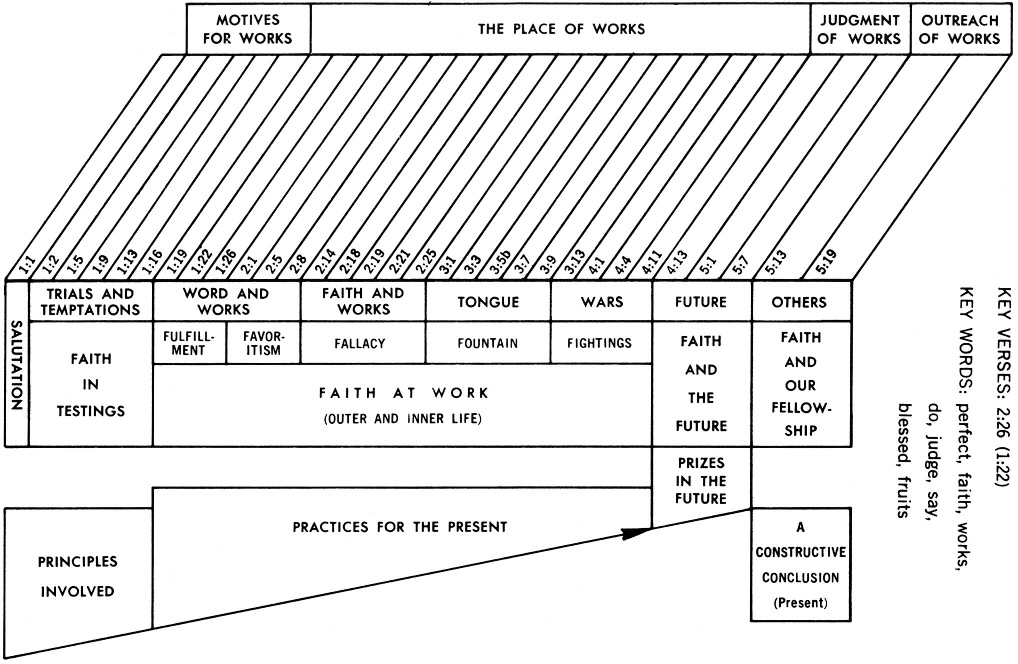
Click chart to enlarge
Chart from recommended resource Jensen's Survey of the NT - used by permission
Swindoll's Chart
|
JAMES |
|||||||
| Motives for Works |
The Place of Works: Outward Demonstration of Inner Faith |
Outreach of Works |
|||||
| Jas 1:1-18 | Jas 1:19-2:13 | Jas 2:14-25 | Jas 3:1-12 | Jas 3:13-4:12 | Jas 4:13-5:12 | Jas 5:13-19 | |
| Trials & Temptations |
Word & Works |
Faith & Works |
Tongue | Wars | Future | Others | |
|
Faith |
Fulfill |
Favor |
Fallacy |
Fountain |
Factions |
Faith |
Faith |
|
FAITH AT WORK |
|||||||
The Theme: The Testings of Personal Faith
The trials of the believer (James 1:2–12)
A. The proper attitude toward trials (James 1:2–4)
1. The attitude commanded (James 1:2)
2. The reason indicated (James 1:3)
3. The outcome to be realized (James 1:4)
B. The use of prayer amid trials (James 1:5–8)
1. The need for wisdom (James 1:5a)
2. The request for wisdom (James 1:5b)
3. The bestowal of wisdom (James 1:5c–8)
a. The divine response (James 1:5c)
b. The human obligation (James 1:6–8)
(1) The necessary attitude (James 1:6a)
(2) The rejected character (James 1:6b–8)
C. The correct attitude toward life by the tried (James 1:9–11)
1. The attitude of the lowly brother (James 1:9)
2. The attitude of the rich (James 1:10–11)
a. The reason for the attitude (James 1:10a)
b. The illustration from the flower (James 1:11a)
c. The application to the rich (James 1:11b)
D. The result of enduring trials (James 1:12)
1. The blessedness of endurance (v 12a)
2. The reward of endurance (James 1:12b)
The nature of human temptation (James 1:13–16)
A. The source of human temptation (James 1:13–14)
1. The repudiation of a divine source (James 1:13)
a. The rejection stated (James 1:13a)
b. The rejection vindicated (James 1:13b)
2. The reality of the human source (James 1:14)
B. The consequences of yielding to temptation (James 1:15)
C. The warning against being deceived (James 1:16)
The activity of God in human affairs (James 1:17–18)
A. The Giver of all good gifts (James 1:17)
B. The Author of the believer’s regeneration (James 1:18)
The Test Marks of a Living Faith
Faith tested by its response to the Word of God (James 1:19–27)
A. The reactions to the Word (James 1:19–20)
1. The knowledge possessed (James 1:19a)
2. The reaction demanded (James 1:19b)
3. The reason stated (James 1:20)
B. The reception of the Word (James 1:21)
1. The stripping off of sins (James 1:21a)
2. The appropriation of the Word (James 1:21b)
C. The obedience to the Word (James 1:22–27)
1. The demand for active obedience (James 1:22–25)
a. The statement of the requirement (James 1:22)
b. The illustration of the requirement (James 1:23–25)
(1) The negative portrayal (James 1:23–24)
(2) The positive portrayal (James 1:25)
2. The nature of acceptable obedience (James 1:26–27)
a. The futility of activity without inner control (James 1:26)
b. Acceptable service with inner control (James 1:27) (from Hiebert - James Commentary)
James 1:2 Consider it all joy, my brethren, when you encounter various trials, (NASB: Lockman)
Greek: Pasan charan egesasthe, (2PAMM) adelphoi mou, hotan peirasmois peripesete (2PAAS) poikilois,
Amplified: Consider it wholly joyful, my brethren, whenever you are enveloped in or encounter trials of any sort or fall into various temptations. (Amplified Bible - Lockman)
Barclay: My brothers, reckon it all joy whenever you become involved in all kinds of testings,
ESV: Count it all joy, my brothers, when you meet trials of various kinds
KJV: My brethren, count it all joy when ye fall into divers temptations;
ICB: My brothers, you will have many kinds of troubles. But when these things happen, you should be very happy
Montgomery: My brothers, when you are beset by various temptations, count it all joy,
NET: My brothers and sisters, consider it nothing but joy when you fall into all sorts of trials
NLT: Dear brothers and sisters, whenever trouble comes your way, let it be an opportunity for joy. (NLT - Tyndale House)
Phillips: When all kinds of trials and temptations crowd into your lives my brothers, don't resent them as intruders, but welcome them as friends! (Phillips: Touchstone)
Wuest: Be constantly rejoicing. Consider it a matter for unadulterated joy whenever you fall into the midst of variegated trials which surround you,
Weymouth: Reckon it nothing but joy, my brethren, whenever you find yourselves hedged in by various trials.
Young's Literal: All joy count it, my brethren, when ye may fall into temptations manifold;
CONSIDER IT ALL JOY, MY BRETHREN, WHEN YOU ENCOUNTER VARIOUS TRIALS: Pasan charan egesasthe, (2PAMM) adelphoi mou, hotan peirasmois peripesete (2PAAS) poikilois:
- Consider it all joy - Jas 1:12; Mt 5:10, 11, 12; Lk 6:22,23; Ac 5:41; Ro 8:17,18,35, 36, 37; 2Co 12:9; 2Co 12:10; Php 1:29; 2:17; Col 1:24; He 10:34; 1Pe 4:13, 14, 15, 16
- James 1 Resources - Multiple Sermons and Commentaries
- See also 1 Peter 1:6 Commentary 1 Peter 1:7 Commentary
- See Afflictions-Suffering-Quotes, Devotionals, Illustrations
Related Passages:
Psalm 119:67+ Before I was afflicted I went astray, But now I keep Your word.
Psalm 119:71+ It is good for me that I was afflicted, That I may learn Your statutes.
1 Peter 1:6-7+ In this you greatly rejoice, even though now for a little while, if necessary, you have been distressed by various trials, 7 so that the proof of your faith, being more precious than gold which is perishable, even though tested by fire, may be found to result in praise and glory and honor at the revelation of Jesus Christ;
Job 23:10 But He knows the way I take; When He has tried me, I shall come forth as gold.
to the degree that you share the sufferings of Christ, keep on rejoicing (present imperative = Command to make it your habit to rejoice in your trials. Why? Read on); so that also at the revelation of His glory, you may rejoice with exultation.
Matthew 5:10, 11, 12+ Blessed (see wonderful meaning of makarios) are those who have been persecuted for the sake of righteousness, for theirs is the kingdom of heaven (Jesus is not saying persecution earns us heaven but that the fact that we are persecuted for the sake of His Name is strong proof that we belong to Jesus and not to this world). Blessed (makarios) are you when men cast insults at you, and persecute you, and say all kinds of evil against you falsely, on account of Me (Why are we blessed? Read on… ). Rejoice, (present imperative = make this your continual, habitual practice - see our need to depend on the Holy Spirit to obey) and be glad (present imperative = make this your continual, habitual practice - see our need to depend on the Holy Spirit to obey), for your reward in heaven is great (Not just that you have a "reward" but that the reward is even "great"! What encouragement this truth should be for suffering saints!), for so they persecuted the prophets who were before you.
Luke 6:22, 23+ Blessed (see wonderful meaning of makarios) are you when men hate you, and ostracize you, and cast insults at you, and spurn your name as evil, for the sake of the Son of Man (Note the "qualifier" - "for the sake of the Son of Man" = we are one in covenant with Jesus and when we suffer, He suffers. Make sure your suffering meets the criteria of "for His sake"!). Be glad (aorist imperative - Command. Do this now. Don't delay - see our need to depend on the Holy Spirit to obey) in that day, and leap for joy (aorist imperative - Command. Do this now. Don't delay - see our need to depend on the Holy Spirit to obey) , for behold, your reward is great in heaven; for in the same way their fathers used to treat the prophets. ()
Acts 5:41-42+ (context = Acts 5:17-33ff+) So (Peter, et al) they went on their way from the presence of the Council (the Jewish Sanhedrin in Jerusalem, composed primarily if not solely of unsaved Jews), rejoicing that they had been considered worthy to suffer shame for His name. (Beloved this has to be one of the most convicting verses in the Bible -- "worthy to suffer shame"! The antithesis of the world's way of thinking.)
Romans 8:17-18+ and if children, heirs also, heirs of God and fellow heirs with Christ, if indeed (FIRST CLASS CONDITION = SINCE = A REALITY) we suffer with Him (Note "with Him" - we suffer He suffers. We suffer, but not alone! We suffer but not in vain. Why? What is the result?) in order that we may also be glorified with Him. For I consider that the sufferings of this present time are not worthy to be compared with the glory that is to be revealed to us.
2 Corinthians 4:17-18+ For momentary (CONTRAST WITH ETERNAL), light (CONTRAST WITH "WEIGHT OF GLORY") affliction is producing for us an eternal weight of glory far beyond all comparison, 18 while we look not at the things which are seen, but at the things which are not seen (SEE VERTICAL VISION); for the things which are seen are temporal, but the things which are not seen are eternal.
Romans 5:2-5+ (THE POSITIVE EFFECT OF TRIALS = PRODUCES PERSEVERANCE) through whom also we have obtained our introduction by faith into this grace in which we stand; and we exult in hope of the glory of God. 3 and not only this, but we also exult (NIV, NLT = REJOICE) in our tribulations (thlipsis), knowing that tribulation brings about perseverance (hupomone - SAME WORD Jas 1:3+) and perseverance, proven character (dokime - tested and "passed the test"); and proven character, hope and hope does not disappoint, because the love of God has been poured out within our hearts through the Holy Spirit who was given to us.
1 Peter 1:5-7 (THE POSITIVE EFFECT OF TRIALS = PRODUCES PRAISE, GLORY, HONOR) who (BELIEVERS) are protected by the power of God through faith for a salvation ready to be revealed in the last time. 6 In this (TRUTHS IN 1Pe 1:3-5+) you greatly rejoice, even though now for a little while, if (ASSUMED TRUE = SINCE) necessary (TRIALS ARE NECESSARY!), you have been distressed (lupeo - feel deep emotional or physical pain) by various (poikilos) trials (periasmos) , 7 so that the proof of your faith, being more precious than gold which is perishable, even though tested by fire, may be found to result in praise and glory and honor at the revelation of Jesus Christ;
Acts 16:25-26+ (CONTEXT = IN PRISON) About midnight Paul and Silas were praying and singing hymns of praise to God, and the prisoners were listening to them and suddenly there came a great earthquake, so that the foundations of the prison house were shaken; and immediately all the doors were opened, and everyone's chains were unfastened.
1 Peter 5:10+ After you have suffered for a little while, the God of all grace, who called you to His eternal glory in Christ, will Himself perfect, confirm, strengthen and establish you.
Hebrews 5:8-9+ (EVEN THE SON OF GOD WAS "TESTED") Although He was a Son, He learned obedience from the things which He suffered. 9 And having been made perfect, He became to all those who obey Him the source of eternal salvation,

A PARADOXICAL
CONSIDERATION
Notice that James does not offer thanksgiving for his readers or a prayer for their needs, and in fact no where suggests that James necessarily had personal contact with his readers. So without fanfare he jumps the difficult topic of trials, even beginning with a command!
Consider (hegeomai) it all joy (chara), my brethren (adelphos), when (not "if") you encounter (parapipto) various (poikilos) trials (periasmos) - Consider it all joy - The literal rendering emphasizes the call to joy even more forcefully: “All joy count it!” James places “all joy” at the very beginning for emphasis, highlighting the believer’s attitude toward trials. J. B. Phillips captures the spirit of the passage well with his paraphrase: “When all kinds of trials and temptations crowd into your lives, my brothers, don’t resent them as intruders, but welcome them as friends!” While trials are naturally unwelcome and painful, James calls believers to view them from God’s perspective, recognizing that He uses them as instruments for spiritual growth, endurance, and maturity (James 1:2–4). Related - Spiritual Paradoxes of Christianity.
On the "surface", this command is one of the most difficult in all the Bible in my opinion. It ranks up there with "in everything give thanks" (1Th 5:18+). And yet we know that God is not trying to frustrate us or defeat us or destroy us, but to conform us to the image of His Son and in so doing He wastes no circumstance, no adversity, no affliction, no sickness, no success, no failure, etc, in achieving His end, which in fact He will achieve (cp Phil 1:6+, 1Pe 5:10+). When you are in the trial, it is critical to remember that God never commands to do His will in any area, that He does not also supply us with the grace and power necessary to fulfill it (Php 2:12+, Php 2:13NLT+, 2Cor 12:9, 10+, Php 4:11, 12, 13+).
James is not saying the trials are joyful in themselves but are God's appointed means to an end which is joyful. In other words, joy in trials comes from knowing that the outcome will be for our good and God's glory. It's as if while in the trial, we have a future focused mindset, because we know that the trial in the hands of the good and loving Potter is not without value regarding the sculpting of our character. We must lay hold of this truth that a loving Father allows (sometimes sends) trials in our lives, not to impair us but to improve us. Not to destroy us but to develop us. In other words, our Father takes us into His darkroom to develop our character not destroy it. In his explanation of why believers should not think lightly of God's discipline, the writer of Hebrews reminds of the promised "fruit" writing that…
All discipline (paideia) for the moment seems not to be joyful, but sorrowful; yet to those who have been trained (gumnazo - perfect tense speaks of the enduring results of the effect of this training) by it, afterwards (IT WILL HAVE AN END!) it yields the peaceful fruit of righteousness. (Heb 12:11+)
Consider is in the aorist imperative is a command calling for action, and can even convey a sense of urgency (See note on need for the Spirit). It is also a command because it is not our natural response to trials. We are to regard our experiences of testing as the ground for all joy,! But remember that God never commands us to do anything which He does not enable or empower. See discussion of the Need for the Holy Spirit to obey NT commands or "How to Keep All 1642 Commandments in the New Testament!")
Warren Wiersbe - Our values determine our evaluations. If we value comfort more than character, then trials will upset us. If we value the material and physical more than the spiritual, we will not be able to ‘count it all joy!’ If we live only for the present and forget about the future, the trials will make us bitter, not better. (Bible Exposition Commentary)
When God puts us in the furnace, He always keeps His eye
on the clock and His hand on the thermostat.
--Warren Wiersbe
Hiebert on consider it all joy notes that "the meaning is not that suffering is the occasion for all the joy there is, but that it should occasion only joy, unmixed with other reactions. New Testament usage of "all" (pas) tended to support the latter meaning (Php 2:29; 1Ti 2:2; Titus 2:10; 3:2; 1Pe 2:18) (James Commentary)
The work of God transforms us
And makes us like His Son;
He works through trials and testings
Until our life is done.
--Sper
Warren Wiersbe makes an excellent point related to the commands James gives in chapter 1 - In James 1:12, James used a very important word, love. We would expect him to write, “the crown of life, which the Lord hath promised to them that trust Him” or “that obey Him.” Why did James use love? Because love is the spiritual motivation behind every imperative in this section. (Bible Exposition Commentary)
Douglas Moo points out that "As do Paul (Ro 5:2–4) and Peter (1Pe 1:5–7) in similar passages, James reminds his readers that God brings difficulties into believers’ lives for a purpose, and that this purpose can be accomplished only if they respond in the right way to their problems.....Why does God allow the righteous to suffer? is, indeed, one of the most perplexing and difficult questions that God’s people can ask. James gives no complete answer. But implicit in what James says is a conviction that the suffering of believers is always under the providential control of a God who wants only the best for his people.
Through many dangers, toils and snares,
I have already come.
’Tis grace has brought me safe thus far,
And grace will lead me home.
Practicing the paradox of "all joy in trials" is not normal but supernormal. In other words, joy in trials is not a natural reaction but must be a supernatural reaction. Ultimately, it seems to me, that the man or woman who is most able to obey this command is the one who is walking by the Spirit (Gal 5:16+), filled with the Spirit, controlled by the Spirit (Eph 5:16+). As the believer yields to the Spirit, making the determined choice of his will, he or she is enabled to manifest supernatural joy (Galatians 5:22+).
For example, recall the exhortation of the writer of Hebrews to continually (present tense) fix…
our eyes on (by faith turning our eyes away from earthly things and fixing them on) Jesus, the Author and Perfecter of faith, Who for the joy set before Him endured the cross, despising the shame, and has sat down at the right hand of the throne of God. (Hebrews 12:2+)
Comment: Christ "endured" this trial and the shame with His eyes on the joy His sacrifice would bring. And as Peter said "Christ also suffered for you, leaving you an example for you to follow in His steps" 1Peter 2:23 +
Matthew Poole comments that we are to "esteem it so by a spiritual judgment, though the flesh judge otherwise."
Day by day and with each passing moment,
Strength I find to meet my trials here;
Trusting in my Father's wise bestowment,
I've no cause for worry or for fear.
—Berg

JOY WHEN ENVELOPED
BY VARIEGATED TRIALS
All joy - "Whole joy", unmixed joy, without admixture of sorrow, not just "some joy" along with much grief! How is this possible? I submit that it is "IM-possible" relying on our natural strength, but is "HIM-possible" relying on supernatural strength. As noted above, the Holy Spirit produces His joy in us (Gal 5:22+, cf Ro 15:13+). The translations render it - wholly joyful (Amp), pure joy (ISV, Moffatt), complete joy (Berkley), nothing but joy (NET), unadulterated joy (Wuest), highest joy (Grotius)
Joy is deep satisfaction that comes from knowing that God is
in control even when my circumstances seem to be out of control.
-- Ray Pritchard
John MacArthur explains that all joy
"is variously interpreted by commentators as meaning pure joy, unmixed joy, complete and total joy, or sheer joy. From the context, it seems that all of those meanings are fitting. James is speaking of a unique fullness of joy that the Lord graciously provides His children when they willingly and uncomplainingly endure troubles while trusting in Him—regardless of the cause, type, or severity of the distress. He will always use them for our benefit and for His own glory. It is not because of some sort of religious masochism, but rather a sincere trust in the promise and goodness of our Lord, that we can look on trials as a welcome friend, knowing with Joseph that what may have been meant for evil against us, God means for good (Ge 50:20; cf. Ro 8:28+).
We are not just to act joyful, in reluctant pretense, but to be genuinely joyful. It is a matter of will, not of feelings, and should be the conscious, (ED: SPIRIT ENABLED) determined commitment of every faithful believer. And because God commands it, it is within the ability, under the Spirit’s provision, of every true Christian. (ED: GOD'S COMMANDMENTS ALWAYS COME PRE-PACKAGED WITH HIS GOD'S ENABLEMENTS!) When faith in Jesus Christ is genuine, James assures us, even the worst of troubles can and should be cause for thanksgiving (1Th 5:18+) and rejoicing.
The more we rejoice in our testings, the more we realize that they are not liabilities but privileges, ultimately beneficial and not harmful, no matter how destructive and painful the immediate experience of them might appear. When we face trials with the attitude that James admonishes, we discover that the greatest part of the joy is drawing closer to the Lord—the Source of all joy—by becoming more sensitive to His presence, His goodness, His love, and His grace. Our prayer life increases, as does our interest in and study of the Word, and in each of those ways our joy increases all the more. (SEE James MacArthur New Testament Commentary - Page 21)
Commenting on consider it all joy, Theodore Epp remarks that…
To have joy does not necessarily mean we will be hilarious and laughing about the trials we are experiencing, but it means we will have a deep-seated confidence that God knows what He is doing and that the results will be for His glory and our good. (Theodore Epp: James the Epistle of Applied Christianity)
Believers should (and can) see their trials
not so much as obstacles but as opportunities
Note that James is not commanding believers to enjoy their trials per se which in themselves are often grievous and not necessarily joyful. If this were his intent, James would be calling for a "stoic-like" resignation, in which one simply "grins and bears" the trial. To the contrary, James is saying that believers should (and can) see their trials not so much as obstacles but as opportunities, which when "leavened" with God's grace, prove to be "fertilizer" for growth in Christ-likeness. Trials when seen with eyes of faith (cp He 11:1+; 2Co 5:7) can then be accepted as God's tools for producing beneficial results and can then be occasions for rejoicing. As an aside, James is not a masochist and is not calling for us to seek out or needlessly rush into trials.
One thinks in fact of Jesus' words that we are to pray "lead us not into testing (temptation)" (Mt 6:13+) regarding which Mayor comments…
One who is conscious of his own weakness may without inconsistency pray that he may be kept out of temptation, and yet, when he is brought into it through no fault of his own but by God's providential ordering, he may feel such trust in Divine support as to rejoice in an opportunity of proving his faithfulness.
Steven Cole on JOY - Biblical joy in times of trials is not natural optimism. It is the joy of hope (Ed: absolute assurance of future good) in God and His sure promises. This radical attitude results from a deliberate choice. The choice is, “Will I trust in God and His promises, or not?” As James says, it is our faith that is being tested. We do not know if our faith is genuine until it stands up under the test. You can buy a jacket that claims to be waterproof. If you wear it on dry days, you have not put the jacket to the test. The test of that jacket is, if you get caught in a downpour, does it keep you dry? If it does, you say, “That’s a good jacket!” It’s easy to proclaim, “I trust in God!” Anybody can say that. But, the test of your faith is when you really do choose to trust God in a severe trial. Afterwards, you know that your faith is genuine, because it brought you through the trial. But the point is, when you are faced with a trial, you have a choice: Will I trust God and the promises of His Word, as I have professed to do, or not? To trust God and experience His hope and joy in the midst of trials is a radical attitude that James commands us to adopt. (James 1:1-4 A Radical Approach to Trials recommended)
BRETHREN
My brethren (adelphos) (also in Jas 1:2; 2:1, 14; 3:1, 10, 12; 5:12, 19) - He is referring to true believers addressing them with a feeling of warmth and love, as well as identification, which would assure them that they are not alone in their trials. He later refers to them as "beloved brethren" again emphasizing his pastoral affection for them (Jas 1:16, 19, 2:5). As an aside brethren does not exclude "sistern" or sisters in Christ - "my brothers and sisters" is therefore quite appropriate.
Matthew Poole writes that James uses my brethren "both as being of the same nation and the same religion; so he calls them, that the kindness of his compellation might sweeten his exhortations."
D Edmond Hiebert adds that my brethren denotes James' "personal feelings toward his readers. He accepts them as members with him of one spiritual community, as fellow members of the family of God. Therefore, "what James has to say applies only to born-again Christians." The possessive "my" expresses his own consciousness of his equality with them as brothers and that as their brother he is concerned about their trials. Fanar remarks, "The perpetual recurrence of this word shows that the wounds which St. James inflicts are meant to be the faithful wounds of a friend."' He eagerly draws his readers to himself as he seeks to minister to their needs. In the pagan world, the term (brethren) was used of a fellow member in some restricted secular group or of members of a particular religious society. Among the Jews, the term was used to denote a fellow Israelite. The early Christians readily employ the term as expressive of their consciousness that as believers in Christ they were all members of one spiritual family. The use of this designation in the early church was apparently stimulated by the teaching of Jesus in Mk 3:35 and Mt 23:8. (James Commentary)
ENCOUNTERING
TRIALS
When you encounter (parapipto) - Note carefully James does not say "if" but "when" referring not to possibility but to inevitability! Trials are not an elective, but a required course in the "school of Christ"! Commenting on "when" Hiebert adds that "The use of the indefinite temporal construction (hotan with the subjunctive), "whenever ye [may] fall into," indicates that they tend to come at an undetermined time. Their arrival cannot be pinpointed beforehand. They may he expected at anytime." (James Commentary) Trials then are an expected/guaranteed element of the normal Christian life, and so, beloved, as Peter says "Do not be surprised (present imperative + negative = command to stop continually being surprised!) at the fiery trial among you which comes upon you for your testing, as though some strange thing were happening to you." (1Pe 4:12+) To be sure, most of us are either in a trial, just coming out of one or on the verge of entering a new one. Such is the common lot of mankind (cp 1Cor 10:13+ "common to man").
Hiebert adds that peripipto suggests "that these trials are unavoidable. Like the thieves who surrounded the man on the Jericho road (see Lk 10:30+), such adverse situations unexpectedly surround the believer with no escape. The compound verb (peripipto), which pictures these trials as encircling the believer, implies that the reference is not to minor little irritations but to larger adverse experiences that cannot be avoided. The reference is to various adversities, afflictions, and calamities that are hard to bear. The reference is not specifically to religious persecutions, although they were a prominent part in the experiences of the readers. Martin, indeed, holds that these trials "are better understood as signs of oppression and persecution endured for one's religious convictions."' (James Commentary)
Steven Cole makes the important point that "Many Christians naively think that if they obey the Lord, they will be spared from any trials. When trials hit them, they are confused and often angry at God: “I was following You! Why did You allow this to happen?” But the Bible gives abundant testimony that all of God’s saints encounter trials. And these trials are not necessarily the consequence of disobedience. Rather, God uses them to test our faith. They will be varied according to His sovereign purpose. We cannot understand why He sends the particular trials that He does, but whatever they are, we can know that they are from Him. (James 1:1-4 A Radical Approach to Trials recommended)
Notice that while the world says "consider it joy when you escape trials", James says "No, consider it joy when you are in the midst of trials!"
The Psalmist writes that "Weeping may last for the night, but a shout of joy comes in the morning" (Ps 30:5)
VARIOUS TRIALS
Various (poikilos) gives a vivid picture of the diversity and varied aspects and appearances of the trials that affect believers, not their number, which is left to be inferred.
William Barclay remarks that "Our troubles may be many-coloured, but so is the grace of God; There is no color in the human situation which grace cannot match. There is a grace to match every trial and there is no trial without its grace…All kinds of experiences will come to us. There will be the test of the sorrows and the disappointments which seek to take our faith away. There will be the test of the seductions which seek to lure us from the right way. There will be the tests of the dangers, the sacrifices, the unpopularity which the Christian way must so often involve. But they are not meant to make us fall; they are meant to make us soar. They are not meant to defeat us; they are meant to be defeated. They are not meant to make us weaker; they are meant to make us stronger. Therefore we should not bemoan them; we should rejoice in them. The Christian is like the athlete. The heavier the course of training he undergoes, the more he is glad, because he knows that it is fitting him all the better for victorious effort. As Browning said, we must “welcome each rebuff that turns earth’s smoothness rough,” for every hard thing is another step on the upward way. (The Daily Study Bible Series)
It is not surprising to see James use the related verb peirazo (to test or to tempt) to describe temptations (Jas 1:13, 14+). As most believers have experienced, trials which God allows can become sources of temptation to sin. If we choose to react to the trial based on feelings and/or emotions, it is likely that our fallen flesh will deceive and impel us to react inappropriately. However, if we act (contrast with react) in faith (in God - His sovereignty [He is in control - Da 4:35+, Ps 115:3+, Ps 135:6+, Isa 46:10, 11], in His faithfulness [He won't test us beyond what we can bear - He knows our "load limits"! - 1Cor 10:13+], in and by His grace [His power is perfected in our weakness, 2Co 12:9, 10+], in His promises [momentary affliction will yield eternal glory beyond comparison - 2Co 4:16, 17, 18+], etc) then the trials instead of seducing us to sin, strengthen us to grow more like the Savior (cp 2Pe 3:18+).
Consider (2233)(hegeomai from ágo = to lead) primarily signifies to lead and then to consider. The picture is that of one leading his or her mind through a reasoning process to arrive at a conclusion. Considering (hegeomai) involves careful thought, not quick decision. It involves a conscious judgment resting on deliberate weighing of the facts. It denotes deliberate and careful judgment stemming from external proof, not subjective judgment based on feelings. Hegeomai and calls for a mental evaluation adopted as the result of due deliberation, the conscious acceptance of a definite inner attitude. Hegeomai is also a mathematical term which says "Think about it and come to a conclusion."
Hegeomai - 28x in 21v in the NT - NAS = chief(1), consider(3), considered(2), considering(1), count(4), counted(1), esteem(1),governor(1), leader(1), leaders(3), leading(1), led(1), regard(5), regarded(1), Ruler(1), thought(2). Mt. 2:6; Lk. 22:26; Acts 7:10; 14:12; 15:22; 26:2; 2Co. 9:5; Phil. 2:3, 6, 25; 3:7, 3:8; 1Th 5:13; 2Th 3:15; 1Ti 1:12; 6:1; Heb. 10:29; 11:11, 26; 13:7, 17, 24; James. 1:2; 2Pet. 1:13; 2:13; 3:9, 15.
Related Resources:
- See notes on 1 Corinthians 10:13 for comments on trials/temptations.
- Spurgeon's Sermon - Two Good Things - Ps 119:71, Ps 73:28
- See in depth article on Afflictions-Suffering-Quotes, Devotionals, Illustrations
- See commentary on Hebrews 12:5-11
- The Refiner's Fire - play the related song as your prayer beloved - Refiner's Fire
- New Testament Words Related to Affliction/Suffering
- Verses Related to Affliction/Suffering - note the "+" sign after each verse indicates an in depth comment is available.
- Why? Seeing God in our Pain
- Out of the Ashes
- Why Would A Good God Allow Suffering? Finding goodness in trouble (or here)
- Navigating The Storms Of Life
- What does the Bible say about suffering?
- Why do so many people have to experience terrible suffering before death?
Joy (5479) (chara from chaíro = to rejoice) describes an attitude which is cheerful and glad. It is a is a sense of inner gladness, delight or rejoicing. Secular dictionaries define joy as the emotion evoked by well-being, success, or good fortune or the emotion evoked by the prospect of possessing what one desires. The world's definition of joy is therefore virtually synonymous with the definition of happiness, for both of these "emotions" are dependent on what "happens" The world's joy is the emotion evoked by well-being, success, or good fortune or by the prospect of possessing what one desires.
The Bible defines joy as a gift of God, a fruit of His Spirit, which is independent of circumstances. Certainly there is joy in human life, such as joy when one experiences a victory (" We will sing for joy over your victory, and in the name of our God we will set up our banners. May the LORD fulfill all your petitions." Ps 20:5 Spurgeon's comment) or reaps a bountiful harvest (see Is 9:3), but more often the Bible speaks of joy in a spiritual sense. For example, Nehemiah declared to the down in the mouth (not very filled with joy) Jews that "The joy of the Lord is your strength" (Neh 8:10). Similarly, David pleaded with God to “restore to me the joy of Thy salvation” (Ps 51:12 Spurgeon's Comment). It is not surprising that joy and rejoicing are found most frequently in the Psalms (about 80 references) and the Gospels (about 40 references).
Joy is the deep-down sense of well-being that abides in the heart of the person who knows all is well between himself and the Lord. It is not an experience that comes from favorable circumstances but even occurs when those circumstances are the most painful and severe as Jesus taught His disciples declaring…
Truly, truly, I say to you, that you will weep and lament, but the world will rejoice; you will be sorrowful, but your sorrow will be turned to joy. 21 "Whenever a woman is in travail she has sorrow, because her hour has come; but when she gives birth to the child, she remembers the anguish no more, for joy that a child has been born into the world. 22 "Therefore you too now have sorrow; but I will see you again, and your heart will rejoice, and no one takes your joy away from you. (John 16:20-22)
Believers have the Resident Source of joy within for as as Paul teaches "the fruit of the Spirit is love, joy, peace, patience, kindness, goodness, faithfulness (Galatians 5:22+) Emotional fluctuations cannot disturb this Source of joy. Note Paul’s statement of this confidence (Phil 3:20+). Joy not only does not come from favorable human circumstances but is sometimes greatest when those circumstances are the most painful and severe.
Warren Wiersbe defines joy as "that inward peace and sufficiency that is not affected by outward circumstances. (A case in point is Paul’s experience recorded in Phil 4:10-13ff+) This "holy optimism" keeps him going in spite of difficulties. (He adds) Our values determine our evaluations. If we value comfort more than character, then trials will upset us. If we value the material and physical more than the spiritual, we will not be able to ‘count it all joy!’ If we live only for the present and forget the future, the trials will make us bitter, not better (Bible Exposition Commentary)
The Baker Encyclopedia adds that joy is a "Positive human condition that can be either feeling or action. The Bible uses joy in both senses. Joy is a feeling called forth by well-being, success, or good fortune. A person automatically experiences it because of certain favorable circumstances. It cannot be commanded. The shepherd experienced joy when he found his lost sheep (Mt 18:13). The multitude felt it when Jesus healed a Jewish woman whom Satan had bound for 18 years (Lk 13:17+). The disciples returned to Jerusalem rejoicing after Jesus’ ascension (Lk 24:52+). Joy was also the feeling of the church at Antioch when its members heard the Jerusalem Council’s decision that they did not have to be circumcised and keep the Law (Acts 15:31+). Paul mentioned his joy in hearing about the obedience of the Roman Christians (Ro 16:19+). Ps 137:3+ shows that the emotion cannot be commanded. The Jews’ captors wanted them to sing in the land of their exile, something they were unable to do. Faraway Jerusalem was their chief joy (Ps 137:6+). There is a joy that Scripture commands. That joy is action that can be engaged in regardless of how the person feels. Proverbs 5:18 (+) tells the reader to rejoice in the wife of his youth, without reference to what she may be like. Christ instructed his disciples to rejoice when they were persecuted, reviled, and slandered (Mt 5:11+, Mt 5:12+). The apostle Paul commanded continuous rejoicing (Phil 4:4+; 1Th 5:16+ ED: Calling for continuous dependence on the Holy Spirit to obey these commands in the present imperative). (Baker Encyclopedia of the Bible)
Excerpt from David Scaer's article Joy - Happiness over an unanticipated or present good. In the Old Testament joy (Heb. sama [ Song of Solomon 1:4 ), to marriage (Proverbs 5:18 ), the birth of children (Psalm 113:9 ), the gathering of the harvest, military victory (Isaiah 9:3 ), and drinking wine (Psalm 104:15 ). On the spiritual level it refers to the extreme happiness with which the believer contemplates salvation and the bliss of the afterlife. Unexpected benefits from God are expressed in terms of common experiences. The psalms express the joyous mood of believers as they encounter God. Believers rejoice because God has surrounded them with his steadfast love (32:11) and brought them to salvation (40:16; 64:10). David rejoices that God has delivered him from the hand of his enemies (63:11). Joy is a response to God's word (Psalm 119:14 ) and his reward to believers (Isaiah 65:14 ) and their strength (Nehemiah 8:10 ). (For full article click in Baker Evangelical Dictionary Joy)
Related Resources:
- Resources on Joy
- Joy - Chara (Greek Word Study)
- Biblical Joy and Hope
- Delight Yourself in the Lord
- Bridgeway Bible Dictionary Joy
- Baker Evangelical Dictionary Joy
- Charles Buck Dictionary Joy of God Joy
- Hastings' Dictionary of the Bible Joy
- Hastings' Dictionary of the NT Joy (2) Joy
- Morrish Bible Dictionary Joy
- Wilson's Bible Types Joy
- International Standard Bible Encyclopedia Joy
- McClintock and Strong's Bible Encyclopedia Joy of God
- The Jewish Encyclopedia Joy
- Nave Topical Bible Joy
- Thompson Chain Reference Soul-Winners' Joy Joy
- Torrey Topical Textbook Joy
- Holman Bible Dictionary Joy
- Is there a difference between joy and happiness?
- How can I find joy in the midst of trials?
- How can I experience joy in my Christian life?
- What is the joy of the Lord?
- The Fruit of the Holy Spirit – What is joy?
- How did Jesus bring joy to the world?
- What does it mean to count it all joy (James 1:2)?
Encounter (4045) (peripipto from peri = around + pipto = to fall, to fall into, to fall down) means literally to fall around, and so to fall in with or among (trials, Jas 1:2, robbers Lk 10:30). In one NT context peripipto means to mover toward something and strike against it (Acts 27:41). This verb can also convey the sense of falling into something suddenly or unexpectedly -- isn't that what most trials do? They "jump" on us and catch us off guard! I like the picture presented by the Amplified version "whenever you are enveloped in or encounter trials of any sort or fall into various temptations." The picture is one encompassed by these trials, something with which we can all readily identify! Some secular uses of peripipto include as a description of ships meeting by chance at sea (Herodotus), to encounter unjust judgments, to be caught in one's own snare (Herodotus), to fall on one side (Plutarch).
Friberg writes that peripipto means "as coming onto a situation accidentally and becoming innocently involved; literally, of mishaps encounter; of robbers fall into the hands of, be seized by (Lk 10:30)
Peripipto is used only 3 times in the NT…
Luke 10:30 Jesus replied and said, "A certain man was going down from Jerusalem to Jericho; and he fell among (peripipto) robbers, and they stripped him and beat him, and went off leaving him half dead."
Comment: The preposition peri "around" (in peripipto) pictures the certain man as being completely surrounded by the thieves on all sides, with no way of escape, and thus unavoidably "falling" victim to their assaults.
Acts 27:41 But striking (KJV = striking into; peripipto) a reef where two seas met, they ran the vessel aground; and the prow stuck fast and remained immovable, but the stern began to be broken up by the force of the waves.
Peripipto is used 4x in the Septuagint (Da 2:9 plus the 3 uses below)…
Ruth 2:3 So she departed and went and gleaned in the field after the reapers; and she happened (Lxx = peripipto) (Lxx adds by chance = periptoma = by accident) to come to the portion of the field belonging to Boaz, who was of the family of Elimelech.
2 Samuel 1:6 And the young man who told him said, "By chance (periptoma = by accident) I happened (Lxx = peripipto) to be on Mount Gilboa, and behold, Saul was leaning on his spear. And behold, the chariots and the horsemen pursued him closely.
Proverbs 11:5 The righteousness of the blameless will smooth his way, but the wicked will fall (Lxx = peripipto) by his own wickedness.
Matthew Poole comments that peripipto conveys the picture "when you are so beset and circumvented by them, that there is no of escaping them, but they come upon you, though by the direction of God’s providence, yet not by your own seeking. “Divers temptations;” so he calls afflictions, from God’s end in them, which is to try and discover what is in men, and whether they will cleave to Him or not.
Samuel Rutherford emphasizes the certainty of trials writing that "You will not get leave to steal quietly to heaven without a conflict and a cross."
The Puritan Thomas Watson agreed writing "Though Christ died to take away the curse from us, yet not to take away the cross from us."
Spurgeon asked "How can I look to be at home in the enemy's country, joyful while in exile, or comfortable in a wilderness? This is not my rest. This is the place of the furnace and the forge and the hammer. To those servants of God whom He purposes to use in a larger, greater way, many trials are allowed to come (they are necessary), for we must be ground between the millstones of suffering before we can be bread for the multitude.
J C Ryle explains that "Every cross is a message from God and intended to do us good in the end."
Matthew Henry adds "These troubles, that lie heavy, never come upon us but when we have need, and never stay any longer than needs must."
John Newton describes these trials as like "medicines which our gracious and wise Physician prescribes, because we need them; and He proportions the frequency and weight of them to what the case requires.
J. Vernon McGee in his pithy style adds "I know it is not at all popular to teach that God will prove us and lead us on to maturity through suffering. People would rather be encouraged to think that they are somebody important and that they can do great things on their own. My friend, we are nothing until the Spirit of God begins to move in our hearts and lives. We have nothing to offer to God. He has everything to offer to us. (McGee, J V: Thru the Bible Commentary: Nashville: Thomas Nelson)
Warren Wiersbe adds that the encouraging note that "We must keep in mind that all God plans and performs here is preparation for what He has in store for us in heaven. He is preparing us for the life and service yet to come. Nobody yet knows all that is in store for us in heaven, but we do know that life on earth is a school in which God trains us for our future ministry in eternity. This explains the presence of trials in our lives for they are some of God’s tools and textbooks in the school of Christian experience. (Bible Exposition Commentary)
Steven Cole comments that "Some of the readers had probably been members of the church in Jerusalem, but they had scattered into many locations because of the persecution that arose after the death of Stephen (Acts 8:1; 11:19, 20). Because of anti-Semitism in the Roman Empire, these believers in Christ were often the brunt of hostility both from the pagan world, as well as from their own people. Word got back to James of some of the difficulties that these brethren were encountering: affliction from without (Jas 5:1, 2, 3, 4, 5, 6) and, as often happens at such times, conflicts within (Jas 2:1-13; 4:1-12). Some were lapsing into a superficial, formal religion that professed orthodox beliefs, but practiced selfish, ungodly lifestyles (Jas 1:22, 23, 24, 25, 26, 27; Jas 2:14-26; Jas 3:9, 10, 11, 12). As a pastor, James writes to these scattered Jewish believers to make the point: True faith shows itself in practical, godly living. He develops several themes: endurance through trials; the dangers of riches and encouragement to the poor; the law and love; faith and works; the coming of the Lord; and, humility. But his main point is that true biblical faith works. (James 1:1-4 A Radical Approach to Trials recommended)
Various (4164) (poikilos) means existence in various kinds or modes, diversified, manifold, variegated, many colored. Poikilos was used to describe the skin of a leopard, the different-colored veining of marble or a robe embroidered with many different colors and thence passes into the meaning of changeful, diversified, applied to the changing months or the variations of a strain of music. Poikilos stresses not the number of trials but the great variety or diversity of the trials, "multicolored", like Joseph's coat of many colors (Ge 37:3 - where Lxx for "many" = poikilos).
In Mt 4:24 poikilos is used of the great variety of torments of body and mind among the people whom Jesus healed. In He 2:4 poikilos describes the variety of the manifestations of God's power in connection with the preaching of the gospel.
Various trials would include those common to all men as well as those related to the fact that they are believers (cp 2Ti 3:12)
Peter writes to believers experiencing fiery trials…
In this you greatly rejoice (continually "jump for joy" - there is no way this would be possible in our natural state - it has to speak of Spirit enabled supernatural ability to rejoice! It speaks of the believer's moment by moment need to submit to and depend on the Spirit, walking by the Spirit - Gal 5:16- +) even though now for a little while, if (the idea is since they are… ) necessary you have been distressed by various (poikilos) trials (1 Peter 1:6+, read 1Pe 1:7 [+] which gives the context to help understand how future hope energizes present rejoicing even in painful circumstances)
But note that God's provision for our "multicolored" trials is "multicolored" grace…
As each one has received a special gift, employ it in serving one another as good stewards of the manifold (poikilos) grace of God. (1 Peter 4:10+)
Comment: God's grace is sufficient for every trial whatever its color.
God will certainly prune us but never without purpose, for as Vance Havner said "Some secular uses of peripipto include as a description of ships meeting by chance at sea (Herodotus), to encounter unjust judgments, to be caught in one's own snare (Herodotus), to fall on one side (Plutarch). The grace, the groans and the glory are all part of the eternal purpose. Where there is no groaning there is no growing now, nor glory to come.
Guy King gives an interesting illustration of manifold grace from manifold trials (temptations)…
We find that Peter joins Paul in magnifying the grace of GOD. There is an interesting Greek word, poikilos, which occurs several times in the New Testament, and which Peter uses twice, both in his First Epistle, and which is translated "manifold":
(a) "Ye are in heaviness, through manifold temptations," (1Pe 1:6+)
(b) "Good stewards of the manifold grace of GOD," (1Pe 4:10+)
Put those two things together.
On the one hand, let the five digits, all so different in character, from the thumb to the little finger, stand for the manifold trials and testings of life. On the other hand, let the five digits stand for the manifold grace. Now put the right hand over the left, and observe how the fingers of the grace hand exactly correspond to those of the temptations hand. Only an illustration; but an illustration of a beautiful fact - that whatever may be the need, there is at hand just the very grace to meet it. (Colossians 4:15-18 His Kind Regard)
Blind unbelief is sure to err
And scan His work in vain;
God is His own interpreter,
And He will make it plain.
Trials (3986)(peirasmos from peirazo = to make trial of, try, tempt, prove in either a good or bad sense) describes first the idea of putting to the test and then refers to the tests or pressures that come in order to discover a person’s nature or the quality of some thing. Think of yourself as a tube of "spiritual toothpaste". Pressure brings out what's really on the inside! Peirasmos connotes trouble or something that breaks the pattern of peace, comfort, joy, and happiness in someone’s life. Trials rightly faced are in fact beneficial to the saint as Peter (as James 1 explain), but wrongly received and processed can "evolve" into temptations to commit sins. It is axiomatic that Satan tempts us to bring out the worst in us while God tests us to bring out the best for He ever seeks to make us more like His Son.
Note that some translations render peirasmos with the word temptations (ASV, TLB, Wesley, Young's Literal, Amplified, Darby, KJV), but the context does not suggest that it is being used in the sense of solicitation to evil or temptation to sin (as in Jas 1:13,14) for one would hardly be urged to rejoice in such a setting.
Peirasmos in Septuagint - Ex 17:7; Deut 4:34; 6:16; 7:19; 9:22; 29:3; Ps 95:8+ (Ps 95:9 uses peirazo)
That which is intended as a test may in fact become a temptation
for the person tested because of his inner response to the situation.
Hiebert - The noun peirasmos denotes a testing being directed toward an end, to discover the nature or quality of the object or person tested. The verbal form peirazo denotes the action of putting something or someone to the test. Such a test may be applied with either a good or bad intention. In a good sense, the test may be applied in order to demonstrate the strength or good quality of the object tested. When the testing is applied with the evil aim that the object will be led to fail under testing, then the thought of temptation comes in. Since it is a melancholy fact that men often break down under the testings of life, the term peirasmos is often used with the meaning of temptation, a solicitation to evil. Under either meaning, the term "has always the idea of probation associated with it."' Both the noun and the verb are rare in secular Greek,' but they are common in the Septuagint and the New Testament. Since the Scriptures are concerned with moral values, the concept of testing is an essential one in the Bible. In human experience, the two aspects of testing and temptation may be closely related. That which is intended as a test may in fact become a temptation for the person tested because of his inner response to the situation. Well aware of this close connection in actual experience, James deals with both aspects of peirasmoi in this opening section of his epistle. In Jas 1:2-12 he deals with the nature and use of external tests that come to the believer in daily life, while in Jas 1:13-16+ he deals with the experience of temptation to evil. In Jas 1:17,18+ he shows that God's beneficent activities toward the believer establish that He cannot be associated with peirasmos in the sense of solicitation to evil. God does test the faith of His people, but He does not allure them to evil. (James Commentary)
William Barclay - Peirasmos is trial or testing directed towards an end, and the end is that he who is tested should emerge stronger and purer from the testing. (ED comment: However this word can mean tempt, which is what Satan does - he desires that we emerge weaker and less pure as a result of succumbing to the peirasmos. See explanation in following paragraph). The corresponding verb peirazein, which the King James Version usually translates to tempt, has the same meaning. The idea is not that of seduction into sin but of strengthening and purifying (ED: But just the opposite effect if Satan peirazo's us). For instance, a young bird is said to test (peirazein) its wings. The Queen of Sheba was said to come to test (peirazein) the wisdom of Solomon. God was said to test (peirazein) Abraham, when he appeared to be demanding the sacrifice of Isaac (Genesis 22:1). When Israel came into the Promised Land, God did not remove the people who were already there. He left them so that Israel might be tested (peirazein) in the struggle against them (Jdg 2:22+, Jdg 3:1, 4+, cf Ex 15:25, 16:4, 20:20, Dt 13:3)(ED: Actually man of the OT uses of peirazo are of Israel testing/tempting God!. Ex 17:2, 7, Nu 14:22, ) The experiences in Israel were tests which went to the making of the people of Israel (Deuteronomy 4:34; Deuteronomy 7:19). (James 1)
Jamieson - Every possible trial to the child of God is a masterpiece of strategy of the Captain of his salvation for his good.
Hort - The Christian must expect to be jostled by trials on the Christian way.
Barclay - All kinds of experiences will come to us. There will be the test of the sorrows and the disappointments which seek to take our faith away. There will be the test of the seductions which seek to lure us from the right way. There will be the tests of the dangers, the sacrifices, the unpopularity which the Christian way must so often involve. But
they are not meant to make us fall;
they are meant to make us soar.
They are not meant to defeat us;
they are meant to be defeated.
They are not meant to make us weaker;
they are meant to make us stronger.
Therefore we should not bemoan them;
we should rejoice in them.
The Christian is like the athlete. The heavier the course of training he undergoes, the more he is glad, because he knows that it is fitting him all the better for victorious effort. As Browning said, we must "welcome each rebuff that turns earth's smoothness rough," for every hard thing is another step on the upward way. (James 1)
Erwin Lutzer - God often puts us in situations that are too much for us so that we will learn that no situation is too much for Him.
Notice that James does not say that the trial will necessarily "feel good", and in fact it usually does not, which emphasizes the importance of acting based on faith rather than reacting based on feelings/emotions.
Matthew Henry - God's design in afflicting His people is their probation (Ed: the act of proving or testing), not their destruction; their advantage, not their ruin.
Richard Sibbes rightly said that "God promises no immunity from crosses."
Spurgeon aptly adds that "There are no crown-wearers in heaven that were not cross-bearers here below."
John Calvin says these necessary trials "are not afflicted by chance, but through the infallible providence of God."
Why should I complain
Of want or distress,
Temptation or pain?
He told me no less;
The heirs of salvation,
I know from his Word,
Through much tribulation
Must follow their Lord.
--John Newton
Ponder these principles if you are being tested even as you read these notes. Trust God and His Word of Truth and Life. Choose to act, not to react.
Or as J C Ryle once said…
Trials are intended to make us think, to wean us from the world, to send us to the Bible, to drive us to our knees. (Amen! So be it!)… Settle it firmly in our minds that there is a meaning, a needs-be and a message from God in every sorrow that falls upon us… There are no lessons so useful as those learned in the school of affliction… (and be encouraged for) The tools that the great Architect intends to use much are often kept long in the fire, to temper them and fit them for work
Spurgeon explains the great value of his personal trials writing…
I am afraid that all the grace that I have got out of my comfortable and easy times and happy hours might almost lie on a penny. But the good that I have received from my sorrows, and pains, and griefs, is altogether incalculable. What do I not owe to the crucible and the furnace, the bellows that have blown up the coals, and the hand which has thrust me into the heat?… I bear my witness that the worst days I have ever had have turned out to be my best days… I can bear my personal testimony that the best piece of furniture that I ever had in the house was a cross. I do not mean a material cross; I mean the cross of affliction and trouble… In shunning a trial we are seeking to avoid a blessing.
John Macarthur has an excellent illustration and explanation of the purpose of "trials" (temptations) -- To test the genuineness of a diamond, jewelers often place it in clear water, which causes a real diamond to sparkle with special brilliance. An imitation stone, on the other hand, will have almost no sparkle at all. When the two are placed side by side, even an untrained eye can easily tell the difference. In a similar way, even the world can often notice the marked differences between genuine Christians and those who merely profess faith in Christ. As with jewels, there is a noticeable difference in radiance, especially when people are undergoing difficult times. Many people have great confidence in their faith until it is severely tested by hardships and disappointments. How a person handles trouble will reveal whether his faith is living or dead, genuine or imitation, saving or non-saving. (SEE James MacArthur New Testament Commentary - Page 15)
William MacDonald writes that "In this section James deals with the subject of temptation. He uses the word in two different senses. In Jas 1:2-12, the temptations are what we might call holy trials or problems which are sent from God, and which test the reality of our faith and produce likeness to Christ. In Jas 1:13-17, on the other hand, the subject is unholy temptations, which come from within, and which lead to sin. The Christian life is filled with problems. They come uninvited and unexpected. Sometimes they come singly and sometimes in droves. They are inevitable. James does not say “if you fall into various trials” but when. We can never get away from them. The question is, “What are we going to do about them?”
There are several possible attitudes we can take toward these testings and trials of life. We can rebel against them (He 12:5+) by adopting a spirit of defiance, boasting that we will battle through to victory by our own power. On the other hand, we can lose heart or give up under pressure (He 12:5). This is nothing but fatalism. It leads to questioning even the Lord’s care for us. Again, we can grumble and complain about our troubles. This is what Paul warns us against in 1 Co 10:10. Another option—we can indulge in self-pity, thinking of no one but ourselves, and trying to get sympathy from others. Or better, we can be exercised by the difficulties and perplexities of life (Heb. 12:11+). We can say, in effect, “God has allowed this trial to come to me. He has some good purpose in it for me. I don’t know what that purpose is, but I’ll try to find out. I want His purposes to be worked out in my life.” This is what James advocates: “My brethren, count it all joy when you fall into various trials.” Don’t rebel! Don’t faint! Rejoice! These problems are not enemies, bent on destroying you. They are friends which have come to aid you to develop Christian character.
God is trying to produce Christlikeness in each of His children. This process necessarily involves suffering, frustration, and perplexity. The fruit of the Spirit cannot be produced when all is sunshine; there must be rain and dark clouds. Trials never seem pleasant; they seem very difficult and disagreeable. But afterwards they yield the peaceable fruit of righteousness to those who are trained by them (Heb. 12:11). How often we hear a Christian say, after passing through some great crisis, “It wasn’t easy to take, but I wouldn’t give up the experience for anything.” (BORROW Believer's Bible Commentary)
- Trials are not sent to break us but to build us.
- Trials do not make us less useful; they make us more usable.
- Trials are not detours from God's plan but part of God's plan.
- Trials are not meant to consume us but to conform us.
- Trials are not God's punishment but God's preparation.
- Trials are not obstacles to growth but opportunities for growth.
- Trials do not come to weaken faith but to strengthen faith.
- Trials are not designed to ruin character but to refine character.
- Trials are not God's abandonment of us but His investment in us.
- Trials are not evidence of God's displeasure but instruments of His development.
- Trials are not meant to drive us from God but to draw us to God.
- Trials are not intended to diminish us but to deepen us.
- Trials are not the enemy of faith but the proving ground of faith.
- Trials are not the graveyard of hope but the greenhouse of hope.
- Trials are not designed to destroy our confidence in God but to display His faithfulness.
- Trials do not hinder spiritual maturity; they help produce it.
- Trials are not the furnace of destruction but the furnace of purification.
- Trials are not accidents in the Christian life but assignments from a sovereign God.
- Trials are not wasted pain but purposeful pain.
- Trials are not the end of God's work in us but the means by which He completes His work in us.
- God's furnace is for refining, not ruining.
- The fire that tests faith also strengthens faith.
- What burns away the dross reveals the gold.
- Affliction is God's classroom for maturity.
- The hammer of adversity shapes the vessel of usefulness.
- Every trial carries a lesson wrapped in suffering.
- The deepest roots often grow in the darkest storms.
- God measures every trial and wastes none of them.
- The school of suffering graduates saints.
- The pathway to maturity often passes through adversity.
Ray Pritchard (sermon) rightly says that "difficulties are placed in our path for our spiritual benefit. This law teaches us that spiritual growth is possible and necessary but it is not instant or easy. There are no shortcuts on the road to glory. As football coaches have said for generations, “No pain, no gain.”Here are four principles that help us think clearly about our trials:
1) Because we live in a fallen world, bad things happen to all of us.
2) We have no control over many things that happen to us or to those around us.
3) We do have complete control over how we respond.
4) Our response to our trials largely determines our spiritual growth—or lack thereof.
...Struggle in the Christian life is inevitable, lifelong and ultimately beneficial. We encounter God’s grace through our trials in ways that would not happen if the trials had not come in the first place. It takes a mature Christian to understand this principle, and ironically, it is this principle that makes us mature.
Years ago my friend Jim Warren (longtime host of Primetime America on the Moody Broadcasting Network) passed along this bit of advice: “Ray, when hard times come, be a student, not a victim.” The more I have pondered those simple words, the more profound they seem to me. Many people are professional victims, always talking about how unfair life is. A victim says, “Why did this happen to me?” A student says, “I don’t care why it happened. I want to learn what God is trying to teach me.” A victim looks at everyone else and cries out, “Life isn’t fair.” A student looks at life and says, “What happened to me could have happened to anybody.” A victim feels so sorry for himself that he has no time for others. A student focuses on helping others so that he has no time to feel sorry for himself. A victim begs God to remove the problems of life so that he might be happy. A student has learned through the problems of life that God alone is the source of all true happiness.
I. The Command
“Consider it pure joy, my brothers, whenever you face trials of many kinds” (James 1:2). James begins by reminding us that sooner or later (probably sooner) we will all face trials of various sorts. The word “face” has the idea of falling or stumbling over a problem. Picture someone driving down the highway in a convertible. The top is down, the music is blaring, and the driver is having a blast. Not a problem in the world, not a care or a concern. Suddenly there is a bump, a jolt, and the car comes to a sudden halt. What happened? The car hit a massive pothole and suddenly the happy journey is over. Life is like that for all of us. No matter who we are or where we live, trouble is just a phone call away. A doctor may say, “I’m sorry. You’ve got cancer.” Or the voice may inform you that your daughter has just been arrested. Or you may be fired without warning. Or someone you trusted may start spreading lies about you. Or your husband may decide he doesn’t want to be married anymore. The list is endless because our trials are “multi-colored” and “variegated” (the Greek word has this idea behind it). Unlike the famous ice cream store, our trials come in more than 32 varieties.
How, then, should we respond to these hard times that suddenly come to us? James offers what appears to be a strange piece of advice: “Consider it pure joy” or “Count it all joy” (KJV). That sounds so odd that one wonders if he is serious. “Count it all joy? Are you nuts? Do you have any idea what I’ve just been through?” It does sound rather idealistic, if not downright impossible. I confess to be being bothered by this so I decided to check it out in the Greek. No help there. The word “joy” means … joy. Pretty simple. So I decided to check out some other translations. One version says, “Be very glad” and another says, “Consider yourselves fortunate.” That didn’t help at all, so I turned to the translation of J. B. Phillips, hoping for some light (if not a way of escape). This is how he handles verse 2: “When all kinds of trials and temptations crowd into your lives, my brothers, don’t resent them as intruders, but welcome them as friends!” Even as I type these words, there is a rueful smile on my face. I think it’s the exclamation point at the end that does it for me. It’s not just “welcome them as friends,” which would be hard enough, but “welcome them as friends!” which to me sounds positively giddy, like I’m welcoming long-lost friends to my home.
A “Supernatural” Response
As I have pondered the matter, and considered my own difficulties with this concept, the thought occurs that “counting it all joy” when troubles come is not a natural response. If we want a natural response, we can talk about anger or despair or complaining or getting even or running away. It isn’t “natural” to find joy in hardship. But that’s the whole point. James isn’t talking about a “natural” reaction. He’s talking about a “supernatural” reaction made possible by the Holy Spirit who enables us to see and to respond from God’s point of view. I conclude, then, that counting it all joy is a conscious choice we make when hard times come (ED: Php 2:13NLT+ says God gives us the desire and the power to make this choice!). Truthfully, it’s probably a choice we’ll have to make again and again and again. And to do it we’ll have to take the long view of life, to understand that what we see is not the final chapter of the story. If we can make the choice to view life that way, then we can make the following statements about our struggles and our trials:
1) This is sent from the Lord.
2) This is necessary for my spiritual growth.
The first statement reflects a high view of God’s sovereignty. Everything that happens to us is either caused by God or sent by God. If I truly believe that, then I can move to the second statement and begin to look for ways to grow spiritually.
Here’s a practical hint. Don’t trust your feelings! When those you love are in great pain or when you face senseless tragedy or when friends turn against you or when life tumbles in around you, your feelings won’t be an accurate guide. You won’t “feel” joyful or grateful or full of trust normally. You are quite likely to be filled with a whole bag of negative emotions. So don’t judge your circumstances by your feelings. Judge your circumstances by the Holy Spirit and by the Word of God. When you do that, a powerful conclusion emerges: These great trials give me great hope that God means a great benefit to me. Seeing things God’s way doesn’t cancel your trials and it doesn’t turn them into non-trials, but it does transform your evaluation of those trials. You will view them differently because you believe that God intends through them to give you a great benefit that could not come any other way.
This week I read about a pastor in Florida who occasionally throws “Count it all joy” parties. He prepares a nice invitation, sends it out to lots of people, and then waits for the response. “Why are you having this party? Is it your birthday? Your anniversary? Did you get a raise?” they ask him. “No, I’m having this party because I’m going through a hard time right now and I want to celebrate because I know God has something good planned for me in the end.” The thought occurred to me that this is a far better idea than the “Pity Parties” many of us like to throw. Perhaps a group of people going through hard times should come together to throw a “Count it all joy” party so they can commiserate and celebrate together. That’s at least approaching the spirit of our text.
Joy Because God is in Control
No doubt our main problem comes because we misunderstand the word “joy.” In contemporary parlance, the word is virtually a synonym for happiness. Joy to many people speaks of a pep rally or a champagne party or a New Year’s Eve bash. To us, joy means the absence of all pain. But that’s not at all what the Bible means. Here’s a working definition: Joy is deep satisfaction that comes from knowing that God is in control even when my circumstances seem to be out of control. The key to joy is knowing that God is in control. If you know that, you can be satisfied at a very deep level even while you weep over what is happening around you and to you.....
Sorrow Can Be Selfish
The great 19th-century preacher Alexander MacLaren points out that excessive grief can be selfish:
There are many of us who make some disappointment, some loss, some grief, the excuse for shirking plain duty. There is nothing more selfish than sorrow, and there is nothing more absorbing unless we guard against its tendency to monopolize. Work! Work for others, work for God is our best comforter next to the promise of God’s Holy Spirit. There is nothing that so lightens the weight of a lifelong sorrow as to make it the stimulus to a lifelong devotion; and if our patience has its perfect work, it will not make us sit with folded hands, weeping for the days that are no more, but it will drive us into heroic and energetic service, in the midst of which there will come some shadow of consolation or, at least, some blessed oblivion of sorrow.” (From his sermon on this text: “Patience and Her Work”)
And so I ask this practical question. How can we go on when sorrow has paid us a visit? What shall we do when tragedy strikes and we feel like giving up? Here are five suggestions:
A. Remind yourself of the promises of God.
That simply means, dwell much in the Word of God. Talk to yourself and forcibly call to mind the promises of God’s presence, his comfort, his divine care, and his unerring purpose to mold you into the likeness of his Son. In the darkest hours, the promises will not come easily. You must do whatever it takes to feed your own soul with the Bread of Life.
B. Give thanks for what you can give thanks for.
There are times when thanksgiving seems almost impossible and sometimes even impious. Sin in all its ugliness sometimes comes as an unwanted guest. Should we give thanks for sin? No, never. But even if you cannot give thanks for 99% of what is happening, focus on the 1% you clearly see and give thanks to God for that.
C. Refuse to give in to bitterness and despair.
Here I speak of the conscious choices of the heart. Too many times we speak as if we were involuntarily overwhelmed and had no choice but to be bitter, angry, and hostile. Or we had no choice but to give up our faith in God. Better we should say, “I could give in to anger but by God’s grace I will choose a higher road. I could turn away from my Lord but I will not do it.”
D. Choose to believe in God.
That means exactly what it says. Believe in God! Believe in his goodness. Believe in his love. Believe in his kindness. Faith is a choice made by the heart. If you want to believe, you will believe, and the angels of heaven will come to your aid.
E. Make up your mind to go on with life.
This is what David did. This is what we must do. Grief is good and proper and is healing and even ennobling, but after grief has done its work of healing and helping, then we must move on. The past is gone and we can’t go back. Don’t try. You can’t live in yesterday. And you can’t even live in today. The voice of God calls us onward toward tomorrow. Several years ago I formulated a principle I call the First Law of Spiritual Progress. It goes like this:
I can’t go back.
I can’t stay here.
I must go forward.
Even if we want to go back, we can’t. And we can’t stay where we are. God’s call is always onward, forward, moving out by faith into the unknown future. This is not easy but it must be done. And when we do it, we will discover a well of joy springing up to refresh our souls as we march onward with the Lord.
Here are some booklets that you may find helpful when you encounter various trials...
- Navigating The Storms Of Life
- Why? Seeing God in our Pain
- When God Says No
- Out of the Ashes
- Why? Seeing God in our Pain
- Why Would A Good God Allow Suffering? Finding goodness in trouble (or here)
- Better Than Gold- The Life-Changing Wisdom Of The Bible
- The Strength of Weakness
- Overcoming Worry
- It’s Not Fair: Trusting God When Life Doesn't Make Sense
- Cultivating A Heart Of Contentment
- When You Feel Like Running Away
- Now What? A Healing Journey Through Job Loss
- Why Is Life So Unfair?
- When The Going Gets Tough
- What Can I Do With My Worry? - Turning anxiety into trust
- What Does The Bible Say About Patience?
- How Does God Keep His Promises? Trusting God on His terms
- How Much Does God Control? Loving a God who is all-powerful and good
COUNT IT JOY
by Susan Peterson
Count it joy, and never be discouraged,
When by trials your life is sorely pressed.
For you know that when your faith is tested,
Your endurance then develops best.
Perseverance must complete its working;
You will need to let it have its way.
When it’s done, you’ll be complete and perfect,
Having all you need to meet each day.
So if any one of you lacks wisdom,
Ask of God, who always hears and cares.
He gives freely without asking questions;
His abundance will become your share.
But when asking, you must never falter,
Like a wave that’s blown and tossed about.
If you do, you’ll never gain God’s blessing;
Double-minded, you’ll succumb to doubt.
Blest the man who perseveres in trial;
For you know the testing soon will pass.
When it’s o’er and you have stood unmoving,
You’ll receive the crown of life at last.
But when tempted, never be accusing;
It’s not God who leads you from the path.
Your own lusts seduce you and entice you,
Giving birth to sin, and sin to death.
Do not let yourself yield to deception;
God’s the source of every perfect gift.
He’s the Maker of the stars in heaven,
Changing not as shadows move and shift.
For He chose a spirit birth to give you,
Through the Word of truth that you believed.
Thus are you the firstfruits of His labors;
By His grace, salvation is achieved.
I stood the children straight and tall
by last year's marks upon the wall .Another year, how soon they go,
see how fast the children growAnd then I thought of how God's Word
says grow in grace and in the Lord.And as I knelt with God alone
He asked me gently, "Have you grown?Can you look back and understand
how sun and rain came from My hand,the trials which My love decreed?
Did they not prove Me real indeed?Or would you change a single hour
and miss the knowledge of My power?Do I seem nearer when you pray
than just a year ago today?And does your zeal for lost men die
or greater grow as years go by?"What deep and sear.ching questions, these,
they kept me long upon my knees.Before His gaze my soul must own,
how very little it had grown .Dear Lord , this year may all men see
that I grow dail more like Thee .
Annie Johnson Flint - Disappointment- His appointment
''Disappointment- His appointment,"
Change one letter; then I see
That the thwarting of my purpose
Is God's better choice for me.
His appointment must be blessing,
Though it may come in disguise,
For the end from the beginning
Open to His wisdom lies.''Disappointment- His appointment,"
Whose? The Lord's, Who loves me best
Understands and knows me fully,
Who my faith and love would test;
For; like loving earthly parent,
He rejoices when He knows
That His child accepts, unquestioned,
All that from His wisdom flows.''Disappointment-His appointment,"
"No good thing will He withhold,"
From denials oft we gather
Treasures of His love untold.
Well He knows each broke purpose
Leads to fuller, deeper trust,
And the end of all his dealings
Proves our God is wise and just
Amy Carmichael - The best training is to learn to accept everything as it comes, as from Him whom our soul loves. The tests are always unexpected things, not great things that can be written up, but the common little rubs of life, silly little nothings, things you are ashamed of minding (at all). Yet they can knock a strong man over and lay him very low. (Amy Carmichael, Borrow Candles in the Dark). (Below is her convicting poem)…
Hast thou no scar?
No hidden scar on foot, or side, or hand?
I hear thee sung as mighty in the land,
I hear them hail thy bright ascendant star,
Hast thou no scar?Hast thou no wound?
Yet, I was wounded by the archers, spent,
Leaned me against the tree to die; and rent
By ravening beasts that compassed me, I swooned:
Hast thou no wound?No wound? No scar?
Yes, as the Master shall the servant be,
And pierced are the feet that follow Me;
But thine are whole: can he have followed far
Who has no wound nor scar?
PS: If you want to read an incredibly convicting biography I dare you to read Elisabeth Elliot's work book entitled A Chance to Die: The Life and Legacy of Amy Carmichael
Through trials we learn to overcome,
Through Christ our victories are won;
Come lay your burdens at His feet
And find this inner peace so sweet.
—HalseyNEVER GIVE UP
by Fanny CrosbyNever be sad or desponding,
If thou hast faith to believe.
Grace, for the duties before thee,
Ask of thy God and receive.Refrain
Never give up, never give up,
Never give up to thy sorrows,
Jesus will bid them depart.
Trust in the Lord, trust in the Lord,
Sing when your trials are greatest,
Trust in the Lord and take heart.What if thy burdens oppress thee;
What though thy life may be drear;
Look on the side that is brightest,
Pray, and thy path will be clear.
RefrainNever be sad or desponding,
There is a morrow for thee;
Soon thou shalt dwell in its brightness,
There with the Lord thou shalt be.
RefrainNever be sad or desponding,
Lean on the arm of thy Lord;
Dwell in the depths of His mercy,
Thou shalt receive thy reward.
Refrain
Dear tried and tested, suffering saint, beloved of God (1Jn 3:1+, 1Th 1:4+) consider praying this song to your loving Father...
Refiner's Fire
Purify my heart
Let me be as gold
And precious silver
Purify my heart
Let me be as gold
Pure gold
Refiner's fire
My heart's one desire
Is to be holy
Set apart for you Lord
I choose to be holy
Set apart for you my master
Ready to do your willPurify my heart
Cleanse me from within
And make me holy
Purify my heart
Cleanse me from my sin
Deep within
Refiner's fire
My heart's one desire
Is to be holy
Set apart for you Lord
I choose to be holy
Set apart for you my master
Ready to do your willRefiner's fire
My heart's one desire
Is to be holy
Set apart for you Lord
I choose to be holy
Set apart for you my master
Ready to do your will
And I am ready to do your will
Make me ready to do your will
(1). Prove our faith genuine - so when a believer comes through a trial still trusting the Lord, he is assured that his faith is genuine
(2). Are only for a little while (cf 1Pe 5:10+, Ro 8:18+, 2Co 4:18 Heb 12:11 - + -"for the moment")
(3). Are necessary to our growth in Christ & so trials in a believer's life are purposeful (cf Ro 8:28+; Ro 8:29+)
(4). Will cause grief & sorrow so we must not think they are not of any benefit just because we grieve (cf Heb 12:11 + "All discipline for the moment seems not to be joyful, but sorrowful")
(5). Are multicolored, of various "sizes, shapes and colors" (Ja 1:2) but in (1Pe 4:10+ "manifold" = poikilos) Peter says God provides multicolored grace for multicolored trials! There is sufficient grace (2Cor 12:9) to match every trial and there is no trial without sufficient grace.
(6). Ultimately will bring praise, glory and honor to God. There is great comfort for suffering saints in knowing that their sufferings are neither purposeless nor fruitless. On the other hand, the sufferings of the ungodly are only a foretaste of the pangs they will endure forever.
(7). Will not be fully understood as to their eternal significance until the revelation of Jesus Christ (1Cor 2:14)
Times of affliction are usually gaining times to God's people.-Joseph Alleine
Adversity introduces a man to himself. -Anon.
Affliction is God's shepherd dog to drive us back to the fold.-Anon.
Affliction is the school of faith.-Anon.
Affliction, like the iron-smith, shapes as it smites.-Anon.
Afflictions are often God's best blessings sent in disguise.-Anon.
Crosses are ladders that lead to heaven.-Anon.
Fire is the test of gold, adversity of strong men.-Anon.
Our great Teacher writes many a bright lesson on the blackboard of affliction.-Anon.
Some hearts, like evening primroses, open more beautifully in the shadows of life.-Anon.
The Christian justifies tribulation. Ten thousand times ten thousand saints… are ready to witness that their most manifest and rapid spiritual growth is traceable to their periods of trial.-Anon.
The darker the night, the brighter the stars; the hotter the fire, the purer the gold.-Anon.
The gem cannot be polished without friction, nor man perfected without trials.-Anon.
The hammer shatters glass, but forges steel.-Anon.
The more a tree of righteousness is shaken by the wind, the more it is rooted in Christ.-Anon.
The water that dashes against the wheel keeps the mill going; so trial keeps grace in use and motion.-Anon.
Trial is the school of trust.-Anon.
Where there are no trials in life, there are no triumphs.-Anon.
The purpose of the tests of life are to make, not break us.-Maltbie Babcock
Prosperity is the blessing of the Old Testament; adversity is the blessing of the new.-Francis Bacon
Night brings out stars as sorrow shows us truths.-Gamaliel Bailey
Suffering so unbolts the door of the heart that the Word hath easier entrance.-Richard Baxter
Weakness and pain helped me to study how to die; that set me on studying how to live.-Richard Baxter
The brook would lose its song if you removed the rocks.-Fred Beck
Troubles are often the tools by which God fashions us for better things.-Henry Ward Beecher
For the Christian, trials and temptations are not only means for proving his faith but for improving his life.-John Blanchard
I have learned more from life's trials than from its triumphs.-John Blanchard
The Christian's midnight is brighter than the sinner's noon.-John Blanchard
The trials of life are meant to make us better, not bitter.-John Blanchard
Affliction is the shaking of the torch that it may blaze the brighter.-Horatius Bonar
We have got more from Paul's prison-house than from his visit to the third heavens.-Andrew Bonar
It is the usual way of providence with me that blessings come through several iron gates.-Thomas Boston
Afflictions are blessings.-Thomas Brooks
Afflictions are but as a dark entry into our Father's house.-Thomas Brooks
Afflictions are the mother of virtue.-Thomas Brooks
Affliction is an excellent comment upon the Scriptures.
-Thomas Brooks
Afflictions ripen the saint's graces.-Thomas Brooks
Afflictions, they are but our Father's goldsmiths who are working to add pearls to our crowns.-Thomas Brooks
God's house of correction is his school of instruction.-Thomas Brooks
Stars shine brightest in the darkest night. Torches are the better for beating. Grapes come not to the proof till they come to the press. Spices smell sweetest when pounded. Young trees root the faster for shaking. Vines are the better for bleeding. Gold looks the brighter for scouring; and juniper smells sweeter in the fire.-Thomas Brooks
The grand design of God in all the afflictions that befall his people is to bring them nearer and closer to himself.-Thomas Brooks
The vinegar of adversity quickens our graces.-Thomas Brooks
As threshing separates the wheat from the chaff, so does affliction purify virtue.-Richard E. Burton
The Lord uses his flail of tribulation to separate the chaff from the wheat.-John Bunyan
Thou art beaten that thou mayest be better.-John Bunyan
Afflictions ought ever to be estimated by their end.John Calvin
In the darkness of our miseries the grace of God shines more brightly.-John Calvin
Our afflictions prepare us for receiving the grace of God.-John Calvin
Our faith is really and truly tested only when we are brought into very severe conflicts, and when even hell itself seems opened to swallow us up.-John Calvin
The more we are afflicted by adversities, the more surely our fellowship with Christ is confirmed!-John Calvin
Whatever poison Satan produces, God turns it into medicine for his elect.-John Calvin
The staying power of our faith is neither demonstrated nor developed until it is tested by suffering.-D. A. Carson
There is a certain kind of maturity that can be attained only through the discipline of suffering.-D. A. Carson
The saint knows not why he suffers as he does, yet he comprehends with a knowledge that passes knowledge that all is well.-Oswald Chambers
The brightest crowns that are worn in heaven have been tried, and smelted, and polished, and glorified through the furnace of tribulation.-E. H. Chapin
We often learn more under the rod that strikes us, than under the staff that comforts us.-Stephen Charnock
Affliction makes saints eminent.-Chrysostom
In prosperity, our friends know us; in adversity we know our friends.-Churton Collins
It is not until we have passed through the furnace that we are made to know how much dross there is in our composition.-C. C. Colton
Calamity is the perfect glass wherein we truly see and know ourselves.-William Davenant
There is no education like adversity.-Benjamin Disraeli
Fiery trials make golden Christians.-William Dyer
Eminent virtue always shows brightest in the fire. Pure gold shows its purity chiefly in the furnace.-Jonathan Edwards
Great men are made greater by their misfortunes.-Minucius Felix
Afflictions… are as necessary for our waftage to heaven as water is to carry the ship to her port.-William Gurnall
God's wounds cure; sin's kisses kill.-William Gurnall
God sometimes snuffs out our brightest candle that we may look up to his eternal stars.-Vance Havner
It takes the grindstone to sharpen the axe.-Vance Havner
It is better to drink of deep griefs than to taste shallow pleasures.-William Hazlitt
The Lord doesn't take us into deep water to drown us but to develop us.-Iry Hedstrom
Afflictions are continued no longer than till they have done their work.-Matthew Henry
Afflictions are sent for this end, to bring us to the throne of grace, to teach us to pray and to make the word of God's grace precious to us.-Matthew Henry
Extraordinary afflictions are not always the punishment of extraordinary sins, but sometimes the trial of extraordinary graces.-Matthew Henry
If we cry to God for the removal of the oppression and affliction we are under, and it is not removed, the reason is not because the Lord's hand is shortened or his ear heavy, but because the affliction has not done its work.-Matthew Henry
It has been the advantage of God's people to be afflicted.-Matthew Henry
Many are taught with the briars and thorns of affliction that would not learn otherwise.-Matthew Henry
Of the many that are afflicted and oppressed, few get the good they might get by their affliction. It should drive them to God, but how seldom is this the case!-Matthew Henry
Outward losses drive good people to their prayers, but bad people to their curses.-Matthew Henry
Sanctified afflictions are spiritual promotions.-Matthew Henry
Sometimes God teaches us effectually to know the worth of mercies by the want of them and whets our appetite for the means of grace by cutting us short in those means.-Matthew Henry
The injuries men do us should drive us to God, for to him we may commit our cause.-Matthew Henry
Let prosperity be as oil to the wheels of obedience and affliction as wind to the sails of prayer.-Philip Henry
Affliction is the medicine of the mind.-John P. K. Henshaw
The great blows of God are designed to make a man stand up.-John Hercus
Afflictions are the cause of eternal glory. Not the meritorious cause, but still the procuring cause.-Charles Hodge
Afflictions are unavoidable; they occupy a large proportion of life, and of godliness.-William Jay
The Christian is more formed from his trials than from his enjoyments.-William Jay
As the wicked are hurt by the best things, so the godly are bettered by the worst.-William Jenkyn
Trouble is only opportunity in work clothes.-Henry J. Kaiser
Only in the hot furnace of affliction do we as Christians let go of the dross to which, in our foolishness, we ardently cling.-David Kingdon
This school of trial best discloses the hidden vileness of the heart and the vast riches of a Saviour's grace.-Henry Law
Christian people are generally at their best when they are in the furnace of affliction and being persecuted and tried.-D. Martyn Lloyd-Jones
Trials and tribulations are very good for us in that they help us to know ourselves better than we knew ourselves before.-D. Martyn Lloyd-Jones
Affliction is the Christian's theologian.-Martin Luther
I never knew the meaning of God's Word until I came into affliction.-Martin Luther
No man, without trials and temptations, can attain a true understanding of the Holy Scriptures.-Martin Luther
We should never see the stars if God did not sometimes take away the day.-Kenneth Macrae
God's children never gain so much honour as in their troubles.-Thomas Manton
Trial is not only to approve, but to improve.-Thomas Manton
Affliction is the whetstone of prayer and obedience.-Edward Marbury
Trouble is the structural steel that goes into character-building.-Douglas Meador
A dark hour makes Jesus bright.-Robert Murray M'Cheyne
Affliction is the school in which great virtues are acquired, in which great characters are formed.-Hannah More
No pain, no palm; no thorns, no throne; no gall, no glory; no cross, no crown.-William Penn
One breath of paradise will extinguish all the adverse winds of earth.-A. W. Pink
Afflictions often possess remarkable power to remind us of our sins.-William S. Plumer
It is a blessed thing when our trials cure our earnest love for things that perish.-William S. Plumer
By afflictions God is spoiling us of what otherwise might have spoiled us—when he makes the world too hot for us to hold, we let it go.-John Powell
The hiding places of men are discovered by affliction.-S. I. Prime
I have never met with a single instance of adversity which I have not in the end seen was for my good—I have never heard of a Christian on his deathbed complaining of his affliction.-Alexander M. Proudfit
Afflictions clarify the soul.-Francis Quarles
Afflictions are a fan in God's hand to separate between good and evil men.-Maurice Roberts
No enemy of Christ's cause… has it in his competence to inflict so much as one naked blow on the Christian or on the church. Every blow is parried for our good. Every curse aimed at us is sweetened into a blessing. Every poisonous dart is deflected. Every wound is healed. Every accusation is silenced.-Maurice Roberts
Grace grows best in the winter.-Samuel Rutherford
Affliction is a searching wind which strips the leaves off the trees and brings to light the bird's nests.-J. C. Ryle
In the resurrection morning… we shall thank God for every storm.-J. C. Ryle
Let us settle it firmly in our minds that there is a meaning, a needs-be and a message from God in every sorrow that falls upon us.-J. C. Ryle
Prosperity is a great mercy, but adversity is a greater one, if it brings us to Christ.-J. C. Ryle
There are no lessons so useful as those learned in the school of affliction.-J. C. Ryle
The tools that the great Architect intends to use much are often kept long in the fire, to temper them and fit them for work.-J. C. Ryle
Trials are intended to make us think, to wean us from the world, to send us to the Bible, to drive us to our knees.-J. C. Ryle
Trials are the resistances God gives us to strengthen our spiritual muscles.-George Seevers
Misfortune is an occasion to demonstrate character.-Seneca
No one appears to me more pitiable than the man who has never known misfortune.-Seneca
We become wiser by adversity.-Seneca
Afflictions should be the spiritual wings of the soul.-Richard Sibbes
After conversion we need bruising, to see that we live by mercy.-Richard Sibbes
Poverty and affliction take away the fuel that feeds pride.-Richard Sibbes
When the afflictions of Christians are doubled, then they are commonly most humbled.-Richard Sibbes
As Jacob was blessed and halted both at one time, so a man may be blessed and afflicted both together.-Henry Smith
A true Christian's losses are gains in another shape.-C. H. Spurgeon
I am afraid that all the grace that I have got out of my comfortable and easy times and happy hours might almost lie on a penny. But the good that I have received from my sorrows, and pains, and griefs, is altogether incalculable. What do I not owe to the crucible and the furnace, the bellows that have blown up the coals, and the hand which has thrust me into the heat?-C. H. Spurgeon
I am sure I have derived more real benefit and permanent strength and growth in grace, and every precious thing, from the furnace of affliction, than I have ever derived from prosperity.-C. H. Spurgeon
I bear my witness that the worst days I have ever had have turned out to be my best days.-C. H. Spurgeon
I can bear my personal testimony that the best piece of furniture that I ever had in the house was a cross. I do not mean a material cross; I mean the cross of affliction and trouble.-C. H. Spurgeon
I owe more than I can tell to the graver's tool, and I feel the lines of its cutting even now.-C. H. Spurgeon
In shunning a trial we are seeking to avoid a blessing.-C. H. Spurgeon
None of us can come to the highest maturity without enduring the summer heat of trials.-C. H. Spurgeon
On some few occasions I have had troubles which I could not tell to any but my God, and I thank God I have, for I learned more of my Lord then that at any other time.-C. H. Spurgeon
Our troubles have always brought us blessings, and they always will. They are the dark chariots of bright grace.-C. H. Spurgeon
Stars may be seen from the bottom of a deep well, when they cannot be discerned from the top of a mountain. So are many things learned in adversity which the prosperous man dreams not of.-C. H. Spurgeon
The anvil, the fire and the hammer are the making of us.-C. H. Spurgeon
The Christian gains by his losses. He acquires health by his sickness. He wins friends through his bereavements, and he becomes a conqueror through his defeats.-C. H. Spurgeon
The tears of affliction are often needed to keep the eye of faith bright.-C. H. Spurgeon
There are some of your graces which would never be discovered if it were not for your trials.-C. H. Spurgeon
There is nothing that makes a man have a big heart like a great trial.-C. H. Spurgeon
We find no sword-blades so true in metal as those which have been forged in the furnace of soul-trouble.-C. H. Spurgeon
Jesus was transfigured on the hilltop, but he transforms us in the valley.-J. Charles Stern
It takes a world with trouble in it to train men for their high calling as sons of God and to carve upon the soul the lineaments of the face of Christ.
-J. S. Steward
A sanctified person, like a silver bell, the harder he is smitten, the better he sounds.-George Swinnock
Cold blasts make afire to flame the higher and burn the better.-George Swinnock
God's rod, like Jonathan's, is dipped in honey.-George Swinnock
We are safer in the storm God sends us than in a calm when we are befriended by the world.-Jeremy Taylor
For a Christian, even the valleys are on higher ground.-D. Reginald Thomas
Despise not the desert. There is where God polishes his brightest gems.-R. A. Torrey
As the hotter the day the greater the dew at night; so the hotter the time of trouble the greater the dews of refreshing from God.-John Trapp
Better be preserved in brine than rot in honey.-John Trapp
Better be pruned to grow than cut up to burn.-John Trapp
Troubles are free schoolmasters.-John Trapp
Affliction is God's flail to thresh off our husks.-Thomas Watson
Christians are commonly best in affliction.-Thomas Watson
Is it any injustice in God to put his gold into the furnace to purify it?-Thomas Watson
Jonah was sent into the whale's belly to make his sermon for Nineveh.-Thomas Watson
The eyes that sin shuts affliction opens.-Thomas Watson
The whale that swallowed Jonah was the means of bringing him safe to land.-Thomas Watson
There is more evil in a drop of sin than in a sea of affliction.-Thomas Watson
When God lays men on their backs, then they look up to heaven.-Thomas Watson
Whilst I continue on this side of eternity, I never expect to be free from trials, only to change them. For it is necessary to heal the pride of my heart that such should come.-George Whitefield.
We know not what we lose when we pray to be delivered out of afflictions, because God always increases his consolation and grace as afflictions abound.-Thomas Wilson
I am mended by my sickness, enriched by my poverty, and strengthened by my weakness.-Abraham Wright
What fools we are, then, to frown upon our afflictions! These, how crabbed so ever, are our best friends. They are not intended for our pleasure, they are for our profit.-Abraham Wright
Among my list of blessings infinite stands this the foremost that my heart has bled.-Edward Young
From the Highly recommended resource - The Complete Gathered Gold-John Blanchard (Digital version)
Spurgeon comments on testing of our faith:
Faith untried may be true faith, but it is sure to be little faith, and it is likely to remain dwarfish so long as it is without trials. Faith never prospers so well as when all things are against her: tempests are her trainers, and lightnings are her illuminators. When a calm reigns on the sea, spread the sails as you will, the ship moves not to its harbor; for on a slumbering ocean the keel sleeps too. Let the winds rush howling forth, and let the waters lift up themselves, then, though the vessel may rock, and her deck may be washed with waves, and her mast may creak under the pressure of the full and swelling sail, it is then that she makes headway towards her desired haven. No flowers were so lovely a blue as those which grow at the foot of the frozen glacier; no stars gleam so brightly as those which glisten in the polar sky; no water tastes so sweet as that which springs amid the desert sand; and no faith is so precious as that which lives and triumphs in adversity. Tried faith brings experience. You could not have believed your own weakness had you not been compelled to pass through the rivers; and you would never have known God's strength had you not been supported amid the water-floods. Faith increases in solidity, assurance, and intensity, the more it is exercised with tribulation. Faith is precious, and its trial is precious too. Let not this, however, discourage those who are young in faith. You will have trials enough without seeking them: the full portion will be measured out to you in due season. Meanwhile, if you cannot yet claim the result of long experience, thank God for what grace you have; praise Him for that degree of holy confidence whereunto you have attained: walk according to that rule, and you shall yet have more and more of the blessing of God, till your faith shall remove mountains and conquer impossibilities.
In the ancient times, a box (blow) on the ear given by a master to a slave meant liberty, little would the freedman care how hard was the blow. By a stroke from the sword the warrior was knighted by his monarch, small matter was it to the new-made knight if the royal hand was heavy. 'When the Lord intends to lift his servants into a higher stage of spiritual life, He frequently sends them a severe trial; He makes His Jacobs to be prevailing princes, but He confers the honour after a night of wrestling, and accompanies it with a shrunken sinew. Be it so, who among us would wish to be deprived of the trials if they are the necessary attendants of spiritual advancement?
Afflictions when sanctified make us grateful for mercies which aforetime we treated with indifference. We sat for half-an-hour in a calf's shed the other day, quite grateful for the shelter from the driving rain, yet at no other time would we have entered such a hovel. Discontented persons need a course of the bread of adversity and the water of affliction, to cure them of the wretched habit of murmuring. Even things which we loathed before, we shall learn to prize when in troublous circumstances. We are no lovers of lizards, and yet at Pont St. Martin, in the Val D'Aosta, where the mosquitoes, flies, and insects of all sorts drove us nearly to distraction, we prized the little green fellows, and felt quite an attachment to them as they darted out their tongues and devoured our worrying enemies. Sweet are the uses of adversity, and this among them—that it brings into proper estimation mercies aforetime lightly esteemed.
We never prize the precious words of promise till we are placed in conditions in which their suitability and sweetness are manifested. We all of us value those golden words, "When thou walkest through the fire thou shalt not be burned, neither shall the flame kindle upon thee" but few if any of us have read them with the delight of the martyr Bilney, to whom this passage was a stay, while he was in prison awaiting his execution at the stake. His Bible, still preserved in the library of Corpus Christi College, Cambridge, has the passage marked with a pen in the margin. Perhaps, if all were known, every promise in the Bible has borne a special message to some one saint, and so the whole volume might be scored in the margin with mementoes of Christian experience, every one appropriate to the very letter.
How different are summer storms from winter ones! In winter they rush over the earth with their violence; and if any poor remnants of foliage or flowers have lingered behind, these are swept along at one gust. Nothing is left but desolation; and long after the rain has ceased, pools of water and mud bear tokens of what has been. But when the clouds have poured out their torrents in summer, when the winds have spent their fury, and the sun breaks forth again in glory, all things seem to rise with renewed loveliness from their refreshing bath. The flowers, glistening with rainbows, smell sweeter than before; the grass seems to have gained another brighter shade of green; and the young plants which had hardly come into sight, have taken, their place among their fellows in the borders, so quickly have they sprung among the showers. The air, too, which may previously have been oppressive, is become clear, and soft, and fresh. Such, too, is the difference when the storms of affliction fall on hearts unrenewed by Christian faith, and on those who abide in Christ. In the former they bring out the dreariness and desolation which may before have been unapparent. The gloom is not relieved by the prospect of any cheering ray to follow it; of any flowers or fruits to show its beneficence. But in the true Christian soul, 'though weeping may endure for a night, joy cometh in the morning.' A sweet smile of hope and love follows every tear; and tribulation itself is turned into the chief of blessings.
There is an old story in the Greek annals of a soldier under Antigonus who had a disease about him, an extremely painful one, likely to bring him soon to the grave. Always first in the charge was this soldier, rushing into the hottest part of the fray, as the bravest of the brave. His pain prompted him to fight, that he might forget it; and he feared not death, because he knew that in any case he had not long to live. Antigonus, who greatly admired the valour of his soldier, discovering his malady, had him cured by one of the most eminent physicians of the day; but, alas! from that moment the warrior was absent from the front of the battle. He now sought his ease; for, as he remarked to his companions, he had something worth living for—health, home, family, and other comforts, and he would not risk his life now as aforetime. So, when our troubles are many we are often by grace made courageous in serving our God; we feel that we have nothing to live for in this world, and we are driven, by hope of the world to come, to exhibit zeal, self-denial, and industry. But how often is it otherwise in better times! for then the joys and pleasures of this world make it hard for us to remember the world to come, and we sink into inglorious ease.
"I had," said Latimer, describing the way in which his father trained him as a yeoman's son, "my bows bought me according to my age and strength; as I increased in them so my bows were made bigger and bigger." Thus boys grew into crossbowmen, and by a similar increase in the force of their trials, Christians become veterans in the Lord's host. The affliction which is suitable for a babe in grace would little serve the young man, and even the well-developed man needs severer trials as his strength increases. God, like a wise father, trains us wisely, and as we are able to bear it he makes our service and our suffering more arduous. As boys rejoice to be treated like men, so will we rejoice in our greater tribulations, for here is man's work for us, and by God's help we will not flinch from doing it.
We had traversed the Great Aletsch Glacier, and were very hungry when we reached the mountain turn half-way between the Bel Alp and the hotel at the foot of the Ægischorn; there a peasant undertook to descend the mountain, and bring us bread and milk. It was a very Marah to us when he brought us back milk too sour for us to drink, and bread black as a coal, too hard to bite, and sour as the curds. What then? Why, we longed the more eagerly to reach the hotel towards which we were travelling. We mounted our horses, and made no more halts till we reached the hospitable table where our hunger was abundantly satisfied. Thus our disappointments on the road to heaven whet our appetites for the better country, and quicken the pace of our pilgrimage to the celestial city.
"The pine, placed nearly always among scenes disordered and desolate, brings into them, all possible elements of order and precision. Lowland trees may lean to this side and that, though it is but a meadow breeze that bends them, or a bank of cowslips from which their trunks lean aslope. But let storm and avalanche do their worst, and let the pine find only a ledge of vertical precipice to cling to, it will nevertheless grow straight. Thrust a rod from its last shoot down the stem, it shall point to the centre of the earth as long as the tree lives."
Amid the sternest trials the most upright Christians are usually reared. The divine life within them so triumphs over every difficulty as to render the men, above all others, true and exact. What a noble spectacle is a man whom nothing can warp, a firm, decided servant of God, defying hurricanes of temptation!
Our afflictions are like weights, and have a tendency to bow us to the dust, but there is a way of arranging weights by means of wheels and pulleys, so that they will even lift us up. Grace, by its matchless art, has often turned the heaviest of our trials into occasions for heavenly joy. "We glory in tribulations also." We gather honey out of the rock, and oil out of the flinty rock.
When the green leaves bedeck the trees and all is fair, one cannot readily find the birds' nests, but when the winter lays bare the trees, anyone, with half-an-eye, may see them. Thus amid the press of business and prosperity the Christian may scarcely be discerned, his hidden life is concealed amid the thick and throng of the things of earth; but let affliction come, a general sickness, or severe losses in the family, and you shall see the Christian man plainly enough in the gracious patience by which he rises superior to trial. The sick bed reveals the man; the burning house, the sinking ship, the panic on the exchange, all these make manifest the hidden ones. In many a true believer, true piety is like a drum which nobody hears of unless it be beaten.
Our crosses are not made of iron, though painted sometimes with iron colours; they are formed of nothing heavier than wood. Yet they are not made of pasteboard, and will never be light in themselves, though our Lord can lighten them by his presence. The Papists foolishly worship pieces of wood supposed to be parts of the true cross; but he who has borne the really true cross, and known its sanctifying power, will value every sliver of it, counting his trials to be his treasures, his afflictions argosies of wealth, and his losses his best gains.
Lawns which we would keep in the best condition are very frequently mown; the grass has scarcely any respite from the scythe. Out in the meadows there is no such repeated cutting, they are mown but once or twice in the year. Even thus the nearer we are to God, and the more regard he has for us, the more frequent will be our adversities. To be very dear to God, involves no small degree of chastisement.
Payson thus beautifully writes: —
"I have been all my life like a child whose father wishes to fix his undivided attention. At first the child runs about the room, but his father ties up his feet; he then plays with his hands until they likewise are tied. Thus he continues to do, till he is completely tied up. Then, when he can do nothing else, he will attend to his father. Just so has God been dealing with me, to induce me to place my happiness in him alone. But I blindly continued to look for it here, and God has kept cutting off one source of enjoyment after another, till I find that I can do without them all, and yet enjoy more happiness than ever in my life before." (All the above from Spurgeon Feathers for Arrows)
Your affliction quickened your prayers. There is a man trying to write with a quill pen; it will not make anything but a thick stroke; but he takes a knife and cuts fiercely at the quill till it marks admirably. So we have to be cut with the sharp knife of affliction, for only then can the Lord make use of us. See how sharply gardeners trim their vines, they take off every shoot, till the vine looks like a dry stick. There will be no grapes in the spring, if there is not this cutting away in the autumn and winter. God quickens us in our afflictions through His Word. (Barbed Arrows from the Quiver of C. H. Spurgeon)
Greg Laurie - NOT IF, BUT WHEN
My brethren, count it all joy when you fall into various trials, knowing that the testing of your faith produces patience. But let patience have its perfect work, that you may be perfect and complete, lacking nothing. (James 1:2–4)
It would be nice if we could see the trials in our lives as options, as electives. It would be nice if we could say, “I’m going to skip the trials course.” But trials are going to happen in the life of every believer. Notice that James says, “Count it all joy when you fall into various trials …” ( James 1:2, emphasis mine). The phrase “various trials” could also be translated, “many-colored trials.” So no two trials or experiences are necessarily alike. You will be tested. The question is will you pass or fail? We must remember that God never tests us without a reason.
God’s ultimate purpose is to conform us into the image of Jesus Christ. God wants to produce a family likeness in us. This means that some trials and testings will show us immediate results, while others will produce long term ones. In other words, there are times when I can come through a trial, look back, and say, “I learned this when I went through that experience.” But then there are times when I come through a difficulty, and I can’t tell you what I have learned.
But what has happened, maybe unnoticed by me, is that I have become a little bit more like Jesus. He has worked in my life to mold me and shape me into His own image. It’s hard to say what has resulted sometimes. But we can know that God is in control. And His ultimate purpose is to conform us into the image of His own dear Son.
Celebrate bankruptcy? How foolish that seems to us! Yet author Leo Buscaglia's mother did just that. Her husband came home one evening and sadly told the family that his business partner had stolen the assets of the firm. Bankruptcy was unavoidable.
Instead of despairing, Leo's mother went out, pawned some jewelry, and prepared a delectable dinner. When family members protested, she replied, "The time for joy is now when we need it most, not next week."
Mrs. Buscaglia's response to her family's financial crisis reminds me of a New Testament directive: "Count it all joy when you fall into various trials" (James 1:2).
Have you run into difficult circumstances recently? Has some calamity gripped your heart with fear and sorrow? God doesn't want you to wear a hypocritical, smiling face. But He does want you to trust Him through all your circumstances -- including calamities! He wants you to accept failure, sickness, and loss as opportunities for growth in faith and obedience.
Our wise and loving heavenly Father longs for us to submit to His sovereign control. Only as we do that can we agree with James and rejoice even in calamity.-- V C Grounds (Our Daily Bread, Copyright RBC Ministries, Grand Rapids, MI. Reprinted by permission. All rights reserved)
Though times be dark, the struggles grim,
And cares rise like a flood,
This sweet assurance holds to Him:
My God is near and good.-- Hager
Life's trials should make us better - not bitter.
Faith Tested - Alexander Maclaren, in a sermon entitled Faith Tested and Crowned, (Ge 22:1) distinguished between being tempted and being tested or tried. He said that “the former word conveys the idea of appealing to the worst part of man, with the wish that he may yield and do the wrong. The latter means an appeal to the better part of man, with the desire that he should stand. Temptation says, ‘Do this pleasant thing; do not be hindered by the fact that it is wrong.’ Trial or proving says, ‘Do this right and noble thing; do not be hindered by the fact that it is painful.’ The one is a sweet, beguiling melody, breathing soft indulgence and relaxation over the soul; the other is a pealing trumpet-call to high achievements.”
Every hardship of life holds the possibility of being a temptation and a trial. By resisting all suggestions we know are wrong and accepting all circumstances as opportunities for growth, we cooperate with the Holy Spirit in His sanctifying work in us. We move toward that desired goal of being “perfect and entire, lacking nothing” (James 1:4). - D. J. De Haan
Raku - Some friends gave us a piece of Raku pottery. "Each pot is hand-formed," the tag explained, "a process that allows the spirit of the artist to speak through the finished work with particular directness and intimacy." Once the clay has been shaped by the potter it is fired in a kiln. Then, glowing red hot, it is thrust into a smoldering sawdust pile where it remains until finished. The result is a unique product—"one of a kind," the tag on our piece insists.
So it is with us. We bear the imprint of the Potter's hand. He too has spoken through His work "with particular directness and intimacy." Each of us is formed in a unique way for a unique work: "We are His workmanship, created in Christ Jesus for good works, which God prepared beforehand that we should walk in them" (Ephesians 2:10+). But though we are created for good works, we're not yet finished. We must experience the kiln of affliction. Aching hearts, weary spirits, aging bodies are the processes God uses to finish the work He has begun.
Don't fear the furnace that surrounds you. Be "patient in tribulation" and await the finished product. "Let patience have its perfect work, that you may be perfect and complete, lacking nothing" (Jas 1:4+).— David H. Roper Our Daily Bread, Copyright RBC Ministries, Grand Rapids, MI. Reprinted by permission. All rights reserved)
We are here to be perfected,
Only God our needs can see;
Rarest gems bear hardest grinding,
God's own workmanship are we. —Anon.
He who has begun a good work in you
will complete it until the day of Jesus Christ. —Php 1:6 (+)
Happy Adversity? - On the back of a wedding anniversary card were some wiggly lines drawn by our 3-year-old grandson. Alongside was a note from our daughter explaining that Trevor told her what he had written: "I'm writing a letter for your love and happy adversity."
Trevor's "mistake" has become our watchword, because "happy adversity" embodies the biblical principle of facing difficulties with joy: "Count it all joy when you fall into various trials, knowing that the testing of your faith produces patience" (James 1:2, 3).
From our perspective, adversity is anything but happy. We have the idea that the Christian life is supposed to be trouble-free, and we see little value in hardship. But God sees it differently.
J. B. Phillips' translation of James 1:2, 3 reads:
When all kinds of trials and temptations crowd into your lives, my brothers, don't resent them as intruders, but welcome them as friends! Realize that they come to test your faith and to produce in you the quality of endurance.
Affliction does not come as a thief to steal our happiness, but as a friend bringing the gift of staying power. Through it all, God promises us His wisdom and strength.
So don't be offended if I wish you "Happy Adversity" today.— David C. McCasland Our Daily Bread, Copyright RBC Ministries, Grand Rapids, MI. Reprinted by permission. All rights reserved)
Be assured beyond all doubting,
In the trial you're passing through,
That the Lord's great love and mercy
Is at work for good in you. —Anon.
Life's burdens are designed
not to break us but to bend us toward God.
Higher Math - Mathematical formulas work well with numbers, but not with people. That's why this equation in James 1 sounds unworkable:
Faith + Trials = Patience
One might better try to mix oil and water. But what makes this formula work is confidence in God's unfailing love, which allows for all the human emotions that come with life's trials.
Shirley and her husband Roy proved that this equation is still up-to-date. Here's their story: Roy was told that in 6 months the plant where he worked would close but he would receive severance pay.
Shirley wrote, "Praise the Lord for that--but also praise the Lord that He loves us so much He's given us yet another trial in our lives. (This will be the fourth time we're starting over in the 13 years we've been married.) At first I panicked and questioned God's love. But I kept reading my Bible, stopped feeling sorry for myself, and started to pray for others. As long as God gives us this roof over our heads (and even if we lose it), I'll thank Him."
So when you face trials, you can "count it all joy" if you add faith, knowing that God's love will never fail. As you do, you will develop an attitude of patient expectation, confident that God will do what is best. — Dennis J. De Haan Our Daily Bread, Copyright RBC Ministries, Grand Rapids, MI. Reprinted by permission. All rights reserved)
Afflictions may test me,
They cannot destroy;
One glimpse of Thy love
Turns them all into joy. --Willett
The first lesson in patience is learning to count our trials as joy.
F B Meyer. Our Daily Walk - JOY IN THE HOUR OF TRIAL - "Count it all joy when ye fall into divers temptations. Knowing that the trying of your faith worketh patience."--James 1:2-3.
WE ARE bidden to count our trials as pure Joy, since our patient endurance leads ultimately to the finished product of a holy character. All the trials and afflictions that beset us are seen and shared by our Heavenly Father. God did not save Israel from the ordeal of affliction, but passed through it with them (Exod. 3:7-9; Isa. 63:9). Evidently there was a wise purpose to be served by those bitter Egyptian experiences. So with ourselves. There is a reason for our trials which we do not understand now, but we shall do some day, when we stand in the light with God. Afflictions are not always chastisement, though in some cases that may be so; but more often we are in grief through manifold trials, that the proof of our faith, being much more precious than of gold that perisheth, may be found unto praise and honour and glory at the revelation of Jesus Christ. Let us therefore rejoice, and magnify His lovingkindness. What a theme is here for praise! Sweet psalms and hymns have floated down the ages, bearing comfort for myriads, because those who wrote them passed through searching discipline. And it may be that we who have passed through great tribulation will be able to contribute notes in the Heavenly music that the unfallen sons of light could never sing. The Psalter of Eternity could not be complete without the reminiscences, set to music, of the grace that ministered to us in our earthly trials, and brought us up out of the furnace of pain.
Then we shall tell how God's glorious arm went also at our right hand, as at the right hand of Moses; of how the stony paths became soft as mossy grass; of how He led us out of the scorching heat into green pastures and waters of rest; and how He provided for us to make for Himself a glorious Name. Yes, we will make mention of the Lord, according to all that He shall have bestowed upon us, according to His mercies, and according to the multitude of His lovingkindness. We will tell the story of how the Angel of His Presence saved us; how, in His love and pity, He redeemed us; and how He bare and carried us all the days of old. We shall have a great story to tell! "My heart and my flesh fail, but Thou art the strength of my heart and my portion for ever! None of them that trust in Him shall be desolate.'"
PRAYER - Give me, O Lord, a steadfast heart, which no unworthy affection may drag downwards; give me an unconquered heart, which no tribulation can wear out; give me an upright heart, which no unworthy purpose may tempt aside. AMEN. (F B Meyer. Our Daily Walk)
Turning Trials Into Triumphs - James' words "Count it all joy when you fall into various trials" (1:2) offer a vital key for turning trials into triumphs. Although we don't choose to have trials, we can choose how we respond. J. B. Phillips paraphrased it like this: "Don't resent them as intruders, but welcome them as friends!"
British counselor Selwyn Hughes reminds people that trials are our friends only if our goal is to become more like Jesus. If our goal is to avoid difficulties or mishaps, our trials will seem more like intruders.
Hughes admits that he often needs to take his own advice. He recalls a time when he and his wife had pulled off to the side of the road to look at a map. Then a truck swerved and slammed into their car. They escaped injury, but their car was totaled. Then it started to rain! Hughes immediately battled with frustration, apprehension, and anger toward the other driver, and found it extremely difficult to "count it all joy." But as they waited for the police, he began to focus on how God could use the trial to make him more like Jesus. Gradually, the crisis became his friend.
The next time you face a trial of some kind, make friends with it and allow God to use the situation to make you more like Jesus. — Joanie Yoder Our Daily Bread, Copyright RBC Ministries, Grand Rapids, MI. Reprinted by permission. All rights reserved)
Our loving God transforms us
And makes us like His Son
By using trials and testings
Until His work is done. —Sper
God chooses what we go through; we choose how we go through it.
See the transmuting effect of grace enabling the tried and tempted family of God to count it pure joy, whenever they face trials of many kinds. We have here a problem in arithmetic. Take all your trials and mark them down. Now add them up, and what is the sum total? "Joy!" What mysterious arithmetic! How unlike the addition taught in schools! How different from the sums and problems in the lesson books! How different, also, a result does the Lord bring out from your own calculations when you looked at them one by one, without adding up the whole sum! Then "count it pure joy" whenever you face trials of many kinds, knowing that their effect is—to wean you from the world—to endear Christ—to render His truth precious—and to make you fit for your eternal inheritance. Are you satisfied with the solution of the problem? Can you write down your own name at the bottom of the sum and say, "It is proved—I carry the proof in my own bosom?" (J. C. Philpot. Riches)
Wall-Bangers Anonymous - I’ll never forget the time during college when, after I had finished writing a big paper that was due the next day, I heard a loud commotion in the room across the hall. My neighbor was in a state of panic, throwing stuff around his room looking for his paper. Frustrated, he banged his fist against the closet and shouted, “Thanks a lot, God. You make life one big laugh!”
I might have given him an A+ for theology—at least he knew that God was ultimately in charge—but an F for his response to the problem.
For those of us who get mad at God when life takes a wrong turn, we need a good dose of biblical therapy. So, welcome to “Wall-Bangers Anonymous”—a two-step program toward a positive, God-honoring response to pain.
Step One: Think straight about trouble.
It’s not only inevitable, it’s indiscriminate. Trouble comes in all shapes and sizes. “Various trials” (James 1:2) affect our health, our careers, our relationships. Once we understand the facts, we can begin appreciating their significant value in our lives.
Step Two: Trade resistance and resentment for receptivity and rejoicing.
“Count it all joy” The joy is not in the presence of pain but in the knowledge that God is using our pain to refine us and make us better, not bitter. — Joe Stowell Our Daily Bread, Copyright RBC Ministries, Grand Rapids, MI. Reprinted by permission. All rights reserved)
If we embrace adversity,
Accepting every pain,
Then we will learn what we should know;
Our grief will turn to gain. —Sper
God chooses what we go through; we choose how we go through it.
Growing Pains - When suffering invades our lives, we often wonder what we've done to deserve it. Yet even Jesus, our perfect Savior, suffered during His earthly life. Hebrews 5:8 says that "He learned obedience by the things which He suffered."
Author James Stalker writes: "Suffering does not always sanctify. It sours some tempers and makes them selfish. But many triumph nobly over their temptation. There are sick-rooms [where] it is a privilege to visit."
J. Oswald Sanders told about visiting such a place in Australia, where Miss Higgens lived. Constantly in pain, she hadn't left her room for more than 40 years. Her arms and legs had been amputated to arrest a progressive disease. Determined to live creatively, she named her cottage "Gladwish," where she gave herself to prayer and spiritual ministry. Using a pen attached to the stump of her arm, she maintained a worldwide correspondence for years and led hundreds to Christ. Her suffering stimulated creativity in her life and service.
If you're longing to live more creatively, "Count it all joy when you fall into various trials" (James 1:2). Dare to give your hassles and heartaches a more challenging name, such as "growing pains," with the emphasis on growing! — Joanie Yoder
Those whom God has called to suffer
Know the agony of pain,
Yet when they yield it all to Him,
They find in it great gain. —Hess
If you praise God in your trials, your burdens will turn into blessings.
Octavius Winslow - "It is good for me that I have been afflicted," has been the exclamation and the testimony of many of the Lord's covenant and tried people. It is often difficult at the moment to justify the wisdom and the goodness of God in His dealings with His saints. David found it so, when he saw with envy the prosperity of the wicked. Job found it so, when, in the hour and depth of his afflictions, he exclaimed, "You are become cruel to me: with Your strong hand You oppose Thyself against me." Jeremiah found it so, when in his affliction he said, "He has hedged me about, that I cannot get out: He has made my chain heavy." And yet, where is the furnace-tried, tempest-tossed believer, that has not had to say, "In very faithfulness has He afflicted me"? During the pressure of the trial, at the moment when the storm was the heaviest, he may have thought, "All these things are against me;" but soon he has been led to justify the wisdom and the love, the faithfulness and the tenderness, of His covenant God and Father in His dealings.
The furnace is a needed process of sanctification. If not, why has God so ordered it? If not, why is it that all His people are "chosen in the furnace of affliction"? Why do all, more or less, pass through it? The furnace is needed-it is needed to "purify the sons of Levi, and purify them as gold and silver, that they may offer unto the Lord an offering in righteousness;"-it is needed to consume the dross and the tin which adhere so closely to the precious ore, to burn up the chaff that mingles with the precious grain, to purify the heart, to refine the affections, to chasten the soul, to wean it from a poor empty world, to draw it from the creature, and to center it in God. Oh the blessed effects of this sanctified process! Who can fully unfold them? That must be blessed indeed, which makes sin more exceedingly sinful-which weans and draws away from earth-which endears Jesus, His precious blood and righteousness-and which makes the soul a "partaker of His holiness." This is the blessed tendency of the sanctified discipline of the covenant, and in this way does the Holy Spirit often sanctify the child of God.
A B Simpson (from Christ in the Bible) has this message on James 1:2, 12
THE PRACTICAL
DISCIPLINE OF LIFE
My brethren, count it all joy when ye fall into diverse temptations." "Blessed is the man that endureth temptation: for when he is tried, he shall receive the crown of life, which the Lord hath promised to them that love Him (James 1:2, 12).
Rotherham slightly changes the translation of these verses, as does also the Revised Version.
My brethren, count it all joy when we fall in with diverse temptations." "Blessed is the man that endureth temptation (or testings), for when he is approved, he shall receive the crown of life, which the Lord hath promised to them that love Him.
The epistles of Paul and John represent the interior, the experimental, and spiritual side of Christian life, while that of James represents the practical. God makes His mosaics of many different pieces and the blending of all together makes the perfect whole. There is room for James as well as for Paul and John. Paul is the apostle of faith, John of love, Peter of comfort, but James is the apostle of good works, the apostle of practical living. He stands in the New Testament very much as the book of Proverbs stands in the Old. It has been said that the reason the Scotch are such a practical and prosperous race is because every Scotsman used to be brought up with the book of Proverbs in his vest pocket. It would be well to have some cheap editions of Proverbs and more pockets to hold them.
This conservative old minister in the Church of Jerusalem, James, deals with the practical discipline of life from two sides.
I. THE DISCIPLINE THAT COMES TO US FROM TEMPTATION.
1. He first tells us that temptation is not an unmingled evil.
By temptation he means undoubtedly evil; not trouble, but the solicitation of evil, the battle for right with the power of the tempter and our evil heart.
"My brethren, count it all joy when ye fall in with diverse temptations. Blessed is the man that endureth temptation."
While it is evil, it has a good side, and it becomes an agency in the education of our spiritual character and the strengthening of all the better elements of our nature.
2. While temptation is not directly from God, yet it is overruled by God, and made one of His instrumentalities of blessing to us.
God does not "tempt any man, neither is tempted with evil," yet God permits us to be tempted. God put our first parents into temptation and He made it possible for them either to choose or refuse; gave them a nature subject to temptation, and while it might overcome them, it might also be overcome. God does not tempt any man, yet He does allow this to be one of the classes in the school of faith and holiness. He even led Jesus Christ, His own Son, into the wilderness by the Spirit to be tempted of the devil. Think it not a strange thing then, dear friends, if your life is called to pass through the ordeal of the conflict, evil from within and from without, not merely things that grieve, afflict and distress you, but things that tend to make you do wrong and draw you from the path of righteousness, truth and godliness. They will come. God wants you to be forewarned and forearmed, and to know it is better that they should come to you, if you but take the panoply of God and come through in victory.
3. The source of temptation; whence it comes.
"Every man is tempted when he is drawn away of his own lust."
Temptation comes from your own heart. There are innumerable tempters, men, women and fallen spirits of wickedness. But none have any power unless we have ourselves a traitor in the citadel of the heart. The enemy cannot get in unless you let him in. You hold the key of the fortress. Therefore it is in your own heart that the crucial battle is fought, the secret foe is hidden, your own lust, your own desire or "coveting," which is the literal translation, the thing in you that wants to do the wrong; your wish for it, even if it is not yet your will. This is the starting place of temptation. It is the blossom of sin. And this is where God wants to bring His sanctifying grace and take away the very desire. Just as the sea fowl plunging in the miry water comes up undefiled because its wing is oiled and burnished, and the filth around cannot adhere to it, so the Lord Jesus passed through the powers of darkness and the allurements of the world and all the evil that was around Him and was proof against it. He could say "the prince of this world cometh and hath nothing in me." It is in the heart that temptation has its starting point. Ask God to give you a true and holy desire to please Him, and an instinctive repugnance and recoil from evil, and so long as you have this, you shall not fall into temptation.
4. Then we have the blessedness of resisting and enduring temptation.
"Count it all joy when ye fall into diverse temptations, knowing this, that the trying of your faith worketh patience. But let patience have her perfect work, that ye may be perfect and entire, wanting nothing." (James 1:2, 3, 4.) "Blessed is the man that endureth temptation."
The battle does you good. The conflict educates you, strengthens you, establishes you, and is necessary for you that you may be grounded and settled and finally approved and rewarded. One of the best results of temptation is that it shows you what is in your own heart. It reveals yourself. Until temptation comes, you feel strong and self-confident, but when the keen edge of the adversary's weapon has pierced your soul, you have more sympathy with others and less confidence in your own self-sufficiency, and you are humiliated and broken at His feet, a poor, helpless thing, and this is the best thing that can happen to you. God wants to disarm you and lay you low, and then He can lift and save you and give you His strength. It makes you humble and doubtful of yourself. You find you must not take the aggressive, but fly to your refuge in Christ. He will make a way of escape that you may be able to bear it." (1Corinthians 10:13+) Like the little conies that hide in the rock and do not face their enemies, but fly for shelter, you will find your only safeguard is Jesus Christ; He is the shield to cover you, and you will be safe not by fighting, but by hiding behind the cross and in the bosom of your Savior. If you have had much spiritual conflict, it has humbled you, shown you your helplessness, and taught you sympathy for others.
Temptation exercises our faith and teaches us to pray. It is like military drill and a taste of battle to the young soldier. It puts us under fire and compels us to exercise our weapons and prove their potency. It shows us the resources of Christ and the preciousness of the promises of God. It teaches us the reality of the Holy Spirit and compels us to walk closely with Him and hide continually behind His strength and all-sufficiency. Every victory gives us new confidence in our victorious Leader, and new courage for the next onset of the foe, so that we become not only victors, but more than conquerors, taking the strength of our conquered foes and gathering precious spoil from each new battle field. So that temptation strengthens what we have received and establishes us in all our spiritual qualities and graces. You will find the forest trees which stand apart, exposed to the double violence of the storm, are always the sturdiest and strike their roots the deepest in the soil. And so it is true in the spiritual world, as the apostle Peter expressed it;
The God of all grace, who hath called us unto his eternal glory by Christ Jesus, after that ye have suffered a while, make you perfect, stablish, strengthen, settle you. (1Pe 5:10+)
At the same time temptation teaches us to watch as well as pray, to avoid the things that bring temptation, and to keep off the enemy's ground. It is only the inexperienced Christian that plays lightly with evil. Luther used to say "He must needs have a long spoon who sups with the devil." "Pray," says Bishop Hamlin, "from God's side of the fence." Don't jump over into the devil's garden, and then ask God to help you, but keep on God's side, and watch and pray that ye enter not into temptation. Often our overconfidence betrays us. Like the man who had escaped the bailiff who tried to serve him with a warrant for arrest, and had just got across the State line, where the law protected him, when his pursuer, exchanging guile for force, laughed and said, "You have the best of me. And now let us shake hands and part friends." The foolish fellow reached out his hand, and in a moment the bailiff had pulled him over to his side of the line and clapped the handcuffs on him. So if Satan cannot beat us fairly, he will allure us so near the borders of danger that we shall be caught by his wiles. Some people sail so near the lake of fire that they get their sails scorched and find it impossible to get away. The maturest Christian is always the humblest and most watchful. Let us be not high-minded, but fear, and learn to combine the two blessed safeguards of hope and fear, which God has so wisely blended in these two passages: 1Co 10:12: "Let him that thinketh he standeth take heed lest he fall," and then adds in the thirteenth verse, "God is faithful, who will not suffer you to be tempted above that ye are able." And yet once more, in the fourteenth verse, he returns to the language of warning and caution, "Wherefore, my dearly beloved, flee from idolatry."
Temptation also teaches us patience.
"But let patience have her perfect work, that ye may be perfect and entire, wanting nothing."
This implies that patience is the finishing grace of the Christian life. Therefore, God usually puts His children through the school of suffering last. It is the graduation class in the discipline of Christ. Let us not, therefore, be surprised if God puts us through the hottest of all furnaces, namely, that which is fired with the devil's brimstone, before He makes us vessels for His glory.
5. Temptation brings a glorious recompense of reward, for "when he is approved, he shall receive the crown of life, which the Lord hath promised to them that love Him."
There is a reward for the soul-winner. There is a reward for the Christian pastor and worker. But there is also a special reward for the man or the woman that has had no great service, and perhaps has won no single soul, but has stood in the hard place, has kept sweet in the midst of wrong, and in the face of temptation, pure amid the allurements of the world, and simply withstood in the evil day, and having done all, stood at last approved. On the field of Waterloo, there was a regiment which stood under fire through all that awful day and was not once suffered to charge upon the foe. It held the key to the position, and as again and again permission to advance was asked, the answer came "Stand firm."
When they had nearly all fallen, the message came back for the last time from their commander, "You have saved the day," and the answer was returned, "You will find us all here." Sure enough they lay a heap of slain on that fatal, yet glorious hill. They had simply stood, and history has given them the reward of valor and the imperishable fame of having turned the tide of the greatest battle of the nineteenth century. So God is preparing crowns for quiet lives, for suffering women, for martyred children, for the victims of oppression and wrong, for the silent sufferers and the lonely victors who just endured temptation. Tempted brother, be of good cheer. Some day you will wonder at the brightness of your crown.
II. THE DISCIPLINE OF PROVIDENCE.
In the striking parable of the potter and the wheel, Jeremiah has taught us that while God is disciplining the heart by the touch of His Spirit, He is turning round the clay on the wheel of providence and bringing us into new situations for the exercise of new graces and the teaching of new lessons with every alternation of life's conditions. So that His providence cooperates with His Holy Spirit in the education of our spiritual character, and we are to recognize the things that happen to us as in no sense accidents, but simply divine methods of dealing with us and teaching and blessing us. So James proceeds to bring out the relation of God's providence to our spiritual discipline in the ninth and tenth verses, "Let the brother of low degree rejoice in that he is exalted: but the rich, in that he is made low."
1. We have the discipline of prosperity. This is not a hard or uncongenial experience to the natural heart, but it often is the hardest of all experiences for the soul.
"I have learned," says Paul, "in whatsoever state I am, therewith to be content. I know both how to be abased, and I know how to abound." (Phil. 4:11, 12notes)
But how few Christians really know how to abound. How frequently prosperity changes their temper and the habits and fruits of their lives! To receive God's blessing in temporal things, to have wealth suddenly thrust upon us, to be surrounded with congenial friends, to be enriched with all the happiness that love, home, the world's applause and unbounded prosperity can give, and yet to keep a humble heart, to be separated from the world in its spirit and in its pleasures, to keep our hearts in holy indifference from the love and need of earthly things, to stand for God as holy witnesses in the most public station, and to use our prosperity and wealth as a sacred trust for Him; counting nothing our own, and still depending upon Him as simply as in the days of penury -- this, indeed, is an experience rarely found, and only possible through the infinite grace of God. And yet God calls His children in greater or less measure to pass through the test of blessing.
It may not be a great fortune, but a joy in your humble life worth more to you than millions. Now He does not ask us to refuse it, to be harsh, narrow and monkish, and to think to make ourselves better by asperities and penances. No,
"Let the brother of low degree rejoice in that he is exalted."
Open your heart to the love and joy He is bringing. Bask in the sunshine of His smile. But do it with a humble and unselfish heart. Let your blessing only make you more sensitive to the sufferings of others, more grateful to Him, and more ready to make sacrifices and render services to your Master and your fellow men. Then can "God rejoice over you to do you good with all his heart and with all his soul."
2. Then comes the other side of the revolving wheel, the discipline of adversity. The brother of high degree is made low. Wealth takes wings and flies away. Friends prove false, and even the downy nest of love and home breeds viper's eggs and bitter heartbreaks. But we must still rejoice. God is testing us in the crucible. We have a witness for Him that only the dark shadows can bring out. Let us be true to our testimony. Let us glorify Him in the fires. Let us look over the head of all our trouble to Him, and still believe that all things work together for good to them that love God." Then nothing can be against us.
And sorrow touched by God grows bright
With more than rapture's ray,
As darkness shows us worlds of light
We never saw by day.
Adversity often has to come to save us from the loss of eternal life. Then only when all other things fail us, can we fully find the all-sufficiency of God, and learn that within ourselves we may possess the resources of perfect happiness by having Him. It was thus that the Hebrew Christians could take joyfully the spoiling of their goods, knowing in themselves that they had a better and more enduring substance. (Heb. 10:34+) It is a rare secret in the alchemy of grace to be able thus to transmute a seeming flaw into an eternal touch of grace and glory.
A lapidary once purchased a beautiful stone, but found afterwards that there was a hidden flaw of iron rust beneath the surface. At first he was disposed to throw it away as worthless. Then there came to him the conception of a rich design, in which a female figure was cut in the stone, and the strong tint of the iron vein was carved into a rich robe, whose drapery and color added a beautiful adorning to the exquisite figure. Thus the flaw became the fairest charm in all the fine creation of his genius. And so God would have us take the things that seem to be against us and so transmute them by the power of His grace that "instead of the thorn shall come up the fir tree, and instead of the brier shall come up the myrtle tree."
In conclusion let us learn to find in God the secret of blessing and victory under all conditions and circumstances, and even to turn the hate of Satan into an occasion of victory and blessing. Thus shall the curse be made a blessing, sorrow turned into joy, and even sin so conquered that grace shall much more abound. (A. B. Simpson. Christ in the Bible - James)
J R Miller - Not all of us understand the meaning and purpose of temptation. We think of it as an effort of Satan to destroy us.
That is what Satan intends, but that is not God’s intention concerning temptation. Jesus was not only tempted, but He was led, driven, by the Holy Spirit to His temptation.
He could not be our Saviour until He was tempted - that is, tried and proved. So we read here, "Blessed is the man that endureth temptation." The beatitude is not for him who has not been tempted, but for him who has met temptation and has been victorious.
It certainly seems a strange thing to read that we should count it all joy when we fall into manifold temptations. We regret to see our friends come under sore temptation or to have to be tempted ourselves; but we learn here that we may even count it joy to have the experience. Temptation is therefore an opportunity.
Blessings lie beyond it, which cannot reach in any other way but through the experience of temptation.
The deeper meaning of my trials
O Lord, You've kept from me;
But some small part of Your great plan
I pray, Lord, help me see.
—D. De Haan
William Cowper alluded to the beneficial effects of trials allowed by the beneficent God…
GOD MOVES IN A MYSTERIOUS WAY
by William Cowper
(Piper's discussion of his life)God moves in a mysterious way
His wonders to perform;
He plants His footsteps in the sea
And rides upon the storm.Deep in unfathomable mines
Of never failing skill
He treasures up His bright designs
And works His sovereign will.Ye fearful saints, fresh courage take;
The clouds ye so much dread
Are big with mercy and shall break
In blessings on your head.Judge not the Lord by feeble sense,
But trust Him for His grace;
Behind a frowning providence
He hides a smiling face.His purposes will ripen fast,
Unfolding every hour;
The bud may have a bitter taste,
But sweet will be the flower.Blind unbelief is sure to err
And scan His work in vain;
God is His own interpreter,
And He will make it plain.