Judges 10:2
Judges 10:3
Judges 10:4
Judges 10:5
Judges 10:6
Judges 10:7
Judges 10:8
Judges 10:9
Judges 10:10
Judges 10:11
Judges 10:12
Judges 10:13
Judges 10:14
Judges 10:15
Judges 10:16
Judges 10:17
Judges 10:18
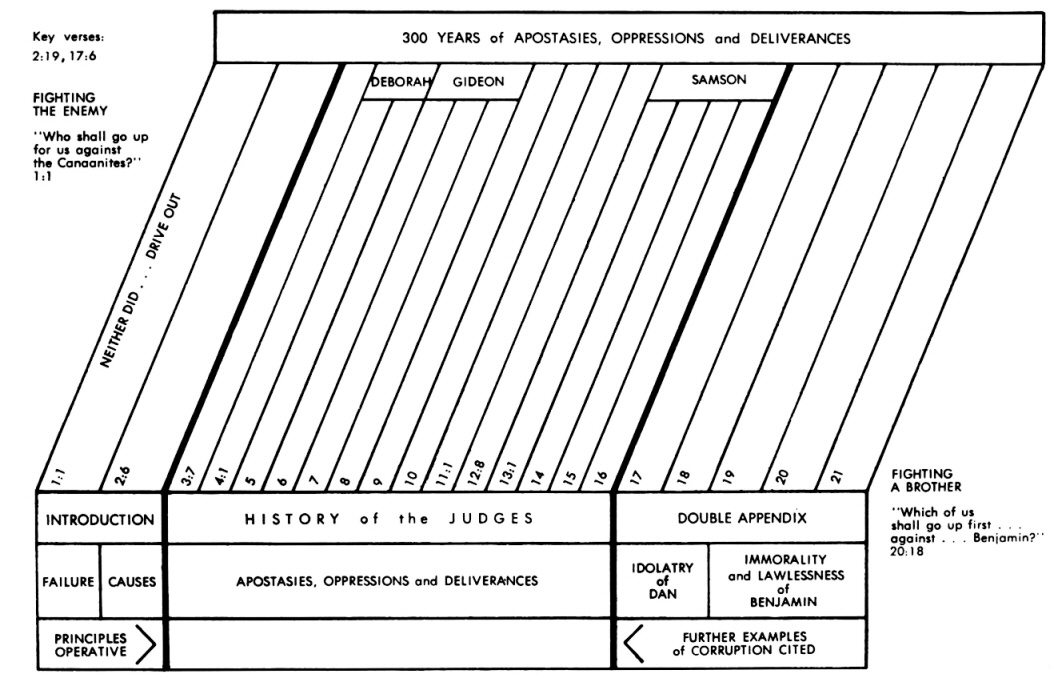
Chart from recommended resource Jensen's Survey of the OT - used by permission
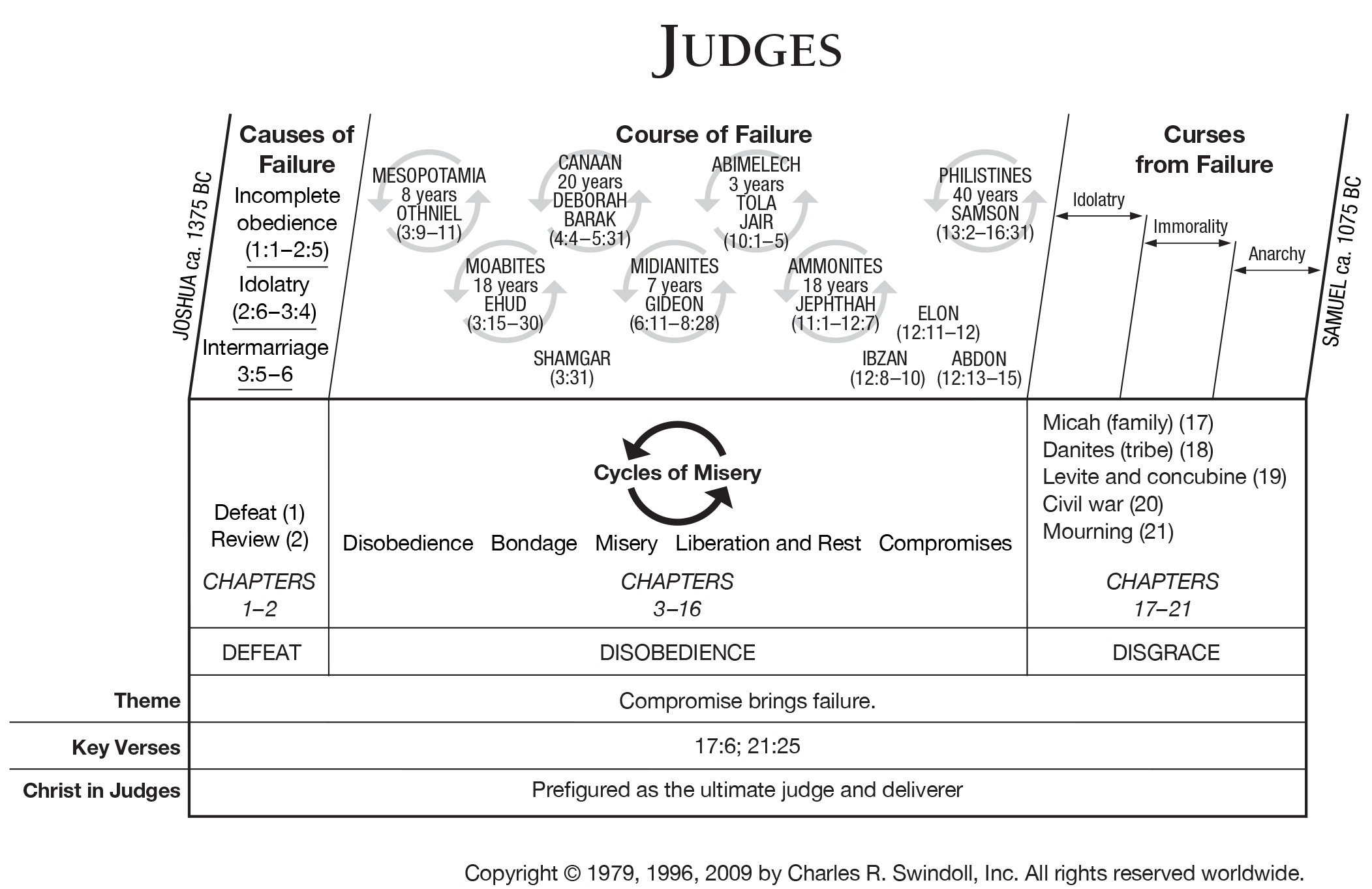
Chart on Judges - Charles Swindoll
|
RECYCLING SIN |
|||||
| Jdg 1:1-3:6 | Jdg 3:7-16:31 | Jdg 17:1-21:25 | |||
| Introduction | History of the Judges | Appendix | |||
| Causes of the Cycles THE REASON |
Curse of the Cycles THE RECORD |
Conditions in the Cycles THE RESULTS |
|||
| Failure to Complete Conquest Jdg 1:1-36 God's Judgment for Failure Jdg 2:1-3:6 |
Curse of the Cycles |
Conditions in the Cycles |
|||
| Living with Canaanites |
War with the Canaanites |
Living Like the Canaanites |
|||
| Religious Laxity |
Political Uncertainty |
Moral Anarchy |
|||
| About 350 Years of Israel's History - Almost 25%! From Compromise to Confusion! |
|||||

Another Timeline of Israel's History
Click to Enlarge
from Jensen's Survey of the OT
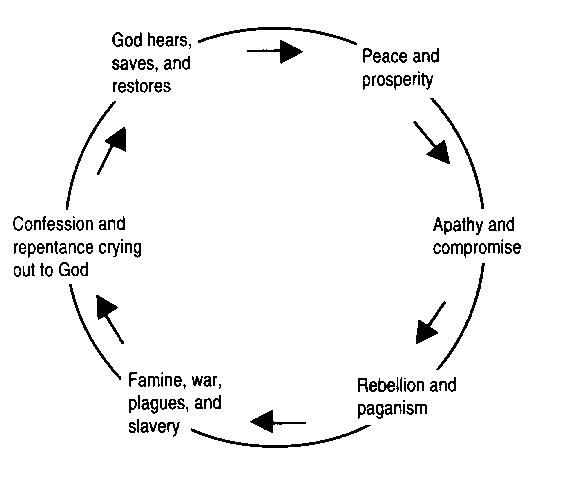
Click to Enlarge
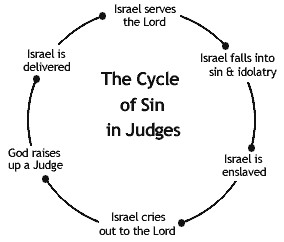
Other ways to describe Israel's cycle…
- Rest > Rebellion > Retribution > Repentance (?) > Restoration
- Sin > Suffering/Servitude > Supplication > Salvation
- Apathy > Apostasy > Affliction > Answered Prayer
- Disobedience > Desperation > Deliverance
- Disobedience > Bondage >Misery > Liberation and Rest > Compromises
Hannah's Bible Outline
Parenthesis: the tyranny of Abimelech (Jdg 8:33-Jdg 9:57)
- Israel's idolatry (Jdg 8:33-35)
- Shechem's submission to Abimelech (Jdg 9:1-57)
- Abimelech's treachery to become king (Jdg 9:1-6)
- Jothan's speech (Jdg 9:7-21)
- The parable (Jdg 9:7-15)
- The application (Jdg 9:16-21)
- Shechem's treachery toward Abimelech (Jdg 9:22-25)
- Gaal's aborted rebellion (Jdg 9:26-41)
- Abimelech's capture of Shechem (Jdg 9:42-49)
- Abimelech's death at Thebez (Jdg 9:50-57)
3. Tola (Jdg 10:1–2)
4. Jair (Jdg 10:3–5)
5. Jephthah (Jdg 10:6–12:7)
1. Israel’s sin (Jdg 10:6)
2. Israel’s servitude (Jdg 10:7–9)
3. Israel’s supplication (Jdg 10:10–16)
4. Israel’s deliverance (Jdg 10:17–12:7)
1. The preparations for battle (Jdg 10:17–11:28)
1. The armies gathered (Jdg 10:17–18)
2. The leader secured (Jdg 11:1–11)
1. His background (Jdg 11:1–3)
2. His covenant (Jdg 11:4–11)
3. The messages to Ammon (Jdg 11:12–28)
2. The vow and victory in battle (Jdg 11:29–40)
1. The vow made (Jdg 11:29–31)
2. The victory secured (Jdg 11:32–33)
3. The vow observed (Jdg 11:34–40)
3. The strife with Ephraim (Jdg 12:1–6)
1. Ephraim’s jealousy (Jdg 12:1–3)
2. Ephraim’s defeat (Jdg 12:4–6)
4. The death of Jephthah (Jdg 12:7)
6. Ibzan (Judges 12:8–10)
7. Elon (Judges 12:11–12)
8. Abdon (Judges 12:13–15)
Paul Apple (Judges 10:6-12:15) Cycle # 5 – Deliverance from Philistines and Ammonites Jephthah (Judge #8)
God can use a man who is rejected by the world but appropriates His grace
1. Judges 10:6-11:28 Rise of Jephthah – From Despised Reject to Desired Recruit --
Don’t Underestimate the Love of God in Remaining Faithful to His People Despite Their Repeated Apostasies . . . And Don’t Underestimate the Grace of God in Transforming Human Outcasts Into Conquering Heroes
2. Judges 11:29-40 Jephthah’s Tragic Vow – Don’t Bargain With God –
Commitments Made to the Lord Must Be Kept Regardless of the Cost
3. Judges 12:1-7 Jephthah’s Legacy -- Internal Conflict Tears Apart the People of God –
Inflated Egos and a Harsh Spirit Erupt in Tragic Conflict for the People of God
Remember what was prophesied of the Lord Jesus Christ: “the stone which the builders rejected has become the chief cornerstone.” (1 Peter 2:7-8; Ps. 118:22 – “This is the Lord’s doing; it is marvelous in our eyes.” Acts 4:11-12) All of the judges point to the ultimate Deliverer in some form or fashion. Today we are going to be amazed at the love of God for His people and the grace of God to make leaders out of cast off rubble. Whatever our past may have been, by the providence of God it can be used to shape us and mold us for great usefulness to the Lord in the future.
FOLLOWING NOTES ARE COMPLETELY REVISED SPRING, 2022
Judges 10:1 Now after Abimelech died, Tola the son of Puah, the son of Dodo, a man of Issachar, arose to save Israel; and he lived in Shamir in the hill country of Ephraim.
- arose - Jdg 2:16 3:9
- Shamir - Jos 15:48
- Judges 10 Resources
Related Passage:
Nehemiah 9:27 “Therefore You delivered them into the hand of their oppressors who oppressed them, But when they cried to You in the time of their distress, You heard from heaven, and according to Your great compassion You gave them deliverers (yasha'; Lxx - soter = agent of deliverance, savior, rescuer) who delivered (yasha'; Lxx - sozo - rescue, heal) them from the hand of their oppressors.
OUTLINE OF JUDGES 10
Sin Restrained - Judges 10:1-5
Sin Resurgent - Judges 10:6-9
Sin Rebuked - Judges 10:10-14
Sin Rejected - Judges 10:15-18
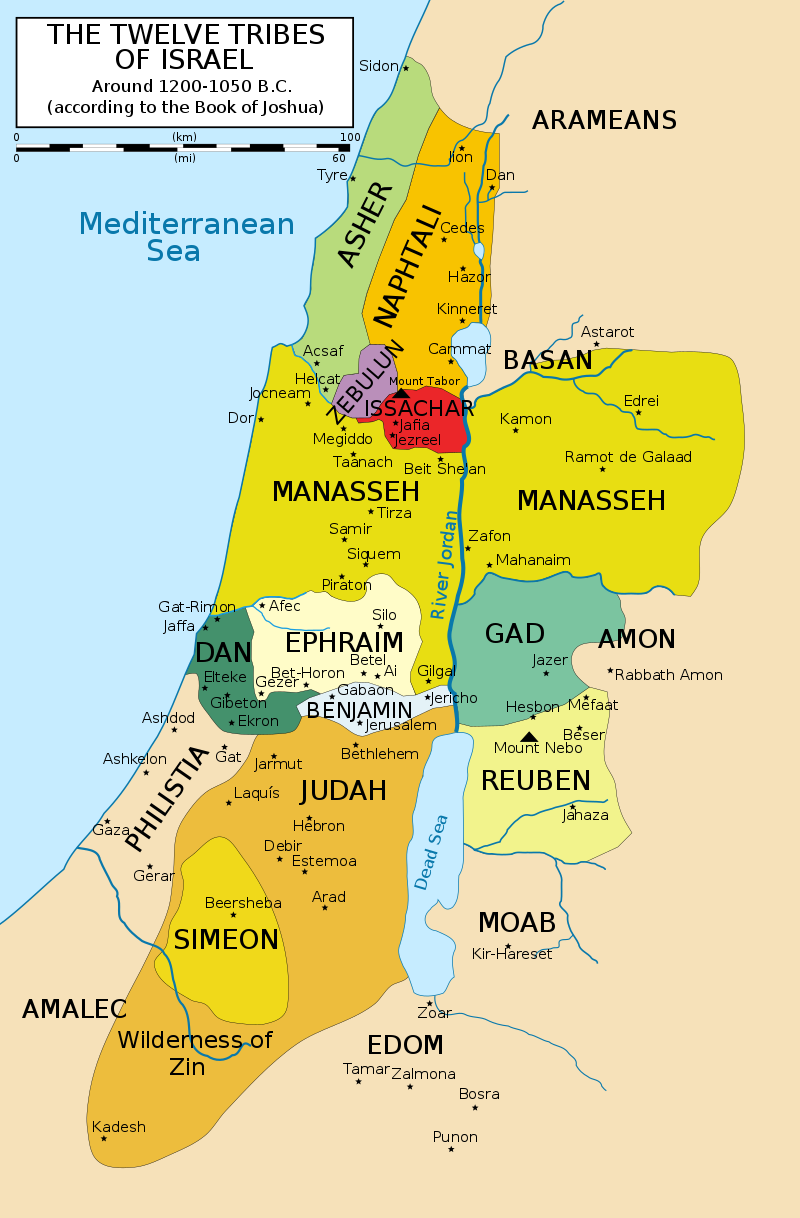
Note the locations of Issachar and Ephraim
TOLA RAISED UP
TO SAVE
Tola is the second of the so-called "minor judges," the others being Shamgar (Jdg 3:31), Jair (Jdg 10:3-5), Ibzan, Elon and Abdon (Jdg 12:8-15). It is notable that these next two minor judges judged Israel for a total of 45 years, but little is known about their judgeships.
Now after Abimelech died, Tola the son of Puah, the son of Dodo, a man of Issachar, arose to save (yasha'; Lxx - sozo - rescue, heal) Israel; and he lived in Shamir in the hill country of Ephraim - Tola is the only judge whose ancestral information extends three generations. The literal order of the Hebrew is "And he rose up after Abimelech to save Israel Tola the son of Puah..." After Abimelech's atrocious, abominable "reign" Israel clearly needed a "savior!" This time the oppression was not so much from without but from within (or at least there is no record of external oppression and this is none for the other so-called "minor judges" Jdg 12:8-15.) Commentators think that the function of these judges was more to handle administrative and judicial matters than it was to fight wars. Tola was the sixth judge and was similar to Shamgar in that little information is recorded. Tola arose as we read previously of Deborath - "The peasantry ceased, they ceased in Israel, Until I, Deborah, arose, Until I arose, a mother in Israel." (Jdg 5:7) (See map above for location of lands of Issachar and Ephraim, the latter being much more centrally located.)
The use of the verb save (yasha'; Lxx - sozo - rescue, heal) is unusual as it suggests one needs to be rescued from some distress, trial, affliction, etc. Given the fact that under Abimelech, there was clearly spiritual decay, it is certainly reasonable to see Tola as saving Israel from Abimelech's abominable influence (and even the residual influence of Gideon in his latter days when his making of an ephod led to overt idol worship - read Jdg 8:29-35+)
The location of Shamir (means thorn, flint) is not known but some writers have connected it with Samaria (because of Hebrew = shimron). This location is questionable because Samaria was in the tribal portion of Manasseh, not Ephraim.
Boling makes a good point related to why save is used noting that "in contrast with Abimelech's effort and short-lived success as king, what Israel needed was good administration, which Tola provided." (Borrow Judges The Anchor Bible)
Note that Tola is functioning as a judge residing in Ephraim outside of his tribe of birth (Issachar) an observation that suggests he served as judge over a much wider area (? all of Israel since he was centrally located).
Tola means - red/purple worm and some parents when they first see their newborn, might think that would be a good name. See discussion below of the fascinating related Hebrew word tola which also refers to a Savior, the Messiah, in Psalm 22:6. Without going to far from the meaning of Judges 10:1, it is fascinating that the Greek word used to translate arose (Heb - qum) is anistemi which is used in the NT to describe the Messiah being raised up from the dead (Acts 2:24+, Acts 13:34+, Jn 6:39), conquering our enemies, sin, Satan and death, and providing salvation to all who believe in Him. Is Tola a foreshadowing of the Messiah? I leave that as an open ended question, but the parallels are intriguing. For more discussion see Psalm 22:6-I Am a Worm.
Pulpit Commentary - Nothing more is known of Tola than what is here told us, viz., his name, his parentage, his dwelling-place, his office, the length of time which he held it, and the place of his burial. Who were the enemies from whom Tola was raised up to save Israel we are not told. There was probably no great invasion or grievous servitude, but perhaps frequent border wars requiring an able and watchful chief to maintain the independence of Israel. Tola and Puah (otherwise written Puvah) were both names of families in Issachar (Genesis 46:13; Numbers 26:23). Shamir in the hill country of Ephraim, to distinguish it from Shamir in the hill country of Judah (Joshua 15:48). Both are otherwise unknown
George Bush on arose to save (Heb. יקם להושיע yâkom lehōshia) is literally arose to save or deliver. To sustain the office and act the part of a savior or deliverer, in case it should be necessary. They were now freed from the tyranny of Abimelech, and as far as appears enjoyed prevailing peace, yet they were still liable to annoyance and incursions from the neighboring powers, and it was fitting that they should have a head to preside over their concerns, repressing internal discords, maintaining union, guarding against idolatry, and prepared at all times to take the field in their defence.
Bush on the hill country of Ephraim - Though of the tribe of Issachar, yet when raised to the government, he came and dwelt in mount Ephraim, as being a more central station, one to which the people might more conveniently resort for judgment. (Judges 10 Commentary)
Fausset - after Abimelech who though an usurper of kingship, yet was son of Gideon, and de facto, though not de jure, judge. there arose at God’s call, to defend to save Israel from internal conspirators like Abimelech, or external foes like Midian, and above all from the apostasy and idolatry which had so often provoked God to send such executioners of His wrath against Israel. That Tola kept Israel from idols, appears from the fact that, when he and Jair were dead, Israel relapsed into idolatry. Tola the son of Puah [both bore names the same as the original founders of families in Issachar (Gen. 46:13; Nu 26:23) the son of Dodo [not “his uncle” as the Septuagint translate it; but a proper name (2Sa. 23:9; 1Chr. 11:12] Tola resided in Ephraim, rather than in his own tribe Issachar, as being a more convenient centre of government. (Judges 10 Commentary)
Tola (08439)(Tola from Tola 08438 ) occurs 5x in 5v - Gen. 46:13; Num. 26:23; Jdg. 10:1; 1 Chr. 7:1; 1 Chr. 7:2. Gilbrant writes that "The name "Tola" means "worm" but was probably not derogatory. The word is identical to HED #8768, which refers to the "dark red dye" made from the female cochineal insect. This colorant was used on the yarn and fabric for the Tabernacle (Exo. 25:4; 26:1, 31, 36; 27:16; 35:6), as well as for the priestly garments (28:8, 15, 33; cf. HED #8772). Toah's brother Puah (HED #6554) was also named for a type of red dye.
The name was used by two people in the Bible. The first Tola was the oldest of Issachar's four sons (Gen. 46:13; Num. 26:23; 1 Chr. 7:1f). He was the head of a clan known as Tolaites. Tola had six sons who were ancestors of many fighting men during the reign of King David (v. 2). The other Tola of the Bible was one of Israel's judges (Judg. 10:1f). He was a later descendant of Issachar and was the son of Puah, the son of Dodo. He resided in the Ephraimite city of Shamir, which may have been located not far from Samaria. From this city, he led Israel for twenty-three years. The Bible says that Tola "delivered" (yāshaʿ, HED #3588) Israel after the violent and relatively short reign of Abimelech (ch. 9). No specific battle of Tola is mentioned, so the reference may be to a time of peace and stability over which Tola presided following the death of Abimelech.
The name "Puah" is mentioned once as a brother of Tola and once as a father to Tola. Some question the historical accuracy of these genealogical relationships, but it is entirely possible that both were common names in the tribe of Issachar.
TOLA [ISBE] - to'-la (tola`, "worm" or "scarlet stuff"):
(1) One of the four sons of Issachar (Gen 46:13; 1 Ch 7:1), mentioned among those who journeyed to Egypt with Jacob (Gen 46:8 f), and in the census taken by Moses and Eleazar, as father of the Tolaites (Nu 26:23) whose descendants in the reign of David included 22,600 "mighty men of valor" (1 Ch 7:2).
(2) One of the Judges, the son of Puah, a man of Isaachar. He dwelt in the hill country of Ephraim in the village of Shamir, where after judging Israel 23 years he was buried (Jdg 10:1,2). In the order of succession he is placed between Abimelech and Jair. It is interesting to note that both Tola and Puah are names of colors, and that they occur together both in the case of the judge and in that of the sons of Isaachar. They may therefore be looked upon as popular typical or ancestral names of the Issachar tribe, although current critical theories seek an explanation in a confusion of texts. - Ella Davis Isaacs
Tola (08438) is related to the proper name of this judge Tola (08439) in Judges 10:1, which several sources say means worm or scarlet or purple. This word Tola was the name for a worm in Hebrew. This particular worm was used in the making of red dye, and so it’s often translated "scarlet". The tola' would attach itself to a tree as it prepared to lay its eggs, and in the process, the mother would die, leaving a red stain on the wood. Later, after the babies would hatch and leave, the red stain would dry up, turn white, and flake off the wood. In Psalm 22:6, an indisputably Messianic psalm, the Messiah cries out, "I am a worm" (tola’). The picture our humble Messiah presents parallels the worm's life cycle, for Jesus died on a cross of wood in the process of giving birth to us, leaving a bloody stain that turns our sins from scarlet to white as snow! This is surely amazing, utterly incomprehensible grace and love in action! O come let us adore Him!
Save (03467) yasha' (See also yeshua from which we get our word "Jesus") is an important Hebrew verb which means to help, to save, to deliver. The root in Arabic is "make wide" which underscores the main thought of yasha' as to bring to a place of safety or broad pasture in contrast to a narrow strait which symbolizes distress or danger. TWOT adds that the concept of "wide" "connotes freedom from distress and the ability to pursue one’s own objectives. To move from distress to safety requires deliverance. Generally the deliverance must come from somewhere outside the party oppressed. In the OT the kinds of distress, both national and individual, include enemies, natural catastrophes, such as plague or famine, and sickness. The one who brings deliverance is known as the “savior.” (THINK OF GIDEON IN THE PRESENT PASSAGE). It is notable that almost 20% of the uses of yasha' are found during the dark days of Judges (dominated by the heart attitude of Jdg 21:25), which surely speaks of the undeserved mercy of God!
Yasha' in Judges - Jdg. 2:16; Jdg. 2:18; Jdg. 3:9; Jdg. 3:15; Jdg. 3:31; Jdg. 6:14; Jdg. 6:15; Jdg. 6:31; Jdg. 6:36; Jdg. 6:37; Jdg. 7:2; Jdg. 7:7; Jdg. 8:22; Jdg. 10:1; Jdg. 10:12; Jdg. 10:13; Jdg. 10:14; Jdg. 12:2; Jdg. 12:3; Jdg. 13:5
Keith Krell - “God’s Honorable Mentions” (Judges 10:1-5; 12:8-15) The judgeship of Jephthah (Judges 10:6–12:7) is framed by a brief mention of the five so-called “minor judges” (10:1–5; 12:8–15). For several reasons, their role in ancient Israel seems to have differed from the other judges:
1. Each is mentioned only briefly in a notation containing primarily genealogical information.
2. Missing is any indication that they led Israel in battle against a foreign enemy.
3. The length of time which each served is given in an exact number of years rather than as a round number.
The ministries of these minor judges teach two lessons, one negative and the other positive. Negatively they did not change any of the previous problems in Israel but seem to have maintained the status quo. The fact that several of the judges fathered extremely large families points to their living like the eastern kings of their day. This is further evidence that Canaanite culture was influencing the Israelites adversely. Positively these accounts indicate God’s gracious blessing of His apostate people despite themselves. McCann writes, “Elsewhere in the Old Testament, children are gifts from God [Ps 127:3]; they indicate God’s blessing. So amid the increasing chaotic and violent stories that indicate the Israelites are abandoning God, the two lists of minor judges suggest that God is not abandoning the Israelites (see Judges 2:1, where God says, ‘I will never break my covenant with you.’).”2 Furthermore, for forty–five years, the people of Israel enjoyed peace and security, thanks to the leadership of Tola and Jair. This fact suggests that God is working behind the scenes in and through the family and political institutions to promote stability and prosperity. (Sermon)
QUESTION - Who were Tola, Jair, Ibzan, Elon, and Abdon?
ANSWER - Tola, Jair, Ibzan, Elon, and Abdon were each judges who led Israel and are mentioned in Judges 10—12. They are sometimes considered “minor judges,” since their accounts are shorter than some of the other judges’ (such as Gideon or Samson), yet each of their accounts includes important information and lessons for the book’s original readers and for readers today.
Tola: Judges 10:1–2 records, “After the time of Abimelek, a man of Issachar named Tola son of Puah, the son of Dodo, rose to save Israel. He lived in Shamir, in the hill country of Ephraim. He led Israel twenty-three years; then he died, and was buried in Shamir.” Tola the judge is not to be confused with the Tola mentioned in Genesis 46:13 and elsewhere in biblical genealogies.
Jair: This judge is described in Judges 10:3–5: “[Tola] was followed by Jair of Gilead, who led Israel twenty-two years. He had thirty sons, who rode thirty donkeys. They controlled thirty towns in Gilead, which to this day are called Havvoth Jair. When Jair died, he was buried in Kamon.” Jair’s numerous sons, donkeys, and cities are mentioned to emphasize his influence and wealth as leader of Israel during this time.
Ibzan: Judges 12:8–10 notes, “After [Jephthah], Ibzan of Bethlehem led Israel. He had thirty sons and thirty daughters. He gave his daughters away in marriage to those outside his clan, and for his sons he brought in thirty young women as wives from outside his clan. Ibzan led Israel seven years. Then Ibzan died and was buried in Bethlehem.” Though Ibzan was born and died in the same town, his 60 children gave him tremendous influence. His sons married women from outside his clan, and his daughters were given to men outside his clan. This would have created many alliances with other Israelites and would have extended his influence as a leader.
Elon: We read in Judges 12:11–12 that, “After [Ibzan], Elon the Zebulunite led Israel ten years. Then Elon died and was buried in Aijalon in the land of Zebulun.” Little is known of this leader, yet his tribe, length of leadership, and death are each meticulously recorded.
Abdon: Judges 12:13–15 reveals, “After [Elon], Abdon son of Hillel, from Pirathon, led Israel. He had forty sons and thirty grandsons, who rode on seventy donkeys. He led Israel eight years. Then Abdon son of Hillel died and was buried at Pirathon in Ephraim, in the hill country of the Amalekites.” A man of much wealth and with a large family, Abdon, from the tribe of Ephraim, would have been well-known in his time.
Each judge was called by God to rescue the Israelites at a specific time and for a specific purpose. Still today, God uses His people in specific places and times to accomplish His plans in ways that help many.GotQuestions.or
Judges 10:2 And he judged Israel twenty-three years. Then he died and was buried in Shamir.
JUDGE FOR
23 YEARS
And he judged (shaphat; Lxx - krino) Israel twenty-three years. Then he died and was buried in Shamir - It is interesting that it does not say the land was undisturbed while he judged. It is probable that it was, but surprising it is not recorded as with the previous judges. The other difference is there is no statement that THEN (when the judge died) Israel did evil again in the sight of the LORD.
A R Fausset - he judged the northern and eastern tribes; not the southern tribes, Judah, Benjamin, and Simeon, which had no share in Gideon’s victory, and had not come under Abimelech’s usurpation (Judges 10 Commentary)
Judged (08199) shaphat is a verb that means to judge or govern. While it frequently translated judge, this is somewhat misleading as shaphat is not typical of the modern concept of judge (as in a court of law), but is much more inclusive -- to function as ruler or governor - individuals (Jdg. 16:31; 1 Sa 7:16), king (1 Ki. 3:9); even God Himself (Ps. 50:6; 75:7) because He is the source of authority and will eventually conduct all judgments (Ps. 96:13). In a judicial sense shaphat could refer to the arbitration of civil, domestic, and religious disputes (Dt. 25:1), fulfilled by the congregation (Nu 35:24), by individual judges (Ex 18:16; Dt. 1:16), by the king (1 Sa 8:5, 6, 20) or by God Himself (Ge 16:5; 1 Sa 24:12, 15). The Septuagint (LXX) uses the Greek krites = Judges or krino meaning to judge.
Uses of shaphat in Judges - Jdg. 2:16; Jdg. 2:17; Jdg. 2:18; Jdg. 2:19; Jdg. 3:10; Jdg. 4:4; Jdg. 10:2; Jdg. 10:3; Jdg. 11:27; Jdg. 12:7; Jdg. 12:8; Jdg. 12:9; Jdg. 12:11; Jdg. 12:13; Jdg. 12:14; Jdg. 15:20; Jdg. 16:31
Judges 10:3 And after him, Jair the Gileadite arose, and judged Israel twenty-two years.
- Gileadite: Ge 31:48 Nu 32:29
- Judges 10 Resources
JAIR THE
GILEADITE
And after him, Jair the Gileadite arose, and judged (shaphat; Lxx - krino) Israel twenty-two years = - This judge was from the tribe of Manasseh as we deduce from Numbers 26:29 which says "The sons of Manasseh: of Machir, the family of the Machirites; and Machir became the father of Gilead: of Gilead, the family of the Gileadites."
A R Fausset - This Jair is not the same as Jair the Manassite, who in the time of Moses gave the name Havoth-Jair to the towns of Bashan which he had conquered (Nu 32:41). The earlier Jair took Argob or Trachonitis, the Lejah, and called from his own name certain villages or groups of dwellings, twenty-three in number originally, which afterwards the sons of the judge Jair increased to thirty; they probably also fortified and enlarged the towns. Havoth means ‘dwelling-places,’ from Havah, “life,” as the German Leben, ‘life,’ is a termination of many names of towns; so Eisleben. The total number of such villages of Jair in Argob was sixty, of which thirty-seven were conquered by Nobah (a family of sons of Machir related to Jair) and twenty-three by Jair (Josh. 13:30; 1 Kings 4:13; 1 Chron. 2:22, 23). As Nobah was of a subordinate branch of the Jair family, Moses comprehends the whole sixty under Jair’s name, Havoth-Jair. Og’s sixty fenced cities, Moses observes as a marvellous monument of God’s grace to Israel, are become even “unto this day” (the day when he wrote) ‘Havoth-Jair,’ the dwellings of Jair (Deut. 3:14)], and judged Israel twenty and two years. (Judges 10 Commentary)
Gilead [EBD] hill of testimony, (Gen. 31:21), a mountainous region east of Jordan. From its mountainous character it is called "the mount of Gilead" (Gen. 31:25). It is called also "the land of Gilead" (Num. 32:1), and sometimes simply "Gilead" (Ps. 60:7; Gen. 37:25). It comprised the possessions of the tribes of Gad and Reuben and the south part of Manasseh (Deut. 3:13; Num. 32:40). It was bounded on the north by Bashan, and on the south by Moab and Ammon (Gen. 31:21; Deut. 3:12-17). "Half Gilead" was possessed by Sihon, and the other half, separated from it by the river Jabbok, by Og, king of Bashan. The deep ravine of the river Hieromax (the modern Sheriat el-Mandhur) separated Bashan from Gilead, which was about 60 miles in length and 20 in breadth, extending from near the south end of the Lake of Gennesaret to the north end of the Dead Sea. Abarim, Pisgah, Nebo, and Peor are its mountains mentioned in Scripture.
Judges 10:4 And he had thirty sons who rode on thirty donkeys, and they had thirty cities in the land of Gilead that are called Havvoth-jair to this day.
- rode on thirty donkeys: Jdg 5:10 12:14
- called Havvoth-jair : Nu 32:41 Dt 3:14
- Judges 10 Resources
A WEALTHY
FAMILY
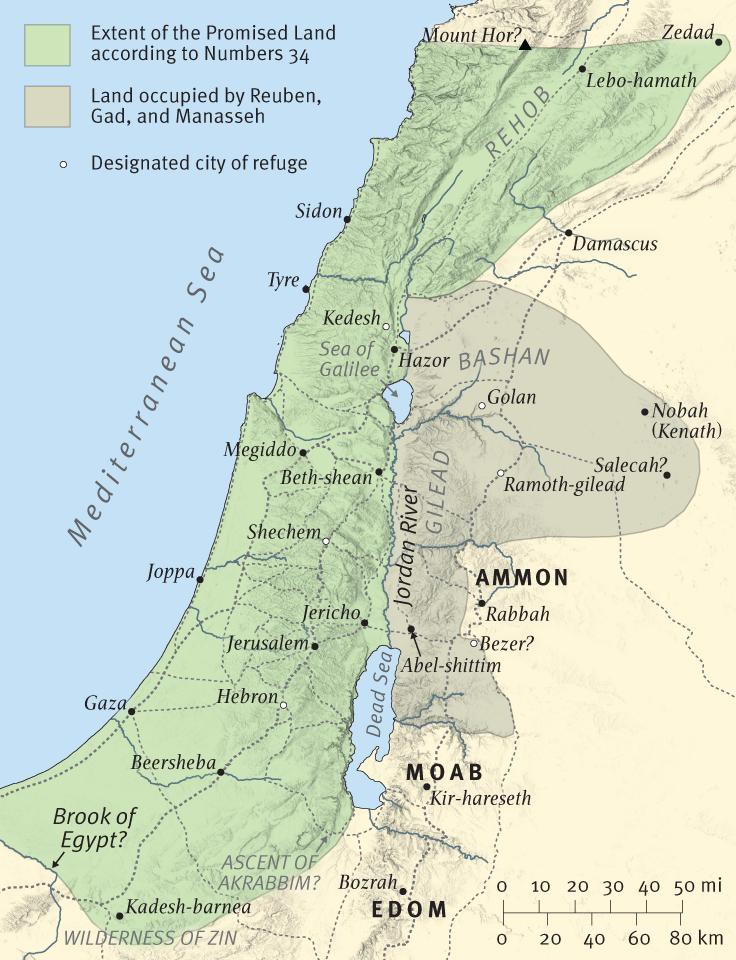
And he had thirty sons who rode on thirty donkeys (dictionary), and they had thirty cities in the land of Gilead that are called Havvoth-jair to this day - Very large families suggests a marriage to several wives, a part of life tolerated but never ordained or approved in God’s blueprint of one man and one woman for life (Ge 2:24). Click this map and note Gilead is just east of the Jordan River. Note that each of Jair's sons had a Gileadite village that bore the name of Jair, which sounds a bit arrogant or egotistical!
THOUGHT- As we have seen with Gideon, God did not use sinless people (there is only One, Christ Jesus), but He used sinners to accomplish His work on earth! The point is do not say God cannot use you because you are a sinner, for God used a man named Paul who called himself the "chief of sinners." The question is not whether God can use you because He can. The real question is do you desire to be used for His kingdom work? What say you brother or sister? When you stand at the Bema seat will you hear "Well done, my faithful (not sinless) servant?" (Mt 25:21, 23, Lk 19:17)
THOUGHT - Many sons is not only evidence of great prosperity but also great depravity because polygamy is a sin and was never God's plan for marriage (cf Ge 2:24). Sin is deceitful (Heb 3:13+) and slowly seeps into one's life unless diligently guarded against! As wealth and prestige increased in the ancient world, so did one's harem (the fallen flesh is never satisfied! Only Jesus satisfies!). Gideon had 70 sons, because he had many wives (Jdg 8:30+) and a concubine a sin that caused the death of his true sons and the death of many other people at the hands of Abimelech! The wages of sin are death and sin is the horrible gift that just keeps on giving! Do not be deceived beloved brethren! King Ahab also had seventy sons (2Ki 10:1), and some of Gideon's successors had many sons - Jair had thirty (Jdg 10:4+), Ibzan had thirty (Jdg 12:9+) and Abdon had forty (Jdg 12:14+).
Guzik - This shows that Jair was a polygamous man, and a man of wealth and prestige. His many sons had fancy transportation and their own territory to rule. Jair never took the title of king but it seems that he acted like one.
Lindsay - The "tent villages of Jair" (Havvoth Jair) were a group of towns in Bashan named by an earlier Jair (Num. 32:39-42; Deut. 3:14) which were relatively permanent since they were still there in the days of the author of the Book of Judges. (See context The Bible Knowledge Commentary: Old Testament)
A R Fausset - The Oriental donkey is a superior animal. Israel had not yet imported horses. Moreover, the donkey was used in times of peace; horses for war (see Jdg 5:10, Jdg 12:14; 1Ki 10:28, 1:33; Zech. 9:9], and they had thirty cities which are called Havoth-Jair unto this day, which (are) in the land of Gilead [villages are cities to a contented mind (Henry)]. (Judges 10 Commentary)
George Bush on Thirty sons that rode on thirty donkeys, &c. describes "a very remarkable indication of eastern manners, and of the state of the times. It seems that the people so generally went about on foot, that to ride on an donkey, that is, to ride at all, was considered a mark of wealth and distinction. So we afterwards read of Abdon, another judge, ch. 12:14, that ‘he had forty sons and thirty nephews, that rode on threescore and ten ass colts.’ No doubt this conveyed to the ancient Hebrews the idea of as much consideration as it does among us to say, that a person keeps a carriage. Josephus, perhaps from thinking the indication undignified, changes the asses to horses.
Thirty cities—called Havoth-jair unto this day. Heb. ‘villages of Jair.’ We read in Nu 32:41, that ‘Jair the son of Manasseh went and took the small towns thereof, and called them Havoth-jair,’ from which some have supposed that the Jair there mentioned is the same person with the judge spoken of in the passage before us. But the former was doubtless the ancestor of the latter, though the names of the villages in question were retained unaltered from the original possessor. Their number, as we learn from 1Chr 2:22, was at first only twenty-three, but the remaining seven were added in process of time. The circumstance affords evidence of the rank and opulence of the family. (Judges 10 Commentary)
HAVVOTH-JAIR [ISBE] - hav-oth-ja'-ir (chawwoth ya'ir "the encampments" or "tent villages of Jair"; the King James Version Havoth-Jair, ha-voth-ja'ir): The word chawwoth occurs only in this combination (Nu 32:41; Dt 3:14; Jdg 10:4), and is a legacy from the nomadic stage of Hebrew life. Jair had thirty sons who possessed thirty "cities," and these are identified with Havvoth-jair in Jdg 10:3 ff. The district was in Gilead (10:5; Nu 32:41). In Dt 3:13 f, it is identified with Bashan and Argob; but in 1 Ki 4:13, "the towns of Jair" are said to be in Gilead; while to him also "pertained the region of Argob, which is in Bashan, threescore great cities with walls and brazen bars." There is evident confusion here. If we follow Jdg 10:3 ff, we may find a useful clue in 10:5. Kamon is named as the burial place of Jair. This probably corresponds to Kamun taken by Antiochus III, on his march from Pella to Gephrun (Polyb. v.70, 12). Schumacher (Northern `Ajlun, 137) found two places to the West of Irbid with the names Qamm and Qumeim (the latter a diminutive of the former) with ancient ruins. Qamm probably represents the Hebrew Qamon, so that Havvoth-jair should most likely be sought in this district, i.e. in North Gilead, between the Jordan Valley and Jebel ez-Zumleh. W. Ewing
Judges 10:5 And Jair died and was buried in Kamon.
And Jair died and was buried in Kamon - Once again we note no mention or rest, but in light of the statement in Judges 10:6 it is very likely that the land was undisturbed.
John MacArthur has a note that "Most likely, the judgeship of Jair was the time period of Ruth." (See MacArthur Study Bible) I am not sure why he makes that statement.
Godly men in positions of responsibility, within our communities, can have a real and positive influence for good and in restraining evil. It is right that through the mechanisms of a democratic society godly men and women should seek to influence popular thinking and legislative decision making to bring our society more in line with Scripture. But these measures will be only limited and temporary, unless the hearts of the people are changed by the gospel of Jesus Christ. Otherwise, once the restraint is removed, as when the Christians of influence are voted out or die, the old downhill movement will soon take over again. Nothing short of a work of God’s Spirit in the hearts and lives of thousands of “ordinary people” can turn the juggernaut of our increasingly godless Western materialism back from the slippery slope of collapse and disintegration. While we are right to pray and work to restrain sin and to enact Christian legislation to prevent the corruption of our society and the upholding of God’s moral absolutes, we shall never change the hearts of people that way. Law can restrain, for a while, but only the gospel can liberate. It is noteworthy that the great social reforms of the nineteenth century, such as the abolition of slavery, followed spiritual revivals in the late eighteenth century catalyzed by George Whitefield and John Wesley, men who God raised up to proclaim His truth in power. When the hearts of men and women were changed in large numbers, the laws of the society were also soon follow. Only a similar movement of God's Spirit in our day will save America from the deadly decay of moral decline and depravity which ultimately will destroy a nation founded as "one nation under God"! Pray for revival and anointed empowered revivalists like Wesley and Whitefield to be raised up by God. There is simply no other hope. American Christians must cry out, confess and repent and perhaps God will no longer be able to bear our misery (v16).
Judges 10:6 Then the sons of Israel again did evil in the sight of the LORD, served the Baals and the Ashtaroth, the gods of Aram, the gods of Sidon, the gods of Moab, the gods of the sons of Ammon, and the gods of the Philistines; thus they forsook the LORD and did not serve Him.
- did evil - Jdg 4:1 6:1 13:1
- Baal (ba'al) - Jdg 2:11-14 3:7 2Ch 28:23 Ps 106:36
- the gods of Sidon - 1Ki 11:5,7,33 16:31 2Ki 17:16,29-31 23:13
- the gods of the Philistines - Jdg 16:23 1Sa 5:2 2Ki 1:2,3 Jer 2:13 Eze 16:25,26
- Judges 10 Resources
Related Passages:
1 Kings 11:5-7 For Solomon went after Ashtoreth the goddess of the Sidonians and after Milcom (MOLOCH) the detestable idol of the Ammonites. 6 Solomon did what was evil in the sight of the LORD, and did not follow the LORD fully, as David his father had done. 7 Then Solomon built a high place for Chemosh the detestable idol of Moab, on the mountain which is east of Jerusalem, and for Molech the detestable idol of the sons of Ammon.
SEVENFOLD IDOLATRY!
This vitally important verse is like a broken record describing a broken people in Judges, but unfortunately not a contrite, repentant people. Note the fact that the evil is described after the judge died, it would be fair to deduce that the people suppressed their evil to some degree while Jair was alive. Just a thought to ponder. It is also notable that these pagan nations complete encircled Israel! Note also there were seven idolatrous gods and seven pagan nations (Jdg 10:11-12).
THOUGHT - Seven is the number of completeness or perfection, but in this case was not for good but for evil God allowed to be meted out on His chosen people! Watch out! God does not play favorites when we begin to wantonly sin! Be careful when you begin to backslide as you might just end up in a "seven fold" affliction like Israel! (See What is the biblical significance of the number seven/7? | GotQuestions.org)
Then - When? When Jair the judge died. Sounds like the "same song, next verse!"
The sons of Israel again (yasaph) did evil in the sight of the LORD - More literally "they added to their evil!" After forty-five years of comparative quiet (we assume that was true) Israel again apostatized, and in “process of time the children of Ammon made war against Israel”
Sons of Israel in the book of Judges - Jdg. 1:1; Jdg. 2:4; Jdg. 2:6; Jdg. 2:11; Jdg. 3:2; Jdg. 3:5; Jdg. 3:7; Jdg. 3:8; Jdg. 3:9; Jdg. 3:12; Jdg. 3:14; Jdg. 3:15; Jdg. 3:27; Jdg. 4:1; Jdg. 4:3; Jdg. 4:5; Jdg. 4:23; Jdg. 4:24; Jdg. 6:1; Jdg. 6:2; Jdg. 6:6; Jdg. 6:7; Jdg. 6:8; Jdg. 8:28; Jdg. 8:33; Jdg. 8:34; Jdg. 10:6; Jdg. 10:8; Jdg. 10:10; Jdg. 10:11; Jdg. 10:15; Jdg. 10:17; Jdg. 11:27; Jdg. 11:33; Jdg. 13:1; Jdg. 19:12; Jdg. 19:30; Jdg. 20:1; Jdg. 20:3; Jdg. 20:7; Jdg. 20:13; Jdg. 20:14; Jdg. 20:18; Jdg. 20:19; Jdg. 20:23; Jdg. 20:24; Jdg. 20:25; Jdg. 20:26; Jdg. 20:27; Jdg. 20:30; Jdg. 20:32; Jdg. 20:35; Jdg. 21:5; Jdg. 21:6; Jdg. 21:18; Jdg. 21:24;
Again (yasaph) did evil in the sight of the LORD - Did evil is a repeated phrase in Judges - see notes Judges 2:11, 3:12, 4:1, 6:1, 10:6, Judges 13:1 The phrase did evil is common in is also common in 1 & 2 Kings (24 times), increasing in frequency in second Kings (see below). It is as if the closer they got to judgment, the more evil they became or the more certain the judgment had to be. Just a thought to ponder. Note it is also interesting that this phrase did evil is not found in 1 & 2 Samuel. Could it be that the reason is that the leaders were godly men like Samuel and David? Note also that the evil began with Baalim (plural) but progressed to the point documented in Judges 10:6!
Notice the phrase in the sight of the LORD - We all need to hear and heed this tragic warning (cf 1 Cor 10:6,11)! How strong is the power of sin to cause us to commit presumptuous sins knowing that they are being committed in full view of the Most Holy God! It is as if they were saying we don't really care if Your Holy eyes see us, because we are going to see to satisfy our fleshly desires (which can never be satiated!) Pr 15:3+ reiterates that "The eyes of the LORD are in every place, watching the evil and the good."
THOUGHT - Do not be deceived! Lord God "forgive us our debts, as we also have forgiven our debtors. And do not lead us into temptation, but deliver (rhuomai - rescue) us from evil (cf Ps 25:15)." (Mt 6:12-13+). In the sight of the LORD - Israel was Yahweh's "wife" -- so try to picture how horrible this was -- if you are married, just think of your spouse committing adultery in front of your very eyes! It's surprising that lightning bolts did not immediately strike the Israelites committing what we know were immoral abominations (too horrible to even mention!) I wonder what it would do to impede us from falling into that sin that so easily entangles us if we paused to ponder ourselves as the Bride of Christ, knowing that our omniscient, all seeing Bridegroom Christ Jesus is watching us
Did evil - 41x in 41v - Notice how this horrible refrain is not encountered until the book of Judges! It skips the time of David and Solomon, but after that occurs again and again in the sad saga of the kings of Israel. Jdg. 2:11; Jdg. 3:12; Jdg. 4:1; Jdg. 10:6; Jdg. 13:1; 1 Ki. 14:22; 1 Ki. 15:26; 1 Ki. 15:34; 1 Ki. 16:25; 1 Ki. 16:30; 1 Ki. 22:52; 2 Ki. 3:2; 2 Ki. 8:18; 2 Ki. 8:27; 2 Ki. 13:2; 2 Ki. 13:11; 2 Ki. 14:24; 2 Ki. 15:9; 2 Ki. 15:18; 2 Ki. 15:24; 2 Ki. 15:28; 2 Ki. 17:2; 2 Ki. 17:11; 2 Ki. 21:2; 2 Ki. 21:20; 2 Ki. 23:32; 2 Ki. 23:37; 2 Ki. 24:9; 2 Ki. 24:19; 2 Chr. 12:14; 2 Chr. 21:6; 2 Chr. 22:4; 2 Chr. 33:2; 2 Chr. 33:22; 2 Chr. 36:5; 2 Chr. 36:9; 2 Chr. 36:12; Neh. 9:28; Isa. 65:12; Isa. 66:4; Jer. 52:2
A R Fausset - And [after Jair’s death; for a good ruler restrains the evil] the children of Israel did evil again in the sight of the LORD [JEHOVAH (compare note, Jdg 2:11, 3:7, 4:1, 6:1), the often-recurring monotonous formula expressing Israel’s stupid obstinacy in so often going back to their old bad way, in spite of its often experienced fatal consequences, and daring to do so in the face of Jehovah, who had so often punished them], and served Baalim, and Ashtaroth [see Judges 2:11, 13], and the gods of Syria [Heb., Aram, divided into many tribes having their respective ‘gods,’ viz., Aram of Zobah, of Beth Rehob, of Damascus, of Ishtob, of Maacha, and of Mesopotamia, and probably of Hamath (2 Sam. 8:3, 5). These tribes were subsequently joined into one state. The Hebrew terms for one “using divination” (Quoseem), “a witch” (mekasheeph, Deut. 18:10), and “idolatrous priests” (Kemarim, 2 Kings 23:5), are of Syriac derivation], and the gods of Zidon [Baal and Ashtoreth], and the gods of Moab, and the gods of the children of Ammon [Milcom or Molech and Chemosh of Moab], and the gods of the Philistines [Dagon or Derceto. Seven idols are mentioned here as served by Israel, just as seven heathen nations are mentioned (Jdg 10:11, 12), out of whose hands Jehovah had delivered His people. Israel had repaid the sevenfold Divine deliverance with sevenfold idolatry. Their fullness of iniquity rivalled His fullness of grace. Seven is the number that seals God’s works as perfect, as creation was completed by the seventh day], and forsook the Lord, and served not Him [Jehovah’s worship cannot be combined with that of idols; so idolaters, beginning with the attempt at combination, soon give up even the semblance of worshipping Jehovah (Ezek. 20:39). The prosperity of heathen nations around them, their great numbers, and the absence in Jehovah’s worship of all gratifications to the carnal appetite, such as dancing, artistic performances, and scenes, all of which, even actual libertinism, were common in the worship of idols (Nu 25:1-3ff) bewitched Israel]. (Judges 10 Commentary)
Served (abad; Lxx - latreuo - serve with a spirit of worship, active voice = willfully served) the Baals (ba'al) and the Ashtaroth ('ashtaroth/astarot) - Served indicates first that they made a conscious choice to worship that which was no god at all (this is how deceptive sin is beloved! Heb 3:13+) and in time learned that their willful choice resulted in bondage to these false gods, to enslavement by them!
THOUGHT - Paul warns us in the NT "Do you not know that when you present yourselves to someone as slaves for obedience, you are slaves of the one whom you obey, either of sin resulting in death, or of obedience resulting in righteousness?" (Ro 6:16+, cf Dt 30:19+) In light of this truth "Therefore, my beloved, flee (present imperative see our need to depend on the Holy Spirit to obey - you will never escape the need to continually flee) from idolatry.." (1Cor 10:14+) John "supplements" Paul's command writing "Little children, guard (present imperative see our need to depend on the Holy Spirit to obey - phulasso = continually "post a sentry" at the entrance to your heart - cf Pr 4:23+) yourselves from idols.." (1Jn 5:21+)
ISRAEL "BRANCHES OUT"
TO OTHER PAGAN DEITIES
The gods of Aram, the gods of Sidon - Gods of Aram (Syria)(see 2Chr 28:23, 2Ki 16:10) included Baal (ba'al), Mot (means "death"), Anath (or Anat). God's of Sidon include Baal (ba'al) and Astarte.
The gods of Moab - Gods of Moab include the abominable Chemosh (or here), especially despicable because of child sacrifice (see depiction) Chemosh was the primary national god of the Moabites and Ammonites. The Moabites are called the "people of Chemosh" in the passage of Scripture that details the travels of the Israelites through Edom, Moab, and Ammon, (Nu 21:21-32+). During the reign of Solomon worship of Chemosh, along with that of other pagan gods, was established and promoted in the city of Jerusalem. Jeremiah specifically condemns the worship of Chemosh (Jer 38:1ff). The prophet focuses on the god's impotence by showing him going into captivity with his priests and people. (Who was Chemosh? Gotquestions.org)

- Who is Chemosh
- Chemosh - 8v = Nu. 21:29; Jdg. 11:24; 1 Ki. 11:7; 1 Ki. 11:33; 2 Ki. 23:13; Jer. 48:7; Jer. 48:13; Jer. 48:46
The gods of the sons of Ammon - Molech (Moloch in Acts 7:43) was an abomination of the Ammonites. Sadly the "wisest" man of his day, Solomon, built a high place for this god in Jerusalem (1Ki 11:7). The worship of this god, like Chemosh, was particularly odious because it was associated with human sacrifice.
- Molech - 8v - Lev. 18:21; Lev. 20:2; Lev. 20:3; Lev. 20:4; Lev. 20:5; 1 Ki. 11:7; 2 Ki. 23:10; Jer. 32:35
- Molech, Moloch
- Who was Moloch/Molech? Gotquestions.org
- What does the Bible say about child sacrifice? Gotquestions.org (THOUGHT - What about abortion today?)
And the gods of the Philistines: The writer is preparing us for Judges 13-16 where the Philistines enter mortal combat with the judge Samson. Their gods included Dagon, Baal, etc (Dagon found in Jdg. 16:23; 1Sa 5:2; 1Sa 5:3; 1Sa 5:4; 1Sa 5:5; 1Sa 5:7; 1Chr. 10:10) Dagon was the highly venerated national deity of the Philistines. Each city of the Philistine pentapolis had its temple for the worship of this god. The temple statuary portraying Dagon was characterized by an upper human torso, with the lower torso of a fish. The major cultic rite in Dagon's worship was human sacrifice. When the Philistines captured and overcame Samson, the five Philistine cities planned a great celebration. Dagon had delivered their enemy into their hands (Judges 16:23-24)! The Philistines called for a sacrifice to their god. Presumably they intended to offer Samson as a human holocaust/offering. Dagon was, however, defeated by Yahweh. Dagon haunted the reigns of both Saul and David. The Israelites relied on their theological understanding that Yahweh was mightier than Dagon but, unfortunately, with an inexcusable naivete. When they brought the ark of the covenant from Shiloh and took it into battle against the Philistines, it did not result in their victory. However, the presence of the ark in Philistine hands led to the challenge to their god, Dagon, and the return of the ark to the Israelites. Throughout the narratives relating the encounters between the people of Israel and the Philistines, there persists an underlying theological dilemma. Which deity is greater and therefore the one to worship and serve: the Lord God or Dagon?
Reformation Study Bible on gods - In previous accounts only the Baals and the Ashtaroths were mentioned (Jdg 2:11, 13; 3:7). This longer list of gods indicates a downward spiral in Israel’s violations of the covenant. See also Jdg 10:11–12 and note. The peoples mentioned surrounded Israel on its borders.
The Preacher's Commentary on why the attraction to idols - Pagan religion was based on a system which can best be summarized by the term sympathetic magic. We have to go back a stage to understand the attraction of idolatry. It is the harnessing of supernatural power to achieve the ends which the “worshiper” requires. In spite of mankind’s rebellion against God and rejection of His moral law, it remains stubbornly true that because we are made in the image of God, men and women always have been and always will be incurably religious. There will always be an appetite for the divine, which can ultimately only be satisfied in the deep personal relationship with God, through the Lord Jesus Christ, which is the essence of Christianity. But man, in rebellion, is always looking for substitutes. The root of all sin is to want to be my own god. It is clear that idolatry will always be attractive to the sinful human heart. It removes the uncomfortable aspects of the living God, with His perfect knowledge, total power, and moral demands, summed up by C. S. Lewis in his memorable description as “the transcendental interferer,” and replaces the god-need with an idol which I can create and control. The only problem is that the idol has no power, because it is lifeless. Therefore, I have to persuade myself that like any human being (after all it is made in the image of man!) my “god” has to be cajoled, or encouraged, or bribed to give me what I desire. This need lies at the root of all pagan worship. So, if the requirement is for fertile soil and rich harvests, as it was with the Canaanites, the temple worship logically involves ritual prostitution, in the hope that the demonstration and dedication of human potency and fertility will persuade the god to act similarly in the natural, physical realm—to increase the crops or the flocks of animals. Canaanite religion was largely a fertility cult of the mother goddess. Other gods, such as Molech (god of Ammon), required human sacrifice, especially of children, in a fire pit, as did Chemosh (god of Moab). (See context The Preacher's Commentary - Vol. 07: Judges and Ruth Jackman, D., & Ogilvie, L. J. Vol. 7)
A SAD REFRAIN:
"DID NOT… "
Thus they forsook ('azab; Lxx - egkataleipo - separated connection with; active voice = willfully separated) the LORD and did not serve (abad; Lxx = douleuo - active voice - one's will volitionally and completely given over to) Him- Israel was like a wife sadly choosing to break her marriage covenant and separate from her husband (cf Israel the Wife of Jehovah). Jesus reiterated the impossibility of serving two gods when He declared "(ABSOLUTELY) No one can serve (douleuo) two masters; for either he will hate the one and love the other, or he will be devoted to one and despise the other. You cannot serve (douleuo) God and wealth." (Mt 6:24+)
THOUGHT - As noted below in note on Judges 10:13, man is created by God to worship and serve God and if he willingly chooses to reject and forsake God, God will give him over to his master Sin (three times in Romans 1! - Ro 1:24+, Ro 1:25+, Ro 1:28+). As an aside, if you think God is unfair and does not give the heathen a chance to know Him, then you need to read Ro 1:18-32+ where you see ALL men were without excuse. While knowledge of God in creation does not save them, if their heart is turned toward God, rest assured He will send someone to them with the Gospel of Jesus Christ!
Davis and Whitcomb comment on they forsook - The spiritual trends observed in Israel at this time did not merely reflect syncretism, but in many cases involved the total abandonment of the worship of Jehovah in favor of other national deities. (Israel From Conquest to Exile)
In other words Davis and Whitcomb see that God has in effect been placed on a shelf and Israel's entire focus is on the false gods. Given the fact that there is no mention of priestly (true priests), the sanctuary, carrying out Levitical offerings, celebration of Passover, etc, it is certainly very possible that forsook in many cases signifies complete abandonment as they suggest!
Did not - This is a sad refrain in the book of Judges (and I fear too often in our lives [including mine!] as believers!
Did not drive out = Jdg 1:21, 28, 30, 31, 32, 33+
did not know the LORD = Jdg 2:10+
did not listen to their judges = Jdg 2:17a+
did not do as their fathers = Jdg 2:17b+
did not abandon their practices or their stubborn ways = Jdg 2:19+
did not remember the LORD their God Jdg 8:34+
did not serve Him = Jdg 10:6+
Jeremiah's commentary on faithless Jerusalem years later is timelessly applicable…
"Has a nation changed gods, When they were not gods? But My people have changed their glory For that which does not profit. "Be appalled, O heavens, at this, And shudder, be very desolate," declares the LORD. For My people have committed two evils: They have forsaken Me, The fountain of living waters, To hew for themselves cisterns, Broken cisterns, That can hold no water. (Jeremiah 2:11-13)
Abraham Lincoln wrote these words as he proclaimed a National Fast Day, as it was his belief that the Civil War was a chastisement from God for the sins of the nation: "We have been the recipients of the choicest blessed bounties of heaven. We have been preserved these many years in peace and prosperity. We have grown in numbers, wealth, and power as no other nation has ever grown. But we HAVE FORGOTTEN GOD." What would he say today? These next 3 chapters of Judges chronicle the same kind of national tragedy in Israel. In spite of all that God had repeatedly done for His people, once again the Israelites FORGOT THEIR GOD. The fickleness of Israel in light of God's treatment of them is difficult to understand. Israel would soon find out that the sin of idolatry promised a great deal but delivered little. It promised freedom, pleasure, and prosperity but delivered bondage, guilt, shame and death. And so it is still true today!
George Bush - Did evil again. Heb. יסיפו לעשות חרע yosiphu laasoth hâra, added to do evil. The defection here mentioned was undoubtedly very gross and of aggravated enormity. They became in a sense universal idolators, adopting all the gods of the surrounding nations. They scarcely seemed to have admitted the God of Israel as one of the many deities they worshipped, but to have cast him off altogether. ‘Those that think to serve both God and mammon, will soon come entirely to forsake God, and to serve mammon only. If God have not all the heart he will soon have none of it.’ Henry. (Judges 10 Commentary)
Reformation Study Bible - Jdge 10:6–12:7 Cf. 1Sa 12:11. The list of idols Israel followed (Jdg 10:6) and the internal chaos of Israel became more pronounced (Jdg 12:1–7). Jephthah brought only six years of peace (Jdg 12:7) instead of peace for a generation (Jdg 3:11, 30; 5:31; 8:28). Finally, Jephthah rashly and sinfully sacrificed his daughter (Jdg 11:30–40). Many things about Jephthah are reminiscent of Gideon, Abimelech, or Saul.
- Jephthah like Gideon was a “mighty man of valor” (Jdg 6:12; 11:1).
- Both men made the Ephraimites angry by not calling them out to participate in battle (Jdg 8:1–3; Jdg 12:1–6).
- Jephthah and Abimelech were both outcast sons, one born to a concubine and the other to a harlot.
- They gathered to themselves bands of adventurers (Jdg 9:4; 11:3).
- Both Jephthah and Saul were made leaders in Mizpah (Jdg 11:11; 1 Sa 10:17).
- Both men faced Ammonites as their first adversaries (Jdg 11:12–29; 1 Sa 11:1–11).
- Jephthah and Saul each made an unwise vow that returned to threaten their firstborn, and each offered an unlawful sacrifice (Jdg 11:30–40; 1Sa 13:8–14; 14:24–25).
Again (03254)(yasaph) means to add, to increase, to do again, to continue. It indicates continuing to do something, doing it over and over (repeatedly). It can also mean to enhance or increase something, to surpass.
Gilbrant - It occurs in the OT mostly in the Hiphil, although it is also attested in the Qal and Niphal. The Qal and Hiphil forms often occur with an object plus ʿal, meaning "to add something to something" (TDOT, 6:121). When ʿal yāsaph occurs in the Niphal, it means "to join oneself to" (see Ex 1:10). Thus, in Lev. 6:5, God commands that one who swears falsely must "add a fifth to it," i.e., make restitution. The exclusive meaning of its Akkadian cognate is "interest." Concerning the redemption of things consecrated to the Lord, the same is said (Lev. 22:14; 27:13, 15, 19, 27; Lev 27:31). In all these instances, if the people wished to redeem an object or property, they were commanded to "add a fifth to it." The Lord "adds" years to a person's life, as He did to king Hezekiah (2Ki 20:6; Isa 38:5). The first son born to Jacob and Rachel was given a name derived from yāsaph, for Rachel prayed, "May the Lord add to me another son" (Ge 30:24, NASB).
The phrase ʿal yāsaph can be used to make a positive or a negative statement. Its negative sense means "to do something even worse," and its positive nuance means "to surpass." The people asked Samuel to pray for them because they added to all their sins by asking for a king (1Sa 12:19). In the Book of Job, Elihu accuses Job of adding rebellion to his sin (Job 34:37). The Book of Exodus records that "when Pharaoh saw that the rain and the hail and the thunder had ceased, he sinned again [lit. he added to the sin] and hardened his heart" (Ex 9:34, NASB).
The positive sense of the phrase ʿal yāsaph is addressed in Ecc. 1:16, which reads, "Behold, I have magnified and increased wisdom more than all who were over Jerusalem before me" (NASB). Again the wise man states, "I became great and increased more than all who preceded me in Jerusalem" (Eccl 2:9, NASB). The Queen of Sheba told Solomon that he exceeded in wisdom and prosperity all she had heard (1Ki. 10:7). Here, instead of ʿal yāsaph the construction is ʾel yāsaph, which is rare; however, the parallel in 2 Chr. 9:6 uses ʿal yāsaph (Bendavid, 91). In the Psalms, the psalmist declares, "May the Lord give you increase, you and your children" (Ps 115:14).
The Hiphil of ʿal yāsaph can be used in an "oath formula." For example, this phrase stands opposite "take away from it," in Deut. 4:2, which says, "You shall not add to the word which I am commanding you, nor take away from it, that you may keep the commandments of the Lord your God which I command you" (NASB; also Deut. 12:32). This is a statement of what is required of the people of God in order to possess the land; anything else is considered apostasy. Therefore, these two statements in Deuteronomy protect and define the Israelite religion, rather than determining the canon (TDOT, 6:122). The Book of Proverbs, which only uses the first part of the formula, declares that one who adds to the words of the Lord is a liar (Prov. 30:6). Ecclesiastes uses this formula in a different manner by proclaiming that what God has done will remain forever, and "There is nothing to add to it and there is nothing to take from it" (Ecc. 3:14).
Oaths often employ yāsaph. Frequently the construction is "may God do thus to... and thus more; may God punish." Usually, this type of oath is spoken of oneself. For example, Saul used this formula in talking to Jonathan (1 Sam. 14:44). Ruth implored Naomi not to make her leave, "Where you die, I will die, and there I will be buried. Thus may the Lord do to me, and worse [lit. and thus may He add], if even death parts me from you" (Ruth 1:17, NASB). This same use of yāsaph in oath formulas can be seen in 1 Sam. 3:17; 2 Sam. 3:9; 19:13; 1 Ki. 2:23; 19:2; 20:10; and 2 Ki. 6:31.
The idea of "to increase" or "to enlarge" can be expressed by the Hiphil form of yāsaph with an object or with ʿal and no object. Isaiah said that the people had turned away from the Lord that their rebellion had therefore increased or continued (Isa. 1:5). Rehoboam told the people that he would "add" (i.e., increase) the yoke that his father Solomon had laid upon them (1 Ki. 12:11, 14; 2 Chr. 10:11, 14). Nehemiah contended with the leaders of the people for profaning the Sabbath, for they were "adding," or increasing, the wrath of the Lord against Israel. In Wisdom texts, this construction is often used in connection with wisdom and knowledge: "Give instruction to a wise man, and he will be still wiser, teach a righteous man, and he will increase learning" (Pr 9:9, NASB). Instruction in wisdom lengthens days and years, as well as adding peace to one who holds it fast (Pr 3:2). Yāsaph in the Niphal can also mean "to increase" (Prov. 11:24).
When yāsaph occurs in the infinitive construct, it carries the idiomatic meaning "to continue to do something," or "to do something again" (Gen. 38:26). At the conclusion of the account of Judah's incestuous sexual encounter with his daughter-in-law Tamar, Moses writes, "And he knew her again no more" (Ge 38:26). (Complete Biblical Library)
Vine - Basically, yāsap signifies increasing the number of something. It may also be used to indicate adding one thing to another, e.g., "And if a man eat of the holy thing unwittingly, then he shall put the fifth part thereof unto it, and shall give it unto the priest …" (Lev. 22:14).
This verb may be used to signify the repetition of an act stipulated by another verb. For example, the dove that Noah sent out "returned not again" (Gen. 8:12). Usually the repeated action is indicated by an infinitive absolute, preceded by the preposition le, "And he did not have relations with her again." Literally, this reads "And he did not add again [ʿôd] to knowing her [intimately]" (Gen. 38:26). In some contexts yāsap means "to heighten," but with no suggestion of numerical increase. God says, "The meek also shall increase [yāsap] their joy in the Lord …" (Isa. 29:19). This same emphasis appears in Ps 71:14: "… and will yet praise thee more and more [yāsap] or literally, "And I will add to all Thy praises." In such cases, more than an additional quantity of joy or praise is meant. The author is referring to a new quality of joy or praise, i.e., a heightening of them. Another meaning of yāsap is "to surpass." The Queen of Sheba told Solomon, "Thy wisdom and prosperity exceedeth the fame which I heard," or literally, "You add [with respect to] wisdom and prosperity to the report which I heard" (1 Kings 10:7).
This verb may also be used in convenantal formulas, e.g., Ruth summoned God's curse upon herself by saying, "The Lord do so to me, and more also [yāsap], if ought but death part thee and me," or literally, "Thus may the Lord do to me, and thus may he add, if …" (Ruth 1:17; cf. Lev. 26; Deut. 27-28). (Vine's Expository Dictionary of Old Testament and New Testament Words)
Yasaph - 206 - add(26), add to it more(1), added(8), added...more(1), adding(3), adds(4), again(58), again*(9), another(3), another*(1), any more(1), anymore(4), anymore*(1), continue(5), continued(2), continued*(1), did(3), did not again(1), do it again(4), else(1), even(1), exceed(1), farther(1), further(2), give(1), give you increase(1), grow(1), increase(4), increase you a more(1), increased(6), increases(3), increasing(2), intensify(1), join(1), longer(9), longer*(7), more(18), more shall be done(1), more also(1), more*(5), once more*(3), once*(1), prolong(1), prolongs(1), repeated*(1), surpass(1), worse*(1), yet more(2), yet more and more(1). Gen. 4:2; Gen. 4:12; Gen. 8:10; Gen. 8:12; Gen. 8:21; Gen. 18:29; Gen. 25:1; Gen. 30:24; Gen. 37:5; Gen. 37:8; Gen. 38:5; Gen. 38:26; Gen. 44:23; Gen. 46:4; Exod. 1:10; Exod. 5:7; Exod. 8:29; Exod. 9:28; Exod. 9:34; Exod. 10:28; Exod. 10:29; Exod. 11:6; Exod. 14:13; Lev. 5:16; Lev. 6:5; Lev. 22:14; Lev. 26:18; Lev. 26:21; Lev. 27:13; Lev. 27:15; Lev. 27:19; Lev. 27:27; Lev. 27:31; Num. 5:7; Num. 11:25; Num. 22:15; Num. 22:19; Num. 22:25; Num. 22:26; Num. 32:15; Num. 36:3; Num. 36:4; Deut. 1:11; Deut. 3:26; Deut. 4:2; Deut. 5:22; Deut. 12:32; Deut. 13:11; Deut. 17:16; Deut. 18:16; Deut. 19:9; Deut. 19:20; Deut. 20:8; Deut. 25:3; Deut. 28:68; Jos. 7:12; Jos. 23:13; Jdg. 2:21; Jdg. 3:12; Jdg. 4:1; Jdg. 8:28; Jdg. 9:37; Jdg. 10:6; Jdg. 10:13; Jdg. 11:14; Jdg. 13:1; Jdg. 13:21; Jdg. 20:22; Jdg. 20:23; Jdg. 20:28; Ruth 1:17; 1 Sam. 3:6; 1 Sam. 3:8; 1 Sam. 3:17; 1 Sam. 3:21; 1 Sam. 7:13; 1 Sam. 9:8; 1 Sam. 12:19; 1 Sam. 14:44; 1 Sam. 15:35; 1 Sam. 18:29; 1 Sam. 19:8; 1 Sam. 19:21; 1 Sam. 20:13; 1 Sam. 20:17; 1 Sam. 23:4; 1 Sam. 25:22; 1 Sam. 27:4; 2 Sam. 2:22; 2 Sam. 2:28; 2 Sam. 3:9; 2 Sam. 3:34; 2 Sam. 3:35; 2 Sam. 5:22; 2 Sam. 6:1; 2 Sam. 7:10; 2 Sam. 12:8; 2 Sam. 14:10; 2 Sam. 18:22; 2 Sam. 19:13; 2 Sam. 24:1; 2 Sam. 24:3; 1 Ki. 2:23; 1 Ki. 10:7; 1 Ki. 12:11; 1 Ki. 12:14; 1 Ki. 16:33; 1 Ki. 19:2; 1 Ki. 20:10; 2 Ki. 6:23; 2 Ki. 6:31; 2 Ki. 19:30; 2 Ki. 20:6; 2 Ki. 21:8; 2 Ki. 24:7; 1 Chr. 14:13; 1 Chr. 17:9; 1 Chr. 17:18; 1 Chr. 21:3; 1 Chr. 22:14; 2 Chr. 9:6; 2 Chr. 10:11; 2 Chr. 10:14; 2 Chr. 28:13; 2 Chr. 28:22; 2 Chr. 33:8; Ezr. 10:10; Neh. 13:18; Est. 8:3; Job 17:9; Job 27:1; Job 29:1; Job 34:32; Job 34:37; Job 36:1; Job 38:11; Job 40:5; Job 41:8; Job 42:10; Ps. 10:18; Ps. 41:8; Ps. 61:6; Ps. 71:14; Ps. 77:7; Ps. 78:17; Ps. 115:14; Ps. 120:3; Prov. 1:5; Prov. 3:2; Prov. 9:9; Prov. 9:11; Prov. 10:22; Prov. 10:27; Prov. 11:24; Prov. 16:21; Prov. 16:23; Prov. 19:4; Prov. 19:19; Prov. 23:28; Prov. 23:35; Prov. 30:6; Eccl. 1:16; Eccl. 1:18; Eccl. 2:9; Eccl. 3:14; Isa. 1:5; Isa. 1:13; Isa. 7:10; Isa. 8:5; Isa. 10:20; Isa. 11:11; Isa. 15:9; Isa. 23:12; Isa. 24:20; Isa. 26:15; Isa. 29:1; Isa. 29:14; Isa. 29:19; Isa. 37:31; Isa. 38:5; Isa. 47:1; Isa. 47:5; Isa. 51:22; Isa. 52:1; Jer. 7:21; Jer. 31:12; Jer. 36:32; Jer. 45:3; Lam. 4:15; Lam. 4:16; Lam. 4:22; Ezek. 5:16; Ezek. 23:14; Ezek. 36:12; Dan. 10:18; Hos. 1:6; Hos. 9:15; Hos. 13:2; Joel 2:2; Amos 5:2; Amos 7:8; Amos 7:13; Amos 8:2; Jon. 2:4; Nah. 1:15; Zeph. 3:11
Forsook (left) (05800) 'azab basically means to depart from something -- to leave, to forsake (48x), to leave (26x; "left" 22x), to loose, to depart, to abandon. Things that can left behind or forsaken include persons (Ge 44:22; Nu 10:30; Ru 1:16; 2Ki4:30), people who should left behind (Ge 2:24); places (2Ki 8:6; Jer 18:14; 25:38) and objects (Ge 39:12,13; 50:8; Ex 9:21). Men can forsake God (apostatize) (Dt 28:20, 31:16, Jer 1:16), can abandon qualities of virtue (1Ki 12:8, 2Chr 10:8, 13), the way (of righteousness) (Pr 15:10), instruction/wisdom (Pr 4:2, 6), reproof (Pr 10:17 - "ignore" = forsake), kindness (lovingkindness, faithfulness) (Pr 3:3). God promises to not forsake His people (Ge 24:27, 28:15, Dt 31:6,7 contrast what God's people will do = Dt 31:16). In a use similar to Pr 28:13, we are instructed to "forsake wrath." (Ps 37:8)
1828 Webster - Forsake = To quit or leave entirely; to desert; to abandon; to depart from. 2. To abandon; to renounce; to reject. 3. To leave; to withdraw from; to fail. In anger, the color forsakes the cheeks. In severe trials, let not fortitude forsake you. 4. In scripture, God forsakes his people, when he withdraws his aid, or the light of his countenance.
The Lxx translates azab with the Greek verb egkataleipo which means abandoned, deserted left. The active voice speaks of their volitional, willful choice to desert God.
THOUGHT - Oh my, do I ever do actively, willfully desert our great, mercy filled, grace giving God? Surely, I do every single time I presumptuously sin! And remember when we sin, we do evil in the sight of the LORD! That thought alone should serve as a preventative or "antidote" to impede or at least lessen the commission of presumptuous, willful sins! Other preventatives = Pray Ps 19:13, continually fix your eyes on Jesus (Ps 25:15) and continually giving thanks (1Th 5:18).
'Azab in Judges - Jdg. 2:12; Jdg. 2:13; Jdg. 2:21; Jdg. 10:6; Jdg. 10:10; Jdg. 10:13
Baal (proper noun)(01168) ba'al refers to the pagan god who was called by the name "Baal". Elijah contended with and exterminated the prophets of Baal (1 Ki 18:18, 19, 21, 22, 25, 26, 40). One of the more incredible mentions of Baal is Jehu's eradication of them from the northern kingdom (see 2 Ki 10:18-28). Before God would use Gideon to deliver His people from the Moabites, He first had him tear down his father's backyard altar to Baal (Jdg 6:25, 28, 30-31+). As a result Gideon was named Jerrubball ("Let Baal contend against him" - Jdg 6:32+). Under Gideon Israel was set free from Moabite oppression, but apparently the people were not set free from the "seed" of Baal worship in their hearts for "Then it came about, as soon as Gideon was dead, that the sons of Israel again played the harlot (SPIRITUAL ADULTERY!) with the Baals, and made Baal-berith their god" (Jdg 8:33+)! Wow! Our hearts are more deceitful than all else and are desperately sick (Jer 17:9)! In 1 Sa 7:4 we see that "Israel removed the Baals and the Ashtaroth and served the LORD alone" but they must have backslide because we see their cry in 1 Sam 12:10!
THOUGHT- Beware of idols as they are EVERYWHERE! In Colossians 3:5+ we see Paul's definition of idols/idolatry writing "greed, which amounts to idolatry!". When you desire ANYTHING more than you desire JESUS, you are on the path to "idol worship!" Idols need to be radically uprooted lest they revive and return!
Baal (ba'al) - Baal . Baal the most significant male deity of the Canaanites and his consort Asherah were the most alluring deities confronting Israel in the promised land following the conquest. The numerous references to Baal in the Old Testament indicate his attractiveness and influence on the Israelites. The Book of Judges chronicles the numerous times the people fell to the temptation to worship Baal. During the time of Ahab and Jezebel Baal was declared the official national deity. A temple and hundreds of officiants were established for Baal's worship in Samaria (1 Kings 16:29-34 ). A final chapter concerning Baal worship was written during the reigns of Jehu and Josiah, when the southern kingdom and its capital were purged of the worship of Baal (2 Kings 10 ; 23:1-30 ). Baal's name derives from the Semitic word ba'lu, meaning "lord." He was assumed to fulfill several significant roles by the peoples who worshiped him. As god of the storm the roar of his voice in the heavens was the thunder of the sky. He was the god who both created and granted fertility. He was the deity slain by enemies who thus fell into the hands of Death. During the time that Baal was under the control of Death, the vegetation wilted or ceased and procreation stopped. He was the god of justice, feared by evildoers. The Book of Kings recounts that Jezebel used the plan of the Baal temple in Sidon for the construction of a similar temple in Samaria. Ahab agreed with her to make Baal worship the royal religion of the northern kingdom (1 Kings 16:29-31 ). Baal, like Asherah, was also worshiped at high places. The cult of Baal involved the offering of many animal sacrifices. Priests would officiate on behalf of the persons presenting sacrificial animals to the god. Some of the northern kingdom rulers even "made their sons pass through fire"offering their own sons as sacrifices to Baal. "Holy prostitutes"both male and female were available to worshipers, encouraging the fertility of both land and people. (Baker Evangelical Dictionary)
Related Resources
- Baal-Study of Hebrew Words especially ba'al
- American Tract Society • Baal
- Bridgeway Bible Dictionary • Baal
- Baker Evangelical Dictionary • Baal
- Easton's Bible Dictionary • Baal
- Fausset Bible Dictionary• Baal (3) • Baal (2) • Baal (1)
- Holman Bible Dictionary • Baal
- Hastings' Dictionary of the Bible • Baal (1) • Baal
- Hastings' Dictionary of the NT • Baal
Ashtaroth (06252) 'ashtaroth/astarot (See also Asherim 0842 = Asherah) Ashtaroth is plural indicating many of these female gods. This is the name of the patroness of sex and war. "She" was called “virgin” and “holy” but was in truth nothing but a “sacred prostitute.” Figures of Ashtoreth (1Ki 11:5), the equivalent of the Phoenician goddess of fertility, Astarte (Dt 16:21), which were worshiped as idols during times of spiritual declension in Israel (Jdg 10:6; 1Sa 7:3,4; 1Sa 12:10; 1Sa 31:10; 1Ki 11:5,33; 2Ki 23:13). The Hebrew form Ashtaroth (NIV, "Ashtoreths") is the plural of Ashtoreth. This name is a deliberate distortion of Astarte's name that vocalizes the last two syllables of the name to reflect the Hebrew word boset, "shame."
THOUGHT - Modern readers often miss the import of Canaanite idolatry (see See "PG-13" discussion by Davis) and how it so closely parallels sexuality being practiced in the "civilized" world of the 21st century. The worship of a Canaanite god or goddess was no minor blemish in Israel's history. Besides having a devastating and debasing effect on the practitioner, the acts of worship included male and female cultic prostitutes in hetero- and homo-sexual liaisons which were fundamentally opposed to the worship of the living God, and were acts of treason against His Covenant (See Israel the Wife of Jehovah).
Ashtoreth . Ashtoreth was a popular goddess in several cultures. Her worship attracted the Israelites shortly after their settlement in Canaan. At the heart of this pagan religion was the worship of the fertility or fecundity "forces/features" that characterized the animate aspects of the created world. Ashtoreth's popularity among the Phoenicians and other northwest Semitic peoples was long-standing. The major confrontation between Ashtoreth and Yahweh took place during the days of Eli, Samuel, and Saul. Particularly after the defeat on Mount Gilboa, the people of Israel faced an almost imponderable theological dilemma. Instructions were sent throughout the land of the Philistines to proclaim victory over Israel and their God Yahweh. The proclamation was to be made in the temples of their idols and among the people (1 Samuel 31:6-10 ): the Baals and Ashtoreths were mightier than the Lord! Ashtoreth's influence was finally discredited by Josiah, who "cleaned house" by destroying the shrines erected by Solomon. He made clear that Yahweh was the only and true God for the people of Israel (Who was Asherah? Gotquestions.org)
Asherah . The people of Israel had been settled in the promised land for only a brief time before their attention turned to the deities of the Canaanites. The Book of Judges chronicles this apostasy. The people forsook the Lord God to serve Asherah and her husband Baal (Ashteroth is an alternative name for Asherah, Judges 2:13 ; 3:7 ). The name "Asherah" and its variant spellings occur thirty-nine times in the Old Testament. In a number of these instances, Baal is mentioned along with Asherah. Evidence from Ugaritic mythologies and other texts suggests that the term refers to both the Canaanite goddess and cultic objects facilitating her worship. That Baal and Asherah are mentioned together in several Old Testament passages suggests that the Canaanites and other peoples considered Asherah to be an important "high deity" along with Baal. The most explicit passage disclosing the close relationship between the two comes from the narrative about Ahab and Jezebel's confrontation with Elijah (1 Kings 18:1-19:18 ). Their endorsement of and participation in the worship of these Canaanite deities is the most extreme of any incidents related in Scripture concerning Israelite rulers who adopted the worship of these gods. In fact, Jezebel went so far as to insist that Ahab provide for the worship of her Phoenician deities. Asherah was one of the three chief consort-goddesses within the Canaanite pantheon, along with Astarte (or Ashtaroth) and Anath. These three goddesses were jealous rivals. In the mythology, Asherah is portrayed as the consort of both El and Baal. In the Ugaritic myths she clearly emerges as the consort of El, the chief high god of the west Semitic pantheon. The Canaanite myths associated El with the source of fresh water, located in the distant west or north. On this basis El's consort was identified mainly as a sea-goddess. During the kingdom period of Israel's history she was the goddess at the side of Baal. On some occasions, however, she comes across as a fierce opponent of Baal—particularly when she thought she would lose her authority or influence among other members of the pantheon or when Baal preferred Anath instead of Asherah as his sexual intimate. The conflict and enmity between Baal and Asherah provided an explanation for the alternating two-climate season each year in the Mediterranean region. The most shocking endorsement of Israel's buying into Canaanite religion was the construction of a temple for the worship of Baal at Samaria. This, as mentioned above, was promoted by Ahab (869-850 b.c.) and Jezebel, his wife, who was the daughter of the Tyrian king Ethbaal (1 Kings 16:29-34 ). This temple was constructed with the help of Tyrian artisans, along with an altar on which to offer sacrifices and a "sacred pole" (NRSV) or "wooden image" (NKJV). Because of this apostasy, judgment was poured out on Ahab and Jezebel. Jehu later destroyed this temple (2 Kings 10:18-31 ). During the reign of Manasseh (687-642 b.c.) Canaanite religion was appropriated by the people of Judah from Geba to Beer-sheba (2 Kings 16:4-14 ). Manasseh added various aspects of Canaanite (a carved image of Asherah, 2 Kings 21:7 ) and other religions to the city of Jerusalem. He even offered his own son as burnt offering (2 Kings 21:6 ). Josiah later cleansed Jerusalem of the excesses of Canaanite worship (2 Kings 23 ). The Israelites had been warned before settling the land of Canaan about established religious worship sites, particularly the "high places" taken over intact during the conquest. These sites were often furnished with basic cultic objects and resident sacred personnel. Cultic features included the following: small clay figurines (Judges 3:7 ; Micah 5:13 ); "sacred pillars" (1 Kings 14:23 ); an "incense altar" (2 Chronicles 30:14 ); an altar for offering the whole burnt offering (2 Kings 21:5 ) and "priests" and "priestesses." Several Canaanite high places were appropriated by Israel's religious leaders early in the settlement, including Bethel (Judges 1:22-26 ), Shiloh (1 Samuel 1:1-18 ), and Gibeah (1 Samuel 13:1-4 ). Both Solomon (1 Kings 11:1-4 ) and Manasseh (2 Kings 21:1-17 ) encouraged worship at high places. Asherah and Baal worship caused the downfall of the northern and southern kingdoms of Israel. (Gods and Goddesses, Pagan Baker Evangelical Dictionary)
His Pain
Read: Judges 10:6-16
They put away the foreign gods from among them and served the Lord. And His soul could no longer endure the misery of Israel. —Judges 10:16
The Old Testament book of Judges is a somewhat depressing account of God’s people locked in a recurring cycle of rebellion, punishment, repentance, and deliverance. After every divine intervention, the process was repeated. It was always their pain that caused God’s people to call on Him: “The children of Israel said to the Lord, ‘We have sinned! Do to us whatever seems best to You; only deliver us this day, we pray'” (Judges 10:15).
Six times in Judges they cried out to God, and each time He came to their rescue. But the Lord Himself was also in pain. In a remarkable statement, the Bible says of Almighty God, “His soul could no longer endure the misery of Israel” (v.16).
The misery we suffer because of our spiritual rebellion will always cause pain to the Lord. As the prophet Isaiah wrote: “In all their affliction He was afflicted” (Isaiah 63:9).
God’s suffering reached its zenith when His Son Jesus Christ went to the cross to die for our sin. We will never fully understand what it meant for the intimacy of the Father and the Son to be broken (Matthew 27:46-50).
It’s good to ponder the pain of God even as we praise Him for the marvel of our salvation. By David C. McCasland
Your love, O God, would spare no pain
To conquer death and win;
You sent Your only Son to die
To rescue us from sin. —D. De Haan
Sin brings pain—to us, and to God.
Judges 10:7 And the anger of the LORD burned against Israel, and He sold them into the hands of the Philistines, and into the hands of the sons of Ammon.
- The anger of the LORD burned - Jdg 2:14 Dt 29:20-28 31:16-18 32:16-22 Jos 23:15,16 Ps 74:1 Na 1:2,6
- and He sold them into the hands - Jdg 4:2 1Sa 12:9,10 Ps 44:12 Isa 50:1
- Judges 10 Resources
Related Passages:
Deuteronomy 32:30 (SPEAKS TO YAHWEH "SELLING") “How could one chase a thousand, And two put ten thousand to flight, Unless their Rock had sold them, And the LORD had given them up?
Judges 2:14 The anger of the LORD burned against Israel, and He gave them into the hands of plunderers who plundered them; and He sold them into the hands of their enemies around them, so that they could no longer stand before their enemies.
Judges 2:20 So the anger of the LORD burned against Israel, and He said, “Because this nation has transgressed My covenant which I commanded their fathers and has not listened to My voice,
Judges 4:2 And the LORD sold them into the hand of Jabin king of Canaan, who reigned in Hazor; and the commander of his army was Sisera, who lived in Harosheth-hagoyim.
Psalm 106:41 Then He gave them into the hand of the nations, And those who hated them ruled over them.
Nehemiah 9:27 “Therefore You delivered them into the hand of their oppressors who oppressed them, But when they cried to You in the time of their distress, You heard from heaven, and according to Your great compassion You gave them deliverers who delivered them from the hand of their oppressors.
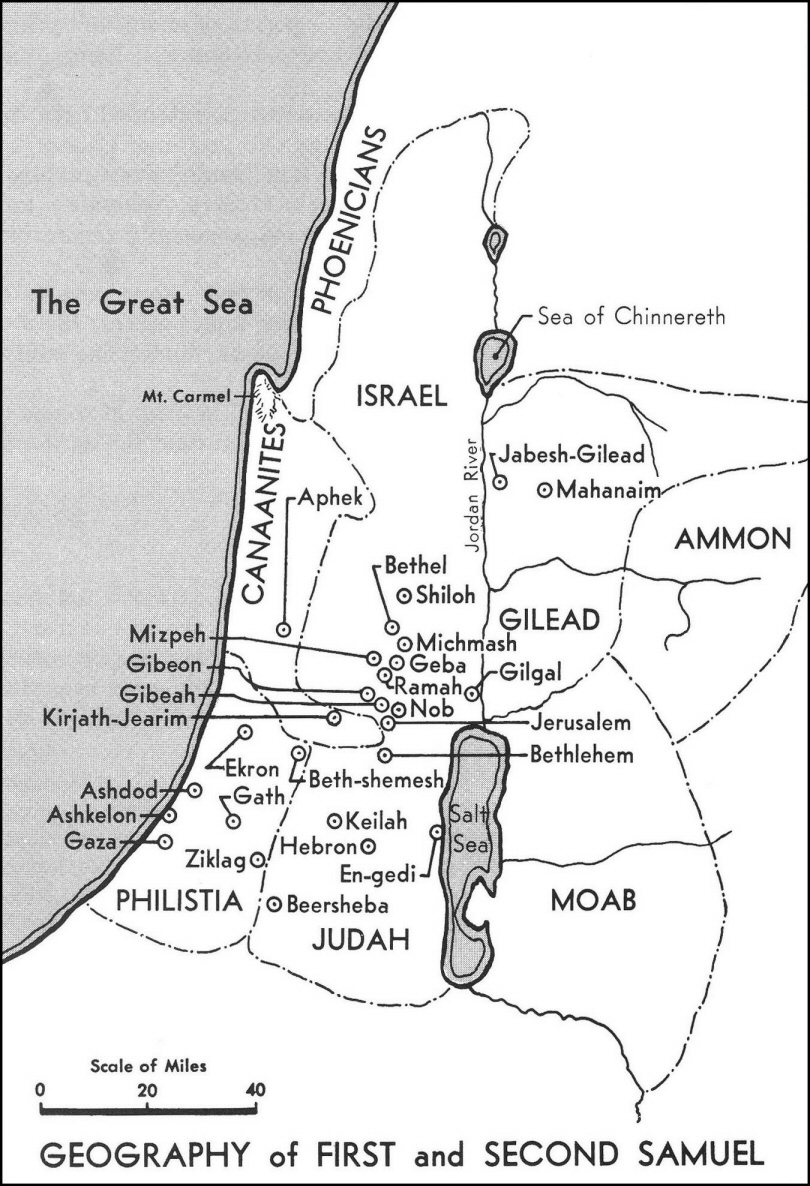
Note Philistia on the Southwest and Ammon on the east
IN THE PINCER GRIP OF
PHILISTIA AND AMMON
See "pincer grip" below.
The anger (aph) of the LORD burned - Literally "His nose became hot" an expressive metaphor for the anger and one of the most obvious examples of the anthropomorphisms for God in the OT. Four times in Judges - Jdg 2:14+, Jdg 2:20+, Jdg 3:8+, Jdg 10:7. (See What is an anthropomorphism?)
The Preacher's Commentary writes that when an individual or a nation forsakes the Living God, "Disaster is inevitable. The idols we create and choose to worship can never satisfy because ultimately every man-made cistern is flawed. We can only hew out leaking containers, which are destined to run dry. We do not have the spiritual technology to create a fountain of living waters, however much we may fool ourselves. So, God’s wrath is always kindled when anyone or anything is allowed to take over His place in our lives. It is not a vindictive, punitive anger, but a jealous yearning that those whom He has redeemed, at such great cost, should live in the enjoyment of that exclusive relationship with Himself, for which He recreated them. “I will be your God and you shall be My people.” Such anger is the other side of a love that will not let us go, a love that disciplines, in order to restore. (Jackman, D., & Ogilvie, L. J. Vol. 7: The Preacher's Commentary Series: Judges, Ruth - see The Preacher's Commentary,)
Sold (makar) them into the hands of the Philistines - Into the hands is the repeated idiom meaning into the "grasp" of the power of another. Twice associated with the anger of the LORD - Jdg 2:14+, Jdg 3:8+. Into the hands of the Philistines prepares us for the coming story of Samson in Judges 13:1-16:31. If you look at the map and notice Philistia on the West and Ammon on the East, you can almost envision a "hand" gripping Israel in between (like a "pincer grip"), literally and spiritually squeezing the life out of them! In this passage clearly the focus is on the powerful Ammonites who fought across the Israelite territory to the east of the Jordan and into the central hill country (Judah, Benjamin, Ephraim), and were able to subdue all the Israelite forces.
THOUGHT - Let us learn from Israel's mistakes (memorize 1Cor 10:6,11+), for God is not mocked and the one who sows to the flesh, shall from the flesh reap corruption (and destruction).
Lawson Stone - The Hebrew idiom is derived from the world of commerce: "he sold them into the hands of," and appears elsewhere in Judges only in the preface (2:14b) and in the Deborah story (4:2). Elsewhere Yahweh is said to "give" them into the hands of enemies (6:1; 13:1) or to "strengthen" the enemy (3:12). The writer seems to select which term to use, since rarely does more than one of these appear in the same place. (See context Joshua, Judges, Ruth)
A R Fausset says that sold means in essence that Yahweh "Renounced His right in them, and gave them up as slaves, helplessly sold to their foes, even as the Israelites had sold themselves as slaves to heathenish corruptions (2Ki 17:17; Ro 7:14, 15) , and into the hands of the children of Ammon [these, though put second, preceded the Philistines in oppressing Israel. The Ammonites are placed in this order, with a view to the following verse which proceeds to describe their vexing Israel. The Philistines in some degree had vexed Israel at the close of Moab’s oppression, and the beginning of Jabin’s (Jdg 3:31). Their power gradually increased, so that from vexing the southwestern parts of Israel in Shamgar’s days, they now, towards the close of the Ammonite oppression, so mastered all Israel as to prevent any smith’s work throughout the land (note, Jdg 5:8; 1Sa 13:19, 22)]. (Judges 10 Commentary)
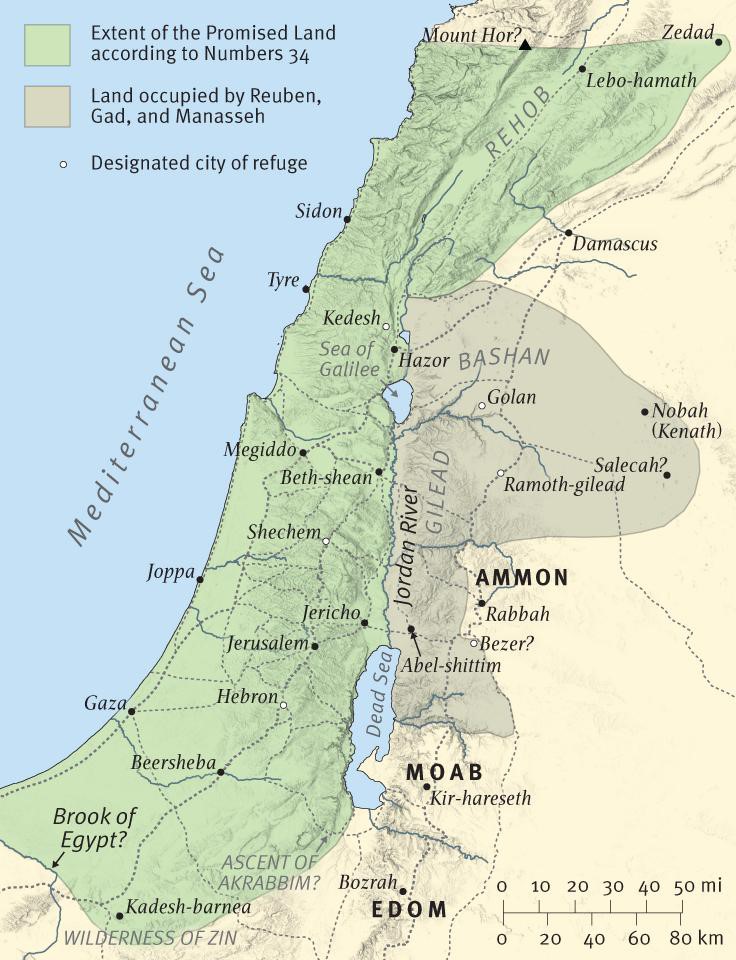
Note Location of Ammon (Source)
Into the hands of the sons of Ammon - Ammonites were descendants of Lot (Ge 19:31-38; Amos 1:13): Once again we see the Lord punish His covenant breaking, faithless wife by sending foreign oppressors, Philistines in the west and the Ammonites in the east, oppressing Israel for 18 years. Ammon was a Transjordanian kingdom northeast of Moab (see map above) and was allied with Eglon of Moab in the time of Ehud (Jdg 3:13+). The Ammonites oppressed Gilead, the Transjordanian area occupied in the south by the tribe of Gad and in the north by the half-tribe of Manasseh.
Bush notes that "The one on the west, the other on the east; so that they were grievously annoyed on both sides. (Commentary)
THOUGHT: The bitter fruit of sin. When we turn from God to sin we always lose for sin's promises are never fulfilled. Israel's compromise with the pagans from a human perspective may have seemed sensible. After all it wouldn't hurt to experience a little of their culture and religion and thus ensure a peaceful coexistence. The problem was that they turned from God and He turned from them. When has sin ever produced what was promised? Sin never produces the alluring fruit for which we have yielded to its temptation in the first place. Sin cannot, and has not the slightest interest in doing so. We are at our most foolish when we imagine that sin has our best interests at heart. Sin's only desire is to trap us, to rule us and to destroy us. Sin always produces great distress, even though sometimes, by God’s grace, its effects are delayed. Nevertheless, a broken relationship with God will always result in broken relationships with others—an isolation and aloneness which are sin’s dead end.
Anger (nose, nostril, wrath) (0639) aph from anaph = to breathe hard, to be angry) is a masculine noun meaning nose, nostril, snout (pigs - Pr 11:22), face (2Sa 25:23) and anger. Both senses are found in Proverbs 30:22 - "For the churning of milk produces butter, and pressing the nose (aph) brings forth blood; so the churning of anger (aph) produces strife." In the first use God "breathed into (man's) nostrils the breath of life." (Ge 2:7) Aph sometimes refers to the entire e whole face (Ge 3:19), especially in the expression, to bow one’s face to the ground (Ge 19:1; 1Sa 24:8). To have length of nose is to be slow to wrath (Pr 14:29, 16:32). To have shortness of nose is to be quick tempered (Pr. 14:17; Jer. 15:14, 15). Aph is used in a phrase (goba aph) which means pride, arrogance, formally, high of nose, an improper haughtiness and self-confidence (Ps 10:4). Often speaks of divine anger or wrath (Ps 2:5, 2:12, 6:1, 30:5, 74:1, 77:9, 78:21) and thankfully is "Slow to anger." (Ps 103:8; 145:8, both Lxx = makrothumos = long-suffering)
Sold (sell)( 04376) makar means to sell, to dispose of or transfer or be disposed of or transferred to a purchaser in exchange for money or other consideration. The first use is by Jacob calling on Esau to "sell me your birthright" (Ge 25:31, 33). The verb can be defined variously as "to sell," "to sell one's self," "to be given over" and "to abandon."
Judges 10:8 And they afflicted and crushed the sons of Israel that year; for eighteen years they afflicted all the sons of Israel who were beyond the Jordan in Gilead in the land of the Amorites.
- that year - Jdg 10:5 Isa 30:13 1Th 5:3
- Judges 10 Resources
Related Passages:
Numbers 32:33+ (LAND "BEYOND THE JORDAN IN GILEAD") So Moses gave to them, to the sons of Gad and to the sons of Reuben and to the half-tribe of Joseph’s son Manasseh, the kingdom of Sihon, king of the Amorites and the kingdom of Og, the king of Bashan, the land with its cities with their territories, the cities of the surrounding land.
AFFLICTED AND
CRUSHED
And they afflicted (raats) and crushed (ratsats) the sons of Israel that year; for eighteen years they afflicted all the sons of Israel who were beyond the Jordan in Gilead in the land of the Amorites - They afflicted is repeated twice and both refer to Ammon. A major brunt of the Ammonite affliction would be to Reuben, Gad and the half tribe of Manasseh which had settled in the "TransJordan" region (see map) and now were forced to be the first tribe to suffer at the hands of the fierce Ammonite armies that repeatedly devastated their lands. (See the location of Ammon on the map above) Eighteen years is the same length of the Moabite affliction (Eglon) in Judges 3:14+.
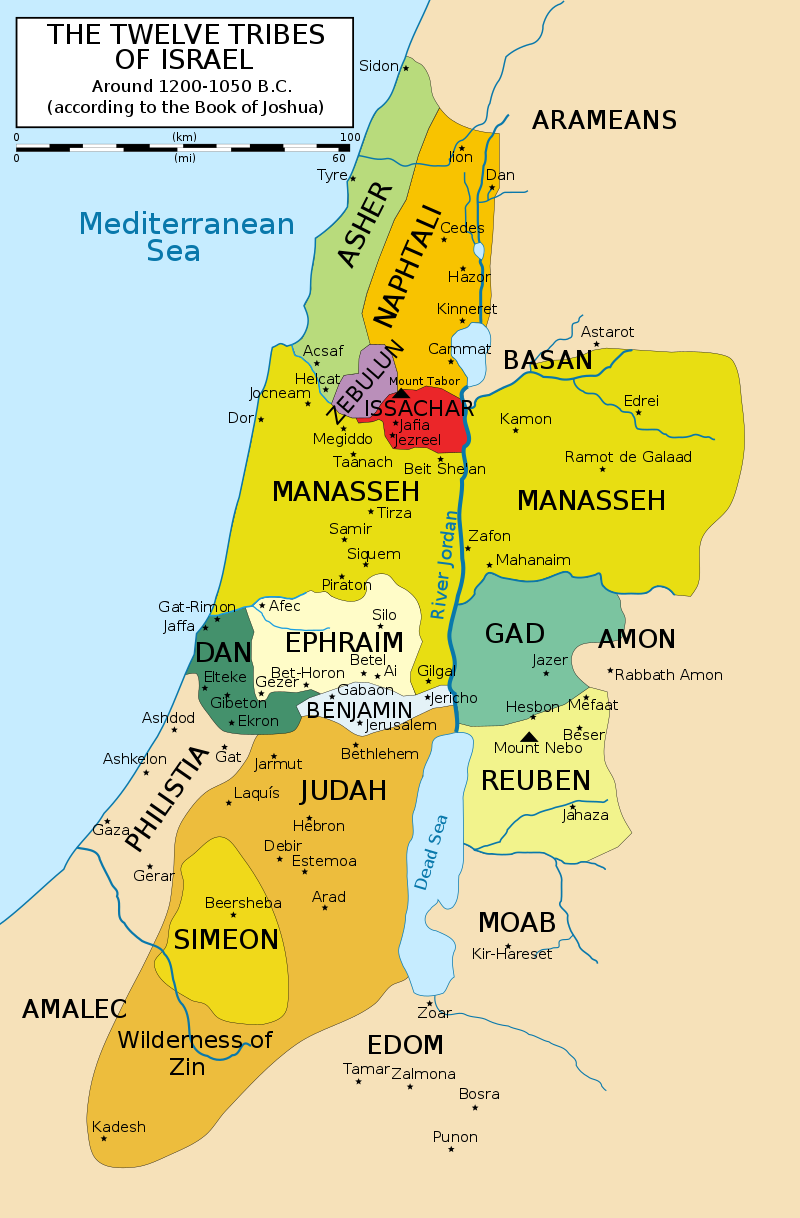
The phrase beyond the Jordan in Gilead in the land of the Amorites refers to the territory of Sihon king of the Amorites (I.E., THIS LAND HAD PREVIOUSLY BELONGED TO SIHON AND OG), and Og the king of Bashan that had been conquered by Israel prior to entering the Promised Land ane which was subsequently requested by the tribes of Gad, Reuben and half-tribe of Manasseh.
Pulpit Commentary on in Gilead "in its widest acceptation, including, as in Deuteronomy 34:1; Joshua 22:9, 13, 15; Judges 20:1, the whole country held by the Amorites on the east of Jordan, and given to Reuben, Gad, and the half-tribe of Manasseh. But in its narrower and stricter sense Gilead (see this map) was bounded on the north by Bashan proper, and on the south by the Mishor, or plain of Medeba, which lay between the valley of Heshbon and the river Arnon, thus excluding that part of the territory of Reuben from Gilead (see Joshua 13:9-11). Originally, as we learn from Judges 11:13-22, the territory bounded by the Arnon on the south, by the Jabbok on the north, by the wilderness on the east, and by the Jordan on the west, had belonged to Moab, but the Amorites had taken it from them before the conquest of Sihon by the Israelites.
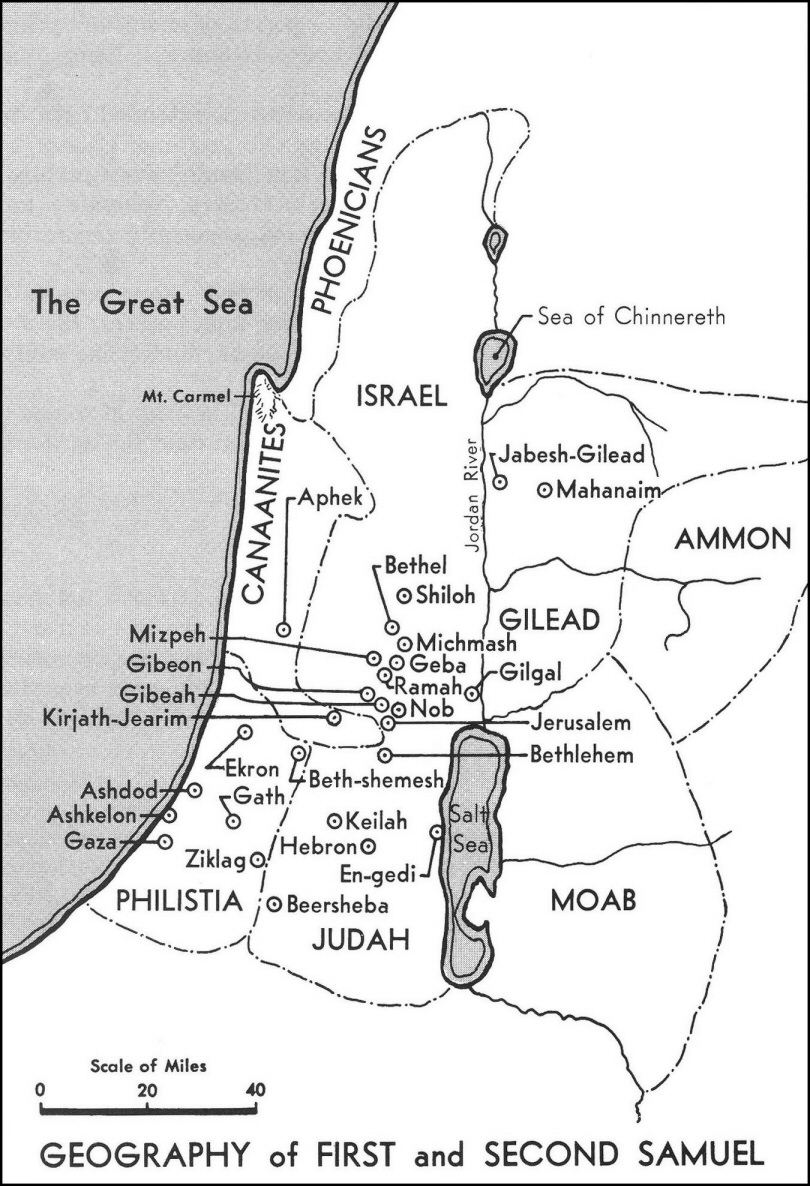
Stone on Gilead - Gilead lies in the region east of the Jordan roughly between the northern tip of the Dead Sea and the southern tip of the Sea of Galilee (see this map). The term sometimes loosely designates the whole region east of the Jordan.
NET Note on Afflicted and crushed - Heb “shattered and crushed.” The repetition of similar sounding synonyms (רָעַץ [ra’ats] and רָצַץ [ratsats]) is for emphasis; רָצַץ appears in the Polel (functions as an intensive) adding further emphasis to the affirmation.
A R Fausset - And that year they [the Ammonites] vexed [the same Hebrew as Ex. 15:6, ra’atz “dash in pieces”] and oppressed [Heb., ‘crushed,’ as in Deut. 28:33. Rotzetzu] the children of Israel [put the stop here, marking “that year” (viz., the year when, shortly after Jair’s death, Israel apostatised, and God sold Israel into their hands) as the year of their “dashing in pieces and crushing Israel.” Then is added in the next sentence the duration of the oppression], eighteen years [they crushed] all the children of Israel that (were) on the other side Jordan, in the land of the Amorites, which (is) in Gilead [the land of Sihon, king of the Amorites, and Og of Bashan (Numb. 21:21, &c.) ‘Gilead’ here comprises all the land of the Amorites east of Jordan occupied by Israel (Josh. 22:9)]. (Judges 10 Commentary)
George Bush - Did evil again. That year they vexed and oppressed the children of Israel eighteen years. We know not what sense to make of this clause as it now stands, which seems to bring an oppression of eighteen years’ continuance within the space of one year. Probably the solution is to render the verbs in the pluperfect, ‘and that year they had vexed and oppressed them eighteen years;’ i. e. that year completed the period of eighteen years, during which they had proved a scourge to them. The oppression commenced during the administration of Jair, perhaps nearly at the same time with the apostasy which caused it, and at the time of his death had continued eighteen years. This last event, though occurring after the apostasy commenced, is mentioned before it by prolepsis or anticipation, than which nothing is more frequent in the sacred writers. The terms employed in the original to indicate the severity of the oppression are very expressive. They import crushing and breaking to pieces, a metaphor apparently drawn from the action of two mill-stones upon the substance placed between them, to which Henry strikingly compares the condition of the Israelites at this time under the grinding oppression of the two hostile powers on either side of them, the Ammonites and the Philistines. Another remark of the same commentator respecting this apostasy of Israel is well worthy of insertion here. ‘God had appointed that if any of the cities of Israel should revolt to idolatry, the rest should make war upon them and cut them off, Deut. 13:12, et infr. They had been jealous enough in this matter almost to an extreme, in the case of the altar set up by the two tribes and a half, Josh. 22, but now they are grown so very bad, that when one city was infected with idolatry, the next took the infection, and, instead of punishing, imitated and outdid it; and therefore since they that should have been revengers to execute wrath upon them that did this evil, were themselves guilty, or bare the sword in vain, God brought the neighboring nations upon them to chastise them for their apostasy.’ (Judges 10 Commentary)
Afflicted (07492)(raats) means to shatter and is translated in the Septuagint in Jdg 10:8 with the verb thlibo which literally means to press, squeeze, crush, squash, hem in and then to be narrow. Raats is used only one other time in Ex 15:6 “Your right hand, O LORD, is majestic in power, Your right hand, O LORD, shatters the enemy." When they obeyed God shattered their enemy, but when they disobeyed their enemy was allowed to shatter them!
Brown-Driver- Briggs - [רָעַץ] verb shatter (Aramaic רְעַץ smite, shatter; compare perhaps Tel Amarna ra—âƒu, Wkl TelAm. 128. 3 l; 137,32); — Imperfect 3 feminine singular תִּרְעַץ אוֺיֵב׳יְמִינְךָ י Exodus 15:6; 3 masculine plural וַיִּרְעֲצוּ Judges 10:8, accusative of person (of men; "" וַיְרֹצְצוּ).
Crushed (07533)(ratsats) literally means to crush (as a skull - Jdg 9:53), but most of the uses are figurative of crushing in the sense of oppression (Dt 28:33, Jdg 10:8), as in the exercising of authority or power in a burdensome, cruel, or unjust manner. Of King Asa oppressing his own people (2 Chr 16:10) Refers to nation of Egypt as a crushed reed (2 Ki 18:21, Isa 36:6).
Ratsats is translated in the Septuagint in Jdg 10:8 with the Greek verb thlao which means to break a seal (which in this case is not a natural, purposeful act, but one greatly to be regretted, since the seal appears as a means of protection, whose destruction is followed by dire consequences) Hs 8, 6, 3. It means to crush, to bruise (of persons) 2 Sa 22,39; to break (down) (of things) 2 Ki18,21; to oppress as in Jgs 10,8.
Gilbrant - The verb rātsats conveys the basic meaning "to crush," "to oppress" or "to break into pieces." Used literally, this verb illustrates the breaking of a golden bowl and well wheel (Ecc. 12:6). Judges 9:53 recalls the deadly instance when Abimelech's skull was broken open by a woman who dropped a large rock from a tower in the besieged town of Thebez. Sometimes, rātsats refers to oppression of a group of people by another person or group of people. For example, the wicked typically oppress the poor (Job 20:19; Amos 4:1), and Asa oppressed some of the Israelites (2 Chr. 16:10). Occasionally, God allowed Israel to suffer mistreatment at the hands of other nations because of their idolatry (Judg. 10:8; Hos. 5:11) or other acts of disobedience (Deut. 28:33). Elsewhere, the weak condition of Egypt is metaphorically compared to a "bruised" (2 Ki. 18:21) and "broken" reed (Isa. 36:6). Isaiah 42:3 indicates, in reference to God's Servant, that "a bruised reed he shall not break." This prophetically foretells of the Savior, in Whom the Spirit would dwell (v. 1) and Who would "open the blind eyes" and "bring out the prisoners from the prison" (v. 7). God's mighty act of crushing the many heads of the Leviathan, the primeval creature who ruled the sea, revealed his character as divine Creator and Deliverer (Ps. 74:14). Also notable, rātsats described the conflict between Jacob and Esau while they were still in their mother's womb (Gen. 25:22). This discord continued throughout their lives and beyond, as their descendants fought with each other as well. (Complete Biblical Library Hebrew-English Dictionary)
Ratsats - 19x in 18v - Usage: broke(1), bruised(1), crush(1), crushed(9), crushing(1), oppressed(5), struggled(1).
Genesis 25:22 But the children struggled together within her; and she said, "If it is so, why then am I this way?" So she went to inquire of the LORD.
Deuteronomy 28:33 "A people whom you do not know shall eat up the produce of your ground and all your labors, and you will never be anything but oppressed and crushed continually.
Judges 9:53 But a certain woman threw an upper millstone on Abimelech's head, crushing his skull.
Judges 10:8 They afflicted and crushed the sons of Israel that year; for eighteen years they afflicted all the sons of Israel who were beyond the Jordan in Gilead in the land of the Amorites.
1 Samuel 12:3 "Here I am; bear witness against me before the LORD and His anointed. Whose ox have I taken, or whose donkey have I taken, or whom have I defrauded? Whom have I oppressed (Lxx = katadunasteuo - Acts 10:38, Jas 2:6), or from whose hand have I taken a bribe to blind my eyes with it? I will restore it to you."
1 Samuel 12:4 They said, "You have not defrauded us or oppressed us or taken anything from any man's hand."
2 Kings 18:21 "Now behold, you rely on the staff of this crushed reed, even on Egypt; on which if a man leans, it will go into his hand and pierce it. So is Pharaoh king of Egypt to all who rely on him.
2 Chronicles 16:10 Then Asa was angry with the seer and put him in prison, for he was enraged at him for this. And Asa oppressed some of the people at the same time.
Job 20:19 "For he has oppressed and forsaken the poor; He has seized a house which he has not built.
Psalm 74:14 You crushed the heads of Leviathan; You gave him as food for the creatures of the wilderness.
Ecclesiastes 12:6 Remember (command) (cf Eccl 12:1) Him before the silver cord is broken and the golden bowl is crushed, the pitcher by the well is shattered and the wheel at the cistern is crushed;
Comment: All the verbs portray death as tragic and irreversible.
HCSB Study Bible. - The cord, the bowl, the jar...shattered at the spring, and the wheel... broken at the well all refer (Ed: Not everyone interprets it this way!) to drawing up water from a well, a spring, or a cistern. Water in the Bible is frequently associated with life (this is understandable, considering the near-desert climate of ancient Israel). Thus, if these things are broken, death has occurred. Describing these objects as silver and gold implies that life is precious.
Isaiah 36:6 "Behold, you rely on the staff of this crushed reed, even on Egypt, on which if a man leans, it will go into his hand and pierce it. So is Pharaoh king of Egypt to all who rely on him.
Isaiah 42:3 "A bruised reed He will not break And a dimly burning wick He will not extinguish; He will faithfully bring forth justice.
Isaiah 42:4 "He will not be disheartened or crushed Until He has established justice in the earth; And the coastlands will wait expectantly for His law."
Isaiah 58:6 "Is this not the fast which I choose, To loosen the bonds of wickedness, To undo the bands of the yoke, And to let the oppressed go free And break every yoke?
Ezekiel 29:7 "When they took hold of you with the hand, You broke and tore all their hands; And when they leaned on you, You broke and made all their loins quake."
Hosea 5:11 Ephraim is oppressed, crushed in judgment, Because he was determined to follow man's command.
Amos 4:1 Hear this word, you cows of Bashan who are on the mountain of Samaria, Who oppress the poor, who crush the needy, Who say to your husbands, "Bring now, that we may drink!"
Judges 10:9 And the sons of Ammon crossed the Jordan to fight also against Judah, Benjamin, and the house of Ephraim, so that Israel was greatly distressed.
- Ammon crossed - Jdg 3:12,13 6:3-5 2Ch 14:9 2Chr 20:1,2
- Israel was greatly distressed - Dt 28:65 1Sa 28:15 2Chr 15:5
- Judges 10 Resources
DISTRESSED BY
THE AMMONITES
And the sons of Ammon crossed the Jordan to fight also against Judah, Benjamin, and the house of Ephraim, so that Israel was greatly distressed (tsarar - narrow, cramped, restricted; Lxx - thlibo = pressed upon, crowded) - As you can discern from this map, when Ammon crossed the Jordan, they would first go through the tribes of Reuben, Gad and Manasseh (half-tribe) (as noted above). These three tribes would continually pay a price for having chosen this land on the east of the Jordan! Be careful what you choose!
Stone explains why Israel was greatly distressed - Between the Ammonites shutting down the main traffic artery in the heartland of the Israelite settlements and the Philistine pressure from the west, the Hebrew's literal "it got very tight for Israel" (Cf tsarar - narrow, cramped, restricted; Lxx - thlibo = pressed upon, crowded) is quite appropriate.
Pulpit Commentary on sons of Ammon - It would seem that at this time the king of the children of Ammon was also king of the Moabites, since he laid claim (Judges 11:13, 24) to the land which had once belonged to Moab. If we may trust the king of the Ammonites' statement, the object of the war was to recover that land, and he carried the war across the Jordan into the territory of Judah and Ephraim in order to compel the Israelites to give it up.
Stone on fight also against Judah, Benjamin, and the house of Ephraim - These attacks make the Ammonite threat the most comprehensive crisis in the book so far. For these three areas to come under simultaneous threat was remarkable, but Ammon's location, significantly overlapping Gilead, made it feasible. The Ammonites had no access to trade routes or the resources of the larger region: They were bordered by desert to the east and otherwise hemmed in by Israelite tribes, which minimized the benefit of the King's Highway passing through Ammon's land. Their need for Lebensraum prompted a campaign that probably sought first to open up the King's Highway more fully. To further capitalize on that route, there followed attacks west of the Jordan, aimed at controlling the north-south highway running atop the watershed ridge, known to biblical geographers as the "National Highway" (Dorsey 1991:118-146). This route, like the King's Highway, was one of three lucrative north-south trade routes in the area. It ran north from Beersheba to Hebron, passed just west of Jerusalem, through Bethel, past Shiloh, and through Shechem to connect with the east-west routes running up the Wadi Far'a and Jezreel valley before passing along the west side of the Sea of Galilee to all points north. Once Ammon seized critical points in the south, middle, and north of this road—in Judah, Benjamin, and Ephraim—they would have strategic control over two of the three major trade routes and a choke hold over the competing Israelite highland economy that produced the same olives and grapes—major cash crops—that grew in Ammonite territory.
George Bush - The children of Ammon passed over Jordan. The Philistines probably harrassed the children of Israel in the south of Canaan, west of the Jordan; and the Ammonites the two tribes and a half to the east of that river. The spirit of conquest or of aggression, however, soon led the latter to cross the Jordan. It seems probable that they rather vexed and distressed the trans-Jordanic tribes, than kept them in entire subjection; and afterwards extended their incursions to the west of the Jordan. They were justly punished by the Amorites, for they had so utterly degenerated and conformed to their heathen neighbors, that Ezekiel, in addressing the Israelitish nation, ch. 16:3, says by a bold figure, ‘Thy father was an Amorite, and thy mother a Hittite. (Judges 10 Commentary)
A R Fausset - Moreover the children of Ammon passed over Jordan to fight also against Judah, and against Benjamin, against the house of Ephraim [not content with oppressing Israel east of the Jordan, the Ammonites, towards the close of the eighteen years of oppression, crossed over and invaded the Israelite southern and northern tribes west of Jordan, Judah, Benjamin, and Ephraim]; so that Israel was sore distressed [the same Hebrew word as ch. 2:15, “in great straits”]. (Judges 10 Commentary)
Distressed (06887)(tsarar) means to be narrow, to be cramped, to be straitened, to be constricted, to hem or be hemmed in. It pictures being in a narrow, confining space. Tsarar is also used in Jdg 2:15+ and Jdg 11:7+. Tsarar is translated in the Septuagint in Jdg 10:9 with the verb thlibo which literally means to press, squeeze, crush, squash, hem in and then to be narrow.
Judges 10:10 Then the sons of Israel cried out to the LORD, saying, "We have sinned against Thee, for indeed, we have forsaken our God and served the Baals."
- Then the sons of Israel cried out: Jdg 3:9 1Sa 12:10 Ps 106:43,44 Ps 107:13,19,28
- Judges 10 Resources
CRYING OUT AND
CONFESSING SIN
Then the sons of Israel cried out (za'aq) to the LORD, saying - "Cried out" as in the previous times of distress when Israel called on the Lord there was no evidence of repentance for her sin. She was like the passengers on an airplane that suddenly lost engine power and began to cry out to God for help. It is interesting that despite the plethora of so-called gods, Israel in "crunch time" cried out to the One God Jehovah. This implies that deep inside they knew their so-called gods were not really God and had no power to save. It also shows how if men will not serve the One God, they are still so constituted that they must worship and will resort to gods of their own imagination to satisfy this deep inner need. It's true of all of us - we have been created with a "God shaped vacuum" and if we will not worship the One True God, we will worship the god of self, of money, of power, etc. These latter gods make no moral demands per se on us and thus we can do as we please, doing whatever seems right in our own eyes. And so we conclude that much of the modern world like ancient Israel is in effect "polytheistic", the only difference being that the modern gods have different names.
Guzik adds "It seems that Israel was willing to worship just about anything except the true God. When a man stops believing in God, he does not believe in nothing; he believes in anything."
Lindsay on Israel cried out - In previous times of distress Israel's calling on the Lord was not an evidence of repentance for her sin (cf. Jdg 3:9, 15; 4:3). (See context The Bible Knowledge Commentary: Old Testament)
THOUGHT - Are you trapped in some persistent (secret) sin? Do you need to cry out like Israel? Play this old Maranatha song Cry Out to the Heavenly Father.
Cried out to the LORD - 14x in 14v - Ex 14:10; Ex 15:25; Ex 17:4; Nu 12:13; Nu 20:16; Jos. 24:7; Jdg. 10:10; 1Sa 12:8; 1Sa 12:10; 1Sa 15:11; Ps. 107:6; Ps. 107:13; Ps. 107:19; Lam 2:18
This is the only recorded instance in Judges where the people confess their sin.
We have sinned (chata';Lxx - hamartano) against Thee, for indeed, we have forsaken ('azab Jdg 10:6, 13; Lxx - egkataleipo - separate connection with) our God and served (abad) the Baals: first they confessed their sins and then, then the Lord rebuked them (v13,14), but they remained steadfast in their confession of sin (v15) and took action to get rid of the foreign gods and serve the Lord. (v16). Indeed, this scenario does suggest that in this "cycle" there may have been more than just remorse. There may have been genuine repentance. Ultimately God alone knows whether this was genuine or expedient. The forsook God when they should have forsaken (also 'azab) their transgressions as in Pr 28:13+ which warns "He who conceals his transgressions will not prosper, But he who confesses and forsakes ('azab) them will find compassion."
It is amazing that in spite of all the sin the first half of the book of Judges, Judges 10:10 is first use of chata' in the book of Judges - it is used again to mean sinned in Jdg 10:15 and Jdg 11:27 but refers to marksmanship in Jdg 20:16, where the Benjaminite 700-man brigade can "sling a rock and hit a target ... without missing"
Davis and Whitcomb comment on We have sinned - a mere recognition of sin was not enough this time. God wanted repentance and a total, unqualified commitment from His people that they would again obey the law. (Israel From Conquest to Exile)
Guzik - The words of this cry (We have sinned) seem fine, but God’s response seems to indicate that He saw something lacking in Israel’s repentance. One may cry out to the Lord, yet really just wish things were different. Crying out to God with the voice is not necessarily the same as crying out to Him with our heart. God wanted from Israel the same thing He wants from us – a heart that will put its hand to the plow and not look back (Luke 9:62+). He wants us to come to the place where we know that there is nothing worth following except God.
Arthur Cundall elaborates on Guzik's point writing that "The extremity of the plight of the Israelites led to a recognition of their waywardness and an appeal to God. This met with no easy response, for the cycle of deliverance followed by forgetfulness, ingratitude and apostasy had occurred too often for a facile overlooking of their sin. God required, and requires still, the steadfast love, loyalty and obedience of his subjects, in which He can operate continually on their behalf, rather than a relationship, lightly severed, in which He is used in times of emergency only. He reminded them therefore of his former deliverances. (Borrow Judges & Ruth: Tyndale Old Testament Commentary)
We have sinned - 21x in 21v - Num. 12:11; Num. 21:7; Deut. 1:41; Jdg. 10:10; Jdg. 10:15; 1 Sam. 7:6; 1 Sam. 12:10; 1 Ki. 8:47; 2 Chr. 6:37; Neh. 1:6; Ps. 106:6; Isa. 42:24; Jer. 3:25; Jer. 8:14; Jer. 14:7; Jer. 14:20; Lam. 5:16; Dan. 9:5; Dan. 9:8; Dan. 9:11; Dan. 9:15
Served the Baals - 5x in 5v - Jdg. 2:11; Jdg. 3:7; Jdg. 10:6; Jdg. 10:10; 1 Sa 12:10
Remember if we are tempted to condemn Israel for their stupidity & the fact that they never seemed to learn, they are a picture of our fallen flesh nature. When we look at them we are looking at ourselves (in our Adamic nature, our old man, our "flesh"). In so many ways our lives are simply a modern day reflection of their ancient rebellion. And why is this? simple -- we have no King at the moment of rebellion & we are doing what is right in our own eyes, just like Israel did!
Matthew Henry comments on (Jdg 10:10-18): "God is able to multiply men's punishments according to the numbers of their sins and idols. (cp v6) But there is hope when sinners cry to the Lord for help, and lament their ungodliness as well as their more open transgressions. It is necessary, in true repentance, that there be a full conviction that those things cannot help us which we have set in competition with God. They acknowledged what they deserved, yet prayed to God not to deal with them according to their deserts. We must submit to God's justice, with a hope in his mercy. True repentance is not only for sin, but from sin. As the disobedience and misery of a child are a grief to a tender father, so the provocations of God's people are a grief to Him. From Him mercy never can be sought in vain. Let then the trembling sinner, and the almost despairing backslider, cease from debating about God's secret purposes, or from expecting to find hope from former experiences. Let them cast themselves on the mercy of God our Saviour, humble themselves under His hand, seek deliverance from the powers of darkness, separate themselves from sin, and from occasions of it, use the means of grace diligently, and wait the Lord's time, and so they shall certainly rejoice in His mercy."
A R Fausset - And the children of Israel cried [za’aqu, the cry of pain seeking help (Hos. 7:14); not yet real hatred of their sin] unto the LORD [JEHOVAH], saying, We have sinned against Thee, both because [namely, in that וְכִי describes their sin in detail] we have forsaken our God [dereliction of duty enjoined], and also served Baalim [Heb., “the Baals,” viz., of the several surrounding nations, each having its own Baal. Positive commission of sin forbidden (Jer. 2:12, 13)]. (Judges 10 Commentary)
George Bush - Both because we have forsaken, &c. They specify distinctly the two forms of their transgression; first, in departing wickedly from God, secondly, in serving idols. Under the deep impression of their guilt in this conduct, they made good the words of the prophet, Is. 26:16, ‘Lord, in trouble have they visited thee; they poured out a prayer when thy chastening was upon them.’ The first step of a sinner’s return to God is the discovery of his own great guilt, and a sense of his deserved ruin, and this in order to be available must be accompanied with the most sincere and penitent acknowledgment of his aggravated offences. (Judges 10 Commentary)
Reformation Study Bible on Jdg 10:10-16 - This is the only account in the Book of Judges where Israel not only cries out to God, but also puts away their idols. Elsewhere, they simply cried out to the Lord and He delivered them (Jdg 10:10; 2:19; 3:9). God saw through their superficial repentance but chose to deliver them anyway (cf. Dt. 32:15–38).
Cried out (02199) za'aq means to cry out, to call out for help (especially when in distress), to appeal (even making public sounds of physical and/or emotional anguish - Ex 2:23, 2Chr 20:9, Job 35:9). Za'aq can be summoned in the sense of to be assembled (Jos 8:16; Jdg 6:34, 35; 18:22, 23) Finally, za'aq can mean to issue a proclamation by sending out an official written document with instructions or principles (Jonah 3:7) There are two versions of the Lxx in Judges and one renders cried out in Jdg 10:10 with the verb boao which means to cry out for help, to cry out in anguish (Mk 15:34, Mt 27:46) and the other uses the verb krazo meaning to cry out in a loud voice, to shriek, to scream! That's what a person is willing to do when they grasp the power that sin holds over them and they are powerless to break it in their own strength! That's when we need to Cry Out to the Heavenly Father!
Sinned (Lxx - hamartano) (02398) chata' means to miss the way, to fail; to err, to swerve from truth, to go wrong. The literal use describes an accurate shot by slingshot Jdg 20:16 - they could "not miss (chata')." Pr 19:2 conveys a related meaning of chata' in those versions that translate it as "miss the way." (Pr 19:2NIV) As Vine says "From this basic meaning comes the word’s chief usage to indicate moral failure toward both God and men, and certain results of such wrongs." When man sins he has missed the mark, the goal, or the way that God has set as standard.
Served (05647)(abad) means to work (to cultivate, till - Ge 2:5, 15 - Lxx = ergazomai before the fall! Ge 3:23 after the fall, Lxx = ergazomai), to serve (be enslaved or hold in bondage - Ex 6:6 - Lxx = katadouloo = make a slave; Lev 25:38, 39 Lxx = douleuo)(Ge 14:4, 15:13, 14 - Lxx = douleuo), worship. Labor (as when Israel was in Egyptian bondage - Ex 1:13,14 but same word abad translated worship after redemption Ex 3:12, 7:16, 8:1, 8:20, 9:1, et al where Lxx = latreuo).
It is interesting that there are two versions of the Septuagint for Judges 10:10, one translating serve (abad) in this verse with latreuo, which conveys the sense of to worship. The other Lxx version translates abad with douleuo which means to serve, to be enslaved. This is not really surprising for to that to which one is enslaved is often that which one worships! Woe! Notice that abad is translated serve in some passages and other translations translate it as worship (Ex 3:12 vs Ex 3:12KJV; Dt 6:13 vs Dt 6:13KJV). We see a similar pattern in Deut 31:20 "For when I bring them into the land flowing with milk and honey, which I swore to their fathers, and they have eaten and are satisfied and become prosperous, then they will turn to other gods and serve (Lxx = latreuo) them, and spurn Me and break My covenant." In Ps 2:11 the NAS translates it "Worship the LORD" whereas most versions have "serve the LORD" (and the Lxx = douleuo). In Ps 72:11 speaking of the Messiah "All nations serve (Lxx = douleuo) Him." Ps 97:7 says "Let all those be ashamed who serve (other versions have "worship"; Lxx = proskuneo - worship) graven images." In sum, clearly there is a very clear association between what (who) one serves and who one worships.
Vine - "to serve, cultivate, enslave, work." This root is used widely in Semitic and Canaanite languages. This verb appears about 290 times in all parts of the Old Testament. The verb is first used in Gen. 2:5: "to till the ground." God gave to man the task "to dress [the ground]" (Ge 2:15; 3:23; cf. Ge 1:28). In Ge 14:4 "they served Chedorlaomer" means that they were his vassals. God told Abraham that his descendants would "serve" the people of a strange land 400 years (Ge 15:13), meaning, "to be enslaved by." Ābad is often used toward God: "you shall worship God at this mountain." (Ex. 3:12). The word is frequently used with another verb: "“You shall fear only the LORD your God; and you shall worship Him" (Deut. 6:13), or "It shall come about, if you listen obediently to my commandments which I am commanding you today, to love the LORD your God and to serve Him with all your heart and all your soul," (Dt. 11:13). All nations are commanded: "Serve the Lord with gladness …" (Ps 100:2). In the reign of Messiah, "all nations shall serve him" (Ps 72:11). The verb and the noun may be used together as in Nu 8:11" (Vine's Expository Dictionary of Old Testament and New Testament Words)
Baker on abad - A verb meaning to work, to serve. This labor may be focused on things, other people, or God. When it is used in reference to things, that item is usually expressed: to till the ground (Gen. 2:5; 3:23; 4:2); to work in a garden (Gen. 2:15); or to dress a vineyard (Deut. 28:39). Similarly, this term is also applied to artisans and craftsmen, like workers in fine flax (Isa. 19:9); and laborers of the city (Ezek. 48:19). When the focus of the labor is another person, that person is usually expressed: Jacob's service to Laban (Gen. 29:15); the Israelites' service for the Egyptians (Ex. 1:14); and a people's service to the king (Judg. 9:28; 1 Sam. 11:1). When the focus of the labor is the Lord, it is a religious service to worship Him. Moreover, in these cases, the word does not have connotations of toilsome labor but instead of a joyful experience of liberation (Ex. 3:12; 4:23; 7:16; Josh. 24:15, 18). Unfortunately, this worship service was often given to false gods (Deut. 7:16; 2 Ki. 10:18, 19, 21-23). (The Complete Word Study Dictionary – Old Testament)
TWOT on abad - The etymology of this word seems to share the ideas of several Semitic roots, e.g. the old Aramaic root which means "to do or make," an Arabic root meaning "to worship, obey" (God) and its intensive stem meaning "to enslave, reduce to servitude." This service may be directed toward things, people, or God. When used in reference to things it is usually followed by an accusative of the thing upon which the labor is expended, e.g. "to till" a field (Genesis 2:5 and often elsewhere); "to dress" vineyards; workers or artisans in flax (Isaiah 19:9) or in city construction (Ezekiel 48:18). Occasionally it is without the accusative as in Deut. 15:19, "to till" [the ground]. The second category is followed by an accusative of person, e.g. Jacob's serving Laban (Genesis 29:15; Genesis 30:26, 29). Sometimes this usage includes the preposition be with a person, thus one "works by means of another" or uses another as a slave (Exodus 1:14; Jeremiah 22:13, or in the Pual stem with captives, Isaiah 14:3). Servitude also includes "to serve as subjects" to a king or ruler (Judges 9:28; 1 Samuel 11:1). In the Hiphil stem, it means "to compel one to labor" as a slave (Exodus 1:13). When the service is offered to God, however, it is not bondage, but rather a joyous and liberating experience (Exodus 3:12; Exodus 4:23; Exodus 7:16, 8:1; Exodus 10:26; Psalm 22:31; Job 21:15; Jeremiah 2:20; Malachi 3:14). All too frequently, the text records that this service was given to other gods who were not gods at all (Deut. 7:16; 2 Kings 10:18-19, 21-23, etc.). The same concept is used of serving Yahweh with the Levitical service (Numbers 3:7-8; Numbers 4:23, 30, 47; Numbers 8:11, 19ff., etc.). Interestingly enough, the LXX reserved the Greek word latreuō for the official service of the priests only. The NT however, steadfastly resisted using this group of words for the NT ministry or its functions except in Romans 15:16, where it refers to Paul's labors for Jesus Christ. Instead, it reserved it for other religious contexts, especially those dealing with the OT ritual (Hebrews 9:21; Hebrews 10:11; Luke 1:23).
Gilbrant on abad - Meaning "to work," "to till," "to tend," "to serve" or "to be a slave," ʿāvadh occurs nearly 300 times in the Bible in five different stems. It appears in the Qal stem 271 times, in the Niphal 4 times, in the Pual 2 times, in the Hiphil 8 times and in the Hophal 4 times. The verb is widely attested in Semitic.
At times, the Qal stem refers to working or laboring in an occupation. According to the Law, occupational work done by both people and animals was to be done only six days a week; all workers were to rest on the Sabbath (Exo. 20:9; 34:21; Deut. 5:13). Such occupational work included making bricks (Exo. 5:18), tilling the ground (Gen. 2:5; 3:23; 4:2, 12; Jer. 27:11), tending a vineyard (Deut. 28:39) or garden (Gen. 2:15), working with flax (Isa. 19:9), serving a city (Ezek. 48:18f) and performing military service (Ezek. 29:18). Although domesticated animals worked, the firstborn of the flocks and herds were to be dedicated to the Lord (Deut. 15:19), and wild animals never worked to serve people (Job 39:9).
The Qal stem also refers to serving another person, such as a son serving his father (Mal. 3:17). One could also serve another for wages: Jacob served Laban two seven-year terms to pay the dowry for his wives (Gen. 29:15, 18, 27), and he later served him merely for wages (Gen. 31:41). On the other hand, an Israelite could become a bondservant to another. Though such service was limited to six years (Exo. 21:2; Deut. 15:12, 18; Jer. 34:14), a person could elect to become a lifelong bondservant (Exo. 21:6).
The concept of serving also included serving another as a slave. The Egyptians made the Israelites their slaves and demanded rigorous labor from them (Exo. 1:14). Also, as judgment, Jeremiah prophesied that Israel would be forced to serve foreign nations, though the Lord would eventually deliver them from such service (Jer. 30:8). Similarly, whereas the Israelites were not to enslave fellow Israelites (Lev. 25:39; Jer. 34:9f), and judgment was against those who forced their neighbors to serve without wages (Jer. 22:13), foreigners could be made permanent slaves (Lev. 25:46); for instance, during the conquest, the Canaanites who were not destroyed were made forced laborers (Josh. 16:10).
The concept of working also includes serving a king or ruler as subjects, either voluntarily or under force, or a king serving his people (1 Ki. 12:7). Thus, the people of Israel served Solomon as king (1 Ki. 4:21); however, they rightly refused to serve his son Rehoboam (1 Ki. 12:7). Most often the reference is to serving the king of a foreign people (1 Sam. 4:9; 11:1), though foreign nations like the kingdom of Hadadezer served David (2 Sam. 10:19; 22:44; 1 Chr. 19:19). Jeremiah foretold that Israel would eventually have to serve them (Jer. 5:19). Indeed, during times of judgment, Israel served foreign kings such as Cushan-Rishathaim of Mesopotamia (Judg. 3:8) and Eglon, king of Moab (v. 14), though King Hezekiah refused to serve the king of Assyria (2 Ki. 18:7). Also, foreign nations and their animals were forced to serve Nebuchadnezzar (Jer. 25:11; 27:6ff; 28:14); Gedaliah encouraged the remnant left in Judah to serve the king of Babylon (2 Ki. 25:24; Jer. 40:9); and eventually all nations will serve the Messiah (Ps. 72:11).
Frequently, ʿāvadh is used in the theological sense of making sacrifices to the Lord (Isa. 19:21), serving God or serving pagan gods; mostly it is used to describe those who serve pagan gods, like foreign nations (Deut. 12:2, 30), Abraham's ancestors (Josh. 24:2) and many of the Israelites while they were in Egypt (v. 14). However, Israel was not to serve pagan gods (Deut. 7:16; 11:16; 28:14; 29:18; Josh. 23:7; 2 Ki. 17:35; Jer. 25:6), but only the Lord (Exo. 4:23; 7:16; 8:1; 10:26), and they were to be judged if they neglected this command (Deut. 8:19; 30:17; Josh. 23:16; 24:20; 2 Chr. 7:19, 22). The Lord foretold that Israel would turn away from Him to serve pagan gods (Deut. 31:20). He warned that pagan wives would entice Israel to serve pagan gods (Deut. 7:4), and anyone who enticed an Israelite to commit such sins (Deut. 13:6; 17:3) would be put to death (cf. 13:9; 17:5). As judgment, Israel would be exiled and serve pagan gods in a foreign land (Deut. 28:36, 64; 29:26; Jer. 16:13). At the time of the conquest, Israel promised not to serve pagan gods (Josh. 24:16), but to serve only the Lord (vv. 18, 21, 24), and they did so throughout the days of Joshua and the elders who outlived him (Josh. 24:31; Judg. 2:7). However, during the period of the judges, Israel frequently turned away from the Lord to serve pagan gods (Judg. 2:11, 13, 19; 3:6f; 10:6, 10, 13; 1 Sam. 8:8), which resulted in judgment; but when they repented and returned to serving the Lord (Judg. 10:16), He gave them deliverance. Later, the Lord commanded that Israel's kings serve only Him; and if they turned away from Him to serve pagan gods (1 Ki. 9:6), He would cut off the nation (v. 7). Israel did turn away from the Lord to serve pagan gods (Jer. 11:10; 13:10; 16:11; 22:9; 35:15), which resulted in their exile and in serving the pagan King Nebuchadnezzar.
Pagan worship included serving the sun, moon, stars and the hosts of heaven. Israel was not to serve these (Deut. 4:19), but King Manasseh worshiped and served them (2 Ki. 21:3; 2 Chr. 33:3), and the people followed his example (Jer. 8:2). Such idolatry also involved serving Baal (Judg. 2:11; 3:7; 10:6, 10), serving idols (2 Ki. 17:12; 21:21; Ezek. 20:39) and serving the Asherim.
Frequently, ʿāvadh speaks of the Levites' serving in the Tabernacle (Num. 3:7f; 4:23, 30, 37, 41, 47; 7:5; 8:15, 22; 18:6), for which work they bore the iniquity (Num. 18:23). This service was regarded as work of the Lord (Num. 8:11) done for the children of Israel (Num. 8:19; 16:9). The Levites served from age thirty to fifty (Num. 4:30, 37, 47; 8:25) and received the tithes of Israel as compensation for their work (Num. 18:21). The service of the Gershonites was to carry the curtains, covers and hangings of the Tabernacle (Num. 4:26), while the priests served at the altar and behind the veil (Num. 18:7).
The Niphal stem expresses the passive sense "to be tilled" or "to be served," always in reference to land in the Bible. It refers to a field being tilled (Ezek. 36:9, 34) or to an untilled field (Deut. 21:4). Once, ʿāvadh refers to a king being served from the field (Ecc. 5:9). This passage is difficult, though, and has various translations: "the king himself is served by the field" (KJV, ASV, NKJV), "a king who cultivates the field is an advantage to the land" (NASB), "a king is an advantage to a land with cultivated fields" (RSV) and "this is an advantage for a land: a king for a plowed field" (NRSV).
The Pual stem also expresses the passive sense "to be worked" or "to be made to serve." It refers to Israel's being made to serve the king of Babylon (Isa. 14:3) and to a heifer that has not been worked (Deut. 21:3). It is interesting to note that expiating the guilt of a city in whose territory an unsolved murder took place required the sacrifice of an unbred and unworked heifer slaughtered in an untilled, unsown field (v. 4). Modern scholars regard these Pual forms as remnants of an extinct Qal passive stem because the verb does not occur in the Piel stem.
The Hiphil stem conveys the causative sense of the verb "to make someone work." The Egyptians made Israel serve with rigor (Exo. 1:13), and they kept Israel in bondage (Exo. 6:5). Solomon's overseers made the laborers work to provide the material for the Temple (2 Chr. 2:18). Nebuchadnezzar made his army work strenuously to overthrow Tyre (Ezek. 29:18). Theologically, Josiah made all Israel serve the Lord (2 Chr. 34:33); but Israel sinned, so the Lord ironically reasoned with them that He had not made them serve Him with grain offerings (Isa. 43:23), but they had burdened the Lord (literally "made Him labor") with their sin (v. 24). Because of their disobedience and sin, the Lord would cause Israel to serve their enemies in a foreign land (Jer. 17:4).
The Hophal stem conveys the passive sense of the Hiphil stem. The Law commanded Israel not to serve pagan gods (literally not to allow themselves to be made to serve pagan gods; Exo. 20:5; 23:24; Deut. 5:9) or to be persuaded to do so (Deut. 13:2). (Complete Biblical Library Hebrew-English Dictionary)
Abad - 263v - become slaves(1), been slaves(1), bondage(2), burdened(2), cultivate(7), cultivated(2), cultivates(1), do(6), do the work(1), enslaved(3), given(1), holding in bondage(1), imposed(1), keep(2), labor(3), laborers*(2), make servant(1), make slaves(2), manufacturers(1), observe(1), perform(9), performed(2), plowed(1), rendered(1), serve(141), served(52), serves(2), serving(5), slave(1), slaves(1), subject(1), till(1), tiller(1), tiller*(1), tills(2), use as slaves(1), used(1), uses services(1), work(7), worked(2), workers(2), working(1), worship(7), worshipers(6). Gen. 2:5,15; 3:23; 4:2,12; 14:4; 15:13-14; 25:23; 27:29,40; 29:15,18,20,25,27,30; 30:26,29; 31:6,41; 49:15; Exod. 1:13-14; 3:12; 4:23; 5:18; 6:5; 7:16; 8:1,20; 9:1,13; 10:3,7-8,11,24,26; 12:31; 13:5; 14:5,12; 20:5,9; 21:2,6; 23:24-25,33; 34:21; Lev. 25:39-40,46; Num. 3:7-8; 4:23-24,26,30,37,41,47; 7:5; 8:11,15,19,22,25-26; 16:9; 18:6-7,21,23; Deut. 4:19,28; 5:9,13; 6:13; 7:4,16; 8:19; 10:12,20; 11:13,16; 12:2,30; 13:2,4,6,13; 15:12,18-19; 17:3; 20:11; 21:3-4; 28:14,36,39,47-48,64; 29:18,26; 30:17; 31:20; Jos. 16:10; 22:5,27; 23:7,16; 24:2,14-16,18ff,24,31; Jdg. 2:7,11,13,19; 3:6-8,14; 9:28,38; 10:6,10,13,16; 1 Sam. 4:9; 7:3-4; 8:8; 11:1; 12:10,14,20,24; 17:9; 26:19; 2 Sam. 9:10; 10:19; 15:8; 16:19; 22:44; 1 Ki. 4:21; 9:6,9,21; 12:4,7; 16:31; 22:53; 2 Ki. 10:18-19,21-23; 17:12,16,33,35,41; 18:7; 21:3,21; 25:24; 1 Chr. 19:19; 28:9; 2 Chr. 2:18; 7:19,22; 10:4; 24:18; 30:8; 33:3,16,22; 34:33; 35:3; Neh. 9:35; Job 21:15; 36:11; 39:9; Ps. 2:11; 18:43; 22:30; 72:11; 97:7; 100:2; 102:22; 106:36; Prov. 12:11; 28:19; Eccl. 5:9,12; Isa. 14:3; 19:9,21,23; 28:21; 30:24; 43:23-24; 60:12; Jer. 2:20; 5:19; 8:2; 11:10; 13:10; 16:11,13; 17:4; 22:9,13; 25:6,11,14; 27:6-9,11-14,17; 28:14; 30:8-9; 34:9-10,14; 35:15; 40:9; 44:3; Ezek. 20:39-40; 29:18,20; 34:27; 36:9,34; 48:18-19; Hos. 12:12; Zeph. 3:9; Zech. 2:9; 13:5; Mal. 3:14,17-18
Judges 10:11 And the LORD said to the sons of Israel, "Did I not deliver you from the Egyptians, the Amorites, the sons of Ammon, and the Philistines?
- Did not I - Jdg 2:1-3
- Egyptians - Ex 14:30 1Sa 12:8 Ne 9:9-11 Ps 78:51-53 106:8-11 Heb 11:29
- Amorites - Nu 21:21-25,35 Ps 135:10,11
- sons of Ammon - Jdg 3:11-15
- Philistines - Jdg 3:31
- Judges 10 Resources
MEMORY JOGGER OF
DIVINE DELIVERANCES
And the LORD said to the sons of Israel, "Did I not deliver you from the Egyptians, the Amorites (cf Nu 21:21-35+), the sons of Ammon (confederated with Moabites in Jdg 3:13+), and the Philistines (cf Jdg 3:31+)? - Note that here Yahweh appears to be addressing the entire nation (cf Jdg 2:1-5, Jdg 6:7-10). NLT = "The LORD replied, "Did I not rescue you from the Egyptians, the Amorites, the Ammonites, the Philistines," Did I...deliver - This is not in the Hebrew but is implied and was true historically. Here the Lord contrasts Israel's disobedience with 7 gods (Jdg 10:6) and His deliverances from at seven oppressors. As so often in Old Testament instruction, God counsels His people to look back and learn lessons in the present from their past. Their very existence as a nation, beginning with the Exodus from Egypt, was totally dependent on divine initiative and intervention.
Pulpit Commentary - These references to former deliverances are of great historical value, and not the least so as they allude to events of which the existing records give no account, or a very imperfect one. They show the existence of a real history in the background of that which has been preserved in the Bible (see Judges 8:13).
George Bush notes that the manner in which "these reproofs were conveyed to the Israelites, we are not informed. It was probably through the medium of some inspired prophet, or of the high priest, whose duty it was to learn the will of heaven in all trying emergencies.(Commentary) Ed comment - And we have seen a prophet speaking to Israel in Judges 6:8-10 reminding Israel of previous divine deliverances.
A R Fausset - And the LORD [JEHOVAH] said unto the children of Israel, (Did) not (I deliver you) [not in the Hebrew: God leaves Israel herself to supply the omission)] from the Egyptians [at the Ex 1:1–14:31], and from the Amorites [Nu 21:21–35, Sihon and Og], from the children of Ammon [under Eglon of Moab (Jdg 3:13)], and from the Philistines [by Shamgar (Jdg 3:31; so in 1Sa 12:9) “the Philistines” come between ‘Sisera’ and Moab]? (Judges 10 Commentary)
Judges 10:12 "Also when the Sidonians, the Amalekites and the Maonites oppressed you, you cried out to Me, and I delivered you from their hands.
- Sidonians: Jdg 5:19-31
- Amalekites: Jdg 6:3
- Maonites: LXX = Midianites which Dr. Wall thinks the true reading. But the Maonites might be a tribe of Arabs, inhabitants of Maon. (Jos 15:55. 1Sa 23:24, 25; 25:2,) which assisted Moab. 2Ch 26:6,7 Ps 106:42,43
- Judges 10 Resources
Also when the Sidonians, the Amalekites and the Maonites oppressed you, you cried out (tsaaq; Lxx - krazo) to Me, and I delivered (yasha'; Lxx - sozo - rescued) you from their hands - The deliverance from the Sidonians is not clear as there is no definitive reference, but some think that the Sidonians were allied with Jabin and Sisera. The Amalekites were ancient enemies from whom God had delivered Israel (Ex 17:8-16). God also delivered Israel from the Amalekites who were allied to the Moabites (Jdg 3:13) and the Midianites (Jdg 6:3). The identification of the Maonites is not clear and many favor using the Septuagint translation which renders it "Midianites," but we cannot be dogmatic. Whoever they were, the point is that Yahweh rescued Israel from their hand.
I delivered you is the constant refrain in all these incidents. Again and again God had stepped in to rescue them when all seemed lost. How many times He had called them back to Himself! How many times has He called you or me back to Himself. Prone to wander, Lord I feel it, Here's my heart, take and seal it, seal it for Thy courts above!
A R Fausset - The Zidonians also [leagued with Jabin king of North Canaan, over which Zidon exercised a protectorate (ch. 18:7, 28], and the Amalekites [whose assaults on Israel began as early as at Horeb (Exod. 17:8–16), and were renewed in concert with Moab at Eglon’s invasion (ch. 3:13), and with the Midianites (ch. 4:3)], and the Maonites [no mention before occurs of these as oppressors of Israel. Possibly they are the same as the Mehunim or Meunites of 2 Chron. 26:7, the inhabitants of Maan (as 1 Chron. 4:41, ought to be translated, instead of “the habitations”), a city near Petra, east of Wady Musa, in the mountainous region west of the Arabah. Then “the Maonites” may represent the Midianites in general, the name of an adjoining kindred tribe standing for the whole. Both the best MSS. of the Septuagint (Alexandrine and Vatican) read (Μαδίαμ) ‘Midian.’ But no Hebrew MS. now extant supports this reading. It is most unlikely that Israel’s great oppressor, Midian, should have been unnoticed. Therefore, either the Septuagint preserves the true original reading; or, if we must read as existing MSS., “the Maonites” must represent the Midianites] did oppress you; and ye cried to me, and I delivered you out of their hand. (Judges 10 Commentary)
Cried out (06817) tsaaq cry out, to summon. It refers to shouting, complaining loudly, to pleading for relief or justice, calling for help. Gilbrant - The verb occurs nearly fifty times in the Qal with the sense of crying out for help and consolation from suffering or injustice (e.g., 2 Ki. 8:3, 5; Job 19:7; Isa. 42:2). God heard the blood of Abel, which cried out from the ground for justice (Gen. 4:10). Tsāʿaq is frequently used to express the kinds of prayers directed to God in the midst of a despairing crisis. Moses, while leading the Israelites out of Egypt and through the wilderness, faced numerous difficult situations. And with the added complaints of the people, he would often cry out in desperation to the Lord for direction and strength (cf. Exo. 17:4). The verb is used frequently to describe the call for deliverance of the Israelites from the Egyptians and other oppressors (Num. 20:16; Deut. 26:7; Judg. 10:12; Neh. 9:27; Isa. 19:20).
Delivered (saved, help) (03467)(yasha')(See also yeshua from which we get our word "Jesus") is an important Hebrew verb which means to help, to save, to deliver. The root in Arabic is "make wide" which underscores the main thought of yasha' as to bring to a place of safety or broad pasture in contrast to a narrow strait which symbolizes distress or danger. The Lxx translates yasha' with the Greek verb sozo, to save, deliver, restore.
Judges 10:13 "Yet you have forsaken Me and served other gods; therefore I will deliver you no more.
NET But since you abandoned me and worshiped other gods, I will not deliver you again.
- Jdg 2:12 Dt 32:15 1Ch 28:9 Jer 2:13 Jon 2:8
- Deut. 8:19–20; 31:16–17; Num. 33:55–56; Josh. 23:13; Judg. 2:3.
- Judges 10 Resources
Related Passages:
Judges 2:12 and they forsook the LORD, the God of their fathers, who had brought them out of the land of Egypt, and followed other gods from among the gods of the peoples who were around them, and bowed themselves down to them; thus they provoked the LORD to anger.
Jeremiah 2:13 “For My people have committed two evils: They have forsaken Me, The fountain of living waters, To hew for themselves cisterns, Broken cisterns That can hold no water.
Jeremiah 2:28 “But where are your gods Which you made for yourself? Let them arise, if they can save you In the time of your trouble; For according to the number of your cities Are your gods, O Judah.
YOU GOTTA SERVE
SOMEBODY!
Yet ("but" in NET Bible) - This is in effect in this context a term of contrast - what is being contrasted? Sadly despite Yahweh's deliverances which should have prompted Israel to run to their Strong Tower (Pr 18:10), they forsook the Rock of their salvation.
THOUGHT - Does this sound like a familiar story? What sin have you wrestled with over the years and from which Yahweh has repeatedly delivered you and yet you still continue from time to time to forsake Him?
You have forsaken ('azab; Lxx - egkataleipo - separated connection with; active voice = willfully separated) Me - In spite of the "seven fold" deliverance (? completion, perfection), Israel still made the bad choice to willfully leave God in a lurch, so to speak.
This sad phrase You have forsaken occurs 4 times in the OT. Notice the cause of the curses in the first use...
Deuteronomy 28:20 "The LORD will send upon you curses, confusion, and rebuke, in all you undertake to do, until you are destroyed and until you perish quickly, on account of the evil of your deeds, because you have forsaken Me.
Judges 10:13 "Yet you have forsaken Me and served other gods; therefore I will no longer deliver you.
2 Chronicles 12:5 Then Shemaiah the prophet came to Rehoboam and the princes of Judah who had gathered at Jerusalem because of Shishak, and he said to them, "Thus says the LORD, 'You have forsaken Me, so I also have forsaken you to Shishak.'"
Jeremiah 5:19 "It shall come about when they say, 'Why has the LORD our God done all these things to us?' then you shall say to them, 'As you have forsaken Me and served foreign gods in your land, so you will serve strangers in a land that is not yours.'
And served (abad) other gods - This is the "natural" consequence of forsaking God. Our soul abhors a spiritual vacuum and we will either worship and serve God alone or we will worship and serve gods who are no gods but are dead idols that are nothing but vanity!
THOUGHT - YOU GOTTA SERVE SOMEBODY (Play Bob Dylan's classic song!) Who are you serving today? And remember don't try to accomplish this in your own natural strength, for genuine worship and serving of the Almighty is only possible by daily reliance on His supernatural source, His indwelling Spirit, by Whom we are commanded to be continually filled (Eph 5:18+) so that we might continually walk by His power and then (and only then) we will not carry out the desires of our fallen flesh (see Gal 5:16-18+). Remember that Israel is a graphic picture of our rotten flesh! Do not be deceived beloved brethren!
Served other gods - 5x
Deuteronomy 17:3 and has gone and served other gods and worshiped them, or the sun or the moon or any of the heavenly host, which I have not commanded,
Deuteronomy 29:26 'They went and served other gods and worshiped them, gods whom they have not known and whom He had not allotted to them.
Joshua 24:2 Joshua said to all the people, "Thus says the LORD, the God of Israel, 'From ancient times your fathers lived beyond the River, namely, Terah, the father of Abraham and the father of Nahor, and they served other gods.
Judges 10:13 "Yet you have forsaken Me and served other gods; therefore I will no longer deliver you.
1 Samuel 8:8 "Like all the deeds which they have done since the day that I brought them up from Egypt even to this day-- in that they have forsaken Me and served other gods-- so they are doing to you also.
I will deliver (yasha'; Lxx - sozo - rescue, heal) you no more are some of the most frightening words in all of Scripture. If you are not frightened by them, then you need to ask why not. The simple, clear indictment brings home in a sickening way, to the pit of our stomachs, the awful emptiness and hopelessness of being irrefutably under God’s rebuke. And yet God is not to be blamed for He is only being true to His holy Word.
Lxx translates deliver with sozo which has the basic meaning of rescuing one from great peril. Additional nuances include to protect, keep alive, preserve life, deliver, heal, be made whole. Woe to all who are not delivered daily from the power of sin and its horrible corrupting actions on our soul!
Guzik explains why God says He would not deliver them - God was harsh with Israel because they had to be genuinely sick of their sin before they would genuinely turn to God. God allowed Israel to experience the sickness of their sin. ILLUSTRATION - One technique used to help people stop smoking is to put them in a small, unventilated room and make them smoke for hours on end, until they can hardly bear it. It makes them sick of smoking, and makes them truly want to stop. In the same way, sometimes God will allow the natural consequences of our sin to crash upon us in concentrated form, so we can become sick of our sin.
G Campbell Morgan adds "For the first time it is recorded that He refused to save them, reminding them of how repeatedly they He had delivered them, and yet they had turned back to their evil courses. In the message of His anger there was clearly evident a purpose of love.”
Arthur Cundall - “God declared that by their absolute apostasy and their ingratitude for his deliverances the people have no legitimate claim upon him (v. 13). Let the gods they have accepted instead of him deliver them, if they could! But this apparent rejection, and the apparent indifference to the pleas of his people, was designed to test the sincerity of their response. Action was required, not words which can be no more than a shallow profession. But God is gracious and merciful, slow to anger, and he met the limited response of Israel. He knew that it would be of short duration and that the old familiar pattern would be repeated many a time before the nation finally learned the folly of forsaking him. Perhaps before we condemn Israel for its slowness of heart we would do well to acknowledge our dependence upon the patience of a long-suffering God. In the case of Israel the gods which could neither save nor satisfy were put away as the people sought the Lord in penitence. (Borrow Judges & Ruth: Tyndale Old Testament Commentary)
As the Preacher's Commentary observes "Thank God that He still loves His lost world of rebellious human beings enough, sometimes, to rebuke us by leaving us to our own devices until we realize what a desperate dead end sin is. We need to expose our contemporary God-substitutes to the penetrating light of the Old Testament’s exposure of idolatry, for what it really is and where it really leads. (See context The Preacher's Commentary - Vol. 07: Judges and Ruth)
A R Fausset - Yet ye have forsaken me, and served other gods: wherefore I will deliver you no more [i.e., in your state of apostasy, wherein it is only the punishment, not the sin, which extorts from you your cry to ME. Israel must change—God cannot change. But if Israel will truly repent, God will also (Jer. 26:13). “Yea, God will pardon such sin as no man would pardon (Jer. 3:1), nor god either (Mic. 7:18)” (Trapp)]. (Judges 10 Commentary)
Judges 10:14 "Go and cry out to the gods which you have chosen; let them deliver you in the time of your distress."
- Dt 32:26-28,37,38 1Ki 18:27,28 2Ki 3:13 Pr 1:25-27 Isa 10:3 Jer 2:28
- Judges 10 Resources
Related Passage:
Judges 5:8+ (CHOOSING THE WRONG GODS) “New gods were chosen (bahar/bacha; Lxx - eklegomai = chosen out for oneself); Then war was in the gates. Not a shield or a spear was seen Among forty thousand in Israel.
1 Kings 18:27 It came about at noon, that Elijah mocked them and said, “Call out with a loud voice, for he is a god; either he is occupied or gone aside, or is on a journey, or perhaps he is asleep and needs to be awakened.”
Deuteronomy 32:37-38+ “And He will say, ‘Where are their gods, The rock in which they sought refuge? 38 ‘Who ate the fat of their sacrifices, And drank the wine of their drink offering? Let them rise up and help you, Let them be your hiding place!
SEEK DELIVERANCE
FROM YOUR IDOLS
Go and cry out to the gods which you have chosen (bahar/bacha; Lxx - eklegomai = chosen out for oneself) - God gives Israel two command (How? By a prophet - that would seem most likely manner of communicating these commands). Chosen means they did not just make an accidental choice, but choice based on taking a keen look at those lifeless images. Indeed they made a careful choice or more accurately a CARELESS choice.
THOUGHT - Every time we choose OUR WAY instead of GOD'S WAY, we are committing which (usually) willful and presumptuous.
Let them deliver (yasha'; Lxx - sozo - rescue, heal) you in the time (et/eth) of your distress (tsarah) - Okaym, you want it your way Israel, then you run to those gods that got you in this mess! Let those gods that are no gods rescue, save and help you "in the time of your tribulation" (KJV), "in your hour of distress!" (NLT), "when you are in trouble!" (NIV)
Davis and Whitcomb - Verse 14 records the awesome words of God, “Go and cry unto the gods which ye have chosen; let them deliver you in the time of your tribulation.” These words could not help but pierce to the very hearts of the wicked Israelites. They realized that prayers to the deities about them were of no avail at this stage. In their utter helplessness and sorrow of heart, they again turned heavenward and cried to their God.(Israel From Conquest to Exile)
John Hunter: "The gods they served provided opportunities for sin, but there was no salvation from their hands. It is the same in our day. Many people are seeking and following the gods of lust and pleasure and materialism. They too provide many opportunities for excitement and blatant sinfulness, but they cannot save a precious soul." (Judges and a Permissive Society)
George Bush - Go and cry out the gods which you have chosen. Which ye have not served upon compulsion, but which ye have freely and voluntarily chosen. The Most High does not turn away his ear from their prayers, nor sink them in utter despair, yet he sends a sharp and upbraiding answer, of which the immediate effect would be to awaken their consciences, and confound them under a sense of their baseness and ingratitude. Many a time they had been delivered and those very oppressors subdued under them; yet they had vilely sinned against their own mercies. He therefore refers them for help to the gods whom they had served, (ED: NOT TO BE VINDICTIVE BUT WITH A PURPOSE) to rebuke their folly and convince them of the weakness of these lying vanities. Yet the emphatic declaration, ‘I will deliver you no more,’ is to be understood conditionally (ED: BECAUSE CLEARLY HE DID DELIVER THEM FROM THE AMMONITE OPPRESSION THROUGH THE NEXT JUDGE), in case their idols were kept among them; for the divine threatenings always imply a reserve of mercy to the truly penitent. (1) If God appears to frown upon the returning sinner, let him not despair; it is no more than his desert, indeed, if he be utterly rejected; but with the Lord there is mercy and forgiveness, and a heart of overwhelming kindness is sometimes temporarily concealed by an aspect of wrath (cf Lam 3:21-24). (2) When we are brought to a real sense of our sins, we shall see the vanity and insufficiency of those things to make us either safe or happy (ED: cf THEIR "PASSING PLEASURES!" - Heb 11:25+), in which we formerly trusted. (Judges 10 Commentary)
A R Fausset - Go and cry unto the gods which ye have chosen; let them deliver you in the time of your tribulation [ironical, as 1 Ki 18:27; fulfilling Moses’ prophetical song (Dt. 32:37-38). God will laugh and mock at the calamity of the hardened transgressor (Pr 1:26). Israel ‘chose’ new gods (Jdg 5:8), which had not proved their godhead by any services, in preference to Jehovah, whose services Israel had so richly experienced (ED: HIS RECOUNTING 7 FOLD DELIVERANCE IN Jdg 10:11-12). God’s delay in hearing tested Israel’s sincerity: so it turned out for their profit, for so they “accepted the punishment of their iniquity” (see Jdg 10:15, 16; Lev. 26:40-42)]. (Judges 10 Commentary)
Chosen (0977)(bahar/bachar) in most contexts means to choose or to select. Lot choose Sodom (Ge 13:11). Moses chose able men (Ex 18:25). "Theologically, bāchar asserts the sovereignty of God in all of life. It affirms divine omnipotence and capacity for choice and in so doing declares that purpose and personality, expressing itself in agape love, lie at the heart of reality." (Gilbrant) TWOT adds that bahar/bachar is often "used to express that choosing which has ultimate and eternal significance." "Bāḥar is used 30 times in Deuteronomy, all but twice referring to God's "choice" of Israel or something in Israel's life." (Vine)
Vine - Bāḥar first occurs in the Bible in Ge. 6:2. It is often used with a man as the subject: Lot (Ge 13:11). In more than half of the occurrences, God is the subject of bāḥar, as in Nu 16:5: "even the one whom He will choose, He will bring near to Himself." Neh 9:7-8 describes God "chose Abram". Bāḥar is used 30 times in Deuteronomy, all but twice referring to God's "choice" of Israel or something in Israel's life. "He chose their descendants after them." (Dt. 4:37). Being "chosen" by God brings people into an intimate relationship with Him: " … The children of the Lord your God: … the Lord hath chosen thee to be a peculiar people unto himself, above all the nations that are upon the earth" (Dt. 14:1-2). God's "choices" shaped the history of Israel; His "choice" led to their redemption from Egypt (Dt. 7:7-8), sent Moses and Aaron to work miracles in Egypt (Ps. 105:26-27), and gave them the Levites "to bless in the name of the Lord" (Dt. 21:5). He "chose" their inheritance (Ps 47:4), including Jerusalem, where He dwelt among them (Dt. 12:5; 2 Chr. 6:5, 21). But " they have chosen their own ways, And their soul delights in their abominations,4 So I will choose their punishments And will bring on them what they dread." (Isa. 66:3-4). The covenant called men to respond to God's election: " … I have set before you life and death …: therefore choose life …" (Dt. 30:19; cf. Josh. 24:22). The Greek Septuagint version translated bāḥar chiefly by eklegein (eklego).
Baker - A verb whose meaning is to take a keen look at, to prove, to choose. It denotes a choice, which is based on a thorough examination of the situation and not an arbitrary whim. Although this word rarely means to prove, it does communicate that sense in Isaiah 48:10, where it describes the way God tested Israel in order to make a careful choice: "I have tested you in the furnace of affliction." In most contexts, the word suggests the concept to choose or to select. It can designate human choice (Ge 13:11; Dt. 30:19; Josh. 24:15; Jdg. 10:14) or divine choice (Dt. 7:7; 1 Sa 2:28; Neh. 9:7; Ps. 135:4); however, in either case, it generally has theological overtones. This word can also have the connotations to desire, to like, or to delight in. A good example is Isaiah 1:29, where the word is in synonymous parallelism with ḥāmad̠ <02530>, meaning to desire or take pleasure in. (The Complete Word Study Dictionary – Old Testament)
TWOT - The root and its derivations occur 198 times with this meaning. The root idea is evidently "to take a keen look at" (KB), thus accounting for the connotation of "testing or examining" found in Isaiah 48:10 and in the usage of the Niphal stem in Proverbs (e.g. Proverbs 10:20 "choice silver"). It has also been suggested that the root is related to the Arabic baḥara "to cleave, till the ground, (in science) to penetrate," thus yielding some such meaning as "to distinguish." But the Akkadian bêrum "to choose" and much rarer "to test" is the most important Semitic parallel. Bāḥar is used only in a few instances without specific theological overtones. A typical example would be Genesis 13:11, "Lot chose the plain." (Cf also Ex 18:25; Dt. 23:16; etc.). It is important to note, however, that it always involves a careful, well thought-out choice (cf. 1 Sa 17:40; 1 Ki 18:25; Isa 1:29;40:20). Apart from these exceptions, the word is used to express that choosing which has ultimate and eternal significance. On the one hand God chooses a people (Psalm 135:4), certain tribes (Psalm 78:68), specific individuals (1 Kings 8:16; 1 Chron. 28:5; 1 Samuel 10:24; 2 Samuel 6:21), and a place for his name (Deut. 12:5; etc.). In all of these cases serviceability rather than simple arbitrariness is at the heart of the choosing. Thus Yahweh chose Israel to be holy and thereby to serve as his witness among the nations (Deut. 14:6). But her election is not based on her own greatness but on the greatness of the Lord's love (Deut. 7:7f.). The choice of Israel is confirmed by the exile and restoration, for in a new way Israel now bears witness of the Lord to the nations (Isaiah 41:8f.; Isaiah 43:10; Isaiah 48:10). The scriptural doctrine of divine capacity for choice demonstrates that purpose and personality, not blind mechanism, are at the heart of the universe. Since God carefully chooses certain ones for a specific task, he can also reject them if they deviate from that purpose (1 Samuel 2:27ff.).
Gilbrant on bahar/bachar -
Bāchar is a verb of significance in the Scriptures, occurring 172 times in the Hebrew text. The idea of careful choice is present, even in those instances of non-theological application.
The linguistic history of bāchar, shows that its semantic range focused on the concept of careful, thoughtful choice arising out of actual need. It thus contrasts with terms meaning "select," "pick," "take." What is chosen, according to this Hebrew verb, is what is "preferred." Its derivatives also reflect this meaning of careful, deliberate choice. The word is used to express that specific act of choosing which has eternal significance or consequence (TW, 1:100).
David carefully chose the stones he would use in his encounter against Goliath (1 Sam. 17:40). In a negative sense, the sons of God "chose" or "preferred" daughters of men to become their wives (Genesis 6). In a non-theological frame of reference, Lot chose the Jordan Valley as his dwelling place (Gen. 13:11).
The dynamic factor seems to be the possibility of scrutinizing the determination of choice. This may be more apparent with respect to its theological application.
In 1 Sam. 2:28, Yahweh carefully chooses his priest. The priest is charged with the responsibility of determining which objects for sacrifice are suitable in which careful discrimination is utterly necessary for the atonement to be properly made.
When Israel became a monarchy as a result of the misguided desires of the people, Yahweh's sovereignty remained even in the determination of who would become king. Interestingly, Saul is chosen by the casting of lots, which was one way for determining how Yahweh disclosed his choice; it was not an arbitrary process of chance, but guided by God.
Second Samuel 6:21 presents us with David's assertion of Yahweh's sovereign design. David said to Michal, "Yahweh, who chose me...." This passage is set against 1 Sam. 15:28 which describes Samuel's informing Saul that, as a direct result of his disobedience, the kingdom of Israel has been torn from him by Yahweh. Yahweh also determines the place where He can be properly worshiped.
Bahar/bachar - choice(6), choicest(2), choose(40), chooses(22), choosing(1), chose(21), chosen(67), desired(2), men(1), preferred(1), require(1), select(1), selected(1), selected from the choice(1), selects(1), tested(1). Gen. 6:2; 13:11; Exod. 14:7; 17:9; 18:25; Num. 16:5,7; 17:5; Deut. 4:37; 7:6-7; 10:15; 12:5,11,14,18,21,26; 14:2,23-25; 15:20; 16:2,6-7,11,15-16; 17:8,10,15; 18:5-6; 21:5; 23:16; 26:2; 30:19; 31:11; Jos. 8:3; 9:27; 24:15,22; Jdg. 5:8; 10:14; 20:15-16,34; 1 Sam. 2:28; 8:18; 10:24; 12:13; 13:2; 16:8-10; 17:40; 20:30; 24:2; 26:2; 2 Sam. 6:1,21; 10:9; 15:15; 16:18; 17:1; 19:38; 24:12; 1 Ki. 3:8; 8:16,44,48; 11:13,32,34,36; 12:21; 14:21; 18:23,25; 2 Ki. 21:7; 23:27; 1 Chr. 15:2; 19:10; 21:10; 28:4-6,10; 29:1; 2 Chr. 6:5-6,34,38; 7:12,16; 11:1; 12:13; 13:3,17; 29:11; 33:7; Neh. 1:9; 9:7; Job 7:15; 9:14; 15:5; 29:25; 34:4,33; 36:21; Ps. 25:12; 33:12; 47:4; 65:4; 78:31,67-68,70; 89:19; 105:26; 119:30,173; 132:13; 135:4; Prov. 1:29; 3:31; 8:10,19; 10:20; 16:16; 21:3; 22:1; Cant. 5:15; Isa. 1:29; 7:15-16; 14:1; 40:20; 41:8-9,24; 43:10; 44:1-2; 48:10; 49:7; 56:4; 58:5-6; 65:12; 66:3-4; Jer. 8:3; 33:24; 49:19; 50:44; Ezek. 20:5; Hag. 2:23; Zech. 1:17; 2:12; 3:2
Time (06256)(et/eth) means time but the exact sense depends on the context. It is used most often to express the time of the occurrence of some event. Et/eth can refer to a duration of time, as for all time (Ex. 18:22; Pr 8:30) or for any time in general (Lev 16:2). The time referred to may be past, present, or future (Nu 23:23; Jdg. 13:23; Isa. 9:1). Et/eth can be the time when certain appropriate things took place - kings went forth to war in the spring (2 Sa 11:1; 1 Chr. 20:1), the Jews said “The time has not come, even the time for the house of the LORD to be rebuilt," to which God said “Is it time for you yourselves to dwell in your paneled houses while this house lies desolate?’” (cf Hag 1:2, 4). Et/eth is fitting for certain reasons, such as rain falling on the land in its season (Dt. 11:14; Jer. 5:24); fruit trees bearing fruit at the proper time (Ps. 1:3), a proper time for fitting words (Pr 15:23)
The phrase at that time is used 93x in 92v and several speak of the time of the Lord's final dealings with the nation of Israel -
Jer 3:17 “At that time they will call Jerusalem ‘The Throne of the LORD,’ and all the nations will be gathered to it, to Jerusalem, for the name of the LORD; nor will they walk anymore after the stubbornness of their evil heart."(Millennium),
Jer 31:1 "“At that time,” declares the LORD, “I will be the God of all the families of Israel, and they shall be My people.” " (Millennium),
Jer 33:15 ‘In those days and at that time I will cause a righteous Branch of David to spring forth; and He shall execute justice and righteousness on the earth. (Second Coming of Christ)
Zeph 3:19-20 describes the time when the Lord will restore Israel - "“Behold, I am going to deal at that time With all your oppressors, I will save the lame And gather the outcast, And I will turn their shame into praise and renown In all the earth. 20“At that time I will bring you in, Even at the time when I gather you together; Indeed, I will give you renown and praise Among all the peoples of the earth, When I restore your fortunes before your eyes,” Says the LORD."
Joel 3:1 says "For behold, in those days and at that time, When I restore the fortunes of Judah and Jerusalem." (Millennium)
In the book of Daniel there are a number of uses of time that refer to yet unfulfilled prophecy: Note 4 uses in Daniel 12:1!
Daniel 8:17-note So he came near to where I was standing, and when he came I was frightened and fell on my face; but he said to me, “Son of man, understand that the vision pertains to the time of the end.”
Daniel 11:35-note “Some of those who have insight will fall, in order to refine, purge and make them pure until the end time; because it is still to come at the appointed time (moed) .
Daniel 11:40-note “At the end time the king of the South will collide with him, and the king of the North will storm against him with chariots, with horsemen and with many ships; and he will enter countries, overflow them and pass through.
Daniel 12:1-note “Now at that time Michael, the great prince who stands guard over the sons of your people, will arise. And there will be a time of distress such as never occurred since there was a nation until that time; and at that time your people, everyone who is found written in the book, will be rescued.
Daniel 12:4-note “But as for you, Daniel, conceal these words and seal up the book until the end of time; many will go back and forth, and knowledge will increase.”
Daniel 12:9-note He said, “Go your way, Daniel, for these words are concealed and sealed up until the end time.
Daniel 12:11-note “From the time that the regular sacrifice is abolished and the abomination of desolation is set up, there will be 1,290 days.
Here are some categories of time:
(1) A certain point in time (e.g., Ge 21:22; 24:11; Ex. 9:18; Dt. 1:9; 1 Sa 20:12; Isa. 48:16; Da 9:21, Zeph. 3:20). Ezra 10:14 refers to a "time" arranged for a specific purpose. God appoints a time for worship (cf. Neh. 10:34; 13:31); for punishment (2 Sa 24:15); and a time to die (Eccl. 7:17).
(2) It refers to time of an occasion or opportunity as with the famous passage in Esther 4:14 "who knows whether you have not attained royalty for such a time as this?" (cf Ex. 18:22; 2 Sa 11:1; Neh. 9:28). In Eccl 3:1-8, 11 et/eth refers to a time saying "There is an appointed time for everything. And there is a time for every event under heaven) (for various things to occur (birth, die, plant, uproot, etc) There is a proper time for birds to sing is in the spring (Song 2:12). Jeremiah stated that the birds know the proper time to migrate, but God's people do not know the ordinance of the Lord (Jer 8:7). There were also proper times for harvest (Jer 50:16), pregnancy (Ge 18:10, 14) and mating (Ge 31:10).
Et/eth is in other eschatological statements in the book of Daniel (see above), referring to the time of the end of this age (the age we are in now). In Jer 30:7-note we read about "the time of Jacob’s distress, but he will be saved from it," which refers to the 3.5 Great Tribulation during which there will be the most horrible time in history for the nation of Israel, but which will be followed by the Millennium.
(3) Et/eth expresses time as a "period," "age," or "era." In Lev. 15:25, = "period of her menstrual impurity." Several contexts refer to time of trouble which speaks of divine judgment (cf. Ps. 9:9; 10:1; Isa. 33:2; Jer. 2:28; 10:15; 11:14; 15:11; 50:31; Ezek. 22:3; Dan. 9:23; Joel 3:1). On occasion, ʾēt refers to "times" as equivalent to one's "days," or life span (cf. Ps. 31:15).
Vine has a similar division - "time; period of time; appointed time; proper time; season." Basically this noun connotes "time" conceived as an opportunity or season.
(1) The word signifies an appointed, fixed, and set time or period. "the wise men who understood the times" (Esth. 1:13). God alone, however, knows and reveals such "appointed times": "At the time of their punishment they shall be brought down,” Says the LORD. " (Jer. 8:12).
(2) The concept "proper or appropriate time." This nuance is applied to the "time" God has appointed for one to die: "Be not over much wicked, neither be thou foolish: why shouldest thou die before thy time?" (Eccl. 7:17). It is used of the "appropriate or suitable time" for a given activity in life: "He hath made every thing beautiful in his time…" (Eccl. 3:11; cf. Psa. 104:27). Finally, the "appropriate time" for divine judgment is represented by ʿēt: "It is time for thee, Lord, to work: for they have made void thy law" (Psa. 119:126).
(3) "season," or a regular fixed period of time such as springtime: "And he said, I will certainly return unto thee according to the time of life; and, lo, Sarah thy wife shall have a son" (Gen. 18:10). Similarly, the word is used of the rainy "season" (Ezra 10:13), the harvest "time" (Jer. 50:16), the migratory "period" (Jer. 8:7), and the mating "season" (Gen. 31:10).
(4) Applied to differing "extensions of time." In its first biblical appearance, for example, ʿēt represents the "time" (period of the day) when the sun is setting (Ge. 8:11). The word is used of special occasions such as the birth of a child (Mic 5:3) and of periods during which certain conditions persist (Ex 18:22; Dan. 12:11).
TWOT on et/eth - The basic meaning of this word relates to time conceived as an opportunity or season. Et/eth can apply to extensions of time. It is used of particular points in time as an hour of the day (Ex 9:18; Josh 11:6). It is used of an occasion such as the completion of childbearing (Mic 5:3), to mark the situation prevailing when Michael stands in God's court (Da 12:1), and (used distributively) when Israel's judges are to function (Ex 18:22). It is used of a period narrowly conceived as late afternoon (perhaps dusk, Ge 21:11), and as the period when Nehemiah's enemies were writing and registering their complaint (Neh 6:1). It can refer to an extended period as well, e.g. the time during which the tabernacle rested at Gibeon (1 Chr 21:29), and the period of God's gracious covenantal treatment of Israel (Ezek 16:8). There are many situations which ʿēt describes. We will look at only three. First, it is used of the usual, the regular events, such as rains (Ezra 10:13), harvest (Jer 50:16), seasons of the year like spring, the time of pregnancy (Ge 18:10, 14), the migratory time of birds (Jeremiah 8:7), and mating season (Ge 31:10). God is consistently presented as the orderer (controller) of all recurring events. Secondly, it is used of the appropriate time for unrecurring incidents such as death (Eccl 7:17). Thus those who return from the Exile plead that it is not the appropriate time for rebuilding the temple (Haggai 1:2). Ecclesiastes presents God as the one who has designed life's components so that each has a suitable season (Eccl. 3:11; cf. Pr 6:14). In Leviticus 26:4 God asserts his sovereignty over rain. He tells Job (Job 38:32) of his control over the stars. The Psalmist (Ps 104:27) notes God's maintenance of the seas and all that is in them according to their proper times. Just as all creation suits his plan, so he requires man to arrange life according to its times (i.e. according to his law, Jeremiah 8:7). When man fails to do this God promises judgment. So, the Psalmist reminds God that it is time for him to act (Ps 119:126). Finally, the word connotes a fixed, set time or period (1 Chr. 9:25). As such it is what astrologers claim to discern (Esther 1:13), but God alone knows such hidden matters because he controls them. Therefore, in the prophets God speaks of his appointed judgment (Jer 8:12), of a point (time) when all will be consummated (Daniel 12:9), and which will result in an extended period (time) of glory and blessing for his people (Jer 3:17; Jer 50:20).
Et/eth - always*(1), appointed time(1), circumstances(1), continually*(1), interval*(1), mealtime*(1), now(3), period(1), season(10), some(1), time(226), timely(1), times(27), when(8), whenever(1), year(2). Gen. 18:10,14; 21:22; 24:11; 29:7; 31:10; 38:1,27; Exod. 9:18; 18:22,26; Lev. 15:25; 16:2; 26:4; Num. 22:4; 23:23; Deut. 1:9,16,18; 2:34; 3:4,8,12,18,21,23; 4:14; 5:5; 9:20; 10:1,8; 11:14; 28:12; 32:35; Jos. 5:2; 6:26; 11:6,10,21; Jdg. 3:29; 4:4; 10:14; 11:26; 12:6; 13:23; 14:4; 21:14,22,24; Ruth 2:14; 1 Sam. 4:20; 9:16; 18:19; 20:12; 2 Sam. 11:1; 24:15; 1 Ki. 8:65; 11:4,29; 14:1; 15:23; 19:2; 20:6; 2 Ki. 4:16-17; 5:26; 7:1,18; 8:22; 10:6; 16:6; 18:16; 20:12; 24:10; 1 Chr. 9:25; 12:32; 20:1; 21:28-29; 29:30; 2 Chr. 7:8; 13:18; 15:5; 16:7,10; 20:22; 21:10; 24:11; 25:27; 28:16,22; 29:27; 30:3; 35:17; Ezr. 8:34; 10:13-14; Neh. 4:22; 6:1; 9:27-28; 10:34; 13:21,31; Est. 1:13; 4:14; 5:13; 8:9; Job 5:26; 6:17; 22:16; 24:1; 27:10; 38:23,32; 39:1-2,18; Ps. 1:3; 4:7; 9:9; 10:1,5; 21:9; 31:15; 32:6; 34:1; 37:19,39; 62:8; 69:13; 71:9; 81:15; 102:13; 104:27; 105:19; 106:3; 119:20,126; 145:15; Prov. 5:19; 6:14; 8:30; 15:23; 17:17; Eccl. 3:1ff,11,17; 7:17; 8:5-6; 9:8,11-12; 10:17; Cant. 2:12; Isa. 9:1; 13:22; 17:14; 18:7; 20:2; 33:2,6; 39:1; 48:16; 49:8; 60:22; Jer. 2:17,27-28; 3:17; 4:11; 5:24; 6:15; 8:1,7,12,15; 10:15; 11:12,14; 14:8,19; 15:11; 18:23; 27:7; 30:7; 31:1; 33:15,20; 46:21; 49:8; 50:4,16,20,27,31; 51:6,18,33; Ezek. 4:10-11; 7:7,12; 12:27; 16:8,57; 21:25,29; 22:3; 27:34; 30:3; 34:26; 35:5; Dan. 8:17; 9:21,25; 11:6,13-14,24,35,40; 12:1,4,9,11; Hos. 2:9; 10:12; 13:13; Joel 3:1; Amos 5:13; Mic. 2:3; 3:4; 5:3; Zeph. 1:12; 3:19-20; Hag. 1:2,4; Zech. 10:1; 14:7
Your distress (trouble) (06869)(tsarah from tsar = literally a narrow, confining space, figuratively dire straits from which escape is difficult) is a noun which depicts tightness (figuratively trouble) and implies great strain or stress psychologically and spiritually (as in Ge 42:21). The root word deals with harassment and torment engendered by an enemy and thus speaks of adversity, affliction, tribulation, trouble. Tsarah is used to describe the cursing to Israel for disobedience (Dt 31:17, 21 = troubles). The Lxx translates tsarah with thlipsis which literally means a pressing together and figuratively speaks of suffering brought on by outside circumstances. Thlipsis is a strong term which does not refer to minor inconveniences, but to real hardships. Medically thlipsis was used of the pulse (pressure). Thlipsis described the pressing together of grapes. It conveyed the idea of being squeezed or placed under pressure or crushed beneath a weight. When, according to the ancient law of England, those who willfully refused to plead guilty, had heavy weights placed on their breasts, and were pressed and crushed to death, this was literally thlipsis. Thlipsis thus refers not to mild discomfort but to great difficulty. That is the "fruit" these men will reap for rejecting God's gracious gesture of stretching out His hand (Pr 1:24).
Judges 10:15 And the sons of Israel said to the LORD, "We have sinned, do to us whatever seems good to Thee; only please deliver us this day."
- We have sinned - 2Sa 12:13 24:10 Job 33:27 Pr 28:13 1Jn 1:8-10
- do - Jos 9:25 1Sa 3:18 2Sa 10:12 15:26 Jon 2:4 3:9
- seems - Hebrew = "is good in thine eyes"
- deliver - 2Sa 24:14 Job 34:31,32
- Judges 10 Resources
Related Passage:
Leviticus 26:40-42 ‘If they confess their iniquity and the iniquity of their forefathers, in their unfaithfulness which they committed against Me, and also in their acting with hostility against Me– 41I also was acting with hostility against them, to bring them into the land of their enemies–or if their uncircumcised heart becomes humbled so that they then make amends for their iniquity, 42 then I will remember My covenant with Jacob, and I will remember also My covenant with Isaac, and My covenant with Abraham as well, and I will remember the land.
SECOND CONFESSION
OF SIN
And the sons of Israel said to the LORD, "We have sinned, do to us whatever seems good to Thee; only please deliver (natsal; Lxx = exaireo - rescue) us this day - They accepted whatever punishment God would give (as justly deserved). This may be an example of genuine repentance.
John MacArthur writes that "Genuine repentance acknowledges God’s right to chasten, so His punishment is seen as just and He is thereby glorified. It also seeks the remediation that chastening brings, because genuine contrition pursues holiness."
Guzik on do to us whatever seems good to Thee - This indicates that Israel came to a place of total surrender to God. The prayer that comes most naturally to us is, “Do to me whatever seems best to me.” The change in heart meant that the season of affliction eventually did affect Israel in a good way.
Preacher's Commentary has an excellent summary of this section writing that "The Greek word metanoia, which we translate “repentance,” means a change of mind. It is in our thought processes that the transformation which issues in a change of action has to begin. Repentance is more than a mere admission of sin, though that confession “we have sinned” (v. 15) is the first step. What the people had once regarded as a legitimate expression of their own self-determination is now recognized for what it always was—an offense against God. But admission, on its own, can mean little more than remorse. The small boy caught pulling his sister’s hair may howl in apparent contrition at the punishment he receives, but he may simply be peeved that his misdeed has been discovered. Do the tears signify repentance, or merely remorse? Everything depends on what happens when the adult leaves the room. True repentance is being sorry enough to quit! Just as Israel had chosen to turn away from the Lord, so now they must choose to turn away from idols. The reality of their repentance is demonstrated, in verse 15, in the request, “Do to us whatever seems best to You.” That reveals a heart change. While recognizing the justice of what God has said, they would still rather cast themselves upon His mercy than be left in the misery of their sin, without Him. They realize that they have no grounds on which to appeal for mercy, but they determine nevertheless to commit their cause to their gracious covenant Lord. There are no extenuating circumstances. There can be no logical appeal-grounds for clemency. Still, it is better to fall into the hands of the Lord than to be left, isolated in one’s sins, a prey to the nations around them. At the same time, they demonstrate the reality of their words by removing the foreign gods and restoring their right and proper worship of Yahweh (v. 16). They turn to Him, not in words only, but in deeds and therefore in truth. There was a public break with sin which signified a true change of heart, and this was acceptable to God. (Jackman, D., & Ogilvie, L. J. Vol. 7: The Preacher's Commentary Series: Judges, Ruth. Page 167. Nashville, Tennessee: Thomas Nelson)
A R Fausset - And the children of Israel said unto the Lord, We have sinned: do Thou [do not punish us by foreigners, but do THOU] unto us whatsoever seemeth good unto Thee [(2 Sam. 24:14). True repentance meekly bears whatever chastisement God inflicts]; deliver us only, we pray Thee, this day [so Pharaoh (Ex 10:17; Isa. 26:16)].(Judges 10 Commentary)
Deliver (05337)(natsal) means primarily to deliver, often by the power of one entity overcoming another. Deliverance from the hand or power (Ge 32:11, Hos 2:10). Idols and human might cannot deliver (1 Sa 12:21, Ps 33:16).
Of Jacob's cry for deliverance and deliverance (preserved) (Ge 32:11, 30). Of Joseph's rescue (Ge 37:21, 22) Of Moses acting as a deliverer (Ex 2:19), of Moses returning to Egypt to deliver Israel (Ex 3:8), of Yahweh's promise of deliverance (Ex 6:6), of the Lord sparing the Israelites at the Passover (Ex 12:27), of Moses relating his deliverance by Yahweh from the Egyptians (Ex 18:4, 8, 9, 10), of deliverance of the manslayer from the blood avenger (Nu 32:25), of Yahweh delivering from Israel's enemies, (Dt 23:14, cf Dt 32:39 = "no one who can deliver from My hand," cf Josh 24:10, Jdg 6:9, Jdg 8:34, 1 Sa 7:14, ), of a woman delivering her husband (Dt 25:11), of Rahab's appeal to Israel for deliverance (Josh 2:13), of Joshua delivering Gideonites (Josh 9:26), of Phinehas delivering Israel from hand of God's judgment (Josh 22:31), of Gideon's deliverance from Midianites (Jdg 9:17), of David's cry to be delivered from his transgressions (Ps 39:8). Natsal can refer to taking objects from the power of another - plunder the Egyptians (Ex 12:36, cf Ex 3:22). Israel stripped off their ornaments at Mt Horeb (Ex 33:6). Of a slave who had escaped (Dt 23:15). In Psalm 119:43, the psalmist asked God not to take (or deliver) His word out of his mouth. In Proverbs we see that righteousness delivers (Pr 10:2, 11:4 ,11:6 ,12:6), which surely speaks of (and foreshadows) the righteousness found only in Christ the Righteous One and which is imputed to us when we place our faith in Him.
In the Psalms natsal is often a cry for deliverance (in form of a command). It is sometimes deliverance from enemies (wicked, persecutors, aliens), but also from fears (Ps 34:4), troubles (Ps 34:17, 54:7), afflictions (Ps 34:17), transgressions (Ps 39:8), blood-guiltiness (Ps 51:14), from death (Ps 56:13), from the mire (Ps 69:14), deliver the needy (Ps 72:12), sins (79:9), from the snare (Ps 91:3), out of distresses (Ps 107:6), deliver my soul (Ps 120:2), out of great waters (Ps 144:7). In the Septuagint, in the Psalms natsal is translated most often with rhuomai (snatch from danger), but also with sozo (to save, deliver) and exaireo (to take up, deliver).
Psalm 7:2 Or he will tear my soul like a lion, Dragging me away, while there is none to deliver (Lxx = sozo) .
Psalm 18:17 He delivered (Lxx = rhuomai = snatch from danger) me from my strong enemy, And from those who hated me, for they were too mighty for me.
Psalm 18:48 He delivers (Lxx = rhuomai = snatch from danger) me from my enemies; Surely You lift me above those who rise up against me; You rescue me from the violent man.
Psalm 22:8 "Commit yourself to the LORD; let Him deliver him; Let Him rescue (Lxx = sozo) him, because He delights in him."
Psalm 22:20 Deliver (Lxx = rhuomai = snatch from danger) my soul from the sword, My only life from the power of the dog.
Psalm 25:20 Guard my soul and deliver (Lxx = rhuomai = snatch from danger) me; Do not let me be ashamed, for I take refuge in You.
Psalm 31:2 Incline Your ear to me, rescue (Lxx = exaireo = take out, rescue) me quickly; Be to me a rock of strength, A stronghold to save me.
Psalm 31:15 My times are in Your hand; Deliver (Lxx = rhuomai = snatch from danger) me from the hand of my enemies and from those who persecute me.
Psalm 33:16 The king is not saved by a mighty army; A warrior is not delivered (Lxx = sozo) by great strength.
Psalm 33:19 To deliver(Lxx = rhuomai = snatch from danger) their soul from death And to keep them alive in famine.
Psalm 34:4 I sought the LORD, and He answered me, And delivered (Lxx = rhuomai = snatch from danger) me from all my fears.
Psalm 34:17 The righteous cry, and the LORD hears And delivers(Lxx = rhuomai = snatch from danger) them out of all their troubles.
Psalm 34:19 Many are the afflictions of the righteous, But the LORD delivers (Lxx = rhuomai = snatch from danger) him out of them all.
Psalm 35:10 All my bones will say, "LORD, who is like You, Who delivers (Lxx = rhuomai = snatch from danger)the afflicted from him who is too strong for him, And the afflicted and the needy from him who robs him?"
Psalm 39:8 "Deliver (Lxx = rhuomai = snatch from danger) me from all my transgressions; Make me not the reproach of the foolish.
Psalm 40:13 Be pleased, O LORD, to deliver (Lxx = rhuomai = snatch from danger) me; Make haste, O LORD, to help me.
Psalm 50:22 "Now consider this, you who forget God, Or I will tear you in pieces, and there will be none to deliver (Lxx = rhuomai = snatch from danger) .
Psalm 51:14 Deliver (Lxx = rhuomai = snatch from danger) me from bloodguiltiness, O God, the God of my salvation; Then my tongue will joyfully sing of Your righteousness.
Psalm 54:7 For He has delivered (Lxx = rhuomai = snatch from danger) me from all trouble, And my eye has looked with satisfaction upon my enemies.
Psalm 56:13 For You have delivered (Lxx = rhuomai = snatch from danger) my soul from death, Indeed my feet from stumbling, So that I may walk before God In the light of the living.
Psalm 59:1 For the choir director; set to Al-tashheth. A Mikhtam of David, when Saul sent men and they watched the house in order to kill him. Deliver (Lxx = exaireo) me from my enemies, O my God; Set me securely on high away from those who rise up against me.
Psalm 59:2 Deliver (Lxx = rhuomai = snatch from danger) me from those who do iniquity And save me from men of bloodshed.
Psalm 69:14 Deliver (Lxx = sozo) me from the mire and do not let me sink; May I be delivered (Lxx = rhuomai = snatch from danger) from my foes and from the deep waters.
Psalm 70:1 For the choir director. A Psalm of David; for a memorial. O God, hasten to deliver me (Lxx = sozo) ; O LORD, hasten to my help!
Psalm 71:2 In Your righteousness deliver (Lxx = rhuomai = snatch from danger) me and rescue me; Incline Your ear to me and save me.
Psalm 71:11 Saying, "God has forsaken him; Pursue and seize him, for there is no one to deliver (Lxx = rhuomai = snatch from danger) ."
Psalm 72:12 For he will deliver (Lxx = rhuomai = snatch from danger) the needy when he cries for help, The afflicted also, and him who has no helper.
Psalm 79:9 Help us, O God of our salvation, for the glory of Your name; And deliver (Lxx = rhuomai = snatch from danger) us and forgive our sins for Your name's sake.
Psalm 82:4 Rescue the weak and needy; Deliver (Lxx = rhuomai = snatch from danger) them out of the hand of the wicked.
Psalm 86:13 For Your lovingkindness toward me is great, And You have delivered (Lxx = rhuomai = snatch from danger) my soul from the depths of Sheol.
Psalm 91:3 For it is He who delivers (Lxx = rhuomai = snatch from danger) you from the snare of the trapper And from the deadly pestilence.
Psalm 97:10 Hate evil, you who love the LORD, Who preserves the souls of His godly ones; He delivers (Lxx = rhuomai = snatch from danger) them from the hand of the wicked.
Psalm 106:43 Many times He would deliver (Lxx = rhuomai = snatch from danger) them; They, however, were rebellious in their counsel, And so sank down in their iniquity.
Psalm 107:6 Then they cried out to the LORD in their trouble; He delivered (Lxx = rhuomai = snatch from danger) them out of their distresses.
Psalm 109:21 But You, O GOD, the Lord, deal kindly with me for Your name's sake; Because Your lovingkindness is good, deliver me;
Psalm 119:43 And do not take the word of truth utterly out of my mouth, For I wait for Your ordinances.
Psalm 119:170 Let my supplication come before You; Deliver (Lxx = rhuomai = snatch from danger) me according to Your word.
Psalm 120:2 Deliver my soul, O LORD, from lying lips, From a deceitful tongue.
Psalm 142:6 "Give heed to my cry, For I am brought very low; Deliver (Lxx = rhuomai = snatch from danger) me from my persecutors, For they are too strong for me.
Psalm 143:9 Deliver (Lxx = exaireo) me, O LORD, from my enemies; I take refuge in You.
Psalm 144:7 Stretch forth Your hand from on high; Rescue (Lxx = rhuomai = snatch from danger) me and deliver me out of great waters, Out of the hand of aliens
Psalm 144:11 Rescue me and deliver (Lxx = exaireo) me out of the hand of aliens, Whose mouth speaks deceit And whose right hand is a right hand of falsehood.
Baker on natsal - A verb meaning to deliver. Deliverance often indicated the power of one entity overcoming the power of another. It was frequently expressed as deliverance from the hand (i.e., power) of another (Gen. 32:11[12]; Hos. 2:10[12]). Thus, idols (1 Sam. 12:21) and mere human might (Ps. 33:16) were belittled as unable to deliver. God was frequently honored as delivering His people, whether from earthly enemies (2 Sam. 22:1; Jer. 1:8); or from more abstract things like transgressions (Ps. 39:8[9]); and death (Ps. 33:19; 56:13[14]). The word also refers to the taking of objects from another's power and is thus translated to recover (Judg. 11:26; 1 Sam. 30:8); to strip (2 Chr. 20:25); or to spoil (Ex. 3:22; 12:36). In a special usage, the word signifies warriors delivering one's eyes, that is, escaping from sight (2 Sam. 20:6). In 2 Samuel 14:6, a participle referred to one who would separate two men fighting each other. In Psalm 119:43, the psalmist asked God not to take (or deliver) His word out of his mouth. (The Complete Word Study Dictionary: Old Testament)
Natsal - 192v - defended(2), deliver(103), deliver yourself(2), deliverance(1), delivered(46), delivered at all(1), deliverer(1), delivering(1), delivers(7), escape(1), escaped(1), plucked(1), plunder(1), plundered(1), preserved(1), recover(1), recovered(2), rescue(11), rescued(5), saves(1), separate(1), snatched(1), snatched away(1), snatches(1), spared(3), stripped(1), surely deliver(2), surely rescue(1), take(1), take away(1), taken away(2), took(1). Gen. 31:9,16; 32:11,30; 37:21-22; Exod. 2:19; 3:8,22; 5:23; 6:6; 12:27,36; 18:4,8-10; 33:6; Num. 35:25; Deut. 23:14-15; 25:11; 32:39; Jos. 2:13; 9:26; 22:31; 24:10; Jdg. 6:9; 8:34; 9:17; 10:15; 11:26; 18:28; 1 Sam. 4:8; 7:3,14; 10:18; 12:10-11,21; 14:48; 17:35,37; 26:24; 30:8,18,22; 2 Sam. 14:6,16; 19:9; 20:6; 22:1,18,49; 23:12; 2 Ki. 17:39; 18:29-30,32-35; 19:11-12; 20:6; 1 Chr. 11:14; 16:35; 2 Chr. 20:25; 25:15; 32:11,13-15,17; Ezr. 8:31; Neh. 9:28; Job 5:4,19; 10:7; Ps. 7:1-2; 18:17,48; 22:8,20; 25:20; 31:2,15; 33:16,19; 34:4,17,19; 35:10; 39:8; 40:13; 50:22; 51:14; 54:7; 56:13; 59:1-2; 69:14; 70:1; 71:2,11; 72:12; 79:9; 82:4; 86:13; 91:3; 97:10; 106:43; 107:6; 109:21; 119:43,170; 120:2; 142:6; 143:9; 144:7,11; Prov. 2:12,16; 6:3,5; 10:2; 11:4,6; 12:6; 14:25; 19:19; 23:14; 24:11; Isa. 5:29; 19:20; 20:6; 31:5; 36:14-15,18-20; 37:11-12; 38:6; 42:22; 43:13; 44:17,20; 47:14; 50:2; 57:13; Jer. 1:8,19; 7:10; 15:20-21; 20:13; 21:12; 22:3; 39:17; 42:11; Ezek. 3:19,21; 7:19; 13:21,23; 14:14,16,18,20; 33:9,12; 34:10,12,27; Dan. 8:4,7; Hos. 2:9-10; 5:14; Amos 3:12; 4:11; Jon. 4:6; Mic. 4:10; 5:6,8; Hab. 2:9; Zeph. 1:18; Zech. 3:2; 11:6
Judges 10:16 So they put away the foreign gods from among them, and served the LORD; and He could bear the misery of Israel no longer.
KJV And they put away the strange gods from among them, and served the LORD: and his soul was grieved for the misery of Israel.
NET They threw away the foreign gods they owned and worshiped the LORD. Finally the LORD grew tired of seeing Israel suffer so much.
BBE So they put away the strange gods from among them, and became the Lord's servants; and his soul was angry because of the sorrows of Israel.
CSB So they got rid of the foreign gods among them and worshiped the LORD, and He became weary of Israel's misery.
ERV And they put away the strange gods from among them, and served the LORD: and his soul was grieved for the misery of Israel.
ESV So they put away the foreign gods from among them and served the LORD, and he became impatient over the misery of Israel.
GWN Then they got rid of the foreign gods they had and served the LORD. So the LORD could not bear to have Israel suffer any longer.
NKJ So they put away the foreign gods from among them and served the LORD. And His soul could no longer endure the misery of Israel.
NAB And they cast out the foreign gods from their midst and served the LORD, so that he grieved over the misery of Israel.
NIV Then they got rid of the foreign gods among them and served the LORD. And he could bear Israel's misery no longer.
NJB They got rid of their foreign gods and served Yahweh, who could bear Israel's suffering no longer.
NLT Then the Israelites put aside their foreign gods and served the LORD. And he was grieved by their misery.
NRS So they put away the foreign gods from among them and worshiped the LORD; and he could no longer bear to see Israel suffer.
YLT And they turn aside the gods of the stranger out of their midst, and serve Jehovah, and His soul is grieved with the misery of Israel.
- they put - 2Ch 7:14 15:8 33:15 Jer 18:7,8 Eze 18:30-32 Ho 14:1-3,8
- his soul - Ge 6:6 Ps 106:44,45 Isa 63:9 Jer 31:20 Ho 11:8 Lu 15:20 19:41 Joh 11:34 Eph 4:32 Heb 3:10 4:15
- Judges 10 Resources
Related Passages:
1 Thes 1:9-10 For they themselves report about us what kind of a reception we had with you, and how you turned to God from idols to serve a living and true God (THIS IS TRUE REPENTANCE), 10 and (FRUIT OF REPENTANCE) to wait for His Son from heaven, Whom He raised from the dead, that is Jesus, Who rescues us from the wrath to come.
Matthew 3:8 “Therefore bear (aorist imperative see our need to depend on the Holy Spirit to obey) fruit in keeping with repentance."
2 Cor 7:9 I now rejoice, not that you were made sorrowful, but that you were made sorrowful to the point of repentance; for you were made sorrowful according to the will of God, so that you might not suffer loss in anything through us. 10 For the sorrow that is according to the will of God produces a repentance without regret, leading to salvation, but the sorrow of the world produces death. 11 For behold what earnestness this very thing, this godly sorrow, has produced in you: what vindication of yourselves, what indignation, what fear, what longing, what zeal, what avenging of wrong! In everything you demonstrated yourselves to be innocent in the matter.
ISRAEL BROUGHT FORTH FRUIT
IN KEEPING WITH REPENTANCE
So they put away the foreign gods from among them, and served (abad; Lxx = douleuo) the LORD - They put away means they turned aside, removed or departed from their so called gods, a critical step which would support that this time their confession was not simply remorse but was also accompanied by a renunciation of the false gods.
And He could bear the misery of Israel no longer - NET = Finally the LORD grew tired of seeing Israel suffer so much." More literally in Hebrew "and His soul became short at their misery."
NET Note on could bear the misery of Israel no longer - Literally in Hebrew = "And his spirit grew short [i.e., impatient] with the suffering of Israel." The Hebrew noun nefesh also appears as the subject of the verb qatsar in Nu 21:4 (the Israelites grow impatient wandering in the wilderness), Jdg 16:16 (Samson grows impatient with Delilah's constant nagging), and Zech 11:8 (Zechariah grows impatient with the three negligent "shepherds").
ESV Study note on could bear the misery of Israel no longer is interesting - Many scholars see this as a reference to God’s great mercy and his capacity to be moved by Israel’s misery and repentance (cf. Jdg 2:18). Another interpretation is that it is Israel’s unfaithfulness, the cause of their misery, that makes God impatient. This would indicate that Israel’s “repentance” here was only a superficial one. (See context ESV Study Bible)
Served (enslaved) in the Lxx is douleuo used repeatedly in Judges. Note the first (Jdg. 2:7) and second (Jdg. 3:8) uses are diametrically opposed! If we don't serve Jehovah, we will still be forced to serve another master! Do not be deceived! -
Septuagint uses of douleuo in Judges - Jdg. 2:7; Jdg. 3:8; Jdg. 3:14; Jdg. 9:28; Jdg. 9:38; Jdg. 10:6; Jdg. 10:10; Jdg. 10:13; Jdg. 10:16
Due largely to the influence of Greek philosophers like Plato and Aristotle, many people in the ancient world, including most of the early church fathers, believed that God was incapable of feeling a wide range of common emotions. Similarly, the contaminating effects of the Enlightenment lead many today to envision God primarily as a rational and intellectual being, void of genuine feeling. This verse radically does away with such a gross misconception! And this realization that we humans actually do cause God pain, can lead us to soften our hardened hearts and encourage us to love the Lord with ever-deepening devotion. Do we really understand the depth of the truth in this section. O Lord, open our eyes to see what even our seemingly "little" sins do to Your tender heart! Amen.
More literally the Hebrew has one of the most incredibly tender descriptions of Jehovah in all of Scripture: "His soul could no longer endure"
"Bear no longer" (qatsar) means cut short or have a briefer duration of time go by than is normal. Figuratively qatsar means to be impatient, grow tired, no longer bear. It means to have a feeling or attitude of a lack of forbearance in reference to an object or event "God's soul reached the limit of its endurance with the trouble of Israel". Literally, His soul became “short” or “impatient.” God could bear it no longer. The same word is used in Numbers 21:4 "Then they set out from Mount Hor by the way of the Red Sea, to go around the land of Edom; and the people became impatient because of the journey." In Numbers qatsar describes the people becoming very discouraged on their wilderness journey round the borders of Edom, just before they grumbled against God and against Moses and suffered the plague of fiery serpents. This use in Judges is clearly in a positive context, indicating that Jehovah can no longer look down at the miseries His people are suffering. His heart response toward them does not reflect a grudging duty, but is a deep-rooted response of covenant love. But don't miss the important truth that the same covenant love that withdrew His protection in order to bring His sinful people to recognize the consequences of their sin is the covenant love that now demonstrates itself in great compassion for his punishment has achieved the goal of turning them back from their rebellion, to love and serve the Lord. Punishments and benefits flow from the love of God, and have for their object the happiness and well-being of men. As Israel turned to the Lord, so He also turned to their suffering.
G Campbell Morgan adds "“The Hebrew word (qatsar) literally means ‘impatient.’ It suggests God’s restlessness in the presence of suffering. It is the restlessness of His love, and that is the cause of His anger, and the governing principle in all its activities.”
Guzik - God looked upon disobedient Israel with compassion, not hatred. It was “difficult” for God to allow Israel to stay in their misery, though it was best for them. Like the perfect loving parent, God hated to see Israel suffer, even when it was good for them. He longed to rescue them but would not do it until it was good for them.
Davis comments that "Many Christians, especially those who have a lively sense of God’s severity but little of his kindness, should meditate on this text. You must see Yahweh’s heart. And don’t forget where he showed it to you: in the Old Testament, the book of the grace of God. (Ralph Davis, D. Focus on the Bible: Judges)
Paul in describing the regenerated Thessalonian believers wrote that even other people "report about us (Paul, Silas, Timothy) what kind of a reception we had with you, and how you turned to God from idols to serve a living and true God, and to wait for His Son from heaven, whom He raised from the dead, that is Jesus, who delivers us from the wrath to come. (1 Thes 1:9-10)
Adam Clarke writes "What a proof of the philanthropy of God! Here His compassion moved on a small scale, but it was the same principle that led Him to give His Son Jesus Christ to be a sacrifice for the sins of the whole world. God grieves for the miseries to which his creatures are reduced by their own sins. Be astonished ye heavens, at this; and shout for joy, all ye inhabitants of the earth! For, through the love whence this compassion flowed, God has visited and redeemed a lost world!”
Meyer writes - “And now He grieves over you. If only you would forsake your sins and turn to Him, He would assuredly raise up a Jephthah for your help.”
Guzik - Israel finally discovered that the worst of serving God is better than the best of serving idols.
George Bush - They put away the strange gods. Heb. אלהי הנכר elohë hannëkâr, the gods of the stranger. In coming before God not only is every excuse for sin to be renounced, and the plea of guilty, guilty, sincerely to be made, but if we would approve our repentance real, the sins we confess are instantly to be discarded. When this is the case, and our transgressions are truly our bitterness and burden, though we may stand trembling under the black review, yet there is hope
His soul was grieved. Not that there is really any grief in God, for being infinitely happy in himself, he is inaccessible to any such emotion; but it is spoken after the manner of men, to represent to us more forcibly the abounding compassions of his heart. He acted towards his people like one who felt for their sufferings, like a kind father, who cannot but be grieved over the afflictions of his children. He had pity upon them, restraining his severities, and giving a new and merciful complexion to his dispensations towards them. The Heb. is ‘shortened, contracted, straitened;’ a term expressive of a state of mind the opposite of equanimity, long-suffering, forbearance; implying at once a sympathy with suffering, and a kind of impatience in redressing it. How consoling the thought that no prodigal returns to God but his paternal heart yearns over him, touched with a feeling of his wretchedness, and ready to embrace the most miserable of sinners. (Judges 10 Commentary)
A R Fausset - And they put away the strange gods from among them [(Josh. 24:23; 1 Sam. 7:3). Prayer and repentance show their sincerity by giving up all idols. This was the crowning point (Hos. 14:8; Prov. 28:13; Job 34:31, 32], and served the Lord [JEHOVAH]: and His soul was grieved [tiquetzar ‘shortened,’ so vexed (ch. 16:16)] for the misery of Israel [He could no longer forbear the manifestation of His fatherly affection, or leave unnoticed the wrongs done to His people by the foe. So God, in Jer. 31:20; Isa. 63:9, 15, 16]. (Judges 10 Commentary)
Judges 10:16 F B Meyer Our Daily Homily
His soul was grieved for the misery of Israel.
This is a very strong way of stating the pitifulness of God. It is applying to Him terms borrowed from our own experiences as men; and in no other way could we realize the tender love and compassion of our Heavenly Father. Israel’s miseries were due to the sins with which their history was marked; but God’s love brooded over them, longing to deliver.
This is the explanation of God’s first words to Adam. — One of the versions substitutes for “Where art thou?” the words “Alas for thee!” as though God were treading the glades of Eden with a broken heart, grieved for the misery of his children.
This was the lament of God’s Spirit throughout the Old Testament. — “How shall I give thee up, Ephraim? Mine heart is turned within me; my compassions are kindled together.” “O Israel, thou hast destroyed thyself!”
This led to the Incarnation and Passion of our Lord. — He looked, and there was no man; He wondered that there was none to help, therefore his own arm brought salvation.
This characterized our Lord’s earthly life. — When He beheld the city, and foresaw all the evil that would accrue to it, He could not hold back his tears. “His soul was grieved.” In all likelihood, you, my reader, may be suffering keenly the result of your own mistakes and sins in earlier life. The troubles that hem you in are the direct outcome of your having forsaken God. He could, and would, have saved you; but you made it impossible, because you withdrew yourself from his care. And now He grieves over you. If only you would forsake your sins and turn to Him, He would assuredly raise up a Jephthah for your help.
Judges 10.16 G Campbell Morgan
His soul was grieved for the misery of Israel. Judges 10.16.
These are wonderful words about God, especially when considered in the light of the circumstances concerning which they were written. The people of God seem for a period to have given themselves up with an appalling abandonment to almost every form of idolatry which presented itself to them. Notice the list: the Baalim, the Ashtaroth, the gods of Syria, the gods of Zidon, the gods of Moab, the gods of the children of Ammon, the gods of the Philistines. The anger of Jehovah against them proceeded in judgment through the Philistines and the men of Ammon, and it continued for eighteen years. Then, in their sore distress, they cried to God, and for the first time it is recorded that He refused to save them, reminding them of how repeatedly He had delivered them, and yet they had turned back to their evil courses.
In the message of His anger there was clearly evident a purpose of love. He would recall them to a recognition of His power by bidding them seek deliverance from the gods whom they had worshipped. The method produced the result. They put away the strange gods and returned to Jehovah. Then, these words admit us to the deep fact underlying all the Divine activity: "His soul was grieved for the misery of Israel." The Hebrew word literally means "impatient." It suggests God's restlessness in the presence of suffering. It is the restlessness of His love, and that is the cause of His anger, and the governing principle in all its activities. (Morgan, G. C. Life Applications from Every Chapter of the Bible).
Judges 10:17 Then the sons of Ammon were summoned, and they camped in Gilead. And the sons of Israel gathered together, and camped in Mizpah.
- Mizpah - Jdg 11:11,29 Ge 31:49
- Judges 10 Resources
GOD SETS THE STAGE
FOR AMMON'S DEFEAT
Then - When? When they put away their foreign gods and served the LORD. Some think this verse should have been the beginning of chapter 11. Thus the Pulpit Commentary says "The preliminary matter of Israel's sin, of their oppression by the Ammonites, of their repentance and return to the God of their fathers, and of God's merciful acceptance of their penitence and prayer, was concluded in the last verse. The history of their deliverance by Jephthah begins here."
The sons of Ammon were summoned, and they camped in Gilead - Summoned is in the passive voice which speaks of an outside force bringing about the summoning of Ammon. This should have been familiar territory for them for this had been going on for 18 years and they likely expected the same submissive spirit they had encountered during that time! They did not know that Israel had confessed and repented, and that now Yahweh was on their side! Once again we see the sovereign hand of God moving the chess pieces into position to prepare for Israel's deliverance. Unmerited favor if there ever was an example of such! What a merciful God we serve. Recall Pr 21:1 says "The king’s heart is like channels of water in the hand of the LORD; He turns it wherever He wishes."
And the sons of Israel gathered together, and camped in Mizpah - Here are the other "chess pieces." Gathered like summoned is also in the passive voice indicating that an outside force brought about the "gathering." This Mizpah is most likely the one located east of the Jordan (see map).
Cundall - Gilead is normally used to designate the central of the three main divisions of the Israelite settlement east of the Jordan, between Bashan in the north and the southern tableland, but the term is used somewhat loosely. To meet this emergency the people of the Israelite tribes involved assembled themselves together, with possibly a new morale and a will to resist following their repentance and return to the Lord. All they lacked was a suitable commander to marshal their forces. Mizpah (RV, RSV), which means ‘watchtower’, was a common place-name in a country often subjected to attack by marauding bands, and any identification is hazardous. The Mizpah associated with Jacob’s covenant with Laban (Gen. 31:46ff.) and Ramoth-mizpeh (usually identified with Ramoth-gilead, Josh. 13:26; cf. Josh. 20:8; Deut. 4:43; 1 Kgs 22:3) have been suggested as possible sites, but there can be no certainty. The frequent mention of the leaders of Gilead (RSV) in the narrative indicates that this was the area principally threatened at this time and that the deliverance of Jephthah was achieved without any general appeal to the tribes. (Borrow Judges & Ruth: Tyndale Old Testament Commentary)
George Bush - The children of Ammon were summoned. Heb. יצעקו yitztzhaku, (Heb verb - tsaaq = to cry out, call - used in Judges also for Israel "crying out" to Yahweh - all uses of tsaaq = Jdg. 4:3; Jdg. 7:23; Jdg. 7:24; Jdg. 10:12; Jdg. 10:17; Jdg. 12:1) were cried together; were convened by means of criers, sent over the country in every direction, to stir up all the enemies of Israel.
Camped in Mizpeh. There were several places of this name, but as the war here described was waged on the east of the Jordan, the Mizpah alluded to in the text was undoubtedly that in the trans-Jordanic half-tribe of Manasseh, and of which an account is given, Josh. 11:3. (Judges 10 Commentary)
A R Fausset - Then the children of Ammon were gathered together [Heb., “caused themselves to be summoned together,” only to be “broken in pieces” (Isa. 8:9)], and encamped in Gilead [with the purpose of dispossessing Israel of all their territory east of Jordan as far as the river Jabbok (Jdg 11:13), probably also to invade Western Palestine beyond Jordan (Jdg 10:9)]: and the children of Israel assembled together [penitence and faith now gave them courage to do what they were not willing to do before (read about the "righteous" in Pr 28:1)], and encamped in Mizpeh [Hebrew, Mizpah usually with the article “the Mizpah” or watch-towers. Mizpeh (masculine) is the town; Mizpah (feminine) is the district (Josh. 11:3, 8+). Laban gave this name to Gilead, “the heap of witness,” the memorial of his covenant with Jacob; for he said, “Jehovah watch between me and thee when we are absent one from another.” (Ge 31:49) Identical with Ramoth Gilead, now Es-Salt or Ramoth-Mizpeh, now mount Jebel Osha to the north-west (Josh. 13:26). Distinct from Mizpeh-Moab and Mizpeh-Benjamin]. (Judges 10 Commentary)
Judges 10:18 And the people, the leaders of Gilead, said to one another, "Who is the man who will begin to fight against the sons of Ammon? He shall become head over all the inhabitants of Gilead."
- Who is the man - Jdg 1:1 11:5-8 Isa 3:1-8 34:12
- he shall become - Jdg 11:11 12:7 1Sa 17:25
- Judges 10 Resources
ISRAEL GATHERS BUT
LEADERS NEED A LEADER
For context note that the next section, Judges 11:1–3, is a parenthesis which gives us the background story on Jephthah. Then the narrative in Jdg 10:17–18 is picked up again in Jdg 11:4ff.
And the people, the leaders of Gilead, said to one another, "Who is the man who will begin to fight against the sons of Ammon? He shall become head over all the inhabitants of Gilead." Leaders (sare) is the term used of Sisera (Jdg 4:2), the "princes" of Issachar (Jdg 5:15), and the governor of a city (Jdg 9:30) and in the present context appears to include military and political leaders. They had LEADERS but they needed A LEADER to LEAD into BATTLE. It was natural that the Gileadites were the most vocal since it was their territory which was most immediately threatened. There was no effective leader, and hence as we read in Judges 11:5ff, they approached Jephthah, whom they had formerly rejected (Jdg 11:7). As an incentive they offered to make any commander who proved successful against the Ammonites the ruler of their entire territory (Jdg 10:18; cf. Jdg 11:9)
Guzik - Israel gathered, but had no leader. God’s pattern for doing great works among His people is to raise up a man. He could do the work all by Himself; He could send angels to do the work for Him; He could use a leaderless mob or a committee. Yet God’s normal means of operating is to raise up a man, and through that man to do a great work. God uses leaders.
George Bush - The people and the princes said. Heb. העם שרים hââm sârim, the people, the princes said; indicating, by a remarkable phraseology, how closely related, not to say identified, were the people and the rulers among these eastern tribes. Though the nominal distinction existed, yet the interests of each were so completely the same, that their respective denominations are as it were merged in each other. How different the spectacle presented by the governments of nearly every European nation for the last two thousand years, and continued to the present day!
Bush - Shall become head, &c. Shall not only take the conduct of the present war, but when the war is over shall, as a reward for his services, be continued as the governing head of this people. This verse comes in here as an introduction to the following narrative. (Judges 10 Commentary)
A R Fausset - And the people (and) princes [rather “the people, namely, the princes,” i.e., the people as represented by the princes] of Gilead said one to another, What man (is he) that will begin to fight against the children of Ammon? he shall be head over all the inhabitants of Gilead [the Gileadites, as an independent people, elect their own head and commander-in-chief without consulting the tribes west of Jordan: he is called (in Jdg 11:6, 11) their ‘captain’ in war, as well as ‘head’ in civil relations]. (Judges 10 Commentary)
Judges 10 Rebellious and Brought Low F B Meyer
Judges 10:1-5 Times of quietness. -- God will not be always threshing. After storms have disturbed the atmosphere, there come times of clear shining and peace. Such parentheses of rest came to Israel under Tola and Jair, of whom there is little notable to record. How often it happens that we make much of the days of strife and sorrow, while we permit the days of uneventful calm and prosperity to pass almost without remark.
Judges 10:6-9 Times of sin and suffering. -- Very woeful is this incessant story of backsliding. The whole land must have been infected with multiplied idolatries. As an inspired commentary on these verses, we should read Psalm 106:36-46. The sentences there are very pathetic, and well in accord with the sad record before us. "Many times did He deliver them, but they were rebellious in their counsel, and were brought low for their iniquity:'
Judges 10:10-18 Times of repentance. -- Truly pathetic is this scene! The cry of agony (Judges 10:10). There is hope when sinners cry to God with genuine contrition, and to such cries there is an immediate response. The answer of God may have come by Him, or by angels, but it was very just. This apparent refusal of help was only intended to bring them more utterly to their knees in self-abhorrence, humiliation, and prayer. It is at such times that we not only pray, but we put away the strange gods, and cast ourselves utterly and hopelessly at His feet. "We have sinned, do Thou unto us whatsoever seemeth good unto Thee" (Judges 10:15). We should read also Hosea 14, appropriating the prayer with which it begins; and then we shall hear the reply coming from those gracious lips, "I will heal their backslidings, I will love them freely, mine anger is turned away:' How touching the thought that our miseries can grieve God (Judges 10:16), even when they are the result of sin. "His compassions fail not:' (F. B. Meyer. CHOICE NOTES ON JOSHUA THROUGH 2 KINGS