Judges 16:2
Judges 16:3
Judges 16:4
Judges 16:5
Judges 16:6
Judges 16:7
Judges 16:8
Judges 16:9
Judges 16:10
Judges 16:11
Judges 16:12
Judges 16:13
Judges 16:14
Judges 16:15
Judges 16:16
Judges 16:17
Judges 16:18
Judges 16:19
Judges 16:20
Judges 16:21
Judges 16:22
Judges 16:23
Judges 16:24
Judges 16:25
Judges 16:26
Judges 16:27
Judges 16:28
Judges 16:29
Judges 16:30
Judges 16:31
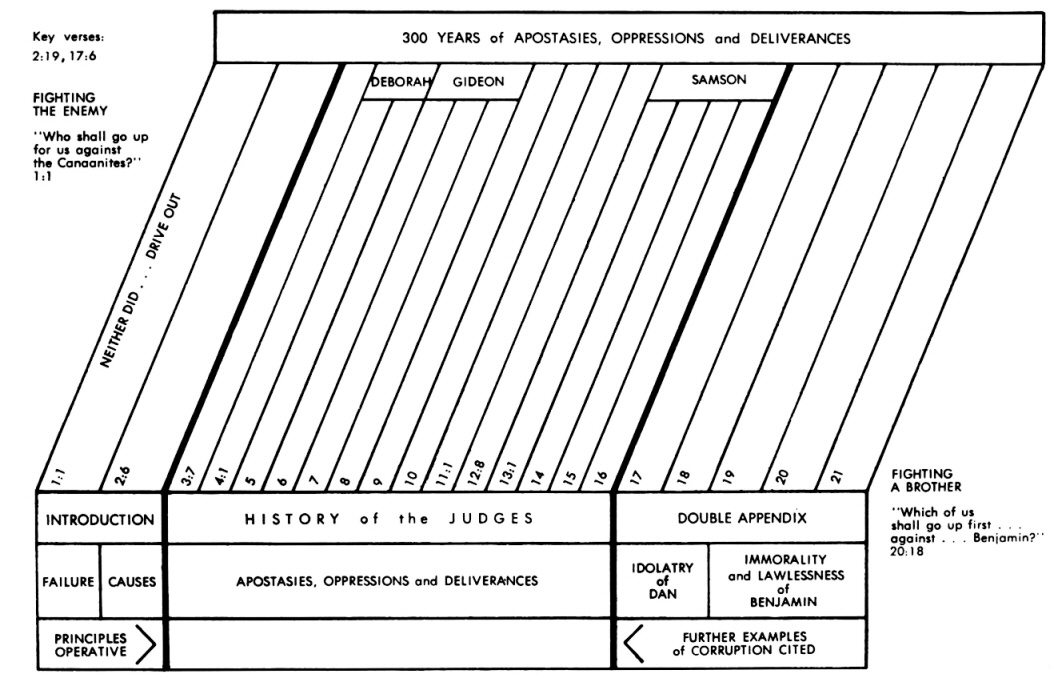
Chart from recommended resource Jensen's Survey of the OT - used by permission
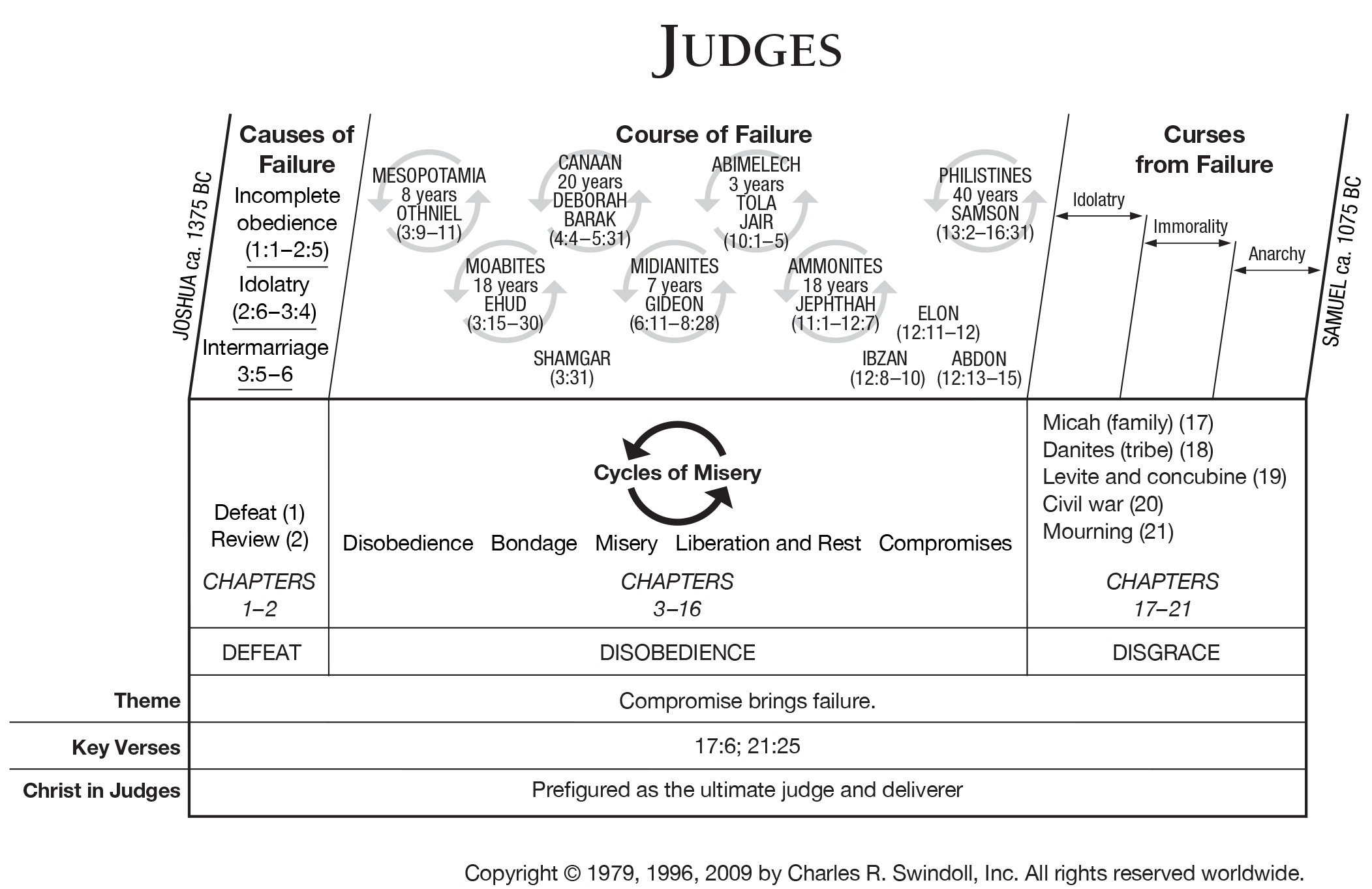
Chart on Judges - Charles Swindoll
|
RECYCLING SIN |
|||||
| Jdg 1:1-3:6 | Jdg 3:7-16:31 | Jdg 17:1-21:25 | |||
| Introduction | History of the Judges | Appendix | |||
| Causes of the Cycles THE REASON |
Curse of the Cycles THE RECORD |
Conditions in the Cycles THE RESULTS |
|||
| Failure to Complete Conquest Jdg 1:1-36 God's Judgment for Failure Jdg 2:1-3:6 |
Curse of the Cycles |
Conditions in the Cycles |
|||
| Living with Canaanites |
War with the Canaanites |
Living Like the Canaanites |
|||
| Religious Laxity |
Political Uncertainty |
Moral Anarchy |
|||
| About 350 Years of Israel's History - Almost 25%! From Compromise to Confusion! |
|||||

Another Timeline of Israel's History
Click to Enlarge
from Jensen's Survey of the OT
Click to Enlarge
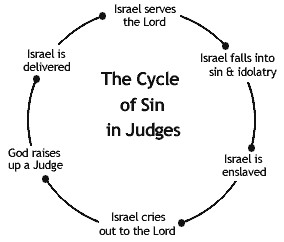
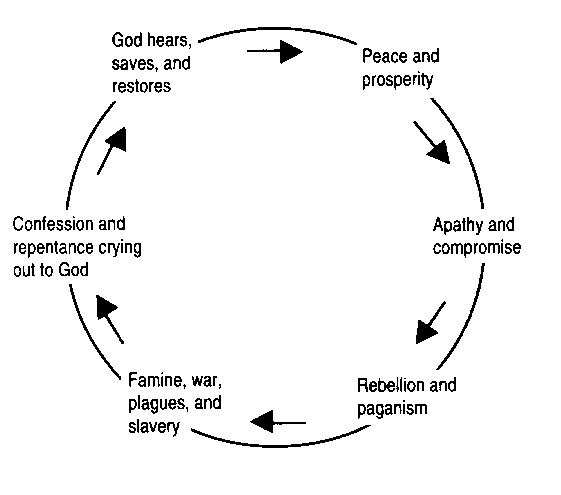
Other ways to describe Israel's cycle…
- Rest > Rebellion > Retribution > Repentance (?) > Restoration
- Sin > Suffering/Servitude > Supplication > Salvation
- Apathy > Apostasy > Affliction > Answered Prayer
- Disobedience > Desperation > Deliverance
- Disobedience > Bondage >Misery > Liberation and Rest > Compromises
Dale Ralph Davis - For convenience chapters 14–16 can be divided into six main episodes. Each episode is structured around these two basic elements: a Philistine success followed by a Samsonite disaster. The outline is this:
Episode 1 Jdg 14:5–20
Solution—answer to riddle
Failure—slaughter at Ashkelon
Episode 2 Jdg 15:1–6a
Solution—Samson gone, peace
restored, girl given to best man
Failure—flaming foxes
Episode 3 Jdg 15:6b–8
Solution—burn up Timnite woman
and father
Failure—slaughter by Samson
Episode 4 Jdg 15:9–17
Solution—Samson bound,
handed over
Failure—‘Jawbone Hill’
Episode 5 Jdg 16:1–3
Solution—Ambushing the playboy
Failure—portable gates
Episode 6 Jdg 16:4–30
Major pattern:
Solution—hair shaved
Failure—tragedy at Dagon’s Place
Subsidiary patterns:
Solution/failure—7 bowstrings (Jdg 16:6–9a/9b)
Solution/failure—new ropes (Jdg 16:10–12a/12b)
Solution/failure—loom (Jdg 16:13–14a/14b)
Solution/success—razor (Jdg 16:15–19a/19b–21)
From Judges: Such a Great Salvation - highly recommended resource - get it if you are going to preach or teach Judges!
Judges 16:1 Now Samson went to Gaza and saw a harlot there, and went in to her.
- and went. Ge. 38:16–18. Ezr. 9:1, 2.
- Harlot - Genesis 38:16, 17, 18; Ezra 9:1,2
- Judges 16 Resources
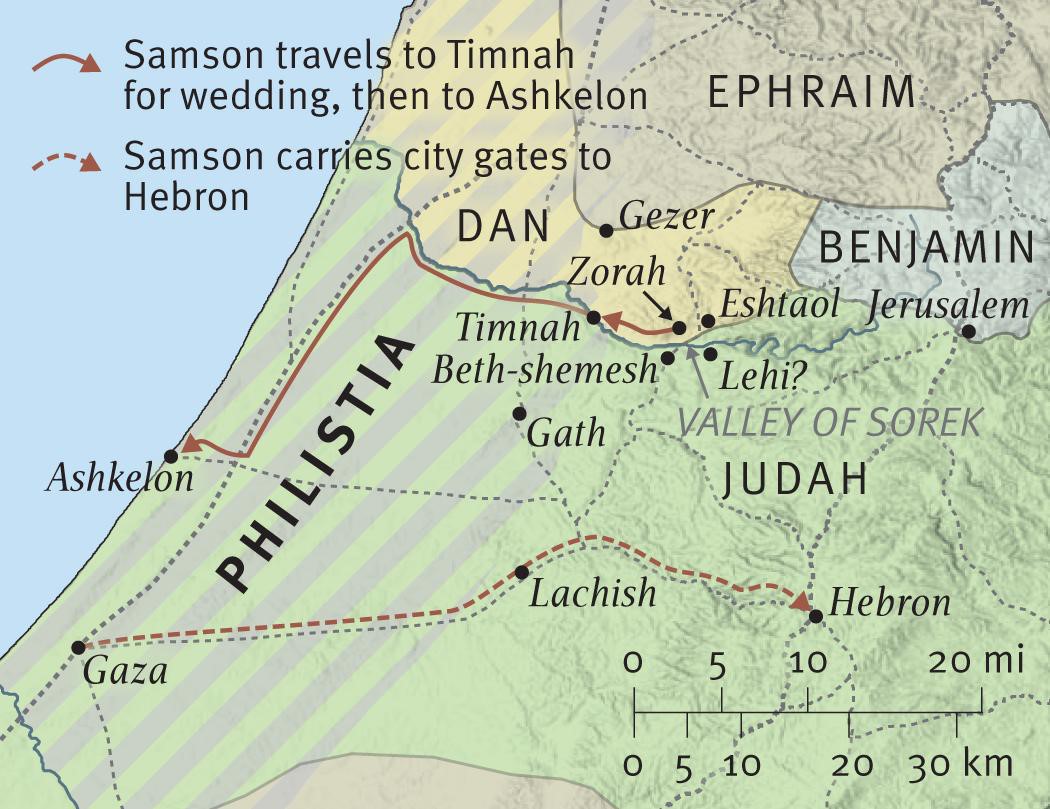
See Gaza in southwest Philistia
(ESV Global Study Bible)
HEBREWS HALL OF FAMER
HEADS FOR A HARLOT!
Now Samson went to Gaza and saw a harlot (zanah) there, and went in to her. - One bad turn led to another. Topographically (in terms of elevation above sea level) speaking the physical direction of Gaza was down, but more important was the fact that Samson's spiritual direction was down!
Samson falls prey to the same flesh-driven femme fatale problem! He had just tasted victory over his adversary the Philistines in Jdg 15:14-18+ and yet goes where he should not have gone and looks where he should not have looked! Beware if you know you are vulnerable to the lion's bite (EVERYONE READING THIS NOTE!), and don't walk into the lion's cage, much less stick your head into his mouth! This ought to remind us that the proclivity to sin never dies of old age, that our weaknesses never go away but are always crouching at the door of our heart ready to pounce (cp Cain's folly even after being warned by God in Ge 4:6-7, 8) We can always (and ONLY) overcome the the lusts of the flesh in the power of the Spirit (Gal 5:16+), but they will never leave us (see Gal 5:17+ where "sets its desire" is present tense = continually!). We are always weak in the area of these old sins. As someone has said, "Old flesh never dies; it just smells that way." So after victory he is tempted in this area and he immediately succumbs, because he is unwilling to turn to the Lord in his time of need and to draw upon him. Now again the Lord delivers him miraculously. He escapes through the midst of the Philistines at night and rips the gates off the city walls and carries them on his back all the way to Hebron, which is 40 miles from Gaza--again an evidence to him of the immense strength that was his in the Lord.
Guzik - Samson was in obvious sin here. This is a clear example of how a man so used of God can also sin and sin blatantly.. Samson wanted to be used by God, but he also yielded to the deceitfulness of sin. He kept the external features of his Nazirite vow zealously, while at the same time sinning blatantly with a prostitute.. Samson did what we nearly all do when deceived by sin. He put his life into categories, and figured that some categories God cared about, and some categories God did not care about. Understanding that Jesus has claim over our entire life is a radical change of perspective." (Judges 16 Commentary)
Went in to her - The life of Samson illustrates the ancient truth that a good beginning doesn’t guarantee a good ending.
Henry Wadsworth Longfellow once wrote that "Great is the art of beginning, but greater is the art of ending. (cp Heb 12:1, 2+, Php 3:14+, 1Ti 1:18, 6:20, 1Pe 1:13+)
As Solomon wrote "The end of a matter is better than its beginning (Eccl 7:8)
Samson’s morality had fallen to a low point with his visit to the prostitute at Gaza, and he soon was paying the consequences of ignoring God. It’s possible for one's character to deteriorate so much that they don’t have to be tempted in order to sin. All they need is the opportunity to sin, and they will tempt themselves (cp Jas 1:14, 15+)! What a frightening state in which to be! Illicit sex may taste sweet as honey (Pr 5:3+), but always ends up as bitter as wormwood (Pr 5:1-14+). Samson the man had become Samson the animal as the prostitute led him to the slaughter (Pr 7:6-23+).
Gaza was an important seaport town located about forty miles from Samson’s hometown of Zorah. We aren’t told why Samson went there, but it’s not likely he was looking for sensual pleasure. Once again the lust of the eyes and the lust of the flesh (cp 1Jn 2:15-17+, Jas 1:14+) combined to grip Samson and make him a slave to his passions. It seems incredible to us that a servant of God (Jdg 15:18+), who did great works in the power of the Spirit, would visit a prostitute, but the record is here for all to read. This story reminds one of the exploits of Jimmy Swaggart caught visiting ladies of the night.
It’s possible for people’s character to deteriorate so much
that they don’t have to be tempted in order to sin.
All they need is the opportunity to sin,
and they’ll tempt themselves.
-- Warren Wiersbe
Warren Wiersbe - It seems incredible to us that a servant of God (Jdg 15:18+), who did great works in the power of the Spirit, would visit a prostitute, but the record is here for all to read. The Lord certainly didn’t approve of such behavior, especially on the part of a Nazirite; and the experience was for Samson one more step down into darkness and destruction. In recent years, there have been enough ministerial scandals in the United States alone to put all of us on guard. “Therefore let him who thinks he stands take heed lest he fall” (1Co 10:12NKJV+). We can’t help it when Satan and his demons tempt us; but when we tempt ourselves, we become our own enemy. God doesn’t tempt us (Jas 1:12–15+). When we pray, “Lead us not into temptation” (Mt 6:13+), we’re asking that we not tempt ourselves or put ourselves into such a position that we tempt God (ED: ONE OTHER INTERPRETATION IS THAT WE ARE ASKING HIM NOT TO ALLOW A TEMPTATION THAT IS TOO STRONG FOR US TO HANDLE). We tempt Him either by forcing Him to intervene and rescue us or by daring Him to stop us. It’s possible for people’s character to deteriorate so much that they don’t have to be tempted in order to sin. All they need is the opportunity to sin, and they’ll tempt themselves. Illicit sexual experience may begin as sweet as honey, but it ends up as bitter as wormwood (Pr 5:1–14+). Samson the man had become Samson the animal as the prostitute led him to the slaughter (Pr 7:6–23+). (See context The Bible Exposition Commentary)
George Bush - Then went Samson to Gaza. This place was the capital and the most important of the five Philistine principalities, and was situated about fifteen miles south of Ascalon, sixty miles southwest from Jerusalem, and between two and three miles from the sea. It was a very ancient city, and is always spoken of in the Old Testament as a place of great importance. In more modern times it has undergone a great variety of changes occasioned by the fortunes of war, till at present it has declined to a trading village of some three or four thousand inhabitants. It stands upon a hill of about two miles circumference at the base, surrounded by valleys, and overlooking a prospect of much beauty. Environed by and interspersed with gardens and plantations of olive and date trees, the town has a picturesque appearance to which its numerous elegant minarets not a little contribute. The buildings being mostly of stone, and the streets moderately broad, the interior answers expectation better than most other towns of Syria, and affords accommodations far superior to most places in Egypt. The suburbs, however, are composed of miserable mud huts; but all travellers concur with Sandys in admiring the variety and richness of the vegetable productions, both wild and cultivated, of the environs. The inhabitants have manufactures of cotton and soap, but derive their principal support from the commerce between Egypt and Syria, which must all pass this way. Scarcely any of its ancient remains are now to be found. Those of which travellers gave an account a century or two ago, have nearly all disappeared.—The real motive by which Samson was prompted in this visit to Gaza, it is vain to attempt to discover. We can scarcely, however, from the sequel resist the impression that his spiritual affections had suffered a serious decline, that he had relaxed the vigilance and circumspection of his walk as a Nazarite, and that he ventured uncalled among the uncircumcised. Considering the relation in which he stood to the Philistines, and the light in which he was regarded by them, it was certainly a step full of personal danger, provided he went thither openly and without disguise. But from the context it would rather appear, that he entered the gates without the citizens being at first apprised of the fact. His being there, however, was soon noised abroad, and his enemies were at once on the alert with their machinations to get him in their power, and what security for safety have they who wander unbidden from the path of duty? (resource)
George Bush And saw there an harlot, &c. The seeing this lewd woman was not perhaps the moving cause of his going to Gaza, but being there he accidentally fell in with her, and was unhappily ensnared by the sight of his eyes. How have the strongest in grace occasion to pray, Lead us not into temptation! (resource)
R C Sproul applies the truths in this story to believers today noting that "Samson drifted into sin one inch at a time, but finally there was a point when God withdrew his favor and denied him access to the gift of strength. Pride, presumption, and neglecting your spiritual gifts may result in the same end. What task has God set before you at this point in life? Are you aware of your privilege and, as Paul encouraged Timothy (2Ti 1:6+), are you stirring up your gift into a righteous flame? (Before the Face of God: Book Three: A Daily Guide for Living from the Old Testament)
F B Meyer - A fatal snare again entangled Samson. -- How many great men have been too weak to resist the wiles of the flesh. Those who do great exploits for God must ever watch against these. This story should remind us of the death of Christ. In His weakness as He hung upon the Cross, the power of hell compassed Him in, and anticipated an easy victory, but He laid hold on the doors of death, the gate into the unseen, and plucked them up, bars and posts and all, and put them upon His shoulders and carried them up to the top of the everlasting hills, which lie towards the city of Rest (Eph 4:8+). AMEN!
This chapter (among many lessons) shows how desire (lust) can deceive a person into believing a lie. From whence does that desire originate? From ourselves, from our mortal enemy, Sin, which continually entices us with the desires of deceit (Jas 1:14, 15+, cf 1Pe 2:11+). If Sin's desires were not deceitful they would not be so enticing! Therefore, the writer of Hebrews wisely exhorts us to "encourage one another day after day, as long as it is still called “Today,” lest any one of you be hardened by the deceitfulness of sin." (Hebrews 3:13+) We must continually “Keep watching and praying" lest we fall prey to Sin's siren song and "enter into temptation," for as Jesus warned our "spirit is willing but the flesh is weak. (Mt 26:41+)
It has been well said that "There is a great deal of deceitfulness in sin; it appears fair, but is filthy; it appears pleasant, but is pernicious; it promises much, but performs nothing. The deceitfulness of sin is of a hardening nature to the soul; one sin allowed prepares for another; every act of sin confirms the habit; sinning against conscience is the way to sear the conscience; and therefore it should be the great concern of every one to exhort himself and others to beware of sin." (Matthew Henry)
Keil and Delitzsch - Samson’s Fall and Death.—Samson’s judicial labours reached their highest point when he achieved his great victory over the Philistines at Lechi. Just as his love to the daughter of a Philistine had furnished him with the occasion designed by God for the manifestation of his superiority to the uncircumcised enemies of Israel, so the degradation of that love into sensual lust supplied the occasion for his fall which is related in this chapter. “Samson, when strong and brave, strangled a lion; but he could not strangle his own love. He burst the fetters of his foes, but not the cords of his own lusts. He burned up the crops of others, and lost the fruit of his own virtue when burning with the flame enkindled by a single woman.” (Ambros. Apol. ii., David. c. iii.)
Keil & Delitzsch - His Heroic Deed at Gaza.—Samson went to Gaza in the full consciousness of his superiority in strength to the Philistines, and there went in unto a harlot whom he saw. For Gaza, see Josh. 13:3. בֹּוא אֶל is used in the same sense as in Gen. 6:4 and 38:16. It is not stated in this instance, as in Judg. 14:4, that it was of the Lord. (Commentary)
ILLUSTRATION - ENEMY ATTACK - In his book, From the Shadows, former CIA director Robert Gates relates a near-catastrophe that took place during the Presidency of Jimmy Carter. Carter's national security advisor, Zbigniew Brzezinski, was once awakened and informed that the Soviet Union had launched an all-out nuclear attack. One minute before he was to have called the President, word arrived that the first information had been in error. Someone had accidentally inserted military exercise tapes into the missile-defense computer system. Thankfully, Brzezinski's wake-up call was a false alarm. He remained calm and in control in a situation in which he might have fallen prey to fear or panic. He knew that if we fail to control our passions, our passions control us. That's what happened to Samson. Unable to control himself, in the end he fell victim to an ""enemy attack.""
|
PARALLEL PATTERN OF SAMSON'S |
||
|
EVENT |
Jdg 14-15 |
Jdg 16 |
|
Sees woman |
Jdg 14:1 |
Jdg 16:1 |
|
Woman betrays secret |
Jdg 14:5-18 |
Jdg 16:4-20 |
|
Samson bound |
Jdg 15:9-13 |
Jdg 16:21 |
|
Samson calls on Lord |
Jdg 15:18-19 |
Jdg 16:28, 30 |
|
Philistine slaughter |
Jdg 15:14-17 |
Jdg 16:30 |
|
Judgeship Acknowledged |
Jdg 15:20 |
Jdg 16:31 |
Ray Pritchard (see full sermon Little Steps to a Big Fall) - You may wonder why I bring up this story at this time. And then maybe you don’t. It does have an amazingly contemporary sound, doesn’t it? It’s a story of reckless behavior by someone who should have known better. It could have been ripped from the pages of any newspaper in America. I don’t want to make a political point other than to note that what happened in the White House isn’t unique or new in any sense. It’s as old as the human race. Certainly the story of Samson and the prostitute of Gaza stands as a cautionary tale to all of us. Here are some of the obvious lessons:
1) Just because we think we have conquered a certain sin doesn’t mean it will stay conquered forever.
2) The price of long-term spiritual victory is continued vigilance coupled with self-discipline and regular accountability.
3) God sometimes lets us suffer the consequences of our sin as a means of grace so that when we are humbled, we will return to him with a truly broken heart.
4) A healthy sense of our own sinfulness and an honest admission of our weakness can protect us from foolish mistakes and stupid choices.
5) A lifetime of obedience can be ruined in a moment of sinful passion.
6) If we think that we are somehow immune to certain temptations—and that what others have done we would never do—we are arrogant, self-righteous fools. We may be in greater danger than the people we criticize.
7) God lets some people fall so that others will learn not to sin.
8) Judgment and forgiveness are not mutually exclusive. We may be judged and forgiven at the same time.
Write two verses of Scripture over this tragic story of Samson and the prostitute at Gaza. The first is Proverbs 16:18 “Pride goes before destruction and a haughty spirit before a fall.” The second is 1 Corinthians 10:12, “Therefore if any man thinks that he is standing firm, let him take care lest he fall.” Where is the grace of God in all of this? We see it in two ways. First, the grace of God appear at the end of Judges 16 when blind Samson—having been captured and publicly humiliated by the Philistines–returns to God just before he dies. Second, we see God’s grace in the fact that this strange story of Samson and prostitute is recorded in the Bible. It is a “severe mercy” and a warning from God who loves us too much to let us take our sin lightly. Why did Samson go to Gaza? Because he was self-confident. Because he had lived for twenty years without ever dealing with his basic problem. And since he’d lived problem-free for twenty years he felt like he didn’t have a problem anymore. Oh, Samson, what a fool you were. And what fools we are if we don’t learn from what his mistakes. We read this story, Lord, and a thousand fugitive thoughts go through the mind. We watch Samson throwing his life away and we say, “How stupid.” Grant that we might have a better estimate of our own weakness. Help us to see that what happened to Samson could so easily happen to any of us. Renew within us the spirit of self-discipline. Show us anew the danger of dabbling with temptation. Lead us to the place where we will yield our desires to you. Thank you for the alchemy of the Holy Spirit, through which the base metal of our passions is transformed into pure gold for your kingdom. Amen. (Little Steps to a Big Fall)
In another message Pritchard writes - The story of Samson and Delilah, found in Judges 16, really could be titled “Didn’t you used to be Samson?” It’s the story of a man who having reached the pinnacle of his career and having accomplished everything a man would want to accomplish, in one sudden, violent turn went from the top right down to the bottom. It’s the story of a man whose name was a household word, whose picture was on every wall, whose deeds were celebrated by poets and priests. It’s the story of a man who had it all and who in a moment lost it all. The amazing thing about the story of Samson and Delilah is that it comes at the height of his career. That really is the most shocking fact. In the end, Samson was tricked by the same thing that tricked him in the beginning. And in that one fact is the shock and surprise. Or perhaps it is no shock and no surprise at all that after all these years, the thing he struggled with in the beginning—that thing reached out and bit him on the heel and finally brought him down.....The story begins in Judges 16:1 where Samson does a very unusual thing. One day Samson went down to Gaza where he saw a prostitute. Gaza was a Philistine city. It was about 25 miles away from Zorah, where he grew up. Gaza was not only a Philistine city, it was also the headquarters for the Philistines. It was the place where they had the temple of Dagon. It was a crazy thing for Samson to do. It would be like Mikhail Gorbachev coming to Washington, D.C. one Friday night, and hoping he wouldn’t be recognized. The odds weren’t in his favor. Everybody in Gaza knew Samson; he was Public Enemy Number One. Maybe he thought he was far enough away that either they wouldn’t recognize him or maybe word wouldn’t get back to Israel. Who knows? It was a crazy, insane chance to take. In one sense it wasn’t a “chance” at all, because there was absolutely no chance the mighty Samson could slip in and out of the capital city of the Philistines unobserved. No chance. None whatsoever. It’s like the stories we sometimes hear about certain preachers and politicians who take such reckless chances with their private lives that it almost seems as if they have a professional death wish. Maybe that’s what is happening here. Maybe Samson is fed up with the unending pressure of 20 years at the top of the heap. Maybe he’s so fed up with the humdrum that he almost doesn’t care if he does get caught. That kind of thing happens all the time, and more so as successful men approach the mid-life years. So Samson leaves his own people again. He goes to the capital city of the Philistines and there he sees a prostitute. He went in, the Bible says, to spend the night with her. By the way, Samson is the only man in the Hall of Fame of Faith in Hebrews ll, who ever slept with a prostitute. This famous man of God went in to spend the night with a prostitute. (Looking for Love in all the Wrong Places)
Related Resources: Dealing with Lust, Holiness, Godliness
- Ephesians 5:3, 4ff Exposition
- Proverbs 4:23 Exposition
- 2Corinthians 7:1 Exposition
- Jehovah Nissi: Exposition of Exodus 17:8-16
- 1Thessalonians 4:3ff Exposition
- Galatians 5:16ff Exposition
- 1Timothy 4:7ff Exposition
- 2Corinthians 10:3-5 - Exposition
- James 1:13; James 1:14; James 1:15 - Exposition
- Proverbs 5:1-14; Proverbs 5:15-23; Proverbs 6:20-35; Proverbs 7:1-27 - Exposition
- Study of our fallen flesh
- Deceitfulness of Sin
- Read Nu 32:23+, Pr 5:22 - Captured by Iniquity and Held by Cords of one's own Sin
Sin will take you further than you ever wanted to stray!
Cost you more than you ever dreamed you would pay!
Keep you longer than you ever thought you would stay!
Harlot (02181) (zanah) (see Harlot • Harlotry) means a prostitute. Prostitutes like the woman whom Samson visited at Gaza were common in the ancient world. In fact, prostitution has been a part of religious rites since at least 3000 a.d. In Babylon, Syria, Canaan, Arabia, and Phoenicia intercourse with a temple prostitute was believed to induce fertility among humans, animals, and crops. The historian Herodotus tells of a Babylonian custom that required every woman to sit in the temple of the goddess Ishtar until chosen by a stranger for sexual relations. A desirous man would toss a coin in a woman’s lap. If she accepted the coin and his sexual advances, she would have paid her obligation to the goddess and be free to return to her normal life. In Israel, however, ritual prostitution was forbidden (Dt 23:17). Laws existed to prevent priests from marrying prostitutes (Lev 21:7), and income from prostitution could not be used to pay vows in the temple (Dt 23:18). Nevertheless, commercial prostitutes practiced their trade rather freely in Hebrew society. They were easily recognizable by their hairstyle, head ornaments, or perhaps a special mark on their foreheads. Their clothing and jewelry signaled their availability, and like streetwalkers everywhere, they frequented particular locales well known as meeting spots. Payments were accepted in money, grain, wine, or livestock. It was even common to accept a pledge until the payment could be fulfilled.
ESV Study Bible - Hebrew has two words for prostitutes. One (qadesh) refers to “cultic prostitutes” who served pagan gods (Gen. 38:21-22; Deut. 23:17; 1 Kings 14:24). The word here (zonah) signifies a second type, the common, “secular” variety (cf. Gen. 38:15). (See context ESV Study Bible)
Sin Saps Us
Return to the Lord. Say to Him, "Take away all iniquity; receive us graciously." —Hosea 14:2
Sin saps us of our God-given strength. We become spiritually weak and decrepit, but often we imagine that we’re just as hardy as ever.
That’s the deceitfulness of sin. Gradually we drift away from God. We lose our desire to spend time in His Word and in prayer. The current of this world carries us away from friends and godly influences. We drift deeper into sin—our pathetic, feeble state evident to all eyes but our own.
I think of Samson, that man of towering strength who pillowed his head in the lap of sin, then rose from his sleep and said, “I will go out as before … and shake myself free!” (Judges 16:20). But he didn’t know that the Lord had taken away his strength.
Many years later, the prophet Hosea confronted the people of Israel and said that they too had lost their strength because of sin, and they didn’t realize it (Hosea 7:8-16). So Hosea commanded them to “return to the Lord. Say to Him, ‘Take away all iniquity; receive us graciously'” (Jdg 14:2).
Sin can sap us too. That’s why we must deliberately take time to ask the Lord to expose our sin (Psalm 139:23-24). When we turn in repentance to Him, He will receive us graciously, set us free from sin’s domination, and arm us again with strength. —David Roper
Search me, O God, and know my heart;
Try me, and know my anxieties;
And see if there is any wicked way in me,
And lead me in the way everlasting.
—Psalm 139:23-24
Sin adds to your trouble, subtracts from your energy, and multiplies your difficulties.
John Piper (The Anatomy of Backsliding on Ps 119:176) notes that at the terminus of one of the most wonderful psalms in Scripture, the psalmist makes a declaration the picture of which is that of the confession of one who has become backslidden!
I have gone astray like a lost sheep (What should we pray when we have gone astray?). Seek thy servant, (Why should God seek His servant?) for I do not forget thy commandments.
Spurgeon commenting on this passage writes: This is the finale: I have gone astray like a lost sheep—often, willfully, wantonly, and even hopelessly, but for thine interposing grace. Before I was afflicted, and before thou hadst fully taught me thy statutes, I went astray from the practical precepts, from the instructive doctrines, and from the heavenly experiences which thou hadst set before me. I lost my road, and I lost myself. Even now I am apt to wander, and, in fact, have roamed already; therefore, Lord, restore me.
Seek thy servant. He was not like a dog, that somehow or other can find its way back; but he was like a lost sheep, which goes further and further away from home; yet still he was a sheep, and the Lord’s sheep, his property, and precious in his sight, and therefore he hoped to be sought in order to be restored. However far he might have wandered he was still not only a sheep, but God’s “servant,” and therefore he desired to be in his Master’s house again, and once more honored with commissions for his Lord. Had he been only a lost sheep he would not have prayed to be sought; but being also a “servant” he had the power to pray. He cries, Seek thy servant, and he hoped to be not only sought, but forgiven, accepted, and taken into work again by his gracious Master.
Notice this confession; many times in the psalm David (Ed note: David may be the author but that is no where clearly stated.) has defended his own innocence against foul-mouthed accusers, but when he comes into the presence of the Lord his God he is ready enough to confess his transgressions. Here he sums up, not only his past, but even his present life, under the image of a sheep which has broken from its pasture, forsaken the flock, left the shepherd, and brought itself into the wild wilderness, where it has become as a lost thing. The sheep bleats, and David prays, Seek thy servant. His argument is a forcible one—for I do not forget thy commandments. I know the right, I approve and admire the right; what is more, I love the right, and long for it. I cannot be satisfied to continue in sin, I must be restored to the ways of righteousness. I have a home-sickness after my God, I pine after the ways of peace; I do not and I cannot forget thy commandments, nor cease to know that I am always happiest and safest when I scrupulously obey them and find all my joy in doing so. Now, if the grace of God enables us to maintain in our hearts the loving memory of God’s commandments it will surely yet restore us to practical holiness. We cannot be utterly lost if our heart is still with God. If we be gone astray in many respects, yet still, if we be true in our soul’s inmost desires, we shall be found again, and fully restored. Yet, let us remember the first verse of the psalm while reading the last: the major blessedness lies not in being restored from wandering, but in being upheld in a blameless way even to the end. Be it ours to keep the crown of the causeway, never leaving the King’s Highway for By-path Meadow, or any other flowery path of sin. May the Lord uphold us even to the end. Yet even then we shall not be able to boast with the Pharisee, but shall still pray with the publican, “God be merciful to me a sinner,” and with the psalmist, Seek thy servant.
John MacArthur in his book (see context of The Power of Integrity: Building a Life Without Compromise) the reading and practice of which is sorely needed to sound a wake up call in many sleeping, drifting, compromising modern churches. Here is an excerpt from this excellent book that relates to Samson's life as it deals with the sad certain sequelae of compromise…
Church history is full of people who refused to compromise the biblical standards. As he stood before the Diet of Worms and was ordered to recant his writings or lose his life, Martin Luther did not deny Christ. Hugh Latimer and Nicholas Ridley, two English Reformers, were both burned at the stake for their faith in Christ. Those men are representative of the people who can’t be bought; no price will cause them to sell out.
THE PRICE
OF COMPROMISE
Men who hold to an uncompromising standard are sorely lacking in the church today. Many so-called Christians boast of their moral standards and extol their righteous character, yet abandon their conviction when compromise is more beneficial and expedient.
Perhaps you recognize one or more of the following:
• People say they believe the Bible, yet attend churches where the Bible isn’t taught.
• People agree that sin must be punished, but not if those sins are committed by their children.
• People oppose dishonesty and corruption until they must confront their bosses and risk losing their jobs.
• People maintain high moral standards until their lusts are kindled by unscriptural relationships.
• People are honest until a little dishonesty will save them money.
• People hold a conviction until it is challenged by someone they admire or fear.
Sadly, such compromises are not exceptions; they have become the rule. But don’t think twentieth-century Christians are the only experts in the art of compromise. Scripture is full of people who compromised, including some very choice servants of God.
• Adam compromised God’s law, followed his wife’s sin, and lost paradise (Gen. 3:6, 22, 23, 24).
• Abraham compromised the truth, lied about Sarah’s relationship to him, and nearly lost his wife (Ge 12:10, 11, 12).
• Sarah compromised God’s Word and sent Abraham to Hagar, who bore Ishmael and destroyed peace in the Middle East (Ge 16:1-12).
• Moses compromised God’s command and lost the privilege of entering the Promised Land (Nu 20:7, 8, 9, 10, 11, 12).
• Samson compromised his devotion as a Nazirite and lost his strength, his eyesight, and his life (Jdg. 16:4-6, 16-31).
• Israel compromised the commands of the Lord, lived in sin, and, when fighting the Philistines, lost the Ark of God (1Sa 4:11). She also compromised the law of God with sin and idolatry and lost her homeland (2Chr 36:14-17).
• Saul compromised God’s divine word by not slaying the animals of his enemy and lost his kingdom (1Sa 15:3, 20-28).
• David compromised God’s standard, committed adultery with Bathsheba, murdered Uriah, and lost his infant son (2Sa 11:1-4ff, 2Sa 12:7-14 - note especially what David had despised in committing these sins - 2Sa 12:9, 10 and what was the most odious result - 2Sa 12:14).`
• Solomon compromised his convictions, married foreign wives, and lost the united kingdom (1Ki 11:1-8).
• Judas compromised his supposed devotion for Christ for thirty pieces of silver and was separated from Christ eternally (Mt 26:20-25, 47, 48, 49; 27:1-5; cf. Jn 17:12).
• Peter compromised his conviction about Christ, denied Him, and lost his joy (Mark 14:66-72). Later he compromised the truth in order to gain acceptance by the Judaizers and lost his liberty (Gal. 2:11-14).
• Ananias and Sapphira compromised their word about their giving, lied to the Holy Spirit, and lost their lives (Acts 5:1-11).
Two observations come to mind from those examples. First, in every case the effect of the compromise was to lose something valuable in exchange for something temporary and unfulfilling, some sinful desire. How contrary that is to what we discovered in the first chapter. There we learned that you gain something valuable (your salvation and relationship with Christ) in exchange for something worthless (your sin and self-righteousness).
Second, note what was compromised in each of those examples: either God’s Word, a command from God, or a conviction about God. Thus the true price of compromise is a rejection of God’s Word, which amounts to rebellion against Him and promotion of self as the final authority.
That is the situation in many churches today. Even in churches that once were genuinely evangelical, where the Bible was the divine standard for belief and living, God’s Word is now compromised. Sometimes it is stripped of its clear meaning or is relegated to a place of secondary authority. In many churches that once preached sound doctrine, evils that God plainly and repeatedly condemns are touted as acceptable. Scripture is often reinterpreted to accommodate those anti-biblical views. Pragmatism is in; commitment to biblical truth is denigrated as poor marketing strategy.
The fact is, people are content with unbiblical notions that raise their comfort level and either justify or overlook their sins. They are quick to reject as unloving anyone who presumes to hold them accountable to doctrinal beliefs and moral standards they deem outmoded and irrelevant.
Today the church is full of spiritual babies who are tossed here and there by waves, and carried about by every wind of doctrine, by the trickery of men, by craftiness in deceitful scheming (Eph 4:14+)—the antithesis of a spiritually mature Christian. Spiritual babies are in constant danger of falling prey to every new religious fad that comes along. Because they are not anchored in God’s truth, they are subject to every sort of counterfeit truth—humanistic, cultic, pagan, demonic, or whatever. Just as families today are dominated by their children, so are many churches. How tragic when the church’s immature believers are among its most influential teachers and leaders. (see context of The Power of Integrity: Building a Life Without Compromise)
The Deceitful Appearance of Poisonous Mushrooms - There are a thousand or more varieties of mushrooms that are good to eat… The most dreaded of the poisonous mushrooms are two members of the Amanita group. One is the death cap, and the other is the fly amanita. The death cap grows in the woods from June until fall. Its poison acts like the venom of a rattlesnake, as it separates the corpuscles in the blood from the serum. No antidote is known for the poison of the death cap. The only hope for anyone who has eaten it is to clean out his stomach promptly with a stomach pump. It is small wonder that one variety is known as the destroying angel. The death cap has often been mistaken for the common mushroom. A person should not make this mistake if he observes carefully. The poisonous plant has white gills (picture), white spores, and the fatal poison cap around the stem. The plant that is safe to eat has pink gills, brown spores, and no cap. Many of the mistakes come from picking it in the button stage, for it does not show all these differences until it has grown larger. Sin is most dangerous when it is in the button stage!
#/media/File:Lact.sub.jpg)
Charles Hodges' Outline dealing with the Deceitfulness of Sin…
Compare the expressions, deceitfulness of riches, of unrighteousness, of lusts. The latter is the better sense. The subject for consideration is the characteristic of sin as deceitful.
I. Sin is not an act but a power, a principle, something innate, indwelling, permanent and active, an enemy of the most dangerous kind, not only because it is within and ever on the alert and powerful, and has so many allies, but also because it is so treacherous.
II. How is sin deceitful?
1. It deceives us as to what is sinful, as in the case of Adam. So also in the case of thousands.
2. It deceives us as to its demands. It promises to be satisfied with a limited indulgence. So the slothful, the negligent, the sensual, the avaricious. It is the first step that costs.
3. It deceives as to the pleasure it promises. Adam expected to be like God.
4. It deceives us as to the true motives which determine our conduct. Ministers, missionaries, as well as others are thus deceived.
5. It deceives us as to its effects and to the degree of impunity with which it can be indulged.
III. The effects of sin as thus deceitful.
1. It hardens. That is,
a. as to the will it renders it stiff and fixed. It becomes settled in evil.
b. As to the feelings it renders them obdurate. Motives cease to affect, the conscience to warn or reprove, and the result is a reprobate mind.
2. It slays or destroys the soul.
a. In destroying its sensibility.
b. In destroying desire and hope of amendment.
c. In bringing it fully under the power of the law.
IV. Means. The preliminary conditions are;
1. A sense of danger.
2. A sense of weakness. The means are;
a. Committing ourselves to Christ and his Spirit. To be guided by his wisdom. To regard nothing as innocent or harmless which he condemns.
b. To resist the beginning and first suggestions.
c. In doubtful cases always to go against what may be evil.
(Hodge, C. Sermon Outlines: Taken from Princeton Sermons Simpsonville SC: Christian Classics Foundation)
There is an insect that has a very close resemblance to the bumblebee, but which is a terrible enemy to it. Because of its likeness, it sometimes finds its way in a fraudulent manner into the bee’s nest, and there deposits its eggs. But when these eggs are hatched the larvae devour those of the bee. It comes in as a friend and helper, but turns out to be a devouring enemy. Such is the secret sin harbored in the heart. It eats away the vitals of the spiritual life, and effectually destroys the power of growth and usefulness. It is all the more dangerous when it comes in the likeness of a friend and helper in the work of the Lord. Beware of the deceitfulness of sin! (AMG Bible Illustrations)
Sin Is Like An Insect! - It was reported recently that an enormous pine tree in the mountains of Colorado had fallen victim to a pine beetle and died. According to locals, up to that point the tree was thought to be indestructible. It had survived fourteen lightning strikes and many years of Colorado winters, including avalanches and fires. But it was eventually brought down from within by a tiny insect that did its work silently. That's the way it is with sin in a person's life, be they a Christian or a non-Christian. Watch over your heart with all diligence. Pr 4:23+
Rousseau's "Self-Ruse" - The deceitfulness of sin is vividly seen in the life of the French philosopher Rousseau. He declared, “No man can come to the throne of God and say, ‘I’m a better man than Rousseau.’” When he knew death was close at hand, he boasted, “Ah, how happy a thing it is to die, when one has no reason for remorse or self-reproach.” Then he prayed, “Eternal Being, the soul that I am going to give Thee back is as pure at this moment as it was when it proceeded from Thee; render it a partaker of Thy felicity!”
This is an amazing statement when we realize that Rousseau didn’t profess to be born again. In his writings he advocated adultery and suicide, and for more than 20 years he lived in licentiousness. Most of his children were born out of wedlock and sent to a foundling home. He was mean, treacherous, hypocritical, and blasphemous. (Our Daily Bread)
Misnomers - A newspaper columnist expressed astonishment at the way truth is often stretched in advertising. She recalled ordering "fresh fruit salad" from the menu in a Boston restaurant. But when the item was served, it was anything but "fresh." The peaches, pineapples, grapes, and maraschino cherries had spent months wallowing in their own juice in a tin can. When the waitress was asked what happened to the "fresh" fruit salad, she responded cheerily, "Oh, honey, that's just what they call it." Such deception occurs not only in advertising; it happens whenever people move away from God's principles of truth and goodness. Deception, misnomers (the use of a wrong name), and outright lies are the tools of an immoral person's trade. Selfish and evil people call themselves generous and good. The slaves of sin call themselves liberated. The foolish call themselves enlightened. And the lustful describe their acts as love affairs. God is not fooled by these misnomers. In Isa 5:20, He warned against those who "call evil good, and good evil." No matter what the world calls good or evil, let's take our definition from the God of all truth. With Him there are no misnomers. –M R De Haan II (Our Daily Bread)
Deceptions, twists, and outright lies
Define the words of fools;
But those who know God's Word will have
A life where wisdom rules.
–Sper
We would not delight in sin if we were not deceived by sin.
If you rationalize one sin, it becomes two.
Two Florida men charted a course and drove their fishing boat out into the Gulf of Mexico. Using the boat's compass, they headed to deep waters 60 miles offshore where they hoped to catch grouper. When they arrived at what they thought was the right place, they turned on their depth finder and realized they were nowhere near their target. They discovered that one of them had laid a flashlight near the ship's compass, and the attached magnet had affected the reading. Just as that magnet changed the compass, so our sinful hearts can influence our thinking. Many of Jesus' countrymen, for example, thought they were moving in the right direction by denying that He was the promised Messiah (Jn 7:41-42). But the real problem with these people was the bias in their hearts. They resisted Jesus because of the threat He seemed to pose to their religious traditions. Rather than carefully checking all the Scriptures, which would have verified who He was, they settled for what they preferred to believe. And they rejected Him. Because we too can be self-deceived, we must ask the Lord to expose the inner motives that cast shadows across our minds and dim our spiritual discernment (Ps 139:24+). With His help, we can get back on course. –M R De Haan II (Our Daily Bread)
Often I have walked in my own way,
Trusting in my self-deceiving heart;
Now I realize that I must pray,
"Lord, from Your way I will not depart."
–Hess
To avoid self-deception,
seek God's direction.
Got Moles? - While cutting our grass, I spotted rounded mounds of sandy loam on what had recently been a smooth lawn. A family of moles had emigrated from nearby woods to take up residence beneath our yard. The little creatures were wreaking havoc with our lawn by burrowing into the soil and disrupting the beautiful turf.
In some ways the activity of moles illustrates the dark side of the human heart. On the surface, we may appear polished and polite. But greed, lust, bigotry, and addictions can work inner destruction. Sooner or later, those sins will become apparent.
King Saul had a fatal flaw that festered beneath the surface—rebellion against God. He had been commanded not to take any of the spoils of war from the Amalekites (1Sa 15:3). But after a decisive victory, he let the Israelites keep the best of the livestock for themselves (1Sa 15:9).
When the prophet Samuel confronted the king, Saul rationalized that he had kept the sheep and cattle to sacrifice to God. But this was a mere cover for his sinful pride, which had erupted in defiance of the God he claimed to serve.
God's remedy for rebellion is confession and repentance. Like Saul, you may be rationalizing your sin. Confess and forsake it before it's too late.—Dennis Fisher (Our Daily Bread)
God wants complete obedience—
Excuses will not do;
His Word and Spirit point the way
As we His will pursue.
—Sper
One sin becomes two when it is defended.
The 19th-century pastor Henry Ward Beecher told of a mother in the wild frontier country who was washing clothes beside a stream. Her only child was playing nearby. Suddenly she realized he was gone. She called his name, but there was no answer. Alarmed, the mother ran to the house, but her son was not there. Frantically, the woman dashed out to the forest. There she found the child, but it was too late. The youngster had been killed by a wolf. Heartbroken, she picked up his lifeless body, drew him close to her heart, and tenderly carried him home. Beecher concluded, "Oh, how that mother hated wolves!"
Every Christian should have a similar hatred for evil (Ps 101:3-8+). Yet many mothers and fathers who are so careful to guard their youngsters from physical harm don't notice the evil forces that threaten their spiritual welfare. As a result, they leave them unprotected. They show little concern for the kinds of friends their children make, the magazines they read, or the TV programs they watch. But whenever these influences are bad, they should be seen as a deadly threat, and we should protect our children from them. It's not wrong to hate when we hate what is wrong. –R W De Haan (Our Daily Bread)
FOR FURTHER STUDY
According to Psalm 101:1-8, what are we to hate?
How can we avoid looking at evil? (Ps101:3).
How can we please God with our speech? (Ps101:1, 5, 7).
If we do not hate evil,
we cannot love good.
Pulling weeds from my lawn can be a struggle. Whether it's unearthing a string of ivy or digging up dandelions, it's often difficult to overcome God's curse in the Garden of Eden (Ge 3:17, 18). When the ground is hard and dry, weeds are highly resistant to being uprooted. But when a soaking rain softens the soil, they yield quite readily. I've also noticed that the youngest weeds are easier to remove and the older ones are more stubborn. Bad habits are like that. The longer they remain, the more difficult they are to remove. If we uproot them early, when our heart is tender toward God's love, we will have the best chance for success.
Paul tells us of God's great love and abundant grace to us (Ro 5:20,21+). These truths can soften the soil of a hard heart. And when we understand that Jesus died to free us from the penalty and the power of sin (Ro 6:1-14+), we will see the need to fight aggressively against sinful habits. A passive faith won't kill a bad habit. Faith must actively apply these truths. "Pulling weeds" is often a painful process of multi-failures followed by the success of failing for the last time. Do you have some weeds that need pulling? –D J De Haan (Our Daily Bread)
The sins that would entangle us
Must never be ignored;
If we do not get rid of them
They'll pierce us like a sword.
–Sper
A bad habit is like a soft chair–
easy to get into but hard to get out of.
I Was Deceived - It was dusk. My wife and I had just strolled across the famous Charles Bridge in Prague when a man approached us with a wad of money in his hand. "Forty-two Czech korunas for one dollar," he said. The official rate was about 35Ks for one US dollar. So I exchanged 50 dollars for 2,100 Czech korunas.
That evening I told my son about my good fortune. "Dad, I should have told you," he apologized. "Never exchange money on the street." We looked at the bills. The 100K note was a good Czech bill, but the two 1,000K bills were worthless. They looked like Czech money but were Bulgarian notes no longer in circulation. I had been deceived—and robbed!
Satan employs similar tactics (John 8:44). He capitalizes on the deceitfulness of sin (Heb 3:13), using its "passing pleasures" (Hebrews 11:25+) to hide the pain that always follows. Sin may be attractive, even offering something that in and of itself is good—but behind it is deception.
Our best defense against that deception is to have a growing knowledge of God's Word. As we follow the psalmist's example, we'll keep from being deceived by sin: "Your Word I have hidden in my heart, that I might not sin against You" (Psalm 119:11-notes) (See Memorizing His Word). —Dennis J. De Haan (Our Daily Bread)
Give me, O Lord, a strong desire
To look within Your Word each day;
Help me to hide it in my heart,
Lest from its truth my feet would stray.
—Branon
God's truth uncovers Satan's lies.
Booster Words - Booster shots—think of the benefits! They are part of a complete program of vaccinations that protect us against threatening diseases.
Booster words—ever heard of them? They are words we say to help others in the fight against discouragement and despair.
In his book Secrets From The Mountain, Pat Williams tells of an experiment with a group of students. They were told that scientists had proven that brown-eyed children were smarter than blue-eyed ones. Immediately, the brown-eyed students began doing better in school. A few days later, though, the students were told that they had been misinformed, and it was the blue-eyed youngsters who were actually smarter. Quickly, the scores of the blue-eyed children rose above those of their brown-eyed classmates.
Lying to children is never right, but the study demonstrates that words have the power to influence behavior. Paul recognized this, so he sent Timothy to the church at Thessalonica to encourage the believers in their faith—and his words did just that (1Th 3:2, 3+, 1 Th 3:6+).
Do we "exhort one another daily"? (Hebrews 3:13). Do we bring comfort and encouragement to the people we know? Try using some booster words today. —Dave Branon (Our Daily Bread)
Putting It Into Practice
Think of someone who needs encouragement.
How can you help that person today?
Make a phone call, send an e-mail, or pay a visit.
Hope can be ignited by a spark of encouragement.
The Power Of Sin - I was having lunch with a pastor-friend when the discussion sadly turned to a mutual friend in ministry who had failed morally. As we grieved together over this fallen comrade, now out of ministry, I wondered aloud, “I know anyone can be tempted and anyone can stumble, but he’s a smart guy. How could he think he could get away with it?” Without blinking, my friend responded, “Sin makes us stupid.” It was an abrupt statement intended to get my attention, and it worked.
I have often thought of that statement in the ensuing years, and I continue to affirm the wisdom of those words. How else can you explain the actions of King David, the man after God’s own heart turned adulterer and murderer? Or the reckless choices of Samson? Or the public denials of Christ by Peter, the most public of Jesus’ disciples? We are flawed people who are vulnerable to temptation and to the foolishness of mind that can rationalize and justify almost any course of action if we try hard enough.
If we are to have a measure of victory over the power of sin, it will come only as we lean on the strength and wisdom of Christ (Ro 7:24, 25+). As His grace strengthens our hearts and minds, we can overcome our own worst inclination to make foolish choices. —Bill Crowder (Our Daily Bread)
The price of sin is very high
Though now it may seem low;
And if we let it go unchecked,
Its crippling power will grow. "
—Fitzhugh
God’s Spirit is your power source—
don’t let sin break the connection.
Connected Actions - My son Steve was running the best cross-country races of his life. Just a high-school freshman, he earned a spot on the varsity team.
That's when Steve decided he wanted to go even faster—but not on foot. So he spent a Saturday racing a dirt-track motorcycle. All went well until he misjudged a jump and ended up with his leg under a Yamaha.
Nothing was broken, but having a banged-up calf muscle took a toll on his cross-country season. His times got worse, and he missed making the varsity team for the state finals.
Steve learned an important lesson: All of our actions are connected. Each action affects other areas of our lives.
Sometimes we try to keep parts of our lives separate from our faith in Christ. One example is thinking that watching immorality on TV does not affect our walk with God. But the Bible says, "He who sows iniquity will reap sorrow" (Proverbs 22:8), and "He who sows to his flesh will … reap corruption, but he who sows to the Spirit will … reap everlasting life" (Galatians 6:8).
All elements in life are inter-related. We must make sure that each thought, each action, and each word flows from a heart of Godliness—so that everything we do is for God's glory, honor, and praise. —Dave Branon (Our Daily Bread)
Surer than autumn's harvests
Are harvests of thought and deed;
Like those that our hearts have planted,
The yield will be like the seed.
—Harris
The best reason for doing what's right today is tomorrow.
Hebrews 3:7-19 TODAY IN THE WORD
Today, if you hear his voice, do not harden your hearts. - Hebrews 3:7-8
What one national park worker calls ""a false sense of security"" continues to lead visitors of national parks to ignore warnings and to take dangerous chances. Despite clear warnings, for example, people still try to pose with the bears, to get too close to other wild animals, or to enter waters that are not safe for swimming. This park worker suggests that perhaps the word ""park"" itself helps to lull people into feeling safe when they are actually in a potentially dangerous environment.
It seems to be part of our human nature to ignore warning signs. The recipients of the letter to the Hebrews had a very clear warning posted before them of the tragic consequences of allowing their hearts to be hardened through unbelief. But the writer was afraid these believers were about to crash through the warning sign and commit the same error that a previous generation of God's people had committed.
These verses are part of an ongoing series of warnings directed at a group of people who were wavering in their commitment to Christ. They were reminded that the generation of Israelites that came out of Egypt under Moses never reached God's promised rest in Canaan, although it was waiting to be claimed.
The problem was the people's hardness of heart, which led them to test God, to doubt His provision, and to rebel against His will for them. These Israelites provoked God to anger, and He "declared on oath"" (Heb 3:11) that their bones would bleach in the desert until the entire generation died out (Heb 3:17).
We also need to take this warning to heart. Unbelief always displeases God. The solution to this problem is to keep our hearts tender toward Him, something believers need to help one another do every day (Heb 3:11).
The urgency of doing this today is obvious from the fact that sin is very deceitful. If we ignore it, sin will harden our spirits as surely as cement hardens once it has been poured. We need the same kind of faithfulness the writer of Hebrews urged his readers to maintain (Heb 3:14).
Just to make sure the point wasn't missed, the writer returned to the example of Moses' unbelieving generation (Heb 3:11- 19). It's a warning we can't hear too often. God honors faith, whereas unbelief invites His judgment.
TODAY ALONG THE WAY - This very day is one of the ""todays"" that the author of Hebrews urges us to take advantage of as we encourage one another. Through today's study, we have attempted to encourage you to walk faithfully with Christ. Do you know someone you can encourage in his or her walk? It might be a family member or a friend who is experiencing doubt or a trial. Ask God to lead you to someone who needs an encouraging word this week.
Harmless Little Sins? - What happened to the great city of Ephesus? Often mentioned in the New Testament, it was one of the cultural and commercial centers of its day. Located at the mouth of the Cayster River, it was noted for its bustling harbors, its broad avenues, its gymnasiums, its baths, its huge amphitheater, and especially its magnificent Temple of Diana. What happened to bring about its gradual decline until its harbor was no longer crowded with ships and the city was no longer a flourishing metropolis? Was it smitten by plagues, destroyed by enemies, or demolished by earthquakes? No, silt was the reason for its downfall--silent and nonviolent silt. Over the years, fine sedimentary particles slowly filled up the harbor, separating the city from the economic life of the sea traders. Little evil practices, little acts of disobedience may seem harmless. But let the silt of sin gradually accumulate, and we will find ourselves far from God. Life will become a spiritual ruin. In the book of Hebrews we are warned of the danger of "the deceitfulness of sin" (Heb 3:13). James said that the attractive pleasures of sin are really a mask covering death (Jas 1:15+). (Ibid)
God forbid that we let the silt of sin accumulate in our lives! --V C Grounds (Our Daily Bread, Copyright RBC Ministries, Grand Rapids, MI. Reprinted by permission. All rights reserved)
Christian, walk carefully, danger is near!
On in your journey with trembling and fear;
Snares from without and temptations within
Seek to entice you once more into sin.
-Anon.
Little sins add up to big trouble.
Octavius Winslow (1808-1878) wrote a book entitled Personal Declension and Revival of Religion in the Soul dealing specifically with the topic "What is the present spiritual state of my soul before God?" His first chapter entitled Incipient Declension is most relevant to the study and application of the truths seen in the spiritual slippage in the sad, solemn saga of Samson. Perhaps God is calling you to stop for a time and ponder Samson. If you are experiencing a weariness of soul brought on by wandering from the ancient paths (Jer 6:16), perhaps Winslow's soul "prying" work might be just what the Great Physician is prescribing to draw you from the depths of despond, apathy, etc. The following is simply a partial excerpt from Chapter 1 (Incipient Declension) to wet your spiritual appetite. Clearly the best balm is always the pure, undiluted Word, but there are times when God seems to raise up human works meant to catalyze our desires to discipline ourselves for godliness. The intrigued reader is encouraged to at least take a look at the interesting table of contents (each of which is an active link… e.g., when was the last time you read or heard a discussion of grieving the Spirit?)
* Preface
* Chapter 1: Incipient Declension
* Chapter 2: Declension in Love
* Chapter 3: Declension in Faith
* Chapter 4: Declension in Prayer
* Chapter 5: Declension in Connection with Doctrinal Error
* Chapter 6: On Grieving the Spirit
* Chapter 7: The Fruitless and the Fruitful Professor
* Chapter 8: The Lord, the Restorer of His People
* Chapter 9: The Lord, the Keeper of His People
Excerpt from Incipient Declension - “The backslider in heart (Pr 14:14).”
If there is one consideration more humbling than another to a spiritually-minded believer, it is, that, after all God has done for him, - after all the rich displays of His grace, the patience and tenderness of His instructions, the repeated discipline of His covenant, the tokens of love received, and the lessons of experience learned, there should still exist in the heart a principle, the tendency of which is to secret, perpetual, and alarming departure from God. Truly, there is in this solemn fact, that which might well lead to the deepest self-abasement before Him.
If, in the present early stage of our inquiry into this subject, we might be permitted to assign a cause for the growing power which this latent, subtle principle is allowed to exert in the soul, we would refer to the believer's constant forgetfulness of the truth, that there is no essential element in divine grace that can secure it from the deepest declension; that, if left to its self-sustaining energy, such are the hostile influences by which it is surrounded, such the severe assaults to which it is exposed, and such the feeble resistance it is capable of exerting, there is not a moment - splendid though its former victories may have been - in which the incipient and secret progress of declension may not have commenced and be going forward in the soul! There is a proneness in us to deify the graces of the Spirit. We often think of faith and love, and their kindred graces, as though they were essentially omnipotent; forgetting that though they undoubtedly are divine in their origin, spiritual in their nature, and sanctifying in their effects, they yet are sustained by no self-supporting power, but by constant communications of life and nourishment from Jesus; that, the moment of their being left to their inherent strength, is the moment of their certain declension and decay.
We must here, however, guard a precious and important truth; viz., the indestructible nature of true grace. Divine grace in the soul can never really die; true faith can never utterly and finally fail. We are speaking now but of their decay. A flower may droop, and yet live: a plant may be sickly, and yet not die. In the lowest stage of spiritual declension, in the feeblest state of grace, there is a life that never dies. In the midst of all his startings aside, the ebb and the flow, the wandering and the restoring, the believer in Jesus is “kept by the power of God through faith unto salvation.” He cannot utterly fall; he cannot finally be lost. The immutability of God keeps him, - the covenant of grace keeps him, - the finished work of Jesus keeps him, - the indwelling of the Spirit keeps him, and keeps him to eternal glory. We say, then, true grace is indestructible grace; it can never die. But it may decay; and to the consideration of this solemn and important subject, the reader's serious attention is now invited. We propose to exhibit the subject of Personal Declension of Religion in the Soul in some of its varied and prominent forms and phases, and to direct to those means which God has ordained and blessed to its restoration and revival. (Incipient Declension)
Judges 16:2 When it was told to the Gazites, saying, "Samson has come here," they surrounded the place and lay in wait for him all night at the gate of the city. And they kept silent all night, saying, "Let us wait until the morning light, then we will kill him."
- they surrounded the place 1Sa. 19:11; 23:26. Ps. 118:10–12. Ac. 9:24. 2 Co. 11:32, 33.
- they kept silent all night, saying. Jdg 15:18. Mt. 21:38; 27:1. Ac. 23:15.
- Judges 16 Resources
SAMSON SURROUNDED
BY SILENT GAZITES
When it was told to the Gazites, saying, "Samson has come here," they surrounded the place and lay in wait for him all night at the gate of the city. And they kept silent all night, saying, "Let us wait until the morning light, then we will kill him." - This is almost comical. You can just envision these fearful Philistines saying "Shhhhh. He may hear us!"
NET NOTE - Heb “And they surrounded.” The rest of the verse suggests that “the town” is the object, not “the house.” Though the Gazites knew Samson was in the town, apparently they did not know exactly where he had gone. Otherwise, they would could have just gone into or surrounded the house and would not have needed to post guards at the city gate.
Bush - they surrounded the place Heb. ויסבו vayâsobu, they went round about. With the utmost activity they traversed the city to and fro, conversing with each other, concerting plans, and adopting measures to make a captive of their most formidable foe. Their principal precaution, it seems, was to station sentinels at the gates to apprehend him as he should attempt to pass out in the morning. (resource)
Bush - Were quiet all the night. Heb. יתחרשו yith’hâreshu, kept themselves silent; as if by special constraint. They would do nothing, make no disturbance, create no alarm, that would endanger the success of their schemes. (resource)
Keil and Delitzsch - When this was told to the Gazites, they surrounded him (the object to the verb is to be supplied from the following word לֹו) and laid wait for him all night at the city gate, but they kept themselves quiet during the night, saying, “Till the dawning (אֹור, infin.) of the morning,” sc., we can wait, “then will we kill him.” For this construction, see 1 Sam. 1:22. The verb וַיֻּגַּד, “it was told” (according to the LXX and Chald.: cf. Gen. 22:20), or וַיֹּאמְרוּ, “they said,” is wanting before לָעַזָּתִים, and must have fallen out through a copyist’s error. The verb הִתְחָרֵשׁ has evidently the subordinate idea of giving themselves up to careless repose; for if the watchmen who were posted at the city gate had but watched in a regular manner, Samson could not have lifted out the closed gates and carried them away. But as they supposed that he would not leave the harlot before daybreak, they relied upon the fact that the gate was shut, and probably feel asleep. (Commentary)
Judges 16:3 Now Samson lay until midnight, and at midnight he arose and took hold of the doors of the city gate and the two posts and pulled them up along with the bars; then he put them on his shoulders and carried them up to the top of the mountain which is opposite Hebron.
- Took hold of the doors - Ps 107:16; Isa 63:1-5; Micah 2:13; Acts 2:24
- Judges 16 Resources
Samson Carries City Gates to Hebron!
(ESV Study Bible)

SAMSON UNHINGED!
UNHINGES CITY GATES!
Unhinged figuratively refers to someone with madness or insanity, but in Samson's case he was just plain mad (angry).
Now Samson lay until midnight, and at midnight he arose and took hold of the doors of the city gate and the two posts and pulled them up along with the bars; then he put them on his shoulders and carried them up to the top of the mountain which is opposite Hebron - The fact that the city gate was barred didn’t alarm him. He picked up the doors, posts, and bars and carried them off! This feat of strength is amazing for Samson carried this huge, heavy gate (and two posts and bars!) and transported them on his shoulders about 40 miles (as estimated on the map above)! It should be noted that whether he carried them all the way to Hebron, a distance of about forty miles, or only to a hill that faced Hebron, depends on how you translate Jdg 16:3 for both interpretations are possible. What is amazing is that in spite of his sin with the prostitute from Gaza, Samson was still able to carry this heavy a great distance. He had physical strength to carry the heavy load, even though he lacked the spiritual strength to resist the sexual sin! Oh my!
Dale Ralph Davis quips "Samson is not above leaving a woman in bed to save his skin. While the Gaza Civil Defense Unit is waiting for light Samson uses the night." (Judges: Such a Great Salvation)
Samson's near capture was another warning from God that he needed to repent and return to his Nazirite lifestyle, but he still did not have ears to hear or eyes to see the divine warning sign!
THOUGHT - How often are we like Samson? We are toying with sin and in God's great mercy He sends us a warning of some type to convince us we should confess, repent and return. God give us ears to hear and eyes to see. In Jesus' Name. Amen.
Samson's removal of the doors of the city gate was not just a feat of strength to amaze his adversaries. It was also a message, because the city gate was not only a protection for the city, but also the place where the officials met to transact business. To “possess the gate of his enemies” was in fact used as a metaphor meaning “to defeat your enemies!”
ESV Study Bible on the city gate - Gates from this period, the Early Iron Age, were elaborate complexes, at least two stories high, with guardrooms flanking a narrow opening. The two posts were set deep in the ground to support the doors. (See ESV Study Bible or borrow the ESV study Bible)
Guzik - Despite his sin, God still gave Samson supernatural strength to escape from the Philistines. God did this because God’s purpose was bigger than Samson himself, and because God used Samson despite Samson’s sin, not because of it. (ED: SO NOTE THAT WHILE HE HAS SPIRIT ENABLED PHYSICAL STRENGTH, HE HAS NO SPIRIT ENABLED SELF-CONTROL).
Clearly this feat of strength was another manifestation of the Spirit's provision of supernatural strength. The first mention in Jdg 13:25 of the Spirit is like a preview of his future "power encounters." There are at least Seven "power encounters" - (1) Jdg 14:6, (2) Jdg 14:19, (3) Jdg 15:4-5 (power implied), (4) Jdg 15:8 (power implied), (5) Jdg 15:14-15, (6) Jdg 16:3 (power implied) and (7) Jdg 16:30 (power implied). Seven is the number of completion (just wondering!)
Ray Pritchard on Samson's unhinging the city gate - There are two things you need to know about this. First, when it says he ripped up doors of the city gate, it doesn’t mean a hollow core door. It means it was a thick wooden door anchored by iron posts on either side and held in place with iron hinges. To rip out a door like that would take enormous strength. To pick it up and carry it even one foot would be a tremendous feat. The door would have weighed almost 700 pounds. Second, by carrying off the doors of the city gate, Samson was humiliating the Philistines once again. Nearly all the ancient cities were surrounded by a thick wall, which meant the gate was the main entrance. The gate symbolized the safety and security of the city. And for Samson to take the city gate and to put it on his shoulders and to carry it away like that—not only was it a feat of incredible strength—it was also his way of humiliating the Philistines and saying, “See, not only can you not catch me, I’m going to destroy the symbol of your security.” He carried the doors and put them on top of the hill which faces Hebron. Hebron was in the land of Judah. That was where the people of God were. He put them up there as if to say, “See, you can’t stop me. You can’t catch me. I can do anything I want.” You may wonder why this little episode is in the Bible. How does this story of Samson and the prostitute fit in with Samson and Delilah? The answer is transparent. Samson had a problem with women. He never liked the Philistines. He hated them all his life. But he could never stay away from the Philistine women. He hated the Philistines, but he could never stay away from their women. What Samson wanted, by going down to the prostitute in Gaza, was sex without commitment. He wanted love without any strings attached. But there’s no such thing as sex without commitment or love with no strings attached. He thought he was going to get it by going to a prostitute and getting his physical needs satisfied. Then he would slip out during the night, rip off the gate, set it down on the hill, pay his own price to the Philistines, and go back home, wash his hands and nobody would be the wiser. But let me tell you what’s really going on in Samson’s heart and mind. Do you remember what happened way back there when he was 19 years old? He went down to that woman in Timnah and he made an engagement with her and he liked her and he wanted her. Do you remember what she said to him in order to get him to tell her the riddle? She said to him, “You don’t really love me.” As a matter of fact, that happened to be exactly true. He didn’t love her. And that struck Samson in his ego and that’s why he gave up the secret. Samson is now trying to prove that he is capable of real love. But he can’t do that by going to a prostitute. It seems at first as if Samson has gotten away with it. It seems that the man of God has gone into a prostitute, has ripped off the doors of the city gate, has gone back home and now he’s back there laughing with the boys. It looks like Samson has really gotten away with one here. When Samson went into that prostitute the real price he paid was the price on the inside. Not on the outside, but the price on the inside, because the woman had said, “You don’t really love me.” And in just a few moments Delilah is going to say, “How can you say, ‘I love you.’” It’s the same old cycle repeating itself over and over again. Try as you might, you can’t prove that you love somebody by going down to a prostitute, because that’s just sex for money. And strangely enough, when Samson did that, it drove him into the arms of Delilah. Do you understand what I’m saying? By going to a prostitute, not only did his real needs go unmet, he just inflamed his passions and drove himself into Delilah’s arms. That’s why this story is in the Bible. Society tells us, Go ahead, you can have a one night stand, you can have your fun, you can walk away from it, and you can just move on. The world says, “You can say it was just for fun.” But it’s not true. It’s never just for fun. There’s no such thing as sex without commitment. There’s no such thing as love with no strings attached. That’s what Samson is about to find out. Samson’s done two things that are going to get him into trouble. First, he has enraged the Philistines by ripping off their city gate. Second, he has inflamed his old passion for women and for illicit sex. He has inflamed it now, and there is going to be nothing but trouble ahead. This is the little fall on the way to the big fall. (Looking for Love in all the Wrong Places)
George Bush-- Took the doors of the gate. Heb. יאחז yeehōz, laid hold of, seized. Not the great gate itself, but the two smaller doors or leaves, constructed within the large gate, and which alone were opened on ordinary occasions. The posts, bar, &c., of these were different from the more solid and massy fixtures of the great gate, which of course he could not think of removing. It was indeed an instance of divine forbearance at which Samson had occasion to wonder that his supernatural strength was yet continued to him, notwithstanding his aggravated offence. We should have thought that his very convictions of conscience would have unnerved his arm, and rendered him all but absolutely powerless. But God may have wise reasons for deferring the punishment of those sins which yet do by no means pass with impunity. Samson is reprieved but not pardoned. (resource)
Keil and Delitzsch - at midnight Samson got up, and “laying hold of the folding wings of the city, gate, as well as the two posts, tore them out of the ground with his herculean strength, together with the bar that fastened them, and carried them up to the top of the mountain which stands opposite to Hebron.” עַל־פְּנֵי merely means in the direction towards, as in Gen. 18:16, and does not signify that the mountain was in the front of Hebron or in the immediate neighbourhood (see Deut. 32:49, where Mount Nebo, which was on the other side of the Jordan, and at least four geographical miles from Jericho, is said to have been over against, it, and the same expression is employed). The distance from Gaza to Hebron was about nine geographical miles. To the east of Gaza there is a range of hills which runs from north to south. The highest of them all is one which stands somewhat isolated, about half an hour to the south-east of the town, and is called el Montar from a wely which is found upon the top of it. From this hill there is a splendid prospect over the whole of the surrounding country. Hebron itself is not visible from this hill, but the mountains of Hebron are. According to an ancient tradition, it was to the summit of this hill that Samson carried the city gates; and both Robinson (Pal. ii. 377) and V. de Velde regard this tradition as by no means improbable, although the people of Gaza are not acquainted with it. “The city gate of the Gaza of that time was probably not less than three-quarters of an hour from the hill el Montar; and to climb this peak with the heavy gates and their posts and bar upon his shoulders through the deep sand upon the road, was a feat which only a Samson could perform” (V. de Velde) (Commentary)
Judges 16:4 After this it came about that he loved a woman in the valley of Sorek, whose name was Delilah.
Related Passages:
Proverbs 6:27 Can a man take fire in his bosom And his clothes not be burned?
Proverbs 6:28 Or can a man walk on hot coals And his feet not be scorched?
See Valley of Sorek just above "JUDAH" on map
(ESV Study Bible)
SAMSON LOVED A
WOMAN NAMED DELILAH
After this it came about that he loved a woman in the valley of Sorek, whose name was Delilah - Delilah is the only woman actually named in the sad saga of Samson. Loved (ahab) has a wide range of meanings like its English counterpart, ranging from mere physical attraction to loyal devotion. In the present context it refers primarily to physical-emotional attraction. Samson "loved" Delilah, but as shown in the next verse, Delilah loved money (not Samson)! Samson had a penchant for "strange" (non-Israelite) women and Delilah was his third (at least in Jdg 13-16, cf Jdg 14:1,16:1) and like the saying goes "Three strikes and you're out!" Actually it took her four "pitches" (to uncover his secret) to "strike Samson out!"
MacArthur - His weakness for women of low character and Philistine loyalty reappeared (cf. Pr 6:27, 28). He erred continually by going to her daily (Jdg 16:16), allowing himself to be entrapped in her deceptions. (See context in The MacArthur Bible Commentary or borrow the MacArthur study Bible) While many such as MacArthur assume Delilah is a Philistine, she does have a Semitic name so not all writers are absolutely convinced she was of Philistine extraction.
The phrase "he loved a woman" who eventually resulted in his defeat and death is similar to the description of King Solomon whose love of women brought disaster on Israel. The moral is clear - you can be the strongest man alive or the wisest man alive, but if you disobey God you are on dangerous grounds with disaster looming on your horizon!
Now King Solomon loved many foreign women along with the daughter of Pharaoh: Moabite, Ammonite, Edomite, Sidonian, and Hittite women, 2 from the nations concerning which the LORD had said to the sons of Israel, “You shall not associate with them, nor shall they associate with you, [for] they will surely turn your heart away after their gods.” Solomon held fast (A strong and picturesque Hebrew verb dabaq [Lxx = kollao - "stick like glue!"] = used of husband being joined to his wife and them being one flesh! Ge 2:24) to these in love. (DISOBEDIENCE PRACTICED) 3 He had seven hundred wives, princesses, and three hundred concubines, and his wives turned his heart away. 4 For when Solomon was old, his wives turned his heart away after other gods; (Ed: Idolatry and immorality are inextricably associated from Genesis to Revelation! Beware of practicing immorality!!!) and his heart was not wholly devoted to the LORD his God, as the heart of David his father [had been.] 5 For Solomon went after Ashtoreth the goddess of the Sidonians and after Milcom the detestable idol of the Ammonites. 6 Solomon did what was evil in the sight of the LORD, and did not follow the LORD fully, as David his father [had done.] 7 (Ed: Note how his sin took him deeper and deeper in to deceitful darkness, just like Samson) Then Solomon built a high place for Chemosh the detestable idol of Moab (Ed: Child sacrifices were practiced to this horrid idol!!!), on the mountain which is east of Jerusalem (Mt of Olives directly east of the Temple Mount which presumably still had the presence of the Shekinah glory cloud!), and for Molech the detestable idol of the sons of Ammon (Ed: Another idol associated with child sacrifices!!!). 8 Thus also he did for all his foreign wives, who burned incense and sacrificed to their gods. 9 Now the LORD was angry with Solomon because his heart was turned away from the LORD, the God of Israel, who had appeared to him twice, 10 and had commanded him concerning this thing, that he should not go after other gods; but he did not observe what the LORD had commanded. 11 So the LORD said to Solomon, (DISASTER PREDICTED) “Because you have done this, and you have not kept My covenant and My statutes, which I have commanded you, I will surely tear the kingdom from you, and will give it to your servant. 12“Nevertheless I will not do it in your days for the sake of your father David, [but] I will tear it out of the hand of your son. (1 Kings 11:1-12)
All of the proverbs below describe Samson! (And ironically are written by Solomon -- but it must have been when he was younger and his heart had not yet been turned to idols! Be careful because a good start does not guarantee a good finish in spiritual matters!)...
- Pr 22:14 The mouth of an adulteress is a deep pit; He who is cursed of the LORD will fall into it.
- Pr 23:27 For a harlot is a deep pit And an adulterous woman is a narrow well.
- Pr 26:11 Like a dog that returns to its vomit Is a fool who repeats his folly.
- Pr 27:22 Though you pound a fool in a mortar with a pestle along with crushed grain, [Yet] his foolishness will not depart from him.
Criswell - The story of Delilah is the third example of Samson's moral weakness (cf. Jdg 14:1-4; 16:1-3). Through her he broke the third Nazirite vow (cf. Jdg 14:8-10), after withstanding her first three advances (Jdg 16:5-20).
George Bush -- It came to pass afterward, that he loved a woman, &c. It is to be feared that Samson’s impunity, at least for the present, in the former instance, emboldened him to give way a second time to unhallowed desires. ‘Custom of success makes men confident in their sins, and causes them to mistake an arbitrary tenure for a perpetuity.’ Bp. Hall. The same idea is more emphatically expressed by Solomon:—‘Because sentence against an evil work is not executed speedily, therefore the heart of the sons of men is fully set in them to do evil.’ It is not indeed expressly affirmed that this woman was a harlot, like the former, but from the tenor of the ensuing narrative, it is scarcely to be questioned that she was. She is no where called his wife; he did not take her home to his house; and the whole train of her negotiations with her countrymen go to prove that she was a mercenary and perfidious courtezan, governed in her conduct towards Samson by interest instead of affection, if indeed it be not profaning the term affection to use it in connexion with such an illicit and degrading intercourse.—Of the position of the valley of Sorek nothing certain is known.—As to the name of this vile woman, ‘Delilah,’ its import is that of humbling, abasing, bringing down, and like hundreds of other names in the Scriptures, originating in events, may have been derived from the evil influence which she exerted upon Samson. (recommended resource)
Valley of Sorek lay between Zorah and Timnah on the border of Judah and Philistia (see map above) in the vicinity of Beth-shemesh. Whenever Samson went into enemy territory, he “went down” both geographically and spiritually (14:1, 5, 7, 10). This time he found a woman in the valley, not too far from home, and he fell in "love" with her. It’s a dangerous thing to linger at the enemy’s border because you might get caught. The Valley of Sorek was near his home, but Samson’s heart was already far from God. It shocks us to see this Nazarite sleeping on the lap of a wicked woman, but this is what happens when people choose to go their own way and reject the counsel of loved ones and the Lord.
Keil and Delitzsch - Samson and Delilah.—After this successful act, Samson gave himself up once more to his sensual lusts. He fell in love with a woman in the valley of Sorek, named Delilah (i.e., the weak or pining one), to whose snares he eventually succumbed. With reference to the valley of Sorek, Eusebius affirms in the Onom. (s. v. Σωρήχ), that there was a village called Βαρήχ (l. Καφὰρ σωρήχ according to Jerome) near Zorea, and ἐν ὁρίοις (l. βορείοις according to Jerome, who has ad septentrionalem plagam); and also (s. v. Σωρήκ) that this place was near to Eshtaol. Consequently the Sorek valley would have to be sought for somewhere in the neighbourhood of Samson’s birthplace (Jdg. 13:1), and the dwelling-place of his family (v. 31). (Judges 16 - Keil & Delitzsch Commentary)
DELILAH: Along with David and Bathsheba, Samson and Delilah have captured the imagination of scores of writers, artists, composers, and dramatists. Handel included Delilah in his oratorio “Samson,” and Saint-Saens wrote an opera on “Samson and Delilah.” (The “Bacchanale” from that work is still a popular concert piece.) When Samson consorted with Delilah in the Valley of Sorek, he never dreamed that what they did together would be made into a Hollywood movie and projected in color on huge screens.
Scholars disagree on the meaning of Delilah’s name. Some think it means “devotee,” suggesting that she may have been a temple prostitute. But Delilah isn’t called a prostitute as is the woman in Gaza, although that’s probably what she was. For that matter, Delilah isn’t even identified as a Philistine. However, from her dealings with the Philistine leaders, she appears to be one. Other students believe that the basis for her name is the Hebrew word dalal, which means “to weaken, to impoverish.” Whether or not this is the correct derivation, she certainly weakened and impoverished Samson!Ray Pritchard - Delilah was a Philistine. But the name Delilah (which means something like Darling) is of Semitic origin. He falls in love with a Philistine woman whose name is of Semitic origin, meaning she was half his people and half their people. She lived in the Valley of Sorek, which is right by the city of Zorah, Samson’s hometown. It’s all very convenient. Samson is on familiar territory. And Delilah was beautiful and sexually attractive to him. Don’t misunderstand. Delilah was no Tugboat Annie. She was a beautiful woman. I think it’s possible that Samson had known her for years. Perhaps known Delilah for all his life. Why not? They grew up in the same area. It’s all too familiar by now. He sees her, he wants her, he falls in love with her, and suddenly he’s beginning to go down, down, down again. Samson only got involved with three women in his life. All three of them were Philistines. All three of them got him into trouble. The first was the woman of Timnah. That was simply an infatuation based on physical beauty. The second was the harlot in Gaza. That was pure lust. The third was Delilah, and that was love. But all three times they were Philistine women. Don’t you see what’s going on in Samson’s life? First, he’s just fooling around and then he’s playing around and then he’s sticking his toe in and then he’s jumping in. In every case he gets himself into trouble. Only this time he’s gone too far. Let me state the point plainly. God’s people are not to get involved romantically with unbelievers. God’s people are not to do that. That’s one of the hardest principles for teenagers to grasp. It is also one of the clearest lessons that comes out of the life of Samson. Why do the people of God continue to make this mistake? For one thing, unbelieving men and women look so attractive. They look so exciting. They look so fun-loving. They look so free. It is the work of Satan which makes Christian guys look boring and nerdy and Christian girls look dull and homely. It shouldn’t surprise us that in this world, it’s the Philistines who have the money, the power, the prestige, the connections, the sex appeal, and all the other stuff. It shouldn’t surprise us. Satan set it up that way. The problem comes when you go out and marry a Philistine. It’s not until you get married that you discover they are uncircumcised. And by then, it’s way too late.Samson once again gets himself involved in a wrong kind of relationship. This one is going to get him in nothing but more trouble. As the relationship develops, Samson begins to toy with temptation.
Samson's sensuality proved to be his demise as it did for famous author Oscar Wilde (not a Christian as far as I can discern) who wrote the following sad commentary…
The gods had given me almost everything. But I let myself be lured into long spells of senseless and sensual ease… Tired of being on the heights, I deliberately went to the depths in search for new sensation. What the paradox was to me in the sphere of thought, perversity became to me in the sphere of passion. I grew careless of the lives of others. I took pleasure where it pleased me, and passed on. I forgot that every little action of the common day makes or unmakes character (Ed note: read that statement again!), and that therefore what one has done in the secret chamber, one has some day to cry aloud from the house-top. I ceased to be lord over myself. I was no longer the captain of my soul, and did not know it (Ed note: Actually being born into sin he was never truly the captain of his soul, although self-deception led him to believe he once was). I allowed pleasure to dominate me. I ended in horrible disgrace. (Ed note: May his tribe decrease!)
QUESTION - Who was Delilah in the Bible?
ANSWER - Delilah in the Bible is best known as the one who brought about the ruin of Samson. Delilah lived in the Valley of Sorek, which lay on the border between the territories of the ancient Philistines and the Israelite tribe of Dan. Samson, one of the judges of Israel, had an affair with Delilah, and she betrayed him to the Philistines (Judges 16:19).
Samson was a man of incredible strength, whose exploits are recorded in the book of Judges. Samson’s strength was legendary, unlike anything that was seen before or since. He single-handedly struck down 1,000 Philistines using only the jawbone of a donkey (Judges 15:15), by the power of God’s Spirit he tore a lion to pieces (Judges 14:6), and he uprooted the gate of the town of Gaza and carried it up a hill (Judges 16:3). All of Samson’s mighty acts were done in opposition to the Philistines, with whom he had a bitter, long-standing rivalry, described in Judges 14 and 15. The Philistines were always trying to understand Samson’s strength and find a way to defeat him. They were always thwarted—Samson was just too strong—until they teamed with Delilah. This woman was eventually Samson’s downfall.
When Samson began consorting with Delilah, the Philistine leaders saw an opportunity. They came to Delilah with an offer: “See if you can lure him into showing you the secret of his great strength and how we can overpower him so we may tie him up and subdue him. Each one of us will give you eleven hundred shekels of silver” (Judges 16:5). It was an offer she couldn’t refuse, and she began to seek a way to subdue her beau.
From the very beginning of Delilah’s relationship with Samson, it was clearly her intention to discover Samson’s weakness and report back to the Philistines. Appealing to his supposed love for her, Delilah asked him repeatedly to confide in her the secret of his great strength. Repeatedly, Samson hides the truth from her. He lies about the source of his strength on three different occasions, and on each occasion, Delilah reports his lie to the Philistines and they come to attack him, thinking him weakened (Judges 16:5–14). Samson’s response to Delilah’s actions is puzzling. He obviously knows she plans to betray him. Despite her wicked game, Samson stays with Delilah and refuses to acknowledge the danger. Eventually, Samson makes the quite irrational decision to tell Delilah the truth— his strength comes from his long hair, uncut because he was a Nazarite. He tells Delilah that, if his head is shaved, he will become like any other man (Judges 16:16–17). Scripture gives the reason for Samson’s foolish revelation: Delilah was nagging him daily so that his soul was “annoyed to death” (Judges 16:16, NASB).
The wise course of action would have been for Samson to leave Delilah, rather than tell her the truth. He surely must have known that she would betray him—but his feelings for her proved stronger than wisdom. Samson did not leave her; in fact, he fell asleep with his head in her lap, and the inevitable occurred. Delilah had his hair cut, and she betrayed him, allowing the Philistines to bind him, gouge out his eyes, and take him away as a slave (Judges 16:18–21). All this she did for a quantity of silver promised her from the Philistines (Judges 16:5). Delilah, the original femme fatale, illustrates the truth of 1 Timothy 6:10, “The love of money is a root of all kinds of evil.”GotQuestions.org
Judges 16:5 And the lords of the Philistines came up to her, and said to her, "Entice him, and see where his great strength lies and how we may overpower him that we may bind him to afflict him. Then we will each give you eleven hundred pieces of silver."
- the lords of the Philistines. Jdg 3:3. Jos. 13:3. 1Sa. 29:6. Entice. ch. 14:15. Pr. 2:16–19; 5:3–11; 6:24–26; 7:21–27. 1 Co. 6:15–18.
- bind him to afflict him. Jdg 17:2. Ge. 38:16. Nu. 22:17, 18. Mi. 7:3. Mat. 26:15. 1 Ti. 6:9, 10
THE FEMME FATALE'S LUSTING
FOR FILTHY LUCRE
A femme fatale is another name for an enchantress, a charmer, a seductress. She is a mysterious and attractive woman who puts men in dangerous or compromising situations. Delilah was like the Greek mythical goddess Circe who enchanted Odysseus and his men and turned them into swine.
Filthy lucre means shameful profit, a perfect description of Delilah's deception!
And the lords of the Philistines came up to her, and said to her, "Entice (pathah; Lxx - apatao) him, and see where his great strength lies and how we may overpower him that we may bind him to afflict him. Then we will each give you eleven hundred pieces of silver Each of the Philistine leaders offered to pay Delilah a considerable sum of money (probably amounting to many thousands of dollars) if she would entice Samson and learn the source of his great strength. Micah offered to pay his household priest ten pieces of silver a year, plus room and board (Jdg 17:10); so Delilah was being rewarded most generously. If each of the princes of the five Philistine cities was in on the plan, as they probably were, Delilah would have received 5,500 pieces of silver. This shows how important it was to the Philistine leaders that Samson be captured.
Pritchard - He begins to toy with temptation when he should have run from it. Judges 16:5 tells us what happens next. There were five Philistine rulers, so they were offering her 5,500 shekels of silver to betray Samson. That would be an amount equal to perhaps $50,000 today. It was an enormous sum of money they were offering to Delilah. It shows how desperate the Philistine leaders were. Before we go any farther, don’t forget that Delilah is a Philistine. He’s in love with her, but she’s a Philistine. And her first loyalty is to her own people. So she first tries the straightforward approach. “So Delilah said to Samson, ‘Tell me the secret of your great strength and how you can be tied up and subdued.’” (Jdg 16:6) This strikes me as a pretty blunt way of doing it. There’s nothing very subtle here. It’s a very strange relationship. She’s saying, “I want to know the secret of your strength so you can be tied up and subdued.” What kind of woman would say that? And what kind of man would be fooled by this?
George Bush -- Entice him, and see, &c. ‘The princes of the Philistines,’ as Bp. Hall shrewdly remarks, ‘knew already where Samson’s weakness lay, though not his strength, and therefore they would entice his harlot with gifts to entice him.’ These five satraps made common cause on this occasion, considering Samson a public enemy whom it equally concerned them all to crush if possible. (resource)
Wherein his great strength lieth. Rather, Heb. בּמח כחו גדול bammëh ko’hu gâdol, whereby, or for what cause his strength is (so) great. Perhaps imagining it was the effect of some charm, spell, or amulet, which he carried about with him, and that if they could get possession of this, they would soon have him in their power. (resource)
That we may bind him to afflict him. Or, Heb. ‘to humble, to depress, to bring him low.’ They do not say expressly ‘to kill him,’ though this was their ultimate intention, but they no doubt saw that the plain avowal of such a bloody purpose would shock too much whatever feelings of woman yet remained in the bosom of Delilah, and would thus defeat their plan; besides, it is clear from the event that they designed by a series of aggravated insults and injuries to torture and break down his spirit, and thus prolong their triumph before putting the finishing stroke to it in his death. (resource)
Eleven hundred pieces of silver. These pieces of silver were probably shekels, and the total sum according to our computation would amount to upwards of $2,000, a vast bribe for the time and country. (resource)
Keil and Delitzsch - The princes of the Philistines offered Delilah a considerable sum (they would give her one thousand and one hundred shekels of silver each, i.e., a thousand shekels or more: cf. Judg. 17:2) if she would persuade Samson, and bring out from him “whereby his strength was great,” and whereby they could overpower and bind him, לְעַנֹּותֹו, to bend him, i.e., to oppress him. The Philistine princes thought that Samson’s supernatural strength arose from something external, which he wore or carried about with him as an amulet. There was a certain truth at the foundation of this heathen superstition, inasmuch as this gift of divine grace was really bound up with the possession of a corporeal pledge, the loss of which was followed by the immediate loss of the gift of God (see at v. 17). (Commentary)
Entice (066601) pathah means to persuade or entice a person to sin. Entice means to attract artfully or adroitly or by arousing hope or desire and suggests drawing by artful or adroit means. The idea is to lead astray from one’s true course. The TWOT (Here is a link to online TWOT) adds that "The basic verb idea is “be open, spacious, wide,” and might relate to the immature or simple one who is open to all kinds of enticement, not having developed a discriminating judgment as to what is right or wrong." One source adds that pathah is related to the word for "inexperienced." Webster's definition of entice - To incite or instigate, by exciting hope or desire; usually in a bad sense; as, to entice one to evil. Hence, to seduce; to lead astray; to induce to sin, by promises or persuasions. To tempt; to incite; to urge or lead astray.
In Judges 16:5 the Septuagint translates pathah with the Greek verb apatao which means to deceive, seduce, allure, coax or persuade and depicts the seducing of persons sexually or enticing them into sin and transgression. The Philistines used this same verb (pathah) when they demanded that Samson's bride-to-be "coax" him into revealing his secret (Jdg 14:15). Even as the Timnite girl managed to get the truth out of Samson, tragically so would Delilah. It is interesting that the basic meaning of patah is to be open, spacious, wide and might relate to the immature or simple one who is open to all kinds of enticement, not having developed discriminating/discerning judgment as to what is right or wrong.
Enticement may look good for a moment,
but can lead to despair for a lifetime!
Judges 16:6 So Delilah said to Samson, "Please tell me where your great strength is and how you may be bound to afflict you."
- Ps. 12:2. Pr. 6:26; 7:21; 22:14; 26:28. Je. 9:2–5. Mi. 7:2, 5.
- Judges 16 Resources
So Delilah said to Samson, "Please tell me where your great strength is and how you may be bound to afflict you - Hebrew has "how you can be subdued in order to be humiliated.” When Delilah began to probe for the secret of his strength, Samson should have been aware of his danger and, like Joseph (Ge 39:12; 2Ti 2:22), fled as fast as possible. But passion had gripped him, sin had anesthetized him, and he was unable to act rationally. Anybody could have told him that Delilah was making a fool out of him, but Samson would have believed no one.
George Bush (recommended resource) Delilah said to Samson, Tell me, I pray thee, wherein thy great strength lieth. It can scarcely be supposed that this question was so bluntly and nakedly propounded as here stated, as in that case her treacherous design could not well have failed to betray itself. It is the general usage of the sacred writers merely to give the leading incidents, the prominent outlines, of the events which they relate, leaving the details to be supplied by the reflection of the reader. In this case she undoubtedly plied all her arts of blandishment and persuasion, and by taking advantage of his yielding moods, and expressing her admiration of his wonderful exploits, aimed to throw him off his guard, and thus win his secret from him unawares. But as yet he retained sufficient self-possession to elude her cunning.
Keil and Delitzsch Commentary - Judg. 16:6. Allured by the reward in prospect, Delilah now sought to get from him the secret of his strength. But he deceived her three times by false statements. He first of all said to her (v. 7), “If they bound me with strings that have not been dried, I should be weak and like one of the men” (i.e., like any other man). יֶתֶר signifies a sinew or string, e.g., a bow-string, Ps. 11:2, and in the different dialects either a bow-string or the string of a harp or guitar. As a distinction is made here between the יְתָרִים and the עֲבֹתִים in v. 11, the strings intended here are those of catgut or animal sinew. The number seven is that of a divine act, answering to the divine power which Samson possessed. (Judges 16 - Keil & Delitzsch Commentary)
Morning and Evening Spurgeon asks…Where lies the secret strength of faith? It lies in the food it feeds on; for faith studies what the promise is—an emanation of divine grace, an overflowing of the great heart of God; and faith says, “My God could not have given this promise, except from love and grace; therefore it is quite certain his Word will be fulfilled.” Then faith thinketh, “Who gave this promise?” It considereth not so much its greatness, as, “Who is the author of it?” She remembers that it is God who cannot lie—God omnipotent, God immutable; and therefore concludeth that the promise must be fulfilled; and forward she advances in this firm conviction. She remembereth, why the promise was given,—namely, for God’s glory, and she feels perfectly sure that God’s glory is safe, that he will never stain his own escutcheon, nor mar the lustre of his own crown; and therefore the promise must and will stand. Then faith also considereth the amazing work of Christ as being a clear proof of the Father’s intention to fulfil his word. “He that spared not his own Son, but freely delivered him up for us all, how shall he not with him also freely give us all things?” Moreover faith looks back upon the past, for her battles have strengthened her, and her victories have given her courage. She remembers that God never has failed her; nay, that he never did once fail any of his children. She recollecteth times of great peril, when deliverance came; hours of awful need, when as her day her strength was found, and she cries, “No, I never will be led to think that he can change and leave his servant now. Hitherto the Lord hath helped me, and he will help me still.” Thus faith views each promise in its connection with the promise-giver, and, because she does so, can with assurance say, “Surely goodness and mercy shall follow me all the days of my life!”
Judges 16:7 And Samson said to her, "If they bind me with seven fresh cords that have not been dried, then I shall become weak and be like any other man."
- If they bind me. Jdg 16:10. 1 Sa. 19:17; 21:2, 3; 27:10. Pr. 12:19; 17:7. Ro. 3:8. Gal 6:7+, Gal 6:8+ Col. 3:9.
- Judges 16 Resources
LIAR, LIAR,
PANTS ON FIRE!
And Samson said to her, "If they bind me with seven fresh cords that have not been dried, then I shall become weak and be like any other man." If Samson's heart had been on fire for God, he would have saved himself a load of hurt! But then, that truism applies to us doesn't it beloved? The heart of the problem is always the heart! How's the condition of your heart? Fresh cords were weaker than dried cords. He is toying with Delilah. That his adversaries believed this would actually contain him shows how desperate they were to capture him, so desperate that they would believe anything!
NET NOTE - cords - The word refers to a bowstring, probably made from animal tendons. See Ps 11:2; Job 30:11.
MacArthur - Samson played a lying game and gave away his manhood, here a little, there a little. He also played with giving away his secret—and finally gave it up, i.e., "told her all" (Jdg 16:17). He could be bought for a price, and Delilah paid it. Compare Esau selling his birthright (Ge 25:29-33) and Judas denying Jesus (Mt 26:14-16) (See context in The MacArthur Bible Commentary or borrow the MacArthur study Bible)
George Bush -- If they bind me with seven fresh cords. How Samson’s veracity in this reply is to be vindicated, we know not. Probably the same obtuseness of conscience which made him insensible to the guilt of one species of sin, rendered him reckless of another. How fearful the effects of suffering the moral sense to be deadened by a single case of wilful transgression! As the word translated ‘withs,’ (יתר yether,) is a general word for rope, or cord, we learn by the use of the epithet ‘green,’ that the ropes in use among the Hebrews, like those employed in many other countries and formed of osiers, hazels, &c., were made of crude vegetable materials, such as vines, tendrils, pliable twisted rods, or the tough fibres of trees. And Josephus expressly says that the ropes with which Samson was bound were made of the tendrils of the vine. Such ropes are still used in the East, and while they remain green are stronger than any other. In India the legs of wild elephants and buffaloes newly caught are commonly bound with bonds of this sort; those of hemp and flax being rarely found there. Except some that are formed of hair or leather, they are generally made of the fibres of trees (particularly of the palm tree), of roots, of grasses, and of reeds and rushes. They are in general tolerably strong, but in no degree comparable to our own hempen ropes. Though light, yet wanting in compactness, they are much thicker than those employed by us, and are generally rough and coarse to the eye. The Septuagint, however, by translating the Hebrew by νευραις ὑγραις, and the Vulgate by nerviceis funibus, understand these bonds to be cords made of the sinews of cattle, or perhaps out of raw hides, which make exceedingly strong cords. But the objection to this rendering is, that animal sinews or hides when ‘green,’ i. e. humid, recent, have less strength than when thoroughly dried. The former is doubtless the true interpretation. (resource)
Judges 16:8 Then the lords of the Philistines brought up to her seven fresh cords that had not been dried, and she bound him with them.
- bound him. Ec. 7:26.
- Judges 16 Resources
Then the lords of the Philistines brought up to her seven fresh cords that had not been dried, and she bound him with them. As Bush suggests she bound him "Perhaps in dalliance, in a sportive way, as though she were only half in earnest, or at any rate wished only to gratify her own curiosity, and see if what he had told her was true."
Keil & D - When Delilah told this to the princes of the Philistines, they brought the seven strings required, and Delilah bound Samson with them. “And the spy sat in the room (לָהּ, dat. com., lit. ‘to her,’ i.e.) to help her.” namely, without Samson knowing it, as Delilah had certainly not told him that she should betray the secret of his strength to the Philistines. He was there, no doubt, that he might be at hand and overpower the fettered giant as soon as it became apparent that his strength was gone. She then cried out to him, “Philistines upon thee, Samson!” And he snapped the strings as one would snap a cord in two “when it smells fire,” i.e., is held to the fire. (Commentary)
Judges 16:9 Now she had men lying in wait in an inner room. And she said to him, "The Philistines are upon you, Samson!" But he snapped the cords as a string of tow snaps when it touches fire. So his strength was not discovered.
- touches fire. Ps. 58:9.
- Judges 16 Resources
THE FIRST BINDING
WAS A SNAP FOR SAMSON
Now she had men lying in wait in an inner room. And she said to him, "The Philistines are upon you, Samson!" But he snapped the cords as a string of tow snaps when it touches fire. So his strength was not discovered. She had men lying in wait (While Samson was lying with his mouth, she was also lying!) There is no evidence that the Philistines gave away their cover. With the cords snapped, they stopped! Some list this event as well as the escape from the new ropes in Jdg 16:12 and the locks from the loom in Jdg 16:14 as "power encounters." The implication is that though they were lesser feats of strength, they nevertheless did require strength and presumably supernatural strength.
THOUGHT - What a picture we envision with the phrase "lying in wait." Sin masquerades in many forms, but one of the most frightening is when it lies in wait for us. The spiritual winds seem calm and our heart seems at rest. But because we still possess the fallen flesh, we are ever at risk of that sin which so easily entangles us (Heb 12:1), that sin which seems so dormant, but which so quickly pounces and overwhelms and defeats us once again, even as was soon to happen in Samson's supernatural life. One recalls the picture God painted for Cain when He warned him in Genesis 4 "Then the LORD said to Cain, "Why are you angry? And why has your countenance fallen? If you do well, will not your countenance be lifted up? And if you do not do well, sin is crouching at the door; and its desire is for you, but you must master it." (Genesis 4:6-7+) Sin like a hungry predator is ever couching at the door of our heart, ready to spring without warning if we fail to master it and drop our guard! Dear fellow believer, are you slumbering spiritually, "sleep walking" as if there is no danger "lying in wait?" God grant us ears to hear and hearts to heed Paul's warning that "The night is almost gone, and the day is at hand. Let us therefore lay aside the deeds of darkness and put on the armor of light. Let us behave properly as in the day, not in carousing and drunkenness, not in sexual promiscuity and sensuality, not in strife and jealousy. But put on the Lord Jesus Christ, and make no provision for the flesh in regard to its lusts." (Romans 13:12-14+)."
Bush - Now there were men lying in wait, abiding with her in the chamber. Heb. ‘and the lier in wait (collect. sing. for plur.) sat for her in an inner apartment.’ Our translation very erroneously represents the liers in wait as abiding in the same chamber where she and Samson now were; but if so, how could he but have been aware of their presence? That which we have given is the true rendering. The Heb. לה lâh, is not ‘with her,’ but ‘to or for her,’ i. e. subservient to her designs. (resource)
Bush - The Philistines be upon thee, Samson. Are at hand to surprise and take thee; probably the concerted signal for the men lying in wait to rush into the room, and if the experiment succeeded, and his limbs were effectually manacled, to make him prisoner at once. (resource)
Bush - When it toucheth the fire. Heb. בהריחו אש bahari’hu ësh, when it smelleth the fire; i. e. when it perceiveth, feeleth, or hath a sensation of the fire; metaphorically spoken. The use of the term ‘smell,’ in this sense in the Hebrew is somewhat peculiar. Thus Job 14:9, speaking of a tree cut down, ‘Yet through the scent of water it will bud:’ i. e. through the perception of water. Ps. 59:9, ‘Before your pots can feel the thorns.’ Heb. can smell the thorns. Dan. 3:27, ‘Neither were their coats changed, nor the smell of fire had passed on them;’ i. e. the feeling, the perception of fire. (resource)
Judges 16:10 Then Delilah said to Samson, "Behold, you have deceived me and told me lies; now please tell me, how you may be bound."
- deceived - Gen 31:7; Ex 8:29; Job 13:9; Isa 44:20; Jer 9:4
- tell me. Jdg 16:7, 13:15–17. Pr. 23:7, 8; 24:28. Eze. 33:31. Lu. 22:48.
- Judges 16 Resources
DELILAH ACCUSES SAMSON
OF HIS FIRST LIE
Then Delilah said to Samson, "Behold, you have deceived me and told me lies; now please tell me, how you may be bound - Notice that Delilah still thinks Samson could be bound and that would allow the men to capture him. So he goes along with her thinking and proceeds to describe another way to bind him.
Bush "After the lapse of some considerable time, when she saw that her blandishments had given her an advantage over him; for to renew the attempt to worm out of him his secret, immediately after her failure would, of course, have been bad policy."
Judges 16:11 And he said to her, "If they bind me tightly with new ropes which have not been used, then I shall become weak and be like any other man."
- If they bind me. Pr. 13:3, 5; 29:25. Ep. 4:25
- Judges 16 Resources
SAMSON LIES A SECOND
TIME ABOUT HIS STRENGTH
And he said to her, "If they bind me tightly with new ropes which have not been used, then I shall become weak and be like any other man - The new ropes refers to the same ropes the men of Judah had bound him with in Jdg 15:13 and which clearly could not restrain him. And so Samson continued downward on the slippery slope of falsehood, for he knew what he said was not true. He would have done better had he heeded the sage words of Solomon...
Proverb 13:3 The one who guards his mouth preserves his life; The one who opens wide his lips comes to ruin. (Exactly what transpired!)
Proverbs 13:5 A righteous man hates falsehood, But a wicked man acts disgustingly and shamefully.
Bush If they bind me fast with new ropes. Heb. עבתיב abothim, from עבת aboth, to wreathe, braid, twist together, to make thick by wreathing, and implying ropes or cords of the thickest and strongest description, probably answering nearly to the idea of our modern cables. The material, however, may have been the same with that of the יתרים yetherim, mentioned above. (resource)
Judges 16:12 So Delilah took new ropes and bound him with them and said to him, "The Philistines are upon you, Samson!" For the men were lying in wait in the inner room. But he snapped the ropes from his arms like a thread.
DELILAH'S SECOND
ROPE TRICK
So Delilah took new ropes and bound him with them and said to him, "The Philistines are upon you, Samson!" For the men were lying in wait in the inner room. But he snapped the ropes from his arms like a thread. The Philistines are still lying in wait and Samson was unaware of their presence.
THOUGHT - Beloved, what a picture of sin's insatiable desire to ensnare us and reign over us. It often begins with "little sins" that we feel we can conquer and may have some degree of victory over, but little sins are like the little foxes that eventually destroy the vineyard (Song 2:15+). Little wonder that Paul like a commanding general to his endangered troops issued in almost staccato-like fashion four critical commands -
"Even so consider (command calling this to be something we ponder deeply and often, lest we forget this axiomatic truth and fall prey to the wiles of our intractable mortal enemies -- the world, the flesh and the devil (cp Sin = Principle <> hamartia <>flesh) yourselves to be dead to (the) Sin, but alive to God in Christ Jesus. Therefore do not let sin reign (a command, not a suggestion!) in your mortal body that you should obey its lusts (Notice: Sin is not "sin" in general but in fact every use in Romans 6 is personified [e.g., as a king, a slavemaster] as possessing strong desires. The problem is these desires are always anti-God desires! Gal 5:16+ gives us the divine pattern of how to kill these desires. Have you learned to daily "walk by the Spirit" for then, and ONLY THEN, will you be enabled to not carry out the desires of the flesh. Don't invert Gal 5:16+ and reason falsely "If I fight off these strong desires, then I will be walking in the Spirit." Absolutely not! In fact, you are then walking in legalism, the absolute antithesis of the Spirit of grace!), and do not go on presenting (another command) the members of your body to sin as instruments of unrighteousness; but present yourselves (another command to God as those alive from the dead, and your members as instruments of righteousness to God - cp the presentation of our "whole" person to God in Ro 12:1+). For (see value of learning to identify and query this term of explanation) Sin shall not be master over you, for you are not under law, but under grace." (Romans 6:12-14+)
Judges 16:13 Then Delilah said to Samson, "Up to now you have deceived me and told me lies; tell me how you may be bound." And he said to her, "If you weave the seven locks of my hair with the web <and fasten it with a pin, then I shall become weak and be like any other man.">
DELILAH'S SECOND ACCUSATION
OF SAMSON'S DECEPTION
Then Delilah said to Samson, "Up to now you have deceived me and told me lies; tell me how you may be bound: And he said to her, "If you weave the seven locks of my hair with the web <and fasten it with a pin, then I shall become weak and be like any other man."> This was Samson's second deception and lie. Not only was he not getting the picture that she was setting him up, he persists in telling lies. Since Samson was lying with his head in her lap, Delilah could easily begin to weave his hair into the material. Little did she know that she was just a "hair'sbreath" away from discovering the real secret of Samson's strength.
Dale Ralph Davis - Samson always loved a good time and, apparently, so did Delilah. She started Samson on a new game called ‘The Philistines Are Here!’ Actually, Delilah was playing her own game but she needn’t tell Samson that. Samson seemed to enjoy himself, snapping both fresh bowstrings (vv. 6–9) and new ropes (vv. 10–12), though Delilah probably seethed when he wrecked her loom (vv. 13–14). (Judges: Such a Great Salvation)
George Bush The seven locks of my head. Heb. שבע מחלפות sheba ma’hlephoth, the seven braids or plaits; into which probably the hair of Samson was braided. As seven, however, is a usual term in the Scriptures for completeness or universality, it may here be equivalent simply to ‘all my locks.’ His strength, he tells her, would be weakened if these were interwoven with the warp which was in a loom hard by, perhaps in the same room; which might be the place where Delilah used to weave. This verse seems to end abruptly, but the supplementary clause, ‘Then shall I be like another man,’ is easily supplied from the context. (resource)
Keil and Delitzsch Commentary - Jdg. 16:13, 14. The third deception: “If thou weavest together the seven locks of my hair with the warp. And she drove it in with the plug.” These words are difficult to explain, partly because several technical terms are used which have more than one meaning, and partly because the account itself is contracted, both Samson’s advice and her fulfilment of it being only given in a partial form, so that the one has to be completed from the other. In v. 19, the only other passage in which מַחְלָפֹות occurs, it no doubt means the plaits into which Samson’s long flowing hair was plaited. הַמַּסֶּכֶת only occurs here (vv. 13 and 14), and probably means the woven cloth, or rather what was still upon the loom, the warp of the cloth, δίασμα (LXX). Accordingly the meaning of the verse would be this: If thou weavest the seven plaits of my hair along with the warp upon the loom. The commentators are all agreed that, according to these words, there must be something wanting in the account, though they are not of one opinion as to whether the binding of Samson is fully given here, and all that has to be supplied is the clause “Then shall I be weal,” etc. (as in vv. 7 and 11), or whether the words וַתִּתְקַע בַּיָּתֵד add another fact which was necessary to the completeness of the binding, and if so, how these words are to be understood. In Bertheau’s opinion, the words “and she thrust with the plug” probably mean nothing more than that she made a noise to wake the sleeping Samson, because it is neither stated here that she forced the plug into the wall or into the earth to fasten the plaits with (LXX, Jerome), nor that her thrusting with the plug contributed in any way to the further fastening of the hair. These arguments are sound no doubt, but they do not prove what is intended. When it is stated in v. 14b, that “he tore out the weaver’s plug and the cloth,” it is certainly evident that the plug served to fasten the hair to the cloth or to the loom. Moreover, not only would any knocking with the plug to waken Samson with the noise have been altogether superfluous, as the loud cry, “Philistines upon thee, Samson,” would be amply sufficient for this; but it is extremely improbable that a fact with so little bearing upon the main facts would be introduced here at all. We come therefore to the same conclusion as the majority of commentators, viz., that the words in question are to be understood as referring to something that was done to fasten Samson still more securely. הַיָּתֵד = הַיְתַד הָאֶרֶג (v. 14) does not mean the roller or weaver’s beam, to which the threads of the warp were fastened, and round which the cloth was rolled when finished, as Bertheau supposes, for this is called מְנֹור אֹרְגִים in 1 Sam. 17:7; nor the σπάθη of the Greeks, a flat piece of wood like a knife, which was used in the upright loom for the same purpose as our comb or press, viz., to press the weft together, and so increase the substance of the cloth (Braun, de vestitu Sacerd. p. 253); but the comb or press itself which was fastened to the loom, so that it could only be torn out by force. To complete the account, therefore, we must supply between vv. 13 and 14, “And if thou fastenest it (the woven cloth) with the plug (the weaver’s comb), I shall be weak like one of the other men; and she wove the seven plaits of his hair into the warp of the loom.” Then follows in v. 14, “and fastened the cloth with the weaver’s comb.” There is no need, however, to assume that what has to be supplied fell out in copying. We have simply an ellipsis, such as we often meet with. When Samson as wakened out of his sleep by the cry of “Philistines upon thee,” he tore out the weaver’s comb and the warp (sc.,) from the loom, with his plaits of hair that had been woven in. The reference to his sleeping warrants the assumption that Delilah had also performed the other acts of binding while he was asleep. We must not understand the account, however, as implying that the three acts of binding followed close upon one another on the very same day. Several days may very probably have elapsed between them. In this third deception Samson had already gone so far in his presumptuous trifling with the divine gift entrusted to him, as to suffer the hair of his head to be meddled with, though it was sanctified to the Lord. “It would seem as though this act of sin ought to have brought him to reflection. But as that was not the case, there remained but one short step more to bring him to thorough treachery towards the Lord” (O. v. Gerlach). ( Commentary)
Judges 16:14 So while he slept, Delilah took the seven locks of his hair and wove them into the web>. And she fastened it with the pin, and said to him, "The Philistines are upon you, Samson!" But he awoke from his sleep and pulled out the pin of the loom and the web.
- went away. Ezr. 9:13, 14. Ps. 106:43.
- Judges 16 Resources
Related Passage:
Ps 106:43 Many times He would deliver them; They, however, were rebellious in their counsel, And so sank down in their iniquity.
Comment - Oh, how we need to daily give thanks for the great forbearance and patience of our Holy God!
DELILAH BRAIDS
SAMSON'S HAIR
So while he slept, Delilah took the seven locks of his hair and wove them into the web>. And she fastened it with the pin, and said to him, "The Philistines are upon you, Samson!" But he awoke from his sleep and pulled out the pin of the loom and the web - Delilah is getting closer to the secret as foolish Samson teases her with his hair! So three times Delilah says "the Philistines are upon you," (Jdg 16:9,12, 14), but contrary to what some commentaries state, there is no evidence that the Philistines actually came out of hiding when she shouted this warning. The purpose of the warning was to test the truth of Samson's words. Three warnings from Delilah uncovered three lies from Samson.
George Bush -- And she fastened it with the pin. Rather, she fastened it with a pin. Heb. תתקע ביתד tithka bayyâthëd, Both the original words occur in the account of Jael’s driving (תתקע) the pin (היתד) into Sisera’s temples, and the probability is, that the web, with Samson’s lock interwoven, was in some way secured by being fixed to a strong pin which was driven either into the ground or into the wall, as the Septuagint understands it. Or rather, as the looms at that period were very simple, the words may import that the loom itself was more firmly secured by means of the pin driven into the ground. (resource)
Judges 16:15 Then she said to him, "How can you say, 'I love you,' when your heart is not with me? You have deceived me these three times and have not told me where your great strength is."
- How can. Jdg 14:16. Pr. 2:16; 5:3–14.
- when Ge. 29:20. De. 6:5. 1 Sa. 15:13, 14. 2 Sa. 16:17. Pr. 23:26. Ca. 8:6, 7. John 14:15, 21–24; 15:10. 2 Co. 5:14, 15. 1 Jn 2:15, 16; 5:3.
- Judges 16 Resources
YOU DON'T LOVE
ME SAMSON!
Then she said to him, "How can you say, 'I love you,' when your heart is not with me? You have deceived me these three times and have not told me where your great strength is - And of course she was right! Here is a case of a man of God being rebuked by a pagan! Samson could strangle a roaring lion but could not smother his roaring lusts! Samson is the epitome of a deceived man -- when you are deceived you don't even realize it. Furthermore, to allow oneself to be deceived dictates that there is some level of trust when the deception occurs. You don't tend to believe someone you don't trust. Samson was telling her that he loved her, but his heart wasn't with her. He had never shared the secret of his life. He had never let her see the hidden things of his spirit. He couldn't, because she could not have shared them (cp 1Co 6:14, 15+). She would have used this against him.
And so finally he is on the verge of giving in to the pressure that she has relentlessly exerted on him. What a contrast with godly Joseph who endured Potiphar's wife's sexual overtures day after day (Ge 39:7-0, esp Ge 39:10!) and yet did not give in to her seduction (Ge 39:9, 12, cp 1Co 6:18+). Joseph was a man who had set a guard at the doorway of his heart (Pr 4:23+ - see studies on Topic - Heart). Samson failed to guard his heart and instead of having the strength of heart to resist Delilah's overtures, he finally succumbed and it cost him his life. He failed to rely on the Spirit and began to trust his flesh, which can never kill sin.
Ray Pritchard - Now Delilah plays her trump card: “Then she said to Him: ‘How can you say, “I love you,” when you won’t confide in me.’” (16:15) Bingo. She’s got him now. That’s exactly what the woman of Timnah said 20 years earlier. Her words stuck right in his ego. Now the secret’s about to come out. But there’s more. She complains that he has made a fool of her three times. Notice verse 16: “With such nagging she prodded him day after day until he was tired to death.” Samson could never keep a secret when there was anything important at stake. And the two women who brought him down used two convenient tools. The first one used a flood of tears. The other used an avalanche of words. She stuck him in his ego and she just talked and talked and talked and talked until he finally was ready to tell her. (Looking for Love in All the Wrong Places)
George Bush -- When thine heart is not with me. When thou dost not lay open thy heart to me; when thou canst not trust me with its secrets. An important practical truth lies at the foundation of this remonstrance of Delilah. It is true, that ‘they only have our love, who have our hearts,’ and the remark holds eminently in regard to love to God. If we profess to love Him while the warmth of our affection is withholden, and a cold reserve takes the place of that free, filial, and unreserved intercourse, which is the privilege of his people, what is to be inferred from it, but that we are deceiving ourselves with an empty show? His demand is, ‘My son, give me thy heart.’ (resource)
Judges 16:16 And it came about when she pressed him daily with her words and urged him, that his soul was annoyed to death.
- she pressed him daily Pr. 7:21–23, 26, 27. Lu. 11:8; 18:5.
- his soul was annoyed to death. Job 21:4, Jon. 4:9. Mar. 14:24.
- Judges 16 Resources
Related Passages:
Proverbs 7:21-27+ With her many persuasions she entices him; With her flattering lips she seduces him. 22 Suddenly he follows her As an ox goes to the slaughter, Or as one in fetters to the discipline of a fool, 23 Until an arrow pierces through his liver; As a bird hastens to the snare, So he does not know that it will cost him his life. 24 Now therefore, my sons, listen to me, And pay attention to the words of my mouth. 25 Do not let your heart turn aside to her ways, Do not stray into her paths. 26 For many are the victims she has cast down, And numerous are all her slain. 27 Her house is the way to Sheol, Descending to the chambers of death.
SAMSON AT THE POINT
OF CAVING IN TO DELILAH
And it came about when she pressed (tsug) him daily with her words and urged him, that his soul was annoyed to death: Hebrew = “and his spirit was short [i.e., impatient] to the point of death.” He was impatient to the point of death (which came to pass! A prophetic pun!) In Proverbs (see above) Solomon lays down the basic principles which explain why Samson yielded to Delilah. Just as with the nagging woman in Jdg 14:17, it is tragic that he did not understand that he had access not just to physical power but he also had access to the supernatural power of the Spirit to overcome the fallen flesh (cf Gal 5:16+). The key word (repeated in Jdg 14:17+) in this interchange is pressed (tsug) and is translated in the Lxx with the verb parenochleo which means to cause unnecessary trouble, cause difficulty, trouble greatly, annoy (as in Acts 15:19+). And so as we might say today Samson "caved in!" (See What does the Bible say about nagging?) Samson seems to be a slow learner given that the first Philistine "wife" employed the same technique to get him to divulge the answer to riddle, which ended badly with Samson being forced to kill 30 Philistines to pay off his wardrobe bet (Jdg 14:19-20+) It seems that Samson's brain like putty in their hands when he was under the spell of women!
Keil and Delitzsch Commentary - his soul became impatient even to death. The ἁπ. λεγ. אָלַץ signifies in Aramaean, to press or plague. The form is Piel, though without the reduplication of the ל and Chateph-patach under (see Ewald, § 90, b.). (Commentary)
George Bush -- When she pressed him daily—he told her all his heart. Alas! how are the mighty fallen! What an affecting exhibition of the weakness of human nature even in its best estate! Well could Samson now adopt the language of Solomon;—‘I find more bitter than death the woman whose heart is snares and nets, and her hands are bands: whoso pleaseth God shall escape from her; but the sinner shall be taken by her.’ Wearied out by the ceaseless upbraidings of his vile paramour; and enslaved by the violence of his passion, the fatal secret is at length extorted from him, and the mighty Nazarite remains scarcely a common man! So perfectly captivated and intoxicated had he become, notwithstanding repeated warnings, by the vehemence of his affection, that, ‘like the silly dove without heart,’ he rushed upon his ruin! Had he not been completely infatuated, he would have seen before that no alternative remained to him but to break away at once and at all hazards from the enchantress, and quit the field where it was so evident that he could not keep his ground. But no chains are stronger than those woven by illicit love, and with him who becomes their prisoner, reputation, life, usefulness, yea, even God’s glory, and the salvation of the soul, are put to peril in obedience to its unhallowed dictates. But the righteous judgment of God is not to be overlooked in this fearful fall of the champion of Israel. Having so long presumptuously played with his ruin, Heaven leaves him to himself as a punishment for his former guilty indulgence. He is made to reap as he had sown, and consigned to the hands of his enemies for ‘the destruction of the flesh that the spirit might be saved in the day of the Lord Jesus.’ But it becomes not us to exult over the apostasy of the fallen. ‘We wonder that a man could possibly be so sottish, and yet we ourselves by temptation become no less insensate. Sinful pleasures, like a common Delilah, lodge in our bosoms; we know they aim at nothing but the death of our soul; we will yield to them and die. Every willing sinner is a Samson; let us not inveigh against his senselessness, but our own: nothing is so gross and unreasonable to a well-disposed mind, which temptation will not represent fit and plausible. No soul can, out of his own strength, secure himself from that sin which he most detesteth.’ Bp. Hall. Let us learn hence, (1) That fidelity is never to be expected from those who show an utter unfaithfulness to God, and have stifled and triumphed over the inward warning voice or conscience. (2) That when the heart is infatuated by unlawful desire, repeated warnings of danger will be disregarded. (3) That they who feel themselves unable to resist the importunity of their tempters should instantly fly from their dangerous presence. (resource)
Pressed (06693)(tsug) means to constrain, bring into straits, press upon, oppress, distress. It refers to refers to strong inner motivation or great external pressure. Forcing someone to do something under duress, even using violence (Deut. 28:53, 55, 57; Isa. 29:7; Jer. 19:9). In Isa 29:2 God says "I will bring distress (tsug) on Ariel (Israel)." The two uses in Judges describe women who are persistently nagging Samson and in both cases he succumbs to their pestering him! (Jdg 14:17, Jdg 16:16). Elihu described the strong inclination within him to address Job and his comforters as "the spirit within me constrains me" (Job 32:18). The enemy may be called literally "one who brings distress" (Isaiah 51:13).
TWOT - The strongest curse of judgment that God brings against his disobedient people is the distress of siege and captivity. The distress will become so severe that they will even eat their children (Deut. 28:53, 55, 57; Jeremiah 19:9). Isaiah declares that during such a time Israel will unfortunately fail to seek comfort in the Creator God, but will instead continue to fear the destroying oppressor (Isaiah 51:13). But fortunately God is able to bring relief to his people (Isaiah 51:14). (See TWOT online)
Gilbrant - The verb tsûq is widely attested in the Semitic languages, with cognates in Ugaritic, Akkadian, Arabic, Syriac and Ethiopic, among others. Its meaning involves pressure, usually exerted on an individual or group by an outside agent. In one instance, however, the pressure or constraint comes from within the individual. In Deuteronomy, the finite verbal form of tsûq occurs in contexts describing siege actions and conditions. The Lord envisions dire circumstances for the nation of Israel when the enemy oppresses them (Deut. 28:53, 55, 57). Jeremiah 19:9 depicts a similar situation. Isaiah prophesied woe to Ariel/Jerusalem when God would allow Assyria and Babylon to besiege her. The participial form is used as a nominal to mean "the oppressor." Because Israel had forgotten the Lord, she should fear the "fury of the oppressor" (Isa. 51:13).
Pressure can also come in the form of psychological force upon an individual to wear down his resistance. Samson relented and told his wife the riddle he had devised because she had cried for a week and had pressed him so hard (Judg. 14:17). Similarly, Delilah "pressed him daily with her words, and urged him, so that his soul was vexed unto death," and he told her the secret of his strength (Judg. 16:16). Job 32:18 offers an example of constraint or pressure within an individual. Elihu had apparently listened to the dialog between Job and his friends and could wait no longer to offer his counsel: "I am full of the matter, the spirit within me constrains me." And so in speaking, he gave vent to his opinions. (Complete Biblical Library)
Tsug - 11x in 10v bring distress(1), constrains(1), distress(2), oppress(3), oppressor(2), pressed(1), pressed him so hard(1). Deut. 28:53; Deut. 28:55; Deut. 28:57; Jdg. 14:17; Jdg. 16:16; Job 32:18; Isa. 29:2; Isa. 29:7; Isa. 51:13; Jer. 19:9
Judges 16:17 So he told her all that was in his heart and said to her, "A razor has never come on my head, for I have been a Nazirite to God from my mother's womb. If I am shaved, then my strength will leave me and I shall become weak and be like any other man."
NET Finally he told her his secret. He said to her, "My hair has never been cut, for I have been dedicated to God from the time I was conceived. If my head were shaved, my strength would leave me; I would become weak, and be just like all other men."
- all that was in his heart. Pr. 12:23; 29:12. Mi. 7:5.
- A razor has never come on my head. Jdg 13:5. Nu. 6:5. Ac. 18:18.
- Judges 16 Resources
Related Passage:
Num 6:5 ‘All the days of his vow of separation no razor shall pass over his head. He shall be holy until the days are fulfilled for which he separated himself to the LORD; he shall let the locks of hair on his head grow long.
SAMSON'S SECRET
REVEALED
So - This means "therefore" (a term of conclusion). When all was said and done, Samson was finally undone!
All that was in his heart - Proverbs 12:23; 29:12; Micah 7:5) Talk about not guarding one's heart. Sometimes guarding our heart is keep noxious spiritual pollutants from entering, but other times like here we are to keep some things from going out of our heart.
Samson played the fool! One wonders if Samson had ever read Solomon's warning...
Proverbs 12:23 A prudent man conceals knowledge, But the heart of fools proclaims folly.
Mic 7:5 Do not trust in a neighbor; Do not have confidence in a friend. From her who lies in your bosom Guard your lips. (Whoa!)
So he told her all that was in his heart and said to her, "A razor has never come on my head, for I have been a Nazirite (nazir) to God from my mother's womb. If I am shaved, then my strength will leave me and I shall become weak and be like any other man - NET = "I have been dedicated to God from the time I was conceived." His strength was related to his Nazirite vow and his hair was only a sign of that vow. There was no power per se in his long locks! Why did he reveal his secret? We cannot be certain, but possibly each time she had said the Philistines were upon him, there were none present and he had convinced himself she could be trusted with the truth.
One day it all came out. Samson said ‘razor’ and Delilah saw silver.
-- Dale Ralph Davis
MacArthur makes a good point that "When Delilah became more important to him than God, his strength was removed." (See context in The MacArthur Bible Commentary or borrow the MacArthur study Bible)
NET NOTE on have been a Nazirite - Or “set apart to God.” Traditionally the Hebrew term נָזִיר (nazir) has been translated “Nazirite.” The word is derived from the verb נָזַר (nazar, “to dedicate; to consecrate; to set apart”).
Pritchard writes that "Samson reveals his secret in order to save face. Underline the first five words of verse 17: “So he told her everything.” The rest, as they say, is history. He told her about the Nazirite vow. He explained why no razor had ever touched his hair. And he told her point blank, . “If my head were shaved, my strength would leave me, and I would become as weak as any other man.” (16:17) When I studied that, I learned something I didn’t know. I thought Samson had been tricked. He hasn’t been tricked. Samson knew exactly what he was doing. Do you see that? He knew exactly what he was doing. He said, “My hair’s never been cut. I’ve been a Nazirite to God. I’ve always been dedicated to God.” He didn’t just tell her about the hair. He told her what the hair represented. He revealed his dedication to God. Samson, you fool. You weren’t tricked. You weren’t deceived. Like Adam, you knew exactly what you were doing. He told her in order to save face because she had said, “You don’t really love me.” And Samson has to prove that he’s capable of real love, so finally he tells her." (Looking for Love in All the Wrong Places)
Bush - I have been a Nazarite unto God from my mother’s womb. What a confession to be made in the lap of a vile Delilah! What a commentary upon his words was afforded by his present condition! Strange that the utterance of a sentence betraying such a glaring inconsistency in his conduct should not have awakened him from the spell by which he was bound, and made him break away with his secret but half divulged! Strange, that when his own voice thus pronounced his condemnation, he should have remained as insensible as the nether mill-stone! (resource)
Bush - If I be shaven, then my strength will go from me, &c. Not that his strength lay in his hair, for this in fact had no natural influence upon it, one way or the other. His strength arose from his peculiar relation to God as a Nazarite, and the preservation of his hair unshaven or unshorn was the mark or sign of his Nazariteship, and a pledge on the part of God of the continuance of his miraculous physical powers. If he lost this sign, the badge of his consecration, he broke his vow, and consequently forfeited the thing signified. God abandoned him, and he was thenceforward no more, in this respect, than a common man; at least, was deprived of supernatural strength. (resource)
Keil and Delitzsch - “And he showed her all his heart,” i.e., he opened his mind thoroughly to her, and told her that no razor had come upon his head, because he was a Nazarite from his mother’s womb (cf. Judg. 13:5, 7). “If I should be shave, my strength would depart from me, and I should be weak like all other men.” (Commentary)
Nazirite (05139) nazir from nazar) - to dedicate) means one consecrated, separated, devoted. First used of Joseph = "one distinguished among his brothers" (Ge 49:26). In Lev 25:5,11 "untrimmed vines" the idea being that during the sabbatical year they were left to grow of themselves. Those who took a special vow of abstention as an act of devotion to God.
TWOT - The Nazirites formed a group of dedicated individuals, both men and women (cf. Numbers 6:2), who were spiritual leaders in their times. Amos cites the Nazirites in parallelism with prophets in Nu 2:11-12, showing how the benign influence of the Nazirites was diminished in the context of the disobedience of eighth-century Israel.
Wikipedia on Nazarite (read entire article):
In the Hebrew Bible, a nazirite or nazarite is one who voluntarily took a vow described in Numbers 6:1–21. "Nazarite" comes from the Hebrew word נזיר nazir meaning "consecrated" or "separated".[1] This vow required the person to:
- Abstain from wine, wine vinegar, grapes, raisins, intoxicating liquors,[2] vinegar made from such substances,[3] and eating or drinking any substance that contains any trace of grapes.[4]
- Refrain from cutting the hair on one's head; but to allow the locks of the head's hair to grow.[5]
- Not to become ritually impure by contact with corpses or graves, even those of family members.[6]
Judges 16:18 When Delilah saw that he had told her all that was in his heart, she sent and called the lords of the Philistines, saying, "Come up once more, for he has told me all that is in his heart." Then the lords of the Philistines came up to her, and brought the money in their hands.
- Come up. Ps. 62:9. Pr. 18:8. Je. 9:4–6.
- brought the money. Jdg 16:5. Nu. 22:7. 1 Ki. 21:20. Mat. 26:15. Ep. 5:5. 1 Ti. 6:10.
- Judges 16 Resources

DELILAH KNEW SHE
HAD HIT THE JACKPOT!
Delilah was in this ruse for money, not love, and now the hand she had played proved to be the winning one!
When Delilah saw that he had told her all that was in his heart, she sent and called the lords of the Philistines, saying, "Come up once more, for he has told me all that is in his heart." Then the lords of the Philistines came up to her, and brought the money in their hands - This is an interesting verse for twice we see the word heart and the fact that Delilah now knew Samson had revealed his heart, in contrast to concealing his heart in Jdg 16:15. She was ready to collect and the Philistine lords for reasons I cannot discern trusted that she had truly uncovered Samson's secret of strength. So they hand Delilah the cash before the deed is carried out. Everyone was confident that they had Samson's number!
Bush (recommended resource) When Delilah saw. When she became satisfied by the serious tone in which he spake, and by the various tokens to be read in his countenance, air, general manner, &c., that he had told her the truth.
Keil and Delitzsch Commentary - When Delilah saw (i.e., perceived, namely from his words and his whole behaviour while making this communication) that he had betrayed the secret of his strength, she had the princes of the Philistines called: “Come up this time, … for he had revealed to her all his heart.” This last clause is not to be understood as having been spoken by Delilah to the princes themselves, as it is by the Masorites and most of the commentators, in which case לָהּ would have to be altered into לִי; but it contains a remark of the writer, introduced as an explanation of the circumstance that Delilah sent for the princes of the Philistines now that she was sure of her purpose. This view is confirmed by the word וְעָלוּ (came up) which follows, since the use of the perfect instead of the imperfect with vav consec. can only be explained on the supposition that the previous clause is a parenthetical one, which interrupts the course of the narrative, and to which the account of the further progress of the affair could not be attached by the historical tense (וַיַּעֲלוּ). The princes of the Philistines came up to Delilah on the receipt of this communication, bringing the money, the promised reward of her treachery (v. 5), in their hands.. (Commentary)
Judges 16:19 And she made him sleep on her knees, and called for a man and had him shave off the seven locks of his hair. Then she began to afflict him, and his strength left him.
- she made. Pr. 7:21–23, 26, 27; 23:33, 34. Ec. 7:26.
- Judges 16 Resources

Hollywood's Biblically Incorrect
Depiction of Shaving Samson!
SAMSON SHAVED AS HE
SLEEPS ON SEDUCTRESS' KNEES!
And she made him sleep on her knees, and called for a man and had him shave off the seven locks of his hair - Delilah was sharp enough this time to call for a "razor cut." Test your skill in observation of the Biblical text -- How many errors do you detect in the Hollywood picture above that shows Samson's shaving? (Clue: There are at least 2 glaring errors). Did you notice the phrase seven locks? Without being too dogmatic, the fact that the writer actually numbers his locks at seven (number seven in Scripture) could speak of completion, in this case the completion of his tenure as a man of strength. Samson was asleep when he should have been awake! He was physically asleep which was a sad snapshot of Samson's spiritual slumber!
May God give us grace that we not fall prey to the somniferous (sleep inducing) effects of the world, the flesh and/or the devil! Christ warned the disciples in the Garden of Gethsemane to "Keep watching (present imperative see our need to depend on the Holy Spirit to obey) and praying (also (present imperative) that you may not enter (fall) into temptation; the spirit is willing, but the flesh is weak.” (Mt 26:41+). Note that each lie Samson told actually took him closer to the truth. How dangerous it is to play with sin because eventually you will get burned!
THOUGHT - How tragic! But you see, this is how the Lord deals with rebellion in a believer's life. He warns through His Word. He woos by His Spirit. He sometimes intervenes supernaturally with providential circumstances to keep us from destruction. He counsels us through godly people who love us, our parents and members of the body of Christ. However, if insist on being like a bull in a china closet and go our own way (cf Jdg 21:25+), He will let us go down that path (and beloved, it is DOWNWARD!) And eventually we fall under the oppressive power of our fallen flesh. God does this because He loves us, and ultimately seeks to bring us to senses that we might escape from the snare of the devil (2Ti 2:26+) and bring forth the peaceful fruit of righteousness (Hebrews 12:5-10, 11+). In the words of the Psalmist, "He gave them their request, but sent leanness into their soul." (Ps 106:15KJV)
Bush -- Made him sleep upon her knees. A custom very common in the East. ‘It is very amusing to see a full-grown son, or a husband, asleep on his mother’s or wife’s knees. The plan is as follows: the female sits cross-legged on the carpet or mat, and the man having laid himself down, puts his head in her lap, and she gently taps, strokes, sings, and soothes him to sleep.’ Roberts. -- Caused him to shave off. Heb. ותגלח vattegalla’h, shaved off; that is, by the agency of another, as well rendered in our common version. ‘That a man should be able not only to cut, but to shave off the hair, on which, during all Samson’s life, razor had never before come, implies either that Samson slept very soundly, or that the man was very dexterous in his craft. In fact the Oriental barbers do their work with so much ease, as to render the shaving of the head (the head is usually shaven in the East) rather grateful than unpleasant. The most delicate sleeper would scarcely be awakened by it; and even those who are awake are scarcely sensible of the operation which they are undergoing.’ Pict. Bible. (resource)
Then she began to afflict ('anah; Lxx - tapeinoo = humble) him, and his strength (koach) left him - Hebrew = “She began to humiliate him.” CSB = "made him helpless." ESV = "began to torment him." GWT = "began to torture him." NIV = "began to subdue him." NLT = "began to bring him down." I like the NLT paraphrase as it picks up on one of the keywords "down" in Judges 13-16! This was the ultimate taking down of a man who heretofore could not be taken down! The word for strength is used 8x in Judges, the first time of Yahweh's charge to Gideon ("Go in this your strength and deliver Israel from the hand of Midian." Jdg 6:14) and then the next 7x in Judges 16. It is surprising that there are no uses in Jdg 13-15. The Septuagint translates strength (koach) with the Greek noun ischus which speaks of capability to function effectively (with power and might), something Samson could no longer do.
Bush -- Began to afflict him. That is, from this act of hers commenced that series of insults, injuries, and humiliations, which his enemies had before, v. 5, announced their intention to bring upon him. He had previously sported thoughtlessly upon the brink of the precipice of degradation and ruin, and now his fall can no longer be delayed. As the next step in his downward career, his miraculous strength forsakes him. Having now violated the conditions of his Nazarite vow, on which it depended. ‘He that sleeps in sin must look to wake in loss and weakness.’ Bp. Hall.(resource)
Afflict (Humble) (06031)('anah)means to be afflicted, be bowed down, be humbled, be meek. 'Anah frequently expresses the idea God sends affliction to discipline (Dt 8:2-3+, see context Dt 8:5, 1Ki 11:39; Ps 90:15 Luke 3:5). 'Anah can speak of harsh and painful treatment (Isa 53:4+, Ge16:6). 'Anah is most frequently translated in LXX by tapeinoo (as it is here in Jdg 16:19). 'Anah is used 3x in Judges 16 (Jdg 16:5, 6, 19) and two more times in Judges (Jdg 19:24, Jdg 20:5).
Strength (power)(03581)(koach) means in general power, might, force, ability. The basic idea is the ability to do something. The first use is Ge 4:12 as part of the curse from sin for "“When you cultivate the ground, it will no longer yield its strength to you." It refers to strength of individuals (Samson) and a nation (Josh 17:17). In Micah 3:8 the prophet said he was "filled with power" which he immediately equates with "the Spirit of the LORD," Who indeed is the source of all supernatural strength. Yahweh allowed Pharaoh to remain "in order to show (him His) power" (Ex 9:16). After Yahweh delivered Israel from the hand of Egypt, they sang "Your right hand, O LORD, is majestic in power." (Ex 15:6, cf Ex 32:11).
Gilbrant - Kōach most often refers to physical strength. Strength wanes through the years, being the distinguishing feature of young males (Prov. 20:29). Caleb's claim that he was as strong in his latter years as he had been in the desert is summed up in his declaration that he still had the strength to fight, something not expected of his age group (Josh. 14:11). Strength is needed not only to be on the offensive, but to resist force as well (2 Chr. 14:11; Dan. 8:7). One's level of strength is affected by a variety of circumstances. Samson possessed an abundance of physical strength (Judg. 16). Micah possessed strength via the Spirit of Yahweh (just as Samson), power to declare the transgressions of Israel (Mic. 3:8). Psalmists often lamented that their strength had left them prematurely (cf. Ps. 22:15). Hezekiah lamented that the women had no strength to give birth (2 Ki. 19:3); the defeated Judahite leaders had no strength to flee (Lam. 1:6); and David noted that the people had no strength to continue weeping for the deaths of Saul and Jonathan (1 Sam. 30:4). The dead are those without any strength (Job 3:17). Renewal of one's lost strength can be as simple as eating (1 Kings 19:8), though one may need divine help (Isa. 40:29).
Kōach also refers to "virility." The ground possesses kōach, which it withheld from Cain (Ge 4:12). Among the penalties for covenant infidelity was the infertility of the land (Lev. 26:20). Reuben was Jacob's virility, his firstborn (Gen. 49:3). In an agricultural society, one's wealth is tied inextricably to one's produce and one's children (both as labor force and as a social security net in old age, as the expense of the upkeep of the elderly is spread more bearably among a number of offspring). This nuance is present in Pr 5:10; Hos. 7:9; and Ezra 2:69. Further, wisdom is strength (Prov. 24:5).
Human strength is no match for Yahweh's. Yahweh is the warrior par excellence (Ex 32:11; Job 26:12). He possesses power to create the universe (Jer. 51:15ff), and He sustains it (Isa. 40:26). He thus has the power to perform saving acts (Isa. 50:2). Further, Yahweh possesses greater wisdom than humans (Job 37:23). Indeed, all human efforts to resist his power are futile (Isa. 10:13). Human abilities do not create strength, but rather the grace of Yahweh enables prosperity (Deut. 8:17f). Kōach is thus a gift of Yahweh. (Complete Biblical Library)
Koach - 117v - ability(3), able(1), able*(2), force(1), fruit(1), might(4), mightily(1), mighty(1), power(40), powerful(1), powerless*(1), strength(65), strong(1), wealth(1). Gen. 4:12; Gen. 31:6; Gen. 49:3; Exod. 9:16; Exod. 15:6; Exod. 32:11; Lev. 26:20; Num. 14:13; Num. 14:17; Deut. 4:37; Deut. 8:17; Deut. 8:18; Deut. 9:29; Jos. 14:11; Jos. 17:17; Jdg. 6:14; Jdg. 16:5; Jdg. 16:6; Jdg. 16:9; Jdg. 16:15; Jdg. 16:17; Jdg. 16:19; Jdg. 16:30; 1 Sam. 2:9; 1 Sam. 28:20; 1 Sam. 28:22; 1 Sam. 30:4; 1 Ki. 19:8; 2 Ki. 17:36; 2 Ki. 19:3; 1 Chr. 26:8; 1 Chr. 29:2; 1 Chr. 29:12; 1 Chr. 29:14; 2 Chr. 2:6; 2 Chr. 13:20; 2 Chr. 14:11; 2 Chr. 20:6; 2 Chr. 20:12; 2 Chr. 22:9; 2 Chr. 25:8; 2 Chr. 26:13; Ezr. 2:69; Ezr. 10:13; Neh. 1:10; Neh. 4:10; Job 6:11; Job 6:12; Job 6:22; Job 9:4; Job 9:19; Job 23:6; Job 24:22; Job 26:12; Job 30:2; Job 30:18; Job 31:39; Job 36:5; Job 36:19; Job 36:22; Job 37:23; Job 39:11; Job 39:21; Job 40:16; Ps. 22:15; Ps. 29:4; Ps. 31:10; Ps. 33:16; Ps. 38:10; Ps. 65:6; Ps. 71:9; Ps. 102:23; Ps. 103:20; Ps. 111:6; Ps. 147:5; Prov. 5:10; Prov. 14:4; Prov. 20:29; Prov. 24:5; Prov. 24:10; Eccl. 4:1; Eccl. 9:10; Isa. 10:13; Isa. 37:3; Isa. 40:9; Isa. 40:26; Isa. 40:29; Isa. 40:31; Isa. 41:1; Isa. 44:12; Isa. 49:4; Isa. 50:2; Isa. 63:1; Jer. 10:12; Jer. 27:5; Jer. 32:17; Jer. 48:45; Jer. 51:15; Lam. 1:6; Lam. 1:14; Dan. 8:6; Dan. 8:7; Dan. 8:22; Dan. 8:24; Dan. 10:8; Dan. 10:16; Dan. 10:17; Dan. 11:6; Dan. 11:15; Dan. 11:25; Hos. 7:9; Amos 2:14; Mic. 3:8; Nah. 1:3; Nah. 2:1; Hab. 1:11; Zech. 4:6
Henry Bosch tells the story of how Robert Robinson, the author of "Come Thou Fount of Every Blessing" - "lost the happy communion with the Savior he had once enjoyed, and in his declining years he wandered into the by-ways of sin. As a result, he became deeply troubled in spirit. Hoping to relieve his mind, he decided to travel. In the course of his journeys, he became acquainted with a young woman on spiritual matters, and so she asked him what he thought of a hymn she had just been reading. To his astonishment he found it to be none other than his own composition. He tried to evade her question, but she continued to press him for a response. Suddenly he began to weep. With tears streaming down his cheeks, he said, “I am the man who wrote that hymn many years ago. I’d give anything to experience again the joy I knew then.” Although greatly surprised, she reassured him that the “streams of mercy” mentioned in his song still flowed. Mr. Robinson was deeply touched. Turning his “wandering heart” to the Lord, he was restored to full fellowship."
F B Meyer writes that…
A third time Samson fell under the deadly fascination of a woman. -- Nor did he escape this time so easily. By the promise of great riches, the Philistine lords successfully bribed Delilah to ascertain the secret of his strength. A true woman uses her influence over those she loves, to augment rather than to sap their strength; but Samson, to his own undoing, sought love outside the limits set by religion. Whenever men or women act thus they forfeit their purity, and hand themselves over to the enemies of God, and of their souls, for their destruction.
Licentiousness robs men of wit and courage
For many are the victims she has cast down, And numerous are all her slain. Her house is the way to Sheol, Descending to the chambers of death. (Pr 7:26-27).
What a warning to us not to tamper with any secret Delilah sin. Notice how Delilah tried again and again to obtain Samson's secret, and how he dallied with her, until at last he yielded.
Let us learn that when temptation comes to us, it is a mistake merely to evade it, or to parry attacks, as if to throw the tempter off the scent. These lines of defense are taken one after another, and the foe presses into the citadel, which in turn must yield.
Let us beware of scissors, even though apparent love holds them, as they steal over the locks while we are steeped in unconsciousness of the havoc that they make; lest our strength goes from us, and we become "like other men" There are hours in our life when, though we know it not, our strength departs. Oh, the horror of he wist not (Judges 16:20).
Judges 16:20 And she said, "The Philistines are upon you, Samson!" And he awoke from his sleep and said, "I will go out as at other times and shake myself free." But he did not know that the LORD had departed from him.
- I will go out Dt 32:30. Isa 42:25. Hos 7:9.
- the LORD had departed Nu 14:9, 42, 43. Jos. 7:12. 1Sa 16:14; 1Sa 18:12; 1Sa 28:14-16. 2Chr 15:2. Isa 59:1, 2. Jer 9:23, 24. Mt. 17:16, 20. 2Co 3:5.
- Judges 16 Resources
Related Passages:
Numbers 14:9; 42; 43+ “Only do not rebel against the LORD; and do not fear the people of the land, for they will be our prey. Their protection has been removed from them, and the LORD is with us; do not fear them.”...42 “Do not go up, or you will be struck down before your enemies, for the LORD is not among you. 43 “For the Amalekites and the Canaanites will be there in front of you, and you will fall by the sword, inasmuch as you have turned back from following the LORD. And the LORD will not be with you.”
Joshua 7:12+ “Therefore the sons of Israel cannot stand before their enemies; they turn their backs before their enemies, for they have become accursed. I will not be with you anymore unless you destroy the things under the ban from your midst.
1 Samuel 16:14 Now the Spirit of the LORD departed from Saul, and an evil spirit from the LORD terrorized him.
1 Samuel 18:12 Now Saul was afraid of David, for the LORD was with him but had departed from Saul.
ONE OF THE SADDEST PHRASES IN
SCRIPTURE - HE DID NOT KNOW
And she said, "The Philistines are upon you, Samson!" And he awoke from his sleep and said, "I will go out as at other times and shake myself free." You would think that by then Samson would have been alert to danger, but his conscience was defiled and his moral senses were destroyed. Samson even deceived himself by thinking he had everything under control (v20), but he was wrong. The rest of the story shows the tragic end of the believer who will not let God have his way with his life. From v20 on, Samson does nothing but lose.
He loses his hair, the symbol of his NazIrite dedication; for that dedication had long since been abandoned. Then he loses his strength, but he is ignorant of it until he is overpowered. How futile it is for the servant of God to try to serve the Lord when out of His will. Next Samson loses the light, for the Philistines put out his eyes. He loses his liberty, for they bind him with fetters of brass. He loses his usefulness to the Lord, for he ends up grinding corn instead of fighting God’s battles. Samson also lost his testimony, for he was the laughingstock of the Philistines. Their fish-god Dagon, not the God of Israel, was given all the glory.
C. H. Mackintosh observes: The lap of Delilah proved too strong for the heart of Samson, and what a thousand Philistines could not do was done by the ensnaring influence of a single woman.
Bush - Will go out—and shake myself free. Shake myself free from the fetters with which I am bound, and rid myself of the enemies that would be upon me. It is not indeed expressly stated that he was bound at this time, but the probability is that such was the case, that Delilah had slyly tied his hands while he was asleep. (resource)
F B Meyer warns that "Through neglect of watching and prayer --or by reason of carelessness in the walk and conversation--it is quite possible to break that holy connection between ourselves and heaven which is the secret of deliverance, and the talisman of victory. There is always a Delilah ready to sheer off the locks of our strength, if we allow ourselves to sleep in her lap. And out strength may be gone ere we know it. "He wist not that the Lord had departed from him." (Judges 16:20.)
But he did not know that the LORD had departed from him: Jehovah had departed from him - When he lost his long hair, the Lord left him; and he was as weak as other men. His power was from the Lord, not from his hair; but the hair was the sign of his Nazirite vow. The Spirit who had come upon him with such power had now departed from him. Nu 6:7 reads literally “because the consecration (nezer) of his God is upon his head.” The basic meaning of the nezer is “separation” or “consecration”; but it is also used of a royal crown (2Sa 1:10; Zec 9:16; Ps 89:39). Samson’s long hair was his “royal crown” and he lost it because of his blatant sin. Since Samson didn’t discipline his body, he lost both his crown and his prize (1Co 9:24-27+). This reminds me of Jesus' words to the church at Philadelphia "Behold, I come quickly! Hold fast what you have, that no one may take your crown." (Rev 3:11+).
Did not know - 5 times in Judges - Jdg 2:10 Jdg 13:16 Jdg 14:4 Jdg 16:20 Jdg 20:34
MacArthur on he did not know that the LORD had departed from him - Here was the tragedy of the wrath of abandonment. His sin had caused him to forfeit the power of God's presence. This principle is seen in Ge 6:3; Pr 1:24-31; Mt 15:14; Ro 1:24-32. See note on Jdg 10:13, 14." (See context in The MacArthur Bible Commentary or borrow the MacArthur study Bible)
MacArthur has an additional note on the "wrath of abandonment" in his note on Jdg 10:13-14+ explaining that "Here is the form of God's wrath, by which He abandons persistent, willful sinners to the consequences of their sins. This aspect of divine judgment is referred to in the case of Samson (Jdg 16:20), as well as the warnings of Pr 1:20-31 and Ro 1:24-28. It is a pattern of rejection seen throughout history (cf. Acts 14:15, 16) even among the Jews (cf. Hos 4:17; Mt 15:14). (See MacArthur Study Bible)
Paul charges believers in these last days to " have nothing to do with (present imperative see our need to depend on the Holy Spirit to obey) worldly fables fit only for old women. On the other hand, discipline (present imperative = calls for this to be a Christian "soldier's" lifestyle) yourself for the purpose of godliness, for (explains why spiritual discipline is so vitally important) bodily discipline is only of little profit, but godliness is profitable for all things, since it holds promise for the present life and also for the life to come (1Ti 4:7+;1Ti 4:8+)
Ray Pritchard on did not know... - He didn’t realize what had happened. I wish I had power to speak what this really means to me. Too many Christians drift away from God through stupidity and folly, and they don’t realize what they have lost until they’ve lost it. They don’t appreciate what they had until it’s gone. They don’t see where they were until they slide down into the pit. Why is it that Christians don’t appreciate what they have until they lose it and go into sin? (Looking for Love in All the Wrong Places)
Warren Wiersbe - From Jdg 16:20 on, Samson does nothing but lose. He loses his hair, the symbol of his Nazarite dedication; for that dedication had long since been abandoned. Then he loses his strength, but he is ignorant of it until he is overpowered. How futile it is for the servant of God to try to serve the Lord when out of His will. Next Samson loses the light, for the Philistines put out his eyes. He loses his liberty, for they bind him with fetters of brass. He loses his usefulness to the Lord, for he ends up grinding corn instead of fighting God's battles....Samson also lost his testimony, for he was the laughingstock of the Philistines. Their fish-god Dagon, not the God of Israel, was given all the glory. (See context in Wiersbe's Expository Outlines on the Old Testament or borrow Wiersbe's expository outlines on the Old Testament)
Dale Ralph Davis draws a powerful application from the story of Samson - Samson is a paradigm of Israel: one raised up out of nothing, richly gifted, who panders around with other loves and yet, apparently, always expects to ‘have’ Yahweh. So Israel has received grace on top of grace yet persistently carries her affairs with Baal (see 2:11ff.), utterly ignorant of her true condition (cf. Hos. 7:9), blithely assuming that all is well (Jer. 2:34b–35a) and that Yahweh is always at her disposal (Jer. 2:27b). She is a people who does not know that Yahweh may depart from her—just as a church may believe that God would never write ‘Ichabod’ over its denominational headquarters (cf. 1 Sam. 4:21). How tragic when God’s professing people cannot see that they are ‘wretched, pitiable, poor, blind, and naked’ (Rev. 3:17+). Whether to ancient Israel or contemporary church, Samson’s tragedy still speaks: watch out, lest you abandon the divine call, leave your first love, and forfeit the divine presence. (Judges: Such a Great Salvation)
Bush - the Lord had departed from him. Being newly awakened out of sleep, he knew not that his head had been shaven of its locks, and therefore did not suspect that God had withdrawn his special influences from him. This circumstance may serve as a striking illustration of what often happens to those who have provoked God by their transgressions. By a righteous dereliction he leaves them; he withdraws his favorable presence; and yet, like Samson, they are not aware of the desertion. They feel not the loss they have sustained; at least till they begin to be sensible by frustrated schemes and adverse providences, that it is not with them as in days that are past. Though their souls languish and grow weak, and their gifts as well as their graces wither, and others perceive their spiritual decline, yet a strange delusion is upon them; they know not their real state; they fancy themselves in health and prosperity when the sources of both are effectually undermined within them. ‘God is departed from him’ expresses one of the most fearful forms of the divine judgments. (resource)
Keil and Delitzsch - She then cried out, “Philistines upon thee, Samson!” And he awaked out of his sleep, and thought (“said,” i.e., to himself), “I will go away as time upon time (this as at other times), and shake myself loose,” sc., from the fetters or from the hands of the Philistines; “but he knew not that Jehovah had departed from him.” These last words are very important to observe in order to form a correct idea of the affair. Samson had said to Delilah, “If my hair were cut off, my strength would depart from me” (v. 17). The historian observes, on the other hand, that “Jehovah had departed from him.” The superhuman strength of Samson did not reside in his hair as hair, but in the fact that Jehovah was with or near him. But Jehovah was with him so long as he maintained his condition as a Nazarite. As soon as he broke away from this by sacrificing the hair which he wore in honour of the Lord, Jehovah departed from him, and with Jehovah went his strength. (Commentary)
QUESTION - What should we learn from the account of Samson and Delilah?
ANSWER - The story of Samson and Delilah, recorded in the sixteenth chapter of Judges, has been the delight of scores of writers, artists, and composers for hundreds of years. When Samson dallied with Delilah in the Sorek Valley of ancient Philistia, he never imagined that their sordid relationship would be projected on huge movie screens some 30 centuries later.
A quick overview of the story of Samson and Delilah begins with the announcement of Samson’s birth by the angel of the Lord (Judges 13:1–24). In fact, Samson is one of the few in Scripture whose birth was divinely preannounced to his parents (Judges 13:3). He shares this honor with Isaac, John the Baptist, and Jesus. Samson, whose name means “sunshine,” was born sometime between 1045 BC and 1000 BC, during a dark period of Israel’s history. Seven times this nation had turned from God and now found themselves under the oppressive rule of the Philistines.
Samson was born a Nazirite, meaning he was “separated” or “set aside” for God. This meant that he was not to drink wine or fruit of the vine. He couldn’t go near or touch a dead body, human or animal, nor could he cut his hair. Though he was set apart for special service to God (Judges 13:5), Samson ignored his Nazirite vow of godly devotion and relied upon his own strength and abilities rather than upon God’s. Although God empowered him with supernatural strength to begin the deliverance of the people of Israel from the Philistines (Judges 13:5), it was his weakness for the Philistine women that did him in (Judges 14:1–3, 16:1–22). His passion for women was more important to him than God’s expressed will (Deuteronomy 7:3).
During his wedding to a Philistine woman, Samson was deceived and humiliated by his wife and wedding guests (Judges 14:1–15). Angered, Samson got his revenge by personally killing 1,000 men (Judges 15:1–20). But, in the end it was his passionate obsession for Delilah that led him to reveal to her the secret of his strength. His hair was shorn by Delilah, and, as a result, he was captured, blinded, and forced to grind grain for his enemies. Eventually, while in prison, Samson’s strength did return, and he died while destroying the temple of the Philistine god Dagon, killing thousands of Philistines (Judges 16:1–31).
With the Spirit of God upon him (Judges 13:25; 14:6, 19; 15:14), Samson was a powerful man with supernatural strength. The story reveals that he was also very intelligent with an unusual sense of humor. While he had almost unlimited potential to deliver his people from the Philistines, his story ends in needless tragedy. He not only failed to deliver his people, but killed himself. Disobedience, defeat, disgrace, and destruction were his fatal cohorts. Despite his having the Spirit of the Lord upon him, his sexual yearnings of the flesh controlled his life (1 John 2:16). He was courageous before men but weak when it came to women (Proverbs 5:3; 6:32; Matthew 5:28).
There are many valuable lessons we can glean from the story of Samson and Delilah. Though born with unbelievable potential, Samson forfeit his life because of sin. The lesson for us is that, the deeper we allow ourselves to be influenced by the glamour and allurement of sin, the more blind we become. This extraordinary story tells us that Samson was spiritually blind long before his eyes were gouged out (Judges 16:21). We must accept the reality that sin can seep deep into in our lives. We must know that sin has a blinding, numbing impact upon us. Otherwise, we find ourselves ensnared by it, just as Samson did.
All sin, especially sexual sin, comes with its own dire and sometimes deadly consequences. Sin binds us, then it blinds us; then it slowly and inexorably grinds away at us (Judges 16:21). In truth, sin will take us farther than we may intend to go. It will hold us longer than we may intend to stay. Furthermore, sin will cost us more than we intend to pay. We must heed the stern warning: “Above all else, guard your heart, for it is the wellspring of life” (Proverbs 4:23).
We learn that God can use the wicked as well as the righteous to accomplish His will. We also discover that our own righteousness or wickedness will not deter God from doing His will. Though God punishes wrongdoing, He may wait in delivering the punishment.
Samson also demonstrates that he was a shallow, vengeful man who pouted when things didn’t go his way. Most telling are his references to “I have a right to get even” (Judges 15:3, 11). This, too, was the same mindset of the Philistines (Judges 15:10). It’s strikingly akin to the world’s mindset today and contrary to the teachings of Christ (Matthew 5:38).
However, despite all of Samson’s weaknesses, he did turn back to God before he died (Judges 16:28–30). God in His sovereignty used Samson to fulfill His purpose. In reality, Samson’s death did much to impede the oppressive actions of the Philistines. Samson’s destruction of the temple of Dagon was a major factor in their downfall at Mizpah by Samuel and the children of Israel some 100 years later (1 Samuel 7:7–14).
Perhaps the greatest lesson we learn is that God would rather forgive than judge. In the final analysis, God saw Samson as a man of faith. This is evidenced by the fact that he’s listed among those in the hall of faith (Hebrews 11:32). When we read through the list of names recorded there, we find that no one in the “hall of faith” was perfect. Samson was the strongest man to ever live, but it was God who gave him the strength. More importantly, Samson let himself be used by God. In fact, God could have used him without making him the strongest man. He’s willing to meet us right where we are right now and to take us where He wants if we will let Him (James 4:8).GotQuestions.org
Related resources:
- Interesting book by Octavius Winslow (Click)
- Hosea 4:16 The Evil and Danger of Backsliding - Sermon by Charles Simeon
- Hosea 2:5-7 The Backslider's Way Hedged Up - Sermon by C H Spurgeon
- Hosea 2:15 The Backslider's Door of Hope - Sermon by C H Spurgeon
- Hosea 14:4 Backsliding Healed - Sermon by C H Spurgeon
- Jeremiah 3:22-23 Hope for the Worst of Backsliders - Sermon by C H Spurgeon

Samson was like the Frog in the Kettle
Wikipedia says "The boiling frog is a fable describing a frog being slowly boiled alive. The premise is that if a frog is put suddenly into boiling water, it will jump out, but if the frog is put in tepid water which is then brought to a boil slowly, it will not perceive the danger and will be cooked to death. The story is often used as a metaphor for the inability or unwillingness of people to react to or be aware of sinister threats that arise gradually rather than suddenly. While some 19th-century experiments suggested that the underlying premise is true if the heating is sufficiently gradual,[1][2] according to contemporary biologists the premise is false: a frog that is gradually heated will jump out.[3][4] (ED: PERHAPS THERE IS A LESSON HERE - GENUINE BELIEVERS WILL EVENTUALLY JUMP OUT! A THOUGHT TO PONDER.) Indeed, thermoregulation by changing location is a fundamentally necessary survival strategy for frogs and other ectotherms.
Webster says backslide means to lapse morally. To fall off; to apostatize; to turn gradually from the faith and practice of Christianity. To lapse into bad habits or vices from a state of virtue, religious faith, etc
Easton's says to backslide means "To draw back or apostatize in matters of religion (Acts 21:21; 2Thes 2:3; 1 Timothy 4:1). This may be either partial (Proverbs 14:14) or complete (Hebrews 6:4-6; 10:38,39). The apostasy may be both doctrinal and moral.
ISBE has this entry on backslide- bak'-slid' (meshubhah; Hosea 11:7; 14:4 and often in Hosea and Jeremiah, shobhabh; shobhebh, in Jer, 4 times: all meaning "turning back or away," "apostate," "rebellious." carar, in Hosea 4:16 = "stubborn," "rebellious"; the Revised Version (British and American) "stubborn"): In all places the word is used of Israel forsaking Yahweh, and with a reference to the covenant relation between Yahweh and the nation, conceived as a marriage tie which Israel had violated. Yahweh was Israel's husband, and by her idolatries with other gods she had proved unfaithful (Jeremiah 3:8,14; 14:7; Hosea 14:4). It may be questioned whether Israel was guilty so much of apostasy and defection, as of failure to grow with the growing revelation of God. The prophets saw that their contemporaries fell far short of their own ideal, but they did not realize how far their predecessors also had fallen short of the rising prophetic standard in ideal and action.
As someone has well said "Backsliding begins when knee-bending stops!" (Ed comment: Woe!)
The Christian writer Paul E. Little also alluded to the subtle slippage inherent in backsliding noting that "Collapse in the Christian life is seldom a blowout. It is usually a slow leak."
The KJV uses the term backsliding more often than any other translation and is found mainly in the Book of Jeremiah where it refers to the lapse of the nation of Israel into paganism and idolatry. - Jer 3:6, 8, 11, 12, 14, 22; 8:5; 31:22; 49:4; Hos 4:16; 11:7; 14:4
What is the Biblical definition of "Backsliding?"…
In popular theology the term “backsliding” is often given a prominent place. Depending on one’s theological tradition, it may be used to describe a person’s return to questionable habits, to a loss of the sense of God’s presence, or even to the “down” times that seem to be part of so many believers’ emotional experiences. But popular theology does not always reflect biblical meanings. In the Bible’s use of “backsliding” there is an important, but different, message.
1. The Hebrew words. “Backsliding” seldom occurs in modern English translations (6 times, NIV; 2 times, NASB), and only in the OT. Yet the root terms express an important biblical idea.
Three forms from the same root communicate the idea of backsliding. Two of them, šôbāb (4 times in the OT—Isa 57:17; Jer 3:14, 22; 50:6) and šôbēb (2 times in the OT—Jer 31:22; 49:4), mean “backsliding” or “apostasy.” The most commonly used word, mešûbâh, occurs twelve times in the OT (Pr 1:32; Jer 2:19; 3:6, 8, 11, 12, 22; 5:6; 8:5; 14:7; Hos 11:7; 14:4). It means “backsliding,” “disloyalty,” or “faithlessness.”
2. The nature of backsliding. A study of the use of these words makes it clear that this is one of the many OT words intimately linked with the belief that God has established a covenantal relationship between himself and Israel. Backsliding is disloyalty by the OT community to the covenant relationship and involves a refusal to live by the terms of the covenant.
The focus in references to backsliding is on the central element of the covenant: the commitment of God’s people to him personally. Texts that refer to backsliding repeatedly describe a faithless community that has rebelled against the Lord and has “scattered [its] favors to foreign gods” (Jer 3:13).
Backsliding also involved rejection of the social and moral requirements of the covenant. Jeremiah shows this as he condemned the leaders who had consciously rejected “the way of the LORD, the requirements of their God” (Jer 5:5).
It is important to note that each OT cry against backsliding portrays the state of the OT community, not of individuals (except Pr 1:32). Each description of the backslidden people implies their willful choice to turn away from the God of the covenant to other gods and therefore to other moralities.
3. Summary. In the Bible “backsliding” is a word used to describe the corporate condition of God’s OT people during periods of apostasy. The backslidden community had sinned by choosing to worship other gods, and a moral decay marked the backslidden society. This particular concept is never carried into the NT: “backsliding” is not found there as a description of the experience either of an individual Christian or of a particular congregation.
However, any who feel a sense of alienation from the Lord can find release in the prescription Jeremiah shares with God’s OT people: “ ‘Return, faithless Israel,’ declares the LORD, `I will frown on you no longer, for I am merciful,’ declares the LORD, `I will not be angry forever. Only acknowledge your guilt’ ” (Jer 3:12-13). In confession and trust in the mercy of God we, like Israel, can find restoration and peace. (Richards, L O: Expository Dictionary of Bible Words: Regency)
Warren Wiersbe writes that "Most Christians do not jump into sin and get away from God’s will. They gradually decline spiritually, then find themselves in trouble and wonder how it happened. They leave their first love (Rev. 2:4) and start living for the flesh and not the Spirit (Gal. 3:1–3). That is why our Lord admonished us to watch and pray (both in the present imperative and both need to depend on the Holy Spirit to obey - Mt 26:41+). When we least expect it, the germ of sin can enter the system. (Borrow With the Word or read context in With the Word: The Chapter-by-Chapter Bible Handbook)
Unger writes that "In the NT backsliding is set forth as involving a change of the believer’s state before God but not of his standing. The former is variable and depends upon daily contact with Christ, “if we walk in the light” (1 John 1:7) and many other factors of the spiritual life. Standing, by contrast, refers to the believer’s position “in Christ,” which is grounded in the unchangeable and perfect work of Christ for the believer, whereas state describes the changing and imperfect condition of his soul from moment to moment as affected by backsliding on the one hand or spiritual progress on the other. Faith in Christ secures standing (John 1:12; Rom. 5:1–2; 8:17; Eph. 1:3, 6; Col. 2:10; Heb. 10:19; etc.), but observance of all the laws of the spiritual life alone assures protection against backsliding. Compare 1 Cor. 1:2–9 (standing) with 1 Cor. 1:11; 3:1–4; 4:18; 5:2 (state). Backsliding not only results in a changed state or experience but involves corrective chastening (Heb. 12:6; 1 Cor. 11:31), loss of rewards and fellowship (2 Cor. 5:10; 1 John 3:10), curtailment of usefulness, and in extreme cases physical death (1 Cor. 5:5; 1 John 5:16) that the “spirit may be saved in the day of the Lord Jesus.” (Online version or borrow The new Unger's Bible dictionary)
David Guzik (Judges 16 Commentary) gives us a powerful metaphor for the subtle nature of backsliding, even invisible to the backslider himself or herself! (By the way, that's also a descriptive definition of "deceived"! The deceived person by definition does not know it! So don't be deceived! Look at your face in the mirror of God's Word -- if it's "dirty" wash it with the water of the Word and the soul cleansing soap of repentance!)…
Are you backsliding? The signs may not be so obvious to others. When you see a tree broken over in a windstorm, it’s easy to think that it was the wind. If you look closer, you will often see that insects have been at work a long time on the tree, making it weaker and weaker. It really wasn’t the wind that did it - other trees around it withstood the wind. It was the slow decline of strength, as insects nibbled away month after month. (From Comments on Hoses 14:4).
Dr. Payson warns that…
“The symptoms of spiritual decline are like those which attend the decay of bodily health. It generally commences with loss of appetite and a disrelish for wholesome food, prayer, reading the Scriptures and devotional books. Whenever you perceive these symptoms, be alarmed, for your spiritual health is in danger: apply immediately to the great Physician for a cure.”
J. Oswald Sanders writes that…
We must not just take it for granted that we are in touch with God. Joseph and Mary lost a whole day of fellowship with Jesus because they “supposed him to be in the company.” They took for granted something of which they should have made sure. “He [Samson] wist not that the Lord had departed from him” (Judges 16:20). He was out of touch with God and did not know it. (Sanders, J O: The Best That I Can Be. Overseas Missionary Fellowship Books. 1984)
Warren Wiersbe commenting on Jer 2:19 that…
A basic principle is enunciated in verse 19: God punishes us by allowing our own sins to bring pain and discipline to our lives. “Your own conduct and actions have brought this upon you. This is your punishment. How bitter it is!” (Jer 4:18NIV) “Your wrongdoings have kept these [rains] away; your sins have deprived you of good” (Jer 5:25NIV).
The greatest judgment God can send to disobedient people is to let them have their own way and reap the sad, painful consequences of their sins. (Ed comment: This certainly applies to Samson. Is there some pet sin you are holding onto, even "cultivating"? You can be sure that the harvest will be bitter fruit even as it was in Samson's life! Gal 6:7-note, Gal 6:8-note)
The word “backsliding” literally means “to turn away” and describes the nation’s repeated apostasy. The Book of Judges records at least seven occasions when Israel turned from the Lord and had to be chastened, and there were numerous other times during the period of the monarchy when the Israelites deliberately turned from the Lord. The word “backslide” is not used in the New Testament, but the experience is described in other ways: falling from grace (Gal 5:4), leaving your first love (Rev 2:4-note), loving the world (1Jn 2:15-note, 1Jn 2:16-note, 1Jn 2:17-note; 2Ti 4:10-note), and walking in darkness (1Jn 1:5, 6, 7, 8, 9, 10). (See context The Bible Exposition Commentary- Jeremiah)
Theodore H. Epp a well known Bible expositor warns that "Backsliding starts in such a subtle way that most of us are not aware of it, and many of us may be backslidden and may not realize it."
C E Macartney once explained the danger of backsliding noting that "Between an airplane and every other form of locomotion and transportation there is one great contrast. The horse and wagon, the automobile, the bicycle, the locomotive, the speedboat, and the great battleship—all can come to a standstill without danger, and they can all reverse their engines, or their power, and go back. But there is no reverse about the engine of an airplane. It cannot back up. It dare not stand still. If it loses its momentum and forward-drives, then it crashes. The only safety for the airplane is in its forward and upward motion. The only safe direction for the Christian to take is forward and upward. If he stops, or if he begins to slip and go backward, that moment he is in danger."
Mike Yaconelli wrote the following illustration on backsliding in the Wittenberg Door "“I live in a small, rural community. There are lots of cattle ranches around here, and, every once in a while, a cow wanders off and gets lost. Ask a rancher how a cow gets lost, and chances are he will reply, ‘Well, the cow starts nibbling on a tuft of green grass, and when it finishes, it looks ahead to the next tuft of green grass and starts nibbling on that one, and then it nibbles on a tuft of grass right next to a hole in the fence. It then sees another tuft of green grass on the other side of the fence, so it nibbles on that one and then goes on to the next tuft. The next thing you know, the cow has nibbled itself into being lost.’ ” Most people don’t deliberately set out to backslide, but following their appetites or desires from one tuft to the next, they nibble themselves through the fence and off the straight and narrow path." (A dramatic illustration of Samson's wanderlust)
Jerry White observes a truth many believers have experienced at one time or another "No one is so empty as the man who has stopped walking with God and doesn’t know it."
F W Boreham alludes to the Christian's journey through the tempestuous, tempting seas of life noting that "The captain gives earnest heed to the charts lest he drift unconsciously shoreward!"
The peril of the drifting life - For most of us the threat of life is not so much that we should plunge into disaster, but that we should drift into sin. There are few people who deliberately and in a moment turn their backs on God; there are many who day by day drift farther and farther away from him. There are not many who in one moment of time commit some disastrous sin; there are many who almost imperceptibly involve themselves in some situation and suddenly awake to find that they have ruined life for themselves and broken someone else's heart. We must be continually on the alert against the peril of the drifting life. The Word will never drift from us. The danger is our drifting from it. The harbor of salvation is absolutely secure. It is Jesus Christ, who never moves, never changes, and is always available to anyone who wants the protection and security of His righteousness.
The writer of Hebrews adds that in light of the truth of the superiority of our Captain Christ Jesus "We must pay much closer attention to what we have heard, lest we drift away from it." (Hebrews 2:1)
Predisposition to "drifting" backward -
(1). Time: A slow drift, given enough time, will carry you to another continent and its dark uncharted waters.
(2). Familiarity with the truth. It is natural for us to come to regard the familiar as commonplace. The initial venture into the mysteries of Christ will leave us exhilarated. But with the repeated journeys, some become bored tourists.
(3) Danger of busyness: We who live at the end of the twentieth century are busy people, and the multiplicity of our cares and duties can overwhelm us. A snowflake is a tiny thing, but when the air is full of them, they can bury us. Even so, the thousand cares of each day can insulate us from the stupendous excellencies of Christ, causing us to begin a deadly drift. The drifting that comes through the combination of years, familiarity, and busyness often bares its existence when the storm of opposition comes. The anchor has long been loosed, and when the winds come, an eternal soul is suddenly on the rocks and shipwrecked.
Here is a fascinating illustration of drifting the wrong direction ("backsliding") - The danger and deceitfulness of drifting is illustrated by the story of the English explorer, William Edward Parry, who took a crew to the Arctic Ocean. They wanted to go farther north to continue their chartings, so they calculated their location by the stars and started a very difficult and treacherous march north. They walked hour upon hour, and finally, totally exhausted, they stopped. Taking their bearings again from the stars, they discovered that they were farther south than they had been when they started. They had been walking on an ice floe that was moving south faster than they were walking north. How many people are out with step to God, thinking that they are walking with Him, when in fact they are moving away from Him faster than they are supposedly walking toward Him. That is the tragedy of drifting from the truth. Will you awaken one day ("come to your senses") to find, like Parry’s crew, that all the time you have been moving imperceptibly in the wrong direction.
In his poem “Let Me Get Home Before Dark” Dr. Robertson McQuilkin offers a prayer that alludes to subtle drifting…
I fear the Dark Spectre may come too soon—or do I mean, too late?
That I should end before I finish or finish, but not well.
That I should stain your honor, shame your name, grieve your loving heart.
Few, they tell me, finish well…
Lord, let me get home before dark. (Read the entire poem - it is powerful)
The venerable preacher Charles Simeon (see John Piper's summation of this man's amazing ministry - Brothers, We Must Not Mind a Little Suffering) once warned that "However advanced a man may be in piety or age, he is still in danger of falling." (AMEN - I AM 76 IN 2022 AND BELIEVE THIS IMPLICITLY!)
F. W. Norwood wrote that "Life’s greatest tragedy is to lose God and not to miss Him."
Thomas à Kempis - Whoever strives to withdraw from obedience withdraws from grace
C H Spurgeon (read his miraculous testimony) spoke a great deal about backsliding warning that "You, who have the most familiarity with Christ, and enjoy the most holy fellowship with him, may soon become the very leaders of the hosts of Satan if your Lord withdraws His grace. David’s eyes go astray, and the sweet psalmist of Israel becomes the shameless adulterer, who robs Uriah of his wife. Samson one day slays a thousand of his enemies with the might of his arm and the valor of his heart; another day his honor is betrayed, his locks are shorn, and his eyes are put out by a strumpet’s treacherous wiles. How soon are the mighty fallen!…
Here are several pithy quotes from unknown sources…
Never look back unless you want to go that way
However deep you fall, you are never out of God's reach
Life's greatest tragedy is to lose God and not miss Him
If you are not as close to God as you used to be, you do not have to guess who moved
(From Complete Gathered Gold - Recommended)
John Chrysostom wrote that "If repentance is neglected for an instant, one can lose the power of the Resurrection as he lives with the weakness of tepidity and the potential of his fall.
G Campbell Morgan in a sermon entitled "Backsliding" on Deut 4:29 says…
I am speaking tonight to some who have traveled a long distance from the Father's house, to some who seem as though they had lost track of the way that leads them home; or I may be speaking to many others who have just lost their first love, who are maintaining all the externalities of Christian relationship, but have lost the thrill, the fire, the passion, the devotion. Whether to those or to others upon the trackless burning desert of degradation my message is exactly the same…
The first is purely personal, perhaps hidden from men, corruption of self. The second is the sequel to self-corruption, the making of a graven image. Finally, the overt act of evil.
(STEP #1) What is self-corruption? It is the devotion of the life to something lower than the highest.
The first movement of backsliding may be accomplished without committing any sin which the age names vulgar. In the moment in which a man takes his eye from the highest and sets it upon something lower, be the distance apparently never so small, he has set himself upon the decline which ends in the desert and in the agony of rejection.
Self-corruption is the first step in the backslider's pathway, the choice of something lower than the highest. What is the highest? The thing you have seen that is highest. That is the highest for you. To you it was the fair and radiant vision of the loveliness of the Christ in those days when you knew He was fairer than all the sons of men, more perfect in loveliness. You saw that, and you turned your eyes from it to something a little lower, to some ideal you built for yourself out of your own imagining. You corrupted yourself when you allowed the false ideal to intrude into the realm of your own thinking, your own desire, your own choosing. That was the beginning of the whole story.
(STEP #2) Following that is what always follows, the setting up of a graven image.
You say,
"Here your message breaks down. I have set up no graven image."
Remember, the graven image is always the figure of that which lies behind it. When a man has corrupted himself, the issue is always that he thinks falsely of God. Man is so linked to deity in the very essential of his being that he will form his conception of God upon what he is in himself. There is a sense in which, try as he will, he cannot escape this. He is forevermore projecting his own personality into immensity, and calling that God. That is the whole history of idolatry through all the centuries. Man has flung the lines of his own personality into immensity, and called the result God. In proportion as his own personality has become corrupt and evil, he has projected corruption and evil into immensity, and made that his god.
When a man corrupts himself,
he corrupts the idea of God
by putting something false in the place of God.
In the old days it was a graven image, so that, as the prophet said, man took to himself a tree or a piece of stone, and carved out of it a semblance, a grotesque imitation of himself, and called it a god. So when a man has corrupted himself by accepting some ideal lower than the highest he immediately makes a god after the pattern of his own ideal, and descends a little lower on this course of backsliding, until swiftly and surely he descends to a course of evil which a little while ago he would have declared to have been impossible to himself.
(STEP #3) He does the evil thing who never intended to do it. He started by choosing the lower ideal. He proceeded, in the next place, to corrupt deity, by projecting into immensity the false lines of his own corrupt nature, and worshiping that. Suddenly the light that seemed to lure him fades, and the very ideal which he worshiped fails, and he finds himself doing things he never dreamed he could do. (This is a MUST READ sermon - click and slowly read the rest of this somber, sobering message from Dr Morgan! Why? Because in every one of our hearts, no matter how spiritual you are today, lurks the "prone to wander" temptation!)
John Blanchard echoes Dr Morgan's analysis of Backsliding writing that "Backsliding never begins with a loud bang… it begins quietly, slowly, subtly, insidiously… It is possible to be diligent in our religion, yet distant in our relationship.
The pithy evangelical writer, J C Ryle (1816-1900 - read a short biography) has the following "thoughts" relative to backsliding…
Men fall in private long before they fall in public.
If we know anything of true, saving religion, let us ever beware of the beginnings of backsliding.
It is a miserable thing to be a backslider. Of all unhappy things that can befall a man, I suppose it is the worst. A stranded ship, an eagle with a broken wing, a garden covered with weeds, a harp without strings, a church in ruins — all these are sad sights, but a backslider is a sadder sight still.
I am trying, as God shall help me, to set the story of your backsliding in relationship to the spiritual and infinite. Shall I put that story in slightly different language? You corrupted yourself in that hour when you ceased your devotion to the God of your mother, and ceased to hand over your life wholly and absolutely to Christ. Your backsliding proceeded when you put into the place of Christ something else. It may have been your business. It may have been your very passion for knowledge. It may have been a far more mean and paltry thing than either of these, your pursuit of pleasure. You put something where Christ used to be. You who once took of your talents, and time, and strength, and poured them out in sacrificial service in the cause of Christ have been worshiping with all the soul, with all the heart, and with all the mind, wealth, fame, pleasure, I know not what. You know. There is your graven image. The result has been that this week, in the prosecution of your business, in the pursuit of your pleasure, you have done things which, if you thought I could proclaim them in your name from this pulpit, would cause you to blush and hurry from the building. You did not begin here. You began with the lowered ideal. You continued with the false deity, and the hour has come in which your hands in the sanctuary are unclean with deeds of evil, and you know your very heart has become polluted. That is the process of backsliding.
The following tale illustrates the subtle nature of backsliding - A foolish old farmer, so the story goes, concluded one day that the oats he had fed his mule for years were simply costing him too much. So he hatched a plan: he mixed a little sawdust in with the feed, and then a little more the next day, and even more the next, each time reducing the amount of oats in the mix. The mule didn’t seem to notice the gradual change, so the farmer thought things were fine and kept decreasing the proportion of oats. But weeks later, on the day he finally fed the poor beast nothing but sawdust, the mule finished the meal and fell over dead. A silly tale, perhaps, but it serves as a parable of the backslider—the Christian who slips further and further away from God through unrepented sin or neglect. Though we know our souls cannot survive on spiritual sawdust, we may well convince ourselves that a little won’t hurt too much, and a little less real spiritual food won’t be missed. Then, over time, the proportion of sawdust increases while the oats gradually disappear. Before long, the change is complete, and our starved, sawdust-stuffed spiritual life has collapsed.
J C Ryle - If we know anything of true, saving religion, let us ever beware of the beginnings of backsliding.
Thomas Guthrie addressed the subtle and deceptive nature of backsliding writing that "If you find yourself loving any pleasure more than your prayers, any book better than the Bible, any house better than the house of the Lord, any table better than the Lord's table, any persons better than Christ, or any indulgence better than the hope of heaven — be alarmed."
Ernest Plant pithily explains the roots of backsliding - Backsliding is caused by slack abiding.
C H Spurgeon warns all backsliders - It is dangerous to backslide in any degree, for we know not to what may lead. It may be hard going forward, but it is worse going back. With deep repentance and sincere faith, find your way back from your backsliding. It is your duty, for you have turned away from Him Whom you professed to serve. It is your wisdom, for you cannot strive against Him and prosper. It is your immediate necessity, for what He has done is nothing compared to what He may do in the way of chastisement, since He is Almighty to punish. Backsliders begin with dusty Bibles and end with filthy garments!
D. Martyn Lloyd-Jones speaks of the tragedy of backsliding observing that "The backslider is a man who, because of relationship to God, never really enjoys anything else."
Billy Graham - Satan rejoices when old habits overwhelm [us] and we cave in to the pressure of the crowd… perhaps temptation lures [us] into sin… a backsliding Christian compromises their faith and causes unbelievers to mock the Gospel.
Donald Grey Barnhouse once said that "Withering is a slow process, barely perceptible at first either to one who is being withered or to those who look on."
Lehman Strauss - Every human need, every case of backsliding is a call to prayer.
A W Tozer - In every Christian’s heart there is a cross and a throne, and the Christian is on the throne till he puts himself on the cross; if he refuses the cross, he remains on the throne. Perhaps this is at the bottom of the backsliding and worldliness among Gospel believers today. We want to be saved, but we insist that Christ do all the dying. No cross for us, no dethronement, no dying. We remain king within the little kingdom of Mansoul and wear our tinsel crown with all the pride of a Caesar; but we doom ourselves to shadows and weakness and spiritual sterility.
Vance Havner described revival - Revivals should not be necessary. God never meant that His people should live by fits and starts in alternate periods of backsliding and repenting. But since we have such "malarial" Christianity (a fever and a chill, a fever and a chill) we shall have need of revivals. If we walked with God and kept ourselves prayed up, it would not be necessary to call in preachers every six months to stir up the church. If we had more "vival" we would not need re‑vival. We would live in normal spiritual health all the time without shots in the arm twice a year. (ED: IF YOU WANT RE-VIVAL, YOU MIGHT TRY RE-BIBLE! - Ps 119:25+).
GENESIS 19:26
But his wife looked back from behind him, and she became a pillar Of salt
The cause and danger of backsliding
I. THE CAUSE OF BACKSLIDING.
Unbelief, leading to…
(1) disobedience,
(2) indecision. She was perplexed between God and the world.
II. THE DANGER OF BACKSLIDING.
1. There is the danger of forfeiting our salvation.
2. The danger of punishment. (T. H. Leale.)
Havner also said "Taking it easy is often the prelude to backsliding. Comfort precedes collapse....We are so subnormal that if we ever became normal people would think we were abnormal.
The Puritan writer William Gurnall rightly said that "A declining Christian must needs be a doubting Christian"
F B Meyer in a devotional on Psalm 1 alludes to backsliding, writing that…
THE BLESSED, or Happy, man is described negatively (Ps 1:1). There is a gradation in the attitude, the sphere of influence, and the condition of his companions. In attitude, we may begin by walking, advance to standing, and end by sitting. If we would avoid the sitting, let us guard against walking or standing.
In the sphere of influence, the beginning of backsliding is when a man listens to counsel; he then drifts into the path trodden by sinners, and finally is hardened enough to sit where scornful talk surrounds him on every hand.
The condition of evil companions. We should be repelled if we were to be plunged suddenly into contact with the scornful, but our moral interests may not be specially outraged by the counsel of the wicked. Indeed, the advice which wicked men give sometimes resembles closely what our heart suggests and our taste prefers. It is so specious (having deceptive attraction or allure; having a false look of truth or genuineness), so apparently sensible and natural, that we are captivated by it. Only gradually do we slide from those who forget God to those who set His law at defiance or openly blaspheme Him. (F B Meyer. Our Daily Walk, May 11)
From the Valley of Vision we read this prayer entitled "Backsliding"…
O Lord,
When the world’s unbelievers reject thee,
and are so forsaken by thee
that thou callest them no more,
it is to thine own thou dost turn,
for in such seasons of general apostasy
they in some measure backslide with the world.
O how free is thy grace
that reminds them of the danger that confronts them
and urges them to persevere in adherence to thyself!
I bless thee that those who turn aside
may return to thee immediately,
and be welcomed without anything
to commend them,
notwithstanding all their former backslidings.
I confess that this is suited to my case, for of late
I have found great want,
and lack of apprehension of divine grace;
I have been greatly distressed of soul
because I did not suitably come to the fountain
that purges away all sin;
I have laboured too much for spiritual life,
peace of conscience, progressive holiness,
in my own strength.
I beg thee, show me the arm of all might;
Give me to believe
that thou canst do for me more than I ask or think,
and that, though I backslide, thy love will never let me go,
but will draw me back to thee with everlasting cords;
that thou dost provide grace in the wilderness,
and canst bring me out, leaning on the arm of my Beloved;
that thou canst cause me to walk with him
by the rivers of waters in a straight way,
wherein I shall not stumble.
Keep me solemn, devout, faithful, resting
on free grace for assistance, acceptance,
and peace of conscience.
Dwight L Moody… devotes an entire chapter of his book The Way to God to backsliding…
THERE ARE TWO KINDS of backsliders. Some have never been converted: they have gone through the form of joining a Christian community and claim to be backsliders; but they never have, if I may use the expression, "slid forward." They may talk of backsliding; but they have never really been born again. They need to be treated differently to real backsliders,- those who have been born of the incorruptible seed, but who have turned aside. We want to bring the latter back the same road by which they left their first love.
There is nothing that will do backsliders so much good as to take them to the Word of God; and for them the Old Testament is as full of help as the New. The book of Jeremiah has some wonderful passages for wanderers. What we want to do is to get backsliders to hear what God the Lord will say.
Look for a moment at Jeremiah 6:10.
"To whom shall I speak, and give warning, that they may hear? behold, their ear is uncircumcised, and they cannot hearken, behold, the word of the Lord is unto them a reproach; they have no delight in it."
That is the condition of backsliders. They have no delight whatever in the word of God. But we want to bring them back, and let God get their ear. Read from the fourteenth verse to the seventeenth:
"They have healed also the hurt of the daughter of My people slightly, saying, Peace, peace; when there is no peace. Were they ashamed when they had committed abomination? nay, they were not at all ashamed, neither could they blush: therefore they shall fall among them that fall: at the time that I visit them they shall be cast down, saith the Lord. Thus saith the Lord, Stand ye in the ways, and see, and ask for the old paths, where is the good way, and walk therein; and ye shall find rest for your souls. But they said, We will not walk therein. Also I set watchmen over you, saying, Hearken to the sound of the trumpet. But they said, We will not hearken." (Jer 6:14-17)
That was the condition of the Jews when they had backslidden. They had turned away from the old paths. And that is the condition of backsliders. They have got away from the good old book. Adam and Eve fell by not hearkening to the word of God. They did not believe God's word; but they believed the Tempter. That is the way backsliders fall- by turning away from the word of God…
Now there is one thing to which we wish to call the attention of backsliders; and that is,- that the Lord never forsook them; but that they forsook Him! The Lord never left them; but they left Him! And this too without any cause! He says: "What iniquity have your fathers found in Me, that they are gone far from Me?" Is not God the same today as when you came to Him first? Has God changed? Men are apt to think that God has changed; but the fault is with them.
Backslider, I would ask you, "What iniquity is there in God, that you have left Him and gone far from Him?" You have, He says, hewed out to yourselves broken cisterns that hold no water. The world cannot satisfy the new creature. No earthly well can satisfy the soul that has become a partaker of the heavenly nature. Honor, wealth, and the pleasures of this world, will not satisfy those who, having tasted the water of life, have gone astray, seeking refreshment at the world's fountains. Earthly wells will get dry. They cannot quench spiritual thirst.
Again in the Jer 2:32 verse:
"Can a maid forget her ornaments, or a bride her attire? yet My people have forgotten Me, days without number." That is the charge which God brings against the backslider. They "have forgotten Me, days without number."
I have often startled young ladies when I have said to them, "My friend, you think more of your earrings than of the Lord." The reply has been, "No, I do not." But when I have asked, "Would you not be troubled if you lost one; and would you not set about seeking for it?" the answer has been, "Well, yes, I think I should." But though they had turned from the Lord, it did not give them any trouble; nor did they seek after Him that they might find Him.
How many once in fellowship and in daily communion with the Lord now think more of their dresses and ornaments than of their precious souls! Love does not like to be forgotten. Mothers would have broken hearts if their children left them and never wrote a word or sent any memento of their affection: and God pleads over backsliders as a parent over loved ones who have gone astray; and He tries to woo them back. He asks: "What have I done that they should have forsaken Me?"
The most tender and loving words to be found in the whole of the Bible are from Jehovah to those who have left Him without a cause. Hear how He argues with such:
"Thine own wickedness shall correct thee and thy backsliding shall reprove thee: know therefore, and see, that it is an evil thing and bitter, that thou hast forsaken the Lord thy God, and that My fear is not in thee, saith the Lord God of hosts" (Jeremiah 2:19).
I do not exaggerate when I say that I have seen hundreds of backsliders come back; and I have asked them if they have not found it an evil and a bitter thing to leave the Lord. You cannot find a real backslider, who has known the Lord, but will admit that it is an evil and a bitter thing to turn away from Him. I do not know of any one verse more used to bring back wanders than that very one. May it bring you back if you have wandered into the far country. (Read All of Chapter 9 in Moody's book - THE WAY TO GOD And How to Find It)
Related resource: Can God Bless America? by John MacArthur
William Jenkyn warned that "God will preserve you in your ways, not in your wanderings."
F B Meyer in a devotional discusses the causes of backsliding, noting that…
THE CAUSES of backsliding are many. We have pretended to be living a more devoted life than was actually the case; we neglected to watch unto prayer; we allowed secret sin to eat out the heart of our piety, 'as the white ant works destruction in the East; or we yielded to temptation, and then sought to justify ourselves against the remonstrances (earnest presentations of reasons for opposition or grievance) of conscience; or we yielded to the fear of man, and drifted with the multitude to do evil; or we became prosperous, and trusted only in our wealth; or poor, and succumbed to covetousness and the bitterness of despair. (F B Meyer. Our Daily Walk. October 6)
Are You Leaning the Wrong Direction?
Several years ago a severe ice storm hit southern lower Michigan, causing great damage to trees. As I surveyed the destruction, I checked the two large white birches in my backyard. One had lost some of its limbs, but its partner had suffered a worse fate. The entire tree had toppled over and was completely uprooted. Why the one and not the other? The answer was simple. Instead of standing straight up, this thirty-five-foot tree had grown at a pronounced angle. So when the heavy ice accumulated on its branches, it fell in the direction it was leaning.
Samson was leaning in the wrong direction. As a result, he had a great downfall. Although he is numbered among the heroes of faith in Hebrews 11 and was one of Israel's great judges, a sad note is sounded throughout the story of his life due to a serious weakness in his character. He had an eye for women, and he insisted on taking a wife from a heathen nation (Judges 14:3). His down-fall came because his life was inclined toward fulfilling the lusts of the flesh.
If we don't live in fellowship with the Lord each day, our lives will lean toward some weakness or besetting sin. Then, when a crisis comes or if we are caught off guard, we will be unable to resist the pressure. Samson's fall is a tragic example of what can happen to a leaning Christian. —D J De Haan (Our Daily Bread, Copyright RBC Ministries, Grand Rapids, MI. Reprinted by permission. All rights reserved)
F B Meyer has a pithy comment writing that…
If we desire to be pure and good, Christ-like and God like, we must live in fellowship with Christ; beholding and reflecting His glory, even the lowliest and most sinful may become changed into His image. How different to Moses is the unveiled glory of Christ. Let us beware of anything that might bring a veil between Him and us, and nothing will so soon do this as sin, and inconsistency. Moses wist not that his face shone, and Samson wist not that the Lord had departed from him (Jdg16:20). There is a tragic as well as a blessed unconsciousness. Let us see to it that we watch and pray, that we may not be taken unawares, and deprived of our purity and strength whilst wrapt in unconsciousness. (F B Meyer. Our Daily Walk)
William Arnot in his excellent commentary on Proverbs writes…
"The backslider in heart shall be filled with his own ways."
Proverbs 14:14.
IF the secret history of backsliders were written, many startling discoveries would be made. Whatever the enormity it may end in, backsliding begins unseen in the heart. The Christian in name, whose fall resounds through the land, filling the mouths of scorners with laughter, and suffusing the faces of disciples with shame, did not descend to that depth by one leap from the high place on which he formerly stood. He does not by a sudden resolution of mind turn from virtue into vice. He does not even abandon his Sabbath school, or desert the prayer-meeting, by a deliberate judgment.
A slipping begins secretly and imperceptibly in his heart,
while appearances on the surface are kept unchanged.
He ceases to watch and pray. He admits vain thoughts, and gives them encouragement to lodge within him. Having no hunger for righteousness, he neglects the bread of life. He grows weary of religious exercises and religious society. If he continue to attend them, it is a bodily service, endured for the purpose of maintaining the place which he has attained. Duties become more irksome, and forbidden indulgence more sweet.
There is a weighing beam exposed to public view, with one scale loaded and resting on the ground, while the other dangles high and empty in the air. Everybody is familiar with the object, and its aspect. One day the curiosity of the passengers is arrested by observing that the low and loaded beam is swinging aloft, while the side which hung empty and light has sunk to the ground. Speculation is set on edge by the phenomenon, and set at rest again by the discovery of its cause. For many days certain diminutive but busy insects had, for some object of their own, been transferring the material from the full to the empty scale. Day by day the sides approached an equilibrium, but no change took place in their position. At last a grain more removed from one side, and laid in the other, reversed the preponderance, and produced the change. There is a similar balancing of good and evil in a human heart ; the sudden outward change results from a gradual inward preparation.
All engineering proceeds upon the principle of reaching great heights or depths by almost imperceptible inclines. The adversary of men works by this wile. When you see a man who was once counted a Christian standing shameless on a mountain-top of open impiety, or lying in the miry pit of vice, you may safely assume that he has long been worming his way in secret on the spiral slimy track by which the old serpent marks and smoothes the way to death.
On the same branch of an apricot-tree that leant against the south side of a garden wall, I have seen two fruits, large and luscious, hanging side by side, and ripening apace in the sun. They were of equal size and equal loveliness. Their stainless bosoms peeped from beneath the leaves, to bask in the noonday heat. Nothing in nature could be more lovely to look upon, or more rich in promise. Yet, ere to-morrow's sun is hot, one of them grows black on the side, and bursts, and collapses, and becomes a mass of rottenness, while the other remains in undiminished beauty and fragrance by its side. Whence the diverse fates of these twin beauties I Especially, why did the catastrophe happen so suddenly 4 It happened thus :—yesterday, when you stood looking on the two, admiring their equal beauty, one of them was hollow in the heart. If then you had taken it in your hand, and turned it round, you would have seen corruption already pervading its mass. On the dark side, next the wall, it has been pierced and entered. Its inside has been scooped out and devoured, while it continued to present to the passenger as fair an appearance as ever ; and see, black, crawling, loathsome creatures are nestling and reveling in that hollow heart, beneath that beauteous skin.
Thus are fair promises in the garden of the Lord suddenly blighted. You have known two standing long side by side in a goodly profession, and laboring hand in hand for the kingdom of Christ. One of them falls headlong into a pit of vice, and next day the whole neighborhood rings with the scandal. Diverse are the emotions, but all are moved. Christ's enemies sneer, and his members sigh. How sudden the fall has been, sorrowing disciples say to each other in a suppressed whisper, when they meet,—how sudden and unexpected! No, friends ; it was not a sudden fall. In the heart, unseen, there has been a long preparation of backsliding. Vain thoughts have lodged within, and vile thoughts have been welcome visitors. Persons first vain and then vile have by degrees found their way into his presence, and charmed him, so that he cannot want them, though he knows they are stinging serpents. By such a process his heart has been hollowed out, and inhabited by creatures more loathsome than crawling vermin, while the skin of profession was kept whole, and its fairest side turned to public view. A cry of wonder rises from the crowd, when the hollow shell falls in, because they did not know its hollowness until the fall revealed it.
There is a warning, in such a case :—beware of backsliding in heart ; small beginnings may issue in a fearful end. But there is encouragement even here to disciples who are humble, and trustful, and watchful. There is no such thing as a sudden collapse of a sound heart. "They that wait upon the Lord shall renew their strength." (Proverbs 14:14 The Backslider)
THE FROST BELL - Keep thy heart with all diligence; for out of it are the issues of life. Proverbs 4:23.
Philemon 1:24 ~60-63A.D.
as do Mark, Aristarchus, Demas, Luke, my fellow workers.
Col 4:14 5 yr before 2Ti
Luke, the beloved physician, sends you his greetings, and also Demas.
2Ti4:10 ~67A.D.
for Demas, having loved this present world, has deserted me and gone to Thessalonica; Crescens has gone to Galatia, Titus to Dalmatia.
Awaiting death by execution, Paul wrote his second letter to Timothy from Rome while confined in a chilly, dank dungeon. He was so cold that he asked for his cloak, and so lonely that he begged Timothy to come as soon as possible. He was also keenly disappointed in Demas — a former companion in the work of God. How pathetic his plaintive words, which may be paraphrased as follows, "Do your best to come to me quickly, for Demas has deserted me, having fallen in love with this present world." It is hard to understand how Demas could so cruelly abandon the imprisoned apostle: However, knowing that a grave sin of this nature is always preceded by a backsliding in heart, we can be sure that Demas had been cooling off spiritually for some time before he forsook Paul to seek the pleasures of the world.
Prior to the development of thermostatically controlled heat, many greenhouses were equipped with a "frost bell." This was an electrical device connected to the thermometer which warned the owner when the mercury fell to the danger point. At the signal, he would hurry out to stoke his fires, thus saving his crop of fruit or flowers.
It isn't necessary to attach a frost bell to determine when a Christian is growing spiritually cold. If prayer, Bible reading, and Christian service begin to become burdensome and the allurements of the world begin to make their appeal, it's time to re-kindle the fires of one's spiritual life. This can be done only through humble confession of sin and a renewal of dedication to Christ.
Vain world, I turn away, tho' thou seem fair and good;
That friendly, outstretched hand of thine is stained with Jesus' blood.
If in thy least device, I stoop to take a part,
All unaware, thine influence steals God's presence from my heart!
—Mauro
While the Christian must live in the world,
he must not allow the world to live in him.
—Bosch
Judges 16:20 F B Meyer (Our Daily Homily): He wist not that the Lord was departed from him.
Beware of unconscious deterioration!
Grey hairs may be here and there upon us without our knowing it. The Lord may be gone out on feet so noiseless, that we are not aware that His Spirit has glided along the corridor, and through the doorway, whispering, Let us depart.
Deterioration is unconscious because it is so gradual.
The rot that sets in on autumn fruit is very gradual. The damp that silences the violin or piano does its work almost imperceptibly. Satan is too knowing to plunge us into some outrageous sin at a bound. He has sappers and miners engaged long before the explosion, in hollowing subterranean passages through the soul, and filling them with explosives.
Spiritual declension blunts our sensibility.
The first act of the burglar is to gag the voice that might alarm, and poison the watch-dog. So, sin blinds our eyes, and dulls our keen alertness to the presence of evil. Thus, the stages of our relapse are obvious to all eyes but our own. We are drugged as we are being carried off captives.
The progress of evil within us is a matter of unconsciousness, largely because we are quick to discover reasons to justify our decadence.
We gloss over the real state of affairs. We call sins by other names. We insist on considerations which in our eyes appear to justify our conduct. We still attend to our religious duties, and try to persuade ourselves that it is with us as in times past. To avoid deterioration we must ever watch and pray, and realize that we are the temple of the Holy Ghost. Then shall the peace of God as a sentry guard our hearts and our thoughts in Christ Jesus.
F B Meyer (Our Daily Walk) - If we desire to be pure and good, Christ-like and God like, we must live in fellowship with Christ; beholding and reflecting His glory, even the lowliest and most sinful may become changed into His image. How different to Moses is the unveiled glory of Christ. Let us beware of anything that might bring a veil between Him and us, and nothing will so soon do this as sin, and inconsistency. Moses wist (knew) not that his face shone, and Samson wist (knew) not that the Lord had departed from him (Judges 16:20). There is a tragic as well as a blessed unconsciousness. Let us see to it that we watch and pray, that we may not be taken unawares, and deprived of our purity and strength whilst wrapt in unconsciousness.
Spiros Zodhiates records the "pathetic story of Origen, a church father of antiquity, who had fallen into great backsliding. After a period of time, he began to turn back to the Lord again, and coming into a congregation, desired to preach. He opened the Bible randomly at the fiftieth psalm and began to read these words in the sixteenth and seventeenth verses: "But unto the wicked, God says, what have you to do to declare my statutes, or that you shouldest take my covenant in your mouth? Seeing you hate instruction, and cast my words behind you." Upon reading the words, Origen remembered his own backsliding and coming under great conviction he started to weep. He wept so bitterly that all the congregation was moved to weep with him. There is no doubt that preachers may be able to accomplish far more for their Lord by humbling themselves and confessing their shortcomings rather than by proudly declaring the truth while hiding their own sin. (1 Corinthians Commentary)
BACKSLIDING LIKE THE
FALL OF AUTUMN LEAVES!
Spurgeon on Backsliding - several quotes…
Remember, brethren, that decays in grace and backsliding are usually very much like the fall of the autumn leaves. You are watching the trees, for even now they are beginning to indicate the coming fall. They evidently know that their verdant robes are to be stripped from them, for they are casting off their first loose vestments. How slowly the time of the brown leaf comes on! You notice here and there a tinge of the copper hue, and anon the gold leaf or the bronze is apparent. Week after week you observe that the general fall of the leaves is drawing nearer, but it is a matter that creeps slowly on. And so with backsliders. They are not put out of the visible church all at once, they do not become open offenders all at once. The heart by slow degrees turns aside from the living God, and then at last comes the outward sin and the outward shame.
God save us from
falling by little and little!
The devil's little strokes
Have felled many great oaks
Constant droppings of temptation have worn away many stones. God save us there from. Some cities have been carried by storm. Brave soldiers have made the irons of the scaling ladder bite on the top of the wall, and up they have swarmed in defiance of death, and carried the city by sudden force within a few hours. But many other cities have been taken by the slow process of the siege; the supplies have been cut off; warriors have been slain at the sally-ports, slowly; entrenchments have been thrown up nearer and nearer to the wall, mines have been dug under the bastions, forts have been weakened, gates have been shaken, and at last the city has been subdued. Where Satan captures one man by force of strong temptation, he captures ten by the gradual process of sapping and undermining the principles which should rule within. (Flashes of Thought)
Backsliding, not a Necessity - It is regarded by many as a law of nature, that our first love must grow cold, and our early zeal must necessarily decline. I do not believe it for a moment. "But (term of contrast - see Pr 4:17) the path of the righteous is like the light of dawn, That shines brighter and brighter until the full day." (Pr 4:18) and, were we watchful and careful to live near to God, there is no reason why our spiritual life should not continuously make progress both in strength and beauty. There is no inherent necessity in the divine life itself compelling it to decline, for is it not written, "It shall be in him a well of Water, springing up unto everlasting life:" (Jn 4:14) "out of his belly shall flow rivers of living water." (Jn 7:38) Grace is a living and incorruptible seed that liveth and abideth for ever, and there is nowhere impressed upon the divine life a law of pining and decay. If we do falter and faint in the onward path, it is our sin, and it is doubly sinful to forge excuses for it. It is not to be laid upon the back of some mysterious necessity of the new nature that it should be so, but it is to be brought as a charge against ourselves. (See context in Flashes of Thought)
A wise father does not care to restore a son to a position for which he has proved himself to be unfit. Even so has the Lord dealt with many backsliding ones; like David, they have been restored, but never to their former peace, prosperity, and power. - Spurgeon Gold
Secret backslidings end in public abominations.
Trouble is often the means whereby God delivers us. God knows that our backsliding will soon end in our destruction, and He in mercy sends the rod. He in mercy sends the rod. We say, “Lord, why is this?” not knowing that our trouble has been the means of delivering us from far greater evil. Many have been saved from ruin by their sorrows and their crosses. At other times, God keeps His people from the snare of the fowler by giving them great spiritual strength, so that when they are tempted to do evil, they say, “How can I do this great wickedness and sin against God?” But what a blessed thing it is that if the believer shall, in an evil hour, fall into the net; God will bring him out of it! Backslider, be cast down, but do not despair. Although you have been wandering, hear what your Redeemer says: “Return, backsliding children; I will have mercy upon you.” You shall yet be brought out of all evil into which you have fallen, and though you shall never cease to repent of your ways, yet He who loves you will not cast you away; He will receive you and give you joy and gladness. (Spurgeon - Deliverance from Danger - in his book Strengthen My Spirit or Strengthen My Spirit - click here and page down for over 30 of these incredible devotionals - you will probably want to buy to book - 9 ratings)
Christian, what do you have to do with sin? Has it not cost you enough already? What, man! Have you forgotten the times of your conviction? If you have, I have not! Burnt child, will you play with the fire? What! When you have already been rent in pieces by the lion, will you step a second time into his den? Have you not had enough of the old serpent? Did he not poison all your veins once? (morning & evening devotional reading-- May 30)
So mature a servant of the devil as Judas is not purchased all at once. It takes time to educate a man for the scorner's seat. If you begin to slip on the side of a mountain of ice, the first slip may not hurt if you can stop and slide no further. But alas, you cannot so regulate sin! When your feet begin to slide, the rate of the descent increases, and the difficulty of arresting this motion is incessantly becoming greater. It is dangerous to backslide in any degree, for we know not to what it may lead.
The falls are mostly of middle-aged or elderly people. We have hardly in Scripture an instance of any young professor that turned aside. The reason is, I think, because when we are weak, then are we strong; and when we conceive ourselves to be strong, we become weak. (Ed: Woe! I am 66 as I post Spurgeon's sobering quote! But, dear young reader, beware, for you too one day will be my age!) (From Girding on the Harness)
Following Spurgeon quotes on backsliding are from Sermonindex
Chosen vessels of mercy, notwithstanding their backslidings, are brought back; but ah! remember that nine out of ten of those who backslide never were Gods people.
It is very easy to go back in the heavenly pilgrimage, but it is very hard to retrieve your steps.
By little and by little, as a rule, backsliding leads on to overt apostasy and sin. No, no, so mature a servant of the devil as Judas is not produced all at once; it takes time to educate a man for the scorners seat. Take care, therefore, of backsliding, because of what it leads to. If you begin to slip on the side of a mountain of ice, the first slip may not hurt if you can stop and slide no further; but, alas! you cannot so regulate sin; when your feet begin to slide, the rate of their descent increases, and the difficulty of arresting this motion is incessantly becoming greater. It is dangerous to backslide in any degree, for we know not to what it may lead.
It is a wonderful thing, that even if you have been a prodigal, and have spent your living with harlots, yet if you are his child, you may call him Father. Did not the prodigal say, Father, I have sinned? There is good pleading in this fact, for you are not unchilded even by your sin.
The Christian life is very much like climbing a hill of ice. You cannot slide up, nay, you have to cut every step with an ice axe; only with incessant labour in cutting and chipping can you make any progress; you need a guide to help you, and you are not safe unless you are fastened to the guide, for you may slip into a crevasse. Nobody ever slides up, but if great care be not taken they will slide down, slide back, or in other words backslide. This is very easily done. If you want to know how to backslide, the answer is leave off going forward and you will slide backward, cease going upward and you will go downward of necessity, for stand still you never can.
It is not easy to persuade one who has been a backslider to come back to his first love. The return journey is uphill, and flesh and blood do not assist us in it.
Devotion to God will be found to be the basis of holiness and the buttress of integrity. If you backslide in secret before God, you will soon err in public before men.
Tell me where you lost the company of Christ, and I will tell you the most likely place for you to find him again. Did you lose the company of Christ by forgetting prayer, and becoming slack in your devotion? Have you lost Christ in the closet? Then you will find him there. Did you lose Christ through some sin? Then you will find him in no other way but by the giving up of the sin, and seeking by the Holy Spirit to mortify the member in which the lust doth dwell. Did you lose Christ by neglecting the Scriptures? Then you must find Christ in the Scriptures; where you lost him, you will find him. It is a true saying, Look for a thing where you dropped it, for it is there.
Nine times out of ten, declension from God begins in the neglect of private prayer.
I trust that you do watch against the more coarse and vulgar sins to which others are prone, and that you will not be allowed to fall into them; but there is such a thing as falling by little and little.
Remember that if you are a child of God, you will never be happy in sin. You are spoiled for the world, the flesh, and the devil. When you were regenerated there was put into you a vital principle, which can never be content to dwell in the dead world. You will have to come back, if indeed you belong to the family.
Related Resources:
- See below - Samson Conquered Judges 16:20-21 by C H Spurgeon
Judges 16.20 G Campbell Morgan - But he wist not that the Lord was departed from him. Judges 16.20
Than this, there is no more tragic sentence in the whole Bible. It reveals a most appalling condition, that of the unconscious loss of the one essential to success in the work of God. At last the hour had come in which God no longer co-operated with Samson; and the man did not know it! It is impossible to believe that this unconsciousness was a sudden thing. That is to say, this man had lost the keen consciousness of the presence of God, or else he would have been conscious of His absence. Having yielded to his own passions, rather than to the Spirit of God, he had come to the condition in which his knowledge of the power of that Spirit was intellectual rather than experimental. He had had great experiences of that power, and he went on expecting them, even when he was making them impossible by his manner of life. In the hour of need, he said: "I will go out as at other times.:'; but he could not. The expected experience did not come. He was caught, and blinded, and made the bond-slave of his foes. The story is one to fill the soul with holy fear. The possibility of going on in an attempt to do the work of God after God has withdrawn Himself, is an appalling one. The issue is always that of defeat and the uttermost shame. The value of the whole story for us is that it ought to teach us that if we yield ourselves to those desires of the flesh and spirit which are out of harmony with the will of God, He must withdraw from us the power in which to do His work. The only way to be sure that we have not lost the fellowship of enablement, is to maintain a conscious fellowship in complete obedience. (Borrow Life applications from every chapter of the Bible).
James Smith - SPIRITUAL UNCONSCIOUSNESS.
"And he wist not that the Lord was departed from him" (Judges. 16:20).
"Moses wist not that the skin of his face shone " (Exod. 34:29).
It seems almost sacrilege to place Samson and Moses side by side, seeing the former was the slave of passion, whereas the latter was the slave of God, yet we do so for a specific purpose, viz., to place the two in contrast, and that we might emulate Moses.
There is nothing new or strange in unconscious acts. There are many things in life which we do quite unconsciously, through sheer force of habit. For instance, the accomplished pianist or organist does not think about the notes he has to strike. It is easy to see what a merciful provision this is which saves our feeble consciousness from being burdened with the heavy daily load. Had we to think how we were to manage every step we take, how we were to masticate our food, how to act or speak, or any other action which we now automatically perform, the mind would be crowded to distraction with these competing elements, reason would snap under the intolerable strain, and the world would be turned into a raving Bedlam.
It is when the unconsciousness has to do with the spiritual realm we need to be on our guard.
There are two kinds of unconsciousness. Samson was unconscious of spiritual loss, whereas Moses was unconscious of spiritual gain. The first was tragic; the second was blessed; the first was fatal to service; the latter was one important bit of service, and increased his usefulness.
I. Unconscious Spiritual Decline. One cannot help pitying Samson, fool though he was. "He wist not that the Lord was departed from him," but he ought to have known that his evil living would lead to this loss. Reading the life of Samson, we have the same feeling of grief as when reading the life of Burns, the Scottish poet—it is the what might have been which oppresses us. There were great possibilities for Samson, yet they were never fully realised. It is a very solemn and awful thing to hinder God's purposes for us.
God did not forsake him immediately. He bore long with him—at least a score of years did He suffer him, giving deliverance upon deliverance.
The phrase "departed from him" had only reference to service, not to salvation. Though he had played fast and loose with sin, he was still in the Heavenly family. "Departed" meant powerlessness in service for God.
It is an awful thing to know that the Lord may depart from us, so far as power in service is concerned, and yet we be unconscious of it. It means that we can get so hardened by the deceitfulness of sin that we are not as sensitive as formerly.
II. Unconscious Spiritual Gain. For forty days and forty nights Moses had been alone with God. Beholding the glory of the Lord, he had been changed into the same image. And if we were more often alone with the Lord our countenances too would be oftener radiant.
Unconsciousness is the invariable sign of true holiness.
Judges 16:21 Then the Philistines seized him and gouged out his eyes; and they brought him down to Gaza and bound him with bronze chains, and he was a grinder in the prison.
- gouged out his eyes; Pr. 5:22; 14:14. Je. 2:19.
- bound him. 2 Ki. 25:7. 2 Ch. 33:11. Ps. 107:10–12; 149:8.
- grinder. Ex. 11:5. Is. 47:2. Mat. 24:41
- Judges 16 Resources
- Judges 16:21-31 Strength Profaned and Lost by Alexander Maclaren
Related Passage:
2 Kings 25:7 They slaughtered the sons of Zedekiah before his eyes, then put out the eyes of Zedekiah and bound him with bronze fetters and brought him to Babylon.

Gaza in SW Philistia - site of Samson's capture
(ESV Global Study Bible)
THE BLINDING, BINDING AND GRINDING
CONSEQUENCES OF SIN
Wiersbe - Someone has said that Jdg 16:21 reminds us of the blinding, binding, and grinding results of SIN. (See context in With the Word: The Chapter-by-Chapter Bible Handbook)
Then the Philistines seized ('achaz) him and gouged out his eyes - "The ayes have it!" means someone wins! Here the "the eyes have it" led to persistent immorality and loss of the very eyes that were the "window" of Samson's sins. Samson walked by sight, specifically the lust of the eyes (1Jn 2:16+) when he should have been walking by faith (2Cor 5:7+) in light of his incredible blessings. In short, the mighty warrior became a slave to his fallen flesh and then a slave to the Philistines (also a picture of our fallen flesh). The Philistines opted to humiliate Samson rather than kill him. There is a touch of irony as seized ('achaz) is same word used to describewhen Samson "took hold of the doors" (Jdg 16:3), a bit of "poetic justice" for the Philistines!
ESV Study Bible - The practice of blinding an enemy and then forcing him to grind grain at a mill is known from ancient Near Eastern texts (e.g., the Tapikka Letters, from a 14th century b.c. Hittite administrative city). The Philistines may have adopted this practice from the Hittites. (See context in ESV Study Bible or borrow the ESV study Bible)
Ray Pritchard - Notice the four things that happened to Samson. First there is mutilation. They gouged out his eyes. Then there is deportation. They took him down to Gaza. Oh, Samson, when was the last time you were in Gaza? That’s right. When you came to visit that harlot. Now you’re going to go back down there. In chains this time. Then there is incarceration. Binding him with bronze shackles. Finally, there is humiliation. They set him to grinding in the prison. Grinding in the prison was the work of slaves. It was the work of animals.So they bound him. His head has been shorn. His eyes gouged out. On his hands and his knees the mighty Samson pushes the pole that powers the press that grinds the grain. O, how the mighty are fallen. The empty sockets in his eyes bear mute testimony of his unfaithfulness to God. Samson, Samson, Samson. How could you end like this? (Looking for Love in All the Wrong Places - this was Samson's "theme song" - from the movie The Urban Cowboy - caution - one slightly inappropriate scene)
Keil and Delitzsch - Philistines then seized him, put out his eyes, and led him to Gaza fettered with double brass chains. The chains are probably called nechushtaim (double brass) because both hands of both feet were fettered with them. King Zedekiah, when taken prisoner by the Chaldeans, was treated in the same manner (2 Kings 25:7). There Samson was obliged to turn the mill in the prison, and grind corn (the participle טֹחֵן expresses the continuance of the action). Grinding a handmill was the hardest and lowest kind of slave labour (compare Ex. 11:5 with 12:29); and both Greeks and Romans sentenced their slaves to this as a punishment (see Od. xx. 105ff., vii. 103–4; Terent. Phorm. ii. 1, 19, Andr. i, 2. 29), and it is still performed by female slaves in the East (see Chardin in Harmar’s Beob. üb. d. Orient. iii. 64). (Commentary)
Bush - put out his eyes. Heb. ינקרו yenakkeru, bored out. ‘With the Greeks and Asiatics, the way of putting out the eyes, or blinding, was not (always) by pulling or cutting out the eyes, as some have imagined; but by drawing, or holding a red-hot iron before them. This method is still in use in Asia. According to Chardin, however, the pupils of the eyes were more frequently pierced and destroyed on such occasions. But Thevenot says, ‘that the eyes in those barbarous acts are taken out whole, with the point of a dagger, and carried to the king in a basin.’ He adds, that, ‘as the king sends whom he pleases to do that cruel office, some princes are so butchered by unskilful hands, that it costs them their lives.’ In Persia it is no unusual practice for the king to punish a rebellious city or province by exacting so many pounds of eyes; and his executioners accordingly go and scoop out from every one they meet, till they have the weight required.’ Burder. Thus was the lust of the eye in looking after and gazing upon strange women punished. The offending organ that he had refused to pluck out was in effect plucked out for him in the righteous providence of God. (resource)
In his epic poem Samson Agonistes, John Milton has the champion say:
O loss of sight, of thee I most complain!
Blind among enemies, O worse than chains,
Dungeon, or beggary, or decrepit age!
And they brought him down to Gaza - He comes full circle having spied a harlot in Gaza and now unable to see in Gaza! Also it was at Gaza that he uprooted the massive city gates and now he was grinding grain! Is there some "divine" poetic justice in this scenario? Recall Delilah was in the valley of Sorek (map) (Jdg 16:4) which would have been close to his home in Zorah (see map). Apparently the valley of Sorek is where the Philistines captured him. They then transported him almost 40 miles to the southernmost Philistine town of Gaza which is where the curtain falls on his life and the lives of 3000 Philistines! And again note the direction - DOWN but the difference is that this time it would be down to the grave! Samson started out on the TOP of the world so to speak and for the next 20 years slid progressively DOWN! That's what unconquered sin will do to a soul, even one that is the physically strongest man in the world!
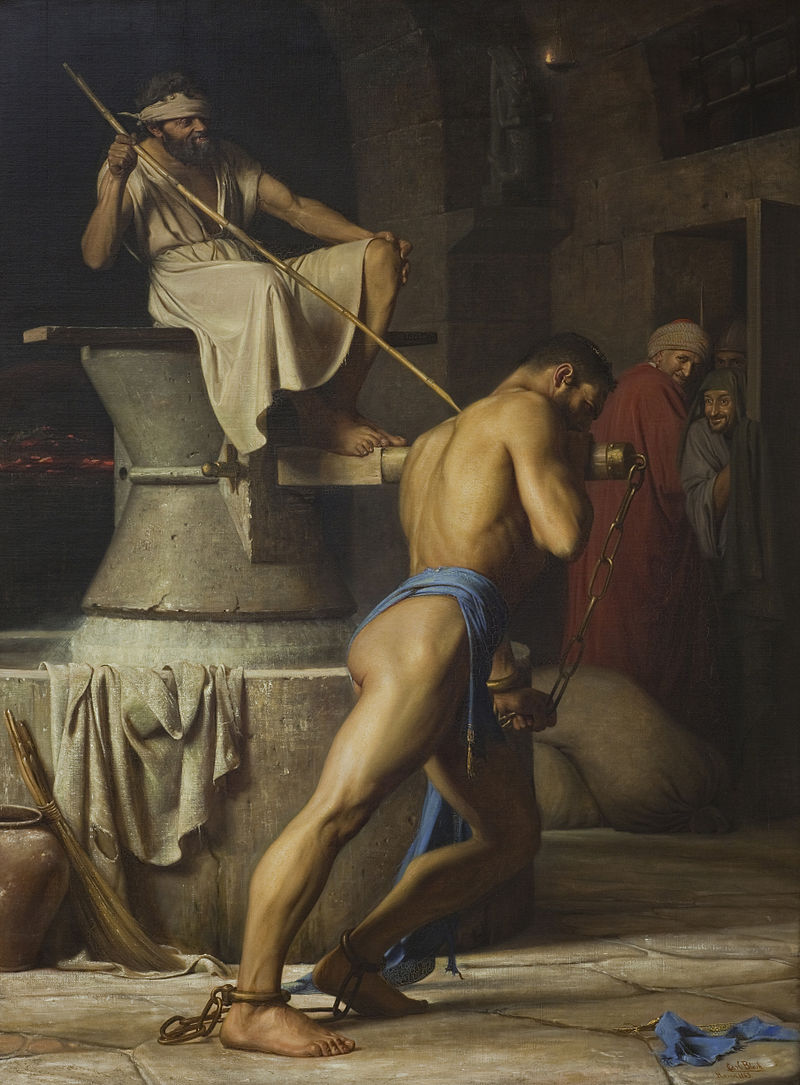
And bound him with bronze chains, and he was a grinder in the prison - "Sunny" Samson ended in abysmal darkness (see below), toiling at the grinding mill, doing the work usually assigned to slaves, women, or donkeys. Samson now had plenty of time to ponder his sins that brought him to this tragic juncture. They bound him physically because he had allowed himself to be bound spiritually/morally by the tentacles of sin. Indeed, bound him is a literal fulfillment of the figurative effect of the cords of sin as described in several passages...
Proverbs
His own iniquities will capture the wicked, And he will be held with the cords of his sin. (Pr 5:22+)
He will die for lack of instruction, And in the greatness of his folly he will go astray. (Pr 5:23+, cf Ro 6:16+)
Peter describing false teachers says
For speaking out arrogant [words] of vanity they entice by fleshly desires, by sensuality, those who barely escape from the ones who live in error, 'promising them freedom while they themselves are slaves of corruption; for by what a man is overcome, (hettao in perfect tense) by this he is enslaved. (douloo in perfect tense = became enslaved and still in that state/condition) (2Pe 2:19+)
Jesus was right (AS HE ALWAYS IS!)
Jesus answered them, “Truly, truly, I say to you, everyone who commits (present tense = habitually, as one's lifestyle exactly what Samson did!) sin is the slave (doulos) of sin. John 8:34
Bush - fetters of brass. A proof that iron, though now well known, had not yet come into general use; as otherwise we should doubtless have found Samson bound with fetters of that material. The emphasis here is not on brass, as distinguished from any other metal; but to show that his fetters were of metal; and that he was not, like the common class of offenders, bound with ropes or thongs of leather. offending organ that he had refused to pluck out was in effect plucked out for him in the righteous providence of God. (resource)
In his epic poem Samson Agonistes, John Milton has the champion say:
O loss of sight, of thee I most complain!
Blind among enemies, O worse than chains,
Dungeon, or beggary, or decrepit age!
Bush - he was a grinder in the prison - Of course with mill-stones worked by the hands, this being still the usual method of grinding corn in the East. It is an employment, however, which usually devolves on women; and to assign it to such a man as Samson, was doubtless with a view to reduce him to the lowest state of degradation and dishonor. To grind corn for others, was, even for a woman, a proverbial term, expressing the most degraded and oppressed condition; and how much more for Samson, who seems to have been made grinder-general for the prison-house.
‘Ask for this great deliverer now, and find him
Eyeless at Gaza, at the mill with slaves.
-- ’Milton.
The champion and avenger of Israel is now become the drudge and the sport of the Philistines. The crown is fallen from his head, and his honor laid in the dust. We are ready to pity the degraded judge of Israel, when we see him reduced to such a state of misery by his enemies; but while we pity the man, we congratulate the sinner, to whose final salvation these heavy trials were made subservient. Let us not, however, lose sight of the solemn lesson which his misery teaches us. What a warning to those who ‘yield their members instruments of iniquity.’ They will find their bondage bitter and unbearable when they are finally bound with the chains which their sins have forged for them. (resource)
Warren Wiersbe - Samson is one of three men in Scripture who are especially identified with the darkness. The other two are King Saul, who went out in the darkness to get last-minute help from a witch (1Sa 28:7, 8), and Judas, who “went immediately out: and it was night” (Jn 13:30). Saul lived for the world, Samson yielded to the flesh, and Judas gave himself to the devil (Jn 13:2, 27); and all three ended up taking their own lives. But there was one ray of light in the darkness: Samson’s hair began to grow again. His power was not in his hair but in what his hair symbolized—his dedication to God. If Samson renewed that dedication, God might restore his power. (See context in The Bible Exposition Commentary)
Some of the most dangerous practices bring temporary pleasure.
That's why they are so ensnaring.
Freedom, however, is found in becoming a slave of Jesus Christ.
— H. V Lugt
Seized (took hold, fastened grip)(0270)('achaz) means to grasp, take hold, take possession. First use is the dramatic "ram caught in a thicket" (Ge 22:13, cf Ex 4:4) Figuratively of anguish taking hold ("gripped") someone( Ex 15:14) and "trembling grips them." (Ex 15:15). "Caught" in Jdg 1:6. "Seized him and slew him" (Jdg 12:6)
The following is extracted from David Roper's excellent sermon Samson and Delilah - His eyes had gotten him into trouble (Jdg 14:1,2; 16:1), and the “lust of the eyes” had led him into sin. Had Samson walked by faith, he would have ended his career in honor, glorifying the Lord. And that is what happens to us. God will give us up to the passions of our own life, if we insist on it. This picture of Samson grinding away at the mill is such a vivid illustration of what happens in the inner man. There is a blinding--a loss of a sense of moral perspective and vision. There is a binding--a loss of our freedom and liberty and mobility in the Spirit. And there is a grinding--a sense of futility and boredom and purposelessness about life, of just going around and around and around inside. There is a way out, though. And if this is there is a "blinding, binding & grinding" effect transpiring in your spirit because of some old sin pattern you are harboring, you need to know there is a way out. And as we see in the following verses the Lord did remember Samson. God does not forget us even though we forget Him. When He takes his hands off us and lets us go, He is still right there available to us. He never utterly abandons us, and He didn't in the case of Samson. He was there, standing ready to respond to his entreaty. And I am sure that in the months of grinding at that mill Samson had reviewed his life's sowing and reaping (Ga 6:7, 8+). He must have surely comprehended what and why this had happened to him. He realized that his strength lay in Jehovah, and thus in the end he sought the Mighty One to set him free from his bondage. A death had to take place -- his death. It was only through Samson's death that the Philistines could be brought under subjection. And this is also true in our life. The only way out of bondage is to go back to that area of our life where we are resisting the Lordship of Jesus Christ and die, right there (cp Rev 2:4, 5+).
In his letter to the Romans, Paul says that those who have died are no longer under the dominion of sin (Ro 6:16-18+). To look honestly at the sin that binds you, calling it what God calls it (1Jn 1:9+, Pr 28:13+), and putting it away by the Spirit of Christ (cp Ro 8:13+, Col 3:5ff+, Ro 13:12, 13, 14+), will bring freedom. God is able to rout the "Philistines" in your life and to restore the sense of peace and prosperity.
Father, thank you for this great story. We thank you for the truth that is revealed in it. We pray that it might be truth which we enter into personally. We ask that we would be strengthened in the inner man to face, honestly and squarely, the issues in our life which we have been unwilling to submit to you, and to cast them off in your power, and thereby to experience the sense of liberty in the Spirit, in Jesus' name, Amen. (Samson and Delilah)
F B Meyer on Judges 16:21-31 Repentance and renewal. -- Alone in the prison-cell reflection did its work; and prayer again arose from Samson's heart; his hair began to grow again. Is not there an analogy to Peter's repentance with bitter tears, preparing for Pentecost? What pathos in that last petition (Judges 16:28; Ps. 74:18, 19, 20, 21, 22, 23)! There is an encouragement here for backsliders to return to God that He may forgive and restore them, and peradventure use them again.
A W Tozer - The Lord Departed -- We bear within us the seeds of our own disintegration. Our moral imprudence puts us always in danger of accidental or reckless self-destruction. The strength of our flesh is an ever present danger to our souls. Deliverance can come to us only by the defeat of our old life. Safety and peace come only after we have been forced to our knees. God rescues us by breaking us, by shattering our strength and wiping out our resistance. Then He invades our natures with that ancient and eternal life which is from the beginning. So He conquers us and by that benign conquest saves us for Himself.
With this open secret awaiting easy discovery, why do we in almost all our busy activities work in another direction from this?
Why do we build our churches upon human flesh?
Why do we set such store by that which the Lord has long ago repudiated, and despise those things which God holds in such high esteem?
For we teach men not to die with Christ but to live in the strength of their dying manhood. We boast not in our weakness but in our strength. Values which Christ has declared to be false are brought back into evangelical favor and promoted as the very life and substance of the Christian way. How eagerly do we seek the approval of this or that man of worldly reputation. How shamefully do we exploit the converted celebrity. Anyone will do to take away the reproach of obscurity from our publicity-hungry leaders: famous athletes, congressmen, world travelers, rich industrialists; before such we bow with obsequious smiles and honor them in our public meetings and in the religious press. Thus we glorify men to enhance the standing of the Church of God, and the glory of the Prince of Life is made to hang upon the transient fame of a man who shall die. (See context in God's Pursuit of Man)
Slaves of Sin - When we repeatedly give in to a particular sin, we become a slave to it. A man dying of AIDS admitted that he had felt guilty about his homosexual way of life. But he couldn't carry out his resolve to give up his immoral lifestyle. Another young man admitted that his wife left him because of his preoccupation with pornographic literature. He's unhappy, but he can't stay away from smut shops. Similarly, many people who take cocaine know they are ruining their lives, but they feel powerless to give up the habit.
Samson too had become a slave to sin. He continued an affair with Delilah even though he knew she was bent on betraying him to his enemies. Samson was not stupid, but he was a slave to his lust. Like the homosexual, the pornography addict, and the drug user, he could not do what he knew he should.
Once we start down the wrong path, turning back is difficult. Jesus said that whoever keeps on sinning will become a slave to sin (John 8:34). Some of the most dangerous practices bring temporary pleasure. That's why they are so ensnaring. Freedom, however, is found in becoming a slave of Jesus Christ.
When we are in the grip of an evil practice that is ruining our life, we can acknowledge our sin and helplessness to the Lord, submit fully to Him, and be assured that He will deliver us. —H. V Lugt (Our Daily Bread, Copyright RBC Ministries, Grand Rapids, MI. Reprinted by permission. All rights reserved)
The pleasures of sin are for a season,
but its wages are for eternity.
Judges 16:22 However, the hair of his head began to grow again after it was shaved off.
- the hair. Le. 26:44. De. 32:36. Ps. 106:44, 45; 107:13, 14
- Judges 16 Resources
SAMSON'S DIVINE
HAIR RESTORATION
However, the hair of his head began to grow again after it was shaved off - Who created the physiological mechanisms to cause hair to grow? That's rhetorical of course. God was in the process of restoring His fallen man. He had said Samson would be a Nazirite to his death and so he would be! Samson's strength was not in his hair but in the Spirit (cf Micah 3:8+) and that the hair was (1) a sign and (2) the final fulfillment of his Nazirite vow. What is amazing is the blindness of the Philistines to not recognize that his hair regrowth might also signal a return of his strength. Did God blind them to the possibility? Possibly!
MacArthur has an interesting thought on growth of his hair and his strength - His hair grew with his repentance, and his strength with his hair. (See context in The MacArthur Bible Commentary or borrow the MacArthur study Bible)
George Bush -- The hair of his head began to grow again, after he was shaven. Rather, Heb. ‘according as it had been shaved;’ i. e. in the same proportions as it had been cut off. This circumstance, though in itself inconsiderable, is mentioned by way of suitable preface to what follows. The letting the hair grow was a prominent circumstance in the condition of a Nazarite; and the extraordinary strength of Samson was not a matter of thews and sinews, but was conferred upon him as a special gift of God, on condition of his remaining in the state of Nazariteship. The loss of his hair did not in itself deprive him of strength; but the loss of his hair involved the loss of his strength, because it took from him the condition of a Nazarite, with which his extraordinary physical powers were inseparably connected. Accordingly, when we find him again growing strong, after the renewed growth of his hair, we are bound to believe that it was not because his hair grew; but because he repented of his past misconduct. God was pleased, therefore, having hereby become reconciled to his offending servant, to accept the renewal of his vow of Nazariteship, including the consecration of his hair, and in consequence of that acceptance re-invested him, as his hair grew, with the powers which he had before lost. In the language of Bp. Hall, ‘his hair grew together with his repentance, and his strength with his hair.’ The practical reflections of the same writer on this part of Samson’s history are equally striking and just. ‘It is better for Samson to be blind in prison, than to abuse his eyes in Sorek; yea, I may safely say, he was more blind when he saw licentiously, than now that he sees not; he was a greater slave when he served his affections, than now in grinding for the Philistines. The loss of his eyes shows him his sin, neither could he see how ill he had done till he saw not.’ Bp. Hall. (recommended resource)
Keil and Delitzsch - Samson’s Misery, and His Triumph in Death.—The hair of his head began to grow, as he was shaven. In the word כַּאֲשֶׁר, as (from the time when he was shaven), there is an indication that Samson only remained in his ignominious captivity till his hair began to grow again, i.e., visibly to grow. What follows agrees with this. (Commentary)
Going Bald?
Barney had always been proud of his thick, wavy hair. But then he began to lose it. Finally just one lone hair remained on top of his shiny dome. One morning Barney awoke, looked at his pillow, and was shocked to see that last hair lying there. Jumping out of bed, he ran downstairs crying, “Martha, Martha, I’m bald!”
That story reminds me of Samson, who “did not know that the Lord had departed from him” (Judges 16:20). A similar thing happens to the Christian who dabbles in the things of the world. He goes deeper into sin, slowly sliding away from the Lord, without knowing what is happening. It is not until he has had some startling experience—perhaps due to God’s discipline—that he sees his true condition. When brought under the searchlight of the Word of God, the deceived one is shocked to realize how Satan has stripped away his spiritual power and discernment.
Television, movie, and home video habits reveal how far some people have slipped. Suggestive words and immoral themes, once considered offensive, are tolerated as acceptable entertainment.
To avoid the kind of shock that Barney experienced, it’s important to examine ourselves daily. Say, are you going bald spiritually? — by Richard De Haan (Our Daily Bread, Copyright RBC Ministries, Grand Rapids, MI. — Reprinted by permission. All rights reserved)
O Lord, help us to recognize
When we begin to compromise,
And give us strength to follow through
With what we know is right and true.
—Sper
Most often, falling into sin is not a blowout but a slow leak.
Judges 16:4-17 A Lock Of Hair
After his return from the moon, Neil Armstrong was often plagued by the media. Seeking greater privacy, he moved his family into a small town. But notoriety was a nuisance even there. Armstrong’s barber found out that people would pay good money to get a lock of his hair. So after giving the space hero several haircuts, he sold the clippings to a buyer for $3,000! Armstrong was shocked at the barber’s opportunism.
The Scriptures tell of another story of disloyalty and a haircut. As a symbol of God’s calling of Samson as a Nazirite, he was never to cut his hair (Jdg. 13:5). When the Spirit of God came upon him, he was given super-human strength over his enemies (Jdg 15:14). Wanting to overpower him, the Philistines hired Delilah, a woman who had a relationship with him, to find out the secret of that strength. He foolishly told her that his power would be gone if his hair were cut. She lulled him to sleep and had him shorn (Jdg 16:5,19).
Greed can drive us to be disloyal to others and to God, causing us to make sinful choices. Our desire should be to exhibit a heart that is fully committed to love the Lord and others. He shows “Himself strong on behalf of those whose heart is loyal to Him” (2Chr 16:9). — by Dennis Fisher (Our Daily Bread, Copyright RBC Ministries, Grand Rapids, MI. — Reprinted by permission. All rights reserved)
O Lord, may my heart be loyal to You
In all that I say and all that I do;
When a trusted person is not a true friend,
I know that on You I can always depend.
—Hess
Loyalty is the test of true love.
Judges 16:23 Now the lords of the Philistines assembled to offer a great sacrifice to Dagon their god, and to rejoice, for they said, "Our god has given Samson our enemy into our hands."
- Dagon. 1 Sa. 5:2–5. Je. 2:11. Mi. 4:5. Ro. 1:23–25. 1 Co. 8:4, 5; 10:20.
- to rejoice. Job 30:9, 10. Ps. 35:15, 16. Pr. 24:17.
- Judges 16 Resources
DANCING
BEFORE DAGON
Now the lords of the Philistines assembled to offer a great sacrifice to Dagon their god, and to rejoice, for they said, "Our god has given Samson our enemy into our hands - Dagon was the chief deity of the Philistines. The capture of Samson led to great rejoicing; and the Philistines had a national festival in honor of Dagon, their god of grain and chief deity.
Dagon was also worshiped by the West Semitic residents of Mari on the Euphrates, and a temple to “Dagan” (Dagon) existed at Ugarit. In some texts from Ugarit, Baal is called “the son of Dagan.” Among the Philistines there were temples to this god in Gaza and Ashdod (1Sa 5:1-7).
It was tragic that a servant of the Lord, raised in a godly home, was now the humiliated slave of the enemy. But even worse, the Philistines gave glory to their god Dagon for helping them capture their great enemy. Instead of bringing glory to the God of Israel, Samson gave the enemy opportunity to honor their false gods. Dagon was the god of grain, and certainly the Philistines remembered what Samson had done to their fields (Jdg 15:1-5).
Dagon (see below) is from the word dag meaning fish and he was the the Philistine god of grain,
Dagon - 7x - Jdg. 16:23; 1 Sam. 5:2; 1 Sam. 5:3; 1 Sam. 5:4; 1 Sam. 5:5; 1 Sam. 5:7; 1 Chr. 10:10
The rejoicing of the Philistines is reminiscent of the last time the unbelieving world will ever rejoice. In the Revelation the 2 witnesses who have been performing the Lord's will for 1260 days (3.5 years, the first half of Daniel's Seventieth Week-see notes) are killed by the Antichrist and their dead bodies allowed to lie in Jerusalem for all the world to see. John records…
And those who dwell on the earth (in Revelation "earth dwellers" is synonymous with unbelievers) will rejoice over them (their dead bodies) and make merry; and they will send gifts to one another, because these two prophets tormented those who dwell on the earth. (Revelation 11:10+)
Bush -- The lords of the Philistines assembled This great festival scene had evidently been some time delayed, as appears from the fact of Samson’s hair having had time to grow in the interval; but perhaps the necessary preparations for so grand an occasion consumed considerable time, or it may have been the second anniversary of the deliverance of their enemy into their hands. (resource)
Bush - Dagon A deity of the Philistines generally represented as having the head and upper parts human, while the rest of the body resembled a fish. It was called Derceto, among the heathens, though the Heb. word ‘Dagon,’ comes from ‘Dag,’ a fish. The Philistines living on the sea coast had a sea-idol. (resource)
Bush - Our god has delivered. Though they knew that he was betrayed into their hands by Delilah, yet they foolishly attribute it to their god. The circumstance, however, affords a hint worth taking. If even a Philistine ascribes his victories to his idol gods, how much more are we bound to pay a similar tribute to our God, and give him the glory of every great and good work done by us, in us, or for us. (resource)
Keil and Delitzsch Commentary - Judg. 16:23, 24. The captivity of this dreaded hero was regarded by the Philistines as a great victory, which their princes resolved to celebrate with a great and joyous sacrificial festival in honour of their god Dagon, to whom they ascribed this victory. “A great sacrifice,” consisting in the offering up of a large number of slain sacrifices. “And for joy,” viz., to give expression to their joy, i.e., for a joyous festival. Dagon, one of the principal deities of the Philistines, was worshipped at Gaza and Ashdod (2 Sam. 5:2ff., and 1 Macc. 10:83), and, according to Jerome on Isa. 46:1, in the rest of the Philistine towns as well. It was a fish-deity (דָּגֹון, from דָּג, a fish), and in shape resembled the body of a fish with the head and hands of a man (1 Sam. 5:4). It was a male deity, the corresponding female deity being Atargatis (2 Macc. 12:26) or Derceto, and was a symbol of water, and of all the vivifying forces of nature which produce their effects through the medium of water, like the Babylonian ́Ωδάκων, one of the four Oannes, and the Indian Vishnu (see Movers, Phöniz. i. pp. 143ff., 590ff., and J. G. Müller in Herzog’s Cycl.). (Judges 16 - Keil & Delitzsch Commentary)
Dictionary of Deities and Demons in the Bible - check out this resource for one hour and then go to page Page 244


Relief of a Mesopotamian fishman (Kulullû) identified
in accordance with early 20th century scholarship as Dagan
DAGON דגון - from the Dictionary of Deities and Demons in the Bible - check out this resource for one hour and then go to page Page 244
I. Dagon is the Hebrew form of the name of the god Dagan, who was an important Mesopotamian and West Semitic deity. Dagon occurs as a Philistine deity in the Hebrew Bible, specifically as the god of Ashdod (1 Sam 5:1–7 and 1 Macc 10:83–84; Judg 16:23 [Gaza]; 1 Chr 10:10 [Beth-Shan?]). The LXX also reads the name Δαγων instead of Nebo (→Nabû) in Isa 46:1.
The etymology of the name Dagan is uncertain. Etymologies based on dāg, ‘fish’, dāgān, ‘grain’, and on a root meaning ‘be cloudy’ (Arabic dajj or dajana) are all equally dubious and there is no contextual evidence from the Hebrew Bible or from Mesopotamian/West Semitic sources to give much support to these speculations. It is wiser to restrict oneself to what can be known from the evidence, principally that Dagan was a deity of major significance in the Mari region in the Old Babylonian period and that his worship appears to have spread widely in later times. He was thus adopted, no doubt in some syncretistic form, perhaps as a corn-god, by the Philistines.
II. Dagan is one of the most persistent deities of the world of Semitic religion. His worship is well attested from the third millennium BCE in the Ebla texts and he appears in Sargonic personal names, but neither source gives any hint of the precise nature of this deity. In Ebla, though important in cult, he is rarely named, but called by various titles including dBE (bēlu, ‘Lord’) and dLUGAL-du-du-luki (‘Lord of Tuttul’). Temples, festivals and even a section of the city were dedicated to Dagan.
Sargon attributed his conquest of Upper/Western Mesopotamia to Dagan and worshipped him in Tuttul. This confirms Dagan’s regional authority, leaving southern Mesopotamia to other deities, including Enlil. He is well attested in the Mari texts as one of the principal deities of the Amorites of Old Babylonian Upper Mesopotamia and he is specifically linked with Mari, his great cult-centres being at Terqa and especially Tuttul. It may be noted that Dagan is often connected in the Mari texts with the activities of ecstatics/prophets who received messages from the god in his temple, which were then transmitted to the king.
In southern Mesopotamia Dagan was sometimes identified with the god Enlil. This may suggest some ‘storm-god’ aspect (supporting the etymology linking the name with the possible Arabic cognate noted above), though the significance of the equation may not be this aspect and the Arabic cognate is extremely remote.
The westward ‘migration’ of Dagan is already evident in the Ugaritic texts. He has a rather minor role in Ugaritic mythology, playing a very small and obscure part in the Nikkal poem. The context here is fragmentary, but it is possible that Dagan is mentioned as the father of the lunar deity Yarikh (→Moon) (KTU 1.24:14). He has no active role in the main myths and legends and is merely mentioned as the father of →Baʿal (called bn dgn, ḥtk dgn). His paternity of Baʿal might be interpreted as implying characteristics similar to Baʿal’s. Be this as it may, Dagan’s importance in Ugaritic religion is confirmed by his relative popularity in offering-lists and similar texts. From the fact that he is the recipient of offerings recorded on two stelae found in the precinct of a major temple (KTU 6.13 and 6.14) it appears that one of the two principal temples at Ugarit was dedicated to Dagan, though the evidence is not completely conclusive. The other temple was that of Baʿal. Ugaritic ‘theology’ (as opposed to the different world of Ugaritic mythology) may be reflected in the local pantheon lists and the main one of these, extant in several versions, puts Dagan in third place, after →El and →Ilib but before Baʿal (see KTU 1.47; 1.118 and Akkadian RS 20.24 = Ugaritica V i, 18).
It is noteworthy that in the Ugaritic texts Dagan is twice called dgn ttl, ‘Dagan of Tuttul’ (KTU 1.100:15; 1.24:14 [tt(l)]), a title which shows the continuity of the Ugaritic Dagan tradition with that of Mari.
The fact of Dagan’s having no active part in the main Baʿal myths may reflect the relative lateness of his arrival on the Syrian coast. References to Baʿal as ‘son of Dagan’ also present considerable problems, since he is clearly also the son of El. Some have sought to resolve this by assuming that Dagan is to be identified with El, but this idea is hard to maintain in view of the fact that the two were separately worshipped. Others suggest the title ‘son of Dagan’ reflects an awareness of Baʿal’s foreignness and secondariness within the history of the Ugaritic pantheon. It may well be that the confusion arises from a lack of fixity in the genealogy of the Ugaritic gods.
Biblical evidence of Philistine worship of Dagan (below)—the form of the name recorded for this is Dagon, reflecting a shift of ā to ō—is uninformative in detail, but clearly implies that the deity was taken over by the Philistines as a national god. We must assume his worship had been widespread throughout the coastal (corn-producing?) area which the Philistines came to call their own. The adoption of pre-existing cults, no doubt still popular among the Semitic population, can be regarded as normal. It may be noted, however, that there is only one possible direct Phoenician allusion to Dagan/Dagon, in the phrase ʾrṣt dgn hʾdrt, ‘the rich lands of Dagon’, in the fifth century BCE Eshmunazar inscription (KAI 14:19). Dagon does, however, have a prominent role in Philo of Byblos’ speculative account of Phoenician religion (below).
ROBERTS (1972:18–19) argued for Dagan having had an underworld role. His argument is largely based on the underworld aspect of Enlil, with whom Dagan was identified, though he also cites a Mari text in which Dagan is called bēl pagrê, which Roberts takes to mean ‘lord of the sacrifices for the dead’. This translation is dubious: ‘lord of sacrificial victims’ may be more likely. There is, however, some slight evidence pointing in the direction of the funerary cult in that an inscription of Shamshi-Adad I seems to connect the bı̄t kispi (‘temple of the funerary ritual’) in Terqa with the temple of Dagan there.
We cannot resolve the question of the etymology of the name Dagan/Dagon. It could be pre-Semitic. The connection with ‘fish’ (cf. Biblical evidence as interpreted by Wellhausen [below], Jerome and later Jewish tradition [Rashi, Kimchi]) is entirely secondary, being based on a folk etymology. The name Dagan appears to have been a ‘given’ which needed explanation and the explanation arrived at would, conveniently, help to make sense of certain difficulties in one of the Biblical texts (see below). This made the ‘fish’ connection the more attractive, but it has little intrinsic merit. As an interpretation it is only loosely supported by the Philistine association with the sea and analogies with the goddess Derketo at a later date.
As for ‘grain’, this suggestion has a venerable ancestry in that this is the significance of Dagan in Philo of Byblos, where Dagon is identical with Siton and is regarded as having discovered grain and the plough. This cannot, however, be regarded as settling the issue and it is now a widely held view that the word for ‘grain’ comes from the name of the god and not vice versa. Perhaps more simply we might suppose that the connection with ‘grain’ is secondary and based on the coincidence of the West Semitic word for grain (e.g. Hebrew and Ugaritic [one doubtful occurrence: KTU 1.16 iii:13]) and the Mesopotamian name of the god being homonyms. The grain-related meaning of the root dgn is distinctively West Semitic. It would not have been known to a Mesopotamian worshipper of the deity and cannot have been at all prominent in the understanding of his name.
Finally the Arabic dajana, ‘to be gloomy, cloudy’, not found elsewhere in Semitic, has been adopted by many recent scholars. As we have seen, connection with storms (since Dagan was Enlil-like and also the father of Baʿal) is possible though never explicit. The appeal to such a remote Semitic cognate for etymology smacks of desperation.
III. 1 Sam 5:1–7 contains the most important of the Biblical references to Dagan/Dagon. The passage concerns the bringing of the Ark of the Covenant by the Philistines into the temple of their god Dagon in Ashdod. The introduction of the captured Ark into a temple is meant to be a sign of submission to the god of the particular temple. According to the story in 1 Sam, however, the statue of Dagon fell down (in submission) before the Ark and was smashed. There is a difficulty in the text of the end of v. 4: raq dāgōn nišʾar ʿālā(y)w, apparently “only Dagon was left upon him”. BHK and BHS recognise the need for a construct noun before ‘Dagon’ and this is reflected in the ancient versions (LXX: ἡ ῥάχις, backbone; Vg: truncus, body without limbs; Tg: gwpyh, his body, Syr: gwšmh, his body). Wellhausen would correct dāgōn to dāgō, ‘his fish(-part)’, and this is still favoured by BHK. This would give ‘only his fish-part remained upon him’, which would, if accepted, support the connecting of Dagan’s name with dāg, ‘fish’, a tradition represented in Jerome (<dag ʾōn, ‘fish of tribulation’!) and in the Talmud. It is notable, however, that while the ancient versions are aware of a problem with the text, this is not an interpretation they put upon it. The Wellhausen suggestion is now rightly abandoned by BHS.
Of the remaining Biblical references to Dagan/Dagon, note may be made of other passages which confirm the association of the god with the Philistines. In Judg 16:23 the Philistine chiefs assemble, presumably in the temple of Dagon, to offer sacrifice of thanksgiving to Dagon for their capture of Samson. Dagon is called ‘their/our god’ and he receives a zebaḥ gādōl, ‘a great sacrifice’. Although it is not explicitly stated here that there was a Dagon temple at Gaza, no change of locale is implied and it seems likely that there was such a temple, since there appear to have been many temples of the god. Josh 15:41 and 19:27, where the placename Beth-Dagon occurs, imply there were such temples in Judah and in Asher. According to 1 Chr 10:10 the head of Saul was initially displayed by the Philistines as a trophy of war in a temple of Dagon. This appears to have been at Beth-Shan (1 Sam 31:10).
That the cult of Dagon persisted into the intertestamental period is clear from 1 Macc 10:83–84, according to which the High Priest Jonathan burned down the temple of Dagon in Azotus, i.e. Ashdod, which had become the place of refuge of the cavalry of Apollonius, governor of Coele-Syria.
In addition to these explicit biblical references to the god Dagon, note should be made of a number of biblical verses in which it has been argued that the occurrence of the word dāgān, ‘grain’, intends an allusion to the deity. Thus in Gen 27:28 and Hos 7:14 and 9:1 (e.g. ALBRIGHT 1946: 1046). The claimed allusion in Gen 27:28 is without foundation, since nothing in the context suggests anything to do with foreign gods and dāgān is satisfactorily translated as ‘grain’, one of the divine gifts in Isaac’s blessing upon his son. Here and elsewhere ‘grain’ is associated with →‘dew’ (ṭal), ‘fatness of the earth’ and ‘new wine’ (tîrôš, →Tirash). The fact that ṭal and ṭîrôš may elsewhere have mythological overtones does not prove that dāgān has such overtones in Gen 27:28.
The case of the Hosea passages is different, since it is clear that it is one of Hosea’s themes that it was Yahweh, not the foreign gods, who gave Israel “the grain, the wine and the oil” (2:10–11:12). In these cases there may be a faint echo of the divine name Dagan (though the fact that the definite article is used means that it is indeed faint). In Hos 7:14 the specific context is that of turning to other gods and “for dāgān and ṭîrôš (without definite articles) they gash themselves” may plausibly be interpreted as an allusion to illicit cult, though the allusion could be simply to a cult of lamentation for the failure of vegetation. Hos 9:1, “you have loved a prostitute’s payment upon all the threshing-floors of dāgān”, could again contain an allusion to the deity.
Judges 16:24 When the people saw him, they praised their god, for they said, "Our god has given our enemy into our hands, even the destroyer of our country, who has slain many of us.
- they praised their god. De. 32:27. Is. 37:20. Eze. 20:14. Da. 5:4, 23. Hab. 1:16. Re. 11:10.
- who has slain many of us. Jdg 15:8, 16.
- Judges 16 Resources
SAMSON'S FAILURE LEADS
TO PRAISES TO DAGON
Because Samson failed to submit to the true God, he was allowed to be humiliated before a false God.
When the people saw him, they praised their god, for they said, "Our god has given our enemy into our hands, even the destroyer of our country, who has slain many of us: Wrong. Their god did not defeat Samson. Samson in essence defeated Samson. Had Samson maintained his Nazirite vow and his morals, he would have been invincible! The truth is that because of Samson's sin, Samson's God had allowed his enemies to capture and defeat him. Although I think Samson was a believer, compare God's similar treatment of unbelievers who are given over to the power of sin in Romans 1 (Ro 1:24, 26, 28+ and a similar fate of unbelievers in 2Th 2:10-12+) Clearly their description of Samson indicates he had done significant damage to the Philistines. It is also certainly possible that not every feat of Samson against the Philistines is recording the Judges 13-16.
Note that in view of the fact that in the next verse they say "Call for Samson," some think that they phrase they saw him refers to their god Dagon, not Samson. Certainly the text could be understood that way.
MacArthur on they praised their god - It is tragic when a person's sin contributes to the unsaved community giving praise to a false god, for God alone is worthy of praise. (See context in The MacArthur Bible Commentary or borrow the MacArthur study Bible)
The Philistines had their theology wrong and ultimately it led to the destruction of Dagon’s temple. Samson fell into their hands, not because Dagon had defeated the Lord, but because Samson’s sinfulness had caused the God of Israel to abandon him to the power of sin (Pr 5:22) and hands of godless sinners. I personally see God's mercy in this section because theoretically they should have killed Samson, but God had other plans.
Keil and Delitzsch - All the people took part in this festival, and sang songs of praise to the god who had given the enemy, who had laid waste their fields and slain many of their countrymen, into their hands. (Commentary)
Judges 16:25 It so happened when they were in high spirits, that they said, “Call for Samson, that he may amuse us.” So they called for Samson from the prison, and he entertained them. And they made him stand between the pillars.
- when they were in high spirits: Jdg 9:27 18:20 19:6,9 2Sa 13:28 1Ki 20:12 Es 3:15 Isa 22:13 Da 5:2,3 Mt 14:6,7
- amuse us: Job 30:9,10 Ps 35:15,16 69:12,26 Pr 24:17,18 Mic 7:8-10 Mt 26:67,68 27:29,39-44 Heb 11:36
- Judges 16 Resources
MOCKING THE
MUSCLEMAN
It so happened when they were in high spirits, that they said, “Call for Samson, that he may amuse (sachaq) us.” So they called for Samson from the prison, and he entertained them. And they made him stand between the pillars - Can we not see the invisible hand of God behind these scenes. He kept Samson alive. He caused his hair to regrow. He had him brought before the mockers. He had him strategically placed between the pillars. God was sovereignly setting the scene for Samson's final slaughter! The precise nature of the amusements offered by Samson is not specified in the text. One can be fairly sure that they were not feats of strength like lifting an incredible weight or bending an iron bar (like a "circus strongman"), but such possibilities cannot be excluded. One might think that Samson's restoration of strength would have given him the strength to break any Philistine bonds. God however had other plans for the "amusement" of the Philistines and the utilization of Samson's strength.
George Bush - in high spirits - Heb. כי טוכ לכם ki töb libbam, when their heart was good. A parallel usage occurs Ruth, 3:7; 1 Sam. 25:36, and elsewhere. (resource)
Bush - amuse us - That is, passively, that he may be a subject of sport and merriment to us; that we may make ourselves merry at his expense. It is quite improbable, we think, that Samson, a poor blind prisoner, should be required actively to engage in any thing that should make sport to his enemies. The idea doubtless is simply, that he should be brought out to become a laughing-stock to them, a butt for their scoffs, mockeries, and insults. Accordingly the Sept. version of the next clause has, ‘And they buffeted him;’ and Josephus says, he was brought out, ‘that they might insult him in their cups.’ But their triumphing was short, and their joy but for a moment. ‘Nothing fills the measure of the iniquity of any person, or people, faster than mocking, or misusing the servants of God, yea, though it is by their own folly that they are brought low. Those know not what they do, nor whom they affront, that make sport with a good man.’ Henry. (resource)
Keil and Delitzsch -- When their hearts were merry (יְטֹוב, inf. of יָטַב), they had Samson fetched out of the prison, that he might make sport before them, and “put him between the pillars” of the house or temple in which the triumphal feast was held. Then he said to the attendant who held his hand, “Let me loose, and let me touch the pillars upon which the house is built, that I may lean upon it.” הֵימִישֵׁנִי is the imperative Hiphil of the radical verb יָמַשׁ, which only occurs here; and the Keri substitutes the ordinary form הָמִישׁ from מוּשׁ. “But the house,” adds the historian by way of preparation for what follows, “was filled with men and women: all the princes of the Philistines also were there; and upon the roof were about three thousand men and women, who feasted their eyes with Samson’s sports” (רָאָה with בְּ, used to denote the gratification of looking). (Commentary)
Amuse (07832)(sachaq) means to laugh, amuse, make sounds expressing an attitude of pleasure (Eccl 3:4). The other sense is laughing at, mocking, scoffing through words and/or laughing sounds that make fun of another (person or object) and implying lack of concern over the object or anger and disrespect (Job 5:22; 30:1; 39:7; 39:18, 22; 41:29; Ps 2:4; 37:13; 52:6; 59:8; Pr 1:26; 29:9; 31:25; La1:7; Hab1:10) To joke at (Pr 26:19). To scorn (2Chr 30:10).
Gilbrant - A primary root, the verb tsāchaq, which means "to laugh," is used thirteen times in the Qal or Piel stems. All uses are in Genesis and Exodus, except for one use in Judges. An alternate form with similar meanings, sāchaq (HED #7925), occurs thirty-six times in later portions of Scripture.
The Qal stem of tsāchaq denotes the action of laughter, and all six occurrences are in the account of events surrounding the birth of Isaac. When God announced to Abraham that he and Sarah would have a son, the ninety-nine-year-old fell to his face and laughed, thinking that it was impossible (Gen. 17:17). Sarah had the same reaction some weeks later when she overheard the Lord (in human form) announcing the same incredible promise (Gen. 18:12). Her laugh, like her husband's, was one of disbelief, and God pointed out her lack of faith (Gen. 18:13ff). A year later, however, the promised son was born, and Sarah's incredulous laugh turned to a laugh of joy (Gen. 21:6). Even the name of her newborn son Isaac meant "laughter."
In the Piel stem, tsāchaq can mean "to play," "to make sport," "to mock." The word often has a negative connotation. When Lot tried to warn his sons-in-law of the impending destruction of Sodom, they refused to take him seriously, assuming that he was simply jesting with them (Gen. 19:14). On the day Isaac was weaned, Ishmael was observed mocking him—an offense which ultimately led to the expulsion of him and his mother from Abraham's household (Gen. 21:9). The same spirit of mockery can be seen in the episode where the blind Samson was brought to the Philistine festival so that he could entertain and amuse the crowd, giving them an opportunity to taunt their old enemy (Judg. 16:25).
The Piel usage sometimes has strong sexual overtones. By claiming Joseph tried to seduce her, Potiphar's wife accused him of toying with the whole household and with her (Gen. 39:14, 17). When Isaac had claimed that Rebekah was merely his sister, the deception was uncovered when the Philistine king observed him "sporting" with her, obviously in the manner of a marriage relationship (Gen. 26:8). This gives a broad hint at the activities of Israel in the account of the golden calf, where Ex 32:6 says that the people "rose up to play." (Complete Biblical Library)
Sachaq - 36v - amuse(1), amusing(1), celebrate(2), celebrating(3), hold a contest(1), joking(1), laugh(6), laughed them to scorn(1), laughs(6), merrymakers(2), mock(1), mocked(1), play(2), played(1), playing(1), rejoicing(2), scorns(1), smiled(1), smiles(1), sport(1). Jdg. 16:25; Jdg. 16:27; 1 Sam. 18:7; 2 Sam. 2:14; 2 Sam. 6:5; 2 Sam. 6:21; 1 Chr. 13:8; 1 Chr. 15:29; 2 Chr. 30:10; Job 5:22; Job 29:24; Job 30:1; Job 39:7; Job 39:18; Job 39:22; Job 40:20; Job 41:5; Job 41:29; Ps. 2:4; Ps. 37:13; Ps. 52:6; Ps. 59:8; Ps. 104:26; Prov. 1:26; Prov. 8:30; Prov. 8:31; Prov. 26:19; Prov. 29:9; Prov. 31:25; Eccl. 3:4; Jer. 15:17; Jer. 30:19; Jer. 31:4; Lam. 1:7; Hab. 1:10; Zech. 8:5
Judges 16:26 Then Samson said to the boy who was holding his hand, "Let me feel the pillars on which the house rests, that I may lean against them."
SAMSON BEGINS TO
PLOT HIS REVENGE
Then Samson said to the boy who was holding his hand, "Let me feel the pillars on which the house rests, that I may lean against them." - During a break in the day’s entertainment, Samson asked his attendant to help him actually touch the pillars on which the house rests. This detail is critical for these were not some secondary or side pillars but pillars crucial for the integrity of the house.
Norman Geisler - JUDGES 16:26–27—If suicide is wrong, why did God bless Samson for doing it?
PROBLEM: Suicide is murder, and God said, “You shall not murder” (Ex. 20:13). There were many suicides in the Bible (see comments on 1 Sam. 31:4), and none of them received divine approval. Yet Samson committed suicide here with God’s apparent blessing.
SOLUTION: Samson never took his life; he sacrificed it for his people. There is a big difference. Jonah prayed, “Lord, please take my life from me, for it is better for me to die than to live!” (Jonah 4:3) But he never took his own life. Suicide is acting “for one’s self.” What Samson did was to lay his life on the line for others—his people. Samson’s act was no more suicide than Christ’s, when He said, “I lay down my life,” for “the good shepherd gives His life for the sheep” (John 10:11, 17). In fact, “greater love has no one than this, than to lay down one’s life for his friends” (John 15:13).
Of course, not every apparent death “for others” is really an act of love. Paul made this plain in his great love chapter: “though I give my body to be burned, but have not love, it profits me nothing” (1 Cor. 13:3). Even a martyr may not be dying out of love, but in an obstinate commitment to his own self-centered cause. Saul took self-death “lest these uncircumcised men come and thrust me through and abuse me” (1 Sam. 31:4). Abimelek sought death for himself “lest men say of me, `A woman killed him’ ” (Jud. 9:54). Samson by contrast asked God for permission to die, praying, “Let me die with the Philistines” (Jud. 16:30). God granted his request, “so the dead that he killed at his death were more than he had killed in his life” (v. 30). Paul also was willing to be “accursed from Christ for my brethren” (Rom. 9:3). The soldier who falls on a hand grenade to save his buddies is not taking his life by suicide; he is giving his life for others. Likewise, Christ did not commit suicide when He came to “give His life a ransom for many” (Mark 10:45). (When Critics Ask: A Popular Handbook on Bible Difficulties )
Judges 16:27 Now the house was full of men and women, and all the lords of the Philistines were there. And about 3,000 men and women were on the roof looking on while Samson was amusing them.
- were on the roof looking on. Jdg 9:51. De. 22:8. Jos. 2:8. 2Sa. 11:2.
- Judges 16 Resources
MOCKERS DAYS
ARE NUMBERED
Now the house was full of men and women and all the lords of the Philistines were there. And about 3,000 men and women were on the roof looking on while Samson was amusing (sachaq; Lxx - empaizo in present tense) them. - What a picture of this godless, scoffing age which finds pleasure in using Christ's holy Name as a curse word and ridicules His followers on television, movies and the web ("amusing" themselves!). As we see here in Judges, God's people have the last word, because God Himself has the last Word. We need to pray for those who persecute us and cry out to God to have mercy on their souls and open their heart to receive their only hope. Today is their day of salvation. Tomorrow the pillars of the humanistic world will come down, even as the Stone cut out without hands will strike Nebuchadnezzar's statue s"so that not a trace of them was found." (Daniel 2:34-45-notes)
George Bush -- Upon the roof about three thousand men and women. The house or temple itself was full of the principal people below; while about three thousand, probably of the lower orders, had stationed themselves upon the roof, the roofs of eastern buildings, as is well known, being generally flat. In answer to the question, how this large number of persons on the roof could have seen Samson while made the subject of mirth below?—it may be remarked, that we are to form our ideas of the scene from the style of building common to the East. The edifice in question undoubtedly formed a part of a quadrangular pile of building and walls, having a court or area in the centre, where Samson might be exhibited with ease to the whole assembled multitude. The principal building in such structures generally occupies that side of the inclosure which faces the entrance, and is advanced considerably out of the line of the square. It is, moreover, usually constructed with an open front to afford a clear view of what is going on in the court, having curtains to be drawn up or let down at pleasure, and supported by two or more pillars either in the front or in the centre. Samson probably after having been for some time paraded about the area, where every one could see him, requested to be conducted within the part of the edifice now described, that he might rest himself against its pillars, see on v. 29. (resource)
Judges 16:28 Then Samson called to the LORD and said, "O Lord GOD, please remember me and please strengthen me just this time, O God, that I may at once be avenged of the Philistines for my two eyes."
- called. 2Ch. 20:12. Ps. 50:15; 91:15; 116:4. La. 3:31, 32. He. 11:32.
- remember. Ps. 74:18–23. Jon. 2:1, 2, 7. Je. 15:15.
- that I may. Jdg 5:31. Ps. 58:10, 11; 143:12. 2 Ti. 4:14. Re. 6:10.
- Judges 16 Resources
Related Passages:
Judges 15:18 Then he became very thirsty, and he called to the LORD and said, “You have given this great deliverance by the hand of Your servant, and now shall I die of thirst and fall into the hands of the uncircumcised?”
Psalm 66:18-19 If I regard wickedness in my heart, The Lord will not hear; 19 But certainly God has heard; He has given heed to the voice of my prayer.
Hebrews 11:32-34+ (NOTICE TWO OF THE ACTIONS DESCRIBE SAMSON'S EXPERIENCES) And what more shall I say? For time will fail me if I tell of Gideon, Barak, Samson, Jephthah, of David and Samuel and the prophets, 33 who by faith conquered kingdoms, performed acts of righteousness, obtained promises, shut the mouths of lions, 34 quenched the power of fire, escaped the edge of the sword, from weakness were made strong (AS IN THIS SECTION), became mighty in war, put foreign armies to flight.
SAMSON'S CRISIS CRY
TO THE SOVEREIGN LORD
Then Samson called to the LORD and said, "O Lord (Adonai) GOD (Jehovah) - Samson demonstrates his faith in Yahweh (cf Heb 11:32) as he utters his second (recorded) and last prayer and the fact that God answered suggests that all was right between him and his Lord (see psalm above). Samson addresses God in perhaps the most formal manner possible, combining the term "master" (Adonai) with the divine name, Yahweh (Jehovah). Prior to this he addressed God as "you" (Jdg 15:18) and referred to him as God (Elohim) (Jdg 16:17). For the second time in the book God answered his prayer, allowing him to bring the temple crashing down.
The Psalmist records (referring to disobedient Israel) God's response to their cry for help…
Then they cried out to the LORD in their trouble; He saved them out of their distresses. He brought them out of darkness and the shadow of death, And broke their bands apart… Then they cried out to the LORD in their trouble; He saved them out of their distresses. He sent His word and healed them, and delivered them from their destructions. (Psalm 107:13-14, 19-20)
Please remember me and please strengthen me just this time, O God (Elohim), that I may at once be avenged (naqam) of the Philistines for my two eyes - He addresses God as O Lord (Adonai) GOD (Jehovah) and O God (Elohim) which speaks of the one Who is the Sovereign Master! It is notable that this is first time, Samson actually appeals to God for strength rather than presuming on the Spirit's presence. Samson cried out to God and said, "God, remember me" and God did remember him. Why? Because God didn't go away but was always there, waiting… and that was all Jehovah needed to hear. God says, "I will! Your name is Samson." "Yes, Lord." Then Samson said, "Lord, please strengthen me," because he knew where strength came from. God was still going to be praised even in the midst of Samson's sin. Samson wanted to be strengthened so he could avenge himself on the Philistines who gouged out his eyes, but God says, "No. I'll strengthen you so that I can fulfill what I began in your life--to begin to deliver Israel from the Philistines--and in spite of your sin I am still going to fulfill My plan." The phrase just this time is translated in the NET as "just one more time." This request implies that clearly Samson knew this would be the final scene of his life! He wanted to go out with God glorifying gusto, not a bad goal for any of God's saints!
THOUGHT - That is all our Father in Heaven waits to hear from you and me - "Please remember me!" The proud refuse to bow and cry "Help". Only the humble will cry out from the heart (cp Mt 15:25-28; Mk 9:22- 25; Peter drowning - Mt 14:30, cp Mt 8:24-26; Ps 107:6, 13, 19, 20, 28, Jonah 1:14-15). It matters not how desperate the situation is. Our Father is ready to hear and respond to "Please, remember me."
Life Application Note adds - One of the effects of sin in our lives is to keep us from feeling like praying. But perfect moral behavior is not a condition for prayer. Don't let guilt feelings over sin keep you from your only means of restoration. No matter how long you have been away from God, he is ready to hear from you and restore you to a right relationship. Every situation can be salvaged if you are willing to turn again to him. If God could still work in Samson's situation, he can certainly make something worthwhile out of yours. (See context in Life Application Study Bible or borrow the Life Application Study Bible: Old Testament and New Testament)
Stone on remember me - The cry for God to "remember" carries deep connotations. For humans, to remember God and his saving actions involves those actions having a continuing impact—that is, one orders one's life around the reality of God's actions in a concrete way. Israel's whole problem resided in its tendency to forget Yahweh and his actions. Likewise, for Yahweh to "remember" his servant means he acts decisively on his servant's behalf. Since remembrance also implies a forgetting, possibly Samson here acknowledged his past alienation from Yahweh and the justice of Yahweh's departure from him, and called now for Yahweh to return to his servant. (See context in Joshua, Judges, Ruth)
An unknown Confederate soldier during the Civil War wrote the following poem several stanzas of which would aptly apply to Samson's life:
Answered Prayer
I asked God for strength, that I might achieve,
I was made weak, that I might learn humbly to obey…
I asked for health, that I might do great things,
I was given infirmity, that I might do better things…
I asked for power, that I might have the praise of men,
I was given weakness, that I might feel the need for God…
I asked for all things, that I might enjoy life,
I was given life, that I might enjoy all things…
I got nothing that I asked for but everything I had hoped for;
Almost despite myself, my unspoken prayers were answered.
I am among all men most richly blessed.
George Bush (recommended resource) Samson called unto the Lord, and said, &c. It is scarcely to be presumed that this prayer was uttered audibly. It was rather, we may suppose, a mental petition, breathed forth from the depths of a broken heart, where godly sorrow had been doing its perfect work. But though the voice of his prayer was not heard of man, yet it was graciously heard and answered of God, and though he himself did not live to recite or record it, yet God, by revealing it to the inspired penman, provided for its being registered for the benefit of the church. Whether it is to be considered as embracing all that he inwardly uttered, or merely the general drift, the substance of it, is uncertain; probably the latter, according to prevailing usage in the Scripture style of narration. By praying that God would once more remember and strengthen him, he virtually acknowledged that all the wonderful exploits he had hitherto performed were owing to a strength given him from above, and that he would be powerless for the present achievement unless the same divine aid were granted him. True it is, if we regard the bare letter of his petition, it has the air of being prompted mainly by a spirit of revenge; but from God’s accepting and answering the prayer, it cannot be doubted, that he looked upon himself in this transaction, not as a private but as a public person, extraordinarily called to be the instrument of a signal act of vengeance to the enemies of Israel and of God. The indignities heaped upon himself had indeed been great and grievous, and such as would be in fact worthily punished in the catastrophe which he meditated. But this was not his leading motive. The consideration of his personal sufferings was merged in a holy zeal for the Lord of hosts, the vindication of whose glory was of infinitely more consequence than the avengement of his own wrongs. In putting out his eyes, they had ‘touched the apple’ of God’s eye, and this was not to be done with impunity. Under the influence of this feeling, combined with the consciousness that his own past misconduct would be no more than justly visited by a painful end, be cheerfully devotes himself to death.
Keil and Delitzsch Then Samson prayed to Jehovah, “Lord Jehovah, remember me, and only this time make me strong. O God, that I may avenge myself (with) the revenge of one of my two eyes upon the Philistines,” i.e., may take vengeance upon them for the loss of only one of my two eyes (מִשְּׁתֵי, without Dagesh lene in the ת: see Ewald, § 267, b.),—a sentence which shows how painfully he felt the loss of his two eyes, “a loss the severity of which even the terrible vengeance which he was meditating could never outweigh” (Bertheau).(Commentary)
Be avenged (05358) naqam means to avenge, take vengeance, revenge, avenge oneself, be avenged, be punished. To exact punishment for a wrong. To inflict a punishment or penalty in return or retaliation for a harm or injury. To avenge, take vengeance, to entertain revengeful feelings. Naqam in Judges - Jdg 15:7, Jdg 16:28.
Judges 16:29 And Samson grasped the two middle pillars on which the house rested, and braced himself against them, the one with his right hand and the other with his left.
LEANING ON LORD'S STRENGTH
HE LEANS ON THE STRONG PILLARS
And Samson grasped the two middle pillars on which the house rested, and braced himself against them, the one with his right hand and the other with his left - Samson has planned his dramatic exit. He has sought divine power and now is in a strategic position.
Maclaren - Wearied with his humiliating exertions, the blind captive begs the boy who guided him to let him lean, till he can breathe again, on the pillars that held up the light roof. We need not discuss the probable architecture of Dagon’s temple, of which we know nothing. Only we may notice that it is not said that there were only two pillars, but rather necessarily implied that there were more than two, for those against which he leaned were ‘the two middle’ ones. It is quite easy to understand how, if there were a row of them, knocking out the two strongest central ones would bring the whole thing down, especially when there was such a load on the flat roof. Apparently the principal people were in the best places on the ground floor, sheltered from the sun by the roof, on which the commonalty were clustered, all waiting for what their newly discovered mountebank would do next, after he had breathed himself. The pause was short, and they little dreamed of what was to follow.
ARCHAEOLOGY - Two Middle Pillars - The most dramatic archaeological discovery to illuminate Philistine culture is the excavation of a unique Philistine temple at Tel Qasile just north of Tel Aviv by Ami Mazar. Though very small, the temple with its two column bases corresponds to the plan of the Philistine temple pulled down by Samson at Gaza.
In Shakespeare's Hamlet the lead character says "Give me that man who is not passion's slave." Samson, a man "designed for great exploits" but with a legacy of uncontrollable lust and savage fits of temper. (Jas 1:20) What paradox. Great physical strength but just as great inner weakness. The paradoxes culminate at the end of his life: he deliverer is delivered to his enemies, God's chosen scourge is beaten and blinded, the practical joker becomes a joke for reveling Philistines and finally the dying Samson kills more Philistines than the living one!
George Bush -- Took hold of the two middle pillars upon which the house stood. To this it has been objected, How could a roof capable of accommodating three thousand persons, be supported upon two pillars? But it is not said that there were no more than two. There might have been several others not standing in the middle or central part of the building, which contributed to the support of the roof, when at the same time the removal of the two in question, would, more than all the rest, endanger the fall of the whole edifice. The celebrated architect, Sir Christopher Wren, says, that in considering what kind of fabric it must be that could with one pull be demolished, he conceived to himself a vast roof of cedar beams resting at one end upon the walls, and centering at the other upon one short architrave that united two cedar pillars in the middle. ‘One pillar would not be sufficient to unite the ends of at least one hundred beams that tended to the centre; therefore, I say, there must have been a short architrave resting upon two pillars, upon which all the beams tending to the centre might be supported. Now if Samson by his miraculous strength pressing on one (or both) these pillars, moved it from its basis, the whole roof must of necessity fall.’ (Hewlett’s Bible.) (resource)
Keil and Delitzsch - After he had prayed to the Lord for strength for this last great deed, he embraced the two middle pillars upon which the building was erected, leant upon them, one with his right hand, the other with the left (viz., embracing them with his hands, as these words also belong to יִלְפֹּת), and said, “let my soul die with the Philistines.” He then bent (the two pillars) with force, and the house fell upon the princes and all the people who were within. So far as the fact itself is concerned, there is no ground nor questioning the possibility of Samson’s bringing down the whole building with so many men inside by pulling down two middle columns, as we have no accurate acquaintance with the style of its architecture. In all probability we have to picture this temple of Dagon as resembling the modern Turkish kiosks, namely as consisting of a “spacious hall, the roof of which rested in front upon four columns, two of them standing at the ends, and two close together in the centre. Under this hall the leading men of the Philistines celebrated a sacrificial meal, whilst the people were assembled above upon the top of the roof, which was surrounded by a balustrade” (Faber, Archäol. der. Hebr. p. 444, cf. pp. 436–7; and Shaw, Reisen, p. 190). The ancients enter very fully into the discussion of the question whether Samson committed suicide or not, though without arriving at any satisfactory conclusion. O. v. Gerlach, however, has given the true answer. “Samson’s deed,” he says, “was not suicide, but the act of a hero, who sees that it is necessary for him to plunge into the midst of his enemies with the inevitable certainty of death, in order to effect the deliverance of his people and decide the victory which he has still to achieve. Samson would be all the more certain that this was the will of the Lord, when he considered that even if he should deliver himself in any other way cut of the hands of the Philistines, he would always carry about with him the mark of his shame in the blindness of his eyes,—a mark of his unfaithfulness as the servant of God quite as much as of the double triumph of his foes, who had gained a spiritual as well as a corporeal victory over him.” Such a triumph as this the God of Israel could not permit His enemies and their idols to gain. The Lord must prove to them, even through Samson’s death, that the shame of his sin was taken from him, and that the Philistines had no cause to triumph over him. Thus Samson gained the greatest victory over his foes in the moment of his own death. The terror of the Philistines when living, he became a destroyer of the temple of their idol when he died. Through this last act of his he vindicated the honour of Jehovah the God of Israel, against Dagon the idol of the Philistines. “The dead which he slew at his death were more than they which he slew in his life.” (Commentary)
Judges 16:30 And Samson said, "Let me die with the Philistines!" And he bent with all his might so that the house fell on the lords and all the people who were in it. So the dead whom he killed at his death were more than those whom he killed in his life.
- Let me die with the Philistines Mt. 16:25. Ac. 20:24; 21:13. Phi. 2:17, 30. He. 12:1–4.
- The house fell - Job 20:5; 31:3. Ps. 62:3. Ec. 9:12. Mat. 24:38, 39. 1 Th. 5:2.
- So the dead whom he killed at his death Jdg 14:19; 15:8, 15. Ge. 3:15. Phi. 2:8. Col. 2:15. He. 2:14, 15.
- Judges 16 Resources

SAMSON'S THIRD PRAYER:
A VICTORY SHOUT
And Samson said, "Let me die with the Philistines!" - Something is clearly different about Samson who in Jdg 15:18 complained he might "die of thirst!" Now he is prepared to die for his Lord. Indeed he would be "a Nazirite to God from the womb to the day of his death." (to the tomb) (Jdg 13:7+) This is an addendum to his prayer for remembrance and strength. Saul committed suicide but it was without purpose. Samson's death although in a sense a form of suicide, had purpose. The prayer includes the purpose, for in asking God to let him die, he is also asking for the Philistines to die. In sum, his death was not without purpose.
Krell paraphrases Judges 13-16 as spoken from Samson's perspective (it makes for fascinating reading), summing his life up this way "My name means “sunny,” yet I ended up in the darkness, blinded by the very enemy I was supposed to conquer. God gave me every advantage, and I threw it away in favor of doing what was right in my own eyes to my own undoing.15 I was the strongest of all men, but I was weakened and defeated not by soldiers or armies but by one woman! I, the strong one could not entangle myself from “the weak one.” It may seem harsh, but it would have been better for me to have become physically blind earlier in my life. It could have prevented my sexual sin.16 It was only after my eyes were taken away from me that I prayed for the first time.
My fall can be traced back to two things: (1) I didn’t know my weaknesses, and (2) I didn’t know my strength.17 Mistakenly, I didn’t see God as the real source of my strength. Instead, I saw only myself (see 15:14–17). Consequently, God allowed my strength to be taken from me so that in painful circumstances I could learn that without the powerful God, I am powerless.
I live with the haunting reminder that God didn’t take my ministry away from me. I gave my ministry away. I forfeited not only my physical life but my spiritual legacy. I’m remembered as a strong man, not as a great man. If I could share with you one lesson it is this: No one gets away with sin. Not me, not you!"
And he bent with all his might so that the house fell on the lords and all the people who were in it. - We've all heard of entertainers whose act could bring the house down, but Samson put a new spin on an old idiom! Samson's supernatural strength was clear evidence of the Spirit coming upon him mightily. It is also worth noting that this supernatural power was given for the first time in answer to prayer. Watch this fairly well done video re-enactment of this incredible feat of strength.
The first mention in Jdg 13:25 of the Spirit is like a preview of his future "power encounters." There are at least Seven "power encounters" - (1) Jdg 14:6, (2) Jdg 14:19, (3) Jdg 15:4-5 (power implied), (4) Jdg 15:8 (power implied), (5) Jdg 15:14-15, (6) Jdg 16:3 (power implied) and (7) Jdg 16:30 (power implied). Seven is the number of completion (just wondering!)
Davis - Dagon, a non-god who...cannot prevent the site of his celebration from becoming a massive cemetery (populated by his devotees). (Judges: Such a Great Salvation)
Dave Guzik - This was suicide, but differed from suicide in the strict sense in that his purpose really wasn't to kill himself, but to kill as many Philistines as he could. There is a sense in which Samson was like modern suicide-bombers. Suicide is clearly sin, the sin of self-murder. Yet we are wrong if we regard it as the unforgivable sin. Most all who commit suicide have given in to the lies and deceptions of Satan, whose purpose is to kill and destroy (John 10:10). (Judges 16 Commentary)
MacArthur on the house fell on the lords and all the people who were in it - Some Philistine temples had roofs overlooking a courtyard, above wooden columns planted on stone foundations. The central pillars were set close to furnish extra support for the roof. Here the victory celebration and taunts flung at the prisoner below drew a big crowd. The full strength of Samson, renewed by God, enabled him to buckle the columns. As a result, the roof collapsed and the victory was Israel's, not Philistia's. He died for the cause of his country and his God. He was not committing suicide, but rather bringing God's judgment on His enemies and willing to leave his own life or death to God. He was the greatest champion of all Israel, yet a man of passion capable of severe sin. Still, he is in the list of the faithful (cf. Heb 11:32).(See context in The MacArthur Bible Commentary or borrow the MacArthur study Bible)
See description of archaeological findings of a Philistine city in Tel Qasile.
Stone comments - Excavations of a series of Philistine temples at Tel Qasile, within the city limits of modern Tel Aviv, reveal in the stratum X level two stone column bases about six feet apart upon which would have stood massive cedar columns, of which carbonized remains were found, to support the roof (Mazar 1992:317-323; Bierling 1992:113-119). Dislodging them might indeed have compromised the structure of the building, especially if it were already burdened with spectators on the roof (cf. 16:27). No one, of course, claims this temple as the one destroyed by Samson. Tel Qasile stratum X is somewhat late for Samson and, of course, is not located in Gaza. Still, its existence confirms in the Iron I period a Philistine temple design previously known only from ch 16. The three successive temples at Tel Qasile, covering the entire period of Philistine occupation, document an impressive diversity of architecture and floor plan, suggesting scholars should not expect uniformity in Philistine cult centers. (See context in Joshua, Judges, Ruth)
Pastor Lowell Johnson draws the following lessons...
You need to know the difference between forgiveness and restoration.
- Forgiveness focuses on the sin of the person and restoration focuses on service and trust.
- Forgiveness is immediate; restoration is gradual. It took time for Samson’s hair to grow back.Another truth is this: God forgives, but very often the consequences of sin are not erased.
- Samson grew new hair, but he didn’t receive new eyes.
- When we finally repent of our sins, God does not automatically obliterate the past.One other lesson: God restores failures, but we are not necessarily restored to our original usefulness for the Lord.
- Samson was forgiven and restored, but he was never able to do what he could have done if he had not sinned.
- A person’s desire to serve the Lord may return, but opportunity to serve may not be the same.
- Dedication may be restored, but the confidence of others in you may never return."
- Samson traded God’s power for a carnal pursuit of pleasure.
- We often do the same (The Restoration of a Failure)
So the dead whom he killed at his death were more than those whom he killed in his life: This final salvo by Samson was part of the fulfillment of the prophecy of the Angel of the LORD that "he shall begin to deliver Israel from the hands of the Philistines." (Jdg 13:5+).
"No one gets away with sin. Not me, not you!"
-- Keith Krell speaking for Samson
THOUGHT - Samson illustrates people who have power to conquer others, but who cannot conquer themselves. Does that describe your ministry dear reader? Samson could set the Philistine fields on fire, but could not control the fires of lust that flamed up in his own heart! In the power of the Spirit, he killed a lion, but by that same Spirit would not kill the lusts of His flesh (Ro 8:13+)! While he could easily break physical bonds, the spiritual shackles of seductive sin waxed ever stronger until they killed him (see deceitfulness of sin)! Instead of leading the nation, he preferred to work independently, and as a result, left no permanent victory behind. Samson is best known in history for the feats of physical strength and what he destroyed, not for spiritual strength and what he built up. Because he lacked self discipline, his strength in one sense was not well-controlled and rightly used to deliver Israel from the oppression of the Philistines. Failure to submit to the Spirit's control of his lusts for women ended in his early death some twenty years later! O beloved, how we all need to read and heed the examples of the life of Samson. "Now these things happened as examples for us, so that we would not crave evil things as they also craved." (1Cor 10:6+) (Some of this "Thought" is adapted from Wiersbe's Expository Outlines on the Old Testament)
THOUGHT - On Samson's Death - Believers in a parallel (spiritual) way are to count their old sin nature ("flesh") as dead (Ro 6:11). When Samson died, he did more in his death than he did in his life. That is what happens in our spiritual life. When we die to our sinful nature (cf Mk 8:34, Gal 2:20) more is accomplished through our new (Spirit enabled) nature than could ever be accomplished through our old (flesh empowered) nature. Samson died physically that day, but he did not die spiritually because in Hebrews 11:32, God sees him as a man of faith.
As we have alluded to earlier, it would remain for Samuel and David to finally and fully deliver Israel from the Philistines. The tragic irony is that the prophet Samuel accomplished more with one prayer than Samson did in twenty years of periodic demonstrations of physical strength (1Sa 7:9-14).
Wiersbe wrote "Samson walked in the darkness and died in the darkness. God forgave him and restored his strength, but He did not restore his sight or his ministry. Samson may have died in victory, but he lived in moral and spiritual defeat. He destroyed God’s enemies, but he did not live like God’s friend (Jn 15:14). What a tragedy!" (See context in With the Word: The Chapter-by-Chapter Bible Handbook)
In another writing Wiersbe makes an interesting observation "Like Saul, Samson was a castaway (1Cor 9:27KJV+); he had committed sin unto death, and God had to take him off the scene (see 1Co 11:30-31+; 1Jn 5:16-17+). (See context in Wiersbe's Expository Outlines on the Old Testament or borrow Wiersbe's Expository Outlines on the Old Testament - this is a great resource for preaching)
Bush -- Let me die. I am content to die, if the glory of God requires it; as at once a suitable punishment to me, and means of judgment to the Philistines. Heb. ‘let my soul die:’ i. e. according to Hebrew usage, let my life become extinct. As to his ‘soul,’ as we understand the term, he would of course pray that that might live. Samson’s death is no warrant for suicide, as it does not appear that he directly sought it, or designed to bring it about any farther than as it might be the inevitable consequence of destroying so many of the enemies of his people. He may be considered therefore as having perished in the same way as if he had fallen in battle like Josiah, 2 Chron. 6:23, 34, resisting the invaders of his country. (resource)
Bush - He bowed himself with all his might, and the house fell, &c. With arms extended he grasps the massy pillars, and feeling an answer to his prayer in the renewed strength bestowed upon him, he bends himself forward with all his force; the pillars rock, the building totters, the roof, encumbered with the weight of the spectators, rushes down, and death in every tremendous shape appears. Crushed under the load or dashed to pieces in the fall, thousands expire. Their music is now changed to dying groans; and shrieks of agonizing pain, instead of songs of triumph, fill the air. Thus dies the mighty Samson, triumphant in his fall, and more terrible to the Philistines in his death than even during his life. Who can in this but be reminded of that adorable Saviour, who ‘triumphed over principalities and powers upon the cross, and by death overcame him that had the power of death, and delivered those who through fear of death were all their lifetime subject to bondage?’ (resource)
Alexander Maclaren sums up Samson observing that…
We have the last cry and heroic death of Samson. It is not to be supposed that his prayer was audible to the crowd, even if it were spoken aloud. It is not an elevated prayer, but is, like all the rest of his actions at their best, deeply marked with purely personal motives. The loss of his two eyes is uppermost in his mind, and he wants to be revenged for them. Instead of trying to make a lofty hero out of him, it is far better to recognise frankly the limitations of his character and the imperfections of his religion. The distance between him and the New Testament type of God’s soldier measures the progress which the revelation of God’s will has made, and the debt we owe to the Captain of the host for the perfect example which He has set. The defects and impurity of Samson’s zeal, which yet was accepted of God, preach the precious lesson that God does not require virtues beyond the standard of the epoch of revelation at which His servants stand, and that imperfection does not make service unacceptable. If the merely human passion of vengeance throbbed fiercely in Samson’s prayer, he had never heard ‘Love your enemies’; and, for his epoch, the destruction of the enemies of God and Israel was duty. He was not the only soldier of God who has let personal antagonism blend with his zeal for God; and we have less excuse, if we do it, than he had.
But there is the true core of religion in the prayer. It is penitence which pleads, ‘Remember me, O Lord God!’ He knows that his sin has broken the flow of loving divine thought to him, but he asks that the broken current may be renewed. Many a silent tear had fallen from Samson’s blind eyes, before that prayer could have come to his lips, as he leaned on the great pillars. Clear recognition of the Source of his strength is in the prayer; if ever he had forgotten, in Delilah’s lap, where it came from, he had recovered his conscious dependence amid the misery of the prison. There is humility in the prayer ‘Only this once.’ He feels that, after such a fall, no more of the brilliant exploits of former days are possible. They who have brought such despite on Jehovah and such honour to Dagon may be forgiven, and even restored to much of their old vigour, but they must not be judges in Israel any more. The best thing left for the penitent Samson is death.
He had been unconscious of the departure of his strength, but he seems to have felt it rushing back into his muscles; so he grasps the two pillars with his mighty hands; the crowd sees that the pause for breath is over, and prepares to watch the new feats. Perhaps we may suppose that his last words were shouted aloud, ‘Let me die with the Philistines!’ and before they have been rightly taken in by the mob, he sways himself backwards for a moment, and then, with one desperate forward push, brings down the two supports, and the whole thing rushes down to hideous ruin amid shrieks and curses and groans. But Samson lies quiet below the ruins, satisfied to die in such a cause.
He ‘counted not his life dear’ unto himself, that he might be God’s instrument for God’s terrible work. The last of the judges teaches us that we too, in a nobler cause, and for men’s life, not their destruction, must be ready to hazard and give our lives for the great Captain, who in His death has slain more of our foes than He did in His life, and has laid it down as the law for all His army, ‘He that loseth his life for My sake shall find it.’
How beautifully the quiet close of the story follows the stormy scene of the riotous assembly and the sudden destruction. The Philistines, crushed by this last blow, let the dead hero’s kindred search for his body amid the chaos, and bear it reverently up from the plain to the quiet grave among the hills of Dan, where Manoah his father slept. There they lay that mighty frame to rest. It will be troubled no more by fierce passions or degrading chains. Nothing in his life became him like the leaving of it. The penitent heroism of its end makes us lenient to the flaws in its course; and we leave the last of the judges to sleep in his grave, recognising in him, with all his faults and grossness, a true soldier of God, though in strange garb.
Spurgeon tells the following story "George Whitefield had a brother, who had lived far from the ways of godliness; and one afternoon he was sitting in a room in a chapel-house. He had heard his brother preach the day before, and his poor conscience had been cut to the very quick. Said Whitefield’s brother, when he was at tea: “I am a lost man,” and he groaned and cried, and could neither eat nor drink. Said Lady Huntingdon, who sat opposite: “What did you say, Mr. Whitefield?” “Madam,” said he, “I said I am a lost man.” “I’m glad of it,” said she; “I’m glad of it.” “Your ladyship, how can you say so? It is cruel to say you are glad that I am a lost man.” “I repeat it, sir,” said she; “I am heartily glad of it.” He looked at her, more and more astonished at her barbarity. “I am glad of it,” said she, “because it is written, ‘The Son of Man came to seek and to save that which was lost.’” With the tears rolling down his cheeks, he said: “What a precious Scripture; and how is it that it comes with such force to me? O! Madam,” said he, “Madam, I bless God for that; then he will save me; I trust my soul in his hands; he has forgiven me.” He went outside the house, felt ill, fell upon the ground, and died.
Judges 16:31 Then his brothers and all his father's household came down, took him, brought him up, and buried him between Zorah and Eshtaol in the tomb of Manoah his father. Thus he had judged Israel twenty years.
- his brothers. John 19:39–42.
- between Zorah and Eshtaol . Jdg. 13:2, 25. Jos. 19:41.
- Thus he had judged Israel twenty years. Jdg. 15:20.
- Judges 16 Resources
Related Passage:
Judges 15:20+ So he judged Israel twenty years in the days of the Philistines.
Gaza in SW Philistia - site of Samson's capture
(ESV Global Study Bible)
Then his brothers and all his father's household came down, took him, brought him up, and buried him between Zorah and Eshtaol in the tomb of Manoah his father - Samson was laid to rest in the region where he had grown up and was given the honor of burial in his father’s tomb (cf. Jdg 8:32). A proper burial was a sign of special kindness and divine blessing. Not to be "buried" was a sign of divine disapproval, both on the surviving kinsmen and on the nation. The location between Zorah and Eshtaol reminds one of Jdg 13:25+. Samson has returned to where he began, only now he is dead. Samson's remains were laid to rest where the Spirit of Yahweh first stirred him (Jdg 13:25+).
THOUGHT - Beloved, you can mark it down that we may ignore our sins, but our sins will not ignore us. We eventually reap what we sow (Hos 8:7, Hos 10:13, Pr 22:8, Gal 6:7, 8). Reaping follows sowing -- actions have consequences. Wicked deeds result in suffering and sorrow. Samson sowed the hot winds of sexual immorality and reaped the tumultuous whirlwinds of destruction.
Sow a thought, and you reap an act;
Sow an act, and you reap a habit;
Sow a habit, and you reap a character;
Sow a character, and you reap a destiny.
—Samuel Smiles
William MacDonald - Because he consorted with the Philistines so often in his life and found their women irresistible, Samson is now found with the Philistines in his death, a corpse among corpses in the rubble of Dagon’s temple. Separation would have earned for him a nobler death. Here we are taught a sober lesson, one we should not take lightly. Loss of separation (sanctification) leads to loss of power and eventual ruin. To yield our members to sin (cf Ro 6:12-13+) is to pursue self-destruction. Samson’s body was removed to the territory of Dan by his relatives and was buried there. (See context in Believer's Bible Commentary)
Thus he had judged Israel twenty years - To the surprise of many (and a testimony to the great lovingkindness of God), the writer of Hebrews records the name of Samson among the heroes of the faith (Heb 11:32, cf righteous Lot - 2Pe 2:7-9). This record despite the fact that Samson failed to truly fulfill God's will for his life. Unable to conquer himself, Samson was ruined by his own lusts (cp Jas 1:13-15). He stands as a tragic example of a man of great potential who lacked stability of character and control of his spirit. Still, God in His sovereignty used him (cf Jdg 14:4+). Samson did much to hamper the oppressive actions of the Philistines, and his final victory in the temple of Dagon may have been a factor in the defeat of the Philistines at Mizpah shortly thereafter (1Sa 7:7-14).
ESB Study Note - The main body of the book of Judges now ends, with a final editorial comment about Samson’s judging. Samson, the last judge, had been empowered by God’s Spirit, just as the first (Othniel) had been. However, much had happened in the interim. Samson and most of his predecessors certainly were not paragons of virtue. Yet, despite the generally poor examples of the judges themselves, God had worked to deliver Israel and to protect his own name and reputation. But the book’s message is not yet played out. In the following chapters, the nation’s apostasy sinks to even deeper levels, and the stage is set for the coming of a faithful king who will restore moral order. (See context in ESV Study Bible or borrow the ESV study Bible)
Alexander Maclaren says it well -- Instead of trying to make a lofty hero out of him, it is far better to recognize frankly the limitations of his character and the imperfections of his religion… If the merely human passion of vengeance throbbed fiercely in Samson’s prayer, he had never heard ‘Love your enemies’ ; and, for his epoch, the destruction of the enemies of God and of Israel was duty.
Samson's decline began when he disagreed with his parents about marrying a Philistine girl. Then he disdained his Nazarite vow and defiled himself. He disregarded the warnings of God, disobeyed the Word of God, and was defeated by the enemies of God. He probably thought that he had the privilege of indulging in sin since he wore the badge of a Nazarite and won so many victories for the Lord, but he was wrong. If any of us think we stand in our own strength, then we had better take heed and remember the story of Samson, lest we end up in a similar state (cp 1Co 10:12).
King Solomon, the wisest man in the Old Testament, had some pithy comments that would apply to individuals with a "Samson-like" attitude, writing that…
“Whoever has no rule over his own spirit is like a city broken down, without walls” (Pr 25:28).
“He who is slow to anger is better than the mighty, and he who rules his spirit than he who takes a city” (Pr 16:32).
I wonder whether Solomon was thinking about Samson when he wrote those words. Unfortunately Solomon's own lusts for pleasure cause him to let down his guard over his heart with the result that the nation of Israel was torn apart (1Ki 11:1-10. See the punishment - 1Ki 11:11-13 - the cost of persistent sin like an old commercial used to say is "priceless"!).
George Bush -- Then his brethren—came down and took him. The overwhelming catastrophe which had destroyed the lives of so many of the lords and inferior rulers of the people, seems to have been such a crush to the Philistine power, that they troubled Israel no more for several years, and did not even attempt to hinder Samson’s relations from taking away and burying his dead body. It was selected out from heaps of the slain, brought honorably to his own country, and interred in the sepulchre of his fathers.—Thus terminates the history of one of the most remarkable personages that ever distinguished the annals of the Jewish or any other people. We may learn from it, that great gifts are often connected with great imperfections. The champion of Israel possessed courage and strength, and did signal service to his country in contending with its enemies; but he had little self-government, and affords a melancholy proof how little corporeal prowess avails when judgment and prudence are wanting, and how dangerous, in fact, are all such gifts in the hands of any one, who has not his passions under proper discipline, and the fear of God continually before his eyes. While, as a Nazarite, he was careful to abstain from strong drink, he took little heed to cultivate that purity of sentiment and conduct which is a crown to every other excellence, and the want of which never fails to sully the lustre of the brightest characters.—It may here be remarked, that from the history of Samson it is generally supposed was derived that of the Hercules of the pagan mythology, and M. De Lavour, an ingenious French writer, has drawn out the parallel at full length, an abridgment of which may be seen in Dr. A. Clark’s commentary. The coincidences are certainly very striking, and to most minds would perhaps afford an additional proof of how much the heathen have been indebted to the Bible. (resource)
Keil and Delitzsch - This terrible blow necessarily made a powerful impression upon the Philistines, not only plunging them into deep mourning at the death of their princes and so many of their countrymen, and the destruction of the temple of Dagon, but filling them with fear and terror at the omnipotence of the God of the Israelites. Under these circumstances it is conceivable enough that the brethren and relatives of Samson were able to come to Gaza, and fetch away the body of the fallen hero, to bury it in his father’s grave between Zorea and Eshtaol (see Judg. 13:25).—In conclusion, it is once more very appropriately observed that Samson had judged Israel twenty years (cf. Judg. 15:20). (Commentary)
Choose not the lowly paths of sin
When lofty heights before you rise;
God freely gives the power to win
The victor’s crown, the heavenly prize.
—D. De Haan
ILLUSTRATION - Squandered Resources - Gary Inrig - borrow his excellent commentary Hearts of Iron, Feet of Clay which archive.org allows you to borrow for an hour at no charge and renew. While you cannot copy and paste, this is still a useful resource. Journey Through Judges is Inrig's 50 part series on Judges online. Inrig relates the tragedy of Samson to the tale of woman named "Garbage Mary."
An old woman, known to all her neighbors as “Garbage Mary,” (See 'Derelict' Called Illinois Heiress) lived in a small town in Florida. Every day she could be seen dressed in rags as she made her rounds, walking the streets and scavenging through garbage cans for food, then hoarding her “finds” in her car or in her tiny two-room apartment. She was a recluse with no friends, and, as she scrounged cigarettes and ice cubes from anyone who was willing, the only conclusion was she was an old woman eking out survival as she rapidly spiraled further and further out of touch with reality.
Finally, Garbage Mary was picked up by police and confined in a psychiatric institution. But when some court officials went to her apartment to collect a few of her personal effects, they were amazed to discover, amid all the rubble, piles of cash. Scattered throughout her apartment and her car were bankbooks, stock securities, oil-drilling rights, real-estate documents, and cash, which indicated that Garbage Mary was worth a great deal of money. Investigators also learned that she was not elderly, but rather a forty-eight-year-old woman. In fact, she was a college graduate who had inherited a great deal of money when her father died in 1974.
Further research revealed that Mary had experienced two unhappy marriages, and when authorities located her brother, he expressed his conviction that the trauma of these broken relationships had unhinged her mind. Her psychiatrist conjectured that because she was living alone, she had fallen into a mental rut because she had nothing to excite her. Whatever the reason, the tragedy remains. Here was a woman with vast financial resources, able to buy almost anything she might desire, who had been reduced to foraging through dumpsters and living in rags and eating discarded food. All the while, her resources went unused and neglected. While her money collected interest, she collected garbage!
It is impossible not to feel sad for someone who has been so hurt by life that she is reduced to such a condition. The tragedy of Garbage Mary is neglected resources. But there are others who live as derelicts because they have squandered their resources. Money, privileges, and advantages have gone through their prodigal hands like water. Because they would not control their appetites and impulses, they feed their bodies from garbage cans, when once they had lived in prosperity and abundance.
Samson was a kind of spiritual “Garbage Mary,” but of the derelict variety. He did not neglect his resources; he squandered them. He did not end his life as a hopeless derelict. In fact, he was recognized in some way as the leader of his country, a famous and feared strongman. But Samson squandered and ignored the resources God had given him. He was a man of great potential and even greater tragedy because his life was a story of waste. And in that there is a lesson for us. We who are in Christ have enormous resources, far beyond anything that Samson knew. In Jesus, we have been given all things that relate to life and godliness. But we can dissipate those resources and live far below them if we do not learn the lesson that Samson never learned—the lesson of self-discipline and wholehearted commitment to the Lord
THOUGHT - Are you living a “Garbage Mary” Christian life? God has provided every resource you need to live an abundant, Spirit-filled life. But you will never know that life apart from a consistent commitment to God’s authority and a self-discipline that brings all of life under the lordship of Jesus Christ.
Related Resource:
Judges 16:1-3 A fatal snare again entangled Samson. -- How many great men have been too weak to resist the wiles of the flesh. Those who do great exploits for God must ever watch against these. This story should remind us of the death of Christ. In His weakness as He hung upon the Cross, the power of hell compassed Him in, and anticipated an easy victory, but He laid hold on the doors of death, the gate into the unseen, and plucked them up, bars and posts and all, and put them upon His shoulders and carried them up to the top of the everlasting hills, which lie towards the city of Rest (Eph. 4:8).
Judges 16:4-20 A third time Samson fell under the deadly fascination of a woman. -- Nor did he escape this time so easily. By the promise of great riches, the Philistine lords successfully bribed Delilah to ascertain the secret of his strength. A true woman uses her influence over those she loves, to augment rather than to sap their strength; but Samson, to his own undoing, sought love outside the limits set by religion. Whenever men or women act thus they forfeit their purity, and hand themselves over to the enemies of God, and of their souls, for their destruction.
Licentiousness robs men of wit and courage (Pr 7:26, 27). What a warning to us not to tamper with any secret Delilah sin. Notice how Delilah tried again and again to obtain Samson's secret, and how he dallied with her, until at last he yielded. Let us learn that when temptation comes to us, it is a mistake merely to evade it, or to parry attacks, as if to throw the tempter off the scent. These lines of defense are taken one after another, and the foe presses into the citadel, which in turn must yield. Let us beware of scissors, even though apparent love holds them, as they steal over the locks while we are steeped in unconsciousness of the havoc that they make; lest our strength goes from us, and we become "like other men" There are hours in our life when, though we know it not, our strength departs. Oh, the horror of he wist not (Judges 16:20).
Judges 16:21-31 Repentance and renewal. -- Alone in the prison-cell reflection did its work; and prayer again arose from Samson's heart; his hair began to grow again. Is not there an analogy to Peter's repentance with bitter tears, preparing for Pentecost? What pathos in that last petition (Judges 16:28; Ps. 74:18-23)! There is an encouragement here for backsliders to return to God that He may forgive and restore them, and peradventure use them again. (F. B. Meyer. CHOICE NOTES ON JOSHUA THROUGH 2 KINGS)
James Smith - SAMSON’S LIFE AND DEATH Judges 14–16
“What Heaven bestows, with thankful eyes receive;
First ask thy heart, and then through faith believe;
Slowly we wander o’er a toilsome way,
Shadows of life, and pilgrims of a day.
‘Who restless on this world receives a fall,’
Look up on high, and trust thy God for all.”—CHAUCER.
The fuller the cup the more easily is it to spill the contents. The higher the spiritual privilege the more need for lowliness of walk before God. The stronger we are the greater the temptation to trust in our strength. The more frequently the Spirit of God moves us the more powerfully will the world and the flesh oppose us. The life of Samson alternates with light and shade. A Nazarite who seemed to be partially unconscious of the sacredness of his life, a fatal flaw in his character as a servant in the work of God. “Know ye not that Christ dwelleth in you?” Let us look at his—
I. Amazing Exploits. “He rent a young lion like a kid” (Jdg 14:6). “With the jawbone of an ass he slew a thousand men” (Jdg 15:15). “He carried away the gates of the city of Gaza” (Jdg 16:3). In Samson that promise was literally fulfilled: “One man of you shall chase a thousand” (Joshua 23:10). It is as easy for God to work with one man as with three hundred (Judges 7:7). Samson had no followers; he asked for none. He alone was commissioned and empowered; he alone must do it. In olden times God usually began with one man. Jesus began with two (John 1:37). We will never do exploits for God if we wait on others to help us. One man in the power of the Spirit is always equal to the occasion. “Greater is He that is in you than he that is in the world.” The weapons used by Samson were worthy of the mighty Spirit of the Lord. “Foolish and base things” (1 Cor. 1:27–29).
II. Superhuman Strength. “Delilah said to Samson, Tell me, I pray thee, wherein thy great strength lieth” (Jdg 16:6). Samson was not a giant; his great sttength did not, therefore, lie in an arm of flesh. No human muscle can be developed into spiritual power. The secret of his great strength lay in the presence of the Almighty Spirit of God with him, as one consecrated to the will of God. “Ye shall receive the power of the Holy Ghost coming upon you, and ye shall be witnesses unto Me” (Acts 1:8). This is still the secret of the great strength of any servant of Jesus Christ, and it may be yours. This great strength cannot be purchased by intellectual wisdom or social position. It is the gift of God (Acts 8:18–20), and should be to our souls what our physical strength is to our bodies, only in a superhuman degree, the mighty power of God.
III. Sore Temptation. “She pressed him daily with her words, and urged him, so that his soul was vexed unto death” (Jdg 16:16). You will notice that the whole force of this temptress’ energy is brought to bear upon that one thing that distinguished Samson from other men, “Wherein thy great strength lieth” (v. 15). In falling in love with Delilah he deliberately steps into the fires of trial. This was clearly an unequal yoke; from the very first she sought his ruin as a Nazarite (vv. 5, 6), and proved herself an enemy to the divine purpose in the life of Samson. It is a melancholy sight to see one trifling so with the secret of his power for God. Unholy alliances are deadly enemies to spiritual power. Whatever would mar our relationship with God must be looked upon as the poison of a serpent. Our strongest point for God will be the point most incessantly assaulted by the devil and the Spirit-resisting world. “Call upon ME in the day of trouble” (Psa. 50:15).
IV. Complete Failure. “She made him sleep upon her knees; and he awoke, and said, I will go out, as at other times, and shake myself. But he wist not that the Lord was departed from him” (Jdg 16:19, 20). While he slept his locks were cut off, and his strength went from him. He shakes himself as at other times, but it is only himself he shakes. The mighty enemy-shaking power of the presence of the Lord was gone. He is now but a withered branch, fit to be cast into the fire at the hands of men (John 15:6). When the Spirit of God is grieved our defence as servants is gone (Num. 14:9). When the Spirit of the Lord departed from Saul, at that moment he began to fall (1 Sam. 18:12). His strength lay not in his locks, but that head that had never felt the touch of a razor was a witness of his consecration to the will of God. In losing his hair he lost his testimony for God. The power of the Spirit of God alone can make us true witnesses for Christ. Without this we may shake ourselves in feverish effort, but this will only reveal our utter weakness. For a servant of Christ to be as weak as other men is doing dishonour to the Spirit of God. Samson is not the only servant of God who has lost his power through worldliness and self-indulgence (v. 19). Much of the powerless preaching of to-day may be traced to the same cause. No one can possibly fail in the work of the Lord who lives and acts in the power of the Holy Spirit (Phil. 2:13).
V. Terrible Bondage. “The Philistines took him, and put out his eyes, and bound him with fetters of brass; and he did grind in the prison-house” (Jdg 16:21). He was betrayed by the woman whom he loved, and on whose knees he slept the fatal sleep. The pleasures of sin always deliver over its votaries to spiritual blindness and bondage. Poor Samson. How are the mighty fallen! Let us take warning, and beware of worldly pleasures that ensnare the soul to the grieving of the Holy Ghost. Is there none among us whose service for God and His Christ is performed under the same conditions as Samson worked in the prison-house of Gaza? Blind and fettered servants, to whom the house of prayer becomes as a prison, a place to be got out of as soon as possible. We have neither eyes to see nor liberty to serve, unless we are filled with the Holy Spirit. Apart from this the Lord’s work will become a drudgery and a slavery. Prison grinders instead of triumphant warriors.
VI. Final Victory. “And Samson called unto the Lord,” etc. (Jdg 16:28–30). Out of the depths of his sorrow and helplessness he cried unto the Lord. This is the only time we read of him acknowledging the Lord. His urgent and pitiful request is granted. “His hair began to grow again” (v. 22); his separation unto God began to appear once more. If we have lost our power for God there is only one way whereby it can be restored—confession and fresh consecration. Samson’s dying cry was for one more manifestation of the old power, that he might die as a victor; and like Jesus Christ, our unfailing Conqueror, by the grace of God he overcame more by his death than his life. Our own restoration to God must precede the ingathering of souls (Ps. 51:12, 13).
Samson is, in many respects, one of the most remarkable men whose history is recorded in the pages of inspiration. He enjoyed a singular privilege only accorded to one other person in the Old Testament. His birth was foretold to his parents by an angel. Isaac was promised to Abraham and Sarah by angels whom they entertained unawares; but save Isaac, Samson was the only one whose birth was foretold by an angelic messenger before the opening of the Gospel dispensation. Before his birth he was dedicated to God, and set apart as a Nazarite. Now, a Nazarite was a person who was entirely consecrated to God, and in token of his consecration he drank no wine; and allowed his hair to grow, untouched by the razor. Samson, you may therefore understand, was entirely consecrated to God, and when any saw him, they would say, “That man is God’s man, a Nazarite, set apart.” God endowed Samson with supernatural strength, a strength which never could have been the result of mere muscles and sinews. It was not the fashioning of Samson’s body that made him strong; it was not the arm, or the fist with which he smote the Philistines; it was a miracle that dwelt with him, a continued going forth of the omnipotence of God, which made him mightier than thousands of his enemies.
Samson appears very early to have discovered in himself this great strength, for “the Spirit of the Lord began to move him at times in the camp of Dan.” He judged Israel for thirty years, and gloriously did he deliver them. What a noble being he must have been! See him, when he steps into the vineyard for a moment from his parents. A lion that has been crouching there springs upon him, but he meets him all unarmed, receives him upon his brawny arms and rends him like a kid. See him afterwards, when his countrymen have bound him and taken him down from the top of the rock, and delivered him up to the thousands of the Philistines. He has scarcely come near them, when, without a weapon, with his own foot, he begins to spurn them; and seeing there the jawbone of an ass, he takes that ignoble weapon, and sweeps away the men that had helmets about their heads and were girded with greaves of brass. Nor did his vigor fail him in his later life, for he died in the very prime of his days. One of his greatest exploits was performed at this very season. He is entrapped in the city of Gaza. He remains there till midnight; so confident is he in his strength that he is in no hurry to depart, and instead of assailing the guard, and making them draw the bolts, he wrenches up the two posts, and takes away the gate, bar and all, and carries his mighty burden for miles to the top of a hill that is before Hebron.
Every way it must have been a great thing to see this man, especially if one had him for a friend. Had one been his foe, the more distant the sight the better, for none could escape from him but those who fled; but to have him for a friend and to stand with him in the day of battle, was to feel that you had an army in a single man, and had in one frame that which would strike thousands with terror.
Samson, however, though he had great physical strength, had but little mental force, and even less spiritual power. His whole life is a scene of miracles and follies. He had but little grace, and was easily overcome by temptation. He is enticed and led astray. Often corrected; still he sins again. At last he falls into the hands of Delilah. She is bribed with an enormous sum, and she endeavors to get from him the secret of his strength. He foolishly toys with the danger, and plays with his own destruction. At last, goaded by her importunity, he lets out the secret which he ought to have confided to no one but himself. The secret of his strength lay in his locks. Not that his hair made him strong; but that his hair was the symbol of his consecration, and was the pledge of God’s favor to him. While his hair was untouched he was a consecrated man; as soon as that was cut away, he was no longer perfectly consecrated, and then his strength departed from him. His hair is cut away; the locks that covered him once are taken from him, and there he stands a shaveling, weak as other men. Now the Philistines begin to oppress him, and his eyes are burned out with hot iron. How are the mighty fallen! How are the great ones taken in the net!
Samson the great hero of Israel, is seen with a shuffling gait walking towards Gaza. A shuffling gait, I said, because he had just received blindness, which was a new thing to him; therefore, he had not as yet learned to walk as well as those who, having been blind for years, at least learn to set their feet firmly upon the earth. With his feet bound together with brazen fetters—an unusual mode of binding a prisoner, but adopted in this case because Samson was supposed to be still so strong, that any other kind of fetter would have been insufficient—you see him walking along in the midst of a small escort towards Gaza. And now he comes to the very city out of which he had walked in all his pride with the gates and bolts upon his shoulders; and the little children come out, the lower orders of the people come round about him, and point at him—“Samson, the great hero, has fallen! let us make sport of him!” What a spectacle! The hot sun is beating upon his bare head, which had once been protected by those luxuriant locks. Look at the escorts who guard him, a mere handful of men, how they would have bled before him in his brighter days; but now a child might overcome him. They take him to a place where an ass is grinding at the mill, and Samson must to the same ignoble work. Why, he must be the sport and jest of every passerby, and of every fool who shall step in to see this great wonder—the destroyer of the Philistines made to toil at the mill. Ah, what a fall was there, my brethren! We might indeed stand and weep over poor blind Samson. That he should have lost his eyes was terrible; that he should have lost his strength was worse; but that he should have lost the favor of God for a while; that he should become the sport of God’s enemies, was the worst of all. Over this indeed we might weep.
Now, why have I narrated this story? Why should I direct your attention to Samson? For this reason. Every child of God is a consecrated man. His consecration is not typified by any outward symbol; we are not commanded to let our hair grow forever, nor to abstain from meats or drinks. The Christian is a consecrated man, but his consecration is unseen by his fellows, except in the outward deeds which are the result thereof.
And now I want to speak to you as consecrated men, as Nazarites, and I think I shall find a lesson for you in the history of Samson.
First, the strength of the consecrated man. Do you know that the strongest man in all the world is a consecrated man? Even though he may consecrate himself to a wrong object, yet if it be a thorough consecration, he will have strength—strength, for evil, it may be, but still strength. In the old Roman wars with Pyrrhus, you remember an ancient story of self-devotion. There was an oracle which said that victory would attend that army whose leader should give himself up to death. Decius the Roman Consul, knowing this, rushed into the thickest of the battle, that his army might overcome by his dying. The prodigies of valor which he performed are proofs of the power of consecration. The Romans at that time seemed to be every man a hero, because every man was a consecrated man. They went to battle with this thought—“I will conquer or die; the name of Rome is written on my heart; for my country I am prepared to live, or for that to shed my blood.” And no enemies could ever stand against them. If a Roman fell there were no wounds in his back, but all in his breast. His face, even in cold death, was like the face of a lion, and when looked upon it was of terrible aspect. They were men consecrated to their country; they were ambitious to make the name of Rome the noblest word in human language; and consequently the Roman became a giant. And to this day let a man get a purpose within him, I care not what his purpose is, and let his whole soul be absorbed by it, and what will he not do? You that are “everything by turns and nothing long,” that have nothing to live for, soulless carcasses that walk this earth and waste its air, what can you do? Why nothing. But the man who knows what he is at, and has his mark, speeds to it “like an arrow from a bowshot by an archer strong.” Nought can turn him aside from his design. How much more is this true if I limit the description to that which is peculiar to the Christian—consecration to God! Oh! what strength that man has who is dedicated to God! Is there such a one here? I know there is.
Need I tell you of the wonders that have been done by consecrated men? You have read the stories of olden times, when our religion was hunted like a partridge on the mountains. Did you never hear how consecrated men and women endured unheard-of pangs and agonies? Have you not read how they were cast to the lions, how they were sawn in sunder, how they languished in prisons, or met with the swifter death of the sword? Have you not heard how they wandered about in sheeps’ skins and goat’s skins, destitute, afflicted, tormented, of whom the world was not worthy? Have you not heard how they defied tyrants to their face, how, when they were threatened, they dared most boldly to laugh at all the threats of the foe—how at the stake they clapped their hands in the fire, and sang psalms of triumph, when men, worse than fiends, were jeering at their miseries? How as this? What made women stronger than men, and men stronger than angels? Why this—they were consecrated to God. They felt that every pang which rent their heart was giving glory to God, that all the pains they endured in their bodies were but the marks of the Lord Jesus, whereby they were proven to be wholly dedicated unto him. Nor in this alone has the power of the consecrated ones been proved. Have you never heard how the sanctified ones have done wonders? Read the stories of those who counted not their lives dear to them, that they might honor their Lord and Master by preaching his Word, by telling forth the Gospel in foreign lands. Have you not heard how men have left their kindred and their friends, and all that life held dear—have crossed the stormy sea, and have gone into the lands of the heathen, where men were devouring one another? Have you not known how they have put their foot upon that country, and have seen the ship that conveyed them there fading away in the distance, and yet without a fear have dwelt amongst the wild savages of the woods, have walked into the midst of them, and told them, the simple story of the God that loved and died for man? You must know how those men have conquered, how those, who seemed to be fiercer than lions, have crouched before them, have listened to their words, and have been converted by the majesty of the Gospel which they preached.
What made these men heroes? What enabled them to rend themselves away from all their kith and kin, and banish themselves into the land of the stranger? It was because they were consecrated, thoroughly consecrated to the Lord Jesus Christ. What is there in the world which the consecrated man cannot do? Tempt him; offer him gold and silver; carry him to the mountain top, and show him all the kingdoms of the world, and tell him he shall have all these if he will bow down and worship the god of this world. What saith this consecrated man? “Get thee behind me, Satan; I have more than all this which thou dost offer me; this world is mine, and worlds to come; I despise the temptation; I will not bow before thee.” Let men threaten a consecrated man, what does he say? “I fear God, and, therefore, I cannot fear you; if it be right in your sight to obey man rather than God, judge ye; but, as for me, I will serve none but God.”
“But,” says someone, “can we be consecrated to Christ? I thought that was for ministers only.” Oh, no, my brethren; all God’s children must be consecrated men. What are you? Are you engaged in business? If you are what you profess to be, your business must be consecrated to God. Perhaps you have no family whatever, and you are engaged in trade, and are saving some considerable sum a year; let me tell you the example of a man thoroughly consecrated to God. There lives in Bristol, (name unknown), a man whose income is large; and what does he do with it? He labors in business continually that this income may come to him, but of it, every farthing every year is expended in the Lord’s cause except that which he requires for the necessaries of life. He makes his necessities as few as possible, that he may have the more to give away. He is God’s man in his business. I do not exhort you to do the same. You may be in a different position; but a man who has a family, and is in business, should be able to say—“Now, I make so much from my business; my family must be provided for—but I seek not to amass riches. I will make money for God and I will spend it in his cause.”
If I have said, “I am Christ’s,” by his grace I will be Christ’s. Brethren, you in business may be as much consecrated to Christ as the minister in his pulpit; you may make your ordinary transactions in life a solemn service of God. Happy the man who is consecrated unto the Lord; where’er he is, he is a consecrated man, and he shall do wonders.
The littleness of Christians of this age results from the littleness of their consecration to Christ. The age of John Owen was the day of great preachers; but let me tell you, that that was the age of great consecration. Those great preachers whose names we remember, were men who counted nothing their own: they were driven out from their benefices, because they could not conform to the Established Church, and they gave up all they had willingly to the Lord. They were hunted from place to place; the disgraceful Five-Mile-Act would not permit them to come within five miles of any market town; they wandered here and there to preach the Gospel to a few poor sheep, being fully given up to their Lord. Those were foul times; but they promised they would walk the road fair or foul, and they did walk it knee-deep in mud; and they would have walked it if it had been knee-deep in blood, too. They became great men; and if we were, as they were, wholly given up to God—if we could say of ourselves, “From the crown of my head to the sole of my foot, there is not a drop of blood that is not wholly God’s; all my time, all my talents, everything I have is God’s”—if we could say that, we should be strong like Samson, for the consecrated must be strong.
Now, in the second place, the secret of their strength. What makes the consecrated man strong? Ah! beloved; there is no strength in man of himself. Samson without his God was but a poor fool indeed. The secret of Samson’s strength was this—as long as he was consecrated he should be strong; so long as he was thoroughly devoted to his God, and had no object but to serve God, (and that was to be indicated by the growing of his hair) so long, and no longer, would God be with him to help him. And now you see that if you have any strength to serve God, the secret of your strength lies in the same place. What strength have you save in God? Ah! I have heard some men talk as if the strength of free will, of human nature, was sufficient to carry men to heaven. Free will has carried many souls to hell, but never a soul to heaven yet. No strength of nature can suffice to serve the Lord aright. No man can say that Jesus is the Christ but by the Holy Ghost. No man can come to Christ except the Father that hath sent Christ doth draw him. If, then, the first act of Christian life is beyond all human strength, how much more are those higher steps far beyond any one of us? Do we not utter a certain truth when we say in the words of Scripture, “Not that we are sufficient of ourselves to think anything as of ourselves; but our sufficiency is of God.” I think everyone who has a really quickened soul will sooner or later be made to feel this. Ay! I question whether a man can be converted a day without finding out his own weakness. It is but a little space before the child finds that he can stand alone so long as God his Father takes him by the arms and teaches him to go, but that if his Father’s hand be taken away he has no power to stand, but down he falls at once. See Samson without his God, going out against a thousand men. Would they not laugh at him? and with scarcely time to express is terror, he would flee, or be rent in pieces. Imagine him without his God, locked up in Gaza, the gates fast closed. He goes out into the streets to escape; but how can he clear a passage? He is caught like a wild bull in a net; he may go round and round the walls, but where shall be his deliverance? without his God he is but as other men. The secret of his strength lies in his consecration, and in the strength which is its results. Remember, then, the secret of your strength. Never think that you have any power of your own; rely wholly upon the God of Israel; and remember that the channel through which that strength must come to you must be your entire consecration to God.
In the third place, What is the peculiar danger of a consecrated man? His danger is that his locks may be shorn, that is to say, that his consecration may be broken. As long as he is consecrated he is strong; break that, he is weak as water. Now there are a thousand razors with which the devil can shave off the locks of a consecrated man without his knowing it. Samson is sound asleep; so clever is the barber that he even lulls him to sleep as his fingers move across the pate, the fool’s pate, which he is making bare. The devil is cleverer far than even the skillful barber; he can shave the believer’s locks while he scarcely knows it.
Shall I tell you with what razors he can accomplish this work? Sometimes he takes the sharp razor of pride, and when the Christian falls asleep and is not vigilant, he comes with it and begins to run his fingers upon the Christian’s locks, and says, “What a fine fellow you are! What wonders you have done! Didn’t you rend that lion finely? Wasn’t it a great feat to smite those Philistines hip and thigh? Ah! you will be talked of as long as time endures for carrying those gates of Gaza away. You need not be afraid of anybody.” And so on goes the razor, lock after lock falling off, and Samson knows it not. He is just thinking within himself, “How brave am I! How great am I!” Thus works the razor of pride—cut, cut, cut away—and he wakes up to find himself bald, and all his strength gone. Have you never had that razor upon your head? I confess I have on mine. Have you never, after you have been able to endure afflictions, heard a voice saying to you, “How patient you were!” After you have cast aside some temptation, and have been able to keep to the unswerving course of integrity, has not Satan said to you, “That is a fine thing you have done; that was bravely done.” And all the while you little knew that it was the cunning hand of the evil one taking away your locks with the sharp razor of pride. For mark, pride is a breach of our consecration. As soon as I begin to get proud of what I do, or what I am, what am I proud of? Why, there is in that pride the act of taking away from God his glory. For I promised that God should have all the glory, and is not that part of my consecration? And I am taking it to myself. I have broken my consecration; my locks are gone, and I become weak. Mark this, Christian—God will never give thee strength to glorify thyself with. God will give thee a crown, but not to put on thine own head. As sure as ever a Christian begins to write his feats and his triumphs upon his own escutcheon, and take to himself the glory, God will lay him level with the dust.
Another razor he also uses is self-sufficiency. “Ah,” saith the devil as he is shaving away your locks. “you have done a very great deal. You see they bound you with green withers, and you snapped them in sunder, they merely smelt the fire and they burst. Then they took new ropes to bind you; ah! you overcame even them; for you snapped the ropes in sunder as if they had been a thread. Then they wove the seven locks of your head, but you walked away with loom and web too, beam and all. You can do anything, don’t be afraid; you have strength enough to do anything; you can accomplish any feat you set our will upon.” How softly the devil will do all that; how will he be rubbing the poll while the razor is moving softly along and the locks are dropping off, and he is treading them in the dust. “You have done all this, and you can do anything else.” Every drop of grace distills from heaven. O my brethren, what have we that we have not received? Let us not imagine that we can create might wherewith to gird ourselves. “All my springs are in thee.” The moment we begin to think that it is our own arm that has gotten us the victory, it will be all over with us—our locks of strength shall be taken away, and the glory shall depart from us. So, you see, self-sufficiency, as well as pride, may be the razor with which the enemy may shave away our strength.
There is yet another, and a more palpable danger still. When a consecrated man begins to change his purpose in life and live for himself—that razor shaves clean indeed. There is a minister; when he first began his ministry he could say, “God is my witness I have but one object, that I may free my skirts from the blood of every one of my hearers, that I may preach the Gospel faithfully and honor my Master.” In a little time, tempted by Satan, he changes his tone and talks like this, “I must keep my congregation up. If I preach such hard doctrine, they won’t come. Did not one of the newspapers criticize me, and did not some of my people go away from me because of it? I must mind what I am at. I must keep this going. I must look out a little sharper, and prune my speech down. I must adopt a little gentler style, or preach a new-fashioned doctrine; for I must keep my popularity up. What is to become of me if I go down? People will say, ‘Up like a rocket, down like the stick’; and then all my enemies laugh.” Ah, when once a man begins to care so much as a snap of the finger about the world, it is all over with him. If he can go to his pulpit, and say, “I have got a message to deliver; and whether they will hear or whether they will not hear, I will deliver it as God puts it into my mouth; I will not change the dot of an ‘i’, or the cross of a ‘t’ for the biggest man that lives, or to bring in the mightiest congregation that ever sat at minister’s feet”—that man is mighty. He does not let human judgments move him, and he will move the world.
But let him turn aside, and think about his congregation, and how that shall be kept up; ah Samson! How are thy locks shorn! What canst thy do now? That false Delilah has destroyed thee—thine eyes are put out, thy comfort is taken away, and thy future ministry shall be like the grinding of an ass around the continually revolving mill; thou shalt have no rest or peace ever afterwards. Or let him turn aside another way. Suppose he should say, “I must get preferment, or wealth, I must look well to myself, I must see my next feathered, that must be the object of my life.” I am not now speaking of the ministry merely, but of all the consecrated; and as sure as ever we begin to make self the primary object of our existence our locks are shorn. “Now,” says the Lord, “I gave that man strength, but not to use it for himself. Then I put him into a high position, but not that he might clothe himself about with glory; I put him there that he might look to my cause, to my interests; and if he does not do that first, down he shall go.
And so, if you live in this world, and God prospers you, you get perhaps into some position, and you say, “Here I am; I will look out for myself; I have been serving the church before, but now I will look to myself a little.” “Come, come,” says human nature, “you must look after your family,” (which means, you must look after yourself). Very well, do it, sir, as your main object, and you are a ruined man. “Seek first the kingdom of God and his righteousness, and all these shall be added to you.” If you keep your eye single, your whole body shall be full of light. Though you seemed as if you had shut out half the light by having that single eye, yet your body shall be full of light. But begin to have two masters, and two objects to serve, and you shall serve neither; you shall neither prosper for this world, nor for that which is to come. Oh, Christian, above all things take care of thy consecration. Ever feel that thou art wholly given up to God, and to God alone.
And now, lastly, there is the Christian’s disgrace. His locks are cut off. I have seen him, young as I am, and you with gray hairs upon your brows have seen him oftener than I; I have seen him in the ministry. He spake like an angel of God; many there were that regarded him, and did hang upon his lips; he seemed to be sound in doctrine and earnest in manner. I have seen him turn aside; it was but a little thing—some slight deviation from the ancient orthodoxy of his fathers, some slight violation of the law of his church. I have seen him, till he has given up doctrine after doctrine until, at last, the very place wherein he preached has become a byword and a proverb; and the man is pointed out by the gray-headed sire to his child as a man who is to be looked upon with suspicion; who, if he lectures, is to be heard with caution; and if he preaches, is not to be listened to at all. Have you not seen him? What disgrace was there! What a fall! The man who came out in the camps of Dan, and seemed to be moved by the Spirit of the Lord, has become the slave of error. He has gone into the very camps of the enemy, and there he is now, grinding in the mill for the Philistine, whom he ought to have been striking with his arm.
Now these men who have turned aside and broken their consecration vow, are pointed at as a disgrace to themselves and dishonor to the Church. And you who are members of Christ’s Church, you have seen men who stood in your ranks as firm soldiers of the cross, and you have noticed them go out, from us, “because they were not of us,” or like poor Samson, you have seen them go to their graves with the eyes of their comfort put out, with the feet of their usefulness bound with brazen fetters, and with the strength of their arms entirely departed from them. Now, do any of you wish to be backsliders? Do you wish to betray the holy profession of your religion? My brethren, is there one among you who this day makes a profession of love to Christ, who desires to be an apostate? Is there one of you who desires like Samson to have his eyes put out, and to be made to grind in the mill? Would you, like David, commit a great sin, and go with broken bones to the grave? Would you, like Lot, be drunken, and fall into lust? No, I know what you say, “Lord, let my path be like the eagle’s flight; let me fly upwards to the sun, and never stay and never turn aside. Oh, give me grace that I may serve thee like Caleb, with a perfect heart, and that from the beginning even to the end of my days, my course may be as the shining light, which shineth more and more unto the perfect day.” Ay, I know what is your desire. How, then, shall it be accomplished? Look well to your consecration; see that it is sincere; see that you mean it, and then look up to the Holy Spirit, after you have looked to your consecration, and beg of him to give you daily grace; for as day-by-day the manna fell, so must you receive daily food from on high. And, remember, it is not by any grace you have in you, but by the grace that is in Christ, and that must be given to you hour by hour, that you are to stand, and having done all, to be crowned at last as a faithful one, who has endured unto the end. I ask your prayers that I may be kept faithful to my Lord; and on the other hand, I will offer my earnest prayers, that you may serve him while he lends you breath, that when your voice is lost in death, you may throughout a never-ending immortality, praise him in louder and sweeter strains.
And as for you that have not given yourselves to God, and you are not consecrated to him, I can only speak to you as to Philistines, and warn you, that the day shall come when Israel shall be avenged upon the Philistines. You may be one day assembled upon the roof of your pleasures, enjoying yourselves in health and strength; but there is a Samson—called Death, who shall pull down the pillars of your tabernacle, and you must fall and be destroyed—and great shall be the ruin. May God give you grace that you may be consecrated to Christ; so that living or dying, you may rejoice in him, and may share with him the glory of his Father.
SCARCELY any part of Scripture has afforded more occasion for the doubts of skeptics or the scoffs of infidels, than the history of Samson. True it is, that many strange things are contained in it; but there is nothing in it which may not easily be accounted for by those who consider the nature of that dispensation, and the power of the God of Israel. The doctrine of the Resurrection appeared to many incredible: but our Lord said to them, “Ye do err, not knowing the Scriptures, nor the power of God.” The same reply we would make to any persons who would question the facts contained in this history. Samson was raised up by God on purpose to chastise the oppressors of Israel: and he was strengthened by God to effect that by his own arm, which seemed to require the united exertions of the whole nation. The circumstance of his being recorded as a man of faith and piety, gives a great additional interest to his history; because it is difficult to conceive how such inconsistencies should be combined in one person. We must not however attempt to cloke his impieties, because he was a saint; nor must we contradict an inspired Apostle, because he was a sinner: we should rather examine the different parts of his conduct, that so we may form a just estimate of his character: and we shall find our labour well repaid by many instructive lessons which his history will afford us.
Let us then consider,
I. His character—
It must be confessed that there was in him much amiss. He appears to have been too much actuated by,
1. A vindictive spirit—
[He knew indeed the peculiar commission given him: but yet in executing that commission he seems to have been influenced more by personal considerations than by true patriotism. His first slaughter of thirty Philistines was an act of revenge for the treachery which he had experienced at his bridal-feast, both from the bride herself, and all his pretended friends. When he returned afterwards to be reconciled to his wife, and found her given by her own father to another man, he executed the strange device of tying three hundred foxes together, two and two, by their tails, with a fire-brand or torch between each couple, and sending them in among the ripe corn, and the sheaves already cut, as also among the vines and olives; by which he devastated a great extent of country. (This was not so impracticable a thing as we are ready to imagine: for the foxes in that country were very numerous; Song 2:15; Ezek. 13:4. And Samson, being the chief governor of the Jewish nation, would have many at hand to execute his commands.) And, notwithstanding the Philistines themselves, on hearing of the reason of this conduct, avenged him on his wife and father-in-law by burning them to death, yet was he bent on further vengeance, and “slew the Philistines, hip and thigh, with a great slaughter.”
After this we do not wonder that the Philistines sought to take him: we only wonder that his own countrymen did not embrace this opportunity of uniting with him to shake off the yoke of their oppressors. The tribe of Judah, amongst whom Samson had taken refuge, were only alarmed for their own safety; and, to screen themselves, engaged to apprehend him, and deliver him up to the Philistines. On their swearing not to destroy him themselves, Samson surrendered up himself to them; and suffered them to bind him with two new cords. The Philistines seeing him brought to them a prisoner, exulted greatly, and shouted aloud for joy: but their joy was soon turned into sorrow: for Samson burst the cords asunder, as easily as flax is consumed by fire; and, with the jaw-bone of an ass, which he found near him, he slew no less than a thousand men.
Now we do not mean to ascribe the whole of this to mere revenge; for we doubt not but that he was moved to it by the Spirit of God: but as Jehu afterwards was actuated by pride even whilst in other respects he was under a divine impulse, so was Samson too much under the influence of a vindictive spirit, whilst in other respects he was executing the designs of Heaven.]
2. A vain-glorious spirit—
[On this last occasion, when God had vouchsafed to him so great a deliverance, we should have expected that he would have been forward to give God the glory: but behold, he took all the honour to himself: “With the jaw-bone of an ass, heaps upon heaps, with the jaw-bone of an ass have I slain a thousand men.” (Jdg. 15:16) How lamentable, that at such a time he should forget by whom this miracle had been wrought, and should so provoke to jealousy his heavenly Benefactor! This, it is true, is but too common: but how evil it is in the sight of God, we may see in the judgment inflicted for it on a heathen prince; who, when applauded for his eloquence, omitted to give the glory unto God: he was smitten with a mortal disease, and “eaten up of worms.” (Acts 12:22, 23)]
3. A spirit of lewdness and incontinence—
[Here was his great failing. His first connexion in marriage was imprudent, but not sinful: but when that tie was dissolved by the death of his wife, he seems to have entertained no more thoughts of an honourable connexion, but addicted himself to an unlawful commerce with harlots. On one occasion, for the gratification of his sinful appetites, he put himself in the power of his Philistine enemies, and would have fallen a sacrifice to their rage, if he had not, beyond all reasonable expectation, risen at midnight from the harlot’s bed, and, by supernatural strength, borne away the gates of the city which had been barred against him. (Jdg 16:1,2, 3) At another time he became enamoured of a woman, called Delilah: and the violence of his attachment to her was ere long the occasion of his death. Bribed by the Philistines, she sought to obtain from him information respecting the source of his great strength. He to amuse her, and to avoid a disclosure of so important a secret, told her various things, and submitted to various experiments; all of which issued in wonderful displays of his strength. But at last, “wearied to death” by her incessant importunity, he madly confided to her the secret, ‘That his strength would vanish if only his locks were cut, since they were the badge of his Nazariteship, and the token or seal of his consecration to God: that seal once broken, the blessings which God had conferred upon him as a Nazarite would be forfeited and lost.’ She now saw that she had gained her point, and prepared every thing for his destruction. But would not one have thought that after such a disclosure he would have taken care not to put himself in her power? Yet behold, he soon afterwards fell asleep with his head in her lap; and afforded her an opportunity of employing a man to cut off his hair. This being done, she woke him, as on former occasions; and he, unconscious that the Lord had departed from him, went forth to shake himself as at other times. But now his strength was gone; and the Philistines seized him and put out his eyes, and bound him with fetters of brass, and made him grind in a prison. What an awful example is here of the miseries consequent upon unbridled lust! The infatuation it produces is beyond all conception. Verily the fetters of brass id not form a stronger bond for his feet, than ungoverned passions make for the souls of men. Even reason and common sense often appear to fail the persons who are under their influence; insomuch that, with temporal and eternal ruin before their eyes, they rush on, till they bring upon themselves the miseries which they would not shun.]
How in the midst of all this wickedness can he be deemed a saint?
[We must make great allowance for the dispensation under which he lived, and the peculiar darkness of his times. But God forbid that we should vindicate such conduct as his! We apprehend that we must look for his piety rather in his latter days than at any time previous to his confinement at Gaza. Certainly his early days were marked with a pious submission to his parents: and it is probable, that, in his wonderful exertions, there was more of affiance in God, and a regard for Israel’s welfare, than appears upon the face of the history. Moreover, when God rebuked his pride by suffering him to be in danger of perishing through thirst, he betook himself to prayer, and obtained a miraculous supply of water from God, by a well opened, not in the jaw-bone, as the translation imports, but in Lehi, as the marginal rendering more justly intimates; the place being by anticipation called Lehi, in reference to this feat wrought by the jaw-bone.] (En-hak-kore” means, The well of him that cried: and it continued in Lehi for many years. Judg. 15:19)
But in our text we see the greatest proof of his piety; as will more fully appear, whilst we consider,
II. His end—
[Like Manasseh, this ill-fated Judge humbled himself in his affliction, and sought the Lord. Of this there is abundant evidence in his prayer. We grant that even here there seems to be a remnant of that vindictive spirit which we have before noticed: but we are willing to hope, that it was the cause of God and of Israel that he desired to avenge, rather than his own. The compliance of God with his request seems to warrant this conjecture. Indeed God’s honour, if we may so speak, required such a signal act of vengeance to be inflicted on his enemies. The Philistines had assembled in a spacious edifice, to offer a great sacrifice to Dagon, their idol-god. To him they ascribed praise and honour, as having triumphed over the God of Israel. Thousands of their chief men and women were assembled in the place, and three thousand others on the roof; and Samson was brought forth, to be made an object of profane mirth and triumph. Then it was that Samson offered this prayer, and willingly devoted himself to death, that he might be an instrument of God’s vengeance on them. The place was supported by two contiguous pillars: and God enabled him, by a wonderful exertion of strength, to pull down the pillars in an instant, and thus to overwhelm at once the whole assembly. He fell indeed himself in the common ruin: but in his death he reminds us of that adorable Saviour, who “triumphed over principalities and powers upon the cross,” and “by death overcame him that had the power of death, and delivered those who through fear of death were all their lifetime subject to bondage.”
Here we cannot but contemplate the benefit of affliction. At Lehi, it was rendered serviceable to humble his pride; and at Gaza it brought him fully to repentance. We are ready to pity the degraded Judge of Israel when we see him reduced to such a state of misery by his enemies: but, if we pity the man, we congratulate the sinner; to whose final salvation these heavy trials were made subservient: and we congratulate all, whatever their afflictions be, who find them overruled for so great a good.]
This subject may well be improved,
I. For warning—
[How painful is it to see a person, who had been consecrated to God from his first conception in the womb, and who had given early hopes of fulfilling the desires of his parents and the designs of God, abandoning himself to the lawless indulgence of his appetites and passions! Yet thus it is with many, whose parents have watched over them with the tenderest care, and prayed for them with the most pious solicitude (Pr 5:22-note) — — — O that those who think lightly of such sins would ponder the cautions given them by Solomon (Pr. 5:1-13-note; and Pr 6:25, 26, 27, 28-note and Pr 7:6-27-note) — — — and learn betimes to “abstain from fleshly lusts, which war against the soul!”]
2. For encouragement—
[Great as was the sin of Samson, and justly as he merited the judgments which he brought upon himself, he found mercy of the Lord at last: and sure we are, that every penitent, whatever his crimes may have been, shall obtain mercy, if only he flee for refuge to that Saviour whose “blood cleanseth from all sin.” We mean not by this observation to encourage any in the indulgence of sin, from a hope that they shall at last repent of it and be saved: for how do they know that they shall live to repent, or that, if their lives be prolonged, repentance will be given them? But, if any are desirous of humbling themselves for sin before God, let them not despair of mercy: let them rather expect, that God, who delighteth in mercy, will be gracious unto them; that he will refresh their weary souls in their deepest extremity (Is. 41:17, 18); and that, before he take them hence, he will give them victory over all their spiritual enemies; so that with their dying breath they shall sing, “Thanks be to God who giveth us the victory through our Lord Jesus Christ!”] (Simeon, C. 1832-63. Horae Homileticae).
We now enter upon a new period in Samson's history, characterized by the loss of his Nazariteship and by his restoration. Judges 16:31, compared with Judges 15: 20, marks outwardly this division. In Judges 15, God had preserved His servant in spite of himself, in a definite engagement with a woman who served other gods. But that did not rectify the natural tendency of his heart. And the first verse of this chapter shows us where this tendency led him. He had courted the idolatrous world, and now he goes after the defiled world, not fearing temporary association with it. A worldly propensity unjudged leads us necessarily to more serious falls. Thus it was, in the history of the church, that Pergamos led to Thyatira. Samson's connection with this woman was but a passing one, and he did not lose his strength there, for the secret between himself and God still continued. Waylaid all night, at the gate of the city, by his mortal enemies, he arose from his slumber, "and took the doors of the gate of the city, and the two posts, and went away with them, bar and all, and put them upon his shoulders, and carried them up to the top of an hill that is before Hebron" (Jdg 16:3).
More than once does the history of Samson remind us of that of Christ; as, for instance, his victory over the lion of Timnath, and again in the achievement of the gates of Gaza. Like Samson, the Lord awaking from the sleep of death, has brought to nought the machinations of the enemy in breaking the gates of his terrible fortress. He has led into captivity that which held us captives; and, ascended on high, He has displayed the trophies of His victory. Death, the citadel of Satan, having no longer doors to hold us, has become for us a passage;* no bolt could imprison Christ there, no power is able to keep us there. The "hill that is before Hebron," the place of the risen Man who passed through death,** is a sure guarantee to us. {*"Hebron" means "a passage."} {**We have remarked elsewhere (Meditations on the Book of Joshua) that Hebron is always in Scripture the place of death.}
We have said more than once, that there is not a man of God who is not called to manifest, and who does not, in fact, manifest some traits of the person of the Saviour. Ah! how beautiful it would have been to have seen Samson a worthy representative of Christ in his victory over death, as he was in his victory over the ravening lion! Whence went forth this strong man with the gates of Gaza on his shoulders? For whom did he fight? Who had placed him in this extremity? In all these things, his history presents the most complete contrast to that of our adorable Saviour.
Let us pay attention to a still more humiliating recital (Jdg 16:4-21). Samson, who had hitherto only formed a passing connection with evil, now went further. The daughter of the Philistines had been pleasing to his eye; the woman of Gaza had ensnared him for a moment; Delilah took possession of his affections. "He loved a woman in the valley of Sorek" (Jdg 16:4). This is the termination of the path of the child of God who gives way to, instead of judging, the first movements of his natural heart. Samson had hitherto guarded his intimate and secret relationship with God, in spite of everything. He possessed something which the world could not understand, and to the source of which it could not rise. His strength remained an enigma to his enemies; no doubt they saw the effect of it, but directed against themselves, and that made them all the more eager to wrest the secret of it from him, in order to find out what weapons to use against this servant of Jehovah. Doubtless, also, his long hair, a garb not common to all, was a public avowal of separation to God. But had his secret not been betrayed, the world would never have imagined that what was typical of dependence and of self-forgetfulness, was for the Nazarite a source of strength.
Samson loved Delilah. His heart was divided, and God could not go on with this. It is impossible for our affections to go out to the world and likewise to God. "No servant can serve two masters: for either he will hate the one, and love the other; or else he will hold to the one, and despise the other" (Luke 16:13). In loving Delilah, Samson as much as said that he hated and despised God; when, in actual fact, he belonged to Him. This woman's influence over him increased more and more. "How canst thou say, I love thee, when thine heart is not with me?" (Jdg 16:15). From that time his heart was taken captive, and it was not long ere he surrendered the whole of his secret. Three times — the seven green withs that never were dried, the new ropes that never were occupied, and the seven locks of his head woven with the web — had not been able to quench the power of the Spirit. God still sustained His poor, unfaithful servant. But when his secret was divulged, the mark of his dependence removed, the bond of communion between his soul and God abolished, what remained for him? All his strength had vanished. The past experiences of God's deliverances, in spite of his moral bondage, only served to deceive him and to lull him into security. Three times he had extricated himself at a critical moment. Why not a fourth? The blinded heart said to itself: "I will go out as at other times before, and shake myself." But, with communion lost, intelligence of the thoughts of God was wholly lacking. "He wist not that Jehovah had departed from him" (Jdg 16:20).
Not that Samson was very happy under the yoke of Delilah. "She pressed him daily with her words, and urged him, so that his soul was vexed unto death" (Jdg 16:16). That was all he got from what had most attracted him! He would gladly have refused but was no longer capable of doing so. A man of the world may find his joy in the world; a believer, never. At bottom, the heart of Samson was in a measure with God and the Israel of God. From that fact sprang all this conflict, struggle, vexation and misery. Our conscience speaks and we have no real rest, our joy is embittered. At last he took the final step, and "told her all his heart" (Jdg 16:17). That was followed by sleep: "She made him sleep upon her knees" (Jdg 16:19). The soul loses all sense of its relationship with God, and falls into heavy slumber in the dense atmosphere of corruption. Then the enemy in ambush, watching for this moment, advanced, bound the strong man, put out his eyes, and treated him as one of their most wretched slaves. A condition, alas, worse than sleep! Samson is now only a poor blind slave, the sport of the enemies of Jehovah. Let us not he mistaken as to this, that the enemy was more hostile to God than to Samson, for the vanquished Nazarite became apparently the witness of the victory of the false god Dagon over the true God. The lack of reality in Christians is the world's most powerful weapon against Christ. In despising the unfaithful believer, it is really Him which the world finds the opportunity of despising.
Thank God, the history of the last of the judges does not close with this defeat. God will have the final victory in spite of the unfaithfulness of His witnesses. Samson recovered his Nazariteship in this state of bitter humiliation. "Howbeit the hair of his head began to grow again after he was shaven" (Jdg 16:22). Samson was not a man of prayer. Only twice in all his history do we hear him addressing God (Jdg 15:18; Jdg 11:28). Here, whilst his enemies were celebrating their triumph, Samson cried to Jehovah. For my own part I appreciate in a man of God an end brighter than the commencement, though, doubtless, this is not what is highest. The path of Christ, the perfect Man, was one of perfect evenness and uniformity in the very many varied circumstances through which He had to pass, and it is thus that we see Him in Psalm 16, and in the Gospels. And yet to end like Samson, whose life presented so many contrasts; to end like Jacob, whose course, full of schemes and human devices, closed with the glorious vision of Israel's future and by worship which recognized in Joseph the type of the promised Messiah; to end like that was far better than to terminate his career like Solomon, in idolatry, after a magnificent reign of wisdom and power. Yes, Samson's end was a splendid victory. "The dead which he slew at his death were more than they which he slew in his life" (Jdg 16:30).
May we profit by this history, and not require such experience of ourselves, either by a bad beginning or a bad ending. Paul, a man subject to like infirmities as ourselves, avoided both, although weakness was manifest in his walk on more than one occasion. Let us learn to regulate our steps by those of our sinless Model; that was the strength of the apostle, and it will be ours. Then will God say of us: "They go from strength to strength, every one of them in Zion appears before God" (Ps. 84:7-Spurgeon's note).