Judges 5:2
Judges 5:3
Judges 5:4
Judges 5:5
Judges 5:6
Judges 5:7
Judges 5:8
Judges 5:9
Judges 5:10
Judges 5:11
Judges 5:12
Judges 5:13
Judges 5:14
Judges 5:15
Judges 5:16
Judges 5:17
Judges 5:18
Judges 5:19
Judges 5:20
Judges 5:21
Judges 5:22
Judges 5:23
Judges 5:24
Judges 5:25
Judges 5:26
Judges 5:27
Judges 5:28
Judges 5:29
Judges 5:30
Judges 5:31
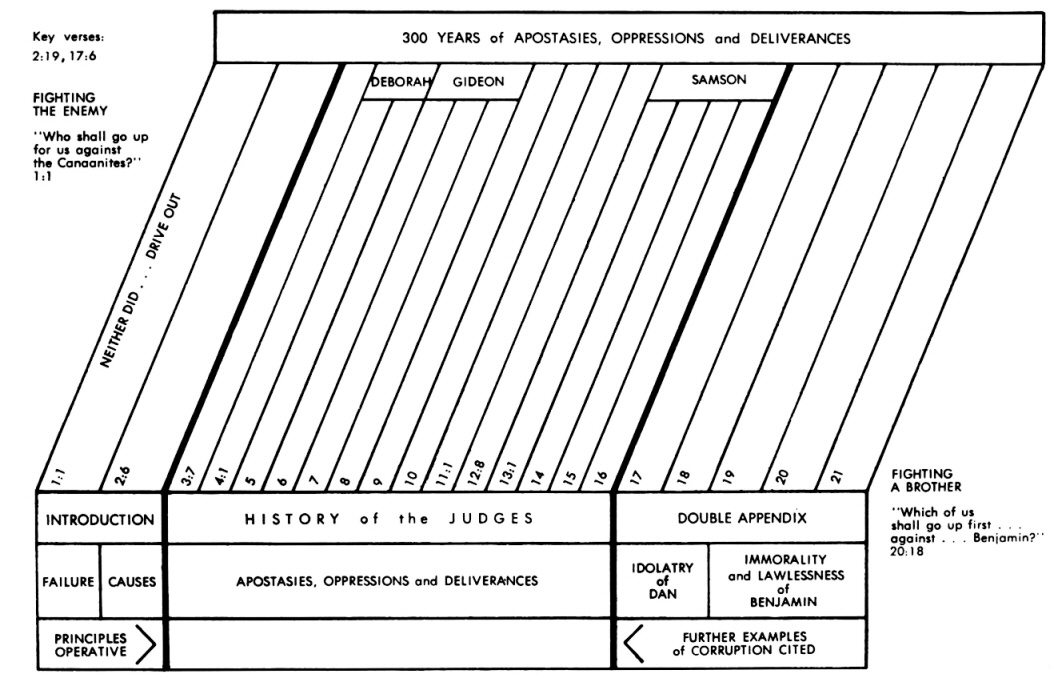
Chart from recommended resource Jensen's Survey of the OT - used by permission
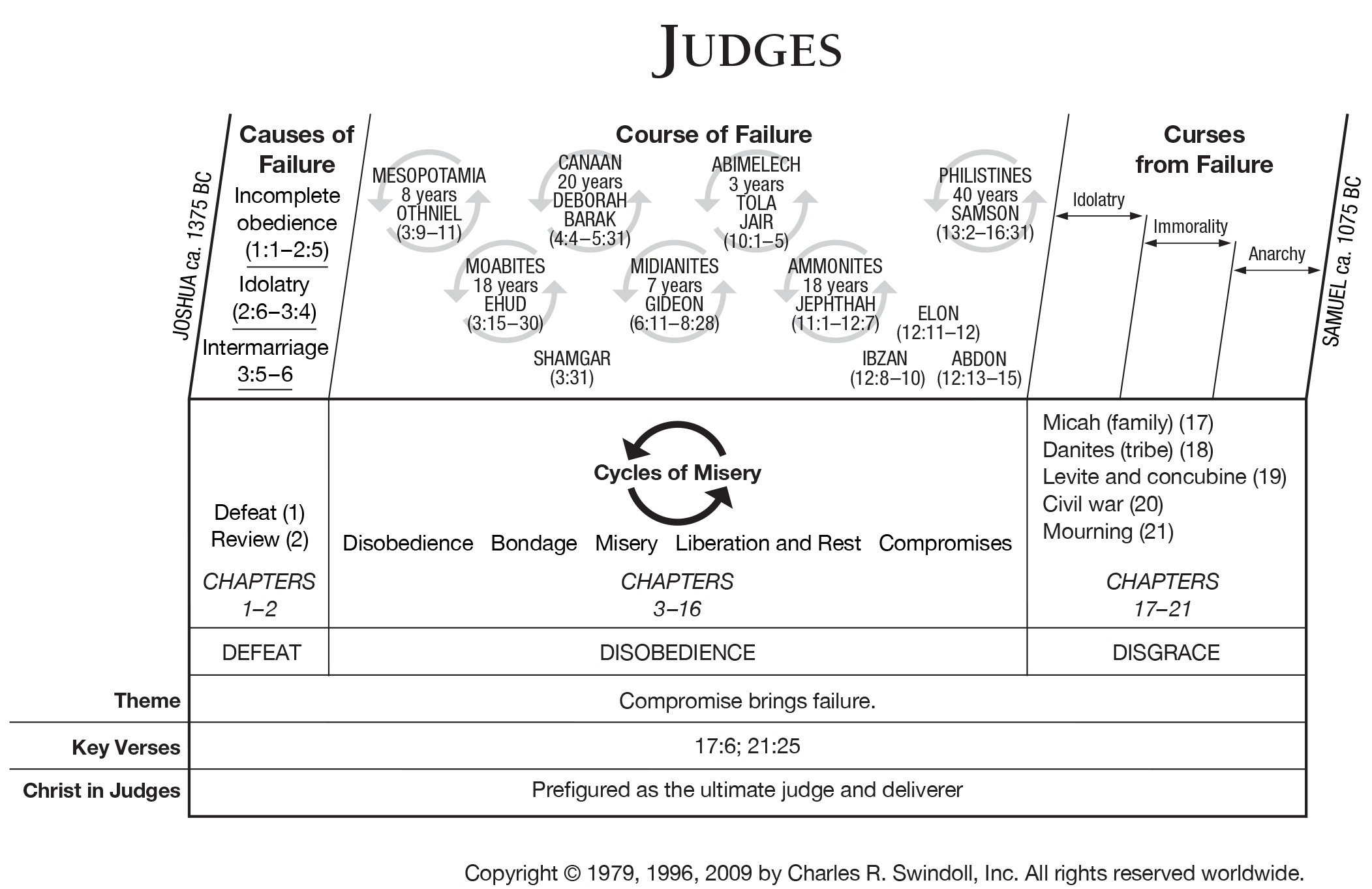
Chart on Judges - Charles Swindoll
|
RECYCLING SIN |
|||||
| Jdg 1:1-3:6 | Jdg 3:7-16:31 | Jdg 17:1-21:25 | |||
| Introduction | History of the Judges | Appendix | |||
| Causes of the Cycles THE REASON |
Curse of the Cycles THE RECORD |
Conditions in the Cycles THE RESULTS |
|||
| Failure to Complete Conquest Jdg 1:1-36 God's Judgment for Failure Jdg 2:1-3:6 |
Curse of the Cycles |
Conditions in the Cycles |
|||
| Living with Canaanites |
War with the Canaanites |
Living Like the Canaanites |
|||
| Religious Laxity |
Political Uncertainty |
Moral Anarchy |
|||
| About 350 Years of Israel's History - Almost 25%! From Compromise to Confusion! |
|||||

Another Timeline of Israel's History
Click to Enlarge
from Jensen's Survey of the OT
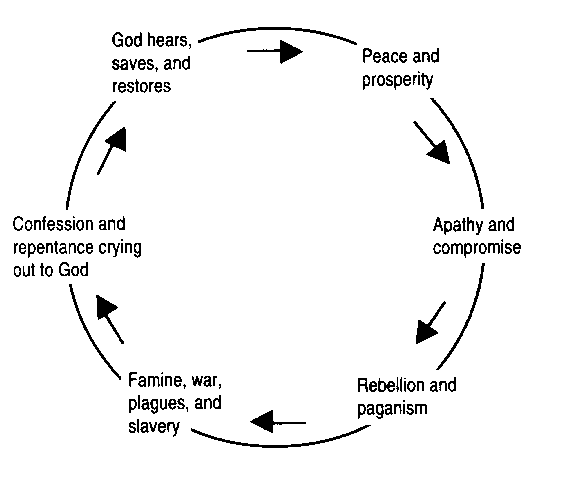
Click to Enlarge
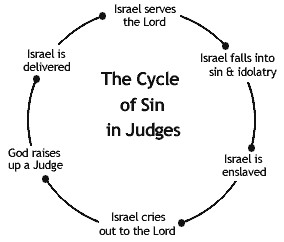
Other ways to describe Israel's cycle…
- Rest > Rebellion > Retribution > Repentance (?) > Restoration
- Sin > Suffering/Servitude > Supplication > Salvation
- Apathy > Apostasy > Affliction > Answered Prayer
- Disobedience > Desperation > Deliverance
- Disobedience > Bondage >Misery > Liberation and Rest > Compromises
FOLLOWING NOTES ARE COMPLETELY REVISED SPRING, 2022
Judges 5:1 Then Deborah and Barak the son of Abinoam sang on that day, saying,
- Ex 15:1,21; Nu 21:17; 1Sa 2:1; 2Chr 20:21,27; Job 38:7; Ps 18:1; Isa 12:1-6; 25:1; 26:1; Lk 1:46,67,68; Rev 15:3-4; Rev 19:1-3
Exodus 15:1; 21 Then Moses and the sons of Israel sang this song to the LORD, and said, “I will sing to the LORD, for He is highly exalted; The horse and its rider He has hurled into the sea. (15:21) Miriam answered them, “Sing to the LORD, for He is highly exalted; The horse and his rider He has hurled into the sea.”
Revelation 15:3-4 And they sang the song of Moses, the bond-servant of God, and the song of the Lamb, saying, “Great and marvelous are Your works, O Lord God, the Almighty; Righteous and true are Your ways, King of the nations! 4“Who will not fear, O Lord, and glorify Your name? For You alone are holy; For ALL THE NATIONS WILL COME AND WORSHIP BEFORE YOU, FOR YOUR RIGHTEOUS ACTS HAVE BEEN REVEALED.”
Revelation 19:1-3 After these things I heard something like a loud voice of a great multitude in heaven, saying, “Hallelujah! Salvation and glory and power belong to our God; 2 BECAUSE HIS JUDGMENTS ARE TRUE AND RIGHTEOUS; for He has judged the great harlot who was corrupting the earth with her immorality, and HE HAS AVENGED THE BLOOD OF HIS BOND-SERVANTS ON HER.” 3And a second time they said, “Hallelujah! HER SMOKE RISES UP FOREVER AND EVER.”
The song's main sections are as follows:
- Jdg 5:2-3 prelude (praise to the Lord and a call to hear the song)
- Jdg 5:4-5 the Lord's arrival as Israel's champion
Conditions prevailing before the battle
- Jdg 5:6-8 Israel had no standing army at this time.
The fighters were all non-professional volunteers.
- Jdg 5:9-13 a call to participate in the battle
- Jdg 5:14-18 the response of the Israelite tribes
The ensuing conflict
- Jdg 5:19-23 the battle itself
- Jdg 5:24-27 the death of Sisera
- Jdg 5:28-30 the waiting of his mother in vain
- Jdg 5:31 epilogue
Warren Wiersbe Outlines Judges 4-5
- Judges 4:1-3 Act one: A tragic situation
- Judges 4:4-7 Act two: A divine revelation
- Judges 4:8-10 Act three: A reluctant participant
- Judges 4:11-23 Act four: A victorious confrontation
- Judges 5:1-31 Act five: A glorious celebration
A SONG OF VICTORY
AND DELIVERANCE
After the gruesome details of Judges 4, it is time for reflection and a song of praise to God. The song of Deborah is a rousing declaration of praise to God. The great words "bless" or "praise" are found only 8 times in the entire book of Judges and 4 of those uses are in Judges 5 and 3 relate to God (Jdg 5:2, 3, 9) and one to Jael (Jdg 5:24). None of the other uses of "bless" or "praise" are directed to Yahweh in Judges. Are we surprised in a book whose theme verse is Judges 21:25+ "In those days there was no king in Israel; everyone did what was right in his own eyes." It is difficult to bless or praise God when our focus is always on ourselves! As Webb says "Judges is a book that quenches singing rather than evoking it."
Hindson, et al has a helpful introductory note on Judges 5:1-7- Then sang Deborah and Barak a song of victory, similar to many that are preserved in Scripture to commemorate the intervention of God on behalf of His people. The song is one of praise unto the Lord for His deliverance and recounts the oppression under the Canaanites, the mustering of the tribes, the Battle of Kishon, and the death of Sisera. In essence the song of chapter Jdg 5 repeats in poetic form the narrative of chapter Jdg 4. Nearly all commentators agree that this ode of triumph is contemporary with the events it describes. Even in its translated form it retains a spirit of excitement and gives the reader the experience of being an eyewitness to its events. The authorship of the poem is attributed to Deborah and Barak themselves and should be accepted as such. The fact that they are referred to in both the first and the third person throughout the poem is typical in ancient Near Eastern texts. This poetic song contains both the rhythm and parallelism of typical Hebrew poetry (e.g., Hear, O ye kings; give ear, O ye princes). The poetic form of the song is somewhat obscure in the AV and is generally more effective in the new translations. (See KJV Bible Commentary online)
Then - A word which marks sequence, in this case indicating the song they sang after the victory Jehovah won, much like Moses' song, which is interesting as both songs commemorate the supernatural overthrow of horses and chariots! It is notable that this is the only song recorded in the 350 years of the sad times of the judges.
Then Deborah and Barak the son of Abinoam sang on that day, saying - "Deborah was a prophetess and a poetess." (John Trapp) The writer shifts from narrative prose to jubilant poetry to give tribute to God for the victory and in so doing describes various aspects which parallel Judges 4. This passage seems to suggest both Deborah and Barak sang the song, but the personal pronouns ("I, Deborah...“My heart...the people of the LORD came down to me.") in Jdg 5:7, 9, 13 would support that this was primarily Deborah’s victory song. Furthermore, the verb sang is feminine (3rd person, feminine, singular) rather than masculine. So she takes the lead in the song. Clearly though from this first first, just as Barak joined her in the battle, so he joined her in the victory celebration. Don't miss the time phrase on that day which should prompt a question like "what day?" So what day do you think? It is surely the new day of freedom from 20 years of oppression by Jabin and the Canaanites. That should make anyone want to sing!
Spurgeon - Deborah sang concerning the overthrow of Israel’s enemies, and the deliverance vouchsafed to the tribes: we have a far richer theme for music; we have been delivered from worse enemies, and saved by a greater salvation. Let our gratitude be deeper; let our song be more jubilant.”
Webb - After twenty long years their bonds were suddenly broken, and they were free again. That’s why they sang this song. It was what their ancestors had done when the Lord delivered them from slavery in Egypt (Exodus 15:1+). It’s what a later generation would do when God rescued them from exile in Babylon (Isaiah 26:1), and it’s what all God’s redeemed people will do one day in Heaven (Revelation 5:9, 10+). Singing is a natural and proper response to deliverance. It’s something people do when God saves them and they are glad and grateful to him. Judges 5 is the natural accompaniment of Judges 4. (See Judges and Ruth: God in Chaos)
Judges 5 pays tribute to those individuals and tribes who valiantly played their part (including Jael) and rebukes those who did not, thus alerting us to a certain lack of unity among the tribes (a problem that will emerge more clearly later in the book). The battle involved mainly the central and northern tribes (there is no mention of Judah), and of these some acquitted themselves more creditably than others. But the main theme of the song is `the righteous acts' of the LORD Himself, who went forth as Israel's champion and overwhelmed His enemies by unleashing the powers of heaven against them. In this it is very reminiscent of the song of Moses when the Lord fought for them against the Egyptians (cp Exodus 15)
THOUGHT - The Spirit filled saint is a song filled saint! Animals can't sing. Neither can pews or pulpits or Bibles or buildings. Only you. And your melody is broadcast right into heaven -- live -- where God's antenna is always receptive...where the soothing stains of your song are always appreciated. (Swindoll - Insights for Living Study Bible) (See Swindoll's critique of Deborah)
TECHNICAL COMMENT - Since Judges 5 is not easy to interpret, there can be a tendency for the interpreter to allegorize the text rather than approach it literally. Certainly a poem or song cannot be easily outlined. In addition, unlike English poetry, Hebrew poetry contains recurring themes, expressed in different ways with frequent outbursts of praise and prayer. So this technical comment is simply some historical background on Bible interpretation in general.
You might ask why should the diligent student (2Ti 2:15+) want to study the history of Bible interpretation? In short, if one knows something of the erroneous methods of Bible interpretation that have been proposed over the last 2000 years, those modes of interpretation are more likely to be both recognized and avoided, for as the saying goes "History tends to repeat itself".
Mickelsen adds that "History shows that erroneous principles have often spoiled the exegetical work of fine men, some of whom are great saints. This should be a warning to us against careless interpretation. There is less excuse for us because we can profit by the lessons of the past. (A. Berkeley Mickelsen: Interpreting the Bible. Eerdmans. 1963)
The earliest of the so called Early Church Fathers interpreted Scripture literally (see topic Literal Interpretation) for the most part. As an aside, regarding the meaning of literal interpretation, Peter Lange writes…
Literal is not opposed to spiritual but to figurative; spiritual is an antithesis on the one hand to material, and on the other to carnal (in a bad sense). The Literalist is not one who denies that figurative language, that symbols are used in prophecy, nor does he deny that great spiritual truths are set forth therein; his position is simply, that the prophecies are to be normally interpreted (i.e., according to the received laws of language) as any other utterances are interpreted-that which is manifestly literal being regarded as literal, and that which is manifestly figuratively being so regarded. The position of the Spiritualist (Ed note: AKA "allegorist") is not that which is properly indicated by the term. He is one who holds that certain portions are to be normally interpreted, other portions are to be regarded as having a mystical sense. The terms properly expressive of the schools are normal and mystical. (John Peter Lange, A Commentary on the Holy Scripture: Revelation, p. 98)
Toward the end of the second century many of the so called "fathers" began to interpret the Scriptures allegorically. Allegorical interpretation jettisons (or at least minimizes) the literal meaning and looks for "deeper" spiritual meanings which are considered the "true" meaning. An offshoot of allegorical interpretation is the practice of seeing significance in numbers, known as gematria.
As Roy Zuck explains that "Allegorizing is searching for a hidden or secret meaning underlying but remote from and unrelated in reality to the more obvious meaning of a text. In other words the literal reading is a sort of code (Ed note: Does this sound familiar? cp The Bible Code, which preceptaustin.org thoroughly rejects as unfounded, without merit and very misleading!), which needs to be deciphered to determine the more significant and hidden meaning. In this approach the literal is superficial, the allegorical is the true meaning. (Borrow Basic Bible Interpretation for one hour) (Bolding added)
Origen (185-254) held a high view of the inspiration of Scripture and yet was guilty of mishandling the Bible by minimizing its literal meaning and treating it as "one vast allegory" with many hidden meanings. He reasoned that the Bible was full of enigmas, parables and dark sayings which meant that the meaning could only be found at a deeper level! Thus it is not surprising that Origen interpreted the Hebrew poetry in Judges 5 allegorically, writing that Deborah, the “bee,” was inspired with honey-sweet prophecies! He "fantasized" that Barak’s initial unwillingness to respond to Deborah's prophecy represented the inability of Israel to triumph over the devil (who he said was portrayed by Sisera) until the deliverance of mankind through the Cross. Origen interpreted Jael as representative of the church (despite the fact that Paul clearly stated that the "church" was a mystery in the OT! See notes Ephesians 3:4; 3:5) who had been gathered from the Gentiles and that she ("Jael, the church"), helped to save believers by destroying the devil (Sisera). Other examples of Origen's allegorization of Scripture include his teaching that Noah's ark pictured the church and Noah pictured Christ. He interpreted the donkey Jesus rode upon at His triumphal entry as representing the Old Testament, while its colt depicted the New Testament!
Origen's allegorical interpretation is mentioned so that the educated reader might be aware of just how far afield interpretation can go when one ignores the boundaries of normal, literal, grammatical-historical hermeneutical principles (hermeneutics = the science of interpretation or study of the methodological principles of interpretation). It is hoped that the reader will be stimulated to take time to study the checkered history of Bible interpretation over the last 2000 years (see the synopses below). Finally, it is hoped that the ridiculousness of Origen's interpretations will set aflame in the reader a strong desire to continually diligently seek to rightly divide the Word of Truth, whether in one's devotional reading or when teaching others the Scriptures.
Augustine (354-430) who also accepted the allegorical method of interpretation (eg, he interpreted Noah's drunkenness in Genesis 9:20-23 as representative of Christ in His suffering and death!) stigmatized Deborah's Song as simply too obscure for comment.
To reiterate, we need to continually be like the Bereans (see Acts 17:11) and be wary of reading older commentaries unless we understand how they approached the interpretation of the Word of Truth. As discussed many of the early church fathers quickly slipped from a predominantly literal approach into an allegorical approach, which dominated the "Dark Ages" (it's not surprising that they were "dark" when you understand how the Word of Truth was handled by the leading figures of this 1000+ year period!).
The temptation to not be literal is very great in a passage like Judges 5 where the Hebrew is difficult to interpret and there are phrases that are symbolic. Our goal is ever to…
Be a Berean not an Origen!
Regarding interpretation of the Scriptures see topic Interpretation in the section on inductive Bible study. Specifically in regard to allegorical interpretation see Tony Garland's summary (Rise of Allegorical Interpretation). See also a historical summary by Dr Stephen Lewis in his course on hermeneutics (Hermeneutics - Study of Interpretation of Scriptures - especially the overview of the history of Bible interpretation - beginning on page 22).
Related Resource:
- The Song of Deborah in Tradition and testament : essays in honor of Charles Lee Feinberg (Borrow for one hour) (1981), pages 123-160. - This is for the one who wants to dig deep into this passage.
Judges 5:2 "That the leaders led in Israel, that the people volunteered. Bless the LORD!
Amplified: For the leaders who took the lead in Israel, for the people who offered themselves willingly, bless the Lord!
ESV: That the leaders took the lead in Israel, that the people offered themselves willingly, bless the Lord!
Young's Literal: For freeing freemen in Israel, For a people willingly offering themselves Bless ye Jehovah.
- leaders led - Dt 32:43; 2Sa 22:47,48; Ps 18:47; 48:11; 94:1; 97:8; 136:15,19,20; Ps 149:6, 7, 9; Rev 16:5,6; 18:20; 19:2
- that the people volunteered Jdg 5:9 2Ch 17:16 Ne 11:2 Ps 110:3 1Co 9:17 2Co 8:12 9:7 Php 2:13 Philemon 1:14
A FITTING BEGINNING
PRAISE TO THE LORD
That the leaders led in Israel - Deborah arose and went (as did Barak after Deborah agreed) and so 10,000 from Naphtali and Zebulun followed ("volunteered") just as God had said (cf Jdg 4:6+; Jdg 4:10+). The point is that the leaders led out (as they should) and the people were willing to follow their lead. In this case the primary leader was Deborrah with Barak at her side.
ESV Study Bible on leaders led - The Hebrew is difficult. While the ESV translation ("the leaders took the lead") is the most likely sense, an alternative proposal is that the word translated “leaders” may literally mean, “the long-haired ones” or “the hairy ones,” with the verb translated “took the lead” being “to let [hair] hang loose.” (Borrow ESV study Bible for one hour)(ED: JUST A THOUGHT - DEBORAH WOULD CERTAINLY BE A "LONG HAIRED" ONE!)
Herbert Wolf - This opening line is one of the most obscure in the song. It could also be translated "When locks of hair grow long in Israel," alluding to the practice of leaving hair uncut to fulfill a vow (Nu 6:5, 18). This would connote dedication to the Lord in participating in a "holy war." Deuteronomy 32:42 may refer to long-haired soldiers, though "leaders" is also a possibility there. (The Expositor's Bible Commentary)
Wycliffe Bible Commentary says "long hair" "suggests either that Israel became practically a nation of Nazarites, or that they enjoyed the freedom and strength with which the long hair of the Nazarite was associated. (Borrow Wycliffe Bible Commentary)
That the people volunteered (nadab - "willingly offered") - Leaders must have followers! Some tribes volunteered, but sadly other tribes did not volunteer discussed below. Volunteered "connotes an uncompelled and free movement of the will unto divine service or sacrifice." Nadab was used of making voluntary offerings to restore the Lord's sanctuary after the 70 year exile (Ezra 2:68). Volunteered is used with this military sense in 2Chr 17:16 ("volunteered for the LORD", cf Ps 110:3)
Guzik - The conductor must lead, and the orchestra must be ready and willing to follow the conductor’s leadership. When the conductor does his job and the orchestra does their job, then beautiful music is made. (Judges 5 Commentary)
Bless (barak) the LORD! (repeated for emphasis Jdg 5:9+): Why? because He alone could raise up a Deborah. He alone could motivate a Barak. He alone could prevail over 900 iron chariots. Yes, Barak's faith seems to have temporarily faltered (Jdg 4:8+).
THOUGHT - We are all "Baraks" (proper name, not the verb barak) at times - we have the sure promises of God but only half-heartedly stand on them. Why? Because we have "900 iron chariots" of the "Sisera" in our life. We need to remember that when God promises, He cannot lie and so we can walk into battles against humanly impossible odds. The world would laugh at us saying how can you go against "iron chariots" when we lack any weapons? Our answer should echo Deborah's who declared "Today He has given your enemy into your hands." Blessed be the name of the LORD our God. Let us bless His marvelous Name forever and forever. Amen.
Some boast in chariots, and some in horses; But we will boast in the name of the LORD, our God. They have bowed down and fallen; But we have risen and stood upright. (Psalm 20:7, 8)
Spurgeon comments: Chariots and horses make an imposing show, and with their rattling, and dust, and fine caparisons, make so great a figure that vain man is much taken with them; yet the discerning eye of faith sees more in an invisible God than in all these. The most dreaded war engine of David's day was the war chariot, armed with scythes, which mowed down men like grass: this was the boast and glory of the neighbouring nations; but the saints considered the name of Jehovah to be a far better defence. As the Israelites might not keep horses, it was natural for them to regard the enemy's calvary with more than usual dread. It is, therefore, all the greater evidence of faith that the bold songster can here disdain even the horse of Egypt in comparison with the Lord of hosts. Alas, how many in our day who profess to be the Lord's are as abjectly dependent upon their fellow men or upon an arm of flesh in some shape or other, as if they had never known the name of Jehovah at all. Jesus, be thou alone our rock and refuge, and never may we mar the simplicity of our faith.
We will remember the name of the Lord our God. "Our God" in covenant, Who has chosen us and Whom we have chosen; this God is our God. The name of our God is JEHOVAH, and this should never be forgotten; the self existent, independent, immutable, ever present, all filling I AM (See study on His name Jehovah). Let us adore that matchless name, and never dishonour it by distrust or creature confidence. Reader, you must know it before you can remember it. May the blessed Spirit reveal it graciously to your soul!
How different the end of those whose trusts are different! The enemies of God are uppermost at first, but they ere long are brought down by force, or else fall of their own accord (cf notes on Revelation 19:15). Their foundation is rotten, and therefore when the time comes it gives way under them; their chariots are burned in the fire, and their horses die of pestilence, and where is their boasted strength? As for those who rest on Jehovah, they are often cast down at the first onset, but an Almighty arm uplifts them, and they joyfully stand upright. The victory of Jesus is the inheritance of his people. The world, death, Satan (see note Revelation 20:10), and sin, shall all be trampled beneath the feet of the champions of faith; while those who rely upon an arm of flesh shall be ashamed and confounded for ever. (Spurgeon's comments Verse 7; Verse 8)
Volunteered (freewill offering)(05068)(nadab) means to incite (willingly), impel. It describes the devotion of person or property completely to Yahweh. It is an act motivated by love or devotion to the LORD. Nadab is used of volunteering for military campaigns (Judg 5:2, 9) and the willing offerings for both the first and second temples (see 1 Chr 29:5, 6, 9, 14, 17).TWOT (online) says nadab "connotes an uncompelled and free movement of the will unto divine service or sacrifice. The verb nādab occurs three times in the Qal and each time describes the inner state of those contributing to the construction of the tabernacle. Such offerings were to be one's own goods and given voluntarily. The rest of the occurrences are in the Hithpael and, hence, are reflexive. The building (1 Chr 29:5) and rebuilding (2 Chr 35:8; Ezra 1:6) of the temple elicited abundant voluntary giving and sacrifice (Ezra 3:5) from God's people. Interestingly, Deborah commends the people (Judges 5:2) and leaders (Judges 5:9) of Israel for liberally and voluntarily offering themselves to God in the holy war. David addresses God concerning the freewill contributions toward building the temple, confessing that he owned everything including their stewardship, and he was gracious in accepting them (1 Chr 29:5,6, 14, 17)."
Bless (praise) (01288) barak is a verb which literally can mean to kneel (to go to one's knees - Camel in Ge 24:11, Solomon in 2Chr 6:13) as contrasted with standing position or even a bowing at the waist). And so barak can refer to an act of adoration sometimes on bended knee. To give divine blessings (Ge 1:22, 9:1-7) To esteem greatly or adore God for His blessings (Ge 24:48, Ps 103:1) To invoke blessings upon another (Ge 24:60, 27:4, 27)
Judges 5:3 "Hear, O kings; give ear, O rulers! I-- to the LORD, I will sing, I will sing praise to the LORD, the God of Israel.
- Hear O kings Dt 32:1,3; Ps 2:10-12; 49:1,2; 119:46; 138:4,5) - This is a call to the Gentile rulers for Israel did not have a monarchy at this time.
- I will sing praise to the LORD Jdg 5:7; Ge 6:17; 9:9; Ex 31:6; Lev 26:28; 1Ki 18:22; 19:10,14; Ezra 7:21
Related Passages:
Psalm 2:10-12+ Now therefore, O kings, show discernment; Take warning, O judges of the earth. 11 Worship the LORD with reverence And rejoice with trembling. 12 Do homage to the Son, that He not become angry, and you perish in the way, For His wrath may soon be kindled. How blessed are all who take refuge in Him!
RULERS OF NATIONS
URGED TO LISTEN
In Judges 5:3-5 Deborah focuses on remembrance of God's preservation of Israel in the past.
Hear, (shama) O kings; Give ear - Hear is a command and shama conveys the sense of to hear and heed what is heard. Rulers are commanded to listen not to Deborah but to Jehovah (Yahweh), the Name that expresses His covenant relationship with Israel. He is the only One worthy to be praised. Give ear doubles the call to listen closely and is translated in the Septuagint with the verb enotizomai (in present imperative) which is a command to continually pay attention or to listen carefully to what is said.
I will sing, I will sing praise to the LORD, the God of Israel - Comparing this "I" to the "I, Deborah" in Jdg 5:7, this would support that Deborah is the primary author of this song.
Judges 5:4 "LORD, when Thou didst go out from Seir, When Thou didst march from the field of Edom, The earth quaked, the heavens also dripped, Even the clouds dripped water.
KJV Judges 5:4 LORD, when thou wentest out of Seir, when thou marchedst out of the field of Edom, the earth trembled, and the heavens dropped, the clouds also dropped water.
BBE Judges 5:4 Lord, when you went out from Seir, moving like an army from the field of Edom, the earth was shaking and the heavens were troubled, and the clouds were dropping water.
CSB Judges 5:4 LORD, when You came from Seir, when You marched from the fields of Edom, the earth trembled, the heavens poured rain, and the clouds poured water.
ERV Judges 5:4 LORD, when thou wentest forth out of Seir, when thou marchedst out of the field of Edom, the earth trembled, the heavens also dropped, yea, the clouds dropped water.
ESV Judges 5:4 "LORD, when you went out from Seir, when you marched from the region of Edom, the earth trembled and the heavens dropped, yes, the clouds dropped water.
GWN Judges 5:4 O LORD, when you went out from Seir, when you marched from the country of Edom, the earth quaked, the sky poured, the clouds burst,
NKJ Judges 5:4 "LORD, when You went out from Seir, When You marched from the field of Edom, The earth trembled and the heavens poured, The clouds also poured water;
NAB Judges 5:4 O LORD, when you went out from Seir, when you marched from the land of Edom, The earth quaked and the heavens were shaken, while the clouds sent down showers.
NET Judges 5:4 O LORD, when you departed from Seir, when you marched from Edom's plains, the earth shook, the heavens poured down, the clouds poured down rain.
NIV Judges 5:4 "O LORD, when you went out from Seir, when you marched from the land of Edom, the earth shook, the heavens poured, the clouds poured down water.
- LORD, when Thou didst go out from Seir Dt 33:2; Ps 68:7,8; Hab 3:3-6
- The earth quaked 2Sa 22:8; Job 9:6; Ps 18:7-15
- Even the clouds dripped water Ps 77:17
Related Passages:
Deuteronomy 33:2+ He said, “The LORD came from Sinai, And dawned on them from Seir; He shone forth from Mount Paran, And He came from the midst of ten thousand holy ones; At His right hand there was flashing lightning for them.
Habakkuk 3:3-6+ God comes from Teman, And the Holy One from Mount Paran. Selah. His splendor covers the heavens, And the earth is full of His praise. 4 His radiance is like the sunlight; He has rays flashing from His hand, And there is the hiding of His power. 5 Before Him goes pestilence, And plague comes after Him. 6 He stood and surveyed the earth; He looked and startled the nations. Yes, the perpetual mountains were shattered, The ancient hills collapsed. His ways are everlasting.
Psalm 68:7-8 O God, when Thou didst go forth before Thy people, When Thou didst march through the wilderness, Selah. 8 The earth quaked; The heavens also dropped rain at the presence of God; Sinai itself quaked at the presence of God, the God of Israel.
Spurgeon - The heavens also dropped at the presence of God, as if they bowed before their God, the clouds descended, and "a few dark shower drops stole abroad." Even Sinai itself was moved at the presence of God. Moses tell us, in Exodus 19, that "the whole mountain quaked greatly." That hill, so lone and high, bowed before the manifested God. The God of Israel. The one only living and true God, whom Israel worshipped, and who had chosen that nation to be his own above all the nations of the earth. The passage is so sublime, that it would be difficult to find its equal. May the reader's heart adore the God before whom the unconscious earth and sky act as if they recognised their Maker and were moved with a tremor of reverence.
GOD RIDES THE CLOUDS
AS HIS CHARIOTS
Judges 5:4-5 reflect a recitation of the LORD's previous mighty deeds on behalf of Israel and a foreshadowing of what He accomplished in Judges 4, as summarized in Jdg 5:19-21.
LORD (Jehovah -Yahweh), when Thou didst go out from Seir - This song of praise is addressed to Yahweh. This recalls God's giving victory in the past with the implication that He is the same yesterday, today and tomorrow! The phrase Thou didst go out describes a theophany depicting Yahweh marching from Mount Seir in Edom and bringing a great rainstorm (from the south).
Deborah recounts the work God had done for Israel (Jdg 2:10+) depicting Yahweh as a Mighty Warrior marching forth from Seir/Edom to come to the aid of His people. Seir was a mountain in Edom, to the south of Israel. Sinai (Mt Sinai) was further south and was the place where the Lord first revealed Himself to Israel. Having become their God at Mt Sinai when He (and they) entered into covenant, He then led them from the south through Seir and Edom to the promised land, the place of the present victory.
Ralph Dale Davis - First, Deborah gives us a lively view of the coming of Yahweh (Jdg 4-5; cf. Dt. 33:2-5; Ps 68:7-10; Hab 3:3-4): It is difficult to know whether Yahweh's going forth from Seir and marching from Edom refer to his contemporary coming to the conflict with Sisera or whether the reference is to his ancient coming to his people in Egypt and his meeting with them at Sinai. In any case, there is a clear hint of Yahweh's delivering Israel from Egypt and preserving them in the desert when Deborah refers to Yahweh as 'the One of Sinai.' There, at Sinai, Yahweh had taken Israel as His own (Ex 19+); there He came and met with them; there He had placed them under His law at liberty. But Yahweh – and this is Deborah's point – is not stuck at Sinai. Rather, the God Who decisively came to Israel at Sinai comes again and again to the aid of His people in their present troubles. The God Who delivered them at the Sea of Reeds (Ex 14) can rescue at the waters of Meggido (Jdg 5:19); the God Who came to Mount Sinai (Ex 19-24) comes to Mount Tabor as well (Jdg. 4:14-15). Yahweh is not set in historical concrete at Sinai; rather the One of Sinai is mobile, marching forth again and again to rescue His flock. And when He does, creation comes unglued! Earth trembles, clouds pour rain (perhaps an allusion to the rainstorm sent against Sisera), mountains shake. See Ps 18:7-19 in context for another sample of this explosive God. (Judges: Such Great Salvation)
Jehovah is pictured as coming to Israel's rescue from Mt Sinai, via Edom. He is surrounded by cloud, thunder and earthquake, as at His first coming to His people as recounted in Exodus 19:16-19+
So it came about on the third day, when it was morning, that there were thunder and lightning flashes and a thick cloud upon the mountain and a very loud trumpet sound, so that all the people who were in the camp trembled. 17 And Moses brought the people out of the camp to meet God, and they stood at the foot of the mountain. 18 Now Mount Sinai was all in smoke because the LORD descended upon it in fire; and its smoke ascended like the smoke of a furnace, and the whole mountain quaked violently. 19 When the sound of the trumpet grew louder and louder, Moses spoke and God answered him with thunder.
He comes in storm, and he unleashes a storm (literally) on his enemies (Jdg 5:20,21) When Jehovah passes through the heavens, the clouds release their water, and when He touches down on earth, the mountains quake. What an Awesome Omnipotent God believers have the grand privilege to bow down to and worship, even with a holy boldness made available through our Great High Priest, Christ Jesus.
When Thou didst march from the field of Edom, The earth quaked, the heavens also dripped, Even the clouds dripped water - NIV = "the heavens poured, the clouds poured down water." All opposition melted as the Israelites left the borders of Edom to move toward the entrance into the Promised Land. Notice the reaction of the various parts of the creation to the Creator - the earth trembled, the heavens dripped, the clouds dripped. This undoubtedly takes on added significance in that the false god of the Canaanites (Baal) was envisioned by them as the "storm god". Jehovah shows Who is the true and living "storm God"!
Wycliffe Bible Commentary (borrow 1 hour) - The picture is of God setting forth from his abode to assist his people in the conflict with Sisera. All nature was convulsed as God acted in power. The imagery is poetic and is designed to impress upon the mind of the reader the awesomeness of the Divine activity.
Seir - 39x in 38v - Gen. 14:6; Gen. 32:3; Gen. 33:14; Gen. 33:16; Gen. 36:8; Gen. 36:9; Gen. 36:20; Gen. 36:21; Gen. 36:30; Num. 24:18; Deut. 1:2; Deut. 1:44; Deut. 2:1; Deut. 2:4; Deut. 2:5; Deut. 2:8; Deut. 2:12; Deut. 2:22; Deut. 2:29; Deut. 33:2; Jos. 11:17; Jos. 12:7; Jos. 15:10; Jos. 24:4; Jdg. 5:4; 1 Chr. 1:38; 1 Chr. 4:42; 2 Chr. 20:10; 2 Chr. 20:22; 2 Chr. 20:23; 2 Chr. 25:11; 2 Chr. 25:14; Isa. 21:11; Ezek. 25:8; Ezek. 35:2; Ezek. 35:3; Ezek. 35:7; Ezek. 35:15
Judges 5:5 "The mountains quaked at the presence of the LORD, This Sinai, at the presence of the LORD, the God of Israel.
- The mountains quaked - Deut 4:11; Ps 97:5; Ps 114:4; Isa 64:1-3; Nah 1:5; Hab 3:10
- This Sinai - Ex 19:18; 20:18; Dt 4:11,12; 5:22- 25; He 12:18
Related Passages:
Exodus 15:3-6+ “The LORD is a warrior; The LORD is His name. 4 “Pharaoh’s chariots and his army He has cast into the sea; And the choicest of his officers are drowned in the Red Sea. 5 “The deeps cover them; They went down into the depths like a stone. 6 “Your right hand, O LORD, is majestic in power, Your right hand, O LORD, shatters the enemy.
Psalm 97:5 The mountains melted like wax at the presence of the LORD, At the presence of the Lord of the whole earth.
Spurgeon: The hills melted like wax at the presence of the LORD. Inanimate nature knows its Creator, and worships Him in its own fashion. States and kingdoms which stand out upon the world like mountains are utterly dissolved when He decrees their end. Systems as ancient and firmly rooted as the hills pass away when He does but look upon them. In the Pentecostal era, and its subsequent age, this was seen on all hands, heathenism yielded at the glance of Jehovah Jesus, and the tyrannies based upon it dissolved like melted wax. At the presence of the Lord of the whole earth. His dominion is universal, and His power is everywhere felt. Men cannot move the hills, with difficulty do they climb them, with incredible toil do they pierce their way through their fastnesses, but it is not so with the LORD, His presence makes a clear pathway, obstacles disappear, a highway is made, and that not by His hand as though it cost Him pains, but by His mere presence, for power goes forth from Him with a word or a glance. O for the presence of the LORD after this sort with His church at this hour! It is our one and only need. With it the mountains of difficulty would flee away, and all obstacles would disappear. O that thou wouldest rend the heavens and come down, that the mountains might flow down at Thy presence, O Lord. In the little world of our nature the presence of Jesus in reigning power is as a fire to consume our lusts and melt our souls to obedience. Sometimes we doubt the presence of the Lord within, for He is concealed with clouds, but we are again assured that He is within us when His light shines in and fills us with holy fear, while at the same time the warmth of grace softens us to penitence (Ed note: And all God's people said "Amen. Praise Jehovah!")
Nahum 1:5 Mountains quake because of Him, And the hills dissolve; Indeed the earth is upheaved by His presence, The world and all the inhabitants in it.
Comment: This verse is ultimately a prophecy of the last days when His wrath will be poured out upon the whole earth, that His righteous cause might be vindicated)
Habakkuk 3:10 The mountains saw You and quaked; The downpour of waters swept by. The deep uttered forth its voice, It lifted high its hands.
GOD OF THE
MOUNTAINS
The mountains quaked at the presence of the LORD, This Sinai, at the presence of the LORD, the God of Israel - This speaks of God's awesome power and His sovereign control over the entire creation. On the other hand God of Israel speaks of His personal relationship with the nation of Israel (something the "kings" in Jdg 5:4 needed to hear and heed!) "Israel had entered into a covenant with the Lord at Mount Sinai, and He would fulfill His promises to His special people." (See context Be Available)
The ESV note on Jdg 5:4-5 suggests "The Lord’s marching from Seir and Edom likely refers to God’s transferring his “abode” from the wilderness to Canaan (by way of the land of Edom; cf. Nu 10:12; 20:22)—from one mountain (Sinai; Jdg. 5:5) to another (Zion; Ps. 2:6)." (Borrow ESV study Bible for one hour)
This storm not only served the practical function of bogging down Sisera's chariots and neutralizing his technological edge, it also depicts the Lord—not Baal—as the true God of the storm who marches out from His mountain home with the clouds and rain. The Lord alone controls the cosmic elements.
Holman Study Bible: NKJV Edition.
Judges 5:6 "In the days of Shamgar the son of Anath, In the days of Jael, the highways were deserted, And travelers went by roundabout ways.
- Shamgar - Jdg 3:31,
- Jael - Jdg 4:17,18
- the highways - Lev 26:22; 2Chr 15:5; Isa 33:8; Lam 1:4; 4:18; Mic 3:12,
Related Passages:
Judges 4:2-3+ And the LORD sold them into the hand of Jabin king of Canaan, who reigned in Hazor; and the commander of his army was Sisera, who lived in Harosheth-hagoyim. 3 The sons of Israel cried to the LORD; for he had nine hundred iron chariots, and he oppressed the sons of Israel severely for twenty years.
2 Chronicles 15:5 “In those times there was no peace to him who went out or to him who came in, for many disturbances afflicted all the inhabitants of the lands.
Isaiah 33:8 The highways are desolate, the traveler has ceased, He has broken the covenant, he has despised the cities, He has no regard for man.
Lamentations 1:4 The roads of Zion are in mourning Because no one comes to the appointed feasts. All her gates are desolate; Her priests are groaning, Her virgins are afflicted, And she herself is bitter.
DESPERATE TIMES
IN ISRAEL
In Judges 5:6-8 Deborah recalls the contemporary context of national distress and fear gripping especially the northern tribes of Israel. The desperate time called for a daring Deborah!
In the days of Shamgar (Jdg 3:31+) the son of Anath, In the days of Jael, the highways were deserted - Roadways that were well-trodden in the past were no longer used by Israelites. Obviously at that time the major trade routes were controlled by the Philistines and the Canaanites. The usual routes traveled were vacated out of fear of attack by the Canaanites.
Off the highways and on to the byways!
Adam Clarke - “The land was full of anarchy and confusion, being everywhere infested with banditti. No public road was safe; and in going from place to place, the people were obliged to use unfrequented paths.”
Davis - Times were so bad folks couldn’t even travel safely—they had to take the back roads because thieves and thugs freeloaded on the main highways. Israel was totally defenseless, having neither warriors (v. 7a) nor weapons (v. 8b; cf. the later situation under the Philistines in 1 Sam. 13:5–7, 19–22). Sometimes it is only when God’s people see how hopeless they are (the picture of vv. 6–8) that they can appreciate how mighty Yahweh is (the picture of vv. 4–5). Desperate people (vv. 6–8) and sufficient God (vv. 4–5) are placed side by side that the former might rest in the latter. (Judges: Such a Great Salvation)
And travelers went by roundabout ways: Literally this means crooked paths, off the road bypaths which were not frequented by the Canaanites. This was Israel's fearful state before God's victory over King Jabin. They refused Yahweh as their kind King so He gave them an evil king!
THOUGHT- A decline in the social and moral life of a nation is the inevitable consequence of a nation’s spiritual decline. O, that the Spirit would graciously give believers in post-Christian America open ears to hear and broken hearts to be revived so that righteousness might reign and our nation be exalted once again for the glory of the LORD. Proverbs 14:34 makes it clear that
"Righteousness exalts a nation,
But sin is a disgrace to any people. "
Judges 5:7 "The peasantry ceased, they ceased in Israel, until I, Deborah, arose, until I arose, a mother in Israel.
English of the Septuagint (LXX): The mighty men in Israel failed (ceased), they failed (ceased) until Deborah arose, until she arose a mother in Israel.
ASV The rulers ceased in Israel, they ceased, Until that I Deborah arose, That I arose a mother in Israel.
Berkley The rulers ceased in Israel, they ceased until I, Deborah, arose, arose a mother in Israel.
ESV The villagers ceased in Israel; they ceased to be until I arose; I, Deborah, arose as a mother in Israel.
KJV The inhabitants of the villages ceased, they ceased in Israel, until that I Deborah arose, that I arose a mother in Israel.
NIV Village life [Or Warriors] in Israel ceased, ceased until I, Deborah, arose, arose a mother in Israel.
- peasantry - Esther 9:19
- a mother - Jdg 4:4, 5, 6; 2Sa 20:19; Is 49:23; Ro 16:13
NORMAL LIFE WAS
NOT POSSIBLE
The peasantry ceased, they ceased in Israel - Remember that the prevailing conditions in Jdg 5:6-6 lasted for 20 years! Even the Great Depression in America only lasted 10 years (1929-1939)! And think how horrible the conditions were in America during that time! That gives us some sense of how bad it was for the average Israelite for 20 years! Peasantry (parazon [only in Jdg 5:7,11] from perazah = an open region) is a difficult Hebrew word to translate. Some Hebrew lexicons render perazon warriors or as people dwelling in unwalled villages. In this context parazon may in fact be "warriors" especially in view of the fact that one variant of the Lxx translates it with dunatos which describes one who possesses power. The alternative translation as in NAS is that village life in open villages ceased and the peasants fled to walled cities, which would fit the context (Jdg 5:6) but would be less consistent with the way the Septuagint (LXX) has translated the verse.
KJV Bible Commentary (see online) - The phrase, the inhabitants of the villages (KJV), has been variously translated as “peasantry” (NASB), “village life” (NIV), and “champions” (NEB). The latter is to be preferred, for it makes the context more clear: “Champions there were none, none left in Israel, until I Deborah arose.”
Until I, Deborah, arose, until I arose, a mother in Israel - Until is a time phrase indicating that prior to Deborah the situation was dire. Until usually implies a situation will come to an end or a change of circumstances as in the case of Deborah arising as judge. Note the repetition for emphasis (and is not a prideful statement) - I, Deborah, arose, until I arose. The repeated pronoun "I" supports Deborah as the writer of this song.
Judges 5:8 "New gods were chosen; Then war was in the gates. Not a shield or a spear was seen Among forty thousand in Israel.
- new gods - Jdg 2:12,17; Deut 32:16-17
Related Passages:
Judges 2:12-13+ and they forsook the LORD, the God of their fathers, who had brought them out of the land of Egypt, and followed other gods from among the gods of the peoples who were around them, and bowed themselves down to them; thus they provoked the LORD to anger. So they forsook the LORD and served Baal and the Ashtaroth.
Comment: Recall that Baal and Ashtaroth were the principal god and goddess, respectively, of the Canaanite nations. Baal was associated with the sun and storms, Ashtaroth with sex and fertility. The worship of both "gods" was grossly licentious and cruel and included animal sacrifices, male and female prostitution, and sometimes human sacrifices, things that should never have been referred to as worship!
Judges 2:17+ Yet they did not listen to their judges, for they played the harlot after other gods and bowed themselves down to them. They turned aside quickly from the way in which their fathers had walked in obeying the commandments of the LORD; they did not do as their fathers.
Judges 10:14 “Go and cry out to the gods which you have chosen; let them deliver you in the time of your distress.”
Deuteronomy 32:16-17+ “They made Him jealous with strange gods; With abominations they provoked Him to anger. 17 “They sacrificed to demons who were not God, To gods whom they have not known, New gods who came lately, Whom your fathers did not dread.
THE CAUSE OF ISRAEL'S
OPPRESSION - IDOLATRY
New "gods" were chosen; Then war was in the gates - Israel turned to idolatry, a refrain that echoes again and again in Judges. Chosen in the Lxx is active voice indicating this was a volitional choice, a choice of their will, a choice between God and "no gods!" Note the time sensitive word "then" which marks progress, in this case almost describing the result of idolatry. The gates refers presumably to the fortified gates of the the walled cities. So here Deborah says, not only were the roads deserted but the Canaanites even came up to accost the walled cities (or into them)! Israel did not want God, so He gave them war. GWN renders it "war broke out inside the city gates."
THOUGHT- This principle is timeless. If you would rather choose your idols (and their accompanying "pet sins") over the holy God, God will let you have what you desire, but He won't let you choose the consequences. He will choose the consequences and you will have "war" in your heart and mind and soul and spirit! Do not be deceived (read Gal 6:7-8+).
TECHNICAL NOTE - This is not an easy, straightforward passage. Wycliffe Bible Commentary says "These words have puzzled Biblical scholars. Their most obvious meaning is that Israel, devoid of help from God, turned to idolatry. Some commentators make God the subject, reading, God (ʾĔlōhîm) chose something new (so the Peshitta and the Vulgate). Others translate ʾĔlōhîm as judges, although such a usage is foreign to the Book of Judges. It seems best to render the words as in the av, seeing in them a description of the apostasy of the people of Israel and their desperate attempt to gain help from idols."
The NET translation has "God chose new leaders, then fighters appeared in the city gates; but, I swear, not a shield or spear could be found, among forty military units in Israel." The NET NOTE says "The Hebrew text reads literally, "He chose God/gods new." Some take "Israel" as the subject of the verb, "gods" as object, and "new" as an adjective modifying "gods." This yields the translation, "(Israel) chose new gods." In this case idolatry is the cause of the trouble alluded to in the context. The present NET translation takes "God" as subject of the verb and "new" as substantival, referring to the new leaders raised up by God (see v. 9a). For a survey of opinions and a defense of the present translation, see B. Lindars, Judges 1–5, 239–40."
Not a shield or a spear was seen Among forty thousand in Israel - Israel was unarmed. The children of Israel had no physical weapons because they had lost the spiritual war by compromise and following after other gods. The moral erosion that followed could not be combatted because no strength--spiritual or physical--was available. Given no arms this makes it all the more dramatic that they willingly volunteered themselves for such a dangerous mission.
THOUGHT - There is a lesson that repeats itself over and over in Judges and that is that we cannot fight the external enemies if we have failed to conquer the internal enemies.
Life Application Notes - Without God at the center of their national life, pressure from the outside soon became greater than power from within, and they were an easy prey for their enemies. If you are letting a desire for recognition, craving for power, or love of money rule your life, you may find yourself besieged by enemies—stress, anxiety, illness, fatigue. Keep God at the center of your life, and you will have the power you need to fight these destroyers. (Borrow for 1 hour - Life application study Bible)
Guzik sees an interesting application of no weapons - By spiritual analogy, we can say that Satan doesn’t only want to oppress the Christian; he also wants to disarm the believer. He wants the believer to lay down the full armor of God that belongs to you in Jesus Christ (Ephesians 6:12-18+). (Judges 5 Commentary)
Judges 5:9 "My heart goes out to the commanders of Israel, The volunteers among the people; Bless the LORD!
Amplified: My heart goes out to the commanders of Israel who offered themselves willingly among the people. Bless the Lord!
ASV: My heart is toward the governors of Israel, That offered themselves willingly among the people: Bless ye Jehovah.
ESV: My heart goes out to the commanders of Israel who offered themselves willingly among the people. Bless the Lord.
NJB: My heart is with the leaders of Israel, with the people who came forward with a will! Bless Yahweh!
DEBORAH'S GRATITUDE
TO WARRIORS AND GOD
My heart goes out to the commanders of Israel, The volunteers among the people; Bless the LORD! This describes the glorious transformation that took place when Deborah arose. Notice also it begins and ends with praise to the LORD. So even these desperate times are bookended with praise to God. Deborah was clearly a God centered, Spirit empowered prophetess!
THOUGHT - How do you respond when you are experiencing dire straits? Do you moan and groan, complain and character "assassinate" (God's faithfulness, etc)? Or do you Praise Yahweh in the storm? (Play great song - I Will Praise You in the Storm - don't just sing it! Believe it! Live it!) Do you give thanks for all things, remembering that this God's (commanded) will for believers (1Th 5:18+)? When circumstances are dire, we need to take our eyes off of our circumstances and fix them on the God of the circumstances. We can do this when we lay aside self-reliance and rely on the Holy Spirit to enable this supernatural response.
Guzik - We should never hide our light under a bushel (Matthew 5:15-16), but tell others of the great things God has done and is doing. Many need to wake up and sing a song of praise to the Lord. (Judges 5 Commentary)
Judges 5:10 "You who ride on white donkeys, You who sit on rich carpets, And you who travel on the road-- sing!
NIV: You who ride on white donkeys, sitting on your saddle blankets, and you who walk along the road, consider
NKJV: Speak, you who ride on white donkeys, Who sit in judges' attire, And who walk along the road.
NLT: "You who ride on fine donkeys and sit on fancy saddle blankets, listen! And you who must walk along the road, listen!
TLB: Let all Israel, rich and poor, Join in his praises-- Those who ride on white donkeys And sit on rich carpets, And those who are poor and must walk.
- You who ride on white donkeys- Jdg 10:4; Jdg 12:14
- You who sit on rich carpets - Psalm 107:32; Isaiah 28:6; Joel 3:12
Related Passages:
Judges 12:14 He had forty sons and thirty grandsons who rode on seventy donkeys; and he judged Israel eight years.
ALL CLASSES HAD REASON
TO BE THANKFUL
You who ride on white donkeys, You who sit on rich carpets, And you who travel on the road-- sing! - Ruling classes and rich rode white donkeys. So from the rich to the poor (those who walk rather than ride). The call to be thankful went out to all classes (even rich but it is hard to imagine a rich Israelite under the Canaanite oppression) for those who would have been able to ride on white donkeys were the people of importance as shown by the context (rich carpets).
Judges 5:11 "At the sound of those who divide flocks among the watering places, There they shall recount the righteous deeds of the LORD, The righteous deeds for His peasantry in Israel. Then the people of the LORD went down to the gates.
KJV They that are delivered from the noise of archers in the places of drawing water, there shall they rehearse the righteous acts of the LORD, even the righteous acts toward the inhabitants of his villages in Israel: then shall the people of the LORD go down to the gates.
BBE Give ear to the women laughing by the water-springs; there they will give again the story of the upright acts of the Lord, all the upright acts of his arm in Israel.
CSB Let them tell the righteous acts of the LORD, the righteous deeds of His warriors in Israel, with the voices of the singers at the watering places. Then the LORD's people went down to the gates.
ERV Far from the noise of archers, in the places of drawing water, there shall they rehearse the righteous acts of the LORD, even the righteous acts of his rule in Israel. Then the people of the LORD went down to the gates.
ESV To the sound of musicians at the watering places, there they repeat the righteous triumphs of the LORD, the righteous triumphs of his villagers in Israel. "Then down to the gates marched the people of the LORD.
GWN Listen to the voices of those singing at the wells. Over and over again they repeat the victories of the LORD, the victories for his villages in Israel. Then the LORD's people went down to the city gates.
NKJ Far from the noise of the archers, among the watering places, There they shall recount the righteous acts of the LORD, The righteous acts for His villagers in Israel; Then the people of the LORD shall go down to the gates.
NAB Sing of them to the strains of the harpers at the wells, where men recount the just deeds of the LORD, his just deeds that brought freedom to Israel.
NET Hear the sound of those who divide the sheep among the watering places; there they tell of the Lord's victorious deeds, the victorious deeds of his warriors in Israel. Then the LORD's people went down to the city gates–
NIV the voice of the singers at the watering places. They recite the righteous acts of the LORD, the righteous acts of his warriors in Israel. "Then the people of the LORD went down to the city gates.
NJB sing -- to the sound of the shepherds at the watering places! There they extol Yahweh's blessings, his saving acts for his villages in Israel! (Then Yahweh's people marched down to the gates.)
NLT Listen to the village musicians gathered at the watering holes. They recount the righteous victories of the LORD and the victories of his villagers in Israel. Then the people of the LORD marched down to the city gates.
NRS To the sound of musicians at the watering places, there they repeat the triumphs of the LORD, the triumphs of his peasantry in Israel. "Then down to the gates marched the people of the LORD.
YLT By the voice of shouters Between the places of drawing water, There they give out righteous acts of Jehovah, Righteous acts of His villages in Israel, Then ruled in the gates have the people of Jehovah.
- among the watering places Ge 26:20-22 Ex 2:17-19 Isa 12:3
- righteous deeds of the LORD: Heb. righteousnesses, 1Sa 12:7 Ps 145:7 Mic
- Peasantry - Jdg 5:7
- Then the people of the LORD went down to the gates De 22:24 Job 29:7 Isa 28:6 Jer 7:2
At the sound of those who divide flocks among the watering places, There they shall recount the righteous deeds of the LORD, The righteous deeds for His peasantry in Israel. Then the people of the LORD went down to the gates - Watering places would be sites the community would gather together. It is interesting that here and Judges 5:13 are the only places in the book of Judges where Israel is referred to as "the people of the LORD". The gates in ancient Israel were the site of legal and business activity, and so would also be the logical place to muster of troops.
Spurgeon writes some words of practical personal application noting that…
Deborah sang concerning the overthrow of Israel’s enemies, and the deliverance vouchsafed to the tribes: we have a far richer theme for music; we have been delivered from worse enemies, and saved by a greater salvation. Let our gratitude be deeper; let our song be more jubilant. Glory be unto God, we can say that our sins, which were like mighty hosts, have been swept away, not by that ancient river, the river Kishon, but by streams which flowed from Jesus’ side. Our great enemy has been overcome, and his head is broken. Not Sisera, but Satan has been overthrown: the “seed of the woman has bruised his head” for ever. We are now ransomed from the galling yoke; we walk at liberty through the power of the great Liberator, the Lord Jesus.
The results which accrued from the conquest achieved by Barak, are upon a small scale similar to those which come to us through the deliverance wrought out by the Lord Jesus Christ. I shall take our text and spiritualize it, viewing its joyous details as emblematic of the blessings granted to us through our Redeemer. Those who went to draw water at the wells after Barak’s victory, were no longer disturbed by the robbers who lurked at the fountains for purposes of plunder; and instead of drawing the water by stealth and in hasty fear, the women joined their voices around the well head, and sang of the mighty acts of God; and the citizens who had been cooped up within the town walls, and dared not show themselves in the suburbs, ventured beyond the gates into the open country, transacted their business openly, and enjoyed the sweets of security. I think we can readily see that this is an instructive type of the condition into which our Lord Jesus Christ has brought us, through the destruction of our sins and the overthrow of the powers of darkness. (See Spurgeon's sermon on Judges 5:11 - Songs of Deliverance)
Judges 5:12 Awake, awake, Deborah; Awake, awake, sing a song! Arise, Barak, and take away your captives, O son of Abinoam.
- Deborah - Ps 57:8; 103:1,2; 108:2; Isa 51:9,17; 52:1,2; 60:1; Jer 31:26; 1Co 15:34; Eph 5:14
- Take away your captives, O son of Abinoam Ps 68:18; Isa 14:2; 33:1; 49:24-26; Eph 4:8; 2Ti 2:26
Related Passages:
Psalm 108:2-3 Awake, harp and lyre; I will awaken the dawn! I will give thanks to Thee, O LORD, among the peoples; And I will sing praises to Thee among the nations.
Spurgeon Awake, harp and lyre. As if he could not be content with voice alone, but must use the well tuned strings, and communicate to them something of his own liveliness. Strings are wonderful things when some men play upon them, they seem to become sympathetic and incorporated with the minstrel as if his very soul were imparted to them and thrilled through them. Only when a thoroughly enraptured soul speaks in the instrument can music be acceptable with God: as mere musical sound the Lord can have no pleasure therein, he is only pleased with the thought and feeling which are thus expressed. When a man has musical gift, he should regard it as too lovely a power to be enlisted in the cause of sin. I myself will awake early. I will call up the dawn. The best and brightest hours of the day shall find me heartily aroused to bless my God. Some singers had need to awake, for they sing in drawling tones, as if they were half asleep; the tune drags wearily along, there is no feeling or sentiment in the singing, but the listener hears only a dull mechanical sound, as if the choir ground out the notes from a worn out barrel organ. Oh, choristers, wake up, for this is not a work for dreamers, but such as requires your best powers in their liveliest condition. In all worship this should be the personal resolve of each worshipper: "I myself will awake."
I will praise thee, O LORD, among the people. Whoever may come to hear me, devout or profane, believer or heathen, civilized or barbarian, I shall not cease my music. David seemed inspired to foresee that his Psalms would be sung in every land, from Greenland's icy mountains to India's coral strand. His heart was large, he would have the whole race of man listen to his joy in God, and lo, he has his desire, for his psalmody is cosmopolitan; no poet is so universally known as he. He had but one theme, he sang Jehovah and none beside, and his work being thus made of gold, silver, and precious stones, has endured the fiery ordeal of time, and was never more prized than at this day. Happy man, to have thus made his choice to be the Lord's musician, he retains his office as the Poet Laureate of the kingdom of heaven, and shall retain it till the crack of doom. And I will sing praises unto thee among the nations. This is written, not only to complete the parallelism of the verse, but to reaffirm his fixed resolve. He would march to battle praising Jehovah, and when he had conquered he would make the captured cities ring with Jehovah's praises. He would carry his religion with him wherever he pushed his conquests, and the vanquished should not hear the praises of David, but the glories of the Lord of Hosts. Would to God that wherever professing Christians travel they would carry the praises of the Lord with them! It is to be feared that some leave their religion when they leave their homes. Nations and peoples would soon know the gospel of Jesus if every Christian traveller were as intensely devout as the Psalmist. Alas, it is to be feared that the Lord's name is profaned rather than honoured among the heathen by many who are named by the name of Christ.
A CALL TO
WORSHIP
Awake, awake, Deborah; Awake, awake, sing a song: Four commands addressed to Deborah to awake! Awake (5782)(ur) is a verb meaning to stir, to arouse, to awaken and is used as in this verse of raising something or someone to action, of agitating someone, of motivating them. In short, the idea of "awake" here is not from sleep but an arousal to action, in this case literally "Speak or utter a song!" The command to awake is given by Deborah herself which one commentator explains as her recounting to herself God's summoning her to prophetic action.
As Matthew Henry exhorts "Praising God is work that we should awake to, and awake ourselves to,
Arise, Barak, and take away your captives, O son of Abinoam - The command for Barak to Arise (6965) (quwm) is from the prophetess (speaking the command of God to Barak) to stand up literally or more likely in a figurative sense to take action and to lead away the POW's (prisoners of war).
Quwm is a major verb in Judges occurring some 38 times (Click for all uses). Note especially the similar uses in Judges 2…
Then the LORD raised up judges who delivered them from the hands of those who plundered them. (see note Judges 2:16)
When the LORD raised up judges for them, the LORD was with the judge and delivered them from the hand of their enemies all the days of the judge; for the LORD was moved to pity by their groaning because of those who oppressed and afflicted them. (see note Judges 2:18)
When the sons of Israel cried to the LORD, the LORD raised up a deliverer for the sons of Israel to deliver them, Othniel the son of Kenaz, Caleb's younger brother. (See note Judges 3:9)
But when the sons of Israel cried to the LORD, the LORD raised up a deliverer for them, Ehud the son of Gera, the Benjamite, a left-handed man. And the sons of Israel sent tribute by him to Eglon the king of Moab. (See note Judges 3:15)
Deborah said to Barak, "Arise! For this is the day in which the LORD has given Sisera into your hands; behold, the LORD has gone out before you." So Barak went down from Mount Tabor with ten thousand men following him. (see note Judges 4:14)
A similar battle chant was used time and time again when the ark of the covenant was raised at the head of the procession as Israel went forth into battle…
Whenever the ark set out, Moses said, "Rise up, O Lord! May your enemies be scattered; may your foes flee before you’” (Numbers 10:35).
Related Resource:
Judges 5:13 "Then survivors came down to the nobles; The people of the LORD came down to me as warriors.
- Then survivors came down to the nobles: Ps 49:14; Isaiah 41:15,16; Ezekiel 17:24; Daniel 7:18-27; Romans 8:37; Revelation 2:26,27; Revelation 3:9
- the Lord - Ps 75:7
THE ROSTER OF THE
WILLING
In Judges 5:13-15 Deborah first describes those who chose to volunteer for this potentially dangerous mission.
Then survivors (sarid) came down to the nobles - Survivors refers to those who responded to the call to volunteer for war. They were "survivors" referring to the remnant of the Jews who had survived the oppression of Jabin of Hazor. The term previously was used only of God's judgment against the wicked nations He had cursed with annihilation (Nu 21:35; 24:19; Dt 2:34; Jos 8:22; 10:28-40). The use here reminds us that Israel's troubles had resulted from apostasy. The only reason they were left with survivors was Yahweh's promises of grace to the patriarchs (Ge 12:1-3; cf. Isa 1:9; Jer 42:17). From Judges 4 we know that there were 10,000 who joined Barak against the enemy. To the nobles is rendered in the NET as "to the mighty ones" in context most likely referring to the leaders of the forces (aka "unarmed" forces).
The people of the LORD came down to me as warriors (gibbor) - Who is "me" here? While this might suggest Barak, others think this is still Deborah speaking ("singing"). Warriors speaks of the strength and vitality of a successful warrior and is used in Isaiah 9:6 of God as the "Mighty God". This word is also used by the description of Gideon in Judges 6...
The Angel of the LORD appeared to him and said to him, “The LORD is with you, O valiant warrior (gibbor).” (Jdg. 6:12+)
Survivors (remnant)(08300) sarid from sarad = to escape, to flee) is a masculine noun which means those who survive or remain after a judgment or a battle. It is a person who has fled from a battle, that is, a "survivor." In Job 20:21 sarid describes physical things that had not been devoured. All other uses describe those who escape an enemy onslaught. In the negative sense sarid describes situations where there are no survivors (Nu 21:35; Josh 10:28; Jer 42:17). Keil and Delitzsch note that "Sârīd is one who is left after a judgment or a battle; hence in Jeremiah 42:17 and Joshua 8:22 it is connected with pâlīt (one who has escaped from destruction), so that here serīdīm and peletah are actually alike, the serīdīm being just the escaped ones upon Mount Zion."
Warriors (ESV = Mighty) (01368) gibbor cp related verb gabar = be strong, accomplish, excel, prevail) is from a root which is commonly associated with warfare and has to do with the strength and vitality of the successful warrior. And thus this adjective means powerful, strong, brave, mighty. Warrior. Hero. Mighty man (cp "mighty [gibbor] men of David" - 2Sa 23:8).
Gibbor in Judges - Jdg. 5:13; Jdg. 5:23; Jdg. 6:12; Jdg. 11:1; Ruth 2:1
Judges 5:14 "From Ephraim those whose root is in Amalek came down, Following you, Benjamin, with your peoples; From Machir commanders came down, And from Zebulun those who wield the staff of office.
- Ephraim - Jdg 3:27; 4:5,6
- Amalek - Jdg 3:13; Ex 17:8-16
- after - Jdg 4:10,14
- Machir - Numbers 32:39,40
From Ephraim those whose root is in Amalek came down: Lindsay explains "The explanation about Ephraim’s roots being in Amalek apparently indicates that the Ephraimites lived in the central hill country previously occupied by the Amalekites." (See context The Bible Knowledge Commentary)
NET translation = They came from Ephraim, who uprooted Amalek, they follow after you, Benjamin, with your soldiers. From Makir leaders came down, from Zebulun came the ones who march carrying an officer's staff. Jdg 5:14NET)
NET NOTE on "From Ephraim those whose root is in Amalek" - Hebrew = “From Ephraim their root in Amalek” (the words “they came” are supplied in the translation for stylistic reasons). Because of the difficulty of the MT, many prefer to follow one of the ancient versions or emend the text. For various proposals see B. Lindars, Judges 1–5, 252–53. The present translation repoints שָׁרְשָׁם (shorsham, traditionally translated “their root”) as a Piel verb form with enclitic mem (ם). The preposition ב (bet) on עֲמָלֵק (’amaleq) introduces the object (see Job 31:12 for an example of the construction). Ephraim’s territory encompassed the hill country of the Amalekites (Jdg 12:15). (Judges 5 Commentary)
Following you, Benjamin, with your peoples; From Machir commanders came down: (Lxx ="inhabitants of Machir came down with me searching out the enemy")
Machir was the firstborn of Manasseh who was in turn firstborn of Joseph but who did not receive the blessing of the firstborn (Ge 48:13-20). Jacob crossed his hands and gave that blessing to Ephraim. When the Promised Land was apportioned, half of the tribe of Manasseh settled on the east bank of Jordan and half on the west. In summary, Machir refers to the 1/2 of Manasseh on the west side who were willing to join the fight. As note below the eastern 1/2 of Manasseh was not willing to join the battle.
And from Zebulun those who wield the staff of office (Lxx = "they that draw with the scribe's pen of record")
Judges 5:15 "And the princes of Issachar were with Deborah; As was Issachar, so was Barak; Into the valley they rushed at his heels; Among the divisions of Reuben There were great resolves of heart.
- the princes of Issachar : 1Ch 12:32
- Barak: Jdg 4:6,14
- Among the divisions of Reuben Pr 22:13 2Co 11:2
Related Passages:
1 Chronicles 12:32 And of the sons of Issachar, men who understood the times, with knowledge of what Israel should do, their chiefs were two hundred; and all their kinsmen were at their command.
Comment - A description of men from this tribe who had joined up with David in his battle against Saul…
And the princes of Issachar were with Deborah; As was Issachar, so was Barak - Princes of Issachar were the leaders of this tribe and were a protective escort for Deborah.
Into the valley they rushed at his heels - "They set out at his heels in the valley." (Jdg 5:15CSB) "yes, Issachar was with Barak, rushing after him into the valley." (Jdg 5:15NIV)
Among the divisions of Reuben There were great resolves of heart - "It wasn’t that Reuben didn’t think about coming to Tabor. No, the Reubenites discussed the matter thoroughly; they talked a lot about it. But it wasn’t a good time to leave the sheep. Perhaps the Jordan was more of a barrier than east Manasseh (Gilead) even realized; in any case, they didn’t cross it. Dan and Asher evidently were preoccupied with profitable maritime trade. ‘I have bought a field, and I must go out and see it; I pray you, have me excused’ (Luke 14:18 RSV). (Davis - Judges: Such a Great Salvation)
Gary Inrig - Deborah was not content simply to record the general principles of the response. In precise detail, she listed the tribes that came and characterized their response. The roll call included Ephraim, Benjamin, Machir (the half-tribe of Manasseh living west of the Jordan), Zebulun, Issachar, and Naphtali. Three tribes deserve special attention. In verse 15 the men of Issachar are pictured rushing into battle at Barak’s heels, not a step behind their leader. Zebulun (v. 18) is called a people who “risked their very lives.” No sideliners there. And Naphtali, also mentioned in verse 18, stood “on the heights of the field,” which is to say that they deliberately chose the hottest and most difficult part of the battle. It is a graphic picture of courage and valor.
All of this has a direct application to my life as a follower of Jesus Christ. I must not read a chapter like Judges 5 without measuring myself against the kind of commitment that I read of here—wholehearted, spontaneous, enthusiastic, risk-taking commitment—which obeys the command of God and marches into the teeth of the enemy to do battle for God. Jesus has called me to be His disciple. He challenges me to engage in spiritual warfare, not so much against people but against the hosts of Satan. He has commissioned me to live for Him in the world. He has given me the privilege of serving Him in all kinds of different ways. I can respond to that call in a number of ways: I can give the grudging reply of duty: (1) “Well, if I’m drafted, I guess I’ll have to serve!” (2) I can answer as a reluctant volunteer: “Hey, maybe if I enlist early enough, I can get a good, soft office job.” (3) I can have the spirit of the mercenary: “How much’re ya gonna pay me? What’s in it for me?” (4) I can exhibit the attitude of the glory-seeker: “If I’m not an officer, I’m not interested.” (5) Or I can have the same commitment as Zebulun, Issachar, and Naphtali, and eagerly volunteer to be in the center of the battle for God.
When Israel built the tabernacle, Exodus 36 tells us it was built by all those whose hearts stirred them to do the work and to give contributions willingly. Finally, the workers came to Moses with a problem: “Moses, they are bringing much more than enough. Tell them to stop.” And they had to restrain the people from giving! What a delightful problem!
One of the sad things about our contemporary churches is that we see so little of that kind of enthusiastic response to God’s call. So many of us are willing to give only the spare parts of our lives to Jesus. There is so much duty and so little love in our service for the King. But what a beautiful thing it is to see a willing heart rushing into battle at the heels of King Jesus, despising life to the point of death to bring glory to Him! (Borrow Hearts of Iron, Feet of Clay)
Judges 5:16 "Why did you sit among the sheepfolds, To hear the piping for the flocks? Among the divisions of Reuben There were great searchings of heart.
- sheepfolds - Nu 32:1, 2, 3, 4, 5,24; Phil 2:21; 3:19
- great searchings of heart.Ps 4:4; 77:6; Lam 3:40,41
THE ROSTER OF THE
RELUCTANT
As discussed in the next two verses, four and one-half tribes fail to make the muster roster. The made the choice not to volunteer. God had not called for a mandatory draft but willing hearts.
Why did you (Reuben) sit among the sheepfolds, To hear the piping (bleatings) for the flocks: NET = "Why do you remain among the sheepfolds, listening to the shepherds playing their pipes for their flocks?" Those from the tribe of Reuben were more concerned with their material possessions than be involved come to the help of the LORD.
Among the divisions of Reuben there were great searchings of heart - NET = "there was intense searching of heart." NLT = "In the tribe of Reuben there was great indecision." The "heart-searching" of tribe of Reuben did not search deep enough and so they failed to aid Deborah and Barak against the Canaanites. The tribe of Reuben pondered the call to arms but finally stayed at home. They were probably considering Dt 20:1-9, Israel’s law of warfare, and examining their hearts to see whether they were qualified to go to war.
Gary Inrig - They were emotionally stirred, their hearts were moved, but their feet never proceeded. They stayed at home listening to the shepherds piping their sheep, but they never heard the blast of the war trumpets. They were moved by sentiment, but not to sacrifice. I think that this is a constant danger for Christians. It is easy to be moved emotionally, to have great “searchings of heart,” but never to translate emotions into actions, to leave the sheepfolds and head for battle. (Borrow Hearts of Iron, Feet of Clay)
In sum, we see several tribes who appear to have refused to join in the battle against Sisera - Reuben, Gilead (Gad, East Manasseh), Dan, Asher. Six loyal tribes are praised, and 4 absentees are taunted (Judah and Simeon are not mentioned). Many are kept from doing their duty by the fear of trouble, the love of ease, and undue affection to their worldly business and advantage. All seek their own, (Php 2:21+)
Keep in mind that during this period in history "every man did that which was right in his own eyes” (Jdg 21:25+).
THOUGHT - When Joshua was the commander of Israel’s armies, all the tribes participated; but when Barak summoned the forces, only half of them went to war against Jabin. The people of God today are not unlike the people of Israel when it comes to God’s call for service: some immediately volunteer and follow the Lord; some risk their lives; some give the call serious consideration but say no; and others keep to themselves as though the call had never been given.
ARE YOU SITTING AMONG THE SHEEPFOLDS? When Deborah, Israel's fourth judge, sang her song in celebration of Israel's victory over the Canaanites (Judges 5:2-31) , she mentioned the people of the tribe of Reuben. They had "great resolves of heart," she said; but, she noted with dismay, they were content to sit "among the sheepfolds." They had not turned their plans into action.
The tribe of Reuben was like the boy who sat at his mother's desk, carefully drawing a picture. Soon he laid down his pen and proudly showed his mother his sketch of the family dog. She commented on the fine likeness, then noticed that something was missing. "Where is Rover's tail?" she asked. "It's still in the bottle," the boy explained.
Many important things in the Christian life are left undone because we don't put our plans into action. We decide to devote more time to the reading and studying of the Word of God, then get sidetracked by other activities. We resolve to be more faithful in praying for others. And for a while we do just that. Then, gradually, other things take priority.
No matter how noble our plans, no matter how good our intentions, they can't glorify God if they are "still in the bottle." —P. R. V. (Our Daily Bread, Copyright RBC Ministries, Grand Rapids, MI. Reprinted by permission. All rights reserved)
We may be on the right track,
but we won't get anywhere if we just sit there.
Related Resource:
Judges 5:17 "Gilead remained across the Jordan; And why did Dan stay in ships? Asher sat at the seashore, And remained by its landings.
- Gilead - Joshua 13:25,31
- Asher - Joshua 19:24-31
TRIBAL
"NO-SHOWS!"
A "no show" is a person who is expected to be somewhere but who does not arrive.
Gilead remained across the Jordan: Gilead refers to the geographic region east of the Jordan River and obviously is not the name of a tribe. In context, however, it is clear that the tribes to the east of the Jordan, Reuben, Gad and the eastern 1/2 of Manasseh, did not volunteer for the battle. This is notable because they had originally chosen this land because of it was fertile for their flocks. As a result they were always the first tribes invaded by adversaries coming from the east! And now their geographic separation sadly leads to a spiritual separation and refusal to volunteer.
Gary Inrig - I cannot help but think that one of the major reasons for their absence was that they had cut themselves off from active fellowship with the other tribes. You can mark it down: A voluntary lack of fellowship with other believers will inevitably produce a lack of enthusiasm for God’s work. This is an important issue in our time when polls tell us that many people who profess to be Christ-followers are living independently outside of active church fellowship. There are two huge problems with this attitude. First, it is direct disobedience to the Lord’s clear exhortation: “Let us not give up meeting together” (Hebrews 10:25). Second, love for fellow believers is an evidence of salvation (see 1 John 3:10, 14). If we can easily absent ourselves from fellowship, it should make us wonder about the true nature of our relationship with the Lord. (Borrow Hearts of Iron, Feet of Clay)
Related Resource:
And why did Dan stay in ships? Dan's original territory was in the south, near the coast. Later, most of them moved to a new inland location in the far north. (Jdg 1:34+; Jdg 18:1+; cf. Joshua 19:40-48+)
Related Resource:
Gary Inrig - “Why did Dan stay in ships?” Deborah asked. The answer is that Dan had never realized its potential under God. Back in 1:34–36 we learned that the Amorites forced the Danites up to the mountain country. In fact, because they would not obey God, they became so utterly weak that they chose to leave their God-assigned territory and migrate to the north. That move proved truly disastrous, as will become evident as we consider Judges 18. The people of Dan had never grown spiritually. All they could see was their own situation, so they just stayed where they were. This same apathy would lead them to become the first tribe to go into corporate apostasy. Again, there is an important spiritual truth. A Christian who does not have a growing Christian life will not have a volunteering, eager spiritual experience. (Borrow Hearts of Iron, Feet of Clay)
ESV Note adds - Dan’s connection with ships (5:17) probably reflects the tribe’s original inheritance along the south-central coastal plain, with access to the sea (Josh. 19:40-46). Later, the tribe migrated northward, forced out of its territory (Josh. 19:47; Judg. 1:34; 18:1). (Borrow for one hour - ESV study Bible)
Asher sat at the seashore, and remained by its landings - In other words the tribe of Asher refused to fight Sisera. They focused on their work, their ships, their docks, their trading and had no vision for God's work or the magnificence of the mission at hand! After all they did not have to travel some of the dangerous roads of their relatives.
Gary Inrig says "It is so important that we have a biblical vision of life. We need to see ourselves as God sees us; we need to see our mission in God’s terms; we need to see our service in God’s way. And when we grab hold of a biblical understanding of life, we will begin to develop volunteers’ hearts for God. There is one thing we should notice about these four-and-a-half tribes who did not respond to God’s call. None of them ever again made a significant contribution to the cause of God. Asher virtually vanished except for a brief involvement with Gideon. Dan nosedived into apostasy; the two-and-a-half tribes on the east of the Jordan were overrun repeatedly. The chief victims of the reluctant spirit were the possessors of that spirit. They lived for themselves, refusing to risk what they had, and, as a result, they lost what they had. It is always that way in the Christian life. If I do not have an eager, giving heart for God, my reluctant spirit will affect my fellow believers. But above all, it will injure me as I shrivel up within my own shell." (Borrow Hearts of Iron, Feet of Clay)
In short, the tribes of Reuben, Gilead, Dan, and Asher put personal comfort and safety ahead of concern for their oppressed brethren and refused to join in the battle against Sisera. It is notable that after this period, all four of these tribes never made a significant contribution to the cause of God. Asher virtually vanished except for a brief involvement with Gideon. Dan nose-dived into apostasy. The 2.5 tribes on the EAST of the Jordan were overrun repeatedly by enemies. They lived for themselves, refusing to risk what they had, and as a result they lost what they had.
The tribes who joined forces include Ephraim, Benjamin, Machir (1/2 tribe of Manasseh on the West side of Jordan), Zebulun, Issachar, Naphtali. The only 2 tribes not mentioned are Simeon and Judah presumably because they were geographically remote toward the South. God cherishes those who serve Him with a willing heart more than those who hold back with a reluctant spirit.
William MacDonald points out that "Scripture notes carefully those who fought in the battle and those who stood passively by, unwilling to risk their safety in Jehovah’s cause. And so it is today: The Lord knows who is actively confronting the world and the devil and who is sitting back and simply watching. There is a time of reward coming, but it is also a time of loss (1 Cor. 3:10–15). (Borrow Believer's Bible Commentary)
Judges 5:18 "Zebulun was a people who despised their lives even to death, And Naphtali also, on the high places of the field..
NKJV Zebulun is a people who jeopardized their lives to the point of death, Naphtali also, on the heights of the battlefield.
NIV The people of Zebulun risked their very lives; so did Naphtali on the heights of the field.
Young's literal Zebulun is a people who exposed its soul to death, Naphtali also--on high places of the field (This correlates with the LXX = "exposed their soul to death")
- Zebulun: Jdg 4:10
- despised their lives Esther 4:16, Acts 20:24, Php 1:20-23, 1Jn 3:16, Rev 12:11
- Naphtali also, on the high places of the field: Jud 4:6,10,14
TWO TRIBES WHO
RISKED THEIR LIVES
Zebulun was a people who despised their lives even to death - They were willing to die for the cause! And were willing to do so with the promise of plunder in silver (Jdg 5:19)!
And Naphtali also, on the high places of the field (LXX is rendered they "came to the high places of their land"). High places (or places of higher elevation) are alluded to in Jdg 4:6 (Mt Tabor) and Jdg 4:10 ("went up...went up") - The meaning is not clear as some think that if they were on the high places, they would have been exposed to the enemy. An alternative interpretation (especially as supported by the phrase "Naphtali also" suggesting also like the tribe of Zebulun. This would speak of Naphtali's similar courage and willingness to give their life for victory over the Canaanites.
Judges 5:19 "The kings came and fought; Then fought the kings of Canaan At Taanach near the waters of Megiddo; They took no plunder in silver.
- The kings came and fought Jos 10:22-27 11:1-15 Ps 48:4-6 68:12-14 118:8-12 Rev 17:12-14 Rev 19:19
- At Taanach near the waters of Megiddo Jdg 1:27, 1Ki 4:12
- They took no plunder in silver. Jdg 5:30; Ge 14:22; 4:16; Ps 44:12
Related Passages:
Judges 1:27+ But Manasseh did not take possession of Beth-shean and its villages, or Taanach and its villages, or the inhabitants of Dor and its villages, or the inhabitants of Ibleam and its villages, or the inhabitants of Megiddo and its villages; so the Canaanites persisted in living in that land.
DEBORAH DESCRIBES
THE DEFEAT OF THE KINGS
In Judges 5:19-23 Deborah describes the victory over Sisera, whose greatest strength proved to be his greatest liability!
The kings came and fought - Canaan was not a unified state. Jabin and Sisera were leaders of an anti-Israelite coalition including other Canaanite kings. It is not much different in modern Israel opposed by a loose coalition of Iran-Syria-PLO. The point is that they enlisted a coalition that might put forth the strongest effort possible to crush Israel. This coalition of Canaanite kings reminds me of Israel's War for Independence in 1947-49 when Arab enemies surrounded her (and outmanned her) in an attempt to crush the newly declared nation of Israel and yet were repelled and defeated (I think by the great and mighty Yahweh!)
Then fought the kings of Canaan At Taanach near the waters of Megiddo (Judges 1:27)- Megiddo was a strongly fortified elevation, on the western side of the Jezreel Valley and was one of a chain of enemy cities that remained unconquered during the period of the Judges.
Later Solomon's huge stables were built at Megiddo. The famous battle between the Syrian states and the Egyptians under Thutmose III (c. 1500 B.C.) took place at Megiddo. This is recorded in ancient literature in such detail as to provide the starting point for the history of military science. Military leaders have called this area one of the greatest battlefields in the world. Megiddo commanded the pass between the plains of Jezreel and Sharon, and for this reason was the scene of several battles recorded in the Scriptures:
(1) Deborah's victory (Jdg 4:10-24+);
(3) Saul's defeat (1Sa 31:1);
(4) Death of King Josiah in battle with Pharaoh Necho (2Ki 23:28-30; 2Chr 35:20-24).
The GATHERING OF ARMIES prior to the last great battle of this age will be at Armageddon (Har-Megiddo = mount of Megiddo) (Rev 16:12-16+). Note Revelation 16:16 does not say that the Battle will occur at Armageddon which many scholars teach. This interpretation was suggested by C I Scofield but it is not the location of the actual battle but the is the site at which the anti-God armies will gather.
They took no plunder in silver - They fought without expectation of pay. These brave Israelites show us that not everyone in the times of the Judges adhered to the "motto" in Judges 21:25!
Judges 5:20 "The stars fought from heaven, From their courses they fought against Sisera.
English of the LXX: The stars from heaven set themselves in array, they set themselves to fight with Sisara out of their paths.
- The stars fought from heaven Joshua 10:11; 1Sa 7:10; Ps 77:17,18
Related Passages:
Judges 4:15+ The LORD routed Sisera and all his chariots and all his army with the edge of the sword before Barak; and Sisera alighted from his chariot and fled away on foot.
Joshua 10:11-12+ As they fled from before Israel, while they were at the descent of Beth-horon, the LORD threw large stones from heaven on them as far as Azekah, and they died; there were more who died from the hailstones than those whom the sons of Israel killed with the sword. 12 Then Joshua spoke to the LORD in the day when the LORD delivered up the Amorites before the sons of Israel, and he said in the sight of Israel, “O sun, stand still at Gibeon, And O moon in the valley of Aijalon.”
Psalm 83:9+ (DAVID WROTE) Deal with them (ISRAEL'S ENEMIES) as with Midian, As with Sisera and Jabin at the torrent of Kishon,
STARS FROM HEAVEN
FOUGHT
The stars fought from heaven, From their courses they fought against Sisera (see note) - Who were the stars that fought against Sisera? This is difficult verse to interpret dogmatically. One interpretation is that this refers to a cloudburst of rain sent by God (cf "the LORD routed Sisera" Judges 4:15+) and this would fit with the description of a "torrent of Kishon" (Jdg 5:21, cf Joshua 10:11-12).
Another interpretation (probably less likely because nothing in immediate context supports this interpretation) is that stars could be reference to angels in this battle. Angels are equated with "stars" in Job 38:7 "When the morning stars sang together, And all the sons of God shouted for joy?"
ESV Study note - The imagery suggests that the forces of nature fought on God’s side (and thus Canaanite deities, who supposedly ruled over these forces, were powerless to help against the true God). (Borrow ESV study Bible)
Ryrie says this is "A reference to the cloudburst God sent." (Borrow Ryrie Study Bible)
Fruchtenbaum comments that "If this refers literally to the heavens and to literal stars, it would mean that the weather was in Israel’s favor. But, if the “heaven” and “stars” are being used symbolically, it would refer to angels engaged in a war on behalf of Israel in the heavenly realms. In context, both statements could be true." (Judges and Ruth: Ariel's Bible Commentary)
Henry Morris - This is not an astrological ascription, for the Bible unequivocally condemns the practice of astrology. This is a poetic reference (in this song of Deborah and Barak) to the intervention of angels in this great battle. Angels are frequently called "stars" in the Bible, because their home is in the starry heavens (Job 38:7; Isa 14:12,14; Rev 1:20; 12:3-9).
Related Resources:
- Sermon on Judges 5:20 by Alexander Maclaren - ALL THINGS ARE YOURS
Judges 5:21 "The torrent of Kishon swept them away, The ancient torrent, the torrent Kishon. O my soul, march on with strength.
Amplified - The torrent Kishon swept [the foe] away, the onrushing torrent, the torrent Kishon. O my soul, march on with strength!
ASV - The river Kishon swept them away, That ancient river, the river Kishon. O my soul, march on with strength.
Young's Literal - The brook Kishon swept them away, The brook most ancient--the brook Kishon. Thou dost tread down strength, O my soul!
- Kishon: Jdg 4:7,13 1Ki 18:40 Ps 83:9,10
- O my soul,: Ge 49:18 Ps 44:5 Isa 25:10 Mic 7:10
A WADI WASHED
THEM AWAY
The torrent of Kishon swept them away (cp "heavens dripped" Judges 5:4) The ancient torrent, the torrent Kishon: A wadi is an Arabic term for a seasonal stream, a dry riverbed that contains water only during times of heavy rain. Kishon however was more like a perennial stream, but it acted like a wadi when suddenly filled with water! See picture of a wadi that could turn into a torrent with a downpour of rain.

Barry Webb as a great re-enactment of what the day of this climactic battle was like - What would you have seen if you had been there? The enemy was advancing eastward along the Jezreel plain, following the course of the Kishon River. At the eastern end Barak and his men had rushed down from Mount Tabor and were moving westward across the plain to engage them. As they did so the skies began to darken—quickly. A storm approached from the south, from the direction of Edom. It swept across the Dead Sea, gathering moisture and increasing in intensity as it came up the Jordan Valley into the central highlands. Then, with the precision of a smart bomb, its mighty clouds broke open and dropped their payload of flooding rain right at the source of the Kishon River. Suddenly all the small streams and dry wadis leading down to the valley floor became raging torrents. By the time Barak and his men reached the banks of the Kishon where the battle was to take place the enemy was already defeated. Sisera’s fancy chariots had all bogged down, and their drivers were all scrambling down from them and beginning to run." (See Judges and Ruth: God in Chaos)
In this verse Kishon (~ Kishon River - see Kishon) at the base of Mt Carmel is referred to as a "brook" which is the Hebrew word for a dry river bed or wadi, which certainly was not normally a "torrent" as described here. Thus one has to deduce that God intervened and sent rain to swell the Kishon. If it had already been a torrent and the plains of Jezreel muddy, one could hardly imagine Sisera risking his war machine of 900 chariots in such a miry sod which would have negated the impact of the chariots.
Notice how some of the Bible translations are very interpretative…
and his soldiers were swept away by the ancient Kishon River.
I will march on and be brave. (CEV)
Although I think this paraphrase is accurate it is definitely more interpretative. This is another reason the student who diligently seeks to rightly handle the Word of Truth should at the very least utilize a literal version (like NAS, NKJV, ESV) and not a paraphrase (like CEV) or a so called dynamic equivalence (like the popular NIV which is more thought for thought but which is definitely more interpretative than the literal versions). Better yet why not become familiar with the original languages?
O my soul, march on with strength The flooded Kishon reflects Jehovah going before Barak and the 10000 to neutralize the 900 iron chariots and thus remove the huge military advantage the Canaanites had over Israel. The occurrence of a flood also would explain why Sisera fled on foot, for under normally dry conditions he would have been able to escape faster if he had a chariot but not if his chariot were stuck in the mud. Surely Barak and the troops witnessed this divine intervention and it gave strength to their souls to fight on, now fully convinced that the battle was Jehovah's and that he had indeed given the enemy into their hand. God is in the business of strengthening our souls. The optimal formula = When we are weak, He is strong. When we humble ourselves before Him, He strengthens our soul with His empowering grace, for He is ever opposed to the proud, and always willing to give grace to the humble. Dear saint, is your soul in the right "position" to receive His enabling grace? Or are you living life in your strength, thinking you have no need for His presence and power?
Humble (present imperative; passive voice = let it happen) yourselves
in the presence of the Lord,
and He will exalt you. (James 4:10)
Torrent (Brook, wadi) (05158) nachal means torrent, torrent valley, wadi, a dry ravine that became a raging torrent during rainy season.
Vine - Nacḥal occurs about 139 times in biblical Hebrew and in all periods. This noun represents a dry valley in which water runs during the rainy season: "And Isaac departed thence, and pitched his tent in the valley of Gerar, and dwelt there" (Gen. 26:17, the first biblical appearance). The word can signify the "wady" when it is full of rushing water. Indeed, it appears to describe the rushing water itself: "And he took them, and sent them over the brook …" (Ge 32:23). Sometimes naḥal means a permanent stream or "river": "These shall ye eat of all that are in the waters: whatsoever hath fins and scales in the waters, in the seas, and in the rivers, them shall ye eat" (Lev. 11:9). Finally, the word represents a miner's shaft (only once in the Scripture): "They open shafts in a valley away from where men live" (Job 28:4, rsv). The Pentateuch consistently distinguishes between extra-Egyptian waterways (calling them naḥal, 13 times, and nāhār, 13 times) and inter-Egyptian waterways (calling them y(e)'or). This distinction demonstrates the kind of firsthand knowledge and historical concern expected from a mature eyewitness.
Nacḥal is used figuratively of many things that emerge and disappear suddenly or that have extreme onrushing power such as the pride of nations (Isa. 66:12), the strength of the invader (Jer. 47:2), and the power of the foe (Psa. 18:4). Torrents of oil do not please God if the offerer's heart is wrongly disposed (Mic. 6:7). God overfloods the godly with torrents of His good pleasure (Psa. 36:8). The eschaton is typified by streams, or torrents, in the desert (Ezek. 47:5-19; cf. Exod. 17:3ff.). (Vine's Expository Dictionary of Old Testament and New Testament Words)
Uses of Nachal in Judges - Jdg. 4:7; Jdg. 4:13; Jdg. 5:21; Jdg. 16:4
Judges 5:22 "Then the horses' hoofs beat From the dashing, the dashing of his valiant steeds.
English of the Greek Septuagint = When the hoofs of the horse were hindered (impeded, entangled), his mighty ones earnestly hasted
- Then the horses' hoofs beat Ps 20:7; 33:17; 147:10,11; Isaiah 5:28; Jeremiah 47:4; Micah 4:13
Then the horses' hoofs beat From the dashing, the dashing of his valiant steeds. Then - Marks sequential activity. When is "then"? From the context it is almost assuredly after the Kishon overflowed its banks.
Ryrie - Apparently the hooves of the horses stamped the ground in their effort to escape the flood of water.
Judges 5:23 'Curse Meroz,' said the Angel of the LORD, 'Utterly curse its inhabitants; Because they did not come to the help of the LORD, To the help of the LORD against the warriors.'
- Curse Meroz - 1Sa 26:19; Jer 48:10; 1Co 16:22
- Angel of the LORD - Jdg 2:1; Jdg 4:6; Jdg 6:11; Jdg 13:3; Mt 25:41
- Because they did not come - Jdg 21:9,10 Ne 3:5
- to the help 1Sa 17:47; 18:17; 25:28; Ro 15:18; 1Co 3:9; 2Co 6:1
Related Passages:
Jeremiah 48:10 “Cursed be the one who does the LORD’S work negligently, And cursed be the one who restrains his sword from blood.
1 Corinthians 16:22 If anyone does not love the Lord, he is to be accursed. Maranatha.
Genesis 16:7 Now the angel of the LORD found her by a spring of water in the wilderness, by the spring on the way to Shur.
Judges 2:1 Now the angel of the LORD came up from Gilgal to Bochim. And he said, “I brought you up out of Egypt and led you into the land which I have sworn to your fathers; and I said, ‘I will never break My covenant with you,
Judges 6:11 Then the angel of the LORD came and sat under the oak that was in Ophrah, which belonged to Joash the Abiezrite as his son Gideon was beating out wheat in the wine press in order to save it from the Midianites.
Judges 13:3 Then the angel of the LORD appeared to the woman and said to her, “Behold now, you are barren and have borne no children, but you shall conceive and give birth to a son.
THE ANGEL OF THE LORD
CURSES MEROZ
Curse Meroz,' said the Angel of the LORD, 'Utterly curse its inhabitants; Because they did not come to the help of the LORD, To the help of the LORD against the warriors: Deborah and Barak didn’t curse the people of Meroz; it was the Angel of the LORD Who did it. Curse does not mean to shout obscenities or insults but in the present context refers to a type of formalized prayer also known as an imprecation or calling down of a curse upon someone or some thing. In an imprecatory prayer (prevalent in the Psalms, e.g., Ps 12:3-4, etc) one appeals to God to punish an enemy. Curse could be translated "call judgment down." When God responds to such an appeal and punishes the guilty party, he is said to be "under a curse" or "cursed." Note that their sin wasn’t simply failing to assist Israel -- they failed to help the Lord!
We do not know the location of Meroz but given the strong condemnation, it is likely the village was close to the site of mustering of Israelite troops or the battle itself, and yet the men of Meroz refused to die to self. In trying to save their life, they lost it! (cf Mk 8:34-39+)
Phillips Brooks said that "Meroz stands for the shirker for him who is willing to see other people fight the battles of life, while he simply comes in and takes the spoils."
Curse ye Meroz…Because they came not to the help of the Lord.—Judges 5.23
The words are taken from the great song of Deborah in celebration of victory. It is full of fire and passion throughout, and is a remarkable revelation of the character of the woman. Its first part is a chant of confidence, telling the secret of the victories won. Everything is attributed to the direct . government and activity of God. The second part celebrates the victory. Those who, hearing the call for help, responded, are spoken of with approval. Those who remained behind, taking no part in the conflict, are the objects of her fierce scorn. These particular words constituted her curse on neutrality. Meroz had not joined the enemies of the nation in open hostility. It had held aloof. Its sin was that it had not helped. There are hours and situations when neutrality becomes criminal. It is always so when the principles of righteousness, justice, and compassion are involved. In such hours, to stand aloof is to range oneself on the side of evil things. In the ease of the enterprise of God in human history, as that enterprise is centred in Christ, it is always so. To this Christ bore unequivocal witness when He said: "He that is not with Me is against Me; he that gathereth not with Me, scattereth abroad." This is a clarion note which needs to be sounded abroad. There are multitudes of people who are in the condition of Meroz. They would protest that they do not desire to hinder; but they do nothing to help. So superlative is the claim of Christ, and so fundamental to all human well-being His work that neutrality is impossible. The curse of Deborah rests upon all such attitudes. (Borrow 1 hour online - Life applications from every chapter of the Bible).
Judges 5:24 "Most blessed of women is Jael, The wife of Heber the Kenite; Most blessed is she of women in the tent.
- Most blessed Jdg 4:17; Ges 14:19; Pr 31:31; Luke 1:28,42
Related Passages:
Luke 1:42+ (THE ONLY OTHER WOMAN IN SCRIPTURE SPECIFICALLY CALLED BLESSED AMONG WOMEN) And she cried out with a loud voice and said, “Blessed are you (MARY) among women, and blessed is the fruit of your womb!
A BLESSING FOR
A KILLING!
Judges 5:24-27 is disturbing to some readers because it appears Deborah is singing praises to a murderer. See Walter Kaiser's analysis below. In Jdg 5:24-27 Deborah praises Jael an in Jdg 5:28-30 in essence mocks the mother of Sisera.
Davis writes "The whole section is a tale of two women, a study in contrast. Robert Alter (The Art of Biblical Poetry [New York: Basic Books, 1985], 45) also draws attention to the ‘pointed contrast between the simple Kenite tent and the Canaanite palace, with its bevy of female attendants so interested in the material benefits of war.’" (Judges: Such a Great Salvation)
Most blessed of women is Jael, The wife of Heber the Kenite: Obedience brings blessing, so in some way Jael was obedient to the will of God to eradicate Sisera. Deborah’s blessing on Jael reminds us of Gabriel’s words to Mary (Luke 1:42). It is interesting that God calls Jael the "most blessed of women" but she is not considered blessed by some modern sources. For example, the New Bible Dictionary entry refers to her as "murderess of Sisera"! I prefer to go with God's view of her character and actions rather than man's viewpoint (NBD adds: "a barbaric exultation in Jael's vicious act"). In my opinion this type of comment shows how liberal humanistic sympathies sneakin subtlety and make it imperative to constantly go back to the Bible and see what God actually -- in short, we need to be sympathetic (so to speak) not to man's cause but to God's cause!
In short, this praise of Jael, despite her seemingly treacherous assassination of Sisera as he slept, is warranted in Deborah's (inspired) mind! For twenty years, Sisera had oppressed the Israelites and Yahweh had previously given clear commands to utterly destroy the Canaanites (Dt 7:2,4). Furthermore, Sisera and his men would each have taken "to every man a damsel or two" for his own sport if they had prevailed, as even Sisera's mother gloated (Jdg 5:29,30). So let us not be too sympathetic with Sisera's cause.
Most blessed is she of women in the tent: Notice that instead of condemnation, Jael receives a double blessing! Since the erection of tents including driving in the tent pegs was women's work, Jael was able to dispatch Sisera efficiently by driving a tent peg into his temple. To be killed by a woman would be considered a disgrace (cf Jdg 9:54). So Deborah's prophecy, that the principal honor of slaying Sisera would be a woman's, was fulfilled (Jdg 4:9) This victory provided permanent relief from Canaanite oppression in this area and allowed Israel control to the strategic Esdraelon valley.
Warren Wiersbe quipped that "Sisera was killed by Jael, who had given him milk; and his army was defeated because of Deborah, whose name means “bee.” Sisera discovered that “the land of milk and honey” could be a dangerous place!"
Judges 5:25 "He asked for water and she gave him milk; In a magnificent bowl she brought him curds.
A SEEMINGLY GRACIOUS
RESPONSE
Milk instead of water.
He asked for water and she gave him milk; In a magnificent bowl she brought him curds: Lulling him to sleep, she violates the hospitality code, hammering a tent peg through his skull. Remember that this is war and he is a bitter enemy of God's people.
Curds - artificially soured milk which was produced by shaking milk in the skin bottle in which it was stored, and fermenting it with the stale milk adhering to the skin from previous use.
Judges 5:26 "She reached out her hand for the tent peg, And her right hand for the workmen's hammer. Then she struck Sisera, she smashed his head; And she shattered and pierced his temple.
- 1Sa 17:49, 50, 51; 2Sa 20:22
JAEL MAKES
HER POINT
She reached out her hand for the tent peg, And her right hand for the workmen's hammer. Then she struck Sisera, she smashed his head; And she shattered and pierced his temple: Just imagine this tent scene for a moment. Jael was hardly a coward, and without a doubt risked her life in a brave act to kill Israel’s enemy. If Sisera had awakened, it is not hard to imagine what Jael's fate would have been!
Walter Kaiser addresses a question in Judges 5:24-27: A Murderer Praised? - Jael has been charged with six faults - (1) Disobedience to her husband, who had friendly relations with Jabin; (2) Breaking a treaty (Jdg 4:17-note) (3) Deception in entertaining Sisera, giving no hint of her hostile intentions as she assuaged his thirst by giving him a kind of buttermilk or yogurt when all he asked for was water; (4) Lying, saying, “Fear not,” when Sisera had much to fear; (5) Violating the conventions of hospitality by murdering one that she had agreed to accept as a guest; (6) Murder (Jdg 4:21-note)
How many of these charges are true? Jael should not have lied, no matter how grave her circumstances. But, as for the other charges, remember that this was a time of war. Some had already shirked their potential for assisting Israel during a desperate time of need, namely the city of Meroz (Jdg 5:23). But here was Jael, related only through marriage to Moses and Israel, who had chosen to dwell in the midst of the people of God. When involuntarily thrust into the vicinity of the war by virtue of the location of her tent, she did not hesitate to act by killing the man who stood against the people of God with whom she had come to identify herself. It is for this that she is so lavishly praised.
What is clear is that Jael lied to Sisera and she killed him. Is her lying justifiable? No! To say, as one commentator did, that “deception and lying are authorized in Scripture any time God’s kingdom is under attack” is unsupported by the Bible. This same writer went on to affirm that “since Satan made his initial assault on the woman by means of a lie (Ge 3:1-5), it is fitting that the woman defeat him by means of a lie, … lie for lie.”
The conclusions reached over a century ago by Edward L. Curtis are interesting to note:
"from a moral standpoint, … at first glance it appears like the condemnation of a base assassination, especially when one reads Jdg 4:18, 19, 20, 21. [Shall we suppose] that in good faith she received Sisera and pledged him protection, but afterwards, while she saw him sleeping, God moved her to break her word and slay him? … The numerous manifestations of God, His frequent communications at that time to His agents, might suggest that Jael received [just such] a divine communication, but to consider her act otherwise morally wrong and to use this as a ground for its justification, is impossible. Right and wrong are as fixed and eternal as God, for they are of God, and for him to make moral wrong right is to deny himself."
Jael’s loyalty to Yahweh and his people is her justification. It was part of the old command to exterminate the Canaanite (Dt 7:2, 20:16, 17, 18). Jael came to the assistance of the people of God, and for this she is declared blessed. (See online Hard Sayings of the Bible)
Thomas Watson wrote that "Sin is a mere cheat. While it pretends to please us, it beguiles us! Sin does as Jael did. First she brought the milk and butter to Sisera, then she pounded the tent peg through his head! (Jdg 5:26). Sin first courts, and then kills! It is first a fox—and then a lion. Whoever sin betrays—it kills!"
Judges 5:27 "Between her feet he bowed, he fell, he lay; Between her feet he bowed, he fell; Where he bowed, there he fell dead.
- Ps 52:7; Matthew 7:2; James 2:13
IS THIS TEXT EVIDENCE OF
A BIBLICAL DISCREPANCY?
Between her feet he bowed, he fell, he lay; Between her feet he bowed, he fell; Where he bowed, there he fell dead: In Jdg 4:21-22 it seems clear that Jael pegged him while he was lying down asleep. This verse suggests he fell down after being pegged. For discussion of this difference in descriptions see the explanatory comments on Judges 4.
F. Duane Lindsey suggests that "The vivid picture of Sisera’s death is not intended to narrate the steps of the physical action, but describes metaphorically and in slow motion, so to speak, the fall of a leader." (See context The Bible Knowledge Commentary)
Judges 5:28 "Out of the window she looked and lamented, The mother of Sisera through the lattice, 'Why does his chariot delay in coming? Why do the hoofbeats of his chariots tarry?'
- The mother of Sisera through the lattice 2Ki 1:2; Song 2:9
- Why does his chariot delay Jdg 4:15; Song 8:14; James 5:7
SISERA'S MOTHER
LAMENTS AT THE LATTICE
Davis - The picture of Sisera’s mother is simply dripping with holy sarcasm. Here she is, peering anxiously through the upstairs window, squinting into the distance, demanding in suppressed fear the reason for Sisera’s delay. Why hadn’t she heard the clatter of his chariot horses yet? Where is her boy? (Judges: Such a Great Salvation)
Out of the window she looked and lamented, The mother of Sisera through the lattice, 'Why does his chariot delay in coming? Why do the hoofbeats of his chariots tarry: Sisera's mother begins to worry because of the delay in return of her son from what she was sure would have been total victory. It was total victory, just not for Sisera, Jabin and the Canaanites! Sisera's mother is the tragic counterpart to Deborah, `a mother in Israel' and so would be ably equipped to speak from a mother's perspective, which she does for three verses (Jdg 5:28-30).
Wiersbe - What a pathetic picture of hope where there is no hope! How many people today are looking out the window of false assumptions and expecting something to happen that will never happen. Sisera was dead and he would never come home to his mother’s love again. His mother and her attendants kept telling themselves and each other that everything was fine, but it wasn’t." (See context Be Available (Judges): Accepting the Challenge to Confront )
Judges 5:29 "Her wise princesses would answer her, Indeed she repeats her words to herself,
SISERA'S MOTHER
REASSURED BY PRINCESSES
Her wise princesses would answer her, Indeed she repeats her words to herself - The wise women reassure Sisera's mother in the next passage implying it takes time to divide the spoil. Sisera's mother had vain imaginings, a bubble of hope that would soon be burst by news of her son's death.
F. Duane Lindsey - The pathos of the fallen general is amplified by an ironic description of Sisera’s mother awaiting the unrealizable return of her son from battle. Her anxiety—Why is his chariot so long in coming?—and the hopeful excuses of his delay made by one of her maidens and herself contrast vividly with the real situation. (See context The Bible Knowledge Commentary)
Judges 5:30 'Are they not finding, are they not dividing the spoil? A maiden, two maidens for every warrior; To Sisera a spoil of dyed work, A spoil of dyed work embroidered, Dyed work of double embroidery on the neck of the spoiler?'
NET 'No doubt they are gathering and dividing the plunder– a girl or two for each man to rape! Sisera is grabbing up colorful cloth, he is grabbing up colorful embroidered cloth, two pieces of colorful embroidered cloth, for the neck of the plunderer!'
BBE Jre they not getting, are they not parting the goods among them: a young girl or two to every man; and to Sisera robes of coloured needlework, worked in fair colours on this side and on that, for the neck of the queen?
CSB "Are they not finding and dividing the spoil-- a girl or two for each warrior, the spoil of colored garments for Sisera, the spoil of an embroidered garment or two for my neck?"
ESV 'Have they not found and divided the spoil?-- A womb or two for every man; spoil of dyed materials for Sisera, spoil of dyed materials embroidered, two pieces of dyed work embroidered for the neck as spoil?'
- Are they not finding, are they not dividing the spoil: Exodus 15:9; Job 20:5
- A spoil of dyed work embroidered Genesis 37:3; 2Sa 13:18; Ps 45:14
A MOTHER'S
VAIN HOPE
Are they not finding, are they not dividing the spoil A maiden, two maidens for every warrior: Sensing the delay may have ominous implications, Sisera's mother hopefully imagined the reason for her son's delay was the great victory he had won and the abundance of the spoils of war.
What does this passage clearly teach that the warriors under Sisera would have done to the Israelite women had he defeated Barak at Kishon? That is a rhetorical question as the answer is obvious! Why then is Jael's destruction of the personification of evil (Sisera) treated with such contempt by so many commentators and Bible dictionaries? We need a healthy restoration of a proper fear of the LORD Who is in His holy Temple and Who is storing up wrath to be meted out in the day of revelation of His righteous judgment (cf Rev 19:1-3+ regarding what our reaction should be when we see God's hand destroying evil). Sisera simply received his dues a bit earlier then most but his demise pales in comparison to the second death which brings the torment of everlasting flames of punishment in gehenna, the lake of fire (Rev 20:11-15+, cf Mt 25:41, 46).
Cundall on the Hebrew word translated maiden - “Elsewhere in the Old Testament it means ‘womb’, and in the Moabite Stone it has the meaning ‘girl-slaves.’ The nearest English equivalent is ‘wench,’ and it is clear that these unfortunate captives would be used to gratify the lusts of their captors.” (Borrow - Judges & Ruth: Tyndale Old Testament Commentary)
To Sisera a spoil of dyed work, A spoil of dyed work embroidered, Dyed work of double embroidery on the neck of the spoiler? - As we might say in today's language, Sisera's worried but hopeful mother pictures her conquering son decked out in the finest attire, suitable for the cover of the middle east version of "GQ" (Gentlemen's Quarterly)!
Judges 5:31 "Thus let all Thine enemies perish, O LORD; But let those who love Him be like the rising of the sun in its might." And the land was undisturbed for forty years.
- Thus let all Thine enemies perish Ps 48:4,5; 58:10,11; 68:1, 2, 3; 83:9-18; 92:9; 97:8; Revelation 6:10; 18:20; Revelation 19:2,3
- Those who love Him - Ex 20:6; Dt 6:5; Ps 91:14; 97:10; Ro 8:28; 1Co 8:3; Ep 6:24; Jas 1:12; 2:5; 1Pe 1:8; 1Jn 4:19=21; 5:2,3
- The sun - 2Sa 23:4; Ps 19:4,5; 37:6; Pr 4:18; Da 12:3; Hos 6:3; Mt 13:43
Related Passages:
Judges 3:11+ Then the land had rest (shaqat) forty years. And Othniel the son of Kenaz died.
Judges 3:30+ So Moab was subdued that day under the hand of Israel (ULTIMATELY UNDER THE HAND OF YAHWEH). And the land was undisturbed (shaqat) for eighty years.
Daniel 12:3+ “Those who have insight will shine brightly like the brightness of the expanse of heaven, and those who lead the many to righteousness, like the stars forever and ever.
A SONG ENDING WITH
A CURSE AND A BLESSING
Thus let all Thine enemies perish, O LORD - May all of God’s enemies perish as Sisera had perished (and they will in eternal punishment!). This verse takes the form of a prayerful prophetic curse by the prophetess Deborah. Indeed, one day her prophecy will be fulfilled when all the enemies of Jehovah will be put to shame and will perish under His righteous judgment and His mighty hand. Indeed, the fate of Sisera is a foreshadowing of the judgment that will one day fall on all the Lord's enemies. Deborah's dramatic decree reminds one of the Psalmist's words...
Do homage to the Son, lest He become angry, and you perish in the way,
For His wrath may soon be kindled.
How blessed are all who take refuge in Him! (Ps 2:12)
Cursing of enemies in this way had been common since the time of Moses (see Nu 10:35, Ps 68:1-3) It was not motivated by personal vindictiveness but by a recognition that judgment belonged to Yahweh, and that his honour was bound up with the fate of his people. However given Paul's words in Ro 12:17-21+, it is not appropriate for Christians to curse their enemies! In fact, Paul commands us to "Bless (present imperative see our need to depend on the Holy Spirit to obey) those who persecute you; bless and do not curse." (Ro 12:14+)
But let those who love (ahab) Him be like the rising of the sun in its might: But introduces a dramatic contrast of the curse on those who hate God and the blessing for those who love God. And remember our love for God is preeminently shown not so much by what we say but what we do (cf Jesus - Jn 14:15). Love (ahab) conveys a sense of covenant loyalty as demonstrated by obedience to God's commands and rejection of false gods. The comparison with the rising of the sun in its might pictures those who love the Lord symbolizes glory, power, brightness. Ultimately this pictures every OT and NT saints glorified status in the ages to come when God's enemies are totally vanquished.
Paul writes about the future of those who love the Lord promising that "In the future there is laid up for me the crown of righteousness, which the Lord, the righteous Judge, will award to me on that day; and not only to me, but also to all who have loved His appearing. (2Ti 4:8+) (DO YOU LOVE HIS APPEARING?)
Compare Moses' words in Deut 7:9-10+
Know therefore that the LORD your God, He is God, the faithful God, who keeps His covenant and His lovingkindness to a thousandth generation with those who love Him and keep (NOTE LOVE~ OBEY) His commandments; but repays those who hate Him to their faces, to destroy them; He will not delay with him who hates Him, He will repay him to his face
Those who love Him refers to the loyal followers of the Lord, in contrast to His enemies. Such shall be the honour, and joy of all who love God in sincerity, they shall shine for ever as the sun in the firmament. Like the sun when it rises in its strength, cf. Samson [see note Judges 16:1] whose name is derived from the Hebrew word shemesh = `sun'.
David compared a godly leader to the rising sun and the sun shining after the rain (2Sa 23:3-4).
“The God of Israel said, The Rock of Israel spoke to me, ‘He who rules over men righteously, Who rules in the fear of God, 4 Is as the light of the morning when the sun rises, A morning without clouds, When the tender grass springs out of the earth, Through sunshine after rain.’
When leaders obey God, as Deborah and Barak did, there is always the dawning of a new day for their people; and there will be calm and light after the storm. The armies of Israel had been through a storm, but God had given them the victory.
And the land was undisturbed (shaqat) for forty years The land was tranquil and free from conflict for forty years, twice the length of time it had experienced disturbance and conflict (Jdg 4:3+)
THOUGHT - This reminds me of how amazing is God's grace. Recall that Israel had cried to the LORD for deliverance (Jdg 4:3+) and God (in effect) gave them "exceeding abundantly beyond all that (they) ask or think." (Eph 3:20+). God allowed 20 years of oppression, but gave them (totally a reflection of His grace) 40 years of rest! How good is our God? (Rhetorical!) Has His bestowal of unmerited favor been your experience when He has delivered you from some "Sisera" sin? It can be! He is waiting for you to cry out in brokenness and humility and He will come to your aid (cf "He is able to come to your aid" in Heb 2:18+)
Wiersbe - The closing prayer (Jdg 5:31) contrasts the enemies of the Lord—who like Sisera go out in darkness—with the people who love God, who are like the noonday sun. The battle at Megiddo was more than just a conflict between opposing armies. It was a conflict between the forces of darkness and the forces of light. We either love Christ and walk in the light, or we are His enemy and perish in the darkness.The curtain comes down on our drama, but the cast will be making curtain calls as long as people read and study the Bible. For whatever was written in earlier times was written for our instruction, so that through perseverance and the encouragement of the Scriptures we might have hope (Ro 15:4+). (See context Be Available -Judges : Accepting the Challenge to Confront)
Undisturbed, (rest)(08252) shaqat is a verb which means to cause quietness, to pacify, to allay, to be still, to be quiet, to be undisturbed. Basically the meaning of shaqat is a state of tranquility, as when the land has absence of war (2Chr 20:30). The first use in Joshua is used figuratively to describe that "the land had rest (Lxx = katapauo = to cause something to cease, to cause to be at rest - Heb 4:4, 8, 10) from war." (Josh 11:23, cp similar uses in Josh 14:15, Jdg 3:11, 30; 5:31; 8:28) In Ruth 3:18+ Naomi tells Ruth that Boaz "will not rest (Lxx = hesuchazo = to be at rest)" until he resolves the matter of who is to be the kinsman redeemer. In Isaiah 30:15 we read "For thus the Lord GOD, the Holy One of Israel, has said, "In repentance and rest you will be saved, In quietness and trust is your strength." Sadly the last part of that verse says "But you were not willing!" In Isa 32:17 what brings true security and tranquility reading that that "the work of righteousness will be peace, And the service of righteousness, quietness (Lxx = anapausis = cessation from wearisome activity for the sake of rest) and confidence forever." Thus it is righteousness which brings true tranquility. The tossing sea "cannot be quiet (still, at rest, calm)." (Isa 57:20) Shaqat describes people (Israel) "at rest, that live securely" (Ezek 38:11) which speaks of a sense of safety and security.
Shaqat in Joshua-Judges - Jos. 11:23; Jos. 14:15; Jdg. 3:11; Jdg. 3:30; Jdg. 5:31; Jdg. 8:28; Jdg. 18:7; Jdg. 18:27;
Judges 5:31 F B Meyer Our Daily Homily
Let them that love Him be as the sun when he goeth forth in his might.
So sang Deborah; and we may take up her strain, making it our prayer for all that love the Lord Jesus Christ in sincerity.
We desire it for his sake. — It cannot be for his glory that his followers should be weak-kneed and decrepit. waning and flickering, backsliding and inconstant. Men will judge Him by them, and will count his light a vanishing luminary if He cannot maintain the glow and fire in those that follow Him. Besides, how great the anguish of his heart must be when those on whom He has expended pains and care deceive and fail Him!
We desire it for their sakes. — Think of the beneficent ministry of the sun — awakening bird and blossom; painting the rich colors of natural beauty; ripening fruits; gladdening children and grandsires; carrying everywhere healing with his beams. If he were conscious of the good he imparts, what blessedness would be his! Would he grudge the expenditure of his vitalizing forces, when from millions of upturned lips he heard himself blessed! Such may the bliss of the Christian worker be if, without diminution of light and heat, his life grows to the perfect day. Blessed are they who bless. If it is happy to receive, it is far happier to impart. “Remember the words of the Lord Jesus, how He said, It is more blessed to give than to receive.”
We desire it for the sake of others. — The world is sunless enough! Many are perishing for a bath of sunshine! Darkness broods chill and deathly. Let no clouds dim your pathway, or, if they do, transmute them to gold. Shine forth, ye righteous, in the kingdom of your Father, satellites of the greater central Sun of Righteousness!
F B Meyer JUDGES 5 - DEBORAH'S SONG
One of the noblest songs in history, composed by Deborah herself (Judges 5:7). In this magnificent ode we are taught to ascribe all glory in our successes to God. The people made themselves free-will offerings in the day of God's power; and it is only when we do so that the mighty power of God can work through human means.
Judges 5:1-5 Its opening notes are praise. -- Whatever merit was attaching to Barak and his army, the glory of victory was with God. Oh, how negligent we are in the high praises of God; and how much easier would prayer and trust be if mingled more constantly with thanksgiving. The kings of surrounding lands were plotting to destroy the chosen people, and they are bidden to hear what God had wrought, lest they meddle with them to their hurt.
Judges 5:6-8 The distress of Israel. -- No trade on the highways; no safe travelling; no tillage of the country, because the villagers had fled to the towns; no administration of justice, because war had invaded the gates, where the courts were kept; no arms of defense. And all because they had chosen new gods (Judges 5:8).
We do well to remember our low estate, to see the hole of the pit from whence we have been taken; to set our former low estate clearly forth, that the deliverance of God may be the more manifest.
Judges 5:9-18 The muster. -- The governors first made themselves freewill gifts, and the story of their devotion, and of the righteous acts of God, would long be rehearsed with thankfulness beside the village wells, no longer held by the foe. Oh, when will men speak of the glorious majesty of our God with the enthusiasm that they now expend on the words or acts of some favorite leader!
The songstress (Judges 5:12) summons Barak and herself to yet higher ascriptions of praise. He must be on fire who would make others glow. Reuben came not, because of conflicting opinions; Dan and Asher stayed by their ships and creeks; Meroz, though so near the field of battle, remained neutral, and was cursed.
The cooperation of God and man is clearly revealed throughout the Bible. We are His fellow-workers, "fellow-helpers with the truth:' It is well worth our notice that some of the strongest denunciations in the Bible are against those that do nothing. It is a sin not to do, not to come against might to the help of the Lord. "Curse ye Meroz." O my soul, dost thou rightly fulfil all the opportunities of thy life? The virgins that slept without oil: the man that hid the talent: the nations that did it not to the least of the king's brethren; these are held up by Christ to the most terrible denunciations that His gentle lips could frame.
Judges 5:24-27 Sisera's death described in highly poetic phrase.
Judges 5:28-30 The anxiety of the harem to hear the news of the fight. What a contrast between their disappointment and the realized hopes of the Church when Jesus returns from the last great fight! The closing words beautifully harmonize with Matthew 13:43. The deliverance was decisive. "The land had rest forty years." (F. B. Meyer. CHOICE NOTES ON JOSHUA THROUGH 2 KINGS)
THE subject of assassination, one would suppose, should not admit of much diversity of sentiment: but there are those even in the Christian world, who think that in extreme cases, where the death of a tyrant would put an end to grievous oppressions and desolating wars, the dagger of an assassin might be employed. I am not aware that any would attempt to vindicate this sentiment by an appeal to Scripture: they would justify it rather on reasonings from expediency: but it is certain that, though in most cases where such actions are recorded they are mentioned with abhorrence, there are some instances wherein they are mentioned with approbation and applause. Such was the case of Ehud, who stabbed Eglon king of Moab: and such was the case before us, where Jael, the wife of Heber the Kenite, destroyed Sisera, whom she had received under her protection, and to whom she had administered every friendly aid.
The account which is given us of this transaction must be considered in a two-fold view;
I. As an historic fact—
The fact itself is set forth in the foregoing chapter—
[Jabin, king of Canaan, had mightily oppressed the children of Israel for twenty years. At last they cried unto God; who directed Deborah, a prophetess, to take immediate measures for their deliverance. She commissioned Barak to raise ten thousand men; and promised, in God’s name, that Sisera, the captain of Jabin’s army, should be drawn to him and delivered into his hands. The event corresponded with the prediction: Sisera was defeated; and he fled away on foot, and sought refuge in the tent of Jael, the wife of Heber the Kenite, with whom he was at peace. Jael received him most kindly, supplied him with necessary refreshment, covered him with a mantle, and gave him every reason to expect safety under her protection. But, when he was asleep, she took a hammer, and drove a long nail through his temples and through his head: and then went out to the door of her tent, and brought in Barak to see his enemy dead upon the floor.]
And what are we to think of this fact?—
[Supposing it to be unauthorized by any commission from heaven, we cannot hesitate to pronounce it one of the vilest crimes that ever was perpetrated. Some have endeavoured to extenuate it, by saying, that she did not promise not to betray him. But this is a mere subterfuge: whether she promised or not, in words, her whole conduct was equivalent to the strongest promise: and she was guilty of the basest treachery that we can find, on record in the annals of the world. She murdered a man who was at peace with her, and whom she had undertaken to protect.
Thus strongly have we spoken on the occasion, in order that our subsequent views may not be misinterpreted.
Here a question naturally arises; If the action was so base, how comes it to be so highly commended? how comes a prophetess to pronounce such an eulogy upon her, as to call her “the most blessed of women,” for doing that which was in itself such a flagrant act of injustice and cruelty? I answer, (as we before answered in the case of Ehud,) that God is not bound by the laws which he has given to us; and that he may dispense with those obligations which men owe to each other, in order to advance his own purposes in the way he sees fit. He may, as we before observed, order Abraham to slay his son: and therefore he might equally order Jael to slay Sisera; and might make known his mind with equal certainty to her as to him. And, that he did give her this commission, we can have no doubt: for, on account of Barak’s unbelief, Deborah told him that he should lose part of the honour which he might have acquired; and that “God would sell Sisera into the hand of a woman.” Moreover, this whole chapter is a tribute of praise to God on account of the transaction, wherein Jael in particular is celebrated as having performed a most acceptable service to the Lord.
Our proud hearts are apt to rise up in rebellion against God on this occasion; and to ask, how such an order could consist with his perfections? But let us be careful how we presume “to reprove God.” (Job 40:2) We forget that he is the Creator of all, and “may do what he will with his own;” (Mt 20:15) and that “he giveth not account of any of his matters.” (Job 33:13) Let us remember too, that we are no more than mere worms, which, as creatures, have no claim to existence for one moment; and, as sinners, deserve to be in hell: and that, consequently, it is not possible for God to do us any injustice. If, however, we still be disposed to quarrel with this dispensation, the answer of St. Paul to such objectors must be resorted to; “Nay but, O man, who art thou that repliest against God?” Consider the objections to which that reply was made; and it will be found abundantly sufficient for every other objection that can be raised (Ro 9:16, 17, 18, 19, 20, 21, 22, 23, 24) — — —]
Let us next consider this account,
II. As an emblematic record—
The words which close this divine hymn, clearly shew that we are to consider the history in this view. (Compare Jdg 5:31 with Ps 83:2, 3, 4, 9, 10) The transaction was an emblematic representation,
1. Of the judgments that await God’s enemies—
[Sisera’s army was, humanly speaking, invincible, especially by such an handful of men as Barak could muster, and even the greater part of them unarmed, except with such weapons as they might hastily collect. (Jdg 4:13 with Jdg 5:8) Indeed his mother and friends had not the least doubt of a successful issue to the conflict. But when his time was come, he and his army were wholly destroyed: and the very steps which he took for the destruction of God’s people, God himself overruled to effect his overthrow. (Jdg 4:6, 7) Thus it shall be with all the oppressors and persecutors of God’s Church and people: how potent soever they may be, and however secure they may think themselves, “their judgment now of a long time lingereth not, and their damnation slumbereth not.” (2Pe 2:3-note) They exult in the thought of what they will effect: but God “laugheth them to scorn, for he seeth that their day is coming.” (Compare Ps 2:3, 4-note with Ps 37:12, 13-note) The very plans which they concert for the destruction of the Church, God will often overrule for their own destruction (Mic. 4:11, 12): or, if no particular judgment come upon them in this world, the time is quickly coming, when they would be glad to have “the rocks and mountains fall upon them, to cover them from the wrath ”of an avenging God. They think themselves strong now: but “will they be strong in the day that HE shall deal with them, and will they thunder with a voice like his?” O that they were wise and would consider this, ere they “be suddenly destroyed and without a remedy!”]
2. Of the triumphs that are prepared for the Lord’s people—
[The Church at large, or individuals in it, may be reduced, like Israel of old, to great distress; but they shall surely triumph at last. However weak you may be in yourselves, you have no cause to fear; for God is on your side; and will suffer neither sin nor Satan to have dominion over you. (Ro 6:14-note and Ro 16:20-note) You need not direction or assistance from man; you need not say to any human being, “If thou wilt go with me, I will go; but if thou wilt not go with me, I will not go:” (Jdg. 4:8) for God is with you; and “through him you shall be more than conquerors.” (Ro 8:37-note) His voice to every one of you is, like that of Deborah to Barak, “Up, for this is the day that the Lord hath delivered thine enemies into thine hand: is not the Lord gone out before thee?” (Jdg. 4:14) The very “stars in their courses shall fight for you,” (Jdg. 4:20) rather than that you shall be subdued. This is the testimony of all the prophets; nor shall any one that trusts in it be disappointed of his hope. See how the sun bursts through the clouds that obscured it in the early morn, and shines forth in its might: so shall you rise above all your enemies, and shine forth in everlasting glory. (Jdg 4:31)]
The subject addresses itself particularly,
1. To those who are in affliction—
[What was the remedy to which Israel had recourse, when their affliction pressed sore upon them? It was prayer: “they cried unto the Lord.” And is not the same remedy open to us? is it not also as effectual as ever? Is the Lord’s hand shortened that it cannot save, or his ear heavy that it cannot hear? He has given the direction, “Call upon me in the time of trouble, and I will hear thee, and thou shalt glorify me:” “nor will he ever suffer any to seek his face in vain” — — — ]
2. To those who have been delivered from it—
[Delay not to render thanks to your Almighty Deliverer. Whatever means he may have used, remember that HE is the first great Cause, “the Author and Giver of every good and perfect gift.” Stir up yourselves then to glorify him, like Deborah of old; “Awake, awake, Deborah; awake, awake; utter a song.” Call to mind also the various circumstances both of your affliction and deliverance; that nothing maybe omitted which may enhance the mercy in your eyes, or give glory to your heavenly Benefactor. This is a matter of great importance: if you rest in general acknowledgments, you will feel but weak emotions of gratitude: but if you search out occasions of praise, you will soon be filled with wonder and amazement at the mercies vouchsafed unto you.] (Simeon, C. 1832-63. Horae Homileticae Vol. 3: Judges to 2 Kings).
(Ed note: This sermon is more application than exposition)
Many of the saints of God are as mournful as if they were captives in Babylon, for their life is spent in tears and sighing. They will not chant the joyous psalm of praise, and if there be any that require of them a song, they reply, “How can we sing the Lord’s song in a strange land?” But, my brethren, we are not captives in Babylon; we do not sit down to weep by Babel’s streams; “the Lord hath broken our captivity, he hath brought us up out of the house of our bondage. We are freemen; we are not slaves; we are not sold into the hand of cruel taskmasters, but we that have believed do enter into rest:” (see note Hebrews 4:3). Moses could not give rest to Israel; he could bring them to Jordan, but across the stream he could not conduct them; Joshua alone could lead them into the lot of their inheritance, and our Joshua, our Jesus, has led us into the land of promise. He hath brought us into a land which the Lord our God thinketh on; a land of hills and valleys; a land that floweth with milk and honey; and though the Canaanites still be in the land, and plague us full sore, yet is it all our own, and he hath said unto us,
All things are yours, whether Paul, or Apollos, or Cephas, or the world, or life, or death, or things present, or things to come, all are yours, and ye are Christ’s, and Christ is God’s 1 Cor. 3:21-23
We are not, I say, captives, sold under sin; we are a people who sit every man under his own vine and his own fig–tree, none making us afraid. We dwell in
“a strong city, salvation will God appoint for walls and bulwarks:” Isa. 26:1
We have come unto Zion, the city of our solemnities, and the mourning of Babylon is not suitable to the palace of the great King, which is beautiful for situation, the joy of the whole earth.
Let us serve the Lord with gladness, and come before his presence with singing Ps 100:2 (Spurgeon's Note)
Many of God’s people live as if their God were dead. Their conduct would be quite consistent if the promises were not yea and amen; if God were a faithless God. If Christ were not a perfect Redeemer; if the Word of God might after all turn out to be untrue; if he had not power to keep his people, and if he had not love enough with which to hold them even to the end, then might they give way to mourning and to despair; then might they cover their heads with ashes, and wrap their loins about with sackcloth. But while God is Jehovah, just and true; while his promises stand as fast as the eternal mountains; while the heart of Jesus is true to his spouse; while the arm of God is unpalsied, and his eye undimmed; while his covenant and his oath are unbroken and unchanged; It is not comely, it is not seemly for the upright to go mourning all their days. Ye children of God, refrain yourselves from weeping, and make a joyful noise unto the Rock of your salvation; let us come before his presence with thanksgiving, and show ourselves glad in him with psalms.
“Your harps, ye trembling saints,
Down from the willows take;
Loud to the praise of love divine,
Bid every string awake.”
First, I shall urge upon you a stirring up of all your powers to sacred song.
“Awake, awake, Deborah; awake, awake, utter a song.”
In the second place, I shall persuade you to practise a sacred leading of your captivity captive.
“Arise, Barak, and lead thy captivity captive, thou son of Abinoam.”
I. First, then, a stirring up of all our powers to praise god, according to the words of the holy woman in the text, “Awake, awake, ”—repeated yet again “Awake, awake.”
1. What is there that we need to awaken if we would praise God? I reply, we ought to arouse all the bodily powers.
Our flesh is sluggish; we have been busy with the world, our limbs have grown fatigued, but there is power in divine joy to arouse even the body itself, to make the heavy eyelids light, to reanimate the drowsy eye, and quicken the weary brain. We should call upon our bodies to awake, especially our tongue, “the glory of our frame.” Let it put itself in tune like David’s harp of old. A toilworn body often makes a mournful heart. The flesh has such a connection with the spirit, that it often boweth down the soul. Come, then, my flesh, I charge thee, awake. Blood, leap in my veins? Heart, let thy pulsings be as the joy–strokes of Miriam’s timbrel! Oh, all my bodily frame, stir up thyself now, and begin to magnify and bless the Lord, who made thee, and who has kept thee in health, and preserved thee from going down into the grave.
Surely we should call on all our mental powers to awake. Wake up my memory and find matter for the song. Tell what God has done for me in days gone by. Fly back ye thoughts to my childhood; sing of cradle mercies. Review my youth and its early favours. Sing of longsuffering grace, which followed my wandering, and bore with my rebellions. Revive before my eyes that gladsome hour when first I knew the Lord, and tell o’er again the matchless story of the “Streams of mercy never ceasing, ” which have flowed to me since then, and which “Call for songs of loudest praise.” Awake up my judgment and give measure to the music. Come forth my understanding, and weigh his lovingkindness in scales, and his goodness in the balances. See if thou canst count the small dust of his mercies. See if thou canst understand the riches unsearchable which he hath given to thee in that unspeakable gift of Christ Jesus my Lord. Reckon up his eternal mercies to thee—the treasures of that covenant which he made on thy behalf, ere thou wast born. Sing, my understanding, sing aloud of that matchless wisdom which contrived—of that divine love which planned, and of that eternal grace which carried out the scheme of thy redemption. Awake, my imagination, and dance to the holy melody. Gather pictures from all worlds. Bid sun and moon stay in their courses, and join in thy new song. Constrain the stars to yield the music of the spheres; put a tongue into every mountain, and a voice into every wilderness; translate the lowing of the cattle and the scream of the eagle; hear thou the praise of God in the rippling of the rills, the dashing of the cataracts, and the roaring of the sea, until all his works in all places of his dominion bless the Lord.
But especially let us cry to all the graces of our spirit—”awake.” Wake up, my love, for thou must strike the key–note and lead the strain. Awake and sing unto thy beloved a song touching thy well–beloved. Give unto him choice canticles, for he is the fairest among ten thousand, and the altogether lovely. Come forth then with thy richest music, and praise the name which is as ointment poured forth. Wake up, my hope, and join hands with thy sister—love; and sing of blessings yet to come. Sing of my dying hour, when he shall be with me on my couch. Sing of the rising morning, when my body shall leap from its tomb into her Saviour’s arms! Sing of the expected advent, for which thou lookest with delight! And, O my soul, sing of that heaven which he has gone before to prepare for thee, “that where he is, there may his people be.” Awake my love—awake my hope—and thou my faith, awake also! Love has the sweetest voice, hope can thrill forth the higher notes of the saved scale; but thou, O faith—with thy deep resounding base melody—thou must complete the song. Sing of the promise sure and certain. Rehearse the glories of the covenant ordered in all things, and sure. Rejoice in the sure mercies of David! Sing of the goodness which shall be known to thee in all thy trials yet to come. Sing of that blood which has sealed and ratified every word of God. Glory in that eternal faithfulness which cannot lie, and of that truth which cannot fail. And thou, my patience, utter thy gentle but most gladsome hymn. Sing to–day of how he helped thee to endure in sorrows’ bitterest hour. Sing of the weary way along which he has borne thy feet, and brought thee at last to lie down in green pastures, beside the still waters. Oh, all my graces, heaven–begotten as ye are, praise him who did beget you. Ye children of his grace, sing unto your Father’s name, and magnify him who keeps you alive. Let all that in me is be stirred up to magnify and bless his holy name.
Then let us wake up the energy of all those powers—the energy of the body, the energy of the mind, the energy of the spirit. You know what it is to do a thing coldly, weakly. As well might we not praise at all. You know also what it is to praise God passionately—to throw energy into all the song, and so to exult in his name. So do ye, each one of you, this day; and if Michal, Saul’s daughter, should look out of the window and see David dancing before the ark with all his might, and should chide you as though your praise were unseemly, say unto her, “It was before the Lord, which chose me before thy father, and before all his house, therefore will I play before the Lord:” 2 Samuel 6:21. Tell the enemy that the God of election must be praised, that the God of redemption must be extolled, —that if the very heathen leaped for joy before their gods, surely they who bow before Jehovah must adore him with rapture and with ecstacy. Go forth, go forth with joy then, with all your energies thoroughly awakened for his praise.
2. But you say unto me, “why and wherefore should we this day awake and sing unto our God?” There be many reasons; and if your hearts be right, one may well satisfy.
Come, ye children of God, and bless his dear name; for doth not all nature around you sing? If you were silent, you would be an exception to the universe. Doth not the thunder praise him as it rolls like drums in the march of the God of armies? Doth not the ocean praise him as it claps its thousand hands? Doth not the sea roar, and the fulness thereof? Do not the mountains praise him when the shaggy woods upon their summits wave in adoration? Do not the lightnings write his name in letters of fire upon the midnight darkness? Doth not this world, in its unceasing revolutions, perpetually roll forth his praise? Hath not the whole earth a voice, and shall we be silent? Shall man, for whom the world was made, and suns and stars were created, —shall he be dumb? No, let him lead the strain. Let him be the world’s high priest, and while the world shall be as the sacrifice, let him add his heart thereto, and thus supply the fire of love which shall make that sacrifice smoke towards heaven.
But, believer, shall not thy God be praised? I ask thee. Shall not thy God be praised? When men behold a hero, they fall at his feet and honour him. Garibaldi emancipates a nation, and lo, they bow before him and do him homage. And thou Jesus, the Redeemer of the multitudes of thine elect, shalt thou have no song? Shalt thou have no triumphal entry into our hearts? Shall thy name have no glory? Shall the world love its own, and shall not the Church honour its own Redeemer? Our God must be praised. He shall be. If no other heart should ever praise him, surely mine must. If creation should forget him, his redeemed must remember him. Tell us to be silent? Oh, we cannot. Bid us restrain our holy mirth? Indeed you bid us do an impossibility. He is God, and he must be extolled; he is our God, our gracious, our tender, our faithful God, and he must have the best of our songs.
Thou sayest, believer, why should I praise him? Let me ask thee a question too. Is it not heaven’s employment to praise him? And what can make earth more like heaven, than to bring down from heaven the employment of glory, and to be occupied with it here? Come, believer, when thou prayest, thou art but a man, but when thou praisest, thou art as an angel. When thou asketh favour, thou art but a beggar, but when thou standest up to extol, thou becomest next of kin to cherubim and seraphim. Happy, happy day, when the glorious choristers shall find their numbers swelled by the addition of multitudes from earth? Happy day when you and I shall join the eternal chorus. Let us begin the music here. Let us strike some of the first notes at least; and if we cannot sound the full thunders of the eternal hallelujah, let us join as best we may. Let us make the wilderness and the solitary place rejoice, and bid the desert blossom as the rose.
Besides, Christian, dost thou not know that it is a good thing for thee to praise thy God? Mourning weakens thee, doubts destroy thy strength; thy groping among the ashes makes thee of the earth, earthy. Arise, for praise is pleasant and profitable to thee. “The joy of the Lord is our strength.” “Delight thyself in the Lord and he will give thee the desire of thine heart.” Thou growest in grace when thou growest in holy joy; thou art more heavenly, more spiritual, more Godlike, as thou gettest more full of joy and peace in believing on the Lord Jesus Christ. I know some Christians are afraid of gladness, but I read, “Let the children of Zion be joyful in their King.” If murmuring were a duty, some saints would never sin, and if mourning were commanded by God they would certainly be saved by works, for they are always sorrowing, and so they would keep his law. Instead thereof the Lord hath said it, “Rejoice in the Lord always, and again I say, rejoice;” and he has added, to make it still more strong, “Rejoice evermore.”
But I ask you one other question, believer. Thou sayest, “Why should I awake, this morning to sing unto my God?” I reply to thee, “Hast thou not a cause?” Hath he not done great things for thee, and art thou not glad thereof? Hath he not taken thee out of the horrible pit, and out of the miry clay; hath he not set thy feet upon a rock and established thy goings, and is there no new song in thy mouth? What, art thou bought with blood, and yet hast thou a silent tongue? Loved of thy God before the world began and yet not sing his praise! What, art thou his child, an heir of God and joint heir with Jesus Christ, and yet no notes of gratitude? What I has he fed thee this day? Did he deliver thee yesterday out of many troubles? Has he been with thee these thirty, these forty, these fifty years in the wilderness, and yet hast thou no mercy for which to praise him? O shame on thy ungrateful heart, and thy forgetful spirit; come pluck up courage, think of thy mercies and not of thy miseries, forget thy pains awhile and think of thy many deliverances. Put thy feet on the neck of thy doubts and thy fears, and God the Holy Ghost, being thy Comforter, begin from this good hour to utter a song.
3. “But, ” smith one, “when shall I do this? When shall I praise my God?” I answer, praise ye the Lord all his people, at all times, and give thanks at every remembrance of him.
Extol him even when your souls are drowsy and your spirits are inclined to sleep. When we are awake there is little cause to say to us four times, “Awake, awake, awake, awake, utter a song;” but when we feel most drowsy with sorrow and our eyelids are heavy, when afflictions sore are pressing us down to the very dust, then is the time to sing psalms unto our God and praise him in the very fire. But this takes much grace, and I trust brethren you know that there is much grace to be had. Seek it of your divine Lord, and be not content without it; be not easily cast down by troubles, nor soon made silent because of your woes; think of the martyrs of old, who sang sweetly at the stake; think of Ann Askew, of all the pains she bore for Christ, and then of her courageous praise of God in her last moments. Often she had been tortured, tortured most terribly; she lay in prison expecting death, and when there she wrote a verse in old English words and rhyme,
“I am not she that lyst
My anker to let fall,
For every dryslynge myst;
My shippe’s substancyal.”
Meaning thereby, that she would not stop her course and cast her anchor for every drizzling mist; she had a ship that could bear a storm, one that could break all the waves that beat against it, and joyously cut through the foam. So shall it be with you. Give not God fine weather songs, give him black tempest praises; give him not merely summer music, as some birds will do and then fly away; give him winter tunes. Sing in the night like the nightingales, praise him in the fires, sing his high praises even in the shadow of death, and let the tomb resound with the shouts of your sure confidence. So may you give to God what God may well claim at your hands.
When shall you praise him? Why, praise him when you are full of doubts, even when temptations assail you, when poverty hovers round you, and when sickness bows you down. They are cheap songs which we give to God when we are rich; it is easy enough to kiss the hand of a giving God, but to bless him when he takes away—this is to bless him indeed. To cry like Job, “though he slay me yet will I trust in him, ” or to sing like Habakkuk, “Although the fig tree shall not blossom, neither shall fruit be in the vines; the labour of the olive shall fail, and the fields shall yield no meat: the flocks shall be cut off from the fold, and there shall be no herd in the stalls: yet will I rejoice in the Lord, I will joy in the God of my salvation.” Oh Christian, thou askest me when thou shalt rejoice, I say today, “Awake, awake, O Deborah, awake, awake, utter a song.”
4. Yet once more, you reply to me, “But HOW can I praise my God?” I will be teacher of music to thee, and may the Comforter be with me.
Wilt thou think this morning how great are thy mercies. Thou art not blind, nor deaf, nor dumb; thou art not a lunatic; thou art not decrepit; thou art not vexed with piercing pains; thou art not full of agony caused by disease; thou art not going down to the grave; thou art not in torments, not in hell. Thou art still in the land of the living, the land of love, the land of grace, the land of hope. ‘Even if this were all, there were enough reason for thee to praise thy God. Thou art not this day what thou once wert, a blasphemer, a persecutor and injurious; the song of the drunkard is not on thy lips, the lascivious desire is not in thy heart. And is not this a theme for praise. Remember but a little while ago, with very many of you, all these sins were your delight and your joy. Oh! must not you praise him, ye chief of sinners, whose natures have been changed, whose hearts have been renewed. Ye sons of Korah, lead the sacred song! Bethink you of your iniquities, which have all been put away, and your transgressions covered, and none of them laid to your charge; think of the privileges you this day enjoy; elect, redeemed, called, justified, sanctified, adopted, and preserved in Christ Jesus. Why man, if a stone or rock could but for a moment have such privileges as these, the very adamant must melt and the dumb rock give forth hosannas. And will you be still when your mercies are so great! Let them not lie—
”Forgotten in unthankfulness, and without praises die.”
Bethink thee yet again how little are thy trials after all. Thou hast not yet resisted unto blood striving against sin. Thou art poor, it is true, but then thou art not sick; or thou art sick, but still thou art not left to wallow in sin; and all afflictions are but little when once sin is put away. Compare thy trials with those of many who live in thine own neighbourhood. Put thy sufferings side by side with the sufferings of some whom thou hast seen on their dying bed; compare thy lot with that of the martyrs who have entered into their rest; and oh I say, thou wilt be compelled to exclaim with Paul, “These light afflictions which are but for a moment are not worthy to be compared to the glory which shall be revealed in us.” Come, now, I beseech you, brethren, by the mercies of God, be of good cheer, and rejoice in the Lord your God, if it were for no other reason than that of the brave–hearted Luther. When he had been most slandered—when the Pope had launched out a new bull, and when the kings of the earth had threatened him fiercely—Luther would gather together his friends, and say, “Come let us sing a psalm and spite the devil.” He would ever sing the most psalms when the world roared the most. Let us today join in that favourite psalm of the great German,
“God is our refuge and strength, a very present help in trouble. Therefore will we not fear, though the earth be removed and though the mountains be carried in the midst of the sea; though the waters thereof roar and be troubled, though the mountains shake with the swelling thereof.”—Psalm xlvi.
I say, then, sing to make Satan angry. He has vexed the saints; let us vex him.
Praise ye the Lord to put the world to the blush. Never let it be said that the world can make its votaries more happy than Christ can make his followers. Oh, let your songs be so continual, and so sweet, that the wicked may be compelled to say, “That man’s life is happier than mine; I long to exchange with him. There is a something in his religion which my sin and my wicked pleasures can never afford me.” O praise the Lord ye saints, that sinners’ mouths may be set a watering after the things of God. Specially praise him in your trials, if you would make the world wonder—strike sinners dumb, and make them long to know and taste the joys of which you are a partaker.
“Alas!” said one, “but I cannot sing; I have nothing to sing of, nothing without for which I could praise God.” It is remarked by old commentators that the windows of Solomon’s temple were narrow on the outside, but that they were broad within, and that they were so cut, that though they seemed to be but small openings, yet the light was well diffused. (See Hebrew of 1 Kings 6:4.) So is it with the windows of a believer’s joy. They may look very narrow without, but they are very wide within; there is more joy to be gotten from that which is within us than from that which is without us. God’s grace within, God’s love, the witness of his Spirit in our hearts, are better themes of joy than all the corn and wine, and oil, with which God sometimes increases his saints. So if thou hast no outward mercies, sing of inward mercies. If the water fail without, go to that fons perennis , that perpetual fountain which is within thine own soul.
“A good man shall be satisfied from himself.” Proverbs 14:14
When thou seest no cheering providence without, yet look at grace within. “Awake, awake, Deborah! awake, awake, utter a song.”
II. I now turn to the second part of my subject, upon which very briefly.
I know not whether you feel as I do, but in preaching upon this theme, I mourn a scantiness of words, and a slowness of language. If I could let my heart talk without my lips, methinks with God’s Spirit I could move you indeed with joy. But these lips find that the language of the heart is above them. The tongue discovereth that it cannot reach the fulness of joy that is within. Let it beam from my face, if it cannot be spoken from my mouth.
And now the second part of the subject. “arise, barak, and lead thy captivity captive, thou son of Abinoam.”
You understand the exact picture here. Barak had routed Sisera, Jabin’s captain, and all his hosts. She now exhorts Barak to celebrate his triumph. “Mount, mount thy car, O Barak, and ride through the midst of the people. Let the corpse of Sisera, with Jael’s nail driven through its temples, be dragged behind thy chariot. Let the thousand captives of the Canaanites walk all of them with their arms bound behind them. Drive before thee the ten thousand flocks of sheep, and herds of cattle which thou hast taken as a spoil. Let their chariots of iron, and all their horses be led captive in grand procession. Bring up all the treasures and the jewels of which thou hast stripped the slain; their armour, their shields, their spears, bound up as glorious trophies. Arise, Barak, lead captive those who led thee captive, and celebrate thy glorious victory.”
Beloved, this is a picture which is often used in Scripture. Christ is said to have led captivity captive, when he ascended on high. He led principalities and powers captive at his chariot–wheels. But here is a picture for us—not concerning Christ, but concerning ourselves. We are exhorted to–day to lead captivity captive. Come up, come up, ye grim hosts of sins, once my terror and dismay. Long was I your slave, O ye Egyptian tyrants; long did this back smart beneath your lash when conscience was awakened, and long did these members of my body yield themselves as willing servants to obey your dictates. Come up ye sins, come up for ye are prisoners now; ye are bound in fetters of iron, nay, more than this, ye are utterly slain, consumed, destroyed; you have been covered with Jesus’ blood; ye have been blotted out by his mercy ye have been cast by his power into the depths of the sea, yet would I bid your ghosts come up, slain though ye be, and walk in grim procession behind my chariot. Arise, celebrate your triumph, oh ye people of God. Your sins are many, but they are all forgiven. Your iniquities are great, but they are all put away. Arise and lead captive those who led you captive—your blasphemies, your forgetfulness of God, your drunkenness, your lust, all the vast legion that once oppressed you. They are all clean destroyed. Come and look upon them, sing their death psalm, and chant the life psalm of your grateful joy; lead your sins captive this very day.
Bring hither in bondage another host who once seemed too many for us, but whom by God’s grace we have totally overcome. Arise my trials; ye have been very great and very numerous; ye came against me as a great host, and ye were tall and strong like the sons of Anak. Oh! my soul, thou hast trodden down strength; by the help of our God have we leaped over a wall; by his power have we broken through the troops of our troubles, our difficulties, and our fears. Come now, look back, and think of all the trials you have ever encountered. Death in your family; losses in your business; afflictions in your body; despair in your soul; and yet here you are, more than conquerors over them all. Come, bid them all walk now in procession. To the God of our deliverances—who has delivered us out of deep waters—who has brought us out of the burning, fiery furnace, so that not the smell of fire has passed upon us—to him be all the glory, while we lead our captivity captive.
Arise and let us lead captive all our temptations. You, my brethren, have been foully tempted to the vilest sins. Satan has shot a thousand darts at you, and hurled his javelin multitudes of times; bring out the darts and snap them before his eyes, for he has never been able to reach your heart. Come, break the bow and cut the spear in sunder; burn the chariot in the fire. “Thy right hand, O Lord, thy right hand O Lord, hath dashed in pieces the enemy; thou hast broken, thou hast put to confusion them that hated us; thou hast scattered the tempters, and driven them far away “Come, ye children of God, kept and preserved where so many have fallen, lead now this day your temptations captive.
I think that you as a church, and I as your minister, can indeed lead captivity captive this day. There has been no single church of God existing in England for these fifty years which has had to pass through more trial than we have done. We can say, “Men did ride over our heads.” We went through fire and through water, and what has been the result of it all? God hath brought us out into a wealthy place and set our feet in a large room, and all the devices of the enemy have been of none effect. Scarce a day rolls over my head in which the most villainous abuse, the most fearful slander is not uttered against me both privately and by the public press; every engine is employed to put down God’s minister—every lie that man can invent is hurled at me. But hitherto the Lord hath helped me. I have never answered any man, nor spoken a word in my own defence. from the first day even until now. And the effect has been this: God’s people have believed nothing against me; they who feared the Lord have said often as a new falsehood has been uttered, “This is not true concerning that man; he will not answer for himself, but God will answer for him.” They have not checked our usefulness as a church; they have not thinned our congregations; that which was to be but a spasm—an enthusiasm which it was hoped would only last an hour—God has daily increased; not because of me, but because of that gospel which I preach; not because there was anything in me, but because I came out as the exponent of plain, straight–forward, honest Calvinism, and because I seek to speak the Word simply, not according to the critical dictates of man, but so that the poor may comprehend what I have to say. The Lord has helped us as a church; everything has contributed to help us; the great and terrible catastrophe invented by Satan to overturn us, was only blessed of God to swell the stream; and now I would not stay a liar’s mouth if I could, nor would I stop a slanderer if it were in my power, except it were that he might not sin, for all these things tend to our profit, and all these attacks do but widen the stream of usefulness. Many a sinner has been converted to God in this hall who was first brought here, because of some strange anecdote, some lying tale which had been told of God’s servant, the minister. I say it boasting in the Lord my God, this morning, though I become a fool in glorying, I do lead in God’s name my captivity captive. Arise! arise! ye members of this church, ye who have followed the son of Barak, and have gone up as the thousands at his feet; arise and triumph for God is with us, and his cause shall prosper; his own right arm is made bare in the eyes of all the people, and all the ends of the earth shall see the salvation of our God.
As it is in this single church, and in our own individual sphere, so shall it be in the church at large. God’s ministers are all attacked; God’s truth is everywhere assailed. A terrible battle awaits us; but oh! Church of God, remember thy former victories. Awake, ministers of Christ, and lead your captivity captive. Sing how the idols of Greece tottered before you. Say, “Where is Diana? Where now the gods that made glad Ephesus of old?” And thou, O Rome, was not thine arm broken before the majesty of the Church’s might? Where now is Jupiter; where Saturn, where Venus? They have ceased to be. And thou Juggernaut—them Bramah—ye Gods of China and Hindostan—ye too must fall, for this day the sons of Jehovah arise and lead their captivity captive. “Come, behold the works of the Lord, what desolations he hath made in the earth. He breaketh the bow, he cutteth the spear in sunder; he burneth the chariots in the fire. Be still and know that I am God; I will be exalted among the heathen; I will be exalted in the earth.” Church of God, come forth with songs, come forth with shouting to your last battle. Behold the battle of Armageddon draweth nigh. Blow ye the silver trumpets for the fight, ye soldiers of the cross. Come on, come on, ye leagured hosts of hell. Strong in the strength of God most High, we shall dash back your ranks as the rock breaketh the waves of the sea. We shall stand against you and triumph, and tread you down as ashes under the soles of our feet. “Arise, Barak, and lead thy captivity captive, thou son of Abinoam.”
Would to God that the joy of heart which we feel this morning may tempt some soul to seek the like. It is to be found in Christ at the foot of his dear cross . Believe on him, sinners and thou art saved.
‘Why satest thou among the sheepfolds, to hear the pipings for the flocks? At the watercourses of Reuben there were great searchings of heart.’ — Judges 5:16 (Ed Note: A recreant is one unfaithful to duty or allegiance)
I. THE fight.
The warfare is ever repeated, though in new forms. In the highest form it is Christ versus the World, And that conflict must be fought out in our own souls first. Our religion should lead not only to accept and rely on what Christ does for us, but to do and dare for Christ. He has given Himself for us, and has thereby won the right to recruit us as His soldiers. We have to fight against ourselves to establish His reign over ourselves.
And then we have to give our personal service in the great battle for right and truth, for establishing the kingdom of heaven on earth. There come national crises when every man must take up arms, but in Christ’s kingdom that is a permanent obligation. There the nation is the army. Each subject is not only His servant but His soldier. The metaphor is well worn, but it carries everlasting truth, and to take it seriously to heart would revolutionise our lives.
II. The reason for standing aloof.
Reuben ‘abode in the sheepfolds to hear the pipings to the flocks.’ For Dan his ships, for Asher his havens held them apart. Reuben and the other trans-Jordanic tribes held loosely by the national unity. They had fallen in love with an easy life of pastoral wealth, they did not care to venture anything for the national good. It is still too true that like reasons are largely operative in producing like results. It is seldom from the wealthy and leisurely classes that the bold fighters for great social reformations are recruited. Times of commercial prosperity are usually times of stagnation in regard to these. Reuben lies lazily listening to the ‘drowsy tinklings’ that ‘lull’ not only ‘the distant folds’ but himself to inglorious slumber, while Zebulon and Naphtali are ‘venturing their lives on the high places of the field.’ The love of ease enervates many a one who should be doing valiantly for the ‘Captain of his salvation.’ The men of Reuben cared more for their sheep than for their nation. They were not minded to hazard these by listening to Deborah’s call. And what their flocks were to that pastoral tribe, their business is to shoals of professing Christians. The love of the world depletes the ranks of Christ’s army, and they are comparatively few who stick by the colours and are ‘ready, aye ready’ for service, as the brave motto of one English regiment has it. The lives of multitudes of so-called Christians are divided between strained energy in their business or trade or profession and self-regarding repose. No doubt competition is fierce, and, no doubt, a Christian man is bound, ‘whatsoever his hand finds to do, to do it with his might,’ and, no doubt, rest is as much a duty as work. But must not loyalty to Jesus have become tepid, if a servant of His has so little interest in the purposes for which He gave His life that he can hear no call to take active part in promoting them, nor find rest in the work by which he becomes a fellow-worker with his Lord?
III. The recreant’s brave resolves which came to nothing.
The indignant question of our text is, as it were, framed between two clauses which contrast Reuben’s indolent holding aloof with his valorous resolves. ‘By the watercourses of Reuben there were great resolves of heart.’… ‘At the watercourses of Reuben there were great searchings of heart’ Resolves came first, but they were not immediately acted on, and as the Reubenites sate among the sheepfolds and felt the charm of their peaceful lives, the ‘native hue of resolution was sicklied o’er,’ and doubts of the wisdom of their gallant determination crept in, and their valour oozed out. And so for all their fine resolves, they had no share in the fight nor in the triumph.
So let us lay the warning of that example to heart, and if we are stirred by noble impulses to take our place in the ranks of the fighters for God, let us act on these at once. Emotions evaporate very soon if they are not used to drive the wheels of conduct. The Psalmist was wise who ‘delayed not, but made haste and delayed not to keep God’s commandments.’ Many a man has over and over again resolved to serve God in some specific fashion, and to enlist in the ‘effective force’ of Christ’s army, and has died without ever having done it.
IV. The question in the hour of victory.
‘Why?’ Deborah asks it with vehement contempt.
That victory is certain. Are you to have part in it? The question will be asked on the judgment day by Christ, and by our own consciences. ‘And he was speechless.’
To be neutral is to be on the side of the enemy, against whom the ‘stars fight,’ and whom Kishon sweeps away.
‘Who is on the Lord’s side?’— Who?
‘They fought from heaven; the stars in their courses fought against Sisera. — Judges 5:20.
‘For thou shalt be in league with the stones of the field: and the beasts of the field shall be at peace with thee.’ — Job 5:23.
THESE TWO poetical fragments present the same truth on opposite sides. The first of them comes from Deborah’s triumphant chant. The singer identifies God with the cause of Israel, and declares that heaven itself fought against those who fought against God’s people. There may be an allusion to the tempest which Jewish tradition tells us burst over the ranks of the enemy, or there may he some trace of ancient astrological notions, or the words may simply be an elevated way of saying that Heaven fought for Israel. The silent stars, as they swept on their paths through the sky, advanced like an avenging host embattled against the foes of Israel and of God. All things fight against the man who fights against God.
The other text gives the other side of the same truth. One of Job’s friends is rubbing salt into his wounds by insisting on the commonplace, which needs a great many explanations and limitations before it can be accepted as true, that sin is the cause of sorrow, and that righteousness brings happiness; and in the course of trying to establish this heartless thesis to a heavy heart he breaks into a strain of the loftiest poetry in describing the blessedness of the righteous. All things, animate and inanimate, are upon his side. The ground, which Genesis tells us is ‘cursed for his sake,’ becomes his ally, and the very creatures whom man’s sin set at enmity against him are at peace with him. All things are the friends and servants of him who is the friend and servant of God.
I. So, putting these two texts together, we have first the great conviction to which religion clings, that God being on our side all things are for us, and not against us.
Now, that is the standing faith of the Old Testament, which no doubt was more easily held in those days, because, if we accept its teaching, we shall recognise that Israel lived under a system in so far supernatural as that moral goodness and material prosperity were a great deal more closely and indissolubly connected than they are to-day. So, many a psalmist and many a prophet breaks out into apostrophes, warranted by the whole history of Israel, and declaring how blessed are the men who, apart from all other defences and sources of prosperity, have God for their help and Him for their hope.
But we are not to dismiss this conviction as belonging only to a system where the supernatural comes in, as it does in the Old Testament history, and as antiquated under a dispensation such as that in which we live. For the New Testament is not a whir behind the Old in insisting upon this truth. ‘All things work together for good to them that love God.’ ‘All things are yours, and ye are Christ’s, and Christ is God’s.’ ‘Who is he that will harm you if ye be followers of that which is good?’ The New Testament is committed to the same conviction as that to which the faith of Old Testament saints clung as the sheet anchor of their lives.
That conviction cannot be struck out of the creed of any man, who believes in the God to whom the Old and the New Testament alike bear witness. For it rests upon this plain principle, that all this great universe is not a chaos, but a cosmos, that all these forces and creatures are not a rabble, but an ordered host.
What is the meaning of that great Name by which, from of old, God in His relations to the whole universe has been described — the ‘Lord of Hosts’? Who are the ‘hosts’ of which He is ‘the Lord,’ and to whom, as the centurion said, He says to this one, ‘Go!’ and he goeth; and to another, ‘Come!’ and he cometh; and to another, ‘Do this!’ and he doeth it? Who are ‘the hosts’? Not only these beings who are dimly revealed to us as rational and intelligent, who ‘excel in strength,’ because they ‘hearken to the voice of His word,’ but in the ranks of that great army are also embattled all the forces of the universe, and all things living or dead. ‘All are Thy servants; they continue this day’ — angels, stars, creatures of earth — ‘according to Thine ordinances.’
And if it be true that the All is an ordered whole, which is obedient to the touch and to the will of that divine Commander, then all His servants must be on the same side, and cannot turn their arms against each other. As an old hymn says with another reference —‘All the servants of our King In heaven and earth are one,’and none of them can injure, wound, or slay a fellow-servant. If all are travelling in the same direction there can be no collision. If all are enlisted under the same standard they can never turn their weapons against each other. If God sways all things, then all things which God sways must be on the side of the men that are on the side of God. ‘Thou shalt make a league with the stones of the field: and the beasts of the field shall be at peace with
thee. ’
II. Note the difficulties arising from experience, in the way of holding fast by this conviction of faith.
The grim facts of the world, seen from their lowest level, seem to shatter it to atoms. Talk about ‘the stars in their courses fighting’ for or against anybody! In one aspect it is superstition, in another aspect it a dream and an illusion. The prose truth is that they shine down silent, pitiless, cold, indifferent, on battlefields or on peaceful homes; and the moonlight is as pure when it falls upon broken hearts as when it falls upon glad ones. Nature is ‘utterly indifferent to the moral or the religious character of its victims. It goes on its way unswerving and pitiless; and whether the man who stands in its path is good or bad matters not. If he gets into a typhoon he will be wrecked; if he tumbles over Niagara he will be drowned. And what becomes of all the talk about an embattled universe on the side of goodness, in the face of the plain facts of life — of nature’s indifference, nature’s cruelty which has led some men to believe in two sovereign powers, one beneficent and one malicious, and has led others to say, ‘God is a superfluous hypothesis, and to believe in Him brings more enigmas than it solves,’ and has led still others to say, ‘Why, if there is a God, does it look as if either He was not all-powerful, or was not all-merciful?’ Nature has but ambiguous evidence to give in support of this conviction.
Then, if we turn to what we call Providence and its mysteries, the very book of Job, from which my second text is taken, is one of the earliest attempts to grapple with the difficulty and to untie the knot; and I suppose everybody will admit that, whatever may be the solution which is suggested by that enigmatical book, the solution is by no means a complete one, though it is as complete as the state of religious knowledge at the time at which the book was written made possible to be attained. The seventy-third psalm shows that even in that old time when, as I have said, supernatural sanctions were introduced into the ordinary dealings of life, the difficulties that cropped up were great enough to bring a devout heart to a stand, and to make the Psalmist say, ‘My feet were almost gone; my steps had well-nigh slipped.’ Providence, with all its depths and mysteries, often to our aching hearts seems in our own lives to contradict the conviction, and when we look out over the sadness of humanity, still more does it seem impossible for us to hold fast by the faith ‘that all which we behold is full of blessings.’
I doubt not that there are many of ourselves whose lives, shadowed, darkened, hemmed in, perplexed, or made solitary for ever, seem to them to be hard to reconcile with this cheerful faith upon which I am trying to insist. Brethren, cling to it even in the darkness. Be sure of this, that amongst all our mercies there are none more truly merciful than those which come to us shrouded in dark garments, and in questionable shapes. Let nothing rob us of the confidence that ‘all things work together for good.’
III. I come, lastly, to consider the higher form in which this conviction is true for ever.
I have said that the facts of life seem often to us, and are felt often by some of us, to shatter it to atoms; to riddle it through and through with shot.
But, if we bring the Pattern-life to bear upon the illumination of all life, and if we learn the lessons of the Cradle and the Cross, and rise to the view of human life which emerges from the example of Jesus Christ, then we get back the old conviction, transfigured indeed, but firmer than ever. We have to alter the point of view. Everything always depends on the point of view. We have to alter one or two definitions. Definitions come first in geometry and in everything else. Get them right, and you will get your theorems and problems right.
So, looking at life in the light of Christ, we have to give new contents to the two words ‘good’ and ‘evil,’ and a new meaning to the two words ‘for’ and ‘against.’ And when we do that, then the difficulties straighten themselves out, and there are not any more knots, but all is plain; and the old faith of the Old Testament, which reposed very largely upon abnormal and extraordinary conditions of life, comes back in a still nobler form, as possible to be held by us amidst the commonplace of our daily existence.
For everything is my friend, is for me and not against me, that helps me nearer to God. To live for Him, to live with Him, to be conscious ever of communion with Himself, to feel the touch of His hand on my hand, and the pressure of His breast against mine, at all moments of my life, is my true and the highest good. And if it is true that the ‘river of the water of life’ which ‘flows from the Throne of God’ is the only draught that can ever satisfy the immortal thirst of a soul, then whatever drives me away from the cisterns and to the fountain, is on my side. Better to dwell in a ‘dry and thirsty land, where no water is,’ if it makes me long for the water that rises at the gate of the true Bethlehem — the house of bread — than to dwell in a land flowing with milk and honey, and well watered in every part! If the cup that I would fain lift to my lips has poison in it, or if its sweetness is making me lose my relish for the pure and tasteless river that flows from the Throne of God, there can be no truer friend than that calamity, as men call it, which strikes the cup from my hands, and shivers the glass before I have raised it to my lips. Everything is my friend that helps me towards God.
Everything is my friend that leads me to submission and obedience. The joy of life, and the perfection of human nature, is an absolutely submitted will, identified with the divine, both in regard to doing and to enduring. And whatever tends to make my will flexible, so that it corresponds to all the sinuosities, so to speak, of the divine will, and fits into all its bends and turns, is a blessing to me. Raw hides, stiff with dirt and blood, are put into a bath of bitter infusion of oak-bark. What for? For the same end as, when they are taken out, they are scraped with sharp steels, — that they may become flexible. When that is done the useless hide is worth something.
‘Our wills are ours, we know not how;
Our wills are ours, to make them Thine.’
And whatever helps me to that is my friend.
Everything is a friend to the man that loves God, in a far sweeter and deeper sense than it can ever be to any other. Like a sudden burst of sunshine upon a gloomy landscape, the light of union with God and friendship with Him flooding my daily life flashes it all up into brightness. The dark ribbon of the river that went creeping through the black copses, when the sun glints upon it, gleams up into links of silver, and the trees by its bank blaze out into green and gold. Brethren! ‘Who follows pleasure follows pain’; who follows God finds pleasure following him. There can be no surer way to set the world against me than to try to make it for me, and to make it my all. They tell us that if you want to count those stars that ‘like a swarm of fire-flies tangled in a silver braid’ make up the Pleiades, the surest way to see the greatest number of them is to look a little on one side of them. Look away from the joys and friendships of creatural things right up to God, and you will see these sparkling and dancing in the skies, as you never see them when you gaze at them only. Make them second and they are good and on your side. Make them first, and they will turn to be your enemies and fight against you.
This conviction will be established still more irrefragably and wonderfully in that future. Nothing lasts but goodness. ‘He that doeth the will of God abideth for ever.’ To oppose it is like stretching a piece of pack-thread across the rails before the express comes; or putting up some thin wooden partition on the beach on one of the Western Hebrides, exposed to the whole roll of the Atlantic, which will be battered into ruin by the first winter’s storm. Such is the end of all those who set themselves against God.
But there comes a future in which, as dim hints tell us, these texts of ours shall receive a fulfilment beyond that realised in the present condition of things. ‘Then comes the statelier Eden back to man,’ and in a renewed and redeemed earth ‘they shall not hurt nor destroy in all My holy mountain’; and the ancient story will be repeated in higher form. The servants shall be like the Lord who, when He had conquered temptation, ‘was with the wild beasts’ that forgot their enmity, and ‘angels ministered unto Him.’ That scene in the desert may serve as a prophecy of the future when, under conditions of which we know nothing, all God’s servants shall, even more markedly and manifestly than here, help each other; and every man that loves God will find a friend in every creature.
If we take Him for our Commander, and enlist ourselves in that embattled host, then all weathers will be good; ‘stormy winds, fulfilling His word,’ will blow us to our port; ‘the wilderness will rejoice and blossom as the rose’; and the whole universe will be radiant with the light of His presence, and ringing with the music of His voice. But if we elect to join the other army — for there is another army, and men have wills that enable them to lift themselves up against God, the Ruler of all things — then the old story, from which my first text is taken, will fulfil itself again in regard to us — ‘the stars in their courses will fight against’ us; and Sisera, lying stiff and stark, with Jael’s tent-peg through his temples, and the swollen corpses being swirled down to the stormy sea by ‘that ancient river, the river Kishon,’ will be a grim parable of the end of the men that set themselves against God, and so have the universe against them. ‘Choose ye this day whom ye will serve.’