Matthew 5:2
Matthew 5:3
Matthew 5:4
Matthew 5:5
Matthew 5:6
Matthew 5:7
Matthew 5:8
Matthew 5:9
Matthew 5:10
Matthew 5:11
Matthew 5:12
Matthew 5:13
Matthew 5:14
Matthew 5:15
Matthew 5:16
Matthew 5:17
Matthew 5:18
Matthew 5:19
Matthew 5:20
Matthew 5:21
Matthew 5:22
Matthew 5:23
Matthew 5:24
Matthew 5:25
Matthew 5:26
Matthew 5:27
Matthew 5:28
Matthew 5:29
Matthew 5:30
Matthew 5:31
Matthew 5:32
Matthew 5:33
Matthew 5:34
Matthew 5:35
Matthew 5:36
Matthew 5:37
Matthew 5:38
Matthew 5:39
Matthew 5:40
Matthew 5:41
Matthew 5:42
Matthew 5:43
Matthew 5:44
Matthew 5:45
Matthew 5:46
Matthew 5:47
Matthew 5:48
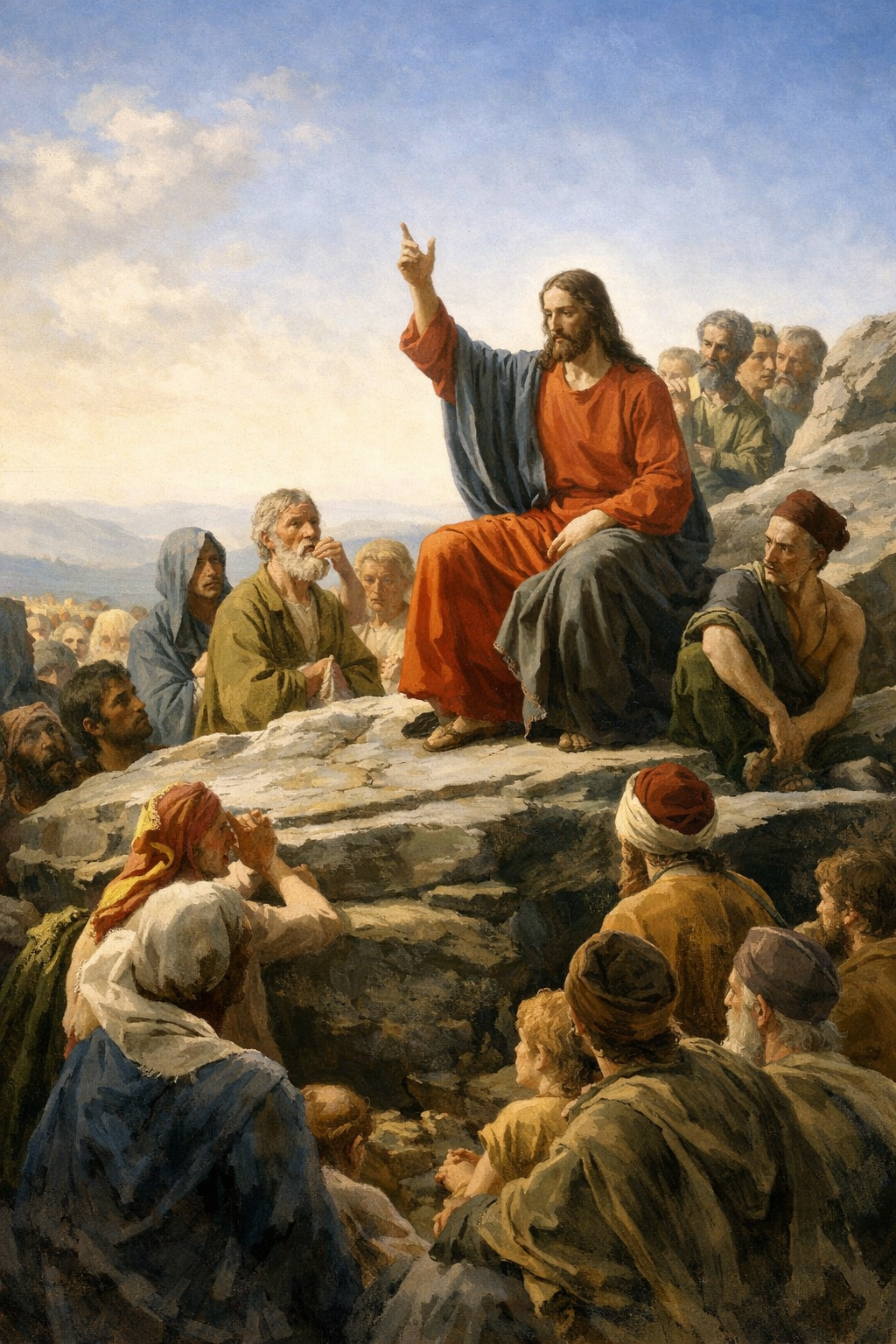
Sermon on the Mount
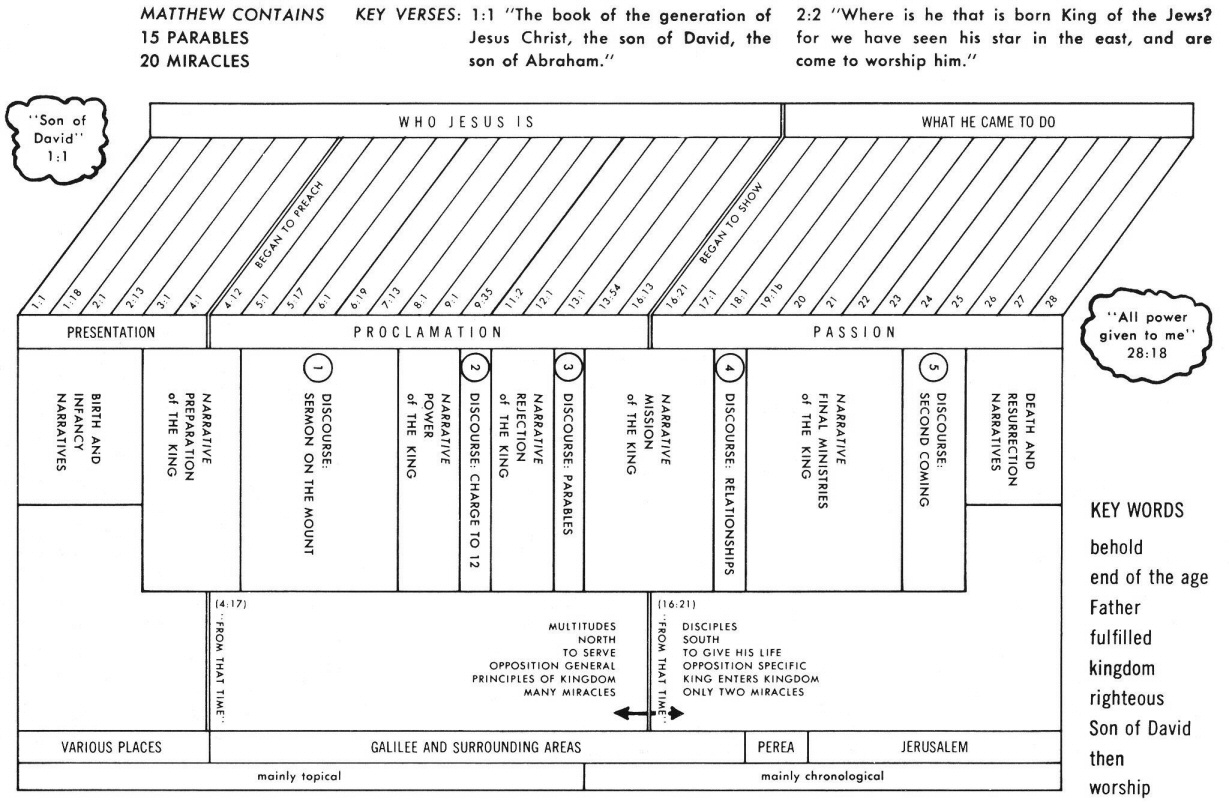
Click chart to enlarge
Charts from Jensen's Survey of the NT - used by permission
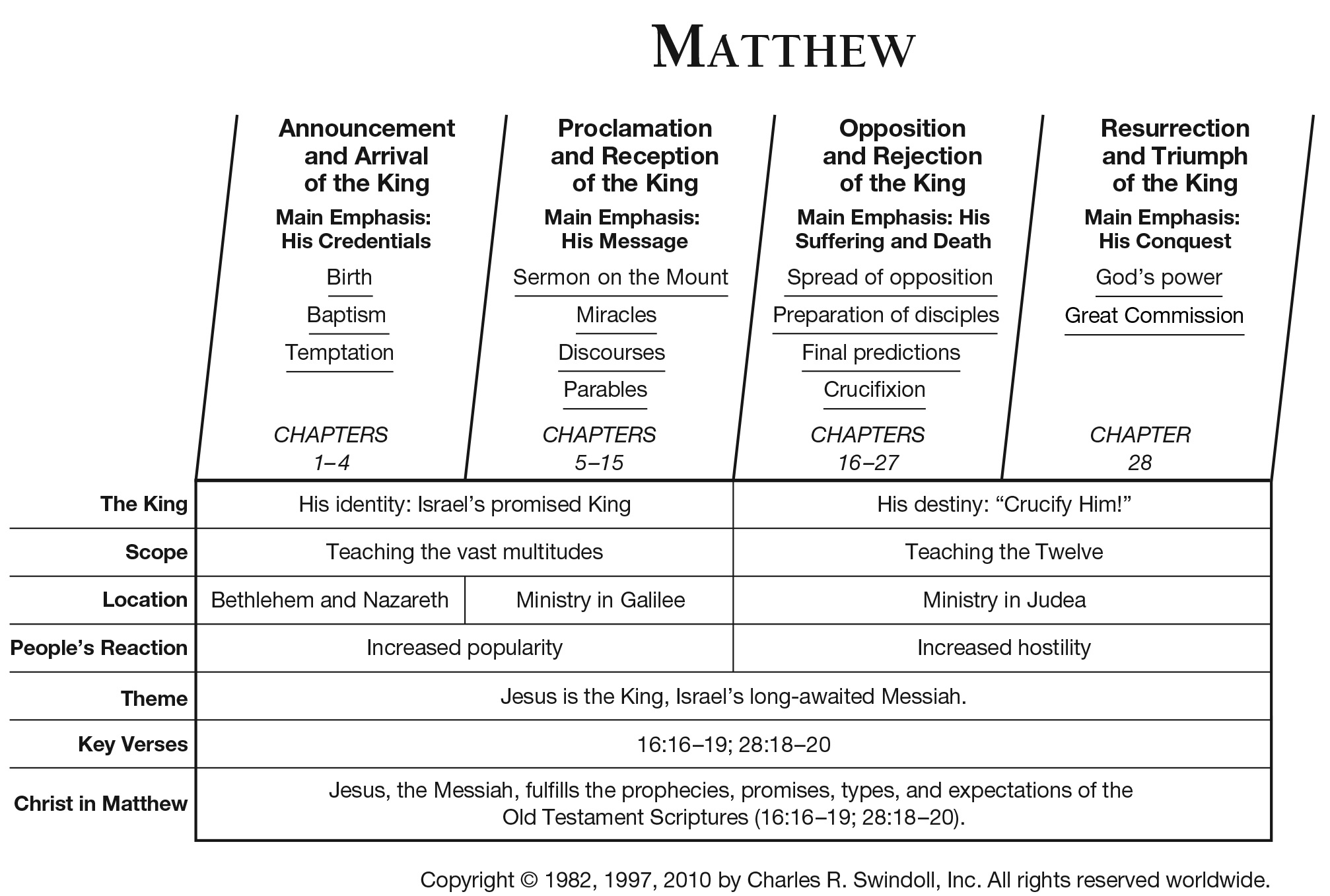
Another Chart from Charles Swindoll
THE LIFE OF JESUS AS COVERED
BY MATTHEW (shaded area)
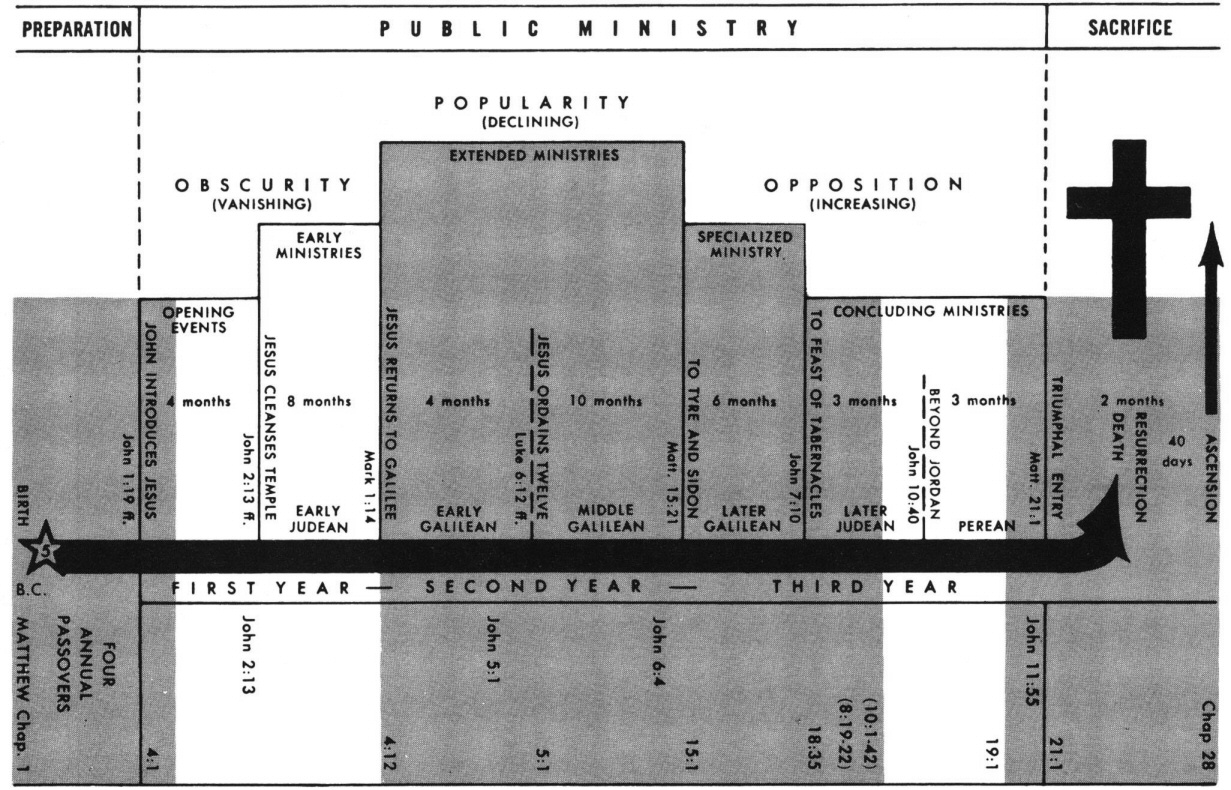
Click chart to enlarge
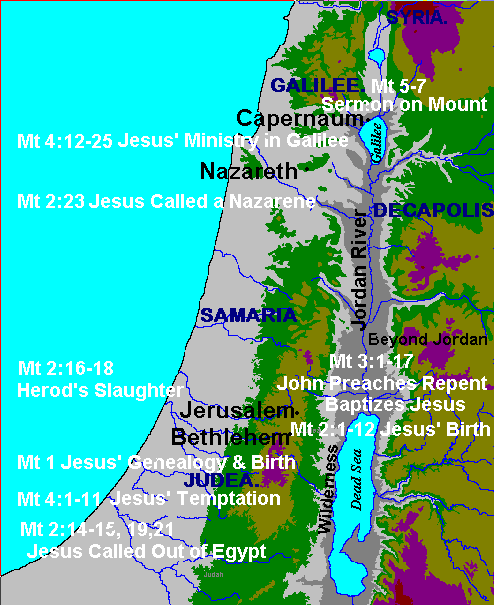
Jesus Birth and Early Years
Leading up to the Sermon on the Mount
Matthew 1-7
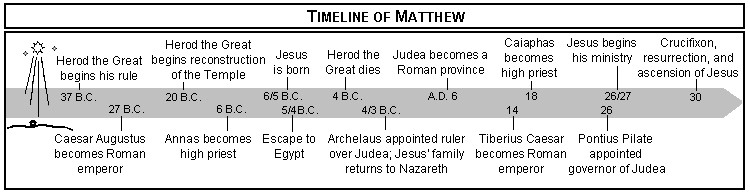
Source: Ryrie Study Bible
Matthew 5:21 "You have heard that the ancients were told, 'YOU SHALL NOT COMMIT MURDER' and 'Whoever * commits murder shall be liable to the court.' (NASB: Lockman)
Greek: Ekousate (2PAAI) oti errethe (3PAPI) tois archaiois, Ou phoneuseis; (2SFAI) os d' an phoneuse, (2SAAS) enochos estai (3SFMI) th krisei
Amplified: You have heard that it was said to the men of old, You shall not kill, and whoever kills shall be liable to and unable to escape the punishment imposed by the court. (Amplified Bible - Lockman)
My Amplified Paraphrase: You have heard that it was said to the people of old, ‘You shall not commit murder,’ and ‘Whoever commits murder shall be liable and answerable to the court [and subject to judgment].’ But I Myself say to you that everyone who continues to be angry with his brother [harboring resentment, hostility, or contempt] shall be guilty before the court; and whoever says to his brother, ‘Raca!’ (empty-headed, worthless) shall be guilty before the supreme court
KJV: Ye have heard that it was said by them of old time, Thou shalt not kill; and whosoever shall kill shall be in danger of the judgment:
NLT: "You have heard that the law of Moses says, 'Do not murder. If you commit murder, you are subject to judgment.' (NLT - Tyndale House)
Philips: You have heard that it was said to the people in the old days, 'You shall not murder', and anyone who does must stand his trial. (New Testament in Modern English)
Wuest: You heard that it was said by those of a previous time, You shall not commit murder, and whoever commits murder shall be subject to the judgment.
Young's Literal: 'Ye heard that it was said to the ancients: Thou shalt not kill, and whoever may kill shall be in danger of the judgment;
YOU HAVE HEARD THAT THE ANCIENTS WERE TOLD, 'YOU SHALL NOT COMMIT MURDER: Ekousate (2PAAI) oti errethe (3PAPI) tois archaiois, Ou phoneuseis; (2SFAI)
- Mt 5:27,33,43; 2Sa 20:18; Job 8:8, 9, 10
- Ge 9:5,6; Ex 20:13; Dt 5:17)
Keep in mind what Jesus had said (commanded) earlier "Let your light shine ( = Do it now! Can convey a sense of urgency. God's commandments always include His enablements -- You CANNOT let your light shine in the natural strength of your fallen flesh - you need supernatural power provided only as you are filled with and learn to rely on the Spirit!) before men in such a way that they may see your good works, and glorify (give a proper opinion - only supernatural deeds give evidence of and glory to the Supernatural God!) your Father Who is in heaven (In other words, He is "invisible" in heaven, but is in a sense is rendered "visible" via the good deeds that shine forth from you! You are His "ambassador of reconciliation" 2Cor 5:18-202Cor 5:18 - are you representing Him well, beloved? By your attitudes and actions?) (Matthew 5:16)
From this verse and Mt 5:20, it follows that the 6 segments in Mt 5:21-48 serve at least a twofold purpose: (1) To teach what righteousness looks like that surpasses the Scribes and Pharisees and (2) To describe the righteousness when lived out in the power of the Spirit gives a proper opinion of our heavenly Father. Keep this command in (Mt 5:16) in mind as you meditate on each segment. Ask yourself in each case "Do my attitudes and actions in this area of my life give others I meet a proper opinion of my Father Who is in heaven?" We are called to be perfect as our heavenly Father is perfect (Mt 5:48) that the world might see His glory in and through us. This is a "heavy" calling but best of all it is a holy calling which He has enabled citizens under the New Covenant to carry out by virtue of their new hearts upon which the Law is written and the indwelling Spirit Who causes us to walk according to His statutes.
It is interesting that Jesus begins with an emphasis on the sanctity of every human life and the call on Kingdom citizens to do all they can to honor that sanctity.
So what is the problem with what the Scribes and Pharisees had taught? The problem is that they were not good inductive Bible students and because of inadequate observation and reliance on the "commentaries" (what the rabbis had taught as "tradition"), they arrived at an inaccurate interpretation of the Law and consequently, and most importantly, they prescribed inappropriate application based on their willfully inept analysis of the OT Scriptures. Their misapplication of the Law led to a liberal attitude toward murder, adultery, divorce, vows, retaliation and love. Therefore Jesus calls His listeners and we the readers of His sermon to exhibit allegiance to a higher standard, a standard of righteousness that far surpasses that of the Scribes and Pharisees and which shines a beacon of supernatural light that points the lost to the great and mighty supernatural Father of lights, the Heavenly Father. (Mt 5:16)
In Mt 5:48 (note) Jesus climaxes this section with the incredible statement to be perfect as your heavenly Father is perfect. Citizens of the Kingdom of Heaven are called to measure themselves not by others but by their Father Who art in heaven. The “sons” are to be perfect, as their heavenly Father is perfect. and as Jesus proceeds to explain, that perfection is absolute perfection and includes our words (notes Matthew 5:33-35, 5:36-37), our responses to injuries (Mt 5:38, 39, 40, 41, 42-notes Mt 5:38-39, 40-42), and our dealings with our enemies (Mt 5:43, 44, 45, 46, 47, 48-notes Mt 5:43-45, 46-48).
At the time of Jesus, the Jews were following the letter of the Law but not the spirit of the Law. In Matthew 23 Jesus speaks 7 woes to the Scribes and Pharisees, those whose righteousness must be exceeded to enter heaven. One of those woes summarizes what the religious leaders were doing and teaching the people to do ""Woe to you, scribes and Pharisees, hypocrites! For you tithe mint and dill and cummin, and have neglected the weightier provisions of the law: justice and mercy and faithfulness; but these are the things you should have done without neglecting the others. You blind guides, who strain out a gnat and swallow a camel! (Mt 23:23)
They were so worried about the little details of the letter of the Law but they were missing the heart of the Law and that is what Jesus explains with 6 illustrations in Mt 5:21-48.
Sinclair Ferguson has some interesting introductory comments to Mt 5:21-48, reminding us that "Jesus came to fulfill the law, not to destroy it. In fact, as we have seen, Jesus teaches that the Law of God is an essential diagnostic tool. Whether we break it or keep it, and whether we encourage others to break it or keep it, is an indication of our true spiritual condition. It is the standard for evaluation in the kingdom of God (Matt. 5:19), but not the standard for entrance into the kingdom. Rather than dispensing with righteousness, Jesus tell his disciples that unless their righteousness surpasses that of the Pharisees and the teachers of the law, they will certainly not enter the kingdom of heaven… It is no accident that these contrasts ("you have heard… but I say") are set in the context of Jesus as the fulfilment of the Exodus: He is the Son God has called out of Egypt (Mt 2:15); He passes through the waters in His baptism (Mt 3:13, 14, 15, 16, 17); He is tested in the wilderness (Mt 4:1-11); He expounds the law of God in the mountainous region (Mt 5:1). Rather than displace the teaching God had given through Moses, Jesus' whole ministry is identified by Matthew as the fulfilment of God's teaching. (BORROW Sermon on the Mount PAGE 78)
Charles Simeon - GENERAL statements, and general invectives, rarely carry any conviction to the mind: they must be supported by an induction of particulars, before they can produce any material effect. Assertions without proofs will be taken for calumny; but, when supported by fact, they will bear down all opposition. The assertions of our blessed Lord, indeed, needed no confirmation; because “he knew what was in man;” and because his miracles were a sufficient attestation to his word. Yet even He condescended to substantiate his accusations by appeals to fact. He had intimated that the Scribes and Pharisees both did and taught many things contrary to his revealed will: and he had declared, that unless we have a better righteousness than theirs, we cannot enter into the kingdom of heaven. To evince the truth of his charge, and of the declaration founded upon it, he shows, that they had grossly perverted the sixth commandment: which on that account he proceeds to explain. (Read the entire sermon - Matthew 5:21,22 Christ's Exposition of the Sixth Commandment)
You have heard suggests that the multitudes listening had for the most part not studied the Law of Moses for themselves but had only heard the teaching on the Law, most likely from the scribes and Pharisees.
Ancients (744) (archaios [word study] from arche = beginning) means old, expressing that which was from the beginning in contrast to palaios [word study], old, as having existed a long period of time. Archaios reaches back to a beginning, whenever that beginning may have been.
TDNT (TDNT - abridged online) says archaios "means “from the beginning,” then “past” or “old,” often with a reference to origins and with something of the dignity of “ancient.” In the LXX it can sometimes have the sense of pre-temporal, as in Is 37:26… in 2Co 5:17 pre-resurrection (Ed: Before our "co-crucifixion" and "co-resurrection" with Christ) religious relations and attitudes are in view.
Archaios - 11x in 11v in the NAS - Mt 5:21, Mt 5:33; Lk 9:8, 19; Acts 15:7, 21; 21:16; 2Cor 5:17; 2Pe 2:5; Rev 12:9 Re 20:2
Murder (5407) (phoneuo) means to kill a man unjustly. Webster (modern version) says that murder is the crime of unlawfully killing a person especially with malice aforethought. (See topic Murder) In the OT passages (Exodus 20:13; Deuteronomy 5:17) the Hebrew word for "murder" refers to pre-meditated, deliberate, intentional murder not accidental killing.
The Septuagint uses phoneuo commonly to translate the Hebrew ratsach which in all 47 uses speaks of one human being killing another and never of a person killing an animal. The taking of a human life is the primary concept behind this word. It refers to the premeditated (Dt. 5:17; 1 Kgs. 21:19; Jer. 7:9), or accidental taking of the life of another human being (Nu. 35:11; Josh. 20:3) and includes any unauthorized killing. The word is used for the punishment of a murderer, but that would not be included in the prohibition.
Phoneuo - 10x - Matt. 5:21; Matt. 19:18; Matt. 23:31; Matt. 23:35; Mk. 10:19; Lk. 18:20; Rom. 13:9; Jas. 2:11; Jas. 4:2; Jas. 5:6
Phoneuo - in the Septuating - first use in the 10 Commandments = Exod. 20:13; Exod. 21:13; Num. 35:6; Num. 35:12; Num. 35:19; Num. 35:21; Num. 35:25; Num. 35:26; Num. 35:27; Num. 35:28; Num. 35:30; Num. 35:31; Deut. 4:42; Deut. 5:17; Deut. 19:6; Deut. 22:26; Jos. 10:28; Jos. 10:30; Jos. 10:32; Jos. 10:35; Jos. 21:13; Jos. 21:21; Jos. 21:27; Jos. 21:32; Jos. 21:36; Jos. 21:38; Jdg. 16:2; Jdg. 20:4; Jdg. 20:5; 1 Ki. 20:40; 1 Ki. 21:19; 2 Chr. 25:3; Neh. 4:11; Neh. 6:10; Ps. 62:3; Ps. 94:6; Prov. 1:32; Prov. 7:26; Jer. 7:9; Lam. 2:20; Hos. 6:9;
Related Resources:
- Dictionary Articles
- Why is "You shall not murder" in the Ten Commandments? | GotQuestions.org
- Why did God mandate capital punishment for murder (Genesis 9:6)? | GotQuestions.org
- Is abortion murder? | GotQuestions.org
- Does God killing people make Him a murderer?
The 1828 edition of Webster's Dictionary defines murder as "he act of unlawfully killing a human being with premeditated malice, by a person of sound mind. To constitute murder in law, the person killing another must be of sound mind or in possession of his reason, and the act must be done with malice prepense, aforethought or premeditated; but malice may be implied, as well as express."
Moses records God's decree after the flood "And surely I will require your lifeblood; from every beast I will require it. And from every man, from every man's brother I will require the life of man. Whoever sheds man's blood, By man his blood shall be shed, For in the image of God He made man." (Genesis 9:5,6)
Ryrie - Homicide (which in a sense is always fratricide [killing a "brother"], v. 5) demands a punishment that matches the crime. The justification for capital punishment, here established, is the nobility of human life, which is made in the image of God. Thus murder shows contempt for God as well as for one's fellow man. See Ro 13:4, where government is given the power of life or death. (The Ryrie Study Bible)
William Barclay - But startling as was Jesus' accent of authority, the standard which he put before men was more startling yet. Jesus said that in God's sight it was not only the man who committed murder who was guilty, the man who was angry with his brother was also guilty and liable to judgment. It was not only the man who committed adultery who was guilty; the man who allowed the unclean desire to settle in his heart was also guilty.
Here was something which was entirely new, something which men have not yet fully grasped. It was Jesus' teaching that it was not enough not to commit murder; the only thing sufficient was never even to wish to commit murder. It was Jesus' teaching that it was not enough not to commit adultery; the only thing sufficient was never even to wish to commit adultery.
It may be that we have never struck a man; but who can say that he never wished to strike a man? It may be that we have never committed adultery; but who can say that he has never experienced the desire for the forbidden thing? It was Jesus' teaching that thoughts are just as important as deeds, and that it is not enough not to commit a sin; the only thing that is enough is not to wish to commit it. It was Jesus' teaching that a man is not judged only by his deeds, but is judged even more by the desires which never emerged in deeds. By the world's standards a man is a good man, if he never does a forbidden thing. The world is not concerned to judge his thoughts. By Jesus' standards, a man is not a good man until he never even desires to do a forbidden thing. Jesus is intensely concerned with a man's thoughts. Three things emerge from this.
(i) Jesus was, profoundly right, for Jesus' way is the only way to safety and to security. To some extent every man is a split personality. There is part of him which is attracted to good, and part of him which is attracted to evil. So long as a man is like that, an inner battle is going on inside him. One voice is inciting him to take the forbidden thing; the other voice is forbidding him to take it.
Plato likened the soul to a charioteer whose task it was to drive two horses. The one horse was gentle and biddable and obedient to the reins and to the word of command; the other horse was wild and untamed and rebellious. The name of the one horse was reason; the name of the other was passion. Life is always a conflict between the demands of the passions and the control of the reason. The reason is the leash which keeps the passions in check. But, a leash may snap at any time. Self-control may be for a moment off its guard--and then what may happen? So long as there is this inner tension, this inner conflict, life must be insecure. In such circumstances there can be no such thing as safety. The only way to safety, Jesus said, is to eradicate the desire for the forbidden thing for ever. Then and then alone life is safe.
(ii) If that be so, then God alone can judge men. We see only a man's outward actions; God alone sees the secret of his heart. And there will be many a man, whose outward actions are a model of rectitude, whose inward thoughts stand condemned before God. There is many a man who can stand the judgment of men, which is bound to be a judgment of externals, but whose goodness collapses before the all-seeing eye of God.
(iii) And if that be so, it means that every one of us is in default; for there is none who can stand this judgment of God. Even if we have lived a life of outward moral perfection, there is none who can say that he never experienced the forbidden desire for the wrong things. For the inner perfection the only thing that is enough for a man to say is that he himself is dead and Christ lives in him. "I have been crucified with Christ," said Paul. "It is no longer I who live, but Christ who lives in me" (Galatians 2:19-20).
The new standard kills all pride, and forces us to Jesus Christ who alone can enable us to rise to that standard which he himself has set before us. (Matthew 5 - William Barclay's Daily Study Bible)
AND 'WHOEVER COMMITS MURDER SHALL BE LIABLE TO THE COURT: os d' an phoneuse, (2SAAS) enochos estai (3SFMI) th krisei
- Exodus 21:12, 13, 14; Numbers 35:12,16, 17, 18, 19, 20, 21,30, 31, 32, 33, 34; Deuteronomy 21:7, 8, 9; 1Kings 2:5,6,31,32
Zodhiates - Murder begins with anger. Human justice may consider anger as temporary insanity, thus an excuse for killing another person. But Jesus taught that anger without a cause is not only inexcusable but also is an evil that needs to be remedied. There is, however, a righteous anger against sin (see Mark 3:5). (Exegetical Commentary on Matthew)
Note that enochos is used four times in Mt 5:21–22, and each use refers to a different court before which the accused must appear and plead his case. Notice that the "courts" progress from court to Supreme Court to Gehenna, the "highest" court of judgment!
Liable (1777) (enochos from enécho = to hold in, i.e., to ensnare, to be entangled - Gal 5:1) literally means held fast in (in the grasp, held in, contained in) and is an adjective describing one "in danger of," "liable to judgment and punishment in a legal forensic sense" (Mt 5:21), or "deserving (worthy) of (and subject to punishment)" (describing the crowd's antipathy toward Jesus = Mt 26:66, Mk 14:64). To be held fast, bound, obliged.
Shall be liable to the court - Literally "Shall be in danger of judgment"
Enochos means being guilty of having done wrong and thus deserving some particular penalty. It describes deeds that were open to judicial indictment (cf. Mt 5:21, 22; 26:66; Mk 3:29; 14:64; Jas 2:10). Enochos is primarily a legal term - liable to a charge or action at law or in court.
Enochos conveys a spiritual It also has a spiritual sense in 1Co. 11:27, where those who partake of the Lord’s Supper in an unworthy way are deemed “guilty” of despising the body and blood of the Lord.
In Hebrews 2:15 the idea of enochos is to be subject to (placed under the authority or control of) bondage (douleia). The cognate (related) verb enecho illustrates this usage - "It was for freedom (eleutheria) that Christ set us free; therefore keep standing firm and do not be subject (enecho) again to a yoke (figuratively represents the burdensome nature) of slavery (speaking of spiritual bondage under law, the opposite of eleutheria = freedom, liberty under grace) (douleia)." (Gal 5:1) ISBE comments that "enecho, "to hold in," hence, to hold captive, as a slave in fetters or under a burden. Having experienced spiritual emancipation, freedom, through Christ from bondage to sin and false religion (Gal 5:1; compare Gal 4:8), the Gentiles were not to become "entangled again in a yoke of bondage" by submission to mere legal requirements, as the external rite of circumcision." (Topical Bible- Entangle)
Balz - enochos has the basic meaning held in something, in the fig. sense subjected, exposed, subject to. It is most often used forensically: guilty, liable. (Exegetical dictionary of the New Testament)
Webster on guilty - justly chargeable with or responsible for a usually grave breach of conduct or a crime; deserving reproach or punishment. Guilty implies responsibility for or consciousness of crime, sin, or, at the least, grave error or misdoing.
In Numbers 35:31 enochos describes "a murderer who is guilty of death (Lxx = enochos)." In Genesis 26:11 "Abimelech charged all the people, saying, "He who touches this man or his wife shall surely be put to death (Lxx = thanatos [death] + enochos = "liable to death")."
B H Carroll notes that "in danger of expresses a mere liability which may be averted, while guilty of expresses a positive, settled transaction." (Interpretation of the English Bible)
Vine - enochos is literally "held in, contained in" (en, "in," echo, "to have, hold"), hence, "bound under obligation to, liable to (liable to a charge or action at law), subject to," is used in the sense of being in "danger" of the penal effect of a misdeed, i.e., in a forensic sense, signifying the connection of a person with (a) his crime, "guilty of an eternal sin," Mk 3:29; (b) the trial or tribunal, as a result of which sentence is passed, Mt 5:21,22 , "the judgment," "the council;" enochos here has the obsolete sense of control (J. Hastings); (c) the penalty itself, Mt 5:22, "the hell of fire," and, with the translation "worthy" ("guilty"), of the punishment determined to be inflicted on Christ, Mt 26:66; Mk 14:64 , "death;" (d) the person or thing against whom or which the offense is committed, 1Cor 11:27 , "guilty," the crime being against "the body and blood of the Lord;" Jas 2:10 , "guilty" of an offense against all the Law, because of a breach of one commandment. Apart from the forensic sense, this adjective is used of the thing by which one is bound, "subject to" (held in, bound by) bondage, in Heb 2:15 . (Danger, Dangerous - Vine's Expository Dictionary of NT Words)
Thayer on enochos - one who is held in anything, so that he cannot escape; bound, under obligation, subject to, liable: with the genitive of the thing by which one is bound (douleias - Heb 2:15). Enochos is used of one who is held by, possessed with, love and zeal for anything. As in Greek writings, chiefly in a forensic sense, denoting the connection of a person either with his crime, or with the penalty or trial, or with that against whom or which he has offended; so a. absolutely guilty, worthy of punishment: Lev 20:9,11,13,16,27.
Friberg - enochos is literally held fast in, caught in; (1) of spiritual bondage subject to, held in, under the control of (Heb 2.15); (2) as a legal technical term, with the genitive denoting the guilt or punishment guilty of (Mk 3.29); liable to, answerable to (Mt 5.22); deserving of (Mt 5.22; 26.66); (3) with the genitive denoting what one has transgressed against guilty of doing wrong against (1Cor 11.27); of law guilty of violating or disobeying (James 2.10). (Analytical Lexicon)
BDAG - (1). pertaining to being held in or constrained = subject to (Heb 2:15). (2) Pertaining to being required to give an account for something held against one = liable, answerable, guilty.
Abbott-Smith - 1. held in, bound by: c. gen. (cl. c. dat.), δουλείας, He 2:15. 2. In law-phrases; (a) liable to a charge or action (cl. c. dat., of crime): c. dat., of the tribunal (MM, Exp., xiii), Mt 5:21, 22; seq. εiς (Field, Notes, 4 f.), ib. 22; (b) c. gen., of the punishment (Ge 26:11): θανάτου, Mt 26:66, Mk 14:64; (c) c. gen. (cl. c. dat., rarely c. prep.; MM, Exp., xiii), of the crime (2 Mac 13:6): Mk 3:29; (d) c. gen., of the thing injured, guilty (absol., in cl.): 1 Co 11:27, Ja 2:10 (cf. Is 54:17; DB, ii, 268a). (A Manual Greek Lexicon of the New Testament)
NIDNTT - Greek literature has the adjective enochos, derived from enechō (Pindar), meaning to hold fast; pass., to be held fast, be subject to (Plato, Xenophon, Isocrates). It is frequently used as a technical legal term: a person is made liable, or subject to a certain penalty under the law. The forum (law court, laws, men or gods) before which he is guilty or liable is usually referred to in the dative. The Septuagint has enochos 21 times in the same sense as secular Greek. The term is used in the LXX chiefly to refer to a person who is condemned to → death because of an action incurring blood-guilt.
Enochos - 10x in 8v - The NAS renders it as deserving(2), guilty(6), liable to(1), subject to(1).
Matthew 5:21 "You have heard that the ancients were told, 'YOU SHALL NOT COMMIT MURDER ' and 'Whoever commits murder shall be liable to the court.' 22 "But I say to you that everyone who is angry with his brother shall be guilty before the court; and whoever says to his brother, 'You good-for-nothing,' shall be guilty before the supreme court; and whoever says, 'You fool,' shall be guilty enough to go into the fiery hell.
NIDNTT comments - Here, in a threefold progression, the respective courts before which a lawbreaker is arraigned are referred to in the dative: krisis, local court; synedrion, supreme national court; gehenna, → hell (the place of punishment is named at once in the accusative instead of the supreme judge). The lesser or greater degree of guilt is reflected in the nature of the court and the severity of the punishment involved.
Matthew 26:66 what do you think?" They answered, "He deserves death!"
A T Robertson - Held in the bonds of death (enochos = en + echō) as actually guilty with the genitive (thanatou). The dative expresses liability as in Mt 5:21 (tēi krisei) and as eis and the accusative (Mt. 5:22). They took the vote though it was at night and they no longer had the power of death since the Romans took it away from them. Death was the penalty of blasphemy (Lev. 24:15). But they enjoyed taking it as their answer to his unanswerable speeches in the temple that dreadful Tuesday a few days before. It was unanimous save that Joseph of Arimathea and Nicodemus did not agree. They were probably absent and not even invited as being under suspicion for being secret disciples of Christ. (Word Pictures in the New Testament)
Mark 3:29 but whoever blasphemes against the Holy Spirit never has forgiveness, but is guilty of an eternal sin "--
Ralph Earle on enochos in this passage - It is more than "in danger of." The one who "blasphemes against the Holy Spirit"—that is, attributes to Satan the gracious work of the Holy Spirit (see vv. 22, 30)—is already "caught" (the force of the adjective) and found guilty. (Word Meanings in the New Testament)
Mark 14:64 "You have heard the blasphemy; how does it seem to you?" And they all condemned Him to be deserving of death.
1 Corinthians 11:27 Therefore whoever eats the bread or drinks the cup of the Lord in an unworthy manner, shall be guilty of the body and the blood of the Lord.
Comment: Paul declares that "if any individual, at any time, would eat of the bread and drink of the cup of the Lord without being conscious that these elements represent the body and the blood of the Lord Jesus Who was crucified for his sins, he implicates himself as an offender." (Zodhiates)
W E Vine: The word enochos, “guilty,” means liable to the penal effect of (a deed); here it marks the guilt as being in respect of the body and blood of the Lord, that is, of being involved in the guilt of His death. This shows the solemnity of unduly regarding the privilege of partaking of the Lord’s Supper, inasmuch as we thereby mar the character of that which gives proof of the absolute holiness of God. (Collected writings of W. E. Vine)
Garland: To eat the Lord’s Supper in a manner that violates its purpose to proclaim the Lord’s death makes one “liable” (enochos) for the death of the Lord. “Liable” is a judicial term (cf. Mark 14:64; 2 Macc. 13:6), which means that the Corinthians are answerable to God, the final judge, for this abuse. They become “responsible for his body and his blood” (Engberg-Pedersen 1993: 119–20)—that is, they are chargeable for his death. Paul’s logic is this: The Lord’s Supper proclaims the Lord’s death. Those whose behavior at the Lord’s Supper does not conform to what that death entails effectively shift sides. They leave the Lord’s side and align themselves with the rulers of this present age who crucified the Lord (1 Cor. 2:8; cf. Heb. 6:5). This explains how they make themselves so vulnerable to God’s judgment. (1 Corinthians. Baker exegetical commentary on the New Testament)
Steve Lewis - Enochos means "subject to or liable to something, especially liable to a penalty or a punishment." By coming to the Lord's Supper in the way that the Corinthians were doing it, they were actually incurring punishment from the Lord for failing to give due weight to this serious occasion of remembrance. They were making no distinction between the Lord's Supper and a common supper or festival. (1 Corinthians Commentary)
Hebrews 2:15 and might free those who through fear of death were subject to slavery all their lives.
Comment: The only passage in the NT in which ἔνοχος appears with neither connotations of judicial language nor a fig. meaning is Heb 2:15; there ἔνοχος is, to be sure, in a context in which it has a negative meaning (“held in slavery”); the slavery springs from the fear of death. Jesus has broken the power of death, whose lord is the devil, for he was like mankind and went through suffering and death. Through the sacrificial death of Jesus the high priest, the power of Satan and of death is conclusively defeated and mankind is redeemed. (Exegetical dictionary of the New Testament)
James 2:10 For whoever keeps the whole law and yet stumbles in one point, he has become guilty (accountable) of all.
Zodhiates - (Enochos in this context means) Bound by sin or guilt, guilty of sin and consequently obliged to punishment on that account (James 2:10).
NIDNTT - Every single sin, however insignificant it may appear to be, makes the doer “totally guilty”, and therefore liable to → judgment.
A T Robertson - There is Talmudic parallel: “If a man do all, but omit one, he is guilty for all and each.” This is a pertinent principle also for those who try to save themselves. But James is urging obedience to all God’s laws.
Doerksen - “Guilty” (enochos) means “in the power of.” The sinner is brought under the controlling power of the whole law. The verb “has become” is in the perfect tense, denoting a continuing situation or state; he stands guilty. That does not mean that the individual has broken every law, or that some violations are not as serious as others, but it does mean that the one who breaks the law, any part of the law, is before the law condemned. (James . Chicago, IL: Moody Press)
Enochos - 16v in the Septuagint - Ge 26:11; Ex 22:3; 34:7; Lev 20:9, 11-13, 16, 27; Nu 14:18; 35:27, 31; Dt 19:10; Josh 2:19; Job 15:5; Isa 54:17
Enochos is used several times to translate the phrase "bloodguiltiness" (Ex 22:3, Lev 20:9, 11-13, 16, 27).
Complete Biblical Library Greek-English Dictionary -This word appears from the time of Aristotle (Fourth Century B.C.) and means “held in, bound by, connected with.” During that same time period Plato used this word as a legal term meaning “liable to, subject to.” The Septuagint makes special use of enochos to translate several Hebrew constructions of dām (blood). Usually dām is translated in the Septuagint by haima (blood) which can also mean “bloody deed, murder, blood line, blood relationship.” It is this nuance of “blood guilt,” i.e., guilt in relationship, that connects dām with enochos, intensifying both the cause and state of “guilt” (Ex 22:3; Lev 20:9; Nu 35:27). A person is responsible to something and that responsibility has been transgressed, thus the person is enochos of the consequences. (See Kedar-Kopfstein, “dām,” Theological Dictionary of the Old Testament, 3:236ff.)
The Old Testament did provide a way of escape from the death penalty if the death was accidental. Moses records that "He who strikes a man so that he dies shall surely be put to death. But if he did not lie in wait for him (speaks of pre-meditation, deliberation), but God let him fall into his hand, (notice Who was in control of the man's death!) then I will appoint you a place to which he may flee. If, however, a man acts presumptuously (Hebrew = seethes, "boils up", acts proudly or rebelliously reflecting a willful decision. The basic idea is that of pride, sense of self-importance, which often is exaggerated to include defiance and even rebelliousness) toward his neighbor, so as to kill him craftily (deliberation, a planned event as a premeditated act, showing intention), you are to take him even from My altar, that he may die (Even the altar would not avail as a place of safety in the case of intentional murder.). Exodus 21:12-14
Matthew 5:22 "But I say to you that everyone who is angry with his brother shall be guilty before the court; and whoever * says to his brother, 'You good-for-nothing,' shall be guilty before the supreme court; and whoever * says, 'You fool,' shall be guilty enough to go into the fiery hell. (NASB: Lockman)
Greek: ego de lego (1SPAI) humin oti pas o orgizomenos (PPPMSN) to adelpho autou enochos estai (3SFMI) te krisei; os d' an eipe (3SAAS) to adelpho autou, Raka, enochos estai (3SFMI) to sunedrio; ov d' an eipe, (3SAAS) More, enochos estai (3SFMI) eis ten geennan tou puros.
Amplified: But I say to you that everyone who continues to be angry with his brother or harbors malice (enmity of heart) against him shall be liable to and unable to escape the punishment imposed by the court; and whoever speaks contemptuously and insultingly to his brother shall be liable to and unable to escape the punishment imposed by the Sanhedrin, and whoever says, You cursed fool! [You empty-headed idiot!] shall be liable to and unable to escape the hell (Gehenna) of fire. (Amplified Bible - Lockman)
KJV: But I say unto you, That whosoever is angry with his brother without a cause shall be in danger of the judgment: and whosoever shall say to his brother, Raca, shall be in danger of the council: but whosoever shall say, Thou fool, shall be in danger of hell fire.
NLT: But I say, if you are angry with someone, you are subject to judgment! If you say to your friend, 'You idiot,' you are in danger of being brought before the court. And if you curse someone, you are in danger of the fires of hell. (NLT - Tyndale House)
Philips: anyone who contemptuously calls his brother a fool must face the supreme court; and anyone who looks on his brother as a lost soul is himself heading straight for the fire of destruction. (New Testament in Modern English)
Wuest: But, as for myself, I am saying to you that everyone who is provoked to anger against his brother shall be subject to the judgment. Moreover, whoever says to his brother, Raca, that is, you senseless empty-head, shall be liable to the Sanhedrin. But whoever shall say, Mōre, that is, you imprudent man without forethought or wisdom, shall be liable to the hell of fire.
Young's Literal: but I -- I say to you, that every one who is angry at his brother without cause, shall be in danger of the judgment, and whoever may say to his brother, Empty fellow! shall be in danger of the Sanhedrim, and whoever may say, Rebel! shall be in danger of the gehenna of the fire.
BUT I SAY TO YOU THAT EVERYONE WHO IS ANGRY WITH HIS BROTHER SHALL BE GUILTY BEFORE THE COURT: ego de lego (1SPAI) humin oti pas o orgizomenos (PPPMSN) to adelpho autou enochos estai (3SFMI) te krisei.
- Mt 5:28,34,44; 3:17; 17:5; Deuteronomy 18:18,19; Acts 3:20, 21, 22, 23; 7:37; Hebrews 5:9; 12:25
- Genesis 4:5,6; 37:4,8; 1Sa 17:27,28; 18:8,9; 20:30, 31, 32, 33; 22:12-23; 1Ki 21:4; 2Chr 16:10; Esther 3:5,6; Ps 37:8; Dal 2:12,13; 3:13,19; Eph 4:26,27
- Mt 5:23,24; 18:21,35; Deut 15:11; Nehemiah 5:8; Obadiah 1:10,12; Romans 12:10; 1 Cor 6:6; 1Th 4:6; 1John 2:9; 3:10,14,15; 4:20,21; 5:16
- Ps 7:4; 25:3; 35:19; 69:4; 109:3; Lamentations 3:52; John 15:25
JESUS LOOKS AT
THE HEART
But - Another striking term of contrast. Jesus contrasts external obedience to internal heart righteousness.
Ellicott - I say unto you.—The I is emphasized in the Greek ("Ego" is first word in sentence). It was this probably that, more than anything else, led to the feeling of wonder expressed in Matthew 7:28-29. The scribe in his teaching invariably referred to this Rabbi and that; the new Teacher spoke as one having a higher authority of His own.
Spurgeon - Oh, what divine dignity there is in this majestic Person whose ipse dixit is to shift all the sayings of the ages! He claims authority to speak, even though he should contradict all the Rabbis and all the learned men that went before him: “I say unto you,”
But you are saying "I have never murdered anyone". Jesus says "Wrong. If you've hated you are guilty."
The OT law dealt only with outward actions, but citizens of the kingdom of heaven must beware of sinful inward attitudes. In fact, the attitudes Jesus calls for can only be fulfilled by those with a New Heart and His Spirit, for otherwise they are an utterly impossible standard which climaxes in the highest of all impossible standards to "Be perfect as your heavenly Father is perfect." Only citizens of the Kingdom of heaven, genuine believers, can obey Jesus' instructions and commands, doing so not because of outward constraints (not "under Law") but because of an inward life ("under grace") enabled by the indwelling Spirit of the Living God. You might argue that the Holy Spirit is not even mentioned in the Sermon on the Mount and you would be correct. But from the character of the life Jesus calls for, it is unarguably clear that one cannot practice such behavior apart from the Spirit’s empowerment (see Romans 8, notes begin on Romans 8:1).
The phrase "but I say" is not to suggest that the Law was merely external but was always intended to be kept from the heart. And so we see this sentiment in the first and great commandment (Mark 12:30) in Deuteronomy where God commands Israel "And you shall love the LORD your God with all your heart and with all your soul and with all your might. And these words, which I am commanding you today, shall be on your heart (Deut 6:5, 6)
This call in the Old Testament to love is the essence of fulfillment of the Law as Paul explains in Romans… "Love does no wrong to a neighbor; love therefore is the fulfillment (fullness, with emphasis upon completeness) of the law. (Ro 13:10)
The point is that Jesus was not saying anything new or different than had already been plainly stated in the Law. He is in no way diminishing the Law. He is showing that the keeping of God's Law has always been an issue of a heart out of which flows that person's loving obedience for God and his fellow man.
"But I say" uses both the first person singular of the verb for say (lego) and the first person singular pronoun (ego) "I" for emphasis. One might paraphrase to bring out the emphatic character as "I myself say." The point is that He emphasizing His authority as on a plain with the Law and is not merely speaking content. Stated another way, "But I say" is a way Jesus equated His Word with the authority of Scripture and thus with the authority of God, which is valid in view of the fact that Jesus is "the Word" (John 1:1). In fact, indirectly by introducing the sentence in this manner, Jesus was underscoring His deity.
Indeed at the end of the Sermon Matthew records "The result was that when Jesus had finished these words, the multitudes were amazed at His teaching for He was teaching them as one having authority, and not as their scribes. (Mt 7:28, 29-\)
Jesus did not rely on the words of other men as did the scribes and Pharisees. Jesus is not speaking words that contradict or conflict with the the Law and the Prophets, but fulfilling those words, giving them the true meaning God had intended. Similar Jesus is not altering, diminishing or depriving even the least of the commandments of their authority (Ro 5:19) Jesus is correcting the perversion of the Law by the scribes and Pharisees who had devised 613 manmade rules that only tied heavy burdens on the people who were told that "Keep all 613 prohibitions and commandments and you will be pleasing to Him and satisfy His demands for righteousness." The problem of course was that their external rules left the heart unchanged, still more deceitful than all else and desperately sick (Jer 17:9, cf Ge 8:21).
The KJV has the phrase "without a cause", a phrase not found in most of the modern versions.
Wiersbe - Anger is such a foolish thing. It makes us destroyers instead of builders. It robs us of freedom and makes us prisoners. To hate someone is to commit murder in our hearts (1 John 3:15). (Bible exposition commentary)
Angry (3710) (orgizo from orge = wrath) means to be or become angry, furious, enraged or provoked and is used in the NT of human and satanic anger. (See Topic Anger) Orgizo describes a brooding, simmering anger that is nurtured and not allowed to die. It is seen in the holding of a grudge, in the smoldering bitterness that refuses to forgive. It is the anger that cherishes resentment and does not want reconciliation.
Eph 4:26+ - BE ANGRY, AND yet DO NOT SIN; do not let the sun go down on your anger, (Why not? - read Eph 4:27!)
Orgizo - 8x in 8v - Mt 5:22; 18:34; 22:7; Luke 14:21; 15:28; Eph 4:26; Rev 11:18; 12:17. The NAS renders it as angry(4), enraged(3), moved with anger(1).
Resources on Anger:
- Anger - Baker's Evangelical Dictionary of Biblical Theology
- Anger - Torrey's Topical Textbook
- Anger - Hastings' Dictionary of the New Testament
- Anger (2) - Hastings' Dictionary of the New Testament
See also RBC (20-30 page) booklets that deal with anger:
The Scribes and Pharisees taught that anything short or murder might be allowed. Jesus brings the Law back to the matters of the heart teaching that the danger of anger was that it was expressive of a murderous intent in the heart and such a one was in danger of the judgment. Jesus says that anger merits execution, because the fruit of anger is murder.
Anger is what we feel when we believe that we have been wronged by someone. It springs from resentment over an offense and contempt for the individual. It results in an adversarial relationship that has the potential to disrupt fellowship and worship alike.
One is reminded of God's warning to Cain about his heart attitude (it was not Cain's offering which was the problem but it was the attitude of his heart!) and how when it was left unrestrained, "pounced" on him and led to murder of Abel…
Then the LORD said to Cain, "Why are you angry? (Hebrew charah = to glow or grow warn, to blaze up and be hot or burn, be kindled, be incensed - a verb perfectly picturing this emotion "blazing up" into a full blown fire) And why has your countenance fallen (this suggests that anger hid itself in Cain’s eyes and with a fallen countenance he avoided looking anyone in the eye preventing others from seeing through the eye gate into his heart!)? If you do well, will not your countenance be lifted up? And if you do not do well, sin (this pictures Sin as an evil king that wants to reign in our mortal bodies, exactly what Paul admonished Roman saints about in Ro 6:12, 13, 14- see note) is crouching (picture of a stealthy panther lurking, ready to spring) at the door; and its desire is for you, but you must master it (If this is God's desire then we know that He made provision for Cain to obey God's will for God's commandments always include His enablements)." And Cain told Abel his brother. And it came about when they were in the field, that Cain rose up against Abel his brother and killed him. (Genesis 4:6, 7, 8)
Warren Wiersbe - Anger is an emotional arousal caused by something that displeases us. In itself, anger is not a sin, because even God can be angry (Dt 9:8, 20; Ps 2:12). The Bible often speaks of anger “being kindled” (Ge 30:2; Dt 6:15), as though anger can be compared to fire. It is difficult for us to practice a truly holy anger or righteous indignation because our emotions are tainted by sin, and we do not have the same knowledge that God has in all matters. God sees everything clearly and knows everything completely, and we do not. The NT principle seems to be that the believer should be angry at sin but loving toward people. The fire of anger, if not quenched by loving forgiveness, will spread and defile and destroy the work of God (Ed note: and the testimony of God's people). According to Jesus, anger is the first step toward murder (Mt 5:21, 22, 23, 24, 25, 26), because anger gives the devil a foothold in our lives, and Satan is a murderer (Jn 8:44). Satan hates God and God’s people, and when he finds a believer with the sparks of anger in his heart, he fans those sparks, adds fuel to the fire, and does a great deal of damage to God’s people and God’s church. Both lying and anger “give peace to the devil” (Eph 4:27).
Horace wrote that “Anger is momentary insanity.” But that is not to say as do our law courts today that the angry person is not responsible because clearly they are!
John writes that…
The one who says he is in the light and yet hates his brother is in the darkness until now. (1John 2:9+)
Everyone who hates his brother is a murderer; and you know that no murderer has eternal life abiding in him. (1John 3:15)
If someone says, "I love God," and hates his brother, he is a liar (he is not a believer); for the one who does not love his brother whom he has seen, cannot love God whom he has not seen. (1John 4:20)
Paul exhorts citizens of the Kingdom of heaven to give a proper opinion of their heavenly Father and enabled by the Holy Spirit to "Let all bitterness and wrath and anger and clamor and slander be put away from you, along with all malice. And be kind to one another, tender-hearted, forgiving each other, just as God in Christ also has forgiven you. (Eph 4:26, 27)
Peter - To sum up, let all be harmonious, sympathetic, brotherly, kindhearted, and humble in spirit not returning evil for evil, or insult for insult, but giving a blessing instead; for you were called for the very purpose that you might inherit a blessing. (1Pe 2:8, 9)
QUESTION - What is the significance of Jesus repeating “but I say to you” in Matthew 5? GOTQUESTIONS.ORG
ANSWER - Six times in Matthew 5 Jesus introduces statements with, “But I say to you” (ESV). In each of these statements in the Sermon on the Mount, Jesus claims to have a higher authority than the scribes. The Lord, as the original giver of the law, was expounding on the law and bringing out its full meaning.
(EDITORIAL NOTE: "but I say to you" - Matt. 5:22; Matt. 5:28; Matt. 5:32; Matt. 5:34; Matt. 5:39; Matt. 5:44; Matt. 12:6; Matt. 17:12; Matt. 26:29; Mk. 9:13; Lk. 4:25; Lk. 6:27; Lk. 9:27; Rev. 2:24)
Jesus first says, “But I say to you” after quoting the Mosaic Law’s prohibition of murder (Matthew 5:21). Jesus then contrasts the well-known saying that “you shall not commit murder” (Exodus 20:13) with an explanation that a person didn’t have to physically commit murder to be guilty of murder. A person is guilty of murder in his heart even if he were only angry with his brother (Matthew 5:22). Unrighteous anger makes one guilty and worthy of hell. Other teachers of the law taught that, as long as you didn’t literally commit murder, you were okay; Jesus said, no, you’re not off the hook that easily, because God sees the heart. (1Sa 16:7)
Jesus then recounts the Mosaic requirement to not commit adultery (Matthew 5:27; cf. Exodus 20:14). He adds, “But I say to you” that, if a man looks at a woman in lust, that man is guilty of adultery in his heart (Matthew 5:28). Jesus then reminds His listeners of the law permitting divorce (Matthew 5:31) and then pivots: “But I say to you” that, if a person divorces his wife for any reason other than immorality, he causes her to commit adultery and commits adultery himself if he remarries someone else (Matthew 5:32).
Jesus cites the law prohibiting making false vows (Matthew 5:33; cf. Leviticus 19:12). He then adds, “But I say to you, Do not take an oath at all” (Matthew 5:34, ESV). Jesus notes the punitive standard of an eye for an eye and a tooth for a tooth (Matthew 5:38; cf. Exodus 21:24) and adds, “But I say to you,” that one should not resist an evil person but be generous to him (Matthew 5:39). Finally, Jesus reminds His listeners of their responsibility to love their neighbors (Matthew 5:43) and challenges them to go further: “But I say to you, love your enemies and pray for those who persecute you” (Matthew 5:44).
In each of these cases, Jesus is challenging His listeners’ perception of how a person becomes righteous. Many thought that they could simply be externally obedient to the Mosaic Law, and, if they did that, they would be righteous in God’s sight. Earlier, Jesus had instructed the crowds that they needed to repent or change their mind about how they could become righteous and how they could enter the kingdom, and they needed to do it quickly because the kingdom was near (Matthew 4:17). External obedience doesn’t equate to righteousness. In the Sermon on the Mount, Jesus explained that they needed to have an internal righteousness—a kind of righteousness neither they nor the Pharisees had (Matthew 5:20). As Jesus would later explain, righteousness, eternal life, and entrance into the kingdom come through belief in Him (John 3:16; 6:47) and not from obedience to the law.
Jesus’ “but I say to you” statements contrast the people’s understanding of the legal requirements for righteousness by obedience to the law and the people’s actual need for righteousness by belief in Jesus. Before Jesus offers them the solution (Himself as the water of life, the bread of life, etc.), He shows them their need. While many people did believe in Him for eternal life, the leadership of the nation refused to change their minds about how they could have righteousness, choosing to depend on their own efforts rather than putting their trust in their Messiah. In so doing, they missed the kingdom (see Matthew 21:31, 43).
QUESTION: Did Jesus contradict the Law in Matthew 5:21-22? GOTQUESTIONS.ORG
ANSWER: In the Sermon on the Mount, Jesus says several times, “You have heard that it was said . . .” (Mt 5:21, 5:27, 5:33, 5:38, 5:43) and follows it up with “But I tell you. . . .” Using the formula, Jesus creates a contrast between the Law of Moses (as interpreted by the Pharisees and scribes) and His own command. In doing this, Jesus is obviously claiming an authority greater than that of the scribes. But it also seems like He is negating the Law.
Rest assured, Jesus did not contradict the Law in any point. In the same sermon, Jesus makes sure no one misunderstood: “Do not think that I have come to abolish the Law or the Prophets; I have not come to abolish them but to fulfill them” (Matthew 5:17).
Jesus’ point in the Sermon on the Mount was that God sees the heart, and that we are actually held to a higher standard than external conformity to a set of rules. The Pharisees taught that, as long as you did the right things, you were “holy.” Jesus said not so; “For I tell you that unless your righteousness surpasses that of the Pharisees and the teachers of the law, you will certainly not enter the kingdom of heaven” (Matthew 5:20).
Jesus is teaching the necessity of having a heart to follow God. Putting on an act and going through the motions of serving God is dishonest. It is also futile, because God sees through the masks we wear (see Mark 7:6). A person who pretends to be holy on the outside yet nurtures a sinful heart is a hypocrite. The Pharisees, who everyone thought were holy, were guilty of just such dissimulation. God doesn’t want more religious activity; He wants a heart dedicated to Him. Holiness starts on the inside.
In Matthew 5:21-22, for example, Jesus says, “You have heard that it was said to the people long ago, ‘You shall not murder, and anyone who murders will be subject to judgment.’ But I tell you that anyone who is angry with a brother or sister will be subject to judgment.” The external command was “do not murder.” This is a good command; we should not murder people. But we make a mistake if we think that’s where our responsibility ends. Jesus said, in essence, God sees your heart. If you have hatred in your heart, then you are just as guilty as the murderer in God’s eyes. The Pharisees’ attitude was, “I am good; I haven’t murdered anyone.” Jesus countered, “No, you are guilty because there is murder in your heart.”
It’s the difference between the letter of the Law and the spirit behind it. Keeping the letter of the Law doesn’t make you righteous (see Galatians 2:16). None of us can keep the whole Law perfectly, anyway. God requires a heart transformation; we must be born again (John 3:7).
God is looking for more than the external practice of religion. People might seem holy to other people, but that’s not the standard. Over and over, the Bible stresses purity of heart before the One who examines the heart (1 Chronicles 29:17; Psalm 24:4; 51:10; Matthew 5:8; 2 Timothy 2:22).
The Law was good and proper. Its purpose was to define sin and delineate holiness. Jesus was not in any way negating the Law; He was showing us the reason for the Law. Jesus fulfilled the Law in that He was the only person to ever keep the whole Law, even in His heart, without sin (Hebrews 4:15).
AND WHOEVER SAYS TO HIS BROTHER, (RACA) 'YOU GOOD-FOR-NOTHING,' SHALL BE GUILTY BEFORE THE SUPREME COURT (SANHEDRIN): os d' an eipe (3SAAS) to adelpho autou, Raka, enochos estai (3SFMI) to sunedrio
- 2Sa 6:20; James 2:20
- Mt 10:17; 26:59; Mark 14:55; 15:1; John 11:47; Acts 5:27
Good for nothing (RACA) (4469) (RACA = Aramaic word equivalent to Hebrew rebq = senseless, empty headed man, worthless, term of utter vilification) refers to a vain, empty (empty headed) or worthless fellow and was used as a term of reproach and utter contempt by the Jews in the time of Christ.
A few sources say raca is derived from a term for spit, but most feel that is probably not the correct etymology.
Raca appears often in the Rabbinic literature. The idea is that of "empty head ("airhead")," or "numbskull," or "one who thinks like a donkey." In that sense Raca expresses dehumanizing contempt which seeks to strip the person of their dignity by viewing them as worthless! To say “Raca” to a person was like saying, “You idiot!”
Smith's Bible Dictionary - Raca denotes a certain looseness of life and manners, while ‘fool,’ in the same passage, means a downright wicked and reprobate person.”
G. H. Waterman - The Aramaic word rêqā is used figuratively in rabbinic literature as a term of contempt, meaning “worthless, good for nothing, stupid.” For example, the MIDRASH on Eccl. 9:15 states that NOAH said to his contemporaries, “Woe, ye foolish ones [rqyy]! Tomorrow a flood will come, so repent” (Qoh. Rab. 9.17). The TALMUD relates that “once when a certain pious man was praying by the roadside, an officer came by and greeted him and he did not return his greeting. So he waited for him till he had finished his prayer. When he had finished his prayer he said to him: Fool [ryq]!” (b. Ber. 32b). Note also that a Greek papyrus letter dating from the 3rd cent. B.C. already uses the form rhacha as an insult (cf. BDAG, 903, which includes a summary of patristic interpretations; for further discussion, see J. Jeremias in TDNT, 6:973–76). (The Zondervan Encyclopedia of the Bible, Volume 5, Q-Z)
BDAG - a term of abuse/put-down relating to lack of intelligence = numskull, fool
TDNT - The Aramaic term expresses disparagement accompanied by anger and contempt. Addressed to the foolish, thoughtless, or presumptuous person, it means “blockhead,” and is the most common term of abuse in Jesus' day. (TDNT - abridged online)
Vine - RAKA (4469) is an Aramaic word akin to the Heb. rêq, empty, the first a being due to a Galilean change. In the A.V. of 1611 it was spelt racha; in the edition of 1638, raca. It was a word of utter contempt, signifying empty, intellectually rather than morally, empty–headed, like Abimelech’s hirelings, Jdg. 9:4 (Ed: cp Jdg 11:3, 2Chr 13:7 - where "worthless" = Hebrew req, 07386, derived from riq = to make empty or empty out) and the “vain” man of Jas. 2:20. As condemned by Christ, Matt. 5:22, it was worse than being angry, inasmuch as an outrageous utterance is worse than a feeling unexpressed or somewhat controlled in expression; it does not indicate such a loss of self–control as the word rendered “fool,” a godless, moral reprobate. (Raca - Vine's Expository Dictionary of NT Words)
English synonyms with a similar idea include nitwit, blockhead, numbskull, bonehead or brainless idiot. Clearly raca expressed utmost contempt for an individual's intelligence (or supposed lack of)!
Africa Bible Commentary - These Jewish insults are similar to the African ‘son of a dog’.
Adam Clarke - Raca signifies a vain, empty, worthless fellow, shallow brains, a term of great contempt. Such expressions were punished among the Gentoos by a heavy fine.
A. B. Bruce: "Raca expresses contempt for a mans head-you stupid! Moros expresses contempt for his heart and character-you scoundrel"
Although I could not find this in any other references (so it may not be accurate), the Cambridge Bible for Schools and Colleges says raca is "a word of contempt, said to be from a root meaning to spit."
George Wood - Raca—that is equivalent to murder in God's eyes. Raca is an epithet. Its use is similar to a racial expletive in modern times. It serves to insult someone.
Chip Bell - "Raca sounds like spitting and means “empty head”."
Sam Storms - By “insult” (i.e., saying “Raca”, an Aramaic term meaning “empty [headed]”) Jesus refers to the mocking of an individual’s intelligence. This isn’t merely a casual reference to a person’s IQ or the equivalent of our calling someone a “nitwit” or “blockhead” or “boneheaded dufus.” He has in mind an angry and dismissive belittling that is designed to embarrass and humiliate.
John Gill - Raca is expressive of indignation and contempt; it was used as a term of reproach. Some derive it from qqr to "spit upon"; as if the person that used it thought the man he spoke to deserved to be spit upon, and treated in the most contemptuous manner: but rather the word signifies "empty" and "vain", and denotes a worthless, empty headed man; a man of no brains; a foolish, witless, fellow.
Ray Pritchard - “Raca” is an Aramaic insult that means something like “You worthless son of a motherless goat.” (Not a literal translation!) Or it might mean “You brainless blockhead” or “You idiot” or “You moron.” I think you get the picture. You said “Raca” when you were angry and wanted to insult a person. It was an attack on a person’s self-worth and dignity. The same is true of “You fool!” It’s an attack on a person’s character. But what about the person who says, “I wish you were dead.” God takes that seriously. Proverbs 18:21 says, “The tongue has the power of life and death.” Do you realize that saying “I wish you were dead” is really a prayer to God? You are speaking death into a particular situation. That’s a way of murdering people! Some of you are so good at it that you ought to be hired by the Mafia as professional hit-men! You are so fast and so clean about it that you can kill two people on the way to the water fountain and step over their corpses on the way back to your desk. No blood! But you’re a murderer in God’s eyes! You’ve killed with your abusive, unkind speech.
Adrian Rogers on RACA - What is the Lord saying? The Lord says, "If your heart is a malevolent heart that burns with anger toward other people, if you look down upon any human being made in the image of God, and you speak contemptuously, if you have contempt and abhorrence of a human being, if you say, "Raca, you fool," the Lord wrote down in Heaven, "Murder, murder, murder." The anger that people have—the anger! You see them, at intersections or wherever, get in a little traffic snarl, and see them just express—the blood rushes to the face—and they'll beep the horn, and they'll get so angry that you know that if It were not against the law, they would take a life—if it were not against the law; the only thing that keeps them from doing it here—murder.
Jeremias - The structure of Mt. 5:21-22 shows that the reference is to three ascending forms of the same penalty rather than to three courts, and that the sins that are equivalent to murder are all sins of the tongue arranged in a kind of crescendo: Whoso is angry, says "blockhead," or says "fool," deserves to be punished with death, to be condemned to death, to suffer death in hell. This paradox whereby apparently harmless words are put on a par with murder shows how very serious sins of the tongue are in God's eyes, and it carries a warning against ill feelings that may seem innocuous but poison relationships. Against authenticity it is argued that there is no true crescendo from wrath to insult, but it should be noted that the speech, style, and outlook are all Palestinian and that the teaching accords with Mk. 7:15; Mt. 12:36-37. (TDNT TDNT - abridged online)
Wycliffe Bible Encyclopedia - RACA - A transliteration of the Greek (Ed: others consider it to be of Aramaic origin) hraka in its only occurrence in the NT in Mt 5:22. The meaning is “empty” or “senseless.” It is a vernacular word of comparatively mild abuse (MM). The RSV too freely translates the passage “whoever insults his brother.” It is not as extreme a term as mōros which means “foolish” or “fool,” and this idea is substantiated by noting the progressive intensity of expressions in Mt 5:22. Raca seems to cast reflection on a man’s intellectual capacity, i.e., “you ignoramus!” This concept must not be pressed exclusively, as we are warned by Jewish Enc. It does at times refer to lack of morals as well. (Pfeiffer, C. F., Vos, H. F., & Rea, J. 1975; 2005. The Wycliffe Bible Encyclopedia. Moody Press)
International Standard Bible Encyclopedia - RACA - Jesus’ explication of the true meaning of the law in Mt. 5:21ff moves from the prohibition of murder to the prohibition of insult. Both the murderer and the person calling another “Raca” count the object of their act, a person made in the image of God, as of little worth. That the correlation of relationships to people with the relationship to God is operative here too is clear from the subsequent saying about leaving the altar to make peace with an offended brother. Gk raká is a transcription of the Aram rêqā. This Aramaic insult, in turn, is related to Heb rêq, an adjective meaning “empty,” to which the vocative ending is added (TDNT, VI, 974). It very likely meant “empty-headed one” and thus something like our “blockhead.” Like “blockhead,” raká was thought a harmless insult even though it expressed disparagement and sometimes contempt. By putting such an insult on the same level as murder, Jesus clearly demands that insults, even “harmless” insults, be avoided. (Bromiley, G. W. 1988; 2002. The International Standard Bible Encyclopedia, Revised 2:856-857. Wm. B. Eerdmans)
Jewish Encyclopedia (1901) - RACA (REKA): Noun formed from the adjective “re” (= “empty”), and applied to a person without education and devoid of morals (comp. Judges 11:3). The noun occurs several times in the Talmud; e.g., Ta‘an. 20b; Ber. 22a. 33b; Giṭ. 58a; B. B. 75a; Pesi. R. 28 (ed. Friedmann, p. 54a). The plural “reaya” is found in Ecclesiastes Rabbah. “Raca” occurs also in the New Testament (Matt. 5:22), where it is equivalent to an expression of contempt. (Raca - The 1901 Jewish Encyclopedia)
Max Wilcox - RACA. An expression of reproach used as an example by Jesus in one of his teachings (Matt 5:22). The RSV translates this term as “insult.” In Matt 5:22a “raca” (Gk rhaka) is basically parallel in meaning to mōre (Fool!) in v 22b, and is thus a term of abuse or contempt. The key difference is that while the second of these is a Greek word, the first is not. It seems in fact to be the emphatic state of Aram r(y)q, meaning “empty,” and hence “worthless,” “good for nothing.” As a term of contempt, it is found in the Talmud and Midrash, e.g., b. Ber. 22b, “… she said to him, Numskull! (= ryq) … ;” and Eccl. Rab. to 9:15, “Woe to you, worthless fellows (rqyy), tomorrow the Flood is coming … ” (that is, these are the men of the flood generation). The word was first noticed as a Semitism by John Lightfoot (1684), who gave a series of examples from Talmudic and Midrashic literature. The context in Matt 5:22 supports the identification of “raca” as a Semitism, in that it refers in turn to the person who is wrathful with his fellow, calls him “Numskull” (raqā) or “fool,” as worthy of “the judgment,” “the Sanhedrin,” or “the Gehenna of fire.” The use of “raca” in Matt 5:22, without any following explanation or translation in Greek, was held by Jeremias to indicate that Matthew’s audience could cope with some Aramaic. (The Anchor Yale Bible Dictionary 5:605)
Raca - Hastings' Dictionary of the New Testament
Ellicott - As far as the dictionary sense of the word raca goes, it is the same as that of the “vain fellows” of Jdg 9:4, Jdg 11:3; Pr 12:11; but all words of abuse depend for their full force on popular association, and raca, like words of kindred meaning among ourselves, was in common use as expressing not anger only but insolent contempt. The temper condemned is that in which anger has so far gained the mastery that we no longer recognize a “brother” in the man who has offended us, but look on him with malignant scorn. (Ellicott)
Phil Newton on Mt 5:21-22 - To begin with, Jesus is not giving stages or degrees leading to murder but showing the different manifestations of the same heart attitude. "Anger" may manifest itself in lashing out, verbally or physically attacking someone, or in vitriolic behavior. What we sometime call ranting and raving may be signs of anger. It may also be what has been termed passive-aggressive in which the angry person may not say anything ugly but treats the other person or persons with personal contempt. It may be the silent treatment or even manifest in what he does not say to another person when he should be commenting in a helpful, relational fashion. "Anger" often shows up in a spousal relationship in which one spouse may demonstrate anger at the other by silence, non-involvement, lack of kindness and gentleness, disregard for showing tenderness and concern. It happens in parent-child relationships and even in work settings. The slow, seething of the angry person looks for ways to express animosity as much by what he does not do as by what he does. "You good-for-nothing," or raca is Aramaic for a term meaning "empty-head" or what we may call without a sense of levity, "numb-skull," "blockhead," or "dingbat." I suppose that we could add dozens of other names that convey the same general idea. This views the other person as inferior - so obviously, pride is part of anger's root. It is a disdainful attitude verbally expressed in insults to another.
Spurgeon on RACA - Murder lies within anger, for we wish harm to the object of our wrath, or even wish that he did not exist, and this is to kill him in desire. Anger “without a cause” is forbidden by the command which says “Thou shalt not kill;” for unjust anger is killing in intent. Such anger without cause brings us under higher judgment than that of Jewish police-courts. God takes cognizance of the emotions from which acts of hate may spring, and calls us to account as much for the angry feeling as for the murderous deed. Words also come under the same condemnation: a man shall be judged for what he “shall say to his brother.” To call a man Raca, or a worthless fellow, is to kill him in his reputation, and to say to him, “Thou fool,” is to kill him as to the noblest characteristics of a man. Hence all this comes under such censure as men distribute in their councils; yes, under what is far worse, the punishment awarded by the highest court of the universe, which dooms men to “hell fire.” Thus our Lord and King restores the law of God to its true force, and warns us that it denounces not only the overt act of killing, but every thought, feeling, and word which would tend to injure a brother, or annihilate him by contempt.
MacArthur adds that raca "has no exact modern equivalent. Therefore in most Bible versions, as here, it is simply transliterated. A term of malicious abuse, derision, and slander, it has been variously rendered as brainless idiot, worthless fellow, silly fool, empty head, blockhead, and the like. It was a word of arrogant contempt. (MacArthur, J: Matthew 1-7 Macarthur New Testament Commentary Chicago: Moody Press)
Why is simply saying "raca" or "you fool" a sin that makes one guilty enough to even go to hell? The answer in short is that every man is made in the image of God and God does not say "raca" or "you fool". Instead what God does is say I love you and to show you how much I sent my only begotten Son (John 3:16). Paul also explains how God sees us and how he responds in light of what He sees (remember we are to be perfect as our heavenly Father is perfect!) writing that…
while we were still helpless, at the right time Christ died for the ungodly. For one will hardly die for a righteous man; though perhaps for the good man someone would dare even to die. But God demonstrates His own love toward us, in that while we were yet sinners, Christ died for us. Much more then, having now been justified by His blood, we shall be saved from the wrath of God through Him. For if while we were enemies, we were reconciled to God through the death of His Son, much more, having been reconciled, we shall be saved by His life. (Ro 5:6-10=notes Romans 5:6; 5:7; 5:8; 5:9; 5:10)
Jesus is saying that in effect our "cutting words" carry out the "assassination" of the person using the weapon of the tongue and those words that proceed from a heart filled with animosity, enmity or anger. When you call another man or woman made in the image of God, you are in effect taking the place of God and when you say "raca" or "you fool" you are holding them with lower esteem than God Himself does and thus it is a grievous sin. Isn't that what one "says" when they murder another person? They are saying in essence that "Your life is worth less to me than it is to God!" And thus the murderer "takes the place" of God.
Jesus exposition helps one understand Solomon's teaching that "Death and life are in the power of the tongue, and those who love it will eat its fruit. (Proverbs 18:21)
ILLUSTRATION OF ANGER - One woman went to the doctor. He looked grave. She said, "What's wrong?" He said, "Madam, you have hydrophobia. You have rabies." She got out a pencil and started to write. He said, "What are you doing—making your will?" She said, "No, I'm making a list of people I'm going to bite." I believe I met her sister on one occasion.
William Barclay - Here is the first example of the new standard which Jesus takes. The ancient law had laid it down: "You shall not kill" (Exodus 20:13); but Jesus lays it down that even anger against a brother is forbidden. In the King James Version the man who is condemned is the man who is angry with his brother without a cause. But the words without a cause are not found in any of the great manuscripts, and this is nothing less than a total prohibition of anger. It is not enough not to strike a man; the only thing that is enough is not even to wish to strike him; not even to have a hard feeling against him within the heart. In this passage Jesus is arguing as a Rabbi might argue. He is showing that he was skillful in using the debating methods which the wise men of his time were in the habit of using. There is in this passage a neat gradation of anger, and an answering neat gradation of punishment.
(i) There is first the man who is angry with his brother. The verb here used is orgizesthai (orgizo). In Greek there are two words for anger. There is thumos , which was described as being like the flame which comes from dried straw. It is the anger which quickly blazes up and which just as quickly dies down. It is an anger which rises speedily and which just as speedily passes. There is orge, which was described as anger become inveterate. It is the long-lived anger; it is the anger of the man who nurses his wrath to keep it warm; it is the anger over which a person broods, and which he will not allow to die. That anger is liable to the judgment court. The judgment court is the local village council which dispensed justice. That court was composed of the local village elders, and varied in number from three in villages of fewer than one hundred and fifty inhabitants, to seven in larger towns and twenty-three in still bigger cities. So, then, Jesus condemns all selfish anger. The Bible is clear that anger is forbidden. "The anger of man," said James, "does not work the righteousness of God" (James 1:20). Paul orders his people to put off all "anger, wrath, malice, slander" (Colossians 3:8). Even the highest pagan thought saw the folly of anger. Cicero said that when anger entered into the scene "nothing could be done rightly and nothing sensibly." In a vivid phrase Seneca called anger "a brief insanity." So Jesus forbids for ever the anger which broods, the anger which will not forget, the anger which refuses to be pacified, the anger which seeks revenge. If we are to obey Jesus, all anger must be banished from life, and especially that anger which lingers too long. It is a warning thing to remember that no man can call himself a Christian and lose his temper because of any personal wrong which he has suffered.
(ii) Then Jesus goes on to speak of two cases where anger turns into insulting words. The Jewish teachers forbade such anger and such words. They spoke of "oppression in words," and of "the sin of insult." They had a saying, "Three classes go down to Gehenna and return not--the adulterer, he who puts his neighbour openly to shame, and he who gives his neighbour an insulting name." Anger in a man's heart, and anger in a man's speech are equally forbidden.
First of all, the man who calls his brother Raca is condemned. Raca (see rhaka, compare Hebrew 7386 = reyq e.g., "vain" in Jdg 9:4, 2Sa 6:20) is an almost untranslatable word, because it describes a tone of voice more than anything else. Its whole accent is the accent of contempt. To call a man Raca was to call him a brainless idiot, a silly fool, an empty-headed blunderer. It is the word of one who despises another with an arrogant contempt. There is a Rabbinic tale of a certain Rabbi, Simon ben Eleazar. He was coming from his teacher's house, and he was feeling uplifted at the thought of his own scholarship and erudition and goodness. A very ill-favoured passer-by gave him a greeting. The Rabbi did not return the greeting, but said, "You Raca! How ugly you are! Are all the men of your town as ugly as you?" "That," said the passer-by, "I do not know. Go and tell the Maker who created me how ugly is the creature he has made." So there the sin of contempt was rebuked. The sin of contempt is liable to an even severer judgment. It is liable to the judgment of the Sanhedrin (sunedrion), the supreme court of the Jews. This of course is not to be taken literally. It is as if Jesus said: "The sin of inveterate anger is bad; the sin of contempt is worse." There is no sin quite so unchristian as the sin of contempt. There is a contempt which comes from pride of birth, and snobbery is in truth an ugly thing. There is a contempt which comes from position and from money, and pride in material things is also an ugly thing. There is a contempt which comes from knowledge, and of all snobberies intellectual snobbery is the hardest to understand, for no wise man was ever impressed with anything else than his own ignorance. We should never look with contempt on any man for whom Christ died.
(iii) Then Jesus goes on to speak of the man who calls his brother moros (Greek #3474). Moros also means fool, but the man who is moros is the man who is a moral fool. He is the man who is playing the fool. The Psalmist spoke of the fool who has said in his heart that there is no God (Psalms 14:1). Such a man was a moral fool, a man who lived an immoral life, and who in wishful thinking said that there was no God. To call a man moros was not to criticise his mental ability; it was to cast aspersions on his moral character; it was to take his name and reputation from him, and to brand him as a loose-living and immoral person. So Jesus says that he who destroys his brother's name and reputation is liable to the severest judgment of all, the judgment of the fire of Gehenna.
Gehenna is a word with a history; often the Revised Standard Version translates it "hell." The word was very commonly used by the Jews (Matthew 5:22; Matthew 5:29-30; Matthew 10:28; Matthew 18:9; Matthew 23:15; Matthew 23:33; Mark 9:43; Mark 9:45; Mark 9:47; Luke 12:5; James 3:6). It really means the Valley of Hinnom. The Valley of Hinnom is a valley to the south-west of Jerusalem. It was notorious as the place where Ahaz had introduced into Israel the fire worship of the heathen God Molech, to whom little children were burned in the fire. "He burned incense in the valley of the son of Hinnom, and burned his sons as an offering" (2 Chronicles 28:3). Josiah, the reforming king, had stamped out that worship, and had ordered that the valley should be for ever after an accursed place. "He defiled Topheth, which is in the valley of the sons of Hinnom, that no one might burn his son or his daughter as an offering to Molech" (2 Kings 23:10). In consequence of this the Valley of Hinnom became the place where the refuse of Jerusalem was cast out and destroyed. It was a kind of public incinerator. Always the fire smouldered in it, and a pall of thick smoke lay over it, and it bred a loathsome kind of worm which was hard to kill (Mark 9:44-48). So Gehenna, the Valley of Hinnom, became identified in people's minds with all that was accursed and filthy, the place where useless and evil things were destroyed. That is why it became a synonym for the place of God's destroying power, for hell. So, then, Jesus insists that the gravest thing of all is to destroy a man's reputation and to take his good name away. No punishment is too severe for the malicious tale-bearer, or the gossip over the teacups which murders people's reputations. Such conduct, in the most literal sense, is a hell-deserving sin.
As we have said, all these gradations of punishment are not to be taken literally. What Jesus is saying here is this: "In the old days men condemned murder; and truly murder is for ever wrong. But I tell you that not only are a man's outward actions under judgment; his inmost thoughts are also under the scrutiny and the judgment of God. Long-lasting anger is bad; contemptuous speaking is worse, and the careless or the malicious talk which destroys a man's good name is worst of all." The man who is the slave of anger, the man who speaks in the accent of contempt, the man who destroys another's good name, may never have committed a murder in action, but he is a murderer at heart. (Matthew 5 - William Barclay's Daily Study Bible)
He that is inebriated with a passion is unfit for an action. Thomas Adams
When anger enters the mind wisdom departs. Thomas à Kempis
Anger is a wind which blows out the lamp of the mind. Anon.
Anger is an acid that can do more harm to the vessel in which it is stored than to anything on which it is poured. Anon.
Anger is as a stone cast into a wasp's nest. Anon.
Anger is just one letter short of danger. Anon.
Anger is often more hurtful than the injury that caused it. Anon.
Don't fly into a rage unless you are prepared for a rough landing. Anon.
He who can suppress a moment's anger may prevent a day of sorrow. Anon.
Nothing can cook your goose quicker than boiling anger. Anon.
One thing that improves the longer it is kept is your temper. Anon.
Sharp words make more wounds than surgeons can heal. Anon.
The anger of today is the remorse of tomorrow. Anon.
Two things a man should never be angry at: what he can help, and what he cannot help. Anon.
Angry men are blind and foolish. Pietro Aretino
It is easy to fly into a passion—anybody can do that—but to be angry with the right person at the right time and with the right object and in the right way—that is not easy, and it is not everyone who can do it. Aristotle
Our anger and impatience often proves much more mischievous than the things about which we are angry or impatient. Marcus Aurelius
A man that does not know how to be angry does not know how to be good. Now and then a man should be shaken to the core with indignation over things evil. Henry Ward Beecher
It is better to swallow angry words than to have to eat them afterwards. John Blanchard
The worst of slaves is he whom passion rules. Phillips Brooks
Anger is usually inexhaustible. John Calvin
Intemperate anger deprives men of their senses. John Calvin
The sun should not set upon our anger, neither should it rise upon our confidence. C. C. Colton
Anger and jealously can no more bear to lose sight of their objects than love. George Eliot
Anger is seldom without a reason, but seldom a good one. Benjamin Franklin
A man in a passion rides a horse that runs away with him. Thomas Fuller
Act nothing in a furious passion. It is putting to sea in a storm. Thomas Fuller
Anger is a sin that is its own punishment. Matthew Henry
Angry men have good memories. Matthew Henry
It is the great duty of all Christians to put off anger. It unfits for duty… a man cannot wrestle with God and wrangle with his neighbour at the same time. Philip Henry
The worst thing we can bring to a religious controversy is anger. Matthew Henry
When anger was in Cain's heart, murder was not far off. Matthew Henry
When passion is on the throne reason is out of doors. Matthew Henry
Human anger never practises the things that God can approve. D. Edmond Hiebert
Anger at God is a symptom. The basic problem is unbelief. Gladys Hunt
Do not do to others what angers you if done to you by others. Isocrates
When angry, count ten before you speak; if very angry, count a hundred. Thomas Jefferson
Anger should not be destroyed but sanctified. William Jenkyn
Anger's the anaesthetic of the mind. C. S. Lewis
When passion enters a situation, human reasoning (unassisted by grace) has as much chance of retaining its hold on truth as a snowflake in the mouth of a blast furnace. C. S. Lewis
When you are in the right, you can afford to keep your temper; and when you are in the wrong you cannot afford to lose it. G. C. Lorimer
Nothing makes room for Satan more than wrath. Thomas Manton
No man can think clearly when his fists are clenched. George J. Nathan
Anger begins in folly and ends in repentance. Pythagoras
People who fly into a rage always make a bad landing. Will Rogers
The greatest remedy for anger is delay. Seneca
Unrestrained anger is often more hurtful to us than the injury that provoked it. Seneca
There is no old age for a man's anger. Sophocles
Passion is the drunkenness of the mind. Robert South
When anger is present, look for the pain. R. C. Sproul
Anger is temporary insanity. C. H. Spurgeon
I have no more right as a Christian to allow a bad temper to dwell in me than I have to allow the devil himself to dwell there. C. H. Spurgeon
To be angry against sin is high and holy thing. C. H. Spurgeon
Wrath in man is a tormenting fiend. David Thomas
The fury of man never furthered the glory of God. A. W. Tozer
Anger and malice differ but in age. John Trapp
Anger may rush into a wise man's bosom, but should not rest there. John Trapp
Ask permission from God before you dare do anything in an angry way. John Trapp
It is not a sin to be angry, but hard not to sin when we are angry. John Trapp
That anger is without sin that is against sin. Thomas Watson
(Compilation of quotes from John Blanchard Complete Gathered Gold)
Be guilty before the Supreme Court - Offences of this kind are placed by our Lord on the same level as those which came before the great court of the Sanhedrim.
Supreme court (4892) (sunedrion from sun/syn = together + hedra = a seat or hedraios = sedentary, as one seated in a chair) means ones seated together. This noun generally describes an assembly or council. In classical Greek sunhedrion initially referred to the place of meeting; and later described the assembly itself or the “council.” In secular language sunedrion was used of a variety of official groups and councils including legislative bodies. In the intertestamental period prior to the birth of Christ sunedrion became a technical term for the "supreme court" or “high court” of the Jews who adopted the Greek into their own language (Hebrew/ Aramaic), calling the council the Sanhedrin. In the NT uses the council or Sanhedrin consisted of 71 members (70 members plus the highest official, the high priest) from the chief priests, former high priests, and the chief priests or heads of the twenty–four courses or divisions, elders, and scribes or lawyers. Apparently the council itself determined who could belong. There were also local councils throughout the Jewish Diaspora with 23 members, which were also called sunedrion.
The Sanhedrin tried the most serious offenses and pronounced the severest penalties, including death by stoning (see Acts 6:12-7:60) The Sanhedrin was formed in imitation of the seventy elders appointed by Moses (Nu 11:16ff.) The members were selected from the chief priests, former high priests, and the chief priests or heads of the twenty–four courses or divisions, elders, and scribes or lawyers. The Jewish genealogical records were kept by the Sanhedrin but they ceased to exist after the destruction of the Temple by the Romans in 70 A D.
Gilbrant - The Gospels reveal how the sunedrion tried to get rid of Jesus early in His ministry (John 11:47). Finally, with the help of Judas, they succeeded in having Him arrested, tried, and sentenced. However, since the Roman forces occupying Jerusalem did not allow the Jews to carry out the death penalty, Jesus had to be brought before the Roman governor, Pontius Pilate. Pilate, almost against his own will, sentenced Jesus to be crucified, the Roman death penalty. The Sanhedrin continued to oppose the gospel even after Jesus rose from the dead. They persecuted the early disciples in Jerusalem (Acts 4:15f.; 6:12) as well as in other towns (Acts 9:1). (Complete Biblical Library Greek-English Dictionary)
Zodhiates - The Sanhedrin dealt with all important matters, both civil and religious, apparently meeting in a hall not far from the temple called by Josephus boulé or bouleutérion (it is interesting that parliament in Greece today is called boulé). On extraordinary occasions they were sometimes convened in the high priest's palace (Mt. 26:3, 57). Under the Romans the right of capital punishment was taken away (Jn 18:31), though they might aid in carrying a sentence to execution (Jn 19:6, 16). References to sunédrion are in Mt. 5:22; 26:59; Mk 14:55; 15:1; Jn 11:47; Acts 5:21, 27, 34, 41; 22:30; 23:1, 15, 20, 28; 24:20. Some references include the place of meeting, the Sanhedrin as sitting in its hall (Luke 22:66; Acts 4:15; 6:12, 15; 23:6). (BORROW The Complete Word Study Dictionary: New Testament)
Ellicott - Sunedrion, though it looks like Hebrew, is really only a transliterated form of the Greek word for council. The court consisted of seventy or seventy-two members, with a president and vice-president, and was made up of the heads of the twenty-four courses of the priests, with forty-six or forty-eight (how chosen it is not known) from the “elders” and “scribes.” Like the Areopagus at Athens, it took cognizance—as in the case of our Lord (Mt 26:65) and Stephen (Acts 6:13)—of blasphemy and other like offences, and its peculiar prerogative was that it could order death by stoning. The point of our Lord’s teaching was, therefore, that to scorn God’s image in man is to do dishonour to God Himself. We cannot truly “fear God” unless we also “honour all men” (1Peter 2:17). The reverence for humanity as such must extend even to the man who has most provoked us (Editorial note - Clearly this necessitates our dependence on the supernatural empowerment by the Spirit!). In the unseen eternal world the want of that reverence has its own appropriate punishment. (Ellicott)
William Barclay on Sanhedrin (from his commentary on Jesus' trial in Mark 14) - There is no doubt that in the trial of Jesus the Sanhedrin broke all its own laws. The regulations for the procedure of the Sanhedrin are in one of the tractates of the Mishnah. Naturally enough some of these regulations are rather ideals than actual practices but, even allowing for that, the whole procedure of this night was a series of flagrant injustices. The Sanhedrin was the supreme court of the Jews and was composed of seventy-one members. Within its membership there were Sadducees—the priestly classes were all Sadducees—Pharisees and Scribes, who were experts in the law, and respected men who were elders. It appears that any vacancies in the court were filled by co-option. The High Priest presided over the court. The court sat in a semi-circle in such a way that any member could see any other member. Facing it sat the students of the Rabbis. They were allowed to speak on behalf of the person on trial but not against him. The official meeting place of the Sanhedrin was the Hall of Hewn Stone ((watch this computer animation)) which was within the Temple precincts, and the decisions of the Sanhedrin were not valid unless reached at a meeting held in that place. The court could not meet at night, nor could it meet at any of the great feasts. When evidence was taken, witnesses were examined separately and their evidence to be valid must agree in every detail. Each individual member of the Sanhedrin must give his verdict separately, beginning from the youngest and going on to the eldest. If the verdict was a verdict of death, a night must elapse before it was carried out, so that the court might have a chance to change its mind and its decision towards mercy. One of the functions of the Sanhedrin was to deal with any man who was suspected of being a false prophet.

A synonymous term for sunedrion is bouleutḗs used in Mark 15:43 and Luke 23:50 to describe Joseph of Arimathea who buried Jesus in his unused tomb.
Sunedrion -22x in 22v- Council(m)(17), council(2), courts(m)(2), supreme court(m)(1). Matt. 5:22; Matt. 10:17; Matt. 26:59; Mk. 13:9; Mk. 14:55; Mk. 15:1; Lk. 22:66; Jn. 11:47; Acts 4:15; Acts 5:21; Acts 5:27; Acts 5:34; Acts 5:41; Acts 6:12; Acts 6:15; Acts 22:30; Acts 23:1; Acts 23:6; Acts 23:15; Acts 23:20; Acts 23:28; Acts 24:20
Sunedrion - 12x in 11v in the Septuagint - Ps. 26:4; Pr 11:13; Pr 15:22; Pr. 22:10; Pr 24:8; Pr 26:26; Pr 27:22; Pr 31:23; Jer. 15:17;
Arthur Carr on the Sanhedrin
A. The history of the Sanhedrin.
Many learned Rabbis endeavoured to trace the origin of the Sanhedrin to the council of 70 elders whom Moses, by the advice of Jethro, appointed to assist him. But it is improbable that this council existed before the Macedonian conquest. (1) The name is Greek, not Hebrew. (2) It finds its equivalent among the political institutions of Macedonia. Finally, (3) no allusion to the Sanhedrin is to be found in the Historical Books or in the Prophets.
B. Constitution.
The President or Nasi (prince) was generally, but not always, the high priest; next in authority was the vice-president or Ab Beth Dîn (father of the house of judgment); the third in rank was the Chacham (sage or interpreter). The members were 71 in number, and consisted (1) of the chief priests or heads of the priestly “courses” (see Luke 1:5); (2) the scribes or lawyers; (3) the elders of the people or heads of families, who were the representatives of the laity.
C. Authority and functions.
The Sanhedrin formed the highest court of the Jewish commonwealth. It originally possessed the power of life and death, but this power no longer belonged to it; John 18:31, “It is not lawful for us to put any man to death,” a statement which agrees with a tradition in the Talmud, “forty years before the temple was destroyed judgment in capital causes was taken away from Israel.”
All questions of the Jewish law, and such as concerned the ecclesiastical polity, religious life of the nation and discipline of the priests fell under the jurisdiction of the Sanhedrin.
D. Place of meeting.
In the present instance the Sanhedrin met at the high priest’s house; from ch. 27:6 we may conjecture that the Temple was sometimes the place of meeting, but their usual house of assembly at this particular epoch was called the “Halls of Purchase,” on the east of the Temple Mount (Dr Ginsburg in Kitto’s Encyc. Bib. Lit. and Lightfoot’s Hor. Hebr.).
QUESTION - What was the Sanhedrin? | GotQuestions.org
ANSWER - The term Sanhedrin is from a Greek word that means “assembly” or “council” and dates from the Hellenistic period, but the concept is one that goes back to the Bible. In the Torah, God commands Moses: “bring me seventy of Israel’s elders who are known to you as leaders and officials among the people. Have them come to the Tent of Meeting, that they may stand there with you" (Numbers 11:16). Also, in the sixteenth chapter of Deuteronomy, we read in verse 18, “You shall appoint for yourselves judges and officers in all your towns which the Lord your God is giving you, according to your tribes and they shall judge the people with righteous judgment.” The land was divided up among the tribes, and in those areas where tribes had their presence, there were towns and villages, and in every town and every village there was to be a court. If there were 120 men as heads of families, they had a local court there called a Sanhedrin. In smaller towns where there were not 120 men as heads of families, there were either three judges, if the town was very small, or seven judges who sat as a court, both judge and jury, in all legal matters.
The Great Sanhedrin was the supreme court of ancient Israel, made up of 70 men and the high priest. In the Second Temple period, the Great Sanhedrin met in the Temple in Jerusalem. The court convened every day except festivals and on the Sabbath. The Sanhedrin as a body claimed powers that lesser Jewish courts did not have. As such, they were the only ones who could try the king or extend the boundaries of the Temple and Jerusalem, and were the ones to whom all questions of law were finally put. The last binding decision of the Sanhedrin was in 358, when the Hebrew calendar was adopted. The Sanhedrin was dissolved after continued persecution by the Roman Empire. Over the centuries, there have been attempts to revive the institution, such as the Grand Sanhedrin convened by Napoleon Bonaparte.
In the New Testament, the Sanhedrin is best known for their part in the series of mock trials that resulted in the crucifixion of Jesus. The Sanhedrin began with an informal examination of Jesus before Annas, the acting high priest (John 18:12-14, 19-23), followed by a formal session before the entire Sanhedrin (Matthew 26:57-68). There the decision was made to turn Jesus over to the Roman authorities to be tried and crucified.
Related Resources:
- Wikipedia - Sanhedrin
- American Tract Society Sanhedrin
- Bridgeway Bible Dictionary Sanhedrin
- Chabad Knowledge Base Sanhedrin
- CARM Theological Dictionary Sanhedrin
- Easton's Bible Dictionary Sanhedrim
- Fausset Bible Dictionary Sanhedrin
- Holman Bible Dictionary Sanhedrin
- Hitchcock Bible Names Sanhedrin
- Hastings' Dictionary of the Bible Sanhedrin
- Hastings' Dictionary of the NT Sanhedrin (2) Sanhedrin
- Morrish Bible Dictionary Sanhedrin or Sanhedrim
- Webster Dictionary Sanhedrin
- International Standard Bible Encyclopedia Sanhedrin
- The Jewish Encyclopedia Sanhedrin Sanhedrin
- Kitto Biblical Cyclopedia Sanhedrim
- McClintock and Strong's Bible Encyclopedia Sanhedrim
- The Nuttall Encyclopedia Sanhedrim
- Smith's Bible Dictionary - Sanhedrim
- Watson's Theological Dictionary Sanhedrim
AND WHOEVER SAYS, 'YOU FOOL,' SHALL BE GUILTY ENOUGH TO GO INTO THE FIERY HELL (GEHENNA): os d' an eipe, (3SAAS) More, enochos estai (3SFMI) eis ten geennan tou puros:
- Ps 14:1; 49:10; 92:6; Proverbs 14:16; 18:6; Jeremiah 17:11)
- Mt 5:29,30; 10:28; 18:8,9; 25:41; Mark 9:47; Luke 12:5; 16:23,24; Revelation 20:14
Spurgeon - Christ here shows us that the commandment, “Thou shalt not kill,” deals with anger, with angry words, with words of cursing, with words of derision, for all these are killing things, hurting and wounding things, and the passion of anger is forbidden under the command, “Thou shalt not kill.” Men have not thought so, but it really is so, for he who is angry with his brother is a murderer; there is the spirit, the essence of that which leads to murder in the passion which breeds malice and revenge. The law is spiritual; it touches the emotions, the thoughts, the desires, as well as the words and actions of men. If I desire ill for a man, I have within me that which would desire his death; and what is that, after all, but murder in the heart? How strict is this law, and yet how just and right!
You fool (3474) (moros) conveys the root meaning of one who is mentally dull, sluggish in understanding, foolish, morally worthless, useless, silly or stupid (English = “moron”). Absurd (ridiculously unreasonable, unsound, or incongruous)
Compare the derivative moria = Folly, foolishness, absurdity (1Cor. 1:18, 21, 23; 2:14; 3:19).
There are a number of synonyms including blockhead, bonehead, dimwit, dork, numbskull, and the list goes on and on. Jesus seems to characterize calling someone a fool as a more serious reproach than a "good for nothing".
MacArthur - Mōros (foolish) has the root meaning of being mentally dull, silly, or stupid, and is the word from which we get “moron.”
Webster on fool, foolish - lacking in sense, judgment, or discretion. Foolish implies the character of being or seeming unable to use judgment, discretion, or good sense. Unwise; imprudent; acting without judgment or discretion in particular things.
Vine - Moros primarily denotes "dull, sluggish" (from a root muh---, "to be silly"); hence, "stupid, foolish;" it is used (a) of persons, Matthew 5:22 , "Thou fool;" here the word means morally worthless, a scoundrel, a more serious reproach than "Raca;" the latter scorns a man's mind and calls him stupid; moros scorns his heart and character; hence the Lord's more severe condemnation; in Matthew 7:26 , "a foolish man;" Matthew 23:17,19 , "fools;" Matthew 25:2,3,8 , "foolish;" in 1 Corinthians 3:18 , "a fool;" the Apostle Paul uses it of himself and his fellow-workers, in 1 Corinthians 4:10 , "fools" (i.e., in the eyes of opponents); (b) of things, 2 Timothy 2:23 , "foolish and ignorant questionings;" so Titus 3:9; in 1 Corinthians 1:25 , "the foolishness of God," not moria, "foolishness" as a personal quality (see C, No. 1), but adjectivally, that which is considered by the ignorant as a "foolish" policy or mode of dealing, lit., "the foolish (thing);" so in ver. 1 Corinthians 1:27 , "the foolish (things) of the world." (Fool, Foolish, Foolishly, Foolishness - Vine's Expository Dictionary of NT Words)
Barclay - Moros also means fool, but the man who is moros is the man who is a moral fool. He is the man who is playing the fool… To call a man moros was not to criticise his mental ability; it was to cast aspersions on his moral character; it was to take his name and reputation from him, and to brand him as a loose-living and immoral person. (Matthew 5 - William Barclay's Daily Study Bible)
Ellicott - Jesus "Himself used the word of the scribes and Pharisees (Mt 23:17; 23:19), and Paul of the skeptical Greek materialist (1Cor 15:36). The self-same word might spring from a righteous indignation or from malignant hatred." (Ellicott)
Expositor's Greek Testament - The word moros "expresses a more serious form of contempt than Raca. Raca expresses contempt for a man’s head = you stupid! More expresses contempt for his heart and character = you scoundrel. The reckless use of such opprobrious epithets Jesus regarded as the supreme offence against the law of humanity. (Matthew 5 - The Expositor's Greek Testament)
Friberg - Moros - foolish, stupid always a term of reproach; (1) of persons considered to be intellectually weak, irrational, or lacking in foresight (Mt 7.26), opposite sophros (wise) and phronimos (intelligent); substantivally = foolish person (Mt 25.3); of one without respect for God (Mt 23.17); the meaning of the substantive more, in Mt 5.22 is uncertain; as an insult it could mean you fool! blockhead!; (2) of things foolish, useless (2Ti 2.23); neuter as a substantive ta. mora, what is thought of as foolish (1Cor 1.27)
MacArthur notes that moros "was sometimes used in secular Greek literature of an obstinate, godless person. It was also possibly related to the Hebrew mārâ which means “to rebel against.” To call someone You fool was to accuse them of being both stupid and godless. The three illustrations in this verse show increasing degrees of seriousness. To be angry is the basic evil behind murder; to slander a person with a term such as Raca is even more serious, because it gives expression to that anger; and to condemn a person’s character by calling him a fool is more slanderous still… Jesus’ prohibition is against slanderously calling a person a fool out of anger and hatred. Such an expression of malicious animosity is tantamount to murder and makes us guilty enough to go into the fiery hell. (MacArthur, J: Matthew 1-7 Macarthur New Testament Commentary Chicago: Moody Press)
The Septuagint uses moros twice in a passage that gives us a "descriptive definition" of moros - Isaiah 32:5 No longer will the fool (moros) be called noble, Or the rogue be spoken of as generous. 6 For a fool (moros) speaks nonsense, And his heart inclines toward wickedness: To practice ungodliness and to speak error against the LORD, To keep the hungry person unsatisfied And to withhold drink from the thirsty.
Moros - 12x in 12v - NAS renders moros as fool(1), foolish(7), foolish things(1), foolishness(1), fools(2).
Matthew 5:22 "But I say to you that everyone who is angry with his brother shall be guilty before the court; and whoever says to his brother, 'You good-for-nothing,' (Raca) shall be guilty before the supreme court; and whoever says, 'You fool,' shall be guilty enough to go into the fiery hell.
A. B. Bruce: "Raca expresses contempt for a mans head-you stupid! Moros expresses contempt for his heart and character-you scoundrel"
Matthew 7:26 "Everyone who hears these words of Mine and does not act on them, will be like a foolish man who built his house on the sand.
Comment - A fool hears truth and does not obey.
Zodhiates - In Matthew 7:24, our Lord illustrates a sensible man as one who does not build on shifting sand but on solid rock. It is much easier to build on sand, but it certainly is not permanent. The person who thinks only of the present and does not consider the eternal is a fool… Moros, someone who acts thoughtlessly or contrary to reason. (1 Corinthians Commentary)
Matthew 23:17 "You fools and blind men! Which is more important, the gold or the temple that sanctified the gold?
Zodhiates - Though in modern Greek the word mōrós is used for "baby," the New Testament consistently attaches the term to adults who willfully (i.e., consciously) and irresponsibly ignore God's commands. Christ's address to the scribes and Pharisees, for example, "Ye fools [mōroí from mōrós] and blind" (Mt. 23:17, 19), is a condemnation of their rebellion, not pity toward their immaturity. Adults know that what they are doing is wrong but do it anyway. (Exegetical Commentary on Matthew)
Matthew 25:2 "Five of them (virgins) were foolish, and five were prudent.
3 "For when the foolish took their lamps, they took no oil with them,
8 "The foolish said to the prudent, 'Give us some of your oil, for our lamps are going out.'
Zodhiates - In our Lord's parable of the ten virgins, we are told that five of them were sensible or prudent (phrónimoi) and five were foolish (mōraí, the feminine plural form of mōrós [Mt 25:1-13]). The sensible ones thought of the future and considered the need to take oil in their vessels. The foolish ones, however, thought only of the present. Thus a fool can be characterized as one who thinks only of the present time without any consideration of the future. (1 Corinthians Commentary)
1 Corinthians 1:25 Because the foolishness of God is wiser than men, and the weakness of God is stronger than men.
27 but God has chosen the foolish things of the world to shame the wise, and God has chosen the weak things of the world to shame the things which are strong,
1 Corinthians 3:18 Let no man deceive himself. If any man among you thinks that he is wise in this age, he must become foolish, so that he may become wise.
MacArthur - Human wisdom is moronic in the Lord’s sight.
Mounce - Paul uses mōros to describe the distance that exists between the world’s wisdom and God’s. The difference is so great that “God’s foolishness” (if he were foolish, which he is not) is wiser than human wisdom (which is not wise) (1 Cor. 1:25); this is by God’s design (1Cor 1:27). In fact, the distance is so great that the wisdom of God as seen in the cross is foolishness (the related noun mōria) to the unbelieving world but the power of God to those who are being saved (1Cor 1:18). Indeed, the non-disciple can’t even understand the spiritual things of God (1Cor 2:14) because they are folly (mōria) to him. Consequently, true disciples must become “fools” in the eyes of the world so they can be truly wise (1Cor 3:18). (Mounce’s Complete Expository Dictionary of Old & New Testament Words)
1 Corinthians 4:10 We are fools for Christ's sake, but you are prudent in Christ; we are weak, but you are strong; you are distinguished, but we are without honor.
2 Timothy 2:23 But refuse foolish and ignorant speculations, knowing that they produce quarrels.
Titus 3:9 But avoid foolish controversies and genealogies and strife and disputes about the Law, for they are unprofitable and worthless.
Moros - 7v in the Septuagint - Deut 32:6; Job 16:7; Ps 94:8; Isa 19:11; 32:5f; Jer 5:21
Deuteronomy 32:6 "Do you thus repay the LORD, O foolish and unwise people? Is not He your Father who has bought you? He has made you and established you.
Psalm 94:8 Pay heed, you senseless among the people; And when will you understand, stupid ones?
Jeremiah 5:21 'Now hear this, O foolish and senseless people, Who have eyes but do not see; Who have ears but do not hear.
Hell (Gehenna) (1067) (geenna from Hebrew gay = valley + Hinnom = a deep narrow ravine south of Jerusalem once associated with the pagan god Moloch and his disgusting rite of infant sacrifices [cp modern practice of abortion!], 2Kings 23:10; 2Chr 28:3; 33:6; Jer 7:31, 19:5, 6, 32:35; Ezekiel 16:20; 23:37 clearly prohibited by God in Lev 18:21, 20:2, 3, 4, 5) is literally the valley of Hinnom, the valley where the filth and dead animals of the city were cast out and burned and where there were trash fires and perpetually burning rubbish, all a fit symbol of the future home of all unrepentant, unregenerate wicked men and women. It was a foul, forbidding place where the fire, smoke, and stench never ceased. It is thus fitting that gehenna is where sin and unrepentant sinners will one day find it's "resting place".
See Study of Eternal Punishment
Vincent on Gehenna - more accurately, the hell of fire. The word Gehenna, rendered hell, occurs outside of the Gospels only at James 3:6. It is the Greek representative of the Hebrew Ge-Hinnom, or Valley of Hinnom, a deep, narrow glen to the south of Jerusalem, where, after the introduction of the worship of the fire-gods by Ahaz, the idolatrous Jews sacrificed their children to Molech. Josiah formally desecrated it, “that no man might make his son or his daughter pass through the fire to Molech” (2Kings 23:10). After this it became the common refuse-place of the city, into which the bodies of criminals, carcasses of animals, and all sorts of filth were cast. From its depth and narrowness, and its fire and ascending smoke, it became the symbol of the place of the future punishment of the wicked. So Milton: “The pleasant valley of Hinnom, Tophet thence, And black Gehenna called, the type of hell.” As fire was the characteristic of the place, it was called the Gehenna of fire. It should be carefully distinguished from Hades, which is never used for the place of punishment, but for the place of departed spirits, without reference to their moral condition.
Gehenna - 12x in 12v - Mt 5:22, 29f; 10:28; 18:9; 23:15, 33; Mk 9:43, 45, 47; Lk 12:5; Jas 3:6
Both Raca and fool broke the heart of the law against murder, one by slaying a person's intelligence and the other his character.
It is interesting that Jehovah does have the right to use moros for He knows the heart and thus He declared to treacherous (adulterous) Jerusalem and Judah 'Hear this, O foolish and senseless people, Who have eyes, but see not; Who have ears, but hear not." (Jer 5:21)
Thus There are times when the Scripture does consider men as fools. Jesus said so Himself, declaring "You fools and blind men; which is more important, the gold, or the temple that sanctified the gold? (Mt 23:17)
God addressed the rich man who had laid up for himself goods on earth but not heaven declaring 'You fool! This very night your soul is required of you; and now who will own what you have prepared?' (Luke 12:20)
And the psalmist explains that…The fool has said in his heart, "There is no God." They are corrupt, they have committed abominable deeds; There is no one who does good. (Ps 14:1) (See Spurgeon's note)
Solomon presents a contrast be one who fears God and the fool writing that…
The fear of the LORD is the beginning of knowledge; Fools despise wisdom and instruction. (Proverbs 1:7)
These examples from Scripture all have in common a stubborn rebellion against God, which is not what Jesus is referring to. For a man to call another man "you fool" is in a sense to put himself in the place of God. Jesus is specifically speaking against the deliberate belittling of someone's person because of the animosity and hatred of our own heart. That He says is as if we had murdered them!
Have you ever been guilty of "murder"?
If we are honest, most of would have to say we are guilty of his crime against our fellow man. Jesus' words give us pause to consider carefully what we speak with our tongues. Our words are generally an accurate barometer of our true spiritual condition. What is your "barometric reading" beloved? It follows that it is of little surprise that the New Testament repeatedly presents such clear teaching regarding the danger of the tongue…
"You brood of vipers, how can you, being evil, speak what is good? For the mouth speaks out of that which fills the heart. The good man out of his good treasure brings forth what is good; and the evil man out of his evil treasure brings forth what is evil. And I say to you, that every careless (literally "not working" - describes a word that produces no good effect, and is not calculated to produce any) word that men shall speak, they shall render account for it in the day of judgment. For by your words you shall be justified, and by your words you shall be condemned." (Mt 12:34-37)
"Do you not understand that everything that goes into the mouth passes into the stomach, and is eliminated? "But the things that proceed out of the mouth come from the heart, and those defile the man. For out of the heart come evil thoughts, murders, adulteries, fornications, thefts, false witness, slanders. These are the things which defile the man; but to eat with unwashed hands does not defile the man." (see notes Matthew 5:17; 5:18; 5:19; 5:20)
BE ANGRY, AND YET DO NOT SIN; do not let the sun go down on your anger, and do not give the devil an opportunity… Let no unwholesome word proceed from your mouth, but only such a word as is good for edification according to the need of the moment, that it may give grace to those who hear. And do not grieve the Holy Spirit of God, by whom you were sealed for the day of redemption. (see notes Ephesians 4:27; 4:29; 4:30)
The International Standard Bible Encyclopedia has an interesting entry which says in part that Raca…
is generally explained as expressing contempt for a man's intellectual capacity (= "you simpleton!"), while more (translated "thou fool"), in the same verse is taken to refer to a man's moral and religious character (= "you rascal!" "you impious fellow!"). Thus we have three stages of anger, with three corresponding grades of punishment:
(1) the inner feeling of anger (orgizo), to be punished by the local or provincial court ("the judgment");
(2) anger breaking forth into an expression of scorn (Raca), to be punished by the Sanhedrin ("the council");
(3) anger culminating in abusive and defamatory language (More), to be punished by the fire of Gehenna. (ISBE)
One should be careful not to misinterpret Jesus as declaring that it makes no difference whether we kill with words like gossip or stab with literal knives of cold steel. What Jesus is teaching is that both activities reveal the same animosity of one's heart to his or her neighbour.
Sinclair Ferguson wisely concludes that "Jesus recognized that we cannot be trusted in our judgment of the seriousness of careless speech. We treat the damage we do with our lips very lightly because we do not see the corpses we leave behind. That is why Jesus invades our moral slumber by telling us how serious this is in the sight of God. He uses language we readily understand: anger incurs judgment; using terms of contempt (like raca) is worthy of condemnation by the highest court (Mt 5:22); calling someone a fool fits us for hell. Jesus is probably not placing these sins on a scale of seriousness in the kingdom of God; He is simply stressing vividly that they are far more serious than most of us assume. In fact, our insensitivity to their real seriousness is indicative of the dullness of our spiritual senses. (BORROW Sermon on the Mount PAGE 82)
Freeman's Manners and Customs of the Bible has the following summary of Mt 5:22 - The Jewish teachers had heretofore taught that nothing except actual murder was forbidden by the sixth commandment. Thus they explained away its spiritual meaning. Christ showed the full meaning of this commandment; according to which we must be judged hereafter, and therefore ought to be ruled now. All rash anger is heart murder. Our “brother” here indicates any person, status notwithstanding, for we are all made of one blood. “Raca,” is a scornful word, and is evidence of pride: “Thou fool,” is a spiteful word, and denotes hatred. Malicious slanders and censures are lethal poison. (Original version of Manners & Customs of the Bible. 1875 - borrow new version)
QUESTION - What is the meaning of “you fool” in Matthew 5:22? GOTQUESTIONS.ORG
ANSWER - In Matthew 5:22, Jesus addresses both the seriousness of anger and the weight of our words. He states, “I say to you that everyone who is angry with his brother will be liable to judgment; whoever insults his brother will be liable to the council; and whoever says, ‘You fool!’ will be liable to the hell of fire” (ESV). The phrase you fool is an example of contemptuous speech, which carries heavy consequences.
When Jesus warns against saying, “You fool,” He is addressing the contemptuous attitude that devalues other people. The Greek word translated as “fool” is mōre, conveying not only a lack of wisdom but also a moral deficiency. Therefore, to call someone a “fool” is to attack his character and integrity, essentially deeming him worthless. This dehumanizing act sharply contrasts with Jesus’ command to love our neighbors as ourselves (Matthew 22:39; cf. Leviticus 19:18). Jesus’ warning against calling someone a “fool” stresses the importance of recognizing and honoring the inherent worth of everyone, as we are all created in the image of God (Genesis 1:27).
The severity of calling someone a “fool” is highlighted by its association with the “fire of hell” or Gehenna (Matthew 5:22). Gehenna was a valley near Jerusalem, historically associated with idolatrous practices and later used as a symbol of divine judgment and eternal damnation (see Jeremiah 7:31–32). When Jesus links the phrase you fool with Gehenna in Matthew 5:22, he is saying that contemptuous words have severe spiritual consequences. This teaching aligns with the broader biblical principle that words reflect the condition of our hearts. As Proverbs 18:21 reminds us, “Death and life are in the power of the tongue, and those who love it will eat its fruits” (ESV). Words are powerful, and those who speak contemptuously of others will be held accountable.
Jesus’ warning against saying, “You fool,” also highlights the seriousness of harboring anger. He even equates unjust anger with murder (Matthew 5:21), challenging His disciples to understand the deeper implications of their thoughts, emotions, and actions. The progression from anger to insult to calling someone a “fool” demonstrates how unchecked anger can escalate into verbal abuse and destructive behavior. Ephesians 4:26–27 advises believers to “be angry and do not sin; do not let the sun go down on your anger, and give no opportunity to the devil” (ESV). By controlling our anger, we can stop ourselves from insulting others and maintain the peace and unity of the Spirit.
The phrase you fool in Matthew 5:22 also draws our attention to the concept of righteous judgment and unrighteous condemnation. When Jesus uses strong language to address evil and hypocrisy (e.g., in Matthew 23:17, 19), He speaks from a heart of truth, desiring to lead His listeners to repentance. In contrast, when we call someone a “fool,” we speak out of anger and contempt, failing to see the person as God does. James 4:11–12 cautions, “Do not speak evil against one another, brothers. The one who speaks against a brother or judges his brother, speaks evil against the law and judges the law. . . . There is only one lawgiver and judge, he who is able to save and to destroy” (ESV). We are not to condemn others but to love and encourage one another toward righteousness and good works (Hebrews 10:24).
The meaning of you fool in Matthew 5:22 extends beyond a mere insult to a reflection on the nature of anger, the power of words, and the need to uphold the dignity of others. We must therefore examine our hearts, control our tongues, and pursue peace with everyone. In doing so, we show ourselves to be children of God.
History of a Murder - The beginning of strife is like releasing water; therefore stop contention before a quarrel starts. –Proverbs 17:14
The newspaper reported a tragic incident of violence that took place in a South American country. A peasant killed his best friend while they were arguing about political differences. When asked why he did it, he replied with these chilling words: "We began peacefully, and then we argued. I killed him when I ran out of words."
This tragedy calls to mind Jesus' teaching in Matthew 5 about the close connection between anger and murder. First He stressed the seriousness of anger (Mt 5:21, 22). He warned that malicious anger, like murder, would be punished by God. Then He gave practical advice designed to defuse anger in a person who has something against another (Mt 5:23, 24, 25, 26).
We should all take a close look at our inner rage. We might think we can control it. Unfortunately, though, our feelings of hostility often control us and cause us to do things we would never do while thinking clearly. That's why unresolved anger needs to be seen as a time-bomb that can explode, destroying ourselves and doing irreparable damage to others. True, not all anger is wrong. But all wrong anger needs to be acknowledged and confessed before it leads to "murder." –M R De Haan II (Our Daily Bread, Copyright RBC Ministries, Grand Rapids, MI. Reprinted by permission. All rights reserved)
When I have lost my temper,
I've lost my reason too;
I'm never proud of anything
Which angrily I do. –Jackson
He who conquers his anger conquers a strong enemy.
J C Ryle…
These verses deserve the closest attention of all readers of the Bible. A right understanding of the doctrines they contain lies at the very root of Christianity. The Lord Jesus here explains more fully the meaning of His words, "I came not to destroy the law, but to fulfill." He teaches us that His Gospel magnifies the law, and exalts its authority. He shows us that the law, as expounded by Him, was a far more spiritual and heart-searching rule than most of the Jews supposed. And He proves this by selecting three commandments out of the ten as examples of what He means.
He expounds the sixth commandment. Many thought that they kept this part of God's law, so long as they did not commit actual MURDER. The Lord Jesus shows, that its requirements go much further than this. It condemns all angry and passionate language, and especially when used without a cause. Let us mark this well. We may be perfectly innocent of taking life away, and yet be guilty of breaking the sixth commandment.
He expounds the seventh commandment. Many supposed that they kept this part of God's law, if they did not actually commit ADULTERY. The Lord Jesus teaches, that we may break it in our thoughts, hearts, and imaginations, even when our outward conduct is moral and correct. The God with whom we have to do looks far beyond actions. With him even a glance of the eye may be a sin.
He expounds the third commandment. Many fancied that they kept this part of God's law, so long as they did not swear falsely, and performed their OATHS. The Lord Jesus forbids all vain and light swearing altogether. All swearing by created things, even when God's name is not brought forward--all calling upon God to witness, excepting on the most solemn occasions, is a great sin.
Now all this is very instructive. It ought to raise very serious reflections in our minds. It calls us loudly to use great searching of heart. And what does it teach?
It teaches us the exceeding holiness of God. He is a most pure and perfect Being, who sees faults and imperfections, where man's eyes often see none. He reads our inward motives. He notes our words and thoughts, as well as our actions. "He requires truth in the inward parts." Oh! that men would consider this part of God's character more than they do! There would be no room for pride, and self-righteousness, and carelessness, if they only saw God "as He is."
It teaches us the exceeding ignorance of man in spiritual things. There are thousands and ten thousands of professing Christians, it may be feared, who know no more of the requirements of God's law than the most ignorant Jews. They know the letter of the ten commandments well enough. They fancy, like the young ruler, "all these have I kept from my youth up." They never dream that it is possible to break the sixth and seventh commandments, if they do not break them by outward act or deed. And so they live on satisfied with themselves, and quite content with their little bit of religion. Happy indeed are they who really understand God's law!
It teaches us our exceeding need of the Lord Jesus Christ's atoning blood to save us. What man or woman upon earth can ever stand before such a God as this, and plead "not guilty?" Who is there that has ever grown to years of discretion, and not broken the commandments thousands of times? "There is none righteous, no! not one." Without a mighty Mediator, every one would be condemned in the judgment. Ignorance of the real meaning of the law is one plain reason why so many do not value the Gospel, and content themselves with a little formal Christianity. They do not see the strictness and holiness of God's Ten commandments. If they did, they would never rest until they were safe in Christ.
In the last place, this passage teaches us the exceeding importance of avoiding all occasions of sin. If we really desire to be holy, we must "take heed to our ways, that we offend not in our tongues." We must be ready to make up quarrels and disagreements, lest they gradually lead on to greater evils. "The beginning of strife is like breaching a dam." We must labor to crucify our flesh and mortify our members, to make any sacrifice and endure any bodily inconvenience rather than sin. We must keep our lips as it were with a bridle, and exercise an hourly strictness over our words. Let men call us precise, if they will, for so doing. Let them say, if they please, that we are "too particular." We need not be moved. We are merely doing as our Lord Jesus Christ bids us, and, if this is the case, we have no cause to be ashamed.