Matthew 5:2
Matthew 5:3
Matthew 5:4
Matthew 5:5
Matthew 5:6
Matthew 5:7
Matthew 5:8
Matthew 5:9
Matthew 5:10
Matthew 5:11
Matthew 5:12
Matthew 5:13
Matthew 5:14
Matthew 5:15
Matthew 5:16
Matthew 5:17
Matthew 5:18
Matthew 5:19
Matthew 5:20
Matthew 5:21
Matthew 5:22
Matthew 5:23
Matthew 5:24
Matthew 5:25
Matthew 5:26
Matthew 5:27
Matthew 5:28
Matthew 5:29
Matthew 5:30
Matthew 5:31
Matthew 5:32
Matthew 5:33
Matthew 5:34
Matthew 5:35
Matthew 5:36
Matthew 5:37
Matthew 5:38
Matthew 5:39
Matthew 5:40
Matthew 5:41
Matthew 5:42
Matthew 5:43
Matthew 5:44
Matthew 5:45
Matthew 5:46
Matthew 5:47
Matthew 5:48
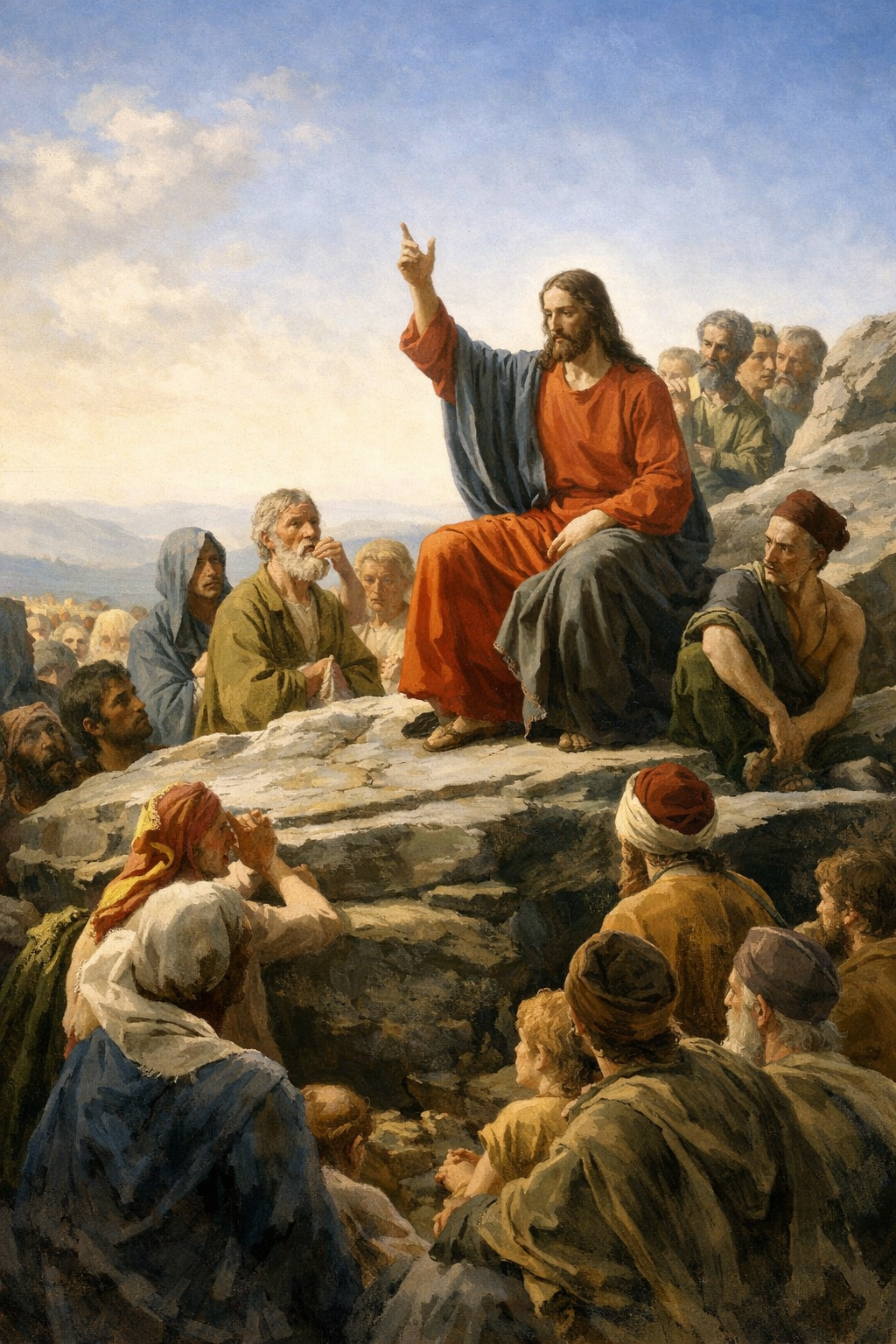
Sermon on the Mount
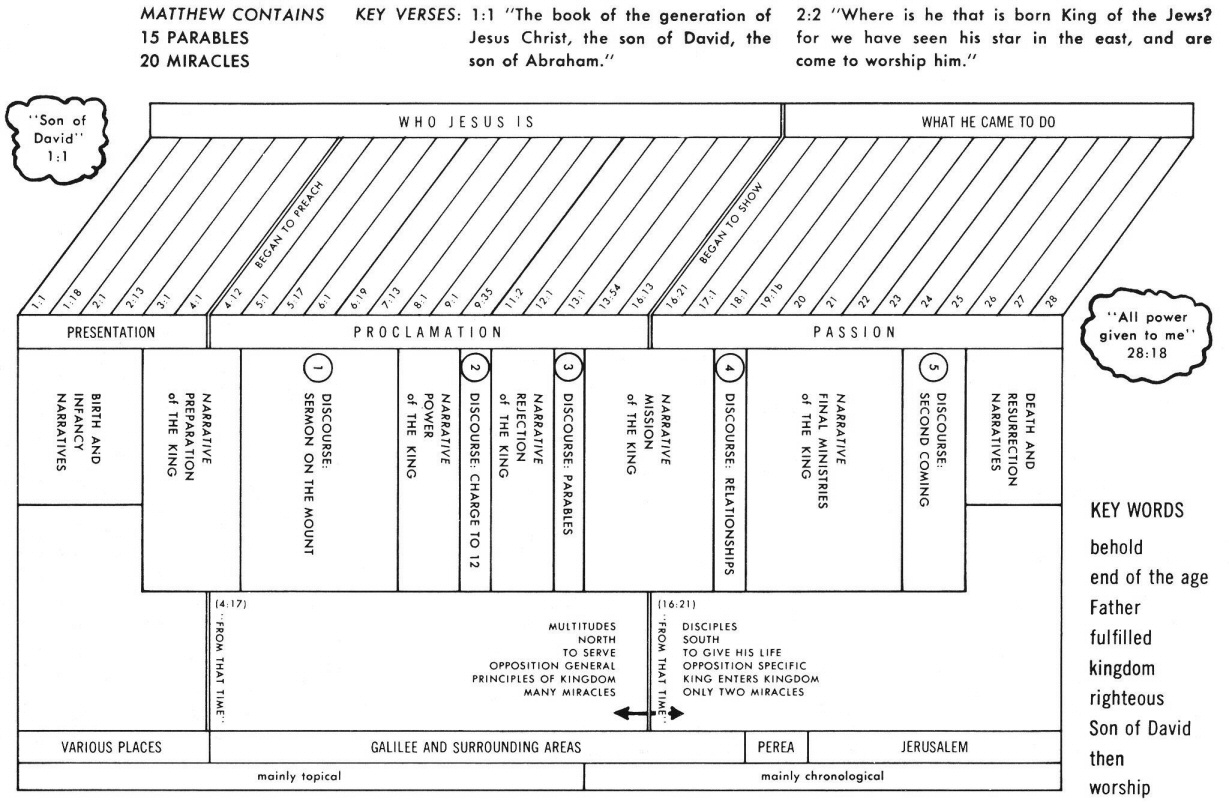
Click chart to enlarge
Charts from Jensen's Survey of the NT - used by permission
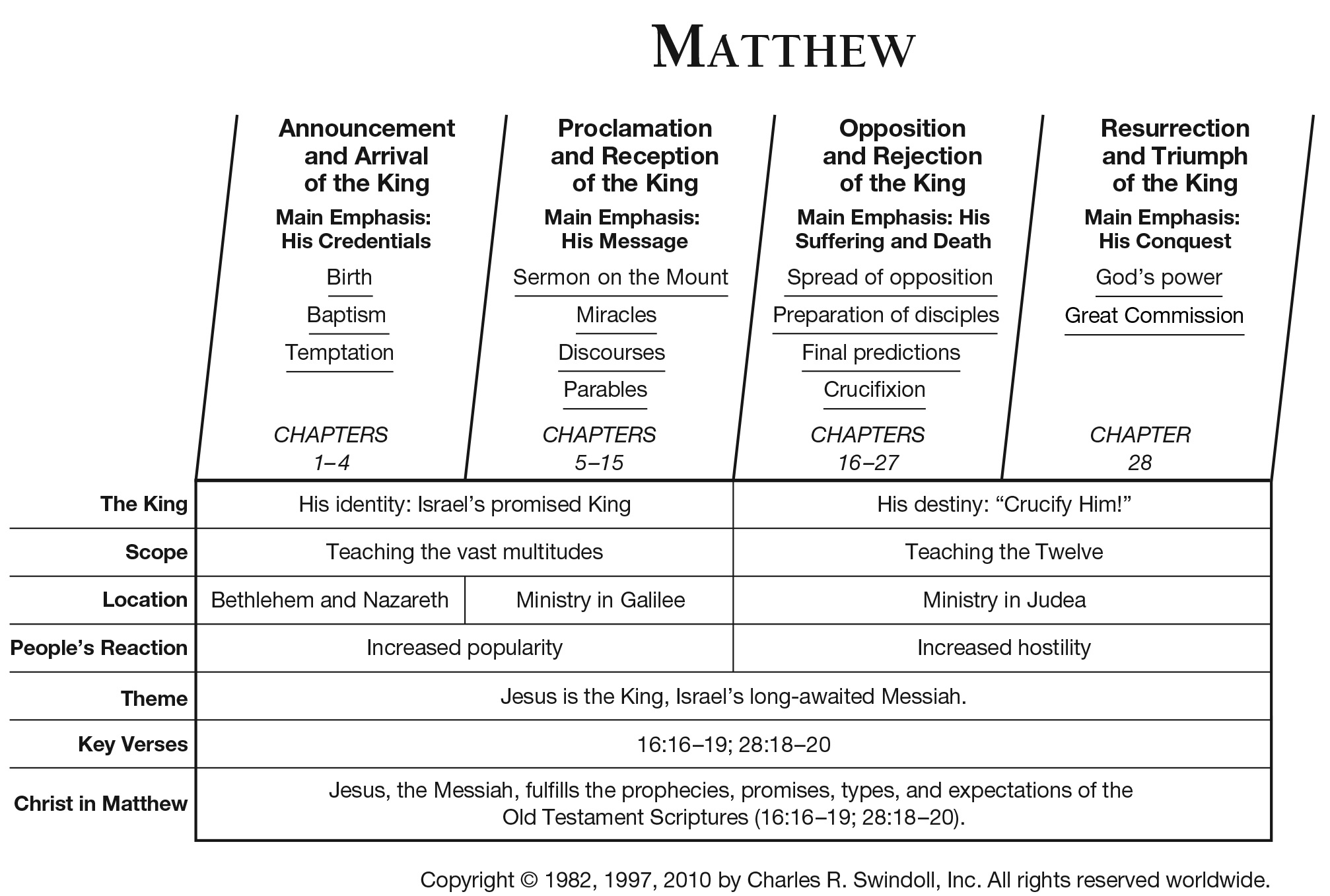
Another Chart from Charles Swindoll
THE LIFE OF JESUS AS COVERED
BY MATTHEW (shaded area)
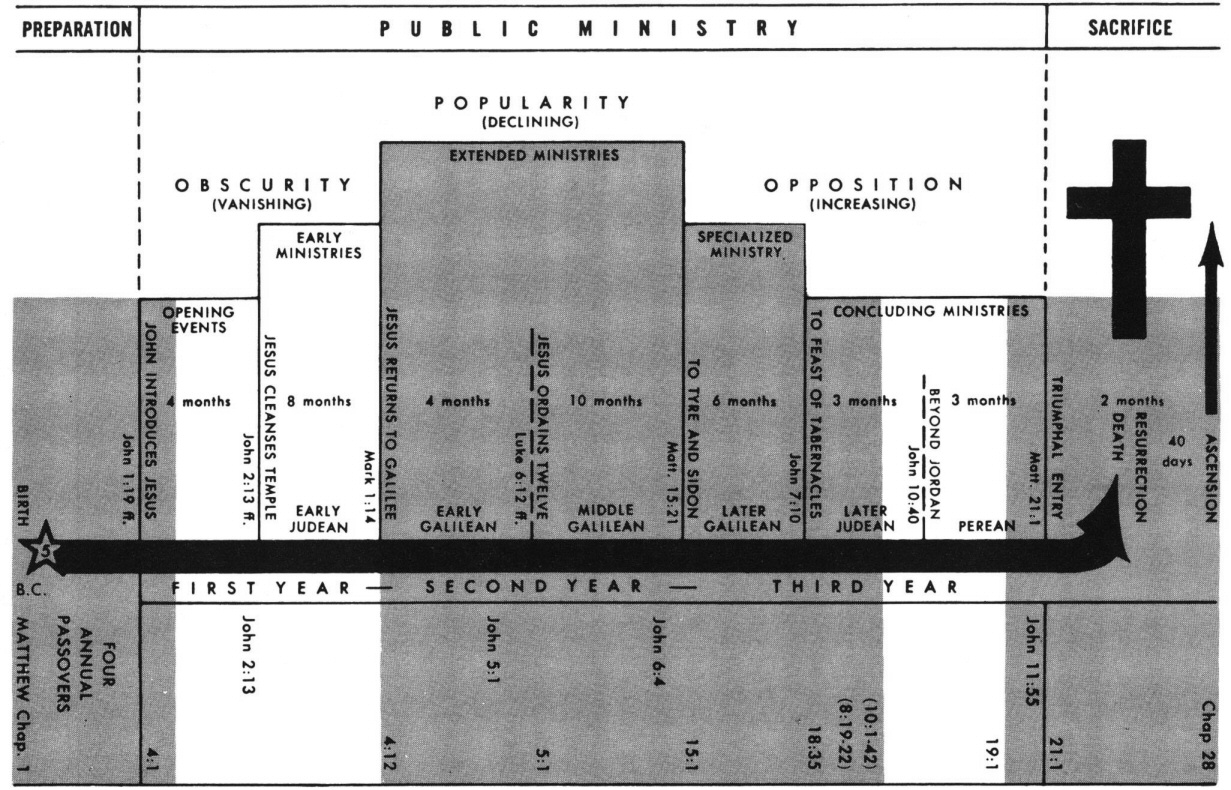
Click chart to enlarge
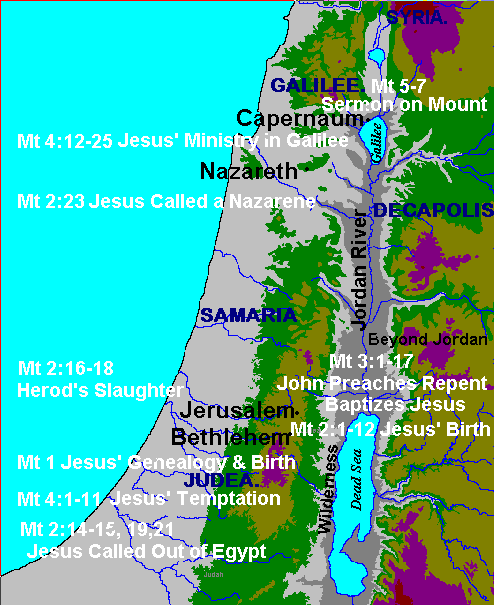
Jesus Birth and Early Years
Leading up to the Sermon on the Mount
Matthew 1-7

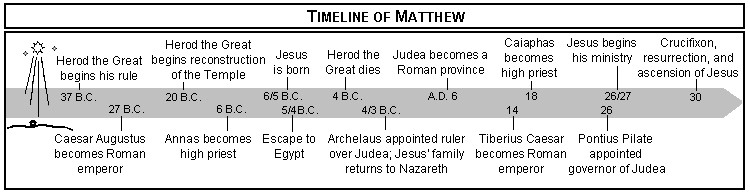
Source: Ryrie Study Bible
Matthew 5:31 "It was said, 'WHOEVER * SENDS HIS WIFE AWAY, LET HIM GIVE HER A CERTIFICATE OF DIVORCE' (NASB: Lockman)
Greek: Errethe (3SAPI) de, Os an apoluse (3SAAS) ten gunaika autou, doto (3SAAM) aute apostasion.
Amplified: It has also been said, Whoever divorces his wife must give her a certificate of divorce. (Amplified Bible - Lockman)
NLT: "You have heard that the law of Moses says, 'A man can divorce his wife by merely giving her a letter of divorce.' (NLT - Tyndale House)
Philips: "It also used to be said that 'Whoever divorces his wife, let him give her a certificate of divorce'. (New Testament in Modern English)
Wuest: Moreover, it was said, Whoever dismisses his wife, let him give her a bill of divorce. (Wuest: Expanded Translation: Eerdmans)
Young's Literal: 'And it was said, That whoever may put away his wife, let him give to her a writing of divorce;
IT WAS SAID, 'WHOEVER SENDS HIS WIFE AWAY LET HIM GIVE HER A CERTIFICATE OF DIVORCE: Errethe (3SAPI) de, Os an apoluse (3SAAS) ten gunaika autou, doto (3SAAM) aute apostasion
- Mt 19:3,7; Deuteronomy 24:1, 2, 3, 4; Jeremiah 3:1; Mark 10:2-9
- Matthew 5 Resources - Multiple Sermons and Commentaries
Charles Simeon writes…
THE laws of men cannot always proceed to the extent that might be wished in the support of truth and virtue. They must sometimes bend to circumstances, and tolerate evils which they cannot totally prevent. Even under the Theocracy itself this necessity was felt and admitted. The laws of Moses, as far as they were purely moral, were perfect and inflexible; but, as far as they were political, they yielded in a measure to the state and character of the people for whom they were made. The Jews were a hardhearted and stiff necked people, and extremely licentious in their manners. They would multiply their wives to any extent that they chose, and put them away on the most frivolous occasions. Moses knew that an absolute prohibition of such practices would only render the men more ferocious, and the women more miserable: and therefore he contented himself with laying some restrictions on the men, that if divorces could not be prevented, they might at least be rendered less frequent, by being made more solemn, more deliberate, more manifest. He limited the permission to those instances wherein there was in the woman some moral, natural, or acquired defect, which was the ground of her husband’s alienation from her. He then ordered that a writing of divorcement should be drawn up, and in the presence of two witnesses be given to her; that so, if she were afterwards married to another man, she might be able to prove that she was not living in adultery, because her former marriage had been annulled. This restriction, which was only a permission granted on account of the hardness of their hearts, was by the Scribes and Pharisees construed into a command to put away their wives, as soon as ever they ceased to love them: and, under cover of this law, the most licentious and cruel practices almost universally obtained. Our blessed Lord, who came to put all his followers under the authority of the moral law, and to reduce the world to its primeval sanctity, declared, that this license was contrary to the original institution of marriage; and that henceforth, as Adam and Eve were formed for each other, and united in marriage, without any latitude allowed to either of them to dissolve the connexion, or to admit any other to a participation of their mutual rights, so should every man and woman, when united in wedlock, have an inalienable right in each other, a right that should never be cancelled, but by a violation of the marriage vows. To this subject our Lord was led by his exposition of the seventh commandment. He had shewn, that that commandment was no less violated by an impure look than by the act of adultery itself: and now he proceeds to shew, that those practices, which were supposed to be sanctioned by the Mosaic law, were never to be tolerated amongst his followers, since they were directly contrary to the spirit of that commandment. There was one, and only one reason, which should henceforth be admitted as a proper ground of divorce: and if any one in future should put away his wife in defiance of this restriction, he should be dealt with as an adulterer in the day of judgment. The restriction itself being so clear and simple, we shall not attempt any further elucidation of it, but shall rather point out the importance of the restriction to the welfare of mankind. (Read the entire sermon - Matthew 5:31, 32 Divorces Forbidden)
Spurgeon comments that in these passages…
our King quotes and condemns a permissive enactment of the Jewish State. Men were wont to bid their wives “begone,” and a hasty word was thought sufficient as an act of divorce. Moses insisted upon “a writing of divorcement,” that angry passions might have time to cool and that the separation, if it must come, might be performed with deliberation and legal formality. The requirement of a writing was to a certain degree a check upon an evil habit, which was so engrained in the people that to refuse it altogether would have been useless, and would only have created another crime. The law of Moses went as far as it could practically be enforced; it was because of the hardness of their hearts that divorce was tolerated; it was never approved.
But our Lord is more heroic in his legislation. He forbids divorce except for the one crime of infidelity to the marriage-vow. She who commits adultery does by that act and deed in effect sunder the marriage-bond, and it ought then to be formally recognised by the State as being sundered; but for nothing else should a man be divorced from his wife. Marriage is for life, and cannot be loosed, except by the one great crime which severs its bond, whichever of the two is guilty of it. Our Lord would never have tolerated the wicked laws of certain of the American States, which allow married men and women to separate on the merest pretext. A woman divorced for any cause but adultery, and marrying again, is committing adultery before God, whatever the laws of man may call it. This is very plain and positive; and thus a sanctity is given to marriage which human legislation ought not to violate. Let us not be among those who take up novel ideas of wedlock, and seek to deform the marriage laws under the pretense of reforming them. Our Lord knows better than our modern social reformers. We had better let the laws of God alone, for we shall never discover any better.
It was said - Hole writes that "Eight times over does He say in this chapter, "I say unto you," and on six of these occasions the words are preceded by the word, "But," throwing His statement into contrast with what the law had previously said." (Ref)
Sends (630) (apoluo from apó = from + luo = loose) means literally to loose from and so to free fully, relieve, release, dismiss, and in the present context to divorce.
Apoluo - 66x in 61v - Matt 1:19; 5:31f; 14:15, 22f; 15:23, 32, 39; 18:27; 19:3, 7ff; 27:15, 17, 21, 26; Mark 6:36, 45; 8:3, 9; 10:2, 4, 11f; 15:6, 9, 11, 15; Luke 2:29; 6:37; 8:38; 9:12; 13:12; 14:4; 16:18; 23:16, 18, 20, 22, 25; John 18:39; 19:10, 12; Acts 3:13; 4:21, 23; 5:40; 13:3; 15:30, 33; 16:35f; 17:9; 19:40; 23:22; 26:32; 28:18, 25; Heb 13:23. NAS renders apoluo as dismissed(1), divorce(3), divorced(2), divorces(5), freed from(1), leaving(1), let depart(1), let go(2), pardon(m)(1), pardoned(1), put away(1), release(20), released(8), send away(8), sending away(2), sends away(1), sent away(8), set free(1).
Certificate of Divorce (647) (apostasion from apo = separation of one thing from another + histemi = stand) describes a standing off from, a departure and in the present context refers to the deed or instrument of such divorce.
Jesus is quoting in part from Deuteronomy 24:1-4 where we read…
"When a man takes a wife and marries her, and it happens that she finds no favor in his eyes because he has found some indecency in her, and he writes her a certificate of divorce and puts it in her hand and sends her out from his house, 2 and she leaves his house and goes and becomes another man's wife, 3 and if the latter husband turns against her and writes her a certificate of divorce and puts it in her hand and sends her out of his house, or if the latter husband dies who took her to be his wife, 4 then her former husband who sent her away is not allowed to take her again to be his wife, since she has been defiled; for that is an abomination before the LORD, and you shall not bring sin on the land which the LORD your God gives you as an inheritance.
So what is the problem with what the Scribes and Pharisees had taught? The problem is that they were not good inductive Bible students and because of inadequate observation and reliance on the "commentaries" (what the rabbis had taught as "tradition"), they arrived an inaccurate interpretation of the Law and consequently, and most importantly, they prescribed inappropriate application based on their willfully inept analysis of the OT Scriptures. Their misapplication of the Law had led to a liberal attitude toward divorce (just as it had with murder, adultery, vows, retaliation and love) and so once again, Jesus call His listeners and we the readers of His sermon for allegiance to a higher standard, a righteousness that far surpasses that of the Scribes and Pharisees and which shines like a beacon of supernatural light that points men to a great and mighty supernatural "force", the Heavenly Father.
J I Packer (et al) comment that…
This Law was supposed to deter divorce rather than encourage it since it required a “writing of divorcement”, executed in public. The document granted the woman the right to remarry without civil or religious sanction. Divorce could not be done privately. The acceptable reason for granting divorce was “some uncleanness.” Specific types of “uncleanness” had their own penalties. Adultery carried the death penalty by stoning. Although the Law of Moses allowed a man to divorce his wife, the wife was not allowed to divorce her husband for any reason at all. Legally the wife was bound to her husband as long as they both lived or until he divorced her. If the woman was given a certificate of divorce, she was eligible to remarry any man except a priest (Lev. 21:7, 14; Ezek. 44:22). However, remarriage defiled her in respect to her first husband—i.e., he could not marry her again, because she had in effect "committed adultery" against him (cf. Matt. 5:32). In Jesus’ day, there was much confusion about the grounds for divorce. The rabbis could not agree on what constituted the “uncleanness” of Deuteronomy 24:1. There were two opinions. Those following Rabbi Shammai felt adultery was the only grounds for divorce. Those who followed Rabbi Hillel accepted a number of reasons for divorce, including such things as poor cooking. (Adapted from Packer, J., Tenney, M. C., & White, W. Nelson's Illustrated Manners and Customs of the Bible. Nashville: Thomas Nelson)
Barclay gives some background on the state of marriage at the time of Jesus writing that…
There is no time in history when the marriage bond stood in greater peril of destruction than in the days when Christianity first came into this world. At that time the world was in danger of witnessing the almost total break-up of marriage and the collapse of the home… Theoretically no nation ever had a higher ideal of marriage than the Jew had. Marriage was a sacred duty which a man was bound to undertake… Ideally the Jew abhorred divorce. The voice of God had said, “I hate divorce” (Malachi 2:16). The Rabbis had the loveliest sayings. “We find that God is long-suffering to every sin except the sin—of unchastity.” “Unchastity causes the glory of God to depart.” “Every Jew must surrender his life rather than commit idolatry, murder or adultery.” “The very altar sheds tears when a man divorces the wife of his youth.” The tragedy was that practice fell so far short of the ideal. One thing vitiated the whole marriage relationship. The woman in the eyes of the law was a thing. She was at the absolute disposal of her father or of her husband. She had virtually no legal rights at all. To all intents and purposes a woman could not divorce her husband for any reason, and a man could divorce his wife for any cause at all. “A woman,” said the Rabbinic law,” may be divorced with or without her will; but a man only with his will… The process of divorce was extremely simple. The bill of divorcement simply ran:
“Let this be from me thy writ of divorce and letter of dismissal and deed of liberation, that thou mayest marry whosoever man thou wilt.”
All that had to be done was to hand that document to the woman in the presence of two witnesses and she stood divorced.
Clearly the crux of this matter lies in the interpretation of the phrase some indecency (see Deut 24:1 above). In all matters of Jewish law there were two schools. There was the school of Shammai, which was the strict, severe, austere school; and there was the school of Hillel which was the liberal, broad-minded, generous school.
Shammai and his school defined some indecency as meaning unchastity and nothing but unchastity. “Let a wife be as mischievous as the wife of Ahab,” they said, “she cannot be divorced except for adultery.” To the school of Shammai there was no possible ground of divorce except only adultery and unchastity. On the other hand the school of Hillel defined some indecency in the widest possible way. They said that it meant that a man could divorce his wife if she spoiled his dinner by putting too much salt in his food, if she went in public with her head uncovered, if she talked with men in the streets, if she was a brawling woman, if she spoke disrespectfully of her husband’s parents in his presence, if she was troublesome or quarrel some. A certain Rabbi Akiba said that the phrase, if she find no favor in his sight, meant that a man might divorce his wife if he found a woman whom he considered to be more attractive than she. (Matthew 5 Commentary - Daily Study Bible online)
How is the light of Christianity shining in our modern world which is desperately in need or a stable marital standard? A study by the Barna Research Group in Ventura, Calif. (circa 2000) says that born-again Christians are more likely to go through a marital split than are non-Christians. Using statistics drawn from a nationwide survey of nearly 4,000 adults, the Barna data show that 11 percent of the adult population is currently divorced but that 25% of all adults have experienced at least one divorce during their lifetime. Among born-again Christians, 27 % are currently or have previously been divorced, compared with 24% among adults who are not born again. Surprisingly, the Barna report said, the Christian group whose adherents have the highest likelihood of getting divorced are Baptists. It said the only group to surpass Baptists were Christians associated with non-denominational Protestant churches. "Of the nation's major Christian groups, Catholics and Lutherans have the lowest percentage of divorced individuals -- 21%. People who attend mainline Protestant churches, overall, experience divorce at the national average of 25%."
Matthew 5:32 but I say to you that everyone who divorces his wife, except for the reason of unchastity, makes her commit adultery; and whoever * marries a divorced woman commits adultery. (NASB: Lockman)
Greek: ego de lego (1SPAI) umin oti pas o apoluon (PAPMSN) ten gunaika autou parektos logou porneias poiei (3SPAI) auten moicheuthenai, (APN) kai os ean apolelumenen (RPPFSA) gamese (3SAAS) moichatai.
Amplified: But I tell you, Whoever dismisses and repudiates and divorces his wife, except on the grounds of unfaithfulness (sexual immorality), causes her to commit adultery, and whoever marries a woman who has been divorced commits adultery. (Amplified Bible - Lockman)
NLT: But I say that a man who divorces his wife, unless she has been unfaithful, causes her to commit adultery. And anyone who marries a divorced woman commits adultery. (NLT - Tyndale House)
Philips: But I say to you that whoever divorces his wife except on the ground of unfaithfulness is making her an adulteress. And whoever marries the woman who has been divorced also commits adultery. (New Testament in Modern English)
Wuest: But, as for myself, I am saying to you, Everyone who dismisses his wife except in a case of unchastity, causes her to commit adultery, and whoever marries her who has been dismissed, commits adultery. (Wuest: Expanded Translation: Eerdmans)
Young's Literal: but I -- I say to you, that whoever may put away his wife, save for the matter of whoredom, doth make her to commit adultery; and whoever may marry her who hath been put away doth commit adultery.
BUT I SAY TO YOU THAT EVERYONE WHO DIVORCES HIS WIFE, EXCEPT FOR THE REASON OF UNCHASTITY MAKES HER COMMIT ADULTERY: ego de lego (1SPAI) humin oti pas o apoluon (PAPMSN) ten gunaika autou parektos logou porneias poiei (3SPAI) auten moicheuthenai, (APN)
- Mt 5:28; Luke 9:30,35
Divorces (630) (apoluo from apó = from + luo = loose) means literally to loose from and so to free fully, relieve, release, dismiss, and in the present context to divorce.
Unchastity (4202) (porneia [word study] from porneúo = commit fornication or any sexual sin) is the idea of fornication which pertains to all kinds of sexual sins. Porneia is the most general Greek word for illicit sexual intercourse. Originally it denoted the practice of consorting with prostitutes; eventually it came to mean “habitual immorality.” Our English word pornography is derived from porneia + graph = a writing. Pornography is thus a writing (or picture) about sexual sin.
Note that Jesus is not saying immorality must lead to divorce, only that it may. Remember His teaching on being peacemakers (see notes Matthew 5:9) and on reconciling (see notes Matthew 5:23-26)
Indirectly, they are saying "I despise God's permanent design of the marriage covenant. I think less of her than God thinks of her."
What does God says about marriage in the Old Testament book of Malachi, the last book to be written, and one the scribes and Pharisees seemed to have conveniently "misplaced" in their teaching on divorce? (note: this passage is very difficult to interpret/translate and thus there is considerable variation in the various modern translations. Simply observe for those truths that are obvious, including the repeated ideas)
Malachi 2:13-see notes "And this is another thing you do: you cover the altar of the LORD with tears, with weeping and with groaning, because He no longer regards the offering or accepts it with favor from your hand.
14 "Yet you say, 'For what reason?' Because the LORD has been a witness (God witnessed their making of a the marriage covenant) between you and the wife of your youth, against whom you have dealt treacherously (denotes deceit or unfaithfulness in a relationship) (Septuagint translates with the Greek word egkataleipo = forsake someone in a state of defeat or helplessness, abandon, desert leave in straits, leave helpless leave destitute, leave in the lurch let one down), though she is your companion and your wife by covenant. (see study of Covenant: As It Relates to Marriage)
15 "But not one has done so who has a remnant of the Spirit. And what did that one do while he was seeking a godly offspring? Take heed then, to your spirit, and let no one deal treacherously (same Hebrew and Greek words as above) against the wife of your youth.
16 "For (explains the reason for the previous warning) I hate divorce (literally = sending or putting away)," says the LORD, the God of Israel, "and him who covers his garment (here may be used as a symbol of protection = divorce removed the wife's protection and treated her cruelly) with wrong (malicious conduct intended to injure another = summarizes the deliberate, brutal, insensitive infringement of rights & privileges of others)," says the LORD of hosts. "So take heed to your spirit, that you do not deal treacherously (same Hebrew and Greek words as above)."
What was taking place in Malachi 2:13-14? Sacrifices were being offered to the Lord with tears because they were not being accepted because the Lord has born witness between them and the wife of their youth.
What did God equate divorce with three times in four verses? Dealing treacherously which means to deal with one's wife in an unfaithful, deceitful way. The priests were sinning and instead of confessing and repenting, persisted in whitewashing their sin thinking that were getting away with it. (cf they forgot the warning in Pr 28:13 that "He who conceals his transgressions will not prosper, but he who confesses and forsakes them will find compassion.")
Malachi 2:14: How does God describe marriage? He was a witness The wife of their covenant, the most solemn binding agreement that could be made by two parties, a commitment to be kept & to break it was punishable by death (cf 1Sa 20:15-16, Jer 34:18-20, 1Cor 11:25-30) (see study of Covenant: As It Relates to Marriage)
Malachi 2:15: Why were they dealing treacherously? They had a problem with their "spirit". They needed to examine the spiritual condition of their hearts (cf the reason God allowed a "certificate of divorce" was because of the hardness of their heart in Mt 19:8, Mark 10:5). Here in Malachi, God said twice "take heed… to your spirit" and "do not deal treacherously". In Galatians 5:16-note Paul gives a command NT husbands need to heed lest they fall into the same trap:
Walk (present imperative) by the Spirit, and you will not (absolutely not) carry out the desire of the flesh.
So if you are walking by the Spirit we are less likely to deal with our wife treacherously. Remember that God's attitude regarding the sending away of the wife of one's youth is that He hates divorce. Be careful! Do not "invert" Gal 5:16! That is don't "try" to do the second part of the verse and think that is tantamount to walking in the Spirit! It will only put you under the Law and in fact will surely quench the Spirit!
Related Resources: from GotQuestions.org
- What are biblical grounds for divorce?
- What does the Bible say about divorce and remarriage?
- What does Malachi 2:16 mean when God says, “I hate divorce”?
- Is the divorce rate among Christians truly the same as among non-Christians?
- Does the Bible say that abandonment is a valid reason for divorce and remarriage?
- Is the divorce rate among Christians truly the same as among non-Christians?
- I am in the process of getting a divorce. Can I start dating, or do I have to wait until the divorce is final?
- What does Deuteronomy 24 teach about divorce?
- What is the exception clause?
- What does the Bible say about remarriage if a divorce occurred before salvation? | GotQuestions.org
- What does the Bible say about divorce and remarriage?
- Why does God hate divorce?
AND WHOEVER MARRIES A DIVORCED WOMAN COMMITS ADULTERY: kai os ean apolelumenen (RPPFSA) gamese (3SAAS) moichatai
- Mt 19:8,9; Malachi 2:14, 15, 16; Mark 10:5, 6, 7, 8, 9, 10, 11, 12; Luke 16:18; Romans 7:3; 1Corinthians 7:4,10,11
- Matthew 5 Resources - Multiple Sermons and Commentaries
Commits adultery (3431) (moicheuo [word study] from moichos = an adulterer) means to be unfaithful to one's marriage vows speaking of sexual intercourse with someone who is married to another. In some uses moicheuo can also be a figure of speech (Re 2:22) as in the Old Testament where "adultery" described unfaithfulness to God especially through the practice of idolatry (which in the NT equates with greed and in essence is anything that comes between you and God).
The second mention "commits adultery" is the verb moichao which is similar in meaning to moicheuo - to have unlawful intercourse with another's wife, to commit adultery with
How does Jesus correct the Pharisees' perverted application of the OT passage on a "certificate of divorce"? He gives only one valid reason for divorce - unchastity and explains that if one divorces a wife it makes her commit adultery and that whoever marries a divorced woman commits adultery.
In Luke 16:18 Jesus adds one other detail regarding divorce explaining that the sender himself also commits adultery if he marries another woman.
Luke 16:18 "Everyone who divorces his wife and marries another commits adultery; and he who marries one who is divorced from a husband commits adultery.
What is the heart of the problem Jesus is addressing? The heart has always been the problem (cf Jer 17:9, Gen 8:21) and in Matthew 19 God says it reflects a hardening of the heart. From the beginning, from the creation of Adam and Eve, God's design was that marriage was a permanent covenant.
Mt 19:7 They said to Him, "Why then did Moses command to GIVE HER A CERTIFICATE OF DIVORCE AND SEND her AWAY?" He said to them, "Because of your hardness of heart (sklerokardia = skleros = hard, not soft and tender but harsh, severe + kardia = heart), Moses permitted (made a concession with regard to God's intention that marriage be lifelong and monogamous) you to divorce (apoluo from apo = marker of dissociation, implying a rupture from a former association + luo = loose) your wives; but from the beginning ("For this cause a man shall leave his father and his mother, and shall cleave [Hebrew means in essence "stick like glue"] to his wife; and they shall become one flesh." Genesis 2:24) it has not been this way. And I say to you, whoever divorces his wife, except for immorality (porneia), and marries another woman commits adultery."
Please note, this brief exposition is not meant to be an exhaustive treatment of divorce and remarriage, which can be a very emotional and controversial subject. See the Precept Ministries International inductive study entitled Marriage Without Regrets. Perhaps you might just want to listen to the audio messages from this course that pertain to Divorce and Remarriage. There are 2 messages in the Marriage Without Regrets course that address the topic of Divorce and those audio tapes (or compact discs) correspond to Lesson 11 and Lesson 12 (see table below). Each separate tape or CD is $4. They are available for purchase from Precept Ministries International at 1-800-763-8280. There are 2 messages by Kay Arthur and 2 messages by Wayne Barber. The item numbers are listed below for your convenience…
|
MESSAGES BY KAY ARTHUR |
||
|
TITLE |
Tape 11: What Does God Say About Divorce? |
Tape 12: What Can the Divorce Do? |
| CD | #13539 | #13540 |
| Tape | #10077 | #10078 |
|
MESSAGES BY WAYNE BARBER |
||
|
TITLE |
Tape 11: Divorce and |
Tape 12: Divorce and |
| CD | #10095 | #10096 |
| Tape | #13557 | #13558 |