Matthew 5:2
Matthew 5:3
Matthew 5:4
Matthew 5:5
Matthew 5:6
Matthew 5:7
Matthew 5:8
Matthew 5:9
Matthew 5:10
Matthew 5:11
Matthew 5:12
Matthew 5:13
Matthew 5:14
Matthew 5:15
Matthew 5:16
Matthew 5:17
Matthew 5:18
Matthew 5:19
Matthew 5:20
Matthew 5:21
Matthew 5:22
Matthew 5:23
Matthew 5:24
Matthew 5:25
Matthew 5:26
Matthew 5:27
Matthew 5:28
Matthew 5:29
Matthew 5:30
Matthew 5:31
Matthew 5:32
Matthew 5:33
Matthew 5:34
Matthew 5:35
Matthew 5:36
Matthew 5:37
Matthew 5:38
Matthew 5:39
Matthew 5:40
Matthew 5:41
Matthew 5:42
Matthew 5:43
Matthew 5:44
Matthew 5:45
Matthew 5:46
Matthew 5:47
Matthew 5:48

Sermon on the Mount
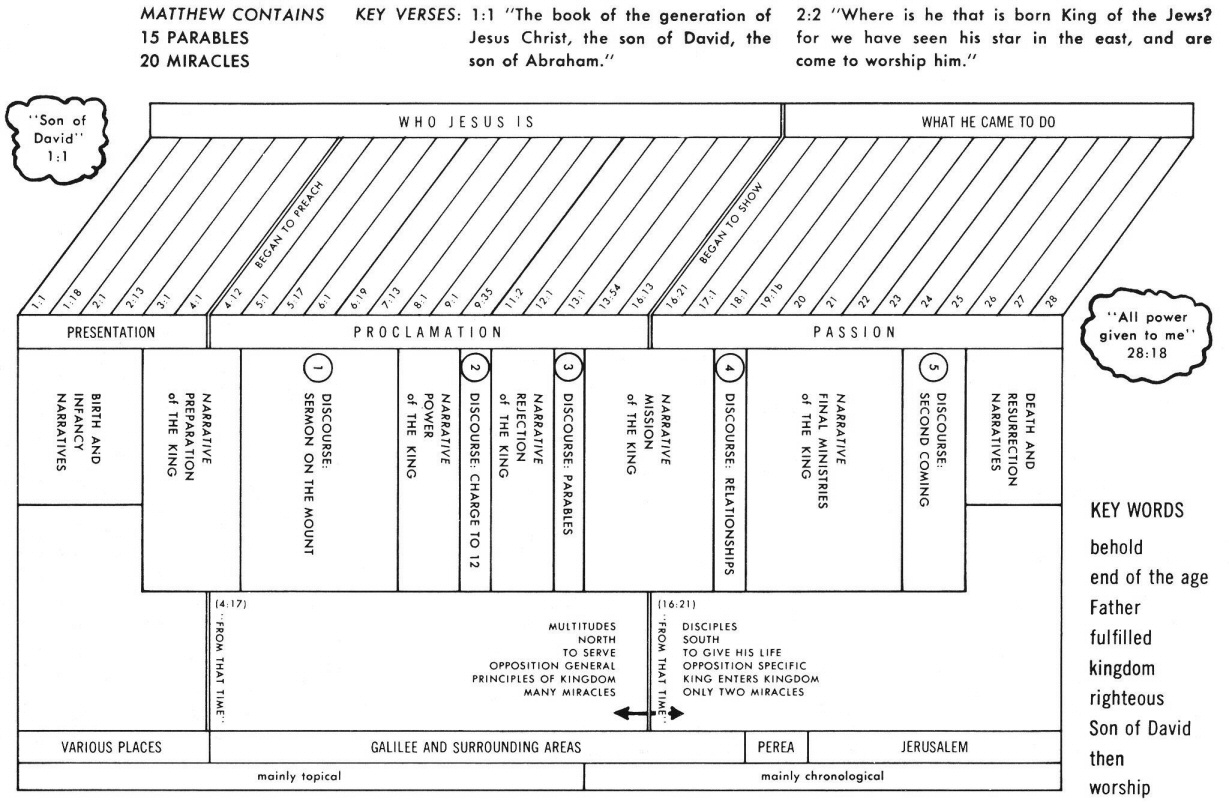
Click chart to enlarge
Charts from Jensen's Survey of the NT - used by permission
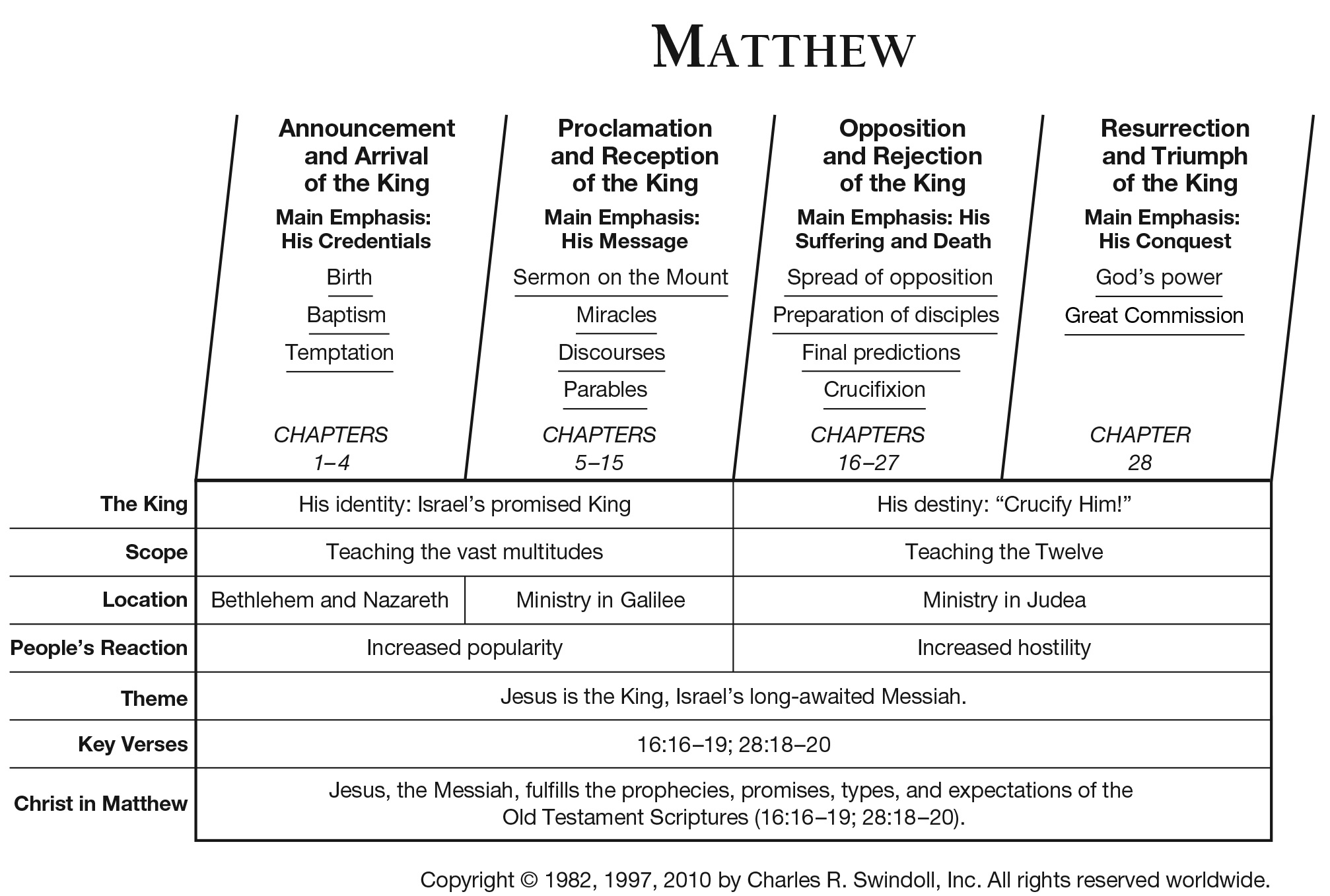
Another Chart from Charles Swindoll
THE LIFE OF JESUS AS COVERED
BY MATTHEW (shaded area)
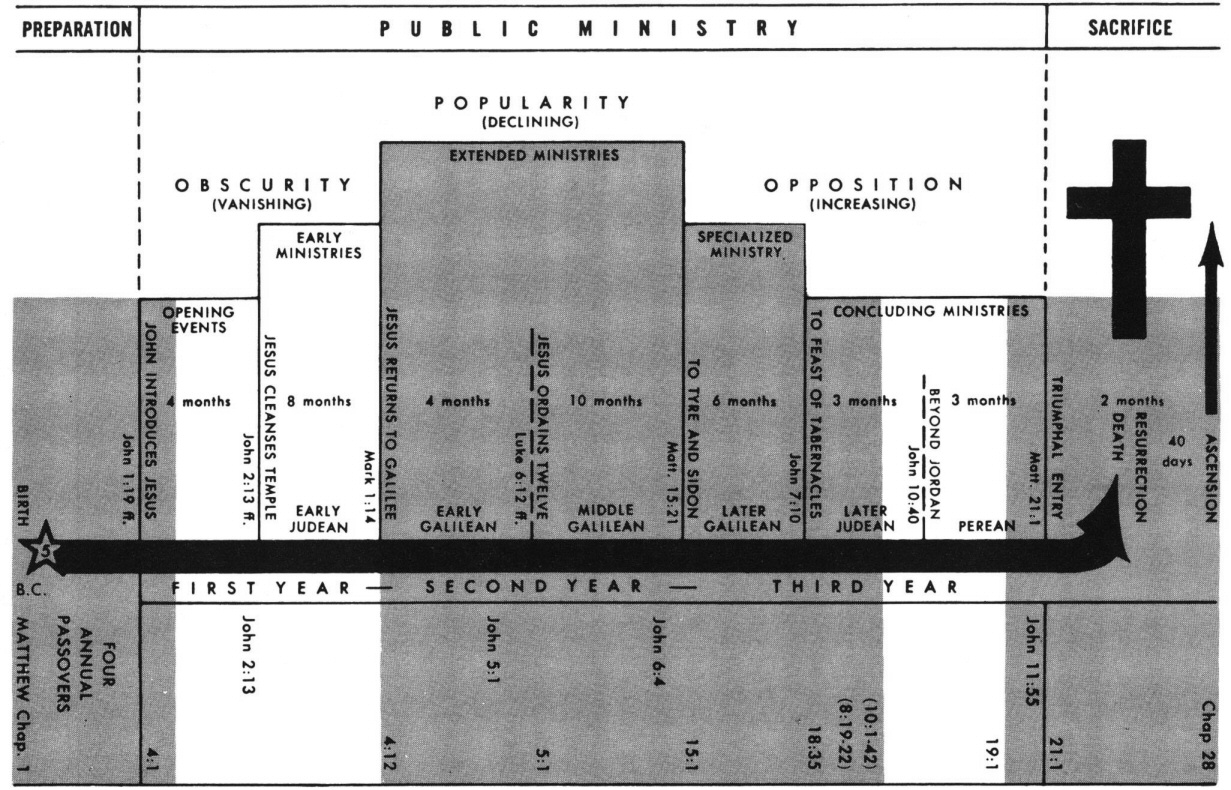
Click chart to enlarge
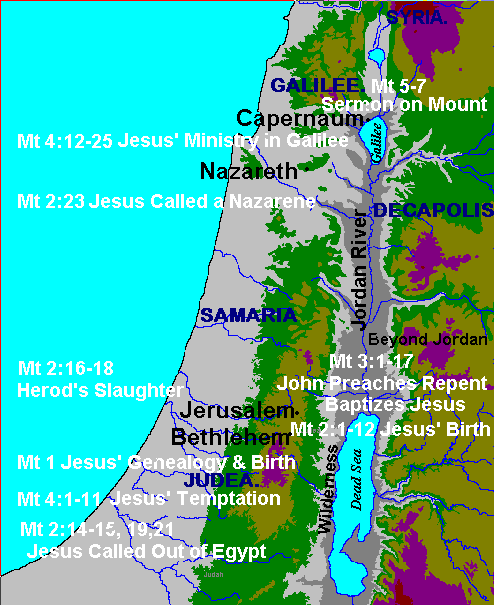
Jesus Birth and Early Years
Leading up to the Sermon on the Mount
Matthew 1-7

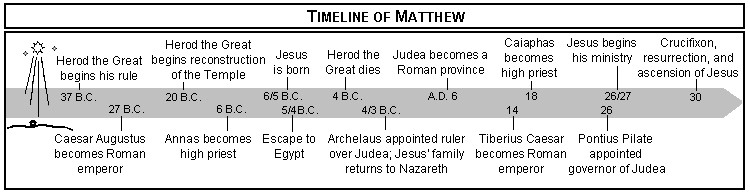
Source: Ryrie Study Bible
Matthew 5:6 "Blessed are those who hunger and thirst for righteousness, for they shall be satisfied. (NASB: Lockman)
Greek: makarioi oi peinontes (PAPMPN) kai dipsontes (PAPMPN) ten dikaiosunen, hoti autoi chortasthesontai. (3PFPI)
Amplified: Blessed and fortunate and happy and spiritually prosperous (in that state in which the born-again child of God enjoys His favor and salvation) are those who hunger and thirst for righteousness (uprightness and right standing with God), for they shall be completely satisfied! (Amplified Bible - Lockman)
Barclay: O the bliss of the man who longs for total righteousness as a starving man longs for food, and a man perishing of thirst longs from after, for man will be truly satisfied.
ICB: Those who want to do right more than anything else are happy. God will fully satisfy them.
KJV: Blessed are they which do hunger and thirst after righteousness: for they shall be filled.
Philips: Happy are those who are hungry and thirsty for goodness, for they will be fully satisfied! (New Testament in Modern English)
Wuest: Spiritually prosperous are those hungering and thirsting for righteousness, because they themselves shall be filled so as to be completely satisfied.
Young's Literal: Happy those hungering and thirsting for righteousness--because they shall be filled.
- Hunger - Ps 42:1-2; Ps 63:1-2; 84:2; 107:9; Amos 8:11, 12, 13; Luke 1:53; 6:21,25; John 6:27
- Matthew 5 Resources - Multiple Sermons and Commentaries
Related Passages:
Psalm 42:1-2 For the choir director. A Maskil of the sons of Korah. As the deer pants for the water brooks, So my soul pants for You, O God. 2 My soul thirsts for God, for the living God; When shall I come and appear before God?
Psalm 63:1 A Psalm of David, when he was in the wilderness of Judah. O God, You are my God; I shall seek You earnestly; My soul thirsts for You, my flesh yearns for You, In a dry and weary land where there is no water.
Psalm 143:6 I stretch out my hands to You; My soul longs for You, as a parched land. Selah.
THE BLESSING OF
A "HOLY HUNGER"
Jesus continues to describe the character of those who belong to the Kingdom of Heaven. These are not natural human traits, but spiritual qualities produced by grace in those who have been born again. Each Beatitude builds upon the previous one, forming a progressive portrait of the true disciple. By the time we reach Mt 5:6, Jesus has already described the poor in spirit (Mt 5:3), those who mourn over sin (Mt 5:4), and the meek (Mt 5:5), those who have been humbled before God. Now, in Mt 5:6, He speaks of a deep, spiritual longing, a hunger and thirst not for food or drink, but for righteousness, a right standing with God and a life that reflects His holiness. Jesus is not issuing a call for self-righteousness, nor is it a commendation of mere religious zeal. Rather, it is a blessing pronounced upon those who, having been emptied of self, now long to be filled with the righteousness that only God can provide. It is a longing that arises from the new heart given in regeneration (Ezekiel 36:26+), and it is a longing that God promises to satisfy.
Spiritual appetite is the engine
that pulls the entire Christian life forward.
Notice also that with this beatitude Jesus shifts our focus. The first three (Mt 5:3–5) lead us inward—poverty of spirit, mourning over sin, meekness before God. But here the gaze turns upward toward God Himself. Some have rightly said this is one of the pivotal beatitudes, for in many ways the practice of this one unlocks the others. If we do not hunger and thirst for God’s righteousness, we will never experience the fullness of the blessings He promises. Spiritual appetite is the engine that pulls the entire Christian life forward. Without this longing, there can be no growth (cf 1Pe 2:2+), no depth, no intimacy, and no satisfaction of the soul.
Blessed (makarios) [are] those who hunger (peinao - present tense) and thirst (dipsao - present tense) for righteousness (dikaiosune), for they shall be satisfied (chortazo) - Remember that in each "beatitude" is the great word makarios describes a deep, God-given joy—a state of spiritual well-being that is not dependent on circumstances but on God’s favor. It speaks of the inner bliss of the one whom God approves. This is not the world's idea of happiness (which depends on happenings) but the heavenly happiness of a heart aligned with God. Makarios is the joy of possessing what the world cannot give and circumstances cannot take away.
Jesus gives two powerful motivations in Matthew 5:6. First, He promises blessedness—the deep, abiding satisfaction that does not depend on outward circumstances but flows from God Himself. Second, He promises true satisfaction—not of the physical appetite, but of the far deeper hunger of the soul, a hunger that can be satisfied only by God’s righteousness. The idea is to long earnestly for or have strong desire for divine (Christ's) righteousness, reflecting progressive sanctification rather than the once-for-all imputation of righteousness that occurs at justification.
Jesus' words call for a desperation in one's heart and soul that will not be satisfied with a trifling knowledge of God or a minimal improvement in moral conduct. Jesus' call is radical, just as in the other Beatitudes.
Blessed - Spurgeon makes an excellent point explaining that this man is "blessed because in the presence of this hunger many meaner (lesser) hungers die out. One master passion, like Aaron's rod, swallows up all the rest. He hungers and thirsts after righteousness, and therefore he is done with the craving of lust, the greed of avarice, the passion of hate, and pining of ambition. Pining to be holy, longing to serve God, anxious to spread every righteous principle,-blessed are they.
Blest are the souls that thirst for grace
Hunger and long for righteousness;
They shall be well supplied, and fed
With living streams and living bread.
-- Isaac Watts
Hunger (peinao - present tense) means to crave after, to long for, to be famished, like a starving person seeking bread. The present tense indicates continual longing, ongoing appetite or a habitual, persistent spiritual craving. The point is that this is not a momentary desire but a lifelong pursuit. Jesus is describing a heart that refuses to be satisfied with spiritual mediocrity.
Thirst (dipsao - present tense) describes intense, consuming thirst, the agony of dehydration, the desperation of a traveler in a scorching desert. The present tense again intensifies the idea: constant longing, unceasing desire, ongoing desperation for what only God can satisfy
Hunger and thirst are powerful bodily cravings that must be satisfied if life—physical or spiritual—is to be sustained. Do you believe that? Jesus’ statement here is the key to entering into the fullness of a truly righteous life (one that surpasses the righteousness of the scribes and Pharisees, Mt 5:20), the very life He unfolds throughout the remainder of the Sermon on the Mount.
In this Beatitude, Jesus reveals that true blessedness is found not in worldly gain, but in a soul that longs for God’s righteousness—and finds its satisfaction in Him alone.
The Spirit awakens the hunger
only Christ can satisfy.
It is important to acknowledge that the Holy Spirit is deeply involved in Matthew 5:6, even though He is not mentioned by name. A hunger for righteousness is a grace the Spirit gives, not a virtue we produce (cf Ro 14:17). Only the Spirit of grace (Heb 10:29) can turn sinners into seekers of Christ's righteousness (cf 1Cor 1:30, Lk 2:25).The entire Beatitude depends on His work in the heart. So when Jesus describes people who earnestly long for righteousness, that longing or hungering must be Spirit-produced. The Spirit awakens the conscience, convicts of sin (John 16:8), shows the emptiness of self-righteousness, ignites the desire for holiness, and stirs up an appetite for Christ Himself. Spiritual hunger doesn’t survive without divine power. The Spirit keeps the heart dissatisfied with sin, keeps the believer longing for greater Christlikeness, prevents spiritual apathy, creates holy dissatisfaction with the world, and fans the flame of spiritual desire. When Jesus says we will be filled the question is filled with what? The answer is several things - Christ’s righteousness, power to obey, inward transformation (2Co 3:18), peaceful fruit of righteousness (Heb 12:11, Gal 5:22), greater knowledge of God (Col 1:10b). All these blessings are the work of the Holy Spirit. When the Spirit stirs your hunger, Christ supplies your fullness. The Spirit creates the craving, while Jesus provides the feast.
🙏 THOUGHT - Note that both hunger and thirst are in the present tense which calls for these pursuits to be our lifestyle (this reason alone indicating that Jesus refers not to justification but to sanctification). Think for a moment - if you eat only one meal, does it satisfy you for the rest of the week? Of course not. Even though that meal might have satiated you for the moment, your body naturally grows hungry again as time passes. In the same way, as genuine believers we will continually hunger and thirst for God's righteousness. One day we will see Him and we shall be like Him in glory (1Jn 3:2+) but until that day we are all "works in progress" (Phil 1:6+).
Think of the prophet Isaiah, probably the "best man (the most righteous) in the land of Israel" in his day. What happened when he saw perfect righteousness (Isaiah 6:1-8)? He was undone and after cleansing of his lips with coal (cf Isaiah 64:6), he responded to the Lord's query of "Whom shall I send, and who will go for Us?" by saying "Here am I. Send me!" (Isaiah 6:8)
We will never reach the breadth and length and height and depth of God's perfect righteousness in this life and so as aliens and strangers (1Pe 2:11+) our goal and our quest is continual pursuit of His righteousness manifest in and through us as we live our lives in the power of His Spirit for His glory (Mt 5:16+). "For from Him and through Him and to Him are all things. To Him be the glory forever. Amen. " (Romans 11:36+).
We need the attitude of the psalmist Asaph in Psalm 73 (Spurgeon's note) who cried…
25 Whom have I in heaven but Thee? And besides Thee, I desire nothing on earth. (hungering, thirsting)
26 My flesh and my heart may fail, But God is the strength of my heart and my portion forever. (fully satisfied)
In Psalm 119:20 the psalmist captures the intensity of the passion Jesus calls for in this beatitude. He does not describe a mild interest or a casual desire, but a consuming longing—a craving that presses upon the soul with real force. This is the same spiritual hunger Jesus blesses in Matthew 5:6.
My soul is crushed with longing after Thine ordinances at all times. (Psalm 119:20)
The phrase “crushed with longing” (lit., “broken,” “consumed”) paints the picture of a heart so deeply hungry for God’s Word that it feels overwhelmed by desire. This is no occasional stirring, but a constant yearning—“at all times”—for God’s will, God’s ways, and God’s righteousness. Such longing is the mark of a soul awakened by grace as in Mt 5:6. It is the spiritual appetite of someone who refuses to be satisfied with anything less than conformity to Christ’s character. And in Mt 5:6 Jesus says that this is the hunger that God delights to satisfy.
Spurgeon adds that "True godliness lies very much in desires. As we are not what we shall be, so also we are not what we would be. The desires of gracious men after holiness are intense, -- they cause a wear of heart, a straining of the mind, till it feels ready to snap with the heavenly pull. A high value of the Lord's commandment leads to a pressing desire to know and to do it, and this so weighs upon the soul that it is ready to break in pieces under the crush of its own longings. What a blessing it is when all our desires are after the things of God. We may well long for such longings…
David had such reverence for the word, and such a desire to know it, and to be conformed to it, that his longings caused him a sort of heart break, which he here pleads before God. Longing is the soul of praying, and when the soul longs till it breaks, it cannot be long before the blessing will be granted. The most intimate communion between the soul and its God is carried on by the process described in the text. God reveals his will, and our heart longs to be conformed thereto. God judges, and our heart rejoices in the verdict. This is fellowship of heart most real and thorough.
Note well that our desire after the mind of God should be constant; we should feel holy longings "at all times." Desires which can be put off and on like our garments are at best but mere wishes, and possibly they are hardly true enough to be called by that name, -- they are temporary emotions born of excitement, and doomed to die when the heat which created them has cooled down. He who always longs to know and do the right is the truly right man. His judgment is sound, for he loves all God's judgments, and follows them with constancy. His times shall be good, since he longs to be good and to do good at all times.
I opened my mouth wide and panted, for I longed for Thy commandments. (Psalm 119:131)
Spurgeon - So animated was his desire that he looked into the animal world to find a picture of it. He was filled with an intense longing, and was not ashamed to describe it by a most expressive, natural, and yet singular symbol. Like a stag that has been hunted in the chase, and is hard pressed, and therefore pants for breath, so did the Psalmist pant for the entrance of God's word into his soul. Nothing else could content him. All that the world could yield him left him still panting with open mouth.
For I longed for thy commandments. Longed to know them, longed to obey them, longed to be conformed to their spirit, longed to teach them to others. He was a servant of God, and his industrious mind longed to receive orders; he was a learner in the school of grace, and his eager spirit longed to be taught of the Lord.
Behold, I long for Thy precepts. Revive me through Thy righteousness. (Psalm 119:40)
Psalm 119:40 expresses precisely the kind of holy longing Jesus blesses in Matthew 5:6. When the psalmist says, “I long for Thy precepts,” he is describing an inner craving—an earnest desire to know and obey God’s will. This corresponds directly to the hunger and thirst Jesus mentions in Mt 5:6 and not a casual interest, not a surface-level religious duty, but a deep, continual longing for God’s truth and God’s ways. This is the very heart posture Jesus calls “blessed.” The psalmist does not ask to be revived by comfort, success, or ease, but by God’s righteousness. Jesus teaches that the only true satisfaction comes from God’s righteousness—just as the psalmist prays to be revived by that same righteousness. In other words: The psalmist longs for righteousness. Jesus says the one who longs for righteousness will be filled with it. They speak with one voice.
Spurgeon adds "Behold, I have longed after thy precepts. He can at least claim sincerity. He is deeply bowed down by a sense of his weakness and need of grace; but he does desire to be in all things conformed to the divine will. Where our longings are, there are we in the sight of God. If we have not attained perfection, it is something to have hungered after it. He who has given us to desire, will also grant us to obtain. The precepts are grievous to the ungodly, and therefore when we are so changed as to long for them we have clear evidence of conversion, and we may safely conclude that he who has begun the good work will carry it on.
Quicken me in thy righteousness. Give me more life wherewith to follow thy righteous law; or give me more life because thou hast promised to hear prayer, and it is according to thy righteousness to keep thy word. How often does David plead for quickening! But never once too often. We need quickening every hour of the day, for we are so sadly apt to become slow and languid in the ways of God. It is the Holy Spirit who can pour new life into us; let us not cease crying to him. Let the life we already possess show itself by longing for more.
Peter echoed a similar thought writing that after choosing to put aside a number of "negative" attitudes (1Pe 2:1+)…
like newborn babes, long for the pure milk of the word, that by it you may grow in respect to salvation (1Pe 2:2+)
Comment - Peter echoes Jesus’ beatitude by portraying the same intense spiritual craving—a newborn’s desperate longing for milk—as the posture that leads to growth in grace. Just as Jesus blesses those who hunger and thirst for righteousness, Peter says that longing for the Word is the pathway to spiritual maturity and increasing conformity to Christ.
Job whose soul was being severely tested found his strength and sustenance in the proper nutrition, revealing the same spiritual appetite Jesus blesses in Matthew 5:6 and the same longing Peter describes in 1 Peter 2:2.…
I have not departed from the command of His lips; I have treasured the words of His mouth more than my necessary food. (Job 23:12+)
Are we aware of the Holy Spirit and all His mighty working within,
forming Christ in us more and more?
D. Martyn Lloyd-Jones in his classic treatise in fact feels that "this Beatitude is of exceptional value because it provides us with a perfect test which we can apply to ourselves, a test not only of our condition at any given time, but also of our whole position… we must surely ask ourselves questions such as these: Are we filled? Have we got this satisfaction? Are we aware of this dealing of God with us? Is the fruit of the Spirit being manifested in our lives? Are we concerned about that? Are we experiencing love to God and to other people, joy and peace? Are we manifesting long-suffering, goodness, gentleness, meekness, faith and temperance? They that do hunger and thirst after righteousness shall be filled. They are filled, and they are being filled. Are we, therefore, I ask, enjoying these things? Do we know that we have received the life of God? Are we enjoying the life of God in our souls? Are we aware of the Holy Spirit and all His mighty working within, forming Christ in us more and more? If we claim to be Christian, then we should be able to say yes to all these questions. Those who are truly Christian are filled in this sense. Are we thus filled? Are we enjoying our Christian life and experience? Do we know that our sins are forgiven? Are we rejoicing in that fact, or are we still trying to make ourselves Christian, trying somehow to make ourselves righteous? Is it all a vain effort? Are we enjoying peace with God? Do we rejoice in the Lord always? Those are the tests that we must apply. If we are not enjoying these things, the only explanation of that fact is that we are not truly hungering and thirsting after righteousness. For if we do hunger and thirst we shall be filled. There is no qualification at all, it is an absolute statement, it is an absolute promise — 'Blessed are they which do hunger and thirst after righteousness: for they shall be filled.' (Go to page 101 in pdf Studies in the Sermon on the Mount)
Stephen Olford on hunger and thirst - This was no mere reference to hunger which could be satisfied by a mid-morning snack. The thought is that of starvation. Similarly, the picture behind the word thirst is that of a person or an animal parched and exhausted. David was a hunter in his younger days, and in Psalm 42 he visualizes the scene of a panting hart or deer trapped by hunters. Perhaps the animal had been running for a long time or had been shot. With one last look heavenward it issues a cry for help, water and food, before dropping dead. To David, this was a description of a soul thirsting and hungering after God. Are you longing for God like that? Is there an intensity of desire? J. N. Darby, one of the founders and early leaders of the Plymouth Brethren, expresses the same thought when he says: “To be hungry is not enough; I must be really starving to know what is in His heart towards me. When the prodigal son was hungry he went to feed upon husks, but when he was starving he turned to his father.” So many evangelicals today are living on husks t spiritual junk food. It is time we turned to our heavenly Father with an intensity of desire in our souls for Him. (Institutes of Biblical preaching, volume seven)
Spiritual Hunger…
A Blessed Hunger
Thomas Watson…A duty implied: 'Blessed are those who hunger'. Spiritual hunger is a blessed hunger. What is meant by hunger? Hunger is put for desire (Isaiah 26:9). Spiritual hunger is the rational appetite whereby the soul pants after that which it apprehends most suitable and proportional to itself. Whence is this hunger? Hunger is from the sense of lack. He who spiritually hungers, has a real sense of his own indigence. He lacks righteousness. (Beatitudes)
Spurgeon writes "They are not full of their own righteousness, but long for more and more of that which comes from above (cp Jas 1:17+). They pine to be right (Ed: cp "right" = main word in "righteousness") themselves both with God and man, and they long to see righteousness have the upper hand all the world over (2Pe 3:13+). Such is their longing for goodness, that it would seem as if both the appetites of "hunger and thirst" were concentrated in their one passion for righteousness. Where God works such an insatiable desire, we may be quite sure that He will satisfy it; yea, fill it to the brim. In contemplating the righteousness of God, the righteousness of Christ, and the victory of righteousness in the latter days, we are more than filled. In the world to come the satisfaction of the "man of desires" will be complete. Nothing here below can fill an immortal soul; and since it is written, "They shall be filled" we look forward with joyful confidence to a heaven of holiness with which we shall be satisfied eternally. (Matthew Commentary)
Bodily hunger cannot make a man so miserable
as spiritual hunger makes him blessed. This evidences life.
The Puritan Thomas Watson writes that "Hunger is put for desire ("At night my soul longs for Thee, Indeed, my spirit within me seeks Thee diligently; For when the earth experiences Thy judgments The inhabitants of the world learn righteousness." Isaiah 26:9). Spiritual hunger is the rational appetite whereby the soul pants after that which it apprehends most suitable and proportional to itself. Whence is this hunger? Hunger is from the sense of want. He who spiritually hungers, has a real sense of his own indigence (cf Mt 5:3). He wants righteousness… This a pious soul hungers after. This is a blessed hunger. Bodily hunger cannot make a man so miserable as spiritual hunger makes him blessed. This evidences life. A dead man cannot hunger. Hunger proceeds from life. The first thing the child does when it is born, is to hunger after the breast. Spiritual hunger follows upon the new birth (1 Peter 2:2). Saint Bernard in one of his Soliloquies comforts himself with this, that sure he had the truth of grace in him, because he had in his heart a strong desire after God. It is happy when, though we have not what we should, we desire what we have not. The appetite is as well from God (ED: THE SPIRIT) as the food. (The Nature of Spiritual Hunger)
R Kent Hughes reminds us that "The fourth Beatitude is a call to pursue conformity to God's will stated in the most extreme of terms. The intensity of the expression is difficult for us to feel because if we are thirsty today, all we need to do is turn on the tap for cold, refreshing water; or if we are hungry, we just open the refrigerator. However, to the ancient Palestinian the expression was terribly alive because he was never far from the possibility of dehydration or starvation. It is not a comfortable picture. Jesus is far from recommending a genteel desire for spiritual nourishment, but rather a starvation for righteousness, a desperate hungering to be conformed to God's will." (See The Sermon on the Mount: The Message of the Kingdom)
Charles Simeon introduces Matthew 5:6 with the following remarks…
MEN naturally desire happiness (Ed: but not necessarily "holiness"!): but they know not in what it is to be found. The philosophers of old wearied themselves in vain to find out what was man’s chief good. But our blessed Lord has informed us wherein it consists: it is found in holiness alone; which, when embodied, as it were, and exercised in all its branches, renders us completely blessed. In this sense we understand the words of our text; wherein are set forth,
I. The distinctive character of a Christian— It is a gross perversion of Scripture to interpret this passage as relating to the righteousness of Christ: for though it is true that every Christian desires to be clothed in that righteousness, and shall, in consequence of that desire, obtain his wishes, yet it is not the truth contained in the words before us: they certainly relate to that inward righteousness which every Christian must possess, and to that “holiness, without which no man shall see the Lord.”
Now the character of every Christian is, that he desires holiness,
1. Supremely—Other desires are not eradicated from the human breast: the natural appetites remain after our conversion the same as before, except as they are restrained and governed by a higher principle (Ed: Praise God!). In proportion, indeed, as religion gains an ascendant in the soul (2Pe 3:18+), those words will be verified, “He that eateth and drinketh of the water that Christ will give him, shall never thirst.” (Jn 4:14, 6:35, cp Jn 7:38, 39, 10:10, Ro 5:21+) But from the very commencement of the divine life (cp 2Pe 1:4+), all earthly things sink in the Christian’s estimation, and are accounted as dung (Php 3:8KJV+) and dross (Pr 25:4, cp Is 1:25+) in comparison of the Divine image. In this sense “Christ is all” (Col 3:11+) to him: and he can say, “Whom have I in heaven but thee? and there is none upon earth that I desire in comparison of thee.” (Ps 73:25, 26 +)
2. Constantly—While other desires remain in the heart, they will of course occasionally rise in opposition to the better principle: but the prevailing desire of the soul is after holiness. “The flesh may lust against the Spirit,” (Gal 5:17+) and seem for a moment to triumph over it: but “the Spirit will lust and strive against the flesh,” till it has vanquished its rebellious motions. The needle (Ed: As on a compass) may be driven by violence from its accustomed position: but its attractions are ever towards the pole (Ed: Praise God for His mercies new each morning and His amazing grace!); and it will never rest till it has resumed its wonted (usual) place. Its momentary diversion serves but to prove its fixed habitual inclination. In like manner, temptation itself, in rousing up the soul to action, calls forth its heavenly tendencies, and displays the holy energies with which it is endued.
3. Insatiably—Every other desire may be satiated; but the more of spiritual nourishment we receive, the more will our hunger and thirst after it be increased (Ed: cp how in a meal "appetizers" are given to whet our appetite for more). St. Paul himself could not sit down contented; but forgetting what he had attained, he reached forth for higher degrees of holiness (Php 3:13+, Php 3:14+). It is only “when we awake up after the perfect likeness of our God, that we shall be satisfied with it.” (Ps 17:15+) (Matthew 5:6 Hungering and Thirsting for Righteousness)
The Puritan Thomas Watson (The Nature of Spiritual Hunger) writes that Jesus' words…
reprove such as have none of this spiritual hunger. They have no winged desires. The edge of their affections is blunted. Honey is not sweet to them that are sick of a fever and have their tongues embittered with choler.’ So those who are soul-sick and ‘in the gall of bitterness’, find no sweetness in God… Sin tastes sweeter to them; they have no spiritual hunger… They evidence little hunger after righteousness that prefer other things before it, namely, their profits and recreations… So when men prefer ‘vain things which cannot profit’ before the blood of Christ and the grace of the Spirit, it is a sign they have no palate or stomach to heavenly things… The Word reproves them who, instead of hungering and thirsting after righteousness, thirst after riches. This is the thirst of covetous men. They desire mammon not manna. ‘They pant after the dust of the earth’ (Amos 2:7). This is the disease most are afflicted with, an immoderate appetite after the world, but these things will no more satiate than drink will quench the thirst of a man with the dropsy. Covetousness is idolatry (Colossians 3:5). Too many Protestants set up the idol of gold in the temple of their hearts. This sin of covetousness is the most hard to root out. Commonly, when other sins leave men, this sin abides. Wantonness is the sin of youth; worldliness the sin of old age… But some may object: My hunger after righteousness is so weak, that I fear it is not true. I answer: Though the pulse beats but weak it shows there is life. And that weak desires should not be discouraged, there is a promise made to them. ‘A bruised reed he will not break’ (Matthew 12:20). A reed is a weak thing, but especially when it is bruised, yet this ‘bruised reed’ shall not be broken, but like Aaron’s dry rod, ‘bud and blossom’. In case of weakness look to Christ your High Priest. He is merciful, therefore will bear with your infirmities; he is mighty, therefore will help them.
But, says a child of God, that which much eclipses my comfort is, I have not that hunger which I once had. Time was when I did hunger after a Sabbath because then the manna fell. ‘I called the Sabbath a delight’. I remember the time when I hungered after the body and blood of the Lord. I came to a sacrament as an hungry man to a feast, but now it is otherwise with me. I do not have those hungerings as formerly. I answer: It is indeed an ill sign for a man to lose his stomach, but, though it be a sign of the decay of grace to lose the spiritual appetite, yet it is a sign of the truth of grace to bewail the loss. It is sad to lose our first love, but it is happy when we mourn for the loss of our first love.If you do not have that appetite after heavenly things as formerly, yet do not be discouraged, for in the use of means you may recover your appetite. The ordinances are for the recovering of the appetite when it is lost. In other cases feeding takes away the stomach, but here, feeding on an ordinance begets a stomach.
The text exhorts us all to labour after this spiritual hunger. Novarinus says, ‘It is too small a thing merely to wish for righteousness; but we must hunger for it on account of a vast longing making itself felt.’ Hunger less after the world and more after righteousness. Say concerning spiritual things, ‘Lord, evermore give us this bread. Feed me with this angels’ food’. That manna is most to be hungered after which will not only preserve life but prevent death (John 6:50). That is most desirable which is most durable. Riches are not for ever (Proverbs 27:24) but righteousness is for ever (Proverbs 8:18). ‘The beauty of holiness, never fades (Psalm 110:3). ‘The robe of righteousness’ (Isaiah 61:10) never waxes old! Oh hunger after that righteousness which ‘delivereth from death’ (Proverbs 10:12). This is the righteousness which God himself is in love with. ‘He loveth him that followeth after righteousness’ (Proverbs 15:9). All men are ambitious of the king’s favour. Alas, what is a prince’s smile but a transient beatitude? This sunshine of his royal countenance soon masks itself with a cloud of displeasure, but those who are endued with righteousness are God’s favourites, and how sweet is his smile! ‘Thy loving-kindness is better than life’ (Psalm 63:3).
To persuade men to hunger after this righteousness, consider two things.
1 Unless we hunger after righteousness we cannot obtain it.
God will never throw away his blessings upon them that do not desire them. A king may say to a rebel, Do but desire a pardon and you shall have it; but if through pride and stubbornness he disdains to sue out his pardon, he deserves justly to die. God has set spiritual blessings at a low rate. Do but hunger and you shall have righteousness; but if we refuse to come up to these terms there is no righteousness to be had for us. God will stop the current of his mercy and set open the sluice of his indignation.
2 If we do not thirst here we shall thirst when it is too late.
If we do not thirst as David did ‘My soul thirsteth for God’ (Psalm 42:2) we shall thirst as Dives did for a drop of water (Luke 16:24). They who do not thirst for righteousness shall be in perpetual hunger and thirst. They shall thirst for mercy, but no mercy to be had. Heat increases thirst. When men shall burn in hell and be scorched with the flames of God’s wrath, this heat will increase their thirst for mercy but there will be nothing to allay their thirst. O is it not better to thirst for righteousness while it is to be had, than to thirst for mercy when there is none to be had? Sinners, the time is shortly coming when the drawbridge of mercy will be quite pulled up.
I shall next briefly describe some helps to spiritual hunger.
1 Avoid those things which will hinder your appetite:
As ‘windy things’. When the stomach is full of wind a man has little appetite to his food. So when one is filled with a windy opinion of his own righteousness, he will not hunger after Christ’s righteousness. He who, being puffed up with pride, thinks he has grace enough already will not hunger after more. These windy vapours spoil the stomach. ‘Sweet things’ destroy the appetite. So by feeding immoderately upon the sweet luscious delights of the world, we lose our appetite to Christ and grace. You never knew a man surfeit himself upon the world, and at the same time be ’sick of love’ to Christ. While Israel fed with delight upon garlic and onions, they never hungered after manna. The soul cannot be carried to two extremes at once. As the eye cannot look intent on heaven and earth at once, so a man cannot at the same instant hunger excessively after the world, and after righteousness! The earth puts out the fire. The love of earthly things will quench the desire of spiritual. ‘Love not the world’ (1 John 2:15). The sin is not in the having, but in the loving.
2 Do all that may provoke spiritual appetite.
There are two things that provoke appetite.
Exercise: a man by walking and stirring gets a stomach to his meat. So by the exercise of holy duties the spiritual appetite is increased. ‘Exercise thyself unto godliness’ (1 Timothy 4:7). Many have left off closet prayer. They hear the Word but seldom, and for want of exercise they have lost their stomach to religion. Sauce: sauce whets and sharpens the appetite. There is a twofold sauce provokes holy appetite: first, the ‘bitter herbs’ of repentance. He that tastes gall and vinegar in sin hungers after the body and blood of the Lord.
Second, affliction. God often gives us this sauce to sharpen our hunger after grace. ‘Reuben found mandrakes in the field’ (Genesis 30:14). The mandrakes are an herb of a very strong savour, and among other virtues they have, they are chiefly medicinal for those who have weak and bad stomachs. Afflictions may be compared to these mandrakes, which sharpen men’s desires after that spiritual food which in time of prosperity they began to loathe and nauseate. Penury (cramping and oppressive lack of resources) is the sauce which cures the surfeit (overabundant supply) of plenty. In sickness people hunger more after righteousness than in health. ‘The full soul loathes the honeycomb’ (Proverbs 27:7, Psalm 119:67, 71). Christians, when full fed, despise the rich cordials of the gospel. I wish we did not slight those truths now which would taste sweet in a prison. How precarious was a leaf of the Bible in Queen Mary’s days! The wise God sees it good sometimes to give us the sharp sauce of affliction, to make us feed more hungrily upon the bread of life. And so much for the first part of the text, ‘Blessed are they that hunger.(Watson, Thomas: The Beatitudes: An Exposition of Matthew 5:1-12, 1660) (Bolding added)
This beatitude begs the question "Do I truly hunger and thirst" for righteousness as manifest in a Spirit empowered righteous lifestyle? Pastor Phil Newton addresses this most important question as follows…
There is deep soul-searching in this Beatitude. We must be honest with ourselves. Forget the fact of what you profess. Forget for the moment that you attend church regularly and that you have Christian friends. What is it that means more to you than anything else? What is it that you must have—it drives your life, consumes your thoughts, directs your impulses? Is it for money or sex or fame or popularity or revenge? Then you are an idolater, for those things have become your god. (cf Col 3:5, Eph 5:5, 1Cor 6:10)
Do you remember the rich young ruler? (read Luke 18:18-27) He came to Jesus asking what he could do to inherit eternal life. He wanted eternal life, no doubt about it. But he did not want it as his chief joy and delight. Jesus’ instructions revealed that the rich young ruler's life was wrapped up in things. He hungered and thirsted for more and more things! He was at heart, an idolater that did not know Christ and eternal life. He wanted the eternal life, but he did not want the holy life that accompanies it. And so he had neither. Does that describe you?
Thomas Watson (biographies) explained, “Desire is the best discovery of a Christian” [129]. What you desire explains your heart. I dare say that there is no one here that desires to go to hell. All want to go to heaven. But that is not the issue. The issue is do you desire to be like Christ? For that is a Christian—not simply someone going to heaven, but a person in whom Jesus Christ has revealed His own righteous life. The spiritual appetite that Jesus Christ calls for is the desire to be like Christ, not simply have the benefits of Christ. It is the desire to have Christ above all that the world offers. It is the desire for Christ that does not give up or abate because of difficulties or demands. It is the desire for Christ that does not faint at the cost of true discipleship. It is the desire for Christ that cannot be put off for lesser things, or procrastinated over while one ventures after the world [cf. Watson 124-126]. (Matthew 5:6 The Blessing of Hungering & Thirsting) (Bolding added)
Think about the apostle Paul's spiritual growth. From the following descriptions of himself it appears as he grows in the grace and knowledge of our Lord and Savior Jesus Christ (2Peter 3:18), he grows more aware of his need for God's righteousness…
| APPROXIMATE DATE OF WRITING (A.D.) |
PAUL'S "SELF DESCRIPTION" |
|
55 |
1Cor 15:9 For I am the least of the apostles, who am not fit to be called an apostle, because I persecuted the church of God. |
|
61 |
Ep 3:8 To me, the very least of all saints, this grace was given, to preach to the Gentiles the unfathomable riches of Christ, |
|
62 |
1Ti 1:15 It is a trustworthy statement, deserving full acceptance, that Christ Jesus came into the world to save sinners, among whom I am foremost of all. |
We see Paul's continual hungering and thirsting (see phrases in bold that correspond to Paul's hungering and thirsting) for God's righteous life to flow through him more and more in his letter to the Philippians…
But whatever things were gain to me, those things I have counted as loss for the sake of Christ. 8 More than that, I (keep on continually) count all things to be loss in view of the surpassing value of knowing Christ Jesus my Lord, for whom I have suffered the loss of all things, and (keep on continually) count them but rubbish in order that I may gain Christ, 9 and may be found in Him, not having a righteousness of my own derived from the Law, but that which is through faith in Christ, the righteousness which comes from God on the basis of faith, 10 that I may know Him, and the power of His resurrection and the fellowship of His sufferings, being conformed to His death; (Paul knew Him but his passionate craving drove him to desire more of Jesus, a perfect parallel to this beatitude Mt 5:6) 11 in order that I may attain to the resurrection from the dead. 12 Not that I have already obtained it, or have already become perfect, but I press on in order that I may lay hold of that for which also I was laid hold of by Christ Jesus. 13 Brethren, I do not regard myself as having laid hold of it yet; but one thing I do: forgetting what lies behind and reaching forward to what lies ahead, 14 I press on toward the goal for the prize of the upward call of God in Christ Jesus. (Philippians 3:7-14 see notes Philippians 3:7-8, Philippians 3:9-11, Philippians 3:12-13, Philippians 3:14)
This great apostle continually recognized his need for more of Christ-likeness in his life. Each step in growth satisfied yes, but also created a greater hunger and thirst for more. And so it should be in our lives, beloved.
What does the object of one's hunger reveal? Phil Newton answers it this way -- What you hunger for reveals the character of your heart. You can mask your outward performance. You can churn out Christian lingo, and put on a happy face, but you know what you really desire. Multitudes flock into churches each week with “Christian masks” that hide the reality that their appetite is not for Jesus Christ but for the things of the world. But Jesus tells us that only those who have the spiritual appetite to hunger and thirst for righteousness will find satisfaction. (Matthew 5:6 The Blessing of Hungering & Thirsting)
Our desire for fuller life is proof
that some life must be there already.
A W Tozer has a note entitled "God Hunger" - These words are addressed to those of God's children who have been pierced with the arrow of infinite desire, who yearn for God with a yearning that has overcome them, who long with a longing that has become pain. "Blessed are those who hunger and thirst for righteousness, for they will be filled" (Matthew 5:6). Hunger is a pain. It is God's merciful provision, a divinely sent stimulus to propel us in the direction of food. If food-hunger is a pain, thirst, which is water-hunger, is a hundredfold worse, and the more critical the need becomes within the living organism the more acute the pain. It is nature's last drastic effort to rouse the imperiled life to seek to renew itself. A dead body feels no hunger and the dead soul knows not the pangs of holy desire. "If you want God," said the old saint, "you have already found Him." Our desire for fuller life is proof that some life must be there already. Our very dissatisfactions should encourage us, our yet unfulfilled aspirations should give us hope. "What I aspired to be, and was not, comforts me," wrote Browning with true spiritual insight. The dead heart cannot aspire. (See Tozer on Christian Leadership: A 366-Day Devotional - Page 5)
The prophet Isaiah spoke of this thirst some 700 years before Jesus' sermon recording Jehovah's invitation…
"Ho! Every one who thirsts, come to the waters; and you who have no money come (we are all spiritually bankrupt, Mt 5:3), buy (with what? we have no "spiritual currency" - the answer of course is that He supplies grace, unmerited favor) and eat. Come, buy wine and milk without money and without cost. 2 Why do you spend money for what is not bread, and your wages for what does not satisfy (Wealthy, materialistic America desperately needs to hear and heed this call)? Listen carefully to Me, and eat what is good, and delight yourself in abundance (cf "will be filled" Mt 5:6) (Isaiah 55:1-2) (See Spurgeon's sermon Isaiah 55:1 A Free Salvation, commentary by Dave Guzik on Isaiah 55,
Here are related devotionals
- Isaiah 55 Making Things Square,
- Isaiah 55 The Price Of Food,
- Isaiah 55:1-3 The Toy Search,
- Isaiah 55:1-9 It's Free!
In some of the last words of Scripture we read God's great invitation repeated…
And the Spirit and the bride say, "Come." And let the one who hears say, "Come." And let the one who is thirsty come; let the one who wishes take the water of life without cost. (Revelation 22:17+)
Observation - Come is the "key word" in this great invitation, and each use is in the form of a command (present imperative), not a suggestion!
🙏 THOUGHT - Have you ever thirsted for righteousness? If that desire is not in you and has never been in your soul, perhaps you need to "Come and Drink" for the first time, receiving God's free gift of salvation offered above in both the Old and the New Testaments. Don't be like the religious people of Jeremiah's day of whom God said…
"My people have committed two evils: They have forsaken Me, the fountain of living waters, to hew for themselves cisterns, broken cisterns, that can hold no water." (Jeremiah 2:13)
The picture Jesus presents is dramatic and is easy to understand. We all know that a starving, thirsting person has a single minded, all-consuming passion for food and water. All other desires pale in comparison. Nothing else has the slightest attraction or appeal and nothing else can even get the desperately starving, thirsting man's attention. You want it so strongly that you can feel the pangs stirring deep within your bowels. It is a matter of life and death. Your very existence depends on that one-cup of water, or that one loaf of bread. By analogy, Jesus uses the metaphor of "hunger and thirst" to teach that just as man cannot live physically without bread and water (Mt 4:4, Lk 4:4, Dt 8:3), so too one cannot live spiritually without God's blessed gift of His divine righteousness. Righteousness is not an optional "spiritual vitamin" but is a vital necessity for a believer's spiritual life, that they might grow in the grace and knowledge that are in Jesus Christ (2Pe 3:18).
DON'T WASTE YOUR LIFE!
🙏 THOUGHT - Beloved, I must ask you - Are you truly, diligently, passionately pursuing after His righteousness as if your spiritual livelihood and health depended upon it? What indicators are there in your life that you are "hungering and thirsting" after God's righteousness? For, starters, you might look at your "day timer" and take note of what you give precedence to in your schedule. Or look at your checkbook or latest credit card bill! Do not be deceived beloved brethren! (cf Gal 6:7) This world is temporal and fleeting and only a fool would invest in that which is destined to pass away into oblivion (cp 1Jn 2:17+, Mt 6:19-21, 2Pe 3:11, 12+). Take a careful inventory of your heart (and if you dare consider praying Ps 139:23+, Ps 139:24+, see also David's other great prayer for a unified heart, a heart of integrity {from "integer" = the whole of anything! Integrity thus = the state of being whole!} in Ps 86:11+) dear child of the living God. Don't waste your life, which like flowing grass it will pass away (Jas 1:10+). (See also REDEEM THE TIME - preceptaustin or another note on )Redeem the Time
D Martyn Lloyd-Jones reminds us that “This beatitude follows logically from the previous ones; it is a statement to which all the others lead. It is the logical conclusion to which they come and it is something for which we should all be profoundly thankful and grateful to God. I do not know of a better test that anyone can apply to himself or herself in this whole matter of the Christian profession than a verse like this. If this verse is to you one of the most blessed statements of the whole of Scripture you can be quite sure you are a Christian; if it is not, then you had better examine the foundations again… We are not hungering and thirsting after righteousness as long as we are holding with any sense of self-satisfaction to anything that is in us, or to anything that we have ever done” (Online Studies in the Sermon on the Mount)
The tragic reason why so many well-meaning churchgoers
are still outside of the kingdom of heaven is that they are seeking God
formally rather than fervently, vaguely rather than vehemently.
John Blanchard affirms Dr Lloyd-Jones' preceding premise writing - Firstly, because hunger is a sign of life. One only has to watch a little baby when feeding time comes around to sense something of the intense desire it has for its mother’s breast. Nobody has to teach a baby to be hungry. Its longing for its mother’s milk is natural. It is a sign of life. In the same way, there is something supernaturally natural about spiritual hunger. This is precisely what Peter meant when he wrote, ‘Like newborn babies, crave pure spiritual milk, so that by it you may grow up in your salvation’ (1 Peter 2:2). The person who does not have a hunger for the Word of God as nourishment for his soul should surely ‘examine the foundations again’ to see if there is any evidence of genuine conversion. Secondly, hunger is a sign of health. One of the most important questions a doctor can ask a patient in the course of an examination is ‘How is your appetite?’ because lack of appetite is always a cause for concern and may be symptomatic of a serious disorder. The same principle applies in spiritual terms. When a professing Christian has little or no appetite for the things of God, something is seriously wrong, even if outwardly everything seems perfectly in order. These words by the Scottish preacher Thomas Guthrie remain as challenging today as when they were first written in the last century: ‘If you find yourself loving any pleasure better than your prayers, any book better than the Bible, any house better than the house of God, any table better than the Lord’s table, any person better than Christ, any indulgence better than the hope of heaven—take alarm!’ One of the greatest signs of sickness in the Christian church today is the widespread lack of hungering and thirsting after God. One can often gauge this by dwindling attendances at evening services… A pastor friend of mine in the United States once told me, ‘For many people in our churches today Christianity has become a spectator sport.’ He was speaking of those who attend church not so that their spiritual hunger might be met by the living God, but so that their religious feelings might be massaged, preferably to music. Is that not a sign of sickness? This is how Thomas Watson addressed the issue: ‘If a man were invited to a feast, and there being music at the feast, he should so listen to the music that he did not mind his meat, you would say, “Surely he is not hungry.” So when men are for jingling words, and like rather gallantry of speech than spirituality of matter, it is a sign that they have surfeited stomachs and itching ears.’ The seventeenth-century phrases may sound a little quaint, but they have lost nothing of their relevance. What a contrast when we listen to Job crying, ‘I have treasured the words of his (God’s) mouth more than my daily bread’ (Job 23:12), and to David, who valued the Word of God as being ‘more precious than gold, than much pure gold … sweeter than honey, than honey from the comb’ (Psalm 19:10). A terrible tragedy is being enacted in our churches today. We have never had so many Bibles, versions of the Bible, and books to help in studying the Bible, yet there seems to be distressingly little hunger and thirst for God. Many seem to have a restless search for ‘power’, exotic spiritual gifts, happiness, peace, emotional ‘highs’, or some other undefined ‘blessing’, but comparatively few seem to have a deep desire to master God’s Word and to be mastered by it. The Beatitude does not read, ‘Righteous are those who hunger and thirst after blessedness.’ The pursuit of ‘blessing’ can never in itself be an indication of righteousness and may in fact be self-centered. God calls us to focus our attention and appetite on him, not on the benefits that he may give us… There must be a hunger and thirst, a passionate longing to get right with God, to be forgiven, to be cleansed from sin and set free from self. The tragic reason why so many well-meaning churchgoers are still outside of the kingdom of heaven is that they are seeking God formally rather than fervently, vaguely rather than vehemently. (The Beatitudes for Today)
And so we see that Jesus is not describing genteel (cultivated, aristocratic, formal, fashionable, refined, stylish) urgings but a desperate hungering and thirsting. He describes those who keep on acknowledging their spiritual poverty (Mt 5:3), keep on seeking to live out God's righteousness as a starving man longs for food or a man perishing from thirst longs for water. Are you hungry? Are you thirsty? What are you hungering and thirsting for? Remember there is the world's way (it is passing away) and the King's way (endures forever).
What is Jesus implying? Does the natural man hunger and thirst for righteousness? (cf 1Cor 2:14). In our fallen state there is none righteous and none seek to live according to His righteous standards (Ro 3:10,11+). This is the state of the natural man (Ro 5:12). And so Jesus' implies that if you have absolutely no hunger and thirst for righteousness, you need to examine the state of your soul. So let me ask again… are you hungry and thirsty for God's righteousness? If not, then perhaps dear reader, you have never by faith accepted Christ's perfect righteousness (Read Ro 1:16,17, Acts 4:12, 16:30,31, Ro 10:9,10+, Eph 2:8,9+, 2Cor 5:17). Today could be the day you into into the Kingdom of heaven.
Some have interpreted the righteousness in this verse as that righteousness which God reckons to the believer's account when he or she is justified by faith, so called imputed righteousness which represents the believer's position or state which is the result of placing one's faith in Christ. (Justification - see Ro 1:17+; Ro 3:21, 22+; cf. Philippians 3:9+). Most writers favor the righteousness Jesus is referring to as an inner righteousness that works itself out in one's living in conformity to God's will (sanctification instead of justification). In short He is referring to righteous living. (Click here to read Ray Pritchard's interesting analysis of righteousness).
Jesus is certainly not speaking of self-righteousness which is a man or woman living by what we think God requires of us. We need be careful not to think that Jesus is saying that we can become righteousness by our efforts of hungering and thirsting for it (cf Ro 3:11+). You can't make a strong enough effort to achieve perfect righteousness (cf Mt 5:48+), which is God's requirement, one which is met by the only perfect God-Man, Christ Jesus, and which is freely made available to all by grace through faith (cf 1Co 1:30, 2Cor 5:21, past tense salvation = justification = once for all declaration by God). Once a sinner becomes a saint, Jesus says their character is such that they begin to display an intense desire to live a life of righteousness, to be pleasing to God with their daily life, this process equating with the doctrine of progressive sanctification. (= present tense salvation = working out of one's salvation with fear and trembling, Phil 2:12+ , Php 2:13+; see diagram and discussion of the "Three Tenses of Salvation")
Kay Arthur adds that "Self-righteousness is always man's interpretation or addition to the clear-cut teaching of God's Word. It's a process of tacking on extra laws, requirements, and expectations, and then saying that if you are really going to be righteous, you must keep all these rules. It is judging others by your standards rather than God's. How deceptive this is, Beloved! What a terrible trap it becomes! Those who chase after these external requirements become blinded to the true, heart-transforming righteousness based on faith alone… Self-righteousness is living by your version of what you think is required by God and then imposing that standard on others, judging their righteousness by whether or not they march to the same drumbeat as you. (BORROW Lord, Only You Can Change Me)
This righteousness surpasses that of the "scribes and Pharisees" (Mt 5:20). Believer's are to hunger and thirst not for the Pharisaical perversion of righteousness Jesus described in Mt 5:21-48 ("you have heard… ") but Jesus' correct interpretation thereof ("but I say… "). The believer is also to hunger and thirst for the practical righteousness Jesus described in Matthew 6 (giving, praying, fasting). And then in Matthew 7 Jesus warns his hearers not to judge for He knows that one the dangers of righteousness (whether it is "false" Pharisaical self-righteousness or genuine God given righteousness) is that the one who is living righteously (whether real or sham) will have a tendency to judge others.
King David testified to his thirsting for Jehovah in the following psalm (note carefully the context - are you figuratively in the "wilderness of Judah"? Try David's prescription for relief)…
(A Psalm of David, when he was in the wilderness of Judah.)
O God, Thou art my God; I shall seek Thee earnestly;
My soul thirsts for Thee, my flesh yearns for Thee,
In a dry and weary land where there is no water. (Psalm 63:1)
Spurgeon nicely sums up David's opening words - “Nothing but thyself can content me; everything else, or everyone else falls short of my desire. There is no water that can slake such a thirst as mine unless I drink from thee, thou overflowing well.” (Spurgeon exhorts us to) "Long after the old times over again — for those times of heaven upon earth — those special seasons when the Lord made the veil between us and heaven to be very thin indeed, and allowed us almost to see his face.“… Shall we praise God in the garden and not praise him in the wilderness? No; we will sing a new song when we come into the desert; for, even if we are in a desert, that is no reason why there should be a desert in us, so let us praise God even in our wilderness experience.
Robert Murray M’Cheyne (The impact of Robert Murray McCheyne) expressed this desperate hungering for righteousness, crying out “Oh God, make me as holy as a pardoned sinner can be!”
Where or how does one obtain this appetite and hunger for a God pleasing righteousness lifestyle? Jesus gives us the answer in his proclamation on the last day of the feast of Tabernacles (Booths). During this great feast the people went to the pool of Siloam each day for seven days, filling pitchers with water. Then, as they walked to the temple, they sang Psalms 103-118. Arriving at the temple, they would pour the water on the altar, symbolizing both the early and latter rains and the outpouring of the Holy Spirit promised in the Old Testament.
37 Now on the last day, the great day of the feast, Jesus stood and cried out, saying, "If any man is thirsty, let him come (command to keep on coming = present imperative) to Me and drink (command to keep on drinking = present imperative). 38 "He who believes in Me (Observe that in context = Drinking ~ Believing), as the Scripture said (No definite OT passage has been identified), 'From his innermost being shall flow rivers of living water.'" 39 But this He spoke of the Spirit, whom those who believed in Him were to receive; for the Spirit was not yet given, because Jesus was not yet glorified (crucified, buried, resurrected and ascended to glory- cp Php 2:9-11+)." (John 7:37-39+) (See also note above on the Holy Spirit)
So you have a standing invitation (so to speak) from the King Himself to come and drink of Jesus and His righteousness (1Cor 1:30), not just the first time (salvation 2Cor 5:21+) but continually, for the rest of your life (pun intended regarding "rest" cf Mt 11:29+). Are you thirsty? Let me rephrase that "Is your soul thirsty?" Does your innermost being feel a gnawing sense of imminent dehydration spiritually speaking? Then come to Jesus and drink of His righteousness and you will be satisfied. But the paradox is that the more we experience the outworking or the "fruit" of His righteousness in our lives (cf Phil 1:11+), the more will be our hunger and thirst. The more we want, the more we get. This is what we saw in the previous discussion of Paul's life (click).
This spiritual dynamic ("more satisfaction begets more hunger and thirst") is underscored when His disciples queried Him about why He taught in parables.
And He answered and said to them, "To you it has been granted to know the mysteries of the kingdom of heaven, but to them it has not been granted. For whoever has (believers, subjects of the King, true citizens in the Kingdom), to him shall more be given, and he shall have an abundance; but whoever does not have, even what he has shall be taken away from him." (Matthew 13:11-12)
The dynamic is that to the one who accepts the Light (John 1:9) will receive still further light as he grows in obedience and maturity in the Lord.
Here is another explanation from Kay Arthur to help understand Jesus' teaching - What did He mean? He had just told the parable (Mt 13:3-9). He had just revealed that only one type of soil — good soil — yielded a crop. What made the difference? It wasn't the seed, because Jesus tells us in Matthew 13:19 that the seed is the word of the kingdom, the truth of righteous living. It was the soil's receptivity to the seed that made the difference. Mark 4:20 adds clarity here: "And those are the ones on whom seed was sown on the good ground, and they hear the word and accept it, and bear fruit, thirty, sixty, and a hundredfold." Did you notice the words "accept it"?… Obviously the more we accept, the greater the crop will be. That's why Jesus goes on to say in Mark 4:24-25: "Take care what you listen to. By your standard of measure it shall be measured to you; and more shall be given you besides. For whoever has, to him shall more be given; and whoever does not have, even what he has shall be taken away from him." Do you want to be righteous? Then receive what God has for you. Be obedient to the revealed will of God, not just with an external obedience, but from the heart. God will give you more and more. But neglect His Word, ignore it, or refuse it, and you will have a meager harvest. (BORROW Lord, Only You Can Change Me: A Devotional Study on Growing in Character from the Beatitudes) (Bolding added)
How do you know when you are hungering and thirsting for righteousness? The first premise is that if the Holy Spirit (emphasize "Holy") dwells in you have the potential to hunger and thirst for righteousness (See note above). If you lack this hunger and thirst then you must stop and ask yourself whether you are quenching or grieving the Holy Spirit or the even more solemn question "Are you truly born again?" for Paul writes that if any man or woman is in Christ, the old things (including the old appetites) are passed away and behold new things (including new spiritual appetites) have come. (2Cor 5:17+) I am not speaking of a limitless, infinite appetite for Christ's righteousness. There are few saints who could make that claim! The question is do you have any appetite whatsoever for God's righteousness? If not, you see the point, because if the Holy Spirit is in you, and He will stimulate in you an appetite for Jesus.
Phil Newton explains that "When a man is hungry the only thing that will satisfy him is food. He has no interest in other things. You can show him diamonds and jewels, houses and land, but if he is starving his only desire is for food. He realizes that all those other things that people value so highly are meaningless in comparison to satisfying his hunger. They are the kingdom citizens." (The Blessing of Hungering & Thirsting)
What should my "appetite" look like if I am genuinely
hungering and thirsting for righteousness
But we need to be practical. The question is what should my "appetite" look like if I am genuinely hungering and thirsting for righteousness? Remember that each of the guidelines below reflect the habitual tendency or general direction of one's life (that is to say both the verbs, "hunger" and "thirst", are in the present tense). We are speaking not of perfection, but of general direction. Is my lifestyle generally directed toward heaven (so to speak) or to the alternative site? If we are hungering for righteousness we would expect to see some of the following characteristics…
(1) There is an increasing desire to be in God's Word and to obey that Word.
For example read about the passion of the psalmist (think about the arid land in which this was written and the preciousness of water to man and beast) who cried out…
As the deer pants for the water brooks,
So my soul pants for Thee, O God.
My soul thirsts for God, for the living God;
When shall I come and appear before God? (Psalm 42:1-2)
David, a man after God's own heart (Acts 13:22), proclaims his "one thing" (note David's degree of desire and object of desire, cf to Paul's "one thing" in Phil 3:13+) and Martha's "one thing" in Lk 10:38-42)…
One thing I have asked from the LORD, that I shall seek:
That I may dwell in the house of the LORD all the days of my life,
To behold the beauty of the LORD,
And to meditate (a lost art in the modern church - see Primer on Biblical Meditation) in His temple (Today we are "His temple"! Are you meditating in it?). (Psalm 27:4)
Finally, look at the repeated emphasis in Psalm 119 (where virtually every verse deals in some way with God's Word!)…
1 How blessed are those whose way is blameless,
Who walk in the law of the LORD.2 How blessed are those who observe His testimonies,
Who seek Him with all their heart.3 They also do no unrighteousness;
They walk in His ways.
4 Thou hast ordained Thy precepts,
That we should keep them diligently.5 Oh that my ways may be established
To keep Thy statutes!9 How can a young man keep his way pure?
By keeping it according to Thy word.10 With all my heart I have sought Thee; (How? By seeking His Word)
Do not let me wander from Thy commandments.11 Thy word I have treasured in my heart,
That I may not sin against Thee.
20 My soul is crushed with longing
After Thine ordinances at all times.40 Behold, I long for Thy precepts;
Revive me through Thy righteousness.
123 My eyes fail with longing for Thy salvation,
And for Thy righteous word.
131 I opened my mouth wide and panted,
For I longed for Thy commandments.
(2) There is an increasing love of the things God loves and a hatred of the things God hates. Specifically you will have a growing hatred for sin and its deceptive, destructive effect in your life and the lives of those around you. One cannot love righteousness and wickedness at the same time.
For example we see God's heart in Psalm 45:6-7 which records that…
Thy throne, O God, is forever and ever; a scepter of uprightness is the scepter of Thy kingdom.
Thou hast loved righteousness, and hated wickedness…
In Psalm 101:3-4 written by David we read…
3 I will set (this is choice David made) no worthless (Hebrew = belial = without use or worth, a name actually given to Satan in 2Cor 6:5) thing before (Hebrew means "prominently before") my eyes; I hate the work of those who fall away; It shall not fasten its grip (cleave fast, "stick like glue" - be careful!) on me. 4 A perverse heart shall depart from me; I will know no evil.
David's words bring to mind the funny but sadly true "Television Psalm" that reads as follows…
The TV is my shepherd, I shall not want.
It makes me to sit down and do nothing for His name's sake,
Because it requires all my spare time.
It restores my knowledge of the things of this world.
It keeps me from the study of God's Word.
Its sound and picture, they comfort me.
Even though I live to a hundred, I shall keep on viewing.
As long as it works, surely no good thing will come of my life.
Our thoughts are shaped by what we see,
And thoughts affect our soul;
So if we'd profit from TV,
We must be in control. —DJD
The Bible is the best TV guide.
(3) There is a growing longing to do God's will.
Let me give you a simple prayer you can pray from time to time - "Teach me to do Your will, For You are my God; Let Your good Spirit lead me on level ground." In Jesus' Name. Amen. (Ps 143:10). Note not only are you asking for God to teach you His will but to empower you to live out His will by His Spirit! And you can be 100% certain God will answer this prayer based on 1Jn 5:14-15+!
What you hunger for reveals the character of your heart. You can mask your outward performance, but God looks at the heart (1Sa 16:7). Phil Newton adds that…
You can churn out Christian lingo, and put on a happy face, but you know what you really desire. Multitudes flock into churches each week with “Christian masks” that hide the reality that their appetite is not for Jesus Christ but for the things of the world. But Jesus tells us that only those who have the spiritual appetite to hunger and thirst for righteousness will find satisfaction… There is deep soul-searching in this Beatitude. We must be honest with ourselves. Forget the fact of what you profess. Forget for the moment that you attend church regularly and that you have Christian friends. What is it that means more to you than anything else? What is it that you must have—it drives your life, consumes your thoughts, directs your impulses? Is it for money or sex or fame or popularity or revenge? Then you are an idolater, for those things have become your god… Thomas Watson explained, “Desire is the best discovery of a Christian” [129]. What you desire explains your heart… We cultivate a healthy spiritual appetite by recognizing our own spiritual poverty, by mourning over our sins as we seek repentance, and by submitting ourselves to God. In this way we turn our appetite away from the husks of the world that cannot satisfy to hunger and thirst after the table of Christ. (The Blessing of Hungering & Thirsting)
Martin Luther expressed this beatitude declaring that "What is required is a hunger and thirst for righteousness that can never be curbed or stopped or sated, one that looks for nothing and cares for nothing except the accomplishment and maintenance of the right, despising everything that hinders this end."
Blessed (see makarios) means spiritually prosperous, independent of one's circumstances because it is a state bestowed by God and not a feeling felt. Fortunate, approved of God, happy independent of happenings.
MAKARIOS - 49V - blessed(1), blessed(46), fortunate(1), happier(1), happy(1). Matt. 5:3; Matt. 5:4; Matt. 5:5; Matt. 5:6; Matt. 5:7; Matt. 5:8; Matt. 5:9; Matt. 5:10; Matt. 5:11; Matt. 11:6; Matt. 13:16; Matt. 16:17; Matt. 24:46; Lk. 1:45; Lk. 6:20; Lk. 6:21; Lk. 6:22; Lk. 7:23; Lk. 10:23; Lk. 11:27; Lk. 11:28; Lk. 12:37; Lk. 12:38; Lk. 12:43; Lk. 14:14; Lk. 14:15; Lk. 23:29; Jn. 13:17; Jn. 20:29; Acts 20:35; Acts 26:2; Rom. 4:7; Rom. 4:8; Rom. 14:22; 1 Co. 7:40; 1 Tim. 1:11; 1 Tim. 6:15; Tit. 2:13; Jas. 1:12; Jas. 1:25; 1 Pet. 3:14; 1 Pet. 4:14; Rev. 1:3; Rev. 14:13; Rev. 16:15; Rev. 19:9; Rev. 20:6; Rev. 22:7; Rev. 22:14
Hunger (3983) (peinao from peín = hunger) means to feel the pangs of lack of food. The majority of the NT uses speak of literal hunger. Jesus elevated feeding the hungry to high level in His teaching in Mt 25:35, 37, 42, 44. The figurative use as in Mt 5:6 signifies to have strong desire to attain some goal with the implication of an existing lack. Other passages that use hunger with this figurative sense are Luke 1:53, 6:21, 25, John 6:35, possibly Rev 7:16 (could refer to literal and/or spiritual hunger). In summary, peinao may refer to hunger for earthly produce (eg. Lazarus hungering for crumbs - Lk 16:19-31) or to an intense desire for spiritual nourishment which is also necessary for the continuance of life.
In classic Greek peinao means to hunger and by extension it means to long for something which is necessary for sustenance of life and can range from simple desire for a meal to starvation brought on by poverty or disaster. Figuratively, it could even refer to an intense desire for something other than food, for something that was deemed necessary for one's well-being.
In the Septuagint, in the OT, peinao is often used in the context of famine (Ge 41:55, 2Ki 7:12), for famine is more frequently spoken of then simple hunger that is an impulse stimulated by short term absence of food. And for this reason, the Septuagint uses the more intense Greek word limos (3016). Peinao is occasionally used in the context of matters of justice in reference to the hungry or oppressed (1Sa 2:5, Ps 146:7).
Peinao - 23x/23v - going hungry(1), hunger(4), hungry(18). Matt. 4:2; Matt. 5:6; Matt. 12:1; Matt. 12:3; Matt. 21:18; Matt. 25:35; Matt. 25:37; Matt. 25:42; Matt. 25:44; Mk. 2:25; Mk. 11:12; Lk. 1:53; Lk. 4:2; Lk. 6:3; Lk. 6:21; Lk. 6:25; Jn. 6:35; Rom. 12:20; 1 Co. 4:11; 1 Co. 11:21; 1 Co. 11:34; Phil. 4:12; Rev. 7:16
Peinao - 39x in the Septuagint - Gen 41:55; Deut 25:18; Jdg 8:4; 1Sam 2:5; 2Sam 17:29; 2Kgs 7:12; Job 22:7; 24:10; Ps 34:10; 50:12; 107:5, 9, 36; 146:7; Pr 6:30; 18:8; 19:15; 25:21; 28:15; Isa 5:27; 8:21; 9:20; 28:12; 32:6; 40:28-31; 44:12; 46:2; 49:10; 58:7, 10; 65:13; Jer 31:12, 25; 42:14; Ezek 18:7, 16. Here are some interesting uses in the OT…
Ps 107:9 For He has satisfied (Heb - saba = to satiate; Lxx = chortazo = feed, satisfy) the thirsty (Heb = shaqaq; Lxx = empty) soul, and the hungry soul He has filled with what is good.
Isaiah 40:31 Yet those who wait for the LORD Will gain new strength; They will mount up with wings like eagles, They will run and not get tired, They will walk and not become weary (Heb = yaeph = get tired; peinao = become hungry).
Jeremiah 31:25 “For I satisfy the weary (Lxx = dipsao in present tense = continually thirsts) ones (Lxx = psuche = soul - so this reads "every continually thirsting soul") and refresh everyone who languishes (Lxx = peinao).”
Thirst (1372) (dipsao from dipsos = thirst) describes literal or figurative (as in Mt 5:6) thirst and pictures one who desires a drink (literal or spiritual). The figurative sense is to long earnestly for or have strong desire for divine (Christ's) righteousness, speaking not of imputation of His righteousness as when one is justified by faith but of one's progressive growth in righteousness (progressive sanctification, growth in holiness and Christ-likeness).
Dipsao - 16x in 16v - am thirsty(1), thirst(5), thirsts(1), thirsty(9). Matt. 5:6; Matt. 25:35; Matt. 25:37; Matt. 25:42; Matt. 25:44; Jn. 4:13; Jn. 4:14; Jn. 4:15; Jn. 6:35; Jn. 7:37; Jn. 19:28; Rom. 12:20; 1 Co. 4:11; Rev. 7:16; Rev. 21:6; Rev. 22:17
Righteousness (1343) (dikaiosune from dikaios = being proper or right in the sense of being fully justified being or in accordance with what God requires) is the quality of being upright. In its simplest sense dikaiosune conveys the idea of conformity to a standard or norm. In this sense righteousness is the opposite of hamartia (sin), which is defined as missing of the mark set by God.
Dikaiosune is rightness of character before God and rightness of actions before men. Righteousness of God could be succinctly stated as all that God is, all that He commands, all that He demands, all that He approves, all that He provides through Christ.
DIKAIOSUNE IN MATTHEW - Matt. 3:15; Matt. 5:6; Matt. 5:10; Matt. 5:20; Matt. 6:1; Matt. 6:33; Matt. 21:32;
Matthew 5:20 - For I say to you that unless your righteousness surpasses that of the scribes and Pharisees, you will not enter the kingdom of heaven.
Matthew 6:33 “But seek first His kingdom and His righteousness, and all these things will be added to you.
ILLUSTRATION - A starving man doesn’t nibble; a parched man doesn’t sip; a drowning man doesn’t hesitate. So the believer’s longing for righteousness is urgent and unrestrained—a desperate reaching for the God who alone satisfies.
Isaac Watts has put the beatitudes to hymn…
Blest are the humble souls that see
Their emptiness and poverty;
Treasures of grace to them are giv’n,
And crowns of joy laid up in Heav’n.Blest are the men of broken heart,
Who mourn for sin with inward smart;
The blood of Christ divinely flows,
A healing balm for all their woes.Blest are the meek, who stand afar
From rage and passion, noise and war;
God will secure their happy state,
And plead their cause against the great.Blest are the souls that thirst for grace
Hunger and long for righteousness;
They shall be well supplied, and fed
With living streams and living bread.Blest are the men whose bowels move
And melt with sympathy and love;
From Christ the Lord they shall obtain
Like sympathy and love again.Blest are the pure, whose hearts are clean
From the defiling powers of sin;
With endless pleasure they shall see
A God of spotless purity.Blest are the men of peaceful life,
Who quench the coals of growing strife;
They shall be called the heirs of bliss,
The sons of God, the God of peace.Blest are the suff’rers who partake
Of pain and shame for Jesus’ sake;
Their souls shall triumph in the Lord;
Glory and joy are their reward.
John S. B. Monsell wrote I Hunger and I Thirst putting the essence of this beatitude to music…
I hunger and I thirst,"
Jesu, my manna be;
Ye living waters, burst
Out of the rock for me.
Thou bruised and broken Bread,
My life-long wants supply;
As living souls are fed,
O feed me, or I die.
Thou true life-giving Vine,
Let me Thy sweetness prove;
Renew my life with Thine,
Refresh my soul with love.
Rough paths my feet have trod
Since first their course began;
Feed me, Thou Bread of God;
Help me, Thou Son of Man.
For still the desert lies
My thirsting soul before;
O living waters, rise
Within me evermore.
FOR THEY SHALL BE SATISFIED: hoti autoi chortasthesontai. (3PFPI):
- Ps 4:6,7; 17:15; 63:5; 65:4; 145:19; Song of Solomon 5:1; Isaiah 25:6; 41:17; 44:3; Isaiah 49:9,10; 55:1, 2, 3; 65:13; 66:11; John 4:14; 6:48-58; 7:37; Revelation 7:16
- Matthew 5 Resources - Multiple Sermons and Commentaries
THE DIVINE PROMISE
FOR PINING - PLENTITUDE!
Plentitude is a word we do not hear much these days but is a great word for this beatitude since it means an abundance or the condition of being full or complete; Existing in great quantity or ample supply. Providing or producing an abundance; the quality of being full or complete; adequacy in quantity. The state of having) enough or more than enough. Pining - a feeling of deep longing; to have a desire for something or someone who isn't present (this is not apropos for God is omnipresent. When we do not feel close to God, guess who moved?) Pining means to to yearn deeply; suffer with longing; long painfully, yearn intensely, yearn persistently especially for something unattainable. Divine communion with God is unattainable for sinful men, but through our Great High Priest it is imminently attainable! To pine is to feel very sad because you cannot be with someone who you love.
🙏 THOUGHT - O that God would so work in our fickle, feeble hearts by His Holy Spirit that we might experience a daily, deep, unquenchable pining to sit at the Savior's feet like Mary (Lk 10:39+)! Amen
Spurgeon - Pining for more holiness, they press forward towards it, and reach it, while the self-satisfied miss it by self-conceit. The Lord will be sure to fill us if we long after the besl things.
For they shall be satisfied - For should always prompt a pause to ponder what this term of explanation is explaining. his also helped you slow your pace and sit with the passage for a moment, practicing a simple but meaningful “mini-meditation” that lets Scripture sink deeper into the heart. For explains the divine promise that those who truly hunger and thirst for righteousness will not be left empty.
We must acknowledge that we cannot be spiritually satisfied on our own, and thus the beatitudes begin with the one who is "poor in spirit" (Mt 5:3+). Hopefully we will begin to see that the things the world tempts us with, cannot satisfy our deepest need. We must hunger and thirst for what Christ Alone provides. Our poverty and mourning over our sins (Mt 5:4+) brings us to see that Christ alone is your Bread of Life and the Living Water our soul needs.
Dear Christian, the Lord plants within our soul a deep longing which He and He alone can satisfy. The giving of satisfaction is the Spirit's work, as the passive voice of chortazo indicates (so called divine passive). Our part is to seek. His part is to satisfy. We will never discover anything in this world more satisfying than the Lord, Who will meet all our needs. And yet there is a marvelous paradox for the person who genuinely hungers and thirsts for God’s righteousness finds it so satisfying that he wants more and more.
Marvin Vincent explains that "shall be filled" is "A very strong and graphic word, originally applied to the feeding and fattening of animals in a stall. In Rev 19:21+, it is used of the filling of the birds with the flesh of God’s enemies. Also of the multitudes fed with the loaves and fishes (Matt. 14:20; Mark 8:8; Luke 9:17). It is manifestly appropriate here as expressing the complete satisfaction of spiritual hunger and thirst. Hence Wycliffe’s rendering, fulfilled, is strictly true to the original.
The Psalmist affirms that God satisfies those who seek Him writing that…
He has satisfied (LXX = chortazo) the thirsty soul, and the hungry soul He has filled with what is good. (Psalm 107:9)
Comment - Psalm 107:9 runs parallel to Matthew 5:6 by proclaiming that the hungry and thirsty soul finds its satisfaction in God alone; the Old Testament says God fills the longing soul with good, and Jesus says that good is His righteousness, given fully to all who earnestly desire it.
Spurgeon adds "He has satisfied the thirsty soul "is the summary of the lost traveler’s experience. He who in a natural sense has been rescued from perishing in a howling wilderness ought to bless the Lord who brings him again to eat bread among men. The spiritual sense is, however, the more rich in instruction. The Lord sets us longing and then completely satisfies us. That longing leads us into solitude, separation, thirst, faintness and self-despair, and all these conduct us to prayer, faith, divine guidance, satisfying of the soul’s thirst, and rest: the good hand of the Lord is to be seen in the whole process and in the divine result."
And fills the hungry soul with goodness. As for thirst He gives satisfaction, so for hunger He supplies filling. In both cases the need is more than met, there is an abundance in the supply which is well worthy of notice: the Lord does nothing in a stingy fashion; satisfying and filling are His especial modes of treating his guests. Nor does He fill the hungry with common fare, but with goodness itself. It is not so much good, as the essence of goodness which He bestows on needy suppliants. (Spurgeon, C. H. Treasury of David)
Phil Newton describes the interesting paradox in this beatitude, "for in one sense you are deeply satisfied when you hunger and thirst for Christ’s righteousness to be radiantly evident in your life, and yet you will keep hungering and thirsting for more. The Christian life is one of knowing something of immediate satisfaction in the forgiveness of sins and assurance of salvation (in justification), but it is also an ongoing process in which you continue to hunger and thirst, and you continue to find deeper satisfaction (in sanctification), until one day you will stand completed in the righteousness of Jesus Christ with no more sin, no more temptation, no more desire for sin, but only the perfections of Christ clothing you (in glorification). Kent Hughes expressed it well, “The more one conforms to God’s will, the more fulfilled and content one becomes. But that in turn spawns a greater discontent. Our hunger increases and intensifies in the very act of being satisfied” (see Hughes' The Sermon on the Mount) (The Blessing of Hungering & Thirsting)
Satisfied (5526) (chortazo from chortos = fodder or grass or herbage of the field in general) means to feed with herbs, grass or hay and then to eat one's fill resulting in a state of being satisfied. Chortazo was used of the feeding of animals until they wanted nothing more—it conveys the idea of complete and abundant satisfaction. They were allowed to eat until they were completely satisfied. The picture is of animals who stayed at the feed trough until they wanted nothing more to eat.
Thus chortazo means to to feed providing more than enough to satisfy. For example Matthew records that "they all ate (multitudes fed miraculously by Jesus with only 5 loaves and 2 fish), and were satisfied. And they picked up what was left over of the broken pieces, twelve full baskets. (Matthew 14:20)
Similarly Paul in describing how he came to learn the secret of spiritual nourishment in Christ wrote "I know how to get along with humble means, and I also know how to live in prosperity; in any and every circumstance I have learned the secret of being filled and going hungry, both of having abundance and suffering need. (see Phil 4:12+)
Chortazo is used figuratively by Jesus to refer to experiencing inward satisfaction, being fully satisfied or being content with some object or state.
Brown records the evolution of the meaning of chortazo writing that "In earlier Greek chortazo was used uniformly of animals but in the exaggeration of comedy was applied to men feasting. Under the influence of colloquial use, it lost its strong sense and became virtually the equivalent of esthio. It used at least twice in this sense by Eubulus. chortos, feeding place, fodder for animals, implies primarily grass or hay for horses and cattle, but as early as the 6th and 5th centuries B.C. it was being used in poetry for food in general (Hipponax, Euripides). In the Septuagint (LXX) chortazo translates the Heb. saba‘, to be sated with. While the basic idea is that of satisfying with food (Pss. 37:19; 59:15; 132:15), the ground is satisfied with rain (Job 38:27), the trees with sap (Ps. 104:13), and the earth with the fruit of God’s works (Ps. 104:13). On two occasions disillusion is expressed (Jer. 5:7; Lam. 3:15, 29), but more often the depth of satisfaction goes beyond that of mere food to that of seeing and knowing God (Ps 17:15; 81:16; 107:9). (Brown, Colin, Editor. New International Dictionary of NT Theology. 1986. Zondervan)
CHORTAZO - 15 times in the NT - Matt. 5:6; Matt. 14:20; Matt. 15:33; Matt. 15:37; Mk. 6:42; Mk. 7:27; Mk. 8:4; Mk. 8:8; Lk. 6:21; Lk. 9:17; Lk. 16:21; Jn. 6:26; Phil. 4:12; Jas. 2:16; Rev. 19:21
CHORTAZO-15 times in the non-apocryphal Septuagint (LXX) Job 38:27; Ps. 17:14; Ps. 17:15; Ps. 37:19; Ps. 59:15; Ps. 81:16; Ps. 104:13; Ps. 104:16; Ps. 107:9; Ps. 132:15; Jer. 5:7; Lam. 3:15; Lam. 3:30 For example there are several uses in Psalms, both figurative (satisfied spiritually) and literal (bread) …
Psalm 17:15+ As for me, I shall behold Thy face in righteousness; I will be satisfied with Thy likeness when I awake.
Psalm 104:13+ He waters the mountains from His upper chambers; The earth is satisfied with the fruit of His works.
Psalm 132:15+ "I will abundantly bless her provision; I will satisfy her needy with bread.
Charles Simeon (recommended) introduces this verse with the following remarks…
To be filled with good and nutritious food is the utmost that the bodily appetite can desire. It is in this sense that we are to understand the promise in the text. The person who hungers and thirsts after righteousness, shall be made,
1. Truly righteous— There is a negative kind of holiness, which is neither pleasing to God nor profitable to man: it consists merely in an abstinence from open sin, and a discharge of external duties. But real holiness pervades the whole man: it comprehends the whole circle of divine graces: it reaches to the thoughts and desires of the heart; and assimilates us to God in all his communicable perfections. Now this is that with which the true Christian shall be filled: in all his dispositions towards God and man, he shall be changed: he shall not only be delivered from all that would injure his character among men, but shall be “transformed into the very image of his God in righteousness and true holiness.”
2. Progressively righteous—That degree of perfection to which Christians may attain, is not gained at once. All the members of the new man, as well as of the material body, do indeed exist at the moment of our birth: but they are then in a state of infantine weakness: and their arrival at a state of maturity is a gradual work. Now this work shall be advanced in the souls of those who earnestly desire it: “they shall hold on their way, growing stronger and stronger;” and, like the risen sun, “shine brighter and brighter unto the perfect day.” “The Lord will perfect that which concerneth them,” and “carry on his work until the day of Christ.”
3. Perfectly righteous—Though absolute perfection is not to be attained in this life, yet every righteous person may expect it, as the completion of his wishes, and the consummation of his bliss. The moment that his soul is released from this frail tabernacle, it shall bid an everlasting farewell to sin and sorrow. The hunger and thirst which characterize him in this world, will then cease for ever: there will remain to him no heights unattained, no wishes unaccomplished: his soul will be “filled” with the desired good, yea, filled to the utmost extent of its capacity.
Application—Are there those who, instead of hungering and thirsting after righteousness, despise it? Tell me, will ye despise it in the day of judgment? will ye despise it, when ye shall see the difference that is put between the godly and the ungodly? And what is that which ye prefer to it? Can ye say of your pleasures, your riches, or your honours, what our Lord says of righteousness? shall ye certainly be filled with those things? or if ye were, would they ever render you truly blessed? Go, ask of Solomon, or ask of any who have made the experiment; and see whether, in their sober moments, they will not confess those things to be “vanity and vexation of spirit?” O “spend not your money any more for that which is not bread, nor labour for that which satisfieth not; but eat ye that which is good, and let your soul be satisfied with fatness.”
Are there those who rest in a form of religion? Know that it is not the form, but the power, of godliness that God requires. The Pharisees of old abounded in outward duties; but “except your righteousness exceed theirs, ye shall in no case enter into the kingdom of heaven.” That which you must desire, that which you must attain, is an universal change both of heart and life: you must become new creatures: old things must pass away, and all things become new.”
Are there any discouraged because of the small proficiency they have made in holiness? Doubtless this is a matter of lamentation to the best of men. If indeed we are excusing ourselves, and pacifying our consciences from the idea that in this frail state we cannot but commit sin, we are deceiving our own souls; for “he that is born of God, sinneth not;” that is, he allows not himself in any sin, whether of excess or defect; whether of commission or of omission. But if “our souls are really athirst for God, and we are panting after him, as the hart after the water-brooks,” we need not fear. God will ere long “fill the hungry with good things;” “he will satisfy the longing soul, and replenish every sorrowful soul.” The very idea of hunger is a painful sensation of want; and if holiness be the object of that appetite, all shall be well, yea, and all is well: “that soul is blessed, and shall be filled." (Matthew 5:6 Hungering and Thirsting for Righteousness)
Bernard of Clairvaux, wrote the following hymn that speaks to the paradoxical filling and yet continually hungering and thirsting for Jesus life in and through us…
Jesus, Thou Joy of Loving Hearts
Jesus, Thou Joy of loving hearts,
Thou Fount of life, Thou Light of men,
From the best bliss that earth imparts,
We turn unfilled to Thee again.Thy truth unchanged hath ever stood;
Thou savest those that on Thee call;
To them that seek Thee Thou art good,
To them that find Thee all in all.We taste Thee, O Thou living Bread,
And long to feast upon Thee still;
We drink of Thee, the Fountainhead,
And thirst our souls from Thee to fill.Our restless spirits yearn for Thee,
Wherever our changeful lot is cast;
Glad when Thy gracious smile we see,
Blessed when our faith can hold Thee fast.O Jesus, ever with us stay,
Make all our moments calm and bright;
Chase the dark night of sin away,
Shed over the world Thy holy light.
In another hymn Bernard of Clairvaux expressed the paradoxical filling and hungering this way…
Jesus, the Very Thought of Thee
O Jesus, Thou the beauty art
Of angel worlds above;
Thy Name is music to the heart,
Inflaming it with love.
Celestial Sweetness unalloyed,
Who eat Thee hunger still;
Who drink of Thee still feel a void
Which only Thou canst fill.
An illustration of thirsting to the point of near dehydration - Driving up from Beersheba, a combined force of British, Australians and New Zealanders were pressing on the rear of the Turkish retreat over arid desert. The attack outdistanced its water carrying camel train. Water bottles were empty. The sun blazed pitilessly out of a sky where the vultures wheeled expectantly. “Our heads ached,” writes Gilbert, “and our eyes became bloodshot and dim in the blinding glare. Our tongues began to swell. Our lips turned a purplish black and burst.” Those who dropped out of the column were never seen again, but the desperate force battled on to Sheria. There were wells at Sheria, and had they been unable to take the place by nightfall, thousands were doomed to die of thirst. “We fought that day,” writes Gilbert, “as men fight for their lives. We entered Sheria station on the heels of the retreating Turks. The first objects which met our view were the great stone cisterns full of cold, clear, drinking water. In the still night air the sound of water running into the tanks could be distinctly heard, maddening in its nearness; yet not a man murmured when orders were given for the battalions to fall in, two deep, facing the cisterns. He then describes the stern priorities: the wounded, those on guard duty, then company by company. It took four hours before the last man had his drink of water, and in all that time they had been standing twenty feet from a low stone wall on the other side of which were thousands of gallons of water. (From an account of the British liberation of Palestine by Major V. Gilbert in The Last Crusade, quoted in Christ’s Call To Discipleship J. M. Boice)
Robert Neighbour - A Thirsty Soul
"Blessed are they that hunger and thirst after righteousness: for they shall be filled" (Matt. 5:6, A. S. V.).
Christ is both the Bread of Life, and the Water of Life to hungry and to thirsty souls.
1. We have before us the fact of thirst. Some one has said, "There is an aching void in the heart of man, the world can never fill." This is another way of saying that there is a thirst the world can never satisfy. That men are unsatisfied and thirsty, no one can doubt. What else is the meaning of the mad rush on the part of young and old, as they press their way in the search of pleasure?
A clown is reported to have cried out to his expectant crowd; "I know what you all want, you want something to make you happy." The clown was right, the whole world is athirst for happiness.
The great difficulty lies in the fact that the hungry, thirsty world does not know that Christ is the supplement of its need; it does not know that in Him, and in Him alone, rest is to be found.
Men do not know that in His presence is fullness of joy, and at His right hand are pleasures for evermore.
2. We have before us the new call of thirst — a thirst for righteousness. The world is thirsty for fun, and happiness, and this can be found only in its enduring quality, in Christ. However, there is a deeper sense of thirst which all do not possess.
It is a thirst for righteousness.
(1) RIGHTEOUSNESS IS A PRIMAL NEED. The Lord Jesus said, "Seek ye first the Kingdom of God, and His righteousness" (Matt. 6:33).
The quest for righteousness should take precedence over everything that a man has or can desire; it is more important than the quest for riches.
So long as Naaman was a leper, what advantage did he find in his victories, as captain of the hosts of Syria?
So long as a man is polluted in his sins, he has lost everything even though he gain the world.(2) RIGHTEOUSNESS IS FOUND IN CHRIST. The Lord Jesus, when He died upon the Cross, became "sin for us, Who knew no sin; that we might be made the righteousness of God in Him" (II Cor. 5: 21).
Our sins are His, His righteousness is ours. He is made unto us righteousness.
The Apostle Paul said, "That I may be found in Him, not having mine own righteousness, which is of the Law, but that which is through the faith of Christ, the righteousness which is of God by faith" (Phil. 3:9).
3. We have before us a blessed result — satisfied. They that hunger and thirst after righteousness shall be filled (see Matt. 5:6).
The 23rd Psalm presents a picture of rest — "He maketh me to lie down in green pastures: He leadeth me beside still waters" ("waters of rest," A. S. V., marg.)
A hungry or a thirsty sheep will never lie down; particularly would he not lie down mid green pastures and with the still waters close at hand. The picture is a picture of satisfaction and rest in Christ. It is an illustration of our key verse.
The demoniac who had been restless and wild, came to Jesus and drank. The result was that they found him "sitting at the feet of Jesus, clothed, and in his right mind" (Luke 8:35).
Spurgeon
Never does the Lord work in any man a firm resolution to find the Savior and yet allow him to perish.
He is blessed because in the presence of this hunger many meaner hungers die out. One master passion, like Aaron’s rod, swallows up all the rest. He hungers and thirsts after righteousness, and therefore he is done with the craving of lust, the greed of avarice, the passion of hate, and pining of ambition.
Pining for more holiness, they press forward towards it, and reach it, while the self-satisfied miss it by self-conceit. The Lord will be sure to fill us if we long after the besl things.
This man is blessed, for in his hunger and thirst he is in accord with the Lord Jesus Christ. When our Lord was here, he hungered after righteousness, longing to do and suffer his Father’s will. His disciples, on one occasion, went away to the city to buy meat; he, being left alone, thirsted to bless the poor sinful woman of Samaria, who came to the well to draw water. To her he said, ‘Give me to drink’, not only to commence the conversation, but because he thirsted to make that woman righteous. He thirsted to convince her of her sin and lead her to saving faith; and when he had done so, his desire was gratified. When his disciples came back, though he had not touched a morsel of bread, or a drop of water, he said, ‘I have meat to eat that ye know not of … My meat is to do the will of him that sent me, and to finish his work.’ Our Lord, on the cross, said, ‘I thirst’, and that thirst of his lip and of his mouth was but the index of the deeper thirst of his heart and soul that righteousness might reign by his death. He died that the righteousness of God might be vindicated; he lives that the righteousness of God may be proclaimed; he pleads that the righteousness of God may be brought home to sinners; he reigns that this righteousness may chase out of this world the iniquity which now destroys it. When you ‘hunger and thirst after righteousness’ in any one of the shapes I have described, you are in a measure partakers with Christ and have fellowship with him in his heart’s desire. As he is blessed, so are you, for ‘Blessed are they which do hunger and thirst after righteousness’. (SERMON NO. 2103)
Wiersbe - If we come to Jesus with a prepared heart, we can learn from him; if we go away and obey what we heard, the blessing will be even greater. “Blessed are those who hunger and thirst for righteousness, for they shall be filled” (Matt. 5:6). Listen to Jesus and learn.
Vance Havner - To hunger and thirst after righteousness is a lost experience with most professing Christians—who are too shallow and superficial, or else too fed-up with the lollipops of earth, really to crave deeper blessing. A deep spiritual feast must emanate from a deep hunger and a big appetite!
MATTHEW 5:1-12
"Blessed are those who hunger and thirst for righteousness, for they shall be filled" (Matthew 5:6).
If we make holiness our goal, we'll attain happiness; if we make happiness our goal, we'll search a lifetime and never find it. Jesus implies this in the Sermon on the Mount. He said that the way to blessedness is through poverty of spirit, purity of heart, and a longing for righteousness. But He also stated that this path may bring persecution (vv. 10-12).
Some people think they can achieve happiness by getting rid of restrictions. Eliminating rules and regulations, they reason, would remove the frustration of having to decide between right and wrong, thereby avoiding separation in human relationships. One man who follows this philosophy said, "It is more important to me to enjoy my life and to be happy than it is to be right. Being right and suffering is no fun. This has been forcefully and clearly revealed to me in my relationship with my seven-year-old. Time and time again I see that [saying he's wrong] . . . only creates suffering and separation between us.
When we apply this line of reasoning to absolute standards of morality, we are in deep trouble. It denies the reality of sin in our hearts as the source of all our woes and forgets that all lasting joy is rooted in separation—separation from evil and unto God. —D.J.D (Reprinted by permission from Our Daily Bread Ministries. Please do not repost the full devotional without their permission.)
Max Lucado - We usually get what we hunger and thirst for. The problem is, the treasures of earth don’t satisfy. The promise is, the treasures of heaven do.… Blessed are those who, if everything they own were taken from them, would be, at most, inconvenienced, because their true wealth is elsewhere.
Stewart Custer - HUNGRY
The psalmist sang of God, “For he satisfieth the longing soul, and filleth the hungry soul with goodness” (Ps. 107:9). The Lord Jesus said, “Blessed are they which do hunger and thirst after righteousness: for they shall be filled” (Matt. 5:6). “And Jesus said unto them, I am the bread of life: he that cometh to me shall never hunger; and he that believeth on me shall never thirst” (John 6:35). The apostle Paul wrote, “Therefore if thine enemy hunger, feed him; if he thirst, give him drink: for in so doing thou shalt heap coals of fire on his head” (Rom. 12:20). “I know both how to be abased, and I know how to abound: every where and in all things I am instructed both to be full and to be hungry, both to abound and to suffer need” (Phil. 4:12). (Wonderful Words)
THIRST
“My soul thirsteth for God, for the living God: when shall I come and appear before God?” (Ps. 42:2). “O God, thou art my God; early will I seek thee: my soul thirsteth for thee, my flesh longeth for thee in a dry and thirsty land, where no water is” (Ps. 63:1). “Ho, every one that thirsteth, come ye to the waters, and he that hath no money; come ye, buy, and eat; yea, come buy wine and milk without money and without price” (Isa. 55:1). “Blessed are they which do hunger and thirst after righteousness: for they shall be filled” (Matt. 5:6). Jesus said, “I am the bread of life: he that cometh to me shall never hunger; and he that believeth on me shall never thirst” (John 6:35b). “Jesus stood and cried, saying, If any man thirst, let him come unto me, and drink” (John 7:37b). (Wonderful Words)
A Culture of Hungers Chris Tiegreen
God blesses those who hunger and thirst for justice, for they will be satisfied. Matthew 5:6
IN WORD
The Olympic athlete stood on the medal stand listening to his national anthem. Years of hard work and dedication were now being rewarded with gold and honor. Analysts could point to various reasons he won —his technique, his physical attributes, his perseverance —but there was one larger reason underlying them all. He won a medal because he had spent his life hungering for it. To a very large degree, we will be defined and directed by our hungers in life. We are pointed in the direction of our desires. They motivate us, determine our focus, and keep us going when we’re tempted to lose heart. They turn our face toward a goal, and we generally grow in the direction we’re facing.
That’s why Jesus blesses us if we hunger and thirst for righteousness —or “rightness,” justice, and truth for ourselves and for the world. That’s the direction we will grow in. Unlike an Olympic athlete —or anyone else who desires something strongly and expends a lot of effort for it —we don’t get it by hard work. We must seek it and be persistent in our desire, and we must cooperate with God in His work in us and through us. But in a very real sense, this attribute can only be given. We hunger and thirst; He fills.
IN DEED
We’re different from an Olympic athlete in another regard too: We don’t have to worry about whether we will achieve the goal. That’s the promise of this Beatitude. Jesus doesn’t say those who hunger and thirst for justice, rightness, and truth might be filled, or may find success, or could possibly be rewarded. He says we will be filled. It’s definite. This goal is not beyond our reach because it’s up to Him, and everything is within His reach. For those of us who hunger for the right things, that’s extremely good news. The end of our search is not futility and frustration. The reward is fulfillment, and it’s inevitable. Our hungers drive us to exactly the right place. - Chris Tiegreen
A reflection on CONTENTMENT
When I hunger for righteousness
God’s Word often defines us by our hunger. Jesus said those who hunger and thirst for righteousness would be filled (Matthew 5:6). It pleases Him when we crave His righteousness and seek it as a treasure. The craving, by His description, is who we are. This is why Proverbs can tell us that the righteous will not go hungry —because what they hunger for is righteousness. God gives such treasures to all who seek them. The wicked, however, crave wickedness. If they are filled, it will only be for a moment; it will not last.
Does contentment elude you? Check your desires. They are an accurate description of who you are and the kingdom you’d rather live in. What do you hunger for? If your cravings lead you to God, you will never go hungry. If they do not, you always will. God’s Kingdom is always about righteousness. Never forget that, and be filled.The Lord will not let the godly go hungry, but he refuses to satisfy the craving of the wicked.
Hungering after Righteousness
Blessed are those who hunger and thirst for righteousness, For they shall be filled.—Matthew 5:6
Hunger and thirst are the strongest of all our bodily appetites. In like manner this hunger in the soul, this thirst after the image of God, is the strongest of all our spiritual appetites, when it is once awakened in the heart: Yea, it swallows up all the rest in that one great desire,—to be renewed after the likeness of Him that created us.—from “Upon the Sermon on the Mount”
A person who is full does not hunger. To be content with our own righteousness is to see no need of being filled with the manna of our Father’s righteousness. We cannot stand before God in our own rags of righteousness. We must exchange them for His holiness. We must hunger for Him. The promise is that if we do so hunger, He will fill us—and we shall never again be famished. Lord, increase our hunger and thirst for righteousness!
[Those who hunger and thirst for righteousness] shall be filled with the things which they long for; even with righteousness and true holiness. God shall satisfy them with the blessings of His goodness, with the felicity of His chosen.
He shall feed them with the bread of heaven, with the manna of His love. He shall give them to drink of His pleasures as out of the river, which he that drinketh of shall never thirst, only for more and more of the water of life.—from “Upon the Sermon on the Mount”
Reason alone will convince every fair inquirer, that God “is a rewarder of them that diligently seek Him.” This alone teaches him to say, “Doubtless there is a reward for the righteous.”—from “The Reward of the Righteous,” Sermon 99, 1782 (Nick Harrison - Best of All God is With Us)
Tony Evans - Blessed Are the Spiritually Famished
Blessed are those who hunger and thirst for righteousness, for they shall be satisfied. MATTHEW 5:6
We’ve all seen images of starving children in countries experiencing food and water shortages. Mothers, holding babies whose bellies are bloated from severe malnutrition, desperately seek food and water. If they can’t find them, these children will die.
This kind of desperation is what Jesus was talking about when He told us to hunger and thirst for righteousness. He wants us to be passionate about doing God’s will, just as parents in developing countries are passionate about getting food or clean water. Our bodies can’t survive without food, and our souls can’t live without righteousness.
How do we hunger and thirst for righteousness? Through the passionate pursuit of God’s righteousness in our own lives—living in God’s will day in and day out.
When we passionately pursue His will, other things become less important, and we turn away from distractions that do not contribute to that pursuit.
John MacArthur - Your appetite for righteousness should equal your appetite for food and water. Drawing Near: Daily Readings for a Deeper Faith - Page 11
David was a man after God’s own heart. In Psalm 63:1 he writes, “O God, Thou art my God; I shall seek Thee earnestly; my soul thirsts for Thee, my flesh yearns for Thee, in a dry and weary land where there is no water.” He communed with God and knew the blessings of His sufficiency: “The Lord is my shepherd, I shall not want. … He leads me beside quiet waters. He restores my soul; He guides me in the paths of righteousness. … Thy rod and Thy staff, they comfort me” (Ps. 23:1–4). He endured unjust persecution for the Lord’s sake: “Zeal for Thy house has consumed me, and the reproaches of those who reproach Thee have fallen on me” (Ps. 69:9).
David’s zeal for God illustrates what Jesus meant when He said, “Blessed are those who hunger and thirst for righteousness” (Matt. 5:6). The words translated “hunger” and “thirst” speak of intense desire. They are present participles, which imply continuous action. The idea is paradoxical: the believer’s continuous and intense desire for righteousness is continually satisfied by Christ.
J. N. Darby, an early leader of the Plymouth Brethren movement, said, “To be hungry is not enough; I must be really starving to know what is in [God’s] heart towards me. When the prodigal son was hungry he went to feed upon husks, but when he was starving, he turned to his father” (quoted in Martyn Lloyd-Jones’s Studies in the Sermon on the Mount, go to page 95). When you have that kind of desperation, only God can satisfy it.
Does your desire for righteousness drive you to Christ for satisfaction? I pray that the words of the psalmist will be yours as well: “As for me, I will behold thy face in righteousness; I shall be satisfied, when I awake, with thy likeness” (Ps. 17:15, KJV). (Drawing Near)
Charles Stanley - The Good Things in Life I Lift Up My Soul: Devotions to Start Your Day with God - Page 16
KEY VERSE: Matthew 5:6 Blessed are those who hunger and thirst for righteousness, For they shall be filled.
Everyone wants the good things in life. But God’s idea of the good things is much different from most people’s. Where some may pursue material gain or satisfaction in relationships, God knows real contentment comes elsewhere. In His eyes, sometimes even trial, heartache, and suffering are good things in our lives.
The best things in life are the things that fit within the purpose and plan God has for your life. They may include wealth or prestige. But they may also include tribulation that God uses to mold you into the servant He has long envisioned.
“Those who seek the LORD shall not lack any good thing” (Ps. 34:10). What does it mean to seek the Lord? Believers already have His Spirit living within us, right? Yes, but Jesus said in Matthew 5:6, “Blessed are those who hunger and thirst for righteousness, for they shall be filled.” Seeking the Lord means longing and thirsting for Him, for a daily intimate relationship with Him.
This process is fascinating. In seeking worldly gain, many people find that the more they get, the more they want. The same is true with Jesus Christ. The more you understand your wonderful Savior and Lord, the more you long to know Him better still. The good things in life come when you seek Him and know you shall be filled. My heart cries out for You, dear Lord. I hunger and thirst for your righteousness. I long for an intimate relationship with You.
Billy Graham - A Thirst for Righteousness Hope for Each Day Signature Edition: Words of Wisdom and Faith
“Blessed are those who hunger and thirst for righteousness.” MATTHEW 5:6
God is the only source of true happiness, because He alone offers those intangibles that we mistakenly believe can be found on Earth: contentment, security, peace, and hope for the future. None of these can be found in a job, a human relationship, money, power, or position. They are God’s alone to give.
How hard it is for us to believe this, however! This is understandable if we haven’t given our lives to Christ; then, the Bible says, our spiritual eyes are blind, unable to see God’s truth until the Holy Spirit opens them. But blindness can happen to believers also when we fall into the pattern of the world, vainly pursuing happiness in the same ways the world does.
That is why the Lord Jesus, in His Sermon on the Mount, told us where ultimate happiness lies: “Blessed are those who hunger and thirst for righteousness, for they shall be filled” (Matthew 5:6). This is God’s promise—and it is true.
Riches or righteousness? Which is your goal?
- Hunger for God is the surest sign of spiritual life.
- Your appetite reveals your allegiance.
- Only God can satisfy the hunger He creates.
- God fills the heart that refuses to live empty.
- Those who crave righteousness never leave God’s table hungry.
- A starving soul finds its feast in Christ alone.
- Spiritual thirst is God’s gift that leads us back to Him.
- Hunger for holiness is the mark of a healthy heart.
- The one who longs for righteousness finds that God longs to satisfy.
- You can’t grow in grace without an appetite for God.
- God satisfies those who refuse to snack on the world.
- A deep hunger for righteousness leads to a deep filling with God.
- Blessed are the desperately hungry, for God delights to feed them.
- Holiness begins where complacency ends.
- You will chase what you crave—so crave righteousness.
- True joy belongs to those who hunger more for God than for sin.
- A thirsty soul is a blessed soul, for God meets the thirst with Himself.
- To hunger for righteousness is to hunger for God Himself.
- He feeds the empty, not the self-satisfied.
- Those who crave Christlikeness never lack spiritual nourishment.
The Parched Traveler in the Desert - A traveler collapses in the heat of the desert, lips cracked, throat burning. No one needs to convince him to want water—his whole being aches for it. Jesus says that is the way the believer longs for righteousness. God does not bless the casually interested but the desperately thirsty—the ones who know they will die without more of Him.
The Infant Who Cries for Milk - A newborn does not merely “prefer” milk—it must have it. Nothing else will calm it. No distraction will do. Peter connects this image directly (1 Pe 2:2). Jesus says the same: spiritual maturity begins with spiritual appetite. A believer who stops longing for righteousness has stopped growing; loss of appetite is a symptom of spiritual illness. It calls for confession and repentance.
The Miner Searching for Gold - A miner swings his pick for hours in the dark, dusty shaft. Why? Because he believes there is treasure in the rock. His desire drives his effort. Those who hunger for righteousness keep digging—into Scripture, prayer, worship—because they know God rewards the seeker (Heb 11:6).
The Athlete Training for a Prize - A runner disciplines himself—diet, sleep, training—saying “no” to distractions and “yes” to anything that leads toward the goal. Hunger for righteousness gives direction and discipline. When a believer thirsts for holiness, many competing desires lose their power.
The Drowning Man Reaching for Air - A drowning man doesn’t negotiate about air—he reaches with total desperation. Jesus blesses those who know righteousness is as essential to the soul as air is to the lungs. They pursue holiness because they know sin suffocates.
The Homing Instinct of the Migrating Bird - A migrating bird cannot stay away from its true destination. Something deep within calls it home. God has put a spiritual homing instinct in His children. Hunger for righteousness is that inner pull drawing us toward God’s character and God’s ways.
The Thirst of the Deer at the Brook (Psalm 42:1) - A deer chased through the forest finally reaches a stream. It plunges its face into the water with urgency, not dignity. That is the picture of longing that Jesus blesses—an undignified, desperate craving to be near God and be like God.
The Student Who Can’t Rest Until He Knows - Some students have an inner drive—they must understand the answer. They stay at their desk long after others leave. Those who hunger for righteousness cannot be satisfied with surface-level Christianity. They seek depth, truth, and transformation.
The Patient Craving the Cure - A terminally ill man hears that a doctor possesses the cure. He will travel any distance, pay any price, endure any hardship to get it. Sin is the sickness; righteousness is the cure. Blessed is the one who longs for healing so deeply he will do whatever it takes to receive it.
The Hungry Beggar at the Feast - A beggar hears of a banquet. He knows he has nothing to offer, but he comes because he is starving and the Master invites him. We come to God empty, hungry, and needy—and He satisfies. Hunger is the doorway to blessing.
Henry Blackaby - THE CHARACTER OF THE CALLED: HUNGRY AND THIRSTY FOR RIGHTEOUSNESS Called and Accountable 52-Week Devotional
“Blessed are those who hunger and thirst for righteousness, for they shall be filled.”—Matthew 5:6
When we are hungry or thirsty during the day, we usually stop and get something to eat or drink. Our need is satisfied quickly, and we continue about our day. But can you remember a time when you were really hungry but couldn’t eat or thirsty and didn’t have a drink? Maybe after working outside or after a long jog, you have been desperate for a refreshing drink. The feeling is intense, isn’t it?
We can’t live very long without food or drink. Going without basic nourishment for long periods makes us weak and unable to function at full capacity. After a while, our thoughts turn toward eating and drinking. We are consumed with one intent: satisfying our craving.
When we “hunger and thirst for righteousness,” we long intensely after righteousness. The only thing that will satisfy us is being in right standing with God. It is not simply doing what is right; it is a passionate concern for being right—inside and out.
What is righteousness? Is it feeling good about ourselves or having our friends, family, and co-workers think we are good persons? Those are good things, but they are not righteousness. Righteousness is being in right standing with God. This righteousness is not something that we will one day achieve—it is given to us by the Father through Jesus’s death and resurrection. We are not “blessed” by our achievement of righteousness, because righteousness is not something that is accomplished in our own strength. But we are blessed because we want nothing more than to be right with God. This is an intense focus on hungering and thirsting to be in right standing with God. It brings satisfaction and contentment to our whole being. Our part is to hunger and thirst for it, to keep it as our most intense craving; then God will fill us.
Jesus summed it up in Matthew 6:33: “But seek first the kingdom of God and His righteousness, and all these things shall be added to you” (boldface added for emphasis). Notice the word added. This word indicates God will add to what He has already given you. It gives us the picture of an ongoing process of adding or filling, which results in continually having enough or being satisfied. Being satisfied is the most wonderful place we can be as Christians. As we seek—search or long intensely for—God’s kingdom and His righteousness, God will continually fill our lives, meeting every need.
This hunger for being right with God and His continual filling of our lives will keep us on track in living out the call of God.
Heavenly Father, I desire many things, but only one
thing do I really need: to seek first Your kingdom and
Your righteousness. Father, may my focus in life
be continually set on being right with You.
In Jesus’s name, Amen.
Tozer - Blessed are they which do hunger and thirst after righteousness: for they shall be filled. —Matthew 5:6
These words are addressed to those of God’s children who have been pierced with the arrow of infinite desire, who yearn for God with a yearning that has overcome them, who long with a longing that has become pain. “Blessed are they which do hunger and thirst after righteousness, for they shall be filled” (Matthew 5:6).…A dead body feels no hunger and the dead soul knows not the pangs of holy desire. “If you want God,” said the old saint, “you have already found Him.” Our desire for fuller life is proof that some life must be there already.…In nature everything moves in the direction of its hungers. In the spiritual world it is not otherwise. We gravitate toward our inward longings, provided of course that those longings are strong enough to move us. Impotent dreaming will not do. The religious urge that is not followed by a corresponding act of the will in the direction of that urge is a waste of emotion
Tozer - Blessed are they which do hunger and thirst after righteousness: for they shall be filled” (Matthew 5:6). Hunger and thirst are physical sensations which, in their acute stages, may become real pain. It has been the experience of countless seekers after God that when their desires become a pain they were suddenly and wonderfully filled. The problem is not to persuade God to fill us, but to want God sufficiently to permit Him to do so. The average Christian is so cold and so contented with his wretched condition that there is no vacuum of desire into which the blessed Spirit can rush in satisfying fullness.
Tozer - There is no way that any of us can talk ourselves into getting a “longing for God.” Spiritual desire and hunger must come from God Himself! It cannot be whipped up. As a grown boy, I tried selling peanuts, popcorn, chewing gum, candy and books on the old Vicksburg and Pacific railroad. I did not sell enough to become any great success, but I recall that we often tried to stir up some desire for our wares among the passengers. We would go through the coaches and give each person a few salted peanuts. No one seemed to want to buy on the first trip through, but when we came back, nearly everyone who had tasted was ready to buy. This was a common trick on the trains. But it is a different story when we consider the spiritual life. No one but God through His Spirit is able to stir up spiritual desire among us. Those who have accepted a common state of spiritual living and have no deep desire for Him will never be stirred by human means.
Tozer - It is disheartening to those who care, and surely a great grief to the Spirit, to see how many Christians are content to settle for less than the best. Personally I have for years carried a burden of sorrow as I have moved among evangelical Christians who somewhere in their past have managed to strike a base compromise with their heart’s holier longings and have settled down to a lukewarm, mediocre kind of Christianity utterly unworthy of themselves and of the Lord they claim to serve. And such are found everywhere…. Every man is as close to God as he wants to be; he is as holy and as full of the Spirit as he wills to be. Our Lord said, “Blessed are they which do hunger and thirst after righteousness: for they shall be filled.” If there were but one man anywhere on earth who hungered and was not filled, the word of Christ would fall to the ground. Yet we must distinguish wanting from wishing. By “want” I mean wholehearted desire. Certainly there are many who wish they were holy or victorious or joyful but are not willing to meet God’s conditions to obtain it.
Tozer - The problem of the spiritual life is not to persuade God to fill us, but to want God sufficiently to permit Him to do so! Jesus Himself spoke of our hungering and thirsting after righteousness. Hunger and thirst are physical sensations which in their acute stages may become real pain. It has been the experience of countless seekers after God that when their desires became a pain they were suddenly and wonderfully filled. Occasionally there appears on the religious scene a person whose unsatisfied spiritual longings become so big and important in the life that they crowd out every other interest. Such a man or woman refuses to be content with the safe and conventional prayers of the frost-bound brethren called upon to “lead in prayer” week after week in the local assemblies. His yearnings carry him away and often make something of a nuisance out of him. His puzzled fellow Christians shake their heads and look knowingly at each other, but like the blind man who cried out after his sight and was rebuked by the disciples, he “cries the more a great deal.” And if he has not yet met the conditions or there is something hindering the answer to his prayer, he may pray on into the late hours. Not the hour of night but the state of his heart decides the time of his visitation! It is easy to learn the doctrine of personal revival and victorious living; it is quite another thing to take our cross and plod on to the dark and bitter hill of self-renunciation. Here many are called and few are chosen!
Tozer - There are qualities in God that can never be explained to the intellect and can only be known by the heart, the innermost being. That is why I say that I do believe in feeling. I believe in what the old writers called religious affection—and we have so little of it because we have not laid the groundwork for it. The groundwork is repentance and obedience and separation and holy living! I am confident that whenever this groundwork is laid, there will come to us this sense of the other-worldly Presence of God and it will become wonderfully, wonderfully real
Tozer - Unsanctified desire will stop the growth of any Christian life and conversely, purified desires will tend towards righteousness by a kind of gentle moral gravitation.
In the moral world, right desires tend toward life and evil ones toward death—that in essence is the scriptural teaching on this subject!
Whatever a man wants badly enough and persistently enough will determine the man’s character.
Wrong desire perverts the moral judgment so that we are unable to appraise the desired object at its real value. However we try, still a thing looks morally better because we want it. For that reason, our heart is often our worst counselor, for if it is filled with desire it may give us bad advice, pleading the purity of something that is in itself anything but pure!
When our dominant desires are bad the whole life is bad as a consequence. When the desires are good the life comes up to the level of our desires, provided that we have within us the enabling Spirit.
At the root of all true spiritual growth is a set of right and sanctified desires. The whole Bible teaches that we can have whatever we want badly enough if, it hardly need be said, our desire is according to the will of God!
The desire after God and holiness is back of all real spirituality, and when that desire becomes dominant in the life nothing can prevent us from having what we want. The longing cry of the God-hungry soul can only be, “Oh, to be like Thee!”
We shall be satisfied with the goodness of your house.
One thing have I asked of the LORD, that will I seek after: that I may dwell in the house of the LORD all the days of my life, to gaze upon the beauty of the LORD and to inquire in his temple.
“Blessed are those who hunger and thirst for righteousness, for they shall be satisfied.”-“He has filled the hungry with good things, and the rich he has sent empty away.”
He satisfies the longing soul, and the hungry soul he fills with good things.-“I am the bread of life; whoever comes to me shall not hunger, and whoever believes in me shall never thirst.”
How precious is your steadfast love, O God! The children of mankind take refuge in the shadow of your wings. They feast on the abundance of your house, and you give them drink from the river of your delights. For with you is the fountain of life; in your light do we see light.
Ps 65:4. Ps. 27:4. Mt. 5:6. Lk 1:53. Ps 107:9.Jn 6:35. Ps 36:7-9.
William Wilberforce - Had we duly felt the burthen of our sins, accompanied with a deep conviction that the weight of them must finally sink us into perdition, our hearts would have danced at the sound of the gracious invitation, ‘Come unto me, all ye that labour and are heavy laden, and I will give you rest.’
Are our hearts really filled with these things, and warmed by the love which they are adapted to inspire? Our minds are apt to stray to them almost unseasonably; or at least to hasten back to them when escaped from the estrangement imposed by the necessary cares and business of life. He was a masterly describer of human nature, who thus portrayed the characters of an undissembled affection:
Unstaid and fickle in all other things,
Save in the constant image of the object,
That is beloved.
Shakespeare, Twelfth Night
Henry Blackaby - Hunger and Thirst Experiencing God Day by Day: Daily Devotional - Page 244
Blessed are those who hunger and thirst for righteousness, because they will be filled.—Matthew 5:6
We cannot be filled with righteousness
if we are filled with self.
Hunger and thirst are the body's way of telling us that we are “empty.” Our natural response to physical hunger and thirst is to seek food and water to satisfy our need. Each Christian has an inner longing that only Christ's righteousness can satisfy. But we cannot be filled with righteousness if we are filled with self. Throughout the Scriptures God emphasizes that the one who longs for Him with all his heart will find Him (Jer. 29:13). As we crave righteousness, we will repent of our sin, and God will remove it from us. Our selfishness will be replaced by the fruits of the Spirit: love, joy, peace, long-suffering, kindness, goodness, faithfulness, gentleness, and self-control (Gal. 5:22–23). The Spirit will make us to be like Christ.
Righteousness is not to be taken lightly, nor is it easily attained. Holy God does not give His righteousness to people indiscriminately. He gives it to those who know they cannot live without it. Our desire for personal righteousness must be powerful, all-consuming, dominating everything we do. Pursuing righteousness means that we value the opinion of God far more than we treasure the opinions of people.
Righteousness is not merely an absence of sin. It is allowing God to fill us with His holiness (Rom. 6:11). It is being like Christ. Jesus is our model of One who sought God's righteousness first, and then the Father glorified Him. We are not only to seek the kingdom of God, but we are also to pursue His righteousness (Matt. 6:33). If we will hunger and thirst for righteousness, we will be satisfied! (Experiencing God Day By Day)
Joseph Stowell - REVERSING THE FLOW Strength for the Journey: Day By Day With Jesus - Page 27
“BLESSED ARE THOSE WHO HUNGER AND THIRST FOR RIGHTEOUSNESS, FOR THEY WILL BE FILLED.”—Matthew 5:6
Engineers got the idea that if they could reverse the flow of the Chicago River, the power and resources of Lake Michigan would flow into it. The water from the depths of the great lake would be fresh and clean, and the flow from the greater to the lesser body of water would be a source of long-term satisfaction and strength to the city.
The engineers did just that. They reversed the flow of the Chicago River so that today it is the only river in all of the Great Lakes system that receives its water from the lake. Because of this, the river is clean, strong, and never lacking for a source—unlike tributaries that draw their water from lesser and often unreliable sources, such as rainfall, snow melt, and underground springs.
Unfortunately, some of us are like the Chicago River before its flow was reversed. We have never permitted God’s Spirit to restructure our passions nor allowed ourselves to draw our satisfaction from Him and His clean resources. As a result, our passions draw their fulfillment from the world around us, and all we have to contribute is the debris and pollution we have accumulated. Sadly, a bird’s-eye view of Christianity looks like that at times, with the pollutants of misplaced passions spilling into the sacred seas of church, home, and friendship.
To reverse the flow means that we need to restructure our longings. We must realize that we have cultivated a longing for lesser, sometimes-impure things. Then, we must repent and turn our hearts toward God and seek to be satisfied in Him and in all that He so wonderfully provides for us. When we do, our hearts sing with the psalmist, “As the deer pants for streams of water, so my soul pants for you, O God. My soul thirsts for God, for the living God. When can I go and meet with God?” (Psalm 42:1–2). Having our deep thirst for God fully satisfied in Him should be the goal of our lives.
What is the source of your satisfaction in life? Is it lesser things or the Living God?
The following illustration gives one a sense of how vital a believer's hungering and thirsting for righteousness is to their spiritual life…
A devoted follower of Socrates asked him the best way to acquire knowledge. Socrates responded by leading him to a river and plunging him beneath the surface. The man struggled to free himself, but Socrates kept his head submerged. Finally, after much effort, the man was able to break loose and emerge from the water. Socrates then asked, “When you thought you were drowning, what one thing did you want most of all?” Still gasping for breath, the man exclaimed, “I wanted air!” The philosopher wisely commented, “When you want knowledge as much as you wanted air, then you will get it!” The same is true with our desire for righteousness. When we trust Christ, God declares us righteous in His sight. But that doesn't mean we are perfect. We need to grow daily in the grace and knowledge of our Lord and Savior Jesus Christ (2 Pet. 3:18). And this can happen only if we have an intense desire to grow It should be our highest aspiration to be like Christ every day. —R. W. D. (Reprinted by permission from Our Daily Bread Ministries. Please do not repost the full devotional without their permission.)
SANCTIFICATION REQUIRES
CONSECRATION WITHOUT RESERVATION.
Spiritual Cravings - Shopping, even for basic foods, can be a patience-testing experience in Russia. I found this out firsthand when I taught at a Bible college in Magadan, Siberia.
I was staying with David and Olga Ilyan, who direct the Bible school. Olga was expecting a baby and she craved peanut butter. David dutifully ventured out into a storm to find some. He looked in every store and asked every street vendor, but there wasn't any peanut butter in all of Magadan! They said it would be another month before the stores would have any in stock.
David's ordeal caused me to think about our spiritual needs. We all have a deep spiritual longing that can't be satisfied by anything the world has to offer. It's a heartfelt desire to know God. He alone can fill our lives with hope and meaning.
In the Sermon on the Mount, Jesus promised that those who hunger and thirst for righteousness "shall be filled" (Mt. 5:6). The prayerful, humble person who seeks to know and please God will always find what he truly needs.
There's no reason to let our hunger for spiritual nourishment go unsatisfied. All that we need is abundantly available in Jesus. --D C Egner (Our Daily Bread, Copyright RBC Ministries, Grand Rapids, MI. Reprinted by permission. All rights reserved)
The One who said He is the Bread of Life
Has also said He'll satisfy your thirst;
So why should you be searching everywhere
When Jesus said that you should seek Him first? --Hess
Only Christ the Bread of Life
can satisfy our spiritual hunger.
Blessed are those who hunger and thirst for righteousness, for they shall be filled. MATTHEW 5:6
Everything was set for our first bass fishing expedition of the year. We had some exotic new lures that would be irresistible to those big six-pounders lurking beneath the surface of our favorite lake. We would tempt them with Sassy Shads, with brightly colored new Hula Poppers, and buzz baits. And, if all else failed, we had some fresh Canadian crawlers. We were out at dawn, hitting all the best spots with our assortment of delectable temptations. But nothing happened. We worked the shore. We cast along the weeds. We tried every lure in the tackle box—even the crawlers. Finally we gave up. As we motored back to the cabin, we concluded, "The fish just aren't hungry"
That experience reminds me of temptation. Satan has a whole "tacklebox" of alluring devices he uses to tempt us. Some of them are gaudy and exotic, easy to spot, while others whet our appetites in quiet and subtle ways. But with mental discipline and the help of the Holy Spirit, we can keep our hearts full of goodness. Then, in frustration, Satan will have to say, "They just aren't hungry!" —D. C. Egner. (Reprinted by permission from Our Daily Bread Ministries. Please do not repost the full devotional without their permission.)
EVERY STEP AWAY FROM THE DEVIL LEADS ONE STEP CLOSER TO GOD.
Shop Right! - Most of us have had the disappointment of going to a store to buy an advertised special, only to find that it was not available.
This problem can also be found in the "shopping place" of spiritual values. There are some preachers who promise that God will prosper everyone who exercises faith by giving money to their church or ministry. People who respond to such claims, though, find that they don't get what's being advertised. Marriages remain fractured, health broken, children rebellious, and a desire for employment frustrated.
What's wrong? Well, some spiritual leaders have taken it into their hands to promote specials that God is not offering. It's true that God can do anything, but let's not forget that He always retains His right to be God.
Then how can we be sure of getting what we are looking for? We must look for what is clearly offered by the Word of God. The Lord is never guilty of false advertising. He offers the fruit of His Spirit, the consciousness of His love and presence, and the many expressions of His character. When we hunger and thirst for righteousness, reaching out in faith for what He offers, we will be filled (Mt. 5:6). That's what it means to shop right! --M R De Haan II (Reprinted by permission from Our Daily Bread Ministries. Please do not repost the full devotional without their permission.)
When we walk with the Lord in the light of His Word,
What a glory He sheds on our way!
While we do His good will, He abides with us still,
And with all who will trust and obey. --Sammis
God always provides what He promises.
Are you hungering and thirsting for Christ Alone and the righteousness He gives? Then be assured that you will be satisfied in this life and the one to soon come!
Or if your "spiritual appetite" has diminished since those early days of "first love" (Rev 2:4-5, see notes) when you first met Jesus, perhaps you might be led to pray Psalm 139:23-24
Search me, O God, and know my heart;
Try me and know my anxious thoughts;
And see if there be any hurtful way in me,
And lead me in the everlasting way
(Verbs in red = commands)
F. B. Meyer in his book Blessed Are Ye. has the following chapter
HUNGRY--THIRSTY--FILLED
"Blessed are they that hunger and thirst after righteousness: for they shall be filled."--Matt. 5:6.
THIS characteristic of hunger and thirst arises naturally out of the foregoing ones. Up to this we have considered the passive side of Christian character--the poverty of spirit that lies low before God, and dares not think of itself more than a redeemed sinner may--the sorrow that mourns in secret over the evil of the world and of the heart--the meekness which has learned to take rebuff, rebuke, and injury calmly and quietly. But now the active element begins to assert itself. The man whose face has been buried in the dust, or stained with tears, or covered with marks of contumely and reproach, now lifts it toward God, crying, with David, " As the deer pants for the water brooks, So my soul pants for You, O God." (Ps 42:2) You misjudged him. You thought that he was altogether deficient in force, and unable to exert himself; now you discover that the whole strength of his nature passes through channels which elude the common view of men, and shows itself in vehement passion toward the Unseen and Eternal.
The desire of the regenerate soul is not simply toward God, but for righteousness. To be right, to do right, to conform in all things to the outlines and spirit of God's ideal, to have a conscience void of offence, to be uncondemned by the heart--this is the desire of the soul. It is not enough to be conscious of weakness and ignorance, or to mourn for sin, the true penitent desires to learn the secret of walking before God in holiness and righteousness all his days.
Our one regret should be that our desires after God and His righteousness are so fickle and faint. There is pain in hunger; nothing is more terrible than to suffer thirst bred by the heat and sand of the desert. But how rarely do we meet with biographies and experiences that come within measurable comparison with these natural cravings for food and drink! Why is it? May we not ask how to increase and augment this hunger for God, so that we shall not need to exert so strong an outward pressure on ourselves to observe times of prayer and worship, but shall leap out in desire toward God and the remembrance of His name, desiring these as the hungry man counts the moments to his meal?
Let us take it to heart that we know so little of those passionate yearnings for God which have dwelt in all holy hearts, and the lack of which is one of the most serious signs of declension in the inner life. May God create in us hunger and thirst like that which Jesus knew, even though it should introduce a new and constant pain into our lives, that we may be led by it to know the blessedness that the knowledge and love of God can bring.
I. THE SPIRITUAL APPETITE
It results from the constitution of our nature. --We cannot go deeper than nature. We cannot go behind or beyond it, for nature is what has been born (Lat. natura), born out of God's thought by God's power. When we speak of nature we must pass in thought from her to her parent God, and find a sufficient answer to all questions and difficulties by saying, " God has so willed it, therefore it is as it is."
All the strong basal instincts of human nature must be traced back to the make of our moral being as it was planned by Almighty wisdom, and wrought by infinite power. Do you ask why a belief in the immortality of the soul, and the hereafter, is found in every nation under heaven? Why lying, theft, and murder are accompanied with the blush of shame, and the desire of concealment; why, in the oldest settlements of man, there are traces of the altar and temple: and why human hearts are irresistibly drawn toward each other, finding indissoluble and indestructible affinities? It is only possible to answer by saying,
"These things are as they are from the very nature with which God has endowed us."
They are necessary, constitutional, essential, as much so as the features of the face, and the general principles of mathematics and arithmetic.
We hunger and thirst, because our physical nature has been so created that it must needs go out of itself for its supplies of nutriment. No one of us is self-contained, or independent of the great world of which we form a part. The difficulties and questions of how it came to be so do not alter the fact. Similarly, God made our souls for Himself. Deep within us, He has put necessities and desires, that crave for satisfaction from the Unseen, Eternal, and Divine.
We have a vision of the land of righteousness and blessedness from which we have come. Trailing clouds of glory, our race has descended into this murky atmosphere, but it can never forget the note of perfect music which it once heard, the vision of perfect beauty which it once beheld. Man is haunted by the thought of God, his original home; and however low he is plunged in sin and wickedness, he does not utterly forget; and there will be a time in his life when the gagged, imprisoned, drugged soul, will arise and come forth and begin to cry with exceeding bitterness,
"I have perverted that which was right, and it profited me not;"
"Thy Spirit is good; lead me into the land of uprightness;"
"I have gone astray like a lost sheep; seek Thy servant."
It produces pain.--There are many sources of pain; but perhaps primarily God has instituted it to compel us to take measures for our health and safety. The intense suffering produced by the decaying tooth is intended to force us to conserve an implement so necessary to mastication. The pain of hunger and thirst is designed to force us to take food, without which the body would become exhausted and die. How tenderly the love of God deals with His children when He forces them by pain to take measures for their own preservation!
So in the moral sphere, we should be thankful, when we are discontented with ourselves, when in self-abhorrence we cry out for God's unsullied righteousness, when we turn from the tortuous policy with loathing, when we go about smitten with infinite unrest. Treasure such an experience, for thus the grace of God leads back to Himself. The "vanity of vanities" of Ecclesiastes, so often wrung from Solomon's soul, was the one symptom of returning health.
It is universal.--As we have never met man or woman incapable of hunger or thirst, so there is no human soul which is not capable of possessing God, and does not need Him for a complete life. Often the spiritual appetite is dormant, as that of a man debauched with drink. The child, whose stomach is cloyed with sweets; the invalid, who has long suffered under the pressure of a wasting illness, may have no appetite, but at any moment it may awake. Thus with the hunger of the soul for God. It awoke in the woman that was a sinner, in the thief on the cross, and Zacchaeus the publican. Take it bitterly to heart if it has not gnawed at your complacency, and destroyed your peace. Be very anxious if you know no yearnings for a better life, no desires after righteousness, no dissatisfaction with the present, no tireless search for God. These are grave symptoms.
Reduce all the activities of man to their ultimate reason, and it will be discovered to be as Jesus said--What shall we eat? What shall we drink? Wherewithal shall we be clothed? Perhaps in these northern climes we might add, How shall we be housed? These elemental necessities are the motor forces of the world. Similarly, all the feverish quest of men in music, art, the love of beauty, the pursuit of the chief good, to say nothing of religion, may be traced back to the desire of the soul for something which it has not attained. It cannot be satisfied in itself. It does not always know what it needs, any more than the babe does who feels the pains of hunger, and cries passionately or bitterly. During the great famines in China and India, the natives have fed on a kind of edible earth, making it into loaves. It has stayed their cravings, but they have grown gradually weaker till they have lain down to die. The nardoo plant of Australia closely resembles flour, but lacks the nutritive property, and those who feed on it, though insensible of hunger, after a few weeks die of starvation. Thus men who seek for that which is not bread, who refuse the fair loaf of God's gift, which is Christ, and feed on ashes, may succeed in stilling the cravings for the unseen and eternal, and yet perish of that fatal lack of God.
II. THE NURTURE OF SPIRITUAL APPETITE
We know too little of it. We cannot always say with the Psalmist,
"I was glad when they said unto me, Let us go into the house of the Lord;"
nor yet
"My soul breaketh for the longing that it hath unto Thy judgments at all times;"
nor with Job,
"I have esteemed the words of His mouth more than my necessary food."
Here are a few simple directions for the stimulating of our desire for God.
Beware of the other food you take.--When children are unable to take the meal their mother has provided, she suspects them of having visited the confectioner's shop on their way home from school, so that their appetite has become cloyed and sickly. May it not be that before we can have an eager taste for God's Word, we shall have to put away some of the reading in which we now indulge, and which is little better than garbage? Sensational novels, frivolous talk, indulgence in appetite and sense, quickly incapacitate us for enjoying God.
Take exercise.--The more we do, the more food we require, and the more we enjoy it. Manly sports; long, vigorous walks; muscular exertion of any kind, will supply the source of hunger which will make the roughest food palatable; and it is they whose hand is seldom off the plough, who sow beside all waters, and are instant in season and out of season, that are most glad when the bells call to rest and food.
Take a tonic.--There is no tonic for spiritual appetite to compare to the biography of a holy life. It is well to have such an one constantly at hand. Frequently the story of the exercises of a man's soul before God has started others on a more passionate quest for the Holy Grail.
Get up into the mountains.--The best appetite invigorator is the keen, bracing air, which breathes around those natural altars of the world which God has reared, where the pines grow, and the glacier moves slowly down, and the sounds of the valley seem far away. There is nothing so healthy as to go up with Christ into the high mountain apart when He prays. The tides of blood are aerated by the purer atmosphere; the eye sparkles with clearer vision; the appetite of the soul becomes keener.
Let us never rest with low levels, attenuated aspirations, or the mean standards which content our fellows. The only hope of the young artist is that he should not be content with the standard that prevails in the provincial town of his birth, but aim after that presented in the highest masterpieces. The only hope of the cygnet, born in the farmyard, is that it should not be content to paddle in the pond which suffices for the ducks. The hope of the soul is to refuse comparison with those beneath, and to keep the eye fixed on the righteousness of God as it is revealed in the life and words of Jesus.
Not as though I had already attained, but I press on.
Let us see to it that we apply the highest standards of right to ourselves, to our relations with our fellow-men, and to our attitude before God, so that we could be content to live alone with God, as the one all-satisfying food of the soul. Hudson Taylor said the other day,
I have been forty years in China, it is forty years since I first landed on her shores, I have done but little there, I have learnt much, and this of all things--to live alone with God, to know God Himself, to know that His heart is love, and that His heart actuates His hand to help.
Here is an ideal after which we may well aspire.
III. THE CERTAIN GRATIFICATION OF THIS APPETITE
God never sends mouths, the old proverb says, but He sends with them the food to fill them. Young lions never seek that which His hand does not open to give. The fish, and the fly at which it snatches; the bird, and the berries on the hawthorn bush; the babe, and the milk stored in its mother's breast, are perfectly adapted to each other. The instinct for immortality, and the mansions which Christ has gone to prepare; the desire for the city, and the city which hath foundations; the lively hope to which we are begotten by the resurrection of Christ, and its fruition, are in perfect harmony. Whatever you and I have longed for in our best and holiest moments, may have its consummation and bliss, because God has prepared for our perfect satisfaction. No hunger without food to match it; no wing without air to match it; no fire without water to match it; no babe's cry without the mother's love to match it; and no soul hungering and thirsting after the righteousness of God without God to meet and match it.
Do you ask what is the bread of God, which can satisfy the insatiable craving of man's heart? Jesus says,
I am that Bread of Life, he that cometh to Me shall never hunger; he that believeth in Me shall never thirst. I am the Bread of Life which came down from heaven, of which a man may eat and not die. The bread that I shall give is my Flesh that I shall give for the life of the world. He that drinketh of the water that I shall give shall never thirst.
Christ is made unto us righteousness. In other words, the man who has Christ, and gets right with Him, who is brought into adjusted relationship with Christ, almost unconsciously gets right with himself, with men, with the great system of law, and with God. Do not fret about the infinite demands that surround you. Do one thing. Let Christ be Alpha and Omega. With Him as foundation-stone, your building shall stand four-square to God and man.
Are you filled? Do you know what it is to be satisfied? Have you ever been filled? Has it ever occurred to you to ask what the apostle meant by saying that the disciples were complete in Him?
If not, and you truly desire these experiences, God will supply all your need out of His riches in glory. To ask, is to have. To seek, is to receive. To hunger and thirst, is to be satisfied. Lift up your heart unto the Lord, and say, "Fill me." Cry for Him with an exceeding great cry. For bread He will not give a stone or a serpent for fish. Believe that you receive simultaneously with your request, and you will know the blessedness of the pain which has brought you to God, the blessedness of being satisfied from God, the blessedness of desiring more of God; and yours shall be the song of the Virgin Mother--
He hath filled the hungry with good things.
My soul shall be satisfied as with marrow and fatness; and my mouth shall praise Thee with joyful lips.
F. B. Meyer. Blessed Are Ye.