Matthew 6:2
Matthew 6:3
Matthew 6:4
Matthew 6:5
Matthew 6:6
Matthew 6:7
Matthew 6:8
Matthew 6:9
Matthew 6:10
Matthew 6:11
Matthew 6:12
Matthew 6:13
Matthew 6:14
Matthew 6:15
Matthew 6:16
Matthew 6:17
Matthew 6:18
Matthew 6:19
Matthew 6:20
Matthew 6:21
Matthew 6:22
Matthew 6:23
Matthew 6:24
Matthew 6:25
Matthew 6:26
Matthew 6:27
Matthew 6:28
Matthew 6:29
Matthew 6:30
Matthew 6:31
Matthew 6:32
Matthew 6:33
Matthew 6:34
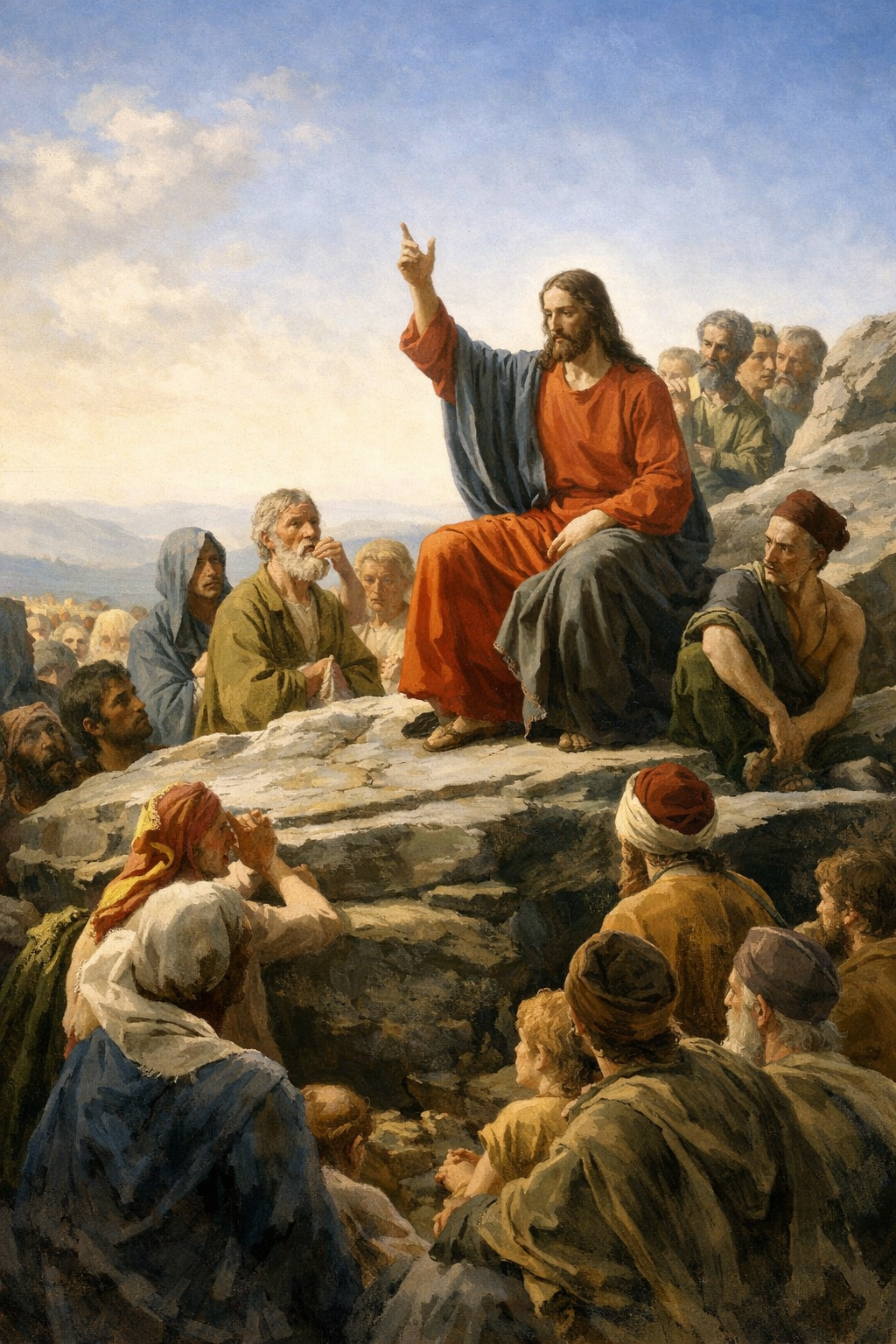
Sermon on the Mount
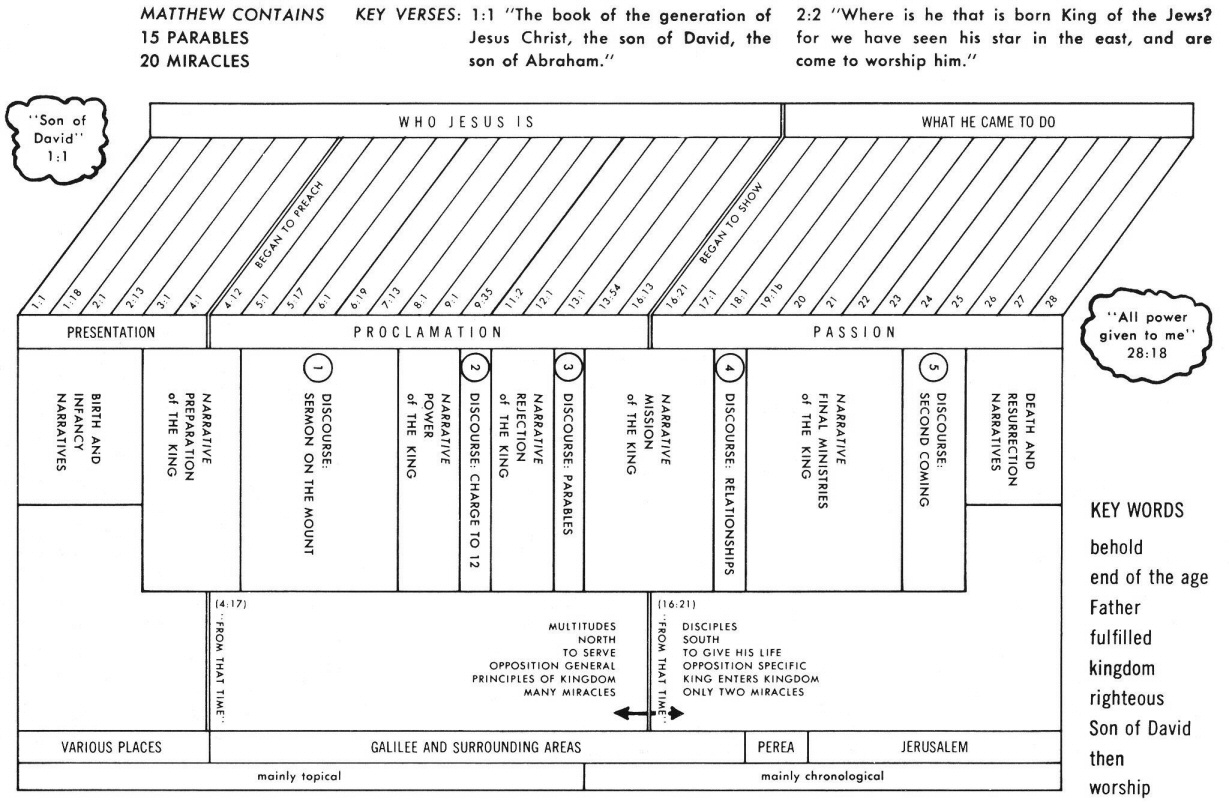
Click chart to enlarge
Charts from Jensen's Survey of the NT - used by permission
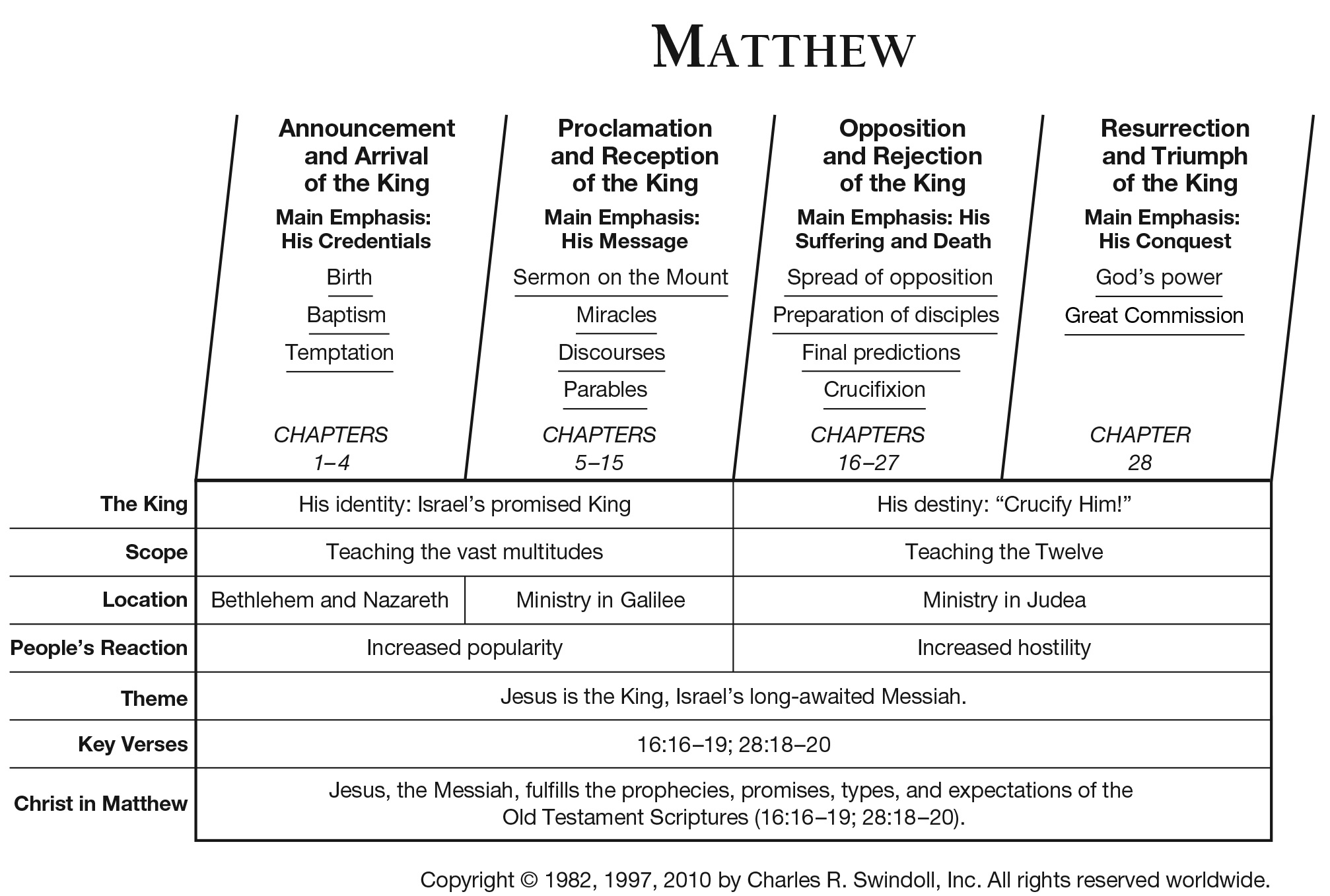
Another Chart from Charles Swindoll
THE LIFE OF JESUS AS COVERED
BY MATTHEW (shaded area)
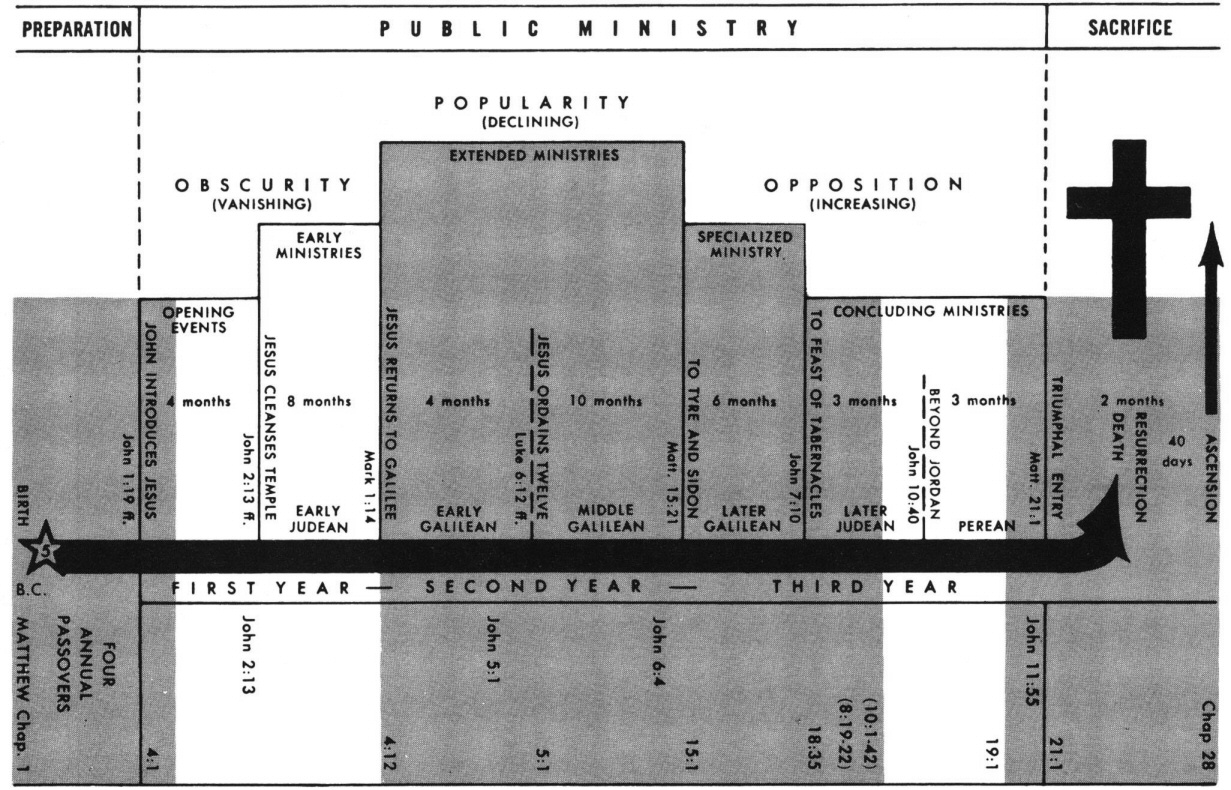
Click chart to enlarge
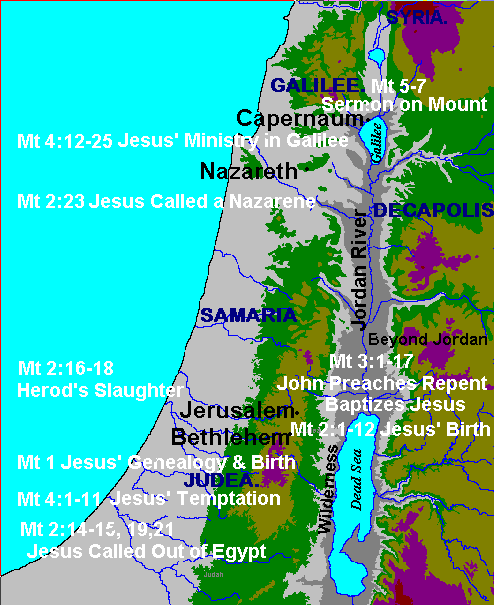
Jesus Birth and Early Years
Leading up to the Sermon on the Mount
Matthew 1-7

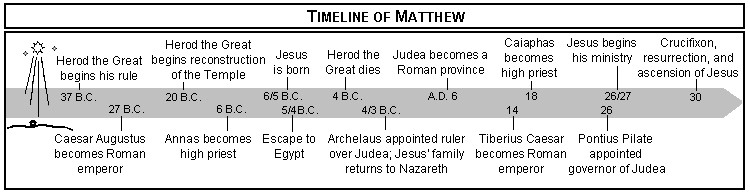
Source: Ryrie Study Bible
Matthew 6:11 'Give us this day our daily bread. (NASB: Lockman)
Greek: Ton arton hemon ton epiousion dos (2SAAM) hemin semeron;
Amplified: Give us this day our daily bread. (Amplified Bible - Lockman)
KJV: Give us this day our daily bread.
NLT: Give us our food for today (NLT - Tyndale House)
Philips: Give us this day the bread we need (New Testament in Modern English)
Wuest: Our bread, that for the coming day, give us today.
Young's Literal: 'Our appointed bread give us to-day.
|
THE LORD'S |
|
|
Our Father Who is in heaven... |
|
|
Your Kingdom Come... |
|
|
Your will be done... |
|
| Index #4 |
Give us this day our daily bread... |
| Index #5 |
Forgive us our debts... |
| Index #6 |
Do not lead us into temptation... |
| Index #7 |
For Yours is the kingdom... |
GIVE US THIS DAY OUR DAILY BREAD: Ton arton hemon ton epiousion dos (2SAAM) hemin semeron
- Mt 4:4; Exodus 16:16-35; Job 23:12; Psalms 33:18,19; 34:10; Proverbs 30:8; Isaiah 33:16; Luke 11:3; John 6:31-59; 2 Th 3:12; 1 Ti 6:8
- Matthew 6 Resources - Multiple Sermons and Commentaries
- Matthew 6:11 The Provision of Prayer, Pt. 1 - John MacArthur
- Matthew 6:11 The Provision of Prayer, Pt. 2 - John MacArthur
“Give us bread today for the coming day”
“Give us today the bread we need for today”
Our bread, that for the coming day, give us today. (Wuest)
J C Ryle explains that "We are here taught to acknowledge our entire dependence on God for the supply of our daily necessities. As Israel required daily manna ("Then the LORD said to Moses, "Behold, I will rain bread from heaven for you; and the people shall go out and gather a day's portion every day, that I may test them, whether or not they will walk in My instruction." Ex 16:4), so we require daily “bread.” We confess that we are poor, weak creatures in need (cf "poor in spirit" Matthew 5:3), and beseech our Maker to take care of us. We ask for “bread” as the simplest of our wants, and in that word we include all that our bodies require.
C H Spurgeon's comments...
Give us this day our daily bread.
We pray for providential supplies for ourselves and others — “Give us .”
We ask for our food as a gift — Give us.” We request no more than bread, or food needful for us. Our petition concerns the day, and asks only for a daily supply; bread enough for this day. We ask not for bread which belongs to others, but only for that which is honestly our own, — “our daily bread. ” It is the prayer of a lowly and contented mind, of one who is so sanctified that he waits upon God even about his daily food, and of one who lovingly links others with himself in his sympathy and prayer.
Give me, Lord, both the bread of heaven, and of earth: that which feeds my soul, and sustains my body. For all I look to thee, my Father. (Commentary)
Give (1325) (didomi) is again in the aorist imperative calling for this to be carried out effectively and even with a sense of urgency.
Give Us - Not "give me"! Intercede for your brethren as well as yourself.
Daily (1967) (epiousios) is an interesting, somewhat difficult to explain Greek word because it does not have an etymology upon which all expositors agree. The Greek word is epiousios (some feel it derives from epí = for or into + ousía = being, substance) appears to have been coined by the gospel writers. It pertains to recurring on a daily basis and in the NT is used only here and in Luke 11:3, the parallel prayer. It is descriptive of a daily and needed portion of food, that which suffices for each day or for the coming day.
Vine feels that epiousios is derived from epi + eimi = to go and thus means "(bread) for going on, i.e., for the morrow and after, or (bread) coming (for us). This suits the added sēmeron, “today,” i.e., the prayer is to be for bread that suffices for this day and next, so that the mind may conform to Christ’s warning against anxiety for the morrow."
The NET Bible note says "Give us bread today for the coming day," or "Give us today the bread we need for today."
Bread (740) (artos) refers to bread.
Wuest translates this passage - Our bread, that for the coming day, give us today.
This translation may sound redundant, but it is a precious and urgent petition by those who live from hand to mouth.
EBC adds that this is a petition "for one day at a time ("today"), reflecting the precarious lifestyle of many first-century workers who were paid one day at a time and for whom a few days' illness could spell tragedy. (Gaebelein, F, Editor: Expositor's Bible Commentary 6-Volume New Testament. Zondervan Publishing)
Even though God knows our needs before we ask, this prayer acknowledges our dependence on His for daily provisions, spiritual and physical. Note that is a prayer for our needs not our greeds.
D. L. Moody knew the secret of spiritual "daily bread" writing "A man can no more take a supply of grace for the future than he can eat enough today to last him for the next 6 months, nor can he inhale sufficient air into his lungs with one breath to sustain life for a week to come. We are permitted to draw upon God’s store of grace from day to day as we need it!
God never gives His strength in advance, so let’s stop crossing bridges before we come to them. The Heavenly Father will graciously supply our every need—one day at a time! Don’t try to bear tomorrow’s burdens with today’s grace.
Prayer should be more than a wish list so if we pray as Jesus taught us, we'll do much more than say, "Our Father, give us."
Teach me to pray, Lord, teach me to pray;
This is my heart-cry day unto day.
I long to know Thy will and Thy way;
Teach me to pray, Lord, teach me to pray. --Reitz
Ray Stedman in his sermon on Luke 11:3-4 When Prayer Becomes Personal has some wonderful thoughts on this topical sentence...
You will notice that this is a prayer for the whole of man: body soul and spirit. With magnificent accuracy he puts his finger squarely on the area of paramount need in each of these areas so that if we understand this prayer properly, and pray it as it should be prayed, there is really nothing further to be said. This magnificent prayer covers every aspect of life.
This is one of the amazing things about the Bible -- how the writers of Scripture were able to reduce to the simplest terms some of these mighty themes of life, stating them in just a word or two, so that we can grasp what they mean. As we will see, however, this prayer is not intended to be merely repeated over and over in some mechanical rote-fashion like a Christianized prayer-wheel; though, unfortunately, it has become that in some circles. This prayer is intended to become a guide to prayer. Each of these areas is capable of infinite expansion as to detail, but, in principle, this is a completely adequate prayer. Nothing more needs to be said if we have genuinely prayed as our Lord indicates. There is no essential area of life neglected. God's interest and love for man touches the whole of our lives every single area. That is why Paul says "Pray about everything. And do not forget," he adds, "to thank him for the answers," (1Thes 5:18-note.)
Jesus begins this section of the prayer with the needs of the body. I like that! I find that we have such distorted concepts of prayer that we often feel there is something wrong with praying about physical needs. I am afraid this is a reflection of a pagan concept of life. The Greeks regarded the body as coarse and unworthy of redemption and they therefore mistreated it. They beat their bodies tortured and tormented them. You find this philosophy widespread in the Orient today, this idea that the body must be subdued by physical torment or suffering, but you never find this in the New Testament nor in true Christian faith. Oh, I know there is that verse in Philippians which in the King James' Version speaks of looking for "the coming of the Lord Jesus who shall change our vile body" (Philippians 3:21), but all you can say about that is that it is a very vile translation! The word does not mean vile at all, it means "a body of lowliness, of humiliation" that is not yet glorified. It has not yet entered into the ultimate state that God has designed for it. But Paul is not saying there is anything wrong with the body.
It is important that we see that prayer must quite properly begin on this level. God likes bodies. That may startle you, but it is true. God engineered and designed them, and he likes them. It is perfectly proper then that we pray about the need of the body. Bread here is a symbol of all the necessities of physical life. It includes more than mere bread; it stands for all that our physical life demands -- shelter, drink, clothing -- anything that the body requires. The vital concern in this area is that there be available to us an immediate unbroken supply. So this prayer moves right at the issue when it says "Give us this day each day our daily bread." The only limit in this prayer is that we are never to pray for a warehouse a full supply for a year ahead. There are no giant economy packages available to us in this are of life. We are to pray for one day's supply.
Now I would like to put this simply to your own heart as I have asked my own this week. Do you pray daily for your physical needs? I wonder if any really do this. Do we pray about the supply of our food, clothing, shelter, and all the physical necessities of life? Do we take time to ask God for them or at least to give thanks for them? Perhaps this has become such a familiar request in the repeating of The Lord's Prayer that it has lost any real meaning to us, and we do not take it seriously. It may therefore be that this is the most flagrant and frequent area of Christian disobedience. For, after all, our Lord meant it when he told us to pray "give us each day our daily bread."
"Oh," you say, "I say grace before every meal." Yes, so do I, but unfortunately I find that it is often so perfunctory so mechanical it really sounds like a sanctimonious way of saying "Let's eat." When I was in high school in Montana we had a neighbor who was a self-confessed atheist, a godless fellow, but with a very engaging personality. We boys often went out to his place because he was a very generous man and let us do many interesting things on his ranch, but he had no use for the gospel or for Christian things. At meal time he engaged in a form of ribald mockery in this matter of giving thanks. I think he did it to shock us. But he would sit down to the table and before anyone could start to eat he would say "Now we are going to say grace," and he would fold his hands and say,
"Pass the bread and pass the meat,
Pitch in, you gol-darn fools, and eat."
Of course he intended it as mockery, but I wonder if our own graces, repeated perfunctorily, mechanically, are not equally as blasphemous? I do not wish to be negative at this point, but I am sure that there must have been some good reason why the Lord told us to pray this way.
I know there are many who are ready to argue that Jesus said elsewhere, "Your Father knows that you have need of these things even before you pray" (Matthew 6:8), so it is not in order to inform God of our needs. And there are others who say it really makes little difference, whether they pray about physical things or not. They get the necessities of life regardless. Furthermore, some say there are many people who never bother to pray at all and who are eating steak and ice cream while we Christians are trying to get along on hamburgers and jello. What is the point, then, of praying?
The answer to that question really touches the central value of prayer. It is very illuminating. Obviously, prayer is not something by which we inform God of our needs or influence him. But prayer is designed to influence us. It is we who are in need of this kind of prayer, not God. Of course, he knows what we have need of, for he knows everything about us. But prayer is something we need. God does not need to be told, but we need to tell him, that is the point.
If you want to see why, ask yourself the question, "What happens to me when I neglect this area of prayer?" If you are honest and look at your life over an extended period of time, you will see that, inevitably, a slow and subtle change occurs in the heart of a Christian who does not pray about material things, who does not take time to thank God for his daily supply of food, shelter and raiment -- the necessities and the luxuries of life.
What happens is that we take these things for granted, and gradually we succumb to the quite foolish delusion that we actually can provide these necessities ourselves. We become possessed with the incredible vanity that our wisdom and our abilities have really made these things possible, that we can supply these things quite apart from God. And when we begin to think that way, we find pride swells within us and a kind of blindness settles upon us, a blindness which darkens our spiritual insight, and we become moody, restless and depressed.
The book of Daniel vividly describes this type of thinking in the story of Nebuchadnezzar, that proud monarch of Babylon, the greatest king of the greatest nation of his age. He walked out in the evening hours upon the battlements of his palace in the city of Babylon, looked out over the city, and said, "Is not this great Babylon, which I have made? My wisdom has built this, my ability has brought it to pass," (Daniel 4:30). He revelled in what he thought were his powers, inherent in himself, by which all this came to pass. As a result of that defiant assumption of basic powers of supply in his life, God brought upon him the judgment of bestiality. He became a beast, and was turned out to grass, to eat in the fields like an animal, which is simply God's dramatic way of saying that ingratitude causes men to become animal-like, to become beasts, with all the ferocity and self-centeredness of a beast growling over his food.
I remember Dr. Ironside telling of an occasion when, as a young man, he went into a cafeteria to eat. When he took his tray and looked around for some place to sit down he found that all the seats in the room were taken except for one chair opposite a man already seated at a table. Ironside went over and asked if he might sit down and the man looked up and grunted something. So Ironside sat down, and, as his custom was, bowed his head and began silently to give thanks for his food before he began to eat. When he looked up he saw the man was eyeing him, almost glowering, and the fellow said to him, "What's the matter, anything wrong with your food?" Ironside said, "No, I don't think so. It seems all right to me." "Well," he said, "have you got a headache or something?" And Ironside said, "No, I haven't. Why do you ask?" "Well," he said, "I noticed you bowing down, and putting your hand up to your head, and closing your eyes. I thought there was something wrong with your head." The tone of voice he was using indicated he wanted to make an issue out of this, but Ironside said to him, "Well, I was simply returning thanks to God for my food." The man snorted, and said, "Oh, you believe in that bosh, do you?" And Ironside said, "Don't you ever give thanks?" He said, "No, I don't. I don't believe in giving thanks for anything. I just start right in." And Ironside said, "Oh, you're just like my dog. He never gives thanks, either, he just starts right in."
After all, it is we who need to give thanks to God, it is we who must always be reminding ourselves that everything we have comes from his hand, and that any moment he can turn it off if for any reason he may choose, that it is only his grace and his goodness that keep it flowing unhindered to us. The only way, therefore, that we can avoid this terrible sin of ingratitude, which the book of Proverbs calls "the sin that is sharper than a serpent's tooth," is to pray daily. Remember that,
Back of the bread is the snowy flour,
And back or the flour, the mill,
And back of the mill is the field of wheat,
The rain, and the Father's will."
F B Meyer has the following devotional on GOD'S PROVISION -
"Give us this day our daily bread."--Matt. 6:11.
IF YOU want daily bread, and would pray for it aright, you must ask as a child; and you must put first, before your own satisfaction, the Hallowing of God's Name, and the doing of His Will. Implicitly you suggest that if He gives you bread, you will use the strength it gives for His service.
Let us ever think of God as the bountiful and generous Giver. Too often He has been described as hard and austere, and as a result, men dread God, and only think of Him when they have done wrong. But we should describe Him as the All-Giver, who gives all things to all with the most royal generosity. He gives sunbeams and dewdrops, showers and rainbows, grace and glory, His beloved Son and His Spirit, human love and friendship, the daily spreading of our table, the provision of all that we need for life and godliness. Whether we wake or sleep, whether we are evil or good, whether we are pleasing to Him or not; to those who forget and blaspheme Him equally as to the saints and martyrs of the Church, God gives with both hands, pressed down and running over. We cannot buy, we do not merit, we cannot claim, but we may rely on Him to give. God is Love; and Love cannot refrain from giving, or it ceases to be Love.
Yet how low God stoops! He is so great, that His greatness is unsearchable. He dwells in the high and lofty place. His sun is ninety-seven millions of miles away from our earth; He has filled the heavens with countless constellations, for each of which He has a name. He puts the Himalaya into a scale, and the islands are as dust in His balances; but Jesus has taught us to say, "Our Father, give us bread!" When we get troubled about the immensity of heaven and the distances of the universe, let us come back to the discourse, of which this prayer is part, and which tells us that the great God thinks about the clothing of the lilies, the down on a butterfly's wings, the food of the young lions in the forest, the store of acorns that squirrels accumulate for their provision. It is wonderful to remember that from the first days of man's sojourn on earth, our Father has been laying up stores for us. Though we may be among the youngest children of Time, we come to a table as richly plenished and provided as those who first tasted of His bounty. "Fear not, it is your Father's good pleasure to give."
PRAYER - Heavenly Father, let me not be anxious about to-morrow's provision or path, but trust Thee to provide and lead for to-day. Open Thine hand, and satisfy the desire of every living thing. AMEN. (F. B. Meyer. Our Daily Walk)
Matthew 6:12 'And forgive us our debts, as we also have forgiven our debtors. (NASB: Lockman)
Greek: kai aphes (2SAAM) hemin ta opheilemata hemon, os kai hemeis aphekamen (1PAAI) tois opheiletais hemon
Amplified: And forgive us our debts, as we also have forgiven (left, remitted, and let go of the debts, and have given up resentment against) our debtors. (Amplified Bible - Lockman)
KJV: And forgive us our debts, as we forgive our debtors.
NLT: and forgive us our sins, just as we have forgiven those who have sinned against us. (NLT - Tyndale House)
Philips Forgive us what we owe to you, as we have also forgiven those who owe anything to us. (New Testament in Modern English)
Wuest: And forgive us the moral obligations we owe, even as also, as for us, we have forgiven those morally obligated to us.
Young's Literal: 'And forgive us our debts, as also we forgive our debtors.
AND FORGIVE US OUR DEBTS: kai aphes (2SAAM) hemin ta opheilemata hemon
- See related topic of "blessed are the merciful" Matthew 5:7-note
- See Jesus' continuation of this topic of forgiveness in Matthew 6:14-note
- Exodus 34:7; 1Kings 8:30,34,39,50; Psalms 32:1; 130:4; Isaiah 1:18; Daniel 9:19; Acts 13:38; Eph 1:7; 1 Jn 1:7, 8, 9
- Mt 18:21, 22, 23, 24, 25, 26, 27,34; Luke 7:40, 41, 42, 43, 44, 45, 46, 47, 48; 11:4
- Matthew 6:12, 14-15 The Pardon of Prayer, Pt. 1 - John MacArthur
- Matthew 6:12, 14-15 The Pardon of Prayer, Pt. 2 - John MacArthur
- Matthew 6:12, 14-15 The Pardon of Prayer, Pt. 3 - John MacArthur
Give us, this day, our daily bread;
And, as we those forgive
Who sin against us, so may we
Forgiving grace receive.
And (2532) (kai) is used to connect each of the last three petitions, whereas the first three are "independent". Why connect the last three? This connection speaks of all three as absolutely necessary, food for the body, forgiveness for the soul and deliverance from temptation for the spirit.
Spurgeon has a rebuttal for the one who says "I have no need to pray this sentence for I have no trespasses"...
Dear one, look at your own heart. I will have no argument with you. Take the bandage off your eyes. You are about as full of sin as an egg is full of protein. Among the rest of your many sins is this rotten egg of an accursed pride about your own state of heart.
THE WORST FORM
OF HYPOCRISY
J C Ryle explains that in this index sentence "We confess that we are sinners, and need daily grants of pardon and forgiveness. This part of the Lord’s Prayer deserves especially to be remembered. It condemns all self-righteousness and self-justifying. We are instructed here to keep up a continual habit of confession at the throne of grace, and a continual habit of seeking mercy and remission. Let this never be forgotten. We need daily to wash our feet (John 13:10)... Its object is to remind us that we must not expect our prayers for forgiveness to be heard if we pray with malice and spite in our hearts towards others. To pray in such a frame of mind is mere formality and hypocrisy. It is even worse than hypocrisy: it is as much as saying, “Do not forgive me at all.” Our prayers are nothing without love. We must not expect to be forgiven if we cannot forgive.
Why would Jesus mention forgiveness so far down the "list" of this model prayer? What is the emphasis in the first three topical sentences? God the Father - worship, longing for His Kingdom, desiring His will, seeking His provision for our life needs.
Here is the point - When we see the greatness and goodness of our Father Who art in heaven, how can we mere mortals choose to withhold from others the same forgiveness we have received at the time of our salvation and each and every moment of every day for the rest of our life? We must have His forgiveness, for we have wounded the heart of our Father by our sins (cp Ezek 6:9-note "I have been hurt"!), including our sins of unforgiveness, a sin which God cannot overlook for He is holy. Therefore for our prayer to be effective we must dealt with our sin.
Dearly beloved, please don't sweep your sin (including unforgiveness) "under the rug", but put it "under the blood". Unforgiveness is the number problem in almost every evangelical congregation and must be dealt with severely.
Here is an audio message from Mark Dever entitled A Friend – Philemon 1:17-25 - Listen to this one if you (or someone you know) is having difficult with forgiveness!
Proverbs warns us "He who conceals (intentionally, willfully hides or covers over sins so as to keep secret) his transgressions will not prosper (accomplish satisfactorily what is intended = generally expresses idea of a successful venture, as contrasted with failure), BUT (note the marked contrast) he who confesses (acknowledges to God) and forsakes (not just confesses but depart, leave and walk away from the sin! - equates with repentance. Enabled by the Spirit and grace, we must make a conscious choice to "walk away" from unforgiveness!) them will find compassion (mercy, pity). (Proverbs 28:13-note)
C H Spurgeon comments...
No prayer of mortal men could be complete without confession of sin.
Prayer which does not seek for pardon will fail, as the Pharisee’s prayer did. Let proud men boast as they please, those who are in Christ’s kingdom will always pray, “Forgive us our debts.”
Our Lord knew that we should always have debts to own, and therefore would always need to cry, “Forgive!
This is the prayer of men whom the Judge has absolved because of their faith in the Great Sacrifice (i.e., they are once and forever justified - Ro 5:1-note); for now to their Father (cp Mt 6:9 "Our Father"!) they come for free forgiveness, as children.
No man may pass a day
without praying “Forgive"...
This pardon we can only obtain as we freely pass over the offenses of others against ourselves: “as we forgive our debtors.” This is a reasonable, nay, a blessed requirement, which it is a delight to fulfill. It would not be safe for God to forgive a man who will not forgive others.
Lord, I most heartily forgive all who may have done me wrong, I am lenient with those who are indebted to me; and now, with a hopeful heart, I pray thee forgive me, as surer, as I now forgive all who are in and sense my debtors. (Commentary)
Forgive (863) (aphiemi [word study] from apo = implies a separation + hiemi = put in motion, send; for additional discussion see notes on study of the noun aphesis) means to send from one's self, to forsake, to hurl away, to put away, let alone, disregard, put off. It conveys the basic idea of an action which causes separation. It refers to total detachment or total separation, from a previous location or condition. In secular Greek it initially conveyed the sense of to throw and in one secular writing we read "let the pot drop" (aphiemi). From this early literal use the word came to mean leave or let go.
It is interesting that "forgive" is in the aorist imperative calling for this action to be carried out effectively and even with a sense of urgency. While it is a command to forgive, it is "activated" if you will only as we are willing to forgive those who have sinned against us. And this is turn is possible only as the Spirit energizes us giving us the desire to forgive and the power to forgive (Php 2:13NLT).
Aphiemi - 143x in 131v - abandoned(1), allow(5), allowed(2), alone(6), forgave(2), forgive(23), forgiven(23),forgives(1), gave permission(1), leave(7), leaves(2), leaving(8), left(38), let(9), let alone(6), let have(1),neglected(1), neglecting(2), permit(6), permitted(1), permitting(1), send away(3), tolerate(1), uttered(1), yielded(1).
Matt 3:15; 4:11, 20, 22; 5:24, 40; 6:12, 14f; 7:4; 8:15, 22; 9:2, 5f; 12:31f; 13:30, 36; 15:14; 18:12, 21, 27, 32, 35; 19:14, 27, 29; 22:22, 25; 23:13, 23, 38; 24:2, 40f; 26:44, 56; 27:49f; Mark 1:18, 20, 31, 34; 2:5, 7, 9f; 3:28; 4:12, 36; 5:19, 37; 7:8, 12, 27; 8:13; 10:14, 28f; 11:6, 16, 25; 12:12, 19f, 22; 13:2, 34; 14:6, 50; 15:36f; Luke 4:39; 5:11, 20f, 23f; 6:42; 7:47ff; 8:51; 9:60; 10:30; 11:4; 12:10, 39; 13:8, 35; 17:3f, 34f; 18:16, 28f; 19:44; 21:6; 23:34; John 4:3, 28, 52; 8:29; 10:12; 11:44, 48; 12:7; 14:18, 27; 16:28, 32; 18:8; 20:23; Acts 5:38; 8:22; 14:17; Rom 1:27; 4:7; 1 Cor 7:11ff; Heb 2:8; 6:1; Jas 5:15; 1 John 1:9; 2:12; Rev 2:4, 20; 11:9.
Aphiemi - 76x in the non-apocryphal Septuagint -
Ge 4:13; 18:26; 20:6; 35:18; 42:33; 45:2; 50:17; Ex 9:21; 12:23; 22:5; 32:32; Lev 4:20, 26, 31, 35; 5:6, 10, 13, 16, 18; 6:7; 16:10; 19:22; Nu 14:19; 15:25f; 22:13; Dt 15:2; 26:10; Josh 10:19; Jdg 1:34; 2:21, 23; 3:1, 28; 16:26; Ru 2:16; 2Sa 15:16; 16:10f; 20:3; 1Ki 19:3; 2Ki 4:27; 23:18; 1Chr 16:21; 2Chr 10:4, 10; 28:14; Ezra 6:7; Job 39:5, 14; 42:10; Ps 17:14; 25:18; 32:1, 5; 85:2; 105:14, 20; 125:3; Pr 4:13; 24:31; Eccl 2:18; 5:12; 10:4; 11:6; Song 3:4; Isa 22:4, 14; 32:14; 33:24; 55:7; Jer 12:7; Ezek 16:39; Da 4:15, 26
Aphiemi means to send forth or away from one's self. It refers to the act of putting something away or of laying it aside and as used here means to let go of the obligation another person has "owes" you because of sin. It means to remit (to release from the guilt or penalty of) as one would a financial debt (e.g., on the Rosetta stone it refers to the "total remission" of certain taxes). In the present context Jesus is referring to an ethical or moral debt due to some offense by another person against us. In that sense they "owe" us. It follows that the basic meaning of forgiveness is to put away an offense. Unfortunately the English word "forgive" does not adequately picture the meaning of the Greek.
In secular Greek literature, aphiemi was a fundamental word used to indicate the sending away of an object or a person. Aphiemi was used to describe the voluntary release of a person or thing over which one has legal or actual control. The related noun aphesis meant described a setting free. .Later it came to include the release of someone from the obligation of marriage, or debt, or even a religious vow. In its final form it came to embrace the principle of release from punishment for some wrongdoing. .
Colin Brown adds that aphiemi means "With a personal object, to send forth, send away (of a woman, to divorce; of a meeting, to dissolve, end), to let go, to leave, dispatch; with an impersonal object, to loose (e.g. a ship into the sea), to discharge (e.g. arrows), to give up. In the figurative sense the verb (aphiemi) means to let alone, permit, let pass, neglect, give up (taking trouble, etc.); in Josephus, Ant., 1, 12, 3, to lose one’s life, die. The legal use is important: to release from a legal bond (office, guilt, etc. and also, a woman from marriage, e.g. Hdt., 5, 39), to acquit (e.g. cancellation of criminal proceedings, Plato, Laws, 9, 86, 9d), to exempt (from guilt, obligation, punishment, etc.; e.g. Hdt., 6, 30). Similarly the noun aphesis (e.g. Demosthenes, 24, 45) means release, pardon, or remission, etc (Brown, Colin: New International Dictionary of NT Theology. 1986. Zondervan)
Aphiemi was also used of teachers, writers, and speakers when presenting a topic, in the sense of “to leave, let alone, disregard, not to discuss now". It means “to abandon, to leave as behind and done with in order to go on to another thing.”
The Greek Old Testament, the Septuagint, contained many of these ideas. In the Old Testament aphiemi spoke of releasing a prisoner or remitting a debt, but it also came to mean pardon or forgiveness.
Trench says that the image underlying aphiemi is that of releasing a prisoner (Isaiah 61:1), or letting go, as of a debt (Dt 15:3). One is reminded of the one goat who was offered as a sin-offering on the Day of Atonement (Lv 16:20), and of the other goat upon which was placed the sins of the people (symbolically) and which was let go in the wilderness, never to be seen again by Israel, the latter goat typifying that aspect of redemption in which the sins of the human race were put away, never to be charged against the individual again (Lv 16:20).
Wuest explains aphiemi from God's perspective noting that "It refers to the act of putting something away. God did that at the Cross when He put sin away by incarnating Himself in humanity in the Person of His Son, stepping down from His judgment throne, assuming the guilt of man’s sin, and paying the penalty, thus, satisfying His justice, and making possible an offer of mercy on the basis of justice satisfied. When a sinner avails himself of the merits of that atoning sacrifice, he thus puts himself within the provision God made. His sins were put away at the Cross, and he comes into the benefit of that when he believes. (Wuest's Word Studies from the Greek New Testament: Studies in the Vocabulary of the Greek New Testament) (Bolding added)
Richards notes that aphiemi "is a verb that occurs 146 times in the NT. It has the sense of "forgive" 49 of these times, 44 of which occur in the Gospels; but it has this meaning only once in Paul's writings (Ro 4:7). It is used in the sense of forgiveness of sins, of debts, and of crimes. The majority of the occurrences of aphiemi convey a meaning other than forgiveness: i.e., dismiss, release, leave, or abandon. (Richards, Larry:. Expository Dictionary of Bible Words. 1985. Zondervan)
The aorist imperative is a command which calls for this to be carried out with effectively and even with a sense of urgency.
Our English word “forgive” does not, as commonly used, give an adequate picture of the Greek word. We say that we have forgiven some one who has wronged us. By that we usually mean that any feeling of animosity we may have had, has changed to one of renewed friendliness and affection. We do not hold the wrong done us against the person anymore. But so far as the act itself is concerned, we cannot do anything about it. It has been done, and it cannot be removed from the one who committed the wrong.
When missionaries in northern Alaska were translating the Bible into the language of the Eskimos, they discovered there was no word in that language for forgiveness. After much patient listening, however, they discovered a word that means, “not being able to think about it anymore.” That word was used throughout the translation to represent forgiveness, because God’s promise to repentant sinners is, “I will forgive their iniquity, and their sin I will remember no more” (Jer. 31:34).
Henry Law writes that forgiveness "is remission of due penalties, the obliteration of incurred guilt, the withdrawal of just displeasure, the blotting out of accusing handwriting, the burying all offences in oblivion, the hushing of the loud thunder of the law, the canceling of its tremendous curse, the consigning to a sheath the sword of justice. It is the frown of Jehovah softening into eternal smiles. It encounters sin, and strips it of its destroying power. (FORGIVENESS OF SINS - 17 Chapter Treatise on this subject!)
Debts (3783) (opheilema from opheílo = to owe - see study of related opheiletes) is that which is owed or obligations we have incurred; including sins of omission and commission. Sins are moral and spiritual debts to God that must be paid. In his account of this prayer, Luke uses hamartia (“sins”; Luke 11:4), clearly indicating that the reference is to sin, not to a financial debt. Matthew probably used debts because it corresponded to the most common Aramaic term (hoba) for sin used by Jews of that day, which also represented moral or spiritual debt to God.
The only other NT use is Romans 4:4 - "Now to the one who works, his wage is not credited as a favor, but as what is due."
Opheilema is used twice in the Septuagint of Dt 24:10.
Gilbrant - Classical Greek gave opheilē the literal meaning of “debt” as in a monetary debt. By the time of the Koine period opheilē was found to have kept its literal usage while two other general meanings were added. It retained the idea of a literal sum of money owed in debt. A new connotation of debt grew out of this. It referred to anything one owed another or one’s “obligation.” Finally, a religious sense of guilt and sin developed from this idea with the Early Church fathers. (Complete Biblical Library)
In this petition disciples ask God's forgiveness for their failure to live according to His will. John writes...
If we confess our sins, He is faithful and righteous to forgive us our sins and to cleanse us from all unrighteousness. (1John 1:9-note)
Pastor Ray Pritchard writes that...
Augustine called this text “a terrible petition.” He pointed out that if you pray these words while harboring an unforgiving spirit, you are actually asking God not to forgive you. Ponder that for a moment. If you pray “Forgive us our debts as we forgive our debtors” while refusing to forgive those who have wronged you, this prayer which is meant to be a blessing becomes a self-inflicted curse. In that case you are really saying, “O God, since I have not forgiven my brother, please do not forgive me.”
That is why Charles Haddon Spurgeon, the great English preacher, said that if you pray the Lord’s Prayer with an unforgiving spirit, you have virtually signed your own “death-warrant.” During one period of his life, John Wesley was a missionary in the American colonies—primarily in the area that would become the state of Georgia. There was a general by the name of Oglethorpe with whom Wesley had some dealings. General Oglethorpe was a great military leader, but he had a reputation as a harsh and brutal man. One day he said to John Wesley, “I never forgive.” To which Wesley replied, “Then, sir, I hope you never sin.”
When we pray, “Forgive us our debts as we forgive our debtors,” we are asking God to forgive our sins according to the same standard we have used in forgiving the sins of others. There are 11 words in the text, but only one of them is important for our purposes. It’s the little word “as.” Everything hangs on the meaning of that word. “As” is the conjunction that joins the first half of the petition with the second half. When Jesus says “as,” he is setting up a comparison between the way we forgive and the way God forgives us.
This text says that we set the standard and then God follows the standard. We establish the pattern and then God follows that pattern in the way He deals with us. When you pray this prayer you are really saying, “O God, deal with me as I deal with other people. Deal with me as I have dealt with others.” We are virtually saying, “O God, I’ve got a neighbor and I did some favors for my neighbor and my neighbor is ungrateful to me for all I have done. I am angry with my neighbor and I will not forgive him for his ingratitude. Now deal with me as I have dealt with my neighbor.” It’s as if we’re praying, “O God, that man hurt me. I am so angry I can’t wait to get even. Deal with me as I have dealt with him.” We set the standard and God follows our lead. Unless you forgive you will not be forgiven. To refuse to forgive someone else and then to ask God for forgiveness is a kind of spiritual schizophrenia. You are asking God to give you what you are unwilling to give to someone else. The fifth petition of the Lord’s Prayer tells us you cannot have it both ways. Do you want to be forgiven? You must forgive others. (Matthew 6:12 Forgiveness and the Lord’s Prayer)
Illustration - The Forgiveness Flower - One day when Stan Mooneyham was walking along a trail in East Africa with some friends, he became aware of a delightful odor that filled the air. He looked up in the trees and around at the bushes in an effort to discover where it was coming from. Then his friends told him to look down at the small blue flower growing along the path. Each time they crushed the tiny blossoms under their feet, more of its sweet perfume was released into the air. Then his friends said, "We call it the forgiveness flower." This forgiveness flower does not wait until we ask forgiveness for crushing it. It does not release its fragrance in measured doses or hold us to a reciprocal arrangement. It does not ask for an apology; it merely lives up to its name and forgives-freely, fully, richly. What a touching example of outrageous forgiveness!
AS WE ALSO HAVE FORGIVEN OUR DEBTORS: hos kai hemeis aphekamen (1PAAI) tois opheiletais hemon
- Mt 6:14, 15; 18:21,22,28-35; Neh 5:12,13; Mk 11:25,26; Lk 6:37; 17:3, 4, 5; Ep 4:32-note; Col 3:13
- Matthew 6 Resources - Multiple Sermons and Commentaries
- Matthew 6:12, 14-15 The Pardon of Prayer, Pt. 1 - John MacArthur
- Matthew 6:12, 14-15 The Pardon of Prayer, Pt. 2 - John MacArthur
- Matthew 6:12, 14-15 The Pardon of Prayer, Pt. 3 - John MacArthur
THE CRITICAL LITTLE
WORD "AS"
as we also have forgiven (left, remitted, and let go of the debts, and have given up resentment against) our debtors. (Amplified)
I found a little remedy
To ease the life we live
And make each day a happier one:
It is the word "forgive"
—Anon.
As (hos) is the key word in this verse, which marks a comparison (see terms of comparison) between the way we forgive and the way God forgives us. In a sense, we set the "standard" and God follows the standard in the way He deals with us in the issue of forgiveness.
What we are praying in Mt 6:12 in essence is something like this...
O God, deal with me as I deal with other people. Deal with me as I have dealt with others.
MacArthur writes “Blessed are the merciful,” our Lord said, “for they shall receive mercy” (Mt. 5:7-note). If we want to enjoy the benefits of God’s forgiveness toward us, we must be willing to forgive other believers, even those who repeatedly sin against us. Or we can express this final principle more directly, which is that God does not forgive those who do not forgive others (Mt. 6:15-note). That does not mean that an unforgiving attitude nullifies a believer’s salvation. In the eternal scope of things, God forgives all the sins of those who are in Jesus Christ. But an attitude that refuses to forgive fellow believers will rob a Christian of his joy, peace, fellowship, and usefulness in the church. (MacArthur, J. The Pillars of Christian Character: The Basic Essentials of a Living Faith. Wheaton, Ill.: Crossway Books)
So if we are angry with a friend for failure to thank us for help we provided, we are asking God to deal with us as we are dealing with our neighbor. Unless we forgive we will not be forgiven. To refuse to forgive someone and then ask God for forgiveness is to ask God to give us what we are unwilling to give to someone else. You cannot have it both ways.
Do you want to experience God's forgiveness?
You must forgive others.
The channel of God's grace is blocked from the human side. We are saying in essence we would rather harbor bitterness and grudges than experience the daily blessing of the joy of the Lord (Neh 8:10). Lack of divine forgiveness in this verse is to be distinguished from the complete and eternal forgiveness of our "debts" which transpired when our sins were placed on Christ's account the moment we by grace through faith received Him as Lord and Savior. That transaction (justification = one time event, "past tense" salvation) is forever immortalized and does not need to be repeated. But once we are justified by faith, we enter into what I call "present tense" salvation (progressive sanctification) in which we are growing in grace and the knowledge of our Lord and Savior Jesus Christ (2Pe 3:18, "being saved" in 1Co 1:18). This aspect of salvation constitutes this present earthly life and is the phase to which Jesus is speaking in Mt 6:12. If we fail to forgive others the debt they owe us, our inner peace is disrupted and our conscience is disturbed. God wants us to forgive the debt that we might experience His peace that passes all human comprehension. So the primary effect of our failure to forgive is loss of intimacy, communion or fellowship with our Father. Pastor Ray Pritchard summarizes the consequences of an unforgiving spirit (and this list is far from complete)...
1. Our fellowship with the Father is blocked or disrupted.
2. The Holy Spirit is grieved. (see Eph 4:30-note, Ep 4:31, 32-note)
3. Our prayers will be hindered and will not be answered. (Ps 66:18-note)
4. God leaves us alone to face the problems of life in our own power (and He may add a few more "problems"). (He 12:5-11-note, Mt 18:34, 35)
5. The devil potentially gains a foothold through our unwillingness to forgive (specifically as manifest by anger we refuse to relinquish). (Ep 4:27-note)
6. We force God to become our enemy.
7. We lose the blessing of God on our life.
8. We waste time (and emotional energy) nursing a wounded spirit.
9. We become enslaved to the people you hate. (The opposite of obeying - Jn 8:31, 32)
10. We become like those we refuse to forgive.
Pritchard writes...
Our real problem at this point is not theological. Our real problem is personal. We don’t see ourselves as very great sinners; therefore, we do not appreciate how greatly God has forgiven us (Ed: Think Ps 103:12-note, Mic 7:18, 19, Isa 38:17, 43:25). But when your own sins seem small, the sins of others against you will seem big indeed. (cp Mt 7:3, 4-note)
The reverse is also true. The greater you see the depth of your sin before God, the less the sins of other people against you will bother you (Ed: And the greater you see the Cross, Gal 6:14-note, the less the sin of others will seem in comparison to your sin which cost God's Son's life on the Cross!). If you think you’re not much of a sinner, then the offenses of other people are going to appear in your eyes as big...
How do we know when we have truly forgiven? What does forgiveness look like? The answer will vary depending on the person involved and what they did to you. Here are a few helpful guidelines (taken partly from Kendall and also from a list by the Puritan author Thomas Watson, as supplied by Waylon Moore):
We know we've forgiven them when we...
1. Face what they did and forgive them anyway
2. Don’t keep bringing it up to them.
3. Don’t talk about it to others.
4. Show mercy instead of judgment. (Mt 5:7-note, Jas 2:13)
5. Refuse to speak evil of others.
6. Choose not to dwell on it.
7. Pray for them. (Mt 5:44-note)
8. Ask God to bless them. (Ro 12:14-note)
9. Do not rejoice at their calamities. (1Co 13:5-note)
10. Help them when you can.
Jesus is telling us that there is a vital link between the way you treat other people and the way God in heaven is going to treat you. Let’s face it. We don’t like that. On one level we tend to think it would be good if we could hate someone for what they did to us and still have the blessings of God, still be filled with the Spirit, still walk in joy every day, still radiate the love of Jesus, and still have our prayers answered. We’d much prefer if we could just have our relationship with God insulated and encapsulated so we could treat other people any way we like. Jesus says, “No deal. You can’t have it that way.” Unless you forgive you will not be forgiven. This is a hard word, isn’t it? But it is a hard word of grace. Many of us desperately need to take a searching moral inventory and ask ourselves some serious questions:
Am I up to date on my forgiving?
Am I holding a grudge against anyone?
Do I harbor any bitterness against any person?
Am I talking too much about what others have done to me?
Have I forgiven those closest to me who have hurt me so deeply?
Someone says, “But I can’t forgive.” No, don’t ever say that. The word “can’t” is a cop-out. The issue is deeper than that. You won’t forgive. Don’t make excuses and don’t play games. If you are a true Christian, a genuine believer in Jesus Christ, if your sins have been washed away, then you can forgive. What God has done for you, you can do for others. There may be some people who won’t forgive. As long as you won’t forgive you’re better off if you never pray the Lord’s Prayer because unless you forgive you will not be forgiven.
And in all of this we have the example of our Lord Jesus Christ who when he was crucified—the innocent for the guilty—the just for the unjust—the righteous for the unrighteous—Jesus, who was murdered at the hands of wicked men, as he hung on the cross cried out, “Father, forgive them for they know not what they do.”
A Place To Begin - Let’s wrap up this sermon with three simple statements of application.
1. You are never closer to the grace of Jesus Christ than when you confess your sins to him.
Are you laboring under a burden of guilt because of foolish things you have said or done? A sense of your own sin is a sign of God’s grace at work in your heart. When you cry out, “God be merciful to me, a sinner,” you will find that the Father will not turn you away.
2. You are never more like Jesus than when you forgive those who have sinned against you.
Do you want to be like Jesus? Become a great forgiver. Jesus was a forgiving Man. He came to create a race of forgiving men and women.
3. You will never fully enter into your freedom in Christ until you learn the freedom of forgiveness.
The two freedoms go together. As long as you hold on to your resentments, you are still chained to the past. You only hurt yourself. By refusing to forgive, you block off the channel of God’s blessing in your life. Although there is freedom in Christ, the unforgiving Christian knows nothing about it. He is still in bondage to the remembered hurts from the past. Until those chains are broken by a decisive act of forgiveness, he will remain a slave to the past.
I have said several times that this is a hard word and indeed it is. But it is also a cleansing word that cuts through all our flimsy excuses and leads us to a fountain of grace where we can be healed, made whole, and restored to a right relationship with our Creator. Our God freely forgave us while we were his enemies. Can we not do for others what he has done for us?
The word of the Lord remains. Unless you forgive you will not be forgiven. (Forgiveness and the Lord's Prayer)
Harry Ironside observes that...
In the government of God as Father over His own children, our forgiveness of daily offences depends upon our attitude toward those who offend us. If we refuse to forgive our erring brethren, God will not grant us that restorative forgiveness for which we plead when conscious of sin and failure. A Father's forgiveness of an erring child takes into account the attitude of the failed one toward other members of the family. This, of course, has nothing to do with that eternal forgiveness that the believing sinner receives when he comes to Christ.
John Stott explains this petition writing that...
Once our eyes have been opened to see the enormity of our offense against God (Ed: And the enormity and completeness of His forgiveness), the injuries which others have done to us appear by comparison extremely trifling. If, on the other hand, we have an exaggerated view of the offenses of others, it proves that we have minimized our own (Stott, pp. 149-50). (Stott, John: The Message of the Sermon on the Mount: 1985, Intervarsity Press)
J R Miller (Biography) wrote...
“‘Forgive us our debts, as we forgive.’
Ah, who, dear Lord, can pray that prayer?
The rest with ready zeal is said,
But, self-accused, we falter there.”“If in my heart has been
An unforgiving thought, or word, or look,
Though deep the malice which I scarce could brook,
Wash me from dark sin.”
A writer says of another, “his heart was as great as the world, but there was no room in it to hold the memory of a wrong.” This is the true ideal for every Christian heart. We have it in the prayer which we are taught to offer for forgiveness. While we ask God to forgive us, we declare to him that we have forgiven those who are indebted to us those who have trespassed against us. We say to God that there is no bitterness, no spirit of unforgiveness, in our heart.
The language is very strong. In Matthew, according to the revised Version, the petition read, “And forgive us our debts, as we also have forgiven our debtors.” In Luke it is “And forgive us our sins; for we ourselves also forgive every one that is indebted to us.” We cannot use the first part of the petition, asking our Father to forgive us, and not follow with the other in which we declare that we will show to others the same forgiveness which we ask for ourselves.
“We pray for mercy,
And that same prayer doth teach us all to render
The deeds of mercy.”
The great importance of this duty of forgiving appears when we remember how repeatedly it is brought before us. When our Lord had gone through the form of prayer, he called the particular attention of his disciples to this petition, in the words, “For it ye forgive men their trespasses, our heavenly Father will also forgive you. But if ye forgive not men their trespassed, neither will your Father forgive your trespasses.” On another occasion, when speaking of prayer and the power we may exercise through prayer — “All things whatsoever ye pray and ask for, believe that ye have received them, and ye shall have them,” Jesus added, “And whensoever ye stand praying, forgive, if ye have aught against any one; that your Father also which is in heaven may forgive you your trespasses.” Whenever we appear before God, and before we begin to speak to him, we should look into our own heart, and if we find there any bitterness, any feeling of unforgiveness, we should seek instantly to put it away. Indeed we must put it away before we can proceed with our prayer.
We pray to be made like Christ, that his image may be impressed upon us; but we cannot be like Christ unless we have the spirit of forgiveness. Too many people who call themselves Christians seem to give little thought to this phase of the Christian life. They may seek to be honest, truthful, just, and upright, but they pass over the duties of love. There is a great lack of tenderness in many lives. Yet we cannot read the New Testament without finding the lesson of gentleness on every page. In the culture of our Christian life we are exhorted to put away every trace of bitterness, and to gather into our character everything that is kindly and loving. “Be ye angry, and sin not: let not the sun go down upon your wrath.” “Let all bitterness, and wrath, and anger, and clamor, and railing, be put away from you, with all malice: and be ye kind one to another, tenderhearted, forgiving each other, even as God also in Christ forgave you.” “Put in therefore, … a heart of compassion, kindness, humility, meekness, longsuffering; forbearing one another, and forgiving each other, if any man have a complaint against any; even as the Lord forgave you, so also do ye.”
These quotations show the tone of the whole New Testament. But how close to these teachings is the church of Christ living? Are we not all disposed to be too keenly alive to anything in others which appears to touch us unkindly? We praise love, but do we live it? We want other people to practise forgiveness, but when one has wronged us, we are slow to practise it ourselves.
The lesson is not an easy one to learn. It is against nature. Only the grace of God in us will enable us to forgive. The spirit of forgiveness is really the shedding abroad in us of the love of God by the Holy Spirit (see note Romans 5:5). When we know that we are forgiven we are born anew, born from above; heaven has come down into our heart. We receive God’s forgiveness, when we receive it truly, not as something to keep only for ourselves, but as a blessing which we are to spread abroad, whose grace we are to manifest and extend to others. It is thus that all God’s gifts are to be received. He gives us comfort in our sorrow, not for ourself alone, but that we may dispense it, comforting others with the comfort wherewith we ourself have been comforted of God (2 Cor 1:4). He delivers us in temptation, that we may strengthen our brothers in their temptation (cp Luke 22:31,32). He gives us his own joy, not to hoard for ourselves, but that we may become the bearer of joy to others. He puts his love into us, that our heart may become a fountain of love in this world. So when God forgives us, He would have us represent Him among men, showing in our own disposition and conduct what the divine forgiveness is. If we are revengeful, resentful, unforgiving, how can the world learn from us the sweetness, the freeness, and the fullness, of the divine forgiveness?
The Koran says that two angels guard every man on the earth, one watching on either side of him; and when at night he sleeps, they fly up to heaven with a written report of all his words and actions during the day. Every good thing he has done is recorded at once and repeated ten times, lest some item may be lost or omitted from the account. But when they come to a sinful thing, the angel on the right says to the other, “Forbear to record that for seven hours; peradventure, as he wakes and things in the quiet hours, he may be sorry for it, and repent and pray and obtain forgiveness.”
It is thus, indeed, that God deals, with us. He is slow to see our sins or the write them down against us. He delights in mercy. The father ran to meet the returning prodigal. We should have the same spirit toward those who do any wrong to us. We should be slow to record the evil that they do and swift to set down every kindness we receive from them. Is it not too often just the reverse of this with us? Are we not quick to believe evil, to take offence, to feel hurt, to charge against our neighbor wrong motives or intentions? And are we not slow to find love in what he does, to apologize for what seems to be unkindness, to spread the veil of charity over his failures in courtesy, and his neglects of the duties of affection?
It will help us in learning this lesson of forgiveness to remember that it is not our prerogative to sit in judgment on the conduct of others. Judgment belongs to God alone. Our duty is, when wronged, to bear it patiently, praying for those who despitefully use us, committing our case to God. “Avenge not yourselves, beloved, but give place unto wrath: for it is written, Vengeance belongeth unto me; I will recompense, saith the Lord. But if thine enemy hunger, feed him; if he thirst, give him to drink: for in so doing thou shalt heap coals of fire upon his head.” (Ro 12:19, 20-notes)
Thus the lesson comes to us, written out in plainest words. We should seek to learn it, for it concerns our most sacred interests. To refuse to forgive others is to shut the door on our own hope of forgiveness. (Click for the entire dissertation on the "Lord's Prayer" by J R Miller "The Golden Gate of Prayer" ) (Note: Bolding and Scripture references added)
Pritchard asks...
What happens when we refuse to forgive? Here are ten consequences of an unforgiving spirit...
1. Our fellowship with the Father is blocked.
2. The Holy Spirit is grieved.
3. Your prayers will not be answered.
4. God leaves you alone to face the problems of life in your own power.
5. The devil gains a foothold through your bitterness.
6. You force God to become your enemy.
7. You lose the blessing of God on your life.
8. You waste time nursing a wounded spirit.
9. You become enslaved to the people you hate.
10. You become like the people you refuse to forgive.
Our real problem at this point is not theological. Our real problem is personal. We don’t see ourselves as very great sinners; therefore, we do not appreciate how greatly God has forgiven us. But when your own sins seem small, the sins of others against you will seem big indeed. The reverse is also true. The greater you see the depth of your sin before God, the less the sins of other people against you will bother you. If you think you’re not much of a sinner, then the offenses of other people are going to appear in your eyes as big. Don’t talk about repentance unless you are willing to forgive your brothers and sisters. Unless you are willing to forgive, your repentance is just so much hot air and empty talk. True repentance always starts with a change of mind that leads to a change of heart that leads to a change (in this case) in the way we view those who have sinned against us.
How do we know when we have truly forgiven? What does forgiveness look like? The answer will vary depending on the person involved and what they did to you. Here are a few helpful guidelines...:
1. Face what they did and forgive them anyway.
2. Don’t keep bringing it up to them.
3. Don’t talk about it to others.
4. Show mercy instead of judgment.
5. Refuse to speak evil of others.
6. Choose not to dwell on it.
7. Pray for them.
8. Ask God to bless them.
9. Do not rejoice at their calamities.
10. Help them when you can.
In giving this list, I do not mean to imply that we must do all ten things every time before we can say we have truly forgiven another person. The presence or absence of repentance plays a role as well. We would do well to take this list and dwell on it, think about it, pray over it, and ask ourselves some hard questions. (Matthew 6:12 Forgiveness and the Lord’s Prayer )
There are petitions for the believer to ask from God, but there are also conditions for the answers to be received. Jesus is not implying that we must earn God's forgiveness for we could never merit it. Our forgiveness to others is simply based on the fact that we ourselves have been forgiven so great a debt by God Himself. If He can forgive us, can we not as His children forgive those who have offended us, their offenses against us not even comparing to the enormity of our offenses against God! Our unwillingness to forgive others proves that we have a grossly exaggerated view of their offenses against us and that we have chosen to minimize our offenses against God.
If we fail to forgive, but instead "treasure up" the debts of others, we make ourselves vulnerable to the soul sapping condition of bitterness.
CANCER OF THE SOUL
BITTERNESS!
Bitterness is the most dangerous of all plagues to healthy Christian living. It will eat away at the vitality of your spiritual life until your once-vibrant testimony is in shambles. Bitterness is the “cancer of the soul”, and much like literal cancer, bitterness claims millions of victims each year. It spreads faster than the common cold and threatens the survival of many churches (cf He 12:15-note). Yet there is a cure for this soul crippling plague and it is found in the medicine called forgiveness, one of the most beautiful words in any language. Even the word forgive conveys the essence of act in the last four letter “give”. To "for give" means to give someone a release from the wrong that he or she has done to you. To cancel the debt. To release them from the charges. To give up any right of retaliation. Heaven future will be a place of infinite, eternal forgiveness, which is why Kingdom citizens are charged by Jesus to begin their other worldly life now by forgiving like their Father forgives them (Eph 4:32-note, Col 3:13-note, Mt 6:14, 15-note).
FORGIVENESS:
JUDICIAL
VS
PARENTAL
(FAMILY)
Note that Mt 6:12 is not the prayer of an unregenerate sinner but the supplication of a saint who has sinned. In Mt 6:12 the forgiveness that we are asking for is not related to salvation, for all of our sins were paid in full by our Lord at Calvary (Jn 19:30 "It is finished" = tetelestai in Greek = "Paid in full" = "Cancelled the Debt"). That forgiveness is reflects God's "judicial" forgiveness and is what the unregenerate sinner prays in Luke 18:13. In Matthew 6:12 the plea is that of a child of God who has grieved his heavenly Father by some wrong attitude, thought, word, or deed and needs parental forgiveness. In other words, the forgiveness that we are to ask for as saints who still commit sins is "parental" or "family" forgiveness. The point is that family forgiveness relates to fellowship, and we cannot walk in fellowship with our Father if we refuse to forgive others.
| FORGIVENESS - WHAT IT IS AND IS NOT |
|
| FORGIVENESS IS... | FORGIVENESS IS NOT... |
| A choice An act of one's will. |
A feeling |
| .Based on the truth that God in Christ has forgiven us Eph 4:32-note |
Based on what is "fair" |
| Supernatural | Natural |
|
Spirit |
A legalistic or fleshly |
|
Emanates from a renewed mind |
"Mind over matter" |
| Unconditional | Conditional |
|
From a new heart |
Just with your lips... |
|
Often a process |
Usually a one time act |
|
To be "holistic" |
Selective or partial |
| Acknowledges the debt owed you. |
Pretend that you were never hurt |
|
Commanded as a lifestyle |
A suggestion or |
|
Allows God to execute His justice |
Circumventing |
| Moving the guilty from your hook to God's hook. |
Letting the guilty |
| Possible with only one party |
Reconciliation |
| Acknowledging unjust behavior is inexcusable, yet still forgiving. |
Excusing unjust behavior |
| Complete... Resolving the anger/resentment by releasing the offense and offender |
Incomplete... Keeping a record of the wrongs 1Cor 13:5 |
| Feeling the hurt but releasing it. |
Denying that you hurt |
| Includes remembering before you can forgive |
Forgetting |
Debtors (3781) (opheiletes from opheílo = owe) describes a person who is indebted to another or bound by some duty (or under obligation). Opheiletes refers to a personal, moral obligation as contrasted to a necessity in the nature of the case. Sin makes us all debtors to God, and brings on an enslavement from which there is no release except through divine redemption and forgiveness, which in turn is to be expressed through us toward others.
It is interesting that this topic (forgiveness) is the only one for which Jesus gave an added explanation. One could arrange the passages as follows...
Forgive us our debts as we forgive our debtors… For if you forgive men their trespasses, you heavenly Father will forgive you too; but, if you do not forgive men their trespasses, neither will your Father forgive your trespasses.
Note that "for" in Matthew 6:14 is a preposition that introduces Jesus' added explanation of the vital importance of our need to forgive others.
Kent Hughes has an humorous, albeit sad true story relating to this verse...
Believers at their worst are capable of holding on to grievances. Two congregations, located only a few blocks from each other in a small community, thought it might be better if they would become one united body, and thus larger and more effective, rather than two struggling churches. But they were not able to pull it off. They could not agree on how to recite “The Lord’s Prayer.” One group wanted, “forgive us our trespasses,” while the other demanded, “forgive us our debts.” So one church went back to its trespasses, while the other returned to its debts! Believers can be stubborn, unchanging and unforgiving. (Hughes, R. K. Colossians and Philemon: The Supremacy of Christ: Crossway Books).
Wesley wrote...
While we do not from our hearts forgive our neighbor his trespasses, what manner of prayer are we offering to God whenever we utter these words (Mt 6:12)? We are indeed setting God at open defiance; we are daring Him to do His worst. "Forgive us our trespasses, as we forgive them that trespass against us." That is, in plain terms,
Do not forgive us at all. We desire no favor at your hands. We pray that you will keep our sins in remembrance, and that your wrath may abide upon us.
But can you seriously offer such a prayer to God? (John and Charles Wesley: Selected Writings and Hymns, pp. 118-19, Paulist Press, 1981)
C H Spurgeon's prayer for forgiveness...
First, we ask at Your hands, great Father, complete forgiveness for all our sins and shortcomings. We hope we can say with truthfulness that we do from our heart forgive all those who have in any way trespassed against us. There lies not in our heart, we hope, a thought of enmity towards any man. However we have been slandered or wronged, we would, with our inmost heart, forgive and forget it all.
We come to You and pray that, for Jesus' sake and through the virtue of the blood once shed for many for the remission of sins (Mt 26:28), You would give us perfect pardon of every sin of the past. Blot out, O God, all our sins like a cloud, and let them never be seen again (Is 43:25, 44:22).
Grant us also the peace-speaking word of promise supplied by the Holy Spirit, that being justified by faith we may have peace with God through Jesus Christ our Lord (Ro 5:1-note). Let us be forgiven and know it, and may there remain no lingering question in our heart about our reconciliation with God; but by a firm, full assurance based on faith in the finished work of Christ, may we stand as forgiven men and women against whom transgression shall never be mentioned forever again.
And then, Lord, we have another mercy to ask, which shall be the burden of our prayer. It is that You would help us to live such lives as pardoned men should live. (The Wings of Prayer)
Ray Stedman writes that in this prayer for forgiveness we find...
the need for a cleansed conscience, for a sense of peace, of rest with God and man. That is the central thing in this area of life. This is the arena where the emotional clutter or our life takes a very deadly toll. Who of us has not experienced something of the painful results of imagined illnesses? Not that they are really imaginary; for they are physical symptoms that come from a disarrangement in our emotional life. They are heart palpitations, flutterings, shortness or breath, skin rashes, throbbing migraine headaches that seem to split the skull, stammering, stuttering, nervous compulsions, and a whole host of vague, undefined reactions that we call by invented names, as the "flim-flams," the "heebie-jeebies," and the "squizzels," and the "gruts." I have not even mentioned yet the really troublesome mental symptoms, the morbid depressions, unreasoning fears and insecurity, the lapses, the psychic shock that can be ours. Where do all these grinning demons arise from? Both Scripture and modern psychology, in its groping after truth, agree that underneath these symptoms lurk two frightening monsters: Fear and Guilt. If we can find a way to slay these fiery dragons, the whole emotional atmosphere of our life will pass into peace. And in this simple prayer that Jesus gives we find a mighty sword.
When we pray, "Forgive us our sins," we are asking for the reality that God promises to every believer in Jesus Christ, "There is therefore now no condemnation to them which are in Christ Jesus," (Romans 8:1a KJV). I do not know anything that troubles Christians more than a sense of guilt. Guilt is the most frequent problem behind the distressing ailments evident in many a Christian's experience. But in this simple prayer is a fully adequate answer, for if we have laid hold of the forgiveness of God, we know there is nothing any longer between us and the Lord. Our hearts there are absolutely free before him and the result is a pervading sense of peace. A wonderful sense of rest grips our life.
But notice, now, Jesus immediately adds a limitation to this. In the realm of the physical, we could pray only about this day's needs, so here we cannot say to God, "Forgive us our sins," unless we are willing and have said to others that they are forgiven for their trespasses against us. I do not think there needs to be any confusion at this point. Jesus is certainly not referring here to that divine forgiveness that accompanies conversion. The Lord's Prayer is meant for Christians -- for only Christians can really pray it intelligently. No non-Christian ever receives forgiveness from God on the basis claiming to forgive everyone else. It is simply impossible for him to forgive until he himself has first received the forgiveness of God, and that forgiveness is offered on the basis of the death of Jesus. Paul says, "In whom we have redemption through his blood, the forgiveness of sins, according the riches of his grace," (Ephesians 1:7 KJV). Grace, that is all. We come thanking him for what the death on the cross has already done in taking away the awful burden of our sin.
But, if we have received that forgiveness, then we will never receive forgiveness for the defilements of our Christian walk unless we are ready to extend that same forgiveness to those who offend us. That is what he is saying here. This forgiveness keeps us enjoying unbroken fellowship with the Father and with the Son, which is, of course, the secret of emotional quietness and rest. Jesus is simply saying that, if you are a Christian, then there is no use praying "Father, forgive my sins" if you are holding a grudge against someone else, or burning with resentment, or filled with bitterness, eating your heart out over some real or fancied slight that has come to you. What he says is, face that first, "First be reconciled with your brother, then come and offer your gift at the altar," (Matthew 5:24b RSV). Forgive him, and then the healing forgiveness of God will flood your own heart and you will find there is nothing then that can destroy the God-given peace down at the very center of you being. If we refuse to forgive someone else we are really withholding from another the grace that has already been shown to us. It is only because we have already been forgiven the great and staggering debt of our own sins that we can ever find the grace to forgive the relatively paltry slights someone else has heaped upon us.
A man once said to me, "I know that I am a Christian, but so-and-so did this thing to me and I can't forget and I can't forgive him." I said to him, "Are you sure that you can't forgive him?" He said, "No. I can't. I have really tried to forgive this man but it keeps coming back and I simply can't forgive him." I said, "You know, I have discovered that we oftentimes use the word can't when what we really mean is won't. Is it not possible that what you are saying is not 'I can't forgive him,' but 'I won't forgive him,' because, if it is really true that you cannot forgive this man, then it indicates that you yourself have never been forgiven, that you are only kidding yourself about being a Christian." This shook him a bit. He thought it through, and then, with rather a sheepish grin he said, "Well, I guess you are right. I guess it is won't." It was not long before there was a real forgiveness extended to the man who had injured him. If we take these words seriously, what a revolution this will make in our lives, in our homes, and in our churches, for we will never discover what God means in terms of the sweetness of forgiving grace moving out in our own life and heart if we are not willing to melt the black frost of years that has withered other relationships of our life. When we are ready to forgive others, then he says this great grace is ours as well. (When Prayer Becomes Personal )
BURYING THE HATCHET - Old Joe was dying. For years he had been at odds with Bill, formerly one of his best friends. Wanting to straighten things out, he sent word for Bill to come and see him. When Bill arrived, Joe told him that he was afraid to go into eternity with such a bad feeling between them. Then, very reluctantly and with great effort, Joe apologized for things he had said and done. He also assured Bill that he forgave him for his offenses. Everything seemed fine until Bill turned to go. As he walked out of the room, Joe called out after him, "But, remember, if I get better, this doesn't count!"
What a picture of the way we often treat one another! The forgiveness we offer is superficial, and it is given with a selfish motive. We say that we forgive, but when the least little friction arises, how quick we are to resurrect past grievances. We like to "bury the hatchet" with the handle sticking out. That way we can easily pick it up again and use it to our advantage.
If our sinless Lord is willing to forgive us--with all our faults--how can we withhold pardon from those who have sinned against us? True Christlike forgiveness buries the hatchet completely. --R W De Haan (Our Daily Bread, Copyright RBC Ministries, Grand Rapids, MI. Reprinted by permission. All rights reserved)
Those who say they will forgive but can't forget,
simply bury the hatchet but leave the handle out for immediate use.
--D. L. Moody
Every man should have a fair-sized cemetery
in which to bury the faults of his friends.
--Henry Ward Beecher
For Further Thought - What happens to your fellowship with God when you hold a grudge? (Mt 6:15-note). Can you think of someone you need to forgive?
WHEN FORGIVENESS SEEMS IMPOSSIBLE - Corrie ten Boom, author of The Hiding Place, was taken captive and spent time in Nazi concentration camps during World War II. While in prison, Corrie saw incredible abuse, so inhumane that it drove the prisoners to incredible depths, including intentionally allowing lice to breed on their bodies because the more lice they had, the less likely it would be that the guards would molest them! And Corrie even witnessed the death of her own dear sister.
After the war, God sent Corrie ten Boom on a mission of mercy through the war-torn cities to encourage residents to choose forgiveness over bitterness. She would motivate her audiences by sharing some of the atrocities she had experienced, implying that if she could forgive such horrors, so could her listeners. One night speaking, she immediately recognized the man who came walking down the aisle as a particularly cruel guards in one of the concentration camps. The man did not recognize her however. As he approached Corrie he said...
Fraulein, you don't know me, but I was a guard in one of those camps. After the war, God saved me. I wish I could go back and undo those years. I can't, but I've just been prompted by God to come tonight and ask you, would you please forgive me?
Then he extended his hand to her. Can you imagine the horrible thoughts and memories that raced through Corrie's mind as she recognized his face and then even worse, heard his incredible plea for forgiveness? How could she? Corrie said her arms froze at her side and she was literally unable to move. The flashbacks in her mind replaying the atrocities, the death of her sister, the abuse. And then God's Spirit said to her,
Corrie, what have you been telling everyone else to do? As an act of your will, will you choose to forgive?
Corrie went on to explain what happened next...
I reached out my hand, and I put it in his, and I said, 'You're forgiven.
She later reported that at that moment...
It was like a dam broke loose—all the bitterness and resentment—and God set me free.
Indeed Jesus said that if we abide in His Word, we would know the truth and that the truth would set us free. (Jn 8:31, 32) But "abiding" (continuing) in His Word is not simply hearing His Word or even just knowing His Word, but most critically includes obeying His Word. When we know the truth about what God says about forgiveness and make the conscious choice (impelled and empowered by His Spirit and His amazing grace sufficient for our every weakness, 2Co 12:9-note, 2Co 12:10-note), we will be set free by the Son and when He frees us we are free indeed. Remember that this freedom is not the right to do as you would, but the power to obey as you ought. (Jn 8:31, 32, 33, 34, 35, 36)
Later Corrie said...
You never so touch the ocean of God's love as when you forgive and love your enemies.
The Cycle Of Forgiveness - Perhaps you've seen the Vietnam War picture of Kim Phuc, a 9-year-old girl running naked in terror from her village, hoping to escape the horror of napalm that was burning her skin. The day was June 8, 1972. The pilot of the South Vietnamese plane was carrying out orders to bomb enemy troop positions in the village of Trang Bang.
Twenty-four years later, Kim Phuc was invited to Washington in 1996 to speak at the Vietnam Veterans Memorial and to place a wreath of flowers to honor the US troops who had given their lives during the war. Kim had said previously that if she could talk to the pilot who dropped the napalm on her, she would forgive him. The person who introduced Kim stated, "An innocent victim of war, she holds no anger at the United States. She feels no anger at the government of Vietnam. She feels no anger at the man who dropped the napalm on her."
How could she forgive those who were responsible for causing her so much pain, for scarring her for life? Kim had become a Christian. She understood forgiveness--how to give it and how to receive it (Col. 3:13). She had been forgiven by Jesus for her own sin, and she was allowing the cycle of forgiveness to continue. How about us? — Dave Branon
Jesus came our debt to pay,
Saved our soul in grace one day;
So in love we all should live,
Ready always to forgive. --Bosch
When it seems you can't forgive,
remember how much you've been forgiven.
Are You Good At Forgiving? - Is it possible to measure a Christian's spiritual maturity? Certainly we cannot judge it by the length or even the content of one's prayers. Too much public praying is done for its effect on the "listeners" instead of the "Listener." (Amen!) Even the generosity of one's giving is not an infallible test of spirituality, for it too may be for personal recognition or easing of a guilty conscience.
Perhaps the surest test
is the ability to forgive.
Is it hard to forgive a person who has offended us? When we look to Jesus as our example, how are we doing? The more we become like Him, the easier it will be to forgive others. When we think of how much He has forgiven us, we should be willing in turn to forgive others as God in Christ has forgiven us (Ephesians 4:32-note).
British pastor and evangelist John Wesley (1703-1791) was traveling with General James Oglethorpe, who was angry with one of his subordinates. The man came to the general and humbly asked for forgiveness, but he was gruffly told,
"I never forgive!"
Wesley looked the general in the eye and said,
"Then I hope, sir, that you never sin."
Would you want God to forgive you in the same way you forgive others? Think about it. —M. R. De Haan (Our Daily Bread, Copyright RBC Ministries, Grand Rapids, MI. Reprinted by permission. All rights reserved)
I found a little remedy
To ease the life we live
And make each day a happier one:
It is the word "forgive"
—Anon.
When it seems you can't forgive,
remember how much you've been forgiven.
Erev Yom Kippur - In Judaism, the holiest day of the year is Yom Kippur, the day of atonement. On that day, the nation seeks God’s forgiveness for sins both personal and national.
What is interesting, however, is the day before Yom Kippur, known as Erev Yom Kippur. It represents a person’s last opportunity to seek forgiveness from other people before Yom Kippur begins. This is important because, in Jewish thought, you must seek forgiveness from other people before you can seek the forgiveness of God.
Today, we are called to do the same. Jesus pointed out that in order to worship Him with all our heart, we first need to resolve matters with others. In Matthew 5:23, 24, He said, “If you bring your gift to the altar, and there remember that your brother has something against you, leave your gift there before the altar, and go your way. First be reconciled to your brother, and then come and offer your gift.”
Even in a matter so basic as our giving, the ability to truly worship God is hindered by the reality of relationships broken by our wrong actions, attitudes, and words.
So that our worship can be pleasing and acceptable to God, let us make every effort to be reconciled to one another—today. — Bill Crowder
Have you hurt a friend or brother?
Go at once and make things right;
From your heart say, “Please forgive me.”
How these words bring God delight!
—D. De Haan
An offense against your neighbor
is a fence between you and God.
Forgive And Forgive And Forgive - Joe was dying, and he wanted to make everything right. He was at odds with Bill, who had been one of his best friends. They hadn't spoken to each other in years. Wanting to resolve the problem, he asked Bill to visit him.
When Bill arrived, Joe told him that he was afraid to go into eternity with bad feelings between them, and he wanted to make things right. Then he reached out for Bill's hand and said, "I forgive you. Will you forgive me?" Bill said he would, but just as he was leaving, Joe shouted, "But remember, if I get better, this doesn't count!"
We may smile at this story. Yet what a clear picture this gives of the way we sometimes treat one another. The forgiveness we profess is often superficial. It may be prompted by fear, or to gain some selfish advantage, or to clear our conscience--not out of genuine love for God and the one who has wronged us. Yes, we may say we forgive, but when the least little friction arises, we are quick to resurrect past grievances. How different is the forgiveness Jesus talked about! (Matthew 18:15-20, 21, 22, 34, 35).
The apostle Paul left no doubt about the nature of genuine forgiveness when he said we are to forgive one another just as God has forgiven us (Ephesians 4:32-note). That means we are to forgive—and forget. — Richard De Haan (Our Daily Bread, Copyright RBC Ministries, Grand Rapids, MI. Reprinted by permission. All rights reserved)
Christ the Lord our debt has paid—
All our sins on Him were laid;
We like Him should try to live,
Always ready to forgive! —Bosch
To resent and remember brings strife;
To forgive and forget brings peace.
Related Resources: Forgive/Forgiveness
- Exposition of "Forgiveness" in Ephesians 4:32
- Exposition of "Forgiveness" in Colossians 3:13
- Exposition of "Forgiveness" in Matthew 6:12 and Matthew 6:14-15.
- Illustrations and quotes on forgiveness
NT words for forgive/forgiveness:
- Forgiveness (859) aphesis
- Forgive (send away from, cancel the debt, release, let go) (863) aphiemi
- Forgive (grant, freely give, bestow) (5483) charizomai
Excellent 5 Part Sermon Series on Forgiveness by Dr Ray Pritchard: following messages are also in his book - The Healing Power of Forgiveness (see reviews by readers)
- 1) Forgiveness Healing the Hurt We Never Deserved
- 2) Forgiveness and the Lord's Prayer
- 3) Judge Not!
- 4) Is Total Forgiveness Realistic
- 5) The Final Step-Blessing Your Enemies
Other Resources on Forgiveness
- Father, Forgive Them by Dr. Ray Pritchard
- Forgiving the Unforgivable by Dr. Ray Pritchard
- How Can I Learn to Forgive? by Dr. Ray Pritchard
- Unless You Forgive by Dr. Ray Pritchard
- Forgiving the Unforgivable article by Dr. Ray Pritchard
- Forgiveness of Injuries (Mt 18:21-22) by John Angell James
- Forgiveness of Sins by Henry Law - 17 Chapter Treatise!