Matthew 6:2
Matthew 6:3
Matthew 6:4
Matthew 6:5
Matthew 6:6
Matthew 6:7
Matthew 6:8
Matthew 6:9
Matthew 6:10
Matthew 6:11
Matthew 6:12
Matthew 6:13
Matthew 6:14
Matthew 6:15
Matthew 6:16
Matthew 6:17
Matthew 6:18
Matthew 6:19
Matthew 6:20
Matthew 6:21
Matthew 6:22
Matthew 6:23
Matthew 6:24
Matthew 6:25
Matthew 6:26
Matthew 6:27
Matthew 6:28
Matthew 6:29
Matthew 6:30
Matthew 6:31
Matthew 6:32
Matthew 6:33
Matthew 6:34
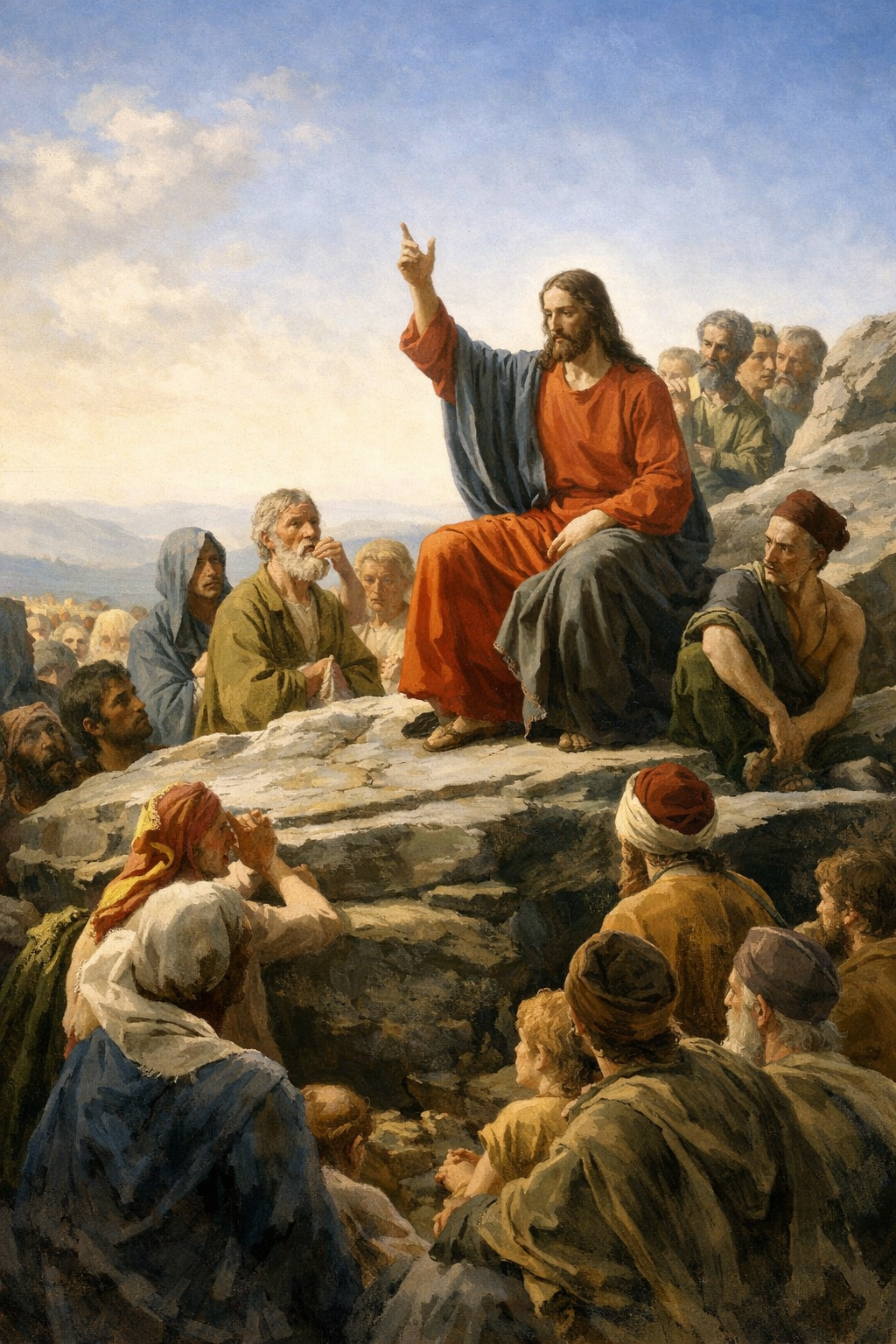
Sermon on the Mount
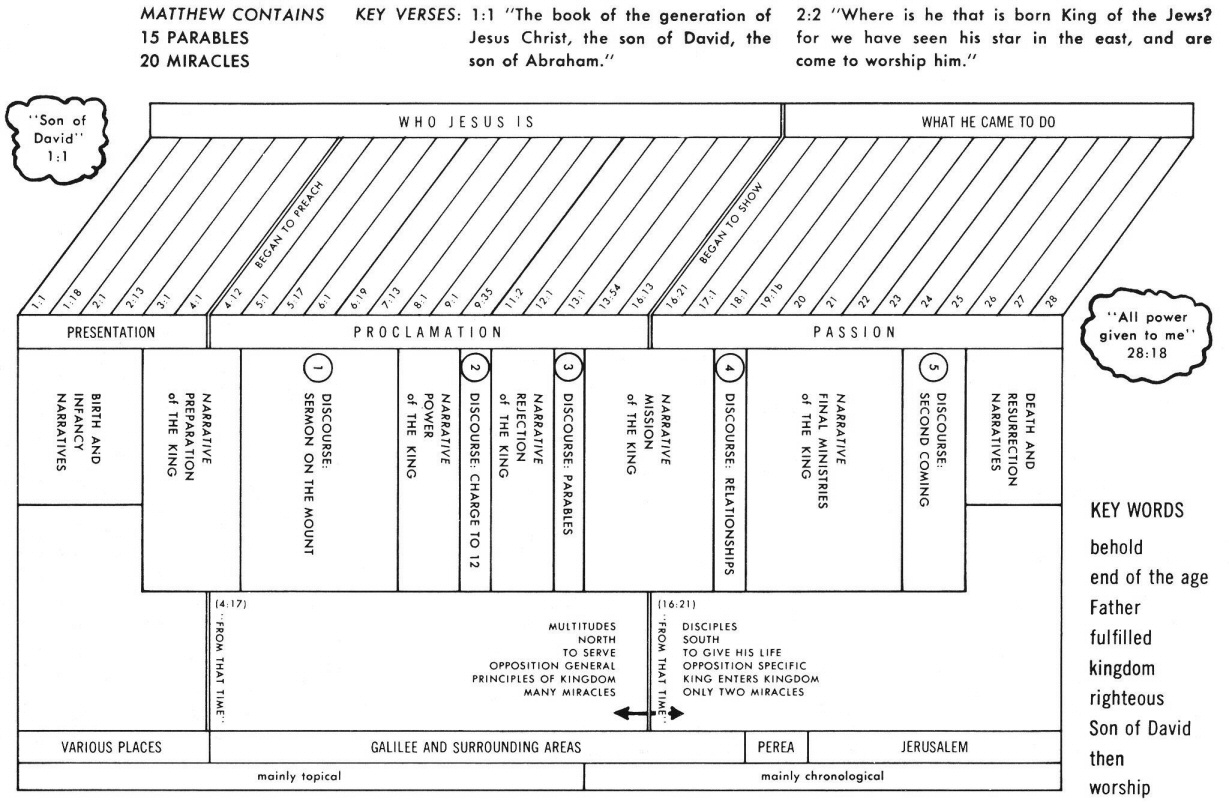
Click chart to enlarge
Charts from Jensen's Survey of the NT - used by permission
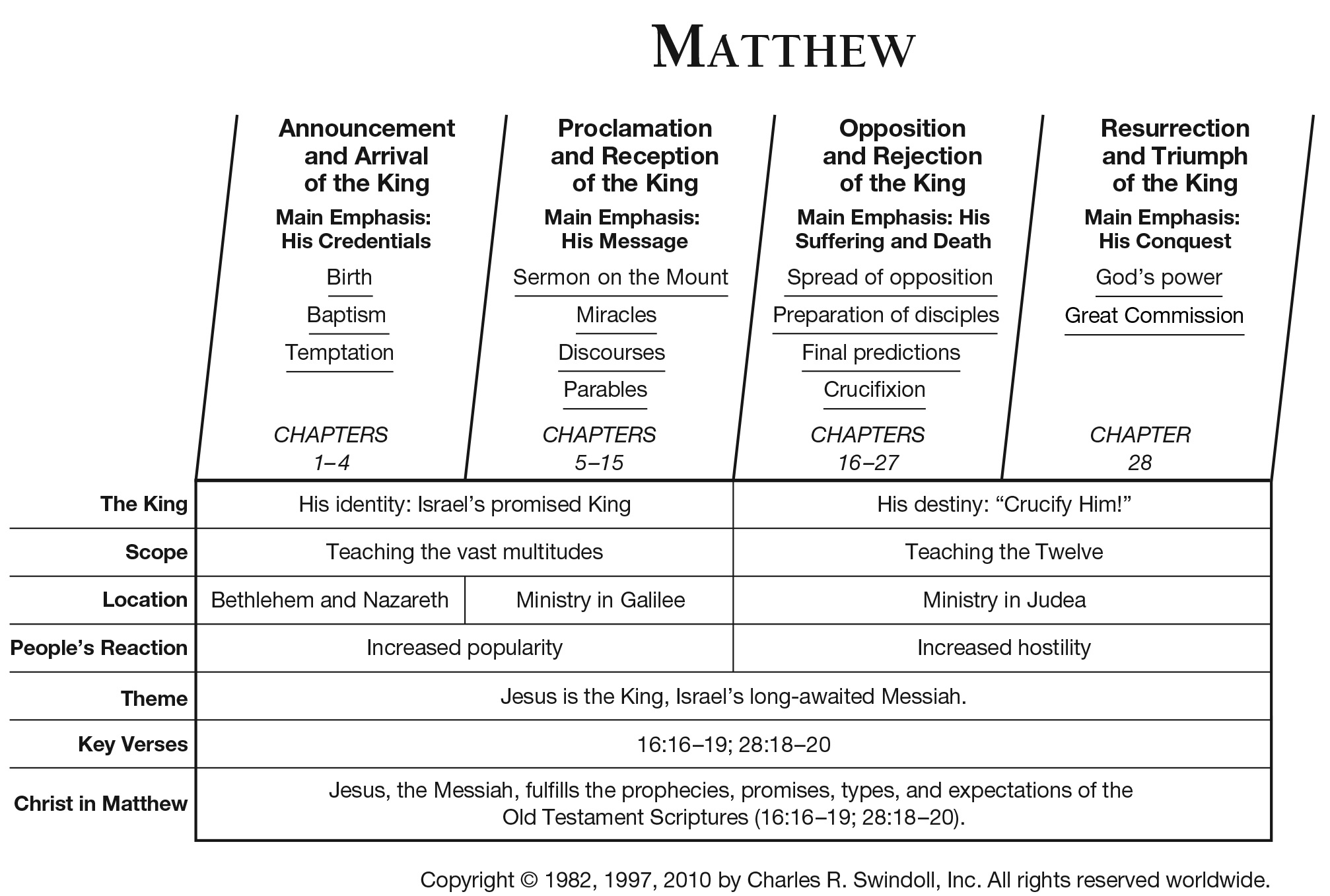
Another Chart from Charles Swindoll
THE LIFE OF JESUS AS COVERED
BY MATTHEW (shaded area)
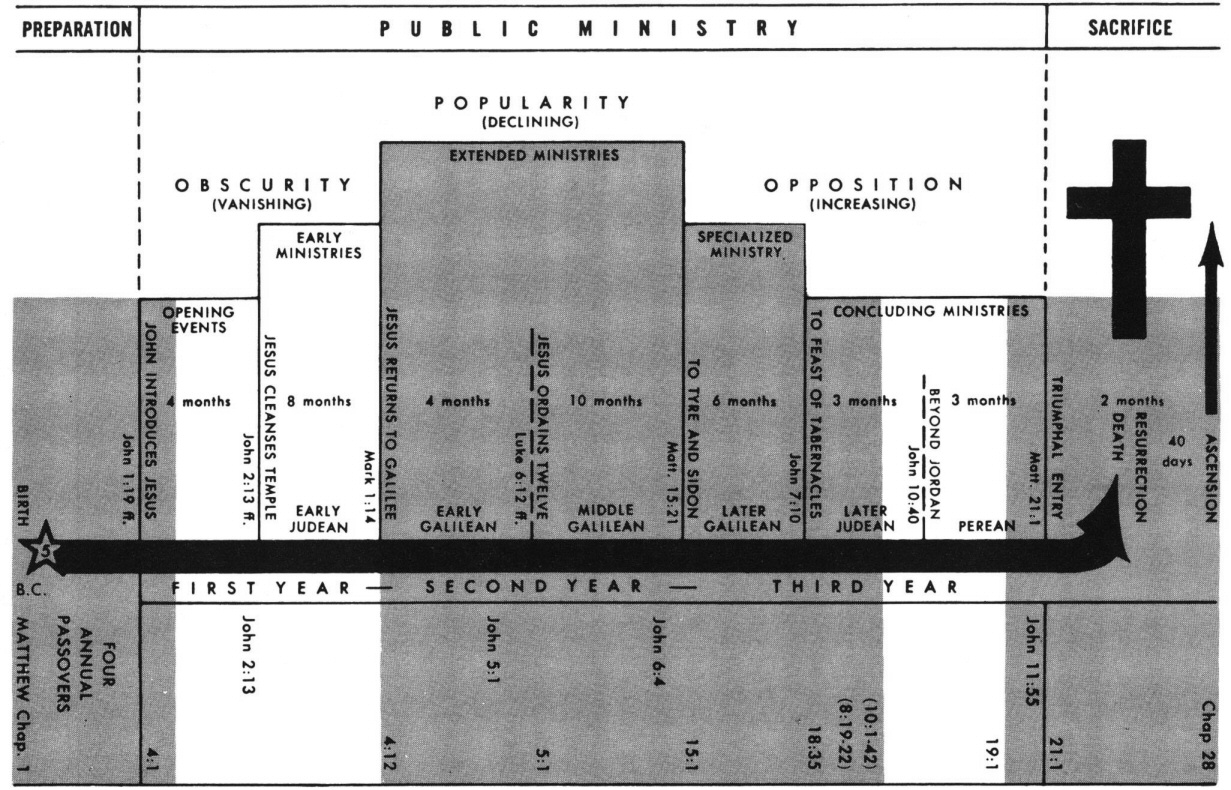
Click chart to enlarge
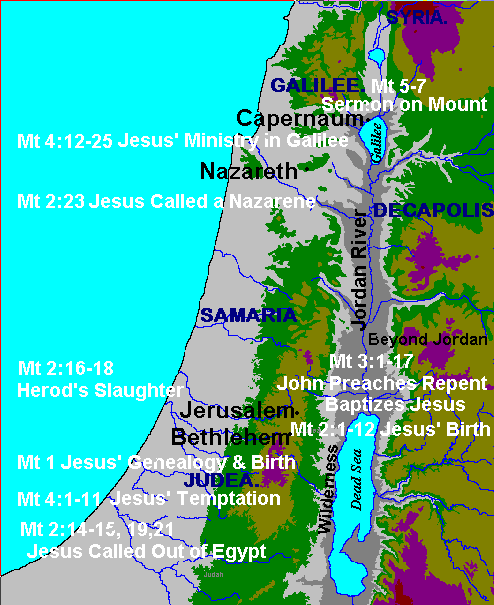
Jesus Birth and Early Years
Leading up to the Sermon on the Mount
Matthew 1-7
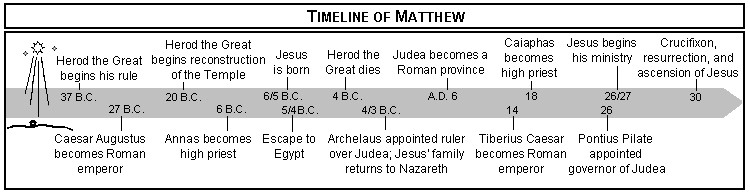
Source: Ryrie Study Bible
Matthew 6:9 Pray, then, in this way: 'Our Father Who is in heaven, Hallowed be Your name. (NASB: Lockman)
Greek: Houtos oun proseuchesthe (2PPMM) humeis Pater hemon o en tois ouranois, hagiastheto (3SAPM) to onoma sou
Amplified: Pray, therefore, like this: Our Father Who is in heaven, hallowed (kept holy) be Your name. (Amplified Bible - Lockman)
KJV: After this manner therefore pray ye: Our Father which art in heaven, Hallowed be thy name.
NLT: Pray like this: Our Father in heaven, may your name be honored. (NLT - Tyndale House)
Philips: Pray then like this - 'Our Heavenly Father, may your name be honoured (New Testament in Modern English)
Wuest: Therefore, as for you, in this manner be praying: Our Father who is in heaven, let your Name be venerated
Young's Literal: thus therefore pray ye: 'Our Father who art in the heavens! hallowed be Thy name.
|
THE LORD'S PRAYER |
|
|
Our Father Who is in heaven... |
|
|
Your Kingdom Come... |
|
|
Your will be done... |
|
| Index #4 |
Give us this day our daily bread... |
| Index #5 |
Forgive us our debts... |
| Index #6 |
Do not lead us into temptation... |
| Index #7 |
For Yours is the kingdom... |
PRAY, THEN, IN THIS WAY: OUR FATHER WHO IS IN HEAVEN: Houtos oun proseuchesthe (2PPMM) humeis Pater hemon o en tois ouranois:
- Luke 11:1,2
- Mt 1:6,14; 5:16,48; 7:11; 10:29; 26:29,42; Isaiah 63:16; 64:8; Luke 15:18,21; John 20:17; Ro 1:7; 8:15; Galatians 1:1; 4:6; 1Peter 1:17
- Mt 23:9; 2Chr 20:6; Ps 115:3; Isa 57:15; 66:1
- Matthew 6 Resources - Multiple Sermons and Commentaries
- Matthew 6:9 The Paternity of Prayer - John MacArthur
- Matthew 6:9 The Priority of Prayer - John MacArthur
- Matthew 6:9-10 Prayer as Worship - John MacArthur
When you contemplate praying remember what W S Bowden said about this holy occupation...
Prayer is weakness leaning on omnipotence.
This prayer is most often referred to as the "Lord's Prayer" but Jesus never actually prayed it Himself (see Mt 6:12 - He had no need for example to pray "forgive us our debts"). Instead this prayer is presented as a model prayer for citizens of the Kingdom of heaven and so might better be titled "The Disciple's Prayer". Jesus never intended for this prayer to be repeated ritualistically with regular, repetitious recital, but rather as a guide or model for our prayers.
The Lord Jesus gave many other commands to pray (Matthew 7:7-11; 9:38; 17:20; 18:19,20; 21:21,22; 26:41; Luke 18:1,7; John 14:13,14; 15:7,16; 16:23,24)--all of which give further instruction on the vital subject of how believers should pray.
Spurgeon introduces a sermon on Matthew 6:9 with these observations...
I THINK there is room for very great doubt, whether our Savior intended the prayer, of which our text forms a part, to be used in the manner in which it is commonly employed among professing Christians. It is the custom of many persons to repeat it as their morning prayer, and they think that when they have repeated these sacred words they have done enough. I believe that this prayer was never intended for universal use.
Jesus Christ taught it not to all men, but to His disciples, and it is a prayer adapted only to those who are the possessors of grace, and are truly converted. In the lips of an ungodly man it is entirely out of place. Does not one say, “Ye are of your father the devil, for his works you do?” Why, then, should you mock God by saying, “Our Father which are in heaven.” For how can he be your Father? Have you two Fathers? And if He be a Father, where is His honour? Where is His love? You neither honour nor love Him, and yet you presumptuously and blasphemously approach Him, and say, “Our Father,” when your heart is attached still to sin, and your life is opposed to His law, and you therefore prove yourself to be an heir of wrath, and not a child of grace!
Oh! I beseech you, leave off sacrilegiously employing these sacred words; and until you can in sincerity and truth say, “Our Father which are in heaven,” and in your lives seek to honour His holy name, do not offer to Him the language of the hypocrite, which is an abomination to Him.
I very much question also, whether this prayer was intended to be used by Christ’s own disciples as a constant form of prayer. It seems to me that Christ gave it as a model, whereby we are to fashion all our prayers, and I think we may use it to edification, and with great sincerity and earnestness, at certain times and seasons.
I have seen an architect form the model of a building he intends to erect of plaster or wood; but I never had an idea that it was intended for me to live in. I have seen an artist trace on a piece of brown paper, perhaps, a design which he intended afterwards to work out on more costly stuff; but I never imagined the design to be the thing itself.
This prayer of Christ is a great chart, as it were: but I cannot cross the sea on a chart. It is a map; but a man is not a traveler because he puts his fingers across the map.
And so a man may use this form of prayer, and yet be a total stranger to the great design of Christ in teaching it to His disciples. I feel that I cannot use this prayer to the omission of others. Great as it is, It does not express all I desire to say to my Father which is in heaven. There are many sins which I must confess separately and distinctly; and the various other petitions which this prayer contains require, I feel, to be expanded, when I come before God in private; and I must pour out my heart in the language which his Spirit gives me; and more than that, I must trust in the Spirit to speak the unutterable groanings of my spirit, when my lips cannot actually express all the emotions of my heart.
Let none despise this prayer; it is matchless, and if we must have forms of prayer, let us have this first, foremost, and chief; but let none think that Christ would tie His disciples to the constant and only use of this. Let us rather draw near to the throne of the heavenly grace with boldness, as children coming to a father, and let us tell forth our wants and our sorrows in the language which the Holy Spirit teaches us. (Read Spurgeon's entire message Matthew 6:9: The Fatherhood of God)
Ironside agrees writing that "There does not seem to be any valid reason for supposing that He meant it to be repeated frequently, or as part of a service of prayer or worship, as it is commonly used today. No mention is made of its use in the early Christian assemblies of the book of Acts, nor is it even referred to in the Epistles....Now that the Holy Spirit has come to guide us in our supplications, it would seem needlessly formal to be bound to use the exact words we have here when we come to God either in public or in private devotions." (Matthew 6 - Ironside's Notes on Matthew)
Pray (4336)(proseuchomai from pros = toward, facing, before [emphasizing the direct approach of the one who prays in seeking God’s face = consciousness that one is speaking to God face to face] + euchomai = originally to speak out, utter aloud, express a wish, then to pray or to vow. Greek technical term for invoking a deity) in the NT is always used of prayer addressed to God (to Him as the object of faith and the One who will answer one’s prayer) and means to speak consciously (with or without vocalization) to Him, with a definite aim (See study of noun proseuche).
The present imperative is a command calling for us to make prayer the habit of our lives. Prayer is not to be a "past time" but a lifestyle. Now, think for a moment. Is prayer easy? Do most of us find ourselves praying without ceasing as called for in this model prayer? I think not (I'll speak for myself at least). Here are a few thoughts to consider. So what is the solution? The Spirit. Prayer is supernatural conversation with God and in our old unholy flesh nature (still present even in believers) does not have a desire to seek holy communion with the Holy One. But the Spirit indwelling us gives us both the desire and the power (see Phil 2:13NLT) to "fulfill" this command (under grace not law), praying because we "want to" not because we "have to"! So if we don't have the desire, ask God to give us the desire. Obviously we need to submit to the leading, filling, enabling of the Spirit, but as we practice this discipline it will become more of our lifestyle and we will find ourselves (hopefully) more often with an attitude to pray before we grumble!
D A Carson picks up on the present tense aspect of prayer Jesus is calling for in His disciples relating that "Someone commented to me that they thought Muslim people were far more devout than Christians. How many Christians in our country, said this friend, would pray with such regularity and fervour as they do with their set hours of prostrated prayer? I replied that Christians are often praying when those around them are wholly unaware of the communication that flows between them and God. The church is always at prayer—but only because of the unfailing grace of the Holy Spirit. (Carson, D. Teach us to pray : Prayer in the Bible and the world. Page 301. Grand Rapids, MI: Baker Book House)
Note that proseuchomai encompasses all the aspects of prayer -- submission, confession, petition, supplication (may concern one's own need), intercession (concerned with the needs of others), praise, and thanksgiving.
Vine adds that proseuchomai carries with it a notion of worship (but see the Greek word for worship = proskuneo) which is not present in the other words for prayer (eg, aiteo, deomai, both of which involve spoken supplication)
Alexander Maclaren introduces his sermon "Our Father" with these comments...
The words of Christ, like the works of God, are inexhaustible. Their depth is concealed beneath an apparent simplicity which the child and the savage can understand. But as we gaze upon them and try to fathom all their meaning, they open as the skies above us do when we look steadily into their blue chambers, or as the sea at our feet does when we bend over to pierce its clear obscure. The poorest and weakest learns from them the lesson of divine love and a mighty helper; the reverent, loving contemplation of the profoundest souls, and the experience of all the ages discern ever new depths in them and feel that much remains unlearned. ‘They did all eat and were filled, men, women, and children—and they took up of fragments that were left five baskets full.’
This is especially true about the Lord’s Prayer. We teach it to our children, and its divine simplicity becomes their lisping tongues and little folded hands. But the more we ponder it, and try to make it the model of our prayers, the more wonderful does its fulness of meaning appear, the more hard does it become to pray ‘after this manner.’ There is everything in it: the loftiest revelation of God in His relations to us and in His purposes with the world; the setting forth of all our relations to Him, to His purposes, and to one another; the grandest vision of the future for mankind; the care for the smallest wants of each day.
As a theology, it smites into fragments all false, unworthy human thoughts of God. As an exposition of religion, the man who has drunk in its spirit has ceased from self-will and sin. As a foundation of social morals it lays deep the only basis for true human brotherhood, and he who lives in its atmosphere will live in charity and helpfulness with all mankind. As a guide for personal life, it gives us authoritatively the order and relative worth of all human desires, and with these the order and subordination of our pursuits and life’s aims. As a prayer it is all comprehensive and intended to be so, holding within the perfect seven of its petitions, all for which we should come to God, and resting them all on His divine name, and closing them all with a chorus of thanksgiving. As a prophecy it opens the loftiest vision, beyond which none is possible, of the final transformation of this world into the kingdom in which God’s will shall be perfectly done, and of the final deliverance from, all evil of the struggling, sinning, sorrowing souls of His children...
...‘After this manner pray ye.’ The question which is usually made prominent in thinking of these words is really a very subordinate one. Did Christ intend to establish a form, or only to give an example? Churchmen say, a form; Dissenters generally say, an example. But it would be better for both Churchmen and Dissenters to try to realise for themselves what ‘this manner’ is.
Kent Hughes observes that in this great prayer the "initial focus is upward, with its first three requests having to do with God's glory. The remaining three requests are for our well-being. God first, man second - that is the ideal order of prayer. His glory before our wants. This is parallel to the Ten Commandments, the first four of which have to do with God's glory and the last six with man's well-being. This prayer is the perfect prayer. Of its perfection Bonhoeffer said, "The Lord's Prayer is not merely the pattern prayer, it is the way Christians must pray. . . . The Lord's Prayer is the quintessence of prayer." It is the perfect pattern for the followers of Christ, and its depth cannot be exhausted by exposition. No matter how one advances in the matter of prayer, it remains the model and the challenge. Sadly, it is more often mindlessly repeated than genuinely prayed. This is especially ironic because the context that introduces the Lord's Prayer in Matthew 6:7, 8 warns against meaningless repetition. The obvious problem for all of us is that "familiarity breeds contempt," in this case "surface familiarity." Some of us learned the Lord's Prayer at our mother's knees. We cannot count the times we have repeated it. We said it again and again as children. We repeat it today as adults. But there is a danger in our familiarity with its beauty - it can become just beautiful words, so that we "say" the Lord's Prayer without praying it. Some who live in the mountains of Colorado rarely see the incredible scenery that occupies their every glance, while flatlanders like me travel a thousand miles just to see the mountains' beauty for a few days - and we really see them! Those who have been dulled to beauty need to see things in a new way, and in respect to the Lord's Prayer we may need to see it anew - not necessarily discovering new truth, but seeing the old truth for what it is. An in-depth study of the Lord's Prayer can help us pray with greater singleness and greater power, just as it has done for thousands through the centuries. (Hughes, R. K. Sermon on the Mount: The Message of the Kingdom. Crossway Books)
Martyn Lloyd-Jones - “Prayer is beyond any question the highest activity of the human soul. Man is at his greatest and highest when, upon his knees, he comes face to face with God” (Lloyd-Jones, D. M. Studies in the Sermon on the Mount)
Phil Newton - Our culture values doing over being. As long as we give ourselves to religious activities then we consider ourselves spiritual. Yet prayer provides more of a barometer of the soul than the most feverish activity. For in prayer we are encountering the living God, bearing our souls before Him, contemplating Him, and seeing Him alone as our Father and Lord. (Sermon)
Puritan Thomas Brooks - “The Lord’s prayer is given us as a directory for prayer, a pattern and an example, by which we are to regulate our petitions, and make other prayers
Bishop Ryle - These verses are few in number, and are soon read, but they are of immense importance....No part of Scripture is so full and so simple at the same time as this. It is the first prayer which we learn when we are little children: here is its simplicity. It contains the germ of everything which the most advanced saint can desire: here is its fullness. The more we ponder every word it contains, the more we shall feel this prayer is of God.
C H Spurgeon's -Our Lord, having warned us against certain vices which had connected themselves with prayer as to its place and spirit, now gives us a model upon which to fashion our prayers. This delightful prayer is short, devout, and full of meaning Its first three petitions are for God and his glory. Our chief prayers to God are to be for his glory. Do we thus begin with God in prayer? Does not the daily bread often come in before the kingdom? We pray as children to a Father, and we pray as brothers, for we say, “Our Father.” “Our Father ” is a familiar name, but the words “which art in heaven ” suggest the reverence due unto him. Our Father and yet in heaven: in heaven and yet our Father. May his name be treated reverently, and may all that is about him—his Word and his gospel—be regarded with the deepest awe! It is for us so to walk before the Lord in all lowliness, that all shall see that we reverence the character of the thrice-holy One. Then can we truly pray, “Hallowed be thy name ”, when we hallow it ourselves. (Commentary)
THE "LORD'S PRAYER":
NOT A RITUAL
BUT A PATTERN
In this way - What does the phrase imply? Note that Jesus did not say when you pray, pray these exact words! This prayer was never meant to be a ritualistic, rote prayer for regular recital but rather a guide for praying "in this way" or "after this manner". We are to use this prayer as a pattern, not as a substitute. The problem with prayer by rote memory is that this kind of prayer becomes "meaningless repetition." Jesus told His audience to "pray in this way," in the context of just having stated not to use meaningless repetition. So clearly Jesus is presenting a pattern for our prayers, not the only words to use in prayer. The "Lord's Prayer" was never intended to be used as a repetitious petition, but as the guide to how His followers should pray.
Luke records a similar, albeit abbreviated version of this model prayer in Jesus' answer to His disciple's query "Lord, teach us to pray" (and thus the moniker "The Disciple's Prayer")...
And He said to them, "When you pray, say: 'Father, hallowed be Thy name. Thy kingdom come. 'Give us each day our daily bread.' And forgive us our sins, For we ourselves also forgive everyone who is indebted to us. And lead us not into temptation.'" (Luke 11:2-4)
As discussed previously, so often the "Disciple's Prayer" has been turned into a ritualistic recital that we mouth but do not genuinely pray from our heart. Such dead formalism is the very practice Jesus is warning them to beware of practicing! That is not to say that one could or should never pray this prayer...the question one must always ask when praying this prayer is...
"Am I praying it from my heart or am I mouthing it from memory as a mechanical, rote exercise?"
Certainly, from the heart, the "Disciple's Prayer" is a valid, efficacious prayer.
Our Father - Jesus begins with an expression of worship and adoration.
R Kent Hughes writes that...
When we say Abba today in our prayers, as we sometimes do, we are making the same sound that actually fell from Jesus’ lips—and from the lips of his incredulous disciples. Jesus transferred the Fatherhood of God from a theological doctrine into an intense, practical experience, and he taught his disciples to pray with the same intimacy. And that is what he does for us. “Our Father”—“Our Abba”—“Our dearest Father”—this is to be the foundational awareness of all our prayers. Does it undergird your prayer life? Is a sense of God’s intimate Fatherhood profound and growing in your life?
Addressing God as Abba (Dearest Father) is not only an indication of spiritual health but is a mark of the authenticity of our faith. Paul tells us in Galatians 4:6, “Because you are sons, God sent the Spirit of his Son into our hearts, the Spirit who calls out, ‘Abba, Father!’ ” The impulse to call on God in this way is a sign of being God’s child. Romans 8:15, 16 says the same thing: “you received the spirit of sonship. And by him we cry, ‘Abba, Father!’ The Spirit himself testifies with our spirit that we are God’s children.” True believers are impelled to say this.
This is precisely what happened to me when I came to faith during the summer before my freshman year in high school. Before that I had a cool theological idea of the universal paternity of God as the Creator of all mankind. His Fatherhood was there, but it was not personal. But with my conversion, God became warm and personal. I now knew God, and I knew he was my Father! This realization is one of the great and primary works of the Holy Spirit. He makes Christians realize with increasing clarity the meaning of their filial relationship with God in Christ. He keeps enhancing this “spirit of sonship” in us and is ever integrating it into our lives.
Do you know that God is your Father? Do you think of him and address him as your “Dearest Father”? If you cannot answer in the affirmative, it may be that he is not your spiritual Father and you need to heed the words of Scripture and come into relationship with him through Christ. “Yet to all who received him [Christ], to those who believed in his name, he gave the right to become children of God” (John 1:12). (The Sermon on the Mount- The Message of the Kingdom - Preaching the Word- R. Kent Hughes)
Our - Note that this is a plural pronoun. In fact there are no singular pronouns in the entire prayer! We are to remember others as well as ourselves. Others take this plural pronoun to be a call for corporate prayer in addition to individual prayer.
Father (3962) (pater) is the genitor (a begetter), by whom another is begotten. Stated more simply this is a man who has begotten a child. Father is the progenitor, the ancestor in the direct line (a forefather -- thus Adam was the "progenitor" of the Human Race).
HELPS Word Studies - father; one who imparts life and is committed to it; a progenitor, bringing into being to pass on the potential for likeness. (HelpsBible.com)
Vine writes that pater is "from a root signifying “a nourisher, protector, upholder” (Lat., pater, Eng., “father,” are akin)." (Note: Not all lexicons agree with this origin)....Whereas the everlasting power and divinity of God are manifest in creation, His “Fatherhood” in spiritual relationship through faith is the subject of NT revelation, and waited for the presence on earth of the Son, Matt. 11:27; John 17:25. The spiritual relationship is not universal, John 8:42, 44 (cf. John 8:12 and Gal. 3:26).
Summary of Pater (from Louw-Nida, Vine, BDAG, Friberg) which is translated father(348), father's(13), fathers(53), parents(1).
(1) A male parent, immediate male ancestor (Mt 2:22, 4:21, Lk 2:48, Heb 12:9)
(2) Parents, both mother and father (Heb 11:23)
(3) Ancestor, forefather - a more remote ancestor, such as one from whom one is descended and generally at least several generations removed, (Acts 3:13, Mt 3:9 )
BDAG on 2Pe 3:4: in some places the pateres are to be understood as the generation(s) of deceased Christians
Physical but not spiritual father - Abraham - Mt 3:9, Lk 3:8, Jn 8:39 (Cf Jn 8:40), Jn 8:53, 56, Acts 7:2 - Abraham was referred to as "father" in this sense by the unregenerate Jews who called Abraham their father (which he was by physical lineage). Because of this association they felt they were guaranteed entry into heaven.
Physical and spiritual father (Father of those who are born again by faith even as Abraham was justified by faith - Ge 15:6) - Lk 16:24, 30, Ro 4:12, 16, James 2:21
(4) Father (title for God), (Jn 10:15; Lk 23:34.)
God the Father (15x in NAS, Not once in the OT): 1 Cor 8:6; Gal 1:1; Eph 6:23; Phil 2:11; Col 1:3; 3:17; 1Th 1:1; 2Th 1:2; 1Ti 1:2; 2Ti 1:2; Titus 1:4; 1Pet 1:2; 2Pet 1:17; 2 John 1:3; Jude 1:1
God and Father (14x NAS, Not once in the OT): Rom 15:6; 1 Cor 15:24; 2 Cor 1:3; 11:31; Gal 1:4; Eph 1:3; 4:6; Phil 4:20; 1Th 1:3; 3:11, 13; Jas 1:27; 1Pet 1:3; Rev 1:6
HELPS Word Studies: is used of our heavenly Father. He imparts life, from physical birth to the gift of eternal life through the second birth (regeneration, being born again). Through ongoing sanctification, the believer more and more resembles their heavenly Father.
Vine: of God in relation to those who have been born anew (John 1:12, 13), and so are believers, Eph. 2:18; 4:6 (cf. 2 Cor. 6:18), and imitators of their “Father,” Matt. 5:45, 48; 6:1, 4, 6, 8, 9, etc. Christ never associated Himself with them by using the personal pronoun “our”; He always used the singular, “My Father,” His relationship being unoriginated and essential, whereas theirs is by grace and regeneration, e.g., Matt. 11:27; 25:34; John 20:17; Rev. 2:27; 3:5, 21; so the apostles spoke of God as the “Father” of the Lord Jesus Christ, e.g., Rom. 15:6; 2 Cor. 1:3; 11:31; Eph. 1:3; Heb. 1:5; 1 Pet. 1:3; Rev. 1:6;
of God, as the “Father” of lights, i.e., the Source or Giver of whatsoever provides illumination, physical and spiritual, Jas. 1:17; of mercies, 2 Cor. 1:3;
of glory, Eph. 1:17;
as Creator, Heb. 12:9 (cf. Zech. 12:1).
(5) Father (title for a high ranking person), (Mt 23:9)
BDAG: as an honorary title or a form of respectful address (Lxx = 2Ki 2:12; 6:21; 13:14)
(6) Elder (Acts 7:2; 22:1)
Vine: of the members of the Sanhedrin, as of those who exercised religious authority over others
(7) An archetype, figurative extension to entry #1 (E.g., "Father" Abraham - Ro 4:11, 12, 16, 17)
BDAG: of spiritual fatherhood (Epict. 3, 22, 81f: the Cynic superintends the upbringing of all men as their pater
(8) Leader, spiritual father in the faith (Devil = Jn 8:44; 1Co 4:15)
Vine: metaphorically, of the originator of a family or company of persons animated by the same spirit as himself, as of Abraham, Ro 4:11, 12, 16, 17, 18, or of Satan, John 8:38, 41, 44
Vine: of one who , as a preacher of the gospel and a teacher, stands in a “father’s” place, caring for his spiritual children, 1Cor. 4:15 (not the same as a mere title of honor, which the Lord prohibited, Matt. 23:9);
(9) Take care of parents until death (Mt 8:21; Lk 9:59),
(10) One advanced in the knowledge of Christ, (1John 2:13 according to W E Vine)
BDAG: (Father in 1Jn 2:13) as a designation of the older male members of a church (as respectful address by younger people to their elders
By drawing attention to God as our Father, Jesus first calls us to recognize the God-centeredness of prayer and indeed of all of life.
1828 Webster's has multiple definitions of Father...
1. He who begets a child; in L. genitor or generator.
The father of a fool haih no joy. Pr. 17.
A wise son maketh a glad father. Pr 10.
2. The first ancestor; the progenitor of a race or family. Adam was the father of the human race. Abraham was the father of the Israelites.
3. The appellation of an old man, and a term of respect.
The king of Israel said to Elisha, my father shall I smite them? 2 Kings 6.
The servants of Naaman call him father. Ibm. v. Elderly men are called fathers; as the fathers of a town or city. In the church, men venerable for age, learning and piety are called fathers, or reverend fathers.
4. The grandfather, or more remote ancestor. Nebuchadnezzar is called the father of Belshazzar, though he was his grandfather. Dan. 5.
5. One who feeds and supports, or exercises paternal care over another. God is called the father of the fatherless. Ps. 68.
I was a father to the poor. Job 29.
6. He who creates, invents, makes or composes any thing; the author, former or contriver; a founder, director or instructor. God as creator is the father of all men. John 8. Jabal was the father of such as dwell in tents; and Jubal of musicians. Gen. 4. God is the father of spirits and of lights. Homer is considered as the father of epic poetry. Washington, as a defender and an affectionate and Wise counselor, is called the father of his country. And see 1 Chron. 2:51–4:14–9:35. Satan is called the father of lies; he introduced sin, and instigates men to sin. John 8. Abraham is called the father of believers. He was an early believer, and a pattern of faith and obedience. Rom. 4
7. Fathers, in the plural, ancestors.
David slept with his fathers. 1 Kings 2.
8. A father in law. So Heli is called the father of Joseph. Luke 3.
9. The appellation of the first person in the adorable Trinity.
Go ye, therefore, and teach all nations, baptizing them in the name of the Father, and of the Son, and of the Holy Spirit. Matt. 28.
10. The title given to dignitaries of the church, superiors of convents, and to popish confessors.
11. The appellation of the ecclesiastical writers of the first centuries, as Polycarp, Jerome, &c.
12. The title of a senator in ancient Rome; as conscript fathers.
Adoptive father, he who adopts the children of another, and acknowledges them as his own.
Natural father, the father of illegitimate children.
Putative father, one who is only reputed to be the father; the supposed father
Pater - 413x in 366v in the NAS - Matt 2:22; 3:9; 4:21f; 5:16, 45, 48; 6:1, 4, 6, 8f, 14f, 18, 26, 32; 7:11, 21; 8:21; 10:20f, 29, 32f, 35, 37; 11:25ff; 12:50; 13:43; 15:4ff, 13; 16:17, 27; 18:10, 14, 19, 35; 19:5, 19, 29; 20:23; 21:31; 23:9, 30, 32; 24:36; 25:34; 26:29, 39, 42, 53; 28:19; Mark 1:20; 5:40; 7:10ff; 8:38; 9:21, 24; 10:7, 19, 29; 11:10, 25; 13:12, 32; 14:36; 15:21; Luke 1:17, 32, 55, 59, 62, 67, 72f; 2:33, 48f; 3:8; 6:23, 26, 36; 8:51; 9:26, 42, 59; 10:21f; 11:2, 11, 13, 47f; 12:30, 32, 53; 14:26; 15:12, 17f, 20ff, 27ff; 16:24, 27, 30; 18:20; 22:29, 42; 23:34, 46; 24:49; John 1:14, 18; 2:16; 3:35; 4:12, 20f, 23, 53; 5:17ff, 26, 36f, 43, 45; 6:27, 31f, 37, 40, 42, 44ff, 49, 57f, 65; 7:22; 8:16, 18f, 27f, 38f, 41f, 44, 49, 53f, 56; 10:15, 17f, 25, 29f, 32, 36ff; 11:41; 12:26ff, 49f; 13:1, 3; 14:2, 6ff, 16, 20f, 23f, 26, 28, 31; 15:1, 8ff, 15f, 23f, 26; 16:3, 10, 15, 17, 23, 25ff, 32; 17:1, 5, 11, 21, 24f; 18:11; 20:17, 21; Acts 1:4, 7; 2:33; 3:13, 25; 4:25; 5:30; 7:2, 4, 11f, 14f, 19f, 32, 38f, 44f, 51f; 13:17, 32, 36; 15:10; 16:1, 3; 22:1, 14; 26:6; 28:8, 25; Rom 1:7; 4:11f, 16ff; 6:4; 8:15; 9:5, 10; 11:28; 15:6, 8; 1 Cor 1:3; 4:15; 5:1; 8:6; 10:1; 15:24; 2 Cor 1:2f; 6:18; 11:31; Gal 1:1, 3f; 4:2, 6; Eph 1:2f, 17; 2:18; 3:14; 4:6; 5:20, 31; 6:2, 4, 23; Phil 1:2; 2:11, 22; 4:20; Col 1:2f, 12; 3:17, 21; 1Th 1:1, 3; 2:11; 3:11, 13; 2Th 1:1f; 2:16; 1 Tim 1:2; 5:1; 2 Tim 1:2; Titus 1:4; Philemon 1:3; Heb 1:1, 5; 3:9; 7:10; 8:9; 11:23; 12:7, 9; Jas 1:17, 27; 2:21; 3:9; 1 Pet 1:2f, 17; 2 Pet 1:17; 3:4; 1 John 1:2f; 2:1, 13ff, 22ff; 3:1; 4:14; 2 John 1:3f, 9; Jude 1:1; Rev 1:6; 2:28; 3:5, 21; 14:1
Pater is found in 941 verses of the Septuagint (Lxx) and therefore will not be listed except for the uses in Genesis...Gen 2:24; 4:20; 9:18, 22f; 10:21; 11:28f; 12:1; 15:15; 17:4f; 19:31ff; 20:12f; 22:7, 21; 24:7, 23, 38, 40; 26:3, 5, 15, 18, 24; 27:5f, 9f, 12, 14, 18f, 22, 26, 29ff, 34, 36, 38f, 41; 28:2, 4, 7f, 13, 21; 29:9, 12; 31:1, 3, 5ff, 9, 14, 16, 18f, 29f, 35, 42, 53; 32:10; 33:19; 34:4, 6, 11, 13, 19; 35:18, 22, 27; 36:9, 24, 43; 37:1f, 4, 9ff, 22, 32, 35; 38:11; 41:51; 42:13, 29, 32, 35ff; 43:2, 7f, 11, 23, 27f; 44:17, 19f, 22, 24f, 27, 30ff, 34; 45:3, 8f, 13, 18f, 23, 25, 27; 46:1, 3, 5, 29, 31, 34; 47:1, 3, 5ff, 9, 11f, 30; 48:1, 9, 15ff, 21; 49:2, 4, 8, 25f, 28f; 50:1f, 5ff, 10, 14ff, 22, 24;
The writer of Hebrews encourages us to enter through the rent veil into the very throne room of God our Father, a glorious journey made possible by Jesus' finished work on the Cross and His present intercession as our Great High Priest,
Since then we have a Great High Priest Who has passed through the heavens, Jesus the Son of God, let us hold fast our confession. For we do not have a High Priest who cannot sympathize with our weaknesses, but One Who has been tempted in all things as we are, yet without sin. Let us therefore draw near with confidence to the throne of grace, that we may receive mercy and may find grace to help in time of need. (Heb 4:14-16)
Since therefore, brethren, we have confidence to enter the holy place by the blood of Jesus, by a new and living Way which He inaugurated for us through the veil, that is, His flesh, and since we have a Great Priest over the house of God, let us draw near with a sincere heart in full assurance of faith, having our hearts sprinkled clean from an evil conscience and our bodies washed with pure water. Let us hold fast the confession of our hope without wavering, for He Who promised is faithful; (Hebrews 10:19-23)
In Matthew 6:1-18, "Father" is a keyword occurring some 10 times. Clearly, the practice of righteousness is to be for the Father's eyes. We are not to pray to saints and angels, but to the everlasting Father, the Father of spirits, the Lord of heaven and earth.
The fatherhood of God forms the foundation for this model prayer, and we as children are called to seek His face using the six (or seven) topical sentences Jesus presents in Mt 6:9-13. “Father” as a title for God was rarely used in the Old Testament (only 14 times) and always used with reference to the nation, not to individuals. Thus where "father" does occur with respect to God, it is commonly by way of analogy, and not used to directly address Him (Deut 32:6; Ps 103:13; Isa 63:16; Mal 2:10). Thus Jesus' teaching that kingdom citizens were to address God as Father must have surprised most of His audience.
Jesus Himself addressed God only as Father (some 60 times in the Gospels), never referring to Him by any other name! Virtually all of Jesus' prayers were addressed to God as Father (exception in Mt 27:46)
And thus the New Testament believer knows God as his Father, with even greater clarity than anything his Old Testament counterpart could have enjoyed. Thus it follows that his praying proceeds from a childlike trust, as expressed in the addressing of God as "Our Father".
C H Spurgeon - A Father! There is music in that word, but not to a fatherless child—to him it is full of sorrowful memories. Those who have never lost a father can scarcely know how precious a relation a father is. A father who is a father indeed, is very dear! Do we not remember how we climbed his knee? Do we not recollect the kisses we imprinted on his cheeks? Do we not recall to-day with gratitude the chidings of his wisdom and the gentle encouragements of his affection? We owe all! Who shall tell how much we owe to our fathers according to the flesh, and when they are taken from us we lament their loss, and feel that a great gap is made in our family circle. Listen, then, to these words, "Our Father, Who is in heaven." Consider the grace contained in the Lord's deigning to take us into the relationship of children, and giving us with the relationship the nature and the spirit of children, so that we say, "Abba, Father." Did you ever lie in bed with your limbs vexed with sore pains, and cry, "Father, pity thy child"? Did you ever look into the face of death, and as you thought you were about to depart, cry, "My Father, help me; uphold me with thy gracious hand, and bear me through the stream of death"? It is at such times that we realize the glory of the Fatherhood of God, and in our feebleness learn to cling to the divine strength, and catch at the divine love. (Flashes of Thought)
Does the truth of God as your Father undergird your life with Father, as well as your prayer life?
J. I. Packer (originally writing in Evangelical Magazine) considers one's grasp of God's Fatherhood and adoption as His child as of essential importance in one's spiritual life explaining that...
If you want to judge how well a person understands Christianity, find out how much he makes of the thought of being God's child, and having God as his Father. If this is not the thought that prompts and controls his worship and prayers and his whole outlook on life, it means that he does not understand Christianity very well at all. For everything that Christ taught, everything that makes the New Testament new, and better than the Old, everything that is distinctively Christian as opposed to merely Jewish, is summed up in the knowledge of the Fatherhood of God. "Father" is the Christian name for God. (Packer, J: Knowing God)
Joachim Jeremias, a respected German NT scholar wrote that the Aramaic word "Abba" was most likely the word Jesus used here when He spoke the words written in Greek in Mt 6:9. And from this premise, Jeremias argues that...
in the Lord’s Prayer Jesus authorizes His disciples to repeat the word Abba after Him. He gives them a share in His sonship and empowers them, as His disciples, to speak with their heavenly Father in just such a familiar, trusting way as a child would with his father. (Joachim Jeremias, The Lord’s Prayer. Minneapolis: Fortress Press, 1980),
Jesus Himself used Abba (Aramaic for "Father") in addressing God, a use without parallel in the whole of Jewish literature. The explanation by some of the early Church fathers (Chrysostom, Theodore, Theodoret) was that Abba was the word used by a young child addressing his or her father. It was an everyday family word, which no one had ventured to use in addressing God. And so Jesus uses it quite naturally to address His heavenly Father in as childlike, trustful, and intimate a way as a little child to its father.
And He was saying, "Abba! Father! All things are possible for Thee; remove this cup from Me; yet not what I will, but what Thou wilt." (Mark 14:36)
Paul likewise mentions that because of our redemption and adoption into God's family, NT believers can address God as "Abba".
For all who are being led by the Spirit of God, these are sons of God. For you have not received a spirit of slavery leading to fear again, but you have received a spirit of adoption as sons by which we cry out, "Abba! Father!" (Romans 8:14-15)
But when the fulness of the time came, God sent forth His Son, born of a woman, born under the Law, in order that He might redeem those who were under the Law, that we might receive the adoption as sons. And because you are sons, God has sent forth the Spirit of His Son into our hearts, crying, "Abba! Father!" (Galatians 4:4-6)
The Net Bible notes explains that...
God is addressed in terms of intimacy (Father). The original Semitic term here was probably Abba. The term is a little unusual in a personal prayer, especially as it lacks qualification. It is not the exact equivalent of “daddy” (as is sometimes popularly suggested), but it does suggest a close, familial relationship. (The NET Bible; Bible. Biblical Studies Press)
To open this model prayer addressing God as Father, indicates He is personal (not merely "a higher power") and that He cares for His family (as a father would). The fact that He is "our Father" establishes the relationship the family relationship. Without faith in Christ’s blood and union with him, it is useless to talk of trusting in the “Fatherhood” of God. Only believers can call God "Father" because we are His children having received Jesus as Savior and believed in His Name (Jesus means "Jehovah saves")
He (Jesus) came to His own, and those who were His own did not receive Him. But as many as received Him, to them He gave the right to become children of God, even to those who believe in His name, who were born not of blood, nor of the will of the flesh, nor of the will of man, but of God. (John 1:12-13:)
Jesus answered (Nicodemus) and said to him, "Truly, truly, I say to you, unless one is born again, he cannot see the kingdom of God."
Nicodemus said to Him, "How can a man be born when he is old? He cannot enter a second time into his mother's womb and be born, can he?"
Jesus answered, "Truly, truly, I say to you, unless one is born of water and the Spirit, he cannot enter into the kingdom of God. (John 3:3-5)
The early church actually forbade non-Christians from reciting this prayer as vigorously as they forbade them from joining with believers at the Lord's Table!
Kent Hughes - the idea that God is our Father, our Abba, is not only a sign of our spiritual health and of the authenticity of our faith, it is one of the most healing doctrines in all of Scripture. Some grew up only with a mother and no father. Others grew up in conventional homes where the relationship with the father was negative at best. But whatever our background, we need the touch of a father, and our God wants to provide that. Some of us need to bow before God and simply say, "Dearest Father, Abba" and so find the wholeness and healing that he wants to give us... The problem among some evangelical Christians today is the opposite - they have sentimentalized God's fatherhood so much that they have little concept of his holiness. Many Christians are flippantly sentimental about God, as if he is a celestial teddy bear. Such flip familiarity outwardly suggests super-intimacy with God but actually hides a defective knowledge of God. (Hughes, R. K. Sermon on the Mount: The Message of the Kingdom. Crossway Books)
The qualifying phrase Father Who is in heaven is used most often by Matthew and reminds us of his transcendent nature (exceeding usual limits; extending or lying beyond the limits of ordinary experience). Transcendence is a theological term referring to the relation of God to creation. And so "our Father Who is in heaven" is “other” or “different” from His creation, independent and different from His creatures (cf Isa 55:8-9), being beyond His creation and not limited by it or to it. This simple understanding of transcendence makes our privilege of approaching Him intimately like a son or daughter would their earthly father, all the more humbling and praiseworthy. Our transcendent God is also the omnipresent God and is never farther than a prayer away!
Phil Newton adds a practical note to those who have had "suboptimal" relationships with their earthly fathers writing that...
Some of you may have bad memories of your earthly father. I have observed through the years that some people have unfounded fears of God, and grave apprehensions of depending upon Him because they bear deep wounds of their own earthly fathers that disappointed them time and time again. The image of father brings pain to them and not delight. They could never measure up to their father’s expectations or demands. They never felt an intimacy with him because of his self-centered ways. That is why our Lord distinguishes the Heavenly Father from all sinful, earthly fathers. He is not like those bad memories that haunt your understanding of God. He is “Our Father who is in heaven.”...Gardiner Spring gives us a picture of what it means to call upon God as Father. "Secrets may be committed to God that cannot be committed to another. The world knows not of this relief, to spread before Him the secret wants of the soul; to tell them one by one; to tell them all. The conscience, wounded by a sense of sin, finds healing there. Want there finds supply; distrust finds confidence and depression finds praise. Ignorance is enlightened there; poverty is enriched, and weakness becomes strong. Darkness is there dissipated and trembling hopes encouraged. The bruised reed is not broken there, nor is the smoking flax quenched. Grace there cherishes what it bestows, and completes what it begins…There are no broken cisterns at the mercy seat; it is all a fountain of living water, where streams flow from it, without which this earth were a desert."...It is in the sphere of relationship to God as Father that kingdom citizens find the significance of prayer. It is not a psychological exercise that helps us to cope with the troubles of life, but the heart of children gathering into the bosom of their Father to find peace, comfort, security, and provision for every need. Do you see the Father like that? Are you in relationship to Him through faith in Jesus Christ alone? Then pray, and pray often and boldly, to the Father in heaven. (Sermon)
One often hears someone begin a prayer with "Dear Jesus..." Although that is certainly not heretical, in fairness and in a desire to pray as Jesus teaches, it should be emphasized that Scripture does not instruct believers to pray to the Lord Jesus Christ or to the Holy Spirit. The Bible is our only guidebook for Scripturally sound praying and supersedes the experience or traditional practices of men, whether pastors or laymen. What we do observe is that the entire Godhead is integrally involved in the prayers of the saints. The Holy Spirit leads and initiates our prayers. The Father is the One to Whom all of our prayers are directed or addressed. And finally, all of our prayers ascend to the Father's throne only through the Great High Priesthood of our Lord Jesus Christ a truth which explains why we always end our prayer with a phrase like "in the Name of Jesus". In fairness one might argue that petitions to Jesus made while He was on earth set the precedent for prayers to Jesus. For example, Peter cried out "Lord, save me!" as he began to sink into the water (Mt 14:30).
The writer of Hebrews emphasizes Jesus' Great High Priesthood role over and over as for example in the following passages...
Hence, also, He is able to save forever those who draw near to God (the Father) through Him, since He always lives to make intercession for them. (see note Hebrews 7:25)
Through Him then, let us continually offer up a sacrifice of praise to God (the Father), that is, the fruit of lips that give thanks to His name. (see note Hebrews 13:15)
So when you receive the Lord Jesus Christ as Savior you can boldly, confidently pray "Our Father...". Not only are you in the family, but you are forever in the family (you can't be kicked out of the family) because you are sealed, Paul explaining that...
In Him, you also, after listening to the message of truth, the gospel of your salvation-- having also believed, you were sealed in Him with the Holy Spirit of promise, who is given as a pledge of our inheritance, with a view to the redemption of God's own possession, to the praise of His glory. (Ephesians 1:13-14, see Wayne Barber's sermons on Ephesians 1:13-15: Marvel of Redemption; Ephesians 1:13-15: Security of Redemption 1:13-15: Security of Redemption Part 2)
In summary, when we pray, effective prayer is brought to the Father in the Name of Jesus. We ought to pray through the Son, rather than to Jesus.
What does "in Jesus' name" mean? Arno C. Gaebelein explains it this way...
"In order to pray in His name it is necessary that the person is in Him and identified with Him. The phrase "in the name" as used in the New Testament generally signifies the representation of the person whose name is used, standing in his stead, fulfilling his purposes, manifesting his will and showing forth his life and glory. To pray, therefore, effectually in His name means realizing our standing in Christ, our union with Him, and seeking His glory. The mere use of the name of our Lord in prayer without the spiritual reality of our oneness with Him and deep desire to glorify Him by having his will done in our lives is unavailing. But knowing Him and bent on doing His will we can pray in His name."
The question one might ask is "Can everyone pray this prayer?" And the answer is no, not really. In other words, the "Disciple's Prayer" is a "family prayer" and one must be a member of the family of God to be able to address Him as Father. He is Father only to those who are His children, His sons and daughters. Who are His children?
Jesus taught that although He went first to the Jews, those who by all rights should have been God's children, they refused to accept Him. John explains that...
He came to His own, and those who were His own did not receive (welcome as one would a guest. The aorist tense indicates this was a decisive act of rejection of the Messiah by [most but not all] the Jews) Him. But as many as received Him, to them He gave the right to become children of God, even to those who believe in His name, who were born not of blood, nor of the will of the flesh, nor of the will of man, but of God.
Only believers can call God "Father" because we are His children having received Jesus as our Lord and Savior and believed in His Name (Jesus' Name means in essence "Jehovah saves")
Paul explains how one can know if they are in the family of God
For all who are being led by the Spirit of God, these are sons of God. For you have not received a spirit of slavery leading to fear again, but you have received a spirit of adoption as sons by which we cry out, "Abba! Father!" The Spirit Himself bears witness with our spirit that we are children of God, and if children, heirs also, heirs of God and fellow heirs with Christ, if indeed we suffer with Him in order that we may also be glorified with Him. (see notes Romans 8:14-15, 8:16-17)
Paul explains that sons (and daughters) of God are led by God's Spirit. We don't have a spirit of slavery which causes us to fear God but a spirit that says we are adopted into God's family and can call Him "Abba". And His Spirit gives us an inner assurance in our spirit that belong to God. Finally, when we suffer for the sake of His Name, we demonstrate one of the clearest "badges" or marks of a genuine believer. (see discussion of persecution for the sake of Christ Matthew 5:10-12)
While "Father" points to God's nearness, "In heaven" reminds us of His transcendence or otherness. Many of the ancient Jews had such lofty views of God’s transcendence that they often had no concept of His personhood, and thus could not think of Him in terms of a personal relationship. On the other hand, our modern evangelicalism puts such emphasis on God’s nearness that sadly His mysterious transcendence and sovereignty have almost disappeared from many of our thoughts of God. God's transcendence is independent of, above, and distinct from this universe. God is outside, above, and before this time-space universe, His name “I Am that I Am” stressing His transcendent independence and existence (Exodus 3:14). "In heaven" reminds us that He is God and we are not as the Scriptures attest...
Remember this, and be assured; recall it to mind, you transgressors. Remember the former things long past, for I am God, and there is no other. I am God, and there is no one like Me, declaring the end from the beginning and from ancient times things which have not been done, Saying, ‘My purpose will be established, and I will accomplish all My good pleasure’ (Isaiah 46:8-10)
Our God is in the heavens. He does whatever He pleases. (Psalm 115:3)
Ray Stedman comments on why Jesus begins with the focus on the Father noting...
Jesus invariably puts prayer in this form. He puts the things concerning God first. Surely this exposes a fatal weakness in our own prayers, which so frequently begin with us. Is this not our trouble? We rush almost immediately into a series of pleading petitions that have to do with our problems and our needs and our irritations, and this serves to focus our attention upon what is already troubling us and to increase our awareness of our lack. Perhaps that is the reason we frequently end up more depressed or more frustrated than when we began. But Jesus shows us another way. We must begin with God. We must take a slow, calm, reassuring gaze at him, at his greatness and his eagerness to give, his unwearied patience and untiring love. Then, of course, the first thing we receive in prayer is a calm spirit and there is no need for us to plunge in panic into a flood of words...This is why this pattern prayer begins with a word of relationship, "Father." May I point out that it is "Father," not "Daddy-o"! There is a reverence about the word father that is totally absent in some modern expressions of fatherhood and surely this is the note our Lord intends for us to capture as we begin our study in this prayer. It is essential to know to whom we are praying. We are not, when we come to prayer, talking about God. We are not engaging in a theological dialogue. We are talking with God. We are going to converse with him directly and so it is very essential that we understand to whom we are speaking. Our Lord gathers it all up in this marvelously expressive word and says true prayer must begin with a concept of God as Father.
Immediately that eliminates a number of other concepts. It shows us that prayer, real prayer, is never to be addressed to the Chairman of the Committee for Welfare and Relief. Sometimes our prayers take on that aspect. We come expecting a handout. We want something to be poured into our laps, something that we think we need, and in making an appeal we are but filling out the properly prescribed forms.
Nor is prayer addressed to the Chief of the Bureau of Investigation. It is never to be merely a confession of our wrong-doings, with the hope that we may cast ourselves upon the mercy of the court. Nor is it an appeal to the Secretary of the Treasury, some sort of genial international banker whom we hope to interest in financing our projects. Prayer is to be to a Father with a father's heart, a father's love, and a father's strength, and the first and truest note of prayer must be our recognition that we come to this kind of father. We must hear him and come to him as a child, in trust and simplicity and with all the frankness of a child, otherwise it is not prayer.
Someone has pointed out that this word father answers all the philosophical questions about the nature of God. A father is a person, therefore God is not a blind force behind the inscrutable machinery of the universe. A father is able to hear, and God is not simply an impersonal being, aloof from all our troubles and our problems. And above all, a father is predisposed by his love and relationship to give a careful, attentive ear to what his child says. God is this way. From a father, a child can surely expect a reply. Our Lord goes on to teach us more of what a father is like in the parable that follows this prayer, and the point of it is surely that God is interested in what we have to say. A father, therefore, may be expected to reply to us.
We are not only to address God as Father, that is, simply taking the word upon our lips, but we are to believe that he is a Father, for all that God makes available to mankind must always come to us through faith, must always operate in our lives through belief. Belief invariably involves an actual commitment of the will, a moving of the deepest part of our nature. Therefore when we come to prayer, if we begin by addressing God as "Almighty God," or "Dreadful Creator," or "Ground of all Being," this betrays our fatal ignorance or unbelief. The greatest authority on prayer says that God is a father!
Someone has suggested that we can combine the extremes of theological persuasion evident in our country today with this prayer: "May the Ground of Our Being bless you real good." Such a prayer is absurd, of course. When I come home I do not want my children to meet me in awe, and say, "Oh thou great and dreadful Pastor of Peninsula Bible Church, welcome home." It would be an insult to my father-heart. I want my children to greet me as a father. It is never prayer until we recognize that we are coming to a patient and tender father. That is the first note in true prayer. (See his entire message The Pattern Prayer)
Are you suffering from a hardened heart? Is your heart so set on your self, your opinion, your needs that you have lost feeling. Is your heart as hard as a mill stone. Are you past feeling? Rod Mattoon in his commentary "Treasures from 2 Samuel, Treasures from Scripture Series" shares a wonderful poem for you to consider today.
HAVE A HAD A HEART CHECK UP RECENTLY?.....NOT MEDICAL BUT SPIRITUAL!
The hardening of the heart ages people
more quickly than the hardening of the arteries.
How is your heart? Is it yielded to the Lord? If we are going to be anything for the Lord, our heart must be surrendered to Him. When we look at the Lord’s prayer, we find that it flows out of the heart of one committed to Him. It ought to be the attitude of our life. An unknown author put it this way.…
- * I cannot say “our” if I live for myself.
- * I cannot say “Father” if I do not endeavor each day to act like His child.
- * I cannot say “who art in Heaven” if I am laying up no treasure there.
- * I cannot say “hallowed be thy name” if I am not striving to live holy.
- * I cannot say “Thy kingdom come” if I am not doing all I can to hasten it.
- * I cannot say “Thy will be done” if I am disobedient to His Word.
- * I cannot say “on earth as it is in Heaven” if I’ll not serve Him now.
- * I cannot say “give us this day our daily bread” if I am dishonest.
- * I cannot say “forgive us our debts” if I harbor a grudge against others.
- * I cannot say “lead us not into temptation” if I deliberately place myself in its path.
- * I cannot say, “deliver us from evil” if I don’t put on all the armor of God.
- * I cannot say “Thine is the kingdom” if I do not give the King the loyalty due Him from a faithful subject.
- * I cannot attribute to Him “the power” if I fear what men may do.
- * I cannot ascribe to Him “the glory” if I’m seeking honor only for myself, and I cannot say “forever” if the horizon of my life is bounded completely by time instead of eternity.
Guard your heart against hardness.
-- Proverbs 4:23
The hardening of the heart ages people more quickly than the hardening of the arteries. (Source - Alignment Ministries) (See related topic - Backsliding)
Related Resources on Father -
- Thayer's full Greek Definition of patér -- a father
- Father - Bridgeway Bible Dictionary
- Father - Baker's Evangelical Dictionary of Biblical Theology
- Father - Holman Bible Dictionary
- Father - Watson's Biblical & Theological Dictionary
- Father - Kitto's Popular Cyclopedia of Biblial Literature
- Father - International Standard Bible Encyclopedia
- Father - Cyclopedia of Biblical, Theological and Ecclesiastical Literature
HALLOWED BE YOUR NAME: Houtos hagiastheto (3SAPM) to onoma sou
- Leviticus 10:3; 2Samuel 7:26; 1Kings 8:43; 1Chronicles 17:24; Nehemiah 9:5; Psalm 72:18; 111:9; Isaiah 6:3; 37:20; Ezekiel 36:23; 38:23; Habakkuk 2:14; Zechariah 14:9; Malachi 1:11; Luke 2:14; 11:2; 1Timothy 6:16; Revelation 4:11; 5:12
- Matthew 6 Resources - Multiple Sermons and Commentaries
- Matthew 6:9 The Paternity of Prayer - John MacArthur
- Matthew 6:9 The Priority of Prayer - John MacArthur
- Matthew 6:9-10 Prayer as Worship - John MacArthur
J C Ryle explains that...
By the “name of God we mean all those attributes through which He is revealed to us—His power, wisdom, holiness, justice, mercy and truth. By asking that they may be “hallowed,” we mean that they may be made known and glorified. The glory of God is the first thing that God’s children should desire. It is the object of one of our Lord’s own prayers:
“Father, glorify (aorist imperative) your name!” (John 12:28).
It is the purpose for which the world was created; it is the end for which the saints are called and convened (Related resource: John Piper's sermon God Created Us For His Glory on Isaiah 43:1-7): it is the chief thing we should seek—“that in all things God may be praised” (see note 1 Peter 4:11).
Hallowed (37) (hagiazo [word study] from hagios = set apart, holy, sanctified) means treated as holy, dedicated, consecrated, set apart, sanctified. It means to set apart for God, to sanctify, to make a person or thing (in the OT altars, days, priests, etc were set apart) the opposite of koinos, which means profane or common.
Hiebert - The primary meaning of sanctify is "to set apart, to consecrate," but it also carries the thought of the resultant holiness of character in the consecrated. The note of holiness was already sounded in 1Th 3:13 and 1Th 4:3-, 1Th 4:4, 5, 1Th 4:6, 7, 8. (Hiebert, D. Edmond: 1 & 2 Thessalonians: BMH Book. 1996)
What we are doing when we pray this phrase is we are acknowledging God as holy, as unlike any other. We are choosing to hold His Name in reverence and thus to reverence, honor, glorify, and exalt Him for His name speaks of His person and character.
The aorist imperative is a command which normally calls for urgent action.
A more literal translation is “Let your name be hallowed” or “May Thy name be held in reverence.”
Barclay - The word which is translated hallowed is a part of the Greek verb hagiazo. The Greek verb hagiazo is connected with the adjective hagios, and means to treat a person or a thing as hagios. Hagios is the word which is usually translated holy; but the basic meaning of hagios is different or separate. A thing which is hagios is different from other things. A person who is hagios is separate from other people. So a temple is hagion (Greek #39) because it is different from other buildings. An altar is hagios because it exists for a purpose different from the purpose of ordinary things. God's day is hagios because it is different from other days. A priest is hagios because he is separate from other men. So, then, this petition means, "Let God's name be treated differently from all other names; let God's name be given a position which is absolutely unique." But there is something to add to this. In Hebrew the name does not mean simply the name by which a person is called-- John or James, or whatever the name may be. In Hebrew the name means the nature, the character, the personality of the person in so far as it is known or revealed to us. That becomes clear when we see how the Bible writers use the expression. The Psalmist says, "Those who know thy name put their trust in thee" (Ps 9:10). Quite clearly that does not mean that those who know that God is called Jehovah will trust in him. It means that those who know what God is like, those who know the nature and the character of God will put their trust in him. The Psalmist says, "Some boast of chariots and some of horses, but we boast of the name of the Lord our God" (Ps 20:7). Quite clearly that does not mean that in a time of difficulty the Psalmist will remember that God is called Jehovah. It means that at such a time some will put their trust in human and material aids and defenses, but the Psalmist will remember the nature and the character of God; he will remember what God is like, and that memory will give him confidence. So, then, let us take these two things and put them together. Hagiazo, which is translated to hallow, means to regard as different, to give a unique and special place to. The name is the nature, the character, the personality of the person in so far as it is known and revealed to us. Therefore, when we pray "Hallowed be Thy name," it means, "Enable us to give to thee the unique place which thy nature and character deserve and demand." (Matthew 6 - William Barclay's Daily Study Bible)
Kent Hughes mentions four ways we hallow God's Name...
First, negatively, we are careful not to profane God's name with our mouths. We avoid swearing or taking his name in vain. We speak of him with great reverence. This is perhaps the least requiring aspect of hallowing his name.
Second, we begin with the positives: We reverence him as Father with acts of public and private worship. I personally consider the morning worship at the church I pastor to be the most important aspect of my life and ministry (apart from my personal devotion). I do not consider my sermon to be the most important part of the service but the worship. Is God's name truly being lifted up? Do the hymns, Scriptures, and prayers lift up his name? We hallow his name when we worship.
There is a third way: We reverence God or hallow his name when our beliefs concerning him are worthy of him. We cannot hallow his name if we do not understand it. Specifically, in the Lord's Prayer we must understand his Abba-Fatherhood. The deeper our understanding, the more depth there will be to our reverence. It is all the work of the Holy Spirit, of course, but we must yield to that work. We understand the depth and wonder of saying, "Abba Father" only through the Holy Spirit. Is God your Dearest Father?
And fourth, we hallow his name by living a life that displays that he is our Father... Luther was right. We best hallow God's name when our life and our doctrine are truly Christian. When we pray, "Our Father in heaven, hallowed be your name," we are dedicating ourselves to lead lives that reverence all that he is. (Hughes, R. K. Sermon on the Mount: The Message of the Kingdom. Crossway Books)
How important is it that we "hallow" God's Name? Jesus teaches that kingdom citizens are to recognize the greatness of God's Name and ascribe to Him the glory due His Name. When Ezekiel prophesied against Israel, the word of the Lord explained the foundational problem as Israel’s failure to recognize the LORD’s name.
"Therefore, say to the house of Israel, 'Thus says the Lord GOD, "It is not for your sake, O house of Israel, that I am about to act, but for My holy name, which you have profaned (defiled, polluted, desecrated, treated with abuse, irreverence, or contempt) among the nations where you went. And I will vindicate the holiness of My great name which has been profaned among the nations, which you have profaned in their midst. Then the nations will know that I am the LORD," declares the Lord GOD, "when I prove Myself holy among you in their sight. (Ezekiel 36:22-23)
Martin Luther (Greater Catechism) asked
“How is it [God’s name] hallowed amongst us?”
Answer “When our life and doctrine are truly Christian”
The Bible Knowledge Key Word Study comments that...
The first and most encompassing petition in the prayer Jesus gives his disciples as a model concerns God's glory. They are to ask God to make his name something people will treat as holy, and not common or profane. This will ultimately be done after the judgment when the righteous remain (Mt 13:41-43). But this petition probably has a present relevance, too, as people become disciples and begin to relate to God as Father. This petition thus becomes a missionary prayer that God would enable Jesus' followers to accomplish their mission of making disciples of all nations, honoring God in the process (Mt 28:19-20). (Bock, Darrell L, Editor: The Bible Knowledge Key Word Study: The Gospels Cook Communications)
Name (3686) (onoma) is the proper name of a person or object. In our modern world, a name does not have the same significance as it did in antiquity. In both the Old and New Testament times "the name" concisely summed up all that a person is. One's whole character was implied by their name. And so it follows that the Names of God denote not just His title, but also include all that by which He makes Himself known and all that He shows Himself to be.
In Biblical times a Name was a means of self-revelation. In the ancient world it was especially important to know the name of the deities in order to invoke their presence and obtain help from them. One of the most famous encounters is found in Exodus when Moses was confronted by God at the burning bush, and given a commission to deliver Israel from bondage. Moses argued with God, saying that no one would believe him.
Then Moses said to God, "Behold, I am going to the sons of Israel, and I shall say to them, 'The God of your fathers has sent me to you.' Now they may say to me, 'What is His name?' What shall I say to them?" And God said to Moses, "I AM WHO I AM"; and He said, "Thus you shall say to the sons of Israel, 'I AM has sent me to you.'" And God, furthermore, said to Moses, "Thus you shall say to the sons of Israel, 'The LORD, the God of your fathers, the God of Abraham, the God of Isaac, and the God of Jacob, has sent me to you.' This is My name forever, and this is My memorial-name to all generations. (Exodus 3:13-15)
Have you ever begun your prayer addressing God as "I Am", His memorial name to all generations?
Why should we study and be familiar with God's many Names? God commands us in the Old Testament to honor His Name, Moses recording...
"You shall not take the name of the LORD your God in vain, for the LORD will not leave him unpunished who takes His name in vain." (Exodus 20:7)
Now this commandment means more than avoiding using God's name in a profane (means common) manner. This is important because it speaks to the root sin of disbelieving, denying or distorting the truth about His glorious Being as manifest in part through His Name. The opposite of profaning God's Name is hallowing His Name! It means that those' who are in relationship with Him must honor or hallow His name in the way they live. For citizens of the Kingdom of heaven, we are called to be lights in the way we live and in so doing we give the unbelieving world a proper opinion of our Father Who art in heaven (see note by Ray Stedman below with expounds on this point)..
There is protection in God's Name, Solomon writing that...
The name of the LORD is a strong tower;
The righteous runs into it and is safe. (Pr 18:10)
God's Name is like a well fortified structure that provides protection for citizens of the Kingdom of heaven who still reside on earth. The more we understand God's various Names, the more they become a spiritual fortress for us in our times of need. As we grow to understand the very nature and character of God through a study of His magnificent Names, we will find yourselves running to His name to find safety and strength. His name truly is like a strong tower! God's Name stands for the manifestation of His presence in His revelation and His relation to His people. It is essential to know God's Name because we bear His Name ("Christian") and we are commanded to live in such a way that will bring glorify His Name. As we come to know the significance of each name, we will enhance the breadth of our ability to praise God and to live in His protection.
He has sent redemption to His people;
He has ordained His covenant forever;
Holy and awesome is His name (Psalm 111:9)
Nathan Stone in a classic work (The Names of God) elaborates on this idea explaining that...
a name in the Old Testament was often an indication of a person's character or of some peculiar quality. But what one name could be adequate to God's greatness? After all, as one writer declares, a name imposes some limitation. It means that an object or person is this and not that, is here and not there. And if the Heaven of heavens cannot contain God, how can a name describe Him? What a request of Moses, then, that was —that the infinite God should reveal Himself to finite man by any one name! We can hardly understand or appreciate Moses himself unless we see him in his many-sided character of learned man and shepherd, leader and legislator, soldier and statesman, impulsive, yet meekest of men. We can know David, too, not only as shepherd, warrior, and king, but also as a prophet, a poet, and musician. Even so, the Old Testament contains a number of names and compound names for God which reveal Him in some aspect of His character and dealings with mankind...As one would expect, the opening statement of the Scriptures contains the name God. "In the beginning God!" The Hebrew word from which this word God is translated is Elohim. While not the most frequently occurring word for the Deity, it occurs 2,570 times. The one which occurs most frequently is the word in the King James Version translated Lord, and in the American Standard Version, Jehovah...There is a spiritual significance in the use of these different names. It is much more "rational" to believe that the great and infinite and eternal God has given us these different names to express different aspects of His being and the different relationships He sustains to His creatures. (Nathan Stone. Names of God)
It follows that one would be well rewarded with a greater understanding of the many names of God in the Old Testament, for then one could approach the throne of grace addressing Him by a specific name which speaks of an aspect of His character. For example, if one were in need of help, it might be quite reasonable to approach Him as Jehovah Jireh: The LORD Will Provide. For a study of the Names of God see the following links for a more detailed and practical analysis of a number of God's specific Names. And then go to our Father Who art in heaven and speak with Him based on what you learn about Him from His many Names. Go into His presence acknowledging His worth (worship ~ "worth-ship") giving Him honor and reverence due only to Him. Worship in prayer in Scripture is not repetition or frenzy but includes a review of His character and His ways.
NAMES OF GOD
- Name of the LORD is a Strong Tower: Summary
- Name of the LORD is a Strong Tower: Why Should You Study It?
- Elohim: My Creator - Genesis 1:1
- El Elyon: Most High God - Sovereign Over All - Genesis 1:18
- El Roi: God Who Sees - Genesis 16:13
- Jehovah - Exodus 3:14
- Jehovah Sabaoth, LORD of hosts (of armies) - Isaiah 6:3
- Jehovah Sabaoth , LORD of hosts (of armies) - Isaiah 6:3
- Jehovah Mekeddeshem (M'Kaddesh) LORD Who Sanctifies - Exodus 31:13
- Jehovah Nissi: The LORD Our Banner - Exodus 17:8-16
- Jehovah Nissi: Exposition of Exodus 17:8-16
- Jehovah Shalom - Pt 1: The LORD our Peace - Judges 6:24
- Jehovah Shalom - Pt 2: The LORD our Peace - Judges 6:24
- Jehovah Jireh: The LORD Will Provide - Genesis 22:14
- Jehovah Rapha: The LORD our Healer - Exodus 15:26
- Jehovah Roi: The Lord is My Shepherd 1 - Psalm 23
- Jehovah Roi: The Lord is My Shepherd 2 - Psalm 23
- Jehovah Ezer: The LORD our Helper: - Psalm 121
- Jehovah Ezer: Commentary on Psalm 121
- Our Stronghold sermon by C H Spurgeon on Proverbs 18:10
Jesus' focus in this model prayer on God's Name emphasizes the importance of worship ("worth-ship") as we begin to commune with our Father Who art in heaven.
How does worship affect us? Well, for example, if you are going through a difficult time, experiencing assaults from the world, the flesh and/or the devil, all these enemy forces crying out to you to abandon your faith and hope in God, then take a moment and read the encouraging example of King Hezekiah of Judah in Isaiah 36-37. Remember that the nation of Israel had been divided into two kingdoms, Israel to the north with the ten tribes, and Judah in the South with two tribes, Judah and Benjamin. Assyria had defeated the Northern Kingdom of Israel in 712BC and taken the 10 tribes into captivity. In Isaiah 36, we find the formidable foe threatening to bring about the same fate for Judah.
Another way to hallow His Name, is to study what His Name stands for, as manifest in His character and His attributes. Consider taking the a month to do an overview of His attributes. What might that do to our faith and our desire to come into His presence in prayer? For assistance in your study you could use the links below as guidelines, but remember not to just read the description or definition of His attribute. Always take time to read the Scriptures (in context) that relate to the specific attribute.
|
ATTRIBUTES OF GOD |
|
Now memorize His Names so that you will be able to meditate (see Primer on Biblical Meditation) on them and the Spirit can call them to your remembrance in your hour of need. This is part of what it means to "hallow" His Name.
As alluded to earlier acknowledging God by His various names, although highly commendable, does not encompass the fullness of what is called for in hallowing His name. In other words, we don't just speak His Name with our lips, but we are called to live in the light of the truth of His Name. Believers as a royal priesthood are to represent His Name by walking "in a manner worthy of the calling with which we have been called." (Ephesians 4:1).
Ray Stedman elaborates on this aspect of hallowing God's Name noting that this part of the prayer reflects a personal surrender explaining that...
"this is the petition that makes hypocrites out of most of us. For we can say "Father" with grateful sincerity, but when we pray "Hallowed be thy name," we say this with the guilty knowledge that, as we pray, there are areas of our life in which His Name is not hallowed and in which, furthermore, we don't want it to be hallowed. When we say "Hallowed by thy name," we are praying,
"May the whole of my life be a source of delight to you and may it be an honor to the name which I bear, which is your name. Hallowed be your name."
It is the same thing we find in that prayer of David's at the close of one of his great psalms:
"May the words of my mouth and the meditations of my heart be acceptable in thy sight, O Lord, my strength and my redeemer," (Psalms 19:14).
That is praying "Hallowed be thy name."
The trouble is that we so frequently know there are great areas of our life that are not hallowed. There are certain monopolies which we have reserved to ourselves, privileged areas which we do not wish to surrender, where the name of our boss or the name of our girl friend or some other dear one means more to us than the name of God. But when we pray this, if we pray it in any degree whatsoever of sincerity or openness or honesty, we are praying,
"Lord, I open to you every closet, I am taking every skeleton out for you to examine. Hallowed be thy name."
There cannot be any contact with God, any real touching of his power, any genuine experiencing of the glorious fragrance and wonder of God at work in human life until we truly pray, and the second requisite of true prayer is that we say "Hallowed be thy name."
But we are not only aware that in each of us there are areas where God's name is not hallowed, where he cannot write his name, but furthermore we are aware deep in our being that none of us can make our lives like this, that no matter how we may try to arrange every area of our lives to please him, there is a fatal weakness, a flaw that somehow makes us miss the mark. Even when we try hard we find ourselves unable to do this. But you will notice that this prayer is not phrased as simply a confession or an expression of repentance to the Father. We are not to pray as so frequently we do pray, "Father, help me to be good," or "Help me to be better." Is it not rather remarkable that throughout this whole pattern prayer, not once do you ever find an expression of a desire for help in the sanctification of life? That which is so much our concern, and so much the concern of Scripture, is never once reflected in this prayer. No, Jesus turns our attention entirely away from ourselves to the Father. This phrase, "Hallowed be thy name" is really a cry of helpless trust, in which we are simply standing and saying,
"Father, not only do I know that there are areas in my life where Thy Name is not hallowed, but I know also that only You can hallow them, and I am quite willing to simply stand still and let You be the Holy One Who will actually be first in my life."
When we pray that way, then we discover that the rest comes by itself, so to speak.
The man who lets God be his Lord and surrenders to Him is drawn quite spontaneously into a great learning process and becomes a different person. Martin Luther once said,
"You do not command a stone which is lying in the sun to be warm. It will be warm all by itself."
When we say,
"Father, there is no area of my life that I'm not willing to let you talk to me about, there is no area that I will hide from you, my sexual life, my business life, my social life, my school life, my recreation times, my vacation periods,"
that is saying, "Hallowed be thy name." When we pray that way we discover that God will walk into the dark closets of our life where the odor is sometimes too much even for us to stand and clean them out and straighten them up and make them fit for his dwelling.
"If we walk in the light," John says, (and that is not sinlessness, that means where God sees everything), "If we walk in the light as he is in the light, we have fellowship one with another, and the blood of Jesus his Son cleanses us from all sin," (1 John 1:7 RSV). (The Pattern Prayer)
F B Meyer's devotional entitled THE MODEL PRAYER -
"After this manner therefore pray ye: Our Father which art in heaven, hallowed be Thy Name."--Matt. 6:9.
THE LORD'S PRAYER is a temple reared by Christ Himself--the embodiment of His ideal, and as we repeat these simple and wonderful sentences, we cannot but think of the myriads who have been molded by them, and have poured into these petitions their hearts' desires.
Our Lord was not always insisting on prayer, but was constantly praying to His Father Himself. His disciples knew His habit of getting away for secret prayer, and they had on more than one occasion seen the transfiguring glory reflected on His face. Happy would it be for us if the glory of fellowship and communion with God were so apparent that men would come to us saying, "Teach us to pray" (Exod. 34:35).
Prayer must be simple. The Jewish proverb said, "Everyone who multiplies prayer is heard," but our Lord forbade senseless repetition by His teaching of the simple, direct, and intelligible petitions of this prayer.
Prayer must be reverent. The tenderest words, the simplest confidences, the closest intimacy will be welcomed and reciprocated by our Father in Heaven. But we must remember that He is the great King, and His Name is Holy. Angels veil their faces in His Presence. Let us remember that "God is in Heaven, and thou upon earth; be not rash with thy mouth, and let not thine heart be hasty to utter anything before God."
Prayer must be unselfish. Our Lord so wove intercession into the structure of this Prayer that none can use it without pleading for others. Sorrow or sin may isolate us and make us feel our loneliness and solitude, but in prayer we realize that we are members of the one Body of Christ, units in that great multitude which no man can number.
Prayer must deal with real needs. Daily bread stands for every kind of need, and the fact that Jesus taught us to pray for it, suggests that we may be sure that it is God's will to give.
Prayer must be in faith. We cannot but believe that we are as certain to prevail with God, as the good man of the house with his friend; and if among men to ask is to get, how much more with Him who loves us with more than a father's love (Luke 11:9-13).
PRAYER - O God our Father, help us to live in the spirit of prayer to-day. Breathe Thy Spirit into us as we kneel before Thee, subduing the selfishness that makes discord, and uniting our hearts in the fear of Thy Name. AMEN. (Our Daily Walk)
In Octavius Winslow's devotional (Morning Thoughts - Daily Walking with God) we read...
MARCH 7. "Your will be done on earth, as it is heaven." Matthew 6:10.
The holy Leighton has remarked, that to say from the heart, "your will be done," constitutes the very essence of sanctification. There is much truth in this; more, perhaps, than strikes the mind at the first view. Before conversion, the will, the governing principle of the soul, is the seat of all opposition to God. It rises against God- His government, His law, His providence, His grace, His Son; yes, all that appertains to God, the unrenewed will of man is hostile to. Here lies the depth of man's unholiness. The will is against God; and so long as it refuses to obey Him, the creature must remain unholy. Now, it needs no lengthened argument to show that the will, being renewed by the Holy Spirit, and made to submit to God, in proportion to the degree of its submission must be the holiness of the believer. There could not be perfect holiness in heaven, were there the slightest preponderance of the will of the creature towards itself. The angels and "the spirits of just men made perfect," are supremely holy, because their wills are supremely swallowed up in the will of God. "Your will be done on earth, even as it is in heaven." The will of God is supremely obeyed in heaven, and in this consists the holiness and the felicity of its glorious inhabitants.
Now, in exact proportion as God's will "is done on earth" by the believer, he drinks from the pure fountain of holiness; and as he is enabled, by the grace of Christ, in all things to look up to God with filial love, and to say, "not my will," O my Father, "but your, be done," he attains the very essence of sanctification.
Spurgeon's Devotional Morning and Evening on Matthew 6:9...
“After this manner therefore pray ye: Our Father which art in heaven, etc.” — Matthew 6:9
This prayer begins where all true prayer must commence, with the spirit of adoption, “Our Father.” There is no acceptable prayer until we can say, “I will arise, and go unto my Father.” This child-like spirit soon perceives the grandeur of the Father “in heaven,” and ascends to devout adoration, “Hallowed be Thy name.” The child lisping, “Abba, Father,” grows into the cherub crying, “Holy, Holy, Holy.”
There is but a step from rapturous worship to the glowing missionary spirit, which is a sure outgrowth of filial love and reverent adoration—“Thy kingdom come, Thy will be done on earth as it is in heaven.”
Next follows the heartfelt expression of dependence upon God—“Give us this day our daily bread.”
Being further illuminated by the Spirit, he discovers that he is not only dependent, but sinful, hence he entreats for mercy, “Forgive us our debts as we forgive our debtors:” and being pardoned, having the righteousness of Christ imputed, and knowing his acceptance with God, he humbly supplicates for holy perseverance, “Lead us not into temptation.”
The man who is really forgiven, is anxious not to offend again; the possession of justification leads to an anxious desire for sanctification.
“Forgive us our debts,” that is justification; “Lead us not into temptation, but deliver us from evil,” that is sanctification in its negative and positive forms.
As the result of all this, there follows a triumphant ascription of praise, “Thine is the kingdom, the power, and the glory, for ever and ever, Amen.”
We rejoice that our King reigns in providence and shall reign in grace, from the river even to the ends of the earth, and of His dominion there shall be no end. Thus from a sense of adoption, up to fellowship with our reigning Lord, this short model of prayer conducts the soul.
Lord, teach us thus to pray.
Matthew 6:10 'Your kingdom come. Your will be done, On earth as it is in heaven. (NASB: Lockman)
Greek: eltheto (3SAAM) e basileia sou, genetheto (3SAPM) to thelema sou, os en ourano kai epi ges.
Amplified: Your kingdom come, Your will be done on earth as it is in heaven. (Amplified Bible - Lockman)
KJV: Thy kingdom come. Thy will be done in earth, as it is in heaven.
NLT: May your Kingdom come soon. May your will be done here on earth, just as it is in heaven. (NLT - Tyndale House)
Philips: May your kingdom come, and your will be done on earth as it is in heaven. (New Testament in Modern English)
Wuest: let your kingdom come, let your will be done, as in heaven, so on earth.
Young's Literal: 'Thy reign come: Thy will come to pass, as in heaven also on the earth.
YOUR KINGDOM COME: eltheto (3SAAM) e basileia sou:
- Mt 3:2; 4:17; 16:28; Psalms 2:6; Isaiah 2:2; Jeremiah 23:5; Daniel 2:44; 7:13,27; Zechariah 9:9; Mark 11:10; Luke 19:11,38; Colossians 1:13; Revelation 11:15; 12:10; 19:6; Revelation 20:4
- Matthew 6 Resources - Multiple Sermons and Commentaries
- Matthew 6:9-10 Prayer as Worship - John MacArthur
- Matthew 6:10 The Program of Prayer - John MacArthur
- Matthew 6:10 The Plan of Prayer, Pt. 1 - John MacArthur
- Matthew 6:10 The Plan of Prayer, Pt. 2 - John MacArthur
Your kingdom - Not my little "fiefdom" down here.
Spurgeon has a good exhortation related to this petition...
“Hallowed be thy name. Thy kingdom come. Thy will be done in earth, as it is in heaven” (Matt. 6:9-10). Let not your prayers be all concerning your own sins, your own wants, your own imperfections, and your own trials, but let them climb the starry ladder and get up to Christ Himself. Then, as you draw nigh to the blood-sprinkled mercy seat, offer this prayer continually, “Lord, extend the kingdom of Your dear Son.” Such a petition, fervently presented, will elevate the spirit of all your devotions. Mind that you prove the sincerity of your prayer by laboring to promote the Lord’s glory. (Daily Help)
Out of seven petitions the first three concern the name, kingdom, and will of God. The Lord must occupy the highest place in our prayers, and indeed in our whole lives. The four petitions for ourselves rise by degrees from "bread" up to "deliverance from evil" teaching us that we ought not to grovel in prayer, but to increase in spirituality while we plead. (The Interpreter)
Kingdom (932) (basileia from basileus = a sovereign, king, monarch) denotes sovereignty, royal power and dominion. Most of the NT uses of basileia do not refer primarily to a geographical territory. The Kingdom of God is the sphere in which God is acknowledged as King in the hearts of those giving Him loving obedience. This is the Kingdom in its present form (But see in depth discussion at basileia). The prayer is asking for the future Kingdom (and King) to come where
THE RIGHTEOUS WILL SHINE FORTH AS THE SUN in the kingdom of their Father. He who has ears, let him hear." (Mt 13:43)
Literally this reads "Thy reign come" or "Let Thy Kingdom come now!" which is in the form of a command (aorist imperative) which calls for effective action and even a sudden, instantaneous coming. Praying for His Kingdom to come reflects our allegiance to His sovereign rule over His Kingdom. The Kingdom of God in essence means the reign of God.
Phil Newton explains "Thy kingdom come" as linked to "Thy will be done" writing...
The second and third petitions (out of six) of the Lord’s Prayer very naturally flow out of the first petition. God’s name is not hallowed to the ends of the earth, and that affects the praying of kingdom citizens. We see this at every turn. We look at the warring factions throughout the world, the oppression that boggles the imagination, the ruthless treatment of the poor and powerless, and we have no doubt that God’s name is not being hallowed. We see the gross idolatry in many nations, the superstitions in others, and the worship of false gods in still others. On the home front we recognize rebellion and the pursuit of sin at every level. We shake our heads at the way morality is scorned and even openly mocked. God’s name is not being hallowed to the ends of the earth. The Living God is not recognized. Therefore we pray, “Your kingdom come. Your will be done, on earth as it is in heaven.” Because God’s name is not hallowed we must pray for his kingdom to come.
These two petitions ask for the Lord’s rule over our lives and the entire created order to be fully manifested. It is the longing of kingdom citizens – that the kingship of our King might be honored and glorified, and that the whole earth might submit to his rule. Day after day, people of every walk of life pray, “Your kingdom come. Your will be done.” And probably there is no phrase – no prayer – more abused and misunderstood as this one. Yet millions pray this petition today without any careful thought that to pray this without desiring it is taking the Lord’s name in vain.
But kingdom citizens must be different. The content of the Sermon on the Mount informs us of the character, behavior, and demands upon kingdom citizens. Asking, “Your kingdom come, Your will be done,” is in the here-and-now a plea for the full description of kingdom life in this Sermon to be fully displayed in our lives. And beyond this, it is a jealous desire for the rule of our Lord to encompass every life, so that every knee is bent in submission to his Lordship. Kingdom citizens long to see the kingdom of God extended into every life and corner of the globe. Thus we pray concerning the kingdom of God and his will. How does such praying affect your life and the world about you? (Matthew 6:10: The Lord's Prayer: Submission)
J C Ryle explains that...
By his kingdom we mean, first, the kingdom of grace which God sets up and maintains in the hearts of all living members of Christ by his Spirit and Word. But we mean chiefly the kingdom of glory which one day will be set up when Jesus comes the second time, and “they will all know me, from the least of them to the greatest” (He 8:11). This is the time when sin, sorrow and Satan will be driven out of the world. It is the time when the Jews will be converted, and the full number of the Gentiles will come in (Romans 11:25), and a time that is to be desired more than anything. It therefore fills a foremost place in the Lord’s Prayer.
Alan Redpath once quipped...
Before we can pray, 'Thy kingdom come', we must be willing to pray, 'My kingdom go'.
Your Kingdom come - Notice that this is in the aorist imperative which is a command which normally calls for urgent action. Compare the exclamation of the early church "Maranatha" which means "Our Lord, come", "O Lord come!" or "Our Lord has come." (1Co 16:22). Would it be that we heard this same cry more often from the modern church!
When we pray Thy kingdom come, we are praying for the glorious day when our Lord Jesus Christ returns as King of kings and Lord of lords (Rev 19:16, compare Da 2:34, 35-note with Da 2:44, 45-note) to set up His millennial (1000 year - see Millennium) kingdom on earth in which righteousness will be the rule of the day. Indeed the Kingdom is inseparable from the King and to pray for His Kingdom to come is to pray for its consummation. This is the kingdom to which we are citizens and its fulfillment should be the longing of our hearts and our prayers. Maranatha. Our Lord, come!
As an aside, it is ironic that many amillennialists pray this prayer for the millennial kingdom to come!
Matthew describes the setting up of His Kingdom on earth...
"But when the Son of Man comes in His glory, and all the angels with Him, then He will sit on His glorious throne. And all the nations (Gentile judgment) will be gathered before Him; and He will separate (so-called judgment of the sheep and the goats to determine which Gentiles enter the Millennial Kingdom and which are cast into the Lake of fire) them from one another, as the shepherd separates the sheep from the goats; and He will put the sheep on His right, and the goats on the left. Then the King will say to those on His right, 'Come, you who are blessed of My Father, inherit the kingdom prepared for you from the foundation of the world. (Mt 25:31-34)
The Kingdom of Heaven was the heart of Christ's message. (see related discussion on "the Kingdom") Matthew is the only Gospel to use the phrase "Kingdom of Heaven", the other Gospel's using the phrase "Kingdom of God". The primary meaning of "Kingdom of heaven" is “God’s kingly rule.” That is, the basic emphasis is on the actual rule of God as an activity, rather than on the realm or territory over which He rules. Click here to study over 100 uses of the "Kingdom" most of which refer to the Kingdom of Heaven/God.
Kent Hughes sums up the essence of the second index sentence writing that...
When we pray "your kingdom come," we pray for three things.
First, we pray for the final and ultimate establishment of God's kingdom. We pray for the day when all creation will freely call Him "Dearest Father" - "Abba." There is an almost martial, triumphant ring to "your kingdom come." Come, O Lord!
Second, we pray "your kingdom come" so we will be conformed to His will in this world. As we pray this, we hand ourselves over to the grace of God so He may do with us as He pleases. Your kingdom come in my life. Use me for Your kingdom.
Third, "your kingdom come" is a prayer that God's rule will come to others through us. It is a prayer for Christ to work His revolutionary power in a fallen world. Your kingdom come in my family, my job, my city, my nation.
This is a big prayer that depends on a big God. And when truly prayed, it makes for a big life. Is your life, is my life, big enough to pray, "your kingdom come"? (Hughes, R. K. Sermon on the Mount: The Message of the Kingdom. Crossway Books)
C H Spurgeon's comments...
Oh, that thou mayest reign over all hearts and lands! Men have thrown off their allegiance to our Father, God; and we pray with all our might that he may, by his almighty grace, subdue them to loyal obedience. We long for the coming of King Jesus; but meanwhile we cry to our Father, “Thy kingdom come.” We desire for the supreme will to be done in earth, with a cheerful, constant, universal obedience like that of “heaven.” We would have the Lord’s will carried out, not only by the great physical forces which never fail to be obedient to God, but by lovingly active spirits; by men, once rebellious, but graciously renewed. Oh, Oh, that all who say this prayer may display on earth the holy alacrity of obedience which is seen in the happy, hearty, united, and unquestioning service of perfect saints and angels before the throng. Our heart’s highest wish is for God’s honor, dominion, and glory. (Commentary)
Ray Stedman writes (in his sermon The Pattern Prayer) that...
The third cry of true prayer, again concerned with God, is a cry of hope, "Thy kingdom come." Now this can be a sigh for heaven. Who of us does not get homesick for heaven once in awhile, longing to be free from the desultory humdrumness of life and to experience the glory we read of in the Bible. Or this can be, as it ought to be, a cry heaven to come to earth. That is, "Thy kingdom come," meaning, may the kingdoms of this world become the kingdoms of our Lord and of his Christ. This is which we sing in the hymn, Jesus Shall Reign,
Jesus shall reign where'er the sun
Does his successive journeys run;
His kingdom stretch from shore to shore,
Till moons shall wax and wane no more.
YOUR WILL BE DONE ON EARTH AS IT IS IN HEAVEN: genetheto (3SAPM) to thelema sou, os en ourano kai epi ges:
- Mt 7:21; 12:50; 26:42; Ps 40:8; Mk 3:35; John 4:34; 6:40; 7:17; Acts 13:22; 21:14; 22:14; Ro 12:2; Eph 6:6; Col 1:9; 1Th 4:3; 5:18; Heb 10:7,36; 13:21; 1 Pe 2:15; 4:2
- Neh 9:6; Ps 103:19, 20, 21; Da 4:35; Heb 1:14
Your will be done - This is our acknowledgement that God knows what is best and that we surrender our will to His. It also expresses a longing to see His will acknowledged throughout the world. The verb "be done" (literally "come to pass") is in the form of a command (aorist imperative). This is a call for effective action and can even convey a sense of urgency. I am always amazed that fallen men can boldly approach a holy God with prayer even in the form of commands! Amazing Grace indeed! (cp Heb 4:16).
John Piper writes that "Thy will be done..."
On the personal level that must mean, "Father, please cause me to obey your will the way the angels obey it in heaven. (Psalm 103:21, "Bless the Lord, all his hosts, his ministers that do his will!") Help me to do your will flawlessly and to do it with the same fervency and undivided devotion that they have. Make my obedience a heavenly obedience."
But on the worldwide level the meaning is far greater. In heaven there is nothing but obedience to the will of God. So when we pray, "Thy will be done on earth as it is in heaven," we are praying that the earth would be filled only with people who do the will of God the way the angels do it in heaven.
In other words we are praying for the kingdom to come. We are praying that the earth be filled with the knowledge of the glory of the Lord as the waters cover the sea (Hab. 2:14). We are praying that the cause of world missions would so prosper in our day that all the ransomed from every tribe and tongue and people and nation would be reached and gathered in, and the King would come. For whom are we praying when we pray, "Hallowed by thy name"? For the unreached peoples of the earth and for ourselves that God would use us to reach them. (Matthew 6:5-15: Hallowed Be Thy Name)
J C Ryle explains that...
We here pray that God’s laws may be obeyed by men as perfectly, readily and unceasingly as they are by angels in heaven. We ask that those who do not obey his laws now may be taught to obey them, and that those who do obey them may obey them better. Our truest happiness is perfect submission to God’s will, and it is the purest love to pray that all mankind may know it, obey it and submit to it.
Thy kingdom come is related to Thy will be done in the sense that a genuine, complete submission to God's will naturally flows out of an undivided, absolute allegiance to His Kingdom. How is the church in America doing in this area? Are we giving lip service to God by praying "Thy will be done, Thy kingdom come" and yet continuing to love this present world, like Demas? Paul recorded for all eternity the tragic choice of Demas who...
having loved this present world, has deserted me and gone to Thessalonica (see note 2 Timothy 4:10)
To a large extent the professing church in America has become double-minded, forgetting that...
our citizenship is in heaven (citizens of another Kingdom that we are to be praying for), from which also we eagerly wait for a Savior, the Lord Jesus Christ (see notes Philippians 3:20)
Ask God today to reveal to you anything that is dividing or diluting your allegiance to His Kingdom.
In Alexander Solzhenitsyn's `A Day in the Life of Ivan Denisovich,' Ivan endures all the horrors of a Soviet prison camp. One day he is praying with his eyes closed when a fellow prisoner notices him and says with ridicule, "Prayers won't help you get out of here any faster." Opening his eyes, Ivan answers, "I do not pray to get out of prison but to do the will of God." Prayer is not manipulating God to get what we want but discovering what He wants us to do, and then asking the Holy Spirit to enable us to do His will. Prayer is not a way to get what we want but the way to become what God wants. (Our Daily Bread: A Daily Devotional)
Robert Law once wrote that...
"Prayer is a mighty instrument, not for getting man’s will done in heaven, but for getting God’s will done on earth,”
The "prayer warrior" George Mueller who fed thousands of orphans with food which God provided in answer to prayer wrote that...
Prayer is not overcoming God’s reluctance. It is laying hold of God’s willingness.
F B Meyer has the following devotional on God's Will -
"Thy Will be done, as in heaven, so on earth."--Matt. 6:10.
MANY PEOPLE shrink from God's will. They think that it always means pain, or sorrow, or bereavement. They always feel melancholy when you speak of doing the Will of God. Alas! how the devil has libeled God. The will of God is the will of a Father. It is the Fatherhood of God going out in action. "It is not the will of your Father that one of these little ones should perish." "This is the will of God, even your sanctification."
If only the will of God were done on earth, as it is done in heaven, there would be peace between the nations, and love and happiness in all our homes. Love would cement the union of all men in a city of blessedness. The fact of the world's present condition is no argument against the beneficence and blessedness of the will of God. It is because men will not do the will of God that things are as they are!
In our own life we shall never be really fight or happy until we have got to the point of saying: "I delight to do Thy will, O my God." We may not begin there. The first step is to choose it, then we shall come to accept it lovingly and thankfully; but, finally, we shall rejoice and delight in it. If you cannot say "Thy Wilt be done," say: "I am willing to be made willing that Thy Will should be done." If your will is like a bit of rough and rugged iron, tell God that you are willing for it to be plunged into the furnace of His love, so that all which is unyielding and obdurate may pass away before the ardent heat of the Divine Fire. Depend on it that He will not fail, nor be discouraged with the long process that may be required; and that He will not be rough or violent. He will stay His east wind. He will keep His hand on the pulse, that He may be aware of the least symptom that the ordeal is too strong.
At first there may be a twinge of pain, as when a dislocated limb is pressed back into its proper position, but afterwards there is the blessed restoration of healthy vigour. You will only lose what you would gladly give up if you know as much as God does of what promotes soul-health. "Whosoever," said our Lord, "will do the Will of my Father, the same is my brother, and sister, and mother." "In His Will is our peace."
PRAYER - Most Gracious God, to know and love whose will is righteousness, enlighten our souls with the brightness of Thy presence, that we may both know Thy Will and be enabled to perform it. AMEN. (F. B. Meyer. Our Daily Walk)