Matthew 7:2
Matthew 7:3
Matthew 7:4
Matthew 7:5
Matthew 7:6
Matthew 7:7
Matthew 7:8
Matthew 7:9
Matthew 7:10
Matthew 7:11
Matthew 7:12
Matthew 7:13
Matthew 7:14
Matthew 7:15
Matthew 7:16
Matthew 7:17
Matthew 7:18
Matthew 7:19
Matthew 7:20
Matthew 7:21
Matthew 7:22
Matthew 7:23
Matthew 7:24
Matthew 7:25
Matthew 7:26
Matthew 7:27
Matthew 7:28
Matthew 7:29
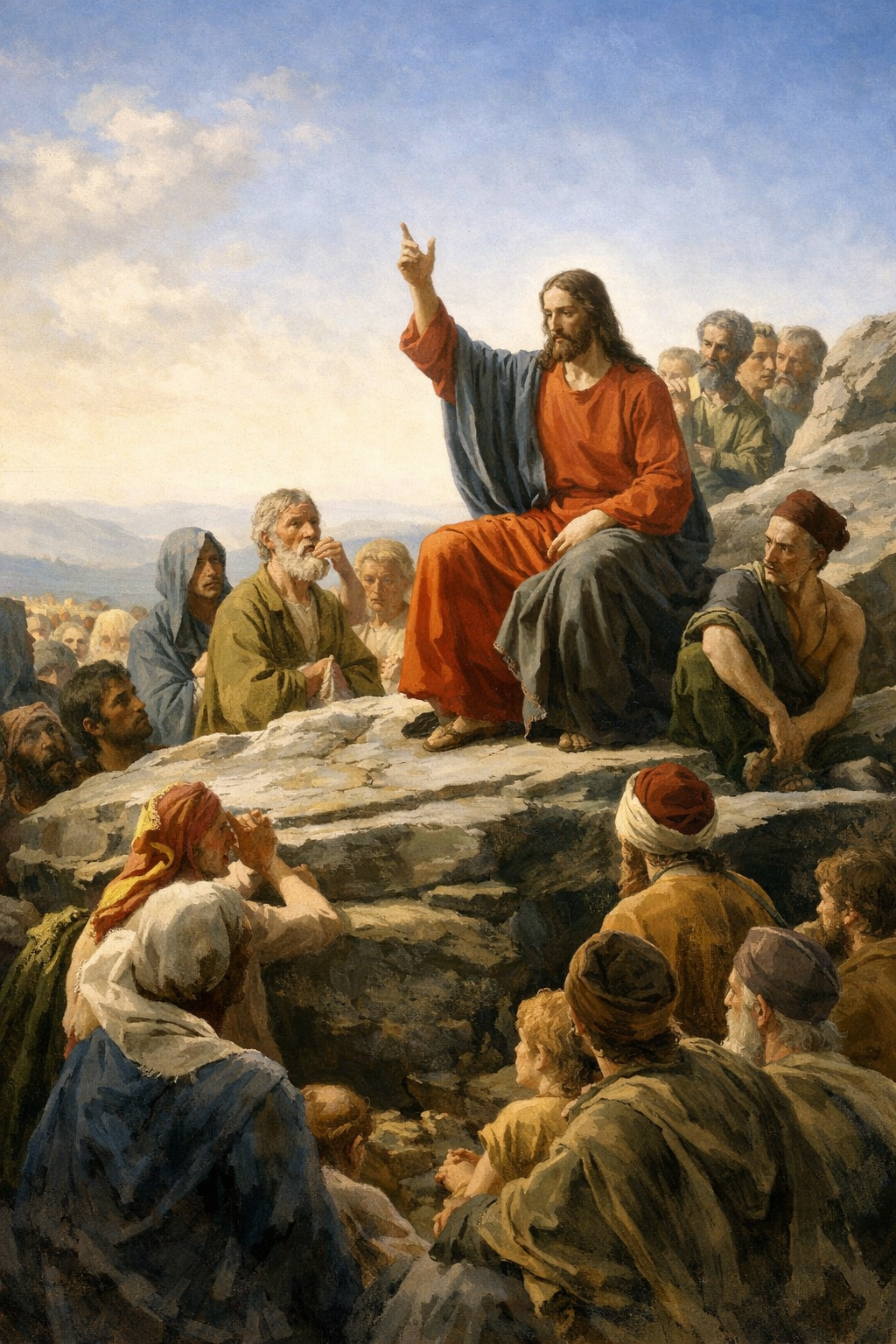
Sermon on the Mount
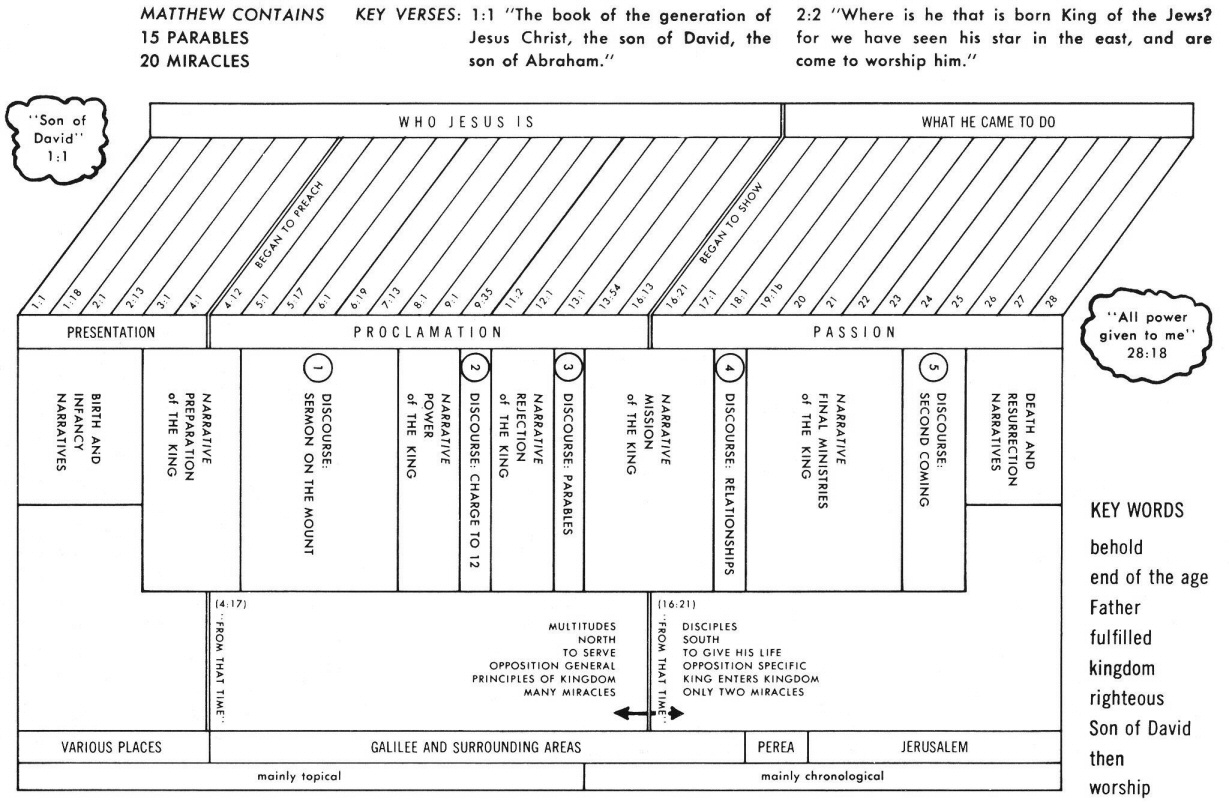
Click chart to enlarge
Charts from Jensen's Survey of the NT - used by permission
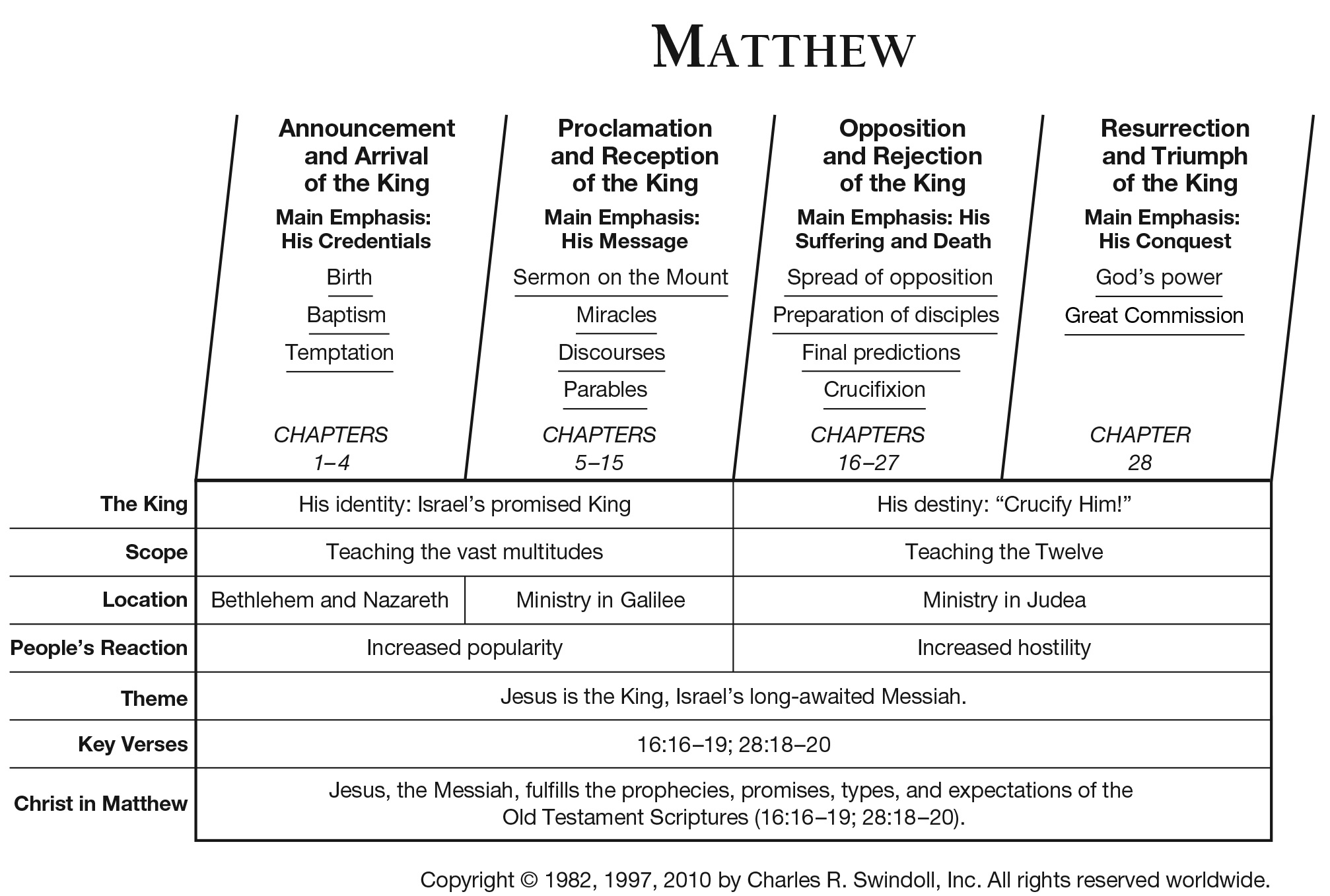
Another Chart from Charles Swindoll
THE LIFE OF JESUS AS COVERED
BY MATTHEW (shaded area)
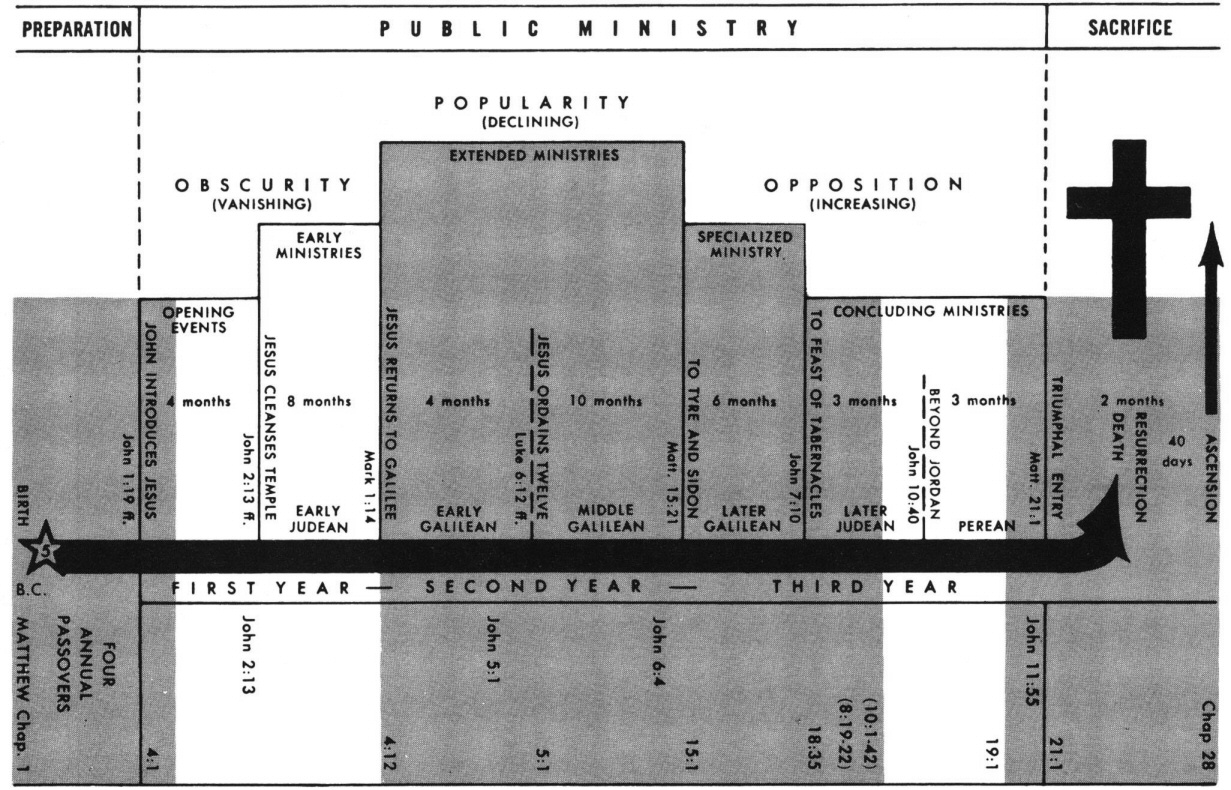
Click chart to enlarge

Jesus Birth and Early Years
Leading up to the Sermon on the Mount
Matthew 1-7

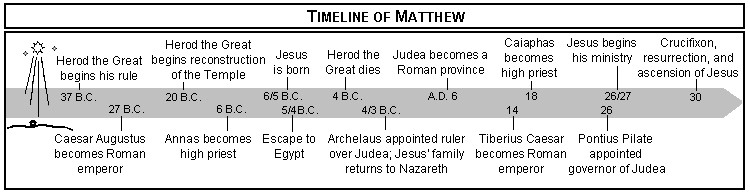
Source: Ryrie Study Bible
Matthew 7:12 "In everything, therefore, treat people the same way you want them to treat you, for this is the Law and the Prophets. (NASB: Lockman )
Greek: Panta oun osa ean thelete (2PPAS) ina poiosin (3PPAS) humin oi anthropoi, outos kai umeis poieite (2PPAM) autois; outos gar estin (3SPAI) o nomos kai oi prophetai.
Amplified: So then, whatever you desire that others would do to and for you, even so do also to and for them, for this is (sums up) the Law and the Prophets. (Amplified Bible - Lockman)
KJV: Therefore all things whatsoever ye would that men should do to you, do ye even so to them: for this is the law and the prophets.
NLT: Do for others what you would like them to do for you. This is a summary of all that is taught in the law and the prophets. (NLT - Tyndale House)
Phillips: Treat other people exactly as you would like to be treated by them - this is the essence of all true religion." (New Testament in Modern English)
Wuest: Therefore, all things whatever you may be desiring men to be doing to you, in the same manner also, as for you, you be doing to them, for this is the law and the prophets.
Young's: All things, therefore, whatever ye may will that men may be doing to you, so also do to them, for this is the law and the prophets.
In everything, therefore, treat people the same way you want them to treat you, for this is the Law and the Prophets.
- Luke 6:31
- Mt 22:39,40; Leviticus 19:18; Isaiah 1:17,18; Jeremiah 7:5,6; Ezekiel 18:7,8,21; Amos 5:14,15; Micah 6:8; Zechariah 7:7, 8, 9, 10; 8:16,17; Malachi 3:5; Mark 12:29, 30, 31, 32, 33, 34; Romans 13:8, 9, 10; Galatians 5:13,14; 1Timothy 1:5; James 2:10, 11, 12, 13
- Matthew 7 Resources - Multiple Sermons and Commentaries
Spurgeon writes...
&“&The law and the prophets&” are here condensed into a single sentence. This is the golden rule, a handy rule, a perpetually-applicable rule, useful in every condition, and it never makes a mistake.
Wonderful condensation of the two tables off the law! God help us to remember it. This is a golden rule, and he that follows that shall lead a golden life.
J C Ryle comments that in "In this part of the sermon on the mount (Mt 7:12-20) our Lord begins to draw His discourse to a conclusion. The lessons He here enforces on our notice, are broad, general, and full of the deepest wisdom. Let us mark them in succession. He lays down a general principle for our guidance in all doubtful questions between man and man. We are "to do to others as we would have others do to us." We are not to deal with others as others deal with us. This is mere selfishness and heathenism. We are to deal with others as we would like others to deal with us. This is real Christianity. This is a golden rule indeed! It does not merely forbid all petty malice and revenge, all cheating and over-reaching. It does much more. It settles a hundred difficult points, which in a world like this are continually arising between man and man. It prevents the necessity of laying down endless little rules for our conduct in specific cases. It sweeps the whole debatable ground with one mighty principle. It shows us a balance and measure, by which every one may see at once what is his duty. Is there a thing we would not like our neighbor to do to us? Then let us always remember, that this is the thing we ought not to do to him. Is there a thing we would like him to do to us? Then this is the very thing we ought to do to him. How many intricate questions would be decided at once, if this rule were honestly used! (J. C. Ryle. Expository Thoughts)
This is what we often hear referred to as "the Golden Rule" (the principle of reciprocity = the practice of exchanging things with others for mutual benefit) which is a summation of Jesus' ethical teaching regarding our treatment of others.
All things, therefore, whatever ye may will that men may be doing to you, so also do to them, for this is the law and the prophets.
The Golden Rule is like a "pocketknife" always ready to be used, even when there is no time to ask for advice. Treat them like you would like to be treated Jesus says! Jesus thus provides a rule we can use in thousands of specific cases to determine what righteousness looks like. Doing to others what we would want them to do to us is what the Law and the Prophets taught. This behavior fulfills them (cf. Mt 5:17). This behavior is the will of God, and Jesus’ disciples should do it.
Jesus had made similar statements earlier in His sermon...
"Give to him who asks of you, and do not turn away from him who wants to borrow from you." (notes Matthew 5:42)
"I say to you, love your enemies, and pray for those who persecute you." (notes Matthew 5:44)
Versions of the “Golden Rule” existed before Christ, in the rabbinic writings and even in Hinduism and Buddhism. All of them cast the rule as a negative command, such as Rabbi Hillel’s version,
“What is hateful to yourself do not to someone else.”
Jesus puts this command in the positive, and says that we should do unto others what we want them to do unto us.
Jameison, F, B writes that...
“This is the substance of all relative duty; all Scripture in a nutshell.” Incomparable summary! How well called “the royal law!” (Jas 2:8; Ro 13:9). It is true that similar maxims are found floating in the writings of the cultivated Greeks and Romans, and naturally enough in the Rabbinical writings. But so expressed as it is here—in immediate connection with, and as the sum of such duties as has been just enjoined, and such principles as had been before taught—it is to be found nowhere else. And the best commentary upon this fact is, that never till our Lord came down thus to teach did men effectually and widely exemplify it in their practice. The precise sense of the maxim is best referred to common sense. It is not, of course, what—in our wayward, capricious, gasping moods—we should wish that men would do to us, that we are to hold ourselves bound to do to them; but only what—in the exercise of an impartial judgment, and putting ourselves in their place—we consider it reasonable that they should do to us, that we are to do to them.& (Matthew 7)
MacArthur comments that...
How we treat others is not to be determined by how we expect them to treat us or by how we think they should treat us, but by how we want them to treat us. Herein is the heart of the principle, an aspect of the general truth that is not found in similar expressions in other religions and philosophies. For many years the basic instrument of music was the harpsichord. As its keys are depressed, a given string is plucked to create the desired note, much as a guitar string is plucked with a pick. But the tone made in that way is not pure, and the mechanism is relatively slow and limiting. Sometime during the last quarter of the eighteenth century, during Beethoven’s lifetime, an unknown musician modified the harpsichord so that the keys activated hammers that struck, rather than plucked, the strings. With that minor change, a major improvement was made that would henceforth radically enhance the entire musical world, giving a grandeur and breadth never before known. That is the sort of revolutionary change Jesus gives in the golden rule. Every other form of this basic principle had been given in purely negative terms, and is found in the literature of almost every major religion and philosophical system... The motivation is basically selfish-refraining from harming others in order that they will not harm us. Those negative forms of the rule are not golden, because they are primarily utilitarian and motivated by fear and self-preservation...
Selfless love does not serve in order to prevent its own harm or to insure its own welfare. It serves for the sake of the one being served, and serves in the way it likes being served-whether it ever receives such service or not. That level of love is the divine level, and can be achieved only by divine help. Only God’s children can have right relations with others, because they possess the motivation and the resource to refrain from self-righteously condemning others and to love in an utterly selfless way. (MacArthur, J: Matthew 1-7 Macarthur New Testament Commentary Chicago: Moody Press)
Therefore (3767) (oun) is a term of conclusion, but the question then arises as to what specifically that Jesus has previously discussed is now being concluded in this summary statement. In so doing, Jesus makes the command much broader. It is the difference between not breaking traffic laws and doing something positive like helping a stranded motorist. This especially applies to Christian fellowship. If we would experience love and have people reach out to us, we must love and reach out to others.
Expositor's has a good summary of the possibilities writing that...
The oun ("therefore") might refer to Mt 7-11 (i.e., because God gives good gifts, therefore Jesus' disciples should live by this rule as a function of gratitude) or to Mt 7:1-6 (i.e., instead of judging others, we should treat them as we ourselves would want to be treated).
But more probably it refers to the entire body of the sermon (Mt 5:17-7:12), for here there is a second reference to "the Law and the Prophets"; and this appears to form an envelope with Mt 5:17-20. (Ed note: This is a figure of speech which goes by the Latin term "inclusio" for "inclusion" in which the same phrase ["Law and Prophets"] is repeated at the beginning of Jesus' exposition of what constitutes a surpassing degree of righteousness and again here at the end, which is marked as the end also by the fact that He then proceeds to call for a decision from His hearers in Mt 7:13-14. Bullinger adds that "When this figure is used, it marks what is said as being comprised in one complete circle, thus calling our attention to its solemnity; giving completeness of the statement that is made, or to the truth enumerated, thus marking and emphasizing its importance." Figures of Speech Used in the Bible)
"Therefore," in the light of all I have taught about the true direction in which the OT law points, obey the Golden Rule; for this is (NIV "sums up") the Law and the Prophets (cf. Ro 13:9).
This way of putting it provides a powerful yet flexible maxim that helps us decide moral issues in a thousand cases without the need for multiplied case law. The rule is not arbitrary, without rational support, as in radical humanism; in Jesus' mind its rationale ("for") lies in its connection with revealed truth recorded in "the Law and the Prophets." The rule embraces quantity ("in everything") and quality ("[do] even so"). And in the context of fulfilling the Scriptures, the rule provides a handy summary of the righteousness to be displayed in the kingdom. (Ed note: by kingdom citizens) (Expositor's Bible Commentary) (Bolding and italics added)
McGee feels that “Therefore” is the most important word in the Golden Rule. It relates the Golden Rule to that which precedes it. That is, it postulates it on prayer. It all comes together in one package. Don’t lift out the Golden Rule and say that you live by it. Understand what the Lord is talking about. Only as we “ask, seek, and knock” are we able to live in the light of the Golden Rule. (McGee, J V: Thru the Bible Commentary: Nashville: Thomas Nelson)
This Golden Rule of conduct is not a prerequisite for salvation, for no person (except Christ) could possibly obey it perfectly. Jesus is commanding those who are already citizens of the Kingdom of Heaven to seek to order their personal lives by this standard, which in its essence far surpasses the righteousness of the scribes and Pharisees! In other words, the command of Jesus demands a standard of conduct that surpasses what is normally expected, a command that can only be fulfilled by those who possess the gift of God's Spirit. The perfect love of the heavenly Father is most reflected in His children when they treat others as they themselves wish to be treated.
Begin to apply (in the power of the Spirit) the "Golden Rule Test" - Ask yourself whether the action you think is beneficial to others is actually one you would want to receive yourself! Such actions might just change your interactions for the better and for God's glory!
McNeile writes that
“The Golden Rule is the distilled essence of that ‘fulfilment’ (that which Jesus described in Mt 5:17 "Do not think that I came to abolish the Law or the Prophets; I did not come to abolish, but to fulfill.")
"The law and the Prophets" is further explained by Jesus in Matthew 22 when asked...
"Teacher, which is the great commandment in the Law?" And He said to him, "'YOU SHALL LOVE THE LORD YOUR GOD WITH ALL YOUR HEART, AND WITH ALL YOUR SOUL, AND WITH ALL YOUR MIND.' This is the great and foremost commandment. The second is like it, 'YOU SHALL LOVE YOUR NEIGHBOR AS YOURSELF.' On these two commandments depend the whole Law and the Prophets." (Mt 22:36-40)
There is also a negative form of Jesus positive command in the Apocrypha (caveat)...
And what you hate, do not do to any one. Do not drink wine to excess or let drunkenness go with you on your way (Tobit 4:15)
Jesus, in contrast to the Jewish rabbis and the Apocrypha, made it a positive command (present imperative), enriching its meaning going beyond passive restraint to active benevolence. Christianity is not simply a matter of abstinence from sin but is positive goodness in action. This command nicely summarizes the whole gist of the ethical principles contained in the Law and the Prophets and the surpassing righteousness described from Mt 5:22-7:11.
How can we put the Golden Rule into action in our workplace? The story is told of a owner talking with one of his managers about an employee stealing from the firm. The owner, who was a follower of Christ, asked, "What do you think we should do about him?" to which the manager responded "Give him the ax!" The Christian applying Jesus' teaching asked "Suppose he admits his wrongdoing and agrees to pay for what he's stolen? Why don't we let him keep his job? Isn't that how you would want to be treated?" The manager replied "Sure, but that's just not the real world!" Jesus' point is that His disciples are in fact citizens of another world, the Kingdom of Heaven and as such we are committed to follow the King's decrees, which demand integrity, responsibility, and accountability. When they are practiced, employees become more dependable and fulfilled. And when the employer makes the workers' welfare as important as making a profit, more people stay off welfare rolls and out of unemployment lines. Sure believers are living in "the real world" but living in the real world but they are not to follow its rules but the rules which Jesus laid down in the Sermon on the Mount. When we put Christ's righteousness into practice, our light shines and the Father in heaven gets the glory.
THE REAL WORLD - The owner of a company was talking with one of his managers about an employee who was stealing from the firm. The owner, who was a follower of Christ, asked, "What do you think we should do about him?"
"Give him the ax!" replied the manager.
"Suppose he admits his wrong-doing and agrees to pay for what he's stolen," said the owner, "Why not let him keep his job" Isn't that how you
would want to be treated?"
"Well, yeah," said the manager, "but that's not the real world."
Jesus calls us to follow the rules of HIS world, which IS the real world. His rules demand our integrity, responsibility, and accountability. When they are practiced, employees become more dependable and fulfilled. And employers make their workers' welfare as important as making a profit. The result? More people stay off welfare rolls and out of unemployment lines.
Paul had some advice for workers and employers. He urged workers to carry out their duties "as bondservants of Christ,...as to the Lord, and not
to men" (Eph 6:6, 7-see notes Ep 6:6; 6:7). And he instructed masters not to threaten their servants, reminding them that their Master shows no partiality (Eph 6:9).
What about us? Are we living in the real world by the rules Jesus gave us? -- Dennis J. De Haan (Our Daily Bread, Copyright RBC Ministries, Grand Rapids, MI. Reprinted by permission. All rights reserved)
THINKING IT THROUGH
What principle does the golden rule (Mt. 7:12)
give us for serving others? How does it apply in the workplace?
The reward for honest labor
is always greater than the wages received.
J R Miller (Who Is He?) - Our Duty to Others
“All things whatsoever ye would that men should do to you, do ye even so to them.” Matthew 7:12
This is a wonderfully comprehensive rule of action. It bids us consider the interests of others as well as our own. It bids us set our neighbour alongside of ourself, and think of him as having the same rights as we have, and requiring from us the same treatment that we give to ourself. It gives us a standard by which to test all our motives and all our conduct bearing on others. We are at once in thought to change places with the person toward whom duty is to be determined, and ask, “if he were where I am, and I were where He is, how should I want him to treat me in this case?” the application of this rule would instantly put a stop to all rash, hasty actions; for it commands us to consider our neighbour and question our own heart before doing anything. It would slay all selfishness; for it compels us to regard our neighbours interests as precisely equal to our own. It would lead us to honour others; for it puts us and them on the same platform.
The application of this rule would put a stop to all injustice and wrong; for none of us would do injustice or wrong to ourselves, and we are to treat our neighbour as if he were ourself. It would lead us to seek the highest good of all other men, even the lowliest; for we surely want all men to seek our good. The thorough applying of this Golden Rule would end all conflict between capital and labour; for it would give the employer a deep, loving interest in the men he employs, and lead him to think of their good in all ways. It would also give to every employee a desire for the prosperity of his employer and an interest in his business. It would end all strife in families, in communities, among nations. The perfect working of this rule everywhere would make heaven; for the will of God would then “be done on earth, as it is in heaven.”
GOD is graciously pleased on some occasions to take those things which are good in men, for the purpose of illustrating his own ineffable and unbounded goodness. There is scarcely to be found a mother so destitute of feeling as to “forget her sucking child, and not to have compassion on the son of her womb.” ‘Such a monster,’ says God, ‘may be found: “yet will not I forget thee&&.” ’ So, in the words before the text, we are told, that, “evil” as men are, there exists not a father so cruel as to give his child a stone or a serpent, when importuned by him for the food that is necessary for his subsistence: from whence this inference is made; “How much more shall your heavenly Father give good things unto them that ask him.” Such inferences are just and legitimate to a certain extent: but they must not be pressed too far. We must not presume to argue, as many infidels have done, “that because a benevolent man would not punish his enemy to all eternity, therefore God will not:” for there is no parallel between the cases; nor are God’s actions to be measured by such a standard: his written word will be the rule of his procedure; and all conclusions that contradict that, will prove delusive at the last. But though we cannot always argue from what man would do to what we may expect from God, we may safely, and in all cases, infer, from the superabundant goodness of God to us, the obligation which lies on us to exercise all possible degrees of kindness to our fellow-creatures. To this thought we are led by the connexion in which our text stands with the preceding verses. The words we have just read to you are an exhortation founded on the preceding representation of the Divine goodness: and certainly the argument is exceeding strong: for, if God in any case condescends to make our good actions a rule of conduct to himself, much more should we make the unbiassed convictions of our own minds the rule of our conduct towards all.
The direction that is here given us, is as important as any in the whole sacred volume. We shall endeavour to point out,
I. Its import—
It is almost dangerous to attempt an elucidation of so plain a command, lest we only obscure, whilst we endeavour to explain it. But it is obvious that something must be supplied, in order to guard against the misconstructions which a caviller might put upon the words. The fact is, that all people do of themselves supply what is wanting in them, without being conscious that the sense which they affix to the words is the result of their own judgment, and not the strict meaning of the words themselves. I say there are two limitations which all people do, though unconsciously, assign to the words, and without which they would not be a just rule of conduct to any man: and these are,
1. That we must exchange situations, as it were, with the person towards whom we are about to act—
[It would be absurd to say, that we must actually conduct ourselves towards all people precisely as we would wish them to act towards us. There are a thousand menial services, which the more opulent part of the community must have done for them, and which it would be folly and madness in them to go and do for others&&. Besides, there are duties arising out of the very situations we hold; and which are not duties to any, except to persons who are so circumstanced. Those, for instance, who are in authority, as rulers, or parents, or masters, are not called to obey their inferiors, because they desire to be obeyed by them. Were we therefore to construe the command without any limitation, we must break down all the distinctions in society, and set aside all the duties which God himself has connected with them. To prevent this, we must suppose the person to be in our situation, and ourselves in his; and then consider, what we should desire and expect from him. If, for instance, we be in authority, we should ask ourselves what treatment we should desire and expect, if we were in the place of our inferiors; and then we should act with all the kindness and condescension towards them, that we, in a change of circumstances, should expect at their hands.]
2. That we must make, not our inclination, but our judgment, the rule of our conduct—
[It is not sufficient to change places with the person towards whom we are about to act. For, if we put ourselves in the situation of a poor man, we might wish our rich neighbour to divide his property with us: but this is no reason why we should go and act thus: the thing is unreasonable in itself: and, however we might wish it, we should not for a moment think that justice or equity required it. So, if we were to put ourselves in the place of a convicted felon, we might wish the judge not to put the laws in force against us: but that is no reason why we, if sitting in the place of judgment, should not enforce and execute the laws against others. We must not consider so much what we might wish in such circumstances, as what we should, after full and impartial consideration, think right. We should think it right that the judge should investigate our cause with care, and make his decision with equity; and, on the whole, should lean to the side of mercy rather than of severity: but we could never persuade ourselves that felons should be permitted to violate the laws with impunity; because that would render the peaceful members of society a prey to every daring ruffian. It is evident then that we must call in the aid of judgment, and regulate our conduct according to its deliberate and unbiassed dictates.
With the help of these two remarks, we shall be in no danger of misinterpreting the rule before us. Indeed these limitations are so obvious, that, as we said before, they are unconsciously supplied even by the most ignorant of mankind: so that we might have waved all mention of them, if it had not been expedient to mark with precision the limits, which, though generally acknowledged, are but indistinctly seen. In a word, the rule is this: We must consider in all cases what we, under a change of circumstances, should think it right for another to do unto us; and that must be the rule of our conduct towards him.]
Having thus considered the import of the rule, we proceed to shew,
II. Its excellence—
A greater encomium cannot be passed upon it than is in the words before us: “This is the law and the prophets.” But what is implied in this commendation? and what are those particular excellencies which it holds up to our view? It intimates, that the rule is eminently distinguished for the following properties:
1. It is concise—
[“The law and the prophets” constitute a very large volume; to become well acquainted with which in all its parts, requires no little expense, both of time and labour. But, vast as its circumference is, its lines all meet in this rule, as in their common centre. We speak not indeed of the doctrinal part of this volume, but of the preceptive. This limitation, like those before mentioned, is necessarily implied, though not expressed: and, if we do not bear it in mind, we shall pervert this best of principles into an occasion of the most destructive error. “The law and the prophets” have a twofold use; first, to testify of Christ as the ground of our hopes&&; and next, to state the law as the rule and measure of our duties&&. To understand the commendation given to this rule as extending to the law and the prophets in the former sense, would annihilate the whole Gospel, and make the death of Christ of no avail. We must therefore understand our Lord as speaking of the law and the prophets only so far as they contain a rule of life. Moreover, when speaking of them expressly in this view, he comprehends the law under two great commandments, The love of God, and The love of our neighbour; and then he adds, “On these two commandments hang all the law and the prophets&&.” But it is only to this second commandment that the rule in our text refers; and consequently, when we speak of the rule as comprehending the law and the prophets, we must be considered as limiting our assertion not only to the preceptive part of the law, in opposition to the doctrinal, but to that part of the preceptive code which contains our duty to our neighbour. Let it be remembered, however, that there is not a page of the sacred volume which is not replete with instruction upon this point; and that this short sentence in my text is a summary of the whole.
Now if, on every occasion, we had to search the sacred volume for some precept directly to our point, the opportunities of acting would be passed before we had found such a direction as would be satisfactory to our minds. This would be the case even with those who were most conversant with the sacred writings, and much more with those whose time is almost entirely occupied with temporal concerns. But behold, here is a summary, so short, that it is easily remembered; so simple, that it is easily understood; so suited to all occasions, that it is easily applied, by any person, and at any time. Methinks this rule, to a Christian, is like the compass to a mariner. Were the master of a ship destitute of any means of directing his vessel, except those afforded him by the heavenly bodies, he might often be steering a very different course from that which he designed to take: but, by the help of the compass, the most illiterate sailor may know which way to steer: that little portable contrivance will direct him, whether by day or night, whether in a calm or tempest, and that too in every climate under heaven. Precisely thus it is with the Christian: there would be many times and occasions, when, if destitute of this rule, he would not know how to conduct himself aright: but, by the help of this, the most ignorant cannot lose his way: his path in every situation is made plain by it; and the “way-faring man, though a fool, shall not err therein&&.”]
2. It is comprehensive—
[“The law and the prophets” contain directions proper for every person, in every rank, under every situation and circumstance in which he can possibly be placed. Nor is this rule at all less extensive: it will direct the king on his throne no less than the meanest subject in his dominions. There is not any single act, relating either to justice and equity, or to kindness and charity, or even to common decency and civility, which it does not equally embrace, and for which it does not provide a sufficient directory.
Under the Jewish dispensation, the high-priest had an opportunity of ascertaining the mind and will of God by means of his breast-plate. What the Urim and Thummim was, or how it conveyed information to the high-priest, is not positively known: but that God did make use of it in some way to convey to him the knowledge of his will, is certain: nor was there any subject whereon God would not have given him instruction, if he had sought it in a becoming manner. Now we are repeatedly told in the New Testament, that all true Christians are both “kings and priests unto God:” and one of the most distinguished privileges which, as Christians, we enjoy, is a liberty of access to God, every one of us for ourselves, without the intervention of any human being; and a permission to seek direction from him on every occasion. And has not God furnished us with the Urim and Thummim? Yes, he has: this very rule he has given us to carry, as it were, upon our breasts, that it may instruct us in every part of our duty. We may say respecting it, as Moses says of the Gospel salvation, “we need not go up to heaven, to bring it down from above, nor descend into the deep, to bring it up from beneath; but the word is nigh us, even in our mouth and in our hearts&&.” Wherever we are, we need only set ourselves in the presence of God, and, with humble supplications to him, inspect our own bosoms, to see what light this rule will afford us; and we shall assuredly be guided in the right way. Whether we be rich or poor, learned or unlearned, and whether the subject be more or less important, no difference shall be made: if the point relate to states and kingdoms, or if it concern only the smallest branch of moral duty to an individual, it shall equally be made known to us: and if, after that, we err, the error will not proceed from any defect in the rule itself, but from a want of a more perfect discernment of it, or a more just application of it to the point before us.]
3. It is complete—
[What can be added to “the law and the prophets” to make them more complete? Vain would be the attempt either of men or angels to find in them one single flaw or defect: for whilst they comprehend every species of duty, they supply at the same time every motive for the performance of it: “The word of the Lord is perfect.” The same may be said also of the rule before us. No created wisdom can improve it: no man can find in it any thing either superfluous or defective. Its comprehensiveness and conciseness we have before spoken of: and we may now notice, what indeed still more clearly displays its excellence, its singular operation on the human mind, not merely as a light to direct us in the path we should go, but as an incentive to us to walk in it.
The mode in which this rule operates upon us is this: it takes the most corrupt principle of the human heart, even that root of bitterness from whence every species of injustice springs; it suspends all the operations of that principle on the side of evil, and constrains it to become a powerful advocate of virtue. Selfishness is the real source of all those evils and calamities which men bring on each other. It is to this principle that we must trace the wars of contending nations, the discord of families, the injustice, the fraud, and all the other evils that are found in the transactions of individuals. From this principle it is, that men are universally disposed to expect too much, and to concede too little. Now this rule, requiring us to put ourselves in the place of him towards whom we are about to act, cuts off at once all scope for the exercise of this principle in our own cause, and enlists it into the service of our neighbour: thereby inclining us as much to favour him, as it would otherwise have inclined us to benefit ourselves: at the same time it marks so strongly the reasonableness of true benevolence, as makes us abhor the thought of acting in opposition to it. I may further add too, that whilst this rule operates thus as a stimulus to virtue, a consciousness of having acted agreeably to it is one of the richest rewards that man can enjoy on earth: if a man fail of accomplishing his benevolent purposes, he has a recompence in his own bosom from a sense that he has acted right himself: and, if he attain his end, he has double recompence, the testimony of a good conscience, and the joy of seeing that he has not laboured in vain. Say then, whether this be not justly called the golden rule? Surely, whether we consider the mode of its operation, or its peculiar efficacy, or the delight that invariably proceeds from conforming to it, its value is inestimable: nor can any terms be too strong in commendation of it.]
From this subject we may learn,
1. The scope and intent of true religion—
[It is surprising what a jealousy prevails in the minds of men with respect to this. Talk of religion, and especially of Christ, and of “the righteousness which is of God by faith in him, unto all, and upon all them that believe;” and a doubt immediately arises, whether you are not an enemy to good works: this is declared to be the proper tendency of such sentiments; and all manner of stories are raked together to countenance the idea. As for those who deny that “the law and the prophets” testify of Christ, and point him out as the only source of “righteousness and strength&&,” we shall leave them to settle the matter with the Apostle Paul, and with the standard writings of the established Church. We shall at present notice those only who are so fearful about the interests of morality. Now we assert, that, however strongly the doctrine of justification by faith be maintained from “the law and the prophets,” no man that pays the smallest deference to their testimony can fail to insist upon good works. When we read in one part, that “the love of God and of our neighbour are the two great commandments, on which hang all the law and the prophets;” and in another part, that “the doing as we would be done unto, is (in substance) “the law and the prophets;” we are amazed that any human being should be found, who denies the necessity of good works; or that people should be so credulous as to impute this sentiment to all who embrace the doctrine of salvation through a crucified Redeemer. Let the matter be investigated: let it be seen whether Paul was an enemy to good works; whether the great body of our English Reformers were enemies to good works: let us examine the writings of those who now uphold the same doctrine, and see whether they neglect to inculcate and encourage good works. Truly, if people were not blinded by prejudice, they would see that one half at least of the obloquy that falls upon those who are contemptuously called Evangelical, is on account of the strictness of their lives and the holiness of their deportment. But, waving all these considerations, this at least is plain, that, whatever fault there may be in any set of men, “the law and the prophets” stand unimpeached: they, with one voice, require submission to the golden rule, and make the practice of that to be an indispensable test of men’s regard for their testimony. Let this then sink down into our ears; let it be remembered, that the very Scriptures, which inculcate most forcibly the doctrine of salvation by faith in Christ, inculcate also a most exalted morality. The Gospel never did, nor ever will, bring any person to salvation in the way of sin; it is in the way of holiness only, and of a very exalted degree of holiness too, that any man can attain the salvation of the Gospel. Not that holiness will save him; it is the blood and righteousness of Christ that saves him: nevertheless it is an universal and unalterable truth, that “without holiness no man shall see the Lord.” May God write that truth on the hearts of such as disregard good works, (if any such there be,) and especially on the hearts of all who set themselves against the doctrines of salvation through unfounded prejudices against them, as being of a licentious tendency!]
2. The effect and benefit of true religion—
[This is not to be looked for in the professions, but in the practices of men; yet not in the practice of some easy duties, such as those of generosity and kindness, but in an universal and habitual attention to the rule before us. Where Christian principles have their full operation on the mind, there this rule will be established in the heart, and be exhibited in the life. Take the conduct of the early converts to Christianity; and there you will see the precise change of which we are speaking: and their situations being peculiar, they carried the principle to the extent of selling all their possessions for the support of their poorer brethren. A still more wonderful instance we see in the Apostle Paul, who, from the time of his conversion to Christianity, was willing to do or suffer any thing whereby he might facilitate the progress of the Gospel in the world. Knowing the advantages which, as a Christian, he enjoyed, he was willing even to lay down his own life, if by so doing he might bring others to a participation of them. The same change is still accomplished in the world; only it is less visible; the circumstances of the Church not calling for such a manifest display of it, and the measure of divine grace now enjoyed by the saints being, it is to be feared, more scanty than at that period. But can any one see the effects of religion, even as it is now exhibited, and not confess its excellence? Wherever it prevails, it establishes both in the heart and life this amiable principle: it brings men to do as they would be done unto. Suppose for a moment that one single man, the present disturber of the universe&&, were impressed aright by the Gospel of Christ, and brought under the influence of this principle, how many thousands and even millions of the human race would have reason to rejoice! And, if that principle were universally prevalent, what happiness would pervade the world! Such then is the effect, and such the benefit of true religion. It only remains that we urge you all to cultivate this principle. Let it not be said of any of you, ‘He talks of faith in Christ, but he is covetous, dishonest, passionate, vindictive.’ Let love reign in your hearts; and whilst you profess yourselves to be “trees of righteousness, of the Lord’s planting,” let the “tree be known by its fruit.”]