Matthew 7:2
Matthew 7:3
Matthew 7:4
Matthew 7:5
Matthew 7:6
Matthew 7:7
Matthew 7:8
Matthew 7:9
Matthew 7:10
Matthew 7:11
Matthew 7:12
Matthew 7:13
Matthew 7:14
Matthew 7:15
Matthew 7:16
Matthew 7:17
Matthew 7:18
Matthew 7:19
Matthew 7:20
Matthew 7:21
Matthew 7:22
Matthew 7:23
Matthew 7:24
Matthew 7:25
Matthew 7:26
Matthew 7:27
Matthew 7:28
Matthew 7:29
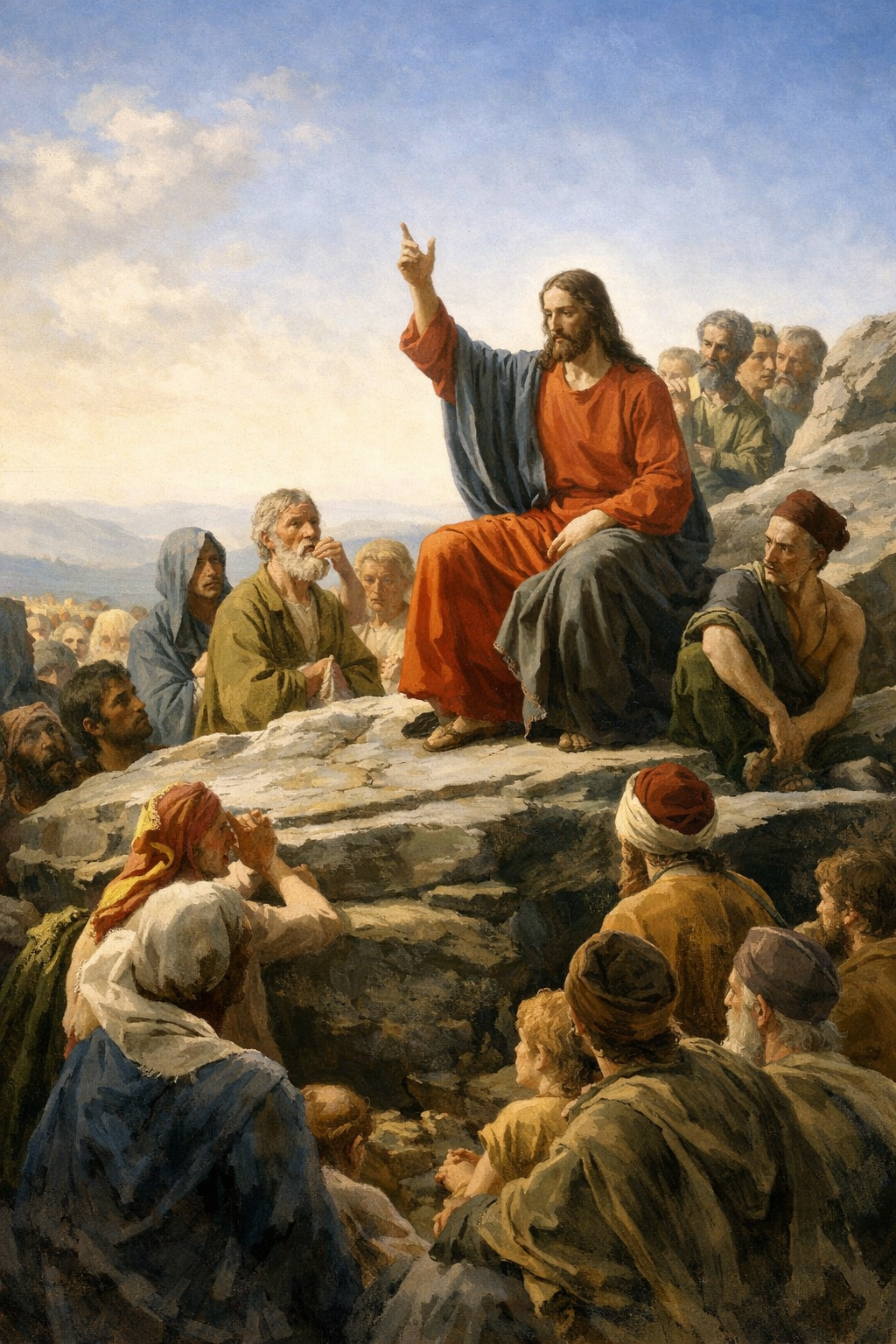
Sermon on the Mount
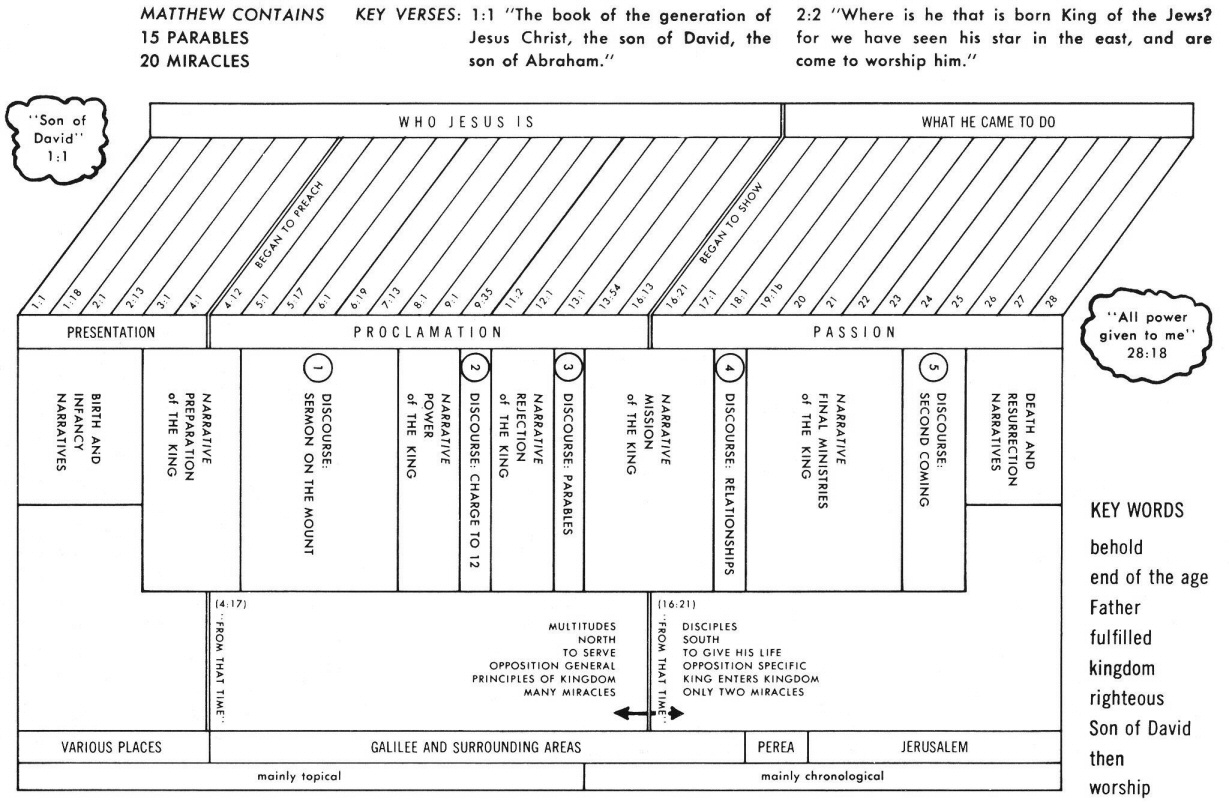
Click chart to enlarge
Charts from Jensen's Survey of the NT - used by permission
Another Chart from Charles Swindoll
THE LIFE OF JESUS AS COVERED
BY MATTHEW (shaded area)
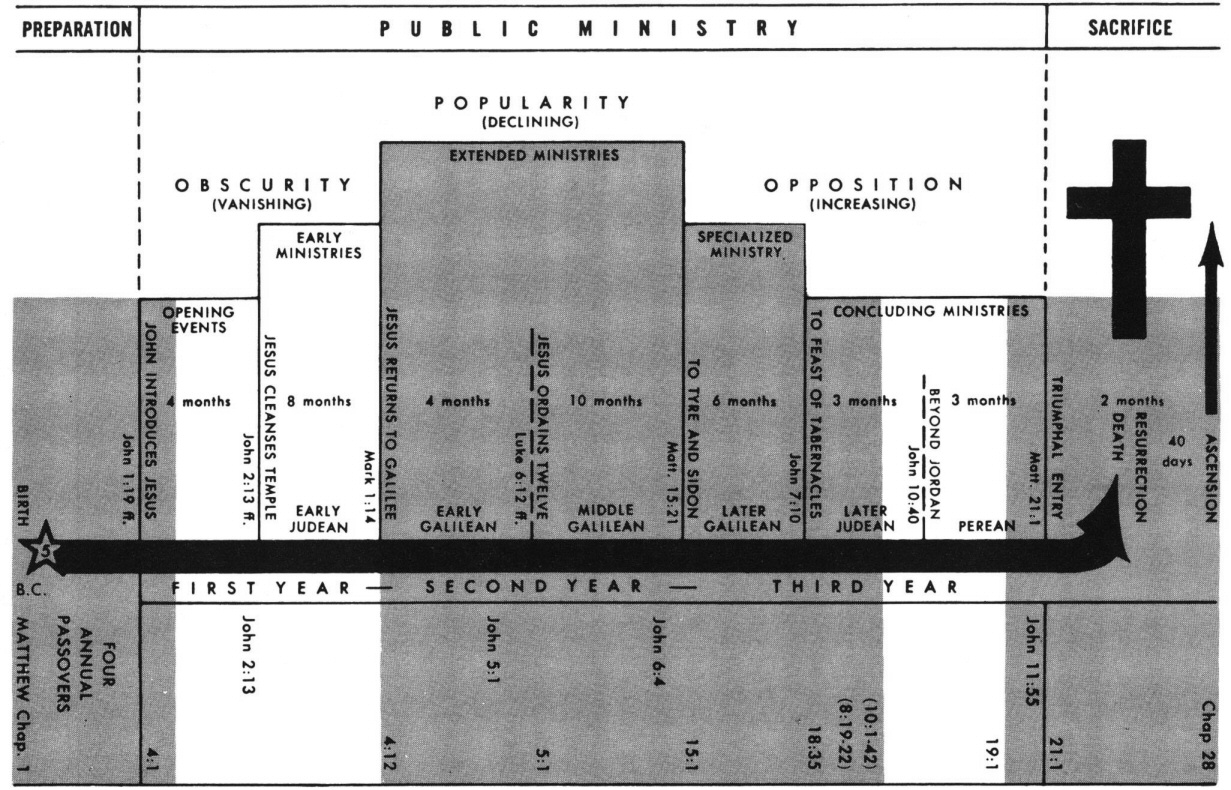
Click chart to enlarge
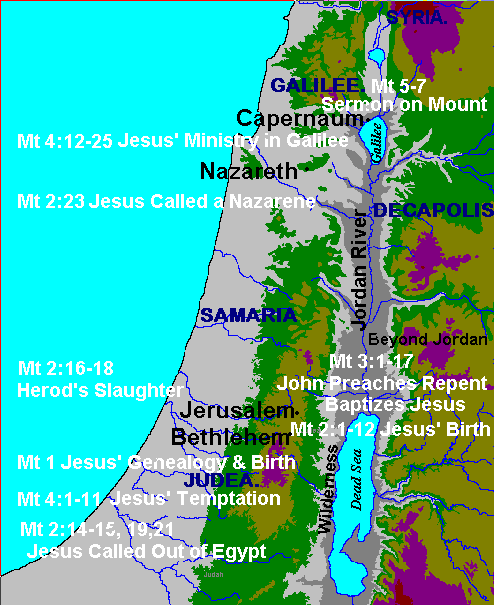
Jesus Birth and Early Years
Leading up to the Sermon on the Mount
Matthew 1-7
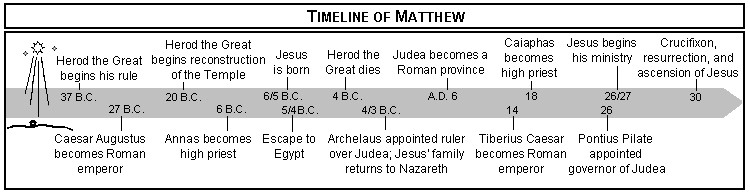
Source: Ryrie Study Bible
Matthew 7:15 "Beware of the false prophets, who come to you in sheep's clothing, but inwardly are ravenous wolves. (NASB: Lockman)
Greek: Prosechete (2PPAM) apo ton pseudopropheton, oitines erchontai (3PPMI) pros humas en endhumasin probaton, esothen de eisin (3PPAI) lukoi arpages.
Amplified: Beware of false prophets, who come to you dressed as sheep, but inside they are devouring wolves. (Amplified Bible - Lockman)
KJV: Beware of false prophets, which come to you in sheep's clothing, but inwardly they are ravening wolves.
NLT: Beware of false prophets who come disguised as harmless sheep, but are really wolves that will tear you apart. (NLT - Tyndale House)
Phillips: Be on your guard against false religious teachers, who come to you dressed up as sheep but are really greedy wolves. (New Testament in Modern English)
Wuest: Constantly be guarding yourself against the false prophets, men who are of such a character as to be coming to you with sheep-like outward expressions, but in their inner being they are rapacious wolves.
Young's: 'But, take heed of the false prophets, who come unto you in sheep's clothing, and inwardly are ravening wolves.
Beware of the false prophets: Prosechete (2PPAM) apo ton pseudopropheton:
- Beware Mt 10:17; 16:6,11; Mk 12:38; Lk 12:15; Acts 13:40; Php 3:2; Col 2:8; 2Pe 3:17
- False prophets Mt 24:4,5,11,24,25; Dt 13:1, 2, 3; Is 9:15,16; Jer 14:14, 15, 16; 23:13, 14, 16; Jer 28:15, 16, 17; 29:21,32; Ezek 13:16,22; Mic 3:5, 6, 7,11; Mk 13:22,23; 2Pe 2:1, 2, 3; 1Jn 4:1; Re 19:20
- Matthew 7 Resources - Multiple Sermons and Commentaries
BEWARE OF
SPIRITUAL DANGER
Spurgeon writes "Ahabs and Jezebels...will deceive you, if you are not divinely guarded against them."
Spurgeon in his sermon The Sieve writes that...
IN reading this chapter one is led to feel that it is not, after all an easy thing to be a sincere Christian. The way is hard, the road is narrow. Who will may represent the way to heaven as being easy; our Savior does not so speak of it. “Strait is the gate and narrow is the way, and few there be that find it.” “Many are called and few chosen.” The difficulty of being right is increased by the fact that there are men in the world whose trade it is to make counterfeits. There were, and there are, many false prophets. Our Savior has spoken about them in this chapter, and given us a way of testing them; but they are carrying on their trade still as successfully as ever. Now, since there are traitors abroad whose business it is to deceive, we ought to be doubly vigilant and constantly upon our watch-tower, lest we be misled by them. I charge you, examine every statement you hear from Christian pulpits and platforms; I charge you, sift and try every religious book by the great standard of the word of God. Believe none of us if we speak contrary to this word — yea, believe not an angel from heaven if he preach any other gospel than that which is contained in inspired Scripture. “To the law and to the testimony, if they speak not according to this word it is because there is no truth in them. God grant us grace to escape from false prophets! We shall not do so if we are careless and off our guard, for the sheep-skin garment so effectually covers the wolf, the broad phylactery so decorates the hypocrite, that thousands are deceived by the outward appearance, and do not discover the cheat. Crafty are the wiles of the enemy, and many foolish ones are still ignorant of his devices. Tutored by the experience of ages, seducers and evil men not only wax worse and worse, but they grow more and more cunning. If it were possible, they would deceive even the very elect. Happy shall they be, who, being elect, are kept by the mighty power of God unto salvation, so that they are not carried away with any error. (See the full text The Sieve)
J C Ryle comments that here...
the Lord Jesus gives us a general warning against false teachers in the church. We are to "beware of false prophets." The connection between this passage and the preceding one is striking. Would we keep clear of this "broad way?" We must beware of false prophets. They will arise. They began in the days of the apostles. Even then the seeds of error were sown. They have appeared continually ever since. We must be prepared for them, and be on our guard.
This is a warning which is much needed. There are thousands who seem ready to believe anything in religion if they hear it from an ordained minister. They forget that clergymen may err as much as laymen. They are not infallible. Their teaching must be weighed in the balance of Holy Scripture. They are to be followed and believed, so long as their doctrine agrees with the Bible, but not a minute longer. We are to try them "by their fruits." Sound doctrine and holy living are the marks of true prophets. Let us remember this. Our minister's mistakes will not excuse our own. "If the blind lead the blind, both will fall into the ditch."
What is the best safe-guard against false teaching? Beyond all doubt the regular study of the word of God, with prayer for the teaching of the Holy Spirit. The Bible was given to be a lamp to our feet and a light to our path. (Psalm. 119:105.) The man who reads it aright will never be allowed greatly to err. It is neglect of the Bible which makes so many a prey to the first false teacher whom they hear. They would have us believe that "they are not learned, and do not pretend to have decided opinions." The plain truth is that they are lazy and idle about reading the Bible, and do not like the trouble of thinking for themselves. Nothing supplies false prophets with followers so much as spiritual sloth under a cloak of humility.
May we all bear in mind our Lord's warning! The world, the devil, and the flesh, are not the only dangers in the way of the Christian. There remains another yet, and that is the "false prophet," the wolf in sheep's clothing. Happy is he who prays over his Bible and knows the difference between truth and error in religion! There is a difference, and we are meant to know it, and use our knowledge. (J. C. Ryle. Expository Thoughts)
Beware (4337) (prosecho from pros = before, toward + echo = hold) means literally to hold to, toward or before. Originally it was followed by the word "the mind" (nous) but at times "the mind" was omitted but still the idea of "the mind" was implied. To apply one’s self to. To attach one’s self to.
Prosecho means to moor a ship, to tie it up. Prosecho was also used to mean “to remain on course”.
Figuratively (see also below) the idea is to hold one's mind before then to take heed, to pay attention, to give heed, be in a state of alert, to watch out for or to be on guard. The word implies the giving one’s consent, as well as one’s attention. When used in this manner prosecho always warns of some type of danger (usually spiritual danger but occasionally physical)! Prosecho is not a call simply to notice or sense something, but to be on guard against it because it is so harmful (eg, the danger of practicing your righteousness for others to see, the danger of false prophets, false teachers and false teaching, the danger of the Pharisees and Sadducees). The idea is to turn one’s mind or attention to a thing by being on one’s guard against it.
The present imperative calls for the wise citizen of the kingdom of heaven to be continually on the look out for false prophets especially those who promote the deadly deceptive "doctrine" of the wide gate and the wide way that leads to death and destruction (cp Mt 7:13, 14-note). Remember that a false teaching is the more dangerous the more truth it contains. And as someone well said an error no wider than a hair will lead a hundred miles away from the goal. Jesus' point is that not every who claims to belong to God and to speak for Him actually proclaims God's truth. His message speaks poignantly to the evangelical church in our day of shallow teaching which sets the saints up for false teaching! Watch out! The best antidote for the "arsenic" or leaven of false teaching is to teach sound doctrine (cp 2Ti 4:2-note, 2Ti 4:3, 4-note, Heb 5:14-note, Titus 1:9-note, 1Pe 2:2-note) As J C Ryle put it "Ignorance of the Scriptures is the root of all error."
It is noteworthy that 12 of the 24 NT uses of prosecho are in the present imperative which is a command (see below) calling for continual attention!
Prosecho means
(1) To bring to, bring near, in Greek writings of bringing near a place, such as to bring a ship to land, and simply to touch at, put in. BDAG adds that "In non-biblical writings the primary meaning (is to) ‘have in close proximity to’; frequently... of mental processes ‘turn one’s mind to’."
(2) To hold or turn one's mind toward a person or thing. To attend to, be attentive. To pay close attention to something. To give assent to. (of the crowds listening to Phillip = Acts 8:6, 10, 11) (Of Lydia paying attention and thus responding Acts 16:14) (Notice that the meanings #2 and #3 are related and some lexicons do not separate the meanings).
(3) To be in a state of alert, be concerned about, care for, take care. The idea is to be in a continuous state of readiness to learn of any future danger, need, or error, and to respond appropriately. This meaning is frequently found as a command calling for continued attention (present imperative) - beware, be on alert, watch out, etc. (Mt 6:1, 7:15, 10:17, 16:6, 11, Lk 12:1, 17:3, 20:46, 21:34, Acts 5:38, 20:28, 1Ti 4:13) Notice also that it is Jesus Who is most often using this verb as a command!
(4) Continue to believe. Hold firmly to a particular belief (1Ti 1:4, 6:3)
Wherever the narrow demands of following Jesus are taught, there are false prophets who advocate the wide gate and easy way watering down the truth to the point that as Spurgeon sarcastically quipped...
There is not enough left to make soup for a sick grasshopper.
Prosecho - 24x in 24v - NAS = addicted(1), beware(8), give attention(1), giving...attention(1), giving attention(2), guard(3), officiated(1), pay attention(2), pay...attention(1), paying attention(2), respond(1), take care(1).
Matthew 6:1-note "Beware (prosecho - present imperative = command to be continually on the alert!) of practicing your righteousness before men to be noticed by them; otherwise you have no reward with your Father who is in heaven.
Matthew 7:15-note "Beware (prosecho - present imperative = command to be continually on the alert!) of the false prophets, who come to you in sheep's clothing, but inwardly are ravenous wolves.
Matthew 10:17 "But beware (prosecho - present imperative = command to be continually on the alert!) of men, for they will hand you over to the courts and scourge you in their synagogues.
Matthew 16:6 And Jesus said to them, "Watch out (horao - present imperative) and beware (prosecho - present imperative = command to be continually on the alert! A charge for constant watchfulness.) of the leaven of the Pharisees and Sadducees."
Matthew 16:11 "How is it that you do not understand that I did not speak to you concerning bread? But beware (prosecho - present imperative = command to be continually on the alert!) of the leaven of the Pharisees and Sadducees."
Matthew 16:12 Then they understood that He did not say to beware of the leaven of bread, but of the teaching of the Pharisees and Sadducees.
Luke 12:1 Under these circumstances, after so many thousands of people had gathered together that they were stepping on one another, He began saying to His disciples first of all, "Beware (prosecho - present imperative = command to be continually on the alert! Calls for this to be one's continual attitude.) of the leaven of the Pharisees, which is hypocrisy.
Luke 17:3 "Be on your guard! (prosecho - present imperative = command to be continually on the alert!) If your brother sins, rebuke him and if he repents, forgive him.
Luke 20:46 "Beware of the scribes, who like to walk around in long robes, and love respectful greetings in the market places, and chief seats in the synagogues and places of honor at banquets,
Luke 21:34 "Be on guard (prosecho - present imperative = command to be continually on the alert!), so that your hearts will not be weighted down with dissipation and drunkenness and the worries of life, and that day will not come on you suddenly like a trap;
Comment: Disciples are to watch out. If they are too absorbed into everyday life, they will stop watching and living faithfully. (NET Bible note)
Acts 5:35 And he said to them, "Men of Israel, take care (prosecho - present imperative = command to be continually carefully consider) what you propose to do with these men.
Acts 8:6 The crowds with one accord were giving attention (imperfect tense = over and over) to what was said by Philip, as they heard and saw the signs which he was performing.
Acts 8:10 and they all, from smallest to greatest, were giving attention (imperfect tense = over and over) to him, saying, "This man is what is called the Great Power of God."
Acts 8:11 And they were giving him attention (imperfect tense = over and over. It pictures repeated action) because he had for a long time astonished them with his magic arts.
Acts 16:14 A woman named Lydia, from the city of Thyatira (city in the province of Lydia in Asia Minor), a seller of purple fabrics, a worshiper of God, was listening and the Lord opened her heart to respond to the things spoken by Paul.
Comment: The NET Bible notes that BDAG says prosecho here means "gives the meaning "pay attention to" here, (but that) this could be misunderstood by the modern English reader to mean merely listening intently. The following context, however, indicates that Lydia responded positively to Paul's message, so the verb here was translated "to respond."
Acts 20:28 "Be on guard (prosecho - present imperative = command to be continually on the alert! This is to be your habitual attitude/action!) for yourselves (Note: Pastors, elders = first watch over your own heart and soul!) and for all the flock, among which the Holy Spirit has made you overseers, to shepherd the church of God which He purchased with His own blood.
1 Timothy 1:4 nor to pay attention to myths and endless genealogies, which give rise to mere speculation rather than furthering the administration of God which is by faith.
Comment: Vine says that "The verb prosecho sometimes signifies to be attentive to, as in Acts 6:14; 8:6, more strongly, to apply oneself to, to attach oneself to, to cleave to a person or thing; this is the meaning here, as also in 4:1, and Titus 1:14. In 1 Timothy 3:8, the meaning is to be addicted to and in 4:13, to devote thought and effort to. The danger mentioned in this verse was not merely that of giving attention to fables, etc., but rather of following such teachings by attaching oneself to the propagandists. (Vine, W. Collected writings of W. E. Vine. Nashville: Thomas Nelson or Logos)
1 Timothy 3:8 Deacons likewise must be men of dignity, not double-tongued, or addicted ("turning one's mind" or "devoted" or "occupy oneself with" or) to much wine or fond of sordid gain,
1 Timothy 4:1 But the Spirit explicitly says that in later times some will fall away from the faith, paying attention to deceitful spirits and doctrines of demons,
Comment: MacArthur writes that prosecho "expresses more than merely listening to something. It means “to assent to” “to devote oneself to,” or “cling to something.” The present tense of the participle shows that apostates continually cling to demonic teaching. They understand the facts of the gospel intellectually, and outwardly identify with the Christian faith. Since their hearts are not right with God and they do not have the Spirit to teach and protect them (cf. Jude 19), however, they are lured away by deceitful spirits. Planos (deceitful, cp word study on related verb planao) comes from the root word from which our English word “planet” derives. It carries the idea of wandering, and thus came to mean “seducing,” or “deceiving.” Demons are called deceitful because they cause men to wander from the orbit of the truth. The Holy Spirit leads people into saving truth (cf. Jn 16:13), while these unholy spirits lead them into damning error." (MacArthur, John: 1Timothy Moody Press)
1 Timothy 4:13 Until I come, give attention to (prosecho - present imperative = command to be continually devote yourself to!) the public reading of Scripture, to exhortation and teaching.
Comment: Robertson translates, “keep on putting your mind on". MacArthur writes that "Give attention to is the present active indicative form of prosecho. Timothy was to continually give his attention to those things --it was to be his way of life. Donald Guthrie writes that the verb “implies previous preparation in private” (The Pastoral Epistles, rev. ed [Grand Rapids: Eerdmans, 1990], 109). It encompasses not just the act of teaching, but all the commitment, study, and preparation associated with it. (MacArthur, John: 1Timothy Moody Press)
Titus 1:14 not paying attention to Jewish myths and commandments of men who turn away from the truth.
Hebrews 2:1-note For this reason we must pay much closer attention to what we have heard, so that we do not drift away from it.
Comment: Vine says that Prosecho "means to hold to, to turn attention to, hence to take heed in a practical way. In 3:12 the verb is blepo, to look, to give earnest consideration. (Vine, W. Collected writings of W. E. Vine. Nashville: Thomas Nelson)
MacArthur: "Pay much closer attention" to and is emphatic. In other words, on the basis of who Christ is, we must give careful attention to what we have heard about Him. We cannot hear these things and let them just slide through our minds. (MacArthur, John: Hebrews. Moody Press or Logos)
Hebrews 7:13-note For the one concerning whom these things are spoken belongs to another tribe, from which no one has officiated (gave attendance, served) at the altar.
Comment: Vine says that Prosecho means "to give attendance, usually signifies to give heed (Ed comment: see Lxx uses - Ps 5:2 = "Heed", Ps 17:1 = "give heed" Ps 22:19 = "hasten to", multiple other similar uses - see Lxx entries below), and therefore suggests devotional thought and effort to a thing. Cp. “give heed” in Acts 16:14 and 1Timothy 4:13. (Vine, W. Collected writings of W. E. Vine. Nashville: Thomas Nelson or Logos)
2 Peter 1:19-note So we have the prophetic word made more sure, to which you do well to pay attention as to a lamp shining in a dark place, until the day dawns and the morning star arises in your hearts.
Prosecho - 90v in Septuagint (LXX) - Ge 4:5; 24:6; 34:3; Exod 9:21; 10:28; 19:12; 23:21; 34:11f; Lev 22:2; Deut 1:45; 4:9, 23; 6:12; 8:11; 11:16; 12:13, 19, 23, 30; 15:9; 24:8; 32:1, 46; 1 Kgs 7:30; 2 Chr 25:16; 35:21; Ezra 7:23; Neh 1:6, 11; 9:34; Esth 8:12; Job 1:8; 2:3; 7:17; 10:3; 13:6; 27:6; 29:21; Ps 5:2; 10:17; 17:1; 22:1, 19; 35:23; 38:22; 40:1, 13; 55:2; 59:5; 61:1; 66:19; 69:18; 70:1; 71:12; 77:1; 78:1; 80:1; 81:11; 86:6; 130:2; 141:1; 142:6; Prov 1:24, 30; 4:1, 20; 5:1, 3; 7:24; 17:4; Eccl 4:13; Song 8:13; Isa 1:10, 23; 28:23; 32:4; 49:1; 55:3; Jer 6:19; 7:24, 26; 25:4; Dan 9:18; 12:10; Hos 5:1; Mic 1:2; Zech 1:4; 7:11; Mal 3:16. Below are some representative uses of prosecho in the Septuagint (as noted above there are multiple uses in the Psalms where prosecho reflects a crying out to God asking Him to heed)
Genesis 4:5 but for Cain and for his offering He had no regard (Lxx = prosecho). So Cain became very angry and his countenance fell.
Proverbs 1:24 "Because I called and you refused, I stretched out my hand and no one paid attention (Lxx = prosecho);
Proverbs 4:20 My son, give attention (Lxx = prosecho - present imperative = command to be continually devote yourself to!) to my words; Incline your ear to my sayings.
FALSE
PROPHETS
False prophets (5578) (pseudoprophetes from pseudes = false, untrue + prophetes = prophet) who teach any other way than that our Lord has clearly marked out in this passage. These men (1) claim to be a prophet from God and (2) utter falsehoods under the name of divine prophecies.
This term pseudoprophetes also refers to a specific historical individual (who is yet to be revealed) who will be the "front man" for the Antichrist in the end times (see Rev16:13-note; Rev 19:20-note. Rev 20:10-note). Below is a description of the False Prophet (from Tony Garland's highly recommended literal interpretation of the Revelation = A Testimony of Jesus Christ)
The False Prophet is the second beast which John sees which comes up out of the earth having two horns like a lamb and who spoke like a dragon (Rev. 13:11-note). His appearance is benign, like that of a lamb, but his prophecies and commands have their source in the devil. This is why Scripture refers to him as the “False Prophet” (Rev. 19:20-note; Rev 20:10-note).
The False Prophet performs great signs and miracles which are used to witness to the Beast from which he derives his power. “He exercises all the authority of the first beast in his presence and causes the earth and those who dwell in it to worship the first beast” (Rev. 13:12-note). He causes those on the earth to worship the Beast and to make an image to the beast (Rev. 13:14-note). He is even granted power “to give breath to the image of the beast” (Rev. 13:15-note). It appears that the miracles he performs are genuine, but what they attest to is false. It is the False Prophet who causes all men to receive a mark in order to be able to buy or sell (Rev. 13:16, 17-note).
Along with the dragon and the Beast, he forms an anti-trinity wherein the dragon occupies a position like that of the Father, the Beast like that of the Son, and the False Prophet like that of the Holy Spirit, but testifies to the false son . All three are the source of demons which gather the kings of the earth to battle (Rev 16:13,14-note). (See Campaign of Armageddon) Both the False Prophet and the Beast are taken at the Second Coming of Christ and cast into the Lake of Fire as its first populace (Rev. 19:20-note). They are still there one thousand years later when joined by the devil (Rev. 20:10-note).
No doubt the False Prophet plays a key role in the deception which Paul described in his letter to the church at Thessalonica:
The coming of the lawless one is according to the working of Satan, with all power, signs, and lying wonders, and with all unrighteous deception among those who perish, because they did not receive the love of the truth, that they might be saved. And for this reason God will send them strong delusion, that they should believe the lie, that they all may be condemned who did not believe the truth but had pleasure in unrighteousness. (2Th. 2:9-12) [emphasis added]
He is an instrument of both the dragon and the Beast, but ultimately of God. See Symbols of Kingdoms See commentary on Revelation 13:11. (A Testimony of Jesus Christ - False Prophet)
Related Resources: See ISBE article on False Prophesying. See below for multiple Scriptures related to false prophets
False prophets are not just wrong but are very dangerous (cf "savage wolves" Acts 20:28, 29, 30), and one should not expose their minds (Remember: The battle is not as much physical as it is mental, so the battlefield is our mind and the great divine weapon is His Word and Sword of Truth, Ep 6:17-note, [2Co 6:7, Col 1:5-note, 2Ti 2:15-note, Jas 1:18-note]) to their false message because they inevitably pervert (Acts 20:30- where "perverse" = to turn or twist the truth throughout and) distort their listener's thinking and poison their souls. False prophets are more deadly than physical wolves and other predators, because they can kill not just the body but the soul.
Pseudoprophetes - 11x in 11v
Matthew 7:15-note "Beware of the false prophets, who come to you in sheep's clothing, but inwardly are ravenous wolves.
Matthew 24:11 "Many false prophets will arise and will mislead many.
Matthew 24:24 "For false Christs and false prophets will arise and will show great signs and wonders, so as to mislead, if possible, even the elect.
Mark 13:22 for false Christs and false prophets will arise, and will show signs and wonders, in order to lead astray, if possible, the elect.
Luke 6:26 "Woe to you when all men speak well of you, for their fathers used to treat the false prophets in the same way.
Acts 13:6 When they had gone through the whole island as far as Paphos, they found a magician, a Jewish false prophet whose name was Bar-Jesus,
2 Peter 2:1-note But false prophets also arose among the people, just as there will also be false teachers among you, who will secretly introduce destructive heresies, even denying the Master who bought them, bringing swift destruction upon themselves.
1 John 4:1 Beloved, do not believe every spirit, but test the spirits to see whether they are from God, because many false prophets have gone out into the world.
Revelation 16:13-note And I saw coming out of the mouth of the dragon and out of the mouth of the beast and out of the mouth of the false prophet, three unclean spirits like frogs;
Revelation 19:20-note And the beast was seized, and with him the false prophet who performed the signs in his presence, by which he deceived those who had received the mark of the beast and those who worshiped his image; these two were thrown alive into the lake of fire which burns with brimstone.
Revelation 20:10-note And the devil who deceived them was thrown into the lake of fire and brimstone, where the beast and the false prophet are also and they will be tormented day and night forever and ever.
Pseudoprophetes - 10x in the Septuagint (LXX) - Zech 13:2; Jer 6:13; 33:7, 8, 11, 16; 34:9; 35:1; 36:1, 8 (Note that preponderance of uses are in Jeremiah who is prophesying before, during and after the fall of Jerusalem. How interesting that Jesus predicts false prophets will arise in the "last" of the last days, just before the true Prophet [Dt 18:15] returns as King of kings, Rev 19:16)
Kistemaker mentions some specific ploys of modern day false teachers...
“Heaven and hell are myths.”
“The God of love will not permit anyone to be punished everlastingly.”
“Satan is a myth.”
“Sin is sickness. It has nothing to do with guilt. Get rid of your guilt-complex.”
“An individual is not responsible for his own so-called sins. The blame, if there is any, rests on the parents or on society.”
“In many situations what used to be considered sin is not really that at all.”
These men claim to speak in His Name ("thus saith the Lord"), ostensibly setting forth the way of God, which in fact is not the true way but a pseudo-way which leads the listener away from God not to Him. The appear harmless like sheep, some of the most harmless animals known. Their inward character is that like insatiably hungry wolves who always seek to further their own interests at the expense of the flock. The outward appearance of these men belies their sinister inward character, which is why Jesus' next instruction in Mt 7:16 is so critical.
Peter warns that false prophets and false teachers are
like unreasoning animals, born as creatures of instinct to be captured and killed, reviling where they have no knowledge, will in the destruction of those creatures also be destroyed, suffering wrong as the wages of doing wrong. They count it a pleasure to revel in the daytime. They are stains and blemishes, reveling in their deceptions, as they carouse with you, having eyes full of adultery and that never cease from sin, enticing unstable souls, having a heart trained in greed, accursed children; forsaking the right way they have gone astray, having followed the way of Balaam, the son of Beor, who loved the wages of unrighteousness, but he received a rebuke for his own transgression; for a dumb donkey, speaking with a voice of a man, restrained the madness of the prophet. These are springs without water, and mists driven by a storm, for whom the black darkness has been reserved. For speaking out arrogant words of vanity they entice by fleshly desires, by sensuality, those who barely escape from the ones who live in error, promising them freedom while they themselves are slaves of corruption; for by what a man is overcome, by this he is enslaved. For if after they have escaped the defilements of the world by the knowledge of the Lord and Savior Jesus Christ, they are again entangled in them and are overcome, the last state has become worse for them than the first. For it would be better for them not to have known the way of righteousness, than having known it, to turn away from the holy commandment delivered to them. It has happened to them according to the true proverb, "A DOG RETURNS TO ITS OWN VOMIT," and, "A sow, after washing, returns to wallowing in the mire." (see notes 2Pe 2:12-13, 14, 15-16, 17, 18, 19, 20-21, 22)
They preach a so-called "gospel" of self-indulgence which is an utterly different message than Jesus proclaimed in the sermon on the mount. The gate of pride, of self-righteousness, and self-satisfaction is the wide gate of the world, not the narrow gate of God!
Pink comments that
“False prophets are to be found in the circles of the most orthodox, and they pretend to have a fervent love for souls, yet they fatally delude multitudes concerning the way of salvation. The pulpit, platform, and pamphlet hucksters have wantonly lowered the standard of divine holiness and so adulterated the Gospel in order to make it palatable to the carnal mind.”
The Disciple's Study Bible notes that...
False prophets plague the church because they can easily deceive with false claims and mighty works (Mt 7:22; 24:24; Re 19:20). To recognize false prophets, the ordinary Christian must examine the way they live and their message. Do their behavior and character conform to Christ and His teaching? Do they proclaim only what people want to hear that makes life easy and pleasurable while ignoring the demanding and difficult requirements of discipleship? (Disciple's Study Bible)
Jesus predicted that in the last days...
false Christs and false prophets will arise and will show great signs and wonders, so as to mislead, if possible, even the elect. Behold, I have told you in advance. (Mt 24:24,25)
False prophets use orthodox language, show biblical piety, and can be almost indistinguishable from true prophets. Since false prophets are so deceptive, how then can they be identified? The answer is that it is in the nature of false prophets to deceive and deny their true character. They can even deceive themselves, believing they are sheep when in fact they are ravenous wolves. They frequently disclose their true nature as ravenous wolves by what they do not affirm. In other words, they are identified not so much by what they say as by what they do not say. They say "Lord, Lord" and thus do not openly deny Jesus’ divinity, His substitutionary atonement, the depravity and lostness of man, the reality and penalty of sin, the destiny of hell for unbelievers, the need for repentance, humility, and submission to God, and other such “negative” and uncomfortable truths. They simply ignore them. Beware of such "prophets" is Jesus' resonating warning!
False prophets includes those elsewhere referred to as false brothers (2Co 11:26), false apostles (2Co 11:13), false teachers (2Pe 2:1), false speakers, that is, liars (1Ti 4:2), false witnesses (Mt. 26:60), and false Christs (Mt 24:24).
Moses explained how to identify false prophets writing that...
"If a prophet or a dreamer of dreams arises among you and gives you a sign or a wonder, and the sign or the wonder comes true, concerning which he spoke to you, saying, 'Let us go after other gods (whom you have not known) and let us serve them (a clear marker of their false nature),' you shall not listen to the words of that prophet or that dreamer of dreams (dreams were a common means of divine revelation, which made the Israelites vulnerable to one who would claim such divine revelation, especially if accompanied by signs or wonders), for (Moses explains why God allowed false prophets some measure of "success") the LORD your God is testing (Hebrew word conveys idea of testing or proving the quality of someone or some thing often by subjecting them to adversity or hardship - the ultimate goal is to show one's genuine character) you to find out if you love the LORD your God with all your heart and with all your soul. You shall follow the LORD your God and fear Him, and you shall keep His commandments, listen to His voice, serve Him, and cling to Him. But that prophet or that dreamer of dreams shall be put to death, because he has counseled rebellion against the LORD your God who brought you from the land of Egypt and redeemed you from the house of slavery, to seduce you from the way in which the LORD your God commanded you to walk. So you shall purge the evil from among you." (Deut 13:1-5)
In his last known letter Paul warns against fallen man's tendency to gravitate toward false prophets and false teachers warning Timothy that...
the time will come when they will not endure ("put up with" - they despise sound teaching and so will leave sound teachers!) sound (hugiaino > English hygiene, hygienic. Hugiaino [word study] = Healthy and wholesome, that which protects and preserves life) doctrine (that which is taught), but wanting to have their ears tickled, they will accumulate (heap one thing on another) for themselves teachers in accordance to their own desires (see epithumia), and will turn away their ears (it is but a short step from itching ears to turning ears) from the truth, and will turn aside to myths (see muthos - word study) (becoming a church filled with comfortable, professing ''Christians'' as in - Titus 1:16-note - listening to comfortable religious talk that contains little if any of God's Holy Word). (notes 2 Timothy 4:3-4)
Charles Spurgeon said
“You and your sins must separate or you and your God will never come together. No one sin may you keep; they must all be given up, they must be brought out like Canaanite kings from the cave and be hanged up in the sun.”
who come to you in sheep's clothing: hoitines erchontai (3PPMI) pros humas en endhumasin probaton
- Who come Zech 13:4; Mk 12:38, 39, 40; Ro 16:17,18; 2Co 11:13, 14, 15; Ga 2:4; Ep 4:14; Ep 5:6; Col 2:8; 1Ti 4:1, 2, 3; 2Ti 3:5, 6, 7, 8, 9,13; 4:3; 2Pe 2:1, 2, 3,18,19; Jude 1:4; Re 13:11, 12, 13, 14, 15, 16, 17
- Matthew 7 Resources - Multiple Sermons and Commentaries
DECEIVERS
DISGUISED
Sheep's clothing - Sheep, on account of their simplicity, mildness, inoffensiveness, patience and obedience, are used as emblems of believers in Christ. Since these false prophets resemble sheep they are more readily accepted into the "flock". When an enemy is seen for what he is, as are mocking, scoffing dogs and swine (Mt 7:6-note), "sheep" are alerted and wary, but when an enemy poses as one of "our own", then we drop our defenses.
John MacArthur has a somewhat different interpretation of "sheep's clothing" explaining that
Similarly, shepherds invariably wore woolen clothing, made from the wool of the sheep they tended. That is the sheep’s clothing of which Jesus here speaks. False prophets do not deceive the flock by impersonating sheep but by impersonating the shepherd, who wears sheep’s clothing in the form of his wool garments. Just as the ancient false prophets often wore the garments of the true prophet, so false shepherds often disguise themselves as true shepherds. Satan’s man goes under the guise of God’s man, claiming to teach the truth in order to deceive, mislead, and, if possible, destroy God’s people. Scripture speaks of three basic kinds of false teachers: heretics, apostates, and deceivers. Heretics are those who openly reject the word of God and teach that which is contrary to divine truth. Apostate teachers are those who once followed the true faith but have turned away from it, rejected it, and are trying to lead others away. Those two kinds of false teachers at least have the virtue of a certain honesty. They do not claim to represent orthodox, biblical Christianity. The false shepherd (the deceiver), on the other hand, gives the appearance of orthodoxy, frequently with great declarations and fanfare. He is not a liberal or a cultist but one who speaks favorably of Christ, the Cross, the Bible, the Holy Spirit, and so on, and who associates with true believers. He may go out of his way to appear orthodox, fundamental, and evangelical. From his looks, vocabulary, and associations he gives considerable evidence of genuine belief. But he is not genuine; he is a fake and a deceiver. He has the speech of orthodoxy, but is a living lie. (Matthew 1-7 Macarthur New Testament Commentary Chicago: Moody Press) (Bolding added)
Paul warns the church in Corinth to be on the look out for these men...
For such men are false apostles, deceitful (deliberately attempting to mislead by telling lies - skilled at "baiting" the trap) workers, disguising (transfiguring, disguising, changing the external appearance without a change the internal, their heart and character remain unregenerate) themselves as apostles of Christ. And no wonder, for even Satan disguises himself as an angel of light. Therefore it is not surprising if his servants also disguise themselves as servants of righteousness; whose end shall be according to their deeds. (2Corinthians 11:13, 14, 15)
The amazing thing about these deceivers is that they themselves are usually self deceived. Paul writes that...
evil men and impostors will proceed from bad to worse, deceiving and (continually - present tense) being (passive voice - outside force causes this effect) deceived. (see note 2Ti 3:13)
but inwardly are ravenous wolves: esothen de eisin (3PPAI) lukoi harpages
- Wolves Is 56:10,11; Ezek 22:25; Mic 3:5; Zeph 3:3,4; Ac 20:29, 30, 31; Re 17:6
- Matthew 7 Resources - Multiple Sermons and Commentaries
Ravenous (727) (harpax from harpazo [word study] = seize up, catch away) means grasping. This word was used to describe a certain kind of wolf and also for the grappling irons by which ships were boarded in naval battles. Harpax describes the spirit which grasps that to which it has no right with a kind of savage ferocity.
The adjective harpax characterizes these false teachers as destructive, rapacious, grasping, robbing, greedy men. Keep your eyes open for this attitude in those who seek to be your spiritual leaders.
Ravenous in English is the idea of very eager or greedy for food, satisfaction, or gratification. The English word implies excessive hunger and suggests violent or grasping methods of dealing with food or with whatever satisfies an appetite.
Wolves (3074) (lukos) describes a literal wolf but here of course is used metaphorically of a rapacious (excessively grasping or covetous; living on prey and often suggests excessive and utterly selfish acquisitiveness or avarice), violent, "wolf-like" person.
In Palestine, wolves were the most common natural enemy of sheep. They were known for being merciless and ferocious. They roamed the hills and valleys, looking for a sheep that strayed away from the flock or lagged behind. When a wolf found such a sheep it quickly attacked and tore it to pieces. Even a grown, healthy sheep was utterly defenseless against a clever, wily wolf.
In Paul's last meeting with the elders of the church at Ephesus he issued a similar stern warning declaring...
Be on guard (prosecho = same verb Jesus used and also in present imperative) for yourselves (examine yourself first!) and for all the flock (guide, guard and graze the flock, rather than "fleecing" the flock), among which the Holy Spirit has made you overseers, to shepherd the church of God which He purchased with His own blood. I know that after my departure savage wolves will come in among you, not sparing the flock and from among your own selves men will arise, speaking perverse (literally twisted throughout, distorted truth) things, to draw away the disciples after them. Therefore be on the alert, remembering that night and day for a period of three years I did not cease to admonish each one with tears. (Acts 20:28, 29, 30, 31)
Since savage wolves, consumed with greed,
Seek simple sheep on which to feed,
Wise are those wary lambs who graze
Close by their Shepherd's watchful gaze. --Gustafson
><>><>><>
How To Catch A Rat - My grandson's chicken coop was invaded by rats. Attracted by the feed, they had moved in. He asked for my help and we set out a couple of traps. After a week, though, we had not caught a single one. Then a farmer friend offered some advice. "No rat," he said, "will touch an exposed trap. You must disguise it with food. Fill a pan with meal and place the trap in it. Cover it well with meal so it is completely hidden." It worked! The next morning we had a big fat rat.
All this reminded me that the devil knows this trick too. He carefully disguises his trap with truth. Nowhere is it better seen than in the numerous false cults and religions in the world today. All set their traps of error in a pan of meal. Many quote the Bible and preach a certain amount of gospel truth. They talk about prayer and Jesus and the Bible. But under the layer of truth is the trap of error.
This is the age of deception. The Bible therefore warns us to "test the spirits" (1Jn 4:1) and beware of deceivers (2Ti 3:13-note; 2Jn 1:7). The only antidote against the clever deceptions that come in the name of Christ (Mk. 13:5, 6) is to know your Bible. Be rooted and grounded in the truth (Col 2:6, 7, 8 -see notes Col 2:6; 7; 8). "Test all things; hold fast what is good" (1Th 5:21-note). Beware of Satan's traps. —M. R. De Haan (Our Daily Bread, Copyright RBC Ministries, Grand Rapids, MI. Reprinted by permission. All rights reserved)
Satan dogs the steps of the saints
And digs a pit for their feet;
He craftily sows his tares in the field,
Wherever God sows His wheat! —Anon.
Satan often disguises error with a veneer of truth.
- Pretended to be sent by God -Je 23:17,18,31
- Not sent or commissioned by God -Je 14:14; 23:21; 29:31
- Made use of by God to prove Israel -Dt 13:3
DESCRIBED AS
- Light and treacherous -Zephaniah 3:4
- Covetous -Micah 3:11
- Crafty -Matthew 7:15
- Drunken -Isaiah 28:7
- Immoral and profane -Jeremiah 23:11,14
- Women sometimes acted as -Neh 6:14; Re 2:20
- Called foolish prophets -Ezekiel 13:2
- Compared to foxes in the desert -Ezekiel 13:4
- Compared to wind -Jeremiah 5:13
- Influenced by evil spirits -1Ki 22:21,22
PROPHESIED
- Falsely -Jeremiah 5:31
- Lies in the name of the Lord -Je 14:14
- Out of their own heart -Jeremiah 23:16,26; Ezekiel 13:2
- In the name of false gods -Jeremiah 2:8
- Peace, when there was no peace -Je 6:14; 23:17; Ezek 13:10; Mic 3:5
- Often practiced divination and witchcraft -Je 14:14; Ezek 22:28; Acts 13:6
- Often pretended to dreams -Jeremiah 23:28,32
- Often deceived by God as a judgment -Ezekiel 14:9
THE PEOPLE
- Led into error -Jeremiah 23:13; Micah 3:5
- Made to forget God’s name by -Je 23:27
- Deprived of God’s word by -Je 23:30
- Taught profaneness and sin by -Je 23:14,15
- Oppressed and defrauded by -Ezek 22:25
- Warned not to listen to -Dt 13:3; Je 23:16; 27:9,15,16
- Encouraged and praised -Je 5:31; Lk 6:26
- Mode of trying and detecting -Deuteronomy 13:1,2; 18:21,22; 1 John 4:1-3
PREDICTED TO ARISE
- Before destruction of Jerusalem -Matthew 24:11,24
- In the latter times -2Peter 2:1
- Judgments denounced against -Jeremiah 8:1,2; 14:15; 28:16,17; 29:32
- Involved the people in their own ruin -Isaiah 9:15,16; Jeremiah 20:6; Ezekiel 14:10
Matthew 7:16 "You will know them by their fruits. Grapes are not gathered from thorn bushes nor figs from thistles, are they? (NASB: Lockman)
Greek: apo ton karpon auton epignosesthe (2PFMI) autous; meti sullegousin (3PPAI) apo akanthon staphulas e apo tribolon suka?
Amplified: You will fully recognize them by their fruits. Do people pick grapes from thorns, or figs from thistles? (Amplified Bible - Lockman)
KJV: Ye shall know them by their fruits. Do men gather grapes of thorns, or figs of thistles?
NLT: You can detect them by the way they act, just as you can identify a tree by its fruit. You don't pick grapes from thorn bushes, or figs from thistles. (NLT - Tyndale House)
Phillips: You can tell them by their fruit. Do you pick a bunch of grapes from a thorn-bush or figs from a clump of thistles? (New Testament in Modern English)
Wuest: By their fruits you will clearly recognize them. They do not gather up grapes from bramble bushes or figs from a prickly wild plant, the thistle, do they?
Young's: From their fruits ye shall know them; do men gather from thorns grapes? or from thistles figs?
You will know them by their fruits. Grapes are not gathered from thorn bushes nor figs from thistles, are they?: apo ton karpon auton epignosesthe (2PFMI) autous meti sullegousin (3PPAI) apo akanthon staphulas e apo tribolon suka
- You will know - Mt 7:20; 12:33; 2 Pe 2:10, 11, 12, 13, 14, 15, 16, 17, 18; Jude 1:10, 11, 12, 13, 14, 15, 16, 17, 18, 19
- Grapes are not gathered - Lk 6:43, 44, 45; Jas 3:12
- Matthew 7 Resources - Multiple Sermons and Commentaries
WATCH WHAT THEY DO
AS MUCH AS WHAT THEY SAY
Jesus now addresses how His followers can recognize these false teachers.
Spurgeon - How? By their eloquence? No. Some of the worst of teachers have had great persuasiveness. You shall know them by their earnestness? No. Some have compassed sea and land to make proselytes to a lie. You shall know them how, then? ;If their teaching makes you better, if it makes you love God, if it draws you to holiness, if it inspires you with noble and heroic sentiments, so that you imitate Christ, then listen to them.
Know (1921) (epiginosko from epi = intensifies meaning of + ginosko = know by experience) means to fully know them or be fully acquainted with. False doctrine cannot restrain the flesh, so false prophets will always eventually manifest the innate wickedness of their hearts. (2Pe 2:1-see notes on false teachers beginning in 2Pe 2:1). The conduct of one's life is the true mirror of one's doctrine.
As Vincent says "Character is satisfactorily tested by its fruits." Remember however that character and reputation are not synonymous, because reputation is what men think you are while character is what God knows you are.
Lincoln
Character is like a tree and reputation its shadow. The shadow is what we think of it; the tree is the real thing.
John Calvin
If we would judge rightly of any man we must see how he bears good and bad fortune.
D. Martyn Lloyd-Jones
Our behaviour in times of need and crisis proclaims what we really are.
Matthew Henry
The Lord knows them that are his by name, but we must know them by their character.
Samuel Smiles
Daylight can be seen through very small holes, so little things will illustrate a person's character.
Geoffrey Wilson
The actions of men form an infallible index of their character.
R. B. Kuiper
A man's heart is what he is.
Blaise Pascal
Orthodoxy of words is blasphemy unless it is backed up by superiority of character.
Fruit trees may be beautiful but they have as their primary purpose the bearing of fruit, and so they are judged not by looks but by fruit produced. Jesus is saying that in the same way a prophet or anyone who speaks for God is to be judged by his life and not just by his lips (words). Just as a genuine fruit tree cannot keep from being revealed by its fruit, the nature of the prophet cannot help being revealed. Jesus is making it quite clear that although false prophets will come, we do not have to be deceived by them but we can in fact accurately identify them if we look closely at their "fruit". On the other hand, the implication is that if genuine believers fail to look closely at the "fruit" of a prophet's life, they can be ensnared by them.
Fruit Test (Thompson Chain Ref) - Mt 3:8, 7:16, 7:20, Lk 13:7 Jn 15:8 Php 4:17
Baker Evangelical Dictionary notes that...
John the Baptist and Jesus teach that the disciple is to produce fruit (good works) as evidence of true repentance (Matt 3:8; Luke 3:8), and they explain that a good tree (the repentant individual) cannot produce bad fruit, that is, a life filled with wicked Acts, and a bad tree (an unrepentant person) cannot produce good fruit, that is, a life of godly works (Matt 3:10; 7:16-20; Luke 3:9; 6:43). (Ref)
Guzik comments that...
There are many who would try to guide us along the broad path that leads to destruction; how can we guard ourselves against them? We guard ourselves against false prophets by taking heed to their fruits. This means paying attention to many aspects of their life and ministry.
We should pay attention to the manner of living a teacher shows. Do they show righteousness, humility and faithfulness in the way they live?
We should pay attention to the content of their teaching. Is it true fruit from God's Word, or is it man-centered, appealing to ears that want to be tickled?
We should pay attention to the effect of their teaching. Are people growing in Jesus or merely being entertained, and eventually falling away?
This fruit is the inevitable result of who we are. Eventually - though it may take a time for the harvest to come - the good or bad fruit is evident, revealing what sort of "tree" we are. (Ref)
Fruits (2590) (karpos) in this context refers to one's manner of life or what a person does. Although karpos can refer to one's words (cf Mt 12:33, 34, 35, 36, 37), here karpos refers more to who the individuals are and how they behave, for they can say the right things and deceive saints who have not obeyed Jesus' command to be continually on guard (Mt 7:15). Character is satisfactorily tested by its fruits. It is not the outward appearance that is important, but the things these false prophets do, the produce so to speak of their thought, words and deeds.
Here is Jesus' key point - If we take note of what these false prophets do and refuse to be charmed or enamored by their false words and their golden oratorical skills, we will recognize them for what they are -- what they teach, how they conduct themselves, their lifestyle, their conduct in general ()
As Kistemaker says...
Good fruit proves that the tree from which it came is healthy. Worthless fruit shows that the tree from which it fell is sickly. This cannot be otherwise. What a man is in his inner being comes to expression outwardly, especially in words and deeds...character reveals itself. To be sure, the false prophet may be able for a little while to deceive people, and to hide his real face behind a mask of seemingly pious words and deeds. This cannot last. “Nothing is more difficult than to counterfeit virtue” (Calvin). The fruit will show the true character of the tree.
Constable summarizes the significance of "fruit" noting that...
Fruit in the natural world, as well as metaphorically, represents what the plant or person produces. It is what other people see that leads them to conclude something about the nature and identity of what bears the fruit. Fruit is the best indicator of this nature. In false teachers, fruit represents their doctrines and deeds. Jesus said His disciples would be able to recognize false prophets by their fruit, their teachings and their actions. Sometimes the true character of a person remains hidden for some time. People regard their good works as an indication of righteous character. However eventually the true nature of the person becomes apparent, and it becomes clear that one’s apparently good fruit was rotten. Prophets true to God’s Word would produce righteous conduct, but false prophets who disregarded God’s Word would produce unrighteous conduct. A poisonous plant will yield poisonous fruit. It cannot produce healthful fruit. Likewise a good tree, such as an apple tree, bears good nutritious fruit (v. 18). The bad fruit may look good, but it is bad nonetheless (v. 16). A false prophet can only produce bad works even though his works may appear good superficially or temporarily. (Tom Constable, T: Tom Constable's Expository Notes on the Bible) (Bolding added)
Fruits includes deeds and doctrine (Mt 16:12; 1Jn 4:1, 2, 3). A person speaking in the name of God is to be tested by the doctrines of Scripture. The same principle still holds true today. Speakers and teachers should be tested against the truths in God’s Word (Jude 1:3; Rev 22:18, 19) for as the true prophet Isaiah wrote
“If they do not speak according to this word, it is because there is no light in them” (Is 8:20, NKJV)
Do they feed pure milk or is is diluted with worldly wisdom, cute stories, etc? (1Pe 2:2-note)
Do their lives demonstrate the power of godliness (2Ti 3:5-note).
Do their disciples exemplify a heart for holiness and a persevering faith (Hebrews 3:14-note).
An art enthusiast displayed on the walls of his office a collection of etchings, including one of the Leaning Tower of Pisa. Every morning he noticed it was crooked, so he straightened it. Finally one evening he asked the cleaning woman if she was responsible for moving the picture each night. "Why, yes," she said, "I have to hang it crooked to make the tower straight!"
In a similar way, some people have the habit of twisting the Scriptures to make their imperfect lives look better or to justify their own opinions. Jesus warns us about the kind of people who do not approach God's Word with honest motives and respect for its authority, and who consequently distort and twist the truth.
In summary, we need to beware of their manner of living and whether they show righteousness, humility and faithfulness in the way they live. We obviously need to be wary of the content of their teaching, especially does it square with God's Word, or is it sensationalist, feelings oriented, emotional, man-centered or appealing to ears that want to be tickled. Finally we need to pay attention to the effect of their teaching and whether or not people are growing in grace and the knowledge of our Lord Jesus Christ or whether they are merely being entertained, and eventually fall away. Though it may take time for the harvest to ripen, the fruit, whether good or bad will become evident and reveal the character of "tree" they are.
False prophets can also be identified by the character of their converts and followers. Their followers will be like them in that they are egotistical, proud, self-centered, self-indulgent, self-willed, and self-satisfied, while being religious. They will be both self-oriented and group-oriented, but never God-oriented or Scripture-oriented.
What is sad is that those who should be attracted to God are often attracted to His enemies, Jeremiah recording that...
“The prophets prophesy falsely, and the priests rule on their own authority and My people love it so!” (Jeremiah 5:30-31;).
“The prophets are prophesying falsehood in My name. I have neither sent them nor commanded them nor spoken to them; they are prophesying to you a false vision, divination, futility and the deception of their own minds” (Jeremiah 14:14).
“Also among the prophets of Jerusalem I have seen a horrible thing: the committing of adultery and walking in falsehood, and they strengthen the hands of evildoers, so that no one has turned back from his wickedness. All of them have become to Me like Sodom, And her inhabitants like Gomorrah.
15 "Therefore thus says the LORD of hosts concerning the prophets, 'Behold, I am going to feed them wormwood and make them drink poisonous water, for from the prophets of Jerusalem pollution has gone forth into all the land.'"
16 Thus says the LORD of hosts, "Do not listen to the words of the prophets who are prophesying to you. They are leading you into futility; They speak a vision of their own imagination, Not from the mouth of the LORD.17 "They keep saying to those who despise Me, 'The LORD has said, "You will have peace"' And as for everyone who walks in the stubbornness of his own heart, They say, 'Calamity will not come upon you.'
18 "But who has stood in the council of the LORD, that he should see and hear His word? Who has given heed to His word and listened?
19 "Behold, the storm of the LORD has gone forth in wrath, Even a whirling tempest; It will swirl down on the head of the wicked. 20 "The anger of the LORD will not turn back Until He has performed and carried out the purposes of His heart; In the last days you will clearly understand it.
21 "I did not send these prophets, But they ran. I did not speak to them, But they prophesied. 22 "But if they had stood in My council, Then they would have announced My words to My people, And would have turned them back from their evil way And from the evil of their deeds.
23 "Am I a God who is near," declares the LORD, "And not a God far off? 24 "Can a man hide himself in hiding places, So I do not see him?" declares the LORD. "Do I not fill the heavens and the earth?" declares the LORD.
25 "I have heard what the prophets have said who prophesy falsely in My name, saying, 'I had a dream, I had a dream!' 26 "How long? Is there anything in the hearts of the prophets who prophesy falsehood, even these prophets of the deception of their own heart, 27 who intend to make My people forget My name by their dreams which they relate to one another, just as their fathers forgot My name because of Baal? 28 "The prophet who has a dream may relate his dream, but let him who has My word speak My word in truth. What does straw have in common with grain?" declares the LORD.
29 "Is not My word like fire?" declares the LORD, "and like a hammer which shatters a rock? 30 "Therefore behold, I am against the prophets," declares the LORD, "who steal My words from each other. 31 "Behold, I am against the prophets," declares the LORD, "who use their tongues and declare, 'The Lord declares.' 32 "Behold, I am against those who have prophesied false dreams," declares the LORD, "and related them, and led My people astray by their falsehoods and reckless boasting yet I did not send them or command them, nor do they furnish this people the slightest benefit," declares the LORD.
33 "Now when this people or the prophet or a priest asks you saying, 'What is the oracle of the LORD?' then you shall say to them, 'What oracle?' The LORD declares, 'I shall abandon you.' 34 "Then as for the prophet or the priest or the people who say, 'The oracle of the LORD,' I shall bring punishment upon that man and his household. 35 "Thus shall each of you say to his neighbor and to his brother, 'What has the LORD answered?' or, 'What has the LORD spoken?' 36 "For you will no longer remember the oracle of the LORD, because every man's own word will become the oracle, and you have perverted the words of the living God, the LORD of hosts, our God. 37 "Thus you will say to that prophet, 'What has the LORD answered you?' and, 'What has the LORD spoken?' 38 "For if you say, 'The oracle of the LORD!' surely thus says the LORD, 'Because you said this word, "The oracle of the LORD!" I have also sent to you, saying, "You shall not say, 'The oracle of the LORD!'"' 39 "Therefore behold, I shall surely forget you and cast you away from My presence, along with the city which I gave you and your fathers. 40 "And I will put an everlasting reproach on you and an everlasting humiliation which will not be forgotten." (Jeremiah 23:14, 16-40)
Know them by their fruits - THE renowned artist Paul Gustave Dore (1832-1883) lost his passport while traveling in Europe. When he came to a border crossing, he explained his predicament to one of the guards. Giving his name to the official, Dore hoped he would be recognized and allowed to pass. The guard, however, said that many people attempted to cross the border by claiming to be persons they were not.
Dore insisted that he was the man he claimed to be. "All right," said the official, "we'll give you a test, and if you pass it we'll allow you to go through." Handing Dore a pencil and a sheet of paper, the official told the artist to sketch several peasants standing nearby. Dore did it so quickly and skillfully that the guard was convinced Dore was indeed who he claimed to be. His work confirmed his word!
Jesus said, "You will know them by their fruits" (Matthew 7:16). Although He was telling people how to identify false prophets, the principle is just as true for believers. We too are known by the work our lives produce. (See James 2:14-26-note)
Someone once asked: "If you were accused of being a Christian, would there be enough evidence to convict you?" We claim to be followers of Christ. Do our lives prove it? —R W De Haan (Our Daily Bread, Copyright RBC Ministries, Grand Rapids, MI. Reprinted by permission. All rights reserved)
THE greater part of our Lord’s Sermon on the Mount was intended to counteract the errors of the Pharisees, and the false glosses by which they had obscured the law of Moses. But, in the words before us, our Lord seems to have intended to counteract the general influence of the Pharisees. They were in high repute for sanctity among the people, even whilst they were filled with all manner of malignant passions. They pretended to have a high regard for religion; but they were, in fact, the bitterest enemies of all vital godliness. It was of great importance that the followers of Christ should know how to distinguish them: and for that purpose our Lord gave them a rule which, in its use and application, was easy, certain, and universal.
Let us consider,
I. Against whom we are here cautioned—
The term “prophets,” though often applied to those who foretold future events, is often to be understood of those only, who, like common ministers, were engaged in preaching the word of God. Of these, many were occupied in disseminating error, rather than truth and therefore they are justly called “false prophets.” (2Pe 2:1. False prophets and false teachers are synonymous.) They were indeed, for the most part, very fair in their pretences, and specious in their appearance and in this respect were in sheep’s clothing but their views and designs were hostile to the best interests of the Church: they were proud, selfish, covetous, worldly, and oppressive and when any opportunity arose of gratifying their malignant dispositions, they manifested their true nature, and shewed themselves to be no other than “ravening wolves.” Of this kind are they,
1. Who lower the standard of the law—
[This was the constant aim of the Pharisees: they explained away the spirituality of the law, and reduced it to a mere letter. Their great object was, to reduce all religion to a few unmeaning observances. Against such persons our Lord, not only in this, but in almost all his discourses, guarded his hearers. He represented them as hypocrites, and said, “Beware of the leaven of the Pharisees and of the Sadducees, which is hypocrisy.” Against such also it is necessary to guard men in every age. Persons of this description often obtain considerable influence by means of their rank and office in the Church and make little use of that influence, except to decry all serious religion. Every thing beyond their own attainments they call enthusiasm and profligacy itself finds more favour in their eyes than true piety. Whatever therefore be their station or their influence, our Lord bids us to “beware of them.” If indeed they sustain the sacred office of ministers, then we must “observe and do whatsoever they enjoin,” so far, at least, as it accords with the word of God. But we must not follow them one hair’s breadth beyond: we must not be led by their influence, either to reject truth, or to embrace error but must be on our guard against them and “follow them only so far as they themselves are followers of Christ.”]
2. Who corrupt and pervert the Gospel—
[Thus it was with the Judaizing teachers: they blended the observation of the Mosaic ritual with an affiance in the Lord Jesus Christ and thus, in fact, destroyed the very foundations of the Gospel. St. Paul tells us, that they perverted the Gospel, and introduced another Gospel, which was, in truth, no Gospel at all (Gal 1:6, 7, 8, 9): and he guards us against them with a holy vehemence, which might appear almost to border on impiety: “If any one, even though he be an angel from heaven, preach any other Gospel unto you than that ye have received, let him be accursed.” “I repeat it,” says he: “if an angel from heaven so corrupt the Gospel, let him be accursed.”
But are there no such teachers in later ages? Yes in every age of the Church they are very numerous. Men are prone to unite something of their own with the meritorious work of Christ, as a joint ground of their hope and they are very specious in their arguments: they seem as if they had a great zeal for morality, and were only afraid of countenancing licentiousness. But, whatever be their pretences, we must be on our guard against them. Hear how pointedly the Apostle speaks: “Beware of dogs, beware of evil-workers, beware of the concision.” Beware then of all such persons, and of their fatal errors; for “by the works of the law shall no flesh be justified,” either in whole or in part: nor “can any man lay any other foundation than that is laid, which is Jesus Christ.”]
3. Who distract and divide the Church—
[Many there were of this description even in the Apostolic age men who would bring forward their own particular notions with a view to draw away disciples after them. Some would insist upon something under the name of science or philosophy: (Col 2:8) others would deny some of the plainest truths of Christianity: others would plead for a latitude in the indulgence of some particular sins: others would exalt one teacher or Apostle above all the rest. In short, they were men of an unquiet, disputatious, forward, contentious disposition (1Ti 6:3, 4, 5) loving to have any kind of pre-eminence, and to raise their own credit or interest on the divisions and dissensions of the Church (Jn 3:9. Gal 6:13). Now, says St. Paul, “Mark men of this description, and avoid them.” “Receive them not into your house,” says St. John, “neither bid them God speed.” (2Jn 2:10) And well may we be on our guard against them. Many of them are extremely subtle and some would almost withstand an Apostle himself. (2Ti 4:15) But they are only wolves, yea ravening wolves too, in sheep’s clothing and though they may express much concern for the welfare of the Church, they fatten on the spoils of every fold to which they can get access. (Titus 1:10, 11)]
But as it may often be difficult to discern the characters of these men, our Lord lays down,
II. The rule whereby we are to judge of them—
It is a plain, acknowledged truth, that we must judge of trees by their fruit—
[No person will expect for a moment to find “grapes on a thorn, or figs on a thistle:” common sense will tell him, that every tree has its own proper productions and that even the fruit it does bear will not be found in perfection, unless the tree itself be good. “A bad tree cannot bring forth good fruit; nor can a good tree bring forth evil fruit.” The quality of the fruit will infallibly mark the quality of the tree itself. If the fruit be good, it will mark the tree to be deserving of culture and regard; but if bad, to merit nothing but excision and the fire.]
Precisely in the same manner we must judge of those who call themselves prophets of the Lord—
[Twice is it repeated, “By their fruits ye shall know them.” We should inquire, What is the fruit of their doctrine upon themselves and on their hearers? If the people themselves be proud, worldly, covetous, and despisers of real piety, we have no reason to think that they will ever produce the opposite dispositions in us. If they be resting on a wrong foundation themselves, they are not likely to build us up upon that which God has laid in Zion. If they be disputatious, contentious, ambitious of pre-eminence among their fellows, they are not calculated to be useful to us in bringing us to a meek, humble, and heavenly frame.
If our access to them be not such as to enable us to judge of their spirit and conduct, then we must endeavour to notice the effect of their doctrines upon others: and if we find that this is altogether unfavourable, we must be on our guard to prevent any evil accruing to ourselves. We may see in the Holy Scriptures, what was the temper, and what the conversation of Christ and his Apostles: and, if we find the word ministered unto us has a tendency to assimilate us to them, we may safely yield ourselves to its influence: but, if it be calculated to lower the standard of real piety, and to make us rest in low attainments, we should beware lest we be led astray by it, and beg of God that nothing may ever “corrupt us from the simplicity that is in Christ Jesus.”
It may be said, that this will lead those who ought to be learners to put themselves in the seat of judgment and to become judges even of their own teachers. But it must be remembered, that it is one thing to erect a tribunal for the exercising of public judgment, and another thing to form a judgment for the benefit of our own souls. The former is wrong, unless we be officially called to it: but the latter is necessary for our own salvation. We are commanded “not to believe every spirit but to try the spirits, whether they be of God.” We are told also to “prove all things, and to hold fast that which is good.” But this we cannot do, unless we examine what we hear, and bring it to the unerring standard of “the word and testimony.” Though, therefore, we be not qualified to lay down the law for others, we must all judge for ourselves since on the exercise of that judgment the eternal welfare of our souls depends. And, if we feel ourselves incompetent for the work, we may apply to God for help, assured that “the meek he will guide in judgment” and that “a way-faring man, though a fool, shall not be permitted by him to err,” in any thing that shall be necessary for the salvation of his soul.]
As a proper improvement of the subject before us, we would recommend to your attention the following advice:
1. Take care to profit by the ministry that you do enjoy—
[Though we must so far have our judgment exercised respecting the ministry of the word, as to determine whether its general scope be likely to profit us or not, yet, when we have reason to believe that the truth of God is proposed to us, we should not listen to it with critical ears: we should rather receive it with all humility of mind and “receive it with meekness, as an engrafted word, able to save our souls.” We should not be satisfied with understanding and approving of what we hear, but should endeavour to reduce it to practice. “If we be hearers only of the word, and not doers, we deceive ourselves” — — — Let us then look well to the effect produced on our own souls, and, “as new-born babes, desire the sincere milk of the word, that we may grow thereby.”]
2. Judge of your own state and character by the fruits you produce—
[If we are concerned to judge of others, much more are we of ourselves: for however wise and pious our instructors may be, it will be of no use to us, unless we be pious ourselves nor, however erroneous they be, shall we suffer, if we be taught and sanctified by the Spirit of God. We must therefore not be contented with adopting right sentiments; but must take care that they influence us in a becoming manner. We should often bring ourselves to the touchstone of God’s word, and examine candidly what advancement we make in the divine life: knowing assuredly that if we be found cumberers of the ground at last, we shall be cut down and cast into the fire: but, if we have abounded in the fruits of righteousness to the glory of our God, we shall be accepted for Christ’s sake, and be acknowledged by him as good and faithful servants, who shall for ever participate his joy.]