Matthew 7:2
Matthew 7:3
Matthew 7:4
Matthew 7:5
Matthew 7:6
Matthew 7:7
Matthew 7:8
Matthew 7:9
Matthew 7:10
Matthew 7:11
Matthew 7:12
Matthew 7:13
Matthew 7:14
Matthew 7:15
Matthew 7:16
Matthew 7:17
Matthew 7:18
Matthew 7:19
Matthew 7:20
Matthew 7:21
Matthew 7:22
Matthew 7:23
Matthew 7:24
Matthew 7:25
Matthew 7:26
Matthew 7:27
Matthew 7:28
Matthew 7:29
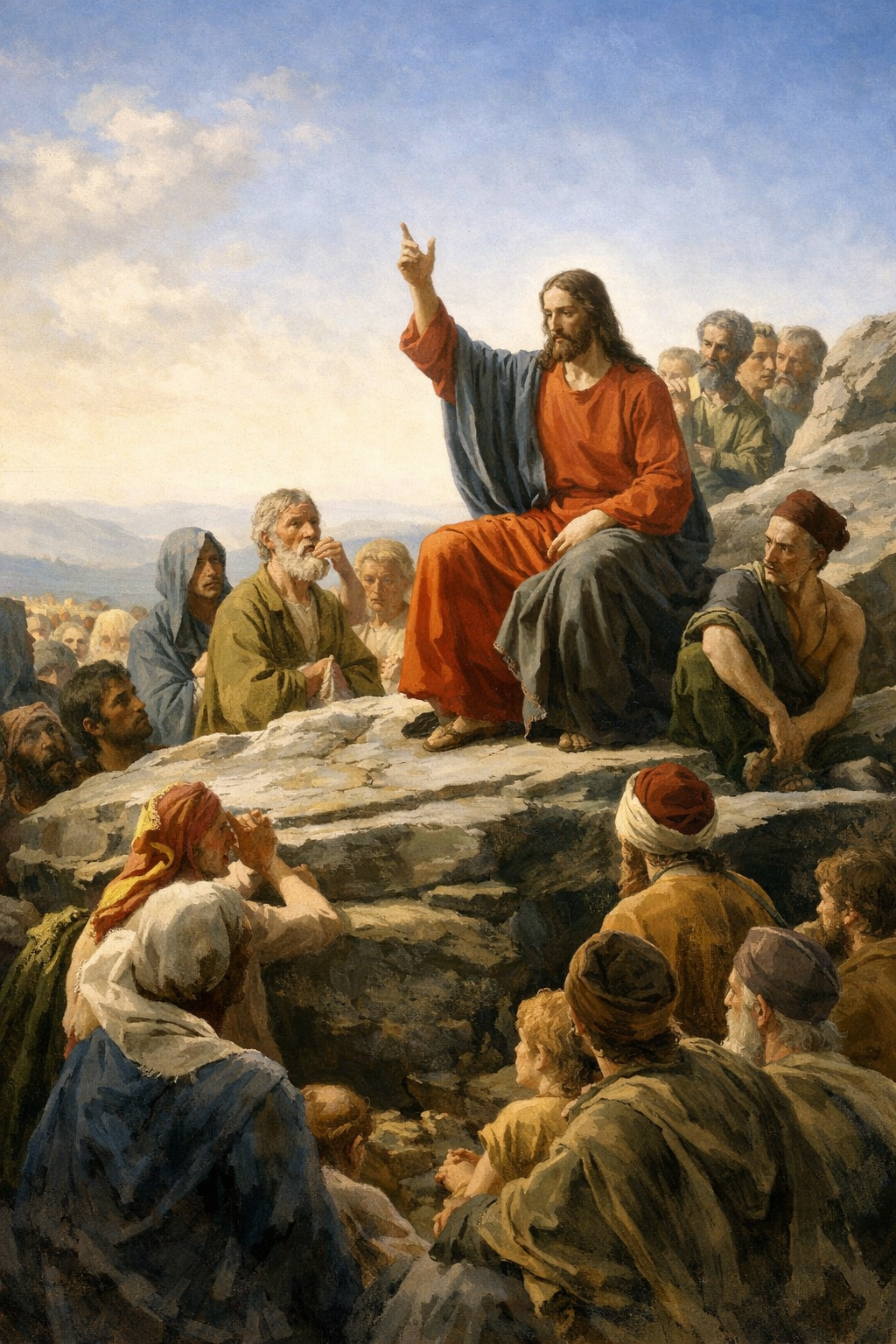
Sermon on the Mount
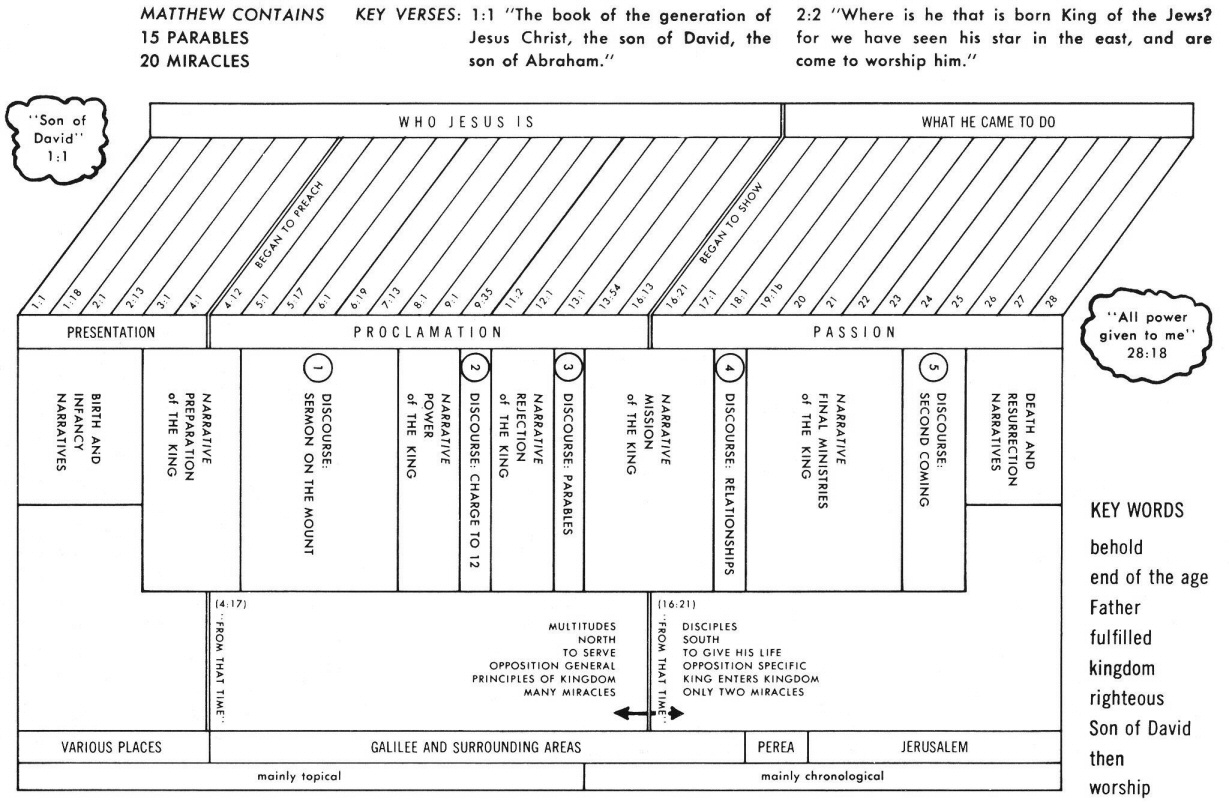
Click chart to enlarge
Charts from Jensen's Survey of the NT - used by permission
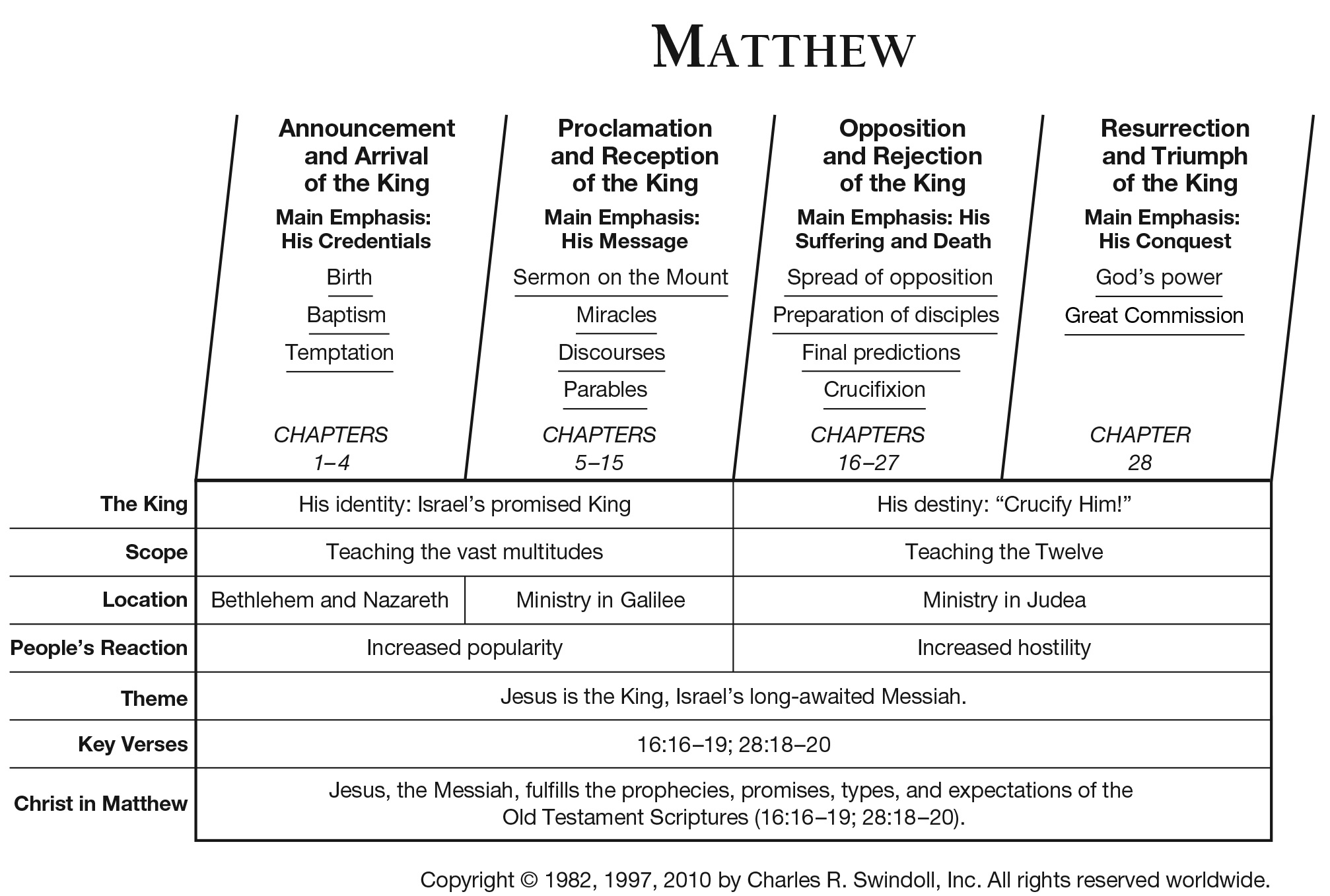
Another Chart from Charles Swindoll
THE LIFE OF JESUS AS COVERED
BY MATTHEW (shaded area)
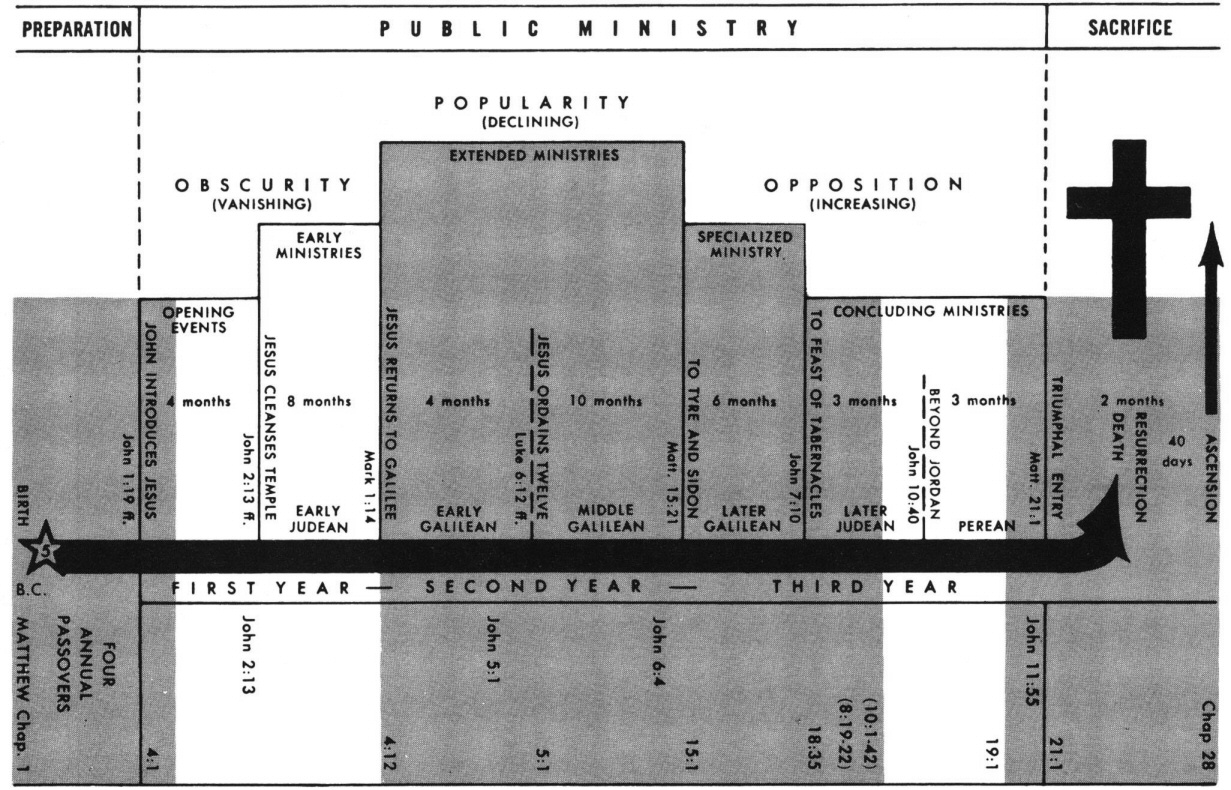
Click chart to enlarge
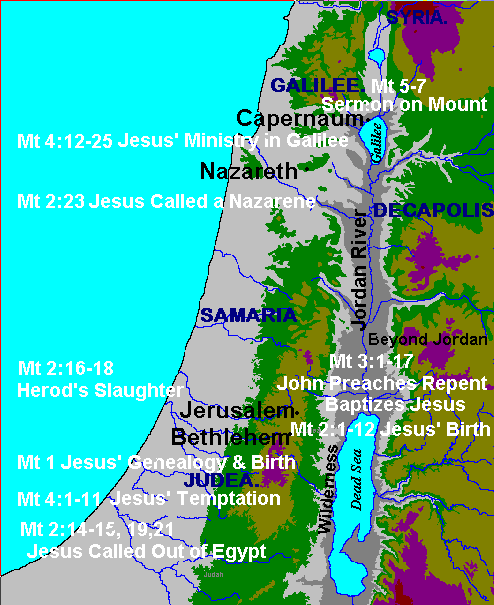
Jesus Birth and Early Years
Leading up to the Sermon on the Mount
Matthew 1-7
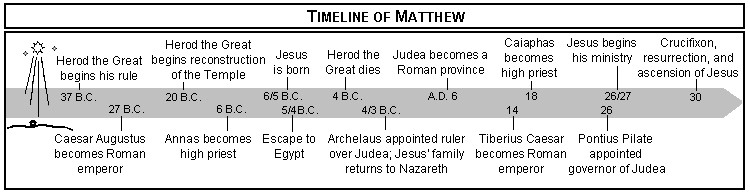
Source: Ryrie Study Bible
Matthew 7:17 "So every good tree bears good fruit, but the bad tree bears bad fruit. (NASB: Lockman)
Greek: outos pan dendron agathon karpous kalous poiei, (3SPAI) to de sapron dendron karpous ponerous poiei; (3SPAI)
Amplified: Even so, every healthy (sound) tree bears good fruit [worthy of admiration], but the sickly (decaying, worthless) tree bears bad (worthless) fruit. (Amplified Bible - Lockman)
KJV: Even so every good tree bringeth forth good fruit; but a corrupt tree bringeth forth evil fruit.
NLT: A healthy tree produces good fruit, and an unhealthy tree produces bad fruit. (NLT - Tyndale House)
Phillips: Every good tree produces good fruit, but a bad tree produces bad fruit. (New Testament in Modern English)
Wuest: In the same manner every intrinsically good tree produces beautiful fruits, but a rotten tree produces fruits which are rotten to the core.
Young's: so every good tree doth yield good fruits, but the bad tree doth yield evil fruits.
So every good tree bears good fruit, but the bad tree bears bad fruit: houtos pan dendron agathon karpous kalous poiei, (3SPAI) to de sapron dendron karpous ponerous poiei; (3SPAI):
- Every good - Ps 1:3; 92:13,14; Is 5:3, 4, 5; 61:3; Je 11:19; 17:8; Lk 13:6, 7, 8, 9; Gal 5:22, 23, 24; Ep 5:9; Php 1:11; Col 1:10; Jas 3:17,18
- But - Mt 12:33, 34, 35; Jude 1:12
- Matthew 7 Resources
GOOD AND BAD
SPIRITUAL FRUIT
Though Jesus moves from bushes to trees, His basic point is similar. In this passage Jesus is concerned not with the kind of fruit (as in the former passage) but with the quality of the fruit as well as the quality of the tree.
Wiersbe notes that the two trees…
These show that true faith in Christ changes the life and produces fruit for God’s glory. Everything in nature reproduces after its kind, and this is also true in the spiritual realm. The second test (of one's profession of faith as to its genuineness) is this: Did my decision for Christ change my life?… The person who believes false doctrine, or who follows a false prophet, will never experience a changed life. Unfortunately, some people do not realize this until it is too late. (Wiersbe, W: Bible Exposition Commentary. 1989. Victor)
Good (tree) (18) (agathos) describes that which is "good" in its character or constitution, beneficial in its effect, profitable, useful, good (value), pertaining to different objects, ie., soil (Lk 8:8) having the proper characteristics or performing the expected function in a fully satisfactory way.
Good (fruit) (2570) (kalos) does not refer to that which is superficial or cosmetic but to what is genuinely and inherently good, righteous, noble, and excellent. In classical usage,
Kalos originally as descriptive of outward form, beautiful; of usefulness, as a fair haven, a fair wind. Auspicious, as sacrifices. Morally beautiful, noble.
Kalos means outwardly fair, as the stones of the temple (Lk 21:5): well adapted to its purpose, as salt (Mk 9:50): competent for an office, as deacons (1Ti 4:6); a steward (1Pe 4:10-note); a soldier (2Ti 2:3-note): expedient, wholesome (Mk 9:43, 45, 47): morally good, noble, as works (Mt 5:16-note); conscience (Heb 13:18-note). In the Septuagint kalos is the most usual word for good as opposed to evil (Ge 2:17; 24:50; Isa 5:20).
Gill observes that…
As is the tree, so is its fruit; if the tree is good, it will bring forth good fruit. The tree that brings forth good fruit, is good antecedent to the fruit it produces; it is first good, and then puts forth good fruit: it is not the fruit that makes the tree good, but makes it appear to be so; but it is the goodness of the tree that makes the fruit good.
As a good man does, and will do good works, but his works do not make him a good man; he is so before he performs good works, or he would never be able to do them; these make him appear to be a good man: so a good preacher, that has an experimental knowledge of the doctrines of the Gospel, will deliver out sound doctrine, who is first made so by the gifts and graces of the Spirit of God; and by searching the Scriptures, and examining his doctrines by them, he will be known and appear to be a good minister of Jesus Christ, nourished up in the words of faith and good doctrine; and such a good minister of the Gospel, out of the good treasure of Gospel truths put into his earthen vessel, will bring forth, from time to time, good and excellent truths, to the edification and profit of those that hear: "but a corrupt tree bringeth forth evil fruit"; if the tree is corrupt, the fruit will be corrupt; and as is the preacher, so will be his doctrines: if he is a corrupt preacher, or a man of a corrupt mind, destitute of the truth, his preaching will be such as will tend to corrupt both the principles and practices of men; for such evil men and seducers, out of the evil treasure of false doctrines, which they have received into their judgments, will bring forth, either more secretly or openly, evil tenets in their ministry, which prove of bad consequence to the souls of men (Ref)
Adam Clarke reminds us…
that as the good tree means a good heart, and the good fruit, a holy life, and that every heart is naturally vicious; so there is none but God who can pluck up the vicious tree, create a good heart, plant, cultivate, water, and make it continually fruitful in righteousness and true holiness.
Bad (tree) (4550) (sapros from sepo = cause to decay, to putrefy, to rot away, be corrupted) means rotten, putrefying, corrupt, disgusting, perishing. Sapros described spoiled fish, rotten grapes on the ground, crumbling stones. The basic meaning relates to the process of decay. Obviously Jesus is not using sapros literally, for if the tree were totally decayed it could yield no fruit at all. His point is that the tree is far from healthy and this is shown by its inability to bear good fruit.
Bad (fruit) (4190) (poneros) refers to evil in active opposition to good.
Fruit (2590) (karpos) is used in its literal sense to refer to fruit, produce or offspring, which describes that which is produced by the inherent energy of a living organism. Karpos is what something naturally produces. Figuratively, karpos is used of the consequence of physical, mental, or spiritual action. In the NT the figurative (metaphorical) uses predominate and this is particularly true in the Gospels, where human actions and words are viewed as fruit growing out of a person's essential being or character. Karpos refers to that which originates or comes from something producing an effect or result (benefit, advantage, profit, utility).
Regarding the fact that a "tree is known by its fruits" Barnhouse wrote that…
This is an infallible criterion, both in the natural and spiritual realm. ‘Even so every good tree bringeth forth good fruit; but a corrupt tree bringeth forth evil fruit’ (Matt. 7:17). The test for love of Christ is obedience to His commandment. Profession is proved or disproved by the daily walk. If a man has no love for spiritual things, he is devoid of a spiritual nature. If a man is in an utterly prayerless state, he has not received the spirit of adoption whereby the saved cries ‘Abba, Father.’ If a man is thoroughly wrapped up in the things of this world, then his eyes must be closed to the glories of Heaven, ‘For where your treasure is, there will your heart be also’ (Mt 6:21-note). If a man prefers the company of worldlings to that of God’s people, then he is a worldling himself. If a man lives to please self rather than God, he is yet dead in trespasses and sin. (Barnhouse, D. G. God's Freedom: Romans 6:1-7:25 page 247. Grand Rapids, MI.: William B. Eerdmans Publishing Company)
John Blanchard put it this way…A fruitless person is not a failed Christian, but a false one—in other words, not a Christian at all… Fruit is evidence of the root. (The Complete Gathered Gold)
Bad fruit - A New York City couple were mailed two tickets to a smash Broadway hit with no explanation or identification of the sender. Nevertheless they decided to attend the show which they thoroughly enjoyed. Returning after the show that night, they discovered their home had been ransacked and looted of furs and jewelry. On the pillow was this simple note: "Now you know." Like that nameless thief, false prophets and false teachers know what people want to hear and so they proclaim a message that appeals to sensual desires (see notes beginning 2 Peter 2, especially 2Pe 2:2-note). These spiritual charlatans don't wear "warning labels", but are servants of Satan who "disguise themselves as servants of righteousness" (2Co 11:15). They are masterful spiritual chameleons who make stupendous claims, but in due time their followers usually end up paying a high price, which can even be eternal destruction if they never hear the truth, are granted repentance, come to their senses and escape from the snare of the devil's servants, having been held captive by them to do their will (2Ti 2:24, 25, 26-notes). Even believers can be deceived by false prophets and false teachers. That is why God's Word repeatedly exhorts us to study the Scriptures (1Pe 2:2-note), test what we hear (1Jn 4:1+, Acts 17:11-note), and grow in the faith (2Pe 1:5, 6, 7, 8, 9 - see notes 2Pe 1:5, 6-7, 8-9). That way, we won't someday go to our "home" and find out that it was not the home in which we expected to spend eternity (Mt 7:21-note)
Beloved, do not believe (stop believing = present imperative with a negative - indicating they were already falling prey) every spirit, but test (present imperative - carry out a careful examination to prove a thing worthy or genuine) the spirits to see whether they are from God; because many (not just a few!) false prophets have gone out into the world. (1 John 4:1+)
As an aside John Stott makes the pithy comment that…The Christian should resemble a fruit tree, not a Christmas tree.
Matthew 7:18 "A good tree cannot * produce bad fruit, nor can a bad tree produce good fruit. (NASB: Lockman)
Greek: ou dunatai (3SPPI) dendron agathon karpous ponerous poiein, (PAN) oude dendron sapron karpous kalous poiein. (PAN)
Amplified: A good (healthy) tree cannot bear bad (worthless) fruit, nor can a bad (diseased) tree bear excellent fruit [worthy of admiration]. (Amplified Bible - Lockman)
KJV: A good tree cannot bring forth evil fruit, neither can a corrupt tree bring forth good fruit.
NLT: A good tree can't produce bad fruit, and a bad tree can't produce good fruit. (NLT - Tyndale House)
Phillips: A good tree is incapable of producing bad fruit, and a bad tree cannot produce good fruit. (New Testament in Modern English)
Wuest: An intrinsically good tree is not able to produce rotten fruits, neither is a rotten tree able to produce beautiful fruit. (Eerdmans)
Young's: A good tree is not able to yield evil fruits, nor a bad tree to yield good fruits.
A good tree cannot produce bad fruit, nor can a bad tree produce good fruit: ou dunatai (3SPPI) dendron agathon karpous ponerous poiein, (PAN) oude dendron sapron karpous kalous poiein. (PAN)
- Galatians 5:17; 1 John 3:9,10
- Matthew 7 Resources
John gives us a good "commentary" on Jesus' words writing that "No one who is born of God practices (present tense- habitually - believers still sin, but they confess, repent and strive by the Spirit's power to not sin) sin, because His seed abides in him; and he cannot (present tense- habitually = AN IMPOSSIBILITY TO LIVE CONTINUALLY IN SIN - CANNOT CONTINUALLY PRODUCE BAD FRUIT) sin, because he is born of God. By this the children of God and the children of the devil are obvious: anyone who does not practice (present tense- habitually) righteousness is not of God, nor the one who does not love (present tense- habitually) his brother." (1 John 3:9,10+)
THOUGHT - Practitioners of sin are not of God! They are not regenerated and indwelt by the Holy Spirit as indicated by their unholy lives! They are not born from above as shown by their pattern of living like those from below!
Spurgeon writes…After all, this is the best test of any doctrine, the practice to which it leads. I remember one day discussing with a person about the doctrine of future punishment. We were arguing, and the gentleman, who owned the vessel on which we were, said, “Come up on deck, and enjoy the fresh air, and leave that subject; but,” he said, “you, sir, will kindly go as far as possible from my men, for they are bad enough as they are, and if you tell them there is no punishment for sin, they will be worse than ever. As for you, Mr. Spurgeon, you may go where you like, you won’t do them any harm.” I thought that rough and ready mode of argument was about as good a commendation as I could wish to have.
Good (tree) (18) (agathos) describes that which is "good" in its character or constitution, beneficial in its effect, profitable, useful, good (value), pertaining to different objects, ie., soil (Lk 8:8) having the proper characteristics or performing the expected function in a fully satisfactory way.
Good tree as Wuest renders it is the "intrinsically good tree" which is good because it is planted by God (Mt 15:13 "Every plant which My heavenly Father did not plant shall be rooted up." ), belongs to Him and bears good fruit, namely it does His will.
Cannot produce bad fruit - Absolutely cannot do this. And vice versa. Jesus' point is that it is impossible for a tree to bear fruit which is contrary to its nature. Healthy trees cannot bear the kind of fruit that is natural to the bad tree. Conversely, the bad tree completely lacks the ability to bear good fruit.
Not = The Greek particle "ou" which signifies absolute negation.
Can (1410) (dunamai [word study]) conveys the basic meaning of that which has the inherent ability to do something or accomplish some end. Thus dunamai means to be able to, to be capable of, to be strong enough to do or to have power to do something.
Fruit (2590) (karpos) is used in its literal sense to refer to fruit, produce or offspring, which describes that which is produced by the inherent energy of a living organism. Karpos is what something naturally produces. Figuratively, karpos is used of the consequence of physical, mental, or spiritual action. In the NT the figurative (metaphorical) uses predominate and this is particularly true in the Gospels, where human actions and words are viewed as fruit growing out of a person's essential being or character. Karpos refers to that which originates or comes from something producing an effect or result (benefit, advantage, profit, utility).
Counterfeit Reality - When people see a photograph or video today, they often ask, "Is it real?" A home computer can manipulate images to create a picture of an event that never happened. Images can be inserted into or removed from photographs. A video can be doctored to make it appear that a person was caught committing a crime or performing an act of heroism. The camera may not lie, but the computer can.
Centuries before such modern technology, the apostle Paul warned Timothy about counterfeit reality in the church. He said that in the last days people would be self-absorbed, "having a form of godliness but denying its power" (2Ti 3:5-note). He repeatedly emphasized the need to live a godly life, warning that "evil men and impostors will grow worse and worse, deceiving and being deceived" (2Ti 3:13-note).
Paul charged Timothy to "continue in the things which you have learned and been assured of" (2Ti 3:14-note). True godliness honors and obeys God while its counterfeit seeks pleasure and personal gain. One pleases the Lord; the other gratifies natural desire. Both are identified by their actions.
When people hear us say we are Christians, they may wonder if our faith is real. Our lives will answer the question by reflecting the reality of Christ. —David C. McCasland (Our Daily Bread, Copyright RBC Ministries, Grand Rapids, MI. Reprinted by permission. All rights reserved)
Dear Heavenly Father, Help me, I pray,
to honor You with all that I do today.
By Your Holy Spirit's power, may my words and actions
cause others to glorify Your Name. Amen.
Matthew 7:19 "Every tree that does not bear good fruit is cut down and thrown into the fire. (NASB: Lockman)
Greek: pan dendron me poioun (PAPNSN) karpon kalon ekkoptetai (3SPPI) kai eis pur balletai. (3SPPI)
Amplified: Every tree that does not bear good fruit is cut down and cast into the fire. (Amplified Bible - Lockman)
KJV: Every tree that bringeth not forth good fruit is hewn down, and cast into the fire.
NLT: So every tree that does not produce good fruit is chopped down and thrown into the fire. (NLT - Tyndale House)
Phillips: The tree that fails to produce good fruit is cut down and burnt. (New Testament in Modern English)
Wuest: Every tree which is not producing beautiful fruit is customarily cut out and is thrown into the fire. (Eerdmans)
Young's: Every tree not yielding good fruit is cut down and is cast to fire:
Every tree that does not bear good fruit is cut down and thrown into the fire: pan dendron me poioun (PAPNSN) karpon kalon ekkoptetai (3SPPI) kai eis pur balletai. (3SPPI):
- Mt 3:10; 21:19,20; Isaiah 5:5, 6, 7; 27:11; Ezek 15:2, 3, 4, 5, 6, 7; Luke 3:9; 13:6, 7, 8, 9; John 15:2, 3, 4, 5, 6; He 6:8; Jude 1:12
- Matthew 7 Resources
FROM THE FRUIT
TO THE FATE
Jesus moves from the fruit to the fate of the rotten tree, giving a judgment similar that of John the Baptist who declared…
And the axe is already laid (= time is running out; judgment is near) at the root of the trees; every tree therefore that does not bear good fruit is cut down and thrown into the fire. (Mt 3:10+)
Every tree - All without exception. No bad, rotten or worthless "tree" (false prophet) is allowed to continue producing bad fruit.
Cut down (1581) (ekkopto from ek = out + kópto = cut) which literally means to cut or strike out and so to cut down. Here Jesus uses it to describe the trees (false prophets) who are done away with or eliminated, as in the tragic example below.
Ekkopto is used 10 times in the NT - Matt. 3:10; 5:30; 7:19; 18:8; Lk. 3:9; 13:7, 9; Ro 11:22, 24; 2 Co. 11:12.
There are 37 uses of ekkopto in the Septuagint (LXX)- Gen. 32:8; 36:35; Exod. 21:27; 34:13; Num. 16:14; Deut. 7:5; 12:3; 20:19f; Jos. 15:16; Jdg. 16:21; 21:6; 1 Ki. 15:13; 2 Chr. 14:3, 14f; 31:1; Job 14:7; 19:10; 42:17; Ps. 74:5; Prov. 30:17; Isa. 9:10; 27:9; Jer. 6:6; 10:3; 22:7; 44:7f; 46:23; Dan. 2:40; 4:14, 17, 23; 9:26; Mic. 5:14; Zech. 12:11
Adam Clarke comments…What a terrible sentence is this against Christless pastors, and Christless hearers! Every tree that produces no good fruit is to be now cut down; the act of excision is now taking place: the curse of the Lord is even now on the head and the heart of every false teacher, and impenitent hearer.
Do you remember the name Jim Jones? He was the head of the People's Temple Christian Church that began in California and ended at Jonestown in the jungles of Guyana, South America when he and nearly a thousand of his followers committed suicide. The amazing thing is that most of those who joined Jones' church were from Christian backgrounds!
MacArthur quotes Mel White's book "Deceived" in which he analyzes why so many were so misled and suggests that Jones…"knew how to inspire hope. He was committed to people in need; he counseled prisoners and juvenile delinquents. He started a job placement center; he opened rest homes and homes for the retarded; he had a health clinic; he organized a vocational training center; he provided free legal aid; he founded a community center; he preached about God. He even claimed to cast out demons, do miracles and heal. (see notes Matthew 7:22). But on the other hand we find all the marks of a false prophet. He promoted himself through the use of celebrities, a very common vehicle for false prophets to gain credibility. He manipulated the press; he wanted certain favorable stories; he was big on playing the press… and he used the language and the forms of faith to gain his power. (Bolding added)
J C Philpot comments on trees that don't bear fruit writing that…A religion that does nothing for a man's soul is worthless. And a religion that never manifests itself in a man's life, is as worthless as a religion that does nothing for the soul. Death is stamped upon both. Religion to be worth anything, must be a living religion—a religion that proceeds from a work of grace upon the heart—communicating life to the soul—and exercising an influence wherever it exists, and in whomever it resides. For where there is a springing up of spiritual life in a man's soul—it must be made manifest by his words and actions! (J. C. Philpot. RICHES)
Matthew 7:20 "So then, you will know them by their fruits. (NASB: Lockman)
Greek: ara ge apo ton karpon auton epignosesthe (2PFMI) autous.
Amplified: A good (healthy) tree cannot bear bad (worthless) fruit, nor can a bad (diseased) tree bear excellent fruit [worthy of admiration]. (Amplified Bible - Lockman)
KJV: Wherefore by their fruits ye shall know them.
NLT: Yes, the way to identify a tree or a person is by the kind of fruit that is produced. (NLT - Tyndale House)
Phillips: So you may know men by their fruit." (New Testament in Modern English)
Wuest: So then, by their fruits you will clearly recognize them. (Eerdmans)
Young's: therefore from their fruits ye shall know them.
So then, you will know them by their fruits: ara ge apo ton karpon auton epignosesthe (2PFMI) autous:
- Acts 5:38
- Matthew 7 Resources
DO NOT BE NAIVE:
EXAMINE THE FRUIT!
So then (ara ge) brings Jesus' argument to a logical conclusion that the fruit is the test of the tree.
Know (1921) (epiginosko [word study]) means you will know them thoroughly and by your experience with them. This is a great promise in view of how deceptive some prophets and teachers can be. We must be careful to make sure the log is out of our eyes so we can see clearly and accurately discern where fruit is good or bad - Be a "fruit inspector" looking at their 3 D's - Doctrine, Deed and Disciples.
Fruits (2590) (karpos) is used in its literal sense to refer to fruit, produce or offspring, which describes that which is produced by the inherent energy of a living organism.
Larry Richards summarizes the Biblical concept of spiritual fruit writing that…Fruitfulness is a consistent concept in the OT and the NT. The fruit God seeks in human beings is expressed in righteous and loving acts that bring peace and harmony to the individual and to society. But that fruit is foreign to sinful human nature. Energized by sinful passions, fallen humanity acts in ways that harm and bring dissension. God's solution is found in a personal relationship with Jesus and in the supernatural working of God's Spirit within the believer. As we live in intimate, obedient relationship with Jesus, God's Spirit energizes us as we produce the peaceable fruits of a righteousness that can come only from the Lord. (Richards, L O: Expository Dictionary of Bible Words: Regency)
Adam Clarke observes that Jesus repeats this idea…because our eternal interests depend so much upon it. Not to have good fruit is to have evil: there can be no innocent sterility in the invisible tree of the heart. He that brings forth no fruit, and he that brings forth bad fruit, are both only fit for the fire.
Constable adds that…The words and works of a prophet eventually reveal his true character just as surely as the fruit of a tree reveals its identity (v. 20). Of these two criteria, works are the more reliable guide. (Tom Constable, T: Tom Constable's Expository Notes on the Bible) (Bolding added)
John MacArthur gives three primary types of "spiritual fruit" by which we can judge the integrity of the "tree".
CHARACTER
(1) Character - a person’s inner motives, standards, loyalties, attitudes, and ambitions eventually are seen in their conduct, because what you believe determines how you behave! And as John Calvin said "nothing is more difficult to counterfeit than virtue". Their character will eventually show itself to be fruit that is rotten to the core. (Study 2 Peter 2 one of the best Scriptural summaries of their true character)
Martyn Lloyd-Jones adds that…A Christian can generally be known by his very appearance. The man who really believes in the holiness of God, and who knows his own sinfulness and the blackness of his own heart, the man who believes in the judgment of God and the possibility of hell and torment, the man who really believes that he himself is so vile and helpless that nothing but the coming of the Son of God from heaven to earth and His going to the bitter shame and agony and cruelty of the cross could ever save him, and reconcile him to God-this man is going to show all that in his personality. He is a man who is bound to give the impression of meekness, he is bound to be humble. Our Lord reminds us here that if a man is not humble, we are to be very wary of him. He can put on a kind of sheep’s clothing, but that is not true humility, that is not true meekness. And if a man’s doctrine is wrong, it will generally show itself at this point. He will be affable and pleasant, he will appeal to the natural man, and to the things that are physical and carnal; but he will not give the impression of being a man who has seen himself as a hell-bound sinner, and who has been saved by the grace of God alone. (Lloyd-Jones, D. M. Studies in the Sermon on the Mount. 1977. Eerdmans)
CREED
(2) Creed - one's fundamental beliefs or doctrine may at first appear Biblical and orthodox but when examined by those who are trained to discern good from evil (Hebrews 5:14), their "thorny theology" is seen to not correspond to the plumbline of God's Word of Truth, often with the omission of foundational Biblical truths. In other words, one needs not only to listen to what they say but also to what they do not say (e.g., they seldom espouse a small gate and narrow way or talk about godly works as evidence of genuine saving faith)!
Arthur Pink wrote that…“False prophets are to be found in the circles of the most orthodox, and they pretend to have a fervent love for souls, yet they fatally delude multitudes concerning the way of salvation. The pulpit, platform, and pamphlet hucksters have wantonly lowered the standard of divine holiness and so adulterated the Gospel in order to make it palatable to the carnal mind… Any preacher who rejects God’s law, who denies repentance to be a condition of salvation, who assures the giddy and godless that they are loved by God, who declares that saving faith is nothing more than an act of the will which every person has the power to perform is a false prophet and should be shunned as a deadly plague” (False Prophets,)
MacArthur nicely summarizes the creed of false prophets noting that…False prophets talk much about the love of God but nothing of His holiness, much about people who are deprived but nothing about those who are depraved, much about God’s universal fatherhood of every human being but nothing about His unique fatherhood only of those who are His children through faith in His Son, Jesus Christ, much about what God will give to us but nothing about obedience to Him, much about health and happiness but nothing about holiness and sacrifice. Their message is a message of gaps, the greatest gap of which leaves out the truth that saves. (Matthew 1-7 Macarthur New Testament Commentary Chicago: Moody Press)
CONVERTS
(3) Converts - like "father like son" is the old aphorism. And so the followers of false prophets and false teachers will produce ungodly, unholy "fruit" like their leaders, usually manifest in their lifestyle.
One of the most notorious examples of false prophets was a man named Grigori Rasputin who gained a foothold in the home of Czar Nicholas II because he seemed to possess a supernatural power to help the czar's hemophiliac son. Rasputin's "prayers" appeared to do far more for the boy than the efforts of all his doctors. Thus, the "holy man" achieved great influence in the government by telling the czar and his wife that their son would live only as long as they listened to his advice. As time went on, the bad fruits of Rasputin became obvious as he begin to manifest a cruel and immoral spirit and maintained his position through harsh intimidation and fear. Charlatans like Rasputin can appear quite winsome initially and they may even perform counterfeit miracles (cf Mt 7:22+). Over time and when carefully observed (cf appropriate judging - Mt 7:1,2+), their character bears no evidence of the fruit of the Spirit. Their works are worthless like fake apples tied on an apple tree to make it look productive. Fitness for spiritual leadership comes from the inside, not the outside, and includes the qualities of love, joy, peace, longsuffering, goodness, faithfulness, gentleness, and self-control (Gal 5:22+, Gal 5:23+). —H. V. Lugt (Our Daily Bread, Copyright RBC Ministries, Grand Rapids, MI. Reprinted by permission. All rights reserved)
A good leader is one who knows the way,
goes the way,
and shows the way.
Throughout history, ungodly people have attained power and influence through their strong personalities or their spectacular deeds. But natural qualities and remarkable feats do not provide the kind of spiritual leadership that God desires and approves. Good leaders know the way, go the way, and show the way (John 14:6 "I am… the way")
Ring Around the Collar - For no good tree bears bad fruit, nor again does a bad tree bear good fruit; for each tree is known by its own fruit. For figs are not gathered from thorns, nor are grapes picked from a bramble bush. The good man out of the good treasure of his heart produces good, and the evil man out of his evil treasure produces evil; for out of the abundance of the heart his mouth speaks. (Luke 6:43-45+) For no good laundry detergent leaves stains on a shirt collar, nor does an inferior detergent get these stains out; for each product is known by its effectiveness. For cleanliness is not obtained from dirt, nor is softness obtained from industrial cleansers. The good man out of a character based in ethical principles produces good, and the evil man out of a character based in unethical principles produces evil; for a man's words and actions reveal his true character.