Matthew 7:2
Matthew 7:3
Matthew 7:4
Matthew 7:5
Matthew 7:6
Matthew 7:7
Matthew 7:8
Matthew 7:9
Matthew 7:10
Matthew 7:11
Matthew 7:12
Matthew 7:13
Matthew 7:14
Matthew 7:15
Matthew 7:16
Matthew 7:17
Matthew 7:18
Matthew 7:19
Matthew 7:20
Matthew 7:21
Matthew 7:22
Matthew 7:23
Matthew 7:24
Matthew 7:25
Matthew 7:26
Matthew 7:27
Matthew 7:28
Matthew 7:29
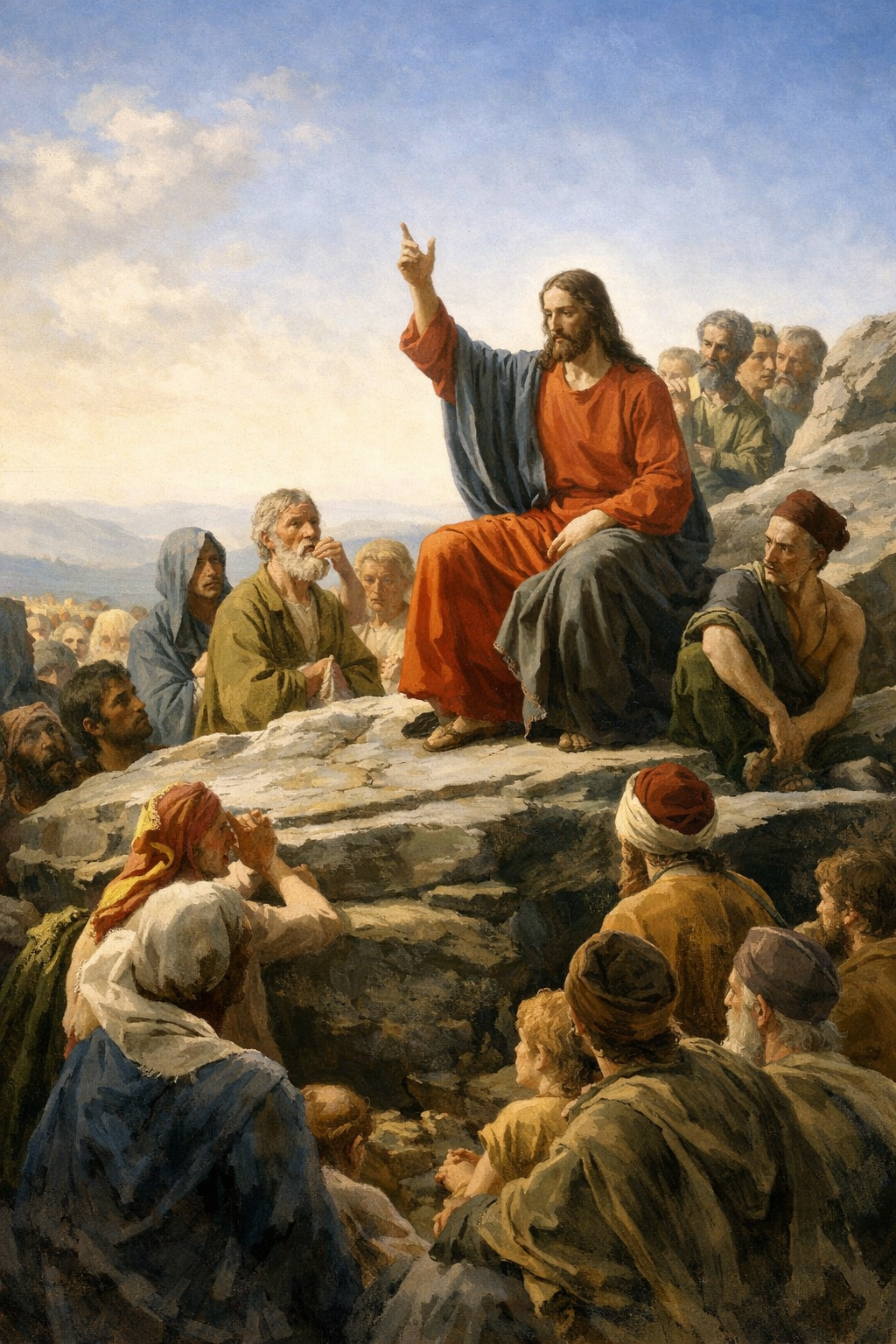
Sermon on the Mount
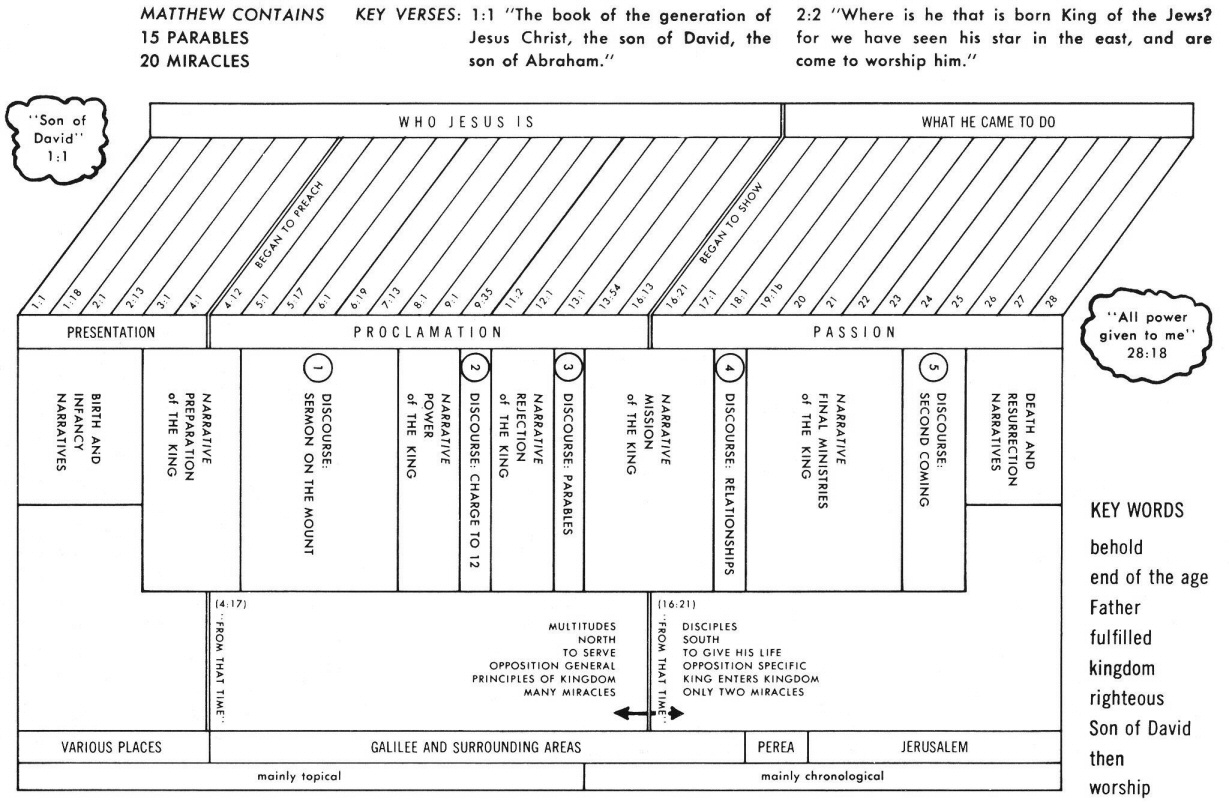
Click chart to enlarge
Charts from Jensen's Survey of the NT - used by permission
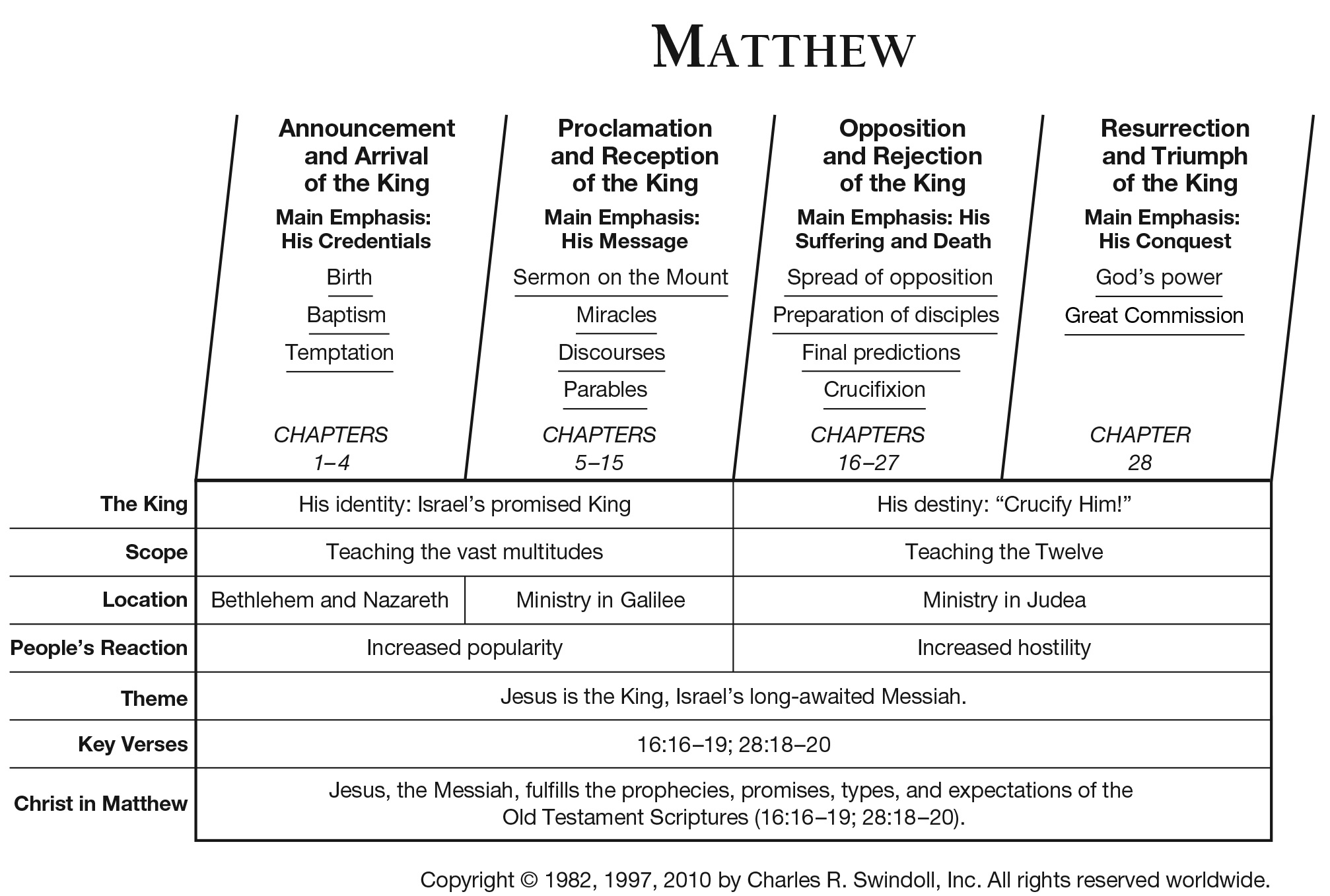
Another Chart from Swindoll
THE LIFE OF JESUS AS COVERED
BY MATTHEW (shaded area)
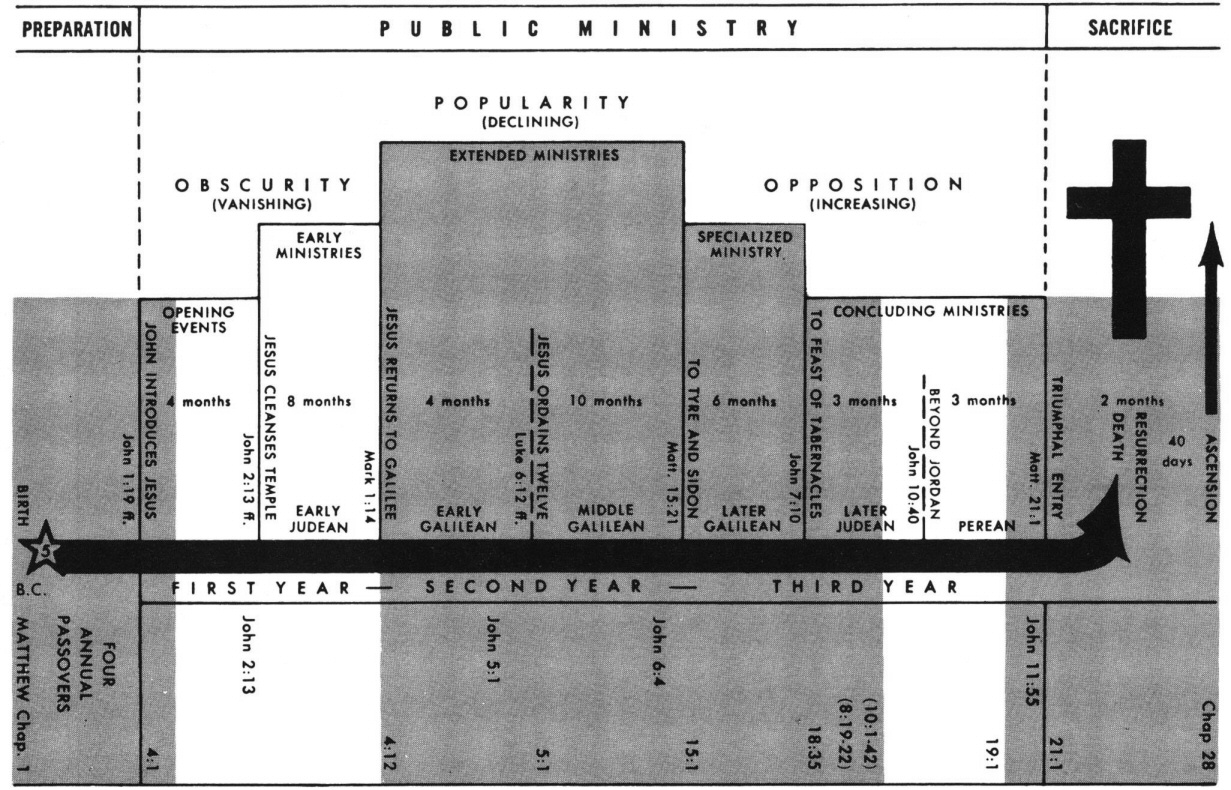
Click chart to enlarge
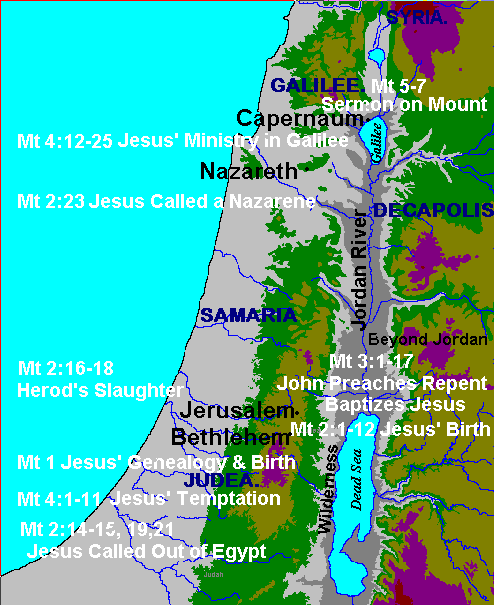
Jesus Birth and Early Years
Leading up to the Sermon on the Mount
Matthew 1-7

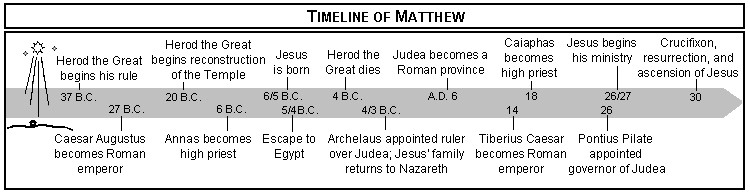
Source: Ryrie Study Bible
Matthew 7:21 "Not everyone who says to Me, 'Lord, Lord,' will enter the kingdom of heaven, but he who does the will of My Father who is in heaven will enter. (NASB: Lockman )
Greek: Ou pas o legon (PAPMSN) moi, Kurie kurie, eiseleusetai (3SFMI) eis ten basileian ton ouranon, all' o poion (PAPMSN) to thelema tou patros mou tou en tois ouranois.
Amplified: Not everyone who says to Me, Lord, Lord, will enter the kingdom of heaven, but he who does the will of My Father Who is in heaven. (Amplified Bible - Lockman)
KJV: Not every one that saith unto me, Lord, Lord, shall enter into the kingdom of heaven; but he that doeth the will of my Father which is in heaven.
NLT: "Not all people who sound religious are really godly. They may refer to me as `Lord,' but they still won't enter the Kingdom of Heaven. The decisive issue is whether they obey my Father in heaven. (NLT - Tyndale House)
Phillips: "It is not everyone who keeps saying to me 'Lord, Lord' who will enter the kingdom of Heaven, but the man who actually does my Heavenly Father's will.. (New Testament in Modern English)
Wuest: Not everyone who keeps on saying to me, Lord, Lord, shall enter into the kingdom of heaven, but he who keeps on doing that which my Father who is in heaven has determined shall be done. (Eerdmans)
Young's: 'Not every one who is saying to me Lord, lord, shall come into the reign of the heavens; but he who is doing the will of my Father who is in the heavens.
Not everyone who says to Me, `Lord, Lord,' will enter the kingdom of heaven: Ou pas o legon (PAPMSN) moi, Kurie kurie, eiseleusetai (3SFMI) eis ten basileian ton ouranon
- Says Mt 25:11,12; Hosea 8:2,3; Luke 6:46; 13:25; Acts 19:13, 14, 15, 15, 17, 18, 19, 20; Romans 2:13; Titus 1:16; James 1:22; 2:20, 21, 22, 23, 24, 25, 26
- Will enter Mt 18:3; 19:24; 21:31; 25:11,12,21; Isaiah 48:1,2; Mark 9:47; 10:23,24; Luke 18:25; John 3:5; Acts 14:22; Hebrews 4:6
- Matthew 7 Resources - Multiple Sermons and Commentaries
- Matthew 7:21-23: Empty Words - John MacArthur
- Matthew 7:21-27: Saved or Self-Deceived, Part 2 - John MacArthur
- Matthew 7:21-27: Unmasking Christmas Hypocrites - John MacArthur
- Matthew 7:21-23: Empty Words and Empty Hearts 1 - John MacArthur
- Video Related to Matthew 7:21 - The Wrath of God
While the previous section (Mt 7:15-20) dealt with false prophets, this next section (Mt 7:21-23) deals with false professors. It is likely that some of the latter were of such a character because of the false teaching of the false prophets. These false professors would in fact be examples of the some of the bad fruit the false prophets produced.
Note that now Jesus turns His attention to the "religious" crowd, who tragically have been duped into a false sense of security thinking that they have a golden "ticket" to heaven when in fact they are headed straight down the highway to gehenna, the Lake of fire! This self deception that one is saved (a believer, a Christian) when in fact he is actually lost (a non-believer, a non-Christian) is surely the most frightening of all deceptions. Can you imagine such a person's last breath on earth and first glimpse of their eternal future! Make no mistake about it --Jesus has just stated that there will be few who enter the small gate and the narrow way (Mt 7:13,14) and now He declares there are many (Mt 7:22) who are on the broad way that leads to destruction (not annihilation) and that they are deceiving themselves thinking they are guaranteed entrance into heaven. In a 2003 survey Barna reported that 64% believe they will go to heaven when they die.
Matthew Henry comments that...
We have here the conclusion of this long and excellent sermon, the scope of which is to show the indispensable necessity of obedience to the commands of Christ; this is designed to clench the nail, that it might fix in a sure place: he speaks this to his disciples, that sat at his feet whenever he preached, and followed him wherever he went. Had he sought his own praise among men, he would have said, that was enough; but the religion he came to establish is in power, not in word only (1 Cor 4:20), and therefore something more is necessary. He shows, by a plain remonstrance, that an outward profession of religion, however remarkable, will not bring us to heaven, unless there be a correspondent conversation Mt 7:21-23.
NOT
EVERYONE
Not everyone - The word for "not" indicates absolute negation. This phrase not everyone indicates that some of those Jesus is talking about are true believers. Their declaration of "Lord, Lord" is genuine, because it comes from their regenerate hearts. He was their Lord in this life and is still their Lord at the Judgment Seat (where only believers will stand - see discussion of this judgment ).
Says to Me - This phrase indicates that Jesus will be the Judge (cf Mt 25:31, 32, 33, 34, 35, 36, 37, 38, 39, 40, 41, 42, 43, 44, 45, 46, Judge of the living and the dead in 2Ti 4:1). And by what they say, we can see that they are self-deceived, thinking they are citizens of the Kingdom of Heaven and God when in fact they still belong to the kingdom of darkness and are under the power of sin and Satan. They may have had God’s name in their mouths, but rebellion was in their hearts.
Who says (3004) (lego) is used of every variety of speaking. Lego is in the present tense signifying that they continually make this affirmation of identification. They don't just say "Lord, Lord" one time and that's all but they continue to say it. Since words are powerful and influential, their words give the impression to those who hear them that they are genuine believers, for they reason who else would say "Lord, Lord"? Jesus answers that question but clearly saying professors who are not possessors of genuine salvation manifest by a new heart and a new direction to their life will speak this way and they will do so continually!
LORD, LORD
Lord, Lord (2962) (kurios related to the adjective kuros - might, strong, supremacy, authoritative) describes one having absolute legal power and thus the one who is master or possessor. It is the one who has absolute ownership. The kurios has control over his possessions. Jesus is referred to some ten times as Savior and some seven hundred times as Lord. Supreme in Authority. Kurios translates Jehovah (LORD in OT) in Septuagint (LXX) 7000 times. Kurios is used over 700 times in the NT!
In summary, kurios signifies sovereign power and absolute authority. The primary idea is Jesus is the One in possession of all power and authority over those who are truly His possession. Paul in his description of genuine believers asks the saints at Corinth...
Or do you not know that your body is a temple of the Holy Spirit Who is in you, Whom you have from God, and that you are not your own? For you have been bought with a price: therefore glorify God in your body. (1Co 6:19,20)
Paul's point is that every genuine believer has been purchased (and redeemed) by the precious blood of the Lamb and now is rightfully the sole possession of the Lamb of God, Who is Lord, the Lord Jesus Christ. Those who were never born again called Him Lord but live like they belong to themselves. They were the "lord" of their life, as shown by their conduct and lifestyle. Their actions of their life belied the affirmation of their lips.
I love Paul's description in Titus describing Jesus as the Possessor (cp Lord - "Absolute Possessor") of blood bought believers for He...
gave Himself for us, that He might redeem us from every lawless deed and purify for Himself a people for His own possession, zealous for good deeds. (Titus 2:14)
As Constable puts it "Obedience to the Father’s will determines entrance into the kingdom, not professed admiration for Jesus."
Lord, Lord - English is a strange language. There is no butter in buttermilk and no egg in eggplant. There is no ham in a hamburger and no apple in a pineapple. Quicksand works very slowly and boxing rings are square. Inconsistencies of language are not significant. Inconsistencies in life are significant. Those who profess to be Christ followers must follow Christ. Their words and deeds must be consistent with what they profess. Watch this Video related to Matthew 7:21
George Whitfield's classic sermon The Almost Christian
THE ALMOST CHRISTIAN by Archibald Alexander
The almost Christian may have a speculative knowledge of all the leading truths of Christianity, and may be able to defend them. The almost Christian entertains a great respect for religion and its professors and institutions. The almost Christian feels a strong desire to enjoy the benefits of the gospel, and may often have his affections much moved, and may form many good resolutions; he may indeed possess a counterfeit of experimental religion, so like that it may deceive not only the man himself, but the most judicious ministers. The almost Christian may be exceedingly conscientious and exact in attending on all the external duties of religion; as touching these, he may be "blameless;" and in regard to zeal, he may be ardent, so as to put to the blush the real believer.
He may also be liberal, and contribute liberally for the support of the gospel, and to feed the poor. He may become a popular preacher of the gospel, and be the means of the conversion of others. He may even go to foreign lands, to bear the glad tidings of salvation to the heathen. He may, in short, do everything which the real Christian does, and feel everything which the real Christian feels—but one. He fails in one single point, but that is an essential point. He never has given his heart to God. He loves the world better than he loves Christ. That most excellent gift of charity has never been poured into his heart. His religion may be all traced to the mere love of happiness, and the operations of a natural conscience, enlightened and awakened by the doctrinal knowledge of the truth.
The apostle Paul teaches, that if a man without CHARITY, that is, love to God and man, should possess angelic eloquence, prophetic knowledge, and the power of working the greatest miracles; yes, if he should have zeal strong enough to make him a martyr, and liberality great enough to induce him to give away all his goods, it would "profit him nothing." Such a one would, after all, be only an almost Christian.
The deceitful heart of man will turn itself into every conceivable form and shape but that of true holiness; of this it may assume the shadow, but never the reality.
James Smith - ALMOST A CHRISTIAN
- Based on Acts 26:28 "Agrippa replied to Paul, “In a short time you will persuade me to become a Christian.”
1. What you Might Be, and Not Be a Christian.
Born in a Christian country.
Brought up in a Christian family (Judas).
Educated in a Christian fashion.
Connected with a Christian Church.
Buried in a Christian manner.
2. What is a Christian?
One who has received Christ.
One who belongs to Christ.
One who is like Christ.
One who serves Christ.
3. What is it to be an Almost Christian?
It is to see your need and not confess it.
It is to wish to be saved and remain undecided.
It is to be at the door, but still outside.
Ecstasy is no guarantee of orthodoxy or that Christian fruit will result. —Nathan O. Hatch
The Bible recognizes no faith that does not lead to obedience, nor does it recognize any obedience that does not spring from faith. The two are at opposite sides of the same coin. —A.W. Tozer
The utter obedience required in the military is accepted as necessary, even when one's life may be the price of that obedience. Why does the Christian fail to practice the same obedience in spiritual matters? To which Mt 7:21 would say perhaps they don't practice obedience because they are not truly Christians.
Will is the whole man active. I cannot give up my will; I must exercise it. I must will to obey. When God gives a command or a vision of truth, it is never a question of what He will do, but what we will do. To be successful in God's work is to fall in line with His will and to do it His way. All that is pleasing to Him is a success. —Henrietta Mears
Live What You Believe - I clipped this interesting item from a local newspaper: "A bus driver became annoyed with his job because he had to wait 7 minutes after every run near an open field which 'litterbugs' had made into an unofficial dump. He often thought that somebody should do something about that unsightly mess. One day he himself decided to get out and pick up some of the tin cans and other debris which were lying all around. This improved things so much that he soon was eager to complete his route and spend all his free moments in cleaning up the area. When spring came, he was so enthusiastic about this project that he decided to sow some flower seeds. By the end of the summer many were riding to the end of the line just to see what the motorman had accomplished by doing what he and others had only talked about before." The article reminded me of the tremendous gap that often exists in many churches between preaching and practice! Many who know what they believe cause us to wonder if they really believe what they know! An intellectual awareness of the truth is not enough. Belief must take fruit in actions.
Christian profession partial
There is a variety of mineral which, when held before the light, exhibits translucency only on its edges. They are dark in the centre; such are marble, flint, or hornstone. It is so with some men; the light of Christianity has shone upon them and modified much of their external conduct, and produced a considerable regard for piety, but within, the centre of their being, remains in the darkness of sin. (Professor Hitchcock.)
The testimony of works more reliable than that of words
Actions are a greater discovery of a principle than words. The testimony of works is louder and clearer than that of words, and the frame of men’s hearts must be measured rather by what they do than by what they say. There may be a mighty distance between the tongue and the heart, but a course of action is as little guilty of lying as interest is, according to our common saying. All outward impieties are the branches of an atheism at the root of our nature, as all pestilential sores are expressions of the contagion in the blood. Men’s practices are the best indexes of their principles. The current of a man’s life is the counterpart of the frame of his heart; who can deny an error in the spring or wheels when he perceives an error in the hand of the dial? Who can deny atheism in the heart when so much is visible in the life? The taste of the water discovers what mineral it is strained through. (Charnock.)
Know Your Destination (Matthew 7:21) - The town of Pisa, Italy, is famous, of course, for its leaning tower. Not so well known, but far more significant, is a painting on the wall of a cemetery there. The artist has depicted the last judgment, with Christ, the Virgin Mary, the Twelve Disciples, and a number of angels. In this painting, groups of people are coming out of their graves, some going to the right and others to the left of the scene. But there appears to be some confusion. Some who thought they belonged on the right and destined for heaven, are being shifted back to the left, destined for hell—and vice versa. What was the basis for their judgment? Christ said, “Not every one that saith unto me, Lord, Lord, shall enter into the kingdom of heaven; but he that doeth the will of my Father which is in heaven” (Matt. 7:21). The Italian artist was inspired by his vivid imagination and the prophetic words of the 5th chapter of Matthew.
As a result of poor planning, Dennis, from Katy, Texas, needed some same-day dry cleaning before he left on a trip. He remembered one store with a huge sign, "One-Hour Dry Cleaners," on the other side of town, so he drove out of his way to drop off a suit. After filling out the tag, he told the clerk, "I need this in an hour."
She said, "I can't get this back to you until Thursday."
"I thought you did dry cleaning in an hour?"
"No," she replied, "That's just the name of the store."
Those of us who carry the name Christian, but fail to act like the one whose name we bear, create confusion and disillusionment for those who have yet to believe.
The expression "face the music" is said to have originated in Japan. According to the story, one man in the imperial orchestra couldn't play a note. Being a person of great influence and wealth, he had demanded that he be given a place in the group because he wanted to "perform" before the emperor. The conductor agreed to let him sit in the second row of the orchestra, even though he couldn't read music. He was given a flute, and when a concert would begin, he'd raise his instrument, pucker his lips, and move his fingers. He would go through all the motions of playing, but he never made a sound. This deception continued for two years.
Then a new conductor took over. He told the orchestra that he wanted to audition each player personally. One by one they performed in his presence. Then came the flutist's turn. He was frantic with worry, so he pretended to be sick. However, the doctor who was ordered to examine him declared that he was perfectly well. The conductor insisted that the man appear and demonstrate his skill. Shamefacedly he had to confess that he was a fake. He was unable to "face the music."
In the realm of Christian service, many professing believers go through the motions, but they are only pretenders. Someday they will be called upon to stand before the Judge of heaven and earth, and their deception will be revealed. God will then separate the "phonies" from the real Christians. No one will be able to hide in the crowd. Each will be made to "face the music."
There are many men like ponds, clear at the top, and mud at the bottom; fair in their tongues, but foul in their hearts. (Swinnock.)
Christian profession easy - It is easy enough to assume the character and manner of a Christian, but to live the Christian life is not so easy. A man can make a sham diamond in a very short time, but the real gem must lie for ages in the earth before it can sparkle with perfect purity. We have far too many of these quickly made Christians amongst us, who have never brought forth fruits meet for repentance, nor gone through the fire of trial, and sorrow, and self-sacrifice. Do not trust to feelings, or words, in yourselves or others, look at your life; a real and a false diamond are very much alike, and yet there is all the difference in the world in their value. (Wilmot Buxton.)
The danger of formality and hypocrisy
1. That in the great day there will be an earnest desire in many to enter into the kingdom of heaven.
2. A mere profession of religion will then be found insufficient.
3. All true and obedient believers will be admitted into the heavenly kingdom. (G. Burder.)
The disowned
I. They went a long way in religion.
II. They kept it up a long while.
III. They were fatally mistaken.
IV. They found it out in a terrible way. (C. H. Spurgeon.)
The final rejection of false professors
I. The qualifying terms of our admission to heaven-”He that doeth the will,” etc.
II. The OPPOSITE GROUNDS of dependence which many prefer:-
1. National privilege and profession. With such persons religion is a question of geography; they are Christians because born in a land of knowledge.
2. Splendid professions of zeal.
3. Deeds of charity and mercy.
III. THE FINAL REJECTION of all who place their confidence on these insufficient grounds.
1. The period.
2. The dignity of the Son of God at that time.
3. The nature of the profession itself-“I never knew you.”
4. The designation given to those unhappy men-”Workers in iniquity.” (J. E. Good.)
Sincere obedience necessary to our acceptance with God
I. Explain the false pretences to the favour of God and the kingdom of heaven.
1. The first pretence is saying to Christ, “Lord, Lord “-a mere profession of Christianity.
2. The second founded on the gift of prophecy-that is to propagate Christianity and promote edification, separable from a holy life.
II. To illustrate that only solid ground of hope which our Lord establishes.
1. The will of God is revealed plainly.
2. In what sense is it to be done? Infirmity cleaves to us all; the gospel of pardon in Christ requires sincerity in doing His will; a partial obedience will not please Him.
3. There must be a persevering continuance in well doing. This the only ground of hope. (J. Abernethy, M. A.)
Self-confidence no security - You remember the lighthouse that was built off the coast of England by Winstanley. The architect was confident that the structure was strong, and laughed at the criticisms upon it. To show his confidence, he took up his abode in the building. In the midst of that fearful November storm, how little that confidence availed him as the structure was caught in the grasp of the winds and shaken to pieces! Now another lighthouse stands there well founded, well builded, and lights the mariner to the safe harbour. So that character that is rightly founded and builded in Christ will not only be secure itself, but light others to security, (C. H. Spurgeon.)
The connection between holy obedience to the will of God, and the happiness of heaven
I. DESCRIPTION OF THE CHARACTER of those who make an external profession of religion, but walk unworthy of its precepts, connected with the impossibility of their entering in such a state into the kingdom of heaven.
1. It is evident that a person may have much which bears the semblance of piety, while he is far from feeling its genuine influence.
2. The text may refer to the lukewarm and indifferent.
II. THE CONNECTION between the character of those who not only profess Christianity, but adorn it by a suitable conversation, with the reward which is held out for their encouragement.
1. The will of God is a term of vast extent.
2. It is easy to see the connection between the character of those who do the will of their Father who is in heaven, and the prospects of future bliss.
Learn:
1. That active obedience to the precepts of Christianity is the surest mark of a genuine Christian believer.
2. The necessity of unremitting endeavours, relying on the strength of Divine grace to qualify us for admission into heaven. (D. Kelly, M.
It is not difficult in our world to get a person interested in the message of the Gospel; it is terrifically difficult to sustain the interest. Millions of people in our culture make decisions for Christ, but there is a dreadful attrition rate. Many claim to have been born again, but the evidence for mature Christian discipleship is slim. In our kind of culture anything, even news about God, can be sold if it is packaged freshly; but when it loses its novelty, it goes on the garbage heap. There is a great market for religious experience in our world; there is little enthusiasm for the patient acquisition of virtue, little inclination to sign up for a long apprenticeship in what earlier generations of Christians called holiness.
"Resignation is surrender to fate; acceptance is surrender to God," says Elizabeth Elliot. "Resignation lies down quietly in an empty universe. Acceptance rises up to meet the God who fills that universe with purpose and destiny. Resignation says, 'I can't,' and God says, 'I can.' Resignation says, 'It's all over for me.' Acceptance asks, 'Now that I'm here, Lord, what's next?' Resignation says, 'What a waste.' Acceptance says, 'In what redemptive way can you use this mess, Lord?' " —Jill Briscoe,
One day my three-year-old granddaughter, Beverly, was playing with her toys. Her mother, who was folding laundry across the room, noticed Beverly's shirt was dirty and needed to be changed," After calling two times with no response her mother gave her the full three-name call: "Beverly Elizabeth Provost, did you hear me?" Beverly-answered, "Yes, Mama. My ears did, but my legs didn't."
It is not what we eat
but what we digest
that makes us strong;
not what we gain
but what we save
that make us rich;
not what we read
but what we remember
that makes us learned;
and not what we profess
but what we practice
that makes us Christians.
Spurgeon writes that...
In addition to the fact that there are false teachers, so is it certain that there are false professors. There never was a time in the church of God in which all were Christians who professed to be so. Surely the golden age of the church (Ed note: strictly speaking the church did not come into being until after His ascension and the coming of the Spirit) must have been when the Master Himself was in it, and had selected twelve choice spirits to be nearest to His person, and to act, as it were, the prime ministers of His kingdom; yet there was a devil amongst the twelve, a devil in the church of which Jesus was pastor. Judas, the treasurer of the apostles, was also a son of perdition.
When Paul and the apostles kept watch over the elect church, surely that must have been a happy time; and when persecution raged all around, and acted like a great winnowing fan to drive away the chaff, one would have expected to find that the threshing-floor contained only clean grain; but it was not so, the heap upon the threshing-floor of the church was even then a mingled mass of corn and chaff. Some turned aside from love of the world, and others were deluded into grievous error, while there were others who remained in the church to discredit it by their impurity, and to bring chastisements upon it by their sin.
We shall never see a perfect church till we see the Lord face to face in heaven. Above yon clouds is the place for perfection; but here, alas, nothing is undefiled; and even in the purest churches we find deceivers and deceived. Among you over whom it is my calling to preside, I know that there are false professors, lovers of the world rather than lovers of God; and though I cannot remove you, any more than the servants of the householder could uproot the tares from the wheat, yet I sigh over you, and you are my daily cross and burden. Oh, that God would convert you, and make you true to your professions, or else remove you from the church which you so greatly grieve and weaken.
But now, if in the church of God there are those who are deceivers and deceived, the question comes to each one of us, “May not we also be mistaken? Is it not possible that we, though making a profession of religion, may, after all, be insincere or deluded in that profession, and fail to be what we think we are? “
Therefore let us put ourselves at this time into the attitude of self-examination, and whatever is spoken, let it come home to us personally. May we try ourselves whether we be right or no, not flinching from any pointed truth; but anxiously desiring to be tried and tested before the Lord himself. (The Sieve)
Spurgeon comments on "Lord, Lord" dissecting and describing the identity of these...
Hypocrites Who Used This Excellent Mode Of Speech. What sort of people were they who said “Lord, Lord,” and yet the Master says of them, that not every one of them shall enter into the kingdom of heaven? Well, I think He refers to a considerable number of people, and I will seek them out. I wonder whether I shall find any in this congregation. Help me, my brethren, by your own self-examination to discover these people.
(1)
There can be no doubt our Lord referred, in the first place, to a certain class of superficial externalists, who said “Lord, Lord,” and there their religion ended.
Such persons still exist all around on they superficial in nature, and in general character. They say good things, but they never feel what they say. Their pious expressions come from as low as the throat, but never from the abysses of the heart. They are of the stony ground order, and have no depth of earth; the hard, barren rock is barely concealed by a sprinkling of soil. They may accurately be styled externalists, for they have the notion that when they have attended to the outside of godliness the whole matter is fully discharged.
For instance, if they sing with their voice, they conclude that they have praised God, and that when the hymn is all uttered to melodious notes worship has been presented to God, even though the heart has never praised him at all.
When they bow the head and close their eyes in public prayer, they consider they are doing something very right and proper, though very likely they are thinking of their farm, their garden, their children, or their home, casting up their accounts, and wondering how they will find trade and the money-market on Monday when they get to their shops.
The externalists are satisfied with the shell of religion whether life remains therein or no; they have a form of godliness, but they are strangers to its power. If they read a chapter every day, they feel very self-complacent, and think they are searchers of the word, though they have never entered into the inner sense, but merely allowed the eye to run over the verses and lines. If they never get an answer to prayer, they feel quite satisfied because they have duly said their prayers. Like boys who give runaway knocks, they have no expectation of an answer. They merely give God the husks, and they think he never looks to see if there is a kernel there. They give him the outward sign, and imagine that he is satisfied, though the thing meant is absent.
Oh, how large a proportion of our fellow-creatures seem to be content when they have rendered an outward obedience to religious requirements! They are content to have made clean the outside of the cup and the platter, but the washing of the inside, the new heart, the truth in the inward parts, the giving of the heart’s love to Jesus, does not seem to be worthy of their attention; and if we talk of it, they are weary of it, and think we are Puritanical, and imagine that we mean to judge them after a too lofty standard. We are too severe with them, they say; but oh! beloved, it is not so.
Does not every thoughtful man see that without the heart religion must be vain? What can there be in mere external forms? Put it to yourselves — what can there be? What do you think yourselves of your children if you see them doing what you bid them, but doing so because they must, but not from an obedient spirit, or because they love you? What would you think of them if they had no trust in you, no confidence in their father’s love and in their mother’s care, but just went about the house mechanically doing what you bade them, and no more? You would feel you wanted your children’s love, you must have their hearts. And God, our Father, thinks the same of us, and if we do not love Him, whatever we may do we cannot be acceptable with Him.
Perhaps you have attended regularly at the church or meeting-house almost ever since you were born, and it is possible that you have gone through all the rites and ceremonies of the community to which you belong. I am not about to condemn you for so doing if you are a Churchman, or if you are a Methodist, or if you are a Presbyterian, any more than I will if you are a Baptist. Only I will put the whole together and say, “God abhors the sacrifice where the heart is not found, and if you have brought him nothing but these externals the verdict of truth concerning your religion is just this — ’Vanity of vanities, all is vanity.’”
If you say “Lord, Lord,” you must yield a hearty obedience to Jesus, and make your inner nature to be the temple of his Holy Spirit, or else your hypocrisy will condemn you at the last great day, as one who dared to insult the God of truth with a false profession.
(2)
Another class of persons who say “Lord, Lord,” and yet are not saved, are those who regard religion as a very excellent thing for quieting their conscience, but who do not look upon it as a practical influence which is to affect their lives and to influence their conduct.
I have known persons who certainly would not be easy if they had not gone through their morning and evening prayers, and yet they were bad husbands and quarrelsome neighbors. They could falsify an account, and put down an article twice to a customer without a very great disturbance of their self-satisfaction, but they would not like to have been away from the house of God on the Sabbath, or to have heard an unsound discourse. Either of these things would have touched their conscience, though it was callous on the point of unfair dealing.
They could lie, could lie handsomely, but they would not swear, or sing a song; they drew the line somewhere, and compounded for a thousand sins of dishonesty by avoiding certain other vices; thus being left to cheat themselves as a righteous punishment for cheating others.
Oh, the deceits and cheats which men play upon themselves! they are their own most easy dupes. A mere matter of religious form will outweigh the most important matters of virtue, when the judgment is perverted by folly.
We have heard of the Catholic in Spain who had a very serious sin to confess to his priest. He had been a brigand, and had murdered hundreds, but the sin that lay upon his conscience was not murder. He had perpetrated a thousand robberies, but the sin that troubled him was not theft. Once upon a time, upon a Friday, a drop of blood spurted from a man he had killed, and it had fallen on his lips, so that he had tasted flesh on a Friday, and that had troubled him. His conscience, which, like Achilles, was invulnerable everywhere else, could yet be Rounded at the heel.
Though we might smile, the same eccentric fact might be declared concerning many beside the brigand. Their eye sees motes and overlooks beams, their judgment strains out gnats and flies, and yet it swallows camels and elephants. They leap one hour and limp another. They are very nice on points of ritual, and equally lax as to common honesty; the thing really worth having — love to God, and love to man — they fling behind their backs, and fancy they shall be saved because they have complimented God by a hypocritical presence of worship, and have deceived men by sanctimonious pretensions. As though, if I cheated a man every day I could make up for it by taking my hat off in the streets to him. They boor to the Almighty and rebel against him. Do they fancy he is to be cozened by them? Do they dream that he is gratified by their sounding words and empty declarations? Whatever they may imagine, it is not so. Many say “Lord, Lord,” to quiet their conscience, but enter the kingdom of heaven they never can.
Now, of this class of hypocrites there are many, and there is one I have met with — an old acquaintance of mine — he may be here now. He is a gentleman who is exceedingly orthodox; I would have you know that he assesses the imperial and infallible standard of orthodoxy. I believe there is a legal pound and a legal yard, kept somewhere in London, to which all measures must conform. This gentleman has got the legal standard of theology in his own possession. He knows exactly what a preacher ought to say upon a text, and it is one of his great delights to sit down and listen to a sermon and say, “A part of that was right, but it was not all so. It was yea and nay; the preacher gave a pail of good milk and then tipped it over at the close; he was not Bound on such a point, and such a point.” This gentleman can divide a hair betwixt the west and north-west side with extreme accuracy, and never can be wrong under any circumstances. He has infallibility. The truth was born when he was born, and will expire when he expires. He is a paragon of accuracy as to his beliefs, only fortunately he is not quite so accurate in the daily conduct of his business; he may be sound in his creed, but he is cracked in his manners. His wife never told me so, but I think if she did speak out her mind she would complain that she has the most crabbed, ill-tempered husband that ever woman was plagued with. His children don’t go to the place of worship where the father goes, because he does not know whether they are elect, and does not trouble himself whether they are so or not, for if they are to be saved they will be saved in God’s own time, and it does not matter whether they go to a place of worship or not. Neither would they like to accompany their father, for they have come to the very natural conclusion that whatever religion their father believes in, they would like to believe the very opposite, for they would like to follow a religion which would make them different from what he is. He is known in the place where he lives as being a man who will walk ten miles to hear some favourite divine, but would not stir a finger to reclaim the sinner or instruct the ignorant; and he is known for another thing, that, with the exception of his divinity, you cannot believe a word he says.
Oh, may God deliver us from these men. There are such to be found in most of our villages. They set themselves up for judges in God’s heritage, and yet they know not what it is to have their nature renewed: in fact, if you were to preach a sermon to them upon, “Without holiness no man shall see the Lord,” they would try to pump the meaning out of it, and put another sense upon it instead; they would say that practical godliness is legality, and that the children of God are not to be talked to in that fashion. They imagine that they may live as they like, and yet be the dear people of God. Beloved, may God save us from this spirit of Antinomianism! for of all the devils that have ever come up from hell I believe it is one of the most brazen-faced and deceitful, and has done more damage among professors than almost any other. They say, “Lord, Lord,” but they shall not enter into the kingdom.
(3)
We have also met with others who say, “Lord, Lord,” but not in sincerity. They are very busy professors, always ready to do anything, and they are not happy unless they have something to do. I blame them not for being busy: I would to God that the sincere people were half as busy; but I detect in them this vice: they are fondest of doing that which will be most seen; they prefer to serve God in those places where the most honor will be gained. To speak in public is infinitely preferable to them to the visitation of a poor sick woman. To work or to give where the deed will be blazoned abroad is after their minds. To take the chair at a public meeting, and receive a vote of thanks, is delightful to them; but to go into a back street and look after the poor, or plod on in the Sunday School in some inferior class, is not according to their taste. It may seem harsh, but it is nevertheless true that many are serving themselves under the presence of serving Christ, they labor to advance the cause in order that they may be themselves advanced; and they push themselves forward in the church this way and that way for the glory of place and position, that everybody may say, “What a good man that is, and how much influence he has, and how well he serves his Master!”
Beloved, if you and I do anything nominally for God, and at the bottom we are doing it for the sake of praise, it is not for God; we are doing it for ourselves. I do not say there is anybody here of that sort, but I would like your conscience to ask you, as my conscience is asking me, “Do I really serve the Lord, or do I work in the church in order that I may be considered to be an industrious, praiseworthy minister, seeking the good of my fellow-men? “
I charge you before God, shun the desire of human praise and never let it pollute your motives. May the Holy Ghost purify you from so base a motive. The praise of God — to have it said by Him, “Well done, good and faithful servant” — that you should seek; but honor from men, avoid it as you would a viper. Shake it off into the fire, if ever you find the desire of it clinging to your soul, else it may be your unhappy lot to find at last that saying, “Lord, Lord,” will not secure you an entrance into the kingdom.
(4)
In all churches I fear there are some of another class of hypocrites, who say “Lord, Lord,” for the sake of what they can get by it.
John Bunyan speaks of Mr. Byends, who had many motives for going on pilgrimage besides going to the Celestial City. He came from the town of Fairspeech, and there he had a large circle of interesting relatives. Mr. Smoothtongue, Mr. Doublemind, and Mr. Facing-bothways, who made all his money as a Waterman, by looking one way and pulling the other. Many of his race still survive in all circles, gentlemen who hold with the hare and run with the hounds, especially running with the hounds if the hare is likely to be caught. They believe that if gain is not godliness, godliness may be made helpful to gain. These gentlemen flourish in all quarters of town and country. One of them set up in a village, and the first question he asked before he opened his shop was, “Which is the most respectable congregation in the neighborhood,” his object being to go there, that he might not only get good, but dispose of his goods as well. We meet with persons in another rank in life whose object in attending a place is that they may get into a respectable circle, and have wealthy friends, and have their hand upon the door-handle of society. Swimming with the stream is their delight, and they prefer that stream in which there are the most gold fish. Others who are poorer have a keen eye to the loaves and fishes, and those churches are best where the loaves are not made with barley, as they used to be, but with white flour, and are not mere penny loaves, but good substantial quarterns. They are pleased also if the fishes are larger than those we read of in the New testament. One of these loathsome hypocrites came to Rowland Hill, and was soon detected by that shrewd divine. “Well,” he said, “and so you profess to have been converted?” “Yes,” said the old lady, “I was converted under your blessed ministry.” “And where have you attended since that time?” “Sir, I have always attended your blessed ministry.” “And I hope you have been comforted and built up?” “Yes, I have, very much, under your blessed ministry.” “I suppose you know some of the rich people who attend with us.” “Yes, I have been kindly noticed by many who sit under your blessed ministry.” Mr. Hill then said, “I suppose you have heard that we have some blessed almshouses?” “Yes,” she said, “she had, and she hoped she might have the blessed privilege of dwelling in one of them.” Alas, alas! the blessed almshouses and the other blessed charities, which indeed are blessed if given from pure motives, have often been perverted to most accursed ends, and “Lord, Lord,” has been said with importunity by some whose sole object for saying it was that they might gain pence thereby.
In whatever station of life you may be, I beseech you, scorn this meanness. Many a member of Parliament is as mean as any man in this respect. He pretends to be zealous for religion in order to gain a seat in the House. Everywhere there is too much of making religion a stalking-horse by which lower ends may be reached. If you wish to be rich and opulent, go and get a ladder from anywhere except from Calvary; put not the cross to so mean a use. If you take the wounds and blood of Jesus and the Savior’s precious name, and conjure by them, what can come upon you but an angry blast from Almighty God? How can he bear such hypocrisy? And yet many will say “Lord, Lord,” for this reason, and will never enter into the kingdom.
(5)
Well, the list is sorrowfully long, but I must mention one or two others. One is the Sunday Christian.
I dare say he is here now. He is an excellent Christian on the Sabbath. As soon as the sun shines upon the earth on the first day of the week, all his religion is awake, but, alas, he is a very queer Christian on a Monday, and a remarkably bad Christian on Saturday nights. Many people keep their piety folded up and put away with their best clothes, and they only give it an airing on the Sabbath. Their Bible is to be seen under their arm on Sunday, but on a Monday, where is that Bible? Well, not at the man’s right hand, as a perpetual companion. Where are the precepts of Scripture? Are they in the shop? Are they in the house? Alas the golden rule has been left in church to lie dusty in the pews until next Sunday. Religion is not wanted by some people on a week-day, it might be inconvenient. Many there be who sing psalms of praise to God but confine their praises to the congregation; as to praising Him in their heart at home, it never occurs to them. Their whole religion lies inside the meeting-house walls, or comes up at certain times and seasons during the day, when the family is called in to prayer.
May God bare us from intermittent religion! May He grant us grace to be always what we should wish to be if we were about to die. May religion never be to us a coat or a cloak to be taken off, but may it be intermingled with the warp and woof of our nature, so that we do not so much talk religion as breathe and live it.
I desire to eat and drink and sleep eternal life, as an old divine used to say. May that be ours.
Good John Newton used to say of his Calvinism, that he did not preach it in masses of dry doctrine like pieces of lump sugar, but that it was stirred up in all his preaching, like sugar dissolved in our tea.
Oh, that some of those people who keep lumps of religion for Sundays would sweeten their lives and tempers with it, till men could see that their ordinary every-day actions were full of the grace of God, and that they were actuated at all times by the love of the Most High God save us from being Sunday Christians!
I will not continue the list, as our time is almost fled. There are many more varieties of vain professors, even as of unclean beasts there are many kinds. May we not be among them! (The Sieve)
J C Ryle comments on...
the uselessness of a mere outward profession of Christianity. Not every one that says "Lord, Lord," shall enter the kingdom of heaven. Not all that profess and call themselves Christians shall be saved.
Let us take notice of this. It requires far more than most people seem to think necessary, to save a soul. We may be baptized in the name of Christ, and boast confidently of our ecclesiastical privileges. We may possess head-knowledge, and be quite satisfied with our own state. We may even be preachers, and teachers of others, and do "many wonderful works" in connection with our church. But all this time are we practically doing the will of our Father in heaven? Do we truly repent, truly believe on Christ, and live holy and humble lives? If not, in spite of all our privileges and profession, we shall miss heaven at last, and be forever cast away. We shall hear those dreadful words, "I never knew you. Depart from me."
The day of judgment will reveal strange things. The hopes of many, who were thought great Christians while they lived, will be utterly confounded. The rottenness of their religion will be exposed and put to shame before the whole world. It will then be proved, that to be saved means something more than "making a profession." We must make a "practice" of our Christianity as well as a "profession." Let us often think of that great day. Let us often "judge ourselves, that we be not judged," and condemned by the Lord. Whatever else we are, let us aim at being real, true, and sincere. (J. C. Ryle. Expository Thoughts)
MacArthur identifies two general types of self-deception...
The two categories of self-deception are those of mere verbal profession and of mere intellectual knowledge. The first, described in Mt 7:21-23, involves those who say but do not do, and the second, described in Mt 7:24-27, involves those who hear but do not do. (MacArthur, J: Matthew 1-7 Macarthur New Testament Commentary Chicago: Moody Press) (Bolding added)
John MacArthur (Click here to read a more detailed discussion of this vitally important topic) feels that people are deceived for at least four reasons:
(1) by a false doctrine of assurance, especially a "quick and easy" assurance from men but not from the Spirit (cf note Romans 8:16)
(2) by a failure to examine one's self and showing no concern about one's sins
(3) by fixation of religious activity in lieu of relationship with the Living Lord
(4) by a "fair exchange approach", in which one sees something wrong in their life and instead of doing something about it, makes an "exchange" with something right or good in their life, all the while failing to make an honest appraisal of whether or not they are genuine believers. (from Empty Words and Empty Hearts)
Spurgeon asks of these false professors...
Where Did These People Fail?... The Savior said that they did not His sayings. “He that doeth the will of my Father which is in heaven,” says he, “shall enter the kingdom.” What is the will, then, of His Father in heaven? We are expressly told that this is the will of Him that sent Christ, that whosoever seeth the Son and believeth on Him should not perish. It is a part, then, of the will of God, which we must do if we would be saved, that we believe on Jesus Christ. Dear hearer, hast thou believed in Jesus? It not, thy sacraments, thy church-goings, thy chapel-goings, thy prayers and hymns, all go for nothing. If thou dost not trust in Jesus, thou hast not even the foundation stone of salvation; thou art lost; and may God have mercy upon thee!
It is a part of God’s will, moreover, that where there IS faith there should be obedience to God, conformity to the divine precepts. In fact, true faith in Jesus always brings this. There never was a man that believed in Jesus yet but what he sought to do the will of Jesus. Now it is a part of the will of Jesus that all those who are His should love one another. Hypocrites do not love one another; though they are always talking about the want of love there is in the church. Listen to them! They are always denouncing other people, and this is no mark of love to the brethren. They have a keen eye for the imperfections of others, but they have no love to those they censure. We must love the brethren, or we lack the plainest and most needful evidence of salvation, “for we know that we have passed from death unto life, because we love the brethren.”
The true child of God, also, adds to his faith, love, and faith begets in him all the graces and virtues which adorn renewed manhood and bring glory to God. Alas! I have known some high professors, not commonly truthful, who would talk about communion with Christ and sweet enjoyments of divine love, and yet they seemed to miscalculate the multiplication table, and did not know how many pounds went to a hundredweight. How dwells the love of God in a man who is a thief? How can it be that he is a servant of a just and holy God, when he is unjust in his dealings toward his fellow-men? It will not do, sir. You prate as long as you will, but you are no Christian unless the rule of integrity is the rule of your life.
Ay, and there are some who are unchaste, and yet dare to talk about being Christians. My eye might at this moment glance upon some who make this Tabernacle their place of pretended worship, and profess to hear the words we speak with pleasure, who are a disgrace to Christianity all the time. Let them get home to their knees and pray God to give them manliness enough at least to be damned honestly, and not to go down to perdition wearing the name of Christian when Christians they are not. If I served Satan, and loved the pleasures of sin, I would do so out-and-out like a man; but to sneak into the church of God, and to live unchastely — I have no words sufficiently strong with which to denounce such detestable meanless.
Alas, I must add that here are some professed Christians who are not sober. If a man is not temperate in meats and drinks how dare he talk about the power of prayer? How dare he come to the prayer-meeting and open his month there? Do you suppose that Christ has any communion with Bacchus, that he will strike hands across the ale house bar, and call him a friend who staggers out of the door of the gin palace to go and listen to a sermon? “Is that ever done?” says one. Done? Ay, let some here confess that they have done it this very day! How dare they say, “Lord, Lord,” and yet drain the drunkards bowl in secret? O sirs, I don’t want to put any of these cases in such a way that you should be vexed and angry, and say, “He is personal;” but if you did say so I should not apologize, but should tell you that so long as you are personal in your offense to Christ I shall be personal in my rebukes. If you are personally insulting to the Savior, you must expect the Savior’s servant to be personal in upbraiding you.
Once more, I fear there are in these days a large number of professors who never exercise real private prayer. The Savior says he will say to them, “I never knew you;” now He would have known them if they had been accustomed to converse with Him in private prayer. Had they communed with Him in earnest supplications, the Lord Jesus could not then have said, “I never knew you,” for they would each one have replied, “Not know me, Lord! I have wept before thee in secret, when no other eye saw me but thine. I brought thee habitually my daily cares, and cast my burden upon thee. Dost not thou know me? I have spoken to thee face to face, as a man speaketh with his friend. I know thee, O my Lord, by joyous experience of thy goodness, and therefore I am sure thou knowest me. Thine answers to my prayers and thy gilts of grace have been so constant that I am sure thou knowest me. Who is there on earth thou dost know if thou dost not know me? “Happy is the man who can speak thus; but alas, many are quite unable to make such a reply. I fear there are some professors now before me who do not pray. You were baptized, and yet you do not pray. You have joined the church, and yet you restrain prayer. You dare come to the communion table, although for a long time you have lived without prayer, for I cannot call that prayer which you slobber over in the way you do with your morning prayer when you are in a hurry, and your evening prayer, when you are almost asleep. God bless you, beloved, and save you from sham praying and make you to have truth in your inward parts, and cause you to be sincere before the living God.
Now, I know what will happen. Some dear trembling heart will say, “I always thought I was a hypocrite. Now I know I am. I have always been fretting and troubling about that.” It generally falls out contrary to our desire, those who are not hypocrites think they are, while real hypocrites throw off our warnings as an ironclad man-of-war casts off the shots of an ordinary gun. I try to make caps to fit heads which deserve to be covered, but the people whose heads they will fit never put them on; and others for whom they were never intended at all — dear, loving, tender-hearted believers, always watchful and careful — are the very ones who will put them on their own heads, and cry “Yes, I fear I am the hypocrite.” Ah, dear soul, do not write bitter things against yourself; because, if you will consider the matter, you will soon see that you are no hypocrite. Would you do anything to grieve Christ? Do you not, above all things, desire to trust Him? Do you know anybody to trust in but Jesus? Are you not depending upon Him? And though you could not say you would die for Him, yet I believe, if it came to the point, that your trembling faith would still keep alive, when that of some of the boastful ones, who, in their own esteem, are almost perfect, would give way, and end in apostasy.
To each one I would say, if thou believest in the Lord Jesus Christ with all thy heart, thou art no hypocrite; and if any one of you has been a hypocrite, and has to plead guilty to many things I have mentioned, come to the foot of the cross and say, “Jesus, Master, I the chief of sinners am, have mercy upon me now. Look on me, and let my sins pass away. Look on me, and let all cunning, and hypocrisy be driven far from me. Give me a new heart and a right spirit, and from this day make me thy child, and I will glorify thee, both on earth and in heaven, for ever and ever.”
but he who does the will of My Father Who is in heaven will enter: all' o poion (PAPMSN) to thelema tou patros mou tou en tois ouranois
- Mt 12:50; 21:29, 30, 31; Mk 3:35; Lk 11:28; Jn 6:40; 7:17; Ro 12:2; Ep 6:6; Col 4:12; 1Th 4:3; 5:18; He 13:21; 1Pe 2:15; 4:2; 1Jn 3:21, 22, 23, 24; Re 22:14
- My Father - Mt 10:32,33; 16:17; 18:10,19,35; 26:39,42; Jn 5:17; 10:29,30; 14:7; Jn 15:23; Re 2:27; 3:5
- Matthew 7 Resources - Multiple Sermons and Commentaries
- Matthew 7:21-23: Empty Words - John MacArthur
- Matthew 7:21-27: Saved or Self-Deceived, Part 2 - John MacArthur
- Matthew 7:21-27: Unmasking Christmas Hypocrites - John MacArthur
- Matthew 7:21-23: Empty Words and Empty Hearts 1 - John MacArthur
DOER'S OF GOD'S WILL
ARE SAVED
But (alla) introduces a contrast between a person's life and lips, between what one says and what one does. The old adage is true that "Actions speak louder than words". Doing does not save, but is the fruit of a heart that has been saved by grace through faith. Faith alone saves, but the faith that saves is not alone!
Spurgeon - Not talking, but doing, not loud profession, but quiet, practical godliness, wins the day.
In Luke Jesus asked a parallel poignant question "Why do you (continually - present tense) call Me, ‘Lord, Lord,’ and (continually - present tense) do not do what I say?” (Luke 6:46)
Does (4160) (poieo) means to do, to perform or to accomplish and is in the present tense which indicates that the general tenor and direction of this person's life is Godward and God pleasing, seeking continually (albeit never perfectly) to do His will.
Do believers ever always do God's will? Sadly the answer is no. We are not yet glorified. We still possess the fallen flesh. Clearly, genuine believers from time to time choose their will over God's will, but when they do, as disobedient children of God, they subject themselves to the disciplining hand of their Father (Heb 12:5, 6, He 12:7, 8, 9, 10, He 12:11). In contrast, those individuals that Jesus is describing in this passage continually, habitually and as their "normal" pattern of life choose their will over God's will (cp John's characterization of the two "fathers" and the two families into which all mankind can be placed - 1Jn 3:7, 8, 9, 10, 11, 12 -note "little children" is John's description of those who have been born from above. Note also that verbs "practice" and "sin" are present tense = picturing continuous action). In short, what Jesus is describing is not "perfection" but "direction" of one's life as evidenced by one's daily thoughts, words and deeds - believers while not perfect (perfection) in this life are headed toward heaven (direction), although from time to time they do live like they are headed in the opposite direction!
Will (2307) (thelema from thelo = to will, the ending -ma signifying the result of something, in this case of God willing) means what one wishes or has determined shall be done or that which is desired or wished for. It refers to a desire which proceeds from one’s heart or emotions. This term expresses the result of one’s purpose or desire. Thelema has both an objective meaning (“what one wishes to happen”) and a subjective connotation (“the act of willing or desiring”) and conveys the idea of desire, even a heart’s desire, expressing primarily emotion instead of volition. In sum, one's (eg, God’s) will is not so much one's intention, as it is his (His) heart’s desire.
Zodhiates says that thelema is the...
Will, not to be conceived as a demand, but as an expression or inclination of pleasure towards that which is liked, that which pleases and creates joy. When it denotes God's will, it signifies His gracious disposition toward something. Used to designate what God Himself does of His own good pleasure. (Zodhiates, S. The Complete Word Study Dictionary: New Testament. AMG)
Thelema - 62x in 58v -
Mt 6:10; 7:21; 12:50; 18:14; 21:31; 26:42; Mark 3:35; Luke 12:47; 22:42; 23:25; Jn 1:13; 4:34; 5:30; 6:38, 39, 40; 7:17; 9:31; Acts 13:22; 21:14; 22:14; Ro 1:10; Ro 2:18; Ro 12:2; Ro 15:32; 1Cor 1:1; 7:37; 16:12; 2Cor 1:1; 8:5; Gal 1:4; Ep 1:1, Ep 1:5, Ep 1:9, Ep 1:11; Ep 2:3; Ep 5:17; Ep 6:6; Col 1:1, Col 1:9; Col 4:12; 1Th 4:3; 1Th 5:18; 2Ti 1:1; 2Ti 2:26; He 10:7, He 10:9, He 10:10, He 10:36; He 13:21; 1Pe 2:15; 1Pe 3:17; 1Pe 4:2, 1Pe 4:19; 2Pe 1:21; 1Jn 2:17; 5:14; Rev 4:11. NAS = desire(1), desires(1), will(57).
Only those who as the habit of their life (present tense - remember this speaks of general pattern not perfection) do the will of the Father will enter the Kingdom of Heaven.
My Father (3962)(pater) Note that this is the first time Jesus explicitly calls God His Father in the gospel of Matthew (Mt 5:16, 48, 6:1, 4, 6, 8, 6:14, 15, 18, 7:11 - "your Father"; Mt 6:6 - "our Father"; Mt 6:32 = "your heavenly Father")
Jesus is making it poignantly clear that it is not enough for a person to say "Lord, Lord" and effectively deny the declaration of their lips by the direction of their life! If one chooses continually to walk the broad road of destruction manifest by continual rebellion and disobedience to the God's will, they are determining and demonstrating their destiny. Faith alone saves but genuine obedience to the Father's will is the test of the genuineness of one's declaration that they believe in Christ. Where there is smoke, their is fire! Righteous sounding words and religious works are not a substitute for right living. Do not misunderstand what Jesus is saying here. No man is saved by works. No amount of obedience merits salvation. Obedience is simply a "marker" or fruit produced by genuine faith.
Man is saved by grace alone but the faith that saves is never alone (see James 2:17, 18, 19, 20, 21, 22, 23, 24, 25, 26-see notes), but brings forth fruit in keeping with repentance (Mt 3:8, Lk 3:8).
The respected prince of preachers, C H Spurgeon said it well...
Obedience is the hallmark of faith, and the proof of grace; but Judas and others worked miracles, and were lost. Faith and obedience are bound up in the same bundle. He that obeys God, trusts God; and he that trusts God, obeys God. Faith is the fountain, the foundation and the fosterer of obedience. Believing and obeying always run side by side.
J Vernon McGee writes that...
Obedience to the faith is very important to God. God saves us by faith, not by works; but after He has saved us, He wants to talk to us about our works, about our obedience to Him. I hear many people talk about believing in Jesus, then they live like the Devil and seem to be serving him. My friend, saving faith makes you obedient to Jesus Christ. (Thru the Bible Commentary) (Bolding added)
John Piper writes that...
True, God-exalting OBEDIENCE comes from FAITH. Any other kind of OBEDIENCE is not true OBEDIENCE at all. (Why Does it Matter Which Came First: Circumcision or Justification?) (Bolding added)
Faith alone unites us to Christ and Christ alone is the ground of our justification. Our obedience is the fruit of that faith. The faith that justifies is the kind of faith that, by the Holy Spirit (Ro 8:13), changes us. If your faith in Christ leaves you unchanged, you don’t have saving faith. Obedience—not perfection, but a new direction of thought and affections and behavior—is the fruit that shows that the faith is alive. James put it this way, “So also faith by itself, if it does not have works, is dead” (Jas 2:17). Faith alone justifies, but the faith that justifies is never alone. It is always accompanied by “newness of life” (Romans 6:4). (John Piper - Sermon)
The question that each of us must ask ourselves is...
Does my life belie
what I claim with my lips ?
Paul gave a similar call in second Corinthians commanding his readers to...
Test (peirazo - present imperative = continually) yourselves (yourselves is first in the Greek sentence for emphasis - not others but judge yourself!) to see if you are in the faith; examine (dokimazo - present imperative = continually) yourselves! Or do you not recognize this about yourselves, that Jesus Christ is in you--unless indeed you fail the test (adokimos = rejected)? (2 Corinthians 13:5)
In his last known writing, Paul warned young Timothy about men who were...
holding (present tense = continually, as their lifestyle they faked being "godly") to a form (morphosis - outward appearance, like a silhouette, cp Pharisees Mt 23:25) of godliness, although they have denied (with their lips and their life - perfect tense = permanent state of denial) its power; and avoid such men as these. (see note 2 Timothy 3:5)
See discussion of the "obedience of faith" (For more discussion of this topic see "obedience of faith")
Spurgeon writes that...
That still remains as the great test of the true heir of heaven,-the doing of the divine will. All the talking, thinking, posturing in the world will not save a man. There must be in him such a faith as produces holiness.
J Vernon McGee in his comment on the parable of the tares makes an interesting comment that could apply to this verse...
(Commenting on Mt 13:24 he says) If one out of ten responding to my invitation to receive Christ is genuine, I feel that my batting average is good. Other Christian workers tell me the same story. A member of the team of a very prominent evangelist has told me that only three percent of their inquirers can be considered genuine converts. So you see, our batting average is not too good, but we thank God for each person who does come to Christ. We are in a kingdom-of-heaven situation, giving out the Word of God—and this is what happens to it. (McGee, J V: Thru the Bible Commentary: Thomas Nelson)
The writer of Hebrews says that Jesus...
having been made perfect, He became to all those who obey Him (as their lifestyle - present tense) the source of eternal salvation (Hebrews 5:9)
As an aside, note that this is the first time Jesus has referred to God as My Father in Matthew (cf "authority" in Matthew 7:29, cf Lu 2:49, Jo 2:16).
Later in this gospel, Matthew records Jesus' similar statement declaring that...
whoever does the will of My Father Who is in heaven, he is My brother and sister and mother. (Mt 12:50)
D. L. Moody was once approached by a stumbling drunk on the street who slurred, “Mr. Moody, I’m one of your converts.” To which Moody replied, “You must be, because you’re certainly not one of the Lord’s!”
Octavius Winslow in his devotional Daily Walking with God writes...
OUR blessed Lord foresaw and forewarned men of this evil, that an outward profession of the Gospel may exist, and yet the heart be a stranger to its power. Let His words—searching and solemn as though now uttered from the judgment-seat—sink down into our ears. If, in the days of our Lord, and of His faithful and vigilant apostles—the days when a public profession of attachment to Christ was to mark a man for the cross and the stake—if in their days, and under these circumstances, there were found those who could take refuge in a mere outward profession, is it astonishing that now, when it costs a man nothing to profess Christ, but rather adds to his worldly influence and emolument, thousands should run upon this quicksand, and make shipwreck of their souls? Oh, it is no marvel.
There may be in an individual's frame of mind and outward conduct much that bears a strong affinity and resemblance to many of the positive evidences of the new birth, without a single step towards that state having been taken. There may be, as regards the state of mind, a deep and clear knowledge of Divine truth, a strongly enlightened judgment, and a sound and scriptural creed. There shall be a strong attachment to, and a zealous maintenance of, some of the distinguishing doctrines of grace—even a desire to hear of Christ, and an ability to judge between sound and unsound, savory and unsavory preaching, and all the while the heart shall be encased in the hardness of impenitence and unbelief—a stranger to the regenerating influence of the Spirit of God. Do not misinterpret our meaning. We speak not anything against a true, spiritual, and experimental acquaintance with Divine truth. We do not forget that there can be no faith in Christ, without some knowledge of Christ. The very existence of faith in the heart implies the existence of, and an acquaintance with, the object of faith—the Lord Jesus. We speak not against an enlarged possession of Divine knowledge. It would be well for the Church of Christ, and would greatly promote her stability and real spirituality, were the standard of Divine knowledge more elevated in her midst. It would screen her from much of the unsound theology and false philosophy, which, at this moment, threaten her purity and her peace. It cannot, with perfect truth, be said—touching an elevated and spiritual taste and thirst for experimental truth—that "wisdom and knowledge are the stability of our times." Much of the prevalent religion is characterized by "itching ears," 2Ti 4:3 (note);—habit of change, Proverbs 24:21;—unstableness, 2Pe 3:16 (note);—affected by "every wind of doctrine," Ep 4:14 (note); and which, in its influence, is "barren and unfruitful," 2Pe 1:18 (note). Were there a more diligent and prayerful study of God's word—a more regular and constant attendance upon a stated ministry (if that ministry be found productive of spiritual benefit), connected with frequent seasons of retirement, consecrated to meditation, self-examination, and secret prayer, there would be less of that superficial Christianity which marks the many in this day of high and universal profession. We want more depth of knowledge—more spirituality—more experience—more of the life and power of true godliness; in a word, more of the anointing and sanctifying influences of the Holy Spirit in the Church.
THE criterion, by which we are to judge of our spiritual state, is precisely the same as that whereby we determine the nature and value of things around us. As we know the different kinds and comparative excellence of trees by their fruits, so we may ascertain by our works whether we be real, or only nominal, Christians. It is by these that we shall be tried in the last day; and, according as they have been conformable or not to the will of God, will our eternal doom be fixed. Of this we are plainly warned in the words before us; which, as they cannot be rendered more intelligible, but would rather be enervated, by any attempt to explain them, we shall endeavour to impress on our minds by an application of them to our hearts and consciences. There are three distinct characters, to whom, in prosecution of our purpose, we shall address ourselves:
I. To those who make a profession of religion, but walk unworthy of it—
[Our Lord not only intimates, but expressly declares, that there are “many” who deceive themselves in the matter of religion. It is of infinite importance therefore that we should have just and accurate notions of vital godliness; and that we should bring our experience of religion to the touchstone of God’s word. It is evident that a person may have much, which bears the semblance of piety, while he is far from feeling its genuine influence. He may say, “Lord, Lord,” that is, he may not only profess to believe in Christ, and to submit to his authority, but may profess it with considerable zeal and confidence; he may also preach, and even work miracles, in the name of Christ, and yet be destitute of that, which alone can prove him to be a true Christian. The examples of Simon Magus, and of Judas, sufficiently confirm this melancholy truth. It becomes us therefore to inquire, not only what notions we entertain, but what effects they produce on our hearts and lives? Are we “doing the will of God?” Are we doing it cheerfully, uniformly, progressively? Do we walk with God, setting him constantly before us, endeavouring to approve ourselves to him in all we do, and worshipping him statedly in the Church, the family, and the closet? Do we act towards our neighbour, as we, in a change of circumstances, should expect him to act towards us? Do we pay a strict regard to truth and honesty in all our dealings? Do we exercise candour in judging, patience in forbearing, kindness in pardoning, generosity in relieving? In short, is love the principle, that regulates all our conduct? And are we conscientiously discharging all our relative duties, as husbands and wives, parents and children, masters and servants, magistrates and subjects? Are we, moreover, duly attentive to the workings of our own hearts, in order to suppress the motions of pride, envy, malice, covetousness, impurity, or whatever else may defile the soul? Are we studious to mortify sin in the thought and desire no less than in its outward actings? Now such is the true way to judge of our state: for only in proportion as we are enabled to practise these duties, have we any scriptural evidence of our acceptance with God. We do not mean that the performance of these duties constitutes the whole of religion: but that our faith in Christ is of no farther value than as it manifests itself by these fruits. If we have not oil in our lamps, whereby we are enabled to make our light shine before men, we shall, like the foolish virgins, be excluded, however confidently we may knock at the gate of heaven in expectation of admittance.]
II. To those who neither practise religion nor profess it—
[The text, though not so directly applicable to persons of this description, may yet suggest to them abundant matter for most serious reflection. While some deceive themselves by a mere profession of religion, there are others who are satisfied with declaiming against hypocrites: who, because they do not pretend to any serious religion, imagine themselves absolved from all obligations to it. But if our Lord does not approve of those who externally honour him, because their lives do not correspond with their professions, can we suppose that he approves of those who openly dishonour and despise him? If they be excluded from his kingdom, shall not these also? If they be disappointed in their expectations, must not the hope of these also be as a spider’s web? If they who can appeal to the judge himself that they have done much for him, be bidden to depart, shall those, who have never done any thing for him, find a favourable acceptance? Let such persons then learn, that to hate hypocrisy in others is to little purpose, unless they hate it also in themselves. The same rule of judgment is established for all. We shall all receive according to what we have done, whether it be good or evil. There shall be one doom for those who abused the Gospel, and for those who rejected it. If to the former it shall be said, “Depart, I never knew you;” of the latter it will be said, “Bring hither those that would not that I should reign over them, and slay them before me.”]
III. To those, who both profess religion, and adorn it by a suitable conversation—
[Our Lord expressly declares, that they, who do the will of his Father, shall enter into his kingdom: and his testimony is confirmed by numberless other passages of Holy Writ. Persons of this description are extremely different from the self-deceiving professors, not only in their practice, but also in their spirit and temper. Instead of making an ostentatious parade of their religion, they are intent rather on cultivating the inward principle: instead of hastily entertaining an assured confidence, they are jealous over themselves with a godly jealousy: and instead of being forward to boast of what they have done for Christ, they are ashamed of their best services, and ready rather to dread his displeasure for what they have omitted, than to claim his favour for any thing they have done. They still have indeed many infirmities: and it is their view of these that keeps them low, and perhaps sometimes fills them with doubts and fears. But God will easily distinguish between the allowed sins of the most specious hypocrite, and the lamented infirmities of the weakest of his children: and while he says to one, “Depart accursed,” he will address the other in terms of approbation and complacency. Though neither leavened or blemished offerings should be presented in sacrifice to God, yet, if presented as free-will offerings, they were accepted. Thus shall the imperfect services of his people, if offered with a willing mind, come up with acceptance before him, and be recorded at the day of judgment as evidences of their faith and love. Let the believer then go on in a course of uniform and unreserved obedience: and let him not be discouraged because he does not possess talents that attract the admiration of men: but rather let him study to approve himself to God; and he who seeth in secret, will ere long reward him openly.]
Acts 26:28—“Almost thou persuadest me to be a Christian.”
The chapter, out of which the text is taken, contains an admirable account which the great St. Paul gave of his wonderful conversion from Judaism to Christianity, when he was called to make his defense before Festus a Gentile governor, and king Agrippa. Our blessed Lord had long since foretold, that when the Son of man should be lifted up, “his disciples should be brought before kings and rulers, for his name’s sake, for a testimony unto them.” And very good was the design of infinite wisdom in thus ordaining it; for Christianity being, from the beginning, a doctrine of the Cross, the princes and rulers of the earth thought themselves too high to be instructed by such mean teachers, or too happy to be disturbed b such unwelcome truths; and therefore would have always continued strangers to Jesus Christ, and him crucified, had not the apostles, by being arraigned before them, gained opportunities of preaching to them “Jesus and the resurrection.” St. Paul knew full well that this was the main reason, why his blessed Master permitted his enemies at this time to arraign him at a public bar; and therefore, in compliance with the divine will, thinks it not sufficient, barely to make his defense, but endeavors at the same time to convert his judges. And this he did with such demonstration of the spirit, and of power, that Festus, unwilling to be convinced by the strongest evidence, cries out with a loud voice, “Paul, much earning doth make thee mad.” To which the brave apostle (like a true follower of the holy Jesus) meekly replies, I am not mad, most noble Festus, but speak forth the words of truth and soberness.” But in all probability, seeing king Agrippa more affected with his discourse, and observing in him an inclination to know the truth, he applies himself more particularly to him. “The king knoweth of these things; before whom also I speak freely; for I am persuaded that none of these things are hidden from him.” And then, that if possible he might complete his wished-for conversion, he with an inimitable strain of oratory, addresses himself still more closely, “King Agrippa, believest thou the prophets? I know that thou believest them.” At which the passions of the king began to work so strongly, that he was obliged in open court, to own himself affected by the prisoner’s preaching, and ingenuously to cry out, “Paul, almost thou persuadest me to be a Christian.”
Which words, taken with the context, afford us a lively representation of the different reception, which the doctrine of Christ’s ministers, who come in the power and spirit of St. Paul, meets with now-a-days in the minds of men. For notwithstanding they, like this great apostle, “speak forth the words of truth and soberness;” and with such energy and power, that all their adversaries cannot justly gainsay or resist; yet, too many, with the noble Festus before-mentioned, being like him, either too proud to be taught, or too sensual, too careless, or too worldly-minded to live up to the doctrine, in order to excuse themselves, cry out, that “much learning, much study, or, what is more unaccountable, much piety, hath made them mad.” And though, blessed be God! All do not thus disbelieve our report; yet amongst those who gladly receive the word, and confess that we speak the words of truth and soberness, there are so few, who arrive at any higher degree of piety than that of Agrippa, or are any farther persuaded than to be almost Christians, that I cannot but think it highly necessary to warn my dear hearers of the danger of such a state. And therefore, from the words of the text, shall endeavor to show these three things:
- First, What is meant by an almost-Christian.
- Secondly, What are the chief reasons, why so many are no more than almost Christians.
- Thirdly, I shall consider the ineffectualness, danger, absurdity, and uneasiness which attends those who are but almost Christians; and then conclude with a general exhortation, to set all upon striving not only be almost, but altogether Christians.
I. And, First, I am to consider what is meant by an almost Christians.
An almost Christian, if we consider him in respect to his duty to God, is one that halts between two opinions; that wavers between Christ and the world; that would reconcile God and Mammon, light and darkness, Christ and Belial. It is true, he has an inclination to religion, but then he is very cautious how he goes too far in it: his false heart is always crying out, Spare thyself, do thyself no harm. He prays indeed, that “God’s will may be done on earth, as it is in heaven.” But notwithstanding, he is very partial in his obedience, and fondly hopes that God will not be extreme to mark every thing that he willfully does amiss; though an inspired apostle has told him, that “he who offends in one point is guilty of all.” But chiefly, he is one that depends much on outward ordinances, and on that account looks upon himself as righteous, and despises others; though at the same time he is as great a stranger to the divine life as any other person whatsoever. In short, he is fond of the form, but never experiences the power of godliness in his heart. He goes on year after year, attending on the means of grace, but then, like Pharaoh’s lean kine [cow?], he is never the better, but rather the worse for them.
If you consider him in respect to his neighbor, he is one that is strictly just to all; but then this does not proceed from any love to God or regard to man, but only through a principle of self-love: because he knows dishonesty will spoil his reputation, and consequently hinder his thriving in the world.
He is one that depends much upon being negatively good, and contents himself with the consciousness of having done no one any harm; though he reads in the gospel, that “the unprofitable servant was cast into outer darkness,” and the barren fig-tree was cursed and dried up from the roots, not for bearing bad, but no fruit.
He is no enemy to charitable contributions in public, if not too frequently recommended: but then he is unacquainted with the kind offices of visiting the sick and imprisoned, clothing the naked, and relieving the hungry in a private manner. He thinks that these things belong only to the clergy, though his own false heart tells him, that nothing but pride keeps him from exercising these acts of humility; and that Jesus Christ, in the 25th chapter of St. Matthew, condemns persons to everlasting punishment, not merely for being fornicators, drunkards, or extortioners, but for neglecting these charitable offices, “When the Son of man shall come in his glory, he shall set the sheep on his right-hand, and the goats on his left. And then shall he say unto them on his left hand, depart from me, ye cursed, into everlasting fire prepared for the devil and his angels: for I was an hungered, and ye gave me no meat; I was thirsty, and ye gave me no drink; I was a stranger, and ye took me not in; naked, and ye clothed me not; sick and in prison, and ye visited me not. Then shall they also say, Lord, when saw we thee an hungered, or a-thirst, or a stranger, or naked, or sick, or in prison, and did not minister unto thee? Then shall he answer them, Verily I say unto you, inasmuch as ye have not done it unto one of the least of these my brethren, ye did it not unto me: and these shall go away into everlasting punishment unto me: and these shall go away into everlasting punishment.” I thought proper to give you this whole passage of scripture at large, because our Savior lays such a particular stress upon it; and yet it is so little regarded, that were we to judge by the practice of Christians, one should be tempted to think there were no such verses in the Bible.
But to proceed in the character of an Almost Christian: If we consider him in respect of himself; as we said he was strictly honest to his neighbor, so he is likewise strictly sober in himself: but then both his honesty and sobriety proceed from the same principle of a false self-love. It is true, he runs not into the same excess of riot with other men; but then it is not out of obedience to the laws of God, but either because his constitution will not away with intemperance; or rather because he is cautious of forfeiting his reputation, or unfitting himself for temporal business. But though he is so prudent as to avoid intemperance and excess, for the reasons before-mentioned; yet he always goes to the extremity of what is lawful. It is true, he is no drunkard; but then he has no Christian self-denial. He cannot think our Savior to be so austere a Master, as to deny us to indulge ourselves in some particulars: and so by this means he is destitute of a sense of true religion, as much as if he lived in debauchery, or any other crime whatever. As to settling his principles as well as practice, he is guided more by the world, than by the word of God: for his part, he cannot think the way to heaven so narrow as some would make it; and therefore considers not so much what scripture requires, as what such and such a good man does, or what will best suit his own corrupt inclinations. Upon this account, he is not only very cautious himself, but likewise very careful of young converts, whose faces are set heavenward; and therefore is always acting the devil’s part, and bidding them spare themselves, though they are doing no more than what the scripture strictly requires them to do: The consequence of which is, that “he suffers not himself to enter into the kingdom of God, and those that are entering in he hinders.”
Thus lives the almost Christian: not that I can say, I have fully described him to you; but from these outlines and sketches of his character, if your consciences have done their proper office, and made a particular application of what has been said to your own hearts, I cannot but fear that some of you may observe some features in his picture, odious as it is, to near resembling your own; and therefore I cannot but hope, that you will join with the apostle in the words immediately following the text, and wish yourselves “to be not only almost, but altogether Christians.”
II. I proceed to the second general thing proposed; to consider the reasons why so many are no more than almost Christians.
1. And the first reason I shall mention is, because so many set out with false notions of religion; though they live in a Christian country, yet they know not what Christianity is. This perhaps may be esteemed a hard saying, but experience sadly evinces the truth of it; for some place religion in being of this or that communion; more in morality; most in a round of duties, and a model of performances; and few, very few acknowledge it to be, what it really is, a thorough inward change of nature, a divine life, a vital participation of Jesus Christ, an union of the soul with God; which the apostle expresses by saying, “He that is joined to the Lord is one spirit.” Hence it happens, that so many, even of the most knowing professors, when you come to converse with them concerning the essence, the life, the soul of religion, I mean our new birth in Jesus Christ, confess themselves quite ignorant of the matter, and cry out with Nicodemus, “How can this thing be?” And no wonder then, that so many are only almost Christians, when so many know not what Christianity is: no marvel, that so many take up with the form, when they are quite strangers to the power of godliness; or content themselves with the shadow, when they know so little about the substance of it. And this is one cause why so many are almost, and so few are altogether Christians.
2. A second reason that may be assigned why so many are no more than almost Christians, is a servile fear of man: multitudes there are and have been, who, though awakened to a sense of the divine life, and have tasted and felt the powers of the world to come; yet out of a base sinful fear of being counted singular, or contemned by men, have suffered all those good impressions to wear off. It is true, they have some esteem for Jesus Christ; but then, like Nicodemus, they would come to him only by night: they are willing to serve him; but then they would do it secretly, for fear of the Jews: they have a mind to see Jesus, but then they cannot come to him because of the press, and for fear of being laughed at, and ridiculed by those with whom they used to sit at meat. But well did our Savior prophesy of such persons, “How can ye love me, who receive honor one of another?” Alas! have they never read, that “the friendship of this world is enmity with God;” and that our Lord himself has threatened, “Whosoever shall be ashamed of me or of my words, in this wicked and adulterous generation, of him shall the Son of man be ashamed, when he cometh in the glory of his Father and of his holy angels?” No wonder that so many are no more than almost Christians, since so many “love the praise of men more than the honor which cometh of God.”
3. A third reason why so many are no more than almost Christians, is a reigning love of money.
This was the pitiable case of that forward young man in the gospel, who came running to our blessed Lord, and kneeling before him, inquired “what he must do to inherit eternal life;” to whom our blessed Master replied, “Thou knowest the commandments, Do not kill, Do not commit adultery, Do not steal:” To which the young man replied, “All these have I kept from my youth.” But when our Lord proceeded to tell him, “Yet lackest thou one thing; Go sell all that thou hast, and give to the poor; he was grieved at that saying, and went away sorrowful, for he had great possessions!” Poor youth! He had a good mind to be a Christian, and to inherit eternal life, but thought it too dear, if it could be purchased at no less an expense than of his estate! And thus many, both young and old, now-a-days, come running to worship our blessed Lord in public, and kneel before him in private, and inquire at his gospel, what they must do to inherit eternal life: but when they find they must renounce the self-enjoyment of riches, and forsake all in affection to follow him, they cry, “The Lord pardon us in this thing! We pray thee, have us excused.”
But is heaven so small a trifle in men’s esteem, as not to be worth a little gilded earth? Is eternal life so mean a purchase, as not to deserve the temporary renunciation of a few transitory riches? Surely it is. But however inconsistent such a behavior may be, this inordinate love of money is too evidently the common and fatal cause, why so many are no more than almost Christians.
4. Nor is the love of pleasure a less uncommon, or a less fatal cause why so many are no more than almost Christians.
Thousands and ten thousands there are, who despise riches, and would willingly be true disciples of Jesus Christ, if parting with their money would make them so; but when they are told that our blessed Lord has said, “Whosoever will come after him must deny himself;” like the pitiable young man before-mentioned, “they go away sorrowful”” for they have too great a love for sensual pleasures. They will perhaps send for the ministers of Christ, as Herod did for John, and hear them gladly: but touch them in their Herodias, tell them they must part with such or such a darling pleasure; and with wicked Ahab they cry out, “Hast thou found us, O our enemy?” Tell them of the necessity of mortification and self-denial, and it is as difficult for them to hear, as if you was to bid them “cut off a right-hand, or pluck out a right-eye.” They cannot think our blessed Lord requires so much at their hands, though an inspired apostle has commanded us to “mortify our members which are upon earth.” And who himself, even after he had converted thousands, and was very near arrived to the end of his race, yet professed that it was his daily practice to “keep under his body, and bring it into subjection, lest after he had preached to others, he himself should be a cast-away!”
But some men would be wiser than this great apostle, and chalk out to us what they falsely imagine an easier way to happiness. They would flatter us, we may go to heaven without offering violence to our sensual appetites; and enter into the strait gate without striving against our carnal inclinations. And this is another reason why so many are only almost, and not altogether Christians
5. The fifth and last reason I shall assign why so many are only almost Christians, is a fickleness and instability of temper.
It has been, no doubt, a misfortune that many a minister and sincere Christian has met with, to weep and wail over numbers of promising converts, who seemingly began in the Spirit, but after a while fell away, and basely ended in the flesh; and this not for want of right notions in religion, nor out of a servile fear of man, nor from the love of money, or of sensual pleasure, but through an instability and fickleness of temper. They looked upon religion merely for novelty, as something which pleased them for a while; but after their curiosity was satisfied, they laid it aside again: like the young man that came to see Jesus with a linen cloth about his naked body, they have followed him for a season, but when temptations came to take hold on them, for want of a little more resolution, they have been stripped of all their good intentions, and fled away naked. They at first, like a tree planted by the water-side, grew up and flourished for a while; but having no root in themselves, no inward principle of holiness and piety, like Jonah’s gourd, they were soon dried up and withered. Their good intentions are too like the violent motions of the animal spirits of a body newly beheaded, which, though impetuous, are not lasting. In short, they set out well in their journey to heaven, but finding the way either narrower or longer than they expected, through an unsteadiness of temper, they have made an eternal halt, and so “returned like the dog to his vomit, or like the sow that was washed to her wallowing in the more!”
But I tremble to pronounce the fate of such unstable professors, who having put their hands to the plough, for want of a little more resolution, shamefully look back. How shall I repeat to them that dreadful threatening, “If any man draw back, my soul shall have no pleasure in him:” And again, “It is impossible (that is, exceeding difficult at least) for those that have been once enlightened, and have tasted of the heavenly gift, and the powers of the world to come, if they should fall away, to be renewed again unto repentance.” But notwithstanding the gospel is so severe against apostates, yet many that begun well, through a fickleness of temper, (O that none of us here present may ever be such) have been by this means of the number of those that turn back unto perdition. And this is the fifth, and the last reason I shall give, why so many are only almost, and not altogether Christians.
III. Proceed we now to the general thing proposed, namely, to consider the folly of being no more than an almost Christian.
1. And the First proof I shall give of the folly of such a proceeding is, that it is ineffectual to salvation.
It is true, such men are almost good; but almost to hit the mark, is really to miss it. God requires us “to love him with all our hearts, with all our souls, and with all our strength.” He loves us too well to admit any rival; because, so far as our hearts are empty of God, so far must they be unhappy. The devil, indeed, like the false mother that came before Solomon, would have our hearts divided, as she would have had the child; but God, like the true mother, will have all or none. “My Son, give me thy heart,” thy whole heart, is the general call to all: and if this be not done, we never can expect the divine mercy.
Persons may play the hypocrite; but God at the great day will strike them dead, (as he did Ananias and Sapphira by the mouth of his servant Peter) for pretending to offer him all their hearts, when they keep back from him the greatest part. They may perhaps impose upon their fellow-creatures for a while; but he that enabled Elijah to cry out, “Come in thou wife of Jeroboam,” when she came disguised to inquire about he sick son, will also discover them through their most artful dissimulations; and if their hearts are not wholly with him, appoint them their portion with hypocrites and unbelievers.
2. But, Secondly, What renders an half-way-piety more inexcusable is, that it is not only insufficient to our own salvation, but also very prejudicial to that of others.
An almost Christian is one of the most hurtful creatures in the world; he is a wolf in sheep’s clothing: he is one of those false prophets, our blessed Lord bids us beware of in his sermon on the mount, who would persuade men, that the way to heaven is broader than it really is; and thereby, as it was observed before, “enter not into the kingdom of God themselves, and those that are entering in they hinder.” These, these are the men that turn the world into a luke-warm Laodicean spirit; that hang out false lights, and so shipwreck unthinking benighted souls in their voyage to the haven of eternity. These are they who are greater enemies to the cross of Christ, than infidels themselves: for of an unbeliever every one will be aware; but an almost Christian, through his subtle hypocrisy, draws away many after him; and therefore must expect to receive the greater damnation.
3. But, Thirdly, As it is most prejudicial to ourselves and hurtful to others, so it is the greatest instance of ingratitude we can express towards our Lord and Master Jesus Christ.
For did he come down from heaven, and shed his precious blood, to purchase these hearts of ours, and shall we only give him half of them? O how can we say we love him, when our hearts are not wholly with him? How can we call him our Savior, when we will not endeavor sincerely to approve ourselves to him, and so let him see the travail of his soul, and be satisfied!
Had any of us purchased a slave at a most expensive rate, and who was before involved in the utmost miseries and torments, and so must have continued for ever, had we shut up our bowels of compassion from him; and was this slave afterwards to grow rebellious, or deny giving us but half his service; how, how should we exclaim against his base ingratitude! And yet this base ungrateful slave thou art, O man, who acknowledgest thyself to be redeemed from infinite unavoidable misery and punishment by the death of Jesus Christ, and yet wilt not give thyself wholly to him. But shall we deal with God our Maker in a manner we would not be dealt with by a man like ourselves? God forbid! No. Suffer me, therefore,
To add a word or two of exhortation to you, to excite you to be not only almost, but altogether Christians. O let us scorn all base and treacherous treatment of our King and Savior, of our God and Creator. Let us not take some pains all our lives to go to haven, and yet plunge ourselves into hell as last. Let us give to God our whole hearts, and no longer halt between two opinions: if the world be God, let us serve that; if pleasure be a God, let us serve that; but if the Lord he be God, let us, O let us serve him alone. Alas! why, why should we stand out any longer? Why should we be so in love with slavery, as not wholly to renounce the world, the flesh, and the devil, which, like so many spiritual chains, bind down our souls, and hinder them from flying up to God. Alas! what are we afraid of? Is not God able to reward our entire obedience? If he is, as the almost Christian’s lame way of serving him, seems to grant, why then will we not serve him entirely? For the same reason we do so much, why do we not do more? Or do you think that being only half religious will make you happy, but that going farther, will render you miserable and uneasy? Alas! this, my brethren, is delusion all over: for what is it but this half piety, this wavering between God and the world, that makes so many, that are seemingly well disposed, such utter strangers to the comforts of religion? They choose just so much of religion as will disturb them in their lusts, and follow their lusts so far as to deprive themselves of the comforts of religion. Whereas on the contrary, would they sincerely leave all in affection, and give their hearts wholly to God, they would then (and they cannot till then) experience the unspeakable pleasure of having a mind at unity with itself, and enjoy such a peace of God, which even in this life passes all understanding, and which they were entire strangers to before. It is true, it we will devote ourselves entirely to God, we must meet with contempt; but then it is because contempt is necessary to heal our pride. We must renounce some sensual pleasures, but then it is because those unfit us for spiritual ones, which are infinitely better. We must renounce the love of the world; but then it is that we may be filled with the love of God: and when that has once enlarged our hearts, we shall, like Jacob when he served for his beloved Rachel, think nothing too difficult to undergo, no hardships too tedious to endure, because of the love we shall then have for our dear Redeemer. Thus easy, thus delightful will be the ways of God even in this life: but when once we throw off these bodies, and our souls are filled with all the fullness of God, O! what heart can conceive, what tongue can express, with what unspeakable joy and consolation shall we then look back on our past sincere and hearty services. Think you then, my dear hearers, we shall repent we had done too much; or rather think you not, we shall be ashamed that we did no more; and blush we were so backward to give up all to God; when he intended hereafter to give us himself?
Let me therefore, to conclude, exhort you, my brethren, to have always before you the unspeakable happiness of enjoying God. And think withal, that every degree of holiness you neglect, every act of piety you omit, is a jewel taken out of your crown, a degree of blessedness lost in the vision of God. O! do but always think and act thus, and you will no longer be laboring to compound matters between God and the world; but, on the contrary, be daily endeavoring to give up yourselves more and more unto him; you will be always watching, always praying, always aspiring after farther degrees of purity and love, and consequently always preparing yourselves for a fuller sight and enjoyment of that God, in whose presence there is fullness of joy, and at whose right-hand there are pleasures for ever more. Amen! Amen!