Romans 8:2
Romans 8:3
Romans 8:4
Romans 8:5
Romans 8:6
Romans 8:7
Romans 8:8
Romans 8:9
Romans 8:10
Romans 8:11
Romans 8:12
Romans 8:13
Romans 8:14
Romans 8:15
Romans 8:16
Romans 8:17
Romans 8:18
Romans 8:19
Romans 8:20
Romans 8:21
Romans 8:22
Romans 8:23
Romans 8:24
Romans 8:25
Romans 8:26
Romans 8:27
Romans 8:28
Romans 8:29
Romans 8:30
Romans 8:31
Romans 8:32
Romans 8:33
Romans 8:34
Romans 8:35
Romans 8:36
Romans 8:37
Romans 8:38
Romans 8:39

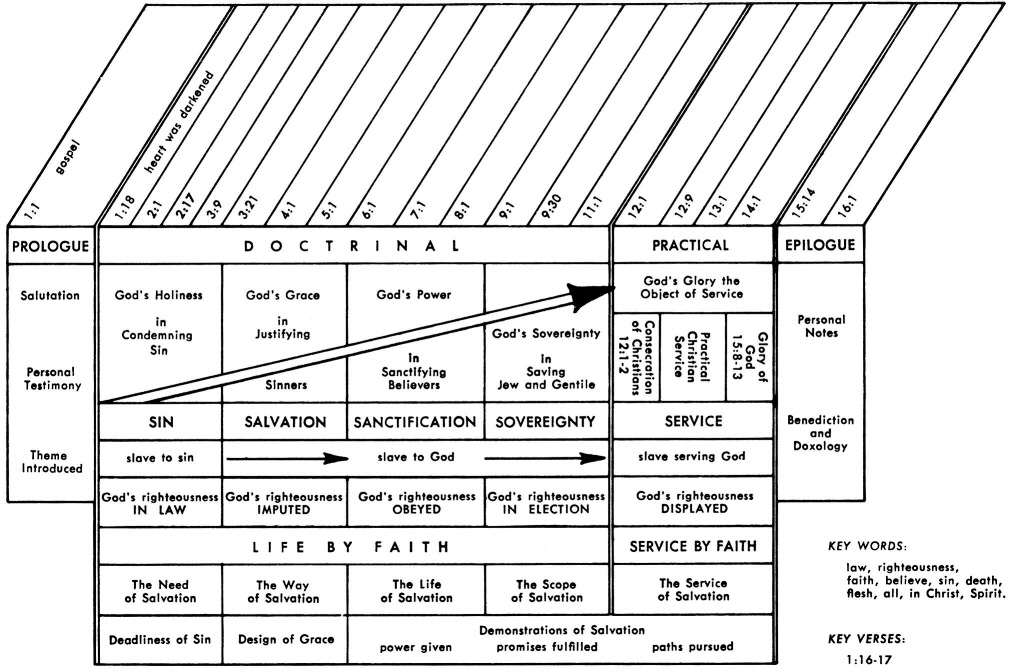
Click chart to enlarge
Chart from recommended resource Jensen's Survey of the NT - used by permission
Romans Overview Chart - Charles Swindoll
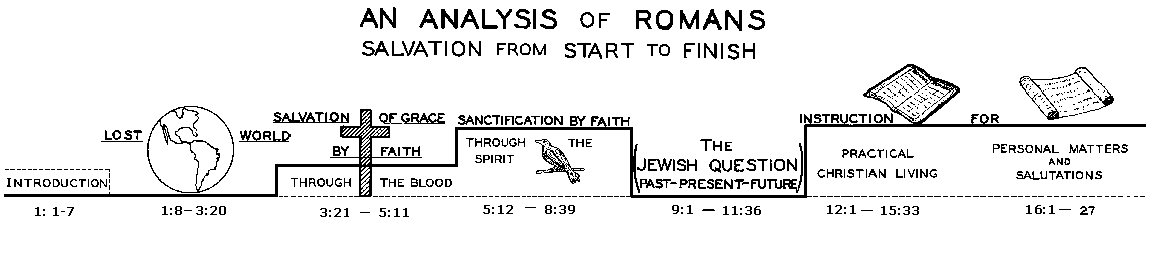
Source: Dr David Cooper
Click to Enlarge
| ROMANS ROAD to RIGHTEOUSNESS |
||||
| Romans 1:18-3:20 | Romans 3:21-5:21 | Romans 6:1-8:39 | Romans 9:1-11:36 | Romans 12:1-16:27 |
| SIN | SALVATION | SANCTIFICATION | SOVEREIGNTY | SERVICE |
| NEED FOR SALVATION |
WAY OF SALVATION |
LIFE OF SALVATION |
SCOPE OF SALVATION |
SERVICE OF SALVATION |
| God's Holiness In Condemning Sin |
God's Grace In Justifying Sinners |
God's Power In Sanctifying Believers |
God's Sovereignty In Saving Jew and Gentile |
Gods Glory The Object of Service |
| Deadliness of Sin |
Design of Grace |
Demonstration of Salvation | ||
| Power Given | Promises Fulfilled | Paths Pursued | ||
| Righteousness Needed |
Righteousness Credited |
Righteousness Demonstrated |
Righteousness Restored to Israel |
Righteousness Applied |
| God's Righteousness IN LAW |
God's Righteousness IMPUTED |
God's Righteousness OBEYED |
God's Righteousness IN ELECTION |
God's Righteousness DISPLAYED |
| Slaves to Sin | Slaves to God | Slaves Serving God | ||
| Doctrine | Duty | |||
| Life by Faith | Service by Faith | |||
|
Modified from Irving L. Jensen's chart above |
||||
R Ruin (Romans 1:17 – 3:20) – The utter sinfulness of humanity
O Offer (Romans 3:21-31) – God’s offer of justification by grace
M Model (Romans 4:1-25) – Abraham as a model for saving faith
A Access (Romans 5:1-11) – The benefits of justification
N New Adam (Romans 5:12-21) – We are children of two “Adams”
S Struggle w/ Sin (Romans 6:1-8:39) Struggle, sanctification, and victory
Romans 8:1 Therefore there is now no condemnation for those who are in Christ Jesus. (NASB: Lockman)
See Romans 8:1 in over 60 English translations
Greek (Nestle-Aland): Ouden ara nun katakrima tois en Christo Iesou;
Greek (Textus Receptus): Ouden ara nun katakrima tois en Christo Iesou; me kata sarka peripatousin alla kata pneuma (see comments below)
Amplified: Therefore, [there is] now no condemnation (no adjudging guilty of wrong) for those who are in Christ Jesus, who live [and] walk not after the dictates of the flesh, but after the dictates of the Spirit. (Amplified Bible - Lockman)
KJV: There is therefore now no condemnation to them which are in Christ Jesus, who walk not after the flesh, but after the Spirit. (translated from Greek Textus Receptus)
Moule: So no adverse sentence is there now, in view of this great fact of our redemption, for those in Christ Jesus.
NLT: So now there is no condemnation for those who belong to Christ Jesus. (NLT - Tyndale House)
Phillips: No condemnation now hangs over the head of those who are "in" Jesus Christ. (Phillips: Touchstone)
Wuest: Therefore, now, there is not even one bit of condemnation to those who are in Christ Jesus. (Eerdmans Publishing - used by permission)
Young's Literal: not even one therefore now adverse judgment & resultant punishment to those in Christ Jesus
[THERE IS] THEREFORE NOW NO CONDEMNATION: Ouden ara nun katakrima:
- See Romans 8:1 in over 60 English translations
- Ro 4:7-8; Ro 5:1; Ro 7:17,20; Jn 3:18,19; Jn 5:24
- Related Resource -- Hymns with words "no condemnation"
- Romans 8 Resources - Multiple Sermons and Commentaries
Related Passages:
Romans 4:7-8 “BLESSED ARE THOSE WHOSE LAWLESS DEEDS HAVE BEEN FORGIVEN, AND WHOSE SINS HAVE BEEN COVERED (WHY? BECAUSE THEY INCUR "NO CONDEMNATION"). 8 “BLESSED IS THE MAN WHOSE SIN THE LORD WILL NOT TAKE INTO ACCOUNT.”
Romans 5:1 Therefore, having been justified by faith, we have peace with God (POSITIONALLY - AND IN Php 4:6-7 = PRACTICALLY, EXPERIENTIALLY) through our Lord Jesus Christ (HE IS OUR PEACE!)
John 3:18-19 “He who believes in Him is not judged (NO CONDEMNATION); he who does not believe has been judged already, because he has not believed in the name of the only begotten Son of God. 19 “This is the judgment, that the Light has come into the world, and men loved the darkness rather than the Light, for their deeds were evil.
John 5:24 “Truly, truly, I say to you, he who hears My word (YOU HAVE TO FIRST HEAR THE GOSPEL WHICH MEANS WE AS BELIEVERS MUST SPEAK IT FORTH - ARE YOU SHARING THE GOSPEL WITH ANYONE?), and believes Him who sent Me, has eternal life, and does not come into judgment (NO CONDEMNATION), but has passed out of death into life (NO "DEATH SENTENCE").
OUR FOREVER POSITION:
NO CONDEMNATION IN CHRIST
Romans 8 beautifully begins with "no condemnation," and it marvelously ends with no separation (see Romans 8:39) for those who are in Christ Jesus. One of the key words of Romans 8 is "Spirit" (especially in the first 27 verses) occurring some 20 times not including numerous pronouns ("Who").
Is eternal security an issue that troubles you dear reader? Then let the word of Christ in Romans 8 richly dwell within you and you will come to appreciate and appropriate that "in Christ Jesus" you are safe and secure now and forever!
If you are reading Romans 8:1 in the KJV (translated from the Greek Textus Receptus) you will note the added phrase "who walk not after the flesh, but after the Spirit." The Nestle-Aland and Westcott and Hort Greek texts do not consider this phrase as legitimate. It is probable that a copyist inadvertently picked up the phrase from Romans 8:4 which has the identical wording. See note below. Can you see how this additional phrase leads to a slightly different interpretation of "no condemnation"? Paul is not basing his declaration of no condemnation upon our practice (conduct), but upon our position (in Christ). While it is true that those who are in Christ should not and do not consistently walk according to the flesh, this is not a condition for their status of "no condemnation" and for that we thank our merciful Father for the wisdom and perfection of His plan of salvation.
The Net Bible adds this note on the addition in KJV: "The earliest and best witnesses of the Alexandrian and Western texts have no additional words for v1. Both the external evidence and the internal evidence are completely compelling for the shortest reading. The scribes were obviously motivated to add such qualifications (interpolated from v4), for otherwise Paul’s gospel smelled too much of grace!"
Dr Harry Ironside has an interesting thought on the variation in translations remarking that "Careful students of the original text discover that the last part of Romans 8:1 in the King James version is an interpolation properly belonging to verse 4 [Romans 8:4]. The magnificent statement that opens Romans 8 - "There is therefore now no condemnation to them which are in Christ Jesus" - requires no qualifying clause. Our justification does not depend on our walk. Freedom from condemnation is given to all who are in Christ, and to be in Him means to be of the new creation. A glance at the Revised version or any critical translation will show that what I am pointing out is sustained by all the editors. It was man's innate aversion to sovereign grace, I am certain, that brought these qualifying words into the text of the King James version. It seemed too much to believe that freedom from condemnation depended solely on being in Christ Jesus and not on our walking after the Spirit. So it was easy to lift the words from verse 4 [Romans 8:4 ] into verse 1 [Romans 8:1 ]. But in verse 4 [Romans 8:4 ] they have their proper place for there Paul was writing of the state of the believer. In verse 1 [Romans 8:1 ] it is the question of standing that is under consideration. (Romans 8).
The Christian’s war with sin does not end until he goes to be with the Lord. Nevertheless, there is still no condemnation-because the penalty for all the failures of this life (and who of us does not have many, yea, even many every day!) has been paid in full at Calvary. The holiest of believers are warned that, although they are no longer slaves to sin’s dominion, they will continually experience conflict with this old nature in this present life (cf Gal 5:17, 1Pe 2:11 where "wage war" is present tense). The weakest of believers are promised that, although they still stumble and fall into sin’s power in their flesh, they will experience ultimate victory over sin in the life to come.
Moule offers a poignant introduction Romans 8 which because of its beauty and practicality is quoted at length. He writes...
here we find the secret that is to “stint the strife” which we have just witnessed, and which in our own souls we know so well. Here is the way “how to walk and to please God” 1Thessalonians 4:1), in our justified life. Here is the way how, not to be as it were the victims of “the body,” and the slaves of “the flesh,” but to “do to death the body’s practices” in a continuous exercise of inward power, and to “walk after the Spirit.” Here is the resource on which we may be forever joyfully paying “the debt” of such a walk; giving our redeeming Lord His due, the value of His purchase, even our willing, loving surrender, in the all-sufficient strength of “the Holy Ghost given unto us.”
Noteworthy indeed is the manner of the introduction of this glorious truth. It appears not without preparation and intimation; we have heard already of the Holy Ghost in the Christian’s life, Romans 5:5, Ro 7:6. The heavenly water has been seen and heard in its flow; as in a limestone country the traveller may see and hear, through fissures in the fields, the buried but living floods. But here the truth of the Spirit, like those floods, finding at last their exit at some rough cliff’s base, pours itself into the light, and animates all the scene. In such an order and manner of treatment there is a spiritual and also a practical lesson. We are surely reminded, as to the experiences of the Christian life, that in a certain sense we possess the Holy Ghost, yea, in His fulness, from the first hour of our possession of Christ. We are reminded also that it is at least possible on the other hand that we may need so to realise and to use our covenant possession, after sad experiments in other directions, that life shall be thenceforth a new experience of liberty and holy joy. We are reminded meanwhile that such a “new departure,” when it occurs, is new rather from our side than from the Lord’s. The water was running all the while below the rocks. Insight and faith, given by His grace, have not called it from above, but as it were from within, liberating what was there.
The practical lesson of this is important for the Christian teacher and pastor. On the one hand, let him make very much in his instructions, public and private, of the revelation of the Spirit. Let him leave no room. so far as he can do it, for doubt or oblivion in his friend’s minds about the absolute necessity of the fulness of the presence and power of the Holy One, if life is to be indeed Christian. Let him describe as boldly and fully as the Word describes it what life may be, must be, where that sacred fulness dwells; how assured, how happy within, how serviceable around, how pure, free, and strong, how heavenly, how practical, how humble. Let him urge any who have yet to learn it to learn all this in their own experience, claiming on their knees the mighty gift of God. On the other hand, let him be careful not to overdraw his theory, and to prescribe too rigidly the methods of experience. Not all believers fail in the first hours of their faith to realise, and to use, the fulness of what the Covenant gives them. And where that realisation comes later than our first sight of Christ, as with so many of us it does come, not always are the experience and action the same. To one it is a crisis of memorable consciousness, a private Pentecost. Another wakes up as from sleep to find the unsuspected treasure at his hand — hid from him till then by nothing thicker than shadows. And another is aware that somehow, he knows not how, he has come to use the Presence and Power as a while ago he did not; he has passed a frontier — but he knows not when. In all these cases, meanwhile, the man had, in one great respect, possessed the great gift all along. In covenant, in Christ, it was his. As he stepped by penitent faith into the Lord, he trod on ground which, wonderful to say, was all his own. And beneath it ran, that moment, the River of the water of life. Only, he had to discover, to draw, and to apply.
Again, the relation we have just indicated between our possession of Christ and our possession of the Holy Ghost is a matter of the utmost moment, spiritual and practical, presented prominently in this passage. All along, as we read the passage, we find linked inextricably together the truths of the Spirit and of the Son. “The law of the Spirit of life” is bound up with “Christ Jesus.” The Son of God was sent, to take our flesh, to die as our Sin Offering, that we might “walk according to the Spirit.” “The Spirit of God” is “the Spirit of Christ.” The presence of the Spirit of Christ is such that, where He dwells, “Christ is in you.” Here we read at once a caution, and a truth of the richest positive blessing. We are warned to remember that there is no separable “Gospel of the Spirit.” Not for a moment are we to advance, as it were, from the Lord Jesus Christ to a higher or deeper region, ruled by the Holy Ghost. All the reasons, methods, and issues of the work of the Holy Ghost are eternally and organically connected with the Son of God. We have Him at all because Christ died. We have life because He has joined us to Christ living. Our experimental proof of His fulness is that Christ to us is all. And we are to be on the guard against any exposition of His work and glory which shall for one moment leave out those facts. But not only are we to be on our guard; we are to rejoice in the thought that the mighty, the endless work of the Spirit is all done always upon that sacred Field, Christ Jesus. And every day we are to draw upon the indwelling Giver of Life to do for us His own, His characteristic work; to show us “our King in His beauty,” and to “fill our springs of thought and will with Him.” (Moule, C. G. The Epistle of St Paul to the Romans)
John quotes Jesus' declaration that "He who believes (pisteuo) in Him is not (absolutely not) judged (krino = root of katakrino - see below); he who does not believe has been judged already, because he has not believed in the name of the only begotten Son of God. And this is the judgment, that the light is come into the world, and men loved the darkness rather than the light; for their deeds were evil. (Jn 3:18,19)
As noted in the overview chart of Romans above, Romans 8 is closely connected with Romans six and seven under the topic "SANCTIFICATION." In Romans 6 believers are shown to be identified with Christ in His representative death to Sin in the crucifixion of the old man which gives us a way to walk (live, conduct ourselves), in a walk in newness of life (Ro 6:4, 5, 6). In Romans 7, believers are shown to be identified with Christ in His representative death to the Law (Ro 7:4, 5, 6) but still struggle with sin. In Romans 8 we encounter the positive side of the two preceding chapters, for now we are introduced to the power of the Holy Spirit Who enables our walk in newness of life and allows us to experience victory of sin's pleasure (Hebrews 11:25) and power (Romans 6:12-13). Without the aid of the Holy Spirit we are slaves to indwelling sin.
As Cranfield explains "The life promised for the man who is righteous by faith is, in the fourth place, described as a life characterized by the indwelling of the Spirit of God. The key word of this section is pneuma, which, while it is used only five times in chapters 1 to 7 (Rom. 1:4; Rom. 1:9; Rom. 2:29; Rom. 5:5; Rom. 7:6;) and eight times in chapters 9 to 16 (Ro 9:1; Ro 11:8; Ro 12:11; Ro 14:17; Ro 15:13; Ro 15:16; Ro 15:19; Ro 15:30), occurs twenty-one times in chapter 8 (Ro 8:1,2, 4, 5, 6, 9, 10, 11, 13, 14, 15, 16, 23, 26, 27), that is, much more often than in any other single chapter in the whole New Testament. In the majority of its occurrences in Romans 8, it quite certainly denotes the Holy Spirit, and in two of them it clearly does not. In the remaining instances it is a matter of some controversy whether the reference is, or is not, to the Holy Spirit: in all of them, in our judgment, it is." (BORROW Romans - page 370)
And so Johnson declares that Romans 8 "is also the great chapter on the Holy Spirit, Who supplies the dynamic for the new life created in believers by the new birth. Just as faith in Christ's work is indispensable for our justification, so faith in the power of the Spirit is indispensable for our sanctification. Since we have found peace with God by looking to the finished work of the Redeemer on the cross, we are now to find the peace of God by looking to His unfinished work on the throne, of which the Holy Spirit is the sign, seal, and executor. Cf. 2Cor 13:14 (grace from Christ is the channel, love from the Father the source, and the fellowship of the Spirit the means of God's ministry to us)...Romans eight, then, gives us a vivid picture of Who our Deliverer, the Lord Jesus Christ, uses in His deliverance of us from the power of indwelling sin. It is the Spirit of God Whom He uses to subdue the power of the flesh and give liberty for the fulfilling of the will of God in our lives. We turn now to the consideration of the liberty that the Spirit bestows. (Romans 8:1-4 Power of the Indwelling Spirit)
Godet connects Romans 8 with Romans 6 (you need to read his explanation slowly) noting that in chapter 6 "the apostle had showed how the object of justifying faith, Christ justified and risen, becomes to the believer, who appropriates it, a principle of death to sin and life to God. But there it was yet nothing more than a state of the will, contained implicitly in the act of faith. That this new will may have the power of realizing itself in the life, there is needed a force from above to communicate to the human will creative efficacy, and overturn the internal and external obstacles which oppose its realization. This force, as the apostle now unfolds, is the Holy Spirit, by Whom Christ crucified and risen reproduces Himself in the believer (Php 3:10)." (The Epistle of St Paul to the Romans - Chapter 8)
THEREFORE (for that reason, consequently) generally introduces a logical result or inference (a conclusion reached on the basis of evidence and reasoning) from what has been previously stated. As an aside see the importance of pausing to ponder strategic terms of conclusion.
THEREFORE (686) (ara) is an inferential particle marking transition to what naturally follows from preceding. Thayer adds ara "intimates that, under these circumstances something either is so or becomes so." What has Paul just stated? In the nearest context in Romans 7:25 Paul has just offered a praise and an explanation for the praise. In Romans 8:1 then Paul is saying "consequently" under these circumstances there is therefore no condemnation. What circumstances? The truth that "through Jesus Christ our Lord....I myself with my mind am serving the law of God". Now I must be honest and state that this is my simplistic explanation, but there are other interpretations so see additional thoughts below on THEREFORE.
TECHNICAL NOTE - This combination of "ara nun" is used numerous times in Romans (Ro 5:18; Ro 7:3, Ro 7:25; Ro 8:12; Ro 9:16, Ro 9:18; Ro 14:12, Ro 14:19). The two particles together strengthen each other and indicate a conclusion drawn with immediate force from what has just been said. Paul is making a contrast between the life of the man dominated by his human nature and the life of the believer under the control of God’s Spirit.
THEREFORE - In view of the fact that "therefore" leads us to expect some result that flows logically from the preceding text, what specifically is Paul pointing back to by using this term of conclusion? Some say Paul draws a conclusion based on his survey of the entire preceding portion of the letter, but against that thought is his use of the phrase "in Christ" which would not be compatible with the preceding sections that do not describe one in union with Christ (e.g., Romans 1:18-3:20.
David Abernathy in An Exegetical Summary of Romans 1-8 gives a lengthy answer to the question "What relationship is indicated by ara ‘therefore’?" (Note the parentheses below demarcate commentaries that hold the explanation and an active link indicates books that can be borrowed from archive.org)
The combination ἄρα νῦν (ara nun) ‘now therefore’ is emphatic, showing that a significant conclusion follows [NICNT- Douglas Moo]. It draws a conclusion from, and restates and elaborates on, what has been discussed in chapters 5, 6, and 7, but especially in Ro 5:12–21 concerning how those in Christ have eternal life instead of the condemnation and death that those in Adam have [NICNT- Douglas Moo].
- It draws a conclusion from chapters 5, 6, and 7, but especially Ro 5:18–21 [Anchor Bible Commentary - Fitzmyer].
- It introduces a conclusion to be drawn from Romans 7:1–6 [Romans - Cranfield].
- It introduces a conclusion to be drawn from the discussion of sanctification in Ro 6:1 through Ro 7:6; that is, since they are dead to sin, alive to God, subject to grace and freed from the law, they are not under condemnation [Godet].
- It draws a conclusion based on the premise of Ro 7:6, that believers are not under condemnation because they are no longer under the domination of the law [BECNT-Thomas Schreiner, C K Barrett - HNTC], and also on the exclamation of victory in Ro 7:24–25, which is linked to Ro 7:6 [BECNT-Thomas Schreiner,].
- It draws a conclusion from the premise in Ro 7:25 that through Christ’s atoning work God has provided the means of freedom from the sinful nature, so that there is no condemnation for those in Christ [Mounce in NAC, Hendriksen in NTC].
- The law is both the means used by sin to fasten its grip on people as well as the basis for God’s judgment, but because Christians have died to the law through union with Christ they escape judgment [C K Barrett - HNTC].
- It draws a conclusion based on the discussion about the enslaving power of sin in chapters 6 and 7 [John Murray - Romans, Hendriksen in NTC].
- It draws a conclusion from all that has been said in the epistle, but especially from chapters 3, 4, and 5 about salvation through Christ’s death and resurrection [John Stott Romans : God's good news for the world].
- It draws a conclusion from all that has already been said in the epistle concerning justification [Charles Hodge, Hendriksen in NTC], and especially in chapters 5, 6 and 7, which is that because of Christ’s sacrifice, believers have been released from the curse of the law [Hendriksen in NTC].
- It introduces a restatement of the major theme of the epistle [James Dunn - Romans. 1-8 - WBC].
- It draws a conclusion from all that has been said in the epistle about Christ’s debt-removing sacrifice of himself, especially in chapters 6 and 7, and most particularly in Ro 7:25 [Hendriksen in NTC].
THEREFORE - R H Mounce comments that "Romans 7:25 (note) teaches that freedom from the power of the lower nature has been provided by God through the atoning work of Jesus Christ. THEREFORE there is no longer any condemnation at all for those who are “in Christ Jesus,” that is, who have been made one with Him by faith in His redemptive sacrifice. The just penalty incurred by the sins of the human race was paid by the death of Christ. The unfavorable verdict has been removed. Now all those who are in Christ are the beneficiaries of that forgiveness. It follows that if condemnation as an objective reality has been removed, there is no legitimate place for condemnation as a subjective experience. To insist on feeling guilty is but another way of insisting on helping God with our salvation. How deeply imbedded in human nature is the influence of works-righteousness! (Mounce, R. H. Romans: The New American Commentary. Broadman & Holman Publishers)
In another commentary on Romans by R H Mounce (BORROW THIS COMMENTARY) he has a similar explanation on Romans 8:1 -- "The first verse sets forth one of the most important truths of the Christian faith. The opening word, "therefore," leads us to expect some result that flows logically from the preceding text (Some see ara referring back to the entire argument set forth in chaps. 5-7 - others to 7:1-6) Romans 7:25 teaches that freedom from the power of the lower nature has been provided by God through the atoning work of Jesus Christ;. Therefore there is no longer any condemnation at all for those who are "in Christ Jesus," that is, who have been made one with Him by faith in His redemptive sacrifice (119). It follows that if condemnation as an objective reality has been removed, there is no legitimate place for condemnation as a subjective experience. To insist on feeling guilty is but another way of insisting on helping God with our salvation! How deeply imbedded in human nature is the influence of works-righteousness!"
Leon Morris on therefore - THEREFORE links the great chapter on life in the Spirit logically to the preceding. NEB brings out something of the force of it with “the conclusion of the matter is this”. It is possible to take THEREFORE to refer to the immediately preceding words, but most agree that this is not the primary context. It is much more likely that Paul is referring to the whole of the preceding argument. He has taken several chapters to bring out the way God saves us in Christ, and in the light of the whole of that massive argument he can say there is now NO CONDEMNATION. His NOW is surely temporal, now in contrast to times gone by before we had entered into the justification Christ brought. It is possibly also in contrast to the time to come. He has a strong eschatological thrust in many places, and he may be hinting that, though we do not as yet experience all the fulness of what salvation in Christ means, we do enjoy all that NO CONDEMNATION means. NOW believers have a wonderful gift of salvation from God in Christ. CONDEMNATION is a forensic term which here includes both the sentence and the execution of the sentence. But for believers there is NO CONDEMNATION at all. (BORROW - The Epistle to the Romans)
Warren Wiersbe comments that “Romans 3:20 shows the ‘therefore’ of condemnation ("because by the works of the Law no flesh will be justified in His sight; for through the Law comes the knowledge of sin"); but Romans 8:1 gives the ‘therefore’ of no condemnation...The Law condemns; but the believer has a new relationship to the Law, and therefore he cannot be condemned.”(BORROW ROMANS COMMENTARY)
The new epoch replaces the previous dispensation of condemnation
-- R H Mounce
Now (3568) (nun) is more of a temporal marker (than an indicator of logical consequences) with focus on the moment, at the present time. It refers to the new era in salvation history! No condemnation when? Right now and forever! This benefit was effected the moment you accepted Christ as your Savior. The "now" contrasts the believer's new state with the old, which had passed away. Hallelujah!
Mounce says "nun, now, is temporal, referring to the new epoch in human history that has replaced the former dispensation of condemnation (cf 2Co 3:7-9).
S Lewis Johnson adds that "The "now" is probably temporal, but one cannot give it the force of the Arminian lady, who was giving her testimony and cried out, "I thank God I'm saved; I'm saved up to the present date!" ( (Romans 8:1-4 Power of the Indwelling Spirit)
Newman says now (nun) "initiates a contrast between someone dominated by his human nature and someone under the control of the Holy Spirit.' (Translator's Handbook of Paul's Letter to the Romans)
Haldane writes that the word now "distinguishes two conditions of a man, namely, his condition under the law, and his condition under grace,—that is, his natural and his supernatural conditions. For by nature we are children of wrath, but now God has rendered us accepted in the Beloved. Being now in Christ, we are not under the curse of the law, because He has borne it for us In the moment in which we believed in Him, we were redeemed from its curse; we entered into another Covenant, in which there is nothing but grace and pardon. That there is now no condemnation to them that are in Him is according to our Lord’s declaration, “Verily, verily, I say unto you, he that heareth My word, and believeth on Him that sent Me, hath everlasting life, and shall not come into condemnation.” It is often remarked that the Apostle does not say that there is in them which are in Christ Jesus neither matter of accusation nor cause of condemnation; and yet this is all included in what he does say. In themselves there is much indeed for both, but here they are viewed exclusively in Jesus Christ. Afterwards, in express terms, he denies that they can be either accused or condemned—which they might be, were there any ground for either. All that was commendable in them, which was sin, has been condemned in their Surety, as is shown in verse 3. (An Exposition of Romans. ca 1839)
No (3762) (oudeis from oude in turn from ou = not + dé = but + heis = one) literally means "but absolutely not one". This negative thus denies absolutely and objectively the possibility in this case of condemnation by God. Not even one will ever be condemned to hell who is in Christ Jesus. Beloved, this should prompt a short worship service in our heart every time we read this passage! In Adam we were guilty and condemned to eternal separation from the Father, but Jesus intervened and redeemed us out of grave peril of eternal death and gave us eternal life in Himself! Hallelujah! What a Savior! Hallelujah! What a Friend!
The literal rendering of Romans 8:1 is "not even one therefore now adverse judgment and resultant punishment to those in Christ Jesus
Note the emphasis (by placing it first in the Greek sentence) on the negative, "not even one"!
Pritchard comments on this word order noting that...
When the New Testament writers wanted to emphasize a particular word, they would put it at the first part of the sentence. That was their way of saying, "This is important. Notice this. Pay attention to it." In the Greek the first word is not "therefore." The first word is not "there." The first word is not "is." The first word is not "now." The first word in this verse in the Greek is the word "no." The fifth word in our translation is first in the original because Paul wants to emphasize in the strongest possible way that there is no condemnation. That's why he took the word "no" and moved it to the front.
And it's not ou, but oude, which is an even stronger negation in the Greek language. There is therefore, no condemnation. You might translate it this way: "There is no condemnation—none whatsoever—for the believer in Christ Jesus...
Do you know what that means? We may stumble, we may fall, we may trip, we may make a thousand mistakes, we may sin and we do, we may get off the path, we may go astray, we may have a thousand problems, but for the believer in Jesus Christ, there is, therefore now, no condemnation because God has said it is so. You can struggle, but you're not condemned. You can fall, but you're not condemned. You can trip, but you're not condemned. You can stray off the path, but you are not condemned because God has said He will not condemn those who are in Christ Jesus.
When Jesus saved you, he didn't say he would take away all your problems. No, but he did say this. In your problems, there is no condemnation. In your struggles, there is no condemnation, in your failure, there is no condemnation. In your going astray, there is no condemnation.
What does it mean, then? It means, number one, there is no rejection for the believer. God is not going to reject you just because you struggle. You're not a bad person just because you're having a hard time." (Romans 8) (Bolding added)
Condemnation (2631) (katakrima from katá = against, down + krino = basic meaning was "to separate" from which the idea of discriminate, distinguish, and then to judge or pronounce sentence against) appears only in Romans, here and in Ro 5:16, Ro 5:18.
The idea literally is of judgment coming down on someone. Paul says God’s judgment is not going to come down upon you, not now, not ever! From the valley of despair and defeat of living under the Law in Romans 7, the apostle now climbs the heights with the triumphant shout, "No condemnation" because of the believer's justification by faith. Those in Christ are not condemned, because Christ was condemned in their stead. There is no punishment for them, because Christ bore their punishment. It is notable that no condemnation is essentially the opposite of justification.
The word condemnation may also be translated "judgment." There is no judgment for those who are in Christ because sin has already been judged in the substitutionary atonement of Jesus.
Katakrima means to judge someone as definitely guilty and thus subject to punishment, which accounts for the literal translation of "adverse judgment and resultant punishment". It is a legal technical term for the result of judging, including both the sentence and the execution or the sentence followed by a suggested punishment (The suffix -ma makes it the result of judgment). Katakrima is always an adverse verdict. Stated another way, katakrima (condemnation) relates to the sentencing for a crime, but its primary focus is not so much on the verdict as on the penalty that the verdict demands.
F. F. Bruce paraphrases "there is no condemnation" as follows "There is no reason why those who are in Christ Jesus should go on doing penal servitude as though they had never been pardoned and liberated from the prison house of sin. (Bruce, F F, The Epistle of Paul to the Romans: Tyndale Press, 1966)
NIDNTT - The noun katakrima, is first found in the 1st cent. B.C. with the meaning punishment, damnation. Its meaning in the Corpus Papyrorum Raineri (ed. 1895) is noteworthy: legal liability in respect of a piece of land...Divine condemnation, issuing, as the word implies, in damnation, is expressed by katakrima. (Brown, Colin, Editor. New International Dictionary of NT Theology. 1986. Zondervan)
S Lewis Johnson adds that "The "now" is probably temporal, but one cannot give it the force of the Arminian lady, who was giving her testimony and cried out, "I thank God I'm saved; I'm saved up to the present date!" The word, "condemnation," is not to be confused with the word judgment. It is the stronger word and refers to final judgment, that of eternal judgment. There is no condemnation for believers, although they still face the necessity of appearing before the judgment seat of Christ (cf. 2Co 5:10). They are freed from condemnation, the condemnation of the Law of God, because their penalty has been paid by a substitute, the Lord Jesus Christ. They are also freed from bondage to sin by the Holy Spirit, a product of the payment of the penalty by Christ. (Romans 8:1-4 Power of the Indwelling Spirit)
As Paul has already declared, the penalty, or condemnation, for sin is death (see Romans 6:23) but here Paul announces the marvelous good news that for Christians there will be no condemnation, neither sentencing nor punishment for the sins that believers have committed or will ever commit. No sin a believer can commit - past, present, or future - can be held against him, since the penalty was paid by Christ and righteousness was imputed to the believer. And no sin will ever reverse this divine legal decision.
Reach my blest Savior first,
Take Him from God’s esteem;
Prove Jesus bears one spot of sin,
Then tell me I’m unclean.
—W. N. Tomkins
MacDonald notes that "there is no need for the kind of self-condemnation which Paul described in chapter 7. We may pass through a Romans 7 experience, unable to fulfill the law’s requirements by our own effort, but we don’t have to stay there. (MacDonald, W., and Farstad, A. Believer's Bible Commentary: Old and New Testaments. Nashville: Thomas Nelson)
A T Robertson writing on no condemnation notes that "As sinners we deserved condemnation in our unregenerate state in spite of the struggle. But God offers pardon “to those in Christ Jesus”. This is Paul’s Gospel. The fire has burned on and around the Cross of Christ. There and there alone is safety. Those in Christ Jesus can lead the consecrated, the crucified, the baptized life. (Greek Word Studies)
Hendriksen also feels that no condemnation "means freedom not only from sin’s guilt but also from its enslaving power. To be sure, a distinction must be drawn between justification and sanctification. But this distinction must never become a separation. Calvin has made this clear by stating, “As Christ cannot be divided, so also these two blessings which we receive together in him are also inseparable” (Institutes III, xi, 6). In line with this twofold reference of the words “no condemnation” is the phrase “in Christ Jesus.” (Ed: See discussions of in Christ and in Christ Jesus ) What Paul is saying is that for those who not only forensically are in Christ Jesus—the guilt of their sins having been removed by his death—but also spiritually—the sanctifying influences of his Spirit dominating their lives, there is now (= consequently) no condemnation. For them there is justification and therefore salvation full and free...Justification and sanctification always go together. (Hendriksen, W., & Kistemaker, S. J. New Testament Commentary Set, 12 Volumes. Grand Rapids: Baker Book House)
Observe carefully that Paul does not base his assertion of no condemnation to the saint upon the saint’s conduct, but upon the saints' position. Our position in Christ has set us free from the compelling power of the evil flesh ("Adamic nature", "Old self or old man") and made us a partaker of the divine nature (see 2Pe 1:3, 4), a new inner condition which produces in every saint a life which has for its motive, obedience to His commandments and the power to follow through (see Philippians 2:13). In other words, it is what God has made the believing sinner that insures the fact that there is no cause for condemnation in him. This is indeed "good news"!
Barton has a practical note writing that many believers...
feel condemned because Satan uses past guilt and present failures to make us question what Christ has done for us. Our assurance must be focused on Christ, not our performance.
Our own conscience reminds us of guilt.
Non-Christian friends will notice (and point out) our inconsistencies.
Past memories of how we lived can haunt us...
The perfection of the law will show how imperfect we are.
We can allow Christ’s perfect example to discourage our efforts rather than encourage our trust.
Unhealthy comparisons with other believers will make us feel inadequate. (Barton, B. B., et al. Life Application Bible Commentary. Romans: Tyndale House Publishers)
Then venerable commentator Matthew Henry writes that..
It is the unspeakable privilege and comfort of all those that are in Christ Jesus that there is therefore now no condemnation to them.
He does not say, "There is no accusation against them,’’ for this there is; but the accusation is thrown out, and the indictment quashed.
He does not say, "There is nothing in them that deserves condemnation,’’ for this there is, and they see it, and own it, and mourn over it, and condemn themselves for it; but it shall not be their ruin.
He does not say, "There is no cross, no affliction to them or no displeasure in the affliction,’’ for this there may be; but no condemnation.
They may be chastened of the Lord, but not condemned with the world. Now this arises from their being in Christ Jesus; by virtue of their union with Him through faith they are thus secured. They are in Christ Jesus, as in their city of refuge, and so are protected from the avenger of blood. He is their Advocate, and brings them off. There is therefore no condemnation, because they are interested in the satisfaction that Christ by dying made to the law. In Christ, God does not only not condemn them, but is well pleased with them, Mt.17:5.
In Galatians Paul explains why there is now "no condemnation" writing that "Christ redeemed (paid the ransom price to free) us from the curse of the Law, having become a curse for us-- for it is written "CURSED IS EVERYONE WHO HANGS ON A TREE"-- in order that in Christ Jesus the blessing of Abraham might come to the Gentiles, so that we might receive the promise of the Spirit through faith." (Galatians 3:13-14)
Although writing primarily to those in Israel who would be saved, the following truth applies to all who by faith are in Christ, Isaiah recording that "No weapon that is formed against you shall prosper; and every tongue that accuses you in judgment you will condemn. This is the heritage of the servants of the LORD, and their vindication is from Me," declares the LORD." (Isaiah 54:17)
Ray Pritchard (Romans 8) writes that...
About 40 years ago Dr. Donald Gray Barnhouse decided to ask a group of Christian leaders to name their favorite chapter of the Bible. So he wrote 20 Christian leaders and asked them this question: If you were shipwrecked on a desert island, and could not take any book with you except the Bible and you could only take with you one chapter of the Bible, what chapter would you choose? Of the 20 Christian leaders, five named Romans 8 as the one chapter they would choose. But those leaders are not alone in that estimation.
Romans 8 is regarded by many Christians as the greatest chapter of all the Bible. In fact, if you read the commentaries on Romans, Chapter 8 is described as "the mountain peak" of Scripture and "the chapter of chapters for the Christian believer." Many commentators quote a German author by the name of Spener who many years ago said it this way:
"If Holy Scripture was a ring, and the Epistle to the Romans a precious stone, Chapter 8 would be the sparkling point of the jewel."
Pritchard goes on to add there are several reasons Romans 8 is the greatest chapter of the greatest book in the Bible...
Number one, Romans 8 is uniquely the chapter of the Holy Spirit. The Holy Spirit is mentioned in Romans 8 no less than 19 different times. No other chapter in the New Testament contains as many direct references to the Holy Spirit.
Number two, it's preeminently the chapter of Christian assurance. Godet said Romans 8 begins with "no condemnation" and ends with "no separation." You start with no condemnation, you end with no separation, and in between you find no defeat. William R. Newell calls Romans 8 "a wondrous comfort to the believer." I like to think of it this way. It is like a mighty river rushing down toward the ocean. As the river nears the ocean, other streams and other tributaries join into it so that as it nears its mouth where it empties into the ocean, you find that it carries with it everything else that has gone before it.
Romans 8 is the summation of chapters 1 through 7. All that Paul has been saying comes to a grand and glorious climax in this chapter. It is the one chapter in this book that you must know, you must read, and you must understand. (Romans 8)
Charles Hodge calls Romans 8 “a rhapsody on assurance.” If you wrestle with your eternal security, meditation on Romans 8 is the antidote to counter the poison of doubt and despair. (Romans 8 - Hodge's Commentary on Romans)
Hodge goes on to explain that "no condemnation" is correctly translated “nothing worthy of condemnation,” as Erasmus and many others translate it; (for in point of fact) those who are in Christ are not exposed to condemnation. Again, this does not only describe their present state but their permanent position. They are placed beyond the reach of condemnation. They will never be condemned. The meaning of a preposition is often best understood by the arguments by which it is sustained. It is so in this case. The whole chapter is a proof of the safety of believers, of their security not only from present condemnation but from future perdition. That nothing will ever separate them from the love of God is Paul’s triumphant conclusion. Those for whom there is not now and never will be any condemnation are described first in their relationship to Christ and second in their character. The first assigns the reason for their security; the second enables us to determine to whom that security belongs. (Romans 8 - Hodge's Commentary on Romans)
Harry Ironside remarks that "It has always seemed to me a great pity that in editing our Bibles and dividing the text into chapters and verses the break was permitted to come where it does between Romans seven and eight. I am persuaded that many souls have failed to see the connection just because of this. We get in the habit of reading by chapters, instead of by subjects. Properly, the first four verses of Romans 8 should be joined right on to chapter 7, thus linking with the expression of hope, "I thank God through Jesus Christ our Lord." (Romans 8).
"There is" is not found in the original Greek but is added to strengthen the meaning that there is absolutely no condemnation to those in Christ. Earlier Paul had written that they were "justified" or acquitted meaning that the charges are no longer against us, Romans 5:1 (note) recording that "Therefore having been justified by faith, we have peace with God through our Lord Jesus Christ."
In Romans 8 Paul is saying that in addition to "peace with God" there is also no need to continually put yourself under condemnation every time you sin. God has condemned sin in the flesh so that we can never be condemned. Our condemnation fell on the Lamb of God. Paul explained this in Romans 5 writing that "So then as through one transgression there resulted condemnation to all men, even so through one act of righteousness there resulted justification of life to all men. (Ro 5:18)
We are no longer under condemnation as are those who are still "in Adam" for we are now "in Christ" (illustration), and safe from the wrath to come. Jesus reaffirms this great truth declaring...
Truly, truly (Amen, Amen), I say to you, he who hears My word, and believes Him who sent Me, has (present tense = continual possession, now and forever) eternal life, and does not (absolutely not) come into judgment (krisis related to krino), but has passed (perfect tense = this event happened at a point in time - the moment of genuine faith - and continues into the present - it speaks of the permanence of the "passing" - thus even the tense of the verb serves to emphasize eternal security!) out of death into life (see note on "life"). (John 5:24)
So if God does not condemn you any longer, don't condemn yourself. Instead reckon yourself as out from under the penalty for sin or otherwise you are imposing a condition on yourself that God Himself does not impose.
Practically Paul is saying that there is no need to continually put yourself under condemnation every time you sin. In this same chapter Paul reiterates "Who dares accuse us whom God has chosen for his own? Will God? No! He is the one who has given us right standing with himself. Who then will condemn us? Will Christ Jesus? No, for he is the one who died for us and was raised to life for us and is sitting at the place of highest honor next to God, pleading for us." (Ro 8:33, Ro 8:34, NLT)
Warren Wiersbe explains that there is now "no condemnation" because "the indwelling Holy Spirit fulfills the righteousness of the Law in us. The Law cannot condemn us because we are dead to the Law. God cannot condemn us, for the Holy Spirit enables the believer to “walk in the Spirit” and thereby meet God’s holy demands. It is a glorious day in the life of the Christian when he or she realizes that God’s children are not under the Law, that God does not expect them to do “good works” in the power of the old nature. When the Christian understands that “there is no condemnation,” then he realizes that the indwelling Spirit pleases God and helps the believer to please Him. What a glorious salvation we have! “Stand fast therefore in the liberty by which Christ has made us free, and do not be entangled again with a yoke of bondage!” warns Paul in Gal 5:1 (NKJV). (BORROW Wiersbe's Expository Outlines on the New Testament)
"But wait!" you say. What about Paul's teaching that every believer "must all appear before the judgment seat of Christ, that each one may be recompensed for his deeds in the body, according to what he has done, whether good or bad (phaulos = not referring to sins but to works from which there is the impossibility of any true gain ever coming forth from. See study on Good Works). (2Cor 5:10)
and even in Romans saying "we shall all stand before the judgment seat of God." (Ro 14:10)
Although there is no condemnatory judgment, all believers of course will indeed come before the judgment (bema) seat of Christ, but that divine "appointment" will not be for condemnation but for rewards (2 Corinthians 5:10) when "each man's praise (don't miss that - Paul says "each" which means all will receive praise from God!) will come to him from God." (1Corinthians 4:5)
The believer will never stand before God as Judge to be condemned or punished for his sins. The condemnation has once and for all fallen fully and finally upon Christ our Substitute. On the other hand every believer will stand before the Bema or judgment seat of Christ to give an account of how faithfully he or she has lived the Christian life since he or she was saved but the focus will not be condemnation but rewards or loss of rewards (see 1Cor 3:12, 13, 14,15).
-
Despair (Ro 7:24) – The wretched cry: “Who will deliver me?”
-
Deliverer (Ro 7:25) – Answer: God, through Christ Jesus.
-
Declaration (Ro 8:1) – No condemnation for those in Christ.
-
Deliverance (Ro 8:2) – Spirit sets us free from sin’s enslaving power.
-
Decisive Act (Ro 8:3) – God condemned sin at the Cross through His Son.
-
Design (Ro 8:4) – Purpose: that God’s righteousness is fulfilled in Spirit-led believers.
QUESTION - What does it mean that there is no condemnation in Christ (Romans 8:1)?
ANSWER - One of the wonderful truths of Scripture is found in Romans 8:1: “Therefore, there is now no condemnation for those who are in Christ Jesus.”
In his letter to the Romans, Paul presents the importance of the good news of Jesus Christ (Romans 1:16–17). We need this good news because all people, in their sin, are under condemnation (Romans 1:18—3:20). Paul then explains the gospel (Romans 3:21—4:25) and what it means to no longer be under condemnation, describing the implications of being declared righteous by God (Romans 5—8). He concludes this section of the epistle by affirming the eternality of the righteousness given by God and asserts that there is now no condemnation for those who are in Christ Jesus (Romans 8:1). Paul adds an example of the trustworthiness of God (Romans 9—11) and challenges believers in Christ to behave in a manner consistent with their new position of righteousness in Christ (Romans 12—16).
The need for salvation is universal because of our connection to Adam and his sin. Adam fell, his nature became sinful, and all humanity bears his image and likeness (Genesis 5). All people born of Adam are naturally under condemnation and separated from God like Adam was (Romans 5:12–15). But Paul explains that those who have believed in Christ are now positionally in Christ. They are justified, or declared righteous, by grace through the redemption in Christ (Romans 3:24), and they are now alive in Christ Jesus (Romans 6:11). They have eternal life (Romans 6:23). Elsewhere, Paul emphasizes that the one believing in Jesus now has a new identity in Christ (Ephesians 1:3–14). Where there was once condemnation by God, there is now justification by God. There is now no condemnation for those who are in Christ Jesus.
The believer’s new position, received by grace through faith (Ephesians 2:8–9), cannot be taken away. Once God declares someone righteous, no one can correctly accuse that person or justly condemn him (Romans 8:31–34). There is now no condemnation for those who are in Christ Jesus. When Jesus died on the cross, He took our condemnation upon Himself; He took the punishment that was due us all (1 Peter 3:18). All who believe in Him have eternal life (John 6:47) and are no longer condemned by God.
It is worth noting that the KJV and some other translations contain an added clause in Romans 8:1: “who walk not after the flesh but after the Spirit” (Romans 8:1KJV). In the context, Paul explains that those who believe in Christ are those who walk by the Spirit, and the evidence of that is that they have the Spirit of God in them (Romans 8:9). Even if the added words in the KJV are not original to verse 1, the same truth (that we walk in the Spirit) is communicated in Romans 8:4 and Romans 8:9. Those who “walk after the Spirit” are those who are “in Christ”; these are two ways of describing the same thing. In other words, the statement of Romans 8:1 that there is now no condemnation to those who are in Christ Jesus is not conditional. Once someone has believed in Christ, he is in Christ and can never be separated from the love of Christ, as Paul explains in Romans 8:38–39. No created thing (including an individual) can separate anyone from the love of God that is in Christ. When Paul affirms that there is now no condemnation for those who are in Christ Jesus (Romans 8:1), we can be confident of our secure position in Christ.GotQuestions.org
C H Spurgeon comments...
I like the old translation. There was a martyr once summoned before Bonner. After he had expressed his faith in Christ, Bonner said, "You are a heretic and will be damned."
"No," said he, quoting the old version, "There is therefore now no damnation to them that believe in Christ Jesus."
Oh, for faith to lay hold on this! Oh, for an overpowering faith that shall get the victory over doubts and fears, and make us enjoy the liberty with which Christ makes men free! You that believe in Christ, go to your beds this night and say, "If I die in my bed, I cannot be condemned!" Should you wake the next morning, go into the world and say, "I am not condemned!" When the devil howls at you, tell him, "You may accuse, but I am not condemned!" And if sometimes your sins rise, say, "I know you, but you are all gone forever. I am not condemned! "
As "there is therefore now no condemnation to them that are in Christ Jesus," so we may solemnly say, "There is therefore now a most weighty condemnation on you who are not in Christ Jesus, who are walking, not after the Spirit, but after the flesh."
Bible Knowledge Commentary writes that "In chapter 8, Paul described the ministry of the indwelling Holy Spirit of God who is the source of divine power for sanctification and the secret for spiritual victory in daily living. (Walvoord, J. F., Zuck, R. B., et al: The Bible Knowledge Commentary. 1985. Victor).
Martin Luther said if the Bible were a ring then Romans would be a the gem that enhanced that ring. And then he went on to say that Romans 8 would be the brilliant splendor that emanated from that ring. No wonder he said that - because Romans 8 teaches us the glorious truth of the work of the Holy Spirit of God and Martin Luther had to come out of a works oriented religion. Luther finally discovered that not only could he not do it but that he was not expected to do it. God sent His Son in the Person of the Spirit to come live in a person so that through him God might live His life.
Dr Wayne Barber who frequently speaks on the "Christ life", wonders how long it will be before most believers come to the same realization that Luther came to - that in the energy of our flesh, we cannot live the Christian life and God never said we could, but He can live it through us and He always said He would. This is the great truth about the Christian life = the results are God's. They are not mine. My responsibility is to put to death the deeds of the flesh by His Spirit (Ro 8:13) and to daily walk in the energy and power of His Spirit (Gal 5:16, Ga 5:25, cf Gal 6:8). As yield my rights, surrendering my will to God's good and perfect will, I am choosing to walk in the Spirit by faith not sight (2Cor 5:7) Romans says that Righteousness is "revealed". I cannot produce it in my own strength. It is God's Spirit producing righteousness in and through my life surrendered to Him (cf Phil 1:11).
How tragic is the truth that Romans 8 is a favorite passage of many believers and yet there are relatively few who really live in it. We like to get into the beauty and victory of Romans 8, but tend to skip over the struggle and heartache of Romans 6 (see notes) and Romans 7 (see notes). Here is the practical point: You cannot live in Romans 8 until you have comprehended the great truths of Romans 6 and Romans 7 The joy and the victory of this great chapter rests on the death and the struggle of Romans 6 and Romans 7. The unerring principle in the Christian life is that Calvary comes before Pentecost -- that the fullness of the Spirit is only possible after having entered into the experience of the death of the cross---Not being crucified in physical terms, but in terms of spiritual experience. Throughout the Word of God, the testimony of the Scripture is that death precedes life. Jesus said "Truly, truly, I say to you, unless a grain of wheat falls into the earth and dies, it remains by itself alone; but if it dies, it bears much fruit" (Jn 12:24) which outlines the unerring principle of productivity and fruitfulness.
It is interesting to note that the personal pronoun (the "big I") that was so prominent in chapter 7 largely disappears in Romans 8 and that the Holy Spirit becomes the dominant Person. This is an important key to understanding and apprehending this teaching. Victory is not in ourselves but in the Holy Spirit, Who indwells, motivates and empowers us now to deny ungodliness and live sensibly, righteously and godly in this present age (see Titus 2:11, 12, 13, 14, 15 notes Titus 2:11, 12, 13-15)
T J Bach wrote that “The Holy Spirit longs to reveal to you the deeper things of God. He longs to love through you. He longs to work through you. Through the blessed Holy Spirit you may have: strength for every duty, wisdom for every problem, comfort in every sorrow, joy in His overflowing service.”
William Newell (Romans 8) writes in his excellent commentary that
We have now come to that great chapter which sets forth that part in our salvation which is exercised by the third Person of the Godhead, the blessed Holy Spirit. Without Christ's work on the cross there would be no salvation, and without the presence and constant operation of the Holy Spirit, there would be no application of that salvation to us, -indeed, no revelation of it to us!
Let us therefore with the profoundest reverence, and greatest gladness, take up the study here in Romans Eight of that work of the Holy Spirit which is directly concerned with our salvation: for Romans is a book of salvation. Jesus Christ and Him crucified is the message that concerns salvation. Christ Jesus and Him glorified is that which concerns our perfecting as believers. The latter, other epistles will unfold more fully. But the teaching of the work of the Holy Ghost in Romans regards His fundamental operations, -just as it is fundamental phases of Christ's work that are presented here.
"The Eighth Chapter of Romans is the instinctive goal of the Christian. Whether or not he can tell why--whether or not he can give the great doctrinal facts that give him comfort here, he is, nevertheless, like a storm-tossed mariner who has arrived at his home port, and has cast anchor, when he comes into Romans Eight!...
This Eighth of Romans, then, comes after the work of Christ-after His atoning blood has put the believer's sins away; after he has seen, also, that he died with Christ, -to sin, and also to that legal responsibility he had in Adam; after the words, "Sin shall not have dominion over you, for ye are not under Law, but under Grace"; and, finally, after the hopeless struggle of the apostle has shown "the flesh" to be incurably bad; and that there is a blessed deliverance, which, though not changing "the body of this death, " nevertheless gives freedom there from "through our Lord Jesus Christ."...
It is on account of the Spirit's acting as a law of life, delivering the believer from the contrary law of sin and death in his yet unredeemed members, that there is no condemnation. It is of the utmost importance to see this. The subject here is no longer Christ's work for us, but the Spirit's work within us. Without the Spirit within as a law of life, there would be nothing but condemnation: for the new creature has no power within himself apart from the blessed Spirit, --as against a life of perpetual bondage to the flesh, --"the end of which things is death" (Newell, W: Romans Verse by Verse)
MacArthur observes that "THEREFORE" is "the Believer’s Emancipation Proclamation." Therefore is a word with introduces a result, consequence, or conclusion based on what has been established previously. "It seems unlikely that Paul is referring to the immediately preceding text. He has just finished lamenting the continued problem of sin in a believer’s life, including his own. It is surely not on the basis of that truth that he confidently declares that believers are no longer under divine condemnation. One might expect rather that any further sin would deserve some sort of further judgment. But Paul makes clear that such is not the case with our gracious God. It seems probable that therefore marks a consequent conclusion from the entire first seven chapters, which focus primarily on justification by faith alone, made possible solely on the basis of and by the power of God’s grace." (MacArthur, J: Romans 1-8. Chicago: Moody Press)
Paul writes that "in Adam all die, so also in Christ all shall be made alive." (1Cor 15:22)
There was condemnation as long as we were IN Adam our first federal head. But now we are IN Christ and therefore are as free from condemnation as He is. As Paul has been teaching in the preceding chapters, we are justified, declared righteous (Ro 3:21, 22, 23, 24 - see notes Ro 3:21-23; 24), now stand in His grace (See Ro 5:1, 2-notes), are no longer under His wrath (see Romans 1:18), and are possessors of life everlasting right now (Ro 5:17,18, 21 - see notes Ro 5:17,18, 21). Christ is the sphere of safety for all who are identified with Him by faith.
How many Christians are filled with "guilt" because of trying to live up to some standard either self-imposed or placed up "over" you by another individual (this is legalism and it can be subtle).
Why is there no longer any condemnatory judgment against us? The reason there is no condemnation has nothing to do with our somehow not deserving condemnation (we do), but with the fact that Jesus bore the condemnation we deserved and as He is condemned no more, neither are we. We were judged guilty of breaking the law (sin) but sin has been judged in the propitiatory sacrifice and substitutionary atonement of Jesus. Since Jesus is not condemned by the Father, those who are in Him are not, will not, and cannot be condemned.
Romans 8 beautifully begins with "no condemnation" and it marvelously ends with no separation (Ro 8:39) and in between the Spirit is provided that we might be empowered to life a life of no defeat as when we were in Adam. The confidence and peace of Romans 8 follows the confusion and conflict that marked Romans 7. Now Paul is looking to Jesus and is finding his standing in Him.
The Disciple's Study Bible has a wonderful summary note on the Holy Spirit writing...
The Spirit is not a possession we hold on to but a Person we love and obey. People must choose between the way of the flesh or sinful nature and the way of the Spirit. We should choose "the Spirit of life'' (Ro 8:2), "the Spirit'' (Ro 8:4), "the Spirit of Christ'' (Ro 8:9), "the Spirit of Him Who raised Jesus'' (God, Ro 8:11), "the Spirit of God'' (Ro 8:14), and "the Spirit of sonship'' (Ro 8:15).
The Spirit gives life (Ro 8:2), peace (Ro 8:6), freedom (Ro 8:9), leadership (Ro 8:14), assurance (Ro 8:16), hope (Ro 8:23; Ro 8:24), and help (Ro 8:26). The Spirit is with all Christians (Ro 8:9, Ro 8:14). The Spirit makes Christians God's children and able to say "Father'' when we pray (Ro 8:15). The Spirit assures us that we are in fact God's children (Ro 8:16), and that, even though we pass through much suffering, we will eventually share in the glory of Christ (Ro 8:17).
With all this we remain free. We must choose to follow the Spirit, to live according to the Spirit (Ro 8:5), to set our minds on what the Spirit desires (Ro 8:5), to be controlled by the Spirit (Ro 8:9), to put to death the old way of life (Ro 8:13), and to be led by the Spirit (Ro 8:18). These phrases all refer to a serious commitment to live as Christians with the help of God's Spirit. This includes high moral standards (Ro 8:4) and more. Obeying the Spirit means a personal loyalty and obedience to Christ which expresses itself by following the leadership of the Spirit in all life's decisions. This is active cooperation as well as passive yielding. The Spirit's work is not irresistible. The Spirit prefers to wait and allow us to obey His leadership freely. Paul's call to obey the Spirit makes no sense at all if the Spirit is only an impersonal power or force. The Spirit is personal, and this leads to the commands to respond to the Spirit in a fully personal manner. (BORROW Disciple's Study Bible) (Bolding added)
FOR THOSE WHO ARE IN CHRIST JESUS: tois en Christo Iesou:
- See Romans 8:1 in over 60 English translations
- Ro 16:7; Jn 14:20; 15:4; 1Cor 15:22; 2 Cor 5:17; 12:2; Gal 3:28; Php 3:9)
- Romans 8 Resources - Multiple Sermons and Commentaries
For - Notice that in this context for does not function as a term of explanation.
"For those who live in union with Christ Jesus"
In Christ Jesus (Click for the 27 uses of this wonderful phrase - "IN" is Locative of Sphere) refers to the justified believer's new position (and "possession") in the Risen Christ, wherein there is no condemnation. (See related resource - in Christ and in Christ Jesus)
Paul locates and bases the believer's status on the phrase "in Christ Jesus" (cf. Romans 6:11, 23). The believer's "no condemnation" state is found in union with Christ Jesus, the keystone of Pauline theology, and the place of safety and liberty. It is the place of safety in that the one in Christ Jesus has the security of eternal life, a life that can never be taken from him and which he cannot lose by definition.
Charles Hodge addresses the question of "In what sense are believers 'in Christ Jesus?'" explaining that...
This must be determined not so much from the meaning of the words as from the teachings of Scripture.
1. They are in Him federally, as all men were in Adam (1 Corinthians 15:22; Romans 5:12, 13, 14, 15,16, 17, 18, 19, 20, 21-see notes).
2. They are in Him vitally, as the branch is in the vine (John 15:1, 2, 3, 4, 5, 6, 7) or, as the head and members of the body are in vital union (1Corinthians 12:27; Ephesians 1:23). This union arises from the indwelling of the Holy Spirit (1 Corinthians 12:13; 6:15, 19).
3. They are in him by faith (Ephesians 3:17; Galatians 3:26, 27).
It is not in virtue of any one of these unions exclusively, but in virtue of them all (so far as adults are concerned) that there is no condemnation for those who are in Christ Jesus. It follows from the nature of this union that it must transform the character of those who are its subjects.
“Therefore, if anyone is in Christ, he is a new creation” (2 Corinthians 5:17; see also John 15:4; Philippians 3:20; Colossians 2:6; 1John 2:5; 1Jn 3:6).
As the union includes the bodies of believers as well as their souls (1 Corinthians 6:15, 16, 17, 18, 19), so this transforming power will ultimately extend to the former as well as to the latter (Ro 8:10, 11). (Romans 8 - Hodge's Commentary on Romans)
Moule writes that "from those words, “in Christ,” he opens this ample revelation of our possession, in our union with Christ, of the Spirit who, having joined us to Him, now liberates us in Him, not from condemnation only, but from sin’s dominion. If we are indeed in Christ, the Spirit is in us, dwelling in us, and we are in the Spirit (Ed note: The corollary is that we are no longer truly, positionally "in the flesh" albeit we far too often act as if we were "in the flesh" but thank God that is never again our position but only our occasional practice!). And so, possessed and filled by the blessed Power, we indeed have power to walk and to obey. Nothing is mechanical, automatic; we are fully persons still; He who annexes and possesses our personality does not for a moment violate it. But then, He does possess it; and the Christian, so possessing and so possessed, is not only bound but enabled, in humble but practical reality, in a liberty otherwise unknown, to “fulfil the just demand of the Law,” “to please God,” in a life lived not to self but to Him. Thus, as we shall see in detail as we proceed, the Apostle, while he still firmly keeps his hand, so to speak, on Justification, is occupied fully now with its issue, Holiness. And this issue he explains as not merely a matter of grateful feeling, the outcome of the loyalty supposed to be natural to the pardoned. He gives it as a matter of divine power, secured to them under the Covenant of their acceptance. Shall we not enter on our expository study full of holy expectation, and with unspeakable desires awake, to receive all things which in that Covenant are ours?...We shall be humbled as well as gladdened; and thus Our gladness will be sounder. We shall find that whatever be our “walk according to the Spirit,” and our veritable dominion over sin, we shall still have “the practices of the body” with which to deal — of the body which still is “dead because of sin,” “mortal,” not yet “redeemed.” We shall be practically reminded, even by the most joyous exhortations, that possession and personal condition are one thing in covenant, and another in realisation; that we must watch, pray, examine self, and deny it, if we would “be” what we “are.” Yet all this is but the salutary accessory to the blessed main burthen of every line. We are accepted in the Lord. In the Lord we have the Eternal Spirit for our inward Possessor. Let us arise, and “walk humbly,” but also in gladness, “with our God.” (Bolding added)(Moule, C. G. The Epistle of St Paul to the Romans)Hallelujah! Amen!
In the last section of Romans Paul writes "Greet Andronicus and Junias, my kinsmen, and my fellow prisoners, who are outstanding among the apostles, who also were in Christ before me. (Ro 16:7)
Jesus explained to His disciples "In that day (when they would see Him after His resurrection) you shall know that I am in My Father, and you in Me, and I in you." (Jn 14:20)
Paul writes to the Corinthians "by His (the Father's) doing you are in Christ Jesus, Who became to us wisdom from God, and righteousness and sanctification, and redemption. (1Co 1:30)
Therefore if any man is in Christ, he is a new creature; the old things passed away; behold, new things have come. (2Cor 5:17)
Writing to the Galatians Paul explained that "There is neither Jew nor Greek, there is neither slave nor free man, there is neither male nor female; for you are all one in Christ Jesus." (Gal 3:28)
Note also that there are not different degrees of being in Christ. In other words, Billy Graham is no more in Christ than you are beloved. A person is either in Christ or not in Him (1Cor 15:22 "For as in Adam all die, so also in Christ all shall be made alive."). This blessed phrase in Christ is perfectly pictured by the Ark of Noah and the provision of safety the Ark provided from God's condemnation and judgment of the world in the waters of the flood.
Hebrews records that "By faith Noah, being warned by God about things not yet seen, in reverence prepared an ark for the salvation of his household, by which he condemned the world, and became an heir of the righteousness which is according to faith. (Hebrews 11:7)
Moses adds...
Then God said to Noah, "The end of all flesh has come before Me; for the earth is filled with violence because of them; and behold, I am about to destroy them with the earth. (Genesis 6:13)
Then the LORD said to Noah, "Enter the ark, you and all your household; for you alone I have seen to be righteous before Me in this time...And Noah did according to all that the LORD had commanded him. (Genesis 7:1,5)
So they went into the ark to Noah, by twos of all flesh in which was the breath of life. And those that entered, male and female of all flesh, entered as God had commanded him; and the LORD closed it behind him. (Genesis 7:15, 16)
And so all believers, like Noah, who was safe in the ark, because "the LORD closed (the door) behind him", are in a similar way secure "in Christ Jesus," because they have been placed in Him by the LORD, Who "locked" them in by saving grace. Glory!
In Christ Jesus believers are safe from the "flood" "in the day of wrath and revelation of the righteous judgment of God" (see Romans 2:5) which in fact is already being "revealed against all ungodliness and unrighteousness of men who suppress the truth in unrighteousness" (see Romans 1:18-19-notes) and holy wrath that will one day come to full ripeness in Revelation 6-19 and in the eternal Lake of fire.
In Christ Jesus is not just an assurance of never coming into condemnation but is a guarantee of a new life even today, because of the position we now share His Risen life (see Romans 6:4, 5-notes).
William Newell writes that "The words in Christ Jesus express that glorious place God has given the believer. The question is not at all now one of justification, but one of position, in Christ Risen, "where condemnation is not, and cannot be." There cannot be degrees here: men either are in Christ, or not in Him. There is no Condemnation-Those in Christ Jesus have more than justification from all things by His blood. They have "justification of life, " which means that they share His risen life. No condemnation-means, no condemnatory judgment.
Dr. Donald Gray Barnhouse has a great statement about the practical effect the truth of "no condemnation" ought to have in our life: A soul that comes to the full realization that he ought to be in hell but that in reality the Lord Jesus took his hell, and that there is therefore, now, now, NOW, no condemnation for him because he is in Christ Jesus, is likely to be quite moved by the truth. If the members of the human race are permitted to yell because their team won a football team, because their candidate won an election, because they have won fifty dollars on a horse race, because their drilling has produced a gusher, let us shout for joy because we are in Christ Jesus, there is, therefore, no condemnation for us NOW. ( p. 4-5)
Dr Harry Ironside remarking on "no condemnation" writes that...
What unspeakable relief it is to the bewildered, troubled soul, oppressed with a sense of his own unworthiness and distressed because of frequent failures, to learn that God sees him in Christ Jesus, and as thus seen he is free from all condemnation. He may exclaim, "But I feel so condemned." This however is not the question. It is not how I feel but it is what God says. He sees me in Christ risen, forever beyond the reach of condemnation.
A prisoner, hard of hearing and dull of sight, standing before the bar might imagine his doom was being pronounced at the very moment that the judge was giving a verdict of full acquittal. Neither blindness nor deafness would alter this verdict. And though we are often slow to hear, and our spiritual vision is most defective, the blessed fact remains that God has pronounced the believer free from condemnation whether he fully rises to the glorious fact or not.
Oh, doubting one, look away then altogether from self and state, look away from frame and feelings to Christ. See Him risen forever beyond the cross where your sins once put Him, and see yourself in Him exalted there at God's right hand. He would not be there if the sin question had not been settled to the divine satisfaction. The fact that He is there and that you are seen by God in Him is the fullest possible testimony to your freedom from all condemnation.
Oh, the peace forever flowing
From God's thoughts of His own Son!
Oh, the peace of simply knowing
On the cross that all was done.
Peace with God is Christ in glory;
God is just and God is love,
Jesus died to tell the story,
Foes to bring to God above.
--A. P. Cecil
We are brought to God "in Christ Jesus," and so all question of judgment is forever settled. It can never be raised again. (Romans 8). (Bolding added)
It is however worth noting that deliverance from divine condemnation does not mean deliverance from divine discipline. Although Christian discipline is a topic many do not enjoy studying, the writer of Hebrews reminds his audience (who were experiencing afflictions)
"you have forgotten the exhortation which is addressed to you as sons, "MY SON, DO NOT REGARD LIGHTLY THE DISCIPLINE OF THE LORD, NOR FAINT WHEN YOU ARE REPROVED BY HIM FOR THOSE WHOM THE LORD LOVES HE DISCIPLINES, AND HE SCOURGES EVERY SON WHOM HE RECEIVES." It is for discipline that you endure; God deals with you as with sons; for what son is there whom his father does not discipline? But if you are without discipline, of which all have become partakers, then you are illegitimate children and not sons." (see notes Hebrews 12:5; 12:6; 12:7; 12:8).
Nor does deliverance from divine condemnation mean escape from our accountability to God, as Paul reminded the Galatians, warning them "Do not be deceived (, God is not mocked; for whatever a man sows, this he will also reap. For the one who sows to his own flesh shall from the flesh reap corruption, but the one who sows to the Spirit shall from the Spirit reap eternal life." (Gal 6:7-8).
Martin Luther said "It is impossible for a man to be a Christian without having Christ, and if he has Christ, he has at the same time all that is in Christ. What gives peace to the conscience is that by faith our sins are no more ours, but Christ’s, upon whom God hath laid them all; and that, on the other hand, all Christ’s righteousness is ours, to whom God hath given it. Christ lays His hand upon us, and we are healed. He casts His mantle upon us, and we are clothed; for He is the glorious Savior, blessed for ever....Faith unites the soul with Christ as a spouse with her husband. Everything which Christ has becomes the property of the believing soul; everything which the soul has, becomes the property of Christ. Christ possesses all blessings and eternal life: they are thenceforward the property of the soul. The soul has all its iniquities and sins: they become thenceforward the property of Christ. It is then that a blessed exchange commences: Christ who is both God and man, Christ who has never sinned, and whose holiness is perfect, Christ the Almighty and Eternal, taking to Himself, by His nuptial ring of faith, all the sins of the believer, those sins are lost and abolished in Him; for no sins dwell before His infinite righteousness. Thus by faith the believer’s soul is delivered from sins and clothed with the eternal righteousness of her bridegroom Christ."
No condemnation now I dread:
Jesus, and all in Him, is mine!
Alive in Him, my living Head,
And clothed in righteousness divine,
Bold I approach th’ eternal throne,
And claim the crown, through Christ my own.
Charles Wesley
God's principles of "Double Jeopardy" (Guilty but not subject to re-trial) - Double jeopardy is a legal concept that protects a person from being prosecuted more than once for the same offense. This came into play in the case of a man who confessed to a Wisconsin judge that 2 years earlier in the same court he had been charged with murder and was found innocent. "But I was guilty," he admitted. The judge quickly conferred with the district attorney to see if the man could be brought to trial for murder. They discovered, however, that because of the principle of double jeopardy the man could not be tried again for that crime. Although he was a murderer, he could not be punished for it. According to God's justice, we who are "in Christ" were as guilty as that man before we were converted, but now we are just as unpunishable. Why? Not because of a legal technicality. Rather, it's because any and every sin we've ever committed or will commit has been fully prosecuted in Christ on the cross. And once is all that the law demands. There are still consequences when we do wrong, even as believers. But as far as the penalty of the law is concerned, Jesus' death places us in a wonderful position of being exempt from eternal punishment. Thank God for His principle of "double jeopardy"! (Our Daily Bread, Copyright RBC Ministries, Grand Rapids, MI. Reprinted by permission. All rights reserved)
Free from the law—O happy condition!
Jesus has bled, and there is remission;
Cursed by the law and bruised by the fall,
Grace has redeemed us once for all.
—Bliss
Dr Wayne Barber discusses the freedom the Holy Spirit gives believers - free from the Law, freed from the reigning power of Sin and provision of the power to live victoriously as more than conquerors in Christ. Dr Barber explains...
"Recall that Some One came to live in me when I placed my faith in Jesus Christ. Ro 5:5 (note)
"and hope does not disappoint, because the love of God has been poured out within our hearts through the Holy Spirit Who was given to us."
He is in every believer (not just those who have achieved a certain level of "spirituality") and He is in us to give us the realization of the victory we already possess by virtue of the truth that we are in Christ Jesus our Lord. As we learn to yield to the Spirit adnd allow Him to control us, we can walk in Christ's victory day by day.
Dr Barber goes on to explain our new life in Christ and the truth that believers are now under a new "management team" illustrating this truth with the story of a factory that had been sold...
"All the workers stayed - they didn't change - but now the "top floor" manager had changed. By analogy our bodies are still the same body as the body we lived in when we were lost - maybe a little older or a little "rounder" on the edges, but still the same mortal or physical body. The inside of our body however has radically changed character (new creation in Christ 2 Cor 5:17) and now the Holy Spirit of God has come to dwell or live at home in our bodies…the holiness of God, the righteousness of Christ is now in me, having been imputed (reckoned to my account - see Romans 4:4, 5, 6-notes) because of having placed my faith in Jesus Christ.
So it's the same old factory, same old workers (members) but the management is now Divine and we've got to learn step by step what this new management tells us to do, and if we fail to yield to the Holy Spirit's direction, we simply will never realize the victory we have in Christ. Victory is not going to come from our performance but from our faith that accesses God's grace, (Ro 5:2 [note]" we have gained ACCESS by FAITH into this GRACE in which we now stand" NIV) which alone can transform our life. We have got to learn to WALK BY FAITH (not by sight) trusting the leading of the Holy Spirit Who lives within us to Guide and direct our steps.
Paul prayed for the Ephesian believers to be
strengthened with power (dunamis = ability to do what you could not do before) through His Spirit in the inner man so that Christ may dwell in your hearts through faith (see notes on Ephesians 3:16-17 ).
Christ lives in me. My flesh is already condemned by the Law although I am free now from Law's condemnation because I am in Christ. But whenever my flesh comes out in my thoughts, words or actions it proves to result in nothing but death. My flesh cannot do any good thing, any righteous thing, any thing that pleases a Holy God. When I in my own SELF (flesh) EFFORT try to forgive one who has wronged me, I find I cannot do what I wish to do (cp Ro 7:14-23 "I" wishes to do good but does the very thing "I" does not want to do). When I try to live this VICTORIOUS LIFE in my own (self) effort, I find that it just does not "work".
But when I put my faith in Christ, I begin to realize that HE can forgive THROUGH me. When I seek to love people who are unlovable in my own energy, I find that I cannot do it. But when I put my trust in the Lord Jesus and I access His grace (by faith) and that amazing grace TRANSFORMS me, I find that out of me comes a love that I didn't even know was there. So something has been marvelously changed inside our mortal bodies - the Holy Spirit now lives within us.
Being filled with the Spirit
In Eph 5:18 (note) Paul reminds believers of the importance in the Christ life to be continually "filled with the Spirit". Being filled with the Spirit is NOT taking a glass of water, drinking it down and then hurrying back to Precept on Thursday night (or wherever you go) and getting it filled up again so you'll have some more to drink. No when the Holy Spirit of God comes to live within us we are changed forever. God's life is in us forever. To be filled with the Spirit is like knocking the bottom out of the glass, taking the glass and putting it in the river and letting the river flow through it. (in Jn 7:38 Jesus prophesied that from our "innermost being shall flow rivers of living water'"). That's what it means to be filled with the Holy Spirit. The more you learn to turn to Him, the more you learn to get up under grace & not under the Law & the more you will learn to trust Him that He is Who He says He is and that only the Spirit of Christ in you can live the Christ life - and the more that life that is already in you (Christ in you the hope of glory), the more that "river" that is in you will be able to flow forth through your mortal body."
Why is "NOW" significant in Romans 8:1? There is absolutely no divine condemnation for a believer because he is safe from the flood in the ark, Christ Jesus. When is "now"? When we put our faith in Christ. In Ro 7:14-25 if Paul was speaking about a lost man (which is a possibility), then the "NOW" refers to his brand new position that he NOW has in Christ Jesus. If you are a believer then "NOW" you never have to worry about condemnation from God (no guarantee from people though). When you were IN ADAM, you were CONDEMNED (Ro 5:18) no matter how good you thought you were but NOW that you are IN CHRIST, there will never be condemnation again. This is the gospel - good news indeed. Why are we no longer condemned? Because we are dead to the sin (of Adam) that resulted in all mankind being condemned. When Christ died, we died with Him being IDENTIFIED with His death and now with His life. Since He fulfilled the requirement of the Law (Jn 19:30 "It is finished!" = Paid in full; Gal 3:13) and God has imputed Christ's righteousness to our account and the promised Holy Spirit of Christ has come to live within us. For the Law to condemn us now, it would have to condemn Christ! Why? Because of our position not our performance! We are in Christ.
Dr Barber believes there are many Christians who don't truly understand this basic truth regarding their secure, eternal, unchanging position in Christ. They still think that condemnation can come upon them. When they sin they think that now because they have committed sin that they are under the condemnation of God.
When one is truly condemned there is no hope. Therefore the difference between condemnation and conviction is that conviction carries with it the same guilt, the same accusation but also carries with it the hope (certainty) that when you will confess and repent and walk in the light (1Jn 1:7,9 - see 1 John 1:5-10 - Evidence of Christianity), the sins you have committed are forgiven and you are now cleansed "from all unrighteousness" and can walk on in victory.
Another possible interpretation (of Ro 7:14-25) is that a man may still be struggling with the Law and the truth about "no condemnation" and this truth in (Ro 8:1, 2) may be what that this believer needs to lay hold of. There is absolutely no need to condemn yourself just because you "messed up" and got back up under the Law only to realize that your self ("flesh") efforts were unable to fulfill the law's requirements (Cp Col 2:23 Ro 7:5 Gal 5:1,7).
Robert Haldane in his classic commentary on Romans comments on the wonderful phrase "in Christ Jesus" writing that...
To be in Christ Jesus is to be one with Him, as united to Him by faith. Those and those only who are the one with Him are the persons to whom there is no condemnation. All who are not in Christ Jesus are under the law and its curse. It is not here said that Christ is with His people, or at their right hand, but that they are in Him, in order that they may know that, being in Him, they have nothing to fear; for what evil can reach those who are one with the Son of God? This union is represented in Scripture by various terms and by many similitudes; its efficacy and power are shown, when it is said, “He that is joined to the Lord is one Spirit.” It is in virtue of this union that the sufferings and obedience of Christ are imputed to His people, they being one with Him who fulfilled the law, and satisfied the justice of God. Their union with Him is the source of that spiritual life by which they are quickened together with Christ, and from which they derive their justification, their sanctification, and consolation. “It is impossible,” Luther remarks, “for a man to be a Christian without having Christ, and if he has Christ, he has at the same time all that is in Christ. What gives peace to the conscience is, that by faith our sins are no more ours, but Christ’s, upon whom God hath laid them all; and that, on the other hand, all Christ’s righteousness is ours, to whom God hath given it. Christ lays His hand upon us, and we are healed. He casts His mantle upon us, and we are clothed; for He is the glorious Savior, blessed for ever.” This union was typified under the law in the person of the high priest, who carried on his breast the twelve stones, on which were engraved the names of the twelve tribes of the children of Israel; so that, when he appeared before God, all the people appeared in him, thus showing that all believers are before God in Jesus Christ, their great High Priest. They are all delivered from condemnation, as being one body with Christ. As the debts of a wife must be discharged by her husband, and as, by her marriage, all her previous obligations are at once transferred to him, so the believer, being married to Christ, is no longer exposed to the curse of the law. All its demands have been met and satisfied by His covenant Head, with whom, as the wife is one with the husband, so he is one.
It is by the human nature of Jesus Christ that we enjoy union with His Divine nature, and that He is Emmanuel, God with us. His humanity is the medium by which His divinity communicates itself with all its graces. Under the former dispensation, God communicated with His people through the ark of the covenant, which was a type of the human nature of Jesus Christ, in order to show us that by it we have union with the whole of His person. And by union with the person of Jesus Christ we obtain communion with the Father. “At that day ye shall know that I am in My Father, and you in Me, and I in you.”
It is not by nature that we enjoy this union, since by nature we are “children of wrath” and “without Christ.” The means by which we are united to Christ are on His part by His Spirit, and on our part by faith. He communicates His Spirit to us, which is as the soul that unites all the members of the body with the head, so that “he who is joined unto the Lord is one Spirit.” On our part we receive Jesus Christ by faith produced in us by His Spirit, in order that we may reciprocally receive Him in our hearts. He dwells in our hearts by faith; and thus we learn what is meant when it is said we are justified by faith, not as being a work, or anything meritorious, but as the medium through which His righteousness, and all the graces and blessings that are in Jesus Christ, are communicated to our souls.
“Faith,” says Luther, “unites the soul with Christ as a spouse with her husband. Everything which Christ has, becomes the property of the believing soul: everything which the soul has, becomes the property of Christ. Christ possesses all blessings and eternal life: they are thenceforward the property of the soul. The soul has all its iniquities and sins: they become thenceforward the property of Christ. It is then that a blessed exchange commences: Christ who is both God and man, Christ who has never sinned, and whose holiness is perfect, Christ the Almighty and Eternal, taking to Himself, by His nuptial ring of faith, all the sins of the believer, those sins are lost and abolished in Him; for no sins dwell before His infinite righteousness. Thus, by faith, the believer’s soul is delivered from sins, and clothed with the eternal righteousness of her bridegroom Christ. O happy union! The rich, the noble, the holy Bridegroom takes in marriage his poor, guilty, and despised spouse, delivers her from every evil, and enriches her with the most precious blessings. Christ, a King and a Priest, shares this honor and glory with all Christians. The Christian is a king, and consequently possesses all things; he is a priest, and consequently possesses God; and it is faith, not works, which brings him all this honor. A Christian is free from all things, above all things, faith giving him richly all things.”
On account of this union, all believers bear the name of Christ, being that of their Head. “For as the body is one, and hath many members, and all the members of that one body being many, are one body; so also is Christ. For by one Spirit are we all baptized into one body,” 1Co 12:13. “We are members of His body, of His flesh, and of His bones,” Ephesians 5:30 (note). And in this Epistle to the Ephesians, the Apostle denominates the Church not only the body of Jesus Christ, but even His fullness. God “gave Him to be the Head over all things to the Church, which is His body, the fullness of Him that filleth all in all,” Ephesians 1:22 (note). He thus shows that this union with Jesus Christ is such that He who filleth all things would consider Himself without His people to be imperfect and incomplete. (An Exposition of Romans. ca 1839)
Illustration of no condemnation for those who are safe in Christ Jesus -- During a recent hurricane in the Gulf of Mexico, a news report highlighted a rescue device used on the oil rigs. In case of fire or (in this case) hurricane, rig workers scramble into the bullet-shaped “bus” and strap themselves into their seats. When the entry port is shut, the vehicle is released down a chute and projected away from the rig. The seat belts protect the occupants from the impact with the water. The capsule then bobs in the sea until rescuers come to pick it up. The device parallels the theological truth of Romans 8:l—”Therefore, there is now no condemnation for those who are in Christ Jesus.” Justification does not mean our world always stops falling apart. The rig still may topple in the hurricane. But those in the right place, whether a rescue module or spiritually in the storm. The storm will take its course. The welfare of the workers depends on whether they are IN the rescue device. - David Asp
Spurgeon also told a story first made famous by D. L. Moody, of a man in the wars between England and France who was drafted as a soldier, but did not have to go to battle because a friend had stepped in, and was accepted as his substitute. The substitute served in the war till he was killed in battle. The man for whom he substituted was drafted a second time, but he refused to serve. He was forced to appear before a judge, and he pleaded that he had been drafted once, had served in the war by means of his substitute, and should now be considered as being dead, because his substitute had been killed. He claimed that his substitute’s service was practically his service, and it is said that the law allowed his plea. Spurgeon comments: “assuredly it is according to divine equity, even if it be not according to human law. No criminal can be hanged a second time; one death is all the law requires: believers died in Christ unto sin once, and now they pennaly die no more. Our condemnation has spent itself upon our gracious representative. The full vials of divine wrath against sin have been poured upon the head of the great Shepherd, that this sheep might go free; and therein is our joy, our comfort, our security. ‘There is therefore now no condemnation to them which are in Christ Jesus’ “ (Ro 8:1).
F B Meyer in Our Daily Walk has the following devotional...
OUR GLORIOUS STANDING!
"There is, therefore, now no condemnation to them which are in Christ Jesus."-- Rom 8:1.
The characteristics of this glorious standing. It is present: "Now."
If we are in Christ, we need not wait in doubts and fears for the verdict of the great white Throne. Its decisions cannot make our standing more clear, or our acceptance more sure, but we shall learn there the meaning of God's dealings with mankind, and triumph in the successful vindication of His ways. We can never be more free from the condemnation of God's righteous law than we are at this present.
It is certain: "There is no condemnation." You must catch this accent of conviction, and be able to speak with no faltering voice of your assured acceptance with God, if you would enter upon the rich inheritance of this chapter, to which these opening words stand as the door of passage. The shadow of a peradventure cannot live in the light of that certainty of which the Apostle speaks.
It is invariable. There are Some who live on a sliding scale between condemnation and acceptance. If health is buoyant and the heart is full of song, they are sure of their acceptance with God; but if the sun is darkened and the clouds return; when the heart is dull and sad, they imagine that they are under the ban of God's displeasure. They forget that our standing in Christ Jesus is one thing; our appreciation and enjoyment of it quite another. Your own heart may condemn you; memory, the recorder of the soul, may summon from the past evidence against you; the great Accuser of souls may lay against you grievous and well-founded charges; your tides of feeling may ebb far down the beach; your faith may become weak and lose its power and grip; your sense of unworthiness may become increasingly oppressive--none of these things can touch your acceptance with God if you are complying with His one all-inclusive condition--"no condemnation to them which are in Christ Jesus." This mystic union with the Son of God is only possible to faith working by love (1Jo 3:23, 24).
PRAYER: We commit ourselves to Thy care and keeping this day; let Thy grace be mighty in us, and sufficient for us, and let it work in us both to will and to do of Thine own good pleasure, and grant us strength for all the duties of the day. Amen. (F B Meyer)
C H Spurgeon in Morning and Evening has the following devotional - Come, my soul, think thou of this. Believing in Jesus, thou art actually and effectually cleared from guilt; thou art led out of thy prison. Thou art no more in fetters as a bond-slave; thou art delivered now from the bondage of the law; thou art freed from sin, and canst walk at large as a freeman, thy Saviour's blood has procured thy full discharge. Thou hast a right now to approach thy Father's throne. No flames of vengeance are there to scare thee now; no fiery sword; justice cannot smite the innocent. Thy disabilities are taken away: thou wast once unable to see thy Father's face: thou canst see it now. Thou couldst not speak with him: but now thou hast access with boldness. Once there was a fear of hell upon thee; but thou hast no fear of it now, for how can there be punishment for the guiltless? He who believeth is not condemned, and cannot be punished. And more than all, the privileges thou mightst have enjoyed, if thou hadst never sinned, are thine now that thou art justified. All the blessings which thou wouldst have had if thou hadst kept the law, and more, are thine, because Christ has kept it for thee. All the love and the acceptance which perfect obedience could have obtained of God, belong to thee, because Christ was perfectly obedient on thy behalf, and hath imputed all his merits to thy account, that thou mightst be exceeding rich through him, who for thy sake became exceeding poor. Oh! how great the debt of love and gratitude thou owest to thy Saviour!
"A debtor to mercy alone,
Of covenant mercy I sing;
Nor fear with thy righteousness on,
My person and offerings to bring:
The terrors of law and of God,
With me can have nothing to do;
My Saviour's obedience and blood
Hide all my transgressions from view."
GOD'S MERCY SYSTEM - In the United States justice system, it's important that jurors have an open mind. They can't have their minds made up before they get into the courtroom. They must always remember that a person is considered innocent until proven guilty.
Even for those who never expect to find themselves on the wrong side of the law, it's a comfort to know that guilt is not assumed, but has to be proven. Yet, this system of justice is not like the one God has devised for mankind. We are declared guilty before we even enter His courtroom! And though that may not sound fair, it is. God's perfect holiness demands it.
In a courtroom, when a person is found guilty, he or she faces punishment. But the wonderful thing about God's courtroom is that when we admit our guilt, we are offered mercy! We are all guilty and face an eternal life-sentence of death. Yet the penalty for sin is meted out only to those who refuse to acknowledge their sin, and who reject God's forgiveness through Jesus Christ.
Guilty -- that's our status. But we can be granted forgiveness and be pardoned from our sin through the blood of Jesus Christ. That's God's mercy system! -- J D Brannon (Our Daily Bread, Copyright RBC Ministries, Grand Rapids, MI. Reprinted by permission. All rights reserved)
God's pardon is so full and free,
For Jesus died on Calvary;
It's granted to each sinful soul
Who truly longs to be made whole. -- D J DeHaan
God's justice condemns us -- but His mercy redeems us