Philippians 1:2
Philippians 1:3
Philippians 1:4
Philippians 1:5
Philippians 1:6
Philippians 1:7
Philippians 1:8
Philippians 1:9
Philippians 1:10
Philippians 1:11
Philippians 1:12
Philippians 1:13
Philippians 1:14
Philippians 1:15
Philippians 1:16
Philippians 1:17
Philippians 1:18
Philippians 1:19
Philippians 1:20
Philippians 1:21
Philippians 1:22
Philippians 1:23
Philippians 1:24
Philippians 1:25
Philippians 1:26
Philippians 1:27
Philippians 1:28
Philippians 1:29
Philippians 1:30

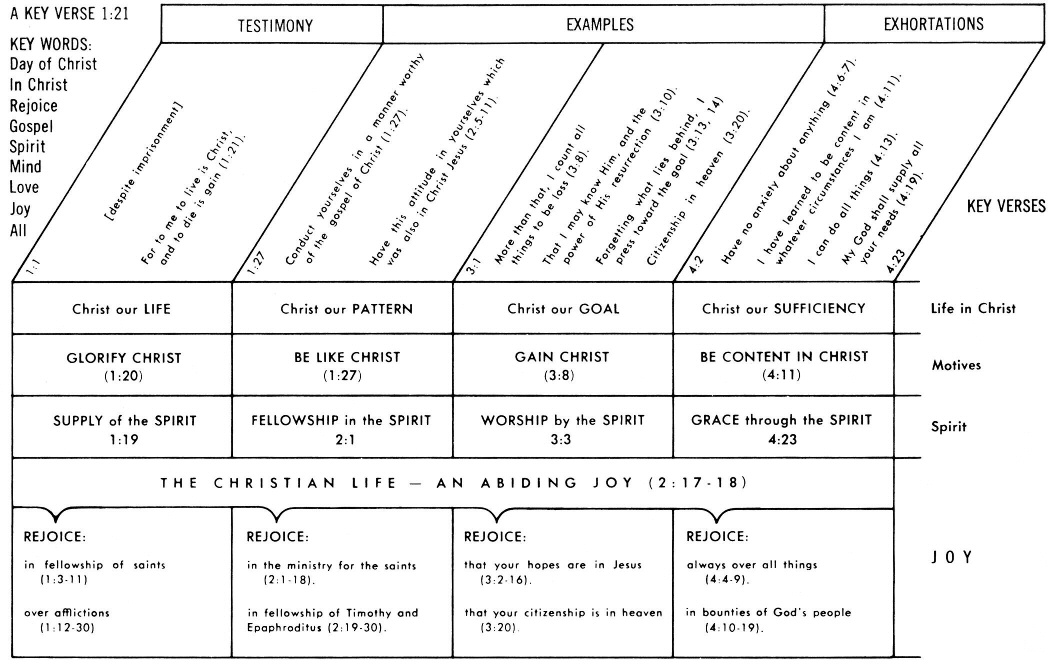
LIFE IN CHRIST
Click chart to enlarge
Charts from Jensen's Survey of the NT - used by permission
Philippians - Charles Swindoll = Chart on right side of page
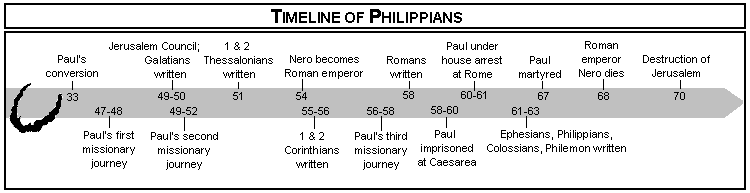
| Account of Paul's Circumstances Php 1:1-30 |
Have the Mind of Christ Php 2:1-30 |
Have the Knowledge of Christ Php 3:1-21 |
Have |
| Partakers of Christ | People of Christ | Pursuit of Christ | Power of Christ |
| Suffering | Submission | Salvation | Sanctification |
| Experience | Examples | Exhortation | |
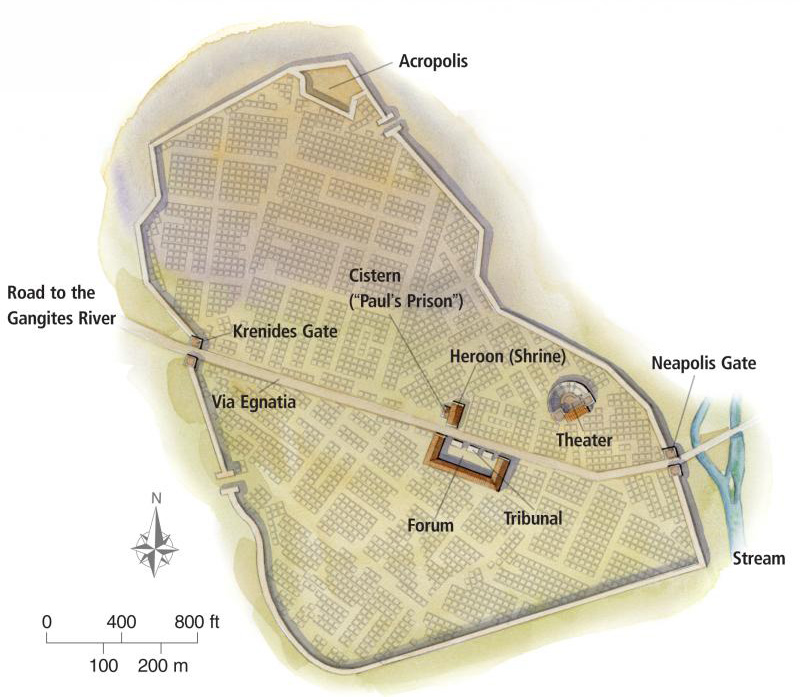
Philippi in the Time of Paul
The city plan above shows those features of the city of Philippi that archaeologists have so far identified as dating from the time of Paul. “Paul’s Prison” is not believed to be an authentic site, but was a cistern later associated with Christian worship. (ESV.org)
Philippians 1:25. Convinced of this, I know that I will remain and continue with you all for your progress and joy in the faith (NASB: Lockman)
Greek: kai touto pepoithos (RAPMSN) oida (1SRAI) hoti meno (1SFAI) kai parameno (1SFAI) pasin humin eis ten humon prokopen kai charan tes pisteos,
Amplified: Since I am convinced of this, I know that I shall remain and stay by you all, to promote your progress and joy in believing, (Amplified Bible - Lockman)
Barclay: And I am confidently certain of this, that I will remain, and I will be with you and beside you all to help you along the road, and to increase the joy of your faith
NET: And since I am sure of this, I know that I will remain and continue with all of you for the sake of your progress and joy in the faith,
NLT: I am convinced of this, so I will continue with you so that you will grow and experience the joy of your faith. (NLT - Tyndale House)
Wuest: And having come to this settled conviction (namely, that to remain in the flesh is more needful for you), I know that I shall remain and continue alive with you all for your progress and joy in your faith (Eerdmans Publishing - used by permission)
Young's Literal: and of this being persuaded, I have known that I shall remain and continue with you all, to your advancement and joy of the faith,
Convinced of this I know that I will remain and continue with you all for your progress and joy in the faith: kai touto pepoithos (RAPMSN) oida (1SRAI) hoti meno (1SFAI) kai parameno (1SFAI) pasin humin eis ten humon prokopenkai charan tes pisteos:
- Php 2:24; Acts 20:25
- Lk 22:32; Jn 21:15, 16, 17; Acts 11:23; 14:22; Ro1:11, 1:12; 15:18, 15:29; 2Co1:24; Eph 4:11,12,13
- Ro 5:2; 15:13; 1Pe1:8
- Torrey's Topic Joy)
And a voice within assures me, that so it will be. I shall continue here and abide with you all; that I may promote your advance in the faith and your joy in believing.(Lightfoot 1)
That is why (it is probably more necessary for you that I should stay here on earth) I feel pretty well convinced (Phillips)
PAUL'S SETTLED CONVICTION
TO REMAIN FOR THE SAINT'S SAKE
Convinced of this - Of what? He is persuaded that his remaining earthbound is necessary for the saints at Philippi.
Dwight Edwards writes that "The purpose for his "remaining in the flesh" is now given. He says he will "remain" (meno--abide' remain) and "continue with" (sumparameno--remain alongside to help) them for a specific purpose. He seeks to help in the furtherance of their spiritual progress and joy. The word for "progress" (prokopeen--to cut forward) was last used in 1:12. Paul desires not only the "cutting forward" of the gospel but also the advancement in maturity by those who had responded to the gospel. Col. 1:28.
Convinced (3982) (peitho) is a strong verb, carrying the components of confidence, reliance, and hope. The NT uses (see examples below) in the perfect tense mean to cause to come to a particular point of view or course of action. The idea is to come to a settled persuasion concerning something or to be persuaded. It means to be so convinced that one puts confidence in something or someone. The idea of a settled conviction is the result of a past completed process of turning a matter over in one’s mind until one is persuaded of it.
Peitho is used 6x in this short epistle (Php 1:6, 1:14, 1:25, 2:24, 3:3, 3:4) and speaks of Paul's settled conviction which is the result of a past completed process of turning this matter over in his mind until he was persuaded of it -- in Php 1:24 he had stated that it was necessary for the sake of the saints at Philippi that he remain on in the body. Paul was confident that the sovereign God was in control, that He had Paul's circumstances well in hand so to speak (Php 1:19, 20, 21, 22, 23, 24). Paul was assured that no matter what happened to him (remember he is writing from a prison cell!), God would be glorified.
that I shall not leave this world yet, but shall be able to stand by you, to help you forward in Christian living and to find increasing joy in your faith (Phillips)
I know (1492)(eido) speaks of knowing that is intuitive, knowing beyond a shadow of a doubt. He knows intuitively the purpose for which he will remain and continue with them - their progress and joy.
Paul's desire to remain on with them was purposeful -- he wanted to disciple them in the Truth (2Ti 2:2- note, 2Ti 4:2-note), sanctify them in the Truth (Jn 17:17), for he knew only by their intake of the pure milk of God's Word could they grow and progress in respect to their salvation (1Pe 2:2-note).
Will remain (3306)(meno) in simple terms means to remain in the same place or position over a period of time. It means to reside, stay, live, lodge, tarry or dwell. Menō describes something that remains where it is, continues in a fixed state, or endures.
Eadie - In expressing the idea of his stay (“Being assured of this, that abiding in the flesh is more needful for you.”), the apostle, in the fulness of his heart, uses two verbs, first meno and then parameno...The second verb becomes personal in its reference, “I shall remain, and remain with.” Not only should he survive, but survive in their company
Continue (parameno) is literally to remain near or continue near as Barclay brings out in his translation "I will be with you and beside you". The preposition "para" means beside which stresses the place of Paul's abiding. Right by their side.
Barclay adds that parameno "means to wait beside a person ever ready to help." (Philippians 1 - Daily Study Bible)
Will...continue (3387)(parameno from para = beside + meno= abide, remain) means to remain in a state or situation, to stay (beside). (1) with the dative of person, often with the denotation of serving stay, remain with as here in Php 1:25. Parameno also means to continue in a state, stay on (Heb 7.23). In James 1:25 parameno means to continue in a course of action, to keep on keeping on. (3) of temporarily lodging remain, continue with (1 Cor 16.6)
Rienecker says that in koine Greek parameno conveyed the idea "to remain in service" or to "remain at someone else's disposal" which helps us understand the encouragement this truth must have conveyed to the saints at Philippi.
Here are the 3 other uses of parameno in the NT. Two uses in the Septuagint - Ge 44:33, Pr 12:7 ("the house of the righteous will stand.").
Hebrews 7:23 The former priests, on the one hand, existed in greater numbers because they were prevented by death from continuing,
James 1:25 But one who looks intently at the perfect law, the law of liberty, and abides by it, not having become a forgetful hearer but an effectual doer, this man will be blessed in what he does.
1 Corinthians 16:6 and perhaps I will stay with you, or even spend the winter, so that you may send me on my way wherever I may go.
Beloved, are you "continuing" at the church God has placed you for the spiritual progress of the sheep over whom He has given you responsibility (for their growth in grace and the knowledge of our Lord and Savior Jesus Christ - 2Pe 3:18-note)? Are the saints to whom you are proclaiming the Gospel growing in Christlikeness (eg, are the fruits of the Spirit becoming more evident? Ga 5:22-note, Ga 5:23-note)? Observe how one's spiritual progress is linked with supernatural joy. The corollary question is "Do you lack joy (independent of the circumstances)?" If so, it could be that you are not making progress in the faith. You may be memorizing Scriptures, performing daily morning devotionals, attending Bible studies, etc, gaining intellectual knowledge, but not necessarily "internalizing" the truth, not obeying what you hear and thus actually deluding yourself that you are growing in grace, when it might be better said that you are growing in spiritual pride because of your great learning sans (without) doing (Jas 1:22-note). Remember, revelation always demands a response. Not from a sense of legalism but motivated by the love of and for Jesus (2Co 5:14, 15, Jn 14:15, 21, 23, 24) and empowered by His Spirit (Gal 5:16-note, 2Co 3:5, 6, Jn 6:63, Ro 7:6- note) and a desire to glorify the Father in your body and through the good deeds He does in your life (Mt 5:16- note)
Eadie - One end was—the advancement of their faith. It would be greatly increased by the apostle's presence and teaching, might grow into deeper vigour, and widen in the circuit of its objects. And his stay would be also for the joy of their faith. The genitive is in both cases that of possession. Their faith possessed a susceptibility of progress, and it would be excited and urged on; that faith, too, possessed or had in it an element of joy, which would be quickened and developed....Joy does spring out of faith— the genitive of origin; but faith may be equally well regarded as possessed of the joy which it originates.
NET Note - Paul's confidence in his release from prison (I know that I will remain and continue with all of you) implies that this Roman imprisonment did not end in his death. Hence, there is the likelihood that he experienced a second Roman imprisonment later on (since the belief of the early church was that Paul died under Nero in Rome). If so, then the pastoral letters (1-2 Tim, Titus) could well fit into a life of Paul that goes beyond any descriptions in the book of Acts (which ends with Paul's first Roman imprisonment). Some have argued that the pastorals cannot be genuine because they cannot fit into the history of Acts. But this view presupposes that Paul's first Roman imprisonment was also his last.
Wuest comments that "Paul had turned over in his mind the need which the Philippian saints had of his ministry, and had come to the settled conviction that they needed him more than he needed to go to heaven. That was just like Paul. He lived a crucified life, dead to self, ever setting even his legitimate desires aside in order that he might serve others. And so he tells them that he will remain on earth with them. While Paul had no active choice in the matter, yet he believed that the servant of the Lord is immortal until his work is done. Thus, if the Philippians needed his ministry, that fact would indicate that he was not to die at that time by the hand of Rome, but that he would be released and thus be able to minister to the spiritual needs of the saints." (Philippians Commentary - Verse by Verse Comments)
MacArthur - Paul hoped to remain and continue with the Philippians to promote both their progress and [their] joy in the faith. Earlier he had spoken of the general “progress of the gospel” (Php 1:12). Using the same word (prokopē), he speaks here of the particular progress of the Philippian believers, first in their joy and then in the faith. As noted under the discussion of Php 1:12, prokopē has the idea of advancing against obstacles, of facing continual resistance. When Paul and Barnabas “returned to Lystra and to Iconium and to Antioch, strengthening the souls of the disciples, encouraging them to continue in the faith,” they warned that “through many tribulations we must enter the kingdom of God” (Acts 14:21–22). Although progress … in the faith does not come without a price, it is always accompanied by progress in joy.
Progress (4297)(prokope) referring to the pioneer advance of the gospel in (Php 1:12-note). Here prokope refers to the Christian progress which the Philippians would make under the ministry of the apostle, "blazing" new paths of Christian conduct and service which would otherwise not be possible. And remember that the word prokope speaks of advancing against obstacles or facing and going forward against continual resistance, so their growth in grace would continually be opposed by the world, the flesh and the devil. Progress pictures trail blazing so that an army can advance (Php 1:12-note). Paul wanted to cut a new path for the Philippians to follow to victory.
Wuest comments that progress "is from the same Greek word we studied in verse twelve, referring to the pioneer advance of the gospel there, and here, to the Christian progress which the Philippians would make under the ministry of the apostle, a progress in new paths of Christian conduct and service which would otherwise not be possible." (Philippians Commentary - Verse by Verse Comments)
The golden thread of Joy is interwoven throughout the Letter to the Philippians - "joy" or "rejoice" occurs all 4 chapters
- 7 uses of chairo = rejoice Phil. 1:18; Phil. 2:17; Phil. 2:18; Phil. 2:28; Phil. 3:1; Phil. 4:4; Phil. 4:10;
- 5 uses of chara = joy Phil. 1:4; Phil. 1:25; Phil. 2:2; Phil. 2:29; Phil. 4:1
- 2 uses of sugchairo = rejoice with Phil 2:17, 18
The increasing of their faith would result in the increasing of their joy. Paul will continue abiding with the the Philippians saints in order to promote the progress of their faith and joy of their faith. Both words are connected by one definite article in Greek. It is the joy of the faith. Their progress will result in their joy. How about you dear reader? Is the Spirit bearing the fruit of joy in your walk of faith? If not, you might do a spiritual inventory to determine whether you are making "progress". There is no neutrality in the walk of faith. We are either going forward or going backward. Press on dear brother or sister. Do not lose heart. Lay aside every encumbrance and the sin which so easily entangles you and press on toward the goal for the only prize worth possessing.
Joy (5479) (chara) is a feeling of inner gladness, delight or rejoicing. Secular dictionaries define joy as the emotion evoked by well-being, success, or good fortune or the emotion evoked by the prospect of possessing what one desires. The world's definition of joy is therefore virtually synonymous with the definition of happiness, for both of these "emotions" are dependent on what "happens".
Certainly there is joy in human life, such as joy when one experiences a victory (" We will sing for joy over your victory, and in the name of our God we will set up our banners. May the LORD fulfill all your petitions." Psalm 20:5 Spurgeon's comment) or reaps a bountiful harvest (see Isaiah 9:3), but more often the Bible speaks of joy in a spiritual sense. For example, Nehemiah declared to the down in the mouth (not very filled with joy) Jews that "The joy of the Lord is your strength" (Neh 8:10). Similarly, David pleaded with God to “restore to me the joy of Thy salvation” (Psalm 51:12 Spurgeon's Comment). It is not surprising that joy and rejoicing are found most frequently in the Psalms (about 80 references) and the Gospels (about 40 references).
Joy then is the deep-down sense of well-being that abides in the heart of the person who knows all is well between himself and the Lord. It is not an experience that comes from favorable circumstances but even occurs when those circumstances are the most painful and severe as Jesus taught His disciples declaring...
Truly, truly, I say to you, that you will weep and lament, but the world will rejoice; you will be sorrowful, but your sorrow will be turned to joy. 21 "Whenever a woman is in travail she has sorrow, because her hour has come; but when she gives birth to the child, she remembers the anguish no more, for joy that a child has been born into the world. 22 "Therefore you too now have sorrow; but I will see you again, and your heacrt will rejoice, and no one takes your joy away from you. (John 16:20, 21, 22)
Christ-Centered Exposition - Are you serving for the progress and joy of others (v. 25)? Hanson points out that the words progress and joy are united by the same preposition and are both modified by the phrase “in the faith” (Letter, 91). He adds, “Real progress in the faith will result in genuine joy in the faith” (ibid.). In other words, these two go together: progress in the faith and joy in the faith (cf. Rom 15:13). This is why Paul wants to stay on planet earth: so people can grow in their faith and grow in their joy. He says something similar to the Corinthians: "I do not mean that we have control of your faith, but we are workers with you for your joy, because you stand by faith." (2 Cor 1:24) What a wonderful way to think about ministry: striving so that others may rejoice in all that is theirs in Christ. Can you identify with this mission? Do you think about living daily for the benefit of others’ progress and for the increase of their joy? This is another way we make much of Jesus. (Christ-Centered Exposition Commentary – Exalting Jesus in Philippians)
ILLUSTRATION - Adoniram Judson was the first overseas missionary sent out from America. He and his wife went to India and then Burma in the early 1800's. He labored in Burma for four decades, but it was not easy at all. After fourteen years, he had a handful of converts and was able to write a Burmese grammar. These years were filled with suffering, being imprisoned for a year and a half, and seeing the death of his wife and children from diseases. Judson longed to be with the Lord, but remaining behind to further the work of the Lord Jesus Christ was more important. Judson's prayer was to live long enough to translate the Bible into the Burmese language and to establish a church of one hundred believers. That prayer was fulfilled. The Lord also enabled him to compile a Burmese-English and English-Burmese dictionary which was a huge tool for Christian workers that followed him. Judson said, "If I had not felt certain that every trial was ordered by infinite love and mercy, I could not have survived my accumulated sufferings." The foundation that Judson laid is still being built upon today with a Christian presence in Burma. Judson's devotion and dedication is still reaping great rewards for Christ today.
Philippians 1:26. so that your proud confidence in me may abound (3SPAS) in Christ Jesus through my coming to you again (NASB: Lockman)
Greek: hina to kauchema humon perisseue (3SPAS) en Christo Iesou en emoi dia tes emes parousias palin pros humas
Amplified: So that in me you may have abundant cause for exultation and glorying in Christ Jesus, through my coming to you again. (Amplified Bible - Lockman)
KJV Study Bible: “That your confidence in Christ may continue to abound because of me, by my coming again to you.” (Nelson)
NKJV: that your rejoicing for me may be more abundant in Jesus Christ by my coming to you again.
NLT: Then when I return to you, you will have even more reason to boast about what Christ Jesus has done for me. (NLT - Tyndale House)
Wuest: In order that your rejoicing may abound in Christ Jesus through me by reason of my personal presence with you again. (Eerdmans Publishing - used by permission)
Young's Literal: that your boasting may abound in Christ Jesus in me through my presence again to you.
So that your proud confidence in me may abound (3SPAS) in Christ Jesus through my coming to you again: hina to kauchema humon perisseue (3SPAS) en Christo Iesou en emoi dia tes emes parousias palin pros humas:
- Php 2:16, 2:17, 2:18, 3:1, 3:3; 4:4, 4:10; Song 5:1; Jn 16:22;16:24, 2Co1:14; 5:12; 7:6
so that you may have still further grounds for boasting in Christ because of me, when once again I come to visit you. (Barclay)
and that you on your part may have in me fresh cause for boasting in Christ, when you see me present among you once more. (Lightfoot)
Then, when I visit you again, you will have good reason to take great pride in Christ Jesus because of me. (CEV),
that your boasting may abound in Christ Jesus through me by my presence again with you. (Darby),
that your rejoicing for me may be more abundant in Jesus Christ by my coming to you again (NKJV)
So by coming to you again, I want to give you even more reason to have pride in Christ Jesus with me. (GWT)
The NIV has joy rather than boasting or proud confidence ("so that through my being with you again your joy in Christ Jesus will overflow on account of me"). That is not really an accurate rendering because the word kauchema focuses more on boasting.
Steven Cole - Php 1:26 does not mean that the Philippians would exalt Paul. It should read, “So that your reason for boasting [or, exulting] may abound in Christ Jesus in connection with me through my coming to you.” Paul means that if their prayers are answered by Paul being released so that he can be with them, they will boast in Christ, not in Paul.(Philippians 1:19-26: What Are You Living For?)
So that - See value of learning to interrogate this term of purpose or result. This phrase marks a specific purpose, the giving to the Philippians saints of an abundant ground for boasting.
MacArthur - So that translates hina, which, when used with a subjunctive verb, introduces a purpose clause. Paul’s continuing to serve the Philippian church would be for the purpose of causing their proud confidence in him to abound in Christ Jesus through his coming to them again. In the Greek text, the phrase in Christ Jesus precedes the phrase in me, and that is the order Paul must have had in mind, the idea being: “in order that your proud confidence may abound in Christ Jesus, as He is seen in me.”....it was Christ Jesus working in him that would cause the Philippian believers’ proud confidence to abound.
Dwight Edwards sums up the gist of this passage - Paul desires that their rejoicing (or boasting) not be in his work, but "in Jesus Christ," Who alone is the One responsible for Paul's coming to them again and for any ministry which occurs. Ro 15:18.
Expositor's - "The emphasis is not on the action itself, but on the basis for it. As the Philippians would experience the progress and joy that Paul's labors among them would produce, they would have new and greater reasons for overflowing with joy. This reason for glorying (their "proud confidence") would be found "in Christ Jesus," Of course, but its immediate occasion would be "on account of me" (en emoi), said Paul. His ministry among them would enable them to see more clearly the riches of their salvation in Christ."
Proud confidence (glorying) (2745)(kauchema) is the result of boasting. This verse is somewhat difficult to understand in the NASB translation. The old ASV (1901) is easier to understand:
that your glorying may abound in Christ Jesus in me through my presence with you again.
A T Robertson emphasizes that "In Christ Jesus” (see all NT uses of this phrase below) as the basis for the glorying."
Vine writes that "it looks as if the pronoun “your” points to their glorying in Paul. But in the original (Greek) the case may be the objective, and the presence of the article with “glorying” indicates that the meaning is, “the glorying in you [that is, “his glorying in them”] may abound in me in Christ Jesus.” Either meaning is possible."
The idea seems to be that the saints in Philippi would glory, boast or exult because the one who had taught them about Christ would be with them again and that their "proud confidence" or exulting would ultimately be in Christ Jesus, the Source of true joy for all believers.
Thus the NIV translates it as "your joy (literally "your boasting") in Christ Jesus will overflow on account of me".
The BBE offers a well worded compromise translation
"So that your pride in me may be increased in Christ Jesus through my being present with you again."
MacDonald - "Through his being spared for longer life and service on earth, the Philippians would have added cause for rejoicing in the Lord when he would visit them once again. Can you not imagine how they would throw their arms around him and kiss him, and praise the Lord with great joy when he would arrive at Philippi?"
Barnes notes that "Through the mercy and grace of Christ, if he (Paul) was spared, his deliverance would be traced to Christ, and they (saints in Philippi) would rejoice together in One (Christ Jesus) Who had so mercifully delivered him. Their joy would not only be that he was delivered, but that he was permitted to see them again."
Abound (surpass, overflow) (4052) (perisseuo) be in excess, overflow and is a favorite of Paul in this epistle to the Philippians (Phil 1:9, 26; 4:12, 18). The point is, as Paul lived on fruitfully, their joy and confidence would continue to overflow because of Christ’s working in him, not because of anything he himself did by his own ability. Paul wanted their proud confidence, glorying or exultation to continually overflow, to exceed a fixed number or measure, to exist in abundance and to be over and above. A synonym we might use today would be the "abundant" Christian life. Do you have a mentor like Paul who was gone for some time and now has returned with the result that you are now overflowing with exultation to Christ Jesus?
In Christ Jesus as Wuest notes indicates that "Christ Jesus is the Sphere in which these blessings are enjoyed, the Sphere in the sense that He made them possible through the blood of His Cross, and in the sense that He is the joy of the believer’s life, the One who completely satisfies. Paul is the human instrument through whom God works to bring these joys to the Philippians by means of his personal presence with them again." Christ Jesus ultimately is the only One in which we should boast (1 Cor 1:31)(Wuest Word Studies - Eerdman Publishing Company Volume 1, Volume 2, Volume 3 - used by permission)
In Christ Jesus - 51x in 50v in the NAS -
Acts 24:24; Rom 3:24; 6:11, 23; 8:1f, 39; 15:17; 16:3; 1 Cor 1:2, 4, 30; 4:15; 15:31; 16:24; Gal 2:4, 16; 3:14, 26, 28; 5:6; Eph 1:1; 2:6f, 10, 13; 3:6, 11, 21; Phil 1:1, 26; 2:5; 3:3, 14; 4:7, 19, 21; Col 1:4; 1 Thess 2:14; 5:18; 1 Tim 1:14; 3:13; 2 Tim 1:1, 9, 13; 2:1, 10; 3:12, 15; Philemon 1:23
The boasting of the Philippian saints did not center on Paul, but had Christ as the Object, for He was the One Whose Person, righteousness, and salvation were continually emphasized by Paul for their focused attention and their comfort. These saints would rejoice with overflowing if and when Paul returned to them but even then their rejoicing as has been repeatedly emphasized would ultimately be in Christ Jesus.
Matthew Henry reminds us
All our joys should terminate in Christ. Our joy in good ministers should be our joy in Christ Jesus for them, for they are but the friends of the bridegroom, and are to be received in His name, and for His sake.
Coming (3952) (parousia from para = with + ousia =being = the participial form of the verb eimi = to be) literally means a "being beside" or a presence. Parousia in the NAS is translated "coming" 22 times and as "presence" twice.
Parousia - 24x: = coming(22), presence(2).
Matt 24:3, 27, 37, 39; 1 Cor 15:23; 16:17; 2 Cor 7:6f; 10:10; Phil 1:26; 2:12; 1 Thess 2:19; 3:13; 4:15; 5:23; 2 Thess 2:1, 8f; Jas 5:7f; 2 Pet 1:16; 3:4, 12; 1 John 2:28.
Parousia denotes both an arrival and a consequent presence with. For instance, in a papyrus letter a lady speaks of the necessity of her parousia in a place in order to attend to matters relating to her property there. In the present context it speaks of the personal presence of Paul as it does later in this same letter (Php 2:12). Parousia is better known as the word which describes the coming of the Lord Jesus and in this latter context it refers to both His coming for His Church and to His second Advent at the end of the Great Tribulation (Click "Day of Christ "for more discussion of "parousia" Click here for comparison of Day of the Lord, Day of Christ)
A Time of Suspense.
The Apostle had been in suspense; on the one hand, the supreme interest of living was that he might know and serve Christ; on the other hand, to die would be gain because it would usher him into an existence with wider horizons and opportunities. Which of the two to choose had thrown him into difficulty and suspense. Finally, however, he had come to the conclusion, that, in all probability, the hour for striking his tent, weighing his anchor, and departing to be with Christ had not come, and that he would have still to abide in the flesh, staying at his post, maintaining his witness on behalf of the Gospel, and bearing the burden and weight of the Churches which looked to him as their father. As far as he was concerned, it was infinitely better to go to be with Christ, but for the sake of the work that needed him, he realised that it was more necessary to remain with his fellow-believers, as their comrade and helper, so as to promote their progress in the knowledge of God, and their joy in believing.
How to Live Meanwhile.
He counted, therefore, with almost absolute certainty that he would return again to Philippi, and already he seemed to hear their shouts of rejoicing as he disembarked at the quay, and was welcomed by the membership of the Church which had come down to Neapolis to greet him. In order that that glad hour might be a sky without clouds, that there might be nothing to jar on the greatness of their mutual gladness, he urged that their conversation (lit. their citizenship) should be worthy of the Gospel of Christ, so that whether he came to see them or was compelled still to be absent, he might hear good tidings of their steadfastness, unity, undaunted courage, and willingness to suffer.
Our "Conversation."
The word conversation is the rendering of a Greek word, which is familiar to us in the terms "police," "politics," "politicians." Its primary reference is to cities and city life. The Apostle thought of the Philippian disciples as citizens. They were citizens of Rome in the first instance, but they were also citizens of the Heavenly Jerusalem. Later on in this Epistle he says, "Our conversation (lit. citizenship) is in heaven." Is not this true of us all? Much as we glory in our earthly citizenship, we have more to glory in when we remember that we are under a Divine Sovereign, that we owe allegiance to Heavenly laws, and that we have burgess rights in the City of God. This, Macaulay tells us, in his eloquent description of the Puritans, was their pride and boast, and it may be ours. We desire a better country, that is, an heavenly, and believe that God has prepared for us a city. We confess that we are pilgrims and strangers on the earth, because we greet from afar the Celestial City, the home of God's elect.
The word, in the course of usage, obtained a wider significance than citizenship, and refers to the manner of life which is incumbent on all those, who by faith have become children of the Jerusalem which is above. We have daily to live in a manner which becomes our high calling and great profession.
We must be Steadfast.
"That ye stand fast." It is comparatively easy to mount up with wings, to run without wearying, and even to walk without fainting, but the hardest matter is to stand fast. Not going back, not yielding to the pressure of circumstances, not cowering before the foe, but quietly, resolutely, and determinedly holding our ground. This note rings through the Apostle's writings. "Having done all," he cries, "see that ye withstand in the evil day, and stand" (Eph. 6:13-14). In this Epistle, we shall find him bidding his brethren "stand fast in the Lord" (Phil. 4:1). Evidently, in his judgment, steadfastness was of supreme importance in the make-up of character.
It is good to begin, but it is better to keep on steadily to the end. It is much when the young soldier, well equipped for battle, steps out into the early dawn, with the light shining upon his weapons, but it is more important far, if, in the late afternoon, he is found standing in the long thin line, resisting the perpetual onset of the foe. We are told of Daniel, that he "continued" (Dan. 1:21). This, perhaps, is the greatest tribute to him, that through decades he did not swerve from his loyalty to God, or devotion to the high interests which were committed to his charge. The men that are steadfast in their loyalty to truth, in their prosecution of duty, in their holding the post assigned to them by the providence of God, are those which leave the deepest impression on their contemporaries. It is not the flash of the meteor which the world really wants, but the constant radiance of the fixed star. What though the storm beats in your face, and every effort is made to dislodge you, though it seems as if you were forgotten in that lone post of duty, still stand fast: the whole situation may depend upon your tenacity of purpose, the campaign may be decided by your holding your ground without flinching. If the Master has put you as a light on the cellar stair, never desert that post because it is lonely and distasteful, and because the opportunity of service comes rarely. To be found doing your duty at the unexpected moment, when His footfall is heard along the corridor, will be a reward for years of patient waiting.
We must Preserve the Spirit of Unity.
"In one spirit, with one mind (R.V. soul) striving together (lit. wrestling) for the faith of the Gospel." The idea of the Apostle is derived from the ancient games, when men might wrestle side by side against those of another city or nation. We put each other in good heart when we stand and strive shoulder to shoulder. The regiments which are drawn from the same locality, are most likely to give a good account of themselves in the battle. Every care should be taken to guard against the outbreak of misunderstanding and jealousy, for these, more than anything else, will induce a spirit of disunion, which is the sure precursor of failure.
In the Home.
To use the illustration of our Lord, the homes that are united are irresistible in their impact upon men, the household which is divided against itself cannot stand. So it is with the alliances, leagues, and parties of human politics; so it is with the army, with federations of operatives, or in the administration of the affairs of state. Directly there are suspicions, jealousies, envies; so soon as men are alienated by the spirit of faction and intrigue; directly parties are for themselves rather than for the state;--paralysis ensues.
In the Church.
In Church life, it is of course necessary that each should preserve his individuality. Each stone in the foundation of the New Jerusalem must flash with its own lustre. Each star must shine with its own glory; each ray in the prism must be itself, or the pure beam of light cannot be produced. The very glory of our common Church life is in the play and mutual interaction of different temperaments, dispositions, and character. A dull uniformity is much to be feared. "If the different members of each Church were similar, if all held the same views, all spoke the same words, all viewed truth from the same stand-point, they would have no unity, but would be simply an aggregate of atoms--the sand pit over again." But amid all these differences there may be a true unity, the different notes may make one splendid burst of music, the different regiments may be animated by a common heroism, the crowd of Medes, Parthians, Elamites, Mesopotamians, Cretans and Arabians, Jews and Gentiles, may make one Church, of whom it may be said "They continued with one accord in the temple, and in breaking bread at home." Whatever we do as members of Christian organisations, we should lay stress upon the things in which we are agreed, and refuse to be alienated over inconsiderable matters, about which we differ.
We must Show Courage in the Presence of our Enemies.
"In nothing affrighted by the adversaries, which is to them an evident token of perdition, but to you of salvation, and that from God." The adversaries include the virulent hate of Jews who dogged the footsteps of the Apostle, and sought to overthrow his work, and the strong hatred of the Gentiles, which showed itself in the cruel scourging and imprisonment to which Paul and Silas had been subjected ten years before. The origin of the word translated affrighted, suggests the behaviour of a horse when it becomes scared, springs aside, or dashes off wildly. It is an expression of panic and dismay; as if one should say, "It is vain to resist, the enemy is too strong."
In point of fact, our adversaries bluster much, but effect very little. They come near to us, as Goliath to David, threatening the terrible things that they are prepared to perpetrate for our undoing, but when they discover that we manfully hold our own, they recoil as the waves from the rocks and cliffs of the shore. It seems, sometimes, as though the ocean would prevail, the mighty waves, mountain high, come towering towards the coast, but within a moment there is nothing to show for their fury but a mass of foam. It was so with the Spanish Armada, when with loud defiance it was hurled against Elizabeth; it was so with the long strife that followed the burning of John Huss and Jerome at Prague, when all Europe arrayed itself against their followers in vain. "Lo the kings assemble themselves, they pass away together; they saw it and then were they amazed; they were dismayed and were stricken with terror; trembling took hold of them there, and pain as of a woman in travail; with the east wind Thou breakest the ships of Tarshish."
Courage Becomes God's Servant.
Undaunted courage becomes the servant of God. It shone in the faces of the three young men, who told the king that they would not bow down to his graven image. It inspired the apostles, who told the Sanhedrin that they must obey God rather than men. It flamed forth in Luther's lonely stand against the papacy. "Be of good comfort, Master Ridley," said Latimer, "and play the man, we shall this day light such a candle, by God's grace, in England, as I trust shall never be put out." In these words was evidence of the undaunted courage which has never failed to animate the martyrs of Jesus. It is impossible to ordinary flesh and blood, but, by faith, we may receive the lion-heart of Him, who is not only the Lamb as it had been slain, but the Lion of the tribe of Judah.
We must Accept Suffering as a Gift from God.
"To you it hath been granted in the behalf of Christ, not only to believe on Him, but also to suffer in His behalf; having the same conflict which ye saw in me, and now hear to be in me." How greatly these words must have encouraged the Philippian Christians! They realised that the Apostle looked upon them as fellow soldiers in the same fight as that in which for a life-time he had been engaged. Their steadfastness and victory at Philippi would make his own resistance easier, just as his heroism in Rome sent a thrill of courage and hope into that far distant city. They were comrades, fellow soldiers, entrusted with similar responsibility on behalf of the dear Lord who was leading the fight.
Our Victories are Our Lord's.
The same thought was in the mind of the Master, when, on the return of the seventy from casting out a few demons, He said, "I beheld Satan fallen as lightning from heaven." He encouraged them by reminding them that their victories were His. So is it always. There is not a single lad at whom shoes are thrown in the bedroom by his school-fellows, because he says his prayers beside his bed; there is not a girl who brings on herself the derisive epithets of her fellow factory hands, because she reads her Testament in the dinner hour; there is not a single working man who endures obloquy and reproach, the hiding of his tools, and exclusion from the companionship of his fellow workmen, because he dares to rebuke their blasphemous and impure conversation, who is not sharing in that same conflict, which is always raging between heaven and hell.
Suffering for Christ's Sake is a Gift.
In that conflict suffering is inevitable, but let us dare to recognise that suffering for Christ's sake is a gift. "It is given to you on behalf of Christ." He entrusts money to some, learning to others, gifts of speech and organisation to others, but to some, who may well stand in the inner circle, He gives the prerogative to suffer. Accept your suffering as a precious gift from His hand, and dare to believe that in and through it all, you are filling up that which is behind of His own suffering, for His Body's sake, which is the Church. You are being admitted into His Gethsemane to watch with Him, your suffering is precious in His sight, and will have a distinct and undoubted effect in hastening the advent of His Kingdom. (F. B. Meyer. The Epistle to the Philippians)