Philippians 1:2
Philippians 1:3
Philippians 1:4
Philippians 1:5
Philippians 1:6
Philippians 1:7
Philippians 1:8
Philippians 1:9
Philippians 1:10
Philippians 1:11
Philippians 1:12
Philippians 1:13
Philippians 1:14
Philippians 1:15
Philippians 1:16
Philippians 1:17
Philippians 1:18
Philippians 1:19
Philippians 1:20
Philippians 1:21
Philippians 1:22
Philippians 1:23
Philippians 1:24
Philippians 1:25
Philippians 1:26
Philippians 1:27
Philippians 1:28
Philippians 1:29
Philippians 1:30

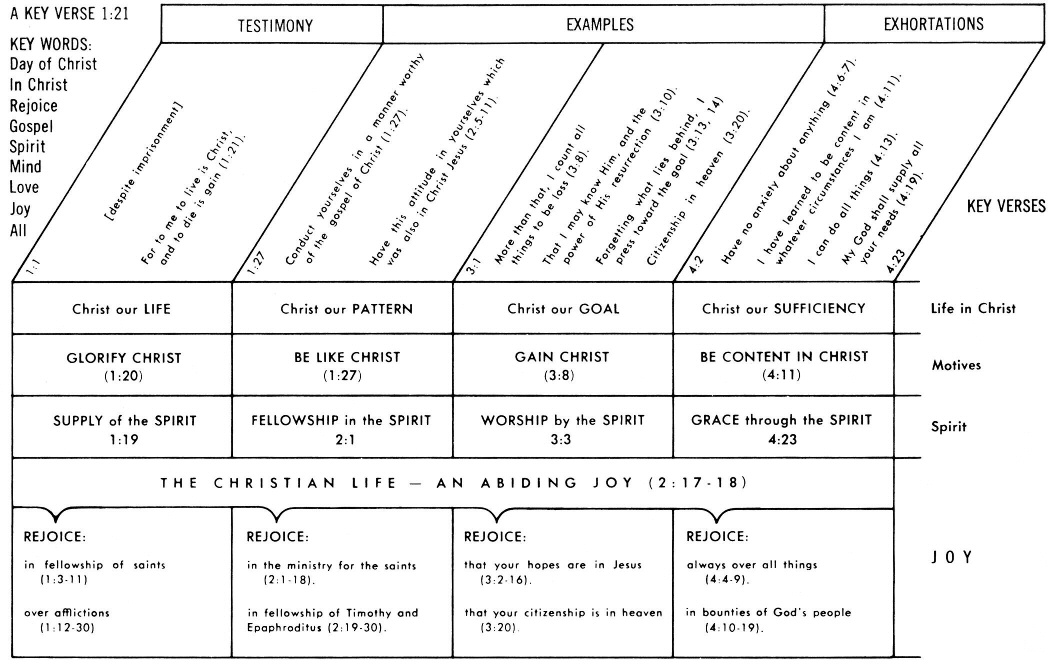
LIFE IN CHRIST
Click chart to enlarge
Charts from Jensen's Survey of the NT - used by permission
Philippians - Charles Swindoll = Chart on right side of page
| Account of Paul's Circumstances Php 1:1-30 |
Have the Mind of Christ Php 2:1-30 |
Have the Knowledge of Christ Php 3:1-21 |
Have |
| Partakers of Christ | People of Christ | Pursuit of Christ | Power of Christ |
| Suffering | Submission | Salvation | Sanctification |
| Experience | Examples | Exhortation | |
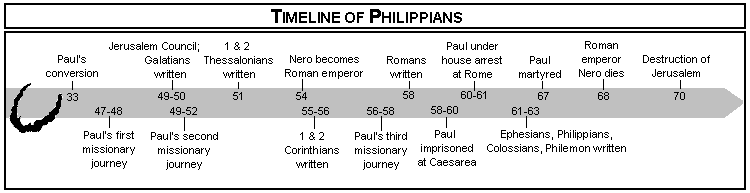

Philippi in the Time of Paul
The city plan above shows those features of the city of Philippi that archaeologists have so far identified as dating from the time of Paul. “Paul’s Prison” is not believed to be an authentic site, but was a cistern later associated with Christian worship. (ESV.org)
Philippians 1:6. For I am confident of this very thing, that He who began a good work in you will perfect it until the day of Christ Jesus. (NASB: Lockman)
Greek: pepoithos (RAPMSN) auto touto, hoti o enarchamenos (AMPMSN) en humin ergon agathon epitelesei (3SFAI) achri hemeras Christou Iesou:
Amplified: And I am convinced and sure of this very thing, that He Who began a good work in you will continue until the day of Jesus Christ [right up to the time of His return], developing [that good work] and perfecting and bringing it to full completion in you. (Amplified Bible - Lockman)
KJV: Being confident of this very thing, that he which hath begun a good work in you will perform it until the day of Jesus Christ:
NLT: And I am sure that God, who began the good work within you, will continue his work until it is finally finished on that day when Christ Jesus comes back again. (NLT - Tyndale House)
Phillips: I feel sure that the one who has begun his good work in you will go on developing it until the day of Jesus Christ. (Phillips: Touchstone)
Wuest: Having come to this settled and firm persuasion concerning this very thing, that He who began in you a work which is good, will bring it to a successful conclusion right up to the day of Christ Jesus; (Eerdmans Publishing - used by permission)
Young's Literal: having been confident of this very thing, that He who did begin in you a good work, will perform it till a day of Jesus Christ,
FOR I AM CONFIDENT OF THIS VERY THING: pepoithôs (RAPMSN) auto touto:
- 2 Co 1:15; 2:3; 7:16; 9:4; Gal 5:10; 2Th 3:4; Phile 1:21; Heb 10:35
CEV God is the one who began this good work in you, and I am certain that he won't stop before it is complete on the day that Christ Jesus returns
NET For I am sure of this very thing, that the one who began a good work in you will perfect it until the day of Christ Jesus.
NET Note - Greek “since I am sure of this very thing.” The verse begins with an adverbial participle that is dependent on the main verb in Phil 1:3 (“I thank”). Paul here gives one reason for his thankfulness.
CONFIDENT IN THEIR
CONSUMMATION
For I am confident (3982) (peitho) means to have come to a settled persuasion concerning some truth or fact and so to be persuaded, convinced. Peitho suggests that a conclusion has been reached on reasonable ground. The apostle’s observation of what God had done among the Philippians in particular, and his reflections on the ways of God in general, led him to form this judgment. Paul was entirely convinced of the truth of what he said and he thus uses the language of a man who had no doubt on the subject.
The perfect tense indicates that Paul had come to the settled persuasion and that he remained confident of God’s desire and ability to continue His transforming work in the lives of the Philippian believers. Paul is still firmly confident and will continue to be so. He has no doubts about their salvation or their security. Paul is saying
I have been persuaded by words to believe that God will bring to completion the good work He began when you were born again.
Note that Paul's confidence did not rest ultimately on the Philippians themselves, but on God, Who would preserve them and enable them to reach the goal.
Matthew Henry adds that "The confidence of Christians is the great comfort of Christians."
John Piper: "Yes, Paul was filled with thanks and joy because the Philippians were partners with him in the gospel. (Phil 1:3-5) But there was a deeper foundation for his joy than these outward-yet precious-displays of concern for the gospel and for him. This practical partnership in the gospel was the symptom of something greater--it pointed to a deeper reality, it was the result of and evidence that something mysterious and wonderful was taking place. Their partnership in Phil 1:5 gave rise to Paul's 'I am sure that he who began a good work in you will bring it to completion at the day of Jesus Christ.' Phil. 1:6 is one of the greatest and most often quoted promises in the Bible. And well it should be. The fact that God is at work in his people, changing the thought patterns and preference of our sinful nature, so that we love what He loves, retooling the grooves in our brain, knitting together the complex strands of our emotional wounds with infinitely greater skill than the world's foremost micro-surgeon--there's no greater promise than this. It is nothing other than the New Covenant promise of Ezekiel 36:26-27. 'I will give you a new heart and put a new spirit within you, I will remove the heart of stone from your flesh and give you a heart of flesh. And I will put my Spirit within you and cause you to walk in my statutes.'"
Beloved of God, this great promise should make all of us remember that we are, as Augustus M. Toplady put it, A Debtor to Mercy - listen to the words of his great hymn, especially the second stanza...
The work which Your goodness began
The arm of Your strength will complete
Your promise is yes and amen
And never was forfeited yet
The future or things that are now
No power below or above
Can make You Your purpose forego
Or sever my soul from Your love
THAT HE WHO BEGAN A GOOD WORK IN YOU: hoti o enarchamenos (AMPMSN) en humin ergon agathon:
- Phil 1:29; 2:13; Jn 6:29; Acts 11:18; 16:14; Ro 8:28, 29, 30; Eph 2:4, 2:5, 2:6, 2:7, 2:8, 2:9, 2:10; Col 2:12; 1Th 1:3; 2Th 2:13, 2:14; Titus 3:4, 3:5, 3:6; Heb 13:20, 21; Jas 1:16, 17, 18; 1Pe 1:2, 1:3
- Phil 2:13 Ro 8:31
Dear brother in Christ, dear sister in Christ, whether you find yourself "up" or "down" (spiritually/emotionally) as you read these notes, take just a moment and ponder the certainty of the work of Spirit of Christ in you, so faithful and so complete that on that glorious day "we shall be like Him, because we shall see Him just as He is" (1Jn 3:2) … so sit back, watch and listen to one of my favorite choruses…
He Who Began a Good Work in You - by Steve Green
That (hoti) - Explains the source of Paul's confidence.
As an aside, God always finishes what He begins as we see in this Old Testament example from first Samuel "(God declared) In that day I will carry out against Eli all that I have spoken concerning his house, from beginning to end. (1Sa 3:12) God had told Eli that he and his sons had forfeited their right to the priest's office in 1 Sa 2:30-33. Hophni, Phinehas and Eli all died the same day (1 Sa 4:11,18). Later, Saul slew Ahimelech, grandson of Phinehas, who had continued to serve as priest (1 Sa 22:16, 17, 18, 19, 20), but his son Abiathar escaped and served as priest under David. Abiathar was in turn deposed by Solomon (1 Ki 2:26, 27), finally completing the prophecy. God always finishes what He begins!
Began (1728) (enarchomai from en = in + árchomai = begin) means make a beginning or commence. It was the normal Greek word for beginning a sacrifice and described scattering the grains of barley on and around the victim which was the first act of a sacrifice.
Enarchomai is used elsewhere only n Galatians 3:3 Paul asking the Galatian saints "Are you so foolish? Having begun by the Spirit, are you now being perfected by the flesh?" The point in both uses is that God via His Spirit takes the initiative in starting His work in us and He is the only One who can bring it to completion (perfection when we are glorified). Salvation always begins with God and if He didn’t make the first move, we would make no move at all (cf Jn 1:13, Ro 3:11). It's like the country preacher who was asked at his ordination how he had become a Christian. He replied, "I did my part and God did His." When asked to explain "his part in salvation", he answered "My part was to run from God as fast as I could. God’s part was to run after me and catch me and bring me into his family." This is a great picture for every person for we are born as rebels running from God and thus all are in desperate need of God taking the initiative to begin His good work in all of us because we are dead in (our) trespasses and sins. (Ep 2:1) God not only initiates the good work of salvation, but continues it and guarantees its consummation. From Him, through Him and to Him be the glory!
In the next chapter, after exhorting the saints to do their part to "work out your salvation" (Phil 2:12), Paul discusses God's part and how He would bring His good work in them to completion explaining ("for") "it is God Who is at work in you, both to will and to work for His good pleasure." (Phil 2:13) The New Living Translation (NLT) is very helpful here paraphrasing it "God is working in you, giving you the desire and the power to do what pleases Him." Who is in us now? The Holy Spirit, our "Sanctifying Agent," Who is continually giving us the "want to" (the desire) and the power to carry out that desire in a way that pleases our Father Who art in Heaven. Are you daily yielding to the Holy Spirit in you, that you might experience to the full His energizing desire and power to live a supernatural life? If not, you are missing out on God's best. But if you are, you can still rest assured that God's Spirit is working in you and will complete His work in you!
Good (18)(agathos) means intrinsically good, inherently good in quality but with the idea of good which is also profitable, useful and beneficial. Thus agathos is good in character or constitution and beneficial in effect.
Barnes adds that "It was on the fact that it was begun by God, that he based his firm conviction that it would be permanent. Had it been the agency of man, he would have had no such conviction, for nothing that man does today can lay the foundation of a certain conviction that he will do the same thing tomorrow. If the perseverance of the Christian depended wholly on himself, therefore, there could be no sure evidence that he would ever reach heaven.
Good work almost certainly refers to God's work in salvation but a few commentators feel that it may relate to their active financial participation ("good work") in the furtherance of the gospel. For example Wuest feels that God who had begun in the Philippians the good work of giving to missions would maintain their fruitful activity until Christ returns. (Click for study of Good Deeds)
Note where the sphere of that good work? It is not among you but in you. Paul is referring not to an external reformation or a surface improvement but to a total rebirth by which a new creation is regenerated by God the Holy Spirit.
Hendriksen calls our attention to "how closely the apostle links human perseverance (“your fellowship in the gospel from the first day until the present”) with divine preservation (“he who began a good work in you will carry it on toward completion”). Any doctrine of salvation which does not do full justice to both of these elements is unscriptural… Although it is true that God brings his work to completion, it is equally true that when God has once begun his work in men, the latter by no means remain merely passive instruments! (Hendriksen, W., & Kistemaker, S. J. New Testament Commentary Set, 12 Volumes. Grand Rapids: Baker Book House)
As a lad, James M. Gray had a friend whose father was very wealthy. Having already made a fortune, the man sought to add to it by purchasing a large tract of real estate in upper Manhattan Island. At that time it was known as Harlem Flats. One day Gray's young companion said, "Let's go up and see the land Dad bought." Dr. Gray, recounting the incident years later, said, "I remember how I laughed when we got there. He couldn't show me a single spot of dry ground. The property was completely covered over with tidewater. I didn't see much of an investment in that for anybody. But, of course, his father did not acquire it for what it was worth then, but for its value in decades to come." Today that land has all been filled in and is heavily populated. It represents millions and millions of dollars to its present owners. What a picture of our redemption!" God sees our worth and value even when we don't. He looks ahead to the finished product. What the Lord starts in our lives, He will complete. (Rod Mattoon)
WILL PERFECT IT: epitelesei (3SFAI):
- Ps 138:8; Jn 6:29; Eph 4:12; 2 1Th 5:23, 24; 2Th 1:11; 1Pe 5:10
will carry it on to completion (NIV)
will go on completing it (NJB),
will continue his work until it is finally finished (NLT)
will carry it on until it is finished (TEV)
will carry it through to completion (GWT)
will go on to perfect it in preparation for the day of Jesus Christ (Weymouth),
will keep right on helping you grow in his grace until his task within you is finally finished (TLB)
developing [that good work] and perfecting and bringing it to full completion in you (Amp)
will keep it growing (Jewish NT)
A "PERFECT"
PROMISE!
Will perfect (2005) (epiteleo from epi = intensify meaning of following verb + teleo = make an end and bring something to its destined goal) (Click in depth word study of epiteleo) conveys the sense that God will carry the work out to the finish. God will not commence this and then abandon us. He will finish the work He has begun in us and will bring it to its intended goal, when we shall be like Him (1Jn 3:2). God will will fully finish and accomplish His good work in and through us as we surrender our will to His perfect will. Nothing in this life will prevent the successful accomplishment of God's good work in every Christian. T
The Greek historian Herodotus wrote that epiteleo was used of performing of religious services, referring to the act of fully completing the ritual of any sacrifice.
Barclay adds that "the words Paul uses for to begin (enarchomai) and for to complete (epiteleo) are technical terms for the beginning and the ending of a sacrifice. There was an initial ritual in connection with a Greek sacrifice. A torch was lit from the fire on the altar and then dipped into a bowl of water to cleanse it with its sacred flame; and with the purified water the victim and the people were sprinkled to make them holy and clean. Then followed what was known as the euphemia, the sacred silence, in which the worshipper was meant to make his prayers to his god. Finally a basket of barley was brought, and some grains of the barley were scattered on the victim, and on the ground round about it. These actions were the beginning of the sacrifice, and the technical term for making this beginning was the verb enarchesthai which Paul uses here. The verb used for completing the whole ritual of sacrifice was the verb epitelein which Paul uses here for to complete . Paul’s whole sentence moves in an atmosphere of sacrifice. Paul is seeing the life of every Christian as a sacrifice ready to be offered to Jesus Christ. It is the same picture as he draws when he urges the Romans to present their bodies as a living sacrifice, holy and acceptable to God (Ro 12:1) (Philippians 1 - William Barclay's Daily Study Bible)
Spurgeon said "The life of a Christian is a series of miracles."
Spurgeon was also once asked by another minister "whether he believed in the final perseverance of the saints. "Well," said he, "I do not know much about that, but I firmly believe in the final perseverance of God, that where he has begun a good work he will carry it on until it is complete." To my mind, that truth includes the final perseverance of the saints. They persevere in the way of salvation because God keeps them in it.
The greatest miracle is the transformation of a sinner into a saint by the grace of God in the process referred to as sanctification. In simple terms sanctification is the work of God's grace in the heart of a believers conforming them into "the image of His Son" (Ro 8:29), this work being a continual process of transformation "from glory to glory… from the Lord, the Spirit" (2Cor 3:18)
Sanctification is synonymous with "present tense salvation" which reflects the truth that every day we are "being saved" (cf 1Cor 1:18) from the tendency of the world to conform us into its mold, from our own flesh and from the devil. (Click study of the 3 tenses of salvation) Note that sanctification is the work of God, is a lifetime process, is never complete in this life, won’t cease until the job is done, and that God will use everything that happens to us—the good, the bad and the ugly—to make us like Jesus. We can be certain of this completion for Jesus speaking of His disciples (which includes us) said "for their sakes I sanctify Myself, that they themselves also may be sanctified in truth." (Jn 17:19)
F. B. Meyer gives an encouraging illustration - We go into the artist’s studio and find there unfinished pictures covering large canvases, and suggesting great designs, but which have been left, either because the genius was not competent to complete the work, or because paralysis laid the hand low in death; but as we go into God’s great workshop we find nothing that bears the mark of haste or insufficiency of power to finish, and we are sure that the work which His grace has begun, the arm of His strength will complete.
Chuck Swindoll - How do we live with worry and stress and fear? How do we withstand these joy stealers?… Let me be downright practical and tell you what I do. First I remind myself early in the morning and on several occasions during the day, 'God, You are at work, and You are in control. And, Lord God, You know this is happening. You were there at the beginning, and You will bring everything that occurs to a conclusion that results in Your greater glory in the end.' And then? Then (and only then!) I relax. From that point on, it really doesn't matter all that much what happens. It is in God's hands. (Laugh Again)
Here are some passages from the OT which teach a truth parallel to that taught in Philippians 1:6:
Ps 57:2 (David speaking) I will cry to God Most High (see El Elyon: Most High God - Sovereign Over All). To God who accomplishes all things for me.
Ps 138:8 (David speaking) Jehovah will accomplish what concerns me. Thy lovingkindness, O Jehovah is everlasting. Do not forsake the works of Thy hands.
If one takes Paul's statement here as referring to God's work in their salvation process (sanctification), then the verb will perfect undergirds the bedrock truth of the believer's eternal security. God worked a wonderful transformation in the Philippians when He first saved them out of paganism and idolatry. Paul voices no concern that the God Who began that work would desert them now. How comforting and reassuring to know that God is totally committed to the work He began in each of our lives. Every believer can now wear the following button…
PBPGIFWMY
It means "Please Be Patient. God Isn’t Finished With Me Yet." Oftentimes when we look in the mirror and deep into our own soul, we may not like what we see, but it's then that we need to recall this great truth that God isn’t finished with us yet. To be certain we are God's works in progress but our attitude should never be "Let go and let God". Paul presents the balancing truth charging each saint to
"work out your salvation with fear and trembling (Man's Responsibility), for it is God Who is at work in you, both to will and to work for His good pleasure (God's Sovereignty)." (see notes on Philippians 2:12-13)
The good news is that since God isn’t finished yet, we can have great hope. The bad news is that since God isn’t finished with us yet, He won’t allow us to stay the way we are. God will keep chipping away at us until we are conformed to the image of Jesus Christ. Some of us have a long way to go. So if you find yourself stuck in the "miry clay" of personal discouragement and defeat (Ps 40:2) be encouraged for God is not finished with you yet. If you’ve been sent to the bench for a personal foul, learn the lesson God has for you and then get back in the game.
God always finishes what He starts.
All who love Christ desire to be like Him in spiritual perfection and absolute holiness. We want to please Him in every respect. However, that noble pursuit is often met with frustration and discouragement as human frailties and sin block our pathway.
Paul’s cry in Romans 7 is ours as well: “That which I am doing, I do not understand; for I am not practicing what I would like to do, but I am doing the very thing I hate. … I find then the principle that evil is present in me, the one who wishes to do good. … Wretched man that I am! Who will set me free from the body of this death?” (vv. 15, 21, 24). His answer resonates with confidence and relief: “Thanks be to God through Jesus Christ our Lord!” (v. 25).
Paul was convinced that God always completes the good work of salvation He begins in every new believer—a work that progressively conforms us to the image of His Son (2 Cor. 3:18). That might seem like a painfully slow process at times, but be assured He will complete it. All whom He justifies will be glorified (Rom. 8:29–30).
In the meantime, you have an active role to play in the process. Paul called it “work[ing] out your salvation with fear and trembling” (Phil. 2:12). You must discipline yourself for holiness through prayer, Bible study, obedience, and accountability to other believers. All the resources you need are at your disposal as God Himself works in you to produce “His good pleasure” (Phil. 2:13).
Rejoice in knowing that you belong to God and that He is conforming you to the image of His Son. See every event of this day as part of that process. Yield to the Spirit’s prompting, and take heart that God will accomplish His will. (John MacArthur - Drawing Near)
Someday God will glorify and reward every believer.
For Christians there’s an element of truth to the bumper sticker that reads, “Please be patient, God isn’t finished with me yet.” We aren’t what we used to be, but there’s much to be done to make us all He wants us to be. Yet, God’s work within us is so sure and so powerful that Scripture guarantees its completion.
Pondering that guarantee led Bible expositor F. B. Meyer to write: “We go into the artist’s studio and find there unfinished pictures covering large canvas, and suggesting great designs, but which have been left, either because the genius was not competent to complete the work, or because paralysis laid the hand low in death; but as we go into God’s great workshop we find nothing that bears the mark of haste or insufficiency of power to finish, and we are sure that the work which His grace has begun, the arm of His strength will complete” (The Epistle to the Philippians [Grand Rapids, Mich.: Baker, 1952], p. 28).
The completion of God’s work in you will come at a future point in time that Paul calls “the day of Christ Jesus” (Phil. 1:6). Scripture also speaks of “the day of the Lord,” which is the time of God’s judgment on unbelievers. But “the day of Christ Jesus” refers to the time when believers will be fully glorified and then rewarded for their faithful service (cf. 1 Cor. 3:10–15). All your earthly cares will be gone, and God’s promise to keep you from stumbling and make you stand in His presence “blameless with great joy” (Jude 24) will be fully realized.
Concentrating on what is wrong in your life might depress you, but focusing on the glorious day of Christ should excite you. Don’t be unduly concerned about what you are right now. Look ahead to what you will become by God’s grace. (John MacArthur - Drawing Near)
The Navigator
Years ago, a dorm buddy helped me grow in Christian maturity with Bible studies published by the Navigators, an organization started in 1943 by Dawson Trotman. Since then, Navigator material has been of endless enrichment to me.
The Navigators was started by Dawson Trotman who, as a high school student, had been class valedictorian and student body president. But his personal life was plagued by drinking, gambling, and questionable friends. One night he was arrested drunk at an amusement park. “Son, do you like this kind of life?” asked the officer. “Sir,” Trotman replied, “I hate it.” Two days later he attended a local church that encouraged Scripture memory. While memorizing verses, Dawson found himself praying, “Oh God, whatever it means to receive Jesus, I want to do it right now.”
He was soon leading others to Christ, but doing little follow-through with his converts. One day he picked up a hitchhiker who swore a blue streak. Dawson recalled having picked up the same man a year before and having led him to Christ. Or so he thought.
Now there appeared no evidence of the man’s conversion.
Dawson was deeply troubled, for it seemed Philippians 1:6 didn’t work. Putting a cardboard under the verse, he actually started to cut the verse out of his Bible with a razor. But, hesitating, he decided to study the passage instead. As he did so, he realized he had been taking the verse out of context. He noticed Paul’s ongoing concern for his Philippian converts, how he prayed for them in Phil 1:3–4, how he held them in his heart in Phil 1:7, how he longed for them with the affection of Christ in Phil 1:8. With new insight, Dawson began focusing his efforts on follow-up and personal discipleship.
In 1933, he began teaching sailor Les Spencer the principles of Christian growth, spending hours with him in Bible study, memorization, and prayer. Soon Spencer was winning and teaching others on his ship until eventually 125 men of the U.S.S. West Virginia were growing in Christ and sharing their faith.
The Navigator ministry had begun. (From This Verse - Robert Morgan)
Swindoll - Telos is the root Greek term, the same root of the word translated perfect. Paul was saying, “He who began a good work in you when you were converted ten years ago, Philippians, will bring it to completion. It will be finished! Jesus will see to it. And that gives me joy.” You want a fresh burst of encouragement? You may have a good friend who is not walking as close to the Lord as he or she once was. Here is fresh hope. Rest in the confidence that God has neither lost interest nor lost control. The Lord has not folded His arms and looked the other way. That person you are concerned about may be your son or daughter. Find encouragement in this firm confidence: The One who began a good work in your boy or in your girl will bring it to completion; He will finish the task. I repeat, that firm confidence in God’s finishing what He started will bring back your joy. I have mentioned joy stealers several times already. Perhaps this is a good place for me to identify three of these most notorious thieves at work today. All three, by the way, can be resisted by firm confidence, the kind of confidence we’ve been thinking about. The first joy stealer is worry. The second is stress. And the third is fear. They may seem alike, but there is a distinct difference.
Worry is an inordinate anxiety about something that may or may not occur. It has been my observation that what is being worried about usually does not occur. But worry eats away at joy like slow-working acid while we are waiting for the outcome.
Stress is a little more acute than worry. Stress is intense strain over a situation we cannot change or control—something out of our control. (Occasionally the safest place for something to be is out of our control.) And instead of releasing it to God, we churn over it. It is in that restless churning stage that our stress is intensified. Usually the thing that plagues us is not as severe as we make it out to be.
Fear, on the other hand, is different from worry and stress. It is dreadful uneasiness over the presence of danger, evil, or pain. As with the other two, however, fear usually makes things appear worse than they really are.
How do we live with worry and stress and fear? How do we withstand these joy stealers? Go back to Paul’s words:
For I am confident of this very thing, that He who began a good work in you will perfect it until the day of Christ Jesus. Philippians 1:6
Let me be downright practical and tell you what I do. First I remind myself early in the morning and on several occasions during the day, “God, You are at work, and You are in control. And, Lord God, You know this is happening. You were there at the beginning, and You will bring everything that occurs to a conclusion that results in Your greater glory in the end.” And then? Then (and only then!) I relax. From that point on, it really doesn’t matter all that much what happens. It is in God’s hands.
KJV Bible Commentary has a well worded comment (See also study of the 3 tenses of salvation):
"The good work has its initiation in regeneration (past) [Past tense salvation]; has its continuation in sanctification (present) [present tense salvation]; and will have its consummation in glorification (future) [Future tense salvation]. In the past there was God’s unchangeable purpose; in the present there is God’s unlimited power; and in the future there is God’s unbreakable promise. This is God’s guarantee for the final preservation and perseverance of the saints. Salvation is all of God." (Dobson, E G, Charles Feinberg, E Hindson, Woodrow Kroll, H L. Wilmington: KJV Bible Commentary: Nelson)
UNTIL THE DAY OF CHRIST JESUS: achri hemeras Christou Iesou:
- Php 1:10; 2:16 1Co 1:8; 2Co 5:9 10; see note on "Day of the Lord" at 2Peter 3:10)
will continue until the day of Jesus Christ [right up to the time of His return] (Amp)
so that you may be ready for the day of Jesus Christ (Barclay)
OUR PERFECTING CONTINUES
UNTIL OUR CONSUMMATION
This reminds me of 1Jn 3:2 (note) where John writes "Beloved, now we are children of God, and it has not appeared as yet what we shall be. We know that, when He appears, we shall be like Him, because we shall see Him just as He is." So the perfecting process will continue in each of us until that glorious day! Hallelujah!
Day of Christ Jesus (Related Resource - see the chart Comparison of 3 Divine Days) refers to Christ's Second coming (as in Phil 1:10 - see note), to the time of His coming again to take His people home to heaven and probably also includes the Judgment Seat of Christ, when service for Him will be reviewed and rewarded. This coming day is referred to as the day of our Lord Jesus Christ (1Cor 1:8) This phrase is not to be confused with the Day of the Lord (Click). Paul never sets the time for the Lord’s return, but he is cheered by that "blessed hope" (Titus 2:13), the period of blessing most likely beginning with the rapture of the church.
C H Spurgeon (Beside Still Waters : Words of Comfort for the Soul) once said that…
Every Christian will in time have spiritual cares. Jesus Christ has begotten us again to a living hope (1Pe 1:3), but you fear your faith will die. You hope that you have some spark of spiritual joy, but dark and dreary nights lower over you and you fear that your lamp will die out in darkness. You have been victorious, but you tremble that one day you might fall by the hand of the enemy.
Listen to me. Cast all your care upon Him, for He cares for you (1Pe 5:7). I am confident of this very thing, that He who has begun a good work in you will complete it until the day of Jesus Christ (Phil 1:6). “He Himself has said, ‘I will never leave you nor forsake you’ ” (He 13:5). “The mountains shall depart and the hills be removed, but My kindness shall not depart from you, nor shall My covenant of peace be removed,’ says the Lord , who has mercy on you” (Isa 54:10). “When you pass through the waters, I will be with you; and through the rivers, they shall not overflow you. When you walk through the fire, you shall not be burned, nor shall the flame scorch you” (Isaiah 43:2).
“The Lord God is a sun and shield; the Lord will give grace and glory; no good thing will He withhold from those who walk uprightly” (Ps. 84:11). “I give them eternal life, and they shall never perish; neither shall anyone snatch them out of My hand. My Father who has given them to Me, is greater than all; and no one is able to snatch them out of My Father’s hand” (John 10:28, 29).
Why, I might keep you here all day repeating the precious promises of God! I close by saying:
What more can He say than to you He hath said,
You who unto Jesus for refuge hath fled?
(Play the hymn "How Firm a Foundation")
ILLUSTRATIONS
Miracle House - One woman writes, “My engineer husband is meticulous but mild-mannered. While our new house was being built, he would leave notes for the workmen, politely calling their attention to mistakes or oversights. Two weeks before we were to move in, the floors still were not finished; the bathrooms not tiled, nor were necessary fixtures installed. I was sure that the work would never be completed in time. However, on moving day, we found that the house was ready to receive us. Curious as to how this miracle had been accomplished, I went and checked where my husband always left his notes for the workmen. Posted prominently on the living room wall was my husband’s last note: “after September 15, all work will be supervised by 5 children.”” God doesn’t need any motivation. He’s planning on finishing the work He’s begun in you.
Once someone came on Michelangelo chipping away with his chisel at a huge shapeless piece of rock. He asked the sculptor what he was doing. “I am releasing the angel imprisoned in this marble,” he answered. The things that Jesus is doing in our lives aren’t something already hidden inside of us, He’s doing His own work, a new work in our lives. But He sees where we’re going. He has things in mind for what we are to be.
THE MAN WITH A PLAN PHILIPPIANS 1:6
He who has begun a good work in you will complete it until the day of Jesus Christ.
When a young teenage girl named Joni Eareckson Tada broke her neck in a diving accident, she thought it was the last step on her road to life. In reality, her mishap was actually the first step on a path of fruitfulness that she could not have imagined at the time. From her wheelchair, the quadriplegic Joni Eareckson Tada has touched millions of lives through her books, art, music, and advocacy for the disabled.
Joni’s story is more dramatic than anything most of us will ever experience. But the depth of her suffering serves all the more effectively to illustrate the point: The day we think life has come to an end is the day God’s plans and purposes are brought into even sharper focus. What we call “accidents” in life are nothing of the sort if we mean that accidents are random occurrences outside of everyone’s control—unpredictable events with no more meaning than a ricocheting steel ball in a pinball machine. The same God who has every hair on your head numbered has the days of your life numbered as well.
The child of God should rest in the knowledge that our Father in heaven has a plan—and He is never late. (David Jeremiah)
The Teacup - An American couple went to Europe, to England and they were celebrating their 25th wedding anniversary. Both the man and the wife were connoisseurs and fanciers of pottery, antiques and China. When they came to Sussex they went into a Little China shop. Their eyes singled out a beautiful little tea cup on the top shelf. The man said, “Can I see that, that’s the most beautiful tea cup I’ve ever seen. “And as he was holding the tea cup the tea cup begins to speak.
It said, “You don’t understand, I haven’t always been a tea cup. There was a time when I was red and that I was clay. My master took me and he rolled me and he patted me over and over and over. I yelled out “Let me alone “but he only smiled and said, “Not yet”. And then I was placed on a spinning wheel, suddenly I was spun around and around and around.” Stop it I’m getting dizzy,” I said. The master only nodded and said “Not yet” Then he put me in an oven, I’d never felt such heat. I wondered why he wanted to burn me and I yelled and I knocked on the door and I could see him through the opening and I could read his lips. As he nodded his head he said “not yet.” Finally the door did open “whew”, and he put me on a shelf and I began to cool. “That’s better” I said. And then suddenly he grabbed me and he brushed me and he began to paint me all over. I thought I would suffocate, I thought I would gag, the fumes were horrible. And he just smiled and said, “Not yet”. And then suddenly he put me back into an oven, not the first one but one twice as hot, and I knew that I was going to suffocate. And I begged and I screamed and I yelled, and all the time I could see him through the opening, smiling and nodding his head, “not yet, not yet. And then I knew that there was no hope, I knew that I wouldn’t make it. I was just ready to give up when the door opened and he took me out and he put me on a shelf .Then an hour later he came back and he handed me a mirror and he said “Look at yourself”. And I did. And I said, “That can’t be me, I’m beautiful!” “I want you to remember,” he then said, “I know that it hurt to be rolled and to be patted but if I would have left you, you would have dried out. And I know that it made you dizzy to spin you around and around on a spinning wheel but if I had stopped you would have crumbled. And I know that it hurt and it was hot and disagreeable in the oven but if I hadn’t put you there you would have cracked. And I know that the fumes were oh so bad when I brushed you and when I painted you all over, but you see, if I hadn’t done that you wouldn’t have hardened and there would have been no color in your life. And if I hadn’t put you in that second oven you wouldn’t have survived for very long. The hardness would not have held. But now you are a finished product. You are what I had in mind when I first began with you.”
Our Daily Bread:
Occasionally when I walk along the beach in Florida, I see the remains of partially built sand castles. Apparently the sculptors got distracted or bored and left their castles unfinished. There is something sad about these ruins. Like the unfinished painting, the half-built house, or the incomplete manuscript, they are a haunting reminder of our human tendency to leave things undone.
In his book Intercepted Letters, William Marshall wrote: "It is a great trial to one who is naturally fond of bringing a thing to completion, to see how many fragments—unfinished bits of life—are left over. He asks himself, `What do I have to show for my labor?' Our trust must be that God will take up what is incomplete and wrap around it His completeness. `He cannot fail."
What a difference between man and God! The Creator always finishes what He has started. All of His masterpieces, planned in eternity past and begun in time, will be brought to fulfillment in eternity future. That's when each believer will be completely conformed to His image.
As we struggle now to be more Christ-like, we can be confident that one day we will reach that goal. God is molding us into trophies of grace, fashioned like His Son. He leaves nothing undone. —P. R. V. (Our Daily Bread, Copyright RBC Ministries, Grand Rapids, MI. Reprinted by permission. All rights reserved)
The conversion of a soul is the miracle of a moment; the growth of a saint is the work of a lifetime.
Also from Our Daily Bread a devotional entitled "End Of Construction"
One day Billy and Ruth Graham were driving through a long stretch of road construction. They had numerous slowdowns, detours, and stops along the way. Finally they reached the end of all that difficulty, and smooth pavement stretched out before them. This sign caught Ruth's attention: "End of construction. Thanks for your patience." She commented that those words would be a fitting inscription on her tombstone someday. As a matter of fact, those words fit all of us as believers, because in this life we are "under construction." When we accept Jesus Christ as Savior and Lord, we begin the lifelong process of spiritual growth. The Holy Spirit works in us to remove our selfishness (Php 2:4), to renew our thinking (Ro 12:2), and to develop qualities in us that are more and more Christ-like (Col 3:5ff). Paul described this process as a work of God. He said, "He who has begun a good work in you will complete it until the day of Jesus Christ" (Philippians 1:6). As we travel heavenward, let's cooperate with God's construction of our lives. When His work in us is complete, "we shall be like Him" (1John 3:2), perfectly conformed to our Savior's likeness. —V C Grounds (Our Daily Bread, Copyright RBC Ministries, Grand Rapids, MI. Reprinted by permission. All rights reserved)
More about Jesus let me learn,
More of His holy will discern;
Spirit of God, my teacher be,
Showing the things of Christ to me. —Hewitt
God loves us too much to let us stay as we are.
You might say believers in this present life are always…

As Hitler was mounting his attack against England during World War II, Winston Churchill was asked to speak to a group of discouraged Londoners. He uttered an eight-word encouragement:
"Never give up! Never, never, never give up!"
There will be times when you'll be discouraged in your Christian walk, but you must never, never, never give up. If nothing else, your struggle against sin will cause you to turn to God again and again and cling to Him in your desperation.
What's required is dogged endurance, keeping at the task of obedience through the ebbs and flows, ups and downs, victories and losses in life. It is trying again, while knowing that God is working in you to accomplish His purposes (Phil. 1:6; Php 2:13). It is persistently pursuing God's will for your life till you stand before Him and your work is done. —D. H. Roper (Our Daily Bread, Copyright RBC Ministries, Grand Rapids, MI. Reprinted by permission. All rights reserved)
Perseverance can tip the scales from failure to success.
JOY STEALERS - Why do many Christians fail to experience real joy, which is listed as a fruit of the Holy Spirit in Galatians 5:22? In his book Laugh Again, Charles Swindoll suggests three common "joy stealers"—worry, stress, and fear. He defines worry as "an inordinate anxiety about something that may or may not occur." (And it usually doesn't.) Stress, says the author, is "intense strain over a situation we can't change or control." (But God can.) And fear, according to Swindoll, is a "dreadful uneasiness over danger, evil, or pain." (And it magnifies our problems.)
Swindoll says that to resist these "joy stealers" we must embrace the same confidence that Paul expressed in his letter to the Philippians. After giving thanks for the Philippian believers (Php 1:3, 4, 5), the apostle assured them "that He who has begun a good work in you will complete it until the day of Jesus Christ" (Phil 1:6).
Whatever causes you worry, stress, and fear cannot ultimately keep God from continuing His work in you. With this confidence we can begin each day knowing that He is in control. We can leave everything in His hands.
Resist those "joy stealers" by renewing your confidence in God each morning. Then relax and rejoice. —Joanie Yoder (Our Daily Bread, Copyright RBC Ministries, Grand Rapids, MI. Reprinted by permission. All rights reserved)
Although our joy will wane at times
From worry, stress, and fear,
God keeps on working in our heart
And tells us He is near. —D. De Haan
Happiness depends on happenings;
joy depends on Jesus.
Every workman takes pride in a project completed and well-done. I thought of this recently when I visited the site of a new house my friend was building. The foundation had been laid, the walls erected, and the wiring and plumbing installed, but the structure still wasn't a house. It needed the finishers. Without the woodworkers, the cabinetmakers, the carpet layers, and the painters, the building was incomplete.
We as Christians need a "finisher" too. The sanctifying work of the Holy Spirit in our lives, which began at conversion, must continue until the One who began the transformation finishes it. And that can happen only by trusting and obeying Jesus, "the author and finisher of our faith," the One to whom we are being conformed.
God is not the architect of incompleteness. The Bible says, "He who has begun a good work in you will complete it until the day of Jesus Christ" (Phil 1:6). Our part is to stay in fellowship with Him. He'll do the rest. —P R. V (Our Daily Bread, Copyright RBC Ministries, Grand Rapids, MI. Reprinted by permission. All rights reserved)
Keep in step with God.
He has planned every step of the way.
RAKU - Some friends gave us a piece of Raku pottery. "Each pot is hand-formed," the tag explained, "a process that allows the spirit of the artist to speak through the finished work with particular directness and intimacy."
Once the clay has been shaped by the potter it is fired in a kiln. Then, glowing red hot, it is thrust into a smoldering sawdust pile where it remains until finished. The result is a unique product—"one of a kind," the tag on our piece insists.
So it is with us. We bear the imprint of the Potter's hand. He too has spoken through His work "with particular directness and intimacy." Each of us is formed in a unique way for a unique work: "We are His workmanship, created in Christ Jesus for good works, which God prepared beforehand that we should walk in them" (see sermon Ephesians 2:10).
But though we are created for good works, we're not yet finished. We must experience the kiln of affliction. Aching hearts, weary spirits, aging bodies are the processes God uses to finish the work He has begun.
Don't fear the furnace that surrounds you. Be "patient in tribulation" and await the finished product. "Let patience have its perfect work, that you may be perfect and complete, lacking nothing" (James 1:4).—David H. Roper (Our Daily Bread, Copyright RBC Ministries, Grand Rapids, MI. Reprinted by permission. All rights reserved)
We are here to be perfected,
Only God our needs can see;
Rarest gems bear hardest grinding,
God's own workmanship are we. —Anon.
A WORK OF GRACE
Phil. 1:6.
THERE is a just mixture of hope and fear, which every Christian should cherish in contemplating his own experience, and the state of the Church of Christ. On the one hand there certainly is ground for fear, whether we judge from analogy, or from what we behold with our eyes. What multitudes of blossoms are annually cut off by frost! of those that set, how many are blighted by an eastern wind! of those that grow, how many are blown off by storms and tempests! and of those that hang upon the tree, how many, when gathered, prove rotten at the core! Thus it is seen in the religious world; many make a fair show for a little while, and then fall off from their profession: others are blighted, and come to naught: others look well for a season, but are beaten down by storms of persecution and temptation: and of those who maintain their profession to the end, how many will at last be found unsound at heart! But, if this cast a damp upon our joys, and teach us to moderate our expectations, it need not, it ought not, to rob us of all our confidence: for though sound fruit may be blown off from a tree, no sound Christian shall ever be separated from the Lord Jesus. Of this the Apostle was fully persuaded: and, under this conviction, he thanked God for the converts at Philippi, whose sincerity he had no reason to doubt, and of whose perseverance in the divine life he therefore entertained the most sanguine hopes.
To make a just improvement of his declaration before us, we shall shew,
I. When a good work may be said to be begun in us—
It is not an easy matter to draw the line between those high attainments of religion of which we may fall short, and yet be confident that a good work is begun: and those low attainments, which will warrant us to hope well, at the same time that they are by no means a sufficient ground of confidence. But, taking St. Paul for our guide, we trust, that we shall so discriminate, as neither to make sad the heart of the righteous, nor to countenance the delusions of the wicked. Those evidences, from whence he “knew the election” (and, of consequence, the perseverance also) of the saints at Thessalonica, will serve as a sure criterion whereby to judge of our own state. We may be assured then that a good work is begun in us, when faith, hope, and love, shew themselves to have been formed in our hearts; that is,
1. When our faith is operative—
[That faith, which is without works, is dead; and is of no more value that the faith of devils: but the faith which stimulates us to resist and mortify all sin, and to be conscientious in the practice of all duties, is, beyond a doubt, the gift of God, the workmanship of an almighty Agent.]
2. When our love is laborious—
[Our “love is not to be in word or in tongue, but in deed and in truth:” nor must it have respect to men’s bodies merely, but to their souls; leading us to consult their spiritual welfare to the utmost of our power, at the same time that we gladly deny ourselves to relieve their spiritual wants. The voice of inspiration assures us that he who exercises such love is born of God.]
3. When our hope is patient—
[The Christian’s hope will have much to try it; but it is to be the anchor of his soul, that shall keep him steadfast in this tempestuous world. He will often experience “fightings without, and fears within:” but beyond and “against hope, he must believe in hope,” saying, “I know in whom I have believed, and that he is able to keep that which I have committed to him against that day.” And every one who has such a lively hope, may be sure that he has been begotten to it by God himself.]
To enter fully into the Apostle’s assertion, we must shew,
II. On what grounds we may be confident that he who has begun this good work will finish it—
If this work were wrought by man, the Apostle would never express such confidence respecting his completion of it; since no dependence can be placed on the stability of man’s virtue. But since he that accomplishes this great work is God, we may be assured, that “he will perform it till the day of Jesus Christ.”
We may be assured of it—
I. From the declarations of his word—
[Numberless are his declarations to this effect, that having once been the “author of a good work within us, he will be the finisher of it.” “He will not forsake his people, because it hath pleased him to make them his people.” He has promised in the strongest possible manner, that “he will never never leave them, never never forsake them.” True, they have many enemies: but “he will suffer none of them to pluck them out of his hands.” Have they manifold temptations? They shall “have none without a way to escape, that they may be able to bear them.” Not even their unbelief shall prevent Jehovah from executing his gracious purposes towards them. As for “Satan, he shall be bruised under their feet shortly.” Through weakness they may occasionally fall: “yet shall they not be utterly cast down.” “God will restore their souls:” and make their very falls the means of augmenting their future caution and stability. The sun may occasionally be covered with a cloud; yet shall it advance to its meridian height: and such shall be the path of all the servants of God: “they shall hold on their way, and their hands shall wax stronger and stronger.” This is the portion of them all without exception, for “it is not the will of our Father that one of his little ones should perish.”]
2. From the perfections of his nature—
[In speaking on this subject, we would proceed with great caution; for we know not what will consist with his perfections: and, if we should presume to speak dogmatically respecting them, we should only betray our own weakness and folly. Yet methinks his wisdom affords us some ground of confidence: for, if he has created us anew, in order that we may shew forth the power of his grace, will he suffer his enemies so to counteract his purposes as to make us only occasions of greater dishonour to him? If only a man should begin to construct a house and leave it unfinished, he would only expose himself thereby to a greater measure of derision: how then would Satan cast reflections on the Deity, if he should fail in accomplishing so great a work as man’s salvation!
In like manner the goodness of God is some ground of hope and confidence. For God has surely never accomplished in us so good a work in order to leave us ultimately to perish under a more aggravated condemnation.
But in speaking of such things which infinitely exceed our comprehension, I can lay no stress on the conjectures of man; nor can I give weight to any thing that does not proceed clearly and immediately from God himself. But in speaking of the truth of God, I feel that I stand on firm ground. God has entered into covenant with us; and has confirmed that covenant with an oath: and has expressly declared that he did so confirm it, that by two immutable things, in which it was impossible for God to lie, we might have strong consolation who “have fled for refuge to lay hold on the hope set before us.” He is as unchangeable in his word as he is in his nature; and “because he changeth not, therefore we are not consumed.” We, alas! are variable in the extreme; but “with him is no variableness neither shadow of turning.” Now if we look into his covenant we shall see that he gives all, and we receive all: and that he engages, not only “not to depart from us, but to put his fear in our hearts that we may not depart from him,” We may be sure therefore that he will not cast off his people, because it hath pleased him to make them his people. If indeed he had chosen any of us because we were holy, or because he foresaw that we should be holy, he might abandon us as not answering his expectations. But he chose us that we might be holy, and predestinated us to be conformed to the image of his Son: and therefore what he has undertaken we may be sure he will perform. It is on this ground alone that we can account for St. Paul’s confidence, in which every one in whom God has begun a good work is fully authorized to join.]
I beg leave now to add a word,
1. Of inquiry respecting the commencement of this work—
[I am fully aware that persons so blinded by self-love as we, are greatly in danger of forming too favourable a judgment of our state: and I must warn all of you that God will not be put off with such a feigned repentance as Ahab’s, or such a partial reformation as Herod’s, or such a hypocritical attachment as that of Judas. Examine then, I pray you, with all imaginable care, respecting the quality of your faith, and hope, and love. Is your faith operative in purifying your heart? Is your love laborious in all kind offices, not to the bodies of men only, but to their souls? And is your hope such as carries you forward through all difficulties towards the attainment of the heavenly prize? Remember, it is no outward work that is here spoken of, but a work in us: and a work which nothing less than Omnipotence can effect. To deceive yourselves in relation to it, is vain, since you cannot deceive the heart-searching God. Be careful then to try your work, of what kind it is; and be satisfied with nothing that does not evidently bear the divine stamp and character upon it.]
2. Of admonition in reference to its continuance—
[There is nothing at which I tremble more than at a hard, bold, presumptuous confidence respecting the application of this doctrine to a man’s own state, whilst in his spirit and temper and conduct he shews himself to be far from the mind of Christ. In fact, wherever such a confidence exists, there is great reason to doubt whether a good work has ever been begun in the soul. Confidence, if truly spiritual, will be attended with humility, watchfulness, gratitude, and zeal. Look to it then, that you manifest on all occasions a deep sense of your utter unworthiness; a fear lest in any thing you grieve the good Spirit of your God; an admiring and adoring sense of God’s mercy to your soul; and a determination of heart to live only to your God. This is the true way in which the good work is to go forward in the soul: and, in so walking, you will best justify your confidence to the world, and will give the best proof of the doctrine of perseverance by actually persevering: moreover, in this way you will not only enjoy the most exalted peace on earth, but will have an abundant entrance ministered unto you in due season into the kingdom of our Lord and Saviour Jesus Christ.]
Philippians 1:7 For it is only right for me to feel this way about you all, because I have you in my heart, since both in my imprisonment and in the defense and confirmation of the gospel, you all are partakers of grace with me. (NASB: Lockman)
Greek: kathos estin (3SPAI) dikaion emoi touto phronein (PAN) huper panton humon dia to echein (PAN) me en te kardia| humas en te tois desmois mou kai en te apologia kai bebaiosei tou euaggeliou sugkoinonous mou tes charitos pantas humas ontas. (PAPMPA)
Amplified: It is right and appropriate for me to have this confidence and feel this way about you all, because you have me in your heart and I hold you in my heart as partakers and sharers, one and all with me, of grace (God’s unmerited favor and spiritual blessing). [This is true] both when I am shut up in prison and when I am out in the defense and confirmation of the good news (the Gospel). (Amplified Bible - Lockman)
BBE: So it is right for me to take thought for you all in this way, because I have you in my heart; for in my chains, and in my arguments before the judges in support of the good news, making clear that it is true, you all have your part with me in grace.
KJV: Even as it is meet for me to think this of you all, because I have you in my heart; inasmuch as both in my bonds, and in the defence and confirmation of the gospel, ye all are partakers of my grace.
NLT: It is right that I should feel as I do about all of you, for you have a very special place in my heart. We have shared together the blessings of God, both when I was in prison and when I was out, defending the truth and telling others the Good News. (NLT - Tyndale House)
Phillips: It is only natural that I should feel like this about you all - you are very dear to me. For during the time I was in prison as well as when I was out defending and demonstrating the power of the Gospel we shared together the grace of God. (Phillips: Touchstone)
Weymouth: And I am justified in having this confidence about you all, because, both during my imprisonment and when I stand up in defence of the Good News or to confirm its truth, I have you in my heart, sharers as you all are in the same grace as myself.
Wuest: Even as it is right for me to be constantly turning my mind in the direction of this very thing in your behalf (namely, the completion of God’s good work in you), because you are holding me in your heart both in my bonds and in my defense and confirmation of the gospel, you all being co-sharers with me in this grace. (Eerdmans Publishing - used by permission)
Young's Literal: According as it is righteous for me to think this in behalf of you all, because of my having you in the heart, both in my bonds, and in the defense and confirmation of the good news, all of you being fellow-partakers with me of grace.
FOR IT IS ONLY RIGHT FOR ME TO FEEL THIS WAY ABOUT YOU ALL: kathos estin (3SPAI) dikaion emoi touto phronein (PAN) huper panton humon:
- 1Co 13:7; 1Th 1:2, 3, 4, 5; 5:5; Heb 6:9, 10 2Co 3:2; 7:3
So it is right for me to take thought for you all in this way (BBE)
So it is only natural for me to feel the way I do (CEV)
So it's right for me to think this way about all of you (GWT)
And I am justified in having this confidence about you all (Weymouth)
And I know that I am right to think like this about all of you. (ICB)
How natural it is that I should feel as I do about you (TLB)
It is right and appropriate for me to have this confidence and feel this way about you all (Amp)
Paul feels justified in being thankful for the Philippians. He stood to them in the relation of father to children, in the gospel; how could he, then, do other than rejoice in the evidence they gave, after all these years, that they were indeed “partakers of grace”?
For it is only right for me to feel this way about you all - This begs the question "To feel what way?" What has Paul just expressed in Phil 1:6? Confidence, right? The Amplified Versions brings this out " It is right and appropriate for me to have this confidence and feel this way about you all."
Feel (5426) (phroneo) means to think, have a mindset, be minded. In this opening section of the letter it means to be thankful (Php 1:3), joyful (Php 1:4), confident (Php 1:6). The activity represented by this word involves the will, affections, and conscience.
Phroneo is a key word in Philippians occurring 10 times out of 26 NT uses -
Matt 16:23; Mark 8:33; Acts 28:22; Ro 8:5; 11:20; 12:3 (twice), Ro 12:6 (twice); Ro 14:6 (twice); Ro 15:5; 1 Cor 13:11; Gal 5:10; Phil 1:7; 2:2 (twice), Php 2:5; 3:15 (twice), 19; 4:2, 10 (twice); Col 3:2
Phroneo is present tense which pictures Paul continually having his mind directed in a practical way toward the good interest of Philippians. Paul’s mind, turned in the direction of the Philippians, would turn to specific prayer in their behalf in (Phil 1:9, 10, 11)
Note use of "all" again -- a reminder that the apostle made no distinctions among them. He was equally confident that the good work of God was going on in them all.
BECAUSE I HAVE YOU IN MY HEART: dia to echein (PAN) me en tei kardiai humas:
- Gal 5:6; 1Jn 3:14
because of the holding me (or you) in the heart as to you (or me) (Literal)
You have a special place in my heart (CEV)
You are always in my heart! (TEV)
because you have me in your heart and I hold you in my heart (Amp)
PAUL'S TENDER
CONCERN
Because - see importance of pausing to ponder terms of explanation. What is Paul explaining (check the context)?
Have (2192) (echo) means to have or hold and so to possess. The present tense indicates that they are continually in his heart. What an encouragement this would have been to those saints. Have told anyone recently that they were either "in" or "on" your heart? We are called to encourage one another daily as long as it is still called today lest anyone be hardened by the deceitfulness of sin.
- Related Discussion: The Deceitfulness of Sin
Heart (2588) (kardia) does not refer to the physical organ but is always used figuratively in Scripture to refer to the seat and center of human life, the wellspring of man’s spiritual life. The heart is the center of the personality, and it controls the intellect, emotions, and will.
The expression because I have you in my heart could just as properly be, “because you have me in your heart.” The second way of rendering the Greek is more in accord with the context. The Philippians had a large place in their hearts for Paul, and at this time especially with reference to the two particulars mentioned here, first, with reference to his defense of the gospel, and second, in his confirmation of the same. The pastor who, like Paul, holds his people in his heart will find them holding him in their hearts.
ILLUSTRATION - After the battle of Gettysburg, a soldier was found dead upon the field, holding in his hand the picture of three small children. No clue to his name could be found. In the terrors of battle he had comforted himself with this picture. It was published, and by this means the children were found in a village of Western New York. Even so do faithful ministers carry the souls of their converts with them wherever they go.
G G Ballard - As Bengel says, "Christ, not Paul, lived in Paul; wherefore Paul is moved not in the heart of Paul, but in the heart of Jesus Christ." Springing from such a depth, Paul's love could not but rise to vast proportions. The heart of Jesus, infinitely tender, thrown open to men, was the home of the captive apostle — the well spring of sacrificing love; where man is brought nearest to God.
Charles Swindoll writes - An old Marine Corps buddy of mine, to my pleasant surprise, came to know Christ after he was discharged. I say surprise because he cursed loudly, fought hard, chased women, drank heavily, loved war and weapons, and hated chapel services.
A number of months ago, I ran into this fellow, and after we'd talked awhile, he put his hand on my shoulder and said, "You know, Chuck, the only thing I still miss is that old fellowship I used to have with all the guys down at the tavern. I remember how we used to sit around and let our hair down. I can't find anything like that for Christians. I no longer have a place to admit my faults and talk about my battles--where somebody won't preach at me and frown and quote me a verse."
It wasn't one month later that in my reading I came across this profound paragraph: "The neighborhood bar is possibly the best counterfeit that there is to the fellowship Christ wants to give his church. It's an imitation, dispensing liquor instead of grace, escape rather than reality--but it is a permissive, accepting, and inclusive fellowship. It is unshockable. It is democratic. You can tell people secrets, and they usually don't tell others or even want to. The bar flourishes not because most people are alcoholics, but because God has put into the human heart the desire to know and be known, to love and be loved, and so many seek a counterfeit at the price of a few beers. With all my heart," this writer concludes, "I believe that Christ wants his church to be unshockable, a fellowship where people can come in and say, 'I'm sunk, I'm beat, I've had it.' Alcoholics Anonymous has this quality--our churches too often miss it."
Now before you take up arms to shoot some wag that would compare your church to the corner bar, stop and ask yourself some tough questions, like I had to do. Make a list of some possible embarrassing situations people may not know how to handle.
A woman discovers her husband is a practicing homosexual. Where in the church can she find help where she's secure with her secret?
Your mate talks about separation or divorce. To whom do you tell it?
Your daughter is pregnant and she's run away--for the third time. She's no longer listening to you. Who do you tell that to?
You lost your job, and it was your fault. You blew it, so there's shame mixed with unemployment. Who do you tell that to?
Financially, you were unwise, and you're in deep trouble. Or a man's wife is an alcoholic. Or something as horrible as getting back the biopsy from the surgeon, and it reveals cancer, and the prognosis isn't good. Or you had an emotional breakdown. To whom do you tell it?
We're the only outfit I know that shoots its wounded. We can become the most severe, condemning, judgmental, guilt-giving people on the face of planet Earth, and we claim it's in the name of Jesus Christ. And all the while, we don't even know we're doing it. That's the pathetic part of it all. -- Charles Swindoll, Leadership, Vol. 4, no. 1.
SINCE BOTH IN MY IMPRISONMENT AND IN THE DEFENSE AND CONFIRMATION OF THE GOSPEL: en te tois desmois mou en tei apologiai kai bebaiosei tou euaggeliou:
- Acts 16:23, 24, 25; 20:23; Eph 3:1; 4:1; 6:20; Col 4:3,18; 2Ti 1:8; 2:9; Heb 10:33, 34
"for in my chains, and in my arguments before the judges in support of the good news, making clear that it is true (BBE)
as I defend the good news and tell about it here in jail (CEV)
both now that I am in prison and also while I was free to defend the gospel and establish it firmly (TEV)
whether I'm in prison or defending and confirming the truth of the Good News (GWT)
because, both during my imprisonment and when I stand up in defence of the Good News or to confirm its truth (Weymouth)
while I am in prison, while I am defending the Good News, and while I am proving the truth of the Good News (ICB)
both when I was in prison and when I was out, defending the truth and telling others the Good News (NLT)
both when I was in prison and when I was out, defending the truth and telling others about Christ (TLB)
[This is true] both when I am shut up in prison and when I am out in the defense and confirmation of the good news (the Gospel) (Amp)
Imprisonment (1199) (desmon from déo = to bind) refers to a bond or band and then to a chain or shackle (of a prisoner). Paul was chained to a Roman guard during his imprisonment he at which time wrote epistles to the Ephesians, Colossians, Philippians, Timothy, Titus and Philemon - the "prison epistles".
Defense (627) (apologia from apó = from + lógos = speech, English = apology but Greek does not convey our idea of apologizing) means to give a reasoned argument, an answer or speech in defense of oneself or in this case of the gospel.
Apologia - 8x in 8v - Acts 22:1; 25:16; 1 Cor 9:3; 2 Cor 7:11; Phil 1:7, 16; 2 Tim 4:16; 1 Pet 3:15
Webster says defend means to take action against a challenge, to maintain or support in the face of argument or hostile criticism, to keep secure from danger or against attack.
Apologia is a Greek judicial term referring to an attorney talking his client off from a charge, thus presenting a verbal defense. Paul was defending the Faith before the tribunal of the world, Nero’s throne. A successful defense would result in the gospel being confirmed, that is, made stable in the sense that its claims would be shown to be true.
Confirmation (951) (bebaiosis from bebaios = sure, fixed) refers literally to that on which one can walk solid. BDAG says bebaiosis is "process of establishing or confirming something."
Bebaiosis was a legal technical term for guaranteeing or furnishing security. It was used of a legally valid confirmation and hence referred to the action - confirmation, verification. Here it is the process of establishing the truth of the gospel or of supporting the truth of the gospel by evidence.
The only other NT use of bebaiosis in Hebrews 6:16 - "For men swear by one greater than themselves, and with them an oath given as confirmation is an end of every dispute."
Gospel (2098) (euaggelion from eú = good + aggéllo = proclaim, tell) (Click word study on euaggelion) originally referred to a reward for good news and later became the good news itself. The word euaggelion was in just as common use in the first century as our words good news today. “Have you any good news for me today?” would have been a common question. The writers of the New Testament adapted the term as God's message of the good (great) news of salvation for lost sinners.
YOU ALL ARE PARTAKERS OF GRACE WITH ME: sugkoinonous mou tes charitos pantas humas ontas. (PAPMPA):
- Phil 1:5; 1Co 9:23; Heb 3:1; 1Pe 4:13; 5:1
you all have your part with me in grace (BBE)
Together we share God's favor (GWT)
sharers as you all are in the same grace as myself (Weymouth)
All of you share in God's grace with me (ICB)
We have shared together the blessings of God (NLT)
We have shared together the blessings of God (TLB)
sharers, one and all with me, of grace (God’s unmerited favor and spiritual blessing) (Amp)
During his imprisonment, the Philippians sent Paul money and Epaphroditus’ services to support the apostle, thus sharing in God’s gracious blessing on his ministry (Php 2:30)
All (pas) - no exceptions. No second class saints for all who are in Christ. At the foot of the Cross the ground is level!
Partakers… with (4791) (sugkoinonos from sun = with, which speaks of intimacy - see word study on "sun" + koinonos = companion, partner - see study on related word koinonia) means co-participant or companion in an enterprise or matter of joint concern, in this case the salvation of the lost! What an eternal enterprise!
NLT paraphrases it "You share with me the special favor of God, both in my imprisonment and in defending and confirming the truth of the Good News."
Grace (charis [word study]) in context would refer to the undeserved strength from God to carry on the work of the Lord in the face of severe opposition. (Click word study on charis) Grace is God's supernatural power and provision to exert His holy influence upon souls, turning them to Christ, keeping them in Christ, strengthening them in Christ, growing them in Christ-likeness.
Philippians 1:8 For God is my witness, how I long for you all with the affection of Christ Jesus. (NASB: Lockman)
Greek: martus gar mou o theos, os epipotho (1SPAI) pantas humas en splagchnois Christou Iesou.
Amplified: For God is my witness how I long for and pursue you all with love, in the tender mercy of Christ Jesus [Himself]! (Amplified Bible - Lockman)
KJV: For God is my record, how greatly I long after you all in the bowels of Jesus Christ.
NLT: God knows how much I love you and long for you with the tender compassion of Christ Jesus. (NLT - Tyndale House)
Phillips: God knows how much I long, with the deepest Christian love and affection, for your companionship. (Phillips: Touchstone)
Wuest: I am thanking my God constantly for your joint-participation [with me] in the furtherance of the good news from the first day [when Lydia opened her home for the preaching of the Word] until this particular moment [as characterized by the gift which you have sent], (Eerdmans Publishing - used by permission)
Young's Literal: For God is my witness, how I long for you all in the bowels of Jesus Christ,
FOR GOD IS MY WITNESS: martus mou:
- Ro 1:9; 9:1; Gal 1:20; 1Th 2:5
Paul appeals to God as his witness (and once to his own conscience) in several letters...
Romans 1:9; For God, whom I serve in my spirit in the preaching of the gospel of His Son, is my witness as to how unceasingly I make mention of you,
Romans 9:1 I am telling the truth in Christ, I am not lying, my conscience bearing me witness in the Holy Spirit,
Galatians 1:20 (Now in what I am writing to you, I assure you before God that I am not lying.)
1 Thessalonians 2:5 For we never came with flattering speech, as you know, nor with a pretext for greed–God is witness–
For God is my witness - Here is the idea paraphrased "I can solemnly appeal to Him because He knows my heart."
Witness (3144) (martus/martys, our English martyr) is one who has information or knowledge of something and hence can bring to light or confirm something. In this case the "witness" is the omniscient God, the Lord of truth, the One Who cannot lie. Talk about calling a believable witness to the stand!
This declaration is in the form of a solemn oath (Mt 5:33, 34, 35-see note on Jesus' teaching regarding vows and oaths Matthew 5:33-35) of which we see similar examples in (Ro 1:9; 2 Cor 1:23; 1 Th 2:5, 10a). Paul is saying that he is calling God to the witness stand to vouch for the veracity of what follows, calling the One Who searches all men's hearts.
HOW I LONG FOR YOU ALL: os epipotho (1SPAI) pantas humas:
- Phil 2:26; 4:1; 2Co 13:9; Gal 4:19; Col 2:1; 1Th 2:8; 2Ti 1:4)
PAUL'S PASSION HAD
NO PARTIALITY OR PREJUDICE
How I long for you all with the affection of Christ Jesus
Long (yearn)(1971) (epipotheo from epi = intensifier + potheo = yearn) means to have a strong desire for something, to desire earnestly. It speaks of having a great affection. The idea of yearn in English is to have a desire for someone who is not there. It is the same word Peter uses commanding the saints "like newborn babies, long for (aorist imperative = a command - "Do this now!" "The need is urgent!") the pure milk of the word, so that by it you may grow in respect to salvation" (1 Peter 2:2-note).
Epipotheo is used in Phil 2:26 to describe Epaphroditus' longing for the saints at Philippi, in Ro 1:11 of Paul's longing to see the saints at Rome (saints he had never even met!), in 2Ti 1:4 of Paul's longing to see his young disciple Timothy and in 2Co 5:2 of Paul's longing to receive his glorified body! We also get a good sense of the emotion of epipotheo in the Greek translation of Psalm 42:1 where David writes
As the deer pants [In Septuagint = epipotheo in present tense = continually yearns] for the water brooks, so my soul pants (epipotheo again in present tense) for Thee, O God
Spurgeon on Ps 42:1 - As after a long drought the poor fainting hind longs for the streams, or rather as the hunted hart instinctively seeks after the river to lave its smoking flanks and to escape the dogs, even so my weary, persecuted soul pants after the Lord my God. Debarred from public worship, David was heartsick. Ease he did not seek, honor he did not covet, but the enjoyment of communion with God was an urgent need of his soul; he viewed it not merely as the sweetest of all luxuries, but as an absolute necessity, like water to a stag. Like the parched traveler in the wilderness, whose skin bottle is empty, and who finds the wells dry, he must drink or die—he must have his God or faint. His soul, his very self, his deepest life, was insatiable for a sense of the divine presence (O, TO HAVE SUCH AN UNQUENCHABLE THIRST FOR GOD - DO IT IN ALL WHO ARE READING THIS HOLY SPIRIT. AMEN). As the hart brays so his soul prays. Give him his God and he is as content as the poor deer which at length satisfies its thirst and is perfectly happy; but deny him his Lord, and his heart heaves, his bosom palpitates, his whole frame is convulsed, like one who gasps for breath, or pants with long running (ARE YOU BEGINNING TO GET A FEEL FOR WHAT PAUL WAS SAYING WHEN HE TOLD THE SAINTS AT PHILIPPI HE LONGED TO SEE THEM?). Dear reader, dost thou know what this is, by personally having felt the same? It is a sweet bitterness. The next best thing to living in the light of the Lord’s love is to be unhappy till we have it, and to pant hourly after it—hourly, did I say? Thirst is a perpetual appetite, and not to be forgotten, and even thus continual is the heart’s longing after God. When it is as natural for us to long for God as for an animal to thirst, it is well with our souls, however painful our feelings. We may learn from this verse that the eagerness of our desires may be pleaded with God, and the more so, because there are special promises for the importunate and fervent.
The preposition "epi" signifies direction and conveys the idea of straining after the object being longed for. What a miracle of divine grace for this heretofore proud Pharisee to have tender heart longing for these former pagan Greeks! But that is not all. He tells them that this longing is in the bowels of Jesus Christ. This same strong desire to see the saints was shared by Epaphroditus in Php 2:26.
You all does not prove that Paul was from the "deep South". As Matthew Henry notes this means "he longed after…not only those among them who were witty and wealthy, but even the meanest and poorest."
Matt Chandler - Now we see that when Paul writes to the Philippians, “I yearn for you all with the affection of Christ Jesus,” it’s because he was there. He’s talking about Lydia. He’s talking about this little slave girl. He’s talking about the jailer. When he says, “I thank God in all my remembrance of you,” these are the people he remembers....Paul knows this church. He has won the souls of this church. He baptized them. He was the conduit through which the power of the Holy Spirit poured out. This is why he’s yearning for them with the affection of Jesus Christ. (To Live is Christ, to Die is Gain).
WITH THE AFFECTION OF CHRIST JESUS: en splagchnois Christou Iesou:
- Phil 2:1; Isa 16:11; 63:15; Jer 31:20; Lk 1:78; 2Co 6:12; 7:15; Col 3:12; Philemon 1:12 1:20; 1Jn 3:17)
with the tenderheartednesses of Christ Jesus (Wuest),
in the bowels of Jesus Christ (KJV)
in the tender mercies of Christ Jesus (ASV)
care for you in the same way that Christ Jesus does (CEV)
from the very heart roote in Iesus Christ (Geneva)
in the loving mercies of Christ Jesus (BBE)
my deep feeling for you all comes from the heart of Christ Jesus himself (TEV)
with tender Christian affection (Weymouth)
I love all of you with the love of Christ Jesus (ICB)
PAUL'S HEART IS
CHRIST'S HEART
With (en) is literally in, in the sphere of, in the atmosphere of that glorious affection of Christ Jesus.
Bengel writes that "In Paul not Paul lives, but Jesus Christ."
Affection (4698) (splagchnon) literally refers to the bowels (one literal use of Judas' in Acts 1:18), but in the NT is used primarily figuratively to describe the inward parts indicating the heart as the seat of emotions and passions. That region was regarded as the seat of passions such as affection, sympathy, and compassion, even as the word heart is used figuratively today. The allusion is to the sympathy, tenderness, and love of the Redeemer. Splagchnon was the strongest and most tender expression the Greeks had to denote the ardor of one's attachment to another. In the first NT use splagchnon describes "the tender (splagchnon) mercy (eleos) of our God." (Lk 1:78).
Swindoll - In the first century it was believed that the intestines, the stomach, the liver, even the lungs, held the most tender parts of human emotions. That explains why this joyful man would use “bowels” in reference to “affection.” He says, in effect, “As I share with you my feelings, I open my whole inner being to you and tell you that the level of my affection is deep and tender.” Too many people live with the inaccurate impression that Paul was somewhat cold and uncaring. Not according to this statement; in fact, quite the contrary! When he was with those he loved, Paul went to the warmest depths in conversation and affection. (Laugh Again)
Splagchnon - 11x in 11v - NAS =affection (3), affections (1), heart (4), hearts (1), intestines(1), tender(1).-
Luke 1:78; Acts 1:18; 2 Cor 6:12; 7:15; Phil 1:8; 2:1; Col 3:12; Philemon 1:7, 12, 20; 1 John 3:17
Paul thus describes his longing, not as his individual emotion, but as Christ’s longing, as if the very heart of Christ dwelt in Paul.
The great apostle lived so close to the Lord Jesus, and he had so shared the sufferings of his Lord for righteousness’ sake, that his heart was very tender, and beat as one with the heart of Jesus. His affection was internal, in his heart, and was most tender and strong like the tender concern Christ had for them, and which Christ had stirred up in Paul.
Clarke adds that Paul is saying in essence "I love you with that same kind of tender concern with which Christ loved the world when he gave himself for it" As evidence of this feeling Paul adds in the next chapter "I am being poured out as a drink offering upon the sacrifice and service of your faith (Php 2:17)
Matthew Henry - O the bowels of compassion which are in Jesus Christ to poor souls! It was in compassion to them that he undertook their salvation, and put himself to so vast an expense to compass it. Now, in conformity to the example of Christ, Paul had a compassion for them, and longed after them all in the bowels of Jesus Christ. Shall not we pity and love those souls whom Christ had such a love and pity for?
Christ (5547) see Christos the Greek equivalent of the Messiah, Anointed One.
Jesus (2424) see Iesous Whose very Name means "Jehovah saves" speaking clearly of Jesus' primary mission in becoming a Man.
THE GROUNDS AND
PURPOSES OF PRAYER
Php 1:5-11
A Consciousness of Kinship. The ground of his intercession was threefold. First, it arose from his consciousness of their kinship. We find this in Phil. 1:5: "I make supplication with joy for your fellowship." The Greek word there is going shares--having in common: "I make supplication with joy because of your fellowship in furthering the Gospel." (See also Phil. 1:7.)
It was the consciousness that those for whom he prayed were so closely akin to him in their determination and aims, that quickened the wheels of his supplication. Had they not shown this fellowship by sending repeatedly to his necessity, as we learn from the close of this Epistle? The Philippian Church, though very poor, had sent again and again generous gifts to supply the Apostle's wants, and this proved that they and he were animated with the same determination.
But more than this, there was the wireless telegraphy which bore out to the storm-tossed ship of his life the prayer and sympathy of his converts. For us also there are kindred spirits in different parts of the world, who are able by their prayer to send vibrations of holy energy into our souls, and when we pray for such we are able to make supplication with joy.
Living with God. Secondly, the Apostle recognised that he was in the line of God's purpose. This always makes it easy to pray. "Being confident of this very thing, that He which began a good work in you will perfect it until the day of Jesus Christ." He mentions two days in these verses--"From the first day," and "the day of Jesus Christ,"--and he says that between those two days, God, who began the work on the first day, and who will perfect it on the last day, is maintaining and building it up step by step.
That first day of our Christian life was due to the interposition of the grace of God. "In the beginning God created." The longer we live, the more sure we are that the beginning of the good work within must be attributed to God. No pastor, no mother, no teacher began it, but in the depth of our heart, by His Holy Spirit, God laid the first foundation stone of the new life, and amid all our sins, failures, and backslidings, He has been building up the work He commenced, and He cannot leave it. At Baalbec we find the remains of unfinished temples which man has abandoned half complete; but nowhere in the universe do we find unfinished worlds, half-made suns left incomplete, though many in the making. We go into the artist's studio and find there unfinished pictures covering large canvases, and suggesting great designs, but which have been left, either because the genius was not competent to complete the work, or because paralysis laid the hand low in death; but as we go into God's great workshop we find nothing that bears the mark of haste or insufficiency of power to finish, and we are sure that the work which His grace has begun, the arm of His strength will complete. It is easy to pray for a soul when you know that God also is at work perfecting it.
Impelled by Affection. Thirdly, His tender affection towards them (Php 1:7, 8). He says: "I have you in my heart … and God is my witness, how I long after you all in the tender mercies of Christ Jesus." The Apostle had got so near the very heart of his Lord that he could hear its throb, detect its beat, nay, it seemed as though the tender mercies of Jesus to these Philippians were throbbing in his own heart.
Let us live like this. You have children in your schools that greatly trouble you, boys and girls whose restless and obstinate natures seem to resist every overture; men and women meet you daily in your home-life, whom you cannot love with the love of natural affection; but, let every one of us get back to the heart of Jesus Christ until it pours its contents into ours, until we begin to yearn over the lost with the compassions of Jesus. Before you pass round that unkind story, before you say you will never speak to that man again, before you treat another with distance and coldness, get back to the heart of Jesus Christ, until His tender compassions shall fill yours. Then you can make supplication with joy.
Subject Matter of the Prayer. He says in Phil. 1:9: "This I pray, that our love may abound yet more and more." The Greek word is--That your love shall pour over--as the bucket which stands under a streamlet issuing from a fissure in the rocks pours over on all sides; I pray, he says, that your love may pour over towards each other, and specially toward God. Oh, that we might know this and be perfected in love, that there might be room for nothing more, that this might affect our whole being; for, depend upon it, when the love of God really fills the heart, the accent of the voice, the movements of our body, the look on the face, the demeanour, everything is affected. Too often we show the worried expression, the querulous tone, the over-strained nervous system, but through all this the love ought to pour, carrying away the discontented gloomy look, so that when we return to our dear ones at the close of the day, the entire household may feel that because we have come, sunlight and the love of God are flooding the house, which during the day had missed the music of our presence. Let "your love abound yet more and more." "In all knowledge." When this love enters a man's heart he knows. "Everyone that loveth is born of God, and knoweth God." Words infinitely deep, but corroborated here, because our Apostle prays that their love may abound more and more in all knowledge and discernment. When the fishers had tossed all night and taken nothing, and the grey dawn was breaking on the beach, it was the eye of him that loved which discerned the figure of the Master standing beside the fire of coals, and John said to Peter, "It is the Lord." If your love abounds more and more, you will not only know, but you will discern, you will be able to detect the traces of the footsteps of your Lord where other men fail to detect them, and hear His voice amid the jangling mart and the hubbub of the city.
RESULTS: DISCRIMINATION.
The effect of what love will be threefold.
(1) Discrimination. "That you may discriminate between things that differ" (Phil. 1:10, marg. R.V.). Such, without doubt, is the true rendering of the Greek, and we are reminded of Isaiah's words, which predict that the Spirit of the Lord shall rest upon the Messiah, and make Him 'of quick understanding.' The margin gives it quick of scent. When one has been on the ocean for a week, breathing the pure ozone, it is marvellous how quick one is to detect poisonous smells. This is well, and if we were quicker of scent, and detected the noisome effluvia which indicate corruption and disease, we should more certainly be saved from taking the poison into our systems. A man who has lost the sense of smell may go into the midst of disease without knowing it, but the man who is quick of scent is warned of danger. And the soul that loves deeply is marvellously quick to detect anything which may hurt or offend the loved one. It is so with the nature that loves God. It discerns, it discriminates, and amid the darkness or the grey dawn of our life, when things are so mixed, that they appear like one another, though really different, the love that loves God perfectly, discerns and distinguishes between things that differ. A man's growth in grace is indicated by the delicacy of the discrimination that rules in his life. As he gets nearer God he detects in himself habits, and practices, ways of behaviour, and of business, which he once permitted without seeing evil in them, but now puts aside as unfit, to follow only the good. This is the first effect of perfected love.
RESULTS: SINCERITY.
(2) Sincerity. "That you may be sincere and without offence" (Phil. 1:10). Just as the X-rays passing through the limb will show at once the fracture, or the result of some accident, so the X-rays of God's truth are always searching the heart, and when a man is living in perfect love, he also lives in perfect truth, for love and truth are one; and the man who lives in love does not mind meeting the searching rays of God's truth, which show that he is no hypocrite.
RESULTS: FRUITFULNESS.
(3) Fruitfulness. It makes us "full of the fruits of righteousness which are through Jesus Christ" (Phil. 1:11). An orchard is fair to see in the spring when there is promise of the blossom, but it is fairest in autumn, when every tree is laden to the ground with fruit. Let us seek this. The pruning is ever going on; the sunshine, and rain; but the whole discipline is making you full of luscious fruit, that thirsty souls may come to partake of the ripe fruit of your life, and turn from you to glorify and praise God. Be sure that love unites the believer very closely with the true Vine, and to be in living unison with Christ involves that we shall bear much fruit.
But all this is only "through Jesus Christ." Do not concern yourself so much with the fruit end of the bough, but with the end of fibrous wood which is connected with the vine. See to it that you live always in union with Jesus Christ, for without Him, severed from Him, you can do nothing. Abide in Him, and let Him abide in you. Let the one agony of your life be to keep near to Jesus. See to it that every morning in your prayer you touch Him, that you meditate on the Bible, that all day the union is kept unbroken, so that the living Christ may pour through you the sap of His own vitality, and fill you with the fruits of righteousness.
Is this your life? It may be from to-day. If you have never become united to Jesus Christ, the Divine man, you may become so by one look of faith. Then go forth to bear the fruit of a holy life to the glory of God, so that your life may praise Him in concert with the seraphs around His Throne.
Thy love, Thy joy, Thy peace <
Continuously impart
Unto my heart,
Fresh springs that never cease,
But still increase.
GROWTH IN GRACE
Phil 1:8–11.
THE connexion subsisting between a pastor and his flock is set forth in the Scriptures under the most endearing images. While they are spoken of as his beloved children, he is represented as the father that begat them, and as the nursing mother who cherishes them in her bosom. Even these images seem to have been too faint to depict the tender regard which St. Paul bore towards those who had been converted by his ministry. He longed for their welfare with more than human affection. He could compare his feelings with nothing so justly as with the yearning of the Saviour’s bowels over a ruined world. Nor was he actuated by partial and personal attachments: his regards were universal: they extended to every member of Christ’s mystical body: yea, he could appeal to God himself, that he felt the deepest interest in the prosperity of “all,” whether more or less distinguished by worldly rank or spiritual attainments. Among the various ways in which he manifests his concern for them, he was especially mindful of prayer and intercession; and though in these benevolent exercises he was solicitous only to approve himself to God, yet he thought it proper on many accounts to inform them of the means he used for their benefit; and to declare to them the particular things which he sought for in their behalf.
From the prayer before us, we see that he desired,
I. Their intellectual improvement—
“Love” is absolutely essential to a Christian: without that, whatever else we may possess, we are only as sounding brass or tinkling cymbals. Love is the characteristic feature of the Deity: and in this all his children resemble him. By this mark we are made known to others as the disciples of Christ: by this we ourselves also are assured, that we have passed from death unto life. In this amiable quality the Philippians “abounded.” But the Apostle wished them to abound in it “yet more and more.” He was solicitous that it should display itself in a becoming manner. He prayed therefore that their “love might yet more and more abound,”
1. In knowledge—
[Knowledge is properly the foundation of love. Whatever we fix our affections upon, we love it for some real or supposed excellence that is in it. If we are unacquainted with the qualities of any person or thing, it is not possible that we should feel any real attachment to him or it. Our love to God therefore, and to his people, should be daily nurtured and strengthened by an increasing acquaintance with them. Our views of the Divine perfections are, at best, but very narrow and contracted. So little are we acqainted with his providence, that we can only faintly guess at either the reasons or issue of his dispensations. The mysteries of redemption are very superficially discovered by us. What we know of Christ, is extremely partial and defective. The nature, extent, and beauties of holiness are very dimly seen. The privileges and blessedness of the Lord’s people are but little understood. Wherever we turn our eyes, we are circumscribed by very narrow limits. On every side there are heights and depths, and length and breadth, that cannot be explored. To be searching into these things is our imperative duty, our exalted privilege. If “the angels desire to look into them,” much more should we. It is by more enlarged views of them, that our love to them must be confirmed and advanced. We should therefore labour incessantly to form a just estimate of heavenly thing’s, and to have our affections regulated by an enlightened understanding.]
2. In a spiritual perception of the things known—
[Merely speculative knowledge is of little avail: it is only like the light of the moon, which dissipates obscurity indeed, but communicates neither heat nor strength. The knowledge which alone will augment our love, is that which produces suitable impressions on the mind; it is that which, like the sun-beam, enlivens and invigorates our whole frame. Now there is a great difference, even amongst good men, with respect to their perception of divine truths. There is, if we may use the expression, a spiritual taste, which is acquired and heightened by exercise. As, in reference to the objects of sense, there is an exquisite “judgment” attained by some, so that their eye, their ear, and their palate can discern excellencies or defects, where others, with less discriminating organs, perceive nothing particular; so is there, in reference to spiritual things, an exquisite sensibility in some persons, whereby their enjoyment of divine truth is wonderfully enhanced. Now this is the knowledge which we should aspire after, and in which our love should progressively abound. We should not be satisfied with that speculative knowledge which may be gained from men and books; but should seek that spiritual discernment, which nothing but the operation of the Spirit of God upon the soul can produce. Whatever be the particular objects of our regard, we should get a realizing sense of their excellency, and be duly impressed with their importance.]
These views and impressions the Apostle desired for them, in order to a further end:
II. Their moral improvement—
Love, when duly exercised, is the main-spring of all acceptable obedience. When abounding in knowledge and in all judgment, so as to be suitably affected with every thing, it will improve the whole of our conduct and conversation. It will make us,
1. More judicious—
[We are very apt to be misled by what is specious. Hence many embrace erroneous principles, or rest in delusive experiences, or justify an unbecoming conduct. Even in the apostolic age, many were turned from the faith by the sophistry of false teachers: and every day presents some to our view, who are ready to admire and applaud themselves for those very things which more disinterested persons see to be their characteristic failings: yea, plain and palpable faults are not unfrequently committed by persons unconscious of acting wrong, in whose eyes the very faults they commit appear not only innocent, but praiseworthy. It is not the world only that put darkness for light; even the godly themselves are apt to confound good and evil; and it is no inconsiderable part of Christian wisdom to distinguish them from each other. The Apostle was anxious that his Philippian converts should form a correct judgment, and so try the things that differed from each other, as to be able to discern the more excellent; just as a refiner proves his metal in the furnace, and thus ascertains its real worth.
But how shall this be done? We answer, By having our love to divine things more under the influence of an enlightened and spiritual mind. We shall then have within ourselves a faculty, as it were, whereby we may discern the things submitted to it. Our views being more comprehensive, and our judgment more spiritual, we shall be able to weigh every thing in a juster balance, and to discriminate with far greater exactness. As the different senses are fitted to give us a right estimate of the things on which they are exercised, so the mind, imbued with ardent love, extensive knowledge, and spiritual discernment, will rightly appreciate whatever presents itself to its notice, and calls for its decision.]
2. More steadfast—
[Though sincerity is ever an attendant on true religion, yet is there much hypocrisy still remaining in the renewed heart. We do not mean that there is any allowed guile; for that would at once determine a man to be no true Israelite: but every grace in man’s heart is imperfect, and admits of growth; and, consequently, sincerity amongst the rest. Moreover, as long as we continue in the body, we are liable to err; and not only to stumble ourselves, but even to become stumbling-blocks to others. Not the attainments of St. Peter himself could place him beyond the reach of sin. We may appeal to all who “know the plague of their own hearts,” whether they do not still feel within themselves a proneness to act with an undue reference to the good opinion of their fellow-creatures; and whether they have not still reason to lament the existence of manifold defects in their deportment towards God and man! Now it is of infinite importance, to the honour of religion and the comfort of our own souls, that these defects be remedied as much as possible; that we be more and more delivered from the influence of corrupt passions; and that we be kept sincere and upright until the day of Christ.
But how shall this steadfastness be attained? We can prescribe no better means than those referred to in the text. A loving spirit, abounding in clear, spiritual, and impressive views of divine truth, will assist us greatly in the whole of our conduct. A feeling sense of the love of Christ upon our hearts will fortify us against every temptation; it will make our walk circumspect, our conscience tender, our zeal ardent, our obedience uniform.]
3. More diligent—
[In estimating a fruit-tree, our principle inquiry respects its fruit: its foliage and blossoms are objects comparatively unimportant. Thus the principles and professions, the experiences and habits of a Christian, are no further valuable, than as they are connected with the substantial fruits of righteousness. His love, whether to God or man, must lead to active exertions, and must shew itself in the practice of universal holiness. He should be like a tree whose boughs are laden with fruit. Such a Christian adorns his profession, and recommends religion to all who behold him: and the fruit which he bears, by virtue derived from Christ, does, through the merits of Christ, ascend up with acceptance before God; and tends exceedingly to exalt the honour of God in the world. Such fruitfulness, I say, is the great end of all the mercies vouchsafed unto him, and of all the love which he professes to feel towards Christ and his people.
But how shall this be secured? We can recur to nothing more effectual than that already mentioned. If we increase in a spiritual perception of the excellency and importance of the Gospel, we cannot fail of being stirred up to activity and diligence in the ways of God: we shall not be satisfied with bringing forth thirty or sixty-fold, but shall labour to bring forth fruit an hundred-fold, and to be “filled with” it in all seasons, and under all circumstances. “Give me understanding,” says David, “and I shall keep thy law, yea, I shall observe it with my whole heart.”]
Application—
[While we admire the Apostle’s tender solicitude for the souls of men, let us cherish a just regard for our own souls; and, by mutual exhortations and fervent intercessions, endeavour to the utmost to advance the interests of religion, in each other, and in the world at large.]
God Finishes What He Starts
Philippians 1:1-6
Rev. Brian Bill
This past week I went to a meeting for parents of high school juniors to learn more about how to navigate through the maze of the coming college chaos. One of the presenters mentioned the trifecta of GPA, class rank, and ACT scores as determining factors for getting accepted into college. I was sitting next to my daughter Emily and she leaned over to me and said, “Dad, how did you get into college?” The next night I was explaining to Beth what we learned at the meeting and I told her about Emily’s comment. My sweet wife smiled and said, “That’s a question that stumps all of us.”
Actually, the better question is this, “How did I graduate from college?” I got off to a bad start when I decided to take Italian. I hadn’t done very well with Spanish in High School so I decided on a “do-over” and took a brand new language in college. That was my first mistake. I realized I was in trouble when the professor told us that after the first day of class he would not speak any more English. Everything would be in Italian from that point on. I languished with this language, getting a “D” for the semester. The next semester I had a TA (Teaching Assistant) who wouldn’t speak English either (what’s up with that?). But then something very exciting happened. The TA’s at Madison went on strike! That meant I didn’t have to go to class. We were supposed to keep up with our work but I didn’t crack a book for weeks. When the strike was over, I went back to class and ended up with an “Incomplete” for a grade. The next semester I actually got an “F.”
I felt like a failure, and wanted to bail on college. I hung in there, eventually getting saved and then after four years at the University of Wisconsin, transferred to Moody Bible Institute, where my grades were much better (that’s probably because they didn’t offer Italian). Those feelings of failure, however, stayed with me for a long time, and came back to the surface when we were missionaries in Mexico, and I couldn’t learn Spanish.
Have you ever felt like a failure and just wanted to quit? Ever been so down that you didn’t think you’d ever be up again? This morning we’re beginning a brand new sermon series from the Book of Philippians that will help each of us journey towards joy even when we’re pummeled by pain and fraught with failure. This letter to the Philippians has been called one of the Apostle Paul’s most personal letters and is perhaps the most quoted in the entire Bible. Here are some favorites from Philippians:
Php 1:6 – “Being confident of this, that he who began a good work in you will carry it on to completion until the day of Christ Jesus.”
Php 1:21 – “For to me, to live is Christ and to die is gain.”
Php 2:3 – “Do nothing out of selfish ambition or vain conceit, but in humility consider others better than yourselves.”
Php 2:10-11 – “That at the name of Jesus every knee should bow, in heaven and on earth and under the earth, and every tongue confess that Jesus Christ is Lord, to the glory of God the Father.”
Php 3:7 – “But whatever was to my profit I now consider loss for the sake of Christ.”
Php 3:13 – “But one thing I do: Forgetting what is behind and straining toward what is ahead.”
Php 4:6-7 – “Do not be anxious about anything, but in everything, by prayer and petition, with thanksgiving, present your requests to God. And the peace of God, which transcends all understanding, will guard your hearts and your minds in Christ Jesus.”
Php 4:13 – “I can do everything through him who gives me strength.”
Php 4:19 – “And my God will meet all your needs according to his glorious riches in Christ Jesus.”
As with any text, it’s very important to study the context so we avoid the mistake of misinterpreting something according to our own understanding so that it meets our needs. That’s why it’s important to study sections of Scripture verse-by-verse.
Background to the Book
Whenever we study a book of the Bible, it’s very helpful to begin with some background. This will enable us to understand the circumstances under which it was written so we can make application to our own lives. First of all, the name Philippians comes from a city named Philippi in what is now Europe. Philippi was a Roman colony, which means I would struggle speaking Italian there! By the way, Ephesians was written to believers in Ephesus and Colossians to the church in Colassae. Second, this is a letter that is intended to be read in its entirety. I encourage you to read this journal of joy at least once a week for the next three months. Third, the Apostle Paul is in prison in Rome when he penned these words, and his thoughts are filled with thankfulness for the generosity and partnership of the Philippian believers.
God brought Paul to Philippi in a very fascinating way. The Apostle was headed in one direction but God had plans for him somewhere else. To read about this in greater detail, see the sermon entitled, “Personalizing God’s Purposes” from the “Faith Factor” sermon series (www.pontiacbible.org). God closed a couple doors and then opened another one. Please turn in your Bibles to Acts 16:9-10: “During the night Paul had a vision of a man of Macedonia standing and begging him, ‘Come over to Macedonia and help us.’ After Paul had seen the vision, we got ready at once to leave for Macedonia, concluding that God had called us to preach the gospel to them.”
Paul and his team traveled from Troas to Neapolis, and then met a woman named Lydia, who was a successful businesswoman. She was the first convert to Christ in Europe and became an anchor in the assembly at Philippi. She was then baptized and opened her home for ministry (see verse 15). By the way, our next Baptism service will be held on May 1st. Call the church office to get on the growing list of those ready to take the plunge. We have 16 so far!
After Lydia and other members of her household were saved, Paul and his companions met a young slave girl who was involved in fortune-telling. Paul recognized that she was in bondage to the devil so he cast an evil spirit out of her. This created such an uproar, especially among her owners, who realized that they were not going to make any more money from her, that Paul and Silas were arrested and thrown in jail. Verse 25 tells us that about midnight, while Paul and Silas were singing hymns, an earthquake shook the prison and opened the doors. The jailer starts to freak out and asks the question we all need to ask at some point in our lives: “Sirs, what must I do to be saved?” He’s given the answer in verse 31: “Believe in the Lord Jesus, and you will be saved—you and your household.” Like Lydia, his household comes to faith and they too, follow the Lord in believer’s baptism. I love verse 34: “He was filled with joy because he had come to believe in God – he and his whole family.”
In verse 40 were read that Paul and Silas went to Lydia’s house again, where they met with the “brothers and encouraged them.” This was the Philippian church in its embryonic stage. This young church was made up of a religious woman, a rejected girl, and a regular guy. Actually, whenever believers gather in a home for instruction, ministry, prayer, adoration, caring and evangelism, they are the church. It doesn’t matter if they’re in the same socio-economic bracket, if they’re single or married, or if they have the same ethnic background. They have everything in common because they have Christ in common. Paul and Silas then leave, with some commentators suggesting that Luke stayed in Philippi where he discipled and trained the believers. Paul visited this church again some time later and now is writing a very personal and warm letter to them, one decade later.
With that as a brief background, let’s take a look at Philippians 1:1-6: “Paul and Timothy, servants of Christ Jesus, To all the saints in Christ Jesus at Philippi, together with the overseers and deacons: Grace and peace to you from God our Father and the Lord Jesus Christ. I thank my God every time I remember you. In all my prayers for all of you, I always pray with joy because of your partnership in the gospel from the first day until now, being confident of this, that he who began a good work in you will carry it on to completion until the day of Christ Jesus.” One of the best ways to not feel like failures is to see ourselves as God does. Thankfully, God grades differently than we do, for He focuses more on who we are, and less on how we perform. This passage teaches us five truths about who we are.
1. We are servants and saints (Php 1:1a).
A little girl went fishing one time with her daddy. After a period of time she threw down her fishing pole and started to walk away. The father turned to her and asked, “What’s the matter, honey?” To which she replied, “Nothing, except I can’t seem to get waited on.” We all want to be waited on, don’t we?
It’s very interesting in verse 1 that Paul does not identify himself as an apostle, or as the guy who started the church. He directs attention away from Himself and puts it on Christ Jesus. He calls himself and his companion Timothy “servants.” This word literally means, “Slave” and refers to “one bound to another” and signifies to be in “bondage.” This has an Old Testament allusion to it. When a slave had the opportunity to be released and he refused by voluntarily submitting himself to his Master, he was called a “bond slave.” Exodus 21:5-6: “But if the servant declares, ‘I love my master and my wife and children and do not want to go free,’ then his master must take him before the judges. He shall take him to the door or the doorpost and pierce his ear with an awl. Then he will be his servant for life.” Notice that this man is motivated by love for His master and that he is making a life-long commitment to be the Master’s slave.
Friend, if you are a believer, you are a servant of the Savior because He has bought you with His own blood. You and I belong to Him and therefore we must serve Him for the rest of our lives. We are not volunteers who can come and go and choose our own agenda; we are slaves who are called to serve with unflinching loyalty and uncompromising obedience.
You and I are servants and we’re also saints. We see this in verse 1: “To all the saints in Christ Jesus.” Some of us are uncomfortable with this title because we’ve been taught that a “saint” is someone who has lived an exemplary life, performed some miracles and been canonized by the church and is worthy of veneration. Actually, the Bible teaches that every born again Christian is a saint. That means that if your name is Martha, you are really “Saint Martha.” If your name is Sam, you can ask people to start calling you “Saint Sam.” That doesn’t sound quite right does it? But it’s true. If you’re a believer in Christ, you are a saint. The word literally means, “One who is set apart.”
When Ananias was told to reach out to Saul after he was converted, he replied in Acts 9:13: “I have heard many reports about this man and all the harm he has done to your saints in Jerusalem.” Paul also addressed the Corinthian Christians with the title of saints, even though they didn’t always act like it in 2 Corinthians 1:1: “To the church of God in Corinth, together with all the saints throughout Achaia.” Believers are saints not because of their behavior but because they are “in Christ Jesus.” One commentator put it this way: “Holy people are unholy people who nevertheless…have been singled out, claimed, and requisitioned by God for his control, for his use, for himself who is holy.” Since we are saints, we should put our position into practice by acting in holy ways.
Brothers and sisters in Christ, we are servants and we are saints. That leads to a second point.
2. We are positioned at a place (Php 1:1b).
Notice the last part of verse 1: “…at Philippi….” This was a real letter written to real people living in a real place. God had a message that He wanted communicated to the church at Philippi. God’s plan has always been for the church to be plugged in to a specific place as headquarters for ministry. We are one of the churches in the community of Pontiac, in the county of Livingston, in the country of America, so that we can impact the continents of the world. We’ll read more about this later in the book but the Philippians had a mission in their community and a vision for the world. Bringing this closer to home, this means that you are in your neighborhood for a redemptive reason and your position at work serves as a platform for you to be salt and light.
Notice that we are “together with the overseers and deacons.” We are meant to minister in tandem with those who are called to lead the church. The word “overseer” is another word for Elder. This shows that the church organized itself relatively quickly by appointing Elders and Deacons. If you missed the Business Meeting on Thursday night, we elected two new Deacons: Gary Beckman and Chad Jones; and one new Elder: Ken Fulkerson.
I can think of two applications from this. First, we need to bloom where we’re planted. God has each of us here right now for such a time as this. Whether you want to be in this community is irrelevant. You are here and God has holy purposes for you. That’s what Mordecai said to Queen Esther, when she was starting to cave: “And who knows but that you have come to royal position for such a time as this?” (Esther 4:14). Second, if God moves you to another geographical area at some point, that’s OK too, because He will reveal His purposes for you in that place. As we learned in our last series, God is Jehovah Shammah – He is there, He is here and He is everywhere.
As servants and saints we are positioned for a purpose at a specific place. The next point describes how we got where we are.
3. We have been granted grace and peace (Php 1:2).
Take a look at verse 2: “Grace and peace to you… ” Grace is the typical Greek greeting and Peace is the Hebrew hello. Paul is masterful here, taking common terms from the audience of his readers and infusing them with rich meaning. Grace is God’s undeserved favor demonstrated when Jesus Christ died for us while we were still sinners (Romans 5:8). We do not deserve His love but He gives it anyway. Grace is getting God’s blessing when we deserve God’s blast. Peace is the result of the bridge that Jesus has made between us and God. We are now reconciled with Him. Peace primarily signifies wholeness. Notice that both grace and truth come from “God our Father and the Lord Jesus Christ.”
Most of us don’t get what grace is all about. I talked to someone just recently who told me that when she comes to church she just feels “so unworthy” and therefore doesn’t want to come back. The shame and guilt is almost unbearable for her. Friend, if that describes you this morning, let these words soak in: God wants to give you grace and the peace that flows from His favor. You don’t have to live with guilt and shame any longer. Grace guts your guilt and peace pulverizes your shame. Remember, we are all unworthy, but we are not worthless. There’s a big difference between the two.
4. We can have joy because of Jesus (Php 1:3-4).
In verse 3 we see that Paul is filled with thankfulness “every time” he remembers the Philippian faithful. We should follow this same pattern. When you think of someone you know, give thanks to God for their uniqueness, for how grace and peace have impacted their lives, for how they are living out their purpose in a specific place and for how they are serving as saints. I see you rolling your eyes because this is hard to pray. Why is that? It’s because we’re so used to pointing out people’s problems and even celebrating their shortcomings. Instead, let’s follow Paul’s example by thanking God every time we remember a brother or sister in Christ.
Notice in verse 4 how Paul prays: “In all my prayers for all of you, I always pray with joy.” In all his prayers, he prays for all of them always. The word always is in the present tense, meaning he continually prays for them. And there’s something that seasons his intercession. It’s joy. Many commentators suggest that joy is the theme of Philippians since it is used fourteen different times in four short chapters. While that’s certainly a repeated theme throughout the book, and it is used in Philippians more than in any other letter, I’d like to suggest that Paul’s most prominent thought was not joy, but rather Jesus, for His name is used seventeen times in the first chapter alone. This is really Paul’s secret. Because he was so focused on Jesus and wanted to know Him more and more, he was able to experience joy in the midst of a dirty and depressing prison. To be filled with the Redeemer is to be filled with rejoicing.
Joy is different than happiness, for happiness is often tied to circumstances. When things go well, we are happy; when they tank, we go in the tank. Joy comes not from circumstances but from the Savior.
That leads to the fifth area on God’s report card.
5. We are partners in process (5-6). With Paul joy is the fruit of knowing the person of Jesus and is also linked to the progress of the gospel. When the Apostle hears of God’s Word going forth with power, He breaks out into rejoicing. Look at verse 5: “because of your partnership in the gospel from the first day until now.” The word “partnership” is the word that is often translated “fellowship.” For most of us fellowship means eating donuts, I mean cookies, in the Fellowship Hall and talking about sports or other activities we’re interested in.
One pastor perceptively points out: “The word ‘fellowship’ originally had commercial overtones. If two men bought a boat and started a fishing business, they were said to be in koinonia –a formal business partnership. They shared a common vision and invested together to make that vision become a reality. True Christian fellowship means sharing the same vision of getting the gospel to the world, and then investing personally to make it happen…when Paul thanks God for the ‘fellowship’ of the Philippians, he is thanking God that from the very first day of their conversion, they rolled up their sleeves and got involved in the advance of the gospel. True fellowship means putting the gospel first as the controlling motive of your life and then doing whatever it takes to spread the life-changing message to the ends of the earth” (From “Joyful Living in a Grumpy World” by Ray Pritchard).
When Paul was with them, they partnered together physically. When Paul left, they partnered financially with him. According to Philippians 4:16, they gave to Paul “again and again” when he was in Thessalonica, which was the next town he visited after leaving Philippi. This church has always been a giving congregation. Many of you support the multiple ministries of PBC through your regular tithes and offerings. Through your giving, you are actually partnering with God in what He is doing. When you give to a missionary, as I hope you do, you are sharing in their service. When you support a summer worker, you become a partner with him or her.
We are partners and we’re also in process. If you haven’t memorized verse 6 yet, I strongly encourage you to do so: “Being confident of this, that He who began a good work in you will carry it on to completion until the day of Christ Jesus.” The word “confident” means to be “fully persuaded and completely convinced.” Paul had no doubts that God always finishes what He starts. Specifically, this involves three aspects:
• God commences His work in us. The theological word for this is justification. We must remember that God takes the initiative in starting His work in us. Salvation always begins with God. We might believe, but even that is possible only as the Lord enables us. We see this in Lydia’s conversion. According to Acts 16:14, “The Lord opened her heart to respond to Paul’s message.” As we learned last week, most of us have bailed on God. When we run from Him, God redeems us. Romans 3:11 says that “no one seeks God.” Friend, if God did not begin His work in you, you would never come to Him. Ephesians 1:4 teaches that we have been chosen before the creation of the world and Ephesians 2:8-9 reminds us, “For it is by grace you have been saved, through faith—and this not from yourselves, it is the gift of God—not by works, so that no one can boast.”
• God continues His work in us. The term for this is sanctification. God is making us progressively more holy, more conformed to the image of His Son. He is at work even when we can’t see Him and often uses tough times to build our character and fortify our faith. Romans 5:3-4: “Not only so, but we also rejoice in our sufferings, because se know that suffering produces perseverance; perseverance, character; and character, hope.”
• God will complete His work in us. The word for this is glorification. Theologians refer to this stage as the “perseverance of the saints.” Actually, it’s better to call it the “perseverance of the Savior,” for He will complete His work, even if we mess up. On the day of Christ Jesus, which means when you stand before Him face-to-face, you will have the ultimate “extreme makeover.” You will be fully finished and completely conformed to His image as Romans 8:30 makes clear: “And those he predestined, he also called; those he called, he also justified; those he justified, he also glorified.”
God always finishes what He starts. If you are saved, you are set apart and you are secure. When you feel like you’ve failed too often and wonder if God has let you go, remember the words of Jesus in John 10:28-29: “I give them eternal life, and they shall never perish; no one can snatch them out of my hand. My Father, who has given them to me, is greater than all; no one can snatch them out of my Father’s hand.”
You and I are partners in process. There are at least two applications of this truth. First, cut others some slack. They are in process just like you are. If they are saved, God is continuing to work, and one day His work will be fully finished. Second, cut yourself some slack. I’m still making the same mistakes in our marriage and dealing with the same dysfunctions that have plagued me for over four decades. Guess what? So are you. But take heart. God is at work. And what He has commenced, He will continue, and one day He will complete.
Summary
Let me summarize. When God looks at you, He doesn’t see a failure and He won’t leave you incomplete. He wants us to savor our favor with Him.
1. We are servants and saints.
2. We are positioned at a place.
3. We have been granted grace and peace.
4. We can have joy because of Jesus.
5. We are partners in process.
One day Billy and Ruth Graham were driving through a long stretch of road construction. They had numerous slowdowns, detours, and stops along the way. Finally they reached the end of all that difficulty, and smooth pavement stretched out before them. Then a sign caught Ruth’s attention: “End of construction. Thanks for your patience.” She turned to Billy and told him that that phrase would be a fitting inscription for her tombstone someday.
That’s a good reminder. While we’re alive, we’re under construction. When we die, we will be complete. In the meantime, let’s be patient with each other and with ourselves.
I was not a good finisher. It took me 7 years to get my undergraduate degree. But God always finishes what He begins. You and I are incomplete right now, because we are under construction, but God will continue His work and complete what He has commenced. You can count on it.
As we celebrate communion, let’s remember that Jesus has finished His work. In a prayer to His Father, Jesus said in John 17:4: “I have brought you glory on earth by completing the work you gave me to do.”
Learning to Love Others
Philippians 1:7-11
Brian Bill
Opening Song: “Lord, I Lift Your Name on High” (children)
I want to begin this morning with an unbelievable story out of Fresno, California.
On Sunday morning at the 18,000-member Calvary Church, tithers flash green Costco-like cards at greeters, who let them in early and usher them to special seating areas. “The seats have more padding, and they recline,” says tither Dan Phelps, kicking back before the sermon. “I feel a little guilty, but you can’t knock the comfort.”
Calvary is believed to be the first church in America to use membership cards to dole out privileges to certain members. First-time visitors are offered the best seats — plush recliners in the orchestra section — while non-tithing attendees carry orange membership cards and are forced to sit in hard, stadium-style seats on the mezzanine. “We give honor to whom honor is due,” says Pastor Jerald Dennis. “If you tithe or volunteer in some way, you deserve a special thank you.” At Life Family Center in Abilene, Texas, members at all levels earn “reward points” similar to frequent flyer miles for tithing and attending. The points add up to free hotel stays, vacation packages and tickets to NASCAR events.
Ringing the church’s cavernous sanctuary are private skyboxes where groups watch the service while enjoying hors d’oeuvres and deep leather chairs. Some pay only occasional attention to what takes place on the platform. “We compete with professional sporting events, not other churches,” says pastor Lovey Pederson. “I would rather people come here than a football stadium, so I offer bigger perks.” This year, at least a dozen more mega-churches will introduce some form of “club card.” “The credit card commercial said it best: ‘Membership has its privileges,’” says Pederson.
I should tell you that this press release was dated April 1st. This is not a true story, but I bet some of you were wondering how you could join that church and get one of those recliners! Several pastors used this April Fool’s prank last Sunday and got some good mileage out of it. One preacher said that some of his members even expressed a willingness to show up for all their services and join a number of ministry teams, if they’d get triple “miles” in return.
When I pastored in Rockford, we used to begin our services by telling people to “sit back and relax.” I now realize that that wasn’t right. We should be sitting forward in reverence, not reclining and relaxing. Some of us approach church with comfort in mind, forgetting that the real issue is conformity to Christ. Instead of focusing on the privileges of membership, we need to realize the responsibilities that we have. Instead of sitting, we must be serving. Instead of being pew potatoes (or chair chameleons) we need to be prayer practicers.
This morning we’re going to follow a different format because frankly we don’t need more principles about prayer, we need more practice in prayer. There will be three elements to our service, and we will cycle through them five different times:
• Preaching
• Praising
• Praying
I should warn you that it might be difficult to sit back and relax today. That reminds me of the woman who sheepishly approached the pastor after the service and said, “I hope you didn’t take it personally when my husband walked out during your sermon.” The pastor replied, “I did find it a little disconcerting.” The wife continued, “Please know that it’s no reflection on your preaching… Bob has been walking in his sleep ever since he was a child.” Our worship time is going to feel more like work today, so I don’t recommend that you catch up on that lost hour of sleep from last weekend!
Actually, prayer should cause us some perspiration. A believer named Epaphras modeled this in Colossians 4:12: “Epaphras…is always wrestling in prayer for you, that you may stand firm in all the will of God, mature and fully assured.” Before we look at Philippians 1:7-11, let me remind you that Paul’s passion was for the continued spiritual progress of believers. Galatians 4:19: “My dear children, for whom I am again in the pains of childbirth until Christ is formed in you.” In Colossians 1:28, we see that Paul’s commitment was to “present everyone perfect in Christ.”
Last week we learned from verse 4 how Paul prayed: he always prayed “with joy” for the believers. This morning we will look at what he prayed. Paul’s prayer in this passage is really a model for us. It’s my hope that after our preaching, praising and praying, that this will become a model for how we can pray in our personal lives. Would you please stand as we read this passage together? “It is right for me to feel this way about all of you, since I have you in my heart; for whether I am in chains or defending and confirming the gospel, all of you share in God’s grace with me. God can testify how I long for all of you with the affection of Christ Jesus. And this is my prayer: that your love may abound more and more in knowledge and depth of insight, so that you may be able to discern what is best and may be pure and blameless until the day of Christ, filled with the fruit of righteousness that comes through Jesus Christ--to the glory and praise of God.”
Song: “Audience of One” (Second Service Only)
1. Limitless Love (Phil 1:7-9).
Paul had deep feelings for the Philippians, telling them, “I have you in my heart.” We could say that this book is really a love letter to them because he was so grateful that they shared in God’s grace with him. In verse 8 he describes how much he longed for them with the “affection of Christ Jesus.” The word “longing” is very forceful. It means to strain after, and to desire earnestly. This was the strongest and most tender expression the Greeks had to denote the intensity of one’s attachment to another. It literally means that his “inward parts” were affected. He is groaning in his gut for them. That leads to a question. Do you have that kind of intense attachment for every Christian you know?
His first request is that they would have limitless love that “abounds more and more.” The picture here is of a river rushing over its banks or a glass of water that is filled to overflowing. The word is also used to describe a cascading waterfall that just keeps coming. When you find yourself floundering in your prayers, ask God to grant limitless love to those you’re praying for.
This word for love is agape, the kind of love that is unconditional and comes only from God. This is not an emotional or impulsive kind of love; it’s a matter of the will. Agape love is an action not a feeling. 1 John 4:7 says it best: “Dear friends, let us love one another, for love comes from God. Everyone who loves has been born of God and knows God.” Paul gives two qualifiers for this kind of love.
Let’s pray that our own love would splash out, and that it would cascade over every Christian we know. One way we can gauge our growth in love is to ask if we’re more loving this year than we were last year. Am I more loving at 45 than I was at 35? By God’s grace and enablement, I want to love more people more deeply as I get older. Unfortunately, as we age we often get the disease called, “The hardening of the categories.” Instead of becoming more loving, we often get more crabby and cantankerous.
I talked to someone this week who told me that she’s been praying this request for over six months for someone she has struggled with. In fact, this prayer was up on her refrigerator so that it was always in front of her. She took the format right from Philippians: “And this is my prayer for that her love may abound more and more in knowledge and depth of insight…” After praying this prayer faithfully, God has answered and finally reconciled this relationship. You may want to put this same prayer into practice.
Song: “Love Lifted Me” (1st Service)
“Unchanging/Your Love Is Deep” (2nd Service)
Prayer for Limitless Love (Becky Anderson 1st Service; Pastor Jeff 2nd Service)
2. Deep Discernment (Phil 1:10a).
When agape love abounds more and more in our lives, we will then be “able to discern what is best.” The two words, “so that” establish a progression. Limitless love leads to deep discernment. We all need wisdom to not only discern the difference between what is evil and what is excellent but also to know how to choose between the good, better, and best. As someone has said, the “good” is really the enemy of the “best.” It’s so easy for us to settle for the spiritual status quo, when God wants us to know the very best. Too many of us are involved in peripheral pursuits that keep us from fully committing ourselves to Christ.
The word “discern” in classical Greek was used for testing money for counterfeits and metal to see if it was pure. It has the idea of verifying in order to determine what is real and valuable. In other words, we pray for discernment so that instead of living mediocre lives, we can know what really matters. When you intercede in this way for others you are asking God to give people the ability to sort through the plethora of their choices and activities and have the wisdom to choose the most excellent way.
Ephesians 5:15-16 puts it this way: “Be very careful, then, how you live-not as unwise but as wise, making the most of every opportunity, because the days are evil.” 1 Thessalonians 5:21 establishes that we must not just accept what we see on the surface: “Test everything. Hold on to the good.” When we’re weak in wisdom and have a discernment deficit, James 1:5 says, “If any of you lacks wisdom, he should ask God, who gives generously to all without finding fault, and it will be given to him.”
Song: “Open My Eyes” (1st Service)
Offering/Song: “Open the Eyes of My Heart” (2nd Service)
Prayer for Deep Discernment (Pastor Brian 1st Service; Pastor Jeff 2nd Service)
3. Sweet Sincerity (Phil 1:10b).
As this prayer progresses, Paul now prays that believers would be genuine: “…and may be pure and blameless until the day of Christ.” The word “pure” literally mean that which “is tested by sunlight.” In ancient times the best pottery was very thin. But the problem with this pottery was that it would often crack in the oven and would need to be thrown away. Dishonest dealers would fill in the cracks with a special wax that blended in with the color of the pottery so that no one could see it. And in the poorly lit shops the unsuspecting customer could easily buy some damaged goods. People got into the practice of taking the stoneware outside to hold it up to the light of the sun. Any cracks would show up right away. Honest artisans would stamp a caption on the bottom of their product that read sine cera, which means, “without wax.” This is the background to our word sincere.
Paul is praying for believers to be sincere, or without the wax of hypocrisy when they stand before the Son on the “the day of Christ.” Every Christian has some cracks; but we must avoid filling them in with the wax of hypocrisy. Instead, let’s pray that we allow the Redeemer to repair our cracks. I met with someone this week that is refreshingly honest and completely real. The word “blameless” refers to a person who doesn’t cause others to stumble. Warren Wiersbe suggests two good tests for us to follow:
• Will what I’m doing cause others to stumble?
• Would I be ashamed if Jesus should return while I’m doing this?
I like what John Wesley’s mother reportedly said to him when he went away to school: “Whatever weakens one’s reason, impairs the tenderness of one’s conscience, obscures one’s sense of God or takes off the delight for spiritual things, whatever increases the authority of one’s body over one’s mind, that thing is sin.”
Offering/Song: “I Surrender All” (1st Service)
Song: “Give Us Clean Hands” (2nd Service)
Prayer for Sweet Sincerity (Casey Hitch)
4. Filled with Fruitfulness (Phil 1:11a).
When’s the last time you prayed for someone to be fruitful? That’s difficult for some of us because we may be jealous of what God does in the lives of others. We may secretly want others to fail just so we look better. Not so with Paul. He was passionate about praying that fruit would form and ripen in the lives of the Philippian believers. The word “filled” means to be completely filled like a cup to the brim. This fruit of “righteousness” only comes as we stay connected to Christ. As followers of Jesus we are called to bear fruit. Jesus said it this way in John 15:5: “I am the vine; you are the branches. If a man remains in me and I in him, he will bear much fruit; apart from me you can do nothing.” If we unplug from the vine, we will never be fine.
Lawrence of Arabia once brought a group of Bedouins to London and put them up in a beautiful hotel. They were accustomed to travel a long way just to get some water and now all they had to do was turn on a faucet. When Lawrence helped them pack up to leave he noticed that they had taken off all the faucets and put them in their bags. They thought if they just had the faucets they could get water wherever they went. Friends, unless we are connected to the pipeline of spiritual water, no matter what else we try, we will not be able to produce spiritual power. Too many of us are living lives that are as dry as the Sahara Desert.
Let’s pray now for the various ministries of our church, that God would be pleased to make us fruitful as Colossians 1:10 says: “And we pray this in order that you may live a life worthy of the Lord and may please him in every way: bearing fruit in every good work, growing in the knowledge of God.”
Prayer for being Filled with Fruitfulness (Gary Beckman)
Song: “Breathe” (2nd Service – if time allows)
5. Giving Glory to God (Phil 1:11b).
When we pray, our goal should always be to give all the glory to God: “…To the glory and praise of God.” His glory is the totality of all His perfection. When we recapture His wonder we can’t help but worship Him. We see once again how this prayer is sequential. In John 15:8, Jesus makes it clear that spiritual fruit gives glory to God: “This is to my Father’s glory, that you bear much fruit, showing yourselves to be my disciples.” When people gaze at you, they should give glory to God. This idea is also stated in Matthew 5:16: “In the same way, let your light shine before men, that they may see your good deeds and praise your Father in heaven.” As our love becomes limitless, when our discernment deepens, when our sincerity sweetens and we are filled with fruitfulness, all glory and honor goes to God. As Psalm 115:1 declares: “Not to us, O LORD, not to us but to your name be the glory.”
The great classical composer Johann Sebastian Bach once said, “All music should have no other end and aim than the glory of God and the soul’s refreshment; where this is not remembered there is no real music but only a devilish hub-bub.” At the top of his compositions were the initials: “J. J.” (“Jesus Juva”) which means, “Jesus help me” and he ended his works with these three letters: “S. D. G.” (“Soli Dei gratia”) which means, “To God alone the praise” (Kingdom Conflict, J. Stowell, Victor, 1985, pp. 77ff). Let’s develop lives that sing the doxology, giving all praise and glory to God alone. Remember that prayer is not about us getting something; it’s about giving God glory.
Song: “To God Be the Glory” (1st Service)
“Not to Us” (2nd Service)
Prayer for Giving Glory to God (Pastor Brian)
Believers do have special membership privileges; actually, the greatest perk we have is prayer. What could be better than being able to communicate and converse with the God of glory? Let’s use this passage in Philippians as a model for our own prayers as we intercede for ourselves and for others. Boldly ask for:
• Limitless Love
• Deep Discernment
• Sweet Sincerity
• Filling with Fruitfulness
• God’s Glory
Closing Song: “We Will Glorify” (1st Service)
“Lord, I Give You My Heart” (2nd Service)
A Prayer for Love
Philippians 1:9-11
Rev. Brian Bill
A week after purchasing a pair of glasses for her husband, the wife decides to take them back to the optometrist. The person behind the counter wants to know the reason for the return so she asks, “What seems to be the problem, mam?” To which the wife replies: “I want a refund for these glasses…my husband’s still not seeing things my way.”
We all want people to see things our way, don’t we? We tend to judge others by looking at them through the prism of our own perspective. And if we look hard enough, we almost always find things to not like in other people. I heard this week about a new “reality” TV show called, “Things I Hate About You.” The theme of this show involves a couple that agrees to be followed around by seven video cameras and a film crew for two weeks so as to capture annoying behaviors that drive the other bonkers. These irritating idiosyncrasies are then ranked on a scale of 1 to 10 to see which individual has more reason to hate the other (www.hollywoodreporter.com).
The Apostle Paul, when he looked closely at the Philippian believers, saw their selfishness, heard their grumbling and was concerned about their church conflict. When he wrote a letter to them, he addressed their selfish hearts when he urged them to consider the example of Christ and put the needs of others before their own (2:3-5). He also told them to get a grip on their grumbling and complaining so they would shine like stars in a crooked and depraved generation (2:14-15). And in his closing comments, he urged two women to be at peace with one another, instead of finding fault with each other (4:2-3).
Here’s the principle. You can always find something to hate about someone, and if you look close enough, you can compile enough evidence to ignore and write off those who don’t see things your way. And, just as the church at Philippi had enough problems to justify judgment, so too, our church has enough selfishness, grumbling and conflict to validate the withholding of love and grace. And yet, in spite of all their problems, when Paul writes to the Philippians, he thanks God for them (1:3), he prays with joy for them (1:4), he calls them partners (1:5), and he’s confident that the work God began in them will eventually be completed (1:6).
And then he expresses his deep devotion in verses 7-8: “It is right for me to feel this way about all of you, since I have you in my heart; for whether I am in chains or defending and confirming the gospel, all of you share in God’s grace with me. God can testify how I long for all of you with the affection of Christ Jesus.” Notice the emotive expressions that he uses:
• “feel this way about all of you”
• “I have you in my heart”
• “I long for all of you”
• “affection”
Paul is crazy about the Philippians. Why is that? I think the secret lies in his prayer life. Two weeks ago we studied how to pray from Ephesians 6:18. Our prayers should be:
• Spirit-directed
• Life-saturated
• All-encompassing
• Clear-minded
• Persistently-devoted
• Others-focused
We also learned that when Paul asked for personal prayer, he requested intercession so that God would give him boldness. By the way, wasn’t it wonderful to hear from Art and Marita Mikesell last Sunday? God has sure given them boldness in what they’re doing. I was personally challenged by Art’s example after church when we went out to lunch with them. During the first five minutes we were in the restaurant, Art initiated spiritual conversations with three individuals, and gave each one of them a gospel tract.
Have you ever struggled with what to pray for when you pray? One author writes: “Often we simply don’t know what to say when we pray…our usual response is to pray like this: ‘Lord, uh…uh…uh…bless Sally…And…uh…uh…please bless Bill…And…uh… I ask that you really bless our missionaries…As one man remarked, if you took the word ‘bless’ out of our prayer vocabularies, some of us would never pray again” (Pritchard, “Beyond All You Could Ask or Think,” Page 27).
This morning we’re going to look at what we should pray for when we pray for others. Turn in your Bibles to Philippians 1:9-11: “And this is my prayer: that your love may abound more and more in knowledge and depth of insight, so that you may be able to discern what is best and may be pure and blameless until the day of Christ, filled with the fruit of righteousness that comes through Jesus Christ--to the glory and praise of God.” This passage contains an overabundant request, three overlapping results, and an overriding reason for prayer.
An Overabundant Request
In the midst of internal squabbles and pervasive selfishness, Paul’s primary request is for believers to experience an overabundance of love. The word here for “love” in verse 9 is agape, the unconditional kind of love. The word “abound” was used to describe the growth of a flower when it goes from a bud to full bloom. The picture is also one of a river rushing over its banks. Paul is praying for believers to have a perpetual flood of love that “gushes out in copious amounts.”
I have never met a person yet who does not need to increase their love level. I know I need more love in my life. Even those who seem to do OK at loving, still have room to bloom. In Paul’s first letter to the church at Thessalonica he prayed: “May the Lord make your love increase and overflow for each other and for everyone else, just as ours does for you…” (1 Thessalonians 3:12). Their love level was high but Paul wanted it to increase and overflow. Years later, when Paul wrote his second letter to this church, he complimented them on their abundance of agape love but interestingly, he never told them that they had arrived: “…The love every one of you has for each other is increasing” (2 Thessalonians 1:3). Pastor Stephen Brown expresses it this way: “Everybody that belongs to Jesus belongs to everybody that belongs to Jesus.”
When you wonder what to pray, ask God to give people an overabundance of love. And while you’re at it, pray the same for yourself. Paul then gives two modifiers in verse 9. Our love is to abound more and more “in knowledge and depth of insight.”
1. Knowledge.
Love is not just a sappy sentimental feeling that comes and goes. It is grounded in God himself. In order to leap forward in love, we must get to know God because the more we know Him the more we will love Him. The word “knowledge” in the Greek has an intensifier in front of it so it can read: “real knowledge.” It’s the kind of knowing that comes from a deep and personal relationship with God. One of the Israelites’ biggest problems was that they didn’t really know God. Listen to the words of Isaiah 1:3: “The ox knows his master, the donkey his owner’s manger, but Israel does not know, my people do not understand.” That’s why the psalmist calls God’s people to slow down and be quiet so they can focus on what really matters: “Be still, and know that I am God; I will be exalted among the nations; I will be exalted in the earth” (Psalm 46:10).
I love what J.I. Packer writes in his book, “Knowing God”: “What were we made for? To know God. What aim should we set ourselves in life? Knowledge of God. What is the best thing in life, bringing more joy, delight, and contentment, than anything else? Knowledge of God” (Page 29).
I’ve been following with interest the dialog in the “Letters to the Editor” section of the Pantagraph the last couple weeks. Earlier this month, someone wrote a letter asking for proof for the existence of God (July 5, 2004). In his challenge, he said he would give $500 to anyone who could convince him. I prayed about this for awhile and then decided to write a response that was published in last Sunday’s Pantagraph. Here’s part of what I wrote. The full text is available by clicking on the “resources” tab on the church website: (www.pontiacbible.org).
First, I’d like to recommend, “The Case for a Creator” by Lee Strobel for evidence for the intelligent design of the universe from the fields of cosmology, physics, astronomy, biochemistry, and DNA research. Second, when we gaze at the galaxies and smell the sweetness of a summer rainstorm, one can conclude that a Creator is responsible for creation (see Psalm 19:1). Third, we can also find support for God’s existence when we hear the cries of our own conscience. Fourth, related to this, there is an insatiable desire within everyone to know God. In every culture on every continent, people long to express “the eternity that God has placed in their hearts” (Ecclesiastes 3:11). Fifth, one of the best ways to understand God is by reading the Bible since it is how God reveals himself. If you claim there is no God and have never studied Scripture, you have not completed your research. Sixth, Jesus reveals who God is. If you’re having doubts about God, then learn about the life, death, and resurrection of Jesus Christ. Seventh, millions of people have experienced God and can testify about how He has changed their lives.
Ultimately, while there is ample evidence to believe in God, even when all the proof is piled up, some will still choose to not believe. For most people, the problem is not with a lack of evidence but with their own desire to live their life as they want. While I won’t wager any money like the letter writer did, I will make this challenge. If you seek God with all your heart by looking at all the evidence and by asking Him to reveal Himself, you will find the God who created you and cares about you (see Jeremiah 29:13). You can count on it.”
I didn’t write this to try to make $500 but instead to give evidence for the existence of a loving God in the hopes of helping this man and other readers grow in their knowledge of the Creator. In fact, if for some reason, he sends the money, I will donate it to the general fund of the church so that we can continue giving out the good news of the grace of God.
Now let me tell you what I didn’t say in the letter. One of the strongest proofs for the existence of God is the love that believers are to have for one another. Jesus said it this way in John 13:34-35: “A new command I give you: Love one another. As I have loved you, so you must love one another. By this all men will know that you are my disciples, if you love one another.” Do you know why I didn’t include this argument? Because many times believers blast one another instead of loving each other, and unbelievers know it and wonder, “If you claim there is a God who is love, why don’t you love one another?” We should be able to point to our love as one of the most convincing proofs that God exists as 1 John 4:7 says, “Dear friends, let us love one another, for love comes from God. Everyone who loves has been born of God and knows God.” The key to being more loving is to experientially know the love of God.
2. Depth of Insight. This refers to discriminating between what is good and what is evil; between what is better and what is best. It takes the knowledge we have and puts it into practice. We need real knowledge and then we need deep insight so we know what we need to do as a result of knowing. We need deep insight in order to make right choices based upon the knowledge that we have. Someone has said that insight is “sight” on the inside, a kind of inner vision that enables us to properly evaluate all the choices we face every day.
3 Overlapping Results
When we request overabundant love to be splashed out in knowledge and depth of insight, verses 10 and 11 specify three overlapping results. Notice the phrase, “so that…” We pray for limitless love so that we can experience these three things that impact the totality of our being – the head, the heart, and the hands.
1. Deepening Discernment.
This affects our head. Look at verse 10: “…you may be able to discern what is best…” The word “discern” refers to approving that which is excellent and describes the process of testing coins and metals to ascertain their value. I like how the Message paraphrases this verse: “You need to use your head and test your feelings so that your love is sincere and intelligent, not sentimental gush.” The ability to discern comes from the constant use of Scripture as Hebrews 5:14 makes clear: “But solid food is for the mature, who by constant use have trained themselves to distinguish good from evil.” We need discernment in our relationships with others because love without truth is sentimentality and truth without love is brutality.
2. Christlike Character.
We start with the head because what we think about gradually makes its way to the heart. The second result of this request is found in the latter half of verse 10: “…and may be pure and blameless until the day of Christ.” Truth must move from our cortex to our character. The word “pure” means to be “judged by sunlight.” In the first century the shops were often dimly lit so customers would take the pottery or fabric out into the sunlight to see what it really looked like. Likewise our lives are to be the same behind closed doors as they are in public. Our love should impact how we live so that what was said about Nathaniel in John 1:47 would be said about us: “Here is a true Israelite, in whom there is nothing false.”
A “blameless” person does nothing to make others stumble or trip up spiritually. Romans 13:10: “Love does no harm to its neighbor.” Notice that we’re to cultivate our character and have holy hearts because Jesus is coming again.
3. Filled with Fruit.
What we think about in our heads must move to the heart and finally must get expressed in our hands. Look at verse 11: “Filled with the fruit of righteousness that comes through Jesus Christ.” When we love more and more we will serve more and more. Our increasing love leads to a bumper crop of indebted service. Notice that the ability to be filled with fruit is only possible through Jesus Christ. That’s exactly what Jesus said in John 15:5: “If a man remains in me and I in him, he will bear much fruit; apart from me you can do nothing.” We are to exhibit the fruit of the Spirit (Galatians 5:22-23) as we boldly proclaim the good news both here and around the world as Colossians 1:6 says: “All over the world this gospel is bearing fruit and growing…”
When Paul thought about the Philippians and prayed that they would have an overabundance of love that led to being filled with fruit, he no doubt remembered how generous they were to him. When they were new believers and the church was just getting started, they exhibited the fruit of financial support.
And Paul was extremely grateful as he writes in Philippians 4:15-19: “…not one church shared with me in the matter of giving and receiving, except you only; for even when I was in Thessalonica, you sent me aid again and again when I was in need. Not that I am looking for a gift, but I am looking for what may be credited to your account. I have received full payment and even more; I am amply supplied, now that I have received from Epaphroditus the gifts you sent. They are a fragrant offering, an acceptable sacrifice, pleasing to God. And my God will meet all your needs according to his glorious riches in Christ Jesus.” That’s why we emphasize that our serving should involve our time, our talents, and our treasures. A portion of what we make with our hands we are to give back with our hands to God.
When you pray, ask God to lavish His love on people so that they will abound in giving that love away to others. This limitless love will affect their heads through deepening discernment; their hearts through Christlike character; and their hands as they become filled with fruit.
The Overriding Reason
Paul ends his prayer in verse 11 in a very theocentric, or God-focused, way. This is a great reminder for us. Prayer is ultimately not about us; it’s about God. It’s not about us getting something; it’s about giving God glory: “…to the glory and praise of God.” The word “glory” here is the Greek word doxa, from which we get “doxology.” As Paul wraps us this letter, he breaks into praise in 4:20: “To our God and Father be glory for ever and ever. Amen.” I have a question: When people look at you, do they naturally think about God? I like Ruth Bell Graham’s definition of a saint: “A saint is a person who makes it easy to believe in Jesus.”
God is to receive all the recognition and praise. This is especially evident when we bear fruit according to John 15:8: “This is to my Father’s glory, that you bear much fruit…” and in Matthew 5:16: “In the same way, let your light shine before men, that they may see your good deeds and praise your Father in heaven.” Art Mikesell began his sermon last week with one of the most beautiful doxologies in the Bible from Romans 11:36: “For from him and through him and to him are all things. To him be the glory forever! Amen.”
At a practical level this means that we are to intercede for others because it brings glory to God. And we are to pray for ourselves because it provides a reminder for us to praise the One who holds all things together. We must remember the first law of the Christian life: “He’s God and we’re not.” Friends, guard against pride. Don’t take the glory that is reserved for God alone. I’m reminded of what happened to King Nebuchadnezzar in Daniel 4 when he started bragging about all that he had done: “Is not this the great Babylon I have built as the royal residence, by my mighty power and for the glory of my majesty?” These words were still on his lips when God answered in a voice from heaven: “Your royal authority has been taken from you. You will be driven away from people and will live with the wild animals; you will eat grass like cattle…” When you’re fruitful; be careful to give thanks to the Father or you may end up eating alfalfa. God will not share His glory with another.
Demolition Derby or Positive Praying
Our family went to the 4-H fair three times this past week. My favorite thing, other than the Wisconsin ice cream, was to watch the demolition derby. Drivers take aim at each other with the attempt to demolish or disable other vehicles. The last one still moving is declared the winner. I wonder if that’s how some of us approach life. If we could, we’d be happy to take someone out. We secretly dream about demolishing our enemies and crashing into other Christians.
Instead of harboring hatred toward others, let’s practice some positive praying. Instead of trying to get people to see things our way, let’s begin seeing things God’s way. I’d like to challenge you to pray this prayer every day for someone you don’t really like. Make an overabundant request for that individual’s love to gush out in copious amounts in knowledge and depth of insight. Ask that God would give the three overlapping results of deepening discernment, Christlike character, and a life filled with fruit. And make the overriding reason of your prayer that God Himself will get all the glory.
Let’s pray this passage of Scripture back to the Lord, inserting the name of someone you don’t really like: “And this is my prayer for : that his/her love may abound more and more in knowledge and depth of insight, so that he/she may be able to discern what is best and may be pure and blameless until the day of Christ, filled with the fruit of righteousness that comes through Jesus Christ-to the glory and praise of God.”
Now, I’d like you to pray this prayer for yourself as you admit that you’re low on love and you need the Lord to fill you up: “And this is my prayer for me: that my love may abound more and more in knowledge and depth of insight, so that I may be able to discern what is best and may be pure and blameless until the day of Christ, filled with the fruit of righteousness that comes through Jesus Christ-to the glory and praise of God.”
Finally, since we are going to hear now from our Brio missions team as they report what they saw God do in Panama, let’s pray for the believers in that country: “And this is our prayer for the Panamanian believers: that their love may abound more and more in knowledge and depth of insight, so that they may be able to discern what is best and may be pure and blameless until the day of Christ, filled with the fruit of righteousness that comes through Jesus Christ-to the glory and praise of God.”
Making the Most of Opportunities
Philippians 1:12-18
Rev. Brian Bill
I’d like to begin with an informal survey. What do you think are the most pressing challenges facing the local church today? Go ahead and just shout out what you think. In a recent survey of over 1300 ministry leaders from Europe, North America and elsewhere, ten top issues emerged (for a full report, see www.lifeway.com/top10).
10. Abortion
9. Homosexuality
8. Relevance
7. Marriage
6. Apathy
5. Doctrine/Worldview
4. Evangelism
3. Leadership
2. Discipleship
1. Prayer
In the recent issue of Leadership Journal (Spring 2005, page 9), a columnist points out that every church has a culture, or ethos, that is not always clearly stated but is firmly felt. She writes that the ethos at her first church was, “Don’t rock the boat.” Other common ones include:
We can find something wrong with anything.
Saved by grace but living under the law.
Visitors are welcome to come back, if they really want to.
By the way, one of the reasons I’m so completely committed to the hiring of an Executive Pastor is so we can do a better job living out the Great Commandment and fulfilling the Great Commission. As we continue in our Philippians series today, it strikes me that this letter explicitly addresses at least five of these top ten issues. Last week we looked at prayer, the number one need of the church today. We learned that when we pray we should boldly ask for:
• Limitless Love
• Deep Discernment
• Sweet Sincerity
• Filling with Fruitfulness
• God’s Glory
Two weeks ago, we described the process of discipleship, the number two issue, pointing out that Christians are under construction and that we will be completed on the day of Christ. This morning, we’re going to focus on another top need: evangelism.
Please turn in your Bibles to Philippians 1:12-18 where we will get a sense of Paul’s ethos. By way of background, remember that Paul is writing this letter from a prison in Rome. He wants the Philippians to focus on four truths as they journey towards joy.
1. God’s purposes are often accomplished through our problems (12).
The believers in Philippi are eager to hear how Paul is doing. Perhaps they even skimmed quickly through the first section of this letter just to get to the part about his personal news. It’s striking to me that Paul does not focus on his problems; instead, he holds up God’s purposes. Look at verse 12: “Now I want you to know, brothers, that what has happened to me has really served to advance the gospel.” What he really wants them to know is not his personal news but how the gospel is spreading; he doesn’t want to talk about how he’s doing but rather how the gospel is doing. Paul introduces what he’s going to say with some pretty strong words because he doesn’t want them to miss the truth that God’s purposes are accomplished through our problems. He then refers to them as “brothers,” which is a term of endearment, but even more than that, it is a reference and reminder that believers are part of the same spiritual family. Paul uses this term four times in this brief letter.
Paul is really good at understating his difficulties. Instead of listing all his woes, as most of us are apt to do, he simply summarizes all that he has been through with this phrase: “that what has happened to me.” The Philippians were well aware of his trials so Paul didn’t need to enumerate them, but we may need a refresher course. Here’s a Reader’s Digest version of the final chapters of the Book of Acts, beginning in chapter 21. Some people started some rumors that Paul had taken a Gentile into the holy part of the Temple, and Jerusalem was up in arms, causing Paul to be beaten and almost killed. The authorities stepped in and arrested Paul, thus saving his life. Paul was then taken to Caesarea, where he was held in prison for two years, awaiting trial. He appeared before Governors Felix and Festus, and eventually before King Agrippa, giving gripping testimony about his faith in Christ. Because Paul appealed his case to Caesar, he was then sent to Italy by ship. After a terrible shipwreck, he was finally brought in chains to Rome where he was kept under house arrest for two years, as he waited for his trial before Caesar.
As Paul thinks about all that has happened to him, he quickly concludes that everything “…has really served to advance the gospel.” The word “advance” is a military term that means “to strike forward” and was used to refer to an army of wood cutters that went ahead of the regular army to cut a road through a forest. These pioneers paved the way. In a similar sense, our problems can prepare the way for God’s purposes to be accomplished. We don’t usually think this way. For many of us, we see our trials and difficulties as impediments. Not so with Paul. His imprisonment, and everything else that has happened to him, is actually an avenue for the gospel to be presented in previously impenetrable areas. The NIV Application Commentary brings it home for each of us: “When difficult, even life-threatening circumstances face us, we should take Paul as our example and look for how God might be working in such circumstances to advance the gospel either in our lives or in the lives of others” (Philippians, page 64).
A classic illustration of how problems and even persecution can be used to bring about God’s purposes is found in Acts 8:1. The church had very clear marching orders to take the gospel outside Jerusalem in Acts 1:8, but it wasn’t until believers were forced to scatter that this command was actually fulfilled: “On that day a great persecution broke out against the church at Jerusalem, and all except the apostles were scattered throughout Judea and Samaria.” Acts 8:4 adds, “Those who had been scattered preached the word wherever they went.” If you read through the New Testament, you’ll find that Paul was passionate about preaching the gospel in Rome. Romans 1:15 says it this way: “That is why I am so eager to preach the gospel also to you who are at Rome.” But Paul’s plans were not God’s plans – he eventually got to Rome, but not in the way he had planned.
Friend, nothing ever just “happens” without a reason. God wants us to see everything in light of his purposes by looking at life through the glasses of the gospel. We could call this the fortune of misfortune. And in Paul’s mind, the ultimate purpose is the “advance of the gospel.” He was able to interpret everything in light of being the light of the world. It may be helpful for us to ask this question: “How will this trial or difficulty that I’m going through right now position me to present the gospel to someone?” That’s a pretty radical thought, isn’t it? This is really the doctrine of God’s providence. God orders all things, the good and the bad, for our ultimate good and for His untarnished glory. Instead of focusing on your problems, lock into God’s purposes.
2. The sharing of the gospel should always be our goal (13).
Our ultimate purpose is to give out the gospel to those around us, no matter what situation we are in. Paul judged everything by Kingdom Priorities and found his purpose at the other end of his chain: “As a result, it has become clear throughout the whole palace guard and to everyone else that I am in chains for Christ.” According to Acts 28:30-31, while Paul was chained to a guard at all times, he did make the most of his opportunities to share the gospel: “For two whole years Paul stayed there in his own rented house and welcomed all who came to see him. Boldly and without hindrance he preached the kingdom of God and taught about the Lord Jesus Christ.” His goal was to present the gospel. This is very clearly stated in 1 Corinthians 9:16: “…I am compelled to preach. Woe to me if I do not preach the gospel!”
The “palace guard” was made up of elite, hand-chosen highly-trained soldiers. They were like a cross between Caesar’s Secret Service and the Army Special Forces. They received double what other soldiers were paid and only had to serve from 12 to 16 years before they could retire. With time they became a powerful political force in Rome, with some serving in the Roman Senate. If you think about it, how else could Paul reach this group of people? Paul was chained to a guard 24 hours a day. Since they changed guards every six hours, Paul would be able to share with a different soldier four times a day, 28 times a week, and reach almost 3000 of these guys in two years. Imagine yourself as one of those soldiers as you watched Paul pray “without ceasing,” meet with people, write letters, and speak to you about Christ. That’s why Paul could say that it had “become clear throughout the whole palace guard and to everyone else that I am in chains for Christ.”
And, according to Philippians 4:22, a number of these men got saved.
Let me ask a few questions. To what or whom do you feel chained to right now? Is it your job? You can chafe under the conditions or you can be a change agent for Christ and make it your goal to share the gospel with everyone you come in contact with. Maybe you feel chained to your spouse and you can’t wait to break free. Instead of running to freedom, find the freedom that comes from forgiveness and servanthood. Maybe you feel chained to your children and instead of complaining it’s time to communicate God’s love to them. Live before your kids in such a way that you make the gospel believable. Perhaps you feel chained to your past as you replay all the bad things you’ve done. It’s time to allow God to use those experiences to help someone else. Or, maybe you feel chained to this church and find yourself complaining that things aren’t better or wonder why things aren’t different.
In his book called RealLivePreacher.com, Gordon Atkinson writes: “I keep getting emails from people who say, ‘Your church sounds nice. I wish I could find one like that.’ Listen to how he responds: “Let me guess. You’re looking for a cool church, filled with authentic Christians who aren’t judgmental but also have convictions, hip and classic in just the right mixture. A church where people forgive each other, love children and worship in meaningful ways…A church where the hunger for truth is honored and people can disagree but still love each other and share a plate of tacos. Where people are committed to ‘The Christ Life’ – and it shows in the fabulous and creative ways they love the world.” He continues: “That what you’re looking for? I got ya. I understand. Here are some tips to help you in your search: You won’t find that church…Go ahead and grieve. You’ll have to make do with a silly bunch of dreamers and children, prone to mistakes, blunders and misjudgments” (Quoted by Marshall Shelley, Leadership Spring 2005, page 3).
After a short time, it became very clear that Paul wasn’t chained to the guards; they were chained to him. His incarceration gave him opportunities for bold evangelism. One pastor referred to this as a “chain reaction” that spread like wildfire through this elite group of men. Paul was in chains but according to 2 Timothy 2:9, “…God’s word is not chained.”
3. Take courage from the examples of other Christians (14).
It’s tough to find someone who is really courageous today. That reminds me of the woman and her husband who had to interrupt their vacation to go to a dentist. The wife was in a hurry and said to the dentist: “I want a tooth pulled, and I don’t want Novocain because I’m in a big hurry. Just extract the tooth as quickly as possible, and we’ll be on our way.” The dentist was very impressed and said, “You’re certainly a courageous woman. Which tooth is it?” The woman turned to her husband and said, “Show him your tooth, dear.” It’s easy to expect others to be courageous, as long as we don’t have to be.
Instead of singing “Onward Christian Soldiers,” some of us should change the words to something like this: “Backward Christian soldiers, fleeing from the fight; with the cross of Jesus, nearly out of sight. Christ our rightful master, stands against the foe; onward into battle, we seem afraid to go.”
When the believers in Rome heard how Paul viewed his problems as part of God’s purpose and how he made the sharing of the gospel his goal, they became more courageous: “Because of my chains, most of the brothers in the Lord have been encouraged to speak the word of God more courageously and fearlessly.” Discouragement spreads with deadly swiftness but courage is also contagious, isn’t it? By giving the gospel to the guards, fellow Christians gained courage. If Paul could do it, why couldn’t they?
I’m greatly encouraged and emboldened when I see our five-day club missionaries give out the gospel message. I marvel at the courageous commitment of our summer missionaries as they prepare to go overseas. On top of that, I know that Cassie Hitch, Kathy Marley and Sue Shavers are still in need of significant financial support. It takes courage for them to keep moving forward. As I think about the sacrifice that our missionaries are making, and the opportunities they take to give out the gospel, I wonder why I hesitate to speak to my friends. And when I think about those who are persecuted for their faith around the world, how dare I keep silent. Their faith helps me not be so fearful. Courage can be caught.
The word “speak” here is not the word for “preach.” Pastor Jeff put a scare into the student ministry this past Sunday night when he passed out tracts to everyone and told them that they were all going to go to the Wal-Mart parking lot to share their faith. The fear in the room was palpable. Some were getting ready to go but most were looking for a place to hide. After scaring them, he then told them how to share their faith naturally with those they already know.
Paul uses the word that means ordinary, regular everyday conversation, where we just converse naturally about what Christ has done on the cross and what He has done in our lives. All we have to do is tell His story and our story. I like how the Living Bible paraphrases 1 Corinthians 9:22: “Yes, whatever a person is like, I try to find common ground with him so that he will let me tell him about Christ and let Christ save him.” Because Paul took advantage of the opportunities he had, the gospel penetrated the palace guard and it also was proclaimed to ordinary people throughout Rome by emboldened Christians.
4. The message of Christ is all that matters (15-18).
Paul had the ability to see everything in light of that which is most important. He could look at his problems as part of God’s purpose for him to share the gospel and encourage other believers. In this final point, we see that Paul was even able to look past someone’s motives, as long as the message of Christ was getting out. Look with me at verses 15-18: “It is true that some preach Christ out of envy and rivalry, but others out of goodwill.” Some believers were jealous of Paul and unbelievably were in competition with him. Even Pilate knew that envy was one of the motives of the religious leaders when they wanted Jesus killed: “For he knew it was out of envy that they had handed Jesus over to him” (Matthew 27:18). Paul continues: “The latter do so in love, knowing that I am put here for the defense of the gospel.” Other believers were motivated by love and knew that Paul was proclaiming the good news.
“The former preach Christ out of selfish ambition, not sincerely, supposing that they can stir up trouble for me while I am in chains.” This phrase “selfish ambition” was used of those who work for hire.
I love Paul’s summary in verse 18: “But what does it matter? The important thing is that in every way, whether from false motives or true, Christ is preached. And because of this I rejoice.” Paul’s joy is tied to the gospel being preached, not what team is doing it. This verse had special application for me recently when a player who wears orange and blue took every opportunity this year to share the gospel with reporters, fans and teammates. He did so verbally and with Scripture references on his high tops. Roger Powell, Jr. was wearing the wrong colors but was sharing the right message.
Some of us really struggle when someone on the “wrong team” is used by God to present the gospel. We’re tempted to write them off, to disparage their character and question everything they do. I read a blog this week by a denominational pastor who took Pastor Rick Warren from Saddleback Church to task, because he reported that 4,000 people committed their lives to Christ on Easter Sunday. This sure sounds like envy and jealousy to me. Paul would say that ultimately what is most important is whether or not the gospel message is being preached. You might disagree with someone, or even question their motives, but if Jesus is being preached and people are getting saved, then we need to rejoice not reprimand.
Pastor Chris Seay tells what happened to him when he started a church that grew very quickly, from 0 to 600 in a matter of months. A local pastor wrote a scathing article in his church newsletter defaming this church and Pastor Seay. Assuming there was a misunderstanding, the pastor of the new church called the other pastor to clear the air. This veteran pastor blasted away with these words: “Son, we are in a different class. You don’t amount to !*%! and you never will. Maybe you will make me eat my words. But I doubt it.” Pastor Seay was humiliated and angry, and over time, started blasting away at pastors and ministries he didn’t like (“A Casualty of My Own War,” Chris Seay, Leadership, Spring 2205).
Paul’s attitude is refreshing, isn’t it? We need to keep the main thing the main thing, and the main thing is the message of the cross. Let it be said that these four truths make up the ethos of PBC:
1. God’s purposes are often accomplished through our problems.
2. The sharing of the gospel should always be our goal.
3. Take courage from the examples of other Christians.
4. The message of Christ is all that matters.
We’re going to conclude today by hearing how the Gospel message has impacted a new couple in our church. Don and Lydia Bauer are in our current membership class and would like to share their stories with you.
You Win Either Way
Philippians 1:19-26
Rev. Brian Bill
As I read and studied Philippians 1:19-26 this past week, I kept thinking about Gerber Hackett. Gerber and Donna have attended PBC for approximately 27 years. I have permission from them to share this with you this morning.
Gerber is under the care of a hospice nurse right now and is struggling physically. His sweet wife Donna is by his side and members of this church are reaching out to him. Get this. On Tuesday morning, an Elder and his wife went out to visit. Later that afternoon another Elder and his wife visited. Then in the evening, several members from their small group came out and spent time with the Hackett’s. I went out on Wednesday because I really wanted to read this passage from Philippians to him. Someone else visited after I left. Let me read it right now.
“Yes, and I will continue to rejoice, for I know that through your prayers and the help given by the Spirit of Jesus Christ, what has happened to me will turn out for my deliverance. I eagerly expect and hope that I will in no way be ashamed, but will have sufficient courage so that now as always Christ will be exalted in my body, whether by life or by death. For to me, to live is Christ and to die is gain. If I am to go on living in the body, this will mean fruitful labor for me. Yet what shall I choose? I do not know! I am torn between the two: [At this point, Gerber shouted out: “That’s the horns of my dilemma. I want to go and be with Jesus but I don’t want to leave Donna Mae.”] I desire to depart and be with Christ, which is better by far; but it is more necessary for you that I remain in the body. Convinced of this, I know that I will remain, and I will continue with all of you for your progress and joy in the faith, so that through my being with you again your joy in Christ Jesus will overflow on account of me.”
When I was done reading, Gerber broke out into song. This is what he sang: “Ready to go, ready to stay…ready to do His will.” After praying for him, we talked a little more and then he put his head back, closed his eyes and started to sing another song:
This world is not my home; I’m just a passing through,
My treasure and my hopes are all beyond the blue.
Indeed, this world is not our home. What Gerber was really saying is that he wins either way. When he dies, he gets to be with Jesus. In the meantime, he’s with Jesus right now and gets to be with Donna and his friends. You can’t beat that. The Scriptures and the singing of songs are sustaining him. Let’s see if we can understand more about how we can be ready to go, and be ready to stay, by looking at the Apostle Paul’s example.
1. Use the power of prayer (Php 1:19a).
As we pick up the last phrase of verse 18, we see once again that Paul is continuing to rejoice. You may wonder how he can be joyful when his situation is anything but jubilant. As we learned last week, it’s because he made the most of every opportunity by seeing God’s purposes in his problems, by making the gospel his goal, by giving courage to other Christians and by making sure the message of Christ is all that matters.
Verse 19 tells us that Paul was joyful in part because of the prayers of God’s people. It gave him great comfort to know that Christians were praying for him. Friend, never underestimate the importance of intercession. In 1 Thessalonians 5:25, Paul asked the church in Thessalonica to pray for him and in 2 Thessalonians 3:1, he linked prayer with the proclamation and spread of the gospel: “Finally, brothers, pray for us that the message of the Lord may spread rapidly and be honored, just as it was with you.” He asked the Ephesian believers to pray that he would “make known with boldness the mystery of the gospel” (Ephesians 6:19).
2. Rely on the provision of the Holy Spirit (Php 1:19b).
Paul utilized intercession and then the Holy Spirit went to work. The word “help” here refers to “sufficient supply of all that is necessary” and has to do with generous giving. The Holy Spirit provides everything that we need; He is not stingy but instead lavishes His provision on us. John 14:26: “But the Counselor, the Holy Spirit, whom the Father will send in my name, will teach you all things and will remind you of everything I have said to you.” And because of the prayers of the saints and the provision of the Spirit, Paul was confident that “what has happened will turn out for my deliverance.”
The word “deliverance” can mean rescue from grave danger and can also refer to salvation. Whatever the precise meaning, Paul knew that what he was going through was just temporary. This is similar to what he wrote in 2 Corinthians 4:17-18: “For our light and momentary troubles are achieving for us an eternal glory that far outweighs them all. So we fix our eyes not on what is seen, but on what is unseen. For what is seen is temporary, but what is unseen is eternal.” Most commentators believe Paul was eventually released, traveled to Spain and then was arrested again before he was martyred (see 2 Timothy 4:16-17).
It’s fascinating to me that the phrase, “this will turn out for my deliverance” is an exact quote from the Septuagint, which is the Greek translation of the Old Testament of Job 13:16. Just as Job knew that he would eventually be delivered, whether out of death, or through death, so Paul knew that he would win either way. Don’t miss the connection between how prayer leads to provision. As someone has said, “Prayer on earth leads to power in heaven.”
3. Give Christ first place (Php 1:20-21).
Ultimately Paul was confident about his deliverance because he had given Christ first place in his life. Notice that he “eagerly expects…that he will not be ashamed.” This is a cool word picture. It means that he is watching with his head lifted up and his neck stretched out, looking away from all other interests. To “eagerly expect” was used of a watchman who peered into the darkness, expectantly looking for the distant beacon which would announce the capture of Troy (www.precepts.org). Paul’s focus is on the future as he looks past his present circumstances. Because he is living for what is to come, he knows that he will not be ashamed. This is fleshed out in 1 John 2:28: “And now, dear children, continue in him, so that when he appears we may be confident and unashamed before him at his coming.” I can’t imagine anything more terrifying than to be ashamed before the Lord when he returns. Can you?
Paul craves “courage” so that “Christ will be exalted” in his body, whether he lives or dies. It’s been said that courage is fear that has said its prayers. One of the best examples of courage and how it is linked to spending time with Christ is found in Acts 4:13: “When they saw the courage of Peter and John and realized that they were unschooled, ordinary men, they were astonished and they took note that these men had been with Jesus.” The word “exalt” is the Greek word “megas” and means “to make great, to enlarge, to make glorious.” That leads to a question. When people look at you do they see the greatness and glory of Christ, or do they see you? Are you making him bigger or smaller by the way you’re living? Psalm 34:3 says, “O magnify the LORD with me, and let us exalt His name together.” Paul believes strongly that he can do that either through his life or through his death. Our missionary Dan Wilson was in Pontiac on Saturday and told us that when he trains national leaders in Africa, he tells them that their job is to “make Jesus famous.”
Verse 21 is Paul’s purpose statement and should become ours as well. In his commentary on Philippians, James Montgomery Boice refers to this verse as a “text that cuts like a surgeon’s scalpel to the heart of Christianity.” In fact, let’s memorize this together right now. You might think you can’t memorize, but I know you can. This verse is very short but is packed with meaning: “For to me, to live is Christ and to die is gain.” Let’s repeat that together. It’s one thing to say this Scripture; it’s another thing all together to make it yours.
Before we move on, how would you honestly complete this sentence? For to me, to live is . What floats your boat? What gets you excited? When you say, “That’s what life is all about,” what are you referring to? Here’s the rub. No one can leave that sentence blank. Everyone is living for something. What are you living for right now? Is it a relationship with someone? Is it your job? Could it be a hobby or a possession? In his sermon last week, Ray Pritchard made the following statement
When it comes to our possessions, we usually only ask one question, “What are my possessions doing for me.” We ought also to ask, “What are my possessions doing to me?” It’s not wrong to own nice things, but you are in a dangerous place when those nice things own you.
He then gave some helpful suggestions to know when something “owns” you.
• When you need that “thing” as a major source of happiness or fulfillment in your life.
• When you can’t imagine living without it.
• When you get angry at the thought of losing it.
• When it’s the first thing you think about in the morning and the last thing you think about at night.
• When you find yourself bringing it up in almost every conversation.
• When you get upset if someone else touches it or comes near it.
• When you plan your schedule around it.
• When you enjoy that “thing” more than being with family and friends.
• When others warn you about your attachment to your possessions.
• When worries and concerns about your possessions crowd out the joy in your life.
Ray concludes by quoting Richard Foster: “When you know deep in your soul that something you own has started to own you, give it away.” Find someone who needs it and give it to them. Don’t make a big deal about it. Just give it away. You will be free, and someone else will be blessed. And your heart will start to sing again.
In the original, this verse literally reads this way: “For to me to live Christ, to die gain.” Life is Christ. His person, purposes and plans are preeminent to Paul. When Paul says, “To me” he is emphatically saying, “Whatever life may be to you, this is what it is to me.” We might say it like this: “As far as I’m concerned…” The commentator Lightfoot suggests that the Apostle is declaring, “I live only to serve Him, only to commune with Him; I have no conception of life apart from Him.” This is summed up in Galatians 2:20: “I have been crucified with Christ and I no longer live, but Christ lives in me…” Colossians 3:4 says it this way: “When Christ, who is your life…” Is He your life? We could ask the question this way: Is Christ prominent in your life, or is He preeminent?
For most of us, we don’t think of death as gain. In fact, we often refer to it this way: “We lost so-and-so.” In many of our minds, the absence of life is a loss. How then can death be gain? Revelation 21:3-4: “Now the dwelling of God is with men, and he will live with them. They will be his people, and God himself will be with them and be their God. He will wipe every tear from their eyes. There will be no more death or mourning or crying or pain, for the old order of things has passed away.” The word “gain” refers to “profit” or interest on money. We come out ahead when we’re dead. Revelation 14:13: “Blessed are the dead who die in the Lord from now on.” Actually, we’re not really dead when we die. We leave this world to spend eternity in another world. What do we gain? One pastor said that we gain a better body, a better home, a better inheritance, and better fellowship.
If for me to live is Christ, then to die is gain, but…
• If for me to live is money, then to die is to leave it all behind
• If for me to live is fame, then to die is to be forgotten
• If for me to live is pleasure, then to die is to miss all the fun
• If for me to live is ambition, then to die is to become insignificant
• If for me to live is possessions, then to die is to have them all rust and fade away
Alexander MacLaren describes how death can be a gain.
1. We lose everything we don’t need – the world, the flesh, and the devil. We lose our trials, troubles, tears and fears.
2. We keep everything that matters – our personality, our identity, our fruit.
3. We gain what we never had before – heaven, rewards, the presence of God, fellowship with other believers.
I came across three tombstone inscriptions this week that reveal different life philosophies.
Here lies Lester Moore; Four slugs from a .44, no Les, no more.
Actually, Les is still more somewhere, either in heaven or in hell. I’m told that there is a headstone in Montgomery, Alabama that reads:
Under the clover, and under the trees,
Here lies the body of Jonathon Pease.
Pease ain’t here, only the pod,
Pease shelled out and went home to God.
That’s pretty good. Apparently there’s another tombstone in Indiana with this epitaph:
Pause, Stranger, when you pass me by,
As you are now, so once was I
As I am now, so you will be,
So prepare for death and follow me.
An unknown passerby read those words and underneath scratched this reply:
To follow you I’m not content,
Until I know which way you went.
Which way will you go when you die?
4. Be prepared to die (Php 1:22-23).
An evangelist was speaking in a church one time and asked those who wanted to go to heaven to raise their hands. Everyone in the audience did so, except for one elderly man sitting near the front. The preacher pointed his finger at him and said, “Sir, do you mean to tell us that you don’t want to go to heaven?” The man replied, “Sure, I want to go, but the way you put the question, I figured you were getting up a busload for tonight.” Most everyone wants to go to heaven, they just don’t want to die in order to get there. Woody Allen reportedly has said, “It’s not that I’m afraid to die, I just don’t want to be there when it happens.”
As Paul contemplates his future, he recognizes that if he continues to live, others will benefit: “this will mean fruitful labor.” And then he says that he doesn’t know what to choose and he is “torn between the two.” The word “torn” means “to be pressed on, or constrained, as in a crowd.” His dilemma is between delaying or departing, but his deepest desire is to “depart.” In our culture we use a lot of euphemisms for death. Here are a few: passed on, gone, passed away, no longer here. The word “departed” is rich in meaning. It’s actually a sailing metaphor that means to pull up anchor. When the believer dies, he or she leaves this world and sets sail for the shores of heaven. It was also used for the taking down of a tent. As a tentmaker, Paul referred to the earthly body as a tent when he wrote in 2 Corinthians 5:1: “Now we know that if the earthly tent we live in is destroyed, we have a building from God, an eternal house in heaven, not built by human hands.” At death our tent is destroyed as we move on to a better place. Right before he is executed Paul used this same word in 2 Timothy 4:6: “…the time has come for my departure.”
Notice that Paul desired to depart “and be with Christ.” This means that there is no such thing as “soul sleep” or a place of probation called purgatory. When a believer dies, he is ushered immediately into the presence of Christ. That’s what Jesus said to the thief on the cross in Luke 23:43: “I tell you the truth, today you will be with me in paradise.” 2 Corinthians 5:8 makes the same point: “We are confident, I say, and would prefer to be away from the body and at home with the Lord.” Paul concludes by saying to depart and be with Christ is “better by far.” This expresses the highest superlative Paul could think of and can be translated, “much more better” or “very far better” or even “better beyond all expression.” He is thinking here of the amazing “death benefits” for the believer.
That reminds me of a young business owner who was opening a new branch office, and a friend decided to send a floral arrangement for the grand opening. Due to a mix-up at the florist, the card that was attached said, “Rest in peace.” After complaining to the florist, the florist said, “Look at this way – somewhere a man was buried under a wreath today that said, “Good luck in your new location.” We really do go to a new location when we leave this one, don’t we? For the Christian, death is nothing more than a change of address.
5. Plan to really live (Php 1:24-26).
It’s only when we’re ready to die can we really live. Those who are most prepared to depart are most prepared to delay. When we die we leave behind all we have and take with us all that we are. When Lymann Abbot was 80 years old, he wrote this: “I enjoy my home, my friends, and my life. I shall be sorry to part with them. But I have always stood in the bow looking forward with eager anticipation. When the time comes for me to put out to sea, I think I shall be standing in the bow and looking forward with eager interest and glad hopefulness to the new world to which the unknown voyage will take me.” Paul was ready to set sail and yet was willing to wait: “But it is more necessary for you that I remain in the body.”
By the way, if you’ve ever contemplated suicide and think it would just be better to die, remember this verse. It is necessary for you to stay to serve the Savior here and for the benefit of others. Your time of death is His call, not yours – or for that matter, anyone else’s. Death for the Christian is never pictured in Scripture as a way to get out of the worst of life. As someone has said, “It is an improvement on the best…To us, life and death often look like two evils of which we know not which is worse. To Paul, they look like two immense blessings, of which he knows not which is better.”
It was Henry James who said, “The best use of your life is to invest it in something that will outlast it.” As much as Paul wanted to go to heaven, he concluded that he would “continue with all of you for your progress and joy in the faith.” His personal desire gave way to their spiritual needs. Look at this way. Why are you and I still here? Why didn’t God just take us home when we became believers? Because He has work He wants us to do! If you’re a Christian, you’ll go to heaven when you die so why not use your time here to get others ready to join you? Paul’s purpose was the “progress” of others. He wanted to help Christians on their journey to joy – this recurring theme of rejoicing comes up twice in these two verses. If he dies, he will gain; if he stays, others will gain. He wins either way.
C.S. Lewis once said, “The Christians who did most for the present world were precisely those who thought most of the next. It is since Christians have begun thinking less of the other world that they have become so ineffective in this. Aim at heaven and you get earth thrown in; aim at earth and you get neither.” Robert Moffat, the pioneer missionary to Africa, once said: “We’ll have all eternity to celebrate our victories, but only one short hour before sunset to win them.”
This quote from the Life Application Commentary on Philippians says it well: “Some people hold tightly to this life. Afraid to lose or let go, they in effect become slaves to their mortality. In contrast, those who do not fear death, seeing it merely as the door to eternal life, are free to live with purpose, meaning and commitment to a cause” (Page 41). We must avoid two errors. One is to work so hard that we lose sight of heaven. The other is to focus on heaven so much that we stop serving.
Before Bishop John Hooper was martyred in the 1500’s, his friend, who he had led to Christ, urged him to recant and remember that “life was sweet and death was bitter.” Hooper replied, “Eternal life is more sweet, and eternal death is more bitter.”
I’d like to close with some more words from the song that Gerber sang to me, called: This World is Not My Home.
Lord, Oh Lord, I have no friend like You.
If Heaven’s not my home, O Lord, what will I do?
Angels beckon me from Heaven’s open door,
And I can’t feel at home in this world anymore.
Over in glory land, there is no dying there,
The saints are shouting victory and singing everywhere,
I hear the voice of them that’s gone on before,
And I can’t feel at home in this world anymore.
They’re all expecting me, that’s one thing I know,
I fixed it up with Jesus, a long time ago.
I know He’ll take me through, though I am weak and poor,
And I can’t feel at home in this world anymore.
Have you fixed it up with Jesus? That’s the ultimate question. Are you ready to do that right now? If so, you could say this prayer with me.
“Lord Jesus, for too long I’ve kept you out of my life. I want to live for you so I can be with you when I die. I admit that I am a sinner and that I cannot save myself. I repent of my sins by changing my mind about the way I’ve been living. I believe and gratefully receive you as my Risen Savior. Thank you, Lord Jesus, for coming to earth. With all my heart I confess that you are the Son of God who died on the cross for my sins and that you rose from the dead on the third day. Thank you for bearing my sins and giving me the gift of eternal life. I want to cross over from death to life. I ask you now by faith to come into my life so that to me to live will be Christ and to die will be gain. Amen.”
Serving and Struggling Together
Philippians 1:27-30
Brian Bill
When we bought our house, one of the things that came with it was an obnoxious electronic doorbell. Not only was it big and ugly but when someone came to the door, it would blast out Beethoven’s 5th or blare out all the verses of Auld Lang Syne. It had different songs for each season of the year but we couldn’t get it to just ding-dong like a regular doorbell. Finally, out of exasperation, I ripped it off the wall several weeks ago. On Monday I decided to put a new doorbell up. I knew I was in trouble when the lady at Ace told me that it was a very easy and simple project that anyone could do. When I got home I studied the back of the package for a few minutes, scratched my head a couple times, took a deep breath and went to work. By the way, Beth always clears out of the way when I tackle a home improvement project because she’s seen the shrapnel fly before.
After hooking up the wires in a number of different ways, creating more sparks than chimes, I calmly got off the chair, put the doorbell back in the package and told Beth that I needed my dad to do this job. I felt like a ding-dong. Once again, things did not go as I had planned. This was anything but quick and easy. After pouting for a few minutes, I tried it again. This time I got it right. I stood outside and rang that puppy for a few minutes, surprised that I had completed the project, and happy to not hear a concerto every time someone comes to the door.
My guess is that things have not always gone as you have planned either. Your life is anything but easy and your walk with Jesus has more worries than victories. We’re going to see in our passage for this morning that Paul has moved from his personal situation to the problems of the Philippians. He’s told them that he will win either way, that his circumstances will turn out for the advance of the gospel, and that his joy will continue to increase. Now his concern is for the church. He’ll be OK, but what about them? Will they go in the tank when trials come? Will they pout when they have problems? Will they fold instead of being faithful? Will they turn on each other instead of working with each other? When things are not easy will they get queasy and begin to question their faith?
Let me give you the outline first, then we’ll read the passage, and then we’ll unpack the passage point-by-point. This should help us put it into practice when we’re all done.
The main point of this section of Scripture is that we must walk the talk (1:27a). And we do so by…
• Standing Together (Php 1:27b)
• Striving as a Team (Php 1:27c)
• Surviving to the End (Php 1:28)
• Suffering for Christ (Php 1:29)
• Struggling with Others (Php 1:30)
Let’s read Philippians 1:27-30: “Whatever happens, conduct yourselves in a manner worthy of the gospel of Christ. Then, whether I come and see you or only hear about you in my absence, I will know that you stand firm in one spirit, contending as one man for the faith of the gospel without being frightened in any way by those who oppose you. This is a sign to them that they will be destroyed, but that you will be saved-and that by God. For it has been granted to you on behalf of Christ not only to believe on him, but also to suffer for him, since you are going through the same struggle you saw I had, and now hear that I still have.”
Walk the Talk
The first part of verse 27 shows Paul’s passion for the Philippians: “…conduct yourselves in a manner worthy of the gospel of Christ.” He’s essentially saying, “Walk the talk” or “live up to who you are.” This is a command in the present tense, meaning this is a call for continuous activity. His choice of words is really interesting and is lost on us in our setting. The Greek word translated “conduct” is where we get “political” or “metropolitan.” This is the main verb in these four verses, which in the Greek is just one long sentence. The basic idea is one of citizenship. Later in Philippians 3:20, Paul says that our “citizenship is in heaven.”
The citizens who lived in Philippi would immediately grasp the idea of having one’s citizenship in another place from where they were living. Acts 16:12 provides a clue: “…Philippi, a Roman colony and the leading city of that district of Macedonia.” Here’s the point. Located hundreds of miles from Rome, Philippi enjoyed all the benefits and privileges of the Roman Empire. They were not taxed, their city was under Roman law and their culture reflected Rome, not the other cities around them. In short they were loyal to another location and conducted themselves according to another culture. They adopted Roman dress and Roman names and even spoke Latin, the language of Rome. John MacArthur points out that Roman society was highly community-conscious, where the individual was subordinate to the state. People saw this as a privilege and were careful to not doing anything that would bring disrepute to their citizenship.
Likewise, Paul is telling us that while we live here, our habits should reflect heaven, “in a manner worthy of the gospel of Christ.” This phrase refers to weighing something on the scales. The idea is that our manner of life should weigh as much as the gospel we claim to be committed to. How we dress, how we speak, and how we act must line up with our ultimate loyalty. We are not just individuals who can do what we want; we are interdependent members of the community of faith, with our heritage firmly rooted in heaven. The story is told that Alexander the Great once met a lazy, good-for-nothing soldier in his army and asked for his name. The soldier replied, “Alexander, sir.” Alexander the Great then said, “Either change your name or change your ways!”
This is a common theme for Paul. It is inconceivable to him that a Christian would somehow turn people away from heaven by the way they were living. Here are a few other passages where he drives this home:
Ephesians 4:1: “I urge you to live a life worthy of the calling you have received.”
Colossians 1:10: “…in order that you may live a life worthy of the Lord…”
1 Thessalonians 2:12: “…urging you to live lives worthy of God…”
Titus 2:10: “…they will make the teaching about God our Savior attractive.”
Paul is saying that we’re to live as if we’re being watched: “…whether I come and see you or only hear about you in my absence.” Warren Wiersbe reminds us that the world around us knows the Gospel message by what they see in us: “You are writing a gospel, a chapter each day, by the deeds that you do and the words that you say. Men read what you write, whether faithful or true: just what is the gospel according to you?”
Remember that people judge heaven by the conduct of its citizens. We represent the gospel of Christ and therefore must live in a worthy way. We are to do this by…
1. Standing Together (Php 1:27b).
To “stand firm in one spirit” describes a Roman military formation in which the soldiers stood side by side, shoulder to shoulder. As they gathered in as close as possible to each other, they held their shields up and their spears out. They were nearly impenetrable in this posture. This word was used of a soldier who defended his position no matter what. Psalm 122:3 captures this idea: “Jerusalem is built like a city that is closely compacted together.” This is really an exhortation to spiritual solidarity. We are to stand and we are to do so together, in unity. When we are united, the world takes notice as stated in Psalm 133:1: “How good and pleasant it is when brothers live together in unity!”
Part of our problem today is that we think the Christian life should make us happy in an individualistic sort of way. But the Bible is clear that Christianity is not a playground, but rather a battlefield. We have not been saved just so we can have an easy and comfortable life; we have been conscripted into God’s army. When the shrapnel starts flying, some of us are quick to desert because we didn’t sign up for this.
Many of us really don’t want to stand together with other Christians. Have you heard of the “Serenity Prayer”? It goes like this: “God grant me the serenity to accept the things I cannot change; courage to change the things I can; and wisdom to know the difference.” This week I came across a different take on this called the “Senility Prayer.” “God grant me the senility to forget the people I never liked anyway; the good fortune to run into the ones I do; and the eyesight to tell the difference.”
Instead of standing together, some of us are splitting apart but unity is extremely important to Christ, as reflected in his prayer to the Father in John 17:23: “May they be brought to complete unity to let the world know that you sent me and have loved them even as you have loved me.” The early church certainly experienced this in Acts 2:44 and 4:32: “All the believers were together and had everything in common…All the believers were one in heart and mind…” To choose to be united is not optional; it’s the heartbeat of heaven and the lifeblood of the church. Paul doesn’t mince words in this regard.
1 Corinthians 1:10: “I appeal to you, brothers, in the name of our Lord Jesus Christ, that all of you agree with one another so that there may be no divisions among you and that you may be perfectly united in mind and thought.”
Ephesians 4:3: “Make every effort to keep the unity of the Spirit through the bond of peace.”
2. Striving as a Team (Php 1:27c).
We must start by standing together but then we need to do more than that. We must also strive together: “contending as one man for the faith of the gospel.” This word for “contending” is also translated as “striving” and is an athletic image. The preposition sun (with) is combined with the noun athleo, from which we get athletics. By the way, Paul uses this preposition 16 different times in this short letter – he is a strong believer in teamwork! The idea is that we are to compete as a team to advance the gospel message. We are not just united for unity’s sake. We are put together as one for the purpose of winning others to Jesus.
One of the best pictures of teamwork is going on right now with the Chicago Bulls. Rallying the squad from an 0-9 start, Coach Scott Skiles has his players striving as a team and winning as they compete in the first round of the playoffs. Chris Duhon, one of the rookies said this about Coach Skiles, “He just likes guys who are going to compete and scrap and try to win…he challenges us each day, and we try to answer” (Chicago Tribune, 4/24/05, Section 3, page 8). Do you remember watching the A-Team with Mr. T? In one episode, some criminals who have been captured by the A-Team before hire some mercenaries to pick off each member one-by-one. Things don’t go as planned and then Hannibal says to Kyle, “Now the next time you want to take somebody out pal, don’t get yourself a squad; get yourself a team.” Paul’s passion for unity is laid out in Romans 15:5-6: “May the God who gives endurance and encouragement give you a spirit of unity among yourselves as you follow Christ Jesus, so that with one heart and mouth you may glorify the God and Father of our Lord Jesus Christ.”
In Philippians 4:3, Paul uses this same word “contending” to describe how Euodia and Syntyche used to serve on the team with him before they started contending against each other and causing problems for the team. Paul pleads with them to make peace so that they can function once again as a team in the cause of Christ. Dietrich Bonhoeffer, who was imprisoned for standing up to Hitler, knew how important it was to work as a team. In his book, “Life Together,” he gives seven principles that help Christians live together (Pages 90-109). Christians, he says, should:
• Hold their tongues, refusing to speak uncharitably about a Christian brother;
• Cultivate the humility that comes from understanding that they, like Paul, are the greatest sinners and can only live in God’s sight by his grace;
• Listen “long and patiently” so that they will understand their fellow Christian’s need;
• Refuse to consider their time and calling so valuable that they cannot be interrupted to help with unexpected needs, no matter how small or menial;
• Bear the burden of their brothers and sisters in the Lord, both by preserving their freedom and by forgiving their sinful abuse of that freedom;
• Declare God’s word to their fellow believers when they need to hear it;
• Understand that Christian authority is characterized by service and does not call attention to the person who performs the service.
3. Surviving to the End (Php 1:28).
When we stand and when we strive it’s easy to get afraid when people come after us. Paul addresses this in verse 28: “…without being frightened in any way by those who oppose you.” The word “frightened” described how a timid horse would get startled by something unexpected or unknown in its path. I try to startle our daughters when I’m sitting in the van and they walk in front of it. I act like I don’t see them and then, when they least expect it, I lay on the horn. I like to see how high I can get them to jump! Paul doesn’t want us to be alarmed or jumpy when we face opposition. We shouldn’t be surprised by opposition. We don’t have to wig out because we’re on the winning team. Actually, if people are not opposing you because of the gospel then there’s something wrong. Here’s a question to ask yourself: “Have I annoyed anyone lately?” Remember what Jesus said in John 15:18: “If the world hates you, keep in mind that it hated me first.” Those who don’t know Christ will eventually be “destroyed” and believers will be “saved.”
4. Suffering for Christ (Php 1:29).
In our American Christian subculture, where we often speak of blessings, prosperity and God’s favor, verse 29 provides a good corrective for us: “For it has been granted to you on behalf of Christ not only to believe on him, but also to suffer for him.” The Greek word translated “granted” is derived from a word meaning “grace” or “favor.” The noun form is used for spiritual gifts, and has the idea of “bestowing graciously.” Everything comes from God. I want you to notice that we have been “granted” two things: salvation and suffering.
Salvation and suffering are grace gifts from God that emanate from His election and sovereignty. We are quick to attribute our salvation to God’s grace but slow to realize that suffering is also a gift. Do you see your problems as a privilege? The apostles had this perspective in Acts 5:41: “The apostles left the Sanhedrin, rejoicing because they had been counted worthy of suffering disgrace for the Name.” Some of us think we suffer because of our sins, and maybe we do bear the consequences of our actions, but suffering is also part of God’s plan for each of us. 2 Timothy 3:12: “In fact, everyone who wants to live a godly life in Christ Jesus will be persecuted.”
Friends, salvation comes from the Lord, and so does suffering. When you go through a tough time it doesn’t mean that God let something get through while He was asleep. Everything comes to you through the filter of His faithfulness. And suffering is part of his plan for each of us. Some of us are surprised and then become angry when we go through tough times. It’s almost like we say, “Hey, what happened here? I didn’t ask for this. This isn’t what I signed up for. I have a right to be happy and blessed.” When you’re being tossed around by trials remember the words of 1 Peter 4:12-13: “Dear friends, do not be surprised at the painful trial you are suffering, as though something strange were happening to you. But rejoice that you participate in the sufferings of Christ…” Here’s the deal: we are blessed up when we’re messed up.
There are a number of purposes behind suffering. We could call this the grace that comes from grief or the promises that come from our problems. David Curtis from Berean Bible Church lists a number of good things that can come from bad things. I’ve adapted his principles for our purposes (www.bereanbiblechurch.org).
• Suffering matures us. James 1:2-4: “Consider it pure joy, my brothers, whenever you face trials of many kinds, because you know that the testing of your faith develops perseverance. Perseverance must finish its work so that you may be mature and complete, not lacking anything.”
• Suffering weans us from self-reliance. 2 Corinthians 1:9: “Indeed, in our hearts we felt the sentence of death. But this happened that we might not rely on ourselves but on God, who raises the dead.”
• Suffering is an evangelistic tool. Philippians 1:12: “Now I want you to know, brothers, that what has happened to me has really served to advance the gospel.”
• Suffering increases our eternal reward. Matthew 5:12: “Rejoice and be glad, because great is your reward in heaven, for in the same way they persecuted the prophets who were before you.”
• Suffering helps us minister to others. 2 Corinthians 1:3-4: “Praise be to the God and Father of our Lord Jesus Christ, the Father of compassion and the God of all comfort, who comforts us in all our troubles, so that we can comfort those in any trouble with the comfort we ourselves have received from God.”
• Suffering helps keep down pride. 2 Corinthians 12:7: “To keep me from becoming conceited because of these surpassingly great revelations, there was given me a thorn in my flesh, a messenger of Satan, to torment me.”
• Suffering shows we belong to Christ. Phil 3:10: “I want to know Christ and the power of his resurrection and the fellowship of sharing in his sufferings, becoming like him in his death.”
E. Stanley Jones, who has been called “Missionary Extraordinary,” ministered on multiple continents and knew how to impact cultures. I love his perspective on how we should respond to our increasing non-Christian culture: “The early Christians did not say in dismay: ‘Look what the world has come to,’ but in delight, ‘Look what has come to the world.’ They saw not merely the ruin, but the resources for the reconstruction of that ruin. They saw not merely the sin that did abound, but that grace did much more abound. On that assurance the pivot of history swung from blank despair, loss of moral fervor, and fatalism, to faith and confidence that at last sin had met its match, that something new had come into the world…” (“Abundant Living,” Page 183).
Before missionary Karen Watson went to Iraq, she counted the cost. She left a letter with her pastor that said: “You’re only reading this if I died.” She was martyred a little over a year ago. Her letter included gracious words to family and friends and this simple summary of what it means to follow Christ: “To obey was my objective, to suffer was expected, his glory my reward.”
John Wesley was riding on his horse once when it dawned on him that he had not been persecuted for three days. He got off his horse, got down on his knees and said, “Maybe I’ve sinned or been disobedient.” Just then a man on the other side of the road recognized him and heaved a rock at him. It bounced off the road, just missing Wesley’s head. He then leapt to his feet and shouted, “Thanks be to God! Everything’s all right. I still have God’s presence with me.”
A couple months ago a group of people from PBC went down to Butler, Illinois to minister at a place called “Love Packages.” This ministry collects Bibles and other Christian literature, packs it up, and then ships it to other countries. Plans are underway for us to do a major collection this summer and then send another team down to pack everything up. I decided to go through my office this week and take some books off my shelf to give to this ministry. I enjoyed doing this but then something unexpected happened. As I was looking at my book titles, I quickly realized that I had a disproportionate number with titles like “Easy Steps to Victory” and other books that were very ethnocentric, meaning they focused on American “Churchianity,” not necessarily biblical Christianity. I realized that I couldn’t send these overseas. I ended up throwing some of my books away because I realized that Christians in other countries often demonstrate more commitment than we do.
Believers in other parts of the world seem to understand the privileges of persecution better than we do. Maybe it’s because they’ve done a better job of living out what we learned last week from Philippians 1:21: “For to me to live is Christ, and to die is gain.” Here are some current headlines from a ministry called Compass Direct (www.compassdirect.org):
- Eritrea – 16 Pastors, Nearly 900 Christians in Jail
- India – Hindu “Defense Army” Fights Christian Conversions
- China – Arrest of House Church Leaders Confirms Repressive Trend
- Vietnam – Harsh Sentences for “Mennonite Six”
- Sri Lanka – Debate Continues on Anti-Conversion Law
5. Struggling with Others (Php 1:30).
We are not alone in our agony. Look at verse 30: “Since you are going through the same struggle you saw I had, and now hear that I still have.” The New Living Translation says, “We are in this fight together…” J.B. Phillips paraphrases it this way: “It is now your turn to take part in the battle…” The word “struggle” is where we get the word “agony.” The Philippians remembered the stuff that Paul went through at Philippi as recorded in Acts 16, and they know a little bit about his current situation. Paul tells them that their struggles are the same. The topic and intensity might be different, but every believer is struggling in some way. Look around. You may think you’re alone in your agony. You’d be surprised to know the amount of suffering right here, right now.
Are you tired of struggling? I have some good news and some bad news and then some more good news. The good news for believers is that your struggles will be over when you’re in heaven. The bad news is that you will struggle until you get there. The good news is that you don’t have to agonize alone.
Jesus is our model and He provides the power for us to persevere through our problems. I received an email this week from someone who described a number of unexpected trials that he and his family are going through right now. I love his summary statement: “It seemed unfair. But it is completely unfair that our Savior bore all of our burdens, as well.” As we come to a time of communion, remember what we have in “common” with Christ, and with other Christians. We have communion with each other because of what Christ did. It wasn’t fair that He…
- Stood
- Strived
- Survived
- Suffered
- Struggled
And He did all this for us. Are you ready to do the same? When problems ring your door bell, will you answer the call?