Philippians 2:2
Philippians 2:3
Philippians 2:4
Philippians 2:5
Philippians 2:6
Philippians 2:7
Philippians 2:8
Philippians 2:9
Philippians 2:10
Philippians 2:11
Philippians 2:12
Philippians 2:13
Philippians 2:14
Philippians 2:15
Philippians 2:16
Philippians 2:17
Philippians 2:18
Philippians 2:19
Philippians 2:20
Philippians 2:21
Philippians 2:22
Philippians 2:23
Philippians 2:24
Philippians 2:25
Philippians 2:26
Philippians 2:27
Philippians 2:28
Philippians 2:29
Philippians 2:30

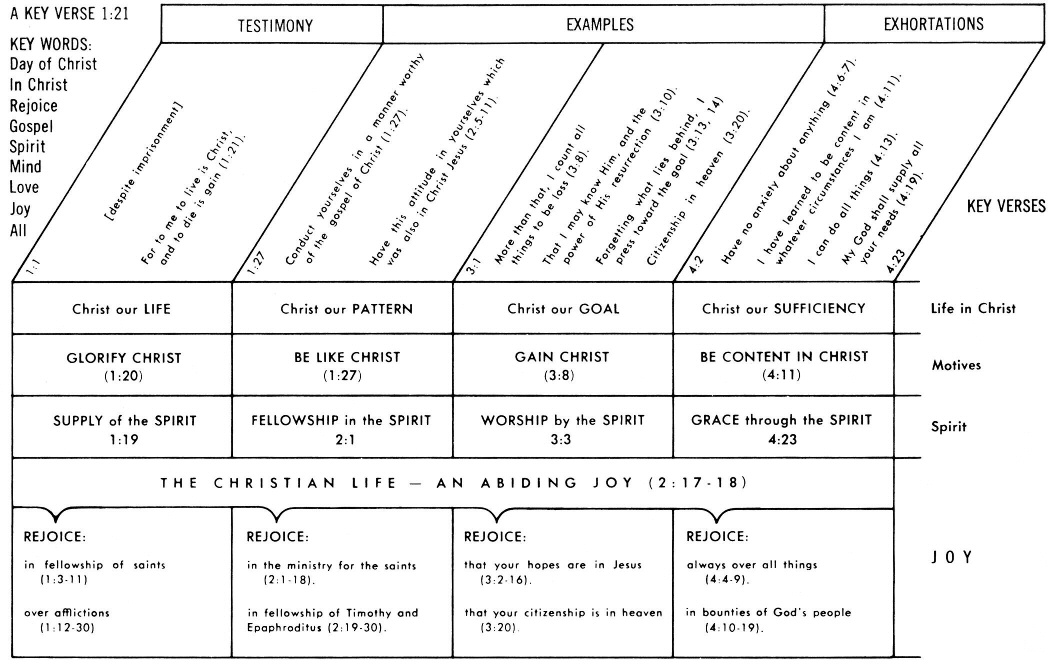
LIFE IN CHRIST
Click chart to enlarge
Charts from Jensen's Survey of the NT - used by permission
Philippians - Charles Swindoll = Chart on right side of page
| Account of Paul's Circumstances Php 1:1-30 |
Have the Mind of Christ Php 2:1-30 |
Have the Knowledge of Christ Php 3:1-21 |
Have |
| Partakers of Christ | People of Christ | Pursuit of Christ | Power of Christ |
| Suffering | Submission | Salvation | Sanctification |
| Experience | Examples | Exhortation | |

Philippi in the Time of Paul
The city plan above shows those features of the city of Philippi that archaeologists have so far identified as dating from the time of Paul. “Paul’s Prison” is not believed to be an authentic site, but was a cistern later associated with Christian worship. (ESV.org)
Philippians 2:14 Do all things without grumbling or disputing (NASB: Lockman)
Greek: panta poieite (2PPAM) choris goggusmon kai dialogismon
Amplified: Do all things without grumbling and faultfinding and complaining [against God] and questioning and doubting [among yourselves], (Amplified Bible - Lockman)
NLT: In everything you do, stay away from complaining and arguing, (NLT - Tyndale House)
Phillips: Do all you have to do without grumbling or arguing, (Phillips: Touchstone)
Wuest: All things be constantly doing without discontented and secret mutterings and grumblings, and without discussions which carry an undertone of suspicion or doubt, (Eerdmans Publishing)
DO ALL THINGS WITHOUT GRUMBLING OR DISPUTING: Panta poieite (2PPAM) choris goggusmonkai dialogismon:
- Php 2:3; Ex 16:7,8; Nu 14:27; Ps 106:25; Mt 20:11; Mk 14:5; Acts 6:1; 1Co 10:10; Jas 5:9; 1Pet 4:9; Jude 1:16
- Pr 13:10; 15:17,18; Mk 9:33,34; Acts 15:2,7,39; Ro 12:18; 14:1; 16:17; 1Co 1:10, 11, 12; 3:3, 4, 5; 2Co 12:20; Gal 5:15,26; Eph 4:31,32; 1Th 5:13,15; 1Ti 6:3, 4, 5; Heb 12:14; Jas 1:20; 3:14, 15, 16, 17, 18; 4:1; 1Pet 3:11
NO GRUMBLING ALLOWED!
Young's Literal translation brings out the fact that the Greek text emphasizes "all things" (first in the Greek sentence) - "All things do without murmurings and reasonings,"
Do (4160) (poieo) expressing an action as continued or not yet completed. Here is where we run into a potential conflict as we "work out our salvation". Paul is commanding (present imperative) that we each make the choice of our will (active voice) to continually make this the habit of our life! Now, just try to obey this command continually in your own (natural) strength! It is clearly impossible, but it is Him-possible! As we learn to renounce self-effort and rely on the Spirit (His working in - Php 2:13), we can begin to experience His supernatural enabling power (Php 2:12 - Our working out). Sure we will fail to "work out our salvation" some of the times we are tempted to grumble or dispute, but we confess, repent, get back up and start walking again by the power of the Spirit Who fills us (Gal 5:16, Eph 5:18). Over time the failures decrease as the reliance on the Spirit becomes more "automatic."
All things - "Some things" is where we would like the bar set, for perhaps we could clear it often (or our "good days") or at least some of the times. But "all things" is too high to humanly "jump". Believers need "supernatural sneakers" to "jump" this high!
You might be thinking "Well we all grumble and that is not such a "big" sin." Wrong! How serious is grumbling before God? Paul records "Nor grumble (verb form = gogguzo, see Nu 11:1, cp how grumbling caused a ground to become a grave = Nu 16:41-50 after the punishment of Korah.), as some of them did, and were destroyed by the destroyer." (1 Cor 10:10) God put these grumblers to death. God is deadly serious about grumbling! And to accentuate Paul's point to the saints at Corinth he added "Now these things (ground becoming a grave, etc) happened to them as an example, and they were written for our instruction, upon whom the ends of the ages have come." (1 Cor 10:11). Ask God's Spirit to remind you of Korah's catastrophe next time (before) you grumble!
Henrietta Mears - Paul is saying, “Don’t be grouchy! You can’t glow if you are!” Having committed your life to the control of the Lord, you are under orders not to murmur or complain! “If God is supreme, why did He allow this thing to happen?” should never pass your lips. You cannot ask your commander in chief the why of anything He asks you to do. (What the Bible is All About)
All (3956) (pas) means all without exception. The Greek reads literally ''all things do", because all is placed first for emphasis = no exceptions! .
Without (5565) (choris) means separately and is from a root word chora which means the space lying between two places or limits. The picture I get from this word is for us to put some space between the things we do and our grumbling -- ''stay away from'' it. Live and work together separated and apart from grumbling and disputing.
Grumbling (1112) (goggusmos from goggúzo = to say anything in a low tone, English = gong) is an audible expression of an unwarranted dissatisfaction = expression of one's discontent. Expression in low tones of disapprobation (act or state of disapproving). Grumbling, grudging, murmuring, complaining (= making formal accusation or expressing dissatisfaction, resentment, displeasure or annoyance). It can reflect a a secret debate or secret displeasure not openly avowed (see use in John 7:12).
The word literally means, “A secret displeasure in the heart, and a sullen discontent that leads to criticism.”
James Draper - The word translated "complaining" (grumbling) gives a picture of mumbling so words cannot be distinguished. It is the low, muffled noise that comes from a large crowd before a service begins. It is not loud dissent, but almost silent mumbling. The complaining mentioned here is a grumbling about man, not about God. It is a general grumbling about each other.
Arndt, et al, say that goggusmos is an "utterance made in a low tone of voice (the context indicates whether the utterance is one of discontent or satisfaction), behind-the-scenes talk. (Greek-English Lexicon of the New Testament and Other Early Christian Literature)
Goggusmos is an onomatopoeic word (two g’s in Greek are pronounced ng) derived from the sound made when murmuring or muttering in a low and indistinct voice with the idea of complaint. The English dictionary defines grumble as complaining in a bad-tempered, nagging or discontented way or making a low, dull rumbling sounds.
Wuest comments that goggusmos refers "not to a loud outspoken dissatisfaction, but to that undertone murmuring which one sometimes hears in the lobbies of our present day churches where certain cliques are “having it out,” so to speak, among themselves. The word refers to the act of murmuring against men, not God. The use of this word shows that the divisions among the Philippians had not yet risen to the point of loud dissension. The word was used of those who confer secretly, of those who discontentedly complain. The word is found in a secular document reporting an interview between Marcus Aurelius and a rebel. A veteran present interposes with the remark, “Lord, while you are sitting in judgment, the Romans are murmuring.” (Philippians Commentary - Verse by Verse)
In secular Greek there is a use of goggusmos "describing grumbling dissatisfaction at disappointed expectations." (TDNT adds) "The idea is that a supposedly legitimate claim is not met. What is denoted is a strong personal attitude. (Theological Dictionary of the New Testament. Eerdmans)
Barclay - It describes the low, threatening, discontented muttering of a mob who distrust their leaders and are on the verge of an uprising. (Daily Study Bible)
Goggusmos is found 4 times in the NAS (John; Acts; Philippians; 1 Peter) and is translated in the NAS as complaint, 2; grumbling, 2. The KJV translates it grudging, 1; murmuring, 3.
Goggusmos is found 7 times in the Septuagint (LXX) (Ex 16:7, 8 = twice, Ex 16:9, 12, Nu 17:5, 17:10, Isa 58:9) and most describe the children of Israel in the wilderness and their stubborn spirit speaking against God in a reprehensible way. Little wonder Paul commands those who have been born again and have a new nature to assiduously avoid such an attitude.
The Exegetical Dictionary has an interesting observation on this word group (so that the following Scriptural annotations include the verb gogguzo) writing that…
The subjects of gogguzo are individuals: in Matt 20:11, the workers in the vineyard; Luke 5:30, Pharisees and scribes; John 6:41, 43, the Jews; 7:32, the wavering masses; 6:61, the doubting disciples; 1 Cor 10:10, the people of Israel during the wanderings in the desert. The persons against which (kata, pros, peri) grumbling is directed are the householder of Matt 20:11, the disciples in Luke 5:30, Jesus in John 6:41 (43) and 7:32, a statement of Jesus in John 6:61, and the Lord, against Whom the people of Israel grumbled, in 1 Cor 10:10. (Balz, H. R., & Schneider, G. . Exegetical Dictionary of the New Testament. Grand Rapids, Mich.: Eerdmans)
John records that when Jesus had gone to Jerusalem to celebrate the Feast of Booths
there was much grumbling (goggusmos) among the multitudes (Jews) concerning Him (Jesus); some were saying, "He is a good man"; others were saying, "No, on the contrary, He leads the multitude astray." (John 7:12) (Comment: In this use the idea of goggusmos is not completely negative and can be defined more as secret talk or whispering)
Commenting on goggusmos in this passage in John 7 Barclay writes that…
It indicates a kind of growling, discontented undertone. It is the word used for the grumbling of the children of Israel in the wilderness when they complained against Moses. They muttered the complaints they were afraid to utter out loud. Fear can keep a man from making a clarion call of his faith and can turn it into an indistinct mutter. The Christian should never be afraid to tell the world in ringing tones that he believes in Christ. (Barclay, W: The Daily Study Bible Series, Rev. ed. Philadelphia: The Westminster Press)
Luke records the second use of goggusmos writing in Acts…
Now at this time while the disciples were increasing in number, a complaint (goggusmos) arose on the part of the Hellenistic Jews against the native Hebrews, because their widows were being overlooked in the daily serving of food. (Acts 6:1)
Peter records the final use of goggusmos exhorting the saints to…
Be hospitable to one another without complaint (goggusmos) (see note 1Peter 4:9) (Comment: John MacArthur quips that hospitality in the Scriptures knows nothing of the "Poor Richard's Almanac" mentality that says fish and guests smell after three days! - from his commentary on 1Peter)
Goggusmos is used 5 times in the LXX Exodus 16…
So Moses and Aaron said to all the sons of Israel, "At evening you will know that the LORD has brought you out of the land of Egypt;
7 and in the morning you will see the glory of the LORD, for He hears your grumblings against the LORD; and what are we, that you grumble against us?"
8 And Moses said, "This will happen when the LORD gives you meat to eat in the evening, and bread to the full in the morning; for the LORD hears your grumblings which you grumble against Him. And what are we? Your grumblings are not against us but against the LORD."
9 Then Moses said to Aaron, "Say to all the congregation of the sons of Israel, 'Come near before the LORD, for He has heard your grumblings.'"
10 And it came about as Aaron spoke to the whole congregation of the sons of Israel, that they looked toward the wilderness, and behold, the glory of the LORD appeared in the cloud.
11 And the LORD spoke to Moses, saying,
12 "I have heard the grumblings of the sons of Israel; speak to them, saying, 'At twilight you shall eat meat, and in the morning you shall be filled with bread; and you shall know that I am the LORD your God.'" (Exodus 16:6-12)
Why is "grumbling" so bad? What insight does Scripture give? (cf Jude1:16)
The psalmist explains
they (Israel) despised the pleasant land. They did not believe in His word but grumbled in their tents. They did not listen to the voice of the LORD. (Ps 106:24, 25-see notes)
Paul explains that…
Nor grumble (related verb gogguzo), as some of them did, and were destroyed by the destroyer (as some did after the judgment on the rebels who were led by Korah in Nu 16:41-50). (1Cor 10:10)
In this passage unbelief is contrasted with grumbling! So when we grumble we are saying God we don't believe God is sovereign and that He is able. We don't believe He is the Giver of all good gifts. We don't trust Him to work out all things for our good and for His glory.
Spurgeon - A heavy wagon was being dragged along a country lane by a team of oxen. The axle-trees groaned and creaked terribly, when the oxen turning round, thus addressed the wheels:: 'Halloa, there! why do you make so much noise? we bear all the labor, and we, not you, ought to cry out!' Those complain first in our churches who have least to do. The gift of grumbling is largely dispensed among those who have no other talents, or who keep what they have wrapped up in a napkin.
Brian Bill - 1 Corinthians 10 teaches that there are few sins as ugly as complaining. Listen toverses 9-11: “We should not test the Lord, as some of them did-and were killed by snakes. And do not grumble, as some of them did-and were killed by the destroying angel. These things happened to them as examples and were written down as warnings for us.” Verse 12 reminds us that if we think we’re not in the camp of the complainers, we should be careful, because it’s just a short step down the slippery slope of complaining. Then, in verse 13, which is a verse that many of us have memorized, we learn that God will give us a way of escape from a complaining spirit: “No temptation has seized you except what is common to man. And God is faithful; he will not let you be tempted beyond what you can bear. But when you are tempted, he will also provide a way out so that you can stand up under it.” This verse is in the context of avoiding a complaining spirit. God will give you a way out of grumbling if you’ll look for it. Israel’s stumbling led to grumbling, which resulted in God’s judgment. When we come to the Book of Numbers, God is no longer gracious with the grumblers, like He was in Exodus. Why is that? Because now they have the Law and they should know better. Ultimately, all grumbling, whether directed at people or problems, is really against God. In Numbers 16, Korah and his cantankerous cohorts complain about their leaders, but Moses knows that they are really going after God in verse 11: “It is against the Lord that you and all your followers have banded together. Who is Aaron that you should grumble against him?” As a result of their mumbling and grumbling, over 14,000 people paid for their protest with their lives. James 5:9: “Don’t grumble against each other, brothers, or you will be judged. The Judge is standing at the door!” As Romans 9:20 asks, “But who are you, O man, to talk back to God?” “Arguing” (Disputing) is when our complaining spills over into conversations, when our misery seeks to manipulate others to comply with our complaints. Arguing takes place when our complaining moves from our heart to our heads and then vomits out of our mouths. Arguing often stirs up doubts and suspicions. Someone has said that this happens as we pass around our poison to others, when our silent grumbling turns to open arguing. Proverbs 29:8: “Mockers stir up a city, but wise men turn away anger.” Isn’t that the order in which this usually happens? We get upset and it affects our emotions, and then we look for some intellectual reasons to justify why we’re so angry....By the way, if you want to know if you are a complainer or an arguer, listen to what kinds of pronouns you use. If you employ “they” or “him” or “her,” more than “us” or “we” you may be a grumbler. It might sound like this: “Why do they do this? Why didthey say that? What was he thinking? Where did she come up with that?” Friends, there is no “they,” because the “they” is “us.” three reasons why we need to work at our speech.
- Complaining denies God’s sovereignty
- Complaining disrupts unity
- Complaining discredits our testimony
Ray Pritchard - Do we understand that complaining is an attack on God’s sovereignty? Every time you complain about your circumstances, you are really saying, “If I were God, I would do things differently.” The complainer has forgotten the first rule of the spiritual life: He’s God and we’re not. Over the years I have traveled to many parts of the world, including some very difficult places in Africa and Asia. After many visits in many places, I can tell you that rarely have I heard any complaints, even from those facing persistent opposition to the preaching of the gospel. I recall hearing about a man who saw great success in preaching the gospel in southern Nigeria. Thousands of tribal people came to Christ. Later he was transferred to the largely-Muslim region of northern Nigeria where after many years of hard labor, he had only gathered a few converts. Same man, same gospel message. Yet different results. But no complaints against the Lord. “I was told early in my ministry,” he said, “to focus on Christ, not on the hardness of the Muslim religion." It’s all a matter of focus, isn’t it? What we look at determines what we see. If we focus on our problems, they will fill our minds until we see nothing else. No wonder we complain and mutter and murmur under our breath. But when we focus on the Lord and his goodness, we see our problems in the light of eternity. God doesn’t work on our timetable. Once we grasp that, we will not complain against the Lord.
George Brooks - Grumbling and disputing are sins of the disposition. These sins grow out of discontentment. We grumble and dispute when things are not working out as we planned them. If we grumble and dispute often enough, these two things will become habits.
Paul did not want the Philippians to live like the children of Israel. The children of Israel were filled with grumbling and disputing with almost every move they made. Before they could get out of Egyptian bondage good, they were grumbling at the Red Sea. They asked Moses, "Is it because there were no graves in Egypt that you have taken us away to die in the wilderness? Why have you dealt with us in this way, bringing us out of Egypt" (Exodus 14:11, NASB)?
There was a time when Israel became thirsty at Marah (Exodus 15:23-25). This place meant bitter. When Israel grumbled about not having water, Moses took a tree and threw it into the water and it became sweet. The children of Israel grumbled in the wilderness of Sin when they became hungry (Exodus 16:1-3).
God got fed up with their attitudes and said, "I have heard the grumblings of the sons of Israel; speak to them, saying, ’At twilight you shall eat meat, and in the morning you shall be filled with bread; and you shall know that I am the LORD your God’" (Exodus 16:12, NASB).
There was another occasion when Israel became thirsty and they began to argue with Moses. God told Moses to strike a rock so that Israel could get water. Moses did what God said and God gave them water to drink. That place was named Massah and Meribah because of the quarreling of the children of Israel (Exodus 17:1-7).
The children of Israel grumbled about Moses being gone too long when he met God on Mt. Sinai. So they got Aaron to lead in the building of the golden calf (Exodus 32). They grumbled about the manna given them by God. They said their appetites were gone because there was not a lot of variety in their diet (Numbers 11:4-6). They grumbled so much that God eventually sent serpents to chastise them for their grumbling (Numbers 21:6).
It appears that grumbling and disputing had begun to appear in Philippi and Paul was trying to keep it from becoming an epidemic. Grumbling and disputing were outward signs of inward rebellion. They are rebellion against God’s right to rule.
Spurgeon - Do not say, “You give me too much to do. You always give me the hard work. You put me in the obscure corner.” No, no; “do all things without grumbling.” And do not begin fighting over a holy work, for if you do, you spoil it in the very beginning. How can you then hope for a blessing upon it? “Do all things without grumbling and disputing.”
ILLUSTRATION - Max Lucado tells of the man who came home one day and immediately his wife started complaining which led to an intense argument. Arriving at 6:30 in the evening, he spent an hour trying to make things right. Nothing worked. Finally he said, “Let’s start over and pretend I’m just getting home.” He stepped outside and when he opened the door, she said, “Its 7:30 at night and you’re just now getting home?”
ILLUSTRATION: Steven Cole gives an illustration of grumbling which should cause all of us to "wince"…
A little old lady walked into a department store one day and was surprised when a band began to play and an executive pinned an orchid on her dress and handed her a crisp $100 bill. She was the store’s millionth customer. Television cameras were focused on her and reporters began interviewing her.
“Tell me,” one asked, “just what did you come here for today?”
The lady hesitated for a minute and then sheepishly answered,
“I was on my way to the Complaint Department.”
How embarrassing! But I wonder, if there had been a secret video camera recording your life this past week, how much grumbling would have been captured on film? Maybe you even came to church like that lady went to the department store, ready to air your complaints or to give someone a piece of your mind. But God meets you at the door and pins His Word on you: “Do all things without grumbling or disputing, that you may be blameless and innocent, a child of God above reproach in the midst of this crooked and perverse generation, among whom you shine forth as a light in the world.” Grumble, grumble--NOT!… Why is affirming the sovereignty of God in all things so important in learning to live with joy rather than with grumbling? (Read his sermon Philippians 2:14-18 Grumble, Grumble - NOT!)
James Draper writes that disputing "means "to debate." Paul warns that if we don't stop grumbling, if we don't stop what is under the surface, it will become open dissension and debate. We must not be party to such a spirit." (Philippians Commentary)
Disputing (1261) (dialogismos from diá = through or as a preposition to intensify meaning of + logizomai = reckon, take an inventory, conclude; source of our English dialogue) means literally reasoning through and so to think or reason with thoroughness and completeness, think out carefully, reason thoroughly, consider carefully, weighing. In the Greek writings dialogismos described the thinking of a man deliberating with himself. It refers to calculated consideration (good or bad as discussed below). It pictures one deliberating with one’s self which conveys the basic meaning of inner reasoning.
Friberg - 1) in a positive sense thought (process), reasoning, design (Lk 2.35); (2) in a negative sense doubt, dispute, argument (Lk 24.38)
BDAG -
1. the process of reasoning, reasoning of polytheists Ro 1:21.
2. content of reasoning or conclusion reached through use of reason, thought, opinion, reasoning, design Lk 2:35; 5:22; 6:8; 9:47. The thoughts of the wise of this world are known to God 1 Cor 3:20 (Ps 93:11); evil machinations Mt 15:19; Mk 7:21. judges w. evil thoughts Jas 2:4 (but here d. can also be the legal technical term - decision: judges who give corrupt decisions).
3. verbal exchange that takes place when conflicting ideas are expressed, dispute, argument d. an argument arose Lk 9:46 without dispute Phil 2:14; 1 Ti 2:8.
4. reasoning that gives rise to uncertainty, doubt; doubts arise
Lightfoot says that as "As goggusmos is the moral, so dialogismos is the intellectual rebellion against God". Dialogismos is rendered arguing (Phillips, NIV, CSB, NRS), arguments (BBE), questioning (ESV, NAB), wrangling (NEB).
Disputing implies a questioning mind and suggests an arrogant attitude by those who assume they’re always right. Arguing with others in the body of Christ is disruptive. That’s why Paul spent the first part of chapter 2 on humility.
To dwell above, with saints we love, that will be grace and glory
But to live below with saints we know, now that’s a different story!
Dialogismos - 14x in 14v = argument, 1; disputing, 1; dissension, 1; doubts, 1; motives, 1; opinions, 1; reasonings, 2; speculations, 1; thoughts, 3; what… were thinking, 2
Matthew 15:19 "For out of the heart come evil thoughts, murders, adulteries, fornications, thefts, false witness, slanders.
Mark 7:21 "For from within, out of the heart of men, proceed the evil thoughts, fornications, thefts, murders, adulteries,
Luke 2:35 and a sword will pierce even your own soul-- to the end that thoughts from many hearts may be revealed."
Luke 5:22 But Jesus, aware of their reasonings, answered and said to them, "Why are you reasoning in your hearts?
Luke 6:8 But He knew what they were thinking, and He said to the man with the withered hand, "Get up and come forward!" And he got up and came forward.
Luke 9:46 An argument started among them as to which of them might be the greatest.
47 But Jesus, knowing what they were thinking in their heart, took a child and stood him by His side,
Luke 24:38 And He said to them, "Why are you troubled, and why do doubts arise in your hearts?
Romans 1:21 For even though they knew God, they did not honor Him as God or give thanks, but they became futile in their speculations, and their foolish heart was darkened.
Romans 14:1 Now accept the one who is weak in faith, but not for the purpose of passing judgment on his opinions.
Comment - Vincent writes: "The primary meaning of dialogismos is a thinking-through or over. Hence of those speculations or reasonings in one's mind which take the form of scruples" (3:167). A. T. Robertson thinks the meaning of the clause is this: "The 'strong' brother is not called upon to settle all the scruples of the 'weak' brother" (WP, 4:412).
1 Corinthians 3:20 and again, "THE LORD KNOWS THE REASONINGS of the wise, THAT THEY ARE USELESS."
Philippians 2:14 Do all things without grumbling or disputing;
1 Timothy 2:8 Therefore I want the men in every place to pray, lifting up holy hands, without wrath and dissension.
James 2:4 have you not made distinctions among yourselves, and become judges with evil motives?
Dialogismos is used 11 times in the Septuagint (LXX) (Ps 40:5, 56:5, 92:5, 94:11, 139:2, 139:20, 146:4, Isa 59:7, Jer 4:14, Lam 3:60, 61) Dialogismos often means the perverse, vain thinking which contemplates destruction (Ps. 94:11), and is turned against God (Jer. 4:14; Isa. 59:7) and against the godly (Ps. 56:5).
Commenting on Phil 2:14, MacArthur notes that dialogismos "soon developed the more specific ideas of questioning, doubting, or disputing the truth of a matter. In Romans 14:1, the word is used of passing judgment on another believer’s opinions and in 1 Timothy 2:8 it is rendered “dissension.” Whereas grumbling is essentially emotional, disputing is essentially intellectual. A person who continues to murmur and grumble against God will eventually argue and dispute with Him. (MacArthur, J. Philippians. Chicago: Moody Press)
Dialogismos can be reflected outward and audibly (e.g., ‘discussion’, ‘argument’) or inward and inaudibly, (i.e. ‘consideration in oneself’, ‘thought’, ‘doubts’).
It refers to an opinion and then to a deliberating and a questioning about what is true as in Luke 24:38.
It is found in the Greek writings from Plato down where it referred to the thinking of a man deliberating with himself (Lk 2:25, 5:22, 6:8, 9:46ff, Ro 14:1). It was used to describe the reasoning of those who thought themselves wise (Ro 1:21, 1Cor 3:20). James 2:4 uses it to mean opinion referring to judges with evil thoughts or who follow perverse opinions or reprehensible principles.
In a positive sense dialogismos means thoughts and in a negative it means disputes or arguments.
NIDNTT -In the NT dialogizomai (related verb) and dialogismos are always used with a slightly depreciatory connotation. The thoughts of the human heart do not necessarily lead, as the Greeks thought, to a knowledge of the truth (cf. 1 Cor. 1:21-25), but are evil (Mk. 7:21; Matt. 15:19), full of doubt and suspicion (Mk. 2:6, 8; Lk. 5:22; 6:8), moved by the passing moment (Lk. 3:15), full of greed (Lk. 12:17; 20:14), always concerned with the superficial (Mk. 8:16f.; Matt. 16:7f.) and full of sly calculation (Matt. 11:25; Mk. 11:31). (NIDNTT adds that) in Phil. 2:14 we have the questioning (dialogismos) which is the germ of apathy. (See online New International Dictionary of NT Theology) (Bolding added)
The Exegetical Dictionary notes that "Even when dialogismos has a specialized use, the essential connection with the general NT meaning of doubting or calculating consideration is retained. (Exegetical Dictionary of the New Testament.)
Luke illustrates the uses of dialogismos…
But Jesus, aware of their reasonings (dialogismos), answered and said to them, "Why are you reasoning (dialogizomai = verb form) in your hearts? (Luke 5:22) (Comment: In the majority of occurrences of the verb dialogizomai is used for the deliberations of Jesus’ opponents, Mk 2:6, 8, or the interpersonal deliberations of the disciples, Mk 8:16ff)
But He (Jesus) knew what they (his opponents) were thinking (dialogismos), and He said to the man with the withered hand, "Rise and come forward!" And he rose and came forward. (Luke 6:8)
And an argument (dialogismos) arose among them (the disciples) as to which of them might be the greatest. But Jesus, knowing what they were thinking (dialogismos) in their heart, took a child and stood him by His side (Luke 9:46-47)
And He said to them, "Why are you (disciples at His post-resurrection appearance) troubled, and why do doubts (dialogismos) arise in your hearts? (Luke 24:38) (Here dialogismos denotes unspoken thoughts concerning the truth of what they see, hence ‘questionings’, ‘doubts’)
Vine notes that dialogismos is "chiefly in the N.T. in an evil sense, of reasonings that are the outcome of self-will, reasonings of the natural mind in independence of God. So in the LXX (e.g., Lam. 3:60), “imaginations.”… Dialogismos sometimes means inward questioning, sometimes dispute… the inward reasonings which find expression in controversy and contention. (Collected Writings of W. E. Vine)
As alluded to above, in the NT, dialogismos is used mainly in an evil sense describing reasoning that is the outcome of self-will. Here it describes reasoning of the natural mind in independence of God. In Ro 1:21 (note) it denotes the false notions about God, entertained in opposition to the facts revealed concerning Him in nature. We see this in Matthew's use…
"For out of the heart come evil thoughts (dialogismos), murders, adulteries, fornications, thefts, false witness, slanders. These are the things which defile the man; but to eat with unwashed hands does not defile the man." (Mt 15:19-20)
Barclay adds that "dialogismos describes useless, and sometimes ill-natured, disputing and doubting. In the Christian life there is the serenity and the certainty of perfect certainty and perfect trust. (Regarding the use of dialogismos in 1Ti 2:8 Barclay comments) "The word used is dialogismos, which can mean both an argument and a doubt. If we take it in the sense of argument, it simply repeats what has gone before and restates the fact that bitterness and quarrels and venomous debates are a hindrance to prayer. It is better to take it in the sense of doubt. Before prayer is answered there must be belief that God will answer." Prayer, Vincent says, “is to be without the element of skeptical criticism, whether of God’s character and dealings, or of the character and behavior of those for whom prayer is offered.” (Daily Study Bible)
Related Resources:
- Torrey Topical Textbook Murmuring
- Easton's Bible Dictionary Murmuring
- Hastings' Dictionary of the NT Murmur, Murmuring Murmuring
- International Standard Bible Encyclopedia Murmur; Murmurings
- McClintock and Strong's Bible Encyclopedia Murmuring Murmuring (2)
Spurgeon - Do not dispute with God; let Him do what seems good to Him. Do not dispute with your fellow Christians; do not raise railing accusations against them. When Calvin was told that Luther had spoken ill of him, he said, “Let Luther call me devil if he please; I will never say of him but that he is a most dear and valiant servant of the Lord.” Do not raise intricate and knotty points by way of controversy. Remember, you have adversaries upon whom to use your swords, and therefore there is little need that you should turn their edges by dashing at the armor of your fellows. Do not dispute even with the world. The heathen philosophers always sought occasions for debate; let it be yours to testify what God has told you, but do not court controversy. Do not be ashamed to contend earnestly for the faith once delivered to the saints, but never do it in a spirit of mere debating, never because you wish to gain a victory, but only because you would tell out what God has bidden you reveal.
Jack Arnold on grumbling and disputing - What is the worst sin a person can commit? Is it adultery, homosexuality, murder or rape? In light of the total holiness of God, it is difficult to say that any sin is any worse than any other sin. However, if we read the Old Testament carefully, we will find that the sin of complaining, grumbling and murmuring was a sin which brought great judgment from God. God hates a grumbling and complaining spirit because complaining is the opposite of a joyful spirit and God wants His people to be joyful. Complaining seems to be American way of life. Most conversations are complaints about the government, the economy, taxes we pay and even about weather. Among Christians, we hear complaints about the sermon – too long, too dry and too pointed. Or there are complaints about the congregation – too large, too cold, too small, too emotional or too impersonal. Complaining is not just an American pastime. It is a human race pastime because all men do have a sin nature which tends towards negative rather than the positive. Complaining is a spiritual problem and it has to be dealt with and spiritually defeated. (Sermon)
Gene Getz - The great temptation of any Christian, especially when he is asked by a non-Christian to do something difficult, is to complain and argue. This was true of the Philippians, some of whom were apparently slaves in the Roman system. As in Ephesus (Eph. 6:5, 6), they were "not their own." They were probably persecuted and put under great pressure, naturally resulting in a tendency to murmur and complain about their state of being. There is another significant correlation here with the 1 Peter passage. Wives were to respect and reverence their unsaved husbands. They were to adorn themselves with "the unfading beauty of a gentle and quiet spirit, which," said Peter, "is of great worth in God's sight" (1 Peter 3:4). A "gentle and quiet spirit," of course, is the opposite of "complaining and arguing." This is the way, he said, to win them over. Paul exhorted the Philippians, therefore, to respect and reverence these ungodly Romans and to do what they asked without negative attitudes and behavior. He then gave the reason why! (see Php 2:15) (The Measure of a Christian - Volume 1 - Page 101)
MacArthur nicely sums up Paul's command in Philippians 2:14 writing that…
Every circumstance of life is to be accepted willingly and joyfully, without murmuring, complaint, or disappointment, much less resentment. There is no exception. There should never be either emotional grumbling or intellectual disputing. It is always sinful for believers to complain about anything the Lord calls them to do or about any circumstance which He sovereignly allows. Whether the task is difficult or easy, whether the situation involves a blessing or a trial, negative attitudes are forbidden. As he testifies later in this letter, Paul’s own spiritual growth had led him to enjoy this attitude:
“I have learned to be content in whatever circumstances I am. I know how to get along with humble means, and I also know how to live in prosperity; in any and every circumstance I have learned the secret of being filled and going hungry, both of having abundance and suffering need” (Php 4:11,12-see note Php 4:11-12).
His example shows that such righteous behavior is possible. (MacArthur, J. Philippians. Chicago: Moody Press)
COMPLAINING…
DON'T!
(Instead 1Th 5:18)
Don’t complain; the more you complain about things the more things you will have to complain about. (E. Stanley Jones)
Complaining about our lot in life might seem quite innocent in itself, but God takes it personally. (Erwin W. Lutzer)
If Christians spent as much time praying as they do grumbling, they would have nothing to grumble about.
Murmur at nothing: if our ills are irreparable, it is ungrateful; if remediless, it is in vain. A Christian builds his fortitude on a better foundation than stoicism; he is pleased with everything that happens because he knows it could not happen unless it had first pleased God, and that which pleases him must be the best. (Charles Caleb Colton)
Don't complain and talk about all your problems--80 percent of people don't care; the other 20 percent will think you deserve them. (Mark Twain)
You will find that, as a rule, those who complain about the way the ball bounces are usually the ones who dropped it.
Whenever you find yourself disposed to uneasiness or murmuring at anything that is the effect of God’s providence, look upon yourself as denying either the wisdom or goodness of God. (William Law)
I complained because I had no shoes until I met a man who had no feet. (Arab proverb)
To swear is wicked because it is taking God’s name in vain. To murmur is likewise wicked for it takes God’s promises in vain.
When in deep water, it’s a good idea to keep your mouth shut.
There is a difference between groaning and grumbling.
Spurgeon offers an antidote for a complaining, murmuring spirit writing that "If we complained less, and praised more, we should be happier, and God would be more glorified. Let us daily praise God for common mercies—common as we frequently call them, and yet so priceless, that when deprived of them we are ready to perish. Let us bless God for the eyes with which we behold the sun, for the health and strength to walk abroad, for the bread we eat, for the raiment we wear. Let us praise him that we are not cast out among the hopeless, or confined amongst the guilty; let us thank him for liberty, for friends, for family associations and comforts; let us praise him, in fact, for everything which we receive from his bounteous hand, for we deserve little, and yet are most plenteously endowed. But, beloved, the sweetest and the loudest note in our songs of praise should be of redeeming love. God’s redeeming acts towards his chosen are for ever the favourite themes of their praise. If we know what redemption means, let us not withhold our sonnets of thanksgiving. We have been redeemed from the power of our corruptions, uplifted from the depth of sin in which we were naturally plunged. We have been led to the cross of Christ—our shackles of guilt have been broken off; we are no longer slaves, but children of the living God, and can antedate the period when we shall be presented before the throne without spot or wrinkle or any such thing. Even now by faith we wave the palm-branch and wrap ourselves about with the fair linen which is to be our everlasting array, and shall we not unceasingly give thanks to the Lord our Redeemer? Child of God, canst thou be silent? Awake, awake, ye inheritors of glory, and lead your captivity captive, as ye cry with David, “Bless the Lord, O my soul: and all that is within me, bless his holy name.” Let the new month begin with new songs. (Spurgeon, C. H. Morning and Evening: Daily readings December 1, Evening)
Spurgeon also once said that "A heavy wagon was being dragged along a country lane by a team of oxen. The axles groaned and creaked terribly, when the oxen turning around thus addressed the wheels, “Hey there, why do you make so much noise? We bear all the labor, and we—not you—ought to cry out!” Those complain first in our churches who have the least to do. The gift of grumbling is largely dispensed among those who have no other talents, or who keep what they have wrapped up in a napkin."
Spurgeon also said…
The very word murmur, how simple it is, made up to two infantile sounds—mur mur. No sense in it, no wit in it, no thought in it. It is the cry rather of a brute than of a man. Murmur—just a double groan.
Ten minutes' praying is better than a year's murmuring.
As long as a man is alive and out of hell, he cannot have any cause to complain.
On the humorous side of complaining and grumbling is a story about the cowboy who…
… was driving down a dirt road, his dog riding in back of the pickup truck, his faithful horse in the trailer behind. He failed to negotiate a curve and had a terrible accident.
Sometime later, a highway patrol officer came on the scene. An animal lover, he saw the horse first. Realizing the serious nature of its injuries, he drew his service revolver and put the animal out of his misery. He walked around the accident and found the dog, also hurt critically. He couldn't bear to hear it whine in pain, so he ended the dog's suffering as well.
Finally he located the cowboy --who suffered multiple fractures--off in the weeds. "Hey, are you okay?" the cop asked. The cowboy took one look at the smoking revolver in the trooper's hand and quickly replied, "Never felt better!" (Source Unknown)
A BAD HABIT Most people have a bad habit or two. Some habits are just irritating, such as talking too much or too fast. Others are much more serious.
Consider, for example, the bad habit developed by the people of ancient Israel. They had just been delivered from slavery (Ex 14:30), and they ought to have been thankful. Instead, they started to complain to Moses and Aaron,
"Oh, that we had died by the hand of the LORD in the land of Egypt!" (Ex 16:3).
We read in Exodus 17:1, 2, 3ff that their complaining escalated into a quarrel. In reality, their complaint was with God, but they picked a fight with Moses because he was the leader. They said,
"Why is it you have brought us up out of Egypt, to kill us and our children and our livestock with thirst?" (Ex 17:3).
The people even began questioning if God was really with them (v.7). Yet He always met their needs. If we're honest, we would have to admit that we sometimes complain when God isn't coming through for us the way we want. We accuse Him of being absent or disinterested. But when our heart is concerned with God's purposes rather than our own, we will be patient and trust Him to provide all that we need. Then we won't develop the bad habit of complaining. —Albert Lee (Copyright RBC Ministries, Grand Rapids, MI. Reprinted by permission. All rights reserved)
Those Christians who with thankful hearts
Praise God throughout the day
Won't tend to grumble and complain
When things don't go their way.
—Branon
To conquer the habit of complaining, count your blessings.
(And surrender your rights to the Spirit Who will enable you to not complain!)
I. Don't you just hate this kind of person?
Calvin and Hobbes are walking through the snow: Calvin: Some people complain all the time! They complain about the least little thing! [he holds his head and grimaces] If something bugs them, they never let go of it! They just go on and on, long after anyone else is interested! It's just complain, complain, complain! People who gripe all the time really drive me nuts! You'd think they'd change the subject after a while, but they never do! They just keep griping until you start to wonder, "What's wrong with this idiot?" But they go on complaining and repeating what they've already said! Hobbes: [rolls his eyes] Maybe they're not very self-aware. Calvin: Boy, that's ANOTHER thing that gets on my nerves!
A. A problem as old as humanity.
1) Alludes to Israel's experience in the Exodus. Deut 32:5
2) The Israelites had a short memory.
a) Complained about food - manna.
b) Complained about manna - meat till they puked.
c) Complained about water - from a rock.
d) Complained about Promised Land - forbidden to enter.
B. We can learn from their example. 1 Cor 10:10-12
II. Five types of complainers.
A. Whiner. David
1) These people wake up negative. They rise and whine.
a) David whines all through the Psalms.
b) The tell-tale sign of the whiner is: "It's not fair. I don't deserve this. Everybody else gets all the breaks."
2) Life is not fair. God never said it would be.
a) It will be fair in Heaven.
b) In the meantime, whining only makes you and others more miserable.
c) Why not take positive action instead?
B. Martyr. Moses
1) Passive aggression.
a) Caused by a need to have control with the least amount of vulnerability.
b) Favorite phrase: "No one appreciates me."
c) Example: Moses in Numbers 11:11-15.
2) Rather than pity parties, state your grievances directly.
C. Cynic. Solomon
1) Favorite phrase: "Nothing will ever change." Eccl 1:2-4
a) A sense of superiority.
b) Not satisfied till others agree.
2) But things CAN change. Jesus says so.
D. Perfectionist. Nagging wife in Proverbs.
1) Nothing is ever right for this person.
a) It is never good enough.
b) Favorite phrase: "Is that the best you can do?"
2) Complaints by a perfectionist wear you down.
Proverbs 27:15 - "A nagging wife is like water going drip, drip, drip on a rainy day."
3) Verse 15 may seem to support this attitude, but a comparison with Old Testament texts shows differently.
a) Paul is not referring to perfection, but innocence and integrity.
b) We should get rid of obvious faults.
c) And note that the emphasis is on our morality, not the morality of those around us.
E. Crusader.
1) They have a pet cause or belief.
a) Guerrilla warfare until they get their way.
2) Crusaders express disagreement in unhealthy ways.
a) They seldom take the issue to those who can resolve it.
b) At worst, some want retribution more than resolution.
c) At best, they want everyone to respect them, even though they don't show much respect for others.
3) They use the Gideon strategy: creating the appearance of greater numbers.
a) "I'm not the only one who feels this way."
b) When pressed, they refuse to talk specifics.
III. Deal with it.
A. God is patient (Ex 34:6-7), but his patience has limits. = For a while Louis Mucciolo flew regularly between New York and Denver, and there were frequent delays. One day as his plane was waiting for takeoff, an announcement warned of yet another lengthy wait. He noticed a flight attendant at the front of the cabin, and with time to kill, he approached her and launched into a litany of all his earlier mishaps on the route. She listened intently. "Sir," she finally asked, "what is your name?" With visions of upgrades or free flights dancing in his head, he pronounced his name clearly and spelled it. She nodded and repeated his name carefully. Then she said, "I must remember that and make sure I avoid any flight listing you as a passenger."
1) Complaining can kill our relationship with God and people.
2) We need to take an attitude check.
B. Admit it's a problem.
1) Not just everyone else's, but yours too.
C. Accept responsibility for your own life.
1) Complaining can be a way to shift blame for our own problems.
a) We are free to choose, but not free from consequences.
b) Nobody friendly to you? Be friendly to them.
2) There are three kinds of people in life: accusers, excusers, and choosers.
a) Accusers are always going around saying "It's your fault." (Adam and Eve)
b) Excusers say "I'm a product of my environment. It's not really my fault."
c) The people that are really successful in life are neither accusers nor excusers. They are choosers. 1> They accept responsibility for their own decisions. 2> When they reap what they sow they take it and move ahead. (Rick Warren)
D. Look for God's hand in circumstances.
1) Complaining is, in essence, rebellion against God.
2) When I complain about my circumstances that are beyond my control I'm really saying, "If I were God things would be different."
a) Don't question God's wisdom.
b) Don't doubt God's care.
c) Don't forget God's goodness.
3) The only way you change other people is by changing yourself.
a) Then they have to react to you differently.
E. Practice positivity. Phil 4:8
1) Complaining is a habit.
a) Habits are only broken by replacement with something else.
b) Take out the negative complaining and replace it with positive speaking.
Ephesians 4:29 - "Do not let any unwholesome talk come out of your mouths, but only what is helpful for building others up according to their needs, that it may benefit those who listen."
2) Control your inner anger.
a) Arguing - do you have a combative spirit? 1> Be careful how you handle differences.
b) Our approach can be Win-Lose or Win-Win. 1> Don't see others as opponents. 2> If you are truly peeved with them, confront them about it. 3> But view them as a brother/sister in Christ.
3) Develop an attitude of gratitude. 1Th 5:18
IV. Shining.
A. Christians should be different.
1) Courage of apostles was noted by opponents.
2) Early Christians so loving they were charged with incest and licentiousness.
B. Positive people stand out.
1) We should contrast with crooked world.
a) Pure and blameless… 1> Not perfect, but no obvious faults. Titus 2:7-8
b) Harmless - not hurtful.
2) Story of converted Ohio drug dealer. = When I was a pastor in Ohio in 1984 my car broke down and I had to walk to a gas station for assistance. They sent a young mechanic over, and he ended up working on the distributor. He was a good mechanic, but I could tell from his language that he wasn't exactly "sanctified." (Some of you may talk like this during the week when your preacher isn't around.) When he found out I was a preacher, he told me about a friend of his. He said this guy was once the biggest drug dealer in Coshocton county. He could supply you with anything you wanted if you had the cash. But one night while he lay drunk in bed, he realized he was throwing his life away. He immediately stopped dealing in drugs and gave his life to Christ. More than this, he went to a Bible College and was about to become a preacher in Kentucky. After telling me all this, the young mechanic said: "It's hard to believe people can change like that. I guess it's what they call being re-born." The drug dealer had been part of the darker side of society, and by changing directions he stood out.
C. Hold out the word of life.
1) Hold fast / or forth…
2) (Statue of Liberty)
D. Pour yourself out.
1) Feel used up? Paul did. (drink offering)
2) Don't become bitter, instead keep God's perspective.
3) We are working toward something GOOD.
(first part adapted from Rev. Rick Warren, Saddleback Community Church, CA)
Philippians 2:15 so that you will prove yourselves to be blameless and innocent, children of God above reproach in the midst of a crooked and perverse generation, among whom you appear ) as lights in the world (NASB: Lockman)
Greek: hina genesthe (2SAMS) amemptoi kai akeraioi, tekna theou amoma meson geneas skolias kai diestrammenes, (RPPFSF) en ois phainesthe (2PPMI) os phosteres en kosmo,
Amplified: That you may show yourselves to be blameless and guileless, innocent and uncontaminated, children of God without blemish (faultless, unrebukable) in the midst of a crooked and wicked generation [spiritually perverted and perverse], among whom you are seen as bright lights (stars or beacons shining out clearly) in the [dark] world, (Amplified Bible - Lockman)
NLT: so that no one can speak a word of blame against you. You are to live clean, innocent lives as children of God in a dark world full of crooked and perverse people. Let your lives shine brightly before them. (NLT - Tyndale House)
Phillips: so that you may be God's children, blameless, sincere and wholesome, living in a warped and diseased world, and shining there like lights in a dark place. (Phillips: Touchstone)
Wuest: to the end that you may become those who are deserving of no censure, free from fault or defect, and guileless in their simplicity, God’s children without blemish, in the midst of a perverse and distorted generation among whom you appear as luminaries in the world, (Eerdmans Publishing)
Young's Literal: that ye may become blameless and harmless, children of God, unblemished in the midst of a generation crooked and perverse, among whom ye do appear as luminaries in the world,
SO THAT YOU WILL PROVE YOURSELVES TO BE BLAMELESS (unable to be censured) AND INNOCENT: hina genesthe (2SAMS) amemptoi kai kai akeraioi:
- Lk 1:6; 1Co 1:8; Eph 5:27; 1Th 5:23; 1Ti 3:2,10; 5:7; Titus 1:6; 2Pet 3:14) (Mt 10:16; Ro 16:19; Heb 7:26
So that (2443) (hina) is a terms of purpose or result. The result of avoiding complaining and arguing is that the Philippian saints will show themselves as blameless (outward conduct) and innocent (inward character) and this will be a dynamic testimony of the church in the darkness of this age which is prone to complain. A complaining Christian is a poor witness. A disputing church is a poor witness. Rejoicing Christians and joyful churches are powerful witnesses.
Brian Bill on so that - When we work at watching our words by allowing God to sanctify our speech, it will result in us becoming “blameless and pure, children of God, without fault...” When we worship more than we whine, when we proclaim instead of complain, we will stand out
Another way this "conclusion" might be understood is that "you should refrain from complaining and arguing so that you may be innocent and pure."
Prove (1096) (ginomai) come to acquire or experience a state. “Blameless” and “innocent” concern the intrinsic character of a person himself.
Continually holding fast (Php 2:16) to pure milk of the Word of Life (by believing and obeying the Word learned) will help ensure that we remain blameless and above reproach. We have to work out what God has "worked" within us!
Spurgeon on blameless - Men will blame you, but you must seek as Christians to lead lives that give no occasion for blame. Like Daniel, compel them to say of you, “We will not find any pretext against this Daniel unless we find it in connection with the law of his God” (Dan 6:5). Erasmus writes of his great adversary Luther, “Even Luther’s enemies cannot deny but that he is a good man.” Force this encomium from an unwilling world. Live so that as in Tertullian’s age, men may say as they did in his time, “Such-and-such a man is a good man, even though he is a Christian.” The heathens thought the Christians the worst of men, but were compelled to confess them to be the best, even though they were Christians. We cannot be blameless if we murmur and dispute, for such things naturally lead to sin. Our lights cannot shine if instead of trimming them we occupy ourselves with blowing out the lamps of others.
Gene Getz on blameless - It means to live in such a way that people cannot point a finger of criticism and accuse a Christian of violating principles he believes in. The important thing is that this kind of life style is to be a dynamic Christian witness to those in darkness—crooked and depraved, and without Christ and the light He gives. Paul used a dynamic culminating illustration to make his point. Christians who "live in the world" without "becoming part of the world"—Christians who mingle with and work for non-Christians with a reverent and respectful at-titude, who do not complain and argue, and who live blameless and pure lives—will "shine like stars in the universe." In the midst of darkness the light of God will shine forth through their lives. The "word of life" will be set forth and communicated clearly. Furthermore, a dynamic Christian life style builds bridges to the world for verbal communication of the gospel. That is why we are to be ready at any time to give an answer to those who ask the reason for the hope that is within us (1 Peter 3:15). Remember, too, that stars shine forth, not just as individual stars, but as clusters. The various constellations blanket the universe and stand out as scintillating examples of God's creative hand. To the average observer there is far more interest in these "bodies" of stars than single stars. This truth is vital to Paul's illustration. It also correlates with his emphasis on love and unity in the body of Christ in the previous paragraphs (specifically 1:27, 28; 2:2-4). As we look up at the dark sky each night and see shining clusters of stars, all beautifully and intricately placed in the universe by God, so the non-Christian world should be able to look at local bodies of Christians and see the oneness and beauty of Christ reflecting the message "that God was reconciling the world to himself in Christ" (2 Cor. 5:19).
Blameless ( 273) (amemptos from a = negates following word + mémphomai = find fault) means irreproachable, faultless, without defect or blemish and thus describes not being able to find fault in someone or some thing (cf use in Heb 8:7 regarding the Old Covenant). The idea is that the person is such that he or she is without the possibility of rightful charge being brought against them. Paul's desire for the Philippian saints is that there be no legitimate ground for accusation when the Lord returns to judge (see discussion of the bema or Judgment Seat of Christ for believers) (see below, 1Th 3:13, for Paul's similar desire and prayer for the saints at Thessalonica).
This adjective was often used to characterize someone who is flawless in the sight of other people.
TECHNICAL NOTE ON RELATED ADVERB amemptos - There is no verifiable archaeological evidence to support the oft-repeated claim that the Greek term amemptos (“blameless”) was inscribed on early Christian tombstones. While the word is theologically rich, describing the believer’s position as blameless in Christ through His finished work on the Cross, the assertion that it functioned as a funerary inscription remains undocumented in the archaeological record. In other words, the theology is sound, but the historical claim is unsubstantiated. That said, one could choose to have “Amemptos” engraved on a grave marker, as a quiet testimony that might stir curiosity and point others to the One Who Alone makes sinners blameless before God.
Barclay adds that amemptos "expresses what the Christian is to the world. His life is of such purity that none can find anything in it with which to find fault. It is often said in courts of law that the proceedings must not only be just but must be seen to be just. The Christian must not only be pure, but the purity of his life must be seen by all. (Barclay, W: The Daily Study Bible Series, Rev. ed. Philadelphia: The Westminster Press)
Amemptos - 5x in 5v.
And they (Zacharias the priest and his wife Elizabeth, John the Baptist's parents) were both righteous in the sight of God, walking blamelessly in all the commandments and requirements of the Lord. (Luke 1:5)
Comment: In a Jewish society that was largely godless this couple lived lives that were fully pleasing to God, yet they were without the much-cherished blessing of children. Note their good lives did not make them righteous, but they were righteous by believing in the coming Messiah, just as was Abraham. They were observing the commandments and requirements of the Lord in such a way that they were blameless and they were quick to deal with the sin in their lives - note this is not synonymous with sinless for that is only seen in Christ.
(Paul describing his days as a religious man wrote) "as to zeal, a persecutor of the church; as to the righteousness which is in the Law, found blameless." (Php 3:6)
Comment: Paul claims that there was no demand of the Law which he did not fulfill) Wiersbe quips that "Like most ‘religious’ people today, Paul had enough morality to keep him out of trouble, but not enough righteousness to get him into heaven! It was not bad things that kept Paul away from Jesus—it was good things! He had to lose his ‘religion’ to find salvation.” ( from Bible Exposition Commentary. 1989. Victor)
(Paul is praying that the Lord) may establish your hearts (believers in Thessalonica) without blame in holiness before our God and Father at the coming of our Lord Jesus with all His saints. (1Thes 3:13)
Comment: Paul's desire was to see them stand blameless in holiness when the Lord, the Judge of all mankind, returns to search not just their external acts but their internal attitudes and motives, testing their hearts - a good prayer for all of us to pray for each other!
For if that first covenant had been faultless, there would have been no occasion sought for a second. (Hebrews 8:7)
Comment: The prediction and promise of the New Covenant in Jer 31:31, 32, 33, 34 demonstrated the inadequacy and the temporary nature of the Old Covenant of Law
There are 11 uses of amemptos in the Septuagint (LXX) (Ge 17:1, Esther 8:12, Job 1:1, Job 1:8, Job 2:3, Job 4:17, Job 9:20, Job 11:4, Job 12:4, Job 15:14, Job 22:3, Job 22:19, Job 33:9)
The Septuagint (LXX) uses show that amemptos describes some very godly men. Moses for example records …
Now when Abram was ninety-nine years old, the LORD appeared to Abram and said to him, "I am God Almighty; Walk before Me, and be blameless. (amemptos) (Ge 17:1)
In Job we read that
There was a man in the land of Uz, whose name was Job, and that man was blameless (amemptos), upright, fearing God, and turning away from evil… 8 And the LORD said to Satan, "Have you considered My servant Job? For there is no one like him on the earth, a blameless (amemptos) and upright man, fearing God and turning away from evil." (Job 1:1,8, cf Job 2:3)
Regarding the distinction from the closely related word amomos used in the next verse, Trench writes that…
If amomos is the 'unblemished,' amemptos is the 'unblamed.'… Christ was amomos in that there was in Him no spot or blemish, and He could say, 'Which of you convinceth Me of sin?' but in strictness of speech He was not amemptos (unblamed), nor is this epithet ever given to Him in the NT, seeing that He endured the contradiction of sinners against Himself, who slandered His footsteps and laid to His charge 'things that He knew not' (i.e., of which He was guiltless).
Believers are to walk (live) in such a manner worthy of our calling to which we were called (Ep 4:1) that we will not elicit the reproach of others. If Christ lives through us we will experience they will hate us for they did not know Him (1Jn 3:1) and so they hated Him. Reproach for godless conduct is not what Paul is referring to here. What he is saying is that we should discipline ourselves for godliness (1Ti 4:7;) to such a degree that even if a charge were made against us, it would not "stick". Amemptos signifies that charges without grounds cannot be substantiated or maintained.
Ray Pritchard - Paul uses three key words to describe how we should live: - 1) Blameless–above reproach. No serious accusation can stick. 2) Pure—high-quality, unmixed alloy. What you see is what you get. 3) Faultless–fit to be offered to God-like a lamb without spot or blemish. We will make an impact on the world by lives that are visibly, observably, measurably, noticeably and obviously different from the people around us. We are to be different to make a difference. Our values set us apart from the surrounding culture. Why is it so important that we be “straight arrows” in our lifestyle? Because we live in a “crooked and perverted generation.”
Spurgeon on innocent - The Greek word might be translated “hornless,” as if you were to be creatures not only that do no harm, but could not do any. Be like sheep that not only will not devour, but cannot devour, for it is contrary to their nature—for they have no teeth with which to bite, no fangs with which to sting, no poison with which to slay. If you carry arrows let them be dipped in love; if you bear a sword let it be the sword of the Spirit, which is the Word of God. Otherwise, be everywhere, even among those that would harm you, “holy, innocent, undefiled, separated from sinners” (Heb 7:26).
Innocent (185) (akeraios from a = without + keránnumi = mix, mingle, such as wine with water or spices) (Click in depth discussion of akeraios) means that which is without mixture, unmixed and then figuratively pictures one who is innocent, guileless, sincere.
Paul wants the Philippian saints to be "blameless in the sight of others; guileless in your own hearts" (Vincent). He is saying that they are not to have one thing "mixed" in their heart or their motives that should not be there as ambassadors of reconciliation of the Most High God.
Akeraios means sincere, unmixed, pure, unadulterated and is used of unalloyed metal. It refers to the inward, intrinsic character. It describes the saint with not one thing in his heart or motives which ought not to be there.
Akeraio is used in only 2 other verses in the NT. In the first use Jesus instructed His disciples..
"Behold, I send you out as sheep in the midst of wolves; therefore be shrewd as serpents, and innocent (akeraios) as doves. (Mt 10:16) (Vincent comments that akeraio means: unmixed, unadulterated. Used of wine without water, and of metal without alloy. Hence guileless. So Luther, without falsity… They were to imitate the serpent’s wariness, but not his wiliness. “The presence of the wolves demands that ye be wary; the fact that ye are my apostles (compare “I send you”) demands that ye be guileless” (Dr. Morison on Matthew)
In the second use of akeraios, Paul exhorted the saints at Rome writing that…
the report of your obedience has reached to all; therefore I am rejoicing over you, but I want you to be wise in what is good, and innocent (akeraios) in what is evil. (see note Romans 16:19) (Comment: “Uncontaminated” seems to be the idea. Paul would have the saints at Rome to be “wise as regards good” and not ignorant as regards evil for that would be impossible while they were still in the world. His point was that they should be without that kind of knowledge of evil that comes from engaging in it, or as one might say, mixing themselves up with it and thus "unalloyed" with evil.)
They are to prove themselves to be saints without mixture of deceit or anything defiling. The word referred to that which was pure as of metals or wines, of the mind without a mixture of evil and free from guile. The Greeks used this word to refer to wine unmixed with water and of unalloyed metal.
Barclay adds that akeraios "expresses what the Christian is in himself. Akeraios literally means unmixed, unadulterated. It is used, for instance, of wine or milk which is not mixed with water and of metal which has no alloy in it. When used of people, it implies motives which are unmixed. Christian purity must issue in a complete sincerity of thought and character. (Philippians 2 Commentary)
James Draper - "Innocent" means unmixed, unadulterated. It was used in the Greek language to refer to pure wine, without any mixture of water in it. When it refers to us as human beings, it describes unmixed living, unmixed motives. Some appear to be spiritual in order to achieve a certain goal. We, as Christ's children, are to conduct ourselves so that we are above censure, so no accusation can be raised against us. We must have unmixed lives that are not filled with compromise. There must be no question about our motives or actions. (Philippians Commentary)
CHILDREN OF GOD ABOVE REPROACH: tekna theou amoma:
- Mt 5:44, 45,48; Luke 6:35; 2Co 6:16, 17, 18; Eph 5:1,2,7; 1Pet 1:14, 15, 16, 17; 2:9; 1Jn 3:1, 2, 3-see notes 1Jn 3:1, 3:2, 3:3
- Children above reproach = 1Ti 5:14,20; Titus 2:10,15; Rev 3:9)
Here Paul gives as another reason for not complaining or disputing the fact that such behavior will have a negative impact on the unsaved, corrupt world which we are called to witness to.
Dwight Pentecost - We must be conscious of the fact that when we try to live for Jesus Christ in the midst of a crooked and perverted generation, our life so convicts those before whom we live Christ, they look for excuses to reject what we say and the testimony of our lives for Christ. When we loosen our tongue and fall into the sin of murmuring and complaining, we give them the excuse they are looking for. By the misuse of our tongue, we can send a man to hell. (Pentecost, J. D. The Joy of Living: A study of Philippians. Kregel Publications)
Spurgeon on children of God - As “the children of God,” remember that the eyes of all are upon you. More is expected from you than from other men because you have a higher pedigree, for you are descended from the very Highest Himself, and therefore should be the highest and best in the world. Do not soil the fingers that are soon to sweep celestial strings; do not let those eyes become the windows of lust which are soon to see the King in His beauty. Do not let those feet be defiled in miry places which are soon to walk the golden streets. Do not let those hearts be filled with pride and bitterness which are soon to be filled with heaven, and to overflow with ecstatic joy.
Children of God - I confess that I read this phrase much too quickly and glibly so that many times it hardly enters my mind and affects my heart. I think if saints (I'm looking in the mirror on this one for sure!) would meditate more deeply on the incredible privilege and position we have to be God's children now and forever, it would (should) radically impact our conduct (as we strive to obey out of love and a holy fear of doing anything that would impugn the great Name of our very own Father!) (See similar thought in 1Pe 1:17, cp 1Jn 2:28)
Children (born ones)(5043) (teknon from tikto = bring forth, bear children, be born) is thus a child produced. Teknon is a child as viewed in relation to his parents or family. This word takes on special theological significance when the Bible calls believers the children of God. NT pupils or disciples are called children of their teachers, because the latter by their instruction nourish the minds of their pupils and mould their characters (thus Paul refers to Timothy as his "son"). "Like Father like son" and if not, then it might be that perhaps they are not in the "family"! Children of God are expected to resemble their Father.
Spurgeon on above reproach - Men whom the world cannot rebuke. Men who can stand right straight up, and defy their enemies to find any real fault in them, who can say without any Pharisaism, as Job did, “You know that I am not wicked” (Job 10:7). I would you were such that men must lie before they can revile you. I would have you men upon whose snow-white garments filth will not stick—who may be and must be slandered, but cannot be really rebuked.
Above reproach (299) (amomos) one who is without blemish like the OT sacrificial animal (think of Ro 12:1 - see note) and is free of defect and thus irreproachable. Saints are to be those "without blemish". By living lives "without blemish", God’s children will stand out all the more clearly against the dark background of this world.
Amomos is used to describe a sacrificial animal for only a “spotless” and thus “perfect” sacrifice was fit to be offered to God. In the New Testament, the adjective is usually employed to portray what a Christian is and should be in the sight of God (Eph 1.4; Col 1.22; Jude 1.24; Rev 14.4-5). Of the 72 uses of amomos in the Greek OT, the Septuagint (LXX), a majority describe unblemished animals to be used for sacrifice. Under Jewish law before an animal could be offered as a sacrifice it must be inspected and if any blemish was found it must be rejected as unfit for an offering to God. Only the best was fit to offer to God. In the Septuagint we see amomos used three times noting that the Nazirite
shall present his offering to the LORD: one male lamb a year old without defect (amomos) for a burnt offering and one ewe-lamb a year old without defect (amomos) for a sin offering and one ram without defect (amomos) for a peace offering (Nu 6:14)
Paul is saying that the character of the child of God should be above any legitimate blame, criticism, or censure. (These are convicting verses aren't they!)
W E Vine contrasts amemptos (used above) with amomos noting that amemptos means "blameless on account of absence of inconsistency or ground of reproof, whereas amōmos indicates absence of stain or blemish. We may have blemish, with freedom from blame. (Vine's Complete Expository Dictionary of Old and New Testament Words)
Barclay adds that amomos "describes what the Christian is in the sight of God. This word is specially used in connection with sacrifices that are fit to be offered on the altar of God. The Christian life must be such that it can be offered like an unblemished sacrifice to God. (Daily Study Bible)
IN THE MIDST OF A CROOKED AND PERVERSE GENERATION: meson geneas skolias kai diestrammenes (RPPFSF):
- Dt 32:5; Ps 122:5; Mt 17:17; Acts 20:30; 1Pet 2:12
Paul is saying that the children of God are to be free from defilement and so not chargeable with justifiable criticism even though we live in the midst of a twisted and perverted generation.
It is sad that in "Moses' song" we read that the children of Israel in spite of being abundantly blessed "have acted corruptly toward Him. They are not His children, because of their defect; but are a perverse (LXX = skolios) and crooked generation." (Deut 32:5)
Here in Philippians Paul applies this same description to the world system and its inhabitants which are opposed to and hostile toward the Gospel of Jesus Christ. Paul is saying he doesn’t want the Philippians to be like the Israelites and fall into murmuring and gossiping, backbiting and complaining. If they do, they, like Israel, will lose their separate identity. He does not want them to lose the identifying mark that they are God’s children.
Midst (3319) (mesos) means in the middle, in the midst or among. God has placed each citizen of the Kingdom of heaven so that they might impact those around them who are dead in their trespasses and sins and living in the Kingdom of darkness subject to the dominion of Prince of Darkness, Satan! Is your light shining in the midst of the darkness? We have the assurance of the Word of God that "The light shines through the darkness, and the darkness can never extinguish it." (John 1:5, NLT)
Dr. Timothy Beougher writes that "Over the centuries, Christians have related to the world in 4 ways:
A. Total separation. Monastery; no contact.
B. Total immersion. Lots of contact, but no impact.
C. Split adaptation. Sunday-only Christian; “hypocrite.”
D. Transformation. “in but not of the world.”
With God’s help (Phil 2:13), it is possible to conquer complaining and avoid arguing, that we prove blameless and innocent, above reproach, in a fallen world. (Morgan, R. J. Nelson's Annual Preacher's Sourcebook : 2002 edition. Nashville: Thomas Nelson Publishers)
Crooked (4646) (skolios, English = scoliosis = an abnormal curvature and misalignment of the spine) describes something as literally crooked, bent, deformed or warped (as a piece of wood becomes from dryness). It stands opposed to that which is straight.
Figuratively skolios refers to anything that deviates from a standard or norm, and in Scripture, it is often used of things that are morally or spiritually corrupt. Thus skolios refers to being morally bent or twisted, crooked, unscrupulous (without moral scruples), dishonest. We speak of someone's behavior as "crooked" or dishonest. Here Paul describes the outward perverted conduct of every unregenerate generation, crooked in mind, heart, and action, bent in all directions.
Peter uses skolios to mean hard to deal with, describing a harsh taskmaster in 1Pet 2:18 (see note), one who is cruel, wicked, unreasonable, or unjust.
TDNT adds that skolios is…
1. Used literally of rivers and roads, this term, meaning “winding,” “twisted,” relates also to the movements of snakes, and may refer, too, to a labyrinth or to ringlets or matted hair. 2. In a transferred sense the term denotes what is “crooked.” Deceit spoils things, bondage leads to crooked action, and an ambiguous oracle is skoliós…
In the main (skolios) in the Greek OT (LXX) expresses the nature of those who do not walk in the straightness and uprightness that God commands but walk in a cramped and crooked way that merits punishment. (Kittel, G., Friedrich, G., & Bromiley, G. W. Theological Dictionary of the New Testament. Eerdmans)
Skolios is curved as opposed to orthos, straight. The unsaved world is crooked in the sense of turning away from the straight path of the truth.
Skolios - 4x in 4v. NAS = crooked, 2; perverse, 1; unreasonable, 1.
'EVERY RAVINE SHALL BE FILLED UP, AND EVERY MOUNTAIN AND HILL SHALL BE BROUGHT LOW; AND THE CROOKED (skolios) SHALL BECOME STRAIGHT, AND THE ROUGH ROADS SMOOTH; (Luke 3:5 quoting Isaiah 40:4 where the LXX uses skolios)
(Peter preaching to Jews from every nation on Pentecost) "And with many other words he solemnly testified and kept on exhorting them, saying, "Be saved from this perverse (skolios) generation!" (Acts 2:40)
(Peter instructing born again servants) "Servants, be submissive to your masters with all respect, not only to those who are good and gentle, but also to those who are unreasonable (skolios)." (see note 1Peter 2:18)
Skolios is used 18 times in the LXX (Deut. 32:5; Job 4:18; 9:20; Ps. 78:8; Pr 2:15; 4:24; 8:8; 16:26, 28; 21:8; 22:5, 14; 23:33; 28:18; Isa. 27:1; 40:4; 42:16; Hos. 9:8). Solomon records for example that…
The way of a guilty man is crooked (LXX = skolios), but as for the pure, his conduct is upright. (Pr 21:8)
He who walks blamelessly will be delivered, but he who is crooked (LXX = skolios) will fall all at once. (Pr 28:18)
Ray Pritchard - The word “crooked” comes from the Greek word skolios, from which we get the English word scoliosis, a curvature of the spine. The word “perverted” is much stronger and in essence means crooked by choice. Some people are messed up because they don’t know any better, while others live that way by choice. Whenever I do a wedding ceremony, I make some comments about how a biblical marriage pictures the relationship between Christ and the church. Properly understood, a healthy marriage is a powerful evangelistic witness in a corrupt and dying generation. I tell the couple standing in front of me that I’m praying that their marriage will be “a window in time through which others catch a glimpse of eternity."
Perverse (1294) (diastrepho from dia = separation, in two, throughout + strépho = turn, English = diastrophism = the process of deformation that produces in the earth’s crust its continents and ocean basins) is literally to twist throughout or to distort. To turn different ways. To twist about.
Diastrepho is used metaphorically in the NT meaning to pervert or to distort. The idea is to cause one to depart from an accepted standard of oral or spiritual values. In the perfect tense it describes a permanently distorted condition (literally the perfect tense pictures permanently "turned aside" and thus depraved) (see Mt 17:17; Lk 9:41; Acts 20:30; Php 2:15).
In some of the NT uses diastrepho means to to turn aside from the right path and so to mislead as in Lk 23:2 where Jesus is falsely accused before Pilate of misleading the people, Luke recording
And they began to accuse Him, saying, "We found this man misleading (diastrepho) our nation and forbidding to pay taxes to Caesar, and saying that He Himself is Christ, a King." (Luke 23:2)
Diastrepho conveys the basic idea of twisting or bending out of shape and was used in Paul's day in this literal sense to describe a piece of pottery that a careless craftsman had misshaped or that had somehow become distorted before being fired in the oven.
Diastrepho is in the perfect tense which describes the permanence of the distorted moral condition of the unregenerate world (unless of course rectified by the gospel!) They were turned out of the way when they were born into the sin of Adam and they remain turned out of the way of truth unless the light in the life of a saint illumines their heart with the truth of the gospel.
TDNT notes that diastrepho
means in Gk. “to twist,” “to dislocate,” “to confuse.” In Hellenistic and especially Stoic ethics diastrophe (= twisting of a fractured limb, distortion) is a technical term for the moral corruption of the empirical man. The nature of man, which is originally good and oriented to the good, is “twisted” (diastrephetai) by bad teaching (Ed note: Genesis 3 teaches it was twisted by the entry of sin!) and example and by environmental influences of all kinds… (Kittel, G., Friedrich, G., & Bromiley, G. W. Theological Dictionary of the New Testament. Eerdmans)
Diastrepho -7 times 7v - Matt 17:17; Luke 9:41; 23:2; Acts 13:8, 10; 20:30; Phil 2:15 NAS = make crooked, 1; misleading, 1; perverse, 1; perverse things, 1; perverted, 2; turn… away, 1.
Jesus used diastrepho to describe His disciples who were unable to cure a man's demon possessed son declaring…
"O unbelieving and perverted (diastrepho = perfect tense) generation, how long shall I be with you? How long shall I put up with you? Bring him here to Me." (Mt 17:17)
Paul on the island of Paphos used diastrepho twice in his encounter with Elymas, Luke recording that…
Elymas the magician (for thus his name is translated) was opposing them (Paul and his associates), seeking to turn the proconsul away (diastrepho) from the faith. But Saul, who was also known as Paul, filled with the Holy Spirit, fixed his gaze upon him, and said, "You who are full of all deceit and fraud, you son of the devil, you enemy of all righteousness, will you not cease to make crooked (diastrepho) the straight ways of the Lord?" (Acts 13:8-10)
Paul used diastrepho again his meeting with the elders at Ephesus warning them that…
from among your own selves men will arise, speaking perverse (diastrepho = perfect tense) things, to draw away the disciples after them. (Acts 20:30)
Diastrepho is found 25 times in the LXX (Exod. 5:4; 23:6; Num. 15:39; 32:7; Deut. 32:5; Jdg. 5:6; 1 Ki. 18:17f; Job 37:12; Ps. 18:26; Pr. 4:27; 6:14; 8:13; 10:9; 11:20; 16:30; Eccl. 1:15; 7:13; 12:3; Isa. 59:8; Ezek. 13:18, 22; 16:34; Mic. 3:9; Hab. 1:40) For example…
(The prophet Micah declares to faithless Israel) Now hear this, heads of the house of Jacob and rulers of the house of Israel, who abhor justice and twist (LXX = diastrepho = present tense = continually) everything that is straight, (Micah 3:9)
(Habakkuk records) Therefore, the law is ignored (paralyzed, stunned, incapable of functioning in its normal way) and justice is never upheld. For the wicked surround the righteous; Therefore, justice comes out perverted (LXX = diastrepho in the perfect tense) (Hab 1:4)
Generation (1074) (genea from gínomai = to become) originally meant a generation, i.e., a multitude of contemporaries and in this verse describes a descent or genealogical line of ancestors or descendants. In the present context genea refers to the populace in broad terms.
AMONG WHOM YOU APPEAR AS LIGHTS IN THE WORLD: en ois phainesthe (2PPMI) os phosteres en kosmo:
- Isa 60:1; Mt 5:14, 15, 16; Jn 5:35; Eph 5:8)
Paul is saying the saints at Philippi and by way of application believers of all ages are to appear as lights in stark contrast to the darkness of this this godless society. We are now "light in the Lord" and are to reflect the glory of the Lord in the middle of this present darkness. The darker the night, the brighter the light appears. Christians are lights or light-bearers. They cannot create any light, but they can reflect the glory of the Lord so that others may see Jesus in them.
Spurgeon on appear as lights - You cannot straighten them, but you can shine. They could destroy you if they could; but all you have to do is to shine. If Christian men would give more attention to their shining, and pay less attention to the crooked and perverse generation, much more would come of it. But now we are advised to “keep abreast of the times” and to “catch the spirit of the age.” If I could ever catch that spirit, I would hurl it into the bottomless abyss, for it is a spirit that is antagonistic to Christ in all respects. We are just to keep clear of all that, and “shine as stars in the world.”
Brian Bill - There are at least four ways to respond when it comes to the world:
- We can isolate and just spend time in holy huddles.
- We can indulge and become just like those around us.
- We can incinerate lost people with our attitudes and actions.
- We can illuminate the darkness by shining and sharing the Word of God.
The first three responses lead to the loss of our witness. It’s illumination that leads to communication. Lights are valuable only when they are used to dispel the darkness and point the way. Look with me at the last part of verse 15: “…in which you shine like stars in the universe.” Believers are to be bold and bright, shining examples of God’s grace. As someone has said, we are not called to be searchlights or spotlights but rather like lights in the fog. In fact, some commentators believe that Paul had the metaphor of a lighthouse in mind when he wrote this. Do you know when stars shine their brightest? It’s when everything is at its darkest. It’s not easy to see stars in the sky when the city lights are on but when you go out in the country, you can see a zillion stars lighting up the sky. I have never seen anything brighter than when I laid on my back in Zimbabwe, looking up at the stars and the moon....A young girl turned to her mom during a church service when the pastor was preaching on this passage and asked her a question: “Mom, how can you work it out if it’s never gotten in?” Has it got in today? One commentator has a theory that those who make the most noise complaining are doing so to compensate for the lack of light in their life. I wonder if a secret video camera had zoomed in on you this past week, how much complaining would have been captured on film? Are you a victim or a victor? Do you whine a lot, or do you shine for Jesus? Are you humble or do you grumble? Perhaps you came in through the doors today looking to air some arguments and file some complaints. Let God meet you at the door as you leave, and let Him pin His Word on you: “Do everything without complaining or arguing, so that you may become blameless and pure, children of God without fault in a crooked and depraved generation, in which you shine like stars in the universe.”
Jack Arnold - Christian, we must face the fact that a complaining spirit is a bad testimony for Christ. Instead of grumbling, we should be thankful and joyful which will make an impact for Christ. Be honest, what is there in your life that would be attractive to an unsaved person? Do you project to the world that a sovereign God is in control? Can you imagine what kind of an impact the Apostle Paul would have had before the Praetorian Guard if while in that Roman jail, they would have heard him say, “This jail stinks! The food is awful! The conditions are atrocious! These chains are killing me! I wish these negative Christians would stop visiting me! I’m being slandered unjustly! I hate to pray because God doesn’t answer anyway!” This kind of complaining and griping would have turned off every Roman soldier guarding Paul and they would have said, “This guy is nothing but a sour-puss. Christianity is not for me!” But instead Paul projected joy, confidence and assurance that God was in control of all things and he found reasons to be thankful even though his circumstances were miserable. Paul did not just give external obedience to his circumstances. He gave internal obedience and was glad and joyful in his circumstances because He knew it was all somehow part of God’s plan for his life. Christians, what kind of impact do you have on this depraved world for Christ? Do the unsaved see you conquering in areas they know they are failing? Can they see Christ in you?
Appear (5316) (phaino from phos = light) means to give light, illuminate, or shine forth as a luminous body. This refers not to the act of shining, but to the fact of appearing, being recognized as God’s children. The saints were to continually (present tense) be conspicuous, visible and "shining examples" of the transforming power of the gospel of God's grace. As someone has said we are not searchlights or spotlights but lights in the fog. Fog lights prevent tragic shipwreck and eternal loss! Searchlights blind our eyes.
How's you're light shining? Saints are not here to adapt to or accommodate to the darkness but to shine as lights.
Vine has an even more direct comment writing that "No true believer can fail to give a witness as to the difference between his manner of life and that of the world. If there is no difference it is questionable whether he has ever come out of darkness into light. (Vine, W. Collected writings of W. E. Vine. Nashville: Thomas Nelson )
Spurgeon - You have noticed at night a star. It is only a little spark comparatively, but still it is very bright, and everybody says, “Do you see that star?” Yes, but there is a moon; why does not everybody say, “Look what a beautiful moon?” They notice the star first, because it is not usual to see stars so brilliant. By-and-by, on a moonlit night, you will hear people say, “What a lovely moon!” Now, in the daylight people do not say, “What a lovely sun!” No. “What a lovely landscape! What a beautiful view! Look at the tints of those trees now the sun is shining!” Just so the little Christian is like a star, bright in his little sphere. Others are like the moon: they excite admiration and attention to themselves. But a full-grown Christian, who should be perfectly conformed to the image of Christ, though giving more light than either the moon or the star, would not be half so much looked at, for men would be looking at what he shed light upon rather than upon him. They would look to the doctrine that he taught rather than to how he taught it; they would be looking rather at the lesson of his life than at the life itself. If I should urge you to more and more publicity, it will not be for your sake, but that you may be more and more forgotten, while the truth is the more clearly seen.
Lights (5458) (phoster from phos = light) is a "light giver" and in classical Greek was the word for "window" which is fascinating for here Paul uses it figuratively to describe a person who lives in such a way that they give light to those about them!
The KJV Bible Commentary - The picture is that of a procession at night, in a crooked and distorted age, in which torchbearers are going and holding high the blazing torches, so that those following can see how to walk in this sin-darkened world. (Dobson, E G, Charles Feinberg, E Hindson, Woodrow Kroll, H L. Wilmington: KJV Bible Commentary: Nelson)
The only other NT use of phoster is in Revelation where John describes the New Jerusalem writing that it had…
the glory of God. Her (the city) brilliance (phoster) was like a very costly stone, as a stone of crystal-clear jasper. (Rev 21:11)
Phoster is used 5 times in 3 verses in the Septuagint (LXX) (Ge 1:14, 1:16, Da 12:3), Moses for example describing the heavenly bodies, recording that
God made the two great lights (LXX = phoster), the greater light (phoster) to govern the day, and the lesser light (phoster) to govern the night; He made the stars also. (Genesis 1:16)
How apropos to speak of saints as luminaries, since as Paul states later, we are heavenly people and our "citizenship is in heaven" (see note Philippians 3:20)
Believers as spiritual light bearers are appointed to reflect the character and ways of our Lord Who is Himself the Light…
"I am the light of the world; he who follows Me shall not walk in the darkness, but shall have the light of life." (John 8:12)
Writing to the saints at Ephesus Paul reminded them that…
you were formerly darkness, but now you are light in the Lord; walk ( command to behave continually = present imperative) as children of light (see Wayne Barber's sermon on Ephesians 5:8 entitled "The Power of the New Garment")
In the Sermon on the Mount Jesus explained that those who are "poor in spirit" (etc) are also called to be…
the light of the world. A city set on a hill cannot be hidden. Nor do men light a lamp, and put it under the peck-measure, but on the lampstand; and it gives light to all who are in the house. Let your light shine before men in such a way that they may see your good works, and glorify your Father who is in heaven. (see notes Matthew 5:14-16)
Jesus said that His church is to be like a city on a hill which cannot be hidden but which can be seen from great distances. His church should stand out in the community as a beacon of light, warning the lost and beckoning the elect.
Letting the light of God shine through - One Sunday on their way home from church, a little girl turned to her mother and said, "Mommy, the preacher's sermon this morning confused me." The mother said, "Oh? Why is that?" The little girl replied, "Well, he said that God is bigger than we are. Is that true?" The mother replied, "Yes, that's true honey." "And he also said that God lives in us? Is that true, Mommy?" Again the mother replied, "Yes." "Well," said the little girl, "if God is bigger than us and He lives in us, wouldn't He show through?" (Amen! or Oh my!)
Dr Paul Chappell reminds us of two important principles in regard to a believer letting God's light shining through, first reminding us that…
God should show through our life, but sadly sometimes our life's bulbs can be dirty, dimming His light. Think about these two factors that can dim God's light:
Unconfessed Sin. Just as dirt accumulates on a light bulb, so the dirtiness of sin can accumulate in your life. If you are not careful to keep your heart clean through daily confession and repentance, unconfessed sin can keep your life from shining God's light.
Have you ever known a Christian who you wondered about their heart's condition? They showed no signs of spiritual fruit and lived in open sin. While we cannot know a person's heart, we can see his light. Allowing sin to go unconfessed can dim God's light and hinder the effectiveness of a life's testimony.
Fear of Men. How often have Christians hidden their lights because of a fear of the opinions of others? We all want to be accepted and appreciated by our peers, yet our world tells us that talking about Christ and faith is taboo. We are told that religion is for Sunday, and Monday through Saturday is a different life. But God desires that you would allow His light to shine through you every day of the week. As the children's song goes,
"Hide it under a bushel?
No! I'm going to let it shine."
(Listen to the Kingston Trio's "This little light of mine")
How clean is your life's bulb today?
Has unconfessed sin dimmed the light of Christ?
Or are you purposefully hiding your light for fear of what others think?
Christian, would you fear man's opinion so much that you would allow someone to die not ever knowing Christ?
Take time today to inspect your life. Ask God to reveal any dimming sin or actions that are keeping your life from brightly showing God's light. Also ask God to give you strength to shine for Him even when others would hide their lights out of fear. (Daily in the Word the daily devotion and radio ministry of Dr. Paul Chappell)
Dr. Timothy Beougher writes that "There are two kinds of Christians: those who “whine” and those who “shine.” Are you seeking to let your light shine to others around you? Then conquer complaining. Avoid arguing. Regain rejoicing." (Morgan, R. J. Nelson's Annual Preacher's Sourcebook: 2002)
J Vernon McGee sums up this section exhorting us to "Be like a light. When we go out at night we see the stars up there. When God looks down on this dark world, He sees those who are His own as little lights down here. The children sing “This Little Light of Mine.” Well, my friend, that’s exactly what it is. Paul says, “Among whom ye shine as lights in the world.” As the stars are up there, we are down here. (McGee, J V: Thru the Bible Commentary)
Spurgeon on in the world - Where does the text say they are to shine?—in their house? No, “in the world.” True, they are to be lights in their own family, but moreover if they come up to the full standard of what they should be, they are to be lights in the world.
World (2889) (kosmos) refers to the "order," "arrangement," and in here refers to the present evil world-system under which Satan has organized the world of unbelieving mankind upon his cosmic principles of force, greed, selfishness, ambition, and pleasure. It is diametrically opposed to the righteous and holy ways of God.
Thomas Watson asks…
How shall we know our souls are pure? (Ed note: And our "lights" bright and clear for a dark world to see?)
(1) If our souls are pure, we flee from the appearance of evil. 1Th 5:22. We shall not do that which looks like sin. When Joseph's mistress courted and tempted him, he "left his garment in her hand, and fled." Ge 39:12 He was suspicious to be near her.
(2) If our souls are pure, the light of purity will shine forth. Aaron had "Holiness to the Lord" written upon his golden plate. Where there is sanctity in the soul, there "Holiness to the Lord" is engraved upon the life (Ex 28:36, 30:10, 39:30 - all 22 uses of phrase "holy to the LORD" = Ex 28:36; 30:10; 31:15; 39:30; Lev 23:20; 27:14, 21, 23, 28, 30, 32; Nu 6:8; Josh 6:19; 2Chr 35:3; Ezra 8:28; Neh 8:9; Je 2:3; 31:40; Ezek 48:14; Zech 14:20, 21; Lk 2:23). We are adorned with patience, humility, good works, and shine as "Lights in the world." Phil 2:15. Carry Christ's picture in your life! 1Jn 2:6. O let us labor for this soul purity! Without it there is no seeing God. Heb 12:14. "What communion has light with darkness?" 2Co 6:14. To keep the soul pure—have recourse to the blood of Christ, which is the "fountain open, to cleanse from sin and impurity." Zech 13:1. A soul steeped in the briny tears of repentance, and bathed in the blood of Christ, is made pure. Pray much for a pureness of soul. "Create in me a clean heart, O God." Ps 51:10. Some pray for children, others for riches; but you are to pray for soul purity. Say, "Lord, though my body is kept pure—yet my soul is defiled, I pollute all I touch. O purge me with hyssop, let Christ's blood sprinkle me, let the Holy Spirit come upon me and anoint me. O make me evangelically pure, that I may be translated to heaven, and placed among the cherubim, where I shall be as holy as you would have me to be, and as happy as I can desire to be." (The Ten Commandments)
Spurgeon - What It Means to Shine as a Christian
A Christian must have some degree of publicity, and it is hardly possible for him to carry out his true character if he lives in such retirement and secrecy as never to be known to be a Christian. Pharisees of old courted publicity. They could not give away one halfpenny in the street but they must sound a trumpet that everybody might see their splendid charity. They could not pray in their closet, but they must seek some corner of the street that every passerby might hold up his hands in amazement at the man who was so good that he prayed even in the street. While we must be warned against the pride of the Pharisee, we must take care that we do not run into another extreme.
Your own conscience will be your guide in that matter. If you detect in yourself any desire to glorify yourself, then you are wrong in making your religion public at all. Plainly, if you discover that you are keeping back in order to get an easier path for yourself, then you are grievously wrong in seeking to hide your religion. If it be for God’s honor for you to publish on the housetops what He has told you in the closet, do it, and if it be for Christ’s honor to do only in the closet that which another man would do in the street, do it. Your conscience will always teach you, if it be an enlightened conscience, when you might act ostentatiously, and when on the other hand you would be cowardly. But do not, I pray you, make the Pharisee’s pride an excuse for your cowardice.
How much of publicity then, do we really think is necessary in a Christian? It is becoming that he should make a public avowal of his faith. He should come out from among the world and declare himself to be on the Lord’s side. There is an ordinance that God has Himself ordained, which is the proper way in which to make this profession—to be baptized in water, in the name of the Father, and of the Son, and of the Holy Ghost, thus openly being buried in water to show our death to the world, and rising out of the water to show that we hope to live a new life as the result of the resurrection of Christ from the dead.
You should also be associated constantly with Christian people. The one act of profession is not enough; it should be continued by union with some visible church of Christ. Christianity requires you to unite yourselves with those who are united to Christ. If the Church of Christ be the spouse of Jesus, you should seek to be a member of her visibly as well as invisibly—especially you that are lately converted, for your presence in the church is for your good, and much for the church’s comfort.
Beside this association with Christians, there should be a daily carrying out of your Christianity in your life. It is not all that we say that shines. That may be only a flash, a sparkle, a display of fireworks, but it is our daily acting which is the true shining out of Christ within.
But to shine as lights, we must add the open testimony of our words. I will not give a rusty nail for your religion if you can be quiet about it; I do not believe you have any. That which is nearest to the heart is generally most on the tongue. You must be constantly bearing your witness by the word of your mouth for Christ, seeking to teach the ignorant, to warn the careless, to reclaim the backsliding, and to bring the wanderers to the cross.
Spurgeon - The Uses Christians Have as Lights
What is the use of Christians as lights? The answer is manifold. We use lights to make manifest. A Christian man should so shine in his life, that those who come near him can see their own character in his life, can see their sins, can see their lost estate. He should so live that a person could not live with him a week without knowing the gospel. His conversation should be such that all who are about him should perfectly understand the way to heaven. Things that men will not see, and cannot see without him, should be very clear wherever he is.
The next use of a light is for guidance. Every Christian should light some part of the voyage of life, and there should not be a channel without its light. I hope that you have often, when men have scarcely known it, pointed them the way to Christ, by saying, “Behold the Lamb of God.”
Lights are also used for warning. On our rocks and shoals a lighthouse is sure to be erected. Christian men should know that there are plenty of false lights shown everywhere in the world. The wreckers of Satan are always abroad, tempting the ungodly to sin under the name of pleasure. They hoist the wrong light; be it yours and mine to put up the true light upon every dangerous rock, to point out every sin, and tell what it leads to, so that we may be clear of the blood of all men, shining as lights in the world.
Lights also have a very cheering influence, and so have Christians. A light really does give great comfort. If you think it does not, sit in the dark an hour or two. A Christian ought to be a comforter. With kind words on his lips, and sympathy in his heart, he should have a cheering word for the sons of sorrow.
Light, too, also has its use in rebuking sin. I think our streetlamps are the best police we have. If those lamps were out we would need ten times the number of watchers, and there would be far more crimes. Why is it that thieves do not like the light? Because their dark deeds can only be done in darkness. And how is it ungodly men do not like Christians? Why, because they rebuke them. Just as lights tend to make a city safe and stop robberies and crime, so Christian men, when they are in sufficient numbers to act upon the commonwealth, will make crime less common. Certainly they will compel it to hide its deformity under the shadows of night, whereas before it might have walked in the blaze of day with approbation.
What is the good of a Christian who is not thus useful to the world? He has a treasure, but he hoards it. Vile is the wretch who hoards gold, but what is he who hoards bread? The world is starving, and they hoard the bread of life. They are hoarding water, the living water; they are damming up the stream to keep enough for themselves. They are more foolish still: they are trying to hoard up the light, as if they would have any less if they let others have it—hoard up light as if there were only a scant supply. If they loved Christ they must love sinners. If they loved Jesus they must seek to extend His kingdom, and to let Him see of the travail of His soul (Isa 53:11).
In Morning and Evening C H Spurgeon has the following devotional…
We use lights to make manifest. A Christian man should so shine in his life, that a person could not live with him a week without knowing the gospel. His conversation should be such that all who are about him should clearly perceive whose he is, and whom he serves; and should see the image of Jesus reflected in his daily actions. Lights are intended for guidance. We are to help those around us who are in the dark. We are to hold forth to them the Word of life. We are to point sinners to the Saviour, and the weary to a divine resting-place. Men sometimes read their Bibles, and fail to understand them; we should be ready, like Philip, to instruct the inquirer in the meaning of God’s Word, the way of salvation, and the life of godliness. Lights are also used for warning. On our rocks and shoals a light-house is sure to be erected. Christian men should know that there are many false lights shown everywhere in the world, and therefore the right light is needed. The wreckers of Satan are always abroad, tempting the ungodly to sin under the name of pleasure; they hoist the wrong light, be it ours to put up the true light upon every dangerous rock, to point out every sin, and tell what it leads to, that so we may be clear of the blood of all men, shining as lights in the world. Lights also have a very cheering influence, and so have Christians. A Christian ought to be a comforter, with kind words on his lips, and sympathy in his heart; he should carry sunshine wherever he goes, and diffuse happiness around him.
Gracious Spirit dwell with me;
I myself would gracious be,
And with words that help and heal
Would thy life in mine reveal,
And with actions bold and meek
Would for Christ my Saviour speak.
COUNT YOUR BLESSINGS - During the years I was a medical doctor, I had a number of patients who seemed to enjoy complaining about their physical ills. I would examine them and not find a single thing wrong, yet all they did was whine and complain. Pains here, aches there, and as one expressed it, "I just feel no good all over." In my opinion, it was all imaginary. It seemed to me that if they would only start to count their blessings they would soon forget their troubles. How different the case of the very old woman, penniless and weak, who was asked, "Auntie, how is your health?" "Oh, I have so much to be thankful for," she replied. "I have only two teeth left, but thank God, they are opposite each other!" Before you begin another day, stop to count your blessings instead of dwelling on your troubles. —M R De Haan (Our Daily Bread (Copyright RBC Ministries, Grand Rapids, MI. Reprinted by permission. All rights reserved)
Instead of complaining, count your blessings.
A Crooked Generation - You could call today's generation "crooked and perverse," just as Paul described his own generation in Philippians 2:15. Even Moses would have understood what Paul was talking about, for he said of Israel, "They have corrupted themselves; they are not His children, because of their blemish: a perverse and crooked generation" (Deuteronomy 32:5).
Crookedness refers to the means by which people accomplish their objectives—doing whatever it takes to get what they want. Shortcuts to success are applauded. Some even boast about how they circumvent the law.
Perversion refers to the way people distort the truth. For example, I heard about three teenagers who wanted to end their stay in a youth hostel long before their expected departure. They angrily insisted that the manager return their nonrefundable deposit. When he finally gave in and the three teens were on their way out, they exclaimed to the hostel's other guests that they had been forced to leave.
We may sometimes get hurt by the crooked behavior and distorted thinking of people. But we are called to be "blameless and harmless" and to "shine as lights in the world" (Philippians 2:15). Let's show the world a different way of living. —Albert Lee (Our Daily Bread (Copyright RBC Ministries, Grand Rapids, MI. Reprinted by permission. All rights reserved)
We are called with a holy calling
The light of the world to be,
To lift up the lamp of the Savior
That others His light may see. —Anon.
The straight and narrow way is God's way for a crooked generation.
When Benjamin Franklin decided to interest the people of Philadelphia in street lighting, he hung a beautiful lantern on the end of a long bracket attached to the front of his house," wrote Cole D. Robinson in World Horizons.
"He kept the glass brightly polished and carefully lit the wick each evening at the approach of dusk. Anyone walking on the dark street could see this light from a long way off and came under its warm glow."
What was the result?
"It wasn't long before Franklin's neighbors began placing lamps outside their homes," Cole continued. "Soon the entire city realized the value of street lighting and followed his example with enthusiasm."
If we live according to the clear light of God's Word, God will dispel the darkness and others will be attracted to the Light. —H. G. Bosch (Our Daily Bread (Copyright RBC Ministries, Grand Rapids, MI. Reprinted by permission. All rights reserved)
Lets not only follow good examples, let's be good examples.
Some of us are the only Christian in the place where we work. Others stand alone as believers in our homes or classrooms. If we live according to the clear light of God's Word, God will dispel the darkness, the Savior will be pleased, and others will be attracted to the light.—H G Bosch
Most people have a bad habit or two. Some habits are just irritating, such as talking too much or too fast. Others are much more serious.
Consider, for example, the bad habit developed by the people of ancient Israel. They had just been delivered from slavery (Ex 14:30), and they ought to have been thankful. Instead, they started to complain to Moses and Aaron, "Oh, that we had died by the hand of the LORD in the land of Egypt!" (Ex 16:3). We read in Ex 17:1, 2, 3 that their complaining escalated into a quarrel. In reality, their complaint was with God, but they picked a fight with Moses because he was the leader. They said, "Why is it you have brought us up out of Egypt, to kill us and our children and our livestock with thirst?" (Ex 17:3). The people even began questioning if God was really with them (Ex 17:7). Yet He always met their needs. If we're honest, we would have to admit that we sometimes complain when God isn't coming through for us the way we want. We accuse Him of being absent or disinterested. But when our heart is concerned with God's purposes rather than our own, we will be patient and trust Him to provide all that we need. Then we won't develop the bad habit of complaining. —Albert Lee (Our Daily Bread (Copyright RBC Ministries, Grand Rapids, MI. Reprinted by permission. All rights reserved)
Those Christians who with thankful hearts
Praise God throughout the day
Won't tend to grumble and complain
When things don't go their way. —Branon
To conquer the habit of complaining, count your blessings.
China's Wall - Righteousness exalts a nation, but sin is a reproach to any people. --Proverbs 14:34
The words of Proverbs 14:34 could be chiseled on the tombstone of many civilizations: "Righteousness exalts a nation, but sin is a reproach to any people." We think we can build a nation on the gross national product or defend it with armaments, but God says that countries are built on the character of their people.
The people of ancient China sought security from the barbaric hordes that swept down from the north, so they erected the Great Wall of China. The massive wall stretched for 1,500 miles. It was 12 to 40 feet wide and 20 to 50 feet high. The wall was too high for the enemy to scale, too thick to tear down, and too long to go around.
Yet during the first 100 years of the wall's existence, China was invaded three times. How was the security breached? The enemies simply bribed a gatekeeper and then marched easily through a gate. The fatal flaw in China's defense lay in spending its wealth to build a wall but paying much less to build the character of the gatekeepers.
A bigger defense system won't ultimately protect our nation. But we can contribute to her security by being "blameless and harmless, … without fault in the midst of a crooked and perverse generation" (Phil. 2:15). --H W Robinson (Our Daily Bread (Copyright RBC Ministries, Grand Rapids, MI. Reprinted by permission. All rights reserved)
Protection of a nation's land
Does not come from its mighty hand;
Security is just a fraud
Unless the people trust in God.
--Sper
A nation is only as strong as the character of its citizens.
Retrospect. Whenever we review the past, our souls are filled with gratitude to God for all the wonderful way that He has led us; but, as we thank Him, we are filled with a sorrowful and infinite regret, and we cannot forget, amid the many mercies we recall, the story of our repeated failure and shortcoming. Yet, mingling with gratitude and sorrow are hope, resolve, and the decision that the past shall be buried by the past, and that we will step forward to an entirely new life of prayer, consecration, and devotion. These three words--thankfulness, confession, and resolve--surely characterise the feelings of all intelligent and thoughtful persons, who by regeneration, through the Holy Spirit applying the Word of Truth, and by adoption into the family of God, have been dissociated from this sinful and adulterous generation, and are reckoned among the children of the resurrection, heirs of God and joint heirs with Christ.
In this paragraph we are brought face to face with the Divine ideal--an ideal which, alas! we have too little realised, but which henceforth shall be realised with new hope. We discover, also, the infinite sources of power which we have not always realised--that God works in us. We are also taught to set ourselves, with new persistency, to the working out of that which God is working in.
Our Ideal as the Children of God. The Negative Side. If you will follow out the paragraph step by step, link by link, you will see that there is the negative and the positive side. There is, first, the NEGATIVE SIDE. "Do all things without murmurings and disputings, that ye may be the sons of God, without rebuke," or, as the R.V. puts it, more accurately, without blemish. To be without blemish is perpetually held up as the supreme ideal of the Christian life. "He chose us in Him before the foundation of the world, that we should be holy and without blemish before Him in love." "That it (the Church) should be holy and without blemish." "To present you holy and without blemish." The Lamb of God was without blemish, and we are called to be the same. There is the more necessity that we should rise to the level of our high calling, because our lives are cast into the midst of a community of distorted vision and oblique ways--"a crooked and perverse generation." This description of society is as true to-day as it ever was. Whether we look at political or social life, the newspapers or the streets, the tone of conversation in the drawing-rooms or on ocean steamers, everything vindicates the adjectives of the Apostle.
The prime method of being without blemish is to do all things "without murmurings and disputings." Do not allow yourselves to fall into discontented moods, and do not indulge in bitter conflict with others. Murmurings stand for all sorts of ill-concealed, half-checked, and half-uttered complaints. They are the low grumblings of a man who is swayed inwardly by impatient thoughts and hard feelings. Disputings are murmurings come to the surface, and breaking out into captious and angry discussions. Keep the heart and the tongue right by the grace of God, and you will be blameless and harmless, the sons of God, without blemish.
Blamelessness is faultlessness, stainlessness--correctness in all the externals of life, as Zacharias and Elisabeth were, who walked in all the commandments and ordinances of the Lord blameless. Harmlessness refers to the essential purity, simplicity, and sincerity, which should characterise all followers of Christ, because there is no admixture of evil thoughts or desires in their aims or conduct.
Our Ideal: The Positive Side. Secondly, there is the Phillips Brooks says: "It is the sincere and deep conviction of my soul, that if the Christian faith does not culminate and complete itself in the effort to make itself known to all the world, that faith appears to me to be a thoroughly unreal and insignificant thing, destitute of power for a single life, and incapable of being convincingly proved to be true." He says also: "Always the enlargement of the faith brings the endearment of the faith; and to give the Saviour to others makes Him more thoroughly our own."
Shine as Stars. Such thoughts were in the Apostle's heart when he urged his converts to shine and hold forth the word of Life.
IF THEY WERE CHRISTIANS AT ALL
(1) If they were Christians at all, they must be stars shining amid the darkness of the world. The image before his mind was that of a new star floating into sight, taking its place among the constellations of the skies, and shedding forth its beams, so as to reproduce its own luminosity as widely as possible, though with the stillness which has no audible voice or language. Here is the consistency and beauty of a holy soul, endeavouring to pass on its nature to other souls, that they too may be light in the Lord.
As we look out on nature, we find that the object for which every flower spreads its colour and perfume is to attract the bee, so that it may propagate its kind. The flower must reproduce itself, or show itself unworthy of the Gardener who produced it not for itself alone. Every living thing exists to pass on its nature; and surely the Christian soul cannot be content unless it has sent itself forward into other lives and coming generations.
One of the most interesting studies is that of inductive electricity. When two wires lie side by side, and a stream of electricity is sent through the one, a faint vibration and reproduction of it will be perceived in the other. It is in this way that, on the long lines of American travel, you are able to telegraph from your moving train to the city you are nearing. The wires along the track are sympathetic with the transmitter on the train. For the same reason, when speaking through the telephone, one can hear the murmur of other wires. It is not that they really touch, but they are deeply sympathetic.
Our Influence on other Souls. There is something like this in our influence upon other souls. There are induced currents for good or bad. You, as a child of God, cannot come in contact with other men who belong to this crooked and perverse generation, without starting within them the vibrations of your own holiness, the yearning for something better than they are, the appetite, the hunger and thirst, after the unseen and the eternal, the condemnation of their sin, and the creation within them of the vibrations and waves of desire to be other than they are. It is also true that you cannot come in contact with a bad man, whose mind is steeped in vice, and whose life is full of base and disgraceful actions, without a corresponding current being induced in yourself. We are always, for good or bad, affecting those who are in close contact with us, and this altogether apart from our volition, and simply by the strength of our character.
Hence it is that Richter, the great German thinker, says: "If thou Knowest how every black thought of thine, and every jealous thought, takes root outside of thee, and goes on for half a century pushing and boring its healing or poisonous roots through the earth, ah, how carefully wouldst thou grow, how carefully wouldst thou choose and think!" And Bishop Huntingdon is on the same line when he says: "There is some nameless influence going out from the very least conscious thing in God's creation, which alters and shapes in its measure every man, woman, and child within its influence."
A Great Responsibility. It is almost terrible to live with these thoughts pressing on one's heart--that one can never speak a word, never transact a piece of business, that one's face is never seen lighted up with the radiance of God, or clouded and despondent, without it being made harder or easier for other men to live a good life. Every one of us, every day, resembles Jeroboam, the son of Nebat, who made other men sin; or we are lifting other men into the light, and peace, and joy of God. No man liveth to himself, and no man dieth to himself; but the life of every one is telling upon an increasing number of mankind. What a solemn responsibility it is to live! What infinite regret should oppress our souls at the thought that we have flung shadows over so many lives which God meant to be happy; that we have put so many stumbling-blocks in people's ways to whom God meant that we should offer stepping-stones; that our life has been for the shame and sorrow rather than for the uplifting and comfort of those around us!
Ours can never be sunshine, the intrinsic light of the sun. At the most we shall never be able to diffuse more than the borrowed light of the star; but this is something, and we may shine amid the dark night which has rested on mankind ever since the sun went down on Calvary in blood-red skies. Ere long the dawn will break on the sky, and we shall become invisible amid the radiance of the coming Lord.
VOICES TO SPEAK FOR GOD.
(2) Besides being a star, we must be a voice; we are to hold forth the word of Life. We cannot hold forth the word without words. It is our duty to speak to those in our immediate circle, that there may be no regret at the end of life. This wonderful gift of human speech, the most marvellous faculty with which any one of us is endowed, must be used to pass on the word of the Kingdom. Lay yourself before God, and your mouth in the very dust, and ask that the Holy Spirit may take your lips, and set them on fire for Himself, that you may be able not only to shine with the mild radiance of a stainless and beautiful character, but that you may utter the word of Life to those who have never given heed to it. Surely the contemplation of such an ideal must fill us with infinite regret. As we go over item after item, we see that there is not one trait to which we can lay claim without considerable misgiving. We are not without blemish! We have not refrained from murmurings and disputings! We have not been blameless and harmless! As we catch sight of God's ideal, we abhor ourselves. As we hear the perfect music, we lament our own discordant notes. As we see the solemn troops and sweet societies of Heaven, we realise how coarse and unrefined our manners are. There cannot be an evening in our life in which, as we review the day, we do not require the precious Blood of Christ.
The Power by which Ideal is Rendered Possible. The past is gone, never to be recalled; and if we are to trust our resolutions, we must certainly and inevitably fall again. But our text says that God is in us; that God, who makes the universe His home, has come to dwell in our hearts, not as a stranger who tarries for a night, but as an abiding, indwelling guest; and that our God is in us to will and to work of His own good pleasure. We have often been conscious of it. Have there not often been within us induced currents of Divine electricity, promptings and inspirations to unselfishness, purity, and devotion, which, alas! we have too often resisted? Ponder again the wondrous message!
God works in us to will. He does not overpower our will, or treat us as automata which He can move at His choice. He approaches us as intelligent beings, who may refuse, as they may accept and yield. At the most He can only suggest certain lines of conduct, but it is left to us to say whether we will make them our own or not. Do you not sometimes feel rising up within you a great desire, a yearning, a drawing, a purpose to be other than you are? Ah! this is God working in you to wish and will. Be very thankful, because you know that God is taking pains with your character, only be sure to let Him have your eager and complete response.
God works in us to work. God never works in us to will without empowering us to perform that to which He prompts. He has with Him a sufficiency of power equivalent to our necessity, and if we will turn to Him for it, He will enable us to carry out every prompting of His will. We may not remember the moment when He entered; we may not have heard the sound of His feet along the passage-way of our heart; He may have stolen in on the morning light, in the waft of the wind, or on the fragrance of flowers--but He is in thy soul and mine. He is come to take our side against sin. The Father waits to make the child like Himself, first by prompting him to will good things, and then by energising him to do the things He wills. That is our hope; and our only hope for the coming days, that they may be better than the past, is the recognition that our ideal is God's for us, and He waits to make it a living fact.
Our Duty to Work Out what He Works In. Is there anything in life or heart which has of late caused you solicitude? Have you been doubtful about a certain line of conduct? Has something which you did in the past arisen and made you feel that you ought to make restitution and reparation? Is there some one habit, a method of life, an inner idol, an unopened cupboard, which has not been consecrated absolutely to Him? Do you realise that there is the constant pressure by Another than yourself dealing with it? Do you hear the thud of the engine deep down in your soul; the movement of the piston that sends the quiver of the vibration through the whole of your being? Be very thankful, for God is come to fight the evil of your nature, as a mother sets herself beside her child to fight the disease which is sapping his life.
But God's efforts on our behalf will be abortive unless we work out what He works in. If He wills in us to break with some evil habit, we must will the same. Our will must yield to His, as the skiff to the stream that bears it on its current. If He bids us take up our bed and walk, we must dare to believe that we can do it, and availing ourselves of His might, we must spring to our feet. If He sends us on His divine errands, we must not be rebellious nor hold ourselves back. Our salvation lies in achieving deliverance from every form of sin, and it is only by degrees that we learn all that sin is, and become emancipated from its dominion and love.
With Fear and Trembling. Let us do this "with fear and trembling." If an illustrious artist spends a morning with one of his students, helping him to finish some picture at which he has been working hard but unsuccessfully, the young man does not fear the artist, but trembles lest he may not make the best possible use of his kindness. So, my soul, when the great God comes to thee, and says, "I am going to save thee from thy sins," thou must take good heed to garner up all His gracious help with miserly care, full of anxiety lest thou shouldest fail to avail thyself of the least trust, the smallest prompting. He will do His work effectually and thoroughly; let Him have full scope, and thou shalt be more than satisfied.
Oh, Thou who workest through the universe, who fulfillest Thine own high purpose, so that seraphs, angels, and all holy beings are infilled by Thee, come to-day and fill us, infill our whole nature, then spirit, soul, and body shall be impenetrated by Thine energy, and shall realise Thine ideal! (F. B. Meyer. The Epistle to the Philippians)
The Power Of Light - Some of us may not especially enjoy poetry. But often a few lines of verse will grip our imagination, as do the following by Francis Thompson: “The innocent moon, which nothing does but shine, moves all the laboring surges of the world.”
The moon is nearly 240,000 miles from Earth and is only 1/400th the size of the sun. With no light or heat of its own, it reflects the radiance of that greater heavenly body. It appears to be relatively insignificant. Yet, the moon quietly and almost imperceptibly moves the oceans of the world by its gravitational pull.
Most of us may not seem all that influential or well-known. We don’t have the giftedness, the wealth, or the position to make much of an impact on our society. Our names don’t appear in the newspaper, nor are they mentioned on television. We may think that all we can do is practice our faith in the humdrum routines of everyday life. But perhaps, unnoticed by us, we are having an influence on the people around us by our Christlike attitudes and actions.
Let’s not be concerned, then, about our seeming lack of influence. Instead, do what Jesus commanded: “Let your light so shine before men, that they may see your good works and glorify your Father in heaven” (Matthew 5:16). --Vernon C. Grounds (Our Daily Bread, Copyright RBC Ministries, Grand Rapids, MI. Reprinted by permission. All rights reserved)
Jesus bids us shine with a clear, pure light
Like a little candle burning in the night;
In this world of darkness we must shine—
You in your small corner, and I in mine. —ExcellEven the smallest light
can make a difference in the darkest night.
Pilot Lights - In 1982, a London pastor watched as a man stood on the church steps and witnessed to passersby about Jesus. The pastor had never seen anything like it. He admitted that before that day he had considered himself an evangelist because he preached evangelistic sermons. But that night a fire was kindled in his heart. He promised God he would begin talking to people outside his church as well as inside.
The pastor invited members of the church to join him, and the weekly venture became known as Pilot Lights. Just as a pilot light stays lit and ready to be used, members of the Pilot Lights commit themselves to be faithful to God and available for Him to use to tell others about Christ. After a time of training and prayer, they walk the sidewalks near the church every Saturday morning, talking with people about Jesus.
Our churches are to be places of wonderful friendship and support. But perhaps, like the pastor in London, we need to raise our eyes to see people just beyond the walls of our traditional practice. It’s important to share the glow of worship together, but the sidewalks of life are filled with people who need to see the light of Christ shining through us (Phil 2:15).
Let’s step outside and be “pilot lights” burning with God’s love today. --David C. McCasland (Our Daily Bread, Copyright RBC Ministries, Grand Rapids, MI. Reprinted by permission. All rights reserved)
Is your life a channel of blessing?
Is the love of God flowing through you?
Are you telling the lost of the Savior?
Are you ready His service to do? —SmythA world in darkness
needs the light of the gospel.
Shine! - Author Anne Lamott once wrote that the people she admires have “purpose, heart, balance, gratitude, joy… They follow a brighter light than the glimmer of their own candle; they are part of something beautiful.”
In my experience, such people are not simply religious. They are committed disciples of Christ. Jesus explained why His followers have a sort of luminous quality. “I am the light of the world. He who follows Me shall not walk in darkness, but have the light of life” (John 8:12). Believing in Jesus as our Savior, we now can light up the world. We are told, “Let your light so shine before men, that they may see your good works and glorify your Father in heaven” (Matthew 5:16).
This doesn’t mean we must always display an artificial cheerfulness. Many of us don’t possess a sunny disposition. We may struggle with moods of depression. We may have to battle melancholy. But in the Holy Spirit’s power, we can be like the Christians to whom Paul wrote, “You shine as lights in the world” (Philippians 2:15). As Francis of Assisi put it: “Lord, make me an instrument of Your peace! Where there is hatred, let me sow love; … where there is darkness, light.”
Just as the moon reflects the radiance of the sun, so we who believe and follow the Savior can reflect Him who is the light of the world. -- Vernon Grounds (Our Daily Bread, Copyright RBC Ministries, Grand Rapids, MI. Reprinted by permission. All rights reserved)
There is sunshine in my soul today,
More glorious and bright
Than glows in any earthly sky,
For Jesus is my light. —HewittA world in darkness needs the light of the gospel.
Finding Our Way Home - Author Anne Lamott tells about a 7-year-old girl who got lost in a big city. The girl frantically ran up and down several streets, looking for a familiar landmark. A policeman saw the girl, realized something was wrong, and offered to help. So she got in the car and he slowly drove through nearby neighborhoods. Suddenly the girl pointed to a church and asked the policeman to let her out. She assured him, “This is my church, and I can always find my way home from here.”
Many people think the church is an archaic institution, no longer relevant in our modern world. Yet I am convinced that a church that faithfully teaches the Bible and proclaims the good news of salvation through Christ provides exactly what we all need to “find our way home.”
When our churches are fulfilling their God-given function, believers humbly serve and care for one another, encouraging each other to follow Christ’s example (Philippians 2:1-11). Those groups of believers, by their words and lives, also point a lost world to Jesus. They serve “as lights in the world, holding fast the word of life” (Php 2:15, 16).
A church that teaches the truth about Christ is not only relevant but desperately needed in our world. It can help people of all ages to find their way home. Vernon Grounds (Our Daily Bread, Copyright RBC Ministries, Grand Rapids, MI. Reprinted by permission. All rights reserved)
Christ builds His church and makes it strong
By using you and me;
And if we all will do our part,
The world His love will see. —SperA church helps the lost to find their way home
when its light shines brightly.
Shine Where You Are - The name of Peter Carter is probably unknown to most people today. He was a 19th-century American Presbyterian pastor. He wasn’t as famous a pulpiteer as Charles Haddon Spurgeon. He didn’t write great works of theology like his contemporary Charles Hodge. He never achieved the international recognition of Henry Ward Beecher of the Brooklyn Tabernacle. But he lived his faith in such a way that he encouraged hundreds of people to trust and serve Jesus Christ. Carter radiated the Savior’s love to children as well as to adults.
For example, a visitor asked some of the children in Carter’s Sunday school if they knew the Good Shepherd. “Oh, yes,” they answered. “He’s Pastor Peter Carter.” Missionary-statesman Robert E. Speer said, “If all the reasoned arguments in support of Christianity were destroyed, Peter Carter and the two or three men like him I have known would remain for me as its impregnable basis and defense.”
Even if we think of ourselves as rather ordinary believers, all of us can by God’s grace be shining lights that “glorify [our] Father in heaven” and point people to the Savior (Matthew 5:16; Philippians 2:14, 15, 16). We too can be flesh-and-blood evidence that the gospel is true. --Vernon Grounds (Our Daily Bread, Copyright RBC Ministries, Grand Rapids, MI. Reprinted by permission. All rights reserved)
I want my life to shine for Jesus
So that everywhere I go
The watching world will see He loves them
And His saving grace will know. —HessGod put us on earth to shine as lights,
not to get used to the dark.
Lights In The Darkness - I once read about a woman who felt very much alone at her workplace because she was the only Christian. She was often ridiculed for her faith and accused of being narrow-minded. Finally she became so discouraged that she considered quitting her job. Before doing that, however, she talked with her pastor. After listening to her complaints, the minister asked, “Where do people usually put lights?” “In dark places,” she replied.
She quickly recognized that her place of work was indeed a “dark place” where “light” was vitally needed. So she decided to stay where she was and become a stronger influence for Christ. It wasn’t long before a number of her fellow employees—13 of them, in fact—came to know Christ as their Savior.
As “lights in the world” (Philippians 2:15), we who are believers in Christ have the privilege of illuminating its dark places. Although we are not of the world, we are in the world. We must not allow ourselves to be shaped by its pressures; instead, we are to exert our influence on it.
If you are in an unusually difficult and ungodly atmosphere, call to mind Christ’s words, “Let your light so shine before men” (Matthew 5:16). Remember, it’s the dark places that need the light. —R W De Haan (Our Daily Bread, Copyright RBC Ministries, Grand Rapids, MI. Reprinted by permission. All rights reserved)
If you were in the dark,
You'd surely welcome light;
That's why we share God's Word
With souls in darkest night. —HessTo lead others out of the darkness of sin,
let them see your light.
Lights in the World - It’s easy to see that we live “in the midst of a crooked and perverse generation” (Phil. 2:15). We are continually reminded that we live in a fallen world by our own sinful tendencies, by newspaper headlines that report horrifying crimes, and by a society that is growing accustomed to gross immorality.
Against this backdrop of darkness, followers of Jesus are told to be “lights in the world” (Phil. 2:15). Yet our conduct often reflects a dim and distorted image of Him. That’s why Paul warned us against “complaining and disputing” (Php 2:14) and urged us to put our salvation to work with reverence for God (Php 2:12, 13).
We may wonder why the apostle didn’t mention something more scandalous than complaining. But relatively few of us are guilty of “headline” sins, while all of us have been guilty of the smugness, pride, and self-centeredness that erupts in murmuring and quarreling. And these “lesser” sins can be just as destructive.
Paul knew that we need to be spiritually alert to evil and nip it in the bud. By heeding these exhortations we will “become blameless and harmless, children of God without fault” (v.15). Then we will be sure to shine as lights in this dark world. --Herbert Vander Lugt (Our Daily Bread, Copyright RBC Ministries, Grand Rapids, MI. Reprinted by permission. All rights reserved)
Darkness seems so overpowering
In our world today;
Help us, Lord, to keep on shining
Till the break of day. —HessIt's the life behind our words
that makes our testimony ring true.