Philippians 2:2
Philippians 2:3
Philippians 2:4
Philippians 2:5
Philippians 2:6
Philippians 2:7
Philippians 2:8
Philippians 2:9
Philippians 2:10
Philippians 2:11
Philippians 2:12
Philippians 2:13
Philippians 2:14
Philippians 2:15
Philippians 2:16
Philippians 2:17
Philippians 2:18
Philippians 2:19
Philippians 2:20
Philippians 2:21
Philippians 2:22
Philippians 2:23
Philippians 2:24
Philippians 2:25
Philippians 2:26
Philippians 2:27
Philippians 2:28
Philippians 2:29
Philippians 2:30

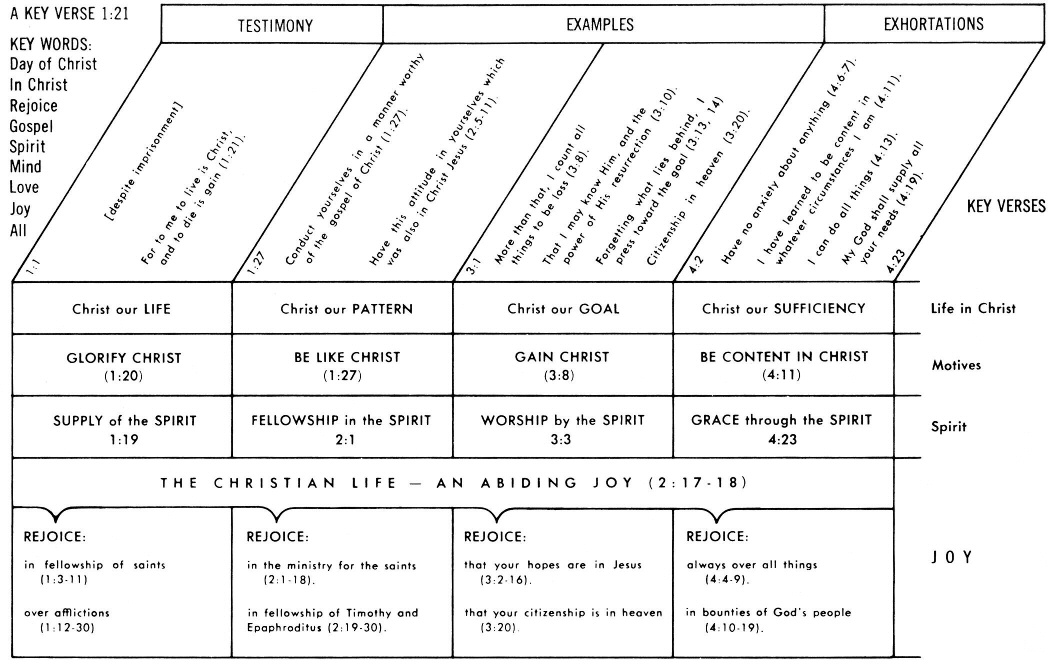
LIFE IN CHRIST
Click chart to enlarge
Charts from Jensen's Survey of the NT - used by permission
Philippians - Charles Swindoll = Chart on right side of page
| Account of Paul's Circumstances Php 1:1-30 |
Have the Mind of Christ Php 2:1-30 |
Have the Knowledge of Christ Php 3:1-21 |
Have |
| Partakers of Christ | People of Christ | Pursuit of Christ | Power of Christ |
| Suffering | Submission | Salvation | Sanctification |
| Experience | Examples | Exhortation | |

Philippi in the Time of Paul
The city plan above shows those features of the city of Philippi that archaeologists have so far identified as dating from the time of Paul. “Paul’s Prison” is not believed to be an authentic site, but was a cistern later associated with Christian worship. (ESV.org)
Philippians 2:23 Therefore I hope (1SPAI) to send (AAN) him immediately, as soon as I see (1SAAS) how things go with me; (NASB: Lockman)
Greek: touton men oun elpizo (1SPAI) pempsai (AAN) os an aphido (1SAAS) ta peri eme exautes
Amplified: I hope therefore to send him promptly, just as soon as I know how my case is going to turn out. (Amplified Bible - Lockman)
Barclay: So then, I hope to send him, as soon as I see how things go with me. (Westminster Press)
KJV: Him therefore I hope to send presently, so soon as I shall see how it will go with me.
Lightfoot: Him therefore I hope to send without delay, when I see what turn my affairs will take.
NLT: I hope to send him to you just as soon as I find out what is going to happen to me here. (NLT - Tyndale House)
Phillips: I hope to send him to you as soon as I can tell how things will work out for me (Phillips: Touchstone)
Wuest: This very one therefore I am hoping to send as soon as, having turned my attention from other things and having concentrated it upon my own circumstances, I shall have ascertained my position. (Eerdmans Publishing)
Young's Literal: him, indeed, therefore, I hope to send, when I may see through the things concerning me -- immediately;
Therefore I hope to send him immediately as soon as I see how things go with me: touton men oun elpizo (1SPAI) pempsai (AAN ) os an aphido (1SAAS) ta peri eme exautes:
- 1Sa 22:3
- Philippians 2 Resources - Multiple Sermons and Commentaries
- Philippians 2:19-30 Worth Imitating - Steven Cole
- Philippians 2:19-24 Model Spiritual Servants: Timothy - John MacArthur
- Philippians 2:19-24 Anti-Model of Leadership - John MacArthur
Therefore - term of conclusion
I hope (1679) (elpizo) speaks of Paul's confidence or assurance in the possibility that what he will be able to send Timothy.
Him (5126) (touton) means of these persons. Note that touton is placed first in the Greek sentence for emphasis. It is this one, Timothy himself. It is important to note that Paul was willing to give his best to these believers.
Send (3992) (pempo) means to dispatch as one would messengers, agents, or ambassadors.
As soon as I see how things go with me - Presumably refers to what would happen to Paul at his trial, whether he would be released or not.
I see (872) (aphorao from apó = away from or intensifier + horao = to look) means to look away steadfastly or intently from one thing toward another distant object. It means to see to an end or perceive clearly.
Wuest translates "see" as "having turned my attention from other things and having concentrated it upon my own circumstances" and comments that apeido "speaks here of the act of turning one’s attention from other things and concentrating them upon one’s own situation. Paul was so forgetful of self, yes, so dead to self, so engrossed in the welfare of others, that, even though he was a prisoner, and was facing martyrdom, yet he had not taken thought of his own welfare. He voices the hope that he will be able to send Timothy soon. But his sending Timothy is dependent upon his own circumstances which may or may not hinder." (Philippians Commentary - Verse by Verse)
Philippians 2:24 and I trust (1SRAI) in the Lord that I myself also will be coming (1SFMI) shortly. (NASB: Lockman)
Greek: pepoitha (1SRAI) de en kurio hoti kai autos tacheos eleusomai. (1SFMI)
Amplified: And I have confidence from the Lord that I myself will come to see you soon. (Amplified Bible - Lockman)
Barclay: But I am confident in the Lord that I myself too will soon come to you. (Westminster Press)
Lightfoot: At the same time I trust in the Lord, that I shall visit you before long in person.
KJV: But I trust in the Lord that I also myself shall come shortly.
NIV: And I am confident in the Lord that I myself will come soon. (NIV - IBS)
NLT: And I have confidence from the Lord that I myself will come to see you soon. (NLT - Tyndale House)
Phillips: but God gives me some hope that it will not be long before I am able to come myself as well. (Phillips: Touchstone)
Wuest: But I have come to a settled conviction, which conviction is in the Lord, that I also myself shall come shortly. (Eerdmans Publishing)
Weymouth: but trusting, as I do, in the Lord, I believe that I shall myself also come to you before long.
Young's Literal: and I trust in the Lord that I myself also shall quickly come.
AND I TRUST IN THE LORD THAT I MYSELF ALSO WILL BE COMING SHORTLY: pepoitha (1SRAI) de en kurio hoti kai autos tacheos eleusomai. (1SFMI):
- Phil 2:19; 1:25,26; Ro 15:28,29; Phile 1:22; 2 Jn 12; 3 Jn 14
- Philippians 2 Resources - Multiple Sermons and Commentaries
- Philippians 2:19-30 Worth Imitating - Steven Cole
- Philippians 2:19-24 Model Spiritual Servants: Timothy - John MacArthur
- Philippians 2:19-24 Anti-Model of Leadership - John MacArthur
Paul had confidence that he would soon be freed from prison and be able to visit the Philippians:
for I know that this will turn out for my deliverance through your prayers and the provision of the Spirit of Jesus Christ, Phil 1:19
Convinced of this, I know that I will remain and continue with you all for your progress and joy in the faith, so that your proud confidence in me may abound in Christ Jesus through my coming to you again. Phil 1:25-26.
I trust (3982) (peitho) means to cause to come to a particular point of view or course of action. The idea is to come to a settled persuasion concerning something or to be persuaded. It means to be so convinced that one puts confidence in something or someone.
Peitho is in the perfect tense which indicates that Paul had come to a settled persuasion at some point in time and that this persuasion had a permanent effect or impact on him. Peitho is a strong verb, carrying the components of confidence, reliance, and hope.
What does the little phrase "in the Lord" mean? In this context (and Php 2:19) clearly the idea is that Paul was willing to submit himself to the will of the Lord (which is always good and acceptable and perfect - Ro 12:2b). As James writes "Instead, you ought to say, "If the Lord wills, we shall live and also do this or that." (James 4:15) James says saints should have a heart attitude of total dependence on God's will. In fact we act presumptuously--and possibly calamitously--when we leave God and His will out of our plans and prayers! How often do I pray something with the attitude of "if it be Thy will?" (Not often enough in my case!) Paul was willing to place himself in the hands of God. Whatever the will of God, he would go with that. If God releases him from prison he will go to Philippi to resolve the church conflict. If God decided to keep him in prison, he would send Timothy to Philippi. Paul operated on the principle "if the Lord wills." Paul's security was independent of circumstances and rested completely on God's will.
The significant phrase in the Lord is used by Paul 9 times in Philippians, 3 times in this last section describing Timothy and Epaphroditus (Phil 1:14; 2:19, 2:24, 2:29, Phil 3:1, 4:1, 4:2, 4:4, 4:10 see notes Phil 1:14; 2:19, 24, 29, 3:1, 4:1, 4:2, 4:4, 10).
Dwight Edwards comments that "Not only is Paul expecting to send Timothy, but he is also confident that he will come quickly himself. Again we see his trust or confidence is not in the Roman system of justice, but in the Lord. Since the Lord wanted him free, no system or government could keep him in bondage." (Sermon)
A T Robertson on in the Lord adds that this is "not a perfunctory use of this phrase. Paul’s whole life is centered in Christ." (Gal 2:20).
Some commentaries feel that this phrase ("in the Lord") may be rendered “if the Lord wills” as in (Acts 18:21; 1Cor 4:19; Jas 4:15, Heb 6:3)
Others feel that "in the Lord" may suggest the agency of the confidence, for example, “the Lord has given me confidence that”. Interpreting the phrase in this manner, it is clear that the ground of Paul's confidence, hope and settled persuasion is in the sphere of the Lord. The idea is that it is only in the Lord that the apostle can look ahead with confidence, and with this confidence he says I myself will be able to come to you soon.
In either case, it is clear that every mood of Paul’s life is regulated by his submission to the will of His Lord. He was so "in synch" and in covenant oneness with his Lord and Master that all of his plans were conditioned by this intimate relationship.
Wiersbe comments on this Pauline mindset manifest by servant's heart and a "submissive mind is not the product of an hour’s sermon, or a week’s seminar, or even a year’s service. The submissive mind grows in us as... we yield to the Lord and seek to serve others." (Wiersbe, W: Bible Exposition Commentary. 1989. Victor)
APPLICATION: All the acts, thoughts, and attitudes of Christians should spring from the fact that they are "in the Lord" and are prompted by the Spirit. Everything we do should be consistent with, and submitted to, the Lord's will.
Is your attitude and approach to all of life and ministry dependent upon and directed by the phrase "in the Lord"?
Paul’s will and work are wholly dominated by the Lord whom he serves and as He wrote the Corinthians "I do not wish to see you now just in passing; for I hope to remain with you for some time, if the Lord permits" (1Cor 16:7)
This verse emphasizes that all of Paul's hopes and plans are a result of his being in communion with his Lord.
J Vernon McGee asks the question you may be asking Shouldn’t we have plans? By all means we should make plans, but those plans always should be amenable to the will of God. We should be willing to change them. We should be willing to shuffle things around. When Paul went out, he did not have a rigid schedule for his missionary journeys. He went as the Lord led him. We see in the Book of Acts how the Lord just practically detoured him on the second missionary journey. Paul was going down into Asia; the Spirit of God sent him over to Europe. He didn’t know he was going to Europe—he didn’t have a visa for Europe—but in that day he didn’t need a visa. He went where the Holy Spirit led him." May his tribe increase! (McGee, J V: Thru the Bible Commentary: Nashville: Thomas Nelson)
Wiersbe cautions that "There are two extremes we must avoid in this important matter of seeking God’s will. One is to be so frightened at making a mistake that we make no decisions at all. The other is to make impulsive decisions and rush ahead, without taking time to wait on the Lord. After we have done all we can to determine the leading of the Lord, we must decide and act, and leave the rest to the Lord. If we are in some way out of His will, He will so work that we will finally have His guidance. The important thing is that we sincerely want to do His will (John 7:17). After all, He guides us “for His name’s sake” (Ps 23:3), and it is His reputation that is at stake. (Wiersbe, W: Bible Exposition Commentary. 1989. Victor)
This truth finds a parallel in Jesus' declaration: "I am the vine, you are the branches; he who abides in Me, and I in him, he bears much fruit, for apart from Me you can do (absolutely) nothing." (Jn 15:5)
Coming (2064) (erchomai) means to come or go, to fall out.
Shortly (5030) (tacheos from tachús = prompt, swift) means quickly, speedily and is equivalent to soon, shortly, quickly, hastily. Tacheos can refer to a very brief extent of time with a focus on the speed of the action. In the present context tacheos refers to a future point of time that is subsequent to another point of time, with focus on brevity of interval rather than on speed of activity. (Cp cognate word tachinos)
Paul believed that he would receive his freedom and would be able to return to Philippi fairly soon. Earlier he wrote "And convinced of this, I know that I shall remain and continue with you all for your progress and joy in the faith (see note Philippians 1:25)
He hopes that his appeal will be successful, and that he will be set free so that he might visit the Philippians once more.
John MacArthur adds that Paul "He did not minimize the value he could be to the church at Philippi by ministering to them in person. Whether or not he did, however, it is clear that he had the utmost confidence in Timothy. (MacArthur, J. Philippians. Chicago: Moody Press)
On this day that we honor mothers, we want those of you who are moms to know that you matter! Unfortunately kids don’t always let their moms know the depth of their devotion but some younger school children have done so with these answers to the following questions.
Why did God make mothers?
• She’s the only one who knows where the scotch tape is.
• Mostly to clean the house.
• To help us out of there when we were getting born.
What ingredients are mothers made of?
• God makes mothers out of clouds and angel hair and everything nice in the world…and one dab of mean.
Why did God give you your mother and not some other mom?
• We’re related.
• God knew that she would like me a lot more than other people’s moms like me.
What kind of little girl was your mom?
• My mom has always been my mom and none of that other stuff.
• I don’t know because I wasn’t there, but my guess would be pretty bossy.
What’s the difference between moms and dads?
• Moms work at work and work at home, and dads just work at work.
What would it take to make your mom perfect?
• On the inside she’s already perfect. Outside, I think some kind of plastic surgery.
If you could change one thing about your mom, what would it be?
• She has this weird thing about me keeping my room clean. I’d get rid of that.
• I’d make my mom smarter. Then she’d know it was my sister who did it and not me.
• I would like for her to get rid of those invisible eyes in the back of her head.
As we come to the second chapter of Philippians this morning, it strikes me that more than anything else, what makes for good mothers is the ability to think of others more than they think of themselves. Actually, that’s Paul’s passion for each of us. If we call ourselves Christians and want to grow, and we desire this church to be all that it can be, we must develop an others orientation. The Philippian church had been infected with the deadly disease of disunity and the only cure was to recommit to biblical servanthood.
Please turn to Philippians 2:1-11 where Paul gives us four essentials to help us become more oriented toward others.
1. Fathom the excellence of what we have (Php 2:1). Many of us forget what we’ve been given. Look at verse 1: “If you have any encouragement from being united with Christ, if any comfort from his love, if any fellowship with the Spirit, if any tenderness and compassion.” Normally the word “if” conveys doubt. But here Paul is using a Greek grammatical form that actually expresses certainty. He’s really saying, “If such-and-such is true – and I know that it is.” A better translation would be “since.”
• Since you have encouragement from being united with Christ. The word “encouragement” means “to come alongside to support and help.” This consolation that comes from Christ was predicted by Simeon in Luke 2:25: “He was waiting for the consolation of Israel…” We should be encouraged because we are commended by Christ and never have to face condemnation from Him as Romans 8:1 states: “Therefore, there is now no condemnation for those who are in Christ Jesus.”
• Since you have comfort from his love. The word “comfort” means the “alleviation of suffering and misery.” Knowing that He lavishes His love on us should give us great comfort and security because He will never abandon us as promised in Hebrews 13:5: “Never will I leave you; never will I forsake you.”
• Since you have fellowship with the Spirit. Knowing that we have immediate access to the Almighty gives us confidence that He is always available as Hebrews 4:16 states: “Let us then approach the throne of grace with confidence, so that we may receive mercy and find grace to help us in our time of need.”
• Since you have tenderness and compassion. The word “compassion” literally refers to feeling something in your gut, to be moved in your intestines, if you will. MacArthur writes that the Hebrews expressed attitudes and emotions in terms of physiological symptoms, not in abstractions. And, recognizing that Christ is compassionate toward us should fill us with that same kind of compassion and tenderness toward others as stated in Colossians 3:12: “Therefore, as God’s chosen people, holy and dearly loved, clothe yourselves with compassion, kindness, humility, gentleness and patience.” Paul had this kind of feeling toward the Philippians in 1:8: “…I long for all of you with the affection of Christ Jesus.”
Every Christian has received these blessings. This is similar to what is said in Ephesians 1:3: “Praise be to the God and Father of our Lord Jesus Christ, who has blessed us in the heavenly realms with every spiritual blessing in Christ” and 2 Peter 1:3: “His divine power has given us everything we need for life and godliness…” Friends, we have been blessed way beyond what we deserve. Paul’s point is this: Since you’ve been given all this, shouldn’t you grant grace to others and do whatever it takes to promote peace and embrace unity?
2. Fulfill the expectations of what we must do (Php 2:2-4). We must do something with what we have. Notice the word “then” in the first part of verse 2. If (since) you have all these blessings, then do the following. And when believers fulfill these expectations, Paul says that this will “make my joy complete.” Once again, we see how Paul weaves joy into this letter. His joy would be full if they fulfilled these commands. The tense of this means we are to do so immediately and without delay. As we go through these specific expectations, remember that we’ve been given the spiritual resources of verse 1 in order to fulfill them. As someone has said, “God’s commands are not demands upon you but rather a demand upon the God who gave the command.”
• Resolve to pull together (Php 2:2). This is a very strong appeal to unity. Look with me at verse 2: “…by being like-minded, having the same love, being one in spirit and purpose.” To be like-minded literally means, “To think the same thing.” To have the “same love” gets to our feelings and our unconditional commitment to every Christian, whether we like them or not. And to be “one in spirit and purpose” touches on how we relate to one another. The Greek is helpful here because this phrase literally means, “same-souled.” We have shared heads, hearts and hands. Our thoughts should be on the same page; our feelings should move us toward each other; and then we must reach out and walk hand-in-hand. It’s not enough to just think good thoughts or even to have warm fuzzy feelings; we must also have our souls joined together in one purpose; that of bringing glory to God by getting the gospel out.
• Resist selfishness (Php 2:3a). “Do nothing out of selfish ambition or vain conceit…” The phrase “selfish ambition” means strife that comes from ugly self-promotion. One pastor says that this speaks of a competitive spirit that destroys unity by dividing the church into groups and cliques. This person thinks only of himself or herself, similar to Diotrephes in 3 John 9-10: “Diotrephes, who loves to be first, will have nothing to do with us. So if I come, I will call attention to what he is doing, gossiping maliciously about us....” Selfishness and pride are at the root of every sin. If you find yourself positioning for personal profit, if you must win every argument, if you think your sin smells better than others, than you’re in danger of being a Diotrephes. If you’re thinking of someone who fits this description and you hope they’re listening, or wish they were here today, James 4:1 reminds us that the source of our conflict might actually be closer than we care to admit: “What causes fights and quarrels among you? Don’t they come from your desires that battle within you?”
In his book, “Mere Christianity,” C.S. Lewis calls pride the great sin: “There is one vice of which no man in the world is free, which every one in the world loathes when he sees it in someone else…If anyone would like to acquire humility I can think tell him the first step. The first step is to realize that one is proud…If you think you are not conceited, it means that you are very conceited indeed.” You’ll know that you’re making progress in this area when you begin to think less of your own abilities and more of your imperfections.
One pastor suggests some searching questions that each of us should ask…
- Do I love to argue too much?
- Do I worry whether others recognize my contributions?
- Am I secretly envious of others?
- Do I sometimes rejoice at the misfortunes of others?
- Am I quick to criticize those who are different from me?
- How much time do I spend talking about myself?
- Do I do more talking than listening?
• Regard others as more important (Php 2:3b). “…but in humility consider others better than yourselves.” This is a tough one because most of us secretly believe that we’re better than those around us. But humility is a prerequisite for unity. The word “humility” was often used to describe the mentality of a slave and had the idea of “base, shabby, low, and common.” Someone has described humility as “insight into one’s insignificance.” This is captured in Romans 12:3, 10: “Do not think of yourself more highly than you ought…Be devoted to one another in brotherly love. Honor one another above yourselves.” Numbers 12:3 describes Moses as a good model of humility: “a very humble man, more humble than anyone else on the face of the earth.”
“To consider others better” is to think of others as superior to yourself. This is a mathematical term which means, “Think about it and come to a conclusion.” We are to count what is really there, add it up, and find out what is true. A wonderful biblical example is found in Genesis 13 where we read that Abraham allowed Lot to choose whatever land he wanted. He thought more highly of his nephew than he thought of himself and verse 8 says Abraham did it for the sake of unity: “Let’s not have any quarreling between you and me, or between your herdsmen and mine, for we are brothers.” When’s the last time you specifically did something to avoid an argument?
Watchman Nee, the Chinese evangelist, tells of a Christian he once knew in China. He was a poor rice farmer, and his fields lay high on a mountain. Every day he pumped water into the paddies of new rice, and every morning he returned to find that a neighbor who lived down the hill had opened the dikes surrounding the Christian’s field to let the water fill his own. For awhile he tried to ignore the injustice but then he couldn’t take it any more so he decided to meet and pray with another Christian and came up with this solution. The next day the Christian farmer rose early in the morning and first filled his neighbor’s fields; then he attended to his own. Watchman Nee tells how the neighbor subsequently became a Christian because of this genuine demonstration of humility and Christian character (as quoted by James Montgomery Boice, “Philippians,” Page 107).
• Remember the needs of others (Php 2:4). I heard Ken Marley use an expression recently that I had never heard before. Instead of saying, “Me-first,” we really should say, “Me-third.” That means that God is first, everyone else is second, and I’m third. Warren Wiersbe uses J.O.Y. as an acrostic to help us see the importance of putting the needs of others first. “J” stands for Jesus first. “O” is for others. “Y” is for yourself last. That’s what the Apostle Paul is saying in verse 4: “Each of you should look not only to your own interests, but also to the interests of others.” To “look” is to fix one’s attention on, with great interest in. Some of us need to take our eyes off ourselves and literally lift them to look at others. This lines up with what our Lord taught in Mark 10:44: “Whoever wants to be first must be slave of all.”
Chuck Swindoll suggests a great application for Php 2:3-4 by asking us to fill in the blanks of this paraphrase with the names of two people we’re struggling with right now: “Do nothing from selfishness or empty conceit, but with humility of mind regard ________ as more important that yourself; do not merely look out for your own personal interests, but also for the interests of _________.”
3. Follow the example of Christ (Php 2:5-8). Aren’t you glad that you don’t have to make your own roadmap to maturity? We don’t have to wonder how God wants us to live because the Messiah is our model. Our attitudes and actions should reflect the example of Christ. Look at verse 5: “Your attitude should be the same as that of Christ Jesus.” This means that we are to set our minds on the Master.
J. Gresham Machen gave an unforgettable commencement address in 1929: “It is a serious step, in these days…to become a Christian…the man who today enters upon the Christian life is enlisting in a warfare against the whole current of the age.” After challenging students to hold to pure doctrine by resisting an easier, culture-friendly version of Christianity, Machen gave the graduating class some advice that is equally applicable today: “Read the Gospels…Just read them; just let the stupendous figure of Jesus stand before your eyes and become convinced that the pathway of true progress leads to the feet of Jesus” (As quoted in www.worldmag.com, 5/3/05).
Let’s study the steps that Jesus took by looking at the different downward levels taken by the Lord.
• Sovereign (Php 2:6). Philippians 2:6 states that Jesus has always existed and He is God: “Who, being in very nature God, did not consider equality with God something to be grasped.” He did not have to “grasp” on to the glory of God. It was not something He had to defend or hold on to. He let it go to come to our world. Have you ever stopped to wonder what it must have been like for Jesus to leave the holiness of heaven and come to the woes of our world? He had been eternally surrounded by unimaginable beauty and then He was birthed among beasts, both of the animal and human variety. 1 Timothy 3:16 speaks of the mystery of Godliness, namely that “He appeared in a body.” This is the crux of Christmas. That’s why He was given the name “Immanuel,” which means, “God with us” (Matthew 1:23).
• Servant (Php 2:7). Jesus went from sovereignty to servanthood. Verse 7 says that He made “himself nothing, taking the very nature of a servant.” The Greek literally means that “He emptied Himself.” Listen carefully. Jesus never abandoned His deity, but He did empty Himself of some things while He was on earth.
- He willingly gave up His glory. That’s why later in His ministry, shortly before He died, Jesus asked the Father to give Him His glory back in John 17:5: “And now, Father, glorify me in your presence with the glory I had with you before the world began.”
- He gave up His honor. The Majesty allowed Himself to be mistreated, He was hated and mocked and spit upon. Isaiah 53:3: “He was despised and rejected by men, a man of sorrows, and familiar with suffering. Like one from whom men hide their faces he was despised, and we esteemed him not.”
- He rejected His riches. 2 Corinthians 8:9: “For you know the grace of our Lord Jesus Christ, that though he was rich, yet for your sakes he became poor, so that you through his poverty might become rich.”
It wasn’t that Jesus lost any of His divine attributes; He simply chose to not use them. He had the prerogative of Majesty but chose the place of a menial servant. Jesus described Himself this way in Luke 22:27: “But I am among you as one who serves.”
• Submission (Php 2:8a). As God, He emptied Himself, as man He humbled Himself. Philippians 2:8: “And being found in appearance as a man.” In this step down, Jesus voluntarily submitted Himself to hunger and pain and tiredness and emotions and other human limitations, and yet never sinned. Hebrews 4:15 says that Jesus “has been tempted in every way, just as we are-yet was without sin.”
• Sacrifice (Php 2:8b). In this final step down, we see exactly why Jesus came to earth. He was born to die. His death was no accident; He came on purpose to die in our place. The last part of Philippians 2:8 reads: “He humbled himself and became obedient to death--even death on a cross!” Death on a cross was brutal and barbaric and was not even talked about in polite Roman society circles. Ancient writers used to say that to die on a cross was to die a thousand times before you take your last breath. May I suggest that this was not the worst of it for Jesus? The most painful element of his death is that when He died, all the smelly sins and terrible transgressions of the entire world were placed on His shoulders. And when He hung on the cross as our sacrificial sin substitute, God the Father had to look away, causing the Son to cry out in agony, “My God, my God, why have you forsaken me?” (Matthew 27:46).
Because He was fully man He could take our punishment upon Himself and because He is fully God, the shedding of His blood satisfied divine justice. Jesus is both just and the justifier. 1 Peter 3:18: “For Christ died for sins once for all, the righteous for the unrighteous, to bring you to God.”
4. Focus on the exaltation of Christ (Php 2:9-11). The Sovereign became a Servant and was Submissive in order to be our Sacrifice. And then He was exalted to the highest place once again. Verses 9-11 describe this three-fold exaltation.
• God has exalted His name. Php 2:9: “Therefore God exalted him to the highest place and gave him the name that is above every name.” There is nothing higher than Jesus; everything else is below Him.
• Everyone will bow in allegiance to Him. Php 2:10: “That at the name of Jesus every knee should bow, in heaven and on earth and under the earth.” Those in heaven will hit the ground before His glory, which includes the angelic host and all the believers who have died before us. Those on earth will bow, which includes skeptics, agnostics and atheists, even those who mocked Him when He was alive. And those who are under the earth will bow, which refers to the unsaved who have died, and Satan and all his demons. It’s much better to bow willingly while there is still time than to wait until it’s too late. You’re going to bow either way. It’s just a matter of time. Here’s the question: Will you voluntarily humble yourself before the Lord or wait until you’re forced to do so?
• Every tongue will confess that Jesus is Lord. Php 2:11: “And every tongue confess that Jesus Christ is Lord, to the glory of God the Father.” This is the quintessential confession of Christianity. To know Christ as Savior is to confess Him as Lord. The Lordship of Christ is at the core of what it means to be a Christian. Is He the Lord of your life?
I can think of two applications this morning.
1. Decide to be saved.
In hearing these last three verses, the question suddenly becomes very personal and very urgent: Have you bowed before Christ and have you confessed that He is your Lord and Savior? If not, why not? You’re going to do it sooner or later. It’s much better to do it now, isn’t it? You may want to pray this prayer along with me: “Lord Jesus, for too long I’ve kept you out of my life. I bow before you right now and confess that you are my Lord. I admit that I am a sinner and that I cannot save myself. I repent of my sins by changing my mind about the way I’ve been living. I believe and gratefully receive you as my Risen Savior. Thank you, Lord Jesus, for coming to earth. With all my heart I confess that you are the Son of God who died on the cross for my sins and that you rose from the dead on the third day. Thank you for bearing my sins and giving me the gift of eternal life. I want to cross over from death to life. I ask you now by faith to come into my life so that I may serve you forever and learn to put you first, others second, and me last. Amen.”
2. Determine to be a servant.
According to one study I read, if a mom was fully compensated for all she does, her annual salary would be over $500,000! Children don’t always appreciate their moms, but as we get older, we certainly celebrate all that you do! It’s obvious that we can’t afford to pay you, but we sure want you to know how much we value you.
And for all of us, let’s fathom the excellence of what we have, and fulfill the expectations of what we must do by resolving to pull together, resisting selfishness, regarding others as more important, and by remembering the needs of others. Make sure you’re following the example of Christ and focus on His coming exaltation. You might get paid for other things you do, but to develop an others orientation…as the commercial says, “That’s priceless.” And then you’ll hear those words we all want to hear from the lips of the one whose name is above all names: “Well done, good and faithful servant!” (Matthew 25:23).
Drama: “Dueling iPods”
What were your thoughts during this drama? How did it make you feel? Did it make you uncomfortable? Where are you sitting? Which character are you? Did it make you sad as they moved farther and farther apart? [Write thoughts down on white board]
The words of Jesus from John 17:20-23: “I pray also for those who will believe in me through their message, that all of them may be one, Father, just as you are in me and I am in you. May they also be in us so that the world may believe that you have sent me. I have given them the glory that you gave me, that they may be one as we are one: I in them and you in me. May they be brought to complete unity to let the world know that you sent me and have loved them even as you have loved me.”
Ephesians 4:2-6: “Be completely humble and gentle; be patient, bearing with one another in love. Make every effort to keep the unity of the Spirit through the bond of peace. There is one body and one Spirit- just as you were called to one hope when you were called- one Lord, one faith, one baptism; one God and Father of all, who is over all and through all and in all” and verse 13: “Until we all reach unity in the faith and in the knowledge of the Son of God and become mature, attaining to the whole measure of the fullness of Christ.”
Philippians 2:1-5: “If you have any encouragement from being united with Christ, if any comfort from his love, if any fellowship with the Spirit, if any tenderness and compassion, then make my joy complete by being like-minded, having the same love, being one in spirit and purpose. Do nothing out of selfish ambition or vain conceit, but in humility consider others better than yourselves. Each of you should look not only to your own interests, but also to the interests of others. Your attitude should be the same as that of Christ Jesus.”
Paul gives us four essentials in this passage to help us become more oriented toward others. Please turn to Philippians 2.
1. Fathom the excellence of what we have (2:1). Many of us forget what we’ve been given. Look at verse 1: “If you have any encouragement from being united with Christ, if any comfort from his love, if any fellowship with the Spirit, if any tenderness and compassion.” Normally the word “if” conveys doubt. But here Paul is using a Greek grammatical form that actually expresses certainty. He’s really saying, “If such-and-such is true – and I know that it is.” A better translation would be “since.”
Every Christian, regardless of their praise preferences, has received these blessings. Paul’s point is this: Since you’ve been given all this, shouldn’t you grant grace to others and do whatever it takes to promote peace and embrace unity?
2. Fulfill the expectations of what we must do (2:2-4). We must do something with what we have. Notice the word “then” in the first part of verse 2. If (since) you have all these blessings, then do the following. And when believers fulfill these expectations, Paul says that this will “make my joy complete.” The tense of this means we are to do so immediately and without delay.
• Resolve to pull together (2). This is a very strong appeal to unity. Look with me at verse 2: “…by being like-minded, having the same love, being one in spirit and purpose.” To be like-minded literally means, “To think the same thing.” To have the “same love” gets to our feelings and our unconditional commitment to every Christian, whether we like them or not – and whether we like their music or not. To be “one in spirit and purpose” touches on how we relate to one another. The Greek is helpful here because this phrase literally means, “same-souled.”
• Resist selfishness (3a). “Do nothing out of selfish ambition or vain conceit…” The phrase “selfish ambition” means strife that comes from ugly self-promotion and a competitive spirit that destroys unity by dividing the church into groups and cliques. Selfishness and pride are at the root of every sin.
• Regard others as more important (3b). “…but in humility consider others better than yourselves.” This is a tough one because most of us secretly believe that we’re better than those around us and that our music preference should be prescribed for everyone. But humility is a prerequisite for unity. “To consider others better” is a mathematical term which means, “Think about it and come to a conclusion.” We are to count what is really there, add it up, and find out what is true. A wonderful biblical example is found in Genesis 13 where we read that Abraham allowed Lot to choose whatever land he wanted. He thought more highly of his nephew than he thought of himself and verse 8 says Abraham did it for the sake of unity: “Let’s not have any quarreling between you and me, or between your herdsmen and mine, for we are brothers.” When’s the last time you specifically did something to avoid an argument?
• Remember the needs of others (4): “Each of you should look not only to your own interests, but also to the interests of others.” To “look” is to fix one’s attention on, with great interest in. Some of us need to take our eyes off ourselves and literally lift them to look at others.
3. Follow the example of Christ (2:5-8). Aren’t you glad that we don’t have to make our own roadmap to maturity? We don’t have to wonder how God wants us to live because the Messiah is our model. Look at verse 5: “Your attitude should be the same as that of Christ Jesus.” This means that we are to set our minds on the Master and emulate His example.
As we continue in our series called “Worship Matters” I almost wanted to change the topic of today’s sermon because I see so much grace and unity here. But I decided to preach on “The Real Worship Wars” anyway because this topic can bring out a musical maelstrom and has led to wars in many churches. Conversations about worship often produce more heat than light and instead of bringing us closer, as we saw in the drama; our praise preferences can actually polarize us.
Historical Music Madness
I find it helpful to know that skirmishes over musical styles in the church are not a new thing. In fact, it’s been going on for a long time. I’m certainly no expert in church history so I’m thankful to Pastor Stephen Schwambach for his insights (www.sermoncentral.com). If you’re in a small group you’ll study more about this in your lesson for this week.
For the first several hundred years of Christianity there was great freedom in the area of music but that all changed in the early 300’s when congregational singing was discouraged and only professional “praisers” were allowed to sing. In addition, musical instruments were not allowed in the church. Chanting became the accepted way to adore God.
It stayed that way for the next thousand years or so until a young monk named Martin Luther launched the Protestant Reformation. Having a musical background, Luther began writing songs that reflected personal experiences with God and brought the instruments back into church. And, the congregation was invited to sing along to songs like “A Mighty Fortress is our God.” This was controversial, especially since he brought the organ into church because many thought that this was a “worldly” instrument.
A couple hundred years later, fifteen-year-old Isaac Watts was turned off by the stuffy church music of his day and finally his dad had enough and said to him one Sunday after the service, “Then give us something better, young man!” He wrote his first song before the evening service. He had a millennial mindset and believed that “songs should stir the soul” and be plain, personal and powerful. He’s known for “Joy to the Word!” and “When I Survey the Wondrous Cross.” Do you think people liked his 600 or so songs? No, they hated them, referring to them as “Watts’ Whims!” Congregations actually split over whether or not they could be used in church services. One article I read indicated that it took about 100 years for his hymns to be accepted because many didn’t like how he paraphrased Scripture with his “man-made” music.
Later in that century two brothers kicked things up another notch – John and Charles Wesley. They believed that the only way to reach the common person was to give them music they could relate to. Did you know that Charles wrote 6,500 hymns like “Christ the Lord is Risen Today” and “O for a Thousand Tongues to Sing.”
Years later Fanny Crosby introduced a new form called “Gospel Hymns” with titles like “Redeemed How I Love to Proclaim It” and “To God Be the Glory.” While her 7,000 hymns are appreciated today, back then her songs were attacked as heathenistic “dance music.” Tempers boiled over and churches ruptured.
In 1865 William Booth believed that the way to reach the lost was through the music they loved and so he adopted popular tunes and gave them Christian lyrics. He’s famous for saying, “Why should the devil have all the best music?” Black gospel music was criticized when it first came out and southern gospel music was met with this refrain from many: “Not in our church, you don’t.” Then, in the early days of the Jesus movement, a man named Larry Norman, who was so committed to reaching people with music, tried to bring guitars and drums into the church, only to be criticized. He has been called the “father of Christian rock” but refers to himself this way: “I’m just an artist reaching toward heaven.”
So in once sense there has always been conflict in churches about music. The real issue is not really our preferences but whether or not we have a passion for God. We shouldn’t be in wars about worship but rather be growing in our wonder for God. John Fischer, a singer and songwriter, wrote an article several years ago called, “What to Do about the Worship Wars” (www.moodymagazine.com). I appreciate his perceptive insight: “Never before, at least in my lifetime, has worship been more important to Christians; and never before has it been so complicated and tentative, as people shuffle from church to church seeking the right blend of worship experience for their families in what seems like an endless zero-sum game…Many people go to church today more to experience God than they go to hear about Him…and that experience they define as worship…The bad thing is that each person now becomes the sole and final authority as to what worship is. In effect, ‘worship’ is whatever connects with me. What I like and understand is what ministers to me.”
I want to suggest that the real war however, is being fought on three fronts. It’s not so much about music as it is about a believer’s battle with society, with Satan and with self.
1. War with society. We could call this the war “out there.” In our sin-soaked society where celebrity is supreme and entertainment is our elixir, we must crave the Word and not cave to the world. While we live in this world, we are not to be of this world. James 4:4: “You adulterous people, don’t you know that friendship with the world is hatred toward God? Anyone who chooses to be a friend of the world becomes an enemy of God.” 1 Corinthians 1:20 says that the wisdom of the world is “foolish.” As an example of what our society is like today, a state senator from Nebraska has sued God, seeking a permanent injunction against Him (www.ketv.com). People can curse God on national TV and utter blasphemies regarding Jesus with hardly anyone batting an eye. And Colossians 2:8 cautions Christians against following empty philosophies and worldly ways: “See to it that no one takes you captive through hollow and deceptive philosophy, which depends on human tradition and the basic principles of this world rather than on Christ.” James 1:27 adds that we are to keep from “being polluted by the world.”
The way to do battle against society and win the war against the world is through faith. Listen to the words of 1 John 5:4: “For everyone born of God overcomes the world. This is the victory that has overcome the world, even our faith.”
2. War with Satan. We could call this the war “beyond here.” I turn to John Fischer again: “The war is not between those who want traditional worship and those who want contemporary worship. The real war is with the enemy who would do us in by dividing us and rendering us ineffective by our bickering and fighting.”
Ezekiel 28 describes a scene that played out in Heaven a long time ago. Satan was originally created to be an angelic leader but wanted to be totally in charge and overthrow God’s rule by leading a number of other angels in his insurrection. As a result, God cast him and his cohorts out of heaven. The language is graphic and intense in verses 12-17: “You were the model of perfection, full of wisdom and perfect in beauty...you were anointed as a guardian cherub...you were blameless in your ways from the day you were created until wickedness was found in you...your heart became proud on account of your beauty, and you corrupted your wisdom because of your splendor. So I threw you to the earth...”
In a parallel passage, Isaiah 14:11 says that Satan was puffed up with pride and loved the sound of music before being kicked out of heaven: “All your pomp has been brought down to the grave, along with the noise of your harps; maggots are spread out beneath you and worms cover you.”
Ever since their expulsion from Heaven, Satan and his minions have had an agenda for revenge and have launched a celestial conspiracy against the person of God, the purposes of God, the people of God, the praise of God, and the pursuers of God.
• Satan Attacks the Person of God. One verse that describes Satan’s ultimate desire is found in Isaiah 14:14: “I will make myself like the Most High.” Since he failed in this attempt and was cast out of the presence of God, Satan and his evil angels are set on attacking the person of God. And they are relentless. Satan is referred to as the “adversary” 56 times in the Bible. It was pride that caused his downfall and it is pride that makes him continue his adversarial attacks on the Almighty.
• Satan Attack the Purposes of God. Satan is diametrically opposed to everything that God is accomplishing today. While the good angels serve as messengers of God, Satan and his cohorts will do anything they can to derail what God is doing. The evil one is set on annihilating the church or neutralizing its effectiveness. He takes great pleasure in causing chaos and conflict within churches. He knows that if he can get a church to fight against itself, it will lose its effectiveness as a conduit of God’s truth and grace to a hurting world.
• Satan Attacks the People of God. When Satan attacks the person and purposes of God, he does it very boldly. When he attacks the people of God, he’s much more subtle in his strategy. To borrow the title of Ray Pritchard’s new book, Satan uses a “stealth attack” to divide, divert, deride and dishearten believers. Look at it this way. Satan and his followers know that they will only get a small percentage of people to become Satanists. So, instead of making bold appearances, their tactics are subtle -- but they are designed to shipwreck your faith.
• Satan Attacks the Praises of God. The devil hates it when we sing praises to God. He hates our music because our singing rouses our souls, gives us courage, lifts our hearts, restores our faith, builds our confidence, unites our voices, and lifts up the name of the Lord like a mighty banner. Music is not just preparation for warfare. Music is spiritual warfare. When God’s people sing together, we invade the devil’s territory. When we’re seething with anger instead of singing with adoration, Satan wins.
I know Satan has already been defeated by Christ and that he’s lost but sometimes I wonder if he’s wining the “worship war.” In a 2002 study by George Barna, only three out of ten church-going adults indicated that they view worship as something that is focused primarily on God (www.barna.org). Pastor Dick wrote down some ways that Satan attacks in this area.
• Satan gets us to argue so we don’t sing.
• Satan wants us to be split over music.
• Satan wants us to be critical of someone else’s music.
• Satan wants us to not accept others’ music.
• Satan wants us to get the idea that music=worship.
• Satan Attacks the Pursuers of God. Armed with spiritual scud missiles, he plays insidious mind games with those who aren’t yet believers. 2 Corinthians 4:4 says that, “The god of this age has blinded the minds of unbelievers, so that they cannot see the light of the gospel of the glory of Christ, who is the image of God.”
If we war against society through our faith, then we win against Satan by resisting him. James 4:7: “Submit yourselves, then, to God. Resist the devil, and he will flee from you.”
3. The war with self. We must fight “out there” and “beyond here.” We must also do battle “inside here.” Mark Labberton writes: “…Many debates about worship are just indirect ways of talking about ourselves, not God. Our debates devolve into how we like our worship served up each week. It’s worship as consumption rather than offering. It’s an expression of human taste, not a longing to reflect God’s glory.”
In worship, God is asking us to do something that we are uniquely designed to do but at the same time, what our sinful nature rebels against. Society and Satan are my enemies but my other enemy is myself and my own divided heart that fights against my full devotion to Christ. Worship is like a wrestling match because I am selfish.
The way to win the war with self is to surrender. It comes back to Romans 12:1: “Therefore, I urge you, brothers, in view of God’s mercy, to offer your bodies as living sacrifices, holy and pleasing to God-this is your spiritual act of worship.” For a refresher on how to do this, see the sermon called “Worship is a Verb” (www.pontiacbible.org).
Adoration Must Lead to Action
We want to always be application-oriented at PBC because our adoration must lead to action. These action steps will help us fight on three fronts – against society, Satan and self – so that we can become those who worship in spirit and in truth.
1. Sing the Psalms for 30 days. A beautiful story is told of a young French girl who had been born blind. After she learned to read by touch, a friend gave her a Braille copy of Mark’s gospel. She read it so much that her fingers became calloused and insensitive. In an effort to regain her feeling, she cut the skin from the ends of her fingers. Tragically, however, her calluses were replaced by scarring that took away all feeling. She started sobbing and gave the Bible a goodbye kiss, saying, “Farewell, farewell, sweet word of my heavenly Father.” In doing so, she discovered that her lips were even more sensitive than her fingers had been, and so she spent the rest of her life reading God’s treasure with her lips. If you sing five psalms a day, you’ll finish all of them in a month.
2. Ask to hear someone’s testimony. Once we know how someone got saved, it’s much easier to appreciate the kind of singing they like. That reminds me of the young girl who got saved at a revival in the morning and in the afternoon was singing and dancing in the house. Her sour grandfather rebuked her with these words: “You ought to be to be ashamed of yourself! You just went to church and now you’re singing and dancing on the Lord’s day!” Crushed by her grandfather’s attitude, the little girl went out to the barn, climbed up on the fence and observed an old mule standing there with a sad, droopy face and bleary eyes. As she reached over and patted the mule sympathetically, she said, “Don’t cry, ole mule. I guess you got the same kind of religion that grandpa has!” The next time you’re talking to a Christian, ask to hear how he or she became a Christian – it may keep you from being grumpy.
3. Spend time with someone you don’t like this week. It’s easy for us to just hang out with people who are like us. The body of Christ has always included people who are not like each other and don’t like each other. Think of how the Jews and the Greeks got along, the Barbarians and the Scythians, the slaves and free. If we’re going to be the church, then we must seek unity in the midst of diversity. Here’s a principle that Beth and I heard in a marriage conference over twenty years ago. When you see another person who has different preferences than you do, say these words silently: “Not wrong, just different.” By the way, if you want to get together this week I’ll know it’s because you don’t really like me.
4. Practice praying. Harold Best suggests this prayer for those of us who like the familiar when it comes to music: “Almighty God, here I am again in the same place, hearing the same music. I love it; it means much, I feel close to you and know you to be close to me. Help me understand that I risk danger by vainly repeating, by assuming you are nearer because everything is so familiar. Instead, make all of this new to me once again, as only the God of mystery can. Take me back to the first day of creation when all was new; bestow on me the gift of offering all to you as never before.”
And, here’s a prayer we can pray when we are in the midst of newness: “Almighty God, what I am now seeing and hearing makes no sense. It is not what I like or what I expected. Even so, it is here; I am here; you are here. There are some here who passionately love you and have made this offering to you, even though I can’t make hide or hair of it. Nonetheless, I join with them by faith; I join with an offering that, to me, only bespeaks a mystery. I offer what I do not understand to you, the one whom I will never fully understand…I turn from what I already know to what I need to know.” (“Music Through the Eyes of Faith,” pages 154-155).
5. Start serving now. I’ve brought this up the last two Sundays and I do so again today because it is so important. Worship must lead to work. If you’re blessed in here on a Sunday morning that’s good, but God defines worship as each of us leaving here to be a blessing to others. The evidence that worship is happening is not whether we like the songs but whether we are giving our lives away in service. One pastor puts it this way: “Biblical worship that finds God will also find our neighbor.”
I played around with some phrases this week, looking for a perfect punch. Here’s what I came up with: Singing must lead to serving. If you just soak, you’ll croak. If you don’t commit to serve, you’ll end up criticizing those who are serving. Pew paralysis leads to too much analysis. Friends, if you and I aren’t serving, then we’re not worshipping. I received a very encouraging email from someone this week. Let me read part of it: “We feel as though it is time for us to do more than just attend on Sundays. We understand that there is an abundance of opportunities for us and it’s about time for us to take advantage of them.”
I was grieved in my heart Thursday morning when I heard that we had to turn children away from AWANA because we don’t have enough leaders. I don’t say that to guilt you into serving but I do want to challenge you to serve if you’re not already doing so. The PBC pathway looks like this. Come and engage on Sundays, then plug into a small group, and then start serving.
6. Give God your heart. We should always define ourselves with deeper issues than style or form. The ultimate question is this: Does God have my heart?
[Go back to bench] Where are you sitting today? Look down the row and see someone who might sing differently than you but matters greatly to God. Think of the person who sits in your chair during the other service and pray for him or her.
It ultimately doesn’t matter where you sit or whether you attend the first or the second service. What matters most is whether you’re surrendered and where you’re serving. As we sing this closing song, maybe its time to not sit anymore but to actually drop to your knees. We might as well do it now because everyone will do it later as Philippians 2:9-11 says: “Therefore God exalted him to the highest place and gave him the name that is above every name, that at the name of Jesus every knee should bow, in heaven and on earth and under the earth, and every tongue confess that Jesus Christ is Lord, to the glory of God the Father.”
If you want to kneel or come up front or stay seated or stand, that’s fine. But make this song a prayer of surrender.
Lord I give You my heart,
I give You my soul, I live for You alone.
Every breath that I take,
Every moment I’m awake,
Lord have Your way in me.
Closing Song: “Lord, I Give You My Heart.”
Have you ever received a Christmas present that you didn’t really like? Here’s what you should say if you get a gift that underwhelms you.
• Hey! There’s a gift!
• Well, well, well…
• This is perfect for wearing around the basement.
• To think…I got this the year I vowed to give all my gifts to charity.
• I really don’t deserve this.
I get a kick out of what kids say around Christmas time. Here are some actual letters that children have written to the Lord.
• Dear God, please put another holiday between Christmas and Easter. There is nothing good in there now.
• God, I read the Bible. What does beget mean? Nobody will tell me.
• Dear God, in Bible times, did they really talk that fancy?
• Dear God, my brother told me about how you were born but it just doesn’t sound right. What do you say?
Tonight we want to take a look at the gift we should never want to return because the presence of Christ is a present we don’t really deserve. Specifically we’re going to take a look at the process that Jesus went through for us because there are certainly elements of His coming that don’t sound quite right. In order to help us grasp the mystery of Christmas we’re going to approach our study from a slightly different angle. The story has become so common to us that we’re in danger of missing the marvel of what really happened. On top of that, our culture has packaged the season with clutter and chaos and confusion and wrapped it all in the colors of commercialism.
Instead of looking at the familiar story through the perspective of the shepherds or Mary and Joseph, or the innkeeper, or the wise men, or even the Old Testament prophets, we’re going to look past this scenery in order to see Christmas from the perspective of Christ Himself. Specifically, we’re going to focus on a series of demotions that He took. We could call them His steps to downward mobility. Philippians 2:6-11 is perhaps the most profound statement of the Christmas story anywhere in the Word of God. F.B. Meyer has said, “It is almost unapproachable in its unexampled majesty.” This section of Scripture is really a piece of profound poetry, with some commentators suggesting that this was actually an ancient hymn.
Please listen as I read: “Who, being in very nature God, did not consider equality with God something to be grasped, but made himself nothing, taking the very nature of a servant, being made in human likeness. And being found in appearance as a man, he humbled himself and became obedient to death-even death on a cross! Therefore God exalted him to the highest place and gave him the name that is above every name, that at the name of Jesus every knee should bow, in heaven and on earth and under the earth, and every tongue confess that Jesus Christ is Lord, to the glory of God the Father.” We’re just going to skim the surface tonight but we’ll discover five different levels, or degrees down, that the Lord took. As we walk through this passage, we’ll illustrate each step with some Scripture from the nativity narrative and we’ll also utilize music to help us recapture the stunning wonder of Christmas.
1. Majestic Preexistence (6). When I first learned that Jesus has always existed I was blown away. Didn’t He get His start when He was born in Bethlehem? Actually, the Bible is very clear that Jesus has always been. Listen to the opening words of the Gospel of John: “In the beginning was the Word, and the Word was with God, and the Word was God. He was with God in the beginning. Through him all things were made; without him nothing was made that has been made” (John 1:1-3). Later, in this same gospel, in John 5:18, his enemies tried to kill Him because He stated that He was equal with God. Colossians 1:15 sums it up beautifully: “He is the image of the invisible God…”
Philippians 2:6 states that Jesus is in the very nature God. He did not have to “grasp” on to the glory of God. It was not something He had to defend or hold on to. He let it go to come to our world. Have you ever stopped to wonder what it must have been like for Jesus to leave the holiness of heaven and come to the woes of our world? He had been eternally surrounded by unimaginable beauty and then He was birthed among beasts, both of the animal and human variety. 1 Timothy 3:16 speaks of the mystery of Godliness, namely that “He appeared in a body.” This is the crux of Christmas. That’s why He was given the name “Immanuel,” which means, “God with us” (Matthew 1:23).
Luke 1:26-35 describes how the Son of God became the son of Mary: “In the sixth month, God sent the angel Gabriel to Nazareth, a town in Galilee, to a virgin pledged to be married to a man named Joseph, a descendant of David. The virgin’s name was Mary. The angel went to her and said, ‘Greetings, you who are highly favored! The Lord is with you.’ Mary was greatly troubled at his words and wondered what kind of greeting this might be. But the angel said to her, ‘Do not be afraid, Mary, you have found favor with God. You will be with child and give birth to a son, and you are to give him the name Jesus. He will be great and will be called the Son of the Most High. The Lord God will give him the throne of his father David, and he will reign over the house of Jacob forever; his kingdom will never end.’ ‘How will this be,’ Mary asked the angel, ‘since I am a virgin?’ The angel answered, ‘The Holy Spirit will come upon you, and the power of the Most High will overshadow you. So the holy one to be born will be called the Son of God.’” Jesus is the preexistent and majestic Son of God.
Music: “What Child Is This?”
2. Menial Position (7). Jesus went from majestic preexistence to a menial position. Verse 7 says that He made “himself nothing, taking the very nature of a servant.” The Greek literally means that “He emptied Himself.” Listen carefully. Jesus never abandoned His deity, but He did empty Himself of some things while He was on earth.
• He willingly gave up His glory. That’s why later in His ministry, shortly before He died, Jesus asked the Father to give Him His glory back in John 17:5: “And now, Father, glorify me in your presence with the glory I had with you before the world began.”
• He gave up His honor. The Majesty allowed Himself to be mistreated, He was hated and mocked and spit upon. Isaiah 53:3: “He was despised and rejected by men, a man of sorrows, and familiar with suffering. Like one from whom men hide their faces he was despised, and we esteemed him not.”
• He rejected His riches. 2 Corinthians 8:9: “For you know the grace of our Lord Jesus Christ, that though he was rich, yet for your sakes he became poor, so that you through his poverty might become rich.”
It wasn’t that Jesus lost any of His divine attributes; He simply chose to not use them. He had the prerogative of Majesty but chose the place of a menial servant. This first step down was much further than we can even imagine. He voluntarily demoted Himself, not to become a prince, but to take on the very nature of a servant, the lowest possible class of people. The first Adam wanted to be God; Jesus, as the second Adam, became a servant. Jesus described Himself this way in Luke 22:27: “But I am among you as one who serves.”
Christmas means that…
He descended that we might ascend (John 14:3)
He was born that we might be born again (John 3:3)
He became a servant that we might become sons (Galatians 4:6-7)
He was forsaken that we might not be forsaken (Matthew 28:20)
He died that we might live (John 5:24)
He came down that we might be caught up (1 Thessalonians 4:16-17)
Bill Hybels has said: “The sights and sounds and smells and splendors of heaven are all Jesus knew from eternity past. When he wakes up as a baby, the first thing he sees on planet earth is that he’s in a barn. The first thing he smells is urine and manure. And the first sounds he hears are of animals. In heaven…Jesus had known legions of angels hovering around the throne, tens of thousands of them assigned to the full-time job of singing, ‘Worthy is the Lamb. Holy, holy, holy. There is none like you.’ He gets down on planet earth and there’s none of that going on. There are just some cows and donkeys and a few people standing around” (Preaching Today, Tape 232).
C.S. Lewis wryly pointed out that if you want to get the hang of the Incarnation, think of how you would like to become a slug or a crab.
Luke 2:4-7 records for us in simple language how the Creator became a creature, how the Mighty became meek: “So Joseph also went up from the town of Nazareth in Galilee to Judea, to Bethlehem the town of David, because he belonged to the house and line of David. He went there to register with Mary, who was pledged to be married to him and was expecting a child. While they were there, the time came for the baby to be born, and she gave birth to her firstborn, a son. She wrapped him in cloths and placed him in a manger, because there was no room for them in the inn.”
Music: “Away in a Manger/Silent Night”
3. Man of Perfection (8a). Jesus was majestically preexistent when He decided to empty Himself and take a menial position as a servant. As a servant, He was also a man of perfection according to Philippians 2:8: “And being found in appearance as a man.” In this step down, Jesus voluntarily submitted Himself to hunger and pain and tiredness and emotions and other human limitations, and yet never sinned. Hebrews 4:15 says that Jesus “has been tempted in every way, just as we are-yet was without sin.” He was sinless in order to fulfill the Law’s demand for perfect righteousness. Jesus came to do what we could not do by becoming the perfect obedient sacrifice for sin.
President Nixon once declared in a speech that the greatest moment in human history was when man walked on the moon. Shortly afterwards, Billy Graham corrected him and said, “No, the greatest moment in history was not when man walked on the moon but when God walked on the earth.”
Dr. Richard Seltzer tells of a moment when he caught a transforming glimpse of what happened at Bethlehem. It reoriented this surgeon’s life in an important way. He explains what happened in his book called, “Mortal Lessons.”
I stand by the bed where a young woman lies, her face postoperative, her mouth twisted in palsy. A tiny twig of the facial nerve, the one to the muscles of her mouth, has been severed, and she will be thus from now on. Oh, the surgeon had followed with religious fervor the curve of her flesh. I promise you that. Nevertheless, to remove the tumor from her cheek, he had to cut that little nerve.
“Will my mouth always be like this?” the woman asks. “Yes, it always will be so. The nerve has been cut.” She nods and is silent. Her young husband is in the room and he smiles and looks at his wife with a love so absolutely generous that it stuns the surgeon to silence. All at once I know who he is, and I understand and instinctively lower my gaze... The bridegroom bends down to kiss her mouth. And I am so close that I can see how he twists his lips to accommodate hers.
In commenting on this story, Pastor Dan Meyer writes, “Once upon a time, the God who bent down and took hold of a handful of dust and shaped humanity and breathed life into it stooped down again, and this time it was himself that he reshaped in order to kiss a disfigured earth with his grace and to breathe new life into the beloved. He showed us in that moment that it is not just the staggering height of God that displays His grandeur, it is how far He is willing to bend down that fully displays His glory” (“Preaching Today,” Tape 232).
We live on a visited planet. Allow the magnitude of the Majesty becoming man to help you know that He understands everything you’re going through today. And be so amazed at the Incarnation that you can’t help but tell others about it. Luke 2:16-17: “So they hurried off and found Mary and Joseph, and the baby, who was lying in the manger. When they had seen him, they spread the word concerning what had been told them about this child, and all who heard it were amazed at what the shepherds said to them.”
Music: “This Baby”
4. Mediator for People (8b). In this final step down, we see exactly why Jesus came to earth. He was born to die. His death was no accident; He came on purpose to die in our place. The last part of Philippians 2:8 reads: “He humbled himself and became obedient to death--even death on a cross!” Death on a cross was brutal and barbaric and was not even talked about in polite Roman society circles. Ancient writers used to say that to die on a cross was to die a thousand times before you take your last breath. May I suggest that this was not the worst of it for Jesus? The most painful element of his death is that when He died, all the smelly sins and terrible transgressions of the entire world were placed on His shoulders. And when He hung on the cross as our sin substitute, God the Father had to look away, causing the Son to cry out in agony, “My God, my God, why have you forsaken me?” (Matthew 27:46).
In a Christmas play, a question is asked, “What did Joseph do the day after Christ was born?” That’s an interesting question. The day after the birth of Jesus, Joe probably helped with Mary and the baby, making things as comfortable as he could. But what about the next day? The play imagines that since Joseph is a carpenter that he begins making a crib for Jesus. And as he does, he recalls the celebration they had with the shepherds the night before, and says to himself, “If they treated him like this when he was just a baby, how will they treat Him when they find out He is the Son of God?” At that exact time in the play, the lights suddenly go off, and all you can hear is a hammer hitting against the wood as a spotlight splashes its beams on a bloody cross. Friends, unless we see the cross overshadowing the cradle, we will lose the real meaning of Christ’s birth.
Because He was fully man He could take our punishment upon Himself and because He is fully God, the shedding of His blood satisfied divine justice. Jesus is both just and the justifier. 1 Peter 3:18: “For Christ died for sins once for all, the righteous for the unrighteous, to bring you to God.” Let’s go back in the Nativity Narrative to Matthew 1:21 when Joseph receives some inside information about how the Son will be the Savior: “She will give birth to a son, and you are to give him the name Jesus, because he will save his people from their sins.”
A Christmas card sums up the role of Jesus as mediator with a saying from Max Lucado: “Jesus humbled Himself. He went from commanding angels to sleeping in the straw. From holding stars to clutching Mary’s finger. The palm that held the universe took the nail of a soldier. Why? Because that’s what love does.”
Music: “Here I Am to Worship”
5. Master and Preeminent (9-11). The Majesty became Menial and a Man in order to be our Mediator. And then He was exalted to the place of Preeminent Master. This passage describes a three-fold exaltation.
• God has exalted His name. Verse 9: “Therefore God exalted him to the highest place and gave him the name that is above every name.” There have been some great names throughout history, but none greater than His. Here are some of His names: Alpha & Omega; the Beginning and the End; He is the King of kings and Lord of lords; He is the Way, the Truth, and the Life; the Door; the Good Shepherd; the Vine; the Bread of Heaven; the Living Water; and the Light of the world. He is the Wonderful Counselor, the Mighty God, the Everlasting Father, and the Prince of peace. He is the Lamb of God; the Lilly of the valley; the Rose of Sharon, and the Lion of the tribe of Judah. He is the Messiah, Immanuel, Son of God and Son of man. He is Lord, Savior, and Redeemer, the Rock of our salvation. He is the King of glory and the great I Am. He is master, ruler, and the hope of our salvation.
• Everyone will bow in allegiance to Him. Verse 10: “That at the name of Jesus every knee should bow, in heaven and on earth and under the earth.” While some people refuse to acknowledge His right to reign supreme, eventually everyone will bow before Him. It’s much better to do this willingly while there is still time than it is to do it when it’s too late. You’re going to bow either way. It’s just a matter of time.
• Every tongue will confess that Jesus is Lord. Verse 11: “And every tongue confess that Jesus Christ is Lord, to the glory of God the Father.” This is the quintessential confession of Christianity. To know Christ as Savior is to confess Him as Lord. Let’s celebrate His coming at Christmas, but let’s remember to confess Him as Supreme Master. Is Jesus prominent in your life? Is He important to you? That’s good. But actually, He demands more than that. He insists on being preeminent. He is King and He is Lord.
Did you know that Luke uses the title “Lord” seventeen times before he even comes to what is perhaps the plainest description in Luke 2:11? “Today in the town of David a Savior has been born to you; he is Christ the Lord.”
According to the book called, “Preaching the Christmas Gospel,” which is a collection of thirteen Christmas sermons from the years 380 to 1550, one big difference in preaching today is that we emphasize the practical aspects of Christian living, while preaching back then was simply an invitation to praise and worship. It was more doxological, “Come, let us adore Him” than didactic. While preaching must always be practical, we should also be struck by the sheer wonder of the Incarnation and be moved to worship. When the author was asked if there is one sermon over the course of approximately 1200 years that really wooed people to worship, Augustine’s preaching rises to the top. Listen to how he communicated Christmas: “Jesus took to Himself what He was not, while remaining what He was…He continued to be what He is, while appearing to us as what we are” (From an interview with John D. Witviliet, 12/20/04, www.christianitytoday.com).
Another Christmas card captures this well. A baby’s footprint appears on the cover with the words, “Unto you is born this day a Savior.” When you open the card, the phrase, “Which is Christ the Lord” is superimposed over a grown man’s handprint, complete with a bloody hole in the palm.
The angelic hosts broke out into unbridled praise when they announced the birth of Jesus. The shepherds moved quickly to get as close to Christ as they could. Let’s go back to the narrative from Matthew’s gospel to be reminded of the necessity of expressions of worship. Some time after Jesus was born, the Magi arrive. Matthew 2:11: “On coming to the house, they saw the child with his mother Mary, and they bowed down and worshiped him. Then they opened their treasures and presented him with gifts of gold and of incense and of myrrh.” The magi fell down and worshipped, giving gifts to the Giver. They simply model what we should be doing today and what believers will be doing throughout eternity.
I’ve always wondered why they weren’t disappointed when they finally found Jesus. After all, He did not look like a king. His home did not look like a castle. He had no scepter in his hand, commanded no armies, gave no speeches, and passed no laws. He could not walk or talk. No royal decree came from his lips. There was nothing to make you think he was a King. To the outward eye, he was nothing but a peasant child born in dire poverty.
But to the Magi, he was a King. He possessed more royalty in a cradle than Herod had in his fine palace. Somehow these wise seekers saw beyond the present and into the future -- and in deep faith, they worshipped him. That word literally means “to kiss toward and to intensely adore.” They somehow knew that this child would one day rule the world and they were not ashamed to fall on their faces before Him.
Friend, are you underwhelmed by the Christ of Christmas? If you are, may I suggest that you take a fresh look at the steps the Savior took for you? When you focus on His majestic preexistence and move to His menial position and then remember that He was a man of perfection who became the mediator for people, you will be moved to respond to Him as your preeminent master. You will never be underwhelmed by the gift of Christ again. If anything, you will be overwhelmed with adoration…
Music: “Angels from the Realms of Glory/O Come Let us Adore Him”
Application
I see two ways to apply what we’ve learned tonight. The message of Christmas speaks to those who are still searching for the Savior and to those who have already found Him.
1. Salvation for the Lost. The good news of Christmas is only good to those who have found favor with God. But there’s bad news as well. The coming of Christ will bring peace to those who receive it, but to those who don’t, condemnation is what’s in store. For those who are underwhelmed by Immanuel, this time of the year should bring up dread and feelings of judgment. Someone has said, “That smiling, cherubic child had a glimmer of wrath in His eyes.” The real tragedy of Christmas is not that Jesus came and died on the cross. It’s that He faced the cross in order to rescue those who refuse to be rescued.
He is King of Kings and Lord of Lords. Will you bow before Him right now? Will you confess with your mouth that the Christ of Christmas is your Mediator? Commit yourself to Christ tonight or confess His Lordship later when you have no choice. The Bible says that in order to benefit from all that Christ has done, you must believe, receive and confess. Have you seen the movie, “Polar Express?” In contrast to what the film says, when we decide to get on a train, it does matter where that train is going. We must do more than just “believe” as if the act of believing is laudable in itself. There’s a big difference between blind believing and biblical faith. To “believe” means to “rely on, to trust in, to cling to.” Will you do that right now? There’s bad news at Christmas but it can become good news when you accept Christ.
2. Servanthood for the Found. This profound passage on the demotions of Christ is found in the letter sent to the church at Philippi. This church was filled with selfishness and division. Paul challenges the believers, in light of the example of Christ, to “Do nothing out of selfish ambition or vain conceit, but in humility consider others better than yourselves. Each of you should look not only to your own interests, but also to the interests of others. Your attitude should be the same as that of Christ Jesus” (2:3-5).
Will you take a step down for someone before the year is over? It’s time to let go of grievances and offenses from the past. Serve somebody who doesn’t deserve it. From our side, Christmas has always been about getting. From Christ’s side, it’s always been about giving. Give the gift of yourself by writing a note, by speaking kindly, by serving, by worshipping, by giving of your resources, and by telling others of His greatness.
Twice in the past five years, someone set out to steal the baby Jesus statue from the manger scene from Daley Plaza in Chicago. The news media jumped all over the story, with Frank Mathie from ABC7 saying, “You can’t have a nativity scene without the baby Jesus.” After a two-day search, the figurine was recovered and returned. Before it was put back, it was taken to a home. Friend, have you inadvertently kidnapped Christ from Christmas? It’s time to take Him home. One way we can do that is by adoring Immanuel, the Indescribable One. When you do, you will never be underwhelmed again because you’ll know that this is a present you don’t deserve.
Closing Song: “He’s Indescribable”
An older woman walked into a department store one day and was surprised when a band began to play and an executive pinned an orchid on her dress and handed her a crisp $100 bill. She didn’t know it but she was the store’s one millionth customer. Television cameras zoomed in and a reporter started interviewing her. The first question she was asked was this: “Tell me, just what did you come here for today?” The lady hesitated for a moment and then answered sheepishly, “I was on my way to the Complaint Department.”
Likewise, many Christians spend a lot of time in the Complaint Department. George Will wrote an article earlier this month in the Washington Post that stated in part:
“Some Christians should practice the magnanimity of the strong rather than cultivate the grievances of the weak. But many Christians are joining today’s scramble for the status of victims. There is much lamentation about various ‘assaults’ on ‘people of faith.’ Christians are indeed experiencing some petty insults and indignities…But their persecution complex is unbecoming because it is unrealistic” (www.washingtonpost.com, 5/5/05).
Do you agree with him? Do we have a persecution complex? Are we known more for being victors or victims? Do non-Christians see us as worshipers or whiners? Are we perceived as kind or are we considered cantankerous? Why are evangelicals often depicted as angry? Are we known more for what we’re against instead of what we’re for? Do people understand your political views but don’t have a clue about your personal faith? Do others refer to you as a sour saint or do they smile when they hear your name? These are good questions to ask.
Our passage in Philippians has some helpful truths to frame our responsibilities in both the church and culture today. Please turn in your Bibles to Philippians 2:12-18. I want to begin by reading just the first word in verse 12: “Therefore…” Paul is linking what he has written in the first eleven verses of Philippians 2 with what comes next. Specifically, he’s saying this: Based upon the sacrificial service and death of Christ, we must follow his example by serving and putting others before ourselves. His plea in verses 1-4 is for unity. Our pattern is Jesus himself, as found in verses 5-11. And now, in verses 12-18, we are given the process we are to go through. We move then from exhortation to example to expectation.
I want you to notice the next phrase: “…my dear friends…” I love how Paul treats the Philippians. They have problems with pride, they’re dealing with disunity, and two women are in a big fight, but Paul says they are “dear” to him. He picks up on this theme again in 4:1: “…my brothers, you whom I love and long for…dear friends!” After highlighting their reciprocal relationship, he next affirms the fact that they are committed to obedience: “…as you have always obeyed.” This is an example of “catching someone doing something right.” He affirms them for what they’ve been doing, while encouraging them to go to the next level.
With that as an introduction, Paul establishes six ways that we are called to work in tandem with God. 1 Corinthians 3:9 says that “we are God’s fellow workers.”
1. Work out your salvation (v. 12). At first glance, this doesn’t sound quite right, does it? Let’s look at what Paul is saying a little more closely: “…continue to work out your salvation with fear and trembling.” We don’t work “for” our salvation, or “toward” it, or even “at” it, but we are to work “out” our salvation. Remember, Paul is writing to the Christian community, and he uses the plural pronoun for “you,” meaning he is addressing the entire church. This means that we are to live out what we know to be true. Since we are saved, we must behave as believers. The word “work” means to “work fully to the point of finishing the job.” It was used by the Romans for “working a mine” completely, getting out every piece of valuable stone. Likewise, we are to mine the depths of our rich redemption. At salvation God deposited a wealth of blessings into our lives; now we must go down deep to experience and enjoy what we’ve been given.
The phrase “fear and trembling” helps us see that we must never take our faith lightly or tritely. “Fear” describes fright or terror and reverential awe. We must have such a reverence and respect for God that we will be afraid to sin, coupled with a strong desire to please Him. That’s what Exodus 20:20 states: “…The fear of God will be with you to keep you from sinning.” If you find yourself sinning all the time and not really being bothered by it, it could be because you have lost your fear of God.
The word “trembling” means “to quake with fear.” Isaiah 66:2 tells us that God wants us to have this kind of attitude when we approach Him: “This is the one I esteem: he who is humble and contrite in spirit, and trembles at my word.” Psalm 2:11 brings both fear and trembling together: “Serve the LORD with fear and rejoice with trembling.” We can revere God and rejoice in Him, which are two values in our corporate singing time. We want our music to be both reverent and full of rejoicing. John MacArthur writes: “Believers should have a serious dread of sin and a yearning for what is right before God.”
When we contemplate our lostness, our deep depravity, and our inability to save ourselves, we can’t help but tremble at the thought of getting what we deserve. And then we should live our lives accordingly and worship Him fully as stated in Hebrews 12:28-29: “…Let us be thankful, and so worship God acceptably with reverence and awe, for our ‘God is a consuming fire.’” We must get serious about our salvation and as God’s redeemed, we must live responsibly.
2. Let God work in your sanctification (v. 13). Verse 13 really needs to be read with verse 12. The reason we can work “out” our salvation is because God has worked salvation “in” us: “For it is God who works in you to will and to act according to His good pleasure.” The word “work” here means active and efficient effort; we get the word “energy” from it. God’s work involves two aspects:
• God works in our will. God first moves our desires to become aligned with His.
• God works to make us act. After changing our motives, He gives us the might to do what is right.
Let me give you a suggestion. Instead of saying to God after you sin, “I really wanted to obey you,” some of us need to be more honest and cry out, “God, I disobeyed you and did what I wanted to do and not what you wanted me to do. Would you please create within me a desire to do your will, and then give me the devotion to do it?”
God empowers our desires and also gives us the energy to do our duties. He alone makes us willing and able. We must first decide and then we can do, and God energizes both our deciding and our doing. And He does all this for “His good pleasure.” God sanctifies us for our good, but ultimately He does it for His glory. He wants us to think and do what pleases Him. On the one hand, as verse 12 teaches, our reverence for God should keep us from sinning. On the other hand, knowing that God rejoices at our obedience should motivate us to do what is right. The phrase “good pleasure” expresses the idea of “great enjoyment” and “satisfaction.” That reminds me of what John Piper likes to say, “God is most glorified in us when we are most satisfied in Him.” Your growth in sanctification brings God great satisfaction.
These two verses, when taken together, teach the biblical truth that we are responsible to do what we can do, and at the same time, God is sovereign and in control of everything. We can only do because of what God has done in our lives. We can work out because God has worked in. David recognized this when he gave God all the credit for His work of grace that led to the people’s generosity in 1 Chronicles 29:14: “But who am I, and who are my people, that we should be able to give as generously as this? Everything comes from you, and we have given you only what comes from your hand.” Hebrews 13:21 says essentially the same thing: May God “…equip you with everything good for doing his will, and may he work in us what is pleasing to him.” God equips us to do His will, and He works in us so that we can do it. He empowers us to do what He is asking us to do. As Lehman Strauss says, “God has assumed the responsibility for the inworking, we are responsible for the outworking.” We are to work out what God has worked in.
3. Work on your speech (v. 14). One way we are to live out our responsibility is to work at sanctifying our speech. We see this in verse 14: “Do everything without complaining or arguing.” The word “do” is another word that emphasizes work. It’s an imperative and the tense of the verb indicates that it’s a job that’s not yet been completed; therefore we need to work at our words. Notice that this is a command that covers “everything.” In the original, it’s emphatic and actually reads this way: “All things do without…” Paul doesn’t say, “Try to work on your speech once-in-awhile, when you feel like it, or just when you’re in church.” The “everything” here covers every situation, every place, every inconvenience, and every irritation.
“Complaining” is the low-toned muttering we do against God and others that often takes place at an emotional level. The word literally means, “A secret displeasure in the heart, and a sullen discontent that leads to criticism.” I don’t often quote Greek words because it’s difficult enough for me to speak English, but in this case, I want to teach this one to you because it’s a word that actually sounds like grumbling or complaining. It’s an onomatopoeic word, which simply means it sounds like what it means, kind of like “hiss” or “hum” or “murmur.” Let see if we can say it together: “Gongusmon…Gong-goose-moan.”
Last Sunday when Pastor Dick was preaching, he challenged us to think through what company we’re in and what company we keep. Some of us might be complacent, others of us might minister only when it’s convenient, many are committed, and there are a few of us who are in the company of the complainers. He did an excellent job walking us through the grumblers in the nation of Israel. For these complainers, whatever God did, it was never enough for them. Psalm 106:25 equates grumbling with disobedience: “They grumbled in their tents and did not obey the Lord.” As Pastor Dick said, the solution to a spirit of grumbling is to submit to the sovereignty of God.
1 Corinthians 10 teaches that there are few sins as ugly as complaining. Listen to verses 9-11: “We should not test the Lord, as some of them did-and were killed by snakes. And do not grumble, as some of them did-and were killed by the destroying angel. These things happened to them as examples and were written down as warnings for us.” Verse 12 reminds us that if we think we’re not in the camp of the complainers, we should be careful, because it’s just a short step down the slippery slope of complaining. Then, in verse 13, which is a verse that many of us have memorized, we learn that God will give us a way of escape from a complaining spirit: “No temptation has seized you except what is common to man. And God is faithful; he will not let you be tempted beyond what you can bear. But when you are tempted, he will also provide a way out so that you can stand up under it.” This verse is in the context of avoiding a complaining spirit. God will give you a way out of grumbling if you’ll look for it.
Israel’s stumbling led to grumbling, which resulted in God’s judgment. When we come to the Book of Numbers, God is no longer gracious with the grumblers, like He was in Exodus. Why is that? Because now they have the Law and they should know better. Ultimately, all grumbling, whether directed at people or problems, is really against God. In Numbers 16, Korah and his cantankerous cohorts complain about their leaders, but Moses knows that they are really going after God in verse 11: “It is against the Lord that you and all your followers have banded together. Who is Aaron that you should grumble against him?” As a result of their mumbling and grumbling, over 14,000 people paid for their protest with their lives. James 5:9: “Don’t grumble against each other, brothers, or you will be judged. The Judge is standing at the door!” As Romans 9:20 asks, “But who are you, O man, to talk back to God?”
“Arguing” is when our complaining spills over into conversations, when our misery seeks to manipulate others to comply with our complaints. Arguing takes place when our complaining moves from our heart to our heads and then vomits out of our mouths. Arguing often stirs up doubts and suspicions. Someone has said that this happens as we pass around our poison to others, when our silent grumbling turns to open arguing. Proverbs 29:8: “Mockers stir up a city, but wise men turn away anger.” Isn’t that the order in which this usually happens? We get upset and it affects our emotions, and then we look for some intellectual reasons to justify why we’re so angry.
Max Lucado tells of the man who came home one day and immediately his wife started complaining which led to an intense argument. Arriving at 6:30 in the evening, he spent an hour trying to make things right. Nothing worked. Finally he said, “Let’s start over and pretend I’m just getting home.” He stepped outside and when he opened the door, she said, “Its 7:30 at night and you’re just now getting home?” (“Just Like Jesus,” Page 107).
By the way, if you want to know if you are a complainer or an arguer, listen to what kinds of pronouns you use. If you employ “they” or “him” or “her,” more than “us” or “we” you may be a grumbler. It might sound like this: “Why do they do this? Why did they say that? What was he thinking? Where did she come up with that?” Friends, there is no “they,” because the “they” is “us.”
Actually, as we remember the context of this passage, and consider others as more important than ourselves, we will stop grousing and griping. Proverbs 13:10 states: “Pride only breeds quarrels…” A negative example of this is found in Mark 9:33-34 when we read that the disciples “argued” among themselves because they were trying to figure out who was the greatest. Galatians 5:26 states that if you do a lot of complaining and arguing, it could be because you have a proud heart: “Let us not become conceited, provoking and envying each other.” Galatians 5:15 is even more graphic: “If you keep on biting and devouring each other, watch out or you will be destroyed by each other.”
Before we move on, let me quickly mention three reasons why we need to work at our speech.
• Complaining denies God’s sovereignty
• Complaining disrupts unity
• Complaining discredits our testimony
That leads to the fourth way to work…
4. Work at shining (v. 15). Verse 15 begins with a purpose clause: “so that.” When we work at watching our words by allowing God to sanctify our speech, it will result in us becoming “blameless and pure, children of God, without fault...” When we worship more than we whine, when we proclaim instead of complain, we will stand out. Notice how Paul describes the world he lived in, which is not that different from the one we live in today: “in a crooked and depraved generation…” The word “crooked” is the root of scoliosis and means bent or warped. Our world is sure warped, isn’t it? “Depraved” refers to that which is twisted or perverted. We don’t need anyone to convince us about the warped and twisted condition of our culture today. Decay and death are everywhere. Our job is to be straight and true at all times, not necessarily to straighten everyone else out.
Interestingly, Paul is sort of quoting Deuteronomy 32:5 here: “They have acted corruptly toward him; to their shame they are no longer his children, but a warped and crooked generation.” When Moses wrote these words he was lamenting the fact that the children of Israel had become warped and crooked and were no longer acting like children of God. Paul says that born again believers are “children of God” and the world around us is filled with those who are warped and crooked.
There are at least four ways to respond when it comes to the world:
1. We can isolate and just spend time in holy huddles.
2. We can indulge and become just like those around us.
3. We can incinerate lost people with our attitudes and actions.
4. We can illuminate the darkness by shining and sharing the Word of God.
The first three responses lead to the loss of our witness. It’s illumination that leads to communication. Lights are valuable only when they are used to dispel the darkness and point the way. Look with me at the last part of verse 15: “…in which you shine like stars in the universe.” Believers are to be bold and bright, shining examples of God’s grace. As someone has said, we are not called to be searchlights or spotlights but rather like lights in the fog. In fact, some commentators believe that Paul had the metaphor of a lighthouse in mind when he wrote this.
Do you know when stars shine their brightest? It’s when everything is at its darkest. It’s not easy to see stars in the sky when the city lights are on but when you go out in the country, you can see a zillion stars lighting up the sky. I have never seen anything brighter than when I laid on my back in Zimbabwe, looking up at the stars and the moon.
This past week, the Northern Lights gave off a wonderful display of dazzling color. Do you know how the Northern Lights get their beauty and stunning quality? As the sun gives off highly charged particles of energy, traveling at unbelievable speeds, these particles form a cloud or plasma. This stream of plasma is known as the solar wind. As the solar wind interacts with the edge of the earth’s magnetic field, some particles collide with the gases in the ionosphere and start to glow, producing this amazing spectacle of dancing columns of light. According to the Encarta Encyclopedia, “These particles then collide with gas molecules in the atmosphere, thereby exciting the molecules and causing them to emit electromagnetic radiation in the visible portion of the spectrum” (Microsoft Encarta Encyclopedia, 2004).
This only happens when there is a collision of particles from above the earth with the earth’s atmosphere. Now stay with me on this. As Paul declares in Philippians 3:20, we are citizens of heaven. When we collide with the citizens of earth, we should explode in an array of attractive light, and excite others to get fired up as well. As Joe Aldrich likes to say, “Evangelism is what spills over when you bump into someone.”
Jesus said it this way in Matthew 5:14-15: “You are the light of the world. A city on a hill cannot be hidden. Neither do people light a lamp and put it under a bowl. Instead they put it on its stand, and it gives light to everyone in the house. In the same way, let your light shine before men, that they may see your good deeds and praise your Father in heaven.” This auditorium is now filled with new lights that are illuminating everything in the room. Likewise, we have been created to reflect God’s glory. When people see Christians complaining and arguing in the church, or when they observe our anger towards the atmosphere in our culture, they’re frankly not very interested in having anything that we have. But, when we shine the light of Jesus, they will be attracted to the Son.
One of the best contemporary examples of someone who is living out her faith with her lights on is Patricia Heaton, the co-star of “Everybody Loves Raymond.” In a recent interview on the O’Reilly Factor, she clearly and boldly stated that she is pro-life. Bill O’Reilly commented that this must be a difficult position to hold because Hollywood is almost 100 percent pro-choice. He then pressed her, pointing out that some people probably don’t want to talk to her and have turned their backs on her. She gave a great answer when she said, “People know me first as an actress and a friend.” Isn’t that great? She’s known as a friend first. She’s shining for Jesus, as she speaks truth and offers grace. One Blogger perceptively asks a question that all of us need to answer: “Do you have any actual friends who are majorly messed up?” (As quoted in my blog 5/18/05: www.pontiacbible.org/brian). Don’t forget that what you are gives you a platform for what you say because how you live affects the world in which you live.
It’s easy for some of us to get so fired up about moral issues that we forget to be friends with those who are living in a crooked and depraved generation. When I was a student at Moody Bible Institute, about twenty of us would go to an Abortion Clinic on Saturday mornings to pray and look for opportunities to share the gospel. One particular Saturday as we walked to the clinic, we saw about 50 protesters marching with signs in front of the building. The atmosphere was tense. There was a lot of yelling. I’ll never forget what happened next. A young woman got out of a taxi cab and tried to make her way to the clinic. Several of the protestors tried to block her way. One man became very loud and forcibly tried to keep her from entering the clinic. The security guard warned him to stay off the property. At this point, the protestor turned to this man, who was just doing his job and said, “You can just go to .” I couldn’t believe it. Here this man was trying to save lives but had no problem relegating someone to the fires of Hell.
In his book called, “Like the Stars,” Glenn Parkinson argues that “responding to the moral decline of America with resentment and hostility does not inspire righteousness; it only alienates our neighbors further from us and from the gospel… We need to start working to make [the term] ‘evangelical Christian’ a synonym for ‘good people who do good things to make our suffering world a better place to live’” (As quoted in WORLD, 4/9/05, Page 36). This is stated succinctly in 1 Peter 2:12: “Live such good lives among the pagans that, though they accuse you of doing wrong, they may see your good deeds and glorify God on the day He visits us.”
5. Work from Scripture (v. 16). When our lives are light, people are more apt to listen to our words. Verse 16 tells us that we are to shine but we’re also to share. We must live it and then we must give it: “As you hold out the word of life-in order that I may boast on the day of Christ that I did not run or labor for nothing.” The phrase “hold forth” means to “present, or to offer something.” The picture is of one who is holding fast to the truth and holding out the Gospel of life to those who are in desperate straights. Paul “works” at this, as he uses the word “labor” implying once again that we are not to just be passive and let our lives alone do the talking. We must also give out the gospel. This is in the present tense, meaning we are to do it continually, all the time. Paul makes it clear that he does not want to “labor” for nothing. If all the church at Philippi does is gripe and groan and grumble, then all of his efforts will have been wasted.
6. Work as a sacrifice (v. 17-18). As Paul contemplates the character and condition of the Christians he is writing to, he concludes: “But even if I am being poured out like a drink offering on the sacrifice and service coming from your faith, I am glad and rejoice with all of you. So you too should be glad and rejoice with me.” The word “pour” sounds like the word “spent.” Paul has poured himself out for people, spending everything he has to further their faith. Notice how he links sacrifice and service. God wants us to be sacrifices first and secondly to serve. He doesn’t want occasional acts of service; but instead demands our very lives. The word “pour” means to pour out an offering as an act of worship. This was a potent image to the first century believers. In the Old Testament book of Numbers, worshippers were told to offer an animal, then a grain offering, and finally a drink offering. Paul is saying that his life is like the final sacrifice, as he has given Himself to God and to God’s people. This phrase is also used in 2 Corinthians 12:15: “So I will very gladly spend for you everything I have and expend myself as well.”
Once again, true to form, Paul interjects rejoicing and gladness into his writing. The best antidote to grumbling is to be glad in the Lord. And this joy only comes as we sacrifice all to the Savior and live lives of servanthood. As we close this morning, I’d like you to rate yourself on a scale of 1 to 10 in each of these six areas. 10 means that you’re working hard and 1 means you have a ways to go.
1. Work out your salvation 1 5 10
2. Let God work in your sanctification 1 5 10
3. Work on your speech 1 5 10
4. Work at shining 1 5 10
5. Work from Scripture 1 5 10
6. Work as a sacrifice 1 5 10
A young girl turned to her mom during a church service when the pastor was preaching on this passage and asked her a question: “Mom, how can you work it out if it’s never gotten in?” Has it got in today? One commentator has a theory that those who make the most noise complaining are doing so to compensate for the lack of light in their life. I wonder if a secret video camera had zoomed in on you this past week, how much complaining would have been captured on film? Are you a victim or a victor? Do you whine a lot, or do you shine for Jesus? Are you humble or do you grumble? Perhaps you came in through the doors today looking to air some arguments and file some complaints. Let God meet you at the door as you leave, and let Him pin His Word on you: “Do everything without complaining or arguing, so that you may become blameless and pure, children of God without fault in a crooked and depraved generation, in which you shine like stars in the universe.”
At the age of twenty-one, I left Memphis and moved to the mountains of North Carolina. I spent the next year reading, studying, and praying that my new found faith would grow. Two things occurred to me at that time. First, I did not make a very good “mountain man.” Roughing it, to me, is a Holiday Inn without a pool. Second, I didn’t have many friends. Actually, it became clear that I did not know how to make friends.
Most of the friends I had were from school, church, or some activity I was involved in. But now, in a different culture, in the middle of nowhere, I found it harder to make friends. I spent a lot of time alone and it started to get to me. I decided to learn how to make friends and influence people. So I bought a book.
The book had a simple title, “Friendship.” Each chapter had assignments and I began to “practice” on the people around me. I decided to try “active listening” with my next door neighbor and, by golly, it worked. Then I started trying to think of my next door neighbor’s needs above my own. Their trash got taken out to the curb with mine. This really worked well. I tried to talk about subjects that my neighbor was interested in. Lo and behold, we became very good friends. In fact, we became best friends. Actually, fourteen years later we are still best friends! [Picture of Maxine and I]
Now I’m not saying if you buy a book on friendship you will automatically find your wife. Many of the high school students were looking for pens to write down the name of this magical book. My point this morning is that friendship is important and we could all use some homework assignments to help us grow in this area.
I get by with a little help from my friends
It has been said that an individual is fortunate if they have five good friends in their life time. George Barna, in his book, “What Americans Believe,” wrote, “Americans are among the loneliest people on earth.” Maybe it is because of our fast-paced society or it is due to our rugged American individualism but many of us struggle to find friends. We saw this phenomena clearly in the 1990s when the two most popular television shows were both about groups of friends trying to find their way together – “Seinfeld” and “Friends.” Friendships can be based on a common goal like catching bad guys [Scooby Do and Shaggy], or trying new careers [Paris and Nicole], or trying to win an election [Napoleon Dynamite and Pedro]. A friend can encourage, affirm, and even rebuke. You can trust a friend with your secrets and with your valuables. A person may have many acquaintances and several casual connections, but good friends are hard to find. We were created for community and function more fully when flanked by faithful friends.
No name tags needed
I love that many of the local high school’s jackets come with the student’s names on the back. If I can just ease around enough to see the lettering I am able to address a student I don’t know by name. There were several girls who figured this out and would switch jackets to see if I actually knew their names or if I was faking them out. Thank goodness I finally learned their names!
The Apostle Paul did not need lettering on the back of jackets or name tags. He knew people’s names and people knew him. Paul was a pal to many. In the sixteenth chapter of Romans, he lists thirty-five friends by name. In fact, in many his letters he mentions by name individuals that he has built relationships with through ministry. He highlights two of his friends in the book we have been studying for the past month, Philippians. Please turn with me to Philippians 2:12.
Extreme examples
If you read the passage for this week ahead of time, you may have been a little confused. Chapter two begins with the beautiful “Christ Hymn” then moves on to encourage us to “shine like stars.” Paul then starts going into his travel plans. Why would he do that? In chapter one and two of Philippians Paul is making a point. Paul encourages the Christians at the church in Philippi to “…conduct yourselves in a manner worthy of the Gospel of Christ.” (Philippians 1:27) In chapter two, Paul gives four extreme examples of Christian conduct – Jesus Christ (2:5-11), Paul himself (2:17-18), Timothy (2:19-24), and Epaphroditus (2:25-30). His “travel plans” include these two friends. Let’s turn our attention to them this morning.
Timothy – A Short Bio
Would you please stand for the reading of this section of God’s Word:
“I hope in the Lord Jesus to send Timothy to you soon, that I also may be cheered when I receive news about you. I have no one else like him, who takes a genuine interest in your welfare. For everyone looks out for his own interests, not those of Jesus Christ. But you know that Timothy has proved himself, because as a son with his father he has served with me in the work of the gospel. I hope, therefore, to send him as soon as I see how things go with me. And I am confident in the Lord that I myself will come soon. (Phil 2:19-24)
In this passage of Scripture, we are introduced to one of Paul’s best friends, Timothy. Timothy was originally from Lystra in modern-day Turkey. He grew up in a multicultural house with a Greek father and a Jewish-Christian mother and grandmother. His heritage belies some confusion. His name means “one who honors God” but he was not circumcised as was the Jewish custom. This exposure to Greek and Jewish traditions served him well as he helped Paul spread the Gospel to Gentiles.
Paul had led Timothy to the Lord at a young age and Timothy was instrumental in Paul’s ministry very early on. Timothy was with Paul in Corinth (Acts 18:5), was sent into Macedonia (Acts 19:22), was with Paul on the return trip from Jerusalem (Acts 20:4), and assisted Paul in the writing of Romans (Romans 16:21), 2 Corinthians (2 Cor 1:1), Philippians (Phil 1:1), Colossians (Col 1:1), 1 and 2 Thessalonians, and Philemon. It has been said that Timothy was Paul’s “sole authorized representative”
of the Gospel. For years Paul had relied on Timothy. Paul was under house arrest in Rome and he is not quite ready to send him to Philippi.
I’ll send him…just not yet
Look at verse 19 with me. Notice first that Paul hopes “in the Lord Jesus to send Timothy.” This is not an idle wish but a deep longing of the Apostle’s heart. The word “hope” conveys several ideas. First, it means to “look forward in confidence to what is good and beautiful.” Second, it tells us that Paul’s schedule was controlled by the Lord.
Paul was planning to send Timothy but he recognized that God may have other plans. Notice also the word “soon.” In other words Paul said, “I am, God willing, going to send Timothy to you but just not yet.” Timothy was the perfect person to send to Philippi. He not only knew the culture, the church knew him. And what is Paul expecting to hear? Good news – “that I may be cheered when I receive news about you.” Paul loved the church at Philippi (1:3-4,8, 4:5) and was eager to hear how they were doing.
Timothy’s resume
Paul then describes Timothy in glowing terms:
1. Soul Mates. Paul begins with “I have no one else like him…” This is the same Greek word used back in 2:2. It is actually a combination of two words that mean “equal” and “soul.” Paul is saying that Timothy and he are “soul mates.” The wording is strong. Paul feels like he has “absolutely none like Timothy.” The same concept is used in the Old Testament in describing the relationship between Jonathon and David. (see I Sam 20). It is the picture of two kindred souls doing ministry together. A modern day example would be Billy Graham and George Beverly Shea who for more than 60 years have spread the Gospel all around the world.
2. The Real Deal. Remember, “is it live or is it Memorex?” There was no shadow of doubt with Timothy. Paul says Timothy is the “real deal.” The word “genuinue” means natural or legitimate. Timothy’s interest in the Philippian church’s welfare was a sign of his inner character of compassion. Timothy was a true shepherd. The Greek word “interest” is a strong word that shows Timothy was “concerned to the point of being burdened.” In 2 Corinthians 11:28 we learn that Paul had “true concern for all the churches.” Timothy had the same concern but had a special place in his heart for Philippi. He had seen the church begin and had a vested interested in their welfare.
3. Single-Minded. Paul goes on to say that Timothy cared so deeply that other individual’s concern paled in comparison. Look at verse 21: “For everyone looks out for his own interests, not those of Jesus Christ.” His life was Jesus, others, and himself. Remember Paul is giving us examples of how to conduct ourselves in a manner worthy of the Gospel and he makes it clear that one of the marks of a growing Christian is the ability to say “Me-Third.”
4. Fire-Tested. Let’s continue on in verse 22. Paul states that the church at Philippi knows that Timothy has “proved himself.” This term means “proof after testing.” Timothy was a seasoned veteran and had survived and thrived through hardship. He was Paul’s “trouble shooter” in Corinth (I Cor 4:17), Thessalonica (I Thes 3:2), Ephesus (I Tim 1:3-4), and Philippi.
5. Sonny Boy. Paul then likens his relationship with Timothy to that of a son and a father. Listen to what Paul calls him in other letters: “my true child in the faith” (I Timothy 1:2), “my beloved son” (2 Timothy 1:2), and “my beloved faithful child in the Lord” (I Cor 9:17). In that culture, sons learned their trade and their faith from their fathers. Paul cared deeply for Timothy and was his spiritual mentor and father-figure.
6. Servant. Noticed that Paul did not say that Timothy “served me in the work of the Gospel.” Paul inserted a very important word – with. Timothy and Paul were a team of servants. They both had servant’s hearts and they gave themselves away in the caring for the needs of others. Timothy had surrendered his own personal plans to serve with Paul. He was not interested in being a superstar, just a servant. He wanted to be faithful, not famous.
You get Tim, you get me
Let’s look at the last two verses of this section. Paul is confident that he will be released and visit Philippi in person. He needs a little more information about his situation before he parts with Timothy. But, his attitude is “You get Timothy, you get me!” They shared the same passion, the same heart beat for the church at Philippi. Timothy was a great example of having “the same attitude of that of Christ Jesus.” (Phil 2:5) Paul then introduces us to another faithful friend – Epaphroditus.
Epaphroditus the Messenger
While Timothy’s name is all over the New Testament, Epaphroditus is mentioned only in Philippians. He was either the pastor or an elder in the church in Philippi. He had been sent to Paul in Rome from Philippi to carry a financial gift and to meet Paul’s daily needs. While Epaphroditis was in Rome he became sick and nearly died. Because of this situation, Paul has decided to send him back to his home church. Paul then tells us about Epaphroditus’ character using five descriptive terms.
1. “My brother” – this literally meant “from the same womb.” In that culture, there was not much “brotherly love” and the church provided a place where people felt connected and encouraged. They both shared the same passion for the Gospel.
2. “Fellow worker” – Paul and Epaphroditus had an effective partnership in ministering to the church of Philippi and beyond.
3. Fellow soldier” – Paul never calls us to a life of ease but to a battlefield. Today is Memorial Day. This is a time when we honor the brave men and women who have made the ultimate sacrifice to preserve our freedom. If you are a member of the armed services or you are a veteran please stand.
1. “Messenger” – He was designated by the church at Philippi to be their representative to Paul.
2. “Minister” – Epaphroditus’
mission was to carry the financial gift to Paul and then to remain indefinitely to “take care of his needs.” He ministered to and with Paul as he was under house arrest in Rome. By the way, raise your hand if you are a minister. If you are a Christian, God has given you a ministry. Do you know what it is?
From this description, you can see why Epaphroditus was so important to Paul’s ministry. But, because of sickness, Paul thought it was necessary to send him back.
Epaphroditus the Patient
Paul wanted to send him back immediately. Epaphroditus was distressed that the church at Philippi had heard he was ill. Look with me at verses 26-28:
“For he longs for all of you and is distressed because you heard he was ill. Indeed he was ill, and almost died. But God had mercy on him, and not on him only but also on me, to spare me sorrow upon sorrow. Therefore I am all the more eager to send him, so that when you see him again you may be glad and I may have less anxiety.” (Phil 2:26-29)
Paul decided to send Epaphroditus back to Philippi to ease their minds and to calm his nerves. Epaphroditus was in “distress,” which is no small thing. The word means “deep anguish, anxiety, or emotional turmoil.” Philippi was eight hundred miles from Rome and at least a three month journey. Somehow the news had gotten back to the home front that Epaphroditus was deathly ill and he was worried that they thought he may have died. In fact, this was nearly the case. They word “ill” means “without strength” and he probably came down with the Roman plague. The term “almost died” literally means “next door.” He was at death’s door. But God had mercy on him and healed him.
Notice that Paul, who had the gift of healing (see Acts 14:9-10; Acts 19:1-2; Acts 20:9-12; Acts 28:8), did not heal him. Also, notice that Paul said he was spared “sorrow upon sorrow.” For those of us that have anxiety from time to time, notice that one of his main goals in sending Epaphroditus back was so that Paul would have “less anxiety.” Paul was not perfect and struggled just as we do. Isn’t that nice to hear?
Epaphroditus the Hero
Paul is very strategic in the closing verses of this section. There were those in Philippi that would have accused Epaphroditus of failing to complete the mission. Paul wanted to leave little room for doubt – Epaphroditus was not a quitter. He commands the church to welcome him with “great joy” and “honor” Epaphroditus. They were to praise him and celebrate the work he accomplished while he was with Paul in Rome. He nearly died risking his life for the sake of the Gospel.
The word for risking means to “hazard, to throw aside one’s life, or to gamble.” In fact, this word became a noun with the formation of a group of Christians in the third century. They called themselves the “parabolani,” the gamblers, after this verse of Scripture and in honor of Epaphroditus. Whenever and wherever a plague hit, these gamblers would rush in to take care of the sick and bury the dead. They were willing to risk their lives to live out the Gospel.
I was talking to a student recently who was with a group involved with street ministry. She told me a story of setting up a tent in a really bad part of town next to a liquor store. There had been a shooting in that very location several days before. They sang and shared the Gospel and provided soup and did so knowing they were at risk. She said that they did it because that’s what Jesus would do.
God calls us to be gamblers and said if you want to “gain your life you must lose it for my sake.” (Matthew 10:39) Jim Elliot, who lost his life as a missionary in Ecuador, wrote this haunting words just before his death, “He is no fool to give up what he can not keep to gain what he can not lose.” Whether it is taking the Gospel to a dangerous place or hugging a little girl with HIV, what good is the Gospel without a few gamblers?
A Friend’s a Friend Forever…
We’ve spent these last few minutes learning about Paul’s friends Timothy and Epaphroditus. Word Net online dictionary defines the word friend “as a person you know well and regard with affection and trust.” It is closely related to the words love and peace. In the Bible it implies a “reciprocal relationship.” Dr. Wilfred Funk has said that the warmest word in the English language is “friendship” while the most bitter is “alone.”
Solomon tells us to be very careful how we pick our friends:
“A righteous man is cautious in friendship, but the way of the wicked leads them astray. (Proverbs 12:26)
Our friends can influence us for good and for bad:
“He who walks with the wise grows wise, but a companion of fools suffers harm.” (Proverbs 13:20)
Paul told the church at Corinth that friends can compliment us or corrupt us:
“Do not be misled: "Bad company corrupts good character." (I Cor 15:33)
Let’s see if we can come up with a working definition of the word “friend.”
Faithful
A friend is faithful. Samuel Coleridge wrote, “Friendship is a sheltering tree.” They are loyal to you and support you through good times and bad. The writer of Proverbs wrote:
“A friend loves at all times, and a brother is born for adversity. (Proverbs 17:17)
Real
Timothy had a “genuine interest” in their welfare; a friend is the real deal. You know their heart as well as their head. They are realistic. They know your upside as well as your downside and like you anyway! Erma Bombeck stated, “A friend is someone who thinks you are good egg, even though you are a little cracked.” They desire your best and will work with you to bring that out.
“As iron sharpens iron, so one man sharpens another.” (Prov 27:17)
Invested
A friend is invested in your spiritual growth. As the old Michael W. Smith song says, “A Friend’s a friend forever, if the Lord’s the lord of them.” They are willing to say the hard things that will help you on your spiritual journey. They tell you the truth, even if it hurts.
“Better an open rebuke than hidden love. Wounds from a friend can be trusted, but an enemy multiplies kisses. (Proverbs 27:6)
Encourager
A friend is your biggest cheerleader. They praise you and value your victories. They use words to build you up and when they speak you listen.
“Perfume and incense bring joy to the heart and the pleasantness of one’s friend springs from his earnest counsel. (Proverbs 27:9)
N eeds
A friend thinks of your needs as much as she thinks of their own needs. They realize that friendship is a team effort and are willing to walk the road with you through the mountains and valleys of faith. Solomon wrote the words that were on the front of our wedding invitations:
“Two are better than one, because they have a good return for their work: If one falls down, his friend can help him up. But pity the man who falls and has no one to help him up! (Eccl 4:9-10)
D ependable
Walter Winchell said: "A real friend is one who walks in when the rest of the world walks out." A true friend does not bail on you and would never kick you when you are down.
“A man of many companions may come to ruin, but there is a friend who sticks closer than a brother. (Proverbs 18:24)
We will come back to this verse in just a minute. But first, I have a few questions.
How about you, Friend?
As you listened to that list of characteristics of a friend, did you feel encouraged or bummed out? Do those words describe you? Are you a good friend? Chuck Swindoll suggests five questions to ask ourselves to see how our friendship factor rates:
1. What are the limits of my friendship? Do I use people or lay down my life for them? How much do I know of sacrificial love?
2. What is my impact on others? Am I a change agent for godliness in my friend’s life? Are they a deeper disciple because of me?
3. Do I take the risk of openness, or is there a carefully constructed wall around my life that no one can penetrate?
4. Am I an initiator of love, or am I waiting for others to earn my approval or to reach out to me?
5. How am I helping my friends realize their potential in any or every area of life? Are they more fruitful because of me?
Action Steps
Let’s end out time today with a call to action.
1. If you want to have friends you must be a friend. Ralph Waldo Emerson wrote: “The only way to have a friend is to be one.” It is the lesson I learned in the mountains of North Carolina. If I wanted to make friends, I needed to make a few changes in the way I related to people. I needed to listen more than I talk. I needed to talk less about myself. I needed to ask more questions. If you are a little intimidated in starting conversations with people here is a great acrostic that Pastor Dick shared with me: FIRE. Asked about their family, their interests, their relationships, and their experiences. I guarantee you that if you ask a person about these four categories you will get them talking. By the way, Pastor Dick is our new executive pastor and will be in his office in mid-July.
1. Get involved in the women’s or men’s ministry. Women do a great job in building long lasting relationships. My wife has a group of friends that support her, love her, and when she needs it, confront her. Women, if you have wanted to make friends, get involved in the women’s ministry. They have Tuesday morning Bible studies, “Gatherings,” and informal times of relationship building. They also have a program called “Apples of Gold” that pairs younger women up with more mature women for mentoring.
Men, we struggle in this area don’t we? We have been raised in America. We are men! We grunt about sports, the weather, and about the stock market. We have been taught that to make it on our own. Our Rambo complexes hurt our relationship capacity and, as a result, we are lonely. Guys, get involved in the men’s ministry. Come to the men’s breakfast held once a month. Get in a small group or a Bible study with a couple of other guys. Get accountable to another guy. Take a risk and be relational! Join the men’s ministry for a Peoria Chief’s baseball game July 9 or attended Promise Keepers at the end of July.
1. Serve, serve, serve!!! In a recent poll, the Barna group found that friendship was an extremely important factor in church growth and success. One of the findings is fascinating: members with best friends at church are more satisfied with their churches and more engaged in various ministries. This doesn’t surprise me at all.
Some of my best friends are the incredible servants on the student ministry team. We serve together, pray together, and dream together. This summer we are going to be involved in a missions project called “Ten Tons of Love.” Pontiac Bible Church’s goal is to collect 20,000 pounds of Bibles, Christian books, magazines, CDs, tapes, and curriculum and deliver a truck to a ministry in Bulter, IL called “Love Packages.” Go through your basement and bookshelves and clean house. Get involved and serve. Serve somewhere this summer. Join the “Promise Land” team, the multimedia team, the worship team, the greeting team, the decorating team, the landscaping team, or the hostess team. You will be surprised at how quickly you make friends when you faithful serve.
4. Think of others need ahead of your own. I believe this attitude must be an intentional act of the will. You must be actively seeking out needs to meet and looking for opportunities to consider others better than yourself. Remember Paul’s words earlier in chapter two:
“Do nothing out of selfish ambition or vain conceit, but in humility consider others better than yourselves. Each of you should look not only to your own interests, but also to the interests of others.” (Phil 2:2-4)
I experienced an amazing example of this attitude on Wed morning. I joined Pontiac Christian School’s junior high class for an end-of-the-year kickball game. The seventh graders were down two runs and it was the last inning. The bases were loaded and I stepped to the plate with dreams of grandeur running through my head. The ball was pitched and I kicked what I thought would be a game-winning homerun and felt a “pop” in my leg. I took two steps and collapsed. Jason caught the ball and we lost. What moved me was the students were more concerned for me than for the outcome of the game. The moral of this story? Don’t play kickball when you are almost 37!
1. Find the faithful Friend named Jesus. In one conversation, Jesus changed the rules of the friendship game. Let’s listen in as He talks with His disciples:
“My command is this: Love each other as I have loved you. Greater love has no one than this, that he lay down his life for his friends. You are my friends if you do what I command. I no longer call you servants, because a servant does not know his master’s business. Instead, I have called you friends, for everything that I learned from my Father I have made known to you. (John 15:12-15)
No longer disciples, but friends! Jesus proved the depth of His love for them by laying down his life.
Jesus was faithful. He promised he would be with us …”always, to the very end of the age." (Matthew 28:20)
Jesus is real. He was a “friend of sinners and tax collectors.” (Matthew 11:19)
Jesus is invested. “While we were yet sinners, Christ died for us.” (Romans 5:8)
Jesus is our encourager. Paul said, “I can do all things through Christ who gives me strength.” (Phil 4:13)
Jesus thought of our needs above His own. “For you know the grace of our Lord Jesus Christ, that though he was rich, yet for your sakes he became poor, so that you through his poverty might become rich.” (2 Cor 8:9-10)
Jesus is dependable. Jesus is the friend that “sticks closer than a brother.” (Prov 18:24)
Let’s look at this verse again: “A man of many companions may come to ruin, but there is a friend that sticks closer than a brother.” The term “come to ruin” means to break in pieces by a blow.” Life is going to hit your hard and friends will forsake you. Friends will disappoint you and sometimes leave you out in the cold. But, there’s good news. I love the Geico Insurance commercials. There is one that asks, “Can your glue do this?” and there is a baby grand piano hanging from the ceiling. That is a great picture of the word “sticks.” It means to cleave or adhere to. Jesus will stick with you through thick and thin. He will never bail, bully, or back bite you. You can trust Him and He will never let you down. Jesus Christ is that friend that sticks closer than a brother.
I Knew You’d Come
Since it is Memorial Day, I’d like to end with a story I read about recently. Two friends grew up together in the early part of the twentieth century. When WWI broke out, they enlisted together, trained together, and fought together. They found themselves separated in the heat of a fierce battle. One lay critically wounded in the open battle field, the other huddled in a bunker with his commanding officer. He requested permission to try to reach his injured friend but was denied because it was too dangerous. In fact, the officer said it would be suicidal. When the officer turned his back, the soldier bolted out of the bunker and started running across barbed wire and dodged bullets whizzing all around him. He staggered back into the foxhole with his buddy who was now dead. He had been shot multiple times and lay dying next to his friend. The officer was both angry and deeply moved. “What a waste,” he blurted out. He’s dead and now you are dying. It just wasn’t worth it.” The man replied with his dying breaths, “Oh yes it was, Sarge. When I got to him, the only thing he said was, ‘I knew you’d come, Jim.”
The sweetness of sacrifice permeates true, rich, lasting friendship. Jesus said “greater lover has no man than this that he lay down his life for his friends.” (John 15:12)
The words to an old hymn speak of Jesus’ sacrifice:
“I’ve found a Friend, O such a friend! He bled, He died to save me; And not alone the gift of life, but His own Self He gave me! Naught that I have mine own I call, I’ll hold it for the Giver, My heart, my strength, my life, my all are His, and His forever.” (I’ve Found a Friend, Small)
Do you know Jesus Christ as your friend? Have you placed your full trust in Him for the forgiveness of your sins? Have you surrendered yourself to Him to be the leader of your life? Remember, the Bible makes it clear that if you are not a Christ-Follower you are not His friend. Jesus said "He who is not with me is against me, and he who does not gather with me, scatters.” (Luke 11:23) I love the way Eugene Peterson translates this verse: “This is war, and there is no neutral ground. If you are not on my side, you’re the enemy; if you are not helping, you are making things worse.” (Luke 11:23, The Message) And how do we know we are Jesus’ friends? He said, “You are my friends if you do what I command.” (John 15:13) Do you have a desire to obey Jesus? Do you want to please Him in all your ways? Or are you indifferent to His instructions?
We are going to end this morning by singing a song called “Once Again.” The bridge will be our prayer this morning –“Thank you for the cross, my Friend.” If Jesus is not your Savior, tell Him you need Him as your best friend. (From Finding Faithful Friends sermon by Jefferson Williams)