Philippians 2:2
Philippians 2:3
Philippians 2:4
Philippians 2:5
Philippians 2:6
Philippians 2:7
Philippians 2:8
Philippians 2:9
Philippians 2:10
Philippians 2:11
Philippians 2:12
Philippians 2:13
Philippians 2:14
Philippians 2:15
Philippians 2:16
Philippians 2:17
Philippians 2:18
Philippians 2:19
Philippians 2:20
Philippians 2:21
Philippians 2:22
Philippians 2:23
Philippians 2:24
Philippians 2:25
Philippians 2:26
Philippians 2:27
Philippians 2:28
Philippians 2:29
Philippians 2:30

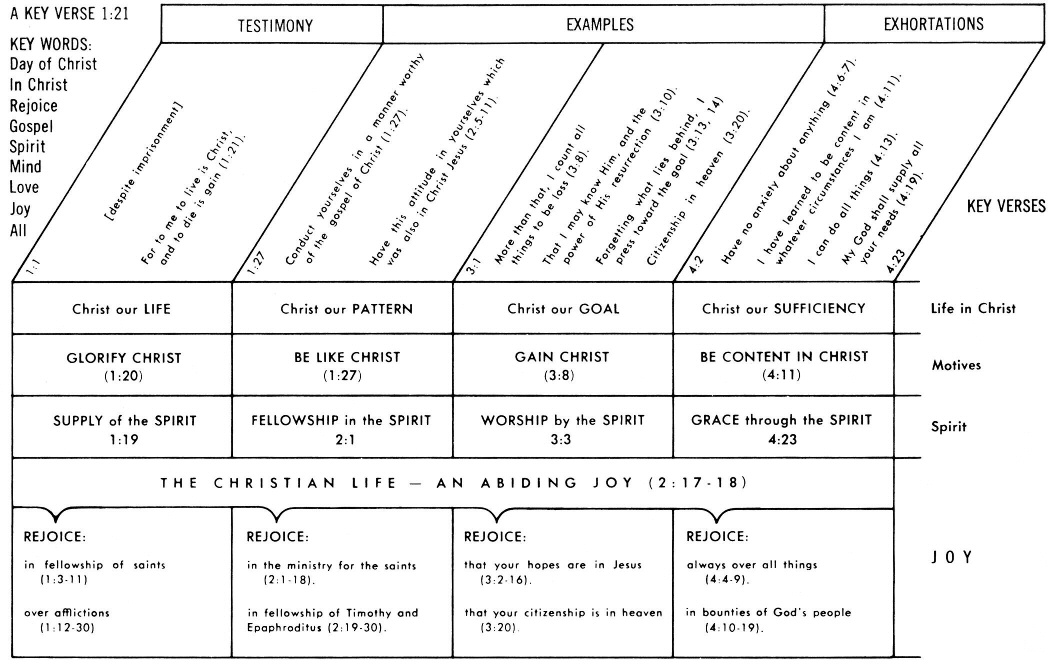
LIFE IN CHRIST
Click chart to enlarge
Charts from Jensen's Survey of the NT - used by permission
Philippians - Charles Swindoll = Chart on right side of page
| Account of Paul's Circumstances Php 1:1-30 |
Have the Mind of Christ Php 2:1-30 |
Have the Knowledge of Christ Php 3:1-21 |
Have |
| Partakers of Christ | People of Christ | Pursuit of Christ | Power of Christ |
| Suffering | Submission | Salvation | Sanctification |
| Experience | Examples | Exhortation | |
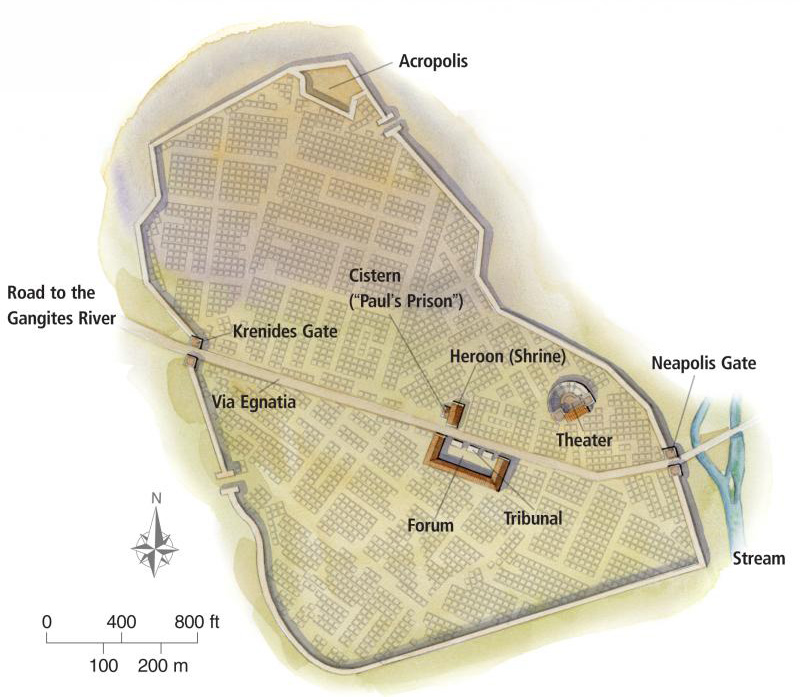
Philippi in the Time of Paul
The city plan above shows those features of the city of Philippi that archaeologists have so far identified as dating from the time of Paul. “Paul’s Prison” is not believed to be an authentic site, but was a cistern later associated with Christian worship. (ESV.org)
Philippians 2:25 But I thought it necessary to send to you Epaphroditus, my brother and fellow worker and fellow soldier, who is also your messenger and minister to my need (NASB: Lockman)
Greek: Anagkaion de hegesamen (1SAMI) Epaphroditon ton adelphon kai sunergon kai sustratioten mou, humon de apostolon kai leitourgon tes chreias mou, pempsai (AAN) pros humas
Amplified: However, I thought it necessary to send Epaphroditus [back] to you. [He has been] my brother and companion in labor and my fellow soldier, as well as [having come as] your special messenger (apostle) and minister to my need. (Amplified Bible - Lockman)
NLT: Meanwhile, I thought I should send Epaphroditus back to you. He is a true brother, a faithful worker, and a courageous soldier. And he was your messenger to help me in my need. (NLT - Tyndale House)
KJV: Yet I supposed it necessary to send to you Epaphroditus, my brother, and companion in labour, and fellowsoldier, but your messenger, and he that ministered to my wants.
Lightfoot: I have thought it necessary to dispatch Epaphroditus to you at once; Epaphroditus, whom you commissioned as your delegate to minister to my needs, in whom I have found a brother and a fellow-laborer and a comrade in arms.
Wuest: But after weighing the facts, I considered it indispensable to send to you Epaphroditus, my brother and fellow worker and fellow soldier, but your ambassador, to whom you entrusted a mission, and who in a sacred way ministered to my need. (Eerdmans Publishing)
Young's Literal: And I thought it necessary Epaphroditus -- my brother, and fellow-workman, and fellow-soldier, and your apostle and servant to my need -- to send unto you,
But I thought it necessary to send to you Epaphroditus: Anagkaion de hegesamen (1SAMI) Epaphroditon:
- Phil 4:18
- Philippians 2 Resources - Multiple Sermons and Commentaries
- Philippians 2:19-30 Worth Imitating - Steven Cole
- Philippians 2:25-30 Model Spiritual Servants: Epaphroditus - John MacArthur
FIVE-FOLD DESCRIPTION
OF EPAPHRODITUS
Php 2:25-30
But (de) a term of contrast. What is Paul contrasting? He had just stated his desire "I trust in the Lord that I myself also will be coming shortly." (Php 2:24). Since he could not go immediately (he was under house arrest) and he sensed that it was necessary someone go to the Philippians, he explains he will send Epaphroditus, who had been sent by them to bring their gift to Paul (cf Php 4:18).
The question arises as to why Paul showed such honor (in his five-fold description, see Php 2:29) to Epaphroditus especially since the Philippians clearly knew him and had entrusted him with the gift for Paul? Tony Merida writes "Why the emphasis on honor? This emphasis is probably due to the fact that this was a culture based more on honor and shame than our American culture is. Think about it. The church sends their representative to the famous apostle. When he arrives, he has been sick, he almost dies, and he has to go home sooner rather than later. The church might think of him as an embarrassment. “We should have sent someone else!” they may have said. But Paul covers for him and says Epaphroditus deserves a hero’s welcome." (Exalting Jesus in Philippians)
I thought (2233) (hegeomai [word study] from middle deponent of ágo = to lead) primarily signifies to lead then, consider and so to think about and come to a conclusion.
Hegeomai is a mathematical term which involves careful thought and not come to a quick or hasty decision. Paul seems a little reluctant to send Epaphroditus back, but he’s thought it over and realizes that it is very important to do so. Epaphroditus will be taking this letter of Paul’s back to Philippi with him.
An excellent illustration of the meaning of this word is Moses in (He 11:26-note) who thought through his decision, weighing the pros and cons. He weighed what Egypt had to offer against what God offered. When he reached a conclusion it was well-founded and certain. God’s offer was infinitely superior in every way. In the eyes of the world no reproach (being ridiculed and persecuted) would be worth sacrificing riches for. Yet Moses believed that the worst he could endure for Christ would be more valuable than the best of the world. And so Paul aware of his circumstances makes a conscious judgment resting upon his deliberate weighing of all the facts.
Necessary (316) (anagkaios from anagke [word study] = necessity) means what one can not do without and so that which is indispensable - connected by bonds of nature or friendship; what ought according to the law of duty be done, what is required by the circumstances. Anagkaios is a very strong word. Paul reasoned that this was what was required by the circumstances.
John Walvoord - This great chapter of Scripture concludes with another illustration of a saint who had attained the mind of Christ in his life and witness. Epaphroditus, who had come from Philippi with the offering of the Philippian church to Paul, is being sent with this epistle back to Philippi with a word of apostolic approbation. As Timothy would be delayed until after the outcome of the trial, he is sending Epaphroditus at once.
MEET MISTER CHARMING
Epaphroditus (1891) is mentioned only in the present epistle and according to Vincent is derived from Aphrodite (Venus), and means charming and how well he lived up to his name. Others say his name means "belonging to” or “favored by Aphrodite” and later came to mean “loving” or “lovely.” As an aside the goddess Aphrodite was associated with gambling (cf Epaphroditus "risking his life" or "gambling his life" in Php 2:30) so that rolling two sixes was called the ‘throw of Aphrodite’ and it was considered to be a clear indication that a person would win a game.
Epaphroditus was most likely a Gentile born to pagan parents, given the fact that he was named for the mythical goddess Aphrodite! This shows that God is not a discriminator of who He uses to expand His kingdom. Perhaps you think God would never use you because you have a "pagan" background, but in fact God specializes in miraculous restorations of wrecked lives!
Peter O'brien on Epaphroditus - His name (derived from Aphrodite), which was common in this period, means ‘lovely’, ‘charming’, or ‘amiable’. Perhaps his family had been worshippers of the goddess Aphrodite, and it is likely that Epaphroditus was a Gentile convert. ‘Epaphras’ is probably a short form of the name, but Epaphroditus should not be identified with the Epaphras of Colossae (Col. 1:7; 4:12; Phm. 23).(The New International Greek Testament Commentary)
W E Vine - A change from idolatrous names was not considered necessary in the early churches.
David Jeremiah - Apart from these few verses he would be an unknown, but in many respects, that fits him anyway. He was just a layman in the church at Philippi who held no office, wrote no books, gave no sermons, led no great enterprises for God. He was a messenger boy for the gospel, a servant for his Lord. No task was too menial for him to do. No assignment was too little for him to accept. No risk was too great for him to take. He would have been comfortable with a towel and basin.
Warren Wiersbe emphasizes that Epaphroditus was a "balanced Christian!" - Balance is important in the Christian life. Some people emphasize “fellowship” so much that they forget the furtherance of the Gospel. Others are so involved in defending the “faith of the Gospel” that they neglect building fellowship with other believers. Epaphroditus did not fall into either of these traps. He was like Nehemiah, the man who rebuilt the walls of Jerusalem with his sword in one hand and his trowel in the other (Neh. 4:17). You cannot build with a sword nor battle with a trowel! It takes both to get the Lord’s work accomplished. (ILLUSTRATION) Dr. H.A. Ironside used to tell about a group of believers who thought only of “fellowship.” They had little concern for reaching the lost or for defending the faith against its enemies. In front of their meeting place they hung a sign: JESUS ONLY. But the wind blew away some of the letters, and the sign read—US ONLY. It was a perfect description of a group of people who were not balanced Christians.
- Epaphroditus - American Tract Society Bible Dictionary
- Epaphroditus - Nave's Topical Bible
- Epaphroditus - Fausset's Bible Dictionary
- Epaphroditus - Holman Bible Dictionary
- Epaphroditus - Hastings' Dictionary of the Bible
- Epaphroditus - Hastings' Dictionary of the New Testament
- Epaphroditus - International Standard Bible Encyclopedia
- Epaphroditus - Kitto's Popular Cyclopedia of Biblial Literature
- Epaphroditus - Cyclopedia of Biblical, Theological and Ecclesiastical Literature
Herbert Lockyer - It was William Penn who, centuries ago, described the seven features of deep-hearted friendship in this way:
"A true friend unbosoms freely,
Advises justly,
Assists readily,
Adventures boldly,
Takes all patiently,
Defends courageously, and
Continues a friend unchangeably."
As we are to see, Epaphroditus answers this drastic test without flinching. To Paul he was a friend sticking closer than a brother. As a friend in need he was a friend indeed.
My brother: ton adelphon:
- 2Co 2:13; 8:22; Philemon 1:1
BETA UPSILON CHI - B.U.C:
BROTHERS IN CHRIST
Beta Upsilon Chi (Brothers Under Christ) is the name of a Christian fraternity founded at the University of Texas in 1985. The fraternity's verse is "Behold, how good and how pleasant it is For brothers to dwell together in unity!" (Ps 133:1)
Tony Merida on my brother - This first description reminds us how we become partners in the gospel. Through Christ, we have been adopted by the Father. And when you become a Christian, not only do you have a new relationship with God, but you also get a new relationship with other believers. You are now brothers and sisters. The term brother may not mean much to you if you grew up in a church where you heard it regularly. (ILLUSTRATION) Christians often use the term because they can’t remember each other’s names! But it’s a miracle that we’re brothers and sisters. Our identity has changed; God is our Father, and we are adopted family members. In calling him “brother” Paul is also highlighting his affection for Epaphroditus, not just this identity change. When you go through hard times with Christian brothers or sisters at your side, you form a deep relationship with them. Such was the case here. Praise God for brothers and sisters in Christ!
NET Note adds - The reason why Paul refers to Epaphroditus as his brother, coworker, fellow soldier, etc., is because he wants to build up Epaphroditus in the eyes of the Philippians, since Paul is sending him back instead of Timothy. This accent on Epaphroditus' character and service is implied in the translation "For he is…"
Robertson makes an interesting observation that there is "one article ton (the) with the three epithets given in an ascending scale (Lightfoot), brother (adelphon, common sympathy), fellow-worker (sunergon, common work), fellow-soldier (sunstratiōtēn, common danger).
My brother - born of the same two parents or only of the same father or mother; having the same national ancestor, belonging to the same people, or countryman. Paul doesn’t look down at Epaphroditus “the delivery man” but as his “brother”. As believers, we are all on the same level, all born by the same Spirit (Jn 3:3-5) and so we are all brothers and sisters in Christ Jesus. And this is the essence of “fellowship” (koinonia) which has as its root koinos or common. We are in spiritual fellowship because we all have the same thing in common, our relationship with Jesus Christ.
Brother (80) (adelphos from a = here denoting unity + delphús = womb) is literally those born from same womb and then descriptive of fellowship of life based on identity of origin. Fellow believers in Christ are sons of their heavenly Father and united by the bond of affection and Christian love.
APPLICATION (of the five-fold description of Epaphroditus) - Wouldn’t these five terms be wonderful on a tombstone? Wouldn’t you like to be known as a brother, coworker, fellow soldier, messenger, and minister? What would people say should go on your tombstone? Emulate Epaphroditus. (Merida)
And fellow worker: kai sunergon:
- Phil 4:3; 1Cor 3:9; 2Cor 8:23; Col 1:7; 4:11; 1Thes 3:2; Philemon 1:1,24
CHRISTIAN
SYNERGY
Fellow worker (4904) (sunergos from sun = together with, intimate association implied + érgon = work) refers to his co-laborer, presumably who participated with Paul in the labors of the gospel. As noted the prefix sun/syn speaks of intimacy. Other individuals called fellow worker include - Prisca and Aquila (Ro 16:3), Urbanus (Ro 16:9), Timothy (Ro 16:21, 1 Th 3:2), Titus (2 Cor 8:23), Aristarchus, Barnabas’s cousin Mark, Jesus who is called Justus (Col 4:11), Philemon (Philemon 1:24)
1 Corinthians 3:8-9 Now he who plants and he who waters are one; but each will receive his own reward according to his own labor. For we are God's fellow workers; you are God's field, God's building.
Our English word synergy is from sunergos and describes the interaction or cooperation of two or more organizations, substances, or other agents to produce a combined effect greater than the sum of their separate effects.
Sunergos is used by Paul in 12/13 NT uses (Rom 16:3, 9, 21; 1Cor 3:9; 2Cor 1:24; 8:23; Phil 2:25; 4:3; Col 4:11; 1Th 3:2; Philemon 1:1, 24; 3John 1:8) and in this verse emphasizes a common spiritual effort in addition to a common spiritual life discussed above ("my brother"). Sunergos conveys the idea of an affectionate partnership, not merely that of an impersonal, official relationship.
In the NT, sunergos is used only of a co–worker or helper in the Christian work. In each instance sunergos conveys the idea of an affectionate partnership and not merely that of an impersonal, official relationship. Paul twice specifically includes godly women among his fellow workers (Prisca or Priscilla Ro 16:3) and Euodia and Syntyche, two godly but quarreling members of the church at Philippi who had shared Paul’s “struggle in the cause of the gospel” (Php 4:3-note)
Wycliffe says sunergos is a "term borrowed from the workshop and stressing the spirit of comradeship."
In 1 Th 3:2 we read of "Timothy, our brother and God’s fellow worker (sunergos) in the Gospel." In other words, Timothy + God = supernatural synergy!
Keathley commenting on Timothy in 1 Th 3:2 says that sunergos "refers to someone who is a team player. This is someone who does not seek to run or control things on his own, nor serve for selfish or personal agendas. There are two aspects of a team player in the body of Christ:
1.He or she is one who is a fellow worker with God. The head of the body is the Lord Jesus. The church belongs to Christ, not us. This means we are to get our orders and spiritual strength from the Lord and allow Him to work in and through us. We work as God’s fellow workers by submission to Him and by faith in His provision.
2.This also means we are to work together with our brethren in Christ as a part of God’s team. There is no such thing as a one-man team. We work to build up others and to help the body to function as a body. It means team work with each believer doing his share for the goals of the Head and the team.
In addition, sunergos brings out the fact that Timothy was a worker, which, in New Testament terms, means a minister or a servant of others. Selfish, self-centered agendas spoil our ability to not only be team players, but to work as servants. (1Thessalonians 3:1-13 )
and fellow soldier: kai sustratioten mou:
- 2Ti 2:3,4; Philemon 1:2
FELLOW SOLDIERS
OF CHRIST
Fellow soldier (4961) (sustratiotes from sun = together with, emphasizing an intimate relationship + stratiotes = a soldier; see study of related verb strateuomai = wage war) is an interesting combination word, the prefixed preposition "sun" speaking of an intimate association and thus picturing saints fighting side by side against onslaught from seen and unseen foes. Phillips picks up on this picture, translating it as comrade-in-arms.
The only other NT use is in Philemon 1:2 "and to Apphia our sister, and to Archippus our fellow soldier, and to the church in your house."
Boice - Fellow soldier described "A shoulder-to-shoulder fighting accounted for the success of Rome's armies. Prior to the triumph of Rome, men fought mostly as individuals. They often dressed alike and were armed alike, but they did not fight side by side with each other. The Roman armies did, and as a result the phalanxes of the legions were the terror of the ancient world. The soldiers marched abreast behind a solid wall of shields. And as they marched they struck their shields with their spears in unison and sang their battle songs. In such a way we are to advance in harmony against the spiritual powers arrayed against us."
Gilbrant - Figuratively used the term can refer to: (1) the fellowship in conflicts, victories, and disciplines of Christian life; (2) the honor of being associated with Paul and his sufferings (Bauer); and (3) according to Thayer, the common danger and endurance of hardships with others for the cause of Christ (Greek-English Lexicon). (Complete Biblical Library Greek-English Dictionary)
The use of "soldier" alludes to the difficulties, opposition, and dangers encountered in the spread of the the Gospel of Christ.
In past days a famous slogan was "You're in the Army now!" This slogan applies to all of God's children. They have been enlisted in His army to fight the good fight of faith against the world, the flesh and the devil. Sadly many believers do not understand the fact that when we were "rescued us from the domain of darkness, and transferred us to the kingdom of His beloved Son," (Col 1:13-note), the kingdom of darkness now actively opposes us. As a result, many believers are "wounded" in spiritual warfare because they are ignorant of the invisible battle that is raging. Like my old medical school professor used to say when I would say I did not know the answer to his question -- "You can't not know!" Well that was true in medicine, but it is far more true in spiritual warfare.
Paul used the soldier metaphor in his last letter to his young disciple Timothy exhorting him to be ready for the spiritual battle...
Suffer hardship (aorist imperative - Do this now! Do it effectively! Don't delay! It is urgent!) with me, as a good soldier of Christ Jesus. No soldier in active service entangles himself in the affairs of everyday life, so that he may please the one who enlisted him as a soldier. (2Ti 2:3-4-note)
Related Resources:
Christians and Christian ministers are compared with soldiers Philemon 1:2; 2Timothy 2:3; 2:4 (note) because of the nature of the service in which they are engaged. The Christian life is a warfare with many foes to be overcome. Like Roman soldiers, the period which they are to serve is fixed by the Great Captain of our salvation, and all Christian soldiers will soon and eternally be permitted to enjoy the fruit of victory. Paul regarded himself as enlisted to make war on all the spiritual enemies of the Redeemer, and he esteemed Epaphroditus as one who had shown that he was worthy to be engaged in so good a cause.
John Gill has an excellent summary of the Christian as a soldier noting that "the life of every believer is a warfare; he is always engaged in a war with sin, and Satan, and the world; and is often called to fight the fight of faith, to contend earnestly against false teachers for the faith once delivered to the saints, to stand up for it, and fast in it; and is provided for with the whole armour of God, with weapons of warfare, which are not carnal, but spiritual and mighty, being enlisted as a volunteer under the great Captain of his salvation, Jesus Christ, under whose banner he fights, and is more than a conqueror through him: but though this is the common case and character of all the saints, it more especially belongs to ministers of the Gospel; who are set for the defense of it, and at the front of the battle, and are called to meet the enemy at the gate, and endure hardness as good soldiers of Jesus Christ"
Who is also your messenger and minister to my need: humon de apostolon kai leitourgon t es chreias mou:
- Pr 25:13; Jn 17:18; 2 Co 8:23; Heb 3:1) (Phil 4:18; 2Cor 11:7, 8, 9
A MESSENGER WHO
MINISTERS
Spurgeon - Paul was in prison at Rome. These Philippians had made a contribution, and they had sent Epaphroditus with it to relieve the apostle in his poverty.
Messenger (652) (apostolos [word study] from apo = from + stello = send forth) is literally a "sent one" which conveys the basic idea of one who is sent to do a job and associates authority with the assignment.
The secular Greek writer Demosthenes gives a picture of the meaning of "apostolos" using the term to describe a cargo ship sent out with a load. He also spoke of a naval fleet as "apostles" sent out to accomplish a mission.
Epaphroditus was thus sent out as a "messenger" from the church at Philippi to bring relief to Paul who acknowledged his arrival writing that
"I have received everything in full and have an abundance; I am amply supplied, having received from Epaphroditus what you have sent, a fragrant aroma, an acceptable sacrifice, well-pleasing to God" (see note Philippians 4:18)
A parallel use of apostolos is found in the second epistle to the Corinthians where Paul wrote
"as for our brethren, they are messengers (apostolos) of the churches, a glory to Christ" (2 Cor 8:23)
In the preceding verses Paul is describing the men who were responsible for the handling and transporting of the funds. Thus churches apparently sent out their own "messengers" for various purposes but these were separate and distinct from the "apostles of Jesus Christ," each of whom had been been specifically chosen and sent out in person by resurrected Christ. There is no continuity of these apostles of Jesus Christ since in no place were the churches instructed to ordain apostles and furthermore none would be able to fulfill the criteria necessary for one to be a true apostle of Jesus Christ.
Spurgeon - Paul was in prison at Rome. These Philippians had made a contribution, and they had sent Epaphroditus with it to relieve the apostle in his poverty.
Apostolos - 80x in 79v - NAS = apostle(18), Apostle(1), apostles(52), apostles'(5), messenger(m)(1), messengers(m)(1),one who is sent(1).
Matt 10:2; Mark 3:14; 6:30; Luke 6:13; 9:10; 11:49; 17:5; 22:14; 24:10; John 13:16; Acts 1:2, 26; 2:37, 42f; 4:33, 35ff; 5:2, 12, 18, 29, 40; 6:6; 8:1, 14, 18; 9:27; 11:1; 14:4, 14; 15:2, 4, 6, 22f; 16:4; Rom 1:1; 11:13; 16:7; 1 Cor 1:1; 4:9; 9:1f, 5; 12:28f; 15:7, 9; 2 Cor 1:1; 8:23; 11:5, 13; 12:11f; Gal 1:1, 17, 19; Eph 1:1; 2:20; 3:5; 4:11; Phil 2:25; Col 1:1; 1 Thess 2:7; 1 Tim 1:1; 2:7; 2 Tim 1:1, 11; Titus 1:1; Heb 3:1; 1 Pet 1:1; 2 Pet 1:1; 3:2; Jude 1:17; Rev 2:2; 18:20; 21:14.
While the following note is not based on Biblical or historical facts, it does present a description of how Epaphroditus may have functioned as a sent one:
The church at Philippi appointed Epaphroditus as their “sent one” (apostle) to take the money to Paul (Phil. 4:18). Most likely he would have had others go with him, not only for accountability, but also to protect the money, since this is the pattern in the early church (cf. Acts 20:4; Lenski 1937:696-697). More than likely, they would have walked the Via Egnatia from Philippi to Dyrrachium on the Adriactic Sea (367/8 Roman miles; Adams 1982:280), and then cross the sea by ship. They would have continued walking on the Via Appian from Brundusium to Rome (360 Roman miles). This trip, covering 729 miles, most likely would have taken 57 days, with a rest on each Lord’s Day, a trip of almost two months. If Epaphroditus and his friends made this trip during the winter, he might have picked up pneumonia, or he could have eaten tainted food at one of the inns. These conditions might explain why he got deathly sick and almost died (Phil. 2:27, 30). (Epaphroditus: A Gambling Veteran)
Minister (3011) (leitourgos] from léïtos = of the people + érgon = work) a person in service of state who held public office who was so passionately dedicated to his duties that he discharged them at his own expense. This is the word used to describe the kind of work that the Priests and Levites did in the Temple. We get our word “liturgy” from it. Paul sees the help that Epaphroditus has given as being a spiritual kind of service.
Barclay elaborates on leitourgos - "In secular Greek this was a magnificent word. In the ancient days in the Greek cities there were men who, because they loved their city so much, at their own expense undertook certain great civic duties. It might be to defray the expenses of an embassy, or the cost of putting on one of the dramas of the great poets, or of training the athletes who would represent the city in the games, or of fitting out a warship and paying a crew to serve in the navy of the state. These men were the supreme benefactors of the state and they were known as leitourgoi ." (Philippians 2 Commentary)
In the Septuagint (LXX) leitourgos was used primarily in reference to the Old Testament priestly service to God and of service to man. Similarly the most common NT meaning of leitourgos describes service to the Lord by believers. 2 Sam. 13:18; 1 Ki. 10:5; 2 Ki. 4:43; 2 Ki. 6:15; 2 Chr. 9:4; Ezr. 7:24; Neh. 10:39; Ps. 103:21; Ps. 104:4; Isa. 61:6
Wuest adds that "the service of Epaphroditus in ministering to the needs of Paul while the former was in Rome, was looked upon by the apostle as a ministry having as much sacredness about it as one would meet with in the ministry of the priests in the Jewish temple services." (Philippians Commentary - Verse by Verse)
Need (5532) (chreia [word study] from chréos = debt) from chraomai = to use, make use of or chreos = a debt) means a necessity, what is needed or the occasion of need. Here it refers to something lacking and needed. In other words it refers to Paul's necessities.
What was Paul's need? We know that one practical need Paul had was the monthly rental check (so to speak) for Luke records that Paul "stayed two full years in his own rented quarters (Gk = misthoma from misthoo = to let for hire and misthos = wages) and was welcoming all who came to him." (Acts 28:30)
Brian Bill sums up the superlative example of Epaphroditus the Messenger -
While Timothy’s name is all over the New Testament, Epaphroditus is mentioned only in Philippians. He was either the pastor or an elder in the church in Philippi. He had been sent to Paul in Rome from Philippi to carry a financial gift and to meet Paul’s daily needs. While Epaphroditis was in Rome he became sick and nearly died. Because of this situation, Paul has decided to send him back to his home church. Paul then tells us about Epaphroditus’ character using five descriptive terms.
(1) My brother – this literally meant “from the same womb.” In that culture, there was not much “brotherly love” and the church provided a place where people felt connected and encouraged. They both shared the same passion for the Gospel.
(2) Fellow worker – Paul and Epaphroditus had an effective partnership in ministering to the church of Philippi and beyond.
(3) Fellow soldier – Paul never calls us to a life of ease but to a battlefield. Today is Memorial Day. This is a time when we honor the brave men and women who have made the ultimate sacrifice to preserve our freedom. If you are a member of the armed services or you are a veteran please stand.
(4) “Messenger – He was designated by the church at Philippi to be their representative to Paul.
(5) Minister – Epaphroditus’ mission was to carry the financial gift to Paul and then to remain indefinitely to “take care of his needs.” He ministered to and with Paul as he was under house arrest in Rome. By the way, raise your hand if you are a minister. If you are a Christian, God has given you a ministry. Do you know what it is?
From this description, you can see why Epaphroditus was so important to Paul’s ministry. But, because of sickness, Paul thought it was necessary to send him back.
Alan Carr - AN ANATOMY OF A LOVELY CHRISTIAN
I. Php 2:25 A LOVELY CHRISTIAN IS A BALANCED CHRISTIAN
(ILLUSTRATION - It is easy for Christians to get out of balance. That is, we are prone to focus on one area of our Christian walk to the exclusion of other areas that are just as important. Some people get off balance in the area of fellowship, everything is about being with their “group” and having a good time. For others it is evangelism, everything revolves around bringing people to Jesus, but they ignore spiritual development and growth. For some it is legalism, they are so concerned with keeping things in line with their idea of how things ought to be that they set themselves up as spiritual detectives who investigate and correct the motives and action of others. There are many other areas of life where this is true as well. But, when a Christian, or a church for that matter, gets out of balance, they bring reproach upon the cause of Christ. They are like a wobbly tire on an automobile. They throw everything else out of balance as well. Epaphroditus wasn’t like this! He was balanced in his walk with the lord and with others. Notice the three areas of his life that were balanced.)
A. He Is Balanced In His Walk As A Son - Paul calls him “my brother”. This term refers to those who are “members of the same family; to those who are united in the bonds of affection.” What Paul is saying is this: “I love old Epaphroditus and he loves me! We are brothers in Christ!” Epaphroditus walked with Paul, not against him!
(Note: Every believer ought to strive for balance in this area! We are in this thing together and we should love one another and stand together. There is no place in the Christian family for one brother to attack another. There is no place in the Christian family for division and strife. In fact, the Bible makes it clear that we are duty bound to love one another, Matt. 22:37-39; 1 John 3:11-18; 1 John 4:11-21. Love among the brethren is the calling card of the church - John 13:35! There must be love, mutual concern and unity among God’s children, Phil 1:27. When there isn’t, someone is out of balance in their walk as a son!)
B. He Is Balanced In His Work As A Servant - Epaphroditus was a “fellow worker” with Paul. In other words, he shouldered his portion of the load. He was not a loafer, who let others carry his part. He got in there and went to work for the glory of the Lord. Verse 25 tells us that he was a “messenger” and a “minister”. He was sent by the church at Philippi with a gift for Paul. He was their messenger. But, I think the greatest gift from Philippi was old Epaphroditus himself. Why? Because, when he arrived in Rome, Paul had somebody who was willing to do his part.
(Note: In his walk as a son, Epaphroditus was balanced. That refers to “the fellowship of the Gospel”. That is where many believers get out of balance. They love to be with the brethren and think that a little fellowship with their class or their friends at church is all they need to be complete. The fact is, God didn’t save us to fellowship only. He saved us to get to work for His glory, Eph. 2:10; James 2:18. It is a shame that 90% of the work in an average church is done by 10% of the people. There is plenty to do, but a shortage of people willing to do it! Epaphroditus loved to fellowship, but he didn’t mind rolling up his sleeves and getting involved in the physical work of the Lord either. We need some with that same attitude today. If you want something to do, let us know and we’ll find you something!)
C. He Is Balanced In His Warfare As A Soldier - When Paul calls this man a “fellowsoldier” he is talking about a man who is “an associate in the spiritual conflicts of the Christian life”. The term “fellow soldier” tells us that Epaphroditus fought alongside of Paul and not against him! They were partners in a common struggle. They were shoulder to shoulder fighting the flesh, the world and the devil. They were as one in the dangers they faced, the enemies they encountered and the goals they shared.
(Note: There is a great need in this day for people who are willing to take a stand against evil in the world. We need believers who are not afraid to put on the whole armor of Christ and go with Him into battle. The devil is trying to tear down and take away many of the blessings we have as believers. We need some who will take a stand for the Bible, the church, for holiness and for the old time way! We need some battlers in this day!)
(Note: Far too many Christians get out of balance in this area. Some, when “contending for the faith”, are guilty of setting themselves up as judge and jury on what others around them should and shouldn’t be doing! Many believers loose sight of who the real enemy in this thing is. Your brother or sister in Christ is not the enemy and you are never justified in attacking another believer! Paul tells us clearly who our enemy is: Eph. 6:12. If we are going to fight, let us fight against the devil and his deeds, not against one another! Last time I checked, I was still a private and Jesus was still the General! Last time I checked, I was just a branch saved to bear fruit and not a fruit inspector! Let’s get it right and fight the real enemy!)
(Epaphroditus was a balanced believer. He was active in all these areas of the Christian life. He was balanced in his walk, in his work and in his warfare! Where do you stand in these areas tonight?)
II. Phil 2:26-29 A LOVELY CHRISTIAN IS A BURDENED CHRISTIAN
A. The Focus Of This Burden - Php 2:26-27a tells us that Epaphroditus was very sick. In fact, Paul says that “he was sick nigh unto death”. (Ill. Paul had healed others, Acts 14:9; 28:8, why didn’t he heal Epaphroditus? Maybe the Apostolic, sign gift of healing had already been phased out. Either way, this passage lets us know that God, not man is in charge of the healing process!) Even though he was desperately ill, his focus was not on himself. His focus was on his brothers and sisters at Philippi! He had heard that they had heard he was sick. He is burdened because they are worried about him! The phrase “full of heaviness” comes from the same word used of Jesus when He was in the Garden of Gethsemane, Mt. 26:37-38; Mark 14:33-34. His focus is not on his own condition or needs. His focus is on others and their welfare! In other words, he was displaying absolute Christlikeness in this situation!
(Note: What a lesson for the church! How many of us can see no farther than the end of our own noses? We are so caught up in what is happening to us that we are unable to see the needs of those around us. You know that you are maturing as a Christian when your first thought is not about how something affects you, but your primary concern is how it may affect someone else! Epaphroditus was a living, breathing commentary on Phil. 2:4. He was the essence of Gal. 6:2. He was what we all ought to be! There is nothing in this world more immature than a believer who thinks of his or her own needs first! Ill. What if Jesus had thought this way? What if Paul had adopted that attitude? What if God had thought like we do?
When we get the needs of others first, we will watch what we say to, what we do, where we go and how we react. We will be careful to ensure that others are edified and encouraged, before we take thought for ourselves!)
Click here for the remainder of this message that discusses Php 2:28-30.
Philippians 2:26 because he was longing for you all and was distressed because you had heard that he was sick (NASB: Lockman)
Greek: epeide epipothon (PAPMSN) en (3SIAI) pantas humas kai ademonon (PAPMSN) dioti ekousate (2SAAI) hoti esthenesen. (3SAAI)
Amplified: For he has been [homesick] longing for you all and has been distressed because you had heard that he was ill. (Amplified Bible - Lockman)
NLT: Now I am sending him home again, for he has been longing to see you, and he was very distressed that you heard he was ill. (NLT - Tyndale House)
KJV: For he longed after you all, and was full of heaviness, because that ye had heard that he had been sick.
Lightfoot: I have sent him, because he longed earnestly to see you and was very anxious and troubled that you had heard of his illness.
Wuest: For he was constantly yearning after all of you, and was in extreme anguish because you heard that he was ill. (Eerdmans Publishing)
Young's Literal: seeing he was longing after you all, and in heaviness, because ye heard that he ailed,
because he was longing for you all: epeide epipothon (PAPMSN) en (3SIAI) pantas humas:
- Phil 1:3,8; 4:1; 2 Sa 13:39; Ro 1:11; 2 Co 9:14
- Philippians 2 Resources - Multiple Sermons and Commentaries
- Philippians 2:19-30 Worth Imitating - Steven Cole
- Philippians 2:25-30 Model Spiritual Servants: Epaphroditus - John MacArthur
EPAPHRODITUS WAS
DISTRESSED FOR THE SAINTS
Because (for) - always pause to ponder this term of explanation. Explains why Paul thought it necessary to send him
Longing (1971) (epipotheo from epi = either an intensifier or marking direction of the desire + potheo = to yearn) means to desire earnestly, long for greatly, intensely crave possession or have great affection for. Paul declares that Epaphroditus demonstrates the same concern for the Philippians as he himself does ("God is my witness, how I long for you all with the affection of Christ Jesus." - Php 1:8-note). Thus they are one in their work for the Lord (sunergos), and they are one in their love for the Lord's people.
The LXX (Greek Septuagint) uses this verb to translate David's deep desire for God --
As the deer pants for (epipotheo) the water brooks, so my soul pants for (epipotheo) Thee, O God. (Ps 42:1)
The use in David's psalm gives us a sense of the great heart of Epaphroditus who was intensely longing for his beloved saints at Philippi. The present tense indicates this longing was not a spasmodic yearning but a continual habitual expression of his heart attitude.
And was distressed because you had heard that he was sick: kai ademonon (PAPMSN) dioti ekousate (2SAAI) hoti e sthenesen. (3SAAI ):
- Job 9:27; Ps 69:20; Pr 12:25; Isa 61:3; Mt 11:28; Mt 26:37 Ro 9:2; 1Pe 1:6
- 2Sa 24:17; Jn 11:35,36; Acts 21:13; Ro 12:15; 1Cor 12:26; Gal 6:2; Eph 3:13
MUTUAL EMPATHY BETWEEN
THE SAINTS AND EPAPHRODITUS
Spurgeon on distressed - In Matthew 26:37, you find it recorded that Jesus was “troubled,” and that expression is full of meaning—of more meaning, indeed, than it would be easy to explain. The word in the original is a very difficult one to translate. It may signify the abstraction of the mind, and its complete occupation by sorrow, to the exclusion of every thought which might have alleviated the distress. One burning thought consumed His whole soul, and burned up all that might have yielded comfort. For awhile His mind refused to dwell upon the result of His death, the consequent joy which was set before Him. The learned Thomas Goodwin says, “The word denotes a failing, deficiency, and sinking of spirit, such as happens to men in sickness and swounding.” Epaphroditus’ sickness, whereby he was brought near to death, is called by the same word.
And was distressed because you had heard that he was sick - It is notable that Epaphroditus was less concerned about his own potentially fatal illness than he was about the effect of this news on the saints at Philippi! This is a perfect illustration of Php 2:3-4 "Do nothing from selfishness or empty conceit, but with humility of mind regard one another as more important than yourselves; do not merely look out for your own personal interests (HIS SERIOUS ILLNESS), but also for the interests of others (THEIR WORRY OVER HIS SERIOUS ILLNESS)." Compare Timothy's "Others first" attitude (see note).
This fact also emphasizes how the Gospel had affected the previous self-centered pagans in Philippi, so that their heart was now transformed causing them also to look out for the interests of others (for Epaphroditus). What an illustration of the truth Paul describes in 1 Corinthians 12:26 says "If one member suffers, all the members suffer with it." The apostle Paul said that all believers in Christ are part of “one body” (1 Cor 12:13). Are you truly grieved when a brother in Christ is suffering? Does it bother you when a believer stumbles into sin and is brought under the chastening hand of the Lord? Do you experience sorrow of heart when a child of God is passing through the deep waters of affliction and trial? If not, ask the Lord right now to help you become the kind of person who can share the heartache of others and sympathize with them. Yes, to every Christian we meet who is in some kind of distress, we should be ready to say from our hearts not just our lips, “I hurt for you”. The saints at Philippi were suffering over Epaphroditus' affliction and he in turn was distressed over their suffering. This is how a healthy body of Christ functions. There is mutual empathy. And what is the meaning of empathy but your pain in my heart!
The hurting ones need sympathy,
They need to know we’re there;
A quiet word, a tender touch
Assures them that we care. —DJD
Distressed (85) ("excessively concerned") (ademoneo from a derivative of adeo = to be sated to loathing) means to be distressed, deeply troubled or distressed, this intense discomfort being quite plain. Be sorely troubled. Be upset. Be dismayed. Be in anguish. The present tense indicates this was a lingering distress. Ademoneo describes the confused, chaotic, heavy state of restlessness that results from a time of turmoil or great trauma. To reiterate, Epaphroditus was more concerned about the Philippians’ worry for him than he was about his own difficult situation.
Thayer says ademoneo originates from the alpha privative "a" and the root word demos meaning home. This combination yields the literal meaning of not at home and accordingly uncomfortable. In fairness, the reader should understand this origin although it sounds plausible is disputed by other authorities. For example, Moulton and Milligan write that "Towards the etymology of this word, T. W. Allen (CR xx. p. 5) traces an adjective (the Greek word) demon in the Iliad (M 213), with the meaning “knowing” “prudent,” so that ademoneo would suggest originally bewilderment."
How distressed was Epaphroditus? The 2 other NT used give us a very good sense of how distressed he was -- Epaphroditus was almost overwhelmed with sorrow, like our Lord was in Gethsemane as He anticipated the Cross, Matthew writing that He "began to be grieved and distressed. (ademoneo) (Mt 26:37).
The only other NT use is Mark's parallel description of the Lord in Gethsemane...
Mark 14:33 And He took with Him Peter and James and John, and began to be very distressed (ekthambeo) and troubled (ademoneo) .
Wuest adds an interesting note that ademoneo "finds its origin in a word that has the idea of “not at home,” thus, “uncomfortable, troubled, distressed.” The word does not refer to homesickness, but to the discomfort of not being at home. Thus the heart of Epaphroditus was not at rest. The reason for this restlessness was that he was concerned that the Philippians had heard of his illness and were themselves concerned over their messenger for whom they in a measure held themselves responsible. What a miracle divine grace had wrought in the hearts of these Greeks who had recently come up out of rank paganism! (Philippians Commentary - Verse by Verse)
He had become sick (770) (astheneo from asthenes = without strength, powerless from a = without + sthenos = strength, bodily vigor) means to be feeble (in any sense), to be diseased, impotent, sick, to lack strength, to be infirm, to be weak.
Brian Bill on the distress of Epaphroditus - Paul decided to send Epaphroditus back to Philippi to ease their minds and to calm his nerves. Epaphroditus was in “distress,” which is no small thing. The word means “deep anguish, anxiety, or emotional turmoil.” Philippi was eight hundred miles from Rome and at least a three month journey. Somehow the news had gotten back to the home front that Epaphroditus was deathly ill and he was worried that they thought he may have died. In fact, this was nearly the case. They word “ill” means “without strength” and he probably came down with the Roman plague. The term “almost died” literally means “next door.” He was at death’s door. But God had mercy on him and healed him. Notice that Paul, who had the gift of healing (see Acts 14:9-10; Acts 19:1-2; Acts 20:9-12; Acts 28:8), did not heal him. Also, notice that Paul said he was spared “sorrow upon sorrow.” For those of us that have anxiety from time to time, notice that one of his main goals in sending Epaphroditus back was so that Paul would have “less anxiety.” Paul was not perfect and struggled just as we do. Isn’t that nice to hear?
C H Mackintosh has some devotional thoughts on the character of Epaphroditus...
There is great moral beauty in it. We are not told very much about him, but in what we are told, we see a great deal of what is truly lovely and pleasant — much that makes us long for men of the same stamp in this our day. We cannot do better than quote the inspired record concerning him; and may the blessed Spirit apply it to our hearts and lead us to cultivate the same lovely grace which shone so brightly in that dear and honored servant of Christ!
“I supposed it necessary,” says the blessed apostle, “to send to you Epaphroditus, my brother and companion in labor, and fellow-soldier, but your messenger and he that ministered to my wants. For he longed after you all and was full of heaviness, because that ye had heard that he had been sick. For indeed he was sick nigh unto death; but God had mercy on him, and not on him only, but on me also, lest I should have sorrow upon sorrow. I sent him therefore the more carefully, that when ye see him again, ye may rejoice, and that I may be the less sorrowful. Receive him therefore in the Lord with all gladness; and hold such in reputation, because for the work of Christ he was nigh unto death, not regarding his life, to supply your lack of service toward me” (Phil. 2: 25-30).
Now it is quite possible that some of us, on reading the above, may feel disposed to inquire if Epaphroditus was a great evangelist or teacher or some highly gifted servant of Christ, seeing the inspired apostle bestows upon him so many high and honorable titles, styling him his “brother and companion in labor, and fellow-soldier.”
Well, we are not told that he was a great preacher or a great traveler or a profound teacher in the Church of God. All we are told about him in the above touching narrative is that he came forward in a time of real need to supply a missing link, to “fill a gap,” as we say. The beloved Philippians had it upon their hearts to send help to the revered and aged apostle Paul in his prison at Rome. He was in need and they longed to supply his need. They loved him, and God had laid it upon their loving hearts to communicate with his necessities. They thought of him, though he was far away from them, and they longed to minister to him of their substance.
How lovely was this! How pleasing to the heart of Christ! Hearken to the glowing terms in which the dear old prisoner speaks of their precious ministry.
“But I rejoiced in the Lord greatly, that now at the last your care of me hath flourished again; wherein ye were also careful, but ye lacked opportunity.... Notwithstanding, ye have well done that ye did communicate with my affliction. Now, ye Philippians, know also that in the beginning of the gospel, when I departed from Macedonia, no church communicated with me as concerning giving and receiving, but ye only. For even in Thessalonica ye sent once and again unto my necessity. Not because I desire a gift, but I desire fruit that may abound to your account. But I have all, and abound; I am full, having received of Epaphroditus the things from you, an odor of a sweet smell, a sacrifice acceptable, well pleasing to God” (Phil. 4: 10, 14-18).
Here we see the place which Epaphroditus filled in this blessed business. There lay the beloved apostle in his prison at Rome, and there lay the loving offering of the saints at Philippi. But how was it to be conveyed to him? These were not the days of banks checks and post-office money orders. No, nor of railway traveling. It was no easy matter to get from Philippi to Rome in those days. But Epaphroditus, that dear, unpretending, self-surrendering servant of Christ, presented himself to supply the missing link, to do the very thing that was needed and nothing more; to be the channel of communication between the assembly at Philippi and the apostle at Rome. Deep and real as was the apostle's need, precious and seasonable as was the Philippians' gift, yet an instrument was needed to bring them both together, and Epaphroditus offered himself for the work. There was a manifest need and he filled it. He did not aim at doing some great showy thing, something which would make him very prominent and cause his name to be blazed abroad as some wonderful person. Ah! no, Epaphroditus was not one of the pushing, self-confident, extensive class. He was a dear, self-hiding, lowly servant of Christ, one of that class of workmen to whom we are irresistibly attracted. Nothing is more charming than an unpretending, retiring man who is content just to fill the empty niche; to render the needed service, whatever it is; to do the work cut out for him by the Master's hand.
There are some who are not content unless they are at the head and tail of everything. They seem to think that no work can be rightly done unless they have a hand in it. They are not satisfied to supply a missing link. How repulsive are all such! How we retire from them! Self-confident, self-sufficient, ever pushing themselves into prominence. They have never measured themselves in the presence of God, never been broken down before Him, never taken their true place of self-abasement.
Epaphroditus was not of this class at all. He put his life in his hand to serve other people; and when at death's door, instead of being occupied with himself or his ailments, he was thinking of others. “He longed after you all and was full of heaviness” — not because he was sick, but — ”because ye had heard that he had been sick.” Here was true love. He knew what his beloved brethren at Philippi would be feeling when informed of his serious illness, an illness brought on by his willing-hearted service to them.
All this is morally lovely. It does the heart good to contemplate this exquisite picture. Epaphroditus had evidently studied in the school of Christ. He had sat at the Master's feet and drunk deeply into His spirit. In no other way could he have learned such holy lessons of self-surrender and thoughtful love for others. The world knows nothing of such things; nature cannot teach such lessons. They are altogether heavenly, spiritual, divine. Would that we knew more of them! They are rare among us with all our high profession. There is a most humiliating amount of selfishness in all of us, and it looks so hideous in connection with the name of Jesus. It might agree well enough with Judaism, but its inconsistency with Christianity is terribly glaring.
Notice the very touching manner in which the inspired apostle commends Epaphroditus to the assembly at Philippi. It seems as if he could not make enough of him, to speak after the manner of men.
“He longed after you all, and was full of heaviness, because that ye had heard that he had been sick. For indeed he was sick nigh unto death, but God had mercy on him, and not on him only, but on me also, lest I should have sorrow upon sorrow.”
How deeply affecting! What a tide of divine affection and sympathy rolled in upon that unpretending, self-sacrificing servant of Christ! The whole assembly at Philippi, the blessed apostle and above all, God Himself all engaged in thinking about a man who did not think about himself. Had Epaphroditus been a self-seeker, had he been occupied about himself or his interests, or even his work, his name would never have shone on the page of inspiration. But no; he thought of others, not of himself. Therefore God and His apostle and His Church thought of him.
Thus it will ever be.
A man who thinks much of himself saves others the trouble of thinking about him.
But the lowly, the humble, the modest, the unpretending, the retiring, the self-emptied, who think of and live for others, who walk in the footsteps of Jesus Christ, these are the persons to be thought of and cared for, loved and honored, as they ever will be by God and His people.
“I sent him therefore the more carefully,” says the beloved apostle, “that when ye see him again ye may rejoice, and that I may be the less sorrowful. Receive him therefore in the Lord with all gladness; and hold such in reputation. Because for the work of Christ he was nigh unto death, not regarding his life, to supply your lack of service toward me” (Phil. 2: 28-30).
Thus it was with this most dear and honored servant of Christ. He did not regard his life, but laid it at his Master's feet, just to supply the missing link between the church of God at Philippi and the suffering and needy apostle at Rome. Therefore, the apostle calls upon the Church to hold him in reputation, and the honored name of Epaphroditus has been handed down to us by the pen of inspiration, and his precious service has been recorded and the record of it read by untold millions, while the names and the doings of the self-seekers, the self-important, the pretentious of every age and every clime and every condition are sunk — and deservedly so — in eternal oblivion. (Short Paper 1)
Philippians 2:27 For indeed he was sick to the point of death, but God had mercy on him, and not on him only but also on me, so * that I would not have sorrow upon sorrow. (NASB: Lockman)
Greek: kai gar esthenesen (3SAAI) paraplesion thanato; alla o theos eleesen (3SAAI) auton, ouk auton de monon alla kai eme, hina me lupen epi lupen scho. (1SAAS)
Amplified: He certainly was ill [too], near to death. But God had compassion on him, and not only on him but also on me, lest I should have sorrow [over him] coming upon sorrow. (Amplified Bible - Lockman)
NLT: And he surely was ill; in fact, he almost died. But God had mercy on him—and also on me, so that I would not have such unbearable sorrow. (NLT - Tyndale House)
KJV: For indeed he was sick nigh unto death: but God had mercy on him; and not on him only, but on me also, lest I should have sorrow upon sorrow.
Lightfoot: Nor was the report unfounded. He was indeed so ill that we despaired of his life. But God spared him in his mercy; mercy not to him only but to myself also, that I might not be weighed down by afresh burden of sorrow.
Wuest: For truly he was ill, next door to death. But God had mercy upon him, and not upon him alone, but also on me, in order that I might not have sorrow upon sorrow. (Eerdmans Publishing)
Young's Literal: for he also ailed nigh to death, but God did deal kindly with him, and not with him only, but also with me, that sorrow upon sorrow I might not have.
For indeed he was sick to the point of death: kai gar esthenesen (3SAAI) paraplesion thanato:
- Php 2:30; 2Ki 20:1; Ps 107:18; Ecc 9:1,2; Jn 11:3,4; Ac 9:37
- Philippians 2 Resources - Multiple Sermons and Commentaries
- Philippians 2:19-30 Worth Imitating - Steven Cole
- Philippians 2:25-30 Model Spiritual Servants: Epaphroditus - John MacArthur
ON DEATH'S
DOOR!
For (gar) - always pause to ponder this term of explanation.
Paul was making certain that the Philippians understood the sacrifice that Epaphroditus had made for the cause of Jesus Christ. He specifically wanted the saints at Philippi that this was not just a cold but an illness that could have taken his life had not God intervened.
Sick (770) (astheneo from a = without + sthénos = strength, bodily vigor) means to be diseased, enfeebled, weak, without strength.
To the point of (3897) (paraplesios from pará = close to + plesíos = near and figuratively = neighbor) means literally “alongside of a neighbor” and then nearby or close to. As the KJV puts it Epaphroditus was "nigh unto death", the word paraplesion picturing "death" as just next door. And so Epaphroditus and "death" were next door neighbors!
but God had mercy on him and not on him only but also on me: alla o theos eleesen (3SAAI) auton ouk auton de monon alla kai eme:
- Job 5:19; Ps 30:1-3,10,11; 34:19; 103:3,4; Ps 107:19-22; Isa 38:17;43:2; Acts 9:39-41
- Isa 27:8; Jer 8:18; 10:24; 45:3; Hab 3:2; 1Cor 10:13; 2Cor 2:7
THE HEALING MERCY
OF GOD
God had mercy - God healed Epaphroditus. When you are sorely sick and are healed, do you acknowledge that ultimately it was God Who had mercy, even in the provision of wonderful physicians and pharmaceuticals! His Name forevermore is Jehovah Rapha, The LORD our Healer.
Spurgeon on God had mercy - Lazarus of Bethany, Dorcas, Epaphroditus, and Trophimus are a few of that great host of sick folk whom the Lord loves in their sicknesses, for whom the promise was written that “The LORD will sustain him upon his sickbed; In his illness, You restore him to health.” (Ps 41:3).
Mercy (1653) (eleeo from eleos = mercy) means to show compassion and extend help for the consequences of sin. The idea of mercy is to show kindness or concern for someone in serious need or to give help to the wretched, to relieve the miserable. When God spares a person from death it is always a reflection of His mercy, because “the wages of sin is death” (Ro 6:23-note) and every human being is a sinner (Ro 3:23-note).
But also on me - Mercy is God's kindness not only to Epaphroditus but to Paul (who was unable to use his apostolic power to heal) in restoring the health of his brother and fellow worker.
Are you a weary wayfarer in need of God's great mercies which are new every morning?
Spurgeon has the following illustration of mercy provided to weary wayfarers...
What a rugged, precipitous, ungainly pass is that Col D'Obbia! It was shrewd common sense, and true humanity which suggested the erection of that poor little hospice at the summit. Never was a shelter more opportune, a refuge more welcome. One could not have expected to find a retreat in so desolate a region, but there it was, and we were received into it with cordiality. The great Lord of pilgrims has taken care that in the hardest parts of our road to the Celestial City there should be blessed resting places, where beneath the shade of promises, weary ones may repose within the shelter of love. God's hospice may be confidently looked for whenever the way is more than ordinarily difficult.
><>><>><>
I remember well being taken one day to see a gorgeous palace at Venice, where every piece of furniture was made with most exquisite taste, and of the richest material, where statues and pictures of enormous price abounded on all hands, and the floor of each room was paved with mosaics of marvellous art, and extraordinary value. As I was shown from room to room, and allowed to roam amid the treasures by its courteous owner, I felt a considerable timidity, I was afraid to sit anywhere, nor did I hardly dare to put down my foot, or rest my hand to lean. Everything seemed to be too good for ordinary mortals like myself; but when one is introduced into the gorgeous palace of infinite goodness, costlier and fairer far, one gazes wonderingly with reverential awe at the matchless vision. "How excellent is Thy lovingkindness, O God!" "I am not worthy of the least of all thy benefits. Oh! the depths of the love and goodness of the Lord." — Feathers for Arrows
Imagination fails to guess the height of heaven, and even thus the riches of God's mercy exceed our highest thoughts. — The Interpreter
So that I would not have sorrow upon sorrow: hina me lupen epi lupen echo. (1SAAS ):
So that (hina) - pause to ponder terms of purpose or result - so that, in order that, that, as a result.
Sorrow upon sorrow - The picture of sorrow heaped up or piled upon more sorrow. God is merciful to His children and here protected Paul from such an extreme degree of distress.
Sorrow (3077) (lupe - see study of related verb lupeo = to cause one to experience severe mental or emotional distress or physical pain) means sadness, grief or heaviness.
Spurgeon gives an apt illustration of sorrow, an intruder few of us welcome into our life - Two seeds lie before us—the one is warmed in the sun, the other falls from the sower's hand into the cold dark earth, and there it lies buried beneath the soil. That seed which suns itself in the noontide beam may rejoice in the light in which it basks, but it is liable to be devoured by the bird; and certainly nought can come of it, however long it may linger above ground; but the other seed, hidden beneath the clods in a damp, dark sepulchre, soon swells, germinates, bursts its sheath, upheaves the mould, springs up a green blade, buds, blossoms, becomes a flower, exhales perfume, and loads the wings of every wind. Better far for the seed to pass into the earth and die, than to lie in the sunshine and produce no fruit; and even thus for thee the future in its sorrow shall be as a sowing in a fertile land; tears shall moisten thee, grace shall increase within thee, and thou shalt grow up in the likeness of thy Lord unto perfection of holiness, to be such a flower of God's own planting as even angels shall delight to gaze upon in the day of thy transplanting to celestial soil.— Feathers for Arrows
Spurgeon on Why Christians Are Permitted to Get Sick
"Why are diseases and pains left in the bodies of God’s people? Our bodies are redeemed, for Christ has redeemed our entire manhood, but if Christ be in us the body is still dead because of sin, even though the spirit is alive because of righteousness. It is not till the resurrection that we shall enjoy the full result of the redemption of the body. Resurrection will accomplish for our bodies what regeneration has done for our souls. We were born again, but that divine work was exercised only upon our spiritual nature. Our bodies were not born again; hence they still abide under the liability of disease, decay, and death, though even these evils have been turned into blessings. This frail, sensitive, and earthly frame, which Paul calls “our humble body” (Phil 3:21), grows weary and worn, and by-and-by it will fade away and die, unless the Lord shall come. And even if He should come, this feeble fabric must be totally changed, for flesh and blood as they now are cannot inherit the kingdom of God, neither can corruption dwell with incorruption. Even unto this day the body is under death because of sin, and is left so on purpose to remind us of the effects of sin, that we may feel within ourselves what sin has done, and may the better guess at what sin would have done if we had remained under it, for the pains of hell would have been ours forever. These griefs of body are meant to make us recollect what we owe to the redemption of our Lord Jesus, and so to keep us humble and grateful. Aches and pains are also sent to keep us on the wing for heaven, even as thorns in the nest drive the bird from its sloth. They make us long for the land where the inhabitant shall no more say, “I am sick” (Isa 33:24). Note this, that in every healing of which we are the subjects we have a pledge of the resurrection. Every time a man who is near the gates of death rises up again he enjoys a kind of rehearsal of that grand rising when from beds of dust and silent clay the perfect saints shall rise at the trump of the archangel and the voice of God. We ought to gather from our restorations from serious and perilous sickness a proof that the God who brings us back from the gates of the grave can also bring us back from the grave itself whenever it shall be His time to do so.
Ken Hemphill - Borrow But God page 76 (highly recommended) - BUT GOD Shows Mercy Philippians 2:27 (NASB) (See also article on BUT GOD)
Paul wrote to his beloved church in Philippi from prison, where he had received assistance from them and wanted to return the favor. Thus he had decided to send Timothy to them as soon as possible. This young pastor would be able to give them word about him, as well as come back with an update to keep Paul encouraged. Yet the circumstances of his imprisonment had caused Paul to delay sending him.
He assured the Philippians, though, that Timothy's delay would not affect his sending of Epaphroditus, a man whose name meant “charming” or “amiable.” He, in fact, had been the messenger to Paul from the Philippian church, bearing their gift of support. “I am fully supplied,” Paul wrote back, “having received from Epaphroditus what you provided — a fragrant offering, a welcome sacrifice, pleasing to God” (Phil. 4:18).
Epaphroditus had greatly endeared himself to the apostle. His presence alone had far exceeded any financial gift he had brought on behalf of the church. Paul described him as his brother, his co-worker, his fellow-soldier.
But Epaphroditus had apparently fallen gravely ill, either on his way to see Paul or during his stay. “He came close to death for the work of Christ, risking his life to make up what was lacking in your ministry to me” (Php 2:30). Epaphroditus was filled with emotion for the concern his illness had created in his home church.
Once again, however, the kingdom perspective is indicated by a “But God.” The Lord had mercy on Epaphroditus. Yet there is a second “but” statement that occurs in the same sentence. God not only had mercy on his seriously ill servant, “but also on me” — on Paul — “so that I would not have one grief on top of another.” God's mercy in the healing of Epaphroditus was simultaneously a gift of mercy to Paul.
Have you thanked God lately for the mercy he has demonstrated to you … by way of his ministry to someone you love?