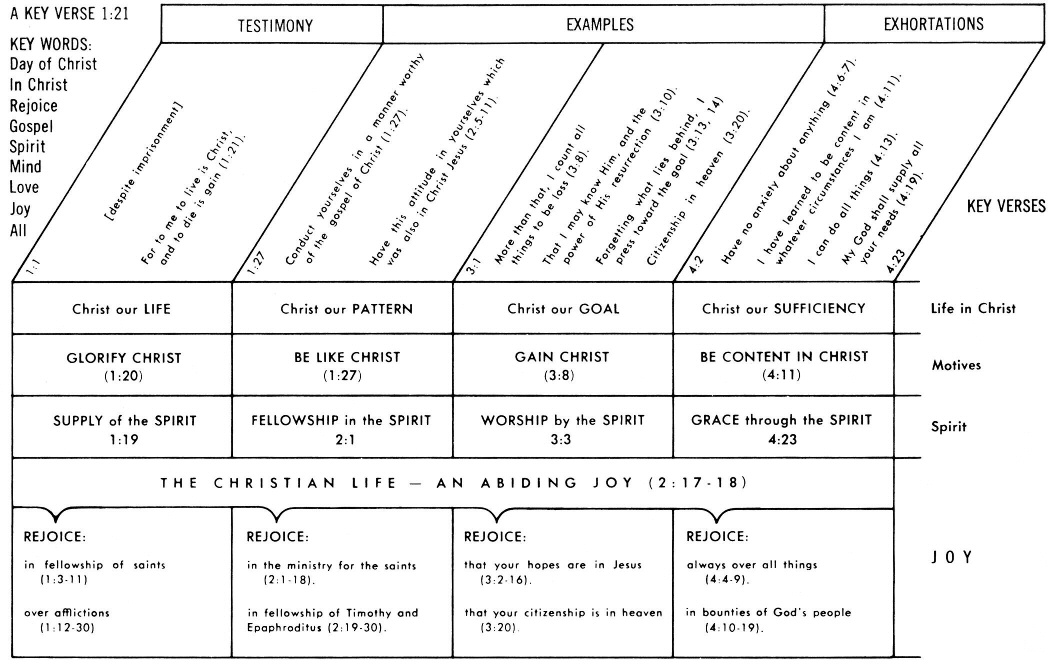
LIFE IN CHRIST
Click chart to enlarge
Charts from Jensen's Survey of the NT - used by permission
Philippians - Charles Swindoll = Chart on right side of page
| Account of Paul's Circumstances Php 1:1-30 |
Have the Mind of Christ Php 2:1-30 |
Have the Knowledge of Christ Php 3:1-21 |
Have |
| Partakers of Christ | People of Christ | Pursuit of Christ | Power of Christ |
| Suffering | Submission | Salvation | Sanctification |
| Experience | Examples | Exhortation | |
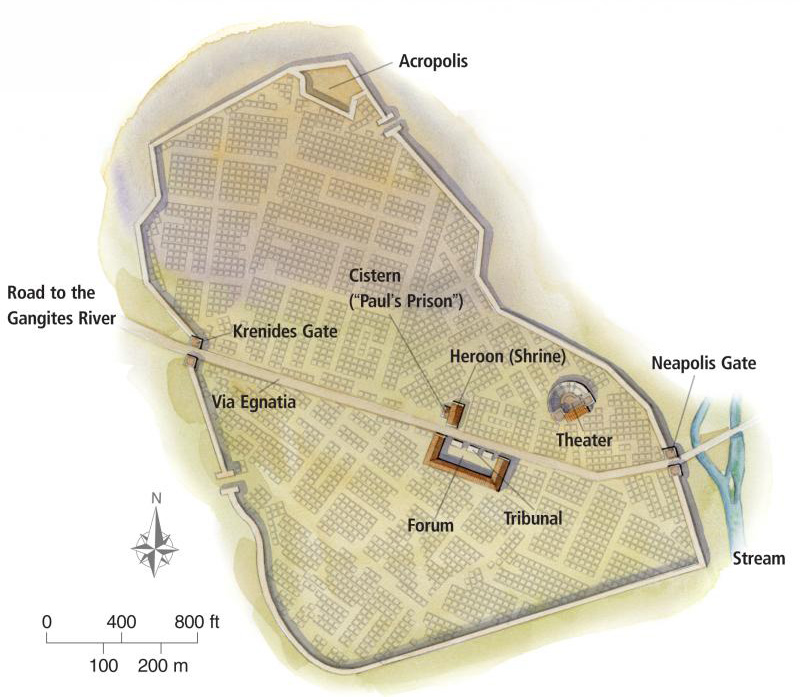
Philippi in the Time of Paul
The city plan above shows those features of the city of Philippi that archaeologists have so far identified as dating from the time of Paul. “Paul’s Prison” is not believed to be an authentic site, but was a cistern later associated with Christian worship. (ESV.org)
Philippians 2:5 Have this attitude (2PPAM) in yourselves which was also in Christ Jesus, (NASB: Lockman)
Greek: touto phroneite (2PPAM) en humin o kai en Christo Iesou,
Amplified: Let this same attitude and purpose and [humble] mind be in you which was in Christ Jesus: (Amplified Bible - Lockman)
Barclay: Have within yourselves the same disposition of mind as was in Christ Jesus (Philippians 2 Commentary)
KJV: Let this mind be in you, which was also in Christ Jesus:
KJV Bible Commentary: Keep on thinking this in you which was also in Christ Jesus.Lightfoot: Reflect in your own minds, the mind of Christ Jesus. Be humble, as he also was humble
Phillips: Let Christ himself be your example as to what your attitude should be. (Phillips: Touchstone)
Wuest: This mind be constantly having in you which was also in Christ Jesus (Eerdmans Publishing)
Young's Literal: For, let this mind be in you that is also in Christ Jesus,
HAVE (habitually, as your lifestyle) THIS ATTITUDE IN YOURSELVES WHICH WAS ALSO IN CHRIST JESUS: touto phroneite (2PPAM) en humin ho kai en Christo Iesous:
- Mt 11:29; 20:26-28; Lk 22:27; John 13:14,15; Acts 10:38; 20:35; Ro 14:15; 15:3,5; 1Co 10:33; 11:1; Eph 5:2; 1Pet 2:21; 4:1; 1Jn 2:6)
For an excellent discussion of the doctrine in this section see John MacArthur's sermon the "Humiliation of Christ".
Have this mind in you, which was also in Christ Jesus (ASV)
and think the same way that Christ Jesus thought (CEV)
Let the same disposition be in you which was in Christ Jesus (Weymouth)
this mind be constantly having in you which was also in Christ Jesus (Eerdmans Publishing)
Let Christ himself be your example as to what your attitude should be (Phillips)
Let your attitude toward one another be governed by your being in union with the Messiah Yeshua: (Jewish NT)
Vine introduces this section writing that…
In order to enforce the earnest exhortations just given as to lowliness of mind and unselfish consideration of the things of others, the apostle sets forth the Lord Jesus Christ as the supreme example of this, and in doing so declares the outstanding doctrines of the faith, “the deep things of Christ,” His voluntary self-abasement, His incarnation, His obedience even unto the death of the cross. The passage combines Christian doctrine and Christian practice. The immediate connection is between the principle in Phil 2:4, of having regard to the condition and needs of others, and this sublime example of Christ. For all that now follows declares how He looked upon our dire needs as sinners. We are the “others” whose “needs” were the great object of His actings of grace. And it is His mind, as thus expressed, that is to be our mind. (Vine, W. Collected writings of W. E. Vine. Nashville: Thomas Nelson)
The KJV renders it Let this mind be in you" which gives one the impression that Paul is giving them an exhortation that is optional. As most of the modern versions convey more accurately, this instruction by Paul is a command. Paul is making it very clear that, if one is to be a child of God in whom the Father takes great delight, this command will be lovingly obeyed.
And so Paul proceeds to lift up before the eyes of the Philippians the example of the Lord Jesus Christ.
What kind of attitude did He exhibit? What characterized His behavior toward others? One has summed up the mind of the Christ as:
(1) The selfless mind;
(2) The sacrificial mind;
(3) The serving mind.
The Lord Jesus consistently thought of others. Now literally Paul commands the saints at Philippi…
"This be ye constantly thinking in you which also was in Christ Jesus”
This (5124) (touto) is emphatic (placed first in the Greek text for emphasis) and shows that the command relates refers to the what Paul has just instructed in the preceding passages Philippians 2:3-4.
May the Mind of Christ, My Savior
May the mind of Christ, my Savior,
Live in me from day to day,
By His love and power controlling
All I do and say.
May the Word of God dwell richly
In my heart from hour to hour,
So that all may see I triumph
Only through His power.
May the peace of God my Father
Rule my life in everything,
That I may be calm to comfort
Sick and sorrowing.
May the love of Jesus fill me
As the waters fill the sea;
Him exalting, self abasing,
This is victory.
May I run the race before me,
Strong and brave to face the foe,
Looking only unto Jesus
As I onward go.
May His beauty rest upon me,
As I seek the lost to win,
And may they forget the channel,
Seeing only Him.
Have this attitude (5426) (phroneo [word study]) means to set one's mind or heart upon something, to have understanding, to be wise, to direct one’s mind to a thing, to seek or strive for. The idea is not to give just a casual thought to something but a thinking that involves the affections and will as well as the reason.
Phroneo - 26x in 20v - Matt 16:23; Mark 8:33; Acts 28:22; Rom 8:5; 11:20; 12:3, 16; 14:6; 15:5; 1 Cor 13:11; 2 Cor 13:11; Gal 5:10; Phil 1:7; 2:2, 5; 3:15, 19; 4:2, 10; Col 3:2. NAS = adopt a view(1), conceited*(1), concern(1), concerned(1), feel(1), have attitude(3),intent on purpose(1), live in harmony(1), mind(4), observes(2), set their minds(2), set your mind(1), setting your mind(2),think(3), views(1).
Phroneo refers to the basic orientation, bent, and thought patterns of one's mind, rather than to the intellect itself. Paul is announcing this in the present tense (calling for continuous action, lifestyle) active voice (personal decision of the will - to yield to the enabling power of the Spirit - see below) imperative mood (command).
And so Paul is not making a suggestion but is commanding the saints at Philippi to be transformed by the “renewing of the mind” (Ro 12:2) because he knows that only in this way can we carry out the command for Christ-like behavior (for example, just try to be selfless and humble like Christ in your own strength! Our flesh ever gravitates toward selfishness and pride!) So it is vital to remember that Christ has not left us alone to try to carry this out by ourselves. He has given each and every believer a wonderful Helper (Jn 14:16, 26, 15:26, 16:7), the Holy Spirit, the Spirit of Christ (Ro 8:9). And so we must continually remember that the Spirit of Jesus Christ (Phil 1:19) is in us (1Co 3:16, 1Co 6:19), continually working, continually giving us the desire and the power to carry out all of God's commands (which we cannot carry out in our own inherent power, the "arm of flesh" 2Chr 32:8! Rely on this truth even as the people relied on King Hezekiah's words beloved!) even as he describes in the next section of this letter explaining that…
it is God Who is at work (energeo in the present tense = continually "energizing") in you, both to will (the Spirit gives us the "want to", the desire to obey God's commands) and to work (energeo in the present tense - the forever indwelling Holy Spirit continually gives us the power to obey) for His good pleasure. (Phil 2:13)
Comment: As Christ followers, we are 100% responsible to "have this attitude" (to continually "work out [our] salvation" - Phil 2:12) but at same time we are 100% dependent on the "synergistic" supernatural work of our Enabler, the indwelling Holy Spirit. It therefore behooves believers to become conversant with the Spirit's ongoing work and our continual ongoing need for His work in us (see comments by F B Meyer re "walking by the Spirit" at the end of this note);
Paul is calling the saints at Philippi (and in every place and every time) to a daily lifestyle of vigilance in maintaining a Christocentric orientation to life that could be eroded easily for as the hymn says
O to grace how great a debtor daily I’m constrained to be!
Let Thy goodness, like a fetter, bind my wandering heart to Thee.
Prone to wander, Lord, I feel it, prone to leave the God I love.
Here’s my heart. O take and seal it. Seal it for Thy courts above.
(Play Come Thou Fount of Every Blessing)
Sing this hymn to the Lord as your prayer right now and then empowered by amazing grace, go forth making the decision to continually chose Savior over self. God will provide "plenteous opportunities" during the day as well as "plenteous grace" (cp 2Co 12:9; 2Co 12:10) to enable you to practice this important spiritual discipline of thinking like Christ would think in every situation and in every circumstance, to the glory of the Father. Amen.
Remember as Robert Murray M'Cheyne said…
"It's not great talents that God blesses, but great likeness to Jesus."
The saints at Philippi (as is true of all believers) had "the mind of Christ" (1Cor 2:16) but Paul is them to continually think like Christ. He knew that when they had their Lord's attitude, they would not be defending their own rights, promoting their own selfish interests and living for themselves. How did you begin your morning today? Did you choose to put on Christ and His attitude or were you influenced by the world system (kosmos) which incessantly promotes and "exalts" selfishness (2Ti 3:1,2, 3, 4, 5-see notes 2Ti 3:1-2, 3:3-5).
Christ Who is "gentle and humble in heart" (Mt 11:29) is to be our daily example of selflessness. He was lowly-minded and we should be like-minded. As followers of Christ, we should imitate His "example" and "follow in His steps" (1Pe 2:21).
The one who says he abides in Him ought himself to walk in the same manner as He walked (1Jn 2:6). (I.e., your life should match your lips! If it does not, you need to ponder 2Cor 13:5).
We should
walk (present imperative = command calling for Spirit imparted supernatural love, love in action, to be the saint's lifestyle!) in love, just as Christ also loved (us), and gave Himself up for us, an offering and a sacrifice to God as a fragrant aroma" (Eph 5:2)
We should
not be conformed (present imperative + negative = stop doing this - suschematizo) to this world (aion), but be transformed (metamorphoo - continually = present tense) by the renewing of (our) mind that you may prove (dokimazo) (I.e., as the Spirit renews our mind to think experientially like who we are positionally [we have the "mind of Christ" 1Co 2:16] we will be able to test and discern and prove genuine) what the will of God is, that which is good (agathos) and acceptable (euarestos) and perfect (teleios). (Ro 12:2).
As we
"with unveiled face (behold) as in a mirror the glory of the Lord (in passages such as the one we are studying, we… ) are being transformed (metamorphoo - continually = present tense) in the passive voice = action exerted from outside source - in this case the Holy Spirit) into the same image from glory to glory, just as from the Lord, the Spirit" (2Cor 3:18)
What was the "attitude" in Christ Jesus? The answer follows in one of the most profound descriptions of our Lord in the entire word of God. If you have not memorized this section of Scripture so that you might be "blessed" by meditating upon ("beholding as in a mirror the glory of the Lord") it's precious truth "day and night" (Ps 1:2), you are missing the "opportunity of a lifetime". Take a week and memorize at least verses 3-10. You will never regret it in time or eternity! (See Memorizing His Word)
CHRISTOLOGY
IN PHILIPPIANS 2:6-11
- Christ's Preexistence
- Christ's Humiliation
- Christ's Exaltation Philippians 2:6
- Philippians 2:7-8
- Philippians 2:9-11
Matthew Henry rightly reminds us that genuine
"Christians must be of Christ's mind. We must bear a resemblance to His life, if we would have the benefit of His death" for as Paul writes "you are not in the flesh but in the Spirit, if indeed the Spirit of God dwells in you. But if anyone does not have the Spirit of Christ, he does not belong to Him" (see note Romans 8:9)
A T Robertson comments that
"Paul presents Jesus as the supreme example of humility. He urges humility on the Philippians as the only way to secure unity."
The Lord of glory consistently thought of others first which prompted Charles H. Gabriel to pen these powerful, poignant words…
He had no tears for His own griefs,
But sweat-drops of blood for mine.
F B Meyer in Our Daily Walk has the following devotional entitled THE MEANING OF THE CROSS - FAITH IS not simply an intellectual experience of a statement of fact, but it is our personal trust and confidence in Him of whom the fact is true. We are not saved merely because we believe that Jesus Christ died for us on the Cross, but because we trust in Him who died. It is the personal touch between Christ and ourselves that causes His life to pass into our nature, making us sound and healthy, as well as secure and safe.
What does the Cross mean to you and me? Does it not mean that there our Lord gave Himself absolutely to the Father's will. Never in any way did He make Himself the origin and fountain of His action, but was ever the empty channel through which God poured Himself. "He humbled Himself, and became obedient unto death, even the death of the cross." It seemed as if He went down lower and lower, on rung after rung of the ladder until He reached Hades, giving up everything only to follow the Will of God; but out of the lowest depths God raised Him to the Eternal Throne.
In each one of us there is strong serf-will. You say, "I am resolved to be a good man or woman, to live a noble life, to give up bad habits--I will" But it can never be accomplished in that way. It is only when we are willing to see ourselves, our own energy, our good self as well as our bad serf brought to an end on the Cross of Jesus, that we shall be able to enter into and live His eternal life.
At this moment I would summon you to stand beneath the Cross and to see there One who entirely yielded up His own will. More than that, I want you to see your serf-life nailed there, and turn from it to God in adoration, saying that you are prepared to be weak and helpless so far as your own energies are concerned, that He may put forth in your life the mighty energy of that power which raised Christ from the dead. It is only when we are weak that we are really strong; it is only when we surrender ourselves to the power of the Cross, so that we realize that we have been crucified with Christ, that we are able to share in His eternal victory over the devil and the power of evil.
PRAYER - O God, Thou hast revealed Thyself to us in Thy Son, Jesus Christ our Lord. We love Him, because He endured the Cross, and despised the shame in order to save us. May we follow Him by the way of the Cross, bearing His reproach, sharing His griefs, obedient even unto death, that we may also live and reign with Him here, and more perfectly at last. AMEN.
WHAT is "the Christmas spirit"? Is it jovial family festivity, the sound of familiar carols in a busy shopping mall, the flow of cheery greeting cards that keep us in touch with old friends, a tree covered with twinkling lights peeking out of a pile of brightly wrapped packages, or the general good feeling we get at this season of the year? These are what most people think of when they hear the expression "Christmas spirit." But for Christians much more is involved.
J. I. Packer defines the Christmas spirit in his book Knowing God. He writes, "We talk glibly of the Christmas spirit, rarely meaning more by this than sentimental jollity on a family basis… It ought to mean the reproducing in human lives of the temper of Him who for our sakes became poor, … the spirit of those who, like their Master, live their whole lives on the principle of making themselves poor—spending and being spent—to enrich their fellowmen, giving time, trouble, care, and concern to do good to others—and not just their own friends—in whatever way there seems need."
In Philippians 2 we read that the Son of God laid aside His divine glory and became your servant and mine by being made in human likeness and dying on the cross for our sins. Following His example means letting the mind of Christ be in us and humbly serving others. That's the true spirit of Christmas!—D J De Haan (Our Daily Bread, Copyright RBC Ministries, Grand Rapids, MI. Reprinted by permission. All rights reserved)
A former missionary told the story of two rugged, powerful mountain goats who met on a narrow pathway joining two mountain ridges. On one side was a chasm 1,000 feet deep; on the other, a steep cliff rising straight up. So narrow was the trail that there was no room to turn around, and the goats could not back up without falling. What would they do? Finally, instead of fighting for the right to pass, one of the goats knelt down and made himself as flat as possible. The other goat then walked over him, and they both proceeded safely.
In a sense, this is what Jesus Christ did for us when He left heaven's glory and came to this earth to die for our sins. He saw us trapped between our sin and God's righteousness with no way to help ourselves. He humbled Himself by giving up His right to use His divine power. He came in the likeness of men and took the form of a servant (Phil. 2:5-8). Then, by dying for sinful mankind, He let us "walk over Him" so that we could experience forgiveness and receive eternal life. —D C Egner (Our Daily Bread, Copyright RBC Ministries, Grand Rapids, MI. Reprinted by permission. All rights reserved)
Christ emptied Himself.
Behold our pattern.
St. Ambrose.
God's Paradoxes - Whoever desires to save his life will lose it, but whoever loses his life for My sake will find it. --Matthew 16:25
The Bible tells us there is a wisdom that is foolish and a foolishness that is wise (1Cor. 1:20, 21, 22, 23, 24, 25). There is a gain that is loss and a loss that is gain (Phil. 3:7, 8, 9). And there is an exalted way that leads downward and a humble way that leads to exaltation (Phil. 2:5-11).
Statements like these seem to be contradictions, but they are actually paradoxes. A paradox is a statement that contains two truths, which at first glance seem to be incompatible.
A psychiatrist once unknowingly referred to one of God's paradoxes, remarking, "The greatest secret of mental health comes down to us in the words, 'Whoever would save his life will lose it, and whoever loses his life will save it.'" He added, "I forget who said that, but it is a great truth."
Who said that? Our Lord Jesus Christ! He gave us that principle in Matthew 16:25. And the apostle Paul lived it out as he endured countless hardships for the benefit of others (2Cor. 4:8, 9, 10, 11, 12). Yet Paul knew that even as his physical body was dying, his spirit was being renewed (2Co 4:16).
You cannot find your richest personal fulfillment until you sacrifice your time, strength, and resources to God's will. "Lose your life" for Christ. Start really living! --V C Grounds (Our Daily Bread, Copyright RBC Ministries, Grand Rapids, MI. Reprinted by permission. All rights reserved)
Take up thy cross and follow on,
Nor think till death to lay it down,
For only he who bears the cross
May hope to wear the glorious crown. --Everest
Christ showed His love by dying for us;
we show our love by living for Him.
F B Meyer in his devotional commentary "The Epistle to the Philippians" ask a series of questions which are vitally important to every believer's day to day life in Christ…
How do you live the Christian life? (BOOKLET)
What means are given to the believer to press on in walking faithfully before the Lord?
Can the Christian really live differently from the unbelievers of the world?
When true conversion takes place, the believer has a different nature and different desires than his unbelieving counterpart. This produces a different walk, that is, a totally different sort of conduct or lifestyle. Without this new nature a person can only slide deeper into bondage in attempting to conform to divine standards by the power of the flesh. Those who are in Christ are to live by the provisions of the Holy Spirit.
This is not to say that the believer never sins. For indeed he does as long as he is in his fleshly body. But there is a completely different attitude toward sin and even a different attitude toward the Law. He sins, but he does not desire to go on in sin. He sins, but he is not under the Law's condemnation, rather it serves to convict him and lead him in walking rightly before God.
How can we really live like Christians? Let us see how our text gives us instructions and assurance of genuine Christian living.
I. A Command
The one imperative of this text is
"But I say, walk by the Spirit," which is followed by an inevitable result, "and you will not carry out the desire of the flesh." (Gal 5:16-see commentary)
Jesus Christ has saved us to deliver us not only from the penalty of sin but also from its power in our daily lives. He has saved us that we might live holy lives before Him. For example, Titus 2:11-12-note declares,
"For the grace of God has appeared, bringing salvation to all men, instructing us to deny ungodliness and worldly desires and to live sensibly, righteously and godly in the present age."
It is not a matter of 'signing on with the Lord' then living anyway we desire until He takes us to heaven. So many have the mistaken notion that Christianity is just a decision. It is not. It is a total lifestyle under the dominion of Jesus Christ. It means that you have a new nature and you live in a new way because you are indwelt by the Holy Spirit.
It seems that the Apostle captures the whole essence of the Christian's daily life within this verse. First he looks at it positively, then views it negatively. Let us see this for ourselves.
Walk by the Spirit
1. Stated positively
A number of matters confront us at first glance in the words, "Walk by the Spirit." First, Paul explains that this is the very antithesis of "biting and devouring one another" as he had warned about in the previous verse (Gal 5:15). "But I say," i.e., 'Instead of biting and devouring one another because you have given the flesh an opportunity, "walk by the Spirit and you will not carry out the desires of the flesh." Christians must not be presumptuous about the way they live in relation to others. They must not be careless with sin. There is one way we are to live and that is by 'walking in the Spirit'.
A second issue involves the meaning of "walk." The word is commonly used in the New Testament to refer to the whole of one's conduct or behavior. It carries ethical connotations. It involves the way you and I live, how we treat others, what we think about, the sort of things in which we invest our time and resources, the way we talk, the people with whom we are involved. Walking implies progress, especially with the use of the present tense showing that this is continual action. It is not as fast as running, but it is steadily progressing. He does not tell us to go at breakneck pace in the Spirit, but to walk, to pace ourselves by the Spirit's direction and power.
Everything you do involves your walk with Christ if you are a believer. You are never to compartmentalize your life so that in this area you live like a Christian, but over here you live according to the ways of the world. I would go so far as to say, that if you are comfortable doing that you need to consider whether or not you have ever been born of God. All of us have been on the receiving end of unethical or rude behavior by those who profess to be Christians on Sunday but give no evidence of being a Christian during the week. If you have slipped into such a dichotomy then I urge you to repent!
Third, Paul qualifies what he means by commanding the believer to walk. He says to "walk by the Spirit." This brings into focus the great emphasis we see in the Upper Room Discourse in John's Gospel (Jn 14-16) and the writing of the Apostle Paul.
We are to live daily by the influence, direction and power of the Holy Spirit. We are to live in the sphere of relationship to the Holy Spirit. We are to live as those under the control of the Spirit (Eph 5:18).
This reminds us that we can only live by the Spirit if we have been justified by faith in Christ. The Holy Spirit is not a force for men to use to gain some personal mastery in life. He is God dwelling within the believer! He is 'the life of God in the soul of man' as Henry Scougal expressed it. Keep in mind what has transpired in the previous four chapters of Galatians. Paul has explained justification by faith. Now he is speaking to those who have been truly justified by Christ so that they might go on in the faith. and they can due to the Spirit's indwelling power.
Finally, to walk by the Spirit implies that the Spirit is heading somewhere and you are following. It demonstrates for us that the indwelling Spirit of God is actively involved in the life of the Christian in pointing him toward those things that are honoring to God. The Holy Spirit always leads us in concert with the revealed will of God in the Bible. He will never lead us to sin. He will never lead us to violate the written Word of God.
So whenever we seem to have an interest in heading in a questionable area of lifestyle, we can be sure the Holy Spirit is not leading us. Whenever we come to the Scripture and see what God commands us to do, we can be certain that the Holy Spirit, the Divine Author of the Word, will not guide us into disobeying what God has spoken.
To walk by the Spirit implies that we are maintaining an ongoing communion with God. We are exercising those spiritual disciplines that keep our hearts focused upon the Lord, that turns our feet away from sin, that warms our love for Christ. How are you going to walk by the Spirit if you are not in any sort of communion with Him? Our text calls upon us to be serious minded about our spiritual walks, to live in dependence upon the Holy Spirit granting to us the strength and power to obey, and to trust that He will always lead us rightly. We are to be sensitive to His promptings in our lives which may lead us in acts of service, witness, or love. We see what God commands and find the Spirit's strength to obey. We hear the voice of the Spirit directing us and again find His strength to obey.
Do not forget about the Holy Spirit's indwelling strength. Too often we lean upon our own abilities when facing the demands of God before us. But in simple language we are reminded to "walk by the Spirit." Do not trust in your strength for it will surely fail. Do not rest in your gifts and abilities for they are weak at best. Plead for the strength of the Holy Spirit to fill your life and enable you to live before the Lord in ways that honor Him.
2. Stated negatively
Paul says, in essence, do you want to know how to keep from going on in sin? Then "walk by the Spirit and you will not carry out the desire of the flesh." I believe it is important to see how Paul has used this term, "flesh," throughout this epistle. In 2:16 he speaks of "no flesh being justified" by the law. So by this he means no human being, no one subject to sin. In 2:20 he states that the life he lives in the flesh he lives by faith in the Son of God as one who has been crucified with Christ. Here he implies his humanity that is subject to sin. He is not using "flesh" as another term for 'sin nature' rather for the human body with its propensity for sin.
In Galatians 3:3, Paul asks the question, "Are you so foolish? Having begun by the Spirit, are you now being perfected by the flesh?" This verse offers an important insight on how flesh is used in our text. The idea of being perfected by the flesh meant the labor which the Galatians were exerting in trying to conform to the law. It was their energies, their strength, their wisdom struggling to obey the law in order to be sanctified. Paul makes it clear that our sanctification does not occur because we conform to the law. The law has no power to sanctify just as it has no power to justify.
Akin to this same use of flesh is the passage in Galatians 4:21-31, in which Paul contrasts the children of promise with the children of flesh. By flesh, he again refers to the self-effort of fallen men trying to conform to the law of God in order to gain merit with God. Paul explains that such effort only leads to more slavery. Here he uses 'flesh' to describe man apart from God's grace, man left to himself and his own abilities. Rather than finding refuge in Christ, he trusts in himself as he seeks to conform to the demands of the law for justification.
Now, back to our text in Gal 5:16. When Paul says that if you walk by the Spirit you will not carry out the desires of the flesh, he points back to the statement he has already made in Galatians 3:3, that the flesh cannot perfect us or sanctify us. The only way of progress is by the Spirit's work in us. The flesh represents the unrenewed mind that still has all the properties of fallen humanity. Though the flesh might seek to do some good and clean up from time to time in order to impress others, at its root the flesh does one thing: it sins. The desire of the flesh is sin. You can dress it up, call it by another term but the propensity of our humanity apart from the grace of God is to go deeper and deeper into sin.
II. An Explanation
Perhaps this is easier understood if we take a closer look at what is meant by flesh and Spirit.
1. Nature of flesh and Spirit
Paul explains, "For the flesh sets its desire against the Spirit, and the Spirit against the flesh; for these are in opposition to one another, so that you may not do the things that you please." Here we find the basic problem of why we must have a new nature controlled by the Holy Spirit. For all of us are still in the flesh, that is, we all still reside in human bodies that have the propensity for sin. We are capable in our humanity of committing any number of sins which might produce a moral outrage on the part of our neighbors.
There is another reprehensible thing about the flesh. It refuses to trust the cross of Christ. The flesh would rather trust its own strength for moral improvement and for standing with God. To turn away from self-trust to abandon all claims to merit and cling only to Christ sends the flesh into a frenzy! If something is of grace, of the Spirit, of the glory of God, the flesh will seek to do just the opposite. Its longings (Gk. 'desire') run completely counter to the Holy Spirit.
But the Spirit represents all that God is and all that God has done for sinners through Christ. The Holy Spirit, the third Person in the Godhead, applies the redemptive work of Jesus Christ to the sinner. It is the Spirit who renews and regenerates the fallen nature of the sinner so that he has a desire to repent of his sins and believe the gospel of Christ. It is the Spirit who continually renews and fills the believer, exercising control over his life so that he might be sanctified before God. It is the Holy Spirit who 'comes alongside to help' as the Divine Paraclete, comforting, strengthening, urging, motivating the believer in his walk with Christ. It is the Spirit who bears witness with our spirits that we belong to Christ.
2. Conflict of flesh and Spirit
It is natural that the flesh and Spirit are in conflict with one another! "For the flesh sets its desire against the Spirit, and the Spirit against the flesh; for these are in opposition to one another, so that you may not do the things that you please." You cannot please the flesh and at the same time please the Holy Spirit. Nor can you please the Holy Spirit and at the same time please the flesh. They work in opposition to one another. They are the exact opposite at every turn.
To live in the Spirit implies that the believer is living contrary to the normal human existence. He has trusted in the one work, that of Christ, which has brought him into relationship to the Holy Spirit. The flesh, on the other hand, trusts in a multitude of little works, adding them up as supposed merit before God. Thus, it denies the efficacy of the work of Christ on the cross.
Rather than setting up a dichotomy which we must choose on a regular basis for living, Paul is saying just the opposite. We do not choose to live in the flesh or choose to live in the Spirit, as though we can turn off one and turn on the other at the drop of a hat. Instead, we are either in the flesh or in the Spirit. We are either seeking to please God in the Spirit or seeking to please ourselves and the world in the flesh. The conflict abounds, for you cannot do the things which are pleasing to God as long as you are lost, i.e., in the flesh. Nor can you live the life which is displeasing to God as long as you are saved, i.e., in the Spirit.
Can Christians sin? Is Paul teaching perfectionism? Certainly we can sin, but the overriding message of Galatians is that those sins are not imputed to the believer as far as divine judgment. Christ has availed for the believer, so that his sins have been taken out of the way, judged in the Person of Christ on the cross. So, is he perfect? Not at all. He still sins because he still lives in a fleshly body. Until he is liberated from this "body of death" he will still battle with sin. But as a Christian, he has a new nature controlling his life. He is not the same person anymore. The union of his soul with the Spirit of God means that he is going to live in a new fashion. The pattern and practice of his life is to live in the Spirit, not according to the ways of the flesh.
So what is Paul doing in this passage? He is reminding the Galatians that if they are in Christ, then their lives will be lived in conformity to the Spirit of God and not to the flesh. It is not a matter of reverting back and forth between flesh and Spirit. Yes, we do struggle with sin. That is part of our sanctification. And yes, the Christian can fall into grievous sin, impairing his walk with Christ and damaging his testimony before the world. But because he is in the Spirit he cannot persist in such behavior or lifestyle. He cannot find satisfaction in sin or the ways of the world.
III. A Delight
Paul adds yet another dimension to this whole matter. "But if you are led by the Spirit, you are not under Law." The Greek translation puts this in the present tense, so it is better rendered, 'If you are being led by the Spirit Himself, you are not under Law." The emphasis is upon the condition of the believer, he is being led by the Spirit, and the fact that he is no longer subject to the futility of the Law for his sanctification.
1. Assurance given
The assurance that a person is a Christian is the very fact that he is led by the Holy Spirit. As Paul wrote to the Romans, "All who are being led by the Spirit of God, these are sons of God" (Romans 8:14). If the Holy Spirit is not leading you to love God or to follow after Him or to desire Him, then what are you led to believe? You must assume that if there is no leading of the Spirit in your life then you have never been born of God. Why make such a statement at this point? Remember that Paul had been dealing with the matter of legalism as a means to being justified. He had explained that by the works of the law shall no flesh be justified (2:16). But some may have persisted in depending upon the works of the law to put them into a right standing with God. They had followed the deadness of legalism. They had trusted in the flesh. They were still under the Law.
But look at the reality of this assurance. If the Spirit of God persists in working in your life to lead you into holiness, then the evidence that you are being sanctified is present. God is at work in you! You are being led from one degree of grace to another. You are being brought through the trials of life, even with all of its temptations, into the liberty of an ongoing relationship to Jesus Christ. You are being assured by the witness of the Spirit that you are truly born of God.
You find yourself repulsed by the flesh. That becomes normal to you because the flesh and the Spirit "are in opposition to one another, so that you may not do the things that you please." By this Paul did not mean that you cannot follow after the Lord, but he meant that if you are in the Spirit then you cannot follow after the flesh to please the flesh, just as if you are in the flesh you cannot follow after the Spirit, regardless of how hard you try.
2. Affirmation repeated
For Paul, to be in the flesh meant that you would strive to justify yourself before God by means of the Law. This is where his argument has the most practical application. He is telling us that just as we are not justified by the Law neither are we sanctified by the Law. "But if you are led by the Spirit, you are not under the Law." By this, Paul does not mean that we become lawless, for our Lord declared, "If you love Me, you will keep My commandments." Surely that is law! But the whole attitude toward law is different. As Samuel Bolton wrote, "He that loves God solely because God commands it does not love God at all" [The True Bounds of Christian Freedom, 138]. We love Christ and demonstrate that love by our desire to obey Him.
Is this just a slavish duty? Does the Lord put us in the position that we feel compelled to follow a drudgery of obedience, even though our desire is to do otherwise? By no means, for "you are not under the Law." It is not the Law that compels you to obey but the reality that you belong to Christ and are indwelled by the Holy Spirit. It is the reality that you have a new nature in Christ, one that is bent on loving and obeying Him. You do not obey because you have to but because you want to. The Spirit of God has accomplished the change within you so that you might love and obey the Lord.
What is the difference between the person who obeys out of duty and the other who obeys out of delight? I return to the old Puritan work by Samuel Bolton for some most helpful material. Bolton compares what he calls "the legal spirit" with "the evangelical" spirit. So what we are addressing are those who are not truly born of God but who are attempting nonetheless to sanctify themselves by adherence to slavish duty. And we are seeing those who due to the new birth and ongoing work of the Spirit are walking in obedience as a delight.
(1) The principle that moves the one spirit to duty is slavish, the other childlike…
(2) The one man does these things as his delight, and the other as his burden…
(3) The one type of man performs duty from the convictions of conscience, the other from the necessity of his nature. With many, obedience is their precept, not their principle; holiness their law, not their nature. Many men have convictions who are not converted; many are convinced they ought to do this and that, for example, that they ought to pray, but they have not got the heart which desires and lays hold of the things they have convictions of, and know they ought to do. Conviction, without conversion, is a tyrant rather than a king… Conscience tells a man that he ought to do certain things, but gives him no strength to do them. It can show him the right way and tell him what he ought to do, but it does not enable the soul to do it… One the other hand, where there is the principle of the Gospel, where there is grace, it is in the soul as a pilot in a ship who not only points the way but steers the vessel in the way which he appoints.
(4) The one kind of man looks for his satisfaction in the duty by the performance of the duty, the other looks for satisfaction in the duty as he finds Christ thereby; it is not in the duty, but above the duty, that he finds his satisfaction.
(5) The one kind of man contents himself with the shell, the other is not content without the substance. The godly man goes to duty as the means of communion with God, to see God, to enjoy God, and to talk with God; the other goes to duty merely to satisfy the grumblings and quarrels of his conscience.
(6) The one type of man performs duty in order to live by it… But the believer prays and performs duty, yet he looks beyond them, and looks to live by Christ alone. He lives in the duty, but not by the duty; he lives in obedience, but yet looks a higher than obedience: 'I live, yet not I, but Christ liveth in me'…
(7) The one type of man does things coldly and formally, the other fervently… A natural man may pray earnestly at times when in fear or horror, or under pangs of conscience, but he does not cry believingly…
(8) The formal man does duty with a view to it serving other ends, and especially when he finds himself in extreme difficulties… But it is not so with the godly man. He closes with these duties as his heaven, as a part of his happiness, a piece of his glory…
(9) The one kind of man does duty as a sick man eats his food, not out of desire for it and delight in it, but because he knows that he will die if he does not eat; yet he has no desire or stomach for it. But the godly man does duty after the manner in which a healthy man feeds, not merely because he needs food, but because he desires it and delights in it.
Conclusion
It is only those who have been justified by faith alone in Christ alone who are being sanctified by the Holy Spirit. This one walks by the Spirit and is led by the Spirit. he has not by-passed the cross for a legalistic life of holiness. But from the cross, he presses on through the trials and temptations of life with a new Master, a new nature, and a new strength. Does this describe you?
Have you been laboring out of frustration to please God but failed to see that Jesus Christ has pleased God on our behalf? Are you clinging to your strength for obedience when as a true believer you have the power of the Holy Spirit to enable you?
Walk by the Spirit and you will not carry out the desire of the flesh.
Philippians 2:6 who, although He existed (PAPMSN) in the form of God, did not regard (3SAMI) equality with God a thing to be (PAN) grasped (NASB: Lockman) Greek: tos en morphe theou huparchon (PAPMSN) ouch harpagmon hegesato (3SAMI) to einai (PAN) isa theo
Amplified: Who, although being essentially one with God and in the form of God [possessing the fullness of the attributes which make God God], did not think this equality with God was a thing to be eagerly grasped or retained (Amplified Bible - Lockman)
KJV: Who, being in the form of God, thought it not robbery to be equal with God:
Barclay: for he was by nature in the very form of God, yet he did not regard existence in equality with God as something to be snatched at (Philippians 2 Commentary)
Lightfoot: Though existing before the worlds in the Eternal Godhead, yet he did not cling with avidity to the prerogatives of divine majesty, did not ambitiously display his equality with God
Phillips: For he, who had always been God by nature, did not cling to his prerogatives as God's equal, (Phillips: Touchstone)
Wuest: Who has always been and at present continues to subsist in that mode of being in which He gives outward expression of His essential nature, that of Deity, and who did not after weighing the facts, consider it a treasure to be clutched and retained at all hazards, to be equal with Deity (in the expression of the divine essence) (Eerdmans Publishing)
Young's Literal: Who, being in the form of God, thought it not robbery to be equal to God,
WHO ALTHOUGH H E EXISTED IN THE FORM OF GOD: hos en morphe theou huparchon (PAPMSN):
- Isa 7:14; 8:8; 9:6; Jer 23:6; Mic 5:2; Mt 1:23; Jn 1:1, 1:2, 1:18 ; 17:5; Ro 9:5; 2Co 4:4; Col 1:15;1:16 1Ti1:17; 3:16; Titus 2:13; Heb 1:1, 1:3 1:6 1:8; Heb 13:8
- See Torrey's Topic The Humility of Christ
Now Paul proceeds to describe the humiliation of the Son so that we might understand what it means to “Have the mind of Christ.” He begins by emphasizing that Jesus Christ possessed the essence of God's nature from all eternity.
John wrote that before time began, Christ was already in existence with God "In the beginning was the Word, and the Word was with God, and the Word was God. He was in the beginning with God. All things came into being by Him, and apart from Him nothing came into being that has come into being. (John 1:1, 2, 3)
Paul affirms His divinity writing that Jesus 'is the image of the invisible God, the first-born of all creation. For by Him all things were created, both in the heavens and on earth, visible and invisible, whether thrones or dominions or rulers or authorities-- all things have been created by Him and for Him. And He is before all things, and in Him all things hold together. (Col 1:15, 16; Col 1:17)
The writer of Hebrews adds that Jesus "is the radiance of His glory and the exact representation of His nature, and upholds all things by the word of His power. When He had made purification of sins, He sat down at the right hand of the Majesty on high (Heb 1:3)
Wuest paraphrases Phil 2:6 this way "Who has always been and at present continues to subsist in that mode of being in which He gives outward expression of His essential nature, that of Deity, and who did not after weighing the facts, consider it a treasure to be clutched and retained at all hazards, to be equal with Deity (in the expression of the divine essence) (Philippians Commentary - Verse by Verse Comments)
Lightfoot has a lengthy "paraphrase" writing that…
"Though existing before the worlds in the Eternal Godhead, yet he did not cling with avidity to the prerogatives of divine majesty, did not ambitiously display his equality with God; but divested himself of the glories of heaven, and took upon him the nature of a servant, assuming the likeness of men. Nor was this all. Having thus appeared among men in the fashion of a man, he humbled himself yet more, and carried out his obedience even to dying. Nor did he die by a common death: he was crucified, as the lowest malefactor is crucified. But as was his humility, so also was his exaltation. God raised him to a preeminent height, and gave him a title and a dignity far above all dignities and titles else. For to the name and majesty of Jesus all created things in heaven and earth and hell shall pay homage on bended knee; and every tongue with praise and thanksgiving shall declare that Jesus Christ is Lord, and in and for him shall glorify God the Father " (Lightfoot)
Existed (5225) (huparcho from hupó = under + árcho = begin or arche = beginning) means literally to begin under and then to exist, be present or be at hand. Huparcho involves continuing to be that which one was before. Huparcho denotes the continuance of a previous state or existence. It stresses the essence of a person’s nature, that which is absolutely unalterable, inalienable, and unchangeable.
Barclay adds that huparcho "is not the common Greek word for being. (Huparcho) describes that which a man is in his very essence and which cannot be changed. It describes that part of a man which, in any circumstances, remains the same. So Paul begins by saying that Jesus was essentially and unalterably God. (Philippians 2 Commentary)
Huparcho in the present tense (continuous) clearly signifies that Jesus continually existed in the form of God. Nothing appeared that was not an objective reality from the beginning.
This is a clear statement of the deity of Christ. In His pre-incarnate state Christ possessed the attributes of God and so appeared to those in heaven who saw Him. He was and had always existed as God before He became man for
Jesus Christ is the same yesterday and today, yes and forever. (Heb 13:8)
Prophesying of the coming Messiah, Micah spoke of Messiah's eternal existence writing
His goings forth are from long ago, from the days of eternity (Mic 5:2)
Although a bit more technical, it is worth noting that the verb "existed" is not the usual verb of "being" (eimai), but is the "stronger" verb, huparcho which refers to an antecedent condition which is protracted into the present. That is, our Lord's being in the form of God was true of Him before He became Man and was true of Him at the time of the writing of this epistle, which tells us that in taking upon Himself humanity with its limitations yet without its sin, He lost nothing of His intrinsic deity, its attributes or its prerogatives.
Jesus speaking to His Jewish audience made an indisputable claim reminding them that
"Your father Abraham rejoiced to see My day, and he saw it and was glad." The Jews therefore said to Him, "You are not yet fifty years old, and have You seen Abraham?" Jesus said to them,
Truly, truly, I say to you, before Abraham was born, I am. (present tense)
Therefore they picked up stones to throw at Him; but Jesus hid Himself, and went out of the temple." (John 8:56 57 58, 59)
Why did the Jews pick up stones to stone Jesus? They recognized that He had made an unmistakable absolute emphatic declaration "I am" (ego eimi) which the Jews clearly understood as a reference to (Exodus 3:14), when Moses asked God His name and received the reply:
"I AM THAT I AM." (see study on Jehovah)
So just as God had taught Moses, now Jesus informed the Jews that He was the eternally existent One. Jesus says that He existed even before Abraham "was" ("came into existence") and thus the inescapable conclusion is that Jesus is God, Yahweh or Jehovah of the Old Testament. And thus here in Philippians 2, Paul is affirming that Jesus existed from all eternity as God, not merely resembling God, but as God in the truest sense of the word. Jesus existed continually in the form of God.
Just before His crucifixion, He prayed to His Father again testifying that He had always "existed"…
"Glorify Thou Me together with Thyself, Father, with the glory which I had with Thee before the world was." (Jn 17:5)
Form (3444) (morphe) refers to the nature or character of something and emphasizes both the internal and external form. In other words morphe refers to the outward display of the inner reality or the essential form of something which never alters.
Morphe - 3x in 3v - Mark 16:12; Phil 2:6, 7
Mark 16:12 And after that, He appeared in a different form to two of them, while they were walking along on their way to the country. (cp Lk 24:16, the full account of this appearance is Luke 24:13-32)
Comment: MacDonald "To Mary He had appeared as a gardener. Now He seemed like a fellow-traveler. But it was the same Jesus in His glorified body." Wuest essentially agrees "The Greek word “form” is the same as that used in the account of the Transfiguration, but Swete says that there was clearly nothing in the Lord’s appearance to distinguish Him from any other wayfaring man."
Walvoord "This could mean that He took on a form different from that in which He appeared to Mary Magdalene or, more likely, that He appeared to them in a form different from that in which they had previously recognized Him as Jesus." (Philippians 2 At the Name of Jesus Every Knee Should Bow)
Morphe stresses essence of one’s nature and specifically denotes the essential, unchanging character of something—what it is in and of itself. Morphe does not speak of external appearance or outward shape but of the essential attributes and the inner nature. When Paul says Jesus Christ was “in the form of God,” The Son is one in nature, one in attributes, one in character with the Father.
As John MacArthur states morphe means that…
The idea is that, before the Incarnation, from all eternity past, Jesus preexisted in the divine form of God, equal with God the Father in every way. By His very nature and innate being, Jesus Christ is, always has been, and will forever be fully divine. (MacArthur, J. Philippians. Chicago: Moody Press)
Morphe contrasts with "schema" (Phil 2:8) which denotes the outward which changes from time to time and from circumstance to circumstance.
For example, morphe of any human being is his or her humanity and this never changes. On the other hand, his or her schema is continually changing (no, you are aren't getting any younger!). A baby, a child, a boy, a youth, a man of middle age, an old man always have the morphe of humanity, but the outward schema changes all the time. The morphe never alters; the schema continually does. Does this help you understand this important distinction?
Paul in using morphe is clearly teaching that Jesus Christ in His preincarnate state Christ possessed all the attributes of God and so appeared to those in heaven who saw Him. Thus morphe refers to the outward display of the divinity of the preexistent Christ (see Vincent below).
Hebrews affirms the deity of Christ writing that Jesus…
"is the radiance of His (the Father's) glory and the exact representation of His (the Father's) nature, and upholds all things by the word of His power. When He had made purification of sins, He sat down at the right hand of the Majesty on high (He 1:3)
Paul wrote that "Christ… is the image of God" (2Cor 4:4), specifically that
He is the image of the invisible God, the Firstborn of creation, for by Him all things were created, both in the heavens and on earth, visible and invisible, whether thrones or dominions or rulers or authorities--all things have been created through Him and for Him. (Col 1:15, 16)
Existed in the form of God
Morphe presumes an objective reality. No one could be in the form (morphe) of God who was not God. Morphe is the essential form which never alters which contrast with the similar word schema which describes the outward form which changes from time to time and from circumstance to circumstance. The derivative Greek word metamorphoo is found in Mt 17:2 where Jesus "was transfigured before them; and His face shone like the sun, and His garments became as white as light." (Mt 17:2) where the prefixed preposition meta- in a composition signifies a change and thus is translated "transfigured" or a change in form and could be rendered, "His mode of expression was changed before them."
Our Lord's usual mode of expression as a Man was that of a bond-slave. That was an expression which came from His innermost being as the One who came not
"to be served, but to serve, and to give His life a ransom for many." (Mk 10:45)
But for a moment in (Mt 17:2) the mode of His expression was changed. He gave expression to the essence of His deity in which He is a co-participant with God the Father and God the Holy Spirit. The splendor and majesty of His deity (He 1:3) shone through the "clay walls of His humanity", and by means of a medium discernible to the physical eyesight of His astounded audience.
The form of God in Philippians 2:8 speaks of an expression of His glory not discernible to our physical vision, although His resurrection glory will be for
when He appears, we shall be like Him, because we shall see Him just as He is and everyone who has this hope fixed on Him purifies himself, just as He is pure." (1Jn 3:2, 1Jn 3:3)
Peter affirms that
"though you have not seen Him, you love Him, and though you do not see Him now, but believe in Him, you greatly rejoice with joy inexpressible and full of glory" (1Pe 1:18)
Thus our Lord in His preincarnate state manifested the glory of His deity to the holy angels in an outward mode of expression discernible to these spiritual intelligences.
The KJV Bible Commentary explains that morphe…
signifies the mode in which He expresses His divine essence. Form (Greek morphe) “always signifies a form which truly and fully expresses the being which underlines it” (H. A. A. Kennedy, The Epistle to the Philippians, p. 436) No creature could exist in the form of God, but Lucifer aspired to this (Isa 14:12, 13, 14). To give expression to the essence of deity implies the possession of deity. What Peter, James, and John witnessed on the Mount of Transfiguration was a glimpse of the outward expression of His deity (Mt 17:1, 2). Christ’s own eternal self-manifesting characteristics were shining forth from His divine essence. (Dobson, E G, Charles Feinberg, E Hindson, Woodrow Kroll, H L. Wilmington: KJV Bible Commentary: Nelson)
Marvin Vincent has a lengthy more technical theological discussion on morphe explaining that
"We must here dismiss from our minds the idea of shape. The word is used in its philosophic sense, to denote that expression of being which carries in itself the distinctive nature and character of the being to whom it pertains, and is thus permanently identified with that nature and character.
Thus it is distinguished from schema = fashion, comprising that which appeals to the senses and which is changeable.
Morphe or form is identified with the essence of a person or thing:
Schema = fashion is an accident which may change without affecting the form… As applied here to God, the word is intended to describe that mode in which the essential being of God expresses itself.
We have no word which can convey this meaning, nor is it possible for us to formulate the reality.
Form inevitably carries with it to us the idea of shape. It is conceivable that the essential personality of God may express itself in a mode apprehensible by the perception of pure spiritual intelligences; but the mode itself is neither apprehensible nor conceivable by human minds. This mode of expression, this setting of the divine essence, is not identical with the essence itself, but is identified with it, as its natural and appropriate expression, answering to it in every particular. It is the perfect expression of a perfect essence. It is not something imposed from without, but something which proceeds from the very depth of the perfect being, and into which that being perfectly unfolds, as light from fire.
To say, then, that Christ was in the form of God, is to say that He existed as essentially one with God. The expression of deity through human nature (Phil 2:7) thus has its background in the expression of deity as deity in the eternal ages of God's being.
Whatever the mode of this expression, it marked the being of Christ in the eternity before creation. As the form of God was identified with the being of God, so Christ, being in the form of God, was identified with the being, nature, and personality of God. This form, not being identical with the divine essence, but dependent upon it, and necessarily implying it, can be parted with or laid aside. Since Christ is one with God, and therefore pure being, absolute existence, He can exist without the form. This form of God Christ laid aside in His incarnation. (Philippians 2: Greek Word Studies)
The word "God" does not have the article "the" in Greek (anarthrous), which stresses the quality or essence.
John Walvoord…
The expression “being in the form of God” (Note: The Greek being is not the usual verb on (to be), but huparchon in the form of an imperfect participle, meaning continued existence, emphasizing the fact that Christ had always been and still is in the form of God. The imperfect tense is in contrast to the aorist verbs used in reference to the incarnation which describe acts in time.) means not only that Christ is God, but that He always was God and that He existed as God, not simply because He possessed all the attributes of God, but because these were manifested outwardly and He had the appearance and glory of God. Being thus from eternity past all that God is both in substance and in manifestation, He did not consider His being on equality with God something that needed to be retained by self-effort, but rather “made himself of no reputation,” literally, “emptied Himself,” taking on the form of a servant.
Three Greek words are used to describe the outer appearance of Christ: (1) Morphe (form), referring to divine nature and attributes in their manifestation. The form of God is in contrast to the form of a servant (v. 7) or the manifestation of Christ in the substance and attributes of a servant. (2) Homoiomati (likeness), meaning that Christ was made like other men in His essential attributes and manifestation as a genuine man (v. 7). (3) Schemati (fashion), referring to outer manifestation and more transient characteristics of humanity (v. 8). The use of the three words together affirm that Christ was from eternity past all that God is in substance, attributes, and manifestation. Becoming incarnate He was all that was necessary to genuine humanity apart from sin. In appearance he looked like a man and acted like a man. In His incarnate state Christ continued to be all that God is though appearing in the form of man. After His ascension and glorification He continued to be all that man is apart from sin, limitation, and human characteristics that pertain only to this life. (Philippians 2 At the Name of Jesus Every Knee Should Bow)
DID NOT REGARD EQUALITY WITH GOD A THING TO BE GRASPED: ouch harpagmon hegesato (3SAMI) to einai (PAN) isa theo:
- Ge 32:24, 25, 26, 27, 28, 29, 30; 48:15, 48:16; Ezek 8:2, 3, 4, 5, 6; Jos 5:13, 14, 15; Hos 12:3, 4, 5; Zec 13:7; Jn 5:18; 5:23, Jn 8:56, 57, 58, 59; 10:30; 10:33, 10:38, 14:9; 20:28; Rev 1:17, 18; 21:6
Who, existing in the form of God, counted not the being on an equality with God a thing to be grasped (ASV)
Who, being in the form of God, thought it not robbery to be equal to God (Young's Literal)
Let Earth and Heaven Combine
He laid His glory by,
He wrapped Him in our clay;
Unmarked by human eye,
The latent Godhead lay;
Infant of days He here became,
And bore the mild Immanuel’s Name.
Remember that what Paul is doing in the deeply theological passages is exhorting the saints at Philippi to manifest a humble attitude motivated by the perfect example of our blessed Lord. Paul knows that if they manifest a "mind of Christ" attitude, this will ensure unity in their local body.
Christ thought of others, not Himself. Unlike the first Adam, who made a frantic attempt to seize equality with God (Gen 3:5), Jesus, the last Adam (1Cor 15:47), humbled himself and obediently accepted the role of the Suffering Servant for the sake of Adam's spiritually dead progeny. This is the example Paul sets before the saints at Philippi.
Regard (2233) (hegeomai = the middle deponent of the verb ágo = to lead) primarily means to lead and thus to "lead the mind" through a reasoning process to a conclusion. The idea is to think about something and come to a conclusion. Hegeomai is consideration which involves careful thought and not quick decision. It involves a conscious judgment resting on deliberate weighing of the facts. It is translated "esteem" in Phil 2:3 (note)
Equality (2470) (isos) defines things exactly same in size, quantity, quality, character or number. Thing of your geometry class when you learned about an "isosceles" triangle, one having two sides of equal length. That is the picture of the Greek word "isos". In becoming a man, Jesus did not in any way forfeit or diminish His absolute equality with God.
Dwight Edwards explains that "Out of love for us and the joy set before Him (He 12:2), He released His grip on equality with the Father and began sliding down the rope of humiliation. Christ had a perfect right to bold on to what was His. But He did not cling to His rights, but rather He let go of them with an five fingers." (Sermon)
Grasped (725) (harpagmos from harpazo = to seize upon with force) originally meant “a thing seized by robbery” and eventually came to mean anything snatched, clutched, embraced, or prized, thus is sometimes translated “grasped” or “held onto” as a treasure is clutched and retained.
Given this definition we can paraphrase this verse…
“Christ did not regard His equality with God as a treasure to be clutched and retained at all costs.”
Jesus refused to selfishly cling to His favored position as the divine Son of God nor view it as a prized possession to be used for Himself.
The KJV Bible Commentary explains that…
This word (harpagmos) has two distinct meanings. One, a thing unlawfully seized, and two, a treasure to be clutched and retained. Christ did not cling to His prerogatives of His divine majesty, did not ambitiously display His equality with God. Christ waived His rights to: (1) express His deity; (2) display His divine attributes; and (3) demonstrate His equality with God. He did not regard His position as equal with God as something to be held onto, but as something to be relinquished for the redemption of man. He gave up His throne in glory for a cross of shame and suffering. (Ibid)
In his classic book "The Incarnation" E H Gifford (published about 1896) explains this mysterious divine transaction as…
Thus it is not the nature or essence … but the mode of existence that is described in this second clause [“did not consider it robbery to be equal with God”]; and one mode of existence may be changed for another, though the essential nature is immutable. Let us take St. Paul’s own illustration, 2Cor 8:9
“Though He was rich, yet for your sakes He became poor, that you through His poverty might become rich.”
Here in each case there is a change of the mode of existence, but not of the nature.
When a poor man becomes rich, his mode of existence is changed, but not his nature as man. It is so with the Son of God; from the rich and glorious mode of existence which was the fit and adequate manifestation of His divine nature, He for our sakes descended, in respect of His human life, to the infinitely lower and poorer mode of existence which He assumed together with the nature of man.
Wuest writing on harpagmos notes that "The Greek word has two distinct meanings, “a thing unlawfully seized,” and “a treasure to be clutched and retained at all hazards.” When a Greek word has more than one meaning, the rule of interpretation is to take the one which agrees with the context in which it is found. The passage which we are studying is the illustration of the virtues mentioned in Phil 2:2, 3, 4, namely, humility, and self-abnegation for the benefit of others. If our Lord did not consider it a thing to be unlawfully seized to be equal with God in the expression of the divine essence, then He would be asserting His rights to that expression. He would be declaring His rightful ownership of that prerogative. But to assert one’s right to a thing does not partake of an attitude of humility and self-abnegation. Therefore, this meaning of the word will not do here. If our Lord did not consider the expression of His divine essence such a treasure that it should be retained at all hazards, that would mean that He was willing to waive His rights to that expression if the necessity arose. This is the essence of humility and of self-abnegation. Thus, our second meaning is the one to be used here. (Philippians Commentary - Verse by Verse Comments)
Vincent adds this note on harpagmos taking it to mean "a highly prized possession, we understand Paul to say that Christ, being, before His incarnation, in the form of God, did not regard His divine equality as a prize which was to be grasped at and retained at all hazards, but, on the contrary, laid aside the form of God, and took upon Himself the nature of man. The emphasis in the passage is upon Christ’s humiliation. The fact of His equality with God is stated as a background, in order to throw the circumstances of His incarnation into stronger relief. Hence the peculiar form of Paul’s statement. Christ’s great object was to identify Himself with humanity; not to appear to men as divine but as human. Had He come into the world emphasizing His equality with God, the world would have been amazed, but not saved, He did not grasp at this. But rather He counted humanity His prize, and so laid aside the conditions of His preexistent state, and became man. (Greek Word Studies)
Philippians 2:7 but emptied (3SAAI) Himself, taking (AAPMSN) the form of a bond-servant, and being made in the likeness of men. (NASB: Lockman) Greek: talla heauton ekenosen (3SAAI) morphen doulou labon, (AAPMSN) en homoiomati anthropon genomenos; (AMPMSN)
Amplified: But stripped Himself [of all privileges and rightful dignity], so as to assume the guise of a servant (slave), in that He became like men and was born a human being. . (Amplified Bible - Lockman)
KJV: But made himself of no reputation, and took upon him the form of a servant, and was made in the likeness of men:
Barclay: but he emptied himself, and took the very form of a slave, and became like men. (Philippians 2 Commentary)
Lightfoot: but divested himself of the glories of heaven, and took upon him the nature of a servant, assuming the likeness of men.
Phillips: but stripped himself of all privilege by consenting to be a slave by nature and being born as mortal man. (Phillips: Touchstone)
Wuest: But emptied Himself, having taken the outward expression of a bondslave, which expression came from and was truly representative of His nature, entering into a new state of existence, that of mankind. (Eerdmans Publishing)
Young's Literal: but did empty himself, the form of a servant having taken, in the likeness of men having been made,
BUT EMPTIED HIMSELF: alla heauton ekenosen (3SAAI) :
Ps 22:6; Isa 49:7; 50:5,6; 52:14; 53:2,3; Da 9:26; Zec 9:9; Mk 9:12; Ro 15:3; 2Co 8:9; Heb 2:9-18; 12:2; 13:3)
The old King James is still a beautiful and poignant rendering "But made Himself of no reputation."
Regarding the pronoun "himself" the KJV Bible Commentary notes that…
Himself is accusative in Greek. He did not empty something from Himself, but He emptied Himself from something, i.e., the form of God. The figure presented is similar to pouring water from a pitcher into a glass. The form is different, but the substance remains the same. “Jesus Christ the same yesterday, and to day, and for ever” (Heb 13:8). Christ emptied Himself of His divine glory (Jn 17:3), but not of His divine nature. He emptied Himself of the self-manifestation of His divine essence.
“He was not unable to assert equality with God. He was able not to assert it” (M. R. Vincent, Word Studies in the New Testament. p. 433).
He stripped Himself of His expression of deity, but not His possession of deity. He restricted the outward manifestation of His deity. In His incarnation, He clothed Himself with humanity. He was like a king temporarily clothing himself in the garb of a peasant while still remaining king, even though it was not apparent.
When Christ became incarnate, He was one person with two natures, divine and human, “each in its completeness and integrity, and that these two natures are organically and indissolubly united, yet so that no third nature is formed thereby. In brief, to use the antiquated dictum, orthodox doctrine forbids us either to divide the person or to confound the natures” (A. H. Strong, Systematic Theology, p. 673). Christ emptied Himself in order that He might fill us (2Cor 5:21; 8:9). (Dobson, E G, Charles Feinberg, E Hindson, Woodrow Kroll, H L. Wilmington: KJV Bible Commentary: Nelson)
Emptied (2758) (kenoo from kenos = empty) means to completely eliminate elements of high status or rank by eliminating all privileges or prerogatives associated with such status or rank. Emptied does not mean that Jesus gave up divine attributes. In short, Jesus did not surrender His deity! But He did veil His glory.
Marvin Vincent explains that emptied is " Not used or intended here in a metaphysical sense to define the limitations of Christ’s incarnate state, but as a strong and graphic expression of the completeness of his self-renunciation. It includes all the details of humiliation which follow, and is defined by these. Further definition belongs to speculative theology. not intended in a metaphysical sense (i.e., that he gave up divine attributes), but is a “graphic expression of the completeness of his self-renunciation” (Philippians 2 Commentary page 59).
Kenoo was used of removing things from a container, until the container is empty; of pouring something out, until there is nothing left. So of what did He empty Himself? To reemphasize, He did not empty Himself of His divine nature for that would be impossible. He continued to be the Son of God.
There is controversy concerning the precise meaning of the "kenosis", some theologians of liberal persuasion suggest that Jesus became human in the sense that He was fallible, possibly even sinful. Conservative theologians interpret this passage to mean that Jesus took on the limitations of humanity. This involved a veiling of His preincarnate glory (Jn 17:5) and the voluntary nonuse of some of His divine prerogatives during the time He was on earth (Mt 24:36).
John Walvoord - The Greek expression ekenosen, meaning to empty, is a strong word speaking of the dramatic act of incarnation. It must be interpreted, however, by its context. Christ did not empty Himself of deity, but of its outward manifestation. He emptied Himself by taking the form of a servant (Greek labon, meaning taking, an aorist participle indicating simultaneous action). The incarnation did not change the person and attributes of Christ in His divine nature, but added to it a complete human nature. To achieve the divine purpose of becoming the Savior, the divine glory needed to be veiled. Christ voluntarily, moment by moment, submitted to human limitations apart from sin. The humiliation was temporary. The incarnation was everlasting. (Philippians 2 At the Name of Jesus Every Knee Should Bow)
For an excellent discussion of Philippians 2:6-11 from a thoroughly conservative and Scripturally based perspective John MacArthur's Philippians 2:6-11 Incarnation of Triune God is highly recommended.
Clearly Jesus did not cease being God for He Himself made the clear declaration to Philip in the form of a question…
"Have I been so long with you, and yet you have not come to know Me, Philip? He who has seen Me has seen the Father; how can you say, 'Show us the Father'?" (Jn 14:9)
Aside He threw His most divine array,
And hid His Godhead in a veil of clay,
And in that garb did wondrous love display,
Restoring what He never took away.
TAKING THE FORM OF A BONDSERVANT: morphe doulou labon (AAPMSN) :
- Isa 42:1; 49:3,6; 52:13; 53:11; Ezek 34:23,24; Zec 3:8; Mt 12:18; Mt 20:28; Mk 10:44,45; Lk 22:27; Jn 13:3-14; Ro 15:8)
The passage denotes the special or characteristic form or feature of a person or thing. Morphe is the essential form which never alters; schema is the outward form which changes from time to time and from circumstance to circumstance.
Taking (2983) (lambano) is an instrumental participle in the Greek, indicating the means by which the action in the main verb is accomplished. Our Lord set Himself aside by taking upon Himself the form of a servant. The word "form" (morphe) has the same content of meaning as the word "form" in Php2:6. “Taking” does not imply an exchange but adding something and so Paul teaches that the Lord did not lay aside the form of God and did not cease to be God, but He added the “form” of man.
Form (3444) (morphe) as discussed above (note) refers to the nature or character of something and emphasizes both the internal and external form. In other words morphe refers to the outward display of the inner reality or the essential form of something which never alters. Jesus, the same divine Person Who existed always in the form of God took on Himself the form of a bondservant. He Who was the Sovereign manifested Himself as a lowly bondservant. When Christ did this, His Person did not change, only the mode (= way in which something occurs) of His expression. Paul clearly refutes any assertion of liberalism that the Lord Jesus Christ emptied Himself of His deity!
Bondservant (1401) (doulos [word study]) is one who has surrendered their rights to the will of another. Jesus surrendered His rights to the will of His Father. He did this for you and for me beloved. Shall not the such love constrain us out of love to live a life of surrender.
Christ Jesus changed His mode of expression from that of the glory of Deity to that of the humiliation of a bondservant, and in doing that, He set His legitimate desire of being glorified aside, thus setting self aside to express Himself as a bondservant, receiving instead of the worship of the angels, the curses and hatred of mankind. It was the Lord of Glory at the Passover feast (read John 13) who laid aside His outer garments to wrap a towel about Himself and perform the duties of a slave. That towel, symbol of His position as a bondservant, speaks of the humility with which He clothed Himself. One had to be laid aside if the other was to be taken up. While He was kneeling on the floor washing the disciples' feet, He was still the Lord of Glory although He looked like a bondservant.
Arthur Pink writes that Jesus…
voluntarily "took upon him the form of a servant" (Philippians 2:7) and manifested His entire subjection to God by becoming "obedient" to Him—an obedience without any reserve or limit, for He "became obedient unto death, even the death of the cross" (Philippians 2:8). Thus,
a "servant" is known chiefly by his obedience
"Don't you know that when you offer yourselves to someone to obey him as slaves, you are slaves to the one whom you obey—whether you are slaves to sin, which leads to death, or to obedience, which leads to righteousness?" (Romans 6:16). Of Christ the Father declared, "Behold my servant, whom I uphold; my elect, in whom my soul delights" (Isaiah 42:1). And why did the Father find such "delight" in Him? Because He loved righteousness, and hated wickedness (Psalm 45:7), because He could say "I do always those things that please him" (John 8:29).
And it is only as the Christian conducts himself as an obedient "servant" that he has fellowship with Christ, follows the example He has left him, and gives his Redeemer "delight." "For unto me the children of Israel are servants; they are my servants whom I brought forth out of the land of Egypt: I am the Lord your God" (Lev. 25:55). Mark it well, my reader: it was not only Moses and Aaron, or even the priests and Levites who were His "servants," but all the Israelites who had been redeemed from the house of bondage; and they were "servants" because He was the Lord their God. "Lord" and "servant" are correlative terms, as are husband and wife, parent and child. This holds good in the New Testament era as truly and fully as it did in the Old: all who have been genuinely converted and brought to receive Christ as their Lord—are His servants. This was foretold of old: "And foreigners who bind themselves to the LORD to serve him, to love the name of the LORD, and to worship him" (Isaiah 56:6).
"Not with eye service, as men pleasers; but as the servants of Christ, doing the will of God from the heart" (Ephesians 6:6). "You turned to God from idols to serve the living and true God" (1 Thessalonians 1:9). "Live as free men, but do not use your freedom as a cover-up for evil; live as servants of God" (1 Peter 2:16). Even in Heaven, the saints shall still sustain this relationship and character: "His servants shall serve him" (Rev 22:3). (Servants of God)
TORREY'S TOPIC
THE HUMILITY OF CHRIST
- Declared by himself -Matthew 11:29
EXHIBITED IN HIS
- Taking our nature -Philippians 2:7; Hebrews 2:16
- Birth -Luke 2:4-7
- Subjection to his parents -Luke 2:51
- Station in life -Matthew 13:55; John 9:29
- Poverty -Luke 9:58; 2 Corinthians 8:9
- Partaking of our infirmities -Hebrews 4:15; 5:7
- Submitting to ordinances Mt 3:13-15
- Becoming a servant -Matthew 20:28; Luke 22:27; Php 2:7
- Associating with the despised -Matthew 9:10,11; Luke 15:1,2
- Refusing honours -John 5:41; 6:15
- Entry into Jerusalem -Zechariah 9:9; Matthew 21:5,7
- Washing his disciples’ feet -John 13:5
- Obedience -John 6:38; Hebrews 10:9
- Submitting to sufferings -Isaiah 50:6; 53:7; Acts 8:32; Mt 26:37-39
- Exposing himself to reproach -Ps 22:6; 69:9; Ro 15:3; Is 53:3
- Death -John 10:15,17,18; Philippians 2:8; Hebrews 12:2
- Saints should imitate -Philippians 2:5-8
- On account of, he was despised -Mark 6:3; John 9:29
- His exaltation, the result of - Philippians 2:9
AND BEING MADE IN THE LIKENESS OF MEN: en homoiomati anthropon genomenos (AMPMSN):
- Jn 1:14; Ro 1:3; 8:3; Gal 4:4; Heb 2:14, 15, 16, 17; 4:15)
After explaining that Christ always existed, Paul explains that He came into the world in the likeness of men, meaning “as a real Man.” The humanity of the Lord is as real as His deity. He is true God and true Man which is a mystery that no created mind can fully comprehend!
Being made (1096) (ginomai) means to cause to be ("gen"-erate) become. It describes Jesus definite entrance in time into humanity. He "invaded" humanity
"when the fulness of the time came, (when) God sent forth His Son, born of a woman, born under the Law" (Gal 4:4) (The divine Son was fully human)
Jesus was no mere phantom humanity as the Docetic Gnostics (see Docetism) held. Christ was born here below that we might be born from above.
The verbs emptied, taking, being made are all aorist tense. Specifically they are all what is known as punctiliar aorist, where punctiliar denotes action that occurs instantaneously or at a point in time, as opposed to action that is progressive or ongoing.
He came into existence as a man, John writing that…
"the Word became flesh, and dwelt among us, and we beheld His glory, glory as of the only begotten from the Father, full of grace and truth." (Jn 1:14) (This is the great verse of the incarnation, when the eternal Word took on human flesh. Since this verse and the following verses unequivocally refer to "Jesus Christ" John 1:17, there is no legitimate escape from the great truth that Jesus was the great God and Creator, as well as perfect Man and redeeming Savior. Furthermore, He has assumed human flesh forever, while still remaining fully God. He is not part man and part God, or sometimes man and sometimes God but is now and eternally the God-Man. He is always true God and perfect Man--man as God created and intended man to be)
In Romans Paul explains that…
concerning His (God's) Son, (He) was born of a descendant of David according to the flesh" (Ro 1:3) (Paul describes the incarnation of God in human flesh, in the person of His Son, the Lord Jesus Christ. He was a true man, "made of the seed of David," as foretold by the prophets; His birth was completely natural from the point of conception, but His conception was altogether miraculous. He had no human father although Joseph was his legal, adoptive father, conveying the legal right to David's throne and His mother remained a virgin until after He was born. Since Mary herself was a descendant of David, and since He grew in her womb for nine months, He was indeed "made" of one who was of the seed of David. Nevertheless, He could have had no genetic connection to either Mary or Joseph. Otherwise, there could have been no natural way in which "that holy thing" Luke 1:35 could have been kept from inherited sin or inherited mutational defects. Thus, His conception necessarily involved the special creation of the cell placed by the Holy Spirit in Mary's womb. "A body hast thou prepared me" (Heb 10:5). Just as the body of the first Adam was specially created by God, without genetic connection to human parents, so was that of "the last Adam" (1Co 15:45). Yet, He was no less fully human than the first Adam, the father of all other humans. Furthermore, His growing body was "made" through natural nourishment in Mary's womb as He grew, and Mary was "of the seed of David." Thus He was, indeed, "made of the seed of David according to the flesh," although the specifications for the "making" of His body were contained in the DNA code programmed by God in the created cell. Morris, Henry: Defenders Study Bible. World Publishing)
Later in Romans Paul adds that…
"what the Law could not do, weak as it was through the flesh, God did: sending His own Son in the likeness (homoioma = "likeness" is crucial, for it indicates that Jesus was a true man but not a sinful man) of sinful flesh and as an offering for sin, He condemned sin in the flesh (Ro 8:3)
How important is this doctrinal truth? John explains that…
By this you know the Spirit of God: every spirit that confesses that Jesus Christ has come in the flesh is from God; (1John 4:2)
In this passage, John is stating that the supreme test of the demonic spirits, and the false teachers they influence is their teaching concerning the nature of Jesus Christ. If, in any way, they try to separate Jesus from "the Christ," denying either the full deity or perfect humanity of the Lord Jesus Christ, they are not from God. Some attempt to make Jesus a mere man upon whom "the Christ-spirit" came. Some argue that everyone can be "a Christ" in the same sense Jesus was. Many deny His miraculous conception, bodily resurrection or both. Unless Jesus Christ was perfect man, He could not die for our sins. Unless He was God, He could not defeat death and thus could never save us. Any doctrine less than that of Jesus Christ as the God-Man, God and Man perfectly, united in the hypostatic union, is deadly heresy.
Hebrews also emphasizes the truth of Jesus the God-Man, writing that…
Since then the children share in flesh and blood, He Himself likewise also partook of the same, that through death He might render powerless him who had the power of death, that is, the devil and might deliver those who through fear of death were subject to slavery all their lives. (Heb 2:14,15)
Likeness (3667) (homoíoma from homoioo = to make like) refers to shape, similitude (= a visible likeness, a thing or sometimes a person that is like or the counterpart of another) or a resemblance.
Thomas Constable is careful to point out that…
“Likeness” (homoioma) does not mean exactness (eikon - 5104). Even though Jesus had a fully human nature, that nature was not sinful. Every other human being has a sinful human nature. Moreover Jesus had a divine nature as well as a human nature." (Tom Constable's Expository Notes on the Bible)
Strong's Lexicon writes that homoioma is "1 that which has been made after the likeness of something. 1a a figure, image, likeness, representation (as used in Ro 1:23, Rev 9:7). 1b likeness i.e. resemblance, such as amounts almost to equality or identity (as in Ro 5:14, 6:5, 8:3, Phil 2:7)."
Homoioma according to Thayer is "that which has been made after the likeness of something, hence, a. a figure, image, likeness, representation."
TDNT states that homoioma is…
“what is made similar,” “copy.” The word is rare in secular Gk.. It occurs in Plato, Aristotle, Epicur., and occasionally papyrus., and always has the concrete sense of “copy” rather than the abstract sense of likeness or correspondence. It is thus synonymous to eikon. Eikon and homoioma are often used as equivalents (but see Constable's note above)… (and) are in Plato the earthly copies of the heavenly prototypes. But there is often a distinction between the two words. This may be formulated as follows: eikon represents the object, whereas homoioma emphasizes the similarity, but with no need for an inner connection between the original and the copy. (Kittel, G., Friedrich, G., & Bromiley, G. W. Theological Dictionary of the New Testament. Eerdmans)
Our Lord's humanity was a real likeness, not a mere phantom. But this likeness did not express the whole of Christ's nature. His mode of manifestation resembled what men are. Homoioma emphasizes identity. In reality He was a man, possessing all the essential aspects of a human being, although unlike all others He was sinless.
Homoioma is found only 6 times in the NT (Romans 4x; Philippians; Revelation) and is translated: appearance, 1; form, 1; likeness, 4.
Here are the other NT uses of homoioma…
(men who had professed to be wise but were fools) exchanged the glory of the incorruptible God for an image in the form (or likeness - homoioma) of corruptible man and of birds and four-footed animals and crawling creatures. (Ro 1:23) (Comment: Here Paul uses homoioma to describes the state of being similar in appearance - the same idea is seen in the use of homoioma in the Septuagint (LXX) of Psalm 106:20 "Thus they exchanged their glory for the image [homoioma] of an ox that eats grass" referring to the Israel's making the idolatrous golden calf in Ex 32:1ff. Aaron sought to present this golden calf to Israel as the image, of the gods they left behind in Egypt)
Nevertheless death reigned from Adam until Moses, even over those who had not sinned in the likeness of the offense of Adam, who is a type of Him who was to come. (Ro 5:14)
Comment: Here Paul is using homoioma to describe a state of having a common experience. Before there was even a written law, men were disobedient to the "law" which God wrote on the heart of every man. Though they might not have broken a direct written command, death still reigned over them because of Adam’s transgression. Because Adam and Eve were evicted from the Garden of Eden after they sinned, they had no more opportunity to disobey God’s single prohibition. They no longer had access to the forbidden fruit of the tree of the knowledge of good and evil, nor have any of their descendants. Consequently, it has been impossible for any human being, either before or after Moses, to have sinned in the likeness of the initial offense of Adam.
For if we have become united with Him in the likeness (homoioma) of His death, certainly we shall also be in the likeness (this phrase added by translators) of His resurrection, (see note Romans 6:5)
Comment: Here Paul is again using homoioma to describe a state of having a common experience, specifically in the same death that Christ died, we died
For what the Law could not do, weak as it was through the flesh, God did: sending His own Son in the likeness of sinful flesh and as an offering for sin, He condemned sin in the flesh, (Ro 8:3)
The appearance of the locusts was like horses prepared for battle; and on their heads appeared to be crowns like gold, and their faces were like the faces of men. (Rev 9:7)
Homoioma is found 32 times in the Septuagint (LXX) (Ex 20:4; Deut. 4:12, 15ff, 23, 25; 5:8; Jos. 22:28; Jdg. 8:18; 1 Sam. 6:5; 2 Ki. 16:10; 2 Chr. 4:3; Ps. 106:20; 144:12; Cant. 1:11; Isa. 40:18f; Ezek. 1:5, 16, 22, 26, 28; 8:2f; 10:1, 8, 10, 21; 23:15; Dan. 3:25). For example Moses records…
"You shall not make for yourself an idol, or any likeness (LXX = homoioma) of what is in heaven above or on the earth beneath or in the water under the earth. (Ex 20:4)
"Then the LORD spoke to you from the midst of the fire; you heard the sound of words, but you saw no form (LXX = homoioma) -- only a voice." (Deut 4:12)
In Daniel we see a usage that almost certainly refers to an appearance of the pre-incarnate Messiah…
He (Nebuchadnezzar) answered and said, "Look! I see four men loosed and walking about in the midst of the fire without harm, and the appearance of the fourth is like (LXX = homoioma) a son of the gods!" (Da 3:25)
MacArthur adds that homoioma "refers to that which is made to be like something else, not just in appearance (cf. Php 2:7) but in reality. Jesus was not a clone, a disguised alien, or merely some reasonable facsimile of a man. He became exactly like all other human beings, having all the attributes of humanity, a genuine man among men. (MacArthur, J. Philippians. Chicago: Moody Press)
It is important to realize that the resemblance signified by homoíoma in no way implies that one of the objects in question has been derived from the other. In the same way two men may resemble one another even though they are in no way related to one another. This word is so important to the proper understanding of the incarnation of Christ that it is necessary to consider the context of the more important passages where it occurs.
ONE GIANT LEAP FOR GOD - On July 20, 1969, Apollo 11 astronauts landed on the moon. It was an unprecedented human achievement. Millions remember the words of Neil Armstrong: "That's one small step for man, one giant leap for mankind." President Nixon declared, "All humanity is one in their pride."
Two thousand years earlier, the Creator of the moon made a giant leap of a vastly different kind. He descended from heaven to earth (Philippians 2:5, 6, 7, 8). God the Son, the eternal Word (John 1:1,14), stepped down from heaven to become fully human, while remaining fully God. It was an amazing "leap," which showed us God's heart of love. He became one of us so that He could die on the cross to pay the penalty for our sins. By trusting Him as our Savior, we are forgiven. We also receive His Spirit, who enables us to overcome selfish ambition and conceit, and to care for others (Philippians 2:3, 4).
A leap into space may unite mankind in the pride of achievement, but it pales in comparison with what God accomplished when Jesus came from heaven to earth. He now unites all who trust Him, producing in them a growing humility and love that replaces selfishness and pride. Going to the moon is nothing compared to that. — Dennis J. De Haan (Our Daily Bread, Copyright RBC Ministries, Grand Rapids, MI. Reprinted by permission. All rights reserved)
Jesus our Savior left heaven above,
Came down to earth with a message of love;
Took on Himself all our sin and our shame,
Now life eternal is ours through His Name. —Hess
Christ was born here below that we might be born from above.
In washing the disciples' feet, Jesus shocked His followers (John 13)
This was not the beginning of the first valet school; Jesus was not some water-basin wonder. With a towel around His waist, Jesus washed soiled feet, but He was more interested in dirty people than dusty toes.
The disciples had been vying for leadership positions, and Jesus played chief foot-washer to clean their hearts rather than their feet. Jesus acted as a servant to combat the hotshot attitudes of the disciples. He hoped they would recall and imitate His humility.
In coming to this earth, Jesus became part of a long-running play, but He was not acting. He took the servant part for some thirty-three years to show people how to live (Phil. 2:7). Those who follow Him lead by example. They never make a grand entrance; they come in through the service door. —D J De Haan (Our Daily Bread, Copyright RBC Ministries, Grand Rapids, MI. Reprinted by permission. All rights reserved)
Getting our own way serves only to get in the way of service.
F B Meyer's devotional commentary on Philippians…
HE EMPTIED HIMSELF
Php 2:5, 6, 7, 8
Majesty and Humility Combined. In the whole range of Scripture this paragraph stands in almost unapproachable and unexampled majesty. There is no passage where the extremes of our Saviour's majesty and humility are brought into such abrupt connection. Guided by the Spirit of God, the Apostle opens the golden compasses of his imagination and faith, and places the one point upon the supernal Throne of the eternal God, and the other upon the Cross of shame where Jesus died, and he shows us the great steps by which Jesus approached always nearer and nearer to human sin and need; that, having embraced us in our low estate, He might carry us back with Himself to the very bosom of God, and that by identifying Himself with our sin and sorrow He might ultimately identify us with the glory which He had with the Father before the world was. And this wonderful description of His descent to our shame and sorrow is here cited by the Apostle, that it might be a living impulse and inspiration to ourselves, not to look upon our own things, not to hold them with a tight grasp, but to be willing to stoop for others to shame, sorrow, and spitting; fulfilling God's purpose of mercy to the world, even as Jesus Christ, who became the instrument and organ through which God's redemptive purpose wrought. "Let this mind be in you." Think these thoughts. Never look exclusively upon your own interests, never count anything of your own worthy to stand in the way, but always be prepared to the last point to deny yourself, that the redemptive purpose of God may flow through the channel of your life to those that sorely need His blessed help. It is a wonderful thing that, day by day, in our poor measure, we may repeat the purpose and the work of Jesus Christ our Emmanuel.
No rhetoric or metaphor of ours can add to the splendour of these words, but in the simplest possible way we will stand on these seven successive slabs of chrysolite.
FIRST, HE WAS IN THE FORM OF GOD.
Christ in the Form of God. The Greek word translated "form" means a great deal more than the external appearance; it stands for the essence of God's nature, so that we may say that Jesus Christ possessed the essence of the Divine quality and nature from all eternity. This exactly agrees with other words of Scripture, as when we are told, He is "the image of the invisible God." Again, "Being the effulgence of His glory," i.e. He was the outshining beam of the Father's glory; "and the very image of His substance," i.e. He corresponded to the Divine Nature, as a seal to the die. Again, "The Word was with God, and the Word was God… All things were made by Him." And then, as we overhear that marvellous communion between the Son and the Father, in John 17, we notice His reference to the glory He had with the Father before the worlds were made, and with which He asks the Father to glorify Him in His human nature again. All these deep words prove that whatever God was in the uncreated eternity of the past, the infinite, the incomprehensible, the all-holy, and the all-blessed,--that was Jesus Christ, who was absolutely one with Him, as spirit and soul are one in the organisation of our nature.
SECONDLY, THERE WAS NO ROBBERY WHEN HE CLAIMED EQUALITY WITH GOD.
It was not Robbery. Indeed, as R.V. puts it, it was not a thing to be grasped, because He was so sure of it. It was conceded to Him universally; He counted it no robbery; He thought it detracted nothing from the Father's infinite glory when He stood on an equality with Him; and it is remarkable to notice how in the four courts of earthly life He prosecuted His claim. There are four courts for us all.
Four Courts. In the court of His intimates. On the highway to Caesarea Philippi, He asked His disciples whom men took Him to be; and Peter cried, "Thou art the Christ, the Son of the living God." This could not have meant that the Lord Jesus was the Son as we are sons. That would have been a meaningless response. There was something more than that. And Jesus took it to be more, because He said, "Flesh and blood hath not revealed it unto thee, but My Father which is in heaven." In those words He took to Himself the prerogative of equality with God. You remember how He said afterwards: "Ye believe in God,"--give Me the same faith, "believe also in Me." He thought it not robbery to receive the faith that man gives to God. He said significantly: "My Father and I,"--"We will come and make our abode with him." He thought it not robbery to enter the human soul and to share its occupancy with the Father. With His intimates He always spoke of Himself as One with the Father, in an incomprehensible, mysterious, but essential oneness.
So also in the court of public opinion. He said, "I and my Father are One," with an emphasis that made the Jews catch up stones to cast at Him, because, being a man, He claimed to be God. And He also told them that all men were to honour the Son even as they honour the Father. He thought it not robbing God to accept the honour men gave to Him.
So also in the court of justice. We know how the priests challenged Him, and asked Him to declare His essential nature, and said, "Art Thou the Son of the living God?"--using the word son in the sense the Jews always did use it, as intimating essential Deity; and He said, "Thou sayest that I am: and hereafter ye shall see the Son of man coming in the glory of God," for He did not think it robbery to share God's prerogative and place.
Finally, in the court of death. When death came, and He hung upon that cross of agony, He did not for a moment retract all that He had said, but opened the gate to the dying thief, and assured him that he would be that day with Him in Paradise,--for He did not think it robbing God to assume the right of opening the gates of forgiveness and life.
All through His earthly life He insisted upon it that He was God's equal, God's fellow, and that He was One with the Father.
THIRDLY, HE EMPTIED HIMSELF.
He Emptied Himself. This was evidently by His free will and choice. He emptied Himself of His glory. As Moses veiled the glory that shone upon his face, so Emmanuel veiled the glory that irradiated from His Person. We are told they need no sun in heaven, because His Presence is sun. What an effulgence of light must have streamed from Jesus, the Second Person of the Holy Trinity, in those uncreated ages! But when He stepped down to earth He veiled it,--the Word became flesh and tabernacled among us, the Shekinah nature was shrouded, so that it was not able to penetrate, save on the Mount of Transfiguration, when, for a moment, the voluntary act by which Christ hid His intrinsic splendour was laid aside, and it welled out in cascades and torrents of blinding light.
But probably we are specially here taught that He emptied Himself of the use of His divine attributes. This is a profound truth which it is necessary to understand if you would read rightly the lesson of our Saviour's life. Men have been accustomed to think that the miracles of Jesus Christ were wrought by the putting forth of His intrinsic and original power as God: that when He hushed the storm, and the waves crouched like whelps to His feet, that when He raised the dead, and Lazarus sheeted with grave-clothes came forth, that when He touched the sight of the blind, and gave eyeballs to those that had been born without their optics, that all this was done by the forthputting of His own original, uncreated, and divine power; whereas a truer understanding of His nature, specially as disclosed in the Gospel by St. John, shows that He did nothing of Himself, but what He saw the Father doing; that the words He spoke were not His own words, but as He heard God speaking He spoke; that the works He did were not his own, but the Father's who sent Him, for when they said on one occasion "Show us the Father," He replied, "He that hath seen Me hath seen the Father; the words! speak to you I speak not from Myself, but the Father that dwelleth in Me, He doeth His works." His human life was one of faith, even as ours should be: "As the living Father hath sent Me, and I live by the Father, even so he that eateth Me shall live by Me." Frequently He paralleled our experience with His own; and no doubt the story of the Vine in which He depicts our dependence upon Himself, had long been in His thought as an emblem of His own dependence upon the Father. He chose to live like this. He voluntarily laid aside the exercise of His omnipotence, that He might receive power from God; absolutely and voluntarily forwent the use of attributes that lay all around Him, like tools within the reach of the skilled mechanic, that He might live a truly human life, weeping our tears, and receiving the plenitude of His Father's power.
FOURTHLY, HE TOOK UPON HIM THE FORM OF A SERVANT.
Christ in the Form of a Servant. The infinite God, with whom He was One, desired to achieve certain purposes in our world; and the blessed Christ, the Second Person in the Trinity, undertook to be the medium and vehicle through which the Father might express Himself: and just as the words that issue from our mouth are impressed with our intelligence--the liquid air around us yielding itself to the movements of the larynx, so that what is in our mind is communicated and conveyed to others as they listen--so Jesus Christ became the Word of God, impressed with the thought, mind, and intention of God, so that the Father was able, through the yielded nature of the Son, to do, say, and be everything He desired. Christ was the perfect expression of the Being of Him whom no man hath seen, or can see.
It is absurd, therefore, to divorce Jesus from the Father. Preachers have made an awful mistake when they have spoken of the Atonement as though Jesus intervened to appease the Father, to satisfy something in God that needed satisfaction before He could love. On the contrary, the whole Bible substantiates the belief that God was in Christ; and that what Christ did, God did through Him, and that the death on the cross was the act of the entire Deity. What wonder, then, that the Father said, "Behold My Servant whom I have chosen, Mine elect, in whom My soul is well pleased. I will put My Spirit upon Him, and He shall show judgment to the Gentiles."
FIFTHLY, HE WAS MADE IN THE LIKENESS OF MEN.
In the Likeness of Men. He must know what the experiences of a human body are, what childhood and boyhood, and what it is to pass through the various stages of manhood. It was needful that He should be as perfectly united with man as He was perfectly united with God, so that He might be made a merciful and faithful High Priest, to make intercession for our sins--for all these reasons---He did not abhor the Virgin's womb, but was made man. Let us not fear too much the mystery and burden of human life. Our Lord and Master has gone this way before us, and has left a track behind, as they who traverse the Australian bush break twigs or branches along their route, to serve as a guide to those who follow. It is good to be born, that we may have a share in the nature He has worn.
SIXTHLY, HE DIED.
Christ Obedient to Death. He need not have died, because He was sinless; and death was only the result of sin. 'Adam sinned, and so died; Jesus did not sin, and therefore needed not to pass through death's portal. From the Mount of Transfiguration, He might, had He chosen, have stepped back into heaven, as Adam might have been caught back to God, if he had not eaten of the forbidden fruit. Had our first parents not yielded to temptation, our race would still have peopled the world, and would have passed away, as, at the Second Advent, those will, who are alive and remain,--suddenly changed, not seeing death, and their mortality swallowed up of life. From the Mount of Transfiguration Jesus Christ could have stepped into heaven, His body passing in a moment, in the twinkling of an eye, through its supreme transfiguration. But, had this been the case, He would never have made the reparation due to the holy law which man had broken. And therefore, with calm deliberation, and with full knowledge of all that awaited Him, He came down the mountain-side, and yielded Himself to death. He laid down His life at the cross, and bowed His meek head beneath death's sceptre. He had power to lay down His life, as a voluntary gift and sacrifice for our race; and He used it. Though Lord of all, He became obedient to the last dread exaction of human penalty: and, through death, destroyed him that had the power of death.
SEVENTHLY, HE CHOSE THE MOST DEGRADING AND PAINFUL FORM OF DEATH.
Even the Death of the Cross. There were several methods of death--by decapitation, by the stoppage of the heart's action, or by drinking poison. The death of the cross was the death of the slave, the most shameful and ignominious. Cicero said that it was far, not only from the bodies but the imagination of Romans. Therefore, since this death was the most shameful through the exposure of the person, the most degrading, the most painful known to man, the Saviour chose it. He could not have gone any lower.
One has sometimes imagined how He might have died--in the home of Bethany, with the window open towards Jerusalem, Mary wiping the death-dew from His brow, and Martha waiting on His every need, whilst Lazarus gave Him a brother's help. But this could not be the Lord's choice, in view of the fact that He must taste death for every man, and be made a curse, and be able to put His everlasting arms beneath those of His followers, who have died the most excruciating and shameful deaths.
That Mind must be in us. We must be willing to lay aside our ambition and glory, our thrones of comfort, respect, and power, if by doing so we may be the better able to succour others. We must be willing to take the form of servants, to wash one another's feet, to submit even to shame and spitting, to misunderstanding and opprobrium, if we shall thereby help to lift the world nearer God. There is no other way of sitting with Jesus on His throne, no other method by which we may assist Him, however feebly, in His work of saving others. There are plenty among us like the two brethren who would sit right and left in the Kingdom, who will never be able to attain thereto because they will not pay the price of drinking His cup and being baptised with His baptism. They will not take the low seat, or stoop to the obscure and unnoticed tasks: they love the honour that comes from human applause, and the notoriety which accrues from conspicuous notices in the daily press. God help and forgive us for yielding to these insidious temptations, and give us the Spirit of our Lord, that the same mind may be in us as in Him. Kepler, when he first turned his telescope to resolve the nebulae, said, "I am thinking over again the first thoughts of God"; but surely it is given to us to think still earlier thoughts than those of Creation, even those which were in the heart of the Lamb who was slain in the Divine Purpose before the worlds were framed. (F. B. Meyer. The Epistle to the Philippians)