Philippians 4:2
Philippians 4:3
Philippians 4:4
Philippians 4:5
Philippians 4:6
Philippians 4:7
Philippians 4:8
Philippians 4:9
Philippians 4:10
Philippians 4:11
Philippians 4:12
Philippians 4:13
Philippians 4:14
Philippians 4:15
Philippians 4:16
Philippians 4:17
Philippians 4:18
Philippians 4:19
Philippians 4:20
Philippians 4:21
Philippians 4:22
Philippians 4:23

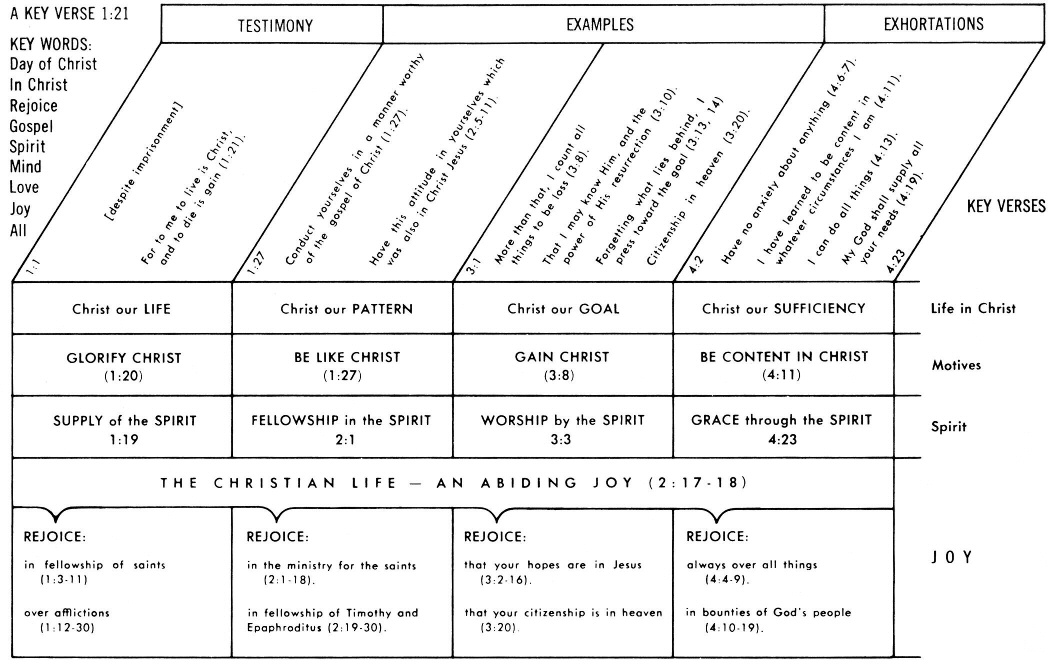
LIFE IN CHRIST
Click chart to enlarge
Charts from Jensen's Survey of the NT - used by permission
Philippians - Charles Swindoll = Chart on right side of page
| Account of Paul's Circumstances Php 1:1-30 |
Have the Mind of Christ Php 2:1-30 |
Have the Knowledge of Christ Php 3:1-21 |
Have |
| Partakers of Christ | People of Christ | Pursuit of Christ | Power of Christ |
| Suffering | Submission | Salvation | Sanctification |
| Experience | Examples | Exhortation | |
Philippians 4:14 Nevertheless, you have done (2PAAI) well to share with (AAPMPN) me in my affliction (NASB: Lockman)
Greek: plen kalos epoiesate (2PAAI) sugkoinonesantes (AAPMPN) mou te thlipsei
Amplified: But it was right and commendable and noble of you to contribute for my needs and to share my difficulties with me. (Amplified Bible - Lockman)
NLT: But even so, you have done well to share with me in my present difficulty. (NLT - Tyndale House)
Phillips: Nevertheless I am not disparaging the way in which you were willing to share my troubles. (Phillips: Touchstone)
Wuest: All the same, you did a beautiful thing when you made yourselves fellow partakers with me in my tribulation. (Eerdmans)
Young's Literal: but ye did well, having communicated with my tribulation;
NEVERTHELESS, YOU HAVE DONE WELL TO SHARE WITH ME IN MY AFFLICTION: plen kalos epoiesate (2PAAI) sugkoinonesantes (AAPMPN) mou te thlipsei :
- 1Ki 8:18; 2 Chr 6:8; Mt 25:21; 3Jn 1:5, 6, 7, 8) (Php 4:18; 1:7; Ro 15:27; 1Co 9:10,11; Gal 6:6; 1Ti 6:18; Heb 10:34; 13:16
THEY SHARED IN THE
AFFLICTIONS OF PAUL
Nevertheless (4133) (plen) is a marker of contrast (see discussion of terms of contrast), implying the validity of something irrespective of other considerations. Paul uses plen here to restrict his previous statement. In view of Paul's complete reliance upon Christ in him, continually strengthening him in every circumstance, the Philippians might have wondered if they should have even bothered to send him the gift. After all why would one who is self-content (in Christ) need anything? Paul wants the Philippians to know that their gift ("nevertheless") was still very much appreciated. Their gift demonstrated that they had a proper spirit as givers.
Paul's joy in his strength in Christ would not obscure his joy in their loving ministry or take away from his sincere gratitude to them for their sacrifice.
Steven Cole - One of the first lessons on giving should be that we learn to take the initiative in looking for faithful Christian workers who are focused on the glory of God and the work of the gospel (as Paul was) and support them without being pressured to give.
Spurgeon on sharing with me in my affliction - I do not suppose that they sent him very much; but he knew the love that prompted the gift, he understood what they meant by it. I always had a fancy that Lydia was the first to suggest that kind deed. She, the first convert of the Philippian church, thought of Paul, I doubt not, and said to the other believers, “Let us take care of him as far as we can. See how he spends his whole life in the Master’s service, and now he may at last die in prison for want of even common necessaries; let us send him a present to Rome.” How grateful is the apostle for that gift of love! What gladness they had put into his heart!
Sproul - By giving to help alleviate his lack, they participated in his own poverty and suffering for Christ in this world (Col. 1:24–27). This was remarkable because joining in Paul’s travails added more trouble, from an earthly perspective, to the Philippians’ existing suffering for their faith in Philippi (Phil. 1:29–30). Truly, the Apostle could count on the Philippians through thick and thin.
Vincent concurs writhing " Lest, in declaring his independence of human aid, he should seem to disparage the Philippians’ gift."
Paul returns to the theme of “Partnership” in the gospel - Php 1:3-5
I thank my God in all my remembrance of you, 4 always offering prayer with joy in my every prayer for you all, 5 in view of your participation (koinonia) in the gospel from the first day until now.
Comment: How did they participate? Surely by prayers for Paul, but also by provision of resources for Paul as described in this section.
Share with me (4790) (sugkoinoneo from sún = with + koinoneo = to partake, share [word study on related word koinonia]) means to participate in something with someone.
Vine has an interesting comment on sugkoinoneo writing that by using this verb "the apostle does not mean simply that it was a joint contribution on their part, but that they joined with him, making his affliction their own. (Vine, W. Collected writings of W. E. Vine. Nashville: Thomas Nelson )
Vine references as support for his interpretation the passage in Galatians where Paul commands believers to
Bear (present imperative) - commandment to do this as our lifestyle, only possibly as we surrender to the Spirit, allowing Him to fill/control and empower us) one another's burdens (extra heavy loads, which here represent difficulties or problems people have trouble dealing with), and thus fulfill the law of Christ. (Gal 6:2)
Affliction (2347)(thlipsis from thlibo = to crush, press together, squash, hem in, compress, squeeze in turn derived from thláo = to break) (Click in depth study of thlipsis)
Thlipsis - 45x in NT - The NAS translates thlipsis as affliction(14), afflictions(6), anguish(1), distress(2), persecution(1), tribulation(16),tribulations(4), trouble(1).
Matt. 13:21; 24:9, 21, 29; Mk. 4:17; 13:19, 24; Jn. 16:21, 33; Acts 7:10f; 11:19; 14:22; 20:23; Rom. 2:9; 5:3; 8:35; 12:12; 1 Co. 7:28; 2 Co. 1:4, 8; 2:4; 4:17; 6:4; 7:4; 8:2, 13; Eph. 3:13; Phil. 1:17; 4:14; Col. 1:24; 1 Thess. 1:6; 3:3, 7; 2 Thess. 1:4, 6; Heb. 10:33; Jas. 1:27; Rev. 1:9; 2:9f, 22; 7:14
Thlipsis originally expressed sheer, physical pressure on a man. Medically thlipsis was used of the pulse (pressure). It conveys the idea of being squeezed or placed under pressure or crushed beneath a weight. When, according to the ancient law of England, those who willfully refused to plead guilty, had heavy weights placed on their breasts, and were pressed and crushed to death, this was literally thlipsis.
John MacArthur writes that "Thlipsis (tribulations) has the underlying meaning of being under pressure and was used of squeezing olives in a press in order to extract the oil and of squeezing grapes to extract the juice… In Scripture the word thlipsis is perhaps most often used of outward difficulties, but it is also used of emotional stress." (MacArthur, J: Romans 1-8. Moody)
Thlipsis pictures one being "crushed" by intense pressure, difficult circumstances, suffering or trouble pressing upon them from without. Thus persecution, affliction, distress, opposition or tribulation, all press hard on one's soul. Thlipsis does not refer to mild discomfort but to great difficulty. In Scripture the thlipsis is most often used of outward difficulties, but it is also used of emotional stress and sorrows which "weighs down" a man’s spirit like the sorrows and burden his heart. Thlipsis then includes the disappointments which can "crush the life" out of the one who is afflicted.
The English word "tribulation" is derived from the Latin word tribulum (literally a thing with teeth that tears), which was a heavy piece of timber with spikes in it, used for threshing the corn or grain. The tribulum was drawn over the grain and it separated the wheat from the chaff. As believers experience the "tribulum" of tribulations, and depend on God’s grace, the trials purify us and rid us of the chaff.
Constable has an interesting note here - “We know that God loves a cheerful giver, but I believe we also need to stress that God loves a cheerful receiver. Cheerful receivers make giving and receiving a joy. It is especially important that the called workers of the church learn to be gracious, cheerful receivers. This is not necessarily an easy task. The art of being a gracious, cheerful, thankful receiver may be even more difficult than being a cheerful giver. If we learn to accept the compliments and the special personal gifts which we receive in a gracious, cheerful manner, we will help make giving and receiving a joy for ourselves and for our people.” (Philippians Notes)
In sharing with him in his affliction, they did something about his problem, putting their money where their mouth was so to speak.
Jack Arnold - This message is on money, not how to make it but how to give it. Money is such a sensitive topic but it is absolutely necessary we learn to give if we are going to be effective Christians. Money is a very touchy subject, not just in the religious realm but also in the secular. There was a college student in need of money who wrote home to his father. He said, “Dear Dad. No Mon. No fun. Your Son!” The father promptly wrote back, “Dear Son. Too bad. I’m sad. Your dad!” Money is always a sticky subject but one which should never embarrass a Christian, for when a Christian loves Christ, it ultimately affects his pocketbook. Someone has said, “It is better to have your bank in heaven then to have your heaven in a bank.” In this present life we place so much emphasis upon temporal things. Yet, within a few short years at best, each one of us knows we shall stand naked before God. AT that time we will have no wealth, no money, no titles, no influence. Everything will be left behind at death and all material values for us will be suddenly worth absolutely nothing. Did you know that undertakers are sometimes called on to provide suitable clothing in which the corpse may be buried? There are special suits made for such occasions which look like ordinary suits except they have no pockets. They need no pockets for there is nothing to put in them. This is a very graphic way to illustrating the biblical truth that we brought nothing into this world and we can take nothing out of it (1 Tim. 6:7). We have all heard the expression, “When you die, you can’t take your money with you.” Well, the practical joker said, “If I can’t take it with me, I’m not going!” But the fact of the matter is that we are all going to die and we cannot take our money with us. As responsible Christians, we are to make our money work now so as to have eternal results. It is important that we all know why we give money, how to give money, where to give money and to whom to give money.
Do your givin’
While you’re livin’
Then you’re knowin’
Where it’s goin’.
God not only wants us to give of our money but He wants us to give joyfully. The Lord Jesus taught, “It is more blessed to give than to receive” (Acts 20:35). There is a spiritual joy in giving which is difficult to describe until one has had the experience.
Notice Paul said they “shared” in his troubles. Paul was rejoicing because they fellowshipped or shared with Paul in the ministry. They were partners with him in the gospel. They considered it a great privilege to give to Paul and the cause of Christ. They wanted to give. They were excited about giving. They were honored that God had given them the grace to give. It was a noble and beautiful thing for these Philippians to share their material things with Paul. These folks were anxious to give. They did not have to be begged (2 Cor. 9:7: Each man should give what he has decided in his heart to give, not reluctantly or under compulsion, for God loves a cheerful giver.). They were motivated by love for Christ and love for Paul. Someone has said, “You may give without loving, but you can’t love without giving.” Our willingness to give as Christians may be used as one thermometer to test our true spirituality. (The Joy of Giving)
ILLUSTRATION - A farmer once went to hear John Wesley preach. The great leader was dealing with the question of money, and was examining it under three divisions. His first thought was. “Get all you can.” The farmer nudged his neighbor and said: “That man has got something in him; it is admirable preaching! Wesley reached his second thought. “Save all you can.” The farmer became quite excited. “Was there ever anything like this!” he said. The preacher denounced thriftlessness and waste, and the farmer rubbed his hand as he thought, all this have I been taught from my youth up. What with getting and with hoarding, it seemed to him that “salvation” had come to his house. But Wesley went on to his third thought which was, “Give all you can.” “Oh, dear, exclaimed the farmer, “He’s gone and spoiled it all!”
THE Apostle had already made it clear, that though for a long interval he had received nothing from the Philippian Church, he did not complain, but realised that there were sufficient reasons which accounted for the cessation of their gifts. He did not deny that he had been straitened in outward circumstances, but he had been content because he discerned the will of God in every dispensation, and was able to do all things in union with the Living Christ. He had found that his legitimate necessities had been met, and that God had dealt with him as with Elijah, to whom the feathered fowl, and the slender resources of the widow of Zarephath, ministered daily provision. He rejoiced, however, that his friends had been able to send again to his necessity, not for his sake alone, but for theirs. It was not that he sought for a gift, but for fruit that might be reckoned to their account.
The Gift and Its Return. No Church had done for Paul what the Philippian Church had. In the early days they had sent once and again to minister to his need; and now their present, forwarded by the hand of Epaphroditus, redounded still further to their credit. It was "an odour of a sweet smell, a sacrifice acceptable, well-pleasing to God." How could he repay them for the gifts they had sent when they were able, and for the desire to send when they were not. It was clear that he must always be hopelessly in debt to them so far as material supplies were concerned, but he could pray and make intercession on their behalf, and remind the Master that all kindness shown to the servant imposed an honourable obligation on the Master, and out of all this arose the assurance that his "God would fulfil every need of theirs according to His riches in glory in Christ Jesus."
"Fulfil." To translate the Greek word as R.V. does by fulfil connects this verse with the preceding one, and brings out the designed and beautiful harmony. The Apostle was filled because he had received from Epaphroditus the gifts of his friends, and now God would fulfil their need. What they had done in the lower sphere for him would be repeated in a higher sphere by God. The measure with which they had meted out their stores for the imprisoned Apostle would be returned to them brimming to the full, not with the supplies for physical need, but with the eternal and unsearchable riches of heaven, which are in Christ Jesus.
Give and Receive. This is a constant law of God's world. "Give, and it shall be given unto you: good measure, pressed down, shaken together, running over, shall be given into your bosom. For with what measure ye mete, it shall be measured to you again." Lend your boat for a whole afternoon to Christ that it may be His floating pulpit, and He will return it to you laden with fish. Place your upper room at His disposal for a single meal, and He will fill it and the whole house with the Holy Spirit of Pentecost. Place in His hands your barley loaves and fish, and He will not only satisfy your hunger, but add twelve baskets full of fragments. The Philippians sent three or four presents to a suffering and much needing servant of God, and from that moment they might reckon that every need of theirs would be supplied. Such small acts on our part are recompensed with such vast returns. We scratch the surface of the soil and insert our few little seeds, and within a few months the acreage is covered by a prolific harvest in which a hundredfold is given for every grain which we seemed to throw away.
God's Return to us. God refuses to be in debt to any man. He takes into His exchequer the accounts of all outlay made by His stewards for the relief of need and distress, and He repays with interest. When the Good Samaritan was leaving the village inn, on the morning after the memorable rescue of the wounded traveller, he said to the host, "Take care of him, and what thou spendest more, when I come again, I will repay." Evidently, he was well-known on the road, he had often been at that inn before, and had established his character by honourable and generous treatment. They knew that his word was his bond, and that whatever was expended in reason would secure an ungrudging repayment. And if this be true of man how much more of God. He hands over to us cases in which He is deeply interested, saying as He does so, "Take care of these, expend what is necessary, and I will repay." May we not reckon on God for this? According to our faith it will be to us.
But Give Cheerfully. Whenever, therefore, we feel impelled to make provision for others, let us do it as unto God, not simply out of human pity, but from a deep sense of obligation to our Heavenly Father, let us do it gladly, freely, generously. "God loveth a cheerful giver." Three things will happen,
(1) We shall send a thrill of gratitude into some weary and fainting soul, encouraging it to hope in God because it has found that its hope in man has not been misplaced.
(2) The odor of the act will be fragrant as it steals upward to mingle with the adoration and service of Heaven. There is no longer need to offer propitiatory sacrifices, for they have been done away in view of the sacrifice made by our Lord when He once offered Himself without sin unto God, but there is room in the Christian dispensation for the sacrifice of praise (Heb. 13:15-note), for the living sacrifice of ourselves (Ro 12:1-note), and for the acceptable sacrifices of Christian beneficence which, as this paragraph tells us, are well-pleasing to God.
(3) We may also reckon that He will fill to the brim the measure with which we have meted out for others, and take it as a certainty that He will fulfil every need according to His riches. If our measure was filled with sand grains, He will return it filled with gold dust; if it was filled with pebbles, He will hand it back replete with diamonds; if it contained necessaries for the physical life, He will restore it brimming over with spiritual riches.
Charity Succeeded by Poverty. It may be answered that many who have given lavishly for God's cause have afterwards come to penury and need, and their benefactions seem to have been lost like argosies that go down at sea. In any case, there has been no return to brighten the straitened circumstances of declining years.
Three answers may be given.
First, it may be that the gifts were not rendered with a single eye for the glory of God, but for some lower motives of display, ostentation, or self-advertisement; therefore, they had their reward. They were done to be seen of men, they received the recognition and applause of men, and God refused to recognise any obligation for further recompense.
Secondly, it is necessary, before these laws of the spiritual world operate on our behalf, that we should definitely and by faith appropriate them. There is no promise which does not require to be claimed. As the angel of electricity will not step forth to illumine our rooms unless we turn the switch when we pass through the door, so we must not complain that the laws of the spiritual world do not bring us help unless by faith we appropriate their service. Whenever, therefore, we expend alms for the relief of need, let us definitely put our money into God's bags, which wax not old: we should specifically lay up treasure in heaven, we should pay our money, so to speak, into the bank of His faithfulness, and reckon that there will be a definite return. It may be taken as an axiom that in this world there is a return for every gift that we lay on the altar of self-sacrifice --not of reward but of free grace. We must not make the gift in order to get the reward, but having made the gift in the name of Christ, and for the fulfilment of His redemptive purpose, we may certainly believe that in ways that we may not be able to define God will supply all our need.
Thirdly, it should be borne in mind that though there may be apparent straitness, there may be a wealth of content, a gold mine of peace and joy, the precious stones of spiritual grace, which correspond to the riches in glory of which the Apostle speaks. When life was young, they gave of their temporal things, and now as the evening shades gather, God gives them not temporalities but spiritualities. They sowed carnal things and reap spiritual ones (1Co 9:11).
God's Return. "All your need." From the moment that we draw our first breath in this world to the last sigh of expiring life, we are full of needs. The babe has its cradle needs, and the patriarch those that arise from the wearing out of his faculties, and his growing dependence on others. The body has physical need, the mind its hunger for truth, the heart its insatiable longing for love, the spirit for spiritual sustenance and quickening. Our human nature is one great bundle of need, it is always crying aloud for satisfaction; and as civilisation advances, the variety and multiplicity of our need is ever on the increase.
Needs and Desires. We must distinguish between our needs and our desires. It is possible to want a good many things which we do not need. We often want things which it would injure us greatly to have. Paul wanted to be delivered from his thorn, but his real need was for more grace. We want a great many things which it is not possible for our Heavenly Father to give us, except to the great detriment of our best life. There is no promise that God shall supply all our desires or wishes, there is a certainty that He will fulfil all our need.
Some may read these words whose needs are clamant, the need for guidance, for help against temptation, for the quickening of languishing devotional life, the need for daily bread or employment. Let all such take this to their heart for their comfort that God will supply all their need. "My God shall fulfil every need of yours."
Christ is God's Answer to Our Need. "In Him are all the treasures of wisdom and knowledge hidden." "It pleased the Father that in Him should all the fulness dwell." "In Him dwelleth all the fulness of the Godhead bodily." The Divine-Human nature of Christ is replete with every possible supply for His people. "He filleth all in all." Those that trust Him can say, as the Apostle did of the Philippian gifts, "I have all things and abound; I am filled, hating received from Christ the things that came from God, and which were treasured in Him for my enrichment and thanksgiving." The teaching of the Apostle is full of this thought, as when he says, "I thank my God always concerning you, for the grace of God which was given you in Christ Jesus; that in everything ye were enriched in Him" (1Cor 1:4, 5), and again, "Blessed be the God and Father of our Lord Jesus Christ who hath blessed us with every spiritual blessing in the heavenly places in Christ" (Eph 1:3-note). Peter also affirms the same thought. "Grace to you, and peace be multiplied in the knowledge of God, and of Jesus our Lord; seeing that His Divine power hath granted unto us all things that pertain unto life and godliness" (2Pet. 1:2-note, 2Pe 1:3-note).
Christ is the complement i.e. the completement of every soul. Just as the dark face of the moon taken with her first crescent of light makes a complete circle, so the unseen Redeemer together with our infinite need makes a complete man after God's stature. The greater our deficiency the larger His supply.
The Prime Necessity. The prime necessity, however, is that we should reckon it is so, and avail ourselves of all the treasures that are prepared for our use in our Risen Lord. Too often we act as if we had to meet the demands of life from our own limited exchequer, instead of believing that we have been taken into partnership with the Son of God, and can at any moment draw upon His all-sufficiency. What would you think if a clerk, who was sent to a distant land to open a branch of some great business firm, were to seek to meet the expenses out of his own limited salary, when the head of the firm had told him to draw upon his credit to any extent which he deemed necessary? But we make the same mistake when we meet the calls of life apart from the boundless wealth which is placed to our credit in Jesus.
A story is told by Dr. Richard Newton of an old and poverty-stricken Indian, who many years ago made his way into a Western settlement in search of food to keep him from starving. A bright-coloured ribbon was seen around his neck, from which there hung a small, dirty pouch. On being asked what it was, he said it was a charm given him in his younger days. He opened it, and took out a worn and Crumpled paper, which he handed to the person making the inspection. It proved, on examination, to be a regular discharge from the federal army, signed by George Washington himself, and entitling him to a pension for life. Here was a man with a promise duly signed, which if presented in the right place would have secured him ample provision, yet he was wandering about hungry, helpless, and forlorn, and begging bread to keep him from starving. What a picture of many Christians who are in need of everything when they might be rich and full! Perhaps their own life had not been generous, certainly their faith has never put in its claim to God's great bank of promise.
We deal with a Father. Let us remember that we are dealing with a Father. "Now unto our God and Father be the glory for ever." The Father's eye is on His children, and a Father's hand is stretched out to their relief. Let us be of good cheer. Two sparrows are sold for a farthing, but five for two farthings, that is, sparrows are so cheap that one can be thrown into the bargain, but that odd sparrow cannot fall to the ground without the notice of the Father. Surely we are of more value than many sparrows, and we may count on Him with absolute certainty. Nowhere in the world does He make birds, fish, young lions, or babes, without supplying the food which He has taught them to require. He cannot do worse by us; we dare not think that He had implanted needs which He is unable and unwilling to meet. Only let us make Him our confidant, going through life with a free-handed generosity that gives, and with an absolute trust which takes, making our requests known unto Him, and receiving the fulfilment of every need, out of which shall arise to Him who loves us, cares for us, and sustains us, glory unto the ages of the ages. The grace of God, and if He loves, there must be something lovable upon which our hearts can fasten. (F. B. Meyer. The Epistle to the Philippians - A Devotional Commentary)
Philippians 4:15 - You yourselves also know (2SRAI), Philippians, that at the first preaching of the gospel, after I left Macedonia, no church shared (3SAAI) with me in the matter of giving and receiving but you alone (NASB: Lockman)
Greek: Oidate (2SRAI) de kai humeis, Philippesioi, hoti en arche tou euaggeliou, hote exelthon apo Makedonias, oudemia moi ekklesia ekoinonesen (3SAAI) eis logon doseos kai lempseos ei me humeis monoi
Amplified: And you Philippians yourselves well know that in the early days of the Gospel ministry, when I left Macedonia, no church (assembly) entered into partnership with me and opened up [a debit and credit] account in giving and receiving except you only. (Amplified Bible - Lockman)
Lightfoot: But, though I am thus indifferent to my own wants, I commend you for your sympathy and aid in my affliction. I need not remind you, my Philippian friends; you yourselves will remember that in the first days of the Gospel, when I left Macedonia, though I would not receive contributions of money from any other church, I made an exception in your case.
NLT: As you know, you Philippians were the only ones who gave me financial help when I brought you the Good News and then traveled on from Macedonia. No other church did this. (NLT - Tyndale House)
Phillips: You Philippians will remember that in the early days of the Gospel when I left Macedonia, you were the only church who shared with me the fellowship of giving and receiving. (Phillips: Touchstone)
Wuest: But you yourselves also know, Philippians, that at the beginning of the good news, when I went out from Macedonia, not even one assembly made itself a partner with me as regards an account of giving and receiving except you only,
Young's Literal: and ye have known, even ye Philippians, that in the beginning of the good news when I went forth from Macedonia, no assembly did communicate with me in regard to giving and receiving except ye only;
AND YOU YOURSELVES ALSO KNOW PHILIPPIANS THAT AT THE FIRST PREACHING OF THE GOSPEL AFTER I DEPARTED FROM MACEDONIA NO CHURCH SHARED WITH ME IN THE MATTER OF GIVING AND RECEIVING BUT YOU ALONE: Oidate (2SRAI) de kai humeis, Philippesioi, hoti en arche tou euaggeliou, hote exelthon apo Makedonias, oudemia moi ekklesia ekoinonesen (3SAAI) eis logon doseos kai lempseos ei me humeis monoi:
And you Philippians yourselves well know that in the early days of the Gospel ministry, when I left Macedonia, no church (assembly) entered into partnership with me and opened up [a debit and credit] account in giving and receiving except you only. (Amplified Bible - Lockman)
THE MISSIONARY FOCUS
OF A YOUNG CHURCH!
You yourselves know (eido) - Paul by recalling their former kindness confirms his appreciation of their present help. In other words he is saying that this is no new thing for you have always been generous.
They were the only church that had shared financially with Paul in his pressing circumstances and they had done so despite their own poverty.
With the statement "First preaching of the gospel" Paul digresses to 10 years earlier at the time of is initial encounter with his readers, when God used his preaching of the Gospel to birth the "First Church of Philippi".
Preaching of the Gospel (2098) (euaggelion from eú = good + aggéllo = proclaim, tell) (Click in depth study) originally referred to a reward for good news and later became the good news itself. The word euaggelion was in just as common use in the first century as our words good news today. “Have you any good news for me today?” would have been a common question. In this secular use euaggelion described good news of any kind and prior to the writing of the New Testament, had no definite religious connotation in the ancient world until it was taken over by the "Cult of Caesar" which was the state religion and in which the emperor was worshipped as a god. The writers of the New Testament adapted the term as God's message of salvation for lost sinners.
Euaggelion - 76x in the NT -
Matt. 4:23; 9:35; 24:14; 26:13; Mk. 1:1, 14f; 8:35; 10:29; 13:10; 14:9; 16:15; Acts 15:7; 20:24; Rom. 1:1, 9, 16; 2:16; 10:16; 11:28; 15:16, 19; 16:25; 1 Co. 4:15; 9:12, 14, 18, 23; 15:1; 2 Co. 2:12; 4:3f; 8:18; 9:13; 10:14; 11:4, 7; Gal. 1:6f, 11; 2:2, 5, 7, 14; Eph. 1:13; 3:6; 6:15, 19; Phil. 1:5, 7, 12, 16, 27; 2:22; 4:3, 15; Col. 1:5, 23; 1 Thess. 1:5; 2:2, 4, 8f; 3:2; 2 Thess. 1:8; 2:14; 1 Tim. 1:11; 2 Tim. 1:8, 10; 2:8; Philemon 1:13; 1 Pet. 4:17; Rev. 14:6
The NAS renders euaggelion as made a proclamation(1), preach(16), preached(10), preacher(1), preaches(2), preaching(11),proclaim(8), proclaimed(6), proclaiming(6).
I departed from Macedonia refers to Paul's first European circuit, when he went by way of Athens to Corinth, where he was joined by Silvanus and Timothy, bringing a contribution from Macedonia. (Acts 18:5; 2 Cor. 11:9).
Steven Cole - Apparently those gifts were not enough to provide full support, because he reminds the Thessalonians how he worked with his hands to provide for his needs when he was with them (2Th 3:7-9). But right from the start of their Christian experience, the Philippians had given. Paul taught that it is proper for a man who labors in the gospel to receive his support from the gospel (1 Cor. 9:1-18; 1 Tim. 5:17-18). But for the sake of avoiding the charge that he was preaching for the money, Paul chose not to receive support from a new church where he was ministering while he was there. Instead, he supported himself by making tents. But if the funds came from another church outside the area, he would stop making tents and devote himself full time to the work of the ministry (compare Acts 18:1-11, 2 Cor. 11:7-12)....But Paul must have taught the Philippians early on the importance of faithful giving to support those in Christian ministry, because soon after he left town, they sent gifts after him. They would have been just a few months old in the Lord, but they were already practicing faithful giving.
Jack Arnold - This young, vibrant local church had a missionary vision for the whole world, and were ready, when other churches were not, to give to this cause. No local church is on a biblical foundation without a strong missionary emphasis. A local church must sacrifice to see the Great Commission filled in any given generation. Jesus said, “Go into all the world and preach the good news to all creation” (Mk. 16:15). There is a sense in which it is not enough to pray for the lost. We must also pay for them by sending missionaries, if we are going to reach them and win them to Christ. Notice the Philippians were a unique church even for the first century. If you took one-hundred churches which call themselves Baptists, Presbyterians, Methodists, Lutherans or whatever, ninety of them would not be uniquely mission-minded. It is unique to be a part of a church which is committed to world evangelism. These Philippians sent several gifts to Paul, showing their interest and eagerness in missions. They were repeatedly involved in seeing the gospel go all over the world. Again we see how the Philippians “shared” with Paul. This means “fellowshipped” or “became partners.” They were partners with Paul in the ministry. By giving to missionaries who are in Africa, Europe or South America today, we are partners with them in the Gospel. This is a fantastic motivation for giving to missions and missionaries. This may sound a warning to us that we should be partners in missionary endeavors with those who truly believe and preach the gospel of Christ. We need to align ourselves with those who believe the fundamental doctrines of the Faith. We must never become partners with the liberals and unbelievers in world evangelism. It should be pointed out that this gift was from the whole Philippian Church. Individuals did not support Paul but it was a total effort by the local church. The biblical principle seems to be that local churches not individuals are to carry out giving to missions and missionaries (Ed: Not sure I totally agree with this statement. Especially if you are attending a church that is not missions minded!). (Joy of Giving)
Church (1577) (ekklesia from ek = out + kaleo = call) literally "called-out ones" and implies an "assembly". Ekklesia was used by the Greeks for their assembly of citizens "called out" to transact the business of the city or to discuss the affairs of State. Ekklesia in the NT describes a living organism, composed of living members joined together; through which Christ lives and works, carrying out His Kingdom purposes on earth. The giving by the Philippian saints was a reflection of Christ living His life out through this local, dynamic body of believers. May their tribe increase in these last days. Amen.
As stated above, "the church" is not a building or an organization or a creed but is in essence an organism, the Body of Christ (Eph 4:12-note, Col 1:18-note), with Christ as the Head of the Body (Col 1:18-note, Eph 1:22, 23-note), and individual members of His Body, the Church composed of men and women called out of the domain of darkness (Col 1:13-note) by God from every tribe and tongue and people and nation (Rev 5:9-note, out of darkness - 1Pe 2:9-note) unto salvation. I believe that only regenerate (Titus 3:5-note) men and women, both Jew and Gentile (Eph 3:6, "formerly far off" = Gentiles Eph 2:13, 14-note, Ep 2:15, 16-note, Ep 2:17, 18-note, cp Gal 3:28, 29), compose the true church and that the true church does not include unsaved individuals (Acts 2:41, 47). Jesus predicted the church in (Mt 16:18), and Pentecost was the inception of the church (Acts 2:1, 2, 3, 4ff). The church at its inception was composed of Jews but Gentiles later became "fellow citizens with the saints, and are of God's household, having been built upon the foundation of the apostles and prophets, Christ Jesus Himself being the Corner Stone in Whom the whole building, being fitted together is growing into a holy temple in the Lord in Whom you also are being built together into a dwelling of God in the Spirit (Eph 2:19, 20, 21, 22-note). I believe that the NT Scriptures also teach that "church" can refer to a local assembly of believers (eg, Col 4:15,16-note, cp Acts 2:42, 14:23, Re 1:4-note). The church is the bride of Christ, which will live and reign with Him throughout all eternity (Ep 5:31-note, Ep 5:32-note; Rev 19:7-note). The church is entrusted with the mission of world evangelization during this age (Mt 28:19, 20; Acts 1:8).
ILLUSTRATION - Boy and Father. Dr. G. Campbell Morgan tells of visiting the home of a very wealthy Christian man and on one occasion, at family prayers in the morning, the man prayed tenderly and eloquently for the missionaries and the heathen. When he had finished, his teenage son said to him, “Dad, I like to hear you pray for missionaries.” His dad said, “Well, son, I am glad to hear that.” And the boys said, “But do you know what I was thinking while you were praying? I thought, ‘If I had your bank book, I would answer half your prayers.’”
Shared (2841) (koinoneo from koinos = common, shared by all) means literally to share one's possessions with the implication of some kind of joint participation and mutual interest. This Greek word was used in a marriage contract where the husband and wife agree to a joint-participation in the necessaries of life.
The things that are "shared" in the NT include needs of other believers (Ro 12:13-note), spiritual things (Romans 15:27-note), good things with one's teacher (Ga 6:6), giving to the work of missions (Php 4:15), responsibility in another's sins (! 1Ti 5:22), of Christ participating (sharing or taking part) in our humanity (He 2:14-note), of believers who experience the suffering for the sake of Christ (1Peter 4:13-note), in evil deeds (2Jn 1:11).
The key idea in the word is that of a partnership, a possessing things in common, a belonging in common to. The saints at Philippi were in a glorious spiritual partnership with the great apostle Paul in spreading the Gospel of Jesus Christ! Believers have the same opportunity today as they pray for and give generously to missionaries taking the gospel to the thousands of hidden people groups. Are you sharing in the eternal endeavor? Don't pass up the once in a lifetime opportunity!
There are 8 uses of koinoneo in the NT and is rendered (in the NAS) as contributing(1), participates(1), share(4), shared(2)…
Romans 12:13-note contributing to the needs of the saints, practicing hospitality.
Romans 15:27-note Yes, they were pleased to do so, and they are indebted to them. For if the Gentiles have shared in their spiritual things, they are indebted to minister to them also in material things.
Galatians 6:6 And let the one who is taught the word share all good things with him who teaches.
Philippians 4:15 And you yourselves also know, Philippians, that at the first preaching of the gospel, after I departed from Macedonia, no church shared with me in the matter of giving and receiving but you alone;
1Timothy 5:22 Do not lay hands upon anyone too hastily and thus share responsibility for the sins of others; keep yourself free from sin.
Hebrews 2:14-note Since then the children share in flesh and blood, He Himself likewise also partook of the same, that through death He might render powerless him who had the power of death, that is, the devil;
1Peter 4:13-note but to the degree that you share the sufferings of Christ, keep on rejoicing; so that also at the revelation of His glory, you may rejoice with exultation.
2Jn 1:11 for the one who gives him a greeting participates in his evil deeds.
Paul used the noun form koinonia in the first chapter writing…
in view of your participation (koinonia) in the gospel from the first day until now. (see note Philippians 1:5)
Koinonia in that verse signifies joint participation and co-operation in the gospel, through financial support and prayer support. The Philippians were fellow laborers or co-laborers with Paul to take the whole Word to the whole world. Immediately upon becoming Christians and continually thereafter, the Philippians had dedicated themselves to living and proclaiming the truth about Jesus Christ, and specifically to helping Paul in his ministry. (cf Lydia - Acts 16:15).
Koinoneo is used 4 times in the non-apocryphal Septuagint (LXX) 2Chr 20:35; Job 34:8; Pr 1:11; Eccl 9:4.
Giving (1394) (dosis from dídomi = to give) refers to a gift.
Today's English Version renders it "you were the only ones who shared my profits and losses."
Receiving (3028) (lepsis from lambáno = to receive) refers to a receipt or to the act of receiving.
Giving and receiving together picture a ledger with a credit and debit page. The implication is that Paul evidently was a careful steward of his resources and kept an account of his receipts and expenditures.
Matter (3056) (logos) was sometimes used as a business term and in the NT is translated as “accounts” (Mt 18:23; 25:19) or “accounting” (cf Luke 16:2). This is Paul's meaning in the present context.
The Philippians kept a ledger in which they recorded the good things received from Paul on the credit page, and the debt they owed Paul on the debit side. He acknowledged the receipt of their gift in the words, "I have all," using a business term meaning, "I have received in full" (Php 4:18).
The word "abound" in Php 4:17, is taken from the money market. It was used of the accumulation of interest.
Spurgeon on except you alone - The Philippians were the only Christians who had sent any help to this great sufferer for Christ’s sake in the time of his need.
Philippians 4:16 for even in Thessalonica you sent (2PAAI) a gift more than once for my needs (NASB: Lockman)
Greek: hoti kai en Thessalonike kai hapax kai dis eis ten chreian moi epempsate. (2PAAI)
Amplified: For even in Thessalonica you sent [me contributions] for my needs, not only once but a second time. (Amplified Bible - Lockman)
Lightfoot: Nay, even before I left, when I was still at Thessalonica, you sent more than once to supply my wants.
NLT: Even when I was in Thessalonica you sent help more than once. (NLT - Tyndale House)
Phillips: Even in Thessalonica you twice sent me help when I was in need. (Phillips: Touchstone)
Wuest: that even in Thessalonica more than once you sent to relieve my necessity.
Young's Literal: because also in Thessalonica, both once and again to my need ye sent;
FOR EVEN IN THESSALONICA YOU SENT A GIFT MORE THAN ONCE FOR MY NEEDS: hoti kai en Thessalonike kai hapax kai dis eis ten chreian moi epempsate. (2PAAI):
For - see term of explanation for discussion of importance of pausing to ponder this strategic conjunction.
Even in Thessalonica - see Acts 17:1-15
The Greek literally reads "because also in Thessalonica, both once and again to my need you sent". Note that the NASB adds the word "gift" for continuity, but it is not present in the original Greek text.
Needs (5532) (chreia from chréos = debt) refers to that which is a lack of something requisite, desirable, or useful. Chreia means to have need of someone or something (Mt 3:14, Mk 2:25). It can speak of the necessities of life (Acts 20:34). In Eph 4:29 (note) chreia refers to an individuals "needs" (more in a figurative sense or psychological, spiritual sense rather than a physical sense).
Chreia - 49x in the NT -
Matt. 3:14; 6:8; 9:12; 14:16; 21:3; 26:65; Mk. 2:17, 25; 11:3; 14:63; Lk. 5:31; 9:11; 10:42; 15:7; 19:31, 34; 22:71; Jn. 2:25; 13:10, 29; 16:30; Acts 2:45; 4:35; 6:3; 20:34; 28:10; Rom. 12:13; 1 Co. 12:21, 24; Eph. 4:28, 29; Phil. 2:25; 4:16, 19; 1 Thess. 1:8; 4:9, 12; 5:1; Tit. 3:14; Heb. 5:12; 7:11; 10:36; 1 Jn. 2:27; 3:17; Rev. 3:17; 21:23; 22:5.
The NAS renders chreia as necessary(1), need(40), needed(1), needs(6), task(1).
Dwight Pentecost notes that "The strange thing in this passage is that the apostle is not commending the Philippians because they met his need; he is commending them because they have satisfied a need of their own of which they seem to have been entirely ignorant. Since the apostle had nothing, we would suppose that he would thank them because of what their gift did for him. But he barely mentions that. His thanksgiving goes to God because through the gift they have satisfied a need which they have. The apostle points out that this is not the first time the Philippians contributed to his needs. They did so on at least two previous occasions. (Pentecost, J. D. The Joy of Living: A Study of Philippians. Kregel Publications)
Philippians 4:17 Not that I seek (1SPAI) the gift itself, but I seek (1SPAI) for the profit which increases (PAPMSA) to your account (NASB: Lockman)
Greek: ouch hoti epizeto (1SPAI) to doma, alla epizeto (1SPAI) ton karpon ton pleonazonta (PAPMSA) eis logon humon
Amplified: Not that I seek or am eager for [your] gift, but I do seek and am eager for the fruit which increases to your credit [the harvest of blessing that is accumulating to your account]. (Amplified Bible - Lockman)
Lightfoot: Again I say, I do not desire the gift, but I do desire that the fruits of your benevolence should redound to your account.
NLT: I don't say this because I want a gift from you. What I want is for you to receive a well-earned reward because of your kindness. (NLT - Tyndale House)
Phillips: It isn't the value of the gift that I am keen on, it is the reward that will come to you because of these gifts that you have made (Phillips: Touchstone)
Wuest: Not that it is my character to be ever seeking the gift, but I am seeking the fruit which is accumulating to your account.
Young's Literal: not that I seek after the gift, but I seek after the fruit that is overflowing to your account;
NOT THAT I SEEK THE GIFT ITSELF: ouch hoti epizeto (1SPAI) to doma :
- Php 4:11; Mal 1:10; Acts 20:33,34; 1Co 9:12, 13, 14, 15; 2Co 11:16; 1Th 2:5; 1Ti 3:3; 1Ti 6:10; Titus 1:7; 1Pe 5:2; 2Pe 2:3,15; Jude 1:11
PAUL IS NOT AFTER
THEIR MONEY!
Seek (present tense)(1934) (epizeteo from epí = intensifies meaning + zeteo = to seek) means to search for or even to demand. Paul was neither inquiring about a gift nor demanding it.
Epizeteo - 13x in the NT - The NAS renders epizeteo craves(1), eagerly seek(2), searched(1), searching(1), seek(2), seeking(3), seeks after(1), sought(1), want(1).
Matt. 6:32; 12:39; 16:4; Lk. 4:42; 12:30; Acts 12:19; 13:7; 19:39; Rom. 11:7; Phil. 4:17; Heb. 11:14; 13:14.
By declaring "not (absolute negation) that I seek the gift" Paul is apparently still defending himself against the slanderous assertion that he is using the gospel as a means of making a living. Note that "seek" is in the present tense indicating one's habitual action. As Wuest renders it Paul is saying that it
"Not that it is my character to be ever seeking the gift"
Gift (1390) (doma from didomi = to give) is a present or gift and the word lends greater emphasis to the character of the gift. In this case it is preceded by the definite article in Greek ("to" = the) indicating that this is a specific gift he is referring to.
Wil Pounds - “Not that I seek the gift itself, but I seek for the profit which increases to your account” (v. 17). James Boice writes, “Money that is given to help another Christian is called fruit. Our gifts to others are encouraged by God, noticed by God, and much-desired by Him.” There is a great stewardship principle. The imagery says Thielman, is that of a bank account that receives compounded interest. Paul says, it is “continuously increasing profit for your account.” It pays spiritual dividends in eternity. Paul has in mind the day we stand before the Lord Jesus Christ and give an account of how we have used His gifts to us. The gifts the Philippians have sent to Paul is for their spiritual advantage. “Their generosity was a concrete demonstration that God was completing the good work that he had started in them when they believed the gospel (Phil 1:6),” notes Thielman." (Abide In Christ Ministry)
BUT I SEEK FOR THE PROFIT WHICH INCREASES TO YOUR ACCOUNT: alla epizeto (1SPAI) ton karpon ton pleonazonta (PAPMSA) eis logon humon:
- Phil 1:11; Micah 7:1; Jn 15:8,16; Ro 15:28; 2Cor 9:9, 10, 11, 12, 13; Titus 3:14
- Pr 19:17; Mt 10:40, 41, 42; 25:34, 35, 36, 37, 38, 39, 40; Lk 14:12, 13, 14; Heb 6:10
PAUL IS SEEKING THEIR
ETERNAL GOOD!
But - see discussion of terms of contrast. Paul is seeking not after their "goods" (money) but their "good" (eternal fruit).
Seek (present tense - continually seeking)(1934) (epizeteo from epí = intensifies meaning + zeteo = to seek) means to search for and to strive after or long for. It depicts Paul as continually seriously interested in their future fruit or having a strong desire for them to be increasing in fruit. Paul was striving for and longing for the fruit to be increasing for the Philippians based on their giving.
The saints at Philippi were "future focused" in their giving to Paul. Financial planners tell us, ‘When it comes to your money, don’t think just three months or three years ahead. Think thirty years ahead.’ Christ, the ultimate “financial planner,” takes it a step further saying, ‘Don’t ask how your investment will be paying off in thirty years. Ask how it will be paying off in thirty million years!’” Store up for yourself treasure in heaven! It ‘s an investment that will pay eternal dividends!
Jack Arnold - When Paul says, “Not that I am looking for a gift, he wants to assure them that he is not begging for their money, or that his ministry would have folded up if they had not sent the gift. His ministry was based squarely on Christ and His ability to meet Paul’s need. No one could accuse Paul of being “money-mad” in the ministry. The real motive behind Paul’s receiving the gift was that there might be spiritual fruit or ; that is, that people might be saved. This could better be translated, “But I am looking for the which increases to your account.” To see people trust Christ and living for Him is the ultimate end of all Christian missionary effort. There is no sacrifice too big to even see one person trust Jesus Christ. NOTE. What Paul is saying is that every gift to the Lord’s work results in many spiritual dividends. This is laying up treasure in heaven. When we give to the Lord’s work, it is like depositing money in God’s bank and that money is going to draw interest in the salvation of souls. Each time we give to the Lord’s work, we are making a spiritual investment which should bring in spiritual profit. Therefore, beloved, invest wisely in the Lord’s work. Put your money where it is going to earn the most spiritual profit. (Joy of Giving)
Here is the principle - Sow sparingly, reap sparingly … sow bountifully, reap bountifully “Give, and it will be given to you. They will pour into your lap a good measure–pressed down, shaken together, and running over. For by your standard of measure it will be measured to you in return.” Luke 6:38-note
Have you seen the bumper sticker “The one that dies with the most toys wins!” That’s a sad philosophy that most of the world buys into! Jesus gives us the proper perspective declaring that “It is more blessed to give than to receive!” And I would add that blessing is not just in time but in eternity
The famous British preacher, C. H. Spurgeon, once received a request from a wealthy man to come to their town and help them raise funds for a new church building. He told Spurgeon he could stay in his country home there. Spurgeon wrote back and told him to sell the home and give the money to the project! He was urging this man to put his earthly estate in the bank of heaven where it would bear interest for eternity.
Profit (spiritual fruit)(2590) (karpos) is fruit, in this case speaking of the "eternal dividends" the Philippians would receive from their "investment" in the apostle Paul. Paul is referring to the eternal dividends accruing in their spiritual account in the bank of Heaven. Jesus referred to this as storing up for ourselves treasure in heaven where moth and rust do not destroy and thieves do not break in to steal (Mt 6:19-20-note). This fruit was the reward God would recompense to them for their generous support of Paul as their "church missionary". (cf Pr 11:24, 25; 19:17; Lk 6:38; 2Co 9:6)
Notice what Paul says at the Bema Seat, the Judgment Seat of Christ...
For we must all appear before the judgment seat of Christ, so that each one may be recompensed for his deeds in the body, according to what he has done, whether good or bad. (2 Cor 5:10-note)
When Paul says "good or bad" in 2 Cor 5:10 in this context "bad" (Greek = phaulos) is not referring to sins per se, but to deeds of the body which are not effective in bearing fruit. They are deeds that cannot produce any true gain. It follows that they must be deeds initiated and energized by the flesh, not the Spirit and thus are deeds produced when one is not abiding in Christ, the Vine (Jn 15:5).
Paul had earlier used karpos in this same letter
Philippians 1:11 having been filled with the fruit of righteousness which comes through Jesus Christ, to the glory and praise of God.
Philippians 1:22 But if I am to live on in the flesh, this will mean fruitful labor for me; and I do not know which to choose.
Karpos - 67x in the NT - benefit (2), crop(5), crops(2), descendants*(1), fruit(43), fruitful(1),fruits(4), grain(1), harvest(1), proceeds(1), produce(4), profit(1).
Mt. 3:8, 10; 7:16ff; 12:33; 13:8, 26; 21:19, 34, 41, 43; Mk. 4:7f, 29; 11:14; 12:2; Lk. 1:42; 3:8f; 6:43f; 8:8; 12:17; 13:6f, 9; 20:10; Jn. 4:36; 12:24; 15:2, 4f, 8, 16; Acts 2:30; Rom. 1:13; 6:21f; 15:28; 1 Co. 9:7; Gal. 5:22; Eph. 5:9; Phil. 1:11, 22; 4:17; 2 Tim. 2:6; 4:13; Heb. 12:11; 13:15; Jas. 3:17f; 5:7, 18; Rev. 22:2
Increases (4121) (pleonazo from pleion = more) means to cause to increase or superabound and so to be present in abundance or to have plenty (2Pe 1:8-note, Php 4:17). To have more than is necessary or more than enough to meet one's needs (2Co 8:15). To become more and more - in Ro 5:20-note speaking of transgression and sin increasing, in Romans 6:1-note of grace increasing (in his rhetorical rebuttal to those who would seek to turn grace into an opportunity to increase in sin, falsely thinking such conduct was "okay" with God!), of grace spreading or increasing as manifest by giving thanks to God (as an aside, genuine giving of thanks proceeds from an attitude of gratitude in a grace filled/controlled/transformed heart), in 2Th 1:3 speaking of love for one another.
See discussion in New International Dictionary of New Testament Theology (NIDNTT) - Topics covered include πλεονάζω (pleonazō), to be or become more or great, to grow, to increase; ὑπερπλεονάζω (hyperpleonazō), to be present in great abundance.
Pleonazo was a term taken from the money market and was used of the accumulation of interest, in this case the interest in the "spiritual account" of the Philippians as a result of their generous giving.
Pleonazo is used 9 times in the NT an is rendered cause to increase(1), grows greater(1), have too much(1), increase(2), increased(1),increases(1), increasing(1), spreading(1)…
Romans 5:20-note - And the Law came in that the transgression might increase; but where sin increased, grace abounded all the more,
Romans 6:1-note What shall we say then? Are we to continue in sin that grace might increase?
2Corinthians 4:15 For all things are for your sakes, that the grace which is spreading to more and more people may cause the giving of thanks to abound to the glory of God.
2Corinthians 8:15 as it is written, "He who gathered much did not have too much, and he who gathered little had no lack."
Philippians 4:17 Not that I seek the gift itself, but I seek for the profit which increases to your account.
1Thessalonians 3:12-note and may the Lord cause you to increase and abound (perisseuo) in love for one another, and for all men, just as we also do for you; (Note: Pray for love in your local body so that the God of love fills His people with the desire and power to love one another with grace empowered, Spirit controlled supernatural love, love that surpasses human comprehension! Don't try to artificially "manufacture" it for it will lack the touch of the Supernatural.)
2 Thessalonians 1:3 We ought always to give thanks to God for you, brethren, as is only fitting, because your faith is greatly enlarged, and the love of each one of you toward one another grows ever greater;
2Peter 1:8-note For if these qualities are yours and are increasing, they render you neither useless nor unfruitful in the true knowledge of our Lord Jesus Christ.
There are 18 uses of pleonazo in the non-apocryphal Septuagint (LXX) - Ex 16:18, 23; 26:12; Nu 3:46, 48, 49, 51; 9:22; 26:54; 2Sa 18:8; 1Chr. 4:27; 5:23; 2Chr 24:11; 31:5; Ps 50:19; 71:21; Pr. 15:6; Jer 30:19; Ezek 23:32. Here is a representative use (and a great/bold prayer to pray to our Father, although some translations do not see it as a prayer, eg Psalm 71:21NIV, Ps 71:21ESV)…
Psalm 71:21 May You increase (Heb - rabah = increase greatly or exceedingly; Lxx = pleonazo) my greatness and turn to comfort me. (Amplified reads - Increase my greatness (my honor) and turn and comfort me.)
Spurgeon comments - As a king, David grew in influence and power. God did great things for him, and by him, and this is all the greatness believers want. May we have faith in God, such as these words evince. And comfort me on every side. As we were surrounded with afflictions, so shall we be environed with consolations. From above, and from all around, light shall come to dispel our former gloom; the change shall be great, indeed, when the Lord returns to comfort us.
Greatness increasing with comfort, and comfort increasing with greatness; very rarely united. George Rogers.
Here is another example of the use of pleonazo in the Septuagint…
Proverbs 15:6 Great (Heb = rab = much, many, great; Lxx = pleonazo) wealth is in the house of the righteous, but trouble is in the income of the wicked.
Keith Krell on to your account - Think about it: Who benefits most from a gift to God’s work? You might say, “Well, that’s obvious. The recipient does.” Really? Here, Paul says that the primary beneficiary of your faithful giving is YOU! And I don’t just mean the warm feeling you get inside when you help someone. Paul is talking about something that goes far beyond that. Whenever you invest your time, treasures, and talents in God’s kingdom, God deposits fruit (karpos) into your ERA (Eternal Retirement Account). So God, others, and you benefit when you give. God pays in many ways, including eternal rewards that you are commanded to store up for yourself in heaven....It is important to understand that you become a partner with whomever you support. If you support our church, anything that the Lord allows our staff and ministries to accomplish, you share in. This means that when you stand before Christ, you will be rewarded for the fruit that comes from our ministry. Even though the Philippians were 800 miles away from Paul, they supported his ministry, and through Paul’s fruit, the eternal pay off for them will be great! Perhaps you need to spend more time investing in your ERA than in your IRA. We need to ask, “Where can our money have the most eternal impact?” (Money in the Bank)
Account (3056) (logos) in this context is used much as we would use the term "bank-account." You probably thought you just had an account at your local bank didn't you? Wrong! If you are a believer in Christ, there is an account with your name on it reserved in the "bank of Heaven" which begs the question, are you under grace making frequent deposits in your account? If so, beloved, your reward in heaven will be great! Lord, give us eyes of faith to "look not at the things which are seen (our temporal bank account), but at the things which are not seen (our heavenly bank account); for the things which are seen are temporal, but the things which are not seen are eternal." In Jesus' Name. Amen. (2 Cor 4:18-note,
We stt this future focus mindset in the man Moses who was "considering the reproach of Christ greater riches than the treasures of Egypt; for he was looking to the reward. By faith he left Egypt, not fearing the wrath of the king; for he endured, as seeing Him who is unseen.". (Heb 11:26-27-note)
The grace giving of the Philippian church was storing up for the church members great treasure in heaven. (Mt 6:2-4, 19-21--See notes on giving Matthew 6:2-4; Matthew 6:19-21)
F B Meyer - Give and Receive… is a constant law of God's world. "Give, and it shall be given unto you: good measure, pressed down, shaken together, running over, shall be given into your bosom. For with what measure ye mete, it shall be measured to you again." (Lk 6:38) Lend your boat for a whole afternoon to Christ that it may be His floating pulpit, and He will return it to you laden with fish. Place your upper room at His disposal for a single meal, and He will fill it and the whole house with the Holy Spirit of Pentecost. Place in His hands your barley loaves and fish, and He will not only satisfy your hunger, but add twelve baskets full of fragments. The Philippians sent three or four presents to a suffering and much needing servant of God, and from that moment they might reckon that every need of theirs would be supplied. Such small acts on our part are recompensed with such vast returns. We scratch the surface of the soil and insert our few little seeds, and within a few months the acreage is covered by a prolific harvest in which a hundredfold is given for every grain which we seemed to throw away. (Commentary on Philippians)
Philippians 4:18 But I have received everything in full and have an abundance; I am amply supplied, having received (AMPMSN) from Epaphroditus what you have sent, a fragrant aroma, an acceptable sacrifice, well-pleasing to God (NASB: Lockman)
Greek: apecho (1SPAI) de panta kai perisseuo; (1SPAI) pepleromai (1SRPI) dexamenos (AMPMSN) para Epaphroditou ta par' humon osmen euodias, thusian dekten, euareston to theo
Amplified: But I have [your full payment] and more; I have everything I need and am amply supplied, now that I have received from Epaphroditus the gifts you sent me. [They are the] fragrant odor of an offering and sacrifice which God welcomes and in which He delights. (Amplified Bible - Lockman)
Lightfoot: For myself, I have now enough of all things. The presents which you sent by Epaphroditus have fully supplied my needs. I welcome them, as the sweet savor of a burnt-offering, as a sacrifice accepted by and well-pleasing to God.
NLT: At the moment I have all I need—more than I need! I am generously supplied with the gifts you sent me with Epaphroditus. They are a sweet-smelling sacrifice that is acceptable to God and pleases him. (NLT - Tyndale House)
Phillips: Now I have everything I want - in fact I am rich. Yes, I am quite content, thanks to your gifts received through Epaphroditus. Your generosity is like a lovely fragrance, a sacrifice that pleases the very heart of God. (Phillips: Touchstone)
Wuest: But I have all things to the full and overflowing. I have been filled completely full and at present am well supplied, having received at the hands of Epaphroditus the things from you, a fragrant aroma, a sacrifice acceptable, well-pleasing to God.
Young's Literal: and I have all things, and abound; I am filled, having received from Epaphroditus the things from you -- an odour of a sweet smell -- a sacrifice acceptable, well-pleasing to God:
BUT I HAVE RECEIVED EVERYTHING IN FULL AND HAVE AN ABUNDANCE: apecho (1SPAI) de panta kai perisseuo (1SPAI):
- Php 4:12; 2 Th 1:3
Jack Arnold - Paul again commends them for the gift and said it was payment in full. In essence, he is saying, “you have met your obligations and then some.” These gifts to Paul were an act of worship on the part of the Philippians. These gifts were “a fragrant offering, an acceptable sacrifice, pleasing to God.” These sacrificial gifts were given out of a pure heart that loved God and wanted to see His kingdom furthered in this world. NOTE. In the Old Testament, believers offered up physical, animal sacrifices. In the New Testament, believers offer sacrifices but they are spiritual in nature. As a believer-priest, the Christian is to offer his spiritual sacrifice of money to God (Heb. 13:15-16 - Through Jesus, therefore, let us continually offer to God a sacrifice of praise—the fruit of lips that confess his name. And do not forget to do good and to share with others, for with such sacrifices God is pleased.). Only God knows the true motive of the heart in giving. God always wants us to give as an act of praise and worship. (ILLUSTRATION) Someone has said, “Some people give according to their means and others according to their meanness.” There was this farmer who discovered that his favorite cow had given birth to twin calves, one white and the other black. He said to his wife, “You know, dear, I think we ought to give one of these calves to the Lord. We will raise one for ourselves and give one to the Lord who has given us this unexpected blessing.” She said, “Which one are you going to give to the Lord?” “Well,” he said, “I haven’t decided yet. We’ll treat them alike and feed them the same and when it comes time to market them we will then decide which one to give to the Lord.” So he fed the calves, took care of them, and they grew through the summer. Then one day he came into the house looking miserable, and his wife said, “What is the matter?” “Oh,” he said, “A terrible thing has happened. The Lord’s calf has died.” She said, “But I thought you hadn’t chosen yet which one it was.” “Oh, yes,” he said, “All the time I was thinking that the white calf would be the Lord’s, and it was the Lord’s calf that died.” POINT: It is easy to rationalize our financial commitments to the Lord when it is really going to cost us something. (Joy in Giving)
Keith Krell - In Php 4:18, Paul expresses once again that he isn’t after more money (whew!). Three times he states that he has been given enough: “But I have received everything in full and have an abundance; I am amply supplied, having received from Epaphroditus what you have sent”(Php 4:18a). Paul is not after a salary increase. He isn’t striving for a promotion. He is content in Christ. The Philippians blessed Paul’s sandals off. Ironically, if any church had an excuse not to give, it was the Philippians since they were one of the most impoverished churches (2 Cor 8–9). But in spite of their circumstances, they gave, not just according to their ability, but beyond their ability. (Money in the Bank)
Received (568) (apechomai or apecho from apó = from + écho = have) means to be enough, to be sufficient and as in this case to have received in full. In this specific use apecho is used by Paul in the technical sense "This is my receipt". Apecho was constantly used in secular Greek describing the drawing up a of a receipt. What Paul is saying to them in "business terms" is "you have paid me in full in all respects". Note that in other NT contexts, apechomai has a distinctly different meaning of to have (Lk 15:2) or to produce separation or distance from someone or something (Mt 15:8) and then by figurative extension to avoid contact with as in (Acts 15:29, 1Ti 4:3, 1Th 4:3-note, 1Th 5:22-note, 1Pe 2:11-note)
Apechomai - 19x in the NT -
Matt. 6:2, 5, 16; 14:24; 15:8; Mk. 7:6; 14:41; Lk. 6:24; 7:6; 15:20; 24:13; Acts 15:20, 29; Phil. 4:18; 1 Thess. 4:3; 5:22; 1 Tim. 4:3; Philemon 1:15; 1 Pet. 2:11-note
The NAS renders apechomai/apecho as abstain(5), abstaining(1), away(1), have back(1), have in full(3), have received in full(1), it is enough(1), off(1), receiving in full(1), was away(2).
Wuest - And now Paul signs a receipt for the gift they sent him, possibly a bit of apostolic humor. The words “I have” are a rubber-stamp of the first century for, “I give you a receipt for what you sent me,” or “I have received in full.”
Have an abundance (4052) (perisseuo from perissós = abundant) means to superabound or to be in excess. In this verse perisseuo extends the idea of apecho, as if he was not just full but overflowing or superabounding.
Wuest commenting on perisseuo writes that "abound” (abundance) in the Greek speaks of that which exists in superfluity. The Philippian gift must have been generous, and Epaphroditus must have been loaded down. What a demonstration of the work of the Holy Spirit is seen in this act of generosity on the part of these former pagans, performed for one who in origin, training, and religion had been and in some ways was still so different from them, different in a sense which would naturally militate against Paul, Gentiles of the proudest and most exclusive race of antiquity, the intelligentsia of the world, loving one who belonged to a race that was looked down upon and despised. (Ibid)
I AM AMPLY SUPPLIED HAVING RECEIVED FROM EPAPHRODITUS WHAT YOU HAVE SENT A FRAGRANT AROMA AN ACCEPTABLE SACRIFICE WELL-PLEASING TO GOD: pepleromai (1SRPI) dexamenos (AMPMSN) para Epaphroditou ta par' humon osmen euodias thusian dekten euareston to theo:
- Phil 2:25,26
- Jn 12:3, 4, 5, 6, 7, 8; 2Co 2:15,16; Ep 5:2; Heb 13:16, 20, 21; 1Pe 2:5) (Ro 12:1; 2Co 9:12
Amply supplied (4137) (pleroo from pleres = full) means to be completely filled, as a net filled with fish or cup filled to brim. Pleroo is used often to describe the fulfilling of God's OT promises and prophecies.
Pleroo is a great NT verb to take a moment and study to see what or who is filled (or fulfilled), what they are filled with (eg, just to "tease" you, contrast Ro 1:29-note and Eph 5:18-note, Acts 13:52, Jn 3:29, 2Ti 1:4-note; 1Jn 1:4, 2Jn 1:12!), how this filling comes about, what the result of filling is, etc.
Note Paul's use of the perfect tense which signifies "I have been filled full and remain in that state" or “I have been filled and am still full, supplied and satisfied.” Such was the lasting effect of their gift on Paul!
Pleroo - 86x in the NT - The NAS has various and numerous ways of rendering pleroo - accomplish(1), accomplished(1), amply supplied(1), approaching(1), complete(1),completed(3), completing(1), elapsed(1), fill(3), filled(16), fills(1), finished(1), fulfill(5), fulfilled(35), fully carry out(3), fully come(1), fully preached(1), increasing(1), made complete(2), made full(5), make complete(1), make full(1), passed(2), supply(1).
Matt. 1:22; 2:15, 17, 23; 3:15; 4:14; 5:17; 8:17; 12:17; 13:35, 48; 21:4; 23:32; 26:54, 56; 27:9; Mk. 1:15; 14:49; Lk. 1:20; 2:40; 3:5; 4:21; 7:1; 9:31; 21:24; 22:16; 24:44; Jn. 3:29; 7:8; 12:3, 38; 13:18; 15:11, 25; 16:6, 24; 17:12f; 18:9, 32; 19:24, 36; Acts 1:16; 2:2, 28; 3:18; 5:3, 28; 7:23, 30; 9:23; 12:25; 13:25, 27, 52; 14:26; 19:21; 24:27; Rom. 1:29; 8:4; 13:8; 15:13, 14, 19; 2 Co. 7:4; 10:6; Gal. 5:14; Eph. 1:23; 3:19; 4:10; 5:18; Phil. 1:11; 2:2; 4:18, 19; Col. 1:9, 25; 2:10; 4:17; 2 Thess. 1:11; 2 Tim. 1:4; Jas. 2:23; 1 Jn. 1:4; 2 Jn. 1:12; Rev. 3:2; 6:11
Having received (1209) (dechomai [word study]) means to accept readily, or to receive kindly and so to take to oneself what is presented or brought by another. Paul stresses his appreciation of the kindness both of the church and of Epaphroditus.
Dechomai - 56x in the NT - accept(2), accepted(3), receive(18), received(11), receives(15), take(3), taken(1),took(1), welcome(1), welcomed(1).
Matt. 10:14, 40f; 11:14; 18:5; Mk. 6:11; 9:37; 10:15; Lk. 2:28; 8:13; 9:5, 48, 53; 10:8, 10; 16:4, 6f, 9; 18:17; 22:17; Jn. 4:45; Acts 3:21; 7:38, 59; 8:14; 11:1; 17:11; 22:5; 28:21; 1 Co. 2:14; 2 Co. 6:1; 7:15; 8:17; 11:4, 16; Gal. 4:14; Eph. 6:17; Phil. 4:18; Col. 4:10; 1 Thess. 1:6; 2:13; 2 Thess. 2:10; Heb. 11:31; Jas. 1:21
Keith Krell on fragrant aroma - Paul draws upon the Old Testament where they would take an offering and lay it on the altar, and they would pour it out and it would create steam that the whole community could smell. The language grows out of the OT and while it was used generally to describe sacrifices to God (i.e., in the case of Noah after the flood, Gen 8:21), it is especially connected in its approximately 50 uses to the Levitical sacrificial system and the various burnt offerings (cf. Exod 29:18, 25, 41; Lev 1:9, 13, 2:2, 9, 12; Num 15:3, 5, 7, 10, 13–14). The expression acceptable sacrifice (qusian dekthn) in the OT referred to grain offerings as well as burnt offerings and could refer spiritually to the sacrifice of a broken spirit (Ps 51:17–19) or of praise (50:8). It indicated that the sacrifice as a whole was acceptable to God because the sacrifice itself as well as the heart of the one doing the sacrificing was pleasing to God. (In the case of the Philippians, whose hearts were committed to Christ and to their apostle, and whose gift was generous by all measure, their sacrificial offer was very pleasing [euareston] to God). It was given to Paul, but it was as if it had been offered directly to God. This same type of metaphor is used by Paul in 2 Cor 2:15 and Eph 5:2.
Fragrant (3744) (osme from ozō = emit an odor whether good or bad; English = ozone) refers to a smell, scent or odor of any kind. BDAG says osme is "the quality of something that affects the mind as with an odor" and is used "of an unpleasant odor stench (Tob 6:17; Job 6:7)." Osme is used literally of the pleasant aroma of "the costly perfume" Mary used to anoint Jesus' feet in (Jn 12:3). Friberg writes that osme is used "figuratively; from the Middle Eastern concept that an odor from something is communicating its power sweet smell, fragrance (2Cor 2:14, 16)." Here in Eph 5:2 osme is used to describe the "odor" of the sacrifice of Christ as an acceptable aroma or fragrance.
Osme - 6x in the NT - Jn. 12:3; 2 Co. 2:14, 16; Eph. 5:2; Phil. 4:18
Osme is used 46x in the non-apocryphal Septuagint (LXX) most often to describe a "soothing aroma" to the Lord, which parallels Paul's use of osme as fragrant to describe the saint's sacrificial giving!!! Have you ever pondered that your giving to the work of Jehovah as motivated by His Spirit produces a soothing aroma before His throne in heaven? Does this precious word picture not cause you to desire to be given more opportunities to give to Him and His people and His supernatural Kingdom work?! What an awesome God we serve that we as redeemed sinners (who are now saints) are given the holy privilege of offering up acceptable sacrifices to the incomprehensible God (Play Indescribable; Indescribable #2; How Great Is Our God) and that these offerings are truly pleasing and "pleasantly aromatic" to Him, all made possible by and through the greatest sacrificial gift of Christ Jesus, our Great High Priest! Here are the Lxx uses of osme that you might want to meditate on in an attitude of worship and thanksgiving -- Gen. 8:21; Exod. 29:18, 25, 41; Lev. 1:9, 13, 17; 2:2, 9, 12; 3:5, 11, 16; 4:31; 6:15, 21; 8:21, 28; 17:4, 6; 23:13, 18; Num. 15:3, 5, 7, 10, 13f, 24; 18:17; 28:2, 6, 8, 13, 24, 27; 29:2, 6, 8, 11, 13, 36; Ezr. 6:10; Ezek. 6:13; 16:19; 20:28, 41; Dan. 2:46; 4:1
Aroma (2175) (euodia) fragrance, sweet odor and metaphorically as here of sacrifices pleasing to God, specifically the material assistance sent to Paul by the Philippians.
Euodia - 3x in the NT - 2 Co. 2:15; Eph. 5:2; Phil. 4:18
Fragrant aroma is an image that moves us from the business world of accounting to the religious world of the priest and obviously is used by Paul to describe their material gift to God. It is worth noting that the same terms are used to describe Christ’s sacrificial death in Ephesians, Paul writing for the saints at Ephesus to…
walk in love, just as Christ also loved you, and gave Himself up for us, an offering and a sacrifice to God as a fragrant aroma. (Ephesians 5:2)
Vine commenting on an odor of a sweet smell writes that…
the phrase is used in the Septuagint (LXX) for the Hebrew savor of rest especially of the burnt (or ascending) offering, e.g., Leviticus 1 and 2, but also of the peace offering, Leviticus 3 and sin offering (Lev 4). The idea of free will and self-dedication was not altogether absent from the burnt offering (though this is not to be gathered from Lev. 1:3, for the phrase there is not “of his own voluntary will,” a.v., but “for his acceptance”)…
The offerings of believers, such as the gifts of the church at Philippi to Paul, ascend to God as an odor of a sweet smell, in the savor of the sacrifice of Christ (though they have nothing to do with the removal of guilt as His expiatory offering had), and this is suggested by the fact of the identical terms in Ephesians 5:2 and Philippians 4:18. The free-will character of the offerings is common to both. The gifts of believers are as the fragrance of incense in their acceptance with God. (Vine, W. Collected writings of W. E. Vine. Nashville: Thomas Nelson)
Acceptable (1184) (dektos from dechomai - to accept or receive favorably) means accepted (see Webster below), acceptable, welcome (willing permitted or admitted), pleasing (giving pleasure, agreeable, gratifying). Dektos describes one of whom there is or has been a favorable decision of the will. It conveys the picture of a "open" reception, much like when one puts the "welcome mat" on their front door step, something Jesus did not experience even in His own hometown! (Lk 4:24 - He was not "dektos" - not welcome) Thankfully, God puts out the "welcome (home) mat" for all who fear and obey Him. (Acts 10:35). As note below, the adjective is very common in the LXX in a sacrificial sense.
BDAG summarized - 1. Pertaining to being met with approval in someone’s company, acceptable, welcome, (Lk 4:24); only here of human recognition; in all other references in this entry always of acceptance by God. (Acts 10:24). 2. Pertaining to being pleasing because of being approved, pleasing, acceptable, of things: Sabbaths B 15:8; sacrifices (Php 4:18), fasting (Isa 58:5), prayer (Pr 15:8); 3. Pertaining to being appropriate to circumstances, favorable, of time (2Cor 6:2, Isa 49:8, year , Lk 4:19. In these passages the concrete temporal element points to the abstract feature of God’s favorable attitude finding climactic expression.
Dektos was particularly used of the sacrifice in Lev 1:3-4 to describe one that met with divine approval. In Pr 11:1 we see that a just weight is God's "delight" (Hebrew - ratson/rason; Lxx - dektos) and in Pr 14:35 it describes the "king's favor (Hebrew - ratson/rason; Lxx - dektos)… toward a servant who acts wisely." In Malachi 2:13 those who offered the sacrifices were not right with the Lord (they were seeking divorces - Mal 2:14) which is why He no longer was accepting their offerings with "favor (Hebrew - ratson/rason; Lxx = dektos)" from their hand. In Jeremiah 6:20 because of their breaking covenant with Jehovah, He says " Your burnt offerings are not acceptable (Hebrew - ratson/rason; Lxx = dektos), and your sacrifices are not pleasing to Me.” In a prophecy to be fulfilled during the Millennium, God promises that those who have joined with Him in covenant, will once again be able to offer "acceptable (Hebrew - ratson/rason; Lxx = dektos)" burnt offerings on His altar (NB: Yes, there will be "burnt offerings" during the Millennium - Ezek 40:38-39, etc)
The use of dektos in the Lxx of Job 33:26 is very interesting to ponder as it reads "Then he will pray to God, and He will accept (Lxx = dektos; ratsah/rasah) him, That he may see His face with joy, And He may restore His righteousness to man." This use is very instructive as many of the prior uses discussed in the previous paragraph are in a context of sacrifices that were accepted by God. Here we see prayer is acceptable to Him. It follows that there does seem to be something about our prayers that parallel the literal OT sacrifices. We know that many times those sacrifices are described as being associated with a "soothing aroma to the Lord." (Lev 1:9, 13, 17, Lev 2:2, 9, 12, Lev 3:5, 16, etc) This reminds us of Cornelius' prayers to God of which Peter said "Your prayers and alms have ascended as a memorial before God." (Acts 10:4). Henry Morris comments "Even though Cornelius had not known about Christ, nor was he a practitioner of the Jewish system of sacrifice and worship, he nevertheless was a "devout man, and one that feared God… which gave much alms to the people, and prayed to God alway" (Acts 10:2), and God was pleased with this. While these actions were not capable of earning salvation, his sincere acceptance and practice of the limited spiritual light that he had received resulted in God sending more light to him. It may be that this is a model of how God may deal with those men and women of any time and nation who do accept and follow such light as they have."
Baker adds that dektos was "Used with elements of time such as kairos (2540), season (Lk 4:19), and eniautós (1763), year (2Cor. 6:2), meaning a time in which God has pleasure, and which He Himself has chosen.
TDNT - The verbal adjective dektos has the basic meaning “what one can accept.” In the LXX it is linked with dechomai in transl. of רָצָה (ratsah/rasah) “to find pleasure,” and means “acceptable” or “pleasing” on the basis of a divine act of will.
Dektos - 5x - translated acceptable(2), favorable(1), welcome(2).
Luke 4:19 TO PROCLAIM THE FAVORABLE YEAR OF THE LORD."
Comment: Jesus is quoting from Isaiah 61:2 explaining why the Spirit of the Lord was upon Him - "To proclaim the favorable year of the LORD (fulfilled at His first coming), and the day of vengeance of our God (to be fulfilled in the future at His second coming); To comfort all who mourn.
Thayer says here dektos denotes "that most blessed time when salvation and the free favors of God profusely abound."
Luke 4:24 And He said, "Truly I say to you, no prophet is welcome in his hometown.
Acts 10:35 but in every nation the man who fears Him and does what is right is welcome to Him.
2 Corinthians 6:2 (Paul quotes Isa 49:8) for He says, "AT THE ACCEPTABLE TIME I LISTENED TO YOU, AND ON THE DAY OF SALVATION I HELPED YOU." Behold, now is "THE ACCEPTABLE TIME," behold, now is "THE DAY OF SALVATION "--
Philippians 4:18 But I have received everything in full and have an abundance; I am amply supplied, having received from Epaphroditus what you have sent, a fragrant aroma, an acceptable sacrifice, well-pleasing to God.
Dektos - 34 uses in the Septuagint - see discussion above for use of dektos in the description of the sacrificial offerings.
Exodus 28:38 "It shall be on Aaron's forehead (Engraved with "Holy to the LORD" - Ex 28:36), and Aaron shall take away the iniquity of the holy things which the sons of Israel consecrate, with regard to all their holy gifts; and it shall always be on his forehead, that they may be accepted (ratson/rason derived from ratsah/rasah) before the LORD.
Leviticus 1:3 'If his offering is a burnt offering from the herd, he shall offer it, a male without defect; he shall offer it at the doorway of the tent of meeting, that he may be accepted (ratson/rason) before the LORD.
4 'He shall lay his hand on the head of the burnt offering, that it may be accepted (ratsah/rasah) for him to make atonement on his behalf.
Leviticus 17:4 and has not brought it to the doorway of the tent of meeting to present it as an offering to the LORD before the tabernacle of the LORD, bloodguiltiness is to be reckoned to that man. He has shed blood and that man shall be cut off from among his people.
Leviticus 19:5 'Now when you offer a sacrifice of peace offerings to the LORD, you shall offer it so that you may be accepted (ratson/rason).
Leviticus 22:19 for you to be accepted-- it must be a male without defect from the cattle, the sheep, or the goats. 20 'Whatever has a defect, you shall not offer, for it will not be accepted for you. 21 'When a man offers a sacrifice of peace offerings to the LORD to fulfill a special vow or for a freewill offering, of the herd or of the flock, it must be perfect to be accepted; there shall be no defect in it.
29 "When you sacrifice a sacrifice of thanksgiving to the LORD, you shall sacrifice it so that you may be accepted.
Leviticus 23:11 'He shall wave the sheaf before the LORD for you to be accepted (ratson/rason); on the day after the sabbath the priest shall wave it.
Deuteronomy 33:16 And with the choice things of the earth and its fullness, And the favor (ratson/rason) of Him who dwelt in the bush. Let it come to the head of Joseph, And to the crown of the head of the one distinguished among his brothers.
23 Of Naphtali he said, "O Naphtali, satisfied with favor (ratson/rason), And full of the blessing of the LORD, Take possession of the sea and the south."
24 Of Asher he said, "More blessed than sons is Asher; May he be favored (ratson/rason) by his brothers, And may he dip his foot in oil.
Job 33:26 Then he will pray to God, and He will accept (ratsah/rasah) him, That he may see His face with joy, And He may restore His righteousness to man.
Proverbs 10:24 What the wicked fears will come upon him, But the desire of the righteous will be granted (Lxx = is acceptable).
Proverbs 11:1 A false balance is an abomination to the LORD, But a just weight is His delight (ratson/rason).
Proverbs 12:22 Lying lips are an abomination to the LORD, But those who deal faithfully are His delight.
Proverbs 14:9 Fools mock at sin, But among the upright there is good will.
35 The king's favor is toward a servant who acts wisely, But his anger is toward him who acts shamefully.
Proverbs 15:8 The sacrifice of the wicked is an abomination to the LORD, But the prayer of the upright is His delight (ratson/rason).
28 The heart of the righteous ponders how to answer (Lxx = are acceptable with the Lord), But the mouth of the wicked pours out evil things.
Proverbs 16:7 When a man's ways are pleasing (ratsah/rasah) to the LORD, He makes even his enemies to be at peace with him.
13 Righteous lips are the delight (ratson/rason)of kings, And he who speaks right is loved.
Proverbs 22:11 He who loves purity of heart And whose speech is gracious, the king is his friend.
Isaiah 49:8 Thus says the LORD, "In a favorable (ratson/rason) time I have answered You, And in a day of salvation I have helped You; And I will keep You and give You for a covenant of the people, To restore the land, to make them inherit the desolate heritages;
Isaiah 56:7 Even those I will bring to My holy mountain And make them joyful in My house of prayer. Their burnt offerings and their sacrifices will be acceptable (ratson/rason) on My altar; For My house will be called a house of prayer for all the peoples."
Isaiah 58:5 "Is it a fast like this which I choose, a day for a man to humble himself? Is it for bowing one's head like a reed And for spreading out sackcloth and ashes as a bed? Will you call this a fast, even an acceptable (ratson/rason) day to the LORD?
Isaiah 60:7 "All the flocks of Kedar will be gathered together to you, The rams of Nebaioth will minister to you; They will go up with acceptance (ratson/rason) on My altar, And I shall glorify My glorious house.
Isaiah 61:2 To proclaim the favorable (ratson/rason) year of the LORD And the day of vengeance of our God; To comfort all who mourn,
Jeremiah 6:20 "For what purpose does frankincense come to Me from Sheba And the sweet cane from a distant land? Your burnt offerings are not acceptable (ratson/rason) And your sacrifices are not pleasing to Me."
Malachi 2:13 "This is another thing you do: you cover the altar of the LORD with tears, with weeping and with groaning, because He no longer regards the offering or accepts it with favor (ratson/rason) from your hand.
The important principle for saints to remember is that whether or not an offering is really acceptable and well-pleasing to God depends on the motive of the one who brings it. Lowell phrases it poetically as…
“Not what we give but what we share,
For the gift without the giver is bare.”
Sacrifice (2378) (thusia from thúo = to sacrifice) is literally that which is offered as a sacrifice. Here thusia is used metaphorically to describe their service of giving. It was a sacrifice to God and since they were financially poor, it was given "sacrificially"!
In the Old Testament there were two types of sacrifices, the first offered to deal with sin and the broken fellowship that resulted from the sin. The sacrificial blood was a picture of the bridging of the gap between the giver and God (although OT sacrifices for sin only covered over for a time, whereas Christ's sacrifice effectively and permanently removed all guilt of sin for those who believe in Him).
The second type of OT sacrifice was presented to God as an act of worship, the presenter having had his sins covered over by the blood of the sin offering, which resulted in his hearts being full of thanksgiving and praise to God which was reflected in the offering. It is this second type of "sacrifice" for which Paul is commending the Philippians. The writer of Hebrews has a parallel passage writing that…
Through Him (Christ, our Great High Priest) then, let us continually offer up a sacrifice of praise to God, that is, the fruit of lips that give thanks to His Name. And do not neglect doing good and sharing (which is exactly what the saints at Philippi had done!); for with such sacrifices God is pleased. (Hebrews 13:15-16)
Note also that in the Old Testament sacrificial system, every sacrifice was to provide a fragrant aroma and be acceptable to God. Only if the individual offered it up with the correct heart attitude would it be pleasing to God. And so we read that after the flood and their arrival on dry land…
Then Noah built an altar to the LORD, and took of every clean animal and of every clean bird and offered burnt offerings on the altar and the LORD smelled the soothing aroma; and the LORD said to Himself, "I will never again curse the ground on account of man, for the intent of man's heart is evil from his youth; and I will never again destroy every living thing, as I have done." (Genesis 8:20-21) (cf Lev 1:9,13,17).
In Exodus a parallel passage states…
And you shall offer up in smoke the whole ram on the altar; it is a burnt offering to the LORD: it is a soothing aroma, an offering by fire to the LORD. (cf Ex 29:18).
Compare Genesis
The Lord smelled the soothing aroma; and the Lord said to Himself, “I will never again curse the ground on account of man, for the intent of man’s heart is evil from his youth; and I will never again destroy every living thing,as I have done. (Ge 8:21)
Paul is saying that the Philippians’ gift was a spiritual sacrifice, which is what he exhorted the saints at Rome to pursue writing…
I urge you therefore, brethren, by the mercies of God, to present your bodies a living and holy sacrifice, acceptable (euarestos) to God, which is your spiritual service of worship. (see note on Romans 12:1, cf 1Pe 2:5-note)
Well pleasing (2101) (euarestos from eu = well + arésko = please) describes that which causes someone to be pleased or something which is well approved, eminently satisfactory, or extra-ordinarily pleasing. What the saints at Philippi did to help Paul and his mission was eminently satisfactory and extra-ordinarily pleasing service to God (cf. Ge 8:21; Ex 29:18; Lev 1:9, 13; Ezek 20:41).
Euarestos - 9x in the NT - Ro 12:1, 2; 14:18; 2 Co. 5:9; Ep 5:10; Php 4:18; Col 3:20; Titus 2:9; He 13:21.
The NAS renders euarestos as acceptable(3), pleasing(2), well-pleasing(3), which is pleasing(1).
The KJV Commentary - The Philippians’ stewardship was a barometer of their spiritual condition. One can give without loving, but he cannot love without giving. Love takes the stew out of stewardship. The love gift pleased God, relieved Paul, and enriched the Philippians. (Dobson, E G, Charles Feinberg, E Hindson, Woodrow Kroll, H L. Wilmington: KJV Bible Commentary: Nelson)
Dwight Pentecost has a practical summation of Philippians 4:14-18 writing that "We are responsible before God for the use of every material thing that God puts into our hands. We are not only responsible for the surplus, we are responsible for every penny. Our material goods are to be used under the control of the Spirit of God, so that the saints’ needs might be met, and the servants’ needs might be met, and God might be satisfied as we give sacrifices acceptable and well-pleasing to God. I trust that God may give such an attitude toward the material things He has given to us, that we shall no longer divide them into “His” and “ours” but recognize that they all belong to Him and that we are stewards of what He has entrusted to us, so that we might use them to the glory of His name. (Pentecost, J. D. The Joy of Living: A Study of Philippians. Kregel Publications)
In Our Daily Walk F B Meyer has the following devotional entitled "Rich Toward God"…
LET US never forget this wonderful assertion, that life consists not in what we possess, but in what we are; not in goods, but in goodness; not in things, but qualities. "How much was he worth?" we ask when a man dies, and we expect an answer in the amount that stood to his credit, and on which his estate must pay death duties. Yet surely a man is worth only the love, humility, generosity, and sweet reasonableness which characterize him. Take away some people's wealth, and, as in the case of the rich man of whom our Lord speaks in His parable, you have nothing left; but take away all things from St. John or St. Paul, from St. Francis or Augustine, or Wesley, and you have an abundance left which makes them the millionaires of all time! "Poor, yet making many rich; having nothing, and yet possessing all things."
The rich man in the parable made three foolish mistakes. First, he treated his wealth as though it were absolutely his own. There is no suggestion that he had made it wrongfully. His wealth had evidently accrued as the gift of prolific harvests, and was certainly due to the goodness of the Creator, on whose co-operation the results of husbandry evidently depend. But to lift up grateful eyes in thankful acknowledgment to God seems never to have occurred to him! Are we not all too prone to magnify our own shrewdness and aptitude, and to exclude God when we make up our accounts for the year.
Second, he thought that the best receptacle for his overplus was in barns, and forgot that there were multitudes of poor and needy souls around. When we begin to accumulate more than we need for our use, or the provision for our families, we should consider, not further investments, but the pressing need of others.
Third, he thought that goods could stay the hunger of the soul How often has the heart of man or woman been surfeited with goods and remained unsatisfied? Let us give, expecting nothing again, with full measure, pressed down, and running over; give, not only money, but love and tenderness and human sympathy; give as one who is always receiving from the boundless resources of God.
PRAYER - Help us, O God, to set our affections on things above, not on things on earth, for nothing beneath these skies can satisfy the hearts which Thou hast made for Thyself. AMEN.
A Bigger Shovel by Joe Stowell - It’s interesting to me that Jesus taught more about money than any other subject. He consistently talked about the importance of generosity and the deadly danger of greed. To the man who asked Jesus to tell his brother to divide the inheritance with him, Jesus responded by warning, “Watch out! Be on your guard against all kinds of greed; a man’s life does not consist in the abundance of his possessions” (Luke 12:15). And in Luke 6:38Jesus taught, “Give, and it will be given to you . . . pressed down, shaken together and running over.” To disciples distracted by financial needs, Jesus assured them that the Father knows they need such things as food and clothes: “But seek his kingdom, and these things will be given to you as well” (Luke 12:22-31).
God’s plan is simple—give to gain. In other words, give to the kingdom and God will take care of your needs.
The great British preacher Charles H. Spurgeon once learned about this kind of trust while trying to raise money for poor children in London. He went to Bristol hoping to collect £300 (which in those days was a huge amount of money) for London’s homeless children. At the end of the week of meetings, many lives had been changed and his financial goal had been reached. That night, as he bowed in prayer, Spurgeon was clearly prompted to give the money to a co-laborer of Christ named George Mueller.
“Oh no, Lord,” answered Spurgeon, “I need it for my own dear orphans.” Yet Spurgeon couldn’t shake the idea that God wanted him to part with it. Only when he said, “Yes, Lord, I will,” could he find rest.
With great peace, he made his way the next morning to Mueller’s orphanage and found the great man of prayer on his knees. The famous minister placed his hand on Mueller’s shoulder and said, “George, God has told me to give you the £300 I’ve collected.”
“Oh, my dear brother,” exclaimed Mueller,” I’ve just been asking him for exactly that amount!” The two servants of the Lord wept and rejoiced together.
When Spurgeon returned to London, he found an envelope on his desk containing more than £300. The Lord had returned the £300 he had obediently given to Mueller, with 300 shillings of interest!
Spurgeon learned what another generous believer once said: “I shovel out, and God shovels in, and he has a bigger shovel than I do.” And while the return may or may not be monetary, you can be sure that your heart will overflow with the joy of giving generously and seeing His kingdom prosper.
And you don’t have to look back a hundred plus years to discover stories about the overflowing generosity of God to people who cheerfully give their money to the needs of others and God’s work. Just ask those who have discovered the joy of giving. They’ve got plenty of stories to prove the point. Let me invite you to get a few stories of your own!
YOUR JOURNEY…
- When was the last time God prompted you to give something? How did you respond? If He hasn’t prompted you to give to others, ask Him to give you an opportunity. You can be sure that He will!
- Do you give generously and sacrificially to the kingdom? Examining your heart to find out why or why not will be an important exercise. What holds you back? Greed? Fear? Disinterest?
- Read 2 Corinthians 9:6-15. Why is it sometimes hard to be a “cheerful giver”?
- To help you give more cheerfully in the future, be sure to consider the outcome—your gift “is not only supplying the needs of God’s people but is also overflowing in many expressions of thanks to God” (2 Corinthians 9:12).
- What assurance do you find in the promise of Philippians 4:19? Don’t miss the fact that the promise was made to the Philippians who had just given themselves sacrificially into poverty for the work of Christ through Paul.
A NOTE OF THANKS - I was rummaging through some old files the other day when I ran across a big envelope full of treasures -- a collection of thank-you notes from my students during the last year I taught in high school. They brought back some cherished memories. Reading them reminded me of the importance of letting people know how much they are appreciated. Thank-you notes afford us the opportunity to make permanent our feelings of gratitude for our friends or loved ones.
The apostle Paul sent a thank-you note to the Christians in Philippi. They were the only church that had supported him financially on his missions trip (Phil. 4:15), and he wanted to say thanks. But he did more. He told the people specifically what good they had done by helping him. Through Paul, the people reached out to places they could never visit. They met Paul's necessities (Phil 4:16). Their gifts bore spiritual fruit (v27). They pleased God (Phil 4:18). And they received the promise of God's provision for them (Phil 4:19).
Thank-you notes work both ways. They help the sender to express appreciation, and they help the recipient to know what he has done to assist. It's a great combination.
Does someone you know deserve a note of thanks? -- J. David Branon (Copyright RBC Ministries, Grand Rapids, MI. Reprinted by permission. All rights reserved)
Consider what the Lord has done
Through those who've shown you love;
Then thank them for their faithful deeds,
For blessings from above. -- Sper
A word of encouragement can make the difference between giving up and going on.
Steven Cole - Philippians 4:14-20 Faithful Giving, Faithful God
Whenever I speak on the subject of giving, I’m aware that I’m dealing with a sensitive area where people are easily offended. “The church is always after my money,” is the common complaint. I’m also reminded of the comment a preacher made, that when you throw a rock at a pack of dogs and one of them yelps, you know which one got hit. So before you yelp about this sermon, you’d better think about whether the Word of God may be hitting you where it hurts!
If you’re visiting with us, you need to know that my usual method is to preach through a book of the Bible, and speak on what the text says. It’s your lucky day--you just happened to come on a day when the text talks about giving money! The Bible speaks very plainly about money because our hearts and our wallets are tightly bound up together, and God is after our hearts. Jesus talked often about money: 16 of His 38 parables deal with how to handle money and possessions. In the Gospels, one out of ten verses (288 in all) deal directly with money. The Bible offers 500 verses on prayer, 500 verses on faith, but more than 2,000 verses on money and possessions (Howard L. Dayton, Jr., Leadership, Spring, 1981, p. 62).
I also want you to know that I do not know how much or how little anyone in this church gives. If you think I’m looking at you because you don’t give very much, it’s just your guilty conscience! If you fake it and smile back at me, I’ll probably think you’re a big giver! But it won’t fool God. Also, you need to know that this year our giving is actually more than $4,000 over our budget, so I’m not addressing the subject because we’re in a crunch. Our text is a “thank-you note” Paul wrote to the Philippians who had given sacrificially to meet his need. In it he gives us one of the most comforting promises in the Bible:
If we give faithfully to the Lord’s work, He will supply all our needs.
In the context, it’s a conditional promise; you can’t divorce Phil 4:19 from what goes before. It is to people who have given faithfully and generously that Paul says, “My God shall supply all your needs according to His riches in glory in Christ Jesus.” If we meet the condition--give faithfully, God will fulfill His part--supply all our needs. So what is faithful giving? There are many more principles than the ones found here, but these four we all must learn:
THE PRINCIPLES FOR FAITHFUL GIVING:
1. Faithful giving should be one of the first things we establish in our Christian walk.
Paul commends the Philippian church by reminding them of how, at the first preaching of the gospel, after he departed from their region (Macedonia), they shared with him in the matter of giving and receiving (Phil 4:15-16). At that point, they were the only church that took the initiative to send support to Paul. Even when he was still in Macedonia, at Thessalonica, more than once they sent gifts to him. Apparently those gifts were not enough to provide full support, because he reminds the Thessalonians how he worked with his hands to provide for his needs when he was with them (2Th 3:7-9). But right from the start of their Christian experience, the Philippians had given.
Paul taught that it is proper for a man who labors in the gospel to receive his support from the gospel (1 Cor. 9:1-18; 1 Tim. 5:17-18). But for the sake of avoiding the charge that he was preaching for the money, Paul chose not to receive support from a new church where he was ministering while he was there. Instead, he supported himself by making tents. But if the funds came from another church outside the area, he would stop making tents and devote himself full time to the work of the ministry (compare Acts 18:1-11, 2 Cor. 11:7-12). As I mentioned last week, Paul never seemed to make his needs known, even as prayer requests, but trusted in the sovereign God to provide. When funds ran low, he would go back to work until God met the need.
But Paul must have taught the Philippians early on the importance of faithful giving to support those in Christian ministry, because soon after he left town, they sent gifts after him. They would have been just a few months old in the Lord, but they were already practicing faithful giving.
Jesus taught the same principle in Luke 16:10-13. After giving the parable of the unrighteous steward, which has to do with money, He said, “He who is faithful in a very little thing is faithful also in much.” He goes on to show that the “little thing” is our use of “unrighteous mammon,” or money. If we are faithful in how we use our money to advance His kingdom, the Lord will then entrust “true riches” to us (Lk 16:11) which, in the context, are souls. If we want God to entrust us with souls, we begin by proving our faithfulness in what to us is a “big thing,” but to God is a “little thing,” the use of our money. That’s His test. So financial faithfulness, which includes giving, but also how we manage all the material goods God has entrusted to us (earning, spending, saving), should be one of the first lessons we learn in our Christian walk.
One of the first lessons on giving should be that we learn to take the initiative in looking for faithful Christian workers who are focused on the glory of God and the work of the gospel (as Paul was) and support them without being pressured to give. It’s a sad commentary on the American church that we live in relative luxury while faithful servants of the Lord are being held up from going to the field because of a lack of funds, or they have to return from the field to raise more support. Many American Christians are so used to the pressured appeals of TV preachers, that “if you don’t give right now, this ministry will go off the air,” that we overlook the faithful servants of the Lord who are not so forceful in their appeals for funds.
In our own church, we have faithful people who are doing the Lord’s work. Don’t assume that all their financial needs are being met. Like the Philippian church with Paul, take the initiative to support them. If you’re not sure of their need, ask them. Keep in contact and direct some of the resources God has entrusted to you to help support them in His work.
2. Faithful giving should be focused on the furtherance of the gospel.
Paul was “preaching the gospel” (Phil 4:15). He had given each church where he worked an example of his hard work and his freedom from greed (Acts 20:33-35; 1 Thess. 2:5; 2 Thess. 3:7-9). There are those who claim to be serving the Lord, but they are lazy and greedy. Don’t give to them. If a TV or radio preacher pleads for money, saying that his ministry will go under if you don’t send your gift today, let him go under. He’s not trusting God. Look at his lifestyle. If he’s living in luxury, let him sell some of his junk and give it to his ministry. The Scriptures warn us about men who are in ministry for the money (1 Tim. 6:5; Titus 1:11; 2 Pet. 2:3, 14, 15).
The famous British preacher, C. H. Spurgeon, once received a request from a wealthy man to come to their town and help them raise funds for a new church building. He told Spurgeon he could stay in his country home there. Spurgeon wrote back and told him to sell the home and give the money to the project.
Give to those who emphasize ministry, not money. Paul’s focus was on preaching the gospel, not on his need for money. While he genuinely appreciated the gift from the Philippians, he was more excited about what it signified about their heart for God, that it represented fruit accruing in their account in heaven (Phil 4:17). As for himself, Paul lived by faith and was content with whatever God provided. But he never made strong appeals for funds for himself.
Paul did, by the way, make a strong appeal for funds for others. In 2 Corinthians 8 & 2Cor 9, he appealed strongly to them to give generously to meet the need of the poor Christians in Judea. Of course he would never stoop to some of the fund-raising gimmicks used by various ministries and churches in our day--sending out “prayer cloths” in exchange for your contribution, church raffles, bingo games, and the like. He appealed to them to give based on God’s gracious gift of His Son for us (2 Cor. 8:9; 9:15). He was always scrupulous not to take advantage of anyone in financial matters, but to keep his focus on ministry (2 Cor. 7:2; 11:7-12; 12:18; 2 Thess. 3:8). So look for faithful servants or ministries who are focused on the furtherance of the gospel and give faithfully to them.
3. Faithful giving is investing in eternity.
Paul says, “I’m looking for the profit that increases to your account” (Phil 4:17). These terms were common accounting words. Paul is saying that when you give to the Lord’s work, you’re putting money into your account in the Bank of Heaven, and it pays guaranteed high interest for all eternity. If you have any money invested in stocks or mutual funds, you realize that the more risky the investment, the greater the chance that you can make high returns, but also the greater the chance that you can lose a lot. And, even the “safe” investments have no guarantees. But when you invest in God’s work, there is no risk and you get the highest possible return on your investment, guaranteed by the very Word of God!
In Luke 16:1-9, Jesus tells the parable of the crooked steward. He was being called on the carpet for squandering his master’s possessions. He knew he would lose his job and he didn’t want to become a beggar or to dig ditches. So he quickly called his master’s debtors and reduced their bills. Since he knew that his time was short, he made friends for himself in high places, so that in the future they would welcome him. Jesus isn’t praising the steward’s dishonesty, but rather his foresight. He is telling us for the short time we have left on this earth to use our Master’s money to make friends for eternity, to see people come to Christ. Then, when we step into heaven, they will welcome us. By giving to the Lord’s work, you are investing in souls for all eternity. It’s the smartest investment you can make.
4. Faithful giving should be motivated by worship.
Paul calls their gift “a fragrant aroma, an acceptable sacrifice, well-pleasing to God” (Phil 4:18). These terms come out of the Old Testament where they describe the sacrifices that worshipers offered to God. They also are used in the New Testament to describe Christ’s offering of Himself for our sins (Eph. 5:2). The point is, you aren’t giving to the pastor or to the church; you aren’t giving to the missionary or mission organization. You are giving to God Himself. If Jesus Christ bodily walked into this church, if He was the usher handing you the plate, and you saw the nail scars on His hands that were pierced for you, and if they money was going to Him personally for His support, would you give any differently than you do now? Would you grudgingly say, “All right, here’s a few bucks!” Or, would you give gratefully out of a heart of love and worship because He gave Himself for you?
Suppose I gave my wife a gift on Valentine’s Day. How would she feel if I said, “I didn’t really want to, but I hadn’t gotten you anything for quite a while, and I was feeling kind of guilty. I know that our neighbor got his wife something and I know it’s my duty as your husband to give you something.” She wouldn’t be “well-pleased,” because my motive was wrong. But if I said, “Honey, you deserve even more than I can give, but I love you so much and I was thinking of how much you mean to me when I bought this,” the very same gift would be accepted as well-pleasing to her. That’s how we should give to God, out of a heart of love and gratitude, to glorify Him (Phil 4;20).
If our giving is done as an act of worship to glorify God, then we won’t want it advertised how much we’re giving. Many Christian ministries cater to the flesh when they put up plaques or memorial books with the names of donors. The best plaque I’ve ever seen is one at the village at Campus Crusade’s Arrowhead Springs that reads, “This village was donated by five businessmen who want the glory to go to God.” Amen!
Thus we are to give faithfully to the Lord’s work of furthering the gospel, out of a heart of worship to our Lord who gave Himself for our sins. If we do, God promises something:
THE PROMISE FROM OUR FAITHFUL GOD:
Faithful givers can count on the faithful God’s faithful supply: “My God shall supply all your needs according to His riches in glory in Christ Jesus” (Phil 4:19). What a magnificent promise!
1. The source of the promise is our God with whom we are in union in Christ Jesus.
“My God,” “in Christ Jesus.” Here again is Paul’s intimate, personal relationship with his Savior. Giving to the Lord’s work is not for anyone who does not know Him through the cross. If you know Him as “my God,” if you know that by faith you are “in Christ Jesus,” then the privilege of giving and the promise of God’s faithfulness apply to you. If you do not know Christ, you can’t give to Him until you receive from Him His gift to you.
It is none other than the God who spoke the universe into existence who promises to supply your needs when you give faithfully. Even though, as Paul himself experienced, you may suffer some tight times, your needs (not luxuries--this isn’t prosperity theology!) will be met, and you will have far more, namely, the great joy of fellowship with the Creator and Savior.
2. The sufficiency of the promise is the riches of God for all my needs.
He promises to supply all our needs according to (not “out of”) His riches in glory in Christ Jesus. What a staggering promise! The God who owns the whole earth says that He will meet our needs if we give faithfully, and it is a blessed thing to know this in your experience as you watch Him do it.
The American pastor Wilbur Chapman had a family tragedy occur that made it necessary for him to travel to the West Coast. A banker who attended his church visited with him just before he left. As they talked, the banker took a piece of paper out of his pocket and slipped it into his pastor’s hand. Chapman looked at it and saw that it was a blank check made out to him, signed by the banker. Momentarily stunned, he asked, “Do you mean you are giving me a signed check to be filled out as I please?” “Yes, exactly,” said the banker. “I don’t know how much you might need, and I want you to draw any amount that will meet your need.” Chapman gratefully took the check, but he didn’t need to use it on his trip. Later he commented, “It gave me a comfortable, happy feeling to know that I had a vast sum at my disposal.” Our supply is as sufficient as the Bank of Heaven, a blank check for all our needs. But how do we know the check is good?
3. The certainty of the promise depends on God Himself.
Blank checks are no good if the person who signs them is destitute or a crook. But if the check is signed by “my God,” the God I know personally, the God who is also our Father (Phil 4:20), the God who has never in human history failed His children, the God who demonstrated His great love for us by giving His only Son on the cross, then the check is good! “He who did not spare His own Son, but delivered Him up for us all, how will He not also with Him freely give us all things?” (Rom. 8:32). If we meet the condition by giving faithfully, the promise is certain--our God and Father will meet all our needs. You can count on it!
Conclusion
There is probably no more accurate gauge of your spiritual life than your giving to the Lord’s work. Do you give only grudgingly and under pressure? Then you’re not focused on the abundant grace of our Lord in your life. Are you hit and miss about your giving, doing it once in a while, but not systematically? Then you’re probably not faithful in other disciplines of the Christian life, such as devotions. Are you stingy and tight with your giving? Then your love for the Lord is probably cold and sterile. Do you religiously give ten percent and take pride in it? Then you’re probably legalistic in your spiritual life, judging yourself and others by the performance of certain duties rather than by a heart of love for the Savior.
The reason your giving is a pretty good gauge of your spiritual life is that your heart is bound up with your treasure. Jesus taught, “Where your treasure is, there will your heart be also” (Matt. 6:21). If you want your heart to be with the Lord, put your money in the Lord’s work. If you want your heart to be in this evil world, put your money in the things of the world. It’s a simple principle to state, but not so simple to implement, because it requires faith.
To give generously to the Lord’s work requires that you believe that there really is a heaven ahead. Since you plan to spend eternity there, you put your money over to the other side in advance, where it’s earning interest in heaven’s bank, awaiting your arrival. Jesus called it “laying up treasures in heaven” (Matt. 6:19).
It’s like the story of the sailor who was shipwrecked on a South Sea island. He was seized by the natives who carried him to their village and set him on a crude throne. They treated him as royalty. Soon he learned that their custom was once each year to make a man king, king for a year. He thought this was a pretty good deal until he started wondering what happened to all the former kings after their year was up. He found out that after the year, the king was banished to a deserted island where he starved to death. That worried him, but he was a smart king, so he put his carpenters to work making boats and his gardeners to work transplanting fruit trees and other crops to the island where he would be banished. His carpenters built a nice home there. So when his year was over, he was banished, not to a barren island, but to an island of abundance. In the same way, if we really believe that this life is temporary and eternity is ahead, we will be sending our treasures over to that side by our giving, so we’ll have something there waiting for our arrival.
Giving generously also takes faith because you have to trust that when you give away your money, God is going to make up for it by providing for your immediate needs. What if I give and then some unexpected emergency comes up? What if I give and lose my job? I heard of a fellow who was struggling with the idea of giving ten percent of his income to his church. (I believe ten percent should be the base, not the ceiling.) He told his pastor that he didn’t see how he could do it and keep up with his bills. The pastor replied, “If I promise to make up the difference in your bills if you should fall short, do you think you could try tithing for just one month?” After thinking about it for a moment, the man replied, “Sure, if you promise to make up any shortage, I guess I could try tithing for one month.”
The pastor responded, “Now, what do you think of that? You say you’d be willing to put your trust in a mere man like myself, who possesses so little materially, but you couldn’t trust your Heavenly Father who owns the whole universe!”
That’s the issue at the heart of this matter of faithful giving. Will you trust the living God who gave His Son for you by giving generously and systematically, out of a heart of gratitude, love, and worship? If you do, He promises to meet all your needs according to His glorious riches in Christ Jesus.
Discussion Questions
1. Should a Christian who is in debt give to the Lord’s work or first pay off his debts?
2. In light of all the needs, how can we know where to give and how much to give?
3. Is it a lack of faith for Christians to have savings and investments? Should we give everything and trust God for the future?
4. Is tithing the standard of giving for those in Christ? If not, how do we know how much to give?
WHERE SHOULD YOU GIVE?
How should we determine where to give, since we are confronted with so many ministries and needs worldwide? Of course, waiting upon the Lord in prayer is crucial for determining where to give and how much to give. But also, there are some guidelines. The local church is God’s ordained means for propagating the gospel (Matt. 16:18), and so you ought to support its ministries. Beyond that,
(1) Support individuals whom you know personally to be faithful.
(2) Consider giving to those who are serving in difficult places.
(3) Consider whether a person is helping reach those with no gospel witness. They may be serving at the home office of a mission, but if they are part of an outreach to those who have no indigenous church in their midst, they ought to be higher priority for support than those who are reaching the already reached.
If you’re giving to a Christian organization (rather than an individual), ask some questions:
(1) What is the organization really aiming for? Is their doctrinal statement sound? Are they using biblical methods? Is their focus on the gospel as essential, and not social ministry for its own sake?
(2) Is the organization using sound financial methods? Do they belong to the Evangelical Council for Financial Accountability? If not, are their books audited? Will they send you a financial statement? Do they use proper fund-raising methods?
(3) Do you know and trust any of the leaders in the organization? Are they godly people of integrity? Is the leader accountable to a board, or is the board a rubber stamp?
(4) How does the organization function? Do they strive for excellence without extravagance? How much of their income goes to overhead and fund-raising (more than 25% is suspect)? Do the leaders live simply or in luxury?
Overwhelmed by Need
Two weeks ago, Milt Hanson and I took our children to Cornerstone Music Festival. We enjoyed the fellowship, the great weather, and were inundated with incredible Christ-honoring music for four days. But we were also overwhelmed by the opportunities to give. In between main stage shows, commercials for World Vision (www.wvi.org) and the “ONE campaign” (www.one.org) encouraged us to give sacrificially to erase poverty and AIDS in Africa. Switchfoot (www.switchfoot.com) showed us video from their recent mission trip to India and pleaded with us to give. At the church service, we participated in an offering that supported Jesus People USA (www.jpusa.org) and their work inner-city Chicago. The helicopter ride we took supported Wycliffe Bible Translators (www.wycliffe.org). There were even three hungry teenage guys who sat in front of our camp site singing songs about chickens while begging for money to buy a pizza. There were so many noble causes, so many needs, so many opportunities, and only so much money in my wallet. Should I feel guilty that I didn’t give my last dollar? What did God require of me?
Right Here at Home
I am equally overwhelmed here. With the addition of Heart to Heart Counseling Services, PBC now supports nineteen missionaries. From Mexico to the Philippines, from Dallas to Pontiac we support individuals and projects that are proclaiming the name of Jesus. (For a full list and email addresses go to www.pontiacbible.org) We also have six students doing five day clubs this summer, sharing the Gospel with children all over Livingston County, and are still raising their support. We just approved a budget that is approaching half a million dollars, our new executive pastor starts today, and a parking lot waits to be paved. We still owe on the family life center and are in need of a new roof.
Do you know this feeling? Do you ever feel overwhelmed by the seeming endless needs that constantly tug at your heart through the television, radio, and internet?
Because the Bible Tells Me So
When confused or needing answers, we need to search the Scriptures and find out what God says about the matter. What does the Bible say about money and giving? More than you think! Almost half of the parables are about money or possessions. There are 40 verses on baptism, 275 verses on prayer, 350 verses on faith, 650 verses on love, and 2,350 verses that related specifically to finances and material possessions! (For a detailed account of these Scriptures go to www.kluth.org) Both the Old and New Testament have much to say about how money and possessions can be used to further God’s Kingdom or how it can literally destroy a person’s joy and hope. This morning my goal is to allow the Scriptures to teach us some basic principles related to giving. Before we begin, let me make a couple of disclaimers.
All the Church Wants Is My Money!
The story is told of two business men who were flying to a conference overseas. The small plane they were in developed engine problems and they had to crash land on a deserted island. One of the men began to cry stating that he will never get to see his kids grow up and never tell his wife how much he loved her. The other man simply leaned against a palm tree and fell asleep. His friend woke him and confronted him – “How can you sleep? Don’t you care that we are going to die on this island?” At this the calm companion said, “I am not worried at all. I make $500,000 a year and I always faithfully give ten percent to my church. I know my pastor will find me!”
Many people are turned off when the pastor preaches on money and finances. Many pastors are afraid to teach on this subject. Why do you think Brian asked me to preach this week? Who has not heard some one say “All they ever want is my money?” Mark Twain once said that he was so tired of appeals for money that he never put anything in the plate but he always tried to take a bill out!
This morning I am not here to coax you out of your cash or swindle you out of your savings. None of the pastors or leaders knows how much or how little you give. I do know that I am honored to serve a church that is so generous with their giving. We are in good shape financially so I am not preaching this as a pulpit power play hoping to bring in a big offering. This is the beauty of going verse-by-verse through books of the Bible. We have come to the end of our series on Philippians. This morning we will look at the closing verses, which just happen to be about giving. If you are visiting, stick with me. You may be surprised by what you hear. By the end of our time together today, I hope to convince you to be extravagant worshipers of God in the area of your finances.
Thank you Notes
We are trying to teach our boys to write thank you notes. When they receive a toy for their birthday or some money for Christmas, they need to say thank you. I was not taught to do that growing up but I have learned over the years to write thank you notes as soon as I receive something. It is a small way of showing appreciation for the gift. Philippians 4:14-23 is Paul’s thank you note to the Philippians for their generous giving. Let’s listen in as he shares his heart of gratitude with this church he loves.
“Yet it was good of you to share in my troubles. Moreover, as you Philippians know, in the early days of your acquaintance with the gospel, when I set out from Macedonia, not one church shared with me in the matter of giving and receiving, except you only; for even when I was in Thessalonica, you sent me aid again and again when I was in need. Not that I am looking for a gift, but I am looking for what may be credited to your account. I have received full payment and even more; I am amply supplied, now that I have received from Epaphroditus the gifts you sent. They are a fragrant offering, an acceptable sacrifice, pleasing to God. And my God will meet all your needs according to his glorious riches in Christ Jesus. To our God and Father be glory for ever and ever. Amen.” (Philippians 4:14-19)
I believe we can glean four basic principles from these verses as they relate to giving.
The four points will spell out the word GIVE. The first principle is…
God owns it all
The church in Philippi was about six months old when they begin to support Paul’s missionary endeavors. He left Philippi and traveled to Thessalonica where he preached the Gospel. The Philippian church sent money to him several times to aid his efforts to win people to Christ. Paul then traveled to Athens and Corinth. The Philippians had given so much that they were unable to give while he was ministering in Corinth.
Paul starts this section out by saying it was good of them to share in his troubles. They partnered with Paul. In fact, they were the only church that joined in Paul’s missionary adventures. Their giving showed their heart for Paul and the fellowship they felt with him. To them, it was like a joint business venture. They supplied the needs of Paul so that he could minister freely.
It also showed that they “got it.” This is such a blessing to a pastor. Honestly, the best compliment you can give me after a sermon is not “great job” but “I get it! I heard what the Bible said and I am going to do it!” Paul must have beamed with joy when the first gift arrived. He spent time teaching and now they proved they were listening.
One of the lessons he must have taught them when he was with them was…
God owns everything. If God owns everything, then how much do we own? We own nothing! Well, surely we own ourselves, right? Does this verse sound familiar?
“You are not your own; you were bought at a price.” (I Cor 6:20)
What price? You were bought with the highest price imaginable – the price of His Son. We own nothing, not even the right to our own lives. God merely allows us to be stewards in order to further his kingdom.
The Scriptures make this point clear:
The earth is the LORD's, and everything in it, the world, and all who live in it…”
(Psalm 24:1)
Even the talents, abilities, and jobs that provide money are actually from the Lord:
“But remember the LORD your God, for it is he who gives you the ability to produce wealth…”(Duet 8:18)
This is even reflected in our worship. Think about the Doxology - “praise God from whom all blessing flow…”
I think you get the point. God owns it all. We own nothing, not even ourselves.
This is a very important foundational point. Everything you have has been given to you for the purpose of glorifying God. Do we truly believe that God owns it all? Do we believe He has made us a trustee, a manager, and a steward of what He gives us during our life time?
If it is true that God owns it all, then how should we approach the area of money? Ron Blue, a Christian financial expert, gives three outcomes to the belief that God owns it all.
• If God owns it all, then we have a responsibility to Him. God has the right to whatever He wants whenever he wants it. We are only stewards of what He was entrusted to us.
• If God own it all, then every spending decision is a spiritual decision.
• If God owns it all, then it is impossible to fake stewardship. Concerning our checkbooks, Blue states, “It reflects your goals, priorities, convictions, relationships, and even the use of your time.”
(For more on financial management go to wwwronblue.com)
We are called to be faithful with what He has given us. Paul told the believers at Corinth:
“Now it is required that those who have been given a trust must prove faithful.” (I Cor 4:2)
Point to Ponder: Have you settled the ownership issue today with God? Do you truly believe that He owns it all? Would your check book show it? Maybe you need to sign it over to Him.
Invest in things eternal
“Not that I am looking for a gift, but I am looking for what may be credited to your account.” (Philippians 4:17)
I have some bad news and some good news and it has nothing to do with switching to Geico. The bad news is you can not take anything with you when you die. I’ve never seen a U-haul behind a hearse.
Solomon, one of the richest men who ever lived, wrote about this in his journal:
“Naked a man comes from his mother's womb, and as he comes, so he departs.
He takes nothing from his labor that he can carry in his hand…he toils for the wind.” (Eccl 5:15)
That’s the bad news. Would you like to hear the good news? Listen to Jesus:
"Do not store up for yourselves treasures on earth, where moth and rust destroy, and where thieves break in and steal. But store up for yourselves treasures in heaven, where moth and rust do not destroy, and where thieves do not break in and steal. For where your treasure is, there your heart will be also. (Matthew 6:19-21)
Here is a principle that Randy Alcorn says can change your life: you can not take it with you but you can send it on ahead.
Paul says that the gift is important but even more important is the fact that the Philippians had an eternal perspective about their money. Again they “got it.” Their hearts were in the right place. Our hearts always go where we put our money. In other words, our feelings follow our finances. Their heart was for Paul and his ministry. They wanted to invest in a venture that could pay ever-lasting rewards.
In these verses, Paul uses banking terminology – a ledger sheet recording their gift that made God smile. When the Philippians gave to Paul, God noticed. This is a picture of an account that has continually increasing interest. Spiritual maturity leads us to invest in things that last forever instead of things that can fade away. James Boice writes: “Money that is given to help another Christian is called fruit. Our gifts to others are encouraged by God, noticed by God, and much desired by God.”
We will only be on this earth a short time and he who dies with the most toys…still dies! We need a radical shift in our thinking about money.
True or false – Money is evil. Listen to how Paul describes money to young Timothy:
“People who want to get rich fall into temptation and a trap and into many foolish and harmful desires that plunge men into ruin and destruction. For the love of money is the root of all kinds of evil. Some people, eager for money, have wandered from the faith and pierced themselves with many griefs.” (I Tim 6:9-10)
It’s the love of money that gets us into trouble. Just this week, another CEO was convicted of stealing millions of dollars from his company. When the judge sentenced him to twenty-five years with no parole, this man sobbed uncontrollably. Jesus said, “What good is it for a man to gain the whole world, yet forfeit his soul?” (Mark 8:36).
Giving isn’t God’s way of raising funds; it is His ways of raising children whose hearts are rich toward Him. God has poured out his blessings on us and what have we done? We took them home and put them on our shelf. God raises our standard of living so we can raise our standard of giving.
Point to Ponder: How is your investment portfolio? Pastor Steven Cole gives us some insight into where we are to invest. He emphasizes that we should first give to our local church then to individuals and organizations you know to be faithful. He encourages us to give to those serving in difficult places and those reaching unreached parts of the world. Also, giving to the needy should be a high priority. I also rejoice when I see the generous mercy fund offering that we use to meet needs in this church body and the community.
Value God more than Money
“I have received full payment and even more; I am amply supplied, now that I have received from Epaphroditus the gifts you sent. They are a fragrant offering, an acceptable sacrifice, pleasing to God.” (Philippians 4:18-19)
The Philippians had renewed their concern for Paul by sending him financial gifts while he was in prison at Rome. Paul states that the gift is more than enough. He uses three Old Testament terms of worship to describe their giving “fragrant offering,” “acceptable sacrifice,” and “pleasing to God.” When the sacrifice was made (see Lev 7) it produced a fragrant aroma that people could smell. The exact same words are used to describe the sacrifice that Jesus made for us on the cross:
“Be imitators of God, therefore, as dearly loved children and live a life of love, just as Christ loved us and gave himself up for us as a fragrant offering and sacrifice to God.” (Eph 5:1-2)
When we give, we are not giving to a church or a pastor, but to Jesus Christ Himself. And He is worthy of our best. Paul describes their extravagant giving as a form of worship.
In our present Christian culture, the word “worship” has been limited to singing and music. This is not the Biblical view of worship. Listen to Paul’s definition of worship in his letter to the Romans:
“Therefore, I urge you, brothers, in view of God's mercy, to offer your bodies as living sacrifices, holy and pleasing to God-this is your spiritual act of worship.” (Romans 12:1)
Worship is a lifestyle, not a song. Worship is prayer, reading and studying the Scriptures, fasting, singing, serving, and giving. Everything we do here at Pontiac Bible Church on a Sunday morning is worship. The music, the prayer, the preaching of God’s word and even the offering –it is all worship.
You may have noticed that we did not take the offering during the music. We did this intentionally. This gives me an opportunity to teach about the tithe.
A junior high girl in our Cross Roads ministry asked a great question once in response to the bible study we were doing. She said, “I think I know the answers to the other questions, but I’ve never heard of “tithing.”
There does seem to be a lot of confusion about giving. In the Old Testament, people gave 10% because they had to. Under the covenant of grace, we have the responsibility to give 10% and more because want to. Let’s look at three principles of grace giving:
• Grace giving is voluntary. Giving is not something we HAVE to do; it is something we get to do. If you are a Christian, then you will want to give. In 2 Corinthians 9:7, Paul states:
“Each man should give what he has decided in his heart to give, not reluctantly or under compulsion, for God loves a cheerful giver.” (2 Cor 9:7)
The Greek word translated cheerful is the same word we get our word hilarious. God loves extravagant, joyful, hilarious givers who realize that the can not out give God. Jesus said, “It more blessed to give than to receive.” (Acts 20:35)
• Grace Giving is proportionate giving. In I Cor 16:2, we see Paul addressing the amount to given:
“Now about the collection for God's people: Do what I told the Galatian churches to do. On the first day of every week, each one of you should set aside a sum of money in keeping with his income, saving it up, so that when I come no collections will have to be made.” (I Cor 16:1-2)
It is clear that ten percent is the baseline. But is that all we are to give? John Piper has said that the 10% tithe is “a middle class American way to rob God.” We are privileged to live in the wealthiest country in the history of the world. If you live in a house, drive a car, and have enough food to eat today, you are better off than 97% of the world’s population. Many of us could and should be giving 15, 20, or even 25%.
• Grace Giving is sacrificial. Jesus told a story about an offering that got his attention:
“As he looked up, Jesus saw the rich putting their gifts into the temple treasury. He also saw a poor widow put in two very small copper coins. "I tell you the truth," he said, "this poor widow has put in more than all the others. All these people gave their gifts out of their wealth; but she out of her poverty put in all she had to live on." (Luke 21:1-4)
It really is not about how much you give, but how much you keep. The widow was commended for how much she kept – nothing. She gave everything she had. The Pharisees just gave out of their wealth. Are you just giving God the leftovers, or are you giving Him your best? King David said it this way, “I will not sacrifice to the Lord a burnt offering that costs me nothing.” (2 Samuel 24:24)
Tithing is the solution to greed. It has been said that if you want to break the back of greed, give your money away freely. John Wesley, whose books made an enormous amount of money during his lifetime, died with two silver spoons to his name. He was quoted as saying, “When I get any money, I give it away, lest it get control of my heart.” The Philippians were worshipping God when they provided Paul with funds for the ministry. It was a way of lifting Jesus high.
What happens to the money you put into the plate? The offering pays our light bill, electricity bill, facility upkeep, the pastors, teachers, and support staff’s salaries. It supports student ministry, children’s ministry, men and women’s ministry, outreach and evangelism. It supports the library, the nursery, Pontiac Christian School, AWANA, the worship team, the multimedia team, and nineteen missionaries scattered across the globe. Every dollar is used with integrity to make an IMPACT on our community, our county, our country, and the continents with the life-transforming message of Jesus Christ. Can you get excited about that?
When you walked in this morning, you were handed a penny. It is a gift from me to you. You can do anything you want with it. You can put it in your pocket, put it in your change purse, or you can put it in the plate. If you put it in the plate, it will be used to change hearts for eternity. This morning everyone has something to put into the offering. But it is your choice to give or to keep the penny.
Point to Ponder: Have you ever considered giving as a form of worship? How can we use our time, talents, or treasures to worship God? As we take this offering, how are you feeling about what you had planned to put in the plate in light of what we have been studying? As you give, consider these four declarations:
• With this offering, I am declaring my total dependence and trust in you
• With this offering, I am resisting everything in our culture that constantly whispers in my ear that I need more and more
• With this offering, I am sending treasure ahead to heaven
• With this offering, I am affirming my heart belongs to God.
Engage your heart and expect blessings
“And my God will meet all your needs according to his glorious riches in Christ Jesus.” (Phil 4:18-19)
This verse has been taken out of context by many people. Verse 19 is not a blank check to people who waste what God has given them. It is also not a promise of prosperity and luxury. It is conditional. If…then. If you honor me with your finances, then I will meet all of your needs. Let’s look at each phrase of this verse together:
• “My God” Paul does not invoke the name of some distant deity but starts by saying “my God.” God is a personal God who knows the number of hairs on your head (Luke 12:7) and what you need before you ever ask (Matthew 6:8).
• “Will meet” – This word means to “fill to the brim, to furnish or supply generously.” It is the picture of filling a glass to overflowing.
• “All you needs” – Notice Paul said your needs and not your “greeds”. In 1890, a survey was taken and the question was “Name your basic needs.” The 19 century respondents came up with sixteen basic needs. The same question was posed to individuals in the year 1990. Do you want to guess how many “basic needs” they listed? The came up with 98 basic needs. Play Stations and Plasma Screens are not BASIC needs! The Philippians had given so generously they were in needs. Paul says thank you but he also realizes he can not repay them but is confident God will.
• “Accordingly to His glorious riches.” Notice that Paul did not say “out of his glorious riches.” If Bill Gates walked into your house this afternoon and said, “I think I want to give you some money” what would be your reaction? Would you get a wheelbarrow and shout “Show me the Money!”? What if he pulled out his wallet and handed you a one dollar bill. That would be “out of his riches” and cheap! But what if he said “All I have is yours.” That would get your heart pumping, wouldn’t it? That’s exactly what God promises - to meet all our needs according to His vast resources which He makes completely available to us.
• “In Christ Jesus.” This is a promise for believers only. It is only through Christ that these riches can be accessed. J.H. Pickford writes: “What grounds do we have to lay hold of this promise to supply our needs, if we refuse to supply the needs of God’s work and we have the means? With what confidence can we pray for the Lord to honor us with substance, if we have not honored Him with the substance He was given us? …What we withhold withers, what we lay aside is spoiled, but what we release, returns.”
God promises to meet our needs. What are our greatest needs before God? Our greatest needs are not for more money or possessions but for salvation, forgiveness, hope, and peace. God, through Jesus Christ’s sacrificial death on the cross, has provided all this and more. That’s why some of the poorest people in the world are the happiest in Him.
God promises to meet your needs in proportion to your honoring Him. This is a pattern through the Bible. Rick Warren states with every promise, there is a premise. This is an if-then proposition – “If you faithfully, generously, sacrificially, voluntarily, and cheerfully give to support and further my Kingdom, then I will provide all your needs.”
In 1990, Maxine’s parents were $120,000 in debt due to a failed business. They were two hours away from having their house re-possessed. They went to a credit counselor who encouraged them to file bankruptcy. While reviewing their bills she noticed that they gave to their church and told them they would have to stop tithing. Maxine’s mother said that would be the last thing to go. When they returned home, they took 1% of their total debt and gave it away to someone who had a bigger need than they did. They never stopped tithing and giving and, through a new job and some amazing circumstances, they paid off the entire debt in three and half years!
Jesus said it this way:
“Give and it will be given to you. A good measure, pressed down, shaken together and running over, will be poured into your lap. For with the measure you use, it will be measured to you." (Luke 6:38)
God even says to test Him in this area:
Bring the whole tithe into the storehouse, that there may be food in my house. Test me in this," says the LORD Almighty, "and see if I will not throw open the floodgates of heaven and pour out so much blessing that you will not have room enough for it.” (Malachi 2:10)
The great missionary Hudson Taylor’s wrote in his journal, “God’s work, done in God’s way, will never lack for supply.” As one of our high school students recently told me, “I guess giving in really all about trust.”
Action Steps
One of the most important things you can do with a sermon like this is to not just listen to it but apply it to your life. Here are three action steps that Chuck Swindoll suggests:
• Look within and release. Examine your heart as it relates to giving. Read and learn more about the spiritual discipline of giving. Go to www.generousgiving.org and www.crown.org for great teaching in this area. Read Larry Burkett’s “How to Manage Your Money” or “Money Matters for Parents and their Kids” by Ron and Judy Blue. If you do not give at all, make a commitment to at least give 10%. If you are giving 10%, maybe God would want you to move that figure up to 15%.
• Look around and respond. Remember how I began this sermon? I was overwhelmed by all the need. Ask God to show you where you can bless someone. No one can do everything but everyone can do something.
• Look up and rejoice. I want to end this morning with one more story about God providing. As many of you know, Pontiac Bible Church lead a campaign this summer called “Ten Tons of Love.” Our goal was to collect 20,000 pounds of Bibles, Christian books, magazines, tapes, CDs, hymnals, and bicycles to support a ministry called Love Packages. Last weekend, fourteen adults and students delivered Central Illinois’ gift. What an incredible weekend of worship. I watch our group give of themselves in their time, talents, and treasures. One of the highlights of our trip was listening to Steve Schmidt tell stories about God’s powerful provision.
Steve told us about a time when David C. Cook publishing bought several small companies and offered to give him all the material they did not want to sell. He said yes but had no idea what he was getting into. The next week, four full semi-trailers arrived and after they unloaded everything the warehouse was packed full. When he stood in the middle of the gym he became suddenly overwhelmed with how much money it was going to take to ship all this material. He said that he felt God saying two words to him, “Ship it!” His secretary told him they had $37 in the account and they needed $3,500 in order to send the first shipment. As they were loading the truck, he still had no idea how they were going to pay for the container. As the truck pulled out, a car pulled in and several men got and asked for Steve. They told him they felt lead to give to Love Packages and handed him a check for…guess how much? $3500! He walked back into the warehouse and looked at his secretary and said, “You know that shipment to Liberia? Ship it, too!”
That kind of faith is contagious. Let me introduce you to Candi Kelly, one of our Love Packages team members. She is going to share how God touched her heart through the mission of Love Packages.
“Last week, Brian gave us some homework assignments…the last one was- Step out in faith and do what God wants you to do, relying on His power to do so.
On July 8, 14 of us set out to do just that. I was excited about the trip, because I knew God was going to be in it, but I had NO idea how much He was going to move me. 14 of us made the trip and Steve (the founder of Love packages) made 15 workers. Between the 15 of us, we unloaded the semi, touched between 50 and 60 thousand pieces of literature, completed a door frame on Steve’s house, did laundry, did dishes and cut down some killer weeds. We began working at about 7 a.m. and finished up around 3:00. Now, we were some speedy workers, but without God’s Hand in that, there is no way we could have accomplished all we did.
Bible story—after we finished unloading the truck, a group of us went into ‘the sorting room’ with Steve to sort and pack bibles. We were busy working away, and Kenny Hinds pulled MY bible out of the sorting bin and held it up in the air and said “it’s going in the box!” I watched as he finished packing that box and then put it on the pallet that is scheduled to be shipped to Tanzania on the 15th. Shipping takes about 45 days, which means, by the end of August, a pastor in Tanzania will be giving MY bible to someone who does not have one. As if that wasn’t an awesome enough feeling, once we got home, I was able to share with another PBC member that I put HER bible in a box that will also arrive in Tanzania at the end of August. I knew the joy that was behind the smile on her face, because I had experienced that same feeling on Saturday.
Conclusion-It was awesome to actually BE the hands and feet of God, helping to reach the other side of the world with His word. We worked, we cried, we laughed, we sang, but most of all, we worshiped. Everything we did Saturday was an act of worship of our awesome God. There was also an unbelievable amount of fellowship that occurred in the short amount of time we were together. Some of us even bonded with strangers in a restaurant—but that’s a story for another time. As we were winding down, we sat and listened to Steve share some testimonies. As we were sitting there, I looked at Pastor Jeff and said “don’t ever leave on another mission trip without me”
[Power Point presentation – Love Packages trip]
This week, I received an email from a high school student who read my sermon ahead of time. She wrote:
“I'm not worshiping Him in my finances, my actions, or with my heart. I mean, I know it's all His… now that you told us about that… but I don't know if I can give it all to Him… or if I want to, or even if I know how. I mean how am I supposed to give Him everything??? I'm so scared that I won't be able to control my life… I mean, I know I can't… but it scares me to have to walk blindly.”
Could you close your eyes and bow your head. Maybe you feel just like that. You want to trust God but you are scared to take the leap. Let me close by praying specifically for you to trust Him and honor Him with your finances.