Philippians 4:2
Philippians 4:3
Philippians 4:4
Philippians 4:5
Philippians 4:6
Philippians 4:7
Philippians 4:8
Philippians 4:9
Philippians 4:10
Philippians 4:11
Philippians 4:12
Philippians 4:13
Philippians 4:14
Philippians 4:15
Philippians 4:16
Philippians 4:17
Philippians 4:18
Philippians 4:19
Philippians 4:20
Philippians 4:21
Philippians 4:22
Philippians 4:23
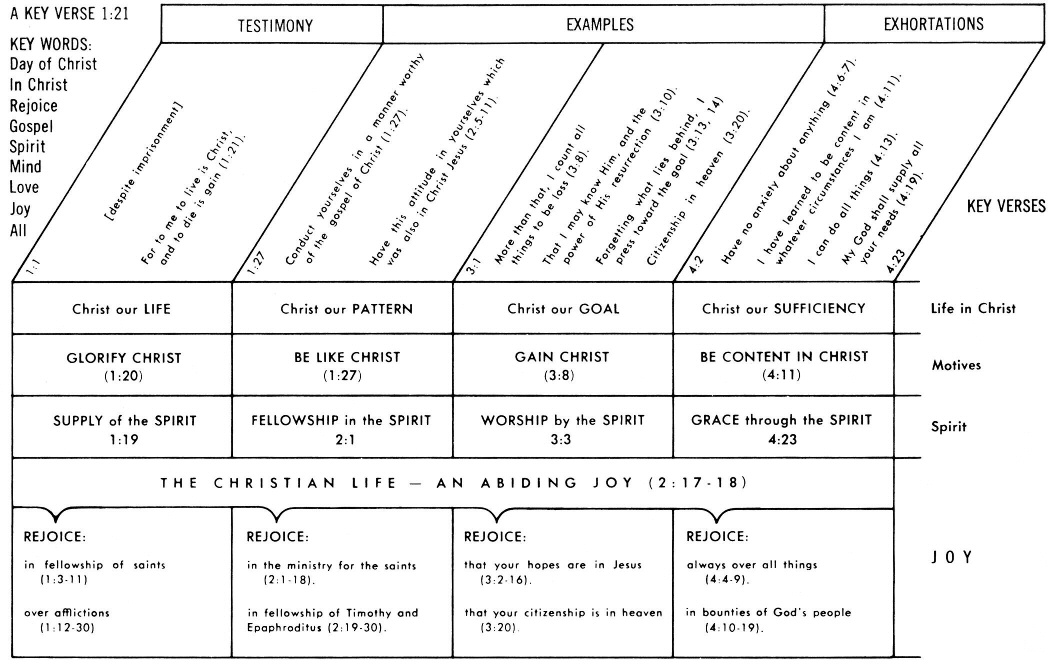
LIFE IN CHRIST
Click chart to enlarge
Charts from Jensen's Survey of the NT - used by permission
Philippians - Charles Swindoll = Chart on right side of page
| Account of Paul's Circumstances Php 1:1-30 |
Have the Mind of Christ Php 2:1-30 |
Have the Knowledge of Christ Php 3:1-21 |
Have |
| Partakers of Christ | People of Christ | Pursuit of Christ | Power of Christ |
| Suffering | Submission | Salvation | Sanctification |
| Experience | Examples | Exhortation | |
Philippians 4:8 Finally, brethren, whatever is (3SPAI) true, whatever is honorable, whatever is right, whatever is pure, whatever is lovely, whatever is of good repute, if there is any excellence and if anything worthy of praise, dwell (2PPMM) on these things (NASB: Lockman)
Greek: To loipon, adelphoi, osa estin (3SPAI) alethe, osa semna, osa dikaia, osa hagna, osa prosphile, osa euphema, ei tis arete kai ei tis epainos, tauta logizesthe; (2PPMM)
Amplified: For the rest, brethren, whatever is true, whatever is worthy of reverence and is honorable and seemly, whatever is just, whatever is pure, whatever is lovely and lovable, whatever is kind and winsome and gracious, if there is any virtue and excellence, if there is anything worthy of praise, think on and weigh and take account of these things [fix your minds on them]. (Amplified Bible - Lockman)
Amplified (Revised): Finally, believers, whatever is true, whatever is honorable and worthy of respect, whatever is right and confirmed by God’s word, whatever is pure and wholesome, whatever is lovely and brings peace, whatever is admirable and of good repute; if there is any excellence, if there is anything worthy of praise, think continually on these things [center your mind on them, and implant them in your heart].
NLT: And now, dear brothers and sisters, let me say one more thing as I close this letter. Fix your thoughts on what is true and honorable and right. Think about things that are pure and lovely and admirable. Think about things that are excellent and worthy of praise. (NLT - Tyndale House)
Phillips: Here is a last piece of advice. If you believe in goodness and if you value the approval of God, fix your minds on the things which are holy and right and pure and beautiful and good. (Phillips: Touchstone)
TLB: And now, brothers, as I close this letter, let me say this one more thing: Fix your thoughts on what is true and good and right. Think about things that are pure and lovely, and dwell on the fine, good things in others. Think about all you can praise God for and be glad about.
Wuest: Finally, brethren, whatever things have the character of truth, whatever things are worthy of reverence, whatever things are righteous, whatever things are pure, whatever things are lovely, whatever things are attractive, whatever excellence there is or fit object of praise, these things make the subject of careful reflection.
Young's Literal: As to the rest, brethren, as many things as are true, as many as are grave, as many as are righteous, as many as are pure, as many as are lovely, as many as are of good report, if any worthiness, and if any praise, these things think upon;
FINALLY BRETHREN WHATEVER IS TRUE: To loipon, adelphoi, hosa estin (3SPAI) alethe:
- Mt 22:16; Jn 7:18; Ro 12:9; 2Cor 6:8; Ep 4:25; 5:9; 6:14; 1Pe 1:22; 1Jn 3:18
- Ro 12:9, 10, 11, 12, 13, 14, 15, 16, 17, 18, 19, 20, 21; 1Co 13:4, 5, 6, 7; Gal 5:22; Jas 3:17; 2 Pe 1:5, 6, 7
- Philippians 4 Resources - Multiple sermons and commentaries
- Listen to excellent sermon Battle for the Christian Mind by Dr Steven Lawson
THE CHRISTIAN'S
THOUGHT LIFE
Here's a simple sermon outline for Philippians 4:8-9:
- Get Right (includes confessing, etc, Ps 139:23, 24, 1 Jn 1:9, Pr 28:13. Why? Because you are not going to be able to fulfill the commands if the Spirit is quenched!)
- Think Right (This command should include memorizing and meditating on the Word of Truth, the Word of Life)
- Live Right (The essence of this command is about being a disciple = a learner who follows a godly example, ultimately following Jesus - cf Php 3:17, 1 Cor 11:1)
The mind cannot be entirely at rest. It is not a blank. The corollary is that you cannot think two thoughts at the same time. What happens if you try to do this? One thing in context that happens is that you become anxious, which in simple terms means you are being pulled in two directions -- toward a "good" thought or toward a "bad" thought. And what is the result of this divided thinking? You become paralyzed (so to speak) by your anxiety. Hence Paul gives us an exhortation to think about right things which include Jesus Christ our Holy Lord, the Scriptures the Holy Word, loving attitudes and holy desires. Here is an old praise song by Brian Doerksen that puts the "Whatever is..." to music...
Whatever is True
Whatever is true
Whatever is right
Whatever is pure
Whatever is lovely
We will fix our thoughts on these things
Jesus You're true
Jesus You're right
Jesus You're pure
You are lovely
We will fix our thoughts on You
Jesus (Jesus)
Who is like You (Who is like You)
Jesus (Jesus)
Who is like You (Who is like You)
Who is like You
To become more like Christ, meditate on Who He is...
("True, right, pure, lovely, etc).
To reiterate, what has Paul just been discussing? -- Anxiety (merimna from merizo = to divide or draw different directions - which is exactly what anxiety does to most of us!)) or worry, which describes a mind that is being pulled in two directions! Here in Php 4:8 Paul gives us another passage that deals with our mind and in context gives us a way to combat anxiety and worry, by fixing it in one direction so to speak! This recalls the exhortation of Hebrews in which he tells us we can run the race of life with endurance by fixing our eyes on Jesus, or in Php 4:8 language, by fixing our thoughts on Jesus and His Word, because He is the Word, the Word of life (John 1:1, 1 John 1:1), the Word Who gives life (cf Jn 6:63).
Robert Morgan writes that "Paul’s final technique for overcoming worry is to meditate on what is excellent and praiseworthy. Verses 8-9 say: "Finally, brothers, whatever is true, whatever is noble, whatever is right, whatever is pure, whatever is lovely, whatever is admirable—if anything is excellent or praiseworthy—think about such things. Whatever you have learned or received or heard from me or seen in me—put it into practice. And the God of peace will be with you."
Since worry and anxiety are conditions of the mind, one of the best remedies is (enabled by the Spirit Who gives us the desire and the power - Php 2:13NLT) to push them aside with healthier thoughts. Romans 12:2 says that we are transformed by the renewing of our minds. And that’s one of the reasons for memorizing Scripture.
Man's unique ability to think troubled the famous American poet Walt Whitman who said that he often envied the cattle that graze contentedly in a meadow, because they never worry or dwell on troublesome thoughts. As followers of Christ, we know that the ability to think is a God-given gift and that we unlike the natural (unregenerate) man have been given the precious gift of "the mind of Christ." (1 Cor 2:16). But sad to say, even we who have the mind of Christ can misuse it by entertaining thoughts that are vulgar, foul, and mean. In Php 4:8 Paul gives us the antidote for un-Christ-like thinking.
THOUGHT - Remember that Christ-like character is shaped by thinking Christ-honoring thoughts. How has your thought life been this past week? Do you need to confess ungodly thoughts? I personally have begun "fasting" from the news (or should we call it "spin"?) and it has allowed me (enabled by the Spirit of course) to obey Paul's two commands (both present imperative) to the "keep seeking the things above, where Christ is, seated at the right hand of God, and keep setting [my mind] on the things above, not on the things that are on earth." (Col 3:1-2) If you are anxious about what is going on in the world, you might consider "fasting," from the things going on in this world which John says "is passing away and even its lusts." (1 Jn 2:17) In a related instruction regarding our mindset, Jesus said "No one can serve (douleuo in present tense) two masters (kurios - also translated "lord"); for either he will hate (miseo) the one and love (agapao) the other, or he will be devoted (antechomai) to one and despise ( kataphroneo) the other. You cannot serve God and wealth (mamonas)." (Mt 6:24) And in the very next verse Jesus says "For this reason I say to you, do not be worried (merimnao in present imperative with a negative = stop doing this -- a command we can obey only as we are energized by the Holy Spirit to obey) about your life."
Pastor John MacArthur introduces Php 4:8-9 with this thought - The word finally indicates that Paul has arrived at the climax of his teaching on spiritual stability. The principle that he is about to relate is both the summation of all the others and the key to implementing them. The phrase dwell on these things introduces an important truth: spiritual stability is a result of how a person thinks. The imperative form of logizomai (dwell on) makes it a command (Ed: present imperative = to be our continual practice, only possible as we surrender to and are filled/controlled by the Holy Spirit); proper thinking is not optional in the Christian life. Logizomai means more than just entertaining thoughts; it means "to evaluate," "to consider," or "to calculate." Believers are to consider the qualities Paul lists in this verse and meditate on their implications. The verb form calls for habitual discipline of the mind to set all thoughts on these spiritual virtues (Ed: cf the present and future promise for disciplining ourselves for godliness - 1 Ti 4:7-8). The Bible leaves no doubt that people's lives are the product of their thoughts. Proverbs 23:7 declares, "For as he thinks within himself, so he is." The modern counterpart to that proverb is the computer acronym GIGO (Garbage In, Garbage Out). Just as a computer's output is dependent on the information that is input, so people's actions are the result of their thinking. (MacArthur New Testament Commentary – Philippians)
Kenneth Wuest - We come now to a list of Christian virtues which Paul exhorts the saints to make the subject of careful reflection.
Dwight Edwards - Having dealt with our praying (Phil 4:6,7) we are now told what to think on; and in Phil 4:9, what to do or practice. We are to set our minds upon the things that will bring Christ-likeness to our lives. Of course the word of God perfectly fills all these categories.
Rod Mattoon - In verse six, we have those things of which we must rid our mind, especially anxious thoughts. Paul gives us a list of things that are to occupy our minds as a replacement to the destructive things that can occupy them. We are to think, meditate, or ponder on these things and we are to do this all throughout our lives. Our tendency is not to do this because we are distracted by other matters.
Tony Merida - The final issue that Paul addresses is the Christian’s thought life. For Christians to grow in likeness to Jesus, we have to have a renewed mind (Rom 12:1-2; Eph 4:23). God has blessed His church with His Word as a primary means of purifying our minds. (Exalting Jesus in Philippians)
Undoubtedly you've heard the little saying "Sow a thought, reap an action. Sow an action, reap a habit. Sow a habit, reap a character. Sow a character reap a destiny!" As you think about the thoughts that have dominated your mind this past week, what do they say about your destiny? Paul now gives us a virtue list which we can use for a "virtual mind purge" so to speak, replacing the negativity (and evil) that pervades the world's thoughts with the positivity (and goodness) of godly thoughts. This is not some psychological ploy, some "mind over matter trick," but is the living and active Word of God which effectively and powerful counters the words of the world. As an aside, for the past 6 months I have literally stopped watching all news on cable, newspapers, internet, etc. There have been a few "big" things that someone usually informs me about, but the effect of purging my mind of the media's intonations with the inspired Word of God has been amazing!. If you too get frustrated and flustered by the cable news and the talking heads, you might try fasting a week or two from the news. You could even check your blood pressure before and after!
Finally (3062) (loipon) means literally “for the rest” or “for what remains” and in the present context means “as to what remains to be said.” This is Paul's second use of loipon in this letter (Php 3:1-see note Philippians 3:1). Therefore, obviously loipon does not always imply one is drawing to a close but that there is a transition in subject matter.
Loipon - 55x in the NT -The NAS renders loipon as beyond that(1), else(2), finally(6), from now on(2), from then on(1), in the future(1),moreover(1), other(1), other matters(1), other people(1), other things(1), other women(1), others(4), remaining(2), rest(26),still(2), that time onward(1), things that remain(1). Matt. 22:6; 25:11; 26:45; 27:49; Mk. 4:19; 14:41; 16:13; Lk. 8:10; 12:26; 18:9, 11; 24:9f; Acts 2:37; 5:13; 17:9; 27:20, 44; 28:9; Rom. 1:13; 11:7; 1 Co. 1:16; 4:2; 7:12, 29; 9:5; 11:34; 15:37; 2 Co. 12:13; 13:2, 11; Gal. 2:13; 6:17; Eph. 2:3; 6:10; Phil. 1:13; 3:1; 4:3, 8; 1 Thess. 4:1, 13; 5:6; 2 Thess. 3:1; 1 Tim. 5:20; 2 Tim. 4:8; Heb. 10:13; 2 Pet. 3:16; Rev. 2:24; 3:2; 8:13; 9:20; 11:13; 12:17; 19:21; 20:5
As Paul draws to the conclusion of his letter, in this verse he deals with the greatest conflict that every believer encounters - the battle for the control our minds.
Solomon recognized this age long conflict when he wrote…
Watch (NOT A SUGGESTION BUT A COMMAND TO DO THIS CONTINUALLY) over your heart with all diligence, for from it flow the springs of life. (Proverbs 4:23)
Comment - The Septuagint (Lxx) (πάσῃ φυλακῇ τήρει σὴν καρδίαν) literally reads "All guard [phulake] keep on watching over (which is tereo in the present imperative = continually, only possible as we lean on the Holy Spirit to enable us to keep setting a guard at the door of our heart) your heart (see kardia)."
In Proverbs 23:7 Solomon wrote that "As a man thinks in his heart so he is."
THOUGHT - Do you want to know what a man actually is? Solomon has just given us the "test". It is not what he says but what he thinks about! What do you think about most of the time? (compare Paul's command to set your mind on and seek "the things above" in Col 3:1, Col 3:1)
Believers are in a war for their minds, the world system continually bombarding them using every "weapon" at its disposal - books, magazines, billboards, television, movies, internet, etc. The goal of the anti-god world system is to control our actions by first controlling our minds. We've all heard the axiom "The medium is the message" but the real message is that the medium seeks to seduce our minds into its anti-god way of thinking, introducing distorted euphemisms like "values clarification" in which the individual determines the "values" by which he or she assesses what is "true and honorable", etc, neglecting of course the truth that God absolutely sets the absolute, eternal values. If you think this is "brainwashing" is not an ongoing struggle, then try this little experiment. Using a web search engine like "Google", enter the phrase "Values Clarification" in the query box (be sure to include the quotes). You may be surprised at some of the almost 200,000 hits you retrieve!
The ancient Greco-Roman anti-Christ, anti-god world was not any different from world system of today. And so Paul presents to us and to the saints at Philippi the antidote to counter the fiery missiles constantly coming at the believer's mind. The key word in this passage is Paul's command for us to "dwell" on the list of godly qualities in Philippians 4:8. (see more discussion on the critical verb dwell below)
William Barclay rightly observes that…
The human mind will always set itself on something and Paul wished to be quite sure that the Philippians would set their minds on the right things. This is something of the utmost importance, because it is a law of life that, if a man thinks of something often enough, he will come to the stage when he cannot stop thinking about it. His thoughts will be quite literally in a groove out of which he cannot jerk them. It is, therefore, of the first importance that a man should set his thoughts upon the fine things and here Paul makes a list of them. (Daily Study Bible Series)
In this list there are 8 "standards" by which every child of God can test whether their mind is dwelling on that which is worthy of consideration. This verse is worth committing to memory, so that it is available for immediate access whenever and wherever you find your mind!
Dwight Pentecost offers a practical thought regarding this verse noting that…The greatest area of sin in the believer’s life is not the area of actions but the area of thought. There is a whole classification of sins that we would have to call sins of the mind. What was the first sin of Lucifer? It was pride. What is that? A sin of the mind. What is lust? A sin of the mind. What is covetousness? A sin of the mind. Greed? A sin of the mind. Suspicion? A sin of the mind. Discouragement? A sin of the mind. We could go on and on. Those sins are more real to the child of God than such sins as adultery and murder and theft. That is a testimony to the fact that there is a warfare going on. Satan is attacking the mind. Therefore this word of the Apostle Paul concerning the use we make of our minds is so relevant to us today: meditate, ruminate, dwell on these things. (Pentecost, J. D. The Joy of Living: A study of Philippians. Kregel Publications)
Pastor Steven Cole (his messages are highly recommended) introduces Philippians 4:8 with the following comments…
Mark Twain wrote, "What a wee little part of a person’s life are his acts and his words! His real life is led in his head, and is known to none but himself. All day long, the mill of his brain is grinding, and his thoughts, not those other things, are his history." (Reader’s Digest [1/93], p. 155).
I would modify Twain by saying that our thought life forms the basis for and is largely revealed in our actions and words. But Twain’s comments correctly affirm that our thought life composes a major part of who we really are.
Jonathan Edwards put it this way: "The ideas and images in men’s minds are the invisible powers that constantly govern them" (source unknown).
Thus it is crucial for each of us to bring our thought life into submission to Jesus Christ by learning to think biblically about every aspect of life. One of the most helpful things I have learned about the Christian life is that all sin begins in our thoughts, which the Bible often calls “the heart.” Jesus said, “That which proceeds out of the man, that is what defiles the man. For from within, out of the heart of men, proceed the evil thoughts, fornications, thefts, murders, adulteries, deeds of coveting and wickedness, as well as deceit, sensuality, envy, slander, pride and foolishness. All these evil things proceed from within and defile the man” (Mark 7:20, 21, 22, 23, cf Mt 12:34-37).
No one commits these outward sins without first having committed them in his mind. If we want to grow in godliness, we must win the battle over sin on the thought level. In Philippians 4:8 Paul exhorts us to develop a Christian thought life.
His words should not be divorced from the context. Practicing verse 8 is essential if we want to develop and maintain healthy relationships (Phil 4:2, 3, 5). A Christian thought life is also integral to a life of joy (Phil 4:4) and peace (Phil 4:6, 7) in every situation. Since our thoughts form the basis for our behavior, a godly thought life is also essential for the obedience to which Paul exhorts us in Phil 4:9. Clearly, Paul’s thought life was at the heart of the contentment he had learned in every situation (4:10-12). So Paul is telling us the way to be whole people in our relationships with God, with one another, and within ourselves. But before we look specifically at what Paul is teaching and how to obey it, we need to think about:
WHAT PAUL IS NOT TEACHING: THE POWER OF POSITIVE THINKING.
I need to focus on this for a moment because the Christian world has been infiltrated with the false teaching of “positive thinking,” popularized by Norman Vincent Peale and, with only slight variations, by Peale’s protege, Robert Schuller. If you are at all familiar with the teachings of these men, you know that they are not Christian in any orthodox sense of the term, even though they both have been welcomed into evangelical circles. Through their influence, the idea has crept into the American church that it is wrong ever to be negative or critical. This has resulted in the loss of discernment…
WHAT PAUL IS TEACHING: THE CHRISTIAN’S THOUGHT LIFE SHOULD BE FOCUSED ON THE GREAT TRUTHS OF SCRIPTURE.
Even though Scripture is not specifically mentioned, it is assumed, because it is the only source for knowing what is true, honorable, right, pure, lovely, and of good repute. (Read his excellent message Philippians 4:8 The Christian's Thought Life)
Let me qualify (if I may) Pastor Cole's comment on "positive thinking" as someone has asked a question via email - In one sense Php 4:8 is the consummate passage on Biblical "positive thinking" but the question arises is what does one mean by the term "positive thinking." There is Biblical positive thinking (Php 4:8) and there is non-biblical "positive thinking" (Norman Vincent Peale). Clearly, it is the non-biblical variety of positive thinking to which Pastor Cole alludes. For example what is it that fulfills ALL OF THE ATTRIBUTES listed in Php 4:8? Clearly it is the pure WORD OF GOD, THE WORD OF TRUTH (AND JESUS OF COURSE ALSO FULFILLS ALL THESE ATTRIBUTES). So as we fill our mind daily ("let your mind dwell" is present imperative = command to make this your habitual practice) with the WORD OF GOD and THOUGHTS OF JESUS (e.g., reading the Gospels frequently) and meditating on those positive attributes found in His Word, the Holy Spirit uses our focus on the Holy Word to renew our "holy minds" (aka "the mind of Christ" 1 Cor 2:16) and to transform us gradually over time, more and more into the image of God's Son, Jesus Christ (2 Cor 3:18) Now that genre of positive thinking I have absolutely no problem with. In fact I have an entire discussion of Biblical Meditation (which I fear is a lost art in much of our "fast food" oriented society), which is really another way to LET YOUR MIND DWELL on what is true, honorable, etc. The spiritual benefits are priceless as summarized in Psalm 1:1-2and Joshua 1:8. I wish more saints would practice this type of Biblical "positive thinking."
Related Resources:
- Is there any power in positive thinking?
- How can I stop having negative thoughts? How can I overcome negative thinking?
- What is “The Secret”? What is the law of attraction?
Cornerstone Biblical Commentary - Each of these virtues and the sum total of them are what Greco-Romans prized as the best virtues a person could display. This sentence could easily have been found in Epictetus’s Discourses or Seneca’s Moral Essays, in the context of extolling the best of moral virtues.
WHATEVER IS TRUE
Whatever is true - true as to fact. What is true denotes the actuality of something.
What is true? God's Word! And of course Jesus is true (Jn 14:6). And of course Jesus is the Word (Jn 1:1) and the Word of life (1 John 1:1).
Why is truth first in the virtue list? Because it is the "headwaters" from which the springs of life flow. Jesus prayed to His Father, "Sanctify (set them apart from the world and unto Yourself, make them holy) them in TRUTH, Thy Word is TRUTH." (John 17:17). The spiritual battle is not a power struggle but a "truth struggle" and the battlefield is our MIND (~Heart), and the battle rages daily over TRUTH. To remain spiritually stable, we must stand on the truth and we must do that every day. We must begin our day in the Word of Truth, even memorizing it so that during the day we might meditate on it from time to time. If you are too busy for the Word in the morning, you are too busy! Keep it simple. Take just a couple of minutes (you can spare a couple of minutes for God can't you?) Don't read a devotional if you are short on time. Read God's pure milk (for with it alone you grow in respect to salvation - 1 Pe 2:2), the Word of life (cf Dt 32:47, Php 2:16). Focus your attention fully on one verse for one minute (e.g., here are some "starter" verses to consider - Ps 1:2, Joshua 1:8, Pr 4:23, Ps 16:11, etc). Turn it into a prayer. Write it down on a card. (You can do this in 1-2 minutes!) Look at the card during the day, as a reminder that your Lord is near and that His Word is true.
What does whatever is true counter? Lies. Doubts. Satan deceived Adam and Eve by injecting doubt about God's Word of truth ("“Indeed, has God said...? Ge 3:1) and following up with an overt lie ("You surely will not die!" Ge 3:4). And lest we think our mortal enemy rests on his laurels (so to speak - having lured mankind into sin and potentially to eternal death), Jesus reminds us "He was a murderer from the beginning, and does not stand in the truth because there is no truth in him. Whenever he speaks a lie, he speaks from his own nature, for he is a liar and the father of lies." (Jn 8:44).
H C G Moule - Both in the sense of truth-speaking and truth-being. Truthfulness of word, and sincerity of character, are absolutely indispensable to holiness. Nothing is more unsanctified than a double meaning, or a double purpose, however “pious” the “fraud”.
MacArthur has some pithy comments - Paul's call for biblical thinking is especially relevant in our culture. The focus today is on emotion and pragmatism, and the importance of serious thinking about biblical truth is downplayed. People no longer ask "Is it true?" but "Does it work?" and "How will it make me feel?" Those latter two questions serve as a working definition of truth in our society that rejects the concept of absolute divine truth. Truth is whatever works and produces positive emotions. Sadly, such pragmatism and emotionalism has crept even into theology. The church is often more concerned about whether something will be divisive or offensive than whether it is biblically true.
True ( 227) (alethes) is that which conforms to reality. In the final analysis whatever God says on any given subject is true! It speaks of what is valid, reliable, and honest. The unchanging God and His unchanging holy Word is the final test for truth. You do not have to look very closely to find the Lord Jesus Christ in verse 8 for Jesus said He was "the Truth" and each of these traits is true of Him.
Alethes - 26x in the NT - NAS renders alethes as real(1), true(21), truly(1), truth(1), truthful(2). - Matt. 22:16; Mk. 12:14; Jn. 3:33; 4:18; 5:31f; 6:55; 7:18; 8:13f, 17, 26; 10:41; 19:35; 21:24; Acts 12:9; Rom. 3:4; 2 Co. 6:8; Phil. 4:8; Tit. 1:13; 1 Pet. 5:12; 2 Pet. 2:22; 1 Jn. 2:8, 27
In John 3:33 the Scripture attests that God is true to which Paul adds Who cannot lie. (Titus 1:2). So everything God says is true!
John records Jesus' words…
I have many things to speak and to judge concerning you, but He who sent Me is true; and the things which I heard from Him, these I speak to the world. (John 8:26)
And so God Who is true and cannot lie stands in dramatic contrast to Satan who Jesus described to the Jews who would soon try to stone Him…
You (Jews who refused to receive Jesus as their Messiah and Redeemer) are of your father the devil, and you want to do the desires of your father. He was a murderer from the beginning, and does not stand in the truth, because there is no truth in him. Whenever he speaks a lie, he speaks from his own nature; for he is a liar, and the father of lies. (John 8:44)
Paul described Satan as a deceiver writing to the Corinthians…
I am afraid, lest as the serpent deceived Eve by his craftiness, your minds should be led astray from the simplicity and purity of devotion to Christ. (2 Cor 11:3)
In Revelation John records that…
the great dragon was thrown down, the serpent of old who is called the devil and Satan, who deceives the whole world; he was thrown down to the earth, and his angels were thrown down with him. (Rev 12:9)
One who deceives seeks to cause others to accept as true or valid what is false or invalid.
From this introduction, it follows that a vital aspect of thinking on whatever is true means reading, memorizing (see Memorizing His Word) and meditating (see Biblical Meditation) on the Word of God. The remaining seven categories of virtuous thought are all based on the truth of God’s Word. All of them are ways to view the truth of Scripture.
Thinking that is true is not false or unreliable, but genuine and real. When a thought comes racing into (or slithers into) your mind, begin the test by asking is it true? This means we must know the truth ourselves which is why regular serious Bible study is vital to discern truth from error or deception. Now something may be true but still is not worthy of consideration. The last two statements serve as qualifiers "Is it excellent?". "Is it worthy of praise?" If not, then even though it is "true" it is not to be dwelt upon.
Barclay - Many things in this world are deceptive and illusory, promising what they can never perform, offering a specious peace and happiness which they can never supply. A man should always set his thoughts on the things which will not let him down. (ibid)
Pastor Cole reminds us "Since as fallen creatures we are prone to Satan’s lies and deception, the only way we can know the truth and walk in it is to steep ourselves in God’s Word. We should know the Word so well that we automatically run everything we encounter through the grid of God’s Word. We live in a day that is geared toward emotions and strongly influenced by the supposed “virtue” of tolerance. Our culture assumes that love means being tolerant and accepting of everyone and everything, even if God’s Word plainly declares that something is an abomination. If you go with the flow, you will be carried far from God’s absolute standard of moral truth as revealed in His Word. We also must resist the pragmatism of our culture, which determines the true by whatever works. If something works, which means, it brings you happiness (at least at the moment) or it accomplishes what you want, then it must be true. But God’s Word doesn’t always line up with what works. In fact, it’s clear that sin often brings pleasure for a season; if it didn’t we wouldn’t be so enticed by it. Many of the “positive mental attitude” methods are effective in making you a successful sales person. But the question is, Are they biblical? We must test everything by God’s Word, not by feelings or pragmatism. (Read his excellent message Philippians 4:8 The Christian's Thought Life)
ILLUSTRATION - Dr. Walter Cavert reported a survey on worry that indicated that only 8% of the things people worried about were legitimate matters of concern (true)! The other 92% were either imaginary, never happened, or involved matters over which the people had no control anyway. Satan is the antithesis of truth for he is the father of lies (Jn 8:44), and he seeks to corrupt our minds with his lies and deception (2 Cor 11:3). His mantra remains unchanged after 5000 years - “Hath God really said?” (Genesis 3:1ff). (adapted from Warren Wiersbe)
The Holy Spirit sanctifies our mind through God's truth, His Word…
"Sanctify them in the truth; Thy word is truth. (Jn 17:17 - addresses directly to the original 11 apostles but clearly applicable in principle to all disciples of Jesus. This begs the question - are you in the truth daily, so the truth can get in you? If not then don't be surprised that you often lack the peace of God and instead find yourself anxious.)
And do not be conformed (present imperative with a negative) to this world, but be (continually) transformed (present imperative) by the renewing of your mind (THE WORK OF THE SPIRIT - SEE VERSE BELOW), that (PURPOSE CLAUSE) you may prove what the will of God is, that which is good and acceptable and perfect. (Ro 12:2NLT, see note Romans 12:2)
But we all, with unveiled face, beholding as in a mirror the glory of the Lord, are (continually) being transformed into the same image (CHRIST) from glory to glory, just as from the Lord, the Spirit (ENERGIZES OUR TRANSFORMATION AS WE TAKE IN GOD'S WORD). (2 Cor 3:18)
On the other hand, the devil tries to corrupt our mind through lies and deception (and fiery missiles of fear). Whenever we believe a lie, we begin to walk in darkness, the kingdom of Satan! And so we see the importance of Paul's command to continually meditate upon the things that are true.
MacArthur has some insightful comments on those things that are "true":
People no longer ask “Is it true?” but “Does it work?” and “How will it make me feel?” Those latter two questions serve as a working definition of truth in our society that rejects the concept of absolute divine truth. Truth is whatever works and produces positive emotions. Sadly, such pragmatism and emotionalism has crept even into theology. The church is often more concerned about whether something will be divisive or offensive than whether it is biblically true… Too many people go to church not to think or reason about the truths of Scripture, but to get their weekly spiritual high; to feel that God is still with them. Such people are spiritually unstable because they base their lives on feeling rather than on thinking… Salvation involves the transformation of the mind. In Romans 8:5 (note) Paul writes,
Those who are according to the flesh set their minds on the things of the flesh.”
Unsaved, fleshly people have an unsaved, fleshly mind-set. They think as fallen, unredeemed people. On the other hand,
“those who are according to the Spirit [set their minds on] the things of the Spirit.”
Their renewed minds are focused on spiritual truth. Consequently,
“the mind set on the flesh is death, but the mind set on the Spirit is life and peace” (Romans 8:6 note)…
Just as the believers’ initial act of saving faith leads to a life of faith, so also the transforming of the mind at salvation initiates a lifelong process of renewing the mind.
Wiersbe adds this practical note: Wrong thinking leads to wrong feeling, and before long the heart and mind are pulled apart and we are strangled by worry. We must realize that thoughts are real and powerful, even though they cannot be seen, weighed, or measured. We must bring “every thought captive to the obedience of Christ" (2 Cor 10:5).
Henry Blackaby - Put Away Lying
Since you put away lying, Speak the truth, each one to his neighbor, because we are members of one another.—Ephesians 4:25
Because you are a Christian, your life ought to be permeated with truth. When you were born again, God put the Spirit of truth in you (John 16:13). The Spirit's role is to guide you into all truth. The Spirit wants to fill your mind with whatever is true (Phil. 4:8). If you allow the Spirit to fill you with God's truth, you will be truthful in your actions and in your relationships. According to Jesus, this means that your yes will always be yes, and your no will always mean no (Matt. 5:33–37).The world considers truth optional. Deception permeates every corner of society because the prince of this world is the author and father of lies (John 8:44). From his first contact with people, Satan has been lying to them and persuading them to live in falsehood rather than in truth. The world will tempt you to compromise the truth. You may be fooled into thinking that you can accomplish greater good by withholding the truth. That is a demonic deception. You cannot use deception to build the kingdom of God! God refuses to use sinful means to accomplish His holy purposes. You may be tempted to live a lie by projecting a false image of yourself. Jesus condemned this as hypocrisy (Luke 12:56). When you sin, you will be tempted to conceal the truth; yet only as you confess the truth will you be forgiven and set free (James 5:16). What you say reflects what is in your heart (Matt. 12:34). If your heart is filled with deception, your mouth will speak falsehood. Ask God to permeate you with His truth so that you find falsehood, in any form, abhorrent.
Six Ways to Cheer Up
1. Reflect on a funny or pleasant memory, and get ready to giggle. Your original cheerful feeling will always remain attached to that memory.
2. Don't "awfulize" life. Make a habit of thinking positive. After all, optimism isn't born; it's a state of mind we choose to develop.
3. Personalize Scripture by inserting your name in God's promises, such as Isaiah 54:10 or Nehemiah 8:10
4. Think uplifting thoughts—whatever is true, noble, right, pure, lovely, admirable, excellent, or praiseworthy (Philippians 4:8).
5. Let God in on everything, including the annoying little cheer-depleters in your life. He cares!
6. Keep in mind that earthly pleasures were never meant to satisfy by only to make us hungry for the real thing: heaven.
Warren Wiersbe - THE RIGHT BALANCE
Paul balances four activities: "learned and received" and "heard and seen." It is one thing to learn a truth, but quite another to receive it inwardly and make it a part of our inner self. Facts in the head are not enough; we must also have truths in the heart. In Paul's ministry, he not only taught the Word but also lived it so that his listeners could see the truth in his life. Paul's experience ought to be our experience. We must learn the Word, receive it, hear it, and do it.
The peace of God is one test of whether or not we are in the will of God. If we are walking with the Lord, then the peace of God and the God of peace exercise their influence over our hearts. Whenever we disobey, we lose that peace and we know we have done something wrong.
Right praying, right thinking, and right living: these are the conditions for having the secure mind and victory over worry. (Pause for Power)
THINKING CHRISTIANLY—Romans 12:2 - Joseph Stowell
The mind is our only place of total personal privacy. It is that territory no other person can invade. As a result, we tend to be very much ourselves in our minds. We do not have to put up a facade to anyone. It is where immoral fantasies and schemes can play out in intimate detail. Thoughts of revenge, jealousy, lingering anger, and envy can have unchecked freedom. In contrast, our mind can be the place where we seek to enjoy the pleasures of purity and devise plans to serve, help, and heal. It is where we can embrace memorized Scripture and meditate on His Word and His ways. Our minds can pray and commune with the Lord on a constant basis. Our thoughts can be a temple where we offer sacrifices of praise and worship to our Lord. Our minds are a powerful force for good or evil.
It is no wonder God’s Word teaches us that a changed life begins with a changed mind. Paul wrote in Romans 12:2, “Be transformed by the renewing of your mind.” All of life begins and is defined by how we think, what we think about, and what we decide in the confines of our thoughts. God wants our minds. He calls us to think His thoughts after Him and to conform our thoughts to His will and His ways.
Paul is actually calling us to “think Christianly.” To make a deliberate break from the decadent mind-set of a decaying society and reorient ourselves toward God. Brain first! Never have God’s people needed this more than we do today.
Paul wrote to the Philippians, “Whatever is true, whatever is noble, whatever is right, whatever is pure, whatever is lovely, whatever is admirable—if anything is excellent or praiseworthy—think about such things” (Philippians 4:8).
As Proverbs says, “. . . as He thinks within himself so he is” (Proverbs 23:7).
Start the discipline of thinking God’s thoughts after Him.
Ask yourself, “What would God think in a moment like this?”
WHATEVER IS HONORABLE: hosa semna:
- Acts 6:3; Ro12:17; 13:13; 2Co 8:21; 13:7; 1Th 4:12; 1Ti 2:2; 3:4,8,11; Titus 2:2,7; Titus 3:14; Heb 13:18; 1Pe 2:12
- Philippians 4 Resources - Multiple sermons and commentaries
MacArthur on honorable - Semnos (honorable) comes from a word meaning "to revere," or "to worship." In its other New Testament uses, it describes the dignified lifestyle required of deacons (1 Tim. 3:8), deaconesses (1 Tim. 3:11), and older men (Titus 2:2). Believers must not think on what is trivial, temporal, mundane, common, and earthly, but rather on what is heavenly, and so worthy of awe, adoration, and praise. All that is true in God's Word is honorable. (MacArthur New Testament Commentary – Philippians)
Honorable (4586) (semnos) means worthy of respect or entitled to honor. It is that which inspires reverence or awe. It describes those things which are worthy, venerable, august, noble. The idea pertains to whatever evokes special respect. It means worthy of reverence, combining the ideas of gravity and dignity.
King James Bible Commentary.
Semnos is used only 4 times in the NT, here in Philippians 4:8 and in the following passages all describing an attribute of a distinct group of people…
1 Timothy 3:8 Deacons likewise must be men of dignity (semnos), not double-tongued, or addicted to much wine or fond of sordid gain,
1 Timothy 3:11 Women must likewise be dignified, not malicious gossips, but temperate, faithful in all things.
Titus 2:2 (note) Older men are to be temperate, dignified, sensible, sound in faith, in love, in perseverance.
There are many things that are not respectable, and Christians should not think about these things. This does not mean we hide our heads in the sand and avoid what is unpleasant and displeasing, but it does mean we do not focus our attention on dishonorable things and permit them to control our thoughts. Believers are not to dwell on what is trivial, temporal, mundane, common, and earthly, but rather let their minds dwell on what is heavenly (cf our citizenship in heaven - see note Philippians 3:20), and so worthy of awe, adoration, and praise.
Barclay observes that the Greek word semnos "is difficult to translate. It is the word which is characteristically used of the gods and of the temples of the gods. When used to describe a man, it describes a person who, as it has been said, moves throughout the world as if it were the temple of God. Matthew Arnold suggested the translation nobly serious. But the word really describes that which has the dignity of holiness upon it. There are things in this world which are flippant and cheap and attractive to the light-minded; but it is on the things which are serious and dignified that the Christian will set his mind." (ibid)
Ask: Does that to which you are giving your attention have honest value? Does it have the dignity of holiness upon it?
Wayne Barber describes this as "a lifestyle that tells everyone that we are under the Lordship of Christ. It is that which is decent. It is that lifestyle which is attractive to others. Without one's drinking from the well of Christ there will be no lifestyle that attracts others to Him."
Pastor Cole on honorable - This means that Christians are to take life seriously. We are not to be silly goof-offs, who treat life as a perpetual joke. We live in light of eternity, keeping in mind the uncertainty of this short life and the reality of heaven and hell. This doesn’t mean that we can’t appreciate clean humor. But our overall tenor should communicate to a lost world that they must stand before a holy God someday soon. Think on these reverent themes. (Read his excellent message Philippians 4:8 The Christian's Thought Life)
WHATEVER IS RIGHT: hosa dikaia:
- Ge 18:19; Dt 16:20; 2Sa 23:3; Ps 82:2; Pr 11:1; 16:11; 20:7; Isa 26:7; Mk 6:20; Lk 2:25; 23:50; Acts 10:22; Titus 1:8
- Philippians 4 Resources - Multiple sermons and commentaries
- Listen to excellent sermon Battle for the Christian Mind by Dr Steven Lawson
MacArthur on right - Dikaios/// describes whatever is in perfect harmony with God's eternal, unchanging standards, again as revealed in Scripture. Believers are to think on matters that are consistent with the law of God.
Right (1342) (dikaios) refers to that which conforms to the perfect standard of God's righteousness. We know from Romans that the "good works" that God requires (they are "right") do not come from our good intentions, but originate out of faith that obeys. Dikaios describes whatever is in perfect harmony with God’s eternal, unchanging standards, as revealed in Scripture.
Does that to which you thinking about conform to that which is righteous or is it tainted, shady, off color?
WHATEVER IS PURE: hosa hagna:
- 1Ti 4:12; 5:2; Titus 2:14; Jas 1:27; 3:17; 2 Pe 3:1
- Philippians 4 Resources - Multiple sermons and commentaries
- Listen to excellent sermon Battle for the Christian Mind by Dr Steven Lawson
CONTINUALLY CONTEMPLATE
CLEAN WORDS, CLEAN DEEDS
Pure (53) (hagnos) is that which is free from defilement, stainless, that which will not contaminated, that which is "morally and inwardly" pure. Hagnos is that which is holy, morally clean, and undefiled. Jesus is hagnos (1 Jn 3:3-note) and beleivers are to purify themselves just as He is pure, especially in view of the truth that we have the hope (certainty) that one day we will be like Him! (1 Jn 3:2-note)
Hagnos refers to ceremonial purity, and to moral purity. It especially means keeping our bodies undefiled by abstaining from sexual sins (see 2Cor 11:2; 1Ti 5:22; Titus 2:5; James 3:17. The saints then, as now, were constantly attacked by temptations to sexual impurity (Ep 4:17, 18, 19, 20, 21, 22, 23, 24-see notes Ep 4:17-19; 20-22; 23-24). Paul gives a strong warning to every saint…
do not let immorality or any impurity or greed even be named (present imperative commanding this to be their habitual practice = to not to even pronounce the name! Or to stop a practice already in existence.) among you, as is proper among saints; 4 and there must be no filthiness and silly talk, or coarse jesting, which are not fitting, but rather giving of thanks. 5 For this you know with certainty, that no immoral or impure person or covetous man, who is an idolater, has an inheritance in the kingdom of Christ and God. 6 Let no one deceive you with empty words, for because of these things the wrath of God comes upon the sons of disobedience. 7 Therefore do not be partakers with them; 8 for you were formerly darkness, but now you are light in the Lord; walk as children of light 9 (for the fruit of the light consists in all goodness and righteousness and truth), 10 trying to learn what is pleasing to the Lord. (Ep 5:3, 4, 5, 6, 7, 8, 9, 10-See notes Ep 5:3, 4; 5-6; 7-8; 9-10)
Hagnos - 8x in NT translated as chaste(1), free from sin(1), innocent(1), pure(5). - 2 Co. 7:11; 11:2; Phil. 4:8; 1 Tim. 5:22; Tit. 2:5; Jas. 3:17; 1 Pet. 3:2; 1 Jn. 3:3.
Barclay adds that when hagnos was "used ceremonially, it describes that which has been so cleansed that it is fit to be brought into the presence of God and used in his service. This world is full of things which are sordid and shabby and soiled and smutty. Many a man gets his mind into such a state that it soils everything of which it thinks. The Christian’s mind is set on the things which are pure; his thoughts are so clean that they can stand even the scrutiny of God." (ibid)
So we need to test what think about through the "grid" of hagnos and ask ourselves these simple questions - Will it defile or is it intrinsically pure? Will it corrupt our thinking if we give attention to it? Will it stand the scrutiny of God? Will it make me more like Jesus Who is perfect hagnos?
WHATEVER IS LOVELY: hosa prosphile:
- 2Sa 1:23; Song 5:16; 1Co 13:1-13; 1Pe 4:8
- Philippians 4 Resources - Multiple sermons and commentaries
Lovely (4375) (prosphile is a relationship word derived from pros = towards + philes = friend) refers to that conduct which is dear to someone. Lovable, endearing, amiable, gracious, charming, pleasing, winsome.
It is conduct which is pleasing in it's motive and actions towards others. Lovely has the idea of that which is admirable or agreeable to behold or consider.
Who is the most lovely One ever to lived? Jesus of course and it follows that we should think often of what He has done for us, is doing now at the right hand of the Father and will do in the future. Maranatha.
Barclay - Winsome is the best translation of all. The Greek is prosphile, and it might be paraphrased as that which calls forth love. There are those whose minds are so set on vengeance and punishment that they call forth bitterness and fear in others. There are those whose minds are so set on criticism and rebuke that they call forth resentment in others. The mind of the Christian is set on the lovely things—kindness, sympathy, forbearance—so he is a winsome person, whom to see is to love. (ibid)
Ask: Will this thing produce concord and rest and peace: Or will giving attention to this thing produce strife either within you or between you and another brother? If the former, then as the saying goes "hold that thought"! If the latter, than cast it aside.
J R Miller - "Turn my eyes from looking at what is worthless." Psalm 119:37
We must be always turning—if we would keep our life true and according to God's commandments. There are some flowers which always turn toward the sun. There was a little potted rose-bush in a sick-room which I visited. It sat by the window. One day I noticed that the one rose on the bush was looking toward the light. I referred to it; and the sick woman said that her daughter had turned the rose around several times toward the darkness of the room—but that each time the little flower had twisted itself back, until again its face was toward the light. It would not look into the darkness. The rose taught me a lesson—never to allow myself to look toward any evil—but instantly to turn from it. Not a moment should we permit our eyes to be inclined toward anything sinful. To yield to one moment's sinful act—is to defile the soul. One of the main messages of the Bible is, "Turn from the wrong, the base, the crude, the unworthy—to the right, the pure, the noble, the godlike." We should not allow even an unholy thought to stay a moment in our mind—but should turn from its very first suggestion, with face fully toward Christ, the Holy One.
"I will set before my eyes no vile thing!" Psalm 101:3
"Finally, brothers, whatever is true, whatever is noble, whatever is right, whatever is pure, whatever is lovely, whatever is admirable—if anything is excellent or praiseworthy—think about such things!" Philippians 4:8
But we should train ourselves to turn also from all discouragements. There is always a bright side, and we should find it. Discouragement is full of danger. It weakens and hurts the life.
WHATEVER IS OF GOOD REPUTE: hosa euphema:
- Acts 6:3; 10:22; 22:12; Col 4:5; 1Th 5:22; 1Ti 3:7; 5:10; Heb 11:2
- Philippians 4 Resources - Multiple sermons and commentaries
- Listen to excellent sermon Battle for the Christian Mind by Dr Steven Lawson
Good repute (2163) (euphemos is from eu = well, good + pheme = rumor, fame; English = euphemism) and refers to that which is well–spoken of, praiseworthy, laudable, highly regarded or well thought of. It is something or someone that deservedly enjoys a good reputation.
Ask: Are we concentrating on the good things we see in others or are we dwelling on their faults and shortcomings?
No Christian can afford to waste “mind power” on thoughts that tear him down or that would tear others down if these thoughts were shared. The believer must major on the high and noble thoughts especially as revealed in the pure milk of God's word and not dwell upon the base thoughts of this corrupt world.
IF THERE IS ANY EXCELLENCE: ei tis arete:
- Ru 3:11; Pr 12:4; 31:10,29; 2Pe 1:3,4
- Philippians 4 Resources - Multiple sermons and commentaries
- Listen to excellent sermon Battle for the Christian Mind by Dr Steven Lawson
Note the change in sentence structure introduced by "if". These last two qualities are more generic qualities and serve to sum up the preceding qualities.
Excellence (703) (arete) (Click in depth study) refers to any preeminence (moral, intellectual, military). Arete is a term denoting consummate ‘excellence’ or ‘merit’ within a social context. To the Greek philosophers, it meant “the fulfillment of a thing.” Arete came to mean quality of life which made someone or something stand out as excellent. Arete never means cloistered virtue or virtue of attitude, but virtue which is demonstrated in life. When anything in nature properly fulfills its purpose, that fulfillment was referred to as “virtue' or moral excellence. Land that produces crops is “excellent” because it is fulfilling its purpose. The tool that works correctly is “excellent” because it is doing what a tool is supposed to do. A believer demonstrates moral excellence or virtue by living the way He now has the potential to live (possessing everything necessary for life and godliness, His precious and magnificent promises, partaker of His divine nature).
Arete - 5x in the NT - Phil. 4:8; 1 Pet. 2:9; 2 Pet. 1:3, 5. The NAS renders arete as excellence(2), excellencies(1), moral excellence(2).
In short, arete was a term denoting consummate ‘excellence’ or ‘merit’ within a social context. Exhibition of arete invites recognition, resulting in renown or glory. In Homer arete was used primarily of military valor or exploits, but also of distinction for other personal qualities and associated performance that enhance the common interest. The term is a favorite subject in Stoic thought relating to morality.
Peter uses arete in his description of Jesus Who is the supreme manifestation of glory and excellence (arete). (2Pe 1:4). And then Peter calls saints to supply excellence writing…
Now for this very reason also (having everything necessary for life and godliness, having His precious and magnificent promises, so that we might become partakers of the divine nature, for this reason and with His divine supplies and promises), applying all diligence, in your faith supply moral excellence (arete), and in your moral excellence, knowledge (2Pe 1:5) (Comment: Cole comments that "Peter uses it as a quality of God and thus as the first quality that we are to add to our faith (2 Pe 1:3, 5). This means that as a new Christian, one of the first things you must do is to stop any behavior that is not in line with God’s moral virtues as revealed in Scripture, such as the Ten Commandments, the Sermon on the Mount, and Paul’s list of the deeds of the flesh (Gal 5:19, 20, 21-see notes Gal 5:19; 20; 21). To continue doing such things will hinder your growth in godliness. We must focus our minds on moral virtue. [Ibid]).
IF ANYTHING WORTHY OF PRAISE: kai ei tis epainos:
- Pr 31:31; Ro 2:29; 13:3; 1Co 4:5; 2Cor 8:18
- Philippians 4 Resources - Multiple sermons and commentaries
THINK ABOUT THINGS FOR WHICH
YOU CAN PRAISE GOD
What is the opposite of anything worthy of praise? One thought is would be anything worthy of criticism. In other words one becomes hyper-critical. Instead of accentuating the positive (the praiseworthy), he accentuates the negative. We often refer to such a person as one who has a critical spirit. Paul says one way to counter critical thoughts is to dwell on praiseworthy thoughts. Ask God by His Spirit to exchange your critical spirit for God’s correct thinking in Php 4:8. And begin by memorizing Php 4:8. In fact memorize Php 4:6-9 as these passages flow together.
June Hunt - To look with a “critical eye” is to pay close attention to detail— and this can be most helpful. But to look with a “critical spirit” means to microscopically focus on faults— and this is only harmful." The antidote for a critical spirit is a mindset that looks for that which is worthy of praise.
Dave Roper on critical rather than praiseworthy thoughts - I’ve been asking myself lately: Am I preoccupied with other people’s imperfections? Do I brood over their failures and faults, their moral flaws? Do I consider only the wrong that they do, especially the wrong they have done to me, or do I reflect on those aspects of character that are morally excellent and worthy of praise? How many friendships have ended because someone’s mistakes loomed large in our minds? How many marriages have died because we brooded and obsessed over our spouse’s flaws? How many of us have alienated our children because we have endlessly chided them and harped on their failings? Paul writes, “Whatever is true, whatever is noble, whatever is right, whatever is pure, whatever is lovely, whatever is admirable—if anything is excellent or praiseworthy—think about such things.”82 I’ve often pondered this verse and wondered how anyone can think abstractly about nobility, righteousness, and loveliness. Can it be that Paul is suggesting that we concentrate on those traits in others that are noble, admirable, lovely, and worthy of praise?
Worthy of praise (1868) (epainos from epí = upon + aínos = praise) is literally "praise upon" and denotes commendation, praise, or approbation (an act of formally or officially approving). It means something which is worthy of being commended. The word can describe the act of expressing admiration or approval, praise, approval, recognition. In the present context epainos describes a thing that is praiseworthy or something that deserves to be praised. So when that thought comes into your mind ask "Is it praiseworthy?" Then reflect upon it.
Detzler writes that epainos is…
Used sparingly in the Scriptures, the basic meaning of this word is "applause." It speaks of expressed approval or public recognition. Usually this praise was addressed to an individual or to an entire community. (Detzler, Wayne E: New Testament Words in Today's Language. Victor. 1986)
Richards in his note on the related verb epaineo writes that it…
means "to commend," and thus "to praise." In the spirit of the OT, this word for praise involves commending God for himself, his qualities, and his works. This word is also used in commending people. Excitingly, we learn that God will commend believers for faithful service. (Richards, L O: Expository Dictionary of Bible Words: Regency)
In the NT epainos is used to describe praise from God to men, praise to God from men (1 Cor 4:5, fame in 2 Cor 8:18, etc) and praise from men to men (Romans 2:29; Romans 13:3)
Epainos is used 11 times in the NT…
Romans 2:29 (note) But he is a Jew who is one inwardly; and circumcision is that which is of the heart, by the Spirit, not by the letter; and his praise is not from men, but from God. (Comment: There is almost a play on words here because Jew [Ioudaios ~ "the praised one"!] is related to the word Judah [Ioudas; cp Gen 49:8] which means praise. Here the praise from God is on those Jews who have received the Messiah as Savior. Vincent remarks that in this context epainos "means the holy satisfaction of God as opposed to Jewish vain-glory." Denney has an interesting remark that "the love of praise from each other, and religious vanity, are Jewish characteristics strongly commented on by our Lord.”)
Romans 13:3 (note) For rulers are not a cause of fear for good behavior, but for evil. Do you want to have no fear of authority? Do what is good, and you will have praise from the same
1 Corinthians 4:5 Therefore do not go on passing judgment before the time, but wait until the Lord comes who will both bring to light the things hidden in the darkness and disclose the motives of men's hearts; and then each man's praise will come to him from God. (Comment: This refers to the Judgment of believers [see bema] where the motives of deeds done in this present life will be assayed and rewarded or not rewarded. It is of note that the clear implication is that each believer will receive praise from God. This is amazing grace indeed!)
2 Corinthians 8:18 And we have sent along with him the brother whose fame in the things of the gospel has spread through all the churches;
Ephesians 1:6 (note) to the praise of the glory of His grace, which He freely bestowed on us in the Beloved… 1:12 to the end that we who were the first to hope in Christ should be to the praise of His glory… 1:14 who is given as a pledge of our inheritance, with a view to the redemption of God's own possession, to the praise of His glory. (Comment: Vincent writes that the ultimate aim of foreordination is that "Praise is called forth from the children of God by this divine glory which thus appears in grace.")
Philippians 1:11 (note) having been filled with the fruit of righteousness which comes through Jesus Christ, to the glory and praise of God.
Philippians 4:8 Finally, brethren, whatever is true, whatever is honorable, whatever is right, whatever is pure, whatever is lovely, whatever is of good repute, if there is any excellence and if anything worthy of praise, let your mind dwell on these things.
1 Peter 1:7 (note) that the proof of your faith, being more precious than gold which is perishable, even though tested by fire, may be found to result in praise and glory and honor at the revelation of Jesus Christ;
1 Peter 2:14 (note) or to governors as sent by him for the punishment of evildoers and the praise of those who do right.
There are 5 uses of epainos in the Septuagint (LXX) (1 Chr 16:27; 2 Chr. 21:20; Ps. 22:3, 25; 35:28)
Psalm 35:28 And my tongue shall declare Thy righteousness And Thy praise (Hebrew = tehillah = hymn or song of praise, praise in general; Lxx = epainos) all day long. (Spurgeon's Note: Unceasing praise is here vowed to the just and gracious God. From morning till evening the grateful tongue would talk and sing, and glorify the Lord. O for such a resolve carried out by us all!)
TDNT notes that…
Praise and approval were much sought after in antiquity, though the Stoic tried to achieve freedom from human judgment. In the OT, epainos is the recognition that the community gives the righteous, but especially God's approval. In Philo it is the approval of Moses or God, but sometimes public applause in the Greek sense. epainos may also be used in the LXX for the community's attitude of praise and worship toward God. God's throne is surrounded by doxa and epainos (1 Chr 16:27) (Kittel, G., Friedrich, G., & Bromiley, G. W. Theological Dictionary of the New Testament. Eerdmans)
Vincent writes that epainos is
Commendation corresponding to the moral value of the virtue.
Adrian Rogers ILLUSTRATION - I heard of a little boy who went out to see the Grand Canyon, and an old preacher went out to see the Grand Canyon. The old preacher wrote back to his wife—he said, "Today I've seen the handiwork of God. I've seen God as He put colors on His palette, and God as He took His fingers and sculptured a masterpiece." And, he went on, in grandiose words, to describe the Grand Canyon. The little boy wrote back to his mother, and he said, "Guess what, Ma? Today I spit a mile." You can be surrounded by beauty, and not see it.
LET YOUR MIND DWELL ON THESE THINGS: tauta logizesthe (2PPMM):
- Lk 16:15; 1Th 5:21; 1Jn 4:1
- Philippians 4 Resources - Multiple sermons and commentaries
RIGHT THINKING
LEADS TO RIGHT LIVING
As someone has well said "You're not what you think you are; but what you THINK—you are!"
Warren Wiersbe entitles Php 4:8 "Right Thinking" and Php 4:9 "Right Living." I think those are great, practical titles of these two great verses. In his devotional Wiersbe adds "Right praying (Php 4:6-7), right thinking, and right living: these are the conditions for having the secure mind and victory over worry."
Let your mind dwell - "think about these things" (ESV, NET), "dwell on these things" (CSB), "Fix your thoughts on." (NLT), "let your minds be filled with." (NJB)
Dearly beloved, if your thoughts are scattered (anxious, worry) or unhealthy, began to practice the discipline of thinking God’s thoughts after Him. Ask yourself, “What would God think in a moment like this?” Look at God's promise for those who discipline themselves...
But have nothing to do with worldly fables fit only for old women. On the other hand, discipline (present imperative - Make this your habitual practice, doing so by relying on the Spirit's power - see note) yourself for the purpose of godliness; 8 for (PAUL EXPLAINS WHY GODLY DISCIPLINE IS PRICELESS!) bodily discipline is only of little profit, but godliness is profitable for all things, since it holds promise for the present life and also for the life to come. 9 It is a trustworthy statement deserving full acceptance. 10 For it is for this we labor and strive, because we have fixed our hope on the living God, who is the Savior of all men, especially of believers. (1 Ti 4:7-10)
These things are the eight words used for the values that should fill the Christian’s thought-life or as someone has referred to it as Paul's paragraph on good "mental health". As they are ‘taken into account’, they will shape attitudes and direct words and actions. Just the "sheer weight" of these positive traits demands a zealous rejection of the continual bombardment of our minds by godless, negative thoughts (and pictures) of this world.
Take viewing habits as just one example -- the disturbing truth as demonstrated in a recent nation wide survey is that there is NO discernible difference between born again and non-born again individuals regarding the likelihood that they would view adult-only content on the Internet or that they would read magazines or watch videos with explicit sexual content! This negative mindset is exactly what the positive points of Philippians 4:8 are intended to counter and correct. But God's Spirit will not make us puppets. He will give us the desire and the power but we still have to make the personal choice to work out our salvation in fear and trembling! (Php 2:12, 13-see notes Ph 2:12; 13) What does this mean for you? Perhaps you need to stop watching television (not under law but under grace, enabled by the Spirit Who leads you with His holy desires that still call for you to make a choice to follow or not follow His lead! - Gal 5:18). Or perhaps you need to ask another believer to become your accountability partner regarding your Internet usage. Jesus made it very clear that we should do whatever it takes, declaring that…
if your right eye makes you stumble, tear it out, and throw it from you; for it is better for you that one of the parts of your body perish, than for your whole body to be thrown into hell. And if your right hand makes you stumble, cut it off, and throw it from you; for it is better for you that one of the parts of your body perish, than for your whole body to go into hell. (See notes Matthew 5:29; 30)
Paul instructs us to guard what we think about writing...
We are destroying speculations and every lofty thing raised up against the knowledge of God, and we are taking every thought captive to the obedience of Christ,)(2 Corinthians 10:5)
Jesus emphasized the importance of our thoughts writing...
And He was saying, “That which proceeds out of the man, that is what defiles the man. 21 “For from within, out of the heart of men, proceed the evil thoughts, fornications, thefts, murders, adulteries, 22 deeds of coveting and wickedness, as well as deceit, sensuality, envy, slander, pride and foolishness. 23 “All these evil things proceed from within and defile the man.”(Mark 7:20-23)
Let your mind dwell - ("Let them reflect on, take account of, estimate aright, reckon, calculate" - H C G Moule) You are not responsible for the way others think, but you are responsible as a believer the way you think. Each of the preceding categories are a matter of personal choice. Our choices do matter. We can choose a "thought program" that will yield a Christian mind like Paul (Php 4:9) or we can accept the input of the godless world which will yield a mind like Lot who "felt his righteous soul tormented day after day" (2Pe 3:8). You cannot serve both "masters", God and mammon (Mt 6:24)
Tony Merida writes "What we think matters, and it matters more than we think. We need God’s Word to saturate our minds that we may be renewed and kept from offensive ways." (Exalting Jesus in Philippians)
H C G Moule - Let right in all its practical, all its noble forms, be the subject-matter of your considering and designing activities within. Strong, not in yourselves but in your Lord’s presence and His peace, use His strength in you to work out every precept of His Word, every whisper of His Spirit, every dictate of the conscience He has given....He begs them to give to their minds, thus “safeguarded” (Php 3:1, Php 4:7) by the peace of God, all possible pure and healthful material to work upon, of course with a view to practice. Let them reflect on, take account of, estimate aright, (see note below on “think on these things”), all that was true and good; perhaps specially in contrast to the subtle perversions of moral principle favored by the persons described above (Php 3:18, 19), who dreamed of making an impossible divorce between the spiritual and the moral.
Ray Pritchard on Php 4:8 - Our passage closes with an exhortation to think holy thoughts. Did you know that the average person has 10,000 separate thoughts each day? That works out to 3.5 million thoughts a year. If you live to be 75, you will have over 26 million different thoughts. Already most of you have had over 2,000 separate thoughts since you got out of bed this morning. You’ll probably have another 8,000 before you hit the sack tonight. Then you’ll start all over again tomorrow. The principle behind Paul’s words is simple: Sin always begins in the mind and so does holiness. When Paul says “think about such things,” the command is in the present tense: “Keep on thinking about these things.” Find what is true and think about it. Find the lovely and think about it. Find the virtuous and think about it. Do it and verse 9 says “the God of peace will be with you.” If you are a Christian, you have within you the power to obey every command in this passage (ED: THE INDWELLING HOLY SPIRIT - SEE discussion of the Need for the Holy Spirit to obey NT commands). You can literally change your mind if you want to. How? By remembering that all that is best is embodied in a Person! I am speaking of Jesus Christ. If you link yourself with him, you are joined with the highest moral power in the universe. He is the embodiment of everything Paul has commanded us to do. It’s all in Jesus. All virtue, all beauty, all holiness, all truth, all that is good and right is found in him. This is not some abstract philosophy but a call to a personal relationship. My exhortation is simple. Hold on to Jesus! Think about him! Rest in him! Live in him! When Jesus Christ reigns in your heart, you will …
- Stand Firm
- Settle Your Differences
- Resolve to Rejoice
- Ask God for a Gentle Spirit
- Pray About Everything
- Think Holy Thoughts
How does he do it? He does it by the magnetic power of his transforming life. As you hold on to Jesus, he pulls you up from the muck and mire of the old life. He pulls you up from bitterness, up from futility, up from resentment, up from anger, up from compromise, up from impurity, up from dishonesty, up from selfishness, up from greed, up from pessimism, and up from despair. (Philippians 4:1-9: How to Have Joy All Year Long)
Rod Mattoon - Dr. Elinore Kinarthy in Homemade, Sept., 1988, stated "The average person has more than two hundred negative thoughts a day—worries, jealousies, insecurities, cravings for forbidden things, etc. Depressed people have as many as six hundred. You can't eliminate all the troublesome things that go through your mind, but you can certainly reduce the number of negative thoughts. (ILLUSTRATION)
The Psalmist gives sage advice
I will set no worthless thing before my eyes; I hate the work of those who fall away; It shall not fasten its grip on me. (Psalm 101:3)
Spurgeon comments…
I will neither delight in it, aim at it or endure it. If I have wickedness brought before me by others I will turn away from it, I will not gaze upon it with pleasure. The psalmist is very sweeping in his resolve, he declines the least, the most reputable, the most customary form of evil -- no wicked thing; not only shall it not dwell in his heart, but not even before his eyes, for what fascinates the eye is very apt to gain admission into the heart, even as Eve's apple first pleased her sight and then prevailed over her mind and hand.
He was warmly against it; he did not view it with indifference, but with utter scorn and abhorrence. Hatred of sin is a good sentinel for the door of virtue…
I will disown their ways, I will not imitate their policy: like dirt it may fall upon me, but I will wash it off, and never rest till I am rid of it. Sin, like pitch, is very apt to stick.
In the course of our family history crooked things will turn up, for we are all imperfect, and some of those around us are far from being what they should be; it must, therefore, be one great object of our care to disentangle ourselves, to keep clear of transgression, and of all that comes of it: this cannot be done unless the Lord both comes to us, and abides with us evermore.
In short, believers need to allow Christ to be Lord of their time, whether on the Web or the Tube.
Wiersbe - If you will compare this list (in Php 4:8) to David's description of the Word of God in Psalm 19:7-9, you will see a parallel. The Christian who fills his heart and mind with God's Word will have a "built-in radar" for detecting wrong thoughts. "Great peace have they which love Thy Law" (Ps. 119:165). Right thinking is the result of daily meditation on the Word of God.
Comment: Wiersbe's remarks begs an important question for those of us who say we are in the word daily -- the question is this -- Is the word in us during the day or is our morning time such a perfunctory practice that instead of the Word staying in us, it goes in one ear and out the other?" Most of us are rushed in the morning. I understand (and I am "retired!") So my contention has always been if you only have a short time, don't try to speed read the entire chapter (as we are tempted to do to make sure we don't fall too far behind in our "Thru the Bible in a Year" reading schedule!), but instead focus your time on one or two verses, chewing on them (maybe even writing them down on an index card), so that the Spirit can recall them to your mind during the day.
In our godless evil world, we can't avoid hearing bad thoughts, but we can choose not to dwell on them. We can process them through God's "grid" of virtues in Philippians 4:8, and the Spirit will enable us to reject them.
Ralph Waldo Emerson was correct when he said, “You are what you think all day long” which is another way of say "as he thinks within himself, so he is." (Pr 23:7).
Let… mind dwell (3049) (logizomai from lógos = reason, word, account) (English ~ logarithm) means to reckon, compute, calculate, to take into account, to deliberate, and to weigh. Logizomai refers to a process of careful study or reasoning which results in the arriving at a conclusion. Logizomai conveys the idea of calculating or estimating. The idea is to think about something in a detailed and logical manner.
Robertson says it means a “deliberate and prolonged contemplation as if one is weighing a mathematical problem.”
Ralph P. Martin says think about these things with a view to doing them, allowing them "to shape your conduct".
Logizomai - 40x in the NT - NAS renders logizomai as consider(6), considered(2), counted(1), counting(1), credit with(1), maintain(1), mind dwell(1), numbered(2), propose(1), reason(1), reckoned(11), reckons(1), regard(4), regarded(3), suppose(1), take into account(3), thinks(1).
Lk. 22:37; Jn. 11:50; Acts 19:27; Rom. 2:3, 26; 3:28; 4:3ff, 8ff, 22ff; 6:11; 8:18, 36; 9:8; 14:14; 1 Co. 4:1; 13:5, 11; 2 Co. 3:5; 5:19; 10:2, 7, 11; 11:5; 12:6; Gal. 3:6; Phil. 3:13; 4:8; 2 Tim. 4:16; Heb. 11:19; Jas. 2:23; 1 Pet. 5:12.
Paul commands on believers to reflect carefully and continually (present imperative) upon this list of virtues and not just giving it a fleeting thought. This is not an "elective" but a "required" course! The idea is for the believer to continually fill his or her mind with the things listed rather than the trash of this present evil age. Mull these things over. Let your mind be constantly occupied with these things. The present tense and imperative mood commands a continuous action, a call to a spiritual discipline for the purpose of godliness for as a man or woman thinks in their heart so they are (Pr 23:7, cf Mt 15:18, 19).
Paul is saying take these qualities into account and reflect carefully upon them in order that they may shape your conduct, because how and what you believe affects how you behave. These good qualities are not merely things that are good for the head, but things that need to be transformed into action.
Logizomai was an accounting term and so one gets the picture of taking all of the truths Paul has listed regarding your thought life and putting them in the "calculator" of your human brain, thinking about them and coming to a conclusion and most importantly then letting that conclusion affect the way you live.
The thought Paul is conveying is rendered several ways…
"meditate on these things" (NKJV)
"make the subject of careful reflection," (Wuest),
"think on and weigh and take account of these things [fix your minds on them] (Amplified)
Meditate on them with careful reflection, not casually and superficially, but constantly and logically. You can mark it down…
Noble thinking produces noble living.
High thinking produces high living.
Holy thinking produces holy living.
And so Paul says let this mindset be your lifestyle. Continually think about these things in a detailed and logical manner!
I am resolved no longer to linger,
Charmed by the world’s delight,
Things that are higher, things that are nobler,
These have allured my sight.
I will hasten to Him, hasten so glad and free;
Jesus, greatest, highest, I will come to Thee.
I will hasten, hasten to Him, hasten so glad and free;
Jesus, Jesus, greatest, highest, I will come to Thee
(Palmer Hartsough) (Play hymn)
The middle voice is reflexive which means that you yourself are to continually initiate this action and participate in the effects or results thereof. It is also worth noting that in the preceding verse (Php 4:7) Paul had assured the saints that God would guard their hearts and mind in Christ Jesus. In this verse Paul is emphasizing that the saints themselves have a responsibility in the matter. God does not garrison the thought-life of a man who does not want it to be kept pure.
Robertson - We are responsible for our thoughts and can hold them to high and holy ideals.
Spiritual stability is a product of how we think
Proper thinking is not optional for saints.
Paul's command points out that we are each responsible for what we think about. And don't forget that thinking is as much a choice as doing. Our environment doesn’t push our buttons and make us think a certain way. We choose to think certain ways and about certain things.
Dwelling on these things is very close in meaning to meditating upon them. J. I. Packer says that meditation is the practice of turning each truth we learn about God into matter for reflection before God, leading to prayer and praise to God.
Meditation is the activity of calling to mind, and thinking over, and dwelling on, and applying to oneself, the various things that one knows about the works and ways and purposes and promises of God… It is an activity of holy thought, consciously performed in the presence of God, under the eye of God, by the help of God, as a means of communion with God.” (Packer, J I: Knowing God) (See related resource Primer on Biblical Meditation)
Such saturation with the Scriptures is the secret to satisfaction in the soul, which in context is the next topic Paul deals with in Php 4:11-12.
If it is not true Paul writes, do not let it enter your mind. And the way that you know something is not true is by first knowing what is "true", the pure milk of God's holy Word! How you chose to think (either using the guidelines of Philippians 4:8 or the grid of fleshly, worldly wisdom) will affect your will and your emotions (feelings). There are benefits for right thinking and consequences for wrong thinking. Don't be sluggish. Don't be dull of hearing. Don't be deceived. Do be zealous for God and His Holy Word, living out what you take in. In this He will be glorified.
Allen Ross applies Php 4:8 to the harmony of the Body - Remembering that we are set apart for Christ, we are to have a mind of Him ("the mind of Christ" 1 Cor 2:16). This results in harmony with one another. In Philippians Paul provides us with some practical guidelines for being of the same mind toward one another. In his exhortation he says, "whatever is true, whatever is noble, whatever is right, whatever is pure, whatever is lovely, whatever is admirable--if anything is excellent or praiseworthy--think about such things."
Adrian Rogers - Paul tells you how to guard your thought life. I said that's kind of like going to the airport; and, you have to pass through that security gate, and that security gate has a sensor on it. And there are certain things that are contraband. There are certain things that you are not to let through.
J. Wilbur Chapman in essence applied Php 4:8 when he said "Anything that dims my vision of Christ or takes away my taste for Bible study or cramps my prayer life or makes Christian work difficult is wrong for me, and I must, as a Christian, turn away from it." (Note - We must turn away. The Spirit enables us to turn away!)
Harry Blamires has said that while Christians may worship and pray as Christians, they do not think as Christians - The Christian mind has succumbed to the secular drift with a degree of weakness and nervelessness unmatched in Christian history(Harry Blamires, Recovering the Christian Mind. Downers Grove, IL: InterVarsity Press)
Former UN Secretary General Charles Malik speaking to a distinguished audience at the dedication of the Billy Graham Center at Wheaton College declared…
Believe me, my friends, the mind today is in profound trouble, perhaps more than ever before. How to order the mind on sound Christian principles, at the heart of where it is formed and informed, is one of the … greatest themes that can be considered.”
Dwight Pentecost offers a practical summary of this verse…
God’s standard for His children is that we should sit in judgment upon every thought that flickers through our minds. If it cannot pass the test of ringing true and being of honest worth, righteous, incorruptible, and attractive, it is to be rejected and repudiated. If you introduce one drop of contaminated water into a pitcher of cool water, the cool, refreshing, pure water will not purify that defilement, but the defilement will corrupt the pure; so these thoughts will contaminate your mind. Satan wants to turn your mind into a cesspool and have your mind occupied with that which ultimately must corrupt, defile, and spoil the whole body, distort the life, and produce sin. The battle is not first in the field of action; it is in the field of thought. Transport yourself to the pasture, consider the cow chewing her cud, and learn that lesson from nature that the psalmist learned. Your delight must be in the Word of God, and in His Word you must chew your cud day and night. If the battle is lost, it is lost because you do not meditate on “ these things.” (Pentecost, J. D. The Joy of Living: A study of Philippians. Kregel Publications)
Wayne Barber has some additional thoughts on logizomai in his Word Study of the Month
The apostle Paul in Philippians 4:8 tells the Philippian believers that when they see godly living this should cause them to reason out how and why this kind of living exists. He wants them to see the source from which this kind of living comes.
Now, the whole verse hinges on the phrase dwell on these things. It literally means to ponder these things. The word is logizomai. It is in the present imperative. Always be pondering these things. It means to reason something out. To look at something and see what it is all about and how it came to be. When I get on a 747 to take off from an airport, I am amazed at how that plane can fly. I catch myself sitting there thinking that we are never going to get off the ground. It is like a hotel taking off. But, somehow it does and it causes me to ponder as to what in the world makes this thing work.
You see, Godly living is just not the result of a good intention by a sincere believer. When you see someone living the way God says to live, this should make us sit up and take notice. This lifestyle is the fruit of someone's life when that person is drinking from the right well. Jesus Christ is the only well from Whom we must drink. When He is our life (Php 1:21), our attitude of (Php 2:5), and our goal (Php 3:14), then He is the very source of all that we are and all that we do, the well from which we drink. So much of what is called "Christianity" is coming from the wrong well. The well of sincerity, the well of good intentions, the well of tremendous effort, but still the well of ignorance.
Finally brethren, whatever is true. Now the word true is alethes derived from a which means "without" and lethous means that which is hidden. That which is true contains nothing that is hidden that will cause it to self destruct. You see, any well that proclaims truth, that is not the well of Christ, contains something hidden within it that will cause it to self destruct. In fact, anything that man comes up with and calls truth has something that is destructive in it. So many people think that Paul is saying,
"Remember all that your Dad told you as you were growing up and think on these things".
When my daughter Stephanie was 5yo, she was having a very bad day. My wife told her about Philippians 4:8. She went into her room and when she came out about an hour later she said,
"Well, I've been thinking on the things which are true and lovely".
My wife Diana asked her, what she had thought about she said,
"I thought of teddy bears, birthday cakes and wedding gowns".
Well, while that was cute to us as parents, that was far from what Paul was saying. Paul is saying that all that is praiseworthy comes from the well that has nothing hidden in it that will cause it to destruct. That well is Christ and His Word.
In John 3:33 says that God is true referring to God the Father. In John 14:6 Jesus says I am the Truth. In John 14:17 John is speaking of the Holy Spirit and says that He is the Spirit of Truth. Then in John 17:17 Jesus declares "Thy Word is Truth."
It doesn't take much intelligence to realize where the source of Truth in these verses. Until a person is seeking God in His Word… until a person is realizing that Christ is his life… until a person is living out of God's Word, seeking to allow Christ's life to live through him… it is not until then that his life will take on the characteristics of that which is worthy to be pondered by others.
Paul adds the phrase if there is anything worthy of praise to wrap up anything left out that speaks of a person's lifestyle and then he ends by saying ponder these things.
Oh, how we need to come back to the right well. To drink from that which has within itself nothing that would cause it to destruct. To live lives fired by the power of God and fueled by His Word. To live in such a way that others have to stop and ponder our lifestyle. And when they look deep, they do not see us, but they see Christ in us.
Warren Wiersbe - Since Satan himself is a liar, it is no surprise that lying opens for him an opportunity to work in our lives (John 8:44). When you believe the truth, then the Holy Spirit can work in your life. When you believe a lie, then the devil can work in your life. We need to heed Paul’s counsel in Philippians 4:8: (The Strategy of Satan)
Adrian Rogers on True, Honorable, etc
A. The Reliance Test
First of all, is what I want to call the reliance test. We will let all these start with the letter "R," so you can remember them. The reliance test—the reliance test: Is it true? Can you bank on it? Can you rely on it? "Whatsoever things are true" (Philippians 4:8). Do you know that we live in a generation today that doesn't ask, "Is it true?" We ask, "Does it work?" Don't let anything come into your thought life and consciously dwell there. Don't absorb it into your heart, into your philosophy. Don't dwell on it; don't let it be a part of your thought patterns, if it is not true. And of course, the Bible is the prime source of truth.
B. The Respect Test
Now, secondly, not only the reliance test, but the respect test. The second question is, "Is it honest?" "Whatsoever things are true"; and then, he says, "Whatsoever things are honest" (Philippians 4:8). Now the word honest, here, literally means, "honorable"—things that are "honorable." Do you let dishonorable things get into your mind? Are there things that are not worthy of your respect? Things that are not worthy to really occupy your time? Some things are not bad because they are vile; they're bad because they're inane—just silly, stupid, and not worth it.
C. The Rightness Test
All right, here's the third thing. Not only the reliance test, and not only the respect test, but the rightness test. Look again here—he says, "Whatsoever things are just" (Philippians 4:8). And, the word just, here, means, "straight," as opposed to "crooked." Don't let any crooked thinking come into your mind. Do you think straight? Do you think on a straight line?
In my Bible study, in my preaching, and in my devotional life, I try to think in a straight line. I think many of us let things that are crooked come in. I mean, we don't lay down a measuring rod by what we do. We just kind of go this way and that way a little bit. Now, Paul says that there are certain things that are not going to get through the gate. Anything that is unreliable, disrespectful, or not right should not come through the gate. The rightness test: Is it right?
D. The Reverence Test
Now, here's one: He mentions also, "Whatsoever things are pure" (Philippians 4:8). Now the word pure, here, means, "free of contamination." What it was used for is to ask, "Is this animal—or is this object—is it good enough, and is it pure enough to be used in worship? That is, could it be offered to God?
So, the next test is what I call the reverence test: "Whatsoever things are pure." That is, is this something that I would not be ashamed to offer to the Lord? Could I take this story, could I take this movie, could I take this friendship, and could I say, "Lord, I worship you with it?" "Well," you say, "you're not supposed to worship God with everything." Oh, no. You are supposed to worship God with everything. The Bible says, "Whether therefore ye eat, or drink, or whatsoever ye do, do all to the glory of God" (1 Corinthians 10:31). Is this relationship a relationship I could say, "Lord, I offer to you?" Now, last week I was in a Bible conference in Knoxville, Tennessee. And, we had a chance to go up into the Smokies, and see those gorgeous leaves. And, I found myself—Joyce and I were there together—I found my life just overwhelmed with praise to God, and joy was coming up in my life. And, I said, "Lord, this is such a beautiful experience; it's just a time of worship. And, I just offer this to You. I just offer it to You, just this good time. Just this joy, just this beauty—I offer it, Lord, to You. It is pure. It is worthy."
Anything that you're doing that cannot pass the reverence test—that is, that you could not offer up to God—any relationship, any activity, any meal, any recreation, or any business deal—don't let it into your mind.
E. The Relationship Test
And then, next of all, the relationship test. He says, "Whatsoever things are lovely" (Philippians 4:8). Now, the word lovely, here, doesn't mean, "beautiful." But, it literally means, in the Greek language, "causing you to love." Does it cause you to love? If there's something that comes into your mind that causes you to criticize unjustly, or brings division between human beings, then it is wrong.
This word lovely is a combination of two words, which actually means, "toward love"—"toward love." Does this thought move you toward love? You say, does that mean I have to approve what other people do? Absolutely not! I watched television this afternoon. I got so perturbed with it, I can hardly remember his name. I must have a mental block... Sam Donaldson. Boy, but I love him. That's one of the great proofs I'm saved. I mean, does it move you to love? The relationship test.
F. The Refinement Test
And then, finally, the refinement test. Look, if you will, here, as he goes on to say, "Whatsoever things are lovely, whatsoever things are of good report" (Philippians 4:8). Actually, this word means things that are "high-toned"—"high-toned." That means that it sounds good. It is refined.
You know, I have people in every church I've ever pastored who are gossips. You know, I think gossip is a form of insanity. Really. I'll tell you why I think it is a form of insanity. I've never met a gossip who knew they were a gossip. And, this is what they say: "You know me; I don't gossip." And then, they start to gossip. Well, if a person's doing something, and they don't know they're doing it, I think they must have rooms to rent upstairs unfurnished. I mean, it's a form of insanity. They love to listen to things that are not of good report.
People use their ears for garbage cans. They say, "You know, I don't know why people always come and tell me these things." I know why they tell you those things. They know you want to hear them. You know, they know that you will allow them to track mud on the carpet of your mind. They know that—if you're one who has all the latest news about everything. You know those kinds of folks? I mean, buddy, if it's bad, they've got it. I mean, it just comes to them. They say, "You know, well, I don't start all of these rumors; just the ones I tell them to, they're the ones who start them." But, the refinement test: These are things that you ought to put up at the gate of your mind, and do not allow them to come in.
Now, Paul is running out of time. He's already said, "Finally," like some preachers, but he doesn't mean immediately. Then, he just kind of wraps it up, and says, "If there be any virtue, and if there be any praise, think on these things" (Philippians 4:8). Folks, it is so simple, and it is so wonderful. You can absolutely take back that conquered ground, and you can say, "I'm only going to let these thoughts in my mind." And, you don't have to think on anything you don't want to think on.
But now listen—you must be thinking something. You cannot control your thought life by keeping your mind in neutral. You will think something, and if you're not thinking something right, you're going to think something wrong. If you're not thinking something good, you're going to think something bad.
And, the way not to think bad thoughts is not by trying not to think bad thoughts. Try not to think of a submarine, right now. Are you sure you're not thinking about a submarine, right now? All right. The only way not to think about a submarine is not by trying not to think about a submarine, but by thinking about something else. People who are trying not to think about a submarine are thinking about the submarines they're trying not to think about. Isn't that right? Sure.
You see, the Bible says, "Be not overcome of evil, but overcome evil with good" (Romans 12:21). Just let these thoughts come into your mind. And, just keep your heart and mind stayed upon Him. "Thou wilt keep him in perfect peace, whose mind is stayed on thee: because he trusteth in thee" (Isaiah 26:3). "We have the mind of Christ" (1 Corinthians 2:16). Learn to think God's thoughts after Him. And, use Paul's standard here in Philippians 4 as the grid through which everything must come, before it finds lodging in your mind.
Ray Pritchard - Almost a generation ago, when the computer revolution had just begun, the pioneers in the field coined a brand-new word. In those days not many people knew how to operate a computer and those who did made many mistakes. Sometimes the neophyte experts entered the wrong data only to discover a universal truth: If the raw data is bad, the computer can’t do anything good with it. What you put into a computer determines what comes out. If you put the right data in, the right answers come out. The reverse is also true. In order to express that truth, a new word was coined. It describes in four letters both the cause and consequences of putting the wrong data into the computer. Most computer buffs know what word I’m talking about. The word is GIGO. It stands for Garbage In, Garbage Out. Those four letters summarize a huge truth about computers: What you put in determines what you get out. If your input is garbage, guess what your output will be? Garbage. What is true of computers is also true of the human mind. That comparison is apt because the human mind has often been compared to a computer. In fact, the human mind is far more complex than the most advanced computer ever designed. But the basic principle of GIGO is still true: Garbage In, Garbage Out. What you put into your mind determines what you get out.
Did you know that the average person has 10,000 separate thoughts each day? That works out to be 3.5 million thoughts a year. If you live to be 75, you will have over 26 million different thoughts. If you live to be 75, you will have over 26 million different thoughts. Already most of you have had over 2,000 separate thoughts since you got out of bed this morning. You’ll probably have another 8,000 before you hit the sack tonight. Then you’ll start all over again tomorrow. Every one of those 10,000 thoughts represents a choice you make, a decision to think about this, and not about that. Suppose someone gave you $10,000 this morning and said, “Spend it any way you like as long as you spend it all before you go to bed tonight.” You’d be careful how you spent it, wouldn’t you? I’ll bet you’d sit down and take inventory of what you could do with that much money. How sad that we devote so much time to how we spend our money and so little time to how we spend our thoughts. How sad that one seems so important and the other so trivial.
But are your thoughts really so unimportant? Ralph Waldo Emerson said, “Beware of what you set your mind on because that you surely will become.” Henry Ford gave that truth a different spin when he declared, “Thinking is the hardest work in the world, which is probably why so few people engage in it.” Then I ran across this perceptive comment by Betty Sachelli: “Two thoughts cannot occupy the mind at the same time, so the choice is ours whether or not our thoughts will be constructive or destructive.” Change your thoughts and you change the world. My whole sermon is in these four words: “The choice is ours.” God gave you 10,000 thoughts today, but it’s up to you what you do with them.
Adrian Rogers - Now, you know, Norman Vincent Peale has talked so much about the power of positive thinking that some of us, who are fundamentally evangelical preachers, tend to shy away from—a little bit like, somehow, that you tend to be, well, less than an evangelical, fundamental man, or a preacher, if you mention positive thinking; like maybe there's something wrong with positive thinking. Friend, there's nothing wrong with positive thinking; the Bible absolutely, totally, teaches that we're to think positively. You see, it is your mind that controls your actions; and you need to get control of your thought life, and you need to practice positive thinking. You see, the Bible says, in Isaiah 26:3: "Thou wilt keep him in perfect peace, whose mind is stayed on thee: because he trusteth in thee" (Isaiah 26:3). You need to get a lock on the Lord and just keep your mind on the Lord.
Fifteen prominent college professors took this challenge. Here's the challenge that these professors, who worked in human psychology and motivation, took—here's the challenge: If all the books on the art of moving human beings into action were condensed into one brief statement, what would that statement be? That is, if you were to take all of these motivational books—all of these things that are going to show people how to motivate other people, or to be motivated themselves—what would that statement be? Now, they deliberated, they pooled their resources and their minds; they wrote, and they rewrote a statement. And, this is what these 15 prominent professors came up with. Are you ready for it? I'm going to talk to you, now, about the power of the mind—the power of positive thinking. What they said is this: "What the mind attends to, it considers." Now, what does that mean? Well, it just means that, if you hear something—or, if you think about something—you've got to consider it. I mean, when you give your attention to it, you're going to consider it, no matter what it is. "What the mind attends to, it considers." Now, secondly, "What it does not attend to, it dismisses." If you do not keep your mind on it, you're going to lose it. There's no way to hold it, without keeping your mind on it. "What the mind attends to, it considers. What it does not attend to, it dismisses. What the mind attends to continually, it believes." That is, if you attend to something, mind open, with things that are not true, things that are not honest, things that are not just, things that are not pure, things that are not lovely, things that are not of good report, where there's no virtue, where there's no praise, refuse to listen to these things. Listen—there are a lot of people who are going around spreading filth and discouragement and gloom and doom and gossip. Don't let them make a wastebasket out of your ears. Refuse to hear it.
And, that's the reason that it's so important that you have a quiet time with the Lord—because all of these things that are true, honest, just, pure, lovely, of good report, virtue, praise—all that—is just a string of pearls that tell the character of Jesus. I've just given you the biography of Jesus, right here. Fill your heart with Jesus. Every morning, load up on the Lord Jesus; bathe yourselves in the presence of Jesus; practice this positive thinking.
God has so engineered you that you cannot be thinking two thoughts at one time; and, if you're thinking what is right, you cannot be thinking what is wrong. I was reading something interesting about marine biology, and I read that there is a parasite that attacks the mussels, clam-like creatures that live in shells. Have you ever tried to get a clam open without a sharp knife? But, you know what this parasite does? It feeds on those marine animals. But, what it first does—it attacks the muscle that holds the clam together. And, when the muscle is paralyzed, the shell opens and then, the parasite feeds on the animal itself. Now, what the devil wants to do, by the wrong thinking, is to open your life. He paralyzes your thought life, and then he destroys you. You see, the Bible says, "Keep thy heart with all diligence; for out of it are the issues of life" (Proverbs 4:23). And, don't you let the devil pry your mind open with things that are not true, things that are not honest, things are not just, things that are not pure, things that are not lovely, things that are not of good report—where there's no virtue, where there's no praise—refuse to listen to these things.
Fix your eyes on Jesus and not on ugliness - Anne Ortlund (from Fix Your Eyes on Jesus)
I was sitting in the lounge of a Christian radio station, waiting my turn to go into the studio and guest a talk show. Another Christian program, on the air at that moment, was being intercommed into the lounge, so I couldn't help but listen. It was gross. In the name of "exposing" the sins of our day, shocking activities were being described, filthy words were being repeated. I guess listener reaction was supposed to be to pray or send money. I thought about all the New Testament letters, written and circulated in an equally obscene world; the Roman culture was then in its last throes of degradation. But the Scriptures didn't describe the society's filth, they only warned against it; and then spent the space teaching the positive -- both in doctrinal truth and practical application for daily living. Never does Paul say Christians "need to be informed" of what they're fighting against so they can "pray intelligently." No, no! He says, "Stay ignorant!" Be wise about what is good, and innocent about what is evil (Romans 16:19). It is shameful even to mention what the disobedient do in secret (Ephesians 5:12). How do you become "blameless and pure . . . in a crooked and perverse generation, in which you shine like stars in the universe" (Philippians 2:15)?
Philippians 4:8 tells you how:
Whatever is true,
whatever is noble,
whatever is right,
whatever is pure,
whatever is lovely,
whatever is admirable
-- if anything is excellent or praiseworthy -- think about such things.
Surrounded by ugliness, think beauty.
Fix your eyes on Jesus.
Prayer:
O Lord Jesus Christ,
John saw You among the lampstands,
with Your face shining like the sun in all its brilliance,
and Your voice like the sound of rushing waters,
and seven stars in Your right hand.
I can't imagine how beautiful You must be.
A rainbow encircles You,
and before You is a sea of glass . . .
an exquisitely pure reflecting pool . . .
doubling all Your splendor.
I see flashes of lightening from Your throne;
I hear exploding peals of thunder;
I smell heavenly incense from the golden bowls . . .
My senses are dazzled.
"How handsome you are, my lover!
Oh, how charming!" (Song of Solomon 1:16).
Almost without breath,
"lost in wonder, love, and praise,"
I fix my eyes on You.
* * * * *
To remember Thee, to worship Thee,
to confess to Thee, to praise Thee,
to bless Thee, to hymn Thee,
to give thanks to Thee,
maker, nourisher, guardian, governor,
preserver, worker, perfector of all,
Lord and Father,
King and God,
fountain of life and immortality,
treasure of everlasting goods,
whom the heavens hymn,
and the heaven of heavens,
the angels and all the heavenly powers,
one to another crying continually --
and we the while, weak and unworthy,
under their feet --
Holy, Holy, Holy,
Lord God of Hosts;
full is the whole heaven,
and the whole earth,
of the majesty of Thy glory . . .*
A MEDITATING MIND - Some Christians get a little skeptical when you start talking about meditation—not seeing the huge distinction between biblical meditation and some types of mystical meditation. In mystical meditation, according to one explanation, "the rational mind is shifted into neutral .. . so that the psyche can take over." The focus is inward, and the aim is to "become one with God." In contrast, biblical meditation focuses on the things of the Lord, and its purpose is to renew our minds (Rom 12:2) so that we think and act more like Christ. Its objective is to reflect on what God has said and done (Ps 77:12; 119:15-16, 97) and on what He is like (Ps 48:9-14). In Psalm 19:14, David wrote, "May the words of my mouth and the meditation of my heart be pleasing to you, 0 LORD, my rock and my redeemer." Other psalms reflect on God's love (Ps 48:9), His mighty works (Ps 77:12), His instructions (Ps 119:97), and His laws (Ps 119:99). Fill your mind with Scripture and focus on the Lord's commands and promises and goodness. And remember this: Whatever is true, noble, just, pure, lovely, and of good report, meditate on these things (Phil 4:8). —CHK
Lord lead me to meditate on your Wore so that I may know you better, become more like your Son, and please you in all I do and say.
Related Resources:
Gatekeepers of the Temple
The temple of God is holy, which temple you are. —1 Corinthians 3:17
In journalism, the term gatekeeper refers to reporters, editors, and publishers who consider various news items and determine which stories are newsworthy. Some long-time news professionals warn that the Internet allows information to get through without being checked at the gate.
In Old Testament times, gatekeepers guarded the temple to prevent those who were unclean from entering (2 Chron. 23:19). In ad 70, the temple was destroyed by the Roman armies of Emperor Titus. But the destruction began years earlier when the Levites assigned to guard it failed to do so after coming under the corrupt influence of the Syrian king Antiochus iv.
Paul called our bodies God’s “temple” (1 Cor. 3:16-17), and many forces are at work to assault God’s new dwelling. Evil may gain a foothold through unfortified areas of our spiritual life—places where envy, strife, or divisions may undermine us (1 Cor 3:3). Each of us must be on guard against the enemy of our souls and never give place to the devil (Eph. 4:27).
The criteria for what may enter is found in Philippians 4:8—whatever is true, noble, just, pure, lovely, of good report, virtuous, and praiseworthy. The resulting peace will guard the gate of our hearts and minds.
Help me to guard my troubled soul
By constant, active self-control.
Clean up my thought, my speech, my play;
Lord, keep me pure from day to day.
—Thomas
If you’re not on guard against evil you’ll be influenced by evil.
THE RENEWED MIND BY THEODORE EPP
Philippians 4:8,9; 2 Peter 1: 1-9
A good exercise is to analyze the kind of thoughts you have been thinking. Some will be spiritual thoughts that make a positive contribution to life, others will be thoughts about things that are not necessarily good or bad, and there will be thoughts that are definitely bad--and you realize this without anyone's telling you so.
The quickest way to deteriorate or to degenerate is to allow your mind to be occupied with unworthy thoughts. We soon become what we think. Thinking good thoughts contributes to building character; thinking bad thoughts leads downward.
Jesus explained that the mouth really reveals what is in the heart: "The good man out of the good treasure of his heart brings forth what is good; and the evil man out of the evil treasure brings forth what is evil; for his mouth speaks from that which fills his heart" (Luke 6:45).
What the conscious mind thinks on gradually sinks into the subconscious mind and becomes the building blocks, or material, for one's character. "For as he thinks within himself, so he is" (Prov. 23:7).
We can make a positive contribution to our subconscious mind by controlling the thoughts of our conscious mind. But when we think selfishly, covetously, jealously and lustfully, these characteristics will become evident in our character.
"And be not conformed to this world: but be ye transformed by the renewing of your mind, that ye may prove what is that good, and acceptable, and perfect will of God" (Rom. 12:2). (Source)
Pastor Steven Cole concludes his message on this verse with an excellent discussion of application…
Proverbs 4:23 (see notes) says, "Watch over your heart with all diligence, for from it flow the springs of life."
Patrick Buchanan has observed, (ILLUSTRATION) "The food that enters the mind must be watched as closely as the food that enters the body (Reader’s Digest [11/89], p. 203)."
Frank Outlaw wrote, "Watch your thoughts, they become your words; watch your words, they become actions; watch your actions, they become habits; watch your habits, they become character; watch your character, for it becomes your destiny." (Reader’s Digest [date not known]).
To obey what Paul is saying, we must exercise control over our thought life. This involves at least five things:
1. We need the mind of Christ through conversion.
Before a person knows Jesus Christ as Savior and Lord, he has a depraved mind (Ro 1;28). He lives in the lusts of his flesh, indulging the desires of the flesh and of the mind (Ep 2:3). God must supernaturally raise us from our state of being dead in our trespasses and sins (see note Ephesians 2:1) and impart to us a new nature that is able to obey Him (Eph 5:22, 23, 24-see notes Ep 4:22; 23; 24). Paul says that "the mind set on the flesh is hostile toward God; for it does not subject itself to the law of God, for it is not even able to do so; and those who are in the flesh cannot please God. However, you are not in the flesh but in the Spirit, if indeed the Spirit of God dwells in you. But if anyone does not have the Spirit of Christ, he does not belong to Him." (Ro 8:7, 8, 9 -see notes Ro 8:7; 8; 9).
As he goes on to explain, the Holy Spirit gives us the power to put to death the deeds of the flesh and to live in obedience to God.
2. We must clean out and block out sources for sinful thoughts.
We cannot have a pure thought life without first ridding ourselves of things which defile us. It would be like trying to clean yourself while you’re lying in a mud hole. The first step is to get out of the mud and get to a source of soap and water. If we allow things into our lives which promote sensuality, greed, sexual impurity, crude language, violence, hatred, love of self, or anything else not pleasing to God, we cannot grow in holiness.
I agree with Pastor Kent Hughes, who in his book, Disciplines of a Godly Man (Crossway Books, p. 75 or Logos) writes,
I am aware of the wise warnings against using words like ‘all,’ ‘every,’ and ‘always’ in what I say. Absolutizing one’s pronouncements is dangerous. But I’m going to do it anyway. Here it is: It is impossible for any Christian who spends the bulk of his evenings, month after month, week upon week, day in and day out watching the major TV networks or contemporary videos to have a Christian mind. This is always true of all Christians in every situation!” (emphasis his).
Amen! It needs to be said: You will not be a godly person if you do not control the TV, videos, movies, music, magazines, books, and even the radio programs you take in. If something is polluting you or tempting you, get rid of it and make plans to avoid it!
3. Take in God’s Word from every source.
Read it daily. If you’re not a reader, listen to it on tape. You have no excuses for not saturating your mind with Scripture. As Kent Hughes also says,
You cannot be profoundly influenced by that which you do not know (p. 77).
I cannot encourage you enough to memorize verses that relate to problems you struggle with. (related resource Memorizing His Word) Unless the Word is in your heart, God cannot use it when you are tempted (see Jesus’ example in fending off temptation, Mt 4:1, 2, 3, 4, 5, 6, 7, 8, 9, 10,11). You do not need to read the newspaper every day, but you desperately need to read your Bible every day! It’s like a daily shower--it cleanses off the dirt of the world (Eph 5:26).
4. Expose your mind to the teaching and examples of the great Christians down through history. (See related resource Christian Biography)
Listen to and read sermons from godly men. The sermons and commentaries of John Calvin, Jonathan Edwards, Charles Spurgeon, J. C. Ryle, Martyn Lloyd-Jones, and other giants of the faith are available in print. (Ed: Listen to John Piper's excellent biographies of these men at Biographies) Read the biographies of these and other godly men and women. With a few exceptions, avoid most of the modern Christian best sellers, and spend your time reading the works that have stood the test of time. These men walked with God, and they will feed your soul.
5. Listen to wholesome music, especially the great hymns of the faith.
I enjoy many of the praise choruses, especially those that are taken directly from Scripture. But also, some of the great hymns have a history of sustaining God’s people down through the years, and they are doctrinally meaty. The Wesley’s used hymns to teach theology to many who were illiterate. Get recordings of the great hymns and play them until you know them by heart. They will fill your mind with wholesome truth.
Conclusion - (ILLUSTRATION) A number of years ago, the news media picked up the story of a woman known as “Garbage Mary.” She lived in a smelly Chicago tenement amid mounds of garbage. She spent her time rummaging through trash cans. She would bum cigarettes off her neighbors. Police took her to a psychiatric hospital after she was stopped for questioning and found to be in a confused state of mind. When they went into her filthy apartment, they were astounded to find stock certificates and bank books indicating she was worth at least a million dollars. She was the daughter of a wealthy Illinois lawyer. It’s a pathetic story, but it pictures the lives of many professing Christians, who could be immersing their thought life in that which is true, dignified, right, pure, lovely, of good repute; that which is virtuous and worthy of praise. But instead, they surround themselves with moral filth, wallowing daily in raunchy TV programs, polluting their minds with the sordid stories of this condemned world, rather than focusing their thought life on the things of God and Christ.
(ILLUSTRATION) An old Indian Christian was explaining to a missionary that the battle inside of him was like a black dog fighting a white dog. “Which dog wins?” asked the missionary. “The one I feed the most,” replied the Indian. Paul says, “Feed your mind on the pure truth of God’s Word.” (Philippians 4:8 The Christian's Thought Life)
Think through me, thoughts of God,
And let my thoughts be
Lost like the sand-pools on the shore
Of the eternal sea.
--Amy Wilson Carmichael
Chip Ingram - Christians who are not filling their minds with Scripture are like warriors going out to battle without a helmet. A raging battlefield is a frightening place to be when your head is exposed. Just ask any veteran who saw combat in any war of any period in history. The head is the body part of a soldier that is the most guarded—and the most targeted. Your shield of faith will become dramatically more efficient in quenching the enemy’s flaming missiles if you give faith a lot to hang onto. The way to do that is to saturate yourself in the salvation God has given and continues to give freely, not just for your soul and spirit, but for your body, your work, your relationships, your service, your finances—everything. Let your mind be immersed in such truths and absorb them as deeply as you can. Then when you find yourself in the middle of a battle, you will know beyond the shadow of a doubt exactly where you stand.
Philippians 4:8 - Quick Thinking: A man working in the produce department was asked by a lady if she could buy 1/2 a head of lettuce. He replied, “1/2 a head? Are you serious? God grows these in whole heads and that’s how we sell them!” “You mean,” she persisted, “that after all the years I’ve shopped here, you won’t sell me half-a-head of lettuce?” “Look,” he said, “If you like I’ll ask the manager.” She indicated that would be appreciated, so the young man marched to the front of the store. “You won’t believe this, but there’s a lame braided idiot of a lady back there who wants to know if she can buy 1/2-a-head of lettuce.” He noticed the manager gesturing, and turned around to see the lady standing behind him, obviously having followed him to the front of the store. “And this nice lady was wondering if she could buy the other 1/2,” he concluded. Later in the day the manager cornered the young man and said, “That was the finest example of thinking on your feet I’ve ever seen! Where did you learn that?” “I grew up in Grand Rapids, and if you know anything about Grand Rapids, you know that it’s known for its great hockey teams & its ugly women.” The manager’s face flushed, & he interrupted, “My wife is from Grand Rapids!” “And which hockey team did she play for?”
Don’t Eat That Stuff! - Joe Stowell
“Finally, brothers, whatever is true, whatever is noble, whatever is right, whatever is pure, whatever is lovely, whatever is admirable—if anything is excellent or praiseworthy—think about such things.” Philippians 4:8
Recently, when my wife Martie and I wanted to meet our sons and their families for a quick bite to eat, we decided that, with everyone’s busy schedules, it would be easiest to meet at a nearby fast-food joint. When I called my son Joe to suggest the plan, his response was, “Well, I can meet you there, but I can’t eat that stuff. I’m training for a marathon.”
Joe’s comment lodged in my brain, particularly because at the time I happened to be preparing a sermon regarding spiritual food, and his offhand remark illustrated a great spiritual principle. Let me explain. Joe had a goal in mind—the successful completion of the marathon. He knew that reaching the goal was going to require months of disciplined choices, like waking up early to run longer and longer distances. And it meant that he would need to carefully guard and consider everything that he took into his body. Each meal—in fact, each snack—became an opportunity to choose to nourish and energize his body toward a successful marathon run. Spiritually speaking, we have a goal in mind. Paul expresses it clearly in 1 Corinthians 9:27 when, using an illustration of running a race he states, “I beat my body and make it my slave so that after I have preached to others, I myself will not be disqualified for the prize.” In Philippians 3:10-11, he clarifies that the prize at the end of the race is the goal of knowing Christ “and the power of his resurrection and the fellowship of sharing in his sufferings, becoming like him in his death, and so, somehow, to attain to the resurrection from the dead.”
I don’t know about you, but that’s a goal I want to strive toward. I can’t imagine any other objective more rewarding than finishing well and living for intimacy with and empowerment by the indwelling Jesus. But the reality is that many of us are not very committed to the training process that gets us to the goal. A key part of the training is learning how to guard what we “eat” spiritually. Just as those training for a marathon need to guard and carefully consider all that they take in, those of us in training toward the goal of knowing Christ more fully need to guard and consider all that we take in. Paul gives us a phenomenal nutritional guide in Philippians 4:8, using words like true, noble, right, pure, lovely, admirable, excellent, and praiseworthy to describe the spiritual health food for followers of Jesus.
Which should lead all of us to evaluate what we’ve been feeding our hearts and our minds. How well does our TV viewing fit the criteria of true, noble, or right? What about the conversations we have at work? Do they fall in the categories of pure or lovely? Is there anything admirable, excellent, or praiseworthy about the movies we watch or the music we listen to? Imagine how nutritionally strong we would be—when faced with a situation that we know would hinder our goal of finishing our race well and knowing Jesus more intimately—if we were to say, “I can’t. I’m in training.” That kind of spiritual dieting and discipline would groom our lives to run our race far more successfully. We could all stand to take a lesson from Joe—no junk food! As they say, “You are what you eat!”
YOUR JOURNEY…
- What does your spiritual diet consist of?
- How would you rate the moral “nutrition” of your entertainment choices?
- What do you consider to be your ultimate goal in life as a follower of Jesus? How do the choices you make today impact the outcome of that goal?
- Read through Psalm 119:9-16 as an example of how nutritious, good, and right God’s Word is!
TAKE THAT THOUGHT CAPTIVE - In 1892, John Hyde boarded a ship in New York harbor and set out for India. His goal was to proclaim the Gospel to people who had not heard about Jesus. During the next 20 years he earned the nickname "Praying Hyde" because he often spent hours and even many days in prayer for the salvation of nonbelievers and the revival of Christ's followers. On one occasion, Hyde was upset about the spiritual coldness of a pastor, so he began to pray,
"O Father, you know how cold—"
But it was as if a finger stopped his lips from uttering the man's name (ED: A GREAT ILLUSTRATION OF TAKING THE THOUGHT CAPTIVE TO JESUS CHRIST DOING SO ENABLED BY THE HOLY SPIRIT! 2 Cor 10:5). Hyde was horrified when he realized that he had judged the man harshly. He confessed his critical spirit and then determined not to focus on the shortcomings of others but to see them as individuals whom God loves. Hyde asked the Lord to show him things that were "of good report" (Philippians 4:8) in the pastor's life, and he praised God for the man's virtues. Hyde learned later that during this exact time the pastor's spiritual life was revitalized.
Let's not be faultfinders—even in prayer. We can follow Paul's example of focusing on what God has done and what He can do in the lives of others (Ephesians 1:17, 18, 19, 20, 21). Instead of praying against people, let's pray for them. —J E Yoder (Our Daily Bread, Copyright RBC Ministries, Grand Rapids, MI. Reprinted by permission. All rights reserved)
Father, give me the wisdom to know how to pray for others—with kindness, not criticism; with love, not anger; with grace, not judgment.
Be a grace-giver, not a faultfinder
THINK ON THESE THINGS - The best way to keep evil ideas out of our minds is to concentrate on things that are good and pure and beautiful (ED: THE PRINCIPLE OF THE EXPULSIVE POWER OF A NEW AFFECTION - see sermon). The mind cannot be entirely at rest; it is not a blank. Hence the exhortation is given to think about right things. We are to be occupied with the Scriptures, with loving attitudes and holy desires. We must look only on worthy things and meditate primarily on that which is of good report. To praise rather than to criticize is our first duty. As we thus allow the Holy Spirit to bring every thought into captivity to Christ, we will find that good deeds will automatically flow from such lofty and spiritual attitudes. Like our blessed Savior, we too will then go about "doing good" (Acts 10:38).
A college girl who was a fine scholar and had a noble spirit volunteered to be a counselor at a girl's camp. Despite her abilities, she was required to peel potatoes in the kitchen. The head mistress of the camp, realizing that this was quite a menial task for such a talented and highly intellectual girl, exclaimed, "It's too bad that a young woman of your education should have to peel potatoes." The girl who was a splendid Christian looked up brightly and replied, "But, Miss Baldwin, remember, I don't have to think about potatoes while I'm peeling them." The application is obvious. You can keep your soul out of the dust no matter what your task, if you center your thoughts on the things mentioned in our text. Let the Holy Spirit discipline your mind by dismissing suspicion and replacing it with hope and trust. Forego grudges. Flout envy. Be appreciative, be kind, be gentle. Rejoice in the Lord a little more. Take pleasure in beauty and virtue. Clear away the cobwebs of doubt, frustration, and anger. Let your mind dwell on Christ and He will beautify your life. (Our Daily Bread, Copyright RBC Ministries, Grand Rapids, MI. Reprinted by permission. All rights reserved)
Think truly, and thy thoughts
Shall be a fruitful seed;
Live truly, and thy life shall be
A great and noble creed.
— H. Bonar
DO YOU HAVE TIME TO THINK? - An executive of the world's largest toymaker said, "We are such a machine in terms of what we deliver on an annual basis that it doesn't allow time to think." In an effort to stimulate creativity, this company is taking selected employees out of corporate headquarters and encouraging them to think together in new ways. For instance, when asked to devise a method to prevent an egg from breaking if dropped from 14 feet, one group went beyond the conventional approach of trying to cushion its fall and created an egg bungee cord.
What about us? Are our lives so focused on activity and production that we don't take time to think? In Paul's letter to the Philippians, he told them to meditate on things that are true, noble, just, pure, lovely, and of good report (Php 4:8). What would happen if we began this kind of thinking together in our churches and homes? Might we discover creative, God-given approaches to problems that seem to defy solution? Would our perspective on life undergo a radical change?
"Meditate on these things" is a great command. Obeying it with our families and other believers could open doors of discovery for helping others, serving God, and living for Him. Now that's something to think about! —David C. McCasland (Our Daily Bread, Copyright RBC Ministries, Grand Rapids, MI. Reprinted by permission. All rights reserved)
Lord, help us to think of the right and the true,
The pure and the noble—it all points to You;
For if we consider what's worthy of praise,
We'll then want to live for You all of our days. —Fitzhugh
Right thinking leads to right living
DO YOU THINK LIKE A VULTURE? - (ILLUSTRATION) WHILE driving, I sometimes see vultures soaring high overhead, swooping down, and then rising up again with the air currents. Every so often, I see a small group of them sitting on the roadway tearing apart the carcass of some unfortunate creature. These ugly birds are on the lookout continually for what is loathsome and repulsive! Some people are like that. Nothing seems to satisfy them more than what is sinful, corrupt, and immoral. The books and magazines they read, the TV programs they watch, the conversations they engage in, and the activities they pursue reveal a vulture-like appetite.
How much better is the spiritual diet the Bible suggests: "Whatever things are true, whatever things are noble, whatever things are just, whatever things are pure, whatever things are lovely, whatever things are of good report, if there is any virtue and if there is anything praiseworthy—meditate on these things" (Philippians 4:8).
What kind of food do you prefer? Don't be like the vulture. Rather, "as newborn babes, desire the pure milk of the word, that you may grow thereby" (1 Peter 2:2).—R W De Haan
PHILIPPIANS 4:8 GOD'S FILTER OF TRUTH - PASTORS, public speakers, and writers do a lot of listening and reading to find information, illustrations, and better ways of expressing truth. I listen to radio talk shows while driving, and I have a book or magazine in hand while watching a ball game on television. What happens with all this input? My mind processes it, and it becomes a part of me. Then when I write or speak, it comes out in my own words.
This process of absorbing words and ideas is not unique to speakers and authors. Everyone takes in vast amounts of information every day. And living as we do in a world system with godless values, we are bound to take in a lot of garbage. What we can't avoid we need to reject before it becomes a part of the way we think. If we fail to be discerning, our minds will be defiled. But if we find pleasure in what is true, noble, just, pure, lovely, and of good report (Philippians 4:8), these good qualities will become a part of the way we think, act, and speak.We can't avoid hearing bad thoughts and ideas, but if we process them through God's filter of truth, we can turn them around and use them for good.—FM (Our Daily Bread, Copyright RBC Ministries, Grand Rapids, MI. Reprinted by permission. All rights reserved)
Charles Swindoll applies Php 4:8 -
Let me urge you to take charge of your mind and emotions today. Let your mind feast on nutritious food for a change. Refuse to grumble and criticize! Let your life yield a sweet, winsome melody that this old world needs so desperately.
Fix your attention on these six specifics in life:
- Not unreal far-fetched dreams, but things that are true . . .
- Not cheap, flippant, superficial stuff, but things that are honorable . . .
- Not things that are wrong and unjust, . . . but that which is right.
- Not thoughts that are carnal, smutty, and obscene, but that which is pure . . .
- Not things that prompt arguments and defense in others, but those that are agreeable, . . .
- Not slander, gossip, and put-downs, but information of good report, the kind that builds up and causes grace to flow.
Does It Spark Joy?
Finally, brothers and sisters, whatever is true . . . noble . . . right . . . pure . . . lovely . . . admirable—if anything is excellent or praiseworthy—think about such things. Philippians 4:8
Read: Philippians 4:4–9
A young Japanese woman’s book on decluttering and organizing has sold two million copies worldwide. The heart of Marie Kondo’s message is helping people get rid of unneeded things in their homes and closets—things that weigh them down. “Hold up each item,” she says, “and ask, ‘Does it spark joy?’” If the answer is yes, keep it. If the answer is no, then give it away. The apostle Paul urged the Christians in Philippi to pursue joy in their relationship with Christ. “Rejoice in the Lord always. I will say it again: Rejoice!” (Philippians 4:4). Instead of a life cluttered with anxiety, he urged them to pray about everything and let God’s peace guard their hearts and minds in Christ (Php 4:6–7). Looking at our everyday tasks and responsibilities, we see that not all of them are enjoyable. But we can ask, “How can this spark joy in God’s heart and in my own?” A change in why we do things can bring a transformation in the way we feel about them.
“Finally, brothers and sisters, whatever is true . . . noble . . . right . . . pure . . . lovely . . . admirable—if anything is excellent or praiseworthy—think about such things” (Php 4:8). Paul’s parting words are food for thought and a recipe for joy. —David McCasland (Our Daily Bread, Copyright RBC Ministries, Grand Rapids, MI. — Reprinted by permission. All rights reserved)
Lord, show me how You want to spark joy in the tasks I face today.
A focus on the Lord is the beginning of joy.
Insight Paul’s encouragement to rejoice in difficult situations wasn’t from the perspective of someone who did not understand suffering. On Paul’s second missionary journey (AD 50–52), he was falsely accused of disturbing the social peace of the city. Severely flogged and unjustly imprisoned (Acts 16:20–25), Paul remained a picture of calmness and peace. Luke tells us that in the midst of such adversity, “Paul and Silas were praying and singing hymns to God” (v. 25). Paul knew what it meant to “not be anxious about anything, but in every situation, by prayer and petition, with thanksgiving, present your requests to God” (Philippians 4:6). He could write these words because he himself practiced them. Are you at peace like Paul when life is difficult?
PHILIPPIANS 4:8 - "ANYTHING that dims my vision of Christ or takes away my taste for Bible study or cramps my prayer life or makes Christian work difficult is wrong for me, and I must, as a Christian, turn away from it," said J. Wilbur Chapman.
The apostle Paul, under the inspiration of the Holy Spirit, summed it up this way: "Whatever things are true, whatever things are noble, whatever things are just, whatever things are pure, whatever things are lovely, whatever things are of good report, if there is any virtue and if there is anything praiseworthy— meditate on these things" (Philippians 4:8).
With those things filling our minds and with the Holy Spirit leading us, we can develop guidelines for living that will honor God. Doing so will liberate us from "the lust of the flesh, the lust of the eyes, and the pride of life" (1 John 2:16). Then, no matter what trials and temptations may threaten us, we will have a standard to live by.
The Christian life is not a collection of do's and don'ts; it is a daily walk that is guided by the Holy Spirit who indwells us. He can help us establish self-control and give us direction through the principles in Scripture. With His help, we can set good standards for our behavior.—P R Van Groder (Our Daily Bread, Copyright RBC Ministries, Grand Rapids, MI. Reprinted by permission. All rights reserved)
Cafeteria Christianity - In his book Thinking in the Future Tense, Edward B. Lindaman refers to "the cafeteria culture of our age." It's the tendency to shy away from life's unpleasant disciplines and seek only what brings immediate pleasure.
Christians are not exempt from this tendency. Some persuasive preachers promote an "abundant life" of success and prosperity through positive thinking, more faith, or giving money to get God's blessing in return.
The Bible, of course, teaches us to think positively (Phil 4:8) and to give liberally (2 Cor. 8:2). But much "prosperity preaching" lacks the nourishing truths of Christ's sacrifice for sin and His demand for godly living. Our God is not only loving, good, and generous; He is also righteous, holy, and demanding. He hates sin and will not compromise with evil.
It's wonderful to hear about the blessings Christ offers, but we also need to experience repentance and self-denial. The picking and choosing of a cafeteria-style Christianity is no substitute for a well-rounded diet, which includes the tough truths of taking up Christ's cross and following Him (Mark 8:34). That kind of nourishment stimulates the growth of spiritual muscle and Christlike character. And I need all of that I can get, don't you? --D J De Haan (Our Daily Bread, Copyright RBC Ministries, Grand Rapids, MI. Reprinted by permission. All rights reserved)
From subtle love of softening things,
From easy choices, weakenings;
Not thus are spirits fortified,
Not this way went the Crucified. --Carmichael
To be conformed to Christ, let God's Spirit form Christ in you.
PHILIPPIANS 4:8 -An office supervisor instructed her secretary to alter some questionable financial records. When the secretary refused, the supervisor asked, "Don't you ever lie?"
For many people, both public and private honesty is an obsolete virtue—a moral remnant of bygone days. Integrity is more complex than simply refusing to lie. Integrity means speaking out when remaining silent would convey the wrong impression, and it means doing what's best for others even if it causes us harm.
Sa'ad, a sensitive, hard-working man who lives in Zarayed, one of Cairo's garbage dumps, works long hours collecting trash. He is one of thousands of Egypt's garbage collectors who struggle to survive, but who seldom break out of their hopeless prison of poverty. Often he clears little more than fifty cents a day. One day Sa'ad found a gold watch valued at nearly two thousand dollars. He could have sold the watch and made a better life for himself and his family. He could have reasoned that he needed it more than the owner or that it was God's justice that allowed him to find the watch. But he didn't. He returned the watch to its owner. Sa'ad is a Christian and believes it's wrong to keep what doesn't belong to him.
If this kind of honesty is not evident in our lives, we need to reexamine ourselves. Jesus is the Truth. Truthfulness, therefore, must be the way of life for all who follow Him. —D. J. De Haan (Our Daily Bread, Copyright RBC Ministries, Grand Rapids, MI. Reprinted by permission. All rights reserved)
Some people are honest only because they have never had a good chance to steal anything.
What's The Connection? - The image on the TV screen captures our attention and we sit down to watch. As we flip from channel to channel, is there any connection between what we decide to watch and what is in our heart? Does our faith in Christ have anything at all to do with our TV choices?
In a world of falling standards, we must think through this question: How does our relationship with Christ affect our TV viewing habits?
One secular writer speaking about today's television programs said, "The notion of indecency has become obsolete." He is suggesting that a standard has been pushed aside. What is that standard? I believe it's the moral standard found in biblical teaching.
Most TV productions are not governed by the guidelines God wants us to follow. The Bible tells us, "Whatever things are true, whatever things are noble, whatever things are just, whatever things are pure, whatever things are lovely, whatever things are of good report, if there is any virtue and if there is anything praiseworthy—meditate on these things" (Philippians 4:8). It's hard to do that when we're being bombarded by the ungodly images presented on television.
Let's ask God to help us make godly choices in what we watch on TV. —Dave Branon (Our Daily Bread, Copyright RBC Ministries, Grand Rapids, MI. Reprinted by permission. All rights reserved)
Sow a thought, and you reap an act;
Sow an act, and you reap a habit;
Sow a habit, and you reap a character;
Sow a character, and you reap a destiny. —Anon.
Character is formed by making choices in one direction
PHILIPPIANS 4:8 - Our society needs a good dose of old-fashioned honesty, particularly among its leaders. In business, in politics, in school, in the home, and even in the church, we are seeing less and less of this vital quality—especially in money matters. Under-the-table deals, unrecorded trans-actions, padded expense accounts, forgotten debts, and unpaid traffic fines are the order of the day. The rule seems to be, if you can get away with it, do it.
We need to recapture something of the spirit and moral character of the sixteenth President of the United States. Throughout Lincoln's professional life as a lawyer he always had a partner. Frequently, Abe would go out on a circuit to handle legal matters while his colleague stayed at home. When he completed a case, Lincoln often collected the fee before he returned to the office. He always divided the money in his billfold, carefully wrapping his partner's half in a piece of paper on which he wrote his name and the case for which it was received. In this way, if anything happened to him before turning over the money, no one could dispute the amount and for whom it was intended. This practice may seem trivial, but it was totally in keeping with the man we have come to know as "Honest Abe."
We all should make it our goal to live in such a way that the word honest sounds right in front of our name. —D. J. De Haan. (Our Daily Bread, Copyright RBC Ministries, Grand Rapids, MI. Reprinted by permission. All rights reserved)
Don't talk cream and live skim milk
THE GIFT OF THOUGHT - In some ways humans are inferior to animals. I have seen some incredibly strong men, but never one "as strong as an ox." Men can run 100 meters in under 10 seconds, but that doesn't begin to compare with the speed of a cheetah. There are people who have an uncanny sense of direction, but even they can't explain how migrating swallows can return unerringly to the same place year after year.
Yes, some animals are intelligent, but none of them can think as we can. No animal could ever have developed today's amazing society with all its medical and technological advances.
A human's unique ability to think enables him to have thoughts about God and eternity. The famous American poet Walt Whitman found this to be troubling. He said that he often envied the cattle that graze contentedly in a meadow, because they never worry or dwell on troublesome thoughts.
As Christians, we know that the ability to think is a God-given gift. But sad to say, we can misuse it by entertaining thoughts that are vulgar, foul, and mean. Paul told us to meditate on whatever is true, noble, just, pure, lovely, virtuous, praiseworthy, and of good report (Philippians 4:8).
Lord, help us to discipline our thoughts. —Herbert Vander Lugt (Our Daily Bread, Copyright RBC Ministries, Grand Rapids, MI. Reprinted by permission. All rights reserved)
Of all God's creatures only man
Can worship, meditate, and plan;
The gift of thought sets him apart
To love the Lord with all his heart.
—D. De Haan
Godly character is shaped by godly thoughts.
- The spiritual battle, the loss or the victory, is always in the thought-world. - Francis Schaeffer
- A man is not what he thinks he is, but what he thinks, he is. - Anon.
- Give burning thoughts time before they become flaming words. -Anon.
- In company, guard your tongue—in solitude, your thoughts.- Anon.
- The probable reason some people get lost in thought is because it is unfamiliar territory to them. - Anon.
- Thinking evil is the same as doing it. - Anon.
- If the heart be full of sinful thoughts, there is no room for holy and heavenly thoughts. If the heart be full of holy and heavenly thoughts by meditation, there is no room for evil and sinful thoughts.—William Bridge (1600-1670), English minister, preacher, religious writer
- A heart in heaven (Ed: A mind with Php 4:8 thoughts) will be a most excellent preservative against temptations, a powerful means to kill thy corruptions.—Richard Baxter (1615-1691), English Puritan church leader
- Good thoughts bear good fruit, bad thoughts bear bad fruit—and man is his own gardener. - James Allen
- Pure thoughts cannot produce evil deeds. - Augustine
- Thought is a kind of sight of the mind. - Augustine
- A man’s thoughts dye his soul. - Marcus Aurelius
- One must live the way one thinks or end up thinking the way one has lived. - Paul Bourget
- Our minds are mental greenhouses where unlawful thoughts, once planted, are nurtured and watered before being transplanted into the real world of unlawful actions. - Jerry Bridges
- We allow in our minds what we would not allow in our actions, because other people cannot see our thoughts. - Jerry Bridges
- To think is an effort; to think rightly is a great effort; and to think as a Christian ought to think is the greatest effort of a human soul. - Oswald Chambers
- As the image on the seal is stamped upon the wax, so the thoughts of the heart are printed upon the actions. - Stephen Charnock
- Thoughts are the immediate spawn of the original corruption. - Stephen Charnock
- If you would voyage Godward, you must see to it that the rudder of thought is right. - W. J. Dawson
- Think all you speak but speak not all you think. - Patrick Delaney
- A man is what he thinks about all day long. - Ralph Waldo Emerson
- What is the hardest task in the world? To think. - Ralph Waldo Emerson
- How we think is one of the great determining factors in how we live. - Sinclair Ferguson
- Thy thoughts are vocal to God. - John Flavel
- It is bad to think ill, but it is worse to speak it. - Matthew Henry
- The actions of men are the best interpreters of their thoughts. - John Locke
- Thoughts are the spies and messengers of the soul. - Thomas Manton
- We grow like the things we think about. - Daniel L. Marsh
- It is right for us to take thought, but not for thought to take us! - D. Martyn Lloyd-Jones
- More souls are lost through want of consideration than in any other way. - Robert Murray M’Cheyne
- At every point right living begins with right thinking. - Bruce J. Milne
- We cannot afford the luxury of careless thinking. - Irwin Moon
- Controlling and directing one’s thoughts is a habit, and the more one practises it the better one becomes at it. - J. I. Packer
- Thoughts, even more than overt acts, reveal character. - William S. Plumer
- Vain thoughts defile the heart as well as vile thoughts. - William Secker
- Ill thoughts are little thieves. - Richard Sibbes
- Thoughts are the seeds of actions. - Richard Sibbes
- God will not live in the parlour of our hearts if we entertain the devil in the cellar of our thoughts. - C. H. Spurgeon
- The secret of clean living is clear thinking. - John R. W. Stott
- Thoughts have a moral character. - David Thomas
- Every normal person can determine what he will think about. - A. W. Tozer
- If we would think God’s thoughts, we must learn to think continually of God. - A. W. Tozer
- Whatever engages my attention when I should be meditating on God and things eternal does injury to my soul. - A. W. Tozer
- What we think about when we are free to think about what we will—that is what we are or will soon become. - A. W. Tozer
- Jesus is no stranger to your thoughts. - Geoff Treasure
- Guard well your thoughts; our thoughts are heard in heaven. - Owen D. Young
Finally, brethren, whatsoever things are true, whatsoever things are honest, whatsoever things are just, whatsoever things are pure, whatsoever things are lovely, whatsoever things are of good report; if there be any virtue, and if there be any praise, think on these things.
Those things, which ye have both learned, and received, and heard, and seen in me, do: and the God of peace shall be with you.
The God of Peace. We last spoke about the peace of God which, like a white-robed sentry, keeps the heart with its affections, and thoughts, with all their busy and sometimes too promiscuous crowd. We have now to speak about the God of peace; and blessed though the peace of God may be, to have the God from whose nature peace emanates is infinitely preferable. One main constituent of our text is the word think; another the word do.
Thinking and doing are the conditions on which the God of peace will tarry in the heart. To think rightly, and to do rightly--these will bring the blessed dove of heaven to brood in the nest of your soul. Almost everything in life depends on the thoughts, as the forest lies in the acorn, and Scripture itself lays stress upon this. The wise may says: "Keep thy heart with all diligence; for out of it are the issues of life;" and, again, we have it: "As a man thinketh in his heart so is he." In this context we notice that the peace of God is to keep our thoughts; and, again, our text says: "Think on these things." The control of your thought, the government of your mind, this is all important for three reasons.
THINKING AND DOING.
(1) Because thinking about things prepares you for doing them. If you allow a matter to revolve in your mind, if you turn it over and over and consider it from every aspect, and dwell upon it, it becomes comparatively easy to do it. It is as though the thoughts lay down the tram lines, upon which presently the car of action proceeds. The thoughts lay the wires which presently convey the message. No doubt many of you have again and again experienced this, that when you have come to some great crisis in your life, you have passed through it with perfect ease, because you had so often rehearsed the matter. When you came to act, it was as though you had passed through the experience before, your thought had so entirely prepared you for it. It is of the utmost importance therefore that you take care what you think, because thought is the precursor, herald, and forerunner of action.
THOUGHT AND CHARACTER
(2) Thought is also important, because it has a reflex effect upon the whole character. As you think, so you are almost without knowing it. Wordsworth refers to this; he says:
"We live by admiration, love, and hope;
As these are well and wisely fixed,
In dignity of being we ascend."
If a man cherishes bad thoughts, almost unwittingly he deteriorates; he cannot help it. There is a profound philosophy in Rom. 1, where it says that because they refused to retain God in their minds but cherished their vile lusts, God gave them up to their passions to defile themselves. If a man is perpetually cherishing unholy, impure, and untrue thoughts, he will become an unholy, impure, and untrue man. Our character takes on the complexion and hue of our inward thinking. If a man is ever cherishing noble thoughts, he cannot help becoming noble; if he is generous in his thought, he will be in his act; if he is loving and tender in his thought, he will be loving and tender in his bearing. Thoughts are the looms in the wonderful machinery of the inner life, which are running day and night, and weaving the garments in which the soul shall be arrayed. If you will care for your thoughts, the thought will mould character reflexively and unconsciously.
THOUGHT AND IDEALS
(3) Thought affects us because we naturally pursue our ideals. Columbus, after long thinking, came to the conclusion that the earth was round, and that conviction determined him to launch his little boat and steer westward. Washington thought that government must be based on universal suffrage and free vote of the people, and this led to the formation of the United States. Wilberforce thought that every man was equally free in the sight of God, created and redeemed to be responsible to God only, apart from the holding of his fellow-man. Young men and women may read these words in whom great thoughts are formulating themselves, and if they are not to be mere enthusiasts, mere weak dreamers, the time must come when they will yoke the car of their thought to the star of their ideal, and presently a life will tower up before their fellows that shall leave a definite impression for blessing upon the race. If you are to be any more than a dreamer and enthusiast, young friend, your thought must, sooner or later, take shape in your industry and energy, even in the sweat of your brow, and the suffering of martyrdom.
Thought Often Unnoticed. It is a remarkable touch in John Bunyan's description of Ignorance, as he walks beside the two elder pilgrims, that he says: "My heart is as good as any man's heart"--and adds, "As to my thoughts, I take no notice of them." Probably there are scores of people who take no notice of their thoughts. They leave the castle gate of their soul perfectly open for any intruder that may wish to enter, either from heaven or hell; and so it befalls that the thoughts of the world, of vanity, of impurity, thoughts which are inspired by demons, but which are arrayed in the garb of respectable citizens, pour into the great gateway of the soul, filling the courtyard with their tumultuous uproar. Without discrimination, thought, or care on their part, they allow themselves to be occupied and possessed with thoughts of which they have every reason to be ashamed; they teem in and out, and do just as they will. This is the reason why you sometimes find your heart filled with passion; it is because Guy Fawkes has entered in disguise with his fellow-conspirators, and under long flowing robes has introduced explosives. This is why our hearts become filled with hatred, malice, and all uncharitableness, with thoughts against God, and against our fellows. We do not watch the great courtyard gate.
Think Reverently. Think carefully, think reverently, says the Apostle; take care how you think. We might almost say you can live as you like, if you are only careful how you think. At the great dock gates they will feel down the casual labourers before permitting them to enter the great warehouse, and again when they come out. We are told that in some of the great hospitals they will search the visitors, especially on Sunday afternoon, lest they should introduce deleterious food, which might neutralise the physicians' treatment. When there was the dynamite scare in London, how carefully the policeman examined everybody who had business in the House of Commons, lest a bomb might be introduced. If only we had a scrutator standing at the door of our heart to examine every thought as it entered; nay, if we could have there the Angel Ithuriel, of whom Milton speaks, and the touch of whose spear showed that the devil lurked in the toad that squatted by Eve's ear and whispered her his secret, how often in what seems a respectable thought entering the courtyard gate we should discover a traitor, who had come from the very pit to set our heart on fire with sin.
The Conflict of Thoughts. It would appear that to arrest the tide of evil thoughts that threatens us is what St. Paul means when he says he is crucified with Christ. When newly converted there is nothing that we suffer from so much as the collision between the intrusion of those thoughts and the new divine principle, which has entered us. Just for a few hours watch carefully at the gateway of your hearts, and see if it be not sometimes almost an agony to exclude those which you must suspect. In beginning to do this, many would learn, perhaps for the first time, what the Cross of Christ means. It might bring the very perspiration to your forehead, in the awful conflict against certain fascinating thoughts, so winsome, so bright, so attractive, that offer themselves with the most insinuating grace. In earlier days, when one's standard was not quite so high, when one was less aware of the insidious temptation that lurks in the most graceful and attractive thoughts, one would have permitted them to enter, but now how great a fight goes on at the great gate of the soul, not only against bold bad thoughts, but against the more pleasing and seductive ones.
But supposing we were left merely with this constant watching and antagonising of evil thoughts, life would be almost intolerable.
Remember, therefore, that not the negative only but the positive, not destruction only but construction, is the law of the Christian life. Not the grave of Christ, but the resurrection power, is our hope; and hence St. Paul says, "Think on these things"--and he gives you six standards of thoughts.
Let these six sisters stand at the gateway of your soul, and challenge every thought
(1) Think on the True.
"Whatsoever things are true." Keep out of your mind the false, but admit the true, because every life, every government, all politics, all business, all great commercial undertakings, all books and systems, which are not founded upon truth crumble sooner or later. If you could visit this world in the future, you would find that the falsehoods which now stalk across its arena, and seem as strong as thistles in spring, will have passed away. Consider things that are true.
(2) On the Honourable.
"Whatsoever things are honourable." The word in the Greek is grave--reverent--respect-compelling--every-thing which is respectable, which makes for itself a court of respect. Exclude from your mind all that is dishonourable, and admit only what is worthy of God.
(3) On the Just.
"Whatsoever things are just." Be absolutely just to other people in your estimate, in giving them their dues. If they be above you, criticise them justly; if on your level, deal with them as you would wish them to deal with you; if beneath you, be just. Everything unjust in speech or habit prohibit; everything which is just foster.
(4) On the Pure.
"Whatsoever things are pure." Here is the fight for a young man's life, to arrest the impure, however bedizened and bedecked, and to admit into his heart only that which is perfectly pure, pure as the lily, as God's ether, as the light.
(5) "Whatsoever things are lovely."
That conduct which is consistent with 1Cor 13:4, 5, 6, 7, which proceeds from the heart of love and thaws the ice of selfishness, which has accumulated upon others.
(6) And on the Things of Good Report.
"Whatsoever things are of good report." Like the elders who obtained a good report; like Mary, of whom Jesus said, "She hath clone what she could"; like the man with his ten talents, to whom the Lord said, "Well done, good and faithful servant." Anything, the Apostle says, which is virtuous, and anything which wins praise of God or man, think on these things.
Let these six sisters stand at the gateway of your soul, and challenge every thought as it offers itself, admitting only those thoughts which approve themselves as true, just, pure, lovely, and of good report. O God, let these six angels come into our souls, and from now until we meet Thee, let us give the entire control of our nature up to their serene, strong, wholesome restraint, that all that is inconsistent with them may be abashed, and everything which is consistent with them admitted to infill and dwell within us.
A High Ideal. You say the ideal is high. Yes, but listen; we must believe that each of these attributes was won by Christ for us all--won by Him. They were native to Him but they were won because He pursued them through temptation. He kept them as His own, face to face with the most terrific temptations ever presented to a moral being. Having endured all, He died, rose, and bore to God's right hand a humanity in which these things were eternal and inherent. Thence he sent down the Holy Spirit to reproduce His risen humanity in every one who believes.
But Attainable by Faith. Faith is the power with which we receive through the Holy Ghost the nature of Jesus Christ into our hearts; so that instead of talking about justice, purity, and self-restraint as so many abstract qualities, we speak about Him in whom those attributes are incarnated. By faith we receive Him, and having received Him, we receive them. Let the Holy Spirit reproduce Him.
Just now we said, Let those six sisters stand at the gateway and test all our thoughts. But it is better to say, Let Jesus Christ stand at the gateway and test them, because He can not only test but roll back the tide of evil thought, as easily as He could make Niagara leap back, did He choose. It is mere stoicism and stoical philosophy to say: Watch your thought. It is Christian philosophy to say: Let Christ keep your thoughts, testing them, hurling back the evil, and filling the soul with His glorious presence.
This is the secret of the indwelling presence of the God of Peace. He abides where the heart is kept free from evil thoughts, and filled with the Spirit of the Son. "The God of Peace shall be with you." (F. B. Meyer. The Epistle to the Philippians - A Devotional Commentary)
Alexander Maclaren has the following sermon entitled…
THINK ON THESE THINGS
I AM half afraid that some of you may think, as I have at times thought, that I am too old to preach to the young. You would probably listen with more attention to one less remote from you in years, and may be disposed to discount my advices as quite natural for an old man to give, and quite unnatural for a young man to take. But, clear friends, the message which I have to bring to you is meant for all ages, and for all sorts of people. And, if I may venture a personal word, I proved it, when I stood where you stand, and it is fresher and mightier to me to-day than it ever was,
You are in the plastic period of your lives, with the world before you, and the mightier world within to mould as you will; and you can be almost anything you like, I do not mean in regard to externals, or intellectual capacities, for these are only partially in our control, but in regard to the far more important and real things — viz, elevation and purity of heart and mind. You are in the period of life to which fair dreams of the future are natural. It is, as the prophet tells us, for ‘the young man’ to ‘see visions,’ and to ennoble his life thereafter by turning them into realities. Generous and noble ideas ought to belong to youth. But you are also in the period when there is a keen joy in mere living, and when some desires, which get weaker as years go on, are very strong, and may mar youthful purity. So, taking all these into account, I have thought that I could not do better than press home upon you the counsels of this magnificent text, however inadequately my time may permit of my dealing with them; for there are dozens of sermons in it, if one could expand it worthily.
But my purpose is distinctly practical, and so I wish just to cast what I have to say to you into the answer to three questions, the three questions that may he asked about everything. What? Why? How?
I. What, then, is the counsel here?
‘Think on these things.’ To begin with, that advice implies that we can,and, therefore, that we should, exercise a very rigid control over that part of our lives which a great many of us never think of controlling at all. There are hosts of people whose thoughts are just hooked on to one another by the slightest links of accidental connection, and who scarcely ever have put a strong hand upon them, or coerced them into order, or decided what they are going to let come into their minds, and what to keep out. Circumstances, the necessities of our daily occupations, .the duties that we owe to one another, all these make certain streams of thought very necessary, end. to some of us very absorbing. And for the rest — -well!
‘He that hath no rule over his own spirit is like a city broken down, without walls’; anybody can go in, and anybody can come out. I am sure that amongst young men and women there are multitudes who have never realised how responsible they are for the flow Of the waves of that great river that is always coming from the depths of their being, and have never asked whether the current is bringing down sand or gold. Exercise control, as becomes you, over the run and drift of your thoughts. I said that many of us-had minds like cities Broken down. Put a guard at the gate, as they do in some Continental countries, and let in no vagrant that cannot show his passport, and a clear bill of health. Now, that is a lesson that some of you very much want.
But, further, notice that company of fair guests that you may welcome into the hospitalities of your hart and mind. ‘Think on these things’ — and what gee they? It would be absurd of me to try to exhaust the great catalogue which the Apostle gives here, but let me say a word or two about it.
‘Whatsoever things are true.., think on these things; Let your minds be exorcised, breathed, braced, lifted, filled by bringing them into contact with truth, especially with the highest of all truths, the truths affecting God and your relations to Him. Why should you, like so many of us, be living amidst the small things of daily life, the trifles that are here, and nearer coming into vital contact with the greatest things of all, the truths about God and Christ; and what you have to do with them, and what they have to do with you? ‘Whatsoever things are true … think on these things.’
‘Whatsoever things are honest,’ or, as, the word more properly and nobly means, ‘Whatsoever things are reverent, or venerable’ — let grave, serious, solemn thought be familiar to your minds, not frivolities, not mean things. There is an old story in Roman history about the barbarians breaking into the Capitol, and their fury being awed into silence and struck into immobility, as they saw, round and round in the hall, the august Senators, each in his seat. Let your minds be like that, with reverent thoughts clustering on every side; and when wild passions, and animal desires, and low, mean contemplations dare to cross the, threshold, they will be awed into silence and stillness. ‘Whatsoever things are august… think on these things.’
‘Whatsoever things are just’ — let the great, solemn thought of duty, obligation, what I ought to be and do, be very familiar to your consideration and meditation. ‘Whatsoever things are just… think on these things.’
‘Whatsoever things are pure’ — let white-robed angels haunt the place. Let there be in you a shuddering recoil from all the opposite; and entertain angels not unawares. ‘Whatsoever things are pure … think on these things.’
Now, these characteristics of thoughts which I have already touched upon all belong to a lofty region, but the Apostle is not contented with speaking austere things. He goes now into a region tinged with emotion, and he says, ‘whatsover things are lovely’; for goodness is beautiful, and, in effect, is the only beautiful. ‘Whatsoever things are lovely… think on these things.’ And ‘whatsoever things are of good report’ — all the things that men speak well of, and speak good in the very naming of, let thoughts of them be in your minds.
And then he gathers all up into two words. ‘If there be any virtue’ — which covers the ground of the first four, that he has already spoken about — viz. true, venerable, just, pure; and ‘if there be any praise’ — which resumes and sums up the two last: ‘lovely and of good report,’ ‘think on these things.’
Now, if my purpose allowed it, one would like to point out here how the Apostle accepts the non-Christian notions of the people in whose tongue he was speaking; and here, for the only time in his letters, uses the great Pagan word ‘virtue,’ which was a spell amongst the Greeks, and says, ‘I accept the world’s notion of what is virtuous and praiseworthy, and I bid you take it to your hearts.’
Dear brethren, Christianity covers all the ground that the noblest morality has ever attempted to mark out and possess, and it covers a great deal more. ‘If there be any virtue, as you Greeks are fond of talking about, and if there be any praise, if there is anything in men which commends noble actions, think on these things.’
Now, you will not obey this commandment unless you obey also the negative side of it. That is to say, you will not think on these fair forms, and bring them into your hearts, unless you turn away, by resolute effort, from their opposites. There are some, and I am afraid that in a congregation as large as this there must be some representatives of the class, who seem to turn this apostolic precept right round about, and whatsoever things are illusory and vain; whale-ever things are mean, and frivolous, and contemptible, whatsoever things are unjust, and whatsoever things are impure, and whatsoever things are ugly, and whatsoever things are branded with a stigma by all men, they think on these things. Like the flies that are attracted to a piece of putrid meat, there are young men who are drawn by all the lustful, the lewd, the impure thoughts; and there are young women who are too idle and uncultivated to have any pleasure in anything higher than gossip and trivial fiction. ‘Whatsoever things are noble and lovely, think on these things,’ and get rid of all the others.
There are plenty of occasions round about you to force the opposite upon your notice; and, unless you shut your door fast, and double-lock it, they will be sure to come in: — Popular literature, the scrappy trivialities that are put into some periodicals, what they call ‘realistic fiction’; modern Art, which has come to be largely the servant of sense; the Stage, which has come — and more is the pity! for there are enormous possibilities of good in it — to be largely a minister of corruption, or if not of corruption at least of frivolity — all these things are appealing to you. And some of you young men, away from the restraints of home, and in a city, where you think nobody could see you sowing your wild oats, have got entangled with them. I beseech you, cast out all this filth, and all this meanness and pettiness from your habitual thinkings, and let the august and the lovely and the pure and the true come in instead. You have the cup in your hand, you can either press into it clusters of ripe grapes, and make mellow wine, or you can squeeze into it wormwood and gall and hemlock and poison-berries; and, as you brew, you have to drink. You have the canvas, and you are to cover it with the figures that you like best. You can either do as Fra Angelico did, who painted the white walls of every cell in his quiet convent with Madonnas and angels and risen Christs, or you can do like some of those low-toned Dutch painters, who never can get above a brass pan and a carrot, and ugly boors and women, and fill the canvas with vulgarities and deformities. Choose which you will have to keep you company.
II. Now, let me ask you to think for a moment why this counsel is pressed upon you.
Let me put the reasons very briefly. They are, first, because thought moulds action. ‘As a man thinketh in his heart so is he.’ One looks round the world, and all these solid-seeming realities of institutions, buildings, governments, inventions and machines, steamships and electric telegrams, laws and governments, palaces and fortresses, they are all but embodied thoughts. There was a thought at the back of each of them which took shape. So, in another sense than the one in which the saying was originally meant, but yet an august and solemn sense, ‘the word is made flesh,’ and our thoughts became visible, and stand round us, a ghastly company.
Sooner or later what has been the drift and trend of a man’s life comes out, flashes out sometimes, and dribbles out at other times, into visibility in his actions; and, just as the thunder follows on the swift passage of the lightning, so my acts are neither more nor less than the reverberation and after-clap of my thoughts.
So if you are entertaining in your hearts and minds this august company of which my text speaks, your lives will be fair and beautiful. For what does the Apostle immediately go on to add to our text? ‘These things do’ — as you certainly will if you think about them, and as you certainly will not unless you do.
Again, thought and work make character. We come into the world with certain dispositions and bias. But that is not character, it is only the raw material of character. It is all plastic, like the lava when it comes out of the volcano. But it hardens, and whatever else my thought may do, and whatever effects may follow upon any of my actions, the recoil of them on myself is the most important effect to me. And there is not a thought that comes into, and is entertained by a man, or rolled as a sweet morsel under his tongue, but contributes its own little but appreciable something to the making of the man’s character. I wonder if there is anybody in this chapel now who has been so long accustomed to entertain these angels of whom my text speaks as that to entertain their opposites would be an impossibility. I hope there is. I wonder if there is anybody in this chapel to- night who has been so long accustomed to live amidst the thoughts that are small and trivial and frivolous, if not amongst those that are impure and abominable, as that to entertain their opposites seems almost an impossibility. I am afraid there are some. I remember hearing about a
Maori woman who had come to live in one of the cities in New Zealand, in a respectable station, and after a year or two of it she left husband and children, and civilisation, and hurried back to her tribe, flung off the European garb, and donned the blanket, and was happy crouching over the embers on the clay hearth. Some of you have become so accustomed to the low, the wicked, the lustful, the impure, the frivolous, the contemptible, that you cannot, or, at any rate, have lost all disposition to rise to the lofty, the pure, and the true.
Once more; as thought makes deeds, and thought and deeds make character, so character makes destiny, here and hereafter. If you have these blessed thoughts in your hearts and minds, as your continual companions and your habitual guests, then, my friend, you will have a light within that will burn all independent of externals; and whether the world smiles or frowns on you, you will have the true wealth in yourselves; ‘a better and enduring substance.’ You will have peace, you will be lords of the world, and having nothing yet may have all. No harm can come to the man who has laid up in his youth, as the best treasure of old age, this possession of these thoughts enjoined in my text.
And character makes destiny hereafter. What is a man whose whole life has been one long thought about money-making, or about other objects of earthly ambition, or about the lusts of the flesh, and the lusts of the eye,
and the pride of life, to do in heaven? What would one of those fishes in the sunless caverns of America, which, by long living in the dark, have lost their eyes, do, if it were brought out into the sunshine? A man will go to his own place, the place for which he is fitted, the place for which he has fitted himself by his daily life, and especially by the trend and the direction of his thoughts.
So do not be led away by talk about ‘seeing both sides,’ about ‘seeing life,’ about’ knowing what is going on.’ ‘I would have you simple concerning evil, and wise concerning good.’ Do not be led away by talk about having your fling, and sowing your wild cats. You may make an indelible stain on your conscience, which even forgiveness will not wipe out, and you may sow your wild oats, but what will the harvest Be? ‘What, soever a man, soweth that’ — that — ‘shall he also reap,’ Would you like all your low thoughts, all your foul thoughts, to return and sit down beside you, and say, ‘We have come to keep you company for ever’? ‘If there be any virtue… think on these things.’
III. Now, lastly, how is this precept Best obeyed?
I have been speaking to some extent about that, and saying that there must be real, honest, continuous effort to keep out the opposite, as well as to bring in the ‘things that are lovely and of good report.’ But there is one more word that I must say in answer to the question how this precept can be observed, and it is just this. All these things, true, venerable, just, pure, lovely, and of good report, are not things only; they are embodied in a Person. For whatever things are fair meet in Jesus Christ, and He, in His living self, is the sum of all virtue and of all praise. So that if we link ourselves to Him by faith and love, and take Him into our hearts and minds, and abide in Him, we have them all gathered together into that One. Thinking on these things is not merely a meditating upon abstractions, but it is clutching and living in and with and by the living, loving Lord and Saviour of us all. If Christ is in my thoughts, all good things are there.
If you trust Him, and make him your Companion, He will help you, He will give you His own life, and in it will give you tastes and desires which will make all these fair thoughts congenial to you, and will deliver you from the else hopeless bondage of subjection to their very opposites.
Brethren, our souls cleave to the dust, and all our efforts will be foiled, partially or entirely, to obey this precept, unless we remember that it was spoken to people who had previously obeyed a previous commandment, and had taken Christ for their Saviour. We gravitate earthwards, alas! after all our efforts, but if we will put ourselves in His hands, then He will be as a Magnet drawing us upwards, or rather He will give us wings of love and contemplation by which we can soar above that dim spot that men call Earth, and walk in the heavenly places. The way by which this commandment can be obeyed is by obeying the other precept of the same Apostle, ‘Set your minds on things which are above, where Christ is, sitting at the right hand of God.’
I beseech you, take Christ and enthrone Him in the very sanctuary of your minds. Then you will have all these venerable, pure, blessed thoughts as the very atmosphere in which you move. ‘Think on these things… these things do!… and the God of Peace shall be with you.’