Romans 1:2
Romans 1:3
Romans 1:4
Romans 1:5
Romans 1:6
Romans 1:7
Romans 1:8
Romans 1:9
Romans 1:10
Romans 1:11
Romans 1:12
Romans 1:13
Romans 1:14
Romans 1:15
Romans 1:16
Romans 1:17
Romans 1:18
Romans 1:19
Romans 1:20
Romans 1:21
Romans 1:22
Romans 1:23
Romans 1:24
Romans 1:25
Romans 1:26
Romans 1:27
Romans 1:28
Romans 1:29
Romans 1:30
Romans 1:31
Romans 1:32
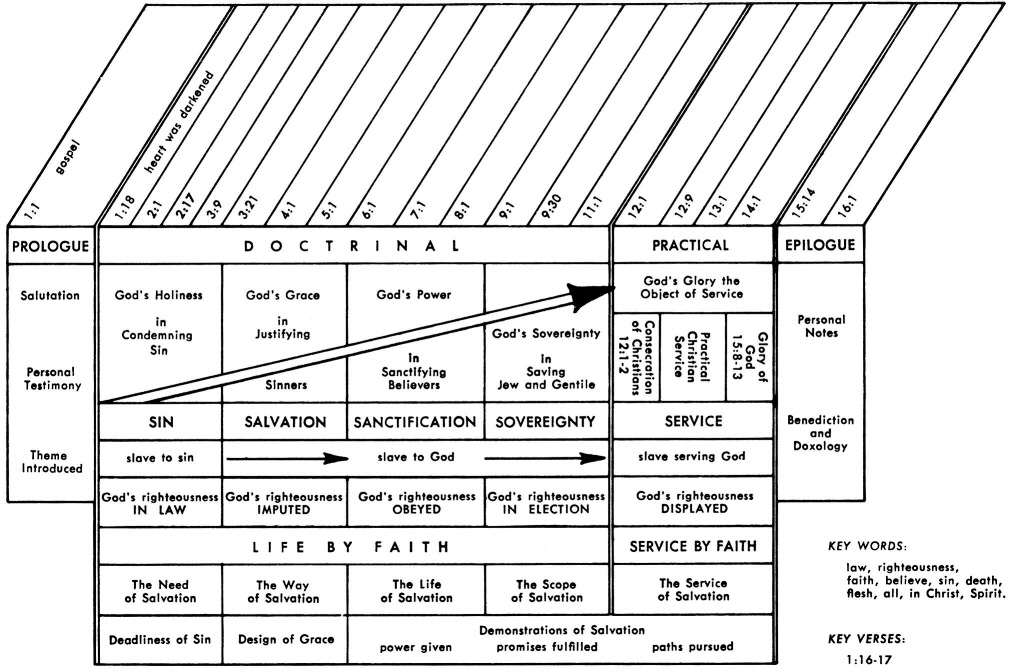
Click chart to enlarge
Chart from recommended resource Jensen's Survey of the NT - used by permission
Romans Overview Chart - Charles Swindoll
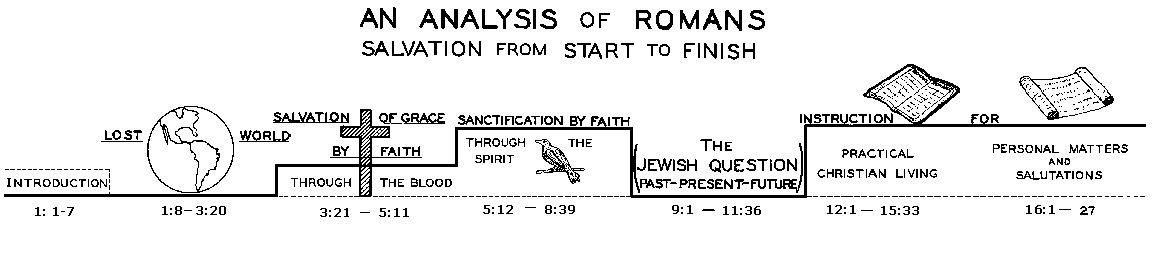
Source: Dr David Cooper
Click to Enlarge
R Ruin (Romans 1:17 – 3:20) – The utter sinfulness of humanity
O Offer (Romans 3:21-31) – God’s offer of justification by grace
M Model (Romans 4:1-25) – Abraham as a model for saving faith
A Access (Romans 5:1-11) – The benefits of justification
N New Adam (Romans 5:12-21) – We are children of two “Adams”
S Struggle w/ Sin (Romans 6-8) Struggle, sanctification, and victory
|
ROMANS ROAD |
||||
| Romans 1:18-3:20 | Romans 3:21-5:21 | Romans 6:1-8:39 | Romans 9:1-11:36 | Romans 12:1-16:27 |
| SIN | SALVATION | SANCTIFICATION | SOVEREIGNTY | SERVICE |
| NEED FOR SALVATION |
WAY OF SALVATION |
LIFE OF SALVATION |
SCOPE OF SALVATION |
SERVICE OF SALVATION |
| God's Holiness In Condemning Sin |
God's Grace In Justifying Sinners |
God's Power In Sanctifying Believers |
God's Sovereignty In Saving Jew and Gentile |
Gods Glory The Object of Service |
| Deadliness of Sin |
Design of Grace |
Demonstration of Salvation | ||
| Power Given | Promises Fulfilled | Paths Pursued | ||
| Righteousness Needed |
Righteousness Credited |
Righteousness Demonstrated |
Righteousness Restored to Israel |
Righteousness Applied |
| God's Righteousness IN LAW |
God's Righteousness IMPUTED |
God's Righteousness OBEYED |
God's Righteousness IN ELECTION |
God's Righteousness DISPLAYED |
| Slaves to Sin | Slaves to God | Slaves Serving God | ||
| Doctrine | Duty | |||
| Life by Faith | Service by Faith | |||
|
Modified from Irving L. Jensen's chart above |
||||
Romans 1:28 And just as they did not see fit (3PAAI) to acknowledge God any longer, God God gave them over (3SAAI) to a depraved mind, to do (PAN) those things which are not proper, (NASB: Lockman)
Greek: kai kathos ouk edokimasan (3PAAI) ton theon echein (PAN) en epignosei, paredoken (3SAAI) autous o theos eis adokimon noun, poiein (PAN) ta me kathekonta, (PAPNPA)
Amplified: And so, since they did not see fit to acknowledge God or approve of Him or consider Him worth the knowing, God gave them over to a base and condemned mind to do things not proper or decent but loathsome, (Amplified Bible - Lockman)
Barclay: Just as they have given themselves over to a kind of knowledge that rejects the idea of God, so God has given them over to the kind of mind that all reject. The result is that they do things which it is not fitting for any man to do. (Daily Study Bible)
KJV: And even as they did not like to retain God in their knowledge, God gave them over to a reprobate mind, to do those things which are not convenient;
NCV: People did not think it was important to have a true knowledge of God. So God left them and allowed them to have their own worthless thinking and to do things they should not do.
NLT: When they refused to acknowledge God, he abandoned them to their evil minds and let them do things that should never be done. (NLT - Tyndale House)
Phillips: Moreover, since they considered themselves too high and mighty to acknowledge God, he allowed them to become the slaves of their degenerate minds, and to perform unmentionable deeds. (Phillips: Touchstone)
Wuest: And even as after putting God to the test for the purpose of approving Him should He meet their specifications, and finding that He did not, they disapproved of holding Him in their full and precise knowledge, God gave them up to a mind that would not meet the test for that which a mind was meant, to practice those things which were not becoming or fitting
Young's Literal: And, according as they did not approve of having God in knowledge, God gave them up to a disapproved mind, to do the things not seemly;
AND JUST AS THEY DID NOT SEE FIT TO ACKNOWLEDGE GOD ANY LONGER: Kai kathos ouk edokimasan (3PAAI) ton theon echein (PAN) en epignosei:
- Ro 1:18,21; Job 21:14,15; Pr 1:7,22,29; 5:12,13; 17:16; Jer 4:22; 9:6; Hosea 4:6; Acts 17:23,32; Ro 8:7,8; 1Cor 15:34; 2Cor 4:4, 5, 6; 10:5; 2Th 1:8; 2:10,11, 12; 2Pe 3:5
- Jer 6:30; 2Co 13:5, 6, 7; 2Ti 3:8; Titus 1:16
- Romans 1 Resources - Multiple Sermons and Commentaries
And so, since they did not see fit to acknowledge God or approve of Him or consider Him worth the knowing (Amplified)
And, according as they did not approve of having God in knowledge (Literal)
And even as after putting God to the test for the purpose of approving Him should He meet their specifications, and finding that He did not (Wuest)
TESTING GOD:
THE DANGER AND "REWARD"
Just as (2531) (kathos) means in accordance with a degree as specified by the context or in proportion as. Godet explains that this "indicates anew the exact correlation between this unrighteousness and the punishment about to be described."
Here for the third and last time our attention is focused on the correlation between man’s rejection of God and God’s rejection of man.
Not (3756) (ou, ouk) indicates absolute negation of whatever it modifies, in this case the verb dokimazo. They absolutely did not approve of God after testing Him to see if He was genuine! How absurd!
See fit (approve to)(1381) (dokimazo from dokimos = tested, proved or approved, tried as metals by fire and thus purified from dechomai = to accept, receive) means to assay, to test, to prove, to put to the test, to make a trial of, to verify, to discern to approve. Dokimazo involves not only testing but determining the genuineness or value of an event or object. That which has been tested is demonstrated to be genuine and trustworthy.
Dokimazo was used in classic Greek to describe the assaying of precious metals (especially gold or silver coins), usually by fire, to prove the whether they were authentic and whether they measured up to the stated worth. That which endures the test was called dokimos and that which fails is called adokimos.
There are 20 uses of dokimazo in the NT -- Lk. 12:56; 14:19; Rom. 1:28; 2:18; 12:2; 14:22; 1 Co. 3:13; 11:28; 16:3; 2 Co. 8:8, 22; 13:5; Gal. 6:4; Eph. 5:10; Phil. 1:10; 1 Thess. 2:4; 5:21; 1 Tim. 3:10; 1 Pet. 1:7; 1 Jn. 4:1
Dokimazo was used in a manuscript of 140AD which contains a plea for the exemption of physicians, and especially of those who have "passed the examination (dokimazo)". Dokimazo was thus used as a technical expression referring to the action of an examining board putting its approval upon those who had successfully passed the examinations for the degree of Doctor of Medicine.
Dokimazo was also used to describe the passing of a candidate as fit for election to public office.
Dokimazo in the present verse means ungodly men presumptuously put God to the test for the purpose of approving Him. In so doing they determined that He did not meet (the absolute negative particle "ou" modifies dokimazo) the specifications which they laid out for a God Who would be to their liking. They refused to put their "stamp of approval" upon Him. They refused to approve Him as God Who should be worshipped and thus they did not hold Him in their knowledge! Although it sounds absurd that sinful men would test the holy God, that is exactly what Paul is saying they did. They tested the infinitely precious God as they would a mere coin, and chose to turn aside from Him!
Hendriksen explains that...
"Instead of regarding this knowledge about God which they were deriving from his revelation in nature to be a precious treasure, they were constantly attempting to suppress it (verse 18) and, as is stated here in verse 28, regarded it as a negligible entity. They did not deem it to be worthwhile to pay any attention to God and to his revelation. So they continued on their sinful way," (Hendriksen, W., & Kistemaker, S. J. Vol. 12-13: New Testament commentary: Exposition of Paul's Epistle to the Romans. Page 79. Grand Rapids: Baker Book House)
Hodge writes that...
The heathen did not think it worth the trouble to retain the knowledge of God. They considered religion to be useless and supposed they could live without God. (Hodge, C. Commentary on the Epistle to the Romans, 1835)
And so fallen mankind rejected God after testing just as one would reject worthless coins after testing. They rejected the only One Who is Worthy as ''worthless''! When you are deceived and depraved you will call 'white, black', good, evil and evil good. Woe to those whose minds are so depraved.
As Isaiah said
"Woe to those who call evil good, and good evil;
Who substitute darkness for light and light for darkness;
Who substitute bitter for sweet, and sweet for bitter!" (Isaiah 5:20).
Cranfield says that such a mind is
“so debilitated and corrupted as to be a quite untrustworthy guide in moral decision.”
To acknowledge God - literally "of having (holding - present tense) God in knowledge" (echo = to hold + epignosis)
Knowledge (1922) (epignosis) refers to a strengthened form of "gnosis" and conveys the thought of a more full, larger and thorough knowledge. It also conveys the idea of a more intimate and personal relationship than the simple term gnosis. Epignosis then is clear and exact knowledge and is the type of knowledge which powerfully influences the form of one's religious life. This is the character of knowledge they refused to "hold" or grasp after testing God and finding He did not pass their test or meet with their approval.
Vincent remarks that these individuals "did not suffer the rudimentary revelation of nature to develop into full knowledge—"a penetrating and living knowledge of God" (Meyer). In Dante's division of Hell, the section assigned to Incontinence, or want of self-control, is succeeded by that of Bestiality, or besotted folly, which comprises infidelity and heresy in all their forms—sin which Dante declares to be the most stupid, vile, and hurtful of follies. Thus the want of self-restraint is linked with the failure to have God in knowledge. Self is truly possessed only in God. The tendency of this is ever downward toward that demoniac animalism which is incarnated in Lucifer at the apex of the infernal cone, and which is so powerfully depicted in this chapter.
Hodge comments that "the phrase to retain the knowledge is stronger than simply “to know.” The text means “to retain in accurate or practical knowledge.” It was the practical recognition of the only true God, whose eternal power and Godhead are revealed in his works, that men were constantly unwilling to make." (Commentary on the Epistle to the Romans - online)
R C Sproul - How excited are you about mastering theology? The word ‘theology’ is often repugnant to people’s ears. They say, ‘I am not interested in theology,’ for they associate it with speculative or purely academic research into the things of God. But, at its simplest, theology means ‘a knowledge of God’.
Haldane - The heathens are thus said to have known God, but, knowing Him, they did not wish to retain that knowledge. This is a crime in the sight of God which subjects men to the most awful judgments of His justice; for it is on this account that the Apostle adds, that God also gave them up to a reprobate mind. This pointedly refers to the word applied to them, as not approving the retaining of the knowledge of God. It denotes a mind judicially blinded, so as not to discern the difference between things distinguished even by the light of nature. Thus the dark eclipse of their understanding concerning Divine things, which they had despised and rejected, had been followed by another general eclipse respecting things human, to which they had applied themselves, and in this consisted the proportion which God observed in their punishment. They did not act according to right reason and judgment towards God,—this is their crime; they did not act according to it among themselves in society,—this was the effect of the abandonment of God, and became their punishment. This passage clearly shows that all that remains of moral uprightness among men is from God, who restrains and sets bounds to the force of their perversity." (Exposition of the Epistle to the Romans)
The man who turns from the truth will be allowed to have his way, will fall deeper and deeper into error, and will reap all the evil consequences of loving darkness rather than light. Those who hate the truth are "given over" to a reprobate mind. Their reprobate minds were tested and found wanting and thus rejected by God.
The basic reason for all evolutionary religion, from atheism and humanism to ancient Babylonian paganism to modern New Age pantheism is that men and women did not like to believe in the God of creation. They are forced then to find some evolutionary explanation for the world with which they could be more comfortable to explain so wondrous a Creation.
Vine writes that "The subject of the effects of rejecting the divine revelation is further developed. The refusal (adokimazo, literally, signifies “not to approve of a thing”) was not through indifference, but was a self-willed choice after a definite consideration of the circumstances. Men preferred sin to the knowledge of God held out to them by means of both the physical universe and their own natural constitution.
GOD GAVE THEM OVER: paredoken (3SAAI) autous o theos:
- Ge 6:3, Jdg 2:14, 13:1
- Romans 1 Resources - Multiple Sermons and Commentaries
GOD HANDS THEM OVER
TO A "REJECTED" MIND!
Gave...over (3860) (paradidomi from para = beside + didomi = to give so literally to give beside) is a very strong Greek verb meaning to hand someone over to the power and authority of another. It is that act of God whereby He hands over the entire human race for judgment because of their sins.
God gave them over is the third of three occurrences of paradidomi in Romans 1. The restraint of God that might have kept people living in pure relationships with each other was removed. This phrase "God gave them over" should put the fear of the Lord into the heart and mind of every thinking person. We may even be so deceived that we think we are in control but sin deceives and when we think we are not in the grips or power of sin we are completely deceived.
William Barclay - There is hardly any passage which so clearly shows what happens to a man when he leaves God out of the reckoning. It is not so much that God sends a judgment on a man, as that a man brings a judgment on himself when he gives no place to God in his scheme of things. When a man banishes God from his life he becomes a certain kind of man, and in this passage is one of the most terrible descriptions in literature of the kind of man he becomes. Let us took at the catalogue of dreadful things which enter into the godless life. Such men do things which are not fitting for any man to do. The Stoics had a phrase. They talked of ta kathekonta, by which they meant the things it befits a man to do. Certain things are essentially and inherently part of manhood, and certain things are not. As Shakespeare has it in Macbeth: "I dare do all that may become a man;Who dares do more is none." The man who banishes God not only loses godliness; he loses manhood too. Then comes the long list of terrible things. Let us take them one by one. (Romans 1 - William Barclay's Daily Study Bible - Commentaries)
Frederick Godet explains it this way - "To retain God as an object of distinct knowledge (the literal sense of Paul's words), is to keep alive within the mind the view of that holy Being, so that His will shall give law to our whole conduct. This is what the Gentiles refused to do. Ceasing to contemplate God and His will, they were given over to all unrighteousness." (Godet, F: The Epistle of St Paul to the Romans)
William Newell observes that...
Here we have for the third time the judicial utterance, God gave them over. This time it is to a settled state, a reprobate mind. There is such a solemn irony in the manner of speech in the Greek, that it should be brought out as well as the English will allow.
Alford translates it: "Because they reprobated the knowledge of God, God gave them over to a reprobate mind."
Conybeare renders it: "As they thought fit to cast out the knowledge of God, God gave them over to an outcast mind."
We might render it: To a mind disapproved of God, since they did not approve knowing God.
And given over to do what? To live lives, think thoughts, be such creatures, as are not befitting the universe of the blessed God; and most particularly not befitting man, who was created in God's image. (Newell. Romans Verse by Verse).
God's response to this worldwide "disloyalty and treason" is not, first, to send us to hell, but to see that we sink into the swamp of our own making.
Here we have the third divine "delivery" -- "God gave them over" or "God gave them up". In the Greek there is actually a word play (pun) which in English might be brought out as follows: "They reprobated the knowledge of God, so God gave them over to a reprobate mind" or "They cast out the knowledge of God, so God gave them up to a cast-out mind!" They abandoned the knowledge of God and so God abandoned them. This is a terrible judgment: to give men up so that they follow the impulses of their own corrupt minds, and so that they follow the desires of their own depraved hearts! "So I gave them up unto their own hearts' lust: and they walked in their own counsels" (Psalm 81:12). (Middletown Bible Church)
John Piper notes that...
Paul's teaching about why a society degenerates into unrestrained, debauched, destructive evil is unlike any analysis you would read today.
One of the reasons for this is that when a society is sinking into moral decay, one of the traits of that decay is the inability to see what is happening. The social mind becomes so defective in the moral decadence that it doesn't have the categories or the framework to recognize evil for what it really is. We do live in such a day. The inability to render sound moral judgments is evident almost wherever you look. Which makes this passage of Scripture one of the most relevant and needed texts in all the Bible for our day - precisely because it seems so foreign. Today, if something doesn't seem spiritually or morally foreign, it is probably part of the blind and decadent atmosphere we breathe, and therefore of no real use to us, no matter how good it makes us feel. What we need is a word from outside our defective world and our depraved thinking. We need a word from God. And we may certainly expect such a word to be very strange, because we have become strangers to the reality of God in a very self-absorbed age.
Paul is saying that the root problem is that we don't like having God in our knowledge...That is the fundamental problem in the world. That is the essence of the human condition. We don't want God. We want self determination and self-exaltation. That was the first sin in the Garden. And that is the root of all evil today. We do not want to know God or to have Him in our lives.
The second step of God's analysis is that God, in an act of judgment (recall the revealing of "wrath" in v18) withdraws His common restraints on our rebellion and gives us over to sink in the swamp we have chosen. This is what you will not hear in any social analysis today.
So what's the point of listing all these sins? The point, I think, is to give us enough examples to show that virtually every form of evil has to do with God and comes from failing to know Him and approve Him and love Him above all things. In other words, he gives us a sweeping array of evils to waken us to the fact that the ruin of any area of life is owing to the abandonment of God.
(In Romans 1:28) they did not want God in their knowledge, therefore...and then he gives his list of evils. In other words: the point of the list is to connect God with every sin in the world. And we've seen that the connection is twofold: every sin is rooted in our preferring something else to God; and every sin gets worse as God takes away his restraints and gives us up to sink in the swamp we have chosen. If America has the highest murder rate in the western world, it has to do with God. If our executives are greedy, it has to do with God. If our politicians are deceitful, it has to do with God. If we gossip about each other behind the back, it has to do with God. If our talk show hosts are insolent and boastful, it has to do with God. If our children are disobedient to parents, it has to do with God. If we are untrustworthy and don't keep our marriage vows, it has to do with God. If we are blind to obvious wrongs and are unloving and unmerciful, it has to do with God. That's the point of this list.
Wherever we are sinking in sin, it is because we have jumped off the rock of the glory of God. The key verse for the reversal of God's wrath against us is Ro1:17. The key verse for the reversal of God's handing us over to a depraved mind is Ro6:17.
"Thanks be to God that, though you were slaves of sin, you became obedient from the heart to that form of teaching to which you were handed over [same word as Ro1:28]."
This is the exact reversal of the hand-over in Ro 1:28. Here it is to a form of teaching that is true and holy, not false and dirty. And notice that it is God who does it. "Thanks be to God," Paul says, that you became obedient to this teaching. God gives us over to truth and righteousness as much as he once gave us over to sin. the key verse for reversing the defectiveness of our minds is Ro 12:2.
"Do not be conformed to this world, but be transformed by the renewing of your mind, so that you may prove what the will of God is, that which is good and acceptable and perfect." (see note Ro 12:2)
When God has given us his righteousness by faith in Jesus, and when he has handed us over to a new teaching of truth and begun to make us obedient to it, then little by little we are transformed in the renewing of our minds and the long list of sins in Ro 1:29, 30, 31 becomes shorter and weaker to the glory of God. (Full sermon)
In an illustration from Our Daily Bread of someone who did not not acknowledge God any longer, we read the story of...
Aaron Burr, the third Vice President of the United States, was reared in a godly home and admonished to accept Christ by his grandfather Jonathan Edwards. But he refused to listen. Instead, he declared that he wanted nothing to do with God and said he wished the Lord would leave him alone. He did achieve a measure of political success in spite of repeated disappointments. But he was also involved in continuous strife, and when he was 48 years old, he killed Alexander Hamilton in a duel. He lived for 32 more years, but through all this time he was unhappy and unproductive. It was during this sad chapter in his life that he declared to a group of friends;
“Sixty years ago I told God that if He would let me alone, I would let Him alone, and God has not bothered about me since.”
Aaron Burr got what he wanted. Woe! People who want nothing to do with God make themselves candidates for His ultimate judgment. They spend their days alienated from Him, and will spend eternity banished from God's presence unless they repent while they still have breathe to do so. (Our Daily Bread, Copyright RBC Ministries, Grand Rapids, MI. Reprinted by permission. All rights reserved)
TO A DEPRAVED (an unqualified, worthless, rejected, failing the test) MIND: eis adokimon noun,
- Jer 6:30; 2Co 13:5, 6, 7; 2Ti 3:8; Titus 1:16
- Romans 1 Resources - Multiple Sermons and Commentaries
"God in their knowledge, God gave them over to a mind void of discernment' (Godet)
A depraved mind -- Vincent notes that "There is a play upon the words. As they did not approve, God gave them up unto a mind disapproved."
Depraved (96) (adokimos) refers to that which is rejected after examination. The basic meaning of adokimos is that not standing the test or failing to meet the test and hence worthless, base or unqualified. Adokimos was the term commonly used of metals that were rejected by refiners because of impurities. The impure metals were discarded, and adokimos therefore came to include the ideas of worthlessness and uselessness. Adokimos marks the thing tested as not being proved to be such as it ought.
Here in Romans 1:28 Paul is saying that the mind that finds God worthless becomes worthless itself. The rejecting mind becomes a rejected mind and thereby becomes spiritually depraved, worthless and useless!
Adokimos was used to describe a counterfeit coin that fell below the standard weight, a cowardly soldier who failed the test in the hour of battle, a candidate for office who the citizens regarded as useless and finally a stone rejected by builders because of a flaw which made it unfit for construction, the rejected stone being clearly marked by a capital "A" on it's surface. It is as if these men who test God and find He does not meet with their approval have a giant "A" stamped on their head and heart. They are tried and rejected by the Master Architect and of no eternal value to Him in building His kingdom. This should break our hearts that these men and women in Romans 1:28 are so depraved.
Here are the 8 NT uses of adokimos: (Adokimos is used twice in the Septuagint - Prov. 25:4; Is 1:22)
Romans 1:28 And just as they did not see fit to acknowledge God any longer, God gave them over to a depraved mind, to do those things which are not proper,
1 Corinthians 9:27 but I buffet my body and make it my slave, lest possibly, after I have preached to others, I myself should be disqualified. (Click for discussion of this verse)
2 Corinthians 13:5 Test yourselves to see if you are in the faith; examine yourselves! Or do you not recognize this about yourselves, that Jesus Christ is in you-- unless indeed you fail the test? 6 But I trust that you will realize that we ourselves do not fail the test. 7 Now we pray to God that you do no wrong; not that we ourselves may appear approved, but that you may do what is right, even though we should appear unapproved.
2 Timothy 3:8 (note) And just as Jannes and Jambres opposed Moses, so these men also oppose (literally set themselves against) the truth, men of depraved (destroyed, ruined, corrupted = kataphtheiro) mind, rejected (adokimos) as regards the faith.
Titus 1:16 (note) They profess to know God, but by their deeds they deny Him, being detestable and disobedient, and worthless (adokimos - unfit, of proven inability to do good) for any good deed. (Click for discussion of Titus 1:16)
Hebrews 6:8 (note) but if it (a field that is rained on and yet only) yields thorns and thistles, it is worthless and close to being cursed, and it ends up being burned.
For many years John Wesley professed to be a Christian and yet when he truly examined himself realized he was not "in the faith" as illustrated by this brief excerpt from his sermon entitled "The Almost Christian":
I did go thus for many years, as many of this place can testify; using diligence to eschew all evil, and to have a conscience void of offence; redeeming the time; buying up every opportunity of doing all good to all men; constantly and carefully using all the public and all the private means of grace; endeavoring, after a steady seriousness of behavior, at all times, and in all places: and God is my record, before whom I stand, doing all this in sincerity; having a real design to serve God; a hearty desire to do his will in all things; to please him who had called me to “fight the good fight,” and to “lay hold on eternal life.” Yet my own conscience bears me witness, in the Holy Ghost, that all this time I was but almost a Christian.''
These men and women were given over to a mind that God tests but finds wanting and is thus rejected by Him as worthless because it does not stand the test. These men had ''tested'' God and did not want to believe in Him. The ultimate test of life is usefulness, and the man whose influence is ever towards that which is unclean is of no use to God or to his fellow-men. Instead of helping God's work in the world, he hinders it and uselessness always invites disaster. It speaks of a mind that is so clouded by sin that it is no longer able to make reliable moral judgments. Here we have gone beyond deliberate iniquity to something much more frightening. At this stage man has lost the desire and the ability to think clearly. He has "lost his mind" (morally or spiritually speaking) and doesn't even know it.
The NKJV translates adokimos as "Debased" a word that was used by a blacksmith who, when he’d finished forming a horseshoe, would place it on his anvil and hit it with his hammer to test whether it was tempered correctly. If it failed the test it was said to be debased, i.e. not quite right. The word debase also conveys the meaning of reduction of the intrinsic value of (a coin) by increasing the base-metal content and implies a loss of position, worth, value, or dignity.
So the idea in Romans 1:28 is of a mind that isn’t quite right, that has some flaw in it that affects its ability to make right judgments. It speaks of a mind that is so clouded by sin that it is no longer able to make reliable moral judgments. Here we have gone beyond deliberate iniquity to something much more frightening. At this stage man has lost the desire and the ability to think clearly. He has lost his mind and doesn't even know it. The result is a world that has left God far behind. It is a society with all restraints removed, a culture devoid of all sense of right and wrong, where every man is doing what is "right in his own eyes." (Deut 12:8 Jdg 17:6 Jdg 21:25 Pr 12:15 Pr 21:2).
In a parallel passage in the OT, Jehovah appointed His prophet Jeremiah to assay His people Israel declaring: "I have made you an assayer and a tester among My people, that you may know and assay their way. All of them are stubbornly rebellious, going about as a talebearer. They are bronze and iron. They, all of them, are corrupt. The bellows blow fiercely. The lead is consumed by the fire. In vain the refining goes on, but the wicked are not separated." (Jeremiah 6:27-29)
Jehovah concludes that because the "impurities" cannot be removed from His people, they will be called "rejected (Lxx = apodokimazo) silver, because the LORD has rejected (Lxx = apodokimazo) them." (Jeremiah 6:30)
This is exactly what God has done to these ungodly men and women in Romans 1:28.
The hymn writer William Hyde (Creation’s Lord, We Give Thee Thanks) catches some of what Paul is saying...
Since what we choose is what we are,
And what we love we yet shall be...
Mind (3563) (nous) is the mind as the organ of mental perception and apprehension. It is the seat of understanding and represents the thinking faculty. Believers have a new mind "the mind (nous) of Christ" (1 Cor 2:16) which can be renewed as we believers chose not to be conformed to this world's way of thinking but to be radically transformed (see Ro 12:2). The mind (nous) Paul is describing in this verse is what he refers to elsewhere as the "fleshly mind" or as Marvin Vincent phrases it "the intellectual faculty in its moral aspects as determined by the fleshly, sinful nature" (Click exposition of Colossians 2:18)
Here are the 22 uses of nous in the NT - NAS translates nous as - composure (1), comprehension(1), mind(20), minds(1), understanding(1).
Lk. 24:45; Rom. 1:28; 7:23, 25; 11:34; 12:2; 14:5; 1 Co. 1:10; 2:16; 14:14f, 19; Eph. 4:17, 23; Phil. 4:7; Col. 2:18; 2 Thess. 2:2; 1 Tim. 6:5; 2 Tim. 3:8; Titus 1:15; Rev. 13:18; 17:9. T
TO DO THOSE THINGS WHICH ARE NOT PROPER: poiein (PAN) ta me kathekonta (PAPNPA):
- Philemon 1:8
- Romans 1 Resources - Multiple Sermons and Commentaries
Boice terms this "insanity, of course—moral insanity."
R C Sproul observes that "Paul moves immediately from ‘he gave them over to a depraved mind’ to ‘to do what ought not to be done’. He is stressing that behavior and action follow thought, that practice follows theory. I can talk about what my theories are, but my life reveals what my real theories are because I always behave according to what I really think is right and proper."
To do (4160) (poieo) means to do, expressing an action as continued or not yet completed and so what one does repeatedly or habitually. The present tense amplifies this meaning as it speaks of continual or habitual action. This is not just an occasional "slipup" (believers are prone to these!) but represents a continuing lifestyle. Beloved, praying a prayer to "receive Jesus into your heart" is a "dangerous" thing. If you have (or if you know someone who has) prayed this prayer and yet exhibits ABSOLUTELY NO CHANGE in their life (no change of language, places they go, things they watch, no desire for things holy - Word, Worship, fellowship, etc), then you should at least be concerned that such a person has not truly repented and believed and been regenerated by the Holy Spirit (cf 2 Cor 13:5). As a medical doctor, I think of these folks as like a person who gets a flu shot so they won't get the "real disease." This mindset is great if you don't want to get the temporal flu, but not great if you want to avoid eternal punishment! Such a state is a dangerous deception (self propagation of belief which is not true but is a lie!) , for as Jesus clearly warned (TWICE!) "you shall die in your sins; for unless you believe (see discussion of genuine, saving belief) that I am [He] ("He" added - "I Am" = ego eimi - "the Great I Am"- Jn 8:58), you shall die in your sins.” (Jn 8:24). Belief alone saves, but the belief that saves is never alone, but is accompanied by fruit in keeping with repentance! (Mt 3:8, Acts 26:20, Read James 2:14-26, compare Eph 2:8-9 with Eph 2:10)
Hodge notes that "To do is the exegetical infinitive; that is, “so that they did.” It expresses the consequence of the dereliction just spoken of, and the natural fruit of a reprobate mind. (Commentary on the Epistle to the Romans)
Not proper - The negative particle "me" plus the verb katheko. The present tense emphasizes that these things are continually not proper or fitting.
Paul listed (a "vice list") some of the things that are not proper in his letter to the saints at Ephesus...
But immorality or any impurity or greed must not even be named among you, as is proper (prepo) among saints; and there must be no filthiness and silly talk, or coarse jesting, which are not fitting (aneko), but rather giving of thanks (ANTIDOTE FOR THE 6 VICES PAUL JUST LISTED). (Eph 5:3-4)
Proper (2520) (katheko from katá = down, according or together with + heko = to come) literally means to come down and then to be convenient, to be fitting or right. It means to be appropriate.
In the negative use (as in this verse) katheko refers to “what is unfitting or improper” and was a technical word used by the Stoic philosophers. It was used by the philosophers in the sense of “what is fitting or demanded” as dictated by nature, custom, or piety.
A T Robertson writes that...
Like an old abandoned building, the home of bats and snakes, left 'to do those things which are not fitting,' like the night clubs of modern cities, the dives and dens of the underworld, without God and in the darkness of unrestrained animal impulses. This was a technical term with Stoics.
TDNT writes that by using katheko in this verse...
Paul has in mind what is offensive even to natural human judgment. The decision against God leads to a complete loss of moral sensitivity, the unleashing of unnatural vices, and hence the type of conduct that even healthy pagans regard as improper. (Kittel, G., Friedrich, G., & Bromiley, G. W. Theological Dictionary of the New Testament. Eerdmans)
Katheko is used 2 times in the NT, here and in Acts 22:22...
And they listened to him up to this statement, and then they raised their voices and said, "Away with such a fellow from the earth, for he should not be allowed to live!"
There are 13 uses in the non-apocryphal Septuagint - Gen. 19:31; Exod. 5:13, 19; 16:16, 18, 21; 36:1; Lev. 5:10; 9:16; Deut. 21:17; 1 Sam. 2:16; Ezek. 21:27; Hos. 2:5
Katheko is used here of what befits the nature of man as God’s creature and his responsibility toward his Creator. God lets men do what they want and if they continually choose to rebel against His rightful rule over His creation, He let's them have their way, even if the result is even greater unrighteousness. Why? Because God wants man to realize that by ourselves we’re totally unable to do the right thing. There is none righteous and none capable of righteous behavior (Ro 3:10). Rather our natural fallen, sinful inclination is to do that which is diametrically opposed to righteousness. Our natural "Adamic" thinking, in the end, will lead us astray.
Haldane comments on the KJV rendering of "not proper" as "not convenient" writing that...
This is a very just and literal translation, according to the meaning of the word convenient in an early stage of the history of our language; but it does not, at present, give the exact idea. The original word signifies what is suitable to the nature of man as a rational and moral being. To do things not convenient, is a figurative expression denoting the doing of things directly contrary and opposite, namely, to the light of reason, the reflections of prudence, and the dictates of conscience. (Exposition of the Epistle to the Romans)
Wuest summarizes this section:
"The human race put God to the test for the purpose of approving Him should He meet the specifications which it laid down for a God who would be to its liking, and finding that He did not meet those specifications, it refused to approve Him as the God to be worshipped, or have Him in its knowledge." Incredible what our sick hearts are capable of deceived into imagining (Je17:9-10). Our rebellion against God is not only displayed in our actions, but in our thinking; we are genuinely "spiritually insane" in our rebellion against God"
Vine adds that the
Determination to refuse the knowledge of God leads, according to the righteous principles and decrees of the divine counsels, to the pursuit and practice of sin. The very influences which would restrain the ungodly are retributively withdrawn from them. The word katheko “to be fit,” is here used of what befits the nature of man as God’s creature and his responsibility toward his Creator.
Harry Ironside notes that....
The vile immoralities depicted here are the natural result of turning from the holy One. The picture of heathenism in its unspeakable obscenities is not over-drawn, as any one acquainted with the lives of idolatrous people will testify. The awful thing is that all this vileness and filthiness is being reproduced in modern society where men and women repudiate God. If people change the truth of God into a lie and worship and serve the creature rather than the Creator, the whole order of nature is violated; for apart from the fear of God there is no power known that will hold the evil desires of the natural heart in check. It is part of the very nature of things that flesh will be manifested in its worst aspects when God gives men up to follow the bent of their unholy lusts." (Romans 1 - Ironside's Notes)
An Emperor Given Over To
A Depraved Mind
The Roman emperor Nero who was probably in power at the time this letter was written exemplified the the utter depravity of a man given over to a depraved mind. Nero's father died when he was about 3 years old. After Caligula confiscated their family wealth, he and his mother found themselves quite poor for a time. Things changed dramatically when Agrippina married her uncle, the emperor Claudius. That marriage was the means of Nero's rise to power. Agrippina managed to get Nero adopted not only as a son of Claudius, but the heir to the throne before Claudius' actual sons. With the line of succession taken care of, Agrippina took the final step on October 13 54 A.D. by murdering her husband/uncle with poisoned mushrooms. Nero became the emperor of the mighty Roman empire at the age of 17. Agrippina was very influential with the young Nero at first, but as might be expected from the example that she had set, he gradually became estranged with her. He had her removed from the palace in 55 A.D., and then ordered his mother's murder 4 years later. From then on, Nero became increasing brutal and depraved.
Nero is perhaps most famous for the great fire of Rome in 64 A.D. It started in the Circus Maximus before raging through the city for 9 days. It is unlikely that Nero himself started the fire, as is popularly believed, because he was in Antium at the time. Whether he ordered it started is another matter - he had long wanted to make room for a grand new city that he had designed. To divert suspicion away from himself, Nero blamed the great fire on the Christians, thereby beginning a persecution of innocent people that has never been surpassed. Many were killed by wild animals before crowds of spectators in the arena, while others were tied to posts, covered with flammable material, and used as human street lamps for Nero's gardens. It is difficult to imagine a more depraved man.
Haters Of God - Recently, I listened to an audiobook by a militant advocate for atheism. As the author himself read his own work with spiteful sarcasm and contempt, it made me wonder why he was so angry.
The Bible tells us that a rejection of God can actually lead to a more hateful attitude toward Him: “Even as they did not like to retain God in their knowledge, God gave them over to a debased mind . . . [to become] haters of God” (Ro 1:28-30).
Turning one’s back on God does not lead to secular neutrality. Indeed, recent militant atheists have shown their desire to remove any reference to a Creator from culture.
When we hear about atheists trying to remove crosses or the Ten Commandments from society, it’s easy to respond to their hatred of God with our own hatred. But we’re exhorted to defend the truth with an attitude of love, “in humility correcting those who are in opposition, if God perhaps will grant them repentance, so that they may know the truth” (2 Tim. 2:25).
The next time you see the works or hear the words of a hater of God, do an attitude check. Then ask God for a spirit of humility and pray that the offender might come to the knowledge of the truth. — by Dennis Fisher
Lord, help us not respond in kind
To those who hate and turn from You;
Instead, help us to love and pray
That someday they’ll accept what’s true. —SperDefend the truth with love.