Romans 1:2
Romans 1:3
Romans 1:4
Romans 1:5
Romans 1:6
Romans 1:7
Romans 1:8
Romans 1:9
Romans 1:10
Romans 1:11
Romans 1:12
Romans 1:13
Romans 1:14
Romans 1:15
Romans 1:16
Romans 1:17
Romans 1:18
Romans 1:19
Romans 1:20
Romans 1:21
Romans 1:22
Romans 1:23
Romans 1:24
Romans 1:25
Romans 1:26
Romans 1:27
Romans 1:28
Romans 1:29
Romans 1:30
Romans 1:31
Romans 1:32

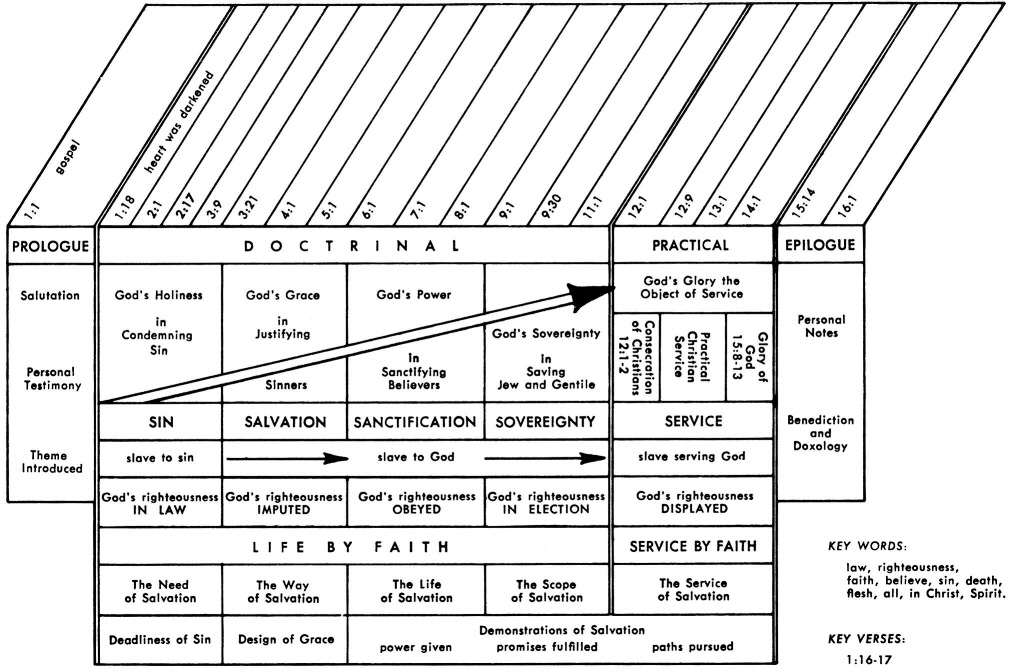
Click chart to enlarge
Chart from recommended resource Jensen's Survey of the NT - used by permission
Romans Overview Chart - Charles Swindoll
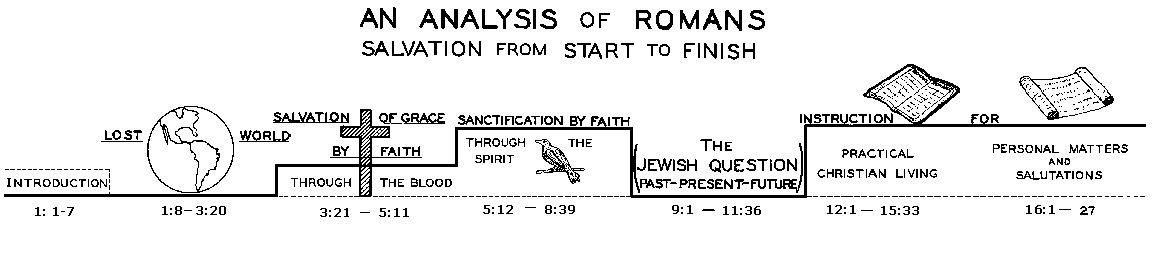
Source: Dr David Cooper
Click to Enlarge
R Ruin (Romans 1:17 – 3:20) – The utter sinfulness of humanity
O Offer (Romans 3:21-31) – God’s offer of justification by grace
M Model (Romans 4:1-25) – Abraham as a model for saving faith
A Access (Romans 5:1-11) – The benefits of justification
N New Adam (Romans 5:12-21) – We are children of two “Adams”
S Struggle w/ Sin (Romans 6-8) Struggle, sanctification, and victory
|
ROMANS ROAD |
||||
| Romans 1:18-3:20 | Romans 3:21-5:21 | Romans 6:1-8:39 | Romans 9:1-11:36 | Romans 12:1-16:27 |
| SIN | SALVATION | SANCTIFICATION | SOVEREIGNTY | SERVICE |
| NEED FOR SALVATION |
WAY OF SALVATION |
LIFE OF SALVATION |
SCOPE OF SALVATION |
SERVICE OF SALVATION |
| God's Holiness In Condemning Sin |
God's Grace In Justifying Sinners |
God's Power In Sanctifying Believers |
God's Sovereignty In Saving Jew and Gentile |
Gods Glory The Object of Service |
| Deadliness of Sin |
Design of Grace |
Demonstration of Salvation | ||
| Power Given | Promises Fulfilled | Paths Pursued | ||
| Righteousness Needed |
Righteousness Credited |
Righteousness Demonstrated |
Righteousness Restored to Israel |
Righteousness Applied |
| God's Righteousness IN LAW |
God's Righteousness IMPUTED |
God's Righteousness OBEYED |
God's Righteousness IN ELECTION |
God's Righteousness DISPLAYED |
| Slaves to Sin | Slaves to God | Slaves Serving God | ||
| Doctrine | Duty | |||
| Life by Faith | Service by Faith | |||
|
Modified from Irving L. Jensen's chart above |
||||
Romans 1:8 First, I thank (1SPAI) my God through Jesus Christ for you all, because your faith is being proclaimed (3SPPI) throughout the whole world. (NASB: Lockman)
Greek: Proton men eucharisto (1SPAI) to Theo mou dia Iesou Christou peri panton humon hoti e pistis humon kataggelletai (3SPPI) en holo to kosms
NLT: Let me say first of all that your faith in God is becoming known throughout the world. How I thank God through Jesus Christ for each one of you. (NLT - Tyndale House)
Phillips: I must begin by telling you how I thank God through Jesus Christ for you all, since the news of your faith has become known everywhere. (Phillips: Touchstone)
Wuest: First, I am constantly thanking my God through Jesus Christ concerning all of you because your faith is constantly being spread abroad in the whole world
Young's Literal: first, indeed, I thank my God through Jesus Christ for you all, that your faith is proclaimed in the whole world;
FIRST I THANK MY GOD THROUGH JESUS CHRIST FOR YOU ALL: Proton men eucharisto (1SPAI) to theo mou dia Iesou Christou peri panton humon:
- Ro 16:4-note
- I thank: Ro 6:17
- through: Eph 3:21 5:20 Php 1:11 Heb 13:15 1Pe 2:5 4:11
- Romans 1 Resources - Multiple Sermons and Commentaries
First (4413) (proton) means first in time, place, order, importance. A continual attitude of gratitude can make a sour day sweet (How is this possible? Php 2:13NLT-note).
THOUGHT: Do you give God this kind of quality time, offering thanks to Him (cp He 13:15-note)? Do you thank Him first or last (or not at all)? Make Him your priority when you rise, when you walk about and when you lie down to sleep (cp Pr 6:20, 21, 22). Make thanksgiving to your worthy God first on your "day timer"! You won't regret it. (cp 1Th 5:18-note)
Thank (2168) (eucharisteo [word study] from eucháristos = thankful, grateful, well-pleasing from eú = well + charízomai = to grant, give - derived from charis = grace!) means to show oneself grateful, to be thankful, to give thanks. Eucharisteo is in the present tense which denotes that Paul's continual gratitude to God, the Giver of good thing bestowed and every perfect gift (James 1:17-note).
My God - No pagan would have made such a statement, nor would have most Jews referred to God with the personal pronoun "my". For Paul, his personal relationship with God was not a theological abstraction but an intimate acquaintance with his beloved Savior and Friend. Is He your God, your best Friend?
THOUGHT: Dear reader, is He "your" God? There can be no other and none better. Beloved, if He is "your" God, then remember that "you have not received a spirit of slavery leading to fear again, but you have received a spirit of adoption as sons by which we cry out, “Abba! Father!" (Ro 8:15- note; cp Gal 4:6, Mark 14:36). In these passages, Abba is the Aramaic term for "Father" conveying a picture of intimacy, much like our English words “Daddy” or “Papa”, the overall picture being one of tenderness, dependence, and a relationship free of fear or anxiety.
THOUGHT: Are you fearful or anxious today? Perhaps you need to go to Him and thank Him that He is "your personal Abba" (not to mention that He is the Helper and Keeper of your soul - Click here to lift up your eyes and see from whence cometh your Help and Protection). See related resources on fear or anxiety: How To Handle Fear (1); How to Handle Fear (2); How To Handle Fear (3); How to Handle Fear (4); Commentary on Matthew 6 see notes - Matthew 6:25ff)
The first mark of true spiritual service, which Paul had in abundance, is thankfulness. It is also the mark of a Spirit filled (controlled) man (cp Eph 5:20-note; Col 3:16-note; Col 3:17-note). Paul was grateful for what God had done for and through him, but he was equally grateful for what God had done in and through other believers.
UNCEASING PRAYER
Romans 1:8-10
First, I thank my God through Jesus Christ for you all, because your faith is being proclaimed throughout the whole world. 9 For God, whom I serve in my spirit in the preaching of the gospel of His Son, is my witness as to how unceasingly I make mention of you, 10 always in my prayers making request, if perhaps now at last by the will of God I may succeed in coming to you.
Herbert Lockyer comments on Paul's prayer in Romans 1:8-10 - What a prayer-burden Paul had for the saints in Rome! How he longed to visit them and preach the Word for their encouragement and edification! The apostle was not only a great Thinker, Theologian, Missionary—he was also a great Intercessor. Without ceasing, he prayed for those receiving his letter—a people he had not seen. It is not as easy to pray for those we have never met, as it is for those we know. How warmly Paul praised those Roman Christians for their faith in God! Martin Luther spoke of Christianity as a "religion of possessive pronouns." Note Paul's appropriation of God in his prayers: "I thank my God." Thanksgiving is an integral part of prayer. Paul must have had a remarkable prayer-list. Often he speaks of "making mention of you in my prayers" (Romans 1:9; Ephesians 1:16; I Thessalonians 1:2). The many incidental allusions to prayer in Paul's life and letters show what an enormous place it must have had in his life. (All the Prayers of the Bible)
James E Rosscup comments on the prayer in Romans 1:8-10 - Paul prays in gratitude to the Father through Christ. The sense is that his privilege to be heard at the throne is by favor flowing to him on account of the work Christ has done (cf. Ro 1:5). Such thanksgiving for all the “beloved” at Rome can be either a corporate, summary tribute, or partly name by name, in the measure that Paul knows specific Christians there (Ro 16:5–16).The persistence of it (9). Paul’s passion for prayer is obvious in its incessant nature. The statement of thanks here is appears from v. 9 to be a very general summarizing, the details of his gratitude absorbing much time. For even earlier this same man of prayer describes his vigil for others as “night and day” (I Thess. 3:10). He pursues a pattern like that of Nehemiah (1:4, 6), and may know all-night prayer as his Lord (Lk. 6:12), or from long before dawn (Mk. 1:35) or talking with God far into the night (Matt. 14:23). Here the apostle claims, “unceasingly I make mention of you.” The word is adialeiptos as in 1 Thess. 5:17. It does refer to constancy, but ongoing effort in an intermittent sense that fits practicality and balance. The word was used for the frequency of a cough, according to Moulton and Milligan. To pray without ceasing is not to pray neglecting other vital parts of a watchful Christian life and its duties. It is analogous to a stove pilot that remains on, ready to leap into use for cooking, yet not cooking things without times in between. How confident Paul is free to be in naming God as the One who can attest his persistent prayer. We do not just have Paul’s claim, or an idealism others attribute to his devotion in prayer. We have a man assured that the One who knows the secrets even of hearts (Ro 2:16) can back up his testimony. We also do not have words of ego craving to make lustful capital of his prayer life, but candid humility that encourages even by this. God-pleasing prayer is evident in the way Paul prefaces the glimpse into his prayer times. He serves God “in my spirit,” a genuine and deep devotion, not a dead and rotten set of motions that Spartan grit can achieve. Jesus had reminded His hearers of habits in prayer that fanatics for religion can excel in, but to gratify their own agendas, not God’s (Matt. 6:5–8). Paul also defines his motive as toned by what is “in the sphere of the gospel of His Son.…” His motive here is in harmony with what he has earlier said in his first letter to the Corinthians (9:23), “I do all things for the sake of the gospel …, .” It also rings true with his clear conscience before God a few years after Romans 1 in Acts 23:1 and 24:16. He keeps a conscience pure before God and men. So, when Paul says he prays unceasingly for others, he does, and his reasons for doing it are marked by victory. The petition for God’s will (Ro 1:10–12). As Paul does keep up mention of the believers to God, he is “always” in his “prayers making mention of a request.…”
(1) To come to the Romans (Ro 1:10). The word for prayers is the general one for prayer whatever aspects comprise it (proseuche). Paul’s prayers could incorporate various aspects such as praise/thanksgiving, confession, petition, intercession, affirmation, question, calling a blessing or a curse by the authority of God, etc. But he is “making” in his prayers (better, “upon, or on the occasion of by prayers”] “request,” that is, “asking” a clearing of the way from God. The word “asking” is deomai, here in the present tense to mean repeated entreaty, and in the middle voice to lay emphasis on his own personal involvement, for his committed heart has much at stake in this. What Paul is asking he expresses in “if somehow now at last,” the “if” allowing some uncertainty, even with fervent longing. For granting his wish to come to the Romans depends not on his will but God’s to which He submits. He stresses God’s will later in the verse. The clause has as its verb “if … I may succeed” (euodoo), in the future tense, passive or middle in voice, “I may be given success,” or “I may prosper.” In either voice to come must be “by the will of God.” “Succeed” as a compound unites eu, good, and hodoo, “to take a road,” so the prayer is, “that I may be led along a good road [given success]” (as D. Moo, Romans, I, 53–54). The opening up of a good road is for Paul to come to those at Rome. About four to six years after writing of this continuing prayer (ED: NOTE GOD'S DELAY IN ANSWERING PAUL'S REQUEST - THAT SHOULD GIVE US HOPE), Paul finds, as in the trials and eventual referral to Rome, that he is on a ship bound for the imperial city. Despite a savage storm and shipwreck, God preserves Paul and all the other passengers, getting them safely to the island Melita. He does open a good road from the perspective of His own will, for He gives Paul a powerful testimony on the ship and even in the lives of many on the island. From there on to Rome, God gives a good road that even includes His providing of believers coming to encourage the apostle at a way station (cf. Acts 17–28+)! (An Exposition of Prayer in the Bible)
Hold pointer over References (from Nave's) for a "quick" study on Thankfulness
Jesus set an example of, Mt 11:25; 26:27; Jn 11:41.
The heavenly host engage in, Re 4:9; 7:11, 12; 11:16, 17.
Commanded, Ps 50:14.
Should be offered to God, Ps 50:14; to Christ, 1Ti 1:12; through Christ, Ro 1:8; Col 3:17; Heb 13:15; in the name of Christ, Eph 5:20; in behalf of ministers, 2Cor 1:11; in private worship, Da 6:10; in public worship, Ps 35:18; in everything, 1Th 5:18; upon the completion of great undertakings, Neh 12:31, 40; before taking food, Jn 6:11; Acts 27:35; always, Eph. 1:16; 5:20; 1Th 1:2; as the remembrance of God's holiness, Ps 30:4; 97:12; for the goodness and mercy of God, Ps 106:1; 107:1; 136:1, 2, 3; for the gift of Christ, 2Co 9:15; for Christ's power and reign, Re 11:17; for the reception and effectual working of the word of God in others, 1Th 2:13; for deliverance through Christ, from indwelling sin, Ro 7:23, 24, 25; for victory over death and the grave, 1Co 15:57; for wisdom and might, Da 2:23; for the triumph of the gospel, 2Co 2:14; for the conversion of others, Ro 6:17; for faith exhibited by others, Ro 1:8; 2Th 1:3, 2:13; for love exhibited by others, 2 Thess. 1:3; for the grace bestowed on others, 1Co 1:4; Phil 1:3, 4, 5; Col 1:3, 4, 5, 6; for the zeal exhibited by others, 2Co 8:16; for nearness of God's presence, Ps 75:1; for appointment to the ministry, 1Ti 1:12; for willingness to offer our property for God's service, 1Chr 29:6-14; for the supply of our bodily wants, Ro 14:6, 7; 1Ti 4:3, 4; for all men, 1Ti 2:1; for all things, 2Co 9:11; Ep 5:20.
Should be accompanied by intercession for others, 1Ti 2:1; 2Ti 1:3; Philemon 1:4.
Should always accompany prayer, Neh 11:17; Phil 4:6; Col 4:2.
Should always accompany praise, Ps 92:1; Heb 13:15.
Expressed in psalms, 1Chr 16:7
Ministers appointed to offer, in public, 1Chr 16:4, 7; 23:30; 2Chr 31:2.
Saints exhorted to, Ps 105:1; Col 3:15; resolve to offer, Ps 18:49; 30:12; habitually offer, Da 6:10; offer sacrifices of, Ps 116:17; abound in the faith with, Col 2:7; magnify God by, Ps 69:30; come before God with, Ps 95:2; should enter God's gates with, Ps 100:4.
Of hypocrites, full of boasting, Lk 18:11. The wicked averse to, Ro 1:21.
MacArthur notes that "A thankful heart for those to whom one ministers is essential to true spiritual service. The Christian who is trying to serve God’s people, however needy they may be, without gratitude in his heart for what the Lord has done for them will find his service lacking joy. Paul could usually find a cause for thanks so that he could honor the Lord for what had been done already and hope for what God would use him to do. Superficial believers are seldom satisfied and therefore seldom thankful. Because they focus on their own appetites for things of the world, they are more often resentful than thankful. A thankless heart is a selfish, self-centered, legalistic heart. Paul had a thankful heart because he continually focused on what God was doing in his own life, in the lives of other faithful believers, and in the advancement of His kingdom throughout the world. (MacArthur, J: Romans 1-8. Chicago: Moody Press)
Through Jesus Christ - This short phrase in essence summarizes the entire epistle to the Hebrews where we learn that Jesus Christ is the believer's Great High Priest, through Whom we have confidence access to the throne of God the Father (cp Heb 2:17, 18, 4:14, 15, 16, 10:19, 20, 21, 22). This phrase pictures Jesus' as our Mediator, elsewhere Paul writing that
There is one God and one Mediator also between God and men, the man Christ Jesus (1Ti 2:5).
Through Him (Christ) then, let us continually offer up a sacrifice of praise to God, that is, the fruit of lips that give thanks to His name. (see note Hebrews 13:15)
you also, as living stones, are being built up as a spiritual house for a holy priesthood, to offer up spiritual sacrifices acceptable to God through Jesus Christ. (see note 1 Peter 2:5)
Jesus said to him, "I am the way, and the truth, and the life; no one comes to the Father, but through Me. (John 14:6)
Paul begins with a compliment. That’s not a small point. The very first words out of his mouth are positive words of affirmation. Notice also that Paul is thankful for ALL the believers in Rome -- His gratitude was impartial and all-encompassing, making no distinctions. In every epistle but one, Paul expresses gratitude for those to whom he writes. The exception was the letter to the church in Galatia, which had defected from the true gospel of grace to a works system of righteousness and was worshiping and serving in the flesh because of the influence of the Judaizers. It was not that the other churches were perfect, which is apparent since Paul wrote most of his letters to correct wrong doctrine or unholy living. But even where the need for instruction and correction was great, he found something in those churches for which he could be thankful.
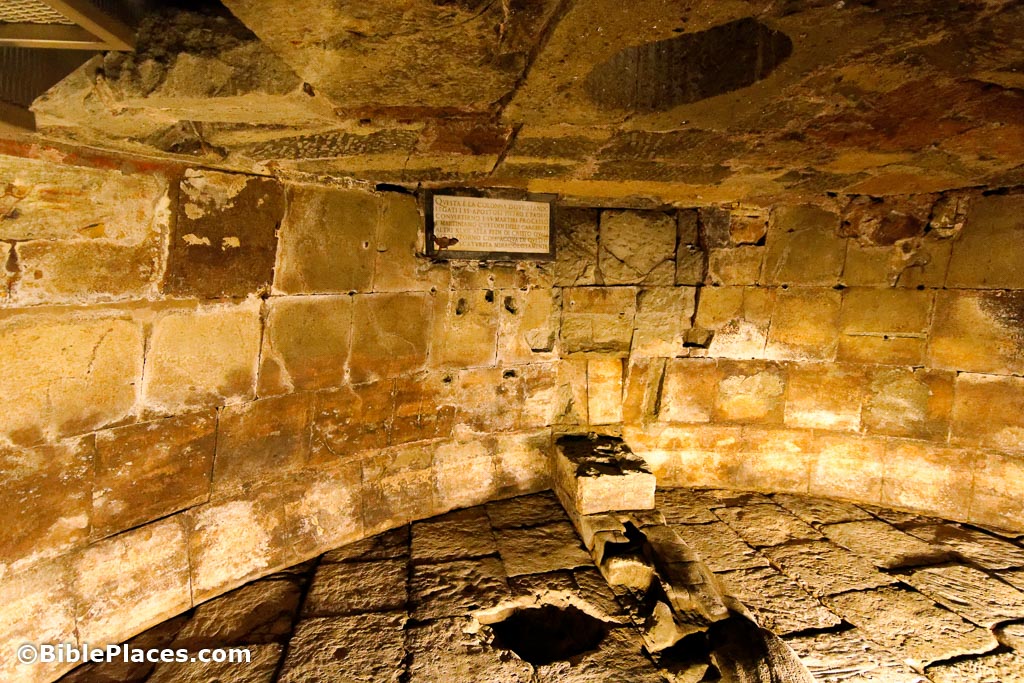
MacArthur writes that "Some years later, as he was prisoner in his own house in Rome while awaiting an audience before Caesar, Paul was still thankful. While there, he wrote four epistles (Ephesians, Philippians, Colossians, and Philemon), commonly called the prison epistles. In each of those letters he gives thanks for the believers to whom he writes (see notes Ephesians 1:16; Philippians 1:3; Colossians 1:3; Philemon 1:4). During his second Roman imprisonment, he may have spent time in the wretched Mamertine Prison (picture of one of the dungeons - talk about claustrophobia!). If so, we can be sure he was thankful even there, although the city sewage system ran through the prison. I was told on a visit there that when the cells were filled to capacity, the sewage gates were opened and all the inmates would drown in the filthy water, making way for a new batch of prisoners. But Paul’s thankfulness did not rise and fall based on his earthly circumstances but on the richness of his fellowship with his Lord. (See context in Romans 1-16 MacArthur New Testament Commentary)
Consider the following simple study - observe and record the wonderful truths that accrue through Him - this would make an edifying, easy to prepare Sunday School lesson - then take some time to give thanks for these great truths by offering up a sacrifice of praise...through Him.
Jn 1:3, Jn 1:7, Jn 1:10,Jn 3:17, Jn 14:6, Acts 3:16, Acts 7:25, Acts 10:43, Acts 13:38-39, Ro 5:9 [note], Ro 8:37 [note], Ro 11:36 [note]; 1Cor 8:6, Eph 2:18 [note], Phil 4:13 [note], Col 1:20 [note], Col 2:15 [note], Colossians 3:17 [note], Heb 7:25 [note], Heb 13:15 [note], 1Pe1:21 [note], 1Jn 4:9
Would you like more study on the wonderful topic of through Him? Click the NT uses of the parallel phrase through Jesus or see (John 1:17, Acts 10:36, Ro 1:8-note,, Ro 5:1-note; Ro 5:2-note Ro 5:21-note, Ro 7:25-note, Ro 16:27-note, Gal 1:1, Eph 1:5-note, Phil 1:11-note, Titus 3:6-note, Heb 13:21-note, 1Pe 2:5-note, 1Pe 4:11-note, Jude 1:25)
All things are from Him, through Him and to Him. To Him be the glory forever. Amen.
BECAUSE YOUR FAITH IS BEING PROCLAIMED THROUGHOUT THE WHOLE WORLD: hoti e pistis humon kataggelletai (3SPPI) en holo to kosmo:
- Because - Mt 5:16 Ro 16:19; 1Th 1:8, 9
- Whole Mt 24:14; Lk 2:1; Acts 11:28
- Romans 1 Resources - Multiple Sermons and Commentaries
MOTIVATION FOR PAUL'S
INTERCESSION FOR SAINTS NEVER SEEN
Because - Always pause and ponder this term of explanation.
Your faith - (literally "the faith your") is not a reference to their belief in Christ which resulted in their salvation but it was more a reference to the changed lives of integrity which their faith produced. Someone might have been describing the church at Rome when they quipped that the church is not a yachting club but a fleet of fishing boats, for the business of the church is to demonstrate God and the supernatural life made possible by His glorious Gospel.
Vance Havner once quipped "There ought to be enough electricity in every church service to give everybody in the congregation either a charge or a shock!
A W Pink added that "If a church does not evangelize it will fossilize."
As Spurgeon said "A holy church is an awful weapon in the hand of God.We shall never see much change for the better in our churches in general till the prayer meeting occupies a higher place in the esteem of Christians."
John Blanchard rightly said that. "The one reaction the Christian church ought never to produce in the community is indifference."
Faith (4102) (pistis) (see study of related words pisteuo and pistos) is synonymous with trust or belief and is the conviction of the truth of anything, but in Scripture usually speaks of belief respecting man's relationship to God and divine things, generally with the included idea of trust and holy fervor born of faith and joined with it. Note that this discussion of pistis is only an overview and not a detailed treatise of this vitally important subject. Those interested are directed to respected, conservative books on systematic theology for more in depth discussion (eg, see Dr Wayne Grudem's book Systematic Theology: An Introduction to Biblical Doctrine online pdf or here is an excellent, uncompromising, imminently readable resource for the lay person. See especially Chapter 35 which addresses the question "What is saving faith?" in an easy to understand manner.) Much of this "definition" deals with the general word group for faith (pistis = noun, pistos = adjective, pisteuo = verb)
As pistis relates to God, it is the conviction that God exists and is the Creator and Ruler of all things well as the Provider and Bestower of eternal salvation through Christ. As faith relates to Christ it represents a strong and welcome conviction or belief that Jesus is the Messiah, through Whom we obtain eternal salvation and entrance into the Kingdom of Heaven. Stated another way, eternal salvation comes only through belief in Jesus Christ and no other way.
Wayne Grudem defines faith that saves one's soul...
Saving faith is trust in Jesus Christ as a living person for forgiveness of sins and for eternal life with God. This definition emphasizes that saving faith is not just a belief in facts but personal trust in Jesus to save me... The definition emphasizes personal trust in Christ, not just belief in facts about Christ. Because saving faith in Scripture involves this personal trust, the word "trust" is a better word to use in contemporary culture than the word "faith" or "belief." The reason is that we can "believe" something to be true with no personal commitment or dependence involved in it. (see Systematic Theology: An Introduction to Biblical Doctrine) (online pdf or here)(Bolding added)
Larry Richards has an excellent discussion on faith writing that...
Originally this word group seems linked with a more formal contract between partners. It stressed faithfulness to the agreement made or trustworthiness in keeping promises. In time the use expanded. In the classical period, writers spoke of trust in the gods as well as trust in people. In the Hellenic era, "faith in God" came to mean theoretical conviction about a particular doctrine, a conviction expressed in one's way of life. As different schools of philosophy and religion developed, the particular emphasis given pistis was shaped by the tradition within which it was used. The NT retains the range of meanings. But those meanings are refined and reshaped by the dynamic message of the gospel.
The verb (pisteuo) and noun (pistis) are also used with a number of prepositions. "To believe through" (dia) indicates the way by which a person comes to faith (Jn 1:7; 1Pe 1:21-note). "Faith en" indicates the realm in which faith operates (see Ep 1:15-note; Col 1:4-note; 2Ti 3:15-note). The most important construction is unique to the NT, an invention of the early church that expresses the inmost secret of our faith. That construction links faith with the preposition eis, "to" or "into." This is never done in secular Greek. In the NT it portrays a person committing himself or herself totally to the person of Jesus Christ, for our faith is into Jesus. (Ed note: Leon Morris in "The Gospel According to John" agrees with Richards writing that "Faith, for John, is an activity which takes men right out of themselves and makes them one with Christ" indicating that Morris likewise understands the Greek preposition eis in the phrase pisteuo eis, to be a significant indication that NT faith is not just intellectual assent but includes a "moral element of personal trust.")
One other aspect of the NT's use of faith words is fascinating. Usually the object of faith is Jesus. Only twelve verses have God as the object of faith (Jn 12:44; 14:1; Ac 16:34; Ro 4:3, 4:5, 17, 24 see notes Ro 4:3, 4:5, 4:17, 4:24; Gal 3:6; 1Th 1:8-note; Titus 3:8-note; Heb 6:1-note;1Pe 1:21-note). Why? The reason is clearly expressed by Jesus himself: "I am the way and the truth and the life. No one comes to the father except through me" (Jn 14:6). God the Father has revealed himself in the Son. The Father has set Jesus before us as the one to whom we must entrust ourselves for salvation. It is Jesus who is the focus of Christian faith. (Richards, L O: Expository Dictionary of Bible Words: Regency)
Wuest in his study of pistis and the related words in this family, pisteuo and pistos, explains that...
When these words refer to the faith which a lost sinner must place in the Lord Jesus in order to be saved, they include the following ideas; the act of considering the Lord Jesus worthy of trust as to His character and motives, the act of placing confidence in His ability to do just what He says He will do, the act of entrusting the salvation of his soul into the hands of the Lord Jesus, the act of committing the work of saving his soul to the care of the Lord. This means a definite taking of one's self out of one's own keeping and entrusting one's self into the keeping of the Lord Jesus. (Wuest, K. S. Wuest's Word Studies from the Greek New Testament: Studies in the Vocabulary of the Greek New Testament: Grand Rapids: Eerdmans)
William Barclay notes that...
Faith begins with receptivity. It begins when a man is at least willing to listen to the message of the truth. It goes on to mental assent. A man first hears and then agrees that this is true. But mental assent need not issue in action. Many a man knows very well that something is true, but does not change his actions to meet that knowledge. The final stage is when this mental assent becomes total surrender. In full-fledged faith, a man hears the Christian message, agrees that it is true, and then casts himself upon it in a life of total yieldedness. (Romans 1 Commentary online - Daily Study Bible )
Faith is relying on what God has done rather than on one's own efforts. In the Old Testament, faith is rarely mentioned. The word trust is used frequently, and verbs like believe and rely are used to express the right attitude to God. The classic example is Abraham, whose faith was reckoned as righteousness (Ge 15:6). At the heart of the Christian message is the story of the cross: Christ's dying to bring salvation. Faith is an attitude of trust in which a believer receives God's good gift of salvation (Ac 16:30,31) and lives in that awareness thereafter (see Gal 2:20-note; cf. Heb 11:1-note).
A CHURCH
AFLAME!
One cannot help but believe that some of the "fuel" for their fervent fire was the "blowing of the bellows" of Paul's intercession on their "spiritual coals!" (cf 2 Ti 1:6+).
How did their Christian lives affect the pagans around them? The Roman historian Tacitus writes that into the city of Rome “flow all things that are vile and abominable, and where they are encouraged”. And yet in the midst of such a "moral cesspool" the Roman saints were living singularly pure lives, giving glorious testimony to the supernatural source of Christianity and the transforming power of the gospel of grace. Beloved, is your "faith" being proclaimed in your family, your neighborhood, your workplace, your school, etc?
Paul personified their faith as a spokesman for the gospel, continuously (present tense) "being proclaimed"
Proclaimed (2605) (kataggello from kata = an intensifier, down + aggelos = messenger and aggello = to declare, report) literally means to "declare down". It means to announce, with focus upon the extent to which the announcement or proclamation extends and so to proclaim throughout. It means to declare plainly, openly and loudly! It was used of solemn religious messages.
Webster adds that our English "proclaim" (from pro = before + clamare = to cry out) means to "declare publicly, typically insistently... in either speech or writing... and implies declaring clearly, forcefully, and authoritatively." (Merriam-Webster's Collegiate Dictionary)
Kataggello is used 18 times in the NT (and not found in the non-apocryphal Septuagint). Study the following to determine "what" is being proclaimed - interesting! We wonder why the modern church seems so unlike the early church in Acts!
Kataggello is translated: announced, 1; proclaim, 7; proclaimed, 5; proclaiming, 5.
Acts 3:24 "And likewise, all the prophets who have spoken, from Samuel and his successors onward, also announced these days.
Acts 4:2 being greatly disturbed because they were teaching the people and proclaiming in Jesus the resurrection from the dead.
Acts 13:5 When they reached Salamis, they began to proclaim the word of God in the synagogues of the Jews; and they also had John as their helper.
Acts 13:38 "Therefore let it be known to you, brethren, that through Him forgiveness of sins is proclaimed to you,
Acts 15:36 After some days Paul said to Barnabas, "Let us return and visit the brethren in every city in which we proclaimed the word of the Lord, and see how they are."
Acts 16:17 Following after Paul and us, she kept crying out, saying, "These men are bond-servants of the Most High God, who are proclaiming to you the way of salvation."
Acts 16:21 and are proclaiming customs which it is not lawful for us to accept or to observe, being Romans."
Acts 17:3 explaining and giving evidence that the Christ had to suffer and rise again from the dead, and saying, "This Jesus whom I am proclaiming to you is the Christ."
Acts 17:13 But when the Jews of Thessalonica found out that the word of God had been proclaimed by Paul in Berea also, they came there as well, agitating and stirring up the crowds.
Act:17:23 "For while I was passing through and examining the objects of your worship, I also found an altar with this inscription, 'TO AN UNKNOWN GOD.' Therefore what you worship in ignorance, this I proclaim to you.
Acts 26:23 that the Christ was to suffer, and that by reason of His resurrection from the dead He would be the first to proclaim light both to the Jewish people and to the Gentiles."
Romans 1:8 First, I thank my God through Jesus Christ for you all, because your faith is being proclaimed throughout the whole world.
Comment: When compared to the uses in Acts, the proclamation of "your faith" is clearly a proclamation of the Gospel, the proclamation of their belief in Jesus, Who is the essence of the Gospel.
1 Corinthians 2:1 And when I came to you, brethren, I did not come with superiority of speech or of wisdom, proclaiming to you the testimony of God.
1 Corinthians 9:14 So also the Lord directed those who proclaim the gospel to get their living from the gospel.
1 Corinthians 11:26 For as often as you eat this bread and drink the cup, you proclaim the Lord's death until He comes.
Comment: Our proclamation of the Lord's death looks backward, and "until He comes" looks forward. The latter should stimulate proclamation of the former!
Philippians 1:17 the former proclaim Christ out of selfish ambition rather than from pure motives, thinking to cause me distress in my imprisonment. 18 What then? Only that in every way, whether in pretense or in truth, Christ is proclaimed; and in this I rejoice. Yes, and I will rejoice,
Colossians 1:28 We proclaim Him, admonishing every man and teaching every man with all wisdom, so that we may present every man complete in Christ.
As someone has well said "When the effect of the Gospel is all important in the church, the force of the Gospel is unstoppable in the world." Amen!
Gilbrant - In the ancient world katangellō always has the sense of “proclaiming,” even though there are sometimes different emphases. It applies to official reports or telling something about oneself. Religiously, it may be the proclamation of a festival or a tribute to the emperor. Two usages in the Septuagint show that God’s opponents must “declare” that He is almighty (2 Maccabees 8:36 and 9:17). In one papyrus a widow refers to having received lamentable news concerning her husband’s death (for specific examples of all the above uses see Bauer). (Complete Biblical Library Greek-English Dictionary)
TDNT has the following note on kataggello recording that...
"In the secular sphere the term is used for official reports, while in the religious area it announces games and proclaims festivals. Plato has it for philosophical proclamation. The Septuagint (LXX) makes no contribution, but Josephus has the word for God’s promise to Abraham and through the prophets... It is always sacral (sacred - of or relating to religion). There is a hint of promise in Acts 3:24, but normally “proclamation” is the meaning. The proclamation is more of acts than of ideas; Jesus has fulfilled what was expected (cf. Acts 4:2; 17:3; 13:38). The language of Acts 26:26 is liturgical. Sometimes there is a missionary thrust, as in Ro 1:4. Teaching is included (cf. 1Co 11:23; Col 1:28). (Kittel, G., Friedrich, G., & Bromiley, G. W. Theological Dictionary of the New Testament. Eerdmans)
Vincent writes that kataggello means
"to proclaim with authority, as commissioned to spread the tidings throughout, down among those that hear them, with the included idea of celebrating or commending." (Vincent, M. R. Word studies in the New Testament. Vol. 3, Page 1-7)
For example, Luke records that the Jewish leaders were
greatly disturbed because (Peter, et al) were teaching the people and proclaiming (kataggello) in Jesus the resurrection from the dead." (Acts 4:2)
What a faith the lives of the Roman saints must have preached! In Corinth, Paul said to the religious pagans
while I was passing through and examining the objects of your worship, I also found an altar with this inscription, ‘TO AN UNKNOWN GOD.’ What therefore you worship in ignorance, this I proclaim (kataggello) to you." (Acts 17:23)
What a positive, uplifting way to begin a letter. This surely must have encouraged the saints at Rome. Maybe they hadn’t heard about him, but he had heard about them.
As an aside, it's worth noting that it’s always easier for the flesh nature to criticize than to commend. It’s always easier to begin by just letting people have it. After all, we live in a fallen, imperfect world, and if you want to, you can always find something to criticize. And frankly we, as new creatures in Christ, all too often act this same way. For some folks this is their way of life. The first thing out their mouths will be the verbal vomit of criticism. It was said of Thomas Hardy that when he walked into a flower garden, he couldn’t see the flowers for the dung-heap in the corner. Unfortunately, the world is full of people like that. But not Paul (and hopefully not us most of the time!). Paul begins by expressing his heartfelt thanks for the church at Rome. Little wonder that the Romans were ready to hear the most profound letter in the NT. There’s a familiar principle at work here. People tend to become what you believe them to be. If you say to a child, "You’re stupid," he’ll struggle forever in his classes. If you treat a man like a criminal, he’ll soon prove it by robbing you blind. But if a husband says to his wife, "You’re the most beautiful woman in the world to me," his wife will be transformed before his very eyes.
In his book Crusade in Europe, Dwight Eisenhower talks about the many different generals he worked with during World War II. As he studied their leadership styles, he came to a simple conclusion. He wrote (and this is paraphrased) that "the methods leaders use to motivate their followers vary so widely as to defy exact categorization. However, it has been my experience that all great leaders share one thing in common. They are able to mix and mingle with their men on a common basis, and so to convince them that they have their best interests at heart." Heart to Heart Ministry begins with a Grateful Heart—one that sees and notices the good that other people do.
Marvin Vincent says the phrase Throughout the whole world is "Hyperbolical (figure of speech in which exceptional exaggeration is deliberately used for emphasis rather than deception), but according with the position of the metropolitan church. Compare 1Thessalonians 1:8 (note)" ("the word of the Lord (which in context is equivalent to the gospel) has sounded forth from you, not only in Macedonia and Achaia, but also in every place your faith toward God has gone forth, so that we have no need to say anything." 1Thessalonians 1:8-note Compare to Acts 17: 6 {note})
A T Robertson agrees writing that "all the world" is best understood as "a legitimate hyperbole, for the gospel was spreading all over the Roman Empire."
Kenneth Wuest adds "This is a popular hyperbole speaking of general diffusion throughout the Roman empire. This local church in the capital city was like a city set on a hill, occupying a prominent position in the world of that day.
From secular history we learn that in a.d. 49 Emperor Claudius expelled Jews from Rome (Acts 18:2+) thinking they were all followers of someone named Chrestus (a variant spelling of Christ). Apparently the testimony of Jewish Christians had so incited the non believing Jews that the turmoil threatened the peace of the whole city. The believers had, then, a powerful testimony not only in the city, but throughout the whole world. What a commendation!
The gospel is alive, gives life and bears fruit, Paul explaining to the Colossian saints that
the gospel which has come to you, just as in all the world also it is constantly bearing fruit and increasing, even as it has been doing in you also since the day you heard of it and understood the grace of God in truth (see note Colossians 1:5-6)
Again in Colossians 1 Paul used a parallel phrase describing
the hope of the gospel that you have heard, which was proclaimed in all creation under heaven. (see note Colossians 1:23)
Other Scriptures clearly speak of the worldwide "leaven like" pervasive ability of the gospel:
And this gospel of the kingdom shall be preached in the whole world for a witness to all the nations, and then the end shall come. (Mt 24:14+)
Again therefore Jesus spoke to them, saying, “I am the light of the world; he who follows Me shall not walk in the darkness, but shall have the light of life. (Jn 8:12)
Or as another has said the church is most effective in the world when it is least like the world! Or as D. Martyn Lloyd-Jones said
The glory of the gospel is that when the church is absolutely different from the world she invariably attracts it.
Some churches are famous because of their pastor, their architecture, their stained glass windows, or their size or wealth. The church in Rome was famous because of its faith. It was a fellowship of genuinely redeemed saints through whom the Lord Jesus Christ manifested His life and power, so that their character was known everywhere.
As Calvin said "The excellence of the church does not consist in multitude but in purity."
I particularly like what Martin Luther said - "The true Christian church is the work of the Word communicated by every available means."
Romans 1:9 For God, Whom I serve (1SPAI) in my spirit in the preaching of the gospel of His Son, is my witness as to how unceasingly I make mention (1SPMI) of you, (NASB: Lockman)
Greek: martus gar mou estin (3SPAI) o Theos, o latreuo (1SPAI) en to pneumati mou en to euaggelio tou huiou autou, os adialeiptos mneian humon poioumai (1SPMI)
Note that KJV adds "always in my prayers" here but the NASB places it in 1:10
NLT: God knows how often I pray for you. Day and night I bring you and your needs in prayer to God, whom I serve with all my heart by telling others the Good News about his Son. (NLT - Tyndale House)
Phillips: Before God, whom I serve with all my heart in the Gospel of his Son, I assure you that you are always in my prayers. (Phillips: Touchstone)
Wuest: for my witness is God, to whom I render sacred service in my spirit in the good news concerning His Son, how unceasingly I am making mention of you always at my prayers,
Young's Literal: for God is my witness, whom I serve in my spirit in the good news of His Son, how unceasingly I make mention of you,
FOR GOD WHOM I SERVE IN MY SPIRIT IN [THE PREACHING OF] THE GOSPEL OF HIS SON: martus gar mou estin (3SPAI) o theos o latreuo (1SPAI) en to pneumati mou en to euaggelio tou huiou autou:
- God: Ro 9:1 Job 16:19 2Co 1:23 11:10,11,31 Ga 1:20 Php 1:8 1Th 2:5-10 1Ti 2:7
- Whom: Ac 27:23 Php 2:22 Col 1:28,29 2Ti 1:3
- In: Joh 4:23,24 Ac 19:21 1Co 14:14,15 Php 3:3
- the Gospel: Mk 1:1 Ac 3:26 1Jn 5:9-12
- Romans 1 Resources - Multiple Sermons and Commentaries
WHOM DO
YOUR SERVE
Bob Dylan wrote a "gospel song" entitled "Gotta Serve Somebody?" Give it a listen! And then ask yourself - Whom do I serve? Life is short, eternity is long. Am I living for self or for Savior?
More literally this verse reads...
for God is my witness, Whom I serve in my spirit in the good news concerning His Son, how unceasingly I continually make mention of you
The preaching of is not in the Greek text but has been added by the translators. Note that in the NAS, words in italics indicate that they have been added to help the fluidity of the sentence but that they are not in the original Greek text.
Serve (3000) (Latreuo [word study]) is always used in the NT of religious service, and is sometimes translated “worship.”
Latreuo - 21x in 21v - Matt 4:10; Luke 1:74; 2:37; 4:8; Acts 7:7, 42; 24:14; 26:7; 27:23; Rom 1:9, 25; Phil 3:3; 2 Tim 1:3; Heb 8:5; 9:9, 14; 10:2; 12:28; 13:10; Rev 7:15; 22:3. NAS = offer(1), serve(15), served(1), service(1), serving(1), worship(1), worshiper(1), worshipers(1).
Marvin Vincent on latreuo - The word was used in a special sense to denote the service rendered to Jehovah by the Israelites as His peculiar people. See Rom. 9:4; Acts 26:7. Compare Heb. 9:1, 6. As in his Philippian letter, Paul here appropriates the Jewish word for the spiritual Christian service. Originally to serve for hire, from latron, hire. Plato uses it of the service of God.
A T Robertson notes that latreuo is from an "Old verb from latron, hire, and latris, hireling, so to serve for hire, then to serve in general gods or men, whether sacred services (Heb. 9:9; 10:2) or spiritual service as here. Cf. Ro 12:1; Phil. 3:3.
In my spirit - The NIV has an interesting rendering (a paraphrase) -- “with my whole heart”
In my spirit - This simply means in a spiritual manner and not in a natural, carnal or fleshly service to the Living God, as would be seen among the Jews (to Jehovah) or among the pagans to their dead gods who are no gods at all.
John MacArthur notes that "Except for two references to the service of pagan idols, the term is used in reference to the worship and service of the true God. The greatest worship a believer can offer to God is devoted, pure, heart-felt ministry. Godly service calls for total, unreserved commitment. Paul served God with everything he had, beginning with his spirit, that is, flowing out of a deep desire in his soul. In [Romans 12:1-note] he appeals to all believers, “by the mercies of God, to present your bodies a living and holy sacrifice, acceptable to God, which is your spiritual service of worship (latreia)” Such spiritual devotion is accomplished by refusing to “be conformed to this world” and by being “transformed by the renewing of your mind, so that you may prove what the will of God is, that which is good and acceptable and perfect” (Romans 12:2-note). (MacArthur, J: Romans 1-8. Chicago: Moody Press)
Paul’s worship and service were inextricably related. His worship was an act of service, and his service was an act of worship. It was not that of a religious drudge, going through endless rituals and reciting prayers and liturgies by rote. It was service bathed in fervent, believing prayers. It was willing, devoted, tireless service, fired by a spirit that loved the Lord Jesus supremely. It was a flaming passion to make known the good news about God’s Son.
Cottrell writes that "To serve God in one’s spirit is to serve him with deep, sincere motivation. Paul is saying that his service to God is completely sincere and internally motivated. Though he served from a deep sense of duty (“I am debtor,” Ro 1:14, KJV), his ministry was not just a job, not just an obligation. His heart was in it. Some do God’s work from selfish or legalistic motives (see Phil 1:15-note; Phil 1:17-note; 3Jn 9-note), but not Paul. Such a testimony should cause Christians everywhere to examine their own hearts and weigh their own motives for serving God." (Cottrell, J. Romans: Vol 1. College Press NIV commentary. College Press Pub)
Dearly beloved, how would you characterize your service to the Lord?
Gospel (2098) (euaggelion [word study]) originally referred to a reward for good news and later became the good news itself. The word euaggelion was in just as common use in the first century as our words good news today. “Have you any good news for me today?” would have been a common question. In this secular use euaggelion described good news of any kind and prior to the writing of the New Testament, had no definite religious connotation in the ancient world until it was taken over by the "Cult of Caesar" which was the state religion and in which the emperor was worshipped as a god.
The writers of the New Testament adapted the term Gospel as God's glorious message of salvation for lost otherwise hopeless, helpless sinners. Euaggelion is found in several combination phrases, each describing the gospel like a multifaceted jewel in various terms from a different viewpoint (from the NASB, 1977):
- the gospel of the kingdom (Mt 4:23+, Mt 9:35+, Mt 24:14+)
- the gospel of Jesus Christ, the Son of God (Mk 1:1+) because it centers in Christ
- the gospel of God (Mk 1:14+, Ro 15:16+, 2Co 11:7+, 1Th 2:2+, 1Th 2:8,9+, 1Pe 4:17+) because it originates with God and was not invented by man
- the gospel of the kingdom of God (Lu 16:16+)
- the gospel of the grace of God (Acts 20:24+, Ro 1:1+),
- the gospel of His Son (Ro 1:9+)
- the gospel of Christ (Ro 15:19+, 1Co 1:9+, 2Co 2:12+, 2Co 9:13+, 2Co 10:14+, Gal 1:7+, Phil 1:27+, 1Th 3:2+)
- the gospel of the glory of Christ (2Co 4:4+)
- the gospel of your salvation (Eph 1:14+)
- the gospel of peace (Eph 6:15+)
- the gospel of our Lord Jesus (2Th 1:8+)
- the glorious gospel of the blessed God (1Ti 1:11+)
- In Ro 16:25, 26+ Paul called it “my Gospel” indicating that the special emphasis he gave the gospel in his ministry.
- An eternal gospel - Rev 14:6+ (Some writers such as C I Scofield interpret this as a "different gospel" than the other "gospels" mentioned above but I think such a distinction is incorrect and is poorly substantiated).
For a rewarding study, study the preceding references in context making notation of the truth you observe about the gospel. If you would like a special blessing, take an afternoon to go through all 76 uses of euaggelion in context making a list of what you learn about the gospel. The Spirit of God will enlighten your heart and encourage your spirit in a very special way...and you'll want to share the "good news" with someone because of your "discoveries"!
Euaggelion - Matt. 4:23; Matt. 9:35; Matt. 24:14; Matt. 26:13; Mk. 1:1; Mk. 1:14; Mk. 1:15; Mk. 8:35; Mk. 10:29; Mk. 13:10; Mk. 14:9; Mk. 16:15; Acts 15:7; Acts 20:24; Rom. 1:1; Rom. 1:9; Rom. 1:16; Rom. 2:16; Rom. 10:16; Rom. 11:28; Rom. 15:16; Rom. 15:19; Rom. 16:25; 1 Co. 4:15; 1 Co. 9:12; 1 Co. 9:14; 1 Co. 9:18; 1 Co. 9:23; 1 Co. 15:1; 2 Co. 2:12; 2 Co. 4:3; 2 Co. 4:4; 2 Co. 8:18; 2 Co. 9:13; 2 Co. 10:14; 2 Co. 11:4; 2 Co. 11:7; Gal. 1:6; Gal. 1:7; Gal. 1:11; Gal. 2:2; Gal. 2:5; Gal. 2:7; Gal. 2:14; Eph. 1:13; Eph. 3:6; Eph. 6:15; Eph. 6:19; Phil. 1:5; Phil. 1:7; Phil. 1:12; Phil. 1:16; Phil. 1:27; Phil. 2:22; Phil. 4:3; Phil. 4:15; Col. 1:5; Col. 1:23; 1 Thess. 1:5; 1 Thess. 2:2; 1 Thess. 2:4; 1 Thess. 2:8; 1 Thess. 2:9; 1 Thess. 3:2; 2 Thess. 1:8; 2 Thess. 2:14; 1 Tim. 1:11; 2 Tim. 1:8; 2 Tim. 1:10; 2 Tim. 2:8; Phlm. 1:13; 1 Pet. 4:17; Rev. 14:6
GOD...IS MY WITNESS AS TO HOW UNCEASINGLY I MAKE MENTION OF YOU: martus gar mou estin (3SPAI) o theos os adialeiptos mneian humon poioumai (1SPMI):
- 1Th 1:2.; 2:13; 5:17, 1Sa 12:23; Lk 18:1; Acts 12:5; Ep 6:18; 1Th 3:10; 2Ti 1:3
- make: Eph 1:16-19 3:14-21 Php 1:4,9-11 Col 1:9-13 1Th 1:2 Phm 1:4
- Romans 1 Resources - Multiple Sermons and Commentaries
THE BEST WITNESS OF
OUR ACTIONS!
God...is my witness -Paul adds this phrase so that the believers in Rome might comprehend how intently He is praying for them and how deeply he yearns to see them. He appeals is to the omniscient God, Who cannot lie, and Who judges the thoughts and intentions as well as the motive of every heart.
Paul appeals to God because he was personally unknown to the Romans, and they to him, and they might doubt his affection to them. He is saying that: this was a case (the constancy of his prayers) which was only known to God and himself, and hence he appeals to Him for the truth of it.
Witness (3144) (martus/martys; English = martyr) is one who has information or knowledge of something and hence can bring to light or confirm something. Martus does not denote a spectator but one who testifies to something.
Martus basically describes one who remembers something and testifies concerning what they remember. Notice that martus has a two fold meaning of (1) describing one who has seen and/or experienced something or someone and (2) one who testifies to what he or she saw. The testimony could be in a legal setting (Mk 14:63; Acts 6:13; 7:58; Heb. 10:28) or in the general sense of recounting firsthand knowledge (Lk 11:48; 1Ti. 6:12; Heb 12:1; 1Pe 5:1).
Martus - 35x in 35v - Mt 18:16; 26:65; Mark 14:63; Luke 11:48; 24:48; Acts 1:8, 22; 2:32; 3:15; 5:32; 6:13; 7:58; 10:39, 41; 13:31; 22:15, 20; 26:16; Rom 1:9; 2 Cor 1:23; 13:1; Phil 1:8; 1 Thess 2:5, 10; 1 Tim 5:19; 6:12; 2 Tim 2:2; Heb 10:28; 12:1; 1 Pet 5:1; Rev 1:5; 2:13; 3:14; 11:3; 17:6
Vincent has this note on martus - The word is used in the New Testament to denote (a) a spectator or eye-witness (Acts 10:39; 6:13). (b) One who testifies to what he has seen (Acts 1:8; 5:32). (c) In the forensic sense, a witness in court (Mt 26:65; Mark 14:63). (d) One who vindicates his testimony by suffering: a martyr (Acts 22:20; Heb. 12:1-note; Re 2:13-note; Re 17:6-note). The first three meanings run into each other. The eye-witness, as a spectator, is always such with a view to giving testimony. Hence this expression of Peter cannot be limited to the mere fact of his having seen what he preached; especially since, when he wishes to emphasize this fact, he employs another word, epoptes (from epi = upon, over + optanomai = see, perceive is literally an "over seer" and then a spectator or eye witness of anything. It refers to those who have first-hand acquaintance with something ) (see 2Pe 1:16-note). Therefore he speaks of himself as a witness, especially in the sense of being called to testify of what he has seen. (1Peter 5: Greek Word Studies)
Unceasingly (89) (adialeiptos from a = without + dia = through + leipo = to leave) means constantly or without ceasing for a continuous activity.
Adialeiptos - 4x in 4v - Ro 1:9; 1Th 1:3; 2:13; 5:17
1 Thessalonians 1:2+ We give thanks to God always for all of you, making mention of you in our prayers; 3 constantly bearing in mind your work of faith and labor of love and steadfastness of hope in our Lord Jesus Christ in the presence of our God and Father,
1 Thessalonians 2:13+ For this reason we also constantly thank God that when you received the word of God which you heard from us, you accepted it not as the word of men, but for what it really is, the word of God, which also performs its work in you who believe.
1 Thessalonians 5:17-note pray (command in present tense calling for this to be our lifestyle - something only possible as the Spirit enables us - as we yield to His filling) without ceasing;
Adialeiptos was used to describe a continuous cough!
Josephus used adialeiptos for the incessant attacks of the Romans against Jotapatha (Josephus, Jewish Wars 3:155-57) or for the continual hammering of a battering ram against the walls of Jerusalem (Josephus, Jewish Wars 5:298-302).
Unceasingly denotes that not much time elapsed between his prayers for them (like a frequent cough...even in that setting one is not coughing without any break whatsoever for that would be physiologically impossible). The point that Paul is conveying to the Roman saints is that were constantly in his thoughts and prayers. Do you have a brother or sister in Christ who cannot seem to get you off of their mind, prayerfully speaking? Thank God for them!
Paul must have had a long "prayer list" for it seems he is always mentioning someone he is praying for in one of his epistles. Could there be any relation between his unceasing prayer and his incredible power in ministry?
A T Robertson - One might think that Paul prayed for no others, but he uses both adverbs (unceasingly = adialeiptos and always = pantote) in 1Th 1:2-note, 1Th 1:3-note. He seems to have had prayer lists. He never omitted the Romans.
Ray Pritchard has some convicting thoughts on this section noting that "Prayer bridges the gap between people. You can be here and they can be way over there, and through prayer you can bridge the gap that separates you. Prayer spans the miles that separate us. Prayer overcomes the misunderstanding that separates us. Prayer leaps across the bad memories that pull us apart. Prayer nullifies the estrangement that keeps us from speaking. There can be bitterness and anger between you, even years of alienation. But that doesn’t matter when you pray because prayer bridges the gap between you and those you love. Your heart can touch their heart by the simple act of praying. What starts in your heart goes first to the Father’s heart, and purified by the sunlight of his love, your prayer falls like an arrow in the heart of the one you love. Prayer can do that! It enables you to touch people you can’t even speak to... If you love someone, you’ll pray for them. If you don’t love them, you’ll stop praying eventually. Because when you pray, one of two things will happen: You will either start loving or you will stop praying." (See PRAYER BRIDGES THE GAP)
Romans 1:10 always in my prayers making request, if perhaps now at last by the will of God I may succeed in coming to you. (NASB: Lockman)
Greek: pantote epi ton proseuchon mou, deomenos (PPPMSN) ei pos ede pote euodothesomai (1SFPI) en to thelemati tou Theou elthein (AAN) pros humas
Amplified: I keep pleading that somehow by God’s will I may now at last prosper and come to you. (Amplified Bible - Lockman)
NLT: One of the things I always pray for is the opportunity, God willing, to come at last to see you. (NLT - Tyndale House)
Wuest: making supplication if somehow now at last I may be prospered in the will of God to come to you
Young's Literal: always in my prayers beseeching, if by any means now at length I shall have a prosperous journey, by the will of God, to come unto you,
ALWAYS IN MY PRAYERS MAKING REQUEST IF PERHAPS NOW AT LAST: pantote epi ton proseuchon mou deomenos (PPPMSN) ei pos ede pot:
- Making request - Ro 15:22, 23, 24,30, 31, 32; Phil 4:6; 1Th 2:18; 3:10,11; Philemon 22; Heb 13:19
- Romans 1 Resources - Multiple Sermons and Commentaries
PRAYING WITHOUT
CEASING
Always (3842) (pantote from pás = all + tóte = then) means at all times, continually; without variation, on every occasion, repeatedly.
Pantote - 41x in 38v - NAS = all times(1), always(40).
Matt 26:11; Mark 14:7; Luke 15:31; 18:1; John 6:34; 7:6; 8:29; 11:42; 12:8; 18:20; Rom 1:10; 1 Cor 1:4; 15:58; 2 Cor 2:14; 4:10; 5:6; 9:8; Gal 4:18; Eph 5:20; Phil 1:4, 20; 2:12; 4:4; Col 1:3; 4:6, 12; 1 Thess 1:2; 2:16; 3:6; 4:17; 5:15f; 2 Thess 1:3, 11; 2:13; 2 Tim 3:7; Philemon 1:4; Heb 7:25.
Prayers (4335) (proseuche from pros = toward or immediately before + euchomai = to pray or vow) is the more general word for prayer and is used only of prayer to God. The prefix pros would convey the sense of being immediately before Him and hence the ideas of adoration, devotion, and worship. The basic idea is to bring something, and in prayer this pertains to bringing up prayer requests. In early Greek culture an offering was brought with a prayer that it be accepted. Later the idea was changed slightly, so that the thing brought to God was a prayer. In later Greek, prayers appealed to God for His presence.
Proseuche is used 37 times in the NT (see below).
Proseuche - 36x in 36v -
Matt 21:13, 22; Mark 9:29; 11:17; Luke 6:12; 19:46; 22:45; Acts 1:14; 2:42; 3:1; 6:4; 10:4, 31; 12:5; 16:13, 16; Rom 1:10; 12:12; 15:30; 1 Cor 7:5; Eph 1:16; 6:18; Phil 4:6; Col 4:2, 12; 1 Thess 1:2; 1 Tim 2:1; 5:5; Philemon 1:4, 22; Jas 5:17; 1 Pet 3:7; 4:7; Rev 5:8; 8:3f
Note the concentration of prayer (proseuche) in the early church! (9/36x in book of Acts) What has happened to us as a church in America? How might this relate to how infrequently we see the power of the Lord at work in our midst today? How is your church's prayer meeting -- alive and well, just barely alive, non-existent? Mark it down - No prayer, no power!
Request (1189) (deomai - related word deesis) is a strong word which originally meant to lack or to be in need but evolved to mean to supplicate, to ask, to beg, to voice a petition based on a real need, to supplicate (make humble entreaty), to ask for with urgency, with the implication of presumed need.
The present tense indicates that this was Paul's continual or habitual practice.
Deomai - 22x in 22v - NAS = ask(1), beg(6), begged(1), begging(2), beseech(2), implored(1), making request(1), please(1), pray(2), prayed(3), praying(2).
Matt 9:38; Luke 5:12; 8:28, 38; 9:38, 40; 10:2; 21:36; 22:32; Acts 4:31; 8:22, 24, 34; 10:2; 21:39; 26:3; Rom 1:10; 2 Cor 5:20; 8:4; 10:2; Gal 4:12; 1 Thess 3:10.
Milligan writes that this word for prayer embodies a sense of personal need and is very common in petitions addressed to ruling sovereigns as distinguished from those addressed to magistrates.
Mounce says that "We are reminded that the real work of the ministry is prayer. Preaching is more a result of the ministry of prayer than it is a ministry itself. A sermon that does not rise from intense and heart-searching prayer has no chance of bearing real fruit.
The saints at Rome did not know of Paul’s prayer support, but the Lord knew about it and honored it. How many of us know the people who are praying for us?
BY THE WILL OF GOD I MAY SUCCEED IN COMING TO YOU: euodothesomai (1SFPI) en to thelemati tou theou elthein (AAN) pros humas:
- The will of God Acts 18:21; 21:14; 1Cor 4:19; James 4:15
- Succeed - Neh 1:11, Acts 19:21; 27:1-28
- Romans 1 Resources - Multiple Sermons and Commentaries
THE FORMULA FOR SUCCESS:
BY THE WILL OF GOD
By - This is actually the Greek preposition en, and could be instrumental (serving as a means, agent, or tool, denoting means) here, but probably is locative of sphere (indicating the sphere, or realm, in which something or someone exists). Paul’s petition is that if it is in the sphere of the will of God for him to see the Romans, he asks that his prayer be answered.
Related Resource:
- See study of meaning and significance of locative of sphere
Will (2307) (thelema) means what one wishes or has determined shall be done or that which is desired or wished for. It refers to a desire which proceeds from one’s heart or emotions. This term expresses the result of one’s purpose or desire.
Thelema refers to the will not as a demand but an inclination of pleasure towards that which is liked, which pleases and creates joy. God’s will signifies His gracious disposition toward something or what God Himself does of His own good pleasure.
Thelema - 62x in 58v - NAS = desire(1), desires(1), will(57).
Matt 6:10; 7:21; 12:50; 18:14; 21:31; 26:42; Mark 3:35; Luke 12:47; 22:42; 23:25; John 1:13; 4:34; 5:30; 6:38ff; 7:17; 9:31; Acts 13:22; 21:14; 22:14; Rom 1:10; 2:18; 12:2; 15:32; 1 Cor 1:1; 7:37; 16:12; 2 Cor 1:1; 8:5; Gal 1:4; Eph 1:1, 5, 9, 11; 2:3; 5:17; 6:6; Col 1:1, 9; 4:12; 1 Thess 4:3; 5:18; 2 Tim 1:1; 2:26; Heb 10:7, 9f, 36; 13:21; 1 Pet 2:15; 3:17; 4:2, 19; 2 Pet 1:21; 1 John 2:17; 5:14; Rev 4:11.
Here are the 8 NT occurrences of the phrase by the will of God. - Rom 1:10; 15:32; 1 Cor 1:1; 2 Cor 1:1; 8:5; Eph 1:1; Col 1:1; 2 Tim 1:1 Note who uses this phrase most often and what God's will is concerning. It is an interesting and somewhat convicting study. Could I say I do what I do "by the will of God"?
Vine adds that thelema "when used of God, signifies a gracious design (cp. Ro 2:18-note; Ro 12:2- note; Ro 15:32-15:32); the similar word boulema denotes a determined resolve (see Ro 9:19-note). Submission to the will of God is not inconsistent with constant prayer. Prayer is often answered in a manner unanticipated by us. (Collected writings of W. E. Vine. Nashville: Thomas Nelson)
The will of God Paul’s way lay in God’s will. Paul is a bondservant of the Lord and his will is therefore entwined with the will of His Master. Therefore his petition is that if it is in the will of God for him to see the Romans, he asks that his prayer be answered. Paul's prayer is a good pattern of prayer for all the saints.
A Jewish prayer for travel says,"May it be your will, Oh Lord our God, that you lead us in peace, and that you sustain us in peace that you save me from the hand of every enemy..."
Click the following links to see list of all verses in NT with phrase "will of God". If you have time, study each entry in context and make a list of what you discover about the "will of God" a topic that to many believers is more mysterious than marvelous - study these 23 NT uses of this phrase - Mark 3:35; Rom 1:10; 8:27; 12:2; 15:32; 1 Cor 1:1; 2 Cor 1:1; 7:9, 10; 8:5; Eph 1:1; 6:6; Col 1:1; 4:12; 1 Thess 4:3; 2 Tim 1:1; Heb 10:36; 1 Pet 2:15; 4:2, 6, 19; 5:2; 1 John 2:17
May succeed (2137) (euodoo from eu = good, well + hodos = journey) is literally to have a good journey or lead along on a good path, guide well, have things turn out well. Vine "to help on one's way." Euodoo is found far more often in the Septuagint (see some of the uses below, e.g., Nehemiah's prayer in Neh 1:11).
Depending on the context, it means (a) of removal of difficulties in the way and being successful in accomplishing some activity or event (as in Ro 1:10 = success in going to Rome) (b) of material prosperity in daily avocation (c) of physical health (d) of spiritual health. KJV translates it as a "prosperous journey". In 1 Cor 16:2 - saving up whatever is possible, as much as one can.
Euodoo - 4 times in the NT (twice in 3Jn 1:2) - Ro 1:10; 1Co 16:2; 3Jn 1:2
Vine - euodoo is used in the Passive Voice signifying "to have a prosperous journey," Rom. 1:10; metaphorically, "to prosper, be prospered," 1 Cor. 16:2, RV, "(as) he may prosper," AV, "(as God) hath prospered (him)," lit., "in whatever he may be prospered," i.e., in material things; the continuous tense suggests the successive circumstances of varying prosperity as week follows week; in 3 John 1:2, of the "prosperity" of physical and spiritual health. (Vine's Expository Dictionary of Old Testament and New Testament Words)
Gilbrant - The verb literally means “be led along a good road” or “have a good journey” (eu [2074], “good”; hodos [3461], “way”). Each of its uses in the New Testament (Romans 1:10; 1 Corinthians 16:2; 3 John 2) is clearly metaphoric. Euodoō describes prospering and succeeding in the normal courses of life, both materially and spiritually. It is important to note that the passive voice of this verb indicates or implies that God is the true source of our prosperity and success. (Complete Biblical Library Greek-English Dictionary)
Euodoo in the Septuagint -
Gen. 24:12 "please grant me success"; Gen. 24:21 = "whether the LORD had made his journey successful or not."; Gen. 24:27 = "the LORD has guided me in the way"; Gen. 24:40; Gen. 24:42; Gen. 24:48; Gen. 24:56; Gen. 39:3; Gen. 39:23; Deut. 28:29; Jos. 1:8; Jdg. 4:8; Jdg. 18:5; 1 Ki. 22:12; 1 Ki. 22:15; 1 Chr. 13:2; 1 Chr. 22:11; 1 Chr. 22:13; 2 Chr. 7:11; 2 Chr. 13:12; 2 Chr. 14:7; 2 Chr. 18:11; 2 Chr. 18:14; 2 Chr. 20:20; 2 Chr. 24:20; 2 Chr. 26:5; 2 Chr. 31:21; 2 Chr. 32:30; 2 Chr. 35:13; Ezr. 5:8; Neh. 1:11 = "make Your servant successful today"; Neh. 2:20 = "The God of heaven will give us success"; Ps. 118:25 "do send prosperity"; Prov. 17:8; Prov. 28:13 = "He who conceals his transgressions will not prosper"; Isa. 46:11; Isa. 48:15; Isa. 54:17; Isa. 55:11 = "without succeeding in the matter for which I sent it."; Jer. 2:37; Jer. 12:1; Dan. 6:3; Dan. 8:11; Dan. 8:12; Dan. 8:24; Dan. 8:25; Dan. 11:27; Dan. 11:36
J Vernon McGee - Paul is praying for a “prosperous journey” to come to Rome. When we read about his journey in the Book of Acts, it doesn’t look exactly prosperous—he went as a prisoner (after being arrested in the Temple in Jerusalem, was falsely accused by the Jewish authorities), he got into a terrific storm at sea, the ship was lost, and he was bitten by a viper when he made it to land. Yet it was a prosperous journey. (McGee, J V: Thru the Bible Commentary: Thomas Nelson)
Related Resources:
- The Will Of God
- How can I know God's will for my life?
- How can I be sure I am praying according to the will of God?
- How can I know God's will for my life?
- How can we recognize the voice of God?
- How can I find my spiritual calling?
- What is the difference between God's sovereign will and God's perfect will?
- How can we recognize the voice of God?
- Does God still speak to us today?
- How can I know when God is telling me to do something?
- How can I know what God’s timing is?
- How can I see the hand of God moving in my life?
- 1 Thessalonians 4:3 Commentary
- Colossians 1:9 Commentary
- Colossians 4:12 Commentary
- Ephesians 1:11-12 Commentary
- Ephesians 5:17-18 Commentary
- Romans 12:2 Commentary