Romans 3:2
Romans 3:3
Romans 3:4
Romans 3:5
Romans 3:6
Romans 3:7
Romans 3:8
Romans 3:9
Romans 3:10
Romans 3:11
Romans 3:12
Romans 3:13
Romans 3:14
Romans 3:15
Romans 3:16
Romans 3:17
Romans 3:18
Romans 3:19
Romans 3:20
Romans 3:21
Romans 3:22
Romans 3:23
Romans 3:24
Romans 3:25
Romans 3:26
Romans 3:27
Romans 3:28
Romans 3:29
Romans 3:30
Romans 3:31

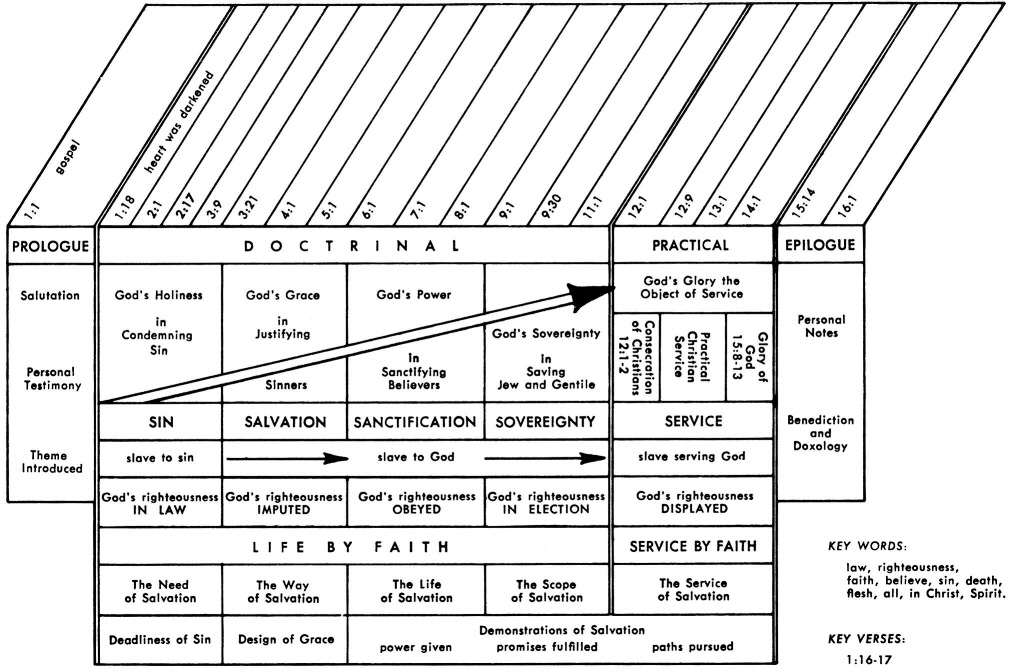
Click chart to enlarge
Chart from recommended resource Jensen's Survey of the NT - used by permission
Romans Overview Chart - Charles Swindoll
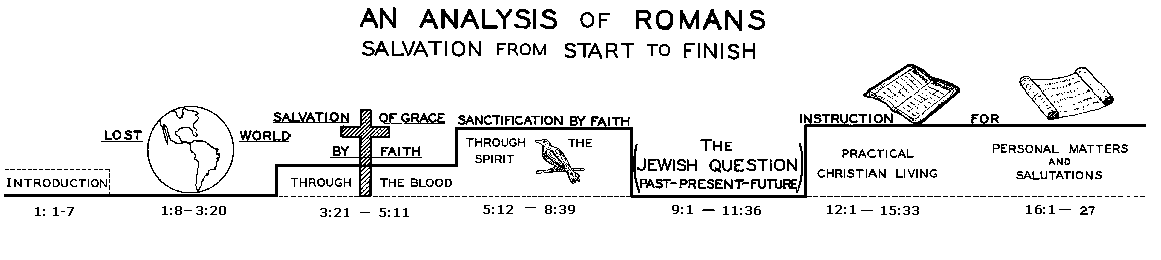
Source: Dr David Cooper
Click to Enlarge
| ROMANS ROAD to RIGHTEOUSNESS |
||||
| Romans 1:18-3:20 | Romans 3:21-5:21 | Romans 6:1-8:39 | Romans 9:1-11:36 | Romans 12:1-16:27 |
| SIN | SALVATION | SANCTIFICATION | SOVEREIGNTY | SERVICE |
| NEED FOR SALVATION |
WAY OF SALVATION |
LIFE OF SALVATION |
SCOPE OF SALVATION |
SERVICE OF SALVATION |
| God's Holiness In Condemning Sin |
God's Grace In Justifying Sinners |
God's Power In Sanctifying Believers |
God's Sovereignty In Saving Jew and Gentile |
Gods Glory The Object of Service |
| Deadliness of Sin |
Design of Grace |
Demonstration of Salvation | ||
| Power Given | Promises Fulfilled | Paths Pursued | ||
| Righteousness Needed |
Righteousness Credited |
Righteousness Demonstrated |
Righteousness Restored to Israel |
Righteousness Applied |
| God's Righteousness IN LAW |
God's Righteousness IMPUTED |
God's Righteousness OBEYED |
God's Righteousness IN ELECTION |
God's Righteousness DISPLAYED |
| Slaves to Sin | Slaves to God | Slaves Serving God | ||
| Doctrine | Duty | |||
| Life by Faith | Service by Faith | |||
|
Modified from Irving L. Jensen's chart above |
||||
Romans 3:1 Then what advantage has the Jew ? Or what is the benefit of circumcision? (NASB: Lockman)
Greek: Ti oun to perisson tou Ioudaiou, e tis e opheleia tes peritomes?
Amplified: THEN WHAT advantage remains to the Jew? [How is he favored?] Or what is the value or benefit of circumcision? (Amplified Bible - Lockman)
KJV: What advantage then hath the Jew? or what profit is there of circumcision?
NIV: What advantage, then, is there in being a Jew, or what value is there in circumcision?
NLT: Then what's the advantage of being a Jew? Is there any value in the Jewish ceremony of circumcision?
Phillips: Is there any advantage then in being one of the chosen people? Does circumcision mean anything? (Phillips: Touchstone)
Wuest: What pre-eminence or advantage is there therefore which the Jew possesses? Or, what profit is there in circumcision?
Young's Literal: What, then, is the superiority of the Jew? or what the profit of the circumcision?
| ROMANS ROAD to RIGHTEOUSNESS |
||||
| Romans 1:18-3:20 | Romans 3:21-5:21 | Romans 6:1-8:39 | Romans 9:1-11:36 | Romans 12:1-16:27 |
| SIN | SALVATION | SANCTIFICATION | SOVEREIGNTY | SERVICE |
| NEED FOR SALVATION |
WAY OF SALVATION |
LIFE OF SALVATION |
SCOPE OF SALVATION |
SERVICE OF SALVATION |
| God's Holiness In Condemning Sin |
God's Grace In Justifying Sinners |
God's Power In Sanctifying Believers |
God's Sovereignty In Saving Jew and Gentile |
Gods Glory The Object of Service |
| Deadliness of Sin |
Design of Grace |
Demonstration of Salvation | ||
| Power Given | Promises Fulfilled | Paths Pursued | ||
| Righteousness Needed |
Righteousness Credited |
Righteousness Demonstrated |
Righteousness Restored to Israel |
Righteousness Applied |
| God's Righteousness IN LAW |
God's Righteousness IMPUTED |
God's Righteousness OBEYED |
God's Righteousness IN ELECTION |
God's Righteousness DISPLAYED |
| Slaves to Sin | Slaves to God | Slaves Serving God | ||
| Doctrine | Duty | |||
| Life by Faith | Service by Faith | |||
|
Modified from Irving L. Jensen's excellent work Jensen's Survey of the NT |
||||
R Ruin (Romans 1:17 – 3:20) – The utter sinfulness of humanity
O Offer (Romans 3:21-31) – God’s offer of justification by grace
M Model (Romans 4:1-25) – Abraham as a model for saving faith
A Access (Romans 5:1-11) – The benefits of justification
N New Adam (Romans 5:12-21) – We are children of two “Adams”
S Struggle w/ Sin (Romans 6-8) Struggle, sanctification, and victory
THEN WHAT: Ti oun:
- Romans 3 Resources - Multiple Sermons and Commentaries
This next section of Romans 3 is generally regarded as one of the most difficult in the whole Epistle. But it will, as we spend work upon it, repay us, Bunyan says:
Hard texts are nuts-I would not call them cheaters:
Whose shells do oft times keep them from the eaters.
John Piper said it this way - My brain almost broke trying to understand the complexity of that paragraph (Ro 3:1-8) (Piper, J. Brothers, we are Not professionals: A Plea to Pastors for Radical Ministry. Nashville, Tenn.: Broadman & Holman Publishers)
By this time, the Jews who would read this letter were undoubtedly beginning to become a bit indignant with the apostle. They were saying to him, in effect
Look, the way you sound, it is as though these privileges that God has given to us -- our great religious heritage -- really means nothing at all. You are undervaluing our heritage. And also if there is no partiality with God (Ro 2:11), what good is it to be Jewish?
Paul answers:
No, I am not; these things mean a lot. The Jews have been given a position of privilege -- they were given the oracles of God; they were entrusted with the message of God; they were chosen as the channel by which God would communicate with the race -- and this is a tremendous privilege.
Remember that Paul had just taught about circumcision (Ro 2:25, 26, 27, 28, 29) and about the judgment of God falling without impartiality on the Jew as well as the Gentile. In his exposure of Jewish pretension (and religious moralists) in Ro 2:1, Paul wrote as if there were now no more difference at all between Jew and Gentile ( e.g. Ro 2:9, 10, 26, 27, 28, 29). But this would be to misunderstand his argument. Paul's purpose was to show that Jews have no advantage with respect to Gentiles in regard to the judgment of God simply because they are Jews. Paul knew that his argument could be misunderstood, and thus in this section he adds a detailed discussion at the conclusion of his exposure of the sin of the religious but unsaved Jew (cp Ro 2:28, 29). In this section Paul proceeds to both affirm Jewish privileges (see Ro 3:2) and delineate the nature and limitations of those privileges. This issue would, of course, be of particular concern to Jews and Jewish Christians but in view of the fact that it raises questions of God's own consistency and reliability regarding circumcision and the law.
John Piper explains that Paul…
has said something that is very provocative and that will not go unchallenged, namely, that some Jews are not really Jews and some Gentiles can really be Jews, even if they are not circumcised. The problem is that this seems to call into question the special position of Israel as God’s chosen people. And that means it would call into question the whole Old Testament. And if Paul’s gospel does that, it will not stand. (Let God Be True Though Every Man a Liar)
The first eight verses of Romans 3 can be interpreted as an "imaginary dialogue" that the apostle holds with his Jewish detractors. The style Paul utilizes here is known as diatribe which was a common method of teaching used by writers and instructors in Paul’s time.
Diatribe (in its archaic definition) is a style of teaching used in ancient philosophical schools, generally characterized by rhetorical questions and imaginary interlocutors. And so to write in style (of diatribe) the author engages in a dialogue with an imaginary opponent or questioner, and the writing is addressed directly to this questioner (2nd person instead of 3rd person).
Sometimes the “dialogue” is one-sided, and the questions flow only from the pen of the writer. This is the case in Ro 2:1, 2, 3, 4, 5 (notes) and Ro 2:17-27 (notes), where Paul bombards the Jews with questions specifically designed to undermine their false confidence wrongly based on their special role in God’s plan.
At other times there is a true dialogue as here in Ro 3:1-8. So to reiterate, in this section the questions come from the imaginary Jewish objector, and Paul provides his emphatic answers. This diatribe style surfaces in a few other places, but it is especially prominent in Romans.
ADVANTAGE HAS THE JEW?: to perisson tou Ioudaiou e tis:
- Ro 2:25, 26, 27, 28, 29; Ge 25:32; Eccl 6:8,11; Isa 1:11, 12, 13, 14, 15; Mal 3:14; 1Cor 15:32; Heb 13:9
- Romans 3 Resources - Multiple Sermons and Commentaries
Here is Paul's first question, based upon the fact that he has just stated that physical Jews whose hearts remain uncircumcised, are not really Jews, and in fact Gentiles who are not physical Jews, can become like true Jews, those who believe the Gospel and have experienced circumcision of their hearts. This being Paul's conclusion, why then would being a Jew have any advantage over Gentiles? In a sense, it seems Paul in offering this conclusion, calls into question the entire OT teaching of the Jews being God's chosen people (Dt 7:6, 7, 8, 9) and the divine blessing that accompanied their status as chosen by God.
Advantage (4053) (perissos) means first that which encircles a thing. Then that which is in excess or over and above (Over and above, more than enough, superabundant in quantity or superior in quality). And thus it means more than enough, superabundant (in quantity), superior (in quality). It can convey the idea of that which is not ordinarily encountered. The idea in this verse is "what is the superiority of the Jew?" More literally, the question is
"What does the Jew have over and above the Gentile?"
Friberg
(1) of what exceeds usual expectation extraordinary, remarkable (Mt 5:47)
(2) of what exceeds necessity abundant (Jn 10:10)
(3) superfluous, unnecessary (2Cor 9:1)
(4) As a colloquial substitute for comparative - what is more than, what goes beyond (Mt 5:37)
(5) Comparative-used as a popular substitute for pleion (more) and mallon (more, rather) (a) (a) as adding a degree of intensity to a noun greater, more severe, more excellent, more abundant, etc. (Mk 12:40, 1Cor 12:23) (b) With the genitive of comparison much more than, even more than (Mk 12:33, Lk 7:26); (c) neuter singular (perissoteron) as an adverb even more, exceedingly, more abundantly (Heb 6:17)
BDAG -
1. pert. to that which is not ordinarily encountered, extraordinary, remarkable
2. pert. to being extraordinary in amount, abundant, profuse
a. going beyond what is necessary perisso; have (someth.) in abundance (Jn 10:10)
b. superfluous, unnecessary (2Cor 9:1)
Liddell Scott - 1. beyond the regular number or size, prodigious 2. out of the common way, extraordinary, uncommon, remarkable, signal, strange 3. of persons, extraordinary, eminent, remarkable, esp. for learning, 4. c. generally beyond others in a thing, Soph.; greater things than this, greater than a prophet, II. more than sufficient, redundant, superfluous,
Perissos 13x in the NT - Translated in NAS - abounds all(1), abounds all the more(1), abundantly(1), advantage(1), all the more(2), beyond(1), especially(2), even more(2), excessive(1), further(1), greater(3), John(1), more(5), more abundant(2), more extremely(1), much more(1), superfluous
Matthew 5:37 "But let your statement be, 'Yes, yes ' or 'No, no'; anything beyond these is of evil.
47 "If you greet only your brothers, what more are you doing than others? Do not even the Gentiles do the same?
Matthew 11:9 "But what did you go out to see? A prophet? Yes, I tell you, and one who is more than a prophet.
Mark 6:51 Then He got into the boat with them, and the wind stopped; and they were utterly astonished,
Mark 7:36 And He gave them orders not to tell anyone; but the more He ordered them, the more widely they continued to proclaim it.
Mark 12:33 AND TO LOVE HIM WITH ALL THE HEART AND WITH ALL THE UNDERSTANDING AND WITH ALL THE STRENGTH, AND TO LOVE ONE'S NEIGHBOR AS HIMSELF, is much more than all burnt offerings and sacrifices."
40 who devour widows' houses, and for appearance's sake offer long prayers; these will receive greater condemnation."
Luke 7:26 "But what did you go out to see? A prophet? Yes, I say to you, and one who is more than a prophet.
Luke 12:4 ¶ "I say to you, My friends, do not be afraid of those who kill the body and after that have no more that they can do.
48 but the one who did not know it, and committed deeds worthy of a flogging, will receive but few. From everyone who has been given much, much will be required; and to whom they entrusted much, of him they will ask all the more.
Luke 20:47 who devour widows' houses, and for appearance's sake offer long prayers. These will receive greater condemnation."
John 10:10 "The thief comes only to steal and kill and destroy; I came that they may have life, and have it abundantly.
Romans 3:1 ¶ Then what advantage has the Jew? Or what is the benefit of circumcision?
1 Corinthians 12:23 and those members of the body which we deem less honorable, on these we bestow more abundant honor, and our less presentable members become much more presentable,
24 whereas our more presentable members have no need of it. But God has so composed the body, giving more abundant honor to that member which lacked,
1 Corinthians 15:10 But by the grace of God I am what I am, and His grace toward me did not prove vain; but I labored even more than all of them, yet not I, but the grace of God with me.
2 Corinthians 2:7 so that on the contrary you should rather forgive and comfort him, otherwise such a one might be overwhelmed by excessive sorrow.
2 Corinthians 9:1 ¶ For it is superfluous for me to write to you about this ministry to the saints;
2 Corinthians 10:8 For even if I boast somewhat further about our authority, which the Lord gave for building you up and not for destroying you, I will not be put to shame,
Hebrews 6:17 In the same way God, desiring even more to show to the heirs of the promise the unchangeableness of His purpose, interposed with an oath,
Hebrews 7:15 ¶ And this is clearer still, if another priest arises according to the likeness of Melchizedek,
Perissos - 29x in non-apocyrphal Septuagint - Ex 10:5; Num 4:26; Judg 21:7, 16; 1 Sam 30:9; 2 Kgs 25:11; Prov 14:23; Eccl 2:15; 6:11; 7:16; 12:9, 11; Ezek 48:15, 18, 21, 23; Dan 3:22; 4:36; 5:12, 14; 6:3;
Both of Paul's questions presuppose the standpoint of one who has hitherto assumed that being a Jew is an advantage and that being circumcised is of value. It now (based on Ro 2, especially Ro 2:25, 26, 27, 28, 29-see notes) looks as if Paul is in danger of erasing a distinction which God has made (Jew and Gentile). The question is, if Jew and Gentile are on the same footing before God, what then is the supposed advantage of being a Jew and what benefit is circumcision?
Dr. James Stifler asks…
“If circumcision in itself does not give righteousness, if uncircumcision does not preclude it, what profit was there ever in it? A distinction that God made among men seems, after all, not to be one.”
This was not a frivolous objection. Today we would phrase the question differently:
“If being affiliated with God’s people through such things as baptism and church membership will not save us, and if having the Word of God is not enough to ensure our salvation or holiness, what is the advantage of being under the umbrella of the Church and Christianity?”
As Paul proceeds to outline in Ro 3:1-20, there were substantial advantages in being raised a Jew, and by way of application there are definite advantages (and responsibilities) to those who are raised in godly families and doctrinally sound churches today. But ultimately each individual must personally respond to the truth. When Ray Stedman was a student at Dallas Theological Seminary, Dr. Lewis Sperry Chafer told them he knew D. L. Moody and his family intimately, and that, so far as he could tell, he saw no indication in any of the Moody children that they ever came to know Jesus Christ. Now, that is tragic, and yet even the great evangelist Moody could not save his own children! Salvation is from God Alone. And His good pleasure in saving some and not others is a holy mystery.
Dunn says
The slightly agonized cry of Jewish self-identity responds in bewildered protest” to the teaching of chapter 2. The protester’s thought is this: “If being a Jew gives us no advantage over the Gentiles on Judgment Day, then what’s the big deal about being a Jew at all? Have we just been spinning our wheels for the last 2,000 years? Are the covenant and its special sign — circumcision — God’s idea of a practical joke? Or is he just now changing his mind about the Jews? Is he going back on his word? What’s the use of being a Jew, then?
J Vernon McGee says that…
Now, this is the same question, I think, that we hear today. I get it because the gospel that I preach says that church membership has no advantage for salvation, that any rite or ritual you go through is meaningless as far as salvation is concerned. God has the world shut up to a Cross. (McGee, J V: Thru the Bible Commentary: Nashville: Thomas Nelson)
OR WHAT IS THE BENEFIT OF CIRCUMCISION?: e opheleia tes peritomes:
- Romans 3 Resources - Multiple Sermons and Commentaries
Here is the second of Paul's two questions.
Benefit (5622) (opheleia from opheleo = to profit from ophéllo = heap up) primarily denotes assistance then comes to describe the state of having acquired an advantage or benefit. Determining “benefit” was a common device among philosophers for evaluating the worth of a behavior or idea.
The only other NT use of opheleia is Jude 1:16 These are grumblers, finding fault, following after their own lusts; they speak arrogantly, flattering people for the sake of gaining an advantage.
Opheleia -8x in non-apocryphal Septuagint - 2 Sam 18:22; Job 21:15; 22:3; Ps 30:9 ("what profit"); Isa 30:5; Jer 23:32; 30:13; 46:11;
Circumcision was practiced because it commanded in the Law (Ge 17:10, 11, 12, 13, 14), and the very fact that the Jews had the special revelation of God's law (oracles in the next verse) should have been a benefit to them. The Law of course could not save, for one no one could keep it. The advantage of the Law was that their inability to keep it and to live up to God's standards should have led the Jews to see their need for something more, specifically the need for an internal circumcision by faith, even a faith like Abraham which resulted in his being reckoned as righteous before God (Genesis 15:6). In that sense, Abraham was circumcised, externally and internally, physically and spiritually.
Circumcision (4061) (peritome from perí = around + témno = cut off) (Click for more in depth word study of peritome) refers literally to cutting and removal of the foreskin. (See related discussion on Circumcision) (See Ro 2:27, 28, 29 - notes where Paul emphasizes the necessity of an internal rather than an external circumcision)
The self-deception of the Jews is reminiscent of Hans Christian Andersen's story of the "The Emperor’s New Clothes" for like that emperor (who actually walked out with no clothes), the Jews also imagined themselves to be "clothed" as it were with a righteousness acceptable to God, when in fact they were quite "naked" in this regard (cp the church at Laodicea - Re 3:17, 18-notes). They were deluded by their misdirected, futile focus on religious works all the while missing a real relationship with the Creator.
So Paul is functioning much like the little boy in the crowd who unashamedly asked where the naked Emperor's "new" clothes were, his question exposing their folly. In Romans 2 Paul had stripped away the layers of Jewish delusion, addressing the "sacred cows" the Jews were relying on for to get them into the kingdom of heaven. They believed that because they possessed the Word of God they were safe. They thought that because Abraham was their physical father they were safe (Paul addresses this misconception in Romans 4, cp Jn 8:36, 37, 38, 39, 40, 41, 42, 43, 44). They saw themselves as guides to the blind (Ro 2:19), correctors of the foolish (Ro 3:20), teachers of the immature (Ro 3:20). But Paul undressed them spiritually speaking, proving that having God’s Word was no guarantee one had a genuine relationship with God. Paul also stripped away their reliance on physical circumcision thus demonstrating that their religious affiliation, "Jew", would not save them.
As Paul in a sense "undressed" his fellow Jews, he also undressed all who would ever read these passages, stripping away all our false pride and confidence that says "We must be okay with God since we have His Word and we go to the right church." Paul is building his case to show that the true righteousness which God accepts is a matter of the heart that believes God's gospel and receives His Son's perfect righteousness (2Co 5:21, 1Co 1:30, Php 3:9, Ro 1:17)! As Paul had just taught (speaking specifically to the Jews) that a man…
is a Jew if he is one inwardly; and circumcision is circumcision of the heart (not a physical but a spiritual circumcision - De 10:16, 30:6 Jer 4:4 Col 2:11,12-notes), by the Spirit, not by the letter (see note Ro 2:29, cp 2Cor 3:6)
William Newell adds that… :
The importance of this great passage cannot be overestimated, for if the Jew as that end of the dispensation, or any "religious" person at this end, be allowed to plead special privilege or light as exempting him from judgment, he will spiritually (of course not actually) escape the general sentence of Ro 3:19, where "all the world" is brought under the judgment of God. If a man escapes in spirit from God's pronouncement of "guilty, " he will never truly rely upon the shed blood of the Guilt-Bearer, Christ (1Pe 2:24, Mt 8:17, Isa 53:4, 5, 6, 11, John 1:29, Heb 9:28, Ga 3:13, OT type - Lv 16:22)! (Romans 3: Devotional and Expositional)
College Press NIV Commentary nicely summarizes this section:
The discussion begins with a question about the role of the Jews in God’s plan (Ro 3:1,2), then quickly moves on to the issue of the character of God himself (Ro 3:3,4). The thought is that what Paul says about the Jews in Romans 2 seems to nullify the apparent Jewish privilege and exclusiveness enjoyed since Abraham’s day, and this in turn calls into question the truthfulness and faithfulness of God. Paul’s response leads to a series of somewhat frivolous questions which may be interpreted as one last desperate attempt at Jewish self-justification (Ro 3:5, 6, 7,8). (College Press NIV commentary)
Denney explains: It might easily seem, at this point, as if the apostle’s argument had proved too much. He has shown that the mere possession of the law does not exempt the Jew from judgment, but that God requires its fulfillment. He has shown that circumcision in the flesh, seal (cp Ro 4:11) though it be of the covenant and pledge of its promises, is only of value if it represents inward heart circumcision. He has, it may be argued, reduced the Jew to a position of entire equality with the Gentile. But the consciousness of the Jewish race must protest against such a conclusion (Expositor's Greek Testament)
William Barclay (Romans 3 - William Barclay's Daily Study Bible)
Here Paul is arguing in the closest and the most difficult way. It will make it easier to understand if we remember that he is carrying on an argument with an imaginary objector. The argument stated in full would run something like this.
The objector: The result of all that you have been saying is that there is no difference between Gentile and Jew and that they are in exactly the same position. Do you really mean that?
Paul: By no means.
The objector: What, then, is the difference?
Paul: For one thing, the Jew possesses what the Gentile never so directly possessed--the commandments of God.
The objector: Granted! But what if some of the Jews disobeyed these commandments and were unfaithful to God and came under his condemnation? You have just said that God gave the Jews a special position and a special promise. Now you go on to say that at least some of them are under the condemnation of God. Does that mean that God has broken his promise and shown himself to be unjust and unreliable?
Paul: Far from it! What it does show is that there is no favouritism with God and that he punishes sin wherever he sees it. The very fact that he condemns the unfaithful Jews is the best possible proof of his absolute justice. He might have been expected to overlook the sins of this special people of his but he does not.
The objector: Very well then! All you have done is to succeed in showing that my disobedience has given God an opportunity to demonstrate his righteousness. My infidelity has given God a marvellous opportunity to demonstrate his fidelity. My sin is, therefore, an excellent thing! It has given God a chance to show how good he is! I may have done evil, but good has come of it! You can't surely condemn a man for giving God a chance to show his justice!
Paul: An argument like that is beneath contempt! You have only to state it to see how intolerable it is!
When we disentangle this passage in this way, we see that there are in it certain basic thoughts of Paul in regard to the Jews.
(i) To the end of the day he believed the Jews to be in a special position in regard to God. That, in fact, is what they believed themselves. The difference was that Paul believed that their special position was one of special responsibility; the Jew believed it to be one of special privilege. What did Paul say that the Jew had been specially entrusted with? The oracles of God. What does he mean by that? The word he uses is logia (3048), the regular word in the Greek Old Testament for a special statement or pronouncement of God. Here it means The Ten Commandments. God entrusted the Jews with commandments, not privileges. He said to them, "You are a special people; therefore you must live a special life." He did not say, "You are a special people; therefore you can do what you like." He did say, "You are a special people; therefore you must do what I like." When Lord Dunsany came in safety through the 1914-18 war he tells us that he said to himself, "In some strange way I am still alive. I wonder what God means me to do with a life so specially spared?" That thought never struck the Jews. They never could grasp the fact that God's special choice was for special duty.
(ii) All through his writings there are three basic facts in Paul's mind about the Jews. They occur in embryo here; and they are in fact the three thoughts that it takes this whole letter to work out. We must note that he does not place all the Jews under the one condemnation. He puts it in this way: "What if some of them were unfaithful?"
(a) He was quite sure that God was justified in condemning the Jews. They had their special place and their special promises; and that very fact made their condemnation all the greater. Responsibility is always the obverse of privilege. The more opportunity a man has to do right, the greater his condemnation if he does wrong.
(b) But not all of them were unfaithful. Paul never forgot the faithful remnant; and he was quite sure that that faithful remnant--however small it was in numbers--was the true Jewish race. The others had lost their privileges and were under condemnation. They were no longer Jews at all. The remnant was the real nation.
(c) Paul was always sure that God's rejection of Israel was not final. Because of this rejection, a door was opened to the Gentiles; and, in the end, the Gentiles would bring the Jews back within the fold, and Gentile and Jew would be one in Christ. The tragedy of the Jew was that the great task of world evangelization that he might have had, and was designed to have, was refused by him. It was therefore given to the Gentiles, and God's plan was, as it were, reversed, and it was not, as it should have been, the Jew who evangelized the Gentile, but the Gentile who evangelized the Jew--a process which is still going on.
Further, this passage contains two great universal human truths.
(i) The root of all sin is disobedience. The root of the Jew's sin was disobedience to the known law of God. As Milton wrote, it was "man's first disobedience" which was responsible for paradise lost. When pride sets tip the will of man against the will of God, there is sin. If there were no disobedience, there would be no sin.
(ii) Once a man has sinned, he displays an amazing ingenuity in justifying his sin. Here we come across an argument that reappears again and again in religious thought, the argument that sin gives God a chance to show at once his justice and his mercy and is therefore a good thing. It is a twisted argument. One might as well argue--it would, in fact, be the same argument--that it is a good thing to break a person's heart, because it gives him a chance to show how much he loves you. When a man sins, the need is not for ingenuity to justify his sin, but for humility to confess it in penitence and in shame. (Romans 3 - William Barclay's Daily Study Bible)
Romans 3:2 Great in every respect. First of all, that they were entrusted with the oracles of God. (NASB: Lockman)
Greek: polu kata panta tropon. proton men (gar) hoti episteuthesan (3PAPI) ta logia tou theou
Amplified: Much in every way. To begin with, to the Jews were entrusted the oracles (the brief communications, the intentions, the utterances) of God. (Amplified Bible - Lockman)
KJV: Much every way: chiefly, because that unto them were committed the oracles of God.
NIV: Much in every way! First of all, they have been entrusted with the very words of God.
NLT: Yes, being a Jew has many advantages. First of all, the Jews were entrusted with the whole revelation of God
Phillips: Yes, of course, a great deal in every way. You have only to think of one thing to begin with - it was the Jews to whom God's messages were entrusted. (Phillips: Touchstone)
Wuest: Much every way, for, first of all, because they were entrusted with the divine utterances of God.
Young's Literal: much in every way; for first, indeed, that they were entrusted with the oracles of God.
GREAT IN EVERY RESPECT FIRST OF ALL (in importance) THAT THEY WERE ENTRUSTED WITH THE ORACLES OF GOD: polu kata panta tropon proton men (gar) hoti episteuthesan (3PAPI) ta logia tou theou:
- Ro 3:3; 11:1,2,15, 16, 17, 18, 19, 20, 21, 22, 23,28,29) (Ro 2:18; 9:4; Dt 4:7,8; Ne 9:13,14; Ps 78:4, 5, 6, 7; 147:19,20; Isa 8:20; Ezek 20:11,12; Lk 16:29, 30, 31; Jn 5:39; 2Ti 3:15, 16, 17; 2Pet 1:19, 20, 21; Rev 19:10
- 1Cor 9:17; 2Cor 5:19; Gal 2:7; 1Ti 6:20) (oracles - Ro 1:2; Ps 119:140; Da 10:21; Acts 7:38; 2Ti 3:15,16; Heb 5:12; 1Pet 4:11; 2Pet 1:20,21; Rev 22:6
- Romans 3 Resources - Multiple Sermons and Commentaries
Great (4183) (polus) speaks of great in number, relatively large in quantity or being high on a scale of extent. In the present context polus functions as a simple adjective meaning denoting degree -- much, great, profound.
Every (3956) (pas) means all denoting highest degree.
Respect (5158) (tropos from trépo = turn towards a thing) originally described a turn or direction and came to mean manner, fashion or manner of life (the manner in which something is done, the way in which a person behaves or lives).
Tropos -10x in the NT - Matt. 23:37; Lk. 13:34; Acts 1:11; 7:28; 15:11; 27:25; Rom. 3:2; 2 Thess. 2:3; 2 Tim. 3:8; Jude 1:7
First (4413) (protos) refers to the former or first in a series or set. Sometimes protos speaks of rank and value and conveys the sense of first (of all), foremost or most important of all.
Having the written self-revelation of God was an unspeakable advantage to the Jew and praise God, it remains true for those of us who are believers today. Do you appreciate your great advantage or are you squandering it, letting your Bible collect dust on the coffee table? God's Word is a great advantage because it gives us a written description of God's eternal nature and teaches us that God is the all-powerful Creator Who sustains the entire universe. His Word reveals His perfect holiness, righteousness, love, justice, etc. The God of the Scriptures is majestic, transcendent and beyond human comprehension and yet He has chosen to reveal His character in His oracles! And of course the greatest advantage of having the oracles of God is that they reveal His eternal plan of redemption for lost mankind (even in the OT! - cp Abraham Ge 15:6). The oracles of God reveal to us our nature and our purpose in God's great plan, something we could never have deduced in our finite minds!
And there were other great advantages and benefits to the Jews throughout history. Despite the fact that the Jews missed and misunderstood God's real purpose for giving the written Law, they did nevertheless benefit from the results of keeping God's Laws. For example as the Bubonic Plague ravaged most of Europe, killing one out of every three people, the Jewish population was left largely untouched! You are asking why was that so? One reason is that in keeping the Law, the Jews were protected from the plague due to the hygienic and dietary regulations contained within the Law! God's Law is good and good for our health, both physically and spiritually. The Jews enjoyed the former but benefit but largely missed the latter, greater benefit. Let's take another example of the Jews who throughout history have generally done well financially as a group. Why? Because the financial principles contained within the Law work regardless of whether those who practice them walk close to the Lord.
How does this apply to America in the twenty-first century? There are a number of things that could be said, but one of the most important is the great advantage found in what I would call the Genesis 12:3 principle where God says He will bless those who bless Abraham's offspring, but will curse those who curse Abraham's offspring. The United States has indubitably benefited from this principle, having been a friend of Israel when many if not most nations scorned her existence. And this divine blessing on America is despite the fact that most Americans are not genuine born again believers!
Another general principle is found in Proverbs 14 where Solomon writes…
Righteousness (right living before God and before man) exalts (speaking in context especially of the moral/ethical realm) a nation, but sin (missing the mark) is a disgrace to any people. (Pr 14:34, cp Dt 4:6, 7,8)
Comment: In a time when the Church in America is largely forsaking sound teaching (2Ti 4:1, 2Ti 4:2, 2Ti 4:3, 4) we need to plead with God for a Spirit driven, God glorifying renewal of men's hearts so that they are turned back to the Lord and sense a deep hunger for His holy word, especially among believing men, many of whom find themselves too busy for "serious" Bible study that takes more than a few minutes of their already over allocated schedule. America is at a cross roads, beloved, and even secular sources are beginning to acknowledge our dire straits, and at the same time they can provide no genuine solution. As the old adage says "America is great because she is good. If America ceases to be good, America will cease to be great." The solution to correct the moral course of our country is the same as it has always been - "In God we trust" (In 2005, the Congress even stooped to the level of removing this phrase from newly minted Presidential $1 coins, placing the phrase on the edges of the coins [double entendre in my opinion - another attempt to remove the one true God from America]! God help us! Amen)
Henry Morris comments on this proverb: The unique blessings of God on the American nation are primarily attributable to the spiritual convictions and motivation of so many of its founders and pioneers; its present moral decline and religious apathy and apostasy are an ominous portent for the future. (Morris, Henry: Defenders Study Bible. World Publishing)
Entrusted (4100)(pisteuo) can refer as in this passage to a committing of something to someone and so to entrust them. And thus we find pisteuo is translated entrust (entrusted, entrusting) 8 times in the NT. Here is an example of this meaning of pisteuo…
If therefore you have not been faithful (pistos) in the use of unrighteous mammon, who will entrust (pisteuo) the true riches to you? (Luke 16:11)
Oracles (3051) (logion from lógios = an orator) was a saying, a pronouncement, a declaration. In Classical Greek logion was used to describe oracular utterances of heathen deities.
See the New International Dictionary of New Testament Theology for a 30+ page discussion of WORD - logos, word, utterance, meaning; lego, collect, count, say; logikos, intellectual, rational, reasonable, spiritual; logion, saying; logios, eloquent; cultured; alogos, irrational, without speech; laleo, to talk, chat, speak.
See related study on graphe - Scriptures
Harper's Bible Dictionary notes that an oracle was…
a message from a god, usually in response to an inquiry; also the sacred precincts whose powers made it possible for the oracle-prophet to consult the god. The Greco-Roman world knew three types of oracles: the oracle obtained through the casting of lots; the dream oracle obtained by sleeping in the sacred precincts, usually connected with healing; and the inspired oracle by which an oracle-prophet responded to inquiries. Though oracles were associated with a place, other prophets, diviners, and soothsayers might be employed by the state to give advice and to travel with the army, or they might set up practice in the local marketplace. (Achtemeier, P. J. Harper's Bible Dictionary. Harper & Row)
MacArthur writes that…
Logion (oracles) is a diminutive of logos (note), which is most commonly translated word. Logion generally referred to important sayings or messages, especially supernatural utterances… In many pagan religions of that day, mediums and seers gave occultic predictions of the future and other messages from the spirit world through supernatural “oracles.” By observing the movements of fish in a tank, the formation of snakes in a pit, or listening to the calls of certain birds, fortune-tellers would purport to predict such things as business success or failure, military victory or defeat, and a happy or tragic marriage. Such a connotation could not have been further from Paul’s use of logion in this passage. (MacArthur, J: Romans 1-8. Chicago: Moody Press)
Paul uses logion as a striking synonym for the Holy Scriptures, referring to them as "the oracles" (his use of the definite article in the Greek -- "the" -- indicates they are not just any oracles but a specific set of oracles, and in context are the Old Testament writings).
Logion was used four times in the NT stressing the fact that the Words in Scripture actually constituted the very utterances of God.
Acts 7:38 received living oracles (refers to Mosaic Law) to pass on to you
Ro 3:2 entrusted with the oracles of God (refers to entire OT).
Heb 5:12 elementary principles of the oracles of God (basic doctrines),
1Pe 4:11 the utterances of God (utterances of God through Christian teachers)
These oracles were given to and through the Jews and are preserved for us now in the OT.
Vine adds that…Note: Divine oracles were given by means of the breastplate of the High Priest, in connection with the service of the Tabernacle, and the Sept. uses the associated word logeion in Ex. 28:15, to describe the breastplate.
Logion is used 32 times in the Septuagint (LXX), the Greek OT
Nu 24:4, Nu 24:16, Dt 33:9, Ps 12:6, Ps 18:30, Ps 19:14, Ps 105:19, Ps 107:11, Ps 119:11, Ps 119:38, Ps 119:41, Ps 119:50, Ps 119:58, Ps 119:67, Ps 119:76, Ps 119:82, Ps 119:103, Ps 119:116, Ps 119:123, Ps 119:133, Ps 119:140, Ps 119:148, Ps 119:158, Ps 119:162, Ps 119:169, Ps 119:170, Ps 119:172, Ps 138:2, Ps 147:15, Isa 5:24, Isa 28:13, Isa 30:27).
Note the 24 uses in Psalm 119 which extols the virtues of God's Word, law, precepts, commandments, ordinance, etc (see the use in Ps 119:11 which shows one potential advantage the Jew possessed because he had access to God's Word)
Ta logia or the oracles are important sayings or messages, especially supernatural ones. In this verse Paul uses logion as a synonym for the entire Old Testament. He is saying that what the Jews received in the logion were the living words of the living God. Thus the Jews had a great advantage in having the Old Testament Scriptures, because these oracles expounded the way of true salvation, Paul recording for example…
And the Scripture (OT "oracles"), foreseeing that God would justify the Gentiles by faith, (Scriptures are personified as a "preacher" who) preached the gospel beforehand to Abraham, saying, "ALL THE NATIONS SHALL BE BLESSED IN YOU. (see Genesis 12:3, 18:18, 22:18)" (Galatians 3:8)
If both Jews and Gentiles are equally guilty, what is the advantage of being a Jew? Paul claims numerous benefits through Judaism but is content to mention one of the chief advantages. The Jews were the custodians of the "oracles" of God. Some indication of the importance ascribed to the Scriptures can be discerned from the fact that of all the advantages which are attributed to the ancient Jew, the only one mentioned by Paul is possession of the "oracles of God."
William Cowper extolled this Jewish advantage in poem…
They, and they only, amongst all mankind,
Received the transcript of the Eternal Mind;
Were trusted with His own engraven laws,
And constituted guardians of His cause;
Theirs were the prophets, theirs the priestly call,
And theirs, by birth, the Savior of us all.
Paul will later expand on the advantage of the Jew in Ro 9:4, 5 (see notes), explaining that Israel also had the adoption, the glory, the covenants, the giving of the law, the service of God, and the promises (contrast the disadvantages of the Gentiles - Eph 2:12).
We know that after the first advent of Christ and the beginning of the Church in Acts 2, many of these Jewish "advantages" became a hindrance to anyone who might enter the New Covenant by grace through faith. In Philippians Paul enumerates seven advantages of being a Jew…
although I myself might have confidence even in the flesh. If anyone else has a mind to put confidence in the flesh, I far more: (#1) circumcised the eighth day, (#2) of the nation of Israel, (#3) of the tribe of Benjamin, (#4) a Hebrew of Hebrews; (#5) as to the Law, a Pharisee; (#6) as to zeal, a persecutor of the church; (#7)as to the righteousness which is in the Law, found blameless.. (Phil 3:4-6-see notes)
These were on the profit side of Paul’s ledger from a Jew's perspective, but when the Spirit opened His eyes to see Jesus as His deliverer, Paul gladly transferred these "benefits" to the "loss" side of the ledger writing…
"whatever things were gain (an accounting term that means “profit”) to me, those things I have counted (perfect tense) = this verb is a mathematical term which says "Think about it and come to a conclusion." In the account book of his life his entries on the gains side were transferred to the side of loss. After reflection he considered them loss) as loss for the sake of Christ. More than that, I count (present tense = continually = Paul continually reflected on what he had had in the past and what it might mean to him now but still came to the same conclusion… if it was not Christ's righteousness, it belonged on the loss column) all things to be loss in view of the surpassing value of knowing Christ Jesus my Lord (Is there anything in this short earthly life which surpasses the value of knowing Christ Jesus our Lord?), for whom I have suffered the loss of all things, and count them but rubbish in order that I may gain Christ," (Phil 3:7-8-see notes)
Romans 3:2 although addressed to the privileged Jews, should cause us as believers today to ponder how great is this benefit of being entrusted with the oracles of God in our day.
What Paul is doing her to his Jewish brethren in the flesh, is destroy their belief that they could ever attain to God's requirement of perfect righteousness. In so doing Paul was much like the Spanish explorer Hernando Cortez who landed at Vera Cruz, Mexico in 1519 intent on conquest. To assure the devotion of his men, Cortez set fire to his fleet of eleven ships! With no means of retreat Cortez’s army had only one direction to move -- into the Mexican interior. Cortez understood the price of commitment and he paid it.
So here at the beginning of one of the most difficult to comprehend and expound oracles of God in all of Scripture, Romans 3:1-8, we are reminded by God that having the oracles of God entrusted to us in a Book is a great thing.
Olshausen on oracles explains that
No doubt in the first place the promises (Acts 7:38; 1Pe 4:11, etc.), and indeed esp those of the Messiah and the kingdom of God, to which all others were related … but the whole Word of God is also indicated by this expression. The Divine promises were confided to the Jews, since in what follows it is just this faithlessness (apistia) in the possession of these promises which is spoken of. The mention is made of Divine faithfulness (pistia) only in connection with this faithlessness.
Alford adds that…
Not only the law of Moses, but all the revelation of God hitherto made of Himself directly, all of which had been entrusted to Jews only.
Meyer explains that…
Paul means the Holy Scriptures and especially the prophecies of the Messiah and the kingdom. These are not destroyed by the Jews’ unbelief.
Ray Stedman gives an interesting illustration of the Jew's great advantage: Just imagine, for instance, an island in darkness, populated with people. There is only one way to escape the island, a narrow bridge over a deep chasm, but the darkness is so great that only a few find their way over that bridge. Everybody on that island has been provided with a little penlight that enables them to dimly illuminate a small space around them, barely enough to avoid the more obvious obstacles in their path. But a certain group of people is given a powerful searchlight that can shine thousands of yards into the darkness. It is given to them not only so that they can find the bridge, but also so they can show others the way out. Yet these people, who have so much more light than the others, spend their time utilizing this powerful searchlight to look for needles in a haystack. They turn that searchlight on a mound of hay and search for needles. That, in essence, was what the Jews were doing. The rabbis were arguing constantly over infinitesimal theological differences. Jesus called this "straining at a gnat, but swallowing a camel," {cf, Mt 23:24}. They argued over how many steps constituted a violation of the Sabbath and whether spitting on a rock is permissible on the Sabbath, or whether spitting on mud is a violation (cp Mt 23:23, Mic 6:7, 8, Ho 6:6, 1Sa 15:22, Isa 1:11, 12, 13, 14, 15,16, 17, 18, Ps 51:16, 17). One would be right, and the other wrong. This is what they used the Law for. Though the Jews had a tremendous advantage in having the Law, Paul says, they failed to use it properly. (Read the full sermon Romans 3:1-20 Total Wipeout )
Romans 3:3 What then? If some did not believe, their unbelief will not nullify the faithfulness of God, will it? (NASB: Lockman)
Greek: ti gar; ei epistesan (3PAAI) tines, me (me expects the negative answer) e apistia auton ten pistin tou theou katargesei (3SFAI)
Amplified: What if some did not believe and were without faith? Does their lack of faith and their faithlessness nullify and make ineffective and void the faithfulness of God and His fidelity [to His Word]? (Amplified Bible - Lockman)
KJV: For what if some did not believe? shall their unbelief make the faith of God without effect?
NIV: What if some did not have faith? Will their lack of faith nullify God's faithfulness?
NLT: True, some of them were unfaithful; but just because they were unfaithful, does that mean God will be unfaithful?
Phillips: Some of them were undoubtedly faithless, but what then? Can you imagine that their faithlessness could disturb the faithfulness of God? (Phillips: Touchstone)
Wuest: Well then—if, as is the case, certain ones did not exercise faith? Their unbelief will not render the faithfulness of God ineffectual, will it?
Young's Literal: for what, if certain were faithless? shall their faithlessness the faithfulness of god make useless.
WHAT THEN? IF SOME DID NOT BELIEVE: ti gar ei epistesan (3PAAI) tines:
- Ro 9:6; 10:16; 11:1, 2, 3, 4, 5, 6, 7; Heb 4:2
- Romans 3 Resources - Multiple Sermons and Commentaries
Paul rejects the assumption that if some Jews were unbelieving or unfaithful and perish, this indicates that God is unfaithful. May it never be! Perish that thought! For God to be unfaithful is unthinkable! (Ro 3:4)
Did not believe (569) (apisteo from a = without + pistós = believing, faithful) means literally without believing. They refuse to believe and thus are unfaithful. To disbelieve, to doubt or not to acknowledge. To betray a trust. Unbelief is a failure to respond to God with trust (pistis) and at heart shows, not doubt, but rejection
Vine feels that “disbelieve” is the best rendering, implying that the unbeliever has had a full opportunity of believing and has rejected it (Vine, W E: Vine's Complete Expository Dictionary of Old and New Testament Words. 1996. Nelson)
Apisteo is used 6 times in the NAS: (Mark 16:11, Mark 16:16, Luke 24:11, 41 all refer to disbelieving Christ's resurrection, of the Jews listening to Paul's testimony of Christ in Acts 28:24, Ro 3:3, 2Ti 2:13; Peter uses apisteo of those who disbelieved and thus rejected the Stone, Christ = 1Peter 2:7) and is translated disbelieve, not believe, faithless. Apisteo is not found in the non-apocryphal Septuagint (LXX).
This statement by Paul has a modern day application for the professing church (and for skeptics). The fact that many people today reject the Scriptures, even alleging that the Bible has been disproved by modern science and reason, means nothing. God's Word has been forever settled in Heaven and will endure forever (Ps 119:89-Spurgeon's note, Ps 119:160-Spurgeon's note), even after this present earth has passed away (Mt 24:35). God's revealed Word is absolute truth, and will judge all its detractors in the last day (see notes on Rev 20:12; Re 22:18,19).
Paul could also be using apisteo in this verse to mean they "were unfaithful". In either case, God remains faithful to His promises. In this verse the Jew raises a second objection. God has made a promise to Abraham to be a God to him and to his seed in all generations. "Shall God's faithfulness be made of none effect, His promise be broken, because a great part of Israel does not believe upon the promised Seed of Abraham, who was to bless all nations?"
Kent Hughes says "This is a strange objection which argues essentially: “Paul, how can you possibly say we Jews have so completely failed in our privileged position and still insist that we are an advantaged people? If we have failed as you insist, God’s Word is powerless and He is unfaithful. (Hughes, K: Preaching the Word: Romans Righteousness from Heaven)
THEIR UNBELIEF WILL NOT NULLIFY (render invalid, inoperative and powerless) THE FAITHFULNESS OF GOD: me e apistia auton ten pistin tou theou katargesei (3SFAI):
- Ro 11:29; Nu 23:19; 1Sa 15:29; Isa 54:9,10; 55:11; 65:15,16; Jer 33:24, 25, 26; Mt 24:35; 2Ti 2:13; Heb 6:13, 14, 15, 16, 17, 18
- faithfulness of God - Ps 84:7; Jn 1:16; 2Cor 3:18; 2Th 1:3; Titus 1:1,2
- Romans 3 Resources - Multiple Sermons and Commentaries
Unbelief (570) (apistia from a = without + pistós = believing, faithful) means literally not believing = faithlessness, distrust, lack of belief. It describes an unwillingness to commit oneself to another or respond positively to the other’s words or actions.
Apistia is found 11 times in the NAS (Matt. 13:58; Mk. 6:6; 9:24; 16:14; Rom. 3:3; 4:20; 11:20, 23; 1Ti 1:13; Heb 3:12, 19) and is not found in the non-apocryphal Septuagint (LXX).
Here are some representative uses…
And He did not do many miracles there (His hometown, Nazareth) because of their unbelief. (Mt 13:58)
Immediately the boy's father cried out and began saying, "I do believe; help my unbelief." (Mark 9:24)
And afterward He appeared to the eleven themselves as they were reclining at the table; and He reproached them for their unbelief and hardness of heart, because they had not believed those who had seen Him after He had risen. (Mark 16:14)
yet, with respect to the promise of God (he would have a male heir), he (Abraham) did not waver in unbelief, but grew strong in faith, giving glory to God, (see note Romans 4:20)
Quite right, they (Jewish branches were broken off, and the Gentiles were grafted in) were broken off for their unbelief (Gentiles were grafted in because of the unbelief of Israel and not because the Gentiles had any merit or claim on God), but you (Gentiles) stand by your faith. Do not be conceited, but fear (Standing before God is based on faith, so feelings of superiority are out of place) (see note Romans 11:20)… And they (Jews) also, if they do not continue in their unbelief, will be grafted in; for God is able (key phrase = He is able = He has grafted wild branches -- Gentiles -- into the cultivated olive, He is able to graft Jews in) to graft them in again. (see note Romans 11:23)
Take care, brethren, lest there should be in any one of you an evil, unbelieving heart, in falling away from the living God. (Hebrews 3:12)
Nullify (2673) (katargeo from kata = intensifies meaning + argeo = to be idle or inactive from argos = ineffective, idle, inactive from a = without + érgon = work) literally means to reduce to inactivity. The idea is to make the power or force of something ineffective and so to render powerless, reduce to inactivity. To do away with. To put out of use. To cause to be idle or useless. To render entirely idle, inoperative or ineffective. Cause something to come to an end or cause it to cease to happen. To abolish or cause not to function. To free or release from an earlier obligation or relationship. To no longer take place.
Katargeo is used 27 times in the NT -
Lk 13:7; Ro 3:3, 31; 4:14; 6:6; 7:2, 6; 1Co. 1:28; 2:6; 6:13; 13:8, 10, 11; 15:24, 26; 2Co. 3:7, 11, 13, 14; Gal 3:17; 5:4, 11; Ep 2:15; 2Th 2:8; 2Ti 1:10; He 2:14
The basic idea of katargeo is to cause something to be idle or useless, inoperative or ineffective. Katargeo always denotes a nonphysical destruction by means of a superior force coming in to replace the force previously in effect, as e.g. light destroys darkness. (Frieberg)
Someone has written that katargeo is pictured by our well known English phrases like "to pull the teeth out of," or "to declaw." In the present context the unfaithfulness of men will not alter the great faithfulness of God.
Vine explains that katargeo "never means “to annihilate.” (= to destroy utterly and completely and thus cause to cease to exist) The general idea in the word is that of depriving a thing of the use for which it is intended. Thus it implies, not loss of being, but loss of well-being (Ed note: although this latter idea cannot be easily applied to many the NT occurrences which refer to inanimate things such as the Law, death, the power of sin, etc). (Vine, W. Collected writings of W. E. Vine. Nashville: Thomas Nelson )
Faithfulness (4102) (pistis) (Click study of pistis) is that which evokes trust and faith, in this case referring to God in Whom confidence can be placed. It describes God's faithfulness, reliability, fidelity, commitment.
Click for notes on God's attribute of faithfulness. Ponder some of the following Scriptures and note what is associated with God's faithfulness. Interesting.
Heb 2:17, 3:6, 10:23, 11:11, 2Ti 2:13, Php1:6 1Th 5:24 1Co 1:9, 10:13, 2Th 3:3 Titus1:2, cp Dt 7:9, 32:6, Neh 9:33, Ps 33:4, Ps 36:5, Ps 89:1, 2, 5, 8, 24, 33, Ps 91:4, 92:2, Ps 96:13 cp Re 19:11, Ps 98:3, Ps 100:5, Ps 119:75, 86, 90, 138, Ps 143:1, Isa 11:5, 16:5, 25:1, 38:18, 19, 42:3, 49:7, 55:3, Jer 32:41 a prophecy concerning Israel, Lam 3:22, 23, Ho 11:12)
The Greek negative me in this construction expects the negative answer. In other words, Jewish faithlessness could not annul God’s faithfulness in carrying out His oracles (whether of promise, prophecy, or judgment). God will fulfill all the promises He made to the nation, even if individual Jews are not able to receive them because of their unbelief.
Paul anticipated that Jewish readers would disagree with his statements that God has not guaranteed to fulfill His promises to every physical descendant of Abraham. They would argue that such teaching nullifies all the promises God made to the Jews in the OT. But his answer reflects both the explicit and implicit teaching of the OT; before any Jew, regardless of the purity of his lineage, can inherit the promises, he must come to repentance and faith (cf. Ro 9:6, 7; Isa 55:6, 7).
The fact that the Jewish people, as a whole, have rejected the gospel of Christ, does not mean that God's faithfulness to them has been in vain; it does not mean that His work is futile or of no effect
John MacArthur writes: The next objection Paul anticipated and confronted was that his teaching abrogated God’s promises to Israel. As any student of the OT knows, God’s promises to His chosen people are numerous. How, then, could Paul maintain that it was possible for a Jew not to be secure in those promises? (MacArthur, J: Romans 1-8. Chicago: Moody Press)
Paul’s answer reflected both the explicit and implicit teaching of the Jewish Scriptures themselves. God had never promised that any individual Jew, no matter how pure his physical lineage from Abraham, or from any of the other great saints of the OT, could claim security in God’s promises apart from repentance and personal faith in God, resulting in obedience from the heart. Isa 55:6, 7 provides a good illustration of an invitation to such obedient faith.
As in the passage from Amos 3:2, many of God’s greatest promises were accompanied by the severest warnings. And most of the promises were conditional, based on His people’s faith and obedience. The few unconditional promises He made were to the nation of Israel as a whole, not to individual Jews (e.g., Ge 12:3; Isa 44:1, 2, 3, 4, 5; Zec 12:10). The national salvation of Israel is as inevitable as God’s promises are irrevocable (cp Ro 11:25, 26, 27, 28, 29-see notes; Zech 13:7, 8, 9, Da 12:7, 10). But that future certainty gives individual Jews no more present guarantee of being saved than the most pagan Gentile.
The mistake of Paul’s accusers was in believing that God’s unconditional promises to Israel applied to all individual Jews at all times. (cp Ro 9:6, 7, 8-notes)
The accusers were right in contending that God cannot break His word. If the blessings of a promise failed to materialize it was because His people did not believe and obey the conditions of the promise. But their unbelief could not prevent the salvation which God would ultimately bring to the promised nation. But an even deeper truth was that, contrary to the thinking of most Jews, salvation was never offered by God on the basis of the heritage, ceremony, good works, or any basis other than that of faith. Paul therefore asks rhetorically,
“The fact that Jews who did not believe forfeited their personal right to God’s promised blessings and barred themselves from the inheritance of God’s kingdom will not nullify the faithfulness of God, will it?”
His salvation will come to Israel some day, when all Israel will be saved.
Romans 3:4 May it never be! Rather, let God be found true, though every man be found a liar, as it is written, "THAT YOU MAY BE JUSTIFIED IN YOUR WORDS, AND PREVAIL WHEN YOU ARE JUDGED." (NASB: Lockman)
Greek: me genoito (3SAMO): ginestho (3SPMM) de o theos alethes, pas de anthropos pseustes, kathos gegraptai (3SRPI): opos an dikaiothes (2SAPS) en tois logois sou kai nikeseis (2SFAI) en to krinesthai (PPN/PMN) se.
Amplified: By no means! Let God be found true though every human being is false and a liar, as it is written, That You may be justified and shown to be upright in what You say, and prevail when You are judged [by sinful men]. (Amplified Bible - Lockman)
KJV: God forbid: yea, let God be true, but every man a liar; as it is written, That thou mightest be justified in thy sayings, and mightest overcome when thou art judged.
NIV: Not at all! Let God be true, and every man a liar. As it is written: "So that you may be proved right when you speak and prevail when you judge."
NLT: Of course not! Though everyone else in the world is a liar, God is true. As the Scriptures say, "He will be proved right
Phillips: Of course not! Let us think of God as true, even if every living man be proved a liar. Remember the scripture? 'That you may be justified in your words, and may overcome when you are judged'. (Phillips: Touchstone)
Wuest: Let no one ever think such a thing. Let God be found veracious and every man a liar, even as it stands written, To the end that you may be acknowledged righteous in your words, and may come out victor when brought to trial.
Young's Literal: let it not be! and let God become true, and every man false, according as it hath been written, 'That Thou mayest be declared righteous in Thy words, and mayest overcome in Thy being judged.'
MAY IT NEVER BE: me genoito (3SAMO):
- Ro 3:6,31; 6:2,15; 7:7,13; 9:14; 11:1,11; Lk 20:16; 1Cor 6:15; Gal 2:17; 2:21; Gal 6:14
- Romans 3 Resources - Multiple Sermons and Commentaries
ABSOLUTELY
NOT!
May it never be (Here are all the NT uses of me genoito - Lk. 1:38; 20:16; Ro 3:4, 6, 31; 6:2, 15; 7:7, 13; 9:14; 11:1, 11; 1Co 6:15; Gal 2:17; 3:21; 6:14) - This is the strongest negative Greek expression and usually carried the connotation of impossibility, “Of course God cannot be unfaithful in His promises or in any other way,” Paul was saying. The expression me genoito, a volitive optative, is equivalent to the Latin ad profanum!, or the English,
“Away with the thought,”
“Let not such a thing be considered.”
Paul's opponents argued against the doctrine of wrath and judgment he had just emphasized in Romans 2. Their specious argument might go something like this
"if God is absolutely faithful to His human creations, then He must save all of them ultimately. Otherwise, it was not fair for Him to create them. If He elected the Jews to be His people, then He must save every one of them to be faithful to His elect."
Paul proved them wrong. The Jews can rightfully point with pride to their place in God's work of salvation but they cannot thereby avoid personal responsibility (Amos 3:2). God is gracious to provide a way of salvation at all. No person deserves salvation, can demand salvation, or accuse God of unfaithfulness in not providing salvation. God gave us freedom to return or reject His love. When we reject it, as we all do, we deserve His wrath. His faithfulness to His purposes demands He let us experience His wrath. His grace in offering salvation gives us an escape from wrath if we accept it.
RATHER, LET GOD BE FOUND TRUE THOUGH EVERY MAN BE FOUND A LIAR: ginestho (3SPMM) de o theos alethes pas de anthropos pseustes:
- Dt 32:4; Job 40:8; Ps 100:5; 119:160; 138:2; Mic 7:20; Jn 3:33; 2Cor 1:18; Titus 1:2; Heb 6:18; 1Jn 5:10,20; Rev 3:7
- Ps 62:9; 116:11
- Romans 3 Resources - Multiple Sermons and Commentaries
LET GOD BE
TRUE
Let God be - The word "found" is added by the NAS translators. ESV (and NIV) is more literal here - "Let God be true!" Paul issues a command in the present tense (present imperative) - Let God continually be (found, proven) true. Paul’s response in this verse provides us with one of the most encouraging truths in the Bible, which can be summarized as a principle: God’s promises are not dependent upon man’s faithfulness, but on His faithfulness (see note), and thus God’s promises are not thwarted by our unfaithfulness. But as discussed in the previous section, realization of many of His promises is contingent upon obedience (conditional promises).
True (227) (alethes from a = w/o + letho, older form of lantháno = be hid) literally is the idea of that which is not hidden and thus means conforming to reality, unconcealed, manifest and in accordance with fact.
In Titus 1:2 Paul describes "God, Who cannot lie." The Greek is "o apseudestheos" so could be more literally rendered "the non-lying God!" The God incapable of lying or deceit and so is always and forever truthful and trustworthy.
Liar (5583) (pseustes from pseudomai = to lie) is one who speaks falsehood, untruth, and so attempts to deceive. Thayer adds that pseustes describes "one who breaks faith, a false or faithless man."
Webster's 1828 Dictionary - A person who knowingly utters falsehood; one who declares to another as a fact what he knows to be not true, and with an intention to deceive him. The uttering of falsehood by mistake, and without an intention to deceive, does not constitute one a liar.
There are 10 uses of pseustes in the NT -
John 8:44 "You are of your father the devil, and you want to do the desires of your father. He was a murderer from the beginning, and does not stand in the truth, because there is no truth in him. Whenever he speaks a lie, he speaks from his own nature; for he is a liar, and the father of lies.
John 8:55 and you have not come to know Him, but I know Him; and if I say that I do not know Him, I shall be a liar like you, but I do know Him, and keep His word.
Romans 3:4 May it never be! Rather, let God be found true, though every man be found a liar, as it is written, "That Thou mightest be justified in Thy words, And mightest prevail when Thou art judged."
1 Timothy 1:10 and immoral men and homosexuals and kidnappers and liars and perjurers, and whatever else is contrary to sound teaching,
Titus 1:12 (note) One of themselves, a prophet of their own, said, "Cretans are always liars, evil beasts, lazy gluttons."
1 John 1:10 If we say that we have not sinned, we make Him a liar, and His word is not in us.
1 John 2:4 The one who says, "I have come to know Him," and does not keep His commandments, is a liar, and the truth is not in him;
1 John 2:22 Who is the liar but the one who denies that Jesus is the Christ? This is the antichrist, the one who denies the Father and the Son.
1 John 4:20 If someone says, "I love God," and hates his brother, he is a liar; for the one who does not love his brother whom he has seen, cannot love God whom he has not seen.
1 John 5:10 The one who believes in the Son of God has the witness in himself; the one who does not believe God has made Him a liar, because he has not believed in the witness that God has borne concerning His Son.
There are 2 uses of pseustes in the Septuagint -
Psalm 116:11 I said in my alarm, "All men are liars."
Proverbs 19:22 What is desirable in a man is his kindness, and it is better to be a poor man than a liar.
NIDNTT adds that…
In the NT 15 different words contain the root pseud- (false). These are found in nearly all the NT writings, but whereas the Synoptic Gospels make only very sparing use of them, they play an important role in Johannine and Pauline writings. Besides the simple use of vb., noun and adj. (pseudomai, lie; pseudos, lie; pseustes, liar; pseudes, deceitful), which comprise the major part of the NT instances, there are numerous compound words. These include: pseudadelphos, false brother (2 Cor. 11:26; Gal. 2:4; Brother); pseudapostolos, false apostle (2 Cor. 11:13; Apostle); pseudodidaskalos, false teacher (2 Pet. 2:1; Teach); pseudologos, speaking lies (1 Tim. 4:2); pseudomartyria, false witness (Matt. 15:19; 26:59); pseudomartys, one who gives false witness (Matt. 26:60; 1 Cor. 15:15; Witness); pseudoprophetes, false prophet (Matt. 7:15; 24:11, 24; Mk. 13:22; Lk. 6:26; Acts 13:6; 2 Pet. 2:1; 1 Jn. 4:1; Rev. 16:13; 19:20; 20:10; Prophet); and pseudochristos, false Christ (Matt. 24:24; Mk. 13:22). (Brown, Colin, Editor. New International Dictionary of NT Theology. 1986. Zondervan)
If all mankind were to agree that God had been unfaithful to His promises, it would only prove that all are liars and God is true. For example in Titus we read…
Titus 1:1 (see notes) Paul, a bond-servant of God, and an apostle of Jesus Christ, for the faith of those chosen of God and the knowledge of the truth which is according to godliness 2 (see note) in the hope of eternal life, which God, who cannot lie, promised long ages ago (cp Nu 23:19, 1Sa 15:29, Heb 6:18)
If every human being who ever lived declared that God is faithless, God would still be found true and every man who testified against Him would be proven to be found a liar.
AS IT IS WRITTEN: kathos gegraptai (3SRPI):
- Job 36:3; Ps 51:4; Mt 11:19
- Romans 3 Resources - Multiple Sermons and Commentaries
IT IS WRITTEN
Now Paul turns to the OT to support his statement that God can never be considered to be false or unfaithful, even when He judges not only Gentiles but also Jews.
Paul quotes Psalm 51:4 from the Septuagint or LXX not the Hebrew. In this text David pictures himself in a heavenly tribunal before the divine Judge. There he makes his confession of guilt and acknowledges that God is proved right in what He says and just in His judgment against David.
Ps 51:4 (Hebrew) Against Thee, Thee only, I have sinned, And done what is evil in Thy sight, So that Thou art justified when Thou dost speak, And blameless when Thou dost judge.
Spurgeon comments on Ps 51:4: Against thee, thee only have I sinned. The virus of sin lies in its opposition to God: the psalmist's sense of sin towards others rather tended to increase the force of this feeling of sin against God. All his wrong doing centered, culminated, and came to a climax, at the foot of the divine throne. To injure our fellow men is sin, mainly because in so doing we violate the law of God. The penitent's heart was so filled with a sense of the wrong done to the Lord Himself, that all other confession was swallowed up in a broken hearted acknowledgment of offence against Him.
And done this evil in thy sight. To commit treason in the very court of the King and before His eye is impudence indeed: David felt that his sin was committed in all its filthiness while Jehovah Himself looked on. None but a child of God cares for the eye of God, but where there is grace in the soul it reflects a fearful guilt upon every evil act, when we remember that the God Whom we offend was present when the trespass was committed.
That Thou mightest be justified when thou speakest, and be clear when thou judgest. He could not present any argument against divine justice, if it proceeded at once to condemn him and punish him for his crime. His own confession, and the judge's own witness of the whole transaction, places the transgression beyond all question or debate; the iniquity was indisputably committed, and was unquestionably a foul wrong, and therefore the course of justice was clear and beyond all controversy.
Sir Richard Baxter comments on That thou mightest be justified when thou speakest, and be clear when thou judgest: But hath not David a defence for it here, and that a very just one? For, in saying, "Against thee, thee only, have I sinned, that thou mightest be justified in thy saying," doth he not speak as though he had sinned to do God a pleasure? therefore sinned that God might be justified? And what can be more said for justifying of God? But far is it from David to have any such meaning; his words import not a lessening but an aggravating of his sin, as spoken rather thus: Because a judge may justly be taxed of injustice if he lay a greater punishment upon an offender than the offence deserves; therefore to clear thee, O God, from all possibility of erring in this kind, I acknowledge my sins to be so heinous, my offences so grievous, that thou canst never be unmerciful in punishing though thy punishment should be never so unmerciful. For how can a judge pass the bounds of equity where the delinquent hath passed all bounds of iniquity? and what error can there be in thy being severe when the greatness of my fault is a justification of severity? That thou canst not lay so heavy a doom upon me, which I have not deserved? Thou canst not pronounce so hard a sentence against me, which I am not worthy of. If thou judge me to torture, it is but mildness; if to die the death, it is but my due; if to die everlastingly, I cannot say it were unjust. Sir Richard Baker.
Written (1125) (grapho from root graph- = primarily means to scratch on or engrave as on an ornament, reports, letters, etc; English = graph, graphic, etc) means to engrave or inscribe with a pen or stylus characters or letters on a surface which can be wood, wax, metal, leather, stone, parchment, dirt (John ), paper, etc. (Click to review all 191 uses of grapho in the NAS)
It is written occurs 76 times in the OT (Click for these uses). When we were children and our parents told us to do something and we questioned "Why?", the answer was usually "Because I said so!". Why are we commanded to be holy? Because God said so! A popular saying is
God said it, I believe it, that settles it.
It is written should put a stop to every complaint or excuse. Paul is saying don't judge but remember you will appear before Me to give an account (as the next verse clarifies). This sobering thought should motivate us to obey this injunction. The perfect tense indicates that this is a completed state and reflects the permanence of the written Word (cp Mt 24:35, Pr 30:5 Isa 40:8, 1Pe 1:23, 24, 25). Where was it written? In those very same "oracles" that gave the Jews their "great" advantage.
THAT THOU MIGHTEST BE JUSTIFIED (shown to be righteous) IN THY WORDS: hopos an dikaiothes (2SAPS) en tois logois sou:
- Romans 3 Resources - Multiple Sermons and Commentaries
SHOWN TO BE
RIGHTEOUS
Paul's quote affirms that God is shown to be righteous or just in his punishment of David's sin which included adultery and murder. The point is that God is just when He judges. In the light of this in Ro 3:3, 4, we should understand Paul to be affirming God's faithfulness to all aspects of his word to Israel. And that word both promises blessing for obedience and judgment for disobedience (Dt 28:1; 30:11, 12, 13, 14, 15, 16, 17, 18, 19, 20, "the blessing and the curse" Dt 30:19). In short, God is faithful to bless and to curse (cp Gal 6:7, 8, cp Ho 8:7, 10:12). We all want the former but would rather not have the latter aspect of His faithfulness. In the present context, Paul is saying that God's faithfulness to His word does not preclude judgment of the Jewish people for their sin
Justified (1344)(dikaioo from dike = right, expected behavior or conformity, not according to one’s own standard, but according to an imposed standard with prescribed punishment for nonconformity) (Click for more discussion of dikaioo) means to show or declare the rightness of something or someone.
As used by Paul in most of the other uses in Romans (Romans has 14 of 39 NT uses of dikaioo - Matt 11:19; 12:37; Luke 7:29, 35; 10:29; 16:15; 18:14; Acts 13:38f; Ro 2:13; 3:4, 20, 24, 26, 28, 30; 4:2, 5; 5:1, 9; 6:7; 8:30, 33; 1 Cor 4:4; 6:11; Gal 2:16f; 3:8, 11, 24; 5:4; 1 Tim 3:16; Titus 3:7; Jas 2:21, 24f) dikaioo has primarily a forensic (legal) use meaning that one is declared righteous or acquitted, emphasizing that such a declaration is not a process but an act. Justification is what God does when a sinner repents and believes on Christ and Paul will take that subject up in more detail later in Romans 3. God does not "make" a sinner righteous ("make" implies an ongoing process) but declares them righteous in a moment in time. Justification is a once-for-all event that never needs to be repeated, is never altered and is never revoked nor rescinded. Justification is a change in a man's relation or standing before God which has to do with relations that have been disturbed by sin, and these relations are personal. It is a change from guilt and condemnation to acquittal and acceptance. As already stated justification in the sense just described is by faith alone in Christ alone apart from works.
PAUL AND JAMES ARE NOT "AT ODDS!"
James uses dikaioo with the sense to show to be righteous by what one does. And so James writes…
James 2:21 (note) Was not Abraham our father justified by works, when he offered up Isaac his son on the altar?
Note: Do not misunderstand. James is not using dikaioo in this context to say Abraham was declared righteous but that he was shown to be righteous by his work - his willingness to offer up his son Isaac, whom he loved (Ge 22:1,2, 3, 9, 10, 11, 12, 13, 14 - Jehovah Jireh: The LORD Will Provide). This "work" was the visible manifestation to men of the fact that at some point in time in the past. In Genesis 15:6 Moses records that "believed in the LORD; and He reckoned it to him as righteousness." And what did he believe? Abraham believed the Gospel for in Galatian 3:8 Paul wrote that "The Scripture, foreseeing that God would justify the Gentiles by faith, preached the gospel beforehand to Abraham, saying, “ALL THE NATIONS WILL BE BLESSED IN YOU.” In short, Abraham was justified by faith on the basis of his faith, NOT on the basis of his works. Romans 3:4 illustrates why one has to be very careful to observe the context when defining Greek words. In other words you cannot simply look up definitions of Greek words in a lexicon and insert those definitions in a passage for many Greek words have more than one meaning which can only be discerned by examining the context. Many people read these three passages in James (James 2:21, 24, 25) and are confused because they read them in light of the definition of dikaioo discussed above (declare to be righteous) which does not apply to this context. This is why we say that context is king in interpretation! The New Living Translation does an excellent job of accurately paraphrasing this passage to give it the intended meaning…
James 2:21NLT Don't you remember that our ancestor Abraham was shown to be right with God by his actions when he offered his son Isaac on the altar? (NLT)
James 2:24 (note) You see that a man is justified (shown to be righteous) by works, and not by faith alone.
James 2:24NLT So you see, we are shown to be right with God by what we do, not by faith alone.
James 2:25 (note) And in the same way was not Rahab the harlot also justified (shown to be righteous) by works, when she received the messengers and sent them out by another way?
James 2:25NLT Rahab the prostitute is another example. She was shown to be right with God by her actions when she hid those messengers and sent them safely away by a different road.
Dr Charles Ryrie has an interesting illustrative explanation writing that "Unproductive faith cannot save, because it is not genuine faith. Faith and works are like a "two-coupon ticket" to heaven. The coupon of works is not good for passage, and the coupon of faith is not valid if detached from works. (The Ryrie Study Bible: New American Standard Translation: 1995. Moody Publishers)
In sum, dikaioo is used by James and in the present verse in Romans 3 with the meaning to show one to be right or righteous. God clearly does not need to be justified in the sense that a man needs justification. Other examples of NT passages with this same nuance are found in the Gospels…
Matthew 11:19 "The Son of Man came eating and drinking, and they say, 'Behold, a gluttonous man and a drunkard, a friend of tax-gatherers and sinners!' Yet wisdom is vindicated (dikaioo - shown to be right, proved to be in the right and accepted by God) by her deeds."
Matthew 11:19NLT The Son of Man, on the other hand, feasts and drinks, and you say, 'He's a glutton and a drunkard, and a friend of tax collectors and other sinners!' But wisdom is shown to be right by its results." (Mat 11:19 NLT)
Luke 7:35 "Yet wisdom is vindicated (dikaioo - shown to be right) by all her children."
Luke 7:35NLT But wisdom is shown to be right by the lives of those who follow it. "
In Abraham's case he was shown to be righteous by his willingness to offer up his only son Isaac. Abraham was not saved by faith plus works, but by a faith that works. Rahab was shown to be righteous by receiving the Jewish spies and protecting them. In a similar sense, God is shown to be righteous by calling David's sin "sin" (Ps 51:4)!
John Piper summarizes this section "So Paul’s answer so far is: Yes, Jews have advantages, like having the very Word of God entrusted to them. But if they are unbelieving they will be judged. This does not call into question God’s faithfulness or truth or righteousness. Rather, the sin of those God judges (like David’s sin) vindicates God in his judgment. The sin of Israel is the very thing that magnifies God’s righteousness in judgment. (Let God Be True Though Every Man a Liar)
AND MIGHTEST PREVAIL (be victorious) WHEN THOU ART JUDGED: kai nikeseis (2SFAI) en to krinesthai (PPN/PMN) se:
- Romans 3 Resources - Multiple Sermons and Commentaries
Mightest prevail (3528) (nikao from nike = victory, conquest, can speak of the means of success) means to conquer, to be victorious or to prevail in the face of obstacles. Here in Romans 3, Paul speaks of God prevailing as in a legal accusation against Him!
In Webster's American Dictionary of the English language (1828) overcome means to conquer; to vanquish; to subdue; as, to overcome enemies in battle. To surmount; to get the better of; as, to overcome difficulties or obstacles. To gain the superiority; to be victorious.
Because God is perfect and is Himself the measure of all goodness and everything that is truth, His Word is its own verification (Ps 51:4) and His judgment its own justification. It is utter folly to suppose that the Lord of heaven and earth might not prevail against the sinful, perverted judgment that either man or Satan could make against Him.
When Thou art judged - This indicates God is "judged" by sinful man regarding the justice of His perfect ways! Woe! Paul is saying that there is no question that God will be victorious.
Judged (2919) (krino) primarily signifies to distinguish, separate or discriminate and then, to distinguish between good and evil, right and wrong, without necessarily passing an adverse sentence, though this is usually involved. Krino means to sift out and analyze evidence. Krino is in the present tense which speaks of continuous action and in this context pictures sinful men as continually passing judgment on God (something fallen men will do right up until the final bowl judgments in the Revelation - read and be amazed at the reaction of sinful mankind who steadfastly refuses to repent even when experiencing the wrath of God which one would think might shake them so that they come to their senses! S ee Revelation 16:9, Revelation 16:10-11)
In Psalm 51, David does not offer excuses for his actions and does not attempt to defend his sin. His sin only served to highlight the righteousness of God. God was absolutely just and righteous in pronouncing sentence on David’s sin. When God pronounced judgment, His verdict would prevail. The faithfulness of God was David’s only hope. He did not speak of his good works nor did he promise future good works. The Law did not even make a provision for the forgiveness of the sin he had committed. In fact even before the law had been codified, God said that the murderer's blood should be shed (Ge 9:5, 6, Nu 35:31, 32, 33) he should have been killed! But in God’s faithfulness, great mercy and compassion, gave David cause for hope. And do David appealed to God for forgiveness and restoration, not on the basis of the Law, but on the basis of God’s character.