Romans 3:2
Romans 3:3
Romans 3:4
Romans 3:5
Romans 3:6
Romans 3:7
Romans 3:8
Romans 3:9
Romans 3:10
Romans 3:11
Romans 3:12
Romans 3:13
Romans 3:14
Romans 3:15
Romans 3:16
Romans 3:17
Romans 3:18
Romans 3:19
Romans 3:20
Romans 3:21
Romans 3:22
Romans 3:23
Romans 3:24
Romans 3:25
Romans 3:26
Romans 3:27
Romans 3:28
Romans 3:29
Romans 3:30
Romans 3:31

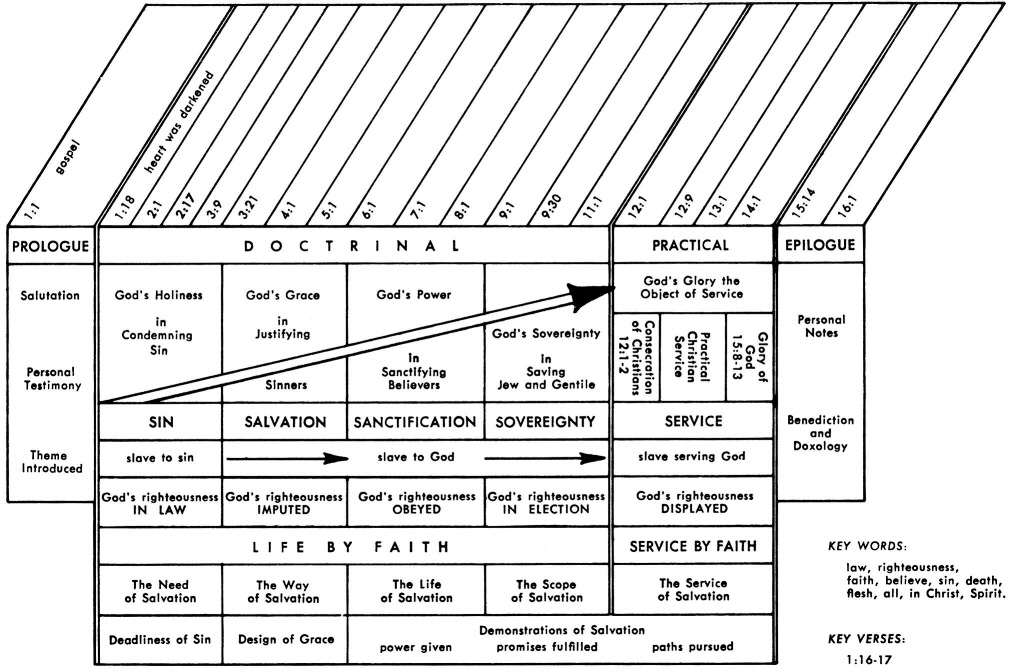
Click chart to enlarge
Chart from recommended resource Jensen's Survey of the NT - used by permission
Romans Overview Chart - Charles Swindoll
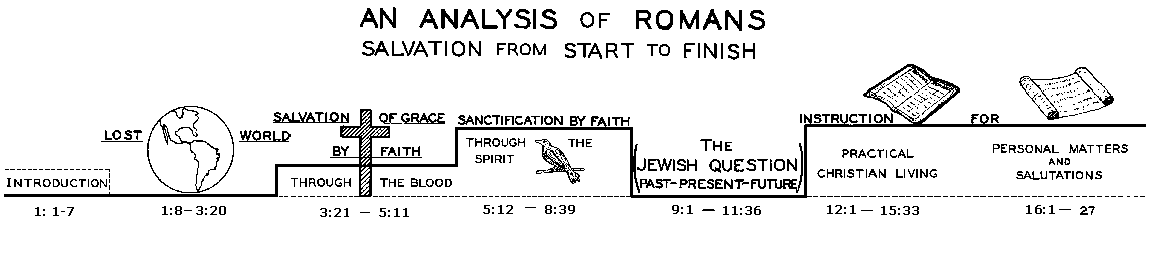
Source: Dr David Cooper
Click to Enlarge
R Ruin (Romans 1:17 – 3:20) – The utter sinfulness of humanity
O Offer (Romans 3:21-31) – God’s offer of justification by grace
M Model (Romans 4:1-25) – Abraham as a model for saving faith
A Access (Romans 5:1-11) – The benefits of justification
N New Adam (Romans 5:12-21) – We are children of two “Adams”
S Struggle w/ Sin (Romans 6-8) Struggle, sanctification, and victory
|
ROMANS ROAD |
||||
| Romans 1:18-3:20 | Romans 3:21-5:21 | Romans 6:1-8:39 | Romans 9:1-11:36 | Romans 12:1-16:27 |
| SIN | SALVATION | SANCTIFICATION | SOVEREIGNTY | SERVICE |
| NEED FOR SALVATION |
WAY OF SALVATION |
LIFE OF SALVATION |
SCOPE OF SALVATION |
SERVICE OF SALVATION |
| God's Holiness In Condemning Sin |
God's Grace In Justifying Sinners |
God's Power In Sanctifying Believers |
God's Sovereignty In Saving Jew and Gentile |
Gods Glory The Object of Service |
| Deadliness of Sin |
Design of Grace |
Demonstration of Salvation | ||
| Power Given | Promises Fulfilled | Paths Pursued | ||
| Righteousness Needed |
Righteousness Credited |
Righteousness Demonstrated |
Righteousness Restored to Israel |
Righteousness Applied |
| God's Righteousness IN LAW |
God's Righteousness IMPUTED |
God's Righteousness OBEYED |
God's Righteousness IN ELECTION |
God's Righteousness DISPLAYED |
| Slaves to Sin | Slaves to God | Slaves Serving God | ||
| Doctrine | Duty | |||
| Life by Faith | Service by Faith | |||
|
Modified from Irving L. Jensen's chart above |
||||
Romans 3:24 being justified as a gift by His grace through the redemption which is in Christ Jesus; (NASB: Lockman)
Greek: dikaioumenoi (PPPMPN) dorean te autou chariti dia tes apolutroseos tes en Christo Iesou:
Amplified: [All] are justified and made upright and in right standing with God, freely and gratuitously by His grace (His unmerited favor and mercy), through the redemption which is [provided] in Christ Jesus, (Amplified Bible - Lockman)
KJV: Being justified freely by his grace through the redemption that is in Christ Jesus:
My Expanded Translation: Being declared righteous at no cost to us (sinners) and the result of no contribution by us (being) freely supplied by God's unmerited favor through the payment of the ransom price to set the captives free, the full price of which is in Christ Jesus (His precious blood Eph 1:7 providing a redemption equating with forgiveness - Col 1:14).
Phillips: Under this divine system a man who has faith is now freely acquitted in the eyes of God by his generous dealing in the redemptive act of Jesus Christ. (Phillips: Touchstone)
Wuest: being justified gratuitously by His grace through the redemption which is in Christ Jesus (Eerdmans)
Young's Literal: and are justified freely by his grace through the redemption that came by Christ Jesus.
BEING JUSTIFIED: dikaioumenoi (PPPMPN):
- Ro 4:16; 5:16, 17, 18, 19; 1Cor 6:11; Eph 2:7, 8, 9, 10; Titus 3:5, 6, 7)
- Romans 3 Resources - Multiple Sermons and Commentaries
JUSTIFICATION
A ONCE FOR ALL ACT IN TIME
Being justified - Note that justified is in the present tense which could be paraphrased "continuously being justified." The passive voice indicates the justification is the result of an outside Source, of course God's Spirit.
- See the Three Tenses of Salvation -
- Past Tense = Justification.
- Present Tense = Sanctification.
- Future Tense = Glorification.
As Morris says, now Paul moves from "From tragedy to triumph." (The Epistle to the Romans)
William Newell - We now come to the greatest single verse in the entire Bible on the manner of justification by faith: We entreat you, study this verse. We have seen many a soul, upon understanding it, come into peace. (Romans: Verse by Verse)
Guzik observes that…Paul develops his teaching about salvation around three themes.
- Justification: an image from the court of law
- Redemption: an image from the slave market)
- Propitiation: an image from the world of religion, appeasing God through sacrifice
Justification solves the problem of man's guilt before a righteous Judge. Redemption solves the problem of man's slavery to sin, the world, and the devil. Propitiation solves the problem of offending God our Creator.
Even as all have sinned and fall short of the glory of God is universal, so is the offer of being justified freely by His grace. It is open to everyone who will believe.
Morris, quoting Moule: "The harlot, the liar, the murderer, are short of it; but so are you. Perhaps they stand at the bottom of a mine, and you on the crest of an Alp; but you are as little able to touch the stars as they." Everyone falls short, but everyone can be justified freely by His grace.
Being justified (1344) (dikaioo from dike = right, expected behavior or conformity, not according to one’s own standard, but according to an imposed standard with prescribed punishment for nonconformity) primarily means to deem to be right. Dikaioo describes the act by which a man is brought into a right state of relationship to God. Dikaioo is a legal term having to do with the law and the the courtroom, where it represented the legally binding verdict of the judge. This is the sense in which Paul uses dikaioo in this section in Romans (Ro 3:21-5:11) in which he unfolds the doctrine of justification.
Dikaioo - 39 times in the NAS, most often in Romans = acknowledged… justice, 1; acquitted, 1; freed, 3; justified, 24; justifier, 1; justifies, 2; justify, 4; vindicated, 3; Mt 11:19; 12:37; Lk. 7:29, 35; 10:29; 16:15; 18:14; Acts 13:38, 39; Ro 2:13; 3:4, 20, 24, 26, 28, 30; 4:2, 5; 5:1, 9; 6:7; 8:30, 33; 1Co 4:4; 6:11; Gal 2:16, 17; 3:8, 11, 24; 5:4; 1Ti 3:16; Titus 3:7; Jas. 2:21, 24, 25
Dikaioo 28 times in Septuagint (LXX) = Ge 38:26; 44:16; Ex 23:7; Deut 25:1; 2Sa 15:4; 1Ki 8:32; 2Chr 6:23; Esther 10:3; Job 33:32; Ps 19:9; 51:4; 73:13; 82:3; 143:2; Isa 1:17; 5:23; 42:21; 43:9, 26; 45:25; 50:8; 53:11; Jer 3:11; Ezek 16:51f; 21:13; 44:24; Mic 6:11; 7:9
The meaning of dikaioo depends on the context and depending on which lexicon you consult you will come up with a variety of definitions so the following is an attempt as classifying most of the NT uses, but please be a Berean and do you own study of this word.
(1) To cause someone to be in a proper or right relation with someone else. This use corresponds to the vitally important truth imputed righteousness and thus means to justify or to declare righteous, which is only accomplished by faith and not by works as explained in definition #2.
Romans 3:24 being justified (declared righteous and in proper or right relation to God) as a gift by His grace through the redemption which is in Christ Jesus
Titus 3:7 that being justified (declared righteous and in proper or right relation to God) by His grace we might be made heirs according to the hope of eternal life.
(2) To show to be right or righteous.
Matthew 11:19 "The Son of Man came eating and drinking, and they say, 'Behold, a gluttonous man and a drunkard, a friend of tax-gatherers and sinners!' Yet wisdom is vindicated (dikaioo - shown to be right, proved to be in the right and accepted by God) by her deeds."
Luke 7:35 "Yet wisdom is vindicated (dikaioo - shown to be right) by all her children."
James uses dikaioo in this sense - to show to be righteous. And so we see that Abraham's works show that he was righteous. He had been declared righteous by faith in Genesis 15:6, but was shown to be righteous in Genesis 22, which is the point that James is making in the following passages.
James 2:21 Was not Abraham our father justified by works, when he offered up Isaac his son on the altar? (Note: Do not misunderstand. James is not using dikaioo in this context to say a Abraham was declared righteous but that he was shown to be righteous by his work - his willingness to offer Isaac. This "work" was the visible manifestation to men of the fact that at some point in time in the past -- Genesis 15:6 -- Abraham had been justified by faith and declared righteous by God on the basis of his faith, not on the basis of his works. This verse illustrates why it one has to be very careful to observe the context when defining any Greek word. Many people read these three passages in James and are confused because they read them in light of definition #1 above which does not apply to this context. The New Living Translation does an excellent job of accurately paraphrasing this passage to give it the intended meaning…
James 2:21 Don't you remember that our ancestor Abraham was shown to be right with God by his actions when he offered his son Isaac on the altar? (NLT)
James 2:24 You see that a man is justified (shown to be righteous) by works, and not by faith alone.
James 2:25 And in the same way was not Rahab the harlot also justified (shown to be righteous) by works, when she received the messengers and sent them out by another way?
In some cases dikaioo refers to Jesus or God Who are demonstrated to be morally right (Divine vindication)…
Romans 3:4 May it never be! Rather, let God be found true, though every man be found a liar, as it is written, "That Thou mightest be justified (shown to be just) in Thy words, And mightest prevail when Thou art judged." (quoting Ps 51:4)
1 Timothy 3:16 (This description refers to Jesus) And by common confession great is the mystery of godliness: He who was revealed in the flesh, Was vindicated (dikaioo - shown to be right) in the Spirit, Beheld by angels, Proclaimed among the nations, Believed on in the world, Taken up in glory.
(3) To make free, liberate, set free or release from the control of . This meaning is similar to another Greek verb eleutheroo. BDAG explains that the idea is "to cause someone to be released from personal or institutional claims that are no longer to be considered pertinent or valid"
Romans 6:7 For he who has died is freed (dikaioo in the passive voice = has been released) from sin (the power of Sin to which we were enslaved)
Acts 13:39 and through Him everyone who believes is freed (dikaioo - passive voice = has been set free) from all things, from which you could not be freed through the Law of Moses.
(4) Acknowledging that someone is just or right.
Luke 7:29 And when all the people and the tax-gatherers heard this, they acknowledged God's justice, (they acknowledged that God's way was right) having been baptized with the baptism of John.
(5) Man declaring that he is just or right. This is something man does and based on his standard of righteousness (self righteousness) not God's standard.
Luke 10:29 But wishing to justify (declare himself righteous) himself, he said to Jesus, "And who is my neighbor?" (Comment: Notice that this young lawyer is trying to limit the demand of the law by asking "Who is my neighbor?" and by limiting it he would then show that he had fulfilled it. In other words this man would judge himself by his own standard of righteousness -- not God's perfect standard -- but he would not be justified in the sense of definition #1)
To understand dikaioo, one needs to understand the root work dike which originally meant manner, tendency and with time came to refer to the designation for the right of established custom or usage. Stated another way, the basic meaning of dike involves the assertion by human society of a certain standard expected by its people which, if not kept, can bring forth ensuing judgment. Thus it can be said that díke is expected behavior or conformity, not according to one's own standard, but according to an imposed standard (here in Romans it is God's standard of righteousness) with prescribed punishment for nonconformity.
Dikaioo ends in "-oo" which in Greek brings out that which a person is. Therefore dikaioo brings out the fact that a person is righteous. It means to declare the rightness of something or someone.
Leon Morris adds a note on dikaioo writing that…
The word is a forensic or legal term with the meaning “acquit”. It is the normal word to use when the accused is declared “Not guilty”. We see its significance in an Old Testament passage:
“When men have a dispute, they are to take it to court and the judges will decide the case, acquitting (or, justifying) the innocent and condemning the guilty” (Deut. 25:1).
Here the legal meaning is plain, and this remains with the word throughout the range of its biblical use. Some argue that it means “to make righteous”, but this cannot be demonstrated. The impossibility of making righteous is clear when the word is used of God (Ro 3:4). It is plain also in the use of the future tense “will be justified” (Ro 2:13), for the reference is to Judgment Day and no one will be “made righteous” on that day. Moreover, that passage refers to “the doers of law” as “justified”, but by definition “doers of law” are righteous: they cannot be “made” righteous. The declaratory meaning is clear. It is to be inferred also from the fact that it stands in opposition to condemnation. “To condemn” does not mean “to make wicked”, but “to declare guilty”; similarly, “to justify” means “to declare just” (Morris, L. The Epistle to the Romans. W. B. Eerdmans; Inter-Varsity Press)
Expositor's Bible Commentary explains dikaioo as follows - In classical Greek the verb dikaioo was sometimes used to mean "do right by a person, give him justice." As a result, it could be used in the sense of "condemn." But in its biblical setting it is used in the opposite sense, namely, "to acquit" (Ex 23:7; Dt 25:1). It is clear both from the OT and the NT that dikaioo is a forensic term; it is the language of the law court. But to settle on "acquittal" as the meaning of justification is to express only a part of the range of the word, even though an important part (Acts 13:39). There is a positive side that is even more prominent in NT usage--"to consider, or declare to be, righteous." The word does not mean "to make righteous," that is, to effect a change of character. Because he considered it ethically deplorable that God should account righteous those who have been and to some extent continue to be sinful, Goodspeed defied the linguistic evidence and rendered dikaioo "to make upright." He failed to realize that the question of character and conduct belongs to a different area, namely, sanctification, and is taken up by Paul in due course, whereas justification relates to status and not to condition. (Gaebelein, F, Editor: Expositor's Bible Commentary 6-Volume New Testament. Zondervan Publishing)
Vine says that dikaioo means "to show, or declare, to be right.” In the N.T. it mostly signifies “to declare a person to be righteous before God." (Vine, W. Collected writings of W. E. Vine. Nashville: Thomas Nelson )
In simple terms dikaioo as used here in Romans means to declare a person to be righteous or right before God. Only God can declare a man righteous and yet men continually seek ways to make themselves righteous.
OH SO CLOSE!
Luke 10:25-29 - In the gospels we encounter a certain lawyer (a scribe who was supposedly an expert in the law of God) approach Jesus to put Him to the test asking
"Teacher, what shall I do to inherit eternal life?" (Lk 10:25).
Jesus responded to the question with another question for this one who knew the Law asking
"What is written in the Law? How does it read to you?" (Lk 10:26)
The lawyer answered Jesus "You shall love the Lord your God with all your heart, and with all your soul, and with all your strength, and with all your mind; and your neighbor as yourself." (Lk 10:27)
This was indeed an excellent answer, the lawyer summing up the requirements of the law (Lev 19:18, Dt 6:5) exactly as Jesus Himself had done on another occasion (see Mt 22:37, 28, 29, 40)
And so Jesus responded
"You have answered correctly; do (present imperative - as the habit of your life - something ultimately only possible in a man or woman who has a supernatural source, i.e., the Holy Spirit Who is given to all who are justified by faith in Christ) this, and you will live. (literally in Greek do and live - "poiei kai zoen")" But wishing to justify (dikaioo) himself, he said to Jesus, “And who is my neighbor?” (Lk 10:28, 29)
"Do… and… live" was indeed the promise of the law (see Lev 18:5, Ezek 20:11). But since no sinner can obey perfectly, the impossible demands of the law were always meant to drive us to seek God's mercy (Gal 3:10, 11, 12, 13, 22, 23, 24, 25) and His righteousness in the Righteous One, the Messiah. The lawyer should have responded with a confession of his guilt, but instead attempted to justify himself with his question "Who is my neighbor?" The prevailing opinion among scribes and Pharisees in Jesus' day was that one’s neighbors were the "righteous" (at least those they considered "righteous"). According to them, the wicked, like tax collectors and especially Samaritans—were to be hated because they were the enemies of God. They cited (Ps 139:21, 22) to justify their position. Jesus teaching on the familiar passage of the good Samaritan demolished any hope this lawyer had to make himself righteous (dikaioo).
Being justified is an act of God (Ro 8:33) Who takes the initiative (cp Ep 1:4, 1Pe 1:2, 2Th 2:13) and provides the means through the redemption which is in Christ Jesus. The sinner who believes in Christ receives God's gift of righteousness (Ro 1:17, Ro 5:17), which then enables God to pronounce him righteous (both Just & Justifier - Ro 3:26). This verse is perhaps the most thorough soteriological (dealing with teaching on salvation) passage in the New Testament.
John MacArthur writes that
Being justified refers back to the “alls” of the previous two verses-all those who have believed, of whom all were sinful. Just as there is no distinction among those who need salvation, there is no distinction among those who receive it, because they all are justified as a gift by His grace.
Dikaioo means to declare the rightness of something or someone. Justification is God’s declaration that all the demands of the law are fulfilled on behalf of the believing sinner through the righteousness of Jesus Christ. Justification is a wholly forensic, or legal, transaction. It changes the judicial standing of the sinner before God. In justification, God imputes (Ed: reckons, places on one's "account") the perfect righteousness of Christ to the believer’s account, then declares the redeemed one fully righteous. Justification must be distinguished from sanctification, in which God actually imparts Christ’s righteousness to the sinner. While the two must be distinguished, justification and sanctification can never be separated. God does not justify whom He does not sanctify. (MacArthur, J: Romans 1-8. Chicago: Moody Press) (Bolding added)
In salvation dikaioo describes the legal act whereby God declares the believing sinner righteous on the basis of the blood of Christ. Justification is not doled out piecemeal over a period of time through mediatorial agents and ritual observances. Stated another way, justification is not a process but is an act that occurs once and need not be repeated. It is something God does, not man. Justification is not subject to recall so that you have to get it over and over again (as in Radical Arminian churches). Justification is not a change wrought by God in us, but a change of our relation to God. Justification describes a person’s status in the sight of the law, not the condition of his or her character. The condition of one’s character and conduct is that with which sanctification deals.
Wiersbe - Do not confuse justification and sanctification. Sanctification is the process whereby God makes the believer more and more like Christ. Sanctification may change from day to day. Justification never changes. When the sinner trusts Christ, God declares him righteous, and that declaration will never be repealed. (Wiersbe, W: Bible Exposition Commentary. 1989. Victor) (Bolding added)
Being justified is once and for all time and as such defines the believers permanent state. Just as you may not be tried for the same crime again after being acquitted, God's justification means you will never be tried or condemned by Him again for your sins--past, present, or future. This is good news indeed.
To reiterate, justification is not an act of God that makes us righteous but is an act of God that declares us righteous based on what Christ accomplished on Calvary.
Jesus, Thy Blood and Righteousness
by Nikolaus von Zinzendorf
Jesus, Thy blood and righteousness
My beauty are, my glorious dress;
’Midst flaming worlds, in these arrayed,
With joy shall I lift up my head.
Bold shall I stand in Thy great day;
For who aught to my charge shall lay?
Fully absolved through these I am
From sin and fear, from guilt and shame.
The holy, meek, unspotted Lamb,
Who from the Father’s bosom came,
Who died for me, e’en me to atone,
Now for my Lord and God I own.
Lord, I believe Thy precious blood,
Which, at the mercy seat of God,
Forever doth for sinners plead,
For me, e’en for my soul, was shed.
Lord, I believe were sinners more
Than sands upon the ocean shore,
Thou hast for all a ransom paid,
For all a full atonement made.
When from the dust of death I rise
To claim my mansion in the skies,
Ev’n then this shall be all my plea,
Jesus hath lived, hath died, for me.
This spotless robe the same appears,
When ruined nature sinks in years;
No age can change its glorious hue,
The robe of Christ is ever new.
Jesus, the endless praise to Thee,
Whose boundless mercy hath for me—
For me a full atonement made,
An everlasting ransom paid.
O let the dead now hear Thy voice;
Now bid Thy banished ones rejoice;
Their beauty this, their glorious dress,
Jesus, Thy blood and righteousness.
MacDonald emphasizes this distinction between "make" and "declare" righteous, writing that…
To justify does not mean to actually make a person righteous. We cannot make God righteous; He already is righteous. But we can declare Him to be righteous. God does not make the believer sinless or righteous in himself. Rather, God puts righteousness to his account. As A. T. Pierson put it,
God in justifying sinners actually calls them righteous when they are not—does not impute sin where sin actually exists, and does impute righteousness where it does not exist. (Believer's Bible Commentary)
At God’s Lighthouse Mission in Manhattan the men who attended services in the ’50s were drilled nightly in Bible verses and in a particular definition of “justified.” Justified, they were taught to repeat, means “just as if I had never sinned in the sight of God.” I was taught this same phrase in Men's Bible Study Fellowship - "Justified" ~ "Just As If I Had Never Sinned". This teaching is not entirely accurate for as discussed above dikaioo, means to be acquitted or to be pronounced righteous. It is not “just as if I had never sinned” and thus it does not go far enough. More accurately it is "just as if I had lived as perfect a life as Jesus did!" Once, when my normal green-tinted sunglasses were lost, I put on a rose-colored pair. And everything I saw through them was rose colored. Justification is a little like this. God sees you and me through "Christ-colored glasses." When God looks at the person who believes in His Son, He sees the righteousness of Jesus Himself. (See more discussion of "Justified-Is "Just-As-If-I'd" Never Sinned" Biblical?)
As someone has well said justification goes beyond acquittal to approval and beyond pardon to promotion. Acquittal means only that a person is set free from a charge. Justification means that positive righteousness is imputed. It is important to realize that justification is a reckoning that takes place in the mind of God. It is not something a believer feels. The believer can be certain it has taken place because the Bible says so. C I Scofield expressed it this way
Justification is that act of God whereby He declares righteous all who believe in Jesus. It is something which takes place in the mind of God, not in the nervous system or emotional nature of the believer.
Dikaioo in other contexts can mean vindicated, proved, pronounced as, declared or shown to be. For example, Paul in recording part of an early church hymn describes Jesus as
He Who was revealed in the flesh, was vindicated (dikaioo) in the Spirit. (NAS,1 Ti 3:16 - note 1 Ti 3:16KJV reads "justified in the Spirit" which is somewhat confusing.)
Comment: Vindicated in this context is easier to understand if translated as "declared (or shown) to be righteous" (with respect to His spiritual nature). The NLT paraphrased version renders it "shown to be righteous by the Spirit"
Dikaioo is used in this way in Romans 3 where Paul writes
let God be found true, though every man be found a liar, as it is written, “That Thou mightest be justified (dikaioo - shown to be right, proved to be right) in Thy words" (see note Romans 3:4)
C H Spurgeon writes
What is justification? A. Justification is an act of God's free grace, wherein he pardons all our sins (Ro 3:24; Eph 1:7), and accepts us as righteous in His sight (2Cor 5:21) only for the righteousness of Christ imputed to us (Ro 5:19), and received by faith alone (Gal 2:16; Php 3:9).
Note: This discussion is not intended to be an exhaustive treatment of the verb dikaioo or of the profound doctrine of justification. For a more exhaustive treatment I would highly recommended Dr Wayne Grudem's work, Systematic Theology). The following quote is taken from his book and emphasizes the crucial importance of an accurate understanding of dikaioo and the doctrine of justification. Grudem writes that…
A right understanding of justification is absolutely crucial to the whole Christian faith. Once Martin Luther realized the truth of justification by faith alone, he became a Christian and overflowed with the new-found joy of the gospel. The primary issue in the Protestant Reformation was a dispute with the Roman Catholic Church over justification. If we are to safeguard the truth of the gospel for future generations, we must understand the truth of justification. Even today, a true view of justification is the dividing line between the biblical gospel of salvation by faith alone and all false gospels of salvation based on good works. (Systematic Theology) (Bolding added)
Question: What is justification? What does it mean to be justified?
Answer: Simply put, to justify is to declare righteous, to make one right with God. Justification is God’s declaring those who receive Christ to be righteous, based on Christ’s righteousness being imputed to the accounts of those who receive Christ (2 Corinthians 5:21). Though justification as a principle is found throughout Scripture, the main passage describing justification in relation to believers is Romans 3:21-26: “But now a righteousness from God, apart from law, has been made known, to which the Law and the prophets testify. This righteousness from God comes through faith in Jesus Christ to all who believe. There is no difference, for all have sinned and fall short of the glory of God, and are justified freely by his grace through the redemption that came by Christ Jesus. God presented him as a sacrifice of atonement, through faith in his blood. He did this to demonstrate his justice, because in his forbearance he had left the sins committed beforehand unpunished—he did it to demonstrate his justice at the present time, so as to be just and the one who justifies those who have faith in Jesus.”
We are justified, declared righteous, at the moment of our salvation. Justification does not make us righteous, but rather pronounces us righteous. Our righteousness comes from placing our faith in the finished work of Jesus Christ. His sacrifice covers our sin, allowing God to see us as perfect and unblemished. Because as believers we are in Christ, God sees Christ’s own righteousness when He looks at us. This meets God’s demands for perfection; thus, He declares us righteous—He justifies us.
Romans 5:18-19 sums it up well: “Consequently, just as the result of one trespass was condemnation for all men, so also the result of one act of righteousness was justification that brings life for all men. For just as through the disobedience of the one man the many were made sinners, so also through the obedience of the one man the many will be made righteous.” It is because of justification that the peace of God can rule in our lives. It is because of justification that believers can have assurance of salvation. It is the fact of justification that enables God to begin the process of sanctification—the process by which God makes us in reality what we already are positionally. “Therefore, since we have been justified through faith, we have peace with God through our Lord Jesus Christ” (Romans 5:1). GotQuestions.org
The words justify, justification, righteous, righteousness, just, right, meet, are all translations of the same Greek root. The verb justify is dikaióō, the noun righteousness, dikaiosune, the adjective righteous, dikaios. This means that all these words have a general meaning that is common to all of them, even though their individual meaning may differ slightly. This again means that there is a definite and vital connection between the act of justifying and the righteousness of the individual who has been justified.
We will look first at the usage of these words in pagan Greek literature.
“In pagan Greece the dikaios person is he who does not selfishly nor yet self-for-gettingly transgress the bounds fixed for him, and gives to everyone his own, yet still desires what is his, and does not in the least withdraw the assertion of his own claims.”
Paul uses dikaios in its purely classical sense in Ro 5:7 (note). In the biblical sense, dikaios is “what is right, conformable to right, answering to the claims of usage, custom, or right… The fundamental idea is that of a state or condition conformable to order, apart from the consideration whether usage or custom or other factors determine the order or direction. Thus, dikaios is synonymous with agathos (good -word study), only that dikaios is a conception of a relation and presupposes a norm, whereas the subject of agathos is its own norm.”
In understanding the words justify and righteous, as they are used in the New Testament, it should always be kept in mind that their meaning is not a subjective one but an objective one. That is, the content of meaning in these words is not to be determined by each individual Bible expositor. If that were the case, what is righteous one day, may not be righteous the next. The content of meaning in that case would be dependent upon the fluctuating standards and ethics of men. With the present trend towards the teaching of the relativity of all truth, this method of interpretation becomes a most vicious thing. What is right one day may be wrong the next.
God is the objective standard which determines the content of meaning of dikaios, and at the same time keeps that content of meaning constant and unchanging, since He is the unchanging One.
Righteousness in the biblical sense is a condition of rightness the standard of which is God, which is estimated according to the divine standard, which shows itself in behavior conformable to God, and has to do above all things with its relation to God, and with the walk before Him. It is, and it is called dikaiosune theou (righteousness of God) (Ro 3:21, Ro1:17), righteousness as it belongs to God, and is of value before Him, Godlike righteousness, see Eph 4:24 (note); with this righteousness thus defined, the gospel (Ro 1:17) comes into the world of nations which had been wont to measure by a different standard. Righteousness in the Scripture sense is a thoroughly religious conception, designating the normal relation of men and their acts, etc., to God. Righteousness in the profane mind is a preponderatingly social virtue, only with a certain religious background.”
Justification in the Bible sense therefore is the act of God removing from the believing sinner, his guilt and the penalty incurred by that guilt, and bestowing a positive righteousness, Christ Jesus Himself in Whom the believer stands, not only innocent and uncondemned, but actually righteous in point of law for time and for eternity. The words justify, justification, righteous, righteousness, as used of man in his relation to God, have a legal, judicial basis. God is the Judge, man the defendant. God is the standard of all righteousness. The white linen curtains of the court of the Tabernacle, symbolized the righteousness which God is, the righteousness which God demands of any human being who desires to fellowship with Him, and the righteousness which God provides on the basis of the acceptance on the sinner’s part, of the Lord Jesus who perfectly satisfied the just demands of God’s holy law which we broke. A just person therefore is one who has been thus declared righteous (Ro 1:17). The word is used in its non-legal sense in Phil 1:7 (note) and Lk 12:57 for instance, where it speaks of conduct that is conformable to what is right. (Wuest, K. S. Wuest's Word Studies from the Greek New Testament:)
Gingrich clarifies the meaning of justification emphasizing that it is…not an executive act of mercy (pardoning) nor an efficient act of power (sanctifying or making righteous), but is a judicial act of grace (declaring righteous). To pardon means to mercifully remit punishment without removing the grounds for condemnation. To sanctify means to make holy and good, to change moral character. To justify means to declare righteous (or just), to impute righteousness to, to proclaim that one is in right relationship to God’s holy law, to announce that the demands of justice have been satisfied, to declare that there are no grounds for condemnation and that punishment cannot be justly imposed. The opposite of to pardon is to punish; the opposite of to sanctify is to make unholy; the opposite of to justify is to condemn. Proverbs 17:15, Isaiah 5:23; Romans 2:13 (note); Ro 3:4 (note) prove that justifying is not pardoning or sanctifying, but is the judicial proclamation of freedom from condemnation, based, not upon something done by the sinner, nor upon something done by God in the sinner but upon something done by Christ for, and then imputed to, the sinner. (Gingrich, R. E. The Book of Romans)
AS A GIFT: dorean:
- Romans 3 Resources - Multiple Sermons and Commentaries
GOD'S PRICELESS
FREE BUT COSTLY GIFT
It is not a matter of wages or merit but is a free gift that originates in the magnanimous grace of God. It means being justified without any prior conditions being met. We do not merit justification, but we enjoy it because of Christ's precious blood given as our ransom price.
Gift is a word which speaks of the great grace of our great God.
Gift (1432) (dorean from dorea = a gift, something bestowed freely, without price, or compensation, as in Jn 4:10; Ac 2:38; 2Co 9:15,, God is always Giver of dorea) conveys the basic meaning of "for nothing". It pertains to being freely given, given without charge or without payment. As a free gift or gratis. Undeserved.
Dorean emphasizes the free character of the gift, given spontaneously and without reference to human merit.
Here in Romans 3:24 the prominent thought is the grace of the Giver.
In some contexts dorean conveys the idea of needlessly as in Gal 2:21
"I do not nullify the grace of God; for if righteousness comes through the Law, then Christ died needlessly (or "for nothing", "not without impact").
In other contexts dorean means without a cause or reason (similar use in Lxx of Ge 29:15) or undeservedly, as when Jesus explained…
"But they have done this (they have both seen and hated Me and My Father as well) in order that the word may be fulfilled that is written in their Law, 'THEY HATED ME WITHOUT A CAUSE.' (John 15:25)
Webster says that a gift is something voluntarily transferred by one person to another without compensation.
Dorean is found 8 times in the NAS
Matthew 10:8 "Heal the sick, raise the dead, cleanse the lepers, cast out demons; freely you received, freely give.
John 15:25 "But they have done this in order that the word may be fulfilled that is written in their Law, 'They hated Me without a cause.' (cp use of dorea in Lxx of Ps 35:19, 69:4, 109:3, 119:161, Job 1:9 "for no reason")
Romans 3:24 (note) being justified as a gift by His grace through the redemption which is in Christ Jesus;
2 Corinthians 11:7 Or did I commit a sin in humbling myself that you might be exalted, because I preached the gospel of God to you without charge?
Galatians 2:21 "I do not nullify the grace of God; for if righteousness comes through the Law, then Christ died needlessly (in vain, done without due result, without or for no purpose, cp use in Lxx of 1Ki 2:31 "without cause")."
Comment: Don't miss what Paul is stating in this verse - His point is that if righeousness can be obtained by sinful men by keeping the law, then Christ's death on the Cross was of no purpose and did not need to occur.
2Th 3:8 nor did we eat anyone's bread without paying for it, but with labor and hardship we kept working night and day so that we might not be a burden to any of you;
Rev 21:6 (note) And He said to me, "It is done. I am the Alpha and the Omega, the beginning and the end. I will give to the one who thirsts from the spring of the water of life without cost.
Rev 22:17 (note) And the Spirit and the bride say, "Come." And let the one who hears say, "Come." And let the one who is thirsty come; let the one who wishes take the water of life without cost.
Guzik writes that…Freely is the Greek word dorean. The way this word is used in other New Testament passages helps us understand the word. Matthew 10:8 (Freely you have received, freely give) and Revelation 22:17 (And whoever desires, let him take the water of life freely) show that the word means truly free, not just "cheap" or "discounted." Perhaps the most striking use of the ancient Greek word dorean is in John 15:25: They hated me without a cause (dorean). Even as there was nothing in Jesus deserving of man's hatred, so there is nothing in us deserving of justification - all the reasons are in God. Calvin on the use of both the words freely and grace: He thus repeats the word to show that the whole is from God, and nothing from us … lest we should imagine a half kind of grace, he affirms more strongly what he means by a repetition, and claims for God's mercy alone the whole glory of our righteousness.
Dorean is found 26 times in the non-apocryphal Septuagint (LXX) (Ge 29:15; Ex 21:2, 11; Nu 11:5; 1Sa 19:5; 25:31; 2Sa 24:24; 1Ki 2:31; 1Chr 21:24; Job 1:9; Ps 35:7, 19; 69:4; 109:3; 119:161; 120:6; Isa 52:3, 5; Jer 22:13; Lam 3:52; Mal 1:10)
Exodus 21:2 "If you buy a Hebrew slave, he shall serve for six years; but on the seventh he shall go out as a free man without payment (Heb = chinnam = freely, undeservedly, without cause, for no purpose, in vain; Lxx = dorea).
2 Samuel 24:24 (1Chr 21:24) However, the king said to Araunah, "No, but I will surely buy it from you for a price, for I will not offer burnt offerings to the LORD my God which cost me nothing (Heb = chinnam = freely, undeservedly, without cause, for no purpose, in vain; Lxx = dorea)." So David bought the threshing floor and the oxen for fifty shekels of silver.
Dorean means that God declares a believer righteous without any cause or legitimate reason. In other words, there is nothing in mankind merits the declaration of righteousness by God. Justification is a gracious gift which God extends to the repentant, believing sinner, wholly apart from human merit or work. That gift cost God the suffering and death of His own Son on the cross, so that, for the believer, there is nothing left to pay. How fitting that the Bible ends with God's invitation
And the Spirit and the bride say, "Come." And let the one who hears say, "Come." And let the one who is thirsty come; let the one who wishes take the water of life without cost (literally "as a gift" = dorean). (Rev 22:17)(note)
McGee emphasizes this point writing that…Freely is the Greek word dorean, translated in John 15:25 “without a cause.” Our Lord Jesus said that they hated Him freely, without a cause—there was no basis for it. Now Paul is saying, Being justified freely—without a cause. There is no explanation in us. God doesn’t say, “Oh, they are such wonderful people, I’ll have to do something for them!” As we have seen before, there is nothing in us that would call out the grace of God, other than our great need. We are justified without a cause. It is by His grace, which means that there is no merit on our part. Grace is unmerited favor; it is love in action. (McGee, J V: Thru the Bible Commentary: Nashville: Thomas Nelson)
Stated another way, justification is not based in any way on our moral improvement.
As William Newell says…We are justified dorean-freely, gratis, gratuitously, giftwise, without a cause in us! This great fact should deliver just now some reader who has been looking within, to his spiritual state, or feelings, or prayers, as a ground of peace. (Romans 3 Commentary)
Barnhouse has this to say about dorean…When we understand this (word dorean), we can see the true basis of our salvation. There was absolutely nothing within man that could recommend him to God. God did not sit in Heaven and look down upon this earth until He had found something in some men that recommended them to Him. He gave salvation to men who deserved Hell. There will not be one person in Heaven who deserved Heaven except the Lord Jesus Christ. He is the only one who merited Heaven. But an innumerable company who merited Hell are going to be in Heaven simply because the grace of God decided that they should be there. (God's Remedy : Romans 3:21-4:1-25)
Peter uses the verb form of dorean (doreomai) in 2 Peter 1:3-4 writing that
His divine power has granted (doreomai from dorea - gift, stressing the gratuitous character) to us everything (How much?) pertaining to life and godliness (eusebeia - word study), through the true knowledge (epignosis - word study) of Him who called us by His own glory and excellence. For by these He has granted (doreomai) to us His precious (timios - word study) and magnificent promises, in order that by them you might become partakers of the divine nature, having escaped (apopheugo - word study) the corruption that is in the world by lust (epithumia - word study). (see note 2 Peter 1:3-4)
Justification is not a wage that God owes us--the only wage He owes us is death (Ro 6:23); it is a gift that He offers freely.
Justification is not reward that we deserve but in fact is charity for the undeserving.
The forgiveness of sins and the righteousness of God are free gifts. That means they cost us nothing because they cost Christ everything! They cannot be earned with works or inherited through parents or absorbed through sacraments. They are free, and can only be received by faith.
Nothing in my hand I bring;
Simply to Thy cross I cling
(ROCK OF AGES)
Awake My Soul To Joyful Lays**
by Samuel Medley, ca 1782
Awake, my soul, in joyful lays,
And sing my great Redeemer’s praise;
He justly claims a song from me,
His loving kindness, oh, how free.
Lovingkindness, lovingkindness,
His lovingkindness, O how free!
He saw me ruined in the fall,
And loved me, notwithstanding all.
He saved me from my lost estate,
Lovingkindness, lovingkindness,
His lovingkindness, O how great!
Though numerous hosts of mighty foes,
Though earth and hell my way oppose,
He safely leads my soul along -
His lovingkindness, O how strong!
Lovingkindness, lovingkindness,
His lovingkindness, O how strong!
When trouble, like a gloomy cloud,
Has gathered thick and thundered loud,
He near my soul has always stood -
His lovingkindness, O how good!
Lovingkindness, lovingkindness,
His lovingkindness, O how good!
Often I feel my sinful heart
Prone from my Jesus to depart;
But though I have him oft forgot,
His lovingkindness changes not.
Lovingkindness, lovingkindness,
His lovingkindness changes not.
Soon I shall pass the gloomy vale,
Soon all my mortal powers must fail;
O! may my last expiring breath
His lovingkindness sing in death.
Lovingkindness, lovingkindness,
His lovingkindness sing in death.
Then let me mount and soar away
To the bright world of endless day;
And sing with raptures and surprise,
His lovingkindness in the skies.
Lovingkindness, lovingkindness,
His lovingkindness in the skies.
** Lays = Songs
BY HIS GRACE: te autou chariti:
- Romans 3 Resources - Multiple Sermons and Commentaries
HIS AMAZING
GRACE
Grace (5485) (charis - English = charity) (Click in depth study of charis) is favor or kindness shown without regard to the worth or merit of the one who receives it and in spite of what that person deserves. An accurate succinct definition of grace is the unmerited favor of God toward man.
Newell writes that…
our word "charity" has been narrowed down in our poor thought and speech to handing out a dole to the needy. But as used by God, this word grace (charis), means the going forth in boundless oceans, according to Himself, of His mighty love. who "so loved the world that He gave His only begotten Son." The grace of God is infinite love operating by an infinite means, -the sacrifice of Christ; and in infinite freedom, unhindered, now, by the temporary restrictions of the Law.
G.R.A.C.E. (God's Riches At Christ's Expense) wholly apart from any merit in ourselves. God's grace is undeserved, unsought, and unbought.
Girdlestone writes that
Grace is the free bestowal of kindness on one who has neither claim upon our bounty, nor adequate compensation to make for it. (Girdlestone, R. B. Synonyms of the Old Testament)
MacArthur - The law reveals God’s righteousness and exposes man’s unrighteousness. Grace, on the other hand, not only reveals God’s righteousness but actually gives His righteousness to those who trust in His Son. (MacArthur, J: Romans 1-8. Chicago: Moody Press)
Tyndale Bible Dictionary - Grace is the dimension of divine activity that enables God to confront human indifference and rebellion with an inexhaustible capacity to forgive and to bless." (Elwell, W. A., & Comfort, P. W)
Grace is the good that you get from someone when he owes you nothing. So what Paul means when he says that we are "justified as a gift by his grace" is that we can't work for justification. The phrase "as a gift" means you can't pay for it. And the phrase "by his grace" means you can't work for it.
Barnhouse tells the following story that speaks of God's gracious gift…
In the days of Moody, there was a minister named Harry Morehouse who often helped Moody in his campaigns. One morning he was walking along the street in a poor part of one of our great cities and witnessed a minor tragedy. A small boy, who could not have been more than five or six years of age, came out of a store with a pitcher of milk in his hands. The little fellow was making his way carefully along the street when he slipped and fell, the pitcher breaking, and the milk running all over the sidewalk. He let out a wail, and Harry Morehouse rushed to see if he were hurt. There was no physical damage but he would not be consoled, crying out over and over, “My mama’ll whip me! My mama’ll whip me.”
Mr. Morehouse said to him, “Maybe the pitcher is not broken in too many pieces; let us see if we can put it together again.” The boy stopped crying at once, as he had no doubt seen bits of crockery glued together to remake a broken plate or cup. He watched as Mr. Morehouse placed the base of the pitcher on the sidewalk and started building up the pieces. There were one or two failures and the pieces fell apart. At each failure the boy started crying again, but was silenced by the big preacher who was helping him so much. Finally, the entire pitcher was reconstructed from the pieces, and it stood there in perfect shape on the sidewalk. The little fellow was given the handle, and he poked it toward the place where it belonged, and, of course, knocked the whole thing apart once more. This time there was no stopping his tears, and it was then that Mr. Morehouse gathered the boy in his arms and walked down the street with him to a nearby crockery store. He entered with the lad and bought a new pitcher. Then he went back to the milk store, had the pitcher washed and filled with milk. Carrying the boy on one arm and the pitcher of milk in the other hand, he followed the boy’s instructions until they arrived at his home. Very gently he deposited the lad on his front steps, carefully put the pitcher in his hands and then said to him, “Now will your mama whip you?” A smile broke on the boy’s streaked face, and he answered, “Aw, no sir! ’cause it’s a lot better pitcher ’an we had before.”
The story may be very simple, but it represents faintly what the Lord Jesus Christ did for me and for you. Whether you will accept the fact or not, you had dropped the pitcher of your life and its milk was spilled beyond regathering. You may have spent much time in trying to patch the pieces together again, but God assures you that you are broken beyond repair. It was when we were thus, broken and hopeless, in the despair of our lost soul and our crashed hopes that the Lord Jesus intervened to save us. He may have watched our efforts at patching for a while, until we could come to the place where we believed beyond question that it is impossible for us to repair our lives in a way that would ever satisfy the holiness of the Heavenly Father. It was then that He carried us in His arms and purchased for us an entirely new nature, a new life, which He imparted to us on the basis of His loving kindness and tender mercies. It was not because there was good in us, but because there was grace in Him. It was not because there was righteousness in our hearts, but because there was grace in His heart. (Ibid)
William Newell describing grace wrote that…
“The grace of God is infinite love operating by an infinite means—the sacrifice of Christ; and an infinite freedom, unhindered, now, by the temporary restrictions of the law… Everything connected with God’s salvation is glad in bestowment, infinite in extent, and unchangeable in its character.” (Romans 3 Commentary)
In order to avoid confusion later on, we should pause here to explain that there are six different aspects of justification in the NT. We are said to be justified by grace, by faith, by blood, by power, by God, and by works; yet there is no contradiction or conflict.
1) We are justified by grace— we do not deserve it.
2) We are justified by faith (see note Romans 5:1)—that means that we have to receive it by believing on the Lord Jesus Christ.
3) We are justified by blood (see note Romans 5:9)—that refers to the price the Savior paid in order that we might be justified.
4) We are justified by power (see notes Romans 1:16, Ro 4:24-25)—the same power that raised the Lord Jesus from the dead.
5) We are justified by God (see note Romans 8:33)—He is the One who reckons us righteous.
6) We are justified by works (Ja 2:24)—not meaning that good works earn justification, but that they are the evidence that we have been justified. We are shown to be justified by our works.
THROUGH THE REDEMPTION WHICH IS IN CHRIST JESUS: dia tes apolutroseos tes en Christo Iesou:
- Ro 5:9; Isa 53:11; Mt 20:28; Eph 1:6,7; Col 1:14; 1Ti 2:6; Titus 2:14; Heb 9:2, 3, 4, 5, 6, 7, 8, 9, 10, 11, 12, 13, 14; 1Pet 1:18,19; Rev 5:9; 7:14
- Mt 20:28 Mk 10:45 Lk 21:28 Acts 20:28 Ro 3:24,3:25 Ro 8:23 1Cor 1:30 Gal 3:13 Eph 1:7, 1:14, 4:30, 5:2, 1Ti 2:6 Titus 2:14 Heb 9:12,22, 10:12, 13, 14 1Pe 1:18, 19, 20, 3:18, 1Jn 2:2 Rev 1:5, 5:9, 14:4)
- For more on redemption see related resources - Baker's Evangelical Dictionary of Theology
- Romans 3 Resources - Multiple Sermons and Commentaries
REDEEMED BY THE
BLOOD OF THE LAMB
Click following for Dr Wayne Barber on redemption in Ephesians Message1 Messages 2-4)
act of liberation (NEB)
Related Resource:
- Click to see how to perform Greek word study using apolutrosis as the example.
And so Paul teaches that God grace makes Him favorably disposed to do justify sinners, not because of any merit in them but because He is gracious and chooses to manifest his grace towards men. But can God do this simply by a decision of his will without any objective action on his part? Not according to this verse, so that Paul goes on to explain that sinners can be pronounced righteous because He has acting in providing redemption ("through the redemption").
Christ Jesus is our "Redeemer" which although not used as a title in the New Testament is found at least some 19 times in the OT (Ruth 4:14; Job 19:25; Ps 19:14; 78:35; Pr 23:11; Isa 41:14; 43:14; 44:6, 24; 47:4; 48:17; 49:7, 26; 54:5, 8; 59:20; 60:16; 63:16; Jer 50:34)
WHEN I SURVEY THE WONDROUS CROSS
(Play Isaac Watt's hymn)
When I survey the wondrous cross
On which the Prince of Glory died,
My richest gain I count but loss,
And pour contempt on all my pride.
Forbid it, Lord, that I should boast,
Save in the death of Christ my God:
All the vain things that charm me most,
I sacrifice them to his blood.
See, from his head, his hands, his feet,
Sorrow and love flow mingled down:
Did e’er such love and sorrow meet,
Or thorns compose so rich a crown?
His dying crimson, like a robe,
Spread o’er his body on the tree;
Then am I dead to all the globe,
And all the globe is dead to me.
Were the whole realm of nature mine,
That were a present far too small;
Love so amazing, so divine,
Demands my soul, my life, my all.
Through (1223) (dia) is a marker by which something is accomplished, in this case explaining how "justification" is made available to undeserving sinners. See short study on the phrase through Him = through Christ.
Spurgeon writes…
Now there comes in a new principle, — the principle of grace, which accomplishes what the law never could accomplish; that is, the free justification of all the guilty ones who believe in Jesus. And this justification is a righteous one, seeing that it is based upon “the redemption that is in Christ Jesus:”
I have heard of Robert Burns, that on one occasion when at church, he sat in a pew with a young lady whom he observed to be much affected by certain terrible passages of Scripture which the minister quoted in his sermon. The wicked wag scribbled on a piece of paper a verse which he passed to her. I fear that the sub-stance of that verse has been whispered into many of your ears often:
Fair maid, you need not take the hint,
Nor idle texts pursue;
'Twas only sinners that he meant,
Not angels such as you.
This sermon is meant for those who think themselves angels as well as for those who know them-selves to be sinners. Cease from all dreamy confidences. Arouse your-selves from proud self-content, and come to Jesus the Savior, who alone can save from sin and death.
Particular Redemption is Charles Haddon Spurgeon's initial foray into teaching his young London flock the "deep things of God." Click the sermon and read his fascinating introduction and explanation. What is intriguing is that he began his introduction into the "deep things of God" with this sermon on "the doctrine of Redemption.
"He gave his life a ransom for many." (Mt 20:28)
Spurgeon writes
"But now, since the circumstances are changed, the teaching will be changed also. I shall not now simply confine myself to the doctrine of faith, or the teaching of believer's baptism; I shall not stay upon the surface of matters, but shall venture, as God shall guide me, to enter into those things that lie at the basis of the religion that we hold so dear. I shall not blush to preach before you the doctrine of God's Divine Sovereignty; I shall not stagger to preach in the most unreserved and unguarded manner the doctrine of election. I shall not be afraid to propound the great truth of the final perseverance of the saints; I shall not withhold that undoubted truth of Scripture, the effectual calling of God's elect; I shall endeavour, as God shall help me, to keep back nothing from you who have become my flock. Seeing that many of you have now "tasted that the Lord is gracious," we will endeavour to go through the whole system of the doctrines of grace, that saints may be edified and built up in their most holy faith…
The doctrine of Redemption is one of the most important doctrines of the system of faith. A mistake on this point will inevitably lead to a mistake through the entire system of our belief." (Bolding added. Excerpt from his sermon Particular Redemption, see Spurgeon's other sermons Plenteous Redemption, Full Redemption; Redemption Through Blood, the Gracious Forgiveness of Sins; Bought With a Price) (Click for a similar thought by John Piper)
Redemption (629)(apolutrosis from apo = marker of dissociation or separation + lutroo = to redeem <> from lutron/lytron = ransom <> from lúo = loosen what is bound, loose any person tied or fastened) is the payment of a price to ransom (lutron/lytron = money for a ransom = ransom or price paid for a slave who is then set free by the one who bought him), to release (of someone from the power of someone else), to buy back or to deliver one from a situation from in which one is powerless to liberate themselves from or for which the penalty was so costly that they could never hope to pay the ransom price. In other words, the idea of redemption is deliverance or release by payment of a ransom.
Gary Hill on apolutrosis - apolytrōsis ("redemption, re-purchase") emphasizes the distance ("safety-margin") between the rescued person and what previously enslaved them. For believers, the prefix (apó) looks back to God's effective work of grace which purchased them from the debt of sin, and bringing them to their new status of being in Christ. Apolytrōsis ("redemption-freedom") is only purchased by the blood of the Lamb – and hence always freely given by the Lord, through faith. Accordingly faith (4102/pístis) and 629 (apolýtrōsis) are directly associated in the NT (see Ro 3:22-26; Eph 1:14,15; Heb 11:33-35). (Discovery Bible)
ILLUSTRATION - An uncle took his young nephew to swim in the ocean when the boy was suddenly attacked by a shark – bitting him so hard it completely severed his leg. With great courage the uncle grabbed a baseball bat, jumped into the water with the shark, and clubbed it until the shark released his nephew's detached leg! The uncle then picked up his nephew and his severed leg and raced to the hospital. Doctors successfully reattached the leg and his nephew was able to walk again. This provides a picture of redemption: winning back what was "lost"! Infinitely greater is our redemption by Christ so we can regain what we have forfeited by our sins! Christ won this back at Calvary by the price of His own blood.Eph 1:7." (Gary Hill)
Apolutrosis is used only once in the Septuagint in Da 4:19 where it refers to the time of Nebuchadnezzar's recovery from his madness without any suggestion of price or cost.
Rightemire rightly notes that…
The central theme of redemption in Scripture is that God has taken the initiative to act compassionately on behalf of those who are powerless to help themselves. The New Testament makes clear that divine redemption includes God's identification with humanity in its plight, and the securing of liberation of humankind through the obedience, suffering, death, and resurrection of the incarnate Son. (Redeem, Redemption - from the well done summary article in Baker's Evangelical Dictionary)
Spurgeon writes that…
The figure of redemption is very simple, and has been very frequently used in Scripture. When a prisoner has been taken captive, and has been made a slave by some barbarous power, it has been usual, before he could be set free, that a ransom price should be paid down. Now, we being, by the fall of Adam, prone to guiltiness, and, indeed, virtually guilty, we were by the irreproachable judgment of God given up to the vengeance of the law; we were given into the hands of justice; justice claimed us to be his bond slaves for ever, unless we could pay a ransom, whereby our souls could be redeemed. We were, indeed, poor as owlets, we had not wherewith to bless ourselves. We were, as our hymn hath worded it, "bankrupt debtors;" an execution was put into our house; all we had was sold; we were left naked, and poor, and miserable, and we could by no means find a ransom; it was just then that Christ stepped in, stood sponsor for us, and, in the room and stead of all believers, did pay the ransom price, that we might in that hour be delivered from the curse of the law and the vengeance of God, and go our way, clean, free, justified by his blood. (Spurgeon's sermon Justification by Grace)
Apolutrosis is found 10 times in the NT and is translated - redemption, 9; release, 1.
Luke 21:28 "But when these things (Always stop and ask "What things?" - then go back and read the preceding context - see question posed to Jesus in Lk 21:7 - ) begin to take place, straighten up and lift up your heads, because your redemption (future tense salvation - glorification, which marks the consummation and completion of our redemptions - cp Ep 1:14 below) is drawing near."
Romans 3:24 being justified as a gift by His grace through the redemption which is in Christ Jesus;
Romans 8:23 And not only this, but also we ourselves, having the first fruits of the Spirit, even we ourselves groan within ourselves, waiting eagerly for our adoption as sons, the redemption of our body.
1 Corinthians 1:30 But by His doing you are in Christ Jesus, who became to us wisdom from God, and righteousness and sanctification, and redemption,
Ephesians 1:7 (note) In Him we have redemption through His blood, the forgiveness of our trespasses, according to the riches of His grace,
Ephesians 1:14 (note) who is given as a pledge of our inheritance, with a view to the redemption of God's own possession, to the praise of His glory.
Ephesians 4:30 (note) And do not grieve the Holy Spirit of God, by whom you were sealed for the day of redemption.
Colossians 1:14 (note) in Whom we have redemption, the forgiveness of sins.
Hebrews 9:15 (note) And for this reason He is the mediator of a new covenant, in order that since a death has taken place for the redemption of the transgressions that were committed under the first covenant, those who have been called may receive the promise of the eternal inheritance.
Hebrews 11:35 (note) Women received back their dead by resurrection; and others were tortured, not accepting their release, in order that they might obtain a better resurrection;
Thayer - Everywhere in the New Testament this word is used to denote deliverance effected through the death of Christ from the retributive wrath of a holy God and the merited penalty of sin.
Ryrie (Ryrie Study Bible) adds that…
Three ideas are involved in the doctrine of redemption:
(1) paying the ransom with the blood of Christ
1Cor 6:20 For you have been bought with a price: therefore glorify God in your body.
Rev 5:9 And they sang a new song, saying, "Worthy art Thou to take the book, and to break its seals; for Thou wast slain, and didst purchase for God with Thy blood men from every tribe and tongue and people and nation.
(2) removal from the curse of the law
Gal 3:13 Christ redeemed us from the curse of the Law, having become a curse for us-- for it is written, "CURSED IS EVERYONE WHO HANGS ON A TREE"
Gal 4:5 in order that He might redeem those who were under the Law, that we might receive the adoption as sons.
(3) release from the bondage of sin into the freedom of grace (here and in 1 Peter 1:18).
1Peter 1:18 knowing that you were not redeemed with perishable things like silver or gold from your futile way of life inherited from your forefathers, (see note)
Redemption is always through His blood; i.e., through the death of Christ (Col 1:14).
Colossians 1:14 in Whom we have redemption the forgiveness of sins. (see note)
Newell exhorts us - Before you leave verse 24, apply it to yourself, if you are a believer. Say of yourself: "God has declared me righteous without any cause in me, by His grace, through the redemption from sin's penalty that is in Christ Jesus." It is the bold believing use for ourselves of the Scripture we learn, that God desires; and not merely the knowledge of Scripture. (Romans 3 Commentary)
Barclay writes that apolutrosis conveys "In every case the conception (of) the delivering of a man from a situation from which he was powerless to liberate himself or from a penalty which he himself could never have paid." He goes on to relate that the Roman philosopher Seneca who tutored and advised Nero was "full of this kind of feeling of helpless frustration. Men, he said, were overwhelmingly conscious of their inefficiency in necessary things. He said of himself that he was a homo non tolerabilis, a man not to be tolerated. Men, he said with a kind of despair, love their vices and hate them at the same time. What men need, he cried, is a hand let down to lift them up. The highest thinkers in the pagan world knew that they were in the grip of something from which they were helpless to deliver themselves. They needed liberation. It was just that liberation which Jesus Christ brought. It is still true that he can liberate men from helpless slavery to the things which attract and disgust them at one and the same time." (Barclay, W: The Daily Study Bible Series, Rev. ed. Philadelphia: The Westminster Press)
Apolutrosis was used was used in secular Greek as a technical term for money paid to buy back and set free prisoners of war or to emancipate (= to liberate a person from subjection or domination, to free from restraint, control, or the power of another) slaves from their masters.
Apolutrosis would have been a very meaningful term to the first century reader as there were by some accounts up to 60 million slaves in the Roman Empire! Many of these slaves became Christians and fellowshipped in the local assemblies. A slave could purchase his own freedom, if he could collect sufficient funds or his master could sell him to someone who would pay the price and set him free. Redemption was a precious thing in Paul's day.
Jesus answering the unbelieving Jews who claimed never to have been enslaved to anyone (which of course was incorrect historically)
"answered them" declaring "Truly, truly, I say to you, everyone who commits sin is the slave of sin." (Jn 8:34)
Believers have been ransomed, bought out of slavery to sin, like the redemption of a bondservant by a kinsman-redeemer (Lev 25:49).
Before redemption we were held captive by Satan to do his will and were enslaved to our old sin nature inherited from Adam. As noted above a Roman or Grecian slave could be freed with the payment of money, but no amount of money can set an enslaved sinner free.
The redemption of a sinner is only possible by payment of the ransom price, the blood of Christ. Peter writes that believers
were not redeemed (lutroo) with perishable things like silver or gold from your futile (a lifestyle that is without purpose, unfruitful, and useless) way of life inherited from your forefathers, but with precious blood, as of a lamb unblemished and spotless, the blood of Christ. (see note 1 Peter 1:18-19, cf 1Co 6:20; Rev 5:9)
Jesus explained to His disciples that
"even the Son of Man did not come to be served, but to serve, and to give His life a ransom (lutron = the ransom price) for many." (Mk 10:45 cf Mt 20:28)
I Gave My Life for Thee
Frances Ridley Havergal
(Her first hymn!)
I gave My life for thee,
My precious blood I shed;
That thou might ransomed be,
And quickened from the dead.
I gave, I gave, My life for thee,
What hast thou given for Me?
Jamieson comments that…
through the redemption that is in Christ Jesus (is) a most important clause; teaching us that though justification is quite gratuitous, it is not a mere fiat of the divine will, but based on a "Redemption," that is, "the payment of a Ransom," in Christ's death. That this is the sense of the word "redemption," when applied to Christ's death, will appear clear to any impartial student of the passages where it occurs.
Guzik - The word redemption had its origin in the release of prisoners of war on payment of a price and was know as the "ransom." As time went on, it was extended to include the freeing of slaves, again by the payment of a price. The idea of redemption means that Jesus bought us, therefore we belong to Him. Paul expressed this thought in another letter: For you were bought at a price; therefore glorify God in your body and in your spirit, which are God's. (1Co 6:20) (Ref)
A dignified looking lady once approached the great preacher Dr. G. Campbell Morgan and said, “Dr. Morgan, I don’t like to hear about the blood. It is repulsive to me and offends my esthetic nature." Dr. Morgan replied, “I agree with you that it is repulsive, but the only thing repulsive about it is your sin and mine." It is repulsive to man, but it is through His blood that we have redemption.
Paul writes that in Christ
"we have redemption through His blood, the forgiveness of our trespasses, according to the riches of His grace, which He lavished upon us." (Eph 1:7-8)
Christ's shed blood is a metonym (figure of speech in which one thing is designated by the mention of something associated with it) for death, the penalty and the price of sin. Christ’s death, by the shedding of His blood, was the substitute for our death and the ransom price that freed us from the bondage and guilt of our old Master "Sin" and introduced us into a life of liberty.
Paul gives us an interesting "definition" if you will of "redemption" writing that in Christ
"we have redemption (apolutrosis), the forgiveness of sins." (Colossians 1:14)
Christ's Blood shed for me for the forgiveness of sins. His death for my life. Redemption results in the forgiveness of sins.
Paul explains that in regard to our salvation we can never boast about anything but the Lord for
by His doing you are in Christ Jesus, Who became to us wisdom from God, and righteousness and sanctification, and redemption (apolutrosis)" (1Cor 1:30)
Paul explains that the Holy Spirit
is given as a pledge of our inheritance, with a view to the redemption (apolutrosis) of God's own possession, to the praise of His glory." (Eph 1:14) (Comment: This is a reference to our "future" redemption)
Later in the same letter he makes another reference to our future redemption, admonishing the saints not to
grieve the Holy Spirit of God, by whom you were sealed for the day of redemption (apolutrosis)" (Eph 4:30)
Comment: Here Paul refers to that future day when our bodies are glorified, that day when final redemption is realized. It is worth noting therefore that Christ's death on the cross has purchased not only present but final liberation. This is good news beloved
In Romans he again refers to our future redemption writing
we ourselves, having the first fruits of the Spirit, even we ourselves groan within ourselves, waiting eagerly for our adoption as sons, the redemption (apolutrosis) of our body. (Ro 8:23)
"Future" redemption is that day when we receive our resurrected glorified body and final deliverance from the "ills that the flesh is heir to". It refers to the final and complete deliverance of our earthly bodies not just from the power of Sin (see note) but even the presence of sin and the pleasure of sin and the resultant tension which we constantly feel as long as we are in these mortal bodies.
The writer of Hebrews explained that Jesus
is the mediator of a new covenant, in order that since a death has taken place for the redemption (apolutrosis - Cranfield calls "the innermost meaning of the cross" ) of the transgressions that were committed under the first covenant (here we see the explanation of how sinners could have been saved in the OT before Christ was crucified - see same idea in Ro 3:25), those who have been called may receive the promise of the eternal inheritance. (Heb 9:15)
One of the effects of the apolutrosis procured by the death of Christ was to redeem all those who had believed in God under the Old Covenant. After Christ died, they saw what had only before been a promise - it was a certain promise, a guaranteed promise, but until the Messiah’s atoning death, it was an unfulfilled promise. The point is that Christ’s atoning death was retroactive. Yom Kippur (the Day of Atonement) also pictured symbolically what Christ’s atonement did actually, for Yom Kippur was "retroactive". When the high priest sprinkled the blood on the mercy seat, the unintentional sins of the people were covered for the previous year.
Redemption, Redeem (apolutrosis) - Vine's Greek Lexicon
apolutrosis a strengthened form of lutrosis, lit., "a releasing, for (i.e., on payment of) a ransom." It is used of…
(a) "deliverance" from physical torture, Heb 11:35, see apolutrosis under DELIVER
(b) the deliverance of the people of God at the coming of Christ with His glorified saints, "in a cloud with power and great glory," Lk 21:28, a "redemption" to be accomplished at the "outshining of His Parousia," 2Thes 2:8, i.e., at His second advent;
(c) forgiveness and justification, "redemption" as the result of expiation, deliverance from the guilt of sins, Ro 3:24, "through the redemption that is in Christ Jesus;" Eph 1:7, defined as "the forgiveness of our trespasses," RV; so Col 1:14, "the forgiveness of our sins," indicating both the liberation from the guilt and doom of sin and the introduction into a life of liberty, "newness of life" (Ro 6:4); Heb 9:15, "for the redemption of the transgressions that were under the first covenant," RV, here "redemption of" is equivalent to "redemption from," the genitive case being used of the object from which the "redemption" is effected, not from the consequence of the transgressions, but from the transgressions themselves;
(d) the deliverance of the believer from the presence and power of sin, and of his body from bondage to corruption, at the coming (the Parousia in its inception) of the Lord Jesus, Ro 8:23; 1Cor 1:30; Eph 1:14; Eph 4:30. See also PROPITIATION. (Vine, W E: Vine's Complete Expository Dictionary of Old and New Testament Words. 1996. Nelson
To the Jews "redeemed" would bring to mind the picture of God's deliverance from Egyptian bondage (Ex 6:6, 15:13). Years later the return of the Jewish exiles from Babylon was depicted in similar terms (Isa 52:3) Jehovah declaring that
You were sold for nothing and you will be redeemed (Hebrew = Ga'al = act as kinsman redeemer; Lxx = lutroo - word study) without money.
In the Old Testament, redemption involves deliverance from bondage based on the payment of a price by a kinsman redeemer, a concept beautifully pictured by Boaz's redemption of Ruth which prefigured the Messiah as Kinsman-Redeemer of all who would receive His free gift by faith. (Click study on Ruth - with discussion of Goel = Kinsman Redeemer on this website).
REDEMPTION, n. [L. redemptio.] Websters 1828 Dictionary
1. Repurchase of captured goods or prisoners; the act of procuring the deliverance of persons or things from the possession and power of captors by the payment of an equivalent; ransom; release; as the redemption of prisoners taken in war; the redemption of a ship and cargo. (Redeem: To purchase back; to ransom; to liberate or rescue from captivity or bondage, or from any obligation or liability to suffer or to be forfeited, by paying an equivalent; as, to redeem prisoners or captured goods; to redeem a pledge. To repurchase what has been sold; to regain possession of a thing alienated, by repaying the value of it to the possessor.)
2. Deliverance from bondage, distress, or from liability to any evil or forfeiture, either by money, labor or other means. (Redeem: To rescue; to recover; to deliver from)
3. Repurchase, as of lands alienated. Lev. 25. Jer. 32.
4. The liberation of an estate from a mortgage; or the purchase of the right to re-enter upon it by paying the principal sum for which it was mortgaged with interest and cost; also, the right of redeeming and re-entering.
5. Repurchase of notes, bills or other evidence of debt by paying their value in specie to their holders.
6. In theology, the purchase of God's favor by the death and sufferings of Christ; the ransom or deliverance of sinners from the bondage of sin and the penalties of God's violated law by the atonement of Christ. (Redeem: In theology, to rescue and deliver from the bondage of sin and the penalties of God's violated law, by obedience and suffering in the place of the sinner, or by doing and suffering that which is accepted in lieu of the sinner's obedience. In commerce, to purchase or pay the value in specie, of any promissory note, bill or other evidence of debt, given by the state, by a company or corporation, or by an individual. The credit of a state, a banking company or individuals, is good when they can redeem all their stock, notes or bills, at par.)
Jesus describing the events surrounding the end of this age uses apolutrosis to describe the final redemption brought about by His triumphant return declaring that
when these things begin to take place, straighten up and lift up your heads, because your redemption is drawing near. (Lk 21:28)
In this context apolutrosis in suggests not just redemption from slavery to Sin but redemption from political oppression and establishment of an independent Jewish state. Apolutrosis is found on a coin struck circa 133-34AD, which reads "First year of the Redemption of Israel".
It cost more to redeem us than to create us. In creation it was but speaking a word. In redemption the Word became flesh and blood (Jn 1:1,14) and shed of His precious blood (1Pe 1:19 - 1Peter 1:19). Creation was the work of God's fingers (Ps 8:3-Spurgeon's note); redemption was the work of his arm (Lk 1:51). In creation, God gave us ourselves; in the redemption he gave us Himself. By creation, we have life in Adam; by redemption, we have life in Christ (Col 3:3). (From The Ten Commandments by Thomas Watson.)
The Gospel is first presented as the bad news to bring one to the point of conviction of personal sin before it can be understood as the good news of redemption from bondage to sin.
Sermons by Spurgeon related to redemption…
- Exodus 10:26 Full Redemption
- Luke 19:10 The Mission Of The Son Of Man
- Matthew 20:28 Particular Redemption
- Psalm 130:7 Plenteous Redemption
- Ephesians 1:7 Redemption Thru Blood, The Gracious Forgiveness Of Sins
Redemption Defined
The word means to buy back by paying a price, and set free
1. Man’s ruin - Isaiah 52:3; Jn 8:34; Ro 6:20
2. Man’s helplessness - Ps 49:7; Micah 6:7
3. A redeemer provided - Job 33:24; Ps 111:9
4. Redemption by blood - Eph 1:7 ; Acts 20:28; He 9:12
5. Redemption by power - Eph 1:13, 14 ; Eph 4:30; Ro 8:23
6. Redemption from iniquity - Titus 2:!4 ; 1Pe 1:18
7. Redemption from the curse - Gal 3:3; Ps 103:4
8. Redemption of the body Ro 8:23 ; Php 3:20
(From the Book of 750 Bible and Gospel Studies, 1909, George W Noble, Chicago)
John Piper speaks about the practical importance that every believer understand this section of Romans writing that "If you build your life on these verses (Ro 3:23,24) - if the truth of these two verses becomes the foundation of your life - you will be unshakable in a hundred crises. If these verses become the sun in the solar system of your life, all your planets will orbit in harmony around the will of God. But if you put these verses out on the rim of your life (say near Neptune or Pluto) you need not be surprised if there is confusion and uncertainty and fear and weakness in your life. There are some truths that are so foundational and so central that you should memorize them, meditate on them, bind them to your mind and heart with chains and ropes and every kind of adhesive you can find. Many professing Christians are very weak, and amble through their days pretty much like unbelievers, because they don't hold on to these verses the way a drowning man takes hold of his rescuer's arm. (Read full sermon text The Demonstration of God's Righteousness)
Below is a Contemporary example of "redemption" taken from the Global Prayer Digest (01/06/01)…
"The two men stood in the shadowy door of a popular brothel in the heart of Phnom Penh's red light district. Five hundred dollars was exchanged. This was not the fee for one night with a prostitute. This "fortune" was paid to redeem a young girl's life from prostitution. God is opening a better way, and there is new hope. Seten Lee's organization, Kampuchea for Christ, received a generous gift from the U.S., providing funds to build a home for these girls on a plot of land close to Phnom Penh. It will provide housing, food, counseling, and vocational training for these girls as they leave their degrading lives of prostitution." Do you think they in a human sense could sing the old hymn "Redeemed how I love to proclaim it". May God's Spirit move that they can also sing "Redeemed by the blood of the Lamb!"
Nor Silver Nor Gold
by James Gray
Nor silver nor gold hath obtained my redemption,
Nor riches of earth could have saved my poor soul;
The blood of the cross is my only foundation,
The death of my Savior now maketh me whole.
Refrain
I am redeemed, but not with silver,
I am bought, but not with gold;
Bought with a price, the blood of Jesus,
Precious price of love untold.
Nor silver nor gold hath obtained my redemption,
The guilt on my conscience too heavy had grown;
The blood of the cross is my only foundation,
The death of my Savior could only atone.
William Newell closes this section writing that…
Before you leave Romans 3:24, apply it to yourself, if you are a believer. Say of yourself: ‘God has declared me righteous without any cause in me, by His grace, through the redemption from sin’s penalty that is in Christ Jesus.’ It is the bold, believing use for ourselves of the Scripture we learn, that God desires; and not merely the knowledge of Scripture. (Romans: Verse by Verse)
Which is in Christ Jesus - Paul reverses the more common name “Jesus Christ” probably to stress the fact that God provided redemption by supplying the payment in the Person of the Messiah (Christ) Who was promised in the Old Testament and who was incarnate as the God-Man Jesus of Nazareth.
Regarding Paul's first use of "In Christ Jesus" Cranfield writes that this phrase…
is naturally explained as intended to indicate that it was in and through Christ Jesus, that is, in and through His Person and Work, that God accomplished His redeeming action. The thought, is of the accomplishment of the redeeming action in the past, not of the availability of redemption in the present through union with Christ. (Cranfield, C. E. B. A Critical and Exegetical Commentary on the Epistle to the Romans)
Question: What is the meaning of Christian redemption?
Answer: Everyone is in need of redemption. Our natural condition was characterized by guilt: “all have sinned and fall short of the glory of God” (Romans 3:23). Christ’s redemption has freed us from guilt, being “justified freely by His grace through the redemption that is in Christ Jesus” (Romans 3:24).
The benefits of redemption include eternal life (Revelation 5:9-10), forgiveness of sins (Ephesians 1:7), righteousness (Romans 5:17), freedom from the law’s curse (Galatians 3:13), adoption into God’s family (Galatians 4:5), deliverance from sin’s bondage (Titus 2:14; 1 Peter 1:14-18), peace with God (Colossians 1:18-20), and the indwelling of the Holy Spirit (1 Corinthians 6:19-20). To be redeemed, then, is to be forgiven, holy, justified, free, adopted, and reconciled. See also Psalm 130:7-8; Luke 2:38; and Acts 20:28.
The word redeem means “to buy out.” The term was used specifically in reference to the purchase of a slave’s freedom. The application of this term to Christ’s death on the cross is quite telling. If we are “redeemed,” then our prior condition was one of slavery. God has purchased our freedom, and we are no longer in bondage to sin or to the Old Testament law. This metaphorical use of “redemption” is the teaching of Galatians 3:13 and 4:5.
Related to the Christian concept of redemption is the word ransom. Jesus paid the price for our release from sin and its punishment (Matthew 20:28; 1 Timothy 2:6). His death was in exchange for our life. In fact, Scripture is quite clear that redemption is only possible “through His blood,” that is, by His death (Colossians 1:14).
The streets of heaven will be filled with former captives who, through no merit of their own, find themselves redeemed, forgiven, and free. Slaves to sin have become saints. No wonder we will sing a new song—a song of praise to the Redeemer who was slain (Revelation 5:9). We were slaves to sin, condemned to eternal separation from God. Jesus paid the price to redeem us, resulting in our freedom from slavery to sin and our rescue from the eternal consequences of that sin. GotQuestions.org
God the Author of
- Psalms 31:5
- Psalms 119:9
- Psalms 130:7
- Isaiah 43:1
- Luke 1:68
- Luke 2:38
- Ephesians 4:30
Through Christ
- Romans 3:24
- 1 Corinthians 1:30
- Galatians 3:13
- Colossians 1:14
- Titus 2:14
- Hebrews 9:12
- 1 Peter 1:18
- Revelation 5:9
Blood of Christ
- Matthew 26:28
- John 6:56
- John 19:34
- Acts 20:28
- Romans 5:9
- Colossians 1:20
- Hebrews 9:14
- 1 Peter 1:18
- 1 Peter 1:19
- 1 John 1:7
- Revelation 1:5
- Revelation 5:9
- Revelation 7:14
- Revelation 12:11
Cross of Christ
- The Doctrine of Preached - 1 Corinthians 1:17
- The Doctrine of Gloried in -Galatians 6:14
- Reconciliation through -Ephesians 2:16
- Enemies of -Philippians 3:18
- Peace made by -Colossians 1:20
- Old Testament ordinances abolished by Colossians 2:14
Of Land and Persons
- Leviticus 25:27
- Leviticus 27:19
- Nehemiah 5:8
- Defined -1 Corinthians 6:20; 7:23
- Is of God -Isaiah 44:21-23; 43:1; Luke 1:68
- Is by Christ -Matthew 20:28; Galatians 3:13
- Is by the blood of Christ -Acts 20:28; Hebrews 9:12; 1 Peter 1:19; Revelation 5:9
- Christ sent to effect -Galatians 4:4,5
- Christ is made, to us -1 Corinthians 1:30
IS FROM
- The bondage of the law -Galatians 4:5
- The curse of the law -Galatians 3:13
- The power of sin -Romans 6:18,22
- The power of the grave -Psalms 49:15
- All troubles -Psalms 25:22
- All iniquity -Psalms 130:8; Titus 2:14
- All evil -Genesis 48:16
- The present evil world -Galatians 1:4
- Vain conversation -1 Peter 1:18
- Enemies -Psalms 106:10,11; Jeremiah 15:21
- Death -Hosea 13:14
- Destruction -Psalms 103:4
- Man cannot effect -Psalms 49:7
- Corruptible things cannot purchase -1 Peter 1:18
PROCURES FOR US
- Justification -Romans 3:24
- Forgiveness of sin -Ephesians 1:7; Colossians 1:14
- Adoption -Galatians 4:4,5
- Purification -Titus 2:14
- The present life, the only season for -Job 36:18,19
DESCRIBED AS
- Precious -Psalms 49:8
- Plenteous -Psalms 130:7
- Eternal -Hebrews 9:12
SUBJECTS OF
- The soul -Psalms 49:8
- The body -Romans 8:23
- The life -Psalms 103:4; Lamentations 3:58
- The inheritance -Ephesians 1:14
MANIFESTS THE
- Power of God -Isaiah 50:2
- Grace of God -Isaiah 52:3
- Love and pity of God -Isaiah 63:9; John 3:16; Romans 6:8; 1 John 4:10
- A subject for praise -Isaiah 44:22,23; 51:11
- Old Testament saints partakers of -Hebrews 9:15
THEY WHO PARTAKE OF
- Are the property of God -Isaiah 43:1; 1 Corinthians 6:20
- Are first-fruits to God -Revelation 14:4
- Are a peculiar people -2 Samuel 7:23; Titus 2:14; 1 Peter 2:9
- Are assured of -Job 19:25; Psalms 31:5
- Are sealed to the day of -Ephesians 4:30
- Are Zealous of good works -Ephesians 2:10; Titus 2:14; 1 Peter 2:9
- Walk safely in holiness -Isaiah 35:8,9
- Shall return to Zion with joy -Isaiah 35:10
- Alone can learn the songs of heaven -Revelation 14:3,4
- Commit themselves to God -Psalms 31:5
- Have an earnest of the completion of -Ephesians 1:14; 2 Corinthians 1:22
- Wait for the completion of -Romans 8:23; Philippians 3:20,21; Titus 2:11-13
- Pray for the completion of -Psalms 26:11; 44:26
- Praise God for -Psalms 71:23; 103:4; Revelation 5:9
- Should glorify God for -1 Corinthians 6:20
- Should be without fear -Isaiah 43:1
TYPIFIED
- Israel -Exodus 6:6
- First-born -Exodus 13:11-15; Numbers 18:15
- Atonement-money -Exodus 30:12-15
- Bond-servant -Leviticus 25:47-54
Marred Hands Settled the Issue - The price Jesus paid for our redemption was terrible indeed. When we think of the extreme suffering He endured to purchase our freedom from sin’s penalty, our hearts should overflow with love for Him. Leslie B. Flynn told a story that illustrates this truth.
An orphaned boy was living with his grandmother when their house caught fire. The grandmother, trying to get upstairs to rescue the boy, perished in the flames. The boy’s cries for help were finally answered by a man who climbed an iron drainpipe and came back down with the boy hanging tightly to his neck.
Several weeks later, a public hearing was held to determine who would receive custody of the child. A farmer, a teacher, and the town’s wealthiest citizen all gave the reasons they felt they should be chosen to give the boy a home. But as they talked, the lad’s eyes remained focused on the floor. Then a stranger walked to the front and slowly took his hands from his pockets, revealing severe scars on them. As the crowd gasped, the boy cried out in recognition. This was the man who had saved his life. His hands had been burned when he climbed the hot pipe. With a leap the boy threw his arms around the man’s neck and held on for dear life. The other men silently walked away, leaving the boy and his rescuer alone. Those marred hands had settled the issue.
Many voices are calling for our attention. Among them is the One whose nail-pierced hands remind us that He has rescued us from sin and its deadly consequences. To Him belongs our love and devotion. -D. C. Egner (Our Daily Bread, Copyright RBC Ministries, Grand Rapids, MI. Reprinted by permission. All rights reserved)
Winston Churchill - A wealthy English family once invited friends to spend some time at their beautiful estate. The happy gathering was almost plunged into a terrible tragedy on the first day. When the children went swimming, one of them got into deep water and was drowning. Fortunately, the gardener heard the others screaming and plunged into the pool to rescue the helpless victim. That youngster was Winston Churchill. His parents, deeply grateful to the gardener, asked what they could do to reward him. He hesitated, then said, “I wish my son could go to college someday and become a doctor.” “We’ll pay his way,” replied Churchill’s parents.
Years later when Sir Winston was prime minister of England, he was stricken with pneumonia. Greatly concerned, the king summoned the best physician who could be found to the bedside of the ailing leader. That doctor was Sir Alexander Fleming, the developer of penicillin. He was also the son of that gardener who had saved Winston from drowning as a boy! Later Churchill said, “Rarely has one man owed his life twice to the same person.”
What was rare in the case of that great English statesman is in a much deeper sense a wonderful reality for every believer in Christ. The Heavenly Father has given us the gift of physical life, and then through His Son, the Great Physician, He has imparted to us eternal life.
May the awareness that we are doubly indebted to God as our Creator and Redeemer motivate us to present our bodies a living sacrifice, holy and acceptable unto Him. - D. J. De Haan (Our Daily Bread, Copyright RBC Ministries, Grand Rapids, MI. Reprinted by permission. All rights reserved)
Our Daily Bread - Sing Redeemed - A story told by Paul Lee Tan illustrates the meaning of redemption: When A. J. Gordon was pastor of a church in Boston, he met a young boy in front of the sanctuary carrying a rusty cage in which several birds fluttered nervously. Gordon inquired, “Son, where did you get those birds?”
The boy replied, “I trapped them out in the field.”
“What are you going to do with them?”
“I’m going to play with them, and then I guess I’ll just feed them to an old cat we have at home.”
Gordon offered to buy them, and the lad exclaimed, “Mister, you don’t want them, they’re just little old wild birds and can’t sing very well.”
Gordon replied, “I’ll give you $2 for the cage and the birds.”
“Okay, it’s a deal, but you’re making a bad bargain.”
The exchange was made and the boy went away whistling, happy with his shiny coins. Gordon walked around to the back of the church property, opened the door of the small wire coop, and let the struggling creatures soar into the blue.
The next Sunday he took the empty cage into the pulpit and used it to illustrate his sermon about Christ’s coming to seek and to save the lost—paying for them with His own precious blood. “That boy told me the birds were not songsters,” said Gordon, “but when I released them and they winged their way heavenward, it seemed to me they were singing, ‘Redeemed, redeemed, redeemed!”
You and I have been held captive to sin, but Christ has purchased our pardon and set us at liberty. When a person has this life-changing experience, he will want to sing, “Redeemed, Redeemed, Redeemed!” (Our Daily Bread, Copyright RBC Ministries, Grand Rapids, MI. Reprinted by permission. All rights reserved)
C H Spurgeon asks…
Dear hearers, are you all justified, that is, made just, through the redemption that is in Christ Jesus? You are certainly all guilty in the sight of God; have you all been made righteous by faith in the redemption accomplished on the cross by Christ Jesus our Lord? I beg you to consider this question most seriously; and if you must truthfully answer, “No,” may God make you tremble, and drive you to your knees in penitence to cry to him for pardon!