Romans 6:2
Romans 6:3
Romans 6:4
Romans 6:5
Romans 6:6
Romans 6:7
Romans 6:8
Romans 6:9
Romans 6:10
Romans 6:11
Romans 6:12
Romans 6:13
Romans 6:14
Romans 6:15
Romans 6:16
Romans 6:17
Romans 6:18
Romans 6:19
Romans 6:20
Romans 6:21
Romans 6:22
Romans 6:23

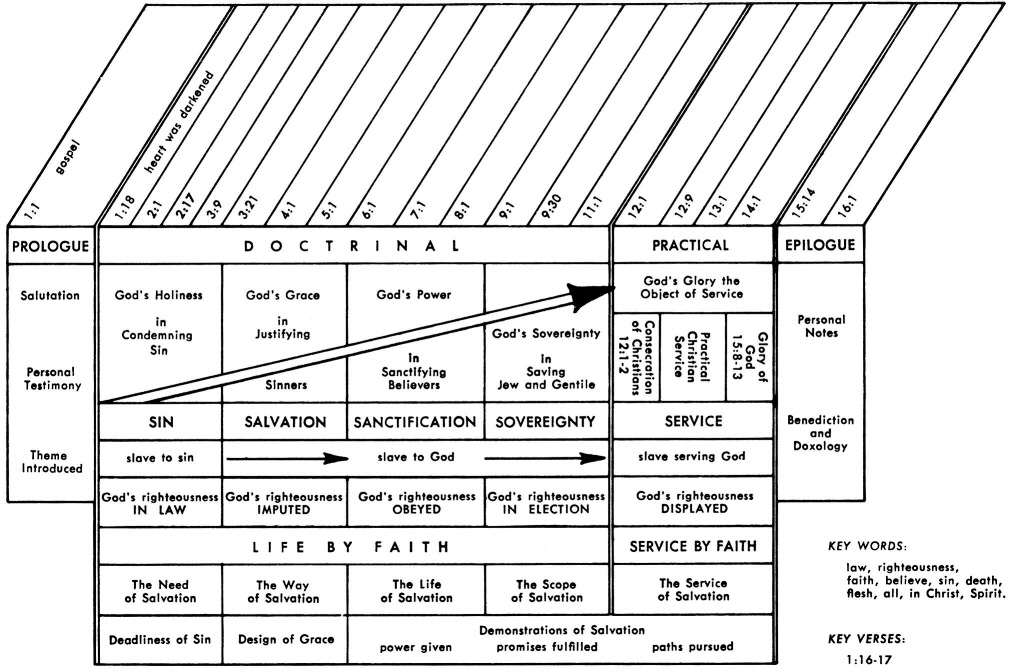
Click chart to enlarge
Chart from recommended resource Jensen's Survey of the NT - used by permission
Romans Overview Chart - Charles Swindoll
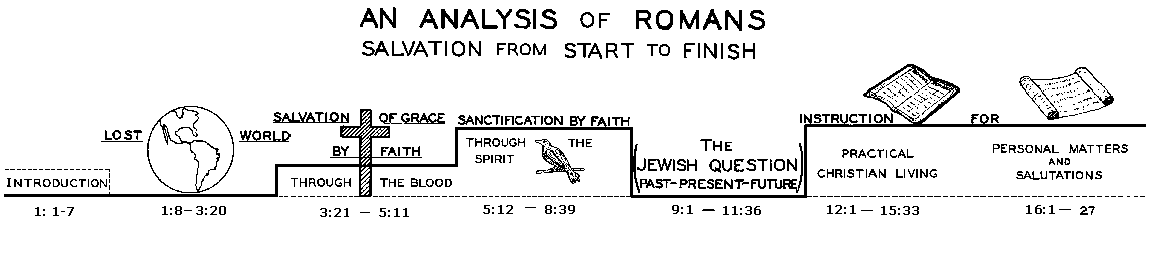
Source: Dr David Cooper
Click to Enlarge
| ROMANS ROAD to RIGHTEOUSNESS |
||||
| Romans 1:18-3:20 | Romans 3:21-5:21 | Romans 6:1-8:39 | Romans 9:1-11:36 | Romans 12:1-16:27 |
| SIN | SALVATION | SANCTIFICATION | SOVEREIGNTY | SERVICE |
| NEED FOR SALVATION |
WAY OF SALVATION |
LIFE OF SALVATION |
SCOPE OF SALVATION |
SERVICE OF SALVATION |
| God's Holiness In Condemning Sin |
God's Grace In Justifying Sinners |
God's Power In Sanctifying Believers |
God's Sovereignty In Saving Jew and Gentile |
Gods Glory The Object of Service |
| Deadliness of Sin |
Design of Grace |
Demonstration of Salvation | ||
| Power Given | Promises Fulfilled | Paths Pursued | ||
| Righteousness Needed |
Righteousness Credited |
Righteousness Demonstrated |
Righteousness Restored to Israel |
Righteousness Applied |
| God's Righteousness IN LAW |
God's Righteousness IMPUTED |
God's Righteousness OBEYED |
God's Righteousness IN ELECTION |
God's Righteousness DISPLAYED |
| Slaves to Sin | Slaves to God | Slaves Serving God | ||
| Doctrine | Duty | |||
| Life by Faith | Service by Faith | |||
|
Modified from Irving L. Jensen's chart above |
||||
R Ruin (Romans 1:17 – 3:20) – The utter sinfulness of humanity
O Offer (Romans 3:21-31) – God’s offer of justification by grace
M Model (Romans 4:1-25) – Abraham as a model for saving faith
A Access (Romans 5:1-11) – The benefits of justification
N New Adam (Romans 5:12-21) – We are children of two “Adams”
S Struggle w/ Sin (Romans 6:1-8:39) Struggle, sanctification, and victory
Romans 6:11 Even so consider yourselves to be dead to sin, but alive to God in Christ Jesus. (NASB: Lockman)
Greek: houtos kai humeis logizesthe ( 2PPMM ) heautous [einai] (PAN) nekrous men te hamartia zontas (PAPMPA) de to theo en Christo Iesou.
Amplified: Even so consider yourselves also dead to sin and your relation to it broken, but alive to God [living in unbroken fellowship with Him] in Christ Jesus. (Amplified Bible - Lockman)
ESV: So you also must consider yourselves dead to sin and alive to God in Christ Jesus. (ESV)
NLT: So you should consider yourselves dead to sin and able to live for the glory of God through Christ Jesus. (NLT - Tyndale House)
Moffat: So you must consider yourselves dead to sin and alive to God in Christ Jesus our Lord.
Phillips: In the same way look upon yourselves as dead to the appeal and power of sin but alive and sensitive to the call of God through Jesus Christ our Lord. (Phillips: Touchstone)
Weymouth: In the same way you also must regard yourselves as dead in relation to sin, but as alive in relation to God, because you are in Christ Jesus.
Wuest: Thus, also, as for you, you be constantly counting upon the fact that, on the one hand, you are those who have been separated from the sinful nature, and, on the other, that you are living ones with respect to God in Christ Jesus. (Eerdmans)
Young's Literal: so also ye, reckon yourselves to be dead indeed to the sin, and living to God in Jesus Christ our Lord.
The secret of daily victory over our fallen flesh is found in practicing three Biblical truths: Know, reckon, and yield.
- KNOW THE FACTS (Romans 6:1-10)
- CONSIDER or RECKON daily the FACTS as TRUE (Romans 6:11)
- YIELD or OFFER YOUR BODY daily to GOD (Romans 6:12, 13, 14)
This is to the Christian's…
EMANCIPATION PROCLAMATION!
GOD GRANT US ALL TO WALK IN THIS TRUTH! AMEN!
One Caveat - Do not undertake the preceding "Steps" mechanically (or legalistically)! The ONLY way to undertake these steps is NOT by relying on our fallen flesh, BUT by continually, wholly relying on the Holy Spirit to give us the supernatural desire and power to do so (see Php 2:13NLT). Spiritual truth is spiritually discerned (cf 1 Cor 2:10-14) and to be successfully practiced calls for us to continually be filled with the Spirit (Eph 5:18, making sure we confess and repent so we do not grieve or quench the Spirit - Eph 4:30, 1 Th 5:19), so that we are enabled to continually walk by the Spirit (Gal 5:16, Gal 5:18, Gal 5:25). As we learn to rely on God's Spirit more and more each day, we will progressively experience more and more of the Emancipation in Christ which God has proclaimed and promised in His Word (cf Ro 8:37, 38, 39)!
Spurgeon has these introductory remarks…
The connection of this passage will help us to understand its meaning. Near the close of the previous chapter Paul had said,
The law entered that the offence might abound; but where sin abounded, grace did much more abound, that as sin hath reigned unto death, even so might grace reign through righteousness, unto eternal life, by Jesus Christ our Lord.
He speaks here of sin as being a reigning principle or monarch, and of grace also as reigning. Then, in chapter 6., he proceeds
What shall we say then? Shall we continue in sin that grace may abound? Likewise reckon ye also yourselves to be dead indeed unto sin, but alive unto God through Jesus Christ our Lord.
You observe here that Paul speaks of the man, the old sinner, as being crucified with Christ, so destroyed by the moral power of the Cross that he who was once a sinner shall no longer serve sin. When he speaks of our being planted or buried with Christ, we must of course understand him as employing figures of speech to teach the great truth that the Gospel redeems the soul from sin. As Christ died for sin, so by a general analogy we die to sin; while, on the other hand, as He rose to a new and infinitely glorious life, so the convert rises to a new and blessed life of purity and holiness.
But recurring particularly to our text, let me say—The language used in our translation would seem to denote that our death to sin is precisely analogous to Christ's death for sin; but this is not the case. We are dead to sin in the sense that it is no longer to be our master, implying that it has been in power over us. But sin never was in power over Jesus Christ—never was His master. Christ died to abolish its power over us—not to abolish any power of sin over Himself, for it had none. The analogy between Christ's death in relation to sin and our dying to sin, goes to this extent and no farther: He died for the sake of making an atonement for sin and of creating a moral power that should be effective to kill the love of sin in all hearts; but the Christian dies unto sin in the sense of being divorced from all sympathy with sin and emancipated from its control. (Romans 6:11 Death To Sin Through Christ)
EVEN SO: houtos kai:
So (3779) (houto) means in this manner, thus (because of this or that), referring to what precedes and in context refers to everything Paul had taught about the believer's position in Christ as the result of their union and identification with Him in His death, burial and resurrection. It could be translated…
"with reference to what precedes"
A basic principle in the Word of God is that people must first know what is true before they can obey God. The thrust of "even so" therefore is that
“You must know and fully believe what I have just said, or else what I am about to say will make no sense. The truth that you are spiritually dead to sin, and the reality that you are spiritually alive to Christ are not abstract concepts for your finite minds to attempt to verify. They are divinely-revealed, foundational axioms behind Christian living, apart from which you can never hope to live the holy lives your new Lord demands.”
Realizing the importance of the truths he presents in Ro 6:1-10 (see notes Romans 6:1-3, Romans 6:4-5, Romans 6:6-7, Romans 6:8-10), Paul uses forms of know and believe 4 times in this great doctrinal section (v3, 6, 8, 9), and in other places he implies that his readers know about certain other truths (see, e.g., 6:2, 6:5, 6:7). These observations illustrate the believer's need to understand his or her position in Christ so that they can then live as they should.
The critical importance of knowing before doing is seen in Hosea where God said
"My people are destroyed for lack of knowledge. Because you have rejected knowledge, I also will reject you from being My priest. Since you have forgotten the law of your God, I also will forget your children." (Hos 4:6)
Israel's problem was that the people did not know (because they had made the choice actively to push it away as the Lxx suggests) and the consequence were that they could not function as God's priest to the nations.
Spurgeon in his notes on Romans 6:11 writes…
How intimately the believer's duties are interwoven with his privileges! Because he is alive unto God, he is to renounce sin, since that corrupt thing belongs to his estate of death. How intimately both his duties and his privileges are bound up with Christ Jesus his Lord! How thoughtful ought we to be upon these matters, reckoning what is right and fit and carrying out that reckoning to its practical issues.
1. We are dead with Christ to sin by having borne the punishment in him. In Christ we have endured the death penalty and are regarded as dead by the law (see notes Romans 6:6; 6:7).
2. We are risen with him into a justified condition and have reached a new life (see note Romans 6:8).
3. We can no more come under sin again than he can (see note Romans 6:9).
4. We are therefore forever dead to its guilt and reigning power: "Sin shall not have dominion over you" (see notes Romans 6:12; 13; 14).
This reckoning is based on truth, or we should not be exhorted to it.
To reckon yourself to be dead to sin so that you boast that you do not sin at all would be a reckoning based on falsehood and would be exceedingly mischievous. "There is no man that sinneth not" (1 Kings 8:46; 1 John 1:8). None are so provoking to God as sinners who boast their own fancied perfection.
The reckoning that we do not sin must either go upon the Antinomian theory that sin in the believer is no sin, which is a shocking notion.
Or else our conscience must tell us that we do sin in many ways: in omission or commission, in transgression or shortcoming, in temper or in spirit (James 3:2; Eccles. 7:20; see note Romans 3:23).
To reckon yourself dead to sin in the scriptural sense is full of benefit both to heart and life. Be a ready reckoner in this fashion. (Romans 6:11-12 Dead But Alive - Notes)
In short, the believer's practice is founded upon his position in Christ.
Duty follows and is founded upon doctrine.
Scriptural exhortation (Romans 6:11ff) must always be based upon sound doctrine (Romans 6:1-10).
The Believer's Study Bible sums up Romans 6:1-13 noting that there are "Three essential elements of the sanctification process are given:
- Know what salvation means (Ro 6:3);
- Reckon or consider yourself to be dead to sin (Ro 6:11 - present imperative);
- Present yourself and the parts of your body to God as instruments of righteousness (present imperative, Ro 6:13).
We are called to live experientially what we are positionally… sanctification requires our active involvement is clearly evident." (Believer's Study Bible)
CONSIDER YOURSELVES: humeis logizesthe (2PPMM) heautous:
- Ro 8:18
make a mental calculation
Similarly let us consider ourselves as actually dead to sin (Berkley)
In the same way, you must see yourselves a being dead to sin (NJB)
Hendriksen notes that
At this point doctrine makes way for exhortation. What has been established, namely, that believers are in principle dead to sin and alive to Christ, must become the abiding conviction of their hearts and minds, the take-off point for all their thinking, planning, rejoicing, speaking, doing. They must constantly bear in mind that they are no longer what they used to be. Their lives from day to day must show that they have not forgotten this. (Hendriksen, W., & Kistemaker, S. J. New Testament Commentary Set, 12 Volumes. Grand Rapids: Baker Book House) (Bolding added)
Paul gives us an excellent parallel commentary on our being dead to sin writing to the saints at Colossae that in light of the doctrinal truth that
you have been raised up with Christ, keep seeking the things above, where Christ is, seated at the right hand of God. Set your mind on the things above, not on the things that are on earth. For you have died and your life is hidden with Christ in God. When Christ, Who is our life, is revealed, then you also will be revealed with Him in glory. Therefore consider the members of your earthly body as dead to immorality, impurity, passion, evil desire, and greed, which amounts to idolatry. (see notes Colossians 3:1, 3:2, 3:3-4, 3:5)
John MacArthur comments that…
If the believer is to fully live out his new life in Christ, he must begin by knowing he is not what he used to be. Once the believer knows the foundational truths about his death, burial, and resurrection with Christ, and his victory over the penalty and power of sin, he is well on his way to victory in the Christian life. Doubts and fears become less and less because he knows he is dealing with a vanquished foe, a monarch who has been dethroned. The believer has been resurrected to new life and therefore has the confidence to strip away his grave clothes and live victoriously! (Dying to Live - Pt 3)
F B Meyer writes that believers must…
Reckon that you have died, and whenever sin arises, to menace or allure you, point back to the grave, and argue that since you died in Christ, you have passed altogether beyond its jurisdiction, for you have yielded your members as weapons of righteousness unto God. And having been crucified with Christ, you now no longer live, but Christ liveth in you (see note Galatians 2:20). Let it become your daily habit to place the grave of Jesus between yourself and all allurements of the world, the flesh, and the devil. (Our Daily Homily)
Satterthwaite exhorts us to…
Trust God in the face of every sin. Believe Him, that He died for your sin, to put your sin away, and to give you victory over sin. As a result of this, He says in the latter part of this chapter here (see notes Romans 6:12, 13), that we aught not to yield out members as instruments of unrighteousness unto sin. (Satterthwaite, D. For Believers Only: Encouragement for Spiritual Living)
Spurgeon asks…
What is it to reckon ourselves dead indeed unto Him? The word rendered reckon is sometimes rendered account. Abraham's faith was accounted unto him for righteousness. So, in this passage, reckon must mean believe, esteem yourselves dead indeed unto sin. Account this to be the case. Regard this as truly your relation to sin; you are entirely dead to it; it shall have no more dominion over you. A careful examination of the passages where this original word is used will show that this is its usual and natural sense. And this gives us the true idea of Gospel faith—embracing personally the salvation which is by faith in Jesus Christ. But more of this hereafter.
What is meant by reckoning yourselves alive indeed unto God through Jesus Christ? Plainly this: that you are to expect to be saved by Jesus Christ and to calculate on this salvation as your own. You are to esteem yourself as wholly dead to sin and as consequently brought into life and peace in Christ Jesus.
What is implied in the exhortation of our text? That there is an adequate provision for this expectation, and for realizing these blessings in fact. For if there were no ground for realization this, the injunction would be most absurd. A precept requiring us to account ourselves dead indeed unto Sin and alive unto God, would be utterably untenable if there were no probability of the thing—if no provision were made for our coming into such relations to Sin on the one hand and to God through Christ on the other. For if these blessings could not be reasonably expected, there could be no rational ground for the expectation. If it were not reasonable to expect it, then to enjoin us to expect it would be palpably unreasonable. Who does not see that the very injunction implies that there is a foundation laid and adequate provision made for the state required?
What is implied in complying with this injunction?
1. Believing such a thing to be possible. Believing it possible that through Christ we may live in the required manner, that we may avoid sin—desist from sinning—give it up and abandon it altogether, and put it forever away. There can be no such thing as an intelligent compliance with this precept, except as there shall underlie it this belief in its practicability. A state actually made practicable by adequate grace, adapted to the laws of mind and to the actual moral condition of lost men.
2. That we cease from all expectation of attaining this state of ourselves, and by our own independent, unaided efforts. There is no beginning to receive by grace till we renounce all expectation of attaining by natural works. It is only when empty of self that we begin to be filled of Christ (Ed: cp John 3:30).
3. A present willingness to be saved from sin. We must actually renounce all sin as such—that is, renounce sin because it is sin, and for what it is. This position the mind must take: I can have nothing more to do with sinning—for God hates sin, and I am to henceforth and for ever to please and glorify Him. My soul is committed with its utmost strength of purpose to this pleasing of God and doing His will.
4. It implies also an entire committal of your whole case to Jesus Christ, not only for present, but for all future salvation from sin. This is absolutely essential. It must always be the vital step—the cardinal act in this great work of salvation from sin.
5. It implies also the foreclosing of the mind against temptation, in such a sense that the mind truly expects to live a life purely devoted to God. This is the same sort of foreclosing of the mind as takes place under a faithful marriage contract. The Bible everywhere keeps this figure prominent. Christians are represented as the bride of Christ. They stand in a relation to Him which is closely analogous to that of a bride to her husband. Hence when they commit their whole hearts to Him, reposing their affections in Him, and trusting Him for all good, their hearts are strongly foreclosed against temptation. The principle here involved, we see illustrated in the merely human relation. When parties are solemnly betrothed in mutual honest fidelity, there is no longer any thought of letting the eye rove or the heart go abroad for a fresh object of interest and love. The heart is fixed—willingly and by plighted faith fixed, and this fact shuts out the power of temptation almost entirely. It renders it comparatively an easy matter to keep the heart safely above the influence of temptation to apostasy. Before the sacred vows are taken, individuals may be excused for looking round and making any observations or inquiries: but never after the solemn vow is made. After the parties have become one by vow of marriage, never to be broken, there is to be no more question as to a better choice—no further thought about changing the relation or withdrawing the heart's affections. No wavering is admissible now; the pledge is made for everlasting faithfulness, settled once and forever! This is God's own illustration, and surely none need be more apt or more forcible. It shows how the Christian should look upon sin and upon all temptation to sin. He must say, Away from my heart for ever! I am married to Jesus Christ; how then can I look after other lovers? My mind is forever settled. It rests in the deep repose of one whose affections are plighted and fixed—to rove no more! Sin? I can think of yielding to its seductions no longer. I cannot entertain the question for a moment. I can have nothing to do with sinning. My mind is settled—the question forever foreclosed, and I can no more admit the temptation to small sins than to great sins—no more consent to give my heart to worldly idols than to commit murder! I did not enter upon religion as upon an experiment, to see how I might like it—no more, than a wife or husband take on themselves the marriage vow as an experiment. No; my whole soul has committed itself to Jesus Christ with as much expectation of being faithful forever as the most faithful husband and wife have of fulfilling their vows in all fidelity till death shall part them.
Christians in this state of mind no more expect to commit small sins than great sins. Hating all sin for its own sake and for its hatefulness to Christ, any sin, however small, is to them as murder. Hence if the heart is ever afterwards seduced and overcome by temptation, it is altogether contrary to their expectation and purpose; it was not embraced in their plan by any means, but was distinctly excluded; it was not deliberately indulged aforetime, but broke on them unexpectedly through the vantage ground of old habits or associations.
Again, the state of mind in question implies that the Christian knows where his great strength lies. He knows it does not lie in works of fasting, giving alms, making prayers, doing public duties or private duties—nothing of this sort; not even in resolutions or any self-originated efforts, but only in Christ received by faith. He no more expects spiritual life of himself apart from Christ, than a man in his senses would expect to fly by swinging his arms in the air. Deep in his soul lies the conviction that his whole strength lies in Christ alone.
When men are so enlightened as truly to apprehend this subject, then to expect less than this from Jesus Christ as the result of committing the whole soul to Him for full salvation, is virtually to reject Him as a revealed Saviour. It does not honour Him for what He is; it does not honour the revelations He has made of Himself in His word by accepting Him as there presented. For consider, what is the first element of this salvation? Not being saved from hell, but being saved from sin. Salvation from punishment is quite a secondary thing, in every sense. It is only a result of being saved from sin, and not the prime element in the Gospel salvation. Why was the infant Messiah to be called Jesus? Because He should save His people from their sins. And does the Bible anywhere teach any other or different view from this? (See additional lengthy discussion Romans 6:11 Death To Sin Through Christ)
Consider (3049) (logizomai from lógos = reason, word, account) means to reckon, compute, calculate, to take into account, to deliberate, and to weigh. Logizomai refers to a process of careful study or reasoning which results in the arriving at a conclusion. Logizomai conveys the idea of calculating or estimating.
Logizomai was a term frequently used in the business community of Paul's day and meant to impute (put to one's account) or credit to one's account.
Logizomai is related to our English term logic (which deals with the methods of valid thinking, reveals how to draw proper conclusions from premises and is a prerequisite of all thought).
Logizomai is used 40 times in the NT in the NASB (Mk; Lu; Jn; Acts; Romans 19x [11x in Ro4!]; 1Co 3x; 2Co 7x; Gal; Phil 2x; 2Ti; Heb; Js; 1P) and is translated: consider, 6; considered, 2; counted, 1; counting, 1; credit, 1; credited, 9; credits, 1; dwell, 1; maintain, 1; numbered, 2; propose, 1; reason, 1; reckoned, 2; regard, 4; regarded, 3; suppose, 1; take into account, 3; thinks, 1.
Logizomai is used some 120 times in the Septuagint (LXX) (Ge 15:6; 31:15; Lev 7:18; 17:4; 25:31; 27:23; Num 18:27, 30; Deut 2:11, 20; 3:13; 1Sa 1:13; 18:25; 2 Sam 4:2; 14:13f; 19:43; 1Ki 10:21; 2 Chr 5:6; 9:20; Neh 6:2, 6; 13:13; Job 31:28; 34:37; 41:29, 32; Ps 32:2; 35:4; 41:7; 44:22; 52:2; 106:31; 119:119; 140:2, 4; 144:3; Pr 15:29; 16:30; 17:28; 24:8; Eccl 10:3; Isa 5:28; 10:7; 13:17; 29:16f; 32:15; 33:8; 40:15, 17; 44:19; 53:3f, 12; Jer 11:19; 18:8, 11, 18; 23:27; 26:3; 29:11; 36:3; 48:2; 49:20, 30; 50:45; Lam 4:2; Ezek 11:2; 38:10; Dan 4:35; 11:24f; Hos 7:15; 8:12; Amos 6:5; Mic 2:1, 3; Nah 1:9, 11; Zech 8:17; Luke 22:37; John 11:50; Acts 19:27; Rom 2:3, 26; 3:28; 4:3ff, 8ff, 22ff; 6:11; 8:18, 36; 9:8; 14:14; 1 Cor 4:1; 13:5, 11; 2 Cor 3:5; 5:19; 10:2, 7, 11; 11:5; 12:6; Gal 3:6; Phil 3:13; 4:8; 2 Tim 4:16; Heb 11:19; Jas 2:23; 1 Pet 5:12).
Paul makes use of the LXX translation of the following two theologically significant verses in his arguments in Romans 4 that righteousness is obtained by faith not works…
In the first LXX use of logizomai in Genesis 15:6 Moses records…
Then he (Abram/Abraham) believed in the LORD; and He reckoned (logizomai) it to him as righteousness. (see note Romans 4:3)
In Psalm 32:2 David records…
How blessed is the man to whom the LORD does not impute (LXX = logizomai) iniquity, And in whose spirit there is no deceit! (see note Romans 4:8)
Note the concentrated use of logizomai in Romans. It follows that one will have considerable difficulty understanding this great letter if he does not understand the meaning and nuances of logizomai.
Paul is telling his readers and us to reflect on our position in Christ and to place two things into our spiritual bank account: (1) We are "dead to sin" and (2) we are "alive to God in Christ Jesus."
We each must take time to consider these facts and make this exercise habitual, not just giving it an occasional casual thought! These are profound truths. As someone has well said such meditative accounting will make for good "preventive theology". Too often we tend to focus on "corrective theology" emphasizing truths (which are valid and important) like
If we confess our sins, He is faithful and righteous to forgive us our sins and to cleanse us from all unrighteousness. (1Jn 1:9)
Paul in Romans 6:11 is calling for us to make it our practice to reflect upon our union and identification with our Lord Jesus Christ, because he knows that a thorough digestion and assimilation of this truth will serve to curb sins so we don't have to confess sins as frequently.
Note also that Consider in Romans 6:11 is present imperative (this is Paul's first major command after building his sound doctrinal case for 5 chapters!) so we need to consider these truths carefully and continuously. This is a strong charge calling for a firm conviction regarding the truths he had just expounded.
Reckoning means to continually count on the fact that God has actually done what he said he would do. Keep on counting yourselves to be what God says you are! Continually count on the fact that if God said it, he meant it, and therefore he did it. It means to live on the basis of the fact that God wasn't kidding when he said he would do this, therefore he did it, and therefore you can continually count on it. Reckoning is not claiming a promise but acting upon a fact. It's not make-believe. It's not getting yourself into an emotional tizzy, or pretending something is true that you know is not true. It's believing that what God has said he would do, he really did do, therefore it really is true, therefore you can depend upon it, therefore you can stake your life upon it, therefore it's an actual fact. What is in view is not a fictitious or “pretend” or “merely symbolical” event, but a settled determination to live in the light of Christ’s death and in the strength of a power which has already defeated sin’s reign in His death and your death with Him.
Warren Wiersbe adds that…
Reckoning is simply that step of faith that says,
“What God says about me in the Bible is now true in my life. I am crucified with Christ.”
Reckoning is faith in action, resting on the Word of God in spite of circumstances or feelings. God does not tell us to crucify ourselves, but rather to believe that we have been crucified and that “the old man” has been put to death. Crucifixion is one death you cannot inflict on yourself; you must be crucified by another.
Reckoning is that step of faith that believes God’s Word and acts upon it." (Wiersbe, W. W. Wiersbe's Expository Outlines on the New Testament. Wheaton, Ill.: Victor Books) (Bolding added)
Paul uses logizomai in Romans 2 addressing "religious" readers (Jew and otherwise) who looked down upon the pagans in Romans 1, asking
"do you suppose (logizomai - do you reason thus) this, O man, when you pass judgment upon those who practice such things and do the same yourself, that you will escape the judgment of God?" (see note Romans 2:3)
Paul's point is that the moralist falsely calculates and comes to the wrong conclusion regarding his own sinfulness and guilt.
Logizomai means to think about something in a detailed and logical manner, reason about it, pondering it and finally drawing conclusions through the use of reason. For example, Paul writes that
"When I was a child, I used to speak as a child, think as a child, reason (logizomai) as a child; when I became a man, I did away with childish things." (1Cor 13:11)
Logizomai means to put together with one’s mind. It means to regard as being, to count as true, or to occupy oneself with reckonings or calculations.
Logizomai was used in early secular documents as follows -- “put to one’s account," "let my revenues be placed on deposit at the storehouse", "I now give orders generally with regard to all payments actually made or credited to the government.”
Logizomai was a secular bookkeeping term which meant to make an entry in the account book or to put to one's account. It carried the economic and legal meaning of crediting something to another’s account. It means to calculate or reckon, as when figuring an entry in a ledger. The purpose of the entry is to make a permanent record that can be consulted whenever needed. It means to credit money to a particular account. It means that when you deposit $1000, the bank credits your account with $1000. Therefore when you write a check for $500, you don't worry about it because you are reckoning on the fact that money is actually in your account.
As alluded to above, probably the most notable use of logizomai with this meaning is when
"Abraham believed God, and it was reckoned (logizomai - credited to his account) to him as righteousness." (see note Romans 4:3)
Abraham believed God, and his act of faith was placed to his account in value as righteousness. He believed God and his act of faith was credited to him for righteousness. He believed God and his act of faith was computed as to its value, and there was placed to his account, righteousness. However, Abraham’s act of faith was not looked upon as a meritorious action deserving of reward. What his faith did do was provide a channel through which God worked His redeeming grace. Faith is a convicted heart reaching out to receive God’s free and unmerited gift of salvation.
Logizomai is translated as “imputed” only once in the NASB (see note Romans 5:13) but nine times in the KJV (Click for the 9 verses). In Ro 4:8 (see note), the KJV reads "Blessed is the man to whom the Lord will not impute sin." In other words the man is called blessed, to whose account no sin is charged. At the Cross, his sin was charged to the account of the Lord Jesus. In Ro 4:6 (see note), the man to whose account righteousness is put, is called blessed
"just as David also describes the blessedness of the man to whom God imputes righteousness apart from works"). (NKJV)
This is imputation, the act of putting something to someone’s account. In the case of the Lord Jesus, the sin of the human race was charged to Him. In the case of the believing sinner, the righteousness of God, Christ Jesus Himself, is put to his account.
To reiterate, here in Romans 6:11, logizomai is used with the meaning of adding up a column (as in accounting) and coming up with the sum total, in the case of Romans 6:1-10, that total (the truth in those verses) being "in the black' so to speak, and providing each believer an inexhaustible, divine 'checking account', based upon the riches procured by the death, burial and resurrection of our Lord Jesus Christ.
As John Gregory Mantle has written
“There is a great difference between realizing, ‘On that Cross He was crucified for me,’ and ‘On that Cross I am crucified with Him.’ The one aspect brings us deliverance from sin’s condemnation, the other from sin’s power.”
And so to "Consider" means to take all of the truths Paul has stated in (Ro 6:1-10 and the preceding chapters) and put them in the "calculator" of your mind. Think about them and come to a conclusion and let that conclusion affect the way you live. The hymn I Surrender All says it well…
I Surrender All
by Judson W Van De Venter
All to Jesus, I surrender;
All to Him I freely give;
I will ever love and trust Him,
In His presence daily live.
Refrain
I surrender all, I surrender all,
All to Thee, my blessèd Savior,
I surrender all.
All to Jesus I surrender;
Humbly at His feet I bow,
Worldly pleasures all forsaken;
Take me, Jesus, take me now.
Refrain
All to Jesus, I surrender;
Make me, Savior, wholly Thine;
Let me feel the Holy Spirit,
Truly know that Thou art mine.
Refrain
All to Jesus, I surrender;
Lord, I give myself to Thee;
Fill me with Thy love and power;
Let Thy blessing fall on me.
Refrain
All to Jesus I surrender;
Now I feel the sacred flame.
O the joy of full salvation!
Glory, glory, to His Name!
Refrain
Wayne Barber asks
"What facts are we to consider?
Verse 2: We are dead to the sin of Adam.
Verse 3: We were baptized into Christ Jesus and into His life.
Verse 4: We are raised with Him into newness of life.
Verse 5: We are intertwined into His life and death; forever identified with Him.
Verse 6: Our old man, what we used to be in Adam, is dead.
Verse 7: We have been justified from the sin of Adam, declared righteous because of what Christ did.
Verse 8: We are believing daily that His life is ours now.
Verse 9: We experientially know that since the death does not reign over Christ, it does not reign over us.
Verse 10: He has died to the sin once and for all. He ended its penalty and its power to those who have put their faith into Him, and now as He lives unto God, so we do because His life is in us."
Kenneth Wuest has an extended but well reasoned note explaining that what Paul is doing using logizomai is to exhort
"the saints that in their endeavor to live a life in accordance with the Word of God, they should take into account the fact that they are dead to sin, that they have been disengaged from the evil nature, that it has no power over them anymore, that they are scot free from it and can say a point blank "NO" to it, also to take into account the fact that they are alive to God, that is, that the divine nature has been imparted with the result that that nature gives them both the desire and the power to regulate their lives in accordance with the Word of God. Now, reckoning one’s self dead to sin and alive to God does not make one so. God constituted the saint so when He saved him. But the act of reckoning brings into better operation with beneficial results, the working of this inner spiritual machinery.
For instance, there is a game in which a blindfolded person is brought into the room, and made to stand on a table board which rests on some books on the floor. Two young men lift the board about a foot, and warn the young man not to bump his head against the ceiling. Thinking that he is near the ceiling, he loses his balance and falls off. He lost his balance and fell because he reckoned himself where he was not. Just so, a Christian who fails to count upon the fact that the power of the sinful nature is broken in his life, fails to get consistent victory over it, with the result that he lives a mediocre Christian life. He reckoned himself where he was not. Another young man is blindfolded and stood on the board. He knows the game. When the board is lifted and he is warned not to bump his head against the ceiling, he remains perfectly straight and maintains his equilibrium, because he reckoned himself where he was.
And so it is with a Christian who counts upon the fact that the power of the sinful nature is broken. He knows that he does not have to obey it, and that he has the power to say "NO" to it, and he turns his back on it and does what is right. The Christian who does not count upon the fact that the divine nature is implanted in his inner being, goes on living his Christian life as best he can more or less in the energy of his own strength, with the result that he exhibits a mediocre Christian experience. But the believer who counts upon the fact that he is a possessor of the divine nature, ceases from his own struggles at living a Christian life, and avails himself of the life of God supplied in the divine nature. So the first adjustment the Christian should make is that of counting upon the fact that the power of the indwelling sinful nature is broken and the divine nature imparted, and order his life on that principle." (Wuest, K. S. Wuest's Word Studies from the Greek New Testament: Studies in the Vocabulary of the Greek New Testament: Grand Rapids: Eerdmans)
James uses logizomai (James 1:2) exhorting his readers "to count it all joy", to look at the trials they were going through and add in the truth that they had learned concerning that God would do for them and in them through the trials and finally come to a settled conclusion. Then proceed to live based on this reasoned conclusion. What and how we think about our identification and union with Christ in His death, burial and resurrection and our new relationship to the power of SIN (previously we were powerless but now we are able to say "no" to sin), will affect the way we live and how we respond to temptations from the flesh, the world and the devil. Paul is saying that since you now know something, you must "consider" it and put it into practice in your life.
Ruth Paxson explains that consider or reckon (logizomai) means…
believing what God says in Romans 6:6 (note) (knowing this, that our old self was crucified with Him, that our body of sin might be done away with, that we should no longer be slaves to sin) and knowing it as a fact in one’s own personal salvation. This demands a definite act of faith, which results in a fixed attitude toward “the old man.” We will see him where God sees him—on the Cross, put to death with Christ. Faith will operate continuously to keep him where grace placed him. This involves us very deeply, for it means that our hearty consent has been given to God’s condemnation of and judgment upon that old “I” as altogether unworthy to live and as wholly stripped of any further claims upon us. The first step in a walk of practical holiness is this reckoning upon the crucifixion of “the old man." (Paxson, Ruth: The Wealth, Walk, and Warfare of the Christian)
As has been stated above, the believer needs to accept what God says about him or her as true and then to live in the light of that truth, independent of one's feelings
John Wesley said it this way…
Frames and feelings fluctuate:
These can ne'er thy saviour be!
Learn thyself in Christ to see:
Then, be feelings what they will,
Jesus is thy Saviour still!
><> ><> ><>
An illustration - 37 Years in the Jungle-
In 1982 an unusual thing happened on the island of Guam (Click to read a very similar illustration of another Japanese soldier who remained in the Philippine jungle for 30 years!)
A Japanese soldier came out of the jungle. He had been living in the jungle for 37 years, since the end of world war II. Why? Because when the news came at the end of the war, he couldn't believe that Japan had surrendered and the war was over. So for 37 years he lived in the jungle. During those 37 years was he free? Sure. At any time from 1945 until 1982, he was completely free to come out of the jungle. It's not like General MacArthur was coming in to get him. He was free. He could come out in 1950 or 1955 or 1969. He was completely free on a theoretical basis. But because he didn't believe it--because he didn't reckon the fact of his freedom to be true--he lived in self-imposed bondage in the jungle for 37 years. Was he free? Yes. Was he free? No, because he chose to stay in bondage, in hiding, in fear in the jungle.
Many Christians are still living in the jungle of sin. The war is over, Christ has won, but they refuse to believe it. They live in self-imposed bondage to sin. They are still in the jungle spiritually because they refuse to believe that Christ has set them free.
Michael Andrus agrees adding…
Are you aware that there are countless Christians still doing hand-to-hand combat with their sin nature, unable to enjoy the peace that is available in Jesus Christ, because somehow they are appallingly ignorant of the fact that their Commander-in-chief has won a great victory and has called them out of the jungle of sin to a life of holiness. Oh, to be sure there are inevitable struggles and some failures ahead so long as we are in this world, but there is no need for us to live as though the final outcome of the war is still hanging in the balance.
TO BE DEAD TO SIN : einai (PAN) nekrous men te hamartia:
- Ro 6:2 Ro 6:7 Ro 6:10, Gal 2:19 Gal 5:24 Gal 6:14 Col 2:20 Col 3:3 1Pe 2:24 Titus 2:14)
Read this passage in several different translations to help understand the meaning…
Look upon yourselves as dead to the appeal and power of sin. (Phillips)
Be constantly counting upon the fact that, on the one hand, you are those who have been separated from the sinful nature (Wuest)
Consider yourselves also dead to sin and your relation to it broken (Amplified)
You too must continually consider yourselves dead as far as sin is concerned. (International Standard Version)
You should see yourselves as being dead to the power of sin (NCV)
To be (1510) (eimi) means to be and the present tense indicates continuous action (consider yourself to be continually dead to sin's power). To be or not to be (dead to sin), that is the question and the answer is that it is now possible for a believer because of Christ's death, burial and resurrection. The present tense in fact identifies this as what is to be continually true for the believer.
Dead (3498)(nekros from nékus = a corpse, root of our English words necropsy, necrophobia, etc) means destitute of life, one who is now a corpse or has breathed one's last. The opposite of living.
Spurgeon writes that…
Being dead to sin must obviously be the opposite of being dead in sin. The latter must undeniably be a state of entire sinfulness—a state in which the soul is dead to all good through the power of sin over it. But right over against this, to be dead to sin, must be to be indifferent to its attractions—beyond the reach of its influence—as fully removed from its influences as the dead are from the objects of sense in this world. As he who is dead in the natural sense has nothing more to do with earthly things, so he who is dead to sin has nothing to do any more with sin's attractions or with sinning itself.
Sin (266) (hamartia from the verb hamartano = miss the mark and so not share in the prize, to err, offend, sin, to act contrary to the will and law of God and so miss the mark in relation to God) in the present context does not refer to the sins we commit (missing the mark) but is personified by Paul as the evil nature still resident in the believer. Sin in this verse refers to Sin as a controlling power and as an enslaving tyrant. Paul's point is that believers have died in relation to the power of sin as their master and this truth leads to his exhortation in the next section (Romans 6:12ff) not to let sin reign and not to yield to its power.
Sin is harsh taskmaster as illustrated by this little poem…
Sin will take you farther than you ever thought you’d stray
Sin will leave you so lost, you think you’ll never find your way
Sin will keep you longer than you ever thought you’d stay
Sin will cost you more than you ever thought you’d pay
Puritan John Bunyan (of Pilgrim’s Progress fame) wrote that
“Sin is the dare of God’s justice, the rape of His mercy, the jeer of His patience, the slight of His power and the contempt of His love.”
In light of Paul's exhortation for us to consider ourselves "dead to sin", Merriam-Webster's Collegiate Dictionary has some interesting definitions of "dead" describing it as
"lacking power to move, feel, or respond, incapable of being stirred emotionally or intellectually, unresponsive, inanimate, no longer functioning, lacking power or effect, no longer have interest, relevance or significance, no longer active, completely out of touch with."
Now substitute some of those definitions in Paul's phrase "_______ to sin" and meditate upon this simple but great truth. Again we may not feel like this is true in light of your ongoing struggle with sin, but it is true.
God does not command us to become dead to sin (Click a for an in depth discussion of what it means to be "dead to sin" in Romans 6:2). God tells us that because of our union and identification with Christ's death, believers are dead to sin and alive to God. This reckoning is the "mental preparation" for his subsequent command to act in accordance with this truth (see Romans 6:12ff). Doctrine always precedes duty. God's enablement always accompanies His commands. However, even if we do not act upon this truth of our deadness to sin's power, the fact is still true. Counting ourselves dead to sin is not a feeling to feel, a promise to claim or a work to be done. It's a truth to be received and believed. It's a transaction which has already been carried out by Christ. We are not told to try to die to sin's power, but rather to realize that, in Christ and because of our identification and union with Him, we have died to sin. This truth is potentially one of the greatest incentives to motivate godly living.
What does it look like when one considers themselves dead to sin? In one sense, we consider ourselves to be dead to sin when we respond to temptation as a dead man would. This practice is illustrated by the story of Augustine who was accosted by a woman who had been his mistress before his conversion. When he turned and walked away quickly, she called after him,
“Augustine, it’s me! it’s me!”
Quickening his pace, he called back over his shoulder,
“Yes, I know, but it’s no longer me!”
What Augustine had told her in other words was that because he was now in union with Christ, he was dead to sin and alive to God. Death means separation and a dead man has nothing to do with immorality, lying, cheating, gossiping, etc.
Mounce has a pithy comment stating that…
"For the Christian to choose to sin is the spiritual equivalent of digging up a corpse for fellowship. A genuine death to sin means that the entire perspective of the believer has been radically altered." (Bolding added) (Mounce, R. H. Romans: The New American Commentary. Broadman & Holman Publishers )
Ray Stedman provides a practical illustration of continually counting one's self dead to sin…
"This means we must learn to recognize the sign of the old life within us, and refuse to let live what God has declared has no right to live. We must not presume to find good in that which God says is totally evil. In other words… stop protecting the self life! stop excusing it, and justifying it! This is the key point. Stop pampering yourself in these matters and making excuses for what God says is wrong, and, thus, letting live what God says is dead. There are many excuses: "Oh, I've got a hot temper, but it is just because I am Irish, you know. My whole family has this trouble, so there is nothing I can do about it." Or, "I am troubled with lust, but that is because I am a Latin." Or, "I am young." Or, "I am hot blooded." Or, "I am cold blooded." Or, "I am red blooded." Or, "I am strongly sexed." Or, we are loveless and we say it is our circumstances that make us this way. Or, it is the other people with whom we work. Thus, we are continually excusing ourselves, and giving the flesh reason to live. Every time you, as a Christian, let enter your thought life any of these things that God has said are the old Adam in you, you are presuming to let live what God declares has no right to live. The only life that God recognizes as having the right to live in you is the risen life of Jesus Christ. But you cannot appropriate that life until you give up trying to make the old life suitable. That is when the death of Christ becomes fully effective to you.
"Well," you say, "does this happen in one great crisis?" Sometimes, yes. But I rather think that it is a result of a series of smaller crises, if I may put it that way. The Spirit of God knows that this thing within us, the flesh, this self-centered life, is what is destroying us. He takes the manifestations of it, one at a time, and makes us face up to them. Any failure to face up to one of these things, as the Lord brings it to our attention, means no further progress until we stop clinging to the specific thing that he is talking about. Whenever we put into action, even in little ways, what God declares to be a fact, nothing can stop us from the third and greatest step, which is yielding to, or appropriating, the life of Christ." (excerpt from The Day I Died)
Paul is not speaking of a psychological mind game, by which we keep affirming something over and over until we are convinced against our better judgment or even against reality that it is true. We know we are dead to sin and alive to God in Christ Jesus because God’s Word declares it is so. In other words, those are truths of faith and they must be affirmed in faith.
><> ><> ><>
A devotional from Our Daily Bread entitled Learning To See -
In his book An Anthropologist on Mars, Oliver Sacks tells about a man named Virgil. Blind from early childhood, Virgil underwent surgery decades later and regained the ability to see. But at first, like the blind man healed by Jesus outside Bethsaida (Mk. 8:22-26), Virgil had difficulty seeing. Although he could discern movement and color, he couldn't put images together to make sense of them. For a time, his behavior was still the same as when he was sightless. Sacks comments, "One must die as a blind person to be born again as a seeing person. It is the interim, the limbo … that is so terrible."
That comment echoes Paul's teaching about burying our old, dead selves to walk in newness of life (Ro 6:4). It is a dramatic spiritual change that may bring a time of difficult adjustment. Ingrained habits and attitudes may hang on like withered leaves in autumn. To overcome sin, we must remember that it is no longer our master (Ro 6:11), and we are to refuse to let it reign in our lives (Ro 6:12). Instead, we are to offer ourselves to God as "alive from the dead" (Ro 6:13). As we take these steps, our spiritual blindness will become a thing of the past, and we will learn to see Jesus more clearly. --VCG (Our Daily Bread, Copyright RBC Ministries, Grand Rapids, MI. Reprinted by permission. All rights reserved)
Amazing grace! How sweet the sound--
That saved a wretch like me!
I once was lost but now am found,
Was blind but now I see. --Newton
Sin blinds--but God's grace restores sight.
Until a believer accepts the truth that Christ has broken the power of sin in their life, they cannot live victoriously, because in their innermost being they do not really believe it is possible.
Ray Pritchard writes that to be "dead to sin" means that…
"You are separated forever from the dominating ruling power of sin. It's like watching a lion roar at the zoo. You may get a thrill from listening to the lion roar in his cage. But as long as the lion is behind bars, you're safe. The lion can roar all it wants but it can't do anything to you unless you do something stupid like crawl into the cage. Then you have problems. Sin is like a roaring lion. As long as you understand that the power of sin is broken, sin cannot dominate your life unless you choose to let it dominate your life." (Three Steps to Victory: Ro 6:8-14)
Here are several practical aspects of knowing one is dead to sin
We can have confidence in the midst of temptation, knowing that with sin’s tyranny broken we can successfully resist it in God’s power. (1Co 10:13).
We have confidence that we cannot sin our way out of God’s grace. Just as we have been saved by God’s power alone, we are kept by His power alone. (Jn 10:27-29).
We have confidence in the face of death. (Jn 11:25,26; see note Ro 8:1, Heb 2:14).
We know that, regardless of what happens to us in this life, no matter how disastrous it may be, God will use it not only for His glory but also for our good. (see note Romans 8:28).
John Gill writes that "to be dead indeed unto sin" is a call for saints to
"believe their discharge from it, and not fear condemnation and death on account of it; and that it shall not be imputed to them, or have any damning power over them, since Christ has died unto it, or for it; and therefore should have no fellowship with it, nothing to do with it, as being dead unto it, and that to them."
John MacArthur adds that…
"The Christian's biography has been written in two volumes. Volume one is our old nature before salvation. Volume two is our new nature. Volume one ends with our death in Christ, and volume two begins with our resurrection in Christ. It is both impossible and inconceivable to relive volume one because we are dead to it." (MacArthur, J: Dying to Live--Pt 3)
The KJV Bible commentary has an excellent note writing that…
“This ‘reckoning’ is no vain experience but one which is morally fruitful, because the Holy Spirit has come to make effective in believers what Christ has done for them, and to enable them to become in daily experience, as far as may be in the present conditions of mortality, what they already are ‘in Christ’ and what they will fully be in the resurrection life” (F. F. Bruce, The Epistle of Paul to the Romans, p139). When we daily count ourselves to be dead to the penalty of sin and alive unto God, there will be no temptation to continue in sin for we will refuse that temptation out of thankfulness to God for counting us." (Dobson, E G, Charles Feinberg, E Hindson, Woodrow Kroll, H L. Wilmington: KJV Bible Commentary: Nelson)
Matthew Henry writes that
"The strongest motives against sin, and to enforce holiness, are here stated. Being made free from the reign of sin, alive unto God, and having the prospect of eternal life, it becomes believers to be greatly concerned to advance thereto. But, as unholy lusts are not quite rooted out in this life, it must be the care of the Christian to resist their motions, earnestly striving, that, through Divine grace, they may not prevail in this mortal state. Let the thought that this state will soon be at an end, encourage the true Christian, as to the motions of lusts, which so often perplex and distress him." (Matthew Henry's Commentary)
BUT ALIVE TO GOD IN CHRIST JESUS: zontas (PAPMPA) de to theo en Christo Iesou :
- Ro 6:13; 1Cor 6:20; Gal 2:19,20; Col 3:3-5
- Ro 6:23; 5:1; 16:27; Jn 20:31; Eph 2:7; Phil 1:11; 4:7; Col 3:17; 1Pet 2:5; 1Pet 4:11)
It should be noted that the Greek text emphasizes the contrast between the two exhortative clauses more than can be readily appreciated or easily expressed in English. The death to sin is only one side of the equation. The old man is gone, but the new man continually lives.
Alive (2198) (zao) means to be alive physically and refers to existence as opposed to death or nonexistence. It means to enjoy real life or to have true life, as God meant it to be lived. Zao is present tense speaking of continuous activity.
Spurgeon writes that…
To be full of life for Him—to be altogether active and on the alert to do His will; to make our whole lives a perpetual offering to Him, constantly delivering up ourselves to Him and His service that we may glorify His name and subserve His interests.
Alive to God reflects the believer's new relation to God in Christ, a spiritual reality which is a complete reversal of the relationship we had with God when we were in Adam. To be alive to God means to converse with Him, to have a regard for Him, to delight in Him and to have a concern for His glory. The love of God reigning in the heart is the life of the soul towards God. It is to have the affections and desires alive toward God.
Wuest adds that that "alive to God" means that
"the divine nature has been imparted with the result that that nature gives them both the desire and the power to regulate their lives in accordance with the Word of God." (Wuest, K. S. Wuest's Word Studies from the Greek New Testament: Studies in the Vocabulary of the Greek New Testament: Grand Rapids: Eerdmans)
In Christ Jesus (Click for Paul's 26 uses of the specific phrase "in Christ Jesus " - make a list of what you discover from your observations) is one the great truths taught by Paul and here is the key to a believer's now being alive with respect to God. "In Christ Jesus" also expresses the believer’s intimate, eternally secure position because of union and identification with Christ. Just as a human being cannot live their physical life unless they are in the air and the air is in them, one cannot live the supernatural, spiritual life of God unless he or she is in Christ, and Christ is in them. Christ is our spiritual life. There is no living to God but through Him -- through Christ as the Head from Whom we receive vital influence; through Christ as the Root by which we derive sap and nourishment, and so life.
John spoke of life in Christ in his summary of the purpose of his gospel, stating that
"these (things) have been written that you may believe that Jesus is the Christ, the Son of God; and that believing you may have life (zoe) in His name (in Christ)." (Jn 20:31)
Matthew Poole commenting on Ro 6:11 writes that
"believers are alive unto God in Jesus Christ, receiving from Him that virtue whereby their spiritual life is begun, maintained, and perfected." (Matthew Poole's Commentary on the New Testament)
Note how various translations express our new relationship to God…
"alive to God [living in unbroken fellowship with Him] in Christ Jesus." (Amplified)
"able to live for the glory of God through Christ Jesus." (NLT)
"but living a godly life through Christ" (People's NT Commentary)
"alive and sensitive to the call of God through Jesus Christ our Lord." (Phillips)
"alive to God, alert to Him, through Jesus Christ our Lord" (TLB)
"alive in relation to God, because you are in Christ Jesus" (Weymouth)
".you are living ones with respect to God in Christ Jesus." (Wuest)
Ray Stedman (in True Baptism Of The Spirit) has a wonderful way of making these profound Pauline passages prolifically practical…
"When you feel temptation in your body or your mind, then there are two things you are to do: First, remember that you don't have to obey sin. You just don't have to. You are free to refuse it. You are free to say, "No, you don't have the right to use that part of my body for a sinful purpose." And, second, remember his power is in you to enable you to offer that same part of your body to God, to be used for his purposes. Now, that may mean a struggle, because the strength of sin is very strong. When we start to turn away from evil in our bodies, the habits of our lives are so deeply engrained that oftentimes it is very difficult, and we struggle. But we have the power not to sin because we have God himself within us -- the living God… There will be a struggle; it is not always easy, but we have the strength to do it and we have the right to do it. We have the freedom not to sin and the desire not to sin. That is what God has brought to us in Christ… Paul is describing the two steps that we are to repeat over and over again, in dealing with evil in our lives."
Oswald Chambers writes that…
Eternal life was the life which Jesus Christ exhibited on the human plane, and it is the same life, not a copy of it, which is manifested in our mortal flesh when we are born of God. Eternal life is not a gift from God, eternal life is the gift of God. The energy and the power which were manifested in Jesus will be manifested in us by the sheer sovereign grace of God when once we have made the moral decision about sin.
“Ye shall receive the power of the Holy Ghost”—not power as a gift from the Holy Ghost; the power is the Holy Ghost, not something which He imparts. The life that was in Jesus is made ours by means of his Cross when once we make the decision to be identified with Him. If it is difficult to get right with God, it is because we will not decide definitely about sin. Immediately we do decide, the full life of God comes in. Jesus came to give us endless supplies of life: “that ye might be filled with all the fulness of God.” Eternal Life has nothing to do with Time, it is the life which Jesus lived when He was down here. The only source of Life is the Lord Jesus Christ.
The weakest saint can experience the power of the Deity of the Son of God if once he is willing to ‘let go.’ Any strand of our own energy in ourselves will blur the life of Jesus. We have to keep letting go, and slowly and surely the great full life of God will invade us in every part, and men will take knowledge of us that we have been with Jesus.
A J Gordon in his book The Ministry of the Spirit has the following thought provoking discussion on Death to sin
"Even so reckon ye also yourselves to be dead unto sin, but alive unto God in Christ Jesus." (Rom. 6:11, R. V.).
This is the condition of making true (Ed: experientially) in ourselves what is already true for us in Christ, of rendering practical what is now judicial; in other words, of being dead to the power of sin in ourselves, as we are already dead to the penalty of sin through Jesus Christ.
As it is written in the Epistle to the Colossians:
"For ye died," judicially in Christ, "mortify " -- make dead practically -- "therefore your members which are upon the earth." (see notes Colossians 3:2; 3:5).
It is this condition which the Holy Spirit is constantly effecting in us if we will have it so.
"If ye through the Spirit do mortify the deeds of the body ye shall live." (see note Romans 8:13).
This is not self-deadening, as the Revised Version seems to suggest by its decapitalizing of the word "Spirit." Self is not powerful enough to conquer self, the human spirit to get the victory over the human flesh. That were like a drowning man with his right hand laying hold on his left hand, only that both may sink beneath the waves.
"Old Adam is too strong for young Melancthon," said the Reformer.
It is the Spirit of God overcoming our fleshly nature by His indwelling life, on Whom is our sole dependence. Our principal care therefore must be to "walk in the Spirit" (see notes beginning Galatians 5:16) and "be filled with the Spirit," (see note Ephesians 5:18) and all the rest will come spontaneously and inevitably. As the ascending sap in the tree crowds off the dead leaves which in spite of storm and frost cling to the branches all winter long, so does the Holy Ghost within us, when allowed full sway, subdue and expel the remnants of our sinful nature. (Ed: This describes a continual process, one which will not attain absolute perfection in this life, but indeed will attain such perfection in the eternal life to come when we are glorified and finally, fully free from not only the presence of sin but the pleasure of sin! Hallelujah!)
One cannot fail to see that asceticism (Ed: This can be very subtle - listen to Ray Stedman's Mp3 on Legalism which gives an excellent warning on how not to walk by the Spirit) is an absolute inversion of the Divine order, since it seeks life through death instead of finding death through life.
No degree of mortification can ever bring us to sanctification. We are to "put off the old man with his deeds." But how?
By "putting on the new man who is renewed in knowledge after the image of him that created him." (see note Colossians 3:10)
"For the law of the Spirit of life in Christ Jesus hath made me free from the law of sin and death," (see note Romans 8:2), writes Paul.
It is a pointed statement of the case which one makes in describing the transition from the old to the new in his own experience, from the former life of perpetual defeat to the present life of victory through Christ.
"Once it was a constant breaking off, now it is a daily bringing in," he says.
That is, the former striving was directed to being rid of the inveterate habits and evil tendencies of the old nature -- its selfishness, its pride, its lust, and its vanity.
Now the effort is to bring in the Spirit, to drink in His divine presence, to breathe, as a holy atmosphere, His supernatural life. The indwelling of the Spirit can alone effect the exclusion of sin. This will appear if we consider what has been called "The Expulsive Power of a New Affection."
"Love not the world, neither the things that are in the world," says the Scripture.
But all experience proves that LOVING-NOT IS ONLY POSSIBLE THROUGH LOVING, the worldly affection being overcome by the heavenly.
And we find this method clearly exhibited in the word. "The love of the Spirit," (see note Romans 15:30) is given us for overcoming the world. The divine life is the source of the divine love. Therefore, "the love of God is shed abroad in our hearts by the Holy Ghost which is given unto us." (see note Romans 5:5) Because we are by nature so wholly without heavenly affection, God, through the indwelling Spirit, gives us His own love with which to love Himself. Herein is the highest credential of discipleship:
"By this shall all men know that ye are my disciples, if ye have love one to another ." (John 13:35).
As Christ manifested to the world the love of the Father, so are we to manifest the love of Christ -- a manifestation, however, which is only possible because of our possession of a common life. As one has truly said concerning our Savior's command to his disciples to love one another: "It is a command which would be utterly idle and futile were it not that he, the ever-loving One, is willing to put His own love within me. The command is really no more than to be a branch of the true vine.
I AM TO CEASE FROM MY OWN LIVING AND LOVING,
AND YIELD MYSELF TO THE EXPRESSION OF CHRIST'S LOVE.
And what is true of the love of Christ is true of the likeness of Christ. How is the likeness acquired? Through contemplation and imitation? So some have taught. And it is true, if only the indwelling Spirit is behind all, beneath all, and effectually operative in all. As it is written:
"But we all with unveiled face, reflecting as a mirror the glory of the Lord, are transformed into the same image from glory to glory, even as from the Lord, the Spirit ." (2 Cor. 3:18, R. V.).
It is only the Spirit of the Lord dwelling within us that can fashion us to the image of the Lord set before us. Who is sufficient by external imitation of Christ to become conformed to the likeness of Christ? Imagine one without genius and devoid of the artist's training sitting down before Raphael's famous picture of the Transfiguration and attempting to reproduce it. How crude and mechanical and lifeless his work would be! But if such a thing were possible that the spirit of Raphael should enter into the man and obtain the mastery of his mind and eye and hand, it would be entirely possible that he should paint this masterpiece; for it would simply be Raphael reproducing Raphael.
And this in a mystery is what is true of the disciple filled with the Holy Ghost. Christ, who is "the image of the invisible God," is set before him as his divine pattern, and Christ, by the Spirit, dwells within him as a divine life, and CHRIST IS ABLE TO IMAGE FORTH CHRIST FROM THE INTERIOR LIFE TO THE OUTWARD EXAMPLE.
Of course LIKENESS TO CHRIST IS BUT ANOTHER NAME FOR HOLINESS, and when, at the resurrection, we awake satisfied with his likeness (Ps. 17:15), we shall be perfected in holiness.
This is simply saying that sanctification is progressive and not, like conversion, instantaneous. And yet we must admit the force of what a devout and thoughtful writer says as to the danger of regarding it as only a gradual growth. If a Christian looks upon himself as "a tree planted by the rivers of water that bringeth forth his fruit in his season," he judges rightly. But to conclude therefore that his growth will be as irresistible as that of the tree, coming as a matter of course simply because he has by regeneration been planted in Christ, is a grave mistake.
The disciple is required to be consciously and intelligently active in his own growth (Ed: see note Philippians 2:12), as a tree is not, "to give all diligence to make his calling and election sure." (see note 2 Peter 1:10)
And when we say "active" we do not mean self-active merely, for "which of you by being anxious can add one cubit unto his stature?" asks Jesus. (Matthew 6:27, R. V.). But we must surrender ourselves to the divine action (Ed: compare note Romans 12:1) by living in the Spirit and praying in the Spirit and walking in the Spirit (see notes Galatians 5:16, Galatians 5:25, cp led by the Spirit - note Galatians 5:18), all of which conditions are as essential to our development in holiness, as the rain and the sunshine are to the growth of the oak. It is possible that through a neglect (Ed: cp note 1Thessalonians 4:8) and grieving of the Spirit (see note Ephesians 4:30) a Christian may be of smaller stature in his age than he was in his spiritual infancy, his progress being a retrogression rather than an advance (Ed: An interesting thought but be a Berean! - see note Acts 17:11). Therefore in saying that sanctification is progressive let us beware of concluding that it is inevitable. (Ed: Although as a good Berean you should compare notes Philippians 1:6, 1Thessalonians 5:24). What Gordon is doing, I believe, is giving a caution or admonition that to grow in spiritual maturity is not as some have said to simply "Let go and let God". The balance is nicely seen Philippians 2:12, Philippians 2:13)
Moreover, as candid inquirers, we must ask what of truth and of error there may be in the doctrine of "instantaneous sanctification," which many devout persons teach and profess to have proved. If the conception is that of a state of sinless perfection into which the believer has been suddenly lifted and of deliverance from a sinful nature which has been suddenly eradicated, we must consider this doctrine as dangerously untrue (Ed: Amen!).
But we do consider it possible that one may experience a great crisis in his spiritual life, in which there is such a total self-surrender to God and such an in-filling of the Holy Spirit, that he is freed from the bondage of sinful appetites and habits, and enabled to have constant victory over self, instead of suffering constant defeat. In saying this, what more do we affirm than is taught in that scripture:
"Walk in the Spirit and ye shall not fulfill the lust of the flesh." (see note Galatians 5:16).
Divine truth as revealed in Scripture seems often to lie between two extremes. It is emphatically so in regard to this question. What a paradox it is that side by side in the Epistle of John we should have the strongest affirmation of the Christian's sinfulness:
"If we say that we have no sin we deceive ourselves, and the truth is not in us";
and the strongest affirmation of his sinlessness:
"Whosoever is born of God doth not commit sin, for his seed remaineth in him, and he cannot sin because he is born of God." (1 John 1:8; 3:9).
Now 'heresy’ means a dividing or choosing, and almost all of the gravest errors have arisen from adopting some extreme statement of Scripture to the rejection of the other extreme. If we regard the doctrine of sinless perfection as a heresy, we regard contentment with sinful imperfection as a greater heresy. And we gravely fear that many Christians make the apostle's words, "If we say we have no sin we deceive ourselves," the unconscious justification for a low standard of Christian living. It were almost better for one to overstate the possibilities of sanctification in his eager grasp after holiness, than to understate them in his complacent satisfaction with a traditional unholiness. Certainly it is not an edifying spectacle to see a Christian worldling throwing stones at a Christian perfectionist.
What then would be a true statement of the doctrine which we are considering, one which would embrace both extremes of statement as they appear in the Epistle of John? Sinful in self, sinless in Christ -- is our answer:
"In Him is no sin; whosoever abideth in Him sinneth not." (1 John 3:5, 6).
If, through the communication of the Holy Spirit, the life of Christ is constantly imparted to us, THAT LIFE WILL PREVAIL WITHIN US. That life is absolutely sinless, as incapable of defilement as the sunbeam which has its fount and origin in the sun.
IN PROPORTION TO THE CLOSENESS OF OUR ABIDING IN HIM
WILL BE THE COMPLETENESS
OF OUR DELIVERANCE FROM SINNING.
And we doubt not that there are Christians who have yielded themselves to God in such absolute surrender, and who through the upholding power of the Spirit have been so kept in that condition of surrender, that sin has not had dominion over them. If in them the war between the flesh and the spirit has not been forever ended, there has been present victory in which troublesome sins have ceased from their assaults, and "the peace of God" has ruled in the heart.
But sinning is one thing and a sinful nature is another; and we see no evidence in Scripture that the latter (see study of flesh) is ever eradicated completely while we are in the body (See also Chart contrasting in the flesh vs in the Spirit).
If we could see ourselves with God's eye, we should doubtless discover sinfulness lying beneath our most joyful moments of unsinning conduct, and the stain of our old and fallen nature so discoloring our whitest actions as to convince us that we are not yet faultless in his presence (Ed: As Paul progressed in sanctification, so too did His assessment of his sinfulness - near the end of his life he called himself the "chief" or "foremost" of sinners!).
Only let us gladly emphasize this fact, that as we inherit from Adam a nature incapable of sinlessness, we inherit from Christ a nature incapable of sinfulness.
Therefore, it is written:
"Whosoever is born of God cannot sin, for his seed remaineth in him." (1 John 3:9)
It is not the nature of the new nature to sin; it is not the "the law of the Spirit of life" (see note Romans 8:2) to transgress.
For the newborn man to do evil is to transgress the law of his nature as before it was to obey it. In a word,
BEFORE OUR REGENERATION
WE LIVED IN SIN AND LOVED IT;
SINCE OUR REGENERATION
WE MAY LAPSE INTO SIN BUT WE LOATHE IT.
(A. J. Gordon. The Ministry of the Spirit)
Andrew Murray in his devotional The Secret of the Cross…
DEAD WITH CHRIST
"If we died with Christ,
we believe that we shall also live with Him." --Romans 6:8 (note)
The reason that God's children live so little in the power of the resurrection life of Christ is because they have so little understanding of or faith in their death with Christ. How clearly this appears from what Paul says: "If we died with Christ, we believe that we shall also live with Him"; it is the knowledge and experience that gives us the assurance of the power of His resurrection in us. "Christ died unto sin once; but the life that He liveth, He liveth unto God" (see note Romans 6:10). It is only because and as we know that we are dead with Him, that we can live with Him.
On the strength of this, Paul now appeals to his readers. "Even so reckon ye also yourselves to be dead unto sin, but alive unto God in Christ Jesus" (see note Romans 6:11). The words "even so reckon yourselves" are a call to an act of bold and confident faith. Reckon yourselves to be indeed dead unto sin, as much as Christ is, and alive to God in Christ Jesus. The word gives us a divine assurance of what we actually are and have in Christ. And this not as a truth that our minds can master and appropriate, but a reality which the Holy Spirit will reveal within us. In His power we accept our death with Christ on the cross as the power of our daily life.
Then we are able to accept and obey the command: "Let not sin reign in your mortal body; but present yourselves unto God, as alive from the dead; for sin shall not have dominion over you" (see note Romans 6:12, 13, 14). "Being made free from sin, ye became servants of righteousness; present your members as servants to righteousness unto sanctification. Being now made free from sin, ye have your fruit unto sanctification" (see note Romans 6:18, 19, 23).
The whole chapter is a wonderful revelation of the deep meaning of its opening words:
"How shall we, WHO DIED TO SIN, live any more therein?"
(see note Romans 6:2)
Everything depends upon our acceptance of the divine assurance: If we died with Christ, as He died, and now lives to God, we too have the assurance that in Him we have the power to live unto God.
John MacArthur - YOU CAN COUNT ON IT Strength for Today: Daily Readings for a Deeper Faith - Page 16
“Even so consider yourselves to be dead to sin, but alive to God in Christ Jesus.” Ro 6:11
✧✧✧
You must act on
what you know to be true.
A foundational biblical principle is that people must understand the truth before they can live it out in their lives. Put another way, duty is always based on doctrine. The first ten verses of Romans 6 lay the solid foundation of truth upon which believers can build their lives. Several times so far (vv.3, 5, 6, 8) Paul has exhorted Christians to understand the truth of their union with Christ in His death and resurrection. Now he exhorts us to act on it.
“Consider” translates a Greek word that means “to calculate,” “to compute,” “to take into account.” Paul urges believers to come to a settled conviction about their death to sin through their union with Christ.
Why do some question the liberating truth that in Christ they are dead to sin? Some are victimized by an inadequate view of salvation, seeing it as a mere change in their legal standing before God. Salvation involves far more, however; it involves a transformation of life. Those who believe their Christian life to be a constant battle between their old and new selves will not be able to consider themselves dead to sin. The accusations of Satan (Rev. 12:10) and conscience also make it very difficult for some to count on their death to sin. But the biggest difficulty Christians face in believing sin is a defeated enemy is their constant battle with it. That struggle makes it hard to believe we’re really dead to sin’s power (Rom. 7:15–24). Nevertheless, the Bible teaches that Christ’s holiness imputed to believers has released us from sin’s dominion. Therefore, Christians can choose not to sin and are never forced to sin.
Consider yourself to be dead to sin, and experience the blessings of triumph over temptation (1 Cor. 10:13), sin (which can never cause you to lose your salvation, Heb. 7:25), and death (John 11:25–26).
✧✧✧
Suggestions for Prayer: Thank God for His gracious provision of salvation in Jesus Christ.
For Further Study: Read the following passages: Hosea 4:6; Isaiah 1:3; Colossians 3:8–10. What do they teach about the importance of doctrinal knowledge in the Christian life?
Burris Butler - Dead to Sin—Alive Unto God—Romans 6:11.
Introduction
The true significance of Christian baptism:
Question: If we are under grace, what is there to keep us from sinning? Why not continue in sin that grace may abound?
Answer: May it not be so! We have died to sin.
I. Being Dead to Sin.
A. When did this death to sin take place?
1. Not at our faith, our repentance, or any act of consecration on our part.
2. Took place when Christ died on the cross.
B. When did we appropriate the death of Christ to ourselves?
1. Not in faith—faith is dead without proving works.
2. Not in repentance—must bring forth fruits meet for repentance—in Christian baptism.
3. “Buried therefore with him by baptism unto death.”
a. This is the first obedience of faith.
b. This is the first fruit of repentance.
In re-enacting the gospel, we appropriate the benefits of the gospel.
C. Are you dead in sin or dead to sin?
II. The True Significance of Christian Baptism.
A. God worked out in facts of history His plan of salvation, culminating in the death, burial, and resurrection of Christ.
B. We work out in facts of our own experience our acceptance of that salvation.
C. The most important fact is that one is “raised with him in newness of life.”
III. Being Alive Unto God.
A. Reckon yourselves dead.
B. God already considers you dead.
C. Too many want God to reckon them one way while they reckon themselves another.
D. Know that you are alive unto God.
Conclusion
Come, enter into this glorious experience.
Vance Havner - Wanted, Dead and Alive
1. The sinner is dead IN sin.
2. The Saviour died FOR sin.
3. The saint is dead TO sin with his Lord.
This is a glorious fact which he is to make real in actual daily experience as he reckons himself dead indeed unto sin but alive unto God through Jesus Christ our Lord (Rom. 6:11).
Death to Self
In a city he visited during one of his many journeys preaching the Word of God, Dr. A. C. Gaebelein noticed a sign in a small dyeing establishment which read:
"I Live To Dye, I Dye To Live
The More I Dye The More I Live
The More I Live The More I Dye."
Read these words aloud, and you will hear a great spiritual truth. The more there is death to self, that much more fully is the Lord Jesus Christ able to live His life in us. "I am crucified with Christ; nevertheless I live; yet not I, but Christ liveth in me" (Gal. 2:20). This kind of living is possible to every believer by full appropriation of all that is his in Christ. "Likewise reckon ye also yourselves to be dead indeed unto sin, but alive unto God through Jesus Christ our Lord" (Rom. 6:11). —Moody Monthly
Adrian Rogers - excerpt below is from his sermon Three Steps to Victory, page 336
A. Know
The very first word is the word know—K-N-O-W. Look, if you will, in verse 3: “Know ye not …” (Romans 6:3) Look again in verse 6: “Knowing this …” (Romans 6:6) Look again in verse 9: “Knowing that Christ …” (Romans 6:9) Now the key phrase, the key word, rather, not even a phrase, is the word know or knowing.
B. Reckon
All right, now, the second word—the second word that I want you to put on your little card that you’re going to keep on your desk, or wherever it is—is the word reckon. Look, if you will, in verse 11: “Likewise reckon” (Romans 6:11)—R-E-C-K-O-N, reckon. Write that word down under the word know. It is the word reckon. It is the second step in three steps to victory.
C. Yield
All right, now, the third word is the word yield. Look in verse 13: “Neither yield ye your members as instruments of unrighteousness until sin: but yield yourselves unto God.” (Romans 6:13) Verse 16: “Know ye not, that to whom ye yield yourselves servants to obey, his servants [you] are.” (Romans 6:16)
Now, those are the three words, and they deal with three steps to victory. The first word is a word of realization. There is something you must realize. There’s something you must know. And so, he uses the word know. There’s something that you realize. The second word is the word of reliance. It is something that you reckon on. There’s something that you trust. There’s something that you count on, as we’re going to see in a moment. And, the third word is the word of release or relinquishment. There’s something that you yield to.
Now, when you get these words—know, reckon, and yield—you have not from some Baptist preacher, but from the Apostle Paul, three steps to living the life where Paul says, “[And] sin shall not have dominion over you.” (Romans 6:14) Say, wouldn’t you like to live that way? Wouldn’t you like to know all of this victory that we sing about and talk about, this life of liberty, this life of victory in the Lord Jesus Christ, where you can say, “Sin shall not have dominion over me. I am living today a life of liberty and a life of victory, which is a life of praise and a life of power and a life of joy, day by day, for the Lord Jesus Christ”? Now, let’s look at it. Let’s look at it even closer. (See Three Steps to Victory, page 336)
Adrian Rogers - Now, the Bible says, in verse 11, reckon that; that’s faith. You see, it’s one thing to get the fact. It’s another thing now to believe it. This word, reckon, is a bookkeeping term. It means “calculate on it”, “act on it”. I mean, if you have your bank account there, and you add it up, and you say, “I have got a certain amount of money in the bank,” once you reckon that, then you can write the check. And the facts are there—those are the numbers—then you calculate it. You say, “Okay. That is true. Now, I can begin to act on this.” Reckoning is not closing your eyes and pretending, but it is a fact that Jesus died for us, that He broke Satan’s back, that Satan’s kingdom is doomed, and that Jesus bought back for us more than Adam ever lost. (See page 225)
ROMANS 6:11
The charm of sin is gone the moment it is perpetrated. JOHN BELLETT
Do not accept the suggestion of the tempter that you are powerless to break away from evil habits. Remember, it is not a question of your own power, but when you honestly repent of the wrongdoing and turn to the Lord for divine help to overcome your besetting sin, He will undertake for you. As you reckon yourself to be dead indeed unto sin, but alive unto God through Jesus Christ our Lord, the Holy Spirit will work in you and through you. He will cause you to triumph over tendencies toward evil and enable you to live victoriously to the glory of the God who has saved you. HENRY A. IRONSIDE
There is no necessity to have even a single evil thought. JOHN DARBY
The Real Enemy (Romans 6:11)
Many years ago the Pogo cartoon character made a statement that revealed the real cause of human problems. He said, “We have found the enemy and he is us!” We are quick to blame the devil or someone else for all of life’s problems. We continue to beat our heads against an imaginary wall fighting an enemy that does not exist while the real enemy is within. We are self-satisfied, self-centered, self-sufficient, and selfish. Adam blamed Eve for his sin (Gen. 3:12), but his problem was with self. Eve accused the serpent for causing her sin (v. 13) but her enemy was self. Sin originated with self and sin continues today because people refuse to let go of self. The self we so desperately cling to will be lost until we learn to let go of it. We should not be amazed that Jesus once said that in order to find ourselves, we must first lose ourselves (Matt. 10:39). Yet, most people are desperately clinging to self. This week a little bird reminded me of self-centered people who are destroying themselves while fighting an imagined enemy. You may consider this strange, but the bird is attacking its own reflection that it sees mirrored in our basement window. The bird repeatedly attacks the basement window. I have seen this phenomenon before and have wondered why some birds do such a thing. I recently found out why. A bird who attacks itself in a mirrored reflection is usually a male bird who has certain territory that he claims as his own. If another male bird enters his territory, he attacks it. Occasionally a male bird claims a piece of territory that has a house in it with glass windows. When the light is right he sees a reflection of himself and thinks it is an enemy intruding on his territory. He will consistently attack his reflection until the reflection is somehow eliminated, until he gets disoriented, or until he kills himself. They beat their heads against their own reflection, thinking they are fighting an enemy, while all of the time the real enemy is inside. Every human problem is caused by each individual attempting to make self the center of life. You can see how problems would arise with everyone wanting his or her own private self as the center. You have probably heard some say, “I never had any problems until I met him,” or “I do not have any problems when I am by myself.” What they say is true because a person who is around only himself has no rivals. There is a sound biblical solution to all of our problems caused by self-centeredness. Paul said that we must die to self and live for Christ (Rom. 6:11). He said of himself: “I no longer live, but Christ lives in me. The life I live in the body, I live by faith in the Son of God, who loved me and gave himself for me” (Gal 2:20 NIV): When we are in Christ and Christ is in us then we become one with Christ and everyone else who is in Christ. Then we are no longer threatened by our own reflection because self is no longer our goal; Christ is. We can all be one in Christ if we are willing to die to self (Gal. 3:26–28). Self is the real enemy and until you give that self up to Christ you will never find life or peace or happiness.—Riley L. Walker
David Jeremiah - Life-Changing Moments with God: Praying Scripture Every Day
Reckon yourselves to be dead indeed to sin, but alive to God in Christ Jesus our Lord.
I hear Your word, Lord Jesus, and believe in God who sent You; I have everlasting life, and shall not come into judgment.… I have passed from death into life … dead to the law … I live to God. I am crucified with Christ; I no longer live, but Christ lives in me; and the life which I now live in the flesh I live by faith in the Son of God, who loved me and gave Himself for me.
Because You live, Jesus, I will live also. You give me eternal life; I shall never perish; neither shall anyone snatch me out of Your hand. God, who has given me to You, is greater than all; and no one is able to snatch me out of His hand. You and Father are one.
If then I was raised with You, Lord Jesus, I seek those things which are above, where You are, sitting at the right hand of God.… For I died, and my life is hidden with You in God.
Lord Jesus, I live now by faith in Your loving sacrifice. Help me to seek eternal things, alone.
ROMANS 6:11; JOHN 5:24; GALATIANS 2:19–20; JOHN 14:19; JOHN 10:28–30; COLOSSIANS 3:1–3
Can We Do No More for Christ? - William Jones
Likewise reckon ye also yourselves to be dead indeed unto sin, but alive unto God through Jesus Christ our Lord.—Romans 6:11.
In this day and age of the world, a large and wide field is open for Christian philanthropy and zeal, wherein to exercise its fullest benevolence and most extended schemes of usefulness, in the blessed work of Sabbath schools, Bible and tract distribution, missions, and many other noble plans for benefiting our fallen race. One hardly need be in want of a place to work. Yet, with all these opportunities for doing good, there are those who find little or nothing to do for Christ. Such go upon the ground that all cannot engage in Sabbath school instruction, or in carrying the word of life from door to door, or enlist as foreign and home missionaries. And must there, on this account, be some idlers in the vineyard, some excused from labor for Christ, except so far as their pecuniary aid is called for? Admit that all these avenues of usefulness are closed to you; can you not speak a word for Christ? Were our conversational powers given us for our own gratification and that of our friends merely, or for this, as the chief object? Much of our influence, for weal or woe, upon those around us, must depend upon the use we make of the “one talent” committed to us in the gift of speech. Look at it, Christian friend! You have an impenitent man in your employ. He has been by your side, engaged in the same labor, for weeks, and months, perhaps even years, and there has been a free interchange of thought and feeling on almost every subject; but have you ever talked with him frankly on the one thing needful—inquired after his soul’s interest? The wife and mother, who regrets that she “is so shut up at home,” has she been faithful in urging the claims of Christ upon her children and domestics, and upon all who make up that dear home circle?
New Testament Illustrations - One Thousand Selected Passages - William Jones
Can We Do No More for Christ?
Likewise reckon ye also yourselves to be dead indeed unto sin, but alive unto God through Jesus Christ our Lord.—Romans 6:11.
In this day and age of the world, a large and wide field is open for Christian philanthropy and zeal, wherein to exercise its fullest benevolence and most extended schemes of usefulness, in the blessed work of Sabbath schools, Bible and tract distribution, missions, and many other noble plans for benefiting our fallen race. One hardly need be in want of a place to work. Yet, with all these opportunities for doing good, there are those who find little or nothing to do for Christ. Such go upon the ground that all cannot engage in Sabbath school instruction, or in carrying the word of life from door to door, or enlist as foreign and home missionaries. And must there, on this account, be some idlers in the vineyard, some excused from labor for Christ, except so far as their pecuniary aid is called for? Admit that all these avenues of usefulness are closed to you; can you not speak a word for Christ? Were our conversational powers given us for our own gratification and that of our friends merely, or for this, as the chief object? Much of our influence, for weal or woe, upon those around us, must depend upon the use we make of the “one talent” committed to us in the gift of speech. Look at it, Christian friend! You have an impenitent man in your employ. He has been by your side, engaged in the same labor, for weeks, and months, perhaps even years, and there has been a free interchange of thought and feeling on almost every subject; but have you ever talked with him frankly on the one thing needful—inquired after his soul’s interest? The wife and mother, who regrets that she “is so shut up at home,” has she been faithful in urging the claims of Christ upon her children and domestics, and upon all who make up that dear home circle?
Wayne Grudem - Systematic Theology - THREE STAGES OF SANCTIFICATION
1. Sanctification Has a Definite Beginning at Regeneration
A definite moral change occurs in our lives at the point of regeneration, for Paul talks about the “washing of regeneration and renewal of the Holy Spirit” (Titus 3:5). Once we have been born again we cannot continue to sin as a habit or a pattern of life (1 John 3:9) because the power of new spiritual life within us keeps us from yielding to a life of sin.
This initial moral change is the first stage in sanctification. In this sense, there is some overlap between regeneration and sanctification, for this moral change is actually a part of regeneration. But when we view it from the standpoint of moral change within us, we can also see it as the first stage in sanctification. Paul looks back on a completed event when he says to the Corinthians, “But you were washed, you were sanctified, you were justified in the name of the Lord Jesus Christ and by the Spirit of our God” (1 Cor. 6:11). Similarly, in Acts 20:32 Paul can refer to Christians as “all those who are sanctified.”2
This initial step in sanctification involves a definite break from the ruling power and love of sin, so that the believer is no longer ruled or dominated by sin and no longer loves to sin. Paul says, “So you also must consider yourselves dead to sin and alive to God in Christ Jesus.… For sin will have no dominion over you” (Rom. 6:11, 14). Paul says that Christians have been “set free from sin” (Rom. 6:18). In this context, to be dead to sin or to be set free from sin involves the power to overcome acts or patterns of sinful behavior in one’s life. Paul tells the Romans not to let sin “reign in your mortal body,” and he also says, “Do not present your members to sin as instruments for unrighteousness, but present yourselves to God” (Rom. 6:12–13). To be dead to the ruling power of sin means that we as Christians, by virtue of the power of the Holy Spirit and the resurrection life of Christ working within us, have power to overcome the temptations and enticements of sin. Sin will no longer be our master, as once it was before we became Christians.
In practical terms, this means that we must affirm two things to be true. On the one hand, we will never be able to say, “I am completely free from sin,” because our sanctification will never be completed (see below). But on the other hand, a Christian should never say (for example), “This sin has defeated me. I give up. I have had a bad temper for thirty-seven years, and I will have one until the day I die, and people are just going to have to put up with me the way I am!” To say this is to say that sin has gained dominion. It is to allow sin to reign in our bodies. It is to admit defeat. It is to deny the truth of Scripture, which tells us, “You also must consider yourselves dead to sin and alive to God in Christ Jesus” (Rom. 6:11). It is to deny the truth of Scripture that tells us that “sin will have no dominion over you” (Rom. 6:14).
This initial break with sin, then, involves a reorientation of our desires so that we no longer have a dominant love for sin in our lives. Paul knows that his readers were formerly slaves to sin (as all unbelievers are), but he says that they are enslaved no longer. “You who were once slaves of sin have become obedient from the heart to the standard of teaching to which you were committed, and, having been set free from sin, have become slaves of righteousness” (Rom. 6:17–18). This change of one’s primary love and primary desires occurs at the beginning of sanctification.3
2. Sanctification Increases throughout Life (SEE PROGRESSIVE SANCTIFICATION)
Even though the New Testament speaks about a definite beginning to sanctification, it also sees it as a process that continues throughout our Christian lives. This is the primary sense in which sanctification is used in systematic theology and in Christian conversation generally today.4 Although Paul says that his readers have been set free from sin (Rom. 6:18) and that they are “dead to sin and alive to God” (Rom. 6:11), he nonetheless recognizes that sin remains in their lives, so he tells them not to let it reign and not to yield to it (Rom. 6:12–13). Their task, therefore, as Christians is to grow more and more in sanctification, just as they previously grew more and more in sin: “Just as you once presented your members as slaves to impurity and to lawlessness leading to more lawlessness, so now present your members as slaves to righteousness leading to sanctification” (Rom. 6:19; the words “just as … so now” [Gk. hōsper … houtōs] indicate that Paul wants them to do this in the same way: “just as” they previously yielded to more and more sin, “in just the same way” they are now to yield themselves to more and more righteousness for sanctification).
Paul says that throughout the Christian life “we all … are being transformed into the same image from one degree of glory to another” (2 Cor. 3:18). We are progressively becoming more and more like Christ as we go on in the Christian life. Therefore he says, “Forgetting what lies behind and straining forward to what lies ahead, I press on toward the goal for the prize of the upward call of God in Christ Jesus” (Phil. 3:13–14)—this is in the context of saying that he is not already perfect but presses on to achieve all of the purposes for which Christ has saved him (vv. 9–12).
Paul tells the Colossians that they should not lie to one another since they have “put on the new self, which is being renewed in knowledge after the image of its creator” (Col. 3:10), thus showing that sanctification even involves increasing likeness to God in our thoughts as well as our words and deeds. The author of Hebrews tells his readers to “lay aside every weight, and sin which clings so closely” (Heb. 12:1) and to “strive for … the holiness without which no one will see the Lord” (Heb. 12:14). James encourages his hearers, “Be doers of the word, and not hearers only” (James 1:22), and Peter tells his readers, “Be holy in all your conduct” (1 Peter 1:15).
It is not necessary to list multiple additional quotations, because much of the New Testament is taken up with instructing believers in various churches on how they should grow in likeness to Christ. All of the moral exhortations and commands in the New Testament Epistles apply here, because they all exhort believers to one aspect or another of greater sanctification in their lives. It is the expectation of all the New Testament authors that our sanctification will increase throughout our Christian lives. (I have written elsewhere at greater length about sanctification.5)
3. Sanctification Is Completed at Death (for Our Souls) and When the Lord Returns (for Our Bodies)
Because there is sin that still remains in our hearts even though we have become Christians (Rom. 6:12–13; 1 John 1:8), our sanctification will never be completed in this life (see below). But once we die and go to be with the Lord, then our sanctification is completed in one sense, for our souls are set free from indwelling sin and are made perfect. The author of Hebrews says that when we come into the presence of God to worship, we come “to the spirits of the righteous made perfect” (Heb. 12:23). This is only appropriate because it is in anticipation of the fact that “nothing unclean will ever enter” into the presence of God, the heavenly city (Rev. 21:27).
However, when we appreciate that sanctification involves the whole person, including our bodies (see 2 Cor. 7:1; 1 Thess. 5:23), then we realize that sanctification will not be entirely completed until the Lord returns and we receive new resurrection bodies. We await the coming of our Lord Jesus Christ from heaven, and he “will transform our lowly body to be like his glorious body” (Phil. 3:21). “At his coming” (1 Cor. 15:23) we will be made alive with a resurrection body, and then we shall fully “bear the image of the man of heaven” (1 Cor. 15:49).6
We may diagram the process of sanctification as in figure 38.1, showing that we are slaves to sin prior to conversion, (1) that there is a definite beginning to sanctification at the point of conversion, (2) that sanctification should increase throughout the Christian life, and (3) that sanctification is made perfect at death. (The completion of sanctification when we receive resurrection bodies is omitted from this chart for the sake of simplicity.)
Daily Light on the Daily Path - So you also must consider yourselves dead to sin and alive to God in Christ Jesus.
“Truly, truly, I say to you, whoever hears my word and believes him who sent me has eternal life. He does not come into judgment, but has passed from death to life.”—For through the law I died to the law, so that I might live to God. I have been crucified with Christ. It is no longer I who live, but Christ who lives in me. And the life I now live in the flesh I live by faith in the Son of God, who loved me and gave himself for me.
“Because I live, you also will live.”—“I give them eternal life, and they will never perish, and no one will snatch them out of my hand. My Father, who has given them to me, is greater than all, and no one is able to snatch them out of the Father’s hand. I and the Father are one.”
If then you have been raised with Christ, seek the things that are above, where Christ is, seated at the right hand of God. . . . For you have died, and your life is hidden with Christ in God.
Rom. 6:11; John 5:24; Gal. 2:19–20; John 14:19; John 10:28–30; Col. 3:1, 3
MORNING READING: ROMANS 6 - Stephen Olford
“Fruit to holiness.” – Romans 6:22
Before a seed bears fruit, it must first die. Before a believer bears fruit, he must be made free from sin through dying with Christ. “Reckon yourselves to be dead indeed to sin,” says the apostle (Rom. 6:11). After death, the seed sprouts into new life. Similarly, if we become united to Christ in His death, we shall be united to Him in His resurrection.
The next essential for a fruit bearing plant is its pruning. The plant, so to speak, must yield itself to the experienced gardener. In the same way, the believer must present himself as alive from the dead, and his members as instruments of righteousness unto God. So that just as that plant now becomes the servant of the gardener, even so the believer becomes the servant of God. Thus says the apostle, “you have your fruit to holiness” (v. 22). This is the fruit of holiness or character: love, joy, peace …
O Lord, make me more fruitful for You.
Daily Light on the Daily Path - “It is the Spirit who gives life.”
“The first man Adam became a living being”; the last Adam became a life-giving spirit.—“That which is born of the flesh is flesh, and that which is born of the Spirit is spirit.”—He saved us, not because of works done by us in righteousness, but according to his own mercy, by the washing of regeneration and renewal of the Holy Spirit.
Anyone who does not have the Spirit of Christ does not belong to him. But if Christ is in you, although the body is dead because of sin, the Spirit is life because of righteousness. If the Spirit of him who raised Jesus from the dead dwells in you, he who raised Christ Jesus from the dead will also give life to your mortal bodies through his Spirit who dwells in you.
It is no longer I who live, but Christ who lives in me. And the life I now live in the flesh I live by faith in the Son of God.—You . . . must consider yourselves dead to sin and alive to God in Christ Jesus.
John 6:63; 1 Cor. 15:45; John 3:6; Titus 3:5; Rom. 8:9–11; Gal. 2:20; Rom. 6:11
Tim LaHaye - A FROG OR A PRINCESS? Embracing Eternity: Living Each Day with a Heart Toward Heaven
Live for the glory of God through Christ Jesus. Romans 6:11
AN OLD MAN was walking beside a creek when he heard a frog call out to him. “Kiss me, old man, for I’m really a beautiful princess.” The old man stopped, somewhat startled and picked the frog up. Again the frog told him, “Kiss me, and I’ll turn into a beautiful princess.” The man put the frog into his pocket and began to walk. After a while the frog protested, “I told you I was a beautiful princess. Why haven’t you kissed me?” The old man kept walking. “I believe you,” he said, “but at my age I’d just as soon have a talking frog.”
Ever known anyone like that? Ever run across someone who could have had a beautiful princess but decided instead to settle for a talking frog? Ever done that yourself? I have. On more than a few occasions.
The problem with following Jesus is that he doesn’t force you to follow him. He extends his salvation to all, and we can accept it and let that be enough. We can settle for his grace without ever exploring the wonders of his blessings. We can take the Holy Spirit into our heart without ever allowing him to change us. “Just as Christ was raised from the dead by the glorious power of the Father,” says Paul, “now we also may live new lives.… We are no longer slaves to sin.… He died once to defeat sin, and now he lives for the glory of God. So you should consider yourselves dead to sin and able to live for the glory of God through Christ Jesus” (Romans 6:4–11).
Jesus extends the promise of a “beautiful princess,” but many simply settle for the novelty of a “talking frog.” Somehow it seems nice to know it’s there if we ever need it, but for now it’s not worth the effort. Change is hard work, and who needs that at our age?
It’s a sad way to think and a loser way to live. Don’t give into it. Jesus offers a life of abundance, filled with unmatchable blessing. He extends the promise of power and joy beyond our wildest dreams, and we’d be fools not to accept it. Don’t let Jesus save you without asking him to change you. Especially when it’s just one kiss away.
REFLECTION
In what ways have you grown complacent about God’s grace and not trusted in his power to change? What is it in your life that needs changing?
Bill Bright - Abundant, Supernatural Life
“Even so consider yourselves to be dead to sin, but alive to God in Christ Jesus.” ROMANS 6:11, NAS
My friend Randy had given up on the Christian life. He said, “I have tried, but failed so many times; nothing seems to work. God doesn’t hear my prayers, and I am tired of trying. I’ve read the Bible, prayed, memorized Scripture and gone to church. But there is no joy and I don’t see any purpose in continuing a life of shame and hypocrisy, pretending I am something that I’m not.”
After listening to his account of his many failures and defeats, I began to explain the ministry of the Holy Spirit. He interrupted me with, “I know all about the Holy Spirit. I’ve read everything I can find, everything you and others have written—and nothing works for me.”
My thoughts turned to Romans, chapter 6. I asked him, “Randy, are you sure you are a Christian?”
“Yes,” he answered. “I’m sure.”
“How do you know?”
“By faith,” he responded. “Scripture promises, ‘For by grace are you saved through faith, that not of yourselves, it’s a gift of God, not of works, lest any man should boast.’ I know I’m saved.”
“Why,” I asked him, “do you trust God for your salvation, but do not believe in His other promises concerning your rights as a child of God?”
I read from Romans 6, reminding Randy that every believer has access to the mighty, supernatural power of the risen Christ. With the Holy Spirit’s help, the believer can live a supernatural life by claiming his rights through an act of his will. The same Holy Spirit who inspired Ephesians 2:8, 9 inspired Romans 6, and, by faith, we can claim that sin no longer has control over us and that the power of the resurrection is available as promised.
That day, God touched Randy’s life, his spiritual eyes were opened and he began, by faith, to live in accordance with his God-given heritage.
Spurgeon - Dead to All but Christ
Romans 6:2, 11; 1 Peter 2:24
Preaching Themes: Greed, Mercy and Compassion
Have you ever seen men dead to other things because a single passion has eaten them up? Look at the miser: Ask him why he does not eat a full meal. He is dead to appetite. Tempt him with rich wines; bring before him the dainties of the season. They will cost him money, and he does not want them. He tells you he has neither taste nor love for such things. But you tell him that there is sweet music to be heard, and there are pleasures to be enjoyed. Yes, but there must be money doled out for them, and therefore he has no ear and no eye. His own dear gold is everything. He is dead to all else. But there is rent due from a poor widow with many children, and he will seize her property and turn her out on the cold stones of the street. Tell him of the widow and her tears, of the orphans and their woes: What does he care for them? He asks you whether you ever had any house property, and assures you that if you had you would soon have as hard a heart as he has. But has the man no compassion! No, sir: He has no life except that which pulsates to the chink of his moneybags. The zeal of his gold has eaten him up.
Now, it is just so with us as to Christ. We have no eyes or ears for anything but for our dear Lord, who bled and died, and who is gone up into his glory. Now sin may charm, but we have the adder’s ear. Sin may put on all its allurements, but we are blind as bats to its beauty, and wish to be. We are dead to sin; so says the text. Another passion has sucked up our life, and our life for sin is all dried up.219
LIVE AS THOUGH YOU ARE DEAD - Os Hillman TGIF: Today God Is First: Daily Workplace Inspiration
In the same way, count yourselves dead to sin but alive to God in Christ Jesus. Ro 6:11
“How will I know when I am going to come out of my adversity pit?” said the woman sitting across from me. “When it doesn't matter anymore,” I replied. The conversation brought back memories of when I sat across from a mentor of mine who said to me, “The only problem you have, Os, is that you are not dead yet. You need a good funeral.” He was talking about my carnal flesh life.
In the Bible, when Joseph was made ruler over the entire kingdom of Egypt after spending many years in slavery and imprisonment, my guess is that it didn't really matter that much to him. He had thought he was going to get out of prison years earlier when he successfully interpreted the cupbearer's dream, but ended up remaining there two more years. Why should this situation prove any different? he must have thought to himself.
I believe that Joseph had to come to a place with God where he resigned himself to remain wherever God had chosen to keep him. He had become dead to his circumstances. We are to do the same. This does not mean we can't have a longing for better days, but just that we have a godly contentment that allows us to remain in any condition with a peace that passes all understanding (see Philippians 4:7).
The Bible says we are to live as though we are dead. Of course, we will still have emotions and dreams. Jesus said, “My soul is overwhelmed with sorrow to the point of death” (Mark 14:34), which sounds like anxiety to me, yet we know Jesus never sinned. So we can conclude that we can have concerns and emotions without crossing over into transgression. God has given us His Spirit to allow us to operate inside the storms of life without sinning.
Place your faith today into the hands of the One who can calm any storm in life.
Michael Green - Illustrations for Biblical Preaching
The story has been told of a girl who was the daughter of one of the royal families of Europe, but had a big, bulbous nose that in her eyes destroyed her beauty and resulted in her seeing herself as an ugly person. Finally her family hired a famous plastic surgeon to change the contour of the girl’s nose. He did his work, and there came the moment when they took the bandages off and the girl could see the results. The doctor saw that the operation had been a total success. All the ugly contours were gone. Her nose was different. When the incisions healed and the redness disappeared, she would be a beautiful girl. He held up a mirror for the girl to see, but so deeply embedded was the girl’s image of herself that when she saw herself in the mirror, she couldn’t see any change. She broke into tears and cried out, “Oh, I knew it wouldn’t work!”
It took six months before the girl would accept the fact that she was indeed an attractive person, and it wasn’t until she had accepted this fact that her self-image and behavior began to change accordingly. So it is with those who are “in Christ.” We must accept our new identity before we will change.
Keywords: Identification with Christ; Romans 6:11; Romans 7:25-8:4; Self-image
When the final second had ticked away, and the thrilling football game had ended, an exhausted fan in the bleachers turned to his friend and exclaimed, “Boy, we really played well today!” The fact was that he hadn’t played at all. He wasn’t wearing the pads. He wasn’t on the field. Yet he identified himself with the eleven men on the team.
So should it be for believers. Christ was the One who died on the cross, Christ was buried, and Christ rose again. Yet we are identified with him.
Keywords: Identification with Christ
Do you remember Clark Kent, that mild-mannered newspaper reporter, of whom no one ever expected anything out of the ordinary? But whenever there was a sudden demand for action far beyond the ability of mortal men, Clark stepped into a closet, stripped off his conservative business suit, and emerged complete with bulging muscles and spectacular costume as—Superman! Superman, the one who could do what otherwise could not be done.
That is exactly what the Word of God is teaching us, although perhaps you have not seen it in those terms before. As we who are believers step into our identity in Christ—who we are, to whom we belong, and who is within us—we will find love, motivation, and power available so that we are able to do what otherwise we could not do.
Keywords: Identification with Christ
Warren Wiersbe - The Living Dead Read Romans 6:1–23
We were therefore buried with him through baptism into death in order that, just as Christ was raised from the dead through the glory of the Father, we too may live a new life. Romans 6:4
The mode of baptism in the early church was immersion. It was (and is) an outward symbol of an inward experience. Their immersion was a picture of what the Holy Spirit did: He identified them with Christ in His death, burial, and resurrection.
This means that believers have a new relationship to sin. They are “dead to sin” (Rom. 6:11). If an alcoholic dies, he can no longer be tempted by alcohol because his body is dead to all physical senses. In Jesus Christ we have died to sin so that we no longer want to “continue in sin” (v. 1 KJV). But we are not only dead to sin; we are also alive in Christ. We have been raised from the dead and now walk in the power of His resurrection. We walk in “newness of life” (v. 4 KJV) because we share His life. Like Paul, each of us can now say, “I have been crucified with Christ and I no longer live, but Christ lives in me” (Gal. 2:20).
Something to Ponder - In what ways have you demonstrated that you have “died to sin”? What steps do you take to “stay dead” when tempted by old and alluring sins?
Oswald Chambers -
Likewise reckon ye also yourselves to be dead indeed unto sin, but alive unto God through Jesus Christ our Lord.—Romans 6:11
ENTIRE SANCTIFICATION DEPENDS ENTIRELY ON my willing, conscious, definite break with sin at the cross, and by an act of faith, appropriating Christ on the throne. The world, the flesh, and the Devil are conquered.
The term sanctification is used by many religions. But any sanctification other than Christian sanctification leads to self-righteousness under the misleading guise of self-denial, self-sacrifice, self-inflicted seasons of prayer, self-appointed fasts, and self-torment.
Christian sanctification is the indwelling holiness that guides our lives as spontaneously as its breathing. It depends not on my longings, yearning, praying, fasting, weeping, or howling, but entirely on my will.
A word of caution is perhaps needed: It is dangerous to draw peace from the realization that we have turned from a wrong way of living to a right way. This is the very essence of pharisaic fanaticism. Holiness is the remaking of our inward and hidden desires and affections, when the Holy Spirit of God dwells in our mortal bodies.
Rick Renner - See Dead To Sin for full discussion
Romans 6:11 could actually be interpreted: “Consider yourself to already be dead to sin. It’s a deed that has already been accomplished and a fact that has already been established and simply needs your affirmation and recognition.”
Don’t argue with what the Holy Spirit is teaching you about this glorious truth. Throw your arms open, accept it, declare it, and walk free from those things that Christ has utterly and permanently disconnected from you!
Charles Stanley - Dealing with Immorality Into His Presence: An in Touch Devotional - Page 181
SCRIPTURE READING: 1 Corinthians 4:1–7
KEY VERSE: Romans 6:11
You also, reckon yourselves to be dead indeed to sin, but alive to God in Christ Jesus our Lord.
A pilot flying a plane through a massive thunderstorm where the horizon is obscured may experience a sensation known as vertigo. Though he is upside down, he feels as if he is flying upright. Correction depends upon his reliance on his instruments, which indicate otherwise.
Similarly, while we may not feel dead to sin (specifically immorality), the Word of God says we are, and His Word is always accurate, even in the midst of storms of passion. This is what the Scriptures refer to as “reckoning,” counting a fact true apart from any emotion or affection. That is why we are called to reckon ourselves dead to sin and alive to God (Rom. 6:11).
Successfully handling immorality begins with reckoning yourself dead to its power, but you must continue by reckoning yourself alive to Christ. You put on this new man, this new identity, by faith in God’s Word.
For sexual immorality, the Scripture says, “God did not call us to uncleanness, but in holiness” (1 Thess. 4:7). For unethical conduct, the Scripture says we should desire “to live honorably” (Heb. 13:18). You deal with immorality by understanding your new holy nature in Christ and appropriating its transforming truth.
Dear Lord, help me die to sin and come alive to You and Your Word. Let me understand and appropriate the truth of my new nature.
J C Philpot - "In the same way, count yourselves dead to sin but alive to God in Christ Jesus." Romans 6:11
How many poor souls are struggling against the power of sin, and yet never get any victory over it! How many are daily led captive by the lusts of the flesh, the love of the world, and the pride of life, and never get any victory over them! How many fight and grapple with tears, vows, and strong resolutions against the besetting sins of temper, levity, or covetousness, who are still entangled and overcome by them again and again! Now, why is this? Because they know not the secret of spiritual strength against, and spiritual victory over them.
It is only by virtue of a living union with the Lord Jesus Christ, drinking into his sufferings and death, and receiving out of his fullness, that we can gain any victory over the world, sin, death, or hell. Let me bring this down a little to your own experience. Say your soul has been, on one particular occasion, very sweetly favored; a melting sense of the Savior's precious love and blood has come into your heart, and you could then believe, with a faith of God's own giving, that he was eternally yours; and through this faith, as an open channel of divine communication, his merits and mediation, blood, righteousness, and dying love came sweetly streaming into your soul.
What was the effect? To lead you to sin, to presumption, to licentiousness? No, just the contrary. To a holy obedience in heart, lip, and life. Sin is never really or effectually subdued in any other way. Saul struck down at the gates of Damascus, and turned from persecution to praying, is a scriptural instance of the death of sin by the power of Christ. It is not, then, by legal strivings and earnest resolutions, vows, and tears, which are but monkery at best, (a milder form of the hair shirt, the bleeding scourge, and the damp cloister,) the vain struggle of religious flesh to subdue sinful flesh, that can overcome sin; but it is by a believing acquaintance with, and a spiritual entrance into the sufferings and sorrows of the Son of God, having a living faith in him, and receiving out of his fullness supplies of grace and strength--strength made perfect in our weakness.
In this sense the Apostle says to the Colossians, "For you are dead;" not merely by the law having condemned and slain you, as to all legal hopes, but by virtue of a participation in the death of the Lord Jesus Christ, by virtue of a living union with the suffering Son of God. "Sin shall not have dominion over you; for you are not under the law," where sin reigns with increased dominion, "but under grace," which subdues sin by pardoning it. If you read Romans 6 with an enlightened eye, you will see how the Apostle traces out the death of the believer unto the power and prevalence of sin, by virtue of a spiritual baptism into the death and resurrection of the Lord Jesus.
P G Matthew - In the same way, count yourselves dead to sin but alive to God in Christ Jesus. —Romans 6:11
The first imperative in the entire book of Romans is found in Romans 6:11. We are exhorted here to reckon, to regard, to keep in mind the reality of our position as Christians. The Greek term is a bookkeeping word used to deal with mathematical realities, not wishful thinking. It is, as F. F. Bruce said, not a game of “Let’s pretend.”1 Sound thinking is the first step toward living a holy life.
This verse exhorts us to regard the truth, remember the truth, and act in line with the truth that we are dead to the old king, sin, and alive to our new King, Jesus. Paul is not asking us to die to sin; he is pointing us to the reality that we are already dead to it.
Paul is telling us that what is true of Jesus, our representative and mediator, is true of us by virtue of our union with him. When Christ died, he died to sin. Therefore, when we believed in Christ by God’s own supernatural enablement, we died with him to sin. Thus, we are finished with sin; it has no more claim on us and no dominion over us. It is not that sin is dead, but that we are dead to it.
Not only so, but we are also alive to God in Christ Jesus. When Christ rose from the dead, we in him also rose from the dead; in him, we have experienced spiritual resurrection. In him, we are alive forevermore and shall never die spiritually again. What is true of Jesus is true of us.
Thus, we must know and count on the reality of our new status in Christ. We must tell sin, “I am no longer under your control; I have been set free! You can yell all you want, but I will not obey you. I refuse to think and act as your slave. I have a new master, the risen Lord Jesus Christ.”
Now we have a choice that we did not have before. Yes, sin still dwells in our body and will be with us until we die, but we have been set free from its dominion. We can say “No” to sin’s demands and make it stick.
1 F. F. Bruce, Romans, Tyndale New Testament Commentaries (Grand Rapids: Eerdmans, 1999), p. 132.
September 1
SET FREE FROM SIN'S AUTHORITY - Paul Enns
Even so consider yourselves to be dead to sin, but alive to God in Christ Jesus. (Romans 6.11)
One day D. L. Moody met a boy who was clutching something in his hand. "What do you have in your hand?" asked Mr. Moody. "I have a bird," exclaimed the boy, "and I'm not going to let him go." "I'll give you a quarter for him," offered Mr. Moody. The boy took the quarter and gave Mr. Moody the bird, whereupon the famed evangelist opened his hand. The bird hesitated momentarily and then quickly flew away. It was free.
Sin once held us firmly in its grasp, and we were unable to escape. But by identifying with Christ in His death, we have been released from bond-age. We have been set free from sin's oppression. We did not free ourselves; we have been set free because we are identified with our spiritual Liberator, Jesus Christ. In His atoning death, Christ died for sin, and those who believe in Christ are identified and united with Him (Romans 6:2-4). Since death means separation, believers have been separated from sin through Christ's death. That does not mean sin no longer exists, but that it need not rule over us any longer.
Our identification with Christ has united us with His new resurrection life. Just as Princess Diana partakes of all the privileges of royalty through her union with Prince Charles, so believers partake of the new life through their union with Christ. Just as the "common" life no longer has authority over Diana, so our old life in its unregenerate state no longer has authority over us. Our old unregenerate self has been crucified with Christ that the old way of life may no longer operate in us: "He who has died is freed from sin" (Romans 6:7).
Does that mean we naturally live perfect, sinless lives? No. The key to daily triumph over sin is to count on our union with Christ and our death to sin (Romans 6:11). Offer your body to God as an instrument of righteousness. Satan and sin have been rendered powerless through the cross (He-brews 2:14). It is the prerogative of a child of God to live triumphantly, not under sin's domination.
LESSON: Believers have been united with Christ in His death and resurrection and are set free from sin's domination.
ADAM, EVE, AND ME
"Reckon yourselves to be dead indeed to sin, but alive to God in Christ Jesus our Lord."-- Romans 6:11
As Adam and Eve faced temptation for the first time, many things were true of them that are not true of us. They lived in a perfect environment and uncorrupted society. No family influence could be blamed for their choice to do what is wrong.
Adam and Eve stood in the morning of creation as creatures of great wonder. No sinful heritage, no ravaged surroundings could be blamed for their downfall.
There were also many sins that Adam and Eve couldn't commit. They couldn't commit adultery. They couldn't steal from anyone. They couldn't dishonor their father or mother. They couldn't bear false witness against their neighbor. They couldn't covet their neighbor's property.
But the essence of sin back at the dawn of creation was the same as it is today -- defiance of God. At the one crucial point at which they were tempted, Adam and Eve did not take seriously what God had said.
In the temptations we face today, we too must decide if we will believe the Lord and do what He says is right. We too must realize that sin can devastate our relationship with Him. We too will need His forgiveness when we fall. Lord, help us to stay far from sin and close to You.-- Haddon W. Robinson (Reprinted by permission from Our Daily Bread Ministries. Please do not repost the full devotional without their permission.)
When strong temptations would allure,
Tell Jesus to come near;
Your confidence in Him make sure,
And He your voice will hear.
-- White
To withstand temptation, stand with Christ.
Allen Ross - Romans 6:11 “Reckon yourselves dead to sin”
In the beginning of Romans 6 Paul raises the question of the relationship of grace and sin. Some might say, well, if we are redeemed by grace, then we may go on sinning so that grace may abound. That, of course, is not an attitude that the Spirit of God engenders in the heart of a true believer, one who has acknowledge guilt and remorse for sins that caused Christ to suffer and die on the cross. But that idea does indicate that the person understands the meaning of the word grace--it is free.
Many Christians do not understand grace. There is something in the human spirit that rebels against the idea of salvation being a free gift. It sounds too easy. Surely, they reason, we have to do something to contribute to salvation, or to pay for our sins in some way. It even stretches over into the Christian life--we confess our sins, but we also wait, thinking that God is going to make us pay for them in some way. Of course, there are natural results of some sins; but additional punishment from God for confessed sins is not what grace is all about.
But for the true believer who has confessed his or her sins to the Lord and received the grace of God by faith, the whole orientation towards sin changes. It is not simply a matter of personal resolve not to sin any more, not simply mind over matter in determining to change. The will plays a great part in the process, but two other forces are at work here on the will. The first is the content of what is believed and how that governs our lives, and the second is the work of the Holy Spirit in our lives. The second force, the Holy Spirit, will be discussed in chapter 8. The first force is discussed here.
What Paul explains is that when we believe in Jesus Christ we by faith become identified with Him. We see our death in His death, because His death was in our place. We see our new life in His resurrected life, because His resurrection was in our place. If we died “in Christ” then we died to sin; if we rose “in Christ” we know that death no longer has control over us. We now live above the curse; we live to God.
These ideas may seem a little hard to grasp at first, but it is the way the faith works. For example, in Judaism Gamaliel taught that when the Jews celebrated Passover, it was “as if” they had been there in Egypt and had escaped bondage with their ancestors. They had to keep that perspective in mind. Such a way of thinking keeps the ritual act from simply being a memory of other people in history. It also means that people who share the faith of the ancestors were in a sense present in their lives; and it means that those who were in the original passover meal in Egypt were participating in something that had benefits for all generations of Jews to come, for there would be no nation of Israel without Exodus 12. Their passover meal was not just a meal in haste--it was a divinely appointed redemptive experience in which they and their descendants would all benefit.
In other words, there is a mentality of corporate personality at work, as some call it, rather than simply an individual experience. All redemptive acts have to be seen in that light. So Paul readily applies it to the Christian faith. Once we acknowledge by faith that Christ died “for us,” we are acknowledging that we benefit in many ways from what He did. We become a new nation, a kingdom, because of Jesus’ death on the cross (which, Paul tells the Corinthians, is our passover). We are then to think of the crucifixion differently, “as if” we were there being crucified in Christ. That is the spiritual meaning of being “in Christ.”
To activate this principle of identification by faith, Paul comes back to his key word for our salvation: “reckon.” When we came to faith in Christ, God reckoned to us righteousness, and He did not reckon our sins to our account. That is the benefit of the death of Christ for us. But now if we properly understand the death of Christ and our relationship to it, we too have some “reckoning” to do--we are to “reckon ourselves dead to sin.” We are to think, to consider ourselves dead to sin in that we actually died in Christ, and we actually rose to a new life in Christ. It is “as if” the slate has been wiped clean, and we have a whole new life to live. This is called “regeneration” in theological language, being “born again” spiritually.
This way of thinking, properly informed by genuine faith and theological understanding, should then govern our lives. And the way this governs our lives is accomplished in two kinds of acts. First, we are to offer our bodies, our lives, as instruments of righteousness to God. There has to be a clear, informed, and decisive dedication to God. It may come at conversion; it may come years later. But it must be happen. And God will receive that dedication and honor it and hold us to it by the power of His Spirit. Secondly, we must then not let sin reign in our bodies. By the power of the Spirit, through growth in the word, and with the encouragement and prayers of the company of the righteous, we will become more and more like Jesus Christ. It does not mean that instantly we will cease sinning forever; it does not mean that there will not be a struggle through life. It means that we will be ruled by righteousness and not by sin. Righteousness will more and more become the dominant influence in our life, governing our decisions and our choices--because we have a new life in Christ. And the spiritual growth that we experience will be evidence of the power of the Spirit of God working through our mind and will in a way that is very different from the mind and will of the world.
Does grace mean that you are free to go on sinning? Paul says that that cannot happen, for that is not what grace is all about. Freedom is not freedom to do anything you want; it is freedom from sin and freedom to act righteously. Grace sets you free from sin as a master, and enables you to live a new life in Christ, a new life characterized by righteousness
FORGIVE ME - TOMORROW
Shall we continue in sin that grace may abound? - Romans 6:1
The subject of the TV program left me shaking my head in disbelief. This particular news-magazine feature showed how some people prepare for Ash Wednesday. On Tuesday they do as much sinful stuff as they can get away with - all the time knowing that the next day they would ask God's forgiveness and give up those sins.
Self-denial may be a popular activity during the season of Lent, but I don't think it's what Jesus had in mind when He spoke of taking up one's cross and following Him (Matt. 16:24). His call for self-denial was to a daily commitment to Him in all areas of life.
When Paul wrote to the church at Rome, he anticipated that people would believe that it didn't matter to God if they were less than totally committed to His Son. He knew that some would think it okay to go on sinning while presuming on God's mercy. Paul found it unbelievable that people of faith would think they could "continue in sin" just so they could experience more of God's grace. Instead, he declared that we should consider ourselves dead to sin. (Rom. 6:11).
As believers in Jesus, we need to follow Him faithfully every day. It's never right to take a time-out from our commitment to Him Author: J. David Branon (Reprinted by permission from Our Daily Bread Ministries. Please do not repost the full devotional without their permission.)
I want to serve the Lord in full surrender,
My life a crucible, His eye the test,
Each hour a gift from Him, the gracious Sender,
Each day a pledge to give to Christ my best.
- Anon.
Following Christ has two requirements:
believing Him and obeying Him.
DYING TO LIVE
"I have been crucified with Christ; and it is no longer I who live, but Christ lives in me; and the life which I now live in the flesh I live by faith in the Son of God, who loved me, and delivered Himself up for me. (Galatians 2:20)
In her book "It Only Hurts When I Laugh", Ethel Barrett tells how outstanding servants of God died to self and sin. George Mueller, when questioned about his spiritual power, responded simply, “One day George Mueller died.”
D. L. Moody was visiting New York City when he consciously died to his own ambitions.
And evangelist Christmas Evans, putting down on paper his surrender to Christ, began it by writing: “I give my soul and body to Jesus.”
It was, in a very real sense, a death to self.
John Gregory Mantle wrote, “There is a great difference between realizing, ‘On that Cross He was crucified for me,’ and ‘On that Cross I am crucified with Him.’ The one aspect brings us deliverance from sin’s condemnation, the other from sin’s power.”
Recognizing that we “have been crucified with Christ” (Gal. 2:20), we should, as Paul admonished in Romans 6:11, consider ourselves “to be dead indeed to sin.”
We still have sinful tendencies within, but having died to them, sin no longer has dominion over us. We die to our selfish desires and pursuits. But believers must also think of themselves as “alive to God in Christ Jesus our Lord” (Ro 6:11 - see exposition of Romans 6:11). We should do those things that please Him.
Victorious Christians are those who have died—to live! - R. W. De Haan.
RECKONING - Ian Macpherson
He was reckoned among the transgressors.—Luke 22:37
Likewise reckon ye yourselves to be dead indeed unto sin.—Rom. 6:11
I reckon that the sufferings of this present [life] time are not worthy to be compared with the glory which shall be revealed in us.—Rom. 8:18
Not everybody is a ready reckoner. Ability to count quickly and accurately is a great natural gift, but it has by no means been conferred equally upon all. Brilliant mathematical brains are the coveted possession of a meager minority of mankind. Not everybody is a ready reckoner.
Whether or not you are a human computer, there are three reckonings to which the New Testament turns your attention.
1. The reckoning of substitution.
He was reckoned among the transgressors. “In God’s view I am now as if I had been executed for my own sin” (A. B. Simpson).
When James Denney, the great Scottish theologian, was asked if he could condense into a sentence the gist of the message of Christianity, he replied by quoting the simple words of a well-known hymn by P. P. Bliss:
Bearing shame and scoffing rude
In my place condemned He stood,
Sealed my pardon with His blood:
Hallelujah, what a Savior!
2. The reckoning of surrender.
Likewise reckon ye yourselves to be dead indeed unto sin.
There’s a little word that God has given
For our help in time of need:
Let us reckon ourselves to be dead to sin,
To be dead to sin indeed.
There’s another word that the Lord has given;
In the very same verse we read:
Let us reckon ourselves alive in Him,
As alive and alive indeed.
Let us reckon, reckon, reckon,
Reckon rather than feel!
Let us be true to the reckoning
And God will make it real.
—A. B. Simpson
3. The reckoning of suffering.
I reckon that the sufferings of this life are not worthy to be compared. There are, as the world sees things, two types of human pain. There is productive pain—the pain, for example, in which a baby is brought into the world. And there is unproductive pain—agony, however inflicted, which is simply senseless, a meaningless misery that adds up to nothing. In the Christian view, there is no such thing as purposeless pain where the people of God are concerned. Present suffering is always related to future glory, and in accordance with that reckoning, it is adjudged “light” and “but for a moment.”
Jerry Bridges - HELP IN THE DAILY BATTLE - borrow Pursuit of Holiness page 68 (Highly recommended)
In the same way count yourselves dead to sin but alive to God in Christ Jesus. Ro 6:11
In chapter 5 we saw how God has delivered us from the realm and reign of sin through union with Christ in His death. We were slaves to sin and in slavery we committed sins. We developed sinful habits regardless of how “good” we were. But Jesus Christ came into this sinful world and took our place on Calvary. He died to sin and through our union with Him we died to sin also. Now we are freed from sin’s reign; we are no longer its slaves. We are to count on this fact and resist sin so that it does not reign in our mortal bodies.
In chapter 6 we saw how sin still lives within us, waging its “guerrilla warfare” through evil desires and deceiving our minds. It may well seem that whatever hope for holiness was held out in chapter 5 was effectively taken away in chapter 6. “What good does it do,” you may ask, “to be told that the war with sin was won by Christ in His death on the cross if I am still harassed and often defeated by sin in my heart?”
To experience practical, everyday holiness, we must accept the fact that God in His infinite wisdom has seen fit to allow this daily battle with indwelling sin. But God does not leave us to do battle alone. Just as He delivered us from the overall reign of sin, so He has made ample provision for us to win the daily skirmishes against sin.
This brings us to the second point in Romans 6:11 that we are to count on and keep before us. We are not only dead to sin, as we saw in chapter 5; we also are alive to God. We have not only been delivered from the dominion of darkness; we also have been brought into the kingdom of Christ. Paul said we have become slaves of righteousness (Romans 6:18). God does not leave us suspended in a state of neutrality. He delivers us from sin’s reign into the reign of His Son.
What is the significance of being alive unto God? How does it help us in our pursuit of holiness? For one thing, it means we are united with Christ in all His power. It is certainly true we cannot live a holy life in our own strength. Christianity is not a do-it-yourself thing.
Notice the attitude of the apostle Paul in Philippians 4:11–13. He is talking about how he has learned to be content whatever the circumstances, whether plenty or want, whether well-fed or hungry. He says he can respond this way through Christ, who gives him strength. How does this apply to holiness? Our reactions to circumstances are a part of our walk of holiness. Holiness is not a series of do’s and don’ts, but conformity to the character of God and obedience to the will of God. Accepting with contentment whatever circumstances God allows for me is very much a part of a holy walk.
But notice that Paul said he could respond in contentment because Christ gave the strength to do so. We see this again where Paul said he prayed that the Colossians would be “strengthened with all power according to his glorious might so that you may have great endurance and patience” (Colossians 1:11). Where do endurance and patience come from? They come as we are strengthened with God’s power.
Consider again another prayer Paul described in his letter to the Ephesians. He said he was praying for them “that out of his glorious riches he may strengthen you with power through his Spirit in your inner being” (Ephesians 3:16, emphasis added). He concluded the prayer by acknowledging that God “is able to do immeasurably more than all we ask or imagine, according to his power that is at work within us” (3:20, emphasis added).
This is the first implication we should grasp of being “alive unto God.” We are united with the One who is at work in us to strengthen us with His mighty power. We have all known the awful sense of hopelessness caused by sin’s power. We have resolved scores of times never to give in again to a particular temptation, and yet we do. Then Satan comes to us and says, “You might as well give up. You can never overcome that sin.” It is true that in ourselves we cannot. But we are alive to God, united to Him who will strengthen us. By reckoning on this fact—counting it to be true—we will experience the strength we need to fight that temptation.
Only as we reckon on these twin facts—that I am dead to sin and its reign over me and that I am alive to God, united to Him who strengthens me—can I keep sin from reigning in my mortal body.
Dr. Martyn Lloyd-Jones says, “To realize this takes away from us that old sense of hopelessness which we have all known and felt because of the terrible power of sin....How does it work? It works in this way: I lose my sense of hopelessness because I can say to myself that not only am I no longer under the dominion of sin, but I am under the dominion of another power that nothing can frustrate. However weak I may be, it is the power of God that is working in me." (I am indebted to Dr. D. Martyn Lloyd Jones for his helpful exposition of the term “died to sin” in chapter 2 of his book Romans: An Exposition of Chapter 6—The New Man p. 144 - Listen to his sermon Dead to Sin: Alive to God)
This is not theoretical teaching, something to be placed on the library shelves of our minds and admired, but of no practical value in the battle for holiness. To count on the fact that we are dead to sin and alive to God is something we must do actively.
Form the habit of continually realizing
that we are dead to sin and alive to God
To do it we must form the habit of continually realizing that we are dead to sin and alive to God. Practically speaking, we do this when by faith in God’s Word we resist sin’s advances and temptations. We count on the fact that we are alive to God when by faith we look to Christ for the power we need to do the resisting. Faith, however, must always be based on fact, and Romans 6:11 is a fact for us.
A second implication of being alive to God is that He has given us His Holy Spirit to live within us. Actually this is not a second result, but another way of looking at our union with Christ, for His Spirit is the agent of this union. It is He who gives spiritual life and the strength to live that life (Romans 8:9–11). It is the Spirit of God who works in us that we may decide and act according to God’s good purpose (Philippians 2:13).
Paul said, “God did not call us to be impure, but to live a holy life. Therefore, he who rejects this instruction does not reject man but God, who gives you his Holy Spirit” (1 Thessalonians 4:7–8). Here Paul connects the giving of the Holy Spirit with our living a holy life. He is called the Holy Spirit, and He is sent primarily to make us holy—to conform us to the character of God. The connection of these two thoughts, the Holy Spirit and a holy life, is also found in other passages. For example, we are told to flee sexual immorality because our bodies are temples of the Holy Spirit (1 Corinthians 6:18–19). We are also told that we are controlled not by our sinful nature but by the Spirit, if the Spirit of God lives in us (Romans 8:9). We read, “Live by the Spirit, and you will not gratify the desires of the sinful nature” (Galatians 5:16).
Why do we have the Holy Spirit living within us to strengthen us toward holiness? It is because we are alive to God. We are now living under the reign of God, who unites us to Christ and gives us His Holy Spirit to dwell within us. 2 (It is also true that the Holy Spirit is the divine Agent who has made us alive to God John 6:63. But we are here considering the results of being delivered from the realm of sin into the realm of God, and the indwelling of the Holy Spirit is one of the results.)
The Holy Spirit strengthens us to holiness first by enabling us to see our need of holiness. He enlightens our understanding so that we begin to see God’s standard of holiness. Then he causes us to become aware of our specific areas of sin. One of Satan's most powerful weapons is making us spiritually blind—unable to see our sinful character. The Bible says, “The heart is deceitful above all things and beyond cure. Who can understand it?” (Jeremiah 17:9). No one can understand it and expose it except the Holy Spirit.
Even Christians taking in the teaching of the Bible can be deceived about their own sins. We somehow feel that consent to the teaching of Scripture is equivalent to obedience. We may hear a point of application in a sermon or perhaps discover it in our own personal Bible reading or study. We say, “Yes that is true; that is something I need to act on.” But we let it drop at that point. James says when we do that, we deceive ourselves (James 1:22).
As we grow in the Christian life we face increasing danger of spiritual pride. We know the correct doctrines, the right methods and the proper do’s and don’ts. But we may not see the poverty of our own spiritual character. We may not see our critical and unforgiving spirit, our habit of backbiting, or our tendency to judge others. We may become like the Laodiceans of whom our Lord said, “You say, ‘I am rich; I have acquired wealth and do not need a thing.’ But you do not realize that you are wretched, pitiful, poor, blind, and naked” (Revelation 3:17).
David was like this when he committed adultery with Bathsheba and then had her husband murdered to cover his first sin (2 Samuel 12:1–13). Was he repentant and humbled over his despicable acts? Not at all. In fact, he was ready to judge another man for a far lesser crime and to condemn him to death (verse 5). How could he do this? Because he was spiritually blind. It was not till Nathan the prophet said to David, “You are the man!” that David was able to see the awful heinousness of his crime.
It is the Holy Spirit’s ministry to make us see that we are poverty-stricken because of our sins. He comes to us and says, “You are the man!” Even though such a message may come from the loving, caring lips of a brother in Christ, it is the Holy Spirit who enables us to accept it and to say as David did, “I have sinned against the Lord.” The Holy Spirit opens the inner recesses of our hearts and enables us to see the moral cesspools hidden there. This is where He begins His ministry of making us holy.
The natural result of seeing God’s standard and our sinfulness is the awakening within us of a desire to be holy. This is also the ministry of the Holy Spirit as He works to make us holy. We are sorry for our sins with a godly sorrow that leads to repentance (2 Corinthians 7:10). We say with David, “Wash away all my iniquity, and cleanse me from my sin....Cleanse me with hyssop, and I will be clean; wash me, and I will be whiter than snow” (Psalm 51:2, 7).
Paul said, “For it is God who works in you to will and to act according to his good purpose” (Philippians 2:13). Before we can act we must will. To will means to desire and resolve. When the Holy Spirit shows us our sinfulness, He does not do this to lead us to despair but to lead us to holiness. He does this by creating within us a hatred of our sins and a desire for holiness.
Only one who has a strong desire to be holy will ever persevere in the painfully slow and difficult task of pursuing holiness. There are too many failures. The habits of our old nature and the attacks of Satan are too strong for us to persevere unless the Holy Spirit is at work in us to create a desire for holiness.
The Holy Spirit creates this desire, not only by showing us our sins, but also by showing us God’s standard of holiness. He does this through the Scriptures. As we read and study the Scriptures or hear them taught, we are captivated by the moral beauty of God’s standard of holiness. Even though His standard may seem far beyond us, we recognize and respond to that which is “holy, righteous, and good” (Romans 7:12). Even though we fail so often, in our inner being we “delight in God’s law” (Romans 7:22).
Here then is another distinction we must make between what God does and what we must do. If the Holy Spirit uses Scripture to show us our need and to stimulate a desire for holiness, then doesn’t it follow that we must be in God’s Word on a consistent basis? Should we not go to the Word, whether to hear it preached or to do our own study, with the prayer that the Holy Spirit would search our hearts for any sin in us? (Psalm 139:23–24).
To live by the Spirit is to live both in obedience to
and dependence on the Holy Spirit
After the Holy Spirit has enabled us to see our need and created within us a desire for holiness, there remains something more that He must do. He must give us the spiritual strength to live a holy life. Paul said, “Live by the Spirit, and you will not gratify the desires of the sinful nature” (Galatians 5:16). To live by the Spirit is to live both in obedience to and dependence on the Holy Spirit. There is a balance then between our wills (expressed by obedience) and our faith (expressed by our dependence). But at this point we are considering the aspect of our dependence on the Holy Spirit.
No one overcomes the corruptions of his heart except by the enabling strength of the Spirit of God. Peter said that God has given us “His very great and precious promises, so that through them you may participate in the divine nature and escape the corruption in the world” (2 Peter 1:4). Through participation in the divine nature we escape corruption—and this participation is through the indwelling Holy Spirit.
We express our dependence on the Holy Spirit for a holy life in two ways.
The first is through a humble and consistent intake of the Scripture. (ED: SEE Chart comparing Filled with the Spirit and the Word)
If we truly desire to live in the realm of the Spirit we must continually feed our minds with His truth. It is hypocritical to pray for victory over our sins yet be careless in our intake of the Word of God.
It is possible, though, to be consistent in our intake of the Word of God without an attitude of dependence on the Holy Spirit. God says, “This is the one I esteem: he who is humble and contrite in spirit, and trembles at my word” (Isaiah 66:2). We are to come to the Word in a spirit of humility and contrition because we recognize that we are sinful, that we are often blind to our sinfulness, and that we need the enlightening power of the Holy Spirit in our hearts.
The second way we express our dependence on the Spirit is to pray for holiness.
The apostle Paul prayed continually for the working of God’s Spirit in the lives of those to whom he was writing. He told the Ephesians that he prayed God would “strengthen you with power through his Spirit in your inner being” (Ephesians 3:16). He prayed that God would fill the Colossians “with the knowledge of his will through all spiritual wisdom and understanding” so that they might “live a life worthy of the Lord and may please him in every way” (Colossians 1:9–12).
He wrote to the Thessalonians, “May God Himself, the God of peace, sanctify you [make you holy] through and through” (1 Thessalonians 5:23); and, “May the Lord make your love increase and overflow for each other and for everyone else....May he strengthen your hearts so that you will be blameless and holy in the presence of our God” (1 Thessalonians 3:12–13). Clearly the apostle Paul knew we depend on the Holy Spirit for holiness, and he expressed this dependence through prayer.
As a young Christian I had the idea that all I had to do to live a holy life
was to find out from the Bible what God wanted me to do and go do it.
As a young Christian I had the idea that all I had to do to live a holy life was to find out from the Bible what God wanted me to do and go do it. Christians with maturity will smile at this naive assumption, but I see younger Christians starting off with the same air of self-confidence. We have to learn that we are dependent upon the enabling power of the Holy Spirit to attain any degree of holiness. Then, as we look to Him, we will see Him working in us—revealing our sin, creating a desire for holiness, and giving us the strength to respond to Him in obedience.
F. B. Meyer in chapter 4 of his book Christian Living addresses the truths of Romans 6:11…
Reckon ye yourselves to be dead indeed unto sin, but alive unto God through Jesus Christ our Lord. --Romans 6:11.
THE nearer we live to God, the more sensitive we become to the presence of sin. Increasing light means increasing self-judgment; and things which were allowed in the twilight of the dawn, become abhorrent as the noontide light reveals their true character. You may gauge your growth in grace, and your increasing reception of the Holy Spirit, by the tenderness of your conscience with respect to sins which you once permitted without remorse, and almost without remark. In proportion as you comprehend the full beauty of Christ your Lord, you will find imperfections in your best moments, and discern blemishes in your holiest deeds. When we hear of God, we are self-satisfied; but when we see Him, we abhor ourselves, and repent in dust and ashes.
In view of these facts it is impossible for any true child of God to be contented with himself. He cannot speak of himself as having attained, or as being already perfect. He is ever following after to apprehend or attain; and as he does so, he, who once described himself as the least of all saints, comes to call himself the chief of sinners. He is conscious of forgiveness; he knows that he is accepted in the Beloved; but, in proportion as he walks in the growing light, he feels his growing need of the precious blood, which cleanseth from all sin.
It is true that many claim to have attained to a condition of sinless perfectness; but they surely fail to discriminate between things which differ widely as the poles. They do not distinguish between the believer's standing in Christ Jesus, in the sight of God, and the practical realization and appropriation of that standing, which can only be in proportion to his faith. According to our faith, so it is to us; and, as faith is ever growing towards perfect vision, is it not clear that there must also be a growth towards the perfect appreciation and enjoyment of our standing in Christ Jesus?
And is there not this also, that there is a whole world of difference between freedom from conscious sin and the attainment of the perfect glory of the stature of Christ? The one is negative; the other is positive. The one is according to the dim light of human consciousness; the other is according to the Divine standard of infinite excellence. The one is within the reach of the young disciple, and ranks among the elements of Christ; the other is still in advance of the holiest saint among the ranks of the redeemed, and always will be. When we come short, we sin.
As soon as we put ourselves in the true relation to the Spirit of God, we may expect to be kept from conscious sin; but surely this is a very different thing from the perfection of the New Testament, which is the maturity of the fully developed man. Even if we have passed from the adolescence to the manhood of Christian development, there is still an infinite chasm between our uttermost attainment, and the surpassing loveliness of the One Perfect Man.
Who of us has not also had some such experience as this--that we condemn things which passed muster years ago? Is not this the law of growing excellence in all art, in all knowledge? Does not the singer, the painter, the writer, the poet, detect blemishes and flaws where once the judgment rested with entire acquiescence and content?
And then, too, must not this be always so, as long as there is progress in any direction along which the energies of the soul may work? And if this be so, is it not almost certain that we permit and harbor things to-day which we shall be the first to condemn when years have passed; just as we condemn things to-day which, for want of fuller light, seemed harmless enough in the days of our ignorance? But, under such circumstances, how can we say that we are perfect? How can we speak of ourselves as sinless? How can we ever get beyond the need of humbly confessing that we are sinners? How can we do without the constant washing in the laver of priests?
There are three matters which must be considered in connection with the believer's inner experience of evil :--
I. The Tempter.
"Your adversary the devil, as a roaring lion, walketh about, seeking whom he may devour : whom resist." (see notes 1 Peter 5:8; 5:9)
It is not necessary to suppose that the prince of the power of the air is the author of temptation to every believer, the world over; for that would go near to investing him with the attributes of omniscience and omnipresence. But he is surrounded by legions of inferior spirits, the wicked spirits in heavenly places, as malignant in their hate as he is; and who are ever waiting to carry out his plans : and any one of these is sufficient to master the soul that has not learnt the secret of victory through faith in the Stronger than the strong man armed.
It is a commonplace in Christian ethics and yet it may not be realized by every reader of these lines--that temptation does not become sin to us, until the will assents to the suggestion of the Tempter. So long as the will is resolute, exclaiming with Joseph, "How can I do this great wickedness, and sin against God?" there is no sin. Sin is the act of the perverted will. That temptation is not sin is proved by the fact that the Lord Jesus was tempted in all points, though without sin. Of course, there is a vast difference between Him and us : because there was nothing in Him, as there is in us, responsive to the tempter's suggestions. It is difficult for us to listen to the suggestion of sin without contracting any stain; but still it may be accepted as broadly true that the fact of our being tempted does not necessarily involve us in sin.
There is only one way by which the Tempter can be met. He laughs at our good resolutions and ridicules the pledges with which we fortify ourselves. He has been dealing with these for sixty centuries, and well knows how to find their weakest point, and to sweep them away, as the tide does the child's barricade of sand. There is only One whom he fears; One who in the hour of greatest weakness conquered him; and who has been raised far above all principality and power, that He may succor and deliver all frail and tempted souls. He conquered the prince of this world in the days of His flesh; and He is prepared to do as much again, and yet again, in each one of us, if only we will truly surrender ourselves to His gracious and mighty indwelling.
In the days of knightly chivalry it was supposed to be enough for the true soldier of the cross to make the sacred sign upon his person; and instantly the foul spirits that had gathered in the murky gloom to do him harm, fell back, and let him through. It was not all legend and myth. But there is a truth beneath the mediaeval setting. And that truth is ours to-day--that the best resource for the hardly-beset soldier of Jesus is to appeal, not to the cross, but to Him who on that cross bruised the serpent's head, not for Himself only, but for us.
There are many forms in which that appeal may be made. Some utter the name of the tempted-- the succoring--High Priest : "Jesus! Jesus!" Some cry in the triumphant assurance of victory, "Jesus saves me." Some do better still, and claim that grace in Him, the lack of which is hurrying them into sin; so that temptation becomes a positive means of grace to them, by showing their deficiency, and leading them to strengthen the things which remain, but which may be languishing to death.
But whichever method you adopt, reader, be sure you do it in one way or another. Swift as the chick to the shelter of the mother's wing, so do you betake yourself to the ever-offered protection of Jesus Christ whenever menaced by the Tempter. The Lord God is not only a sun, but a shield. "The name of the Lord is a strong tower: the righteous runneth into it and is safe." He will "cover thy head in the day of battle." (Psalm 84:11; Pr 18:10 ; Ps. 140:7)
It may be that you have tried to do this, and have failed. You have entered upon the day's life, fully intending to make Jesus your shield of faith, and to hide in Him when threatened by the Tempter. Yet you have found to your dismay, that you have been overcome before you have bethought yourself of your refuge and deliverer. But there is an easy remedy for this, in the aid of the Holy Spirit. He is the Divine remembrancer. It is his office to maintain the spirit in a state of holy recollectedness; and, if the attack be as a thunderclap, He will be as the premonitory lightning flash, crying, "Beware! Beware! ' turn you to your stronghold, O prisoner of hope.'" (Zech. 10:12.)
Be sure of this, that Satan cannot tempt you beyond what you have power to sustain or resist. Powerless in yourself, you can do all things in Christ that strengtheneth you. The Lord Jesus hath bought you; and you must trust him to keep you. "The Lord is thy keeper." " He will not suffer thy foot to be moved.'" "Surely He shall deliver thee from the snare of the fowler." (see notes Psalm 121:5; Psalm 91:3)
II. The Sinful Tendency Within.
Regeneration is not the eradication of the principle of the old life, but the insertion beside it of the principle of a new life, the Christ life. And these two exist side by side; as the house of Saul and the house of David in the rent and distracted kingdom of Israel : but the one is destined to get weaker and weaker, whilst the other waxes stronger and stronger.
"That which is born of the flesh is flesh," and can never be anything else than flesh. It can never be improved into spirit. It can never be anything but abhorrent in the eye of the Holy God. So that "they that are in the flesh cannot please God;" and the flesh which is in us can never please God. The only thing to be done is to deny it; and to reckon it as a dead thing, which has no place in the Home of Life. "Bury thy dead out of thy sight."
SELF is the anagram of FLESH (see note flesh). The flesh-principle is the self-principle, which so insidiously creeps into everything from which it is not rigorously excluded by the race of God. Before we are converted self is the sole motive-power of our lives : our kindest and best actions originate in this root. And after we are converted, it strives to insinuate itself into our religious life. Satan will not prohibit us from being religious--if only "self" is the mainspring of our devotion. Hence it is that Jesus Christ is so unrelenting in His demand for self-denial. And it has been the axiom of saintship in all ages--" Wheresoever thou findest thyself, deny thyself." Sword in hand, we must pursue this evil thing--this self-hood--through all the disguises beneath which it hides itself. We must allow it no quarter. We must believe that it is never more near or more dangerous than when it causes a rumor to be set on foot that it is no more. In the self-congratulation which arises on the receipt of this happy intelligence, there is a new and striking evidence of its continued and vigorous existence.
It is to this evil principle, which is very susceptible to the least suggestion from without, that the Tempter appeals. His attacks would be less formidable if it were not for this traitor within the citadel of the soul. But, we may well fear the bombshells thrown in from without, when we remember the magazines of gunpowder within, awaiting the spark that shall hurry them into explosion, and shatter the rest of the soul.
There is no evidence, then, that the flesh shall ever be eradicated, because it is OURSELVES; and the Apostle clearly tells us that "the flesh lusteth against the Spirit, and the Spirit against the flesh." And in those who most earnestly asseverate its eradication in their own experience, there are frequent indications of its presence still. (see note Galatians 5:17)
But THIS is possible. The Holy Spirit is the deadly antagonist of, and all-sufficient antidote to, the self-life. When He dwells in blessed fulness within the surrendered heart, He sets it free from the law of sin and death : He annihilates the power of the self-life; as an antiseptic cancels the death-dealing germs which proceed from the body of a patient who is stricken by an infectious disease.
When the Holy Spirit resides in power in the heart, He keeps the self-life so utterly in the place of death that temptation has no fascination, no power. The appeals of hell are flung against the ear of death : there is no response, no motion of obedience. Try it, reader : be not content to have the Holy Spirit within thee; see that He fills thee; and thou wilt experience that blessed condition in which the sparks of temptation shall seem to be quenched in an ocean of water, as they touch thy heart.
But remember the evil thing is there still; not eradicated, not destroyed, only kept in the place of death by the Spirit of life. And if ever thou shalt quench or limit His gracious operation, so that He relaxes His restraining power, that accursed principle will arise with all its pristine force, join hands with the tempter, and hurry thee into sin. Watch and pray, therefore; keep in with the Holy Ghost; walk warily; that thou mayest never have to retrace thy steps, shedding tears of blood.
III. Sins.
Through neglect of watching and prayer --or by reason of carelessness in the walk and conversation--it is quite possible to break that holy connection between ourselves and heaven which is the secret of deliverance, and the talisman of victory. There is always a Delilah ready to sheer off the locks of our strength, if we allow ourselves to sleep in her lap. And out strength may be gone ere we know it.
"He wist not that the Lord had departed from him." (see note Judges 16:20.)
And when we put ourselves outside those sacred influences which are intended to deliver us from the power of evil, there is no alternative but that we should break out again into acts of sin. But there is a difference. They are not now the normal state of the soul. They are committed in opposition to the judgment and the conscience. They are the sins of a child for which it will be chastened, until it gets back into the old blessedness again. An old divine says :
"A sheep and a sow may each fall into the same quagmire; but the sow will wallow in it, whilst the sheep will bleat piteously, until she is extricated and cleansed."
Such is the difference between the ungodly and the children of God.
"Whosoever abideth in Him sinneth not"; that is, sin can never become his normal and habitual state. (1 John 3:6.)
If ever this should be your unhappy lot, do not despair. The true test of Christian character does not consist in the inability to fall, but in the quick agony of repentance, and in the immediate restoration to the ways which had been left.
Directly you are conscious of sin, turn at once to your compassionate Lord. Do not wait for the fever of passion to subside, or for the agony of your shame to die down; but, there and then, in the crowd or the street, lift up your heart, and ask Him to touch you with that finger before which uncleanness cannot abide: ask Him to wash you as he did the feet of His disciples, soiled by jealousy and strife for mastery: ask Him to restore your soul to the place it occupied before you fell.
You may not be able to forgive yourself: but He will forgive you instantly; the stain will be at once extracted from the spirit's robes; the foulness will immediately flee from the blemished dress; and the forgiven one shall occupy again the place which for a moment had been vacated, the place in the heavenlies, side by side with its Redeemer. Oh, do not doubt the Saviour's willingness, or the Saviour's power, to forgive; or the efficacy of His blood to wash out each stain, as it may become manifest to the quickened conscience. Remember that His blood ever cleanseth from all sin, as the stream is ever flowing over the pebble, and as the tear-water is ever removing from the eye the motes that alight for a moment upon its surface.
It is not an easy world for any of us to traverse; it is no friend to grace: but it is possible to walk through it with clean and stainless robes. Sin may assail; but it will be as the waves that beat outside the goodly ship without finding admittance within its walls. And out of the pure and guileless heart shall spring all the loveliness of unselfish and helpful deeds, such as shall make this sad world happier, and dark hearts bright with the light of heaven.
O souls, weary and sin-sick, hand yourselves over to the tender mercies of the Good Physician, sure that He will undertake the most desperate case; and
" give beauty for ashes,
the oil of joy for mourning,
the garment of praise for the spirit of heaviness."
(Isaiah 61:3)
F. B. Meyer. Light on Life's Duties
The longer I live, and learn the experience of most Christian people, the more I long to help them and unfold glimpses of that Life of Peace, and Power, and Victory over sin, which our heavenly Father has made possible for us. There are blessed secrets in the Bible, hidden from the wise and prudent, but revealed to babes; things which eye hath not seen, nor ear heard, nor the heart of man conceived, but which God reveals by His Spirit to them that love Him; and if these were once understood and accepted, they would wipe away many a tear, and shed sunshine on many a darkened pathway.
The bitterest experience with most believers is the presence and power of Sin. They long to walk through this grimy world with pure hearts and stainless garments, but when they would do good, evil is present with them. They consent to God's law that it is good; they approve it; they even delight in it after the inward man; they endeavor to keep it; but, notwithstanding all, they seem as helpless to perform it as a man whose brain has been smitten with paralysis, to walk straight. What rivers of briny tears have fallen upon the open pages of the Penitents Psalm 51, shed by those who could repeat it every word from heart! And what regiments of weary feet have trodden the Bridge of Sighs, if we may so call Romans 8, which sets forth, in vivid force, the experience of a man who has not learnt God's secret!
Surely our God must have provided for all this. It would not have been like Him to fill us with hatred to sin, and longings for holiness, if there were no escape from the tyranny of the one, and no possibility of attaining the other. It would be a small matter to save us from sinning on the other side of the pearly gate; we want to be saved from sinning now, and in this dark world. We want it for the sake of the world, that it may be attracted and convinced. We want it for our own peace, which can not be perfected whilst we groan under a worse than Egyptian bondage. We want it for the Glory of God, which would be then reflected from us, with un-dimming brightness, as sunshine from burnished metal.
WHAT, THEN, DOES THE WORD OF GOD LEAD US TO EXPECT?
Before Abraham arose to walk through the land of Promise in its length and breadth, God bade Him " lift up his eyes and look." And before we can enter into the enjoyment of our privileges in Jesus Christ, we must know what they are, in something of their length and breadth, and depth and height.
I. WE MUST NOT EXPECT TO BE FREE FROM TEMPTATION.
Our adversary, the devil, is always going about as a roaring lion, seeking whom he may devour. He tempted our Lord, he will tempt us. He will entice us to do wrong by every avenue of sense, and will pour his evil suggestions through eye, and ear, and touch, and mouth, and mind. If he does not attack us himself, he can set on us any one of his myriad agents who will get behind us and step softly up to us and whisperingly suggest many grievous blasphemies which we shall think have proceeded from our own mind.
But temptation is not sin. A man may ask me to share the spoils of a burglary, but no one can accuse me of receiving stolen property if I indignantly refuse, and keep my doors close shut against him. Our Lord was tempted in all points as we are, yet without sin. You might go through hell itself, teeming with all manner of awful suggestions, and yet not sin. God would not allow Satan to tempt us if temptation necessarily led to sin; but temptation does not do so. There is no sin, so long as the will refuses to consent to the solicitation, or catch at the bait.
Temptation may even be a blessing to a man when it reveals to him his weakness and drives him to the Almighty Saviour. Do not be surprised, then, dear child of God, if you are tempted at every step of your earthly journey, and almost beyond endurance. You will not be tempted beyond what you are able to bear, and with every temptation there will be a way of escape.
II. WE MUST NOT EXPECT TO LOSE OUR SINFUL NATURE.
When we are born again, a new life, the life of God, is put into us by the Holy Spirit. But the old self-life, which is called in Scripture THE FLESH, is not taken away. The two may coexist in the same heart. " The flesh lusteth against the Spirit, and the Spirit against the flesh." The presence of this old self-life within our heart may be detected by its risings, rufflings, chaffing, and movings toward sin, when temptation calls to it from without. It may be as still as death before the increasing power of the new life, but it will still be present in the depths of our nature, as a Samson in the dark dungeons of Philistia; and there will be always a possibility and a fear of its strength growing again to our shame and hurt.
Do not ignore the presence of a sinful nature within you, with its tendencies and possibilities for sin. Many souls have been betrayed into negligence and unwatchfulness by the idea that the root of sin had been plucked from their hearts, and that therefore they could not sin again; and in the face of some sudden uprising of their old nature they have been filled with agony and shame, even if they have not dropped for a moment back into a sea of ink. " If we say that we have no sin, we deceive ourselves, and the truth is not in us."
There is a difference between Sin, and sins. Sin is the root-principle of evil, the flesh, the old self-life, the bias and tendency to sin, which may be kept down by the grace of God, but which will remain in us, though in diminishing power, till we leave this world. Sins are the outcome of this; the manifestations in act of the sinful nature within. From these we may be daily saved, through the grace of Jesus (Mt 1:21). To put the matter clearly, Sin is not dead in us, but we may be dead to Sin, so that it shall not bear the deadly fruits of sins.
III. WE MUST NOT EXPECT TO BE FREE FROM LIABILITY TO SIN.
What is sin? It is the "Yes" of the will to temptation. It is very difficult to express the delicate workings of our hearts, but does not something like this happen to us when we are tempted? A temptation is suddenly presented to us and makes a strong appeal. Immediately there may be a tremulous movement of the old nature, as the strings of a violin or piano vibrate in answer to any sounds that may be thrilling the air around. Some do not feel this tremulous response; others do, though I believe that it will get fainter and fainter as they treat it with continued neglect, so that at last, in the matured saint, it will become almost inaudible. This response indicates the presence of the. evil nature within, which is in itself hateful in the sight of our Holy God, and should be bemoaned and confessed, and ever needs the presence of the Blood of Jesus to counteract and atone; but that tremulous movement has not as yet developed into an actual overt sin, for which we are responsible, and of which we need to repent.
Sin is the act of the will, and is only possible when the will assents to some unholy influence. The tempter presenting his temptation through the senses and emotions, makes an appeal to the will, which is our real self. If that will instantly shudders, as chickens when the hawk is hovering in the sky above them, and cries, " How can I do this great wickedness, and sin against God!" and looks at once to Jesus, there are so far as I can understand, no sins. If on the other hand the will begins to palter with temptation, to dally with it, and yield to it, then we have stepped out of the light into the dark, we have broken God's Law, splashed our white robes, and brought ourselves into condemnation. To this we are liable as long as we are in this world. We may live a godly, righteous, sober life for years, but if we look away from God for only a moment, our will may be suddenly mastered, as was Louis XVIII, by the mob that invaded his palace; and we may, like David, be hurried into a sin which will blast our peace and blacken our character for all coming time.
NOW WHAT ARE THE SECRETS OF VICTORY OVER SIN?
I. REMEMBER THAT THE BLOOD OF JESUS IS EVER AT WORK CLEANSING YOU.
It is sweet to notice the present tenses of Scripture. He forgiveth, healeth, redeemeth, crowneth, satisfieth, executeth judgment; but the sweetest of all is " the Blood of Jesus cleanseth from all sin." It cleansed us when first we knelt at His cross. It will cleanse away the last remnant of sin as we cross the golden threshold. But it does cleanse us every hour; as the brook flows over the stones in its bed, till they glisten with lustrous beauty; and as the tear water, pouring constantly over the eye, keeps it bright and clean, in spite of all the smuts that darken the air. The possession of a sinful nature is an evil that ever needs an antidote. The risings and stirrings of that nature beneath the appeals of temptation ever need cleansing. The permission of things in our life, which we now count harmless, but which we shall some day, amid increasing light, condemn and put away, all these need forgiveness. But for all these needs there is ample provision for us in the Blood of Jesus, which is always crying to God for us. Even when we do not plead it, or remember it, or realize our need of it, it fulfils for us and in us its unceasing ministry of blessing.
2. RECKON YOURSELF DEAD TO THE APPEALS OF SIN.
Sin has no power over a dead man. Dress it in its most bewitching guise, yet it stirs him not. Tears and smiles and words and blows alike fail to awaken a response from that cold corpse. No appeal will stir it until it hears the voice of the Son of God.
This is our position in respect to the appeals of sin. God looks on us as having been crucified with Christ, and being dead with Him. In Him we have passed out of the world of sin and death into the world of resurrection glory. This is our position in the mind of God; it is for us to take it up and make it real by faith. We may not feel any great difference, but we must believe that there is; we must act as if there were. Our children sometimes play at make-believe; we, too, are to make believe, and we shall soon come to feel as we believe. When, then, a temptation solicits you, say, "I am dead to thee. Spend not thine energies on one that is oblivious to thy spells and callous to thy charms. Thou hast no more power over me than over my Lord and Head." "Reckon ye also yourselves to be dead indeed unto sin, but alive unto God through Jesus Christ our Lord." (Rom. 6:11.)
3. WALK IN THE SPIRIT; KEEP IN WITH THE HOLY GHOST.
The Holy Spirit is in the heart of every believer (Rom. 8:9); but alas! too often He is shut up in some mere attic in the back of the house, whilst the world fills the rest. As long as it is so, there is one long weary story of defeat and unrest. But He is not content. Know ye not that the Spirit, which lie hath made to dwell in us, yearneth even unto jealous envy? (Jas. 4:5, R. V.) Happy are they who yield to Him. Then He will fill them, as the tide fills the harbor and lifts the barges off the banks of mud; He will dwell in them, shedding abroad the perfume of the love of Jesus; and will reveal the deep things of God.
We can always tell when we are wrong with the Spirit of God; our conscience darkens in a moment when we have grieved Him. If we are aware of such a darkness, we do well never to rest until, beneath His electric light, we have discovered the cause, and confessed it, and put it away. Besides this, if we live and walk in the Spirit, we shall find that He will work against the risings of our old nature, counteracting them as disinfecting power counteracts the germs of disease floating in an infected house, so that we may do the things that we would. (Gal. 5:17, R. V.) This is one of the most precious words in the New Testament. If you have never tried it, I entreat you to begin to test it in daily experience. " Walk in the Spirit," hour by hour, by watchful obedience to His slightest promptings, and you will find that "you will not fulfil the lust of the flesh."
4. AS SOON AS YOU ARE AWARE OF TEMPTATION, LOOK INSTANTLY TO JESUS.
Flee to Him quicker than a chicken runs beneath the shelter of its mother's wing when the kestrel is in the air. In the morning, ere you leave your room, put yourself definitely into His hands, persuaded He is able to keep that which yon commit unto Him. Go from your room with the assurance that He will cover yon with His feathers, and under His wings shall you trust. And when the tempter comes, look instantly up and say, "Jesus, I am trusting Thee to keep me."
This is what the Apostle Paul calls using the shield of Faith. The upward glance of faith puts Jesus as a Shield between the tempter and yourself. You may go through life, saying a hundred times a day, Jesus saves me, and He will never let those that trust in Him be ashamed. " He is able to guard you even from stumbling." (Jude 24, R. V.) You may be pressed with temptations from without, and may feel the workings of evil within, and yet your will looking earnestly to Jesus, shall remain steadfast, immovable, and unyielding. No weapon that is forged against you in the armory of hell shall prosper.
5. THERE IS SOMETHING BETTER EVEN THAN THIS.
It was first taught me by a grey-haired clergyman, in the study of the Deanery, at Southampton. Once, when tempted to feel great irritation, he told us that he looked up and claimed the patience and gentleness of Christ; and since then it had become the practice of his life to claim from Him the virtue of which he felt the deficiency in himself. In hours of unrest, "Thy Peace, Lord." In hours of irritation, "Thy Patience, Lord." In hours of temptation, "Thy Purity, Lord." In hours of weakness, "Thy Strength, Lord." It was to me a message straight from the throne. Till then I had been content with ridding myself with burdens; now I began to reach forth to positive blessing, making each temptation the occasion for the new acquisition of gold-leaf. Try it, dear reader.
When I have spoken thus in public, I have sometimes been met by the objection, " Ah, sir. it is quite true that the Lord will keep me if I look to Him, but I often forget to look in time." This arises from one of three causes. Perhaps the heart and life have never been entirely surrendered to Jesus. Constant defeat always indicates that there has been failure in consecration. You must not expect Christ to keep you unless you have given your heart and life entirely over to Him, so that He is king. Christ can not be keeper if He is not king. And He will not be king at all, unless He is king in all. Or perhaps there is a want of watchfulness. Christ will not keep us if we carelessly and wantonly put ourselves into the way of temptation. He will give His angels charge over us in every path of duty, but not to catch us every time we like to throw ourselves from the beetling height. Watch and pray that ye enter not into temptation. Or perhaps there is a lack of feeding on the Word of God. No one can live a life of Faith without seasons of prolonged waiting on God in the loving study of the Bible and in prayer. The man who does not make time for private devotion in the early morning can not walk with God all day. And of the two things, the devout meditation on the Word is more important to soul-health than even prayer. It is more needful for you to hear God's words than that God should hear yours, though the one will always lead to the other. Attend to these conditions, and it will become both easy and natural to trust Christ in the hour of trial.
If, notwithstanding all these helps, you should be still betrayed into a sin, and overtaken by a fault, do not lose heart. If a sheep and a sow fall into a ditch, the sow wallows in it, the sheep bleats piteously until she is cleansed. Go at once to your compassionate Saviour; tell Him in the simplest words the story of your fall and sorrow; ask Him to wash you at once and restore your soul, and, whilst you are asking, believe that it is done. Then go to any one against or with whom you have sinned, and confess your faults one to an other. Thus the peace of God that passeth all understanding shall return to roost in your heart, and to guard it like a sentry-angel in shining armor.
And if you thus live, free from the power of sin, you will find that the Master will begin to use you as never before and to tell you His heart-secrets, and to open to you the royal magnificence of a life hidden with Himself in God.
May this be your happy lot, dear reader.
F. B. Meyer. Light on Life's Duties