Romans 6:2
Romans 6:3
Romans 6:4
Romans 6:5
Romans 6:6
Romans 6:7
Romans 6:8
Romans 6:9
Romans 6:10
Romans 6:11
Romans 6:12
Romans 6:13
Romans 6:14
Romans 6:15
Romans 6:16
Romans 6:17
Romans 6:18
Romans 6:19
Romans 6:20
Romans 6:21
Romans 6:22
Romans 6:23

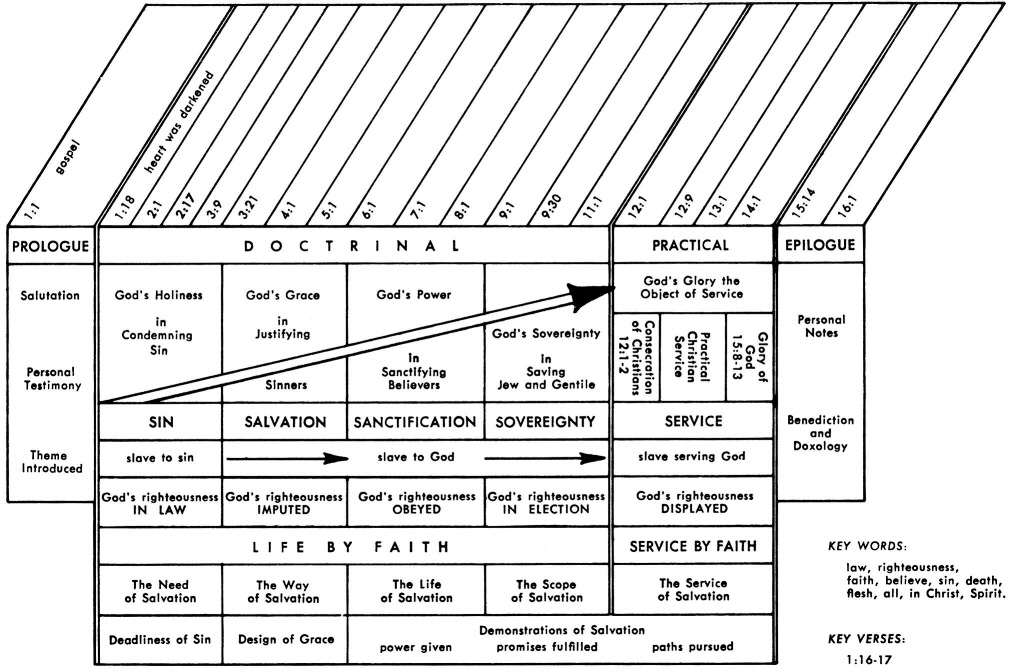
Click chart to enlarge
Chart from recommended resource Jensen's Survey of the NT - used by permission
Romans Overview Chart - Charles Swindoll
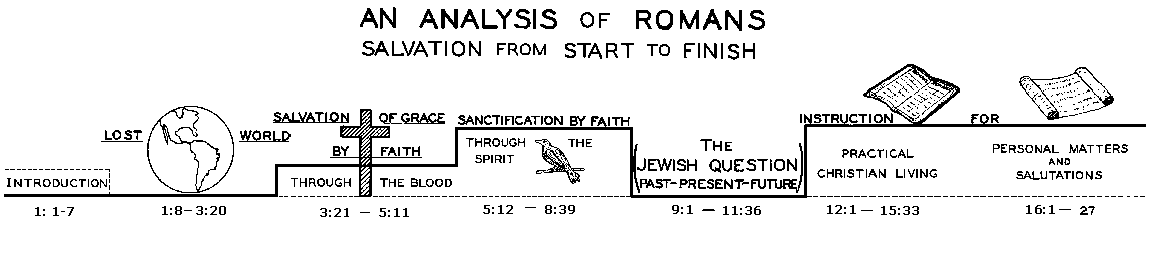
Source: Dr David Cooper
Click to Enlarge
| ROMANS ROAD to RIGHTEOUSNESS |
||||
| Romans 1:18-3:20 | Romans 3:21-5:21 | Romans 6:1-8:39 | Romans 9:1-11:36 | Romans 12:1-16:27 |
| SIN | SALVATION | SANCTIFICATION | SOVEREIGNTY | SERVICE |
| NEED FOR SALVATION |
WAY OF SALVATION |
LIFE OF SALVATION |
SCOPE OF SALVATION |
SERVICE OF SALVATION |
| God's Holiness In Condemning Sin |
God's Grace In Justifying Sinners |
God's Power In Sanctifying Believers |
God's Sovereignty In Saving Jew and Gentile |
Gods Glory The Object of Service |
| Deadliness of Sin |
Design of Grace |
Demonstration of Salvation | ||
| Power Given | Promises Fulfilled | Paths Pursued | ||
| Righteousness Needed |
Righteousness Credited |
Righteousness Demonstrated |
Righteousness Restored to Israel |
Righteousness Applied |
| God's Righteousness IN LAW |
God's Righteousness IMPUTED |
God's Righteousness OBEYED |
God's Righteousness IN ELECTION |
God's Righteousness DISPLAYED |
| Slaves to Sin | Slaves to God | Slaves Serving God | ||
| Doctrine | Duty | |||
| Life by Faith | Service by Faith | |||
|
Modified from Irving L. Jensen's chart above |
||||
R Ruin (Romans 1:17 – 3:20) – The utter sinfulness of humanity
O Offer (Romans 3:21-31) – God’s offer of justification by grace
M Model (Romans 4:1-25) – Abraham as a model for saving faith
A Access (Romans 5:1-11) – The benefits of justification
N New Adam (Romans 5:12-21) – We are children of two “Adams”
S Struggle w/ Sin (Romans 6:1-8:39) Struggle, sanctification, and victory
Romans 6:15 What then? Shall we sin because we are not under law but under grace? May it never be! (NASB: Lockman)
Greek: Ti oun? hamartesomen (1PAAAS) hoti ouk esmen (1PPAI) hupo nomon alla hupo charin? me genoito. (3SAMO)
Amplified: What then [are we to conclude]? Shall we sin because we live not under Law but under God's favor and mercy? Certainly not! (Amplified Bible - Lockman)
CEV: What does all this mean? Does it mean we are free to sin, because we are ruled by God's wonderful kindness and not by the Law? Certainly not! (CEV)
GWT: Then what is the implication? Should we sin because we are not controlled by laws but are controlled by God’s favor? That’s unthinkable! (GWT)
Montgomery: What then? Shall we commit an act of sin because we are not under law, but under grace? Certainly not.
Moule: What then? Are we to sin, because we are not brought under law, but under grace? Shall our life be a life of license, because we are thus wonderfully free? Away with the thought.
New Jerusalem Bible: What is the implication? That we are free to sin, now that we are not under law but under grace? Out of the question!
Phillips: Now, what shall we do? Shall we go on sinning because we have no Law to condemn us any more, but are living under grace? Never! (Phillips: Touchstone)
TLB: Does this mean that now we can go ahead and sin and not worry about it? (For our salvation does not depend on keeping the law but on receiving God’s grace!) Of course not!
Wuest: What then? Shall we sin occasionally, because we are not under law but under grace? Away with the thought.
Young's Literal: So since God's grace has set us free from the law, does this mean we can go on sinning? Of course not!
Godet introduces this section with this comment "The new principle had just been laid down. The apostle had found it in the object of justifying faith. But could a principle so spiritual, apart from every external and positive rule, take hold of the will with power enough to rule it thoroughly? To this natural objection, formulated in Ro 6:15, St. Paul answers as follows: by the acceptance of grace a new master has been substituted for the former, sin (Ro 6:16, 17, 18, 19); and the believer feels himself obliged to serve this new master with the more fidelity because he rewards his servants by communicating life to them, whereas the former master pays his by giving them death (Ro 6:20, 21, 22, 23). Thus it is proved that the new principle is clothed with sufficient, though purely internal authority, to control the believer's entire life. (Romans Commentary - Online)
WHAT THEN?: Ti oun:
- Romans 6 Resources - Multiple Sermons and Commentaries
The question with which Paul introduces this verse is emphatic and expects a positive answer and thus some version translate it with this emphasis:
"Surely you know that" (TEV)
A T Robertson writes the following notes on the Greek text…
What then? (ti oun) Another turn in the argument about the excess of grace.
Shall we sin? (hamartesmen). First aorist active deliberative subjunctive of hamartanō. “Shall we commit sin” - occasional acts of sin as opposed to the life of sin as raised… in Romans 6:1) (where the practice of sin as a habit -present tense - is here raised )
Because (hoti). The same reason as in (Romans 6:1) and taken up from the very words in (Romans 6:14). Surely, the objector says, we may take a night off now and then and sin a little bit “since we are under grace.” Another turn in the argument about the excess of grace.
Wuest - "This second question proposes a life of planned infrequent, spasmodic acts of sin, since grace makes it impossible for a Christian to live a life of habitual sin. Paul answers this question in Romans 6:16-23 by showing that the Christian has changed masters, and that serving the Lord Jesus, it is not his nature to sin."
SHALL WE SIN BECAUSE WE ARE NOT UNDER LAW BUT UNDER GRACE: hamartesomen (1PAAS) hoti ouk esmen (1PPAI) hupo nomon alla hupo charin:
- Ro 6:1,2; 1Cor 9:20,21; 2Cor 7:1; Gal 2:17,18; Eph 2:8-10; Titus 2:11-14; Jude 1:4
- Romans 6 Resources - Multiple Sermons and Commentaries
ANOTHER RHETORICAL
QUESTION
Remember that a rhetorical question is asked merely for effect with no answer expected. Of course in this context the answer is obvious. NO! As believers sin is no longer the sea in which we swim so to speak. It is not the "air" we are to breathe. The Law takes us down. Grace buoys us up. Living under the Law cancels the power of grace.
Shall we sin (264) (hamartano) means to miss the mark (and so not share in the prize). Hamartano means to act contrary to the will and law of God. To commit a wrong. To be in error. Hamartano means to err (err is from Latin errare = to wander or to stray!) which means to wander from the right way, to deviate from the true course or purpose and so to violate an accepted standard of conduct. To err is to miss the right way. To err means to deviate from the path or line of duty. To stray by design or mistake. To err is to stray from God and/or His commandments. Hamartano means to swerve from the truth, to turn aside from the straight course charted by the Word of Truth. To swerve means to wander from any line prescribed, or from a rule of duty; to depart from what is established by law, duty or custom. In short hamartano means to miss the mark of God's perfect standard by wandering (either intentionally or unintentionally) from the path of uprightness.
Gary Hill on hamartano - hamartánō (from a = "not" + méros = "a part, share") [ED: THIS PROPOSED DERIVATION WAS ORIGINALLY PROPOSED BY A. H. STRONG AND IS NOT FOUND IN MANY/MOST LEXICONS THUS ITS VALIDITY IS NOT ABSOLUTELY ESTABLISHED - IT DOES LEAD TO SOME INTERESTING APPLICATION AS HILL GOES ON TO UNFOLD] – properly, having no share in; to sin, which always brings forfeiture (eternal loss because missing God's mark). Like hamartía, (hamartánō) is regularly used in ancient times of an archer missing the target (Homer, Aesch., etc). Every decision (action) done apart from faith (pistis) is sin (Ro 14:23; cf. Heb 11:6). Hamartanō ("to sin") emphasizes loss which always results from missing God's mark (target; i.e. "His preferred will," see thelema). Hamartánō ("choosing sin") asserts the agenda of self, by (for) self, over God's loving plan. Ironically, this insists on bringing self-made condemnation (cf. Titus 3:11). Reflection: Believers experience loss every time they sin (cf. Heb 10:26), as it diminishes their unique glorification awarded by Christ at His return. (The Discovery Bible)
Webster's 1823 Dictionary has a "bibliocentric" definition of sin as "The voluntary departure of a moral agent from a known rule of rectitude or duty, prescribed by God; any voluntary transgression of the divine law, or violation of a divine command; a wicked act; iniquity. Sin is either a positive act in which a known divine law is violated, or it is the voluntary neglect to obey a positive divine command, or a rule of duty clearly implied in such command. Sin comprehends not actions only, but neglect of known duty, all evil thoughts, purposes, words and desires, whatever is contrary to God’s commands or law.
Danker, "In the Iliad (v.287), 264 (hamartanō) is used of a spear missing its mark. In general it is used of failure to achieve one's purpose. "Thus Odysseus in the underworld assures Achilles that Neoptolemus did not err in his words, and only Nestor and Odysseus were match for him (Odyssey xi. 511). Religious significance is attached to the word already as early as Homer. In the Iliad xxiv. 68 Zeus alerts Hera to the fact that Hector never failed to offer pleasing gifts to the gods. The concept of actual wrongdoing and indiscretions committed against the gods appears in the Iliad ix. 501."In Biblical thought the theological implications of 'sin' are more clearly defined in direct ratio to the increased understanding of God's moral nature and man's created responsibility, but the original idea of failure to achieve one's purpose sharpens the contrast between moral expectations and actual achievements. Apart from an understanding of God's redemptive purposes, life is bound to end in disappointment and failure. Human endeavor without atonement is one long ramble. It lacks direction and orientation. Unless all of life is steered toward God and conditioned by His designs, it deviates off course, no matter how swift the speed or determined the direction. That is what the history of this world has to say to contemporary man who hurtles off along his own trajectory, swears companionship to the wind" (Multipurpose Tools for Bible Study, 138).
Under (5259) (hupo) means to be beneath but, even more important, figuratively hupo means to be totally under the power, authority, effects and control of something or someone, in this case the "someone" being Sin personified as a "King" or "Slavemaster" (cf Ro 6:12). Hupo implies operating directly under the efficient cause, i.e. below the one (SIN) directly making something happen. It means you have given SIN the "steering wheel" so to speak. SIN is not a careful driver and always wrecks the "vehicle" (YOU, YOUR BODY, MIND, SOUL, SPIRIT)! That is the spiritual dynamic that transpires EVERY TIME we commit a sin, willful (make a bad choice) or not (sin unknowingly). We have just carried out a thought, word or deed that is in a sense "directed" by our old harsh "Taskmaster" Sin. And this is so sad and uncalled for, for Jesus Christ has set us free from that old "Slavemaster." (Read and saturate your mind with the truth about you dear believer - Ro 6:6-7, Ro 6:11, Ro 6:14, Ro 6:22).
Law (3551) (nomos) (click for purpose of the Law illustrated) is etymologically something parceled out, allotted, what one has in use and possession; hence, usage, custom. It refers to formalized rule or set of rules prescribing what people must do. Sin will overcome us if we try. All attempts to defeat the flesh in our own power will fail.
Grace (5485) (charis) is God's unmerited favor, but it is far more than that! Practically speaking grace is God's power administered by His Holy Spirit (aka the Spirit of grace - Heb 10:29) Who energizes and enables believers to "turn away" from the rotten flesh and to overcome (kill, put to death, mortify, give a fatal blow to) sin (Read and memorize the following two verses so you are able to meditate on them - Ro 8:13; Php 2:13NLT).
Ray Stedman says that Paul's sense here is "Should we sin even once now that we are not under law but under grace?"
Of course Paul is not calling for sinless perfection as Wesley espoused. That is simply not what John teaches (1 Jn 1:8). While we cannot be sinless prior to glorification, the practical point is that we should sin LESS! Saying "Yes" to Jesus and to His empowering Spirit (Ro 8:13) is the best way to start the day, for then you are much more likely to be energized with the desire and power to say "No" to the temptation that comes flying in "our of left field" so to speak. Remember your fleshly lusts are every active for Peter tells us to "abstain from fleshly lusts which (continually - present tense) wage war (continually "strategizing" - think sneaky, tricky, crafty, subtle, "made to order," etc) against our soul. The moment you walk out in the morning with your guard down, it the moment you have just set yourself up for sin!
Kenneth Wuest paraphrases it "What then? Shall we sin occasionally, because we are not under law but under grace?" Read Little Foxes and Sin - There are NO "little sins!"
Montgomery paraphrases it "What then? Shall we commit an act of sin because we are not under law, but under grace? Certainly not."
Here are some other ideas conjured up by Paul's question
“Shall we sin just a little?”
"If forgiveness is as easy and as inevitable as all that, if God's one desire is to forgive men and if his grace is wide enough to cover every spot and stain, why worry about occasional sins?
"Why not do as we like from time to time? It will be all the same in the end."
The answer to "shall we sin?" is "Absolutely not". And he will explain why such a false teaching cannot be accepted.
The question in this verse arises as a reaction to Paul’s statement that now…
“You are not under law, but under grace.” (Romans 6:14)
This question is similar to the one at the beginning of Romans 6:
What shall we say then? Are we to continue in sin that grace might increase? (Romans 6:1)
Note that there is a difference in the way these two questions are phrased.
In the first question, the Greek verb "continue" is present tense and thus refers to a life of habitual sin.
In the second, the verb tense (shall we sin) is aorist tense and thus indicates that here Paul is referring to occasional, single acts of sin. The thought is,
“Since your doctrine of superabundant grace teaches the impossibility of a life of habitual sin on the part of the Christian, will the fact that a Christian is not under the uncompromising rule of law but under the lenient scepter of grace, allow for at least an act of sin once in awhile?”
The idea that grace is "lenient" compared to the uncompromising rule of law, is an erroneous one. The Holy Spirit indwelling the child of God, is infinitely more cognizant of sin in the life of the saint than any system of law ever could be. He is grieved at the slightest sin (Eph 4:30).
In the first question, the desperately wicked heart offers an excuse for sinning in that a life of habitual sin gives God an opportunity to display His grace and thus glorify Himself, which is of course a perversion of the teaching of grace.
In the second question, this same person seeks a loophole somewhere in God’s plan of salvation whereby he might sin once in awhile, and thinks that he has found one in the fact that the Christian is now under grace and is beyond the reach of the law of God which could condemn him. Therefore, he argues that he can sin with impunity, and grace will always forgive. Can you see Paul's argument?
One can see at once from what Paul tells us in Ro 6:1-14, that the person who asks such a question as well as the one in Ro 6:1, is an unregenerate sinner. The child of God has no desire to go on in habitual sin nor yet to sin once in awhile. To be sure, a genuine believer is at times guilty of willful sin. That is, he or she may yield to temptation, knowing that it is sin. But to provide for a planned life of infrequent acts of sin, is altogether foreign to the nature of the saint. Paul answers this question as he did the first one, by the words “God forbid,” “far be the thought.” Then he uses an illustration to show that it is a mechanical impossibility for a Christian to desire to sin even once in awhile.
John MacArthur sums up Paul's argument "With his brief introductory question, What then? the apostle again anticipates the false conclusions his antagonists would derive from his declaration that believers “are not under law, but under grace” (verse 14b). To them, the idea of no longer being under law but under grace was tantamount to being free of all moral restraint. “If the law no longer needs to be obeyed, and if God’s grace covers all sins,” they would argue, “then believers are perfectly free to do as they please.” Jewish legalists, on the other hand, believed obedience to God’s law was the only way of salvation. To them, Paul exalted righteousness out of one side of his mouth, while in reality giving license to sin out of the other side. They accused Paul of condoning lawlessness in the name of God’s grace. The doctrine of grace has always been subject to that false charge, which the apostle first answers in the first half of chapter 6. But because the misunderstanding was so common and the issue so critical, he gives the answer again from a slightly different perspective. The doctrine of salvation by God’s grace, working only through man’s faith and apart from any works, is the furthest thing from a license to sin." (MacArthur, J: Romans 1-8. Chicago: Moody Press) (Bolding added)
Ray Stedman - I know that many experience this. We discover the joy of deliverance. Then we also discover that the old life still has power to tempt us and draw us back into its control. We realize that, even though it is true that Jesus Christ lives within us to be all that he is (which is all that we need), nevertheless the temptation is to strike a balance and work out a compromise. We find ourselves wanting to draw on Christ for the power to meet the times of stress that come -- the big problems -- but we rather like to put on the old comfortable slippers of the flesh the rest of the time, and enjoy that. (Click full sermon Choose Your Master)
Albert Barnes sums up Paul's question with the following thought - "The apostle proceeds to notice an objection which might be suggested. “If Christians are not under the law, which forbids all sin, but are under grace, which pardons sin, will it not follow that they will feel themselves released from obligation to be holy? Will they not commit sin freely, since the system of grace is one which contemplates pardon, and which will lead them to believe that they may be forgiven to any extent?” This Consequence has been drawn by many professing Christians; and it was well therefore, for the apostle to guard against it. (Albert Barnes' Notes on the Bible - 1798-1870)
Adam Clarke - Shall we abuse our high and holy calling because we are not under that law which makes no provision for pardon, but are under that Gospel which has opened the fountain to wash away all sin and defilement? Shall we sin because grace abounds? Shall we do evil that good may come of it? This be far from us!
John Gill comments that "… here the apostle meets with an objection of the adversary, saying, that if men are not under the law, and are free from all obligation to it, then they may live as they list; nor can they be chargeable with sin, or that be objected to them; since where there is no law, there is no transgression, and sin is not imputed where there is no law; and if they are under grace, or in the love and favour of God, from which there is no separation, then they cannot be damned, do what they will: but this objection proceeds upon a mistaken sense of the phrase, "under the law"; for believers, though they are not under the law as the ministry of Moses, yet they are under it, as it is in the hands of Christ; and though not under its curse, yet under obligation to obedience to it, from principles of love and grace; and a transgression of it is sin in them, as in others; and which is taken notice of by God, and visited with stripes in a Fatherly way (see Hebrews 12:5-11), though His lovingkindness is not removed and to argue from the unchangeableness of God's grace, or the doctrines of it, as encouraging licentiousness, is greatly to abuse the grace of God, and manifestly betrays such persons to be ignorant of it and its influence; since nothing more powerfully engages to a love of holiness, and hatred of sin; wherefore the apostle, answers to this objection in his usual way, God forbid; signifying his abhorrence of everything of this kind." (John Gill's Exposition of the Entire Bible -1690-1771) (Bolding added)
MAY IT NEVER BE: me genoito (3SAMO):
- Romans 6 Resources - Multiple Sermons and Commentaries
Paul gives the same clear denial he gave in Romans 6:2. (Click exposition) As in that verse, Paul's refutation is “No, a thousand times no!”
The suggestion that God’s grace grants a license to sin is absurd. Why? Because God bestows His grace in order to free men from bondage to the power of Sin. It would be illogical for the very force that frees us from the power of Sin to at the same time re-energize the power of Sin! Grace clearly does not condone or justify continuing in sin because grace transforms the life that is saved. There is a practical application - If a person's life that gives no evidence of moral and spiritual transformation, they are exhibiting no no obvious evidence of salvation and need to carefully examine the gospel they have believed.
ILLUSTRATIONS OF BIBLE TRUTH by Harry A. Ironside - LAW AND GRACE - "We are not under the law, but under grace" (Ro 6:15).
Some years ago, I had a little school for young indian men and women, who came to my home in Oakland, California, from the various tribes in northern Arizona. One of these was a Navajo young man of unusually keen intelligence. One Sunday evening, he went with me to our young people's meeting. They were talking about the Epistle to the Galatians, and the special subject was law and grace. There were not very clear about it, and finally one turned to the Indian and said, "I wonder whether our Indian friend has anything to say about this."
He rose to his feet and said, "Well, my friends, I have been listening very carefully, because I am here to learn all I can in order to take it back to my people. I do not understand all that you are talking about, and I do not think you do yourselves. But concerning this law and grace business, let me see if I can make it clear. I think is like this. When Mr. Ironside brought me from my home we took the longest railroad journey I ever took. We got out at Barstow, and there I saw the most beautiful railroad station and hotel I have ever seen. I walked all around and saw at one end a sign, 'Do not spit here.' I looked at that sign and then looked down at the ground and saw many had spitted there, and before I think what I am doing I have spitted myself. Isn't that strange when the sign say, 'Do not spit here'?
"I come to Oakland and go to the home of the lady who invited me to dinner today and I am in the nicest home I have ever been in. Such beautiful furniture and carpets, I hate to step on them. I sank into a comfortable chair, and the lady said, 'Now, John, you sit there while I go out and see whether the maid has dinner ready.' I look around at the beautiful pictures, at the grand piano, and I walk all around those rooms. I am looking for a sign; the sign I am looking for it, 'Do not spit here,' but I look around those two beautiful drawing rooms, and cannot find a sign like this. I think, 'What a pity when this is such a beautiful home to have people spitting all over it -- too bad they don't put up a sign!' So I look all over that carpet, but cannot find that anybody have spitted there. What a queer thing! Where the sign says, 'Do not spit,' a lot of people spitted. Where there was no sign at all, in that beautiful home, nobody spitted. Now I understand! That sign is law, but inside the home it is grace. They love their beautiful home, and they want to keep it clean. They do not need a sign to tell them so. I think that explains the law and grace business."
As he sat down, a murmur of approval went round the room and the leader
Romans 6:16 Do you not know that when you present yourselves to someone as slaves for obedience, you are slaves of the one whom you obey, either of sin resulting in death, or of obedience resulting in righteousness? (NASB: Lockman)
Greek: ouk oidate (2PRAI) hoti ho paristanete (2PPAI) heautous doulous eis hupakoen douloi este (2PPAI) ho hupakouete, (2PPAI) etoi hamartias eis thanaton e hupakoen eis dikaiosunen?
Amplified: Do you not know that if you continually surrender yourselves to anyone to do his will, you are the slaves of him whom you obey, whether that be to sin, which leads to death, or to obedience which leads to righteousness (right doing and right standing with God)? (Amplified Bible - Lockman)
Phillips: Just think what it would mean. You belong to the power which you choose to obey, whether you choose sin, whose reward is death, or God, obedience to whom means the reward of righteousness. (Phillips: Touchstone)
Wuest: Do you not know that to whom you put yourselves at the disposal of as slaves resulting in obedience, slaves you are to whom you render habitual obedience, whether slaves of the sinful nature resulting in death, or obedient slaves [of Christ] resulting in righteousness?
Young's Literal: Don't you realize that whatever you choose to obey becomes your master? You can choose sin, which leads to death, or you can choose to obey God and receive his approval.
DO YOU NOT KNOW THAT WHEN YOU PRESENT YOURSELVES TO SOMEONE AS SLAVES FOR OBEDIENCE: ouk oidate (2PRAI) hoti ho paristanete (2PPAI) heautous doulous eis hupakoen:
WHO'S YOUR
MASTER?
Romans 6:16-19 describes the new subjection to righteousness by which grace displaces the old subjection to sin.
James Smith observes…
Scripture religion is variously represented. Sometimes it is a glorious privilege — and sometimes a solemn duty. It is in reality, both. A more glorious privilege man cannot enjoy — than to be the adopted child of God; a more solemn duty cannot devolve on a creature — than to be the slave of the Son of God. Slaves are known often by their uniform — and God's slaves are to be known by their holiness. Slaves of old, were often known by their master's brand — and the slaves of Christ were often known by their sufferings. Like the Apostle of old, they "bear about in the body, the marks," or the brand, "of the Lord Jesus."
There are two distinct classes of slaves in the world, and it is important to know to which we belong. The apostle teaches us how to do this, especially (in Ro 6:16). This passage SUGGESTS AN INQUIRY. Who is your Master? There are but two great masters in the world — and we all serve one or the other.
Who then is your master? Is it SATAN?
If so — then sin is your service. You neglect what God requires — and you do what God forbids. You …
indulge the lusts of the flesh,
enjoy the lust of the eye,
and walk in the pride of life.
(1Jn 2:16)
The world is your home! (See related topic: Earth Dwellers) Only give you enough of the world, and health and opportunity to enjoy it — and you need no more. You would rather have your portion in Paris — than in paradise.
If so, then Hell will be your wages! For the wages of sin is death. If you obey Satan, you love sin and live in its indulgence. You follow the multitude in the broad road that leads to destruction. You yield to the flesh, and allow it to tyrannize over your conscience and affections.
Who is your master? Is it CHRIST?
Then holiness is your delight, and obedience to gospel precepts is your joy. The Church of God is your home, and believers in Christ are your brethren. Eternal life will be your reward, not as merited or deserved by you — but as freely given you by your generous and gracious Master. The gift of God is eternal life — if you obey Christ, you reverence the divine word, both the holy law, and the gracious Gospel. You hallow your Savior's name, never using it lightly, or uttering it without reverence. You rely on his precious blood and glorious righteousness, as the ground of your acceptance with God. You yield to his Spirit — speaking to you in the word, or working within you, and prompting you to perform good works. You unite with his people — whom you esteem the excellent of the earth, and in whom is all your delight. You look and long for his glorious appearing, and as you anticipate his second advent, you often exclaim, "O to see my Master!" (Whose Slave Are You)
Do you not know - Of course you know is the point! Paul speaks of a self-evident truth, the truth that when one accepts servitude to another, that enslavement becomes binding and forbids divided allegiance or servitude! Paul then proceeds to introduce us to the two different "masters", personified as Sin and Obedience.
Know (1492) (eido) (perfect tense) means absolute, positive, beyond a peradventure (chance) of a doubt, knowledge. It means to perceive intuitively and describes a self-evident truth. Paul's question is clearly rhetorical (asked merely for effect with no answer expected) and implies that his readers would readily acknowledge the truth of what he was about to say if they gave it the least thought - it is a dictate of common sense.
Present (3936) (paristemi from para = near, beside + histemi = place, set) literally means to place or set beside or near and hence to place at someone's disposal. Paristemi means to present oneself for service or to put at the service of (sometimes translated "help" as in Ro 16:2). Paristemi is in the present tense indicates this reflects the habit of one's life. The active voice represents the action as being accomplished by the subject and indicates the willing choice of obedience to a master which makes Paul’s point even more obvious.
Slaves (1401) (doulos from deo = to bind) describes one who is in bondage or bound to another, in the state of being completely controlled by someone or something and a slave in the sense of being the property of the owner. The will of the individual is submitted to the will of the master.
Obedience (5218) (hupakoe from hupó = agency or means, under + akoúo = physical hearing and apprehension of something with the mind) literally means "hearing under", that is, listening from a subordinate position in which compliance with what is said is expected and intended. Hupakoe speaks of the one hearing as being under the authority of some one else. Thus, hupakoe comes to mean compliance (disposition to yield to another) with the demands or requests of someone over us. The idea of to hear under pictures subordinating one’s self to the person or thing heard and hence means “to obey” or to hearken (give respectful attention) Obedience is submission or hearkening to a command. Obedience is the carrying out the word and will of another person, especially the will of God.
Hupakoe conveys the picture of one listening and following instructions. Submitting to that which is heard involves a change of attitude, forsaking the tendency of the fallen nature to rebel against Divine instructions and commands and seeking God's will, not self will.
Someone has said that a "proof" that we are of the elect is not an empty prating about how secure we are once we believed, but rather how sensitive we are to the principle and practice of obedience to Jesus.
You know that in effect there is no middle ground between being a slave to sin and a slave to obedience to God. Jesus clearly taught that “No one can serve two masters" (Mt 6:24; Luke 16:13).
Those who are afraid of grace insist that it gives license for sinning. Paul meets this error head-on by asking the question, then flatly denying it. We are free from the law but not lawless. Grace means freedom to serve the Lord, not to sin against Him.
As Paul used the figure of slavery to illustrate death to sin and resurrection to new life in Christ and not in sin, so now he uses slavery against the idea of occasional lapses into sin. Loyalty to Christ will not permit occasional crossing over to the other side to Satan's line.
William Newell sums this section up writing - "the answer to the second question is: God has set believers free, to serve Himself. The only other master is sin. And bondage to sin results from serving sin. But the Word of God says to the believer. Ye are not under law, but under grace. Many people who have been convicted of the guilt of sin and have relied on the shed blood of Christ as putting away that guilt, have not yet, however, seen a state of sin as abject slavery. The strength of sin is just as real as its guilt. No creature can free himself from the bondage of sin. Sin brought to fallen man the inability to do anything else but sin (Ge 6:5). Although contrary to conscience, to reason, to desire for liberty; in spite of the terror inspired by the tragic examples about them, -yea, despite awful warnings and expectations of personal impending ruin, men continue in sin and its bondage. But there is another "obedience, "-that unto righteousness. And the case turns on the words, to whom ye present yourselves as servants. Although we cannot free ourselves, or change our own spiritual condition, the great fact of human responsibility is plainly written here. God, who would have all men to be saved, is always ready to have them present them- selves to Him. And it is by means of the gospel that we do so, -whether to take our place as sinners, in the first instance; or, after we have believed, when we present ourselves to Him and our members as instruments of righteousness. We all know this, be our theological training what it may. We all know we are doing wrong if we do not obey the gospel of God concerning His Son. "When He, the Spirit of truth, is come, He will convict the world in respect of sin … because they believe not on Me" (Joh 16:8,9). Let us remember then, that the obedience unto righteousness of verse 16, is "the obedience of faith, " always. (Romans 6 - Newell's Commentary on Romans)
YOU ARE SLAVES OF THE ONE WHOM YOU OBEY EITHER OF SIN RESULTING IN DEATH OR OF OBEDIENCE RESULTING IN RIGHTEOUSNESS: eis dikaiosunen douloi este (2PPAI) ho hupakouete (2PPAI) etoi hamartias eis thanaton e hupakoes:
- Either of sin - Ro 6:12,17,19, 20, 21, 22, 23
- Romans 6 Resources - Multiple Sermons and Commentaries
SLAVES OF THE
ONE YOU OBEY
You are (este) is present active indicative. The point is one is continually a slave to Sin if we obey Sin and commit sins. The practical implication is that we need to be quick to confess our sins, so we in effect place ourselves back under our "master" OBEDIENCE (so to speak).
Slaves (1401) (doulos [word study] from deo = to bind) (Click additional notes on doulos) in Paul's day were those individuals who were bound to their master in servitude. Doulos in Paul's writings thus conveys the picture of a slave's close, binding tie with their master, of belonging solely to him and of being obligated to and desiring to do his will. In sum, the will of the doulos is completely consumed in the will of the master.
A bondservant therefore is one who has surrendered wholly to the master's will which in the present passage is submission either to "Sin" or to "Obedience". As believers we are no longer our own but have been bought with the price of the blood of Christ (1Cor 6:20, 1Pe 1:18, 19; Titus 2:14). We are now the property of our Lord Jesus Christ and are to conduct ourselves in this present evil age (Gal 1:4) as His "love" slaves (ie, we obey because we love the One Who first loved us - 1Jn 4:19, 2Co 5:14NLT). No man (no exceptions!) can serve two masters (Mt 6:24). We are all born into servitude to Sin for we are all born children of Adam (Ro 5:12), but now we are slaves of the Lord Jesus Christ by our new birth (2Cor 5:17). As believers we now are (ideally) to have no will of our own, no business of our own, no time of our own. Instead we are to be continually yielding to and serving our Master, the Lord Jesus Christ, in complete dependence upon His enabling power.
THOUGHT - Of course, we fail and fall, but we then need to quickly confess and repent as alluded to above. Sin brings death in the sense that our fellowship and communion with God is temporarily "impaired" but it can be "repaired" by confessing our sin against Him and turning from that sin (repentance). But Sin is tricky (Heb 3:13). It also brings shame. What did Adam and Eve do? They hid out of shame and covered themselves with fig leaves.(Ge 3:7,8) And too often we allow ourselves to remain in that "ashamed" state, almost as if we deserved it (which in a sense we do) and almost feeling like we need to do penance and do some "pay back" for our offense. How ridiculous! (Read Col 2:23) God has provided a way of escape - to walk in the light by confessing that sin to Him! (1 Jn 1:7, 9) And yet we remain in the dark shadows of shame (and guilt) (assuming we have not completely seared our conscience). But why would we do that? Our flesh is tricky and wants to keep us in the shadows of unconfessed sin and out of God's marvelous light. And undoubtedly the devil (his minions) are shooting flaming missiles (Eph 6:16) at us saying things like "You deserve to feel a little shame! You don't deserve to go back into God's presence until you've done some penance. You need to feel the weight of sorrow for you sin before you go back to God." (cf "accuser" in Rev 12:10) And all the while God has provided His amazing grace, mercy and forgiveness --not based on our so-called penance; not based on the nature of our sin ("big" or "little" - there are no "little sins!"). Simply based on the blood of Jesus which cleanses us from ALL unrighteousness. (1 Jn 1:7) You may be reading this right now and the Spirit has brought to mind some sin (or sins) you have committed (or are even actively engaging in) and you know that deep in your heart you have been feeling the weight of shame and guilt from that sin (cf Ps 32:4). Dear believer, beloved of the Father, allow God to lift the load off your back. Confess. (1 Jn 1:9) Repent. (Pr 28:13) Both of those "avenues" are open to you at all times and both are grace-based. You can never merit or earn the right to confess or repent. In that sense they are just like our initial salvation - they are free gifts of God's amazing grace and thus they (like our initial salvation) need to be welcomed and received (and acted upon) by faith in God's Word. God gives the gift of confession and repentance to you freely as His unmerited favor. But you say that is "too easy." Shouldn't I have to do something to pay back God for my disobedience. May it never be! Christ has done it all for you. By faith you put your full weight on and rest in His eternal declaration "Paid in Full." (Jn 19:30). And then you rise up and walk forth, walking in the light as He Himself is in the light. Of course, there may still be consequences or there may be some divine discipline (Heb 12:5-11), but neither should impede you or discourage you from walking forth in His marvelous light! (1 Jn 1:7). This discussion is "summarized" well by the timeless words of Augustus Toplady's Rock of Ages. Take a moment to read them (or sing them), allowing each stanza to sink into your soul as a reminder of the "Cleft" Christ made available for you. Don't hide behind "fig leaves" of your own making, but hide yourself in the Rock of Ages, cleft for thee! What can wash away our sins, nothing but the blood of Jesus!
Rock of Ages, cleft for me,
Let me hide myself in Thee;
Let the water and the blood,
From Thy riven side which flowed,
Be of sin the double cure,
Save me from its guilt and power.
Not the labor of my hands
Can fulfill Thy law’s demands;
Could my zeal no respite know,
Could my tears forever flow,
All could never sin erase,
Thou must save, and save by grace.
Nothing in my hands I bring,
Simply to Thy cross I cling;
Naked, come to Thee for dress,
Helpless, look to Thee for grace:
Foul, I to the fountain fly,
Wash me, Savior, or I die.
While I draw this fleeting breath,
When mine eyes shall close in death,
When I soar to worlds unknown,
See Thee on Thy judgment throne,
Rock of Ages, cleft for me,
Let me hide myself in Thee.
Obey (5219) (hupakouo [word study] from hupó = = agency or means, under + akoúo physical hearing and apprehension of something with the mind - akouo gives us our English acoustics - the science of design which helps one hear) literally means to listen under with attentiveness and to respond positively to what is heard. The sense is that one understands and responds accordingly. Note that hupakouo implies an inward attitude of respect and honor, as well as external acts of obedience. Obedience on the part of children consists in listening to the advice given by parents. For example in Genesis 22 Isaac's willingness to be offered as a sacrifice is a model of such submission.
Hughes - Obedience involves conscious listening. If you do not really listen, you cannot really obey. That is why parents are always saying, “Listen to me!” The idea is to listen under with the intent to understand and do it… Much of this is a matter of attitude (Ed: Which reflects the spiritual condition of one's heart!). We are not to be like the little boy who misbehaved and was told by his teacher to sit in the corner, which he did with grudging obedience, all the while saying to himself, “I’m sitting down on the outside, but I’m standing up on the inside!” (Ephesians: The Mystery of the Body of Christ. Crossway Books)
To obey means to hear under authority and thus pictures the one hearing as being under the authority of some one else. Hupakouo means to obey on the basis of having paid attention to. So first one has to hear and then one has to make a conscious choice to submit and respond to the word (optimally, His Word of righteousness and truth) heard.
It short Paul clearly teaches that a slave hearkens or gives respectful attention to either one of two masters, Sin (and the flesh) or "Obedience" (which is made possible by God's indwelling Spirit). There is no middle ground! No place for compromise in the Christian life! Hupakouo is in the present tense indicating obedience is to be the believer's habitual practice (their direction not perfection, at least not in this present life!).
The basic picture of hupakouo is that of placing oneself under what has been heard and therefore submitting to what is heard. Sin and Obedience are here both personified as "Masters". If Sin is one's master, the result will be death of both body and soul (cp James' teaching in Jas 1:14, 15 and thus his strong warning Jas 1:16). If Obedience is the master, the effect of service to this master (Obedience) will be righteousness and holiness.
Paul has a parallel thought on this basic spiritual dynamic (and the basic conflict) commanding saints to…
walk (present imperative = command to continually yield to and be empowered to conduct your life in general) by the Spirit (What is the "promise" coupled with obedience to this command?), and you will not carry out the desire of the flesh (Note the order of the godly "walk": Submission to Spirit is first, not "trying" to control the desires of the flesh, as by keeping a list of "do's and don'ts" - that's putting yourself under the law! See what happens when you do that - Ro 7:5) for the flesh sets its desire (epithumia) against the Spirit, and the Spirit against the flesh; for these are in opposition to one another, so that you may not do the things that you please (which means every believer, as we all know too well [!], still possesses the latent desire to do "our will" rather than God's will, especially when we are bombarded by the tempting "arrows" of the world, the flesh and the devil). (Gal 5:16; Gal 5:17)
To summarize, every person is a bondservant to someone or something. Before we were saved, we were slaves of Sin. Now that we belong to Christ, we are freed from that old slavery and made servants of Christ.
Sin (noun) (266)(hamartia [word study]) literally conveys the sense of missing the mark as when hunting with a bow and arrow (in Homer some hundred times of a warrior hurling his spear but missing his foe).
- See discussion of the verb form - hamartano
- See discussion of "the Sin" = Sin "personified" as a principle
Note how frequently Paul uses hamartia in Romans -
Ro 3:9, Ro 3:20; Ro 4:7, 8; Ro 5:12, Ro 5:13, Ro 5:20, 21; Ro 6:1, 2, Ro 6:6, 7, Ro 6:10, Ro 6:11, Ro 6:12, 13, 14, Ro 6:16, 17, Ro 6:18, Ro 6:20, Ro 6:22, Ro 6:23; Ro 7:5, Ro 7:7, 8, 9, Ro 7:11, Ro 7:13, Ro 7:14, Ro 7:17, Ro 7:20, Ro 7:23, Ro 7:25; Ro 8:2, 3, Ro 8:10; Ro 11:27; Ro 14:23;
Death (2288) (thanatos from thnesko = to die) refers physically to the separation of soul from the body (physical) is literally a physical separation of the soul from the body. Thanatos was a legal technical term for capital punishment. Every form of death in the NT is treated not as a natural process but always as a destroying power related to sin and its consequences. In this verse thanatos speaks of the destroying power related to sin and its consequences.
Righteousness (1343) (dikaiosune from dikaios = being proper or right in the sense of being fully justified being or in accordance with what God requires) is the quality of being upright. In its simplest sense dikaiosune conveys the idea of conformity to a standard or norm. In this sense righteousness is the opposite of hamartia (sin), which is defined as missing of the mark set by God. In this sense righteousness is the opposite of hamartia (sin), which is defined as missing of the mark set by God.
Dikaiosune is rightness of character before God and rightness of actions before men. Righteousness of God could be succinctly stated as all that God is, all that He commands, all that He demands, all that He approves, all that He provides through faith in Christ (Click here to read Pastor Ray Pritchard's interesting analysis of righteousness in the Gospel of Matthew).
What's Paul's point? Who do you habitually obey? A person’s general pattern of living proves who one's true master is. We are speaking of "direction" (Heavenward versus Hell-ward!), not perfection (that's called glorification!). If a person's life is characterized continually by sin (as a lifestyle), then that person is a slave to Sin (as a Master). If one's life is characterized by habitual (Paul did not say "perfect"! obedience), then that person is demonstrating by their habitual conduct that they are a slave to the Lord Jesus Christ. The end result of the first slavery is both physical and spiritual death, whereas that of the second slavery is righteousness (right attitudes and actions before God and men), the mark of eternal life. The habitually unrighteous life cannot be a Christian life.
Matthew Henry sums it up well stating that "If we would know to which of these two families we belong, we must inquire to which of these two masters we yield our obedience."
William MacDonald - Sin’s slaves are bound by guilt, fear, and misery, but God’s servants are free to do what the new nature loves. So why be a slave when you can be free? (Believer's Bible Commentary)
William Newell writes that "Let us remember then, that the obedience unto righteousness of Ro 6:16, is "the obedience of faith, " always.
Comment: In other words, dear believer, Newell is saying we are to walk by faith, not sight. The order is first "Trust" and then "Obey" for there's no other way to be happy in Jesus than to…
Trust and Obey
When we walk with the Lord in the light of His Word,
What a glory He sheds on our way!
While we do His good will, He abides with us still,
And with all who will trust and obey.Trust and obey, for there’s no other way
To be happy in Jesus, but to trust and obey.
Moule - in the very act of leaving (as the result of God's actions in our heart) the bond-service of Sin you entered that of Pardon as taught in the Gospel, and are thus bound to obey as much as ever, though in the opposite direction. (The Epistle of Paul the Apostle to the Romans - Online)
If one manifests no inclination and/or no power to be obedient to the Lord Jesus Christ, then they need to examine themselves in light of Paul's serious warning to…
Test (peirazo - present imperative = Continual command because this is a continual need all of us! See the attitude we must all continually have in 1Co 10:12) yourselves (This pronoun is first in the Greek sentence for emphasis! Quit judging others! Quit looking at others and using their disobedience to justify your disobedience as "not so bad"!) to see if you are in the faith; examine (dokimazo = present imperative) yourselves! Or do you not recognize this about yourselves, that Jesus Christ is in you-- unless indeed you fail the test (adokimos = that which does not prove itself to be such as it ought to be and which is therefore disapproved and useless!)? (2Corinthians 13:5)
C H Spurgeon phrases it this way "If you are doing the deeds of sin, you are the servants of sin and only as you are doing the will of God can you claim to be the servant of God. “Hereby we know that we know him, if we keep His commandments.” (1Jn 2:3) That becomes the index of our condition. The man, then, that lives in sin and loves it, need not talk about the grace of God to which he is a stranger, for the mark of those that come under grace is this, that they serve God, and no longer serve sin. (Spurgeon on Romans)
Romans 6:17 But thanks be to God that though you were slaves of sin, you became obedient from the heart to that form of teaching to which you were committed, (NASB: Lockman)
Greek: charis de to theo hoti ete (2PIAI) douloi tes hamartias hupekousate (2PAAI) de ek kardias eis on paredoethete (2SAPI) tupon didaches,
Amplified: But thank God, though you were once slaves of sin, you have become obedient with all your heart to the standard of teaching in which you were instructed and to which you were committed. (Amplified Bible - Lockman)
Phillips: Thank God that you, who were at one time the servants of sin, honestly responded to the impact of Christ's teaching when you came under its influence. (Phillips: Touchstone)
WBC: But thanks be to God, that when you were slaves of sin you gave your obedience from thee heart to the one to whom you were handed over as a pattern of teaching.
Wuest: But God be thanked, that [whereas] you were slaves of the evil nature, you obeyed out from the heart as a source a type of teaching into which you were handed over.
Young's Literal: Thank God! Once you were slaves of sin, but now you have obeyed with all your heart the new teaching God has given you.
BUT THANKS BE TO GOD THAT THOUGH YOU WERE SLAVES OF SIN : charis de to theo hoti ete (2PIAI) douloi tes hamartias:
- But thanks be to God - Ro 1:8; 1Chr 29:12, 13, 14, 15, 16; Ezra 7:27; Mt 11:25,26; Acts 11:18; 28:15; 1Co 1:4; Ep1:16; Phil 1:3, 4, 5; Col 1:3,4; 1Th 1:2,3; 3:9; 2Th 1:3; 2Ti 1:3, 4, 5; Philemn1:4; 2Jn 1:4; 3 Jn 1:3
- Though you were slaves of sin - 1 Cor 6:9, 10, 11; Ep 2:5, 6, 7, 8, 9, 10; 1Ti 1:13, 14, 15, 16; Titus 3:3, 4, 5, 6, 7; 1Pe 2:9; 4:2, 3, 4, 5
- Romans 6 Resources - Multiple Sermons and Commentaries
Be cautious relying completely on paraphrase translations, which are less faithful to the original Greek (or Hebrew) (Click for comparison of different translations). Paraphrases may help understand the text but can also be misleading as is the The Living Bible translation, which reads…
"Thank God that though you once chose to be slaves of sin… " (Bolding added)
This statement is not theologically accurate! Everyone born has been born into Adam (Ro 5:12) and did not have a choice to obey sin or not. As Paul has clearly taught, Sin is the Master of all who are unsaved. The unregenerate person (Jn 3:3, 5) is under the control of Sin and this is the position of the natural man, without exception. No matter how outwardly moral, upright, or benevolent an unsaved person’s life may be, all that he thinks, says, and does emanates from a proud, sinful, ungodly heart (Ro 3:10).
But - This conjunction should always alert the attentive reader that the writer is introducing a change of direction. So Paul begins a contrast which expresses the absolute incompatibility of living in sin on the part of the believer.
Thanks be (5485) (charis) reads more literally "grace to God" [there is no verb "be"] (Charis also used in 2 Cor 2:14 "Thanks be to God..."). Paul moves from the principle in the preceding verse (Ro 6:16) to the experience of the Roman believers. The apostle’s gratitude to God lies in the fact that their former condition is a thing of the past and his believing readers are no longer subject to that slavery which leads to death.
Were (imperfect tense) signifies an action being committed over and over, which reflects the reality of the unregenerate person, who is under the continual slavery to Sin. The imperfect tense indicates that slavery was an ongoing reality before the new birth (but now = Ro 6:11NLT)
Slaves to sin - Remember that you are either slave to sin or slaves to God. If you are living a life that demonstrates sin is your master, you are not born again and your eternal destiny is the Lake of Fire which burns forever and ever! Do not be deceived by the false teaching that you can claim to be saved by faith at a point in time and then spend the remainder of your life in sin. Such a person is not saved, but deceived and those who teach this deadly doctrine of "free grace" have perverted the Gospel. Woe!
Slaves (1401)(doulos from deo = to bind) (Click additional notes on doulos) was an individual bound to another in servitude and conveys the idea of the slave's close, binding ties with his master, belonging to him, obligated to and desiring to do his will and in a permanent relation of servitude. In sum, the will of the doulos is consumed in the will of the master and in this case the "master" was SIN!
Sin (266)(hamartia) literally conveys the idea of missing the mark as when hunting with a bow and arrow (in Homer some hundred times of a warrior hurling his spear but missing his foe). Later hamartia came to mean missing or falling short of any goal, standard, or purpose. In the present context Sin "personified" as a principle
YOU BECAME OBEDIENT FROM THE HEART TO THAT FORM OF TEACHING TO WHICH YOU WERE COMMITTED: hupekousate (2PAAI) de ek kardias eis on paredothete (2SAPI) tupon didaches eis on paredothete (2SAPI)
- But you became obedient - Ro 1:5; 2:8; 15:18; 16:26; Ps 18:44; 2Cor 10:5,6; Heb 5:9; 11:8; 1Pet 1:22; 3:1; 4:17
- To that form of teaching 2Ti 1:13
A BELIEVER'S NEW
STATE - OBEDIENCE
Peter has a parallel description (and exhortation) writing to the believers who were undergoing persecution and testing times…
Since you have in obedience to the truth (the Gospel - cp Col 1:5) purified your souls for a sincere (anuopkritos) love of the brethren (philadelphia), fervently love (agapao in the aorist imperative) (Truth transforms our mind and heart so that we can carry out this new quality of love) one another from the heart, for you have been born again (anagennao) not of seed which is perishable but imperishable, that is, through the living and abiding word of God (See Power of God's Word). (1Pe 1:22, 23)
You became obedient (5219) (hupakouo [word study] from hupó = = agency or means, under + akoúo = physical hearing and apprehension of something with the mind) literally means to listen under with attentiveness and to respond positively to what is heard. It means to hearken or give respectful attention to.
Hupakouo is in the aorist tense which points to an action which has been completed at a definite time in the past. What time? Clearly, when they believed the life giving Gospel of the grace of God (Acts 20:24). The Roman Christians had given wholehearted obedience to the gospel to which they had been committed, including all the doctrines Paul taught in the book of Romans. Now they possessed a new nature which enabled them to obey their new master, the Lord Jesus Christ.
Hupakouo - 21x in 21v in the NAS - answer(1), became obedient(1), becoming obedient(1), heed(1), obedient(2), obey(12), obeyed(3).
Matt 8:27; Mark 1:27; 4:41; Luke 8:25; 17:6; Acts 6:7; 12:13; Rom 6:12, 16f; 10:16; Eph 6:1, 5; Phil 2:12; Col 3:20, 22; 2 Thess 1:8; 3:14; Heb 5:9; 11:8; 1 Pet 3:6.
Redeemed - Among the many names given to our Lord in the Bible, one is especially dear to me. It is the name Redeemer. The word redeem literally means "to buy back." It suggests that something has been sold or forfeited in order to pay a debt. When the price of its redemption has been paid, the lost article can be reclaimed.
Man was created in God's image, but he sold out to Satan for some fruit from a forbidden tree. Since that time, all mankind has been enslaved to sin and under judgment. The purchase price of redemption was the sacrificial death of Jesus Christ, which met the demands of God's holiness. Everyone who accepts God's gift of forgiveness is set free and becomes a slave of Christ the Redeemer (Ro 6:22).
Many years ago, a man visited a slave market. He watched for a while, then bid on a slave until no one was able to go any higher. After paying the price, he gave the bill of sale to the slave, and said, "I have purchased you to set you free." Overcome with gratitude, the slave refused to leave him and became his devoted servant for life.
Jesus paid an enormous price for our salvation. Do we serve Him out of gratitude? — M. R. De Haan (Our Daily Bread, Copyright RBC Ministries, Grand Rapids, MI. Reprinted by permission. All rights reserved)
My new life I owe to Thee,
Jesus, Lamb of Calvary;
Sin was canceled on the tree,
Jesus, blessed Jesus. --Blanchard
Jesus gave his all for us--
Are we giving our all for Him? (Ro 6:17)
From the heart - Not just the "head" but from our "control center" (see below). Paul is describing more than intellectual acceptance and stoic obedience. He is saying that the believer's new obedience comes from deep within, from their qualitatively new heart which is indwelt by a qualitatively new power (see Ezekiel 36:26, 27, cp even OT teachings that spoke of the need for and provision of a "new heart" = Ezek 11:19, 18:31, Dt 30:6, Jer 31:33, 32:39, 40).
Heart (2588) (kardia) does not refer to the physical organ but is always used figuratively in Scripture to refer to the seat and center of human life. The heart is the center of the personality, and it controls the intellect, emotions, and will. No outward obedience is of the slightest value unless the heart turns to God.
See 4 page article in Dictionary Of Biblical Imagery article on Heart - kardia
See 5 page article in NT Dictionary Of New Testament Theology on Heart - Kardia
Kardia as stated above refers not to the physical organ (over 800 mentions and none refer to the physical organ!), but is always used figuratively to center of our personality, to so to speak to our "control center" (to make a play on the "air traffic control center" at the airport which carefully guards and guides what flies in and what flies out. How applicable to our "hearts" which are so prone to wander!). In short kardia refers to the the affective center of our being wherein lies the capacity of moral preference and volitional desire. The kardia generates thoughts that make the decisions which the mind works out. In other words, our logic flows out of our heart-decisions and not vice versa. Gleason Archer called the kardia, the "desire-producer that makes us tick" for it is the place where our "desire-decisions" occur, and which establish who we really are. WHO ARE YOU? HAVE YOU HAD A HEART CHECK UP RECENTLY? We are assiduous to do this medically, but woefully lax in doing it spiritually (beloved, I speak from experience!). At regeneration God reverses the spiritual atherosclerosis of our old sinful heart by giving us a total heart transplant! Daily confession and repentance are thereafter necessary to avoid "spiritual atherosclerosis" and gradual, subtle hardening (and becoming cold to the things of God) of our heart! (Read and practice daily "preventative maintenance" = 1 Jn 1:9, Pr 28:13).
Gary Hill rightly reminds us that "Life is a continuous contest, waged and won in the heart. As the heart goes, so goes the rest of us. This is true in "both directions": negatively (Jn 14:1, 27; Acts 7:51, 8:21; Ro 1:21) and positively (Acts 16:14; Ro 2:29; Heb 10:22). The heart, as the seat of decision-making, also involves emotions (desires) that are key to making choices....Cognition (the use of the "mind") is vital, but the heart "steers our being" as the primary organ of decision-making. The heart forges our personality ("soul"), intellect ("mind"), and actions ("strength"). Accordingly, the heart is the primary (driving) force in preferring good (Mt 5:28; Ro 6:17), or evil (Mt 5:28). The mind (reasoning) reacts to (works out) heart-choices ("internal persuasions"), but making choices (core-decisions) comes from the heart." (Discovery Bible)
Kardia - 156x in 149v - kardia as heart, 102; heart's, 1; hearts, 49; mind, 2; minds, 1; quick, 1; spirit, 1. Mt 5:8, Mt 5:28; Mt 6:21; Mt 9:4; 11:29; 12:34, 40; 13:15, 19; 15:8, 18, 19; 18:35; 22:37; 24:48; Mk. 2:6, 8; 3:5; 6:52; 7:6, 19, 21; 8:17; 11:23; 12:30, 33; Lk 1:17, 51, 66; 2:19, 35, 51; 3:15; 5:22; 6:45; 8:12, 15; 9:47; 10:27; 12:34, 45; 16:15; 21:14, 34; 24:25, 32, 38; Jn 12:40; 13:2; 14:1, 27; 16:6, 22; Acts 2:26, 37, 46; 4:32; 5:3, 4; 7:23, 39, 51, 54; 8:21, 22; 11:23; 13:22; 14:17; 15:9; 16:14; 21:13; 28:27; Ro 1:21, Ro 1:24; Ro 2:5, Ro 2:15, Ro 2:29; Ro 5:5; Ro 6:17; Ro 8:27; Ro 9:2; Ro 10:1, Ro 10:6, Ro 10:8, 9, Ro 10:10; Ro 16:18; 1Co. 2:9; 4:5; 7:37; 14:25; 2Co. 1:22; 2:4; 3:2, 3, 15; 4:6; 5:12; 6:11; 7:3; 8:16; 9:7; Ga 4:6; Ep 1:18; Ep 3:17; Ep 4:18; Ep 5:19; Ep 6:5, Ep 6:22; Php 1:7; Php 4:7; Col 2:2; Col 3:15, Col 3:16, Col 3:22; Col 4:8; 1Th 2:4, 1Th 2:17; 1Th 3:13; 2Th 2:17; 3:5; 1Ti 1:5; 2Ti 2:22; He 3:8, He 3:10, He 3:12, He 3:15; He 4:7, He 4:12; He 8:10; He 10:16, He 10:22; He 13:9; Jas 1:26; Jas 3:14; Jas 4:8; Jas 5:5, 8; 1Pe 1:22; 1Pe 3:4, 1Pe 3:15; 2Pe 1:19; 2Pe 2:14; 1Jn 3:19, 20, 21; Re 2:23; Re 17:17; Re 18:7.
Kardia gives us medical terms such as cardiac, cardiovascular, etc. Just as the integrity of our physical heart is vital to our physical life, in a similar and even more important way the integrity of our spiritual heart is vital to our spiritual life, for our spiritual life impacts not just our enjoyment of time but of eternity. Beloved, let us study the meaning of kardia, but let us be far more serious about guarding our kardia in this short life (see Pr 4:23, cp 1Ti 4:7, 8, 2Co 5:9 2Co 5:10, Spurgeon writes "A short life should be wisely spent. We have not enough time at our disposal to justify us in misspending a single quarter of an hour. Neither are we sure of enough life to justify us in procrastinating for a moment. If we were wise in heart we should see this, but mere head wisdom will not guide us aright." See his full note on Ps 90:12)
Hughes explains that what Paul is saying here is that…"The heart is the wellspring of man’s spiritual life, and that is where the Roman Christians’ obedience was rooted. It was not just a formal obedience—it came from the center of their being. This is the example of slavery Paul holds up for us all: a heartfelt obedience to Christ and his Word. It is an obedience which brings liberation." (Romans: Righteousness from heaven. Preaching the Word. Wheaton, Ill.: Crossway Books)
While kardia does represent the inner person, the seat of motives and attitudes, the center of personality, in Scripture it represents much more than emotion, feelings. It also includes the thinking process and particularly the will. For example, in Proverbs we are told, “As (a man) thinks in his heart, so is he” (Proverbs 23:7). Jesus asked a group of scribes, “Why are you thinking evil in your hearts?” (Matthew 9:4). The heart is the control center of mind and will as well as emotion.
The great Puritan writer John Flavel wrote that "THE heart of man is his worst part before it is regenerated, and the best afterward; it is the seat of principles, and the fountain of actions. The eye of God is, and the eye of the Christian ought to be, principally fixed upon it. The greatest difficulty in conversion, is to win the heart to God; and the greatest difficulty after conversion, is to keep the heart with God. Here lies the very force and stress of religion; here is that which makes the way to life a narrow way, and the gate of heaven a strait gate. (from Flavel's classic work - Proverbs 4:23 Keeping The Heart which has been called "one of greatest Christian books of all time" - Recommended Reading!) (See also in depth commentary on Pr 4:23).
The Scottish writer John Eadie says that "The “heart” belongs to the “inner man,” is the organ of perception as well as of emotion; the centre of spiritual as it is physically of animal life.
Vine writes that kardia "came to denote man’s entire mental and moral activities, and to stand figuratively for the hidden springs of the personal life, and so here signifies the seat of thought and feeling. (Collected writings of W. E. Vine. Nashville: Thomas Nelson )
MacArthur commenting on kardia writes that "While we often relate heart to the emotions (e.g., “He has a broken heart”), the Bible relates it primarily to the intellect (e.g., “Out of the heart come evil thoughts, murders, adulteries, fornications, thefts, false witness, slanders,” Matt 15:19). That’s why you must “watch over your heart with all diligence” (Proverbs 4:23). In a secondary way, however, heart relates to the will and emotions because they are influenced by the intellect. If you are committed to something, it will affect your will, which in turn will affect your emotions." (Drawing Near. Crossway Books) MacArthur adds that "In most modern cultures, the heart is thought of as the seat of emotions and feelings. But most ancients—Hebrews, Greeks, and many others—considered the heart to be the center of knowledge, understanding, thinking, and wisdom. The New Testament also uses it in that way. The heart was considered to be the seat of the mind and will, and it could be taught what the brain could never know. Emotions and feelings were associated with the intestines, or bowels." (MacArthur, J: Ephesians. 1986. Chicago: Moody Press)
Marvin Vincent has a lengthy comment on kardia writing…
Heart (kardia). The heart is, first, the physical organ, the centre of the circulation of the blood. Hence, the seat and centre of physical life. In the former sense it does not occur in the New Testament. As denoting the vigor and sense of physical life, see Acts 14:17; Jas 5:5; Luke 21:34. It is used fifty-two times by Paul.
Never used like psuche soul, to denote the individual subject of personal life, so that it can be exchanged with the personal pronoun (Acts 2:42 Acts 3:21; Romans 13:1 ); nor like pneuma spirit, to denote the divinely-given principle of life.
It is the central seat and organ of the personal life (psuche) of man regarded in and by himself, Hence it is commonly accompanied with the possessive pronouns, my, his, thy, etc.
Like our heart it denotes the seat of feeling as contrasted with intelligence. 2Cor 2:4; Ro 9:2 (note); Ro 10:1 (note); 2Cor 6:11; Php 1:7 (note). But it is not limited to this. It is also the seat of mental action, feeling, thinking, willing.
It is used —
1. Of intelligence, Romans 1:21 (note) 2Cor 3:15; 4:6; Ep 1:18 (note).
2. Of moral choice, 1Cor 7:37 2Cor 9:7.
3. As giving impulse and character to action, Romans 6:17 (note); Ephesians 6:5 (note); Col 3:22 (note); 1Ti 1:5; 2Timothy 2:22 (note) . The work of the law is written on the heart, Ro 2:15 (note). The Corinthian Church is inscribed as Christ’s epistle on hearts of flesh, 2Cor 1:23.
4. Specially, it is the seat of the divine Spirit, Gal 4:6; Romans 5:5 (note); 2Cor 1:22. It is the sphere of His various operations, directing, comforting, establishing, etc., Php 4:7 (note); Col 3:15 (note); 1Th3:13 (note); 2Th 2:17; 3:5. It is the seat of faith, and the organ of spiritual praise, Ro 10:9 (note); Acts 2:42 Ephesians 5:19 (note); Colossians 3:16 (note).
It is equivalent to the inner man, Ep 3:16 (note); Ep 3:17 (note). Its characteristic is being hidden, Ro 2:28, 29 (note); Ro 8:27 (note); 1Cor 4:5; 14:25.
It is contrasted with the face, 1Th 2:17 (note); 2Cor 5:12; and with the mouth, Ro 10:8 (note).
HEART - page 1262 in the Dictionary of Biblical Imagery online -
In antiquity very little was known about the heart, whose rhythmic beating coincided with all the functions of life and whose cessation meant death. The references in the Bible to the heart as a physical organ are few and by no means specific (e.g., 2 Kings 9:24), but the word heart is often used of such things as personality and the intellect, memory, emotions, desires and will.
Personality. The heart is used metaphorically to describe the intangibles that constitute what it means to be human. In this sense it is the antonym of the “flesh” or body. We see this in the psalmist’s confession, “My flesh and my heart may fail, but God is the strength of my heart and my portion forever” (Ps 73:26NIV).
To use a modern idiom, the heart is often used in the Bible to describe “what makes us tick,” that is, human personality. In other words, the heart is used to describe those dynamic forces that make us unique individuals. As such, the heart can be imbued with moral qualities. For instance, the poet in Psalm 131:1 claims that his “heart is not proud” (cf. 2Ch 32:26). Hearts can also be “evil” (1 Sam 17:28) or “deluded” (Is 44:20; cf. Jer 17:9).
In this regard we also find complex metaphors concerning the heart among the writers of the Bible. A heart not yet bound to God may be referred to as an “uncircumcised heart” (Deut 10:16; Jer 9:26; Rom 2:29; see CIRCUMCISION). On the other hand, hearts can be transformed from self-serving to God-fearing. Ezekiel describes the process as transforming hearts of stone into hearts of flesh (Ezek 11:19). In another place, the prophet refers to this transformation as the reception of a “new heart” (Ezek 18:31).
It is because the heart stands for human personality that God looks there rather than at our actions to see whether we are faithful or not. We are called upon to seek God with all our heart (Deut 4:29; 6:5), so that is where he looks to see if we are his people (1 Sam 16:7).
Our personality is a function of many different aspects of our being, including our thinking, remembering, feeling, desiring and willing. It is therefore not surprising that the Hebrew word for heart, lēb, is used as an image of these as well.
Intellect and Memory. We associate thought and memory with the brain today, but in the idiom of the Bible, thinking is a function of the heart. The psalmist thought about his present difficult situation in the light of his past. As he “remembered [his] songs in the night,” he says, “My heart mused and my spirit inquired” (Ps 77:6 NIV). As a prelude to the flood, the book of Genesis tells us that God noted “how great man’s wickedness on the earth had become, and that every inclination of the thoughts of his heart was only evil all the time” (Gen 6:5 NIV).
When the Bible reports internal dialogue, whether silent prayer to God or simply thought, it uses the idiom “in the heart.” For instance, Hannah prayed to God “in her heart” (1 Sam 1:13); and throughout the book of Ecclesiastes, the Teacher’s mental processes are reported as something he said “in his heart” (e.g. Eccles 2:1, 15). As Mary witnessed all the wonderful things that happened at the time of the birth of her child, Jesus, she is said to have “pondered them in her heart” (Lk 2:19).
Emotions. According to biblical usage, the heart is the source from which the emotions flow. Aaron’s heart flows with joy when he sees Moses (Ex 4:14). Leviticus 19:17 warns God’s people not to hate their brother in their heart. Fear is expressed as a loss of heart (Deut 1:28), indicating that courage is also a heartfelt emotion (Ps 27:3). These and many other emotions-for instance, despair (Deut 28:65), sadness (Neh 2:2), trust (Ps 28:7) and anger (Ps 39:3)—are said to come from one’s heart.
The heart is the seat of desire as well. Ill-fated Shechem, son of Hamor the Canaanite, has his “heart set on Dinah” the daughter of Jacob (Gen 34:3, 8). Abner asks David if he can set things in motion for the king so David can “rule over all that your heart desires” (2 Sam 3:9). The psalmist tells his hearers to turn to God so he can give them the “desires” of their heart (Ps 37:4).
Will. The heart not only thinks and feels, remembers and desires, but it also chooses a course of action. Jesus himself taught that “out of the heart come evil thoughts, murder, adultery, sexual immorality, theft, false testimony, slander” (Mt 15:19 NIV). The obstinacy of the human heart is also an act of will (Deut 2:20), and here we may mention the many references in the book of Exodus to the “hard heart” of Pharaoh (e.g., Ex 4:14, 21; 7:3; 8:15). This is a heart that refuses to choose in accordance with God’s will, which leads ultimately to the Egyptian king’s destruction.
On the positive side, the Bible talks of a heart that prompts a person to give a gift to the Lord (Ex 25:2). It speaks of the “integrity” of a person’s heart (1 Kings 9:4) and of a “discerning” heart (1 Kings 3:9).
God’s Heart. Perhaps the most striking use of heart in the Bible is in reference to God (Gen 6:6; 8:21). The usage is similar to that applied to humankind and should be a reminder that we are created in the image of God (Gen 1:26–27). God, after all, is a personal being who thinks, feels, desires and chooses.
One of the most intriguing passages in this connection is found in Hosea 11. The prophet quotes God as saying that, while he will indeed punish Israel for their rebellion, he will not completely destroy them. The decision to refrain from their utter destruction was not easy; it was the result of God’s inner turmoil:
My heart is changed within me; all my compassion is aroused.
I will not carry out my fierce anger, nor devastate Ephraim again. (Hos 11:8–9NIV)
In the verse that follows, God justifies his change of mind on the basis of his divinity. Humankind, when angered, is naturally inclined toward a course of destruction of those who offend. But God is divine, not human, so his grace wins out.
See also BODY; HARD, HARDEN, HARDNESS; MIND; STONE.
BIBLIOGRAPHY. Borrow H. W. Wolff, Anthropology of the Old Testament (Philadelphia: Fortress, 1974).
The phrase "became obedient from the heart" is important. Paul's point is that God works His salvation in a person's innermost being, changing the heart of every sinner who places their trust into Christ's finished work on Calvary. Now in a believer obedience is not forced or legalistic, but is willing. The corollary is that a person whose heart has not been changed and does not possess this desire to obey has not been saved.
Robert Haldane adds that "Christian obedience is obedience from the heart, in opposition to an obedience which is by constraint. Any attempt at obedience by an unconverted man, is an obedience produced by some motive of fear, self–interest, or constraint, and not from the heart. Nothing can be more convincing evidence of the truth of the Gospel than the change which, in this respect, it produces on the mind of the believer. Nothing but almighty power could at once transform a man from the love of sin to the love of holiness. (Haldane, R. An Exposition of Romans) (Bolding added)
Form (5179) (tupos) properly means a "model" or "pattern" or "mold" into which clay or wax was pressed, that it might take the figure or exact shape of the mold. The word "form" is generally used to denote a resemblance between something present and something future.
The gospel is the pattern. Tupos refers to a mold such as a craftsman would use to cast molten metal. Paul’s point is that God pours His new children into the mold of divine truth. New believers now have an innate and compelling desire to know and obey God’s Word.
Robert Haldane adds that tupos "is a reference to melted metals transferred to a mold, which obey or exactly conform to the mold. It is perhaps as probable that the reference is to wax or clay or any soft matter that takes the form of the stamp or seal. (An Exposition of Romans)
Jamieson commenting on form writes that "The idea is, that the teaching to which they had heartily yielded themselves had stamped its own impress upon them." (Jamieson, R., Fausset, A. R., Fausset, A. R., Brown, D., & Brown, D. A Commentary, Critical and Explanatory, on the Old and New Testaments)
Teaching (1322) (didache [word study]) sometimes means manner of teaching but in the present context, speaks of the content of teaching. In didache, we have incorporated the authority of that which is taught. In the context of Romans "teaching" would refer to the Gospel"
Note that the KJV translation "doctrine was delivered you" is not accurate to the original Greek. J B Phillips more accurately conveys the meaning of the Greek writing that the readers had "honestly responded to the impact of Christ's teaching when you came under its influence." (see additional explanatory note below).
Didache - 30x in 29v in NAS - instruction(2), teaching(27), teachings(1).
Matt 7:28; 16:12; 22:33; Mark 1:22, 27; 4:2; 11:18; 12:38; Luke 4:32; John 7:16f; 18:19; Acts 2:42; 5:28; 13:12; 17:19; Rom 6:17; 16:17; 1 Cor 14:6, 26; 2 Tim 4:2; Titus 1:9; Heb 6:2; 13:9; 2 John 1:9f; Rev 2:14f, 24.
Were committed (3860) (paradidomi [word study] from para = alongside, beside + didomi = give) means to hand over to or to give over into (one’s) power. Paradidomi involves either the handing over of a presumably guilty person for punishment by authorities or the handing over of an individual to an enemy who will presumably take undue advantage of the victim.
Paradidomi - 119x in 117v in NAS - = betray(17), betrayed(10), betraying(9), betrays(3), commended(1), committed(3), deliver(6), delivered(21), delivered over(1), delivering(3), entrusted(3), entrusting(1), gave(4), gave… over(3), given… over(1), hand(6), handed(9), handed… over(1), handed down(4), handed over(4), hands(1), permits(1), put(1), putting(1), risked(1), surrender(1), taken into custody(2), turn… over(1).
Matt 4:12; 5:25; 10:4, 17, 19, 21; 11:27; 17:22; 18:34; 20:18f; 24:9f; 25:14, 20, 22; 26:2, 15f, 21, 23ff, 45f, 48; 27:2ff, 18, 26; Mark 1:14; 3:19; 4:29; 7:13; 9:31; 10:33; 13:9, 11f; 14:10f, 18, 21, 41f, 44; 15:1, 10, 15; Luke 1:2; 4:6; 9:44; 10:22; 12:58; 18:32; 20:20; 21:12, 16; 22:4, 6, 21f, 48; 23:25; 24:7, 20; John 6:64, 71; 12:4; 13:2, 11, 21; 18:2, 5, 30, 35f; 19:11, 16, 30; 21:20; Acts 3:13; 6:14; 7:42; 8:3; 12:4; 14:26; 15:26, 40; 16:4; 21:11; 22:4; 27:1; 28:17; Rom 1:24, 26, 28; 4:25; 6:17; 8:32; 1 Cor 5:5; 11:2, 23; 13:3; 15:3, 24; 2 Cor 4:11; Gal 2:20; Eph 4:19; 5:2, 25; 1 Tim 1:20; 1 Pet 2:23; 2 Pet 2:4, 21; Jude 1:3.
William Newell elaborates on what it means to be committed to the teaching… writing…
Note that the Old Version misses the entire sense of this seventeenth verse in translating: "that form of doctrine which was delivered unto you, " whereas the true rendering is, that form of doctrine unto which ye were handed over (or, delivered). For the verb (paradidomi) is in the plural--ye were delivered over! This statement instructs us deeply in the Divine arrangements. The Israelites, for example, were delivered over to Moses and the Law. It was not only that the Law was delivered by Moses to them; they were them- selves delivered over to a legal dispensation--to a "mold of doctrine, " which had the Ten Commandments as the foundation, and the "ten thousand things of the Law" spoken in accordance therewith. The Jews knew they were under the Law. They had been handed over to it, to its demands, and to its whole economy. Likewise, believers now are delivered over to a form or pattern of teaching. Summarily, this is the Gospel, --particularly, the work of Christ on the cross. Believers have been handed over by God to the mighty facts, not only that their guilt was put away on the cross, but that they, as connected with Adam, died with Christ; that their history in Adam is thus entirely ended before God; and that they now share the risen life of Christ, and are before God as risen ones (Romans 6:10,11). And all believers are comprehended in these great truths, whether they apprehend them or not! It is the first duty of every teacher of God's saints to open to them the glorious facts already true about them, and unto which great mold or form of doctrine, they have been "delivered over" by God." (Romans 6)
Kenneth Wuest agrees with Newell and sums up the meaning of this verse…
It is true that according to the authorized version., the doctrines of salvation were delivered to us, and we by the grace of God believed them. However, that is not what Paul said in his Greek. The verb “delivered” is second person plural. The Greek text reads, “the form of doctrine into which you were delivered.” That is, in salvation, God constituted the believer according to this chapter (vv. 1–14) inwardly so that he would react to the doctrines of grace by nature (the divine nature) in such a way as to receive and obey them. We were delivered into the teaching (doctrine - didache) in that we were constituted in salvation so that we would obey it. Paul thanks God that whereas before salvation we were slaves of the evil nature, we were in salvation delivered (handed over - paradidomi) to the teachings of grace so that we become slaves of righteousness.
Witness Lee, founder of the Local Church movement, wrote a book entitled "Christ Versus Doctrine", the main thesis of which is that it is a personal relationship to Christ that matters and that doctrine actually interferes with that relationship! The book not only is unbiblical but, as one might guess from the title, is also self-contradictory. Doctrine is simply another word for teaching, and the purpose of Lee’s book, of course, was to teach his own doctrine. As an aside, if Lee was so wrong on this basic principle, one needs to espouse a Berean attitude when reading anything by this author. There are some who consider "The Local Church" a cult, whereas others do not. I cannot make a dogmatic statement, as I have not studied Lee's other writings extensively. The watchword however is "Be a Berean!" (Acts 17:11).
Related Resource:
God has so constituted (or better "reconstituted" [regenerated]) us inwardly as believers (according to Ro 6:1-14) that we would react to the doctrines of grace by nature (our new nature, Christ in us the hope of glory, Col 1:27) in such a way as to hear, to receive (Jn 1:12, Col 2:6) and to obey them (for we are indwelt by the Spirit of Christ [Ro 8:9], our "Enabler", now and forever our Source of power to obey [cp Ro 8:13] - now not under law but under the "yoke" of grace - Ro 6:14, Ro 7:5,6).
C H Spurgeon adds…
If, then, a man lives a life of sin, he proves that he is the servant of sin, for he has obeyed its commands, and let that man know assuredly that he has nothing to do with Christ while he is living in sin. But if a man lives in obedience to Christ and seeks after righteousness, and true holiness, that man is evidently the servant of righteousness, and so the servant of God.
><>><>><>
It is a wonderful heart-searching text is this: let us put ourselves under its power. Whatever you obey, that is your master: and if you obey the suggestions of sin, you are the slave of sin: and it is only as you are obedient to God that you are truly the servants of God. So that, after all, our outward, walk and conversation are the best test of our true condition. Without holiness no man shall see the Lord, nor can (He 12:14) he have any reason to believe that he belongs to God. (Spurgeon on Romans)