Romans 6:2
Romans 6:3
Romans 6:4
Romans 6:5
Romans 6:6
Romans 6:7
Romans 6:8
Romans 6:9
Romans 6:10
Romans 6:11
Romans 6:12
Romans 6:13
Romans 6:14
Romans 6:15
Romans 6:16
Romans 6:17
Romans 6:18
Romans 6:19
Romans 6:20
Romans 6:21
Romans 6:22
Romans 6:23

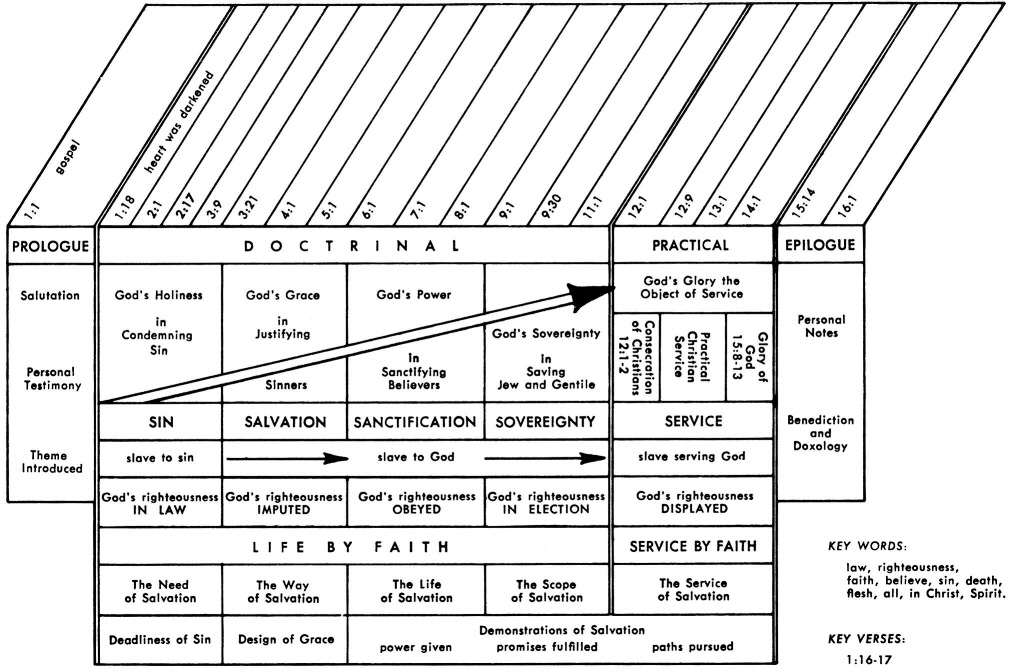
Click chart to enlarge
Chart from recommended resource Jensen's Survey of the NT - used by permission
Romans Overview Chart - Charles Swindoll
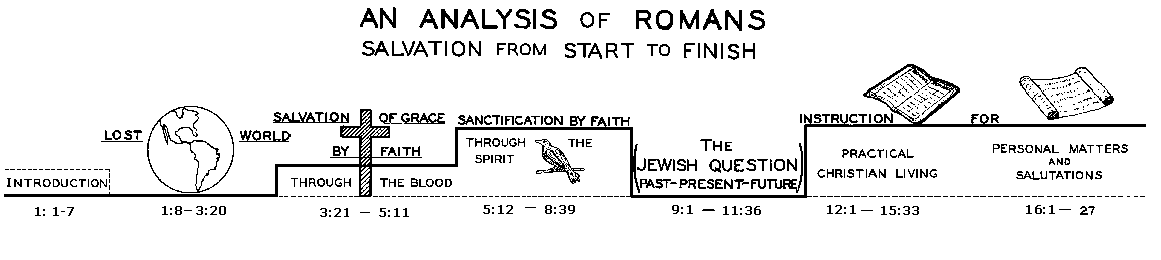
Source: Dr David Cooper
Click to Enlarge
| ROMANS ROAD to RIGHTEOUSNESS |
||||
| Romans 1:18-3:20 | Romans 3:21-5:21 | Romans 6:1-8:39 | Romans 9:1-11:36 | Romans 12:1-16:27 |
| SIN | SALVATION | SANCTIFICATION | SOVEREIGNTY | SERVICE |
| NEED FOR SALVATION |
WAY OF SALVATION |
LIFE OF SALVATION |
SCOPE OF SALVATION |
SERVICE OF SALVATION |
| God's Holiness In Condemning Sin |
God's Grace In Justifying Sinners |
God's Power In Sanctifying Believers |
God's Sovereignty In Saving Jew and Gentile |
Gods Glory The Object of Service |
| Deadliness of Sin |
Design of Grace |
Demonstration of Salvation | ||
| Power Given | Promises Fulfilled | Paths Pursued | ||
| Righteousness Needed |
Righteousness Credited |
Righteousness Demonstrated |
Righteousness Restored to Israel |
Righteousness Applied |
| God's Righteousness IN LAW |
God's Righteousness IMPUTED |
God's Righteousness OBEYED |
God's Righteousness IN ELECTION |
God's Righteousness DISPLAYED |
| Slaves to Sin | Slaves to God | Slaves Serving God | ||
| Doctrine | Duty | |||
| Life by Faith | Service by Faith | |||
|
Modified from Irving L. Jensen's chart above |
||||
R Ruin (Romans 1:17 – 3:20) – The utter sinfulness of humanity
O Offer (Romans 3:21-31) – God’s offer of justification by grace
M Model (Romans 4:1-25) – Abraham as a model for saving faith
A Access (Romans 5:1-11) – The benefits of justification
N New Adam (Romans 5:12-21) – We are children of two “Adams”
S Struggle w/ Sin (Romans 6:1-8:39) Struggle, sanctification, and victory
Romans 6:8 Now if we have died with Christ, we believe that we shall also live with Him, (NASB: Lockman)
Greek: ei de apethanomen (1PAAI) sun Christo, pisteuomen (1PPAI) hoti kai suzesomen (1PFAI) auto
Amplified: Now if we have died with Christ, we believe that we shall also live with Him, (Amplified Bible - Lockman)
GWT: If we have died with Christ, we believe that we will also live with him. (GWT)
NLT: And since we died with Christ, we know we will also share his new life. (NLT - Tyndale House)
Phillips: And if we were dead men with him we can believe that we shall also be men newly alive with him. (Phillips: Touchstone)
Wuest: Now, in view of the fact that we died once for all with Christ, we believe that we shall also live by means of Him,
Young's Literal: And if we died with Christ, we believe that we also shall live with him,
NOW IF WE HAVE DIED WITH CHRIST: ei de apethanomen (1PAAI) sun Christo:
- Ro 6:3, 4, 5; 2Ti 2:11,12
- Romans 6 Resources - Multiple Sermons and Commentaries
- Romans 6:5-11: Dead to Sin, Alive to God - Steven Cole
- Romans 6:1-14 Dead to Sin; Alive to God - John MacArthur
- Romans 6:1-11 Alive Through Christ's Death - John MacArthur
- Romans 6:1-14 The Spiritual Significance of The Resurrection, Pt. 1 - John MacArthur
- Romans 6:1-14 The Spiritual Significance of The Resurrection, Pt. 2 - John MacArthur
- Romans 6:1-14 Spiritual Transformation, Part 3 - John MacArthur
- Romans 6:6-10 Dying to Live 2- Study Guide (click dropdown menu) - John MacArthur
If - This particle (ei) introduces a first class conditional statement which assumes the following is true and can be translated "since" or "in view of the fact that" (we have died with Christ).
We have died (599) (apothnesko [word study] from apo = marker of dissociation implying a rupture from a former association, separation, departure, cessation + thnesko = die) literally means to die off and can speak of physical death but in this context speaks figuratively (metaphorically) of a believer's death to sin.
Have died is aorist tense which signifies that this event happened in the past at a point in time. When a person chooses to turn to Christ and turn away from sin, they die! This is a historical event in the life of every believer.
Click for more discussion of apothnesko in the exposition of Paul's rhetorical question in Romans 6:2 (see note "how shall we who died [apothnesko] to sin still live in it.")
Paul now goes on in the next three verses to explain additional benefit of our union with Christ in His death. Here he explains a truth the natural mind cannot comprehend, that since we died with Christ, we shall now and in the future live with Christ.
With (4862) (sun/syn [word study]) speaks of an intimate, irreversible union.
As an aside, it is interesting that although believers have been crucified with Christ at Calvary (past tense salvation - justification), Jesus still calls us to take up our cross (a picture of suffering and death) daily (Lk 9:23, cf Paul's instruction in Col 3:5), these latter exhortations equating with present tense salvation ( ~ sanctification). In this verse in Ro 6:8 Paul is teaching us the truth that we died with Christ in the past and this death is a once for all experience that has positioned us in Christ and enables us to carry out the daily call to death to our old self's lusts (but this too is appropriated "by faith" - Col 2:6).
WE BELIEVE THAT WE SHALL ALSO LIVE WITH HIM: pisteuomen (1PPAI) hoti kai suzesomen (1PFAI) auto:
- Jn 14:19; 2Cor 4:10-14; 13:4; Col 3:3,4; 1Th 4:14, 15, 16, 17
- Romans 6 Resources - Multiple Sermons and Commentaries
- Romans 6:5-11: Dead to Sin, Alive to God - Steven Cole
- Romans 6:1-14 Dead to Sin; Alive to God - John MacArthur
- Romans 6:1-11 Alive Through Christ's Death - John MacArthur
- Romans 6:1-14 The Spiritual Significance of The Resurrection, Pt. 1 - John MacArthur
- Romans 6:1-14 The Spiritual Significance of The Resurrection, Pt. 2 - John MacArthur
- Romans 6:1-14 Spiritual Transformation, Part 3 - John MacArthur
- Romans 6:6-10 Dying to Live 2- Study Guide (click dropdown menu) - John MacArthur
“Now, in view of the fact that we died off with Christ, we believe (dogmatically) that we will also live with Him.”
FAITH IS
THE KEY!
We believe (4100) (pisteuo [word study] from pistis; pistos; related studies the faith, the obedience of faith) means to consider something to be true and therefore worthy of one’s trust. To accept as true, genuine, or real. To have a firm conviction as to the goodness, efficacy, or ability of something or someone. To consider to be true. To accept the word or evidence of. Pisteuo means to be persuaded to the point that it alters the way one lives.
The present tense, indicates that this is the habit of a believer's life, their continual attitude. Practically, this means that what a person says they understand this truth about their "death and life with Christ", then they will allow the truth to set them free and to control their lives. Why do I say that? Because that is what believe means. It pictures one giving himself or herself over to truth, throwing their full weight upon it as it were. Don't put the cart before the horse though - believing precedes behaving, not the converse. God has revealed the truth about our identification with Christ and our position in Him and Paul says that faith must rest upon these facts. Not only have believers been co-crucified but believers have also been co-resurrected. We now share in His death and in His life! Beloved, do you believe you have died with Him and now live with Him? Do the choices you are making today show that you truly believe?
Vincent notes that pisteuo "means to persuade, to cause belief, to induce one to do something by persuading, and so runs into the meaning of to obey, properly as the result of persuasion."
Pisteuo means to entrust oneself to an entity in complete confidence. To believe in with the implication of total commitment to the one who is trusted. As discussed below Christ is the object of this type of faith that relies on His power and nearness to help, in addition to being convinced that His revelations or disclosures are true.
As noted above, pisteuo can refer to an heart belief (this believing involves not only the consent of the mind, but an act of the heart and will of the subject) or an intellectual belief (mental assent, "head" knowledge), both uses demonstrated by Jesus statement in John 11, " Everyone who lives and believes (refers to genuine saving faith) in Me shall never die. Do you believe (intellectually) this?"
In regard to "we believe", Wayne Barber adds that "What do we believe? We believe we have been justified. We believe we have died to the sin with Him. We believe we have been baptized into His death. We believe we have been raised to walk in the newness of His life in us. We are believing this very moment, every day. Every day that I live I have to believe (adhere to, allow it to affect me) that Christ’s life is in me and that’s what enables me to keep my life free from sin day by day. If I do sin, that’s what convicts me so that I can bring it back to the cross and confess it. Suddenly we see that sin is what He had to die for, and our relationship to sin changes. So we are believing something every day, holding on to it, giving in to it, allowing it to affect us."
"WITH HIM"
UNION WITH CHRIST
Live with (4800) (suzao from sun/syn [word study] = together or with + záo = live) means to live with. The preposition "sun" means with in the sense of "in union with" and thus is used to denote a more intimate relationship of Jesus Christ with us then the corresponding preposition "meta" which also means with. To illustrate, the criminals punished with Jesus were both crucified with (meta) Him or in His company. One of these thieves was not crucified together with (sún) Him, bound up and in union with Him, while the other thief was in fact crucified in union with Him. (see Lk 23:43, 44)
Wayne Barber writes that "we will live with Him. He is the essence of everything that we are. Think about that for a second. The Holy life of God has somehow been intertwined into my life. He lives in me! That’s the whole idea that Paul is trying to get across. When you start talking about turning away from sin and living holy, you've got to remember the holy, divine presence of God lives in you.
Zao is the essence of life so the verb combination suzao speaks of an intimate connection and conveys the picture that we have been entwined with the essence of Christ's (resurrected) life! We are identified with Him and because of His resurrection we share in and can experience the resurrection life of Jesus (walk in newness of life). Christ lives in us in the Person of the Holy Spirit, the Spirit of Christ. His life is in us. We can now walk in a completely new way of life. We believe this and are persuaded by it to the point that we are enabled and willing to alter our lifestyle (empowered even in this act by His grace - He gives us the "want to").
“We hold it as an article of our faith, that we shall be alive with Christ. As He was raised up from death, so we shall be raised from the death of sin. As He lives, so we shall live in holiness. We are in fact raised up here, and, as it were, made alive to Him." (Barnes Notes on the NT)
Living in the future tense in the context of Romans 6 most likely refers to the certainty of our life with Christ in the present, a truth which makes holy living possible. It should be noted that a few conservative commentaries hold the future tense to be strictly a reference to our future life (eg, Expositor's Bible Commentary feels this refers solely to our "future bodily resurrection").
John MacArthur - The assurance that we shall also live with Him obviously applies to the believer’s ultimate and eternal presence with Christ in heaven. But the context, which focuses on holy living, strongly suggests that Paul is here speaking primarily about our living with Him in righteousness in this present life. In Greek, as in English, future tenses often carry the idea of certainty." (MacArthur, J: Romans 1-8. Chicago: Moody Press) (Bolding added)
John Murray agrees writing that "Dying with Christ is assumed and the inference is drawn that we shall also live with Him. Two features of this inference are worthy of note. (1) The certitude of faith in this result is indicated in "we believe". It is an article of faith, not of conjecture, that the life of Jesus' resurrection belongs to those who have been united with Christ in his death. (2) The future tense, "we shall live" does not refer exclusively to the future resurrection state but, as found above (cf. Ro 6:5), points to the certainty of participation in the resurrection life of Christ here and now; it is the life of Spiritual, mystical union. No doubt the resurrection of the body is the ultimate fruition of this union. But we may not restrict the thought to that hope. (John Murray - The Epistle to the Romans)
With Him means that "we will live with respect to Him". At the moment of believing in Christ, new life imparted to the believer . The idea is that we live by means of Him. Sin’s dominion over us has been shattered. We share Christ’s resurrection life here and now. And we shall share it for all eternity, praise His Holy Name! Paul is not speaking so much of of the believer’s fellowship with Christ here or in eternity but of the source of our spiritual life from and in Christ. How long do we derive spiritual life from the Lord Jesus? As long as He lives. Paul says He died once for all, and that death over Him will never again exercise lordship. Thus, the believer will be sustained in spiritual life for time and eternity, since Christ is his life.
Paul wrote to the saints at Philippi that
"For to me, to live [is] Christ, and to die [is] gain." (Php 1:21)
The Greek phrase contains no verb (no [is]) and literally reads “to live Christ, to die gain.” Paul knew that living is Christ. As someone has said "Life is what we are alive to". For Paul the answer is not what but Whom - to him Christ was the essence of his life and real living. Is He really your reason for living, beloved?
To the Galatians Paul wrote
"I have been crucified with Christ; and it is no longer I who live, but Christ lives in me; and the life which I now live in the flesh I live by faith in the Son of God, who loved me, and delivered Himself up for me." (Gal 2:20)
In Paul's experience faith in Christ Crucified has thoroughly replaced confidence in whatever he might have been able to accomplish by means of the Law or works.
MacDonald commenting on (Gal 2:20) writes that "The believer is identified with Christ in His death. Not only was He crucified on Calvary, I was crucified there as well—in Him. This means the end of me as a sinner in God’s sight. It means the end of me as a person seeking to merit or earn salvation by my own efforts. It means the end of me as a child of Adam, as a man under the condemnation of the law, as my old, unregenerate self. The old, evil “I” has been crucified; it has no more claims on my daily life. This is true as to my standing before God; it should be true as to my behavior. The believer does not cease to live as a personality or as an individual. But the one who is seen by God as having died is not the same one who lives. It is no longer I who live, but Christ who lives in me. The Savior did not die for me in order that I might go on living my life as I choose. He died for me so that from now on He might be able to live His life in me. The life which I now live in this human body, I live by faith in the Son of God. Faith means reliance or dependence. The Christian lives by continual dependence on Christ, by yielding to Him, by allowing Christ to live His life in him. Thus the believer’s rule of life is Christ and not the law. It is not a matter of striving, but of trusting. He lives a holy life, not out of fear of punishment, but out of love to the Son of God, who loved him and gave Himself for him. Have you ever turned your life over to the Lord Jesus with the prayer that His life might be manifest in your body?" (MacDonald, W & Farstad, A. Believer's Bible Commentary: Thomas Nelson)
Paul wrote to the Colossians that
When Christ, who is our life, is revealed, then you also will be revealed with Him in glory." (Col 3:4)
It was no longer Paul that lived this life but Christ in Him living His life through him. So we cannot continue in sin because we have His life within us. Mark it down as true beloved: Christ does not merely give life. He is life. The key to living the risen life, the "Christ life", is to have a life centered on Christ Himself. The Son, not this present world, is the center of the believer’s universe, now and throughout eternity!
Charles Haddon Spurgeon - "A Christian lives in two worlds at one and the same time--the world of the flesh and the world of the spirit. It is possible to do both. There are certain dangerous gases, which from their weight fall to the lower part of the place where they are, making it destructive for a dog to enter, but safe for a man who holds his head erect. A Christian, as living in the world of flesh, is constantly passing through these. Let him keep his head erect in the spiritual world, and he is safe. He does this so long as the Son of God is the fountain where he draws his inspiration, his motives, encouragement, and strength."
Romans 6:9 knowing that Christ, having been raised from the dead, is never to die again; death no longer is master over Him. (NASB: Lockman)
Greek: eidotes (RAPMPN) hoti Christos egertheis (AAPMSN) ek nekron ouketi apothneskei, (3SPAI) thanatos autou ouketi kurieuei. (3SPAI)
Amplified: Because we know that Christ (the Anointed One), being once raised from the dead, will never die again; death no longer has power over Him (Amplified Bible - Lockman)
GWT: We know that Christ, who was brought back to life, will never die again. Death no longer has any power over him. (GWT)
NLT: We are sure of this because Christ rose from the dead, and he will never die again. Death no longer has any power over him. (NLT - Tyndale House)
Phillips: We can be sure that the risen Christ never dies again - death's power to touch him is finished. (Phillips: Touchstone)
Wuest: knowing that Christ, having been raised up from among those who are dead, no longer dies. Death over Him no longer exercises lordship.
Young's Literal: knowing that Christ, having been raised up out of the dead, doth no more die, death over him hath no more lordship;
KNOWING THAT CHRIST HAVING BEEN RAISED FROM THE DEAD: eidotes (RAPMPN) hoti (that) Christos egertheis (APPMSN) ek nekron:
- Ps 16:9, 10, 11; Acts 2:24, 25, 26, 27, 28; Heb 7:16,25; 10:12,13; Rev 1:18
- Romans 6 Resources - Multiple Sermons and Commentaries
- Romans 6:5-11: Dead to Sin, Alive to God - Steven Cole
- Romans 6:1-14 Dead to Sin; Alive to God - John MacArthur
- Romans 6:1-11 Alive Through Christ's Death - John MacArthur
- Romans 6:1-14 The Spiritual Significance of The Resurrection, Pt. 1 - John MacArthur
- Romans 6:1-14 The Spiritual Significance of The Resurrection, Pt. 2 - John MacArthur
- Romans 6:1-14 Spiritual Transformation, Part 3 - John MacArthur
- Romans 6:6-10 Dying to Live 2- Study Guide (click dropdown menu) - John MacArthur
Knowing (1492 ) (eido or oida) means to see with perception and generally signifies a clear and purely mental perception. It indicates an absolute, positive, beyond a peradventure of a doubt, knowledge.
Eido is not the word for experientially knowing (ginosko). Eido is the word for intuitive knowing. I just know it! Nobody had to teach me. Eido was found in the papyri to describe a theory or hypothesis which had been confirmed. In the present context eido speaks about that knowledge every believer knows as a result of and only in view of their relationship with God the Father through Jesus Christ. There are certain things that human beings simply cannot know intuitively unless they become the children of God.
The perfect tense indicates that we came to know these truths at a point in time (when we were born again) and we still know these truths about His death. We are "in a permanent state of knowing" because of what happened in the past.
Jesus defeated physical death and the believer never needs to fear death again. We live daily with no fear of dying because we know that Christ has conquered death. Death can no longer be master over us.
Raised (1453) (egeiro) means to awaken from sleep or to rouse from sleep. To stand up from sitting or lying. Figuratively it means to cause to return to life (the ancients closely associated death with sleep).
In Ephesians Paul teaches that
even when we were dead in our transgressions, (God) made us alive together with Christ (by grace you have been saved), and raised us up with Him, and seated us with Him in the heavenly places, in Christ Jesus. (Ep 2:5, 6)
Egeiro is used by Christ Himself in an allusion to His resurrection declaring to the Jews "Destroy this temple, and in three days I will raise it up. (Jn 2:19)
IS NEVER TO DIE AGAIN, DEATH NO LONGER IS MASTER OVER HIM: ouketi apothneskei (3SPAI) thanatos autou ouketi kurieuei (3SPAI):
- Ro 6:14; 5:14; Heb 2:14,15
- Romans 6 Resources - Multiple Sermons and Commentaries
- Romans 6:5-11: Dead to Sin, Alive to God - Steven Cole
- Romans 6:1-14 Dead to Sin; Alive to God - John MacArthur
- Romans 6:1-11 Alive Through Christ's Death - John MacArthur
- Romans 6:1-14 The Spiritual Significance of The Resurrection, Pt. 1 - John MacArthur
- Romans 6:1-14 The Spiritual Significance of The Resurrection, Pt. 2 - John MacArthur
- Romans 6:1-14 Spiritual Transformation, Part 3 - John MacArthur
- Romans 6:6-10 Dying to Live 2- Study Guide (click dropdown menu) - John MacArthur
Is never to die again - Every believer now (not in heaven by and by, but now!) shares in the eternal life in Christ. Our life in Christ is without end. Why? Because death no longer has dominion over Christ and because I am in Him and risen with Him, death no longer has dominion over me. These glorious benefits are forever our sure possession because of the unbreakable, irrevocable (based on covenant, specifically the unbreakable New Covenant) union with Christ.
Never (3765) (ouketi from ouk = not, expressing direct and full negation, independently and absolutely, and hence, objectively + éti = yet, still) refers to a complete and permanent change. In the sense of an extension of time, ouketi means up to a point but not beyond. No more, no further, no longer! This is good news indeed. It is interesting that Paul did not use meketi the other Greek word which means "no longer", but in a less absolute negative sense than ouketi.
Death (2288) (thanatos) physically refers to the final separation of one's soul from their body. Physical death is the primary meaning of thanatos in this passage. Death equates with separation. Jesus absolutely defeated physical death on the Cross and He can never die and His life is now my life. Therefore, I have now have eternal life in Him. We can never die in that sense. Physical death may take place but the moment it takes place, immediately we are in the presence of our Lord (2Cor 5:8). As believers we never have to face the fear of death because Jesus has conquered death.
Wayne Barber adds that "When Lazarus died, one tear streamed down Jesus' face, but when He saw Jerusalem, which had rejected Him, many tears flowed down His face. We cry at the wrong things, folks! Death is a piece of cake. He has defeated death. The death that was attached to the sin has now been overcome. Death will not reign over me. Death will not reign over you. How do I know that? Because He lives forever! His life is my life, and I live forever with Him. How many Christians are not believing, so therefore, they are not knowing?… Don’t you intuitively know it? Don’t fear death! He conquered death." (Romans 6:6-11 The New Life in Christ (Pt2)
Is master (2961) (kurieuo from noun kurios = master - power of control rather than physical strength) means to rule or have dominion over and speaks of individuals who exercise authority or have control over others (Lk 22:25, Ro 14:9, 2Co 1:24). To be lord of, to rule over, to have dominion over or to exercise lordship over. Scripture personifies various things which control human life including law (Ro 7:1), Sin (Ro 6:14) and death (Ro 6:9). Note the present tense speaks of continually lordship of death over non-believers.
There are 7 uses of kurieuo in the NT
Luke 22:25 And He said to them, "The kings of the Gentiles lord it over them; and those who have authority over them are called 'Benefactors.'
Romans 6:9 knowing that Christ, having been raised from the dead, is never to die again; death no longer is master over Him.
Romans 6:14 For Sin shall not be master over you, for you are not under law, but under grace.
Romans 7:1 Or do you not know, brethren (for I am speaking to those who know the law), that the law has jurisdiction over a person as long as he lives?
Romans 14:9 For to this end Christ died and lived again, that He might be Lord both of the dead and of the living.
2Corinthians 1:24 Not that we lord it over your faith, but are workers with you for your joy; for in your faith you are standing firm.
1Timothy 6:15 which He will bring about at the proper time-- He who is the blessed and only Sovereign, the King of kings and Lord of lords (functions here as "verbal noun");
Kurieuo is used 35 times in the non-apocryphal Septuagint (LXX) -
Gen. 3:16; 37:8 (of Joseph prophesying he would reign over his brothers); Ex 15:9; Num. 21:18; 24:7; Jos. 12:2; 15:16; 24:33; Jdg. 9:2; 14:4; 15:11; 2 Chr. 14:7; 20:6; Ps. 106:41; Isa. 3:4, 12; 7:18; 14:2; 19:4; 42:19; Jer. 2:31; 30:3; Lam. 5:8; Dan. 2:38f; 3:2, 27; 4:25, 32; 5:21; 6:24; 11:3ff, 43
Genesis 3:16 To the woman He said, "I will greatly multiply Your pain in childbirth, In pain you shall bring forth children; Yet your desire shall be for your husband, And he shall rule over (Heb = mashal = have dominion, reign, and generally conveys sense of leadership and authority; Lxx = kurieuo) you."
Comment: Let's face it, this use of kurieuo is not very popular with you ladies. And I can understand why, for in many marriages the husband has a tendency to rule over his wife as a selfish, cruel despot, rather that a self-less, loving leader. The latter was God's original intent, but because of our residual, dormant fallen flesh, all too often it is the former who rules the roost so to speak. In fact only the Spirit filled husband (Ep 5:18) can fulfill Paul's command to love his wife like Christ did the church (Ep 5:25; where this calls for continual, daily death to self for Spirit filled/controlled husbands!)
Psalm 106:41 (note) Then He gave them into the hand of the nations; and those who hated them ruled over (Heb = mashal = have dominion, reign, and generally conveys sense of leadership and authority; Lxx = kurieuo) them.
Comment: This passage speaks literally of God's punishment to faithless ("adulterous") Israel, but is a warning to all believers today (1Co 10:6, 11), to not seek/serve any god but Jehovah, lest He be forced to discipline us in a similar way, even using those who hate us! Lord, give us ears to hear, to receive, to tremble, to fear and to obey in the power of Thy Spirit and for the glory of Thy Name. Amen.
Jeremiah 2:31 "O generation, heed the word of the LORD. Have I been a wilderness to Israel, Or a land of thick darkness? Why do My people say, 'We are free to roam ("we are lords" in Je 2:31KJV; Lxx translates this with kurieuo = "we will not be ruled over" = what blatant stubbornness and rebellion and yet how often do we imitate Judah's faithless/"adulterous" behavior and "Do our own thing!"); We will come no more to Thee'?
Paul is sometimes difficult to understand, but not this time! Everyone has a master, either Sin (along with death and the law) or Jesus Christ. Resurrection freed Jesus from the possibility of death, both physical and spiritual. The saving results of His death and resurrection are sure forever. Christ's victory has been accomplished once for all. And since we died with Him, death is no longer master over us. Praise His Name forever!
Are you afraid to die? Then lay hold of this great truth. Eat it. Assimilate it. Then live it out as an act of worship. You are freed from the fear of death. Hallelujah! Death is for the believer the doorway through which we are instantly transported into the presence of Jesus Christ. He conquered physical death and His life is in us so death can no longer reign over us. Hebrews agrees writing that
Since then the children share (koinonia [word study] - fellowship, communion, partnership, have a share in common) in flesh and blood, He Himself likewise (more literally = alongside and nearby ~ in like manner) also partook (metecho = literally to hold with) of the same (of human nature but without its sin), that through death He might render powerless him who had the power of death, that is, the devil (word study) and might deliver those who through fear of death were subject to slavery all their lives." (He 2:14,15-notes)
Wuest comments that
"The Son of God united with Himself, something that was not natural to Him. God, as to His nature, is spirit, that is, incorporeal Being (Jn 4:24)… koinonia (partakers) marks the characteristic sharing of the common fleshly nature as it pertains to the human race at large, whereas metecho (took part of) speaks of the unique fact of the incarnation as a voluntary acceptance of humanity. What light this throws upon the Bible’s attitude towards the dual nature of our Lord, Very God and true Man."
Romans 6:10 For the death that He died, He died to sin once for all; but the life that He lives, He lives to God. (NASB: Lockman)
Greek: o gar apethanen, (3SAAI) te hamartia apethanen (3SAAI) ephapax o de ze, (3SPAI) ze (3SPAI) to theo
Amplified: For by the death He died, He died to sin [ending His relation to it] once for all; and the life that He lives, He is living to God [in unbroken fellowship with Him]. (Amplified Bible - Lockman)
GWT: When he died, he died once and for all to sin's power. But now he lives, and he lives for God. (GWT)
NLT: He died once to defeat sin, and now he lives for the glory of God. (NLT - Tyndale House)
Phillips: He died, because of sin, once: he lives for God for ever. (Phillips: Touchstone)
Wuest: For the death He died, He died with respect to our sinful nature once for all. But the life He lives, He lives with respect to God.
Young's Literal: for in that he died, to the sin he died once, and in that he liveth, he liveth to God;
FOR THE DEATH THAT HE DIED, HE DIED TO SIN: o gar apethanen (3SAAI) te hamartia apethanen (3SAAI):
- Ro 8:3; 2Cor 5:21; Heb 9:26-28; 1Pet 3:18
- Romans 6 Resources - Multiple Sermons and Commentaries
- Romans 6:5-11: Dead to Sin, Alive to God - Steven Cole
- Romans 6:1-14 Dead to Sin; Alive to God - John MacArthur
- Romans 6:1-11 Alive Through Christ's Death - John MacArthur
- Romans 6:1-14 The Spiritual Significance of The Resurrection, Pt. 1 - John MacArthur
- Romans 6:1-14 The Spiritual Significance of The Resurrection, Pt. 2 - John MacArthur
- Romans 6:1-14 Spiritual Transformation, Part 3 - John MacArthur
- Romans 6:6-10 Dying to Live 2- Study Guide (click dropdown menu) - John MacArthur
For - See term of explanation.
Don't misunderstand this passage. Jesus did not sin. He lived a perfect sinless life. In whatever way He died to sin we died to sin. He died to the penalty of sin, meeting sin's legal demands. He did not die as a sinner but took sin upon Himself to die for mankind,
"For what the Law could not do, weak as it was through the flesh, God did: sending His own Son in the likeness of sinful flesh and as an offering for sin, He condemned sin in the flesh, in order that the requirement of the Law might be fulfilled in us, who do not walk according to the flesh, but according to the Spirit." (see note Romans 8:3; 8:4)
God "made Him who knew no sin to be sin on our behalf, that we might become the righteousness of God in Him." (2Co 5:21)
So now believers are free from the penalty of sin the moment they place their faith in Christ and His substitutionary death, burial and resurrection.
It is interesting that the Jewish teachers believed that the “evil impulse” would trouble even the most pious until the time of the Messiah, when the evil impulse would be slain!
Paul says the Messiah has come and sin’s power has been rendered inoperative! This is a fact not an experience… the experience comes later. In the famous old hymn "Rock of Ages" there is a somewhat enigmatic phrase
"be for sin the double cure saved from wrath and made me sure"
The writer may have had in mind the truth Paul unveils in Romans - the first "cure" referring to Christ saving us from the penalty of sin and the second "cure" referring to His saving us from the power of sin.
Barnes draws a practical application writing that
"The design of his death was to destroy sin; to make an atonement for it, and thus to put it away. As his death was designed to effect this, so it follows that Christians being baptized into his death, and having it as their object to destroy sin, should not indulge in it. The whole force of the motive; therefore, drawn from the death of Christ, is to induce Christians to forsake sin." (Barnes, A. Barnes' Notes on the NT)
Thus Paul writes that Christ
"died for all, that they who live should no longer live for themselves, but for Him who died and rose again on their behalf." (2Co 5:15)
As he defended his integrity to the Corinthians, Paul wanted them to know that his old, self-centered life was finished and that he had an all-out desire to live righteously. For all genuine believers, their death in Christ is not only a death to sin, but a resurrection to a new life of righteousness.
Denney - "In dying our death, Christ has done for us something so immense in love, that we ought to be His, and only His for ever. To make us His is the very object of His death." (Denney. Second Corinthians, Page 199)
MacDonald - "Christ did not die for us so that we might go on living our own petty, selfish lives the way we want to live them. Rather He died for us so that we might henceforth turn over our lives to Him in willing, glad devotion." (MacDonald, W. Believer's Bible Commentary. Nashville: Thomas Nelson)
Wayne Barber adds that there are two aspects of Christ's death to sin: "One, He died to the penalty of sin and it is no longer affecting us because the penalty for the sin of Adam and his race was death. So He came under the race of Adam, under the Law, went to the cross, bore our sin upon Himself, and now that He is dead, that death is gone, and when we put our faith into Him, that death never bothers us anymore. That ‘s the penalty of sin. But then secondly, He died to the power of sin. When He rose, He rose victorious over anything that sin could ever do over you and me. When His life is in us, that’s how we live daily—with victory!"
ONCE FOR ALL: ephapax:
Ephapax (2178) strengthens the meaning of the word hapax which also conveys the basic meaning “once for all”. We might say that ephapax means in a sense "once for all and then some!" Once and once only.
This adverb denies a repetition and implies that it will not be done again. Christ's offering of Himself for sin was not like the Old Testament offerings that had to be offered day after day. Christ is the Lamb, a animal utilized in the OT sacrifices as a shadow of He Who was to come. Jesus is the substance, and He only had to die once, and He will never die again! His life now is our life. That’s how we live this holy life!
Three of five uses of ephapax are found in Hebrews and each is also used in the context of Christ's death to sin…
Heb 7:27 - (Christ) Who does not need daily, like those high priests, to offer up sacrifices, first for His own sins and then for the sins of the people, because this He did once for all (ephapax) when He offered up Himself.
Heb 9:12 - and not through the blood of goats and calves, but through His own blood, He entered the holy place once for all (ephapax) having obtained eternal redemption
Heb 10:10 - By this will we have been sanctified through the offering of the body of Jesus Christ once for all (ephapax)
In sum "ephapax" marks the absolute sufficiency and finality of the death of Christ for all the purposes for which He died. The SIN here does not refer to acts of sin. That aspect of the death of our Lord, namely, that of paying the penalty for our sins, Paul took care of in [Ro 3:21-5:11]. Here he speaks of the relation of Christ’s death to the sinful nature of the individual. Our Lord’s death not only paid the penalty of human sin, but it was used of God to break the power of indwelling sin in the believer’s life. This is what the song writer meant when he wrote concerning the blood of Christ, “be of sin the double cure, save from wrath and make me pure.”
BUT THE LIFE THAT HE LIVES HE LIVES TO GOD: o de ze (3SPAI) ze (3SPAI) to theo:
-
Ro 6:11; 14:7-9; Lu 20:38; 2Cor 5:15; 1Pet 4:6
- Romans 6 Resources - Multiple Sermons and Commentaries
- Romans 6:5-11: Dead to Sin, Alive to God - Steven Cole
- Romans 6:1-14 Dead to Sin; Alive to God - John MacArthur
- Romans 6:1-11 Alive Through Christ's Death - John MacArthur
- Romans 6:1-14 The Spiritual Significance of The Resurrection, Pt. 1 - John MacArthur
- Romans 6:1-14 The Spiritual Significance of The Resurrection, Pt. 2 - John MacArthur
- Romans 6:1-14 Spiritual Transformation, Part 3 - John MacArthur
- Romans 6:6-10 Dying to Live 2- Study Guide (click dropdown menu) - John MacArthur
"He lives" In the Revelation Jesus declares "Do not be afraid; I am the first and the last, and the living One; and I was dead, and behold, I am alive forevermore, and I have the keys of death and of Hades (Death and Hades are essentially synonyms, but death is the condition and Hades, equivalent to OT Sheol, the place of the dead). and the living One; and I was dead, and behold, I am alive forevermore, and I have the keys of death and of Hades." (Rev 1:17-18)
The point is that Christ decides who lives, who dies, and when.
This phrase suggests believers share in all that is involved in His life, its fullness and power. The contrast between this and the death that He died is in the matter of relation to sin. He has nothing more to do with that. His life as being “to God” makes good the effects of His sacrifice in the case of those who believe on him.
APPLICATION OF
"HE LIVES TO GOD"
To (the) God is literally "the God" (God with a definite article "the") and in context clearly refers to God the Father. This is an amazing thought. Jesus, Who Himself is God, daily lives His life to God the Father. His whole life is given over to His Father. Therefore, if He lives unto God, and He is God, then we, having His life, are spiritually and supernaturally likewise motivated to live to God the Father. You may be saying to yourself "How can I live this way continually?" (and by the way "lives" is present tense so this is the Son's lifestyle!) Paul gives us the answer in Philippians writing that is is possible because
"it is God Who is at work in (us), both to will and to work for His good pleasure" (see note Philippians 2:12, 2:13)
God Himself is the One Who gives us the desire, the "want to"! He’s the One who moves us towards God. If that is true think about the implication. Now because our Lord Jesus Christ's supernatural life lives in believers in the Spirit of Christ and He lives to God the Father, whenever we walk away from God the Father, it is because we have made a conscious chose to do so! I pray you are as convicted by this truth as I am beloved.
The Spirit is what’s pulling me and moving me like a mighty current towards God. That’s how holy living is taking place. We don’t live holy outwardly; we live holy inwardly. It’s the Holy Spirit of God Who is doing it from within, changing us from glory to glory.