Ruth 2:2
Ruth 2:3
Ruth 2:4
Ruth 2:5
Ruth 2:6
Ruth 2:7
Ruth 2:8
Ruth 2:9
Ruth 2:10
Ruth 2:11
Ruth 2:12
Ruth 2:13
Ruth 2:14
Ruth 2:15
Ruth 2:16
Ruth 2:17
Ruth 2:18
Ruth 2:19
Ruth 2:20
Ruth 2:21
Ruth 2:22
Ruth 2:23
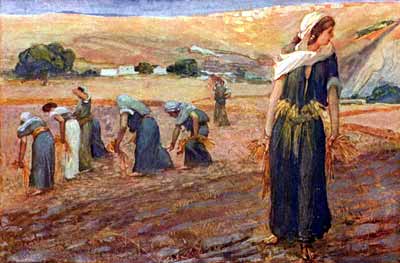
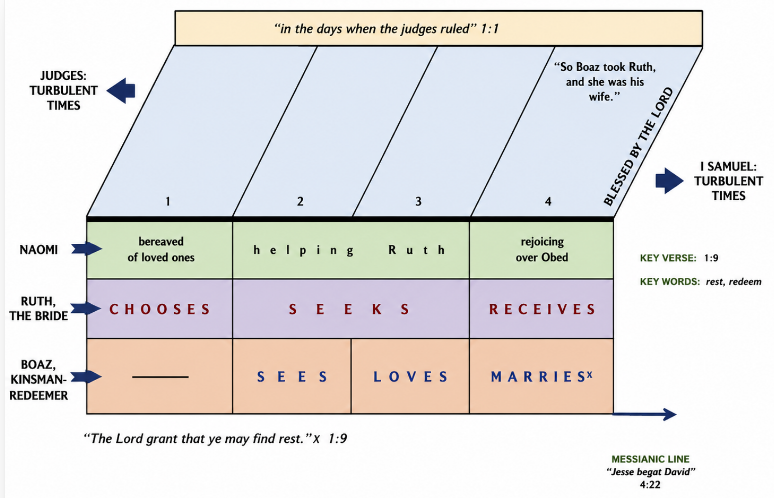
Irving Jensen's Survey of Bible (see his summary of Ruth online - page 392)
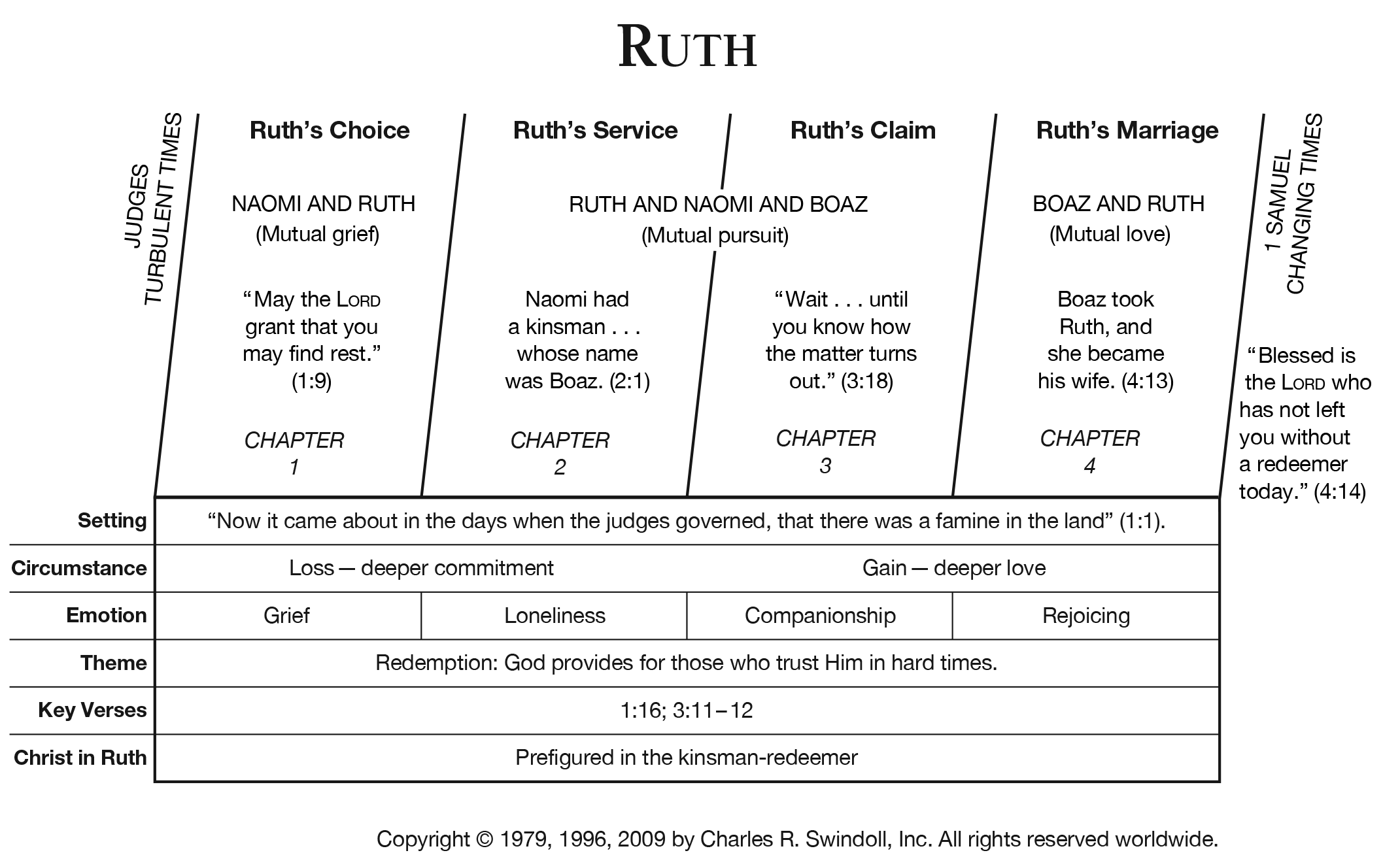
See Swindoll's summary chart of Ruth See Ruth Devotionals
|
RUTH: GOD PROVIDES |
|||
| Ruth 1 | Ruth 2 | Ruth 3 | Ruth 4 |
| Ruth's Choice | Ruth's Service | Ruth's Claim | Ruth's Marriage |
| Ruth's Resolve | Ruth's Rights | Ruth's Request | Ruth's Reward |
| Naomi and Ruth Mutual Grief |
Ruth and Naomi and Boaz Mutual Pursuit |
Boaz and Ruth Mutual Love |
|
| Ruth's Decision: Return with Naomi |
Ruth's Devotion: Provide for Naomi |
Ruth's Request: Redemption by Boaz |
Ruth's Reward: Relative of Messiah |
| Ruth and Naomi |
Ruth and Boaz |
||
| Death of Naomi's Family |
Ruth Cares for Naomi |
Boaz Cares for Ruth |
God Blesses with New Birth |
| Grief | Loneliness | Companionship | Rejoicing |
| Location: Plains of Moab |
Location: Fields of Bethlehem |
Location: Threshing floor of Bethlehem |
Location: Little town of Bethlehem |
| Time Lapsed: About 30 Years See Timeline |
|||
| Setting: Ru 1:1 Now it came about in the days when the judges governed Jdg 21:25+ In those days there was no king in Israel; everyone did what was right in his own eyes. |
|||

Ruth 2:4 Now behold, Boaz came from Bethlehem and said to the reapers, "May the LORD be with you." And they said to him, "May the LORD bless you." (NASB: Lockman)
Amplified: And behold, Boaz came from Bethlehem and said to the reapers, "The Lord be with you!" And they answered him, The Lord bless you! (Amplified Bible - Lockman)
GWT: Just then, Boaz was coming from Bethlehem, and he said to his reapers, "May the LORD be with all of you!" They answered him, "May the LORD bless you!" (GWT)
KJV: And, behold, Boaz came from Bethlehem, and said unto the reapers, The LORD be with you. And they answered him, The LORD bless thee.
Young's Literal: And lo, Boaz hath come from Beth-Lehem, and saith to the reapers, 'Jehovah is with you;' and they say to him, 'Jehovah doth bless thee.'
Septuagint (LXX): kai idou Boos elthen (3SAAI) ek Baithleem kai eipen (3SAAI) tois therizousin (PAPMPD) kurios meth' humon kai eipon (3PAAI) auto eulogesai (3SAA0) se kurios
English of Septuagint: And, behold (pay attention), Booz came from Bethleem, and said to the reapers, The Lord be with you: and they said to him, The Lord bless thee
NOW BEHOLD BOAZ CAME FROM BETHLEHEM AND SAID TO THE REAPERS "MAY THE LORD BE WITH YOU":
"Some time later Boaz himself arrived from Bethlehem" (TEV)
"Just then Boaz arrived from Bethlehem and greeted the harvesters" (NIV)
"Jehovah is with you" (YLT)
"Boaz, as it happened, had just come from Bethlehem. ‘Yahweh be with you!’ he said to the reapers" (NJB)
"Presently Boaz arrived from Bethlehem" (Tanakh)
- Ps 118:26; 129:7 129:8; Lk 1:28; 2Th 3:16; 2Ti 4:22; 2Jn 1:10 11
- Ruth 2 Resources - Multiple Sermons and Commentaries
A SECOND AMAZING
"COINCIDENCE"
Now behold, Boaz came from Bethlehem and said to the reapers, "May the LORD be with you." And they said to him, "May the LORD bless you - The writer heaps coincidence upon coincidence, which should leave no doubt in the reader's mind that this is not just coincidence, but is control by a sovereign God, behind the scenes moving the chess pieces on the board of life in a way that does not interfere with human will. What an amazing God we worship and serve. Won't it be exciting when we get to Heaven and see the incredible interweaving of manifold events in our lives and every other believer's life (assuming that is something He deems fit to reveal to us -- I certainly hope so!). The writer does not tell us how long Ruth had been present in his field, but as the story unfolds it was long enough for the foreman to form a good idea of her actions. You might ask "So what?" Well, think about it. If Ruth's and Boaz's arrival were contemporaneous, the foreman would have not been able to make an assessment of Ruth's character and work ethic. Just a thought underscoring God perfect providential timing!
Behold (02009) (hinneh) (translated "just then", "and lo", "now behold", "presently") is a marker used to enliven a narrative, to change a scene, to emphasize an idea or to draw attention to an important fact, detail or action that follows (eg, Ge 6:13, Isa 65:17). It's an exclamation that demands the reader's attention and so it is variously translated with words such as Here!, There!, Look!, Behold! Now! The Septuagint (LXX) translates "hinneh" with the Greek verb idou which is in the aorist tense, imperative mood (aorist imperative), calling for an urgent attention. Do this now. Don't delay. It could be loosely paraphrased "Pay attention!" or "Listen up!" to arouse attention and introduce a new and extraordinary fact of considerable importance.
Hubbard adds that behold signals several things - First, as a disjunctive sentence structure, it set off what followed for special attention. Second, as an exclamation of surprise (almost an imperative), hinnēh marked an unexpected turn of events which drew the reader emotionally into the narrative. It underscored the startling coincidence of Boaz’s arrival at the same place and at the same time as Ruth. (See context in The Book of Ruth)
Now with an understanding of this interjection "behold", you can see that the narrator is drawing the reader into the scene that gives us our first "personal" introduction to Boaz. It is also worth noting that often when one encounters the word "behold" in the book of Ruth there is a sense that the hand of God is controlling and directing the scene (Ru 3:8+, Ru 4:1+). In other words it was no "accident" that Boaz had come out from the city at the same time Ruth was gleaning in his field!
THOUGHT - So dear reader, "Behold!" the sovereign working of your God and stand in awe and assurance that He is likewise involved in every detail of your life even though you may not always see His hand, sense His presence or "feel" like He is aware of what you are currently going through. Mark it down - Jehovah is aware and He does care! Our Kinsman-Redeemer Himself reminds us "Are not two sparrows sold for a cent? And yet not one of them will fall to the ground apart from (the will of) your Father. But the very hairs of your head are all numbered. Therefore do not fear; you are of more value (worth more) than many sparrows. (Mt 10:29-31+)
And so we find that the wealthy landowner Boaz just ‘happened’ to come to that particular field that same day, and then ‘happened’ to notice the young woman Ruth, who ‘happened’ to be in the shelter at the time of his visit (Ru 2:7+). What if she had been in the fields (at the other end of the field)? Just asking!
In summary, ‘behold’ draws our attention to this chain of circumstances and directs the perceptive reader to the activity of the Almighty God behind the scene. Behold, God has just introduced two of the progenitors (ancestors in the direct line) of Jesus Christ to each other!
Matthew Henry comments that on the fact that Boaz visits his own fields, writing that "This was both for his own interest (he that wholly leaves his business to others will have it done by the halves; the master's eye makes a fat horse) and it was also for the encouragement of his servants, who would go on the more cheerfully in their work when their master countenanced them so far as to make them a visit. Masters that live at ease should think with tenderness of those that toil for them and bear the burden and heat of the day."
FIRST WORDS
BOAZ'S BENEDICTION!
May the LORD be with you - These are the very first words Boaz speaks. The point is that Boaz brought the Lord into his daily life, here in the form of a blessing from a master to workers. He doesn't not use people, but respects them. This observation gives us an insight into the character of this man who would be eventually prove to be Ruth and Naomi's kinsman-redeemer.
THOUGHT - If you want to know a man's relation to God you need to find out how far God (and His Holy Word) has saturated to the details of his everyday life. And you can discern a great deal about an individual from their manner of greeting. He greeted his workers with GOD. Even the tone (and inflection) of our voice and our mannerisms in which we speak communicate much about our disposition. How do you greet others? Glibly with a "Hi, how are you?" (not really expecting an answer) Or do you bless others when you greet them? When you shake hands, are you just going through the motions or do you genuinely have interest in the other person?
Hubbard on the LORD be with you - Its aim was to encourage the workers that Yahweh was present “with them,” blessing their work. Behind it stood the firm, oft-repeated divine commitment to Israel’s well-being: “I am with you.” (See Ge 26:3; 46:4; Ex 3:12; Josh. 1:5; Jdg 6:16; 2Sa 7:9; 1Ki 11:38; Isa. 41:10; Mt. 28:20; etc. For other blessings, see Ge 28:3; Nu 6:24; Ps. 5:12; etc.) (See context in The Book of Ruth)
The psalmist declares "Blessed is the one who comes in the name of the LORD (Ps 118:26+) This verse was quoted by the Jewish multitudes in Jerusalem announcing the arrival of the Messiah, the one who fulfilled His role as mankind's Kinsman-Redeemer (see Mt 21:9).
Parenthetically, it is sad that often pious expressions become part of the language and gradually lose their original meaning. For example “Good-bye” originally meant “God be with you” but one can hardly deduce piety from a person’s use of “good-bye” today! In Boaz’s case we perhaps can. Though the greeting may have been conventional, it is not recorded elsewhere in Scripture nor attested in archeological finds.
Solomon instructs us that
Words from the mouth of a wise man are gracious (are sweet to all, win him favor, bring him praise, brings them honor). (Eccl 10:12).
He who walks in his uprightness fears the LORD (Pr 14:2)
The psalmist adds…
How blessed is the man who fears the LORD, who greatly delights in His commandments. (Ps 112:1)
From these observations and those that follow, it is clear that Boaz was a "God-saturated" man, a God fearing man and that his farming business and relationship to his employees was permeated with a God-consciousness. Not only is Boaz a man of great wealth but a great man of God.
THOUGHT - Do those who you employ or manage know from your words and actions that you are a man or woman of God? They should! Jesus commands us to be salt and light in the midst of a crooked and perverse generation. (Mt 5:13-16+, Php 2:15+) Has your "salt" lost its taste? Is the wick of your lamp barely burning so that it is hardly visible in the darkness?
The prince of preachers, C H Spurgeon, addressed his congregation in a similar way declaring "How better could I salute you this morning than in the words of Boaz to the reapers, “The Lord be with you”? What kinder answer could you give me than “The Lord bless thee”?" (from his Sermon on Joseph: A Miniature Portrait, Ge 39:2)
THOUGHT - A devotional in Our Daily Bread draws a practical application from this exchange of greetings: "It is clear from what we know about Boaz that he was not a harsh landowner, but a man who genuinely cared for others. The response of his workers revealed their goodwill toward him and their desire for God's blessing to be upon him as well. As we think about our relationship with Christ and the people God has placed around us, we would do well to consider the importance of our greetings. Are "good morning" and "God bless you" just empty, insincere phrases? Or do our words show that we truly care for those whom we are addressing?… What is the difference between an empty greeting and a meaningful one? When you talk to someone, how can you communicate genuine love, interest, and concern? A heartfelt greeting can energize the weary and encourage the lonely." (Albert Lee) (Our Daily Bread, Copyright RBC Ministries, Grand Rapids, MI. Reprinted by permission. All rights reserved)
Taylor has an interesting note…Mark, again, his piety. He cries, "The LORD be with you." Now, I know that this has become the common salutation in the East, for Dr. Thomson tells us that "The Lord be with you" is merely the "Allah m'akum" of ordinary custom. I am well aware, also, that by frequent use, even such expressions of piety come to be employed without any pious feeling, and often even by those who have no faith in God at all. How seldom do we think of God when we say "good-bye," which is simply "God be with you!" It is possible that even infidels and atheists may take leave of each other with that word, and without any consciousness of inconsistency in so making use of it. So it is possible that Boaz simply meant to be courteous when he used this salutation, and that there was no more piety in it than there is in a modem "goodbye." It is possible, but not very probable, for, as we shall see in the future, this man was in the habit of tracing all blessings to God, and of commending those whom he loved to the care of God, and therefore in his mouth the ordinary salutation was restored from its common colorlessness to its first uncommon piety, and meant everything which it had originally expressed. (Ruth the gleaner and Esther the queen )
Zeisler comments "How do satisfying relationships begin in the real world? We live in a culture that would probably answer that question in one of two ways. One answer is that good relationships happen by dumb luck, fate, or some arrangement of the stars. You just stumble into a relationship. We occasionally hear the phrase "lucky in love." Consider the folk wisdom about positioning yourself so that a lucky strike will hit you. For example, if you catch the bouquet thrown by the bride, you'll be the next to get married. The other answer is that technique is everything. We learn how to manipulate, seduce, persuade, and captivate somebody by saying exactly the right words, looking exactly the right way… The Bible has a different way of talking about the creation of love and marriage." (Ruth 2:1-16: One Fine Day)
AND THEY SAID TO HIM "MAY THE LORD BLESS YOU:
- Ru 4:11-note; Ge 18:19; Josh 24:15; Ps 133:1, 2, 3; 1Ti 6:2
- Ruth 2 Resources - Multiple Sermons and Commentaries
This pious, considerate interchange shows that even in the days of the Judges there were godly individuals in Israel. The book of Ruth is an oasis of fidelity in a time of Israel’s idolatry, sin, and infidelity. When Boaz came to his workers, he prayed a blessing over them. They expressed their kindness by praying a blessing over him. As Paul declared "let those who have believers as their masters not be disrespectful to them because they are brethren, but let them serve them all the more, because those who partake of the benefit are believers and beloved. (1Ti 6:2)
Boaz shows interest in people and we should emulate him, for people are more important than projects in God's eyes.
People don't care how much you know
Until they know how much you care.
Taylor adds that Boaz's…salutation was no mere one-sided thing. The reapers answered, "The LORD bless thee." They did not look askance upon their employer, as if he had been their natural enemy. They recognized that in his prosperity they would prosper, and that in his adversity they could not but be sufferers with him; and therefore they reciprocated his courtesy, and followed his prayer for them by their prayers for him. It is a beautiful sight. One feels almost as if he were transported three thousand years back to Bethlehem, and saw it all before his eyes. The portly proprietor coming with stately dignity along to his own plot of the field, and kindly saluting the laborers in Jehovah's name; the reapers lifting themselves up simultaneously from their constrained position, each with the sweat on his face and the sickle in his hand, returning the salutation with hearty affection: "An intercourse this," as William Arnot says, "between rich and poor, between master and servant, which we love to think of in those patriarchal times, which we weep the want of in our own." (The Race for Riches, and some of the Pits into which the Runners fall. By William Arnot, pp. 1, 2. Edinburgh, 1852) (Ruth the gleaner and Esther the queen )
Matthew Henry comments that their mutual blessings show "Their joint-dependence upon the divine providence. They express their kindness to each other by praying one for another. They show not only their courtesy, but their piety, and acknowledgement that all good comes from the presence and blessing of God, which therefore we should value and desire above any thing else both for ourselves and others.
McGee adds a pithy comment - There was no labor problem in his field. Management and labor were on speaking terms, and these were of the friendliest sort. The most remarkable part is the inclusion of the Lord’s name and a gracious recognition of Him in all relationships of life. To his “The Lord be with you,” they responded with the cheery and gracious greeting, “The Lord bless thee” (Ru 2:4). God was reverently recognized in the harvest field by both the owner and the laborers. This all transpired in the days of the judges when there was decline, decay, and disintegration. The remainder of Israel might forget God and turn to idols, but there was one man who did not forget Him but remembered Him even in the extension of a morning greeting. (McGee, J V: Thru the Bible Commentary: Nashville: Thomas Nelson)
THOUGHT - What about us? Are we in such close fellowship with God, that His Name is a part of our everyday conversation? Or do we reserve His Name for Sundays and class socials?Many today do indeed use God's holy Name but sadly more often for profanity than for praise.
Do We Truly Care - When I first became a Christian, my friends and I had a way of helping each other memorize portions of the Bible. We would greet one another by asking the other person to quote a verse. Knowing of my poor memory, one friend used to humorously say to me, "Quote John 11:35!" He knew that it would be easy for me to remember this two-word verse.
Although it was a game, we didn't do this just for fun. These greetings reflected our desire to be people of God's Word.
In the book of Ruth, we read that Boaz greeted his workers by saying, "The Lord be with you!" and they responded, "The Lord bless you!" (Ru 2:4-note). It is clear from what we know about Boaz that he was not a harsh landowner, but a man who genuinely cared for others. The response of his workers revealed their goodwill toward him and their desire for God's blessing to be upon him as well.
As we think about our relationship with Christ and the people God has placed around us, we would do well to consider the importance of our greetings. Are "good morning" and "God bless you" just empty, insincere phrases? Or do our words show that we truly care for those whom we are addressing? —Albert Lee (Our Daily Bread, Copyright RBC Ministries, Grand Rapids, MI. Reprinted by permission. All rights reserved)
Thinking It Over - What is the difference between an empty greeting and a meaningful one? When you talk to someone, how can you communicate genuine love, interest, and concern?
A heartfelt greeting can energize the weary and encourage the lonely.
F B Meyer has the following notes on …
RUTH 2 RUTH, THE GLEANER - Ruth 2:4-17 Boaz, the master. -- Would that language like this was more frequently heard in harvest fields and factories! The speech of the employed is generally an echo of that of the employer (Ru 2:4). We should beware, however, of degenerating into a formality which speaks God's name thoughtlessly. How much good might we do if we were more careful to notice those who serve us, and speak kindly to servant-girls. Little acts and words of kindness do not cost much, but they mean much to a lonely soul (Matt. 25:40). Note the significant synonym for trust (Ruth 2:12; Ps 63:7; Mt 23:37).
Boaz (strength) the near kinsman, is a glimpse of Him who, centuries later, was born in this same Bethlehem, and who appeals to each who does the will of His Father, as brother, sister, or mother. He takes knowledge of strangers; He is quick to see every trait of natural grace, and all kindly actions done to the least that belong to Him; He provides bread and wine; He causes handfuls to be dropped on purpose; He screens from annoyance and harm; He comforts and speaks to the heart; He blesses, and the humble, stooping spirit is blessed forever.
DIVINE ENCOUNTERS Ruth 2:4-7
A thirty-eight-year-old scrubwoman went to the movies and sighed, "If only I had her looks." She listened to a singer and moaned, "If only I had her voice." Then one day she stopped crying about what she didn't have and started concentrating on what she did have. She remembered that in high school she had had a reputation for being the funniest girl around. She turned her liabilities into assets and at the height of her career, Phyllis Diller made over one million dollars in one year. She wasn't good-looking and she had a scratchy voice, but she could make people laugh.
Ruth didn't have many assets either, but she was strong and unafraid of hard work. When she went to work, God went into action on her behalf. Many people sit idly by, waiting for providence to happen. However, providence is a two-sided equation: you plus God. Pastor Chuck Smith says, "It's easier to guide a rolling stone than it is to get a stationary one moving." You shouldn't wait for opportunity to knock. Sometimes you must knock on a few doors to see what opportunities Providence opens for you. King Solomon described the unique blend between you and God's providence like this, "Trust in the Lord with all your heart; do not depend on your own understanding. Seek his will in all you do, and he will direct your paths" (Proverbs 3:5-6, NLT, emphasis added). It's simple; when you do, God directs. (Pathway to God's Plan)
Selwyn Hughes - Management-labor relations
"Boaz — greeted the harvesters, 'The Lord be with you!' ÔThe Lord bless you!' they called back." (v. 4)
The reception which Boaz receives from his workers when he arrives in his field shows that his relationship with them was far removed, generally speaking, from today's management-labor relations. Boaz greets his workers with the words "The Lord be with you!," and the workers reply: "The Lord bless you!" Can you imagine that exchange of greeting taking place on shop floors or in offices today? Yet when godliness prevails in a nation, one of the first things to be affected is management-labor relations. During the 1904 revival in Wales, many officials in the coal mines met with the miners to pray together before the day's work began. An old Welsh miner told me: "Dead on the stroke of 6 am, the manager would appear followed by other officials of the mine, and greet us with the word 'Bendegedig' [Welsh for 'wonderful']." The assembled miners would then respond with "Hallelujah," or something similar. What a way to begin a day! The secret of good employer-employee relations is for management to be caring, fair minded and honest, and workers to put in a good day's work. And where there is a Christian commitment on both sides then it adds great weight to the qualities I have mentioned. A leading industrialist in Pusan, Korea, told me during my visit there that before he found Christ the relationships between himself and his workers were in turmoil. After he found Christ, he saw his employees in a new light. "I worked out ways of how I could bless them," he said, 'and they in turn worked out ways by which they could bless me." This kind of approach never fails.
Father, lay Your healing hand on the turmoil that is in so much of the relations between employers and employees. Show everyone concerned that exhibiting fairness, honesty, and concern for the welfare of others is in accordance with the way the world was designed to run. Amen. (Ruth 2)
Ruth 2:5 Then Boaz said to his servant who was in charge of the reapers, "Whose young woman is this ?" (NASB: Lockman)
Amplified: Then Boaz said to his servant who was set over the reapers, Whose maiden is this? (Amplified Bible - Lockman)
GWT: Boaz asked the young man in charge of his reapers, "Who is this young woman?" (GWT)
KJV: Then said Boaz unto his servant that was set over the reapers, Whose damsel is this?
NET: Boaz asked his servant, the one in charge of the harvesters, “To whom does this young woman belong?” (NET Bible)
Young's Literal: And Boaz saith to his young man who is set over the reapers, 'Whose is this young person?'
Septuagint (LXX): kai eipen (3SAAI) Boos to paidario autou to ephestoti (RAPNSD) epi tous therizontas (PAPMPA) tinos e neanis aute
English of Septuagint: And Booz said to his servant who was set over the reapers, Whose is this damsel
THEN BOAZ SAID TO HIS SERVANT WHO WAS IN CHARGE:
- Ru 4:21-note; 1Chr 2:11 12
- Ruth 2 Resources - Multiple Sermons and Commentaries
Boaz asked his servant, the one in charge of the harvesters (NET)
Then Boaz said to his servant who was in authority over the cutters (BBE)
Then Boaz said to his servant who was in charge of the reapers, The Hebrew is abrupt without a transition that would be expected in good English literary style. It is not necessary to conclude that Boaz's next words after his greeting were a question about Ruth.
Hubbard - Barring discovery of something unusual, Boaz would simply check on things, encourage his workers, and go on his way. Something caught his eye, however, and gave him pause. He directed a question to his foreman (lit. “his young man appointed over the reapers”). (See context in The Book of Ruth)
Servant who was in charge - This refers to an overseer whose special duty was to superintend the operations in the field, to supply provision to the reapers, and pay them for their labor in the evening. The Jewish Midrash (Jewish commentaries on Scripture written between 400 -1200AD and based on Hebrew word = “to search out” with implication of discovering a thought or truth not seen on the surface - be very cautious with this type of study! Let the text speak for itself and do not seek to add to it) says that an overseer was in charge of forty-two workers but the present text does not specify the number of workers.
WHOSE YOUNG WOMAN IS THIS?:
"Whose damsel is this?" (KJV)
"To whom does this young woman belong?" (NET)
"What is the good of this young woman?" (Syriac)
"Whose young woman (na'arah) is this? From this point on, Boaz focuses his interest more on Ruth than on the harvest. We must marvel at the overruling providence of the Lord Who led Ruth to the field of Boaz and then led Boaz to visit his field while Ruth was there. When Boaz arrived, Ruth might have been resting in the shelter house that Boaz provided for his workers or she might have grown weary and gone home to Naomi. When we commit our lives to the Lord, what happens to us happens by way of appointment and not by accident.
The heart of love is thoughtful and inquisitive. It seeks to know as much about the object of its desire as possible.
He could not but have known “all the poor” in Bethlehem, and Ruth must have led a very retired life, never seeking company or compassion, since Boaz requires to be informed who the Moabite damsel was. But though a stranger to her personally, the story of Ruth was well known to Boaz. Seen in the light of her conduct and bearing, its spiritual meaning and her motives would at once become luminous to Boaz.
McGee has a humorous comment "What Boaz said here is not quite, “Whose damsel is this?” May I just give you several very free translations? He says, “Well, where in the world has she been that I haven’t met her before?” … Or let me give it another way. Perhaps as accurate Hebrew as you can possibly get, could not be translated, but would sound like a Hebrew wolf whistle. He fell for this girl. This is love at first sight… Boaz had a case of love at first sight. This man really fell for Ruth, and this is romance in the fields of Boaz if you please." (Ibid)
Young woman (05291) (na'arah) a girl, a young woman, a maidservant. It usually refers to a marriageable but unmarried girl, emphasizing the youthfulness of the girl. It means a virgin a virgin (Dt. 22:15, 16, 23, 29; Jdg. 21:12; 1 Ki. 1:2).The feminine form of naʿar, naʿărāh refers to a "young girl," a "girl of marriageable age," a "newly married woman," a "servant," a "concubine." The servant of Naaman's wife is referred to as a naʿărāh (2 Ki. 5:2), as were the young women drawing water in 1 Sam. 9:11 (see also 1Ki. 1:3). Young women who are betrothed or at an age when marriage is envisioned are also referred to by this noun (Ge 24:14; Dt 22:25, 27; Est. 2:4). In this sense naʿărāh is sometimes qualified by bethulah, "virgin," as in Ge 24:16; Dt. 22:23, 28; and Jdg. 21:12. That naʿărāh can refer to a married woman is evident from Dt. 22:15f, 19ff. Ruth, a young widow, is also denoted by this term (Ru 2:6; 4:12). When naʿărāh refers to female servants, it always appears in the plural: for example, the servants/maids of Rebekah (Ge 24:61), Pharaoh's daughter (Exo. 2:5), Ruth (Ruth 2:8), Abigail (1Sa 25:42), Esther (Est. 2:9) and figuratively of the maidservants or attendants of wisdom personified (Pr 9:3). The Levite's concubine is called a naʿărāh in Jdg. 19:3-6, 8f. Amos 2:7 refers to a father and son "going to the same girl," naʿărāh, a violation of God's holy name. The reference may be to a harlot, but the formal term for prostitute is not used.
Na'arah - 61x in 57v - each young lady(1), girl(21), girl's(11), maidens(8), maids(7), young(4), young ladies(1), young lady(4), young woman(2), young women(1), young...woman(1). Gen. 24:14; Gen. 24:16; Gen. 24:28; Gen. 24:55; Gen. 24:57; Gen. 24:61; Gen. 34:3; Gen. 34:12; Exod. 2:5; Deut. 22:15; Deut. 22:16; Deut. 22:19; Deut. 22:20; Deut. 22:21; Deut. 22:23; Deut. 22:24; Deut. 22:25; Deut. 22:26; Deut. 22:27; Deut. 22:28; Deut. 22:29; Jdg. 19:3; Jdg. 19:4; Jdg. 19:5; Jdg. 19:6; Jdg. 19:8; Jdg. 19:9; Jdg. 21:12; Ruth 2:5; Ruth 2:6; Ruth 2:8; Ruth 2:22; Ruth 2:23; Ruth 3:2; Ruth 4:12; 1 Sam. 9:11; 1 Sam. 25:42; 1 Ki. 1:2; 1 Ki. 1:3; 1 Ki. 1:4; 2 Ki. 5:2; 2 Ki. 5:4; Est. 2:2; Est. 2:3; Est. 2:4; Est. 2:7; Est. 2:8; Est. 2:9; Est. 2:12; Est. 2:13; Est. 4:4; Est. 4:16; Job 41:5; Prov. 9:3; Prov. 27:27; Prov. 31:15; Amos 2:7
Ruth 2:6 The servant in charge of the reapers replied, "She is the young Moabite woman who returned with Naomi from the land of Moab.(NASB: Lockman)
Amplified: And the servant set over the reapers answered, She is the Moabitish girl who came back with Naomi from the country of Moab. (Amplified Bible - Lockman)
GWT: The young man answered, "She's a young Moabite woman who came back with Naomi from the country of Moab. (GWT)
KJV: And the servant that was set over the reapers answered and said, It is the Moabitish damsel that came back with Naomi out of the country of Moab:
Young's Literal: And the young man who is set over the reapers answereth and saith, 'A young woman -- Moabitess -- she is, who came back with Naomi from the fields of Moab,
Septuagint (LXX): kai apekrithe (3SAPI) to paidarion to ephestos (RAPNSN) epi tous therizontas (PAPMPA) kai eipen (3SAAI) e pais e Moabitis estin (3SPAI) e apostrapheisa (APPFSN) meta Noemin ex agrou Moab
English of Septuagint: And his servant who was set over the reapers answered and said, It is the Moabitish damsel who returned with Noemin out of the land of Moab
The servant in charge of the reapers replied: (Ge 15:2; 24:2; 39:4; Mt 20:8; 24:45) "the young man standing over the reapers". This man who had the responsibility over the workers and work doubtless had carefully observed Ruth and was fully qualified in giving an accurate response to his master's question.
She is the young Moabite woman who returned with Naomi from the land of Moab:
- Ru 1:16, 19, 22 - see notes Ru1:16; 19, 22
- Ruth 2 Resources - Multiple Sermons and Commentaries
RUTH THE
MOABITE WOMAN
She is the young Moabite woman (na'arah) who returned with Naomi from the land of Moab The literal order is "A young woman -- Moabitess -- she is, who came back with Naomi from the fields of Moab" The literal Hebrew first stresses the fact of her Moabite ancestry and only then is her presence explained, but even then the land of her origin (Moab) is reiterated to draw attention to Ruth’s different nationality and thereby stress that she is from a nation despised by the Jews. The point is clearly made that nothing, not even being a member of a hated nation "shall be able to separate (this woman of faith) from the love of God" (Ro 8:39+) The foreman says she had no owner, husband, or family at all but was associated with Naomi. For him to know that much about Ruth suggest that she had already gained some degree of recognition since her arrival in Bethlehem.
Young (na'arah) is the same Hebrew word used to describe Boaz's young maidens in see Ru 1:22+). Interestingly he only describes her by her country of origin. The Targum adds that the servant stated that Ruth had become a Jewish proselyte but neither the Hebrew or the Septuagint make that declaration. Ruth's affirmation in chapter 1 that "your God, my God" see Ru 1:!6+): would however be consistent with the Targums commentary.
Ruth 2:7: And she said, 'Please let me glean and gather after the reapers among the sheaves.' Thus she came and has remained from the morning until now; she has been sitting in the house for a little while." (NASB: Lockman)
Amplified: And she said, I pray you, let me glean and gather after the reapers among the sheaves. So she came and has continued from early morning until now, except when she rested a little in the house. (Amplified Bible - Lockman)
GWT: She said, 'Please let me gather grain. I will only gather among the bundles behind the reapers.' So she came here and has been on her feet from daybreak until now. She just sat down this minute in the shelter." (GWT)
KJV: And she said, I pray you, let me glean and gather after the reapers among the sheaves: so she came, and hath continued even from the morning until now, that she tarried a little in the house.
NIV: She said, 'Please let me glean and gather among the sheaves behind the harvesters.' She went into the field and has worked steadily from morning till now, except for a short rest in the shelter." (NIV - IBS)
Young's Literal: and she saith, Let me glean, I pray thee -- and I have gathered among the sheaves after the reapers; and she cometh and remaineth since the morning and till now; she sat in the house a little.
Septuagint (LXX): kai eipen (3SAAI) sullecho (1SFAI) de kai sunaxo (1SFAI) en tois dragmasin opisthen ton therizonton (PAPMPG) kai elthen (3SAAI) kai este (3SAAI) apo proithen kai eos esperas ou katepausen (3SAAI) en to agro mikron
English of Septuagint: And she said, I pray you, let me glean and gather among the sheaves after the reapers: and she came and stood from morning till evening, and rested not even a little in the field
AND SHE SAID PLEASE LET ME GLEAN AND GATHER AFTER THE REAPERS AMONG THE SHEAVES:
"She said, 'Please let me follow the workers and gather the grain that they leave on the ground." (ICB)
- Pr 15:33; 18:23; Mt 5:3; Eph 5:21; 1Pe 5:5-6
- Ruth 2 Resources - Multiple Sermons and Commentaries
Related Passages:
Leviticus 19:34+ ‘The stranger who resides with you shall be to you as the native among you, and you shall love him as yourself, for you were aliens in the land of Egypt; I am the LORD your God.
Leviticus 23:22+ When you reap the harvest of your land, moreover, you shall not reap to the very corners of your field nor gather the gleaning of your harvest; you are to leave them for the needy and the alien. I am the LORD your God.’”
Deuteronomy 24:19+ “When you reap your harvest in your field and have forgotten a sheaf in the field, you shall not go back to get it; it shall be for the alien, for the orphan, and for the widow, in order that the LORD your God may bless you in all the work of your hands.
Deuteronomy 10:19+ “So show your love for the alien, for you were aliens in the land of Egypt.
Proverbs 15:33 The fear of the LORD is the instruction for wisdom, And before honor comes humility.
Proverbs 18:23 The poor man utters supplications, But the rich man answers roughly.
Ephesians 5:21+ and be subject to one another in the fear of Christ.
1 Peter 5:5-6+ You younger men, likewise, be subject to your elders; and all of you, clothe yourselves with humility toward one another, for GOD IS OPPOSED TO THE PROUD, BUT GIVES GRACE TO THE HUMBLE. 6 Therefore humble yourselves under the mighty hand of God, that He may exalt you at the proper time,
RUTH IS NOT PRESUMPTIVE
BUT SEEKS PERMISSION
And she said, 'Please let me glean and gather after the reapers among the sheaves (omer) - The foreman further told of Ruth's courteous request for permission to glean after the reapers had completed their work. Note that Ruth does not demand a handout, nor does she presume upon her right to glean (which she had by virtue of Lev 19:9-10+ or as an alien - Dt 10:19+). All Ruth was asking was to gather leftovers behind the reapers and she asks permission even to do that. Ruth is a woman of excellence (Ru 3:11), not unlike another foreign woman who came to Jesus saying
"Lord… even the dogs feed on the crumbs which fall from their masters' table" to which Jesus responded "O woman, your faith is great; be it done for you as you wish." (Mt 15:27, 28+)
In this section we find Ruth gleans after the reapers among the sheaves but a few verses later (Ru 2:15+), we find Ruth now is gleaning among the sheaves. This observation is another indication that Ruth has received "favor" (grace upon grace) from Boaz.
Barber writes that "Ruth, however, is not obtrusive. Instead, she requests to be allowed to glean between the sheaves. If denied permission, she apparently was prepared to persevere with her quest until some other foreman gave his consent (2:2). Such resilience was an outgrowth of a well-balanced personality and showed a well-developed sense of autonomy." (Ruth: A Story of God's Grace: An Expositional Commentary)
William Taylor comments that…There was no money tax levied in Israel for the relief of the poor, and so this provision was made for them. The landholders were never to remove everything from their fields, but were always to leave something for the stranger and the destitute. But while this series of laws required the proprietors of the soil to remember the poor, it did not give indiscriminate right to the destitute to go where they pleased and gather what they could find. That would have led to great abuses. The forward and obtrusive among those who were in want would then have carried off the lions share; while the timid and shrinking and sensitive ones would have been left out in the cold. And again, there might have been a run upon some particular fields to the almost entire neglect of others, and so there would have been unequal pressure upon the different proprietors. Therefore, while the right of the poor to glean was clearly secured, the exercise of that right by them was regulated by requiring that the Gleaner should obtain permission from the proprietor or his representative before beginning operations. So when she reached the field, Ruth, being attracted in the providence of God, either by the kindly countenance of the steward or by the appearance of the maidens who were working under his superintendence, to Boaz's section of the land, went and made request of "the man who was set over the reapers," saying, "I pray you let me glean and gather after the reapers among the sheaves," and the favor so modestly asked was willingly granted. (Ruth the gleaner and Esther the queen)
Sheaves (06016) (omer) refers to stalks of grain gathered and tied into a bundle after harvesting. It denoted a handful of cut sheaves that a reaper accumulated as he worked and then set aside in a pile. The plural form sheaves or “handfuls” probably referred to the piles of such handfuls which women later bound into bundles for transport to the threshing floor. The reapers either gathered the cut grain into sheaves themselves or left it to be collected by the sheaf binder. The sheaves were then gathered into stacks and loaded into carts. As discussed earlier the law directed that some stray stalks and sheaves should be left in the field for the poor and hungry to glean (Dt 24:19).
Gilbrant - Meaning "a sheaf of cut grain," ʿōmer is derived from the verb ʿāmar (HED #6240), "to gather," "to trade." According to Pentateuchal laws, the Israelites were to bring a sheaf of their initial harvest crop as an offering to the Lord (Lev. 23:10ff, 15). The priest was to wave the offering of firstfruits on the day after the Sabbath and then offer a burnt sacrifice, consisting of a one-year-old lamb without defect, followed by other cultic rituals. Also, Israelites were commanded to leave an occasional sheaf from the harvest to be gathered by the less fortunate of the community (Deut. 24:19). The application of this commandment was how Boaz met Ruth, who was gleaning such sheaves in his field (Ruth 2:7, 15). Job used this term figuratively when he emphatically denied his guilt to Eliphaz. He cited the world's injustice because the righteous carried sheaves, yet remained hungry (Job 24:10). (Complete Biblical Library)
Baker - I. A masculine noun referring to a sheaf of grain. It indicates ears of grain recently cut off the stalks (Lev. 23:10-12, 15; Deut. 24:19; Ruth 2:7, 15). Sheaves were to be left for the poor and hungry (Job 24:10). II. A masculine noun indicating an omer; a measure of grain. It is a dry measure of about two liters or two quarts (Ex. 16:16, 18, 22, 32, 33, 36). (Complete Word Study Dictionary- Old Testament)
Omer - 8v - sheaf(5), sheaves(3). Lev. 23:10; Lev. 23:11; Lev. 23:12; Lev. 23:15; Deut. 24:19; Ruth 2:7; Ruth 2:15; Job 24:10
SHE CAME AND HAS REMAINED FROM THE MORNING UNTIL NOW SHE HAS BEEN SITTING IN THE HOUSE FOR A LITTLE WHILE:
- Pr 13:4; 22:29; Eccl 9:10; Ro 12:11; Gal 6:9
- Ruth 2 Resources - Multiple Sermons and Commentaries
"She came and has remained here. From morning until just now. She has stopped only a few moments to rest in the shelter." (ICB)
"She has been on her feet ever since she came this morning. She has rested but little in the hut.” (Tanakh)
"She went into the field and has worked steadily from morning till now, except for a short rest in the shelter" (NIV)
"She has been hard at work ever since, except for a few minutes' rest over there in the shelter" (NLT),
"So she came here and has been on her feet from daybreak until now. She just sat down this minute in the shelter" (GWT),
"she came and stood from morning till evening, and rested not even a little in the field" (Lxx)
"She has stayed here since she arrived. From this morning until right now, she has taken only a brief rest." (NET)
"So she came and has continued from early morning until now, except when she rested a little in the house" (Amp)
Morning (01242) indicates the point of time at which night is changing to day or that time at the end of night: can represent the time just before the rising of the sun. In the ancient Near East the night was divided into three watches. The last period of the night was called the morning watch (Ex 14:24). It lasted from 2:00 A.M.- sunrise.
"In the house" (01004) is the Hebrew word for a tent, hut, dwelling–place or shelter. Most of the translations convey the thought that this was a shelter apparently near the barley field where the workers could have shade from the intense Palestine sun and a brief respite from their labors. Temporary shelters, made of upright poles and covered with leafy branches or straw, were quite common in the ancient Near East.
For a little while (04592) (tarried a little, short rest, brief rest, a few moments of rest, she rested but little, a few minutes rest). The foreman himself has been keeping her under observation, and has noted the quality of her work. Even under the hot sun she takes only a brief rest interval.
The Septuagint (LXX) translation of the Hebrew is she came and stood from morning until evening and rested not even a little in the field" which makes if very clear that she was not loafing.
And so we observe that even this woman of excellence and diligence needed rest. What about you? Do you take time to "rest" in the Lord (in His Word) or do you feel pressured to speed read 6 chapters a day to make sure you accomplish your goal of reading through the Bible in a year? Remember it's not how many times you go through the Bible, but do you humbly submit to allow the Scriptures to go through you? Take time like Mary did to rest and to listen "to the Lord's word, seated (at the) feet" (Luke 10:39) of your Kinsman-Redeemer. You will be refreshed as you tarry in His word and then you will be revived to go out and labor diligently for fruit in the Master's field (cf Mt 11:28, 29 30).
Monty Mills sums up this first scene of this divine drama: Boaz has been introduced masterfully; very few adjectives are used to describe him, instead his actions commend him. (Ed note: Do your actions back up your words?) With consummate ease, the reader has been informed that Boaz is an upright, respected and honored man, that he is a man of substance who is well-organized and whose servants have an easy, yet respectful relationship with him. Verse 4 also makes us aware that Boaz is a godly man, so we can expect him to be readily maneuvered by God. This passage reveals much about the character of Ruth as well, for we find a young woman, under difficult circumstances, exhibiting traits of kindness, compassion, tact, diligence, humility, and decorum. And besides all this information, we have also been told a story; there is a remarkable economy of words, and yet an astonishing volume of information has been conveyed." (bolding added)
Batter in the Bowl
Please let me glean . . . after the reapers among the sheaves. Ruth 2:7
Today's Scripture & Insight: Ruth 2:1-12
My daughter and I consider brownies to be one of the seven wonders of the culinary world. One day, as we were mixing the ingredients of our favorite chocolate treat, my daughter asked if I would leave some batter in the bowl after pouring most of it into the baking pan. She wanted to enjoy what was left over. I smiled and agreed. Then, I told her, “That’s called gleaning, you know, and it didn’t start with brownies.”
As we enjoyed the remnants of our baking project, I explained that Ruth had gathered leftover grain in order to feed herself and her mother-in-law Naomi (Ruth 2:2-3). Because both of their husbands had died, the women had returned to Naomi’s homeland. There Ruth met a wealthy landowner named Boaz. She asked him, “Please let me glean . . . after the reapers among the sheaves” (v. 7). He willingly consented and instructed his workers to purposely let grain fall for her (v. 16).
Like Boaz, who provided for Ruth from the bounty of his fields, God provides for us out of His abundance. His resources are infinite, and He lets blessings fall for our benefit. He willingly provides us with physical and spiritual nourishment. Every good gift we receive comes from Him. By: Jennifer Benson Schuldt (Our Daily Bread, Copyright RBC Ministries, Grand Rapids, MI. — Reprinted by permission. All rights reserved)
Dear God, thank You for the blessings I enjoy! You minister to Your children out of Your limitless abundance. I worship You as my provider.
Our greatest needs cannot exceed God’s great resources.