Ruth 2:2
Ruth 2:3
Ruth 2:4
Ruth 2:5
Ruth 2:6
Ruth 2:7
Ruth 2:8
Ruth 2:9
Ruth 2:10
Ruth 2:11
Ruth 2:12
Ruth 2:13
Ruth 2:14
Ruth 2:15
Ruth 2:16
Ruth 2:17
Ruth 2:18
Ruth 2:19
Ruth 2:20
Ruth 2:21
Ruth 2:22
Ruth 2:23
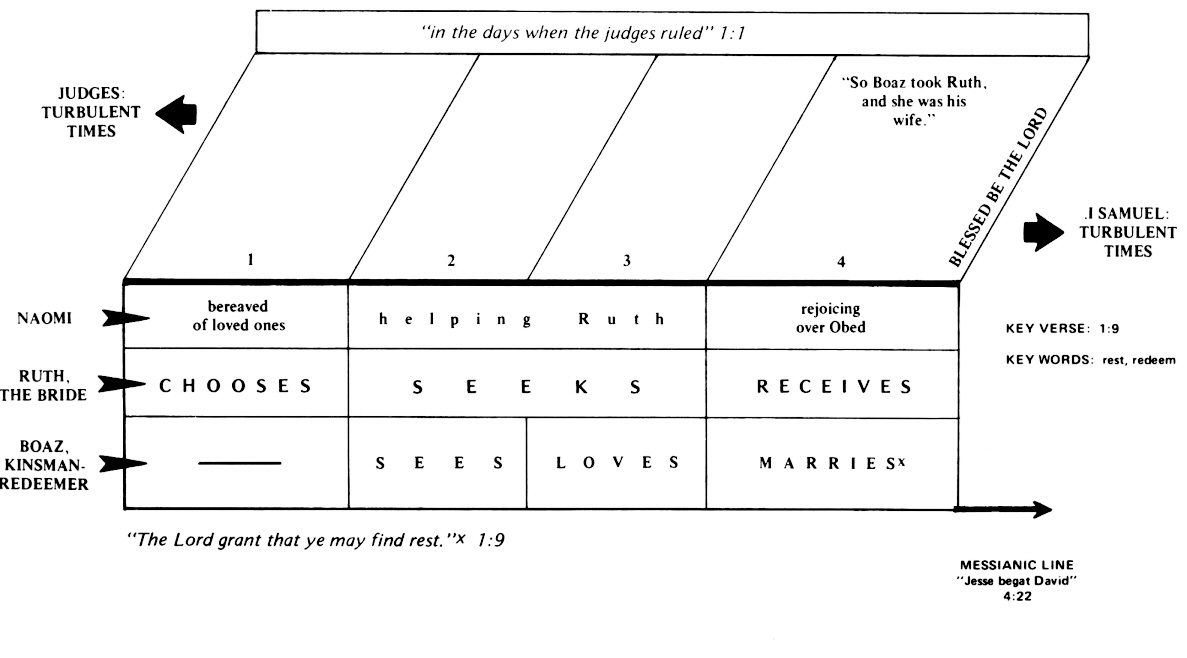
Irving Jensen's Survey of Bible (see his summary of Ruth online - page 392)
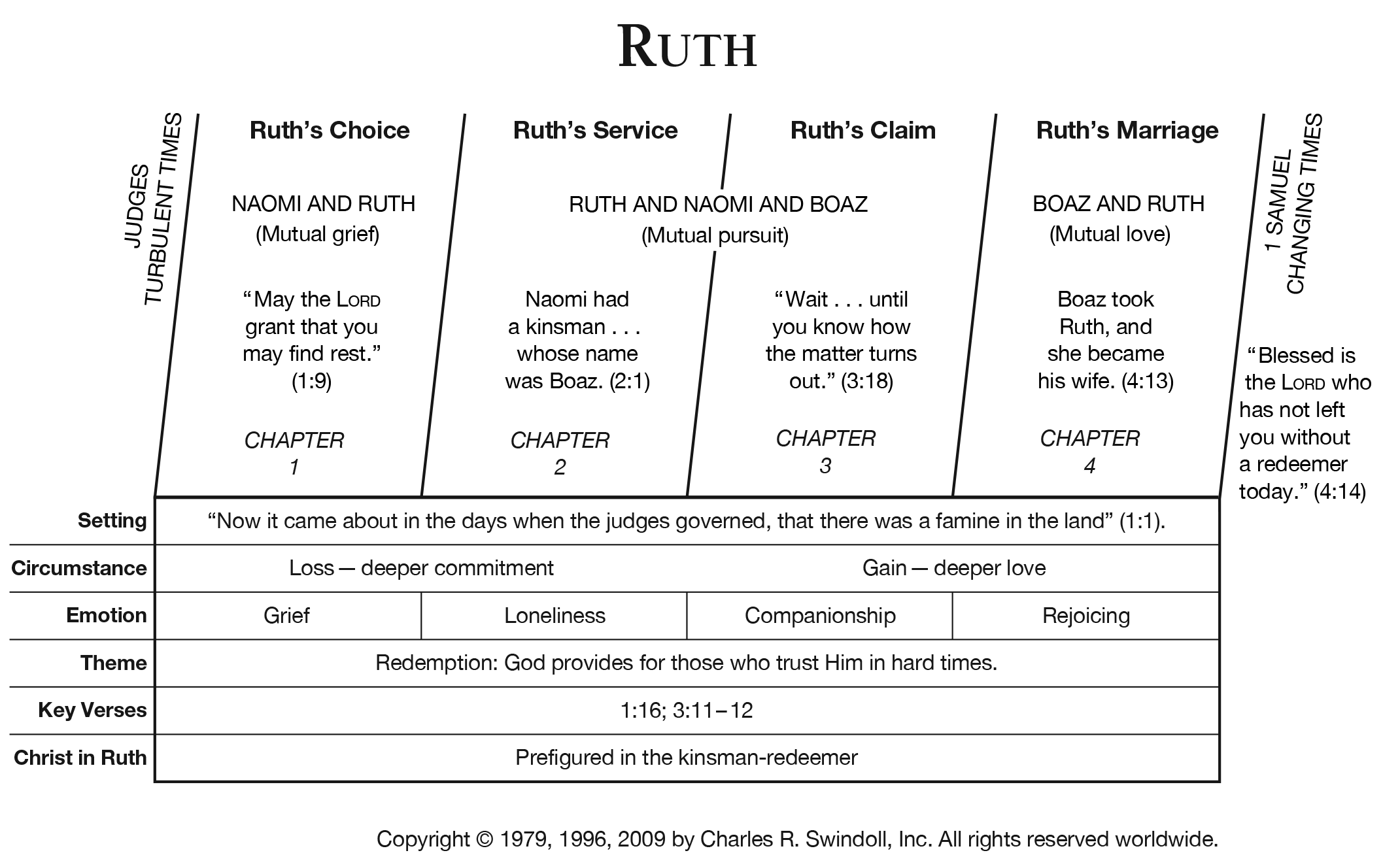
See Swindoll's summary chart of Ruth See Ruth Devotionals
|
RUTH: GOD PROVIDES |
|||
| Ruth 1 | Ruth 2 | Ruth 3 | Ruth 4 |
| Ruth's Choice | Ruth's Service | Ruth's Claim | Ruth's Marriage |
| Ruth's Resolve | Ruth's Rights | Ruth's Request | Ruth's Reward |
| Naomi and Ruth Mutual Grief |
Ruth and Naomi and Boaz Mutual Pursuit |
Boaz and Ruth Mutual Love |
|
| Ruth's Decision: Return with Naomi |
Ruth's Devotion: Provide for Naomi |
Ruth's Request: Redemption by Boaz |
Ruth's Reward: Relative of Messiah |
| Ruth and Naomi |
Ruth and Boaz |
||
| Death of Naomi's Family |
Ruth Cares for Naomi |
Boaz Cares for Ruth |
God Blesses with New Birth |
| Grief | Loneliness | Companionship | Rejoicing |
| Location: Plains of Moab |
Location: Fields of Bethlehem |
Location: Threshing floor of Bethlehem |
Location: Little town of Bethlehem |
| Time Lapsed: About 30 Years See Timeline |
|||
| Setting: Ru 1:1 Now it came about in the days when the judges governed Jdg 21:25+ In those days there was no king in Israel; everyone did what was right in his own eyes. |
|||

Ruth 2:8: Then Boaz said to Ruth, "Listen carefully, my daughter. Do not go to glean in another field; furthermore, do not go on from this one, but stay here with my maids. (NASB: Lockman)
Amplified: Then Boaz said to Ruth, Listen, my daughter, do not go to glean in another field or leave this one, but stay here close by my maidens. (Amplified Bible - Lockman)
GWT: Boaz said to Ruth, "Listen, my daughter. Don't go in any other field to gather grain, and don't even leave this one. Stay here with my young women. (GWT)
KJV: Then said Boaz unto Ruth, Hearest thou not, my daughter? Go not to glean in another field, neither go from hence, but abide here fast by my maidens:
NET: So Boaz said to Ruth, “Listen carefully, my daughter. Don’t leave to gather grain in another field. You need not go beyond the limits of this field. You may go along beside my female workers (NET Bible)
Young's Literal: And Boaz saith unto Ruth, 'Hast thou not heard, my daughter? go not to glean in another field, and also, pass not over from this, and thus thou dost cleave to my young women:
Septuagint (LXX): kai eipen (3SAAI) Boos pros Routh ouk ekousas (2SAAI) thugater me poreuthes (2SAPS) en agro sullexai hetero kai su ou poreuse (2SFMI) enteuthen ode kolletheti (2SAPM) meta ton korasion mou
English of Septuagint: And Booz said to Ruth, Hast thou not heard, my daughter? go not to glean in another field; and depart not thou hence, join thyself here with my damsels
THEN BOAZ SAID TO RUTH "LISTEN CAREFULLY MY DAUGHTER":
- 1Sa 3:6,16; 2Ki 5:13; Matthew 9:2,22
BOAZ TAKES
THE INITIATIVE
Then Boaz said to Ruth, "Listen carefully, my daughter - Boaz (01162) took the initiative. He was the "initiator", not the "terminator" like so many men are in relationships! In so doing, Boaz gives a beautiful portrayal of God's reaching out to us, initiating the conversation as it were, extending grace to those who deserve quite the opposite. Amazing grace indeed! Grace (see study of grace) then means that God makes the first move to come to our aid, not because we deserve anything, but because He loves us and wants us for Himself (to be His special/treasured possession! cp Titus 2:14+, 1Pe 2:9+, cp Ex 19:5NLT). “We love, because He first loved us” (1Jn 4:10,19 cp 2Pe 3:9+, 1Ti 2:3-5+). God took the initiative in salvation when we were spiritually dead (Ep 2:1+, Ep 2:4,2:5+), without spiritual strength (Ro 5:6+ where "helpless" = asthenes = literally without strength), wholly rebellious sinners (Ro 5:8+), and His intractable enemies (Ro 5:10+). Salvation was not an afterthought of God but that which He planned from eternity (Ep 1:4+, Ep 1:5+). Even at this early juncture, we have every reason to believe Boaz loved Ruth and therefore took the first steps to meet her physical and emotional needs.
Hubbard - Now came the moment of truth. “Chance” had thrown Ruth and Boaz together on the same field, but how would that upright Israelite nobleman respond to this foreigner? Would he treat her kindly or cruelly, generously or niggardly? Would he prove to be a racial bigot or perhaps simply skittish about contact with a Moabite? Would he respect or rebuke her for coming to the field alone (perhaps a dangerous undertaking for a woman)? More importantly, how would he view her unusual request? (See context in The Book of Ruth)
Listen carefully (08085) (shama in perfect tense) conveys the idea of hearing with attention or obedience. "In the MT, his words are actually a question (lit. “Haven’t you heard, my daughter?”), a typical Hebrew way to express strong affirmations." (Hubbard) Listen carefully conveys the concept, "I am going to make you such a good offer that if you do not accept it the only rational reason will be that you didn’t hear it." Boaz is not vague nor vacillating but direct and demonstrative, again providing a clear example for godly men to imitate in their interactions with others, especially their spouse.
My daughter (again in Ru 3:10, 11+)(01323) (bat) Boaz called Ruth my daughter most likely because she was younger than he (Ru 3:10+) but also because this was a term of endearment. It reflects his tenderness toward her (without being forward). In essence Boaz is saying that he would treat her like a member of his own family. And the good report the foreman had just rendered concerning Ruth (Ru 2:6, 7) would only increase Boaz's interest in her. Furthermore, Boaz's instructions, along with this manner of addressing Ruth as my daughter indicate that he is offering her a responsibility that goes beyond simply giving her permission to glean in his fields. The Lxx uses the word thugater which can mean one's literal daughter (female child in relation to her parents) or as in the present context indicating someone who is treated as one's daughter (cp Jesus' words to a woman suffering from hemorrhage = Mt 9:22+, Mk 5:34+, Lk 8:48+ - also a helpless, hurting woman and yet a woman of faith like Ruth!)
"DO NOT GLEAN IN ANOTHER FIELD FURTHERMORE DO NOT GO ON FROM THIS ONE BUT STAY HERE WITH MY MAIDS":
- Song 1:7,8
You must not go gleaning in any other field. You must not go away from here. Stay close to my work–women (NJB)
keep close to my maidens (RSV)
STICK LIKE GLUE
TO MY FIELD!
Do not go to glean in another field; furthermore, do not go on from this one, but stay (is translated cleaved in Ruth 1:14) - Stay is dabaq which is same word used in Ru 1:14 when "Ruth clung to her." Boaz is saying "cling" to my field! The Septuagint translates dabaq with the Greek verb kollao (from Gk word kolla = glue) which literally means to join closely or glue together and is in the aorist imperative which indicates a command that is to be carried out even with a sense of urgency. Ruth is encouraged is to "stick close" or "stick like glue" to Boaz's maids and this command was given by Boaz with her best interest at heart. Remember that these were the dangerous days of the judges.
THOUGHT - As Boaz said to Ruth, so our Lord says to us “Glean not in any other field but Mine" for the "fields" of the world are dangerous, destructive, even deadly and must be shunned. Where have you been gleaning this past week, month, year?
Note that Boaz first spoke to Ruth, for she would not have dared to speak to a man in this culture, especially one who was a stranger and “the lord of the harvest.” What right did a widow and a pagan alien have to address a great man like Boaz? Yet he interrupted his conversation with his foreman to speak to a poor stranger gleaning in his field. Boaz invites her to glean in his field for the entire harvest (Ru 2:21+) instead of moving from estate to estate as gleaners usually did.
THOUGHT - What a picture of our "Greater Boaz" Christ Jesus, Whose invitation is to "Come to Me you who are weary and heavy laden and I will give you rest" (Mt 11:28-30+)
With my maids (na'arah) even conveys the sense of Boaz providing protection for Ruth (cf Ru 2:9, 15-16, 22).
My maids (05291) (Hebrew noun na'arah) usually refers to a woman of marriageable though at present unmarried and emphasizes youthfulness. These maids followed the grain cutters and bound grain into sheaves. As an aside it is not as if a wealthy man like Boaz did not have other ladies he might have chosen as a bride and yet he clearly is being drawn toward Ruth the Moabitess (the majesty and mystery of divine providence!)
Stay here with (01692) (dabaq) means to stick to, adhere to, cling to, join with, stay with, stay in close proximity to and which yields the noun form for "glue". Dabaq is translated cleaved in Ruth 1:14. Dabaq describes something that sticks or clings to something else (Ezek 29:4 and Ezekiel’s tongue to roof of his mouth Ezek. 3:26). It is interesting that one of the most concentrated uses of "dabaq" in the OT is found in this short story of Ruth (Ru 1:14, 2:8, 2:21, 23 see notes Ru 1:14; 2:8; 21; 23) ) -- Ruth 2:8 "stay here with my maids"; Ruth 2:21 "‘You should stay close to my servants"; Ruth 2:23 "So she stayed close by the maids of Boaz"; Dabaq often refers to physical things sticking to each other, especially parts of the body as described vividly by Job who said "My bone clings to my skin and my flesh, and I have escaped only by the skin of my teeth" (Job 19:20, cf one's tongue "stuck to their palate" Job 29:10).
FINDING FAVOR Ruth 2:8-13
For a Christian there's no such thing as luck. Believing that luck has dealt you a good or bad hand denies God's hand of providence in your life. Luck is impersonal; a matter of chance bringing about fortune or adversity. I do not trust my life into the hands of fate. Instead, I trust a loving God to orchestrate circumstances that are favorable or unfavorable, according to His will for me. When unfavorable situations arise, I ponder, Am I in the will of God? Have I been obedient to His Word? or Is He trying to redirect my path? When favorable circumstances come my way, I count them as God's blessings—His affirmation that I'm on the right track. Yet I know that whether good or bad things happen, God will work all things together for my good.
Paul described the process of receiving good for good or bad for bad, not as karma, but as reaping what you have sown. "Do not be deceived, . . . for whatever a man sows, that he will also reap. For he who sows to his flesh will of the flesh reap corruption, but he who sows to the Spirit will of the Spirit reap everlasting life" (Galatians 6:7-8). God will reward you according to your deeds.
Ruth had been sowing seeds of goodness toward Naomi, diligence in labor, and humility toward others. Now she is about to reap the bounty of blessing from the Lord. She will find favor from the God of Israel instead of confusion from the twisted hand of fate.
A haughty lawyer once asked an old farmer, "Why don't you hold up your head in the world like I do? I don't let anyone push me around; I won't bow before God or man."
"See that field of grain yonder?" replied the farmer. "Only the heads that are empty stand up. Those that are well filled always bow low." The strange paradox revealed by this story is that what appears to be strong is really weak.
A paradox is a seemingly contradictory or absurd statement that is, in fact, true. Here are just a few of the paradoxical truths found in the Bible: those who are poor in spirit are truly rich; those who know they are weak are really the strongest; those who die to themselves will live forever; those who are humble will be exalted.
Ruth's life is a perfect example of God's paradoxical truths in action. Because she was filled with humility and willingly bowed down, God "lifted her up" in Boaz's sight. God has honored her throughout eternity by recording her story in the most precious of all books, the Bible. Truly Ruth understood this spiritual truth: "When you bow down before the Lord . . . , he will lift you up and give you honor" (James 4:10, NLT). (Pathway to God's Plan)
Be humble or you'll stumble.
Ruth 2:9 "Let your eyes be on the field which they reap, and go after them. Indeed, I have commanded the servants not to touch (molest) you. When you are thirsty, go to the water jars and drink from what the servants draw." (NASB: Lockman)
Amplified: Watch which field they reap, and follow them. Have I not charged the young men not to molest you? And when you are thirsty, go to the vessels and drink what the young men have drawn. (Amplified Bible - Lockman)
GWT: Watch where my men are reaping, and follow the young women in that field. I have ordered my young men not to touch you. When you're thirsty, go to the jars and drink some of the water that the young men have drawn." (GWT)
KJV: Let thine eyes be on the field that they do reap, and go thou after them: have I not charged the young men that they shall not touch thee? and when thou art athirst, go unto the vessels, and drink of that which the young men have drawn.
Young's Literal: thine eyes are on the field which they reap, and thou hast gone after them; have not I charged the young men not to touch thee? when thou art athirst then thou hast gone unto the vessels, and hast drunk from that which the young men draw.'
Septuagint (LXX): ') href="http://studylight.org/lex/grk/view.cgi?number=3588">oi opthalmoi sou eis ton agron ou ean therizosin (3PPAS) kai poreuse (2SFMI) katopisthen auton idou eneteilamen (1SAMI) tois paidariois tou me apsasthai sou kai o ti dipseseis (2SFAI) kai poreuthese (2SFPI) eis ta skeue kai piesai (2SFMI) hothen an hudreuontai (3PPMS) ta paidaria
English of Septuagint: Let thine eyes be on the field where my men shall reap, and thou shalt go after them: behold, I have charged the young men not to touch thee: and when you shalt thirst, then thou shalt go to the vessels, and drink of that which the young men shall have drawn
LET YOUR EYES BE ON THE FIELD WHICH THEY REAP AND GO AFTER THEM:
Watch to see which fields they go to and follow them (ICB)
Watch the field where the men are harvesting, and follow along after the girls (NIV)
Take note of the field where the men are harvesting and follow along after the female workers. (NET)
Keep your eyes on the field they are cutting, and go after them (BBE)
WATCH WHERE
YOU GLEAN
Let your eyes be on the field which they reap - As discussed earlier, the fields in these days had no fences or hedges dividing them and it would have been easy for Ruth to wander off of Boaz's land without knowing. In so doing she might find herself among strangers who in turn might not protect her.
Go after them - In other words, Ruth had first chance at the best of the gleanings which the maids did not bind into sheaves! (Dt 24:19, 22+ cp Dt 15:9+, Ps 41:1+, Pr 14:21, 19:17, Mt 5:7+, cp the undeserved favor or grace Boaz bestowed upon a foreign Moabitess with the marvelous grace of our Kinsman Redeemer on those who were outside of the covenants, without hope and without God in the word - 2Co 8:9+)
THOUGHT - Would God describe you (or me) as gracious to the poor, the helpless, the widow, the orphan? What does your "religion" really look like? (see Jas 1:27+). What should motivate us? A good memory for starters for as God said to Israel and by way of application to us today "You shall remember that you were a slave in the land of _______ (fill in the blank because before we were rescued and transferred from darkness to the kingdom of God's beloved Son [Col 1:12, 13+] by grace through faith [Ep 2:8, 9+] we were all slaves of sin [Ro 6:11+, Ro 6:17, 18+] and Satan [Acts 26:18]) therefore I am commanding you to do this thing." (Dt 24:22, cp Php 2:3, 4+, Php 2:5NIV+)
Boaz encouraged Ruth not to go to other fields to glean, but to remain with his servant girls and work alongside them.
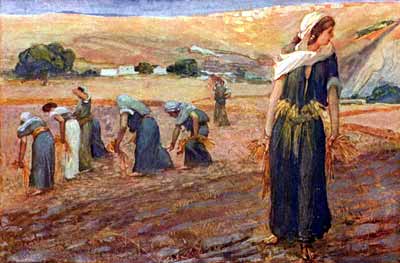
Keep the picture in mind of the men leading the way through the heads of standing barley grain wielding the sickles, slashing to and fro, followed by the women who were tying the freshly cut stalks into sheaves (which were bundles of the grain stalks laid lengthways and tied together after having been reaped). After these sheaves were brought in from the fields, they would then be subjected to the "trauma" of threshing, which would facilitate the separation of the heavier kernels from the lighter, worthless husks which would be carried away by the breezes that blew in from the Mediterranean Sea (see the figurative use in Ps 1:4+). As you might surmise the process of threshing was usually performed on some elevated site to more effectively utilize the separating power of the prevailing sea winds.
Remember that in ancient times (especially the days of the Judges - Jdg 21:25) grain fields were dangerous places for women as alluded to in the Torah where Moses records…
But if in the field the man finds the girl who is engaged, and the man forces her and lies with her, then only the man who lies with her shall die. But you shall do nothing to the girl; there is no sin in the girl worthy of death, for just as a man rises against his neighbor and murders him, so is this case. When he found her in the field, the engaged girl cried out, but there was no one to save her. (Deut 22:25, 26, 27+)
John Butler adds a note about the importance of keeping one's eyes on the master's field writing "If Ruth was going to do as Boaz said and gain the blessing and reward from gleaning in his field, she needed to keep her eyes focused on his field lest in looking at other fields she be tempted to go elsewhere. Going elsewhere would diminish her blessing. Here is a most needed lesson about our eyes and how much they affect our walk in God's way. What we look at has much effect upon our life. Therefore, keep your eyes focused on the right things. Do not focus your eyes on evil or you will be tempted to leave that which is good. Many of God's people have focused their eyes so intently on the rot of television, as an example, that they have left the field of God's will and way for their lives. "Turn away mine eyes from beholding vanity" (Psalm 119:37) is the exhortation needed here. (Ruth The Ancestress of Christ)
Butler on go after them - Evidently, this procedure would benefit Ruth in two ways: first, it would identify her with Boaz’s workers and thus head off potential abuse by rowdies of whatever sort; and second, it would probably give Ruth’s gleaning better results because she would be ahead of other gleaners. (See context in The Book of Ruth)
INDEED I HAVE COMMANDED THE SERVANTS NOT TO TOUCH YOU:
- Ge 20:6, 7, see context Ge 20:1, 2, 3, 4, 5; Job 19:21KJV; Ps 105:15; Pr 6:29; 1Co 7:1; 1Jn 5:18
I have warned the young men not to bother you. (ICB)
I have ordered my men not to molest you. (TEV)
I have forbidden my men to molest you. (NJB)
have I not given orders to the young men not to put a hand on you? (BBE)
BOAZ PROTECTS
RUTH
Indeed, I have commanded the servants not to touch (naga') you - BBE = "not to put a hand on" Boaz is protecting her honor and charged his servants not to molest Ruth. Not to touch alludes to sexual contact (cf naga' Pr 6:29+). The servants (young men) were charged by their master not to lay a hand upon Ruth. In those days women obviously were in danger of being raped while working in the fields (cf Naomi's warning in Ru 2:22+). God, using Boaz as His instrument, was protecting Ruth and God at the same time was protecting the seed of Obed (Ru 4:21, 22) and the integrity of the line of the Messiah (Mt 1:1, 5, 6) from being "defiled", just as He had protected Abraham's wife Sarah from the Philistine King Abimelech (cf Ge 20:6, 7). Once again the narrator gives us the sense that Naomi, Ruth, and Boaz live in an "oasis of peace" in the midst of the dark "days of the judges".
Servants is translated in other versions not as servants but young men man as contrasted with older man. Vine says that na'ar denoted one "who is of marriageable age but is still a bachelor." This fact helps explain Boaz's comment later that she was "not going after young men, whether poor or rich." (Ru 3:10).
Yes, Ruth had the Biblical sanction to glean (Lev 19:9, Dt 24:19) but that sanction did not necessarily guarantee protection from assault (especially in the days of the Judges!), and this fact makes Boaz’s offer exceeding abundantly beyond all that Ruth could have asked or thought (cp Ep 3:20+), especially given her Moabite background (outside the covenant promises of Israel, no hope, no God - cp Eph 2:12+, Ep 2:13+). We do know that Boaz’s mother, Rahab, (cf Mt 1:5+, Jas 2:25+) was from the despised Canaanites and this truth could in part explain Boaz’s desire to protect the foreigner Ruth, not to mention of course that he clearly has manifests an attraction to her excellent character (Ru 3:11+) Note that not once does the writer speak of Ruth's external beauty or attractiveness but only of her attractive inner character (cp 1Pe 3:1-4-+). I have little doubt that this young woman (probably 25-30 years old) was also physically attractive but that misses the point of this section and so the writer ignores a description of her physical appearance. In a culture so affected by the affectation of Hollywood, how prone we are to look at the outside and ignore the inside (cp 1Sa 16:7, Jn 7:24) of those we encounter.
Touch (05060) (naga') is the verb used in (Ex 19:15) where it is translated "do not go near" (a woman) (NASB) and more interpretatively by the NIV (accurately, which is not always the case with this dynamic paraphrase!) as "abstain from sexual relations" (Ex 19:15NIV). Elsewhere naga' means “beat violently” (Ge. 32:26, 33; Job 1:19; Josh. 8:15, Niphal), “inflict injury” (Gen. 26:11, 29), and “have sexual relations” (Gen. 20:6; Prov. 6:29).
The Septuagint (LXX) translates naga' with the Greek verb hapto which meant to cause burning to take place (to light or kindle a fire) and was used literally to mean to touch or take hold of (Jn 20:17, Lk 7:39+) but was also used figuratively and euphemistically of touching a woman (ie, sexual intercourse as in 1Co 7:1/1-corinthians-7-commentary#7:1+, and is also used this way in the Lxx translations of Ge 20:6, Pr 6:29+. It is therefore very likely that the author is alluding to illicit activity that would be especially prone to occur to a foreign woman out in the field with a group of laboring young men in the days of the Judges (cp Jdg 21:25+).
It is interesting to observe the final NT use of the Greek verb hapto in 1Jn 5:18 where it conveys the sense of "to lay hold of or grasp in order to harm," John writing "We know that no one who is born of God sins; but He who was born of God keeps him and the evil one does not touch him. (1Jn 5:18+)
THOUGHT - The believer belongs to God and God protects His children by limiting Satan's power (Job 1:12, later he allows Satan to touch Job [Job 2:4, 5, 6], but He still limited Satan's power for His purposes which are always good not evil [cp Ge 50:20, Ro 8:28, 29+]. Beloved, to counter fear nourish and build your faith in the Father's sovereignty which is an omniscient, omnipresent, omnipotent, infinite sovereignty and let your faith in such a faithful God counter any fear you might have of the Adversary [1Pe 5:8+, 1Jn 4:4]. Remember, faith is the antidote for fear so in order to strengthen your faith lay hold of the truth in Ro 10:17+) so that you might be able to walk by faith not sight (2Cor 5:7, cp 2Cor 4:18+) (See related resource - Fear, How to Handle It)
ILLUSTRATION: Have you checked the labels on your grocery items lately? You may be getting less than you thought. According to U.S. News & World Report, some manufacturers are selling us the same size packages we are accustomed to, but they are putting less of the product in the box. For example, a box of well-known detergent that once held 61 ounces now contains only 55. Same size box, less soap. How something is wrapped doesn’t always show us what’s on the inside. That’s true with people as well. We can wrap ourselves up in the same packaging every day—nice clothes, big smile, friendly demeanor—yet still be less than what we appear to be.
WHEN YOU ARE THIRSTY GO TO THE WATER JARS AND DRINK FROM WHAT THE SERVANTS DRAW:
- Genesis 24:18, 19, 20; Mt 10:42; John 4:7, 8, 9, 10, 11
BOAZ PROVIDES FOR
RUTH'S NEEDS
When you are thirsty, go to the water jars and drink from what the servants draw - Ruth had the freedom to get a drink at any time. Israel is a dry land, with some desert regions and with very hot, dry summers. Whoever travels in this land, experiences parching thirst. One of the ways to show hospitality was to give the thirsty visitor a drink. Boaz offers Ruth hospitality, even to the point that she did not have to draw out the water herself! Thus Boaz gave Ruth permission to drink from the water jars that the young male servants had filled for their use. This was a privilege not ordinarily permitted the gleaners, and is another manifestation of the undeserved favor (grace) that Boaz choose to bestow on Ruth (click here). And again what a picture this gives us of the amazing grace of God as our "greater Boaz", our Kinsman-Redeemer Who also invites us to come and drink if we are thirsty (Jn 7:37-39, Jesus 4:13-15, cp Jesus our "Rock" Ex 17:6 compared with 1Co 10:4 - See Typology-Study of Types)
Hubbard - What an interesting touch: a foreign woman who customarily would draw water for Israelites was welcome to drink water drawn by Israelites. Further, coupled with his granting of permission, the gesture marked a very generous, unexpected concession. (See context in The Book of Ruth)
JESUS OUR GREATER BOAZ
AND THE WOMAN AT THE WELL
10 Jesus answered and said to her, "If you knew the gift of God, and who it is who says to you, 'Give Me a drink,' you would have asked Him, and He would have given you living water." 11 She said to Him, "Sir, You have nothing to draw with and the well is deep; where then do You get that living water? 12 "You are not greater than our father Jacob, are You, who gave us the well, and drank of it himself, and his sons, and his cattle?" 13 Jesus answered and said to her, "Everyone who drinks of this water shall thirst again; 14 but whoever drinks of the water that I shall give him shall never thirst; but the water that I shall give him shall become in him a well of water springing up to eternal life." 15 The woman said to Him, "Sir, give me this water, so I will not be thirsty, nor come all the way here to draw." (Jn 4:10-15+).
LIVING WATER
Now on the last day, the great day of the feast, Jesus stood and cried out, saying, "If any man is thirsty, let him come to Me and drink. 38 "He who believes in Me, as the Scripture said, 'From his innermost being shall flow rivers of living water.'" 39 But this He spoke of the Spirit, whom those who believed in Him were to receive; for the Spirit was not yet given, because Jesus was not yet glorified. (Jn 7:37-39+)
THOUGHT - Beloved are you thirsty? Have you humbled yourself to take a drink from the water jar of our "Greater Boaz" Christ Jesus, Who alone offers living waters that become a well of water springing up to eternal life? Come to Him if you are weary and heavy laden and you will find rest and soul satisfaction. Do not seek to quench your thirst with the world's offering as did a certain rich man (Lk 16:19-21+) for the "water" the world offers can never satisfy your spiritual thirst as the rich man discovered in Hades (Lk 16:24+).
And he cried out and said, 'Father Abraham, have mercy on me, and send Lazarus, that he may dip the tip of his finger in water and cool off my tongue; for I am in agony in this flame.' (Lk 16:24+; see also study of Eternal Punishment)
Ruth probably did not understand why Boaz had commanded his workers to be so generous to her, but she believed his word (cp believers in the NT = 2 Co 5:7+) and found that her needs were met (cp Phil 4:19+, 2Co 9:8, Ps 23:1, 2, 3+).
Devotional from Today in the Word - Rental centers have been popular for a long time. Many people who cannot afford to buy merchandise, or who choose not to buy it, rent items such as furniture, appliances, and electronic equipment. Now, some centers even rent engagement rings just the thing for people who aren’t sure of their commitment. (Today it seems that) "Commitment" is something a person makes until he or she finds something better. Boaz of Bethlehem offers a refreshing contrast to the shallowness of many modern day commitments.
In Ruth 2 he also reveals himself to be a person of integrity and generosity, taking a protective stance toward Ruth and making sure she was provided for in the gleaning and at mealtime. It’s also obvious that Boaz had the spiritual sensitivity to realize and appreciate what Ruth had done in leaving her homeland. He praised her, not just for remaining loyal to Naomi, but also for her commitment to the God of Israel (Ruth 2:11,12)… Would we be willing to pursue an issue to a right and fair resolution, even if it meant personal disappointment for us? We don’t always know what the pay-off will be for doing the right thing. But we can be sure that God will honor us when He is free to take delight in our way, as today’s verse promises.
If the LORD delights in a man’s way, he makes his steps firm. - Psalm 37:23+
Ruth 2:10 Then she fell on her face, bowing to the ground and said to him, "Why have I found favor in your sight that you should take notice of me, since I am a foreigner?" (NASB: Lockman)
Amplified: Then she fell on her face, bowing to the ground, and said to him, Why have I found favor in your eyes that you should notice me, when I am a foreigner? (Amplified Bible - Lockman)
GWT: Ruth immediately bowed down to the ground and said to him, "Why are you so helpful? Why are you paying attention to me? I'm only a foreigner." (GWT)
ICB: Then Ruth bowed low with her face to the ground. She said to Boaz, "I am a stranger. Why have you been so kind to notice me?" (ICB: Nelson)
KJV: Then she fell on her face, and bowed herself to the ground, and said unto him, Why have I found grace in thine eyes, that thou shouldest take knowledge of me, seeing I am a stranger?
NLT: Ruth fell at his feet and thanked him warmly. "Why are you being so kind to me?" she asked. "I am only a foreigner." (NLT - Tyndale House)
Young's Literal: And she falleth on her face, and boweth herself to the earth, and saith unto him, 'Wherefore have I found grace in thine eyes, to discern me, and I a stranger?'
Septuagint (LXX): kai epesen (3SAAI) epi prosopon autes kai prosekunesen (3SAAI) epi ten gen kai eipen (3SAAI) pros auton ti hoti heuron (1SAAI) charin en opthalmois sou tou epignonai (AAN) me kai ego eimi (1SPAI) xene
English of Septuagint: And she fell upon her face, and did reverence to the ground, and said to him, How is it that I have found grace in thine eyes, that thou shouldest take notice of me, whereas I am a stranger
THEN SHE FELL ON HER FACE BOWING TO THE GROUND:
- Ge 18:2; 1Sa 25:23
RUTH BOWS IN
HUMBLE SUBMISSION
Then - This "time phrase" (see expressions of time) marks the sequence in a series of events. Always be alert for this "code word" (be observant) and let it prompt the question "When is then?" (Or Consider the "5P's" - Pause to Ponder the Passage then Practice it in the Power of the Spirit) She falls to her knees and then to her face (see discussion below) after hearing the incredible, gracious (grace laden - cp Ep 4:29+, Pr 15:23, 16:24, 25:11, 27:9, Eccl 10:12) words that Boaz had just bestowed upon Ruth, a woman, a poor woman, a widow woman, a poor foreign widow woman, a Moabitess, an undeserving stranger and alien. What a picture of grace! What a picture Ruth is of all of us before we met our gracious Redeemer, Christ Jesus! Little wonder that Boaz is so frequently spoken of as one who points to the greater Kinsman-Redeemer, Christ Jesus, the One in Whom grace has been piled upon grace and in Whom grace and truth are realized (Jn 1:16, 17 cp Ep 2:7+)
She fell on her face, bowing (shachah) to the ground - This action is a typical oriental gesture by an inferior who humbly submits to their superior (cf Abigail 1Sa 25:23) Ruth in great humility and with a deep sense of gratitude threw herself on the ground and bowed before Boaz, asking with surprise why she, a foreigner, had found such favor in his eyes. What did the master of the field see in her?
Fell (05307) (naphal) means literally to fall (as from a higher to a lower position) and in this verse pictures Ruth literally falling to her knees before Boaz (cp uses in Ge 17:3, 50:18). But the writer adds a second verb, shachah (discussed below), which at first glance is similar, but is added to present an even clearer picture of what transpired that "fateful" ("fate filled") day in the barley field. In other words, although this Hebrew verb naphal can sometimes mean to prostrate one's self, it does not always convey that meaning. In the present scene the writer adds shachah which while also conveying the sense of going from a higher to a lower position (as when one bows down), adds the nuance of doing so with an attitude which is also "bowed down". And so the verb shachah is rightly used to describe one prostrating one's self or bowing down before God with an attitude of reverence and worship (Ge 17:3). The picture is of Ruth falling to her knees (Hebrew = naphal, translated in Septuagint (LXX) with Greek verb pipto = conveys simple meaning "to fall down") and then bowing to the ground or laying herself out on the ground at the feet of Boaz (see below for the Hebrew verb shachah, translated in LXX with Greek verb proskuneo = conveys the sense of worship)
THOUGHT- What does the response to the reception of amazing, totally undeserved grace look like? Falling on our faces in absolute abandon lost in worship of the only One Worthy of worship! Have you ever fallen on your face before your greater Boaz overwhelmed by His mercy and grace to save a wretch like you (me)?
Years later Scripture gives an almost identical description of another godly woman recording that
When Abigail (source of joy) saw David (Ruth's great grandson), she hurried and dismounted from her donkey, and fell on her face (naphal = to fall; pipto = to fall down literally) before David (the great grandson of Boaz and Ruth!), and bowed (Heb = shachah; LXX = proskuneo) herself to the ground. (1Sa 25:23)
We see a similar exchange recorded again before David when…
Mephibosheth (See discussion of Mephibosheth), the son of Jonathan the son of Saul, came to David and fell on his face (naphal = to fall; pipto = fell down) and prostrated (Heb = shachah; Lxx = proskuneo) himself. And David said, "Mephibosheth." And he said, "Here is your servant!" And David said to him, "Do not fear, for I will surely show kindness (hesed - steadfast love, unfailing love, the kind God shows; LXX = eleos - mercy, compassion, manifestation of the readiness and the necessary resources to extend help to one in need - what a picture David gives us of our great and merciful ["mercy full"] God, Who ever says [1] ”I see your need”, [2] “I am moved by your need” and [3] “I move to meet your need”. Blessed be the Name [play Blessed Be Your Name or another version of Blessed Be Your Name] of our Jehovah Jireh, Who provides for our every need according to His riches in glory in Christ Jesus - Php 4:19-note!) to you for the sake of your father Jonathan (Why? because of covenant is withholding nothing! [see also The Exchange of Robes between Jonathan and David] 1Sa 18:1-4 and Jonathan speaking to David said… 1Sa 20:14-17), and will restore to you all the land of your grandfather Saul; and you shall eat at my table regularly. (2Sa 9:6, 7 compared with the last words of this section - 2Sa 9:13 = a picture of us all outside of Christ, the greater Son of David Who ever invites sinners to dine with Him as saints in glory [Re 19:9+, Mt 22:2, 10, Lk 14:16, 17, 21+]! We who like Mephibosheth were poor and crippled and blind and lame have nevertheless been invited to a wedding feast, the marriage supper of the Lamb! Blessed indeed! Amazing grace!)
And so here we see Boaz's great grandson, David, manifesting a kind and gracious spirit just as Boaz himself had shown to Ruth in the barley fields! What a legacy of amazing grace! And Boaz's mother was a pagan idol worshipping harlot, Rahab the harlot by name (Josh 6:17, 25, He 11:31, Jas 2:25), a sinner who by grace through faith became a saint. It's not how bad we've been or how bad we've begun, but how great God's goodness and kindness is to extract us from the miry clay and darkness of our past and to give us a future and a hope. How great is our God! How great is Ruth's God!
Play and watch
Boaz was a man of God and would have been very familiar with the charge that
The stranger (alien, sojourner, foreigner) who resides with you shall be to you as the native among you, and you shall love him as yourself; for you were aliens in the land of Egypt: I am the LORD your God. (Lev 19:34)
And clearly as the story unfolds Boaz went beyond the letter of the Law (Lev 19:9, Deut 24:19) to bestow abundant unmerited favor on this stranger, giving her grace upon grace, far beyond what she could ever have imagined. Boaz was a man who lived out what Jesus encouraged NT saints to do…
Give, and it will be given to you; good measure, pressed down, shaken together, running over, they will pour into your lap. For by your standard of measure it will be measured to you in return. (Lk 6:38+)
Solomon wrote
He who gives to the poor will never want, but he who shuts his eyes will have many curses. (Pr 28:27)
Paul emphasizes this same principle declaring that…
whatever a man sows, this he will also reap… And let us not lose heart in doing good, for in due time we shall reap if we do not grow weary. So then, while we have opportunity, let us do good to all men, and especially to those who are of the household of the faith. (Gal 6:7-10+)
Falling down and Bowing gives a clear indication of Ruth's humility and respect for authority. It behooves all of us to emulate Ruth's attitude and action and "with humility of mind (to) … regard one another as more important than" ourselves, which was the "attitude… which was also in Christ Jesus… Who, although He existed in the form of God, did not regard equality with God a thing to be grasped but emptied Himself taking the form of a bond-servant and… humbled Himself." (Php 2:3-8+)
Warren Wiersbe adds that "Ruth neither looked back at her tragic past nor did she look at herself and consider her sorry plight. She fell at the feet of the master and submitted herself to him. She looked away from her poverty and focused on his riches. She forgot her fears and rested on his promises. What an example for God’s people today to follow! Many people are miserable because they don’t obey the admonition of Heb 12:2+ “fixing our eyes on Jesus.” They spend so much time looking at themselves, their circumstances, and other people that they fail to do what Ruth did, namely, center their attention on their Master. Instead of resting in His perfections, they focus on their own imperfections. Instead of seeing His spiritual riches, they complain about their bankruptcy. They go to church “to get their needs met,” instead of going to church to worship the God Who is greater than any need. They need to heed the counsel of the little poem a radio listener sent me years ago… " (See context in The Bible Exposition Commentary)
Look at self and be distressed,
Look at others and be depressed,
Look at Jesus and you’ll be at rest!
-Corrie Ten Boom
John Butler writes that "This most humble behavior before Boaz shows in action her belief that she is very unworthy of his favors. It is like the action of Peter who, after a great miracle by Christ which gave Peter a great catch of fish, "fell down at Jesus' knees, saying, Depart from me; for I am a sinful man, O Lord" (Luke 5:8+). We need to bow before our Divine benefactor as Ruth bowed before Boaz in recognition of our unworthiness. Bowing not only shows our humble recognition of unworthiness for Divine blessings—and none of us are worthy of His blessings, but it also shows gratitude for the blessings. Lack of reverence shows sinful pride and much lack of gratitude." (Ruth, the ancestress of Christ)
Bowing (07812) (shachah) means to bow down, to prostrate oneself, to crouch, to fall down, to humbly beseech, to do reverence, to worship. The idea is to assume a prostrate position as would in paying homage to royalty (Ge 43:28) or to God (Ge 24:26, Ps 95:6).
Brown-Driver-Briggs' Definition - to bow down (Qal) to bow down; (Hiphil) to depress (fig); (Hithpael) to bow down, prostrate oneself, before superior in homage, before God in worship, before false gods, before angel.
In the first use in Genesis (which has most of the uses - 21v), when Abraham saw "three men (one of Whom was most likely the pre-incarnate Christ)… standing opposite him… he ran from the tent door to meet them and bowed (shachah) himself to the earth (Ge 18:2, cp Lot bowing to the two angels - Ge 19:1) It is used to describe Joseph's brother's sheaves which "bowed down to my sheaf.” (Ge 37:7) When God told Abraham to sacrifice his son, he told his men to remain for they would go to "worship and return to you." (Ge 22:5) Joshua bowed down to the "Captain of the host of the LORD," (Joshua 5:14) almost assuredly a preincarnate appearance of Messiah. In Josh 23:7, 16 Joshua warned Israel NOT to bow down to the idols of the land, but in Jdg 2:12, 17, 19 that is exactly what they did!
The English word prostrate is defined as being stretched out with one's face on the ground in adoration or submission. It is not just that the person has fallen down but pictures them lying at length or with their body extended on the ground and so lying in a posture which is reflective of genuine humility and/or adoration.
Vine - Usage Notes: "to worship, prostrate oneself, bow down." This word is found in modern Hebrew in the sense of "to bow or stoop," but not in the general sense of "to worship." The fact that it is found more than 170 times in the Hebrew Bible shows something of its cultural significance. It is found for the first time in Gen. 18:2, where Abraham "bowed himself toward the ground" before the 3 messengers who announced that Sarah would have a son. The act of bowing down in homage is generally done before a superior or a ruler. Thus, David "bowed" himself before Saul (1 Sam. 24:8). Sometimes it is a social or economic superior to whom one bows, as when Ruth "bowed" to the ground before Boaz (Ruth 2:10). In a dream, Joseph saw the sheaves of his brothers "bowing down" before his sheaf (Gen. 37:5, 9-10). Shāḥâ is used as the common term for coming before God in worship, as in 1 Sam. 15:25 and Jer. 7:2. Sometimes it is in conjunction with another Hebrew verb for bowing down physically, followed by "worship," as in Exod. 34:8: "And Moses made haste, and bowed his head toward the earth, and worshiped." Other gods and idols are also the object of such worship by one's prostrating oneself before them (Isa. 2:20; Isa. 44:15, 17). (Vine's Expository Dictionary of Old Testament and New Testament Words)
Gilbrant - The meaning for shāchāh is "to worship" or "to bow down." Its form is almost always in the Hithpael, the causative reflexive form, indicating that the subject is willingly bowing to the ground. When the verb is used with reference to God (Gen. 22:5; Exo. 4:31; 12:27; 33:10; Judg. 7:15) or idols (Exo. 20:5; 34:14; Deut. 5:9; Judg. 2:12; 1 Ki. 16:31; Ps. 81:9; Jer. 22:9), the translation "worship" is usually sufficient. Sacred objects such as holy mountains, specifically Zion (Ps. 99:9), and the stars, as astral deities (Deut. 4:19), are bowed before in pagan worship. Prostration represents the powerlessness of the worshiper, who lies prone before the being possessing power and authority. This same attitude is expressed in human relationships as well. Political superiors were greeted by this type of prostration (Gen. 42:6; 1 Sam. 20:41; 24:8; 2 Sam. 14:33; 1 Ki. 1:16). This posture is attested hyperbolically in the Amarna Letters which record that vassals of the Pharaoh would fall at the king's feet. Other types of social ranking demanded this gesture. Women in Israelite society bowed before men (Ruth 2:10; 1 Sam. 25:23; 1 Ki. 1:16); the band of prophets following Elisha bowed before him (2 Ki. 2:15); Saul bowed before Samuel (1 Sam. 28:14); Abraham, the resident alien, bowed before the landowners, the Hittites (Gen. 23:7); Moses bowed before his father-in-law (Exo. 18:7); and Joseph, vizier of Egypt, bowed to his father Jacob (Gen. 48:12). (Complete Biblical Library - Incredible Resource)
Swanson - 1. (qal) fall prostrate, i.e., take a bowing stance, here as a position of submission to a human superior (Isa 51:2); 2. (hif) be despondent, formally, cause to weigh down, i.e., cause to be anxious and discouraged, as a figurative extension of causing a person to become in a prostrate position (Pr 12:25),
Shachah - 166v in the OT - bow(5), bow down(23), bowed(15), bowed down(18), bowing(1), bowing down(1), bows down(1), did homage(1), homage(2), lie down(1), paid homage(3), prostrate(2), prostrated(13), prostrating(1), way(1), weighs down(1), worship(48), worshiped(31), worshiping(3), worships(2). Ge 18:2; 19:1; 22:5; 23:7, 12; 24:26, 48, 52; 27:29; 33:3, 6, 7; Ge 37:7, 9, 10; 42:6; 43:26, 28; 47:31; 48:12; 49:8; Ex 4:31; 11:8; 12:27; 18:7; 20:5; 23:24; 24:1; 32:8; 33:10; 34:8, 14; Lv 26:1; Nu 22:31; 25:2; Deut. 4:19; 5:9; 8:19; 11:16; 17:3; 26:10; 29:26; 30:17; Jos 5:14; 23:7, 16; Jdg 2:12, 17, 19; 7:15; Ru 2:10; 1Sa 1:3, 19, 28; 2:36; 15:25, 30f; 20:41; 24:8; 25:23, 41; 28:14; 2Sa 1:2; 9:6, 8; 12:20; 14:4, 22, 33; 15:5, 32; 16:4; 18:21, 28; 24:20; 1Ki 1:16, 23, 31, 47, 53; 2:19; 9:6, 9; 11:33; 16:31; 22:53; 2Ki 2:15; 4:37; 5:18; 17:16, 35f; 18:22; 19:37; 21:3, 21; 1Chr. 16:29; 21:21; 29:20; 2 Chr. 7:3, 19, 22; 20:18; 24:17; 25:14; 29:28, 29, 30; 32:12; 33:3; Neh 8:6; 9:3, 6; Esther 3:2, 5; Job 1:20; Ps. 5:7; 22:27, 29; 29:2; 45:11; 66:4; 72:11; 81:9; 86:9; 95:6; 96:9; 97:7; 99:5, 9; 106:19; 132:7; 138:2; Pr 12:25; Is 2:8, 20; 27:13; 36:7; 37:38; 44:15, 17; 45:14; 46:6; 49:7, 23; 51:23; 60:14; 66:23; Je 1:16; 7:2; 8:2; 13:10; 16:11; 22:9; 25:6; 26:2; Ezek 8:16; 46:2, 3, 9; Mic 5:13; Zeph. 1:5; 2:11; Zec 14:16, 17
Here are the uses in Psalms…
(Ps 5:7) But as for me, by Thine abundant lovingkindness I will enter Thy house, At Thy holy temple I will bow in reverence for Thee.
(Ps 22:27) All the ends of the earth will remember and turn to the LORD, And all the families of the nations will worship before Thee.
(Ps 22:29) All the prosperous of the earth will eat and worship, All those who go down to the dust will bow before Him, Even he who cannot keep his soul alive.
(Ps 29:2) Ascribe to the LORD the glory due to His name; Worship the LORD in holy array.
(Ps 45:11) Then the King will desire your beauty; Because He is your Lord, bow down to Him.
(Ps 66:4) “All the earth will worship Thee, And will sing praises to Thee; They will sing praises to Thy name.” Selah.
(Ps 72:11) And let all kings bow down before him, All nations serve him.
(Ps 81:9) “Let there be no strange god among you; Nor shall you worship any foreign god.
(Ps 86:9) All nations whom Thou hast made shall come and worship before Thee, O Lord; And they shall glorify Thy name.
(Ps 95:6) Come, let us worship and bow down; Let us kneel before the LORD our Maker.
(Ps 96:9) Worship the LORD in holy attire; Tremble before Him, all the earth.
(Ps 97:7) Let all those be ashamed who serve graven images, Who boast themselves of idols; Worship Him, all you gods.
(Ps 99:5) Exalt the LORD our God, And worship at His footstool; Holy is He.
(Ps 99:9) Exalt the LORD our God, And worship at His holy hill; For holy is the LORD our God.
(Ps 106:19) They made a calf in Horeb, And worshiped a molten image.
(Ps 132:7) Let us go into His dwelling place; Let us worship at His footstool.
(Ps 138:2) I will bow down toward Thy holy temple, And give thanks to Thy name for Thy lovingkindness and Thy truth; For Thou hast magnified Thy word according to all Thy name.
In some connotations shachah even conveys the idea of worship as we hear Abraham say to his men as he takes Isaac to the mount to sacrifice him -- "Abraham said to his young men, "Stay here with the donkey, and I and the lad will go yonder; and we will worship (shachah) and return to you." (Ge 22:5)
The verb pictures the bowing down in homage of an inferior before a superior as when David "prostrated (shachah) himself" (1Sa 24:8) before King Saul.
Bowing is translated in the Septuagint (LXX) in this passage (and most of the uses in Psalms and elsewhere) with the picturesque Greek verb proskuneo (from pros = toward or facing + kuneo = kiss, adore) which pictures the practice among the Orientals (especially the Persians) of falling upon their knees and touching the ground with their forehead as an expression of profound reverence.
Proskuneo- 60x in 54v in the NT - Matt. 2:2, 8, 11; 4:9f; 8:2; 9:18; 14:33; 15:25; 18:26; 20:20; 28:9, 17; Mk. 5:6; 15:19; Lk. 4:7f; 24:52; Jn. 4:20, 21, 22; 9:38; 12:20; Acts 7:43; 8:27; 10:25; 24:11; 1 Co. 14:25; Heb. 1:6; 11:21; Rev. 3:9; 4:10; 5:14; 7:11; 9:20; 11:1, 16; 13:4, 8, 12, 15; 14:7, 9, 11; 15:4; 16:2; 19:4, 10, 20; 20:4; 22:8f
Proskuneo- 177x in the Septuagint (LXX) - Gen. 18:2; 19:1; 22:5; 23:7, 12; 24:26, 48, 52; 27:29; 33:3, 6f; 37:7, 9f; 42:6; 43:26, 28; 47:31; 48:12; 49:8; Exod. 4:31; 11:8; 12:27; 18:7; 20:5; 23:24; 24:1; 32:8; 33:10; 34:8, 14; Lev. 26:1; Num. 22:31; 25:2; Deut. 4:19; 5:9; 8:19; 11:16; 17:3; 26:10; 29:26; 30:17; 32:43; Jos. 23:7, 16; Jdg. 2:2, 12, 17, 19; 7:15; Ruth 2:10; 1 Sam. 1:3, 19; 2:36; 15:25, 30f; 20:41; 24:8; 25:23, 41; 28:14; 2 Sam. 1:2; 9:6, 8; 12:20; 14:4, 22, 33; 15:5, 32; 16:4; 18:21, 28; 24:20; 1 Ki. 1:16, 23, 31, 47, 53; 2:13; 9:6, 9; 16:31; 19:18; 22:53; 2 Ki. 2:15; 4:37; 5:18; 17:16, 35f; 18:22; 19:37; 21:3, 21; 1 Chr. 16:29; 21:21; 29:20; 2 Chr. 7:3, 19, 22; 20:18; 24:17; 25:14; 29:28ff; 32:12; 33:3; Neh. 8:6; 9:3, 6; Ester 3:2, 5; 4:17; 8:12; Job 1:20; Ps. 5:7; 22:27, 29; 29:2; 45:11; 66:4; 72:11; 81:9; 86:9; 95:6; 96:9; 97:7; 99:5, 9; 106:19; 132:7; 138:2; Isa. 2:8, 20; 27:13; 37:38; 44:15, 17, 19; 45:14; 46:6; 49:7, 23; 66:23; Jer. 1:16; 8:2; 13:10; 16:11; 22:9; 25:6; 26:2; Ezek. 8:16; 46:2f, 9; Dan. 2:46; 3:5ff, 10ff, 14f, 18, 28; 6:26f; Mic. 5:13; Zeph. 1:5; 2:11; Zech. 14:16f;
Take notice (recognize, show partiality, acknowledge) (05234) nakar means to scrutinize, look intently at and thus conveys the idea of "inspecting" or "looking over" something with the intention of recognizing it. In the present context Ruth is asking Boaz in essence why are you even choosing to pay attention to me or "even give me the time of day" to one so low in rank and unworthy? Note that nakar is not used in the Old Testament as a euphemism for the act of sexual intercourse which is significant because Ru 3:14 uses nakar when Ruth lays at Boaz's feet and "arose before one could recognize another."
Uses in Ruth - Ruth 2:10; Ru 2:19 = take notice, Ru 3:14 = recognize
AND SAID TO HIM "WHY HAVE I FOUND FAVOR (GRACE) IN YOUR SIGHT THAT YOU SHOULD TAKE NOTICE OF ME SINCE I AM A FOREIGNER":
- Ru 2:2,13; 2Sa 9:8; 19:28; Lk 1:43,48; Ro 12:10
- Is 56:3-8; Mt 15:22-28; 25:35; Lk 7:6,7; 17:16-18, Jas 4:6, 2Co 12:9, 10, 1Co 15:10
THAT BOAZ NOTICED
THE UNNOTICED
Why have I found favor (chen/hen; Lxx - charis) in your sight that you should take notice (nakar) of me, since I am a foreigner - Ruth's very question showed a spirit of humility and self-effacement. Her status as from the despised Moabites would have been constantly on her mind and she was undoubtedly aware of the fact that on the basis of her nationality, she did not belong. This truth makes her acceptance even that much more precious. Her response reminds us of the "woman… who was a sinner" of whom Jesus said "her sins, which are many, have been forgiven, for she loved much but he who is forgiven little, loves little." (Lk 7:37, 47+)
Since I am a foreigner (nokriy) - Clearly Boaz knows Ruth is a foreigner (a Moabitess, Ru 2:6), but she was likely not privy to that conversation and wants to make sure Boaz understands to whom it is that he is showing favor. It's as if she is thinking to herself "His kindness is greatly appreciated but I'm not sure he really understands I am from the despised, shunned Moabites!"
How did Ruth know Boaz would care for her? He gave her his promise, and she knew he could be trusted. Ruth had in her heart the essence of the second stanza of It is Well With My Soul:
Tho' Satan should buffet
Tho' trials should come
Let this blest assurance control
It is well. It is well with my soul.
Samuel Ridout - Such grace, so unexpected, moves Ruth to deepest gratitude, and falling at his feet, she asks why he should show such kindness to a stranger like herself. His reply shows how familiar he is with her history, which he interprets as far more than filial kindness to her bereaved mother-in-law. She has come to find shelter under the protecting wings of the God of Israel, and her devotion to Naomi cannot be separated from that. And has not the heart often asked a similar question of our Lord? He has manifested some special thought of us, given some refreshing to our thirsty souls, and we wonder why it should be so. Is not His answer to be found in the fact that He has marked our path, and seen the beginnings of that faith which He now rewards. Nay, is not the faith itself the fruit of His own sovereign grace, and is He not but setting the seal upon His own divine work? He knows those whom He has drawn to Himself. (Gleanings from the Book of Ruth
John Piper has some wonderfully poignant insights on this section commenting that "Ruth raises a question which turns out to be very profound. It's one that we all need to ask God. Hardly anything in our life is more important than the answer we get. Then she fell on her face, bowing to the ground, and said to him, 'Why have I found favor in your eyes, that you should take notice of me, when I am a foreigner?'Ruth knows that she is a Moabitess. From a natural viewpoint she has two strikes against her. She does not resent this, but accepts it. As a non-Israelite she does not expect any special treatment. Her response to Boaz's kindness is astonishment. She is very different from most people today. We expect kindness and are astonished and resentful if we don't get our rights. But Ruth expresses her sense of unworthiness by falling on her face and bowing to the ground. Proud people don't say thanks. Humble people are made even more humble by being treated graciously. Grace is not intended to lift us out of lowliness. It's intended to make us happy in God." (Ruth: Under the Wings of God) (Bolding added)
Favor (02580) (chen/hen) (used 3x in Ruth 2 - Ruth 2:2, 10, 13) Ruth acknowledged her own unworthiness and accepted his "favor" or "grace" for "favor" (chen) means grace which was exactly what she had gone into the fields to find (Ru 2:2+). She believed his promises and rejoiced in them. There was no need for Ruth to worry, for the wealthy lord of the harvest would care for her and Naomi. Furthermore Ruth was a perfect "target" to receive grace, for as Solomon reminds us God "scoffs at the scoffers, yet He gives grace to the afflicted (humble - those who are "low")" (Pr 3:34). The person with humility (Ruth) thinks of others first (Naomi) and not of themselves.
Chen - 67v in OT - The NAS renders chen as adornment(1), charm*(1), charm(1), charming*(1), favor(51), grace(8), graceful(2), gracious(3), pleases*(1). Gen. 6:8; 18:3; 19:19; 30:27; 32:5; 33:8, 10, 15; 34:11; 39:4, 21; 47:25, 29; 50:4; Ex. 3:21; 11:3; 12:36; 33:12f, 16f; 34:9; Nu 11:11, 15; 32:5; Dt 24:1; Jdg. 6:17; Ruth 2:2, 10, 13; 1Sa 1:18; 16:22; 20:3, 29; 25:8; 27:5; 2Sa 14:22; 15:25; 16:4; 1 Ki. 11:19; Esther 2:15, 17; 5:2, 8; 7:3; 8:5; Ps. 45:2; 84:11; Pr. 1:9; 3:4, 22, 34; 4:9; 5:19; 11:16; 13:15; 17:8; 22:1, 11; 28:23; 31:30; Eccl. 9:11; 10:12; Jer. 31:2; Nah. 3:4; Zech. 4:7; 12:10
Take notice (05234) (nakar) (used in Ru 2:19 = take notice, Ru 3:14 = recognize) means to scrutinize, look intently at and thus conveys the idea of "inspecting" or "looking over" something with the intention of recognizing it. In the present context Ruth is asking Boaz in essence why are you even choosing to pay attention to me or "even give me the time of day" to one so low in rank and unworthy? Note that nakar is not used in the Old Testament as a euphemism for the act of sexual intercourse which is significant because as noted above Ru 3:14 uses nakar when Ruth lays at Boaz's feet and "arose before one could recognize another."
The first use in Ge 27:23 nakar describes Jacob's successful ruse to masquerade as Esau for Isaac "did not recognize (Lxx = epiginosko) him, because his hands were hairy like his brother Esau’s hands; so he blessed him."
Nakar is used to describe examining to see if was Joseph's tunic (Ge 37:32,33) Judah examined and recognized the " signet ring and cords and staff " he had given to Tamar when he had illicit relations with her (Ge 38:25-26). Nakar describes when Joseph recognized his brothers but they failed to recognize him (Ge 42:7-8). In Deut 1:17 Moses instructed the judges 'You shall not show partiality (in Hebrew nakar + panim = face - you shall not "know face" which equates with treat them with partiality, as you you knew them for example. Lxx has epiginosko + prosopon = the face) in judgment." (cp similar use Dt 16:19, Pr 24:23, 28:21) Job's friends did not recognize him (Job 2:12) In Ezra 3:13 " the people could not distinguish (nakar; Lxx = epiginosko) the sound of the shout of joy from the sound of the weeping of the people, for the people shouted with a loud shout, and the sound was heard far away." In Neh 6:12, Nehemiah said "Then I perceived (Lxx = epiginosko) that surely God had not sent him, but he uttered his prophecy against me because Tobiah and Sanballat had hired him."
Brown-Driver-Briggs' Definition - to recognize, acknowledge, know, respect, discern, regard. (1) (Niphal) to be recognized (2) (Piel) to regard (3) (Hiphil) (a) to regard, observe, pay attention to, pay regard to, notice (b) to recognize (as formerly known), perceive (c) to be willing to recognize or acknowledge, acknowledge with honor (d) to be acquainted with (e)to distinguish, understand (4) (Hithpael) to make oneself known. Second major meaning = to act or treat as foreign or strange, disguise, misconstrue. (1) (Niphal) to disguise oneself (2) (Piel) to treat as foreign (profane) to misconstrue (3) (Hithpael) to act as alien, to disguise oneself
Nakar - 41v in the OT - able(1), acknowledge(3), acknowledges(1), discern(1), distinguish(1), distinguishes(1), examine(2), examined(1), familiar(1), know(2), knows(1), partial*(1), partiality*(3), perceived(1), point (1), recognize(7), recognized(8), regard(1), regards(2), see(1), show(3), take notice(1), took note(1), took notice(1). Ge 27:23; 31:32; 37:32f; 38:25f; 42:7, 8; Dt 1:17; 16:19; 21:17; 33:9; Jdg 18:3; Ru 2:10, 19; 3:14; 1Sa 26:17; 2Sa 3:36; 1Ki 18:7; 20:41; Ezra 3:13; Neh 6:12; 13:24; Job 2:12; 4:16; 7:10; 21:29; 24:13, 17; 34:19, 25; Ps 103:16; 142:4; Pr 20:11; 24:23; 28:21; Is 61:9; 63:16; Je 24:5; Lam 4:8; Da 11:39
Foreigner (05237) (nokriy) comes from a word that means "to recognize" or be conspicuous. The most common usage is in describing that which is foreign, especially "foreign" people (not Israelites - Ruth the Moabitess).
One of the most tragic uses of nokriy is to describe King Solomon's incredible disobedience in that he "loved many foreign women" (1Ki 11:1) and he even backslid (some actually wonder if he was even genuinely saved -- I think he was) to the point of building idolatrous high places "for all his foreign wives, who burned incense and sacrificed to their gods." (1Ki 11:8, context = 1Ki 11:7, cp allusion to this sin in Neh 13:26)! All seven uses of nokriy in Ezra 10 refer to the Israelites taking foreign wives (Ezra 10:2, 10-11, 14, 17-18, 44). We see a confrontation of the men of Israel in Neh 13:27 - "Do we then hear about you that you have committed all this great evil by acting unfaithfully against our God by marrying foreign women?" Notice how God felt about this sin (it was a great evil)!
Nokriy is used to describe an adulteress in Proverbs 2:16, 5:10, 6:24, 23:27, 27:2, 27:13 and Pr 7:5 (where adulteress is equated with foreigner - nokriy). Most of the uses of nokriy meaning adulteress are translated in the Lxx with the adjective allotrios which means "belonging to another, not one's own." (Lk 16:12-note) or "stranger, foreigner" (Jn 10:5) It is notable (and incredible) that all of these uses of nokriy are in sections of Proverbs penned by King Solomon and then he proceeds in his later years to seek out these very women! Amazing! Frightening! Deception is a powerful "aphrodisiac" (or perhaps better understood - the temptation precedes the deception!) which reminds me of Paul's warnings in 1Cor 10:6, 11, 12. We all need to run the race with endurance -- ALL THE WAY to the finish line! And all by reliance on God's grace and God's Spirit! Amen (or "O my")!
Nokriy is translated in the Septuagint with the Greek noun xenos which generally means a stranger from another place. Xenophobia is fear of strangers, a malady Boaz did not suffer from. A practical application for all of us in America is how do we respond to "foreigners"? Do we despise them or show them kindness?
Jehovah accuses Judah of turning from a choice vine "Into the degenerate shoots of a foreign vine?"
Brown-Driver-Briggs' Definition - foreign, alien - foreign, foreigner (subst), foreign woman, harlot, unknown, unfamiliar (fig.)
Webster on foreign - situated outside a place or country; especially : situated outside one’s own country; born in, belonging to, or characteristic of some place or country other than the one under consideration; alien in character
Nokriy - 45v in the OT - adulteress(2), adulterous woman(2), alien(2), aliens(1), extraordinary(1), foreign(16), foreigner(15), foreigners(5), stranger(1). Ge 31:15; Ex 2:22; 18:3; 21:8; Dt 14:21; 15:3; 17:15; 23:20; 29:22; Jdg. 19:12; Ruth 2:10; 2Sam. 15:19; 1Ki. 8:41, 43; 11:1, 8; 2Chr. 6:32f; Ezra 10:2, 10-11, 14, 17-18, 44; Neh 13:26f; Job 19:15; Ps. 69:8; Pr. 2:16; 5:10, 20; 6:24; 7:5; 20:16; 23:27; 27:2, 13; Eccl. 6:2; Isa. 2:6; 28:21; Jer. 2:21; Lam. 5:2; Obad 1:11; Zeph. 1:8
A FEW QUESTIONS TO PONDER - What does Ruth acknowledge she has received? What does the response to the reception of amazing, totally undeserved grace look like? falling on our faces in absolute abandon lost in worship of the only One Worthy of worship!
What did Ruth believe? She believed his word -- she obeyed his word & gleaned his fields (His fields are all we need precious saint. Wander not to other fields!) She received his grace -- Boaz a channel to dispense God's rich grace & Ruth a vessel to receive it, for God is opposed to the proud but gives grace to the humble (Jas 4:6). She found all of her needs met -- exceedingly, abundantly, far beyond what she had expected or deserved. God gives a greater grace! (Jas 4:6) See following passages for proper response to grace - Lk 7:6,7+; Lk 17:16-18+, 2Co 12:9, 10+
Why Me?
Why have I found such favor in your eyes? Ruth 2:10
Today's Scripture & Insight: Ruth 2:1-11
Ruth was a foreigner. She was a widow. She was poor. In many parts of the world today she would be considered a nobody—someone whose future doesn’t hold any hope.
However, Ruth found favor in the eyes of a relative of her deceased husband, a rich man and the owner of the fields where she chose to ask for permission to glean grain. In response to his kindness, Ruth asked, “What have I done to deserve such kindness? . . . I am only a foreigner” (Ruth 2:10 nlt).
Boaz, the good man who showed Ruth such compassion, answered her truthfully. He had heard about her good deeds toward her mother-in-law, Naomi, and how she chose to leave her country and follow Naomi’s God. Boaz prayed that God, “under whose wings” she had come for refuge, would bless her (1:16; 2:11-12; see Ps. 91:4). As her kinsman redeemer (Ruth 3:9), when Boaz married Ruth he became her protector and part of the answer to his prayer.
Like Ruth, we were foreigners and far from God. We may wonder why God would choose to love us when we are so undeserving. The answer is not in us, but in Him. “God showed his great love for us by sending Christ to die for us while we were still sinners” (Rom. 5:8 nlt). Christ has become our Redeemer. When we come to Him in salvation, we are under His protective wings. (Our Daily Bread, Copyright RBC Ministries, Grand Rapids, MI. Reprinted by permission. All rights reserved)
Dear Lord, I don’t know why You love me, but I don’t doubt Your love. I thank You and worship You!
Gratefulness is the heart's response to God's undeserved love.
Random Acts of Kindness
“Why have I found such favor [grace] in your eyes that you notice me—a foreigner?” Ruth 2:10
Today's Scripture & Insight: Ruth 2:8–13
Some say that the American writer Anne Herbert scribbled the phrase “Practice random acts of kindness and senseless acts of beauty” on a placemat at a restaurant in 1982. The sentiment has since been popularized through film and literature and has become a part of our vocabulary.
The question is “Why?” Why should we show kindness? For those who follow Jesus, the answer is clear: To show the tender mercy and kindness of God.
There’s an Old Testament example of that principle in the story of Ruth, the emigrant from Moab. She was a foreigner, living in a strange land whose language and culture she did not understand. Furthermore, she was desperately poor, utterly dependent on the charity of a people who took little notice of her.
There was one Israelite, however, who showed Ruth grace and spoke to her heart (Ruth 2:13). He allowed her to glean in his fields, but more than simple charity, he showed her by his compassion the tender mercy of God, the One under whose wings she could take refuge. She became Boaz’s bride, part of the family of God, and one in a line of ancestors that led to Jesus, who brought salvation to the world (see Matt. 1:1–16). (Our Daily Bread, Copyright RBC Ministries, Grand Rapids, MI. Reprinted by permission. All rights reserved)
We never know what one act of kindness, done in Jesus’s name, will do.
Lord, what do You want me to do for another today? Lead me. And may that person see a glimmer of You.
Share your ideas of how you can show kindness in the name of Jesus today at Facebook.com/ourdailybread.
It’s never too soon to be kind.
Do We Truly Care - When I first became a Christian, my friends and I had a way of helping each other memorize portions of the Bible. We would greet one another by asking the other person to quote a verse. Knowing of my poor memory, one friend used to humorously say to me, "Quote John 11:35!" He knew that it would be easy for me to remember this two-word verse.
Although it was a game, we didn't do this just for fun. These greetings reflected our desire to be people of God's Word.
In the book of Ruth, we read that Boaz greeted his workers by saying, "The Lord be with you!" and they responded, "The Lord bless you!" (Ru 2:4+). It is clear from what we know about Boaz that he was not a harsh landowner, but a man who genuinely cared for others. The response of his workers revealed their goodwill toward him and their desire for God's blessing to be upon him as well.
As we think about our relationship with Christ and the people God has placed around us, we would do well to consider the importance of our greetings. Are "good morning" and "God bless you" just empty, insincere phrases? Or do our words show that we truly care for those whom we are addressing? —Albert Lee (Our Daily Bread, Copyright RBC Ministries, Grand Rapids, MI. Reprinted by permission. All rights reserved)
Thinking It Over - What is the difference between an empty greeting and a meaningful one? When you talk to someone, how can you communicate genuine love, interest, and concern?
A heartfelt greeting can energize the weary and encourage the lonely.
Ruth 2:11 Boaz replied to her, "All that you have done for your mother-in-law after the death of your husband has been fully reported to me, and how you left your father and your mother and the land of your birth, and came to a people that you did not previously * know. (NASB: Lockman)
Amplified: And Boaz said to her, I have been made fully aware of all you have done for your mother-in-law since the death of your husband, (Amplified Bible - Lockman)
GWT: Boaz answered her, "People have told me about everything you have done for your mother-in-law after your husband died. They told me how you left your father and mother and the country where you were born. They also told me how you came to people that you didn't know before. (GWT)
KJV: And Boaz answered and said unto her, It hath fully been showed me, all that thou hast done unto thy mother in law since the death of thine husband: and how thou hast left thy father and thy mother, and the land of thy nativity, and art come unto a people which thou knewest not heretofore.
Young's Literal: And Boaz answereth and saith to her, 'It hath thoroughly been declared to me all that thou hast done with thy mother-in-law, after the death of thy husband, and thou dost leave thy father, and thy mother, and the land of thy birth, and dost come in unto a people which thou hast not known heretofore.Septuagint (LXX): kai apekrithe (3SAPI) Boos kai eipen (3SAAI) aute apaggelia apeggele (3SAPI) moi osa pepoiekas (2SRAI) meta tes pentheras sou meta to apothanein (AAN) ton andra sou kai pos katelipes (2SAAI) ton patera sou kai ten metera sou kai ten gen geneseos sou kai eporeuthes (2SAPI) pros laon on ouk edeis (2SPPAI) echthes kai trites
English of Septuagint: And Booz answered and said to her, It has fully been told me how thou hast dealt with thy mother-in-law after the death of thy husband; and how thou didst leave thy father and thy mother, and the land of thy birth, and camest to a people whom thou knewest not before
BOAZ REPLIED TO HER ALL THAT YOU HAVE DONE FOR YOUR MOTHER IN LAW AFTER THE DEATH OF YOUR HUSBAND HAS BEEN FULLY REPORTED TO ME:
- Ru 1:11,14, 15, 16, 17, 18, 19, 20, 21, 22; Ps 37:5,6
It hath thoroughly been declared to me all that thou hast done with thy mother-in-law, after the death of thy husband (YLT)
People have told me about everything you have done for your mother-in-law after your husband died (GWT)
I know about all the help you have given to Naomi, your mother-in-law (ICB)
"Yes, I know," Boaz replied. "But I also know about the love and kindness you have shown your mother-in-law since the death of your husband" (NLT)
I have had news of everything you have done (BBE)
I have had a complete account of what you have done (NAB)
I have been told all about the way you have behaved to your mother-in-law (NJB)
RUTH'S
REPUTATION
Boaz replied to her, "All that you have done for your mother-in-law after the death of your husband has been fully reported (nagad) to me - Boaz acknowledge her loyalty to Naomi an older widow. Replied (anah) means to answer but can also mean to raise one's voice and thus several commentators feel that Boaz lifted up his voice so that all bystanders might hear. Boaz may have wanted everybody to hear what he thought about Ruth, and he was not ashamed to be identified with this foreign woman. If indeed this is a correct interpretation (and it does seem reasonable in the context).
THOUGHT - Boaz gives us foretaste of how our Kinsman-Redeemer will someday confess us without shame before His Father. Jesus said that "Everyone therefore who shall confess Me before men, I will also confess him before My Father Who is in heaven." (Mt 10:32+) He is not ashamed to be identified with poor, destitute sinners such as we were in Adam. Let us not be ashamed to identify with Him.
Fully reported (nagad) is from a root meaning to place a matter conspicuously before a person and thus to bring to light a “matter” which was previously unknown. In small towns news travels fast and sadly is often "loose" but in Ruth's case the report is accurate and affirming. Ruth's treatment of her beleaguered mother in law was notable and noticed by all. Ruth's "light" shown forth proving before all and is a good illustration of one who let her "light shine before men in such a way that they (witnessed her) good works… " works which without question brought glory to her "Father Who is in heaven". (Mt 5:16+)
Ruth is a consummate OT example of one was a light in the midst of a crooked generation (Jdg 21:25)…
(Paul commanded believers to) Do (present imperative = as your habitual practice) all (how many? how possible? see context Php 2:13NLT+) things without grumbling (Why is grumbling so bad? See Ps 106:24, 25+ - note relation of lack of faith and grumbling - So when we grumble we are saying "God we don't believe You are sovereign. We don't believe You are the Giver of all good gifts. We don't trust You to work out all things for our good and FOR YOUR GLORY.") or disputing that you may prove yourselves to be blameless and innocent, children of God above reproach in the midst of a crooked and perverse generation, among whom you appear as lights in the world (Php 2:14, 15+)
Ruth was a Mt 5:16 light! What an example to seek to imitate! (He 6:12-note)
THOUGHT - The "Bethlehemites" in the world are watching - what would the report regarding my behavior today? this past week?
When Boaz justified his kindness toward Ruth, he did not say that it was because he had heard of how beautiful she was. In fact the Scripture never mentions Ruth's physical appearance which is fascinating in light of our modern society's infatuation with "good looks"! Instead what Boaz had heard about was the beauty of Ruth's character.
Horace Greeley could have just as well been referring to Ruth when he quipped "Fame is a vapor, popularity an accident, riches take wings, those who cheer today may curse tomorrow; only one thing endures—character."
Boaz had heard about her relationship with Naomi and Ruth's willingness to leave her own family and country in order to take care of her widowed mother-in-law, even though she was a widow herself. God is not interested in our looks or even what other people think about us as much as He desires us to be living epistles (2Cor 3:2,3) that exude the aroma of godly character (2Co 2:14-16) and it for this goal that we should labor and strive. One facet of Ruth's character implied in the text is her uncomplaining nature, (cp Php 2:14, 15+) for not once do we see her asking why God had allowed her to experience such adversity, including even the loss of a young husband. To the contrary, we see her asking why she had received such incredible, undeserved favor (grace) from Boaz. What a high and godly standard Ruth sets for all of us!
Fully reported (told)(05046) nagad means to be conspicuous, to report, to make known, to explain, to be reported. The root idea of the word and the causative form in which it is used is to declare something. The manner and context in which this is done creates the various shades of meaning of the verb.
AND HOW YOU LEFT YOUR FATHER AND YOUR MOTHER AND THE LAND OF YOUR BIRTH AND CAME TO A PEOPLE THAT YOU DID NOT PREVIOUSLY KNOW:
- Ps 45:10; Lk 5:11,23; 14:33; 18:29,30; He 11:8,9,24, 25, 26
"and came to a people who are strange to you" (BBE)
"a people of whom you previously knew nothing" (NJB)
"You came to this nation where you did not know anyone" (ICB)
REPORT OF RUTH'S
LEAVING AND CLEAVING
How you left ('azab) your father and your mother and the land of your birth, and came to a people that you did not previously know - Boaz acknowledges the fact that Ruth had counted the cost so to speak. Ruth left what she knew and came (by faith) to what she did not know.
Hubbard - Boaz’s kindness toward Ruth simply reciprocated hers toward Naomi. He was, indeed, a true son of Israel: he treated foreigners kindly because Israel itself knew the foreigner’s life in Egypt. (See context in The Book of Ruth)
Left (05800) ('azab), which means to depart, leave behind or leave entirely and can convey a note of finality or completeness. The first use of azab is found the setting of the institution of a covenant where God says that "a man shall leave his father and his mother and shall cleave (same verb dabaq - to stick like glue used of Ruth's cleaving to Naomi - Ru 1:14+) to his wife; and they shall become one flesh." (Ge 2:24)
The Septuagint (LXX) translates azab with the strong Greek verb kataleipo (from kata = intensifies meaning + leipo = leave behind) to emphasize that the leaving behind was a complete forsaking of Ruth's former relationships. Ruth counted the cost leaving her homeland and all that was familiar to her, much as did Abraham (who like Ruth also departed from a land of idolatry), who "by faith… when he was called, obeyed by going out to a place which he was to receive for an inheritance; and he went out, not knowing where he was going. (He 11:8+;cf Ge 12:1+)