Ruth 3:2
Ruth 3:3
Ruth 3:4
Ruth 3:5
Ruth 3:6
Ruth 3:7
Ruth 3:8
Ruth 3:9
Ruth 3:10
Ruth 3:11
Ruth 3:12
Ruth 3:13
Ruth 3:14
Ruth 3:15
Ruth 3:16
Ruth 3:17
Ruth 3:18
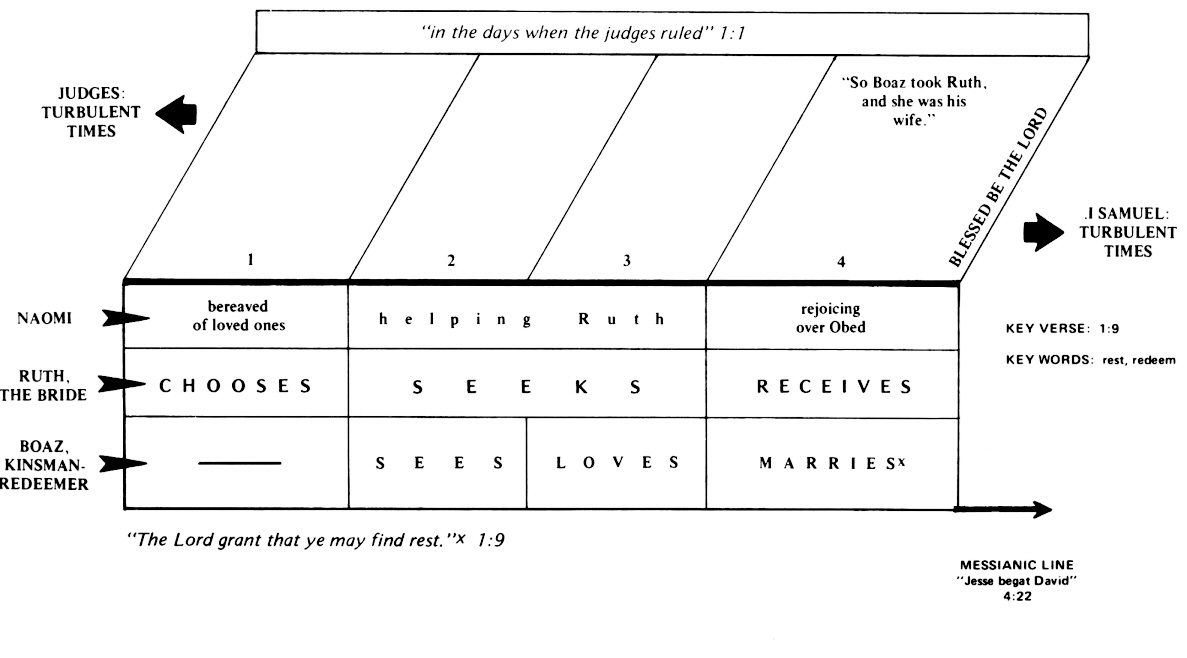
Irving Jensen's Survey of Bible (see his summary of Ruth online - page 392)
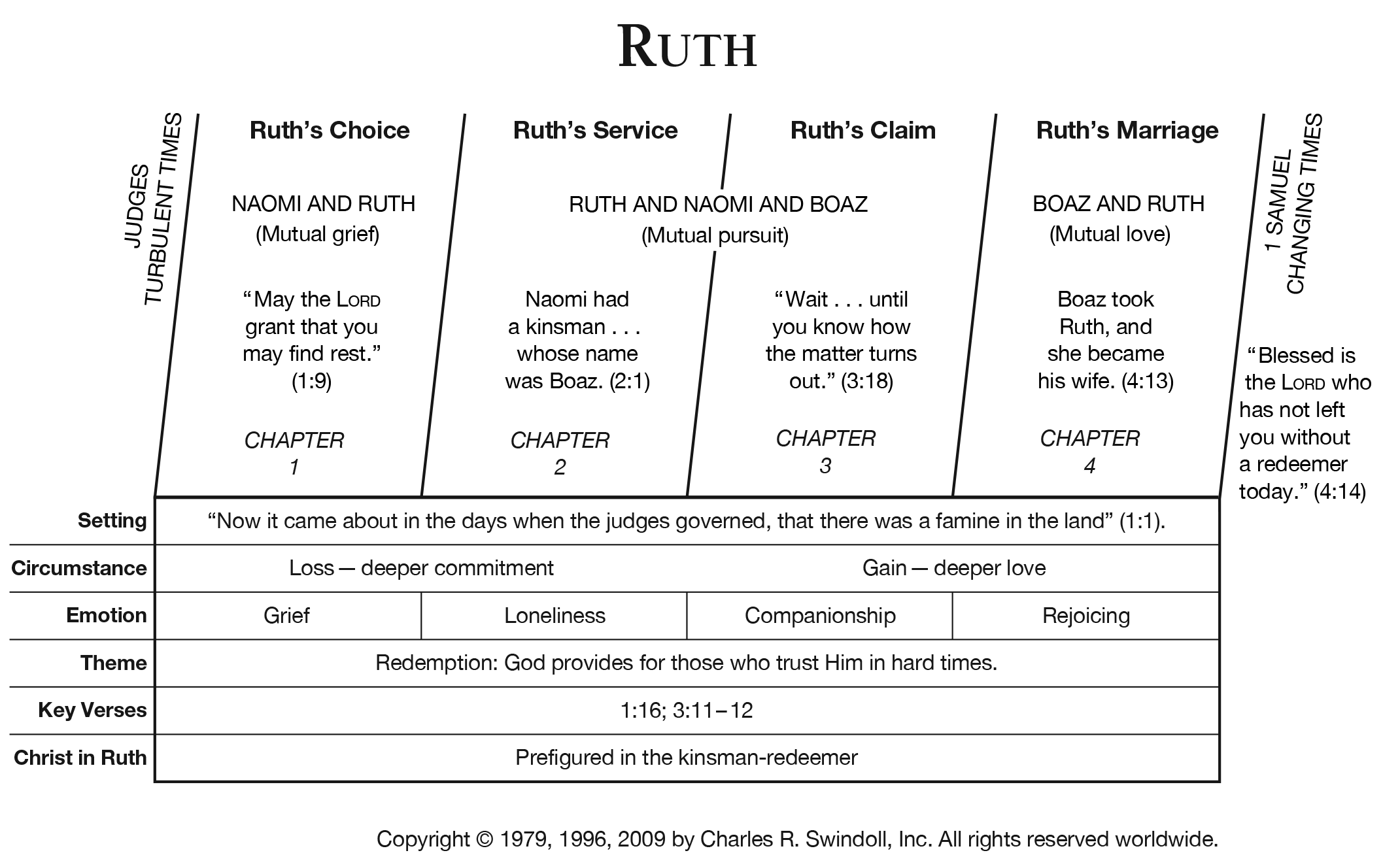
See Swindoll's summary chart of Ruth See Ruth Devotionals
|
RUTH: GOD PROVIDES |
|||
| Ruth 1 | Ruth 2 | Ruth 3 | Ruth 4 |
| Ruth's Choice | Ruth's Service | Ruth's Claim | Ruth's Marriage |
| Ruth's Resolve | Ruth's Rights | Ruth's Request | Ruth's Reward |
| Naomi and Ruth Mutual Grief |
Ruth and Naomi and Boaz Mutual Pursuit |
Boaz and Ruth Mutual Love |
|
| Ruth's Decision: Return with Naomi |
Ruth's Devotion: Provide for Naomi |
Ruth's Request: Redemption by Boaz |
Ruth's Reward: Relative of Messiah |
| Ruth and Naomi |
Ruth and Boaz |
||
| Death of Naomi's Family |
Ruth Cares for Naomi |
Boaz Cares for Ruth |
God Blesses with New Birth |
| Grief | Loneliness | Companionship | Rejoicing |
| Location: Plains of Moab |
Location: Fields of Bethlehem |
Location: Threshing floor of Bethlehem |
Location: Little town of Bethlehem |
| Time Lapsed: About 30 Years See Timeline |
|||
| Setting: Ru 1:1 Now it came about in the days when the judges governed Jdg 21:25+ In those days there was no king in Israel; everyone did what was right in his own eyes. |
|||

Ruth 3:1 Then Naomi her mother-in-law said to her, "My daughter, shall I not seek security for you, that it may be well with you? (NASB: Lockman)
Amplified: THEN NAOMI her mother-in-law said to Ruth, My daughter, shall I not seek rest or a home for you, that you may prosper? (Amplified Bible - Lockman)
BBE: And Naomi, her mother-in-law, said to her, My daughter, am I not to get you a resting-place where you may be in comfort?
CEV: One day, Naomi said to Ruth: It's time I found you a husband, who will give you a home and take care of you.
GWT: Naomi, Ruth's mother-in-law, said to her, "My daughter, shouldn't I try to look for a home that would be good for you?
KJV: Then Naomi her mother in law said unto her, My daughter, shall I not seek rest for thee, that it may be well with thee?
NJB: Her mother-in-law Naomi then said, 'Daughter, is it not my duty to see you happily settled?
TEV: Some time later Naomi said to Ruth, “I must find a husband for you, so that you will have a home of your own
Young's Literal: And Naomi her mother-in-law saith to her, 'My daughter, do not I seek for thee rest, that it may be well with thee?
Septuagint (LXX): eipen de aute Noemin e penthera autes thugater ou me zeteso (1SAAS) soi anapausin hina eu genetai (3SAMS) soi
English of Septuagint: And she lodged with her mother-in-law: and Noemin her mother-in-law said to her, My daughter, shall I not seek rest for thee, that it may be well with thee
THEN NAOMI HER MOTHER IN LAW SAID TO HER:
- Ruth 3 Resources - Multiple Sermons and Commentaries
As we have turned the pages of this short story, it was first Naomi and then Boaz who claimed our attention. Now we turn to Ruth, the one after whom the book is named, the young poverty-stricken widow from Moab who was to become renowned in Israel and an ancestress of Messiah. Remember that everything of eternal significance began when she made the decision to follow her mother-in-law back to Bethlehem-Judah (Ru 1:16, 17, 18).
Then Naomi her mother-in-law said to her, Then is a time phrase (expressions of time) which should always prompt the question of the diligent inductive student When is 'then'? In this case we are not told exactly how much time lapsed between the closing of Ruth 2 and Naomi's question to Ruth in this verse. We are told that Boaz is threshing suggesting that we are at the end of the barley harvest (cp Ru 1:22), which would be about 4 weeks after Ruth and Boaz first met.
Hamilton Smith comments…
Gleaning in the fields of Boaz, and receiving blessings from the hand of Boaz, however happy and right, will not give full rest and satisfaction to the heart either of Boaz or Ruth. Nothing will give rest to the heart but the possession of the one that is loved. Hence, in chapter 3, Ruth is seeking to gain Boaz, and Boaz is working to possess Ruth. Love can never be satisfied with gifts, however precious; it must have the giver.
In his former dealings Boaz had shewn marvellous grace to Ruth. He had put at her disposal his fields, his corn, his maidens, and his young men. He had given her water from his well, parched corn from his table, and handfuls let fall of purpose. All these blessings, however, had not satisfied her heart. They had indeed won her confidence, and drawn out her affections. But once the affections have been won nothing but the possession of the Person who has won them will satisfy the heart. This is equally true whether in Divine or human relationships. The grace and gifts by which Boaz kindled the affections of Ruth would not in themselves satisfy these affections. It is the possession of the Blesser not the blessings that gives satisfaction to the heart.
Thus it is in the Lord's ways with believers. He so deals with us that we are brought to see that He is greater than all the blessings He bestows. Happy for us when we learn that blessings in themselves cannot satisfy. Christ alone can satisfy the heart.
Was not this the great lesson that Peter had to learn in Luke 5? The Lord bestowed a great temporal blessing upon Peter. He gave him the biggest catch of fish he had ever had. It was a blessing beyond the capacity of nets and boats to contain, and yet in that very gift the Lord so revealed Himself to Peter that He became greater in Peter's estimation than the blessings He had given; for immediately afterwards we read, he "forsook all and followed Him." What! left the fish that the Lord had given? Yes, he left all — nets, boats, and fish — and followed Him. If ever there was a catch of fish that Peter had a right to keep, it was the catch of fish the Lord had given. But he forsook the blessings to follow the Blesser.
So with another humble believer, Mary Magdalene. She had been completely under the power of the devil, for the Lord had cast out of her seven demons. She had been greatly blessed but her heart had been won to the Blesser. Thus at the empty tomb, when the disciples went away to "their own home," Mary stood without at the sepulchre weeping. Blessings were not enough for Mary; she could find no rest in this world without Christ. With Him she was happy, without Him she was desolate.
In like manner the Lord dealt with the man who was once a blasphemer of Christ and a persecutor of the saints. Grace reached and blessed him in such manner that Christ became greater to him than all the blessings that Christ could give. His desire is expressed in the words, "that I may know I Him," (Php 3:10-note) and again, "that I may win Christ." (Php 3:8KJV - note) He is not content to know all the blessings to which Christ has given Him a title; he must know the Giver of the blessings. He is not content to win heaven at last, but he must win the One who has made his heaven secure.
Alas! how slow we are to learn that Christ, and only Christ, can satisfy our heart's desire. At times we seek rest in our spiritual blessings. Our efforts are directed to keeping bright in our souls the joy of conversion, and the sense of the blessings we have received. But right as it is to be in the joy of salvation, all such efforts are doomed to failure. We cannot (and God never intended that we should) enjoy the blessings apart from the Blesser. Every blessing that we have received is set forth in Christ, and can only be enjoyed in company with Christ.
Others seek satisfaction in a busy round of service. Would that we were all busy in the Lord's service; but if pursued with the object of finding rest, we shall only find, like Martha (cp Lk 10:38, 39, 40, 41, 42) that we get distracted rather than find rest. Service is good but it will not satisfy the heart.
Others again seek some passing satisfaction in the vain things of this passing world, only to find that the more we surround ourselves with the things of earth the more we increase our cares (cp Mk 4:19JKV), rather than find rest of heart. The prophet truly says. "Arise ye and depart; for this is not your rest; because it is polluted" (Micah 2:10KJV). Again we say, Christ alone can Satisfy the heart.
Thus from one cause or another we are compelled to admit that as Christians we know little true satisfaction of heart. Saved indeed every true Christian is, but it is one thing to be saved and quite another to be satisfied.
Saved by the work of Christ
we can only find satisfaction in the Person of Christ.
The measure in which we are enjoying the company of Christ is the measure of our rest and satisfaction. Full and complete satisfaction will only be known when that great day dawns of which it is said, "The marriage of the Lamb is come, and His wife hath made herself ready." (Rev 19:7, 8, 9) In a mystery this great truth passes before us in the closing portion of the beautiful story of Ruth. The first two chapters have told us in picture how love for Christ is awakened. The last two chapters will tell us how love is satisfied. (The Book of Ruth.)
It is clear that during the weeks of the barley and wheat harvests, Naomi had time to put her plan together. John Piper refers to her plan as strategic righteousness. (cp to passive righteousness = "I don't murder, steal, etc.") When the time was strategically right she acted. As a background one should be aware of the fact that it was customary for Hebrew parents to arrange marriages (Ge 24:3, 4; 34:4, Jdg 14:1, 2, 3, 4, 5f - see notes).
SHALL I NOT SEEK SECURITY THAT IT MAY BE WELL WITH YOU?:
- Ru 1:9-note; 1Co 7:36; 1Ti 5:8, 5:14) (Ge 40:14; Dt 4:40; Ps 128:2-note; Jer 22:15,16
- Ruth 3 Resources - Multiple Sermons and Commentaries
shall I not seek rest for thee (KJV)
do not I seek for thee rest (YLT)
My daughter, should I not try to find a home for you (NIV)
My daughter, it's time that I found a permanent home for you, so that you will be provided for (NLT)
My daughter, shouldn't I try to look for a home that would be good for you? (GWT)
Daughter, is it not my duty to see you happily settled? (NJB)
My daughter, am I not to get you a resting-place where you may be in comfort? (BBE)
I must find a husband for you, so that you will have a home of your own (TEV)
My daughter, I must find a home for you so you will be secure (NET)
"My daughter, shall I not seek (baqas) security (manowach) for you, that it may be well with you - Naomi is saying in essence I seek for you a happy future. The idiomatic, negated rhetorical question is equivalent to an affirmation.
That it may be well with you - Recall that Naomi prayed for this very thing in Ru 1:8, 9, and now she plays a role in answering her own prayer. This is an example of divine sovereignty and human responsibility being beautifully interwoven to bring about the purpose of God.
Arnold Fruchtenbaum reasons that "Naomi was faced with three issues. First, how could the name of Elimelech be maintained among the tribes of Israel since both her sons were now dead? Second, what steps should be taken to protect her inheritance, which Elimelech had left in Naomi’s trust? Third, how could she provide rest and security for her faithful daughter-in-law? A marriage between Ruth and Boaz would solve all three problems. (Fruchtenbaum, A. G. Ariel's Bible Commentary : The books of Judges and Ruth. Page 318. San Antonio, Tex.: Ariel Ministries)
Seek (01245) (baqas) conveys the idea of an earnest seeking after something with the full intention that the object sought be found or acquired.
Naomi felt responsible for Ruth’s future husband and home. Naomi was no longer depressed, but had now in a positive sense become a "matchmaker, matchmaker" (from the tune in the wonderful musical "Fiddler On the Roof" which is highly recommended), and was preparing Ruth to seek the love of her willing kinsman-redeemer, Boaz. Naomi's motive was unselfish for she knew that if Ruth remained an unprotected widow in a foreign land, life could go very hard for her. The turning point in the narrative is at hand.
Paul wrote that he wanted "younger widows to get married, bear children, keep house, and give the enemy no occasion for reproach." (1Ti 5:14)
Security (04494) (manowach from root nuach/nuah) which signifies absence of movement and thus pictures one being quietly settled in a particular place with the presence of security as when "the ark rested (nuach/nuah) upon the mountains of Ararat"(Ge 8:4). In contrast "the dove found no resting (manowach) place for the sole of her foot (Ge 8:9)
Manowach - 7v in the OT - place(1), rest(2), rested(1), resting place(2), security(1). Ge 8:9; Deut. 28:65; Ruth 3:1; 1Chr. 6:31; Ps. 116:7; Isa. 34:14; Lam. 1:3
Keil and Delitzsch write that rest in this verse "signifies the condition of a peaceful life, a peaceful and well-secured condition, "a secure life under the guardian care of a husband" (Rosenmüller).
Naomi seeks a place of tranquility and repose for the maiden from Moab. Earlier (Ru 1:9+) Naomi had prayed for Ruth to experience rest -
May the LORD grant that you may find rest (menuchah = related word - menuchah = resting place, rest, quiet, a place where peace and trust are present)
God was answering Naomi's prayer more "exceeding abundantly beyond all that (she could) ask or think." (Ep 3:20+).
THOUGHT - Has God ever surprised you with an answer so much more than you even thought possible? Rest assured that Jehovah "delights in the prosperity of His servant" (Ps 35:27+) and "in those who fear Him, who put their hope in His unfailing love." (Ps 147:11NIV+)
Play Steve Green's Jesus I Am Resting, Resting - Note the line "As I work and wait for Thee" which is what Ruth was doing as she waited for her kinsman-redeemer
Jesus! I am resting, resting
In the joy of what Thou art;
I am finding out the greatness
Of Thy loving heart.
Thou hast bid me gaze upon Thee,
And Thy beauty fills my soul,
For, by Thy transforming power,
Thou hast made me whole.Jesus! I am resting, resting
In the joy of what Thou art;
I am finding out the greatness
Of Thy loving heart.Oh, how great Thy loving kindness,
Vaster, broader than the sea:
Oh, how marvelous Thy goodness,
Lavished all on me!
Yes, I rest in Thee, Beloved,
Know what wealth of grace is Thine,
Know Thy certainty of promise,
And have made it mine.Simply trusting Thee, Lord Jesus,
I behold Thee as Thou art,
And Thy love, so pure, so changeless,
Satisfies my heart,
Satisfies its deepest longings,
Meets, supplies its every need,
Compasseth me round with blessings,
Thine is love indeed.Ever lift Thy face upon me,
As I work and wait for Thee;
Resting ’neath Thy smile, Lord Jesus,
Earth’s dark shadows flee.
Brightness of my Father’s glory,
Sunshine of my Father’s face,
Keep me ever trusting, resting,
Fill me with Thy grace.
Rest as used in this context implies the security and benefits that are to be found in a godly marriage as discussed below. The Greek word used to translate manowach is anapausis which means to refresh, give rest or permit one to cease from labor in order to recover and collect their strength. Jesus' great invitation uses two forms of this word
Come to Me, all who are weary and heavy-laden, and I will give you rest (anapauo, the verb) Take My yoke upon you, and learn from Me, for I am gentle and humble in heart; and you shall find rest (anapausis, the noun) for your souls." (Mt 11:28, 29+)
Believers are the bride of Christ and in covenant with Him, the one Whom "Boaz" prefigures and in Whom we find our "Sabbath rest and our eternal rest and security.
Rest (manowach) also implies a state of contentment and satisfaction as alluded to by the psalmist:
Be at rest (manowach) once more, O my soul, for the LORD has been good to you. (Ps 116:7+)
As alluded to above, Ruth 3:1 provides a fascinating "commentary" on the ideal state of marriage, which when entered into within God’s will, is the closest earthly approximation to rest which a human being can enjoy, for ideally a godly marriage fixes and composes the affections for life. How unlike most marriages in our modern low commitment society. Is your marriage a blessed rest or a restless battle? A married state is, or should be, a state of rest where "youthful lusts" are forsaken (2Ti 2:22-note), wandering affections are fixed on one's beloved (cp "my beloved" in Song of Solomon - Song 1:13, 14, 16; 2:3, 8, 9, 10, 16, 17; 4:16; 5:2, 4, 5, 6, 8, 10, 16; 6:2, 3, 7:9, 11, 13; 8:14), and one's heart is thus at rest. Naomi seeks Ruth's rest in the house and heart of her husband, who she hopes to be Boaz.
Hubbard observes that "A significant theological point emerges here. Earlier Naomi had wished (ED: or prayed for) for these same things (Ru 1:8, 9+). Here human means (i.e., Naomi’s plan) carry out something previously understood to be in Yahweh’s province. In response to providentially given opportunity, Naomi began to answer her own prayer! Thus she models one way in which divine and human actions work together (ED: God's sovereignty, human free will/man's responsibility): believers are not to wait passively for events to happen; rather, they must seize the initiative when an opportunity presents itself. They assume that God presents the opportunity.” (See context in The Book of Ruth)
McGee - Life in the presence of penury could not have been pleasant for the maid from Moab, but there is not a scintilla of suggestion that she ever complained. She had cast her lot with Naomi on the side of God (Ru 1:16, 17, 18), and she abode with fortitude in her decision. The mother heart of Naomi went out to her daughter-in-law, and she sought for her a place of rest. This could only be attained in the quiet shelter of a godly home, where some strong man protected Ruth from the stormy winds of a harsh world. (McGee, J. V. Ruth and Esther: Women of Faith. Nashville: Thomas Nelson Publishers)
Roy Hession applies these truth to the believer's life writing "When Ruth told her mother-in-law that the name of the man in whose field she had been gleaning was Boaz, I like to think that Naomi suddenly sat bolt upright… We, too, need a like revelation of the right vested in the Lord Jesus for us, if we are to be emboldened to put in our plea for the full redemption that grace has for us. We need to see that the One who has been showing us such undeserved favours ever since we took our place as gleaners in His field has more and is more. We need to see that Jesus is our nearest Kinsman, with the right to redeem both ourselves and our situation, a right acquired through the mighty sufficiency of His blood. The Son of man has the right on earth to forgive sins, and more, to redeem and overrule for ultimate good the very losses occasioned by our sin. And it is all based on blood, in the shedding of which all blame attaching to us was anticipated and extinguished. With that vision of the blood must go a new vision of grace—that our very lacks, faults and failures are our qualifications for what grace provides, in the same way that Ruth had to see that her poverty and widowhood were the very things that qualified her for a redeemer. The lines of John Newton's hymn,
Thou tallest burdened souls to Thee,
And such, O Lord, am I,
Always give me afresh, as I sing them,
This vision of grace.
They show me that Jesus specialises in burdened souls and calls such to Him, and that being the case, I qualify, `for such, O Lord, am I.' Our situations of need are not our disqualification as the Devil would have us to believe, but are in fact, if duly acknowledged, our only qualification to be blessed, which means we are just the case for Him. A new vision of the blood of Christ and the grace of God, then, is all important if we want to make the same daring claim on our nearest Kinsman, as Ruth made on hers. So do yourself the luxury of hearing again and again this sweet Gospel; and if it does not seem to come always from the pulpit, then start preaching it to your heart yourself, until at last you have the boldness to lie at the feet of your Kinsman with great confidence as to what He will do for you. (Borrow Our nearest kinsman : the message of redemption and revival in the book of Ruth)
|
COMPARISONS AND CONTRASTS |
||
|
|
Ruth 2 | Ruth 3 |
| MAIN CHARACTERS |
Naomi, Ruth and Boaz |
Naomi, Ruth and Boaz |
|
TIME/SEASON |
Start of harvest |
End of harvest |
|
PRIMARY SETTING/ACTIVITY |
Boaz’ field/harvesting grain |
Threshing floor/protecting grain |
|
STRATEGY |
God guides Ruth |
Naomi plans |
|
INITIAL INTERPLAY |
Ruth present Boaz arrives |
Boaz present Ruth arrives |
|
RUTH’S QUESTION |
Asking to glean |
Asking to marry (Deut 25:5-10) |
|
BOAZ’ ANSWER |
He agrees |
He agrees |
|
BOAZ’ KNOWLEDGE OF RUTH |
Fully reported to him |
From all his people in the town |
|
LOOMING QUESTION |
No apparent kinsman/provider |
Closer kinsman/redeemer |
|
BOAZ’ PROTECTION |
Her physical need |
Her good reputation |
|
SCENE DURATION |
Working all day |
Waiting all night |
|
DESCRIPTION OF CHARACTER |
Boaz: man of excellence |
Ruth: woman of excellence (Ru 3:11) |
|
WHAT RUTH TAKES HOME TO NAOMI |
An ephah of barley |
Six measures of barley |
|
HINGE TO FINAL MINI-SCENE |
Naomi’s question |
Naomi’s question |
|
PARTING THOUGHT |
Naomi’s |
Naomi’s |
|
THEME |
Gleaning |
Resting |
|
Modified from JETS 39:1 (March 1996) p. 20 by A. Boyd Luter And Richard O. Rigsby |
||
Selwyn Hughes - Ruth 3:1 A budding romance
"My daughter, should I not try to find a home for you ?" (v. 1)
As Naomi ponders the sovereignty of God in the meeting between Ruth and Boaz, she begins to realize there is a distinct possibility that Boaz will take on the responsibility of marrying Ruth and providing the security she needs in the future. She begins, therefore, to formulate a clear and daring plan to ensure the continuance of the budding romance. Note how she opens up the conversation: "My daughter, should I not try to find a home for you, where you will be well provided for? Is not Boaz a kinsman of ours?" (vv. 1-2). This is not meddling or matchmaking, but simply bringing to bear on the issues the insight God has given to her. Most people who fall in love and contemplate marriage could do with a little advice and counsel. Personally, I have never conducted a marriage service for a couple without requiring them to go through some premarital counselling. After all, marriage is probably the most important change that anyone on this earth can experience apart from conversion, and if ever guidance and help is needed, it is in relation to negotiating the difficulties that can occur when two people establish a close relationship. I have come to the conclusion that one of the greatest indictments that can be levelled at the contemporary Christian Church is its failure, generally speaking, to assist and guide those who are about to be married. The more thought and care that goes into planning and preparing for marriage, the more likelihood there is that the couple will spend all their wedding anniversaries - together.
Father, forgive us that we, Your Church, have thought more about how to conduct weddings than how to nurture marriages. Help us to transmit the wisdom that comes from the Scriptures and our own life experiences to those about to marry. Amen.
The Romance
“There is a [grandson] born to Naomi.” And they called his name Obed. He is the father of Jesse, the father of David. —Ruth 4:17
Today's Scripture: Ruth 3:1-11
Widows in biblical times often faced a life of poverty. That’s the situation Ruth and her mother-in-law, Naomi, were in after each woman lost her husband. But God had a plan to provide security for them while involving Ruth as an integral part of a much bigger plan.
Boaz, a wealthy landowner, knew of and admired Ruth (Ruth 2:5-12), but he was surprised when he awoke one night to see her lying at his feet (3:8). She asked him to “spread the corner” of his garment over her to indicate that as a close relative he was willing to be her “kinsman-redeemer” (v.9 NIV). This was more than a request for protection; she was requesting marriage. Boaz agreed to marry her (vv.11-13; 4:13).
Not exactly your typical romantic tale. But Ruth’s choice to follow Naomi’s instructions (3:3-6) set up a series of events that placed her in God’s plan of redemption! From Ruth’s marriage to Boaz came a son (Obed), the eventual grandfather of King David (4:17). Generations later, Joseph was born to the family, and he became the “legal father” of Mary’s child (Matt. 1:16-17; Luke 2:4-5)—our Kinsman-Redeemer, Jesus.
Ruth trusted God and followed Naomi’s instructions even though the ending was uncertain. We too can count on God to provide for us when life is unsure. (Our Daily Bread, Copyright RBC Ministries, Grand Rapids, MI. — Reprinted by permission. All rights reserved)
Lord, give us humility and sensitivity to listen to advice from loved ones who know You well. Show us the right thing to do in our uncertain times and to trust You for the results. Amen.
Fear hinders faith, but trust kindles confidence.
Ruth 3:2 Now is not Boaz our kinsman, with whose maids you were? Behold, he winnows barley at the threshing floor tonight. (NASB: Lockman)
Amplified: And now is not Boaz, with whose maidens you were, our relative? See, he is winnowing barley tonight at the threshing floor. (Amplified Bible - Lockman)
CEV: You have been picking up grain alongside the women who work for Boaz, and you know he is a relative of ours. Tonight he will be threshing the grain.
BBE: And now, is there not Boaz, our relation, with whose young women you were? See, tonight he is separating the grain from the waste in his grain-floor.
GWT: Isn't Boaz, whose young women you've been working with, our relative? He will be separating the barley from its husks on the threshing floor tonight.
KJV: And now is not Boaz of our kindred, with whose maidens thou wast? Behold, he winnoweth barley to night in the threshing floor.
NJB: And Boaz, the man with whose work-women you were, is he not our kinsman? Tonight he will be winnowing the barley on the threshing-floor.
Young's Literal: and now, is not Boaz of our acquaintance, with whose young women thou hast been? lo, he is winnowing the threshing-floor of barley to-night,
Septuagint (LXX): kai nun ouchi Boos gnorimos hemon ou en meta ton korasion autou idou autos likma ton halona ton krithon taute te nukti
English of Septuagint: And now is not Booz our kinsman, with whose damsels thou wast? behold, he winnows barley this night in the floor
AND NOW IS NOT BOAZ OUR KINSMAN WITH WHOSE MAIDS YOU WERE?
- Is not Boaz - Ru 2:19-23+; Heb 2:11-14
- With whose maids you were - Ru 2:8-11+; Ru 2:23+
- Ruth 3 Resources - Multiple Sermons and Commentaries
Now The introductory word regularly introduces a logical step in an argument, often a consequence or a conclusion; the particle falls back on the past and, making deductions from that, seeks to draw the consequences for the situation in the present or the future.
Is not Boaz our kinsman (moda'ath), with whose maids you were? - Our is plural feminine genitive of "ego" in the Septuagint therefore translated "our" not "my", affirming Ruth's right of claim on TWO SEPARATE MOSAIC LAWS laws, one governing widowhood (Dt 25:5, 6) referred to as the "LAW OF LEVIRATE [Latin - levir - husband's brother] MARRIAGE" and a second governing the redemption of the property of one who was too poor to redeem it themselves and this involved the wonderful truth about the KINSMAN-REDEEMER (i.e., the redeemer needed to be a kinsman) (Lev 25:10, 13-16, 24-28+). Naomi may have interpreted Boaz's kindness to Ruth that allowed her to work alongside his maidservants as an indication of a favorable disposition on his part toward Ruth and possibly a willingness to do the kinsman's part.
The custom of Levirate marriage actually antedated the Mosaic law being seen as early as Ge 38 (Tamar seducing her father-in-law Judah because his sons had not fathered a son to perpetuate their dead brother's name & for failure to do so God killed them) viz., that if an Israelite who had been married died without children, it was the duty of his brother to marry the widow, that is to say, his sister-in-law, that he might establish his brother's name in Israel, by begetting a son through his sister-in-law, who should take the name of the deceased brother, that his name might not become extinct in Israel. This son was then the legal heir of the landed property of the deceased uncle (cf. Dt 25:5-10). These two institutions are not connected together in the Mosaic law; nevertheless it was a very natural thing to place the Levirate duty in connection with the right of redemption.
The Net Bible note states that the phrase "Is not Boaz our close relative, with whose female servants you were? is an "idiomatic, negated rhetorical question… equivalent to an affirmation and has thus been translated in the affirmative" as "Now Boaz, with whose female servants you worked, is our close relative. (NET Bible)
Bertheau wrote that "The modest man even in the middle of the night did not hesitate for a moment what it was his duty to do with regard to the young maiden (or rather woman) towards whom he felt already so strongly attached; he made his own personal inclinations subordinate to the traditional custom, and only when this permitted him to marry Ruth was he ready to do so. And not knowing whether she might not have to become the wife of the nearer goël, he was careful for her and her reputation, in order that he might hand her over unblemished to the man who had the undoubted right to claim her as his wife."
Kinsman (04130) (moda'ath) means relative or kinsman. Without going into the grammatical details, note that in the original Hebrew sentence construction kinsman is given considerable stress by a reversal of normal sentence order. This is the only use of this word in the OT. The Septuagint translates moda'ath with the rarely used word gnorimos (Jn 18:16) which means acquainted with or known to.
Gilbrant - Derived from the verb yada, "to know," the noun mōdaʿath occurs once in the OT, where it speaks of Boaz as a "relative" of Naomi and Ruth (Ruth 3:2). Although this word does not tell us how closely Boaz was related to Naomi's late husband Elimelech, he is repeatedly called the "kinsman-redeemer" (Ruth 2:20; 3:9, 12). As the second nearest living male relative of Ruth's late husband, he had the right to redeem her property and take her as his wife, after the only other closer relative had refused to do so (Ruth 4:1-10). This was done in accordance with the levirate marriage custom, in which the closest relative of a widow's husband was to take the woman as his wife and raise up the first child to the name of the deceased relative (Deut. 25:5-10; Matt. 22:24). (Complete Biblical Library)
BEHOLD HE WINNOWS BARLEY:
- Ruth 3 Resources - Multiple Sermons and Commentaries
WIND
WINNOWING
Behold (hinneh), he winnows barley - Winnowing in Palestine consisted of throwing the mixture of straw, chaff, and grain up into the wind by means of a fork with large teeth. The worthless chaff was blown away from the winnower, the straw less far, while the valuable heavier kernels of grain fell back onto the threshing floor (cf figurative use Ps 1:4). The separation is the result of a breeze that usually blows off the Mediterranean from 4-5PM until sunset. The wind however must not be too strong, for then even the heavy valuable portions of the grain would be blown away with the lighter chaff. In summer the west wind blows very strongly in the afternoon but drops off in the evening, so that the evening hours provide the most desirable wind conditions. To best take advantage of this natural (divine providence) phenomenon the threshing floors were usually on elevated parcels ground with a hard packed surface.
Winnows (zarah) conveys the basic thought of stirring up the air to produce a scattering and spreading effect.
Threshing and winnowing were a time of great festivity and rejoicing. Naomi knew (How did Naomi know?) that Boaz was winnowing his grain on the day that she had chosen for her plan. She also knew that Boaz would be sleeping near his grain that night, to protect it for these were the days of the Judges (Jdg 21:25+).
And understanding of the typical threshing floor accentuates how fearful Gideon (who the angel of the LORD called a "valiant warrior" - Jdg 6:12+) must have been, for Scripture records that "the Angel of the LORD (OT manifestation of Jesus) came and sat under the oak that was in Ophrah… as… Gideon was beating out wheat in the wine press in order to save it from the Midianites. (Jdg 6:11+) There is not much breeze in the lower elevation of the typical wine press! This was just fine with Gideon who did not want the exposure associated more elevated threshing floor.
Barley (08184) (se'orah) actually means “a hairy or bristling thing” so called because of the rough and prickly beard covering the ears. In threshing, the grain was beaten out from the stalks with flails (cf. Ru 2:17+) or was trodden over by oxen. Then in winnowing the grain was thrown in the air and the wind carried the chaff away. The grain was then removed from the threshing floor and placed in heaps to be sold or stored in granaries.
Behold (02009) (hinneh) is an interjection demanding attention and could be translated something like "look!" "see!" Most often hinneh was used to point out people. Spurgeon reminds us that "Behold is a word of wonder; it is intended to excite admiration. Wherever you see it hung out in Scripture, it is like an ancient sign-board, signifying that there are rich wares within, or like the hands which solid readers have observed in the margin of the older Puritanic books, drawing attention to something particularly worthy of observation." I would add, behold is like a divine highlighter, a divine underlining of an especially striking or important text. It says in effect "Listen up, all ye who would be wise in the ways of Jehovah!"
AT THE THRESHING FLOOR TONIGHT:
- Ruth 3 Resources - Multiple Sermons and Commentaries
At the threshing floor tonight - The threshing floor (goren) itself was usually located outside town in a place where the prevailing west wind could be used to advantage. The root meaning of the Hebrew word for “thresh” is “to trample,” which comes from this second threshing practice of using oxen to trample the grain. The people of Bethlehem took turns using the threshing floor. The floor was a flat hard area on a slightly raised platform or hill. When the winnowing was done, the farmer normally stayed with the grain at night, camping out on the threshing floor to ensure that the harvest was not stolen. Winnowing (tossing grain into the air to finish separating the grain from the chaff) normally occurred in late afternoon when the Mediterranean winds prevailed. Sifting and bagging the grain would have carried over past dark and Boaz may have remained all night to guard the grain from theft.
Tonight (layil) (layil from lul = twisting away of light) is a picture of the time of day when the light “holds back” and darkness sets in. Whatever Boaz's motive may have been for spending the night at the threshing floor, his presence there reveals an unpretentious man, one who enjoyed all aspects of life associated with the land. The simple manners of Boaz and his times are here before us. This "mighty man of wealth" assists personally in the winnowing of his barley.
THRESHING-FLOOR (Modified from ISBE) - The threshing-floors (Wikipeida Article) are constructed in the fields, preferably in an exposed position in order to get the full benefit of the winds (See picture). If there is a danger of marauders they are clustered together close to the village. The floor is a level, circular area 25 to 40 ft. in diameter, prepared by first picking out the stones, and then wetting the ground, tamping or rolling it, and finally sweeping it. A border of stones usually surrounds the floor to keep in the grain. The sheaves of grain which have been brought on the backs of men, donkeys, camels, or oxen, are heaped on this area, and the process of tramping out begins. In some localities several animals, commonly oxen or donkeys, are tied abreast and driven round and round the floor. In other places two oxen are yoked together to a drag, the bottom of which is studded with pieces of basaltic stone. This drag, on which the driver, and perhaps his family, sits or stands, is driven in a circular path over the grain. In still other districts an instrument resembling a wheel harrow is used, the antiquity of which is confirmed by the Egyptian records. The supply of unthreshed grain is kept in the center of the floor. Some of this is pulled down from time to time into the path of the animals. All the while the partly threshed grain is being turned over with a fork. The stalks gradually become broken into short pieces and the husks about the grain are torn off. This mixture of chaff and grain must now be winnowed. This is done by tossing it into the air so that the wind may blow away the chaff. When the chaff is gone then the grain is tossed in a wooden tray to separate from it the stones and lumps of soil which clung to the roots when the grain was reaped. The difference in weight between the stones and grain makes separation by this process possible. The grain is now poled in heaps and in many localities is also sealed. This process consists in pressing a large wooden seal against the pile. When the instrument is removed it leaves an impression which would be destroyed should any of the grain be taken away. This allows the government offers to keep account of the tithes and enables the owner to detect any theft of grain. Until the wheat is transferred to bags some one sleeps by the pries on the threshing-floor. If the wheat is to be stored for home consumption it is often first washed with water and spread out on goats' hair mats to dry before it is stored in the wall compartments found in every house. Formerly the wheat was ground only as needed. This was then a household task which was accomplished with the hand-mill or mortar

Threshing floors have come into prominence because of the Biblical events which occurred on or near them.
1) Joseph with his kinsmen and Egyptian followers halted for seven days at the threshing-floor of Atad to lament the death of Jacob (Genesis 50:10). Probably there was a group of floors furnishing a convenient spot for a caravan to stop. Travelers today welcome the sight of a threshing-floor at their halting-place. The hard, level spot is a much preferable to the surrounding stony fields for their tents.
2) David built an altar on Ornan's (Araunah's) threshing-floor (2Sa 24:18-24; 1Chr 21:18-27), which later became the site of the Temple (2Chr 3:1). David probably chose this place for his altar because it was on an elevation, and the ground was already level and prepared by rolling.
3) Uzzah died near the threshing-floor of Nacon for touching the ark (2Sa 6:6).
4) Ruth reveals herself to Boaz on his threshing-floor (Ru 3:6,7+, Ru 3:8, 9+).
Threshing-floors were always in danger of being robbed (1Sa 23:1). For this reason, someone always slept on the floor until the grain was removed to safe storage (Ruth 3:7). In Syria, at the threshing season, it is customary for the family to move out to the vicinity of the threshing-floor. A booth is constructed for shade; the mother prepares the meals and takes her turn with the father and children at riding on the sledge.
The instruments of the threshing-floor referred to in 2Sa 24:22 were probably: (1) the wooden sledge (2) the fan (fork) for separating straw from wheat (3) shovel for tossing the wheat into the air in winnowing (4) broom, for sweeping the floor between threshing and for collecting the wheat after winnowing (5) goad (6) the yoke (7) sieve (8) dung catcher
Ruth 3:3 Wash yourself therefore, and anoint yourself and put on your best clothes, and go down to the threshing floor; but do not make yourself known to the man until he has finished eating and drinking (NASB: Lockman)
Amplified: Wash and anoint yourself therefore, and put on your best clothes and go down to the threshing floor, but do not make yourself known to the man until he has finished eating and drinking. (Amplified Bible - Lockman)
BBE: So take a bath, and, after rubbing your body with sweet oil, put on your best robe, and go down to the grain-floor; but do not let him see you till he has come to the end of his meal.
CEV: Now take a bath and put on some perfume, then dress in your best clothes. Go where he is working, but don't let him see you until he has finished eating and drinking. (CEV)
GWT: Freshen up, put on some perfume, dress up, and go down to the threshing floor. Don't let him know that you're there until he's finished eating and drinking. (GWT)
KJV: Wash thy self therefore, and anoint thee, and put thy raiment upon thee, and get thee down to the floor: but make not thyself known unto the man, until he shall have done eating and drinking.
NJB: So wash and perfume yourself, put on your cloak and go down to the threshing-floor. Don't let him recognise you while he is still eating and drinking.
Young's Literal: and thou hast bathed, and anointed thyself, and put thy garments upon thee, and gone down to the threshing-floor; let not thyself be known to the man till he complete to eat and to drink;
Septuagint (LXX): su de louse (2SFMI) kai aleipse (2SFMI) kai perithesein (2SFAI) ton himatismon sou epi seaute kai anabese (2SFMI) epi ton alo me gnoristho (2SAPS) to andri eos ou suntelesai (AAN) auton piein (AAN) kai phagein (AAN)
English of Septuagint: But do thou wash, and anoint thyself, and put thy raiment upon thee, and go up to the threshing-floor: do not discover thyself to the man until he has done eating and drinking
WASH YOURSELF AND ANOINT YOURSELF AND PUT ON YOUR BEST CLOTHES:
- Anoint yourself - 2Sa 14:2 Ps 104:15 Ec 9:8 Mt 6:17
- put on: Es 5:1 1Ti 2:9,10
- Ruth 3 Resources - Multiple Sermons and Commentaries
PREPARATIONS FOR A
NOCTURNAL ENCOUNTER
Wash yourself therefore, and anoint (suk; Lxx - aleipho) yourself and put on your best clothes - Clean up, perfume up and dress up - Naomi's three instructions to prepare for the nocturnal encounter with Boaz. Wash (rachats) is translated in the Greek Septuagint with louo which normally referred to bathing your entire body (cf Jn 13:10) Anoint is translated in the Septuagint with the verb aleipho which describes external physical application of oil or perfumed ointment (Mk 6.13) or (as in Ru 3:3) in the middle voice meaning to anoint oneself or part of one's body (Mt 6.17). Certainly Ruth was not risking her life but it is nevertheless in Naomi's eyes a crucial encounter and she is to look her best.
Put on your best like Esther who risk her life going uninvited before King Ahasuerus "put on her royal robes and stood in the inner court of the king's palace in front of the king's rooms, and the king was sitting on his royal throne in the throne room, opposite the entrance to the palace. (Esther 5:1)
Anoint yourself (05480) (suk) mans to anoint or pour upon and describes the ordinary physical process of anointing the body which in the ancient orient was usually with olive oil (Dt 28:40) particularly after bathing (2Sa 12:20) and especially for its fragrant effect. There were no supermarkets selling deodorants in those days. Thus in the hot Palestine climate olive oil or other ointment was used by the Jews to anoint themselves after bathing in order to give the skin and hair a smooth and comely appearance. It is interesting that the Jews had the custom of rubbing the head with oil or ointment at feasts in token of joy thus this verb is also used as a symbol of gladness. For example in 2 Samuel we read that
Joab sent to Tekoa and brought a wise woman from there and said to her, "Please pretend to be a mourner, and put on mourning garments now, and do not anoint yourself with oil, but be like a woman who has been mourning for the dead many days." (2Sa 14:2) In we read that provides "oil to make (one's) face shine. (NIV) (Ps 104:15+)
Solomon records in the context of verses on "happiness" and "joy" to "let not oil be lacking on your head (Eccl 9:8) (Ecc 9:8NLT paraphrases this latter as "with a dash of cologne"!)." Note that Naomi did not tell her to make herself up like evil Jezebel who "painted her eyes" (2Ki 9:30)
Suk - 9v - anoint(4), anointed(3), poured(1), use any ointment(1). Exod. 30:32; Deut. 28:40; Ruth 3:3; 2 Sam. 12:20; 2 Sam. 14:2; 2 Chr. 28:15; Ezek. 16:9; Dan. 10:3; Mic. 6:15
Gilbrant on suk - A by-form of nāsakh, sûk means "to anoint." Cognates in Middle Hebrew and Jewish Aramaic mean "to smear," and a cognate in Arabic means "to rub." A passive form in Punic means "to be spilled." Evidence for a homophonous root meaning "to provoke" (Isa. 9:11; 19:2) is found in an Arabic cognate that means "to injure" or "to prick" and an Ethiopic word that means "to incite." In most of its OT occurrences, sûk refers to the anointing of oneself with oil for cosmetic purposes, usually after washing. Naomi encouraged Ruth to bathe and anoint herself to approach her kinsman redeemer Boaz (Ruth 3:3). Not being anointed was often a sign of mourning (2 Sam. 12:20; 14:2) or fasting (Dan. 10:3). The lack of oil was a sign of divine judgment. The prophets often warned that the people would not be able to anoint themselves because of the deprivation associated with the Lord's coming judgment (Deut. 28:40; Mic. 6:15). In an allegory illustrating God's care for Jerusalem, Ezekiel portrays the Lord as a groom who found an injured Jerusalem and nursed her to health before marrying her. As part of his care, He anointed Jerusalem with oil (Ezek. 16:9). This may indicate the use of oil as a medicine, although the anointing may have been for cosmetic purposes. In two biblical passages (in the Pilpel stem), sûkh means "to incite," "to provoke." In a prophecy against Israel, Isaiah says that the Lord will incite the enemies of Rezin, a king allied with Israel, against them (Isa. 9:11). In a prophecy against Egypt, Isaiah warns that the Lord will stir up Egyptians against themselves (19:2). (Complete Biblical Library Hebrew-English Dictionary)
From the NT, we know that anointing was a mark of hospitality for Jesus "You did not anoint My head with oil, but she anointed My feet with perfume." (Lk 7:46).
Solomon records that "Oil and perfume make the heart glad, so a man's counsel is sweet to his friend," (Pr 27:9)
ANOINT (Modified from ISBE) Refers to a very general practice in the East. It originated from the relief from the effect of the sun that was experienced in rubbing the body with oil or grease. Among rude people the common vegetable or animal fat was used. As society advanced and refinement became a part of civilization, delicately perfumed ointments were used for this purpose. Other reasons soon obtained for this practice than that stated above. Persons were anointed for health (Mk 6:13), because of the widespread belief in the healing power of oil. It was often employed as a mark of hospitality (Lk 7:46); as a mark of special honor (Jn 11:2); in preparation for social occasions (Ru 3:3-note; 2 Sa 14:2; Isa 61:3).
Clothes (08071) (simlah) not like the attire of a harlot but a general word for clothes which in context could be a mantle (see picture for how it this have looked) large enough to disguise Ruth's identity. Paul would have approved of Ruth's external and "internal" appearance for he desired for
women to adorn themselves with proper clothing, modestly and discreetly, not with braided hair and gold or pearls or costly garments but rather by means of good works, as befits women making a claim to godliness. (1Ti 2:9; 2:10)
GO DOWN TO THE THRESHING FLOOR:
- Ruth 3 Resources - Multiple Sermons and Commentaries
And go down to the threshing floor - Go down - The hill country of Palestine is flanked on the west by the Mediterranean Sea and on the east by the deep rift Arabah, far below sea level. Therefore about any place traveled in Israel is either up or down. Threshing floor (goren) (goren) has the root meaning of the Hebrew word for “thresh” is “to trample,” which comes from the threshing practice of using oxen to trample the grain.
HISTORICAL NOTE - The most famous threshing floor in the world was on Mt Moriah (the site at which Abraham was to sacrifice his son of promise, Isaac Ge 22:1,2,cp 2Chr 3:1, 2Sa 24:24, 25) and which was purchased by King David from the Jebusite Araunah (Ornan -Wikipedia) in order to build an altar to the Lord. (2Sa 24:16-24 cf 1Chr 21:15-22:1) Later, this same area became the site of Solomon’s Temple, the first temple (2Chr 3:1). Some Jews (as well as Christians) believe the altar of burnt offering in the temple at Jerusalem was situated on the exact site of the altar on which Abraham intended to sacrifice Isaac. To them the two Mount Moriahs mentioned in the Bible (Ge 22:2, 2Chr 3:1) are identical. Today, the Muslim structure, the Dome of the Rock in Jerusalem, reputedly sits on this site. The most famous mount, Calvary, is situated in this same area.
DO NOT MAKE YOURSELF KNOWN TO THE MAN UNTIL HE HAS FINISHED EATING AND DRINKING:
- Ruth 3 Resources - Multiple Sermons and Commentaries
STEALTH
ENCOUNTER
but do not make yourself known to the man until he has finished eating and drinking Naomi's bold venture was undoubtedly based upon her inward assurance that Boaz and Ruth were already genuinely attracted to one another and that they were both individuals of great integrity in otherwise lawless days (Ru 1:1, Jdg 21:25).
THE THRESHING PROCESS - "The threshing-floors are constructed in the fields, preferably in an exposed position in order to get the full benefit of the winds. If there is a danger of marauders they are clustered together close to the village. The floor is a level, circular area twenty-five to forty feet in diameter, prepared by first picking out the stones, and then wetting the ground, tamping or rolling it, and finally sweeping it. A border of stones usually surrounds the floor to keep in the grain. The sheaves of grain which have been brought on the backs of men, donkeys, camels, or oxen, are heaped on this area, and the process of tramping out begins. In some localities several animals, commonly oxen or donkeys, are tied abreast and driven round and round the floor…. Until the wheat is transferred to bags some one sleeps by the pile on the threshing floor." (James Orr, The International Bible Std Encyclopedia) (Wikipedia Article)
By James Smith - Handfuls of Purpose
Then Naomi said, “My daughter, shall I not seek rest for thee?” (v. 1). Ruth had found favour in the sight of Boaz, and had tasted the exceeding riches of his grace, but she had not yet found the rest of unbroken fellowship. She was not yet in the yoke with Boaz by the marriage tie. “Take my yoke upon you, and ye shall find rest unto your souls” (Matt. 11:29). This was the rest that now remained for Ruth. Union to the mighty man of wealth is the almighty remedy for her poverty. Are there not many timid believers who have rejoiced in the grace of Jesus but cannot yet call Him My Lord, My Shepherd?
The only way to abiding communion and uninterrupted fellowship is Ruth’s way, “faith and obedience.” She believed all that Boaz told her, and did all he bade her (v. 5).
“Behold he winnoweth barley to-night” (v. 2). This is not the reapers’ work, they have gone to their rest. Now He comes whose fan is in His hand, He will thoroughly purge His floor. Every day’s work has to be winnowed by the Master, and to the servants of Christ this is a source of comfort, for with the barley, if much labour, there is also much chaff. So they are glad to have this work purged ere it reaches the garner, knowing that they are rewarded for the wheat, and not for the chaff, whose end is the fire because there is no life in it.
And Naomi said, “Wash thyself” (v. 3), and get thee down to the floor. This advice given to Ruth was practical and common sense, for although she had experienced great grace at the hand of Boaz, yet in approaching him for higher favours still she must use every means possible to secure the blessing desired. And so should we in making our requests known unto Him. If we regard iniquity in our heart the Lord will not hear. First, be reconciled to thy brother, “wash thyself,” put away and incline your heart (Joshua. 24:23).
Naomi also said, “Mark the place where he shall lie” (v. 4), and lay thee down at his feet, and he will tell thee what thou shalt do. If we want to learn the will of our Master toward us we too must be willing to lie at His feet. Mark the promise He has given, for this is where the Master lies, and lay thyself down there and pull the skirt of His Word over thee, and wait patiently for Him, for He will tell thee what thou shalt do. Notice the three steps of Ruth to the feet of Boaz:
(1) WASHING. (2) WATCHING. (3) WAITING.
“When Boaz had eaten and drunk, and his heart was merry, he went to lie down” (v. 7). The master had sown the seed and carefully watched it from the blade to the earing. Now the harvest is past, the winnowing is over. His soul is satisfied, and he rests. Shall not our Divine Master also see of the travail of his soul, and be satisfied when He shall with the fan of judgment winnow the mixed mass on the floor of the world? Shall there not be enough to satisfy His longing soul and make glad the heart of Him who went out from the home of His glory, bearing precious seed, and who sowed in tears? (Luke 19:41). Shall He be sorry that the chaff has been blown away? He shall rejoice over His people with singing (Zeph. 3:17).
“And it came to pass that at midnight he said, Who art thou?” (v. 8). Though He tarry, wait for Him. His voice is often heard at midnight by the waiting one, while others, it may be, are all insensible to His presence. The special blessing is often received through special waiting.
OUTLINE OF CHAPTER 3
Naomi had great faith in their Kinsman Redeemer. Now that Ruth had put her case into his hands, she is told to “Sit still, for the man will not be in rest till he have finished the thing” (v. 18). See how Ruth entered into that blessed rest.
I. She casts herself at his feet (vv. 4–6). She had offered a request before (chap. 2:7), but now she offers herself. It was in the darkest hour of the night that his voice was heard.
II. She claimed him as her kinsman (v. 9). She claims the fulfilment of his office as redeemer in her behalf. It was a great demand for a poor stranger to make, but the mighty man of grace looked upon it as an act of kindness showed Him (v. 10).
III. She received his promise (v. 10–13). There was no reluctance in Boaz to perform the part of a kinsman redeemer. She asks, and at once the promise is given. He is faithful who hath promised. Ruth does not make him a liar by guilty doubt.
IV. She rests in his work. She sits still now, leaving him to do the redeeming work. What else could she do? The work was not hers, but his. She had his promise that he would finish the thing. So she rests in faith. Rest in the Lord. Trust also in Him, and He will bring it to pass. (Lev. 16:30, 31).