Ruth 3:2
Ruth 3:3
Ruth 3:4
Ruth 3:5
Ruth 3:6
Ruth 3:7
Ruth 3:8
Ruth 3:9
Ruth 3:10
Ruth 3:11
Ruth 3:12
Ruth 3:13
Ruth 3:14
Ruth 3:15
Ruth 3:16
Ruth 3:17
Ruth 3:18
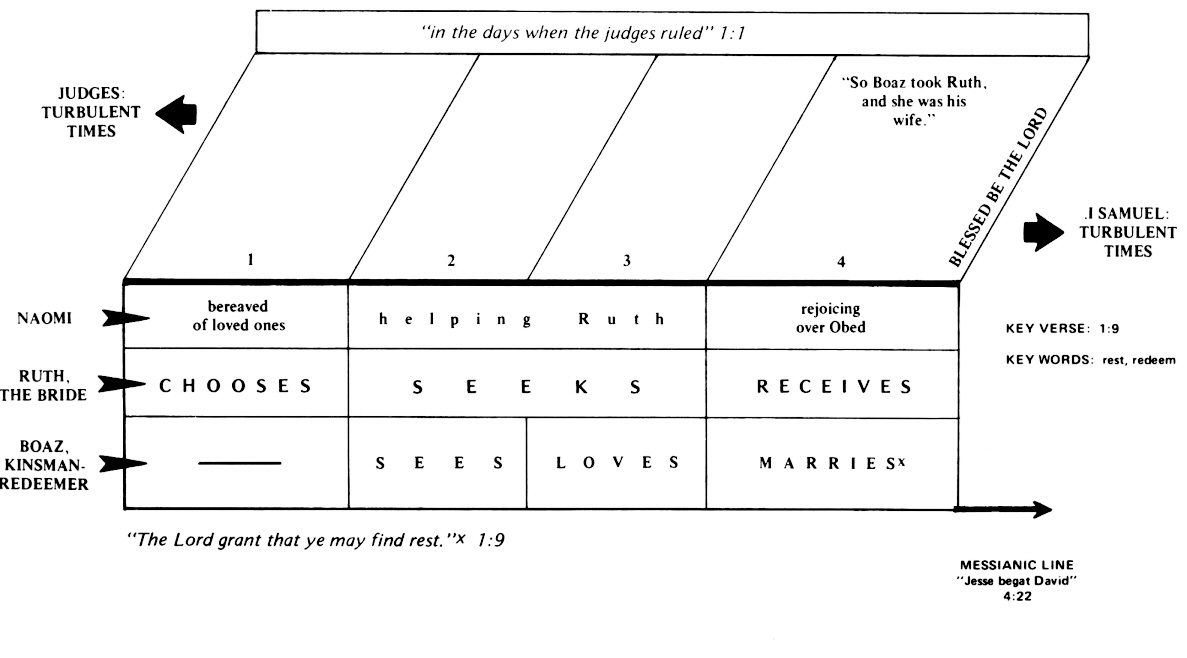
Irving Jensen's Survey of Bible (see his summary of Ruth online - page 392)
See Swindoll's summary chart of Ruth See Ruth Devotionals
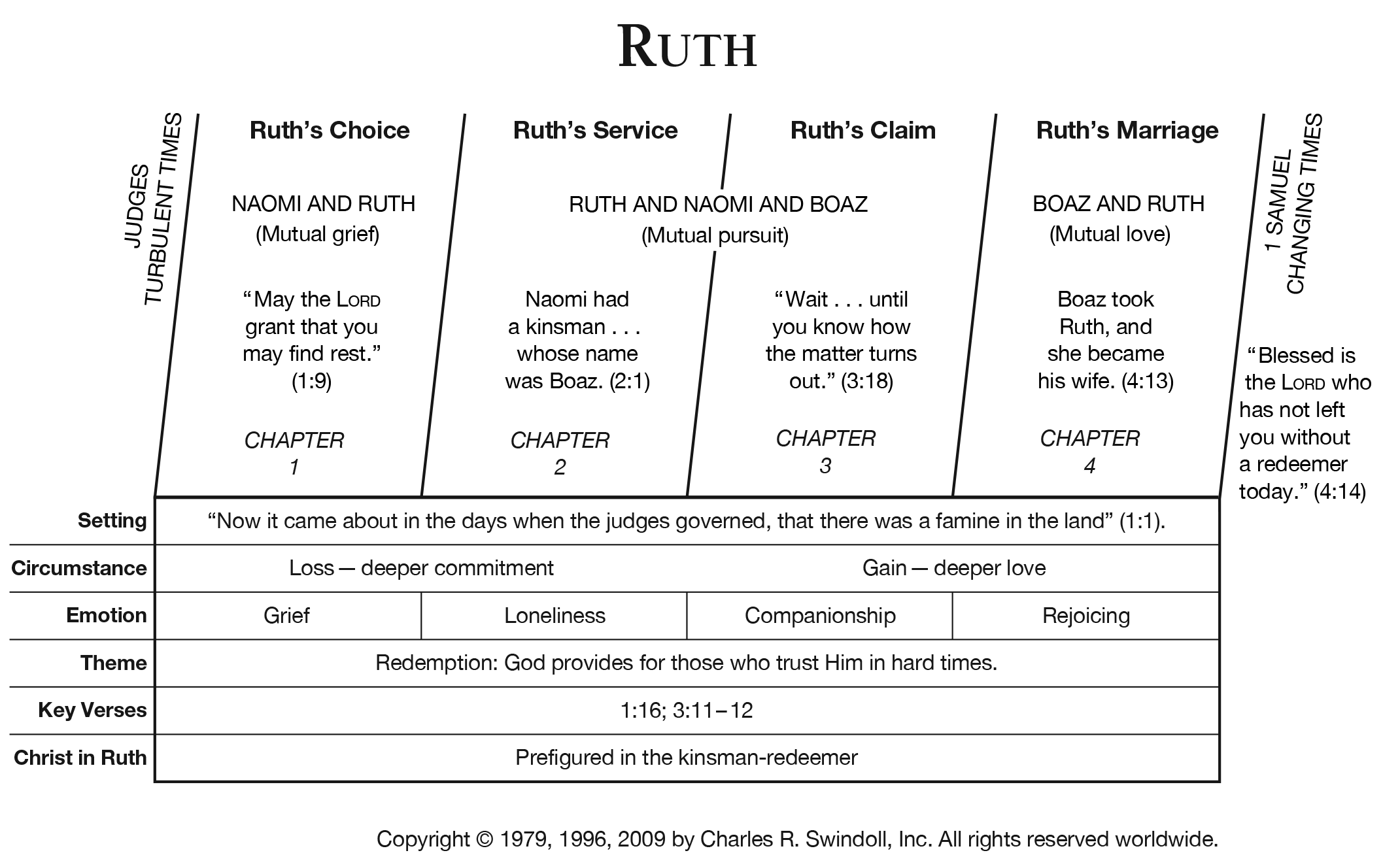
|
RUTH: GOD PROVIDES |
|||
| Ruth 1 | Ruth 2 | Ruth 3 | Ruth 4 |
| Ruth's Choice | Ruth's Service | Ruth's Claim | Ruth's Marriage |
| Ruth's Resolve | Ruth's Rights | Ruth's Request | Ruth's Reward |
| Naomi and Ruth Mutual Grief |
Ruth and Naomi and Boaz Mutual Pursuit |
Boaz and Ruth Mutual Love |
|
| Ruth's Decision: Return with Naomi |
Ruth's Devotion: Provide for Naomi |
Ruth's Request: Redemption by Boaz |
Ruth's Reward: Relative of Messiah |
| Ruth and Naomi |
Ruth and Boaz |
||
| Death of Naomi's Family |
Ruth Cares for Naomi |
Boaz Cares for Ruth |
God Blesses with New Birth |
| Grief | Loneliness | Companionship | Rejoicing |
| Location: Plains of Moab |
Location: Fields of Bethlehem |
Location: Threshing floor of Bethlehem |
Location: Little town of Bethlehem |
| Time Lapsed: About 30 Years See Timeline |
|||
| Setting: Ru 1:1 Now it came about in the days when the judges governed Jdg 21:25+ In those days there was no king in Israel; everyone did what was right in his own eyes. |
|||

Ruth 3:13 "Remain this night, and when morning comes, if he will redeem you, good; let him redeem you. But if he does not wish to redeem you, then I will redeem you, as the LORD lives. Lie down until morning." (NASB: Lockman)
Amplified: Remain tonight, and in the morning if he will perform for you the part of a kinsman, good; let him do it. But if he will not do the part of a kinsman for you, then, as the Lord lives, I will do the part of a kinsman for you. Lie down until the morning. (Amplified Bible - Lockman)
BBE: Take your rest here tonight; and in the morning, if he will do for you what it is right for a relation to do, very well, let him do so: but if he will not, then by the living Lord I myself will do so.
CEV: Stay here until morning, then I will find out if he is willing to look after you. If he isn't, I promise by the living God to do it myself. Now go back to sleep until morning. (CEV)
GWT: Stay here tonight. In the morning if he will agree to take care of you, that is good. He can take care of you. But if he does not wish to take care of you, then, I solemnly swear, as the LORD lives, I will take care of you myself. Lie down until morning." (GWT)
KJV: Tarry this night, and it shall be in the morning, that if he will perform unto thee the part of a kinsman, well; let him do the kinsman's part: but if he will not do the part of a kinsman to thee, then will I do the part of a kinsman to thee, as the LORD liveth: lie down until the morning.
NET: Remain here tonight. Then in the morning, if he agrees to marry you, fine, let him do so. But if he does not want to do so, I promise, as surely as the LORD lives, to marry you. Sleep here until morning."
NJB: Stay here for tonight and, in the morning, if he wishes to exercise his right over you, very well, let him redeem you. But if he does not wish to do so, then as Yahweh lives, I shall redeem you. Lie here till morning.' (NJB)
TEV: Stay here the rest of the night, and in the morning we will find out whether or not he will take responsibility for you. If so, well and good; if not, then I swear by the living Lord that I will take the responsibility. Now lie down and stay here till morning.”
TLB Stay here tonight, and in the
morning I’ll talk to him, and if he will marry you, fine; let him do his duty; but if he won’t, then I will, I swear by Jehovah; lie down until the morning.” Young's Literal: Lodge to night, and it hath been in the morning, if he doth redeem thee, well: he redeemeth; and if he delight not to redeem thee, then I have redeemed thee -- I; Jehovah liveth! lie down till the morning.'
Septuagint (LXX): aulistheti (2SAPM) ten nukta kai estai (3SFMI) to proi ean agchisteuse se agathon agchisteueto (3SAAS) ean de me bouletai (3SPAS) athchisteusai (AAN) se athchisteuso (1SFAI) se ego ze kurios koimetheti (2SAPM) eos proi
Click here for explanation of verb parsing abbreviations in parentheses after each verb
English of Septuagint: Lodge here for the night, and it shall be in the morning, if he will do the part of a kinsman to thee, well - let him do it: but if he will not do the part of a kinsman to thee, I will do the kinsman's part to thee, as the Lord lives; lie down till the morning
- If he will redeem you - Ru 2:20; 4:5; Dt 25:5, 6, 7, 8, 9; Mt 22:24, 25, 26, 27
- As the LORD lives - Jdg 8:19; Jer 4:2; 2Co 1:23; Heb 6:16
- Ruth 3 Resources - Multiple Sermons and Commentaries
- Listen to ballad of all 4 chapters - The Lady Who Laid There Was Ruth!
BOAZ'S SOLEMN PROMISE
TO REDEEM RUTH
Remain this night, and when morning comes, if he will redeem (gaal/goel) you, good; let him redeem (gaal/goel) you - Remain (lun) is a a command which means to lodge and in modern Hebrew the word for "hotel" derives from this verb. This same verb was used by Ruth in Ru 1:16 declaring "where you lodge, I will lodge." While Boaz clearly would be disappointed if the nearest goel redeemed Ruth, he nevertheless once again demonstrates his sterling character by saying if he will redeem (gaal/goel) you, good. Most of us would not have said "good," but something else, even an "expletive deleted." Boaz however is willing to except the outcome!
Notice that the phrase beginning with When the morning comes is another promise from Boaz, specifically declaring that he will resolve the issue the next day!
Redeem you (gaal/goel) occurs 4 times in this verse in the NAS emphasizing especially that the redemption is of Ruth. This association is obscured by the NIV (Ru 3:13NIV, cp the literal rendering Ru 3:13YLT).
Arnold Fruchtenbaum makes the distinction regarding the verb remain that "The word in Hebrew is lun and not shachav, and that is significant because shachav does carry sexual connotations, but lun does not. So, by the use of this verb, all ambiguity is removed concerning the sexual implication between the two. When they were in the very crucible of temptation, they proved themselves righteous by choosing integrity over passion. (Ariel's Bible Commentary)
Morning (01242) (boqer) means daybreak, the point of time at which night is changing to day, just before the rising of the sun. In the ancient Near East the night was divided into three watches. The last period of the night was called the morning watch (Ex 14:24) and lasted from 2:00 A.M.- sunrise. When we read about the period of the Judges, we learn that people did not travel the main highways because they were not safe. Instead they would take off across the fields.
Boaz as Ruth's Protector - This truth about the danger of night travel helps us understand Boaz's charge for Ruth to remain the rest of the night, for in this way she would be protected from any potential physical harm. In the next verse (Ru 3:14) Boaz undertakes to protect her reputation.
What does the fact that he told Ruth there was another nearer kinsman-redeemer show about Boaz's character? As alluded to above it shows Christ-like unselfishness (cp Php 2:3-5+), as well as honesty and humility. The humble person is not one who thinks meanly of himself; he simply does not think of himself at all! (Andrew Murray) Humility is that grace that, when you know you have it, you have lost it! The truly humble person knows himself and accepts himself (Ro 12:3+). He yields himself to Christ to be a servant, to use what he is and has for the glory of God and the good of others.
In short, both Ruth (giving up what other young women would choose...rich or even poor young men) and Boaz (laying aside his own personal interests in Ruth) manifest this Christ-like attitude.
To summarize, Boaz demonstrated his integrity in two ways: (1) He did not send Ruth home in the middle of the night for that would have been potentially dangerous. And even though she lay at his feet the remainder of the night, his intentions remained steadfastly honorable. Boaz would protect her and would not touch her inappropriately. These actions speak volumes about this godly man's character in the dark days of the judges (Jdg 21:25). (2) Boaz also protected the rights of the Goel who was an even closer relative than he. This man understood denial of self, long before the "Greater Boaz" uttered those words (Mk 8:34).
But if he does not wish (chaphets) to redeem (gaal/goel) you - Note this strategic "term of contrast" but, a contrast which assures Ruth of redemption by an unnamed goel or by one named Boaz. The idea of wish is to delight in, to have pleasure, to be pleased and in context to be willing to do something not by force implying voluntary choice. In the OT the idea of desire means much more than merely ‘to long for’ but in Hebrew psychology the whole personality was involved in desire. The idea includes a longing for something that promises enjoyment or satisfaction. Boaz definitely had the desire to marry Ruth, but he was uncertain whether the nearest kinsman would also have this desire.
Then I will redeem (gaal/goel) you, as the LORD lives - As alluded to above, this phrase is repeated for emphasis. In fact the Hebrew text adds the emphatic pronoun "you" to the verb as translated in the New American Bible -- "I will claim you myself" (NAB).
As the LORD lives - This was the most solemn, binding oath a Jew could vow. Thus Boaz bound himself, by an oath to fulfill his promise to redeem Ruth if the first in line Goel should refuse. For Boaz to not carry out his commitment after invoking the Lord's name would have been to violate the third commandment (Ex 20:7). The usual formula of an oath was either: "God is witness betwixt me and thee" (Ge 31:5) or more commonly: "As Yahweh (or God) lives" (Jdg 8:19-note; Ru 3:13-note; 2Sa 2:27; Jer 38:16) or "Yahweh be a true and faithful witness amongst us" Jer 42:5. Usually the penalty invoked by the oath was only suggested: "Yahweh do so to me" as in the first chapter (Ru 1:17-note) In some cases of giving such an oath, the punishment was expressly mentioned (Jer 29:22).
Lie down (sakab) until morning - Boaz gives Ruth a second command which generally means to lie down to sleep. One wonders if Ruth could truly sleep those next few hours. Again it should be emphasized there is nothing inappropriate suggested by Boaz's command. In fact the Septuagint (LXX) translates sakab with the Greek verb koimao (2837 which in the New Testament always refers to lying down to sleep. Again we see the protective instinct of Boaz for Ruth, for it would have been both unsafe and difficult at night without light (which if one used would attract attention) to find her way back home to Naomi. In the Song of Solomon we find a verse that seems to support that Ruth might entail some risks returning home at night - "The watchmen who make the rounds in the city found me, They struck me and wounded me; The guardsmen of the walls took away my shawl from me." (Song 5:7)
As previously alluded to , some "scholars" interpret the events in this section as indicative of an improper (sexual) relationship but they fail to appreciate the element of Ruth’s trust that Boaz would not dishonor her whom he wanted for his wife. They fail to appreciate the cultural taboos of Ruth’s time that would have prevented a man of Boaz’s position from taking advantage of Ruth, thereby destroying her reputation and perhaps endangering his own. Biblical writers were not squeamish about describing sexual encounters, but the writer of Ruth has deliberately refrained from even hinting at such an encounter between Ruth and Boaz. If one reads carefully and with sensitivity, it becomes quite clear that the author was saying just the opposite. Chastity was not an unknown virtue in the ancient world, even in the time of the Judges!
G Campbell Morgan comments on "Then will I do the part of a kinsman to thee"
In these words the nobility and faithfulness of Boaz are manifested. It is hardly possible to read the story without seeing that he loved Ruth, and that therefore he was perfectly ready to take the responsibility of the next-of-kin. There was, how-ever another who had a prior right, and in loyalty to the law of his people, he gave that one his opportunity. The action of Naomi in this matter can hardly be characterized as other than doubtful, and on the basis of faith alone, it is difficult to justify it. Nevertheless, the expedient to which she resorted must be judged in the light of her own age. We must recognize that at the lowest it was an error of judgment, rather than a willful disobedience; and the overruling love of God carried it to a beneficent issue. One element, and perhaps the strongest, in her action, was that of her confidence in Boaz. Her appeal should have been made to the next-of-kin, but the whole attitude of Boaz toward Ruth had made it natural for her to look to him. He, however, fulfilled his first obligation to the law, as he gave the first opportunity to the true kinsman. This next-of-kin had a perfect right lawfully to abandon his claim, seeing that another was ready to assume it. Thus again the Divine, overruling to highest ends is seen in the case of those who walk by faith, and in strict obedience to the known law of God (Life applications from every chapter of the Bible).
Related Resources:
What does lie down mean?
Go to sleep. There is no sexual connotation suggested by the context.
Why does Boaz ask her to spend the night?
This is intended to protect her from possible physical harm (night travel in time of Judges was not safe! Read especially Judges 17:1ff, 18:1ff, 19:1ff) and also to protect her reputation (Ru 3:14).
As an aside note what Boaz's interactions demonstrate...
(1) Prays for her audibly (benediction) Ru 3:10 - these were his first words (other than "Who are you?" Ru 3:9) after she made the "risky" maneuver of uncovering his feet and seeking his protection as her goel. She had no guarantee that he would answer affirmatively.
(2) Praises her - Ru 3:10
(3) Protects her emotions - Ru 3:11 "Do not fear" which is more than just a command but is then substantiated by his promise to do whatever she asks. Our "greater Boaz" repeatedly said "Do not be afraid". The antidote for fear is faith, and faith comes from hearing the Word of promise (in Ruth's case Boaz's promise), believing this Word, obeying this Word and finding our faith grow. In this way, the feelings of fear are countered by faith in our "Boaz" Christ Jesus. Even when we cannot see His face, we can hear His voice and we can trust His voice (in His Word)! Don't trust your feelings. Trust the truth revealed in God's Word.
(4) Protects her physically ("Remain this night...lie down until morning...rose before one could recognize another" - Ru 3:13, 14).
(5) Protects her reputation (Ru 3:14).
(6) Provides for her (Ru 3:15)
What does the "revelation" that there is a closer "goel" teach about Boaz's character? How does it parallel Phil 2:3-5?
The humble person is not one who thinks meanly of himself; he simply does not think of himself at all! (Andrew Murray) Humility is that grace that, when you know you have it, you have lost it! The truly humble person knows himself and accepts himself (Ro 12:3-note). He yields himself to Christ to be a servant, to use what he is and has for the glory of God and the good of others. So both Ruth (giving up what other young women would choose...rich or even poor young men) and Boaz (laying aside his own personal interests in Ruth) manifest this Christ-like attitude.
How does Boaz cement his promise?
He gives Ruth an oath...he is a man of commitment. The most solemn, binding oath a Jew could vow. (cp He 6:13, 17 God's promise and oath)
|
THE KINSMAN REDEEMER: |
|
| QUALIFICATIONS TO BE MET |
FULFILLMENT IN THE MESSIAH |
| Blood Relative A Kinsman |
Gal 4:4, 4:5 Heb 2:14,15, 16, 17 cp Jn 1:1, 14, Php 2:5-11 |
| Possessing the necessary resources |
1Cor 6:20 Gal 3:13 1Pe 1:18, 19 He 7:25, He 10:10-14, 2Co 8:9 |
| Willing to pay the purchase price |
Jn 10:15, 16, 17, 18 1Jn 3:16 Jn 18:37, Ro 5:8 Is 53:4, 5, 6, 7 |
| Willing to take as one's bride |
Ro 7:4 2Co 11:2 Ep 5:25, 26, 27, 28, 29, 30, 31, 32 Re 19:7 |
There are some very interesting Rabbinic comments (Midrash Rabbah, Ruth V, 6) on this section of Ruth:
"…The fifth interpretation makes it refer to the Messiah. COME HITHER; approach to royal state … AND EAT OF THY BREAD refers to the bread of royalty; AND DIP THY MORSEL IN THE VINEGAR refers to his sufferings, as it is said But he was wounded because of our transgressions (Isa 53:5). AND SHE SAT BESIDE THE REAPERS, for he will be deprived of his sovereignty for a time, as it is said, For I will gather all nations against Jerusalem to battle; and the city shall be taken (Zech. 14:2). AND THEY REACHED HER PARCHED CORN, means that he will be restored to his throne, as it is said, And he shall smite the land with the rod of his mouth (Isa 11:2). R. Berekiah said in the name of R. Levi "The future Redeemer will be like the former Redeemer. Just as the former Redeemer revealed himself and later was hidden from them … , so the future Redeemer will be revealed to them, and then hidden from them." Unlike the common Jewish belief made popular by Raashi in the 9th century that Isaiah 53 is referring to the nation Israel, this ancient rabbinic ancient commentary shows that Isaiah 53 was earlier believed by at least some to be a Messianic text. The former "redeemer" in this Midrash is Moses and the future "Redeemer" is the Messiah having a striking parallel in the New Testament that Jesus of Nazareth is the Messiah. According to Scripture He like Moses came and was rejected by Israel as their Redeemer at his first appearance and like Moses is hidden from them now. Rabbi Judah b. Simon said: The meaning is that as a reward for, AND HE MEASURED SIX BARLEYS AND LAID [THEM] ON HER, he was vouchsafed that there should arise from her six righteous men, each one of them possessing six outstanding virtues, viz. David, Hezekiah, Josiah, Hananiah, Mishael and Azariah, Daniel, and the Messiah … The Messiah, as it is said, And the spirit of the Lord shall rest upon him, the spirit of wisdom and understanding, etc. (Isa 11:2). (From the Targum to the Hagiographa)
What does Boaz's action teach about his character?
He is modeling the role of the man as "provider", addressing her emotional and physical needs (cp 1Pe 3:7-note). Boaz not only calmed Ruth’s fears and gave her assurance for the future, but he also met her present needs in a gracious and generous way. She had not asked him for anything, but he gave the grain to her because he loved her. A perfect illustration of what New Testament agape (selfless) love looks like - giving without expectation of receiving.
Ruth 3:14 So she lay at his feet until morning and rose before one could recognize another; and he said, "Let it not be known that the woman came to the threshing floor." (NASB: Lockman)
Amplified: And she lay at his feet until the morning, but arose before one could recognize another; for he said, Let it not be known that the woman came to the threshing floor. (Amplified Bible - Lockman)
BBE: And she took her rest at his feet till the morning: and she got up before it was light enough for one to see another. And he said, Let it not come to anyone's knowledge that the woman came to the grain-floor.
CEV: Ruth lay down again, but she got up before daylight, because Boaz did not want anyone to know she had been there. (CEV)
GWT: So Ruth lay at his feet until morning. Then she got up early before anyone could be recognized. At that moment Boaz thought to himself, "I hope that no one will ever know that this woman came to the threshing floor." (GWT)
KJV: And she lay at his feet until the morning: and she rose up before one could know another. And he said, Let it not be known that a woman came into the floor.
NJB: So she lay at his feet till morning, but got up before the hour when one man can recognise another; and he thought, 'It must not be known that this woman came to the threshing-floor.' (NJB)
Young's Literal: And she lieth down at his feet till the morning, and riseth before one doth discern another; and he saith, 'Let it not be known that the woman hath come into the floor.'
Septuagint (LXX): kai ekoimethe (3SAPI) pros podon autou eos proi e de aneste (3SAAI) pro tou epignonai (AAN) andra ton plesion autou kai eipen (3SAAI) Boos me gnostheto (3SAPM) hoti elthen (3SAAI) gune eis ton alona
English of Septuagint: And she lay at his feet until the morning; and she rose up before a man could know his neighbour; and Booz said, Let it not be known that a woman came into the floor
- Let it not be known - Ro 12:17; 14:16; 1Co 10:32; 2Co 8:21; 1Pe 2:12
- Ruth 3 Resources - Multiple Sermons and Commentaries
- Listen to ballad of all 4 chapters - The Lady Who Laid There Was Ruth!
AT HIS FEET
NOT AT HIS SIDE!
So she lay at his feet until morning and rose before one could recognize another - In perfect obedience and submission (attributes of a woman of excellence) to Boaz's command (imperative mood) to remain (Ru 3:13). At his feet not by his side. This is the fourth time in chapter 3 Ruth's pedal position (so to speak) is emphasized! (Ru 3:4, 7, 8, 14). Don't miss this detail for it is critical for a correct interpretation of the events of this blessed night for it was a righteous rendezvous. Boaz is beginning to take Ruth "under his wings (cover)" (as he had prayed - Ru 2:12), in this passage seeking the protection of Ruth’s reputation. God would later intervene to protect Ruth's descendant Mary from scurrilous gossip thus ensuring that Joseph would not put her away as unchaste (Mt 1:19-25+).
The NET Bible (which is an excellent translation) is somewhat misleading in my opinion "Ruth 3:14 So she slept beside him until morning. She woke up while it was still dark. Boaz thought, "No one must know that a woman visited the threshing floor." This translation contradicts the next word! It also gives the wrong impression!
Note the word at his feet (margelah) means not by his side!. This Hebrew word is a masculine plural noun referring to feet or a place for the feet and describes the place where one’s feet rest or stand, the area immediately around them. The Septuagint uses the Greek verb koimao which conveys the picture of ''sleeping" at his feet until morning. There is absolutely no hint of improper behavior between these two persons of excellence and virtue (Ru 2:1, Ru 3:11)!
THOUGHT - Peter writing to Gentile believers but applicable to the events of this night wrote "Keep your behavior excellent among the Gentiles, so that in the thing in which they slander you as evildoers, they may on account of your good deeds, as they observe them, glorify God in the day of visitation. (1Pe 2:12+)
Before one could recognize another Hebrew literally reads "before a man could recognize his companion (or neighbor)." Recognize (nakar) means to consider carefully, to investigate, to acknowledge and to recognize. The idea is to identify and correlate information and is usually based on seeing and perception. The idea of Before one could recognize another is an idiom meaning before dawn.
And he said, "Let it not be known that the woman came to the threshing floor - Notice this declaration appears to be state after Ruth's arising. The text does not specifically state but does imply that she had already departed before Boaz's order suggests that some of his reapers were aware of Ruth's presence, but Boaz told them to keep Ruth’s presence there a secret as explained below.
Why would Boaz not want it to be known Ruth was present that night? He desired to protect her excellent name, Solomon explaining that "A good name is better than a good ointment." (Eccl 7:1) And as Paul wrote centuries later God's people are to "abstain (present imperative) from every form (morphe) of evil (1Th 5:22+) Boaz did not even want there to be a suggestion of impropriety that might lead to inaccurate, judgmental gossip. Boaz knew the old World War II saying is just as true in relationships as in wars... Loose lips sink ships! Clearly Boaz sought to protect Ruth from the town gossips. Nothing had happened that was improper but when were gossipers ever careful about the facts?
The point is that Boaz once again shows his great concern for Ruth's integrity (Ru 2:9+) Thus, given this contextual information, the reader can rest quite assured that Boaz took no advantage of Ruth. In fact Boaz insisted on not even the appearance of evil, reminding one of Paul's word to the Ephesians to "not let immorality or any impurity or greed even be named among you, as is proper among saints." (Ep 5:3+). Boaz knew that if it became known, town gossips would put the worst construction on the incident, just as some modern commentators do (!), thereby destroying Ruth's virtuous reputation and perhaps even his own.
Related Resource:
- What Happened on the Threshing Floor? - Go to page 171 in HARD SAYINGS BIBLE
Ruth 3:15 Again he said, "Give me the cloak that is on you and hold it." So she held it, and he measured six measures of barley and laid it on her. Then she went into the city. (NASB: Lockman)
Amplified: Also he said, Bring the mantle you are wearing and hold it. So [Ruth] held it, and he measured out six measures of barley and laid it on her. And she went into the town. (Amplified Bible - Lockman)
BBE: And he said, Take your robe, stretching it out in your hands: and she did so, and he took six measures of grain and put them into it, and gave it her to take: and she went back to the town.
CEV: Then he told her to spread out her cape. And he filled it with a lot of grain and placed it on her shoulder. When Ruth got back to town, (CEV)
GWT: Then Boaz told Ruth, "Stretch out the cape you're wearing and hold it tight." So she held it tight while he measured out six measures of barley. Then he placed it on her back and went into the town. (GWT)
KJV: Also he said, Bring the veil that thou hast upon thee, and hold it. And when she held it, he measured six measures of barley, and laid it on her: and she went into the city.
NJB: He then said, 'Let me have the cloak you are wearing, hold it out!' She held it out while he put six measures of barley into it and then loaded it on to her; and off she went to the town.
TEV: Boaz said to her, "Take off your cloak and spread it out here." She did, and he poured out almost fifty pounds of barley and helped her lift it to her shoulder. Then she returned to town with it.
Young's Literal: And he saith, 'Give the covering which is on thee, and keep hold on it;' and she keepeth hold on it, and he measureth six measures of barley, and layeth it on her; and he goeth into the city.
Septuagint (LXX): kai eipen (3SAAI) aute phere (2SPAM) to perizoma to epano sou kai ekratesen (3SAAI) auto kai emetresen (3SAAI) ex krithon kai epetheken (3SAAI) ep' auten kai eiselthen (3SAAI) eis ten polin
English of Septuagint: And he said to her, "Bring the apron that is upon thee": and she held it, and he measured six measures of barley, and put them upon her, and she went into the city
- He measured - Isa 32:8; Gal 6:10
- Ruth 3 Resources - Multiple Sermons and Commentaries
- Listen to ballad of all 4 chapters - The Lady Who Laid There Was Ruth!
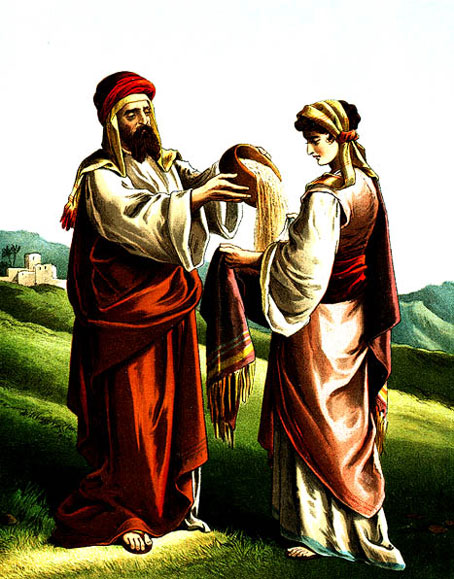
BOAZ'S GIFT
TO RUTH
Again he said, "Give me the cloak (mitpahat) that is on you and hold it - Give...hold are both commands. In light of this truth, observe Ruth's response "So she held...", reflects once again her humble, submissive, obedient spirit. A woman of excellence indeed! Delayed "obedience" is disobedience!
So she held it, and he measured six measures of barley and laid it on her - The NASB adds the word "measures" to the literal phrase six of barley. The NKJV adds the word "ephahs" which is a very an unlikely translation as 1 ephah is anywhere from 3/8's of a bushel to a full bushel. It is virtually inconceivable that Boaz measured out such a huge quantity (over 200 pounds - she was a woman of strength yes, but strength of character not of her ability to carry a physical load)! The phrase laid it on her supports that this was probably a fairly heavy load of barley. This picture emphasizes Boaz's concern for the needs of Ruth and Naomi. Boaz was wealthy and it would have been easy to overlook the needs of others, but he did not. When we are without pain, sadly we often forget those who are in pain. In addition the grain would and been an additional sign to undergird his verbal commitment to carry out what he had promised. Finally the grain gift shows Boaz's gracious, giving heart, which expressed his agape love of giving unconditionally.
NET Bible - The unit of measure is not indicated in the Hebrew text, although it would probably have been clear to the original hearers of the account. Six ephahs, the equivalent of 180–300 pounds, is clearly too heavy, especially if carried in a garment. Six omers (an omer being a tenth of an ephah) seems too little, since this would have amounted to six-tenths of an ephah, less than Ruth had gleaned in a single day (Ru 2:!7). Thus a seah (one third of an ephah) may be in view here; six seahs would amount to two ephahs, about 60 pounds (27 kg).
Then she went into the city - Chapter 2 had been an eventful day in the field after which Ruth returned to the city (Ru 2:18). Chapter 3 ends an eventful night at the threshing floor after which she returned to the city. Both times she returns home to Naomi with bounty from Boaz! One can see Naomi's "Mara mentality" quickly dissipating as God bestows grace upon grace to her through Ruth the Moabitess.
Cloak (04304) (mitpahat) was used for wrapping the head and shoulders and is used only here and Isa 3:22-note. The Septuagint (LXX) translates the Hebrew word mitpahat with the Greek noun perizoma which refers literally to a girdle around (as around the loins) and was used to describe an apron as a cook might wear.
Selwyn Hughes - Ruth 3:14-17 Wait!
"Bring me the shawl you are wearing he poured into it six measures of barley." (v. 15)
Boaz was well aware that Ruth's visit to him at midnight could be misinterpreted. Anxious to preserve her good name, he encourages her to return to her place before the rest of the workers awaken and the general activity of the day begins. Before she leaves, however, he invites her to hold out her shawl, which he fills with six measures of barley. This was not something for which she had labored, the result of her gleaning, but a special gift. A later comment by Ruth indicates that the gift was intended not only for her but for Naomi as well: "He gave me these six measures of barley, saying, 'Don't go back to your mother-in-law empty-handed' " (v. 17). When Ruth finally reports to Naomi all that has happened in the night, and particularly the fact that there is a kinsman nearer than Boaz, Naomi gives her this advice: "Wait For the man will not rest until the matter is settled today" (v. 18). It is not easy to wait, especially where matters of the heart are concerned. But no Christian is mature until he or she has learned to wait. Perhaps this is the word the Lord has for you today - wait. Are you feeling spiritually restless at the moment, straining at the leash and anxious to press ahead on some point that needs further thought and prayer? Well, here is His word again - wait. A purpose far wiser than you can ever conceive of is being worked out for you. A heart infinitely more loving than any other you will ever know is caring for you. A mind greater than yours is planning for you. So - wait!
Father, forgive me that so often I move ahead when I should wait, and rush around when I should be standing still. I have so much to learn in this matter. Help me, dear Father. Teach me the art of waiting. In Jesus' Name I pray. Amen.
INDEX TO THE NOTES:
- Gaal/Goel
- Gaal/Goel - Vine's Definition
- Gaal/Goel - TWOT's Definition
- All OT Uses of Gaal/Goel
- Geullah - Passive Participle of Gaal
- Padah - Redeem, Ransom
- All OT Uses of Padah
- ISBE Article on Redeemer, Redemption
- Redemption - Topical References
Three Hebrew words are used to describe various aspects of redemption in the Old Testament...
- Gaal - Verb (01350)- to redeem, to act as a kinsman. The derivative Go'el (01350) is the active participle of verb Ga'al.
- Geullah (01353)
- Padah - Verb (06299)
One difference between Gaal and padah is that Gaal places emphasis on the redemption being the privilege or duty of the near relative.
The Book of Ruth presents the beautiful account of a human kinsman-redeemer Boaz (chart on his character) who beautifully pictures Christ the consummate Kinsman-Redeemer.
The main word is the verb gaal (01350). Goel (01350) is the active participle of the verb gaal and conveys a primary sense of “restored to an original state”. A Goel therefore was one who not only delivered but who effected restoration to an original state. The Goel is to do the part of a kinsman and thus to redeem their kin from difficulty or danger by the payment of a price.
Goel, the active participial form of gaal has practically become a noun in its own right. Thus goel is translated as noun with the words as redeemer, kinsman or avenger.
Don't be confused if you are looking up the Strong's numbers because Strong did not assign a separate number to the root verb gaal (01350) and the active participle goel (01350), although for reasons unclear to me, he did assign a separate number (01353) for geullah which is the passive participle of gaal.
Ga'al: (01350) is the root verb form. The active participle = Go'el and is usually translated kinsman, redeemer or avenger. The passive participle = Geullah, (see below)
Ga'al = Blood Avenger in Dt 19:6, which describes the individual who had the duty to execute the murderer of his relative. Ga'al is used with this same sense in Nu 35:19, 21, 24, 27 35:12 (see Commentary). Apparently the idea is that the next of kin must effect the payment of life for life. As a house is repurchased or a slave redeemed by payment, so the lost life of the relative must be paid for by the equivalent life of the murderer. The kinsman is the avenger of blood. This system of execution must be distinguished from blood feuds for the blood avenger was a guiltless executioner and not to be murdered in turn.
Vine writes that the main use of Ga'al refers to "the deliverance of persons or property that had been sold for debt, as in Lv 25:25...If he prospers, the man himself may “redeem” it (Lv 25:26). A poor man may sell himself to a fellow Israelite (Lv 25:39) or to an alien living in Israel (Lv 25:47). The responsibility “to redeem” belonged to the nearest relative—brother, uncle, uncle’s son, or a blood relative from his family (Lv 25:25, 48, 49). The person (kinsman) who “redeemed” the one in financial difficulties was known as a Kinsman Redeemer, (Ru 2:20NIV).
SOME REPETITION IN THIS SUMMARY DEFINTION - The Hebrew verb gāʾal (גָּאַל) presents a deeply layered concept in which redemption is the exercise of a binding family obligation to restore, defend, and vindicate a relative who has fallen into loss, danger, or injustice. At its core, the word does not merely describe rescue, but the assumption of responsibility by one who has both the right and duty to act because of kinship, making redemption inherently relational rather than transactional. In Israel’s legal framework, this obligation expressed itself in several concrete spheres: the kinsman redeemer restored alienated inheritance by repurchasing land that had been sold under economic distress (Lev. 25:25), reinstated personal freedom by buying back a relative who had sold himself into servitude (Lev. 25:48-49), secured family continuity and name within the covenant community (Ruth 4:5), and upheld justice by acting as the avenger who answered the wrongful loss of life (Num. 35:19). Each function reflects a unified principle: what has been diminished or taken must be restored, and what has been violated must be set right, even if this requires cost, intervention, or judgment.
This legal and familial framework becomes the theological foundation for understanding God’s self-revelation as Redeemer, where He assumes the role of Israel’s nearest kinsman in a covenantal sense. His redemptive work is therefore not simply deliverance from circumstances, but the active restoration of His people to their rightful position, grounded in His prior claim upon them. As their Goʾēl, He rescues them from oppressive powers, as seen in the exodus where He declares, “I will redeem you with an outstretched arm and with great judgments” (Ex. 6:6), combining deliverance with the overthrow of their oppressors. This pattern continues in His dealings with Israel’s later history, where redemption includes release from exile (Isa. 48:20; 52:9), renewal after judgment, and the removal of sin which had forfeited their standing (Isa. 44:22). Notably, the concept does not always specify a literal payment; instead, the “cost” is often expressed through divine action in judgment and faithfulness, whereby God Himself bears the burden of restoring what His people could not reclaim.
A crucial distinction within Hebrew thought is that gāʾal differs from pādâ in that it emphasizes personal obligation rooted in relationship, rather than merely the act of ransom itself. The redeemer acts not because a price exists, but because the relationship demands intervention, which is why the term naturally expands to include both deliverance and vindication. This is especially evident in passages where God’s redemption involves not only saving His people but also contending against their enemies and upholding their cause (Ps. 69:18; Isa. 49:26). Thus, redemption includes the dual movement of rescue and righteous retribution, restoring order where disorder had prevailed.
Ultimately, gāʾal conveys that redemption is comprehensive restoration grounded in covenant identity, in which God, as both Creator and covenant Lord, acts as the nearest kinsman who reclaims, rescues, and reestablishes His people. Because they belong to Him, He intervenes to recover what is lost, to free what is enslaved, to avenge what is wronged, and to secure their future, demonstrating that redemption is not merely an act but an ongoing expression of His committed relationship to His own (Isa. 43:1; 44:24; Ps. 103:4).
GAAL - 83V - Gen. 48:16; Exod. 6:6; Exod. 15:13; Lev. 25:25; Lev. 25:26; Lev. 25:30; Lev. 25:33; Lev. 25:48; Lev. 25:49; Lev. 25:54; Lev. 27:13; Lev. 27:15; Lev. 27:19; Lev. 27:20; Lev. 27:27; Lev. 27:28; Lev. 27:31; Lev. 27:33; Num. 5:8; Num. 35:12; Num. 35:19; Num. 35:21; Num. 35:24; Num. 35:25; Num. 35:27; Deut. 19:6; Deut. 19:12; Jos. 20:3; Jos. 20:5; Jos. 20:9; Ruth 2:20; Ruth 3:9; Ruth 3:12; Ruth 3:13; Ruth 4:1; Ruth 4:3; Ruth 4:4; Ruth 4:6; Ruth 4:8; Ruth 4:14; 2 Sam. 14:11; 1 Ki. 16:11; Job 3:5; Job 19:25; Ps. 19:14; Ps. 69:18; Ps. 72:14; Ps. 74:2; Ps. 77:15; Ps. 78:35; Ps. 103:4; Ps. 106:10; Ps. 107:2; Ps. 119:154; Prov. 23:11; Isa. 35:9; Isa. 41:14; Isa. 43:1; Isa. 43:14; Isa. 44:6; Isa. 44:22; Isa. 44:23; Isa. 44:24; Isa. 47:4; Isa. 48:17; Isa. 48:20; Isa. 49:7; Isa. 49:26; Isa. 51:10; Isa. 52:3; Isa. 52:9; Isa. 54:5; Isa. 54:8; Isa. 59:20; Isa. 60:16; Isa. 62:12; Isa. 63:9; Isa. 63:16; Jer. 31:11; Jer. 50:34; Lam. 3:58; Hos. 13:14; Mic. 4:10
Kinsman (Avenger) - Greek verb Agchisteuo - Not found in the New Testament. Ga'al is translated in the Septuagint (LXX) by the Greek verb agchisteuo which means to be the next of kin, to do what a kinsman was supposed to do (marry a woman) thus exercising the rights and responsibilities of the kinsman.
Liddell-Scott on agchisteuo - to be next of kin, Isael, to do a kinsmen's office to a woman (= to marry her), also to enter upon an inheritance.
ἀγχιστεύω,
I. to be next or near, γῆ ἀγχιστεύουσα .. πόντῳ E.Tr.224 (lyr.).
II. to be next of kin, heir-at-law, τινί Is.11.11: metaph., ἀ. ἀγοραίης ἐργασίης Hp.Praec.8.
2. c. acc., ἀ. τινά do a kinsman’s office to a woman, i.e. marry her, LXX Ru.3.13, 4.4; also κληρονομίαν ἀ. enter upon .., Nu.36.8.
3. Pass., to be excluded by descent, ἀπὺ τῆς ἱερατείας 2Es.2.62, Ne.7.64.
LEH -on agchisteuo - to be next of kin [tina = "someone"] Ru 2:20; to exercise the rights and responsibilities of a kinsman, to redeem [abs.] (semit., rendering Hebr. lag) Ru 4:4; to marry the widow of a kinsman [tina] (semit., rendering Hebr. lag) Ru 3:13 kinsman (ho agchisteuon) Lev 25:25. AVENGER OF BLOOD ho agchisteuon to haima - Nu 35:12. each daughter who enters upon an inheritance (pasa thugater agchisteuousa kleronomian) ) Num 36,8. Ezra 2:62 they were made next of kin? they were disqualified (from), see also Neh 7,64
Agchisteuo= 32x in 21 verses in the Septuagint (LXX) - Lev. 25:25, 26; Nu 5:8; Nu 35:12, 19, 21, 24f, 27; Nu 36:8; Dt. 19:6, 12; Jos. 20:3, 9; Ru 2:20; Ru 3:13 = 4x; Ru 4:4 = 5x, Ru 4:6 = 3x, Ru 4:7; Ezra 2:62; Neh. 7:64
RELATED WORD -
Agchisteia - noun., right of kin; rights of kin (or rights of inheritance); nearness of kin; close kinship: duty of redeeming, right or responsibility of next of kin (Ru 4:7)
Agchisteia - 5x in 4v - Ruth 4:6; Ruth 4:7 (2x); Ruth 4:8; Neh. 13:29
Related Articles:
- Kinsman-Redeemer, Part 1
- Kinsman-Redeemer, Part 2 Jesus our Kinsman-Redeemer and Blood Avenger and year of Jubilee
- Goel - Our Kinsman Redeemer - In Shadow (Type) & Substance)
The Following Notes on GAAL/GOEL have some duplication
(1) If a Jew because of poverty had been obliged to sell himself to a wealthy "stranger or sojourner," it became the duty of his relatives to redeem him. Compare Lev 25:47 and the article Jubilee.
(2) The same duty fell upon the nearest kinsman, if his brother, being poor, had been forced to sell some of his property. Compare Lev 25:23; Ru 4:4-note, and the article Jubilee. (Click Kinsman-Redeemer, Part 1 and Kinsman-Redeemer, Part 2 for discussion on Jesus as our Kinsman-Redeemer and Blood Avenger and year of Jubilee by K Arthur)
(3) It also devolved upon the nearest relative to marry the childless widow of his brother (Ru 2:13-note).
(4) In Nu 5:5 a law is stated which demands that restitution be made to the nearest relative, and after him to the priest, if the injured party has died (Lev 6:1).
(5) The law of blood-revenge (Blut-Rache) made it the sacred duty of the nearest relative to avenge the blood of his kinsman. He was called the go'el ha-dam, "the avenger of blood." This law was based upon the command given in Ge 9:5f: (see also Avenger)
The main meanings of this verb include "to redeem," "to ransom" or "to deliver." The Israelite understanding of the concept may be unique. There seems to be no direct evidence outside of the Hebrew Bible for the members of the debtor's kinship group to become actively involved in one's debts (although a newly discovered and imperfectly understood Phoenician inscription from Anatolia may relate).
The primary meaning of the root is to do the duty of a kinsman and thus redeem his kin from difficulty or danger. Gāʾal with its derivatives occurs well over 100 times in the OT. Of the more than eighty times the Septuagint uses lutroō (GED #3056), it translates gāʾal forty-nine times and pādhāh (HED #6540) forty times. The two words are closely tied. According to Hebrew understanding, if the debtor is unable to alleviate his debt, it is the responsibility of the next of kin to redeem the surety, whether an object, property or the individual.
One aspect of gāʾal involves the responsibility of a near relative to maintain the property and rights of a widow (Deut. 25:5-10). Upon the husband's death, it is the brother-in-law's duty to take her as his wife. In the Book of Ruth, Boaz receives both the obligation to buy back the property (it had been sold by Elimelech and Naomi during difficult times) and to take the widow Ruth as his wife. The male relative with the prime responsibility for these obligations refused the latter and legally transferred his right to Boaz (Ruth 4:1-6). Obed, the child of Boaz and Ruth, is referred to as the son of Naomi (4:16f; cf. Deut. 25:6), as the heir to the household of Ruth's deceased first husband, the son of Naomi. Legally, the child did not belong to the genealogy of the redeemer, but to the deceased. The primary reason for this legal function was to insure the smooth transfer of property from generation to generation within the same clan.
Gāʾal is also used in the phrase "the avenger of blood," a technical or legal term for the individual upon whom the responsibility to avenge a wrongful death is laid (Num. 35:19, 21, 24f, 27; Josh. 20:3, 5). An animal, land, house or slave was valued at a specified price, but the penalty for taking a life was set at an equivalent price having no monetary value. An allowance was made for the accused in the case of non-premeditated murder in the form of a trial after his arrival at a city of refuge. If exonerated, he must remain in the city. Leaving prior to the death of the high priest put him at risk at the hand of the avenger. While there was acquittal for an accidental death, the value of a life was retained.
The legislation of the Pentateuch contains many references and applications of gāʾal. The basic idea of the term is the release or freedom upon the payment of a price. Often this involved what one could do for oneself. Animals (when unclean), lands, houses or persons dedicated to the Lord may be redeemed by an individual (Lev. 27:2, 13, 15f). Twenty percent had to be added to the assessed value to insure honesty in these transactions. A slave (one who had sold himself to settle a debt) could redeem himself.
Ultimately, God is the One who redeems. References to God's redeeming actions occur primarily in the Psalms and the Prophets. He is the One who will stand up for his people (Israel) and vindicate them. He first brought them out of a "slave house" (Exo. 20:2). In regard to the enslavement in Egypt, Yahweh says, "I will free you from being slaves to them" (Exo. 6:6). With the act of redemption completed, Moses' song voices praise regarding "the people you have redeemed," (Exo. 15:13). The act of redeeming continues throughout the history of the nation into exilic times (from Babylon, Isa. 48:20; and others, Isa. 49:7). In these instances of national redemption, the recipient and ransom price is unclear. Perhaps the price and payment are expressed in terms of God being true to his nature as the champion of the righteous and downtrodden. Punishment of the oppressor is included as part of the process.
Israel was taken into exile because of individual and national sin. God is a Kinsman-Redeemer (Isa. 60:16). As Creator, He has the right of ownership. "The earth is the Lord's, and everything in it," (Ps. 24:1). As a concerned "near kinsman," He deals with sin, which is a greater problem than exile. "I have swept away your offenses like a cloud, your sins like the morning mist," (Isa. 44:22). (Complete Biblical Library Hebrew-English Dictionary)
Ga’al "Redeem, Protect"
Of the Hebrew terms translated in English with "redeem," ga’al is the one word that is most closely connected to Israelite customs. The frequent use of the verb and its main noun in the Book of Ruth illustrates this point. The study of ga’al will show that at the heart of this redemption are the concepts of protection and deliverance.
Etymology
Dictionary Definitions
The customs of Israel with regard to the family are first brought out in some of the dictionary definitions. BDB define the word as "to redeem, act as kinsman."1 KBL have "to lay claim to a person, a thing," and then the developed meaning of "to claim back from another’s authority, to redeem." The old dictionary by Gesenius (upon which BDB was based) says it a little differently: "to redeem, buy back, to require blood; to perform the right and office of a relation via the Law."
One would conclude from this initial survey that the word meant "to redeem" in the sense of reclaiming in relation to tribal protection.
Hebrew Cognates
There are not many words related to the verb ga’al. There is an abstract noun ge’ulim, "redemption," in Isaiah 63:4. A feminine noun ge’ullah also means "redemption," or the "right of buying back," or even "kin." The more specific meaning of these words will be made clear through the study of the verb.
Likewise, personal names do not provide insight into the ramifications of the verb. The name yig’al probably means "he redeems," or "may he redeem." But we will know what the name means specifically by studying the verb carefully. In other words, names do not help us define the word--the word used helps us define the names.
Other occurrences of the root are apparently borrowings from Biblical Hebrew. The participle occurs in Qumran with the sense of "(next of) kin." The word also occurs in Samaritan and in Judaeo-Aramaic.
Rabbinical literature (NH, Gospel times roughly) uses the biblical words with the same meanings in general. According to Jastrow’s dictionary, ga’al means "to cover, ransom, redeem, protect." It is used in the Mishnah to refer to the redemption of the ancestors from Egypt (Pes. 10:6), and in the Talmud for the act of borrowing money to redeem property (Kidd. 20b). Legislation on the Jubilee year also necessarily employs the term with the biblical senses (Kidd. 15b, Ib.20b; Sabb. 118b). So also the Midrashic Literature on the relevant biblical texts will employ the term. "Redemption, release, vindication, protection," are the ideas that keep surfacing in the usages.
Cognate Languages
There are no helpful cognates attested for this word. Ringgren says that there is only one, an Amorite proper name Ga’alalum (see inTDOT). This only shows that the word was known in the earlier periods, and reveals nothing of the meaning. Stamm mentions a proper name with the letters G’ljhw from Beth-Zur as well (see in THAT). The old lexicon by Gesenius lists an Arabic "avenger of blood"--but the word is not a cognate. He was merely showing that the custom was similar.
Because of the limited use of the term in other languages, the meanings will have to be established from biblical usage.
Usage
All the uses of this word-group may be divided between human activity and divine activity (which seems to be a figurative use of the former). At least it is convenient to understand how it is used on the human level before considering the divine activity intended by it.
The Human Go’el
The underlying meaning of all the uses for humans is that the term applies to a relative, some family relation, who will act to redeem, protect, or restore, the property, liberty, life, or posterity of a family member.
1. Protecting Property. The nearest male relative of a weak or oppressed Israelite was responsible to protect the property of the family. This relative came to be known as the "kinsman redeemer" (go’el) because of his actions. According to the Law (Lev. 25:25-34) he was to buy back land sold by a relative. This was to ensure that the family retained the full benefit of the property even during the 49 years that the property could possibly be in the hands of someone other than it owner. This means, of course, that the kinsman redeemer had to be fairly wealthy; poor relatives are of little help.
The kinsman redeemer was also to be paid the extra restitution which was applicable to the violation of property rights (see Lev. 5:21-26; Num. 5:8).
In the Book of Ruth Boaz was determined to settle the matter with regard to Ruth. However, he started the legal proceedings with the discussion of the field of Elimelech that was up for sale, i.e., to be redeemed. The verbs "sell" and "acquire" are used in the discussion, but in the final analysis the nearer kinsman uses the verb ga’al for the whole process: "I am not able to redeem it lest I mar my inheritance. You redeem it for yourself" (4:6). It is likely that once Ruth was part of the deal, he backed out, not wanting to marry a Moabite.
In addition to redeeming family property, the go’el could redeem for his own use things that he had vowed. For example, if a man vowed to give his animal to the LORD, he could then buy it back so that he would retain the use of it--but the LORD would receive the value of the animal vowed. The vow could be paid in the value of the property plus the surcharge of a fifth again (Lev. 27:13). For this reason people would be hesitant to do this--and indeed, the law was on the books to discourage rash vows. But still, in such cases the man was acting as the go’el on his own behalf.
2. Securing Liberty for a Relative. The kinsman redeemer could liberate a family member (Lev. 25:47-54). If an oppressed Israelite could not find relief with the help of an Israelite brother (Lev. 25:35) or hire himself out to a fellow Israelite (Lev. 25:39), and so had to sell himself to a wealthy alien residing in Israel until he worked off the debt, a go’el (who was able and willing) could secure his release by paying the equivalent of the wages of a hireling until the next Year of Jubilee. Thus, he could set the oppressed at liberty by in effect hiring a replacement. How often this happened we do not know; it would have to be a magnanimous and wealthy relative who would do this for a man who got himself into such predicaments.
3. Avenging the Death of a Relative. The "kinsman redeemer of blood" (go’el haddam as he is called) could assume the legal responsibility of a blood avenger to make things right. If someone in the family was killed (Num. 35:24)) and the culprit defied the law and ran free, the kinsman redeemer could put the killer to death when he caught up with him at large (Num. 35:19, 21; Deut. 19:5, 6; and 2 Sam. 14:7). He could not do this if the man fled to a city of refuge. But the action of the go’el was legal whether the killing had been pre-meditated or accidental. Thus, the kinsman redeemer would vindicate the family name by avenging the death. Moreover, the fear of such avenging would serve to protect life, because a reckless person would think twice before killing someone--if he was tried and witnesses condemned him, he would die; if he tried to go free, he could be killed; if he fled to the city of refuge, he lost his liberty and had to remain incarcerated there.
4. Providing an Heir for the Deceased. If a man died without having children, that is, a male heir to carry on the family name and retain the family lands, it was the duty of the go’el to marry the deceased man’s widow and provide an heir who would continue the name and inherit the property (Deut. 25:5-10; Ruth 4:5, 10).
The straightforward interpretation of Ruth shows that ge’ullah, "redemption," incorporated the institution of the "Levirate Marriage" as well as the acquisition of the property. The point of this part of the activity of the kinsman redeemer was to preserve "social immortality," that the name not die out, but be continued from generation to generation.
The responsibilities of the kinsman redeemer were apparently voluntary and not obligatory. The emphasis in Ruth on the willingness to redeem, as well as the possibility of refusal, shows that the kinsman could back down from such duties--but to do so would be to refuse to do "loyal love" within the family, and therefore incur disgrace. In Jewish literature there is a whole tractate explaining the ins and outs of "Refusal." As a bit of poetic justice, in Ruth the near kinsman’s name was expunged from the text and replaced with a catch phrase meaning something like "John Doe" (peloni ‘almoni, "so and so")--he would not act to retain the name of the deceased relative, so why should his name be kept?
These laws were based on ancient customs (see Gen. 38) and served to preserve and protect the family so that the welfare of the whole nation would continue. In fact, the ideal king in Israel was to be a kinsman redeemer for the poor and needy of the land, representing the spirit of these laws in his righteous administration:
"He shall deliver the needy when he cries,
the poor also, and him who has no helper;
He shall spare the poor and the needy,
and shall save the lives of the needy;
He shall redeem (yig’al) them from deceit and violence,
and precious shall their blood be in his sight" (Ps. 72:12-14).
The Divine Go’el
Analogous to many of the activities of the human kinsman redeemer are the divine. Since the Scriptures use the term frequently to describe the LORD’s acts of redemption, a careful analysis of the categories of meaning is essential to determine its contribution to the biblical teachings on that divine work.
1. Deliverance from Bondage. A large number of passages applying the word ga’al to the LORD refer to deliverance from bondage, captivity, or exile. The first instance refers to the exodus: "I am the LORD and I will bring you out from the yoke of the Egyptians. I will free you from being slaves to them and will redeem you (wega’alti) with an outstretched arm and with mighty acts of judgment" (Exod. 6:6). The record of the deliverance from bondage in Egypt shows this to be a figurative use of a well-known concept, the concept of liberating kinsmen from bondage. In other words, the Israelites were already related to the LORD by faith, so the "redemption" referred to here is God’s deliverance of his people. Later biblical writers also described this great event as a "redemption" in terms of ge’ullah. For example, Psalm 74:2 says that the nation was redeemed to be the tribe of God’s own inheritance; Psalm 106:10 says that the nation was redeemed from its enemies; and Isaiah 51:10 states that redeemed Israel crossed the Sea.
The term is also used for deliverance from the Babylonian captivity. Isaiah 48:20 says that Israel’s going forth from Babylon is evidence that the LORD redeems them. These were the people of God being set free. Now it is possible, indeed likely, that some people came to faith in the LORD at that time for the first time, and so the "redemption" for them was more than a deliverance from exile. But for the most part these were people who already believed, even though their faith may have been weak at times. Micah 4:10 also promises that the LORD would redeem Israel from Babylon.
And God will also redeem Israel from its present dispersion around the world. The dispersion began when Assyria and then Rome destroyed the two kingdoms of Israel and Judah--many of those people never returned. But others did, only to be dispersed again when Rome utterly destroyed the nation in 135 A.D. (The temple was destroyed in 70 A.D., but the final blow came with Hadrian). But the prophets foretold how Israel was to be re-gathered to its land, first in unbelief, and then to come to saving faith (Ezek. 37). Then, in the days of Jesus, the people were still waiting for that consolation of Israel; and Jesus and Paul both spoke of it as still in the future. It would be part of the great redemption for which the whole world groans. And ga’al is the term that fits that great deliverance and restoration better than any other word. So Isaiah announces that at that time all the ends of the earth will see the great deliverance (Isa. 52:9); he writes: "Burst into songs of joy together, you ruins of Jerusalem, for the LORD has comforted his people; he has redeemed (ga’al) Jerusalem." As would be expected, the fulfillment of this oracle has been debated from the beginning. It is no doubt that the restoration from the captivity was seen as a partial fulfillment, but since there did not follow universal peace and righteousness, an abundance of life in the land, and the reign of the Messiah, they new it was but a foreshadow of things to come. As Paul said, quoting from Isaiah, the ultimate fulfillment of the world-wide redemption of the people would come just prior to or at the time of the second coming when the fulness of the Gentiles had come in (Rom. 11:26). But regardless of the exact time of the fulfillment, the point is that the word ga’al is used for the LORD’s delivering his people from bondage to the world.
2. Redemption through Vengeance. God is the avenger of blood inrelation to his people Israel, according to Isaiah. So this, another aspect of the meaning of the word, is the means of God’s redeeming Israel from bondage. Isaiah 47:4 states that because the LORD is Israel’s redeemer, Babylon will be destroyed. Later, the prophet states that God is Israel’s redeemer and so will contend for his people (Isa. 49:25, 26). In Isaiah 63:4 the "year of my redemption" (ge’ulim) is in parallelism with "the day of vengeance." Jeremiah also explains that because Israel’s redeemer is strong, Babylon will be destroyed (Jer. 50:34).
3. Deliverance from Distress or Death. Closely related to the concept of deliverance from exile is the use of the term to express deliverance from suffering and disaster that leads to death. For example, the patriarch Jacob attributed to God his redemption from evil (Gen. 48:16). "All evil" has a much broader range than exile, and only a close study of the patriarch’s life experiences will show the full meaning. Elsewhere, the psalmist mentions redemption from destruction (Ps. 103:4). And Lamentations reports the words of a believer about to go into exile, but who is thankful that he is alive (Lam. 3:58). But perhaps the best example is found in the prophet Hosea who records the word of the LORD: "I will ransom them from the power of the grave; I will redeem them (’eg’alem) from death. Where, O death, are your plagues? Where, O grave, is your destruction?" (13:14).
Some attention must be given to the very important use in Job 19:25, which says, "I know that my redeemer (go’ali) lives." Job knows that he is about to die; but he also knows that he has an go’el, an avenger, who will make things right after all. The difficulty is that throughout the book he expresses his conviction that God is treating him like an enemy, and God is the one putting him to death. But here he seems clear that there is a redeemer, an avenger, ready to champion his cause. Who else could that be but the God? This he does not understand, but he will not waver in his faith in his redeemer. The usage of ga’al here combines the meanings of vengeance and rescue from great distress. Although he knows he will die, through the ge’ullah of his great go’el he will see God.
4. Redemption from Sins. The prophet Isaiah reports the word of the LORD for Israel: "I have swept away your offenses like a cloud, your sins like the morning mist. Return to me, for I have redeemed you (ge’altika)" (Isa. 44:22). From this it appears that the redemption of the LORD is at least accompanied by the blotting out of sins. Passages that in general discuss reclamation from bondage or distress will confirm the idea that removal of sin is part of the operation. There would be no deliverance from bondage if the sin was not dealt with; and so in the New Testament it is no surprise to see Jesus connecting the forgiveness of sins with the healing of people.
So God himself is a go’el, a Kinsman Redeemer as it were. The term basically describes the work of God in delivering his people from bondage, distress, imminent death, and/or sins. Because Israel was not strong enough to redeem herself, God had to do it (Jer. 31:11). Because Israel did not sell herself into that condition for money, God will not redeem with money (Isa. 52:3). His redemption is based on love and pity (Isa. 63:9) for his people, and accomplished through judgment on the oppressors.
Synonyms and Antonyms
There are a number of words that overlap with aspects of ga’al, but only a couple are close enough to be called synonyms. The general word for "redeem" is padah, but it is not as technical as ga’al. It basically means "to purchase, redeem with a price." One might "purchase" (padah) a slave, as the Scriptures teach that God did with Israel (in one way of looking at the Exodus); but one "redeems" (ga’al) kinsmen, setting them free. Another word, qanah I, "to acquire, buy," stresses the fact of the acquisition, but not the technical relations. Words for salvation or atonement are related to the word "redeem" in the general theological sense, but only padah is a close synonym.
There are other terms for "relative," or "kin," or for "blood avenge," but no one word comes close to ga’al in expressing the work of a kinsman in redeeming, protecting, or avenging the life, liberty, and property of a relative.
Words that have to do with "selling" (e.g., makar) serve as antonyms to our word. These are not particularly helpful in the study, except that they are used to describe God’s sending his people into captivity--the reverse of the redemption.
Translations
The Greek Old Testament used several words (as might be expected) for the translation of ga’al. The most frequently used words werelutroo, agchisteuo, and rhuomai (used 53, 32, and 12 times respectively). The first stresses the fact of redemption, but does not have all the meanings it has in the later New Testament use. In general it appears as a translation of ga’al in the Psalms. The second word is used to express the fact of kinship, or the work of the kinsman. Thus, it is common in the Pentateuch. The third word emphasizes the aspect of "drawing out," primarily of God’s redemption of his people from the nations. So this is more frequently in Isaiah.
Many English words have been used to translate our word, and perhaps no single word will cover all its meanings. "Redeem" is fairly adequate for most usages, because it means "to recover ownership of by paying a special sum." But if it is used most frequently, its distinctive meaning would have to be made clear or people will confuse it for the New Testament idea of redemption, that is, the suffering Messiah on the cross. The English word "redeem" can also mean "to set free, rescue, ransom." At times, however, "kinsman" and "avenger" or "protector" would be better.
Conclusion
The term ga’al is a technical term drawn from the culture of ancient Israel. Its usages show that it describes the work of the kinsman on behalf of the family, liberating, protecting, or avenging a relative. When transferred to describe divine activity, the same concepts are in the minds of the writers. Only on occasion does the word focus on redemption from sin and distress, and even then not totally dissociated from redemption from bondage or exile.
It is clear, however, that from the Scripture the LORD God is a go’el. There is no reason, or support, for trying to argue for a typology from the character of Boaz when the prophets simply state unambiguously this aspect of God’s nature and work. But the aspects of God’s work that this word describes are more in harmony with the second advent of Christ. The context of the many predictions of God’s redemption is appropriately Jubilee and re-gathering, or, the final redemption
ga˒al (גָּאַל, 1350), “to redeem, deliver, avenge, act as a kinsman.”
This word group is used 90 times, chiefly in the Pentateuch, Psalms, Isaiah, and Ruth. The root appears to be almost exclusively Hebrew, the only cognate being an Amorite proper name.
The first occurrence of gaal is in Ge 48:16: “The angel which redeemed me [Jacob] from all evil" (KJV), means as in the NIV, “delivered me from all harm.” Its basic use had to do with the deliverance of persons or property that had been sold for debt, as in Lev. 25:25....If he prospers, the man himself may “redeem” it (Lev. 25:26). A poor man may sell himself to a fellow Israelite (Lev. 25:39) or to an alien living in Israel (Lev. 25:47). The responsibility “to redeem” belonged to the nearest relative—brother, uncle, uncle’s son, or a blood relative from his family (Lev. 25:25, 48-49). The person who “redeemed” the one in financial difficulties was known as a kinsman-redeemer, as the NIV translates the word in Ruth 2:20. In Dt. 19:6 the redeemer is called the “avenger of blood” whose duty it was to execute the murderer of his relative. The verb occurs in this sense 12 times and is translated “revenger” in KJV (Nu 35:19, 21, 24, 27) or “avenger” (Nu 35:12; see commentary always so in NASB and NIV).
The Book of Ruth is a beautiful account of the kinsman-redeemer. His responsibility is summed up in Ruth 4:5: “What day thou buyest the field of the hand of Naomi, thou must buy it also of Ruth the Moabitess, the wife of the dead, to raise up the name of the dead upon his inheritance.” (Ed: Although descriptive of what the kinsman is to do, this verse actually does not have the word ga'al, go'el or ge Thus the kinsman-redeemer was responsible for preserving the integrity, life, property, and family name of his close relative or for executing justice upon his murderer.
The greater usage of this word group is of God Who promised: “I am the Lord … I will redeem you with a stretched out arm and with great judgments” (Ex. 6:6; cf. Ps. 77:15). Israel confessed: “Thou in thy mercy hast led forth the people which thou hast redeemed …” (Ex 15:13). “And they remembered that God was their rock, and the high God their redeemer” (Ps. 78:35).
The Book of Isaiah evidences the word Redeemer used of God 13 times, all in chapters 41-63, and gaal is used 9 times of God, first in Isaiah 43:1: “Fear not; for I have redeemed thee, I have called thee by thy name; thou art mine.” Gaal is used of deliverance from Egypt (Isaiah 51:10; 63:9) and from captivity in Babylon (Isaiah 48:20; 52:3, 9; 62:12). Israel’s “Redeemer” is “the Holy One of Israel” (Isaiah 41:14), “the creator of Israel, your King” (Isaiah 43:14-15), “the Lord of hosts” (Isaiah 44:6), and “the mighty One of Jacob” (Isaiah 49:26). Those who share His salvation are “the redeemed” (Isaiah 35:9).
The Book of Psalms often places spiritual redemption in parallel with physical redemption. For example: “Draw nigh unto my soul, and redeem it: // deliver me because of mine enemies” (Ps. 69:18). “Bless the Lord, O my soul, and forget not all his benefits...Who redeems thy life from destruction; who crowns thee with loving-kindness and tender mercies” (Ps. 103:2, 4). (Vine's Expository Dictionary)
R Laird Harris - link to the TWOT
גָּאַל (gāʾal) I, redeem, avenge, revenge, ransom, do the part of a kinsman. (ASV and RSV similar, except that they translate “avenger of blood” instead of “revenger of blood.”)
Derivatives
300a גְּאוּלַי (gĕʾûlay) redemption (Isa 63:4 only).
300b (Strong's - 01353) --- גְּאֻלָּה (gĕʾūllâ) redemption, right of redemption, price of redemption, kindred.
300c (Strong's - 01350) --- גֹּאֵל (gōʾēl) I, redeemer.
The participial form of the Qal stem of the verb has practically become a noun in its own right though it may properly be considered as merely a form of the verb.
The primary meaning of this root is to do the part of a kinsman and thus to redeem his kin from difficulty or danger. It is used with its derivatives 118 times. One difference between this root and the very similar root pādâ “redeem,” is that there is usually an emphasis in gāʾal on the redemption being the privilege or duty of a near relative. The participial form of the Qal stem has indeed been translated by some as “kinsman-redeemer” or as in KJV merely “kinsman.” The root is to be distinguished from gāʾal II, “defile” (which see).
The root is used in four basic situations covering the things a good and true man would do for his kinsman.
First, it is used in the Pentateuchal legislation to refer to the repurchase of a field which was sold in time of need (Lev 25:25 ff.), or the freeing of an Israelite slave who sold himself in time of poverty (Lev 25:48ff.). Such purchase and restitution was the duty of the next of kin.
Secondly, but associated with this usage was the “redemption” of property or non-sacrificial animals dedicated to the Lord, or the redemption of the firstborn of unclean animals (Lev 27:11ff’.). The idea was that a man could give an equivalent to the Lord in exchange, but the redemption price was to be a bit extra to avoid dishonest exchanges. In these cases, the redeemer was not a relative, but the owner of the property.
Thirdly, the root is used to refer to the next of kin who is the “avenger of blood” (RSV “revenger”) for a murdered man. The full phrase “avenger of blood” is almost always used (cf. Nu 35:12ff.). Apparently the idea is that the next of kin must effect the payment of life for life. As a house is repurchased or a slave redeemed by payment, so the lost life of the relative must be paid for by the equivalent life of the murderer. The kinsman is the avenger of blood. This system of execution must be distinguished from blood feuds for the gōʾēl was a guiltless executioner and not to be murdered in turn.
Finally, there is the very common usage prominent in the Psalms and prophets that God is Israel’s Redeemer who will stand up for his people and vindicate them. There may be a hint of the Father’s near kinship or ownership in the use of this word. A redemption price is not usually cited, though the idea of judgment on Israel’s oppressors as a ransom is included in Isa 43:1–3. God, as it were, redeems his sons from a bondage worse than slavery.
LAW OF LEVIRATE MARRIAGE
Perhaps the best known instance of redemption of the poor is in the book of Ruth which is the most extensive OT witness for the law of Levirate marriage. According to Deut 25:5–10, a widow without issue should be taken by her husband’s brother to perpetuate seed and thus insure the succession of the land which was bound to the male descendants. The near relative here is called a yābām. The root gāʾal is not used. In the situation in Ruth two things are mentioned, the field and the levirate marriage. The near kin was willing to buy the field, but not to marry Ruth.
The point is that when Naomi in her poverty had to sell the field the next of kin was obligated to buy it back for her. This he was willing to do for his brother’s widow without issue. The land would presumably revert to him anyway at last. When he learned that he must marry Ruth and raise children who would maintain their inheritance, he refused and Boaz stepped in. But the two things, kinsman redemption and levirate marriage, are to be distinguished. The word gōʾēl “redeemer,” does not refer to the latter institution. (Ed: See also: Goel - Our Kinsman Redeemer - In Shadow (Type) & Substance)
JOB'S REDEEMER
In the famous verse Job 19:25 the word gōʾēl is translated “redeemer” in the AV and some have taken it to refer to the coming of Christ in his work of atonement. This would be expressed more characteristically by the Hebrew word pādâ. This word in Job 19:25 is now more accurately referred to the work of God Who as Friend and Kinsman through faith will ultimately redeem Job from the dust of death. The enigmatic “after my skin” of Job 19:26 could well be read with different vowels “after I awake” (see NIV footnote and Job 14:12–14 where Job’s question about resurrection is climaxed by his hope that God will have regard for him at last and that Job like a tree will have a second growth–ḥălîpâ, Job 14:14, which answers to the ḥālap of Job 14:7). In any case Job expects with his own eyes to see God his Goʾēl at last.
Bibliography: A. R. Johnson, “The Primary Meaning of the Root gʾl,” Supp VT 1:67–77. AI, 11–12, 21–23. Leggett, Donald A., The Levirate Goel Institutions in the OT, Presbyterian & Reformed Press. TDOT, II, pp. 350–55. (TWOT )
Gaal/Goel - 99x in 84v in NAS - Majority of uses in Isaiah. Many of the uses of gaal are translated in the Septuagint with the Greek verb lutroo (see NT word study) which conveys the idea of releasing someone who is captive (e.g., a prisoner or a slave or one who owes a debt) on receipt of a ransom payment.
NAS translates Gaal/goel as follows - Redeemer, 18; avenger, 13; bought back, 1; buy back, 1; claim, 1; close relative, 3; closest relative, 3; closest relatives, 1; ever wish to redeem, 2; kinsman, 2; redeem, 22; redeemed, 25; redeemer, 1; redeems, 1; relative, 2; relatives, 1; rescue, 1; wishes to redeem, 1.
Genesis 48:16 The Angel (Not a created angel but Angel of the LORD, cp Isaiah 63:9 below) Who has redeemed (ga'al; Lxx = rhuomai) = deliver, rescue, save) me from all evil (cp Ge 31:11, 12, 13), bless the lads; and may my name live on in them, and the names of my fathers Abraham and Isaac; and may they grow into a multitude in the midst of the earth.”
Exodus 6:6 “Say, therefore, to the sons of Israel, ‘I am the Lord, and I will bring you out from under the burdens of the Egyptians, and I will deliver you from their bondage. I will also redeem (ga'al; Lxx = lutroo) you with an outstretched arm and with great judgments. (See also Ps 77:15-note, cp similar use of Ga'al in Isaiah 51:10)
Exodus 15:13 “In Your lovingkindness You have led the people whom You have redeemed (ga'al; Lxx = lutroo); In Your strength You have guided them to Your holy habitation.
Leviticus 25:25 If a fellow countryman of yours becomes so poor he has to sell part of his property, then his nearest kinsman (ga'al/goel; Lxx = agchisteuo = to be next of kin) is to come and buy back (ga'al; Lxx = ) what his relative has sold.
Comment: This passage is a "prototype" for the OT concept of Kinsman-Redeemer - Study the other uses in Leviticus for amplification of this concept.
Leviticus 25:26 'Or in case a man has no kinsman, but so recovers his means as to find sufficient for its redemption,
Leviticus 25:30 'But if it is not bought back for him within the space of a full year, then the house that is in the walled city passes permanently to its purchaser throughout his generations; it does not revert in the jubilee.
Leviticus 25:33 'What, therefore, belongs to the Levites may be redeemed and a house sale in the city of this possession reverts in the jubilee, for the houses of the cities of the Levites are their possession among the sons of Israel.
Leviticus 25:48 then he shall have redemption right (geullah) after he has been sold. One of his brothers may redeem him,
Leviticus 25:49 or his uncle, or his uncle's son, may redeem him, or one of his blood relatives from his family may redeem him; or if he prospers, he may redeem himself.
Leviticus 25:54 'Even if he is not redeemed by these means, he shall still go out in the year of jubilee, he and his sons with him.
Leviticus 27:13 'But if he should ever wish to redeem it, then he shall add one-fifth of it to your valuation.
Leviticus 27:15 'Yet if the one who consecrates it should wish to redeem his house, then he shall add one-fifth of your valuation price to it, so that it may be his.
Leviticus 27:19 'If the one who consecrates it should ever wish to redeem the field, then he shall add one-fifth of your valuation price to it, so that it may pass to him.
Leviticus 27:20 'Yet if he will not redeem the field, but has sold the field to another man, it may no longer be redeemed;
Leviticus 27:27 'But if it is among the unclean animals, then he shall redeem it according to your valuation and add to it one-fifth of it; and if it is not redeemed, then it shall be sold according to your valuation.
Leviticus 27:28 'Nevertheless, anything which a man sets apart to the LORD out of all that he has, of man or animal or of the fields of his own property, shall not be sold or redeemed. Anything devoted to destruction is most holy to the LORD.
Leviticus 27:31 'If, therefore, a man wishes to redeem part of his tithe, he shall add to it one-fifth of it.
Leviticus 27:33 'He is not to be concerned whether it is good or bad, nor shall he exchange it; or if he does exchange it, then both it and its substitute shall become holy. It shall not be redeemed.'"
Numbers 5:8 'But if the man has no relative to whom restitution may be made for the wrong, the restitution which is made for the wrong must go to the LORD for the priest, besides the ram of atonement, by which atonement is made for him.
Numbers 35:12 'The cities shall be to you as a refuge from the avenger, so that the manslayer will not die until he stands before the congregation for trial.
Numbers 35:19 'The blood avenger himself shall put the murderer to death; he shall put him to death when he meets him.
Numbers 35:21 or if he struck him down with his hand in enmity, and as a result he died, the one who struck him shall surely be put to death, he is a murderer; the blood avenger shall put the murderer to death when he meets him.
Numbers 35:24 then the congregation shall judge between the slayer and the blood avenger according to these ordinances.
Numbers 35:25 'The congregation shall deliver the manslayer from the hand of the blood avenger, and the congregation shall restore him to his city of refuge to which he fled; and he shall live in it until the death of the high priest who was anointed with the holy oil.
Numbers 35:27 and the blood avenger finds him outside the border of his city of refuge, and the blood avenger kills the manslayer, he will not be guilty of blood
Deuteronomy 19:6 otherwise the avenger of blood might pursue the manslayer in the heat of his anger, and overtake him, because the way is long, and take his life, though he was not deserving of death, since he had not hated him previously.
Deuteronomy 19:12 then the elders of his city shall send and take him from there and deliver him into the hand of the avenger of blood, that he may die.
Joshua 20:3 that the manslayer who kills any person unintentionally, without premeditation, may flee there, and they shall become your refuge from the avenger of blood.
Joshua 20:5 'Now if the avenger of blood pursues him, then they shall not deliver the manslayer into his hand, because he struck his neighbor without premeditation and did not hate him beforehand.
Joshua 20:9 These were the appointed cities for all the sons of Israel and for the stranger who sojourns among them, that whoever kills any person unintentionally may flee there, and not die by the hand of the avenger of blood until he stands before the congregation.
Ruth 2:20 Naomi said to her daughter-in-law, "May he be blessed of the LORD who has not withdrawn his kindness to the living and to the dead." Again Naomi said to her, "The man is our relative, he is one of our closest relatives."
Ruth 3:9 He said, "Who are you?" And she answered, "I am Ruth your maid. So spread your covering over your maid, for you are a close relative."
Ruth 3:12 "Now it is true I am a close relative; however, there is a relative closer than I.
Ruth 3:13 "Remain this night, and when morning comes, if he will redeem you, good; let him redeem you. But if he does not wish to redeem you, then I will redeem you, as the LORD lives. Lie down until morning."
Ruth 4:1 Now Boaz went up to the gate and sat down there, and behold, the close relative of whom Boaz spoke was passing by, so he said, "Turn aside, friend, sit down here." And he turned aside and sat down.
Ruth 4:3 Then he said to the closest relative, "Naomi, who has come back from the land of Moab, has to sell the piece of land which belonged to our brother Elimelech.
Ruth 4:4 "So I thought to inform you, saying, 'Buy it before those who are sitting here, and before the elders of my people. If you will redeem it, redeem it; but if not, tell me that I may know; for there is no one but you to redeem it, and I am after you.'" And he said, "I will redeem it."
Ruth 4:6 The closest relative (gaal) said, "I cannot redeem (gaal) it for myself, because I would jeopardize my own inheritance. Redeem (gaal) it for yourself; you may have my right of redemption, for I cannot redeem (gaal) it."
Comment: It is interesting that the Lxx uses agchisteia (duty of redeeming, responsibility of next of kin) in all four uses of gaal in this passage.
Ruth 4:8 So the closest relative said to Boaz, "Buy it for yourself." And he removed his sandal.
Ruth 4:14 Then the women said to Naomi, "Blessed is the LORD who has not left you without a redeemer today, and may his name become famous in Israel.
2 Samuel 14:11 Then she said, "Please let the king remember the LORD your God, so that the avenger of blood will not continue to destroy, otherwise they will destroy my son." And he said, "As the LORD lives, not one hair of your son shall fall to the ground."
1 Kings 16:11 It came about when he became king, as soon as he sat on his throne, that he killed all the household of Baasha; he did not leave a single male, neither of his relatives nor of his friends.
Job 3:5 "Let darkness and black gloom claim it; Let a cloud settle on it; Let the blackness of the day terrify it.
Job 19:25 "As for me, I know that my Redeemer lives, And at the last He will take His stand on the earth.
Psalm 19:14 Let the words of my mouth and the meditation of my heart be acceptable in Your sight, O Lord, my Rock and my Redeemer. (cp Ps 78:35-note)
Spurgeon comments: We must in prayer view Jehovah as our strength enabling, and our Redeemer saving, or we shall not pray aright, and it is well to feel our personal interest so as to use the word my, or our prayers will be hindered. Our near Kinsman's name, our Goel or Redeemer, makes a blessed ending to the Psalm; it began with the heavens, but it ends with him whose glory fills heaven and earth. Blessed Kinsman, give us now to meditate acceptably upon thy most sweet love and tenderness.
Psalm 69:18 Oh draw near to my soul and redeem it; Ransom (padah) me because of my enemies!
Psalm 72:14 He will rescue their life from oppression and violence, And their blood will be precious in his sight;
Psalm 74:2 Remember Your congregation, which You have purchased of old, Which You have redeemed to be the tribe of Your inheritance; And this Mount Zion, where You have dwelt.
Psalm 77:15 You have by Your power redeemed Your people, The sons of Jacob and Joseph. Selah.
Psalm 78:35 And they remembered that God was their rock, And the Most High God their Redeemer.
Psalm 103:4 Who redeems (ga'al; Lxx = lutroo) your life from the pit, Who crowns you with lovingkindness and compassion;
Psalm 106:10 So He saved (Hebrew = yasha = to deliver; Lxx = sozo) them from the hand of the one who hated them, And redeemed (ga'al; Lxx = lutroo) them from the hand of the enemy.
Psalm 107:2 Let the redeemed (ga'al; Lxx = lutroo) of the LORD say so, Whom He has redeemed from the hand of the adversary
Psalm 119:154 Plead my cause and redeem me; Revive me according to Your word.
Proverbs 23:11 For their Redeemer (ga'al; Lxx = lutroo) is strong; He will plead their case against you.
Isaiah 35:9 No lion will be there, Nor will any vicious beast go up on it; These will not be found there. But the redeemed will walk there,
Isaiah 41:14 "Do not fear, you worm Jacob, you men of Israel; I will help you," declares the LORD, "and your Redeemer is the Holy One of Israel.
Isaiah 43:1 But now, thus says the LORD, your Creator, O Jacob, And He who formed you, O Israel, "Do not fear, for I have redeemed you; I have called you by name; you are Mine!
Isaiah 43:14 Thus says the LORD your Redeemer, the Holy One of Israel, "For your sake I have sent to Babylon, And will bring them all down as fugitives, Even the Chaldeans, into the ships in which they rejoice.
Isaiah 44:6 "Thus says the LORD, the King of Israel and his Redeemer, the LORD of hosts: 'I am the first and I am the last, And there is no God besides Me.
Isaiah 44:22 "I have wiped out your transgressions like a thick cloud And your sins like a heavy mist. Return to Me, for I have redeemed you."
Isaiah 44:23 Shout for joy, O heavens, for the LORD has done it! Shout joyfully, you lower parts of the earth; Break forth into a shout of joy, you mountains, O forest, and every tree in it; For the LORD has redeemed Jacob And in Israel He shows forth His glory.
Comment: This verse (and Isa 44:22) will be fulfilled in the end times when "all Israel will be saved" by the "Deliverer!" (Ro 11:26, 27).
Isaiah 44:24 Thus says the LORD, your Redeemer, and the one who formed you from the womb, "I, the LORD, am the maker of all things, Stretching out the heavens by Myself And spreading out the earth all alone,
Isaiah 47:4 Our Redeemer, the LORD of hosts is His name, The Holy One of Israel.
Isaiah 48:17 Thus says the LORD, your Redeemer, the Holy One of Israel, "I am the LORD your God, who teaches you to profit, Who leads you in the way you should go.
Isaiah 48:20 Go forth from Babylon! Flee from the Chaldeans! Declare with the sound of joyful shouting, proclaim this, Send it out to the end of the earth; Say, "The LORD has redeemed His servant Jacob."
Isaiah 49:7 Thus says the LORD, the Redeemer of Israel and its Holy One, To the despised One, To the One abhorred by the nation, To the Servant of rulers, "Kings will see and arise, Princes will also bow down, Because of the LORD who is faithful, the Holy One of Israel who has chosen You."
Isaiah 49:26 "I will feed your oppressors with their own flesh, And they will become drunk with their own blood as with sweet wine; And all flesh will know that I, the LORD, am your Savior And your Redeemer, the Mighty One of Jacob."
Isaiah 51:10 Was it not You who dried up the sea, The waters of the great deep; Who made the depths of the sea a pathway For the redeemed to cross over?
Isaiah 52:3 For thus says the LORD, "You were sold for nothing and you will be redeemed (ga'al; Lxx = lutroo) without money (See 1 Peter 1:18!)."
Isaiah 52:9 Break forth, shout joyfully together, You waste places of Jerusalem; For the LORD has comforted His people, He has redeemed Jerusalem.
Isaiah 54:5 "For your husband is your Maker, Whose name is the LORD of hosts; And your Redeemer (gaal; Lxx = rhuomai)is the Holy One of Israel, Who is called the God of all the earth.
Isaiah 54:8 "In an outburst of anger I hid My face from you for a moment, But with everlasting lovingkindness I will have compassion on you," Says the LORD your Redeemer (gaal; Lxx = rhuomai - the one Who delivers, rescues!).
Isaiah 59:20 "A Redeemer (gaal; Lxx = rhuomai) will come to Zion, And to those who turn from transgression in Jacob," declares the LORD.
Comment: Quoted by Paul as "the Deliverer" of Israel in Romans 11:26-note.
Isaiah 60:16 "You will also suck the milk of nations And suck the breast of kings; Then you will know that I, the LORD, am your Savior And your Redeemer, the Mighty One of Jacob.
Isaiah 62:12 And they will call them, "The holy people, The redeemed (ga'al; Lxx = lutroo in the perfect tense = forever we will be the redeemed) of the LORD"; And you will be called, "Sought out, a city not forsaken."
Isaiah 63:9 In all their affliction He was afflicted, And the angel of His presence (Almost certainly a Preincarnate Christophany - Angel of the LORD, cp Genesis 48:16) saved them; In His love and in His mercy He redeemed (ga'al; Lxx = lutroo) them, And He lifted them and carried them all the days of old.
Isaiah 63:16 For You are our Father, though Abraham does not know us And Israel does not recognize us. You, O LORD, are our Father, Our Redeemer (gaal; Lxx = rhuomai) from of old is Your name.
Comment: It is notable that the Lxx uses rhuomai, which is the same Greek word Paul uses to describe "the Deliverer" of Israel in Romans 11:26-note. Therefore this use of Redeemer ultimately refers to the Messiah. In 1 Thes 1:10 Paul says "Jesus...delivers (rhuomai) us from the wrath to come." See Isaiah 59:20 above, which is the passage quoted in Ro 11:26.
Jeremiah 31:11 For the LORD has ransomed (padah) Jacob And redeemed (gaal) him from the hand of him who was stronger than he.
Jeremiah 50:34 "Their Redeemer is strong, the LORD of hosts is His name; He will vigorously plead their case So that He may bring rest to the earth, But turmoil to the inhabitants of Babylon.
Lamentations 3:58 O Lord, You have pleaded my soul's cause; You have redeemed my life.
Hosea 13:14 Shall I ransom (padah) them from the power of Sheol? Shall I redeem (gaal; Lxx = lutroo) them from death? O Death, where are your thorns? O Sheol, where is your sting? Compassion will be hidden from My sight. (Quoted in part by Paul in 1 Cor 15:55)
Micah 4:10 "Writhe and labor to give birth, Daughter of Zion, Like a woman in childbirth; For now you will go out of the city, Dwell in the field, And go to Babylon. There you will be rescued; There the LORD will redeem you From the hand of your enemies.
Geullah (01353) is a feminine singular noun (Passive participle of Ga'al) means redemption, the right of buying back, the right of redemption, price of redemption, kindred. Redemption was a means by which property remained in families or clans. The best picture of this custom in the Bible is Ruth 4:6, 7.
W E Vine's entry on geullah (גְּאֻלָּה, 01353), "(right of) redemption.”
This word is used in regard to deliverance of persons or property that had been sold for debt. The law required that the “right of redemption” of land and of persons be protected (Lev. 25:24, 48). The redemption price was determined by the number of years remaining until the release of debts in the year of jubilee (Lev. 25:27-28). The word ge˒ullah also occurs in Jer. 32:7: “Behold, Hanameel the son of Shallum thine uncle shall come unto thee, saying, Buy thee my field that is in Anathoth: for the right of redemption is thine to buy it.”
Brown-Driver-Briggs Expanded Definition - on Geullah noun feminine kin (?), redemption — Leviticus 25:24 5t.; construct גְּאֻלַּת Leviticus 25:32; suffix גְּאֻלָּתִי Ruth 4:6, גְּאֻלָּתֶ֑ךָ Ezekiel 11:15, גְּאֻלָּתוֺ Leviticus 25:26 4t.; —
1 kin, אַנְשֵׁי גְּאֻלָּתֶ֑ךָ men of thy kindred Ezekiel 11:15, RV Thes Hi and others; but ᵐ5ᵑ6 Ew Co גלותך׳א thy fellow-exiles.
2 redemption, of field Leviticus 25:24 (H) Ruth 4:7.
3 right of redemption Leviticus 25:29,31,32,48 (H) Ruth 4:6; Jeremiah 32:8 = משׁפט הגאלהJeremiah 32:7.
4 price of redemption Leviticus 25:26,51,52 (H).
Gesenius Definition גְּאֻלָּה f.
(1) the redemption of a field and farm, Leviticus 25:24; Ruth 4:6 hence
(a) the right of redemption, more fully מִשְׁפַּט הַגְּאֻלָּה Jeremiah 32:7, comp. Jeremiah 32:8 (see בְּכוֹרָה ); Leviticus 25:29, 31 Leviticus 25:31, 48 Leviticus 25:48 גְּאֻלַּת עוֹלָםthe right of redeeming for ever, Leviticus 25:32.
(b) followed by a gen. a field to be redeemed by any one by right of relationship, Ruth 4:6.
(c) price of redemption, Leviticus 25:26, 51 Leviticus 25:51, 52 Leviticus 25:52.
(2) relationship, kindredship (see root I, 3). Ezekiel 11:15, אַנְשֵׁי גְאֻלָּתֶךָ thy kindred.
Gilbrant on geullah - A feminine singular noun, geʾullāh is derived from the root gāʾal (HED #1381) and means "redemption," "price of redemption," "something redeemed" and "duty of relationship." Most of the occurrences are in Leviticus.
In regard to houses in their town, Levites always had the right of redemption (Lev. 25:32). Land belonging to the family could not be sold permanently. Provision was made for its redemption (a price for redeeming, Lev. 25:24). A man who sold a house within a walled city had one year in which he could redeem it (Lev. 25:29).
This was neither secular nor sacred; such a distinction was not conceived of in ancient Israel. The Mosaic legislation was set within the redeeming work of their God. The Decalogue and ensuing laws are introduced by, "I am the Lord your God, who brought you out of Egypt, out of the land of slavery" (Exo. 20:1). The redemption constituted the foundation for Israel's life and law; therefore, an appropriate mindset was expected of the redeemed people. Interpersonal relationships with the less fortunate (the stranger, the widow, the needy, Deut. 24:17-22) were to take into consideration Israel's history. "Remember that you were slaves in Egypt; and the Lord redeemed you from there."
The word refers to the transaction or act of redemption, which was to be made an available option given the appropriate circumstances (Lev. 25:24, 31). Its intent was to rectify inequities resulting from misfortune (that which was unavoidable). Israel is Yahweh's "treasured possession" and its conduct should reflect his laws and decrees (Deut. 26:16-19).
Geʾullāh is also the legal right or recourse an individual has to redeem a property or person (if a slave). Boaz laid claim to his right of redemption upon the transfer of the right of the primary redeemer, as the transaction took place at the city gate, the legal forum in his day (Ruth 4:6). Those who experienced economic hardship and sold themselves as slaves could pay the appropriate amount of money and be freed (Lev. 25:48). The following verse explains the fact that relatives may express this right as well.
As Judah's final days were at hand, Jeremiah's cousin, Hanamel, approached him regarding the property he wished to sell at Anathoth. Jeremiah held the right of redemption (Jer. 32:7). The transfer of the land is within God's providence. Redemption would come to those taken to the land of Chaldeans. Isaiah rejoiced, "The Lord has redeemed his servant Jacob" (Isa. 48:20). The purchase of the land is symbolic of future deliverance from captivity by Yahweh, Who also has redemptive rights.
Geʾullāh can be the price involved in the transaction. When property was sold because of financial hardship, it referred to the price (Lev. 25:26, "sufficient funds") needed to repurchase it. Its value was prorated (also a house, v. 31) on the basis of the Year of Jubilee. A man who had sold himself into slavery was to take into consideration both the Year of Jubilee (to prorate the amount of money owed) and the rate at which a hired man was paid. This is his redemption price (v. 51).
Finally, it is used to denote relatives or kin. Ezekiel laments the plight of Israel, wondering whether there will even be a remnant left. He was assured by Yahweh that Israel would be brought back from exile (Ezek. 11:13-17). (Complete Biblical Library)
ALL OT USES OF GEULLAH Geullah - 13x in 12v in the OT. NAS = redemption(7), redemption right(2), redemption rights(1), right of redemption(3).
- Leviticus 25:24 'Thus for every piece of your property, you are to provide for the redemption of the land.
- Leviticus 25:26 'Or in case a man has no kinsman, but so recovers his means as to find sufficient for its redemption,
- Leviticus 25:29 'Likewise, if a man sells a dwelling house in a walled city, then his redemption right remains valid until a full year from its sale; his right of redemption lasts a full year.
- Leviticus 25:31 'The houses of the villages, however, which have no surrounding wall shall be considered as open fields; they have redemption rights and revert in the jubilee.
- Leviticus 25:32 'As for cities of the Levites, the Levites have a permanent right of redemption for the houses of the cities which are their possession.
- Leviticus 25:48 then he shall have redemption right after he has been sold. One of his brothers may redeem him,
- Leviticus 25:51 'If there are still many years, he shall refund part of his purchase price in proportion to them for his own redemption;
- Leviticus 25:52 and if few years remain until the year of jubilee, he shall so calculate with him. In proportion to his years he is to refund the amount for his redemption.
- Ruth 4:6 The closest relative said, "I cannot redeem it for myself, because I would jeopardize my own inheritance. Redeem it for yourself; you may have my right of redemption, for I cannot redeem it."
- Ruth 4:7 Now this was the custom in former times in Israel concerning the redemption and the exchange of land to confirm any matter: a man removed his sandal and gave it to another; and this was the manner of attestation in Israel.
- Jeremiah 32:7 'Behold, Hanamel the son of Shallum your uncle is coming to you, saying, "Buy for yourself my field which is at Anathoth, for you have the right of redemption to buy it."'
- Jeremiah 32:8 "Then Hanamel my uncle's son came to me in the court of the guard according to the word of the LORD and said to me, 'Buy my field, please, that is at Anathoth, which is in the land of Benjamin; for you have the right of possession and the redemption is yours; buy it for yourself.' Then I knew that this was the word of the LORD.
TWOT says that the right of redemption "is used in regard to deliverance of persons or property that had been sold for debt. The law required that the "right of redemption" of land and of persons be protected (Lv 25:24, 48). The redemption price was determined by the number of years remaining until the release of debts in the year of jubilee (Lv 25:27, 28). (Harris, R L, Archer, G L & Waltke, B K Theological Wordbook of the Old Testament. Moody Press)
Padah (06299) means to redeem, ransom, buy and so to cause the freedom or release of a person from bondage or ownership, often implying a delivering or rescue of a person in distress. Padah is not used in Ruth.
The basic meaning of the Hebrew root is to achieve the transfer of ownership from one to another through payment of a price or an equivalent substitute. Padah is used to depict God's act of redeeming; He redeemed His people with a mighty hand from Pharaoh and the slavery they were under in Egypt (Dt. 7:8; Mic. 6:4). Egypt was literally the house of slavery and became the symbol of slavery and oppression from which Israel was delivered (Dt. 9:26; 24:18).
Padah is a distinct word unrelated etymologically to Ga'al/geullah.
Padah is often translated in the Septuagint with the verb lutroo or a related word lutron/lytron (from luo = to loosen that which is bound, especially freeing those in prison). The noun lutron is the ransom price paid for loosing captives from their bonds and setting them at liberty. The verb lutroo refers to the releasing of someone held captive (e.g., a prisoner or a slave) on receipt of the ransom payment.
Padah is also used figuratively with the meaning of delivering, whether in the cases of individuals (Ps 34:22-note) or of the deliverance granted to Israel as a nation (Dt 9:26; 2Sa 7:23; 1Chr 17:21; Isa 29:22). It is especially associated with the deliverance from Egypt (Dt 7:8; 13:5; 24:18; Mic 6:4). In one instance it is used of redemption from sin: “redeem Israel from all his iniquities” (Ps 130:8-note)."
One difference between ga'al/goel and the similar root padah is that there is usually an emphasis in ga'al/goel on the redemption being the privilege or duty of a near relative.
Gilbrant on padah - The prime concept driving this root is that some mode of exchange is required for consumers to receive the objects they desire. In OT times, the possession of the object oftentimes was acquired by the seller. For example, one could redeem a female slave, that she might again experience freedom (Lev. 19:20). The synonym gāʾal (HED #1381) is usually employed for this act. The owner of a female Israelite slave was required to allow her to be redeemed and was prohibited from selling her to foreigners (Exo. 21:8). The verb is often employed metaphorically, outside of its strict legal sense. The Psalms repeatedly assert that the author had been redeemed from some distress by Yahweh (e.g., 26:11). Likewise, David asserted that he had been redeemed repeatedly by the Lord (1 Ki. 1:29). Indeed, the Lord redeemed Israel from slavery as his firstborn (Exo. 13:13), which was further celebrated in David's prayer of thanksgiving upon receiving the covenant that established his descendants as perpetual rulers (2 Sam. 7:23). Zion would be redeemed from its current state of desolation, according to Isa. 1:27. The redemption of the Israelites was at the cost of the firstborn of the Egyptians (cf. Exo. 4:23). The firstborn children of the Israelites were redeemed by substituting the Levites for service to Yahweh (Num. 3:44ff). Further, human offspring and unclean animal offspring were redeemed by offerings of large or small cattle, depending upon the occasion (e.g., 18:8ff). There were classes of unredeemable objects. Anything declared cherem (HED #2869), "devoted to Yahweh," was not redeemable, including humans (Lev. 27:27ff). (Complete Biblical Library Greek-English Dictionary)
William Coker writes that "The semantic development of pādâ is one of great significance to Christian theology. Originally, it had to do with the payment of a required sum for the transfer of ownership, a commercial term. Exodus and Leviticus 19:20 speak of the redemption of a slave girl for the purpose of marriage. It is also used to speak of the redemption of a man's life who is under the sentence of death, as in 1 Samuel 14:45, when Jonathan was redeemed by the people of Israel. The word was given special religious significance by the Exodus. When God delivered Israel from servitude to Egypt, he did so at the price of the slaughter of all the firstborn in Egypt, man and beast (Exodus 4:23; Exodus 12:29). Consequently, the event was to be perpetually commemorated in Israel by the consecration of all the firstborn of man and beast to the Lord (Exodus 13:12). (Theological Wordbook of the Old Testament)
Vine on padah (פָּדָה, 6299), “to redeem, ransom.”
Originally, the usage of this word overlapped with that of kapar; both meant "to ransom." In theological usage, however, each root tended to develop in different directions, so that they can often be considered synonymous only in a very broad sense.
Padah indicates that some intervening or substitutionary action effects a release from an undesirable undesirable condition. In more secular contexts, it implies a payment of some sort. But 1Sa 14:45 indicates that money is not intrinsic in the word; Saul is determined to execute Jonathan for his involuntary transgression, but "the people rescued Jonathan, that he died not."
Slavery appears as a condition from which one may be "ransomed" (Ex 21:8; Lev 19:20).
The word is connected with the laws of the firstborn. As a reminder of slaying all the Egyptian firstborn but sparing the Israelites, God retained an eternal claim on the life of all Israelite firstborn males, both of men and of cattle. The latter were often sacrificed, "but all the firstborn of my children I redeem" (Ex 13:15). God accepted the separation of the tribe of Levi for liturgical service in lieu of all Israelite firstborn (Nu 3:40ff.). However, the Israelite males still had to be "redeemed" (padah) from this service by payment of specified "redemption" money" (Nu 3:44-51).
When God is the subject of padah, the word emphasizes His complete, sovereign freedom to liberate human beings. Sometimes God is said to "redeem" individuals (Abraham, Is 29:22; David, 1Ki 1:29; and often in the Psalter, e.g., Ps 26:11; Ps 44:26; Ps 69:18); but usually Israel, the elect people, is the beneficiary. Sometimes the redemption or deliverance is proclaimed absolutely (2Sa 7:23; Ps 44:26; Ho 7:13); but the subject is said to be "ransomed" from a specific oppression. At other times, the reference is less explicit, e.g., from "troubles" (Ps 25:22) and from "wicked" men (Je 15:21). Only once is padah used to describe liberation from sin or iniquity (Ps 130:8).
Gesenius Definition - פָּדָה to loose (pr. by cutting; losfchneiden; cogn. to the verb פָּדַד); hence
(1) to redeem by paying a price (Arab. فدا), Exodus 13:13 followed by בְּ of the price; as Exodus 34:20, פֶּטֶר חֲמוֹר תִּפְדֶּה בְשֶׂה “the firstborn of an ass thou shalt redeem with a sheep.”
(2) to let go, as a priest (a firstling), Numbers 18:15, 16 Numbers 18:16, 17 Numbers 18:17.
(3) to set free, e.g. from servitude, Deuteronomy 7:8, 13:6 Jeremiah 15:21, 31:11 to preserve, to deliver life from danger, Psa. 34:23 followed by מִן 2 Samuel 4:9; 1 Kings 1:29; Job 6:23 בְּ(in danger), Job 5:20.
Niphal, pass. of No. 1, Leviticus 19:20 of No. 3, Isaiah 1:27.
Hiphil הֶפְדָּה, causat, of Kal. No. 1; Exodus 21:8.
Hophal, pass. inf. absol. הָפְדֵּה Leviticus 19:20.
Derivatives, פִּדְיוֹם־פְּדַהְאֵלּ.
Brown-Driver-Briggs Expanded Definition - מָּדָה verb ransom (Late Hebrew in derivatives; Phoenician in proper name; Assyrian padû, id., Arabic  ; Ethiopic
  ; Minaean פדית redeemed or purchased land Mordt Beitr. 23); —
Qal Perfect 3 masculine singular מָּדָה Leviticus 27:27 +; suffix מָּֽדְךָ Job 5:20; 2 masculine singular מָּדִיתָ Deuteronomy 9:26 +, etc.; Imperfect יִפְדֶּה Psalm 49:8 +, etc.; Imperative מְּדֵה Psalm 25:22; suffix מְּדֵנִי Psalm 26:11 3t.; Infinitive absolute מָּדֹה Numbers 18:15; Psalm 49:8; construct לִפְדּוֺת2 Samuel 7:23 = 1 Chronicles 17:2; Participle active מּוֺדֶה Psalm 34:23; suffix מֹּדְךָ Deuteronomy 13:6; passive plural construct מְּדוּיֵּי Isaiah 35:10; Isaiah 51:11; Numbers 3:49; also absolute מְּדוּיִםNumbers 3:51 (Qr; Kt פדים), construct מְּדוּיֵי Numbers 3:46; suffix מְּדוּיָו Numbers 18:16 (all noun abstract according to Di Kö ii. 1,138, see מְּדוּיִם, מִּדְיֹם below); —
RANSOM:
1 for an assessed price Exodus 13:13,15; Exodus 34:20 (J), Leviticus 27:27; Numbers 3:46,48,49,51; Numbers 18:15,16,17 (P).
2 from violence and death 1 Samuel 14:45; Job 6:23; Psalm 49:8.
3 God subject (underlying thought of payment):
a. from Egypt, with מִן, מִבֵּית עֲבָדִים Deuteronomy 7:8; Deuteronomy 13:6; Micah 6:4; מִנִּיצָֿר Psalm 78:42; ממצרים 2 Samuel 7:23 (but strike out מָּדִיתָ Gei Urschr. 288 We Dr and others) = 1 Chronicles 17:21; מִשָּׁם Deuteronomy 24:18; absolute Deuteronomy 9:26; Deuteronomy 15:15; Deuteronomy 21:8; Nehemiah 1:10.
b. from exile, Jeremiah 31:11; Zechariah 10:8; יְשֻׁבוּן׳מְּדוּיֵּי י Isaiah 35:10 = Isaiah 51:11.
c. in General Hosea 7:13; מִכֹּל צָרוֺתָיו Psalm 25:22; מִכֹּל עֲוֺנוֺתָיו Psalm 130:8.
d. with accusative individual Psalm 26:11; Psalm 31:6; Psalm 44:27; Psalm 69:19; Abraham Isaiah 29:22; ׳פנפשׁ Psalm 34:23; Psalm 71:23; + מכל צרה 2 Samuel 4:9; 1 Kings 1:29; מֵעֲבֹר בַּשָּׁ֑חַתJob 33:28; מִקְּרָבלִֿי Psalm 55:19; מִמָּוֶת Job 5:20; מיד שׁאול Psalm 49:16; Hosea 13:14; מֵעשֶׁק אָדָם Psalm 119:134; מִכַּף עָרִיצִים Jeremiah 15:21.
Niph`al Perfect 3 feminine singular (+
Hoph`al Infinitive absolute) הָפְדֵּה לֹא נִפְדָּ֑תָה Leviticus 19:20 she hath not been at all ransomed (from bondage); Imperfect יִמָּדֶה Leviticus 27:29 (from ban); 3 feminine singular צִיּוֺן בְּמִשְׁמָּט תִּמָּדֶ֑ה Isaiah 1:27.
Hiph`il Perfect 3 masculine singular suffix וְהֶפְדָּהּ Exodus 21:8 he shall let her be ransomed.
Hiph`il Infinitive absolute see
Niph`al
Padah - 51v in the OT -The NAS renders padah as any means redeem(1), in a way redeemed(1), ransom(4), ransomed(7), redeem(26), redeemed(16), redeems(1), redemption price(1), rescued(m)(1), surely redeem(1).
Exodus 13:13 "But every first offspring of a donkey you shall redeem with a lamb, but if you do not redeem it, then you shall break its neck; and every firstborn of man among your sons you shall redeem.
Exodus 13:15 'It came about, when Pharaoh was stubborn about letting us go, that the LORD killed every firstborn in the land of Egypt, both the firstborn of man and the firstborn of beast. Therefore, I sacrifice to the LORD the males, the first offspring of every womb, but every firstborn of my sons I redeem.'
Exodus 21:8 "If she is displeasing in the eyes of her master who designated her for himself, then he shall let her be redeemed. He does not have authority to sell her to a foreign people because of his unfairness to her.
Exodus 34:20 "You shall redeem with a lamb the first offspring from a donkey; and if you do not redeem it, then you shall break its neck. You shall redeem all the firstborn of your sons. None shall appear before Me empty-handed.
Leviticus 19:20 'Now if a man lies carnally with a woman who is a slave acquired for another man, but who has in no way been redeemed nor given her freedom, there shall be punishment; they shall not, however, be put to death, because she was not free.
Leviticus 27:27 'But if it is among the unclean animals, then he shall redeem it according to your valuation and add to it one-fifth of it; and if it is not redeemed, then it shall be sold according to your valuation....29 'No one who may have been set apart among men shall be ransomed; he shall surely be put to death.
Numbers 3:46 "For the ransom of the 273 of the firstborn of the sons of Israel who are in excess beyond the Levites...49 So Moses took the ransom money from those who were in excess, beyond those ransomed by the Levites;
Numbers 3:51 Then Moses gave the ransom money to Aaron and to his sons, at the command of the LORD, just as the LORD had commanded Moses.
Numbers 18:15 "Every first issue of the womb of all flesh, whether man or animal, which they offer to the LORD, shall be yours; nevertheless the firstborn of man you shall surely redeem, and the firstborn of unclean animals you shall redeem. 16 "As to their redemption price, from a month old you shall redeem them, by your valuation, five shekels in silver, according to the shekel of the sanctuary, which is twenty gerahs. 17 "But the firstborn of an ox or the firstborn of a sheep or the firstborn of a goat, you shall not redeem; they are holy. You shall sprinkle their blood on the altar and shall offer up their fat in smoke as an offering by fire, for a soothing aroma to the LORD.
Deuteronomy 7:8 but because the LORD loved you and kept the oath which He swore to your forefathers, the LORD brought you out by a mighty hand and redeemed you from the house of slavery, from the hand of Pharaoh king of Egypt.
Deuteronomy 9:26 "I prayed to the LORD and said, 'O Lord GOD, do not destroy Your people, even Your inheritance, whom You have redeemed through Your greatness, whom You have brought out of Egypt with a mighty hand.
Deuteronomy 13:5 "But that prophet or that dreamer of dreams shall be put to death, because he has counseled rebellion against the LORD your God who brought you from the land of Egypt and redeemed you from the house of slavery, to seduce you from the way in which the LORD your God commanded you to walk. So you shall purge the evil from among you.
Deuteronomy 15:15 "You shall remember that you were a slave in the land of Egypt, and the LORD your God redeemed you; therefore I command you this today.
Deuteronomy 21:8 'Forgive Your people Israel whom You have redeemed, O LORD, and do not place the guilt of innocent blood in the midst of Your people Israel.' And the bloodguiltiness shall be forgiven them.
Deuteronomy 24:18 "But you shall remember that you were a slave in Egypt, and that the LORD your God redeemed you from there; therefore I am commanding you to do this thing.
1 Samuel 14:45 But the people said to Saul, "Must Jonathan die, who has brought about this great deliverance in Israel? Far from it! As the LORD lives, not one hair of his head shall fall to the ground, for he has worked with God this day." So the people rescued Jonathan and he did not die.
2 Samuel 4:9 David answered Rechab and Baanah his brother, sons of Rimmon the Beerothite, and said to them, "As the LORD lives, who has redeemed my life from all distress,
2 Samuel 7:23 "And what one nation on the earth is like Your people Israel, whom God went to redeem for Himself as a people and to make a name for Himself, and to do a great thing for You and awesome things for Your land, before Your people whom You have redeemed for Yourself from Egypt, from nations and their gods?
1 Kings 1:29 The king vowed and said, "As the LORD lives, who has redeemed my life from all distress,
1 Chronicles 17:21 "And what one nation in the earth is like Your people Israel, whom God went to redeem for Himself as a people, to make You a name by great and terrible things, in driving out nations from before Your people, whom You redeemed out of Egypt?
Nehemiah 1:10 "They are Your servants and Your people whom You redeemed by Your great power and by Your strong hand.
Job 5:20 "In famine He will redeem you from death, And in war from the power of the sword.
Job 6:23 Or, 'Deliver me from the hand of the adversary,' Or, 'Redeem me from the hand of the tyrants '?
Job 33:28 'He has redeemed my soul from going to the pit, And my life shall see the light.'
Psalm 25:22 Redeem Israel, O God, Out of all his troubles.
Psalm 26:11 But as for me, I shall walk in my integrity; Redeem me, and be gracious to me.
Psalm 31:5 Into Your hand I commit my spirit; You have ransomed me, O LORD, God of truth.
Psalm 34:22 The LORD redeems the soul of His servants, And none of those who take refuge in Him will be condemned.
Psalm 44:26 Rise up, be our help, And redeem us for the sake of Your lovingkindness.
Psalm 49:7 No man can by any means redeem his brother Or give to God a ransom for him--
15 But God will redeem my soul from the power of Sheol, For He will receive me. Selah.
Psalm 55:18 He will redeem my soul in peace from the battle which is against me, For they are many who strive with me.
Psalm 69:18 Oh draw near to my soul and redeem it; Ransom me because of my enemies!
Psalm 71:23 My lips will shout for joy when I sing praises to You; And my soul, which You have redeemed.
Psalm 78:42 They did not remember His power, The day when He redeemed them from the adversary,
Psalm 119:134 Redeem me from the oppression of man, That I may keep Your precepts.
Psalm 130:8 And He will redeem Israel From all his iniquities.
Isaiah 1:27 Zion will be redeemed with justice And her repentant ones with righteousness.
Isaiah 29:22 Therefore thus says the LORD, who redeemed Abraham, concerning the house of Jacob: "Jacob shall not now be ashamed, nor shall his face now turn pale;
Isaiah 35:10 And the ransomed of the LORD will return And come with joyful shouting to Zion, With everlasting joy upon their heads. They will find gladness and joy, And sorrow and sighing will flee away.
Isaiah 51:11 So the ransomed of the LORD will return And come with joyful shouting to Zion, And everlasting joy will be on their heads. They will obtain gladness and joy, And sorrow and sighing will flee away.
Jeremiah 15:21 "So I will deliver you from the hand of the wicked, And I will redeem you from the grasp of the violent."
Jeremiah 31:11 For the LORD has ransomed Jacob And redeemed (ga'al) him from the hand of him who was stronger than he.
Hosea 7:13 Woe to them, for they have strayed from Me! Destruction is theirs, for they have rebelled against Me! I would redeem them, but they speak lies against Me.
Hosea 13:14 Shall I ransom them from the power of Sheol? Shall I redeem (ga'al) them from death? O Death, where are your thorns? O Sheol, where is your sting? Compassion will be hidden from My sight.
Micah 6:4 "Indeed, I brought you up from the land of Egypt And ransomed you from the house of slavery, And I sent before you Moses, Aaron and Miriam.
Zechariah 10:8 "I will whistle for them to gather them together, For I have redeemed them; And they will be as numerous as they were before.
REDEEMER; REDEMPTION - re-dem'-er, re-demp'-shun (paraq, "to tear loose," "to rescue," padhah, ga'al; agorazo, referring to purchase, lutroumai, from lutron, "a ransom"):
1. Gradual Moralizing of Idea of Redemption
2. Redemption as Life in Individual
3. Redemption as Social
4. Redemption as Process
5. Moral Implications in Scriptural Idea of Redeemer
6. Uniqueness of Son of God as Redeemer
The idea of redemption in the Old Testament takes its start from the thought of property (Lev 25:26; Ru 4:4ff). Money is paid according to law to buy back something which must be delivered or rescued (Nu 3:51; Neh 5:8). From this start the word "redemption" throughout the Old Testament is used in the general sense of deliverance. God is the Redeemer of Israel in the sense that He is the Deliverer of Israel (Dt 9:26; 2Sa 7:23; 1Ch 17:21; Isa 52:3). The idea of deliverance includes deliverance from all forms of evil lot, from national misfortune (Isa 52:9; 63:9; cp Lk 2:38), or from plague (Ps 78:35,52), or from calamity of any sort (Ge 48:16; Nu 25:4,9). Of course, the general thought of the relation of Israel to God was that God had both a claim upon Israel (Dt 15:15) and an obligation toward Israel (1Ch 17:21; Ps 25:22). Israel belonged to Him, and it was by His own right that He could move into the life of Israel so as to redeem Israel. On the other hand, obligation was upon Him to redeem Israel.
In the New Testament the idea of redemption has more a suggestion of ransom. Men are held under the curse of the law (Gal 3:13), or of sin itself (Ro 7:23f). The Redeemer purchases their deliverance by offering Himself as payment for their redemption (Ep 1:7; 1Pe 1:18).
1. Gradual Moralizing of Idea of Redemption:
Throughout both the Old Testament and the New Testament there is to be observed a gradual moralizing of the meaning of redemption. The same process of moralizing has continued throughout all the Christian ages. Starting with the idea of redemption price, conceived almost in material terms, religious thought has advanced to conceptions entirely moral and spiritual. Through the Scriptures, too, the idea of redemption becomes more specific with the progress of Christian revelation. In the beginning God is the Redeemer from distresses of all kinds. He redeems from calamity and from sorrows. This general idea, of course, persists throughout the revelation and enters largely into our thinking of today, but the growing moral discernment of the Biblical writers comes to attach more and more importance to sin as the chief disturber of man's welfare. We would not minimize the force of the Scriptural idea that God is the Deliverer from all misfortune to which man falls heir, but the Scriptural emphasis moves more and more to deliverance from sin. Paul states this deliverance as a deliverance from the law which brings sin out into expression, but we must not conceive his idea in any artificial fashion. He would have men delivered not only from the law, but also from the consequences of evil doing and from the spirit of evil itself (Ro 8:2).
2. Redemption as Life in the Individual:
In trying to discern the meaning of redemption from sin, toward which the entire progress of Biblical and Christian thought points, we may well keep in mind the Master's words that He came that men might have life and might have it more abundantly (Jn 10:10). The word "life" seems to be the final New Testament word as a statement of the purpose of Christ. God sent His Son to bring men to life. The word "life,"' however, is indefinite. Life means more at one period of the world's history than at another. It has the advantage, nevertheless, of always being entirely intelligible in its essential significance. Our aim must be to keep this essential significance in mind and at the same time to provide for an increasing fullness and enlargement of human capacity and endeavor. The aim of redemption can only be to bring men to the fullest use and enjoyment of their powers. This is really the conception implicit even in the earliest statements of redemption. The man redeemed by money payment comes out of the prison to the light of day, or he comes out of slavery into freedom, or he is restored to his home and friends. The man under the law is redeemed from the burden and curse of the law. Paul speaks of his experience under the law as the experience of one chained to a dead body (Rom 7:24). Of course, relief from such bondage would mean life. In the more spiritual passages of the New Testament, the evil in men's hearts is like a blight which paralyzes their higher activities (Jn 8:33-51).
In all redemption, as conceived of in Christian terms, there is a double element. There is first the deliverance as from a curse. Something binds a man or weights him down: redemption relieves him from this load. On the other hand, there is the positive movement of the soul thus relieved toward larger and fuller life. We have said that the Biblical emphasis is always upon deliverance from sin as the essential in redemption, but this deliverance is so essential that the life cannot progress in any of its normal activities until it is redeemed from evil. Accordingly in the Scriptural thought all manner of blessings follow deliverance. The man who seeks first the Kingdom of God and His righteousness finds all other things added unto him (Mt 6:33). Material, intellectual and social blessings follow as matters of course from the redemption of the inner spirit from evil. The aim of redemption, to beget in men's hearts the will to do right, once fulfilled, leads men to seek successfully along all possible avenues for life. This, of course, does not mean that the redeemed life gives itself up to the cultivation of itself toward higher excellencies. It means that the redeemed life is delivered from every form of selfishness. In the unselfish seeking of life for others the redeemed life finds its own greatest achievement and happiness (Mt 16:25).
3. Redemption as Social:
Just as the idea of redemption concerned itself chiefly with the inner spirit; so also it concerns itself with the individual as the object of redemption. But as the redemption of the inner spirit leads to freedom in all realms of life, so also the redemption of the individual leads to large social transformations. It is impossible to strike out of the Scriptures the idea of a redeemed humanity. But humanity is not conceived of in general or class terms. The object of redemption is not humanity, or mankind, or the masses. The object of redemption is rather men set in relation to each other as members of a family. But it would do violence to the Scriptural conception to conceive of the individual's relations in any narrow or restricted fashion (1Co 12:12-27).
An important enlargement of the idea of redemption in our own time has come as men have conceived of the redemption of individuals in their social relationships. Very often men have thought of redemption as a snatching of individuals from the perils of a world in itself absolutely wicked. Even the material environment of men has at times been regarded as containing something inherently evil. The thought of redemption which seems most in line with Scriptural interpretation would seem to be that which brings the material and social forces within reach of individual wills. Paul speaks of the whole creation groaning and travailing in pain waiting for the revelation of the sons of God (Rom 8:22). This graphic figure sets before us the essentially Christian conception of the redemption of the forces in the midst of which men are placed. Those redeemed for the largest life, by the very force of their life, will seize all powers of this world to make them the servants of divine purposes. The seer saw a great multitude which no man could number, of every kindred and nation and tongue, shouting the joys of salvation (Rev 7:9), yet the implication nowhere appears that these were redeemed in any other fashion than by surrendering themselves to the forces of righteousness.
4. Redemption as Process:
We have said that the aim of redemption is to bring men to the largest and fullest life. We have also said that "life" is a general term. To keep close to the Scriptural conceptions we would best say that the aim of redemption is to make men like Christ (Ro 8:9). Otherwise, it might be possible to use the word "life" so as to imply that the riotous exercise of the faculties is what we mean by redemption. The idea of redemption, as a matter of fact, has been thus interpreted in various times in the history of Christian thinking. Life has been looked upon as sheer quantitative exuberance--the lower pleasures of sense being reckoned as about on the same plane with the higher. We can see the moral and spiritual anarchy which would thus be brought about. In Christ's words to His disciples He once used the expression, "Ye are clean because of the word which I have spoken unto you" (Jn 15:3). In this particular context the idea does not seem to be that of an external washing. Christ seems rather to mean that His disciples are cleansed as a vineyard is cleansed by pruning away some of the branches that others may bear fruit. In other words, the redemption of life is to be interpreted so that stress is laid upon the qualitative rather than the quantitative. Christ indeed found place in His instructions and in His own life for the normal and healthy activities of human existence. He was not an ascetic; He went to feasts and to weddings, but His emphasis was always upon life conceived of in the highest terms. We can say then that the aim of redemption is to beget in men life like that in Christ.
5. Moral Implications in the Scriptural Idea of Redeemer:
Moreover, redemption must not be conceived of in such fashion as to do away with the need of response upon the part of the individual will. The literal suggestion of ransom has to do with paying a price for a man's deliverance, whether the man is willing to be delivered or not. Of course, the assumption in the mind of the Biblical writers was that any man in prison or in slavery or in sickness would be overjoyed at being redeemed; but in dealing with men whose lives are set toward sin we cannot always make this assumption. The dreadfulness of sin is largely in the love of sinning which sinning begets. Some thinkers have interpreted redemption to mean almost a seizing of men without regard to their own will. It is very easy to see how this conception arises. A man who himself hates sin may not stop to realize that some other men love sin. Redemption, to mean anything, must touch this inner attitude of will. We cannot then hold to any idea of redemption which brings men under a cleansing process without the assent of their own wills. If we keep ourselves alive to the growing moral discernment which moves through the Scriptures, we must lay stress always upon redemption as a moral process. Not only must we say that the aim of redemption is to make men like Christ, but we must say also that the method of redemption must be the method of Christ, the method of appealing to the moral will. There is no Scriptural warrant for the idea that men are redeemed by fiat. The most we can get from the words of Christ is a statement of the persistence of God in His search for the lost: `(He goeth) after that which is lost, until he finds it' (Lk 15:4). Some would interpret these words to mean that the process of redemption continues until every man is brought into the kingdom. We cannot, in the light of the New Testament, limit the redeeming love of God; but we cannot, on the other hand, take passages from figurative expressions in such sense as to limit the freedom of men. The redemption must be conceived of as respecting the moral choices of men. In our thought of the divine search for the control of inner human motive we must not stop short of the idea of men redeemed to the love of righteousness on its own account. This would do away with the plan of redeeming men by merely relieving them of the consequences of their sins. Out of a changed life, of course, there must come changed consequences. But the Scriptural teaching is that the emphasis in redemption is always moral, the turning to life because of what life is.
Having thus attempted to determine, at least in outline, the content of the Christian idea of redemption, it remains for us to point out some implications as to the work of the Redeemer. Throughout the entire teaching on redemption in the Scriptures, redemption is set before us primarily as God's own affair (Jn 3:16). God redeems His people; He redeems them out of love for them. But the love of God is not to be conceived of as mere indulgence, partiality, or good-humored affection. The love of God rests down upon moral foundations. Throughout the Scriptures, therefore, we find implied often, if not always clearly stated, the idea that God is under obligations to redeem His people. The progress of later thinking has expanded this implication with sureness of moral discernment. We have come to see the obligations of power. The more powerful the man the heavier his obligations in the discharge of this power. This is a genuinely Christian conception, and this Christian conception we apply to the character of God, feeling confident that we are in line with Scriptural teaching. Hence, we may put the obligations of God somewhat as follows: God is the most obligated being in the universe. If a man is under heavy obligations to use aright the power of controlling the forces already at work in the world, how much heavier must be the obligations on the Creator who started these forces! The obligation becomes appalling to our human thought when we think that creation includes the calling of human beings into existence and endowing them with the unsolicited boon of freedom. Men are not in the world of their own choice. Vast masses of them seem to be here as the outworking of impulses almost blind. The surroundings of men make it very easy for them to sin. The tendencies which at least seem to be innate are too often tragically inclined toward evil. Men seem, of themselves, utterly inadequate for their own redemption. If there is to be redemption it must come from God, and the Christian thought of a moral God would seem to include the obligation on the part of God to redeem those whom He has sent into the world. Christ has made clear forever the absolutely binding nature of moral considerations. If the obligation to redeem men meant everything to Christ, it must also mean everything to the God of Christ. So we feel in line with true Christian thinking in the doctrine that redemption comes first as a discharge of the obligations on the part of God Himself.
If we look for the common thought in all the Christian statements of God's part in redemption we find it in this: that in all these statements God is conceived of as doing all that He can do for the redemption of man. If in earlier times men conceived of the human race as under the dominion of Satan, and of Satan as robbed of his due by the deliverance of man and therefore entitled to some compensation, they also conceived of God Himself as paying the ransom to Satan. If they thought of God as a feudal lord whose dignity had been offended by sin, they thought of God as Himself paying the cost due to offended dignity. If their idea was that a substitute for sinners must be furnished, the idea included the thought of God as Himself providing a substitute. If they conceived of the universe as a vast system of moral laws--broken by sin--whose dignity must be upheld, they thought of God Himself as providing the means for maintaining the dignity of the laws. If they conceived of men as saved by a vast moral influence set at work, they thought of this influence as proceeding, not from man, but from God. The common thought in theories of redemption then, so far as concerns God's part, is that God Himself takes the initiative and does all He can in the discharge of the obligation upon Himself. Each phrasing of the doctrine of redemption is the attempt of an age of Christian thinking to say in its own way that God has done all that He can do for men.
6. Uniqueness of the Son of God as Redeemer:
It is from this standpoint that we must approach the part played by Christ in redemption. This is not the place for an attempt at formal statement, but some elements of Christian teaching are, at least in outline, at once clear. The question is, first, to provide some relation between God and Christ which will make the redemptive work of Christ really effective. Some have thought to find such a statement in the conception that Christ is a prophet. They would empty the expression, "Son of God," of any unique meaning; they would make Christ the Son of God in the same sense that any great prophet could be conceived of as a son of God. Of course, we would not minimize the teaching of the Scripture as to the full humanity of Christ, and yet we may be permitted to voice our belief that the representation of Christ as the Redeemer merely in the same sense in which a prophet is a redeemer does not do justice to the Scripture teaching; and we feel, too, that such a solution of the problem of Christ would be inadequate for the practical task of redemption. If Christ is just a prophet giving us His teaching we rejoice in the teaching, but we are confronted with the problem as to how to make the teaching effective. If it be urged that Christ is a prophet who in Himself realized the moral ideal, we feel constrained to reply that this really puts Christ at a vast distance from us. Such a doctrine of Christ's person would make Him the supreme religious genius, but the human genius stands apart from the ordinary mass of men. He may gather up into Himself and realize the ideals of men; He may voice the aspirations of men and realize those aspirations; but He may not be able to make men like unto Himself. Shakespeare is a consummate literary genius. He has said once and for all many things which the common man thinks or half thinks. When the common man comes upon a phrase of Shakespeare he feels that Shakespeare has said for all time the things which he would himself have said if he had been able. But the appreciation of Shakespeare does not make the ordinary man like Shakespeare; the appreciation of Christ has not proved successful in itself in making men like unto Christ.
If, on the contrary, without attempting formal theological construction, we put some real meaning into the idea of Christ as the Son of God and hold fast to a unique relationship between Christ and God which makes Christ the greatest gift that God can give us, we find indeed that Christ is lifted up to essentially divine existence; but we find also that this divinity does not estrange Him from us. Redemption becomes feasible, not merely when we have a revelation of how far up man can go, but when we have also a revelation of how far down God can come. If we can think of God as having in some real way come into the world through His Son Jesus Christ, that revelation makes Christ the Lord who can lead us to redemption.
Such a conception furnishes the dynamic which we must have in any real process of redemption. We need not only the ideal, but we need power by which to reach the ideal. If we can feel that the universe is under the sway of a moral God, a God who is under obligations to bear the burdens of men, and who willingly assumes these obligations, we really feel that moral life at its fullest and best is the greatest fact in the universe. Moreover, we must be true to the Scriptures and lift the entire conception of redemption beyond the realm of conscience to the realm of the heart. What the conscience of God calls for, the love of God willingly discharges. The Cross of Christ becomes at once the revelation of the righteousness of God and the love of God. Power is thus put back of human conscience and human love to move forward toward redemption (Ro 8:35, 36, 37, 38, 39).
The aim of the redemption in Christ then is to lift men out of death toward life. The mind is to be quickened by the revelation of the true ideals of human life. The conscience is to be reenforced by the revelation of the moral God who carries on all things in the interests of righteousness. The heart is to be stirred and won by the revelation of the love which sends an only begotten Son to the cross for our redemption. And we must take the work of Christ, not as a solitary incident or a mere historic event, but as a manifestation of the spirit which has been at work from the beginning and works forever. The Lamb was slain from the foundation of the world (Rev 13:8); the spirit of God revealed in the cross of Christ is the same yesterday, today and forever. We have in the cross a revelation of holy love which, in a sense, overpowers and at the same time encourages. The cross is the revelation of the length to which God is willing to go in redemption rather than set aside one jot or tittle of His moral law. He will not redeem men except on terms which leave them men. He will not overwhelm them in any such manner as to do away with their power of free choice. He will show men His own feeling of holiness and love. In the name of a holy love which they can forever aspire after, but which they can never fully reach, men call to Him for forgiveness and that forgiveness men find forever available.
It remains to add one further item of Scriptural teaching, namely that redemption is a continuous process. If we may again use the word "life," which has been the key to this discussion, we may say that the aim of redemption is to make men progressively alive. There are not limits to the development of human powers touched by the redemptive processes of God. The cross is a revelation of divine willingness to bear with men who are forever being redeemed. Of course, we speak of the redeemed man as redeemed once and for all. By this we mean that he is redeemed once and for all in being faced about and started in a right direction, but the progress toward full life may be faster or slower according to the man and the circumstances in the midst of which he is placed. Still the chief fact is the direction in which the man is moving. The revelation of God who aids in redemption is of the God who takes the direction as the chief fact rather than the length of the stride or the rate of the movement. Every man is expected to do his best. If he stumbles he is supposed to find his way to his feet; if he is moving slowly, he must attempt to move faster; if he is moving at a slower rate than he can attain, he must strive after the higher rate, but always the dynamic force is the revelation of the holy love of God.
The Scriptures honor the prophets in whatever land or time they appear. The Scriptures welcome goodness under any and all circumstances. They have a place for a "light that lighteneth every man that cometh into the world," but they still make it clear that the chief force in the redemption of men is the revelation of holy love in Jesus Christ. The redemption, we repeat, is never conceived of in artificial or mechanical terms. If any man hath not the spirit of Christ he does not belong to Christ (Ro 8:9). The aim of redemption is to beget this spirit, and this spirit is life.
LITERATURE. H. C. Sheldon, Systematic Theology; Clarke, Outline of Christian Theology; Brown, Christian Theology in Outline; Mackintosh, Doctrine of Person of Christ; Bowne, Studies in Christianity; Tymms, The Christian Atonement.
Francis J. McConnell
RELATED RESOURCES:
- See Commentary on Numbers 35:12-34
- Holman Bible Dictionary Kinsman
- Easton's Bible Dictionary Kinsman
- King James Dictionary Kinsman
- Morrish Bible Dictionary Kinsman
- Hawker's Poor Man's Dictionary Kinsman
- McClintock and Strong's Bible Encyclopedia Kinsman
- The Jewish Encyclopedia Kinsman
- Baker's Evangelical Dictionary Kinsman-Redeemer
- Hastings' Dictionary of the Bible Avenger of Blood
- Morrish Bible Dictionary Avenger, Avenger of Blood
- 1911 Encyclopedia Britannica Avenger of Blood
- McClintock and Strong's Bible Encyclopedia Avenger of Blood
- The Jewish Encyclopedia Avenger of Blood
- Goel - Definition
- Avenger of Blood - Hastings' Dictionary of the Bible
- Kin - Hastings' Dictionary of the Bible
- Goel - Cyclopedia of Biblical, Theological and Ecclesiastical Literature
- Easton's Bible Dictionary Goel
- Hastings' Dictionary of the Bible Goel
- Watson's Theological Dictionary Goel
- International Standard Bible Encyclopedia Goel
- McClintock and Strong's Bible Encyclopedia Goel
- Defined. 1Cor 6:20; 1Co 7:23
- Is of God. Isa 44:21, 22, 23; 43:1; Lk 1:68
- Is by Christ. Mt 20:28; Gal 3:13
- Is by the blood of Christ. Acts 20:28; Heb 9:12; 1Pe 1:19; Re 5:9
- Christ sent to effect. Gal 4:4,5
- Christ is made, to us. 1Co 1:30
REDEMPTION: Is from
- The bondage of the law. Gal 4:5
- The curse of the law. Gal 3:13
- The power of sin. Ro 6:18,22
- The power of the grave. Ps 49:15
- All troubles. Ps 25:22
- All iniquity. Ps 130:8; Titus 2:14
- All evil. Gen 48:16
- The present evil world. Gal 1:4
- Vain conversation. 1Pe 1:18
- Enemies. Ps 106:10,11; Jer 15:21
- Death. Ho 13:14
- Destruction. Ps 103:4
- Man cannot effect. Ps 49:7
- Corruptible things cannot purchase. 1 Pet 1:18
REDEMPTION: Procures for us
- Justification. Ro 3:24
- Forgiveness of sin. Ep 1:7; Col 1:14
- Adoption. Gal 4:4,5
- Purification. Titus 2:14
- The present life, the only season for. Job 36:18,19
REDEMPTION: Described as
- Precious. Ps 49:8
- Plenteous. Ps 130:7
- Eternal. He 9:12
REDEMPTION: Subjects of
- The soul. Ps 49:8
- The body. Ro 8:23
- The life. Ps 103:4; Lam 3:58
- The inheritance. Ep 1:14
REDEMPTION: Manifests the
- Power of God. Is 50:2
- Grace of God. Is 52:3
- Love and pity of God. Isa 63:9; Jn 3:16; Ro 6:8; 1Jn 4:10
REDEMPTION:
- A subject for praise. Isa 44:22,23; 51:11
- OT saints partakers of. He 9:15.
REDEMPTION: They who partake of
- Are the property of God. Is 43:1; 1Co 6:20.
- Are first-fruits to God. Rev 14:4.
- Are a peculiar people. 2Sa 7:23; Titus 2:14; 1Pe 2:9.
- Are assured of. Job 19:25; Ps 31:5.
- Are sealed to the day of. Ep 4:30.
- Are Zealous of good works. Eph 2:10; Titus 2:14; 1Pe 2:9.
- Walk safely in holiness. Isa 35:8,9.
- Shall return to Zion with joy. Isa 35:10.
- Alone can learn the songs of heaven. Rev 14:3,4.
- Commit themselves to God. Ps 31:5.
- Have an earnest of the completion of. Ep 1:14; 2Cor 1:22.
- Wait for the completion of. Rom 8:23; Phil 3:20,21; Titus 2:11, 12, 13.
- Pray for the completion of. Ps 26:11; 44:26.
- Praise God for. Ps 71:23; 103:4; Rev 5:9.
- Should glorify God for. 1Cor 6:20.
- Should be without fear. Is 43:1.
REDEMPTION: Typified
- Israel. Ex 6:6.
- Firstborn. Ex 13:11-15; Num 18:15.
- Atonement-money. Ex 30:12-15.
- Bond-servant. Lev 25:47-54.