Ruth 4:2
Ruth 4:3
Ruth 4:4
Ruth 4:5
Ruth 4:6
Ruth 4:7
Ruth 4:8
Ruth 4:9
Ruth 4:10
Ruth 4:11
Ruth 4:12
Ruth 4:13
Ruth 4:14
Ruth 4:15
Ruth 4:16
Ruth 4:17
Ruth 4:18
Ruth 4:19
Ruth 4:20
Ruth 4:21
Ruth 4:22
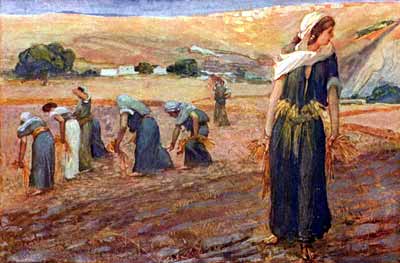
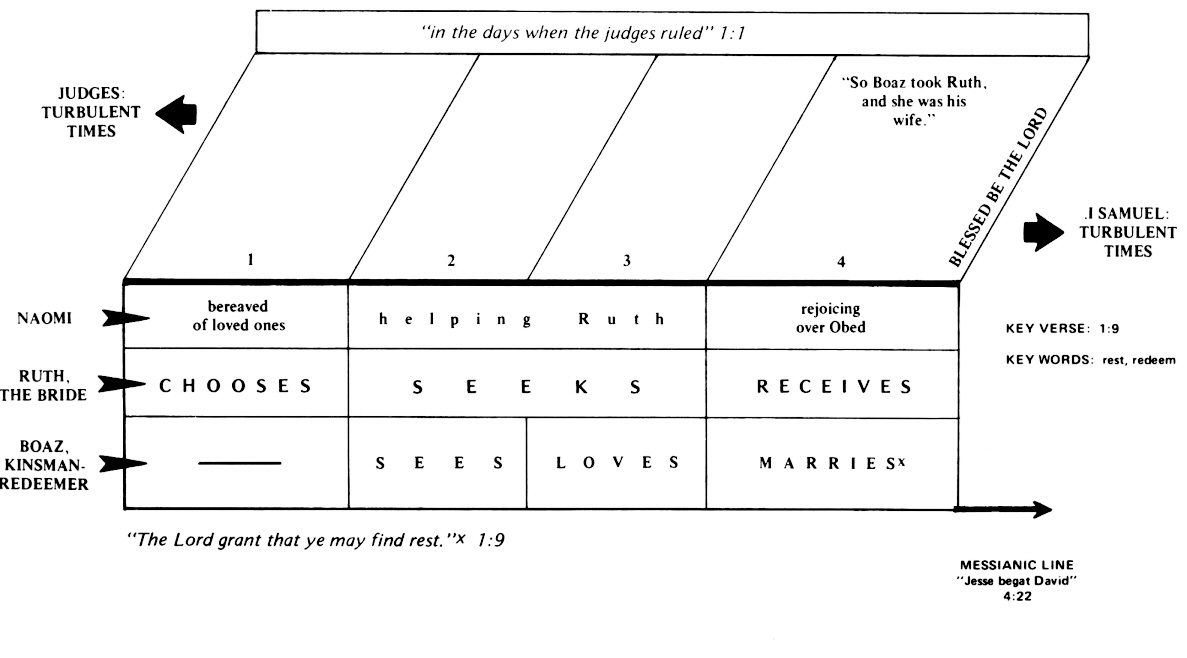
Irving Jensen's Survey of Bible (see his summary of Ruth online - page 392)
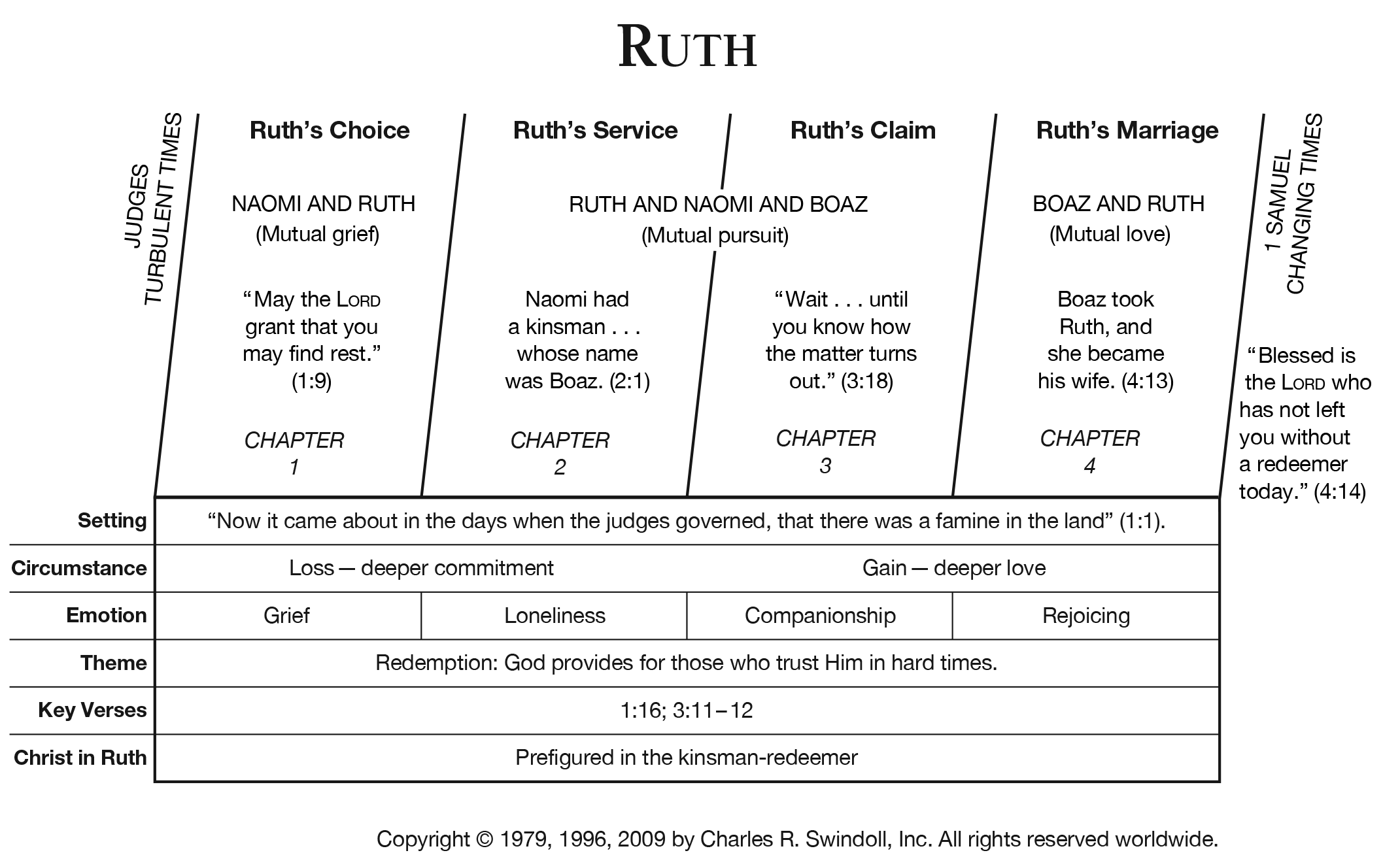
See Swindoll's summary chart of Ruth See Ruth Devotionals
|
RUTH: GOD PROVIDES |
|||
| Ruth 1 | Ruth 2 | Ruth 3 | Ruth 4 |
| Ruth's Choice | Ruth's Service | Ruth's Claim | Ruth's Marriage |
| Ruth's Resolve | Ruth's Rights | Ruth's Request | Ruth's Reward |
| Naomi and Ruth Mutual Grief |
Ruth and Naomi and Boaz Mutual Pursuit |
Boaz and Ruth Mutual Love |
|
| Ruth's Decision: Return with Naomi |
Ruth's Devotion: Provide for Naomi |
Ruth's Request: Redemption by Boaz |
Ruth's Reward: Relative of Messiah |
| Ruth and Naomi |
Ruth and Boaz |
||
| Death of Naomi's Family |
Ruth Cares for Naomi |
Boaz Cares for Ruth |
God Blesses with New Birth |
| Grief | Loneliness | Companionship | Rejoicing |
| Location: Plains of Moab |
Location: Fields of Bethlehem |
Location: Threshing floor of Bethlehem |
Location: Little town of Bethlehem |
| Time Lapsed: About 30 Years See Timeline |
|||
| Setting: Ru 1:1 Now it came about in the days when the judges governed Jdg 21:25+ In those days there was no king in Israel; everyone did what was right in his own eyes. |
|||
Ruth's Reward, 4:1-22
- A Husband, 4:1-12
- A Son, 4:13-17
- A Lineage, 4:18-22
Ryrie Study Bible
Ruth 4:11 All the people who were in the court, and the elders, said, "We are witnesses. May the LORD make the woman who is coming into your home like Rachel and Leah, both of whom built the house of Israel; and may you achieve wealth in Ephrathah and become famous * in Bethlehem. (NASB: Lockman)
Amplified: And all the people at the gate and the elders said, We are witnesses. May the Lord make the woman who is coming into your house like Rachel and Leah, the two who built the household of Israel. May you do worthily and get wealth (power) in Ephratah and be famous in Bethlehem. (Amplified Bible - Lockman)
CEV: The town leaders and the others standing there said: We are witnesses to this. And we pray that the LORD will give your wife many children, just as he did Leah and Rachel, the wives of Jacob. May you be a rich man in the tribe of Ephrath and an important man in Bethlehem. (CEV)
GWT: All the people who were at the gate, including the leaders, said, "We are witnesses. May the LORD make this wife, who is coming into your home, like Rachel and Leah, both of whom built our family of Israel. So show your strength of character in Ephrathah and make a name for yourself in Bethlehem. (GWT)
KJV: And all the people that were in the gate, and the elders, said, We are witnesses. The LORD make the woman that is come into thine house like Rachel and like Leah, which two did build the house of Israel: and do thou worthily in Ephratah, and be famous in Bethlehem:
NJB: All the people at the gate said, 'We are witnesses'; and the elders said, 'May Yahweh make the woman about to enter your family like Rachel and Leah who together built up the House of Israel. Grow mighty in Ephrathah, be renowned in Bethlehem! (NJB)
Young's Literal: And all the people who are in the gate say -- also the elders -- 'Witnesses! Jehovah make the woman who is coming in unto thy house as Rachel and as Leah, both of whom built the house of Israel; and do thou virtuously in Ephrathah, and proclaim the Name in Beth-Lehem;
Septuagint (LXX): kai eiposan (3PAAI) pas o laos oi en te pule martures kai oi presbuteroi eiposan (3PAAI) doe (3SAAO) kurios ten gunaika sou ten eisporeuomenen (PMPFSA) eis ton oikon sou os Rachel kai os Leian ai okodomesan (3PAAI) amphoterai ton oikon Israel kai epoiesan (3PAAI) dunamin en Ephratha kai estai onoma en Baithleem
Click here for explanation of verb parsing abbreviations in parentheses after each verb
English of Septuagint: And all the people who were in the gate said, We are witnesses: and the elders said, The Lord make thy wife who goes into thy house, as Rachel and as Lia, who both together built the house of Israel, and wrought mightily in Ephratha, and there shall be a name to thee in Bethleem
Listen to:
- J Vernon McGee -- Ruth 4:1.mp3
- J Vernon McGee -- Ruth 4:2-5.mp3
- J Vernon McGee -- Ruth 4:6-7.mp3
- J Vernon McGee -- Ruth 4:8-22.mp3
- John Piper -- Ruth 4 - The Best is Yet to Come.mp3
AND ALL THE PEOPLE WHO WERE IN THE COURT AND THE ELDERS SAID "WE ARE WITNESSES":
- Ruth 4 Resources - Multiple Sermons and Commentaries
Witnesses (05707) ('ed) refers to someone who will be accepted to bear a true testimony in various situations for various reasons.
Elders (02205) (zaqen related to zaqan = beard) has the basic meaning of old or aged. In this context zaqen describes those men in the city who were powerful and influential. In general, the elders functioned in both a political and judicial role. They would hear disputes, weigh the evidence and render a decision. As alluded to earlier, in the case of Boaz, they were functioning primarily as witnesses rather than as jurors.
Centuries later "Ten" became the number necessary for a Jewish marriage benediction or a quorum for a synagogue meeting.
Spurgeon - Ruth was highly privileged in having such a kinsman as Boaz, who was not content, for her to glean in his fields, but who took her as his wife; and your great Kinsman intends that you should be betrothed unto him forever, and He will bring you to His heavenly home at the marriage supper of the Lamb. (from his sermon "Job's Sure Knowledge")
MAY THE LORD MAKE THE WOMAN WHO IS COMING INTO YOUR HOME LIKE RACHEL AND LEAH BOTH OF WHOM BUILT THE HOUSE OF ISRAEL:
- Ge 24:60; Ps 127:3, 4, 5; 128:3, 4, 5, 6
- Ge 29:32, 33, 34, 35; 30:1-24; 35:16, 17, 18, 19, 20; 46:8-27; Nu 26:1-65
- Dt 25:9; Pr 14:1
PRAYER FOR…
FAVOR
FORTUNE
FAME
May the LORD make… - This is a prayer for blessing by the populace in general, which is amazing in view of the fact that these are the selfish days of the Judges (Jdg 21:25)
In recalling these famous Jewish mothers, the people's remembrance went back almost 900 years to about 1915 BC.
Rachel and Leah were the wives of Jacob. Rachel is named first and had been barren for many years before she bore children. Similarly Ruth had been barren in Moab. The witnesses expressed their prayer that Boaz would be rewarded with a family comparable to that of Jacob (or Israel), for in Israel children were considered a blessing and not a burden…
Psalm 127:3 Behold, children are a gift of the LORD; The fruit of the womb is a reward.
4 Like arrows in the hand of a warrior, So are the children of one's youth.
5 How blessed is the man whose quiver is full of them; They shall not be ashamed, When they speak with their enemies in the gate. (Ps 127:3, 4, 5).
Psalm 128:3 Your wife shall be like a fruitful vine, Within your house, Your children like olive plants Around your table.
4 Behold, for thus shall the man be blessed sho fears the LORD.
5 The LORD bless you from Zion, and may you see the prosperity of Jerusalem all the days of your life.
6 Indeed, may you see your children's children. Peace be upon Israel! (Ps 128:3, 4, 5, 6)
Why does it say Rachel and Leah built the house of Israel? Because they were Jacob's 2 wives and between them and their two handmaids they bore all of Jacob's sons. Little did they realize that from this union would issue Israel’s greatest kings including David and the Eternal King, the Lord Jesus Christ.
AND MAY YOU ACHIEVE WEALTH IN EPHRATHAH AND BECOME FAMOUS IN BETHLEHEM:
- Ru 1:2-note; Ge 35:16,19; Ps 132:6; Mic 5:2; Mt 2:6
- Ruth 4 Resources - Multiple Sermons and Commentaries
A prayer and a prophecy ultimately fulfilled in the Messiah (see Messianic Prophecies)…
"But as for you, Bethlehem Ephrathah, Too little to be among the clans of Judah, from you One (Messiah) will go forth for Me to be Ruler in Israel. His goings forth are from long ago, from the days of eternity (literally = "the days of old" a phrase used also in Is 63:9, 11; Amos 9:11; Mal. 3:4). (Messiah was to be brought forth as a baby in Bethlehem, but was also to have been "going forth" from eternity. Such an amazing prophecy sounds impossible, but was literally fulfilled when God became man, in divine incarnation in the person of Jesus Christ." (Mic 5:2)
'AND YOU, BETHLEHEM, LAND OF JUDAH, ARE BY NO MEANS LEAST AMONG THE LEADERS OF JUDAH; FOR OUT OF YOU SHALL COME FORTH A RULER (the Messiah), WHO WILL SHEPHERD MY PEOPLE ISRAEL.'" (Mt 2:6)
The use of the word Ephrathah is not without significance for the word means “fruitful.” The people wanted Ruth to be fruitful and famous and bring honor to their little town. It was the place where Rachel was buried (Ge35:19), but more importantly, it would be known as the place where Jesus Christ was born. Ephrathah (also spelled Ephrath and Ephrathah) was another name for Bethlehem.
Become famous - Literally means to "call a name" (qera' shem) expressing a wish for children who would be reckoned descendants of Boaz. Ultimately their offspring would receive "the name which is above every name" (Php 2:9).
Ruth 4:12 "Moreover, may your house be like the house of Perez whom Tamar bore to Judah, through the offspring which the LORD will give you by this young woman." (NASB: Lockman)
BBE: May your family be like the family of Perez, the son whom Tamar gave to Judah, from the offspring which the Lord may give you by this young woman.
CEV: May the children you have by this young woman make your family as famous as the family of Perez, the son of Tamar and Judah. (CEV)
GWT: Also, from the descendant whom the LORD will give you from this young woman, may your family become like the family of Perez, the son whom Tamar gave birth to for Judah." (GWT)
KJV: And let thy house be like the house of Pharez, whom Tamar bare unto Judah, of the seed which the LORD shall give thee of this young woman.
NJB: And through the children Yahweh will give you by this young woman, may your family be like the family of Perez, whom Tamar bore to Judah.' (NJB)
Young's Literal: and let thy house be as the house of Pharez (whom Tamar bare to Judah), of the seed which Jehovah doth give to thee of this young woman.'
Septuagint (LXX): kai genoito (3SAMO) o oikos sou os o oikos Phares on eteken (3PAAI) Tamar to Iouda ek tou spermatos ou dosei (3SFAI) kurios soi ek tes paidiskes tautes
English of Septuagint: And let thy house be as the house of Phares, whom Thamar bore to Juda, of the seed which the Lord shall give thee of this handmaid
MOREOVER, MAY YOUR HOUSE BE LIKE THE HOUSE OF PEREZ WHOM TAMAR BORE TO JUDAH:
- Ge 46:12; Nu 26:20, 21, 22) (Ge 38:29; 1Chr 2:4; Mt 1:3
- Ruth 4 Resources - Multiple Sermons and Commentaries
Little did they realize that from this union would issue Israel’s greatest kings including David and the Eternal King, the Messiah, the Lord Jesus Christ.
Why Perez? Probably because he like Obed was the offspring of a Levirate-like marriage similar to that of Ruth and Boaz. Tamar was a non-Israelite wife of Judah's son Er (Ge 38:6) who became a widow (Ge 38:7) and faced barrenness took into her own hands. She was refused levirate marriage to Judah's remaining son Shelah (Ge 38:14). Tamar then invoked deception, disguising herself as a harlot and enticing Judah into a sinful liaison which resulted in the birth of twin boys . Perez, the first born of the twins became the main ancestor of the Ephrathites and Bethlehemites. Tamar and Judah sinned when they acquired a child, but Ruth and Boaz acted righteously and God rewarded them. And yet all were in the line of the Greater Kinsman Redeemer.
Even though Perez was born under scandalous circumstances, his offspring became one of the most important clans in Judah (and one of the most godly men, Boaz!)
NET Bible note…
Perez is an appropriate comparison here, because (1) he was an ancestor of Boaz, (2) he was born to Tamar by a surrogate father (Judah) after the death of her husband (and refusal of the oldest brother to carry out the role of "levirate marriage"), and (3) he had an unbroken line of male descendants extending over several generations (Ru 4:18, 19, 20, 22, 22).
THROUGH THE OFFSPRING WHICH THE LORD SHALL GIVE YOU BY THIS YOUNG WOMAN:
- 1Sa 2:20
- Ruth 4 Resources - Multiple Sermons and Commentaries
Through the offspring - Through the seed. Fruchtenbaum notes that "The rabbinic interpretation sees this as messianic, as it is written in Psalm 89:36: His seed shall endure forever, And his throne as the sun before me."
Offspring (02233) (zera = seed) … Jehovah shall give" is testimony to the their understanding that…
children are a "gift of Jehovah. The fruit of the womb is a reward." (Ps 127:3)
Comment: A truth we have sadly forgotten in America.
Note that the offspring or firstborn would be considered the son of Mahlon and any additional sons born would legally be the offspring of Boaz. Moses explains that…
"And it shall be that the first-born whom she bears shall assume the name of his dead brother, that his name may not be blotted out from Israel." (Dt 25:6)
The LORD will give you - God's part. Ru 4:13 "Jehovah enabled her to conceive."
By this young woman - Man's (woman's) part in the divine orchestration.
Young woman (05291) (na'arah) a girl, a young woman or a maidservant. It was used to indicate a young girl who was marriageable as in Genesis, where Moses records Isaac's servant prayer for a wife for Isaac…
Now may it be that the girl (na'arah) to whom I say, 'Please let down your jar so that I may drink,' and who answers, 'Drink, and I will water your camels also';-- may she be the one whom Thou hast appointed for Thy servant Isaac; and by this I shall know that Thou hast shown lovingkindness to my master." (Genesis 24:14)
Ruth 4:13 So Boaz took Ruth, and she became his wife, and he went in to her. And the LORD enabled her to conceive, and she gave birth to a son. (NASB: Lockman)
BBE: So Boaz took Ruth and she became his wife; and he went in to her, and the Lord made her with child and she gave birth to a son.
CEV: Boaz married Ruth, and the LORD blessed her with a son. (CEV)
GWT: Then Boaz took Ruth home, and she became his wife. He slept with her, and the LORD gave her the ability to become pregnant. So she gave birth to a son. (GWT)
KJV: So Boaz took Ruth, and she was his wife: and when he went in unto her, the LORD gave her conception, and she bare a son.
NJB: So Boaz took Ruth and she became his wife. And when they came together, Yahweh made her conceive and she bore a son. (NJB)
Young's Literal: And Boaz taketh Ruth, and she becometh his wife, and he goeth in unto her, and Jehovah giveth to her conception, and she beareth a son.
Septuagint (LXX): kai elaben (3SAAI) Boos ten Routh kai egenete (3SAPI) auto eis gunaika kai eiselthen (3SAAI) pros auten kai edoken (3SAAI) aute kurios kuesin kai eteken (3SAAI) huion
English of Septuagint: And Booz took Ruth, and she became his wife, and he went in to her; and the Lord gave her conception, and she bore a son
SO BOAZ TOOK RUTH AND SHE BECAME HIS WIFE:
The events of at least nine months are described in one sentence of fifteen Hebrew words, including five verbs. We are given no details concerning the kind of marriage ceremony that united Boaz and Ruth. Neither are we told how much time elapsed between their marriage and the birth of their first son.
Ruth went from…
loneliness to love,
toil to rest
poverty to wealth
worry to assurance
despair to hope
And so did you and I the moment the Spirit swept us into the Kingdom of heaven by grace through faith in the satisfactory substitutionary sacrifice of our great Kinsman Redeemer, the Lord Jesus Christ.
She became his wife - Fruchtenbaum makes the point that "The ten years in Moab brought misery, but the few short weeks in Bethlehem brought blessing. Ruth’s social progression was now complete. First, she was a nochriyah, meaning a foreigner (Ru 2:10). Second, she was lower than a shiphah, a lower servant (Ru 2:13). Third, she was upgraded to an amah, a maidservant (Ru 3:9). Now, fourth, she became an iishah, a wife (Ru 4:13)" (Ariel's Bible commentary : The books of Judges and Ruth)
Ponder Paul's reminder to the Ephesian Gentiles
Therefore remember, that formerly you, the Gentiles in the flesh, who are called "Uncircumcision" by the so-called "Circumcision," which is performed in the flesh by human hands-- remember that you were at that time separate from Christ, excluded from the commonwealth of Israel, and strangers to the covenants of promise, having no hope and without God in the world.
But now in Christ Jesus you who formerly were far off have been brought near by the blood of Christ. For He Himself is our peace, who made both groups into one, and broke down the barrier of the dividing wall, by abolishing in His flesh the enmity, which is the Law of commandments contained in ordinances, that in Himself He might make the two into one new man, thus establishing peace, and might reconcile them both in one body to God through the cross, by it having put to death the enmity. AND HE CAME AND PREACHED PEACE TO YOU WHO WERE FAR AWAY, AND PEACE TO THOSE WHO WERE NEAR; for through Him we both have our access in one Spirit to the Father. So then you are no longer strangers and aliens, but you are fellow citizens with the saints, and are of God's household," (Eph 2:11-19)
AND HE WENT IN TO HER AND THE LORD ENABLED HER TO CONCEIVE AND SHE GAVE BIRTH TO A SON:
- Ruth 4:12; Ge 20:17,18; 21:1, 2, 3; 25:21; 29:31; 30:2,22,23; 33:5; 1 Sa1:27; 2:5; Ps 113:9; 127:3
- Ruth 4 Resources - Multiple Sermons and Commentaries
Went (0935) (bow) in to her -This phrase occurs 8x in the NAS in the Old Testament as a euphemism for sexual intercourse (Gen 29:23; 30:4; 38:2, 18; Jdg 16:1; Ru 4:13; 2Sa 12:24; Ezek 23:44).
The LORD enabled (05414) (nathan = to give) her". Literally the Hebrew reads "Jehovah gave her conception", which He did not give her for 10 years of marriage to Mahlon in Moab! Ruth went from barrenness to fruitfulness.
Moses gives a similar testimony to the faithfulness of God writing…
Now the LORD saw that Leah was unloved, and He opened her womb, but Rachel was barren. (Genesis 29:31)
Then God remembered Rachel, and God gave heed to her and opened her womb. (Genesis 30:22)
The gift of children was never taken for granted in Israel. The fact that Boaz and Ruth were able to raise up a son to the deceased Elimelech was evidence of God’s blessing. Ruth had been barren in Moab for the entire period of her marriage to Mahlon (Ru 1:4, 5-notes). Now her faithful obedience was rewarded as God gave her conception. The sojourn in Moab lasted at least 10 years (Ru 1:4-note). By contrast, within a few short weeks of their return to Bethlehem, Naomi and Ruth had experienced blessing that was rich and full.
God had been gracious to Ruth back in Moab by giving her the faith to trust Him and be saved. His grace continued when she moved to Bethlehem, for He guided her to the field of Boaz where Boaz fell in love with her. God’s grace continued at the town gate where the nearer kinsman rejected Ruth and Boaz purchased her. After the marriage, God poured out His grace on Ruth and Boaz by giving her conception and then by giving her the safe delivery of a son, whom they named Obed ( means “servant”).
Ruth 4:14 Then the women said to Naomi, "Blessed is the LORD who has not left you without a redeemer today, and may his name become famous in Israel. (NASB: Lockman)
BBE: And the women said to Naomi, A blessing on the Lord, who has not let you be this day without a near relation, and may his name be great in Israel.
CEV: After his birth, the women said to Naomi: Praise the LORD! Today he has given you a grandson to take care of you. We pray that the boy will grow up to be famous everywhere in Israel. (CEV)
GWT: The women said to Naomi, "Praise the LORD, who has remembered today to give you someone who will take care of you. The child's name will be famous in Israel. (GWT)
KJV: And the women said unto Naomi, Blessed be the LORD, which hath not left thee this day without a kinsman, that his name may be famous in Israel.
NJB: And the women said to Naomi, 'Blessed be Yahweh who has not left you today without anyone to redeem you. May his name be praised in Israel! (NJB)
Young's Literal: And the women say unto Naomi, 'Blessed is Jehovah who hath not let a redeemer cease to thee to-day, and his name is proclaimed in Israel,
Septuagint (LXX): kai eipan (3PAAI) ai gunaikes pros Noemin eulogetos kurios os ou kateluse (3SAAI) soi semeron ton agchistea kai kalesai (3SAAO) to onoma sou en Israel
English of Septuagint: And the woman said to Noemin, Blessed is the Lord, who has not suffered a redeemer to fail thee this day, even to make thy name famous in Israel
THEN THE WOMEN SAID TO NAOMI "BLESSED IS THE LORD WHO HAS NOT LEFT YOU WITHOUT A REDEEMER TODAY
- Lk 1:58; Ro 12:15; 1Cor 2:26
- Ge 29:35; Ps 34:1, 2, 3; 103:1,2; 1Th 5:18; 2Th 1:3
- Ge 24:27) (Ru 4:21,22; Ge 12:2; Is 11:1, 2, 3, 4; Mt 1:5, 6, 7, 8, 9, 10, 11, 12, 13, 14, 15, 16, 17, 18, 19, 20
- Ruth 4 Resources - Multiple Sermons and Commentaries
There was similar rejoicing when it was announced that Elizabeth was pregnant with John the Baptist…
And her neighbors and her relatives heard that the Lord had displayed His great mercy toward her; and they were rejoicing with her. (Lk 1:58)
These women are in a sense a picture what Paul was calling for in believers in Romans 12 when he wrote…
Rejoice with those who rejoice, and weep with those who weep. (Ro 12:15-note)
Blessed is the LORD - Praise should always be the first response when one perceives themselves or those around them to be the unworthy benefactors of the incomparable blessings of the only God Who is worthy to be praised (2Sa 22:4, Ps 18:3-note).
No fearing or doubting with Christ on our side,
We hope to die shouting, `The Lord will provide.'
In psalm 103 David offers a blessing to Jehovah (note especially verse 4 which could easily be applied to Naomi's spiritual trek from chapter 1 to chapter 4)…
Bless the LORD, O my soul;
And all that is within me, bless His holy name.
Bless the LORD, O my soul,
And forget none of His benefits;
Who pardons all your iniquities;
Who heals all your diseases;
Who redeems your life from the pit;
Who crowns you with lovingkindness and compassion;
Who satisfies your years with good things,
So that your youth is renewed like the eagle.
(Psalm 103:1, 2, 3, 4, 5-see note)
Bless (01288)(barak) means to endue with power for success, prosperity, fecundity, longevity, etc. One idea of the verb is to kneel down, be or go to a stance in which one is on the knees as contrasted with standing on the feet, a position can be a position of worship or humility. In this context barak means to speak words invoking divine favor w intent that the object will have favorable circumstances or state at a future time. The Lxx translates barak in this verse with eulogetos which means to be well spoken of or inherently worthy of praise.
Who has not left your without a redeemer today - This is the reason they offered praise to Jehovah.
Left (07673) (sabat) means to rest. The idea in the present context is that Jehovah has not ceased His work on Naomi's behalf to provide for her need. In other words, the people clearly see the hand of God in her life, Boaz's marriage to Ruth and the birth of Obed. To God be the glory.
Naomi again assumes center stage in the drama. What a contrast. In Ru 1:19 (note)
"the women said, "Is this Naomi?"
To which Naomi responded…
"Do not call me Naomi; call me Mara, for the Almighty has dealt very bitterly with me. "I went out full, but the LORD has brought me back empty. Why do you call me Naomi, since the LORD has witnessed against me and the Almighty has afflicted me?" (Ro 1:20, 21-note)
Naomi, the central figure in the opening chapter of the story, is the central figure again at its close. Jehovah has redeemed her life from the pit, crowned it with His lovingkindness and satisfied her years replacing her emptiness from bereavement with fulness and her former bitterness with unspeakable joy.
A redeemer (01350) (ga'al - see note) may refer to Boaz but most favor this as a reference to Obed. Why? Fruchtenbaum explains that the redeemer was Obed…
because he will be the one who will someday redeem the whole of Naomi’s possessions. As the son of Ruth, he was also the son of Naomi, and as such, would take away Naomi’s reproach of childlessness. Ruth was the only one who could raise up a son to inherit the estate of Elimelech, and so this son will comfort Naomi and tend to her in her old age and thereby become her true goel. This is the only time the term goel is used of a child, not of an adult. This is the child that Boaz promised would carry on the name of Elimelech and inherit his property. (Ibid)
Expositor's Bible Commentary adds that
Some scholars believe Boaz was the goel but most understand the child (Obed) to be the goel (Ru 4:15 supports this interpretation -- "may he also be to you a restorer of life"). It was the child who took away Naomi's reproach of childlessness and would take care of her in her old age. Those who insist that Boaz was the goel argue that he was consistently anticipated as the goel (Ru 2:20, 3;9, 3:12, 13, 4:10-see notes Ru 2:20; 3:9, 12-13; 4:10). Therefore it would be unusual for that responsibility now to be suddenly transferred to a baby. Reference to the child as Naomi's goel should be understood in the context as a blessing pronounced over the child, just as the men had previously prayed for blessing on Boaz (Ru 4:11)."(Gaebelein, F, Editor: Expositor's Bible Commentary OT 7 Volume Set: Books: Zondervan Publishing)
But in the prophetic context of all of Scripture, the application for Naomi and for every person ever born is to the Greater Seed of the Boaz, the Messiah, the Redeemer of all who would receive Him.
He came to His own, and those who were His own did not receive Him. But as many as received Him, to them He gave the right to become children of God, even to those who believe in His name, who were born not of blood, nor of the will of the flesh, nor of the will of man, but of God. (John 1:11, 12, 13)
AND MAY HIS NAME BECOME FAMOUS IN ISRAEL
- Ruth 4 Resources - Multiple Sermons and Commentaries
His name become famous - More literally "and his name is proclaimed (or called) in Israel"
Name (08034) (shem/sem) is the proper designation of a person. In Scripture one's name stood for and symbolized who the person was.
Famous (07121) (qara') means to call or to summon, but its context determines the writer's intended shade of meaning.
Their prayer that he might be famous throughout Israel is shown to have been answered in the genealogy of David who became Israel's most famous King and then of course the greater "Son of David", Christ Jesus - Ru 4:17-note
The New American Commentary explains that "to call/mention a person's name in a place means to “to keep the name/fame alive,” even after his death, and to perceive the person as living on in his descendants in the place named. In the previous context the men at the gate had applied the prayer to Boaz, with the desire that his name would live on in Bethlehem. But these women expand the scope of the go'el's fame beyond the walls of their town to the nation of Israel as a whole.
We can’t blame Naomi for her reaction in Ruth 1, for we all are prone to react in a similar way to adversity. We can all learn that God’s plan is perfect, and even when we can’t see clearly what He is doing and the circumstances may seem desperate, God still knows what He is doing! Learn that all things really do work together for good for those who love God, to those who are the called according to His purpose (Ro 8:28-note)
The women said to Naomi, “Blessed be the Lord, who has not left you this day without a close relative.” —Ruth 4:14
A wise person once said…
Never be quick to judge whether something is a blessing or a curse.
The story of Naomi reminds resonates with this aphorism.
The name Naomi means pleasant, but when bad things happened, Naomi sought to change her name to match her circumstances. Famine followed by three deaths led Naomi to conclude that “The hand of the Lord has gone out against me!” (Ru 1:13-note).
When people greeted her, she said
Do not call me Naomi; call me Mara, for the Almighty (EL Shaddai - God Almighty) has dealt very bitterly with me (Ru 1:20-note)
Rather than judge her circumstances in light of her identity as a follower of the covenant keeping God, Jehovah, who had promised His unfailing love to His people, Naomi did what most of us tend to do. She (at least to a degree) judged God in light of her circumstances. However when we judge God through the lens of our "present painful" circumstances, we seldom judge Him aright! In fact, Naomi had received a God-given treasure she had not yet discovered, a loyal, loving daughter-in-law (Ru 1:16) from whom would spring a grandchild who would be in the line of the long sought for Messiah. As Naomi’s life shows us, sometimes the worst thing that happens to us can open the door for the best that God has to give us.
Loving Father, help me not to judge Your love for me
on the basis of whether today brings good news
or bad. Help me remember that You desire to use
my circumstances to make me more like Jesus. Amen.
God’s purpose for today’s events may not be seen till tomorrow.
Ruth 4:15 "May he also be to you a restorer of life and a sustainer of your old age; for your daughter-in-law, who loves you and is better to you than seven sons, has given birth to him." (NASB: Lockman)
BBE: He will be a giver of new life to you, and your comforter when you are old, for your daughter-in-law, who, in her love for you, is better than seven sons, has given birth to him.
CEV: He will make you happy and take care of you in your old age, because he is the son of your daughter-in-law. And she loves you more than seven sons of your own would love you. (CEV)
GWT: He will bring you a new life and support you in your old age. Your daughter-in-law who loves you is better to you than seven sons, because she has given birth." (GWT)
KJV: And he shall be unto thee a restorer of thy life, and a nourisher of thine old age: for thy daughter in law, which loveth thee, which is better to thee than seven sons, hath borne him.
NJB: The child will be a comfort to you and the prop of your old age, for he has been born to the daughter-in-law who loves you and is more to you than seven sons.' (NJB)
Young's Literal: and he hath been to thee for a restorer of life, and for a nourisher of thine old age, for thy daughter-in-law who hath loved thee -- who is better to thee than seven sons -- hath borne him.'
Septuagint (LXX): kai estai (3SFMI) soi eis epistrephonta (PAPMSA) psuchen kai tou diathrepsai (AAN) ten polian sou hoti e numphe sou e agaphesasa (AAPFSN) se eteken (3SAAI) auton e estin (3SPAI) agathesoi huper hepta huious
English of Septuagint: And he shall be to thee a restorer of thy soul, and one to cherish thy old age; for thy daughter-in-law which has loved thee, who is better to thee than seven sons, has born him
MAY HE ALSO BE TO YOU A RESTORER OF LIFE AND A SUSTAINER OF YOUR OLD AG(Ge 45:11)
It is fascinating that this short book set in the selfish, sinful days of the Judges is nevertheless filled with benedictions and blessings of Israel’s people (Ru 1:8, 9 2:4, 12, 20, 3:10, 4:11, 12, 14, 15-see notes Ru 1:8-9; 2:4, 12, 20; 3:10; 4:11-12, 14-15). God always has a remnant (see note) of genuine believers no matter how dark the day.
JEHOVAH OUR RESTORER
This benediction or prayer is that Obed might be a "Restorer" of life to Naomi. Note the same idiom “life returns,” is found in 1Ki 17:21, 22.
A restorer of life - This phrase presents a striking contrast to he return to Bethlehem empty (Ru 1:21). Obed would be Naomi's hope for life because through the seed of Obed Naomi would be assured that Elimelech's line would not become extinct.
Restorer (07725) is the Hebrew verb shub/sub which conveys the basic meaning of movement back to point of departure. To turn, return, go back, do again, restore. Shub is a "key word (note)" in Ruth occurring 13 times in only 4 chapters, especially in Ruth 1 (Ruth 1:6, 7, 8, 10, 11, 12, 15, 16, 21, 22, 2:6, 4:3, 15). Naomi "returned" to where she began and was "restored" with far more than she could have ever even ask for in terms of time and eternity. The women were expressing their desire that with the birth of this lad Naomi will find new hope for life and that her spirit would be revived. God's blessings have a way of bringing about revival to our spirits, do they not beloved?
David uses the same verb shuwb in Psalm 19 describing the restorative (reviving Ps 119:25) power of the Word of God, the Law of Jehovah…
The law of the LORD is perfect, restoring the soul. (Ps 19:7)
Spurgeon comments: Making the man to be returned or restored to the place from which sin had cast him. The practical effect of the Word of God is to turn the man to himself, to his God, and to holiness; and the turn or conversion is not outward alone, "the soul" is moved and renewed. The great means of the conversion of sinners is the Word of God, and the more closely we keep to it in our ministry the more likely we are to be successful. It is God's Word rather than man's comment on God's Word which is made mighty with souls. When the law drives and the gospel draws, the action is different but the end is one, for by God's Spirit the soul is made to yield, and cries, "Turn me, and I shall be turned." Try men's depraved nature with philosophy and reasoning, and it laughs your efforts to scorn, but the Word of God soon works a transformation.
In Psalm 23:3 we read…
He restores my soul; He guides me in the paths of righteousness For His name's sake.
Spurgeon comments: He restores my soul. When the soul grows sorrowful He revives it; when it is sinful He sanctifies it; when it is weak He strengthens it. "He" does it. His ministers could not do it if He did not. His Word would not avail by itself. "He restores my soul."
Are any of us low in grace?
Do we feel that our spirituality is at its lowest ebb?
He Who turns the ebb into the flood can soon restore our soul. Pray to Him, then, for the blessing --
"Restore thou me,
thou Shepherd of my soul!"
JEHOVAH
OUR SUSTAINER
Sustainer of old age - A nourisher of your old age. More literally "sustainer of your gray hair", clearly a euphemism for old age.
New American Commentary - The perceptiveness of the women to recognize in the birth of this child the guarantee of Naomi's future well-being is remarkable! She who had been so concerned about the security of her daughter-in-law is now rewarded in kind.
Sustainer (03557) (kul) means to primarily to hold, "to contain as does a vessel". In the present context it takes on the meaning of provide or supply, giving sustenance necessary for physical survival such as food and water, and in this verse probably also speaking of the deepest needs, the needs of one's soul.
Kul - 36x in the OT - Ge 45:11 (provide); Ge 47:12; 50:21; Ruth 4:15; 2 Sam 19:32f; 20:3; 1 Kgs 4:7, 27; 7:26, 38; 8:27, 64; 17:4, 9; 18:4, 13; 20:27; 2 Chr 2:6; 4:5; 6:18; 7:7; Neh 9:21; Ps 55:22; 112:5; Prov 18:14; Isa 40:12; Jer 2:13; 6:11; 10:10; 20:9; Ezek 23:32; Joel 2:11; Amos 7:10; Zech 11:16; Mal 3:2. NAS = calculated(1), contain(4), contains(1), endure(5), had to provide(1), held(1), hold(4), holding(2), maintain(1), provide(4), provided(6), provided them with sustenance(1), provisioned(1), sustain(3), sustained(1), sustainer(1).
Notice the word kul is used in Ge 50:21 describing Joseph's promise to "provide" (nourish, sustain) for his brothers and their children during the remaining years of the famine.
Ultimately God would be Naomi's Restorer even as He is to all who are willing to
Cast (their) burden upon the LORD" (for) "He will sustain (kul) you. He will never allow the righteous to be shaken. (Ps 55:22)
Spurgeon - Thy burden, or what thy God lays upon thee, lay thou it upon the Lord. His wisdom casts it on thee, it is thy wisdom to cast it on him. He cast thy lot for thee, cast thy lot on him. He gives thee thy portion of suffering, accept it with cheerful resignation, and then take it back to him by thine assured confidence.
He shall sustain thee. Thy bread shall be given thee, thy waters shall be sure. Abundant nourishment shall fit thee to bear all thy labours and trials. As thy days so shall thy strength be.
He shall never suffer the righteous to be moved. He may move like the boughs of a tree in the tempest, but he shall never be moved like a tree torn up by the roots. He stands firm who stands in God. Many would destroy the saints, but God has not suffered it, and never will. Like pillars, the godly stand immoveable, to the glory of the Great Architect.
J. M. Neale's Commentary. - Cast thy burden upon him in the same way that the ship in a storm casts her burden on the anchor, which anchor holds on to its sure fixing place. And to my mind, that is the more beautiful sense of the two -- a sense which once entered into, may be followed out in these glorious verses: --
And I see the good ship riding, all in a perilous road; The low reef booming on her lee; the swell of ocean poured Sea after sea, from stem to stern; the mainmast by the board; The bulwarks down; the rudder gone; the boats stove by the chains. But courage still, brave mariners, the ANCHOR yet remains: And he will flinch -- no, never an inch - - until ye pitch sky high; Then he moves his head, as if he said, "Fear nought; for here am I!"
Kul - Can mean "make provision" - God will make a way when there seems to be no other way (Amen).
Edward Everett Hale (1822-1909), former US Senate chaplain: Never attempt to bear more than one kind of trouble at once. Some people bear three kinds--all they have had, all they have now, and all they expect to have.
FOR YOUR DAUGHTER-IN-LAW WHO LOVES YOU AND IS BETTER TO YOU THAN SEVEN SONS:
- Ru 1:16, 17, 18-see notes
- 1Sa 1:8 = "ten sons"; Pr 18:24
- Ruth 4 Resources - Multiple Sermons and Commentaries
This is an amazing affirmation of the character of Ruth, the women placing more value on Ruth than seven sons in a culture that placed tremendous value on even a single male offspring! It would have been enough to say that Ruth was better than one son in the ancient Near East. But better than seven sons! A family with seven sons would have been viewed as the recipient of an extraordinary measure of blessing from Jehovah. All Bethlehem knew she was a noble woman (Ru 3:11), but these women place her value above seven sons; what extraordinary compensation for the two sons Naomi had lost! And so you can see how esteemed Ruth the Moabitess had become among the Jewish women.
Loves (0157)(ahab) means to have an affection based on a close relationship, sometimes in comparison to other persons with a lesser relationship (first use in Ge 22:2) of the love God calls for from His people (Dt 6:5). This is the only use of the word 'ahab in Ruth, but this book is replete with "love in action"! Ruth's loyalty and selflessness on behalf of her mother-in-law demonstrate clearly that love is far more than an emotion, but just as importantly (probably more so) involves one's actions toward or on behalf of another person (the one who is "loved").
Baker - The semantic range of the verb includes loving or liking objects and things such as bribes (Isa. 1:23); wisdom (Prov. 4:6); wine (Prov. 21:17); peace, truth (Zech. 8:19); or tasty food (Gen. 27:4, 9, 14). The word also conveys love for other people (Gen. 29:32; Ruth 4:15; 1 Ki. 11:1); love for God (Ex. 20:6; Ps. 116:1); and also God's love of people (Deut. 4:37; 1 Ki. 10:9; Hos. 3:1). (The Complete Word Study Dictionary – Old Testament)
Vine on ahab - Basically this verb is equivalent to the English "to love" in the sense of having a strong emotional attachment to and desire either to possess or to be in the presence of the object. First, the word refers to the love a man has for a woman and a woman for a man. Such love is rooted in sexual desire, although as a rule it is desire within the bounds of lawful relationships: "Then Isaac brought her into his mother Sarah’s tent, and he took Rebekah, and she became his wife, and he loved her" (Ge 24:67). This word may refer to an erotic but legal love outside marriage. Such an emotion may be a desire to marry and care for the object of that love, as in the case of Shechem's love for Dinah (Ge 34:3). In a very few instances ʾāhab may signify no more than pure lust, an inordinate desire to have sexual relations with its object (cf. 2 Sa 13:1). Marriage may be consummated without the presence of love for one's marriage partner (Ge 29:30). ʾĀhab seldom refers to making love (usually this is represented by yādaʿ, "to know," or by shākab, "to lie with"). The word does seem to have this added meaning, however, in 1 Ki 11:1 (cf. Jer. 2:25). Hosea appears to use this nuance when he writes that God told him to "Go again, love a woman who is loved by her husband, yet an adulteress" (Hos. 3:1). This is the predominant meaning of the verb when it appears in the causative stem (as a participle). In every instance except one (Zech. 13:6) ʾāhab signifies those with whom one has made or intends to make love: "Go up to Lebanon, and cry; and lift up thy voice in Bashan, and cry from the passages: for all thy lovers are destroyed" (Jer. 22:20; cf. Ezek. 16:33). Āhab is also used of the love between parents and their children. In its first biblical appearance, the word represents Abraham's special attachment to his son Isaac: "Take now your son, your only son, whom you love, Isaac" (Ge 22:2). ʾĀhab may refer to the family love experienced by a daughter-in-law toward her mother-in-law (Ruth 4:15). This kind of love is also represented by the word rāḥam. (Vine's Expository Dictionary of Old Testament and New Testament Words)
Ahab - 217x in 202x - beloved(1), dearly love(1), friend(5), friends(6), love(88), loved(53), lover(1), lovers(16), loves(42), loving(2), show your love(1), shows love(1).
Ge 22:2; 24:67; 25:28; 27:4, 9, 14; 29:18, 30, 32; 34:3; 37:3, 4; 44:20; Ex 20:6; 21:5; Lv 19:18, 34; Dt 4:37; 5:10; 6:5; 7:8, 9, 13; 10:12, 15, 18, 19; 11:1, 13, 22; 13:3; 15:16; 19:9; 21:15, 16; 23:5; 30:6, 16, 20; Josh 22:5; 23:11; Jdg 5:31; 14:16; 16:4, 15; Ru 4:15; 1Sa 1:5; 16:21; 18:1, 3, 16, 20, 22, 28; 20:17; 2Sa 1:23; 12:24; 13:1, 4, 15; 19:6; 1Kgs 3:3; 5:1; 10:9; 11:1,2; 2Chr 2:11; 9:8; 11:21; 19:2; 20:7; 26:10; Neh 1:5; 13:26; Esth 2:17; 5:10, 14; 6:13; Job 19:19; Ps 4:2; 5:11; 11:5, 7; 26:8; 31:23; 33:5; 34:12; 37:28; 38:11; 40:16; 45:7; 47:4; 52:3, 4; 69:36; 70:4; 78:68; 87:2; 88:18; 97:10; 99:4; 109:17; 116:1; 119:47, 48, 97, 113, 119, 127, 132, 140, 159, 163, 165, 167; 122:6; 145:20; 146:8; Pr 1:22; 3:12; 4:6; 8:17, 21, 36; 9:8; 12:1; 13:24; 14:20; 15:9, 12; 16:13; 17:17, 19; 18:21, 24; 19:8; 20:13; 21:17; 22:11; 27:6; 29:3; Eccl 3:8; 5:10; 9:9; Song 1:3, 4, 7; 3:1, 2, 3; Isa 1:23; 41:8; 43:4; 48:14; 56:6, 10; 57:8; 61:8; 66:10; Je 2:25; 5:31; 8:2; 14:10; 20:4, 6; 22:20, 22; 30:14; 31:3; La 1:2, 19; Ezek 16:33, 36, 37; 23:5, 9, 22; Da 9:4; Ho 2:5, 7, 10, 12, 13; 3:1; 4:18; 9:1, 10, 15; 10:11; 11:1; 12:7; 14:4; Am 4:5; 5:15; Mic 3:2; 6:8; Zec 8:17, 19; 13:6; Mal 1:2; 2:11.
It is notable that none of these verses speak of love of children to parents, for children are call to honor, revere and obey their parents (surely manifestations of their love for them, cp Jn 14:15).
New American Commentary astutely observes that…
the women's last statement is the most remarkable of all. In the beginning Naomi had bitterly accused God of emptying her life by robbing her of her husband and her two sons (Ru 1:21). But now the women console her: she may have lost her sons, but she has gained a daughter-in-law. And what a daughter-in-law Ruth is!
First, Ruth loves Naomi. In fact, in her action we observe one of the most dramatic demonstrations of the meaning of the Hebrew word for “love,” 'ahab (0157). Whereas modern definitions of love tend to view the word as an emotional term, in the Old Testament love is fundamentally an expression of covenant commitment, the kind of devotion to which Ruth had given such eloquent verbal expression in Ru 1:16, 17. But “love” is not demonstrated primarily in words; it is expressed in acts of ḥesed, placing the welfare of the other ahead of oneself (Ru 3:10-note).
In fact, more than anyone else in the history of Israel, Ruth embodies the fundamental principle of the nation's ethic:
“You shall love your God with all your heart” (Deut 6:5)
“and your neighbor as yourself” (Lev 19:18).
In Lev 19:34 Moses instructs the Israelites to love the stranger as they love themselves. Ironically, it is this stranger from Moab who shows the Israelites what this means. Here the verb means “to be helpful to, to assist, to serve,” hence to love is “to be helpful to someone.”
Second, Ruth has given birth to the go'el. On the surface this may not seem so remarkable, but when one considers that she had been married to Mahlon for ten years but had borne no children for him, the significance of the statement becomes evident. The barren womb has been opened.
Third, Ruth is better for Naomi than seven sons. The reference to “seven sons” is conventional, reflecting the ancient Israelite view that the ideal family consisted of seven sons. Cf. 1Sa 2:5; Job 1:2; 42:13; 2Macc 7; Acts 19:14, 15, 16, 17. (Daniel Block: The New American Commentary- Judges, Ruth)
Better than seven sons - This "accolade" coming from Jewish women is quite extraordinary considering the fact that Ruth was (1) a foreigner and (2) a woman in a society which clearly placed a premium on sons. Indeed Ruth was a woman of excellence (Ru 3:11) in every respect.
Although, interpretation of numbers in Scripture is fraught with danger, it is fair to say that in general seven in Scripture represents a number associated with perfection, fullness or completion.
We read for example of full retribution Moses recording that…
whoever kills Cain, vengeance will be taken on him sevenfold (07659). (Ge 4:15).
In a similar usage the psalmist prays
O Lord, take sevenfold (07659) vengeance on our neighbors for the scorn they have hurled at you. (Psalm 79:12NLT)
Solomon records that…
when he (a thief) is found, he must repay sevenfold (07659) (Pr 6:31)
On a more positive note David invokes seven in a description of the perfection of God's Word declaring that…
The words of the LORD are pure words. As silver tried in a furnace on the earth, refined seven times.(07659)" (Ps 12:6)
Isaiah in describing the inception of the 1000 year Messianic Kingdom (The Millennium) declares that
the light of the moon will be as the light of the sun, and the light of the sun will be seven times brighter, like the light of seven days, on the day (what "day"? in context the 7 fold brightness could be a reference to Messiah's second coming with power and great glory! Read the following verse - Is 30:27) the LORD binds up the fracture of His people (of the Jewish remnant (see note) who will be saved when Messiah returns) and heals the bruise He has inflicted." (Is 30:26)
The writer's point is that Ruth is indeed a woman of excellence (Ru 3:11-note) who even exceeds this high Hebrew standard… high praise indeed! And also marking a somewhat ironic refutation of Naomi's earlier lament…
I went out full, but the LORD has brought me back empty (no husband, no sons). Why do you call me Naomi, since the LORD has witnessed against me and the Almighty has afflicted me? (Ru 1:21-note)
Naomi's perspective was skewed. She saw men (and the loss three of them) as emptiness of such degree that the presence of one Moabite daughter-in-law held no particular hope or consolation in a patriarchal society (a male dominated society marked by the supremacy of the father). Naomi (at least in Ruth 1) could not see how this poor little Moabitess could compensate for her loss of one husband and two sons. And yet in climatic section we see the triumphant testimony that Ruth's presence and progeny was more than sufficient for Naomi (cp 2Co 12:9-note, Eph 3:20-note) Remember this assessment is by the same women who in chapter one asked in amazement and shock "Is this Naomi?" (Ru 1:19-note) God's provision does not always take the form we expect and in fact can even be present even though we fail to recognize it (just as Naomi failed to recognize His provision of Ruth the Moabitess!).
Oh God, for the sake of Thy great Name, open our eyes that we might
know what is the hope of Your calling, what are the riches of the glory of Your inheritance in us Your saints and what is the surpassing greatness of Your power toward us who believe." (Ep 1:18, 19-note)
Ruth 4:16 Then Naomi took the child and laid him in her lap, and became his nurse. (NASB: Lockman)
BBE: And Naomi took the child and put her arms round it, and she took care of it.
CEV: Naomi loved the boy and took good care of him. (CEV)
GWT: Naomi took the child, held him on her lap, and became his guardian. (GWT)
KJV: And Naomi took the child, and laid it in her bosom, and became nurse unto it.
NJB: And Naomi, taking the child, held him to her breast; and she it was who looked after him. (NJB)
Young's Literal: And Naomi taketh the lad, and layeth him in her bosom, and is to him for a nurse;
Septuagint (LXX): kai elaben (3SAAI) Noemin to paidion kai etheken (3SAAI) eis ton kolpon autes kai egenethe (3SAPI) auto eis tithenon
English of Septuagint: And Noemin took the child and laid it in her bosom, and became a nurse to it
THEN NAOMI TOOK THE CHILD AND LAID HIM IN HER LAP AND BECAME HIS NURSE:
 Ruth 4 Resources - Multiple Sermons and Commentaries


This conclusion of the narrative contrasts beautifully with its introduction (Ruth 1:1-5). Deep sorrow turned to radiant joy and emptiness giving way to fullness.
Laid him in her lap - Placed him in her bosom (eg Nu 11:12), which describes the an action as when one embraces a loved one. And thus the Hebrew word "lap" (cheyq) refers to one's bosom and is used figuratively to describe one who is cherished (eg, see Dt 28:56NAS and Dt 28:56KJV = "the husband of her bosom"). The word is applied to both males (Dt 13:7; 28:54; 1 Ki1:2; Je 32:18; Mic 7:5; Eccl 7:9) and females (Dt 28:56; Pr 5:2; La 2:12)
Became his nurse (transliterated - wattehi lo le omenet) - Literally "is to him for a nurse" or "became his nanny".
Nurse (0539) ('aman transliterated 'omenet) is the verb meaning to be firm and thus in this context conveys the idea of providing stability and confidence, as a baby would find in the arms of a parent (see note below). It speaks of nurture, nourishment and caring for a child as would a guardian or a nurse. The Septuagint translates 'aman with the Greek adjective tithemos, which means nursing and describes one who takes care, as a foster parent (eg, used literally this way in 2Sa 4:4 and figuratively in Is 49:23)
Block explains that…
The verb ’omenet derives from a root ’aman, “to be firm.” Here the expression denotes a guardian, “nanny” in the true sense (assuming “nanny” to be an affectionate diminutive expression for Grandmother/Grandma). The present action obviously has nothing to do with wet-nursing; nor should it be viewed as some sort of adoption ritual. Not only would there be no need for a grandmother to adopt a child legally, but it is not clear that women in the ancient world were in a position to adopt children. Within this family context these are not legal actions but the loving, natural actions of a grandmother, gratefully accepting her new status and tenderly receiving the baby.
Within the context of the book, however, the action is much more significant. The image of this woman taking the child in her arms must also be seen against the backdrop of her previous experience. She had not only had her bread basket emptied by famine; in the deaths of her husband and sons her bosom had also been emptied of her men (Daniel Block: The New American Commentary- Judges, Ruth) (Bolding added for emphasis)