Titus 1:2
Titus 1:3
Titus 1:4
Titus 1:5
Titus 1:6
Titus 1:7
Titus 1:8
Titus 1:9
Titus 1:10
Titus 1:11
Titus 1:12
Titus 1:13
Titus 1:14
Titus 1:15
Titus 1:16
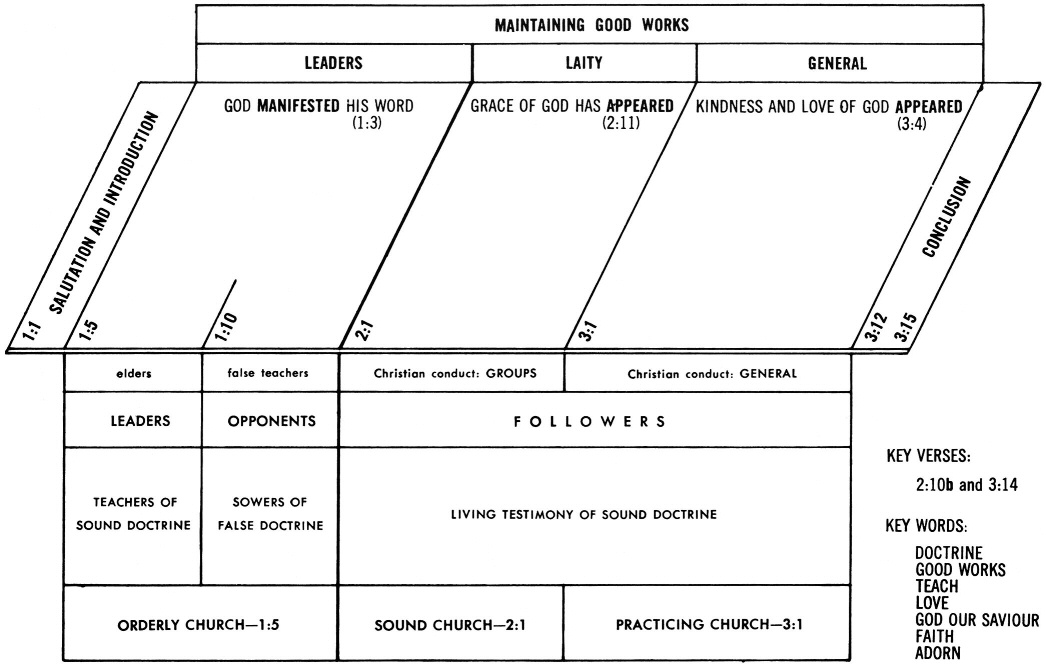
ADORNING THE DOCTRINE OF GOD
Click chart to enlarge
Charts from Jensen's Survey of the NT - used by permission
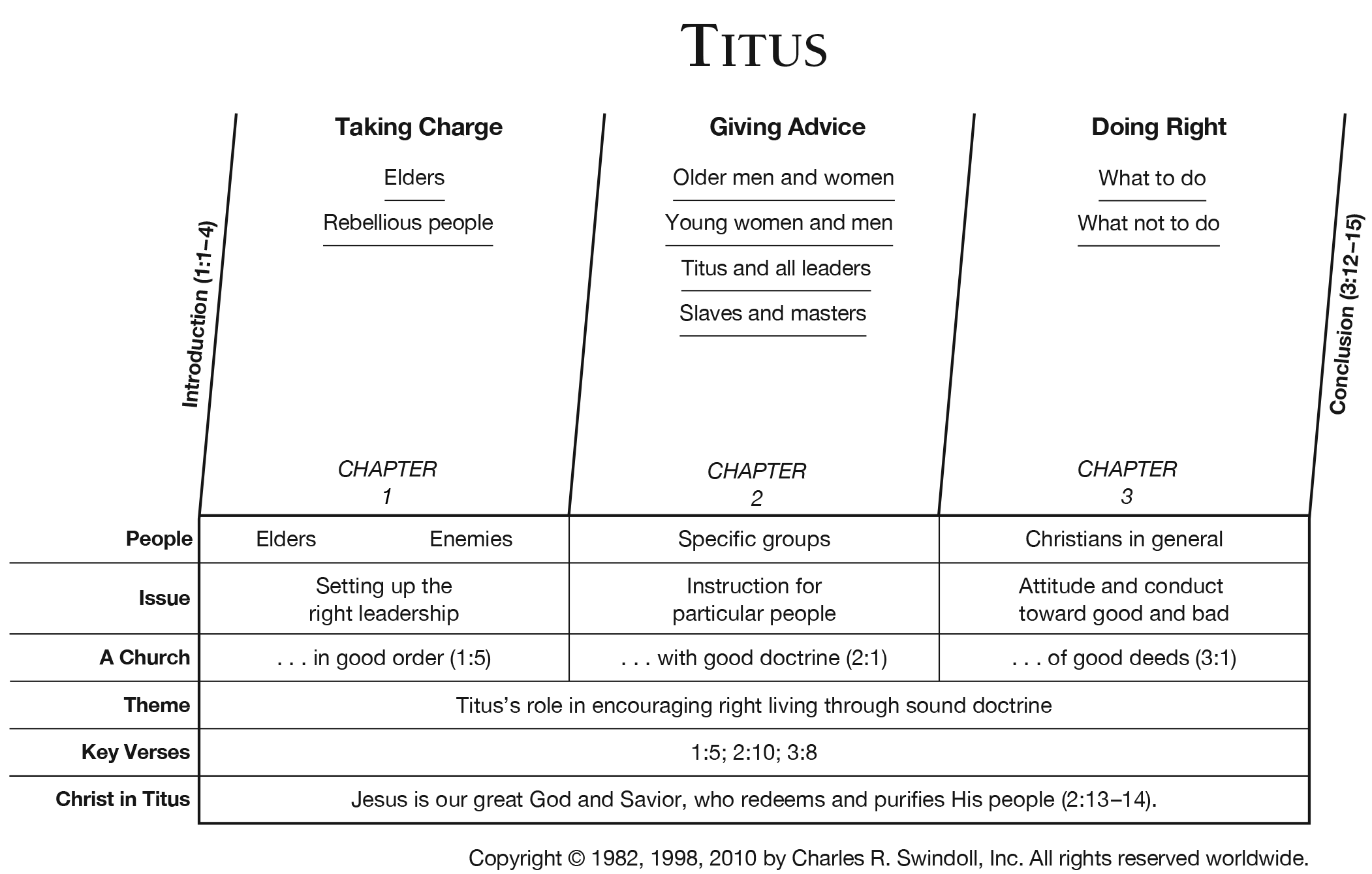
See Summary Chart by Charles Swindoll
Chart below from Michael J. Penfold
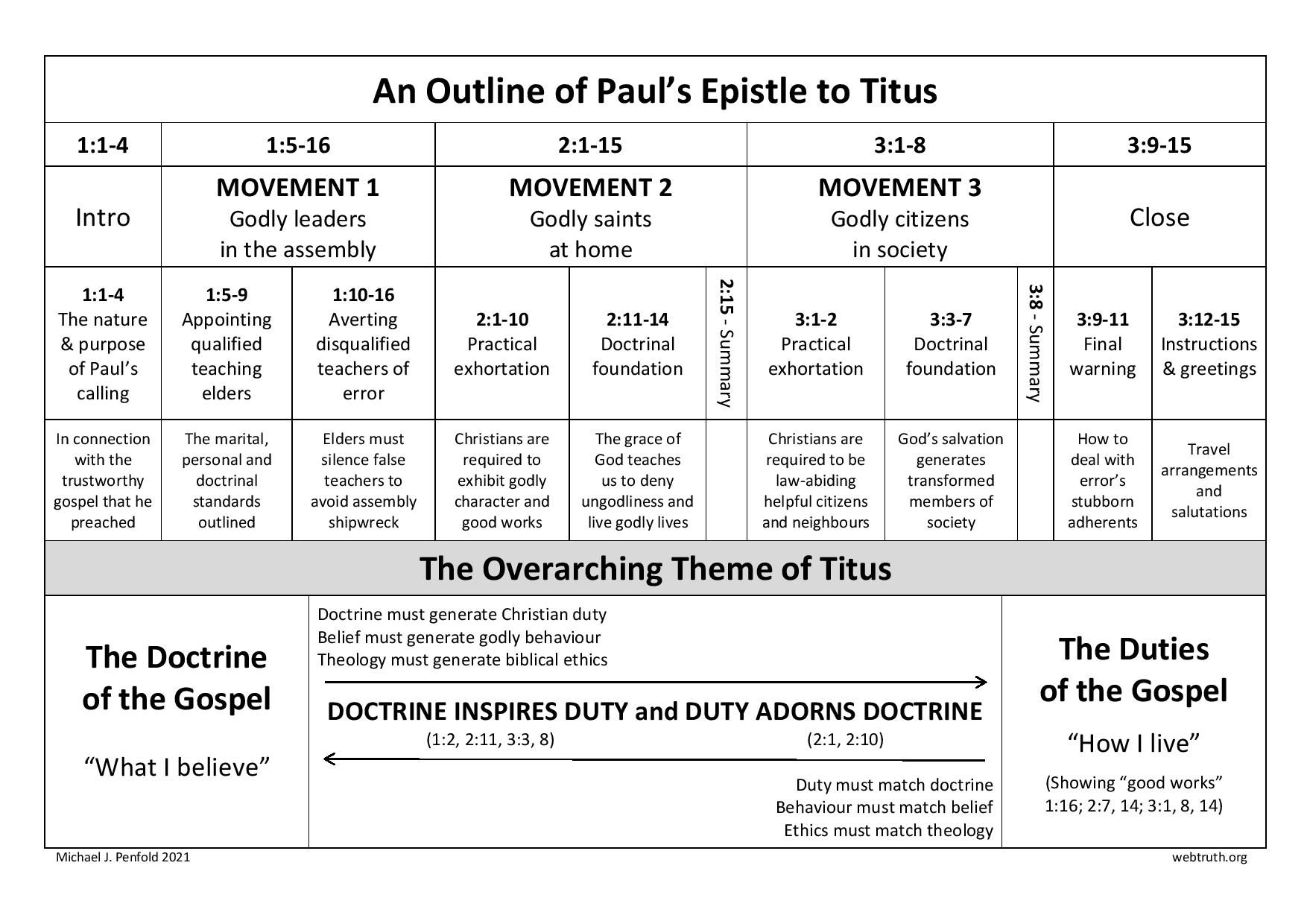
|
Focus |
Appoint Elders |
|||
|
Divisions |
Ordain |
Rebuke |
Maintain |
|
|
Topics |
||||
|
Topics |
Organization |
Offenders |
Operation |
|
|
Place |
Probably Written from either Corinth or Nicopolis (cf. Titus 3:12). |
|||
|
Time |
Circa 63 AD |
|||
|
Modified from Talk Thru the Bible |
||||
Titus 1:16 They profess (3PPAI) to know (RAN) God, but by their deeds they deny (3PPMI) Him, being (PAPMPN) detestable and disobedient and worthless for any good deed. (NASB: Lockman)
Greek: theon homologousin (3PPAI) eidenai, (RAN) tois de ergois arnountai, (3PPMI) bdeluktoi ontes (PAPMPN) kai apeitheis kai pros pan ergon agathon adokimoi
Amplified: They profess to know God [to recognize, perceive, and be acquainted with Him], but deny and disown and renounce Him by what they do; they are detestable and loathsome, unbelieving and disobedient and disloyal and rebellious, and [they are] unfit and worthless for good work (deed or enterprise) of any kind. (Amplified Bible - Lockman)
Barclay: They profess to know God, but they deny their profession by their deeds, because they are repulsive and disobedient and useless for any good work. (Westminster Press)
BBE: They say that they have knowledge of God, while by their acts they are turning their backs on him; they are hated by all, hard-hearted, and judged to be without value for any good work.
KJV: They profess that they know God; but in works they deny him, being abominable, and disobedient, and unto every good work reprobate.
Phillips: They profess to know God, but their actual behaviour denies their profession, for they are obviously vile and rebellious and when it comes to doing any real good they are palpable frauds. (Phillips: Touchstone)
TLB: Such persons claim they know God, but from seeing the way they act, one knows they don’t. They are rotten and disobedient, worthless so far as doing anything good is concerned
Wuest: God they confess that they know but in their works they deny, being abominable and nonpersuasible, and with reference to every good work, disapproved.
Young's Literal: God they profess to know, and in the works they deny Him, being abominable, and disobedient, and unto every good work disapproved.
THEY PROFESS TO KNOW GOD: theon homologousin (3PPAI) eidenai (RAN):
- Nu 24:16; Isa 29:13; 48:1; 58:2; Ezek 33:31; Hos 8:2; 8:3 Ro 2:18, 19, 20, 21, 22, 23, 24; 2Ti 3:5, 3:6, 3:7, 3:8; Jude 1:4
- Titus 1 Resources - Multiple Sermons and Commentaries
"God, they confess that they know" (Wuest),
"Such persons claim they know God" (TLB), "
They profess to know God [to recognize, perceive, and be acquainted with Him]" (Amp)
"They say that they have knowledge of God (BBE)
They profess (3670) (homologeo from homo = same + lego = say) means literally to say the same and so to agree in one's statement. These men admitted openly, freely and continually (present tense = continuous action) that they know God. The continually make a profession acknowledging God. Paul does not deny that they have a theoretical knowledge of God but he does deny that they practically know Him as their Father. They would continually confess ''Jesus is my Lord & I know Him'' but their deeds give them away and reveal their heart. Like the demons (Js 2:19) these men know (possess an intellectual or head knowledge) that He is Lord but they do not really possess saving faith. Their head knowledge has resulted in no change in their heart (it is still "uncircumcised"). Their will is still their own and not His will.
Saving faith is not just intellectual knowledge or mental assent to truth but is also a firm conviction, a surrender to that truth and a conduct emanating from and concordant with that surrender. In short, faith shows itself genuine by a changed life. Only God, of course, can evaluate a person’s heart. But by the way they live, unbelievers usually betray their unbelief and such was the case with these false teachers in the church at Crete.
Matthew Henry comments that "There are many who in word and tongue profess to know God, and yet in their lives and conversations deny and reject him; their practice is a contradiction to their profession.
The Lord speaking through Isaiah described rebellious Israel as a "people draw near with their words and honor Me with their lip service, but they remove their hearts far from Me, and their reverence for Me consists of tradition learned by rote. (Isa 29:13)
And later Jehovah said "Hear this, O house of Jacob, who are named Israel and who came forth from the loins of Judah, who swear by the name of the LORD and invoke the God of Israel, but not in truth nor in righteousness. (Isa 48:1)
To know (1492) (eido) means to intuitively know Him and is a knowing that can only come as a result of God revealing Himself to us. These men claim that at some point in their life they prayed a prayer, walked an aisle, professed to receive Him as Savior. Their deeds however show that they deny God and are in "grave" danger (pun intended) of everlasting damnation in the Lake of Fire.
To think that one intuitively knows (which is the picture the verb eido conveys) God when they really don't is deception of the highest and most tragic degree. It also produces a mindset in the deceived person that is very difficult to reason with. Why? Because they really do believe that they are saved from the wrath to come.
Jamieson, Fausset and Brown write that these fakes "make a profession acknowledging God. He does not deny their theoretical knowledge of God, but that they practically know Him" and they deny him "the opposite of the previous "profess" or "confess" Him.
Thomas Watson = Some brag they have good hearts, but their lives are crooked. They hope to go to heaven, but "their steps take hold of hell," Proverbs 5:5. An upright Christian sets a crown of honor upon the head of religion, he does not only profess the gospel, but adorns it (cp Titus 2:10)—he labors to walk so regularly and holily, that if we could suppose the Bible to be lost, it might be found again in his life. (The Upright Mans Character)
BUT BY THEIR DEEDS THEY DENY HIM: tois de ergois arnountai (3PPMI):
- Mt 7:21, 22, 23, 24, 25
- Titus 1 Resources - Multiple Sermons and Commentaries
"but in their works they deny" (Wuest)
"but their actual behavior denies their profession" (Phillips)
"but they deny their profession by their deeds" (Barclay)
"but from seeing the way they act, one knows they don’t" (TLB)
"They claim that they know God, but their actions deny it. " (TEV)
"but in works they deny Him" (NKJV)
"but they deny him by the way they live" (NLT)
"but deny and disown and renounce Him by what they do" (Amp)
"while by their acts they are turning their backs on him" (BBE)
RELATIONSHIP OF
OUR DEEDS
But - This term of contrast is always an "invitation" by the Spirit to slow down, pausing to ponder the passage and in this case the contrast, asking what Paul is contrasting, why now, what is the importance, who is he describing, etc (see 5W/H questions).
Paul's contrast is striking as he makes the vital connection between a person's lips (what they profess) and their life (what they practice). In a sense this is a life and death distinction, for if we say we believe but continually behave in a way that in effect "denies" our profession, we are lying not just to others but ultimately to ourselves (But never to God Whose omniscient gaze sees all evil and good - Pr 15:3, Pr 5:21). We may even be so deceived (cf Heb 3:13, Titus 3:3) as to think we are saved (regenerate, born again) when the truth is that we are still dead in our trespasses and sins (Eph 2:1) for there has been no demonstrable change in our lifestyle - we've never become a new creature in Christ, with new desires and appetites and ability to obey the Word. (cf 2Cor 5:17). With our lips we in effect say "Lord, Lord" but our life tells another tale, for we fail to practice the will of God (Mt 7:21).
By their deeds - The words may be "smooth," but their fruit is rotten. The attitude of their heart was such that it continually contradicted their profession that they know God.
Deny (720) (arneomai [word study]) means to say one does not know about or is in any way related to God. How? Continually (deny is present tense = this speaks of one's lifestyle, the habitual practices of one's life) as a way of their lost lifestyle. Watch where they go, what they listen to, how they respond to external circumstances, etc. Their denial is not with their lips but by their actions. Their actions prove they are rotten fruit. In short, their actions speak louder than their words.
Arneomai - 33x in 30v in NAS - refused(1). denied(10), denies(5), deny(12), denying(2), disowned(3),
Matt 10:33; 26:70, 72; Mark 14:68, 70; Luke 8:45; 9:23; 12:9; 22:57; John 1:20; 13:38; 18:25, 27; Acts 3:13f; 4:16; 7:35; 1 Tim 5:8; 2 Tim 2:12f; 3:5; Titus 1:16; 2:12; Heb 11:24; 2 Pet 2:1; 1 John 2:22f; Jude 1:4; Rev 2:13; 3:8.
APPLICATION - What do your actions or deeds "say" about who (and "Whose") you are? Does your walk match your talk? Has your life truly changed as a result of your profession of faith in Christ?
Jesus made it very clear that "whoever shall deny Me before men, I will also deny him before My Father who is in heaven. (Mt 10:33)
Our deeds "speak" very loud to those around us! Watch what you "say" (by your behavior)! When a man has an impure mind and conscience, he may have book knowledge of God but his life denies that knowledge. He says one thing with his lips and another with his life. Purity of life can only spring from purity of thought. Their "knowledge" of God is professed in vain for it is contradicted in practice!
At the conclusion of His incredible Sermon on the Mount, Jesus called on His audience and all who profess Him with their mouth, to examine themselves using the plumbline of the following passages...
Not everyone who says to Me, 'Lord, Lord,' will enter the kingdom of heaven; but he who does the will of My Father who is in heaven. 22 "Many will say to Me on that day, 'Lord, Lord, did we not prophesy in Your name, and in Your name cast out demons, and in Your name perform many miracles?' 23 "And then I will declare to them, 'I never knew you; DEPART FROM ME, YOU WHO PRACTICE LAWLESSNESS.' 24 "Therefore everyone who hears these words of Mine, and acts upon them, may be compared to a wise man, who built his house upon the rock. 25 "And the rain descended, and the floods came, and the winds blew, and burst against that house; and yet it did not fall, for it had been founded upon the rock. (See notes Matthew 7:21; 7:22; 7:23; 7:24; 7:25)
Adam Clarke - Their profession and practice were at continual variance. Full of a pretended faith, while utterly destitute of those works by which a genuine faith is accredited and proved. Dio Cassius represents Caesar as saying of his mutinous soldiers: “Having the name of Romans, while they had the manners of the Gauls.” How near are those words to the saying of the apostle!
Karl Rahner has written a statement that should cause all believers to carefully examine their walk -- The number one cause of atheism is Christians. Those who proclaim God with their mouths and deny him with their lifestyles are what an unbelieving world finds simply unbelievable. -- Servant, January, 1995 p10.
I basically agree with Rahner but would add that the number one cause of "atheism" is that men by a volitional choice, continually (present tense, active voice) "suppress the truth in unrighteousness, because that which is known about God is evident within them (stated another way, every atheist knows there is a God! They simply choose to deny His divinity.); for God made it evident to them (the point is that no one has an excuse - certainly we are to send missionaries to the "lost" and for those lost who choose not to deny God but to seek after Him, He will find a way to get the gospel to them.) (see notes Romans 1:18; Romans 1:19)
George Zeller addresses the unusual Teaching of Zane Hodges on Titus 1:16 first noting that Hodges divides believers into two classes - (1) The fruitful believer, The partaker or heir, The believing believer, The overcomer and (2) The barren believer, The carnal one (non-heir), The saved person who stops believing, The non-overcomer. Zeller notes that Hodges teaches that in the first category "This person professes that he knows God and his good works back up this profession. The message of his life is consistent with the message of his lips." In the second category Hodges teaches that "This saved person professes that he knows God but by his wicked works he denies Him. He is saved even though the message of his lips is contradicted by the message of his life. He is a saved person who "lives like the devil" as it were. Dillow does not discuss this verse. Hodges (The Gospel Under Siege [a critique], p.96) teaches that this verse is describing those who are saved. Hodges says that this is a description of "redeemed and justified people" who were performing works that were "unsuited to a Christian profession" (Grace in Eclipse, pages 68-69). It is much better to understand this verse as describing a person who merely professes but does not truly possess Christ. What does the verse itself say? Titus 1:16 says that these people profess with their lips but deny God by their works, being abominable (a strong word to use for God’s beloved children!), disobedient (used in Titus 3:3 of the unsaved) and unto every good work reprobate. The immediate context is speaking about those who are defiled and unbelieving (Titus 1:16). This passage well illustrates the doctrine of Hodges. He teaches that a saved person can claim to know God and yet totally deny Him by his works and life-style, being totally devoid of good works. As we are about to see, Hodges will carry this teaching even a step further. Titus 1:16 teaches, according to Hodges, that a saved person can claim to know God yet deny Him by works. But Hodges also teaches that a saved person can even deny that he knows God! Hodges, as we shall soon see, gives the example of a saved person who does not even claim to know God and who also denies Him by works! How could such a person be saved? (See Can a Saved Person Totally Abandon the Faith?)
BEING DETESTABLE: bdeluktoi ontes (PAPMPN):
- Job 15:16; Rev 21:8, 21:27
- Titus 1 Resources - Multiple Sermons and Commentaries
- "being abominable" (Wuest)
- "for they are obviously vile" (Phillips)
- "because they are repulsive" (Barclay)
- "They are rotten" (TLB)
- "They are despicable" (NLT)
- "they are detestable and loathsome" (Amp)
- "they are hated by all" (BBE)
Spurgeon - This was bad soil, but it had to be plowed and to be sown. And with an Almighty God at the back of the gospel plower and sower, a fruitful harvest came even in Crete. We do not need to be afraid of the adaptation of the gospel to the lowest of the low. If there is any quarter of the town where the people are more sunken in vice than anywhere else, there the gospel is to be carried with more prayer and more faith than anywhere else. Depend upon it, God can bless His word anywhere, among Cretans or among any other sort of degraded people.
Being detestable - The present tense (being) pictures these "professors" as being continually vile, repulsive, rotten, despicable, detestable and loathsome (in the eyes of the Holy God).
Detestable (947) (bdekluktos from bdelusso = to emit a foul odor in turn from bdeo = to stink) means detestable, idolatrous, abominable and abhorrent. This word referred to heathen idols and images and so describes that which is an abomination to God. Thus the deeds of these "professors" are a stench in the nostrils of God and cause Him disgust! What a horrible thought. And they don't even see it because of their self-deception! God abhors their deeds and finds them abominable. WOE!
The only other Scriptural use of bdekluktos is in the Septuagint (LXX) translation of Proverbs "He who justifies the wicked, and he who condemns the righteous, Both of them alike are an abomination (bdekluktos) to the LORD" (Pr 17:15) International Children's Bible translates it "The Lord hates both these things: letting guilty people go free and punishing those who are not guilty."
To get a sense of the hatred of God for their deeds note that bdelusso, the root word, is used in the Septuagint (LXX) several times to describe heathen idols and images. Out of 50 uses of bdelusso the following are used in the context of idolatry (Deut 7:26; 1 Ki 21:26; Hos 9:10). The related noun, bdelugma, meaning abomination is used by Jesus to describe the Antichrist in (Mt 24:15) and in the Septuagint (LXX) is also used in the context of idolatry in (Ex 8:26, Dt 7:25-26, 12:31, 17:1, 18:9, 18:12, 20:18, 27:15, 29:16, 32:16, etc). Moses speaking of Israel records
Deuteronomy 32:16 "They made Him jealous with strange gods; With abominations (bdelugma) they provoked Him to anger.
These cognate (bdelusso, bdelugma) uses of bdekluktos in the LXX give one a sense of how strong this description is of one who is a professor but is not a possessor of Christ's righteousness!
John records that
Nothing unclean and no one who practices (present tense = habitual, as a lifestyle just like 1 Jn 3:4 and 1 Jn 3:8) abomination (bdelugma = abhorred by God) and lying, shall ever come into (Heaven), but only those whose names are written in the Lamb's book of life." (Rev 21:27)
Brian Bell writes that...
Paul reminds his readers of his Lord’s teachings that purification is largely a matter of the internal rather than the external. [There is nothing that enters a man from outside which can defile him; but the things which come out of him, those are the things that defile a man.] Nothing outside can corrupt one who is internally pure; but someone who is internally impure corrupts all he touches.
The false teachers were corrupt to the core (mind and conscience) Result? Even though they claimed to know God, their corrupt actions belied their true natures. “The man who says, “I know him,” but does not do what he commands is a liar, and the truth is not in him.” Their impure interiors thus rendered them externally detestable!
A defiled conscience is like a dirty window: no light can enter! Recent experiments have been made in which people were fitted with special prismatic glasses. These devices greatly distort the vision so that straight lines appeared to be curved, and sharp outlines seemed fringed with color. Within just a few days, however, the unnatural shapes, tinted edges, and inverted landscapes gradually disappeared, and the world began to be normal again, even though they still wore their optical fittings. The brain was finally able to overcome the false data that came through the prismatic lenses. In the area of the spiritual, however, the human mind does not function very well. In fact, man is a sinner whose deepest imaginations are evil, and his thought life produces a world of illusions. He thinks of himself as pure when in reality he is guilty before God.
The following words are from an old engraving on a cathedral in Labeck, Germany:
Thus speaketh Christ our Lord to us:
You call Me master and obey Me not.
You call Me light and see Me not.
You call Me the Way and walk Me not.
You call Me life and live Me not.
You call Me wise and follow Me not.
You call Me fair and love Me not.
You call Me rich and ask Me not.
You call Me eternal and seek Me not.
If I condemn thee, blame Me not.
Some people are like good watches: They’re pure gold, open-faced, always on time, dependable, quietly busy, and full of good works! (Brian Bell)
AND DISOBEDIENT (unpersuaded): kai apeitheis:
- 1Sa 15:22, 15:24; Eph 5:6; 1Ti 1:9
- Titus 1 Resources - Multiple Sermons and Commentaries
- "nonpersuasible" (Wuest)
- "unbelieving and disobedient and disloyal and rebellious" (Amp)
- "they are outrageously rebellious" (NJB), "hard–hearted" (BBE)
- "Unpersuadable, unbelieving, and consequently disobedient" (Adam Clarke)
Disobedient (545) (apeithes from a = without + peítho = persuade; related verb = apeitheo) is literally one who refuses to be persuaded. Apeithes speaks of a stubborn, stiff-necked attitude of disbelief which ultimately manifests itself in disobedience. It is opposed to the main idea in the verb pisteuo translated "believe".
Men do not avoid Christ because of insufficient facts but because of proud and unrepentant hearts. They are unwilling to be persuaded, and are unbelieving and thus are disobedient. Their belief (lack of) dictates their godless behavior. These men who profess to know God are unpersuaded by God's clear Word. They suffer the same fate that the writer of Hebrews pronounced on the Jews who were disobedient writing
to whom did He (God) swear that they should not enter His rest, but to those who were disobedient (related verb apeitheo)? And so we see that they were not able to enter because of unbelief (apistia)." (Hebrews 3:18, 19-notes)
In this verse we see that Hebrews equates disobedience with unbelief. You can say you "believe" but if you don't "obey", your belief is not saving faith. There are many voices even in evangelical circles who would not hold to this teaching, saying in essence that profession equates with possession. Paul says
Let no one deceive you with empty words, for because of these things the wrath of God comes upon the sons of disobedience. (Ep 5:6)
In the OT, the prophet Samuel gave a similar warning to Saul saying
Has the LORD as much delight in burnt offerings and sacrifices as in obeying the voice of the LORD? Behold, to obey is better than sacrifice, and to heed than the fat of rams. (1 Sa 15:22)
Such a man cannot obey the will of God. His conscience is darkened. He has made himself such that he can hardly hear the voice of God, let alone obey it. A man like that cannot be anything else but an evil influence and is therefore unfit to be an instrument in the hand of God.
AND WORTHLESS FOR ANY GOOD DEED: kai pros pan ergon agathon adokimoi:
- Jer 6:30; Ro 1:28; 2Ti 3:8
- Titus 1 Resources - Multiple Sermons and Commentaries
- "and with reference to every good work, disapproved" (Wuest)
- "and when it comes to doing any real good they are palpable frauds." (Phillips)
- "unfit for any good deed" (RSV)
- "worthless so far as doing anything good is concerned" (TLB)
- "not fit to do anything good" (TEV)
- "disqualified for every good work" (NKJV)
- "and [they are] unfit and worthless for good work (deed or enterprise) of any kind." (Amp)
- "and judged to be without value for any good work" (BBE)
- "and for any good work are utterly useless" (WNT)
TESTED BY GOD
AND FOUND WORTHLESS!
Worthless (96) (adokimos from a = without + dokimos = tested and thus reliable or acceptable) refers to that which is rejected after a trial or examination because it fails the test. It means to put to the test for the purpose of being approved, but failing to meet the requirements. These men are like Jannes and Jambres (2 Ti 3:8).
The basic meaning of adokimos is that of failing to meet the test or not standing the test. It describes that which does not prove itself to be such as it ought and which is therefore disapproved and useless. For example, "sterile soil" (see Hebrews 6:8 below) is unfit for fulfilling its purpose.
In short adokimos describes that which is worthless, spurious, unqualified, disqualified, corrupted, not approved,
Adokimos was commonly used of metals that were rejected by refiners because of impurities. The impure metals were discarded, and adokimos therefore came to include the ideas of worthlessness and uselessness.
In relation to God, the rejecting mind becomes a rejected mind (Ro 1:28) and thereby becomes spiritually depraved, worthless and useless. Thus Paul records
Romans 1:28 And just as they did not see fit (dokimazo) to acknowledge God any longer, God gave them over to a depraved (adokimos) mind, to do those things which are not proper. (Comment: This is literally a disapproved mind or a mind which is no mind and cannot discharge the functions of one, a mind in which the divine distinctions of right and wrong are confused and lost, so that God’s condemnation cannot but fall on it at last). (see note Romans 1:28)
Study (and ponder) the 6 other NT uses of this picturesque adjective adokimos...
1Corinthians 9:27 but I buffet my body and make it my slave, lest possibly, after I have preached to others, I myself should be disqualified (adokimos).
Comment: Here adokimos presents a metaphor from the Isthmian games. A contestant who failed to meet the training requirements was disqualified from engaging in the athletic contest. Thus he could not even run, much less win. Note that Paul was not speaking of being disqualified from salvation, but of being disqualified as a usable instrument, a vessel of honor, of the Lord in ministry.
2 Corinthians 13:5 Test (peirazo - present imperative) yourselves to see if you are in the faith; examine (dokimazo - present imperative) yourselves! Or do you not recognize this about yourselves, that Jesus Christ is in you-- unless indeed you fail the test (adokimos)?
2 Corinthians 13:6 But I trust that you will realize that we ourselves do not fail the test (adokimos).
2 Corinthians 13:7 Now we pray to God that you do no wrong; not that we ourselves may appear approved, but that you may do what is right, even though we should appear unapproved (adokimos).
2 Timothy 3:8 And just as Jannes and Jambres opposed Moses, so these men also oppose the truth, men of depraved mind, rejected (adokimos) as regards the faith. (see note)
Hebrews 6:8 but if it yields thorns and thistles, it is worthless (adokimos) and close to being cursed, and it ends up being burned.
There are 2 uses of adokimos in the Septuagint (LXX), Pr 25:4 and Isa 1:22.
Isaiah 1:22 Your (speaking of unfaithful Israel) silver has become dross (Septuagint = adokimos = worthless), Your drink diluted with water.
Of unbelievers, Jeremiah wrote, "They call them rejected (Lxx = apodokimazo) silver, because the Lord has rejected them." (Jer 6:30).
The mind that finds God worthless becomes worthless itself.
It is debauched, deceived, and deserving only of God’s divine wrath. The sinful, depraved mind says to God, “Depart from us! We do not even desire the knowledge of Thy ways." We see this same thought in Paul's description of those who reject the revelation which God gives them...
And just as they did not see fit to acknowledge God any longer (literally "and just as they did not approve [dokimazo] to have God in knowledge") God gave them over to a depraved mind, to do those things which are not proper, (Ro 1:28)
Comment - In other words these godless men and women have in essence subjected God to their tests and conclude that He does not pass! This is amazing audacity and utter stupidity, which shows how deeply depraved are their evil hearts!
The deeds of these professors are "proof positive" that their profession is positively preposterous and their eternal destiny is the Lake of fire.
Adam Clarke writes that these men are "Adulterate; like bad coin, deficient both in the weight and goodness of the metal, and without the proper sterling stamp; and consequently not current. If they did a good work, they did not do it in the spirit in which it should be performed. They had the name of God’s people; but they were counterfeit. The prophet said; Reprobate silver shall men call them." (Titus 1)
Adokimos was used to describe a counterfeit coin that fell below the standard weight, the worthless money being called adokimos. The word also was used of counterfeits of various sorts.
Adokimos was used to describe a cowardly soldier who failed the test in the hour of battle.
Adokimos described a candidate for office who the citizens regarded as useless.
Finally a stone rejected by builders because of a flaw which made it unfit for construction, the rejected stone being clearly marked by a capital "A" (for adokimos) on it's surface. The ultimate test of life is usefulness, and the man whose influence is ever towards that which is unclean is of NO USE to God or to his fellow-men. Instead of helping God’s work in the world, these individuals actively hinder it (cf their continually suppressing or holding down the truth about God in Ro 1:18+). and uselessness always invites disaster.
It is as if these UNSAVED MEN in Titus 1:16 PROFESS Christ but in their practice DENY Him have a giant "A" stamped on their head and heart. Rejected by the Master Architect and of no eternal value to Him in building His kingdom. This should break our hearts that these men and women are so deceived. Doubtless they will be among those described by Jesus in Matthew 7:21-23...
“Not everyone who says to Me, ‘Lord, Lord,’ (PROFESSION) will enter the kingdom of heaven, but he who does (PRACTICE - present tense = as the habit of your life!) the will of My Father who is in heaven will enter. "Many (who) will say to Me on that day, 'Lord, Lord, did we not prophesy in Your name, and in Your name cast out demons, and in Your name perform many miracles?' to whom He declares "I never knew you; DEPART (aorist imperative - Do this without delay!) FROM ME, YOU WHO PRACTICE (present tense = as the habit of your life!) LAWLESSNESS (sin is lawlessness - 1 Jn 3:4)." (see note Matthew 7:23)
The ultimate test in this life is usefulness to God and the man whose influence is ever towards that which is unclean is of no use to God or to his fellow men. Instead of helping God's work in the world, he hinders it and uselessness always invites disaster.
For many years John Wesley professed to be a Christian and yet when he truly examined himself realized he was not "in the faith" as illustrated by this brief excerpt from his sermon entitled "The Almost Christian" (or listen to the video)
I did go thus for many years, as many of this place can testify; using diligence to eschew all evil, and to have a conscience void of offence; redeeming the time; buying up every opportunity of doing all good to all men; constantly and carefully using all the public and all the private means of grace; endeavoring, after a steady seriousness of behavior, at all times, and in all places: and God is my record, before whom I stand, doing all this in sincerity; having a real design to serve God; a hearty desire to do his will in all things; to please him who had called me to “fight the good fight,” and to “lay hold on eternal life.” Yet my own conscience bears me witness, in the Holy Ghost, that all this time I was but almost a Christian.''
Good (18 - agathos) "deed" (2041) - click for discussion of what constitutes a "good deed" in the sight of God.
Barnes comments "that in reference to everything that was good, their conduct was such that it could not be approved, or deserved disapprobation. It was for this reason; from the character of the people of the island of Crete, and of those who claimed to be teachers there enforcing the obligation of the Mosaic law, that it was so important for Titus to exercise special care in introducing men into the ministry, and in completing the arrangements contemplated in the organization of the churches there.” (Ed note: Can the selection of elders and other church leaders be any less important in "Crete-like" America?)
And one last story... There was a very pious family. In it was a daughter and sister who seemed very devout. She was a regular attendant at church, participating in all the parts of the services -- singing, praying, and the Lord's Supper. All believed her to be genuine. Finally she was taken suddenly and seriously ill. A minister was informed of her serious illness and, at her request, came to see her. He expected to find a happy, victorious Christian; but not so. The sick young lady asked him to have a seat, saying, "I am glad you came, for I cannot bear to go out of this world a deceiver and a hypocrite without telling someone." Then she said, "I cannot afford, for the sake of my loved ones, to tell you all of the sham, deceitfulness, and hypocrisy of my life. I have talked about religion, have professed religion, and pretended to be a Christian; but I am not and have never really loved the Lord or His service. Now I must die without any of the prospects of religion and be shut out of heaven forever." Then the minister spoke of the mercy and grace of God. "Yes," she replied, "but that is not for me now. I have been a worthless hypocrite, and God is justly my enemy. My character is finished. What I am, I shall be forever. The tree is even now falling, and it is too late now." In a few minutes she went out to meet God. It will be a fearful thing to come to the end of the way and find it dark.
"if you confess with your mouth Jesus as Lord, and believe in your heart
that God raised Him from the dead, you shall be saved,
for with the heart man believes, resulting in righteousness,
and with the mouth he confesses, resulting in salvation."
(see notes Romans 10:9; Romans 10:10)