Titus 3:2
Titus 3:3
Titus 3:4
Titus 3:5
Titus 3:6
Titus 3:7
Titus 3:8
Titus 3:9
Titus 3:10
Titus 3:11
Titus 3:12
Titus 3:13
Titus 3:14
Titus 3:15
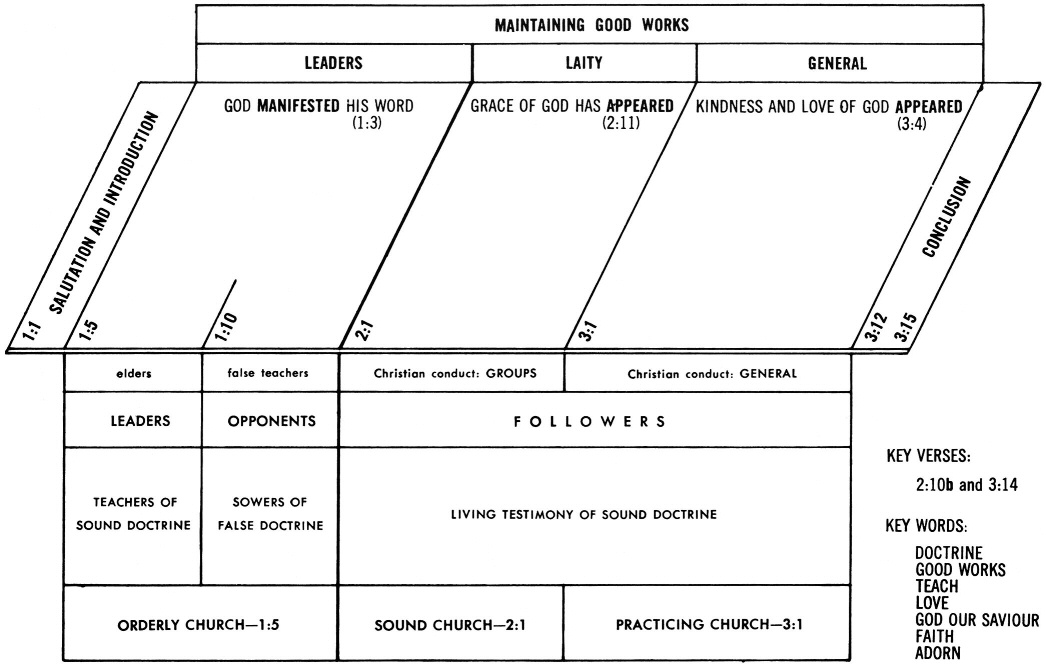
ADORNING THE DOCTRINE OF GOD
Click chart to enlarge
Charts from Jensen's Survey of the NT - used by permission
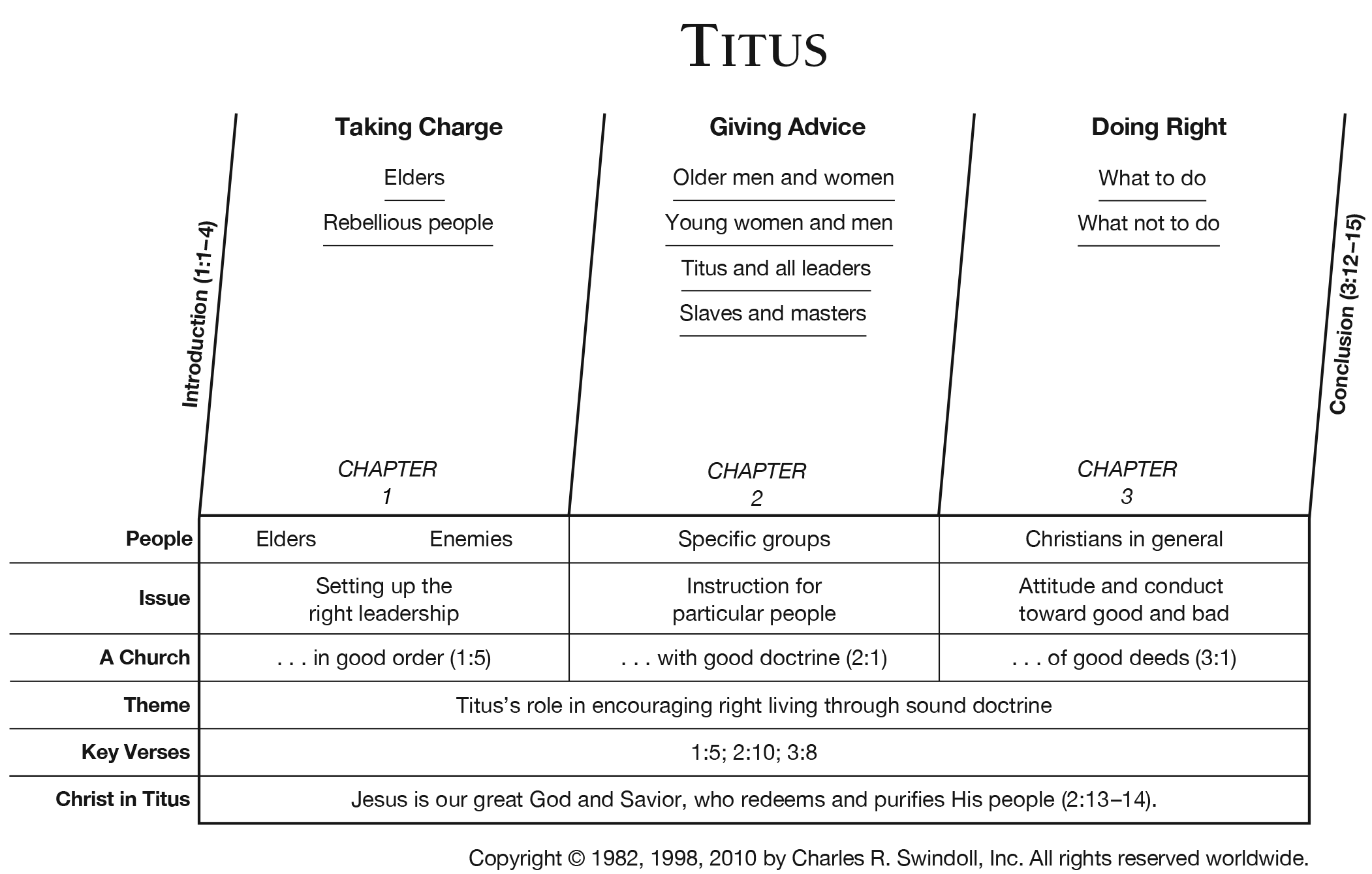
See Summary Chart by Charles Swindoll
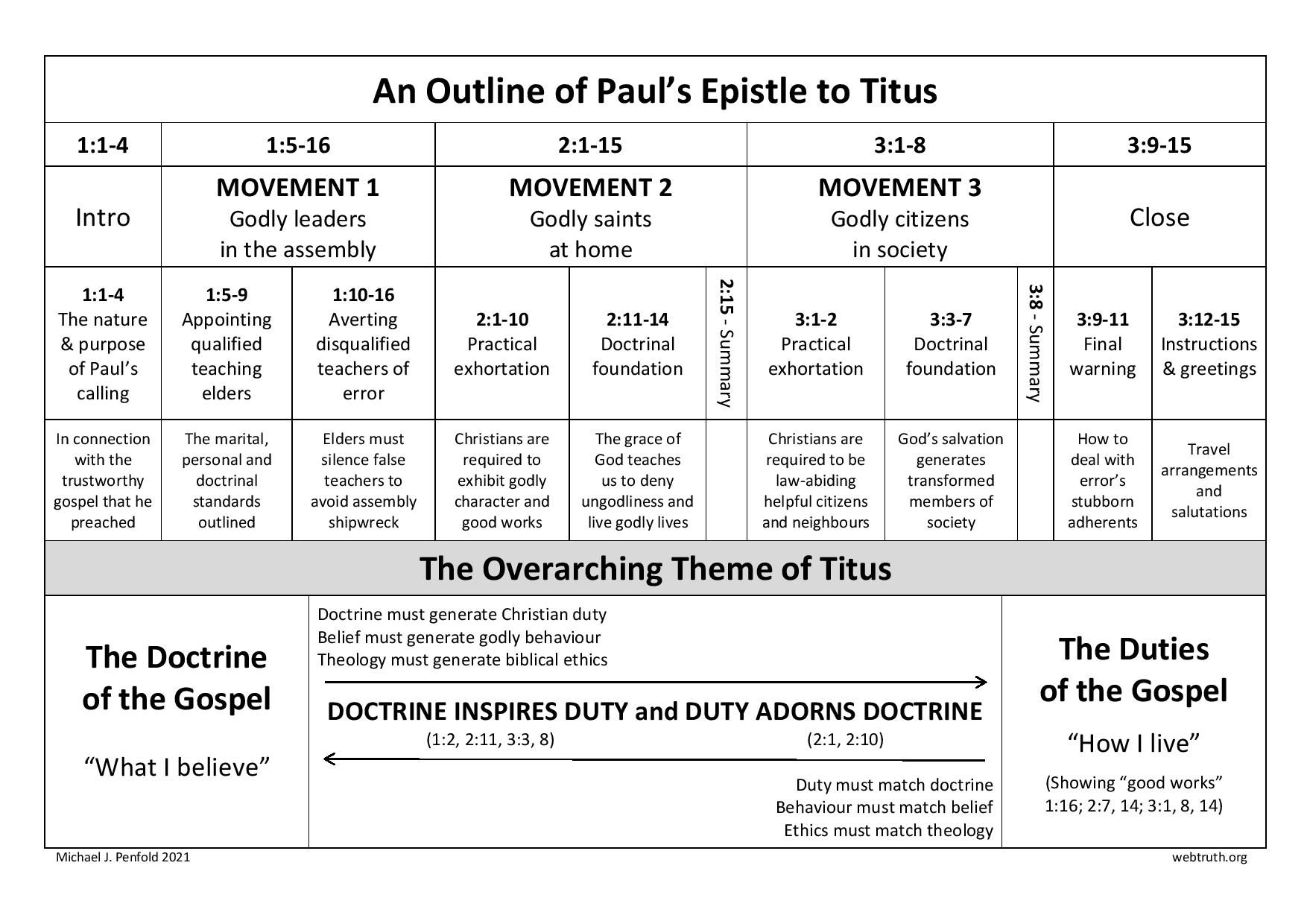
Chart below from Michael J. Penfold
|
Focus |
Appoint Elders |
|||
|
Divisions |
Rebuke |
Maintain |
||
|
Topics |
||||
|
Topics |
Organization |
Offenders |
Operation |
|
|
Place |
Probably Written from either Corinth or Nicopolis (cf. Titus 3:12). |
|||
|
Time |
Circa 63 AD |
|||
|
Modified from Talk Thru the Bible |
||||
Titus 3:6 Whom He poured out upon us richly through Jesus Christ our Savior, (NASB: Lockman)
Greek: ou execheen (3SAAI) eph hemas plousios dia Iesou Christou tou soteros hemon,
Amplified: Which He poured out [so] richly upon us through Jesus Christ our Savior.(Amplified Bible - Lockman)
KJV: Which he shed on us abundantly through Jesus Christ our Saviour;
Phillips: Which he gave us so generously through Jesus Christ our Saviour. (Phillips: Touchstone)
Wuest: Whom He bestowed upon us abundantly through our Saviour, Jesus Christ
Young's Literal: Which He poured upon us richly, through Jesus Christ our Saviour,
WHOM HE POURED OUT UPON US RICHLY: ou execheen (3SAAI) eph hemas plousios:
- Pr 1:23; Isa 32:15; 44:3; Ezek 36:25; Joel 2:28; Jn 1:16; 7:37; Acts 2:33; 10:45; Ro 5:5
- Eph 4:2; 3:8
- Titus 3 Resources - Multiple Sermons and Commentaries
- Titus 3:1-7 Gracious Reminders - Steven Cole
- Titus 3:4-8 Motivation for Service - Steven Cole
- Titus 3:3-8: Christian's Responsibility in Pagan Society -2 - John MacArthur
Whom (3739) (ou) in context refers to the Holy Spirit (see note Titus 3:5). Note the 3 Persons of the Godhead - Whom = Spirit, He = Father, Savior = Jesus. Once again we see that although the word "trinity" (first coined by Tertullian) does not occur in the Scriptures, the three Persons of the Godhead are clearly delineated and each has a distinct cooperative role in the work of grace, each performing His special function in the salvation of our soul. To disbelieve (note I did not say to not be able to fully comprehend!) the Trinity is a very serious theological error.
Do you sense the Spirit at work in your life? Proverbs 1:23+ (Although most translations do not capitalize my Spirit in the following Proverb (seeing this as the "spirit of wisdom"), the interpretation that this speaks of the Holy Spirit certainly seems plausible. Spirit capitalized by me - it is interesting that it seems it some of the older classic commentaries on Proverbs agree this refers to the Spirit whereas modern commentaries less so. Arnot and Bridges comments below are from the 1800's) And so Solomon provides a clue as to why you may not sense Him and how you can immediately rectify the situation…
Turn to my reproof (Hebrew = shub/sub = basic meaning is movement back to the point of departure. Cp Pr 1:25,30 6:23, 10:17 12:1 29:1 Ps 145:1, 2Ti 3:16-note = The Word of God reproves, Re 3:19-note = reproof evidence of Jesus' love, Re 2:4-note), Behold, I will pour out (Hebrew = naba' = gush forth; an uncontrollable or uncontrolled gushing forth) my spirit (Spirit) on you; I will make my words known to you (cp Jn 7:17 14:21 Ps 25:14). (Proverbs 1:23-see on site commentary)
Comment: See also verses on repentance - 2Ki 17:13, 2Chr 30:6, Isa 22:12 ,Jer 25:5 ,Ezekiel 14:6, 18:31, 33:11, Da 4:27 , Hosea 14:2 , Joel 2:12 , Mal 3:7, Mt 3:2, Lk 13:2-3, Acts 3:19, 8:22,17:30, 26:20, repentance beautifully illustrated = 1Thes 1:9-note)
Henry Morris comments - Compare Joel 2:28, cited in Acts 2:17 as referring to God the Holy Spirit. Thus, "wisdom" in Proverbs, though personified initially as a wise mother in Israel, is also clearly speaking of, and as, God Himself (Proverbs 8). (Proverbs Comments in Defender's Study Bible)
William Arnot - It is to those who turn that the promise of the Spirit is addressed. These two reciprocate. The Spirit poured out arrests a sinner, and turns him; then, as he turns, he gets more of the Spirit poured out. The sovereignty of God and the duty of men are both alike real; and each has its own place in the well-ordered covenant. It is true, that unless a man turn, he will not get God’s Spirit poured out; and it is also true, that unless he get God’s Spirit poured out, he will not turn. When the dead is recalled to life, the blood, sent circling through the system, sets the valves of the heart a-beating; and the valves of the heart, by their beating, send the life-blood circling throughout the frame. It would be in vain to inquire what was the point in the reciprocating series to which the life-giving impulse was first applied. The mysteries of the human spirit are deeper still than those of the body. The way of God, in the regeneration of man, is past finding out. One part of it he keeps near himself, concealed by the clouds and darkness that surround his throne; another part of it he has clearly revealed to our understandings, and pressed on our hearts. His immediate part is to pour out the Spirit; our immediate part is to turn at his reproof. If, instead of simply doing our part, we presumptuously intrude into his, we shall attain neither. If we reverently regard the promise, and diligently obey the command, we shall get and do—we shall do and get. We shall get the Spirit, enabling us to turn; and turn, in order to get more of the Spirit. The command is given, not to make the promise unnecessary, but to send us to it for help. The promise is given, not to supersede the command, but to encourage us in the effort to obey. Turn at his reproof, and hope in his promise; hope in his promise, and turn at his reproof. (Proverbs 1:23 A Revival)
Charles Bridges - God calls him to turn at his reproof. He cannot turn himself. But, I will pour out my Spirit as a living fountain upon you. He cannot see his way. But, I will make known my words unto you. ‘I offer thee both my word outwardly to your ears, and a plentiful measure of my Spirit inwardly to your heart, to make that word effectual to you.’ Do you plead that God reckons with you for an inability, which you cannot help—innate without your consent? This is Satan’s argument of delusion. He at once answers the charge, by offering to you present, suitable, and sufficient relief. He meets you on your way to condemnation with the promise of free and full forgiveness.6 Your plea will be of force, when you have gone to him, and found him wanting, The power indeed is of Him. But he hath said—“Ask, and it shall be given you.” If then your helplessness is a real grievance, bring it to him with an honest desire to be rid of it. If you have never prayed, now is the time for prayer. If you cannot pray—at least make the effort. Stretch out the withered hand in the obedience of faith.8 If your heart be hard—your convictions faint—your resolutions unsteady—all is provided in the promise—I will pour out my Spirit upon you. Move, then, and act in dependence upon the Almighty Mover and Agent. Christian experience explains a mystery unfathomable to human reason. It harmonizes man’s energy and God’s grace. There is no straitening—no exclusion—with God. His promises with one mouth assure a welcome to the willing heart. If it cannot move, cannot his Spirit compel—point—draw it to the Saviour? Yea, in the desire to turn, hath not the Saviour already touched it, and drawn it to himself? (Proverbs Commentary)
Isaiah prophesied of the outpouring of the Spirit…
Until the Spirit is poured out upon us from on high, And the wilderness becomes a fertile field (cp Ro 8:21-note) and the fertile field is considered as a forest. (Isaiah 32:15)
Comment: Partial fulfillment at Pentecost Acts 2:1, 2, 3, 17, Joel 2:28 but awaits complete fulfillment of Zech 12:10, Ezek 37:14, when "all" Israel {actually the "1/3" in Zech 13:9} will be saved {Ro 11:26-note}. Thus this promise anticipates its complete fulfillment with the conversion of the nation of Israel (see remnant) when Christ returns.
'For I will pour out water on the thirsty land And streams on the dry ground; I will pour out My Spirit on your offspring, and My blessing on your descendants (Isaiah 44:3)
Comment: God's sovereign and immutable promise is to pour His Spirit upon Israel and in so doing to change the character of His people from those in Adam to those in the Messiah. The Holy Spirit is symbolized by life-giving water a figure often appropriated in the NT (see Jn 1:33, 3:5, 7:38-39.
Ezekiel also prophesied of the outpouring using a different figure of speech…
Then (When is then? Ro 11:26-27-note. This is the New Covenant in His blood - Lk 22:20 1Cor 11:25) I will sprinkle clean water on you ( The ultimate fulfillment is best seen in Heb 10:22- see note), and you will be clean (Prefigured in the feast of Israel by the Day of Atonement in Lev 16:30, 23:26, 27, 28, 29, 30, 31, 32. The fulfillment of the this Day is when Israel repents and looks to their Messiah in a future glorious day - see Zech 3:9, 12:1,10, 11, 12,13, 13:1, 14:9); I will cleanse you from all your filthiness and from all your idols. (Ezekiel 36:25-note)
Comment: It is tragic that the Jewish commentary, the Mishnah The "missed' the true meaning of this profound verse. E.g. Rabbi Aqiba said "Happy are you, O Israel. Before whom are you made clean, and who makes you clean? It is your Father who is in heaven, "as it says, And I will sprinkle clean water on you, and you will be clean Ezekiel 36:25.
Joel prophesied that…
And it will come about after this That I will pour out My Spirit on all mankind; And your sons and daughters will prophesy, Your old men will dream dreams, Your young men will see visions. (Joel 2:28)
Comment: In Acts 2:17 Peter did not state that Joel's prophecy was fulfilled on the day of Pentecost. The details of Joel 2:30, 31, 32 {cp. Acts 2:19,20} were not realized at that time. Peter quoted Joel's prediction as an illustration of what was taking place in his day, and as a guarantee that the sovereign, faithful, wholly trustworthy God would yet completely fulfill all that Joel had prophesied. The time of that fulfillment is stated here {see Hosea's prophecy "the sons of Israel will return and seek the LORD their God and David their king" Hosea 3:5}, i.e. in the latter days when Israel turns to the LORD. {See Ge 49:1}
Jesus came and explained that belief in Him as the Messiah would bring about the fulfillment of the outpouring of the Spirit on both Jew and Gentile alike after He (Messiah) had been crucified, buried, resurrected and ascended…
Now on the last day, the great day of the feast, Jesus stood and cried out, saying, "If any man is thirsty, let him come to Me and drink. "He who believes in Me, as the Scripture said, 'From his innermost being shall flow rivers of living water.' But this He spoke of the Spirit, Whom those who believed in Him were to receive; for the Spirit was not yet given, because Jesus was not yet glorified. (John 7:37-39-note)
Comment: How many of us genuinely experience what Jesus promised here = 'From his innermost being shall flow rivers of living water.'? Too many times my innermost being feels more like a stagnant pond! But clearly these passages document that this is not Jesus' fault nor the Spirit's fault but is my own fault, as I far too often choose to walk according to my will rather than according to the good and acceptable and perfect will of God!
Paul explains this outpouring of the Spirit in Romans writing that…
hope does not (absolutely negation) disappoint, because the love of God has been poured out (the perfect tense conveys = "has poured in and still floods our hearts" - The image is of a shower of rain soaking parched ground. So God soaks our parched hearts with His love through the work of His Spirit) within (KJV "hope maketh not ashamed" - We will never be ashamed by this hope for it is sure and steadfast - He 6:18, 19-see notes He 6:18; 19) our hearts through the Holy Spirit Who was given to us (One of the Holy Spirit's main roles is to "make us deeply and refreshingly aware that God loves us.") (Ro 5:5-note)
Comment: An earthly illustration of our hope which does not disappoint: about the boy and his father who were planning a fishing trip for the next day. That evening as the father was putting his son to bed, the boy hugged his father's neck and said, "Daddy, thank you for tomorrow."
Poured out (1632) (ekcheo from ek = out + chéo = pour) means literally to flow out, to gush forth or to pour out . The inherent idea is to cause something to be emitted in quantity.
Used of literal pouring out of liquids = wine from wineskins in Mt 9:17; Mk 2:22 and Lk 5:37; Jn 2:15, Acts 1:18.
Used of literal pouring out of solids - coins of the moneychangers in John 2:15, bowels of Judas in Acts 1:18.
Holy Spirit poured out - Acts 2:17-18, 2:33, Acts 10:45; love of God poured out within our hearts through the Holy Spirit; Titus 3:6
To pour out blood is an idiomatic way of saying to murder (of righteous blood shed Mt 23:35, Luke 11:50, Acts 22:20; see note Romans 3:15.
Figuratively in Jude 1:11
Woe to them! For they have gone the way of Cain, and for pay they have rushed (ekcheo) headlong into the error of Balaam, and perished in the rebellion of Korah.
Of the blood of Christ…
Mt 26:28 for this is My blood of the covenant, which is poured out for many for forgiveness of sins. (also in Mark 14:24)
Mark 14:24 And He said to them, "This is My blood of the covenant, which is poured out for many.
Luke 22:20 And in the same way He took the cup after they had eaten, saying, "This cup which is poured out for you is the new covenant in My blood.
Ekcheo denotes both abundance and diffusion. It refers to a lavish outpouring to the point of overflowing.
Figuratively ekcheo describes experiencing something in an abundant manner and so to fully experience.
Ekcheo is found 27x in NAS = pour, 1; pour forth, 2; poured, 10; poured forth, 1; pours, 1; shed, 1.
Matt. 9:17; 23:35; 26:28; Mk. 14:24; Lk. 5:37; 11:50; 22:20; Jn. 2:15; Acts 1:18; 2:17f, 33; 10:45; 22:20; Rom. 3:15; 5:5; Titus 3:6; Jude 1:11; Rev. 16:1ff, 6, 8, 10, 12, 17
The 10 uses of ekcheo in Revelation 16 is notable as this chapter expounds on the wrath of God which is poured out in the 7 bowl judgments: Re 16:1, 2, 3, 4, 6, 8, 10, 17- see notes Rev 16:1; 2; 3; 4; 6; 8; 10; 17
Ekcheo - 114x in the Septuagint (LXX)-
Gen. 9:6; 37:22; 38:9; Exod. 4:9; 29:12; 30:18; Lev. 4:7, 12, 18, 25, 30, 34; 8:15; 9:9; 14:41; 17:4, 13; Num. 19:17; 35:33; Deut. 12:16, 24; 15:23; 19:10; 21:7; Jdg. 6:20; 20:37; 1 Sam. 1:15; 7:6; 25:31; 2 Sam. 20:10, 15; 1 Ki. 2:31; 13:3, 5; 2 Ki. 19:32; 21:16; 24:4; 1 Chr. 22:8; 28:3; 2 Chr. 36:5; Job 12:21; 16:13; 30:16; Ps. 14:3; 22:14; 35:3; 42:4; 45:2; 62:8; 69:24; 73:2; 79:3, 6, 10; 102:1; 106:38; 107:40; 142:2; Prov. 1:16; 6:17; Eccl. 11:3; Isa. 57:6; 59:7; Jer. 6:6, 11; 7:6; 10:25; 14:16; 22:3, 17; Lam. 2:4, 11f, 19; 4:1, 11, 13; Ezek. 7:8; 9:8; 14:19; 16:15, 36, 38; 18:10; 20:8, 13, 21; 21:31; 22:3f, 6, 9, 12, 22, 27, 31; 23:8; 24:3, 7; 30:15; 36:18; 39:29; Dan. 11:15; Hos. 5:10; 12:14; Joel 2:28f; 3:19; Amos 5:8; 9:6; Zeph. 1:17; 3:8; Zech. 12:10; Mal. 3:10
Poured out is in the aorist tense which points to a completed act of outpouring in the past. This past outpouring would certainly appear to be an allusion to Pentecost the initial outpouring of which Joel foretold and Luke documented declaring…
"And it will come about after this That I will pour out My Spirit on all mankind; And your sons and daughters will prophesy, Your old men will dream dreams, Your young men will see visions. (Joel 2:28+)
"Therefore having been exalted to the right hand of God, and having received from the Father the promise of the Holy Spirit, He (Jesus) has poured forth this which you both see and hear. (Acts 2:33+)
Nevertheless, since Paul writes "on us" (and he was not saved in Acts 2 on Pentecost) he has a broader audience in mind as he discusses in Romans 5:5 where he explains that…
hope does not disappoint, because the love of God has been poured out within our hearts through the Holy Spirit Who was given to us. (see note Romans 5:5)
For by one Spirit we were all baptized into one body, whether Jews or Greeks, whether slaves or free, and we were all made to drink of one Spirit. (1Cor 12:13)
However, you are not in the flesh but in the Spirit, if indeed the Spirit of God dwells in you. But if anyone does not have the Spirit of Christ, he does not belong to Him. (see note Romans 8:9) (Comment: Note the two names of the Spirit, thus Christ is God as is the Holy Spirit. Furthermore the presence or absence of salvation for a man is determined by the presence or absence of the Holy Spirit. Regardless of works, religion, or ritual, men are lost if they do not have the indwelling Holy Spirit.)
Paul's point is that the Spirit is poured out on each believer when they experience the new birth. In a very real sense, the Spirit's work in each believer as a member of the Body is a continuation of the Pentecostal outpouring.
Richly (4146) (plousios) pertains to that which exists in a large amount with the implication of its being valuable in large amount. God has not held back but poured out the Holy Spirit abundantly upon every believer. Paul is emphasizing that the Holy Spirit is given to us freely and generously, and that the Holy Spirit is always available to help us. God always gives extravagantly. He is never niggardly nor stingy, and so it follows that every inadequate experience of our new life in Christ and failure to experience the abundant life led by the Spirit is always due to some human impediment. In other words, we believers can never blame God for our experiential "short fall", as if He had not given us adequate provisions to walk in newness of life as more than conquerors in Christ Jesus! It is not that we can't live the victorious Christ life but it is sadly all to often that we simply won't live that new life. As Peter reiterates…
His divine power has granted (perfect tense) to us everything pertaining to life and godliness, through the true knowledge (which clearly implies we are daily in the Word of Truth, the only source of this true knowledge) of Him who called us by His own glory and excellence. For by these He has granted (perfect tense) to us His precious and magnificent promises, in order that by them you might become partakers of the divine nature, having escaped the corruption that is in the world by lust. (2Pe 1:3-4-notes)
THROUGH JESUS CHRIST OUR SAVIOUR: dia Iesou Christou tou soteros hemon:
- Titus 1:4; Jn 4:10; 14:16,17; 16:7; Ro 8:2
- Titus 3 Resources - Multiple Sermons and Commentaries
- Titus 3:1-7 Gracious Reminders - Steven Cole
- Titus 3:4-8 Motivation for Service - Steven Cole
- Titus 3:3-8: Christian's Responsibility in Pagan Society -2 - John MacArthur
CHRIST OUR
"CONDUIT"
Through (1223)(dia) is a preposition which means across (to the other side), back-and-forth to go all the way through, "successfully across" ("thoroughly"). Dia is also commonly used as a prefix and lend the same idea ("thoroughly," literally, "successfully" across to the other side). Dia is a root of the English term diameter ("across to the other side, through"). Before a vowel, dia is simply written di. In the present context dia indicates instrumentality or the mode by which something was transferred, in this case referring to the abundant, copious, rich outpouring of the Holy Spirit through the "Conduit" of our Great High Priest, the Lord Jesus Christ. Jesus is the "medium" through Whom the Spirit's presence is secured to every believer without exception.
A Simple Study On the Phrase
"Through Him"
Consider the following simple study - observe and record the wonderful truths that accrue through Him - this would make an edifying, easy to prepare Sunday School lesson - then take some time to give thanks for these great truths by offering up a sacrifice of praise… through Him.
John 1:3 [NIV reads "through Him"], John 1:7, John 1:10,Jn 3:17, Jn 14:6, Acts 3:16, Acts 7:25, Acts 10:43, Acts 13:38-39, Romans 5:9 [note], Romans 8:37 [note], Ro 11:36 [note]; 1Cor 8:6, Ep 2:18 [note], Php 4:13 [note], Col 1:20 [note], Col 2:15 [note], Col 3:17 [note], He 7:25 [note], He 13:15 [note],1Pe 1:21 [note], 1John 4:9
Would you like more study on the wonderful topic of through Him? Click the NT uses of the parallel phrase through Jesus or see John 1:17, Acts 10:36, Ro 1:8-note, Ro 5:1,2-note v1; v2 Ro 5:21-note, Ro 7:25-note, Ro 16:27-note, Gal 1:1, Ep 1:5-note, Php 1:11-note, Titus 3:6-note, He 13:21-note, 1Pe 2:5-note, 1Pe 4:11-note, Jude 1:25
All things are from Him, through Him and to Him. To Him be the glory forever. Amen.
Our - This possessive pronoun points out once more the personal appropriation of Jesus as Savior on the believer's part.
Jesus (2424)(Iesous) is transliteration of the Greek Iesous, which in turn is the transliteration of the Hebrew name Jehoshua (Yehoshua) or Jeshua (Yeshua) which mean Jehovah is help or Jehovah is salvation. Stated another way the Greek Iesous corresponds to the OT Jehoshua (Yehoshua) which is contracted as Jeshua (Yeshua).
Christ (5547)(Christos from chrio = to rub or anoint, consecrate to an office) means one who has been anointed, symbolizing appointment to a task. The majority of the NT uses refer to Jesus (exceptions = "false Christs" - Mt 24:24, Mk 13:22). (See also Messiah - Anointed One)
Savior (4990) (soter from sozo = rescue from peril > from saos = safe; delivered) is the One Who as the agent of salvation rescues those dead in their trespasses and sins, functioning as a Deliverer and Preserver. It is worth noting that in verse 4 the title "Savior" was applied to the Father…
But when the kindness of God our Savior and His love for mankind appeared (Titus 3:4-note)
This truth of course clearly underscores Paul's belief in the deity of Christ.
Titus 3:7 so that being justified by His grace we would be made heirs according to the hope of eternal life (NASB: Lockman)
Greek: hina dikaiothentes (AAPMPN) te ekeinou chariti kleronomoi geneqomen (1PAPS) kat' elpida zoes aioniou
Amplified: [And He did it in order] that we might be justified by His grace (by His favor, wholly undeserved), [that we might be acknowledged and counted as conformed to the divine will in purpose, thought, and action], and that we might become heirs of eternal life according to [our] hope. (Amplified Bible - Lockman)
KJV: That being justified by his grace, we should be made heirs according to the hope of eternal life.
Phillips: The result is that we are acquitted by his grace, and can look forward to inheriting life for evermore. (Phillips: Touchstone)
Wuest: in order that, having been justified by His grace, we might become heirs according to the expectation of life eternal.
Young's Literal: that having been declared righteous by His grace, heirs we may become according to the hope of life age-during.
SO THAT BEING JUSTIFIED BY HIS GRACE: hina dikaiothentes (AAPMPN) te ekeinou chariti:
- Titus 2:11-see note Titus 2:11; Ro 3:24, 28, 4:4, 4:16, 5:1, 2, 15, 16, 17, 18, 19, 20, 21- see notes Ro 3:24, 3:28; 4:4; 4:16; 5:1; 5:2; 5:15; 16; 17; 18; 19; 20; 21; 1Cor 6:11; Gal 2:16
- Titus 3 Resources - Multiple Sermons and Commentaries
- Titus 3:1-7 Gracious Reminders - Steven Cole
- Titus 3:4-8 Motivation for Service - Steven Cole
- Titus 3:3-8: Christian's Responsibility in Pagan Society -2 - John MacArthur
So that (Amplified = "in order that") (2443) (hina) introduces a purpose clause (see terms of purpose or result), explaining the purpose for the giving of the Holy Spirit or more generally the purpose He aimed at in having saved us.
Being justified (1344) (dikaioo from dike = right) (see note on Romans 3:24) describes the act by which a man is brought into a right state of relationship to God. God’s justifying act therefore is his putting people in a right relationship with Himself.
Dikaioo is a legal term which related to the courtroom in Paul's time and in that setting represented a legally binding verdict rendered by the judge. This is the sense in which Paul uses dikaioo in Romans (Ro 3:21-5:11) in which he unfolds the doctrine of justification.
Sin disrupted our relation to God and estranged us from Him. But when we received Christ as our Savior, we were justified or declared righteous, given standing as just in God's sight and brought into His favor. Justification originates in God's grace, His free, unmerited favor. Remember that justification relates to the matter of our standing before God, but it is never divorced from an actual change in the one declared righteous. In other words, justification "flows" into sanctification, the process by which we take in the "Bread of Life", the Word of Truth and make moment by moment decisions of our will to obey the true ingested, this process being enabled by the grace of our Lord Jesus Christ and His Spirit Who dwells in us to will and to work to the Father's good pleasure. In short, justification is the starting point of our new adventure in Christ. In the next verse Paul picks up on this idea as he exhorts believers to engage in profitable good deeds.
Dikaioo depending on the context means
(1) (The meaning in here in Titus 3:6) To cause someone to be in a proper or right relation with someone else = to declare righteous.
(2) To demonstrate that something is morally right (Ro 3:4-see note on this meaning in Romans 3:4 where Paul says that God "mightest be justified -- or shown to be just -- in Thy words")
(3) To acquit, remove guilt, set free (see Acts 13:39 "and through Him everyone who believes is freed (dikaioo) from all things, from which you could not be freed (dikaioo) through the Law of Moses.")
(4) To set free or release from the control of (see note on this meaning in Ro 6:7-note)
(5) To obey righteous commands
To understand dikaioo, one needs to understand the root work dike which originally meant manner, tendency and with time came to refer to the designation for the right of established custom or usage. Stated another way, the basic meaning of dike involves the assertion by human society of a certain standard expected by its people which, if not kept, can bring forth ensuing judgment. Thus it can be said that díke is expected behavior or conformity, not according to one's own standard, but according to an imposed standard (here in Romans it is God's standard of righteousness) with prescribed punishment for nonconformity.
Dikaioo is in the aorist tense points to the completed action of our having been declared righteous before God at a specific point in time in the past. This was effectively realized and imputed (accounted or reckoned) to our "spiritual" account ledger the day we accepted Christ as Savior AND Lord. And so when we believed were set right with God by the grace of Jesus Christ manifest by His death on the cross.
C H Spurgeon asks "What is justification? A. Justification is an act of God's free grace, wherein he pardons all our sins (Ro 3:24-note; Ep 1:7-note), and accepts us as righteous in his sight (2Cor 5:21) only for the righteousness of Christ imputed to us (Ro 5:19-note), and received by faith alone (Gal 2:16; Php 3:9 [note])."
In simple terms dikaioo as used in this verse means "To declare a person to be righteous or right before God." Not to make us righteous (as if justification is a process one is attaining) but to declare us righteous at a moment in time (for justification is a once for all supernatural transaction never to be repeated.) On the other hand sanctification is a process until the day of our glorification in a moment, in the twinkling of an eye. See related discussion - Three Tenses of Salvation
Wiersbe is right to remind us to "not confuse justification and sanctification. Sanctification is the process whereby God makes the believer more and more like Christ. Sanctification may change from day to day. Justification never changes. When the sinner trusts Christ, God declares him righteous, and that declaration will never be repealed. (Wiersbe, W: Bible Exposition Commentary. 1989. Victor)
His (1565) (ekeinos) is literally "of that one" in the genitive (possessive) thus indicating that the reference is to the grace of the Father, His free unmerited favor bestowed on the basis of Christ's perfect, finished work on the Cross.
Grace (5485) (charis from chairo = to rejoice, be glad) is usually defined succinctly as unmerited favor and refers to the free expression of God's lovingkindness to undeserving mankind in which He freely bestows favor upon them without expecting anything in return. When we begin to understand the word grace there is a rejoicing in our heart. And so to an extent grace can be defined by what it causes, including joy, pleasure, delight, gratification, favor and acceptance.
Kenneth Wuest adds that although grace is free, grace is not license to do as we please for "grace in the form of salvation is so adjusted that the one who receives it, turns from sin to serve the living God and live a holy life, for grace includes not only the bestowal of a righteousness, but the inward transformation consisting of the power of indwelling sin broken and the divine nature implanted, which liberates the believer from the compelling power of sin and makes him hate sin, love holiness, and gives him the power to obey the Word of God. (Wuest's Word Studies from the Greek New Testament)
WE MIGHT BE MADE HEIRS: kleronomoi genethomen (1PAPS):
- Ro 8:17,23,24; Gal 3:29; 4:7; Heb 6:17; 11:7,9; Jas 2:5; 1Pe 3:7
- Titus 3 Resources - Multiple Sermons and Commentaries
- Titus 3:1-7 Gracious Reminders - Steven Cole
- Titus 3:4-8 Motivation for Service - Steven Cole
- Titus 3:3-8: Christian's Responsibility in Pagan Society -2 - John MacArthur
OUR NEW STATE
FELLOW HEIRS WITH CHRIST
We might be made (1096) (ginomai) means made to come into existence (as heirs of God), speaking of that which did not exist before (we were hostile toward God). Note the passive voice which indicates that the change our status from spiritual beggars to spiritual heirs was the result of an action from without. In other words, our being made heirs is totally the work of God and completely independent of any personal merit on our part (Thus this voice is the so-called "Divine passive")!
Paul writes that "if (since we are in fact children of God - cf 1 Jn 3:1+) children, heirs also, heirs of God and fellow heirs with Christ, if indeed we suffer with Him so that we may also be glorified with Him." (Ro 8:17+)
The Holman Bible Dictionary defines inheritance as "A legal transmission of property after death." Another source says inheritance is "the receipt of property as a gift or by legal right, usually upon the death of one’s father." Those are both interesting descriptions in view of the fact that for sinners to become saints who are "heirs of God and fellow heirs with Christ," (Ro 8:17-note) Christ first had to die in our place! "Amazing Love how can it be, that Thou my God shouldst die for me!" (Holman Bible Dictionary)
Heirs (2818) (Kleronomos from kleros = a lot - lots were cast or drawn to divide property or select a winner or an heir + nemomai = to possess, to distribute among themselves), literally refers to one who obtains a lot or portion. It is one who receives something as a possession or a beneficiary (the person named as in an insurance policy to receive proceeds or benefits). It signifies more than one who inherits and it includes the idea of taking into possession. The New Testament usage of kleronomos applies primarily to the realm of spiritual inheritance.
Wayne Detzler records a different origin stating that kleronomos
is a combination of two words: kleros (a lot or inheritance) and nomos (law). Thus the word kleronomos indicates the legal distribution of possessions or lots to heirs… In the original Greek culture, possessions were passed on to any person named in one's will. In fact, Greeks often built their fortunes for the purpose of passing them on to favored relatives. The Romans widened the concept to enable the distribution of possessions or wealth among close friends or loyal servants.
To the Jews, however, an inheritance was usually reserved for one's children. In fact this was preserved in the Law as the principle to be followed. The Greek Old Testament also used kleros to refer to casting of the lot, as was seen in the use of the Urim and Thummim (Ex. 28:30; Lev 8:8). (See Detzler's 2 page article on HEIR - New Testament Words in Today's Language)
In the Greco-Roman world the word kleronomos was a legal term and was found on ancient inscriptions of Asia Minor to refer to a son after he was succeeded to the inheritance as representative of his father, undertaking all the duties and obligations of his father.
A heir is one who receives or is entitled to receive some endowment or quality from a parent or predecessor
Richards writes that kleronomos is "one who takes possession of or inherits. The emphasis is on the heir's right to possess." (Richards, L O: Expository Dictionary of Bible Words: Regency)
Vincent comments that…
an inheritance is originally a portion which one receives by lot in a general distribution. In the New Testament the idea of chance attaching to the lot is eliminated. It is the portion or heritage which one receives by virtue of birth or by special gift. So of the vineyard seized by the wicked husbandmen: “Let us seize on his inheritance” (Matt. 21:38); of Abraham in Canaan: “God gave him none inheritance” (Acts 7:5); “an eternal inheritance” (see note Hebrews 9:15).
The figure (of an heir and the inheritance) is based upon Roman, not upon Jewish, law. According to Roman law, all the children, sons and daughters, inherited alike. According to Jewish law, the inheritance of the sons was unequal, and the daughters were excluded, except where there were no male heirs. Thus the Roman law furnished a more truthful illustration of the privileges of Christians.
(Commenting on Jesus as heir in Heb 1:2 [note]) God eternally predestined the Son to be the possessor and sovereign of all things. Compare Psalm 89:28 [Spurgeon's note]. Heirship goes with sonship. See Ro 8:17 [note]; Gal. 4:7. Christ attained the Messianic Lordship through incarnation. Something was acquired as the result of His incarnation which He did not possess before it, and could not have possessed without it. Equality with God was His birthright; but out of His human life, death, and resurrection came a type of sovereignty which could pertain to Him only through His triumph over human sin in the flesh (He 1:3-note), through His identification with men as their brother. Messianic Lordship could not pertain to His preincarnate state: it is a matter of function, not of inherent power and majesty. He was essentially Son of God; He must become Son of man.)
Vine commenting on the use of kleronomos in He 1:2 (note) writes that
kleronomos, “heir,” signifies more than one who inherits, or obtains a portion, it means (like the corresponding Hebrew word, yaresh = 03423 = take something from someone else and possess it for yourself) to take into possession. The word, while being virtually a title, also conveys the significance of dominion and authority…that property in real estate which in ordinary course passes from father to son on the death of the former
Gerald Cowen has a lengthy note on kleronomos…
Originally it denoted one who obtained a lot or portion. In Homer, for instance, it referred to a fragment of stone or wood used as a lot. The portion allotted by this casting of lots was the inheritance. Originally, an inheritance referred to that which had been received from the past. However, in the New Testament especially, the emphasis is changed somewhat to include the future as well.
In the Old Testament there are two basic ways the concept is used.
(1) Captives and captured booty were divided among the victors by lots. Psalm 22:18 predicts the fact that Jesus' clothes would be divided by lot. The captives of Israel were divided among their conquerors: "They have cast lots for my people" (Joel 3:3).
(2) The Land of Promise is Jehovah's inheritance. Jeremiah said, "You defiled my land, and made my heritage an abomination" (Jer 2:7). David said to Saul, "For they have driven me out this day from abiding in the inheritance of the Lord" (1Sa 26:19). The Levite was given no portion in the Promised Land for "the Lord is his inheritance" (Deut. 10:9).
In the Greek papyruses of New Testament times the word kleronomos is used in its ordinary sense of "heir." An example from A.D. 125 says, "If I die with this will unchanged, I leave my daughter Ammonous heir." However, a very important point is that being an heir usually involved responsibilities. A Macedonian inscription says, "But if my heir neglect anything he shall pay to the treasurer a fine of 750 denarii."
Concerning kleronomos Moulton and Milligan conclude, "In the inscriptions the one thing most often emphasized is the obligation of the kleronomos to fulfill certain conditions devolving upon him as an heir.
When Paul insists that only those who fulfill the conditions of heirship are truly heirs, he is making use of a well-known principle."
It is interesting to find also that it was not unheard of for persons to refuse an inheritance because they did not want to take on the responsibilities or fulfill the conditions associated with it. Another papyrus cited by Moulton and Milligan says, "As I have no intention of entering on his inheritance, I am obliged to send you notice, that you may give instructions about the next step to be taken, in order to free me from responsibility after his death."
In the New Testament kleronomos occurs fifteen times. In most, it is used in the ordinary sense of an "heir," one to whom property is to pass after the death of the owner. Three Gospels record the parable of the wicked husband-men who killed the son and heir of the owner in order to seize his inheritance (Matt. 21:38; Mark 12:7; Luke 20:14). Galatians 4:1 describes a child who is an heir but is too young to manage his own affairs.
Primarily kleronomos is soteriological in its emphasis. Abraham was appointed an "heir of the world" through the "righteousness of faith" (Romans 4:13-note). Because believers are now children of God, they have become "an heir of of God through Christ" (Gal. 4:7). The inheritance is eschatological in nature and at the same time present in effect. In Romans 8:17-note the emphasis is on the future glory that will be a part of being an heir of God. In Eph 3:6-note the Gentiles are already fellow-heirs, part of the same body with the Jews (the church), and "partakers of His promise in Christ by the gospel."
Just as in the secular world where heirs had to meet pre-scribed conditions in order to inherit, there are conditions that must be met before one qualifies as an heir of God. Noah prepared the ark by faith and became an heir of righteousness, which comes as a result of faith (Hebrews 11:7-note). Abraham became "heir of the world" through the "righteousness of faith" (Romans 4:13; 4:14-notes). Paul explained to the Galatians that the only way to become an heir of God is through Christ (Gal. 4:7). The inheritance that God has promised to those who believe is based on the condition of faith, by which we become children of God and are placed in Christ, by which also we receive now the righteousness of Christ. Having been made righteous by the grace of God, we are also made heirs "according to the hope of eternal life" (Titus 3:7). (Salvation Word Studies from the Greek New Testament)
See other resources on Inheritance
- What is our inheritance in Christ?
- What is an heir in the Bible?
- What does it mean to be co-heirs/joint-heirs with Christ?
- Nave Topical Bible Inheritance
- Thompson Chain Reference Israel's Inheritance Inheritance Laws of Inheritance
- The Topic Concordance Inheritance
- American Tract Society Inheritance
- Bridgeway Bible Dictionary Inheritance
- Baker Evangelical Dictionary Inheritance
- Holman Bible Dictionary Inheritance
- Hastings' Dictionary of the Bible Inheritance
- Hastings' Dictionary of the NT Inheritance
- Hawker's Poor Man's Dictionary Inheritance
- Smith Bible Dictionary Inheritance
- Vines' Expository Dictionary Inherit, Inheritance
- International Standard Bible Encyclopedia Inheritance
- Kitto Biblical Cyclopedia Inheritance
- McClintock and Strong's Bible Encyclopedia Inheritance
- The Jewish Encyclopedia Inheritance
Kleronomos is found 15 times in the NT and 4 times in the Septuagint (LXX) (Jdg 18:7; 2 Sa 14:7; Jer 8:10; Micah 1:15)…
Matthew 21:38 "But when the vine-growers saw the son, they said among themselves, 'This is the heir (kleronomos - the one who would take over the property) ; come, let us kill him, and seize his inheritance (kleronomia).'
Mark 12:7 "But those vine-growers said to one another, 'This is the heir; come, let us kill him, and the inheritance (kleronomia) will be ours!'
Luke 20:14 "But when the vine-growers saw him, they reasoned with one another, saying, 'This is the heir; let us kill him that the inheritance (kleronomia) may be ours.'
Romans 4:13 (note) For the promise to Abraham or to his descendants that he would be heir of the world was not through the Law, but through the righteousness of faith.
Romans 4:14 For if those who are of the Law are heirs, faith is made void and the promise is nullified;
Romans 8:17 (note) and if children, heirs also, heirs of God and fellow heirs with Christ, if indeed we suffer with Him in order that we may also be glorified with Him.
Comment: Roman law made all children, including adopted ones, equal heritors. Jewish law gave a double portion to the eldest son. The Roman law was naturally in Paul’s mind, and suits the context, where adoption is the basis of inheritance.)
Galatians 3:29 And if you belong to Christ, then you are Abraham's offspring, heirs according to promise.
Comment: This promise does not mean that believers will receive the land promises of Abraham [those covenant promises will be given to believing Israel in the Millennium finally fulfilling God's original promises to Abraham], but rather speaks of the blessings that accrue as the result of justification by faith.)
Galatians 4:1 Now I say, as long as the heir is a child, he does not differ at all from a slave although he is owner of everything,
Galatians 4:7 Therefore you are no longer a slave, but a son; and if a son, then an heir through God.
Titus 3:7 (note) that being justified by His grace we might be made heirs according to the hope (certainty is expressed by this word, with no hint of uncertainty as in the common vernacular) of eternal life.
Comment: Heirship of eternal life is the result of justification and this is attested and confirmed by the Holy Spirit)
Hebrews 1:2 (note) in these last days has spoken to us in His Son, whom He appointed heir of all things, through whom also He made the world.
Hebrews 6:17 (note) In the same way God, desiring even more to show to the heirs of the promise the unchangeableness of His purpose, interposed with an oath,
Hebrews 11:7 (note) By faith Noah, being warned by God about things not yet seen, in reverence prepared an ark for the salvation of his household, by which he condemned the world, and became an heir of the righteousness which is according to faith.
Comment: Noah became an actual possessor of the righteousness according to faith)
James 2:5 Listen, my beloved brethren: did not God choose the poor of this world to be rich in faith and heirs of the kingdom which He promised to those who love Him?
The believer's heirship is not merely a future hope but a present reality. Even now in this present life we have the right as God's children to look forward to the full possession of that which we now possess only in principle. And this future inheritance serves to motivate us to godliness, etc for as C S Lewis wrote…
A continual looking forward to the eternal world is not a form of escapism or wishful thinking, but one of the things a Christian is meant to do. It does not mean that we are to leave the present world as it is. If you read history, you will find that the Christians who did the most for the present world were just those who thought most of the next.
In Romans 8 Paul states that since we are God's spiritual children we are…
heirs also, heirs of God and fellow heirs with Christ, if indeed we suffer with Him in order that we may also be glorified with Him. (see note Romans 8:17)
The actual experience of obtaining our full inheritance awaits the return of our Lord and Savior.
Illustration - English poet Edward Lear, known for his quaint children’s poems and accompanying drawings, was asked to give Queen Victoria drawing lessons. After one of the lessons, the Queen showed Lear several of the family heirlooms that were on display in her living quarters in the palace. Lear, taken with the beauty of the things he saw, without thinking cried out: “Oh, where did you get all these beautiful things?” Queen Victoria replied, “I inherited them, Mr. Lear.” In this passage the apostle reminds Titus of the precious inheritance he received when he experienced the washing of rebirth and the renewal of the Holy Spirit. (Today in the Word)
ACCORDING TO THE HOPE OF ETERNAL LIFE: kat elpida zoe aioniou:
- Titus 1:2, 2:13- see hope in notes on Titus 1:2; 2:13
- Titus 3 Resources - Multiple Sermons and Commentaries
- Titus 3:1-7 Gracious Reminders - Steven Cole
- Titus 3:4-8 Motivation for Service - Steven Cole
- Titus 3:3-8: Christian's Responsibility in Pagan Society -2 - John MacArthur
According to (kata) - this is proportional to this great hope. If God's hope is a "billion" dollars, God does not just give us $5 (a portion) but proportionate to His largess of hope!
The hope of eternal life - The certainty of such an everlasting life is the firm foundation of the believer.
Jamieson rightly states that "Such a blessed hope, which once was not possessed, will lead a Christian to practice holiness and meekness toward others, the lesson especially needed by the Cretans." (Ed: Compare the effect that supernatural hope exerts [or should exert] on a believer's daily walk = 1Jn 3:2-note, 1Jn 3:3-note).
Expositor's Bible Commentary explains that "Our standing as heirs is according to (kata - 2596), in full harmony with, "the hope of eternal life" (Titus 1:2-note). Our present experience of salvation can give us only a tantalizing foretaste of the nature of our future inheritance. (Gaebelein, F, Editor: Expositor's Bible Commentary 6-Volume New Testament. Zondervan Publishing)
Vine explains "according to the hope of eternal life" noting that "this relation to God involves our becoming “heirs of God and joint-heirs with Christ” (Ro 8:1- note). This, the outcome of the pouring forth of the Holy Spirit at Pentecost, is the effect of regeneration. All that will be ours as heirs is in accordance with the hope granted us as our present enjoyment. If there were no present hope, sure and certain, there could be no inheritance. That is the significance of the preposition rendered “according to." (Vine, W. Collected writings of W. E. Vine. Nashville: Thomas Nelson )
Related Resource:
- John Piper's sermon below - Our Hope: Eternal Life
Hope (1680) (elpis) is the desire of some good with the expectation of obtaining it. Hope in Scripture is the absolute certainty of future good. Hebrews states that hope is full assurance (Heb 6:11). Christians have hope for the future because Christ purchased salvation for them on the cross in the past (Ro 5:1, 2-notes), sanctifies them through His Spirit in the present (Gal 5:16, 17, 18, 19, 20, 21, 22, 23, 24, 25), and will lead them to glory in the future (Col 1:27-note; 1Jn 3:2-note, 1Jn 3:3-note).
Eternal life (Click discussion of zoe) is a quality of life that is ours now and a hope for full realization of that life in the future. Thus the Christian "hope," centered especially in Christ and His promised return (Titus 2:13-see note Titus 2:13), is not a forlorn hope, or mere wishful thinking. It is rather, anticipation of what we know is coming, by faith in God's promises. We have the "the hope of eternal life, which God, who cannot lie, promised long ages ago" (Titus 1:2-note). God is omnipotent, but there are three things He cannot do: "he cannot deny Himself" (2Ti 2:13-see note 2 Timothy 2:13); He "cannot be tempted with evil" (Jas 1:13); and, most assuredly, He cannot lie (Titus 1:2-see note Titus 1:2; Nu 23:19). Therefore, our hope is real certainty, even though we do not see its fulfillment just yet (Ro 8:24, 25-notes). This hope we have as "an anchor of the soul, a hope both sure and steadfast and one which enters within the veil" (He 6:19-notes).
Eternal (166)(aionios from aion) means existing at all times, perpetual, pertaining to an unlimited duration of time. Thayer says eternal is 'without beginning or end, that which always has been and always will be." (Ro 16:26, He 9:14). Eternal describes a number of entities in the NT -- kingdom = 2Pe 1:11, glory = 2Co 4:17 2Ti 2:10, 1Pe 5:10; inheritance = He 9:15; redemption = He 9:12; comfort = 2Th 2:16; dwelling places = Lk 16:9, 2Co 5:1; salvation = He 5:9; punishment = Mt 25:46; destruction = 2Th 1:9; judgment = He 6:2; sin = Mk 3:29; . For eternal life see 41 uses below).
Eternal life - This phrase occurs 41 times in the NAS with 15 of the uses being in John's Gospel and 6 more uses by John in his epistle, so that over half the NT uses of this phrase are by John
Mt 19:16, 29; 25:46; Mk 10:17, 30; Luke 10:25; 18:18, 30; Jn 3:15-16, 36; 4:14; 5:24, 39; 6:27, 40, 47, 54, 68; 10:28; 12:50; 17:2-3; Acts 13:46, 48; Rom 2:7; 5:21; 6:22f; Gal 6:8; 1Tim 1:16; 6:12; Titus 1:2; 3:7; 1John 1:2; 2:25; 3:15; 5:11, 13, 20; Jude 1:21
Restored To Favor -Having been justified by His grace, we [have] become heirs according to the hope of eternal life. --Titus 3:7
Isidore Zimmerman served 25 years in prison for a crime he didn't commit. Because of false testimony at his trial, he was convicted of killing a New York policeman. In time, however, his innocence was proven, and in 1962 he was released. But did he "live happily ever after"? No.
Even though he had been innocent all along, Zimmerman couldn't escape the stigma of being an ex-convict. What few jobs he could get soon ended when employers learned that he had served time. His record was cleared, but society did not fully accept him.
What a striking contrast to our standing with God when we trust Jesus as our Savior! We are guilty. Yet on the merits of Jesus' sinless life and atoning sacrifice, we are not only declared righteous, but we are fully restored to favor with our heavenly Father. He treats us as if we had never broken His law, reconciling us to Himself and adopting us into His family. That's full acceptance.
It's absolutely amazing that through faith, and on the merits of Jesus' death, guilty sinners can be declared righteous by God. It's even more astounding that He would restore us to His favor and want us to work for Him.
But then, that's what salvation is all about. —Dennis J. De Haan (Our Daily Bread, Copyright RBC Ministries, Grand Rapids, MI. Reprinted by permission. All rights reserved)
Jesus, Thy Blood and Righteousness
My beauty are, my glorious dress;
'Midst flaming worlds, in these arrayed,
With joy shall I lift up my head. —von Zinzendorf
When God forgives, He removes the sin and restores the soul
A Complete Salvation - John Newton, author of the well known hymn Amazing Grace, was a miserable man of the age of 23. He had been involved in an immortal lifestyle and was engaged in the heartlessly cruel African slave trade. But he was fed up with his sinful way of life.
A crises came on March 10, 1748, on board a ship that was caught in a violent storm. Thinking all was lost, Newton cried out in terror, "Lord, have mercy on us!" Suddenly the word mercy struck him with great force. If anybody needed it, he did. At that moment he believed on Jesus Christ as his savior. God forgave his sins and broke the power of his wicked lifestyle. The apostle Paul referred to both the mercy and the grace of God in salvation. he declared that it is by God's grace we are justified and delivered from the guilt of our sins (Titus 3:7). But he also said that it is God's mercy that delivers us from a lifestyle which he described as "foolish, disobedient, deceived, serving various lusts and pleasures, living in malice and envy, hateful and hating one another" (Titus 3:3). Let's thank God daily for his grace and his mercy. -- Herbert Vander Lugt (Our Daily Bread, Copyright RBC Ministries, Grand Rapids, MI. Reprinted by permission. All rights reserved)
The fullness of God's matchless love
Shines forth from blessed Calvary;
What grace and mercy came too us
When Jesus died on that tree!- Dennis J. De Haan
Grace and mercy are unearned blessings
given to unworthy sinners.
Titus 3:8 This is a trustworthy statement; and concerning these things I want you to speak confidently, so that those who have believed God will be careful to engage in good deeds. These things are good and profitable for men. (NASB: Lockman)
Greek: Pistos o logos, kai peri touton boulomai (1SPMI) se diabebaiousthai, (PMN) hina phrontizosin (PMN) kalon ergon proistasthai (3PPAS) hoi pepisteukotes (RAPMPN) theo tauta estin (3SPAI) kala kai ophelima tois anthropois
Amplified: This message is most trustworthy, and concerning these things I want you to insist steadfastly, so that those who have believed in (trusted in, relied on) God may be careful to apply themselves to honorable occupations and to doing good, for such things are [not only] excellent and right [in themselves], but [they are] good and profitable for the people. (Amplified Bible - Lockman)
KJV: This is a faithful saying, and these things I will that thou affirm constantly, that they which have believed in God might be careful to maintain good works. These things are good and profitable unto men.
Phillips: This is solid truth. Subjects like this are always good and useful (Phillips: Touchstone)
Wuest: Trustworthy is the word. And concerning these things I desire you to be strongly assertive, in order that those who have believed God may take careful thought to be forward in good works.
Young's Literal: Steadfast is the word; and concerning these things I counsel thee to affirm fully, that they may be thoughtful, to be leading in good works -- who have believed God; these are the good and profitable things to men,
THIS IS A TRUSTWORTHY STATEMENT: Pistos ho logos:
- Titus 3 Resources - Multiple Sermons and Commentaries
- Titus 3:1-7 Gracious Reminders - Steven Cole
- Titus 3:4-8 Motivation for Service - Steven Cole
- Titus 3:3-8: Christian's Responsibility in Pagan Society -2 - John MacArthur
Literally faithful is the saying or faithful is the word which for Paul expresses his complete confidence in the soundness of the doctrine stated in Titus 3:4-7.
Trustworthy (4103) (pistos from peitho = to persuade) defines something that can be relied upon or that which is worthy of belief or trust and thus is dependable.
Statement (3056) (logos) is a communication whereby the mind finds expression. Logos is a general term for speaking, but always refers to rational content.
The "trustworthy statement" refers to the preceding truth about the means of justification and the outpouring of the Spirit. This statement would encourage Timothy and should encourage all believers today that we need not fear to preach, practice and apply these truths in the presence of those outside of Christ, who have no hope for the future.
Original Greek is very emphatic placing pistos (trustworthy) first so that the thrust of the sentence is "trustful the Word, faithful the word". Young's Literal has it "stedfast is the word". An simple but awesome truth on which we can stake our life throughout eternity present & future. In the Bible, we have access to a sure, believable logos which can be relied upon & upon which one can "stake his/her life, now and eternally!" (see note Hebrews 10:22). The use of LOGOS here is with the emphasis being upon the word as a concept of thought. Thus, logos refers to the doctrines given in Titus 3:4-7, and their contents.
The other 4 trustworthy statements in the Pauline epistles…
1 Timothy 1:15 It is a trustworthy statement, deserving full acceptance, that Christ Jesus came into the world to save sinners, among whom I am foremost of all.
1 Timothy 3:1 It is a trustworthy statement: if any man aspires to the office of overseer, it is a fine work he desires to do.
1 Timothy 4:9 It is a trustworthy statement deserving full acceptance (see note)
2 Timothy 2:11 (note) It is a trustworthy statement: For if we died with Him, we shall also live with Him
Spurgeon has a devotional comment on Paul's trustworthy statements…
Paul has four of these “faithful sayings.” The first occurs in 1Timothy 1:15, “This is a faithful saying, and worthy of all acceptation, that Christ Jesus came into the world to save sinners.” The next is in ; 1Timothy 4:8 [note], “Godliness is profitable unto all things, having the promise of the life that now is, and of that which is to come. This is a faithful saying, and worthy of all acceptation.” The third is in 2Timothy 2:11 [note], “It is a faithful saying—If we suffer with him we shall also reign with him”; and the fourth is in Titus 3:8 [note], “This is a faithful saying, that they which have believed in God might be careful to maintain good works.”
We may trace a connection between these faithful sayings.
The first one lays the foundation of our eternal salvation in the free grace of God, as shown to us in the mission of the great Redeemer.
The next affirms the double blessedness which we obtain through this salvation—the blessings of the upper and nether springs—of time and of eternity.
The third shows one of the duties to which the chosen people are called; we are ordained to suffer for Christ with the promise that “if we suffer, we shall also reign with him.”
The last sets forth the active form of Christian service, bidding us diligently to maintain good works.
Thus we have the root of salvation in free grace; next, the privileges of that salvation in the life which now is, and in that which is to come; and we have also the two great branches of suffering with Christ and serving with Christ, loaded with the fruits of the Spirit. Treasure up these faithful sayings. Let them be the guides of our life, our comfort, and our instruction. The apostle of the Gentiles proved them to be faithful, they are faithful still, not one word shall fall to the ground; they are worthy of all acceptation, let us accept them now, and prove their faithfulness. Let these four faithful sayings be written on the four corners of my house. (Morning and evening : Daily readings October 27 AM).
AND CONCERNING THESE THINGS I WANT YOU TO SPEAK CONFIDENTLY: kai peri touton boulomai (1SPMI) se diabebaiousthai (PMN):
- Proverbs 21:28; Acts 12:15; 2Corinthians 4:13
- Titus 3 Resources - Multiple Sermons and Commentaries
- Titus 3:1-7 Gracious Reminders - Steven Cole
- Titus 3:4-8 Motivation for Service - Steven Cole
- Titus 3:3-8: Christian's Responsibility in Pagan Society -2 - John MacArthur
Now Paul proceeds to draw a lesson from the lofty doctrinal truths he has just explained, by pointing out the relation between doctrine and duty. Thus he urges Titus, his personal representative in Crete, to stress and affirm confidently "these things" (the sound doctrine in Titus 3:4-7), and to do so with a specific purpose in mind, the purpose being that those who hear would work out their salvation with fear and trembling and choose to engage in good works which profit themselves and others. Belief in sound doctrine should always give rise to God honoring fruit in one's life.
I want (1014) (boulomai) can mean (1) willing as an affection and so to wish, to want or to desire to have or experience something (cf uses in 1Ti 6:9, Acts 17:20, 18:15) or (2) to will deliberately, as when a person deliberates and decides something - to determine, to intend, to will deliberately, to have a purpose, to plan on a course of action. The latter sense appears the main meaning in the present verse. Note the present tense indicates that this is Paul's continual desire.
Speak confidently (1226) (diabebaioomai from diá = intensifies meaning + bebaioo = confirm) means to confirm thoroughly, affirm constantly and confidently or to assert strongly and firmly.
The thrust of Paul's argument is that Titus should continually (present tense) strongly affirm and insist that believers engage in good deeds. Sometimes believers neglect to engage in good deeds, instead assuming a “who cares” attitude but Paul insists this must not be so. Titus should stress these things in order to promote godly behavior in his listeners. The only evidence the unsaved world has that we belong to God is our godly lives.
Vine comments that Paul "makes bold affirmations. The faith is to be boldly proclaimed and applied in all its practical bearing upon the life. No doctrine is to be withheld through yielding to religious prejudice. To omit part of the faith for fear of arousing criticism, is unfaithful and cowardly and cannot meet with God’s approval. (Vine, W. Collected writings of W. E. Vine. Nashville: Thomas Nelson )
SO THAT THOSE WHO HAVE BELIEVED MAY BE CAREFUL TO ENGAGE IN GOOD DEEDS: hina phrontizosin (PMN) kalon ergon proistasthai (3PPAS) hoi pepisteukotes (RAPMPN) theo:
- Ps 78:22; Jn 5:24; 12:44; Ro 4:5; 1Pe 1:21; 1Jn 5:10, 11, 12, 13
- Titus 3 Resources - Multiple Sermons and Commentaries
- Titus 3:1-7 Gracious Reminders - Steven Cole
- Titus 3:4-8 Motivation for Service - Steven Cole
- Titus 3:3-8: Christian's Responsibility in Pagan Society -2 - John MacArthur
Literally Paul says…
that they may be thoughtful, to be leading in good works -- who have believed God; these are the good and profitable things to men.
So that (hina) introduces a purpose clause (see value of terms of purpose or result -) explaining why Titus is to speak confidently, "insist steadfastly" (Amp) or "be strongly assertive" (Wuest), ultimately so that the root of their new birth will bring forth appropriate fruit.
Belief is not a matter of theory or of speculation but of practice as demonstrated by good deeds.
Who have believed (4100) (pisteuo from pistis) are those who have trusted and expressed a conviction of the truth of anything. In Scripture pisteuo usually speaks of belief respecting man's relationship to God through believing in Jesus. As belief relates to God, it is the conviction that God exists and is the Creator and Ruler of all things well as the Provider and Bestower of eternal salvation through Christ. As belief relates to Christ it represents a strong and welcome conviction or belief that Jesus is the Messiah, through Whom we obtain eternal salvation and entrance into the Kingdom of Heaven. Stated another way, eternal salvation comes only through believing in Jesus Christ and no other way.
Note the use of the perfect tense which speaks of the permanence of their faith.
Clarke comments that who have believed refers to…
All Christians; for who can maintain good works but those who have the principle from which good works flow, for without faith it is impossible to please God.
Wayne Grudem defines faith that saves one's soul…
Saving faith is trust in Jesus Christ as a living person for forgiveness of sins and for eternal life with God. This definition emphasizes that saving faith is not just a belief in facts but personal trust in Jesus to save me… The definition emphasizes personal trust in Christ, not just belief in facts about Christ. Because saving faith in Scripture involves this personal trust, the word “trust” is a better word to use in contemporary culture than the word “faith” or “belief.” The reason is that we can “believe” something to be true with no personal commitment or dependence involved in it. (Grudem, W. A. Systematic Theology: An Introduction to Biblical Doctrine Zondervan) (Bolding added)
Faith that saves one's soul includes at least three main elements (1) firm persuasion or firm conviction, (2) a surrender to that truth and (3) a conduct emanating from that surrender. In sum, faith shows itself genuine by a changed life. (Click for W E Vine's definition of faith)
Don't miss the use of perfect tense of the verb pisteuo. This tense speaks of one's abiding or settled state of belief. The idea is that they believed at a specific point of time in the past with the present result that they are still believing (another small truth to nail down the absolute security of our salvation - this tense indicates that they do not stop believing. Obviously you need to compare other Scriptures on "security" of our salvation but this verb tense affirms that our salvation is eternally secure). In short, the perfect tense in this context pictures not only the reader's initial acceptance of these truths but also their present personal faith relationship to God.
Spurgeon writes that the precept…
“Be careful to maintain good works” … is full in its meaning. In another Scripture you are told to be careful for nothing, but here you are bidden to be careful to maintain good works. We read, “casting all your care upon him; for he careth for you”: but do not cast off your care to maintain good works. You have a number of cares about you; slip a bridle over their heads, and train them to plough in the field of good works. Do not let care be wasted over food and raiment and such temporary matters-these may be left with God; but take sacred cares upon you-the cares of holy and gracious living. Yoke your best thoughts to the car of holiness- “be careful to maintain good works.” (The Maintenance of Good Works)
May be careful (5431) (phrontizo from phrontís = care, thought, heed, reflection, care or attention - bestowed on a person or thing; but Vine says it originates from phren = mind) means to exercise thought, give sustained thought to something, be intent on, be careful, be thoughtful, consider, think seriously about, reflect, fix one's attention on, ponder, be concerned about, take careful thought, give heed or concentrate upon.
Moulton and Milligan have some examples of the use of phrontizo in Greek writings - "see to it (phrontizo) therefore that you furnish the sums expended", "take care (phrontizo) to send somebody at once to take it"
There are 5 uses of phrontizo in the Septuagint (LXX) (1Sa 9:5; Job 3:25; 23:15; Ps 40:17; Pr 31:21)
The idea is that since believers are in this abiding state of belief and consequent relation with God, they are to give sustained thought to work out their salvation.
Engage (4291) (proistemi from pró = before, over + hístemi = place, stand) means literally to set or place before, but in this context means to have an interest in or show concern for carrying out good deeds. Salvation is to find practical, visible expression in the believer’s new devotion to good works.
Briscoe - The theology of Christianity is based on grace; the ethics of Christianity are based on gratitude.
Our salvation is not by works, although it results in good works.
Good Deeds (note) - faith that is genuine, is a faith that "works". The "good" works are not just "any" works but "good", those that the Spirit works in and through our life. These good works don't save a man or woman but do demonstrate the validity of their salvation experience. Conversely if we have absolutely no good works, this fact should cause us to examine ourselves as to whether Christ is actually in us (2Cor 13:5). Thus Paul is "anxious" that believers may take the lead in good works and occupy themselves in good works. As an aside, remember that the practice of good deeds is always (or at least always should be) the logical outcome of a true apprehension of the grace of God.
As Paul explained to the saints at Ephesus, it is…
by grace you have been saved through faith; and that not of yourselves, it is the gift of God not as a result of works, that no one should boast. For we are His workmanship, created in Christ Jesus for good works, which God prepared beforehand, that we should walk in them. (see notes Ephesians 2:8; 2:9; 2:10) (Comment: Engaging in good works fulfills the purpose for which we were created!)
Paul is saying that Titus (and all preachers) are to faithfully to bring home to the hearts of believers their responsibilities to the truths they have heard. The believers are to give careful consideration to the importance of fulfilling them, pondering thoughtfully and purposively over this matter.
To reiterate, the rejection of works as a basis of salvation ("deeds" v5) does not weaken Paul’s insistence that saving faith must be revealed in a transformed life, the fruit validating the "root" (our new birth). (cp Ja 2:14-26).
Good deeds (see study of Good Deeds) (see also good works 1; good works 2; good works 3; good works 4)
See related resource by A W Pink - The Scriptures and Good Works
The motivation for good deeds is gratitude for the undeserved, unmerited grace of God. The effect is Christlikeness. The goal is evangelism.
G Campbell Morgan - To believe God is to believe His Word, His revelation of the true order of life. Those who stood on that belief could testify to the power of it in no better way than that of good works, that is, by following a quiet and diligent life of devotion to duty, in callings which in themselves were honest. And that is always so. There is no more powerful force for rebuking all evil things, whether of conduct or of opinion, than that of the quiet, strong, persistent life of man or woman who goes on from day to day doing the duties of the day well, cheerfully, and with joy. It is not easy; and that is recognized in the very verb employed. They are "to be careful"; that is, they are to make it a study, to take thought about it. It is not easy, but it is worth while.
Spurgeon asks…
What are good works? The term is greatly inclusive. Of course we number in the list works of charity, works of kindness and benevolence, works of piety, reverence, and holiness. Such works as comply with the two tables of command are good works. Works of obedience are good works. What you do because God bids you do it, is a good work. Works of love to Jesus, done out of a desire for his glory, these are good works. The common actions of every-day life, when they are well done, with a view not to merit, but out of gratitude-these are good works. “Be careful to maintain good works” of every sort and kind. You are sure to be working in some way, mind that your works are good works. If you have commenced well, be careful to maintain good works; and if you have maintained them, go on to increase them. I preached last Thursday night as now-salvation by grace, and by grace alone; and if I know how to speak plainly, I certainly did speak plainly then, and I hope I do so now. Remember, you are saved by grace, and not by works of righteousness; but after you are saved there comes in this precept, “Be careful to maintain good works.”
This precept is special in its direction. To the sinner, that he may be saved, we say not a word concerning good works, except to remind him that he has none of them. To the believer who is saved, we say ten thousand words concerning good works, beseeching him to bring forth much fruit, that so he may be Christ’s disciple. There is all the difference between the living and the dead: the living we arouse to work; the dead must first receive life. Exhortations which may most fittingly be addressed to the regenerate may be quite out of place when spoken to those who are under the power of unbelief, and are strangers to the family of grace. The voice of our text is to them that have believed in God; faith is pre-supposed as the absolutely indispensable foundation of good works. You cannot work that which will please God if you are without faith in him. As there is no coming to God in prayer without believing that he is and that he is the rewarder of them that diligently seek him, so there is no bringing any other sacrifice to him without a faith suitable to the business in hand. For living works you must have a living faith, and for loving works you must have a loving faith. When we know and trust God, then with holy intelligence and sacred confidence we work his pleasure. Good works must be done freely: God wants not slaves to grace his throne; he seeks not from us the forced works of men in bondage. He desires the spontaneous zeal of consecrated souls who rejoice to do his will, because they are not their own, but bought with the precious blood of Jesus. It is the heartiness of our work which is the heart of it. To those who have renewed hearts, this exhortation is addressed- “Be careful to maintain good works.”
This precept is weighty in importance, for it is prefaced thus: “This is a faithful saying.” This is one among four great matters thus described. It is not trivial, it is not a temporary precept which belongs to an extinct race and a past age. “ This is a faithful saying “-a true Christian proverb, “that they which have believed in God might be careful to maintain good works.” Let the ungodly never say that we who believe in free grace think lightly of a holy life. O you who are the people of my care, I charge you before God and the holy angels that, in proportion as you hold the truth of doctrine, you follow out the purity of precept! You hold the truth, and you know that salvation is not of man, nor of man’s work: it is not of merit, but of mercy, not of ourselves, but of God alone; I beseech you to be as right in practice as in doctrine, and therefore be careful to maintain good works. Dogs will open their mouths, but do not find bones for them: the enemies of the faith will cavil at it, but do not give them ground of accusation. May God the Holy Spirit help you so to live that they may be ashamed, having no evil thing to say of you!
I am afraid that this precept of being careful to maintain good works is neglected in practice, or else the apostle would not have said to Titus, “These things I will that thou affirm constantly.” Titus must repeat perpetually the precept which commands the careful maintenance of good works. Beloved, I fear that preachers often think too well of their congregations, and talk to them as if they were all perfect, or nearly so. I cannot thus flatter you. I have been astounded when I have seen what professing Christians can do. How some dare call themselves followers of Jesus I cannot tell! It is horrible. We condemn Judas, but his fellow is to be found in many. Our Lord is still sold for gain. He still has at his heels sons of perdition who kiss him and betray him. There are still persons in our churches who need to have the ten commandments read to them every Sabbath-day. It is not a bad plan of the Church of England, to put up the ten commandments near the communion table where they can be clearly seen. Some people need to see them; though I am afraid, when they come in their way, they wink hard at some of the commands, and go away and forget that they have seen them. Common morality is neglected by some who call themselves Christians.
My brethren, such things ought not to be, but as long as they are so we must hear Paul saying: “I will that thou affirm constantly that they which have believed in God might be careful to maintain good works.” Certain people turn on their heel, and say, “That is legal talk. The preacher is preaching up works instead of grace.” What! will you dare to say that? I will meet you face to face at God’s right hand at the last day if you dare to insinuate so gross a libel. Dare you say that I do not preach continually salvation by the grace of God, and by the grace of God only? Having preached salvation by grace without a moment’s hesitation, I shall also continually affirm that they which have believed in God must be “careful to maintain good works.” (The Maintenance of Good Works)
THESE THINGS ARE GOOD AND PROFITABLE FOR MEN : tauta estin (3SPAI) kala kai ophelima tois anthropois:
- Job 22:2; 35:7,8; Ps 16:2,3; 2Cor 9:12, 13, 14, 15; Philemon 1:11
- Titus 3 Resources - Multiple Sermons and Commentaries
- Titus 3:1-7 Gracious Reminders - Steven Cole
- Titus 3:4-8 Motivation for Service - Steven Cole
- Titus 3:3-8: Christian's Responsibility in Pagan Society -2 - John MacArthur
Good and profitable for men - Spurgeon comments that…
They are saved by faith; let them be careful to maintain good works. “These things are good and profitable unto men,” that is, to those who practice and observe them.
This, mark you, is supported by argument. The apostle presses home his precept by saying: “These things are good and profitable unto men.” He instances other things which are neither good nor profitable, namely, “Foolish questions, and genealogies, and contentions, and strivings about the law.” In these days some are occupied with questions about the future state, instead of accepting the plain testimony of Scripture, and some give more prominence to speculations drawn from prophecy than to the maintaining of good works. I reverence the prophecies; but I have small patience with those whose one business is guessing at their meaning. One whose family was utterly unruly and immoral met with a Christian friend, and said to him: “Do you quite see the meaning of the Seven Trumpets?” “No,” answered his friend, “I do not; and if you looked more to your seven children the seven trumpets would suffer no harm.” To train up your children and instruct your servants, and order your household aright, are “things which are good and profitable unto men.” A life of godliness is better than the understanding of mysteries. The eternal truth of God is to be defended at all hazards, but questions which do not signify the turn of a hair to either God or man may be left to settle themselves. Be careful to maintain good works,” whether you are a babe in grace or a strong man in Christ Jesus. A holy household is as a pillar to the church of God. Children brought up in the fear of God are as cornerstones polished after the similitude of a palace. You, husbands and wives, that live together in holy love, and see your children serving God, you adorn the doctrine of God our Savior! Tradesmen who are esteemed for integrity, merchants who bargain to their own hurt but change not, dealers who can be trusted in the market with uncounted gold, your acts are good and profitable both to the church and to the world! Men are won to Christ when they see Christianity embodied in the good and the true. But when religion is a thin veneer or a mere touch of tinsel, they call it “humbug”; and rough as the word is, it is worthy of the contemptible thing which it describes. If our religion comes from the very soul, if our life is the life of Christ in us, and we prove that we have new hearts and right spirits by acting the honorable, the kindly, the truly Christian part, these things are good and profitable unto those who watch us, for they may induce them to seek for better things.
I pray you, my beloved, be careful to maintain good works. I thus stir up your pure minds by way of remembrance: if your minds were not pure I would not stir them up, for it would be of no use to raise the mud which now lies quiet. I stir you up because I am not afraid to do so, but am sure that it will do you good. You will take home this exhortation, and you will say, each one to himself, “What can I do more for Jesus? How can I walk more worthy of my profession? How can I be careful to maintain good works?” So may God bless you! (The Maintenance of Good Works)
Clarke adds that…
They are good in themselves, and calculated to promote the well-being of men.
These things are good (2570) (kalos) which means excellent in nature and characteristics, honorable, fair and virtuous and therefore well adapted to the ends. Teaching which calls for behavior that is consistent with one’s Christian profession is excellent and profitable.
This truth correlates with Paul's opening salvo…
according to godliness (Titus 1:1-note)
Profitable (5624) (ophelimos) means useful, profitable, serviceable, helpful, beneficial and refers to that which yields advantageous returns or results. It provides something that one needs to attain a certain goal. Changed lives of believers are profitable for both lost and saved men to see, as they convict the lost and encourage the saved to do likewise.
In short, Spirit empowered good deeds by believers are excellent, attractive, praiseworthy and profitable, having a beneficial impact not only for believers but having an impact on all mankind (see Jesus' exhortation below).
Wiersbe affirms this truth, writing that
“The best way a local church has to witness to the lost is through the sacrificial service of its members.” (Wiersbe, W: Bible Exposition Commentary. 1989. Victor)
Jesus said it best…
"Let your light shine before men in such a way that they may see your good works, and glorify your Father who is in heaven." (see note Matthew 5:16)
Spurgeon has the following message related to be careful to engage in good deeds (maintain good works)…
WHAT WE WISH TO DO. “Be careful to maintain good works.”
This precept is full in its meaning. What are good works? The term is greatly inclusive. Of course we number in the list works of charity, works of kindness and benevolence, works of piety, reverence, and holiness. Such works as comply with the two tables of command are good works. Works of obedience are good works. What you do because God bids you do it, is a good work. Works of love to Jesus, done out of a desire for His glory, these are good works. The common actions of everyday life, when they are well done, with a view not to merit, but one of gratitude — these are good works. “Be careful to maintain good works” of every sort and kind.
This precept is special in its direction. To the sinner, that he may be saved, we say not a word concerning good works, except to remind him that he has none of them. To the believer who is saved, we say ten thousand words concerning good works, beseeching him to bring forth much fruit, that so he may be Christ’s disciple. For living works you must have a living faith, and for loving works you must have a loving faith. When we know and trust God, then with holy intelligence and sacred confidence we work His pleasure.
This precept is weighty in importance, for it is prefaced thus: “This is a faithful saying.” This is one among four great matters thus described. It is not trivial, it is not a temporary precept which belongs to an extinct race and a past age. “This is a faithful saying” — a true Christian proverb, “that they which have believed in God might be careful to maintain good works.” Let the ungodly never say that we who believe in free grace think lightly of a holy life.
I am afraid that this precept of being careful to maintain good works is neglected in practice, or else the apostle would not have said to Titus, “These things I will that thou affirm constantly.” There are still persons in our Churches who need to have the ten commandments read to them every Sabbath day. It is not a bad plan to put up the ten commandments near the communion table where they can be clearly seen. Some people need to see them; though I am afraid, when they come in their way, they wink hard at some of the commands, and go away and forget that they have seen them.
Common morality is neglected by some who call themselves Christians.
This, mark you, is supported by argument. The apostle presses home his precept by saying: “These things are good and profitable unto men.” Men are won to Christ when they see Christianity embodied in the good and the true.
http://www.desiringgod.org
So that we might be justified by his grace and become heirs in hope of eternal life.( Titus 3:7)
The portion of this morning's text to which I would like to direct your attention is found in Titus 3:7 where Paul teaches that Christians have been saved by God in his mercy, "so that we might be justified by his grace and become heirs in hope of eternal life." And our particular focus this morning will be on that last phrase "heirs in hope of eternal life."
There is, to be sure, much, much more in these verses. In particular we find here in Titus 3 one of the most beautiful and God-exalting descriptions of his saving work found anywhere in Scripture. And while we won't have time to look at that picture in detail this morning, I don't want you to miss it. And so I want to invite you all to come back tonight for our evening service, because at that time I want to meditate with you in more depth on this beautiful portrait of God's saving work.
The Content of Christian Hope
But this morning our focus is on the phrase "heirs in hope of eternal life." And I want us to think deeply about that phrase in one final effort to understand the content of biblical hope. This morning is our fifth and final week of trying to answer the question, "What should we as Christians be hoping for?" In the past four weeks we've seen that the content of our hope includes "the appearing of the glory of our great God and Savior, Jesus Christ" (Titus 2:13); it includes "our adoption as sons, the redemption of our bodies" (Romans 8:23); it includes "the hope [of perfected, completed] righteousness" (Galatians 5:5); and it includes "the hope [of seeing and sharing the greatness] of the glory of God" (Romans 5:2). And now this morning from Titus 3:7 we see that our Christian hope, our confident expectation as believers, centers on eternal life. And it is fitting, I think, that we look at eternal life in this final message on the content of our hope, for I'm persuaded that when we ultimately experience eternal life in all its fullness, we will be experiencing all those other dimensions of our hope as well.
To help direct our thoughts about our glorious privilege of being "heirs in hope of eternal life", I want to raise and then try to answer three questions.
- What is eternal life?
- In what sense is eternal life something we hope for? Or, if you will, why does Paul speak of the "hope of eternal life"?
- And what is our present status with regard to the hope of eternal life? Or, what does it mean to be an "heir in hope of eternal life?"
1. What Is Eternal Life?
First of all, then, what is eternal life? I raise this question not because the phrase "eternal life" is a rare one, one that is little known and hardly used. On the contrary, it is a very common expression biblically, and the phrase is a regular part of the speech and prayers of most Christians. And precisely because this expression is used so commonly, it is often used carelessly, without any real sense of what it means. Last Monday evening, in the very early stages of my preparation for this message, Susan and I were talking about the many, many ways a text like this could be approached. And Susan said, "Well whatever you decide to do, I hope you'll try to define eternal life. I use that phrase all the time but I'd be hard-pressed to tell you exactly what it means." And I'm sure she's not alone. And so not only for Susan's sake but for the sake of the clarity of all our thinking and for the joy of all of our hope, I'm going to try to give a biblical definition of eternal life.
It Is Very Long
When we use the adjective "eternal" to describe someone or something, we mean that that person or thing is free from all the limitations of time. When we say, for example, that God is eternal, we mean that he has no beginning and that he has no end. God always was and he always will be. Now in that sense only God is eternal, because only God has no beginning. Everything else created by God has a beginning, everything else has a starting point in time--—including the eternal life promised by God to his children in Christ. But we call our new life in Christ eternal life because it is not bound by time with regard to the future. There are no limits to its duration. That is to say, our eternal life in Christ will last forever and ever and ever. It will never be cut short, never come to an end.
Now if you're like me, it's very difficult to imagine anything that goes on forever. And it's even more difficult to try to put that concept of eternity into word. I think that the last verse of that great hymn "Amazing Grace" perhaps does it as well as anyone can.
When we've been there [in heaven enjoying eternal life with the Lord] 10,000 years; Bright shining as the sun; We've no less days to sing God's praise; Than when we'd first begun.
Imagine that! Ten thousand years doesn't even make a dent in eternity! Ten thousand years in comparison to eternity are like one tick of the clock. No wonder that in light of eternity the apostle James says that our lives "are a mist that appears for a little time and then vanishes" (James 4:4). My friends, this life is very short and eternity is very long. Don't, don't fall into the trap of living your life as though the next 10, 20, 50, 60 years were all the mattered. Think hard about 100 years from now; 10,000 years from now.
It Has No Limits or Restrictions
So then, the first thing we can say about eternal life is that it is very long. But there's more. Not only are there no quantitative limits to eternal life, there are also no qualitative limits or restrictions to it. The joy and satisfaction of our eternal life in Christ will know no limit. To put it simply, it keeps on getting better and better and better--—forever. None of the things that diminish the quality of our life here on earth will trouble us. Sin will be vanquished completely. Disease will be no more. Interpersonal conflicts will all be healed. Every wrong will be righted. Injustice will be done away with. All will be joy. Listen to the apostle John describe eternal life in the new heavens and new earth in Revelation 21:3–4:
And I heard a loud voice from the throne saying, "Behold the dwelling of God is with men. He will dwell with them and they shall be his people and God himself will be with them; he will wipe away every tear from their eyes, and death shall be no more, neither shall there be mourning nor crying nor pain any more, for the former things have passed away."
Think back over that past year of your life and focus in on the greatest and most holy joy you experienced in that year. Perhaps it occurred during one of our Sunday morning worship services or during a private time you had alone with the Lord. Perhaps it happened in a context of ministry. Perhaps it involved an experience with your wife or husband, your children or parents, roommate or friends. Perhaps it was a time of intense satisfaction on your job. But whatever it was, focus in on the joy you experienced at that moment, and then multiply that joy a thousand-fold, and another thousand-fold, and then you can start to get a glimpse of the joy of eternal life. But we're not done yet. The really mind-boggling part is that this unbelievably heightened joy that you're imagining is only the beginning. The joy of your eternal life in Christ will start from that point and keep on getting better, and better, and better, forever.
What Eternal Life Will Not Be Like
But to convince ourselves that this is true, we need to look at exactly what eternal life is like. I say this because many of us have had or perhaps still have a conception of eternal life that seems anything but joyful. One writer described this unfortunately all-too-common view as "spending eternity in space as disembodied spirits who flit from cloud to cloud plucking golden harps in an endless day off" (Anthony Hoekema, "Heaven: Not Just an Eternal Day Off," Christianity Today, September 20, 1985). Is that what eternal life will be like?
NO--—for three reasons.
While it is true for a time we will be, to use Paul's words, "away from the body and at home with the Lord" (2 Corinthians 5:8), that will only be a temporary existence, one in which we eagerly await the resurrection of our bodies on the last day. Eternal life will be lived in new bodies, glorified bodies (Romans 8:23, 1 Corinthians 15:35–57).
Eternal life will not be lived floating in space or flitting from one cloud to another. Resurrection bodies are not intended for that. No, they call for a new earth on which to live and work and play to the glory of God. And Scripture reveals that God intends for the ultimate and eternal state of his universe to include not only a new heaven, but also a new earth (Isaiah 65:17, 66:22; 2 Peter 3:13; Revelation 21:1–2) on which his redeemed saints will reign (Revelation 5:9–10).
And eternal life is not meant by God to be spent in idleness. No, the Bible contains glimpses of the activity that will fill the life of God's people for all eternity. In Revelation 22:3 we read, "The throne of God and of the Lamb will be in the city and his servants will serve him," and in v. 5 of that same chapter we read, "And they will reign for ever and ever." In the parable of the talents in Matthew 25, the master's reward to the faithful servants is this: "Well done, good and faithful servant; you have been faithful over a little, I will set you over much" (Matthew 25:21, 23). And in the parable of the pounds in Luke 19, the master rewards the servant who made ten pounds by giving him authority over ten cities and he gives to the servant who made five pounds authority over five cities. In both parables, the promised reward for faithfulness to God in this life is not idle rest, but active, challenging service. Can you imagine yourself spending eternity fully engaged in activity that is as busy and challenging and fulfilling as that of being mayor of Moscow, Manila, Miami, Mexico City, and Minneapolis!
What Eternal Life Will Be Like
Well, if eternal life is not a disembodied existence, if it is not lived floating in space, if it does not consist of idleness and inactivity, what then is it like? Two Pauline images can help us here.
The first is found in 1 Thessalonians 4:13–18. In those verses Paul speaks of the future of those Christian brothers and sisters who have fallen asleep (that is, who have died in the Lord). He says that when the Lord Jesus returns, the dead in Christ will rise first and then those believers who are still alive will be caught up together with them to meet the Lord in the air. And then Paul concludes triumphantly, "And so we shall always be with the Lord" (1 Thessalonians 4:17). That, in a nutshell, is Paul's view of eternal life. Eternal life is a life of being with the Lord forever. And that preposition "with" is a very rich one. For it denotes not just proximity but intimacy, fellowship, warmth, joy. Listen to how Paul describes this eternal state of affairs in 1 Corinthians 13:12.
For now we see in a mirror dimly, but then face to face. Now I know in part; then I shall understand fully, even as I have been fully understood.
Yes, we are with the Lord now. Yes, we see him now. Yes, we know him now. But now we know in part; now we see in a mirror dimly; now our fellowship with the Lord is marred by our sin. But then, when we are experiencing eternal life in all its fullness, then we shall see him face to face (or to use John's words in 1 John 3:2, "we shall see him as he is"). Then we shall know and understand fully. Then our fellowship with our maker and redeemer will be perfect--—undivided, uninhibited, uninterrupted, unhindered by any physical or moral defects within ourselves--—forever. That is eternal life!
And in conceiving of eternal life this way, Paul is squarely in line with the promise of Jesus. In John 14:2–3, Jesus made tremendous promises to his disciples concerning their life beyond the grave.
In my Father's house are many rooms; if it were not so, would I have told you that I go to prepare a place for you? And when I go and prepare a place for you, I will come again and will take you to myself [or: to be with me], that where I am you may be also.
And listen to how Jesus prayed to his Father for you in John 17:24:
Father, I desire that they also, whom thou hast given me, may be with me where I am, to behold my glory which thou hast given me in thy love for me before the foundation of the earth.
The other Pauline image that can help us understand eternal life is found in 1 Corinthians 15. Here Paul writes concerning eternity,
For as in Adam all die, so in Christ all will be made alive. But each in his own turn: Christ, the first fruits; then, when he comes, those who belong to him. Then the end will come, when he hands over the kingdom to God the Father after he has destroyed all dominion, authority, and power. For he must reign until he has put all his enemies under his feet. The last enemy to be destroyed is death . . . When he has done this, then the Son himself will be made subject to him who put everything under him, so that God may be all in all." (1 Corinthians 15:22–26, 28)
That is the eternal state. Every enemy to the glory of God and to the fullness of our eternal joy will be put under the feet of the risen Christ and destroyed. We will be in perfect fellowship forever with the Lord Jesus who then in turn will submit himself to God so that God might be all in all.
A Life Filled with the Infinite God
And now we can see why eternal life has no qualitative limits as well as no quantitative limits. The reason why eternal life for you and me as Christians will get better and better forever is that it's a life filled with God! It's a life in which we will be forever with the Lord and where God will be all in all. And the point is--—God is infinite! He is an inexhaustible well-spring of joy for everyone who puts their trust in him. One last glimpse of the grandeur and glory and joy of eternal life (both in its endless quantity and in its limitless quality). This time, however, it doesn't come from Scripture but from one of the most imaginative and insightful Christian minds of our time--—C.S. Lewis. Listen to Lewis' words, taken from The Last Battle, the seventh and final volume of his series The Chronicles of Narnia, as he concludes the adventures of Peter, Edmund, and Lucy in Narnia.
Aslan turned to them and said: "You do not yet look so happy as I mean you to be."
Lucy said, "We're so afraid of being sent away, Aslan. And you have sent us back into our own world so often."
"No fear of that," said Aslan. "Have you not guessed?"
Their hearts leaped and a wild hope rose within them.
"There was a real railway accident," said Aslan softly. "Your father and mother and all of you are--—as you used to call it in the Shadowlands--—dead. The term is over: the holidays have begun. The dream is ended: this is the morning."
And as He spoke He no longer looked to them like a lion; but the things that began to happen after that were so great and beautiful that I cannot write them. And for us this is the end of all the stories, and we can most truly say that they all lived happily ever after. But for them it was only the beginning of the real story. All their life in this world and all their adventures in Narnia had only been the cover and the title page: now at last they were beginning Chapter One of the Great Story which no one on earth has read: which goes on forever: in which every chapter is better than the one before. (C. S. Lewis, The Last Battle, New York: Collier Books, pp. 183–84)
Now can you see why Paul wrote that "no eye has seen, nor ear heard, nor the heart of man conceived, what God has prepared for those who love him" (1 Corinthians 2:9)?
Well, that's an attempt, feeble as it may be, to try to give you a glimpse of eternal life. Now we need to move on to our second question and ask, "In what sense is this eternal life something we hope for?"
2. How Is Eternal Life Something We Hope For?
In answering this question, let's keep in mind the definition of hope that we've been working with throughout this series of messages. Christian hope, biblical hope is "a confident expectation and desire for something good in the future." And from that definition we can see three tings that must be true about something if it indeed is to be the object of biblical hope.
What we hope for must be something good.
What we hope for must be in the future.
And what we hope for must be certain not doubtful, so that our expectation of its coming to pass may be confident not wavering.
Eternal Life Is Good and Future
Now from the description of eternal life I've just given, it's quite easy to see how the first two criteria are fulfilled. Eternal life is a proper object of biblical hope because it is truly a good and desirable thing, indeed it is infinitely good and desirable for all those who love God. And eternal life is a proper object of biblical hope because our full enjoyment of it as Christians is in the future.
To be sure, we experience the first fruits of eternal life now. We have in a worship service like this, in our own personal walks with the Lord, in loving and being loved by family and friends foretastes of eternal life and glimpses into its glory and joy. Indeed these foretastes are so real that biblical writers at times speak of eternal life as the present possession of the children of God. For example John says in 1 John 5:11–12, "And this is the testimony, that God gave us eternal life, and this life is in his Son. He who has the Son has life." But as real and as glorious as these foretasted are, they are only foretastes, only glimpses into future when we will experience eternal life to the full. They are, as C. S. Lewis said, only the cover and title page, not the whole story.
Why Eternal Life Can Be Certain: God
But not only must eternal life be good, not only must it be future in its fullness, it must also be certain to qualify it as an object of biblical hope. And at this point Paul's letter to Titus helps us greatly for it points us very clearly to the ultimate reason why a Christian's hope of eternal life can be confident and assured. And that ultimate reason is God himself.
Turn back with me a couple of chapters to Titus 1 and let's look at another place where Paul uses the phrase "hope of eternal life." It's found in the introduction to the letter. Titus 1:1–3:
Paul, a servant of God and an apostle of Jesus Christ, to further the faith of God's elect and their knowledge of the truth which accords with godliness, in hope of eternal life which God, who never lies, promised ages ago and at the proper time manifested in his word through the preaching with which I have been entrusted by command of God our Savior.
So Paul speaks of the "hope of eternal life" in Titus 1:2 and immediately ties it into God's promise. God's elect have the hope of eternal life because God promised it would be so. And God's promise will most certainly be fulfilled, because the God who promised is a God who never lies. The utter truthfulness of God lies at the root of the believer's confident expectation of eternal life.
And then flip back to Titus 3. In Titus 3:7 becoming an "heir in hope of eternal life" is an intended result of the mighty working of God's saving mercy. Note that in Paul's beautiful description of the saving work of God in vv. 4–7, there is only one main verb, one main clause--—v. 5: "He saved us." All the rest of these verses describe when, why, how, or to what end he did it, but the focus of this whole passage is on those three words in v. 5: "He saved us." We'll look much more fully at these verses this evening, but for now the point I want you to see is that God is the subject of that sentence. Our salvation in Christ, which is the necessary pre-requisite to becoming an heir in hope of eternal life, is God's work from beginning to end. And therefore eternal life can be a sure hope for everyone who has become a recipient of God's mercy in Christ. It's a sure hope because it is grounded in the work of a God whose sovereign power is always sufficient to bring to pass all his merciful purposes.
And so we see that eternal life is indeed a proper object of biblical hope because (1) it is an infinitely good and desirable reality, (2) its ultimate fulfillment lies in the future, in the age to come, and (3) that future eternal life in all its fullness is certain and sure. It's sure because of God, because of the utter truthfulness of his saving promise and because of the utter omnipotence of his saving mercy.
3. What Is Our Present Status?
And now all that remains for us this morning is to look briefly at our third question: "What is our present status with regard to eternal life?" And the word Paul uses to describe our present status in Titus 3:7 is the word "heir." We as Christians don't yet possess eternal life in all its fullness, but right now we are "heirs in hope of eternal life." You know what an heir is like, don't you? An heir is like Prince Charles, the heir to the British throne. As the Crown Prince of the United Kingdom, the heir, Prince Charles has a legal right to that throne. It rightfully belongs to him. But he doesn't possess it yet. Something must happen first, before he comes into the full possession of the throne that is rightfully his as heir. His mother, Queen Elizabeth, must either resign or die. Then Prince Charles will no longer be the heir, no, he will sit on the throne as the King of England. So it is with us, believers, who are heirs in hope of eternal life. Through God's saving mercy in Christ all those and only those who have been begotten anew by the Holy Spirit have a legal right to the infinite joys of eternal life. But our full possession of that right is not yet. It will only be ours following our Lord's return.
But just as Prince Charles, though not yet king, nevertheless, lives a royal lifestyle, one that is even now training him for his future life as king, so also you and I as Christians, being of the hope of eternal life, should express that hope in a lifestyle that is fitting for those in training for eternal life. Look how Paul expresses the lifestyle springing from the hope of eternal life in Titus 3:8:
The saying is sure [thus again reiterating the trustworthiness of the promise of God regarding eternal life]. I desire you to insist on these things so those who have believed in God may be careful to apply themselves to good deeds.
Those who by God's grace have believed in God and thus are heirs in hope of eternal life are to be careful to apply themselves to doing good. For Paul, the hope of eternal life is no "pie in the sky" that makes no difference at all in this life. It is real, it is practical, it leads to great joy and earnest efforts toward righteousness. And let me conclude by offering you an illustration which I believe pictures how this is so.
How the Hope of Eternal Life Makes a Difference
Imagine yourself as a 16 year old boy. One day while you are practicing basketball in your driveway, an angel appears to you and delivers a message about the future. "Good news," he says, "you are destined to be a great basketball player. When you graduate from high school, you will play basketball for the University of Minnesota. And you will lead the Gophers to the Big Ten Championship and the NCAA Title. You'll be a first round draft choice in the NBA, drafted by the Boston Celtics, no less. In your first year as Celtic, you'll be the NBA's rookie of the year and Most Valuable Player. And you'll go down in history as one of the very greatest players who ever lived."
"So what's the catch?" you ask suspiciously.
"Nothing. This is free, a gift from God, no strings attached."
Now suppose that the angel, using means that only angels have at their disposal, was able to persuade you that he was in fact a real angel and that his message really was from God and so its fulfillment was guaranteed. And suppose you believed it. Two questions. How would this news make you feel? And how would it make you live? Would you feel happy or ho-hum? And would you practice basketball more or less?
The answer to both questions depends upon your heart. If the angel merely happened to find you playing basketball out of boredom and you really didn't care much for the game, the angel's message wouldn't affect you very much. You might figure out that there would likely be some financial implications in being an NBA star and that might make you happy if you really valued money. But the thought of being a great basketball player itself wouldn't stir your heart very much and the angel's words certainly wouldn't make you practice any more. After all your future success is assured.
But suppose you lived and breathed and dreamed basketball. Suppose the greatest joy you every dared imagine was to be the NBA Rookie of the Year. And now you believed that that great joy was assured, a future certainty. It would change everything--—in your heart and in your life. Specifically it would free you to work harder than ever to improve your game. You would lose forever the very common kind of discouragement that says, "What's the use? I'll never make it. Who am I trying to kid?" Instead you would know that every moment you practiced was preparation for the very thing you longed for most of all. When you made a basket, you would say, "I'm on my way." And when you missed one, you could shrug your shoulders, knowing that your mistakes were only transitional, and say, "Well I still have a way to go, don't I?" The hope of stardom in the NBA would change everything—that is, if you really loved basketball.
And the same thing is true (only more so) with the hope of eternal life. Being an heir in hope of eternal life will change everything in your heart and in your life--—if, that is, you really love the God in whose fellowship you'll spend eternity. But there's one big difference between the basketball analogy and the truth of God's Word regarding eternal life. There is a condition involved in God's promise of eternal life. He only will give it to those who want it. And the only people who really want eternal life are those who love God above all. And the only people who really love God above all are those whose hearts he has changed. No one who is antagonistic or indifferent toward God will receive the promise. Nobody whose heart does not beat fast at the thought of spending eternity in perfect fellowship with the Lord will inherit eternal life. And the kind of heart that longs for God to be his all in all exists only in those people who have experienced the washing of regeneration and renewal by the Holy Spirit.
And so my friends, the word of God to you this morning is that eternal life in Jesus Christ is available to each and every one of you--—if you want it. And the word of God also says to you that only God can make you want it. And so this morning if you are longing for eternal life and thus stand confident and assured of an eternally blessed future, thank God for his amazing grace that changed your heart and made it new. If that is not true of you, humbly ask God for his grace to make it so in your life too, so that none of us leaves this sanctuary without a confident assurance of being an heir in hope of eternal life.