Amos 9:2
Amos 9:3
Amos 9:4
Amos 9:5
Amos 9:6
Amos 9:7
Amos 9:8
Amos 9:9
Amos 9:10
Amos 9:11
Amos 9:12
Amos 9:13
Amos 9:14
Amos 9:15
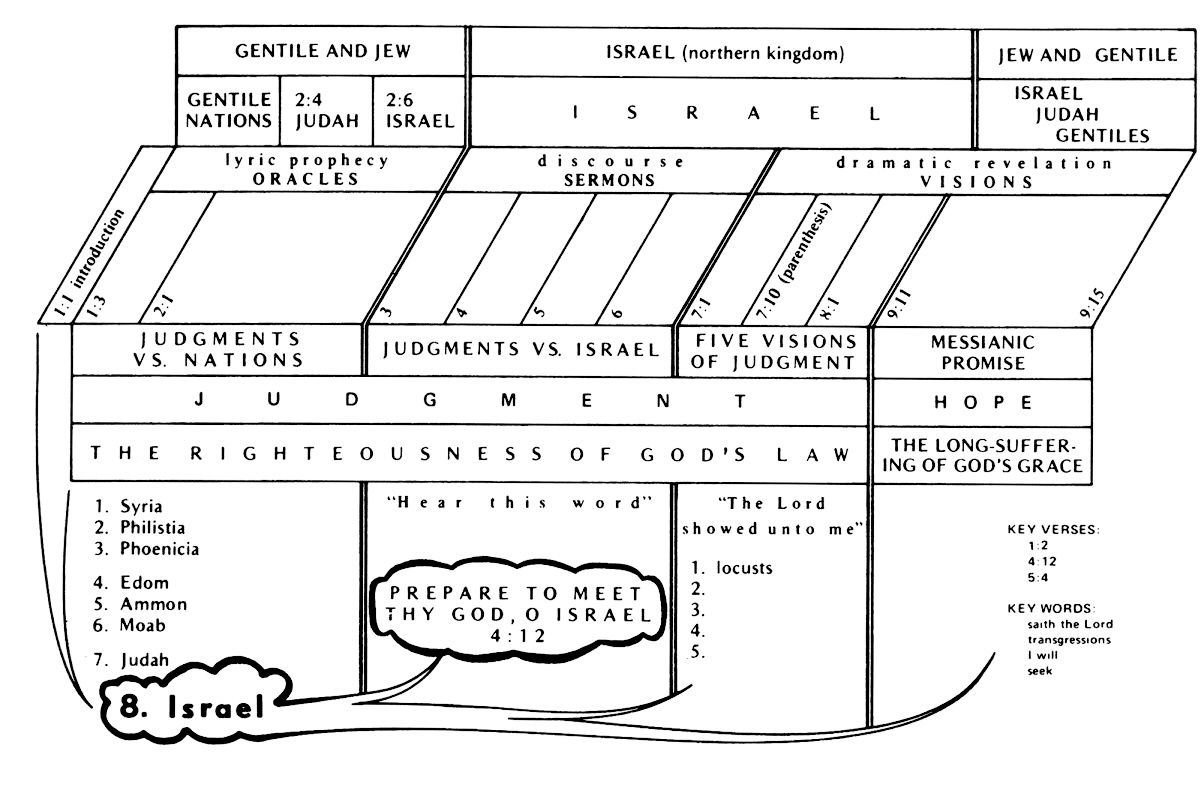
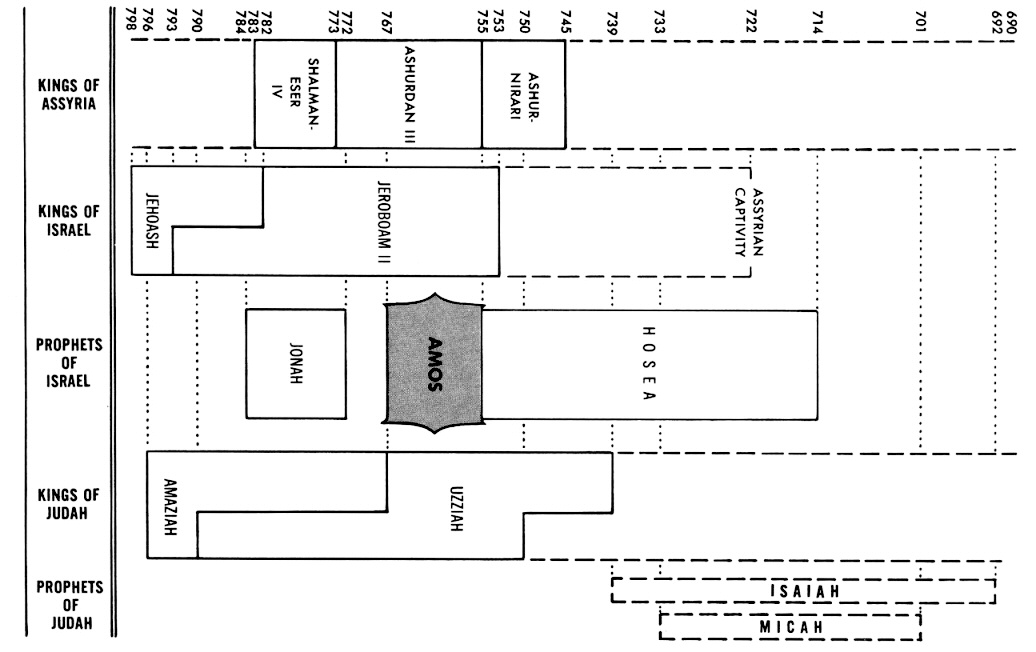
Click chart to enlarge
Jensen's Survey of the OT - used by permission
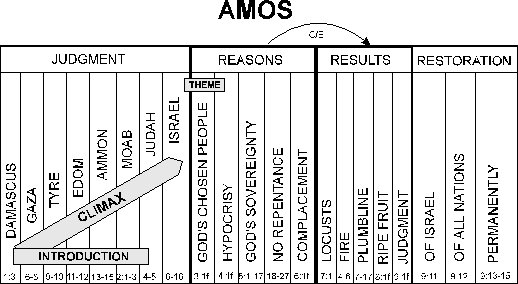
Click chart to enlarge
From Hampton Keathley IV

Amos 9:1 I saw the Lord standing beside the altar, and He said, "Smite the capitals so that the thresholds will shake, And break them on the heads of them all! Then I will slay the rest of them with the sword; They will not have a fugitive who will flee, Or a refugee who will escape.
KJV I saw the Lord standing upon the altar: and he said, Smite the lintel of the door, that the posts may shake: and cut them in the head, all of them; and I will slay the last of them with the sword: he that fleeth of them shall not flee away, and he that escapeth of them shall not be delivered.
NET I saw the sovereign One standing by the altar and he said, "Strike the tops of the support pillars, so the thresholds shake! Knock them down on the heads of all the people, and I will kill the survivors with the sword. No one will be able to run away; no one will be able to escape.
NLT Then I saw a vision of the Lord standing beside the altar. He said, "Strike the tops of the Temple columns, so that the foundation will shake. Bring down the roof on the heads of the people below. I will kill with the sword those who survive. No one will escape!
ESV I saw the Lord standing beside the altar, and he said: "Strike the capitals until the thresholds shake, and shatter them on the heads of all the people; and those who are left of them I will kill with the sword; not one of them shall flee away; not one of them shall escape.
BGT εἶδον τὸν κύριον ἐφεστῶτα ἐπὶ τοῦ θυσιαστηρίου καὶ εἶπεν πάταξον ἐπὶ τὸ ἱλαστήριον καὶ σεισθήσεται τὰ πρόπυλα καὶ διάκοψον εἰς κεφαλὰς πάντων καὶ τοὺς καταλοίπους αὐτῶν ἐν ῥομφαίᾳ ἀποκτενῶ οὐ μὴ διαφύγῃ ἐξ αὐτῶν φεύγων καὶ οὐ μὴ διασωθῇ ἐξ αὐτῶν ἀνασῳζόμενος
LXE I saw the Lord standing on the altar: and he said, Smite the mercy-seat, and the porch shall be shaken: and cut through into the heads of all; and I will slay the remnant of them with the sword: no one of them fleeing shall escape, and no one of them, striving to save himself shall be delivered.
CSB I saw the Lord standing beside the altar, and He said: Strike the capitals of the pillars so that the thresholds shake; knock them down on the heads of all the people. Then I will kill the rest of them with the sword. None of those who flee will get away; none of the fugitives will escape.
NIV I saw the Lord standing by the altar, and he said: "Strike the tops of the pillars so that the thresholds shake. Bring them down on the heads of all the people; those who are left I will kill with the sword. Not one will get away, none will escape.
- I saw 2 Chronicles 18:18; Isaiah 6:1; Ezekiel 1:28; John 1:18,32; Acts 26:13; Revelation 1:17
- upon Amos 3:14; Ezekiel 9:2; 10:4
- Smite Isaiah 6:3,4; Zechariah 11:1,2
- lintel or, chapiter, or knop. cut them. or, wound them. in the head. Ps 68:21; Habakkuk 3:13
- shall not flee Amos 2:14-15; Isaiah 24:17,18; 30:16; Jeremiah 48:44
- Multiple Sermons and Commentaries on Amos
Related Passages:
Amos 7:7 Thus He showed me, and behold, the Lord was standing by a vertical wall with a plumb line in His hand.
Isaiah 6:1-4 In the year of King Uzziah’s death I saw the Lord sitting on a throne, lofty and exalted, with the train of His robe filling the temple. 2 Seraphim stood above Him, each having six wings: with two he covered his face, and with two he covered his feet, and with two he flew. 3 And one called out to another and said, “Holy, Holy, Holy, is the LORD of hosts, The whole earth is full of His glory.” 4 And the foundations of the thresholds trembled at the voice of him who called out, while the temple was filling with smoke.
Job 42:5-6 “I have heard of You by the hearing of the ear; But now my eye sees You; 6 Therefore I retract, And I repent in dust and ashes.”
Judges 16:29-30 Samson grasped the two middle pillars on which the house rested, and braced himself against them, the one with his right hand and the other with his left. 30And Samson said, “Let me die with the Philistines!” And he bent with all his might so that the house fell on the lords and all the people who were in it. So the dead whom he killed at his death were more than those whom he killed in his life.
Ezekiel 40:6 Then he went to the gate which faced east, went up its steps and measured the threshold of the gate, one rod in width; and the other threshold was one rod in width.
Amos 3:14 “For on the day that I punish Israel’s transgressions, I will also punish the altars of Bethel; The horns of the altar will be cut off And they will fall to the ground.
Amos 2:14-15 “Flight will perish from the swift, And the stalwart will not strengthen his power, Nor the mighty man save his life. 15 “He who grasps the bow will not stand his ground, The swift of foot will not escape, Nor will he who rides the horse save his life.
Amos 5:19 As when a man flees from a lion And a bear meets him, Or goes home, leans his hand against the wall And a snake bites him.
1 Kings 18:40 Then Elijah said to them, “Seize the prophets of Baal; do not let one of them escape.” So they seized them; and Elijah brought them down to the brook Kishon, and slew them there.
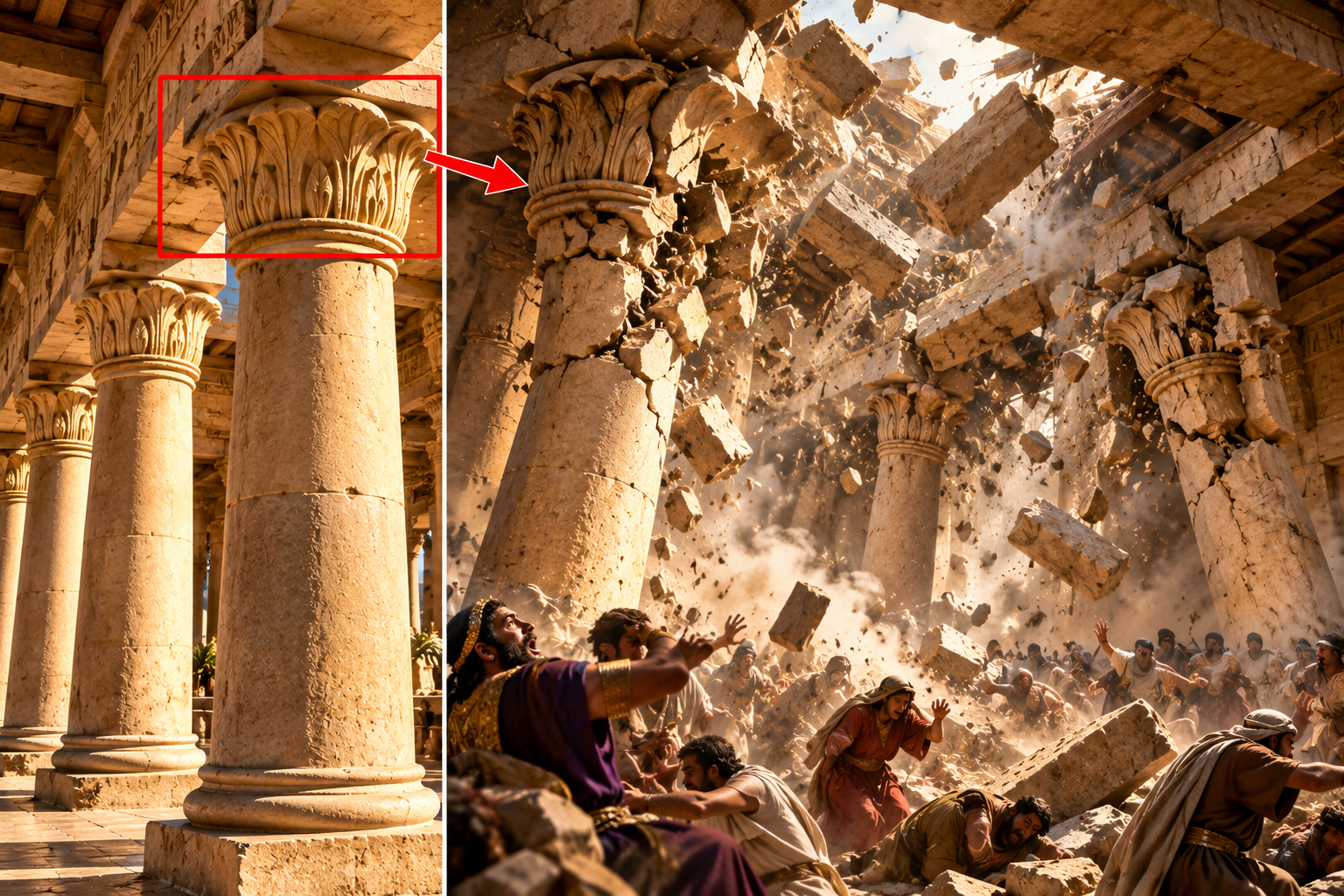
Bring down the roof on the heads of the people below
VISION #5: ADONAI
ORDERS JUDGMENT
I saw the Lord ('adonay; LXX - kurios - one having legal power) standing beside the altar (mizbeah) - This is the fifth and final of Amos’ visions of judgment, a series that began in Amos 7:1. The Lord is standing by the altar just as he ‘stood beside’ Jacob in his Bethel vision (Ge 28:13). The altar normally speaks of mercy received through judgment poured out on a substitutionary sacrifice (cp. Jn 12:31–33). But when the altar and its sacrifices are despised, the altar becomes a place of judgment only. The very place where Israel expected to find divine protection becomes the place from which God announces divine judgment! Throughout Amos, Israel had presumed that its religious ceremonies, sacred shrines, and covenant privileges guaranteed its security. But the LORD now declares that no sanctuary, religious ritual, or human refuge can protect an unrepentant people from His righteous judgment. An altar cannot protect those who persistently refuse to obey the God of the altar! Oh, the high cost of persisting in idolatry. Not only can they not save you, but they will result in your death as a result of righteous judgment of Yahweh.
The very place where Israel expected divine protection
became the place from which God announced divine judgment.
David Allan Hubbard on the finality conveyed by vision number five - Gone is the time for object lessons, pleas, repentance and dialogue. Come is the time for the fullness of the judgment, whose nature and need dominate the book, to be released.....As the foci of the attacks on the political or social corruption were the gate (Amos 5:10, 15) and the citadels or strongholds (Amos 6:8), so the focus of religious corruption was the altar where sacrifices were offered (Amos 2:8; 3:14; 4:4–5; 5:22). The place where God had desired to meet his people in grace was now the site of his fierce and final judgment.....The sanctuary is to collapse from top to bottom, from the dislodged capitals of the pillars to the loosened, shaky thresholds—a further sign that a divine act like an earthquake is in view rather than a military assault. Capitals and threshold together signify the completeness of the destruction: nothing survives from roof to floor, as Zephaniah 2:14 indicated in the graphic picture of Nineveh’s desolation. (Joel and Amos)
Lord ('adonay; LXX - kurios - one having legal power) emphasizes God's sovereignty, authority, and absolute right to rule. The earlier visions involved destructive agents or symbolic objects, but now the LORD personally appears as the One directing judgment. Israel may have ignored God's prophets, but it cannot ignore the God Who sent them. What Israel regarded as its place of greatest security became the scene of its greatest catastrophe.
Amos' vision recalls Isaiah's experience in the temple when Isaiah declared: “I saw the Lord sitting on a throne, lofty and exalted” (Isa 6:1). Isaiah sees the Lord enthroned in heavenly majesty, and the vision leads to his confession, cleansing, and prophetic commission. Amos sees the Lord standing beside the altar, commanding destruction. The same holy God Who cleanses the repentant judges the rebellious.
Bob Utley - This refers to the destruction of a sacred worship site (i.e. altar, possibly at Bethel). The mechanism was the earthquake (cf. Amos 1:1; 8:7-10; 9:1,9). The Israelites were trusting in their covenant relationship with YHWH, but He rejected their amalgamated religious worship (cf. Amos 5:21-24; 8:10). Oh, the danger of eclectic worship!
T S Hadjiev - The sacrificial altar in the outer courtyard was the place where God met the worshippers who brought their offerings to him. Consequently, it was the object that symbolized and made possible human contact with God (Riede 2008: 187–188). The opening scene is rather reassuring. The Lord is standing by the altar where the officiating priest or king would be (1 Kgs 13:1). He is present with the worshipping community (Soggin 1987: 122–123). Things change, however, once the Lord speaks. (See Joel and Amos: An Introduction and Commentary - Page 180)
Thomas Constable on which altar - The altar at Bethel is probably in view since Bethel was the worship site in view in most of this book and since Amos' encounter with Amaziah occurred there (Amos 7:10-17).
Warren Wiersbe - The altar was the place of sacrifice and the atonement, but God refused to accept their sacrifices and forgive their sins (5:21–23). Their man-made religion, carried on by unauthorized priests, was an abomination to the Lord; and He would now destroy it. (Bible Exposition Commentary)
David Guzik - Amos sees the Lord right at the temple, supervising the work of judgment. Amos wants us to know that God isn’t detached from even His hard work of judgment.
Thomas McComiskey suggests a more figurative interpretation writing that "The temple was not a literal temple, for the collapse of such a building would affect only a few. Rather it represents the religion of the northern kingdom, which, in the end, brought about the destruction of its adherents. The decay of the social structure that resulted from their cold externalism could lead only to national ruin. The gross sin of idolatry could lead only to judgment." (SEE Daniel–Malachi - Page 415)
Altars, sacred rituals, and outward professions of faith cannot protect those who persist in rebellion against God. Israel trusted in its sanctuary while perverting the worship of the Lord Whose presence made worship meaningful. The sobering lesson is that no religious structure can provide security to those who refuse to submit to the God it supposedly honors. Our only refuge from divine judgment is not religious activity but genuine repentance and faith in the Lord Jesus Christ (Isa 1:11–17; Mt 7:21–23; Ro 5:9).
The Capital Beneath which is the Threshold
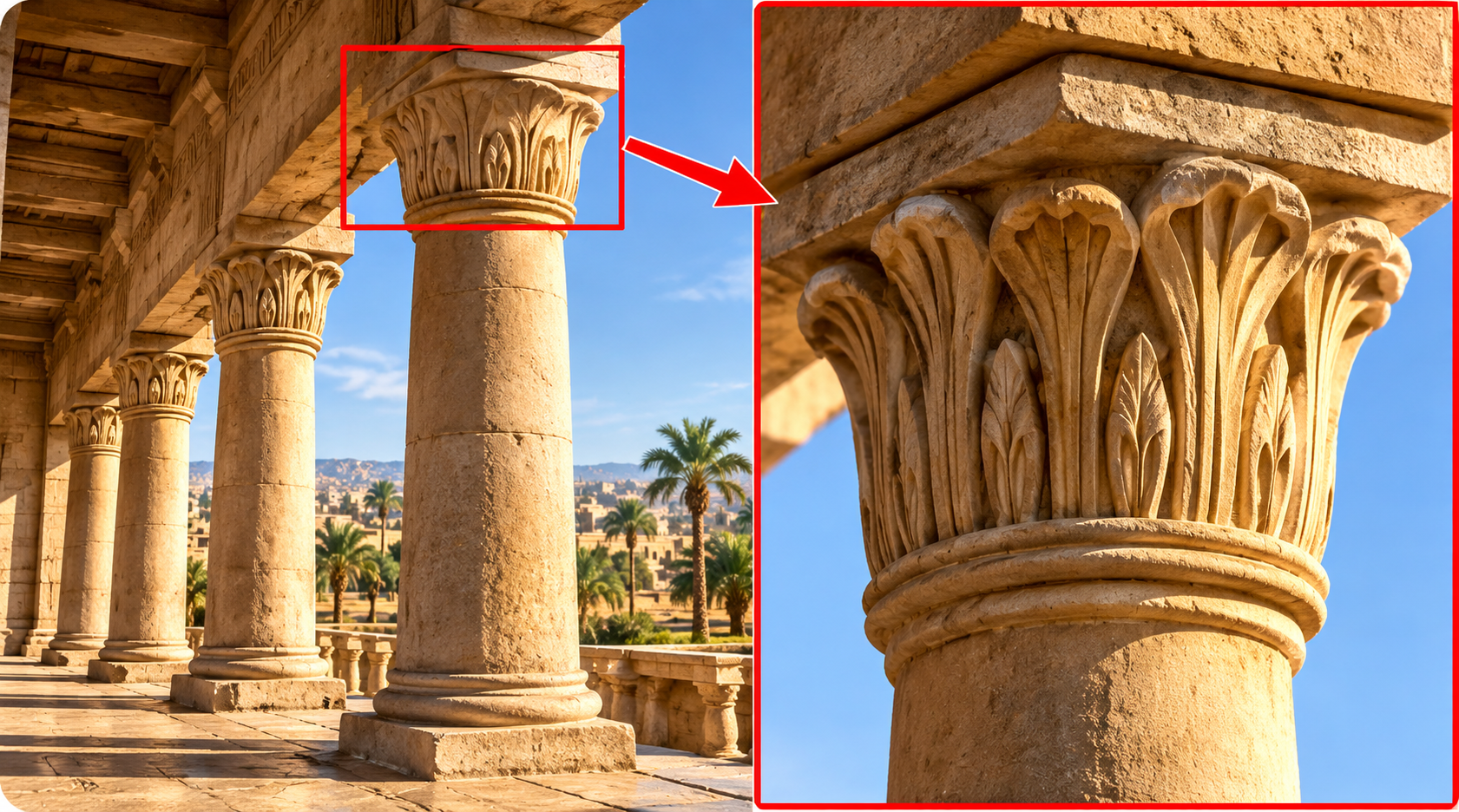
And He said "Smite (nāḵāh; LXX - patasso - strike down as inflicting a heavy or fatal blow) the capitals so that the thresholds will shake (raash; LXX - seio - literally, as causing violent movement) - From Amos 9:1-4 we have Yahweh's first-person monologue. Imagine what Amos must have felt as he listened to the Lord! Adonay (the Sovereign Lord) Himself directs this devastating judgment, emphasizing His absolute authority over its execution. The Hebrew word kaphtôr, translated “capitals,” can refer to the ornamental knob of a lampstand (Ex 25:33–36) or the decorative capital crowning a pillar. Some lexicons associate the term with Kaphtor (Crete), although this etymological connection is uncertain. Here the reference is most likely to the capitals of the pillars supporting the sanctuary. The command to strike the capitals so violently that the thresholds shake portrays the destruction of the entire structure, from its highest architectural features to its very foundations! The shaking may suggest an earthquake, although the text does not explicitly identify the instrument of destruction. The imagery is unmistakable: the sanctuary that Israel regarded as a place of security would become a place of judgment, its collapsing structure bringing destruction upon those gathered within. The very place where Israel presumed upon God's protection would become the place where God's judgment fell! (Am 5:5–6; 8:3; 9:1–4).
T S Hadjiev - Together with the thresholds the capitals symbolize the whole structure from ‘top to bottom’. The threshold in particular was an important part of the temple complex which marked the boundary between the inner realm of the sacred and the outer profane world. Its significance is attested by the existence of a special priestly office, ‘keeper/guardian of the threshold’ (2 Kgs 22:4; 25:18; Jer. 35:4). In the Levant the temple gate was often the most impressive structural component, indicating its crucial role as a boundary marker (Hundley 2013: 121–122). (See Joel and Amos: An Introduction and Commentary - Page 180)
Bob Utley - "Smite the capitals" The VERB smite is a Qal IMPERATIVE. This verse has two IMPERATIVES and a Qal IMPERFECT used as a JUSSIVE (i.e. "quake" BDB 950, KB 1271). The term "capital" refers to the carved (decorated) top of the support stone columns. ▣ "the thresholds" refers to the frame in which the door of the temple is mounted (cf. Isa. 6:4).
John Walton - tops of the pillars. In order to describe how complete the coming destruction will be, Amos again employs a merism. This time his range is from the top to the bottom of the shrine at Bethel, from the capital that decorates the top of the pillars to the doorjamb (see Zeph 2:14). It is possible to compare these earth tremors to Isaiah’s call narrative (Is 6:4), but there it is just a reflection of God’s magisterial presence. Ancient Near Eastern examples of similar destruction mention walls, gates, doors or doorjambs being smashed or demolished (including the Gilgamesh Epic and the inscription of Tukulti-Ninurta I).
David Allan Hubbard asks "To whom are the divine commands smite and shatter addressed? To a heavenly servant like one of Isaiah’s seraphim (Isa 6:2, 6,7)? To the prophet whose symbolic gesture or spoken word had the power to launch the destruction? We cannot be sure. It is more likely that the imperatives (both singular) are a dramatic way of announcing the pending devastation and are directed toward no specific agent...."Like the boss of a demolition squad or the commander of an invading enemy, He snaps his orders for the smashing of the temple and takes personal responsibility for seeing that the last offender is brought to justice.” (see Joel and Amos - Page 215)
The threshold marked the entrance and in this context presumably the entrance into the place of idol worship. This entry way is not "narrow" but "broad" and will shake, quake and tremble, not only for the Israelites but for all who enter this godless threshold. And so this door that led into godless worship recalls Jesus' fearful warning that instead of entering the gate of idolatry we should enter the narrow gate of God
Enter (command) through the narrow gate; for the gate is wide and the way is broad that leads to destruction (apoleia = not annihilation but eternal ruin, forever useless to do anything of worth or value, in short an eternally wasted existence, forever separated from the glorious presence of Jehovah - 2 Th 1:7-9), and there are many (NOT JUST A FEW) who enter through it. For the gate is small and the way is narrow that leads to life, and there are few (NOT MANY) who find it. (Mt 7:13-14, cf "the narrow door" in Luke 13:24).
And break (batsa) them on the heads of them all! - NLT - "Bring down the roof on the heads of the people below." This is the Lord's second command. Judgment of Israel's idolatry now reaches its devastating climax from which their idols could provide no protection! The building collapses upon the heads of those assembled. The people who had gathered in the sanctuary expecting religious security would instead experience destruction. Does this not remind us of a similar divine judgment carried out by God's human instrument named Samson? When Samson pushed against the supporting pillars of the Philistine temple, the building collapsed upon those gathered inside (Jdg 16:29, 30). Amos' vision likewise portrays a religious structure collapsing upon its occupants. The passages are not describing the same event, but the imagery is remarkably similar.
Bob Utley - "break them on the heads of them all" This is referring to the destruction of the worshipers by supernatural means, similar to Samson destroying the Philistine temple in Jdg. 16:23-30. Here the mechanism seems to have been a divinely timed and targeted earthquake.
NET NOTE - Heb "cut them off on the head of all of them." The translation assumes the objective suffix on the verb refers to the tops of the pillars and that the following prepositional phrase refers to the people standing beneath. Another option is to take this phrase as referring to the pillars, in which case one could translate, "Knock all the tops of the pillars off."
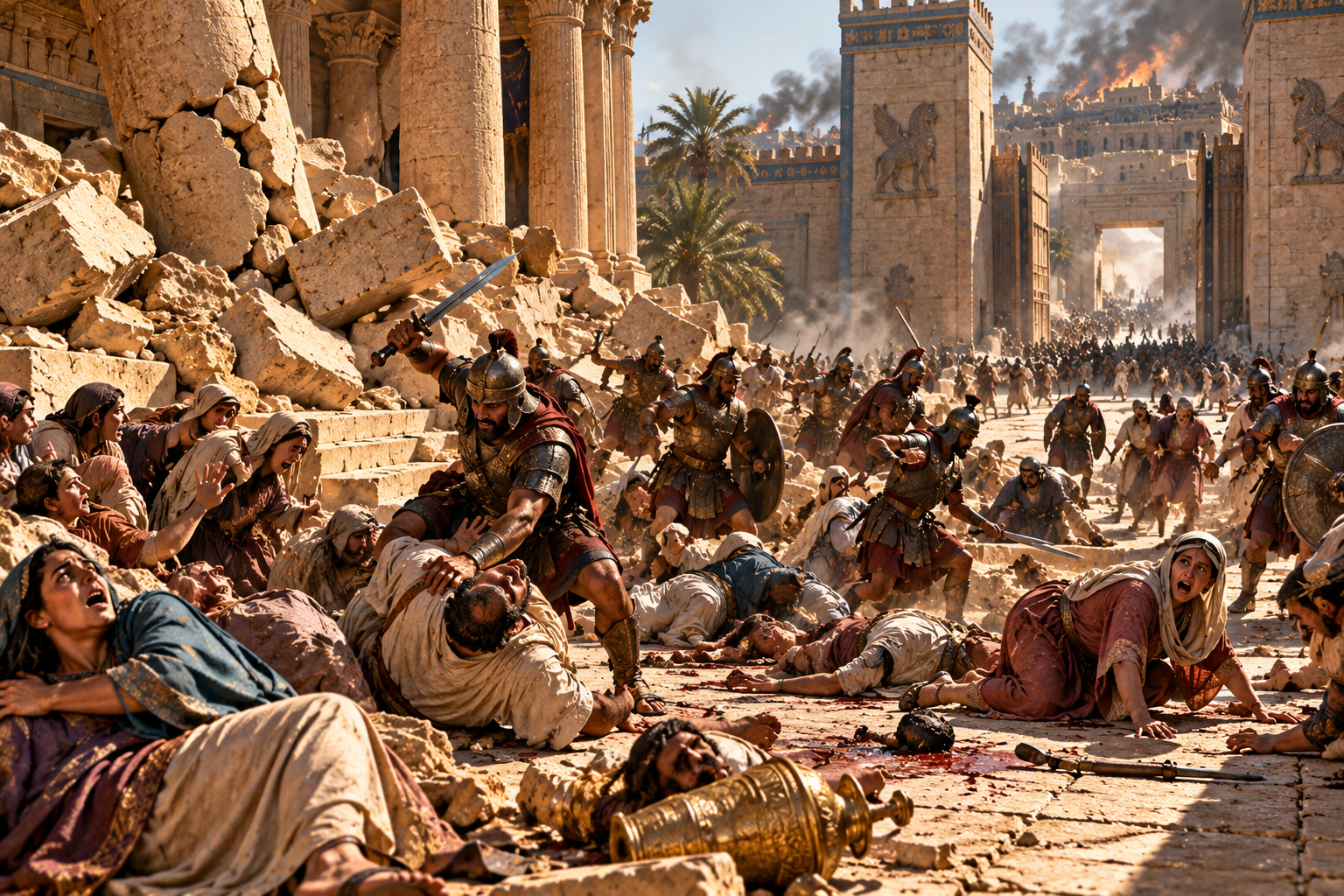
Slain with the sword
Then (marks progression in the narrative) I will slay (harag; LXX - diakopto - cut in two) the rest (acharith; LXX - kataloipos - remaining) of them with the sword - NET - "and I will kill the survivors with the sword" The rest of them refers to those who survive the initial destruction portrayed in the vision. The judgment is therefore described in two stages. First, the structure collapses upon those gathered. Second, the survivors are pursued by the sword.
I will slay emphasizes that the LORD is the ultimate Judge, although human armies (Assyrians) would be the instrument in the execution of divine judgment. The sword might be wielded by human hands, but the judgment proceeded from the sovereign hand of God. It is important to note that this does not mean that every action committed by the Assyrians was morally approved by God. Scripture elsewhere distinguishes God's sovereign use of Assyria from the Assyrians' own arrogance and wicked intentions (Isa 10:5-15). The point is that God remains righteous even when He uses sinful nations as instruments to carry out His judgment.
They will not have a fugitive who will flee, Or a refugee who will escape - NET - "No one will be able to run away; no one will be able to escape." This passage emphasizes the impossibility of escaping the announced judgment through flight. God had already warned “Flight will perish from the swift” (Am 2:14), so that even the fastest runners would be unable to escape. The tragic irony is that the people had repeatedly refused to flee from sin but would now discover that they could not flee from God's judgment of sin.
Or a refugee who will escape reinforces the preceding statement, emphasizing the comprehensive and inescapable nature of divine judgment. The repetition leaves no room for misunderstanding: No fugitive will successfully flee, and no refugee will find a place of safety. When God executes His judgment, there will be neither escape nor refuge!
This scene reminds me of the future day of the LORD described by John in his description of another horrible time, the one of a kind Great Tribulation of the last of the Last Days, when the Jews would experience the Time of Jacob's distress described in Jeremiah 30:7. The earth-dwellers (unbelieving Jews and Gentiles ) at that time will be so horrified at God's hand of judgment that that they will flee in terror trying to escape.
I looked when He broke the sixth seal, and there was a great earthquake; and the sun became black as sackcloth made of hair, and the whole moon became like blood...Then the kings of the earth and the great men and the commanders and the rich and the strong and every slave and free man hid themselves in the caves and among the rocks of the mountains; and they said to the mountains and to the rocks, “Fall on us and hide us from the presence of Him who sits on the throne, and from the wrath of the Lamb; (Rev 6:12, 15-16)
Tony Garland writes - Here is the classic record of man’s response to his own sin—a vain attempt to hide from the omnipresent, omniscient, almighty God (Ge 3:8; Re 6:16). In the irony of God, those who persecuted God’s servants, who were “destitute, afflicted, tormented—of whom the world was not worthy,” who “wandered in deserts and mountains, in dens and caves of the earth” (Heb. 11:38) now experience firsthand a similar affliction from the very hand of God.
The word inescapable means unable to be avoided or denied, incapable of being escaped or avoided; impossible to ignore. If you are not yet safe in Jesus by grace through faith dear reader, then you need to read the preceding descriptions and synonyms of God's coming just judgment! And then take a stroll and walk down The Romans Road to Salvation! I recently received an email from a man who had wrestled with salvation for years but finally came to Christ by "walking" down The Romans Road to Salvation! See also IRAS TU AL CIELO?-Are You Going to Heaven and Are You Going to Heaven?
Bob Utley - The last three lines of Amos 9:1 assert that no Israelite will ultimately escape YHWH's judgment (cf. Amos 9:2-3, LXX, Peshitta, NRSV, REB, NET). It is similar in meaning to Amos 5:19. Prophetic literature is characterized by judgment passages being placed beside salvation passages. This chapter is a good example. Amos 9:1-10, judgment Amos 9:11-15, salvation. Both are true, but there are conditions/options based on YHWH's mercy and human faith/repentance. A remnant of national Israel will survive to accomplish YHWH's redemptive plan (i.e. a Davidic King)!
🙏 THOUGHT — Is Your Security in Religious Activity or in the Living God? Amos 9:1 raises a searching question for modern readers: Are we trusting in religious activity, or in the Lord Jesus Christ Himself? Israel had altars, sacrifices, festivals, and traditions, but none of them could shelter a people whose hearts were far from God. Jesus warned that we can honor God with our lips while our hearts remain distant (Mt 15:8, 9), and that not everyone who calls Him “Lord” truly belongs to Him (Mt 7:21, 22, 23). It is easy to mistake religious activity for spiritual vitality. We may attend church, even teach classes, and know much of the Bible, yet still need to examine ourselves (2 Cor 13:5). Are we doers of the Word, or only hearers (Jas 1:22)? Let us draw near to God with sincere hearts through our great High Priest (Heb 10:19–22). Our security rests not on what we do for Him but on what He has done for us (Ro 5:1,2; 8:1). The altar at Bethel could not save unrepentant Israel, but the once-for-all sacrifice of Christ on the Cross saves forever all who come to God through Him (Heb 7:25; 10:10-14). Hallelujah! Amen!
The progression of the five visions is significant. This progression teaches an important truth. God's patience is real, but it must never be mistaken for indifference toward sin. The LORD had repeatedly warned Israel. He had sent prophets. He had called the people to repentance. But they had persistently refused to listen (Am 2:11–12; 4:6–11; 7:12–13). Now the final vision announces the consequences.
|
Vision |
Passage |
Central message |
|---|---|---|
|
Locusts |
Amos 7:1–3 |
Judgment threatened; Amos intercedes and God relents |
|
Fire |
Amos 7:4–6 |
Judgment threatened; Amos intercedes and God relents |
|
Plumb line |
Amos 7:7–9 |
Israel measured and found wanting; judgment announced |
|
Basket of summer fruit |
Amos 8:1–3 |
Israel's end has arrived |
|
The Lord beside the altar |
Amos 9:1–4 |
Judgment is unavoidable; no hiding place remains |
🙏 THOUGHT - Beloved, it would be easy to read Amos 9:1-4 and say "Woe, that's a horrible fate for the idolatrous Israelites!" But lest we read it too fast, we need to ponder the thought that God takes four verses to describe the certitude and the thoroughness of their destruction. And then ponder the thought that this is but a "preview of coming attractions" so to speak. In other words, as bad as their temporal destruction would be, it pales in comparison to eternal destruction for all who reject God and His Gospel of grace. May this horrible, but very real truth, constrain us, impel us, drive us to seek to be led by and empowered by the Spirit of Jesus to share the life saving Gospel with every soul with which God allows us to have a "divine appointment!" And do not be shy about this, for if you are filled with the Spirit, you are filled with His fruit of boldness (cf Acts 4:31, etc). You may not have a theological degree, an M.A. or ThD, but you do have a "B.A.," for you have been Born Again and the Spirit of Christ, the living God, indwells you. And do not worry if you get it perfect! God is able to take a few loaves and feed 5000, so He can surely take your seemingly meager offering and feed a hungry soul with the seed of the Gospel. Just be sure to try to explain the complete Gospel, of which most of the world has only a vague inkling (and sadly that includes many who would profess to be Christians!) Here is one simple version - You have sinned and the wages of sin are death. God sent a Redeemer to pay for our sins and He paid by dying on a Cross, was buried and then rose from the dead, conquering not only sin but death. He has come once and will come again. Believe on the Lord Jesus Christ and you will be saved (see Acts 16:31, see Paul's summary "definition" of the Gospel in 1 Cor 15:1-8). You can say more about the need for repentance, for genuine faith, for faith that shows itself authentic by its good works, etc. And you may have time to elaborate, but in less than 60 seconds you can speak words of eternal life to them (John 6:68, 63). How can you pass up such an incredible opportunity?!
And lest we think God's judgment too harsh or unfair, remember that Jehovah Himself had warned Israel through His mouthpiece Amos
For thus says the LORD to the house of Israel, “Seek (a command not a suggestion!) Me (WHY? WHAT PURPOSE?) that you may live. 5 “But do not resort to Bethel and do not come to Gilgal, Nor cross over to Beersheba; For Gilgal will certainly go into captivity And Bethel will come to trouble. 6 “Seek (a second command not a suggestion!) the LORD (WHY? WHAT PURPOSE?) that you may live, (NOW THE CONSEQUENCES FOR REFUSING TO SEEK THE LORD) Or He (WHO?) will break forth like a fire, O house of Joseph (i.e. the kingdom of Israel, named here for the father of the two chief tribes, Ephraim and Manasseh; cf. Amos 5:15), And it will consume with none to quench it (DESCRIBING THE THOROUGHNESS OF GOD'S JUDGMENT - cf Amos 5:2) for Bethel, 7 For those who turn justice into wormwood And cast righteousness down to the earth.” (Amos 5:4-7)
Lord (0136)('adonay) is one of the two chief, divine titles of Yahweh. and is an emphatic form of (̓adon) which means lord, master, owner" "Lord in power." It speaks of the Sovereign One! Sovereignty describes God's freedom from external control or of other controlling influences. God is the ultimate authority in every sphere and place. It follows that all creation is subject to Him and that all creation is answerable to Him. As an aside, what verb do you see in the word sovereign? "Reign" of course, and this verb captures the essence of this divine attribute. Our God Reigns!
Our God reigns!
Our God reigns!
Our God reigns!
Our God reigns!
How lovely on the mountains are the feet of Him
Who brings good news, good news;
Announcing peace, proclaiming news of happiness:
Our God reigns, our God reigns!
Refrain
Gary Hill writes that Adonay - refers to Yahweh as the one determining the destiny (eternal meaning) of every scene of life, the one-and-only moral Governor. This divine title ("the Master assigning destiny") applies to God who determines the eternal worth of every act we do on earth. 136 (̓Adônay) properly means "proprietor-owner" (BDB), the one who "makes the final call" to appraise all things. All is under His jurisdiction as owner; see also 430 (̓Elōhîm), God's other chief title ("the circumstance-Maker"). ̓Adônay) is the emphatic plural of ̓Adōn – the plural of excellence – referring to the one true God (Yahweh), the moral Governor of the universe. It conveys the "Lord in full ownership and jurisdiction."]
Gleason Archer - As Adonay, God alone determines the everlasting morality (eternal meaning) of every scene of life. Adonay decides what is approved (righteousness), or spiritually disapproved (unrighteous) as the moral Governor of the universe" (G. Archer).
Altar (04196)(mizbeah from zabach = to slaughter for sacrifice or for food) is a masculine noun that is frequent in the OT (338x) and describes the place of sacrifice where offerings were made to a deity. The first use in Ge 8:20 describes the altar built by Noah as his first act after he survived the flood. Abraham is associated with an altar in Ge 12:7,8; 13:4, 18; Ge 22:9. Not surprisingly the majority of OT occurrences are in Leviticus (88x in 72v and Exodus is not far behind - 61x in 53v). The first offering by Cain and Abel does not mention a specific altar (Ge 4:3).
Smite(05221) nāḵāh is a verb meaning to beat, to strike, to wound. The meaning of the vb. ranges from hitting to killing. ni. be hit, be struck down; pu. be battered, ruined, destroyed; hi. strike, hit, beat, strike dead, wound, batter, destroy; ho. be struck down (dead), be taken, be hit (#5782); nom. מַכָּה (makkâ), blow, stroke, wound, plague, defeat There are many instances of striking physically (Ex. 21:15, 19; Job 16:10; Ps. 3:7[8]; Song 5:7). Of Yahweh smiting the firstborn (Nu 3:13, 8:17), His own people (Nu 11:33). Of Moses striking the rock twice resulting in his not being allowed to enter the Promised Land (Nu 20:11) Frequently, nākhāh is related to the Israelite conquest of Canaan. God used disease to smite the inhabitants of Canaan (Num. 14:12). This word is also used in a different sense, as when the men of Sodom and Gomorrah were stricken blind by the two angels (Gen. 19:11); when a priest stuck a fork into the kettle (1 Sam. 2:14); when people clapped their hands (2 Kgs. 11:12); or when people verbally abused Jeremiah (Jer. 18:18). God struck the Egyptians with plagues (Ex. 3:20); and struck people down in judgment (Isa. 5:25).
Shake (quake, tremble)(07493) raash means to quake, shake, tremble, move and most often refers a physical tremor back-and-forth movement of a physical body by an outside force. Frequently, the trembling or shaking takes place as nature's response to God's presence or to His activity of rendering divine judgment. Things shaken included the walls of a city (Ezek. 26:10), all living creatures (Ezek 38:20), ground shaken by horses (Job 39:20), thresholds of doors (Amos 9:1); the heavens (Joel 2:10, 3:16; Hag. 2:6), the mountains (Jer. 4:24; Nah. 1:5); Gentile nations (Ezek 31:16, Hag 2:7), coastlands or islands (Ezek. 26:15); kingdoms (Isa. 14:16); the earth or lands (Jdg. 5:4; 2 Sam. 22:8; Ps. 60:2; 68:8; 77:18; Isa. 13:13; Jer. 8:16; 10:10; 49:21); Raash once describes the leaping of a warhorse (Job 39:20). In another unique use raash expresses the psalmist's desire that there be an abundance of grain (Ps. 72:16).
Gilbrant notes that raash "is generally connected with God's judgment. In the Qal stem, it refers to the "shaking," "quaking" or "trembling" of the earth (Jdg. 5:4; Ps. 68:8; Isa. 24:18), of the land of Judah (Jer. 8:16), of the heavens (Joel 2:10), of the heavens and the earth (Joel 3:16), of the mountains (Jer. 4:24; Nah. 1:5), of the walls of Tyre (Ezek. 26:10) and of the pasturelands of Tyre (Ezek. 27:28). It refers to the "rustling" or "waving" of the abundant grain crop (Ps. 72:16). But when God judges, the thresholds of the Temple "may shake" (Amos 9:1). In fact, every living creature "shall shake" at the presence of the Lord (Ezek. 38:20). Rāʿash occurs once in the Niphal stem, where it refers to the earth "is moved" at the fall of Babylon (Jer. 50:46). In the Hiphil stem, rāʿash means "to cause to tremble," referring to the earth (Ps. 60:2), the heavens and the earth (Hag. 2:6, 21) and the nations (Ezek. 31:16; Hag. 2:7) when God judges. God inspired the Israelites to take up a taunt song against the king of Babylon asking, "Is this the man who made the [kingdoms of] earth to tremble?" (Isa. 14:16). (Complete Biblical Library Hebrew-English Dictionary)
Break (shatter) (01214) (batsa) means to cut off, break off, or shear, and by extension to finish or complete, to gain by unrighteous violence, and to be covetous or greedy. Batsa and its derivative noun betsa (H1215, "unjust gain, profit") occur thirty-nine times in the OT. The derived uses in the cognate Semitic languages suggest that "to cut" or "cut off" was the original meaning.
BATSA - 16V - accomplished(1), break(1), break ranks(1), completed(1), cut me off(1), cut off(1), cuts me off(1), finish(1), gains by violence(1), get dishonest(1), gets(1), greedy(2), greedy man(1), injured your for gain(1), profits(1). Job 6:9; Job 27:8; Ps. 10:3; Prov. 1:19; Prov. 15:27; Isa. 10:12; Isa. 38:12; Jer. 6:13; Jer. 8:10; Lam. 2:17; Ezek. 22:12; Ezek. 22:27; Joel 2:8; Amos 9:1; Hab. 2:9; Zech. 4:9
Dalman argued that batsa was a technical term used by weavers for cutting a finished piece of cloth free from the loom. Isaiah 38:12 bears this out when Hezekiah contemplates the end of his life in these terms: "Like a shepherd's tent my dwelling is pulled up and removed from me; As a weaver I rolled up my life. He cuts me off from the loom; From day until night You make an end of me." In the same way, Job asks that God would cut off his life: "Would that God were willing to crush me, That He would loose His hand and cut me off!" (Job 6:9). The weaver's image explains the Piel meaning "to complete, finish." When the work is done, the cloth is cut from the loom. So Zechariah promises, "The hands of Zerubbabel have laid the foundation of this house, and his hands will finish it" (Zech 4:9).
Figuratively, batsa means being destroyed or judged, with life or a nation "cut off" by God. Of the godless Job says, "For what is the hope of the godless when he is cut off, When God requires his life?" (Job 27:8). Of Babylon Jeremiah declares, "O you who dwell by many waters, Abundant in treasures, Your end has come, The measure of your end" (Jer 51:13). In some passages batsa describes the Lord carrying out His purposed judgment: "So it will be that when the Lord has completed all His work on Mount Zion and on Jerusalem, He will say, 'I will punish the fruit of the arrogant heart of the king of Assyria and the pomp of his haughtiness'" (Isa 10:12). Likewise Jeremiah laments, "The LORD has done what He purposed; He has accomplished His word Which He commanded from days of old. He has thrown down without sparing" (Lam 2:17).
The more common connotation builds on a slightly different sense of "cut off": cutting off for oneself what is not one's own. In modern slang it is a "rip-off," and so batsa comes to mean being greedy or covetous. It often denotes dishonesty, greed, and injustice. "So are the ways of everyone who gains by violence; It takes away the life of its possessors" (Prov 1:19). Jeremiah indicts the whole nation: "Because from the least even to the greatest Everyone is greedy for gain; From the prophet even to the priest Everyone practices deceit" (Jer 8:10). Ezekiel charges Jerusalem, "In you they have taken bribes to shed blood; you have taken interest and profits, and you have injured your neighbors for gain by oppression, and you have forgotten Me," declares the Lord GOD (Ezek 22:12). He portrays Israel's wicked leaders as "like wolves tearing the prey, by shedding blood and destroying lives in order to get dishonest gain" (Ezek 22:27). Habakkuk pronounces woe on the same sin: "Woe to him who gets evil gain for his house To put his nest on high, To be delivered from the hand of calamity!" (Hab 2:9). The noun appears in Jethro's qualifications for leaders, men "who hate dishonest gain" (Ex 18:21), and in the failure of Samuel's sons, who "turned aside after dishonest gain and took bribes and perverted justice" (1 Sam 8:3).
Slay (02026) harag means to kill, slay, murder, or destroy. Its basic sense is the violent taking of life, usually of one person by another, whether in murder, war, intrigue, or judicial execution. The verb occurs about 170 times in the OT, which shows how common the taking of life was in Israel’s history. It is especially frequent in the histories of the judges and the monarchy, where the thing it describes was all too common. The related nouns are hereg (H2027, “slaughter, killing”) and haregah (H2028, “slaughter”). Jeremiah uses the latter for the renamed valley of judgment: “Therefore, behold, days are coming,” declares the LORD, “when it will no longer be called Topheth, or the valley of the son of Hinnom, but the valley of the Slaughter; for they will bury in Topheth because there is no other place” (Jer 7:32; cf. Zech 11:4, “Pasture the flock doomed to slaughter”). The Septuagint usually renders harag with apokteino, the standard Greek verb for “to kill.” The word remains in use in modern Hebrew, in both verb and noun forms, for killing and slaughter.
HARAG - destroyed(1), kill(44), kill me as you killed(1), kill me at once(1), killed(58), killing(3), kills(2), murdered(2), murderer(1), murderers(1), occurs(1), slain(16), slaughter(1), slay(14), slayer(2), slays(2), slew(11), smitten(1), surely kill(1). Gen. 4:8; Gen. 4:14; Gen. 4:15; Gen. 4:23; Gen. 4:25; Gen. 12:12; Gen. 20:4; Gen. 20:11; Gen. 26:7; Gen. 27:41; Gen. 27:42; Gen. 34:25; Gen. 34:26; Gen. 37:20; Gen. 37:26; Gen. 49:6; Exod. 2:14; Exod. 2:15; Exod. 4:23; Exod. 5:21; Exod. 13:15; Exod. 21:14; Exod. 22:24; Exod. 23:7; Exod. 32:12; Exod. 32:27; Lev. 20:15; Lev. 20:16; Num. 11:15; Num. 22:29; Num. 22:33; Num. 25:5; Num. 31:7; Num. 31:8; Num. 31:17; Num. 31:19; Deut. 13:9; Jos. 8:24; Jos. 9:26; Jos. 10:11; Jos. 13:22; Jdg. 7:25; Jdg. 8:17; Jdg. 8:18; Jdg. 8:19; Jdg. 8:20; Jdg. 8:21; Jdg. 9:5; Jdg. 9:18; Jdg. 9:24; Jdg. 9:45; Jdg. 9:54; Jdg. 9:56; Jdg. 16:2; Jdg. 20:5; 1 Sam. 16:2; 1 Sam. 22:21; 1 Sam. 24:10; 1 Sam. 24:11; 1 Sam. 24:18; 2 Sam. 3:30; 2 Sam. 4:10; 2 Sam. 4:11; 2 Sam. 4:12; 2 Sam. 10:18; 2 Sam. 12:9; 2 Sam. 14:7; 2 Sam. 23:21; 1 Ki. 2:5; 1 Ki. 2:32; 1 Ki. 9:16; 1 Ki. 11:24; 1 Ki. 12:27; 1 Ki. 18:12; 1 Ki. 18:13; 1 Ki. 18:14; 1 Ki. 19:1; 1 Ki. 19:10; 1 Ki. 19:14; 2 Ki. 8:12; 2 Ki. 9:31; 2 Ki. 10:9; 2 Ki. 11:18; 2 Ki. 17:25; 1 Chr. 7:21; 1 Chr. 11:23; 1 Chr. 19:18; 2 Chr. 21:4; 2 Chr. 21:13; 2 Chr. 22:1; 2 Chr. 22:8; 2 Chr. 23:17; 2 Chr. 24:22; 2 Chr. 24:25; 2 Chr. 25:3; 2 Chr. 28:6; 2 Chr. 28:7; 2 Chr. 28:9; 2 Chr. 36:17; Neh. 4:11; Neh. 6:10; Neh. 9:26; Est. 3:13; Est. 7:4; Est. 8:11; Est. 9:6; Est. 9:11; Est. 9:12; Est. 9:15; Est. 9:16; Job 5:2; Job 20:16; Ps. 10:8; Ps. 44:22; Ps. 59:11; Ps. 78:31; Ps. 78:34; Ps. 78:47; Ps. 94:6; Ps. 135:10; Ps. 136:18; Prov. 1:32; Prov. 7:26; Eccl. 3:3; Isa. 10:4; Isa. 14:19; Isa. 14:20; Isa. 14:30; Isa. 22:13; Isa. 26:21; Isa. 27:1; Isa. 27:7; Jer. 4:31; Jer. 15:3; Jer. 18:21; Lam. 2:4; Lam. 2:20; Lam. 2:21; Lam. 3:43; Ezek. 9:6; Ezek. 21:11; Ezek. 23:10; Ezek. 23:47; Ezek. 26:6; Ezek. 26:8; Ezek. 26:11; Ezek. 26:15; Ezek. 28:9; Ezek. 37:9; Hos. 6:5; Hos. 9:13; Amos 2:3; Amos 4:10; Amos 9:1; Amos 9:4; Hab. 1:17; Zech. 11:5
Its first use is the first murder in history, the fratricide of Cain and Abel: “Cain told Abel his brother. And it came about when they were in the field, that Cain rose up against Abel his brother and killed him” (Gen 4:8). Abel’s shed blood then “cried to God” for vengeance: “The voice of your brother’s blood is crying to Me from the ground” (Gen 4:10). Cain feared the same fate himself: “whoever finds me will kill me” (Gen 4:14). The LORD answered, “Therefore whoever kills Cain, vengeance will be taken on him sevenfold.” And the LORD appointed a sign for Cain, so that no one finding him would slay him (Gen 4:15). From the beginning, then, harag is tied to jealousy, bloodshed, guilt, and the demand for justice. Esau’s later plot against Jacob shows the same pattern: “Behold your brother Esau is consoling himself concerning you by planning to kill you” (Gen 27:42).
Murder and execution. The same verb is used for both murder and judicial execution, which agrees with God’s command after the flood: “Whoever sheds man’s blood, By man his blood shall be shed, For in the image of God He made man” (Gen 9:6). The murderer was to be executed. Failing to execute him would amount to consent to the crime, would break the covenant with God, and would deny God’s image in man. The Law distinguished premeditated killing from unintentional killing. “But if he did not lie in wait for him, but God let him fall into his hand, then I will appoint you a place to which he may flee” (Ex 21:13). “If, however, a man acts presumptuously toward his neighbor, so as to kill him craftily, you are to take him even from My altar, that he may die” (Ex 21:14). Likewise, a householder who killed a robber breaking into his home at night did not incur bloodguilt, since a nocturnal housebreaker would not stop at murder to accomplish his purpose (Ex 22:2). David ordered the execution of the murderers of Ishbosheth: “How much more, when wicked men have killed a righteous man in his own house on his bed, shall I not now require his blood from your hand and destroy you from the earth?” (2 Sam 4:11; cf. 2 Sam 4:12). In Mesopotamian law, by contrast, there are few parallels to the biblical laws on murder. There, loss of life could often be compensated by paying a fine, and the death penalty was imposed only in aggravated cases. Scripture treats human life as too sacred to be priced.
Harag and ratsach. There is much overlap among the Hebrew words for “kill.” Harag is not the word used in the sixth commandment. That word is ratsach, which is more characteristic of murder: “You shall not murder” (Ex 20:13; Deut 5:17). This is why most modern versions translate the commandment “murder” rather than “kill.” Many uses of harag do describe murder, but its range is broader. It includes:
Jezebel’s killing of the prophets: “Has it not been told to my master what I did when Jezebel killed the prophets of the LORD, that I hid a hundred prophets of the LORD by fifties in a cave, and provided them with bread and water?” (1 Ki 18:13).
Simeon and Levi’s slaughter of the Shechemites: “They killed Hamor and his son Shechem with the edge of the sword, and took Dinah from Shechem’s house, and went forth” (Gen 34:26).
Joab’s killing of Abner: “So Joab and Abishai his brother killed Abner because he had put their brother Asahel to death in the battle at Gibeon” (2 Sam 3:30).
Joab and Abishai acted from the old tribal obligation of blood vengeance. Their deed was nevertheless condemned as a crime, because they avenged blood spilled in war after the war was over. David charged Solomon, “Now you also know what Joab the son of Zeruiah did to me, what he did to the two commanders of the armies of Israel, to Abner the son of Ner, and to Amasa the son of Jether, whom he killed; he also shed the blood of war in peace” (1 Ki 2:5). In short, harag is usually used of the violent killing of men by other men, sometimes with justification, often, alas, not!
War and wholesale slaughter. Harag often means slaughter in battle or after battle. Sometimes this was the carrying out of cherem, the devoting of all spoil (human, animal, and material) to Yahweh by total destruction.
Against Midian: “So they made war against Midian, just as the LORD had commanded Moses, and they killed every male. They killed the kings of Midian along with the rest of their slain: Evi and Rekem and Zur and Hur and Reba, the five kings of Midian; they also killed Balaam the son of Beor with the sword” (Num 31:7-8).
Ai suffered the same fate: “Now when Israel had finished killing all the inhabitants of Ai in the field in the wilderness where they pursued them, and all of them were fallen by the edge of the sword until they were destroyed, then all Israel returned to Ai and struck it with the edge of the sword” (Josh 8:24).
When the armies attacked Joshua’s ally Gibeon, the LORD fought for Israel: “the LORD threw large stones from heaven on them as far as Azekah, and they died; there were more who died from the hailstones than those whom the sons of Israel killed with the sword” (Josh 10:11).
Under David: “David killed 700 charioteers of the Arameans and 40,000 horsemen and struck down Shobach the commander of their army, and he died there” (2 Sam 10:18).
Under Pharaoh: Pharaoh “captured Gezer and burned it with fire, and killed the Canaanites who lived in the city” (1 Ki 9:16).
In Esther, the Jews were granted the right “to defend their lives, to destroy, to kill and to annihilate the entire army of any people or province which might attack them” (Esth 8:11).
God as subject. Harag is used only infrequently of God’s judicial killing; Scripture more often uses the causative form of mut (“to die”) or nakah (“to strike”). The angel’s slaughter of Sennacherib’s army, for example, uses nakah. The clearest example of harag with God as subject is the death of Egypt’s firstborn. “Behold, I will kill your son, your firstborn” (Ex 4:23). “It came about, when Pharaoh was stubborn about letting us go, that the LORD killed every firstborn in the land of Egypt, both the firstborn of man and the firstborn of beast” (Ex 13:15). Abimelech appealed to God’s justice with the same verb: “Lord, will You slay a nation, even though blameless?” (Gen 20:4).
Harag in Amos. Amos uses harag repeatedly to announce God’s judgment on the nations and on Israel:
Against Moab: “I will also cut off the judge from her midst And slay all her princes with him,” says the LORD (Amos 2:3).
Against Israel, recalling God’s judgments against Egypt: “I sent a plague among you after the manner of Egypt; I slew your young men by the sword along with your captured horses, And I made the stench of your camp rise up in your nostrils; Yet you have not returned to Me,” declares the LORD (Amos 4:10).
In the final vision: “Then I will slay the rest of them with the sword; They will not have a fugitive who will flee, Or a refugee who will escape” (Amos 9:1).
Even exile would be no escape, for the sword itself becomes the executioner: “And though they go into captivity before their enemies, From there I will command the sword that it slay them, And I will set My eyes against them for evil and not for good” (Amos 9:4).
Hosea uses the participle for the “slayer” or executioner: “But Ephraim will bring out his children for slaughter” (Hos 9:13).
Other subjects and objects. Harag can describe humans killing animals: “If there is a man who lies with an animal, he shall surely be put to death; you shall also kill the animal” (Lev 20:15). Balaam said to his donkey, “If there had been a sword in my hand, I would have killed you by now” (Num 22:29). It is never used for killing sacrificial animals and very seldom for slaughtering animals for food. One example of the latter is Isaiah 22:13: “Killing of cattle and slaughtering of sheep, Eating of meat and drinking of wine: ‘Let us eat and drink, for tomorrow we may die.’” (One of the sources in the notes says harag is generally used of killing animals, including sacrificially. Actual OT usage supports the other view, that such uses are rare.)
Animals can be the agents of death as well. “At the beginning of their living there, they did not fear the LORD; therefore the LORD sent lions among them which killed some of them” (2 Ki 17:25). Zophar said of the godless, “He sucks the poison of cobras; The viper’s tongue slays him” (Job 20:16). The word can even describe the destruction of plants: “He destroyed their vines with hailstones And their sycamore trees with frost” (Ps 78:47).
Summary. Harag runs like a red thread through the OT, from the first murder in Genesis to the final sword of judgment in Amos. It shows how sin, once it entered the world, quickly produced bloodshed (cf. Gen 4:7-8). It also shows that God takes the shedding of blood with utmost seriousness, both as a crime against His image and as a judgment He Himself executes on unrepentant sinners.
John MacArthur gives us the background of Amos - Amos was a Judean prophet called to deliver a message primarily to the northern tribes of Israel (7:15). Politically, it was a time of prosperity under the long and secure reign of Jeroboam II who, following the example of his father Joash (2 Kin. 13:25), significantly “restored the territory of Israel” (2 Kin. 14:25). It was also a time of peace with both Judah (cf. 5:5) and her more distant neighbors; the ever-present menace of Assyria was subdued earlier that century because of Nineveh’s repentance at the preaching of Jonah (Jonah 3:10). Spiritually, however, it was a time of rampant corruption and moral decay (Amos 4:1; 5:10–13; 2 Ki 14:24). Historical and Theological Themes Amos addresses Israel’s two primary sins: 1) an absence of true worship, and 2) a lack of justice. In the midst of their ritualistic performance of worship, they were not pursuing the Lord with their hearts (Amos 4:4,5; 5:4–6) nor following His standard of justice with their neighbors (Amos 5:10–13; 6:12). This apostasy, evidenced by continual, willful rejection of the prophetic message of Amos, is promised divine judgment. Because of His covenant, however, the Lord will not abandon Israel altogether, but will bring future restoration to the righteous remnant (Amos 9:7–15). (Introduction)
Amos 9:1-6 Under Surveillance
By Mart De Haan
"Can anyone hide himself in secret places, so I shall not see him?" says the Lord. —Jeremiah 23:24
Imagine that you’re visiting a foreign country when you realize that you’re being followed. Your every move is watched. Your every conversation is monitored. Your hotel room is bugged and the restaurant tables are electronically rigged to pick up every word you speak. It’s as if at all times someone wants to know what you are doing, saying, thinking, and planning. You are constantly under the scrutiny of another, and it seems there is no place to hide.
Fortunately, most of us don’t know what it’s like to live under that kind of surveillance. Yet in reality, we do live every moment of every day under the watchful eyes of the Lord. He sees everything we do; He hears everything we say; He knows every thought we think.
For those who love and trust the Lord, this is an awesome yet comforting truth. But for those who are determined to resist Him, it’s a different story. Amos told Israel that God was pleading with them to turn from their sins (5:4-15), and he warned them that there would be no hiding place for those who refused to repent (9:1-6).
Father, have mercy on us when we are rebellious. We lift our heart to You in behalf of all who think they can somehow elude Your constant surveillance and final judgment.
They shall not stand the judgment test
Who live for self today,
For God sees all and He will judge
The evildoer's way!
—Bosch
Live today as you will wish you had lived when you stand before God.
1. Live now in the light of the day when you will stand before the Light of the world.
2. Make the choices today that you will be glad you made when you stand before Christ.
3. Live every day with eternity in view, for one day eternity will be all that matters.
4. The time to prepare for standing before Christ is while you are still walking with Christ.
5. Live today so that you will have no regrets when today becomes eternity.
6. One day you will look back on this life from eternity. Live now with that perspective.
7. What seems so important today may mean nothing in eternity, and what seems insignificant today may carry eternal significance.
8. Do not wait until you stand before Christ to discover what you should have lived for.
9. The best way to prepare for your last day is to live faithfully this day.
10. Live for the approval of the One before whom you will one day stand.
11. The question is not merely how you will finish your life, but how you will answer for it. (2Co 5:10)
12. Live today remembering that tomorrow you may give an account of yesterday. (Ro 14:12)
13. What you do with your life matters because one day you will meet the One who gave it to you. (Ro 14:12)
14. Do not sacrifice eternal rewards for temporary pleasures. (Heb 11:25–26)
15. The applause of men lasts a moment; the approval of Christ lasts forever. (Gal 1:10; 1Co 4:5)
16. Live for the words “Well done,” not for the world's applause. (Mt 25:21)
17. One day every earthly ambition will be weighed in the balance of eternity. (1Co 3:12–15)
18. The most important evaluation of your life will not come from those who knew you, but from the One who knows you perfectly. (1Co 4:3–5)
19. One day you will wish you had given less attention to what was temporary and more devotion to what was eternal.
20. The life you are living today is the life you will answer for tomorrow.
21. Do not spend your life gaining what you cannot keep while neglecting what you cannot lose. (Mt 6:19–21)
22. The day is coming when you will no longer ask, “What do I want?” but “What did Christ want?”
23. Every day brings you closer to the moment when your faithfulness will matter more than your success.
24. Live so that when you see His face, you will not wish you had followed Him more closely. (1Jn 2:28)
25. The tragedy is not dying with unfinished plans, but dying with an unfinished obedience.
26. What you are living for today determines what you will have to show for your life when you stand before Christ.
27. The world asks, “How much did you accomplish?” Christ asks, “Were you faithful?” (1Co 4:2)
28. Do not let the urgent things of earth crowd out the important things of eternity.
29. One day the opportunities you neglected will be gone forever. Be faithful with the opportunities God gives you today. (Eph 5:15–16)
30. When you stand before Christ, you will never regret a single act of obedience to Him.
31. Live today in such a way that when you stand before Christ, you will not wish you had lived differently.
32. The best preparation for the judgment seat of Christ is a life lived daily for the glory of Christ.
33. Do not wait until you see Christ face to face to begin living as though He is all that matters.”
Amos 9:2 "Though they dig into Sheol, From there will My hand take them; And though they ascend to heaven, From there will I bring them down.
KJV Though they dig into hell, thence shall mine hand take them; though they climb up to heaven, thence will I bring them down:
NET Even if they could dig down into the netherworld, my hand would pull them up from there. Even if they could climb up to heaven, I would drag them down from there.
NLT "Even if they dig down to the place of the dead, I will reach down and pull them up. Even if they climb up into the heavens, I will bring them down.
ESV "If they dig into Sheol, from there shall my hand take them; if they climb up to heaven, from there I will bring them down.
BGT ἐὰν κατορυγῶσιν εἰς ᾅδου ἐκεῖθεν ἡ χείρ μου ἀνασπάσει αὐτούς καὶ ἐὰν ἀναβῶσιν εἰς τὸν οὐρανόν ἐκεῖθεν κατάξω αὐτούς
LXE Though they hid themselves in hell, thence shall my hand drag them forth; and though they go up to heaven, thence will I bring them down.
CSB If they dig down to Sheol, from there My hand will take them; if they climb up to heaven, from there I will bring them down.
NIV Though they dig down to the depths of the grave, from there my hand will take them. Though they climb up to the heavens, from there I will bring them down.
- dig Job 26:6; Ps 139:7-10; Isaiah 2:19
- climb Job 20:6; Isaiah 14:13-16; Jeremiah 49:16; 51:53; Ezekiel 28:13-16; Obadiah 1:4; Luke 10:18
- Multiple Sermons and Commentaries on Amos
Related Passages:
Psalm 139:7-10 Where can I go from Your Spirit? Or where can I flee from Your presence? If I ascend to heaven, You are there; If I make my bed in Sheol, behold, You are there. If I take the wings of the dawn, If I dwell in the remotest part of the sea, Even there Your hand will lead me, And Your right hand will lay hold of me.
Isaiah 2:19 Men will go into caves of the rocks And into holes of the ground Before the terror of the LORD And the splendor of His majesty, When He arises to make the earth tremble.
Jeremiah 23:24 “Can a man hide himself in hiding places So I do not see him?” declares the LORD. “Do I not fill the heavens and the earth?” declares the LORD.
Jonah 1:3-4 (NO PLACE TO RUN FROM GOD) But Jonah rose up to flee to Tarshish from the presence of the LORD. So he went down to Joppa, found a ship which was going to Tarshish, paid the fare and went down into it to go with them to Tarshish from the presence of the LORD. 4The LORD hurled a great wind on the sea and there was a great storm on the sea so that the ship was about to break up.
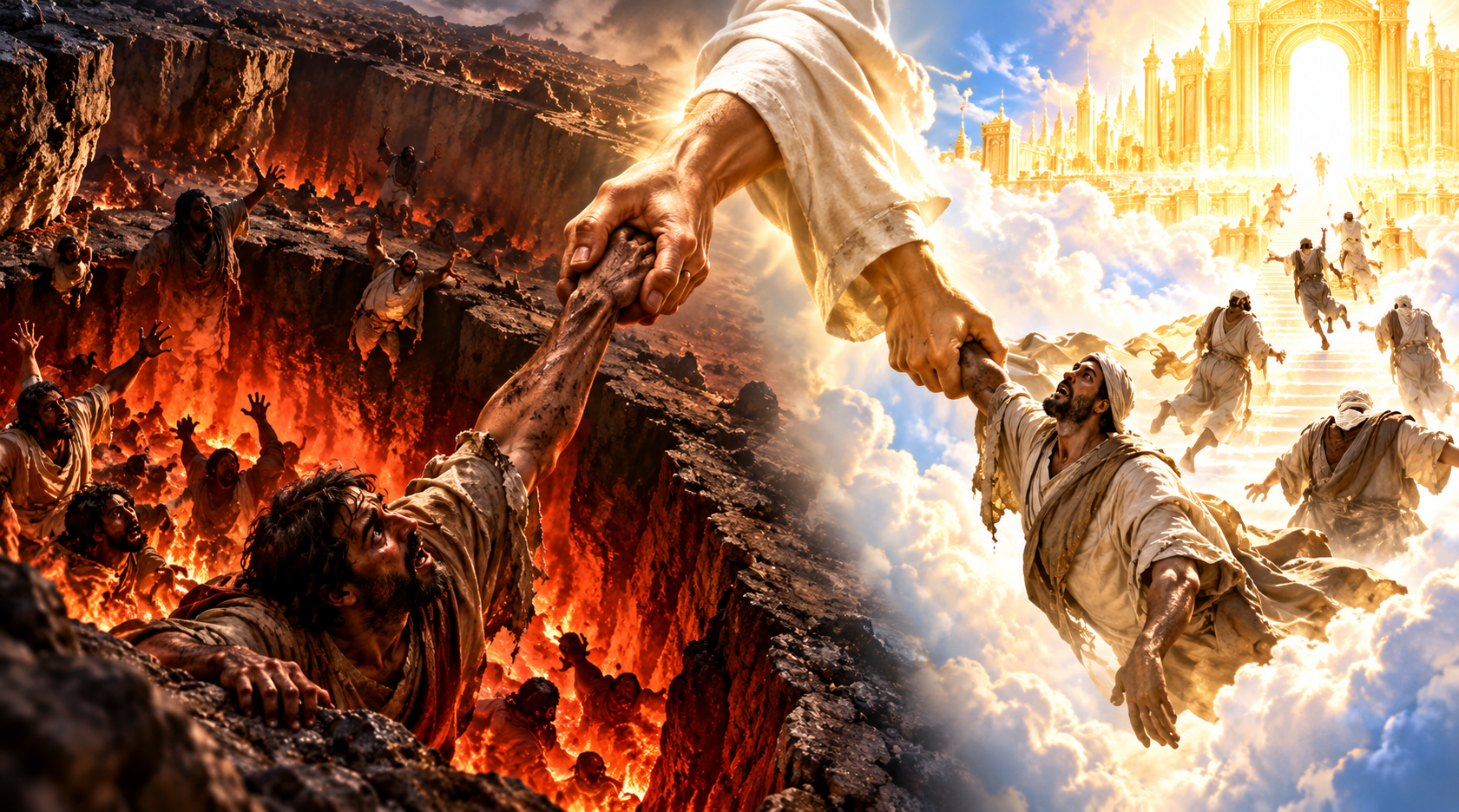
God Will Find Them in the Lowest and Highest Places
NO PLACE
TO HIDE!
Though they dig into Sheol (she'ol), From there will My hand (yad - speaks of power) take them You can run, but you can’t hide.” Having announced in Amos 9:1 that no fugitive will escape His judgment, the LORD now describes two impossible extremes of attempted escape. There will be nowhere to flee in the day of His judgment. Hell and Heaven are both exaggerations because no man could even flee to those places, but if they could, the long arm of the LORD would find them and execute justice. There is no depth so deep that God cannot reach it, and no height so high that God cannot bring it down! The point is not that anyone can literally tunnel into Sheol or climb into heaven, but that even the most extraordinary efforts to escape divine judgment are utterly futile. The point is that what is beyond the reach of every human pursuer remains completely within the reach of God's hand. The language emphasizes both divine omnipresence and divine omnipotence.
Imagine this people so desperate to escape God's judgment that they attempt to tunnel into the deepest possible hiding place, sheol, the realm of the dead. Adonai uses Sheol to depict the lowest imaginable destination. Even if someone could penetrate the realm of the dead, he would still be unable to escape God's authority.
David Allan Hubbard - As dig (Heb. ḥtr; cf. Job 24:16; Ezek. 8:8) indicates, Sheol was viewed as a subterranean realm, occupied by the dead (Isa. 14:9–11, 15–20) and popularly thought to be outside of Yahweh’s sway of sovereignty (Job 10:20–22; 14:13). Amos, however, like the psalmist (Ps. 139:7–11), knew better. The God whose justice and power he had encountered was stranger to no part of his creation; his very dwelling embraced both heaven and earth (Amos 9:6). (see Joel and Amos)
Bob Utley - These verses describe the futility of trying to escape from YHWH's judgment (e.g. Job 34:22; Jer. 23:24; Isa. 29:15). The imagery used is the same as in Ps. 139:8, 9-12 (also note Prov. 15:11). ▣ "Though they dig into Sheol" Sheol (BDB 982, e.g. Isa. 5:14; 14:9; 28:15,18; 38:10) refers to the holding place of the dead. It is described as being in the earth (i.e. dig). This is similar to people trying to hide in the caves in Isa. 2:10,19-21; Luke 23:30; and Rev. 6:15-16.
In this verse heaven may refer to the atmosphere above the earth (cf. Gen. 1:1,14-19,20) and not YHWH's throne (although Isa. 14:12-14 seems to merge the Jewish concept of the first heaven and the third heaven).
Moses says "behold, you have sinned against the LORD, and be sure your sin will find you out." (Nu 32:23) While this warning was specifically directed at the tribes of Reuben, Gad and half the tribe of Manasseh, exhorting them to fulfill their commitment to participate with the other tribes in the campaign in Canaan, it expresses a universal principle. No sin against God or His Word will remain secret and unpunished. And in the day of His righteous, just judgment there will no place to hide. Have you hidden in Christ by grace through faith (Eph 2:8,9), so that your sins might be taken away and you will be rescued from the wrath to come? (1 Th 1:9,10). God is omnipresent in bestowing His blessings and His cursings. The only salvation from His judgment is to run into the strong tower of the Name of the Lord! (Pr 18:10).
J Vernon McGee - for the unbeliever, the omnipresence of God is a terror. Many people commit suicide because they want to get away from it all. A prominent man here in Southern California left a suicide note which read, “I want to end it all and get rid of this life.” Well, he got rid of his problems and a great many things which were annoying him here—he was in deep trouble—but he didn’t get rid of God. (See Thru the Bible)
And though they ascend to heaven, From there will I bring them down (yarad) - From the lowest to the highest there is no hiding place. This is a literary device sometimes called a merism, in which two opposite extremes express a comprehensive totality. The Lord uses extreme hyperbole! Heaven is His home. These false worshipers certainly could not flee there!
Andrew Hill - The merism of “heaven and hell” speaks to the totality of God’s influence and control, “there being no place his sovereignty does not extend” (Stuart 1987:392). (See Minor Prophets: Hosea through Malachi - Page 204)
Bob Utley - "though they ascend to heaven" This is the spacial opposite of Sheol. The language of these verses (i.e. Amos 9:1-4) is reminiscent of Ps. 139:8. There is no where to hide from an angry YHWH (cf. Heb. 10:31)!
Billy Smith writes "If neither heights nor depths can separate people from the love of God (cf. Ro 8:38-39), they are also unable to hide them from the wrath of God." (See Amos, Obadiah, Jonah - Volume 19 - Page 156)
🙏 THOUGHT — Are You Running From God or Running to God? Amos 9:2 reminds us of a truth that is both sobering and comforting. There is nowhere in the universe beyond the reach of God's hand! For those who persistently reject Him, this means that no hiding place can provide escape from His righteous judgment (Heb 4:13; Rev 6:15–17). But for those who belong to Jesus Christ, the same truth becomes an inexhaustible source of assurance. David rejoiced that even in the remotest places God's hand would lead him and His right hand would hold him (Ps 139:7–10). And Jesus promised that no one would snatch His sheep out of His hand or His Father's hand (Jn 10:27–29). What a contrast! The hand that no sinner can escape is the hand from which no true believer can be snatched! When circumstances become overwhelming, when trials threaten to crush our spirits, or when the future seems uncertain, we can rest in the assurance that nothing can separate us from the love of God in Christ Jesus (Ro 8:38,39). And if we have wandered into sin, the answer is not to imitate Adam by hiding from God (Ge 3:8), but to confess our sin and return to the One Who is faithful and righteous to forgive us (1 Jn 1:9). May we never forget that the safest place in all creation is not far away from God, but close to His heart through faith in Jesus Christ (Heb 4:14–16; 7:25).
Sheol (07585)(she'ol) is the underworld or the place to which people descend at death. The grave, death, the depths, the nether world, the underworld. Sheol was viewed as the place where departed spirits went after death. Sheol was envisioned as a dark region within the earth, the entrance to which was the grave with its steep slopes (cf. Ps 88:4-6). In Job 14:13-22, Job expressed the common view of life beyond death, namely, that in Sheol there is no contact with the living, only separation, but in Sheol there is a conscious awareness of the dreary existence. In Jonah 2:3 Jonah pictures himself in the belly of Sheol, its very center - in other words he is as good as dead. In Ps 22:6 Sheol, the underworld, the place of the dead, is personified as David’s enemy. Abaddon is used as a name for Sheol in Ps 88:11. In Ps 143:3"dark places" is a synonym for Sheol, pictured as a dark place located deep in the ground.
Amos 9:3 "Though they hide on the summit of Carmel, I will search them out and take them from there; And though they conceal themselves from My sight on the floor of the sea, From there I will command the serpent and it will bite them.
KJV And though they hide themselves in the top of Carmel, I will search and take them out thence; and though they be hid from my sight in the bottom of the sea, thence will I command the serpent, and he shall bite them:
NET Even if they were to hide on the top of Mount Carmel, I would hunt them down and take them from there. Even if they tried to hide from me at the bottom of the sea, from there I would command the Sea Serpent to bite them.
NLT Even if they hide at the very top of Mount Carmel, I will search them out and capture them. Even if they hide at the bottom of the ocean, I will send the sea serpent after them to bite them.
ESV If they hide themselves on the top of Carmel, from there I will search them out and take them; and if they hide from my sight at the bottom of the sea, there I will command the serpent, and it shall bite them.
BGT ἐὰν ἐγκρυβῶσιν εἰς τὴν κορυφὴν τοῦ Καρμήλου ἐκεῖθεν ἐξερευνήσω καὶ λήμψομαι αὐτούς καὶ ἐὰν καταδύσωσιν ἐξ ὀφθαλμῶν μου εἰς τὰ βάθη τῆς θαλάσσης ἐκεῖ ἐντελοῦμαι τῷ δράκοντι καὶ δήξεται αὐτούς
LXE If they hide themselves in the top of Carmel, thence will I search them out and take them; and if they should go down from my presence into the depths of the sea, there will I command the serpent, and he shall bite them.
CSB If they hide themselves on the top of Carmel, from there I will track them down and seize them; if they conceal themselves from My sight on the sea floor, from there I will command the sea serpent to bite them.
NIV Though they hide themselves on the top of Carmel, there I will hunt them down and seize them. Though they hide from me at the bottom of the sea, there I will command the serpent to bite them.
- hide Job 34:22; Jeremiah 23:23-24
- conceal themselves Ps 139:9-11; Jeremiah 16:16
- the serpent Isaiah 27:1
- Multiple Sermons and Commentaries on Amos
Related Passages:
Job 34:22 “There is no darkness or deep shadow Where the workers of iniquity may hide themselves.
Jeremiah 23:23-24 “Am I a God who is near,” declares the LORD, “And not a God far off? 24“Can a man hide himself in hiding places So I do not see him?” declares the LORD. “Do I not fill the heavens and the earth?” declares the LORD.
Jeremiah 16:16 “Behold, I am going to send for many fishermen,” declares the LORD, “and they will fish for them; and afterwards I will send for many hunters, and they will hunt them from every mountain and every hill and from the clefts of the rocks.
Psalm 139:9-11 If I take the wings of the dawn, If I dwell in the remotest part of the sea, Even there Your hand will lead me, And Your right hand will lay hold of me. If I say, “Surely the darkness will overwhelm me, And the light around me will be night,”
Jeremiah 8:17 “For behold, I am sending serpents against you, Adders, for which there is no charm, And they will bite you,” declares the LORD.

FROM CARMEL'S HEIGHTS
TO THE OCEAN'S DEPTHS
Though they hide (chaba) on the summit of Carmel - There is no hiding from divine omnipresence! Carmel was one of the highest peaks in Israel. (Elevation 525.4 meters or 1,724 ft), but was not high enough to hide from God's justice! Carmel was known for its vegetation, forests, and natural beauty (Isa 35:2; Jer 50:19). Its slopes contained wooded areas, ravines, caves, and secluded places that could provide concealment. The summit rises approximately 1,700 feet above sea level, although elevations vary along the ridge. For someone fleeing an enemy army, Carmel might appear to offer an excellent hiding place.
There are many caves in Carmel's sides, which at one time were inhabited by swarms of monks who were trying to "hide themselves" from their fleshly desires (in fact from the world, the flesh and the devil), but also discovered they could not hide from their fallen flesh nor subjugate it by rites or rituals into submission! The only way to kill sin (A HARSH TASKMASTER!) daily is by the Spirit of Jesus! (Romans 8:13)
J Vernon McGee - “Mount Carmel is wooded and rises to a height of about eighteen hundred feet. I have been there several times and have noted the caves which are along the sides of that mountain. It is said that there are over a thousand caves there, especially on the side toward the sea. But even there God said He would search them out. And although they should try to hide in the bottom of the sea, they would find God there. They could not escape Him.” (See Thru the Bible)
John Walton top of Carmel. As part of this series of phrases warning the Israelites that they cannot hide from God’s wrath, Amos uses the image of the highest point within their nation. Mount Carmel stands eighteen hundred feet above sea level and is a commanding presence, with dense forests and many caves that some might presume to be excellent hideouts (see the comment on Amos 1:2).
As Hubbard says "No place in all creation will afford shelter to the fugitives once God has set his judgment in motion." (see Joel and Amos)
I will search (hapas) them out and take them from there - Search (hapas) means to search diligently, examine carefully, or seek out thoroughly, conveying the idea of an intensive, determined search that leaves no hiding place unexplored. Even if the Israelites conceal themselves among the inaccessible heights of Mount Carmel, God will discover them and bring them out for judgment. The emphatic “I will” underscores that the omniscient and omnipotent Lord Himself will conduct the search. No hiding place is so remote that God cannot find it, and no refuge is so secure that God cannot penetrate it! The same God from whose presence no one can hide (Ps 139:7–12; Jer 23:23–24) will ensure that none escape His righteous judgment (Am 9:1–4).
And though they conceal themselves from My sight on the floor of the sea - From mountain top to ocean floor in another merism. On one hand "How deep the Father's love for us" is, but on the other His wrath is also "deep" for those who reject Him and choose to worship idols as did the Israelites. Amos moves from the towering heights of Mount Carmel to the unfathomable depths of the sea, emphasizing that neither the highest heights nor the deepest depths can conceal anyone from the all-seeing eye of God! The expression “from My sight” reflects the futile assumption that physical distance or concealment could place someone beyond God's observation. But the omnipresent Lord sees everything, even in the darkest depths of the ocean (Ps 139:7-12). What may be hidden from human eyes remains fully exposed before His penetrating gaze (Heb 4:13). The sinner may flee from the presence of men, but he can never flee from the presence of God!
Bob Utley - "though they conceal themselves from My sight on the floor of the sea" This is obviously imagery for sinful mankind's attempt to hide from God (cf. Job 34:21-22; Ps. 139:9-12; Isa. 2:19-20; Jer. 16:16-17; Hosea 10:8; Luke 23:30; Rev. 6:16).!
God grant us today by His Spirit that we would worship God Alone! Amen. If the Spirit brings any "idols" to your mind, smite them down, hack them to pieces, destroy them before they destroy you! Or as Puritan John Owen said in his classic work Mortification of Sin, "Be killing sin, lest it be killing you." (The entire books is an "exposition" of Romans 8:13, which Dr Martyn Lloyd-Jones is one of the most important verses in all of Scripture [listen to his sermon "A Call for Action"] as regards our daily sanctification process.)
Deepest Depth of the Sea

The average depth of the ocean is about 12,100 feet. The deepest part of the ocean is called the Challenger Deep (picture above) and is located beneath the western Pacific Ocean in the southern end of the Mariana Trench, which runs several hundred kilometers southwest of the U.S. territorial island of Guam. Challenger Deep is approximately 36,200 feet deep. It is named after the HMS Challenger, whose crew first sounded the depths of the trench in 1875.
From there I will command (tsavah) the serpent (nahas/nachash) and it will bite them - From there in context is from the depths of the sea. This Hebrew word nachash is the word used for the serpent in the garden! (Ge 3:1, 2, 4, 13, 14) Indeed, since these men in Amos 9 have been "bitten" and poisoned with the deadly venom of sin, they will die in their sin (cf Ro 5:12, Ro 6:23). And so even in the deepest recesses of the sea, the fugitive cannot escape the sovereign authority of God. The identity of the serpent (nahas/nachash) is less important than the fact that God commands it, and it obeys! The serpent does not act independently but serves as an instrument of divine judgment. The verb command (tsavah) emphasizes God's absolute sovereignty over His creation, while it will bite them underscores the certainty of His judgment. Just as God appointed a great fish to swallow Jonah (Jon 1:17), so He can command a creature of the deep to execute His purposes
Bob Utley - "I will command the serpent and it will bite them" This is an allusion to the mythical sea monster, Leviathan (cf. Job 3:8; 41:1; Ps. 74:13-14; 104:26; Isa. 27:1) or Rahab (cf. Job 9:13; 26:12; Ps. 89:10; Isa. 51:9). Notice God commands (Piel IMPERFECT) the chaos monster.

John Walton serpent in the bottom of the sea. From the mountaintop to the bottom of the ocean, there is no place to hide. Even at these depths, God can command the sea serpent to do his biding (compare Jon 1:17). The Israelites knew well the tradition of Yahweh subduing the great sea creatures (see comment on Ps 74:14 and 104:26). Similar contests of strength are found in the Babylonian creation epic, Enuma Elish, and the Egyptian hymn to the sun god, Ra, who must repulse the dragon Apophis repeatedly in order to complete his circuit across the skies. For more information see comments on Genesis 1:20; Exodus 7:1; and Isaiah 27:1.
NET NOTE - If the article indicates a definite serpent, then the mythological Sea Serpent, symbolic of the world’s chaotic forces, is probably in view. See Job 26:13 and Isa 27:1 (where it is also called Leviathan). Elsewhere in the OT this serpent is depicted as opposing the LORD, but this text implies that even this powerful enemy of God is ultimately subject to his sovereign will.
This declaration of divine serpentine judgment would recall a similar judgment on the people of Israel when God sent fiery serpents not from the sea but from the land in Numbers 21
Nu 21:5-9 The people spoke against God and Moses, “Why have you brought us up out of Egypt to die in the wilderness? For there is no food and no water, and we loathe this miserable food.” 6 The LORD sent fiery serpents (nahas/nachash) among the people and they bit the people, so that many people of Israel died. 7 So the people came to Moses and said, “We have sinned, because we have spoken against the LORD and you; intercede with the LORD, that He may remove the serpents from us.” And Moses interceded for the people. 8 Then the LORD said to Moses, “Make a fiery serpent, and set it on a standard; and it shall come about, that everyone who is bitten, when he looks at it, he will live.” 9 And Moses made a bronze serpent and set it on the standard; and it came about, that if a serpent bit any man, when he looked to the bronze serpent, he lived.
Comment - What is amazing is that the Israelites turned the bronze serpent of nachash into an IDOL which they carried around for the next 730 years worshiping the creation "For they exchanged the truth of God for the lie, and worshiped and served the creature rather than the Creator, who is blessed forever. Amen. (Ro 1:25)! 2 Ki 18:4 says "He (King Hezekiah - 715-686 BC) removed the high places and broke down the sacred pillars and cut down the Asherah. He also broke in pieces the bronze serpent that Moses had made, for until those days the sons of Israel burned incense to it; and it was called Nehushtan (a play on the word nahach and fittingly means a ‘trifling thing! = A good illustration of ALL idols!)."
Oh, how evil are ALL of our hearts, how sinister and enticing is our fallen flesh (James 1:14), as we so quickly default to the lusts of the flesh (1 John 2:16), even those of us who have experienced that we have true life (Jn 10:10) and blessing in obedience (1 Sa 15:22, read Lk 11:28) to the Lord (as the Israelites did when they simply looked -- but it was a look of faith and trust in the truth that Moses had declared and as shown below was but a shadow of perfect picture of the Messiah Who would in effect suffer the deadly bite of sin on behalf of all who would simply LOOK to Him in faith and trust as their Substitutionary Sacrifice (One "look" is what saved C H Spurgeon as he responded to Isaiah 45:22KJV).
And so Jesus applied this picture to Himself in John 3:14-16 declaring "As Moses lifted up the serpent in the wilderness, even so must the Son of Man be lifted up; so that whoever believes will in Him have eternal life. “For God so loved the world, that He gave His only begotten Son, that whoever believes in Him shall not perish, but have eternal life."
🙏 THOUGHT — Are You Hiding From God or Finding Refuge in Him? Amos 9:3 reminds us that no hiding place lies beyond the searching eye of God. Israel might imagine that the wooded heights of Carmel or the depths of the sea could shelter them, but the LORD would search them out. We may try to hide from God by concealing cherished sins, excusing disobedience, or quieting our consciences with religious activity. Yet like Adam among Eden’s trees (Ge 3:8, 9, 10), we cannot escape His voice. Even darkness cannot hide us (Ps 139:11,12), and all things lie open before Him (Heb 4:13). But here is the gospel: the God from Whom we cannot hide is the God to Whom we may run for mercy! Instead of concealing our sins, we should confess them and receive His forgiveness (Pr 28:13; 1 Jn 1:9). Instead of fleeing, we should continually draw near through Jesus our great High Priest (Heb 4:14–16). The safest place in the universe is not a mountain cave on Carmel or in the depths of the sea, but in the shadow of the Almighty, in Christ Jesus our Refuge (See Christ our Rock of Refuge) (Ps 91:1,2).
Search (02664) (hapas) means properly, to search by digging deeper; to mine out (implied by its Syriac and Aramaic cognates); searching that is set on arriving at the ultimate objective; a plan to uncover and discover. The Septuagint translates hapas here with the rare verb exereunao (ek = an intensifier + ereunao = to search into, investigate, explore) used in the NT only in 1 Peter 1:10 and meaning to search diligently for something, especially for something hidden like miners engaged in digging for precious metals in the bowels of the earth. This word was used of a dog sniffing out something with his nose.
The Septuagint uses exereunao 5 times in the great Psalm 119 where it translates the word "observe" - Read the following passages from Psalm 119 with the meaning of this verb in mind - it gives a new "nuance" regarding what it means to "observe" God's testimonies, law, precepts, commandments = Ps. 119:2 (surprisingly it is not used to translate "seek" here); Ps. 119:34; Ps. 119:69; Ps. 119:115; Ps. 119:129.
Now let's apply because truth not applied is in one ear and out the other (aka James 1:22). Do you just skim over God's Word so that you can "satisfy" your goal of reading through the Bible in a year? Do you read it superficially so you can check that box in your list of activities in your quiet time? The verb exereunao calls us to "dig into" the precious Word, more precious in fact than gold, but too often we barely scratch the surface for we are more constrained (impelled) by our fallen flesh to go out into the world and "dig for gold!" Little wonder that so many believers are spiritual paupers and their faith is weak and their walk is like a yo-yo on a string! We go to cross fit to train our bodies, but too often we fail to go the old rugged Cross to train our souls! Tomorrow morning begin a new discipline (under grace not law), a discipline enabled by the Spirit, and begin to "dig in" to the living and active Word of God as if your spiritual life depended on it (because it does! cf Jesus' words Mt 4:4, Lk 4:4+). I am a retired medical doctor and would write prescriptions like this "Take 1 tablet q.d. for 30 days." Now that I am retired, I more often treat the soul, so let me prescribe that you try this "discipline" for "1 q.d. x 30 days" and see what a difference it makes in your spiritual vitality and your walk in Christ. I dare you! (under grace of course!).
Solomon, the richest, wisest man (other than Jesus) who ever lived, extols the value of diligently digging for wisdom writing "If you seek her as silver, and search (Lxx = exereunao) for her (WISDOM) as for hidden treasures (it was the custom to bury valuables in the ground or in holes in the rocks)." (Pr 2:4) What is emphasized is the diligent effort that must be made to obtain wisdom. The tragedy is that too often men show more zeal in acquiring material wealth than spiritual treasures.
Hide (02244) chaba is a verb meaning to hide or conceal. Used reflexively, it means to hide oneself, and passively, to be hidden. The root carries the same meaning in a number of Semitic languages, though in Syriac it means “to be darkened.” The verb occurs about thirty times. In four instances it appears in the by-form chabah (HED #2334).
CHABA -33V - becomes hard(1), concealed(1), hid(10), hidden(11), hide(5), hides(1), hiding(2), hushed(1), secretly(1). Gen. 3:8; Gen. 3:10; Gen. 31:27; Jos. 6:17; Jos. 6:25; Jos. 10:16; Jos. 10:17; Jos. 10:27; Jdg. 9:5; 1 Sam. 10:22; 1 Sam. 13:6; 1 Sam. 14:11; 1 Sam. 14:22; 1 Sam. 19:2; 1 Sam. 23:23; 2 Sam. 17:9; 1 Ki. 18:4; 1 Ki. 18:13; 2 Ki. 6:29; 2 Ki. 11:3; 1 Chr. 21:20; 2 Chr. 18:24; 2 Chr. 22:9; 2 Chr. 22:12; Job 5:21; Job 24:4; Job 29:8; Job 29:10; Job 38:30; Isa. 42:22; Isa. 49:2; Dan. 10:7; Amos 9:3
In about twenty-five of its occurrences, chaba describes people hiding out of fear, usually fear of death. The most notable use is the first, where Adam and Eve “hid themselves” from the presence of the Lord God among the trees of the garden (Ge 3:8, 10). Adam confessed that he hid because he was afraid. He was conscious of his alienation from the righteous God and may have remembered the threat of certain death for his transgression. In the same way, the five kings of the southern confederacy, the kings of Jerusalem, Hebron, Jarmuth, Lachish and Eglon, fled from Joshua and hid in the cave at Makkedah. They were found there and executed (Josh 10:16–17, 27). Daniel’s companions felt a great dread while he saw the vision of the man dressed in linen, and they fled to hide themselves (Da 10:7). That vision is similar to the revelation of Jesus given to John on Patmos (Rev 1:12–17). Amos uses the verb for sinners who try to escape God’s judgment: “Though they hide on the summit of Carmel, I will search them out and take them from there” (Amos 9:3).
Not all hiding is from fear of death. When Saul was chosen king by lot at Mizpah, he could not be found until the LORD revealed that he was hiding among the baggage (1 Sam 10:22). This may have been out of modesty, since Samuel had already anointed him privately but no public coronation had yet taken place. In Job’s days of honor, the young men “hid themselves” out of respect or awe when they saw him (Job 29:8; RSV “withdrew”). In Genesis 31:27 the sense is less strictly hiding. Laban complains that Jacob “fled secretly,” literally “hid himself to flee,” an infinitive purpose clause. Jacob hid himself in order to flee (Ge 31:27). Chaba can also describe being safe and secure, as when the man disciplined by God is “hidden from the scourge of the tongue” (Job 5:21).
The stems show the range of the verb. In the Hiphil it is transitive, to hide someone. Rahab “hid” the spies whom Joshua sent (Josh 6:17, 25), and Obadiah hid a hundred prophets of the LORD in caves from Jezebel (1 Ki 18:4, 13). The single Hophal occurrence is the passive of this use, describing people “hidden away in prisons” (Isa 42:22). The Niphal, the Hithpael, and the single Pual occurrence (Job 24:4) are generally intransitive, to hide oneself. A few of these have a passive sense, as when young Joash was “hidden” from Athaliah in the house of the LORD (2 Ki 11:3; 2 Chr 22:12).
Twice the thing hidden is not a person, and both uses are figurative in Job. In Job 29:10 the voices of the nobles “hid” themselves, meaning they fell silent (ASV, RSV “was hushed”; KJV “held their peace”) (Job 29:10). In Job 38:30 the waters “hide themselves” as a stone. Liquid water disappears from view as its surface hardens into ice (RSV “become hard”) (Job 38:30).
Amos 9:4 "And though they go into captivity before their enemies, From there I will command the sword that it slay them, And I will set My eyes against them for evil and not for good."
KJV And though they go into captivity before their enemies, thence will I command the sword, and it shall slay them: and I will set mine eyes upon them for evil, and not for good.
NET Even when their enemies drive them into captivity, from there I will command the sword to kill them. I will not let them out of my sight; they will experience disaster, not prosperity."
NLT Even if their enemies drive them into exile, I will command the sword to kill them there. I am determined to bring disaster upon them and not to help them."
ESV And if they go into captivity before their enemies, there I will command the sword, and it shall kill them; and I will fix my eyes upon them for evil and not for good."
BGT καὶ ἐὰν πορευθῶσιν ἐν αἰχμαλωσίᾳ πρὸ προσώπου τῶν ἐχθρῶν αὐτῶν ἐκεῖ ἐντελοῦμαι τῇ ῥομφαίᾳ καὶ ἀποκτενεῖ αὐτούς καὶ στηριῶ τοὺς ὀφθαλμούς μου ἐπ᾽ αὐτοὺς εἰς κακὰ καὶ οὐκ εἰς ἀγαθά
LXE And if they should go into captivity before the face of their enemies, there will I command the sword, and it shall slay them: and I will set mine eyes against them for evil, and not for good.
CSB And if they are driven by their enemies into captivity, from there I will command the sword to kill them. I will fix My eyes on them for harm and not for good.
NIV Though they are driven into exile by their enemies, there I will command the sword to slay them. I will fix my eyes upon them for evil and not for good."
- go Leviticus 26:33,36-39; Deuteronomy 28:64,65; Ezekiel 5:2,12; Zechariah 13:8,9
- set Lev 17:10; Deut 28:63; 2 Chr 16:9; Ps 34:15,16; Jer 24:6; 44:11
- Multiple Sermons and Commentaries on Amos
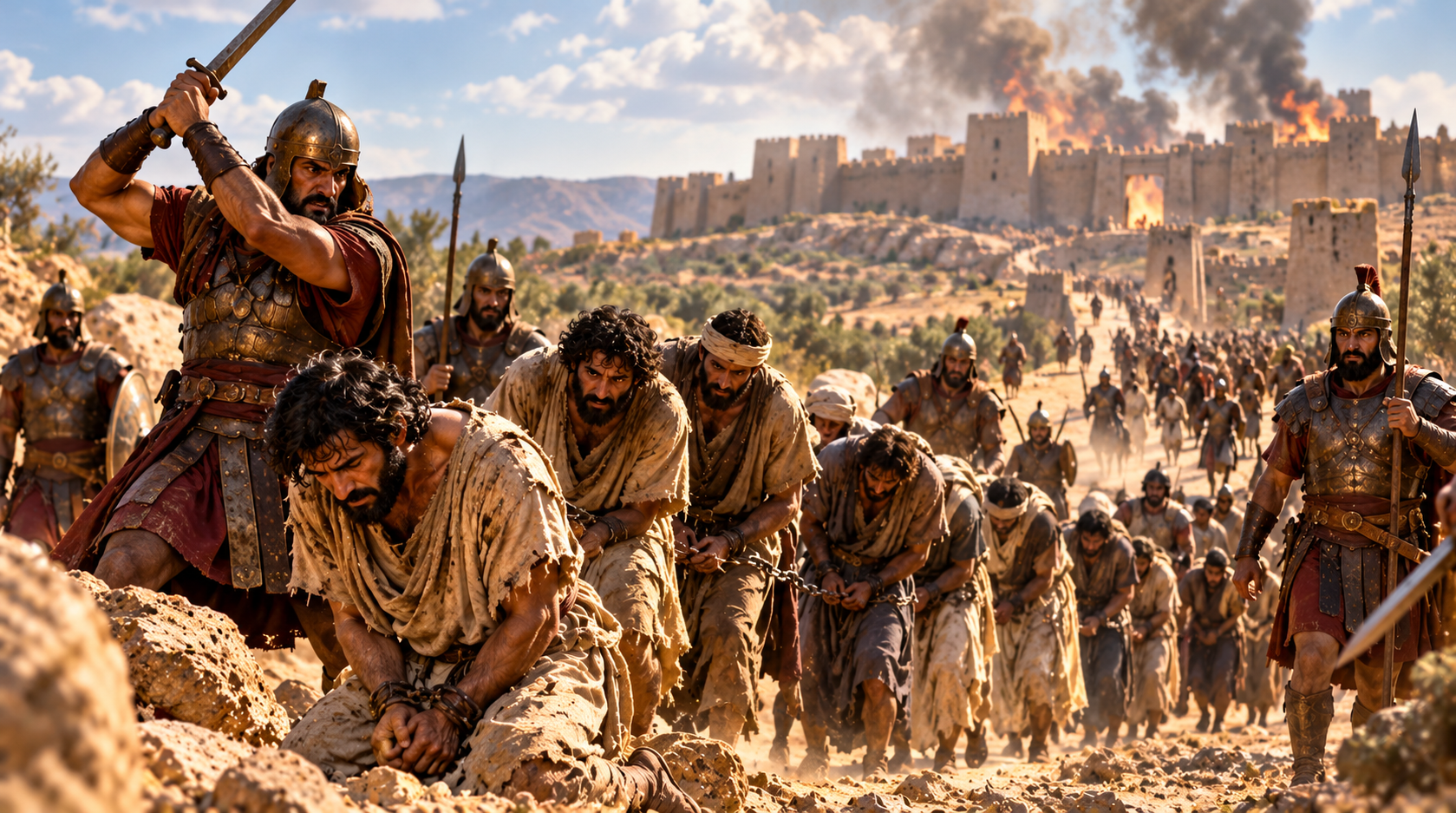
NO REFUGE
IN CAPTIVITY
And though they go into captivity before their enemies, From there I will command (tsavah) the sword that it slay (harag) them - NIV - "Though they are driven into exile by their enemies" Amos had repeatedly warned that exile was coming (Am 5:27; 6:7; 7:11, 17).The picture is of Israelites being marched away as prisoners before their conquering enemies. Even captivity in a foreign land would offer no refuge from the righteous judgment of God.
Throughout Israel's history, the Lord repeatedly used foreign nations as instruments of discipline and judgment against His covenant people (Jdg 2:14; 2Ki 17:6–23; Jer 25:8–11). One might imagine that surviving the initial invasion and being carried away into exile would mean escaping death, but God emphatically declares otherwise. Even those who escape the sword in their homeland will not necessarily escape it in the land of their captivity! Notice the striking parallel: in Amos 9:3 God declares, “I will command the serpent,” and here He declares, “I will command the sword.” Both the creatures of nature and the weapons of warfare are subject to His sovereign command. The repetition of “I will command” emphasizes that this judgment is neither accidental nor merely the result of human aggression, but the deliberate execution of God's righteous decree.
Bob Utley - This is a shocking verse. YHWH's anger and judgment will pursue them even into exile. They will be herded like cattle into a foreign land, but even there death will await them! God will show no compassion (cf. Hosea 1:6; 2:4). This verse reflects the consequences of breaking God's covenant (cf. Lev. 26, Deut. 28; esp. Amos 9:33).
And I will set My eyes against them for evil and not for good - Heb “I will set my eye on them for disaster, not good.” Normally God watched over His people for good, but because they themselves had failed to watch over their hearts with all diligence (Pr 4:23), from their evil heart flowed not springs of life but rivers of evil. And so God set His eyes against them for evil. The persecution of the Jews throughout history testifies to the truth of this prophecy. However as we will see at the end of Amos 9, because of His faithfulness to the Abrahamic Covenant, once again God "will watch over them to build and to plant" (Jer 31:28), a promise that will be fulfilled in the Millennium (cf God's watching over Judah for good in the future in Zech 12:4).
Bob Utley - "I will set My eyes against them for evil and not for good" This is exactly opposite to the covenant promises! This same imagery and terminology occur several times in Jeremiah (cf. Jer. 21:10; 39:16; 44:11,27). It reflects the cursing and blessing sections of Leviticus 26 and especially Deuteronomy 27-29.Notice that YHWH has the power to command actions outside of the Promised Land in the nations supposedly controlled by other gods (LXX, Deut. 32:8). These other gods are helpless. They are non-existent and cannot stop YHWH's wrath!
David Allan Hubbard - They had disregarded the admonitions ‘seek good and not evil’ and ‘hate evil and love good’ (5:14–15). Their love of evil (i.e. injustice and corrupt worship) was to be sated by the lavishness of God’s judgment: he would see to it personally that evil (i.e. disaster) and nothing else was their appointed lot. (See Joel and Amos - Page 245)
ESV Study Bible - Page 325 for evil and not for good. This is a terrifying statement, showing that there is no escape anywhere in the entire creation, but it was what God had promised long before (Deut. 28:64-68) if the people were unfaithful. And yet even there, God offers forgiveness and restoration to those who repent (Deut. 30:1-10). As Ps. 103:9 puts it, “nor will he keep his anger forever.”
J Vernon McGee - My friend, the wicked do well to fear God and to fear the future. There is no escape for them. The man who commits suicide, thinking that he will get rid of his troubles, will move into real trouble when he faces God. It is like jumping from the frying pan into the fire—and that almost literally. (See Thru the Bible)
This is part of the promise of the blessings and cursings in Deuteronomy 28 based upon whether the people were faithful and obedient or unfaithful and disobedient. Sadly Israel manifested chronic, systemic disobedience, and thus they could expect that God’s eye against them and not for them...
“Moreover, the LORD will scatter you among all peoples, from one end of the earth to the other end of the earth; and there you shall serve other gods, wood and stone, which you or your fathers have not known. 65“Among those nations you shall find no rest, and there will be no resting place for the sole of your foot; but there the LORD will give you a trembling heart, failing of eyes, and despair of soul. 66“So your life shall hang in doubt before you; and you will be in dread night and day, and shall have no assurance of your life. 67“In the morning you shall say, ‘Would that it were evening!’ And at evening you shall say, ‘Would that it were morning!’ because of the dread of your heart which you dread, and for the sight of your eyes which you will see. 68“The LORD will bring you back to Egypt in ships, by the way about which I spoke to you, ‘You will never see it again!’ And there you will offer yourselves for sale to your enemies as male and female slaves, but there will be no buyer.” (Deut. 28:64-68)
This verse is testimony to the truth of Proverbs 15:3 which says "The eyes of the LORD are in every place, Watching the evil and the good." And so lest we are too critical of Israel's apostasy which brought God's judgment, we need to be mindful that " the eyes of the LORD move to and fro throughout the earth that He may strongly support those whose heart is completely His. You (KING ASA) have acted foolishly in this. Indeed, from now on you will surely have wars (cf THE LORD'S EYES AGAINST HIM FOR EVIL).” (2 Chr 16:9).
Therefore we need to order our steps enabled by His Holy Spirit and guided by His Holy Word, so that when He watches over us, He sees good and not evil. It behooves us to heed Paul's instructions in "to be wise in what is good and innocent in what is evil" (Ro 16:19) and to "examine (present imperative = command to continue - only possible as we continually rely on the Spirit's enablement) everything carefully; hold fast (present imperative = command to continue - only possible as we continually rely on the Spirit's enablement) to that which is good, abstain (present imperative = command to continue - only possible as we continually rely on the Spirit's enablement) from every form of evil." (1 Th 5:21,22) (See See discussion of the Need for the Holy Spirit to obey NT commands).
Hay – To the believer, it is an encouragement that "the eyes of the Lord are over the righteous" (1 Pet 3:12), as when "he saw them toiling in rowing" (Mk 6:48). On occasions, what He sees moves Him to intervene in mercy. Hagar enjoyed the fact that God is El Roi, the God who sees: "Thou God seest me" (Gen 16:13). The beleaguered Israelites must have rejoiced when Moses relayed the message of God, "I have surely seen the affliction of my people ... and I am come down to deliver them" (Ex 3:7-8). Here, the inspection provoked wrathful intervention, "evil ... not ... good", for "the face of the Lord is against them that do evil" (1 Pet 3:12). In the early chapters of Revelation, the Lord Jesus is seen as having eyes "as a flame of fire" (Rev 1:14). His penetrating gaze of assessment took in every feature of every one of the seven churches, and thus He said to each, "I know ...". What He had observed, and what He knew must have been an encouragement to the pressurised assembly at Smyrna. To such as Sardis, what He claimed to know must have shocked them, for the camouflage that deceived others did not delude Him. What do these eyes reveal when set upon us? (What the Bible Teaches)
🙏 THOUGHT — Are God’s Eyes Upon You for Good? Amos 9:4 reminds us that the eyes of the LORD are always upon us, but His gaze may bring either blessing or judgment. Israel had enjoyed great spiritual privileges, yet persistent rebellion brought this verdict: God would set His eyes against them “for evil and not for good.” How dangerous it is to presume on God’s patience, forgetting that His kindness is meant to lead us to repentance (Ro 2:4)! His eyes are toward the righteous, but His face is against those who do evil (1 Pe 3:12). Yet God also promises to set His eyes on His people for good, to restore them (Jer 24:6). In Christ there is now no condemnation (Ro 8:1), but grace is never a license to sin (Ro 6:1,2). Our Father disciplines us for our good, so that we may share His holiness and bring forth the peaceful fruit of righteousness (Heb 12:10–11). May knowing that His eyes are on us make us seek to please Him (Col 1:10, 2Co 5:9). And when we stumble, may we quickly confess and return to the One who is faithful to forgive (1 Jn 1:9).
Amos 9:5 The Lord GOD of hosts, The One who touches the land so that it melts, And all those who dwell in it mourn, And all of it rises up like the Nile And subsides like the Nile of Egypt;
KJV And the Lord GOD of hosts is he that toucheth the land, and it shall melt, and all that dwell therein shall mourn: and it shall rise up wholly like a flood; and shall be drowned, as by the flood of Egypt.
NET The sovereign LORD who commands armies will do this. He touches the earth and it dissolves; all who live on it mourn. The whole earth rises like the River Nile, and then grows calm like the Nile in Egypt.
NLT The Lord, the LORD of Heaven's Armies, touches the land and it melts, and all its people mourn. The ground rises like the Nile River at floodtime, and then it sinks again.
ESV The Lord GOD of hosts, he who touches the earth and it melts, and all who dwell in it mourn, and all of it rises like the Nile, and sinks again, like the Nile of Egypt;
BGT καὶ κύριος κύριος ὁ θεὸς ὁ παντοκράτωρ ὁ ἐφαπτόμενος τῆς γῆς καὶ σαλεύων αὐτήν καὶ πενθήσουσιν πάντες οἱ κατοικοῦντες αὐτήν καὶ ἀναβήσεται ὡς ποταμὸς συντέλεια αὐτῆς καὶ καταβήσεται ὡς ποταμὸς Αἰγύπτου
LXE And the Lord, the Lord God Almighty, is he that takes hold of the land, and causes it to shake, and all that inhabit it shall mourn; and its destruction shall go up as a river, and shall descend as the river of Egypt.
CSB The Lord, the GOD of Hosts-- He touches the earth; it melts, and all who dwell in it mourn; all of it rises like the Nile and subsides like the Nile of Egypt.
NIV The Lord, the LORD Almighty, he who touches the earth and it melts, and all who live in it mourn-- the whole land rises like the Nile, then sinks like the river of Egypt--
- touches Ps 46:6; 144:5; Isaiah 64:1; Micah 1:3; Nahum 1:6; Habakkuk 3:10; Revelation 20:11
- and all Amos 8:8; Jeremiah 12:4; Hosea 4:3
- rises up Ps 32:6; 93:3,4; Isaiah 8:7,8; Matthew 7:27
- Multiple Sermons and Commentaries on Amos
YAHWEH'S
COSMIC POWER
What an awesome description of the unlimited power of Almighty God! Having declared that no one can escape His judgment, whether in Sheol, heaven, the mountains, the sea, or captivity (Am 9:1–4), Amos now explains why escape is impossible.
Amos 9:5–6 is the third of three hymns of praise in Amos (4:13; 5:8–9; 9:5–6). Each one reminds Israel who their Judge is.
Andrew Hill - These two verses (Amos 9:5-6) are considered a “hymnic doxology of judgment” that glorifies God’s majesty and celebrates his absolute power to carry out his threats of judgment against Israel. (See Minor Prophets: Hosea through Malachi - Page 204)
The Lord GOD of hosts - The One executing judgment is none other than the Lord GOD of hosts, the sovereign Commander of all creation! This is God's "military" Name (so to speak) = Jehovah Sabaoth, LORD of hosts (of armies) This Name speaks of Yahweh's control of the angelic hosts of Heaven. It is fitting that the Septuagint translates this Name with the Greek word pantokrator which is derived from pás = all and kratos = strength or might, especially manifested power, the power to rule or control. The literal ideas include the Ruler over all, the One Who controls all things and the One Who has power over everything. As the One in total control pantokrator thus describes God’s sovereign, omnipotent, irresistible power. This Name for Yahweh with one exception (2 Cor 6:18) is used exclusively in the NT in the book of the Revelation (Rev 1:8; 4:8; 11:17; 15:3; 16:7, 14; 19:6, 15; 21:22). This concentration in the Revelation of Jesus Christ should not be surprising as this book describes God's final and complete victory over godless men and over Satan and his minions. The Name Pantokrator leaves no doubt that He will fulfill every prophecy in the Revelation!
Note that the Septuagint refers to God as Pantokrator 10 times in this short book - Amos 3:13; Amos 4:13; Amos 5:8; Amos 5:14; Amos 5:15; Amos 5:16; Amos 5:27; Amos 9:5; Amos 9:6; Amos 9:15
Lord God of Hosts - 34x in 33v in the OT - note concentration in Amos - 2 Sam. 5:10; Ps. 59:5; Ps. 69:6; Ps. 80:4; Ps. 80:19; Ps. 84:8; Ps. 89:8; Isa. 1:24; Isa. 3:1; Isa. 3:15; Isa. 10:23; Isa. 10:24; Isa. 19:4; Isa. 22:5; Isa. 22:12; Isa. 22:14; Isa. 22:15; Isa. 28:22; Jer. 2:19; Jer. 15:16; Jer. 38:17; Jer. 44:7; Jer. 46:10; Jer. 49:5; Jer. 50:25; Jer. 50:31; Amos 4:13; Amos 5:14; Amos 5:15; Amos 5:16; Amos 6:8; Amos 6:14; Amos 9:5
Lord God (NOT including Lord God of hosts) in the book of Amos - Amos 1:8; Amos 3:7; Amos 3:8; Amos 3:11; Amos 3:13; Amos 4:2; Amos 4:5; Amos 5:3; Amos 7:1; Amos 7:2; Amos 7:4; Amos 7:5; Amos 7:6; Amos 8:1; Amos 8:3; Amos 8:9; Amos 8:11; Amos 9:8
David Guzik - Amos uses the title Lord God again – used 12 times in Amos 7-9, emphasizing the sovereignty of God. “That sovereignty is symbolized in the name of God that dominates this section – Lord God, literally ‘My Master Yahweh.’” (Hubbard)
Moody Bible Commentary Amos presented God's character in an inclusio (ED: NAME AT BEGINNING OF V5 AND END OF V6): The Lord God of hosts who would judge the Israelites is the one of whom Amos concluded, The Lord is His name. Israel's sovereign Lord controls and leads armies, both heavenly and earthly. By His touch the land... melts like ice when a human finger presses on it. He alters the course of earthly matters to rise and fall, to ebb and flow, like the waters of the Nile of Egypt.
Donald Sunukijan - The One Amos saw by the altar (v. 1) was the Lord Almighty, the great suzerain Warrior whose power was irresistible (cf. comments on Amos 3:13). As the Sovereign, not only of Israel and the other nations (Amos 1:3-2:16; 3:9; 9:4, 7) but also of the vast universe, He could speak with certainty that there would be no escape for Israel anywhere in His universe. He whose finger merely touches the earth, causing the mountains to quake and "melt" (i.e., "flatten"; cf. Micah 1:3-4; Nahum 1:5), the whole land to undulate like the Nile, and the inhabitants to mourn (cf. Amos 8:8), would surely possess a powerful "hand" to "seize" (9:2-3) rebels from any spot on earth. (See The Bible Knowledge Commentary Minor Prophets - Page 43)
Warren Wiersbe - A. W. Tozer correctly says, “The essence of idolatry is the entertainment of thoughts about God that are unworthy of Him.”3 The people of Israel created their gods in their own image and held such a low view of Jehovah that they thought He would approve of their sinful ways.
Amos reminded them of the greatness of the God they thought they were worshiping. He is the God of creation, who can melt the earth with a touch and make the land rise and fall like the swelling of the Nile River. (Bible Exposition Commentary)
The One who touches the land so that it melts - He does not need an army to shake the earth, nor does He need a weapon to devastate a nation. He merely touches the land, and it melts! Yahweh's power is so great that the earth melts when He touches the land! What does this depict? The NET NOTE says "The verb probably depicts earthquakes and landslides." The Septuagint translation would support this thought as the Hebrew verb for melt (mug) is translated with the verb saleuo (from salos = wave) means to cause to move to and fro, cause to waver or totter, make to rock. To shake or agitate as by winds or storms. It refers to unexpected and disastrous shaking, of what would be thought to be stable, e.g. earth or sky shake. In Acts 16, saleuo is used literally of an earthquake (Acts 16:26). Saleuo described a ship at anchor slipping its mooring in the midst of a heavy wind. In an ancient letter we read "you sent me letters which would have shaken (saleuo) a stone, so much did your words move me".
David Allan Hubbard agrees writing that "The melting of the earth (theophanic language as in Ps. 46:6 [ED: SAME HEBREW VERB = mug and Lxx = saleuo]; Mic. 1:3–4) and the mourning of its inhabitants looked back to the earthquake of Amos 9:1 (cf. Nahum 1:5 where ‘quake’, raash, and ‘melt’, mug, are paralleled [ED: AND AGAIN "MELT" IS TRANSLATED IN THE SEPTUAGINT WITH saleuo - SHAKE])....What counts is that God’s presence is at home everywhere in the universe from top to bottom, and that presence is utterly dependable and permanently to be reckoned with.” (See Joel and Amos - Page 245)
It is interesting that this same Hebrew verb (mug) for melts is used in Amos 9:13 in Amos' description that "all the hills will be dissolved (melted)."
And all those who dwell in it mourn (abal) - Notice the conjunction “and,” which directly links the mourning of the inhabitants with the melting of the land. When the sovereign Lord touches the earth and causes it to melt or tremble, those who dwell upon it will mourn over the devastating consequences. The Hebrew verb abal means to mourn, lament, or grieve deeply, often describing the sorrow associated with death or overwhelming calamity. The Septuagint translates abal with the Greek verb pentheo, which describes profound grief or lamentation, often so intense that it cannot be concealed and may find expression in outward weeping and wailing, as when mourning the dead. Thus, Amos portrays not merely physical devastation but also the overwhelming emotional anguish experienced by those who survive God's judgment.
There is an interesting connection between the melting of the land and the emotional devastation of its inhabitants. Just as the ground beneath their feet seems to dissolve, so their confidence, security, and sense of well-being collapse. When God causes the land to melt, the hearts of its inhabitants melt with grief! The very earth that once seemed secure becomes a source of terror, and the prosperity that once produced complacency gives way to bitter lamentation. Israel is about to discover that sin is not only destructive but exceedingly costly, and the wages of rebellion will ultimately be paid in tears! (Am 8:8; Isa 24:4–6; Nah 1:5–6).
Hay – In Psalm 46:6-7, the fact that He utters His voice and the earth melts (mug) is an encouragement to the people of God, for it is such a God of power who is "with us", and is "our refuge" (Ps 46:1). In the setting of Amos 9:5, such evidence of divine power is a chill reminder that He has the necessary power to implement the threats of the previous verses. (What the Bible Teaches)
In Amos 8:8 “Because of this (Amos 8:7 the Lord will not forget) will not the land quake and everyone who dwells in it mourn? Indeed, all of it will rise up like the Nile, And it will be tossed about And subside like the Nile of Egypt."
And all of it rises up like the Nile and subsides like the Nile of Egypt - Amos employs a vivid illustration drawn from the annual flooding of the Nile River, a phenomenon well known throughout the ancient Near East. Each year the Nile would rise dramatically, overflowing its banks and inundating the surrounding countryside before gradually receding. The Hebrew verbs translated “rises up” (alah) and “subsides” (shaqa) portray this alternating movement of rising and sinking. Just as the Nile's waters rose and fell under the sovereign control of God, so the land itself would heave and subside when the Lord of hosts touched it. The imagery recalls Amos 8:8, where the same comparison describes the land trembling in response to Israel's sin. Some interpreters understand this language as depicting the violent upheaval of an earthquake, while others see a broader picture of overwhelming divine judgment. In either case, the emphasis is unmistakable: The God who governs the rising and falling of the mighty Nile can cause the very ground beneath His rebellious people to rise and fall at His command! What appears immovable to man is utterly subject to the power of its Creator. When the Almighty touches the earth, even the ground on which men confidently stand becomes unstable! (Ps 46:2–3; 104:32; Nah 1:5–6).
Melts (04127) mug is a verb meaning to melt, dissolve, soften, or melt away. Figuratively, it means to faint, grow weak, or become disheartened. Mug has cognates in Arabic and Ethiopic. If the Arabic maga, “to surge, be in tumult, totter,” is related to the Hebrew root, then “tremble” may also belong to its meaning. This is supported by the parallel with raash, “shake,” in Nahum 1:5 (Nah 1:5). Cathcart points to Jeremiah 4:24 to support the sense of trembling: “I looked on the mountains, and behold, they were quaking, and all the hills moved to and fro” (Jer 4:24). Yet elsewhere the hills “melt like wax” (Mic 1:4; Ps 97:5). The word seems to combine both ideas: trembling and melting. In the Old Testament it serves as a figure of helpless, disorganized terror.
MUG - 16V - disheartened(1), dissolve(2), dissolved(2), melt(3), melted(2), melted away(4), melts(1), soften(1). Exod. 15:15; Jos. 2:9; Jos. 2:24; 1 Sam. 14:16; Job 30:22; Ps. 46:6; Ps. 65:10; Ps. 75:3; Ps. 107:26; Isa. 14:31; Jer. 49:23; Ezek. 21:15; Amos 9:5; Amos 9:13; Nah. 1:5; Nah. 2:6
Mug occurs in the Qal, Niphal, Polel, and Hithpolel stems, but most frequently in the Niphal. In the Niphal it means “to be melted away,” an image of dismay or demoralization. This figurative melting always comes in a context of people facing warfare or God’s judgment. It describes the weakening, fearful hearts of the peoples of Canaan, who “melted away” before Israel’s conquest (Ex 15:15; Josh 2:9, 24). It also pictures warriors weakening and falling away in battle. The Philistine camp “melted away” before Saul’s forces because of their fear of God (1 Sam 14:16). Isaiah called Philistia to “melt away” (Isa 14:31), and Hamath and Arpad were “disheartened” at bad news (Jer 49:23). Sailors in the storm found that “their soul melted away in their misery” (Ps 107:26). Nahum prophesied that the palace of the Assyrian king in Nineveh would be “dissolved” (Nah 2:6). The earth and all who dwell in it “melt” under God’s judgment (Ps 75:3). Regularly, then, this melting pictures the panic that God’s judicial acts produce in the nations: Canaan, Philistia, and the earth and its population.
In the Qal stem, which occurs three times, mug means “to melt.” So great is the Lord’s power that the earth melts when He touches the land (Amos 9:5) or raises His voice (Ps 46:6). God’s word through Ezekiel would cause hearts to “melt” and many to fall (Ezek 21:15). The mountains and hills totter, tremble, and shake at the sound of His voice (Nah 1:5; Ps 46:6; 75:3). In the past all the forces of heaven and earth fought on the Lord’s side. So in the day of His future, final triumph, even nature must tremble at His approach.
In the Polel and Hithpolel stems, mug means “to soften,” “to dissolve,” or “to melt.” In a more literal sense, it describes God’s kind provision in rain that softens the ground: He “soften[s] it with showers” (Ps 65:10). He can also dissolve a man and his possessions. Job lamented the woeful state God had allowed him to enter, saying, “You dissolve me in a storm” (Job 30:22). Like the Niphal in Psalm 75:3, the Hithpolel in Nahum describes the hills dissolving at God’s presence (Nah 1:5).
Yet a final day is coming when the melting will be a picture of blessing rather than terror. In Israel’s restoration, “the mountains will drip sweet wine and all the hills will be dissolved” (Amos 9:13). The NEB pictures the hills waving with corn. This figure portrays a fertile paradise of abundant prosperity, in deliberate contrast with the famine, drought, and blight of Amos 4:6–11. The same verb that describes the land melting under God’s touch of judgment (Amos 9:5) describes the hills overflowing with His bounty (Amos 9:13).
Amos 9:6 The One who builds His upper chambers in the heavens And has founded His vaulted dome over the earth, He who calls for the waters of the sea And pours them out on the face of the earth, The LORD is His name
KJV Amos 9:6 It is he that buildeth his stories in the heaven, and hath founded his troop in the earth; he that calleth for the waters of the sea, and poureth them out upon the face of the earth: The LORD is his name.
NET He builds the upper rooms of his palace in heaven and sets its foundation supports on the earth. He summons the water of the sea and pours it out on the earth's surface. The LORD is his name.
NLT The LORD's home reaches up to the heavens, while its foundation is on the earth. He draws up water from the oceans and pours it down as rain on the land. The LORD is his name!
ESV who builds his upper chambers in the heavens and founds his vault upon the earth; who calls for the waters of the sea and pours them out upon the surface of the earth-- the LORD is his name.
BGT ὁ οἰκοδομῶν εἰς τὸν οὐρανὸν ἀνάβασιν αὐτοῦ καὶ τὴν ἐπαγγελίαν αὐτοῦ ἐπὶ τῆς γῆς θεμελιῶν ὁ προσκαλούμενος τὸ ὕδωρ τῆς θαλάσσης καὶ ἐκχέων αὐτὸ ἐπὶ πρόσωπον τῆς γῆς κύριος ὁ θεὸς ὁ παντοκράτωρ ὄνομα αὐτῷ
LXE It is he that builds his ascent up to the sky, and establishes his promise on the earth; who calls the water of the sea, and pours it out on the face of the earth; the Lord Almighty is his name.
CSB He builds His upper chambers in the heavens and lays the foundation of His vault on the earth. He summons the waters of the sea and pours them out on the face of the earth. Yahweh is His name.
NIV he who builds his lofty palace in the heavens and sets its foundation on the earth, who calls for the waters of the sea and pours them out over the face of the land-- the LORD is his name.
- builds Ps 104:3,13
- calls Amos 5:8; Ge 7:11-19; Jeremiah 5:22
- The LORD Amos 4:13; Exodus 3:14,15
- Multiple Sermons and Commentaries on Amos
Related Passages:
Psalm 104:3; 13 He lays the beams of His upper chambers in the waters; He makes the clouds His chariot; He walks upon the wings of the wind; 13 He waters the mountains from His upper chambers; The earth is satisfied with the fruit of His works.
Amos 5:8 He who made the Pleiades and Orion And changes deep darkness into morning, Who also darkens day into night, Who calls for the waters of the sea And pours them out on the surface of the earth, The LORD is His name.
Jeremiah 5:22 ‘Do you not fear Me?’ declares the LORD. ‘Do you not tremble in My presence? For I have placed the sand as a boundary for the sea, An eternal decree, so it cannot cross over it. Though the waves toss, yet they cannot prevail; Though they roar, yet they cannot cross over it.
Amos 4:13 For behold, He who forms mountains and creates the wind And declares to man what are His thoughts, He who makes dawn into darkness And treads on the high places of the earth, The LORD God of hosts is His name.
Isaiah 40:22 It is He who sits above the circle of the earth, And its inhabitants are like grasshoppers, Who stretches out the heavens like a curtain And spreads them out like a tent to dwell in.

JEHOVAH CREATOR
OF HEAVEN AND EARTH
Amos 9:6 describes God as the master Builder of the universe. The heavens are His palace, and the arching sky is a solid structure He has firmly set over the earth.
Bob Utley - These are difficult-to-translate creation imagery. They speak of God as creator of heaven and earth (i.e. Elohim, cf. Gen. 1; Ps. 104). He is the controller of heavenly bodies and water, both salt and fresh (i.e. forces of nature). It is possible to translate "vaulted dome" (BDB 8) as "storehouse" and if so, then Amos 9:6a refers to YHWH's dwelling place and Amos 9:6b refers to mankind's dwelling place, both of which are created by Him (cf. Amos 9:5a, 6d).
The One who builds His upper chambers (maalah - steps; LXX - anabasis - ascent, going up) in the heavens - Baker says upper chambers (aguddah) "refers to the structures or strata fitted together like a vault, layers, or strata. NET - "He builds the upper rooms of his palace in heaven" While the exact meaning of this phrase is not clear, what is clear is that Yahweh is in control of His Heavens, His dwelling place. God built the sky as a firm, bound-together (fitted together) arch over the world. The One Who did that has total authority over everything under it. For the unrepentant this is a terror, because there is nowhere outside His house to flee. For the believer it is a comfort: “My help comes from the LORD, Who made heaven and earth” (Ps 121:2).
David Allan Hubbard comments that "It is hard to catch the exact picture of what Yahweh is building in verse 6. The heavenly construction may be a ‘staircase’ or a ‘roof-chamber’ . . . The earthly component is even more difficult to define precisely.” (see Joel and Amos)
Moody Bible Commentary His control of heavenly issues is seen in that His upper chambers in the heavens (His dwelling) are as a vaulted dome over the earth and He manages the rain that pours... out on the face of the earth. The word vault is difficult. A vaulted dome is foreign to the architecture of the period, and it may better refer to something bound together or clustered. Although God did indeed create a round earth, this verse should not be used to support that idea.
Donald Sunukijan - He who built His lofty palace in the heavens could not fail to reach any who sought refuge in "the heavens" (Amos 9:2). He who controls the waters of the sea (cf. Amos 5:8) would surely be obeyed by its denizens (Amos 9:3).(See The Bible Knowledge Commentary Minor Prophets - Page 43)
NET NOTE - The Masoretic Text reads “his steps.” If this is correct, then the reference may be to the steps leading up to the heavenly temple or the throne of God (cf. 1 Kgs 10:19–20) Verse 6a pictures the entire universe as a divine palace founded on the earth and extending into the heavens.
Henry Morris - Amos again reminds the people that the God whom they have rejected, Jehovah, is the one who built heaven and populated the earth; furthermore, He later poured all the waters of the sea over all the earth, with the great Flood. It is He who is now judging them, as though they were His enemies, instead of His chosen people.
And has founded His vaulted dome over the earth - As such God would have no difficulty in reaching any who might be able "ascend to heaven" and bring them down (Amos 9:2). This verse seems to describe God as the master Builder of the universe. The heavens are His palace, and the arching sky is a solid structure He has firmly set over the earth.
John Walton - cosmic temple. Amos’s attempt to express God’s complete control over all creation begins with a multistoried or many-chambered sanctuary or palace in the heavens (compare Ps 78:69; Is 66:1). These “upper chambers” bind together the vaults of heaven while at the same time rest upon the waters (see Ps 104:3).

He pours out waters on the earth
He who calls for the waters of the sea And pours them out on the face of the earth - (See Amos 5:8 which is almost identical) This is a description of God's power to cause water vapor to rise up out of the sea, be deposited in clouds and bring rain to the earth.
Thomas McComiskey says "He is the one who has built his temple in heaven and founded the arch of heaven itself above the earth. He draws water from the sea and causes it to rain upon the earth. If he can do all this, building the invisible and commanding the visible, how much more will he be able to rain down punishment upon a rebellious people!" (The Minor Prophets: An Exegetical and Expository Commentary)
Amos 5:8 has a similar description writing that "He who made the Pleiades and Orion And changes deep darkness into morning, Who also darkens day into night, Who calls for the waters of the sea And pours them out on the surface of the earth, The LORD (LXX = Pantokrator as in Amos 9:5) is His name."
The LORD is His name - (LXX = Pantokrator as in Amos 5:8) This is a clear reminder to Israel of Who they have rejected! Jehovah speaks of His covenant keeping Name. They have rebelled against His covenant.
Donald Sunukijan - The Lord is His name. His majesty and His power over creation means that they would not be able to escape Him. And as the Lord (Yahweh, the covenant-keeping God), He would keep His Word and judge those who had disobeyed Him. Interestingly the two verses in Amos that include the exclamation "The Lord is His name" speak of His sovereignty over the universe (Amos 5:8; 9:6).(See The Bible Knowledge Commentary Minor Prophets - Page 43)
Earlier Amos had affirmed the Name of God declaring "For behold, He who forms mountains and creates the wind And declares to man what are His thoughts, He who makes dawn into darkness And treads on the high places of the earth, The LORD God of hosts is His name." (Amos 4:13)
Upper chambers (04609) maalah is a feminine noun meaning step, stair, degree, ascent, or going up. It derives from the common verb alah (05927), “to go up, ascend,” so its basic idea is a rise or a step upward. Maalah occurs 47 times in the Old Testament. It continues in Middle Hebrew and the Dead Sea Scrolls with the meanings “step,” “rise,” and “degree.” From the literal sense of a physical step, the word extends to a journey upward, a rise in rank or status, and in Amos 9:6, the ascending stories of God’s heavenly dwelling.
MAALAH - 23V in NASB - go(1), high degree(1), stairway(6), steps(22), upper chambers(1). Exod. 20:26; 1 Ki. 10:19; 1 Ki. 10:20; 2 Ki. 9:13; 2 Ki. 20:9; 2 Ki. 20:10; 2 Ki. 20:11; 1 Chr. 17:17; 2 Chr. 9:18; 2 Chr. 9:19; Ezr. 7:9; Neh. 3:15; Neh. 12:37; Isa. 38:8; Ezek. 40:6; Ezek. 40:22; Ezek. 40:26; Ezek. 40:31; Ezek. 40:34; Ezek. 40:37; Ezek. 40:49; Ezek. 43:17; Amos 9:6
39V in KJV - Exod. 20:26; 1 Ki. 10:19; 1 Ki. 10:20; 2 Ki. 9:13; 2 Ki. 20:9; 2 Ki. 20:10; 2 Ki. 20:11; 1 Chr. 17:17; 2 Chr. 9:18; 2 Chr. 9:19; Ezr. 7:9; Neh. 3:15; Neh. 12:37; Ps. 120:1; Ps. 121:1; Ps. 122:1; Ps. 123:1; Ps. 124:1; Ps. 125:1; Ps. 126:1; Ps. 127:1; Ps. 128:1; Ps. 129:1; Ps. 130:1; Ps. 131:1; Ps. 132:1; Ps. 133:1; Ps. 134:1; Isa. 38:8; Ezek. 11:5; Ezek. 40:6; Ezek. 40:22; Ezek. 40:26; Ezek. 40:31; Ezek. 40:34; Ezek. 40:37; Ezek. 40:49; Ezek. 43:17; Amos 9:6
Literal steps and stairs. Most often maalah refers to actual steps. God forbade Israel to build steps up to His altar, “so that your nakedness will not be exposed on it” (Ex 20:26). In Ezekiel’s visionary temple, however, the altar has steps facing east (Ezek 43:17). Ezekiel mentions steps throughout his temple vision: at the gates (Ezek 40:6, and several times in that chapter) and at the temple porch (Ezek 40:49). Solomon’s ivory throne had six steps, with a lion on each side of every step (1 Ki 10:19–20; 2 Chr 9:18–19). When Jehu was proclaimed king, the officers spread their garments on the bare steps (2 Ki 9:13). Nehemiah mentions “the steps that descend from the city of David” (Neh 3:15; 12:37).
The steps of the sundial. When God gave Hezekiah a sign that He would heal him, He made the shadow go back ten steps on “the stairway of Ahaz” (2 Ki 20:9–11; Isa 38:8). This may have been a sundial marked in degrees. More likely it was an actual stairway on which the sun’s shadow moved step by step to tell the time, a sense also found in the Dead Sea Scrolls.
Ascent and pilgrimage. Maalah can also describe the act of going up, especially the journey to Jerusalem. Ezra’s return from Babylon is called his “going up” (Ezra 7:9). Fifteen psalms, Psalms 120–134, are titled “A Song of Ascents” (Ps 120:1). These were probably sung by pilgrims as they went up to Jerusalem for the three great feasts. Because Jerusalem sits high in the Judean hills, every approach to it was literally an ascent, and these psalms express the spiritual joy of going up to meet God in His house.
Elevated status. Maalah can also convey height of rank. In 1 Chronicles 17:17, David marvels that God had regarded him “according to the standard of a man of high degree.” The Hebrew text of this verse is difficult, and some lexicons consider it corrupt (cf. 2 Sam 7:19). Gilbrant also lists Ezekiel 11:5 for a negative sense of being presumptuously elevated, or haughty. There the word refers to the thoughts that “come up” into the mind (“I know your thoughts,” NASB).
God’s heavenly stories (Amos 9:6). In Amos 9:6, maalah is used figuratively of the upper levels or stories of God’s dwelling: “The One who builds His upper chambers in the heavens.” The picture is of a many-storied palace whose upper floors rise into the highest heavens. It conveys Yahweh’s exalted position over the universe. Many translators also connect the word with the related noun aliyyah, “upper room,” which Psalm 104:3 uses of God’s “upper chambers.” The word fits Amos 9 well. Israel had to climb steps to reach its altars and climb the hills to reach its shrines. God, by contrast, dwells in the heights He Himself built, where no climbing sinner can reach and from which nothing on earth is hidden.
Selected uses of maalah (NASB)
Exodus 20:26: And you shall not go up by steps to My altar, so that your nakedness will not be exposed on it.
1 Kings 10:19: There were six steps to the throne and a round top to the throne at its rear, and arms on each side of the seat, and two lions standing beside the arms.
2 Kings 9:13: Then they hurried and each man took his garment and placed it under him on the bare steps, and blew the trumpet, saying, “Jehu is king!”
1 Chronicles 17:17: This was a small thing in Your eyes, O God; but You have spoken of Your servant’s house for a great while to come, and have regarded me according to the standard of a man of high degree, O LORD God.
Ezra 7:9: For on the first of the first month he began to go up from Babylon; and on the first of the fifth month he came to Jerusalem, because the good hand of his God was upon him.
Psalm 120 (title): A Song of Ascents.
Isaiah 38:8: Behold, I will cause the shadow on the stairway, which has gone down with the sun on the stairway of Ahaz, to go back ten steps. So the sun’s shadow went back ten steps on the stairway on which it had gone down.
Ezekiel 40:6: Then he went to the gate which faced east, went up its steps and measured the threshold of the gate, one rod in width; and the other threshold was one rod in width.
Amos 9:6: The One who builds His upper chambers in the heavens And has founded His vaulted dome over the earth, He who calls for the waters of the sea And pours them out on the face of the earth, The LORD is His name.
Amos 9:7 "Are you not as the sons of Ethiopia to Me, O sons of Israel?" declares the LORD. "Have I not brought up Israel from the land of Egypt, And the Philistines from Caphtor and the Arameans from Kir
KJV Are ye not as children of the Ethiopians unto me, O children of Israel? saith the LORD. Have not I brought up Israel out of the land of Egypt? and the Philistines from Caphtor, and the Syrians from Kir?
NET "You Israelites are just like the Ethiopians in my sight," says the LORD. "Certainly I brought Israel up from the land of Egypt, but I also brought the Philistines from Caphtor and the Arameans from Kir.
NLT "Are you Israelites more important to me than the Ethiopians? " asks the LORD. "I brought Israel out of Egypt, but I also brought the Philistines from Crete and led the Arameans out of Kir.
ESV "Are you not like the Cushites to me, O people of Israel?" declares the LORD. "Did I not bring up Israel from the land of Egypt, and the Philistines from Caphtor and the Syrians from Kir?
BGT οὐχ ὡς υἱοὶ Αἰθιόπων ὑμεῖς ἐστε ἐμοί υἱοὶ Ισραηλ λέγει κύριος οὐ τὸν Ισραηλ ἀνήγαγον ἐκ γῆς Αἰγύπτου καὶ τοὺς ἀλλοφύλους ἐκ Καππαδοκίας καὶ τοὺς Σύρους ἐκ βόθρου
LXE Are not ye to me as the sons of the Ethiopians, O children of Israel? saith the Lord. Did I not bring Israel up out of the land of Egypt, and the Philistines from Cappadocia, and the Syrians out of the deep?
CSB Israelites, are you not like the Cushites to Me? This is the LORD's declaration. Didn't I bring Israel from the land of Egypt, the Philistines from Caphtor, and the Arameans from Kir?
NIV "Are not you Israelites the same to me as the Cushites?" declares the LORD. "Did I not bring Israel up from Egypt, the Philistines from Caphtor and the Arameans from Kir?
- Are you not as the sons of Ethiopia Jeremiah 9:25-26; Jer 13:23
- Have I not Amos 2:10; Exodus 12:51; Hosea 12:13
- the Philistines Deuteronomy 2:23; Jeremiah 47:4
- the Syrians Amos 1:5; 2Kings 16:9
- Multiple Sermons and Commentaries on Amos
Related Passages:
Amos 2:10 “It was I who brought you up from the land of Egypt, And I led you in the wilderness forty years That you might take possession of the land of the Amorite.
Amos 3:1 Hear this word which the LORD has spoken against you, sons of Israel, against the entire family which He brought up from the land of Egypt:
Exodus 12:51 And on that same day the LORD brought the sons of Israel out of the land of Egypt by their hosts.
Hosea 12:13 But by a prophet the LORD brought Israel from Egypt, And by a prophet he was kept.
Jeremiah 9:25-26 “Behold, the days are coming,” declares the LORD, “that I will punish all who are circumcised and yet uncircumcised– 26 Egypt and Judah, and Edom and the sons of Ammon, and Moab and all those inhabiting the desert who clip the hair on their temples; for all the nations are uncircumcised, and all the house of Israel are uncircumcised of heart.”
Amos 1:5 “I will also break the gate bar of Damascus, And cut off the inhabitant from the valley of Aven, And him who holds the scepter, from Beth-eden; So the people of Aram will go exiled to Kir,” Says the LORD.
ISRAEL AS GOD'S PEOPLE
NOT A PASS FOR PUNISHMENT
Are you not as the sons of Ethiopia (Cushites) to Me, O sons of Israel?" declares the LORD - Jehovah is saying in essence He will show His Chosen People no special favor or partiality in judgment. The NLT renders it "Are you Israelites more important to me than the Ethiopians?" The NET Bible changes it from a question to a declaration of fact - "You Israelites are just like the Ethiopians in My sight." Woe! What a shocking declaration this must have been to the Israelites! The people who proudly regarded themselves as God's chosen nation are suddenly compared to the distant Ethiopians, while their cherished deliverance from Egypt is placed alongside the migrations of two pagan nations, the Philistines and the Arameans. Note that God is not denying Israel's election; He is destroying Israel's presumption that election guarantees exemption from judgment! Israel had confused divine privilege with divine favoritism, assuming that its unique relationship with Yahweh guaranteed national security regardless of its conduct. But the LORD reminds them that He is not merely the God of Israel. He is the sovereign Ruler of every nation, directing the movements of peoples and kingdoms according to His purposes.
Israel's election was a reason for greater responsibility,
not a guarantee of immunity.
KJV Bible Commentary - In its idolatrous practice the privileged Israel had become like the pagans who surrounded them; hence, God likens them to the Ethiopians
Hay – For centuries, the children of Israel had enjoyed the favour of God, and there were clear lines of demarcation between them and the other nations of men. They were distinct in dress, in diet, and most certainly in religion. By embracing idolatry, they had erased these differences, and God now takes them up on the stance they had adopted, and treats them as He would have treated any other idolatrous nation. There would be no concessions just because they were in a covenant relationship with Him. (What the Bible Teaches)
God chooses to illustrate His point with the sons of Ethiopia (Cushites in NIV) who lived in what is today southern Egypt, Sudan and Ethiopia and were considered by Israel as an unimportant country living at the "end of the earth." Israel would have falsely reasoned "Surely God would treat them different than these foreign (Gentile) nations,", but here Jehovah says that is not going to be the case!
In Jeremiah God makes a similar pronouncement against the Southern Kingdom of Judah for Judah's heart is uncircumcised just as that of the foreigners...
Behold, the days are coming,” declares the LORD, “that I will punish all who are circumcised and yet uncircumcised–Egypt and Judah, and Edom and the sons of Ammon, and Moab and all those inhabiting the desert who clip the hair on their temples; for all the nations are uncircumcised, and all the house of Israel are uncircumcised of heart.”(UNREGENERATE - See Ro 2:24-29, Col 2:11-13)(Jer 9:25,26) (See Excursus on Circumcision)
Amos 3:2 indicates that Israel's "special status" as a nation would not preclude her just judgment, God declaring "You only have I chosen among all the families of the earth; Therefore I will punish you for all your iniquities.”
NET NOTE adds that "The Hebrew text has a rhetorical question, "Are you children of Israel not like the Cushites to me?" The rhetorical question has been converted to an affirmative statement in the translation for clarity. See Am 8:8. Though Israel was God's special covenant people, the Lord emphasizes they are not inherently superior to the other nations subject to his sovereign rule." The second half of v. 7 is also phrased as a rhetorical question in the Hebrew text, "Did I not bring Israel up from the land of Egypt, and the Philistines from Caphtor, and Aram from Kir?" The NET translation converts the rhetorical question into an affirmation for clarity.
Have I not brought up Israel from the land of Egypt, and the Philistines from Caphtor and the Arameans from Kir - Of course He had brought up Israel from Egypt (see Amos 2:10; Ex 12:51; Hos 12:13). Israel's exodus was of course unique compared to Philistines and Arameans because of God's covenant with Israel, but this priviledged position did not mean that God's providential authority was limited to Israel. Being chosen by God was never intended to make Israel proud, but to make Israel holy! But He had also brought Philistines from Caphtor (probably island of Crete) and the Arameans from Kir. The difference of course was that they Yahweh did not cut covenant with these pagan nations. The point is that God was able to sovereignly transplant (deport, exile) other nations besides Israel. And in the context of the judgment coming on Israel, it would not be difficult for Him to bring about the exile of the nation of Israel. Their supposed "superiority" would earn no favor with God's impartial justice. And it would be particularly provocative for God to mention two major enemies of Israel, the Philistines and Arameans! In short, what Yahweh is saying is that He is the One Who has the right and the might to bring any nation into their appointed places and also has the authority to remove them. All the nations in world history ar not ultimately governed by their ambition, military power, or political accident, but by the sovereign purposes of God.
Hay explains that "The people of Israel may have prided themselves in remembering that God had released them from Egypt and relocated them in Canaan, and so He had. But other nations had experienced migration under divine direction, the Philistines from Caphtor, possibly the island of Crete, and the Syrians from Kir, possibly in Mesopotamia. While in many ways Israel was unique, it was not completely unique, and just as God would deal with other nations who displeased Him, so He would deal with them: He is "no respecter of persons" in regard to salvation (Acts 10:34), and He is "without respect of persons" in regard to judgment (1 Pet 1:17). (What the Bible Teaches)
Bob Utley - Both the questions of Amos 9:7 expect a "yes" answer. Basically YHWH is depreciating the covenantal uniqueness of Israel. The one and only God (SPECIAL TOPIC: MONOTHEISM) has led all nations to and from their current geographical locations (cf. LXX, Deut. 32:8; and possibly implied in Deut. 29:26). It must have been painful for Israel to be compared to Ethiopia, Philistia, and Syria. This is in sharp contrast to the election theology of Amos 3:2! Israel, like all nations, will answer for their sins!
Donald Sunukijan - God is the Sovereign of every nation. He had not only brought Israel up from Egypt (cf. Amos 2:10; 3:1), but had also guided the historical migrations of their archenemies—the Philistines from Caphtor (cf. Jer. 47:4; Zeph. 2:5), probably another name for the island of Crete, and the Arameans from Kir (cf. Amos 1:5), a location in Mesopotamia. And as God had determined to reverse the destinies of those two nations (cf. Amos 1:3-8), so He had determined to send Israel into exile (Amos 4:2-3; 5:5, 27; 6:7; 7:11, 17; 9:4). He would punish rebellion wherever it occurred. (See The Bible Knowledge Commentary)
David Allan Hubbard sums up this passage this way - Two painful lessons were forced on Israel by Yahweh’s questions: (1) God’s sovereignty and care extended beyond their boundaries to distant and hostile peoples; and (2) their exodus contained no uniqueness to protect them from judgment once they had ruptured the covenant. Any vestige of national pride, social smugness, or military security was snatched away by the divine interrogator. (see Joel and Amos)
🙏 THOUGHT — Are You Confusing Spiritual Privilege With Spiritual Maturity? Amos 9:7 begs an applicational question -- are our spiritual privileges (e.g., Eph 1:3, etc) producing progressive sanctification (growth in holiness) or presumption. God had delivered Israel from Egypt, given them His law and covenant, and sent them His prophets. Yet the people assumed these privileges would protect them however they lived, essentially turning the grace of God into licentiousness. Beloved, we can fall into the same trap (cf 1Co 10:12). Decades of church attendance, Bible study, teaching, and memorized verses must still be continually applied to our daily walk. So let me ask again is all of this privilege making me more humble, more loving, more obedient, more like Jesus? To whom much is given, much will be required (Lk 12:48, cf Jas 3:1). Hearing the Word without doing it is self-deception (Jas 1:22–25), and boasting in knowledge we do not practice dishonors God (Ro 2:17–24). Spiritual maturity is measured not by how much truth we possess, but by how deeply it has transformed our heart (Ro 12:2, 2Co 3:18). May familiarity with "Christian" things never dull our reverence for the Holy One (1Pe 1:13-17). And let us rejoice that our standing before God rests not on our accomplishments, but on His grace through faith in Christ (Eph 2:8–10) which has made us positionally holy and blameless (Co 1:22, Jude 1:24) Lord by Your Word and Your Spirit enable us to more and more to make our practice match our position in Christ. Amen
Amos 9:8 "Behold, the eyes of the Lord GOD are on the sinful kingdom, And I will destroy it from the face of the earth; Nevertheless, I will not totally destroy the house of Jacob," Declares the LORD.
KJV Behold, the eyes of the Lord GOD are upon the sinful kingdom, and I will destroy it from off the face of the earth; saving that I will not utterly destroy the house of Jacob, saith the LORD.
ESV Behold, the eyes of the Lord GOD are upon the sinful kingdom, and I will destroy it from the surface of the ground, except that I will not utterly destroy the house of Jacob," declares the LORD.
CSB Look, the eyes of the Lord GOD are on the sinful kingdom, and I will destroy it from the face of the earth. However, I will not totally destroy the house of Jacob-- this is the LORD's declaration--
NET Look, the sovereign LORD is watching the sinful nation, and I will destroy it from the face of the earth. But I will not completely destroy the family of Jacob," says the LORD.
NIV "Surely the eyes of the Sovereign LORD are on the sinful kingdom. I will destroy it from the face of the earth-- yet I will not totally destroy the house of Jacob," declares the LORD.
NLT "I, the Sovereign LORD, am watching this sinful nation of Israel. I will destroy it from the face of the earth. But I will never completely destroy the family of Israel, " says the LORD.
- the eyes Amos 9:4; Ps 11:4-6; Proverbs 5:21; Pr 15:3; Jeremiah 44:27
- and I Genesis 6:7; 7:4; Deuteronomy 6:15; 1 Kings 13:34; Hosea 1:6; 9:11-17; 13:15,16
- nevertheless Deuteronomy 4:31; Isaiah 27:7,8; Jeremiah 5:10; 30:11; 31:35,36; 33:24-26; Joel 2:32; Obadiah 1:16,17; Romans 11:1-7,28,29
Related Passages:
Amos 9:4 “And though they go into captivity before their enemies, From there I will command the sword that it slay them, And I will set My eyes against them for evil and not for good.”
Proverbs 5:21 For the ways of a man are before the eyes of the LORD, And He watches all his paths.
Proverbs 15:3 The eyes of the LORD are in every place, Watching the evil and the good.
Deuteronomy 6:15 for the LORD your God in the midst of you is a jealous God; otherwise the anger of the LORD your God will be kindled against you, and He will wipe you off the face of the earth.
Hosea 1:6 Then she conceived again and gave birth to a daughter. And the LORD said to him, “Name her Lo-ruhamah, for I will no longer have compassion on the house of Israel, that I would ever forgive them.
Jeremiah 30:11 ‘For I am with you,’ declares the LORD, ‘to save you; For I will destroy completely all the nations where I have scattered you, Only I will not destroy you completely. But I will chasten you justly And will by no means leave you unpunished.’
KINGDOM DESTROY BUT
A REMNANT PRESERVED
Behold (hinneh). This interjection is given to get the reader's full attention! The idea is now "Listen closely!"
The eyes of the Lord GOD are on the sinful (chatta) kingdom - Not just "Lord" but "Lord God" which emphasizes His sovereignty, a truth conveyed by the NIV's rendering "the Sovereign LORD." "Yahweh fixed his damning gaze on Israel" (Hubbard). He saw predominantly evil rather than good (Pr 15:3)!
Compare Jehovah's similar statement earlier in this chapter - "I will set My eyes against them for evil and not for good.” (Amos 9:4) What a horrible thought that the "Chosen People" are here called "the sinful kingdom!" Their election as a nation did not guarantee that their hearts would follow God, for they (like all of us) harbor the intractable enemy of God, the fallen flesh, which is firmly entrenched in our mortal bodies and God's mortal enemy!
Sinful is chatta (see related word chattat/chattath) which has the basic sense of to "miss the mark" in this case the mark of God's righteousness, His holy commands and laws, of all that He deemed just and righteous. The Septuagint translates it with hamartolos which describes behavior or activity that does not measure up to God's holy standard of morality. Hamartolos describes those who are continually erring from the way, constantly missing God's mark, living in opposition to His good and acceptable and perfect will. The fate of the sinful kingdom is a picture of the end of every man and woman who rejects God gracious offer of forgiveness and instead willfully chooses sin as their master and their condemner!
Jehovah makes a similar pronouncement of judgment against Jerusalem and thus the entire Southern Kingdom of Judah declaring "He who dwells in this city will die by the sword and by famine and by pestilence; but he who goes out and falls away to the Chaldeans who are besieging you will live, and he will have his own life as booty. For I have set My face against this city for harm and not for good,” declares the LORD. “It will be given into the hand of the king of Babylon and he will burn it with fire." (Jer 21:9-10)
THE DIVINE
VERDICT
And I will destroy (shamad; LXX - exairo - remove, drive away) it from the face of the earth - "It" of course is the sinful kingdom of the Northern Ten Tribes. Note the "I will" indicating that the Lord God Himself will initiate and orchestrate this destruction even using the abominably evil kingdom of Assyria to carry out the destruction, just as He would later use Babylon as His instrument of destruction against the Southern Kingdom of Judah (Jer 25:9, Jer 27:6). Both Assyria and Babylon would be punished for their evil (And lest you doubt this truth, read of the retribution against Babylon in Jer 51:24-46, 47-59, 60-64). God is NOT evil but He in His infinite wisdom and power is able to use evil men to bring about His righteous ends. This is a mystery to me, but it is seen all through Scripture (think of Judas betraying Jesus, and because Judas' betrayal was the exercise of his free will, he paid the penalty of eternal destruction for his betrayal!) (for more read Does God sometimes use evil to accomplish His plans)
Gary Smith adds "The nations are the instrument of God who will bring destruction and captivity to Israel (Amos 3:11,12; 4:2, 3; 5:27; 6:7, 14; 7:17; 9:4). (Ibid)
The statement from the face of the earth taken by itself would suggest total annihilation of Israel, but as the following context shows that is not to be the case. What would be total is the destruction of the regime of the Northern Kingdom, centered in Samaria. While the Southern Kingdom would later be destroyed, in contrast to Samaria, Jerusalem would be restored after their 70 years of captivity in Babylon. Not so with Samaria, but it would be destroyed from the face of the earth.
Nevertheless - Basically, this noun indicates that a thing "comes to an end" and "is no more" and in this context is used as an adverb of limitation. It introduces a strong qualification or exception.The point is that the destruction of Israel will not be total. What a remarkable turning point in Amos' prophecy! After seven verses of unrelenting judgment, the LORD suddenly introduces a word of hope: “Nevertheless!” The northern kingdom's destruction is certain, but the complete extinction of Jacob's descendants is not God's purpose. Israel's political kingdom will fall, its institutions will collapse, and its people will experience devastating judgment. Yet God's covenant promises will not perish with the nation. The kingdom may be destroyed, but God's covenant cannot be destroyed! Here we encounter two seemingly opposite but perfectly harmonious attributes of God: His uncompromising holiness and His unwavering faithfulness. He will not excuse Israel's persistent rebellion, but neither will He abandon His covenant purposes. God's judgment is severe, but His faithfulness is stronger than Israel's failure!
I will not totally destroy (shamad; LXX - exairo - remove, drive away) the house of Jacob," Declares the LORD - Note that this the covenant keeping God Who is making this solemn declaration. Regarding destroyed, many of the Israelites were slain in the terrible Assyrian invasion in 722 BC and most of the rest deported to Assyria. But because of God's faithful covenant love (Abrahamic Covenant), He promises to always have a remnant of believing Israel (a truth repeated in Amos 9:9).
God's discipline may be devastating,
but His covenant promises remain immutably indestructible.
Totally is not translated as a separate word in Hebrew but is included with shamad) ("totally destroy"). However in the Septuagint totally is translated with ouk signifying absolute negatiion of the noun telos which means fully or completely. In other Israel will "not completely" be destroyed.
Why does God use house of Jacob here? Hay suggests "mention of the "house of Jacob" is reminiscent of their progenitor's history before his name was changed to Israel, hence the negative connotation."
David Allan Hubbard comments on the interpretation of the house of Jacob - To identify sinful kingdom with Israel, the Northern Kingdom, and house of Jacob with Judah, the Southern Kingdom, is both to introduce a distinction not otherwise found in Amos and to use Jacob in a way that would have confused Amos’ hearers (cf. 6:8; 8:7, where Jacob was clearly the Northern Kingdom). (see Joel and Amos)
Hay comments on God's promise that "I will not totally destroy the house of Jacob" - The following verse shows that they would be scattered among the nations of the earth, but the fact that Anna is said to be of the tribe of Asher (Lk 2:36) gives evidence that there were survivors whose descendents were still alive in New Testament times. This should be a great encouragement to us, for, as ever, His promises are never annulled. This pledge made in the days of Amos still holds good, and should give us confidence that all the promises made to New Testament believers are as dependable. "For all the promises of God in Him are yea, and in Him Amen, unto the glory of God by us" (2 Cor 1:20). Just as a small proportion of Israel was preserved in that past era, so in this age of grace, among the Jewish people, there are still some being saved. A judicial blindness afflicts the nation, but it is "in part", and in due course will be lifted; "blindness in part is happened to Israel, until the fullness of the Gentiles be come in" (Ro 11:25 - See Walvoord's analysis on "fullness of the Gentiles" and "times of the Gentiles"). Paul sees himself as an example of an Israelite who has experienced God's salvation in this present Christian era (v. 1), so the blindness is neither total nor permanent. (What the Bible Teaches)
Destroy...destroy (demolish, exterminate) (08045)(shamad) is a verb meaning "be destroyed, decimated, perished, overthrown, exterminated, i.e., pertaining to being in a totally ruined state, which can include death of a person or extinction of an entity." (Swanson) The wholesale destruction depicted by shamad usually involves a rather sudden catastrophe such as warfare or a mass killing. For example, similar to what we read in Amos 9:8, in Dt 6:15 God says He will "wipe" Israel off the face of the earth, so great was His anger against them! Many of the uses of shamad have God as the subject rendering the destruction, sometimes against Israel's enemies, sometimes threatening Israel herself as in the present context.
The Septuagint translates both uses of shamad in this passage with the same verb exairo (ek = out of + airo = to take) which means exclude or remove someone from a group and so to drive away (used only in 1 Cor 5:13 in NT). The idea of exairo is to take up out of any place (exactly what happened to the Northern Kingdom of Israel who was "taken up" out of their land and transported or exiled to Assyria where they became the so-called "Ten Lost Tribes of Israel" (but not lost to God! See What happened to the lost tribes of Israel?)
Amos 9:9 "For behold, I am commanding, And I will shake the house of Israel among all nations as grain is shaken in a sieve, but not a kernel will fall to the ground.
KJV For, lo, I will command, and I will sift the house of Israel among all nations, like as corn is sifted in a sieve, yet shall not the least grain fall upon the earth.
NET "For look, I am giving a command and I will shake the family of Israel together with all the nations. It will resemble a sieve being shaken, when not even a pebble falls to the ground.
NLT "For I will give the command and will shake Israel along with the other nations as grain is shaken in a sieve, yet not one true kernel will be lost.
ESV "For behold, I will command, and shake the house of Israel among all the nations as one shakes with a sieve, but no pebble shall fall to the earth.
BGT διότι ἰδοὺ ἐγὼ ἐντέλλομαι καὶ λικμιῶ ἐν πᾶσι τοῖς ἔθνεσιν τὸν οἶκον τοῦ Ισραηλ ὃν τρόπον λικμᾶται ἐν τῷ λικμῷ καὶ οὐ μὴ πέσῃ σύντριμμα ἐπὶ τὴν γῆν
LXE For I will give commandment, and sift the house of Israel among all the Gentiles, as corn is sifted in a sieve, and yet a fragment shall not in any wise fall upon the earth.
CSB for I am about to give the command, and I will shake the house of Israel among all the nations, as one shakes a sieve, but not a pebble will fall to the ground.
NIV "For I will give the command, and I will shake the house of Israel among all the nations as grain is shaken in a sieve, and not a pebble will reach the ground.
YLT For lo, I am commanding, And I have shaken among all the nations the house of Israel, As one doth shake with a sieve, And there falleth not a grain to the earth.
- and I will shake Leviticus 26:33; Deuteronomy 28:64
- Related Resource: The Davidic Promise And The Inclusion Of The Gentiles (Amos 9:9-15 And Acts 15:13-18): A Test Passage For Theological Systems Walter C. Kaiser, Jr
- Multiple Sermons and Commentaries on Amos
Related Passages:
Leviticus 26:33 ‘You, however, I will scatter among the nations and will draw out a sword after you, as your land becomes desolate and your cities become waste.
Deuteronomy 28:64 “Moreover, the LORD will scatter you among all peoples, from one end of the earth to the other end of the earth; and there you shall serve other gods, wood and stone, which you or your fathers have not known.

DIVINE WINNOWING
LEAVES A REMNANT
For - Term of explanation. What is Jehovah explaining? He is reiterating that He will not totally destroy Israel as He paints us a picture of the doctrine of the believing remnant.
Behold - Listen carefully to what God says. (see discussion of hinneh)
I am commanding - The judgment would take place on order from Jehovah. This order as the Commander-in-Chief (cf Amos 6:11) recalls His military Name "Lord of Sabaoth" or "Lord of hosts (armies)."
And I will shake (nua) the house of Israel among all nations - God says "I will shake" indicating He is clearly the instigator of the shaking. How would He do this? God would use the evil nation of Assyria to shake the house of Israel causing her to quiver, waver, tremble, totter and finally fall. The Septuagint translates "shake" (nua) with the Greek verb likmao which means to winnow (see winnowing).
Shake (for full definition click nua) - Vigorously shaking to and fro. Sailors in a stormy sea are said to "stagger" like drunkards (Ps 107:27); the ways of an adulterer are called "unstable" (Pr 5:6); beggars "totter" along in uncertainty (Ps 109:10); lips "quiver" (1 Sa 1:13); heads "wag" as a sign of contempt and insult (Lam 2:15; Zeph. 2:15); and at times, doorposts, people (EVEN NATIONS AS HERE IN Amos 9:9), idols and the earth "tremble" (Isa. 6:4; Ex. 20:18; Isa. 19:1; 24:20).
Among the nations - In the context of the coming invasion of the Northern Kingdom by Assyria in 722 BC and their subsequent exile from the land, this phrase most likely refers to this scattering, but a few commentators like feel that Amos 9:10 "shows that they would be scattered among the nations of the earth." (Hay - What the Bible Teaches - Amos) See also comments by David Levy below which chronicle the worldwide scattering of the Jews.
As grain is shaken in a sieve - The metaphor would have been easy for his readers to visualize as Israel was primarily an agrarian culture and grain was winnowed to separate the wheat (good) from the chaff (bad, evil).
Henry Morris comments that "The survivors of the Assyrian holocaust were so thoroughly sifted "among all nations" that they have been referred to as the ten lost tribes of Israel, yet God knows where each one and his descendants yet remain.
But not a kernel will fall to the ground - The shaking will be severe, but it will never be outside God's sovereign control. But not in the Septuagint is a strong double negative (ou me) signifying absolutely not. This is one of God's mercy filled, gracious terms of contrast! We would all be forever separated from His holy presence were it not for the "blessed but's" in His Holy Word. It is good to frequently recall God's infinite mercies toward us who deserved Hell, even as Paul reminds us writing
"BUT GOD, being rich in mercy, because of His great love with which He loved us, even when we were dead in our transgressions, made us alive together with Christ (by grace you have been saved)," (Eph 2:4,5)
So beloved, if you are safe in Christ by grace through faith, think of yourself today as an eternally preserved "kernel" which results from God's righteous sifting and separation of the wheat from the chaff (Read Ps 1:4,5, 6 Did you see the distinction in Ps 1:6?)
Spurgeon addresses believers who often feel tossed about as if God were winnowing them! - I think I see you, poor believer, tossed about like that wheat, up and down, right and left, in the sieve, and in the air, never resting. Perhaps it is suggested to you, ‘God is very angry with me.’ No, the farmer is not angry with his wheat when he casts it up and down in the sieve, and neither is God angry with you; this you shall see one day when the light shall show that love ruled in all your griefs.”
A kernel will fall to the ground - That which falls to the ground (if translated as "kernel") depicts the Jews who are part of the righteous believing remnant. God will distinguish between the righteous (the grain) and the wicked (the chaff) when He judges, and will thus preserve a remnant in Israel.
Thomas McComiskey - The worthless bits of stone and rubbish remain in the sieve; the good grain falls to the earth. So the Lord will put his people through the sieve. He will bind the wicked, destroying them (v. 10), but he will save the righteous. This principle of God's justice is eternal: the judgment of the wicked and the salvation of the righteous go together. What we see articulated on the historical plane in Amos will also appear at the end of history (Matt. 13:24-30; 25:31-46). (See The Minor Prophets: An Exegetical and Expository Commentary)
Kernel (or pebble in ESV and NET translations) is tseror (06872) which is "A masculine noun referring to a pebble, a piece of grain. It refers to a relatively small stone left in a city, possibly a small building stone (2Sa 17:13). It is understood as grain in Amos 9:9 by some translators (nasb, grain; kjv, corn). A pebble or a tiny stone is also possible. (Complete Word Study Dictionary – Old Testament)
Gary Smith comments on the fact that the interpretation of this sifting metaphor depends somewhat on whether one translates the Hebrew word tseror as a small stone (pebble as in 2 Sa 17:13) or kernel (of grain). Thus Smith writes...
The process of distinguishing the good from the bad is likened to the process of cleaning grain with a sieve. The meaning of the illustration is made difficult by the use of the rare word ṣerōr which may refer to a ‘pebble’ that is taken out of the good grain, or to the firm ‘kernels’ of good grain. The metaphor of shaking Israel like shaking grain may describe a large mesh sieve which separates straw and other larger stones from the grain which falls through, or it may refer to a fine mesh sieve which separates the good grain from the fine dust and chaff which falls through. If ‘falling’ to the ground is negative, then the good grain must be the ṣerōr which stays in the sieve. However if it is a neutral clause describing the process of separating the grain from useless trash then either interpretation is possible. The main focus is the separation of the good from the bad. Since the next verse relates to the punishment of the sinners, the process of shaking separates the sinners so that they can be destroyed. (Amos - Mentor Commentary)
NET NOTE - Heb “like being shaken with a sieve, and a pebble does not fall to the ground.” The meaning of the Hebrew word צְרוֹר (tsror), translated “pebble,” is unclear here. In 2 Sam 17:13 it appears to refer to a stone. If it means “pebble,” then the sieve allows the grain to fall into a basket while retaining the debris and pebbles (cf. NIV). However, if one interprets צְרוֹר as a “kernel of grain” (cf. NASB, NKJV, NLT) then the sieve is constructed to retain the grain and allow the refuse and pebbles to fall to the ground. In either case, the simile supports the last statement in Amos 9:8 by making it clear that God will distinguish between the righteous (the grain) and the wicked (the pebbles) when he judges, and will thereby preserve a remnant in Israel. Only the sinners will be destroyed (Amos 9:10).
ESV Study Bible - Isaiah 27:12, 13 uses the sieve figure to say that none of the remnant will be lost among the nations.
John MacArthur writes "Only the chaff was to be punished (Amos 9:10); His remnant was to be preserved to inherit the blessings spoken of in the following verses." (See MacArthur Study Bible)
The Tyndale Bible Dictionary summarizes the remnant concisely explaining that it refers to a "group of people who survive a catastrophe brought about by God, ordinarily in judgment for sin. This group becomes the nucleus for the continuation of mankind or the people of God; the future existence of the larger group depends on this purified, holy remnant that has undergone and survived the judgment of God. The remnant concept is found in all periods of redemptive history where catastrophe—be it natural disaster, disease, warfare, or other instruments—threatens the continuity of God’s purposes. From the Creation account to the end of the OT, the concept is progressively sharpened. (See Tyndale Bible Dictionary)
Nelson's New Illustrated Bible Dictionary defines remnant as "the part of a community or nation that remains after a dreadful judgment or devastating calamity, especially those who have escaped and remain to form the nucleus of a new community. The survival of a righteous remnant rests solely on God’s providential care for His Chosen People and His faithfulness to keep His Covenant promises. The concept of the remnant has its roots in the Book of Deuteronomy (Dt 4:27, 28, 29, 30, 31), where Moses warned the people of Israel that they would be scattered among the nations. But God also promised that He would bring the people back from captivity and establish them again in the land of their fathers. This concept was picked up by the prophets, who spoke of the Assyrian and Babylonian captivities. The concept was extended to apply also to the gathering of a righteous remnant at the time when the Messiah came to establish His kingdom." (Nelson's illustrated Bible dictionary)
Messianic Jewish writer David Levy comments on I will shake the house of Israel among all nations as grain is shaken in a sieve - Israel would be sifted because of her sin. The Lord said, “I will command, and I will sift the house of Israel among all nations, as grain is sifted in a sieve; yet shall not the least kernel fall upon the earth” (Amos 9:9). God was about to scatter the Jews worldwide, and they would suffer trials and tribulations during centuries of exile. Grain is sifted to separate it from worthless chaff and other impurities, through this purifying process, God would protect and spare Israel. Israel has been sifted throughout the nations for some 19 centuries as satanically obsessed leaders have attempted to destroy the Jews.
In 135 A.D., the Emperor Hadrian took over Jerusalem and persecuted the Jews. He posted edicts against the practice of Judaism, and any infringement brought the death penalty. Jews were barred from Jerusalem; those trying to enter the city were killed.
During the first crusade in 1096, Jews were branded as the enemies, of Christendom, and 12,000 were killed along the Rhine River in Germany.
In 1181, King Phillip of France banished the Jews from his country, stripping them of their land and houses.
Wikipedia - While the royal demesne had increased under Philip I and Louis VI, it had diminished slightly under Louis VII. In April 1182, partially to enrich the French crown, Philip expelled all Jews from the demesne and confiscated their goods
In 1189, at the coronation of Richard the Lionhearted, persecution of the Jews broke out resulting in most Jewish houses in London being burned, people killed, and their possessions claimed by the Crown.
In 1348, Jews were blamed for the Black Plague of Europe. Jews were killed in Strausberg (2,000), Maintz (6,000), and Erfut (3,000).
In 1478, the Spanish Inquisition broke out, and in 1492, 300,000 Jews were banished from the country and many more killed.
In 1520, Jews were banished from Naples, Genoa, and Venice, Italy.
In 1794, Jews were restricted in Russia, and Jewish men were forced to serve 25 years in the Russian army.
By 1903, renewed restrictions were levied against Jews, and frequent pogroms (massacres) broke out as the Russians destroyed many Jewish villages.
The worst holocaust to come upon the Jews took place between 1933 and 1945 when 6,000,000 died at the hands of Hitler’s Germany as he systematically ordered the destruction of European Jewry.
Yet, in spite of all this suffering, the Jewish people have survived persecutions, pogroms, banishment, and systematic genocide—all in fulfillment of Amos’ amazing prophetic forecast. Amos warned that some Jewish people would be punished because of their rebellious attitudes. “All the sinners of my people shall die by the sword, who say, The evil shall not overtake nor meet us” (Amos 9:10). Amos was saying that those who falsely boasted that judgment would not fall upon the nation (Amos 6:1–3, 13) would be purged out by death. Jeremiah prophesied the survival of Israel in the midst of severe judgment. He said that although God might make a full end of all nations to which He would scatter His people, He would not make a full end of Israel (Jer. 30:11). In fact, He promised that Israel would survive as long as the earth existed (Jer. 31:35–38). What a marvelous promise of God’s grace and mercy in the midst of extreme judgment! (Excerpt from Israel My Glory, vol 48, No.3 June/July, 1990)
C H Spurgeon The sieve
‘For, lo, I will command, and I will sift the house of Israel among all nations, like as corn is sifted in a sieve, yet shall not the least grain fall upon the earth.’ Amos 9:9
The farmer does not sift his wheat because he dislikes it, but just the opposite; he sifts it because it is precious. Child of God, your trials, changes, constant catastrophes and afflictions are no proof of lack of affection on the part of the Most High, but the very contrary. ‘As many as I love, I rebuke and chasten’. It is because you are gold that you are in the crucible, and because you are wheat you are put in the sieve. Another man might have been much happier and more peaceful than you as to outward circumstances; I say not that he could have had a real peace like yours, which you possess within your heart; that is a different matter. But he might have had eyes standing out with fatness, possessing more than heart could wish; he might have spread himself like a green bay tree, being prosperous in life and having no bands in death, whereas you, as one of God’s people, are often chastened, afflicted, tried and troubled. But you must reflect that there is great wrath in God’s apparent mercy to the wicked; God is but fattening them like bullocks for the slaughter; but as for you, there is no divine wrath in your tribulation; it is all sent in love; love is in every loss, every bereavement, every bodily pain, nothing but love, even when the cup is bitterest. There is another thought also that may cheer you, that it cannot be the purpose of the husbandman to destroy the grain when he puts it into the sieve. I never heard of any farmer so doing. If he meant to burn it or let it rot, he would not take the trouble to sift it; it cannot be his intention to destroy it if he sifts it. And so, poor, timid believer, the Lord does not intend to destroy you by these trials. ‘A bruised reed shall he not break’; he may bruise it, but not break it; ‘and the smoking flax shall he not quench’. He will chasten, but not destroy. He will bring you low, but he will yet appear for your deliverance.
Spurgeon - Morning, June 20
“For, lo, I will command, and I will sift the house of Israel among all nations, like as corn is sifted in a sieve, yet shall not the least grain fall upon the earth.” —Amos 9:9
Every sifting comes by divine command and permission. Satan must ask leave before he can lay a finger upon Job. Nay, more, in some sense our siftings are directly the work of heaven, for the text says, “I will sift the house of Israel.” Satan, like a drudge, may hold the sieve, hoping to destroy the corn; but the overruling hand of the Master is accomplishing the purity of the grain by the very process which the enemy intended to be destructive. Precious, but much sifted corn of the Lord’s floor, be comforted by the blessed fact that the Lord directeth both flail and sieve to his own glory, and to thine eternal profit.
The Lord Jesus will surely use the fan which is in his hand, and will divide the precious from the vile. All are not Israel that are of Israel; the heap on the barn floor is not clean provender, and hence the winnowing process must be performed. In the sieve true weight alone has power. Husks and chaff being devoid of substance must fly before the wind, and only solid corn will remain.
Observe the complete safety of the Lord’s wheat; even the least grain has a promise of preservation. God himself sifts, and therefore it is stern and terrible work; he sifts them in all places, “among all nations”; he sifts them in the most effectual manner, “like as corn is sifted in a sieve”; and yet for all this, not the smallest, lightest, or most shrivelled grain, is permitted to fall to the ground. Every individual believer is precious in the sight of the Lord, a shepherd would not lose one sheep, nor a jeweller one diamond, nor a mother one child, nor a man one limb of his body, nor will the Lord lose one of his redeemed people. However little we may be, if we are the Lord’s, we may rejoice that we are preserved in Christ Jesus.
Robert Hawker —Amos 9:9.
BLESSED promise to my poor soul, sifted and blown about by temptation! Look then to Jesus with it, and plead it under every new sifting time. Corn must be sifted, for it is much covered at times with tares and chaff. And so must the seed of Jesus, that the precious may be known and separated; for what is the chaff to the wheat, saith the Lord? Oh, Lord! if it please thee, for thou knowest the necessity of it, sift me, try me, separate me, not only from the ungodly, with whom I am constrained to dwell, but from myself, from my own trifling, vain conversation, from the corruption of the indwelling sin in my fallen nature, from the vain thoughts which lodge within me. Yes, precious Jesus! sift all and every thing which is unsuitable to thee, and let the whole fall through the sieve, that thou alone mayest remain with me: for sure I know my God hath said, though his Israel be sifted, yet not the least grain of the true wheat shall be lost.
Spurgeon - Faith's Checkbook
“For, lo, I will command, and I will sift the house of Israel among all nations, like as corn is sifted in a sieve, yet shall not the least grain fall upon the earth.”—Amos 9:9.
THE sifting process is going on still. Wherever we go, we are still being winnowed and sifted. In all countries God’s people are being tried “like as corn is sifted in a sieve.” Sometimes the devil holds the sieve, and tosses us up and down at a great rate, with the earnest desire to get rid of us for ever. Unbelief is not slow to agitate our heart and mind with its restless fears. The world lends a willing hand at the same process, and shakes us to the right and to the left with great vigour. Worst of all, the church, so largely apostate as it is, comes in to give a more furious force to the sifting process.
Well, well! let it go on. Thus is the chaff severed from the wheat. Thus is the wheat delivered from dust and chaff. And how great is the mercy which comes to us in the text, “yet shall not the least grain fall upon the earth”! All shall be preserved that is good, true, gracious. Not one of the least of believers shall be lost, neither shall any believer lose anything worth calling a loss. We shall be so kept in the sifting that it shall be a real gain to us through Christ Jesus.
G Campbell Morgan - Yet shall not the least grain fall upon the earth. Amos 9.9
In this chapter we have the last of the prophet's visions of judgment. It is contained in the first ten verses. It is one of the most awe-inspiring visions in the Bible. Jehovah was revealed to Amos standing by the altar; and the stroke of His judgment was seen to be irresistible. But it was reasonable and discriminative, and the fact is declared with great force in these words. The house of Israel was to be sifted "among all the nations like as grain is sifted in a sieve; yet shall not the least kernel fall upon the earth." This is ever so. The judgments of God never involve the righteous with the wicked in punishment and destruction. In the process of that judgment, the righteous do suffer with and for the guilty; but such suffering is never destructive. It is often healing and constructive, and becomes the way in which the righteous have highest and fullest communion with God Himself. The ultimate purpose of judgment is set forth in the last message of Amos which immediately follows, and with which the book closes. It is a message of restoration. The opening phrase of it, "In that day," connects it with all that has preceded it, and so interprets for us the p e of God in His activity in wrath. Thus the final word is vibrant with the hope which is born of the certainty of the ultimate triumph of love; and this declaration that "not the least kernel shall fall upon the earth" assures us that in all the terrible and fiery processes made inevitable by human sin, clothing of real worth will be destroyed. When He thoroughly cleanses His threshing floor, "He will gather His wheat into the earner;" it is "the chaff He will burn up with unquenchable fire."
Amos 9:10 "All the sinners of My people will die by the sword, Those who say, 'The calamity will not overtake or confront us.'
KJV Amos 9:10 All the sinners of my people shall die by the sword, which say, The evil shall not overtake nor prevent us.
NET Amos 9:10 All the sinners among my people will die by the sword– the ones who say, 'Disaster will not come near, it will not confront us.'
NLT But all the sinners will die by the sword-- all those who say, 'Nothing bad will happen to us.'
ESV All the sinners of my people shall die by the sword, who say, 'Disaster shall not overtake or meet us.'
BGT ἐν ῥομφαίᾳ τελευτήσουσι πάντες ἁμαρτωλοὶ λαοῦ μου οἱ λέγοντες οὐ μὴ ἐγγίσῃ οὐδ᾽ οὐ μὴ γένηται ἐφ᾽ ἡμᾶς τὰ κακά
LXE All the sinners of my people shall die by the sword, who say, Calamities shall certainly not draw near, nor come upon us.
CSB All the sinners among My people who say: "Disaster will never overtake or confront us," will die by the sword.
NIV All the sinners among my people will die by the sword, all those who say, 'Disaster will not overtake or meet us.'
- the sinners Isaiah 33:14; Ezekiel 20:38; 34:16,17; Zephaniah 3:11-13; Zechariah 13:8,9; Malachi 3:2-5; Malachi 4:1; Matthew 3:10-12; 13:41,42,49,50
- The evil 6:1,3; Ps 10:11; Ecclesiastes 8:11; Isaiah 5:19; 28:14,15; 56:12; Jeremiah 18:18; Malachi 3:15
- Multiple Sermons and Commentaries on Amos
Related Passages:
Amos 6:1-3 Woe to those who are at ease in Zion And to those who feel secure in the mountain of Samaria, The distinguished men of the foremost of nations, To whom the house of Israel comes. 2 Go over to Calneh and look, And go from there to Hamath the great, Then go down to Gath of the Philistines. Are they better than these kingdoms, Or is their territory greater than yours? 3 Do you put off the day of calamity, And would you bring near the seat of violence?
Amos 6:13 You who rejoice in Lodebar, And say, “Have we not by our own strength taken Karnaim for ourselves?”
Amos 7:9 “The high places of Isaac will be desolated And the sanctuaries of Israel laid waste. Then I will rise up against the house of Jeroboam with the sword.”
Amos 9:1 I saw the Lord standing beside the altar, and He said, “Smite the capitals so that the thresholds will shake, And break them on the heads of them all! Then I will slay the rest of them with the sword; They will not have a fugitive who will flee, Or a refugee who will escape.
Amos 9:4 “And though they go into captivity before their enemies, From there I will command the sword that it slay them, And I will set My eyes against them for evil and not for good.”
1 Thessalonians 5:1-4 Now as to the times and the epochs, brethren, you have no need of anything to be written to you. 2For you yourselves know full well that the day of the Lord will come just like a thief in the night. 3While they are saying, “Peace and safety!” then destruction will come upon them suddenly like labor pains upon a woman with child, and they will not escape. 4But you, brethren, are not in darkness, that the day would overtake you like a thief; 5for you are all sons of light and sons of day. We are not of night nor of darkness;
WHEN FALSE SECURITY
BECOMES FATAL!
All the sinners of My people - The implication is that those who are of the believing remnant will not die by the sword. In Amos 9:8, the LORD promised that He would not completely destroy the house of Jacob. In Amos 9:9, He declared that He would sift Israel among the nations. Now He identifies those who will perish in that judgment: the sinners among His own people who confidently insist that disaster will never reach them! Their greatest danger was not the approaching Assyrian army, but their stubborn refusal to believe God's warnings. They mistook His patience for approval, their prosperity for security, and their covenant privileges for immunity from judgment. The people who were most confident that judgment could not touch them were precisely the people whom judgment would overtake! Note that being numbered among God's covenant people ("My people") did not exempt an unrepentant Israelite from God's judgment.
Sinners is the same word translated sinful in Amos 9:7 and translated by the Septuagint with hamartolos (see preceding note).
Will die by the sword (cf sword Amos 9:1, 4) - God declares the "final verdict" on the sinners. Death is always the penalty for sin (Ro 6:23, Ezekiel 18:4,20), unless you have a Sin Bearer (2 Cor 5:21, 1 Peter 2:24). Death by the sword as horrible as it is, is not nearly as bad as the fate that follows, which is death by separation, for Paul writes
After all it is only just for God to repay with affliction those who afflict you, 7 and to give relief to you who are afflicted and to us as well when the Lord Jesus will be revealed from heaven with His mighty angels in flaming fire, 8 dealing out retribution to those who do not know God and to those who do not obey (see hupakouo) the gospel of our Lord Jesus . 9 These will pay the penalty of eternal destruction, away from the presence of the Lord and from the glory of His power, (2 Th 1:6-9)
Die is the Hebrew word muth (04191) which is translated in the Septuagint with teleutao (from teleo - to make an end of, to accomplish) which means to end, finish or complete.
Those who say - They are the people who say that calamity will not overtake them. Their words reveal their hearts. They are not trembling before God's warnings. They are dismissing them. They are not asking how they might escape the coming judgment through repentance. They are confidently asserting that the judgment will never arrive. This is the language of spiritual presumption. Their statement directly contradicts God's repeated announcements throughout Amos. The essence of their presumption was that they trusted their own assessment of the future more than God's revealed Word.
'The calamity will not overtake or confront us - This is similar to those in Amos 5:18 "who are longing for the Day of the LORD," as if it would be the day in which God did good for Israel. In a sense this description is a good definition of "sinners." See Amos' previous descriptions that describe Israel's self-delusion and boasting in Amos 6:1-3 and Amos 6:13. The people confidently declare that the approaching disaster will never reach them. But their confidence rests upon a false assumption.
Deception and delusion regarding the certain judgment of Jehovah is a characteristic of sinners in Amos' day and in our day (2026). In the Septuagint the single Hebrew word for "not" is actually two words (ou me) both of which are repeated (!), signifying absolutely no way -- that shows how utterly they have been deceived by sin (Heb 3:13)! Beware of the deceiving power of sin!
The most dangerous spiritual condition is not ignorance of God's warnings,
but false confidence that those warnings do not apply to us!
The Septuagint translates calamity with Greek kakos which describes that which is inherently harmful, injurious, dangerous. It is notable that kakos also is defined in a moral sense as wicked, vicious, bad in heart, conduct, and character. So it is fitting that the same word (kakos) describes the calamity that would come upon their evil hearts!
Hay applies this almost boastful assurance of those doomed to die - The complacency of these sinners is frightening, and is not confined to their generation. In a future age there will be those who will be saying "Peace and safety" when "sudden destruction" is pending. In that context Paul warns believers against the same careless attitude: "let us not sleep, as do others; but let us watch and be sober" (1 Th 5:3, 6). There is constant need for vigilance lest we should incur divine displeasure (ED: OF COURSE AS BELIEVERS WE CANNOT LOSE THEIR SALVATION, BUT WE CAN LOSE REWARDS). Israel's history stands as a beacon of warning to us all: "Now these things happened unto them by way of example" (1 Cor 10:11, see also 1 Cor 10:6). The injunction there is, "let him that thinketh he standeth take heed lest he fall" (1 Cor 10:12). (What the Bible Teaches - Amos)
Human disbelief cannot overturn a divine decree. This is an important principle throughout Scripture. In Noah's day, ordinary life continued until the flood came (Mt 24:37–39). In Jeremiah's day, false prophets assured the people that peace would continue even while judgment approached (Jer 6:13–15; 23:16–17). Paul warns that when people are saying “Peace and safety,” sudden destruction may come upon them (1 Th 5:3). These passages do not describe identical historical events, but they illustrate a recurring pattern. People often become most confident of their security when they are least willing to confront their spiritual danger. False assurance is especially dangerous because it removes the very urgency that should lead to repentance.
Amos 9:11 "In that day I will raise up the fallen booth of David, And wall up its breaches; I will also raise up its ruins And rebuild it as in the days of old;
KJV In that day will I raise up the tabernacle of David that is fallen, and close up the breaches thereof; and I will raise up his ruins, and I will build it as in the days of old:
NET "In that day I will rebuild the collapsing hut of David. I will seal its gaps, repair its ruins, and restore it to what it was like in days gone by.
NLT "In that day I will restore the fallen house of David. I will repair its damaged walls. From the ruins I will rebuild it and restore its former glory.
ESV "In that day I will raise up the booth of David that is fallen and repair its breaches, and raise up its ruins and rebuild it as in the days of old,
BGT ἐν τῇ ἡμέρᾳ ἐκείνῃ ἀναστήσω τὴν σκηνὴν Δαυιδ τὴν πεπτωκυῖαν καὶ ἀνοικοδομήσω τὰ πεπτωκότα αὐτῆς καὶ τὰ κατεσκαμμένα αὐτῆς ἀναστήσω καὶ ἀνοικοδομήσω αὐτὴν καθὼς αἱ ἡμέραι τοῦ αἰῶνος
LXE In that day I will raise up the tabernacle of David that is fallen, and will rebuild the ruins of it, and will set up the parts thereof that have been broken down, and will build it up as in the ancient days:
CSB In that day I will restore the fallen booth of David: I will repair its gaps, restore its ruins, and rebuild it as in the days of old,
NIV "In that day I will restore David's fallen tent. I will repair its broken places, restore its ruins, and build it as it used to be,
- in that day Acts 15:15-17
- raise Isaiah 9:6,7; 11:1-10; Jeremiah 23:5,6; 30:9; 33:14-16,20-26; Ezekiel 17:24; Ezekiel 34:23,24; 37:24,25; Hosea 3:5; Micah 5:2; Luke 1:31-33,69,70; Acts 2:30-36
- the fallen booth of David Isaiah 16:5; Ezekiel 21:25-27
- wall up its breaches Heb. hedge. Job 1:10; Ps 80:12; 89:40; Isaiah 5:5
- rebuild it as in the days of old Ps 143:5; Isaiah 63:11; Jeremiah 46:26; Lamentations 5:21; Ezekiel 36:11; Micah 7:14
- Multiple Sermons and Commentaries on Amos
Related Passages:
Isaiah 1:8 The daughter of Zion is left like a shelter in a vineyard, Like a watchman’s hut in a cucumber field, like a besieged city.
Amos 2:16) “Even the bravest among the warriors will flee naked in that day,” declares the LORD.
Amos 3:14 “For on the day that I punish Israel’s transgressions, I will also punish the altars of Bethel; The horns of the altar will be cut off And they will fall to the ground.
Amos 5:18-20 Alas, you who are longing for the day of the LORD, For what purpose will the day of the LORD be to you? It will be darkness and not light; 19 As when a man flees from a lion And a bear meets him, Or goes home, leans his hand against the wall And a snake bites him. 20 Will not the day of the LORD be darkness instead of light, Even gloom with no brightness in it?
Amos 8:3 “The songs of the palace will turn to wailing in that day,” declares the Lord GOD. “Many will be the corpses; in every place they will cast them forth in silence.”
Amos 8:9 “It will come about in that day,” declares the Lord GOD, “That I will make the sun go down at noon And make the earth dark in broad daylight.
Amos 8:11 “Behold, days are coming,” declares the Lord GOD, “When I will send a famine on the land, Not a famine for bread or a thirst for water, But rather for hearing the words of the LORD.
Amos 8:13 “In that day the beautiful virgins And the young men will faint from thirst.
Hosea 3:4-5 For the sons of Israel will remain for many days without king or prince, without sacrifice or sacred pillar and without ephod or household idols. 5 Afterward the sons of Israel will return and seek the LORD their God (MESSIAH) and David their king; and they will come trembling to the LORD and to His goodness in the last days.
Isaiah 45:21 “Declare and set forth your case; Indeed, let them consult together. Who has announced this from of old? Who has long since declared it? Is it not I, the LORD? And there is no other God besides Me, A righteous God and a Savior; There is none except Me.
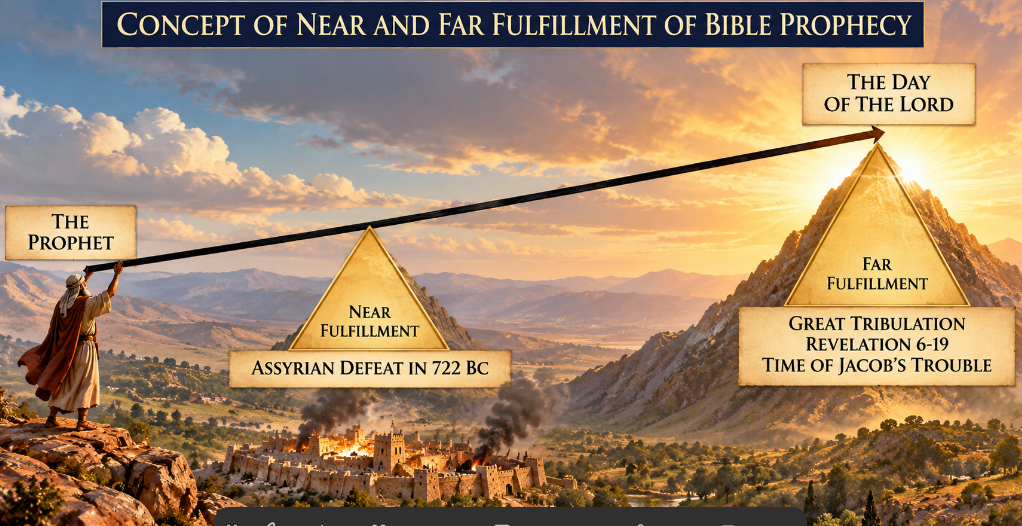
IN THAT DAY
RUINS BECOME RESTORATION
In that day - In context what day? He has just described judgment of sinners. Now God skips down the corridors of time to the end of the age. That day is "prophetic shorthand" for the Day of the Lord. This day includes the judgment of Israel and the Gentile nations of the world, as well as the restoration of Israel (cf. Hos 12-14; Zech 12-14) In Amos 5:18 they were longing for the Day of the LORD, but Amos explained for his hearers that day would be "darkness and not light." Here is Amos 9:11 that day will be reversed and will be light and not darkness!
John A Jelinek - Amos's warnings of divine wrath are also balanced with the prospect of the eventual triumph of God's kingdom. The relationship that God created with His people has a future, and His people will be vindicated at the end of time. Like other eighth-century prophets to Israel and Judah, Amos found reason to hope (e.g., Isa 40-66; Hs 1:10-11; Mc 2:12-13). In that day God will miraculously intervene and also restore the fallen booth (dynasty) of David that had suffered some destruction (9:11). David's "tent" had suffered major damage because of the division of the nation into two parts (Israel in the north, Judah in the south), though it had not yet collapsed. (The Moody Bible Commentary)
John Phillips - God's present purpose in the world is to call out from among all nations the ekklēsia, the church. After that God will turn His attention to the fallen fortunes of "the tabernacle of David." (SEE Exploring Acts: An Expository Commentary - Page 295)
As David Levy says "The words in that day had been used to describe Israel’s judgment (Amos 2:16; 3:14; 5:18–20; 8:3, 9, 11, 13), but now Amos used these words to proclaim the nation’s restoration, spiritual reunion, and redemption." (Excerpt from Israel My Glory, vol 48, No.3 June/July, 1990)
The verse is regarded as Messianic in the Jewish Talmud.
David Allan Hubbard - “The transition from verse 10 to verse 11 is the most abrupt and surprising in the entire book. The sword of judgment gives way to the trowel of reconstruction.” (see Joel and Amos)
G Campbell Morgan - “It is now declared that the reason of the divine judgment is not revenge, but the only way in which it is possible to usher in the restored order on which the heart of God is set.”
Note that some commentators assert that Amos 9:9-10 refers to the Great Tribulation (Mt 24:21), also know as the Time of Jacob's Distress (Jer 30:7), or the time of great distress (Daniel 12:1). Below are my thoughts on this interpretation...
CAVEAT - THE FOLLOWING THOUGHTS ARE VERY SUPPOSITIONAL! There are three phrases in Amos 9:9-10 that do potentially allow such an interpretation that Amos 9:9-10 is a picture of the coming time of Israel's distress at the end of this age: (1) "I will shake the house of Israel among all nations" - Ostensibly this could be interpreted as referring to the final time of the end when Israel will be "shaken" - read Zech 12:1-4. (2) "All the sinners of My people will die by the sword" - This could refer to the horrible Time of Jacob's Distress when 2/3's of Israel will be killed as prophesied in Zech 13:8. (3) "But not a kernel will fall to the ground" - Again ostensibly this would parallel Zechariah's description of a believing remnant of Israel in Zech 13:9 which describes 1/3 of Israel is left after the Lord's judgment of Israel. In sum, Amos 9:9-10 has some descriptions that might allow one to equate it with the Great Tribulation, etc, but I am not fully convinced that was the original intent. Be a Berean!
ESV Study Bible comment on Amos 9:11-15 - God has committed himself to bless his people, and eventually the world, through the family of David (2Sa 7:15-16; Ps 72:17). In that context, Israel’s fortunes (Amos 9:14) would be restored. The abundance described in Amos 9:13-15 stands in stark contrast to the ruin and destruction that fell on Israel after God repeatedly warned them, appealing to them to come to repentance (Amos 4:6-11). Again, the point is that God does not intend for judgment on Israel to be final, but to be a tool through which blessing may ultimately come...Amos 9:11 - In that day reminds the reader of the Day of the Lord that the Israelites confidently expected. If it was to be a day of destruction instead of blessing (Amos 5:18-20), that did not mean it was to be God’s final word on the subject.
I will raise up the fallen booth (sukkah; LXX - skene - tent, generally, of transitory, movable lodging places for nomads, pilgrims, herdsmen, soldiers, constructed of various materials) of David - Notice all of the "I will" (raise up...wall up...raise up...rebuild in Amos 9:11; restore in Amos 9:14; plant in Amos 9:15) statements in this passage, reflecting God's sovereign pleasure and power. This is the covenant keeping God speaking to Israel, who He has just judged and condemned in Amos 9:1-10. In the midst of this judgment, because of His covenant love, God remembers mercy (cf "His unchanging love" - His hesed/chesed/heced in Micah 7:18). And so He gives a prophecy promising restoration of future glory to the nation of Israel, a prophecy that will be consummated when the Messiah returns a second time to set up His glorious Kingdom and reign as King of kings and Lord of lords. Then, in that day, the fallen booth of David will be raised up. As discussed elsewhere in these notes, there are some who feel the booth of David corresponds the chuch but this is not true but reflects spiritualization of the text! (See note)
Compare fallen booth to the original promise to David “Your house and your kingdom shall endure before Me forever; your throne shall be established forever” (2 Samuel 7:16). That word is bayit, a house, a dynasty, a royal line established forever. By Amos’s day the bayit has become a sukkah. The palace has become a garden shack so to speak. And not even a standing shack, for the participle is nopheleth, fallen. The house that was to endure forever is at this time a collapsed hut! Notice too that Amos is speaking while the dynasty still stands. Uzziah was on the throne in Judah and Jeroboam II in Israel, and both kingdoms were prosperous (Amos 1:1). Yet God describes the house of David as already fallen. He sees the end from the beginning, and He names the thing by what it has become in His sight rather than by its appearance at the moment.
The sukkah is also the word for the booths of the Feast of Tabernacles: “You shall live in booths for seven days; all the native-born in Israel shall live in booths, so that your generations may know that I had the sons of Israel live in booths when I brought them out from the land of Egypt. I am the LORD your God” (Leviticus 23:42-43). The booth was the memorial of total dependence on God in the wilderness, when Israel had no house at all and God was their shelter. So the humbling is also the point. Israel is brought back to a booth because a booth is where she learned to depend on Him.
However God's faithfulness does not fail when human faithfulness fails! The booth may fall, the walls may crumble, and the ruins may remain for generations, but not one promise of our faithful God will ever fall to the ground! (Jos 21:45; 1Ki 8:56). And we see this in the prophecy in Zechariah “Then it will come about that any who are left of all the nations that went against Jerusalem will go up from year to year to worship the King, the LORD of hosts, and to celebrate the Feast of Booths” (Zechariah 14:16). The nations come to keep Sukkot. The fallen booth is raised, and the Gentiles come up to the Feast of Booths to worship the King. Amos 9:11 and Amos 9:12 are not two separate promises. They are one picture, and Zechariah shows you the finished scene.
Gary Smith on the fallen booth - This structure which is fallen/falling is a prophetic metaphor of the present and future state of the Davidic kingdom. Instead of a powerful and secure kingdom, as in the time of David’s united monarchy, it was and will be more like a dilapidated little hut. But God will rebuild and restore it to its former glory.
Scofield on fallen booth - The Davidic monarchy, pictured by a tabernacle...was in a degraded condition. Cp. Isa. 11:1. On the basis of this verse the Talmudic rabbis called Messiah Bar Naphli (“the son of the fallen”). But He will arise (Mal. 4:2).
David Levy comments on fallen booth (tabernacle) - "The word tabernacle refers to the royal house of David, which the Lord established forever in the Davidic Covenant (2Sa 7:11-16). But sin brought the Davidic dynasty to decay and decline, to become only a shadow of its once-great power. With the destruction of Judah in 586 B.C. (Jer 22:24–30), the rule of the house of David ceased.' When the Messiah returns to set up His Kingdom, the Davidic Kingdom will be reestablished (Ezek 37:24,25). “In that day [the Lord will] raise up the tabernacle of David that is fallen, and close up the breaches [repair the city wall] of it; and ... raise up his ruins [rebuild Israel], and ... build it as in the days of old [days of Solomon]” (Amos 9:11). At that time the boundaries of Israel will be expanded to include all the land promised to Abraham (Ge 15:18). Israel will possess the remnant of Edom and all the surrounding nations who trust in the Lord (Amos 9:12)., These nations will enjoy the Messiah’s blessing and protection along with Israel. Israel has not known peace with her Gentile neighbors over the centuries, but in that day she will have peace because it will be accomplished by the Lord (Amos 9:12). (Excerpt from Israel My Glory, vol 48, No.3 June/July, 1990)
Donald Sunukijan - God will reestablish David's "tent" over both the Northern and Southern Kingdoms. A "tent" (lit., "booth") or awning was made by setting up a simple frame and spreading branches over it. Its primary purpose was to shelter those under it, whether troops in the field (2Sa 11:11; 1Ki 20:12-16), a watchman at post (Jonah 4:5), or pilgrims at the Feast of Booths (also called the Feast of Tabernacles, Lev. 23:33-42). David's dynasty, which had been a "protective canopy" over all the people of Israel, had "fallen" with the great schism of the 10 Northern tribes from the 2 Southern tribes (1Ki 12, cf 1Ki 11:1-25). This booth had been broken in two. But God promised to unite the two kingdoms once again under Davidic rule (cf. Jer. 30:3-10; Ezek. 37:15-28; Hosea 3:4-5). He will restore the sheltering tent, repair its broken places, building it as it used to be. (See The Bible Knowledge Commentary Minor Prophets - Page 47)
Gary Smith writes that "The word tabernacle refers to the royal house of David, which the Lord established forever in the Davidic Covenant (2 Sa 7:11–16). But sin brought the Davidic dynasty to decay and decline, to become only a shadow of its once-great power. With the destruction of Judah in 586 B.C. (Jer. 22:24–30), the rule of the house of David ceased. When the Messiah returns to set up His Kingdom, the Davidic Kingdom will be reestablished (Ezek. 37:24–25). “In that day [the Lord will] raise up the tabernacle of David that is fallen, and close up the breaches [repair the city wall] of it; and ... raise up his ruins [rebuild Israel], and ... build it as in the days of old [days of Solomon]” (Amos 9:11). (Mentor Commentary - Amos)
Henry Morris - This great prophecy of the ultimate restoration of the Davidic kingdom was still future when Peter and James quoted this verse (Acts 15:14-18). It will be fulfilled at the second coming of Christ, the promised Messiah of Israel, who will Himself assume the throne of David (Luke 1:31-33).
Criswell - The preservation of the Davidic line will achieve fulfillment ultimately through Christ. Amos said specifically (v. 15) that there was to be one final return of the Hebrews from exile, never to be followed by another exile. Some scholars view this brief paragraph on restoration and prosperity as being at variance with Amos's teachings. The truth is that hope is almost universally prevalent in Hebrew literature, especially in that of the prophets. Hebrew prophets naturally follow a statement of condemnation with one of hope. The hope here envisioned is a millennial hope. When Israel's tabernacle of David is restored (v. 11), the results of God's blessings will be apparent in every phase of life. The earth will yield its harvest so abundantly that the reapers will scarcely be able to reap the fields before the plowmen come to begin planting for the next year (v. 13). Israel will never again be taken captive, and she will possess her God-ordained land (vv. 14, 15). The authorship of these last verses is questioned by those who find it difficult to believe that a single prophet might preach both judgment and hope. For the true prophet, judgment was never God's ultimate purpose. God's acts in history are always for His greater redemptive purpose. The Book of Revelation serves as the final word on the relationship between judgment and hope. (Believer's Study Bible)
Hay has an interesting comment - It is significant that it is "the tabernacle of David" that is to be rebuilt. The usage of the word creates a link in thought with the Feast of Tabernacles, and the prophetic significance of that festival has to do with the coming millennial Kingdom of the Lord Jesus (Zech 14:16-19). It will be then that God's Son, "who was born of the seed of David according to the flesh" (Ro 1:3, RV), will exercise His kingly rights. (What the Bible Teaches)
And wall up its breaches I will also raise up its ruins And rebuild it as in the days of old - The days of old recall the glorious reign of King David, when it was as good as it ever got in Israel under the monarchy.
KJV Bible Commentary - Even though Israel has sunk to an all-time low and judgment must fall, still God’s plan for the house of David and His promises to Abraham have not failed and will be ultimately realized. God will repair the damage done to the tabernacle (Heb sukah, hut or booth) of David.
Thomas Finley - the restoration of ‘David’s booth’ amounts to the setting up of the millennial kingdom, and it will also fulfill the literal promise to David of an everlasting kingdom. (Joel, Amos, Obadiah)
David Guzik - Amos knew that Israel was ruined, because he speaks of restoring the tabernacle of David instead of the house of David. A tabernacle is a house, but a humble one. This “Pictures the ‘house’ of David that was becoming a dilapidated shack; in Amos’ time the Davidic dynasty had fallen so low that it could no longer be called a house.” (McComiskey)
John MacArthur comments - In Amos 9:11, the Lord promised that He “will raise up the tabernacle of David, which has fallen down.” At the Jerusalem Council, convened to discuss whether Gentiles should be allowed into the church without requiring circumcision, James quotes this passage (Acts 15:15,16) to support Peter’s report of how God had “visited the Gentiles to take out of them a people for His name” (Acts 15:14). Some have thus concluded that the passage was fulfilled in Jesus, the greater Son of David, through Whom the dynasty of David was reestablished. The Acts reference, however, is best seen as an illustration of Amos’ words and not the fulfillment. The temporal allusions to a future time (“On that day,” Amos 9:11), when Israel will “possess the remnant of Edom, and all the Gentiles” (Amos 9:12), when the Lord “will plant them in their land, and no longer shall they be pulled up from the land I have given them” (Amos 9:15), all make it clear that the prophet is speaking of Messiah’s return at the Second Advent to sit upon the throne of David (cf. Isa 9:7), not the establishment of the church by the apostles. (Ibid)
Warren Wiersbe - James quoted Amos 9:11 during the Jerusalem conference when the leaders discussed the matter of the place of the Gentiles in the church (Acts 15). The question was, “Must a Gentile become a Jew in order to become a Christian?” But note that James did not say that Amos 9:11 was fulfilled by the Gentiles’ coming into the church, but that the prophets (plural) agreed with the Gentiles’ being a part of the church (Acts 15:13–18). After all, if believing Gentiles are one day going to be a part of the Messianic Kingdom (David’s dynasty restored), why can’t they be a part of the church today? Why should they be forced to become Jewish proselytes in order to become Christians? However, some interpret Amos 9:11 and the words of James to mean that the church is the “tabernacle of David” so that the Old Testament prophecies about the kingdom are now fulfilled in the church. How the church is like David’s kingdom “as in the days of old” is difficult to understand, and the references to Edom (Amos 9:12) and the fruitfulness of the land (Amos 9:13–15) are also difficult to apply to the church. (Bible Exposition Commentary)
Walvoord comments on this matter relative to the passage at hand. He says, By no possible stretch of the plain meaning of the passage can the tabernacle of David be made to be an equivalent of the New Testament Church. The prophecy concerns the rebuildin2" of that which was fallen down. The "ruins" are to be rebuilt "as in the day of old." The nature of the bleSSings are earthly, territorial, and national, and have nothing to do with a spiritual church to which none of these blessings has been promised. 9
Here is the ESV Study Bible comment on Acts 15:16-18 - James refers to “prophets” (Acts 15:15), showing that he could appeal to more than one OT text to defend the inclusion of Gentiles by faith alone. See the allusion to Isa. 45:21 in Acts 15:18, and the context of the Isaiah prophecy. James concentrated on Amos 9:11-12, which looked to the time when God would restore the house of David. Luke provides the Septuagint (Greek) translation of the text, which speaks of the Gentiles (Gk. ethnē) seeking the Lord. But even the Masoretic (Hebrew) Text fits with what James argued, since it speaks of a people called by my name (Amos 9:12), and those called by God’s name are in a saving relationship with him. Amos looked to a time when God would claim a people for himself from among the Gentiles. James concurred with Peter that the time of Gentile inclusion in God’s people had now arrived.
Regarding the "Tabernacle of David" read the prophecy in Isaiah 9:6-7 which we often hear at Christmas but often fail to grasp the yet future aspect to be fulfilled at the Second Coming.
For a child will be born to us, a son will be given to us (MESSIAH'S FIRST COMING); And the government will rest on His shoulders (MESSIAH'S SECOND COMING); And His name will be called Wonderful Counselor, Mighty God, Eternal Father, Prince of Peace. There will be no end to the increase of His government or of peace, On the throne of David (CP "REBUILD THE TABERNACLE OF DAVID WHICH HAS FALLEN") and over his kingdom (THE MESSIANIC KINGDOM), To establish it and to uphold it with justice and righteousness From then on and forevermore. The zeal of the LORD of hosts will accomplish this. (Isaiah 9:6-7)
Comment - It is worth quoting the comment in the ESV Study Bible which often is generally "amillennial" in prophetic passages. This comment however seems to leave that door "open" explaining that the Prince of Peace "is the ruler whose reign will bring about peace because the nations (IMPLICATION? THERE WILL BE NATIONS AND NATIONS NORMALLY IN THE BIBLE SPEAKS OF GENTILES! Compare comments on Zechariah 14:16-19 A PASSAGE THAT WOULD BE VERY DIFFICULT TO INTERPRET LITERALLY IF THERE WERE NO LITERAL MESSIANIC KINGDOM!) will rely on His just decisions in their disputes (cf. Isa. 2:4; Isa 11:6-9; Isa 42:4; 49:7; Isa 52:15). This kind of king contrasts with even the best of the Davidic line that Judah has experienced so far, because these titles show that this king will be divine. (ESV Study Bible)
Booth (tabernacle) (05521) sukkah from sakak = to weave together) meant a shelter, a hut, a booth or a thicket. It was a flimsy lean-to of branches that a watchman threw up in a field during harvest and abandoned when the season ended. Sukkah described temporary shelters for animals (Ge 33:17), soldiers (2Sa 11:11), prophets (Jonah 4:5). In Lev 23:42-43 it refers to the booths constructed for the harvest feast, the Feast of Booths (Hebrew transliterated = hag [feast] hassukkot), which was held in the Fall (15th of Tishri - late Sept to Oct - see table for the Seven Great Feasts of Israel)
The Feast of Booths is often referred to as “the feast/festival” (without using the word "Booths" or "Tabernacles") (1Ki 8:2, 65, 12:32, 2Chr 5:3. 7:8, Neh 8:14, 18, Ezek 45:25.) The dedication of Solomon’s temple took place during the time of this festival and so it points to the importance of this feast (1 Kgs 8:2, 65–66). The location of the feast is now “at the place the LORD will choose,” and this probably indicates the centralizing of Israelite worship in the Jerusalem temple (Deut 16:15).
TWOT - Most commonly, (sukkah) is used in connection with the Feast of Tabernacles. Once a year the Israelite left his home to tabernacle in a “booth,” made from tree branches (Lev 23:34ff.). The feast marked not only the joy and thankfulness of a grateful people for God’s provision at the end of the agricultural season (Lev 23:39–41), but was to be a perpetual reminder (Deut 16:13ff.) to the people of God’s care for his own whom he had rescued from Egypt during those long years in the wilderness (Lev 23:42–43). The feast was closed by a day of rest, featured by a holy convocation, marking not only the climax of the religious year but symbolizing the rest of the believer in his God (Lev 23:39). Prophetically, the feast finds final fulfillment in that grand day when God will raise up the fallen booth of David (Amos 9:11) and give shelter to his repentant, redeemed, and re-gathered people (Isa 4:6). (Theological Wordbook of the Old Testament)
TWOT on the derivation of sukkah - The basic meaning of the root (of sukkah) is that of blocking, or stopping up something… This important root is productive in both a physical and figurative sense, particularly with the idea of “covering.” In the former sense, it was frequently used in the building activities relative to the sacred places of worship. The cherubim’s wings were to cover the mercy seat in the tabernacle (Ex 37:9) and the temple (I Chr 28:18). A veil screened off the ark and the mercy seat which were located within the holy of holies (Ex 40:3, 21). The participial form yields the denominative sōkēk, a covering erected to protect besiegers from the defenders’ missiles (Nah 2:5 [H 6]).In a figurative sense, it pictures God’s protection for the one who comes to him for refuge (Ps 5:11; cf. Ps 91:4; 140:7).
The Septuagint often translates sukkah with the noun skene which described temporary, easily moved lodging places (tents, booths) for nomads. It is fascinating that this same word (skene) describes our "eternal dwellings (skene)." (Lk 16:9). Skene was also used to describe the "portable sanctuary," the Tabernacle (Ex 27:21, 29:4, Lev 1:1, Heb 8:5)
Sukkah - 29v - Ge 33:17; Lev 23:34, 42-43; Deut 16:13, 16; 31:10; 2 Sam 11:11; 22:12; 1Kgs 20:12, 16; 2Chr 8:13; Ezra 3:4; Neh 8:14-17; Job 27:18; 36:29; 38:40; Ps 18:11; 31:20; Isa 1:8; 4:6; Amos 9:11; Jonah 4:5; Zech 14:16, 18-19 and translated in the NAS as - booth(1), Booths(9), booths(8), canopies(1), canopy(1), hut(1), lair(1), pavilion(1), shelter(4), temporary shelters(3).
The following Scriptures use sukkah in the context of the Feast of Booths or Tabernacles - Lev 23:34, 42-43, Kt 16:13, 16, 31:10, Ezra 3:4, Neh 8:14-17 and in the Millennial (see descriptions of this glorious time) reign of Messiah - Zech 14:16, 18-19.
QUESTION - What was the tabernacle of David? | GotQuestions.org
ANSWER - The Hebrew word translated “tabernacle” is ohel, which means “a tent (as clearly conspicuous from a distance): a covering, (dwelling) (place), home, tabernacle, tent.” There are three main references to the tabernacle (or tent) of David: Isaiah 16:5, Amos 9:11, and Acts 15:16, in which the apostle James repeats the passage from Amos. The reference in Isaiah 16:5 refers to the tabernacle of David prophetically, pointing to One from the line of David who will someday sit on the throne and rule over all. This is referring to Jesus.
That leaves two other references to the tabernacle of David. In Acts 15:16, while speaking to the Jews, James uses Amos 9:11 to give credence to the recent conversion of the Gentiles in the early church. Many Jews were objecting to this because there was uncertainty as to how the Gentiles were to now keep the Law of Moses. The essential argument from Peter’s earlier experience with Cornelius, a Gentile, was that God was also calling Gentiles to Himself. The apostles were not to put on the Gentiles a burden that no one could ever keep (i.e. the Law of Moses).
From James’ words alone, it is clear that God’s promise through the prophet Amos—that He would “build again the tabernacle of David”—was related to what He was just then beginning to do, namely, visiting the Gentiles to take out from among them a people for His Name. After rehearsing what Simon Peter had just told the Jerusalem Christians—that God had chosen Peter as the instrument whereby He, for the first time, opened the way of salvation to the Gentiles—James plainly declared that God’s visitation of the Gentiles agreed with the words of the prophets (in general) and Amos (in particular). The “tabernacle” referred to in Acts 15:16, then, is the house of God open to all, both Jew and Gentile, who seek Him in order to worship in truth.
Amos 9:11 says, “In that day will I raise up again the tabernacle of David, that is fallen.” There seems to be reference here to a restoration of the Jewish nation to spiritual life in the end times. There might also exist, during that end time, or into the 1,000-year reign of Christ, a tabernacle like the one during David’s day. During David’s time the tabernacle (or tent) housed the Ark of the Covenant and was a precursor to the temple that Solomon would build. The temple was a rectangular house of worship made with elaborate design. Its presence and functionality, with priests, was a sign of God’s favor and presence. When Israel fell away from following the commandments of the Old Covenant, the temple was desecrated and needed to eventually be rebuilt, as described in the book of Ezra.
Acts 15:13-18 After they had stopped speaking (Acts 15:7-11,12), James answered, saying, “Brethren, listen to me. 14 “Simeon has related how God first concerned Himself about taking from among the Gentiles a people for His name. 15 “With this the words of the Prophets agree, just as it is written, 16 ‘AFTER THESE THINGS I will return (ED: NOT I WILL COME BUT WILL RETURN - SECOND COMING), AND I WILL REBUILD THE TABERNACLE OF DAVID WHICH HAS FALLEN (ED: 931 BC KINGDOM SPLIT INTO NORTH AND SOUTH), AND I WILL REBUILD ITS RUINS, AND I WILL RESTORE IT, 17 SO THAT (TERM OF PURPOSE) THE REST OF MANKIND MAY SEEK THE LORD, AND ALL THE GENTILES WHO ARE CALLED BY MY NAME,’ 18 SAYS THE LORD, WHO MAKES THESE THINGS KNOWN FROM LONG AGO.
James will now demonstrate that what Peter has stated is in perfect harmony with the Word of God written by a Jewish prophet. This is a very difficult verse and the battle rages over how James used this specific Old Testament Scripture. We will have to agree amicably to disagree about some of the details but at the same time remaining unified in the truth that Jews and Gentiles are saved by grace through faith apart from the works of the Law. That was the main thrust of James in this difficult to interpret passage.
And so in Acts 15:16-18 James quotes from Amos 9:11-12 (see commentary) but he quotes not from the Hebrew Masoretic text but from the Septuagint version, the Greek translation of the Old Testament which reads somewhat different when compared to the Hebrew. Here is the NAS translation that is based on the Hebrew Masoretic text:
“In that day I will raise up the fallen booth of David, And wall up its breaches; I will also raise up its ruins And rebuild it as in the days of old; 12 That they may possess the remnant of Edom and all the nations who are called by My name,” Declares the LORD who does this.
Here is the English translation of the Septuagint rendering of Amos 9:11-12 with the two major differences in bold:
"In that day I will raise up the tabernacle of David that is fallen, and will rebuild the ruins of it, and will set up the parts thereof that have been broken down, and will build it up as in the ancient days: that the remnant of men (INSTEAD OF EDOM), and all the Gentiles upon whom My Name is called, may earnestly seek me, saith the Lord who does all these things."
Lest me miss the main point because of the confusion and various interpretations of James' quoting Amos 9:11-12, we need to keep in mind that his main purpose for quoting this passage is to show to the legalistic Jews that God has always promised a place for the Gentiles in His plan of redemption and in that plan they did not have to first become Jewish proselytes but were simply to earnestly seek Him.
The Table below compares the Hebrew, the Septuagint and James' translation.
| COMPARISON OF AMOS 9:11-12 IN ACTS 15:16-18 |
||
| Translated from Hebrew | Translated from the Septuagint (NETS) | Luke’s Account of James’s Citation |
| In that day | On that day | After these things I will return, |
| I will raise up the fallen booth of David, and wall up its breaches | I will raise up the tent of David that is fallen | and I will rebuild the tabernacle of David which has fallen, |
| I will also raise up its ruins and rebuild it as in the days of old; | and rebuild its ruins and raise up its destruction, and rebuild it as the days of old | and I will rebuild its ruins, and I will restore it, |
| that they may possess the remnant of Edom and all the nations who are called by My name | in order that those remaining of humans and all nations upon whom my name has been called might seek out me | so that the rest of mankind may seek the Lord, and all the Gentiles who are called by My name |
| declares the LORD who does this. | says the Lord who does these things. | says the Lord. |
Note that James has mankind instead of Edom and seek instead of possess. The Hebrew consonants for "Edom" (H123) and for "Adam" (H120) are identical (ʾd̠m) And the original Hebrew texts was written without vowels which were added much later. The confusion in the vowels ("A" or "E" were added much later) is easy to understand. Some ancient scribes who supplied vowel markings for the Hebrew text upon which our English translations of the Old Testament rest apparently understood the text as “remnant of Edom,” while others, including the Septuagint translators and James, understood it as “remnant of mankind.” Similarly the only distinction in the Hebrew between "possess" (yāraš) and "seek" (d̠āraš) is in one consonant. The text James used may well represent the original. Notice that James begins with the words "After these things I will return," and these words are not the original Hebrew or Septuagint. James substitutes "after these things" for the original "in that day" and also adds the words "I will return."
Stanley Toussaint comments on the major problem, which is not the text per se but the interpretation of the text:
Several observations need to be noted before the passage is interpreted:
(1) James did not say Amos 9:11-12 was fulfilled in the church; he simply asserted that what was happening in the church was in full agreement with the Old Testament prophets.
(2) The word "prophets" is plural, implying that the quotation from Amos was representative of what the prophets in general affirmed.
(3) James' main point is clear: Gentile salvation apart from the Law does not contradict the Old Testament prophets....Bible students interpret these verses in one of three ways.
(1) Those who hold to amillennial theology say the rebuilt house (skēnēn, "tent") of David is the church which God is using to preach to the Gentiles. While this view at first appears plausible, several factors oppose it. (1) The verb return (anastrepsō) used in Acts 15:16 means an actual return. Luke used it only in Acts 5:22 ("went back") and here (he did not use it in his Gospel); in both occurrences it describes a literal, bodily return (ED: IF ONE INTERPRETS THE TEXT LITERALLY OF COURSE). Since God's Son has not yet returned bodily, this rebuilding has not taken place. (2) Christ's present ministry in heaven is not associated with the Davidic throne elsewhere in the New Testament. He is now seated at the right hand of God (Ps. 110:1; Ro. 8:34; Col. 3:1; Heb. 1:3; 8:1; 10:12; 12:2; 1 Pe 3:22). When He returns He will sit on David's throne (2 Sa 7:16; Ps. 89:4; Mt. 19:28; 25:31). (3) The church was a mystery, a truth not revealed to Old Testament saints (Ro 16:25; Eph. 3:5-6; Col. 1:24-27); so the church would not be referred to in Amos.
(2) A second view of the passage is commonly held by premillenarians. According to this view there are four chronological movements in this passage: the present Church Age ("taking from the Gentiles a people for Himself," Acts 15:14), the return of Christ to Israel (Acts 15:16a), the establishing of the Davidic kingdom (Acts 15:16b), and the turning of Gentiles to God (Acts 15:17). While this does interpret these verses in a logical fashion, this approach has some difficulties. (1) The quotation begins with the words "After this." Premillenarians assert James used this phrase to suit his interpretation of the passage. But since the quotation begins with "after this" James must be quoting the sense of Amos 9:11. Therefore this phrase looks back, not to Acts 15:14, but to Amos 9:8-10, which describes the Tribulation ("a time of trouble for Jacob," Jer. 30:7). (ED: WHILE THIS IS POSSIBLE IT IS NOT ABSOLUTELY CLEAR THAT AMOS 9:8-10 DEFINITELY DESCRIBES THE TRIBULATION) (2) If the temporal phrase "after this" refers to the present Age in Amos 9:11, Amos would then have predicted the church in the Old Testament.
(3) A third view, also premillennial, may be more plausible. James simply asserted that Gentiles will be saved in the Millennium when Christ will return and rebuild David's fallen tent, that is, restore the nation Israel. Amos said nothing about Gentiles needing to be circumcised. Several factors support this interpretation: (1) This fits the purpose of the council. If Gentiles will be saved in the Kingdom Age (the Millennium), why should they become Jewish proselytes by circumcision in the Church Age? (2) This approach suits the meaning of "in that day" in Amos 9:11 (ED: SEE COMMENTS ON THE PHRASE "IN THAT DAY" IN AMOS 9:11). After the Tribulation (Amos 9:8-10) God will establish the messianic kingdom (Amos 9:11-12). James (Acts 15:16) interpreted "in that day" to mean that "at the time when" God does one (the Tribulation) He will then do the other. In that sense James could say "After this." (3) This interpretation gives significance to the word "first" in Acts 15:14. Cornelius and his household were among the first Gentiles to become members of Christ's body, the church. Gentile salvation will culminate in great blessing for them in the Millennium (cf. Ro. 11:12). (4) A number of prophets predicted Gentile salvation in the Millennium, as James stated in Acts 15:15 (e.g., Isa. 42:6; Isa 60:3; Mal. 1:11). (See Bible Knowledge Commentary - Page 395) (Bold added)
AFTER THESE THINGS - As discussed James changed the original words from "in that day" to "after these things," the question arises as to what time does this time phrase refer? In other words the question is "After what?" If we examine the context, there is nothing in the preceding passage that allows us to determine the "timing." If we observe the entire context from which James takes this quotation, it is clear that Amos 9:11-15 describes a time of future glory and blessing on the nation of Israel. It describes conditions that clearly have not yet been fulfilled. We know from comparison to other descriptions of the end times restoration of Israel that Amos 9:11-15 describes a time which will follow a period of great distress for the nation of Israel, a time that other Scriptures refer to as the Great Tribulation (Mt 24:21), the Time of Jacob's Distress (Jer 30:7) or the time of great distress (Daniel 12:1). After this time of Israel's future testing the promises of Amos 9:11-15 will be consummated. So this could be the time to which James refers when he says "after these things."
Bock suggestion regarding the phrase after these things - Jeremiah 12:15 may be the source for the opening “After these things I will return,” but this is less than clear, since the phrases may be only a transition into the citation that shows how James sees the timing. (See Acts Baker Exegetical Commentary on the New Testament)
In using this passage James' intention was not to teach the Jews about Israel's future, but to use a prophetic passage that demonstrated that the Gentiles had always been part of God's plan of redemption.
Swindoll adds that "James didn’t, however, mean to imply that the church was fulfilling all that Amos prophesied. The oracle of Amos (ED: READ THE FULL ORACLE IN Amos 9:11-15 AND THE ASSOCIATED COMMENTARY) describes the restoration of Israel, which hasn’t happened yet. James merely used the prophecy to demonstrate that the Lord had always intended to bring elect Gentiles into His kingdom. (See Insights on Acts)
I am shocked at reading the Preacher's Outline & Sermon Bible which flat out comments on the phrase "I will return” writing that "This is referring to the first coming of Jesus Christ. And He had come—no one present would deny that." The POSB goes on to add that "There will be Jewish believers: “The tabernacle of David” refers to believing Jews, the true tabernacle or true body of Jews." (ED: THIS IS AN EXAMPLE OF HOW ONE CAN DERIVE AN UNUSUAL INTERPRETATION AS THE RESULT OF SPIRITUALIZATION OF THE TEXT!) James was applying the prophecy to the present situation. The people of David, the true indestructible tabernacle of David, the true body of David (believing Jews) will be “built up again … I [God] will set it [them] up.” (POSB-Acts) When you read a comment like this it makes you wonder if words have any meaning at all! These POSB comments make no sense when compared to the Amos passage. What is fascinating is that others who spiritualize the text conclude that the tabernacle of David is the Church! Can you not see what begins to happen when you are "fast and loose" with spiritualization of the Biblical text in an attempt to make it "fit" into one's pre-conceived eschatological view? I like what Charles Zimmerman says about this type of interpretation...
The pronounced spiritualizing method used by the adherents of this view (ED: THAT THE RAISED TABERNACLE IS THE CHURCH) is noted for its absence of "controls" in interpretation. That is, there are no consistent literal and grammatical bounds within which they must operate. Its attraction lies in its flexibility. However, if words do not mean what they say within the bounds of common sense interpretation, then the reader has nothing to guide him in his understanding. He is in imminent peril of going astray theologically at any point. (ED: AMEN!) (“To This Agree the Words of the Prophets,” Grace Journal 4:3 Fall 1963:28-40)
Excerpt from Walter Kaiser's articel The Davidic Promise And The Inclusion Of The Gentiles (Amos 9:9-15 And Acts 15:13-18): A Test Passage For Theological Systems - Israel and the Church Then and Now What then are we to conclude about the Jerusalem council? Was circumcision necessary for Christian converts? No! God’s future rested with a restoration of “David’s hut” and the full promise of God, not in the perpetuation of the Mosaic ritual. So the prophets had predicted. Was the “tabernacle of David” a type of the Christian Church which transferred especially Amos’ national hopes into spiritual realities of the gospel era? Again, no! This fails to take seriously the verses that precede and follow Amos 9:11,12, much less the constant repetition of God’s total program which encompassed the past, present and future in a plan that provided for the restoration of nature itself and the calling of Gentiles in that single kingdom of God. The new covenant was nothing less than what God had promised to Abraham and David, but it was also more—but along those same lines of thought already traced. And the “people of God” were and still are one. That was James’ point and Amos’ prediction! Both Jews and Gentiles—Edomites included—would be “called by the name of the Lord.”
F B Meyer - Amos 9:11–12 In that day will I raise up the tabernacle of David that is fallen.
These verses were quoted by the grave, white-vestured James in that memorable gathering of the Church to consider the admission of the Gentiles on equal terms with Jews (Acts 15). It is well worth noticing the special turn which the Lord’s brother gave to the closing words of the quotation. He reads into it the deeper meaning of the Holy Spirit. The quickening and blessing of the chosen people has always meant the blessing of the world.
It was so, as James says, at Pentecost. The blessing which descended on the hill of Zion passed to all lands. They went everywhere preaching the Gospel, until some began to utter it also to the men of Antioch, and great numbers streamed into the Church (Acts 11); and thence the widening circles broadened out, until Ephesus, Athens, Rome, and distant Spain and Britain were included.
So will it be when the end of the present age has been reached. We, the Church, shall sit with Christ in the heavenlies, occupying the place now held by the devil and his demons, who will no longer be the prince of the power of the air; but the Jews, using that term in its strict sense, having been brought to God, shall be the evangelists and apostles of the world. Then the residue of the Gentiles shall seek unto the Lord. Ponder, specially, the promises of Amos 9:13–15; and compare them with Romans 11:15, 24, 28.
May we not appropriate them in a spiritual sense, and ask that the days may hasten when the crops shall have no sooner fallen before the sickle, than the plowmen shall run their shares through the clods; and the vintage shall follow close on the harvest; and men shall be prepared and eager before we begin to speak!
Andrew Hill - The stark contrast between the judgment pronounced in the sermons and visions of Amos and the two salvation oracles (Amos 9:11-12, 13-15) promising deliverance and restoration in the epilogue have prompted many scholars to question the authenticity of the book’s conclusion and assign these salvation oracles to a later writer or editor (e.g., Mays 1969:166). This need not be the case, however, as the oracle structure of Amos’s message fits the basic speech pattern found in prophetic literature in the Old Testament. This speech pattern commonly includes the following:
Indictment (a statement of the offense, typically covenant violations related to idolatry and social justice)
Judgment (a statement of the punishment to be meted out, often including the threat of exile)
Instruction (the expected response to the prophet’s message, usually including a call to repentance)
Aftermath (a promise of future deliverance and restoration offering hope to those who persevere during the intervening period of divine judgment) (See Minor Prophets: Hosea through Malachi - Page 206)
Buyer Beware! – Beware of interpretations of Amos 9:11–15 that spiritualize God's promises to Israel and apply them exclusively to the New Testament church.
Matthew Henry is the author of a popular, freely available Bible commentary that contains much valuable devotional material. However, in my opinion, his interpretation of prophecies concerning Israel is often problematic. For example, commenting on Amos 9:11, Henry writes, “The church militant, in its present state, dwelling as in shepherds’ tents to feed, as in soldiers’ tents to fight, is the tabernacle of David.” Henry frequently interprets Old Testament promises concerning national Israel as finding their fulfillment in the church, an approach resembling what is commonly called replacement theology, although advocates of this interpretive approach would not necessarily accept that designation.
If Israel was literally judged, there is every reason
to expect that Israel will also be literally restored!
But consider the context! Throughout the book of Amos, Israel has consistently referred to the historical nation of Israel. It was Israel that sinned, Israel that was warned, and Israel that experienced God's righteous judgment. Why, then, should we suddenly understand Israel's promised restoration in Amos 9:11–15 as referring exclusively to the church? If Israel was literally judged, there is every reason to expect that Israel will also be literally restored! The New Testament application of this prophecy in Acts 15:13–18 demonstrates that God's purposes include the Gentiles, but it does not require the cancellation of His promises to national Israel. Indeed, Paul emphatically declares, “God has not rejected His people whom He foreknew” (Ro 11:2), and reminds us that “the gifts and the calling of God are irrevocable” (Ro 11:29). Interpretations of prophetic Scripture should therefore be carefully evaluated in light of the immediate context and the broader testimony of God's Word. The God Who faithfully fulfilled His warnings of judgment against Israel will just as faithfully fulfill His promises of restoration! (Jer 31:35–37; Am 9:11–15; Ro 11:25–29). Beloved, the God Who kept His Word in judgment will keep His Word in restoration!
God Has Not Forgotten Israel!
Do Not Replace What God Has Promised!
Israel Was Judged, but Israel Will Be Restored!
God's Promises to Israel Have Not Expired!
God Has Not Replaced Israel, Nor Has He Reneged on His Promises!
The God Who Scattered Israel Will Gather Israel!
Israel's Failure Cannot Frustrate God's Faithfulness!
God's Judgment Was Real, and His Restoration Will Be Real!
The Church Does Not Cancel God's Covenant with Israel!
Israel's Unfaithfulness Cannot Nullify God's Faithfulness!
What God Promised to Israel, He Will Fulfill for Israel!
God's Covenant Promises Are Not Subject to Cancellation!
Israel's Present Unbelief Does Not Mean God's Permanent Rejection!
God's Promises Are Not Revoked by Israel's Rebellion!
The Church Shares in God's Blessings but Does Not Erase His Promises to Israel!
Israel's Restoration Is Not a Divine Afterthought but a Covenant Certainty!
The Nation May Be Scattered, but God's Promises Remain Secure!
Do Not Spiritualize Away What God Has Specifically Promised!
God Is Not Finished with Israel!
Amos 9:11-15 TODAY IN THE WORD
“I will plant Israel in their own land, never again to be uprooted from the land I have given them,” says the LORD your God. - Amos 9:15
When Mount St. Helens erupted in 1980, it covered the surrounding area with a layer of ash that was several hundred feet deep. The hot ash and lava that spewed from the mountain destroyed all plant and animal life, leaving behind a landscape that resembled the moon. Yet nineteen years later an amazing transformation had begun to take place. Birds, grass, elk, and even frogs had all begun to flourish there again. The mountainside, once dead, had come back to life.
The prophet Amos closes his book on a note of hope, describing a similar rebirth for the nation of Israel. God had promised to judge His people, but He did not intend to destroy them. In the future He would “restore David’s fallen tent,” “repair its broken places,” “restore its ruins,” and “build it as it used to be” (Amos 9:11).
The mention of “David’s fallen tent” in this verse has been interpreted in a number of ways. Some think that it refers to the future restoration of the city of Jerusalem after its destruction by the Babylonians. Others regard it as a prediction of the reestablishment of the Davidic dynasty (see discussion of Millennium).
Acts cites this prophecy as support for the inclusion of Gentile believers in the church (Acts 15:16–17). The spread of the gospel to the Gentiles began God’s fulfillment of His promise that the Gentiles would bear His name (Amos 9:12).
In addition to this, Amos predicted a time of unparalleled prosperity for Israel in their own land. He foresaw a harvest so abundant that “the reaper will be overtaken by the plowman and the planter by the one treading grapes” (Amos 9:13). Normally the plowman worked during the months of October and November. The reaper harvested the crop in March or April. In the future, however, the harvest will be so abundant that the reaper will not be able to finish before the plowman begins.
TODAY ALONG THE WAY
The promises Amos describes in these verses will one day be completely fulfilled when Christ establishes His kingdom (see discussion of Millennium). But those who know Christ as Savior already experience a foretaste of what that fulfillment will be like, as they experience the richness of new life in Christ. Think of the changes Jesus Christ has brought into your life. In what areas that were once barren has Christ brought you new life? As you think through each one, pray and thank God for His transforming work in your life.
Amos 9:11–15 Today in the Word
Arbor Day was first celebrated in Nebraska. Julius Sterling Morton, an early settler and editor of Nebraska’s first newspaper, actively promoted his love of trees. In 1872, he proposed a resolution to the State Board of Agriculture that April 10 be set aside as a holiday for planting trees. The resolution was accepted, prizes were offered, and more than one million trees were planted on that first Arbor Day. By 1920, 45 states and territories had joined in, and today Arbor Day is celebrated in all 50 states. National Arbor Day is now the last Friday in April. As Morton said: “Each generation takes the earth as trustees. We ought to bequeath to posterity as many forests and orchards as we have exhausted and consumed.”
Planting a tree is an image of life, and it’s an appropriate picture in today’s passage of God restoring a remnant of His people. This, too, is part of the “day of the LORD.” Just as God Himself executed judgment, so God Himself will be the one to restore and rebuild “David’s fallen shelter” (Amos 9:11–12). These are also messianic verses, and the mention of Edom and “all the nations that bear my name” suggests that God’s plan for spreading His glory around the world included salvation for the Gentiles as well. That’s certainly what the apostle James thought when he quoted these verses as the basis for his agreement with Paul and Barnabas that the Gentiles should be included in the church (Acts 15:15–17).
The picture of restoration with which the book of Amos closes is beautiful and powerful (vv. 13–15). Though judgment is imminent and inescapable, better days are coming. Then, the seasons will run together in such abundance that it will seem as though the plowman is following the reaper. The exiles will return and rebuild their homes. People will tend gardens and plant vineyards. Peace and plenty will be the rule of the day. God Himself will be their Gardener (cf. John 15:1–4), replanting the nation, “never again to be uprooted” (cf. 2 Sam. 7:16).
Apply the Word
Christian musicians have prayed in song for the coming of the “day of the LORD.” One song by David Meece on his Chronology album is entitled simply, “Come That Day”: “Come that day when the mighty gavel pounds the sky / And on that day every man will have to testify / And you will surrender your soul at His door / No man no better for rich or poor / There will be fire, there will be rain / There will be joy, there will be pain / Come that day, come that day, come that day.”
Amos 9:12 That they may possess the remnant of Edom And all the nations who are called by My name," Declares the LORD who does this.
KJV That they may possess the remnant of Edom, and of all the heathen, which are called by my name, saith the LORD that doeth this.
NET As a result they will conquer those left in Edom and all the nations subject to my rule." The LORD, who is about to do this, is speaking!
NLT And Israel will possess what is left of Edom and all the nations I have called to be mine. " The LORD has spoken, and he will do these things.
ESV that they may possess the remnant of Edom and all the nations who are called by my name," declares the LORD who does this.
BGT ὅπως ἐκζητήσωσιν οἱ κατάλοιποι τῶν ἀνθρώπων καὶ πάντα τὰ ἔθνη ἐφ᾽ οὓς ἐπικέκληται τὸ ὄνομά μου ἐπ᾽ αὐτούς λέγει κύριος ὁ θεὸς ὁ ποιῶν ταῦτα
LXE that the remnant of men, and all the Gentiles upon whom my name is called, may earnestly seek me, saith the Lord who does all these things.
CSB so that they may possess the remnant of Edom and all the nations that are called by My name--this is the LORD's declaration-- He will do this.
NIV so that they may possess the remnant of Edom and all the nations that bear my name," declares the LORD, who will do these things.
NCV Then Israel will take over what is left of Edom and the other nations that belong to me,”
- possess Isaiah 11:14; 14:1,2; Joel 3:8; Obadiah 1:18-21
- Edom Genesis 27:29,37; Numbers 24:17; Ps 60:8; Malachi 1:4
- called by My name Isaiah 43:7; 63:19; 65:1; Jeremiah 14:9; 15:16; Daniel 9:18,19
- Multiple Sermons and Commentaries on Amos
REVIVAL OF POWER
FOR THE DAVIDIC KINGDOM
In Acts 15 (see detailed commentary Acts 15:16-18) James quotes from Amos 9:11-12 but he quotes not from the Hebrew Masoretic text but from the Septuagint version, the Greek text, of the Old Testament which reads somewhat different from the Hebrew. Here is the English translation of the Septuagint rendering of Amos 9:11-12
"In that day I will raise up the tabernacle of David that is fallen, and will rebuild the ruins of it, and will set up the parts thereof that have been broken down, and will build it up as in the ancient days: that the remnant of men (INSTEAD OF EDOM), and all the Gentiles upon whom My Name is called, may earnestly seek me, saith the Lord who does all these things."
James' purpose for quoting this passage is to show to the legalistic Jews that God has always promised a place for the Gentiles in His plan of redemption and in that plan they did not have to first become Jewish proselytes but were simply to earnestly seek Him.
That they may possess (yarash) the remnant (sheerith) of Edom - Israel will possess (yarash), and yarash is the conquest word used of Joshua taking the Promised Land. Israel is the subject of that verb, not its object. So the nation that had been invaded, besieged, deported, and scattered, is now the possessing nation! Israel will possess the territory of a nation that had long been her enemy. Edom, descended from Esau, was a persistent adversary, refusing Israel passage through her land during the wilderness journey (Nu 20:14-21) and gloating over Jerusalem’s destruction centuries later (Ob 1:10-14). Yet Amos announces that the restored Davidic kingdom will possess the remnant of Edom. Israel’s enemies will not have the final word.
Amos has already dealt with Edom in Amos 1:11, 12 The book that begins with Edom judged ends with Edom’s remnant possessed. That is a deliberate frame, and it also explains the word remnant: only a remnant is left because the judgment of chapter 1 has already fallen.
Possessing Edom is Davidic language and explains why Edom appears here rather than some other nation. “He put garrisons in Edom. In all Edom he put garrisons, and all the Edomites became servants to David. And the LORD helped David wherever he went” (2 Samuel 8:14). Verse 11 speaks of raising up the fallen booth of David, and verse 12 then describes that restored kingdom reaching its Davidic extent.
Technical Note - The Hebrew reads “possess the remnant of Edom,” but the Septuagint, which James quotes in Acts 15:17, reads “the remnant of mankind may seek the Lord.” The difference arises from reading ‘edom as ‘adam (mankind) and yarash (possess) as darash (seek), both of which involve minimal changes in unpointed Hebrew. This is not an error so much as a reading that draws out what the Hebrew already implies, since Amos 9:12 goes on to speak of all the nations called by God’s name
Hay - The Edomites were dominated by David (2 Sam 8:14), but finally threw off the yoke of Judah in the days of Jehoram (2 Kings 8:22). They remained the implacable foes of the people of God (Amos 1:11), and the little prophecy of Obadiah exposes their hatred of their "brother Jacob" (v. 10). The fact that they are mentioned here specifically is to demonstrate that even the most rabid opponents of Israel will come under the dominion of the son of David in "that day". This will be the fate of "all the nations, which are called by my name" (What the Bible Teaches)
Gary Smith - At that time the boundaries of Israel will be expanded to include all the land promised to Abraham (Gen. 15:18). Israel will possess the remnant of Edom and all the surrounding nations who trust in the Lord (Amos 9: 12)., These nations will enjoy the Messiah’s blessing and protection along with Israel. Israel has not known peace with her Gentile neighbors over the centuries, but in that day she will have peace because it will be accomplished by the Lord (Amos 9: 12). This prophecy was quoted by James at the Jerusalem Council (Acts 15:14–17) to show that Gentiles who accepted Christ did not have to undergo circumcision and become Jewish proselytes. In quoting Amos, James proved to the council that Jewish and Gentile believers would exist side by side during the Kingdom age. Therefore, during the Church age there is no need for Gentiles to become Jews. (Mentor Commentary - Amos)
Charles Feinberg - The citation of Amos 9:11-12 by James in Acts 15 does not warrant us in holding, as some do, that this prophecy is fulfilled completely in this age of grace. The phrase “in that day” of our text refers to the last days of Israel. The quotation of our verses in Acts 15:16-18 is made with one object in view: to confirm the fact of the conversion of the Gentiles. Hence the quotation gives only the general sense of the Amos passage and does not support the position that the Amos text has in view the Christian Church as its ultimate fulfillment. (See The Minor Prophets)
CONVERSION OF
THE NATIONS
And all the nations (goyim) - NET has "Israel's authority will extend over all the nations." The awesome promise is that God will not merely restore David's fallen kingdom, but will extend its dominion over the nations, including Gentiles who belong to Him! God promises to restore David's fallen kingdom (Am 9:11), and under the reign of David's promised Son, that kingdom will extend beyond Israel's borders (Am 9:12).
Andrew Hill -Amos anticipates the global sovereignty of the Davidic ruler during the messianic age (cf. Mal 1:11). (See Minor Prophets: Hosea through Malachi - Page 206)
Who are called (qara) by My name (shem) - NLT = "all the nations I have called to be mine" NOG - "They will capture the few survivors of Edom and all the other nations that were under my authority." Amos anticipates the global sovereignty of the Davidic Ruler, the Messiah, during the Messianic Age (cf. Mal 1:11). The Hebrew idiom is literally “upon whom My name is called,” and it is a formula of ownership. To have God’s Name called over you is to belong to Him. That the nations, the Gentiles, should be so described implies that they have called upon the Name of the LORD and have become His possession.
This passage recalls the words of Paul "Now if their transgression is riches for the world and their failure is riches for the Gentiles, how much more will their fulfillment be!" (Romans 11:12)
The Septuagint translates called (Heb = qara) with the verb epikaleo in the perfect tense (called at some time in the past with enduring effect of that call). Joel 2:32 uses the same verb epikaleo in the Septuagint - "whoever calls (Heb = qara; Lxx = epikaleo) on the name of the LORD Will be delivered. For on Mount Zion and in Jerusalem There will be those who escape, as the LORD has said, even among the survivors whom the LORD calls." Dr Charles Feinberg agrees with this assessment writing that "The remnant that is called by the Name of the Lord is equivalent to those designated in Joel 2:32." (See The Minor Prophets)
Nations (goyim)...called by My Name - God’s blessings will extend to the Gentile nations. The expression “all the nations who are called by My name” is especially significant, for it declares that these nations are not beyond God’s redemptive purposes. The LORD intends His Name to be acknowledged among the Gentiles. This recalls the promise made to Abraham, that in him all the families of the earth would be blessed (Ge 12:3, Ge 22:18).
God’s promise to restore Israel and His purpose to bless the Gentiles are not competing promises. They are complementary parts of one redemptive plan. And note carefully that the inclusion of the Gentiles does not require the cancellation of God’s promises concerning Israel’s future restoration and possession of the land (Am 9:14,15, Ro 11:25-29), contrary to what many commentators teach!
The extent of the Lord's reign in this future day was beautifully expressed by Isaac Watts...
Jesus shall reign where'er the sun
Doth his successive journeys run;
His kingdom stretch from shore to shore
Till moons shall wax and wane no more.
Declares the LORD who does this - God said that settles it! He Who declared it, backs it up with His acts. Israel does not seize this position of possession. God gives it. The promise rests on His character and His oath, not on Israel’s merit or military strength,
Israel moves from the tail to the head. That is the covenant language, and the reversal is exact. The blessing of Deuteronomy 28:13 reads, “The LORD will make you the head and not the tail, and you only will be above, and you will not be underneath, if you listen to the commandments of the LORD your God, which I charge you today, to observe them carefully.” The curse of Deuteronomy 28:43,44 reads, “The alien who is among you shall rise above you higher and higher, but you will go down lower and lower. He shall lend to you, but you will not lend to him; he shall be the head, and you will be the tail.”
Israel has lived under that curse for most of her history. Assyria, Babylon, Persia, Greece, Rome, and what our Lord called “the times of the Gentiles” (Luke 21:24). The great image of Daniel 2 and the four beasts of Daniel 7 trace that same dominion, and their defining activity, is to crush and to trample. Amos 9:12 announces the end of it.
Amos 9:13 "Behold, days are coming," declares the LORD, "When the plowman will overtake the reaper And the treader of grapes him who sows seed; When the mountains will drip sweet wine And all the hills will be dissolved.
KJV Behold, the days come, saith the LORD, that the plowman shall overtake the reaper, and the treader of grapes him that soweth seed; and the mountains shall drop sweet wine, and all the hills shall melt.
NET "Be sure of this, the time is coming," says the LORD, "when the plowman will catch up to the reaper and the one who stomps the grapes will overtake the planter. Juice will run down the slopes, it will flow down all the hillsides.
NLT "The time will come," says the LORD, "when the grain and grapes will grow faster than they can be harvested. Then the terraced vineyards on the hills of Israel will drip with sweet wine!
ESV "Behold, the days are coming," declares the LORD, "when the plowman shall overtake the reaper and the treader of grapes him who sows the seed; the mountains shall drip sweet wine, and all the hills shall flow with it.
BGT ἰδοὺ ἡμέραι ἔρχονται λέγει κύριος καὶ καταλήμψεται ὁ ἀλοητὸς τὸν τρύγητον καὶ περκάσει ἡ σταφυλὴ ἐν τῷ σπόρῳ καὶ ἀποσταλάξει τὰ ὄρη γλυκασμόν καὶ πάντες οἱ βουνοὶ σύμφυτοι ἔσονται
LXE Behold, the days come, saith the Lord, when the harvest shall overtake the vintage, and the grapes shall ripen at seedtime; and the mountains shall drop sweet wine, and all the hills shall be planted.
CSB Hear this! The days are coming-- this is the LORD's declaration-- when the plowman will overtake the reaper and the one who treads grapes, the sower of seed. The mountains will drip with sweet wine, and all the hills will flow with it.
NIV "The days are coming," declares the LORD, "when the reaper will be overtaken by the plowman and the planter by the one treading grapes. New wine will drip from the mountains and flow from all the hills.
- When the plowman will overtake the reaper Leviticus 26:5; Ezekiel 36:35; Hosea 2:21-23; John 4:35
- sows seed Isaiah 35:1,2; 55:13; Joel 3:18,20
- sweet wine Amos 9:5; Judges 5:5; Ps 97:5
- Multiple Sermons and Commentaries on Amos
Related Passages:
Isaiah 27:6 In the days to come Jacob will take root, Israel will blossom and sprout, And they will fill the whole world with fruit.
Isaiah 35:1-2 The wilderness and the desert will be glad, And the Arabah will rejoice and blossom; Like the crocus (35:2) It will blossom profusely And rejoice with rejoicing and shout of joy. The glory of Lebanon will be given to it, The majesty of Carmel and Sharon. They will see the glory of the LORD, The majesty of our God.
Joel 3:18; 20 And in that day the mountains will drip with sweet wine, And the hills will flow with milk, And all the brooks of Judah will flow with water; And a spring will go out from the house of the LORD To water the valley of Shittim.... (3:20) But Judah will be inhabited forever And Jerusalem for all generations.
Leviticus 26:5 (BLESSING PROMISED FOR ISRAEL'S OBEDIENCE) ‘Indeed, your threshing will last for you until grape gathering, and grape gathering will last until sowing time. You will thus eat your food to the full and live securely in your land. (THIS WILL NOT BE COMPLETELY FULFILLED UNTIL THE MILLENNIUM)
Jeremiah 23:5-6 “Behold, the days are coming,” declares the LORD, “When I will raise up for David a righteous Branch; And He will reign as king and act wisely And do justice and righteousness in the land. 6“In His days Judah will be saved, And Israel will dwell securely; And this is His name by which He will be called, ‘The LORD our righteousness.’

Plowman overtakes reaper
PROMISE OF PLENTITUDE
AND PROSPERITY
Behold (hinneh) is an interjection meaning behold, look, now; if. Hinneh generally directs our mind to the text, imploring the reader to give it special attention. In short, the Spirit is trying to arrest our attention! Spurgeon reminds us that "Behold is a word of wonder; it is intended to excite admiration. Wherever you see it hung out in Scripture, it is like an ancient sign-board, signifying that there are rich wares within, or like the hands which solid readers have observed in the margin of the older Puritanic books, drawing attention to something particularly worthy of observation." I would add, behold is like a divine highlighter, a divine underlining of an especially striking or important text. It says in effect "Listen up, all ye who would be wise in the ways of Jehovah!"
These passages describe the glorious Millennial Reign of Messiah when conditions are ideal and idyllic...the utopia that men have been hoping for and trying to create in their strength for millenia! The Millennial Kingdom will be characterized by fertility (Amos 9:13), prosperity (Amos 9:14), and security (Amos 9:15), with Israel finally and permanently possessing the land promised in Ge 15:18-21.
Days are coming," declares the LORD - In these days God promises to remove all curses (cf Lev 26:14-46) and restore covenant blessings to the land (Lev 26:3-10; cf Dt 28:1-14). Sunikijan summarizes the contrasts between cursings and blessings...
Instead of drought and famine (Amos 1:2; 4:6-8), there will be unending prosperity (Amos 9:13; cf. Lev. 26:3-5, 10; Dt. 28:4-5, 8, 11-12).
Instead of the turmoil of war (Amos 2:13-16; 3:11, 15; 4:10-11; 5:2-3; 6:9-10; 7:17; 9:1, 10), there will be unbroken peace which will enable Israel to enjoy the fruit of her labor (Amos 9:14; cf. Lev. 26:6; Dt. 28:6).
Instead of the fear of exile (Amos 4:2-3; 5:5, 27; 6:7; 7:11, 17; 9:4), Israel will confidently defend herself from every foe and remain in the land (Amos 9:15; cf. Lev. 26:7-8; Dt. 28:7, 10). (See The Bible Knowledge Commentary Minor Prophets - Page 47)
When that curse is removed,
"Instead of the thorn shall come up the fir tree, and instead of the brier shall come up the myrtle tree" (Isa 55:13).
The wilderness and the desert will be glad, And the Arabah will rejoice and blossom; Like the crocus It will blossom profusely And rejoice with rejoicing and shout of joy. The glory of Lebanon will be given to it, The majesty of Carmel and Sharon. They will see the glory of the LORD, The majesty of our God. (Isaiah 35:1-2)
When the plowman will overtake (nagash) the reaper - (see note) These agricultural descriptions in the Messianic Kingdom indicated Israel will experience unprecedented peace and absence of fear of a foreign threat. The only way they could plant and harvest like this would be indicative of God giving security along with the productivity. The picture is agricultural abundance so overwhelming that the farming calendar collapses in on itself. Normally a man plows in the fall, sows, reaps in spring, treads grapes in late summer, then plows again. Here the reaper is still working when the plowman arrives for the next planting, and the man treading grapes is overtaken by the man sowing seed. There is no gap. One harvest runs into the next.
Overtake (nagash) in Amos 9:13 speaks of incredible divine blessing on the land. In what might be a play on words Amos used the same Hebrew verb nagash in Amos 9:10 to describe sinners who were so deceived they thought they would not be overtaken by divine judgment!
Amos has spent eight chapters describing the curses. “I gave you also cleanness of teeth in all your cities and lack of bread in all your places, yet you have not returned to Me” (Amos 4:6). “I smote you with scorching wind and mildew; and the caterpillar was devouring your many gardens and vineyards, fig trees and olive trees” (Amos 4:9). “You have planted pleasant vineyards, yet you will not drink their wine” (Amos 5:11). Those are the curses of Deuteronomy 28:38, 39, 40 falling exactly as threatened.
NET NOTE - "Plowing occurred in October-November, and harvesting in April-May. But in the future age of restored divine blessing, there will be so many crops the reapers will take all summer to harvest them, and it will be time for plowing again before the harvest is finished."
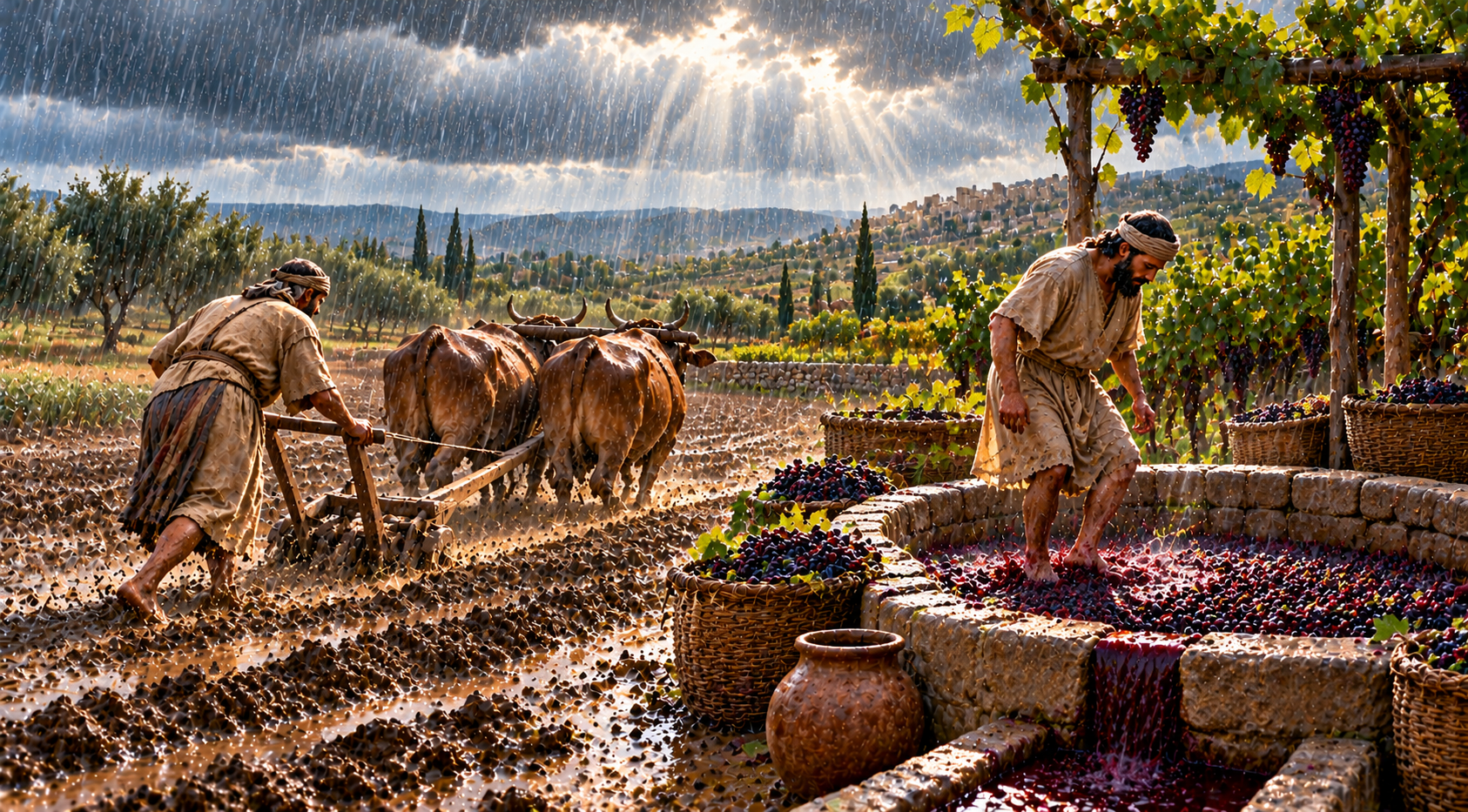
Plowman overtakes the treader
And the treader of grapes him who sows seed - When the grapes were harvested, they were placed in a press where workers would stomp on them with their feet and squeeze out the juice (picture).

NET NOTE - "The grape harvest occurred in August-September, planting in November-December. But in the future age described here there will be so many grapes the workers who stomp them will still be working when the next planting season arrives!"
There is a similar promise of incredible agricultural production to Israel in Leviticus
‘Indeed, your threshing will last for you until grape gathering, and grape gathering will last until sowing time. You will thus eat your food to the full and live securely in your land. (Lev 26:5, read the full blessing for obedience in Lev 26:1-13)
When the mountains will drip sweet wine - Sweet wine is the best wine. A picture of the plethora of vineyards on the mountains. "In his mind's eye Amos can see the wine cascading off the hills like rivulets after a deluge. Joel expresses similar thoughts, but there, while the mountains "drop down new wine", "the hills shall flow with milk". The moisture to produce such a lavish crop will be constant, for "all the rivers of Judah shall flow with waters" (Joel 3:18)." (Hay)
Amos does not borrow from Joel only at the end of his book. He borrows at the beginning too. Joel 3:16 reads, “The LORD roars from Zion and utters His voice from Jerusalem, and the heavens and the earth tremble.” The opening line of Amos reads “The LORD roars from Zion and from Jerusalem He utters His voice; and the shepherds’ pasture grounds mourn, and the summit of Carmel dries up” (Amos 1:2). In as sense, Amos opens his prophecy with Joel 3:16 and closes it with Joel 3:18. The whole book sits inside a frame drawn from Joel’s final chapter. And notice what that frame does to the imagery. Amos 1:2 opens with “the summit of Carmel dries up.” Amos 9:13 closes with “the mountains will drip sweet wine.” The book begins with mountains going dry under the roar of God and ends with mountains running with wine.
David Guzik - When God releases blessing and restoration, fruit comes from unexpected places. Normally, grapevines don’t grow well on mountains or high hills, but in the days of Israel’s restoration even the mountains shall drip with sweet wine and all the hills shall flow with it. When God releases blessing and restoration, the work is blessed – but it is still work. The plowman, the reaper, the treader of grapes, and him who sows seed still have their work to do. God doesn’t just do it all for them, but under God’s blessing and restoration the work is done with energy and joy. The plowman doesn’t just wait around; he gets busy even if he starts bumping into the reaper! “One sign of a true revival, and indeed an essential part of it is the increased activity of God’s laborers.” (Spurgeon)
Sunukijan says "The grapes will hang so heavy in the mountain vineyards that the hills will drip and flow (lit., "melt") with new wine (cf. Joel 3:18). So much juice will drip from the vines or overflow from the vats that the mountains will appear from a distance to be "dissolving" as softened mud will ooze down the slopes" (See The Bible Knowledge Commentary Minor Prophets - Page 47)

Wine will Flow Down the Hillsides
And all the hills will be dissolved (mug) - NET - "it will flow down all the hillsides." Dissolved is verb mug used to describe Yahweh's power to melt the land (Amos 9:5). Here because of the divine blessing on the land and the enhanced fertility and harvest it is as if the hills are are flowing with wine (as if they have "melted").
Gary Smith - Some in the Church deny that God has promised to reestablish Israel physically in the land of Canaan and fulfill covenant promises made to Abraham and his seed (ED: replacement theologians). They believe that the promises to Israel were conditioned on the nation’s obedience to God. They reason that since Israel sinned, breaking her covenant agreement with God, she forfeited any promise of a literal reestablishment in the land of Canaan by the Lord. Those holding this position teach that the Church has taken the place of Israel, and the promises made to the nation are now being fulfilled spiritually in the Church . Thus, the Church is the true Israel of God today, known as spiritual Israel. This interpretation contains several problem areas. First, those holding this position do not interpret Scripture literally; they spiritualize the text and in so doing give a wrong interpretation to the passages dealing with Kingdom promises to Israel (SEE INTERPRETATION). Second, it is clear from Scripture that the promises to Abraham and his seed were given unconditionally and eternally; they did not depend upon Abraham’s faith or obedience for their fulfillment (Ge 12:1–3; 15:7,8; 16:6–8). Third, it is never stated in Scripture that the Church has replaced Israel and become spiritual Israel. (ED: SEE The Israel of God - Galatians 6:16) Fourth, nowhere in the Bible is it said that Israel has forfeited her right to enjoy the promises given in the Abrahamic, Davidic, and New Covenants. In fact, the opposite is true. Over and over again, God gives Israel assurances in the prophetic writings that He will fulfill His covenant promises to the nation. (Amos - Mentor Commentary)
Related Resources:
Overtake (05066) nagash signifies coming into very near proximity to the object. Nagash most commonly denotes the act of approaching in ambulatory fashion (e.g., Ge 27:21). It is also frequently used in a military context, of the clash of opposing forces (e.g., 1 Sam. 7:10; Jer. 46:3). It can be a euphemism for sexual intercourse (Ex 19:15) or interlocking objects (Job 41:16), including shackles (2 Sa 3:34). It is also employed to describe a royal representative (Gen. 45:4) or Yahweh in role of king (Jer. 30:21). Another common nuance of the verb is as a legal technical term, as when plaintiffs approached judges with their claims (Gen. 18:23; Exo. 24:14) or disputing parties approached each other in court (Isa. 50:8). Another common meaning describes drawing near to Yahweh or into His presence. Priests " approach the altar to minister in the holy place" (Ex. 28:43). The idolatry and syncretism of the Levites led to their prohibition from temple service in Ezekiel's eschatological temple - "they shall not come near to Me to serve as a priest to Me, nor come near to any of My holy things" (Ezek. 44:13). The purpose of coming near was that offerings were presented to Yahweh (e.g., Lev. 2:8; Mal. 1:11) so that relationship could continue.
Coppes says "The simple use of the root signifies proximity, i.e. near enough to touch (Genesis 27:21; Genesis 29:10), eat (Genesis 27:25), kiss (Genesis 27:27), embrace (Genesis 48:10). When used in a military context (cf. qārab) it is often accompanied by "to do battle" (cf. Judges 20:23; 1 Chron. 19:14). This is not always true, however. In Joel 3:9 [H 4:9] nāgash by itself signifies being arrayed for battle (paralleled to ʿārak (q.v.), and is in conjunction to bôʾ (q.v.). See 1 Samuel 17:16, 40. The root can also represent the actual engaging in battle and the result. So in Ezekiel 9:6 the elect being marked with a taw are not to be slain (hārag parallel to ʾal nāgash). Israel who proudly boasts that death (the sword) will not overtake or meet them is condemned by God (Amos 9:10). The sovereign covenant God, therefore, guides and controls the sword keeping the elect safe even in the midst of war (Psalm 91:7) and punishing the wicked. The root can be used of approaching a person of exalted position with all the respect due his position (Genesis 43:19; Genesis 45:4; 2 Kings 5:13). God says that a king from his people would so approach him in the eschaton (Jeremiah 30:21). Men approach God through his servants to learn his will (Jeremiah 42:1; cf. the use of the ephod, 1 Samuel 23:9, and the lot, 1 Samuel 14:38). This represents God as king and judge. Sometimes the line between approaching the servant and approaching God himself is difficult to discern (cf. Joshua 14:6; Joshua 21:1). Yet clear examples of approaching God the judge are evidenced, i.e. coming into a courtroom prepared to argue a case (Genesis 18:23). God summons men to come and hear his pronouncement (Joshua 3:9). This image of a courtroom is used forcibly by the prophet Isaiah to call Israel and the nations into account (Isaiah 41:1, 21; Isaiah 45:20-21). The servant of the Lord boldly proclaims God as his advocate before his enemies. He has no fear of being proven wrong (Isaiah 50:8). God sits as judge over his people (Joshua 3:9), and he designates men to represent him in this capacity (Exodus 24:14; Deut. 25:1). Elijah calls the people into court as witnesses in his controversy with the prophets of Baal (1 Kings 18:30). Men also are to approach God the great king and judge as the great and holy savior. Hence our word is used cultically. To approach God properly requires purification (Exodus 19:22; Exodus 20:21; Exodus 28:43; Exodus 30:20; Leviticus 21:21) and appointment (e.g. Numbers 4:19). Our word is used interchangeably with qārab I (q.v.), representing both the presentation of an offering to the priests (Leviticus 8:14) and their presenting it before God (Leviticus 2:8). Like Jeremiah (Jeremiah 12:2, qārab), Isaiah (Isaiah 29:13) reports God's displeasure at his people being close to him with their mouths, and far removed in their hearts. Malachi uses our word six times and always in the sense of making an offering (e.g. Malachi 1:7-8). The root, like qārab I, is used of sexual relations in Exodus 19:15. (Theological Wordbook of the Old Testament)
QUESTION - What does it mean that the plowman will overtake the reaper (Amos 9:13)? Gotquestions.org
ANSWER - Amos prophesied during a time of rampant immorality, social injustice, and spiritual decline in Israel. Much of his book is a warning of impending judgment. However, toward the end, Amos shifts to a message of hope and restoration for God’s faithful remnant. Amos 9:13 is part of this promise: “Look, the days are coming—this is the LORD’s declaration—when the plowman will overtake the reaper and the one who treads grapes, the sower of seed. The mountains will drip with sweet wine, and all the hills will flow with it” (CSB).
In saying “the plowman will overtake the reaper,” Amos describes a time of extraordinary abundance and blessing in Israel. The prophets often used earthly illustrations to express spiritual truths, thereby conveying them with greater force through tangible, imaginative language.
The plowman is the person who prepares the soil for the next season’s grain, and the sower plants seed for the next crop. The reaper harvests the grain, and the treader extracts juice from grapes to make wine. Usually, there is a gap between harvesting the crops and preparing the land for the next planting season.
However, in Amos 9:13, the harvest is so plentiful and continuous that even as one crop of grain is being gathered, it is already time to plant again—the seasons of planting (plowing) and harvesting (reaping) overlap. The grapes grow in such abundance that they cannot be picked and processed before it is time to sow again. They are so plentiful that the hills of Israel drip with sweet wine. There will be more than enough for everyone to eat their fill of grain and quench their thirst with wine.
God’s people will one day experience a time of no lack or delay and of continuous, unending security. This blessing is based on Leviticus 26:5: “If you follow my decrees and are careful to obey my commands, I will send you the seasonal rains. The land will then yield its crops, and the trees of the field will produce their fruit. Your threshing season will overlap with the grape harvest, and your grape harvest will overlap with the season of planting grain. You will eat your fill and live securely in your own land” (NLT).
The fulfillment of the closing section of Amos has not yet occurred (Amos 9:11–15). These verses speak of a glorious future restoration when sin and injustice are eliminated, and righteousness reigns throughout the earth. Amos 9:13 describes a time of blessing that will be fully realized in the Messianic kingdom during Christ’s thousand-year reign (see Isaiah 11:1–10; Jeremiah 23:5–6; Joel 2:26–27; Luke 1:32–33; Revelation 20:1–6). The imagery points to God’s restoration. After a period of hardship, God promises a future of abundance, joy, peace, and overflowing provision for His people under the perfect government of the Savior Himself. At that time, believers will live, worship, and reign with Christ.
In Amos’ day, God assured His faithful people of their future well-being and prosperity. Believers today have the same assurance of an abundant eternal inheritance and a secure future with Him (John 6:37–40; 10:27–29; 1 Peter 1:3–5; Ephesians 1:13–14). The image of the plowman overtaking the reaper thus points beyond Israel’s judgment to the abundant blessing God has promised His people under the righteous reign of Christ.
Amos 9:14 "Also I will restore the captivity of My people Israel, And they will rebuild the ruined cities and live in them; They will also plant vineyards and drink their wine, And make gardens and eat their fruit.
KJV And I will bring again the captivity of my people of Israel, and they shall build the waste cities, and inhabit them; and they shall plant vineyards, and drink the wine thereof; they shall also make gardens, and eat the fruit of them.
NET I will bring back my people, Israel; they will rebuild the cities lying in rubble and settle down. They will plant vineyards and drink the wine they produce; they will grow orchards and eat the fruit they produce.
NLT I will bring my exiled people of Israel back from distant lands, and they will rebuild their ruined cities and live in them again. They will plant vineyards and gardens; they will eat their crops and drink their wine.
ESV I will restore the fortunes of my people Israel, and they shall rebuild the ruined cities and inhabit them; they shall plant vineyards and drink their wine, and they shall make gardens and eat their fruit.
BGT καὶ ἐπιστρέψω τὴν αἰχμαλωσίαν λαοῦ μου Ισραηλ καὶ οἰκοδομήσουσιν πόλεις τὰς ἠφανισμένας καὶ κατοικήσουσιν καὶ καταφυτεύσουσιν ἀμπελῶνας καὶ πίονται τὸν οἶνον αὐτῶν καὶ φυτεύσουσιν κήπους καὶ φάγονται τὸν καρπὸν αὐτῶν
LXE And I will turn the captivity of my people Israel, and they shall rebuild the ruined cities, and shall inhabit them; and they shall plant vineyards, and shall drink the wine from them; and they shall form gardens, and eat the fruit of them.
CSB I will restore the fortunes of My people Israel. They will rebuild and occupy ruined cities, plant vineyards and drink their wine, make gardens and eat their produce.
NIV I will bring back my exiled people Israel; they will rebuild the ruined cities and live in them. They will plant vineyards and drink their wine; they will make gardens and eat their fruit.
- Also I will restore the captivity of My people Israel Ps 53:6; Jeremiah 30:3,18; 31:23; Ezekiel 16:53; 39:25; Joel 3:1,2
- rebuild Isaiah 61:4; 65:21; Jer 30:18; 31:38-40; Ezekiel 36:33-36; 37:25-28
- plant Amos 5:11; Isaiah 62:8,9; Ezekiel 28:26; Zephaniah 1:13
- Multiple Sermons and Commentaries on Amos
Related Passages:
Ezekiel 28:25-26 ‘Thus says the Lord GOD, “When I gather the house of Israel from the peoples among whom they are scattered, and will manifest My holiness in them in the sight of the nations, then they will live in their land which I gave to My servant Jacob. 26 “They will live in it securely; and they will build houses, plant vineyards and live securely when I execute judgments upon all who scorn them round about them. Then they will know that I am the LORD their God.”’”
Micah 4:4 Each of them will sit under his vine And under his fig tree, With no one to make them afraid, For the mouth of the LORD of hosts has spoken.
Ezekiel 16:53 “Nevertheless, I will restore their captivity, the captivity of Sodom and her daughters, the captivity of Samaria and her daughters, and along with them your own captivity,
Genesis 15:18 (GOD'S PROMISE OF THE LAND TO ISRAEL) On that day the LORD made a covenant with Abram, saying, “To your descendants I have given this land, From the river of Egypt as far as the great river, the river Euphrates:
Genesis 17:8 (GOD'S PROMISE OF THE LAND TO ISRAEL) “I will give to you and to your descendants after you, the land of your sojournings, all the land of Canaan, for an everlasting possession; and I will be their God.”
Psalm 105:8-11 (GOD'S PROMISE OF THE LAND TO ISRAEL) He has remembered His covenant forever, The word which He commanded to a thousand generations, 9 The covenant which He made with Abraham, And His oath to Isaac. 10 Then He confirmed it to Jacob for a statute, To Israel as an everlasting covenant, 11 Saying, “To you I will give the land of Canaan As the portion of your inheritance,”
God Restores the Fortunes of Israel
GOD RESTORES ISRAEL
ISRAEL REBUILDS
Also I will restore (shub/sub; LXX - epistrepho - turn, cause to change) the captivity (shebuth) of My people Israel - NRSV renders it "I will restore the fortunes of my people Israel." (NRSV)This includes the "Ten Lost Tribes" which will be finally shown to have not been lost to the omniscient, covenant keeping God! The Septuagint (Lxx) translates captivity with the noun aichmalosia which means captivity, state of captivity as a result of war (Rev 13.10). Notice God's use of the personal possessive pronoun "MY" indicating Israel will still be His chosen people and His possession even in the future.
Amos 5:14 reverses Amos 5:11, for earlier the prophet had said, “Therefore because you impose heavy rent on the poor and exact a tribute of grain from them, though you have built houses of well-hewn stone, yet you will not live in them; you have planted pleasant vineyards, yet you will not drink their wine.” Now: they will rebuild and live in them, plant vineyards and drink their wine. The same prophet who pronounced the curse pronounces its undoing, clause for clause. Behind both stands Deuteronomy 28:30, “You shall build a house, but you will not live in it; you shall plant a vineyard, but you will not use its fruit.”
Andrew Hill - The Hebrew expression shabti eth-shebuth is ambiguous (cf. njb, nrsv, “I will restore the fortunes of my people”). How one understands the noun shebuth (either “exiles” or “fortunes”; cf. HALOT 4:1386) in this context determines the meaning of the expression. In either case, Yahweh is responsible for the reversal of circumstances depicted in Amos 5:11. Implicit in the references to the security of rebuilt homes and cities and the prosperity of agricultural endeavors is the renewal of covenant relationship with Yahweh (cf. Ezek 28:25-26; Mic 4:4). (See Minor Prophets: Hosea through Malachi - Page 206)
NET NOTE adds "This line can also be translated "I will restore the fortunes of my people, Israel" and is a common idiom with three examples below (out of 20 uses in the OT - click here for discussion of all 20 passages)
Jeremiah 30:3 ‘For behold, days are coming,’ declares the LORD, ‘when I will restore the fortunes of My people Israel and Judah.’ The LORD says, ‘I will also bring them back to the land that I gave to their forefathers and they shall possess it.’”
Hosea 6:11 Also, O Judah, there is a harvest appointed for you, When I restore the fortunes of My people.
Zeph 3:20 “At that time I will bring you in, Even at the time when I gather you together; Indeed, I will give you renown and praise Among all the peoples of the earth, When I restore your fortunes before your eyes,” Says the LORD.
Related Resource:
And they will rebuild the ruined cities and live in them - Note the juxtaposition of divine sovereignty (I will restore) and man's responsibility (they will build). Note the contrast with the divine judgment in Amos 5:11. The end times destruction in Israel will leave the country in ruins, but God promises that what was ruined will be rebuilt.
Isaiah has similar prophecies regarding the restoration of Israel in the future...
Isaiah 32:18 Then (Messianic Kingdom, cf Isa 32:15-17) my people will live in a peaceful habitation, And in secure dwellings and in undisturbed resting places;
Isaiah 61:4 Then they will rebuild the ancient ruins, They will raise up the former devastations; And they will repair the ruined cities, The desolations of many generations.
Isaiah 65:21-23 “They will build houses and inhabit them; They will also plant vineyards and eat their fruit. 22 “They will not build and another inhabit, They will not plant and another eat; For as the lifetime of a tree, so will be the days of My people, And My chosen ones will wear out the work of their hands. 23 “They will not labor in vain, Or bear children for calamity; For they are the offspring of those blessed by the LORD, And their descendants with them.
This prophecy echoes the more detailed prophecies in Jeremiah
Jeremiah 30:18 “Thus says the LORD, ‘Behold, I will restore the fortunes of the tents of Jacob And have compassion on his dwelling places; And the city (ZION, JERUSALEM) will be rebuilt on its ruin, And the palace will stand on its rightful place.
Jeremiah 31:38-40 “Behold, days are coming,” declares the LORD, “when the city (ZION, JERUSALEM) will be rebuilt for the LORD from the Tower of Hananel to the Corner Gate. 39 “The measuring line will go out farther straight ahead to the hill Gareb; then it will turn to Goah. 40 “And the whole valley of the dead bodies and of the ashes, and all the fields as far as the brook Kidron, to the corner of the Horse Gate toward the east, shall be holy to the LORD (Read Zechariah 14:20-21); it will not be plucked up or overthrown anymore forever.”
Ezekiel 36:33-36 ‘Thus says the Lord GOD, “On the day (cf Amos 9:11 "IN THAT DAY") that I cleanse you from all your iniquities (- Also read Zechariah 12:10-14, Zechariah 13:1), I will cause the cities to be inhabited, and the waste places will be rebuilt. 34 “The desolate land will be cultivated instead of being a desolation in the sight of everyone who passes by. 35 “They will say, ‘This desolate land has become like the garden of Eden; and the waste, desolate and ruined cities are fortified and inhabited.’ 36 “Then the nations that are left round about you will know that I, the LORD, have rebuilt the ruined places and planted that which was desolate; I, the LORD, have spoken and will do it.”
Ezek 37:24-28 My servant David will be king over them, and they will all have one shepherd; and they will walk in My ordinances and keep My statutes and observe them. 25 “They will live on the land that I gave to Jacob My servant, in which your fathers lived (see Ge 15:18-21); and they will live on it, they, and their sons and their sons’ sons, forever; and David My servant will be their prince forever (cf Ezek 34:23-24). 26 “I will make a covenant of peace with them; it will be an everlasting covenant with them. And I will place them and multiply them, and will set My sanctuary in their midst forever. 27 “My dwelling place also will be with them; and I will be their God, and they will be My people. 28 “And the nations will know that I am the LORD who sanctifies Israel, when My sanctuary is in their midst forever.”’
Comment regarding David - As a literalist I agree with Dr John Walvoord who says that a "solution of the problem (THE IDENTITY OF DAVID IN THE MILLENNIUM) is more simple and seemingly in keeping with the prophetic references throughout Scripture, namely, that by David is meant the resurrected David who shares with Christ as prince some of the governmental duties of the millennial kingdom. It should be clear from many Scriptures that the reign of Christ is shared with others. As Newell has written: “David is not the son of David. Christ, as Son of David, will be King; and David, His father after the flesh, will be prince, during the Millennium” (William R. Newell, The Revelation, p. 323). In the light of many prophecies which promise saints the privilege of reigning with Christ, it would seem most logical that David the king raised from the dead should be given a place of prominence in the Davidic kingdom of the millennial reign of Christ. As indicated in Revelation 19:16, Christ is “KING OF KINGS AND LORD OF LORDS.” This would certainly imply other rulers (cf. Isa 32:1; Ezek 45:8-9; Matt 19:28; Luke 19:12-27)." (The Doctrine of the Millennium—Part I:The Righteous Government of the Millennium)
They will also plant vineyards and drink their wine and make gardens and eat their fruit - See quote above from Ezekiel 36:34, 35. An important promise to a country which has always been agrarian. This speaks of the fertility of the land.
Restore (turn back, bring back) (07725)(shub/sub) is a verb meaning to turn, to return, to go back, to do again, to change, to withdraw, to bring back, to reestablish, to be returned, to bring back, to take, to restore, to recompense.
Captivity (fortunes) (07622) (shebuth from shabah = to take captive but some think it originates from shub = to return, restore) is a feminine noun which has two main meanings in the OT, (1) captivity, captives (esp Nu 21:29 referring to Moab), implying control and oppression and (2) fortunes, assets (primarily possessions, materials, and property though not exclusively so which will make life easier and more secure). One could see how both senses are meant in some passages because to restore someone from captivity is tantamount to bringing them into a place of good fortune. Baker adds that "This word conveys either a state of exile, such as being taken for a spoil of war, or the subjects of such captivity. The chief use was in declaring the liberating power of the Lord in releasing His people from such banishment (Deut. 30:3; Jer. 33:7; Hos. 6:11)."
Amos 9:15 "I will also plant them on their land, And they will not again be rooted out from their land Which I have given them," Says the LORD your God.
KJV And I will plant them upon their land, and they shall no more be pulled up out of their land which I have given them, saith the LORD thy God.
NET I will plant them on their land and they will never again be uprooted from the land I have given them," says the LORD your God.
NLT I will firmly plant them there in their own land. They will never again be uprooted from the land I have given them," says the LORD your God.
ESV I will plant them on their land, and they shall never again be uprooted out of the land that I have given them," says the LORD your God.
BGT καὶ καταφυτεύσω αὐτοὺς ἐπὶ τῆς γῆς αὐτῶν καὶ οὐ μὴ ἐκσπασθῶσιν οὐκέτι ἀπὸ τῆς γῆς αὐτῶν ἧς ἔδωκα αὐτοῖς λέγει κύριος ὁ θεὸς ὁ παντοκράτωρ
LXE And I will plant them on their land, and they shall no more be plucked up from the land which I have given them, saith the Lord God Almighty.
CSB I will plant them on their land, and they will never again be uprooted from the land I have given them. Yahweh your God has spoken.
NIV I will plant Israel in their own land, never again to be uprooted from the land I have given them," says the LORD your God.
- they will not - Isaiah 60:21; Jeremiah 24:6; 32:41; Ezekiel 34:28; 37:25; Joel 3:20; Micah 4:4
- Multiple Sermons and Commentaries on Amos
Related Passages:
Genesis 13:14-15 The LORD said to Abram, after Lot had separated from him, “Now lift up your eyes and look from the place where you are, northward and southward and eastward and westward; 15for all the land which you see, I will give it to you and to your descendants forever.
Genesis 17:7-8 “I will establish My covenant between Me and you and your descendants after you throughout their generations for an everlasting covenant, to be God to you and to your descendants after you. 8 “I will give to you and to your descendants after you, the land of your sojournings, all the land of Canaan, for an everlasting possession; and I will be their God.”
Deuteronomy 30:1-5 “So it shall be when all of these things have come upon you, the blessing and the curse which I have set before you, and you call them to mind in all nations where the LORD your God has banished you, 2 and you return to the LORD your God and obey Him with all your heart and soul according to all that I command you today, you and your sons, 3 then the LORD your God will restore you from captivity, and have compassion on you, and will gather you again from all the peoples where the LORD your God has scattered you. 4 “If your outcasts are at the ends of the earth, from there the LORD your God will gather you, and from there He will bring you back. 5 “The LORD your God will bring you into the land which your fathers possessed, and you shall possess it; and He will prosper you and multiply you more than your fathers.
2 Samuel 7:10 “I will also appoint a place for My people Israel and will plant them, that they may live in their own place and not be disturbed again, nor will the wicked afflict them any more as formerly,
Jeremiah 30:10-11 ‘Fear not, O Jacob My servant,’ declares the LORD, ‘And do not be dismayed, O Israel; For behold, I will save you from afar And your offspring from the land of their captivity. And Jacob will return and will be quiet and at ease, And no one will make him afraid. 11 ‘For I am with you,’ declares the LORD, ‘to save you; For I will destroy completely all the nations where I have scattered you, Only I will not destroy you completely. But I will chasten you justly And will by no means leave you unpunished.’
Jeremiah 24:6 ‘For I will set My eyes on them for good, and I will bring them again to this land; and I will build them up and not overthrow them, and I will plant them and not pluck them up.
Jeremiah 32:41 “I will rejoice over them to do them good and will faithfully plant them in this land with all My heart and with all My soul.
Jeremiah 42:10 ‘If you will indeed stay in this land, then I will build you up and not tear you down, and I will plant you and not uproot you; for I will relent concerning the calamity that I have inflicted on you.

Israel Planted by Yahweh in THEIR LAND and Secure FOREVER!
GOD PLANTING OF ISRAEL
FIRMLY, FOREVER ROOTED
Even the frequently amillennial comments of the Treasury of Scripture Knowledge says on this passage "As the Jews, after their return from Babylon, were driven from their land by the Romans, this can only refer to their future conversion and restoration." (Amen and amen!)
Paul speaks of their future conversion in Romans 11:25-27
For I do not want you, brethren, to be uninformed of this mystery–so that you will not be wise in your own estimation–that a partial hardening has happened to Israel until the fullness of the Gentiles has come in; 26 and so all Israel will be saved (ALL OF THE 1/3 IN Zechariah 13:8-9); just as it is written, “THE DELIVERER (SECOND COMING OF MESSIAH) WILL COME FROM ZION, HE WILL REMOVE UNGODLINESS FROM JACOB.” 27 “THIS IS MY COVENANT WITH THEM, WHEN I TAKE AWAY THEIR SINS.”
I will also plant (nata) them - The sovereign, promise-keeping God will Himself plant the redeemed remnant of the nation of Israel in their land. Notice the personal pronoun “I.” Israel’s permanent restoration does not depend on Israel’s strength, on the goodwill of the nations, or on political circumstances. It rests on the word of the LORD, who closes the book by signing His name to the promise: “Says the LORD your God.” This promise points to the ultimate fulfillment of the land promise in the Davidic Covenant. Through Nathan the prophet, God told David:
“I will also appoint a place for My people Israel and will plant (nata) them, that they may live in their own place and not be disturbed again, nor will the wicked afflict them any more as formerly, (2 Sa 7:10),
Note that the two passages (Amos 9:15 and 2Sa 7:10) use the same Hebrew verb, nata, “to plant.” When God spoke these words to David, Israel was already living in the land. The promise therefore looked beyond David’s day to a time of permanent security, when Israel would be planted so firmly that it would “not be disturbed again.” The word for “disturbed” is ragaz, to tremble or be agitated. That condition was never realized under David, Solomon, or any later king, because both kingdoms were eventually uprooted and carried into exile. Amos 9:15 reaffirms the unfulfilled promise and guarantees its fulfillment: “they will not again be rooted out.”
Other prophecies describe the Lord's permanent planting of Israel in the land...
Isaiah 60:21 “Then all your people will be righteous; They will possess the land forever, The branch of My planting, The work of My hands, That I may be glorified.
MacArthur - Israel will inherit the land promised to Abraham (Ge 12:1, 7; 13:15; 15:18). During the millennial kingdom, that will be the land of Israel as we know it today. In the eternal kingdom, it will be the New Jerusalem, capital of the new creation. The ultimate mission of Israel is to glorify the Lord (49:3; 61:3). (See MacArthur Study Bible)
Jeremiah 31:28 “As I have watched over them to pluck up, to break down, to overthrow, to destroy and to bring disaster, so I will watch over them to build and to plant,” declares the LORD.
Jeremiah 24:6-7 ‘For I will set My eyes on them for good, and I will bring them again to this land; and I will build them up and not overthrow them, and I will plant them and not pluck them up. 7 ‘I will give them a heart to know Me (THE CONSUMMATION OF THE NEW COVENANT - Ezek 36:25-27, Jer 31:31-37), for I am the LORD; and they will be My people, and I will be their God, for they will return to Me with their whole heart.
Jeremiah 32:41 “I will rejoice over them to do them good and will faithfully plant them in this land with all My heart and with all My soul.
Comment - This is the only place in Scripture where God says He does something “with all My heart and with all My soul” and here it refers to the permanent planting of His people in their land.
Note that this promise was not grounded in Israel’s faithfulness, which had failed repeatedly, but in God’s unchanging character and His faithfulness to keep His covenant promises to Abraham, Isaac and Jacob. Paul affirms that God has not cast away His people Israel (Ro 11:1–2) and that their future salvation is certain (Ro 11:26), "for the gifts and the calling of God are irrevocable." (Ro 11:29)
Amos ends not with the roar of the lion (Amos 1:2)
but with the promise of the Gardener Who plants His people
The same God Who kept His word of judgment against Israel will keep His word of restoration. Amos ends not with the roar of the lion (Amos 1:2) but with the promise of the Gardener Who plants His people where no enemy can ever uproot them again. Believers today may draw comfort from the same faithfulness. The God Who keeps His promises to Israel will keep every promise He has made to us in Christ (2 Cor 1:20; Php 1:6). Do you see why it is so important to believe the truth that God will literally fulfill His promises to the nation of Israel?
ESV Study Bible - This final blessing of the people is predicated upon their recognition of their Davidic Messiah, something that is yet to occur (ED: EXCEPT FOR JEWS WHO COME TO CHRIST IN THE CHURCH AGE). See Ro. 11:25-27 (ED: READ ALSO Zechariah 12:10-14)..
On their land - Many prophecies emphasize it is THEIR land referring to the land of Canaan originally given to Abraham and his descendants. Amos is not referring to the church but to the nation of Israel! - (cf. Ge. 13:14-15; 17:7-8; Dt. 30:1-5; 2Sa 7:10; Jer. 30:10-11; Joel 3:17-21; Micah 4:4-7) For example
Deut 30:5 “The LORD your God will bring you (ISRAEL) into the land which your fathers possessed, and you shall possess it; and He will prosper you and multiply you more than your fathers.
The Reformation Study Bible is an example of a non-literal interpretation of Amos 9:15, an interpretative approach with which I strongly disagree! Its study notes especially on prophetic passages often spiritualize the promises made to the nation of Israel, taking promises given literally to Israel and applying them to the church, which it calls “the New Israel” in the note below. Readers of its comments should therefore be Bereans, examining the Scriptures to see whether these things are so (Acts 17:11). Notice they make no allusion to the 1000 reign of Christ which is typical of amillenial interpretation. The comment reads:
The physical Promised Land is but a type (NO IT IS NOT! IT IS LITERAL PHYSICAL LAND! ED: SEE CAVEAT ON CALLING THINGS "TYPES" THAT SCRIPTURE DOES NOT SPECIFICALLY CALL "TYPE") of the New Israel's life in Christ; it points forward to the heavenly Jerusalem (Heb. 11:13-16; 12:22-24). The covenant land promise finds final fulfillment in the new heavens and the new earth (Rev. 21:1-22:6). (Bolding added)
And they will not again be rooted (nathash) out from their land which I have given them - No more "Wandering Jews!" God’s forgiveness is complete and His restoration permanent. The believing remnant is finally restored to their land in the Millennium and they will not be cast out. This promise represents a complete reversal of the curse in Dt 29:28 " the LORD uprooted (nathash) them from their land in anger and in fury and in great wrath, and cast them into another land, as it is this day." So the same verb in the curse of uprooting Israel is used in the promised blessing to never again uproot Israel!
Ezekiel 37:25 “They will live on the land that I gave to Jacob My servant, in which your fathers lived; and they will live on it, they, and their sons and their sons’ sons, FOREVER; and David My servant will be their prince forever.
Joel 3:20 But Judah will be inhabited FOREVER And Jerusalem for all generations.
Zechariah 14:11 People will live in it, and there will no longer be a curse, for Jerusalem will dwell in SECURITY.
Jeremiah has a similar prophecy regarding Jerusalem "it will not be plucked up or overthrown anymore FOREVER.” (Jer 31:40).
Enjoyment of the Promised Land and title to the land are two different things. Israel was removed from the land repeatedly for disobedience, exactly as Deuteronomy 28 warned. But removal from the land never transferred ownership which God had bestowed on Israel. That distinction is what Amos 9:15 settles forever “they will not again be rooted out.” The days of removal end.
Henry Morris on out from their land - This promise applies, not to the return from Babylon, but to the final restoration from exile, when they will never again "be pulled up out of their land."
Says the LORD your God -The final words of Amos are the ground of the assurance to Israel that these things in Amos 9:11-14 (but also the preceding judgments) would come to pass. God promises it, that settles it! Don't miss the last Hebrew words in this prophecy! Your God! After nine chapters of indictment, after the lion’s roar and the plumb line and the basket of summer fruit, God still calls Himself their God. The relationship He judged them for breaking is the relationship He refuses to abandon (See Israel the Wife of Jehovah)
And the Septuagint translates it with pantokrator (Almighty) as the very last (Greek) word in the prophecy of Amos! How wonderful would these words your God sound to ears of Jewish readers who had ears to hear this truth. He still refers to Himself as Your God and in spite of Israel's persistent unbelief, their God is forever faithful. Does this ending not encourage your heart beloved believer, for to you He says "Your God!" You might want to end your time in Amos with a time of worship using an apropos song by Chris Tomlin entitled "Our God"
Water You turned into wine
Opened the eyes of the blind
There's no one like You
None like You
Into the darkness You shine
Out of the ashes we rise
There's no one like You
None like You
Our God is greater
Our God is stronger
God You are higher than any other
Our God is Healer
Awesome in Pow
Our God, Our God
Into the darkness You shine
Out of the ashes we rise
There's no one like You
None like You
Our God is greater
Our God is stronger
God You are higher than any other
Our God is Healer
Awesome in power
Our God, Our God
And if our God is for us
Then who could ever stop us?
And if our God is with us
Then what could stand against?
And if our God is for us
Then who could ever stop us?
And if our God is with us
Then what could stand against?
What could stand against?
Our God is greater
Our God is stronger
God You are higher than any other
Our God is Healer
Awesome in Power
Our God, Our God
And if our God is for us
Then who could ever stop us?
And if our God is with us
Then what could stand against?
And if our God is for us
Then who could ever stop us?
And if our God is with us
Then what could stand against?
What could stand against?
And if our God is for us
Then who could ever stop us?
And if our God is with us
Then what could stand against?
And if our God is for us
Then who could ever stop us?
And if our God is with us
Then what could stand against?
Then what could stand against?
Plant (05193) nata means “to plant,” and from that literal sense comes the extended sense “to fix firmly,” “to establish,” or “to set in place.” It is common in both biblical and modern Hebrew, and it has relatives in Ugaritic, Phoenician, and Old South Arabian. Counts vary slightly by source. One reckons the root at “some seventy times” (probably including derivatives), and another notes “almost sixty times in the Qal stem and once in the Niphal (Isa. 40:24).” Isaiah and Jeremiah account for about thirty of the occurrences. Planting was a daily, familiar sight in an agricultural society that knew about a hundred plant varieties, most of them economically vital. So the biblical writers used nāṭaʿ figuratively about thirty times, and the word picture carries ideas of care, rootedness, permanence, and expected fruit. The noun derivatives neṭaʿ (05194, “plant”) and maṭṭāʿ (04302, “planting, place of planting”) build on the same picture. The Septuagint ordinarily renders nāṭaʿ with phuteuō (φυτεύω), the same verb Jesus and Paul later use.
NATA - 55V - establish(1), pitch(1), plant(31), planted(21), planters(1), plants(2), well-driven(1). Gen. 2:8; Gen. 9:20; Gen. 21:33; Exod. 15:17; Lev. 19:23; Num. 24:6; Deut. 6:11; Deut. 16:21; Deut. 20:6; Deut. 28:30; Deut. 28:39; Jos. 24:13; 2 Sam. 7:10; 2 Ki. 19:29; 1 Chr. 17:9; Ps. 44:2; Ps. 80:8; Ps. 80:15; Ps. 94:9; Ps. 104:16; Ps. 107:37; Prov. 31:16; Eccl. 2:4; Eccl. 2:5; Eccl. 3:2; Eccl. 12:11; Isa. 5:2; Isa. 17:10; Isa. 37:30; Isa. 40:24; Isa. 44:14; Isa. 51:16; Isa. 65:21; Isa. 65:22; Jer. 1:10; Jer. 2:21; Jer. 11:17; Jer. 12:2; Jer. 18:9; Jer. 24:6; Jer. 29:5; Jer. 29:28; Jer. 31:5; Jer. 31:28; Jer. 32:41; Jer. 35:7; Jer. 42:10; Jer. 45:4; Ezek. 28:26; Ezek. 36:36; Dan. 11:45; Amos 5:11; Amos 9:14; Amos 9:15; Zeph. 1:13
First use: God the Planter. The verb first appears in one of Scripture’s earliest anthropomorphisms, God Himself as gardener:
Genesis 2:8 “The LORD God planted a garden toward the east, in Eden; and there He placed the man whom He had formed.”
Before any human planted anything, God planted a place for man to live. That pattern of God preparing a place and then setting His people in it recurs throughout the Old Testament. Scripture also describes Him as the Planter of trees in creation:
Numbers 24:6 “Like valleys that stretch out, Like gardens beside the river, Like aloes planted by the LORD, Like cedars beside the waters.”
Psalm 104:16 “The trees of the LORD drink their fill, The cedars of Lebanon which He planted.”
Literal planting: vineyards, trees, and gardens. Vines and vineyards are the most frequent objects of nāṭaʿ:
Genesis 9:20 “Then Noah began farming and planted a vineyard.”
Other objects include trees in general (Lev. 19:23), fruit trees (Eccl. 2:5), olive trees (Deut. 6:11; Josh. 24:13), the cedar (Isa. 44:14), and gardens (Jer. 29:5). Abraham’s planting is linked to worship:
Genesis 21:33 “Abraham planted a tamarisk tree at Beersheba, and there he called on the name of the LORD, the Everlasting God.”
Many of these texts also mention building houses or cities. Planting and building belong together because they describe settled domestic life in the land:
Jeremiah 29:5 “Build houses and live in them; and plant gardens and eat their produce.”
Planting and the enjoyment of fruit. Many passages stress what planting is for: eating the fruit and drinking the wine. One source observes that “it was an important principle within Israel to be able to enjoy the fruit of the labor; indeed, it was considered a curse from God if a man were not able to eat what he planted.” The covenant curses said exactly that:
Deuteronomy 28:30 “You shall betroth a wife, but another man will violate her; you shall build a house, but you will not live in it; you shall plant a vineyard, but you will not use its fruit.”
The Law protected the planter’s right to the harvest, even in time of war:
Deuteronomy 20:6 “Who is the man that has planted a vineyard and has not begun to use its fruit? Let him depart and return to his house, otherwise he might die in the battle and another man would begin to use its fruit.”
Amos turns this into judgment against oppressors: “you have planted pleasant vineyards, yet you will not drink their wine” (Amos 5:11). Isaiah reverses it in the promise of the new creation:
Isaiah 65:21 “They will build houses and inhabit them; They will also plant vineyards and eat their fruit.”
Israel as God’s planting. The richest theological use of nāṭaʿ pictures Yahweh as “the one great Planter” (cf. the participle nôṭēaʿ, Jer. 11:17) who plants His people. At the Exodus, Moses sang:
Exodus 15:17 “You will bring them and plant them in the mountain of Your inheritance, The place, O LORD, which You have made for Your dwelling, The sanctuary, O Lord, which Your hands have established.”
The psalmist develops this into the image of the vine:
Psalm 80:8 “You removed a vine from Egypt; You drove out the nations and planted it.”
Psalm 80:15 “Even the shoot which Your right hand has planted, And on the son whom You have strengthened for Yourself.”
In the Song of the Vineyard, Isaiah shows the great care of the divine Planter and the disappointing result:
Isaiah 5:2 “He dug it all around, removed its stones, And planted it with the choicest vine. And He built a tower in the middle of it And also hewed out a wine vat in it; Then He expected it to produce good grapes, But it produced only worthless ones.”
Isaiah 5:7 “For the vineyard of the LORD of hosts is the house of Israel And the men of Judah His delightful plant. Thus He looked for justice, but behold, bloodshed; For righteousness, but behold, a cry of distress.”
Jeremiah gives the same lament:
Jeremiah 2:21 “Yet I planted you a choice vine, A completely faithful seed. How then have you turned yourself before Me Into the degenerate shoots of a foreign vine?”
As one source puts it, “even though the Lord planted his choice vine with great care, it still produced sour grapes, making it necessary for Him to destroy it.” The Planter therefore became the One who uproots:
Jeremiah 45:4 “Thus you are to say to him, ‘Thus says the LORD, “Behold, what I have built I am about to tear down, and what I have planted I am about to uproot, that is, the whole land.”’”
The promise of permanent replanting. The uprooting was not God’s final word. In the Davidic covenant He promised a planting that would last:
2 Samuel 7:10 “I will also appoint a place for My people Israel and will plant them, that they may live in their own place and not be disturbed again, nor will the wicked afflict them any more as formerly.”
One source draws out the significance: “This verse indicates that when the Lord plants a people, He provides a place as well as security. The idea of permanence is found in the process of establishing roots.” The prophets repeat the promise:
Jeremiah 24:6 “For I will set My eyes on them for good, and I will bring them again to this land; and I will build them up and not overthrow them, and I will plant them and not pluck them up.”
Jeremiah 32:41 “I will rejoice over them to do them good and will faithfully plant them in this land with all My heart and with all My soul.”
Ezekiel 36:36 “Then the nations that are left round about you will know that I, the LORD, have rebuilt the ruined places and planted that which was desolate; I, the LORD, have spoken and will do it.”
Amos ends his prophecy with the same word:
Amos 9:15 “I will also plant them on their land, And they will not again be rooted out from their land Which I have given them,” Says the LORD your God.
The goal of the replanting is God’s glory, expressed through the derivative maṭṭāʿ:
Isaiah 60:21 “Then all your people will be righteous; They will possess the land forever, The branch of My planting, The work of My hands, That I may be glorified.”
Isaiah 61:3 “To grant those who mourn in Zion, Giving them a garland instead of ashes, The oil of gladness instead of mourning, The mantle of praise instead of a spirit of fainting. So they will be called oaks of righteousness, The planting of the LORD, that He may be glorified.”
God plants nations, rulers, and even the wicked. God’s sovereignty as Planter extends beyond Israel. Jeremiah’s commission uses the vocabulary of uprooting and planting:
Jeremiah 1:10 “See, I have appointed you this day over the nations and over the kingdoms, To pluck up and to break down, To destroy and to overthrow, To build and to plant.”
One source notes that the first four verbs “created chaos, while the last two began the process of reestablishing security” (cf. Jer. 18:9; 31:28). Rulers are planted only to be swept away when God chooses:
Isaiah 40:24 “Scarcely have they been planted, Scarcely have they been sown, Scarcely has their stock taken root in the earth, But He merely blows on them, and they wither, And the storm carries them away like stubble.”
Jeremiah even struggles with the fact that the wicked are rooted by God’s providence:
Jeremiah 12:2 “You have planted them, they have also taken root; They grow, they have even produced fruit. You are near to their lips But far from their mind.”
Creative and cosmic uses. In Psalm 94:9, nāṭaʿ parallels yāṣar (“to form”):
Psalm 94:9 “He who planted the ear, does He not hear? He who formed the eye, does He not see?”
As one source observes, “by using this verb, the psalmist focuses on the placement of the ear rather than its production.” The ear was deliberately set in its place by its Designer.
Isaiah 51:16 is unusual:
Isaiah 51:16 “I have put My words in your mouth and have covered you with the shadow of My hand, to establish [nāṭaʿ] the heavens, to found the earth, and to say to Zion, ‘You are My people.’”
Some scholars (BHS, followed by the RSV’s “stretch out”) emend the text to the expected nāṭâ, “to stretch out.” One of your sources argues the emendation is unnecessary. The passages using nāṭâ describe the original creation, but “Isaiah 51:16 is not concerned with the past creation, but instead with the future establishment of a new order accomplished through the Lord’s Servant.” On that reading, God “plants” a new heavens and earth through His Servant.
Religious misuse: planting idolatry. The same verb describes illegitimate planting. Israel was forbidden to blend Yahweh worship with Canaanite fertility cults:
Deuteronomy 16:21 “You shall not plant for yourself an Asherah of any kind of tree beside the altar of the LORD your God, which you shall make for yourself.”
The Kuntillet ʿAjrud inscription (“I bless you by Yahweh, our guardian, and by his Asherah”) shows that this syncretism actually happened. Isaiah condemns idolatrous gardens, possibly the “Adonis gardens” of the vegetation god:
Isaiah 17:10 “For you have forgotten the God of your salvation And have not remembered the rock of your refuge. Therefore you plant delightful plants And set them with vine slips of a strange god.”
Other figurative uses: tents, nails, and sons. Nāṭaʿ can mean “pitching” a tent, where the normal verb is nāṭâ. The two verbs are used interchangeably in rabbinic literature for setting up temporary structures:
Daniel 11:45 “He will pitch the tents of his royal pavilion between the seas and the beautiful Holy Mountain; yet he will come to his end, and no one will help him.”
It also describes nails “driven” securely in place, a picture of the stability of inspired wisdom:
Ecclesiastes 12:11 “The words of wise men are like goads, and masters of these collections are like well-driven nails; they are given by one Shepherd.”
The psalmist uses it in a prayer for the next generation:
Psalm 144:12 “Let our sons in their youth be as grown-up plants, And our daughters as corner pillars fashioned as for a palace.”
Koheleth uses planting to show that God appoints a season for everything (a text read at President John F. Kennedy’s funeral):
Ecclesiastes 3:2 “A time to give birth and a time to die; A time to plant and a time to uproot what is planted.”
New Testament echo. The LXX’s phuteuō carries the Old Testament picture into the New Testament. Jesus uses it of God’s sovereign planting and uprooting:
Matthew 15:13 “But He answered and said, ‘Every plant which My heavenly Father did not plant shall be uprooted.’”
Paul uses it of gospel ministry, where human servants plant but God alone gives life:
1 Corinthians 3:6 “I planted, Apollos watered, but God was causing the growth.”
Summary. Nāṭaʿ moves from the soil to theology. Literally it describes the farmer setting a vine or tree in the ground with the hope of fruit. Figuratively it describes God firmly establishing His people, nations, rulers, the human ear, and even a new heavens and earth. Behind the word stand several truths. God is the Planter who prepares a place before He places His people (Gen. 2:8; 2 Sam. 7:10). He plants with care and rightly expects fruit (Isa. 5:2, 7). He uproots what proves unfaithful (Jer. 45:4). By covenant grace He promises a final planting from which His people “will not again be rooted out” (Amos 9:15), all “that He may be glorified” (Isa. 61:3).
Rooted out (05428) nathash to pull or pluck up, root out, pluck up by the roots. God pulled out pagan gods or worship symbols, Asherim (Mic. 5:14). Yahweh uprooted His people from His land (Dt 29:28; 1 Ki. 14:15; Jer 12:14, 15, 17). Jeremiah as a prophet uprooted, plucked up nations (Jer. 1:10).
Milton Fisher - Not included in the above catalog are the renderings of nātash in Jeremiah 18:14, where the verb appears in the Niphal (passive) stem. The ASV says, "shall the cold flowing waters that come from another place be forsaken." (So translated due to parallel verb ʿāzab, q.v. at the beginning of the verse.) ASV has "dried up," and RSV "run dry." Such a translation assumes a textual corruption by metathesis from nāshat "fail" (i.e. be dry, parched), a verb used in Isaiah 19:5 in parallel with ḥārab and yābash, both "dry up." The "plucking up" of a river is a possible figure, though a very strong one. It is the idolatrous Asherim (KJV "groves") that are to be plucked up in Micah 5:14 [H 13], but the term is mainly used with God as subject and nations or peoples as object: Deut. 29:28 [H 27]; 1 Kings 14:15; 2 Chron. 7:20; Jeremiah 12:14. The twelfth chapter of Jeremiah provides the key passage (Jeremiah 12:14-17) for the study of this verb, occurring here five of the thirteen times it is used by this prophet. (Jeremiah employs nātash more than all its other occurrences combined.) In Jeremiah 1:10 the usage is in parallel with nātaṣ "break/throw down" (q.v.).
The verb is used frequently with reference to the Lord's work of destroying evil nations: of Israel (Deut. 29:28 [H 27]; 2 Chron. 7:20) and of her neighbors (Jeremiah 12:14-15, 17). In the case of Israel, however, he promises that after judgment he will pluck them up no more (Jeremiah 31:28; Amos 9:15); and in the case of the nations, he promises not to carry out his threat if they repent (Jeremiah 18:7). (Online Theological Wordbook of the Old Testament)
Spiritualize - McClintock and Strong Biblical Cyclopedia
Spiritualize is to interpret and apply historical or other parts of the Bible in what is called a spiritual manner. The sense thus brought out is termed the spiritual sense; and those preachers or expositors who are most ready and extravagant in eliciting it are the most highly esteemed by the unlearned and persons of an uncultivated taste. It is impossible adequately to describe the excesses and absurdities which have been committed by such teachers.
From the time of Origen, who spiritualized the account of the creation of the world, the creation and fall of man, and numerous other simple facts related in the Bible, down to the Jesuit who made the greater light to mean the pope, and the lesser light and the stars to mean the subjection of kings and princes to the pope, there have been multitudes in and out of the Catholic Church who have pursued the same path.
A noted preacher in the metropolis, when expounding the history of Joseph, made out Pharaoh to mean God the Father, and Joseph the Son. As Joseph interpreted Pharaoh's dreams, so Christ interpreted the will of the Father. Potiphar's wife signified the sinful humanity which, according to the preacher our Lord assumed. The prison signified the prison of hell, to which Christ went after his death. The chief butler, who was restored, typified a number of damned spirits whom Christ then liberated; and the chief baker was a type of the rest who were left cut off from their head, Christ. Such a mode of interpretation may astound persons of weak minds, but it is most irreverent and dangerous.
It is one thing to explain a passage literally and then deduce from it spiritual and practical reflections, and another to represent it as directly and positively teaching certain spiritual truths, or apply it to subjects with which it has no manner of connection whatever.
Jacob Boehm, Miguel de Molinos, Madame Guyon, and Madame de Bourignon are representatives of the somewhat numerous class of religionists, particularly of the 17th century, to whose teaching and practice the appellation of spiritualism has been applied.
ED: I WOULD ADD THE ESTEEMED COMMENTATOR MATTHEW HENRY TO THIS LIST AS HE FREQUENTLY SPIRITUALIZED ISRAEL IN THE OLD TESTAMENT, FALACIOUSLY INTERPRETING IT AS THE NEW TESTAMENT CHURCH! BE A BEREAN WITH MATTHEW HENRY ESPECIALLY IN THE OLD TESTAMENT! HERE ARE TWO EXAMPLES FROM AMOS 9:
Amos 9:11 Identifies the restored tabernacle of David with Christ's kingdom and the Christian church. (Full comment)
Amos 9:15 Interprets Israel's permanent planting in its land as the preservation of God's spiritual Israel, the church. (Full comment)
Related Resource:
MacArthur Study Bible summarizes The Ultimate Restoration of Israel
- Isaiah 27:1-13; Isaiah 42-44; 65; 66
- Jeremiah 30-33
- Ezekiel 36:1-38; Ezek 37:1-28; Ezekiel 40-48
- Daniel 9:20-27; Daniel 12:1-3
- Hosea 2:14-23; 14:4-7
- Joel 3:18-21
- Amos 9:11-15
- Obadiah 17, 21
- Micah 7:14-20
- Zephaniah 3:14-20
- Haggai 2:20-23
- Zechariah 13:1-9; Zech 14:1-21
- Malachi 4:1-3