Ezra 1:2
Ezra 1:3
Ezra 1:4
Ezra 1:5
Ezra 1:6
Ezra 1:7
Ezra 1:8
Ezra 1:9
Ezra 1:10
Ezra 1:11
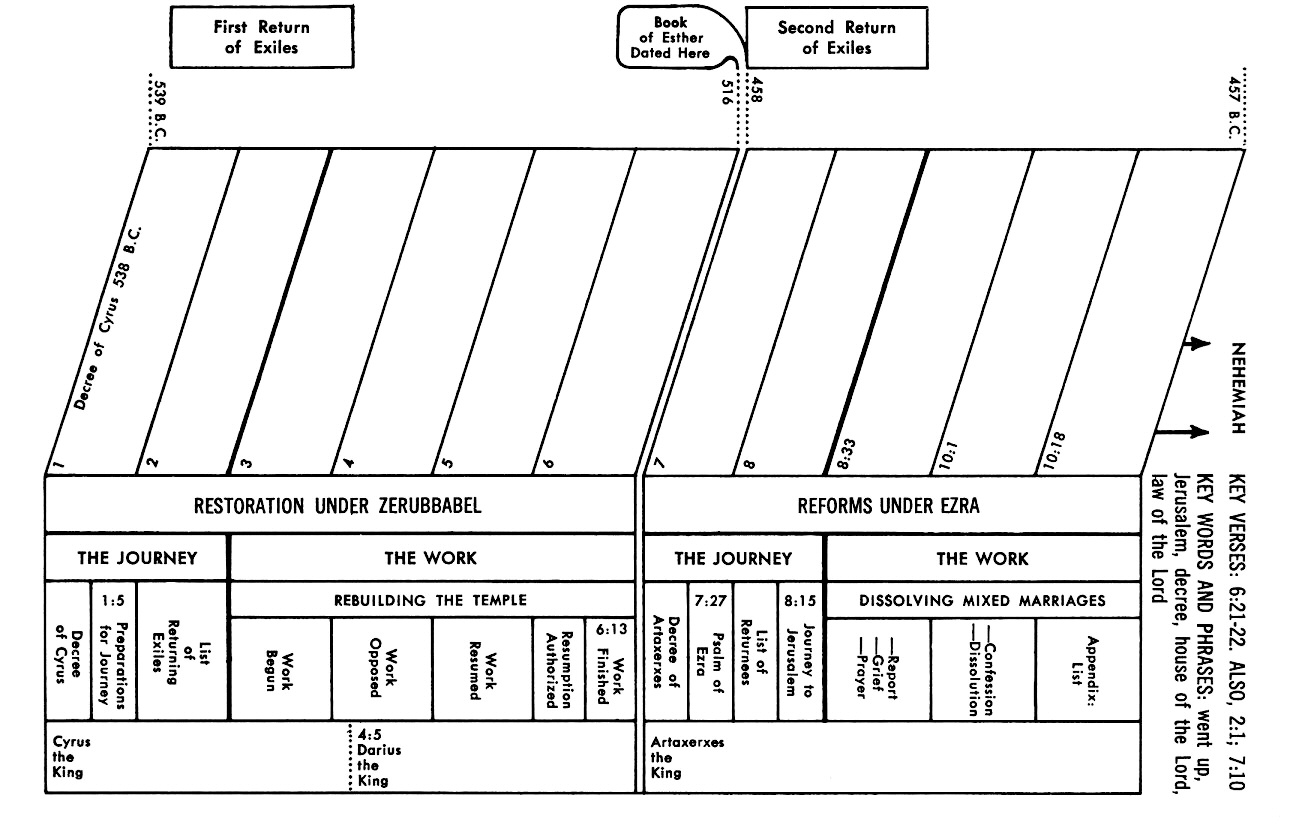
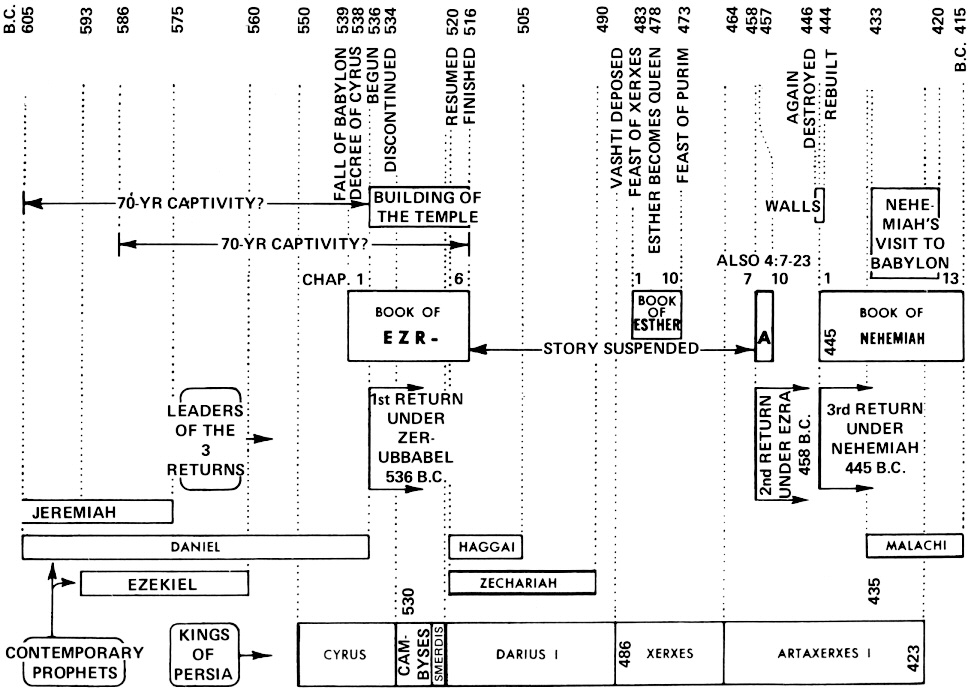
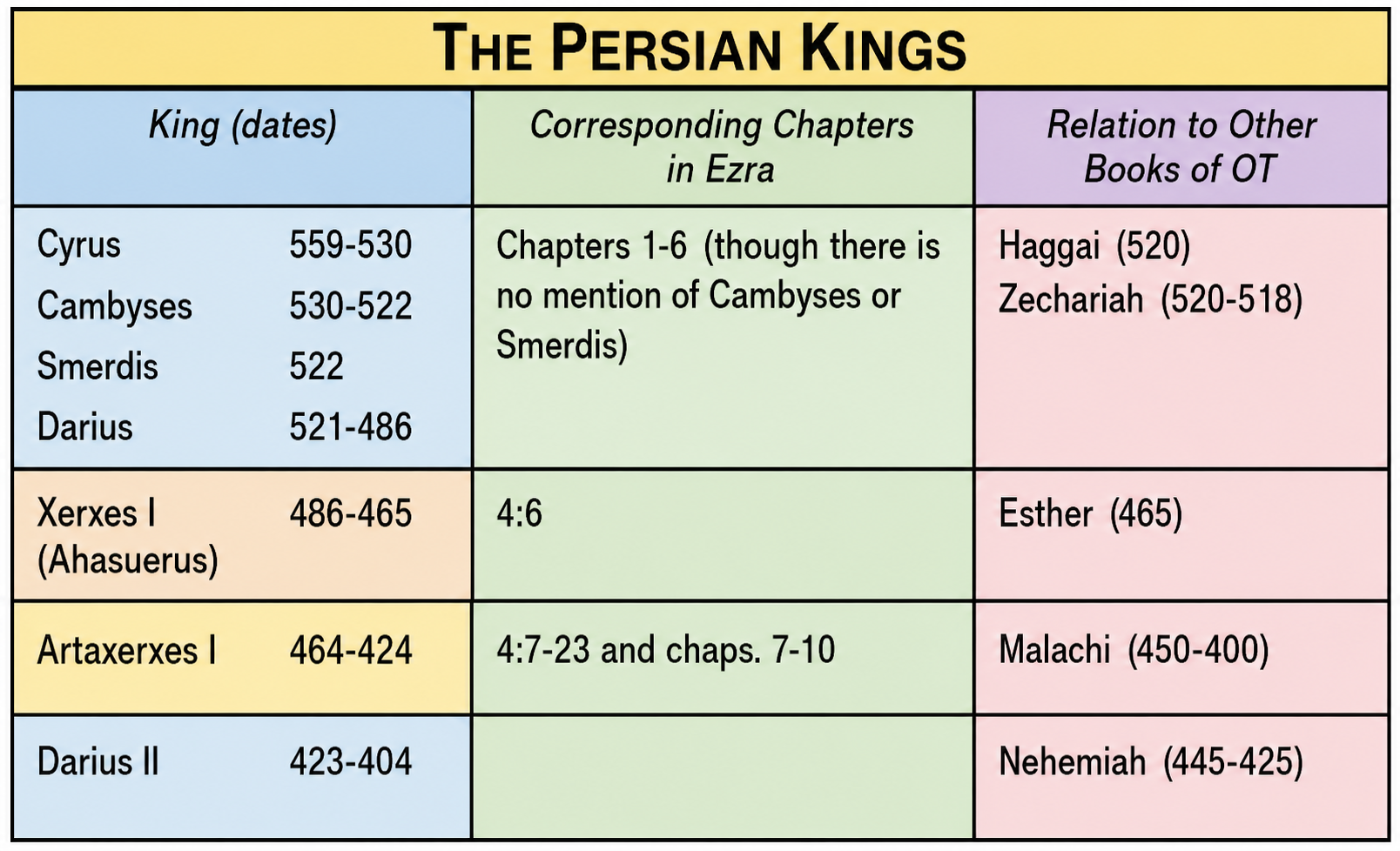
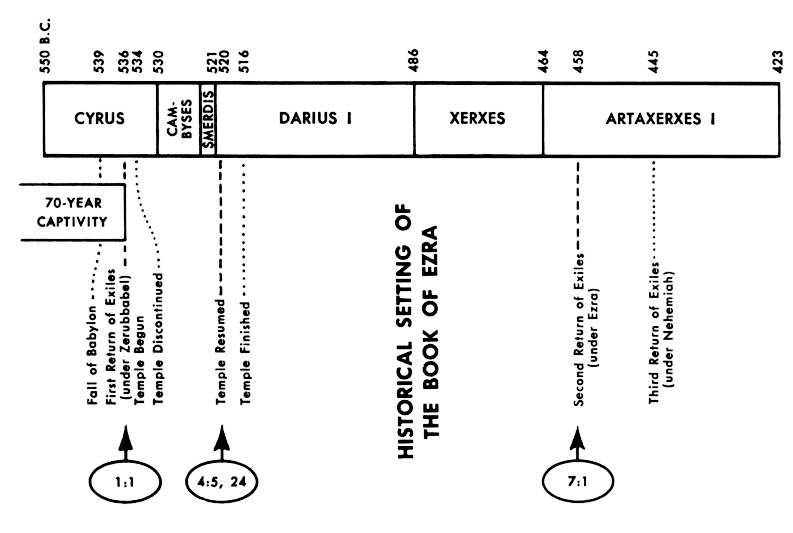
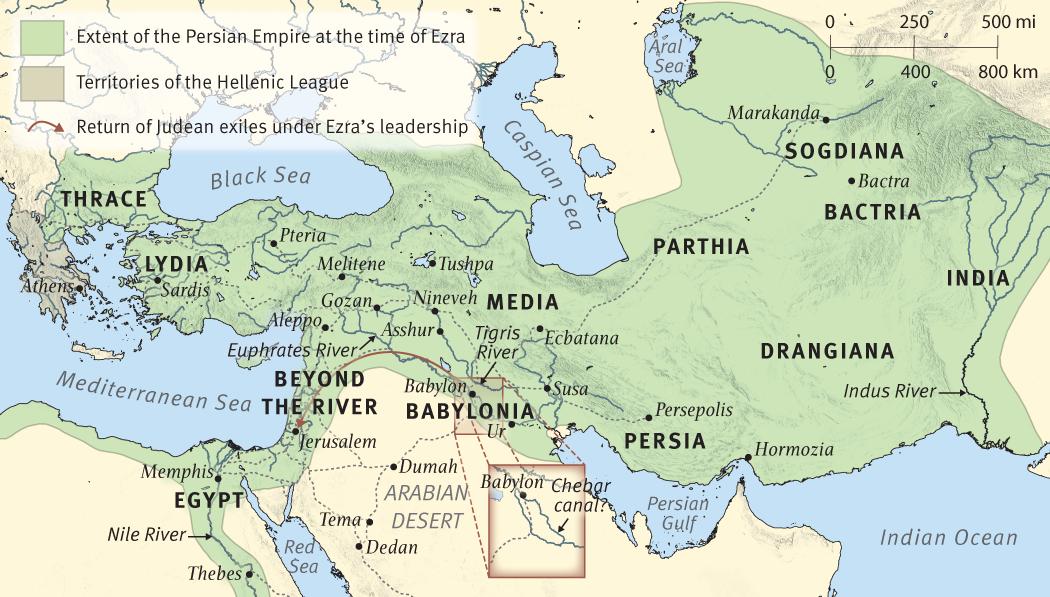
Source: ESV Maps
EZRA UNDER CONSTRUCTION
JUST A FEW NOTES NOW
WILL FINISH IF THE LORD WILLS
Ezra 1:1 Now in the first year of Cyrus king of Persia, in order to fulfill the word of the LORD by the mouth of Jeremiah, the LORD stirred up the spirit of Cyrus king of Persia, so that he sent a proclamation throughout all his kingdom, and also put it in writing, saying:
- Now in the (KJV): 2Ch 36:22,23
- Cyrus (KJV): Cyrus is said to have been the son of Cambyses, king of Persia, and Mandane, daughter of Astyages, king of Media: he was born about 600 years before Christ, and died at the age of 70, after a reign of 30 years. He was mentioned by name, and his conquests foretold, by the prophet Isaiah, about a century before his birth. Josephus states the partiality he evinced towards the Jews, arose from the circumstance of these prophecies being shown him, probably by Daniel.
- by the mouth (KJV): Jer 25:12-14 Jer 29:10 Jer 33:7-13
- the Lord (KJV): Ezr 5:13-15 Ezr 6:22 Ezr 7:27 Ps 106:46 Pr 21:1 Da 2:1
- made a proclamation (KJV): Heb. caused a voice to pass, Mt 3:1-3 Joh 1:23
Now in the first year of Cyrus king of Persia, in order to fulfill the word of the LORD by the mouth of Jeremiah, the LORD stirred up the spirit of Cyrus king of Persia, so that he sent a proclamation throughout all his kingdom, and also put it in writing, saying:
Bob Utley - "in the first year of Cyrus king of Persia" The close of 2 Chr. 36:22-23 is similar to the opening of Ezra. Some scholars assert that the lexical and syntactical style suggests one author. However, it may simply be a way of showing that Ezra-Nehemiah continues the history of Chronicles. See Kings of Persia
▣ "in order to fulfill the word of the Lord by the mouth of Jeremiah" This refers to Jeremiah's prophecy of the seventy-year captivity (cf. Jer. 25:11, 12; Jer 29:10; Jer 50:18-19). It is hard to find an exact 70 year time-frame unless one adds (1)from the time of King Jehoiakim, (2) from the destruction of Solomon's temple in 586 B.C. to the rebuilding of the second temple in 516 B.C. (3) it is possible that the number 70 refers to a round number or the expected life span of an individual See: Seventy Years
▣ "the Lord stirred up the spirit of Cyrus" This VERB (BDB 734 I, KB 802, Hiphil PERFECT, cf. John Joseph Owens, Analytical Key to the Old Testament, vol. 3, p. 1, and Francis Brown, S. R. Driver, and Charles Briggs [ed], of William Gesenius' Hebrew and English Lexicon of the Old Testament) also occurs in Ezra 1:5, where the stirs up the exiles to return home. The major thrust of this recurrent theme is that God is in control of history—all history, by arousing humans to action (cf. Ezra 6:22; 1 Chr. 5:26; 2 Chr. 21:16; 2 Chr 36:22; Isa. 13:17; Jer. 51:1,11; Hag. 1:14)! Cyrus seems to have had a unique concern for the Jews. Many commentators believe this was because Daniel, who lived into Cyrus' reign (cf. Dan. 10:1), showed him his name and the prophecies of Isaiah (cf. Isa. 41:2,25; Isa 44:28-45:7,12-13; 46:11; 48:15), which relates to YHWH calling "one from the east" to do His bidding of allowing His people to return to Judah and rebuild His temple. Josephus, Antiq. 11.1, says that the Jews showed Cyrus the text, Isa. 44:28. Cyrus' knowledge of Isaiah's prophecies may be the source of his words in Ezra 1:2. The same word, "stirred up" or "aroused" (BDB 734), is used in Isa. 41:2,25; Isa 45:13. Daniel himself was concerned about the rebuilding of YHWH's temple (cf. Daniel 9). See Spirit in the Bible
▣ "and also put it into writing saying" Cyrus' decree (538 B.C.) that all of the exiled people groups could return to their native lands (Cyrus Cylinder, cf. Ancient Near Eastern Texts Relating to the Old Testament by J. B. Pritchard, pp. 315-316) and re-establish their religious traditions was an attempt to assure political loyalty and to try to appease the national gods for his reign.
The term "writing" (BDB 508) is a technical term for written posters. It is possible that the Hebrew account of Cyrus' decree in chapter 1 was spoken (i.e., "he sent a proclamation," BDB 876) as well as posted notices (i.e., "put it in writing") throughout the Empire. The Aramaic in Ezra 6:3-5 was the official written document put in the archives.
Believer's Study Bible - The "first year of Cyrus" is the first year of Cyrus's rule over Babylon, which began when his army conquered the city on Oct. 12, 539 B.C. These verses (vv. 1-4) are the Hebrew form of the decree of Cyrus, which later in the book is expressed in Aramaic (6:3-5). The Aramaic version is in the form of an official record of an administrative decision. Cyrus's purpose in 6:3-5 was to authorize the treasurer to withdraw funds for the project. The Hebrew form (vv. 1-4) was the public announcement of the decision as it would have been heralded throughout the empire for the sake of the Jews themselves. Though the phraseology is different, both conveyed the same message: the Jews could return and in so doing were expected to help in rebuilding the temple. There is a reference to Jeremiah's prophecy (Jer. 25:11, 12; Jer 29:10) concerning the end of the Exile. (Ezra 1:1,2) A number of inscriptions from the reign of Cyrus, most notably the famous Cyrus Cylinder, indicate that Cyrus was a clever politician who knew how to win the loyalty of conquered subjects. This verse does not, therefore, mean that Cyrus worshipped the true God. It does show, however, that God sovereignly used Cyrus to reestablish His people (cf. Prov. 21:1). The ascension of Cyrus fulfilled the prophecy of Isa. 44:28-45:4, delivered more than 200 years earlier, which called him God's "anointed" (Isa. 45:1).
Ryrie - first year of Cyrus's reign over Babylon (538 B.C.). Cyrus had reigned over Persia from 559 and had captured Babylon in Oct. 538 (Dan. 5:30-31). The action of Cyrus, predicted about 200 years earlier (see notes on Isa. 44:21-28; Isa 45:1, 5; Introduction to Zechariah, Zech 1:1 book note), fulfilled the prophecy of Jeremiah (25:12).
Matthew Henry - The proclamation of Cyrus for the rebuilding of the temple Ezra 1:1-4. The Lord stirred up the spirit of Cyrus. The hearts of kings are in the hand of the Lord. God governs the world by his influence on the spirits of men; whatever good they do, God stirs up their spirits to do it. It was during the captivity of the Jews, that God principally employed them as the means of calling the attention of the heathen to him. Cyrus took it for granted, that those among the Jews who were able, would offer free-will offerings for the house of God. He would also have them supplied out of his kingdom. Well-wishers to the temple should be well-doers for it.
Steven Cole - God’s Way of Renewal (Ezra 1:1-11)
It is easy—far too easy—to settle into a comfortable, routine Christianity. I have been a committed Christian for about 36 years and a pastor for 25 years, and it’s easy for me to drift into a safe, comfortable routine, where my heart is not panting after God like the thirsty deer after the water brook (Ps. 42:1). At such times, I am not, as David put it, thirsting and yearning for God “in a dry and weary land where there is no water” (Ps. 63:1). My heart grows dull and my vision for God is gradually blurred. What I need at such times—what we all need repeatedly—is for God’s Spirit to blow upon us in spiritual renewal.
The books of Ezra and Nehemiah are about God’s renewing His errant people. They are put together as one book in the Hebrew Bible, although the fact that the lists in Ezra 2 and Nehemiah 7 are virtually the same argues that originally they were separate. Ezra is about the return of the exiles from Babylon, the rebuilding of the Temple, and the restoration of God’s people spiritually. Nehemiah is about the rebuilding of the walls of Jerusalem, as well as the spiritual renewal of God’s people.
The Book of Ezra falls into two sections: Ezra 1-6 deal with the initial return of a remnant from Babylon under the leadership of Zerubbabel in 538 B.C., with the aim of restoring the Temple. The project began in 536 B.C., but opposition quickly arose, leading to the abandonment of the project for 16 years. Through the ministries of the prophets Haggai and Zechariah (Ezra 5:1-2), the construction was renewed, coming to completion in 515 B.C.
Between chapters 6 and 7, there is a 58-year gap during which the events of the Book of Esther took place. At the beginning of chapter 7, in 457 B.C. (81 years after the first return), Ezra the priest led another smaller group to return to the land and bring renewal to the people, who were already drifting into assimilation with the surrounding people.
So the theme of the book is God’s restoring His people to the land according to His gracious promise and restoring His people spiritually to proper worship and godly living. A brief outline is:
1. Restoration of the Temple (Ezra 1-6); return under Zerubbabel (538-515 B.C.)
A. The decree of Cyrus (Ezra 1)
B. The census of the people (Ezra 2)
C. The commencement of the project (Ezra 3)
D. The opposition to the project (Ezra 4)
E. The construction renewed amid opposition (Ezra 5:1-6:12)
F. The construction completed (Ezra 6:13-22)
(58 year gap—the Book of Esther)
2. Reformation of the People (Ezra 7-10); return under Ezra (457 B.C.)
A. The leadership of the reformation commissioned (Ezra 7)
B. The leader and his people return (Ezra 8)
C. The reformation commenced (Ezra 9-10)
(1) The condition of the people revealed (Ezra 9:1-4)
(2) The confession of Ezra in prayer (Ezra 9:5-15)
(3) The covenant (Ezra 10:1-8) and cleansing (Ezra 10:9-44) of the people
With that as a brief introduction, I want to focus the rest of our time on chapter 1. The lesson there is:
Spiritual renewal requires God’s great power working according to His gracious promises for His glorious purpose.
1. God has His chastening purposes for dry times and He has His gracious purposes for spiritually renewing His people.
As you know from the history of Israel, for four centuries the Lord warned His disobedient people, calling them back to Himself through His prophets. Finally, they had persisted in their idolatry for too long, and God fulfilled His warning by scattering them among the nations (Deut. 28:64). As God prophesied through Moses almost 1,000 years before, “And among those nations you shall find no rest, and there shall be no resting place for the sole of your foot; but there the Lord will give you a trembling heart, failing of eyes, and despair of soul. So your life shall hang in doubt before you; and you shall be in dread night and day, and shall have no assurance of your life” (Deut. 28:65-66).
Why would God give His people a trembling heart, failing eyes, despair of soul, and no assurance of life? Hebrews 12 gives us the answer: “For those whom the Lord loves He disciplines, and He scourges every son whom He receives…. He disciplines us for our good, that we may share His holiness” (Heb. 12:6, 10). By nature, we’re all so wed to this world and the things of this world that the Lord has to bring us to the place where we find no rest in Babylon. We have to recognize that all that this world offers will leave us with a trembling heart, failing eyes, and despair of soul. The dry times spiritually should make us thirst after the living God, who alone can satisfy.
There were many Jews in Babylon who were comfortable there. Many of them had been born in captivity and Babylon was all that they knew. They heard stories from the old-timers about the glories of Zion and the beauty of the Temple. But they just shrugged, “Why go back there when we have a good life here?”
Besides, it was both inconvenient and risky to go back to Jerusalem. It meant saying good-bye to the comfortable and familiar surroundings and friends and venturing across 1,000 miles of hostile desert terrain to a land that had been decimated by war. There weren’t cities with beautiful empty homes awaiting them. There were piles of rubble and some hostile people who had moved into the empty land after the Babylonians had dragged off the surviving Jews 50 years earlier. So why go back?
But there were other Jews in Babylon who were not comfortable there. They remembered Zion and said, “How can we sing the Lord’s song in a foreign land” (Ps. 137:4). They exalted Jerusalem, where God’s people worshiped Him in His temple, as their chief joy (Ps. 137:6). So when they heard the unbelievable news that Cyrus, the pagan king, had issued a call to the Jews to return to Jerusalem and rebuild the Lord’s temple, they were like those who dream. Their mouths were filled with laughter and their tongues with joyful shouting. “Then they said among the nations, ‘The Lord has done great things for them.’ The Lord has done great things for us; we are glad” (Ps. 126:2-3).
Cold water tastes so good when you are dry to the bone. God’s river of living water tastes so good when you have gone through a dry time and you’re aware that all of Babylon’s pleasures only leave you with despair of soul. But the key is this: When you are in a dry time, don’t get satisfied with Babylon. Remember Jerusalem, and cry out for God’s Spirit to take you back there. But, how does it happen?
2. Spiritual renewal requires God’s great power.
Ezra 1:1-3a is identical to 2 Chronicles 36:22-23. They are astounding verses. In Jeremiah 29:10-14, the Lord had sent word through His prophet to those who were already in exile in Babylon:
For thus says the LORD, “When seventy years have been completed for Babylon, I will visit you and fulfill My good word to you, to bring you back to this place. For I know the plans that I have for you,” declares the LORD, “plans for welfare and not for calamity to give you a future and a hope. Then you will call upon Me and come and pray to Me, and I will listen to you. You will seek Me and find Me when you search for Me with all your heart. I will be found by you,” declares the LORD, “and I will restore your fortunes and will gather you from all the nations and from all the places where I have driven you,” declares the LORD, “and I will bring you back to the place from where I sent you into exile.”
The Lord had wounded; now He would heal. The Lord had killed; now He was giving life (Deut. 32:39). The seventy-year captivity began in 605 B.C. Jerusalem fell in 587 B.C. The decree of Cyrus was in 538, the first year of his reign over Babylon, 67 years after the first deportation, but scarcely 50 years since the destruction of the city. By the time the people returned and built the altar in 536, the 70 years were almost expired. Derek Kidner observes, “It was not the last time that God’s mercy would shorten the days of trial (Matt. 24:22)” (Ezra & Nehemiah, Tyndale Old Testament Commentaries [IVP], p. 32).
But the remarkable and significant thing is that it was God who stirred up Cyrus to make this dramatic proclamation. About 150 years before, Isaiah had predicted this event (Isa. 44:28-45:7). The fact that he named Cyrus has led critics to say that Isaiah could not have written this, and thus to attribute it to a later scribe. But only a bias against God’s supernatural knowledge would lead us to reject Isaiah’s prophecy.
Why would Cyrus, a pagan king, issue a decree for the Jews to return to Israel and rebuild their Temple? In the 19th century, the Cyrus Cylinder was discovered. It reveals that he had a policy of restoring people to their native lands and religions, asking them to pray to their gods on his behalf. A portion of it reads, “May all the gods whom I have resettled in their sacred cities ask daily Bel and Nebo for a long life for me” (cited by Kidner, p. 18).
So on a human level, you have a polytheistic king following his program of religious tolerance, superstitiously asking the subject people to pray to their gods for his well being. He even provided for funds to be raised to support the restoration, and he donated the temple objects that Nebuchadnezzar had taken years before.
But as our text shows, behind it all was the sovereign God turning this king’s heart as channels of water to fulfill His purpose (Prov. 21:1). Cyrus was ignorant of God’s ways. From his perspective, he was building his empire by employing wise policies that would insure his long reign. But behind Cyrus’ incredible decree, God was working to fulfill His Word through His prophet (Ezra 1:1). Just as in the exodus, the Lord put it in the hearts of the Egyptians to give gold and silver to the Jews, so here He worked through Cyrus so that the Babylonian residents gave those returning silver and gold, goods and cattle (Ezra 1:4, 6). There is simply no human explanation for this. God was the only reason for it.
There are human schemes and methods for bringing spiritual renewal. But for it to be genuine, God must work according to His mighty power. Anything less will be a cheap, superficial substitute. But, then, do we just sit around and wait for God to work, or is there something that we can do?
3. Spiritual renewal is according to God’s gracious promises.
Everything in the spiritual realm depends on God’s grace as promised in His Word. If God had not promised restoration, no amount of human effort could have brought it about. But since God had promised, and since He works through means that He ordains, there are some things that we can do:
A. PRAYER BRINGS GOD’S PROMISES INTO PRACTICAL REALITY.
The prophet Daniel’s meditation on Jeremiah’s prophecy and his prayers for God to forgive and restore His captive people were behind these dramatic changes in history (Daniel 9). Daniel didn’t read Jeremiah’s prophecy, realize that the 70 years were almost up, and say, “Cool! Let’s sit back and see what happens!” Rather, he humbled himself with fasting and he confessed his people’s and his own sins.
If we want spiritual renewal, whether personally or for God’s church, we must humble ourselves before God and entreat Him for it. If we’re content in Babylon, with no longing for worship in God’s temple in Jerusalem, we won’t cry out to Him for anything different. But if we realize that God promises more than we’re experiencing, we will give ourselves to prayer until He grants it.
B. GOD’S WORD REVEALS HIS PROMISES AND HIS PATH OF BLESSING.
The renewal under Ezra was a renewal of God’s Word. The fulfillment of Jeremiah’s and Isaiah’s prophecies showed God’s people that His Word is true and can be trusted, no matter how impossible the situation. Ezra 7:6 tells us that Ezra was a scribe skilled in the law of Moses. Ezra 7:10 says, “Ezra had set his heart to study the law of the Lord, and to practice it, and to teach His statutes and ordinances in Israel.” In Nehemiah 8:8, we find that under Ezra’s leadership, in front of all the people, well-trained scribes “read from the book, from the law of God, translating to give the sense so that they understood the reading.” Many scholars think that Ezra is the author of Psalm 119, which extols God’s Word for 176 verses. Clearly, Ezra was a man who believed in the transforming power of God’s Word.
Every true spiritual renewal is founded on and sustained by God’s Word. The Reformation was a renewal of the Word. Luther, Calvin, and the other Reformers began systematically teaching and applying God’s Word in ways that had been grossly neglected by the Roman Catholic Church. The Puritan movement also was centered on God’s Word, as pastors would explain and apply the great doctrines of Scripture, usually in hour-long sermons (J. I. Packer, Borrow A Quest for Godliness [Crossway Books], p. 280). In the preface of his wonderful book, Calvin’s Preaching (Westminster/John Knox Press, p. x), British scholar T. H. L. Parker indicts the modern church that has abandoned Calvin’s method of careful exposition of Scripture. He says, “What wonder that a Church which picks and chooses what it wants out of the Bible should become confused in its theology, flabby in its morals, and with little to state but the worldly obvious—the day after worldly liberals have stated it more convincingly?” If we want renewal, we must put a renewed emphasis on God’s Word of truth.
C. GOD’S PROVISION SUPPLIES THE DEMANDS OF HIS PROMISES.
God had promised to restore His people after the 70 years, but it was a humanly impossible task. After 70 years in Babylon, with the city of Jerusalem and the Temple in ruins, how could things ever be restored? The Jews didn’t have the resources to do it, even if a royal edict permitted them to return to the land.
But what man could not do, God did. He had Cyrus put it into the royal edict that the people should contribute to those returning. And, Cyrus himself brought out the vessels from the Temple that Nebuchadnezzar had put into his own temple. The 2,499 in Ezra 1:9-10 probably refers to the bigger and more valuable items, whereas the 5,400 in Ezra 1:11 is the total of all the items (John A. Martin, see page 683 in The Bible Knowledge Commentary ). Also, while there is debate as to the exact identity of Sheshbazzar (Ezra 1:8, 10), probably it is the Babylonian name of Zerubbabel (cf. Ezra 5:16 with Zech. 4:9), who was the godly grandson of the godless Jewish King Jeconiah (1 Chron. 3:17-19; borrow Ryrie Study Bible note on Ezra 1:8).
Derek Kidner (p. 35) points out that every piece of these temple items was “a witness to God’s sovereign care and the continuance of the covenant.” Here’s the application for us: Christ has promised to build His church and that some from every tribe, tongue, people, and nation will one day be gathered before His throne (Matt. 16:18; Rev. 5:9). But the task seems humanly impossible! Where do we get the resources to see these promises become a reality? The answer is here: When God promises, He also supplies the demands to meet those promises as His people wait on Him in prayer. As Hudson Taylor used to say, “God’s work done in God’s way will not lack God’s means of support.”
Thus, spiritual renewal requires God’s great power according to His gracious promises. Finally,
4. Spiritual renewal is for God’s glorious purpose.
The Temple at Jerusalem had been the place where God’s glory was displayed. That place had been destroyed because of the sins of His people. He now is referred to as “the God of heaven.” That title is used 9 times in Ezra, more than in any other book of the Bible. It is used 10 times in other post-exilic books (2 Chronicles, Nehemiah, and Daniel), and elsewhere in the Old Testament only 4 times (Martin, p. 655). It shows God to be the sovereign over all. But it also may hint at the fact that His glory was not now being revealed on earth, since the Temple had been destroyed.
Thus God’s purpose was to manifest His glory through a rebuilt Temple where His restored people could worship Him in spirit and truth. His glory was supremely revealed in the rebuilt Temple when Jesus the Messiah appeared there as “God’s salvation, which [He] prepared in the presence of all peoples, a light of revelation to the Gentiles, and the glory of Your people Israel” (Luke 2:32).
God’s purpose today is the same: He wants to reveal His glory through a renewed people, who by their holy lives and witness reveal His Savior, the Lord Jesus Christ, to all peoples. In other words, spiritual renewal is not for us, so that we can lead happy, fulfilled lives to the neglect of the world. Spiritual renewal is for God’s purpose, that His glory would be revealed to the nations.
Conclusion
How can this happen? I can only be brief and limited here.
First, ask God to give you a vision of what a renewed, holy, worshiping, evangelizing community of His people would look like. Then, devote yourself to being a part of making that happen here. It has to begin on an individual level before it can move to a corporate level. In other words, ask God to renew you! If your heart is stirred for renewal, that stirring came from God (Ezra 1:5). And yet each of us is responsible to seek the Lord and “search for [Him] with all your heart” (Jer. 29:13).
Men, especially, need to take the leadership in this process. It was “the heads of fathers’ households of Judah and Benjamin” that arose to the challenge to return to Jerusalem (Ezra 1:5). While God greatly uses godly women, He has ordained for men to take the spiritual lead in the home and in the church. God won’t bring renewal while men are spiritually passive.
Finally, be willing to be inconvenienced to see spiritual renewal happen, both personally and corporately. To return to Jerusalem was a major hassle and inconvenience for everyone who responded to the call. But if God is going to renew your life, you’ve got to get out of your rut and make some changes. You’ve got to be willing to give up the comfortable life in Babylon and embrace the hardships of seeing His Temple rebuilt in Jerusalem. It may be as simple as turning off the tube and picking up your Bible on a consistent basis to spend time with the Lord. It may mean scheduling regular extended times for seeking the Lord. It may mean setting some spiritual goals and asking God for the grace and wisdom to achieve them. But it certainly means doing some things differently than the current status quo!
Do you sense the need personally for spiritual renewal? If your honest answer is, “No, I’m fine, thanks,” you’ll stay in Babylon. It’s a comfortable place to live. You’ll enjoy a good life there. But you’ll miss what God wants to do with you personally and with you as a part of His church corporately.
If you sense the need for renewal, get alone with God as soon as you can and begin asking Him by His great power according to His gracious promises to work for His glorious purpose in you and in this church. It won’t be an easy, comfortable road to travel. There are many hardships and obstacles along the way. But, as Derek Kidner points out (p. 35), the closing words of chapter one, “from Babylon to Jerusalem,” mark one of the turning points of history. God calls you to join that group returning to the place of His blessing.
Discussion Questions
- Why is a holy discontent with where we’re at spiritually essential for every believer?
- Should we just accept spiritual “dry times” or should we fight to get out of them? If we should fight, how?
- A fellow Christian tells you that for him the Bible is dry and boring. What would you say to help him?
- How can a Christian get his or her eyes off of individual problems and onto God’s greater global purpose of His glory?
Brian Bell - Ezra 1
- INTRO
- I remember an article in our local paper when pastor Chuck 1st purchased the Hot Springs. He said (loose quote) “Refurbishing & rebuilding this place is really no different then what the church is all about…rebuilding people lives. They’ve been used & abused, worn & torn down, then they come to Jesus & He does a wonderful transformation in them…& it’s blessed to see.”
- We’ll see this same parallel w/Zerubbabel rebuilding the temple & Ezra rebuilding the people.
- Both require community rather than isolation. Both meet resistance. Both require time & commitment. Both have the Word of God at the center. Both bring Glory & Honor to God.
- The Book
- Ezra opens with what 2 Chronicles closed with (see 2Chr 36:22,23).
- Ezra is very similar to Chronicles (which lead many scholars to conclude Ezra wrote Chronicles).
- Ezra & Nehemiah is 1 book in the Hebrew bible. (They tell 1 story)
- Where does this fit in World History? [i.e. during the writing of the book of Ezra] Gautama(Goat’-ima) Buddha the Indian mystic & founder of Buddhism, was in India. Confucius was in China. And Socrates was in Greece.
- The Background
- Judah had rejected Jeremiah’s warning of judgment...and his prophetic message came true.
- What was Jeremiah’s warning to Judah? (kicked out of the land for 70 years)
- Why did Judah get kicked out of the land? (see 2 Chron.36:21)
- To make up for almost a half a millennium of neglected Sabbaths.
- 1/7th of 490 years = 70 years
- Daniel & Ezekiel were among those who were deported.
- But, Jeremiah also promised Restoration! - This is what the Lord says: “You will be in Babylon for 70 years. But then I will come and do for you all the good things I have promised, and I will bring you home again. Jer. 29:10
- Lesson: What motel chain promises to...keep the light on for you? What does that mean?
- God kept a lamp lit at Jerusalem in order that His Son might be born through the Hebrew nation and come to save the world.
- Lesson: What characteristics of God do you see by allowing them to return? God of 2nd chance.
- Now matter how we’ve blown it in our past, God gives us an opportunity for a new beginning.
- Ezra covers the 1st 2 returns to Israel. Nehemiah covers the 3rd return to Israel.
- Return #1 - 49,897 people return [Zerubbabel leads, 538bc] Purpose? rebuild temple.
- Return #2 - 1,754 return [Ezra is in, 80 yrs. later] Purpose? to rebuild the people.
- Return #3 - Nehemiah leads (14 yrs. later) Purpose? to rebuild the wall.
- The Main Characters
- Ezra – A godly patriotic Jew. His name means Help.
- Read (Ezra 7:6,8,9).
- He was a devoted student of the Scriptures. He helped to restore the Law to the nation. He was a man of prayer (Ezra 8:21-23). He was greatly burdened for the spiritual welfare of his people (Ezra 9:3,4).
- He does not come on the scene till chapter 7.
- Nehemiah – An officer in the kings court.
- He had no prophetic call or priestly lineage.
- He was the original layman. The orig Joe the Plumber.
- Nehemiah was promoted from cupbearer to governor.
- He had no prophetic call or priestly lineage.
- Zerubbabel – He was a leader under Ezra.
- His name means born in Babel (i.e. Babylon).
- His Persian name was Sheshbazzar. (shesh-batsar)
- His official title was tirshatha (Ezra 2:63) which means governor.
- He served as the political leader of the restored nation.
- Joshua – He was the high priest at the time.
- Haggai & Zechariah – They were the 2 Prophets at the time. (See Ezra 5:1)
- The Book Outline:
- The book is divided into 2 Returns: [from Babylon to Promise Land]
- Ezra 1-6 Led by Zerubbabel to rebuild the Temple. [536bc. then 80 yrs later 2nd]
- Ezra 7-10 Led by Ezra to rebuild the Spiritual condition of the people.
- The Restoration of the Temple & the Reformation of the People.
- Between these 2 returns (60 yr gap) Esther’s story is told.
- Tonights Outline: [Ezra 1] The Proclamation [Ezra 2] The People
- Tonights Title: Should I Stay or Should I Go Now?
- What does the Clash
- Feel the anguish: Listen in the poetry of Lamentations(this funeral for a city, in a 5 poem dirge), penned in Babylon, where we can hear the longing of the captives for their homeland.
- How deserted lies the city, once so full of people! How like a widow is she, who once was great among the nations! She who was queen among the provinces has now become a slave...All the joy is gone from our hearts. Our dances have turned into dirges. The crown of glory has toppled from our head. Woe! Woe! Would that we’d never sinned! Because of all this we’re heartsick; we can’t see through the tears. On Mount Zion, wrecked and ruined, jackals pace and prowl. And yet, God, you’re sovereign still, your throne intact and eternal. So why do you keep forgetting us? Why dump us and leave us like this? Bring us back to you, God - we’re ready to come back. Give us a fresh start. As it is, you’ve cruelly disowned us. You’ve been so very angry with us. Lam. 1:1(NKJV); 5:15–22(Mes)
- I remember an article in our local paper when pastor Chuck 1st purchased the Hot Springs. He said (loose quote) “Refurbishing & rebuilding this place is really no different then what the church is all about…rebuilding people lives. They’ve been used & abused, worn & torn down, then they come to Jesus & He does a wonderful transformation in them…& it’s blessed to see.”
- THE PROCLAMATION (Ezra 1)
- The Proclamation (Ezra 1:1-4)
- Persia – A Divine twist of irony…The Lord raised up a nation (Persia), to overthrow the nation (Babylon), that He allowed to overthrow His nation (Jer) [Daniel 2: Babylon; Medo/Persia; Greece; Rome]
- [3 kings of Persia] This decree by Cyrus (Ezra 1), the decree by Darius (Ezra 6), & the decree given by Artaxerxes (Ezra 7) remind us that God remembers us & is working for our good…even in our darkest days.
- Cyrus – Why does he do this? (i.e. let God’s people go)
- As he takes over the crumbling Babylonian empire, one of his 1st acts of office is to reverse the Babylonian policy of deporting conquered people from their homelands.
- Remember this was the Cyrus mentioned in bible prophecy, 170 years earlier. Is.44:28
- *Remember when the words & actions of world leaders disturb you, just remember God is still on the throne & has things in control.
- Cyrus – A true believer or a pagan ruler? “Archeological finds indicate Cyrus showed similar respect to the deities of all conquered people. This seems to have been motivated by national policy rather than faith-motivated conviction.”
- The Decision…Should I Stay or Should I Go Now? (Ezra 1:5,6)
- Where I grabbed my title. The Clash (Eng Punk band 1976-86)
- Judah & Benjamin - Let’s us know that though they had to assimilate into a pagan culture they still maintained their tribal structure (including the role of priests & Levites).
- Not everybody returned…why not?
- How many of you (or your parents) came to America from a different country? Would you move back now?
- Let’s all say we’ve been out of our country for 70 years. So in 1945 we all were made to leave, let’s say Syria. How many of us were born after 1945?
- How would we look at moving to this new country we’d never lived in nor even visited?
- Keep in mind their homeland was burnt & destroyed so it was a wasteland, & the place they were moved to was a place of luxury & beauty.
- The trip was going to be difficult (like the covered wagons in the old days here). Life was going to be demanding.
- They had settled into a district of their own in Babylon, found employment, & lived generally comfortable lives.
- Note: Those that returned were all whose spirits God had moved.
- How does He do that today, how does your spirit personally sense His moving/promting?
- Note: Those that didn’t return encouraged those that did & helped w/expenses. (Even their Babylonian neighbors helped out)
- Note: Those that returned were all whose spirits God had moved.
- So why Go back?
- It was worth the price to do God’s will even though it was going to cost.
- The Articles (Ezra 1:7-11)
- They couldn’t worship without them. We can’t worship with them
- Jn.4 women at well - It’s not where you worship or what you worship with but how you worship. i.e. in spirit & truth.
- Are articles/things needed today for your worship? If so what/which ones? (sound system, instruments)
Dale Ralph Davis - Introduction; God Moves History for his People (Ezra 1)
Introduction
Welcome to Persia! We are in the period following 539 B.C., a time in biblical history called the post-exilic period. The last installment of the people of Judah was carted off to Babylon in 587/6 B.C. But on October 29, 539 B.C., Cyrus came into the city of Babylon in peace, and Persia was the head-knocker of the world.
One could do much worse than to live in a Persia-dominated world. Persia was very eager to show her subject peoples that "the government is for you." The Persians were ecumenical in their religious policy - they encouraged subject peoples to worship their own gods/goddesses, and, generally, they did not deport and relocate captive peoples. As captors went, Persians were temperate. According to Hoerth, under the Persians Palestine was grouped with Phoenicia, Syria, and Cyprus into a Persian district called "The Land Beyond the River" (the "River" was the Euphrates), with Damascus as its capital. Palestine itself was sectioned into provinces: Galilee, Samaria, Judah, and Idumea.1
So much, in short sketch, for her policies. Now meet some of Persia's leading politicians. You may use this as a rough checklist, for you'll meet most of these kings in Ezra and Nehemiah:
- Cyrus II559-530 B.C.
- Cambyses II529-522 B.C.
- Darius I522-486 B.C.
- Xerxes I (a.k.a. "Ahasuerus" in Bible) 485-465 B.C.
- Artaxerxes I464-424 B.C.
Originally, Ezra and Nehemiah constituted one book; that is why we treat them together here.2 My intent in these notes is to provide a theological exposition of the text, an emphasis often missing in commentaries.
God Moves History for His People (Ezra 1)
No one pays much attention to old athletic teams that seemed always to be in eclipse. One still hears talk of the old New York Yankees. But who mentions the old St. Louis Browns or Washington Senators (or the Atlanta Braves of the 1980s)? Why is this? Because the Browns and the Senators were, by and large, losers. Losers don't stir attention. And in the days of Ezra-Nehemiah, Israel was a loser. The big powers were Babylon, then Persia. Who cares about a postage-stamp size kingdom in the political backwater of the Ancient Near East? Who cares about the people who used to live there? Answer: The covenant God does! God cares because he has made promises to these losers, and for this reason he moves history on their behalf. God moves history to give his people a future and a hope.
I. The Word that Drives History - Ezra 1:1-4
The word is more central than the event here. Not that the event doesn't matter - Cyrus' edict, quoted in Ezra 1:2-4, allowed the Jews to return to Judah and to rebuild the temple. But behind this event was the word that Yahweh had spoken years previously to Jeremiah (see Jer 25:12 and 29:10-11, esp. the latter). Jeremiah had said there were 70 years "for Babylon." The numeral may be approximate. It was 73 years from the fall of Nineveh (612 B.C.) to the fall of Babylon (539 B.C.); from the accession of Nebuchadnezzar and the taking of the first crop of Judean exiles (605 B.C.) to the fall of Babylon, it was 66 years.
But how could the Jews return to their land? Their freedom to return to their land came through Cyrus, the Persian conqueror. Note the prophecies about him in Isaiah 41:2-3; 44:24-28; and 45:1-6, especially v. 4. Our text here tells us the secret: "Yahweh stirred up the spirit of Cyrus king of Persia" (Ezra 1:1), thus Cyrus' propaganda and edict in Ezra 1:2-4. His permission for the Jews to return home and to rebuild Yahweh's house is consistent with his practices in Babylon that are reflected in the Cyrus Cylinder.3 But why did Cyrus do this? He did it "that the word of Yahweh by the mouth of Jeremiah might be accomplished" (Ezra 1:1).
Do you see the theology of the text? Do you see how the kings and dictators and head-knockers of the earth are Yahweh's servant boys? Therefore, you can depend on what Yahweh's word declares. And you need have no ultimate fear of the rulers of this age, for they are under the aegis of Yahweh's pleasure, and he uses them as he wills.
II. The Secret that Explains Obedience - Ezra 1:5-6
The leaders of the people rose to go up and rebuild the temple in Jerusalem (Ezra 1:5). But why did they do so? God "stirred up" their spirit - that is the explanation behind their response. God not only "stirs" kings like Cyrus, but he stirs his own people into action.
Note the central focus: rebuilding the house of Yahweh (Ezra 1:2, 3, 4, 5, 7). Rebuilding the temple has to do with the restoration of public worship; this worship is what matters. Seeking God in public worship was the heart of the Jews' existence, and yet they had to be stirred up by God to do it.
This is the same thing that Paul taught in Philippians 2:12-13. Why do Christians obey (Phil 2:12)? Because (gar) "God is working in you, giving you the desire to obey him and the power to do what pleases him" (Phil 2:13 NLT). We obey, we work out our salvation, because God enables us to do so.
Does this not humble us? Ought this not to undercut our arrogance? And should it not encourage us as well? Shouldn't it move us to pray for God to stir right appetites and desires in us and in our children? Shouldn't it lead us to pray that God would do his secret, stirring work in others?
William Still tells of a series of meetings, a sort of youth crusade, they were holding in one of the Scottish towns. He was asked by some of the young people to handle questions after the evening meeting, and he consented to do so. He felt he was given unusual facility and skill in handling their inquiries. Eventually, he dismissed the group, and thinking that everyone had gone off to prepare for bed, he decided he had better check the church building and see that it was closed up properly. He went to open, I believe, the vestry door and could hardly get it ajar. The room was filled with other workers on their knees in prayer, pleading for the Lord to give Still the sharpness needed in answering the young people's questions! Then he knew the secret behind his success. So it is here - the stirring of God moves Judah to obedience.
III. The Signs that Encourage Believers - Ezra 1:7-11
Oh, you won't be interested in this! No, it's only an inventory - and you'll say it has nothing to do with you. Look at Ezra 1:8-11a item by item: 30 gold dishes; 1,000 silver dishes; and so on. "Temple utensils enumerated. How pedantic!" you say.
What is the significance of this? Look at Ezra 1:7-8, and then at Daniel 1:1-2 and 5:2-4,22-23. Nebuchadnezzar originally took these vessels to Babylon in 605 B.C. and placed them in the "treasury of his god." Now, you may be able to guess how this was interpreted by the media (at least by the Babylonian media). Since Yahweh's furniture was pilfered, it signaled the supremacy of Babylon's gods, or so they thought. They assumed that Yahweh had been unable to stop the theft, that he had been defeated and humiliated. (Note that Dan 1:2 assures us that "the Lord gave" these vessels to the Babylonians!) So, in Babylon they sang, "Praise Marduk, from whom all blessings flow!" and toasted one another as they used the "defeated" god's table service (Dan 5:4).
But now what have we in Ezra 1? Babylon is no more, and the utensils that had been taken from Yahweh's house are being inventoried to Sheshbazzar, the leader of Judah (Ezra 1:8). What is Ezra 1 saying? It is saying that Babylon is no more, but the worship of Yahweh endures! The inventory you find so tedious actually constitutes, item by item, so many signs that Yahweh is removing the stigma and taking away the shame. These are not dramatic signs (the kind we often prefer) but low-key signs that Babylon is the loser and that Yahweh is restoring his people and his worship. The Jewish believer who saw this must have savored each vessel counted, each article tallied - each one was a token that defeat had been turned to victory.
Don't despise ordinary signs. Although the Lord sometimes gives us dramatic ones, those tend to be exceptional. He usually offers low-key signs, like the bread and the wine at the Lord's Table. They are only signs, only tokens - but how they put fresh heart into Christ's flock.
"For I know the plans I have for you," declares the Lord, "plans for welfare and not for calamity to give you a future and a hope" (Jer 29:11). God will move all history to make this come true.
F B Meyer - Ezra 1:1 The Lord stirred up the spirit of Cyrus.
There were many rays focused on this spot. In the first place, it had been definitely foretold by Jeremiah that the captivity would only last for seventy years. In the next place, Daniel, having learned from comparison of dates that the allotted time had nearly expired, had set himself to pray. Also, if Josephus be credited, the aged prophet had shown the young king the predictions of Isaiah in which his own name was clearly mentioned: “Thus saith the Lord to His anointed, to Cyrus, whose right hand I have holden: … he shall build my city, and he shall let go my captives, not for price nor reward, saith the Lord of hosts” (Isaiah 45:1, 13).
God is the fountain-head and source of all spiritual blessing, and of all those great movements for the uplifting and enlightenment of mankind which have swept from time to time over the world. Go to Him when you want to reach the heart of kings, prophets, and people. Oh for the faith of Samuel, Elijah, Daniel, and other stalwart men of God, that through Him we may stir up the spirits of those who will not listen to our appeals! For the fervent prayer of a righteous man still availeth much. In prayer you can touch the spring of all the stirrings that the world needs.
But it is not enough for God to stir men, they must obey. It appears that only a comparatively small number of captive Jews obeyed the Divine stirring and came out of Babylon with the chief of the fathers. The call resounds for volunteers, but only a few respond; the inspiration breathes over us, but only some are susceptible to it. God works to will and to do, but only certain of the children of men work out what He works in. Whenever there is a Divine stirring abroad, let us rise up and go.
Proverbs 21:1 The king’s heart is like channels of water in the hand of the LORD; He turns it wherever He wishes.
Ezra 1
In order to fulfill the word of the LORD spoken by Jeremiah, the LORD moved the heart of Cyrus king of Persia. - Ezra 1:1
TODAY IN THE WORD
King Nebuchadnezzar of Babylon controlled a vast empire and enriched his capital with captive peoples and looted treasure. He had been warned in a dream, interpreted by Daniel, to repent of his sins, but instead he proclaimed: “Is this not the great Babylon I have built as the royal residence, by my mighty power and for the glory of my majesty?” God responded with judgment for his pride. Only after his extraordinary humiliation did Nebuchadnezzar respond: “Then I praised the Most High; I honored and glorified him who lives forever” (see Dan. 4:28-37).
The Babylonian kingdom was soon overtaken by the Persian Empire (see Dan. 5:28). In contrast to Nebuchadnezzar, King Cyrus of Persia exhibited a measure of humility about his position. Here in the opening verses of the book of Ezra, we see a key theme emerge: Leaders are important—but only if they allow God to work through them.
Notice throughout today’s reading how often the text describes God working in the hearts of leaders. First, “the LORD moved the heart of Cyrus” in order to fulfill His promise, which we read about yesterday (v. 1). Historians have said that the Persians, particularly Cyrus, were interested in encouraging their conquered peoples to retain their native religion, assuming that this would keep them happier and less likely to revolt. Scripture provides us with the behind-the-scenes peek, however—whatever political motives Cyrus might have had, it was the work of God that prompted him to make the proclamation to initiate the return of Jewish exiles to Jerusalem (vv. 2-4; see Isa. 44:28).
God worked through Cyrus to fulfill His promise, and He also moved the hearts of the tribal leaders, priests, and Levites to desire to return to rebuild the temple (v. 5). Remember that the people had been exiled for several generations; many of them had extended families, good jobs, and comfortable lives throughout the empire. A spiritual prompting made them willing to embrace the arduous task of repairing their decimated spiritual center of worship.
APPLY THE WORD
This chapter concludes with a list of items that Cyrus returned to the Jews. We might be tempted to skim or disregard the lists in this book as irrelevant to our contemporary devotional life. But it reminds us that the Lord cares about details, and He provided for the practical needs to accomplish this task. He restored some of the treasure to His people and equipped them for their journey. When the Lord calls you, He will also equip you to obey Him!
Ezra 1:1–2:2; Haggai 1:1-15
Let us examine our ways and test them, and let us return to the LORD. - Lamentations 3:40
TODAY IN THE WORD
A beautiful building in Kiev, the capital city of Ukraine, has recently been reclaimed for its original purpose, and is now home to a thriving Christian congregation. Like so many churches in the former Soviet Union, this church was confiscated by the government and used for other purposes during many of the seventy-four years of Communist rule. The building suffered from years of neglect, and still needs a lot of repair and restoration work.
Many centuries before the Communists formed the Soviet Union, a foreign conqueror swept through a nation and left a house of God in ruins. A little more than twenty years after the death of King Josiah, the Babylonians under Nebuchadnezzar swept into Judah in a final conquest of the southern kingdom.
Most of God’s people were sent off into exile in Babylon in fulfillment of God’s judgment, and the magnificent temple of Solomon was leveled. But the godly line survived in Babylon, and when the seventy years of captivity God had decreed were finished, He kept His promise to restore Israel to her land.
The book of Ezra records the fulfillment of this promise of restoration, as the first exiles returned to Jerusalem in 538 B.C. A man named Zerubbabel was among this group (Ezra 2:2). He was a prince of Judah, the grandson of King Jehoiachin who had been taken captive by Nebuchadnezzar (2 Kings 24:8-16). We’re studying Zerubbabel today because he was one of the last descendants in the godly line mentioned in the Old Testament.
The prophet Haggai says that Zerubbabel was appointed governor of Jerusalem. The main task of the returned exiles was to rebuild the temple, a job they began with great enthusiasm. But after the temple’s foundation was laid, opposition from the people living in Samaria caused Zerubbabel and the people to stop the work (Ezra 4:1-5, 24).
TODAY ALONG THE WAY
Today’s study finishes our survey of some of the people in the Old Testament lineage of Jesus Christ.
G Campbell Morgan - The Lord stirred up the spirit of Cyrus - Ezra 1:1
To human observation the purposes of God often seem to tarry. The one thing of which we may remain assured is that they are never abandoned. Indeed, there is a very true sense in which they never for a moment tarry. In the Books we have been reading, we have had the story of the complete failure and break-up of the chosen nation. That nation had become "a people scattered and peeled," having lost national position and power; and, to a very large extent, national consciousness also. Nevertheless, God still moved on toward the fulfilment of His ultimate purpose of redemption, not of His people only, but of the race, through them. Through the seventy years of captivity, by the very processes of suffering, He prepared a remnant to return, to rebuild, and so to hold the fort, until He, the true Seed and Servant, should come. The history of this return sets forth clearly the truth concerning this direct overruling of God. He compelled the most unlikely instruments to contribute to the accomplishment of His will. Babylon had carried away His people into captivity, and by so doing had fulfilled His purpose. They, however, treated the conquered nation with undue severity. In process of time, and in fulfilment of the distinct foretelling of Jeremiah, Cyrus the Persian broke the power of Babylon. This Cyrus was now chosen and commissioned as the very instrument for restoring God's remnant to their own land. His proclamation made that return possible. It was the result of Divine dealing, and, moreover, he was conscious that this was so. How constantly in human history God has compelled kings and rulers to carry out His sovereign will!
Ezra 1:1-11 James Smith THE STIRRED-UP SPIRIT.
"Not to the rich He came, and to the ruling
(Men full of meat, whom wholly He abhors);
Not to the fools grown insolent in fooling—
Most, when the lost are dying at their doors.
Nay! but to her who, with a sweet thanksgiving,
Took in tranquility what God might bring;
Blessed Him and waited, and, within her living,
Felt the arousal of a holy thing."—Myers.
The clock of God's providence may seem at times to go slow, but it always strikes at the proper minute. During the seventy years of the Jews' captivity, the cup of Babylon's iniquity was being filled, so that the time of their deliverance synchronised with the time of Babylon's downfall. The quiver of the Almighty is full of arrows. In the first year of his reign, Nebuchadnezzar carried many into captivity. He reigned forty-five years; his son (Evil-merodach), twenty-three; and his grandson (Belshazzar,) three years—which make up the seventy predicted years of their bondage. In the third year of Belshazzar, Darius, the Mede, captured the city of Babylon, and Cyrus, the king of Persia, became ruler (Dan. 5). The accession of Cyrus to the throne was another marvellous fulfilment of prophecy (Isa. 44:28). The very name of the Jews' liberator was mentioned one hundred and fifty years beforehand. This is no mere coincident or random occurrence, it is an indisputable proof of inspiration. At this crisis three distinct prophecies found their fulfilment:
1. The punishment of the king of Babylon (Jer. 25:12).
2. The end of the seventy years' captivity (Jer. 29:10; Da. 9:2).
3. The coming of the deliverer named. We may use these words, "The Lord stirred up the spirit of Cyrus," as a key to unlock some of the treasures of this chapter.
I. The Spirit Needs Stirring Up. "The Lord stirred up the spirit of Cyrus" (Ezra 1:1). The will of God will never be done by us until the spirit within us is stirred up to do it. Man is not a machine. Cold, mechanical service is an insult to the living God. Selfishness is death in His sight. It is possible to have the form of godliness while the spirit is sleeping the sleep of death. You hath He quickened who were dead in trespasses and sin.
II. God Alone can Effectually Stir up the Spirit. "The Lord stirred up the spirit of Cyrus." The source of all spiritual life and power is with Him. Every God-quickened spirit is a spirit raised from the dead, that He might work in that spirit both to will and to do of His good pleasure (Phil. 2:13NLT). There is a divine purpose in every divinely-awakened soul. It is the Spirit that quickens (Jn 6:63KJV).
III. The Means by which the Spirit was Stirred up. There was…
(1) the Word of God. Daniel understood by books the number of the years… that the Lord would accomplish seventy years in the desolations of Jerusalem (Da. 9:2). Daniel may have showed Cyrus the prophet's reference to himself, as the divinely-appointed shepherd by whom the temple was to be built, and the captives freed without a price (Isa. 44:28; Isa 45:1-13).
(2) The providence of God. The fact that Cyrus was now made Governor of Babylon, he was in a position to carry out the prophetic declaration. He discovered that the means of accomplishing these purposes of God were committed to him. Woe must come upon him if he obeys not the heavenly call. Thus, God still stirs up the spirits of men, by making them to know and feel that His word has special reference to themselves in the doing of His will. No man will heartily obey the Gospel of God unless he has, like Cyrus, been powerfully convinced that it is for himself, as if there were no other to whom it could be so applied, and whose only alternative is to obey or sin against the clearest Light. A woman was once led to claim the bare promise of God through receiving a letter addressed to another woman of the same name. She concluded that, if her name had been written in the Bible, she could never have believed that it was her that was meant. When the Holy Spirit applies the word of God, it is always unmistakably luminous and personal.
IV. The Evidences of a Stirred-up Spirit.
(1) There is faith in the word of God. Cyrus said, "The Lord God of heaven… hath charged me to build Him an house at Jerusalem" (Ezra 1:2). The king of Persia was no more clearly and urgently charged to build the temple than we are to believe on the Lord Jesus Christ, and serve Him without fear, in holiness, all the days of our life (Luke 1:74-75). This call to us is quite as personal and imperative as the call that came to Cyrus. Have we as heartily believed it?
(2) There is confession of the purpose of God. "He made a proclamation through all the land" (Ezra 1:1). When we discover what the will of God is concerning us, we should not be ashamed to make it known publicly what our attitude is toward this revealed will. Has he not warned us that "Whosoever is ashamed of Me and of My word, of them will I be ashamed."
(3) There are liberal things devised for the honour of God. The large-heartedness of Cyrus is seen in his offer to let all the captives go who desired the restoration of Jerusalem (Ezra 1:3). in his providing for the sojourners by the way (Ezra 1:4), and in his delivering up of "all the vessels of the house of the Lord" into the hand of "the prince of Judah" (Ezra 1:7-8). The liberal devises liberal things (Isa. 32:8). The spirit that has been stirred up by God will surely be constrained to do God-like things. The spirit of Carey was powerfully stirred up when he said, "Expect much from God, and attempt much for God." Moody said, "God never uses a discouraged worker." The stirred-up spirit is always on the alert for opportunities of helping on the work and people of God, and devises means whereby His banished ones may be restored. Such spirits seek first the Kingdom of God and His righteousness, and God works in them both to will and to do of His good pleasure. (Phil 2:13NLT)
Ezra 1:2 “Thus says Cyrus king of Persia, ‘The LORD, the God of heaven, has given me all the kingdoms of the earth and He has appointed me to build Him a house in Jerusalem, which is in Judah.
- Lord God (KJV): 1Ki 8:27 2Ch 2:12 Isa 66:1 Jer 10:11 Da 2:21,28 Da 5:23
- hath given (KJV): Jer 27:6,7 Da 2:37,38 Da 4:25,32 Da 5:19-21
- all the kingdoms (KJV): According to the testimony of ancient writers, Cyrus, at this time, reigned over the Medes, Persians, Hyrcanians, Syrians, Assyrians, Indians, etc., and all lesser Asia.
- he hath charged (KJV): Isa 44:26-28 Isa 45:1,12,13
Thus says Cyrus king of Persia, ‘The LORD, the God of heaven, has given me all the kingdoms of the earth and He has appointed me to build Him a house in Jerusalem, which is in Judah.
Derek Kidner - “The so-called Cyrus Cylinder, from which the following is an extract, gives his own account of this: ‘I returned to these sacred cities…, the sanctuaries of which have been in ruins for a long time, the images which (used) to live therein and established for them permanent sanctuaries. I (also) gathered all their (former) inhabitants and returned (to them) their habitations… May all the gods whom I have resettled in their sacred cities ask daily Bel and Nebo for a long life for me…; to Marduk, my lord, may they say this: ‘Cyrus, the king who worships you, and Cambyses, his son…’” (Ezra and Nehemiah)
Bob Utley - Thus says Cyrus King of Persia" Cyrus II's famous decree is recorded (1) in Hebrew (a loose translation) in Ezra 1:2-4 and (2) in royal Aramaic in Ezra 6:3-5. R. K. Harrison, Introduction to the OT, p. 132, suggests that the decree of Cyrus was issued in an official form for the Persian archives and a translated form for each different people/language group.
▣ "The Lord, the God of Heaven" This title for the universal God of creation was first used by Abraham in Gen. 24:3,7 and later by Jonah (1:9). It was also a Persian title used of the Zoroastrian, good high-god, Ahura-Mazda (Ormuzd), but in this context it was obviously influenced by Jewish usages referring to YHWH. This proclamation is Jewish, but I believe that this can be explained by (1) the prophesies of Isaiah shown to Cyrus by Daniel (2) Jewish consultation in writing this edict concerning YHWH
▣ "has given me all the kingdoms of the earth" The VERB (BDB 678, KB 733, is a Qal PERFECT, denoting a completed act). From the Cyrus Cylinder (ANET p. 315-16), it is known that Cyrus used religion as a political tool to instill loyalty of people groups. The thing he did for the Jews in the name of their God, he did for all the exiled peoples in the names of their gods. Cyrus' personal beliefs are not the issue.
Marduk is the high-god of the Babylonian pantheon, also called Bel (lord). He was the patron god of the city of Babylon. Cyrus consolidated his reign over the ancient Near East by appeasing each and every people group. The reason Cyrus took the capital of Babylon without a fight was because the last neo-Babylonian king, Nabonidus, became infatuated with the moon god, Zin, who was worshiped in Ur and Haran. His mother was Zin's high priestess at Tema. Nabonidus was absent from Babylon for over ten years on military campaigns near Tema (i.e., Egypt). The priests of Marduk at Babylon saw Cyrus as a liberator and faithful follower of Marduk.
▣ "He has appointed me to build Him a house in Jerusalem" This VERB (BDB 823, KB 955, Qal PERFECT) is used regularly of God appointing someone to a divine task (cf. Num. 27:16; 2 Chr. 23:14). Cyrus' understanding of a divine task may have come from his knowledge of Isaiah's prophecies (cf. Isa. 41:2,25; Isa 44:28-45:7,12-13; 46:11; 48:15).
Henry Morris - Cyrus. Cyrus was prophetically named long before he was born (Isaiah 44:28; Isaiah 45:1,13), presumably during or soon after the reign of King Hezekiah, about two hundred years before its fulfillment as recorded here by Ezra. In fact, this is one of the main arguments by those who say there were two Isaiah's, with the second one writing the section beginning with Isaiah chapter 40. However, this skeptical notion is invalid. The ancient Jewish scribes and other scholars, as well as the New Testament writers, indicate there was only one Isaiah. The New Testament writers quote from both divisions of Isaiah, referring both to the same prophet (Matthew 8:17, quoting Isaiah 53:4; Matthew 4:14-16, quoting Isaiah 9:1,2). house at Jerusalem. Verses 1-3 of Ezra are essentially quotes of the final verses of 2 Chronicles (2 Chronicles 36:22-23). This is one of the reasons why many believe that Ezra was the scribe who researched the old records of the various kings of Judah and then organized them into the books of Chronicles.
Ryrie - This acknowledgment (cf. Ezra 1:3, 4) of Yahweh provides no clear proof that Cyrus was a believer (see Isa. 45:5), but it is evidence of his policy to conciliate captive peoples and their religions, as described in the Cyrus Cylinder. This decree was discovered by Darius I some 20 years later (Ezra 6:2).
The Cyrus Cylinder
The Lord stirred up the spirit of Cyrus king of Persia. —Ezra 1:1
Ezra 1:1-4
In 1879, archaeologists discovered a remarkable little item in an area now known as Iraq (biblical Babylon). Just 9 inches long, the Cyrus Cylinder records something that King Cyrus of Persia did 2,500 years ago. It says that Cyrus allowed a group of people to return to their homeland and rebuild their “holy cities.”
It’s the same story told in Ezra 1. There we read that “the Lord stirred up the spirit of Cyrus king of Persia” to make a proclamation (v. 1). And in that proclamation, Cyrus said he was releasing the captives in Babylon to go home to Jerusalem, re-establish their homes, and rebuild their temple (vv. 2-5).
But there’s more to the story. Daniel confessed his sins and his people’s sins and pleaded with God to end the Babylonian captivity (Dan. 9). In response to Daniel’s prayer, God sent an angel to speak to Daniel (v. 21). Later He moved Cyrus to release the Hebrews. (See also Jer. 25:11-12; Jer 39:10.)
Together, the Cyrus Cylinder and God’s Word combine to show us that the king’s heart was changed and he allowed the exiled Hebrews to go home and worship.
This story has great implications for us today. In a world that seems out of control, we can rest assured that God can move the hearts of leaders. We read in Proverbs 21:1 that “the king’s heart is in the hand of the Lord.” And Romans 13:1 says that “there is no authority except from God.”
The Lord, who is able to change our own hearts as well as the hearts of our leaders, can be trusted for He is in control. Let’s ask Him to work.
Reflect & Pray
Dear Father, the world so often seems out of control. We know You are sovereign over everything. We pray that Your will be done in our homeland and in the hearts of our leaders.
Rather than complain, pray.
Today's Insights
Ezra is one of the Old Testament books that deals with the Israelites’ return to the land of promise after their exile in Babylon. Along with the books of Nehemiah and Haggai, it focuses on rebuilding Jerusalem, the once proud capital of the southern kingdom. Ezra’s role as a scribe was to rebuild the religious life of the Israelites through the law of Moses. In Nehemiah, the focus is on rebuilding the walls of Jerusalem to once again make it a safe haven for the people. Haggai’s focus some years later was on the importance of rebuilding the temple, the center of the Israelites’ national life.
Dave Branon (Reprinted by permission from Our Daily Bread Ministries. Please do not repost the full devotional without their permission.)
Ezra 1:3 ‘Whoever there is among you of all His people, may his God be with him! Let him go up to Jerusalem which is in Judah and rebuild the house of the LORD, the God of Israel; He is the God who is in Jerusalem.
- his God (KJV): Jos 1:9 1Ch 28:20 Mt 28:20
- he is the God (KJV): De 32:31 Ps 83:18 Isa 45:5 Jer 10:10 Da 2:47 Da 6:26 Ac 10:36
Whoever there is among you of all His people, may his God be with him! Let him go up to Jerusalem which is in Judah and rebuild the house of the LORD, the God of Israel; He is the God who is in Jerusalem
Bob Utley - "Whoever" Cyrus allowed any and all Jews to return. History tells us about 50,000 did. The question is how many were left in Babylon? Did the majority of Jews return? Ancient records show that large numbers of Jewish people remained in many cities of Babylon. The ones who returned were the most zealous for their ancestral faith!
▣ "may his God be with him" This is the first of three Qal JUSSIVES: (1) "May his God be with him" (BDB 224, KB 243) (2) "Let him go up to Jerusalem" (BDB 748, KB 828) (3) "Rebuild the house of the Lord" (BDB 124, KB 139) This phrase may give a hint as to (1) how difficult it was to leave a settled lifestyle and travel a long and dangerous route to Judah or (2) the character of Cyrus himself, to whom all ancient historians refer in gracious, positive ways.
▣ "the house of the Lord" This phrase refers to the temple of YHWH on Mt. Moriah in Jerusalem.
▣ "He is the God who is in Jerusalem" The ancient Near Eastern people believed that every nation had a god and that god was limited to the national boundaries. This concept is seen in the story of Naaman, the Syrian general wanting soil from Israel on which to worship YHWH (cf. 2 Kgs. 5:17). The Jews were surprised that YHWH left the temple and traveled east to be with the Jewish exiles in Babylon (cf. Ezek. 10:18; Ezek 11:23-25).
Cyrus, in Ezra 1:2, proclaims YHWH as the God of all the earth, but his comment in Ezra 1:3 shows he still saw Him as Israel's deity only! This phrase could be a parenthesis "(He is God!) which is in Jerusalem," cf. Rotherham's Emphasized Bible, p. 469). By dividing the phrase this way, it emphasizes monotheism!
Believer's Study Bible - The Return from Exile (see map). When Cyrus the Persian captured Babylon in 539 B.C., the way was opened for captive Judah to begin the return to her homeland. Two major expeditions made the journey, one in 537-8 B.C. and another in 458 B.C. Cyrus did not participate in the building of the temple but assigned the work to others. The king even called upon his own heathen subjects to aid the Israelites with generous gifts. The "freewill offerings" (v. 4), then, were not limited to God's people.
Selman - To build him a house’ is a deliberate echo of the central promise of the Davidic covenant (cf. 1 Chronicles 17:11-12; 1 Chronicles 22:10; 1 Chronicles 28:6; 2 Chronicles 6:9-10). Cyrus of course is thinking only of the house in Jerusalem, but in the Chronicler’s thought this phrase is inevitably connected with both houses of the Davidic covenant, the dynasty as well as the temple.” (2 Chronicles: A Commentary - Page 551)
Ezra 1:4 ‘Every survivor, at whatever place he may live, let the men of that place support him with silver and gold, with goods and cattle, together with a freewill offering for the house of God which is in Jerusalem.’”
- let the men (KJV): Ezr 7:16-18 Ac 24:17 3Jn 1:6-8
- help him (KJV): Heb. lift him up, Ec 4:9,10 Ga 6:2
- the freewill (KJV): Ezr 2:68-70 1Ch 29:3,9,17
Every survivor, at whatever place he may live, let the men of that place support him with silver and gold, with goods and cattle, together with a freewill offering for the house of God which is in Jerusalem
Bob Utley - "Every survivor" In this context God chooses only some (those with a faithful zeal) of the remnant (survivors of the Exile) to return to Judah. As we have seen before in this chapter, themes from Israel's past recur (Ezra 1:6). God is reducing the numbers so that He can show His power, provision, and care (e.g., Gideon, Judges 6-7). ▣ "at whatever place he may live" All the Jewish people were allowed by Cyrus' edict in 538 B.C. to return home, those who were exiled by Assyria (722 B.C.) and those who were exiled by Babylon (605, 596, 586, 582 B.C.) We know from history that many of the southern tribes of Judah returned (Judah, Benjamin, Simeon, and most of Levi), but only a few from the northern tribes of Israel, which had been exiled to Media. ▣ "let the men of that place support him" The support for the return trip was supplied by neighbors and kin. These same ones, along with the Persian treasury, helped rebuild the temple.
There is a parallel between the Egyptians of the Exodus giving gold and silver and treasure to the departing Jews to help them build their tabernacle (cf. Exod. 12:35-36). Isaiah depicts the return from exile as a new exodus (e.g., Isa. 41:17-18; Isa 43:14-17; Isa 48:20-21).
This fits the prediction of Haggai 2:7-8 that God will allow and motivate the nations to supply His temple's needs!
Yamauchi - After the deportations only the poor of the land – the vine-growers and farmers – were left (2 Kings 25:12; Jeremiah 39:10; Jeremiah 40:7; Jeremiah 52:16). They occupied the vacant lands (Jeremiah 6:12). A few refugees who fled to different areas drifted back (Jeremiah 40:11-12). For the next fifty years those left behind eked out a precarious existence under the Babylonian yoke (Lamentations 5:2-5), subjected to ill treatment and forced labor (Lamentations 5:11-13).” (See The Expositor's Bible Commentary - Abridged Edition: ... - Page 50)
Ryrie - let the men. I.e., Gentile neighbors in Persia were to help by their donations (v. 6).
Ezra 1:5 Then the heads of fathers’ households of Judah and Benjamin and the priests and the Levites arose, even everyone whose spirit God had stirred to go up and rebuild the house of the LORD which is in Jerusalem.
- whose spirit (KJV): Ezr 1:1 2Ch 36:22 Ne 2:12 Pr 16:1 2Co 8:16 Php 2:13 Jas 1:16,17 3Jn 1:11
Then the heads of fathers’ households of Judah and Benjamin and the priests and the Levites arose, even everyone whose spirit God had stirred to go up and rebuild the house of the LORD which is in Jerusalem.
Bob Utley - "then the heads of the fathers' households of Judah and Benjamin and the priests and the Levites" This is a list of the three major groups (tribes) that made up the southern kingdom, Judah, after the political split in 922 B.C., which was caused by Solomon's son, Rehoboam's arrogance (cf. 1 Kings 12). The only tribal group missing in this list is Simeon, which was incorporated into Judah very early. Most of the tribe of Levi (i.e., priests and Levites) stayed with the southern kingdom because of the temple in Jerusalem. ▣ "everyone whose spirit God had stirred to go up" This is the same VERB (BDB 734 I, KB 802, Hiphil PERFECT) as in Ezra 1:1. God motivated Cyrus to do His will and He motivates His people to do His will. However, there is also a necessary covenantal response from each individual. We know from history that not all of these tribal groups returned. God opens hearts to respond to Him! The Hebrew term ruach (spirit, BDB 924) has a very wide semantic field (BDB 924-926, KB 1197). In this context it refers to the human person, his thought, and volitional processes. Special Topic: Spirit in the Bible=
Ryrie - Although 49,897 chose to go (2:64-65), many remained in Babylon.
Matthew Henry - The people provide for their return - Ezra 1:5-11. The same God that raised up the spirit of Cyrus to proclaim liberty to the Jews, raised up their spirits to take the benefit. The temptation was to some to stay in Babylon; but some feared not to return, and they were those whose spirits God raised, by his Spirit and grace. Whatever good we do, is owing to the grace of God. Our spirits naturally bow down to this earth and the things of it; if they move upward in any good affections or good actions, it is God who raises them. The calls and offers of the gospel are like the proclamation of Cyrus. Those bound under the power of sin, may be made free by Jesus Christ. Whosoever will, by repentance and faith, return to God, Jesus Christ has opened the way for him, and raises him out of the slavery of sin into the glorious liberty of the children of God. Many that hear this joyful sound, choose to sit still in Babylon, are in love with their sins, and will not venture upon a holy life; but some break through all discouragements, whatever it cost them; they are those whose spirit God has raised above the world and the flesh, whom he has made willing. Thus will the heavenly Canaan be filled, though many perish in Babylon; and the gospel offer will not have been made in vain. The bringing back the Jews from captivity, represents the redemption of sinners by Jesus Christ.
David Guzik - It was essential that God move the spirits of these returning exiles because they faced many difficulties.
· The journey itself was long, dangerous, and expensive.
· They returned to a city in ruins with no proper homes, roads, or city institutions.
· They didn’t have all the material resources they needed.
· They didn’t all return to Jerusalem but spread out over the province of Judea.
· They had many enemies.
· Their land was actually the possession of another empire.
Beginning Again
Everyone whose heart God had moved—prepared to go up and build the house of the Lord in Jerusalem. Ezra 1:5
Ezra 1:1–11
After Christmas festivities conclude at the end of December, my thoughts often turn to the coming year. While my children are out of school and our daily rhythms are slow, I reflect on where the last year has brought me and where I hope the next will take me. Those reflections sometimes come with pain and regret over the mistakes I’ve made. Yet the prospect of starting a new year fills me with hope and expectancy. I feel I have the opportunity to begin again with a fresh start, no matter what the last year held.
My anticipation of a fresh start pales in comparison to the sense of hope the Israelites must have felt when Cyrus, the king of Persia, released them to return to their homeland in Judah after seventy long years of captivity in Babylon. The previous king, Nebuchadnezzar, had deported the Israelites from their homeland. But the Lord prompted Cyrus to send the captives home to Jerusalem to rebuild God’s temple (Ezra 1:2–3). Cyrus also returned to them treasures that had been taken from the temple. Their lives as God’s chosen people, in the land God had appointed to them, began afresh after a long season of hardship in Babylon as a consequence for their sin.
No matter what lies in our past, when we confess our sin, God forgives us and gives us a fresh start. What great cause for hope!
Reflect & Pray
What can you do to grow closer to God this year? Share your thoughts with us at Facebook.com/ourdailybread.
God’s grace offers us fresh starts.
Kirsten Holmberg (Reprinted by permission from Our Daily Bread Ministries. Please do not repost the full devotional without their permission.)
Ezra 1:6 All those about them encouraged them with articles of silver, with gold, with goods, with cattle and with valuables, aside from all that was given as a freewill offering.
- strengthened their hands (KJV): that is, helped them, Ezr 7:15,16 Ezr 8:25-28,33
- willingly offered (KJV): Ezr 1:4 Ps 110:3 2Co 9:7
All those about them encouraged them with articles of silver, with gold, with goods, with cattle and with valuables, aside from all that was given as a freewill offering.
Bob Utley - "encouraged them" This is a Semitic idiom, "strengthen their hands." Here it obviously refers to valuable gifts both for the temple in Jerusalem and to help those who are returning to make the trip. ▣ "a freewill offering" God's people had responded to give to the tabernacle in Exod. 35:29 from the spoils they were given by the Egyptians. Here neighbors and fellow Jews give to the rebuilding of the temple in Jerusalem. This may fit Hag. 2:6-7.
Edwin Yamauchi - An important difference between the deportations by the Babylonians and by the Assyrians is that the Babylonians did not replace the deportees with pagan newcomers. Thus Judah, though devastated, was not contaminated with polytheism to the same degree as Israel. (See The Expositor's Bible Commentary - Abridged Edition- Page 50)
Ezra 1:7 Also King Cyrus brought out the articles of the house of the LORD, which Nebuchadnezzar had carried away from Jerusalem and put in the house of his gods;
- Also Cyrus (KJV): Ezr 5:14 Ezr 6:5
- Nebuchadnezzar (KJV): 2Ki 24:13 2Ki 25:13-16 2Ch 36:7,10,18 Jer 27:21,22 Jer 28:3-6 Da 1:2 Da 5:2,3,23
Also King Cyrus brought out the articles of the house of the LORD, which Nebuchadnezzar had carried away from Jerusalem and put in the house of his gods
Bob Utley - "King Cyrus brought out the articles of the house of the Lord, which Nebuchadnezzar had carried away from Jerusalem and put in the house of his gods" These articles would include cups, censers, and sacrificial paraphernalia (cf. Ezra 1:9-11). These articles are mentioned in Jer. 52:17-19; 2 Chr. 36:10. They were placed in the temple of Marduk in the city of Babylon. When one compares 2 Kgs. 24:13 with Dan. 5:2-4, there seems to be a contradiction. However, it seems that the large articles of metal were cut up to make them easier to transport, but the smaller ones such as cups, bowls, and spoons were kept intact.
Henry Morris - When Nebuchadnezzar had plundered the temple at Jerusalem, the empire of Babylon was at its height. In the meantime, however, the Persian empire had defeated the Babylonians and was now preeminent in the world. It is noteworthy that, although Cyrus had his own "gods," he had somehow come to recognize the true "God of heaven" (Ezra 1:2), and acknowledged that "he is the God" (Ezra 1:3).
Ryrie - Some of these articles had been looted and taken to Babylon in 605 (Dan. 1:2), others in 597 (2 Kings 24:13), and the rest in 586 B.C. (2 Kings 25:14-15; Jer. 27:16-22). The Temple furniture had been destroyed in 586 (2 Kings 25:13; Jer. 3:16).
Ezra 1:8 and Cyrus, king of Persia, had them brought out by the hand of Mithredath the treasurer, and he counted them out to Sheshbazzar, the prince of Judah.
- Sheshbazzar (KJV): Ezr 1:11 Ezr 5:14,16 Hag 1:1,14 Hag 2:2-4 Zec 4:6-10
and Cyrus, king of Persia, had them brought out by the hand of Mithredath the treasurer, and he counted them out to Sheshbazzar, the prince of Judah
Bob Utley - "Mithredath" This was the name of the treasurer of the city of Babylon. His name (BDB 609) reflects the Persian sun god, Mithras. This was a common name ("given to Mithras" or "Mithras has given") and another person by the same name occurs in Ezra 4:7. ▣ "Sheshbazzar" His Babylonian name (BDB 1058) means "may ______ protect the father." The blank may refer to the moon god (Zin/Sin) or the sun god (Shashu/Shamash). There has been much discussion about this man's relationship to Zerubbabel, who is mentioned in Ezra 2:2 as bringing the exiles back to Jerusalem. Some see him as the first Persian-appointed governor and the uncle of Zerubbabel (cf. 1 Chr. 3:18, "Shenazzar" or "Shenabazar" is the fourth son of exiled king Jeconiah [Jehoiachin]; Zerubbabel's father is Shealtiel, the first son, cf. Ezra 3:2). In my opinion they are sequential governors (cf. I Esdras 6:18), but this is speculation. See IVP Bible Background Commentary (OT), p. 460). ▣ "prince of Judah" The term "prince" (BDB 672 I) means "one lifted up" or "chief." It does not necessarily imply that he is of the royal line (tribe of Judah, Gen. 49:10; line of Jesse, Isa. 11:1; and family of David, 2 Samuel 7). He is called "governor" in Ezra 5:14-16, while Zerubbabel is called "governor" in Hag. 1:1.
Henry Morris - Sheshbazzar. It is commonly believed that Sheshbazzar is the Chaldean name for Zerubbabel, since both are called "governor" of the returning exiles (Ezra 5:14; Ezra 2:2; Haggai 1:1). It is possible, however, that Zerubbabel succeeded Sheshbazzar as governor. prince. The term "prince" does not have to imply royalty, but only "principal." However, Zerubbabel was actually a grandson of King Jehoiachin (1 Chronicles 3:17-19).
Believer's Study Bible - Mithredath is the Hebrew word for "treasurer." Sheshbazzar, occurring only here (vv. 8, 11) and in 5:14-16, has sometimes been regarded as the Chaldean name for Zerubbabel, identified as "governor" in Hag. 1:1. However, the name probably represents another person, an official governor appointed by Cyrus over the new community in Jerusalem. This would make Zerubbabel his assistant, who eventually took over leadership of those returning to Judah from Babylon. Zerubbabel was the legal heir of Jehoiachin through his uncle Shealtiel (Salathiel), who apparently adopted Zerubbabel as his son, making him the legitimate heir to the throne of David and thus the natural leader of the people.
Ryrie - Sheshbazzar. Likely Zerubbabel's Babylonian name (cf. 5:16 with Zech. 4:9). He was the godly grandson of wicked King Jeconiah (1 Chron. 3:17-19; cf. Hag. 2:23). Others suggest that Sheshbazzar was the official leader and Zerubbabel the popular one. He has also been identified with Shenazzar (1 Chron. 3:18), which would make him Zerubbabel's uncle.
Ezra 1:9 Now this was their number: 30 gold dishes, 1,000 silver dishes, 29 duplicates;
- chargers of gold (KJV): Nu 7:13,19-89 1Ki 7:50 2Ch 4:8,11,21,22 2Ch 24:14 Mt 14:8
- nine (KJV): Mt 10:29-31
Now this was their number: 30 gold dishes, 1,000 silver dishes, 29 duplicates
Bob Utley - 30 gold dishes This term (BDB 173) refers to a basin or basket. The New International Dictionary of Old Testament Theology and Exegesis, vol. 1, p. 256, calls it a dish or pan. The Anchor Bible Commentary, vol. 14, calls it "a small dish or other container," p. 5. The term is used only in this verse in the Bible and is uncertain as all the various guesses from the ancient versions show. ▣ 1,000 silver dishes -- This term (BDB 173) is the same word as the above items except the ones above were made of gold; these were made of silver. In the tabernacle the different types of valuable metals were used to designate degrees of holiness. Gold was used in the Holy of Holies, but silver in the Holy Place and bronze in other parts of the tabernacle. If this remains true then these different metal vessels may have specialized usages. No bronze vessels are mentioned in the list. ▣ 29 duplicates -- This term (BDB 322) may denote a ritual cutting instrument because it may be related to the VERB "to cut through" (BDB 322). In I Esdras 2:13, which contains a list of vessels closer to the number mentioned in Ezra 1:11, these are called "censers." The Peshitta translated it as "vestments" (priestly garments). The UBS Text Project, p. 494, mentions three options. It stated that the only difference is the vowel points. (1) knives ‒ NKJV, JPSOA; (2) various kinds ‒ NEB, REB; (3) altered ‒ NJB, UBS gives this one a "C" rating (considerable doubt)
Ryrie - 1:9-11 The articles totalled 5,400, of which the 2,499 listed in verses 9-10 were evidently the largest or most important.
Ezra 1:10 30 gold bowls, 410 silver bowls of a second kind and 1,000 other articles.
30 gold bowls, 410 silver bowls of a second kind and 1,000 other articles.
Bob Utley - "bowls of a second kind" Some lexicons think the word comes from the root, "double" (i.e., "of a second kind") and refers to bowls that matched each other (cf. New International Dictionary of Old Testament Theology and Exegesis, vol. 2, p. 1138).
Ezra 1:11 All the articles of gold and silver numbered 5,400. Sheshbazzar brought them all up with the exiles who went up from Babylon to Jerusalem.
- the vessels (KJV): Ro 9:23 2Ti 2:19-21
- five thousand (KJV): Instead of 5,400, the enumeration of the articles in v9, v10, only amounts to 2,499; but in the account, Esdras 2:13, 14, the amount is 5,469, as will be evident from the following statements:
All the articles of gold and silver numbered 5,400. Sheshbazzar brought them all up with the exiles who went up from Babylon to Jerusalem.
David Guzik - What is conspicuously missing from the list is any mention of the more significant articles of the temple – the altar of incense, the table of showbread, the brazen altar, the golden lampstand, and especially the ark of the covenant. These articles were presumably lost to history at the destruction of the temple by the Babylonians.
Bob Utley - "five thousand four hundred" If one adds all of these items listed in Ezra 1:9-11, they do not equal even half of this amount. This list was just a summary or there were many small unlisted items such as spoons. The non-canonical book of I Esdras 2:13-15 gives a list that has many more items listed. Many of the larger items of gold in the temple were cut up in order to be transported to Babylon (cf. 2 Kgs. 24:13).