Isaiah 36:2
Isaiah 36:3
Isaiah 36:4
Isaiah 36:5
Isaiah 36:6
Isaiah 36:7
Isaiah 36:8
Isaiah 36:9
Isaiah 36:10
Isaiah 36:11
Isaiah 36:12
Isaiah 36:13
Isaiah 36:14
Isaiah 36:15
Isaiah 36:16
Isaiah 36:17
Isaiah 36:18
Isaiah 36:19
Isaiah 36:20
Isaiah 36:21
Isaiah 36:22
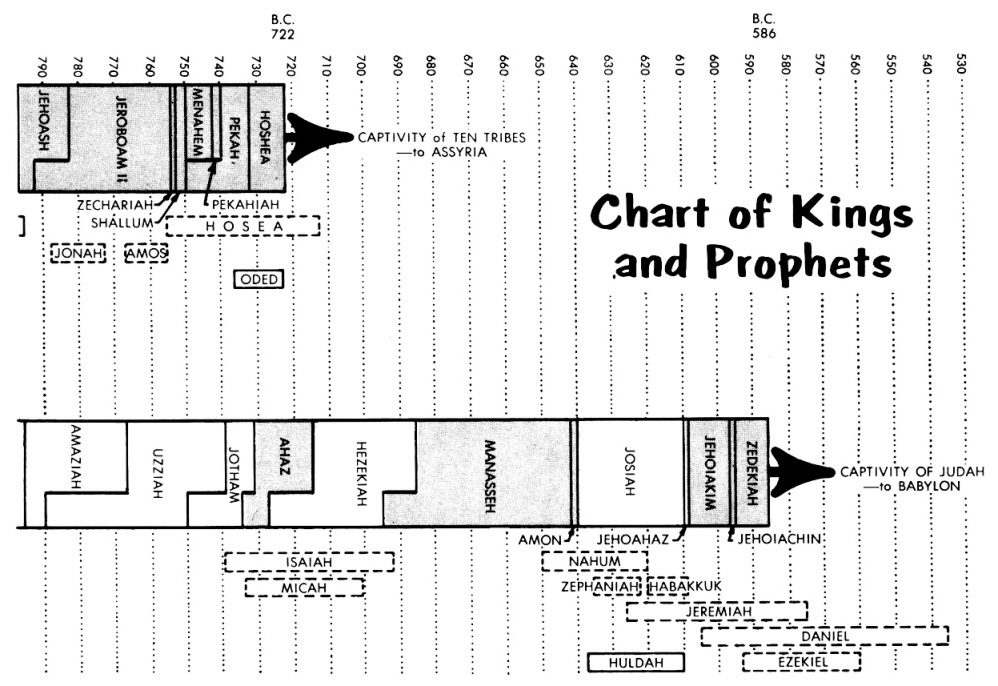
Click to Enlarge
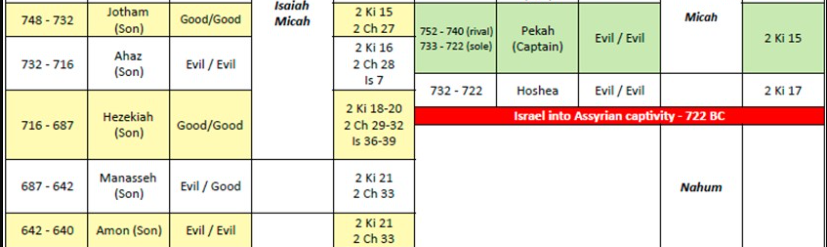
Isaiah 36:1 Now in the fourteenth year of King Hezekiah, Sennacherib king of Assyria came up against all the fortified cities of Judah and seized them.
NLT In the fourteenth year of King Hezekiah's reign, King Sennacherib of Assyria came to attack the fortified cities of Judah and conquered them.
- it came: 2Ki 18:13,17 2Ch 32:1
- that Sennacherib: Isa 1:7,8 7:17 8:7,8 10:28-32 33:7,8
Related Passages:
2 Kings 18:13 Now in the fourteenth year of King Hezekiah, Sennacherib king of Assyria came up against all the fortified cities of Judah and seized them. (NOTE: Chapters 36–39 of Isaiah are essentially identical to 2 Kings 18:13–20:19, with the same historical events also summarized in 2 Chronicles 32:1–33.)
2 Kings 18:14-16 Then Hezekiah king of Judah sent to the king of Assyria at Lachish, saying, “I have done wrong. Withdraw from me; whatever you impose on me I will bear.” So the king of Assyria required of Hezekiah king of Judah three hundred talents of silver and thirty talents of gold. 15 Hezekiah gave him all the silver which was found in the house of the LORD, and in the treasuries of the king’s house. 16 At that time Hezekiah cut off the gold from the doors of the temple of the LORD, and from the doorposts which Hezekiah king of Judah had overlaid, and gave it to the king of Assyria.
2 Chronicles 32:1-8 After these acts of faithfulness (see 2Kings 18:1-8) Sennacherib king of Assyria came and invaded Judah and besieged the fortified cities, and thought to break into them for himself. 2 Now when Hezekiah saw that Sennacherib had come and that he intended to make war on Jerusalem, 3 he decided with his officers and his warriors to cut off the supply of water from the springs which were outside the city, and they helped him (SEE MAP BELOW). 4 So many people assembled and stopped up all the springs and the stream which flowed through the region, saying, “Why should the kings of Assyria come and find abundant water?” 5 And he took courage and rebuilt all the wall that had been broken down and erected towers on it, and built another outside wall and strengthened the Millo in the city of David, and made weapons and shields in great number. 6 He appointed military officers over the people and gathered them to him in the square at the city gate, and spoke encouragingly to them, saying, 7 “Be strong and courageous, do not fear or be dismayed because of the king of Assyria nor because of all the horde that is with him; for the one with us is greater than the one with him. 8 “With him is only an arm of flesh, but with us is the LORD our God to help us and to fight our battles.” And the people relied on the words of Hezekiah king of Judah.
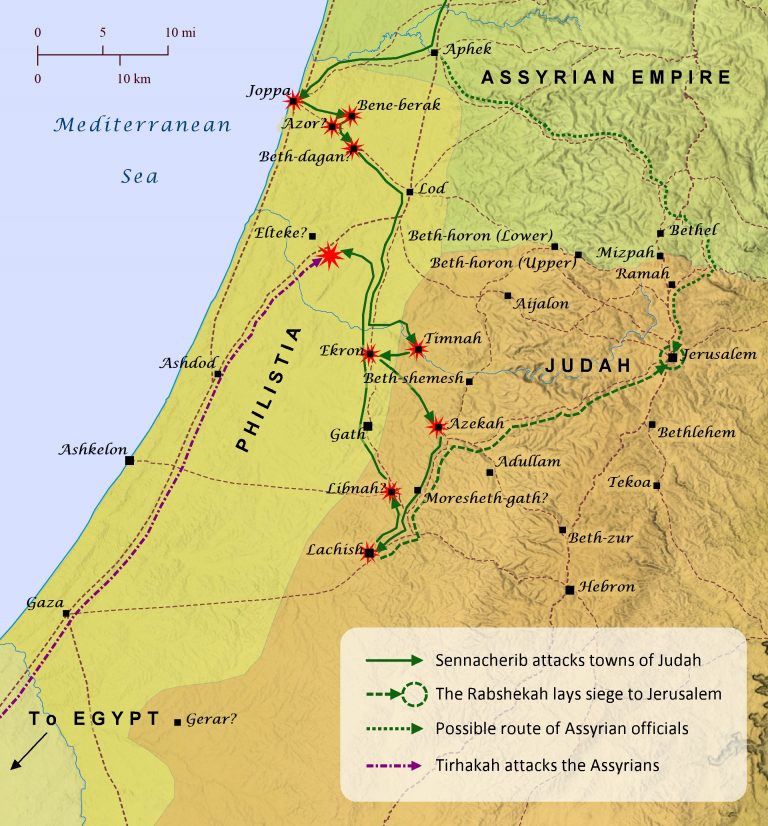
Isaiah 36–39 recounts the dramatic events surrounding 701 B.C., when Assyria launched its decisive campaign against Judah. The crisis followed the death of Sargon II in 705 B.C., an event that triggered widespread rebellion throughout the Assyrian Empire early in the reign of his successor, Sennacherib. Resistance flared across the Fertile Crescent: Merodach-Baladan stirred revolt in Babylon to the east, while Shabako led opposition from Egypt in the west. Encouraged by a pro-Egyptian faction that gained influence in Jerusalem, King Hezekiah aligned Judah with this anti-Assyrian coalition.
In response, Sennacherib first secured his eastern territories, then marched west to crush the rebellion. Phoenicia was subdued, and the smaller regional powers quickly fell. Philistia and Egypt were devastated, and Judah itself was systematically ravaged as Sennacherib tightened the noose around Jerusalem. By 701 B.C., the Assyrian king stood poised to besiege the city. At this critical moment, Rabshakeh, Sennacherib’s chief spokesman, delivered a chilling ultimatum demanding Jerusalem’s surrender (Isa 36:8–13). Humanly speaking, Judah’s situation was hopeless—yet it was precisely then that the Lord intervened, miraculously delivering Jerusalem and demonstrating that the fate of nations ultimately rests not in imperial power, but in the sovereign hand of God.
ASSYRIANS ASSAULT
TAKES JUDEAN CITIES
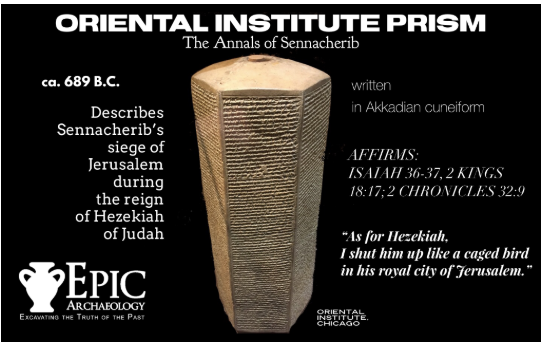
Now in the fourteenth year of King Hezekiah, Sennacherib king of Assyria came up against all the fortified cities of Judah and seized them - The invasion described in Isaiah 36:1 and 2 Kings 18:13 took place in 701 BC, which corresponds to the fourteenth year of King Hezekiah’s reign and is one of the best-established dates in Old Testament history. It is confirmed not only by the biblical text but also by Assyrian records, including Nineveh inscriptions such as Sennacherib’s Prism, which describe Sennacherib’s campaign against Judah.
Click to enlarge
Wikipedia in the Annals of Sennacherib has this historical note recorded on the Taylor Prism (pictured above) -
As for the king of Judah, Hezekiah, who had not submitted to my authority, I besieged and captured forty-six of his fortified cities, along with many smaller towns, taken in battle with my battering rams. ... I took as plunder 200,150 people, both small and great, male and female, along with a great number of animals including horses, mules, donkeys, camels, oxen, and sheep. As for Hezekiah, I shut him up like a caged bird in his royal city of Jerusalem. I then constructed a series of fortresses around him, and I did not allow anyone to come out of the city gates. His towns which I captured I gave to Mitinti, king of Ashdod; Padi, ruler of Ekron; and Silli-bel, king of Gaza.
This moment marked a severe national crisis, placing immense pressure on Hezekiah’s faith and leadership as Judah faced overwhelming military odds against the mighty Assyrian forces, the greatest army in the world at that time. The invasion tested whether Hezekiah's trust would rest in human defenses or in the LORD Alone. This episode reminds us that even God’s faithful servants are not spared trials, but that such trials often become the stage on which God displays His saving power and faithfulness. As Ps 34:19 declares, “Many are the afflictions of the righteous, but the LORD delivers him out of them all.” Another way to look at this truth is that faith does not mean we will have no attacks or tests! (Jas 1:2-7, 1Pe 1:6-7, 1Pe 4:12)
ARCHEAOLOGY FINDINGS CONFIRMING ASSYRIAN INVASION OF JUDAH - Here is part of the Akkadian insciption found on the Taylor Prism - "As for Hezekiah the Judahite, who did not submit to my yoke…Forty-six of his strong, walled cities… which were without number… I besieged, I captured…200,150 people… male and female… horses, mules, asses, camels, cattle and sheep… I brought away from them and counted as spoil. Hezekiah himself, like a caged bird I shut up in Jerusalem, his royal city…His cities which I had despoiled, I cut off from his land…" (Source)
Bob Utley - "in the fourteenth year of King Hezekiah" Gleason Archer, Encyclopedia of Bible Difficulties, p. 207, asserts that a copyist miscopied "24" to "14." The 24th year fits the other dates given in 2 Kings. SPECIAL TOPIC: TEXTUAL CRITICISM
Bob Utley - "Sennacherib king of Assyria" He began this invasion in 701 B.C. See Introduction to Isaiah for further historical information.The Jewish Study Bible, p. 763, has a good summary of the Assyrian account of this incursion. "Sennacherib's own accounts mention that he conqered 46 strong cities and forts, that he captured over 200,000 people, that he made 'Hezekiah a prisoner in Jerusalem, like a bird in a cage,' and that Hezekiah paid him a large tribute, including his daughters, palace women, and male and female singers."
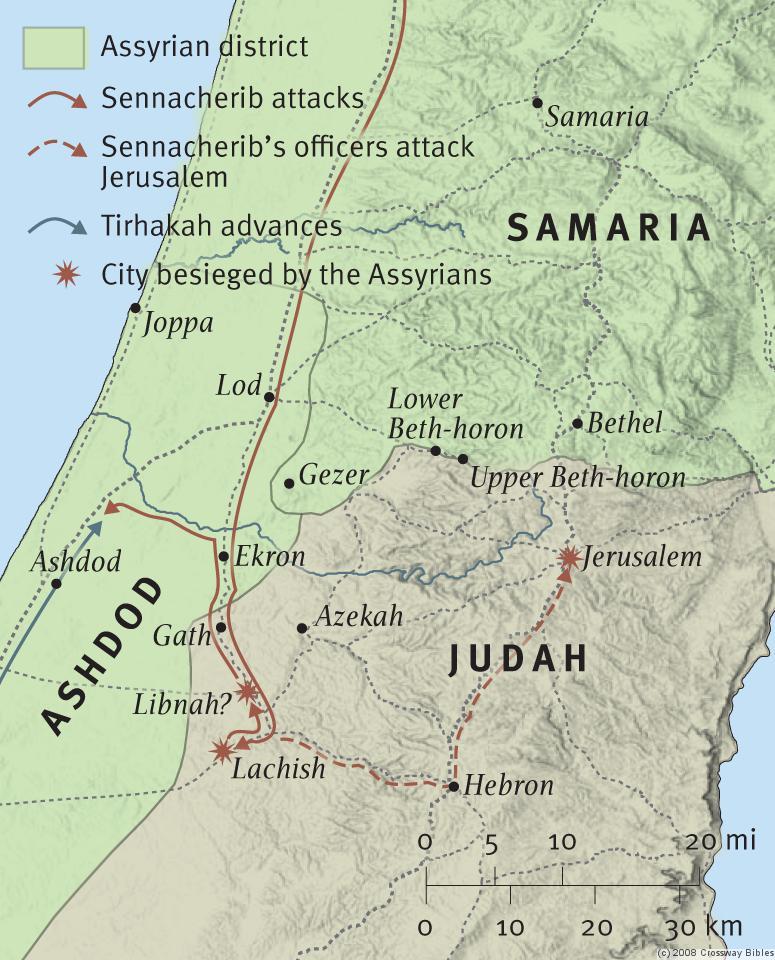
ESV Study Bible page 790 (borrow)
See Sennacherib’s Siege of Lachish - Study reveals how Assyria conquered the Judahite city - excerpt...
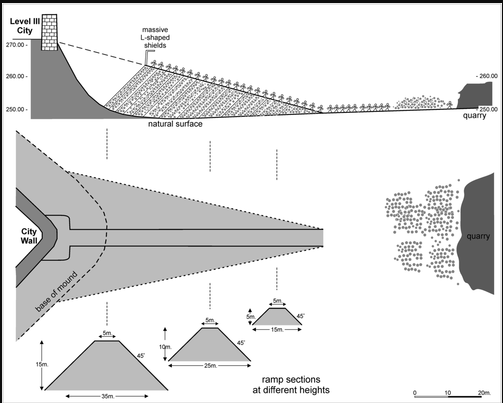
Plan and section drawings of the reconstructed siege ramp at Lachish,
starting from the far end with a stone quarry nearby
Credit: Yosef Garfinkel et al.
Perhaps no event recorded in the Hebrew Bible is better supported by archaeology and external evidence than Sennacherib’s siege of Lachish in 701 B.C.E. The siege of Lachish is documented in multiple Assyrian texts and reliefs and is also clearly visible in the site’s archaeology. These various sources agree that Lachish eventually fell to the Assyrians, who built a massive siege ramp to reach the top of the city’s walls. The same tactic would later be used by the Romans in their siege of Masada. A study, published in the Oxford Journal of Archaeology, examines what went into the construction of the Lachish siege ramp and, in turn, argues for the accuracy of the biblical description of the event. (full article)
QUESTION - Who was Sennacherib? gotquestions.org
ANSWER - Sennacherib was the king of Assyria who reigned from about 720 BC to 683 BC. Archaeologists have uncovered the remains of his palace in Khorsebad, near the ancient city of Nineveh (Jonah 1:1–3). During the reign of King Hezekiah in Judah, Sennacherib invaded Judah, bent on conquering Jerusalem (2 Kings 18:13). Assyria had already conquered the northern kingdom of Israel in 722 BC and had taken the people captive. Second Kings 18:12 says, “This happened because they did not listen to the voice of the LORD their God, but violated His covenant—all that Moses the servant of the LORD had commanded—and would neither listen nor obey.” Now, under Sennacherib, Assyria stood poised to conquer Judah, too.
King Sennacherib’s men first attacked forty-six of Judah’s fortified cities and captured them (Isaiah 36:1). Then they laid siege on Jerusalem. In desperation, Hezekiah sent gold and silver as a peace offering to Assyria, hoping to appease the power-hungry Sennacherib (2 Kings 18:13–16). The Lord sent word to Hezekiah that Sennacherib would not step foot inside the city of Jerusalem (Isaiah 37:33), so Hezekiah stood firm and refused to give in to the Assyrian king’s boastful threats (2 Kings 18:28–35; 2 Chronicles 32:17). He commanded the terrified citizens of Jerusalem not to answer taunts from Sennacherib’s men outside the wall (2 Kings 18:36). Instead, Hezekiah encouraged the people in the Lord: “Be strong and courageous. Do not be afraid or discouraged because of the king of Assyria and the vast army with him, for there is a greater power with us than with him. With him is only the arm of flesh, but with us is the Lord our God to help us and to fight our battles” (2 Chronicles 32:7–8).
Hezekiah sent messengers to Isaiah the prophet to learn what God said on the matter. Because Sennacherib had blasphemed the Lord in his threats against Jerusalem, Isaiah told the king’s messengers, “Tell your master that this is what the LORD says: ‘Do not be afraid of the words you have heard, with which the servants of the king of Assyria have blasphemed Me. Behold, I will put a spirit in him so that he will hear a rumor and return to his own land, where I will cause him to fall by the sword’” (2 Kings 19:5–7).
Hezekiah received the message from Isaiah gladly, but Sennacherib sent Hezekiah a letter of his own: “Do not let the god you depend on deceive you when he says, ‘Jerusalem will not be given into the hands of the king of Assyria.’ Surely you have heard what the kings of Assyria have done to all the countries, destroying them completely. And will you be delivered? Did the gods of the nations that were destroyed by my predecessors deliver them—the gods of Gozan, Harran, Rezeph and the people of Eden who were in Tel Assar? Where is the king of Hamath or the king of Arpad? Where are the kings of Lair, Sepharvaim, Hena and Ivvah?” (2 Kings 19:10–13). King Sennacherib had a long list of victories to boast of, but he made the mistake of thinking Israel’s God was just like the gods of the nations he had defeated.
King Hezekiah took the boastful letter he received from Sennacherib to the temple where he spread it out before the Lord. Then he prayed, “Lord, the God of Israel, enthroned between the cherubim, you alone are God over all the kingdoms of the earth. You have made heaven and earth. Give ear, Lord, and hear; open your eyes, Lord, and see; listen to the words Sennacherib has sent to ridicule the living God” (2 Kings 19:15–16). Hezekiah acknowledged that Assyria was powerful, but he knew that God was more powerful: “It is true, Lord, that the Assyrian kings have laid waste these nations and their lands. They have thrown their gods into the fire and destroyed them, for they were not gods but only wood and stone, fashioned by human hands. Now, Lord our God, deliver us from his hand, so that all the kingdoms of the earth may know that you alone, Lord, are God” (2Ki 19:17–19).
The prophet Isaiah sent word to Hezekiah that, because of Sennacherib’s blasphemous taunts about the God of Israel, the Lord Himself would fight for them and destroy Sennacherib and his armies. Sennacherib was not just defying Israel; he was defying the Living God. That night, the angel of the Lord slew 185,000 in the Assyrian camp. When Sennacherib saw the carnage, he abandoned his conquest of Jerusalem and fled to Nineveh. He never stepped foot inside Jerusalem, just as Isaiah had said.
As Psalm 139:7–12 reminds us, no one can hide from the Lord. One day as Sennacherib was worshiping in his god’s temple, his own sons killed him with a sword (2 Kings 19:36–37). Thus Isaiah’s prophecy of verse 7 was fulfilled.
Hezekiah’s passive victory over Sennacherib is another example of the Lord’s promise to fight for His people (Exodus 14:14; 1 Samuel 17:47; cf. 2 Kings 19:34). As long as they honored Him and obeyed His commands, the Lord was their Defender. He often allowed them to face opposition greater than their resources in order to demonstrate His power and love. The Lord still seeks those who will honor Him so that He can show Himself strong on their behalf (2 Chronicles 16:9). The account of Sennacherib’s failed siege ends with this: “So the Lord saved Hezekiah and the people of Jerusalem from the hand of Sennacherib king of Assyria and from the hand of all others. He took care of them on every side” (2 Chronicles 32:22). Once again, the Lord demonstrated to Judah and to all who call upon His name that “the battle is the Lord’s” (1 Samuel 17:47).
F B Meyer - Sennacherib. -- It must have been a vast disappointment when the Assyrian came to invade Judah. But the invasion would probably give a great assistance to the cause of reform, arresting and warning many who thought the king too particular. It was a great mistake to bribe Sennacherib; and, like so many of our expedients, it did not avail. What a lamentable pity that Hezekiah did not, from the commencement of his trouble, throw himself on the protecting care of God! If the king had only trusted this time as he did the next, there would have been no need for the bribe. God would have delivered His people.
Gleason Archer - How could Sennacherib’s invasion have occurred in the fourteenth year of Hezekiah?
2 Kings 18:13 in the Masoretic text states: “Now in the fourteenth year of King Hezekiah, Sennacherib king of Assyria came up against all the fortified cities of Judah and seized them.” Since Sennacherib’s own record in the Taylor Prism establishes 701 B.C. as the date of that invasion, the fourteenth year of Hezekiah would mean that he did not ascend the throne until 715 B.C. Yet 2 Kings 18:1 (the very same chapter, be it noted) states that Hezekiah became king in the third year of Hoshea king of Israel—which comes out to 729 or 728. This would have been the year in which he was crowned as subordinate king, under his father Ahaz (who did not die until 725). The Masoretic text of 2 Kings 18:13 therefore stands in clear contradiction to 18:1, 9, and 10, which confirm that Hezekiah’s fourth year was Hoshea’s seventh and that Hezekiah’s sixth was Hoshea’s ninth (i.e., 722 B.C.). We must therefore conclude that the Masoretic text has preserved an early textual error (which also appears in Isa. 36:1—where the error probably originated), in which a mistake was made in the decade column. The word “fourteen” was originally “twenty-four.” (for further details, see the articles on 2 Kings 8:24 and Ezra 2 and Nehemiah 7. Compare also my Survey of Old Testament Introduction, pp. 291–92, and E.J. Young, Book of Isaiah: New International Commentary, 2 vols. [Grand Rapids: Eerdmans, 1969], 2:540–42.)
Norman Giesler - 2 KINGS 18:13—How can this verse say that Sennacherib invaded Judah in the fourteenth year of Hezekiah?
PROBLEM: 2 Kings 18:13 claims that “in the fourteenth year of King Hezekiah, Sennacherib king of Assyria came up against all the fortified cities of Judah and took them.” Since archaeological evidence has established Sennacherib’s invasion at 701 B.C., this would mean that Hezekiah became co-regent with his father Ahaz in 719 B.C., and sole ruler of Judah in 715 B.C. However, according to 2 Kings 18:1, Hezekiah became co-regent in 729 B.C., and he became sole ruler of Judah when his father died in 725 B.C. This is a discrepancy of ten years. Which account is correct?
SOLUTION: The claim that Sennacherib invaded Judah in the fourteenth year of Hezekiah is clearly a copyist error. Sennacherib actually invaded Judah in the twenty-fourth year of the reign of Hezekiah of Judah. The error is easy to explain since the difference between the two numbers is a single Hebrew letter. The Hebrew consonants for “fourteen” are rb srh, while the Hebrew consonants for “twenty-four” are rb srm (the ancient manuscripts did not write the vowels, see Appendix 2). The final letters are the only difference in the written text. In fact, the words are the same, only the word “twenty” is simply the plural form of the word “ten.” We might express the way the Hebrew is written as “four ten,” or “four twenty.” It is simply a case where a copyist miscopied the form from “four twenty” to “four ten.” See When Critics Ask
Tentative list of rulers and approximate dates:
- 1354-1318 Asshur-Uballit I:
- conquered the Hittite city of Carchemish
- began to remove Hittite influence and allowed Assyria to develop
- 1297-1266 Adad-Nirari I (powerful king)
- 1265-1235 Shalmaneser I (powerful king)
- 1234-1197 Tukulti-Ninurta I
– first conquest of Babylonian empire to the south - 1118-1078 Tiglath-Pileser I
– Assyria becomes a major power in Mesopotamia - 1012- 972 Ashur-Rabi II
- 972- 967 Ashur-Resh-Isui II
- 966- 934 Tiglath-Pileser II
- 934- 912 Ashur-Dan II
- 912- 890 Adad-Nirari II
- 890- 884 Tukulti-Ninurta II
- 883- 859 Asshur-Nasir-Apal II
- 859- 824 Shalmaneser III
– Battle of Qarqar in 853 - 824-811 Shamashi-Adad V
- 811-783 Adad-Nirari III
- 781-772 Shalmaneser IV
- 772-754 Ashur-Dan III
- 754-745 Ashur-Nirari V
- 745-727 Tiglath-Pileser III
- called by his Babylonian throne name, Pul, in 2 Kings 15:19
- very powerful king
- started the policy of deporting conquered peoples
- In 735 B.C. there was the formation of the "Syro-Ephramatic League," which was an attempt to unify all the available military resources of the trans-Jordan nations from the head waters of the Euphrates to Egypt for the purpose of neutralizing the rising military power of Assyria. King Ahaz of Judah refused to join and was invaded by Israel and Syria. He wrote to Tiglath-Pileser III for help against the advise of Isaiah (cf. 2 Kings 16; Isaiah 7-12).
- In 732 Tiglath-Pileser III invades and conquers Syria and Israel and places a vassal king on the throne of Israel, Hoshea (732-722). Thousands of Jews from the Northern Kingdom were exiled to Media (cf. 2 Kings 15).
- 727-722 Shalmaneser V
- Hoshea forms an alliance with Egypt and is invaded by Assyria (cf. 2 Kings 17)
- besieged Samaria in 724 B.C.
- 722-705 Sargon II:
- After a three year siege started by Shalmaneser V, his successor Sargon II conquers the capital of Israel, Samaria. Over 27,000 are deported to Media.
- The Hittite empire is also conquered.
- In 714-711 another coalition of trans-Jordan nations and Egypt rebelled against Assyria. This coalition is known as "the Ashdad Rebellion." Even Hezekiah of Judah originally was involved. Assyria invaded and destroyed several Philistine cities.
- 705-681 Sennacherib:
- In 705 another coalition of transJordan nations and Egypt rebelled after the death of Sargon II. Hezekiah fully supported this rebellion. Sennacherib invaded in 701. The rebellion was crushed but Jerusalem was spared by an act of God (cf. Isaiah 36-39 and 2 Kings 18-19).
- Sennacherib also put down the rebellion in Elam and Babylon.
- 681-669 Esarhaddon:
- first Assyrian ruler to attack and conquer Egypt
- had great sympathy with Babylon and rebuilt its capital city
- 669-633 Ashurbanipal:
- also called Osnappar in Ezra 4:10
- His brother Shamash-shum-ukin was made king of Babylon. This brought several years of peace between Assyria and Babylon but there was an undercurrent of independence which broke out in 652 led by his brother.
- fall of Thebes, 663 B.C.
- defeated Elam, 653, 645 B.C.
- 633-629 Asshur-Etil-Ilani
- 629-612 Sin-Shar-Ishkun
- 612-609 Asshur-Uballit II:
– enthroned king in exile in Haran after the fall of Assher in 614 B.C. and Nineveh in 612 B.C.
Isaiah 36:2 And the king of Assyria sent Rabshakeh from Lachish to Jerusalem to King Hezekiah with a large army. And he stood by the conduit of the upper pool on the highway of the fuller’s field.
NLT Then the king of Assyria sent his personal representative with a huge army from Lachish to confront King Hezekiah in Jerusalem. The Assyrians stopped beside the aqueduct that feeds water into the upper pool, near the road leading to the field where cloth is bleached.
- sent: 2Ki 18:17-37 2Ch 32:9-23
- the conduit: Isa 7:3 22:9-11
"LET'S MAKE
A DEAL"
And the king of Assyria sent Rabshakeh - Isaiah 36:1-10 summarizes Rabhakeh's first attempt at intimidating Judah to surrender. Note that this is not actually this man's name but means "chief cupbearer" (or "chief wine-pourer) and is the title for a high official, presumably the chief officer of the Assyrian army.
Oswalt: Hezekiah thought he had bought the Assyrians off with tribute (2 Kings 18:13-16)
from Lachish - Lachish was located about 30 miles southwest of Jerusalem and was one of Judah’s most important fortified cities and serving as a major staging area for Sennacherib’s Assyrian army during the invasion of Judah in 701 BC (cf. 2Ki 18:14, 17; 2Ch 32:9). Its strategic position guarding the western approaches to Jerusalem made it a key military objective. The city’s fall is vividly documented in Assyrian palace reliefs from Nineveh, which depict the siege of Lachish in graphic detail—underscoring both the brutality of Assyrian warfare and the grave threat facing Judah at the time.
to Jerusalem to King Hezekiah with a large army - So much for tons of precious metal buying security! It probably helped finance this attack against Jerusalem! Tartan, Rab-saris, and Rabshakeh refer to high-ranking Assyrian officers. The Tartan was the commander-in-chief, the Rab-saris was a chief official or court officer, and the Rabshakeh was likely the field commander or spokesman. Their arrival “with a great army” was meant to intimidate Jerusalem and demonstrate Assyria’s power.
And he stood by the conduit of the upper pool on the highway of the fuller’s field The conduit of the upper pool was part of Jerusalem’s water system, a vital resource during a siege. One of the standard tactics of Assyrian warfare was to seize water sources and cut off access to them, thereby weakening and demoralizing the nation under siege. The Assyrian officials’ decision to meet Hezekiah’s delegation at the conduit of the upper pool was therefore a deliberate act of psychological warfare. By positioning themselves at a critical water supply for Jerusalem, the Assyrians were silently communicating both their strategic awareness and their intention to strangle the city’s lifeline, an intimidation tactic designed to instill fear and undermine confidence in Judah’s defenses.
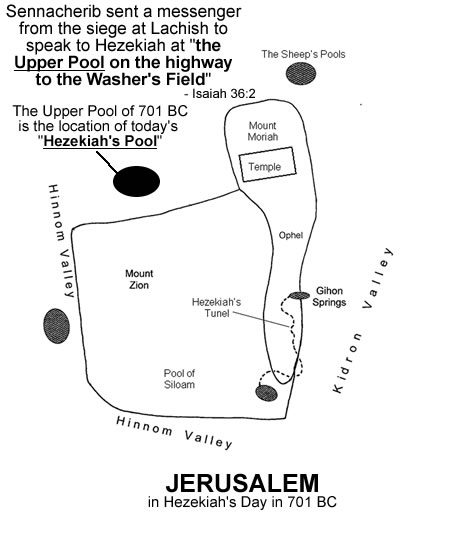
Possible Location of Upper Pool
Scholars disagree
It is interesting that the conduit of the upper pool, on the highway to the fuller’s field is the same place where, years earlier, the prophet Isaiah had met King Ahaz, Hezekiah’s father, to urge him to trust in the Lord rather than in foreign alliances (Isaiah 7:3). Now, in the same spot, Hezekiah faced the same test of faith his father had failed.
Conduit = a water-channel / aqueduct associated with a reservoir (“upper pool”). In other words, a known waterworks landmark.
Fuller’s field = an area associated with cloth-washing/bleaching, which naturally fits a location near water. The spot had to be close enough to Jerusalem’s wall for negotiations/shouting to be heard (Rabshakeh episode)
Whitcomb - The location of the confrontation was significant: “the conduit of the upper pool, which is in the highway of the fuller’s field” (2 Kings 18:17). It was here, on the high ground overlooking the city from the northwest, where laundrymen (fullers) found sufficient water for their trade, that Isaiah had challenged wicked Ahaz thirty-three years earlier with a divine alternative: either trust Jehovah or face the Assyrians (Isa. 7:3-17). Ahaz, on behalf of his people, made his decision, and God’s warning was now being fulfilled.
Beall: Hezekiah here is presented in conscious contrast to his father Ahaz and his actions. Indeed, Rabshakeh picks the very spot to blaspheme the Lord where Isaiah had stood years before to exhort Ahaz to trust in the Lord. And it was Assyria to whom Ahaz had turned for refuge; now that nation was threatening Judah! Yet, Hezekiah's godly response differed entirely from his father's reaction to a much less serious threat.
Bob Utley - "Tartan" This was not a personal name but a title, "Commander-in-chief of the Army" (BDB 1077, cf. Isa. 20;1). "Rab-saris" This was not a personal name but a title, "Chief Eunuch" (BDB 913 CONSTRUCT BDB 710)., cf. Jer. 39:3,13). "Rabshakeh" This is not a personal name but a title, "Chief Cupbearer" (BDB 913 II; NIDOTTE, vol. 4, p. 232, #5). "by the conduit of the upper pool" This was probably on the north side close to the Assyrian camp at Lachish. See Isa. 7:3. "fuller's field" This is a CONSTRUCT of "field" (BDB 911) and "wash" (BDB 460, KB 459, Qal ACTIVE PARTICIPLE). Washing clothes in the ANE did not involve soap but beating on stones or treading on them to loosen the dirt. It is possible this field was (1) a place of pounding or treading clothes (i.e., a water source) (2) a place where wet clean clothes were spread out to dry (3) a place where new cloth was softened (TEV, Walter Duckat, Beggar to King: All the Occupations of Biblical Times, p. 88)
QUESTION - Who was Rabshakeh in the Bible? | GotQuestions.org
ANSWER - The term Rabshakeh means “the chief of the princes” and refers to a field commander sent by Sennacherib, king of Assyria, as a messenger to King Hezekiah of Judah (Isaiah 36). It is unclear whether Rabshakeh was the man’s given name or whether it was merely his title, designating his office. Other Bible versions translate Rabshakeh as “field commander” (NIV), “Assyrian chief of staff” (NLT), and “royal spokesman” (CSB). Rabshakeh could also refer to the chief cupbearer or vizier of the Assyrian court.
Sennacherib’s Assyrian army had defeated the northern kingdom of Israel. 2 Kings 18:12 says that “this happened because they [Israel] had not obeyed the Lord their God, but had violated his covenant—all that Moses the servant of the Lord commanded. They neither listened to the commands nor carried them out.” Sennacherib had also captured all the fortified cities in Judah and was poised to capture Jerusalem, too. He sent the Rabshakeh with a great army to issue a challenge to Hezekiah. Using the Hebrew language, the Rabshakeh said, “Tell Hezekiah that this is what the great king, the king of Assyria, says: What is the basis of this confidence of yours? You claim to have a strategy and strength for war, but these are empty words. In whom are you now trusting, that you have rebelled against me?” (Isaiah 36:4–5). The Rabshakeh used the native language of the Jews in order to be heard by the Jewish guards on the wall. He may have been hoping his words would terrify them into pressuring Hezekiah to surrender.
Hezekiah’s emissaries, Eliakim, Shebna, and Joah, said to the Rabshakeh, “Please speak to your servants in Aramaic, since we understand it. Don’t speak to us in Hebrew in the hearing of the people on the wall” (Isaiah 36:11). But the Rabshakeh only shouted louder in Hebrew, hoping to shake their faith and turn the common people of Judah against their king (Isaiah 36:13).
The Rabshakeh’s message to the people of Jerusalem was full of lies, boasts, and blasphemies:
• he questioned the object of their trust
• he ridiculed Hezekiah’s strategy as weak and ineffective
• he discounted any help they might receive from Egypt
• he told them the Lord had turned against them
• he claimed the Lord had sent him to destroy the land of Judah
• he crudely reminded them of the horrors of being under siege
• he accused Hezekiah of deceiving the people
• he scoffed at the notion of trusting in the Lord
• he offered gifts of land and peace to anyone who would surrender
• he reminded them that no nation’s gods had yet been able to deliver it from Assyria
• he equated the Lord with the impotent gods of the other nations
When Hezekiah heard the threats, he sent his emissaries to consult with the Lord’s prophet, Isaiah (Isaiah 37:1–2). Isaiah told them, “This is what the Lord says: Do not be afraid of what you have heard—those words with which the underlings of the king of Assyria have blasphemed me. Listen! When he hears a certain report, I will make him want to return to his own country, and there I will have him cut down with the sword” (verses 6–7). Hezekiah also took the message he had received from the Rabshakeh to the temple, where he laid it before the Lord and prayed for help.
The Lord did defend Jerusalem, just as He promised (Isaiah 37:36–38). Despite the taunts and manipulative attempts by the Rabshakeh to defeat God’s people, the Assyrian army was destroyed, and the Lord’s purpose prevailed. It will always prevail (Isaiah 46:9–11).
Many today attempt to dishearten God’s people, through ridicule, blasphemy, and lies. Like the Rabshakeh, they see themselves as invincible and possibly even claim that God is on their side. Believers must run to God’s Word, seek for wisdom, and pray. Then they must trust in God’s promises.
Malachi 3:17–18 reveals God’s response when a modern-day Rabshakeh challenges us:
“‘On the day when I act,’ says the Lord Almighty, ‘[those who feared the Lord] will be my treasured possession. I will spare them, just as a father has compassion and spares his son who serves him. And you will again see the distinction between the righteous and the wicked, between those who serve God and those who do not.’”
Utley - Josephus Antiquities 10.1.1., mentions the name of Sennacherib's military general as Rabshakeh, his two commanders as Tartan and Rab-saris (cf. 2 Kgs. 18:17). Josephus says Sennacherib ignored his promise not to besiege Jerusalem in light of Hezekiah's offer to pay a large tribute, mostly from the temple (cf. 2 Kgs. 18:13-16), but instead he attacked Egypt and Ethiopia but left a large military contingent to attack and destroy Jerusalem.
Isaiah 36:3 Then Eliakim the son of Hilkiah, who was over the household, and Shebna the scribe, and Joah the son of Asaph, the recorder, came out to him.
NLT These are the officials who went out to meet with them: Eliakim son of Hilkiah, the palace administrator, Shebna the court secretary, and Joah son of Asaph, the royal historian.
- Eliakim: Isa 22:15-20
- Shebna: 2Sa 8:16,17 20:24,25
Related passages:
2Ki 18:17-18 Then the king of Assyria sent Tartan and Rab-saris and Rabshakeh from Lachish to King Hezekiah with a large army to Jerusalem. So they went up and came to Jerusalem. And when they went up, they came and stood by the conduit of the upper pool, which is on the highway of the fuller’s field. 18 When they called to the king, Eliakim the son of Hilkiah, who was over the household, and Shebnah the scribe and Joah the son of Asaph the recorder, came out to them.
2Ch 32:9 After this Sennacherib king of Assyria sent his servants to Jerusalem while he was besieging Lachish with all his forces with him, against Hezekiah king of Judah and against all Judah who were at Jerusalem, saying,
KING'S ASSISTANTS
ANSWER ASSYRIAN THREATS
Then Eliakim the son of Hilkiah, who was over the household, and Shebna the scribe, and Joah the son of Asaph, the recorder, came out to him. To send high ranking officials instead of the ruler appearing was common diplomatic practice in the ancient Near East, especially when dealing with hostile envoys. Eliakim the son of Hilkiah, who was over the household, would probably be like our modern prime minister.
Believers Study Bible - Shebna, the scribe, was one of Hezekiah's negotiators. Later he would turn from the ways of God and be denounced by Isaiah as a man utterly worthless in character, one doomed to be driven away by God's judgment like a ball tossed with the foot (Isa. 22:15-18).
Bob Utley - As Sennacherib's officials are listed in v. 17, so here, Hezekiah's (cf. 2 Kgs. 19:2). (1) Eliakim ‒ over the household, v. Isa. 22:20; 36:3,22; 37:2; see Roland deVaux, Ancient Israel, pp. 129-131 (2) Shebna ‒ the scribe, Isa. 22:15; 36:3,22; see Roland deVaux, Ancient Israel, pp. 131-132 (3) Joah ‒ the recorder of Isa. 36:22, this title is from the VERB "remember" (BDB 269); it was used of official court records in 2 Sam. 8:16; 20:24; 1 Kgs. 4:3; 2 Kgs. 18:37; Isa. 36:3,22; 1 Chr. 18:15; 2 Chr. 34:8; see Roland deVaux, Ancient Israel, p. 132
QUESTION - Who was Eliakim son of Hilkiah? | GotQuestions.org
ANSWER - Eliakim son of Hilkiah was an important figure during the reign of King Hezekiah of Judah. Eliakim was known for his role as royal steward during a tremendous political and military crisis. His service in Hezekiah's administration, particularly during the Assyrian siege of Jerusalem, reveals his significance as a faithful and trusted leader. Eliakim’s actions demonstrate wisdom, loyalty, and trust in God. During his brief but significant presence in the Bible during a challenging time, Eliakim models the steadfastness of those who sought to defend the city and its people.
Eliakim’s story is recorded in the books of 2 Kings and Isaiah, where he is described as the steward or palace administrator during Hezekiah’s reign. His position was one of considerable influence, as he managed the royal household and served as an advisor to the king. Eliakim is first mentioned during the Assyrian invasion of Judah when the Assyrian army besieges Jerusalem: “[The Assyrian envoy] called for the king; and Eliakim son of Hilkiah the palace administrator, Shebna the secretary, and Joah son of Asaph the recorder went out to them” (2 Kings 18:18).
The historical context in which Eliakim son of Hilkiah lived is critical. The Assyrian Empire, under King Sennacherib, had already conquered the northern kingdom of Israel and was now threatening the southern kingdom of Judah. Sennacherib’s army was known for its brutality, and the siege of Jerusalem was part of the Assyrians’ broader campaign to subjugate the region. As the Assyrian forces surrounded the city, the Assyrian envoy, the Rabshakeh, delivered a speech intended to demoralize the people of Jerusalem and make them question God and Hezekiah’s leadership (2 Kings 18:28–30).
Eliakim and his colleagues were sent to meet with the Rabshakeh. During the exchange, Eliakim asked the Assyrian official to not speak in Hebrew: “Please speak to your servants in Aramaic, since we understand it. Don’t speak to us in Hebrew in the hearing of the people on the wall” (2 Kings 18:26). Eliakim’s concern was that, if the people of Jerusalem heard and understood what the Assyrians were saying, they would be that much more demoralized. However, the Rabshakeh refused to speak in Aramaic and continued to communicate in Hebrew, further inciting fear among the citizens of Jerusalem.
Eliakim’s actions reflect his commitment to maintaining calm and order in the city. After the meeting with the Assyrian envoy, Eliakim and the other officials tore their clothes in grief and returned to Hezekiah, reporting the blasphemous words they had heard. In response, Hezekiah sought guidance from the prophet Isaiah, who delivered a message of reassurance. Isaiah prophesied that God would defend Jerusalem and that Sennacherib would fail in his siege. In Isaiah 37:6–7, Isaiah tells Hezekiah’s officials, “This is what the Lord says: Do not be afraid of what you have heard—those words with which the underlings of the king of Assyria have blasphemed me. Listen! When he hears a certain report, I will make him want to return to his own country, and there I will have him cut down with the sword.”
Eliakim’s role extended beyond the immediate crisis. Isaiah 22 contains a prophecy about Eliakim’s future leadership and his authority in Judah: “In that day I will summon my servant, Eliakim son of Hilkiah. I will clothe him with your robe and fasten your sash around him and hand your authority over to him. He will be a father to those who live in Jerusalem and to the people of Judah. I will place on his shoulder the key to the house of David; what he opens no one can shut, and what he shuts no one can open” (Isaiah 22:20–22). This prophecy foretells Eliakim’s rise to even greater authority, symbolized by his having the “key to the house of David,” which represents the stewardship of the royal household and the responsibility for guiding the people of Judah.
The description of Eliakim as a “father to those who live in Jerusalem” in Isaiah 22:21 emphasizes his role as a compassionate and caring leader, someone who would lead with integrity and wisdom. His leadership contrasts with that of Shebna, the previous steward, who had misused his position for personal gain (see Isaiah 22:15–19). Eliakim’s appointment to this position was a divinely ordained act that would stabilize Judah. He was not only Hezekiah’s servant but God’s.
Isaiah 36:4 Then Rabshakeh said to them, “Say now to Hezekiah, ‘Thus says the great king, the king of Assyria, “What is this confidence that you have?
NLT Then the Assyrian king's personal representative sent this message to King Hezekiah: "This is what the great king of Assyria says: What are you trusting in that makes you so confident?
Related Passages:
2Ki 18:19 Then Rabshakeh said to them, “Say now to Hezekiah, ‘Thus says the great king, the king of Assyria, “What is this confidence that you have?
2Ch 32:10 “Thus says Sennacherib king of Assyria, ‘On what are you trusting that you are remaining in Jerusalem under siege?
- Thus saith: Isa 10:8-14 37:11-15 Pr 16:18 Eze 31:3-18 Da 4:30 Ac 12:22,23 Jude 1:16
- What: 2Ki 18:5,19-37 19:10 2Ch 32:7-10,14-16 Ps 42:3,10 71:10,11
ATTEMPTS TO
SOW DOUBT
Then Rabshakeh said to them, “Say now to Hezekiah, ‘Thus says the great king, the king of Assyria, “What is this confidence that you have? The pagan king asks King Hezekiah a great question. One can only imagine the Holy Spirit nudging Hezekiah's heart when he heard this challenging question! The result is described in 2Ch 32:20-21...
But King Hezekiah and Isaiah the prophet, the son of Amoz, prayed about this and cried out to heaven. 21 And the LORD sent an angel who destroyed every mighty warrior, commander and officer in the camp of the king of Assyria. So he returned in shame to his own land. And when he had entered the temple of his god, some of his own children killed him there with the sword.
One is reminded of David's words in Psalm 20:7 "Some boast in chariots and some in horses, but we will boast in the name of the LORD, our God." Hezekiah did the latter!
Rabshakeh’s question about Judah’s confidence captures the age-old conflict between faith and fear. The world still asks believers, “What is this confidence that you have?”—as though trusting God were foolish when circumstances appear overwhelming. Scripture, however, consistently teaches that true confidence is found only in the Lord, not in visible strength or human calculation. Psalm 27:1 declares, “The Lord is my light and my salvation; whom shall I fear? The Lord is the stronghold of my life; of whom shall I be afraid?”
Bob Utley - "the great king" This was a characteristic title of the Assyrian monarch, like "King of Kings" was for Babylonian kings. It was a way to designate the main/chief ruler over many vassal kings. "What is this confidence that you have" This refers to Hezekiah's trust in YHWH (cf. 2Ki 18:22, 30, 32). The Assyrian leaders were trying to cause a rift between the king and his faith and his unpopular acts against idolatry (cf. v. 22; i.e., removing the high places, destroying the Canaanite fertility idols and his destroying Moses' bronze serpent). The people of Judah still clung to idolatry.
Bob Utley - "What is this confidence that you have" This is a very significant statement for the rest of chapter 36 and 37 because it is a play on the Hebrew word "trust" (Qal perfect, cf. Isa. 12:2; 26:3,4; 31:1; 32:9-11; 36:4,5,6 [twice],7,9,15; 37:10) or the question "what are you trusting in?" Notice that the Assyrian logic is based on their military victories over numerous other national gods. The line of psychological attack seems to impugn Hezekiah's actions on behalf of YHWH in order to impugn His power and to impugn the people's trust in Him (cf. Isa. 36:4,5,7,10,15,18; 37:4,6,10,17,20 esp., 23,29). This sets the stage, much like Daniel 3, for YHWH's confrontation with the Assyrian gods for the purpose that all of the world may know that YHWH is God (cf. Isa. 37:20; 45:6; 2 Chr. 32:7-8). This question is the theological purpose of the literary unit!
Great King - 12v - 2 Ki. 18:19; 2 Ki. 18:28; Ezr. 5:11; Ps. 47:2; Ps. 48:2; Ps. 95:3; Eccl. 9:14; Isa. 36:4; Isa. 36:13; Dan. 2:10; Mal. 1:14; Matt. 5:35
Isaiah 36:5 “I say, ‘Your counsel and strength for the war are only empty words.’ Now on whom do you rely, that you have rebelled against me?
NLT Do you think that mere words can substitute for military skill and strength? Which of your allies will give you any military backing against Assyria?
- empty words: Heb. a word of lips. I have counsel and strength for war. or, but counsel and strength are for the war. Pr 21:30,31 24:5,6
- that: 2Ki 18:7 24:1 Ne 2:19,20 Jer 52:3 Eze 17:15
YOUR STRATEGY IS
JUST EMPTY TALK
I say, ‘Your counsel and strength for the war are only empty words.’ Now on whom do you rely, that you have rebelled against me? Rabshakeh was claiming that Hezekiah’s confidence—whether in military plans, alliances, or in the Lord—was worthless against Assyria’s power. The Assyrian envoy saw trust in God as “empty words,” but Hezekiah’s later prayer proved that faith in the Lord is never in vain. The Rabshakeh’s taunt set the stage for God to show that His strength, not human might, brings true victory.
The Rabshakeh is mocking Judah’s trust, not
just military strength, but ultimately faith in the LORD.
NET NOTE - Heb "you say only a word of lips, counsel and might for battle." Sennacherib's message appears to be in broken Hebrew at this point. The phrase "word of lips" refers to mere or empty talk in Pr 14:23.
Bob Utley - "rebelled against me" This (BDB 597, KB 623, Qal PERFECT) refers to the fact that Hezekiah initially stopped paying tribute to Assyria (cf. 2 Kgs. 18:7), but then apparently began it again when Sennacherib invaded (cf. 2 Kgs. 18:14-16) and then refused a second time to pay tribute.
F B Meyer - Now on whom do you rely?
It was no small thing for Hezekiah to rebel against the proud King of Assyria. Hamath and Arpad, Samaria and Sepharvaim, Hena and Ivah, reduced to heaps of stones, were sufficient proofs of the might of his ruthless soldiers. How could Jerusalem hope to withstand? Rabshakeh could not comprehend the secret source of Hezekiah’s confidence. It was of no use for him to turn to Egypt. Pharaoh was a bruised reed. And as for Jehovah! Was there any likelihood that He could do for Israel more than the gods of the other nations had done for them? Not infrequently does the puzzled world ask the Church, “In whom dost thou trust?”
Our life must to a large extent be a mystery, our peace pass understanding, and our motives be hidden. The sources of our supply, the ground of our confidence, the reasons for our actions, must evade the most searching scrutiny of those who stand outside the charmed circle of the face of God; as it is written, “Eye hath not seen, nor ear heard . . . what God hath prepared.”
We all ought to have the secrets which the world cannot penetrate. Doubt your religion if it all lies on the surface, and if men are able to calculate to a nicety the considerations by which you are actuated. We must be prepared to be misunderstood and criticized, because our behavior is determined by facts which the princes of this world know not. We do not look up to the hills, because we look beyond them to God; we do not trust in silver or gold, or human re source, because God is our confidence. We cannot but seem eccentric to this world, because we have found another center, and are concentric with the Eternal Throne.
Dianne Matthews - On What are you basing your confidence Isaiah 36:4
The Assyrian field commander scoffed at the representatives King Hezekiah had sent. The besieged city of Jerusalem would prove to be no match for Sennacherib’s massive army, but he hoped to convince Hezekiah to surrender without fighting. “Tell Hezekiah,” the commander said, sneering, “‘this is what the great king, the king of Assyria, says: What makes you so confident?’”
The commander ridiculed Hezekiah’s hope of receiving aid from Egypt and their hope that God would rescue them. He claimed that God had turned against Judah. In a further effort to demoralize the starving inhabitants of Jerusalem, he shouted an offer to take them to a land where they would have plenty of food. He ended by listing other nations whose gods had proven ineffective against the power of Assyria. “Could the LORD then rescue Jerusalem from my control?” he mocked.
A crisis has a way of revealing where we place our confidence. Do we trust in our own wisdom and strength to handle tough problems? Is our first instinct to give up and surrender? Do we run to other people for advice and help? Or do we first drop to our knees and ask God to come to our aid? In the face of a situation that looked hopeless, Hezekiah beseeched God to rescue his people. Shortly afterward, God miraculously rescued Judah as he had promised.
Even when we face daunting problems, we can have unshakeable confidence in God if we trust his character and his promises. Rather than being self-confident or depending on others to help us, we can draw on the strength that comes from belonging to him. What makes us confident? A Savior who has promised to never leave us.
“Look! God is my Savior. I am confident and unafraid, because the LORD is my strength and my song. He is my Savior.” Isaiah 12:2
Isaiah 36:6 “Behold, you rely on the staff of this crushed reed, even on Egypt, on which if a man leans, it will go into his hand and pierce it. So is Pharaoh king of Egypt to all who rely on him.
NLT Will Egypt? If you lean on Egypt, you will find it to be a stick that breaks beneath your weight and pierces your hand. The Pharaoh of Egypt is completely unreliable!
- Isa 20:5,6 30:1-7 31:3 2Ki 17:4 2Ki 18:21 Jer 37:5-8 Eze 29:6,7
- Ps 118:9 146:3 Isa 2:22 30:2 31:1,3 36:6 Je 17:5 Ho 5:13
Related Passages:
2 Kings 18:21 “Now behold, you rely on the staff of this crushed reed, even on Egypt; on which if a man leans, it will go into his hand and pierce it. So is Pharaoh king of Egypt to all who rely on him.
MOCKING JUDAH'S
ALLIANCE WITH EGYPT
Behold, you rely on the staff of this crushed reed, even on Egypt, on which if a man leans, it will go into his hand and pierce it. So is Pharaoh king of Egypt to all who rely on him. Isaiah had warned repeatedly that Egypt would be of no help. Rabshakeh says that trusting Egypt is like leaning on a broken reed that splinters and pierces the hand. His image means Egypt was weak and unreliable—anyone depending on her for help would only be hurt.
Bob Utley - "Behold, you rely on the staff of this crushed reed, even on Egypt" Apparently, the Assyrians had inside information on Hezekiah's ill-conceived design for a military alliance with Egypt. Isaiah had earlier condemned this alliance (cf. Isa. 30:1-5; 31:1-3).
Oswalt: According to Sennacherib’s annals, the Assyrian army struck the coast at Sidon and from that point worked its way southward, devouring opponent after opponent until the Egyptian army finally made a stand at Eltekeh about twenty miles west of Jerusalem at the edge of the hill country. There Isaiah’s prophecies concerning the foolishness of dependence upon Egypt (20:1– 6; 30:1–5; 31:1–3) proved painfully true as the Egyptians were routed and the Assyrians continued on to Lachish, Judah’s last hope for stemming the tide.
Isaiah 36:7 “But if you say to me, ‘We trust in the LORD our God,’ is it not He whose high places and whose altars Hezekiah has taken away and has said to Judah and to Jerusalem, ‘You shall worship before this altar’?
NLT "But perhaps you will say, 'We are trusting in the LORD our God!' But isn't he the one who was insulted by King Hezekiah? Didn't Hezekiah tear down his shrines and altars and make everyone in Judah worship only at the altar here in Jerusalem?
- We trust: 2Ki 18:5,22 1Ch 5:20 2Ch 16:7-9 32:7,8 Ps 22:4,5 42:5,10,11
- is it not: De 12:2-6,13,14 2Ki 18:4 2Ch 30:14 31:1 32:12 1Co 2:15
Related Passages:
2 Chronicles 32:11-12 Is not Hezekiah misleading you to give yourselves over to die by hunger and by thirst, saying, “The LORD our God will deliver us from the hand of the king of Assyria”?
ATTEMPTS TO MOCK
HEZEKIAH'S REFORMS
But if you say to me, ‘We trust (batach) in the LORD our God,’ is it not He whose high places (bamah) and whose altars Hezekiah has taken away and has said to Judah and to Jerusalem, ‘You shall worship before this altar’? Rabshakeh attempts to undermine Hezekiah’s faith by mocking his religious reforms. He falsely claims that Hezekiah had angered God by removing the “high places” and altars throughout Judah, failing to recognize that Hezekiah was actually obeying God’s explicit command to worship at the one place the LORD had chosen—the temple in Jerusalem (cf. Dt 12:5–6). Rabshakeh misunderstood the nature of true worship and exploited that ignorance to sow doubt.
This verse illustrates how the world often misinterprets obedience as rebellion and faithfulness as folly. Yet genuine faith worships God on His terms, not ours, a truth Jesus later affirmed: “God is spirit, and those who worship Him must worship in spirit and truth” (Jn 4:24).
Bob Utley - "whose high places and whose altars Hezekiah has taken away" This is an attempt to impugn Hezekiah's relationship with YHWH (cf. 2 Kgs. 18:5). The thrust of the argument is that YHWH is angry with Hezekiah for closing the local high places (cf. 2 Kgs. 18:7). However, this was a misunderstanding by the Assyrians because Hezekiah did exactly what was commanded in Deuteronomy which is the centralization of worship at a site which YHWH would choose (cf. Deut. 12:2-5). The high places had become sites of Ba'al and Asherah worship (cf. 2 Kgs. 18:4). FERTILITY WORSHIP OF THE ANE
John MacArthur - The Rabshakeh mistakenly thought Hezekiah’s reforms in removing idols from all over the land and reestablishing central worship in Jerusalem (18:4; 2Ch 31:1) had removed opportunities to worship the Lord, and thus cut back on honoring Judah’s God, thereby displeasing Him and forfeiting His help in war. That all worship should center in Solomon’s temple was utterly foreign to the polytheistic Assyrians.
Motyer: Hezekiah had conducted a centralizing reform of religion (2 Ki. 18:1-7; 2 Ch. 29-31) with the closure of local sanctuaries and their (at best) corrupt Yahwism. The Rabshakeh speaks from his own heathen background where reduction in quantity of worship detracted from a god’s glory, but he may have been playing also on the frayed nerves of any who were less than convinced of the rightness of what the king was doing.
Isaiah 36:8 “Now therefore, come make a bargain with my master the king of Assyria, and I will give you two thousand horses, if you are able on your part to set riders on them.
NLT - "I'll tell you what! My master, the king of Assyria, will strike a bargain with you. If you can find two thousand horsemen in your entire army, he will give you two thousand horses for them to ride on!
- make a bargain 2Ki 14:14
- and I: Isa 10:13,14 1Sa 17:40-43 1Ki 20:10,18 2Ki 18:23 Ne 4:2-5 Ps 20:7,8 123:3,4
Related Passages:
2 Kings 18:23 “Now therefore, come, make a bargain with my master the king of Assyria, and I will give you two thousand horses, if you are able on your part to set riders on them.
RABSHAKEH'S SARCASM
ABOUT JUDAH'S MANPOWER
Now therefore, come make a bargain with my master the king of Assyria, and I will give you two thousand horses, if you are able on your part to set riders on them. Rabshakeh derides Judah’s weakness by sarcastically offering 2000 horses, as if Judah could even supply enough riders to use them. The taunt is calculated humiliation, exposing Judah’s apparent military helplessness in contrast to Assyria’s overwhelming strength.
The Devil’s Appeal = Closing Pitch:
Making a Deal with the Devil is a Good Deal for You
The mockery cuts deeper than politics or warfare. Spiritually, it reflects how the world ridicules faith, treating dependence on God as naïveté when measured against the world's power and resources. Scripture repeatedly overturns that foolish assumption, insisting that true strength is never found in numbers, weapons, or technology, but in trusting the Lord. As Ps 33:16–17 soberly declares, “The king is not saved by a mighty army; a warrior is not delivered by great strength. A horse is a false hope for victory; nor does it deliver anyone by its great strength.”
Bob Utley - "make a bargain" The VERBis a Hithpael IMPERATIVE denoting the offer of a political pledge (cf. 2 Kgs. 18:23; Job 17:3; Ps. 119:122). The implication is, "leave your pledge with YHWH and trust in Assyria" (and by implication, her gods). This sounds preposterous, but remember Judah had already tried to form an alliance with Egypt (cf. Isa. 36:6,9), which also involved Egyptian deities! Judah's monotheism was being tested! "I will give you two thousand horses" This is a mocking statement based on the weakness of Judea's army. There is some historical doubt about the presence of cavalry in Judah or Assyria at this early date, therefore, many commentators say this is a reference to chariots even though the obvious language refers to cavalry.
if you are able on your part to set riders on them" This sarcastic phrase shows contempt for Judah's weak military condition and Assyria's surplus! It may also be a promise to include Judah's military into the Assyrian army as mercenaries (i.e., hoping to cause a military coup).
Isaiah 36:9 “How then can you repulse one official of the least of my master’s servants and rely on Egypt for chariots and for horsemen?
NLT - With your tiny army, how can you think of challenging even the weakest contingent of my master's troops, even with the help of Egypt's chariots and horsemen?
- the least: Isa 10:8 2Ki 18:24
- and put: Isa 36:6 30:16,17 De 17:16 Pr 21:31 Jer 2:36
Related Passages:
2 Kings 18:24 “How then can you repulse one official of the least of my master’s servants, and rely on Egypt for chariots and for horsemen?
RABSHAKEH MOCKS
JUDAH'S WEAKNESS
How then can you repulse one official of the least of my master’s servants and rely on Egypt for chariots and for horsemen? Rabshakeh continues his taunt by mocking Judah’s weakness, claiming they are incapable of defeating even the lowest-ranking Assyrian officer, much less standing against Assyria by relying on Egypt’s help. The intent was deliberate humiliation, seeking to strip Hezekiah’s men of courage, erode their morale, and convince them that resistance was futile.
Dale Ralph Davis: But it is sad when an Assyrian has to teach you how flimsy and foolish and fragile is the object of your trust. It’s sad when an Assyrian can divine that you trust Egypt more than Yahweh. It’s sad when an Assyrian can expose your folly rather than your faith.
Spiritually, this exposes the world’s flawed calculus of strength, which measures security by visible power, military rank, and political alliances. God’s people, however, are called to live by a different standard—confidence rooted not in human resources but in divine sufficiency.As Zechariah 4:6 declares, “Not by might, nor by power, but by My Spirit,” says the LORD of hosts. Rabshakeh’s mockery thus becomes a test of faith: whether Judah will accept the world’s definition of strength or trust wholly in the unseen power of God.
Isaiah 36:10 “Have I now come up without the LORD’S approval against this land to destroy it? The LORD said to me, ‘Go up against this land and destroy it.’”’”
NLT - What's more, do you think we have invaded your land without the Lord's direction? The LORD himself told us, 'Go and destroy it!'"
- Isa 10:5-7 37:28 1Ki 13:18 2Ki 18:25 2Ch 35:21 Am 3:6
Related Passages:
2 Kings 18:25 “Have I now come up without the LORD’S approval against this place to destroy it? The LORD said to me, ‘Go up against this land and destroy it.
RABSHAKEH IMPLIES INVASION
OF JUDAH IS GOD'S WILL
Have I now come up without the LORD’S approval against this land to destroy it? The LORD said to me, ‘Go up against this land and destroy it He was trying to make them question which side God was on. The Assyrian was lying when they claimed that God had commanded them to destroy His beloved city. His assertion was a deliberate theological distortion intended to demoralize Judah’s leadership and weaken their resolve. It would be like the converse of "if God is for us who can be against us." The implication if true would be something like this -- "If God is against us who can be for us?" The historical context exposes the deception clearly. While Assyria did function as God’s instrument to discipline Israel, serving as the “rod” by which He chastened His people, there is a crucial distinction between being used by God and receiving explicit divine authorization for a specific campaign. Assyria neither understood nor acknowledged this distinction. She did not recognize herself as merely an instrument in God’s hand. Rather, it was in her heart to destroy nations for her own gain, imagining that her conquests were achieved by her own power and wisdom. In arrogating God’s purposes to herself, Assyria crossed the line from instrument to blasphemer.
This verse warns that evil often disguises itself
with partial truth to weaken faith.
NET NOTE In v. 10 the chief adviser develops further the argument begun in v. 7. He claims that Hezekiah has offended the Lord and that the Lord has commissioned Assyria as his instrument of discipline and judgment.
Bob Utley - Have I now come up without the Lord's approval This verse is a statement by the Assyrians that (1) they did not consult Judah's God, (2) God was even on their side! How they knew of the prophecies concerning God's choosing of Assyria to judge Israel, Isa. 10:5-7, is uncertain. Some believe it is a half-truth related to Isa 37:26. This verse seems to contradict itself. (1) "without ... approval," literally "apart from" (2) "the Lord said to me". Obviously Assyria (i.e. Sennacherib) is flaunting itself against the will of YHWH and His people!
Isaiah 36:11 Then Eliakim and Shebna and Joah said to Rabshakeh, “Speak now to your servants in Aramaic, for we understand it; and do not speak with us in Judean in the hearing of the people who are on the wall.”
NLT - Then Eliakim, Shebna, and Joah said to the king's representative, "Please speak to us in Aramaic, for we understand it well. Don't speak in Hebrew, for the people on the wall will hear."
- Aramaic - 2Ki 18:26,27 Ezr 4:7 Da 2:4
IF THEY DON'T HEAR
THEY WON'T FEAR
Then Eliakim and Shebna and Joah said to Rabshakeh, “Speak now to your servants in Aramaic, for we understand it; and do not speak with us in Judean in the hearing of the people who are on the wall.” Aramaic was the standard language of international diplomacy in this period and was rapidly emerging as the lingua franca of the Near East. However, before the Exile, the average Israelite did not understand or speak Aramaic, which remained largely confined to diplomatic, administrative, and elite circles.
The Hebrew officials asked the Assyrians to speak in Aramaic, the commercial and diplomatic language of the day, so that bystanders would not understand what was being said. Evidently the Rabshakeh (commander) himself was speaking in Hebrew or through an interpreter. The Assyrians wanted to prevent the soldiers and citizens from hearing the Assyrian threats and losing heart.
Bob Utley - "Judean" Aramaic (BDB 74) was the diplomatic language of the ANE and "Judean" should be translated "Hebrew" (BDB 397, cf. 2 Kgs. 18:26,28; 2 Chr. 32:18). The thrust of this verse is that Hezekiah's officials are asking the Assyrian representative to speak in the diplomatic language so the people of the city could not understand the threats.
Believers Study Bible - By 600 B.C. Aramaic had become the language of international diplomacy in the Near East. Thus, both the Assyrian and Judean officials (though not the common people) would understand it.
Isaiah 36:12 But Rabshakeh said, “Has my master sent me only to your master and to you to speak these words, and not to the men who sit on the wall, doomed to eat their own dung and drink their own urine with you?”
NLT - But Sennacherib's representative replied, "My master wants everyone in Jerusalem to hear this, not just you. He wants them to know that if you do not surrender, this city will be put under siege. The people will become so hungry and thirsty that they will eat their own dung and drink their own urine."
- that they may: Isa 9:20 Lev 26:29 De 28:53-57 2Ki 6:25-29 18:27 Jer 19:9 La 4:9,10 Eze 4:16
ASSYRIAN KING WANTS ALL TO
HEAR COST OF NO SURRENDER
But Rabshakeh said, “Has my master sent me only to your master and to you to speak these words, and not to the men who sit on the wall, doomed to eat their own dung and drink their own urine with you?” Rabshakeh deliberately refuses the officials’ request to speak in Aramaic and instead addresses the people in Hebrew so that everyone standing on the city wall can hear and understand his words. By doing so, he turns diplomacy into psychological warfare, crudely describing the starvation, desperation, and humiliation that would accompany a prolonged siege. His aim is not merely to threaten Jerusalem, but to terrorize the population, undermine morale, and provoke the people to turn against Hezekiah’s leadership.
This episode illustrates a familiar tactic of our Adversary who is expert in the strategic use of fear, despair, and vivid imagery to weaken faith and erode trust in God’s promises. Against such assaults, God calls His people not to panic or capitulate, but to stand firm in confident reliance upon Him, echoing the assurance of Isaiah 41:10: “Fear not, for I am with you; be not dismayed, for I am your God.”
Bob Utley - Rabshakeh was trying to cause fear and revolt among the military by referring to things that happened during long sieges (cf. Isa. 36:12). (1) people ate dung (2) people drank urine. The author of Chronicles changes the language (cf. 2 Chr. 32:11). See Roland deVaux, Ancient Israel, "Siege Warfare," pp. 236-238.
Bob Utley - This was a threat about the problems associated with a siege (i.e. shortage of food and water, cf. 2 Kgs. 18:27) to cause fear and panic within Jerusalem. Even though Hezekiah may trust YHWH, possibly the citizens would not.
Isaiah 36:13 Then Rabshakeh stood and cried with a loud voice in Judean and said, “Hear the words of the great king, the king of Assyria.
NLT - Then he stood and shouted in Hebrew to the people on the wall, "Listen to this message from the great king of Assyria!
- cried with a loud voice: 1Sa 17:8-11 2Ki 18:28-32 2Ch 32:18 Ps 17:10-13 73:8,9 82:6,7
- Hear: Isa 36:4 8:7 10:8-13 Eze 31:3-10 Da 4:37
RABSHAKEH'S LOUD
RESPONSE IN HEBREW
Then Rabshakeh stood and cried with a loud voice in Judean and said, “Hear the words of the great king, the king of Assyria. The Rabshakeh deliberately raises his voice in Hebrew so that all the people of Jerusalem can hear him, exalting the Assyrian king. This was no accident of speech, but a calculated act of intimidation designed to bypass Judah’s leaders and strike directly at the hearts of the citizens on the wall who were listening to the Assyrian. Rabshakeh’s purpose was to magnify the power and authority of Sennacherib, while simultaneously undermining the people's confidence in the
Rabshakeh's ploy exoses a recurring strategy of the world who attempts to replace God’s rightful authority with political power, and intimidating rhetoric. Against such claims, Scripture consistently reorients God’s people to reality, reminding them that true greatness and sovereignty belong to the Lord alone, the true GREAT KING, as Psalm 47:2 declares, “For the LORD, the Most High, is to be feared, a great King over all the earth.”
Bob Utley - 36:13-16 There are several IMPERATIVES and JUSSIVES used in this message from Sennacherib through Rabshakeh (threats and promises).
- hear, Isa. 36:13 ‒ BDB 1033, KB 1570, Qal IMPERATIVE
- do not let Hezekiah deceive you, Isa. 36:14 ‒ BDB 674, KB 728, NEGATED Hiphil IMPERFECT used in a JUSSIVE sense, cf. Isa. 37:10; this is the same VERB used in Gen. 3:13!
- nor let Hezekiah make you trust in the Lord, Isa. 36:15 ‒ BDB 105, KB 120, Hiphil IMPERFECT used in a JUSSIVE sense
- do not listen to Hezekiah, Isa. 36:16 ‒ BDB 1033, KB 1570, Qal IMPERFECT used in a JUSSIVE sense
- make your peace with me, Isa. 36:16 ‒ BDB 793, KB 889, Qal IMPERATIVE
- come out to me, Isa. 36:16 ‒ BDB 422, KB 425, Qal IMPERATIVE
- eat, Isa. 36:16 ‒ BDB 37, KB 46, Qal IMPERATIVE
- drink, Isa. 36:16 ‒ BDB 1059, KB 1667, Qal IMPERATIVE
Isaiah 36:14 “Thus says the king, ‘Do not let Hezekiah deceive you, for he will not be able to deliver you;
NLT - This is what the king says: Don't let King Hezekiah deceive you. He will never be able to rescue you.
- Isa 37:10-13 2Ki 19:10-13,22 2Ch 32:11,13-19 Da 3:15-17 6:20 Da 7:25 2Th 2:4 Rev 13:5,6
Related Passages:
2 Kings 18:29 “Thus says the king, ‘Do not let Hezekiah deceive you, for he will not be able to deliver you from my hand;
DON'T TRUST
KING HEZEKIAH
Thus says the king, ‘Do not let Hezekiah deceive you, for he will not be able to deliver (natsal; LXX - rhuomai) you The Rabshakeh intensifies his psychological assault by warning the people not to trust Hezekiah, insisting that their king is powerless to save them from Assyria’s overwhelming might. This tactic was designed to sever the people’s confidence both in their God-appointed leader and in the LORD Himself, since Hezekiah’s faith and reforms were inseparably tied to trust in Yahweh.
This strategy reveals a familiar pattern of our Adversary of undermining faith by magnifying human weakness and questioning God’s ability or willingness to deliver. Scripture consistently counters Satan's lies with the assurance of God’s exclusive saving power. As Isaiah 43:11 declares, “I, I am the LORD, and besides Me there is no savior.” Rabshakeh’s challenge thus becomes a test of faith: whether the people will believe intimidating voices that deny God’s power, or rest in the unshakable truth that the LORD alone is mighty to save.
Oswalt: sums up what this entire section (chs. 7-39) is about. The question has been explored in scores of ways: Can God be trusted? Is he strong enough? Is he good enough? Is he faithful enough? If not him, then who or what should be trusted? The nations, humanity – what? The answer has come back in scores of ways: God can be trusted? . . . Sennacherib claims to be more trustworthy than God
Bob Utley - "Do not let Hezekiah deceive you" This VERB (Hiphil IMPERFECT used in a JUSSIVE sense) basically means "beguile" or "deceive." Here, the Assyrian leaders encourage the people of Jerusalem not to trust Hezekiah and his faith in YHWH (cf. Isa. 36:14). In 2 Kgs. 19:10, the same VERB (Hiphil JUSSIVE) is addressed to Hezekiah not to trust YHWH (cf. Isa. 37:10). This same VERB is used of the serpent deceiving Eve in Gen. 3:13. "my hand" There is some confusion in this speech as related to PRONOUNS because Rabshakeh speaks in FIRST PERSON for Sennacherib. "My hand" is in LXX, Peshitta, Targums, and Vulgate.
Deliver (05337) natsal means to deliver or rescue, typically by the superior power of one overcoming another, often expressed as deliverance from the “hand” (power) of an adversary (Ge 32:11; Hos 2:10), underscoring that idols and human strength are unable to save (1 Sa 12:21; Ps 33:16); it describes God’s preserving rescue in Jacob’s plea and encounter (Ge 32:11, 30), Joseph’s protection (Ge 37:21–22), Moses as deliverer and Yahweh’s redemptive purpose for Israel (Ex 2:19; 3:8; 6:6), the sparing at Passover (Ex 12:27), and repeated acts of salvation from enemies (Ex 18:4, 8–10; Dt 23:14; 32:39; Josh 24:10; Jdg 6:9; 8:34; 1 Sa 7:14), including specific cases such as Rahab’s appeal (Josh 2:13), Joshua’s protection of the Gibeonites (Josh 9:26), Phinehas averting judgment (Josh 22:31), Gideon’s victory (Jdg 9:17), and David’s cry for release from transgressions (Ps 39:8); the verb also denotes taking from another’s control—plundering or stripping (Ex 12:36; Ex 3:22; Ex 33:6), safeguarding an escaped slave (Dt 23:15), or not having God’s word taken from one’s mouth (Ps 119:43)—and Proverbs affirms that righteousness delivers (Pr 10:2; 11:4, 6; 12:6), anticipating the saving righteousness found in Christ; in the Psalms, nāṣal frequently appears as an urgent plea for rescue from enemies and threats as well as from fear (Ps 34:4), troubles and afflictions (Ps 34:17; 54:7), guilt and bloodshed (Ps 39:8; 51:14), death and peril (Ps 56:13; 69:14; 91:3; 107:6; 120:2; 144:7), and for the deliverance of the needy (Ps 72:12).
Isaiah 36:15 nor let Hezekiah make you trust in the LORD, saying, “The LORD will surely deliver us, this city will not be given into the hand of the king of Assyria.”
NLT - Don't let him fool you into trusting in the LORD by saying, 'The LORD will rescue us! This city will never be handed over to the Assyrian king.'
- Isa 36:7 37:23,24 Ps 4:2 22:7,8 71:9-11 Mt 27:43
Related Passages:
2 Kings 18:30 nor let Hezekiah make you trust in the LORD, saying, “The LORD will surely deliver us, and this city will not be given into the hand of the king of Assyria.”
RABSHAKEH MOCKS
HEZEKIAH'S FAITH
nor let Hezekiah make you trust in the LORD, saying, “The LORD will surely deliver (natsal; LXX - rhuomai) us, this city will not be given into the hand of the king of Assyria. Rabshakeh openly mocks Hezekiah’s faith, urging the people not to believe his assurance that the LORD will deliver them. This was a calculated effort to redirect Judah’s trust away from God and drive them toward surrender through fear rather than faith.
The episode illustrates how unbelief assaults God’s promises, questioning His word, magnifying threats, and seeking to replace confident trust with paralyzing doubt. Yet the outcome (which they had to see at the moment by faith, not sight) exposes the lie, for the LORD Himself later intervened to deliver Jerusalem, powerfully confirming that reliance on Him is never misplaced. As Psalm 34:17 declares, “When the righteous cry for help, the LORD hears and delivers them out of all their troubles.”
Isaiah 36:16 ‘Do not listen to Hezekiah,’ for thus says the king of Assyria, ‘Make your peace with me and come out to me, and eat each of his vine and each of his fig tree and drink each of the waters of his own cistern,
NLT - "Don't listen to Hezekiah! These are the terms the king of Assyria is offering: Make peace with me--open the gates and come out. Then I will allow each of you to continue eating from your own garden and drinking from your own well.
- Make your peace with me Heb. Make with me a blessing, Ge 32:20 33:11 1Sa 25:27 2Sa 8:6 2Ki 5:15 18:31 2Co 9:5 *marg:
- come out: 1Sa 11:3 2Ki 24:12-16
- eat ye: 1Ki 4:20,25 Mic 4:4 Zec 3:10
Related Passages:
2 Kings 18:31 ‘Do not listen to Hezekiah, for thus says the king of Assyria, “Make your peace with me and come out to me, and eat each of his vine and each of his fig tree and drink each of the waters of his own cistern,
RABSHAKEH MAKES A
DECEPTIVE OFFER
Do not listen to Hezekiah,’ for thus says the king of Assyria, ‘Make your peace with me and come out to me, and eat each of his vine and each of his fig tree and drink each of the waters of his own cistern Rabshakeh presses his appeal by speaking directly to the people on the wall (not the officials), urging them not to listen to Hezekiah, but instead to surrender to the king of Assyria, dangling promises of peace, security, and prosperity if they comply. This was a calculated deception, an offer of apparent well-being designed to create a false sense of safety while masking the reality of bondage and exile. It can be tempting to abandon trust (walk by faith) in the LORD in exchange for immediate relief.
This scene exposes a timeless temptation, for the godless world continually entices and invites God’s people to trade covenant faithfulness for temporary comfort, urging compromise as the path to peace. Scripture, on the other hand, insists that true peace and lasting provision come ONLY from the LORD, not from surrender to the world. Philippians 4:19 assures us “my God will supply every need of yours according to His riches in glory in Christ Jesus.”
Isaiah 36:17 until I come and take you away to a land like your own land, a land of grain and new wine, a land of bread and vineyards.
NLT - Then I will arrange to take you to another land like this one--a country with bountiful harvests of grain and wine, bread and vineyards--a land of plenty.
- I come: 2Ki 17:6-23 18:9-12 24:11 Pr 12:10
- a land of corn: Ex 3:8 De 8:7-9 11:12 Job 20:17
A DECEPTIVE
PROMISE
until I come and take you away to a land like your own land, a land of grain and new wine, a land of bread and vineyards. Rabshakeh promises to relocate the people to “a land like your own,” portraying it as rich, fertile, and abundant, a calculated attempt to make exile sound attractive rather than catastrophic. His words are deliberately deceptive. In Assyrian warfare there is no evidence that conquered populations were treated kindly or prosperously; on the contrary, surrender typically led to deportation, hardship, and oppression. The promise of peace and abundance was therefore propaganda, not policy—meant to disarm resistance rather than reflect reality.
This assurance was meant to soften the horror of deportation and persuade Judah that surrender would lead to blessing rather than loss.
This subtle tactic reveals a familiar strategy of the enemy, a liar and deceiver who repackages destruction as opportunity, bondage as benefit, and compromise as wisdom. By appealing to comfort and prosperity, the Rabshakeh sought to draw God’s people away from trusting the LORD and into reliance on worldly promises. In contrast, Hezekiah’s confidence was rightly anchored in the LORD alone, who truly saves and delivers those who take refuge in Him. As Ps 37:40 declares, “The LORD helps them and delivers them; He delivers them from the wicked and saves them, because they take refuge in Him.”
Bob Utley - Notice that Sennacherib's two promises are directed to the people from the countryside who had fled into the walled city of Jerusalem for protection. He would let them stay on their own land, but as Isa. 36:17 clarifies, only for a short while. He would spare their lives, but still they would be exiled. Even if they surrendered at this time, they would still be taken out of the land of Judah. However, Assyria killed the old and young on the spot!
Isaiah 36:18 ‘Beware that Hezekiah does not mislead you, saying, “The LORD will deliver us.” Has any one of the gods of the nations delivered his land from the hand of the king of Assyria?
NLT - "Don't let Hezekiah mislead you by saying, 'The LORD will rescue us!' Have the gods of any other nations ever saved their people from the king of Assyria?
- lest: Isa 36:7,10,15 37:10 Ps 12:4 92:5-7
- Hath: Isa 37:12,13,17,18 2Ki 18:33-35 19:12,13,17,18 2Ch 32:13-17 Ps 115:2-8 135:5,6,15-18 Jer 10:3-5,10-12 Da 3:15 Hab 2:19,20
Related Passages:
2 Kings 18:33 ‘Has any one of the gods of the nations delivered his land from the hand of the king of Assyria?
2 Chronicles 32:14 Who was there among all the gods of those nations which my fathers utterly destroyed who could deliver his people out of my hand, that your God should be able to deliver you from my hand?
RABSHAKEH EVEN
MOCKS JEHOVAH
Beware that Hezekiah does not mislead you, saying, “The LORD will deliver (natsal; LXX - rhuomai) us.” Has any one of the gods of the nations delivered his land from the hand of the king of Assyria? Rabshakeh goes so far as to mock the LORD Himself, brazenly comparing Him to the powerless gods of the nations Assyria had already conquered. This blasphemous comparison was intended to persuade Judah that their God was no different, that He was unable to save and destined to fail before Assyria’s might.
This scene exposes the height of human arrogance: measuring the living God by the fate of man-made idols and refusing to acknowledge His absolute sovereignty. Unlike the false gods of the nations, mere created objects with no life, power, or authority,the LORD alone rules history and determines the rise and fall of kingdoms. As Isaiah 46:9 declares, “I am God, and there is no other; I am God, and there is none like Me.” The Rabshakeh’s mockery thus sets the stage for God’s decisive self-vindication, proving that He alone is incomparable and mighty to save.
Bob Utley Has any one of the gods of the nations delivered his land from the hand of the king of Assyria" Here is the theological challenge. The gauntlet has been thrown down and YHWH will pick it up! The VERB "deliver" is used five times in Isa. 36:18-20. The first and last are Hiphil IMPERFECTs and the other three are Hiphil PERFECTS.
Isaiah 36:19 ‘Where are the gods of Hamath and Arpad? Where are the gods of Sepharvaim? And when have they delivered Samaria from my hand?
NLT - What happened to the gods of Hamath and Arpad? And what about the gods of Sepharvaim? Did they rescue Samaria from my power?
- Hamath: Nu 34:8 2Sa 8:9
- Arphad: Isa 10:9 Jer 49:23, Arpad
- and have: Isa 10:10,11 2Ki 17:5-7 18:10-12
Related Passages:
2 Kings 18:34 ‘Where are the gods of Hamath and Arpad? Where are the gods of Sepharvaim, Hena and Ivvah? Have they delivered Samaria from my hand?
ARROGANCE OF HUMAN PRIDE
EXALTS FALSE GODS
Where are the gods of Hamath and Arpad? Where are the gods of Sepharvaim? And when have they delivered Samaria from my hand? The Assyrian spokesman Rabshakeh mocks Judah by pointing to the fallen cities of Hamath, Arpad, and Sepharvaim, sneering that their gods proved powerless when destruction came. The taunt is calculated to terrify the people of Jerusalem and to imply that the God of Israel is no different from the defeated idols of other nations. This rhetoric was psychological warfare which was meant to undermine faith by equating the LORD with lifeless gods and magnifying Assyria’s apparent invincibility.
Hezekiah's addresses argument in his prayer "Now, O LORD our God, deliver us from his hand that all the kingdoms of the earth may know that You alone, LORD, are God.” (Isa 37:20)
Bob Utley "the gods of Hamath and Arpad" (1) Hamath was a city in central Syria whose king participated in the rebellion against Assyria and was crushed by Sargon II in 720 B.C. and its population deported to Samaria (cf. 2 Kgs. 17:24). (2) Arpad was a city in northern Syria whose king participated in the rebellion against Assyria and was crushed by Tiglath-pileser III in 740 B.C. "the gods of Sepharvaim" It may have been a city of northern Babylon. This was a location from which Sargon II (722-705 B.C.) sent exiles to settle in Samaria (cf. 2 Kgs. 17:24). Some scholars assume it refers to Samaria (the captured capital of Israel, 722 B.C.). From 2 Kgs. 17:31 we know that the fertility gods they worshiped by child sacrifice were "Adrammelech" and "Anammelech." The first name is also the name of one of Sennacherib's sons who assassinated him (cf. Isa. 37:38). How they are connected is uncertain. The exact names of their deities are uncertain.
Bob Utley "have they delivered Samaria from my hand" This is interesting because Samaria's gods are listed separately from Judah's. They both worshiped YHWH, but apparently the idolatry in the north had become so bad or the Assyrian information so poor that they did not realize that they both worshiped YHWH (cf. 2 Kgs. 17:5,6,24). SPECIAL TOPIC: HAND
Dale Ralph Davis: And it is a telling argument; it can claim history as its witness. Off the top of his head the Rabshakeh names half a dozen hopeless cases. The Assyrian steamroller flattens every land in its path. No divinity has been able to protect its people from the invincible hosts of the god Assur (cf. v. 35a). And then the Rabshakeh said something asinine (v. 35b). By a leap of faith and defect of logic he assumes that Yahweh is simply another generic deity of a minuscule kingdom who is no match for a world-class empire. Something snapped somewhere when he said that. He had stepped over a line. He had gone too far. It was the beginning of the end.
Isaiah 36:20 ‘Who among all the gods of these lands have delivered their land from my hand, that the LORD would deliver Jerusalem from my hand?’”
NLT What god of any nation has ever been able to save its people from my power? Name just one! So what makes you think that the LORD can rescue Jerusalem?"
- that the Lord: Isa 37:18,19,23-29 45:16,17 Ex 5:2 2Ki 19:22-37 2Ch 32:15,19 Job 15:25,26 40:9-12 Ps 50:21 73:9 Da 3:15
Parallel Passages:
2 Kings 18:35 ‘Who among all the gods of the lands have delivered their land from my hand, that the LORD should deliver Jerusalem from my hand?’”
2 Chronicles 32:14 ‘Who was there among all the gods of those nations which my fathers utterly destroyed who could deliver his people out of my hand, that your God should be able to deliver you from my hand?
RABSHAKEH'S ARROGANCE &
BLASPHEMY REACH A CLIMAX
Who among all the gods of these lands have delivered (natsal; LXX - rhuomai) their land from my hand, that the LORD would deliver (natsal; LXX - rhuomai) Jerusalem from my hand? Rabshakeh reaches the height of arrogance by claiming that no god has ever rescued a nation from Assyria, and therefore insisting that the LORD Himself will not save Jerusalem. Wrong! This is the climax of his blasphemy, as he deliberately places the living God on the same level as lifeless idols and treats Yahweh as just another defeated deity.
He exposes the depth of human pride that dares to challenge God’s power and deny His sovereign authority over history and nations. Yet the LORD would soon decisively answer Rabshakeh's brazen defiance, not with words, but with action. As Isaiah 37:35–36 records, the LORD declared, “I will defend this city to save it,” and then destroyed the Assyrian army in a single night, unmistakably proving that no power, no empire, and no boast can stand against His will or thwart His purpose to save His people.
Hezekiah's prayer addresses this declaring "Now, O LORD our God, deliver us from his hand that all the kingdoms of the earth may know that You alone, LORD, are God.” (Isa 37:20)
Isaiah 36:21 But they were silent and answered him not a word; for the king’s commandment was, “Do not answer him.”
NLT - But the people were silent and did not answer because Hezekiah had told them not to speak.
- 2Ki 18:26,37 Ps 38:13-15 39:1 Pr 9:7 26:4 Am 5:13 Mt 7:6
Related Passages:
2 Kings 18:36 But the people were silent and answered him not a word, for the king’s commandment was, “Do not answer him.”
THE SILENCE OF
OBEDIENCE
But they were silent and answered him not a word; for the king’s commandment was, “Do not answer him.” Though undoubtedly shaken with fear, the people remained completely silent, offering no reply at all. Their silence was not the result of confusion or cowardice, but of deliberate obedience for they were acting in accordance with King Hezekiah’s command. In the face of Rabshakeh’s taunts and psychological warfare, the people exercised restraint and trust, refusing to engage in a war of words that could only undermine morale and faith. This quiet obedience reflects a deeper confidence in God’s deliverance and in the leadership Hezekiah had provided, an acknowledgment that the battle would not be won by arguments or bravado, but by waiting upon the Lord (cf. 2 Kings 18:36; Isaiah 36:21).
Their willingness to wait in silence reminds me of Isaiah 40:31 "Yet those who wait for the LORD Will gain new strength; They will mount up with wings like eagles, They will run and not get tired, They will walk and not become weary."
Paul House: The people remain silent because Hezekiah has anticipated such tactics and commanded them to do so. Too, they may not trust the speaker. Of course, the Assyrian line would be hard to sell anyway, since their reputation has preceded the invasion and other Judahite cities lie in ruins. While Hezekiah’s officials report back to him, the Assyrians wait, the defenders wait, and the reader waits.
Whitcomb - Rabshakeh used six arguments to pressure the Jews into the immediate surrender of their city. . .
- The first argument was actually quite valid: Egypt was an undependable and weak reed to lean upon as far as military alliance was concerned. . .
- The second argument, a theological one, must have seemed laughable to most of thelistening jews. Hezekiah had removed all the “Jehovah altars” throughout the land (II Kings 18:4; cf. II Chron 31:1), and destroyed Moses’ brazen serpent (II Kings 18:4). Sure, then, the Assyrians insisted, the Jews could no longer count on any help from Jehovah, whose honor and glory had thus been reduced by Hezekiah’s fanatical inconoclasm! Such reasoning might have seemed impressive to idolaters who thought that the size and number of idols erected in honor of a particular deity would be a valid measuring-stick of the amount of blessing that could be expected from him; but even the average Jew could see through such religious logic (cf. Isa. 10:10, 11).
- Rabshakeh’s third argument was simply that the Assyrian army was overwhelmingly large and powerful (II Kings 18:3, 24; cf. I Kings 20:10). The point was undeniable, except that a gigantic army would presumably require just as much time to conquer a well-fortified city like Jerusalem as a moderate-sized army, and a lengthy siege was probably the last thing the Assyrians wanted to engage in at this time.
- The most astonishing argument of all was probably the fourth one: “Am I now come up without Jehovah against this place to destroy it? Jehovah said unto me, Go up against this land, and destroy it” (II Kings 18:25). . . Even if Rabshakeh did quote from Isaiah’s sermons, he failed to consider the possibility that Jehovah’s wrath upon Judah would be averted if the people repented of their sins and prayed to their God.
- Rabshakeh’s fifth argument (II Kings 18:31, 32) must go down in history as one of the clumsiest and most transparent propaganda appeals on record. If you will just surrender unconditionally to us, said the Assyrian, we will provide for you free transportation to a beautiful land far away, where each of you will have a private cistern surrounded with vines, grain, and both olive and fig trees – like the Garden of Eden! The only problem with this impress
- Sixth, and finally, another religious argument (II Kings 18:33-35). (In our day of neartotal secularism, it is difficult to appreciate how great a role religion played in the ancient Near East, even in military and political affairs.) Other gods, that had protected greater cities than Jerusalem (the gods of Hamath, Arpad, Shepharvaim, Hena, Ivvah, and even – how pitiful! – Samaria), had proven to be utterly ineffective against the might of Ashur, god of the Assyrians. So what could Jehovah do except to surrender His city to prevent its destruction? This argument, like the second one (II Kings 18:22), must have seemed quite unimpressive to those Jews who had any concept whatsoever of the absolute uniqueness of Jehovah.
Isaiah 36:22 Then Eliakim the son of Hilkiah, who was over the household, and Shebna the scribe and Joah the son of Asaph, the recorder, came to Hezekiah with their clothes torn and told him the words of Rabshakeh.
NLT - Then Eliakim son of Hilkiah, the palace administrator, Shebna the court secretary, and Joah son of Asaph, the royal historian, went back to Hezekiah. They tore their clothes in despair, and they went in to see the king and told him what the Assyrian representative had said.
- Eliakim: Isa 36:3,11
- with their: Isa 33:7 37:1,2 2Ki 5:7 Ezr 9:3 Mt 26:65
HEZEKIAH'S OFFICIALS
REACT BY TEARING CLOTHES
Then Eliakim the son of Hilkiah, who was over the household, and Shebna the scribe and Joah the son of Asaph, the recorder, came to Hezekiah with their clothes torn and told him the words of Rabshakeh. Eliakim, Shebna, and Joah return to King Hezekiah. Their appearance told the King everything he needed to know. Their clothes were torn (note), a well known sign of deep grief (note), shock, and distress, after hearing the blasphemous and threatening words of Rabshakeh. Their torn garments express more than fear of military danger but likely also reveal anguish over the dishonor done to the LORD and the seriousness of the crisis confronting Jerusalem. They are showing a proper response to sin, blasphemy, and overwhelming pressure. The are not expressing bravado or denial, but humility, sorrow, and a readiness to seek the LORD’s help. Such brokenness places God’s people in the posture where divine help is found. As Ps 34:18 affirms, “The LORD is near to the brokenhearted and saves the crushed in spirit.”
If we trace the three dozen explicit references to people’s tearing their clothing, we find four main categories of crisis-grief or mourning over the loss of something or someone, sorrow for sin in an act of repentance, fear or alarm and anger or frustration.
The torn garments of Eliakim, Shebna, and Joah are not mere cultural formality but a theological response to the Assyrian crisis. First, they express shock and deep distress—the Rabshakeh’s words threatened Judah’s survival and echoed the kind of devastation that earlier prompted mourning in Genesis 37.
Second, the act conveys righteous outrage at blasphemy, since the Assyrian spokesman openly mocked the LORD Himself (2 Kings 18:30–35), and tearing garments often marked indignation when God’s honor was violated (cf. Isaiah 37:1).
Third, it signifies a confession of helplessness: Judah has no human answer to this threat, preparing the way for dependence on God rather than military or political solutions.
Finally, torn garments function as a call to humble intercession, frequently preceding prayer and repentance in Israel’s history (Joel 2:12–13). Indeed, Hezekiah immediately responds by humbling himself and seeking the word of the LORD through Isaiah (2 Kings 19:1–7).
The torn clothes in 2 Kings 18:37 mark a decisive turning point. They show that Judah stops engaging the voice of intimidation and instead turns toward the voice of God. What Assyria intended as psychological warfare becomes the catalyst for divine intervention and deliverance.
David Guzik: Though they were silent, they were still deeply affected by this attack. They had the same experience Paul described in 2 Corinthians 4:8-9: We are hard pressed on every side, yet not crushed; we are perplexed, but not in despair; persecuted, but not forsaken; struck down, but not destroyed. Things were hard, but the battle was not yet lost.
GRIEVING RITES IN THE OLD TESTAMENT - In the Old Testament, Israelites expressed grief, repentance, and national or personal distress through a rich set of grieving rites, which functioned as outward signs of deep inner sorrow. These included tearing one’s outer robe in moments of shock or loss (Genesis 37:29, 34; 44:13; Judges 11:35; 2 Samuel 1:11; 3:31; 13:31; 1 Kings 21:27; 2 Kings 6:30; Job 1:20; Jeremiah 41:5), putting on sackcloth as a symbol of humiliation and repentance (Genesis 37:34; 2 Samuel 3:31; 1 Kings 21:27; Isaiah 22:12; Ezekiel 7:18; Amos 8:10), and placing dust on the head or sitting on the ground to signify abasement before God (Joshua 7:6; Job 2:12; Nehemiah 9:1; Lamentations 2:10). Other actions included fasting (2 Samuel 1:12; 12:16; Nehemiah 1:4), chanting laments (2 Samuel 1:17; 3:31; 2 Chronicles 35:25), beating the breast and open mourning (2 Samuel 11:26; Nahum 2:7), covering the head or removing shoes (2 Samuel 15:30; Ezekiel 24:17), and even baldness or pulling out hair as a sign of devastation (Job 1:20; Isaiah 22:12; Jeremiah 48:37; Amos 8:10). While many of these practices expressed legitimate covenant grief, Scripture also distinguishes them from pagan mourning rites, such as ritual cutting, tattooing, or shaving connected with ancestral or idolatrous worship (Leviticus 19:28; Deuteronomy 14:1; 1 Kings 18:28), practices explicitly forbidden to Israel. Taken together, these rites show that biblical mourning was meant to give visible expression to inward anguish, repentance, or appeal to God—yet always within the bounds of loyalty to the LORD rather than imitation of pagan attempts to manipulate a deity (cf. Ezekiel 27:30–31; Micah 1:10). (Summarized from Bob Utley)
EXCURSUS ON TEARING CLOTHES IN SCRIPTURE - The tearing of garments in Scripture is an ancient and vivid expression of mourning, grief, shock, repentance, or holy outrage. Its earliest appearance occurs when Reuben and Jacob mourn the apparent death of Joseph (Genesis 37:29, 34). Throughout the Old and New Testaments, faithful individuals tore their clothes in response to devastating loss or spiritual crisis: David at the deaths of Saul and Jonathan (2 Samuel 1:11–12), Elisha when Elijah was taken up (2 Kings 2:11–12), Job in overwhelming calamity (Job 1:20), Jephthah upon realizing the cost of his vow (Judges 11:34–35), Mordecai after learning of Haman’s genocidal decree (Esther 4:1), Ahab when confronted with divine judgment (1 Kings 21:27), and Paul and Barnabas when blasphemously worshiped as gods (Acts 14:14). This act was often accompanied by other signs of humility such as sackcloth, dust, or shaved heads (Job 1:20; Job 2:12; 2 Samuel 3:31). Conversely, the refusal to tear garments could signal spiritual hardness, as when King Jehoiakim and his officials showed no fear or repentance while destroying God’s prophetic word (Jeremiah 36:23–24). Notably, the high priest was forbidden to tear his garments, reflecting the sanctity and distinctiveness of his office (Leviticus 21:10). While the practice continues today in the Jewish rite of keriah, Scripture ultimately insists that outward signs must correspond to inward reality: “Rend your heart and not your garments” (Joel 2:13), with the promise that the LORD is gracious, compassionate, and near to the brokenhearted (Joel 2:13; Psalm 34:18).
Dictionary of Biblical Imagery (online) has this note under "Garments" - Another major motif is the tearing of clothes as a ritual gesture of grief or as an act of uncontrollable rage. Indeed, one of the best indices to the emotionalism of the ancient Hebrews is the frequency with which we read about people tearing their garments in a display of strong feeling. To cite just three specimens, Reuben tears his clothes when he returns to the pit and finds Joseph missing (Ge 37:29), Ezra rends his garments when he learns about the Israelites’ intermarriage (Ezra 9:3), and King Hezekiah tears his clothes when he receives the threatening letter from the Assyrian king (Is 37:1). If we trace the three dozen explicit references to people’s tearing their clothing, we find four main categories of crisis-grief or mourning over the loss of something or someone, sorrow for sin in an act of repentance, fear or alarm and anger or frustration.
The following show that tearing clothes in the OT was an act of grief, shock, repentance, or holy outrage.
Genesis
- Genesis 37:29 — Reuben tears his clothes when Joseph is missing
- Genesis 37:34 — Jacob tears his clothes, mourning Joseph
- Genesis 44:13 — Joseph’s brothers tear their clothes over Benjamin
Exodus
- Exodus 28:32 — Priestly garment commanded not to be torn
- Exodus 39:23 — Same prohibition reiterated
Leviticus
- Leviticus 10:6 — Aaron and sons commanded not to tear garments
- Leviticus 13:45 — Leper required to wear torn clothes
- Leviticus 21:10 — High priest forbidden to tear garments
Numbers
- Numbers 14:6 — Joshua and Caleb tear their clothes at Israel’s rebellion
Joshua
- Joshua 7:6 — Joshua tears his clothes after defeat at Ai
Judges
- Judges 11:35 — Jephthah tears his clothes over his vow
1 Samuel
- 1 Samuel 4:12 — Messenger from battle arrives with torn clothes
- 1 Samuel 15:27 — Saul tears Samuel’s robe (symbolic judgment)
- 1 Samuel 28:17 — Reference to earlier tearing of Samuel’s robe
2 Samuel
- 2 Samuel 1:2 — Amalekite comes with torn clothes
- 2 Samuel 1:11 — David and his men tear clothes for Saul/Jonathan
- 2 Samuel 3:31 — Mourning for Abner
1 Kings
- 1 Kings 11:30 — Ahijah tears new garment into twelve pieces
- 1 Kings 21:27 — Ahab tears his clothes in repentance
2 Kings
- 2 Kings 2:12 — Elisha tears his clothes when Elijah departs
- 2 Kings 5:7 — King of Israel tears clothes over Naaman
- 2 Kings 6:30 — King tears clothes during siege
- 2 Kings 18:37 — Officials tear clothes after Rabshakeh’s blasphemy
- 2 Kings 19:1 — Hezekiah tears clothes and humbles himself
1 Chronicles
- 1 Chronicles 21:16 — David and elders fall down clothed in sackcloth (parallel act)
2 Chronicles
- 2 Chronicles 23:13 — Athaliah tears her clothes
- 2 Chronicles 34:19 — Josiah tears clothes after hearing the Law
Ezra
- Ezra 9:3 — Ezra tears garment and cloak over intermarriage
Nehemiah
- Nehemiah 9:1 — People assemble with sackcloth and dust (associated mourning)
Esther
- Esther 4:1 — Mordecai tears clothes over Haman’s decree
Job
- Job 1:20 — Job tears his robe after catastrophe
- Job 2:12 — Friends weep and tear robes
Isaiah
- Isaiah 36:22 — Officials return with torn clothes (parallel to 2 Ki 18:37)
- Isaiah 37:1 — Hezekiah tears clothes after hearing report
Jeremiah
- Jeremiah 36:24 — Leaders do not tear clothes (spiritual hardness)
Joel
- Joel 2:13 — “Rend your heart, not your garments”
Micah
- Micah 1:8 — Lamentation imagery tied to mourning customs