2 Kings 18:2
2 Kings 18:3
2 Kings 18:4
2 Kings 18:5
2 Kings 18:6
2 Kings 18:7
2 Kings 18:8
2 Kings 18:9
2 Kings 18:10
2 Kings 18:11
2 Kings 18:12
2 Kings 18:13
2 Kings 18:14
2 Kings 18:15
2 Kings 18:16
2 Kings 18:17
2 Kings 18:18
2 Kings 18:19
2 Kings 18:20
2 Kings 18:21
2 Kings 18:22
2 Kings 18:23
2 Kings 18:24
2 Kings 18:25
2 Kings 18:26
2 Kings 18:27
2 Kings 18:28
2 Kings 18:29
2 Kings 18:30
2 Kings 18:31
2 Kings 18:32
2 Kings 18:33
2 Kings 18:34
2 Kings 18:35
2 Kings 18:36
2 Kings 18:37
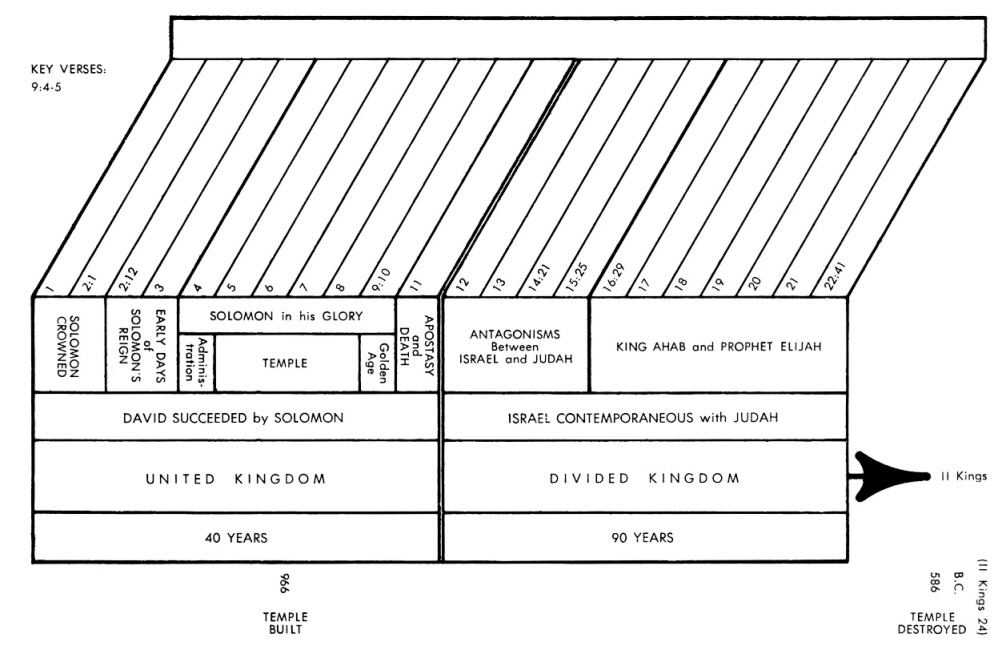
Chart from recommended resource Jensen's Survey of the OT - used by permission
1 Kings Chart from Charles Swindoll

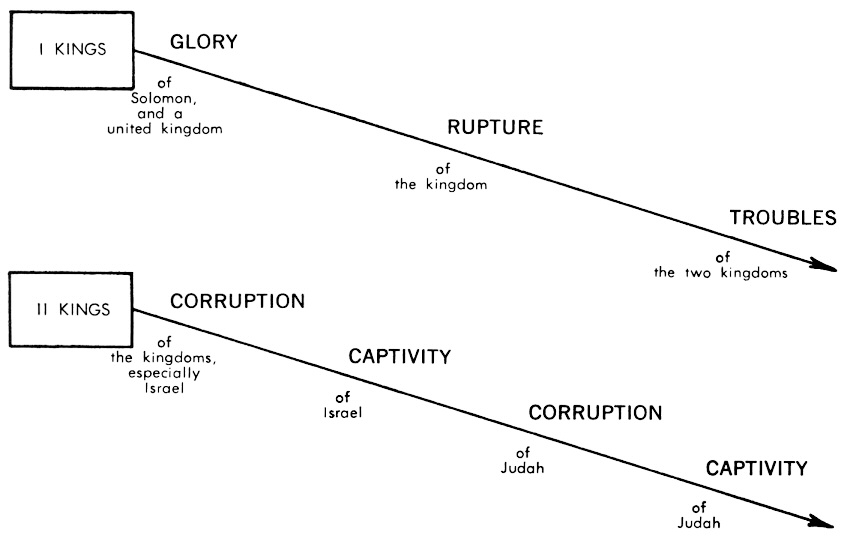
THE DOWNWARD SPIRAL
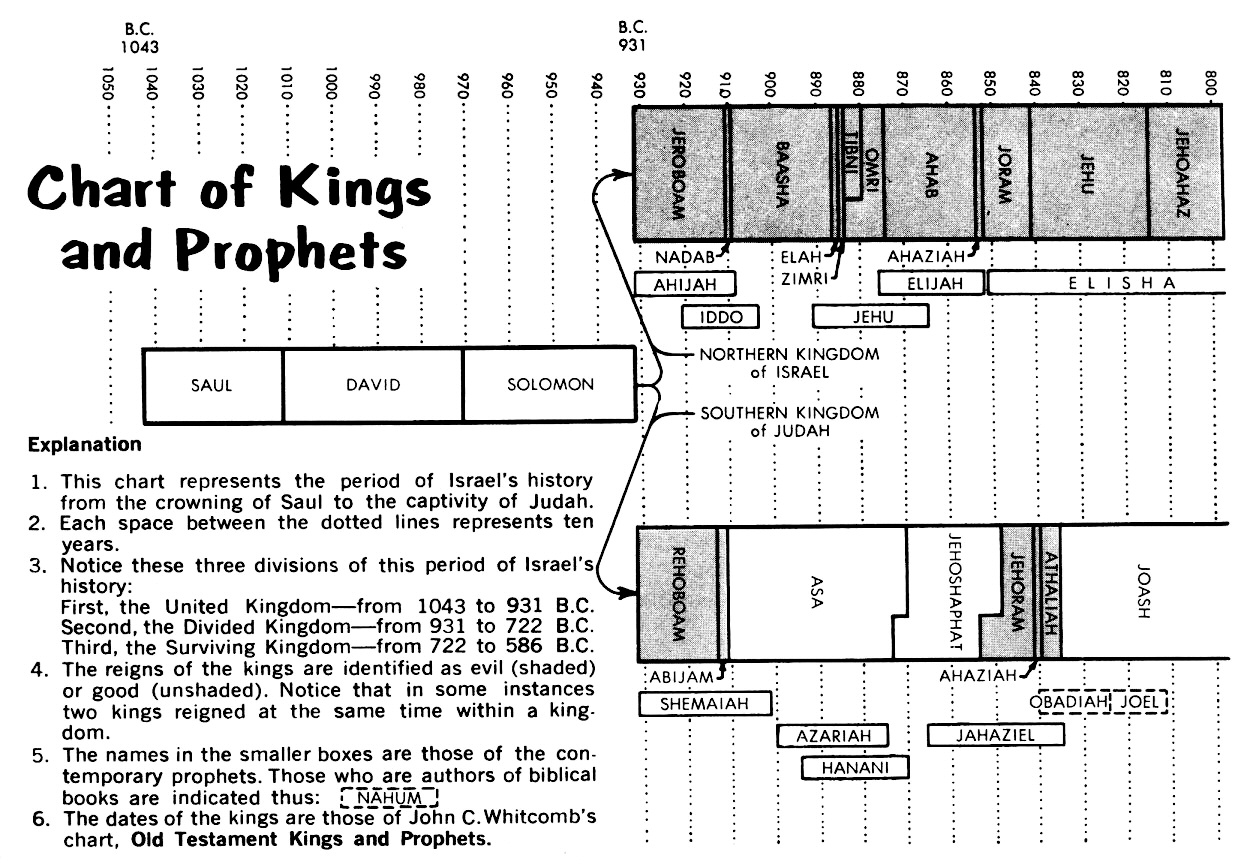
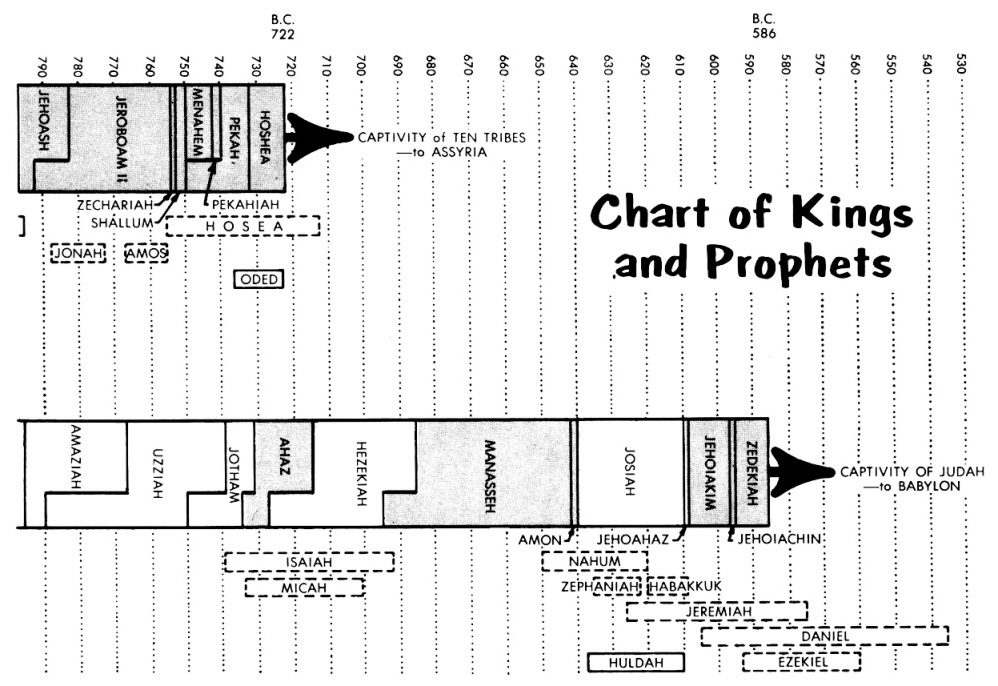
Click to Enlarge
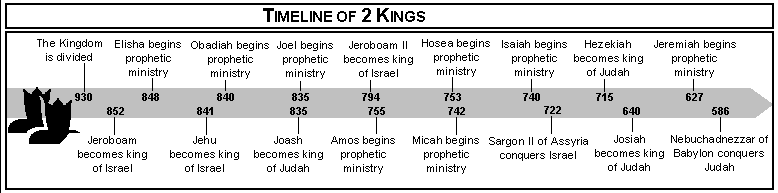
Ryrie Study Bible - Borrow
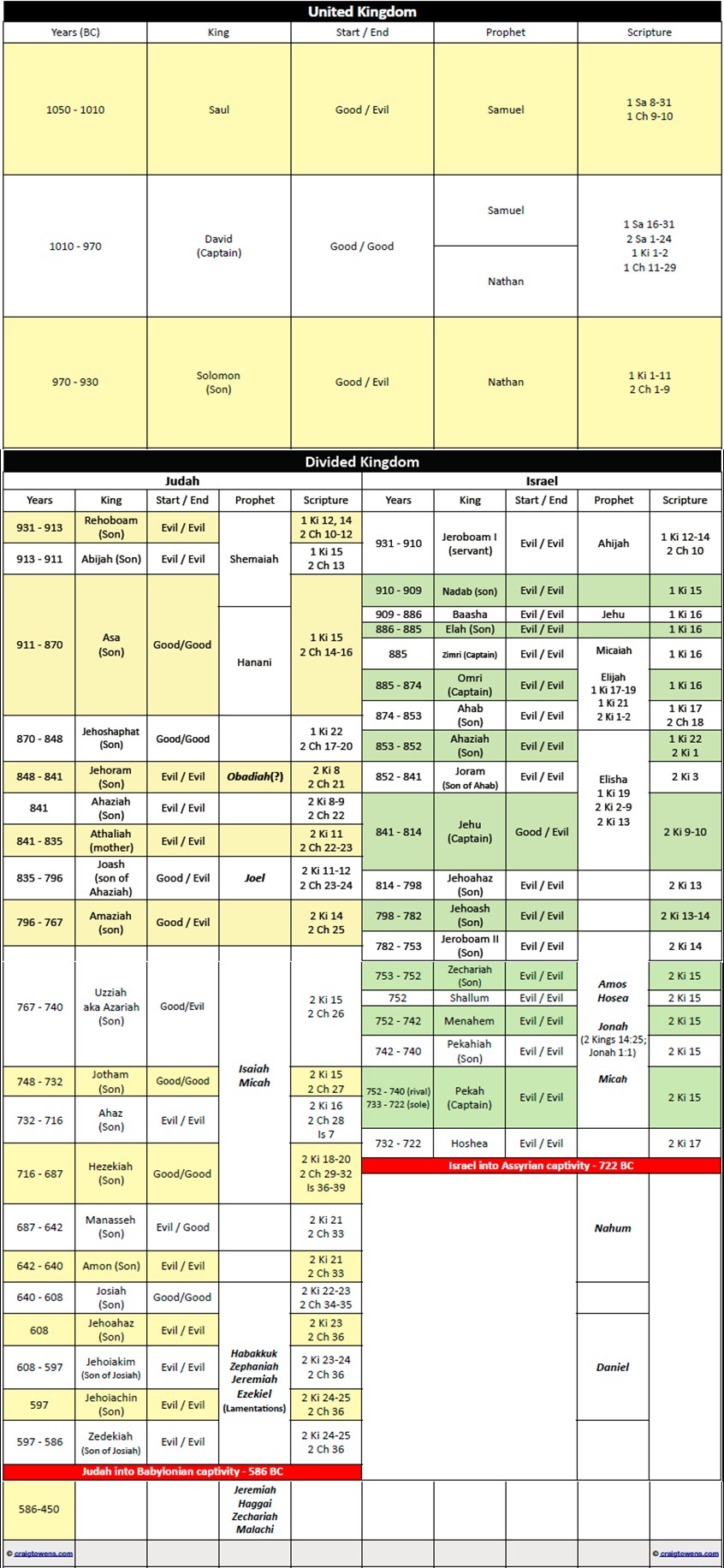
Click to Enlarge
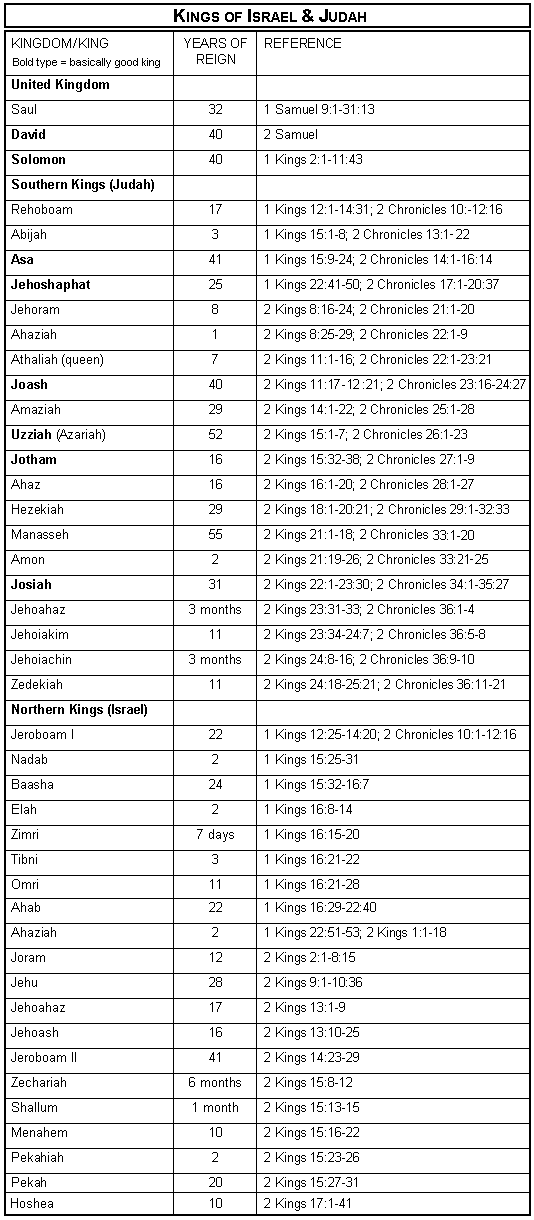
(NOTE: Many consider Amaziah and Hezekiah as "good" kings)
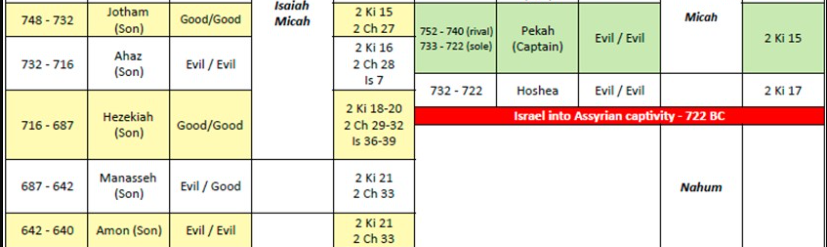
SEE ALSO:
ESV chart - kings of Israel - more information
ESV chart - kings of Judah - more information
Another Chart with Variable Dates for Reigns of King
2 Kings 18:1 Now it came about in the third year of Hoshea, the son of Elah king of Israel, that Hezekiah the son of Ahaz king of Judah became king.
- in the third: 2Ki 18:9 15:30 17:1
- Hezekiah: 2Ki 16:20 1Ch 3:13 2Ch 28:27 29:1 Mt 1:9,10, Ezekias
- 2 Kings 18 Resources
HEZEKIAH LIVE UP TO HIS NAME:
"YAHWEH IS MY STRENGTH"
Now it came about in the third year of Hoshea, the son of Elah king of Israel, that Hezekiah the son of Ahaz king of Judah became king - Son of Ahaz causes us to pause, wondering is this going to be another one where the apple does not fall far from the tree?
Hezekiah's name recalls one of my favorite verses in First Chronicles, 1 Chronicles 16:11, which says
"Seek the LORD and His strength;
Seek His face continually."I frequently turn this into a prayer, for I find myself in need of His power (strength) and His presence (face) every single day! Note also that both phrases are commands! What a glorious invitation from our Father!
Believer's Study Bible - Hezekiah (729-686 B.C.) was one of Judah's finest kings in the sight of God. He was given the high acclaim of having followed in David's conduct and character, and also of being the most faithful of all Judah's kings in trusting God (v. 5). He became coregent with his father Ahaz in 729 B.C. (v. 1) at the age of 11. He became sole ruler at his father's death in 715 B.C., when he (Hezekiah) was 25, and he ruled until 686 B.C.
F B Meyer - 2 Kings 18:1-12 Hezekiah. -- There was to be some hard fighting, in Hezekiah's reign, for existence and liberty. The foes of God and His people would come about them as an angry sea encircling a sand bank. The skies were dark with the gathering storm when Hezekiah ascended the throne, which his father had blackened with his crimes. It was wonderful that such a father as Ahaz should have had such a son; but he probably had a good mother (2 Chr 29:1, 26:5). He at once commenced a course of reform; and made the best preparation possible for meeting all the contingencies of his time by putting away the evils which had alienated the Divine protection.
In the rooting out of idolatry, and in the destruction of the brazen serpent, which had become a kind of fetish, in the same way as the crucifix has become now, he must have raised an immense amount of opposition; but he did not swerve to the right or left. What a magnificent testimony is in 2 Kings 18:6! There is no such way of meeting temptation and danger as by putting the heart right with God. Cleave to Him; depart not from following Him; keep His commandments: so shall the Lord be with you, and whithersoever you go forth, He will prosper you.
Bob Utley - "Hezekiah" Hezekiah's life and actions are also dealt with in 2 Chronicles 29. See my exegetical notes below.
2 Chr. 29:1 "Hezekiah" The Chronicler presents him as one of the godly kings of Judah (i.e., chapters 29-32). In this chapter, after his coronation year he immediately (i.e., first year, first month, cf. 2 Chr. 29:17) started the restoration of temple worship. The sacred calendar begins with Nisan. The Passover of chapter 30 was on the 14th.
2 Chronicles 29:1 is a typical introduction but this was not a typical king. He was, in the Chronicler's opinion, the most spiritual king since David (cf. 2 Kgs. 18:5).
It is surprising that some Hebrew names (i.e., like Joshua) are spelled in different ways.
- in Kings it is spelled
- חזקיהו (i.e., 2 Kgs. 16:20; 18:9; 19:1)
- חזקיה (i.e., 2 Kgs. 18:1)
- in Chronicles ‒ יחזקיהו
The Jewish Study Bible, p. 1808, suggests that the Kings form of the name is older.
The name for Israel's covenant Deity, YHWH, is added to names in two ways.
- a "y" at the beginning (English "J")
- "iah" at the end
Form #2 has both.
The root קזח (BDB 304) means "strong," therefore, the Jewish Study Bible differentiates the meaning as
#1 "YHWH is my strength"
#2 "YHWH is strong"
2 Kings 18:2 He was twenty-five years old when he became king, and he reigned twenty-nine years in Jerusalem; and his mother’s name was Abi the daughter of Zechariah.
- Abi: 2Ch 29:1, Abijah
- 2 Kings 18 Resources
Parallel Passage:
2 Chronicles 29:1 Hezekiah became king when he was twenty-five years old; and he reigned twenty-nine years in Jerusalem. And his mother’s name was Abijah, the daughter of Zechariah.
HEZEKIAH'S REIGN
IN JUDAH
He was twenty-five years old when he became king, and he reigned twenty-nine years in Jerusalem; and his mother’s name was Abi the daughter of Zechariah
Robert Rayburn: Hezekiah was the son of the wicked king Ahaz. Under what influences he came to repudiate his father’s perspective and program we are not told. But it seems clear, even more so in Chronicles than in Kings, that we are to look to his mother. He had a godly mother and she made all the difference to her son and so to Judah as a kingdom.
Bob Utley - "reigned twenty-nine years" He reigned 14 years before his illness of chapter 10 and 15 years after. "Abi" This name (BDB 4) is a shortened form of Abijah (BDB 4, cf. 2 Chr. 29:1).
2 Kings 18:3 He did right in the sight of the LORD, according to all that his father David had done.
- right in the sight: 2Ki 20:3 Ex 15:26 De 6:18 2Ch 31:20,21 Job 33:27 Ps 119:128 Ro 7:12 Eph 6:1
- according: 2Ki 22:2 1Ki 3:14 11:4,38 15:5,11 2Ch 29:2
- 2 Kings 18 Resources
Parallel Passage:
2 Chronicles 29:2 He did right in the sight of the LORD, according to all that his father David had done.
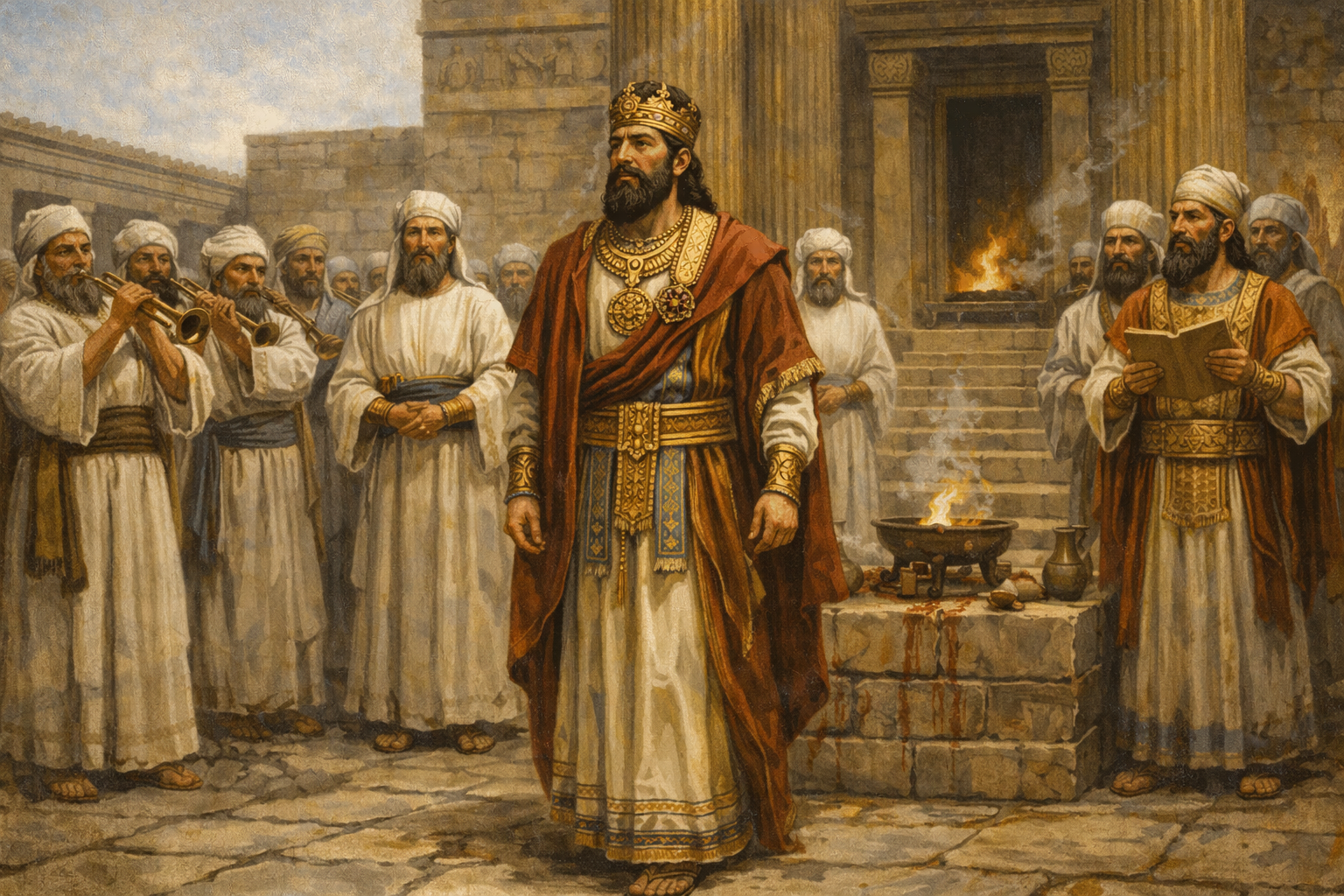
HEZEKIAH
"DAVID REDIVIVUS"
He did right (03477) yashar) in the sight of the LORD - Hezekiah clearly lived Coram Deo as is evidence by what he does in his reign. His eyes are on the LORD because he knows the eyes of the LORD are on him. Clearly he knows the words of 2 Chronicles 16:9+ “For the eyes of the LORD run to and fro throughout the whole earth, to give strong support to those whose heart is blameless toward him.”
according to all that his father David had done - Note not SOME, but ALL! We have not heard this positive description for a long time. Father David speaks of his "spiritual" father, the root of the Davidic Covenant, the lineage of which Hezekiah belongs.
Dale Ralph Davis: So David reigns again! It was almost too much to hope for. Think of Hezekiah’s reign in light of Judah’s previous 150 years. Godly Jehoshaphat’s stupid marriage alliances with Ahab’s family not only guaranteed wicked kings (Jehoram, Ahaziah) to Judah but nearly wiped out the Davidic dynasty (Athaliah). Kings followed who were doing ‘what was right’ but never getting extreme about it (Joash, Amaziah, Uzziah, and Jotham). Then with Ahaz (ch. 16) it looks like Judah is plunging into the pit. How amazing that after Ahaz we have David redivivus. (ED: David redivivus is a Latin phrase meaning “David revived” or “David brought back to life.”)
Warren Wiersbe - Like Asa (1 Kings 15:11), Jehoshaphat (22:43), and Josiah (2 Kings 22:2), his model was King David, which means that, while Hezekiah wasn’t perfect, he did seek to obey the Lord and please Him. He was one of the few kings who actually removed the high places and put an end to idol worship in the hills. He restored temple worship and encouraged the people from both Judah and Israel to come to the temple in Jerusalem and worship the Lord. The Lord had commanded that there be one central place of worship, and that was at Jerusalem (Deut. 12). The sequence of events in Hezekiah’s life as recorded in Scripture is not strictly chronological. Most students agree that the events recorded in Isaiah 38 and 39—his illness and his welcome of the Babylonian ambassadors—actually antedated the Assyrian invasion (Isa. 36—37). We will take this approach as we study Hezekiah’s life and ministry and seek to integrate the material in Kings, Chronicles, and Isaiah.
Peter Pett: Internally Hezekiah was determined to bring Judah back to the true worship of YHWH. He removed the syncretistic high places, broke the pillars which represented Baal, and cut down the Asherah images (or wooden poles) which represented the mother goddess of the Canaanites.
Bob Utley - "He did right in the sight of the Lord"" Hezekiah is one of the few Judean kings who the author of Kings considered a godly, faithful person (cf. 2 Kgs. 20;3). This characterization is said of only two other Judean kings—Asa (1 Kgs. 15:11) and Josiah (2 Kgs. 22:2).
2 Kings 18:4 He removed the high places and broke down the sacred pillars and cut down the Asherah. He also broke in pieces the bronze serpent that Moses had made, for until those days the sons of Israel burned incense to it; and it was called Nehushtan.
- removed: 2Ki 12:3 14:4 15:4,35 Lev 26:30 1Ki 3:2,3 15:14 22:43 Ps 78:58 Eze 20:28,29
- broke down the sacred pillars: 2Ki 23:4 De 7:5 12:2,3 Jud 6:25,28 1Ki 15:12,13 2Ch 19:3 31:1 2Ch 33:3
- broke in pieces the bronze serpentNu 21:8-9 Joh 3:14,15
- those days: 2Ki 16:15
- 2 Kings 18 Resources
Related Passages:
Numbers 21:6-9 The LORD sent fiery serpents among the people and they bit the people, so that many people of Israel died. 7 So the people came to Moses and said, “We have sinned, because we have spoken against the LORD and you; intercede with the LORD, that He may remove the serpents from us.” And Moses interceded for the people. 8 Then the LORD said to Moses, “Make a fiery serpent, and set it on a standard; and it shall come about, that everyone who is bitten, when he looks at it, he will live.” 9 And Moses made a bronze serpent and set it on the standard; and it came about, that if a serpent bit any man, when he looked to the bronze serpent, he lived.
John 3:14-16 “As Moses lifted up the serpent in the wilderness, even so must the Son of Man be lifted up; 15 so that whoever believes will in Him have eternal life. 16 “For God so loved the world, that He gave His only begotten Son, that whoever believes in Him shall not perish, but have eternal life.
ADDITONAL INFORMATION NOT IN KINGS - See commentary on 2 Ch 29:3–31:21
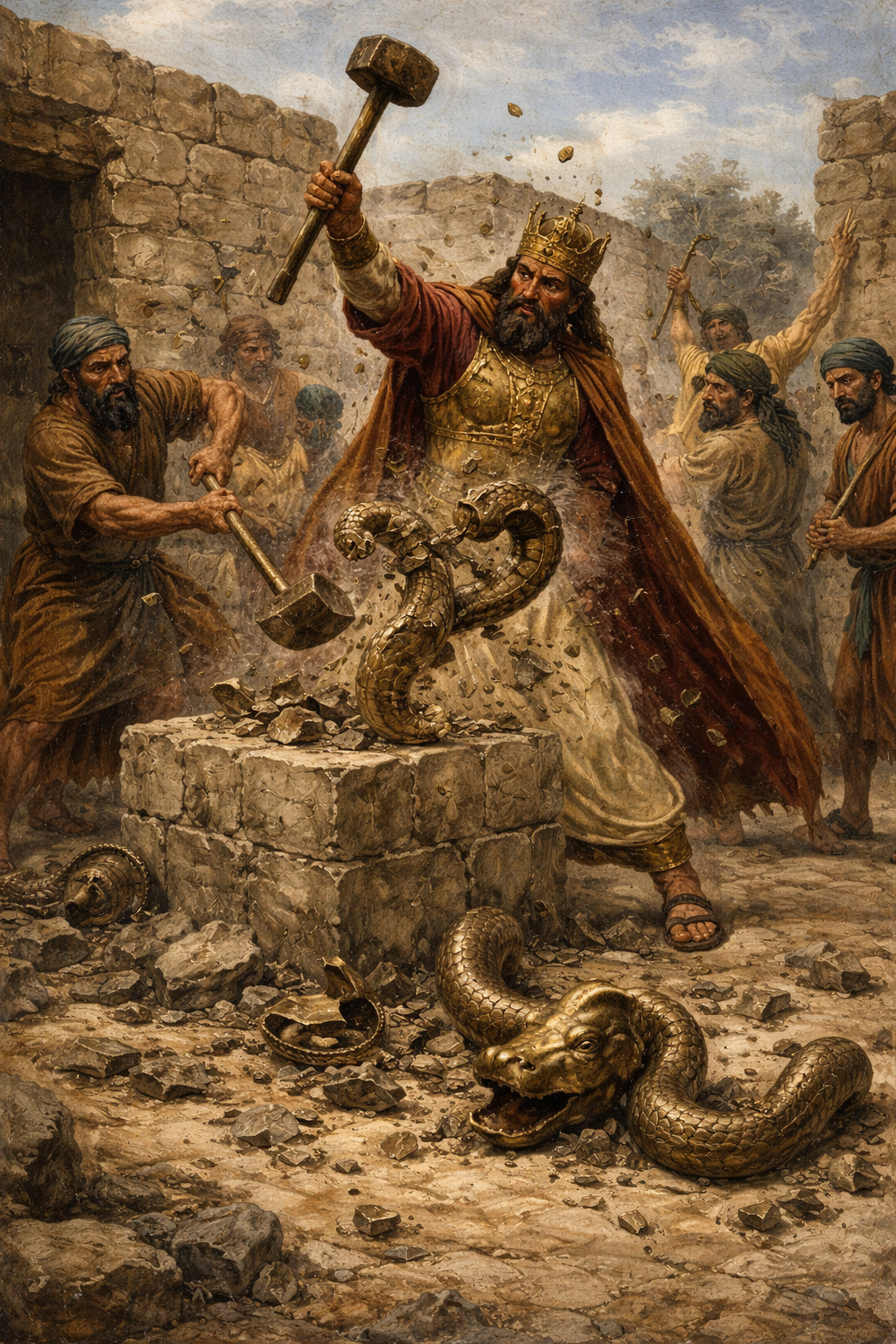
HEZEKIAH THE REFORMER SMASHES
A "MERE PIECE OF BRASS!"
He removed (sur) the high places (bamah) and broke down (shabar) the sacred pillars (matstsebah) and cut down (karath) the Asherah (Asherah) - Finally a king removing the high places! For more discussion on cleansing the temple (2Ch 29:3–19)
Wiersbe - It’s interesting that 2 Kings has but one verse describing Hezekiah’s reforms (18:4), while 2 Chronicles devotes three chapters to this important part of his life. However, 2 Kings mentions how King Hezekiah destroyed the bronze serpent made by Moses (Num. 21:5–9), but this isn’t mentioned in Chronicles. The serpent was a religious relic that had reached the status of an idol. “Nehushstan” probably means “a piece of bronze, a brass thing.” How easy it is for human nature to want to honor religious relics that have no power! Hezekiah was a man of faith who trusted the living God and followed His law, and he didn’t want the people worshipping a dead, useless image.
He also broke (kathath - crushed, shattered) in pieces the bronze serpent (nahas/nachash) that Moses had made, for (term of explanation) until those days the sons of Israel burned incense (qatar) to it; and it was called Nehushtan (Nehushtan (Nechushtan) According to historical and biblical chronology, the serpent’s creation took place during Israel’s wilderness wanderings, around 1400–1450 B.C., and Hezekiah reigned in Judah beginning around 715 B.C. This means the bronze serpent had existed for roughly 700 years before it was finally destroyed.
🙏 THOUGHT - WHAT IS THE LONG LINGERING "NEHUSHTAN" IN YOUR LIFE DEAR DISCIPLE OF JESUS? TEAR IT DOWN TODAY! DESTROY IT UTTERLY, LEST YOU BE DISQUALIFIED (adokimos) IN THE ONLY RACE YOU WILL EVER RUN THAT HAS ETERNAL SIGNIFICANCE (Heb 12:1-2)! SEE COMMENTARY ON 1 Corinthians 9:24-27 ESPECIALLY THE COMMENTS ON DISQUALIFIED). THEN YOU WILL BE ABLE TO SAY LIKE PAUL (See the excellent applicational messages below from Pastor Chuck Smith)
"I have fought the good fight, I have finished the course, I have kept the faith; 8 in the future there is laid up for me the crown of righteousness, which the Lord, the righteous Judge, will award to me on that day; and not only to me, but also to all who have loved His appearing.." (2 Ti 4:7-8, see also 1 Cor 3:10-15)
Henry Morris - The brasen serpent (Numbers 21:8,9) was originally a symbol of sin judged and salvation given. Once it had served its purpose, however, it should have been abandoned. Instead it eventually became an idol. This is the danger involved in too much emphasis on symbols rather than the realities they are intended to represent. Nehushtan. The meaning of "Nehushtan" is "a piece of brass."
Believers Study Bible - Almost immediately after Ahaz's death, Hezekiah destroyed all the high places where pagan religious ceremonies had been held, and disposed of all cultic objects which might have heathen significance. This included even destroying the bronze serpent which Moses had made in the wilderness centuries before (Num. 21:5-9). The people of Hezekiah's day had been using the bronze serpent as an object of superstition and had been burning incense to it (cf. 2 Chr. 29:3-31:21).
David Guzik: God’s people must likewise be on guard against idolatry today. There are many dangers of idolatry in the modern church: Making leaders idols. Making education an idol. Making human eloquence an idol. Making customs and habits of ministry an idol. Making forms of worship an idol.
Chuck Smith: "What does it Mean When People Start Worshipping Relics or Idols?” A. They have lost their consciousness of God's presence. 1. In reality He is always there, "for in Him we live." "Where can I flee from thy presence?" - We are not always aware of Him. B. Somehow within we are trying to recapture that which was lost. 1. The day we felt God's presence and power. 2. That time when God's joy filled our lives. 3. How did we ever lose it? - The cares of this life; - the deceitfulness of riches, - the lust for other things.
Biblical Illustrator: That a blind veneration for the past is always an obstacle in the path of progress. An intelligent regard for the past is, of course, a help and not a hindrance in the direction of all true advance. But a clinging to customs, institutions, modes of thought and worship, and a refusal to surrender them for no other reason than that they have existed for centuries--this is an unintelligent attachment to the past, and has often obstructed progress. Right across the path of Hezekiah, in his endeavours to purify the religious life of Ins people, stood this blind veneration for the brasen serpent. They could have given no intelligent account of their burning incense to this image; only, it had long ago been a medium of healing influence; and as, doubtless, their fathers had burnt incense to it, why should not they? But Hezekiah rose above the superstition which blinded his countrymen.
John Walton - 18:4. bronze serpent, Nehushtan. Nehushtan is not attested outside Scripture. The term is apparently a conglomeration of the Hebrew terms for bronze (neḥoshet) and serpent (naḥash). Figures of serpents crafted in copper or bronze have been found in numerous locations in the ancient Near East. They were apparently cultic images. Often the image of the serpent is held by a deity. It was especially prevalent in Syro-Palestine in the late second and first millennia B.C. Nehushtan appears to have been a deity of healing (especially snake bites), possibly considered an intermediary between Yahweh and the people of Israel (see comment on Num 21:8–9). A well-known bronze bowl from Nineveh with Hebrew names on it depicts a winged snake on a pole of some sort.
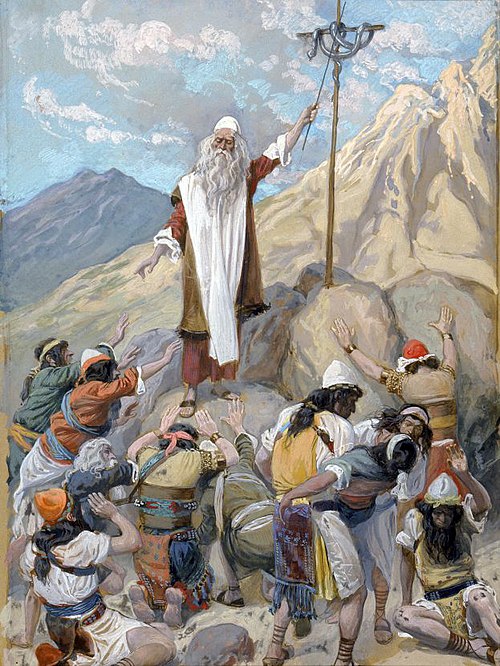
Numbers 21:5-9
The Brazen Serpent (Nehushtan)
The footnote in the New International Version at 2 Kings 18:4 is most interesting. When Hezekiah found the brazen serpent made by Moses in the wilderness still being worshipped, he destroyed it. The NIV says, “… he called it Nehushtan.” The footnotes explain the meaning—”a serpent made of brass.”
One is made to wonder how such an idol could have existed so long (ED: About 730 years! See Nu 21:8-9). It would seem that in the reformation movements of one of the judges or kings, it would have been destroyed. My opinion is that it was not recognized as an idol and hence was preserved. Perhaps they justified it by not calling it an idol. Hezekiah, however, came and called it what it really was—a brass image of a snake.
How often we justify sin by calling it a different name! Some call adultery, “a meaningful relationship.” We excuse covetousness by calling it “prudence” or “economy.” A life of sensual pleasure is “living with gusto.”
In answer to a critic, Abraham Lincoln asked, “How many legs does a cow have?” “Four,” was the reply. “If you call her tail a leg, how many does she have? asked Lincoln. “Five,” was the answer. “No,” Lincoln said, “Just calling a tail a leg, doesn’t make it a leg.”
Have we made a similar mistake? Do we think that sin is not sin, just because we do not call it by its right name? Ancil Jenkins
ADDENDUM NOTES ON NEHUSHTAN - "mere piece of bronze" 2 Ki 18:4 something made of copper, the copper serpent of the Desert. Nehushtan the name given to a bronze snake Moses ordered to be made in the wilderness (Nu. 21:9).
And Moses made a bronze (nechosheth) serpent (nahas/nachash) and set it on the standard; and it came about, that if a serpent (nahas/nachash) bit any man, when he looked to the bronze serpent (nahas/nachash), he lived.
NEHUSHTAN. The bronze (nechosheth) serpent (nahas/nachash) destroyed by King Hezekiah during his reform of the temple worship (2 Ki 18:4). It had been made by Moses centuries earlier. The name can mean “a piece of bronze” (NASB marg.), and it was probably so named by Hezekiah in contempt. K. R. Jones (The Bronze Serpent in the Israelite Cult) lists various archaeological discoveries which have demonstrated that in Mesopotamia before the time of Abraham the serpent was a common symbol of fertility and the return of life. Apparently it was the Hyksos who brought the serpent symbol into Palestine, where at least seven cultic bronze serpents have been found in excavations dating to the Middle and Late Bronze Ages (1650–1200 b.c.).Representations of serpents together with fertility goddesses on plaques and cult standards were frequent in the ancient Near East.
Complete Biblical Library Nehushtan was the name that King Hezekiah gave to the bronze serpent Moses made in the wilderness (2 Ki. 18:4). Hezekiah destroyed the serpent, because the people had burned incense to it as an act of idolatrous worship. The name is derived from a play on the words nahas/nachash, "serpent," and nechōsheth, "bronze." This symbolism is not unique in the ancient Near East, though exactly what it represents is not clear. One can see that the snake in the desert was used in the course of healing (Nu. 21:4ff), a common motif found in a wide variety of cultures throughout the ages. The healing power of snakes was assumed because of their seeming immortality, the ability to shed their old skin. How this image functioned in Judean society at any juncture is not certain, aside from that it became an idol worshiped by the people.
BRAZEN SERPENT - During the period of the wilderness wanderings, Israel murmured against the Lord. As a disciplinary measure, God sent “fiery serpents” among them (Nu 21:5–9). May have been cobras, whose bite produced a burning fever. When the stricken people imploringly turned to Moses, he at the command of God made a brass (copper) serpent, no doubt a replica of the viper with the stinging, deadly bite which had already bitten them. One should not consider this as sympathetic magic, for it probably served as a symbolic reminder of the divine displeasure. Centuries later it became a rallying point for idolatrous worship in Israel which caused the godly Hezekiah to destroy it (2 Ki 18:4). Christ refers to it figuratively as a type of His own approaching death on the cross ("As Moses lifted up the serpent in the wilderness, even so must the Son of Man be lifted up; so that whoever believes will in Him have eternal life. " Jn 3:14-15), as being “made sin for us” (2 Cor 5:21) and as bearing our judgment.
QUESTION - What was Nehushtan? - GotQuestions.org
ANSWER - The word Nehushtan occurs one time in the Bible, in 2 Kings 18:4, “He [Hezekiah] removed the high places and broke the pillars and cut down the Asherah. And he broke in pieces the bronze serpent that Moses had made, for until those days the people of Israel had made offerings to it (it was called Nehushtan).”
2 Kings 18:4 points back to Numbers 21:6–9, “Then the LORD sent fiery serpents among the people, and they bit the people, so that many people of Israel died. And the people came to Moses and said, ‘We have sinned, for we have spoken against the LORD and against you. Pray to the LORD, that he take away the serpents from us.’ So Moses prayed for the people. And the LORD said to Moses, ‘Make a fiery serpent and set it on a pole, and everyone who is bitten, when he sees it, shall live.’ So Moses made a bronze serpent and set it on a pole. And if a serpent bit anyone, he would look at the bronze serpent and live.”
In the time between Moses and Hezekiah, the Israelites began worshiping the “fiery serpent” Moses made out of bronze. It is only mentioned in connection with Hezekiah’s reforms, but the Nehushtan worship could have been taking place long before Hezekiah. While it is understandable how an item that brought miraculous healing could become an object of worship, it was still blatant disobedience to God’s commands (Exodus 20:4–5). The bronze serpent was God’s method of deliverance during the incident recorded in Number 21. There is no indication that God intended it to ever be used again.
Exodus 20:4-5 “You shall not make for yourself an idol, or any likeness of what is in heaven above or on the earth beneath or in the water under the earth. 5 “You shall not worship them or serve them; for I, the LORD your God, am a jealous God, visiting the iniquity of the fathers on the children, on the third and the fourth generations of those who hate Me,
While He does not refer to it as “Nehushtan,” Jesus does mention the bronze serpent in John 3:14, “As Moses lifted up the serpent in the wilderness, so must the Son of Man be lifted up.” Just as anyone who was bitten by a serpent could be healed by looking to the bronze serpent Moses lifted up, so can anyone look to Jesus, who was lifted up on the cross, to be spiritually healed, delivered, and saved.
Interestingly, the word Nehushtan appears to simply mean “piece of brass.” Perhaps Hezekiah named it “Nehushtan” to remind people that it was only a piece of brass. It had no power in it. Even in the Numbers 21 incident, it was God who healed, not Nehushtan.
Nehushtan should be a powerful reminder to us all that even good things—and good people—can become idols in our lives. Our praise, worship, and adoration are to be directed to God alone. Nothing else, regardless of its amazing history, is worthy.
Related Resource:
Bob Utley - This verse records the things Hezekiah did that showed he was serious about the worship of YHWH.
- He removed the high places. These local worship sites had become idolatrous but they were very popular.
- He destroyed the all images of Ba'al and Asherah.
- He destroyed the bronze serpent of Moses' day (i.e., Numbers 21) which had become idolatrous.
Nehushtan" There are several possibilities about the proper name (BDB 639).
- It is related to "serpent," נחשתן ‒ נחשׁ; SPECIAL TOPIC: SERPENT
- It is related to "bronze" ‒ נחשׁת
Because the MT has "he called it," Rashi thought it was Hezekiah that named it "the bronze-thing" or "bronze-god" in derision. This relic appears in Nu 21:8-9, but had become an idol. Judah burned incense to it. There are many examples of bronze snakes as deities in the Ancient Near East
NEHUSTAN - See John 3:14-15 and Nu 21:7-9, but see how they turned this into an idol!!! See 2 Ki 18:4 = The bronze serpent was preserved for 730 years until Hezekiah (715–686BC) broke it in pieces because the people were worshipping it instead of the One to Whom it was supposed to point them!!! In contempt he gave it the name ‘Nehushtan’ (a play on the word nahas/nachash, = ‘serpent’), meaning a ‘trifling thing’ or a "mere piece of brass", because it had become an object of worship.
🙏 THOUGHT - Before we are "too hard" on Israel we need to remember that Israel's rebellion in the OT is a picture of our old flesh nature, and thus this incredible story begs the question "Have I turned something good and glorious into an idol? Am I willing to pray Psalm 139:23, 24?"
NEHUSHTAN - see full article online Dictionary Of Deities And Demons In The Bible PAGE 615
NEHUSHTAN נחשׁתן I. The word nĕḥuštān occurs once in MT, in 2 Kgs 18:4, where it is the name of the bronze (or copper) serpent (nĕḥaš hannĕḥōšet) that →Moses had made in the wilderness (as related in Num 21:8–9) and that King Hezekiah destroyed. The word is a compound of *nuḥušt (Hebrew nĕḥōšet), ‘bronze, copper’, plus the *-ān affix (preserved as -ā- in Hebrew by dissimilation from the -o- type vowel in the previous syllable). The word nĕḥuštān literally means ‘the (specific) thing of bronze/copper’ (cf. the similar morphology of liwyātān, →Leviathan). Implicit in this name is a verbal play on nāḥāš, ‘snake’, of which nĕḥuštān is an image
Chuck Smith - Sermon Notes for 2 Kings 18:1-4 A THING OF BRASS
When people lose a living awareness of God’s presence,
they often cling to relics, places, traditions, or past experiencesSUMMARY - The history of the bronze serpent in Numbers 21 shows that Israel’s rebellion brought divine judgment, yet God graciously provided deliverance through a simple act of faith: those bitten were commanded to look at a bronze serpent lifted on a pole and live—not because the bronze was sacred, but because looking meant obedient submission to God’s authority. Jesus later identified this event as a type pointing to Himself, teaching that just as the serpent was lifted up, so He would be lifted up on the cross to bear the judgment for human sin, and all who look to Him in faith will live, even if they do not fully understand how such simple trust saves. Tragically, what began as a God-given means of grace became, centuries later, an object of idolatry; the preserved bronze serpent was worshiped until Hezekiah destroyed it, rightly calling it “Nehushtan”—a mere piece of bronze. This exposes a timeless danger: when people lose a living awareness of God’s presence, they often cling to relics, places, traditions, or past experiences in an attempt to recapture former spiritual reality. But objects, buildings, or memories are not sacred in themselves; they are only instruments God once used. Unless past encounters with God are carried forward into present obedience and faith, they become idols that hinder spiritual progress, and must be named for what they are—Nehushtan, nothing more than brass.
Unless past encounters with God are carried forward into present
obedience and faith, they become idols that hinder spiritual progress,
and must be named for what they are—Nehushtan, nothing more than brass.
I. THE HISTORY OF THE BRASS (Nu 21:6-9)
A. The people were murmuring against God and rebelling against His authority.
1. The Lord sent serpents of fire into the camp and many were dying from their bites.
2. The Lord commanded Moses to make a serpent of brass and set it on a pole.
a. The people were commanded to look at the brass serpent if bitten.
b. There was nothing sacred about the brass.
c. by looking they were obeying God thus coming under His authority.
B. Jesus said: "and as Moses lifted up the serpent In the wilderness...." (Jn 3:14-16)
1. The serpent was a type for sin.
a. Their sin of rebellion to God's authority.
2. Brass a symbol of judgment.
3. Jesus on the Cross took the guilt of our sin and received God's judgment against sin.
a. If we will just look to Jesus, we shall live.
b. They may not have understood how just by looking at the brass serpent could help. Lie there dying and refuse to look.
C. Somehow this brass relic was preserved 700 yr.
1. But the people were now worshipping it.
2. They were burning incense to it as though it were God.
3. Hezekiah when he came to - the throne broke it in pieces and said "Nehushten."
II. "WHAT DOES IT MEAN WHEN PEOPLE START WORSHIPPING RELICS OR IDOLS?"
A. They have lost their consciousness of God's presence.
1. In reality He is always there, "for in Him we live." "Where can I flee from thy presence?"
a. We are not always aware of Him.
B. Somehow within we are trying to recapture that which was lost.
1. The day we felt God's presence and power.
2. That time when God's joy filled our lives.
3. How did we ever lose it?
a. The cares of this life; the deceitfulness of riches, the lust for other things.
III. PEOPLE TODAY IN THEIR MINDS BURN INCENSE TO SACRED RELICS.
A. "You don't mean you are going to take the tent down?"
B. Maybe there is a certain spot.
1. While standing near this tall pine tree God spoke to you. You can remember now the joy.
2. They need to remove that tree now to build larger facilities.
3. The church's progress often stopped by foolish clauses.
C. Nehushtan, call it what it is, a thing of brass.
1. It's not a god.
2. It's not sacred or holy.
a. This tent is not a church.
b. Neither is the old chapel or the new sanctuary.
c. This tent is just canvas stretched over rope.
1. The church meets here.
2. When you're not here it's just an ugly old tent.
3. The experiences of the past are history and have no true value unless they have been transmitted into present realities.
a. "I wish we could stay in the tent". Nehushtan.
b. "Aren't you going to miss the tent?" Nehushtan.
"Forgetting those things which are behind and reaching for those things which are before I press for the prize of the high calling of God in Jesus Christ." (Phil 3:13-14)
Chuck Smith -2 Kings 18:4 (ED: "NEHUSTAN THEOLOGY")
SUMMARY - This verse exposes Israel’s loss of consciousness of God, as the people clung to a once-God-given symbol to satisfy a spiritual hunger, resulting in confusion between means and object of worship. In response, Hezekiah took two decisive actions: he deliberately stripped the bronze serpent of its sacred aura by calling it Nehushtan—“a mere piece of brass”—and then destroyed it completely. The passage warns that God’s gifts, when detached from God Himself, can become spiritually harmful, as seen when people give reverence to buildings, liturgies, denominations, past experiences, or religious practices as if they were sources of grace. Ultimately, such misdirected devotion signals a deeper loss of awareness of God’s presence, reminding us that even prayer, at its highest expression, moves beyond words into reverent dependence on God alone.
I. WHAT THIS REVEALS.
A. Loss of consciousness of God.
B. People hungering after what has been lost.
C. Confusion.
II. HEZEKIAH'S TWO ACTIONS.
A. Called it "Nehustan" - a mere thing of brass.
B. He broke it into pieces.
III. APPLICATION TO OUR DAY.
A. God's gifts so abused as to become injurious.
1. Some burning incense to a building.
2. Some to an order of worship.
3. Some to a denomination.
4. Some to old experiences.
5. Prayer ordinances - make them means of grace.
B. What this indicates.
1. Loss of consciousness of God.
2. Savanorola - when prayer reaches its ultimate height, words are impossible.
COMMENT - Savonarola is one of the clearest historical “Nehushtan moments” in church history, and Chuck Smith’s reference fits him perfectly.
Good and historic religious forms had gradually
become substitutes for God Himself.Girolamo Savonarola and the Nehushtan Principle can be understood as a historical embodiment of the same spiritual diagnosis seen in Hezekiah’s destruction of the bronze serpent: good and historic religious forms had gradually become substitutes for God Himself.
Savonarola ministered in late–15th-century Florence amid a church culture saturated with ritualism, relics, indulgences, images, and external religion, while genuine repentance and holiness were largely absent; what he perceived was a loss of consciousness of God, marked by people trusting church forms instead of Christ, relying on rituals as automatic means of grace, treating incense, images, relics, and liturgy as spiritually effective in themselves, and reducing prayer to mechanics rather than communion.
In this sense, Savonarola enacted a “Nehushtan response”: as Hezekiah named the idol for what it truly was—“a mere thing of brass”—and destroyed it, Savonarola exposed religious excess as empty, called people not to reform-by-ritual but to repentance, and led Florence in the Bonfire of the Vanities (1497), where citizens voluntarily burned religious trinkets, images, luxuries, and superstitious objects—not out of hatred for beauty or art, but out of zeal against idolatry.
His teaching that true prayer ultimately transcends words, resting silently in God when it reaches its highest expression, perfectly echoes the principle that ritual prayer is only a means, while silent dependence is the reality—and that anything replacing dependence must be broken.
Relationship over ritual, Spirit over structure,
and reality over religious formThis is why Savonarola so closely aligns with the warnings later emphasized by Chuck Smith, who stressed relationship over ritual, Spirit over structure, and reality over religious form: Savonarola stands as a historical witness to the cost of smashing Nehushtans. Excommunicated, arrested, tortured, and executed in 1498, he did not die for rejecting God, but for threatening an institutional religion that had quietly replaced Him.
Anything which once pointed to God but now replaces living
dependence on God must be named for what it is and brokenThe pattern remains unchanged across history—from Hezekiah’s bronze serpent, to relics and sacred objects, to Savonarola’s images and indulgences, and finally to modern substitutes such as buildings, denominations, liturgies, and past experiences—confirming the enduring truth that anything which once pointed to God but now replaces living dependence on God must be named for what it is and broken; this is "Nehushtan theology," and Savonarola lived—and died—by it.
"NEHUSHTAN"
A. Hezekiah's ascension and action "broke in pieces
B. History of brazen serpent.
1. Israel's complaining.
2. Snake pits.
3. Brazen serpent.
C. Preservation of brazen serpent.
1. Moses wilderness; Joshua conquest; judges David Solomon.
D. Development of worship.
1. Interest grew to veneration.
2. Began to worship symbol.
3. Defied serpent of brass.
E. Story not so old.
1. Church of St. Ambrose - Milan 971 Milanese envoy to Constantinople.
COMMENT - Chuck Smith’s reference to “the Church of St. Ambrose – Milan – 971 – Milanese envoy to Constantinople” is significant because it points to a classic historical example of how a God-given means can become an object of devotion, reinforcing the very lesson of 2 Kings 18:4 (Nehushtan) that he was teaching.
He is alluding to a historical incident from A.D. 971, when a Milanese envoy traveled to Constantinople and recorded his astonishment at Eastern Christian worship practices. He observed believers burning incense and showing reverence to relics, sacred objects, and church furnishings in ways that treated these items as conduits of divine presence rather than as reminders pointing to God. This account later became part of a broader Western critique of Eastern devotional excess, especially the tendency for physical objects to move from symbolic aids into objects of veneration. By referencing this moment, Chuck Smith underscores that this danger is not modern but has surfaced repeatedly throughout church history.
The mention of St. Ambrose and Milan is significant because Ambrose was one of the most respected leaders of the early Western church, and Milan became a major theological and liturgical center known for emphasizing spiritual worship over ritual superstition. By invoking “the Church of St. Ambrose,” Chuck Smith is implicitly appealing to an earlier Western tradition that prized inward devotion before later developments elevated relics, incense, and rituals into quasi-sacramental objects. His point is that even churches with strong spiritual foundations can drift over time into object-centered devotion.
Constantinople, the heart of Byzantine Christianity, is central to the warning because it was there that icons, relics, incense, and sacred objects increasingly took on mediatory roles between worshipers and God. Chuck Smith is not attacking Eastern Christianity as a whole, but highlighting a subtle shift in which reverence slid into reliance—where symbols intended to point to God slowly became substitutes for direct dependence on Him.
The theological point Chuck Smith is making is one he consistently emphasized: the danger of confusing symbols with substance, treating outward forms as sources of grace, and replacing living faith with religious mechanics. The 971 Milan–Constantinople reference serves as a historical illustration of a recurring biblical pattern—God gives a good thing, people cling to it, it begins to replace God, and reform becomes necessary. This is the same pattern seen with the bronze serpent (Nehushtan), temple rituals, relics and icons, and even modern church structures, liturgies, denominations, or spiritual experiences.
Chuck Smith often used church history alongside Scripture to show that while the Bible diagnoses the problem, history proves it recurs, making personal application unavoidable. By citing this event, he was effectively saying, “What happened in Israel happened again in church history—and it can happen to us.” In short, his reference highlights a historical parallel to Nehushtan: a once-meaningful aid to worship became an object of devotion itself. The Milanese envoy’s shock at Constantinople illustrates how sincere worship can drift into idolatry, reinforcing Chuck Smith’s central warning that anything replacing direct dependence on God—no matter how sacred its origin—must be recognized and, if necessary, broken.
I. DEIFICATION - - - SIGN OF PEOPLE AT THE TIME.
A. Sign of their loss of consciousness of God.
B. People hungering after that which they lost.
1. Idol always means this.
2. Sense of need - sense of lack.
C. Sign of confusion, misinterpretation.
1. As though serpent was healing agent of past.
II. HEZEKlAH'S TWOFOLD ACTIONS.
A. Named the serpent "Nehushtan."
1. "A thing of brass."
2. He called it what it was.
3. It was a revelation and shame to the people.
a. they had left worshipping the 14-wing God and began worshipping "a thing of brass."
B. He broke it in pieces.
II. MODERN APPLICATIONS.
A. God's gifts may be so abused as to become injurious.
1. Some of the things people burn incense to:
a. A building, selling the church.
b. Form of worship.
c. Certain evangelists or ministers "I know if he would just pray for me."
d. Past experiences.
e. Creed or denomination.
f. Trust deed (terms of deed...)
2. Sign of loss of fellowship with God.
3. Proper attitude toward these things.
a. Call them what they are:
- church - bricks and mortar
- minister - a man, exercise of
- worship - forms
- creeds - human opinions, trust
- deed - paper
- experiences - past
b. If these things come between you and God, break it in pieces.
B. Paul to Phillipians:
"That which was gain to me I counted loss."
30 years later - "Ye, I count all things but loss."
"I counted yesterday no value unless still counting
today."
C. Light that shone on Damascus Road no value unless still shining today.
SUMMARY: The deification of the bronze serpent was a clear sign of the people’s spiritual condition, revealing a loss of consciousness of God and a hunger to fill the void left by that loss; idols always arise from a sensed lack and a misplaced need. Their confusion led them to misinterpret a former means of God’s grace as a continuing source of power, as though the serpent itself healed rather than the living God. Hezekiah’s response was decisive and instructive: first, he named the serpent Nehushtan—“a mere thing of brass”—stripping it of false glory and exposing the shameful reality that they had exchanged worship of the living God for a mere object; second, he broke it in pieces, removing the obstacle to true worship. The lesson carries enduring relevance, for God’s gifts can be so abused that they become injurious—buildings, forms of worship, ministers, past experiences, creeds, or institutions may all become substitutes for God Himself. The proper response is to call these things what they truly are and, if they stand between the soul and God, to break them decisively. As Paul testified, what once seemed gain must continually be counted loss, for yesterday’s light has no value unless it is still shining today.
The proper response is to call these things what they truly are and,
if they stand between the soul and God, to break them decisively.
...yesterday’s light has no value unless it is still shining today.
2 Kings 18:5 He trusted in the LORD, the God of Israel; so that after him there was none like him among all the kings of Judah, nor among those who were before him.
- trusted: 2Ki 19:10 2Ch 32:7,8 Job 13:15 Ps 13:5 27:1,2 46:1,2 84:12 Ps 146:5,6 Jer 17:7,8 Mt 27:43 Eph 1:12
- after him: 2Ki 19:15-19 23:25 2Ch 14:11 16:7-9 20:20,35
- 2 Kings 18 Resources
STEADFAST FAITH
OF HEZEKIAH
He trusted (batach; LXX - elpizo) in the LORD, the God of Israel - Hezekiah is king of Judah but His God is over all Israel, even this name reflecting Yahweh's faithfulness to keep His covenant promises to Abraham, Isaac and Jacob (ISRAEL).
So that - Term of purpose or result. In this case it is a result. A result of what? Clearly his trust in Jehovah.
Proverbs 3:5-6 comes to mind as it uses the same Hebrew verb for trust - Trust (command - batach; LXX - peitho) in the LORD with all your heart And do not lean on your own understanding. 6 In all your ways acknowledge Him, And He will make your paths straight.
After him there was none like him among all the kings of Judah, nor among those who were before him. - Hezekiah was uniquely unmatched in faithfulness and devotion to the LORD, surpassing every other king of Judah—both his predecessors and successors—in covenant loyalty and obedience.
John MacArthur - The most noble quality of Hezekiah (in dramatic contrast to his father, Ahaz) was that he relied on the Lord as his exclusive hope in every situation. What distinguished him from all other kings of Judah (after the division of the kingdom) was his firm trust in the Lord during a severe national crisis (2Ch 18:17–19:34). Despite troublesome events, Hezekiah clung tightly to the Lord, faithfully following Him and obeying His commands (2Ki 18:6). As a result, the Lord was with him and gave him success (2Ki 18:7).
Henry Morris - He trusted in the LORD God of Israel. Hezekiah was arguably the most godly of all the kings of Judah, yet his father Ahaz was probably the most ungodly. Perhaps the testimony of his grandfather, Jotham, or his great grandfather, Uzziah, influenced him toward Jehovah. More likely, he was pointed to the Lord by the prophet Isaiah, who was a frequent spokesman for God at the king's court.
Bob Utley - 18:5 "He trusted (batach; LXX - elpizo) in the Lord, the God of Israel" This is the opposite of 2 Kgs. 17:14. His faith was seen in his acts.
"Trusted" is not the word "amen" but בסח. It is used several times in chapter 18 and once in 19 (only usage in 1 Kings and 2 Kings).
- v. 5 ‒ Qal PERFECT, "trusted in" (YHWH)
- v. 19 ‒ Qal PERFECT, "confidence" (cf. Isa. 36:4)
- v. 20 ‒ Qal PERFECT, "rely" (on Hezekiah)
- v. 21 ‒ Qal PARTICIPLE, "rely"
- v. 21 ‒ Qal PERFECT, "rely" (on Egypt)
- v. 22 ‒ Qal PERFECT, "trust" (cf. Isa. 36:7)
- v. 24 ‒ Qal IMPERFECT with waw, "rely" (on Egypt)
- v. 30 ‒ Hiphil IMPERFECT used in a JUSSIVE sense, "trust" (in YHWH)
- 19:10 ‒ Qal PARTICIPLE, "trust" (in YHWH)
2 Kings 18:6 For he clung to the LORD; he did not depart from following Him, but kept His commandments, which the LORD had commanded Moses.
- For he clung :De 10:20 Jos 23:8 Ac 11:23
- kept: 2Ki 17:13,16,19 Jer 11:4 Joh 14:15,21 15:10,14 1Jn 5:3
- 2 Kings 18 Resources
Related Passages:
Ruth 1:14 And they lifted up their voices and wept again; and Orpah kissed her mother-in-law, but Ruth clung to her.
THE LOYATY OF
HEZEKIAH
For - Term of explanation. What is he explaining? Why Hezekiah is singled out from all the kings before him (1Ki 18:5).
He clung (dabaq; LXX - kollao) to the LORD - He "stuck like glue" to Jehovah! This another description of Coram Deo.
He did not depart (sur; LXX - aphistemi = fall away, withdraw) from following Him - This recalls a NT passage Mt 4:19-20 "And He *said to them, “Follow Me, and I will make you fishers of men.” Immediately they left their nets and followed Him."
And Mark 8:34-38 And He summoned the crowd with His disciples, and said to them, “If anyone wishes to come after Me, he must deny (aorist imperative see our need to depend on the Holy Spirit to obey) himself, and take up (aorist imperative see our need to depend on the Holy Spirit to obey) his cross and follow (present imperative see our need to depend on the Holy Spirit to obey) Me. 35 “For whoever wishes to save his life will lose it, but whoever loses his life for My sake and the gospel’s will save it. 36 “For what does it profit a man to gain the whole world, and forfeit his soul? 37“For what will a man give in exchange for his soul? 38 “For whoever is ashamed of Me and My words in this adulterous and sinful generation, the Son of Man will also be ashamed of him when He comes in the glory of His Father with the holy angels.”
but - Term of contrast. What is he contrasting?
Kept (shamar; LXX - phulasso = watch like a sentry!) His commandments, which the LORD had commanded Moses - Speaks of Hezekiah's obedience to God's Word. He was not a legalist, or a perfectionist. His walk of obedience was about his general direction, not absolute perfection!
How did Hezekiah know the commandments? Not from his father Ahaz, that's for sure! Possibly his mother may have taught him (compare Timothy's mother and grandmother's role in his faith - 2Ti 1:5, 2Ti 3:15). Alternatively he may have obeyed the instructions in Dt 17:18-20+)
TSK - None of the kings of Judah, from the time of the division of the kingdom, equalled Hezekiah in the stedfastness and simplicity of his dependence upon the Lord; in which he aspired to an equality with his progenitor David, who had reigned over the whole land. Even Asa, through weakness of faith, sought the assistance of a heathen prince; and Jehoshaphat formed an alliance with idolatrous Ahab; but Hezekiah clave to the Lord, in entire confidence and unreserved obedience, to the end of his life.
R. D. Patterson: While the writer of Kings concentrates on the political events of Hezekiah’s reign, the author of Chronicles gives supplemental information as to Hezekiah’s continuing reformation. Hezekiah’s spiritual concern brought about a cleansing of the temple, thus undoing the evil deeds of Ahaz (2 Chron 29:3-19). This was followed by a reconstruction and rededication of the temple (2 Chron 29:20-36), accomplished with proper sacrifices (vv. 20-24), with sincere worship (vv. 25-30), and with glad service to God (vv. 31-36). Hezekiah’s further reforms included the reinstitution of the Passover (2 Chron 30), an observation performed with careful forethought (vv. 1-12) and in accordance with the divine command, tempered with mercy (vv. 13-22) and with protracted festivity (vv. 23-27). The author of Chronicles tells of still later iconoclastic purges in which all the people of Israel participated (2 Chron 31:1) and of Hezekiah’s further attention to spiritual details and provisions (2 Chron 31:2-19), closing with the notice that Hezekiah characteristically lived out his life in utter devotion to God and so was successful in all that he did (2 Chron 31:20- 21) (See The Expositor's Bible Commentary - Abridged Edition- Page 50)
Bob Utley - "he did not depart from following Him" Many kings started out well but fell away (i.e., Solomon, Jehoshaphat, Joash, Amaziah). Hezekiah was faithful all his life!
Clung (1692) dabaq means to stick to, adhere to, cling to, join with, stay with, stay in close proximity to and which yields the noun form for "glue". Dabaq describes something that sticks or clings to something else (Ezek 29:4 and Ezekiel’s tongue to roof of his mouth Ezek. 3:26).
It is interesting that one of the most concentrated uses of "dabaq" in the OT is found in this short story of Ruth (Ru 1:14, 2:8, 2:21, 23-see notes Ru 1:14; 2:8; 21; 23) -- Ruth 2:8 "stay here with my maids"; Ruth 2:21 "‘You should stay close to my servants"; Ruth 2:23 "So she stayed close by the maids of Boaz";
Dabaq often refers to physical things sticking to each other, especially parts of the body as described vividly by Job who said "My bone clings to my skin and my flesh, and I have escaped only by the skin of my teeth" (Job 19:20, cf one's tongue "stuck to their palate" Job 29:10).
God speaking through Moses warned Israel to "choose life in order that you may live… by loving the LORD your God, by obeying His voice, and by holding fast (dabaq) to Him" going on to explain that one should cling to Jehovah because "this is your life and the length of your days, that you may live in the land which the LORD swore to your fathers, to Abraham, Isaac, and Jacob, to give them." (Dt 30:19, 20)
King Hezekiah heeded this instruction and "clung to the LORD; he did not depart from following Him, but kept His commandments, which the LORD had commanded Moses." and the result of his clinging was that "Jehovah was with him; wherever he went he prospered." (2Ki 18:6 18:7, cf : Ps 63:8 = My soul clings to You; Your right hand upholds me.
A vivid picture of the meaning of dabaq is found in David's declaration "I will set no worthless thing before my eyes; I hate the work of those who fall away; It shall not fasten its grip (dabaq) on me." (Ps 101:3), picturing the power of sin to entrap the sinner. (Spurgeon on Ps 101:3)
Dabaq also conveys the ideas of loyalty and devotion as in the first use of dabaq where "a man shall leave his father and his mother, and shall cleave to his wife; and they shall become one flesh" (Ge 2:24) which also emphasizes the basic meaning of being intimately joined to another and of being identified with one another, even as Ruth was now committing to be "identified" no longer with the Moabites but primarily with Naomi, her people and her God.
As alluded to earlier, this idea of leaving former affections and loyalties and shifting them to Jehovah is found numerous times in Deuteronomy, as for example in (Dt 10:20) where Moses instructs Israel that they are to "fear the LORD your God; you shall serve Him and cling to Him, and you shall swear by His name". In this verse we also see that reverential awe (fear) of God is in part manifest by one cleaving closely to Him. This truth gives us some insight into Ruth's cleaving to Naomi and ultimately to Naomi's God. (cf Dt 11:22 23, 13:4 Josh 23::8 contrast Josh 23:12 Dt 13:17)
DABAQ (DAVAQ) IS STILL
USED IN MODERN HEBREW
דָּבַק (dāvaq) and its related forms are very much alive in modern Israeli Hebrew, including everyday, non-biblical usage.
How it’s used today in Israel:
-
Verb (דָּבַק / לִדְבֹּק) – to stick, adhere, cling
-
המדבקה דבקה לקיר — “The sticker stuck to the wall.”
-
הדף דבק לשולחן — “The paper stuck to the table.”
-
-
Adhesive / glue sense (derived forms):
-
דֶּבֶק (dévek) — glue, adhesive (common noun)
-
צריך דבק חזק — “You need strong glue.”
-
-
מַדְבֵּקָה (madbéka) — sticker, label
-
לְהַדְבִּיק (lehadbíq) — to glue, to stick on
-
הוא הדביק את התמונה לקיר — “He glued the picture to the wall.”
-
-
-
Figurative / extended uses (same as biblical sense):
-
Emotional or relational attachment
-
הוא דבק בדעתו — “He stuck to his opinion.”
-
-
Even medical usage (by extension):
-
להדביק מחלה — “to infect” (something “clings” and spreads)
-
-
Bottom line:
In modern Hebrew, דָּבַק literally means “to stick / adhere” in the physical sense (glue, stickers, adhesion) and retains its older figurative sense (cling, remain loyal, hold fast). This makes its biblical usage (e.g., “cling to the LORD”) especially vivid to modern Israeli ears—conveying real adhesion, not merely abstract loyalty.
Bob Utley -The reasons for Hezekiah's spiritual evaluation is found in
- v. 4, his actions against idolatry and superstition
- v. 6, his spiritual lifestyle
- clung to the Lord (VERB common in Deuteronomy (cf. Deut. 10:22; 11:22; 13:4; 30:20)
- kept His commandments (VERB also common in Deuteronomy)
"clung" This VERB (Qal IMPERFECT with waw) is often used in a series of requirements related to obedience to the Mosaic Covenant. I have included my notes from Deut. 10:20.
Deut. 10:20 As the requirements of God were set out in vv. 12-13 by several INFINITIVE CONSTRUCTS, here they are set out again in Qal IMPERFECT VERBS:
- "fear the Lord" ‒ cf. Deut. 5:29; 6:13; 13:4
- "serve Him" ‒ cf. Deut. 13:4
- "cling to Him" ‒cf. Deut. 11:22; 13:4
- "swear by His name" ‒ cf. Deut. 5:11; 6:13. See full note at 5:11.
All of these relate to proper motives and actions of worship.
2 Kings 18:7 And the LORD was with him; wherever he went he prospered. And he rebelled against the king of Assyria and did not serve him.
- And the LORD was with him: Ge 21:22 39:2,3 1Sa 18:14 2Ch 15:2 Ps 46:11 60:12 Mt 1:23 Mt 28:20 Ac 7:9,10
- wherever he went he prospered.: Ge 39:2 1Sa 18:5,14 *marg: 2Sa 8:6,14 2Ch 31:21 32:30 Ps 1:3 60:12 Ro 8:31
- rebelled: 2Ki 18:20 16:7
- 2 Kings 18 Resources
GOOD HAND OF LORD
WAS ON HEZEKIAH
And the LORD was with him - He experience the blessing of a sense of the presence of the LORD. Hezekiah’s success was clearly the Lord’s doing.
🙏 THOUGHT - Do you want to experience Jesus in a closer relationship? See John 14:21 “He who has My commandments and keeps them is the one who loves Me; and he who loves Me will be loved by My Father, and I will love him and will disclose Myself to him.” What's the key? Clearly it is obedience - See Hezekiah's obedience in 2Ki 18:6. See also a related passage - Jn 14:15.
Hezekiah was like Ezra (see comments), the good hand of the Lord was on Hezekiah.
Wherever he went he prospered (sakal/sākhal) - This description reminds me of Yahweh's promise to Joshua as he was preparing to lead the Second Generation of Israel into the Promised Land...
“Only be strong and very courageous; be careful to do according to all the law which Moses My servant commanded you; do not turn from it to the right or to the left, so that you may have success (sakal/sākhal) wherever you go. “This book of the law shall not depart from your mouth, but you shall meditate on it day and night, so that you may be careful to do according to all that is written in it; for then you will make your way prosperous, and then you will have success (sakal/sākhal) . (Joshua 1:7-8)
And he rebelled (marad; LXX - atheteo) against the king of Assyria and did not serve (abad; LXX - douleuo = be a slave to) him
Warren Wiersbe - Judah had been a vassal state under Assyria since the reign of King Ahaz, Hezekiah’s father (2Ki 16:7–18). When Sargon, ruler of Assyria, died in battle, and Sennacherib took the throne, it seemed to Hezekiah an opportune time to break that yoke. Sennacherib was involved in other empire concerns, so Hezekiah didn’t send him the annual tribute. Judah had been victorious over the Philistines, so the kingdom was feeling strong. In 722 BC, Assyria attacked Israel and captured the city of Samaria, and this meant that the Assyrian army was now right next door to Judah. In 715 BC, Sennacherib invaded Judah and headed toward Jerusalem.1 Hezekiah’s faith was very weak, so he humbled himself before the king and paid the tribute money that he owed—eleven tons of silver and one ton of gold. Some of the wealth came from the king’s own treasure, but it’s disappointing to see that Hezekiah took the rest of it from the temple of the Lord. He followed the bad example of his father (2Ki 16:8). King David didn’t negotiate with his enemies or try to buy them off; he attacked and defeated them. Of course, Sennacherib withdrew from Judah, but he had every intention of returning
Believers Study Bible - Hezekiah also ceased paying tribute to Assyria, a practice started under his father Ahaz (16:7-9). For reasons unknown, Sargon II, the king of Assyria, waited until 712 B.C. to take steps to punish Hezekiah. This campaign is recorded in Isa. 20:1. Assyria left Judah alone, however, during the rest of Sargon's reign (722-705 B.C.).
Bob Utley - "the Lord was with him" This imagery of God's personal presence and blessing was used of Joseph, Moses, Joshua, David (but of no Judean king since David, except Hezekiah)
Bob Utley - "he rebelled against the king of Assyria" When Sargon II died in 705 B.C., several regions rebelled, Babylon and Judah among them (cf. 2 Kgs. 20:12). The theological question is, did YHWH or Hezekiah initiate this revolt? Hezekiah was still proud over his victory of Philistia, he thought Egypt would help him (this is condemned by Isaiah) and YHWH wanted to show His power. 2 Chronicles 32 lists the many things that Hezekiah did to prepare for war with Assyria.
Prospered (success) (07919) (sakal/sākhal) primarily means to act with insight, to be prudent, to give insight, to teach, to prosper, to consider, to ponder, to understand, to act prudently, to act with devotion. The primary sense of sakal/sākhal is to be prudent, which means "marked by wisdom or judiciousness, shrewd in the management of practical affairs, marked by circumspection." One who manifests prudence is more likely to have success.
SAKAL - 61V - Gen. 3:6; Deut. 29:9; Deut. 32:29; Jos. 1:7; Jos. 1:8; 1 Sam. 18:5; 1 Sam. 18:14; 1 Sam. 18:15; 1 Sam. 18:30; 1 Ki. 2:3; 2 Ki. 18:7; 1 Chr. 28:19; 2 Chr. 30:22; Neh. 8:13; Neh. 9:20; Job 22:2; Job 34:27; Job 34:35; Ps. 2:10; Ps. 14:2; Ps. 32:8; Ps. 36:3; Ps. 41:1; Ps. 53:2; Ps. 64:9; Ps. 94:8; Ps. 101:2; Ps. 106:7; Ps. 119:99; Prov. 1:3; Prov. 10:5; Prov. 10:19; Prov. 14:35; Prov. 15:24; Prov. 16:20; Prov. 16:23; Prov. 17:2; Prov. 17:8; Prov. 19:14; Prov. 21:11; Prov. 21:12; Prov. 21:16; Isa. 41:20; Isa. 44:18; Isa. 52:13; Jer. 3:15; Jer. 9:24; Jer. 10:21; Jer. 20:11; Jer. 23:5; Jer. 50:9; Dan. 1:4; Dan. 1:17; Dan. 9:13; Dan. 9:22; Dan. 9:25; Dan. 11:33; Dan. 11:35; Dan. 12:3; Dan. 12:10; Amos 5:13
2 Kings 18:8 He defeated the Philistines as far as Gaza and its territory, from watchtower to fortified city.
- the Philistines: 1Ch 4:41 2Ch 28:18 Isa 14:29
- from the tower: 2Ki 17:9 2Ch 26:10 Isa 5:2
- 2 Kings 18 Resources
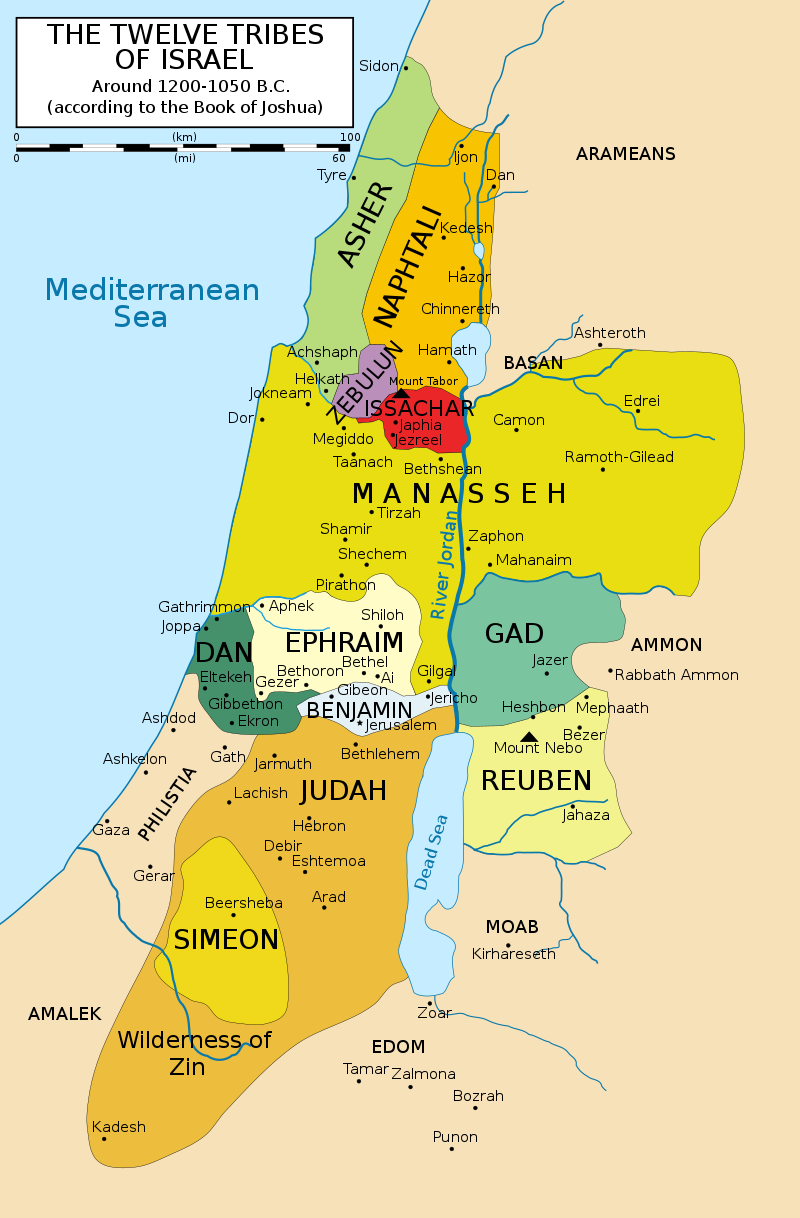
VICTORIES OVER
PHILISTINES
He defeated the Philistines as far as Gaza and its territory,
From watchtower to fortified city This is imagery of "from the smallest fortification to the largest fortification."
John Walton - defeat of the Philistines. The Philistine seaports had been in Assyrian control since Tiglath-Pileser III (745–727 B.C.). Hezekiah likely invaded this area in 705 after the death of Sargon II of Assyria in battle. Counting on the vulnerability of Assyria, Hezekiah probably commandeered anti-Assyrian groups in the area to begin open rebellion against the powerful state. The purpose of the attack was to loosen Assyria’s hold on the trade routes to Egypt. Sargon’s successor, Sennacherib, however, was able to establish pro-Assyrian governors in Philistia.
Bob Utley - "defeated the Philistines" This is a possible reference to Assyrian vassal kings (i.e., Padi of Ekron).
2 Kings 18:9 Now in the fourth year of King Hezekiah, which was the seventh year of Hoshea son of Elah king of Israel, Shalmaneser king of Assyria came up against Samaria and besieged it.
- the fourth year: 2Ki 18:1 17:4-6
- Shalmaneser: 2Ki 17:3-23 Ho 10:14
- 2 Kings 18 Resources
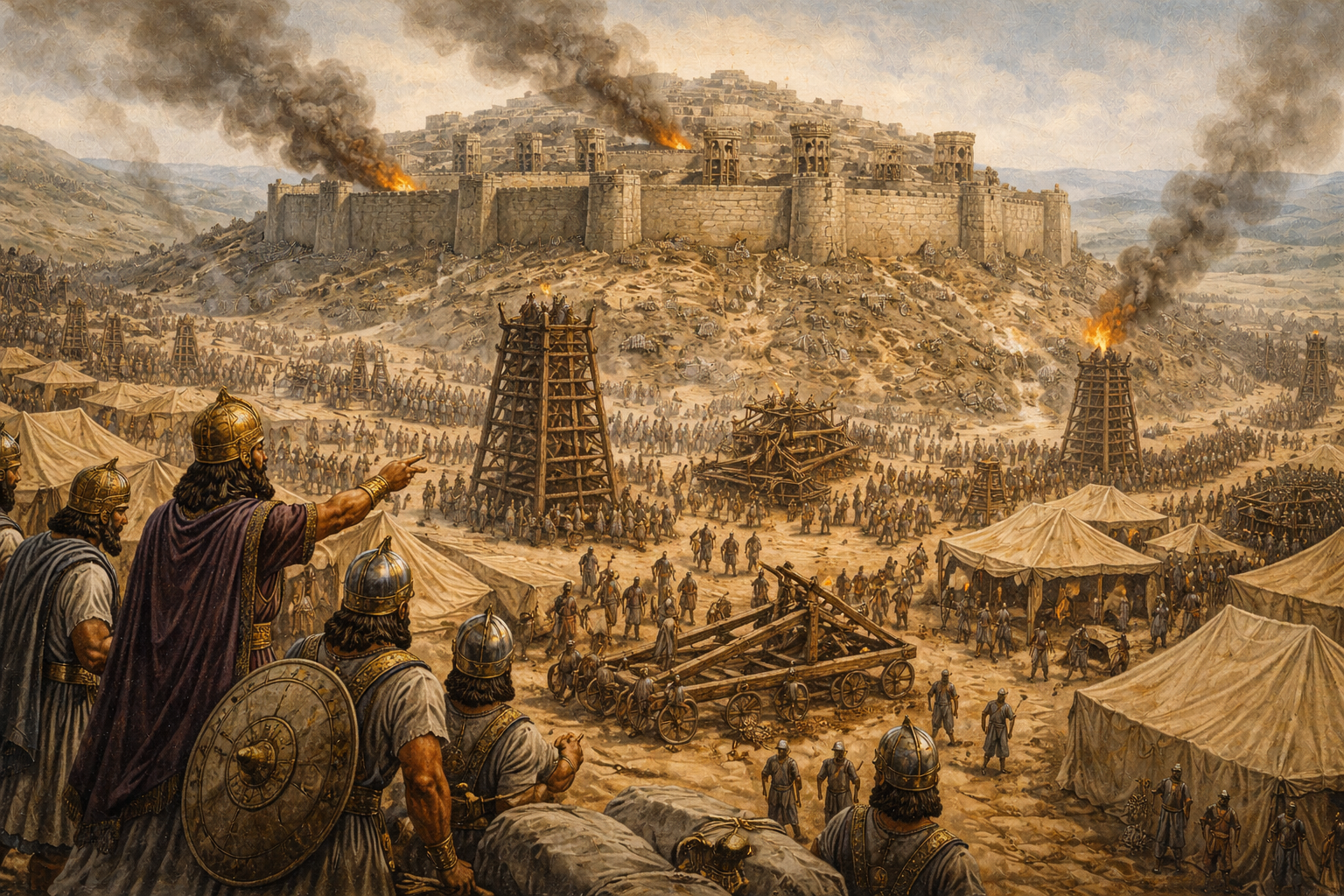
SAMARIA BESIEGED
BY ASSYRIANS
Now in the fourth year of King Hezekiah, which was the seventh year of Hoshea son of Elah king of Israel, Shalmaneser king of Assyria came up against Samaria and besieged it - Shalmaneser V, king of Assyria, who came up against Samaria during the reign of Hoshea of Israel and began the siege that ultimately led to the city’s fall (cf. 2 Kgs 17:3–6). Shalmaneser V reigned c. 727–722 BC and initiated the siege, though Samaria likely fell after his death, early in the reign of his successor Sargon II, who later claimed credit for the capture.
John MacArthur: These verses [2Ki 18:9-12] flash back to the time just before Israel’s destruction and captivity to give a summary of the fall of Samaria (more fully narrated in 2Ki 17:5-23) as a graphic reminder of the Assyrian power and the threat they still were to Judah. This review sets the scene for the siege of Jerusalem with its reminder of Israel’s apostasy against which Hezekiah’s faith in the Lord was a bright contrast. (The MacArthur Bible Commentary- Page 463)
Bob Utley - 18:9-10 Shalmaneser V is the Assyrian king who first besieged Samaria. The siege lasted three years. During this time Shalmaneser V died but his son, Sargon II, finished the job.
Shalmaneser V (Hebrew שַׁלְמַנְאֶסֶר, Shalmanʾeṣer; Strong’s H8022; meaning commonly given as “fire-worshipper,” with proposed nuances such as peace, binding, or retribution) was an Assyrian king who succeeded Tiglath-Pileser III and reigned briefly ca. 727–722 BC; he invaded the northern kingdom of Israel during the reign of Hoshea, compelled him to pay tribute, then returned when Hoshea rebelled by seeking Egyptian support, captured Hoshea, and laid siege to Samaria for three years, a campaign recorded in 2Ki 17:3–6 and 2Ki 18:9–11, though it remains uncertain whether Shalmaneser completed the conquest himself or died before the city fell, since Sargon II later claimed the final capture of Samaria and the deportation of its inhabitants; the Bible mentions him as the Assyrian king responsible for Israel’s overthrow, while extrabiblical records are sparse, leaving open questions about his lineage, the end of his reign, and whether “Shalman” in Hosea 10:14 is an abbreviated reference to him.
2 Kings 18:10 At the end of three years they captured it; in the sixth year of Hezekiah, which was the ninth year of Hoshea king of Israel, Samaria was captured.
- they took it: Ho 13:16 Am 3:11-15 4:1-3 6:7 9:1-4 Mic 1:6-9 6:16 7:13
- 2 Kings 18 Resources
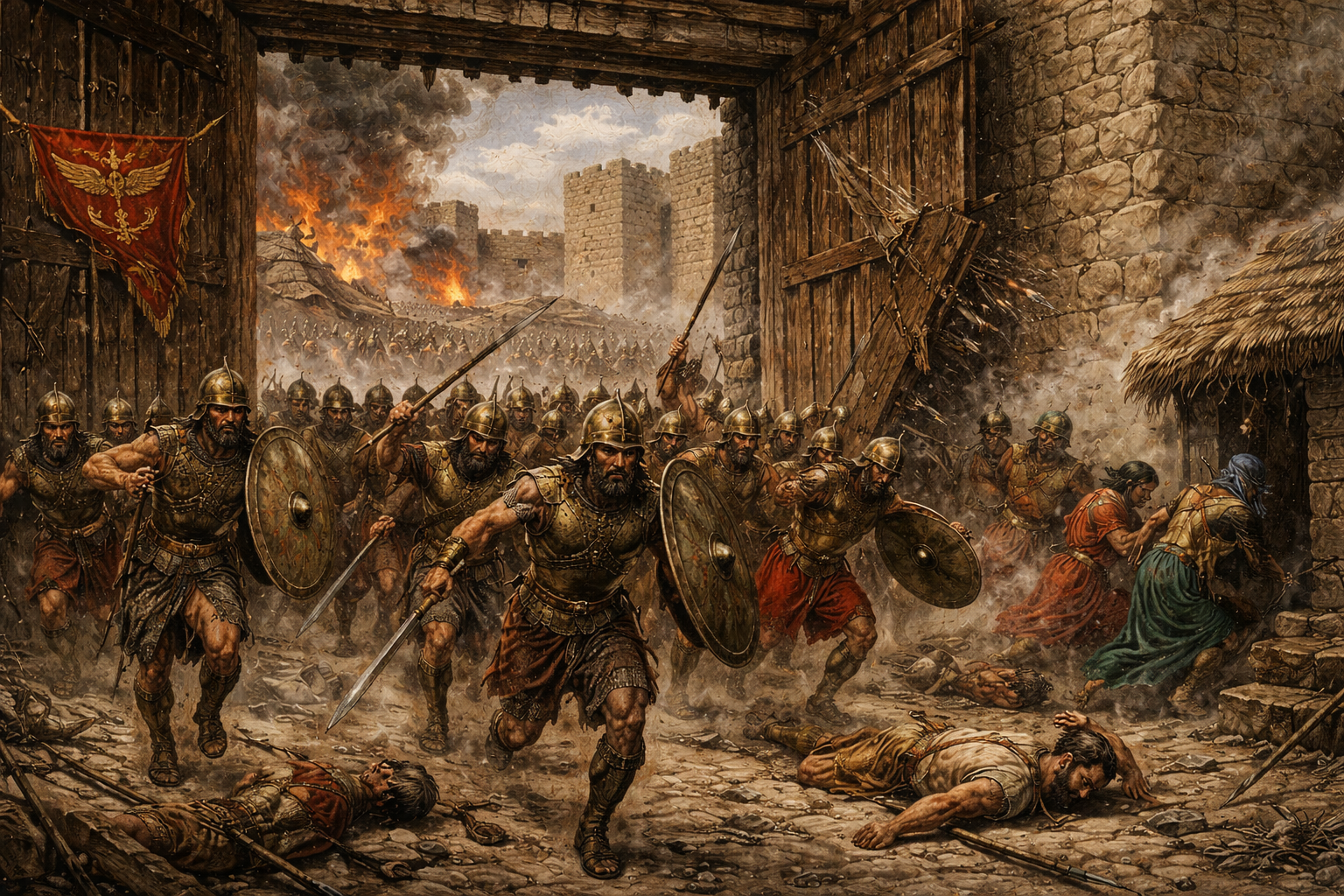
SAMARIA FALLS TO
THE ASSYRIAN
At the end of three years they captured it; in the sixth year of Hezekiah, which was the ninth year of Hoshea king of Israel, Samaria was captured. This statement dates the fall of Samaria precisely, explaining that after a three-year siege, the city was captured in the sixth year of Hezekiah of Judah, which corresponded to the ninth year of Hoshea king of Israel.
2 Kings 18:11 Then the king of Assyria carried Israel away into exile to Assyria, and put them in Halah and on the Habor, the river of Gozan, and in the cities of the Medes,
- Then the king of Assyria 2Ki 17:6 19:11 1Ch 5:26 Isa 7:8 8:4 9:9-21 10:5,11 37:12 Ho 8:8,9 Ho 9:3 Am 5:1-3,6,25-27 Ac 7:43
- 2 Kings 18 Resources
Related Passages:
2 Kings 17:6 In the ninth year of Hoshea, the king of Assyria captured Samaria and carried Israel away into exile to Assyria, and settled them in Halah and Habor, on the river of Gozan, and in the cities of the Medes.
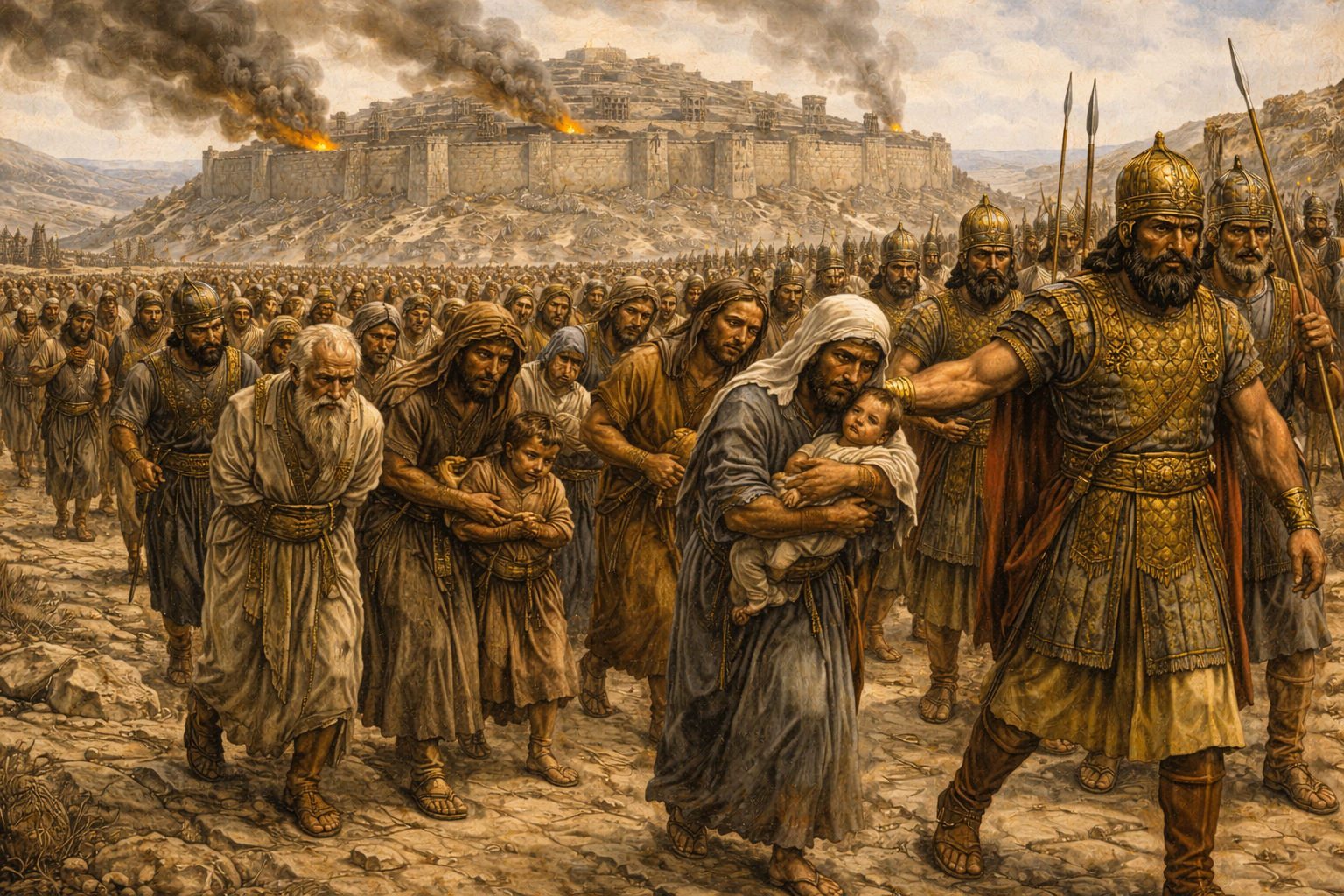
ISRAELITES DEPORTED
TO ASSYRIA
Then the king of Assyria carried Israel away into exile to Assyria, and put them in Halah and on the Habor, the river of Gozan, and in the cities of the Medes - Most historians feel the king of Assyria involved in the fall of Samaria and deportation in 722 BC was Sargon II.
John Walton - places of northern deportation. The areas of deportation of the Samarians are not all precisely known. Halah was a city and province northeast of Nineveh. Sargon’s capital was built there using enemy captives as laborers, probably including Israelites. Habor (Habur) was a large tributary of the Euphrates in eastern Syria. The area had a large Aramean population. Gozan (Tell Halaf) was a city by the headwaters of the Habur River and was the chief city of the Assyrian province of Bit Bahian. Israelite personal names have been found in the Assyrian documents from Gozan. These areas had suffered a decline of population because of the constant Assyrian incursions in the region in previous centuries. In this region the deportees were probably farming the king’s lands. The “cities of the Medes” were probably regions of Media in northwest Iran that were controlled by Assyria. Sargon’s campaigns to Media are well documented. Sargon’s inscriptions record the resettlement of the fortress cities of Harhar and Kishessu by deportees. These Israelites would have been serving in a military capacity on the front line.
Sargon II (r. 722–705 BC), whose name appears in Assyrian inscriptions as Šarru-kīn (“the legitimate king” or “[the god] has established the king”), rose to power after the death of Shalmaneser V, likely as a usurper, and deliberately adopted the illustrious name of the ancient Sargon of Akkad to legitimize his rule; early in his reign he completed the conquest of the northern kingdom of Israel, claiming to have captured Samaria, deported 27,280 inhabitants, and reduced Israel to an Assyrian province (2 Kgs 17:6; 2Ki 18:9–12), though Scripture mentions him by name only in connection with the capture of Ashdod (Isa 20:1). One of Assyria’s most formidable warrior-kings (See map of his empire), he crushed revolts and carried out far-reaching campaigns against Babylonia, Elam, Media, Armenia, Cappadocia, Syria, Palestine, Arabia, and the Egyptian frontier, eventually expelling Merodach-baladan from Babylon and assuming royal authority there. He also left a lasting architectural legacy by founding the royal capital Dur-Sharrukin (Khorsabad) near Nineveh, from which he ruled at the height of Assyrian power, until his assassination by one of his own soldiers in 705 BC, after which the throne passed to his son Sennacherib. (See also Wikipedia) (See Archaeological Biography)
2 Kings 18:12 because they did not obey the voice of the LORD their God, but transgressed His covenant, even all that Moses the servant of the LORD commanded; they would neither listen nor do it.
- they did not obey 2Ki 17:7-23 De 8:20 11:28 29:24-28 31:17 Ne 9:17,26,27 Ps 107:17 Isa 1:19 Jer 3:8 7:23 Da 9:6-11 Mic 3:4 2Th 1:8 1Pe 2:8 4:17
- Moses: Nu 12:7 De 34:5 Jos 1:1 2Ti 2:24 Heb 3:5,6
- 2 Kings 18 Resources
ISRAEL'S FATAL FLAW
TRANSGRESSING COVENANT
Because - Term of explanation. What is he explaining? Why Israel fell and was taken into exile by Assyria in 722 BC. The Assyrians defeated Israel, but the sovereign orchestrated the overthrow (cf Pr 21:1).
They did not obey (shama; LXX - akouo - hear, hearken to) the voice of the LORD their God - Disobedience led to Israel's defeat and deportation. Obey is the Hebrew verb shama which means to hear or listen and by extension to obey what is heard. Notice that Israel heard Yahweh's voice. Yes at Mt Sinai but these men were not there to the hearing of His voice would be via the words of the prophets, Yahweh's mouthpiece. Also any hearing of the reading of the Law would be hearing God's voice.
But - Term of contrast. This is a simple contrast but a sad one.
Transgressed (abar; LXX - parabaino) His covenant (beriyth; LXX - diatheke) even all that Moses the servant ( 'ebed; LXX - doulos) of the LORD commanded - Note the contrast implied -- Israel was anything but a servant of the LORD, which Moses was His servant. A servant does what his master commands. Israel continually refused to do what Yahweh commanded even rejecting His Word.
they would neither listen (shama; LXX - akouo - hear, hearken to) nor do it.
Bob Utley - This gives the reason for Assyria's victory as YHWH's judgment on Israel's sins (cf. 2 Kings 17), not the power of Assyria's gods or military. Kings is a theologically based history, as is Chronicles (i.e., Deuteronomy 7-9; 27-30). YHWH's control of history (cf. Isa. 46:10; 55:8-11) can be seen in
- Shalmaneser V ‒ 2 Kgs. 17:3,4; 18:9
- Nebuchadnezzar ‒ Jer. 21:7; 25:9; 27:6; Ezek. 29:18-20; 30:19
- Cyrus II ‒ Isa. 45:1
This reflects the biblical worldview of the sovereignty and uniqueness of YHWH.
2 Kings 18:13 Now in the fourteenth year of King Hezekiah, Sennacherib king of Assyria came up against all the fortified cities of Judah and seized them.
- the fourteenth: 2Ch 32:1-23 Isa 36:1-22
- Sennacherib: Heb. Sanherib
- came up: Isa 7:17-25 8:7,8 10:5 Ho 12:1,2
- 2 Kings 18:13-20:19 is also found in Isaiah 36:1-39:8.
- 2 Kings 18 Resources
Parallel Passage:
Isaiah 36:1 Now in the fourteenth year of King Hezekiah, Sennacherib king of Assyria came up against all the fortified cities of Judah and seized them.
Related Passages:
Isaiah 20:1 In the year that the commander came to Ashdod, when Sargon the king of Assyria sent him and he fought against Ashdod and captured it,
Isaiah 21:16 For thus the Lord said to me, “In a year, as a hired man would count it, all the splendor of Kedar will terminate;
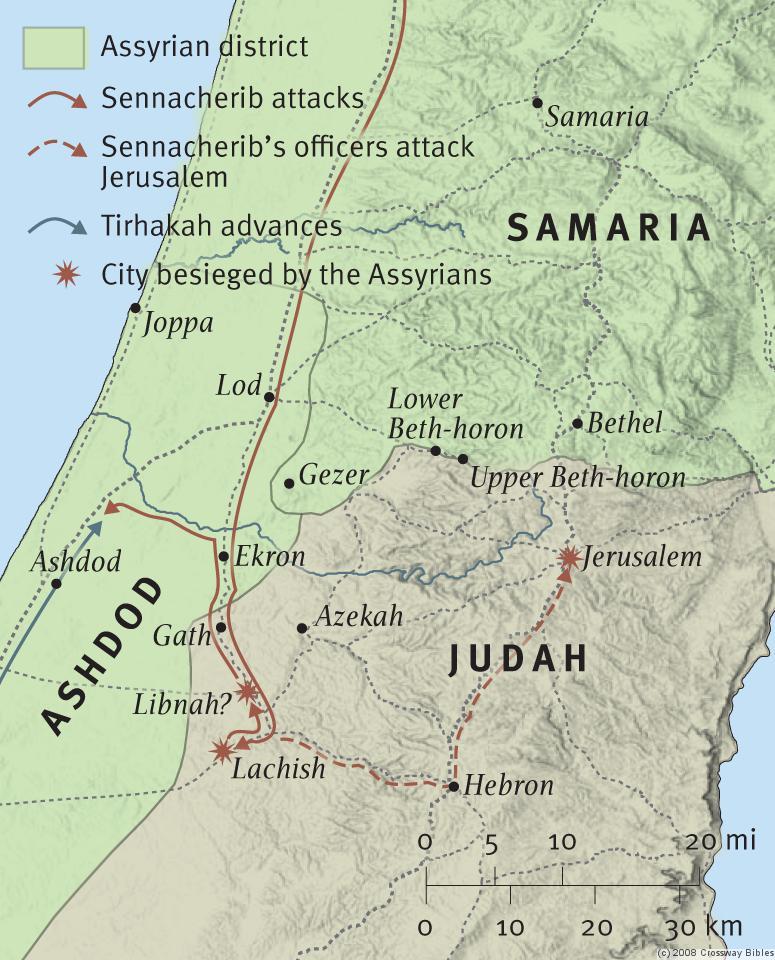
ESV Study Bible page 790 (borrow)
ASSYRIANS ASSAULT
TAKES JUDEAN CITIES
Now in the fourteenth year of King Hezekiah (about 701 BC), Sennacherib king of Assyria came up against all the fortified cities of Judah and seized them - The invasion described in Isaiah 36:1 and 2 Kings 18:13 took place in 701 BC, which corresponds to the fourteenth year of King Hezekiah’s reign and is one of the best-established dates in Old Testament history. It is confirmed not only by the biblical text but also by Assyrian records, including Nineveh inscriptions such as Sennacherib’s Prism, which describe Sennacherib’s campaign against Judah.
This moment marked a severe national crisis, placing immense pressure on Hezekiah’s faith and leadership as Judah faced overwhelming military odds against the mighty Assyrian forces, the greatest army in the world at that time. The invasion tested whether Hezekiah's trust would rest in human defenses or in the LORD Alone. This episode reminds us that even God’s faithful servants are not spared trials, but that such trials often become the stage on which God displays His saving power and faithfulness. As Ps 34:19 declares, “Many are the afflictions of the righteous, but the LORD delivers him out of them all.” Another way to look at this truth is that faith does not mean we will have no attacks or tests! (Jas 1:2-7, 1Pe 1:6-7, 1Pe 4:12)
ARCHEAOLOGY FINDINGS CONFIRMING ASSYRIAN INVASION OF JUDAH - Here is part of the Akkadian insciption found on the Taylor Prism - "As for Hezekiah the Judahite, who did not submit to my yoke…Forty-six of his strong, walled cities… which were without number… I besieged, I captured…200,150 people… male and female… horses, mules, asses, camels, cattle and sheep… I brought away from them and counted as spoil. Hezekiah himself, like a caged bird I shut up in Jerusalem, his royal city…His cities which I had despoiled, I cut off from his land…" (Source)
Click to enlargeWikipedia in the Annals of Sennacherib has this historical note recorded on the Taylor Prism (pictured above) - As for the king of Judah, Hezekiah, who had not submitted to my authority, I besieged and captured forty-six of his fortified cities, along with many smaller towns, taken in battle with my battering rams. ... I took as plunder 200,150 people, both small and great, male and female, along with a great number of animals including horses, mules, donkeys, camels, oxen, and sheep. As for Hezekiah, I shut him up like a caged bird in his royal city of Jerusalem. I then constructed a series of fortresses around him, and I did not allow anyone to come out of the city gates. His towns which I captured I gave to Mitinti, king of Ashdod; Padi, ruler of Ekron; and Silli-bel, king of Gaza.
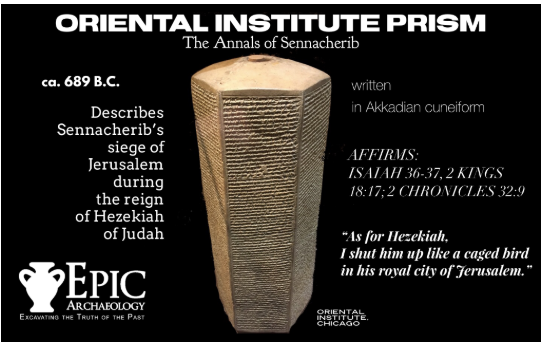

Bob Utley - "in the fourteenth year of King Hezekiah" Gleason Archer, Encyclopedia of Bible Difficulties, p. 207, asserts that a copyist miscopied "24" to "14." The 24th year fits the other dates given in 2 Kings. SPECIAL TOPIC: TEXTUAL CRITICISM
Bob Utley - "Sennacherib king of Assyria" He began this invasion in 701 B.C. See Introduction to Isaiah for further historical information.The Jewish Study Bible, p. 763, has a good summary of the Assyrian account of this incursion. "Sennacherib's own accounts mention that he conqered 46 strong cities and forts, that he captured over 200,000 people, that he made 'Hezekiah a prisoner in Jerusalem, like a bird in a cage,' and that Hezekiah paid him a large tribute, including his daughters, palace women, and male and female singers."
F B Meyer - 2 Kings 18:13-16 Sennacherib. -- It must have been a vast disappointment when the Assyrian came to invade Judah. But the invasion would probably give a great assistance to the cause of reform, arresting and warning many who thought the king too particular. It was a great mistake to bribe Sennacherib; and, like so many of our expedients, it did not avail. What a lamentable pity that Hezekiah did not, from the commencement of his trouble, throw himself on the protecting care of God! If the king had only trusted this time as he did the next, there would have been no need for the bribe. God would have delivered His people.
Gleason Archer - How could Sennacherib’s invasion have occurred in the fourteenth year of Hezekiah?
2 Kings 18:13 in the Masoretic text states: “Now in the fourteenth year of King Hezekiah, Sennacherib king of Assyria came up against all the fortified cities of Judah and seized them.” Since Sennacherib’s own record in the Taylor Prism establishes 701 B.C. as the date of that invasion, the fourteenth year of Hezekiah would mean that he did not ascend the throne until 715 B.C. Yet 2 Kings 18:1 (the very same chapter, be it noted) states that Hezekiah became king in the third year of Hoshea king of Israel—which comes out to 729 or 728. This would have been the year in which he was crowned as subordinate king, under his father Ahaz (who did not die until 725). The Masoretic text of 2 Kings 18:13 therefore stands in clear contradiction to 18:1, 9, and 10, which confirm that Hezekiah’s fourth year was Hoshea’s seventh and that Hezekiah’s sixth was Hoshea’s ninth (i.e., 722 B.C.). We must therefore conclude that the Masoretic text has preserved an early textual error (which also appears in Isa. 36:1—where the error probably originated), in which a mistake was made in the decade column. The word “fourteen” was originally “twenty-four.” (for further details, see the articles on 2 Kings 8:24 and Ezra 2 and Nehemiah 7. Compare also my Survey of Old Testament Introduction, pp. 291–92, and E.J. Young, Book of Isaiah: New International Commentary, 2 vols. [Grand Rapids: Eerdmans, 1969], 2:540–42.)
Norman Giesler - 2 KINGS 18:13—How can this verse say that Sennacherib invaded Judah in the fourteenth year of Hezekiah?
PROBLEM: 2 Kings 18:13 claims that “in the fourteenth year of King Hezekiah, Sennacherib king of Assyria came up against all the fortified cities of Judah and took them.” Since archaeological evidence has established Sennacherib’s invasion at 701 B.C., this would mean that Hezekiah became co-regent with his father Ahaz in 719 B.C., and sole ruler of Judah in 715 B.C. However, according to 2 Kings 18:1, Hezekiah became co-regent in 729 B.C., and he became sole ruler of Judah when his father died in 725 B.C. This is a discrepancy of ten years. Which account is correct?
SOLUTION: The claim that Sennacherib invaded Judah in the fourteenth year of Hezekiah is clearly a copyist error. Sennacherib actually invaded Judah in the twenty-fourth year of the reign of Hezekiah of Judah. The error is easy to explain since the difference between the two numbers is a single Hebrew letter. The Hebrew consonants for “fourteen” are rb srh, while the Hebrew consonants for “twenty-four” are rb srm (the ancient manuscripts did not write the vowels, see Appendix 2). The final letters are the only difference in the written text. In fact, the words are the same, only the word “twenty” is simply the plural form of the word “ten.” We might express the way the Hebrew is written as “four ten,” or “four twenty.” It is simply a case where a copyist miscopied the form from “four twenty” to “four ten.”
- See When Critics Ask
See Sennacherib’s Siege of Lachish - Study reveals how Assyria conquered the Judahite city - excerpt...
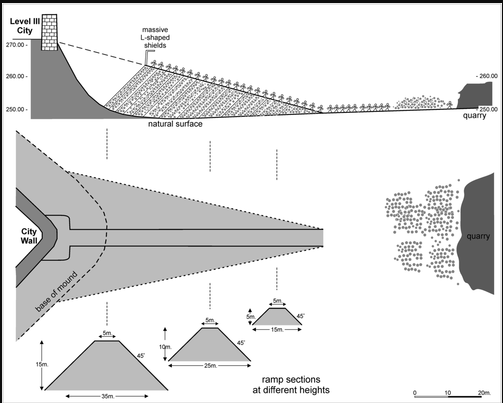
Plan and section drawings of the reconstructed siege ramp at Lachish,
starting from the far end with a stone quarry nearby
Credit: Yosef Garfinkel et al.
Perhaps no event recorded in the Hebrew Bible is better supported by archaeology and external evidence than Sennacherib’s siege of Lachish in 701 B.C.E. The siege of Lachish is documented in multiple Assyrian texts and reliefs and is also clearly visible in the site’s archaeology. These various sources agree that Lachish eventually fell to the Assyrians, who built a massive siege ramp to reach the top of the city’s walls. The same tactic would later be used by the Romans in their siege of Masada. A study, published in the Oxford Journal of Archaeology, examines what went into the construction of the Lachish siege ramp and, in turn, argues for the accuracy of the biblical description of the event. (full article)
Dilday - An interesting wall relief taken from the excavation of Sennacherib’s royal palace in Nineveh is preserved in the British Museum. It portrays the Assyrian king on a portable throne in his military camp outside Lachish. Prisoners of war are marching by on foot, and all the booty from the city is being displayed on ox-wagons. (See The Preacher's Commentary)
QUESTION - Who was Sennacherib? gotquestions.org
ANSWER - Sennacherib was the king of Assyria who reigned from about 720 BC to 683 BC. Archaeologists have uncovered the remains of his palace in Khorsebad, near the ancient city of Nineveh (Jonah 1:1–3). During the reign of King Hezekiah in Judah, Sennacherib invaded Judah, bent on conquering Jerusalem (2 Kings 18:13). Assyria had already conquered the northern kingdom of Israel in 722 BC and had taken the people captive. Second Kings 18:12 says, “This happened because they did not listen to the voice of the LORD their God, but violated His covenant—all that Moses the servant of the LORD had commanded—and would neither listen nor obey.” Now, under Sennacherib, Assyria stood poised to conquer Judah, too.
King Sennacherib’s men first attacked forty-six of Judah’s fortified cities and captured them (Isaiah 36:1). Then they laid siege on Jerusalem. In desperation, Hezekiah sent gold and silver as a peace offering to Assyria, hoping to appease the power-hungry Sennacherib (2 Kings 18:13–16). The Lord sent word to Hezekiah that Sennacherib would not step foot inside the city of Jerusalem (Isaiah 37:33), so Hezekiah stood firm and refused to give in to the Assyrian king’s boastful threats (2 Kings 18:28–35; 2 Chronicles 32:17). He commanded the terrified citizens of Jerusalem not to answer taunts from Sennacherib’s men outside the wall (2 Kings 18:36). Instead, Hezekiah encouraged the people in the Lord: “Be strong and courageous. Do not be afraid or discouraged because of the king of Assyria and the vast army with him, for there is a greater power with us than with him. With him is only the arm of flesh, but with us is the Lord our God to help us and to fight our battles” (2 Chronicles 32:7–8).
Hezekiah sent messengers to Isaiah the prophet to learn what God said on the matter. Because Sennacherib had blasphemed the Lord in his threats against Jerusalem, Isaiah told the king’s messengers, “Tell your master that this is what the LORD says: ‘Do not be afraid of the words you have heard, with which the servants of the king of Assyria have blasphemed Me. Behold, I will put a spirit in him so that he will hear a rumor and return to his own land, where I will cause him to fall by the sword’” (2 Kings 19:5–7).
Hezekiah received the message from Isaiah gladly, but Sennacherib sent Hezekiah a letter of his own: “Do not let the god you depend on deceive you when he says, ‘Jerusalem will not be given into the hands of the king of Assyria.’ Surely you have heard what the kings of Assyria have done to all the countries, destroying them completely. And will you be delivered? Did the gods of the nations that were destroyed by my predecessors deliver them—the gods of Gozan, Harran, Rezeph and the people of Eden who were in Tel Assar? Where is the king of Hamath or the king of Arpad? Where are the kings of Lair, Sepharvaim, Hena and Ivvah?” (2 Kings 19:10–13). King Sennacherib had a long list of victories to boast of, but he made the mistake of thinking Israel’s God was just like the gods of the nations he had defeated.
King Hezekiah took the boastful letter he received from Sennacherib to the temple where he spread it out before the Lord. Then he prayed, “Lord, the God of Israel, enthroned between the cherubim, you alone are God over all the kingdoms of the earth. You have made heaven and earth. Give ear, Lord, and hear; open your eyes, Lord, and see; listen to the words Sennacherib has sent to ridicule the living God” (2 Kings 19:15–16). Hezekiah acknowledged that Assyria was powerful, but he knew that God was more powerful: “It is true, Lord, that the Assyrian kings have laid waste these nations and their lands. They have thrown their gods into the fire and destroyed them, for they were not gods but only wood and stone, fashioned by human hands. Now, Lord our God, deliver us from his hand, so that all the kingdoms of the earth may know that you alone, Lord, are God” (2Ki 19:17–19).
The prophet Isaiah sent word to Hezekiah that, because of Sennacherib’s blasphemous taunts about the God of Israel, the Lord Himself would fight for them and destroy Sennacherib and his armies. Sennacherib was not just defying Israel; he was defying the Living God. That night, the angel of the Lord slew 185,000 in the Assyrian camp. When Sennacherib saw the carnage, he abandoned his conquest of Jerusalem and fled to Nineveh. He never stepped foot inside Jerusalem, just as Isaiah had said.
As Psalm 139:7–12 reminds us, no one can hide from the Lord. One day as Sennacherib was worshiping in his god’s temple, his own sons killed him with a sword (2 Kings 19:36–37). Thus Isaiah’s prophecy of verse 7 was fulfilled.
Hezekiah’s passive victory over Sennacherib is another example of the Lord’s promise to fight for His people (Exodus 14:14; 1 Samuel 17:47; cf. 2 Kings 19:34). As long as they honored Him and obeyed His commands, the Lord was their Defender. He often allowed them to face opposition greater than their resources in order to demonstrate His power and love. The Lord still seeks those who will honor Him so that He can show Himself strong on their behalf (2 Chronicles 16:9). The account of Sennacherib’s failed siege ends with this: “So the Lord saved Hezekiah and the people of Jerusalem from the hand of Sennacherib king of Assyria and from the hand of all others. He took care of them on every side” (2 Chronicles 32:22). Once again, the Lord demonstrated to Judah and to all who call upon His name that “the battle is the Lord’s” (1 Samuel 17:47).
Tentative list of rulers and approximate dates:
- 1354-1318 Asshur-Uballit I:
- conquered the Hittite city of Carchemish
- began to remove Hittite influence and allowed Assyria to develop
- 1297-1266 Adad-Nirari I (powerful king)
- 1265-1235 Shalmaneser I (powerful king)
- 1234-1197 Tukulti-Ninurta I
– first conquest of Babylonian empire to the south - 1118-1078 Tiglath-Pileser I
– Assyria becomes a major power in Mesopotamia - 1012- 972 Ashur-Rabi II
- 972- 967 Ashur-Resh-Isui II
- 966- 934 Tiglath-Pileser II
- 934- 912 Ashur-Dan II
- 912- 890 Adad-Nirari II
- 890- 884 Tukulti-Ninurta II
- 883- 859 Asshur-Nasir-Apal II
- 859- 824 Shalmaneser III
– Battle of Qarqar in 853 - 824-811 Shamashi-Adad V
- 811-783 Adad-Nirari III
- 781-772 Shalmaneser IV
- 772-754 Ashur-Dan III
- 754-745 Ashur-Nirari V
- 745-727 Tiglath-Pileser III
- called by his Babylonian throne name, Pul, in 2 Kings 15:19
- very powerful king
- started the policy of deporting conquered peoples
- In 735 B.C. there was the formation of the "Syro-Ephramatic League," which was an attempt to unify all the available military resources of the trans-Jordan nations from the head waters of the Euphrates to Egypt for the purpose of neutralizing the rising military power of Assyria. King Ahaz of Judah refused to join and was invaded by Israel and Syria. He wrote to Tiglath-Pileser III for help against the advise of Isaiah (cf. 2 Kings 16; Isaiah 7-12).
- In 732 Tiglath-Pileser III invades and conquers Syria and Israel and places a vassal king on the throne of Israel, Hoshea (732-722). Thousands of Jews from the Northern Kingdom were exiled to Media (cf. 2 Kings 15).
- 727-722 Shalmaneser V
- Hoshea forms an alliance with Egypt and is invaded by Assyria (cf. 2 Kings 17)
- besieged Samaria in 724 B.C.
- 722-705 Sargon II:
- After a three year siege started by Shalmaneser V, his successor Sargon II conquers the capital of Israel, Samaria. Over 27,000 are deported to Media.
- The Hittite empire is also conquered.
- In 714-711 another coalition of trans-Jordan nations and Egypt rebelled against Assyria. This coalition is known as "the Ashdad Rebellion." Even Hezekiah of Judah originally was involved. Assyria invaded and destroyed several Philistine cities.
- 705-681 Sennacherib:
- In 705 another coalition of transJordan nations and Egypt rebelled after the death of Sargon II. Hezekiah fully supported this rebellion. Sennacherib invaded in 701. The rebellion was crushed but Jerusalem was spared by an act of God (cf. Isaiah 36-39 and 2 Kings 18-19).
- Sennacherib also put down the rebellion in Elam and Babylon.
- 681-669 Esarhaddon:
- first Assyrian ruler to attack and conquer Egypt
- had great sympathy with Babylon and rebuilt its capital city
- 669-633 Ashurbanipal:
- also called Osnappar in Ezra 4:10
- His brother Shamash-shum-ukin was made king of Babylon. This brought several years of peace between Assyria and Babylon but there was an undercurrent of independence which broke out in 652 led by his brother.
- fall of Thebes, 663 B.C.
- defeated Elam, 653, 645 B.C.
- 633-629 Asshur-Etil-Ilani
- 629-612 Sin-Shar-Ishkun
- 612-609 Asshur-Uballit II:
– enthroned king in exile in Haran after the fall of Assher in 614 B.C. and Nineveh in 612 B.C.
2 Kings 18:14 Then Hezekiah king of Judah sent to the king of Assyria at Lachish, saying, “I have done wrong. Withdraw from me; whatever you impose on me I will bear.” So the king of Assyria required of Hezekiah king of Judah three hundred talents of silver and thirty talents of gold.
- I have done wrong.: 2Ki 18:7 1Ki 20:4 Pr 29:25 Lu 14:32
- 2 Kings 18 Resources
HEZEKIAH ATTEMPTS
TO APPEASE ASSYRIA
Then Hezekiah king of Judah sent to the king of Assyria at Lachish, saying, “I have done wrong - Hezekiah admits to fault against Assyria. Recall that in 2Ki 18:7 it said Hezekiah "rebelled against the king of Assyria and did not serve him." The invasion of Judah by Assyria shook Hezekiah's confidence in his ability to prevent an invasion of Jerusaelm.
Withdraw from me; whatever you impose on me I will bear.” - It is surprising that after such a godly beginning and experiencing revival, when tested (God allowed the Assyrians to invade Judah), his faith falters and he gives in to fear. Instead of going to Yahweh in prayer, he chooses a humanly devised way to avoid further trouble with Assyria. It is notable that Isaiah was an active prophet at this time and he had warned Judah not to rely on foreign powers but to trust in God alone (Isaiah 30:1–3).
So the king of Assyria required of Hezekiah king of Judah three hundred talents of silver and thirty talents of gold - In caving in to the king of Assyria, Hezekiah gave away a "ton" of precious metal - actually several tons - 300 talents × 75 lb = 22,500 lb or about 10.2 metric tons of silver and 30 talents × 75 lb = 2,250 lb or about 1.02 metric tons of gold.
Despite Hezekiah's faith failure God’s mercy is evident in the following passages for when Sennacherib broke his word and attacked Jerusalem anyway, Hezekiah humbled himself before God, prayed earnestly, and sought Isaiah’s counsel (2 Kings 19:1–4). Probably having learned his lesson of relying on man, he sought to rely on God. And so this time, he placed his trust fully in the Lord, and God delivered Judah miraculously by destroying the Assyrian army (2 Kings 19:35). The lesson is that even faithful believers can stumble under pressure, but God graciously restores those who repent and return to Him. Beloved, we all have "faith failures," but fortunately God never does and His mercy and grace are always available to us when we humble ourselves and return to Him in faith (and repentance).
Believers Study Bible- One of the cities which Sennacherib besieged was Lachish. Inscriptions of this siege have been found in the king's palace at Nineveh. Hezekiah agreed to pay tribute to Sennacherib. In his inscription, Sennacherib claims that the tribute also included precious stones, inlaid couches and chairs, elephant hides, and even Hezekiah's own daughters, women of the palace, and musicians.
Bob Utley - 18:14-16 Hezekiah tried to stop Assyria's reprisal by admitting his offence and paying tribute. But (1) this did not work (cf. vv. 17-37; Josephus, Antiq. 10.1.1) (2) there is a period of time between v. 16 and v. 17 "Lachish" This was a major Judean fortress about 30 miles southwest of Jerusalem. It had become the headquarters for the Assyrian invaders. The horror of Lachish's siege and fall (in Assyrian bas reliefs now in the the British Museum) graphically illustrates the scene.
John Walton - 18:14–16. Hezekiah’s tribute. The inscriptions of Sennacherib state that Hezekiah paid thirty talents of gold (about one ton) and eight hundred talents of silver (about twenty-five tons). The Assyrian texts are more detailed, as they claim that Hezekiah was required to send his daughters, concubines, male and female musicians, ivory, elephant hides and various other objects.
2 Kings 18:15 Hezekiah gave him all the silver which was found in the house of the LORD, and in the treasuries of the king’s house.
- 2Ki 12:18 16:8 1Ki 15:15,18,19 2Ch 16:2
- 2 Kings 18 Resources
Related Passages:
Psalm 34:4 I sought the LORD, and He answered me, And delivered me from all my fears.
HEZEKIAH HAD TO GO
TO GOD'S HOUSE FOR TREASURE
Hezekiah gave him all the silver which was found in the house of the LORD, and in the treasuries of the king’s house - "Buying peace" with pagans can be very costly. That principle was true then but is still true today. The irony is that compromise born of fear leads to loss, not true peace. Hezekiah surely must have read David's words, but he forget the message of Ps 20:7 "Some boast in chariots and some in horses, But we will boast in the name of the LORD, our God." One is also reminded of the words in Isaiah 7:9NET "If your faith does not remain firm, then you will not remain secure." In fact, this momentary withdrawal by the Assyrians was followed by a full fledged assault on Jerusalem. So much for silver and gold buying safety!
2 Kings 18:16 At that time Hezekiah cut off the gold from the doors of the temple of the LORD, and from the doorposts which Hezekiah king of Judah had overlaid, and gave it to the king of Assyria.
- gold: 1Ki 6:31-35 2Ch 29:3
- 2 Kings 18 Resources
STEALING FROM GOD
TO PAYOFF GODLESS PAGAN
At that time Hezekiah cut off the gold from the doors of the temple of the LORD, and from the doorposts which Hezekiah king of Judah had overlaid, and gave it to the king of Assyria. - This is an incredibly sad testimony to the cost of Hezekiah's faith failure, actually leading him in effect to steal from Jehovah!
Bob Utley - "doorposts" This term is found only here. Its meaning is unknown but is somehow related to "doors" in the previous clause.
2 Kings 18:17 Then the king of Assyria sent Tartan and Rab-saris and Rabshakeh from Lachish to King Hezekiah with a large army to Jerusalem. So they went up and came to Jerusalem. And when they went up, they came and stood by the conduit of the upper pool, which is on the highway of the fuller’s field.
- Then the king of Assyria: 2Ch 32:9 Isa 20:1 36:2
- the conduit of the upper pool: 2Ki 20:20 Isa 7:3 22:9-11 36:2
- 2 Kings 18 Resources
Parallel Passages:
2 Chr 32:9 After this Sennacherib king of Assyria sent his servants to Jerusalem while he was besieging Lachish with all his forces with him, against Hezekiah king of Judah and against all Judah who were at Jerusalem, saying,
Related Passages:
Isaiah 36:2-3 And the king of Assyria sent (HIS SERVANTS - 2Ch 32:9) Rabshakeh from Lachish to Jerusalem to King Hezekiah with a large army. And he stood by the conduit of the upper pool on the highway of the fuller’s field. 3 Then Eliakim the son of Hilkiah, who was over the household, and Shebna the scribe, and Joah the son of Asaph, the recorder, came out to him.
Isaiah 7:3 Then the LORD said to Isaiah, “Go out now to meet Ahaz, you and your son Shear-jashub, at the end of the conduit of the upper pool, on the highway to the fuller’s field,
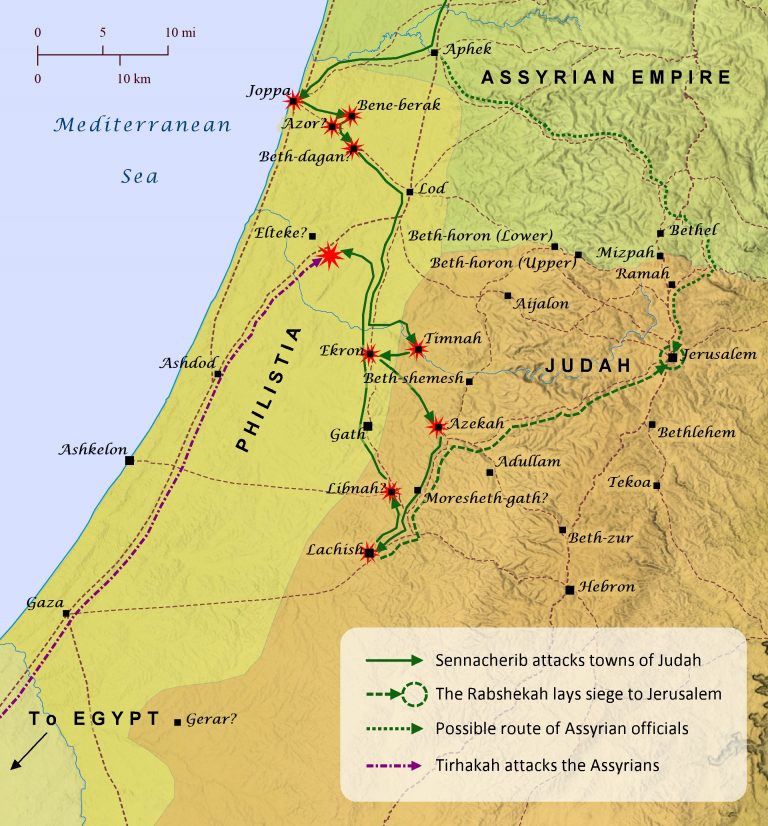
ASSYRIA PREPARES TO
ATTACK JERUSALEM
Then - This marks progression in the narrative. How long between the "pay off" and the "stand off" against Jerusalem is not known. The implication is that this was not a lengthy respite for Hezekiah and Jerusalem.
The king of Assyria sent Tartan and Rab-saris and Rabshakeh from Lachish to King Hezekiah with a large army to Jerusalem. So they went up and came to Jerusalem - So much for tons of precious metal buying security! It probably helped finance this attack against Jerusalem! Tartan, Rab-saris, and Rabshakeh refer to high-ranking Assyrian officers. The Tartan was the commander-in-chief, the Rab-saris was a chief official or court officer, and the Rabshakeh was likely the field commander or spokesman. Their arrival “with a great army” was meant to intimidate Jerusalem and demonstrate Assyria’s power.
It is interesting that the conduit of the upper pool, on the highway to the fuller’s field is the same place where, years earlier, the prophet Isaiah had met King Ahaz, Hezekiah’s father, to urge him to trust in the Lord rather than in foreign alliances (Isaiah 7:3). Now, in the same spot, Hezekiah faced the same test of faith his father had failed.
And when they went up, they came and stood by the conduit of the upper pool, which is on the highway of the fuller’s field - The conduit of the upper pool was part of Jerusalem’s water system, a vital resource during a siege. By standing there, the Assyrian envoys were making a psychological statement, in effect threatening the city’s survival and challenging Hezekiah’s trust in God.
It is a classic confrontation of faith under pressure! One is reminded of the right response when the pressure builds, the psalmist reminding us that "God is our refuge and strength, A very present help in trouble. Therefore we will not fear, though the earth should change And though the mountains slip into the heart of the sea." (Ps 46:1-2). That's a great psalm to memorize, but even better one to put into practice!
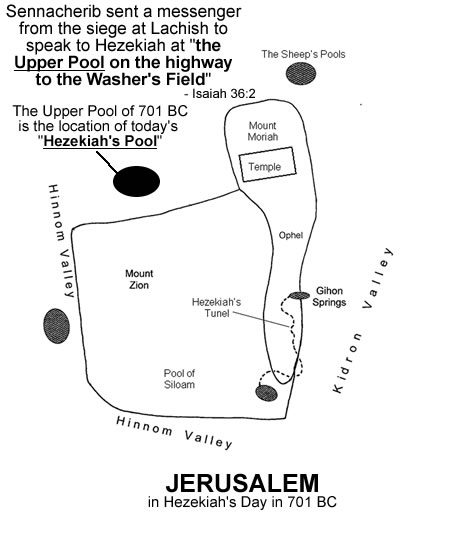
POSSIBLE Location of Upper Pool
Scholars disagree
Scholars generally place this landmark outside (or near) the city’s wall, along a main approach road (“highway”), but the exact identification of the “upper pool” is debated.
Conduit = a water-channel / aqueduct associated with a reservoir (“upper pool”). In other words, a known waterworks landmark.
Fuller’s field = an area associated with cloth-washing/bleaching, which naturally fits a location near water. The spot had to be close enough to Jerusalem’s wall for negotiations/shouting to be heard (Rabshakeh episode)
Bob Utley - "Tartan" This was not a personal name but a title, "Commander-in-chief of the Army" (BDB 1077, cf. Isa. 20;1). "Rab-saris" This was not a personal name but a title, "Chief Eunuch" (BDB 913 CONSTRUCT BDB 710)., cf. Jer. 39:3,13). "Rabshakeh" This is not a personal name but a title, "Chief Cupbearer" (BDB 913 II; NIDOTTE, vol. 4, p. 232, #5). "by the conduit of the upper pool" This was probably on the north side close to the Assyrian camp at Lachish. See Isa. 7:3. "fuller's field" This is a CONSTRUCT of "field" (BDB 911) and "wash" (BDB 460, KB 459, Qal ACTIVE PARTICIPLE). Washing clothes in the ANE did not involve soap but beating on stones or treading on them to loosen the dirt. It is possible this field was (1) a place of pounding or treading clothes (i.e., a water source) (2) a place where wet clean clothes were spread out to dry (3) a place where new cloth was softened (TEV, Walter Duckat, Beggar to King: All the Occupations of Biblical Times, p. 88)
Henry Morris - Rabshakeh. These names are actually titles. Tartan, Rabsaris and Rabshakeh mean, respectively, "Tribute Officer," "Chief Eunuch" and "Chief Butler." conduit of the upper pool. Ironically (or providentially), this was the same location where Ahaz had received and then ignored, the testimony of the prophet Isaiah some thirty years before, even including the great promise of the coming virgin birth of the Messiah, Immanuel (Isaiah 7:3,10-14).
John Walton - Sennacherib’s officials. Tartan, Rabsaris and Rabshakeh appear in some translations, while the NIV refers to them as “supreme commander,” “chief officer,” and “field commander.” The NIV is correct that these are titles rather than names. They are well-known from Assyrian texts. The first, Tartan (Akkadian, turtan), the “field marshal,” was the chief military officer. He represented the king and was sometimes the crown prince. The second, Rabsaris (Akkadian, rab sha reshi), the “chief eunuch,” was probably the representative of the separate military division, the king’s bodyguard. The third, Rabshakeh (Akkadian, rab shaqe), the “chief cupbearer,” is thought to be the provincial governor.
F B Meyer - 2 Kings 18:17-37 Rab-shakeh. -- Three years after, the generals of Sennacherib beleagured the city, in very close quarters. It is thought by some that this bold blasphemer was an apostate Jew, hence the added force of his words. He tried to prove that the Jews had forfeited Divine protection (2 Kings 18:22); that the Assyrians had come at the bidding of Jehovah (2 Kings 18:25); and that He would not be able to do more for His people than other gods (2 Kings 18:34).
The Jews met the taunts of Rab-shakeh in silence. It was wise policy. It is infinitely better to hand over our wrongs to God, who will avenge our cause and see that right is done, than to defend ourselves by argument and force. The only exception is when a simple explanation may relieve the cause we love from some evil imputation. Rab-shakeh could not understand the attitude of the king and people. Men of the world cannot read our secrets. God's hidden ones are as great a mystery as Christ was; but one day they will be manifested with Him.
2 Kings 18:18 When they called to the king, Eliakim the son of Hilkiah, who was over the household, and Shebnah the scribe and Joah the son of Asaph the recorder, came out to them.
- Eliakim the son of Hilkiah: 2Ki 19:2 Isa 22:20-24 Isa 36:3,22 37:2
- Shebna: Isa 22:15-19
- the scribe: or, secretary, 2Sa 8:17
- the recorder: 2Sa 8:16 20:24 1Ki 4:3 2Ch 34:8
- 2 Kings 18 Resources
Related Passages:
Isaiah 36:3 Then Eliakim the son of Hilkiah, who was over the household, and Shebna the scribe, and Joah the son of Asaph, the recorder, came out to him....
Isaiah 36:22 Then Eliakim the son of Hilkiah, who was over the household, and Shebna the scribe and Joah the son of Asaph, the recorder, came to Hezekiah with their clothes torn and told him the words of Rabshakeh.
KING'S ASSISTANTS
ANSWER ASSYRIAN THREATS
When they called to the king, Eliakim the son of Hilkiah, who was over the household, and Shebnah the scribe and Joah the son of Asaph the recorder, came out to them - To send high ranking officials instead of the ruler appearing was common diplomatic practice in the ancient Near East, especially when dealing with hostile envoys. Eliakim the son of Hilkiah, who was over the household, would probably be like our modern prime minister.
Believers Study Bible - Shebna, the scribe, was one of Hezekiah's negotiators (cf. v. 37). Later he would turn from the ways of God and be denounced by Isaiah as a man utterly worthless in character, one doomed to be driven away by God's judgment like a ball tossed with the foot (Isa. 22:15-18).
Bob Utley - As Sennacherib's officials are listed in v. 17, so here, Hezekiah's (cf. 2 Kgs. 19:2). (1) Eliakim ‒ over the household, v. Isa. 22:20; 36:3,22; 37:2; see Roland deVaux, Ancient Israel, pp. 129-131 (2) Shebna ‒ the scribe, Isa. 22:15; 36:3,22; see Roland deVaux, Ancient Israel, pp. 131-132 (3) Joah ‒ the recorder of Isa. 36:22, this title is from the VERB "remember" (BDB 269); it was used of official court records in 2 Sam. 8:16; 20:24; 1 Kgs. 4:3; 2 Kgs. 18:37; Isa. 36:3,22; 1 Chr. 18:15; 2 Chr. 34:8; see Roland deVaux, Ancient Israel, p. 132
2 Kings 18:19 Then Rabshakeh said to them, “Say now to Hezekiah, ‘Thus says the great king, the king of Assyria, “What is this confidence that you have?
- Thus says: 2Ch 32:10 Isa 10:8-14 36:4 37:13 Da 4:30
- What confidence: 2Ki 18:22,29,30 19:10 2Ch 32:7,8,10,11,14-16 Ps 4:2 Isa 36:4,7 37:10
- 2 Kings 18 Resources
Parallel Passages:
2 Chronicles 32:10 “Thus says Sennacherib king of Assyria, ‘On what are you trusting that you are remaining in Jerusalem under siege?
ATTEMPTS TO
SOW DOUBT
Then Rabshakeh said to them, “Say now to Hezekiah, ‘Thus says the great king, the king of Assyria, “What is this confidence (LXX - peitho) that you have? Rabshakeh’s question was meant to sow doubt, but it ultimately set the stage for God to display His glory. The “confidence” Hezekiah had was not in himself or in human strength, but in the living God who keeps His promises and defends His people.
Rabshakeh’s question about Judah’s confidence captures the age-old conflict between faith and fear. The world still asks believers, “What is this confidence that you have?”—as though trusting God were foolish when circumstances appear overwhelming. Scripture, however, consistently teaches that true confidence is found only in the Lord, not in visible strength or human calculation. Psalm 27:1 declares, “The Lord is my light and my salvation; whom shall I fear? The Lord is the stronghold of my life; of whom shall I be afraid?”
Bob Utley - "the great king" This was a characteristic title of the Assyrian monarch, like "King of Kings" was for Babylonian kings. It was a way to designate the main/chief ruler over many vassal kings. "What is this confidence that you have" This refers to Hezekiah's trust in YHWH (cf. vv. 22, 30, 32). The Assyrian leaders were trying to cause a rift between the king and his faith and his unpopular acts against idolatry (cf. v. 22; i.e., removing the high places, destroying the Canaanite fertility idols and his destroying Moses' bronze serpent). The people of Judah still clung to idolatry.
Great King - 12v - 2 Ki. 18:19; 2 Ki. 18:28; Ezr. 5:11; Ps. 47:2; Ps. 48:2; Ps. 95:3; Eccl. 9:14; Isa. 36:4; Isa. 36:13; Dan. 2:10; Mal. 1:14; Matt. 5:35
2 Kings 18:20 “You say (but they are only empty words), ‘I have counsel and strength for the war.’ Now on whom do you rely, that you have rebelled against me?
- vain words: Heb. word of the lips, I have counsel and strength for the war. or, but counsel and strength are for the war. Pr 21:30,31
- rebelled: 2Ki 18:14
- 2 Kings 18 Resources
Parallel Passages:
Isaiah 36:5 “I say, ‘Your counsel and strength for the war are only empty words.’ Now on whom do you rely, that you have rebelled against me?
YOUR STRATEGY IS
JUST EMPTY TALK
You say (but they are only empty words), ‘I have counsel and strength for the war.’ Now on whom do you rely, that you have rebelled against me - Rabshakeh was claiming that Hezekiah’s confidence—whether in military plans, alliances, or in the Lord—was worthless against Assyria’s power. The Assyrian envoy saw trust in God as “empty words,” but Hezekiah’s later prayer proved that faith in the Lord is never in vain. The Rabshakeh’s taunt set the stage for God to show that His strength, not human might, brings true victory.
NET NOTE - Heb "you say only a word of lips, counsel and might for battle." Sennacherib's message appears to be in broken Hebrew at this point. The phrase "word of lips" refers to mere or empty talk in Pr 14:23.
Bob Utley - 18:20-21 Hezekiah had flirted with an alliance with Egypt but Egypt was too weak during this period to help (cf. Isa. 30:2-3).
F B Meyer - 2 Kings 18:20 Now on whom dost thou trust?
It was no small thing for Hezekiah to rebel against the proud King of Assyria. Hamath and Arpad, Samaria and Sepharvaim, Hena and Ivah, reduced to heaps of stones, were sufficient proofs of the might of his ruthless soldiers. How could Jerusalem hope to withstand? Rabshakeh could not comprehend the secret source of Hezekiah’s confidence. It was of no use for him to turn to Egypt. Pharaoh was a bruised reed. And as for Jehovah! Was there any likelihood that He could do for Israel more than the gods of the other nations had done for them? Not infrequently does the puzzled world ask the Church, “In whom dost thou trust?”
Our life must to a large extent be a mystery, our peace pass understanding, and our motives be hidden. The sources of our supply, the ground of our confidence, the reasons for our actions, must evade the most searching scrutiny of those who stand outside the charmed circle of the face of God; as it is written, “Eye hath not seen, nor ear heard . . . what God hath prepared.”
We all ought to have the secrets which the world cannot penetrate. Doubt your religion if it all lies on the surface, and if men are able to calculate to a nicety the considerations by which you are actuated. We must be prepared to be misunderstood and criticized, because our behavior is determined by facts which the princes of this world know not. We do not look up to the hills, because we look beyond them to God; we do not trust in silver or gold, or human re source, because God is our confidence. We cannot but seem eccentric to this world, because we have found another center, and are concentric with the Eternal Throne.
2 Kings 18:21 “Now behold, you rely on the staff of this crushed reed, even on Egypt; on which if a man leans, it will go into his hand and pierce it. So is Pharaoh king of Egypt to all who rely on him.
- the staff: Isa 36:6 Eze 29:6,7
- on Egypt: Isa 30:2,7 31:1-3
- so is Pharaoh: 2Ki 17:4 Jer 46:17
- 2 Kings 18 Resources
Parallel Passages:
Isaiah 36:6 “Behold, you rely on the staff of this crushed reed, even on Egypt, on which if a man leans, it will go into his hand and pierce it. So is Pharaoh king of Egypt to all who rely on him.
MOCKING JUDAH'S
ALLIANCE WITH EGYPT
Now behold (hinneh), you rely on the staff of this crushed reed, even on Egypt; on which if a man leans, it will go into his hand and pierce it. So is Pharaoh king of Egypt to all who rely on him - Rabshakeh says that trusting Egypt is like leaning on a broken reed that splinters and pierces the hand. His image means Egypt was weak and unreliable—anyone depending on her for help would only be hurt.
Bob Utley - "Behold, you rely on the staff of this crushed reed, even on Egypt" Apparently, the Assyrians had inside information on Hezekiah's ill-conceived design for a military alliance with Egypt. Isaiah had earlier condemned this alliance (cf. Isa. 30:1-5; 31:1-3).
Motyer - “Egypt had made its one attempt to redeem its promises (Isaiah 28:14) and its army had been beaten at El Tekeh. The Rab-shakeh had himself seen this, but his words are more far-reaching and damaging, exposing the criminal stupidity of Judah’s leaders: surely, he said, they knew that anyone who ever trusted Egypt suffered for it.” (Isaiah: An Introduction and Commentary - Page 223)
Dilday - Since this is the same terminology Isaiah used to symbolize Egypt (Isaiah 42:3), some have suggested that Sennacherib was familiar with Isaiah’s prophecies and quoted here to imply he was carrying out Yahweh’s will. Further support for this idea is found in verse 25 where Sennacherib seemed to be aware of Isaiah’s statement that Assyria was a rod which Yahweh would use to punish Judah (Isaiah 10:5). (See The Preacher's Commentary - 1 and 2 Kings - Page 32)
Oswalt: According to Sennacherib’s annals, the Assyrian army struck the coast at Sidon and from that point worked its way southward, devouring opponent after opponent until the Egyptian army finally made a stand at Eltekeh about twenty miles west of Jerusalem at the edge of the hill country. There Isaiah’s prophecies concerning the foolishness of dependence upon Egypt (20:1– 6; 30:1–5; 31:1–3) proved painfully true as the Egyptians were routed and the Assyrians continued on to Lachish, Judah’s last hope for stemming the tide.
2 Kings 18:22 “But if you say to me, ‘We trust in the LORD our God,’ is it not He whose high places and whose altars Hezekiah has taken away, and has said to Judah and to Jerusalem, ‘You shall worship before this altar in Jerusalem’?
NET Perhaps you will tell me, 'We are trusting in the LORD our God.' But Hezekiah is the one who eliminated his high places and altars and then told the people of Judah and Jerusalem, 'You must worship at this altar in Jerusalem.'
BGT καὶ ὅτι εἶπας πρός με ἐπὶ κύριον θεὸν πεποίθαμεν οὐχὶ αὐτὸς οὗτος οὗ ἀπέστησεν Εζεκιας τὰ ὑψηλὰ αὐτοῦ καὶ τὰ θυσιαστήρια αὐτοῦ καὶ εἶπεν τῷ Ιουδα καὶ τῇ Ιερουσαλημ ἐνώπιον τοῦ θυσιαστηρίου τούτου προσκυνήσετε ἐν Ιερουσαλημ
LXE And whereas thou hast said to me, We trust on the Lord God: is not this he, whose high places and altars Ezekias has removed, and has said to Juda and Jerusalem, Ye shall worship before this altar in Jerusalem?
CSB Suppose you say to me: We trust in the LORD our God. Isn't He the One whose high places and altars Hezekiah has removed, saying to Judah and to Jerusalem: You must worship at this altar in Jerusalem? '
ESV But if you say to me, "We trust in the LORD our God," is it not he whose high places and altars Hezekiah has removed, saying to Judah and to Jerusalem, "You shall worship before this altar in Jerusalem"?
NIV And if you say to me, "We are depending on the LORD our God"--isn't he the one whose high places and altars Hezekiah removed, saying to Judah and Jerusalem, "You must worship before this altar in Jerusalem"?
NLT "But perhaps you will say to me, 'We are trusting in the LORD our God!' But isn't he the one who was insulted by Hezekiah? Didn't Hezekiah tear down his shrines and altars and make everyone in Judah and Jerusalem worship only at the altar here in Jerusalem?
- We trust in the LORD our God: 2Ki 18:5 Da 3:15 Mt 27:43
- whose high places: 2Ki 18:4 2Ch 31:1 32:12 Isa 36:7 1Co 2:15
- 2 Kings 18 Resources
Parallel Passages:
Isaiah 36:7 “But if you say to me, ‘We trust in the LORD our God,’ is it not He whose high places and whose altars Hezekiah has taken away and has said to Judah and to Jerusalem, ‘You shall worship before this altar’?
Related Passages:
2 Chronicles 32:11-12 ‘Is not Hezekiah misleading you to give yourselves over to die by hunger and by thirst, saying, “The LORD our God will deliver us from the hand of the king of Assyria”? 12‘Has not the same Hezekiah taken away His high places and His altars, and said to Judah and Jerusalem, “You shall worship before one altar, and on it you shall burn incense”?
ATTEMPTS TO MOCK
HEZEKIAH'S REFORMS
But - " The Rabshakeh anticipated the response of the leaders of Judah. “Rabshakeh, you say that we can’t trust in Egypt. All right, we won’t. But we can trust in the LORD our God.” (Guzik)
if you say to me ("Perhaps you will tell me"), ‘We trust (batach) in the LORD our God,’ is it not He whose high places (bamah) and whose altars Hezekiah has taken away, and has said to Judah and to Jerusalem, ‘You shall worship before this altar in Jerusalem - Rabshakeh attempts to undermine Hezekiah’s faith by mocking his religious reforms. He falsely claims that Hezekiah had angered God by removing the “high places” and altars throughout Judah, failing to recognize that Hezekiah was actually obeying God’s explicit command to worship at the one place the LORD had chosen—the temple in Jerusalem (cf. Dt 12:5–6). Rabshakeh misunderstood the nature of true worship and exploited that ignorance to sow doubt.
This verse illustrates how the world often misinterprets obedience as rebellion and faithfulness as folly. Yet genuine faith worships God on His terms, not ours, a truth Jesus later affirmed: “God is spirit, and those who worship Him must worship in spirit and truth” (Jn 4:24).
Bob Utley - "whose high places and whose altars Hezekiah has taken away" This is an attempt to impugn Hezekiah's relationship with YHWH (cf. 2 Kgs. 18:5). The thrust of the argument is that YHWH is angry with Hezekiah for closing the local high places (cf. 2 Kgs. 18:7). However, this was a misunderstanding by the Assyrians because Hezekiah did exactly what was commanded in Deuteronomy which is the centralization of worship at a site which YHWH would choose (cf. Deut. 12:2-5). The high places had become sites of Ba'al and Asherah worship (cf. 2 Kgs. 18:4). FERTILITY WORSHIP OF THE ANE
John MacArthur - The Rabshakeh mistakenly thought Hezekiah’s reforms in removing idols from all over the land and reestablishing central worship in Jerusalem (18:4; 2Ch 31:1) had removed opportunities to worship the Lord, and thus cut back on honoring Judah’s God, thereby displeasing Him and forfeiting His help in war. That all worship should center in Solomon’s temple was utterly foreign to the polytheistic Assyrians.
Motyer: Hezekiah had conducted a centralizing reform of religion (2 Ki. 18:1-7; 2 Ch. 29-31) with the closure of local sanctuaries and their (at best) corrupt Yahwism. The Rabshakeh speaks from his own heathen background where reduction in quantity of worship detracted from a god’s glory, but he may have been playing also on the frayed nerves of any who were less than convinced of the rightness of what the king was doing.
2 Kings 18:23 “Now therefore, come, make a bargain with my master the king of Assyria, and I will give you two thousand horses, if you are able on your part to set riders on them.
- I will give: 1Sa 17:42,44 1Ki 20:10,18 Ne 4:2-5 Ps 123:3,4 Isa 10:13,14 Isa 36:8,9
- 2 Kings 18 Resources
Parallel Passages:
Isaiah 36:8 “Now therefore, come make a bargain with my master the king of Assyria, and I will give you two thousand horses, if you are able on your part to set riders on them.
RABSHAKEH'S SARCASM
ABOUT JUDAH'S MANPOWER
Now therefore, come, make a bargain with my master the king of Assyria, and I will give you two thousand horses, if you are able on your part to set riders on them - Rabshakeh derides Judah’s weakness by sarcastically offering 2000 horses, as if Judah could even supply enough riders to use them. The taunt is calculated humiliation, exposing Judah’s apparent military helplessness in contrast to Assyria’s overwhelming strength.
Guzik - This reminds us of the Rabshakeh’s whole strategy, which was to make Judah give up. This was the entire reason the Rabshakeh was at the aqueduct, speaking to these leaders of Hezekiah’s government. He had the vastly superior armies; he could have just attacked Jerusalem without this little speech. But the Rabshekah would prefer it if Judah would simply give up, out of fear, discouragement, or despair. The enemy of our soul uses the exact same approach. Many of us picture Satan as “itching for a fight” with us. Really, Satan doesn’t want to do battle with you. First of all, there is the strong chance you will win. Second of all, win or lose, the battle can draw you closer to the LORD. Thirdly, what the LORD does in your life through the battle can be a great blessing for other people. No, Satan would much rather not fight you at all! He would much rather try to talk you into giving up! ii. We see this exact strategy used against Jesus during His temptation in the wilderness. When Satan promised Jesus all the kingdoms of the world in exchange for Jesus’ worship, Satan was trying to avoid the fight, and trying to talk Jesus into giving up (Luke 4:5-8). It didn’t work with Jesus, and it shouldn’t work with us.
The Devil’s Appeal = Closing Pitch:
Making a Deal with the Devil is a Good Deal for You
The mockery cuts deeper than politics or warfare. Spiritually, it reflects how the world ridicules faith, treating dependence on God as naïveté when measured against the world's power and resources. Scripture repeatedly overturns that foolish assumption, insisting that true strength is never found in numbers, weapons, or technology, but in trusting the Lord. As Ps 33:16–17 soberly declares, “The king is not saved by a mighty army; a warrior is not delivered by great strength. A horse is a false hope for victory; nor does it deliver anyone by its great strength.”
Bob Utley - "make a bargain" This VERB (Hithpael IMPERATIVE) is treaty language for a reciprocal agreement (cf. Isa. 36:8). "if you are able on your part to set riders on them" This sarcastic phrase shows contempt for Judah's weak military condition and Assyria's surplus! It may also be a promise to include Judah's military into the Assyrian army as mercenaries (i.e., hoping to cause a military coup). "I will give you two thousand horses" This is a mocking statement based on the weakness of Judea's army. There is some historical doubt about the presence of cavalry in Judah or Assyria at this early date, therefore, many commentators say this is a reference to chariots even though the obvious language refers to cavalry.
if you are able on your part to set riders on them" This sarcastic phrase shows contempt for Judah's weak military condition and Assyria's surplus! It may also be a promise to include Judah's military into the Assyrian army as mercenaries (i.e., hoping to cause a military coup).
2 Kings 18:24 “How then can you repulse one official of the least of my master’s servants, and rely on Egypt for chariots and for horsemen?
- How then can you repulse one official : Isa 10:8 Da 2:37,38 4:22,37
- and rely on Egypt 2Ki 18:21 De 17:16 Isa 31:1,3 36:6,9 Jer 37:7 42:14-18 Eze 17:15,17
- chariots: Ps 20:7,8
- 2 Kings 18 Resources
Parallel Passages:
Isaiah 36:9 “How then can you repulse one official of the least of my master’s servants and rely on Egypt for chariots and for horsemen?
RABSHAKEH MOCKS
JUDAH'S WEAKNESS
How then can you repulse one official of the least of my master’s servants, and rely on Egypt for chariots and for horsemen - "His basic message is, “We could beat you with one hand tied behind our backs!”" (Guzik) Rabshakeh continues his taunt by mocking Judah’s weakness, claiming they are incapable of defeating even the lowest-ranking Assyrian officer, much less standing against Assyria by relying on Egypt’s help. The intent was deliberate humiliation, seeking to strip Hezekiah’s men of courage, erode their morale, and convince them that resistance was futile.
Spiritually, this exposes the world’s flawed calculus of strength, which measures security by visible power, military rank, and political alliances. God’s people, however, are called to live by a different standard—confidence rooted not in human resources but in divine sufficiency.As Zechariah 4:6 declares, “Not by might, nor by power, but by My Spirit,” says the LORD of hosts. Rabshakeh’s mockery thus becomes a test of faith: whether Judah will accept the world’s definition of strength or trust wholly in the unseen power of God.
NET NOTE - Heb “How can you turn back the face of an official [from among] the least of my master’s servants and trust in Egypt for chariots and horsemen?” In vv. 23–24 the chief adviser develops further the argument begun in 2Ki 18:21. His reasoning seems to be as follows: “In your weakened condition you obviously need military strength. Agree to the king’s terms and I will personally give you more horses than you are capable of outfitting. If I, a mere minor official, am capable of giving you such military might, just think what power the king has. There is no way the Egyptians can match our strength. It makes much better sense to deal with us.”
2 Kings 18:25 “Have I now come up without the LORD’S approval against this place to destroy it? The LORD said to me, ‘Go up against this land and destroy it.’”’”
- Am I now: 2Ki 19:6,22-37 1Ki 13:18 2Ch 35:21 Isa 10:5,6 Am 3:6 Joh 19:10,11
- 2 Kings 18 Resources
Parallel Passages:
Isaiah 36:10 “Have I now come up without the LORD’S approval against this land to destroy it? The LORD said to me, ‘Go up against this land and destroy it.’”’
RABSHAKEH IMPLIES INVASION
OF JUDAH IS GOD'S WILL
Have I now come up without the LORD’S approval against this place to destroy it? The LORD said to me, ‘Go up against this land and destroy it - The Assyrian waw lying when they claimed that God had commanded them to destroy His beloved city. His assertion was a deliberate theological distortion intended to demoralize Judah’s leadership and weaken their resolve. It would be like the converse of "if God is for us who can be against us." The implication if true would be something like this -- "If God is against us who can be for us?" The historical context exposes the deception clearly. While Assyria did function as God’s instrument to discipline Israel, serving as the “rod” by which He chastened His people, there is a crucial distinction between being used by God and receiving explicit divine authorization for a specific campaign. Assyria neither understood nor acknowledged this distinction. She did not recognize herself as merely an instrument in God’s hand. Rather, it was in her heart to destroy nations for her own gain, imagining that her conquests were achieved by her own power and wisdom. In arrogating God’s purposes to herself, Assyria crossed the line from instrument to blasphemer. The LORD said to me is clearly a lie.
This verse warns that evil often disguises itself
with partial truth to weaken faith.
Guzik - The Rabshakeh saved his best thrust for last: “Admit it, Hezekiah. You know that your God is on my side.” Like all good deception, it would have been easy for Hezekiah and his men to believe this one. After all, hadn’t the Assyrians been wildly successful? Surely, God must be on their side. Didn’t they have the most powerful army? Surely, God must be on their side. This was the finishing blow of a brilliant attack. “Hezekiah, God told me to destroy you. I’m just doing His will, and there is nothing you can do to stop it, so you may as well surrender.”
NET NOTE - - In v. 25 the chief adviser develops further the argument begun in v. 22. He claims that Hezekiah has offended the Lord and that the Lord has commissioned Assyria as his instrument of discipline and judgment.
Bob Utley - Have I now come up without the Lord's approval This verse is a statement by the Assyrians that (1) they did not consult Judah's God, (2) God was even on their side! How they knew of the prophecies concerning God's choosing of Assyria to judge Israel, Isa. 10:5-7, is uncertain. Some believe it is a half-truth related to Isa 37:26. This verse seems to contradict itself. (1) "without ... approval," literally "apart from" (2) "the Lord said to me". Obviously Assyria (i.e. Sennacherib) is flaunting itself against the will of YHWH and His people!
2 Kings 18:26 Then Eliakim the son of Hilkiah, and Shebnah and Joah, said to Rabshakeh, “Speak now to your servants in Aramaic, for we understand it; and do not speak with us in Judean in the hearing of the people who are on the wall.”
- in Aramaic: Ezr 4:7 Isa 36:11,12 Da 2:4
- 2 Kings 18 Resources
Parallel Passage:
Isaiah 36:11 Then Eliakim and Shebna and Joah said to Rabshakeh, “Speak now to your servants in Aramaic, for we understand it; and do not speak with us in Judean in the hearing of the people who are on the wall.”
IF THEY DON'T HEAR
THEY WON'T FEAR
Then Eliakim the son of Hilkiah, and Shebnah and Joah, said to Rabshakeh, “Speak now to your servants in Aramaic, for we understand it; and do not speak with us in Judean in the hearing of the people who are on the wall.” The Hebrew officials asked the Assyrians to speak in Aramaic, the commercial and diplomatic language of the day, so that bystanders would not understand what was being said. Evidently the Rabshakeh (commander) himself was speaking in Hebrew or through an interpreter. The Assyrians wanted to prevent the soldiers and citizens from hearing the Assyrian threats and losing heart. Spiritually, this moment shows the leaders’ concern for protecting their people’s faith from fear and discouragement.
Words have power, and believers must guard their hearts against
voices that seek to undermine trust in God,
Bob Utley - "Judean" This term refers to the Hebrew language (BDB 397, cf. Isa. 36:11,13; 2 Chr. 32:18; Neh. 13:24). Aramaic was the later official language of Persia, but here it was the current language of Assyria.
Believers Study Bible - By 600 B.C. Aramaic had become the language of international diplomacy in the Near East. Thus, both the Assyrian and Judean officials (though not the common people) would understand it.
NET NOTE - Aramaic was the diplomatic language of the empire.
2 Kings 18:27 But Rabshakeh said to them, “Has my master sent me only to your master and to you to speak these words, and not to the men who sit on the wall, doomed to eat their own dung and drink their own urine with you?”
KJV But Rabshakeh said unto them, Hath my master sent me to thy master, and to thee, to speak these words? hath he not sent me to the men which sit on the wall, that they may eat their own dung, and drink their own piss with you?
NKJ But the Rabshakeh said to them, "Has my master sent me to your master and to you to speak these words, and not to the men who sit on the wall, who will eat and drink their own waste with you?"
NET But the chief adviser said to them, "My master did not send me to speak these words only to your master and to you. His message is also for the men who sit on the wall, for they will eat their own excrement and drink their own urine along with you."
BGT καὶ εἶπεν πρὸς αὐτοὺς Ραψακης μὴ ἐπὶ τὸν κύριόν σου καὶ πρὸς σὲ ἀπέστειλέν με ὁ κύριός μου λαλῆσαι τοὺς λόγους τούτους οὐχὶ ἐπὶ τοὺς ἄνδρας τοὺς καθημένους ἐπὶ τοῦ τείχους τοῦ φαγεῖν τὴν κόπρον αὐτῶν καὶ πιεῖν τὸ οὖρον αὐτῶν μεθ᾽ ὑμῶν ἅμα
LXE And Rapsakes said to them, Has my master sent me to thy master, and to thee, to speak these words? has he not sent me to the men who sit on the wall, that they may eat their own dung, and drink their own water together with you.
CSB But the Rabshakeh said to them, "Has my master sent me only to your master and to you to speak these words? Hasn't he also sent me to the men who sit on the wall, destined with you to eat their own excrement and drink their own urine?"
ESV But the Rabshakeh said to them, "Has my master sent me to speak these words to your master and to you, and not to the men sitting on the wall, who are doomed with you to eat their own dung and to drink their own urine?"
NIV But the commander replied, "Was it only to your master and you that my master sent me to say these things, and not to the men sitting on the wall--who, like you, will have to eat their own filth and drink their own urine?"
NLT But Sennacherib's chief of staff replied, "Do you think my master sent this message only to you and your master? He wants all the people to hear it, for when we put this city under siege, they will suffer along with you. They will be so hungry and thirsty that they will eat their own dung and drink their own urine."
YLT And the chief of the butlers saith unto them, 'For thy lord, and unto thee, hath my lord sent me to speak these words? Is it not for the men, those sitting on the wall to eat their own dung and to drink their own water, with you?'
- eat their own dung: 2Ki 6:25 De 28:53-57 Ps 73:8 La 4:5 Eze 4:13,15
- 2 Kings 18 Resources
Parallel Passage:
Isaiah 36:12 But Rabshakeh said, “Has my master sent me only to your master and to you to speak these words, and not to the men who sit on the wall, doomed to eat their own dung and drink their own urine with you?”
RABSHAKEH COUNTERS
REQUEST TO SPEAK ARAMAIC
But Rabshakeh said to them, “Has my master sent me only to your master and to you to speak these words, and not to the men who sit on the wall, doomed to eat their own dung and drink their own urine with you?” Rabshakeh deliberately refuses the officials’ request to speak in Aramaic and instead addresses the people in Hebrew so that everyone standing on the city wall can hear and understand his words. By doing so, he turns diplomacy into psychological warfare, crudely describing the starvation, desperation, and humiliation that would accompany a prolonged siege. His aim is not merely to threaten Jerusalem, but to terrorize the population, undermine morale, and provoke the people to turn against Hezekiah’s leadership.
This episode illustrates a familiar tactic of our Adversary who is expert in the strategic use of fear, despair, and vivid imagery to weaken faith and erode trust in God’s promises. Against such assaults, God calls His people not to panic or capitulate, but to stand firm in confident reliance upon Him, echoing the assurance of Isaiah 41:10: “Fear not, for I am with you; be not dismayed, for I am your God.”
NET NOTE to your master and to you to speak these words Heb “To your master and to you did my master send me to speak these words?” The rhetorical question expects a negative answer.
NET NOTE is it not for the men, those sitting on the wall to eat their own dung and to drink their own water, with you? -- The rhetorical question expects the answer, “Yes, it is.” The chief adviser alludes to the horrible reality of siege warfare, when the starving people in the besieged city would resort to eating and drinking anything to stay alive.
Bob Utley - Rabshakeh was trying to cause fear and revolt among the military by referring to things that happened during long sieges (cf. Isa. 36:12). (1) people ate dung (2) people drank urine. The author of Chronicles changes the language (cf. 2 Chr. 32:11). See Roland deVaux, Ancient Israel, "Siege Warfare," pp. 236-238.
2 Kings 18:28 Then Rabshakeh stood and cried with a loud voice in Judean, saying, “Hear the word of the great king, the king of Assyria.
- Rabshakeh: 2Ch 32:18 Isa 36:13-18
- the king of Assyria: 2Ki 18:19 Ezr 7:12 Ps 47:2 Isa 10:8-13 Eze 29:3 31:3-10 Rev 19:6
- 2 Kings 18 Resources
Parallel Passage:
Isaiah 36:13-18 Then Rabshakeh stood and cried with a loud voice in Judean and said, “Hear the words of the great king, the king of Assyria. 14“Thus says the king, ‘Do not let Hezekiah deceive you, for he will not be able to deliver you; 15nor let Hezekiah make you trust in the LORD, saying, “The LORD will surely deliver us, this city will not be given into the hand of the king of Assyria.” 16‘Do not listen to Hezekiah,’ for thus says the king of Assyria, ‘Make your peace with me and come out to me, and eat each of his vine and each of his fig tree and drink each of the waters of his own cistern, 17until I come and take you away to a land like your own land, a land of grain and new wine, a land of bread and vineyards. 18‘Beware that Hezekiah does not mislead you, saying, “The LORD will deliver us.” Has any one of the gods of the nations delivered his land from the hand of the king of Assyria?
RABSHAKEH'S LOUD
RESPONSE IN HEBREW
Then Rabshakeh stood and cried with a loud voice in Judean, saying, “Hear the word of the great king, the king of Assyria - Rabshakeh deliberately raises his voice in Hebrew so that all the people of Jerusalem can hear him, exalting the Assyrian king. This was no accident of speech, but a calculated act of intimidation designed to bypass Judah’s leaders and strike directly at the hearts of the citizens on the wall who were listening to the Assyrian. Rabshakeh’s purpose was to magnify the power and authority of Sennacherib, while simultaneously undermining the people's confidence in the
Rabshakeh's ploy exoses a recurring strategy of the world who attempts to replace God’s rightful authority with political power, and intimidating rhetoric. Against such claims, Scripture consistently reorients God’s people to reality, reminding them that true greatness and sovereignty belong to the Lord alone, the true GREAT KING, as Psalm 47:2 declares, “For the LORD, the Most High, is to be feared, a great King over all the earth.”
2 Kings 18:29 “Thus says the king, ‘Do not let Hezekiah deceive you, for he will not be able to deliver you from my hand;
- Thus says the king: Ps 73:8,9
- Do not let Hezekiah deceive: 2Ch 32:11,15 Da 3:15-17 6:16 Joh 19:10,11 2Th 2:4,8
- 2 Kings 18 Resources
Parallel Passage:
Isaiah 36:14 “Thus says the king, ‘Do not let Hezekiah deceive you, for he will not be able to deliver you;
DON'T TRUST
KING HEZEKIAH
Thus says the king, ‘Do not let Hezekiah deceive you, for he will not be able to deliver (natsal; LXX - exaireo) you from my hand - The Rabshakeh intensifies his psychological assault by warning the people not to trust Hezekiah, insisting that their king is powerless to save them from Assyria’s overwhelming might. This tactic was designed to sever the people’s confidence both in their God-appointed leader and in the LORD Himself, since Hezekiah’s faith and reforms were inseparably tied to trust in Yahweh.
This strategy reveals a familiar pattern of our Adversary of undermining faith by magnifying human weakness and questioning God’s ability or willingness to deliver. Scripture consistently counters Satan's lies with the assurance of God’s exclusive saving power. As Isaiah 43:11 declares, “I, I am the LORD, and besides Me there is no savior.” Rabshakeh’s challenge thus becomes a test of faith: whether the people will believe intimidating voices that deny God’s power, or rest in the unshakable truth that the LORD alone is mighty to save.
Bob Utley - "Do not let Hezekiah deceive you" This VERB (Hiphil IMPERFECT used in a JUSSIVE sense) basically means "beguile" or "deceive." Here, the Assyrian leaders encourage the people of Jerusalem not to trust Hezekiah and his faith in YHWH (cf. Isa. 36:14). In 2 Kgs. 19:10, the same VERB (Hiphil JUSSIVE) is addressed to Hezekiah not to trust YHWH (cf. Isa. 37:10). This same VERB is used of the serpent deceiving Eve in Gen. 3:13. "my hand" There is some confusion in this speech as related to PRONOUNS because Rabshakeh speaks in FIRST PERSON for Sennacherib. "My hand" is in LXX, Peshitta, Targums, and Vulgate.
NET NOTE The Massoretic Text has “his hand,” but this is due to graphic confusion of vav (ו) and yod (י). The translation reads “my hand,” along with many medieval Hebrew MSS, the LXX, Syriac Peshitta, Targum, and Vulgate.
Deliver (05337) natsal means to deliver or rescue, typically by the superior power of one overcoming another, often expressed as deliverance from the “hand” (power) of an adversary (Ge 32:11; Hos 2:10), underscoring that idols and human strength are unable to save (1 Sa 12:21; Ps 33:16); it describes God’s preserving rescue in Jacob’s plea and encounter (Ge 32:11, 30), Joseph’s protection (Ge 37:21–22), Moses as deliverer and Yahweh’s redemptive purpose for Israel (Ex 2:19; 3:8; 6:6), the sparing at Passover (Ex 12:27), and repeated acts of salvation from enemies (Ex 18:4, 8–10; Dt 23:14; 32:39; Josh 24:10; Jdg 6:9; 8:34; 1 Sa 7:14), including specific cases such as Rahab’s appeal (Josh 2:13), Joshua’s protection of the Gibeonites (Josh 9:26), Phinehas averting judgment (Josh 22:31), Gideon’s victory (Jdg 9:17), and David’s cry for release from transgressions (Ps 39:8); the verb also denotes taking from another’s control—plundering or stripping (Ex 12:36; Ex 3:22; Ex 33:6), safeguarding an escaped slave (Dt 23:15), or not having God’s word taken from one’s mouth (Ps 119:43)—and Proverbs affirms that righteousness delivers (Pr 10:2; 11:4, 6; 12:6), anticipating the saving righteousness found in Christ; in the Psalms, nāṣal frequently appears as an urgent plea for rescue from enemies and threats as well as from fear (Ps 34:4), troubles and afflictions (Ps 34:17; 54:7), guilt and bloodshed (Ps 39:8; 51:14), death and peril (Ps 56:13; 69:14; 91:3; 107:6; 120:2; 144:7), and for the deliverance of the needy (Ps 72:12).
2 Kings 18:30 nor let Hezekiah make you trust in the LORD, saying, “The LORD will surely deliver us, and this city will not be given into the hand of the king of Assyria.”
- make you: 2Ki 18:22 2Ki 19:10,22 Ps 4:2 11:1 22:7,8 71:9,11 125:1,2 Mt 27:43 Lu 23:35
- this city: 2Ki 19:32-34
- 2 Kings 18 Resources
Parallel Passage:
Isaiah 36:15 nor let Hezekiah make you trust in the LORD, saying, “The LORD will surely deliver us, this city will not be given into the hand of the king of Assyria.”
RABSHAKEH MOCKS
HEZEKIAH'S FAITH
nor let Hezekiah make you trust in the LORD, saying, “The LORD will surely deliver (natsal; LXX - exaireo) us, and this city will not be given into the hand of the king of Assyria.” Rabshakeh openly mocks Hezekiah’s faith, urging the people not to believe his assurance that the LORD will deliver them. This was a calculated effort to redirect Judah’s trust away from God and drive them toward surrender through fear rather than faith.
The episode illustrates how unbelief assaults God’s promises, questioning His word, magnifying threats, and seeking to replace confident trust with paralyzing doubt. Yet the outcome (which they had to see at the moment by faith, not sight) exposes the lie, for the LORD Himself later intervened to deliver Jerusalem, powerfully confirming that reliance on Him is never misplaced. As Psalm 34:17 declares, “When the righteous cry for help, the LORD hears and delivers them out of all their troubles.”
2 Kings 18:31 ‘Do not listen to Hezekiah, for thus says the king of Assyria, “Make your peace with me and come out to me, and eat each of his vine and each of his fig tree and drink each of the waters of his own cistern,
- Make your peace with me Ge 32:20 33:11 Pr 18:16
- eat: 1Ki 4:20,25 Zec 3:10
- 2 Kings 18 Resources
Parallel Passage:
Isaiah 36:16 ‘Do not listen to Hezekiah,’ for thus says the king of Assyria, ‘Make your peace with me and come out to me, and eat each of his vine and each of his fig tree and drink each of the waters of his own cistern,
RABSHAKEH MAKES A
DECEPTIVE OFFER
Do not listen to Hezekiah, for thus says the king of Assyria, “Make your peace with me and come out to me, and eat each of his vine and each of his fig tree and drink each of the waters of his own cistern Rabshakeh presses his appeal by speaking directly to the people on the wall (not the officials), urging them not to listen to Hezekiah, but instead to surrender to the king of Assyria, dangling promises of peace, security, and prosperity if they comply. This was a calculated deception, an offer of apparent well-being designed to create a false sense of safety while masking the reality of bondage and exile. It can be tempting to abandon trust (walk by faith) in the LORD in exchange for immediate relief.
This scene exposes a timeless temptation, for the godless world continually entices and invites God’s people to trade covenant faithfulness for temporary comfort, urging compromise as the path to peace. Scripture, on the other hand, insists that true peace and lasting provision come ONLY from the LORD, not from surrender to the world. Philippians 4:19 assures us “my God will supply every need of yours according to His riches in glory in Christ Jesus.”
Bob Utley - 18:31-32 This is the promise of exile to a pleasant place. The Judeans could have their own fields, vineyards, and houses, but in a different place.
NET NOTE Make your peace with me and come out to me (NET BIBLE = "Send me a token of your submission" CSB = "Make peace with me and surrender to me.") Heb “make with me a blessing and come out to me.”
2 Kings 18:32 until I come and take you away to a land like your own land, a land of grain and new wine, a land of bread and vineyards, a land of olive trees and honey, that you may live and not die.” But do not listen to Hezekiah when he misleads you, saying, “The LORD will deliver us.”
- I come: 2Ki 18:11 17:6,23 24:14-16 25:11
- like your own: Ex 3:8 Nu 13:26,27 14:8 De 8:7-9 11:12 32:13,14
- misleads, 2Ki 18:29
- 2 Kings 18 Resources
Parallel Passages:
Isaiah 36:17 until I come and take you away to a land like your own land, a land of grain and new wine, a land of bread and vineyards.
Related Passages:
2 Chronicles 32:13 ‘Do you not know what I and my fathers have done to all the peoples of the lands? Were the gods of the nations of the lands able at all to deliver their land from my hand?
A DECEPTIVE
PROMISE
Until - See until. This expresses his presumptuous, arrogant assurance Assyria will overrun Judah. After all they had easily overrun her sister Israel.
I come and take you away to a land like your own land, a land of grain and new wine, a land of bread and vineyards, a land of olive trees and honey, that you may live and not die.” But do not listen to Hezekiah when he misleads you, saying, “The LORD will deliver (natsal; LXX - rhuomai) us.” - Rabshakeh promises to relocate the people to “a land like your own,” portraying it as rich, fertile, and abundant, a calculated attempt to make exile sound attractive rather than catastrophic. His words are deliberately deceptive.
This assurance was meant to soften the horror of deportation and persuade Judah that surrender would lead to blessing rather than loss.
This subtle tactic reveals a familiar strategy of the enemy, a liar and deceiver who repackages destruction as opportunity, bondage as benefit, and compromise as wisdom. By appealing to comfort and prosperity, the Rabshakeh sought to draw God’s people away from trusting the LORD and into reliance on worldly promises. In contrast, Hezekiah’s confidence was rightly anchored in the LORD alone, who truly saves and delivers those who take refuge in Him. As Ps 37:40 declares, “The LORD helps them and delivers them; He delivers them from the wicked and saves them, because they take refuge in Him.”
2 Kings 18:33 ‘Has any one of the gods of the nations delivered his land from the hand of the king of Assyria?
- Hath any: 2Ki 19:12,13,17,18 2Ch 32:14-17,19 Isa 10:10 36:18-20
- 2 Kings 18 Resources
Parallel Passages:
Isaiah 36:18 ‘Beware that Hezekiah does not mislead you, saying, “The LORD will deliver us.” Has any one of the gods of the nations delivered his land from the hand of the king of Assyria?
Related Passages:
2 Chronicles 32:14 Who was there among all the gods of those nations which my fathers utterly destroyed who could deliver his people out of my hand, that your God should be able to deliver you from my hand?
RABSHAKEH EVEN
MOCKS JEHOVAH
Has any one of the gods of the nations delivered (natsal; LXX - rhuomai) his land from the hand of the king of Assyria? Rabshakeh goes so far as to mock the LORD Himself, brazenly comparing Him to the powerless gods of the nations Assyria had already conquered. This blasphemous comparison was intended to persuade Judah that their God was no different, that He was unable to save and destined to fail before Assyria’s might.
This scene exposes the height of human arrogance: measuring the living God by the fate of man-made idols and refusing to acknowledge His absolute sovereignty. Unlike the false gods of the nations, mere created objects with no life, power, or authority,the LORD alone rules history and determines the rise and fall of kingdoms. As Isaiah 46:9 declares, “I am God, and there is no other; I am God, and there is none like Me.” The Rabshakeh’s mockery thus sets the stage for God’s decisive self-vindication, proving that He alone is incomparable and mighty to save.
NET NOTE Heb “Have the gods of the nations really rescued, each his land, from the hand of the king of Assyria?” The infinitive absolute lends emphasis to the main verb. The rhetorical question expects the answer, “Of course not!”
Bob Utley - 18:33-35 None of the gods of the nations east of the Euphrates has been able to stop Assyria; why should Judah think their's could? Even Israel, which is also YHWH's covenant people, has fallen!
2 Kings 18:34 ‘Where are the gods of Hamath and Arpad? Where are the gods of Sepharvaim, Hena and Ivvah? Have they delivered Samaria from my hand?
- the gods: 2Ki 19:13 Nu 13:21 2Sa 8:9 Jer 49:23
- Hamath: Hamath, there is little doubt, was the Epiphania of the Greeks, as Josephus, Theodoret, and Jerome, expressly assert. It was a celebrated city of Syria, situated on the Orontes, and the present Hamah doubtless occupies its site; as Abulfeda, who was prince or emir of Hamah about A.D. 1345, expressly states, in his Description of Syria, that Hamah is an ancient city mentioned in the writings of the Israelites. It is still a considerable town, situated on both sides of the Orontes, about three days' journey and a half from Tripoli; and must contain, Burckhardt says, at least 30,000 inhabitants.
- Arpad: Arpad is probably the town of Arphas, mentioned by Josephus as limiting the province of Gamalitis, Gaulanitis, Batanea, and Trachonitis, to the N. E.; and the Raphan, or Raphanea, which Stephanus places near Epiphania.
- the gods: 2Ki 17:24-33, Ava, Isa 36:18,19 37:11,12,18,19
- have they delivered: 2Ki 17:6,23,24,30,31 19:12,13
- 2 Kings 18 Resources
Parallel Passages:
Isaiah 36:19 ‘Where are the gods of Hamath and Arpad? Where are the gods of Sepharvaim? And when have they delivered Samaria from my hand?
RABSHAKEH LUMPS YAHWEH
WITH OTHER NO-GODS
‘Where are the gods of Hamath and Arpad? Where are the gods of Sepharvaim, Hena and Ivvah? Have they delivered (natsal; LXX - exaireo) Samaria from my hand? - Rabshakeh intensifies his blasphemy by cataloging conquered cities and their defeated gods, insisting that none had been able to rescue their people from Assyria’s power. The argument is clear that if all those (so-called) gods failed, Judah’s God will fail as well. This rhetoric was designed to strip the people of Judah of all hope, convince them that resistance was futile, and portray trust in the LORD as useless.
Rabshakeh's speech exposes the blindness of human pride who seeks to reduces the living, sovereign God to the level of lifeless idols and assuming that past victories over false gods guarantee victory over the true God. History would soon prove otherwise! The LORD would soon decisively vindicate His supremacy by delivering Jerusalem, demonstrating that He is not bound by human comparisons or military precedent. As Ps 115:3 declares, “Our God is in the heavens; He does all that He pleases.”
NET NOTE The parallel passage in Isa 36:19 omits “Hena and Ivvah.” The rhetorical questions in v. 34a suggest the answer, “Nowhere, they seem to have disappeared in the face of Assyria’s might.” ...Samaria - Heb “that they rescued Samaria from my hand?” But this gives the impression that the gods of Sepharvaim were responsible for protecting Samaria, which is obviously not the case. The implied subject of the plural verb “rescued” must be the generic “gods of the nations/lands” (vv. 33, 35).
2 Kings 18:35 ‘Who among all the gods of the lands have delivered their land from my hand, that the LORD should deliver Jerusalem from my hand?’”
- Who: 2Ki 19:17 Da 3:15
- that the Lord: Ex 5:2 2Ch 32:15 Job 15:25,26 Isa 10:15 37:23-29
- 2 Kings 18 Resources
Parallel Passages:
2 Chronicles 32:14 ‘Who was there among all the gods of those nations which my fathers utterly destroyed who could deliver his people out of my hand, that your God should be able to deliver you from my hand?
Isaiah 36:20 ‘Who among all the gods of these lands have delivered their land from my hand, that the LORD would deliver Jerusalem from my hand?’”
Related Passages:
ADDITIONAL INFORMATION NOT IN KINGS - 2 Chronicles 32:15-19 ‘Now therefore, do not let Hezekiah deceive you or mislead you like this, and do not believe him, for no god of any nation or kingdom was able to deliver his people from my hand or from the hand of my fathers. How much less will your God deliver you from my hand?’” 16 His servants spoke further against the LORD God and against His servant Hezekiah. 17 He also wrote letters to insult the LORD God of Israel, and to speak against Him, saying, “As the gods of the nations of the lands have not delivered their people from my hand, so the God of Hezekiah will not deliver His people from my hand.” 18They called this out with a loud voice in the language of Judah to the people of Jerusalem who were on the wall, to frighten and terrify them, so that they might take the city. 19They spoke of the God of Jerusalem as of the gods of the peoples of the earth, the work of men’s hands.
RABSHAKEH'S ARROGANCE &
BLASPHEMY REACH A CLIMAX
Who among all the gods of the lands have delivered (natsal; LXX - exaireo) their land from my hand, that the LORD should deliver Jerusalem from my hand?’” - Rabshakeh reaches the height of arrogance by claiming that no god has ever rescued a nation from Assyria, and therefore insisting that the LORD Himself will not save Jerusalem. Wrong! This is the climax of his blasphemy, as he deliberately places the living God on the same level as lifeless idols and treats Yahweh as just another defeated deity.
He exposes the depth of human pride that dares to challenge God’s power and deny His sovereign authority over history and nations. Yet the LORD would soon decisively answer Rabshakeh's brazen defiance, not with words, but with action. As Isaiah 37:35–36 records, the LORD declared, “I will defend this city to save it,” and then destroyed the Assyrian army in a single night, unmistakably proving that no power, no empire, and no boast can stand against His will or thwart His purpose to save His people.
NET NOTE Heb “that the LORD might rescue Jerusalem from my hand?” The logic runs as follows: Since no god has ever been able to withstand the Assyrian onslaught, how can the people of Jerusalem possibly think the LORD will rescue them?
2 Kings 18:36 But the people were silent and answered him not a word, for the king’s commandment was, “Do not answer him.”
- held their peace: Ps 38:13,14 39:1 Pr 9:7 26:4 Am 5:13 Mt 7:6
- 2 Kings 18 Resources
Parallel Passages:
Isaiah 36:21 But they were silent and answered him not a word; for the king’s commandment was, “Do not answer him.”
THE JUDAHITES OBEY
THEIR KING
But the people were silent and answered him not a word, for the king’s commandment was, “Do not answer him.” - The people of Jerusalem remain deliberately silent before the Assyrian spokesman, obeying King Hezekiah’s explicit command not to answer him. Their silence was not cowardice but reflected their loyalty to Hezekiah. wisdom an intentional refusal to engage blasphemy, intimidation, or psychological warfare. By withholding a response, the people denied the Rabshakeh the debate he sought and resisted being drawn into fear-driven argument. Spiritually, their silence reflects the strength of quiet trust in God, choosing dependence over defensiveness and faith over frantic speech. Scripture repeatedly affirms that there are moments when God’s people honor Him most not by replying, but by resting in His deliverance. As Exodus 14:14 reminds us, “The LORD will fight for you, and you have only to be silent.”
Meyer - Silence is our best reply to the allegations and taunts of our foes. Be still, O persecuted soul! Hand over thy cause to God. It is useless to argue, even in many cases to give explanations. Be still, and commit thy cause to God.”
Bob Utley - 18:36-37 This logical argument caused the people to fear.
2 Kings 18:37 Then Eliakim the son of Hilkiah, who was over the household, and Shebna the scribe and Joah the son of Asaph, the recorder, came to Hezekiah with their clothes torn and told him the words of Rabshakeh.
- with their clothes rent: 2Ki 5:7 22:11,19 Ge 37:29,34 Job 1:20 Isa 33:7 36:21,22 Jer 36:24 Mt 26:65
- 2 Kings 18 Resources
Parallel Passages:
Isaiah 36:22 Then Eliakim the son of Hilkiah, who was over the household, and Shebna the scribe and Joah the son of Asaph, the recorder, came to Hezekiah with their clothes torn and told him the words of Rabshakeh.
HEZEKIAH'S OFFICIALS SHOW
SIGN OF GRIEF AND MOURNG
Then Eliakim the son of Hilkiah, who was over the household, and Shebna the scribe and Joah the son of Asaph, the recorder, came to Hezekiah with their clothes torn (note) and told him the words of Rabshakeh - Eliakim, Shebna, and Joah return to King Hezekiah with their clothes torn, a customary sign of deep grief, shock, and distress, after hearing the blasphemous and threatening words of Rabshakeh. Their torn garments express more than fear of military danger but likely also reveal anguish over the dishonor done to the LORD and the seriousness of the crisis confronting Jerusalem. They are showing a proper response to sin, blasphemy, and overwhelming pressure. The are not expressing bravado or denial, but humility, sorrow, and a readiness to seek the LORD’s help. Such brokenness places God’s people in the posture where divine help is found. As Ps 34:18 affirms, “The LORD is near to the brokenhearted and saves the crushed in spirit.”
If we trace the three dozen explicit references to people’s tearing their clothing, we find four main categories of crisis-grief or mourning over the loss of something or someone, sorrow for sin in an act of repentance, fear or alarm and anger or frustration.
The torn garments of Eliakim, Shebna, and Joah are not mere cultural formality but a theological response to the Assyrian crisis. First, they express shock and deep distress—the Rabshakeh’s words threatened Judah’s survival and echoed the kind of devastation that earlier prompted mourning in Genesis 37. Second, the act conveys righteous outrage at blasphemy, since the Assyrian spokesman openly mocked the LORD Himself (2 Kings 18:30–35), and tearing garments often marked indignation when God’s honor was violated (cf. Isaiah 37:1). Third, it signifies a confession of helplessness: Judah has no human answer to this threat, preparing the way for dependence on God rather than military or political solutions. Finally, torn garments function as a call to humble intercession, frequently preceding prayer and repentance in Israel’s history (Joel 2:12–13). Indeed, Hezekiah immediately responds by humbling himself and seeking the word of the LORD through Isaiah (2 Kings 19:1–7).
The torn clothes in 2 Kings 18:37 mark a decisive turning point. They show that Judah stops engaging the voice of intimidation and instead turns toward the voice of God. What Assyria intended as psychological warfare becomes the catalyst for divine intervention and deliverance.
GRIEVING RITES IN THE OLD TESTAMENT - In the Old Testament, Israelites expressed grief, repentance, and national or personal distress through a rich set of grieving rites, which functioned as outward signs of deep inner sorrow. These included tearing one’s outer robe in moments of shock or loss (Genesis 37:29, 34; 44:13; Judges 11:35; 2 Samuel 1:11; 3:31; 13:31; 1 Kings 21:27; 2 Kings 6:30; Job 1:20; Jeremiah 41:5), putting on sackcloth as a symbol of humiliation and repentance (Genesis 37:34; 2 Samuel 3:31; 1 Kings 21:27; Isaiah 22:12; Ezekiel 7:18; Amos 8:10), and placing dust on the head or sitting on the ground to signify abasement before God (Joshua 7:6; Job 2:12; Nehemiah 9:1; Lamentations 2:10). Other actions included fasting (2 Samuel 1:12; 12:16; Nehemiah 1:4), chanting laments (2 Samuel 1:17; 3:31; 2 Chronicles 35:25), beating the breast and open mourning (2 Samuel 11:26; Nahum 2:7), covering the head or removing shoes (2 Samuel 15:30; Ezekiel 24:17), and even baldness or pulling out hair as a sign of devastation (Job 1:20; Isaiah 22:12; Jeremiah 48:37; Amos 8:10). While many of these practices expressed legitimate covenant grief, Scripture also distinguishes them from pagan mourning rites, such as ritual cutting, tattooing, or shaving connected with ancestral or idolatrous worship (Leviticus 19:28; Deuteronomy 14:1; 1 Kings 18:28), practices explicitly forbidden to Israel. Taken together, these rites show that biblical mourning was meant to give visible expression to inward anguish, repentance, or appeal to God—yet always within the bounds of loyalty to the LORD rather than imitation of pagan attempts to manipulate a deity (cf. Ezekiel 27:30–31; Micah 1:10). (Summarized from Bob Utley)
EXCURSUS ON TEARING CLOTHES IN SCRIPTURE - The tearing of garments in Scripture is an ancient and vivid expression of mourning, grief, shock, repentance, or holy outrage. Its earliest appearance occurs when Reuben and Jacob mourn the apparent death of Joseph (Genesis 37:29, 34). Throughout the Old and New Testaments, faithful individuals tore their clothes in response to devastating loss or spiritual crisis: David at the deaths of Saul and Jonathan (2 Samuel 1:11–12), Elisha when Elijah was taken up (2 Kings 2:11–12), Job in overwhelming calamity (Job 1:20), Jephthah upon realizing the cost of his vow (Judges 11:34–35), Mordecai after learning of Haman’s genocidal decree (Esther 4:1), Ahab when confronted with divine judgment (1 Kings 21:27), and Paul and Barnabas when blasphemously worshiped as gods (Acts 14:14). This act was often accompanied by other signs of humility such as sackcloth, dust, or shaved heads (Job 1:20; Job 2:12; 2 Samuel 3:31). Conversely, the refusal to tear garments could signal spiritual hardness, as when King Jehoiakim and his officials showed no fear or repentance while destroying God’s prophetic word (Jeremiah 36:23–24). Notably, the high priest was forbidden to tear his garments, reflecting the sanctity and distinctiveness of his office (Leviticus 21:10). While the practice continues today in the Jewish rite of keriah, Scripture ultimately insists that outward signs must correspond to inward reality: “Rend your heart and not your garments” (Joel 2:13), with the promise that the LORD is gracious, compassionate, and near to the brokenhearted (Joel 2:13; Psalm 34:18).
Dictionary of Biblical Imagery (online) has this note under "Garments" - Another major motif is the tearing of clothes as a ritual gesture of grief or as an act of uncontrollable rage. Indeed, one of the best indices to the emotionalism of the ancient Hebrews is the frequency with which we read about people tearing their garments in a display of strong feeling. To cite just three specimens, Reuben tears his clothes when he returns to the pit and finds Joseph missing (Ge 37:29), Ezra rends his garments when he learns about the Israelites’ intermarriage (Ezra 9:3), and King Hezekiah tears his clothes when he receives the threatening letter from the Assyrian king (Is 37:1). If we trace the three dozen explicit references to people’s tearing their clothing, we find four main categories of crisis-grief or mourning over the loss of something or someone, sorrow for sin in an act of repentance, fear or alarm and anger or frustration.
The following show that tearing clothes in the OT was an act of grief, shock, repentance, or holy outrage.
Genesis
- Genesis 37:29 — Reuben tears his clothes when Joseph is missing
- Genesis 37:34 — Jacob tears his clothes, mourning Joseph
- Genesis 44:13 — Joseph’s brothers tear their clothes over Benjamin
Exodus
- Exodus 28:32 — Priestly garment commanded not to be torn
- Exodus 39:23 — Same prohibition reiterated
Leviticus
- Leviticus 10:6 — Aaron and sons commanded not to tear garments
- Leviticus 13:45 — Leper required to wear torn clothes
- Leviticus 21:10 — High priest forbidden to tear garments
Numbers
- Numbers 14:6 — Joshua and Caleb tear their clothes at Israel’s rebellion
Joshua
- Joshua 7:6 — Joshua tears his clothes after defeat at Ai
Judges
- Judges 11:35 — Jephthah tears his clothes over his vow
1 Samuel
- 1 Samuel 4:12 — Messenger from battle arrives with torn clothes
- 1 Samuel 15:27 — Saul tears Samuel’s robe (symbolic judgment)
- 1 Samuel 28:17 — Reference to earlier tearing of Samuel’s robe
2 Samuel
- 2 Samuel 1:2 — Amalekite comes with torn clothes
- 2 Samuel 1:11 — David and his men tear clothes for Saul/Jonathan
- 2 Samuel 3:31 — Mourning for Abner
1 Kings
- 1 Kings 11:30 — Ahijah tears new garment into twelve pieces
- 1 Kings 21:27 — Ahab tears his clothes in repentance
2 Kings
- 2 Kings 2:12 — Elisha tears his clothes when Elijah departs
- 2 Kings 5:7 — King of Israel tears clothes over Naaman
- 2 Kings 6:30 — King tears clothes during siege
- 2 Kings 18:37 — Officials tear clothes after Rabshakeh’s blasphemy
- 2 Kings 19:1 — Hezekiah tears clothes and humbles himself
1 Chronicles
- 1 Chronicles 21:16 — David and elders fall down clothed in sackcloth (parallel act)
2 Chronicles
- 2 Chronicles 23:13 — Athaliah tears her clothes
- 2 Chronicles 34:19 — Josiah tears clothes after hearing the Law
Ezra
- Ezra 9:3 — Ezra tears garment and cloak over intermarriage
Nehemiah
- Nehemiah 9:1 — People assemble with sackcloth and dust (associated mourning)
Esther
- Esther 4:1 — Mordecai tears clothes over Haman’s decree
Job
- Job 1:20 — Job tears his robe after catastrophe
- Job 2:12 — Friends weep and tear robes
Isaiah
- Isaiah 36:22 — Officials return with torn clothes (parallel to 2 Ki 18:37)
- Isaiah 37:1 — Hezekiah tears clothes after hearing report
Jeremiah
- Jeremiah 36:24 — Leaders do not tear clothes (spiritual hardness)
Joel
- Joel 2:13 — “Rend your heart, not your garments”
Micah
- Micah 1:8 — Lamentation imagery tied to mourning customs