Jeremiah 3:2
Jeremiah 3:3
Jeremiah 3:4
Jeremiah 3:5
Jeremiah 3:6
Jeremiah 3:7
Jeremiah 3:8
Jeremiah 3:9
Jeremiah 3:10
Jeremiah 3:11
Jeremiah 3:12
Jeremiah 3:13
Jeremiah 3:14
Jeremiah 3:15
Jeremiah 3:16
Jeremiah 3:17
Jeremiah 3:18
Jeremiah 3:19
Jeremiah 3:20
Jeremiah 3:21
Jeremiah 3:22
Jeremiah 3:23
Jeremiah 3:24
Jeremiah 3:25
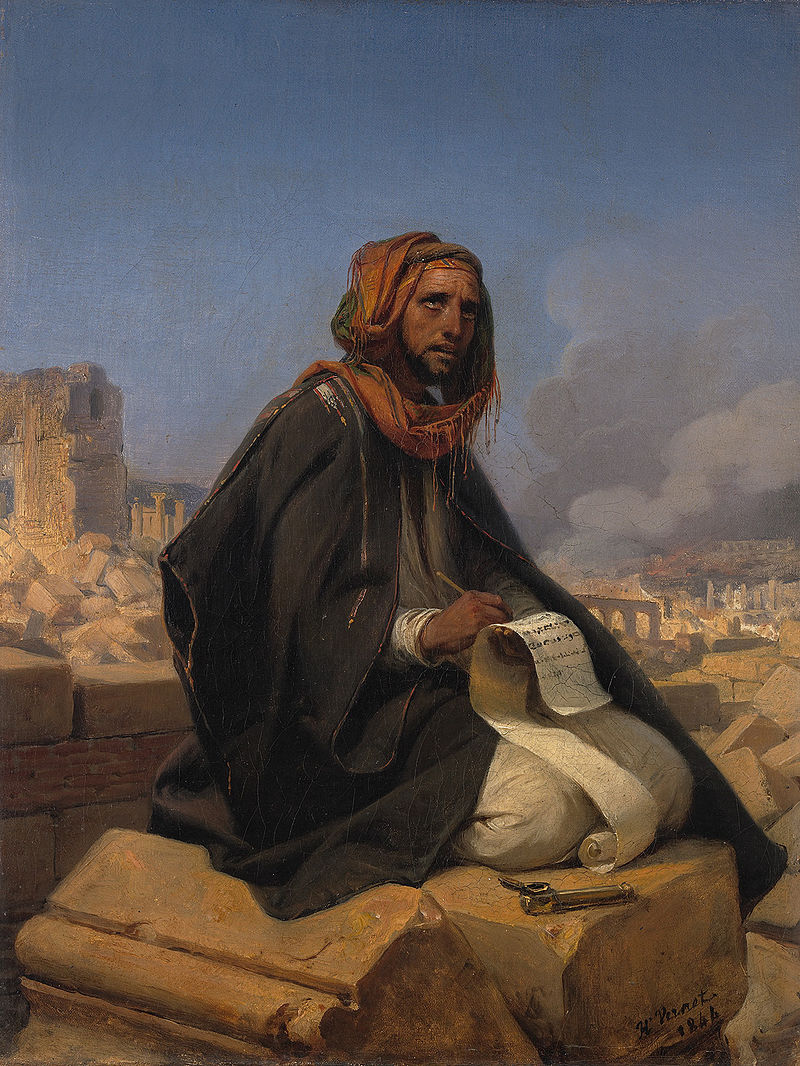
"Jeremiah on the Ruins of Jerusalem"
(Horace Vernet, 1844)
'For I know the plans that I have for you,' declares the LORD,
'plans for welfare and not for calamity to give you a future and a hope.
-- Jeremiah 29:11
(Play beautiful related song by Marty Goetz and Misha)
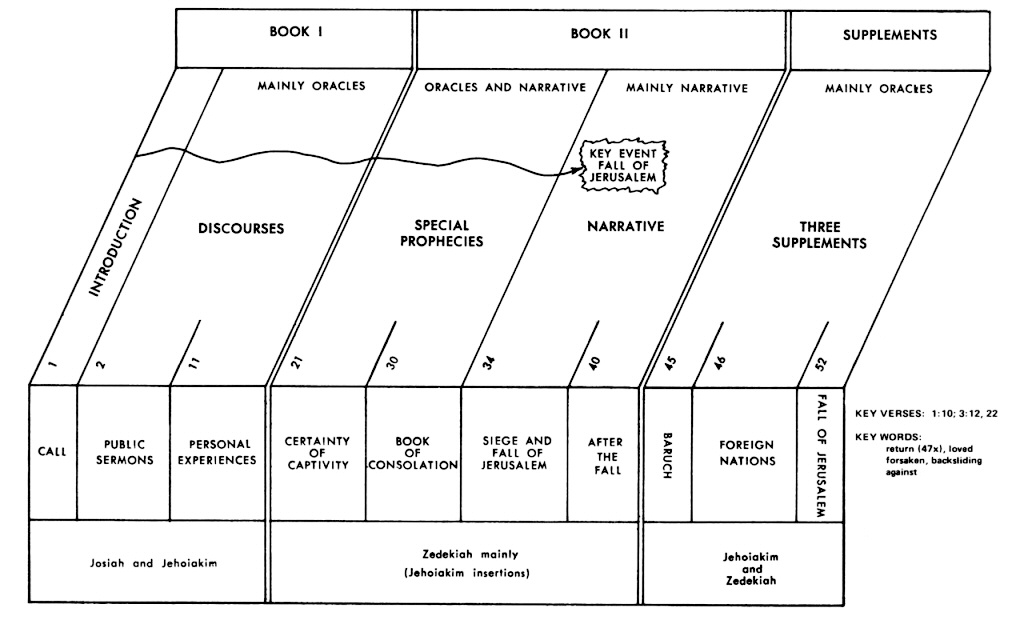
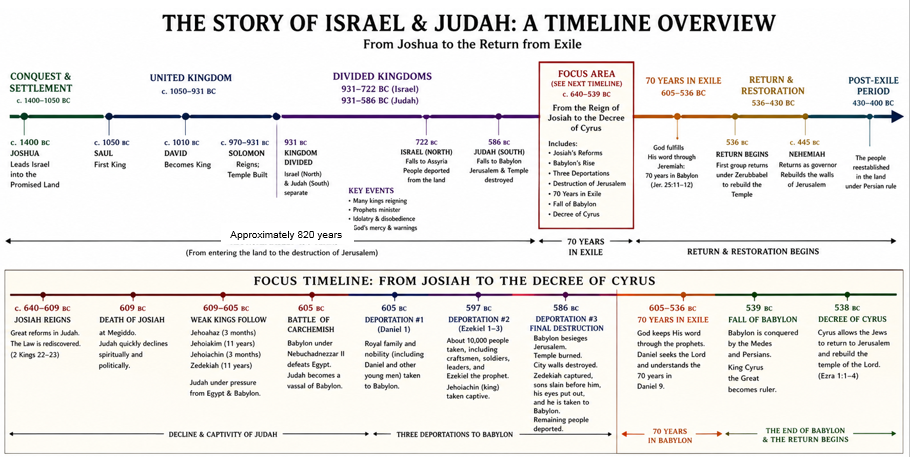
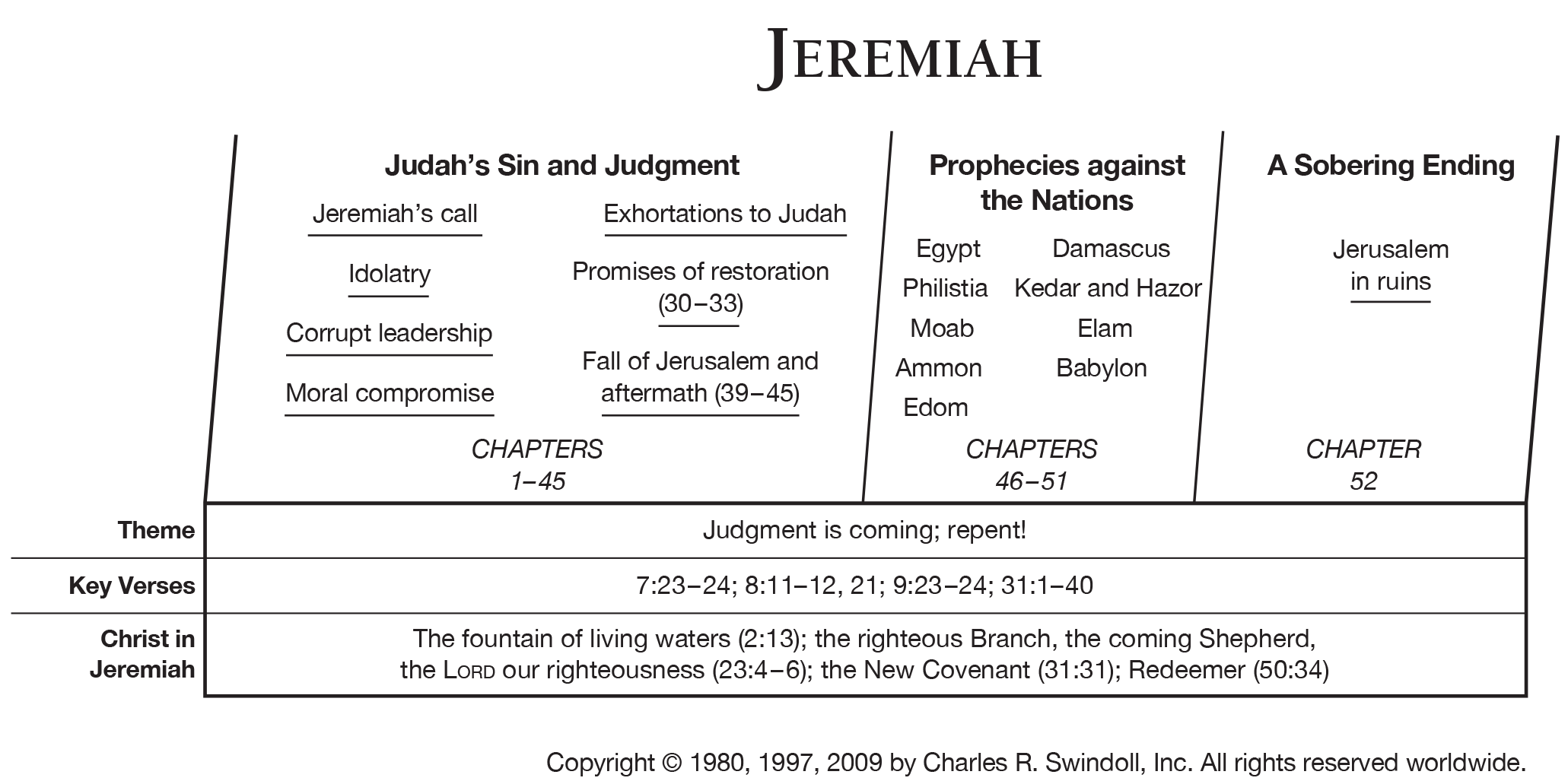
Click chart to enlarge
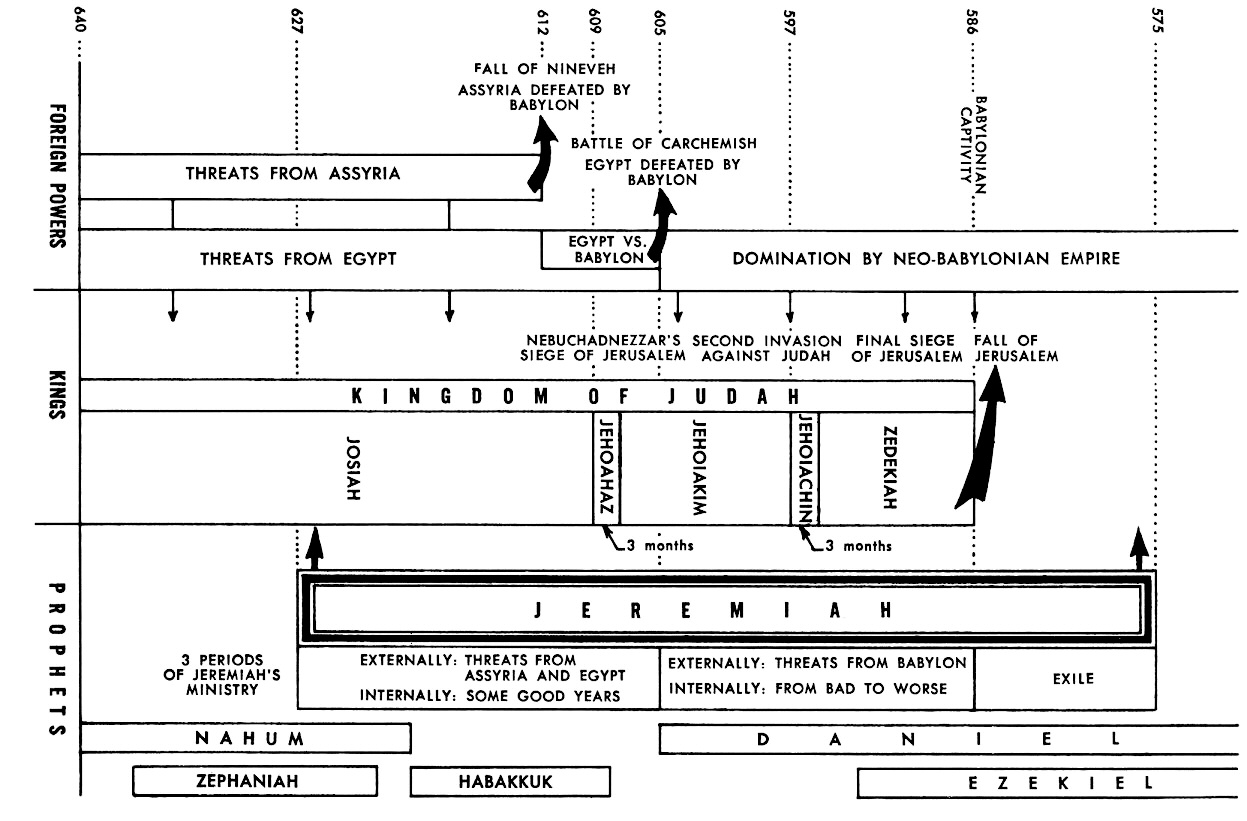
Click chart to enlarge
Chart from recommended resource Jensen's Survey of the OT - used by permission
Jeremiah Chart from Charles Swindoll
| JEREMIAH: "PROPHET TO THE NATIONS" Sin - "I Will Punish" (Jer 9:25) Hope - "I Will Restore" (Jer 30:17) Judah & Jerusalem |
||||||
|
Prophet |
Prophecies to Judah Jer 2:1-45:5 |
Prophecies to the Gentiles Jer 46:1-51:64 |
Prophet's Appendix Jer 52:1-52:34 |
|||
| Prophet's Commission Jer 1:1-19 |
Judah Condemned Jer 2:1-25:38 |
Jeremiah's Conflicts Jer 26:1-29:32 |
Jerusalem's Future Jer 30:1-33:26 |
Jerusalem's Fall Jer 34:1-45:5 |
Nations Condemned Jer 46:1-51:64 |
Historic Conclusion Jer 52:1-52:34 |
| Before The Fall Of Jerusalem Jer 1:1-38:28 |
The Fall Jer 39:1-18 |
After The Fall |
||||
| Call | Ministry | Retrospect | ||||
| Nation of Judah |
Surrounding Nations |
Future of Babylon |
||||
| 627-582 BC Ministered 40+ Years! |
||||||
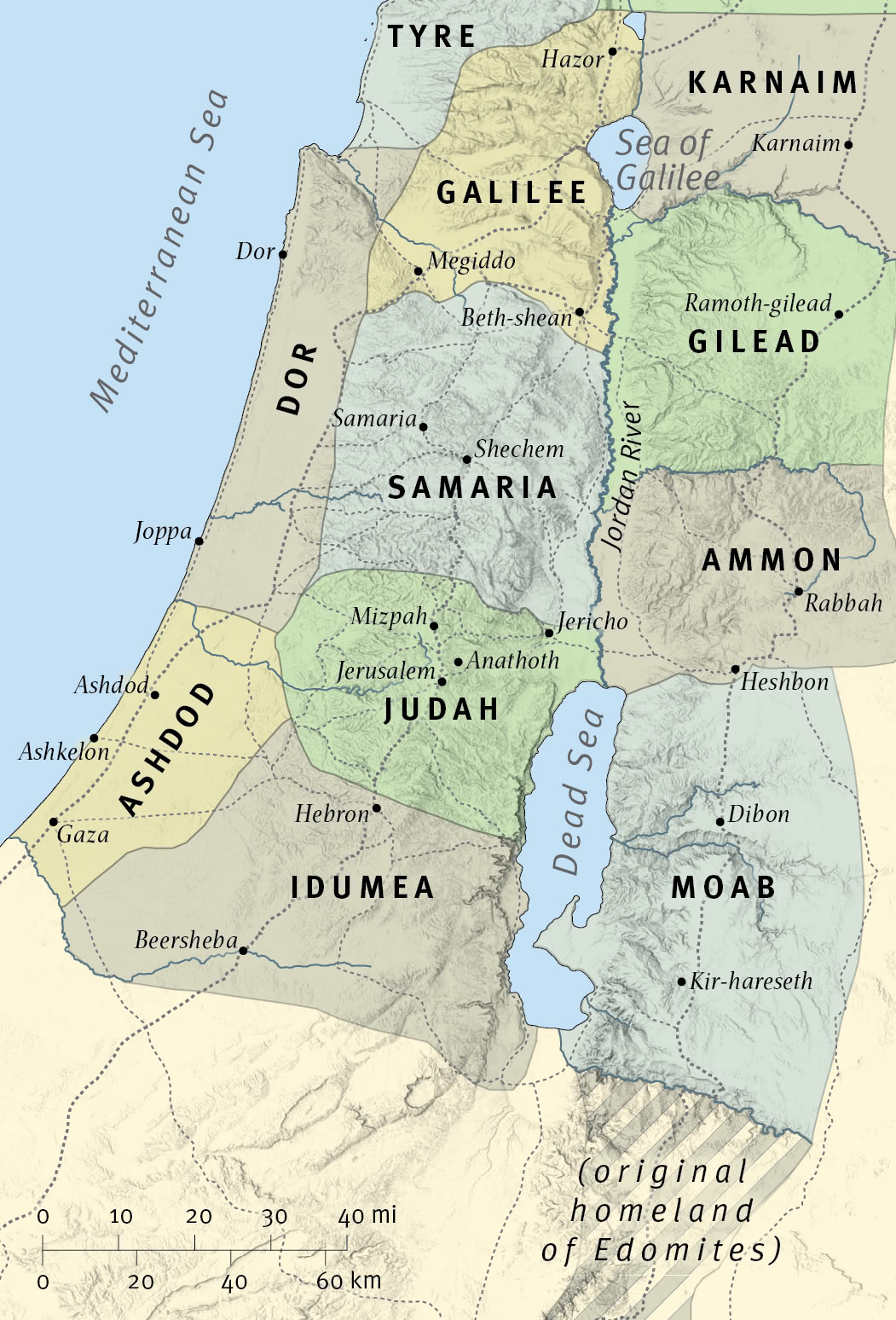
Map of Israel at Time of Jeremiah
Source: ESV Global Study Bible
Jeremiah 3:1 God says, “If a husband divorces his wife And she goes from him And belongs to another man, Will he still return to her? Will not that land be completely polluted? But you are a harlot with many lovers; Yet you turn to Me,” declares the LORD.
- If a husband: De 24:1-4
- shall not that: Jer 3:9 2:7 Lev 18:24-28 Isa 24:5 Mic 2:10
- but thou hast: Jer 2:20,23 De 22:21 Jdg 19:2 Eze 16:26,28,29 23:4-49 Ho 1:2 2:5-7
- yet return: Jer 3:12-14,22 4:1,14 8:4-6 De 4:29-31 Isa 55:6-9 Eze 33:11 Ho 14:1-4 Zec 1:3 Lu 15:16-24
Related Passages:
Deuteronomy 24:1-4 “When a man takes a wife and marries her, and it happens that she finds no favor in his eyes because he has found some indecency in her, and he writes her a certificate of divorce and puts it in her hand and sends her out from his house, 2 and she leaves his house and goes and becomes another man’s wife, 3and if the latter husband turns against her and writes her a certificate of divorce and puts it in her hand and sends her out of his house, or if the latter husband dies who took her to be his wife, 4 then her former husband who sent her away is not allowed to take her again to be his wife, since she has been defiled; for that is an abomination before the LORD, and you shall not bring sin on the land which the LORD your God gives you as an inheritance.
Jeremiah 2:2 “Go and proclaim in the ears of Jerusalem, saying, ‘Thus says the LORD, “I remember concerning you the devotion of your youth, The love of your betrothals, Your following after Me in the wilderness, Through a land not sown.
Jeremiah 2:20 (ISRAEL HAS LEFT HER HUSBAND FOR OTHER "MEN" ~ IDOLS!) “For long ago I broke your yoke And tore off your bonds; But you said, ‘I will not serve!’ For on every high hill And under every green tree You have lain down as a harlot.
Jeremiah 2:32 “Can a virgin forget her ornaments, Or a bride her attire? Yet My people have forgotten Me Days without number.
Jeremiah 2:27 Who say to a tree, ‘You are my father,’ And to a stone, ‘You gave me birth.’ For they have turned their back to Me, And not their face; But in the time of their trouble they will say, ‘Arise and save us.’
Jeremiah 2:35-36 Yet you said, ‘I am innocent; Surely His anger is turned away from me.’ Behold, I will enter into judgment with you Because you say, ‘I have not sinned.’ 36“Why do you go around so much Changing your way? Also, you will be put to shame by Egypt As you were put to shame by Assyria.
METAPHOR OF
MARITAL INFIDELITY
The passage uses the metaphor of marital infidelity to condemn idolatry. The image of Judah as God’s unfaithful wife begins in the Pentateuch and is described in the Prophets like Isaiah, Jeremiah, Ezekiel, and Hosea. Like a woman who thinks she can abandon her first husband, join herself to another man, but then resume her previous marriage when it suits her, so Israel thinks it can turn to other gods but then resume its covenant with YHWH, refusing to acknowledge guilt.
Philip Ryken - Jeremiah chapter 3 is about the way back home. At the end of verse 1 God’s people start to experience the first pangs of homesickness. They telephone God, long-distance, from a pay phone in a brothel. God is overheard to say, “You have lived as a prostitute with many lovers—would you now return to me?” (v. 1). (See Jeremiah and Lamentations: From Sorrow to Hope)
One writer entitles Jeremiah 3:1-4:4 "Turn, Turn, Turn!" continuing the theme of unfaithfulness from Jeremiah 2.
Warren Wiersbe - Jeremiah returned to the metaphor of marriage that he had used in 2:1-2 and 20, but this time he introduced the subject of divorce.
If a husband divorces (shalach - sends away) his wife And she goes from him And belongs to another man, Will he still return (shub) to her? The answer is No! In Israel, if a divorced woman remarried, her first husband could not take her back because it was considered a defilement of the land. So the expected answer to God’s question is: “No, he would not return to her.”
God applies this to Judah, for the Husband is God and the Wife is Judah/Israel. Other man/lovers are idols (one meaning of Baal was "husband"), false gods, alliances with pagan nations. Judah had left God “belonged to another” (idolatry) and repeated this with “many lovers” (not just one act, but continual unfaithfulness) (Jer 2:20, Jer 2:23,25, Jer 2:33, cf Hosea 1-3). Spiritually, Judah had done far worse than the woman in the illustration.
Derek Kidner - This law, which forbade a divorced couple to reunite, was aimed against what would amount to virtually lending one’s partner to another—for if an authoritarian husband could dismiss his wife and have her back when the next man had finished with her, it would degrade not only her but marriage itself and the society that accepted such a practice. (See Jeremiah - Page 35)
David Guzik - This law of Deuteronomy 24:1-4 sounds strange to our modern age where it is not completely uncommon for a wife to return to her first husband after a second or third husband. The sense behind it was that it made the ideas of both marriage and divorce seem of little consequence, as if one might say: “I can divorce her, and remarry her later if I want to.” God wanted to speak that that thinking and say, “No you can’t treat divorce and remarriage so casually. I wont allow it.”. “This law, which forbade a divorced couple to reunite, was aimed against what would amount to virtually lending one’s partner to another…it would degrade not only her but marriage itself and the society that accepted such a practice.” (Kidner). “The precise reasons for this ancient law may have been various, among them being an attempt to preserve the second marriage.” (Thompson)
Will not that land be completely polluted? (chaneph) - Answer is Yes! God explicitly linked disobedience to this law about remarriage with the defilement of the land. Polluted means defiled/profaned, morally contaminated and describes that which has been made or has become unclean before a holy God. This is exactly what the Law stated “You shall not bring sin on the land which the LORD your God gives you. ” (Dt 24:4) Taking back a divorced wife who remarried was not just a private sin but would pollute the land itself The point is that sin is not contained, but defiles the environment where God’s people live.
DOES THIS SOUND FAMILIAR AMERICA? When people disregard God’s moral standards and play "fast and loose" with their marriage vows, as is increasingly common in a postmodern society that rejects absolute truth, the result is not merely personal corruption but widespread moral pollution of the land. What begins as individual disobedience ultimately spreads, so that the entire land becomes defiled, reflecting a culture that has collectively turned away from God’s design and authority. Woe to that culture!
LOOKING FOR LOVE
IN ALL THE WRONG PLACES
But you are a harlot (zānâh; LXX - ekporneuo) with many lovers - To call Judah a harlot is one of the strongest terms God could use for it means not only unfaithful but habitually, shamelessly unfaithful. It speaks of deliberate, repeated spiritual adultery. Many lovers -amplifies this sad truth emphasizing that Judah had not just had a single failure but had taken numerous "lovers" including Baal worship, pagan gods, political dependence on nations instead of God. Jeremiah 2:20 says "on every high hill And under every green tree You have lain down as a harlot." Clearly Yahweh (as Husband) see idolatry as personal betrayal, breaking a relationship (as does adultery).
Warren Wiersbe - They had acted worse than common prostitutes who at least waited for lovers to come to them, for Judah had pursued false gods and repeatedly committed spiritual adultery with them. There was also sexual sin, for the pagan rites usually included consorting with prostitutes, both male and female. Idolatry and immorality often go together (ED: Read Ro 1:22,23,24 = Since they went after idolatry God gave them over to the power of immorality!).
Philip Ryken - The children of Israel have been sleeping with every god they can get their hands on! They have become equal-opportunity worshipers. They do not have just one or two idols—they have a whole closet full of them. (See Jeremiah and Lamentations: From Sorrow to Hope)
In short, Judah’s countless idolatries reveal a heart completely given over to spiritual adultery.
Yet - This is a striking term of contrast which in effect overturns or reverses everything that has been said before (but see Guzik's note). In other words the Law says no return (Dt 24:1-4) and justice says judgment is deserved. In other words, according to the Law restoration should be impossible and according to justice her judgment would be deserved. But here the term "yet" shows God's grace breaking into judgment.
David Guzik - God wanted His unfaithful people to know that though returning to the first husband might be wrong on a human level, it was not wrong between God and His people.
You turn to Me, declares the LORD - Turn means to return, to repent, to come back to a prior relationship. God is exposing Judah’s hypocrisy for they act as if they can casually return (without true repentance) as though nothing has happened. Jeremiah 3:3 says “You have a harlot’s forehead; you refuse to be ashamed.” In other words it is as if they think "You come back to Me as if this is acceptable!”
At the same time, this opens the door to grace. Even though they have no legal right to return because they had so deeply defiled themselves, God says later “Return, faithless Israel… For I am gracious.” (Jeremiah 3:12) and “I will heal your faithlessness.” (Jeremiah 3:22) In short, God invites back those who have no legal claim to return. What the Law forbids, grace invites and God calls back even those who have utterly broken covenant with Him.
Though justice says “no return,” God’s heart still says, “Come back to Me” but not casually, rather in true repentance.
The passage also establishes a tension that later chapters resolve. Although the Deuteronomic analogy would exclude the possibility of repentance and reconciliation between people and God, later passages in the chapter envision such restoration of the covenant relationship.
Warren Wiersbe - Instead of rejecting His people, however, the Lord patiently called for them to return and be restored as His wife. What grace! God had even caused a drought in the land, and the people had called out to Him for help (Jer. 3:4-5), but they had not really repented of their sins. Because of their covenant relationship with God, Judah called Him "Father" and "guide," which were titles Jewish wives sometimes used in addressing their husbands. But how could God give them covenant blessings when they were violating covenant commandments?
David Guzik - The line, “Yet return to Me,” says the Lord is a bit of a mystery to translators. Some (as the NKJV and NLT) translate it as an invitation from God to Israel. Others (such as the NASB and ESV) translate it as an accusation, God accusing Israel of wanting to return to Him lightly or wrongly.
NASB: But you are a harlot with many lovers; yet you turn to Me
ESV: And would you return to Me?
NLT: But you have prostituted yourself with many lovers, says the Lord. Yet I am still calling you to come back to me.
“Scholars are clearly divided on the issue, and the reason is understandable. The verb ‘return’ (sob) in the last line of v.1 is an infinitive that may allow for more than one rendering.” (Feinberg)
Since in the rest of the chapter God repeatedly does invite Israel to return to Him, and the thought of this return is presented in a good sense, it is best to take it as rendered in the NKJV: as a plea from God to His people for them to return to Him.
Polluted (02610) chaneph means to be defiled, to be profane, to pollute, to corrupt, to be godless. "This word most often appears in association with the defilement of the land, suggesting a tainting not by active commission but by passive contact with those committing sin." (Baker) Chaneph denotes the pollution of the land through the shedding of blood (Nu. 35:33); through divorce (Jer. 3:1); and through breaking God's covenant (Isa. 24:5). The earth was "defiled" by the sins of Judah in the prophecy of Isaiah (Isa 24:5) and false prophets and priests were "profane" in Judah near the time of their exile to Babylon (Jer. 23:11). The land was considered "polluted" when adultery and wanton immorality were practiced. (Jer 3:1) The land "polluted" (Ps 106:38; Jer. 3:1, 9) as a result of sacrifice to idols and gross immorality. Baker adds that "Two notable exceptions to this linkage with the land further intensify the notion that the primary meaning is one of passive contamination. In Jeremiah, the Lord declared that the prophets and the priests were corrupted, seemingly by their association with the people's sin (Jer. 23:11)." (CWSD) Breaking of marriage vows to marry another precludes a return to the first mate; in the same way a favored people who drifted back and forth between devotion to idols and the Lord, pollutes the land (Jeremiah 3:1). The Hiphil stem describes the pollution of land. The murderer who had shed innocent blood was regarded as polluting the land (Numbers 35:33).
CHANEPH - 9V - Num. 35:33; Ps. 106:38; Isa. 24:5; Jer. 3:1; Jer. 3:2; Jer. 3:9; Jer. 23:11; Dan. 11:32; Mic. 4:11
Jeremiah 3:2 “Lift up your eyes to the bare heights and see; Where have you not been violated? By the roads you have sat for them Like an Arab in the desert, And you have polluted a land With your harlotry and with your wickedness.
KJV Lift up thine eyes unto the high places, and see where thou hast not been lien with. In the ways hast thou sat for them, as the Arabian in the wilderness; and thou hast polluted the land with thy whoredoms and with thy wickedness.
NKJ "Lift up your eyes to the desolate heights and see: Where have you not lain with men? By the road you have sat for them Like an Arabian in the wilderness; And you have polluted the land With your harlotries and your wickedness.
NET "Look up at the hilltops and consider this. You have had sex with other gods on every one of them. You waited for those gods like a thief lying in wait in the desert. You defiled the land by your wicked prostitution to other gods.
BGT ἆρον εἰς εὐθεῖαν τοὺς ὀφθαλμούς σου καὶ ἰδέ ποῦ οὐχὶ ἐξεφύρθης ἐπὶ ταῖς ὁδοῖς ἐκάθισας αὐτοῖς ὡσεὶ κορώνη ἐρημουμένη καὶ ἐμίανας τὴν γῆν ἐν ταῖς πορνείαις σου καὶ ἐν ταῖς κακίαις σου
LXE Lift up thine eyes to look straight forward, and see where thou hast not been utterly defiled. Thou hast sat for them by the wayside as a deserted crow, and hast defiled the land with thy fornications and thy wickedness.
CSB Look to the barren heights and see. Where have you not been immoral? You sat waiting for them beside the highways like a nomad in the desert. You have defiled the land with your prostitution and wickedness.
ESV Lift up your eyes to the bare heights, and see! Where have you not been ravished? By the waysides you have sat awaiting lovers like an Arab in the wilderness. You have polluted the land with your vile whoredom.
NIV "Look up to the barren heights and see. Is there any place where you have not been ravished? By the roadside you sat waiting for lovers, sat like a nomad in the desert. You have defiled the land with your prostitution and wickedness.
NLT "Look at the shrines on every hilltop. Is there any place you have not been defiled by your adultery with other gods? You sit like a prostitute beside the road waiting for a customer. You sit alone like a nomad in the desert. You have polluted the land with your prostitution and your wickedness.
- Lift up: Jer 2:23 Eze 8:4-6 Lu 16:23
- to: Jer 2:20 De 12:2 1Ki 11:3 2Ki 23:13 Eze 16:16,24,25 20:28
- In the: Ge 38:14 Pr 7:11 23:28 Eze 16:24,25
- you have polluted a land: Jer 3:1,9 2:7
Related Passages:
Genesis 38:14-16 So she (TAMAR) removed her widow’s garments and covered herself with a veil, and wrapped herself, and sat in the gateway of Enaim, which is on the road to Timnah; for she saw that Shelah had grown up, and she had not been given to him as a wife. 15 When Judah saw her, he thought she was a harlot, for she had covered her face. 16 So he turned aside to her by the road, and said, “Here now, let me come in to you”; for he did not know that she was his daughter-in-law. And she said, “What will you give me, that you may come in to me?”
Proverbs 7:10-12 And behold, a woman comes to meet him, Dressed as a harlot and cunning of heart. 11 She is boisterous and rebellious, Her feet do not remain at home; 12 She is now in the streets, now in the squares, And lurks by every corner.
Ezekiel 16:25 “You built yourself a high place at the top of every street and made your beauty abominable, and you spread your legs to every passer-by to multiply your harlotry.
Numbers 35:33 ‘So you shall not pollute the land in which you are; for blood pollutes the land and no expiation can be made for the land for the blood that is shed on it, except by the blood of him who shed it.
Leviticus 18:25 ‘For the land has become defiled, therefore I have brought its punishment upon it, so the land has spewed out its inhabitants.
VIVID METAPHORS DEPICT
JUDAH'S IDOLATRY
Lift up your eyes to the bare heights and see - This is a command for Judah to look around honestly for all they had to do was look around at these idolatrous practices on every high hill! The bare heights refer to the hilltops where pagan worship took place, places stripped of vegetation and used for idol worship (cf. 1 Kings 14:23; Hosea 4:13).
Derek Kidner spares no words writing "This wife, this kingdom of Judah, was no passive shuttlecock between one husband and another, but brazenly promiscuous, installing her lovers, her gods and goddesses, on every hilltop." (See Jeremiah - Page 35)
Where have you not been violated? (shagal) - The NET while somewhat a paraphrase on this passage is vivid - "You have had sex with other gods on every one of them." This is the imagery of prostitution and adultery. Violated (shagal) (or “lain with”) is not literal physical assault, but a metaphor for spiritual adultery—Israel’s repeated turning to idols and false gods. This is a rhetorical question expecting the answer “Nowhere, for you have been unfaithful everywhere.”
Lettmann - ‘Where have you not been lain with?’ (NRSV) is a milder reading suggested by the Masoretes, who found the verb (meaning ‘been ravished’) too shocking. (See Jeremiah and Lamentations: An Introduction and Commentary - Page 85)
NET Note - Heb "Where have you not been ravished?" The rhetorical question expects the answer "nowhere," which suggests she has engaged in the worship of pagan gods on every one of the hilltops.
Philip Ryken - This verse alludes to the worship of Baal and Asherah, which included sex with temple prostitutes at hilltop shrines. The word “ravished” is especially powerful. It is an obscene word for sexual violence. Although God’s people have been looking for a good time, they have been getting raped. False gods are always abusive. (See Jeremiah and Lamentations: From Sorrow to Hope)
By the roads you have sat for them - NLT - "You sit like a prostitute beside the road waiting for a customer." This is the picture of a prostitute who is eager to sell her wares, sitting by the road to actively solicit her clients! Woe!
Like an Arab (NET - "thief"; CSB - "nomad") in the desert - The idea here is Judah was like a thief lying in wait to rob caravan. This pictures Judah watching and waiting for opportunities to commit spiritual adultery (idolatry)
Philip Ryken says - They are like Bedouin salesmen, advertising their wares, waiting for a caravan to pass by. They are just sitting there, trafficking in the world’s currency, waiting to make love to idols. (See Jeremiah and Lamentations: From Sorrow to Hope)
Both pictures (prostitute, nomad) picture Judah actively pursuing their idols!
NET Note - Heb "You sat for them [the lovers, i.e., the foreign gods] beside the road like an Arab in the desert."
Sin is never isolated—
it defiles the environment in which it occurs
And you have polluted (chaneph) a land With your harlotry (zenunim) and with your wickedness - Judah had defile and profaned the sacred promised land. One might say that God views the land as morally sensitive as it reflects the spiritual condition of the people living in it (What does this say about America 2026?). Note that harlotry (zenunim) is plural depicting Judah's repeated acts of prostitution (figurative and literal), totally ignoring that they were in a (marriage) covenant with God! (See Israel the Wife of Jehovah).
Violated (ravished)(04057) shagal is a strong and graphic Hebrew verb meaning to seize and violate sexually, denoting the forcible defilement of a woman and emphasizing both violence and humiliation. It is used in covenantal contexts to describe one of the severe curses of disobedience—“You shall betroth a wife, but another man will violate her” (Deuteronomy 28:30)—highlighting not merely personal tragedy but divine judgment through societal collapse and enemy domination. The term appears in war settings where invading forces brutalize women as part of conquest (Isaiah 13:16; Zechariah 14:2), underscoring the shame and devastation accompanying national defeat. In Jeremiah 3:2 the verb is employed figuratively (in the passive) to portray Israel’s spiritual condition, depicting the nation as having been morally and religiously defiled through persistent idolatry, thus extending the word beyond physical violation to covenant unfaithfulness. Linguistically, šhāg̠al is likely related to the Akkadian šhagālu, “to seize or take by force,” reinforcing the idea of aggressive appropriation. Because of its harsh and explicit nature, later scribal tradition often substituted the more general verb šākhav (“to lie with”), reflecting a sensitivity to its offensiveness, yet the original term remains deliberately vivid in order to convey the gravity of both physical violation and spiritual apostasy.
SHAGAL - 4V Deut. 28:30; Isa. 13:16; Jer. 3:2; Zech. 14:2
Harlotry (02183) zenunim is a Hebrew noun derived from zānâh (זָנָה) denotes fornication or harlotry, but its significance extends far beyond physical immorality into the realm of covenant theology and spiritual allegiance. At its most basic, the term refers to sexual unfaithfulness that violates the exclusivity of the marriage relationship (Hos. 4:11). In this literal sense, it describes acts that break the one-flesh union established by God, highlighting the betrayal of intimacy, trust, and covenant loyalty. However, the dominant usage in Scripture is figurative, where the word becomes a powerful theological metaphor. It depicts Israel’s breach of her covenant relationship with Yahweh, who is portrayed as her Husband (cf. Jer. 2:2; Isa. 54:5). Thus, “fornication” comes to mean spiritual infidelity—giving to others the devotion, trust, and worship that belong to God alone.
ZENUNIM - 13X.11V - harlotries(5), harlotry(8). Gen. 38:24; 2 Ki. 9:22; Jer. 3:2; Ezek. 23:11; Ezek. 23:29; Hos. 1:2; Hos. 2:2; Hos. 2:4; Hos. 4:12; Hos. 5:4; Nah. 3:4
This spiritual harlotry manifests in several interrelated ways:
Idolatry – The primary sense: Israel “prostitutes” herself by worshiping false gods, often at high places or through images (“stones and stocks,” Jer. 3:9). This is not merely religious error but covenant betrayal, exchanging the living God for lifeless substitutes.
Covenant rebellion – The term also encompasses a broader posture of disobedience and refusal to submit to God (Num. 14:33). It reflects a heart that has turned away, not just in worship but in will.
Moral corruption – Because idolatry reshapes behavior, this “fornication” includes the ethical decay that flows from abandoning God (Hos. 6:10). Spiritual unfaithfulness inevitably produces social and personal sin.
Misplaced trust and alliances – In passages like Ezekiel 23, the imagery includes reliance on foreign nations. Such alliances often involved invoking foreign deities and trusting human power instead of Yahweh. Thus, political compromise becomes another form of spiritual adultery.
Defilement of the land – This sin is not isolated to individuals; it spreads and contaminates the entire community and even the land itself (Jer. 3:2). The imagery conveys pervasive, public, and normalized unfaithfulness.
Importantly, this noun carries a covenantal weight: it is not merely wrongdoing, but personal betrayal against a relational God. It assumes prior knowledge of God, prior commitment to Him, and therefore a deeper level of guilt. The imagery of harlotry underscores the offensiveness of exchanging divine love for lesser “lovers.”
Finally, the term also implies consequences and inheritance of guilt—as seen when later generations bear the results of earlier spiritual unfaithfulness (Num. 14:33)—yet it simultaneously leaves room for restoration, as God repeatedly calls His people to put away their “whoredom” so that He may dwell among them again (Ezek. 43:9).
Summary: This word describes not only literal sexual immorality, but more profoundly the total abandonment of covenant loyalty to God—expressed through idolatry, rebellion, misplaced trust, and moral corruption—portrayed as spiritual adultery that defiles both people and land.
Jeremiah 3:3 “Therefore the showers have been withheld, And there has been no spring rain. Yet you had a harlot’s forehead; You refused to be ashamed.
KJV Therefore the showers have been withholden, and there hath been no latter rain; and thou hadst a whore's forehead, thou refusedst to be ashamed.
NKJ Therefore the showers have been withheld, And there has been no latter rain. You have had a harlot's forehead; You refuse to be ashamed.
NET That is why the rains have been withheld, and the spring rains have not come. Yet in spite of this you are obstinate as a prostitute. You refuse to be ashamed of what you have done.
CSB This is why the showers haven't come-- why there has been no spring rain. You have the brazen look of a prostitute and refuse to be ashamed.
ESV Jeremiah 3:3 Therefore the showers have been withheld, and the spring rain has not come; yet you have the forehead of a whore; you refuse to be ashamed.
NIV Therefore the showers have been withheld, and no spring rains have fallen. Yet you have the brazen look of a prostitute; you refuse to blush with shame.
NLT That's why even the spring rains have failed. For you are a brazen prostitute and completely shameless.
- the showers: Jer 9:12 Jer 14:4,22 Lev 26:19 De 28:23 Isa 5:6 Joe 1:16-20 Am 4:7 Hag 1:11
- latter rain: Jer 5:24
- harlot’s forehead: Jer 5:3 6:15 8:12 44:16,17 Eze 3:7 16:30-34 Zep 3:5
- refused: Jer 5:3 Ne 9:17 Zec 7:11,12 Heb 12:25
Related Passages:
Deuteronomy 11:14 that He will give the rain for your land in its season, the early and late rain, that you may gather in your grain and your new wine and your oil.
Leviticus 26:19 I will also break down your pride of power; I will also make your sky like iron and your earth like bronze.
Deuteronomy 28:23 “The heaven which is over your head shall be bronze, and the earth which is under you, iron.
Jeremiah 14:4 “Because the ground is cracked, For there has been no rain on the land; The farmers have been put to shame, They have covered their heads.
Jeremiah 14:22 Are there any among the idols of the nations who give rain? Or can the heavens grant showers? Is it not You, O LORD our God? Therefore we hope in You, For You are the one who has done all these things.
Amos 4:7-8 “Furthermore, I withheld the rain from you While there were still three months until harvest. Then I would send rain on one city And on another city I would not send rain; One part would be rained on, While the part not rained on would dry up. 8 “So two or three cities would stagger to another city to drink water, But would not be satisfied; Yet you have not returned to Me,” declares the LORD.
Proverbs 7:13 So she seizes him and kisses him And with a brazen face (ESV - "bold face" RSV - "impudent face") she says to him:
Hosea 2:21 “It will come about in that day that I will respond,” declares the LORD. “I will respond to the heavens, and they will respond to the earth,
Hosea 6:3 “So let us know, let us press on to know the LORD. His going forth is as certain as the dawn; And He will come to us like the rain, Like the spring rain watering the earth.”
1 Kings 8:35-36 When the heavens are shut up and there is no rain, because they have sinned against You, and they pray toward this place and confess Your name and turn from their sin when You afflict them, 36 then hear in heaven and forgive the sin of Your servants and of Your people Israel, indeed, teach them the good way in which they should walk. And send rain on Your land, which You have given Your people for an inheritance.
RAINS WITHHELD AND STILL
REFUSAL TO BE ASHAMED
Therefore - This term of conclusion signifies a divine cause-and-effect. Judah’s spiritual harlotry would reap God's righteous judgment.
The showers have been withheld, And there has been no spring rain (March and April) - In a word, no repentance, no rain! Baal (which means "husband") was the big fertility idol who was supposed to bring rain, but here demonstrated that he was completely powerless! One would think that this failure to produce rain would bring the people to the knowledge of the truth and they would repent (cf 1Ki 8:35-36). But sadly it was not to be!
The farmers depended on the early rains (Oct-Nov) and the spring rain, also called “latter rain,” which fell in March and April, was crucial for bringing crops to full maturity before harvest. Yet because of Judah’s rebellion, God withheld this life-giving rain and crops shriveled. Even so, the nation refused to recognize God's hand in the drought.
Even such an obvious sign by God
did not bring the people to their senses.
F B Huey - It was ironic that although the fertility cults were supposed to ensure rainfall, Judah’s participation in them was actually the cause of drought in the land. (See Jeremiah, Lamentations: An Exegetical and Theological- Page 71)
Yet you had a harlot’s (zānâh; LXX - porne) forehead; You refused to be ashamed (kalam - not even blush!) - Like a harlot (zānâh) one who persists in unfaithfulness while masking it, Judah concealed her guilt with a hardened, self-justifying, self-righteous spirit. She would not be ashamed (kalam) and would not evey blush over her abominations! She refused to feel the humiliation or conviction her sin deserved, even while experiencing God’s hand of discipline.
Sin, when persistently embraced, not only deceives but it dulls the conscience and hardens the heart (Heb 3:13), making further sin easier and cultivating a defiant spirit that scorns God and rejects His rightful authority to judge.
Philip Ryken - This verse reminds me of a painting by Henri Toulouse-Lautrec, who wasted much of his time exploring the red-light district of Paris. The painting depicts a young prostitute. Her gaze is fixed straight forward without fear or modesty. Her chin is lifted in defiance, challenging anyone to pass judgment on her sins. She has “the brazen look of a prostitute.” (See Jeremiah and Lamentations (ESV Edition): From Sorrow to Hope)
Jeremiah 3:4 “Have you not just now called to Me, ‘My Father, You are the friend of my youth?
- Have you not just now: Jer 3:19 31:9,18-20 Ho 14:1-3
- My Father,: Jer 2:27
- You are the friend : Jer 2:2 Ps 48:14 71:5,17 119:9 Pr 1:4 2:17 Ho 2:15 Mal 2:14
HYPOCRITICAL
PRAYERS
Have you not just now called to Me - This is a rhetorical question from God and expects a positive answer. Just now emphasizes Judah had recently cried out to God. But sadly this appeal comes right after persistent sin and refusal to repent. Yahweh's point is that they are turning to Him in words, but not in their hearts, not in repentance!
My Father - Here calling God their Father is radically different than saying "to a tree, ‘You are my father!" (Jer 2:27) Their pious prayer language claiming God as their Father was worthless without matching deeds, for as the psalmist writes "If I regard wickedness in my heart, The Lord will not hear." (Ps 66:18). Their words sound right, but their idolatrous practices contradict them.
Huey has an interesting note that "A wife sometimes called her husband “Father” in the Ancient Near East as acknowledgment of his authority and protection. Judah was like a wayward wife trying to soothe the anger of her husband with loving words. (See Jeremiah, Lamentations: An Exegetical and Theological- Page 71)
You are the friend of my youth - Judah was claiming an intimate association with Yahweh in the past. To call God their frienc means they call Him their Companion, Guide, or intimate partner. Youth refers back to the early days of Israel’s relationship with God, as in wilderness period when the Rock followed them and the fire guided them.
Yes they had manifested an early covenant devotion as God testifies in Jer 2:2 "“I remember concerning you the devotion of your youth."
Derek Kidner - What made it insufferable was the pious talk that went with it, appealing to Yahweh’s fatherhood, friendship and forbearance (Jer 3:4–5): talk which only added hypocrisy to infidelity. (See Jeremiah - Page 35)
Jeremiah 3:5 ‘Will He be angry forever? Will He be indignant to the end?’ Behold, you have spoken And have done evil things, And you have had your way.”
- Will He be angry forever: Jer 3:12 Ps 77:7-9 85:5 103:8,9 Isa 57:16 64:9
- you have spoken: Eze 22:6 Mic 2:1 7:3 Zep 3:1-5
PRESUMING ON GOD'S MERCY
WHILE PESISTING IN SIN
Will He be angry forever? Will He be indignant to the end?’ - Both questions are rhetorical and expect a negative answer. These questions continue the insincere appeal of Judah, which revealing how they misunderstood and even presumed upon God’s character.
Of course there is some truth in these questions for passages like Ps 30:5 says "His anger is but for a moment." The problem for Judah was that they were using God’s mercy as an excuse to continue in sin. "Oh, He will forgive, etc, etc." Their words were not humble but are casual and self-assured (and self-deceived) thinking “God won’t stay angry forever…” or “This will pass…” Their words reveal their spiritual presumption.
Huey - Their attitude was that of the adulterous wife who lost all claim on her husband by her faithlessness but still counted on his forgiveness and help. They thought that God’s goodness meant that he would overlook their evil ways. Many still refuse to believe that “the wages of sin is death” (Rom 6:23). Although mere words are never sufficient to move God, nevertheless he does not despise the broken and contrite heart (Ps 51:17). (See Jeremiah, Lamentations: An Exegetical and Theological- Page 71)
Behold, you have spoken And have done evil things, And you have had your way - Right after their presumptive questions, God exposes them stating that their words say one thing but their actions prove another. Judah was correct about God’s character, that He is not angry forever. However, they are wrong about themselves, for they are not truly repentant. It follows that the promise of divine mercy does not apply to them in this setting.
Judah assumed that God’s anger would quickly pass, but instead of humbly repenting, they presumptuously use His mercy as justification to continue in sin, revealing their deeply hardened hearts.
Jeremiah 3:6 Then the LORD said to me in the days of Josiah the king, “Have you seen what faithless Israel did? She went up on every high hill and under every green tree, and she was a harlot there.
- faithless: Jer 3:8,11-14 2:19 7:24 2Ki 17:7-17 Eze 23:11
- she went up: Jer 2:20 Isa 57:7 Eze 16:24,25,31 20:28 1Ki 14:23
- a harlot: Jer 3:1
Related Passage:
Jeremiah 2:20 “For long ago I broke your yoke And tore off your bonds; But you said, ‘I will not serve!’ For on every high hill And under every green tree You have lain down as a harlot.
JUDAH FULLY AWARE OF COST
OF ISRAEL'S UNFAITHFULNESS
We know this prophecy was given to Jeremiah sometime after 627 BC because Jer 1:2 says the "word of the LORD came in the days of Josiah...in the 13th year of his reign."
Then the LORD said to me in the days of Josiah the king - This time phrase (then) places this word during the reign of Josiah (640–609 BC). Notice that this phrase implies that even during a time of outward reform under Josiah, God saw deeper, unresolved spiritual unfaithfulness as indicated by the following question. The timing of this revelation to Jeremiah creates a striking contrast because externally Judah looked improved under Josiah’s reforms. However as events after Josiah's death proved the people’s hearts were still largely unchanged.
Have you seen what faithless (meshubah)(backsliding - KJV) Israel did? This rhetorical question expects a postive response. Judah was fully award of the evil that was practiced in the Northern Kingdom. While this should have been Judah's wake up call, as presumably the people heard Jeremiah's words. The problem is that knowledge of history is no guarantee that it won't be repeated, as Judah was about to prove!
She went up on every high hill and under every green tree, and she was a harlot (zānâh; LXX - porneuo) there - NET = "give herself like a prostitute to other gods." God is describing essentially the same sin He had decribed in Judah (Jer 3:2NLT "shines on every hilltop"). Israel relentlessly pursued idolatry in these same places and in every place possible. God describes this as spiritual prostitution that represent an unrestrained, widespread betrayal of their covenant relationship with Him as His "wife" (See Israel the Wife of Jehovah).
Faithless (04878) (meshubah) מְשׁוּבָה (meshûbâ) refers to a willful and persistent turning away from a relationship of covenant loyalty, especially describing Israel’s departure from the LORD, and it signifies not merely an isolated act of sin but a settled condition of spiritual defection in which one abandons known truth and rightful allegiance. Derived from the verb shûv (“to turn” or “return”), it conveys a reversal in direction and status, moving from faithfulness to unfaithfulness, from submission to rebellion, and from nearness to distance, so that what was once embraced is now consciously forsaken. This gives the term a deeply relational force, portraying not simply disobedience to laws but betrayal of a personal relationship, as seen in God’s appeal, “Return, faithless Israel… for I am gracious” (Jeremiah 3:12), and again, “Return, O faithless sons, I will heal your faithlessness” (Jeremiah 3:22). The word also carries the idea of instability and moral wavering, describing a condition in which a person becomes spiritually unreliable and hardened in resistance, as expressed in Proverbs 1:32, “the waywardness of the naive will kill them.” This turning away is revealed in various ways, including abandoning the worship of the LORD for false gods, as in Jeremiah 5:7, “Your sons have forsaken Me and sworn by those who are not gods,” as well as in moral corruption and injustice, as in Jeremiah 8:10, “from the least even to the greatest everyone is greedy for gain,” and in misplaced trust, as seen in Hosea 11:7, “My people are bent on turning from Me.” In the prophetic context, meshûbâ often appears within God’s covenant case against His people, demonstrating that their turning away is a breach that brings accountability and discipline in accordance with covenant warnings such as Deuteronomy 28. Yet the term also carries hope, for it describes a condition that God is willing to heal, as declared in Hosea 14:4, “I will heal their apostasy, I will love them freely,” showing that while meshûbâ represents a persistent and culpable turning from God, it remains curable through repentance because of His enduring mercy.
Harlot (play the harlot) (02181) zānâh (זָנָה) conveys the idea of committing fornication or acting as a prostitute, and at its core denotes a breach of covenant fidelity, whether in the literal sphere of marriage or in the deeper theological sphere of relationship with God. In its literal sense, it describes sexual immorality that violates the sanctity of marriage and purity laws, as seen in “They shall not take a woman who is a harlot or profaned” (Leviticus 21:7) and the vivid portrayal of the seductress in “a woman comes to meet him, dressed as a harlot and cunning of heart” (Proverbs 7:10). Yet even from its earliest occurrences, such as the rhetorical protest in “Should he treat our sister as a harlot?” (Genesis 34:31), the term already carries moral outrage, emphasizing dishonor, betrayal, and covenant violation rather than merely physical sin. The verb is applied only rarely to men (e.g., Numbers 25:1), but overwhelmingly describes women, not because sin is gendered, but because the imagery is rooted in the covenant analogy of Israel as the LORD’s wife.
This marital imagery becomes the dominant theological framework in which zānâh is employed throughout the Old Testament, transforming the word into one of the most powerful metaphors for spiritual apostasy. Israel’s relationship with the LORD is repeatedly depicted as a marriage covenant (cf. Jeremiah 2:2), and therefore turning to other gods is not merely disobedience but adultery against a faithful Husband. Thus the Lord warns, “This people will rise up and play the harlot with the gods of the strangers of the land… and will forsake Me and break My covenant” (Deuteronomy 31:16). The covenantal dimension is especially clear in Exodus 34:13–16, where Israel is commanded to destroy pagan worship sites lest they “play the harlot with their gods… and cause your sons also to play the harlot with their gods.” Here, idolatry is not presented as an abstract theological error but as relational treachery—an intimate betrayal of exclusive devotion. This same concept is echoed in the New Testament, where union language underscores the seriousness of such defilement: “The one who joins himself to a prostitute is one body with her” (1 Corinthians 6:16), reinforcing that spiritual union with idols constitutes a profound corruption of one’s covenant identity.
The prophets develop this imagery with striking emotional and theological depth, portraying God as a wounded yet faithful Husband and Israel as an unfaithful wife who has abandoned Him. In Isaiah 54:6–8 the Lord declares, “The LORD has called you, like a wife forsaken and grieved in spirit… for a brief moment I forsook you, but with great compassion I will gather you,” revealing both the pain of betrayal and the persistence of divine mercy. Likewise, Isaiah 50:1–3 denies that God initiated the separation, implying that Israel’s own unfaithfulness caused the estrangement. Jeremiah intensifies the accusation: “You are a harlot with many lovers; yet you turn to Me” (Jeremiah 3:1), and recalls the earlier devotion of Israel in contrast to her present corruption: “I remember concerning you the devotion of your youth… when you went after Me in the wilderness” (Jeremiah 2:2–3). Hosea embodies this truth in lived experience, as his wife’s unfaithfulness becomes a living parable of Israel’s condition, culminating in the indictment, “You have played the harlot, forsaking your God” (Hosea 9:1). In all these passages, zānâh expresses not only religious error but relational betrayal, ingratitude, and willful abandonment of covenant love.
Beyond idolatry, the term also extends to describe political and economic alliances that reflect misplaced trust and compromise with pagan nations. In Isaiah 23:17, Tyre is said to “play the harlot with all the kingdoms of the earth,” indicating commercial and diplomatic entanglements driven by gain rather than faithfulness. Ezekiel 23:30 attributes judgment to Israel’s conduct: “These things will be done to you because you have played the harlot with the nations, because you have defiled yourself with their idols.” Similarly, Nahum 3:4 condemns Nineveh for “the many harlotries of the harlot, the charming one, the mistress of sorceries,” highlighting deceitful seduction and oppressive dominance. In these contexts, zānâh captures the idea of selling oneself—whether spiritually, politically, or economically—for advantage, revealing a heart that prefers worldly security and gain over covenant loyalty to God.
A further development of the term appears in its ethical dimension, where it describes moral corruption and societal decay apart from explicit idolatry. Isaiah laments, “How the faithful city has become a harlot, she who was full of justice!” (Isaiah 1:21), showing that abandonment of righteousness itself constitutes spiritual prostitution. Thus, zānâh encompasses not only false worship but also the broader abandonment of God’s standards, revealing that sin in any form is fundamentally unfaithfulness to Him. This idea is carried into the New Testament, where spiritual compromise with the world is condemned in marital terms: “You adulteresses, do you not know that friendship with the world is hostility toward God?” (James 4:4), and the church at Ephesus is rebuked for relational decline, “You have left your first love” (Revelation 2:4). Even the judgment of Sodom is described with intensified language, “indulged in gross immorality and went after strange flesh” (Jude 1:7), echoing the Septuagint’s use of terms related to zānâh.
In sum, zānâh is far more than a term for sexual sin; it is a covenantal word that exposes the heart’s tendency to abandon God for substitutes. Whether describing literal prostitution, idolatry, political compromise, or moral decline, the verb consistently communicates unfaithfulness to a relationship defined by exclusive loyalty and love. Scripture presents this unfaithfulness as grievous not merely because it violates law, but because it wounds a personal relationship with a jealous and faithful God whose desire is steadfast devotion.
Jeremiah 3:7 “I thought, ‘After she has done all these things she will return to Me’; but she did not return, and her treacherous sister Judah saw it.
- return to Me: 2Ki 17:13,14 2Ch 30:6-12 Ho 6:1-4 14:1
- her treacherous: Jer 3:8-11 Eze 16:46 23:2-4
Related Passages:
Jeremiah 5:3 O LORD, do not Your eyes look for truth? You have smitten them, But they did not weaken; You have consumed them, But they refused to take correction. They have made their faces harder than rock; They have refused to repent.
GOD'S HOPEFUL
EXPECTATION
I thought, ‘After she has done all these things she will return to Me’ - This expresses not ignorance on God’s part, but His gracious expectation rooted in mercy and covenant love. The Lord is speaking as a Husband who has watched His wife (Israel) pursue repeated spiritual adultery, yet still holds out hope—because His nature is to restore, not to abandon.
Yet even after such accumulated sin, God says, in effect, “Surely now she will come back.” This reflects His longsuffering character, seen elsewhere: “Return, faithless Israel… I will not look upon you in anger. For I am gracious” (Jeremiah 3:12), and again, “For I delight in loyalty rather than sacrifice” (Hosea 6:6). God’s expectation is not based on naïveté, but on His readiness to forgive and His desire for repentance.
God is not speaking merely as a judge evaluating behavior, but as a grieved Husband longing for reconciliation. Earlier He had said, “I remember concerning you the devotion of your youth… your following after Me in the wilderness” (Jeremiah 2:2), showing that His expectation of return is rooted in remembered relationship. Even in judgment, His heart leans toward restoration, echoing later truth: “How can I give you up, O Ephraim?... My heart is turned over within Me” (Hosea 11:8).
but - Sad term of contrast.
She did not return (shub) - She refers to the Northern Kingdom. One would think that after experiencing the consequences of rebellion, the natural response would be to return to the Lord. Sin deceives and dulls the heart to such a degree that even repeated discipline does not guarantee repentance. This is consistent with other warnings: “You have stricken them, but they did not weaken… they refused to take correction” (Jeremiah 5:3). What God anticipated as a reasonable response—return—was resisted by their hard hearts, stiff necks and stubborn will (cf Acts 7:51)
and her treacherous (bagod) sister Judah saw it - means that Judah witnessed God’s judgment on Israel for her unfaithfulness, yet still chose to follow the same sinful path. Though she had clear warning and greater spiritual light, Judah acted faithlessly, showing deliberate disobedience rather than ignorance (Jeremiah 3:8; Luke 12:47).
Samaria (Israel's capital) and Jerusalem (Judah's capital) are similarly compared as adulterous sisters in Ezekiel 23.
Return (turn away or back, bring or go back, restore) (07725) shub/sub is is a common verb (over 1000x) meaning to turn, to return, to go back, to do again, to change, to withdraw, to bring back, to reestablish, to be returned, to bring back, to take, to restore, to recompense, to answer, to hinder.
Shub שׁוּב (shûb) is one of the most theologically significant and frequently used verbs in the Old Testament (occurring over 1,000 times), fundamentally meaning “to turn,” “to return,” or “to go back,” and expressing the idea of a reversal in direction, condition, or relationship across physical, moral, and spiritual dimensions.
In its simplest and most literal sense, it denotes physical movement back to a point of origin or along a previously traveled path, as when “the waters receded steadily from the earth” (Genesis 8:3) or “Esau returned that day on his way to Seir” (Genesis 33:16), and it can also describe reversal or cessation, such as anger turning away (Genesis 27:44) or enemies being driven back (Psalm 9:3). From this foundational meaning, shûb develops a wide range of nuances, including the idea of repeating an action (“Isaac dug again the wells,” Genesis 26:18), restoring or bringing something back (“He restores my soul,” Psalm 23:3), answering or returning a word (Proverbs 18:13), repaying or bringing consequences back upon someone (Psalm 7:16), and even transforming a state or condition (Isaiah 29:17).
Most significantly, shûb becomes the primary Old Testament verb for repentance, uniquely summarizing the entire human responsibility in conversion by combining both the negative and positive aspects—turning away from sin and turning toward God—so that all other expressions of repentance such as “circumcise yourselves to the LORD” (Jeremiah 4:4), “wash your heart from wickedness” (Jeremiah 4:14), and “break up your fallow ground” (Hosea 10:12) are essentially encompassed within this one term. In this covenantal sense, it describes Israel’s relationship with God in three directions: turning away from God in apostasy (“My people are bent on turning from Me,” Hosea 11:7), turning away from evil in repentance (1 Kings 8:35), and returning to God in restored obedience (“you will return to the LORD your God and obey Him,” Deuteronomy 30:2), demonstrating that sin is not an irreversible condition but one that can be redirected by a decisive turning. This usage is especially prominent in the prophets, where God repeatedly calls His people to return, “Return to Me… then you will not be shaken” (Jeremiah 4:1), and promises healing, “Return, O faithless sons, I will heal your faithlessness” (Jeremiah 3:22), while also warning of judgment when they refuse, as seen in the exile of Israel (2 Kings 17:7–8).
The verb also carries strong covenantal and restorative implications, frequently describing both a return from exile and a return to God, showing that physical restoration to the land is inseparably tied to spiritual restoration of the relationship, as in “if they return to You with all their heart… then hear in heaven… and bring them back to the land” (1 Kings 8:33–34). At the same time, shûb highlights the dual reality of repentance as both a human responsibility and a divine work, since people are commanded to turn, yet God is the One who ultimately restores and enables that return, as seen in “Turn back, turn back from your evil ways!” (Ezekiel 33:11) alongside promises of renewal such as “I will heal their apostasy” (Hosea 14:4). Thus, shûb encapsulates the dynamic movement at the heart of biblical theology: humanity turns away from God in sin, yet through repentance—turning from evil and returning to Him—there is restoration, renewal, and life, demonstrating both the seriousness of sin and the enduring mercy of God who receives those who return.
Jeremiah 3:8 “And I saw that for all the adulteries of faithless Israel, I had sent her away and given her a writ of divorce, yet her treacherous sister Judah did not fear; but she went and was a harlot also.
- for all the adulteries: Jer 3:1 2Ki 17:6-18 18:9-11 Eze 23:9 Ho 2:2,3 3:4 4:15-17 9:15-17
- for all the adulteries: De 24:1 Isa 50:1
- yet her treacherous sister Judah did not fear: 2Ki 17:19 Eze 23:11-21 Ho 4:15
JUDAH SAW ISRAEL'S WRIT OF
DIVORCE BUT DID NOT FEAR
And I saw that for all the adulteries of faithless (meshubah)(backsliding - KJV) Israel - God had fully seen Israel’s repeated acts of spiritual unfaithfulness—her ongoing idolatry and covenant betrayal—and judged her accordingly, since her sin was persistent, not occasional (2 Kings 17:7–8).
I had sent her away and given her a writ of divorce - God portrays His relationship with Israel as that of a husband to a wife (cf. Isa. 54:5; Hos. 2:19–20). In this framework. Writ of divorce comes from Deuteronomy 24:1, where a husband formally divorces his wife by giving her a certificate. Applied here, it means that God had formally and decisively severed the covenant relationship in a judicial sense. This was not impulsive but followed long patience and repeated warnings (cf. 2Ki 17:13–18)
Historically, this “divorce” refers to the exile of the northern kingdom (Israel) by Assyria in 722 BC (2Ki 17:6)
What this writ of divorce does NOT mean. It does not mean God ceased to be sovereign over Israel or that He abandoned all future mercy. In fact, later in the same chapter God still calls for return “Return, faithless Israel… I will not look upon you in anger” (Jer. 3:12) So the “divorce” is Judicial separation, not the end of God’s redemptive purposes
Yet her treacherous (bagad; LXX - asunthetos - pertains to those who renege on their word) sister Judah did not fear; but she went and was a harlot (zānâh; LXX - porneuo) also - Fear of the LORD is a good thing for it causes one to hate evil (Pr 8:13). Instead, Judah loved evil and gave herself like a prostitute to gods that were not gods! That is what happens when sin deceives you and your heart is hardened! (Heb 3:13).
Treacherous (0898) bagad apparently from an Arabic root meaning to deceive) means to act deceitfully, unfaithfully, to commit faithlessness.. This word describes a traitor, one who violates his allegiance and betrays something or someone (e.g., God). Bagad means to ‘break faith’ which speaks of one who does not honour the terms of an existing agreement.
The root idea of bagad is to cover or cloak things over, and so to act covertly or falsely, perfidiously (acting untrue to what should command one’s fidelity or allegiance and adds to faithless the implication of an incapacity for fidelity or reliability!). "The verb connotes unfaithfulness in relationships like marriage (Ex. 21:8; Jer. 3:20; Mal. 2:14); Israel’s covenant with the Lord (Ps. 78:57; 119:158); friendships (Job 6:15; Jer. 3:20; Mal. 2:10); leadership (Jdg. 9:23)." (Baker)
In English treacherous describes one likely to betray trust and thus one who is unreliable, even implying a mental readiness to betray trust or confidence. That which is treacherous does not provide secure footing or support. Webster's 1828 say treacherous = "Violating allegiance or faith pledged; faithless; traitorous to the state or sovereign; perfidious in private life; betraying a trust. A man may be treacherous to his country, or treacherous to his friend, by violating his engagements or his faith pledged."
Kaiser notes that bagad "is related to the word beged, “garment.” In effect, what the people were doing in their treacherous dealing was involving themselves in a “cover-up” job. They were masking their covenants with God and their wives. Therein lay the insidious nature of their treachery!"
Jeremiah 3:9 “Because of the lightness of her harlotry, she polluted the land and committed adultery with stones and trees.
- lightness: Eze 23:10
- she polluted: Jer 3:2 2:7
- committed adultery: Jer 2:27 10:8 Isa 57:6 Eze 16:17 Ho 4:12 Hab 2:19
THE CASUALNESS OF THEIR SIN
AND CORRUPTION OF THE NATION
Because of the lightness of her harlotry (prostitution, whoredom = ESV) - NET - "Because she took her prostitution so lightly" Judah treated serious sin as though it were trivial. Sin had become common and normalized in Judah and brought no conviction. What should have produced guilt instead produced indifference.
She polluted the land and committed adultery with stones and trees - As noted earlier polluted the land shows that sin is never isolated but it has corporate and environmental consequences. The land, which was meant to be holy (Lev. 18:24–28), became defiled. Idolatry and immorality spread like a highly contagious virus throughout the society of Judah.
Committed adultery with them means Judah gave her worship, trust, and devotion to lifeless objects instead of the living God. It is called “adultery” because God was her covenant Husband and idolatry was spiritual unfaithfulness (See Israel the Wife of Jehovah)
Stones and trees is vivid imagery for idolatry. Stones were carved idols made of rock while trees were wooden idols or sacred poles (Asherah worship).
Jeremiah 3:10 “Yet in spite of all this her treacherous sister Judah did not return to Me with all her heart, but rather in deception,” declares the LORD.
KJV And yet for all this her treacherous sister Judah hath not turned unto me with her whole heart, but feignedly, saith the LORD.
NKJ "And yet for all this her treacherous sister Judah has not turned to Me with her whole heart, but in pretense," says the LORD.
NET In spite of all this, Israel's sister, unfaithful Judah, has not turned back to me with any sincerity; she has only pretended to do so," says the LORD.
BGT καὶ ἐν πᾶσιν τούτοις οὐκ ἐπεστράφη πρός με ἡ ἀσύνθετος Ιουδα ἐξ ὅλης τῆς καρδίας αὐτῆς ἀλλ᾽ ἐπὶ ψεύδει
LXE And for all these things faithless Juda turned not to me with all her heart, but falsely.
CSB Yet in spite of all this, her treacherous sister Judah didn't return to Me with all her heart-- only in pretense." This is the LORD's declaration.
ESV Yet for all this her treacherous sister Judah did not return to me with her whole heart, but in pretense, declares the LORD."
NIV In spite of all this, her unfaithful sister Judah did not return to me with all her heart, but only in pretense," declares the LORD.
NLT But despite all this, her faithless sister Judah has never sincerely returned to me. She has only pretended to be sorry. I, the LORD, have spoken!"
YLT And even in all this her treacherous sister Judah hath not turned back unto Me with all her heart, but with falsehood, an affirmation of Jehovah.'
NJB Worse than all this: Judah, her faithless sister, has come back to me not in sincerity, but only in pretence, Yahweh declares.'
- Judah: 2Ch 34:33 35:1-18 Ps 78:36,37 Isa 10:6 Ho 7:14
- decep, Ps 18:44 66:3
Related Passages:
Isaiah 29:13 Then the Lord said, “Because this people draw near with their words And honor Me with their lip service, But they remove their hearts far from Me, And their reverence for Me consists of tradition learned by rote,
PRETENDING TO RETURN
FALSE REPENTANCE
Yet in spite of all this - This phrase points back to God’s judgment on Israel (the northern kingdom)—her exile because of persistent spiritual adultery (Jer. 3:6–8). Judah had seen God’s discipline firsthand. She had clear evidence of the consequences of sin. Thus she had every reason to fear, repent, and return in sincerity!
Her treacherous sister Judah - Judah is called treacherous (bāgod, to act deceitfully). Unlike Israel’s more open rebellion, Judah’s sin was more subtle and hypocritical. She maintained an appearance of loyalty while harboring unfaithfulness. Thus, Judah’s guilt was in some ways greater, because she sinned against greater light.
Did not return (shub) to Me with all her heart, but rather in deception (sheqer; LXX - pseudos - a lie, falsehood, deceit),” declares the LORD - NET - "she has only pretended to do so," This was not genuine repentance. Genuine repentance is first of all with all one's heart, holding nothing back. And Mt 3:8 says "bear fruit (aorist imperative see our need to depend on the Holy Spirit to obey) in keeping with repentance." Note carefully that the only way a natural person can bear supernatural fruit is by relying on the Holy Spirit's enabling power.
What does it mean but rather in deception? Judah appeared to repent but inwardly, she remained unchanged, the hearts of the people largely were uncircumcised (Dt 10:16) (See Circumcision of the Heart) Given the fact that Jeremiah had begun his prophesying to Judah in about 627 BC (Jer 1:2) it seems very likely that deception refers to the people's response to Josiah's reforms. Ostensibly, their response looked good, but the fact that almost immediately revert to evil after Josiah's death in 609 BC would suggest that Judah's response to Josiah's reform measures was superficial and hypocritical. And so when “All the people entered into the covenant” (2 Kings 23:3), this was with their lips but not with their whole heart.
And is not false repentance is itself a form of sin, because it pretends submission while resisting God?
Deception (Falsehood, lies, deception) (08267) sheqer שֶׁקֶר from shāqar = to deal deceitfully) refers to a deceptive statement, “breaking faith with others by presenting deception/falsehood rather than truth” (NIDOTTE) Sheqer describes words or activities that are "false," in the sense of being without basis in fact or reality. Sheqer is used with particular reference to false testimony, as in court. It speaks of something which is utterly false which the hearer interprets as true and thus is misled or deceived. The ninth commandment said “You shall not bear false witness against your neighbor. (Ex 20:16, cp Dt 19:18) Zechariah warned against false oaths or perjury (Zech. 5:4; 8:17, cp Jer 5:2). Such deceit is listed in Ps as the act of an adversary (Ps. 27:12), motivated by arrogance (Ps 119:69) and the purpose is to destroy someone through slanderous words (Isa. 32:7).
SHEQER IS CLEARLY A KEY WORD IN JEREMIAH - Jer. 3:10; Jer. 3:23; Jer. 5:2; Jer. 5:31; Jer. 6:13; Jer. 7:4; Jer. 7:8; Jer. 7:9; Jer. 8:8; Jer. 8:10; Jer. 9:3; Jer. 9:5; Jer. 10:14; Jer. 13:25; Jer. 14:14; Jer. 16:19; Jer. 20:6; Jer. 23:14; Jer. 23:25; Jer. 23:26; Jer. 23:32; Jer. 27:10; Jer. 27:14; Jer. 27:15; Jer. 27:16; Jer. 28:15; Jer. 29:9; Jer. 29:21; Jer. 29:23; Jer. 29:31; Jer. 37:14; Jer. 40:16; Jer. 43:2; Jer. 51:17;
Gilbrant - The OT focuses much attention on false prophets, who proclaimed self-generated messages with no foundation in revelation from God. The Book of Jeremiah contains numerous passages exposing the wickedness of such deceitful men (Jer. 14:14; 20:6; 23:14, 25f; 27:14ff; 29:9, 21). They proclaimed their dreams, founded on nothing but their own imaginations (23:32). They were merely eager to gain for themselves, pronouncing oracles of hope and prosperity when peace was not on the horizon (8:10f). Jeremiah noted in disbelief that the people loved those who taught falsehood (5:31; 27:10). They actually preferred prophets whose way of life was wind and lies (Mic. 2:11). Isaiah and Zechariah also mentioned teachers of error (Isa. 9:15; Zech. 10:2; 13:3). The true basis of their message was revealed when Micaiah the prophet told King Ahab that a lying spirit was functioning through the mouth of his prophets to lure him to his death (1 Ki. 22:22). Idols were also described as deceptions, for people worshiped them even though the idols had no life in them (Jer. 10:14f). They were described as teachers of falsehood because of the empty promises associated with them. A person who makes an idol carries a lie in his hand and is too deluded to realize that there are no grounds for worship; it is a piece of stone or wood (Isa. 44:20; Jer. 51:17; Hab 2:18). Lies most commonly take the form of willfully inaccurate words, often described as lying lips or lying tongues. Such deceit is one of the seven things God hates (Prov. 6:17), and He warns that such lies only achieve their objectives for a short time (12:19; 21:6). Deceptive speech is often connected with hatred (10:18; 26:28) and animosity (Ps. 109:2). Those who are righteous reject falsehood (Prov. 13:5) and pray to be delivered from it (Ps. 120:2). Falsehood is particularly reprehensible for a leader (Prov. 17:7), and David declared that no one guilty of it could serve him (Ps. 101:7). At times, deception can be expressed in actions, rather than words. God described Israel as a nation of thieves, who took what they wanted, even though they had no basis for claiming ownership (Hos. 7:1). In addition, the soldier who reported Absalom's fatal predicament to Joab protested that it would be an act of treachery to kill the young man in the face of King David's orders (2 Sam. 18:13). The psalmist spoke of those who persecute the godly with no solid grounds for their actions (Ps. 119:78, 86). The prophets accused Judah of deception, calling them "offspring of deceit." Not only had the Jews fooled men, but they had falsely promised God that they would turn to Him with their whole heart (Jer. 3:10). Other passages broaden the range of usage for sheqer. The Book of Proverbs warns against gaining bread by deception (Prov. 20:17), promising that the wicked will earn deceptive wages (Pr 11:18). The latter verse may refer to wages earned by deceiving others or to wages which fail to provide the satisfaction for which the wicked hope. Sheqer appears occasionally in idiomatic expressions. David complained that he had guarded Nabal's sheep "in vain," perhaps implying that he felt he had been misled (1 Sam. 25:21). Job complained that his companions were "smearers" or "forgers" of lies; their charges against him were groundless (Job 13:4). And when Jehu tried to evade queries about his conversation with Elisha, his friends replied, "Lie!" Jeremiah made a similar reply to accusations that he intended to defect to the Babylonians (Jer. 37:14). (The Complete Biblical Library Old and New Testament)
Jeremiah 3:11 And the LORD said to me, “Faithless Israel has proved herself more righteous than treacherous Judah.
- The backsliding: Jer 3:8,22 Ho 4:16 11:7
- justified: Eze 16:47,51,52 23:11
And the LORD said to me, “Faithless Israel has proved herself more righteous than treacherous Judah
EVERYTHING AFTER JEREMIAH 3:10 IS UNDER CONSTRUCTION -
THERE ARE A FEW NOTES BUT THEY ARE NOT FINAL
Jeremiah 3:12 “Go and proclaim these words toward the north and say, ‘Return, faithless Israel,’ declares the LORD; ‘I will not look upon you in anger. For I am gracious,’ declares the LORD; ‘I will not be angry forever.
- toward the north: Jer 3:18 23:8 31:8 2Ki 15:29 17:6,23 18:1
- Return: Jer 3:1,7,22 4:1 Isa 44:22 Eze 33:11 Ho 6:1 14:1-3
- and I will not: Jer 30:11 33:26 Eze 39:25 Ho 11:8,9
- for I am: Jer 31:20 De 4:29-31 2Ch 30:9 Ps 86:5,15 103:8,17 145:8 Mic 7:18-20 Ro 5:20,21
- I will: Jer 3:5 Ps 79:5
Go and proclaim these words toward the north and say, ‘Return, faithless Israel,’ declares the LORD; ‘I will not look upon you in anger. For I am gracious,’ declares the LORD; ‘I will not be angry forever.
God extends His mercy toward guilty Jerusalem. Judgment has been deferred to provide adequate opportunity to return (i.e., repent). Israel rejected the pleas of God to return and she has been judged. Judah's only hope rests in the God whom her sister Israel rejected.
Vs. 3:12 toward the north. I.e., toward Assyria, which had taken Israel captive. A promise of eventual restoration follows.
Ps103:8,v9; Je31:20
GO & PROCLAIM (2:2) THESE WORDS TOWARD THE NORTH: I.e., toward Assyria, which had taken Israel captive. A promise of eventual restoration follows.
I WILL NOT LOOK UPON YOU IN ANGER FOR I AM GRACIOUS: God extends His mercy toward guilty Jerusalem. Judgment has been deferred to provide adequate opportunity to return (i.e., repent). Israel rejected the pleas of God to return and she has been judged. Judah's only hope rests in the God whom her sister Israel rejected.
Jeremiah 3:13 ‘Only acknowledge your iniquity, That you have transgressed against the LORD your God And have scattered your favors to the strangers under every green tree, And you have not obeyed My voice,’ declares the LORD.
- acknowledge: Jer 3:25 31:18-20 Lev 26:40-42 De 30:1-3 Job 33:27,28 Pr 28:13 Lu 15:18-21 1Jn 1:8-10
- and hast scattered: Jer 3:2,6 2:20,25 Eze 16:15,24,25
- under every: De 12:2
Only acknowledge your iniquity, That you have transgressed against the LORD your God And have scattered your favors to the strangers under every green tree, And you have not obeyed My voice,’ declares the LORD
Jeremiah 3:14 ‘Return, O faithless sons,’ declares the LORD; ‘For I am a master to you, And I will take you one from a city and two from a family, And I will bring you to Zion.’
- O backsliding: Jer 2:19
- for I am married: Jer 3:1,8 2:2 31:32 Isa 54:5 Ho 2:19,20
- one of a city: Jer 23:3 31:8-10 Isa 1:9 6:13 10:22 11:11,12 17:6 24:13-15 Eze 34:11-14 Zec 13:7-9 Ro 9:27 11:4-6
Return, O faithless sons,’ declares the LORD; ‘For I am a master (NIV = husband, NKJV = married to) to you The Hebrew is ba'al = to be master over another. Instead of allowing God to be their husband, his people followed "the Baals" (Je 2:23 Jdg 2:11).
And I will take you one from a city and two from a family, And I will bring you to Zion
I AM A MASTER TO YOU: The Hebrew is ba'al = to be master over another. Instead of allowing God to be their husband, his people followed "the Baals" (Je 2:23 Jdg 2:11).
AND I WILL TAKE YOU ONE FROM A CITY & 2 FROM A FAMILY & I WILL BRING YOU TO ZION: God chose to start over with a small remnant He would lead out of captivity. The promises of the old covenant would be superseded by the promises of the new covenant. Gentiles would come to Zion in a fellowship where evil would not exist. Election purposes hold true even when election people are faithless and have to be rejected for a remnant.
Jeremiah 3:15 “Then I will give you shepherds after My own heart, who will feed you on knowledge and understanding.
- And I: Jer 23:4 1Sa 13:14 Isa 30:20,21 Eze 34:23 37:24 Mic 5:4,5 Joh 10:1-5 21:15-17 Eph 4:11,12 1Pe 5:1-4
- which shall: Pr 10:21 Lu 12:42 Joh 21:15,17 Ac 20:28 1Co 2:6,12,13 3:1,2 Heb 5:12-14 1Pe 2:2 5:2
Then I will give you shepherds after My own heart, who will feed you on knowledge and understanding.
Jeremiah expresses compassion with the promise of new shepherds (ra`ah, Heb.). These new shepherds will exhibit the heart of God and will feed the people of Judah with wisdom and understanding.
Jeremiah 3:16 “It shall be in those days when you are multiplied and increased in the land,” declares the LORD, “they will no longer say, ‘The ark of the covenant of the LORD.’ And it will not come to mind, nor will they remember it, nor will they miss it, nor will it be made again. 1
- when: Jer 30:19 31:8,27 Isa 60:22 61:4 Eze 36:8-12 37:26 Ho 1:10,11 Am 9:9,14,15 Zec 8:4,5 10:7-9
- say: Jer 7:4 Zep 3:11 Mt 3:9
- The ark: Isa 65:17 66:1,2 Mt 1:11 Joh 4:20-24 Heb 9:9-12 10:8,9,19-21
It shall be in those days when you are multiplied and increased in the land,” When? The Messianic Reign (v18; 31:29), the Kingdom of God on earth. PTL! That's why they won't miss the shadow (the ark) because now they have the One Who the ark prefigured in their very midst! (cp Col2:17)
declares the LORD, “they will no longer say, ‘The ark of the covenant of the LORD.’ And it will not come to mind, nor will they remember it, nor will they miss it, nor will it be made again. When Christ returns, the ark of the covenant will not be missed or replaced, for Christ enthroned will be worshiped in Jerusalem.
Jeremiah 3:17 “At that time they will call Jerusalem ‘The Throne of the LORD,’ and all the nations will be gathered to it, to Jerusalem, for the name of the LORD; nor will they walk anymore after the stubbornness of their evil heart.
- the throne: Jer 14:21 17:12 31:23 Ps 87:3 Isa 6:1 66:1 Eze 1:26 43:7 Ga 4:26
- and all the nations: Isa 2:2-4 49:18-23 60:3-9 66:20 Mic 4:1-5 Zec 2:11 8:20-23
- to the name: Isa 26:8 56:6 59:19
- walk: Jer 7:24 9:14 11:8 16:12 18:12 Ge 8:21 Nu 15:39 Ro 1:21 6:14 2Co 10:4,5 Eph 4:17-19
- imagination: or, stubbornness, De 29:29 *marg: Jdg 2:19 Ps 78:8
At that time they will call Jerusalem ‘The Throne of the LORD,’ and all the nations will be gathered to it, to Jerusalem, for the name of the LORD; nor will they walk anymore after the stubbornness of their evil heart
The sovereign God will one day reveal Himself as King over all nations. The Lord had been "enthroned between the cherubim" above the ark (1Sa4:4), but Jerusalem itself would someday be his throne.
Jeremiah 3:18 “In those days the house of Judah will walk with the house of Israel, and they will come together from the land of the north to the land that I gave your fathers as an inheritance.
- In: Jer 30:3 50:4,20 Isa 11:11-13 Eze 37:16-22 39:25-28 Ho 1:11 11:12 Zec 10:6
- with: or, to
- out: Jer 3:12 23:8 31:8 Am 9:15
In those days the house of Judah will walk with the house of Israel, and they will come together from the land of the north to the land that I gave your fathers as an inheritance In the Messianic age God's divided people will again be united (see, e.g., Isa11:12; Eze37:15-23 Ho1:11).
Jeremiah 3:19 “Then I said, ‘How I would set you among My sons And give you a pleasant land, The most beautiful inheritance of the nations!’ And I said, ‘You shall call Me, My Father, And not turn away from following Me.’
- How: Jer 5:7 Ho 11:8
- put thee: Jer 3:4 31:9,20 Joh 1:11-13 2Co 6:17,18 Ga 3:26 4:5-7 Eph 1:5 1Jn 3:1-3
- pleasant land: Heb. land of desire, Jer 12:10 Ps 106:24 Eze 20:6 Da 8:9 11:16,41,45
- goodly heritage: Heb. heritage of glory, or beauty, Pr 3:35 1Pe 1:3,4
- Thou shalt: Jer 3:4 Isa 63:16 64:8 Mt 6:8,9 Ro 8:15-17 Ga 4:5
- shalt not: Jer 32:39,40 Heb 10:39
- from me: Heb. from after me
Then I said, ‘How I would set you among My sons And give you a pleasant land, The most beautiful inheritance of the nations!’ And I said, ‘You shall call Me, My Father, And not turn away from following Me
PLEASANT LAND (Ps106:24 Zec7:14 Je3:19): desirable - implying a hoping or looking forward. Speaks of a treasure (something of great value) and of fruitfulness & agricultural productivity.
BEAUTIFUL INHERITANCE: Judah, Jerusalem, the people themselves--ideally, all were beautiful in God's eyes (6:2 11:16).
Jeremiah 3:20 “Surely, as a woman treacherously departs from her lover, So you have dealt treacherously with Me, O house of Israel,” declares the LORD.
- husband: Heb. friend, Ho 3:1
- so have: Jer 3:1,2,8-10 5:11 Isa 48:8 Eze 16:15-52 Ho 5:7 6:7 Mal 2:11
Surely, as a woman treacherously departs from her lover, So you have dealt treacherously with Me, O house of Israel,” declares the LORD This verse is a concise summary of the story told in Ho1-3. Bagad means literally treachery, betrayal, and denotes unfaithfulness in relationship. See [Isa 48:1-9]. On backsliding, [Je2:1--3:5]. Going to God in repentance cures this sin against Him.
Jeremiah 3:21 A voice is heard on the bare heights, The weeping and the supplications of the sons of Israel; Because they have perverted their way, They have forgotten the LORD their God.
- A voice: Jer 30:15-17 31:9,18-20 50:4,5 Isa 15:2 Eze 7:16 Zec 12:10-14 2Co 7:10
- for they have: Nu 22:32 Job 33:27 Pr 10:9 19:3 Mic 3:9
- and they have: Jer 2:32 Isa 17:10 Eze 23:35 Ho 8:14 13:6
A voice is heard on the bare heights, The weeping and the supplications of the sons of Israel; Because they have perverted their way, They have forgotten the LORD their God.
Judah is pictured on the sanctuaries of the hilltops weeping and pleading for favor. They have discovered that their gods are phony and they have "perverted" (`avah, Heb., "to bend" or "twist") and forgotten the ways of God. The actual sanctuaries may have been destroyed by Josiah's reform. Still they come, drawn by their confusion and forgetfulness of God.
WEEPING: A description of repentance, verbalized in v22 Judah is pictured on the sanctuaries of the hilltops weeping and pleading for favor. They have discovered that their gods are phony and they have "perverted" (`avah = "to bend" or "twist") and forgotten the ways of God. The actual sanctuaries may have been destroyed by Josiah's reform. Still they come, drawn by their confusion and forgetfulness of God.
Mt Henry on [V21-25] Sin is turning aside to crooked ways. And forgetting the Lord our God is at the bottom of all sin. By sin we bring ourselves into trouble. The promise to those that return is, God will heal their backslidings, by his pardoning mercy, his quieting peace, and his renewing grace. They come devoting themselves to God. They come disclaiming all expectations of relief and succour from any but the Lord. Therefore they come depending upon Him only. He is the Lord, and He only can save. It points out the great salvation from sin Jesus Christ wrought out for us. They come justifying God in their troubles, and judging themselves for their sins. True penitents learn to call sin shame, even the sin they have been most pleased with. True penitents learn to call sin death and ruin, and to charge upon it all they suffer. While men harden themselves in sin, contempt and misery are their portion: for he that covers his sins shall not prosper but he that confesseth and forsaketh them, shall find mercy. (Pr28:13)
Jeremiah 3:22 “Return, O faithless sons, I will heal your faithlessness.” “Behold, we come to You; For You are the LORD our God.
- Return: Ho 6:1 14:1,4
- we: Jer 31:18 Isa 27:8 Song 1:4 Ho 3:5 6:1,2 13:4 14:8 Zec 13:9
Return, O faithless sons, I will heal your faithlessness.” “Behold, we come to You; For You are the LORD our God
This will be fulfilled at the Second Coming when all Israel is saved.
Jeremiah 3:23 “Surely, the hills are a deception, A tumult on the mountains. Surely in the LORD our God Is the salvation of Israel.
- in vain: Jer 3:6 10:14-16 Ps 121:1,2 Isa 44:9 45:20 46:7,8 Eze 20:28 Jon 2:8,9
- in the Lord: Jer 14:8 Ps 3:8 37:39,40 121:1,2 Isa 12:2 43:11 45:15,17 63:1,16 Ho 1:7 Joh 4:22
Surely, the hills are a deception, A tumult on the mountains. Surely in the LORD our God Is the salvation of Israel.
3:23 from the hills. It is not the hills "from whence cometh my help" (contrast Psalm 121:1, which is often incorrectly punctuated and thus misread to imply that hills can somehow convey spiritual strength). The fact is that the hills and other such high places were centers of idol worship and spiritual adultery--even of physical whoredoms--leading to God's eventual judgment on both Israel and Judah.
The hills and other high places were centers of idol worship and spiritual adultery (even physical whoredoms) leading to God's eventual judgment on both Israel and Judah. Our salvation is not in idols and the worship of false gods, but in a covenant relationship with the living God.
Jeremiah 3:24 “But the shameful thing has consumed the labor of our fathers since our youth, their flocks and their herds, their sons and their daughters.
- Jer 11:13 Eze 16:61,63 Ho 2:8 9:10 10:6
But the shameful thing has consumed the labor of our fathers since our youth, their flocks and their herds, their sons and their daughters.
Jeremiah 3:25 “Let us lie down in our shame, and let our humiliation cover us; for we have sinned against the LORD our God, we and our fathers, from our youth even to this day. And we have not obeyed the voice of the LORD our God.”
- lie down: Jer 2:26 6:26 Ezr 9:6-15 Ps 109:29 Isa 50:11 La 5:16 Eze 7:18 Da 12:2 Ro 6:21
- for we have sinned: Jer 2:17,19 De 31:17,18 Ezr 9:6 Eze 36:32
- we and our: Jer 2:2 Ezr 9:7 Ne 9:32-34 Ps 106:7 Isa 48:8 La 5:7 Da 9:6-9
- and have not: Jer 22:21 Jdg 2:2 Pr 5:13 Da 9:10
Let us lie down in our shame, and let our humiliation cover us; for we have sinned against the LORD our God, we and our fathers, from our youth even to this day. And we have not obeyed the voice of the LORD our God.”