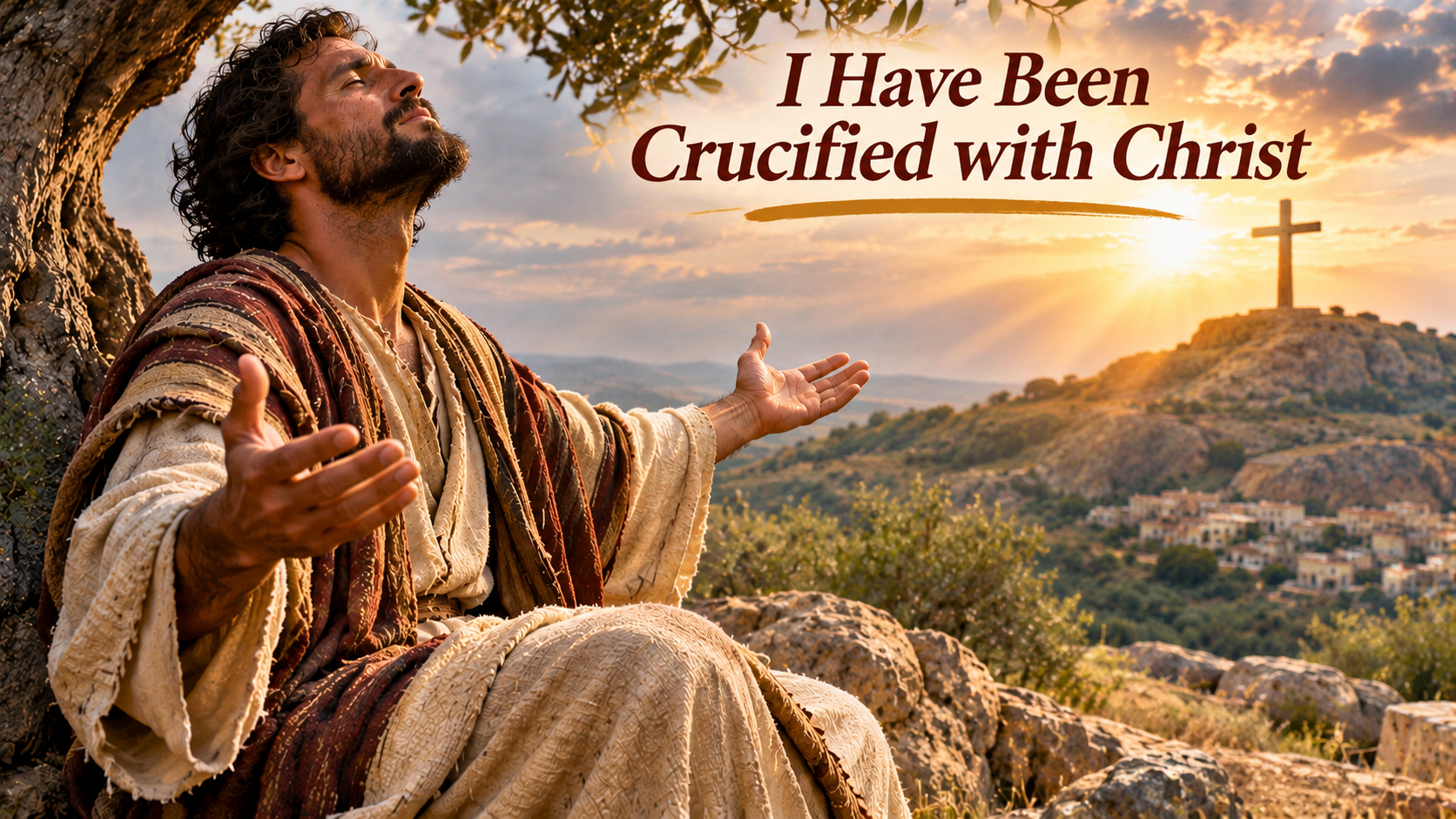
This page is an exercise in observation and disciplining yourself to begin to ask the 5W/H questions (Who, What, Where, Why, When, How) so that it slows you down and gives you more of an opportunity to interact with your Teacher, the Holy Spirit. So before you read any further, let me encourage you to pause and ponder Galatians 2:20 asking as may questions of the text as you can. As you carry out this exercise, it is more than pedantic, but is profitable for learning how to meditate on the Scriptures which God promises to bless (Joshua 1:8, Ps 1:1,2,3). My guess is you will come up with many questions I have not listed below, so do that first before you look at my questions. And in the last section, there are answers to the questions with Scripture cross references. Enjoy!
"I have been crucified with Christ; and it is no longer I who live, but Christ lives in me; and the life which I now live in the flesh I live by faith in the Son of God, who loved me and gave Himself up for me."
Before you begin (the context)
- Who is Paul speaking to in Galatians, and what false teaching is he answering?
- What did Paul just say in Galatians 2:19 ("I died to the Law, so that I might live to God")?
- How does verse 20 explain that death to the Law?
- What does Galatians 2:21 add about grace and righteousness?
1. "I have been crucified with Christ"
Word study links: crucified with (sustauroo) and Christ (Christos).
- Who is the "I"? Is it only Paul, or every believer?
- What tense is the verb? The Greek is a perfect passive.
- What does the perfect tense say about an act that is finished but still has results?
- What does the passive voice say about who did the crucifying?
- When did this crucifixion take place: at Calvary, at Paul's conversion, or both?
- How does this fit your thought that it happened once, when Paul was justified by faith?
- What exactly died: Paul's body, or his "old self"?
- Why does Paul say "with" Christ? What does union with Christ mean?
- Where else does Paul teach this? For example, Romans 6:6: "knowing this, that our old self was crucified with Him, in order that our body of sin might be done away with, so that we would no longer be slaves to sin."
- How does Galatians 5:24 compare? "Now those who belong to Christ Jesus have crucified the flesh with its passions and desires."
- What doctrine is Paul pointing to: justification, union with Christ, or both?
2. "and it is no longer I who live"
Word study link: live (zao).
- What does "no longer" mark as a change between before and after?
- Who was the "I" who used to live, and what was he trusting in?
- How did Saul the Pharisee live before the Damascus road?
- What does Colossians 3:3 add? "For you have died and your life is hidden with Christ in God."
3. "but Christ lives in me"
Link: "but" is a term of contrast.
- What two things does the "but" set against each other?
- Who now lives in Paul?
- Where does Christ live, and how does He live there (by the Spirit)?
- How is Christ living in me different from me merely copying Christ?
- What should change in my day if I really believe Christ lives in me?
4. "and the life which I now live in the flesh"
Word study links: life (zoe), now (nun) and flesh (sarx).
- What does "flesh" mean here: the sinful nature, or simply bodily life?
- How can Paul say "no longer I" and then "I now live"?
- When is the "now"?
- Where does this life take place? In heaven later, or here and today?
5. "I live by faith in the Son of God"
Word study link: faith (pistis).
- How does Paul live this life: by effort, by the Law, or by faith?
- Who is the object of that faith?
- Why does Paul call Him "the Son of God" here?
- What does daily dependence on Him look like?
- How does faith for living compare with faith at the moment of salvation?
6. "who loved me"
Word study link: loved (agapao).
- Who loved?
- Whom did He love? Why does Paul say "me" and not "us"?
- When did He love me: before I loved Him? Romans 5:8 says, "But God demonstrates His own love toward us, in that while we were yet sinners, Christ died for us."
- What kind of love is agape?
- How should this personal love change how I look at myself today?
7. "and gave Himself up for me"
Word study link: gave up (paradidomi).
- What did He give? Something He owned, or Himself?
- How freely did He give it?
- Where else is paradidomi used of Christ being handed over?
- Why "for me"? What does that say about substitution?
- How does His giving of Himself show His love?
Closing the meditation
- What is the single main truth of this verse?
- Which phrase is the Holy Spirit pressing on my heart today?
- How will I live differently today because of it?
- Who could I share this truth with this week?
Meditation means slowing down and questioning one verse, phrase by phrase, with who, what, when, where, why and how. Below, each question has a short answer drawn from Scripture. Try answering each question yourself before you read the answer.
Galatians 2:20 (NASB) "I have been crucified with Christ; and it is no longer I who live, but Christ lives in me; and the life which I now live in the flesh I live by faith in the Son of God, who loved me and gave Himself up for me."
Before you begin (the context)
Who is Paul speaking to in Galatians, and what false teaching is he answering?
Paul is writing to believers in the churches of Galatia (Gal 1:2). False teachers were telling them that faith in Christ was not enough and that they must also keep the Law, especially circumcision (Gal 5:2-4). Paul calls this a different gospel: "I am amazed that you are so quickly deserting Him who called you by the grace of Christ, for a different gospel; which is really not another; only there are some who are disturbing you and want to distort the gospel of Christ." (Gal 1:6-7)
Just before our verse, Paul states the true gospel: "nevertheless knowing that a man is not justified by the works of the Law but through faith in Christ Jesus, even we have believed in Christ Jesus, so that we may be justified by faith in Christ and not by the works of the Law; since by the works of the Law no flesh will be justified." (Gal 2:16)
What did Paul just say in Galatians 2:19?
"For through the Law I died to the Law, so that I might live to God." (Gal 2:19) The Law condemned Paul to death, and in Christ that death sentence was carried out. Having died, Paul is no longer under the Law's rule. Romans 7:4 says the same: "Therefore, my brethren, you also were made to die to the Law through the body of Christ, so that you might be joined to another, to Him who was raised from the dead, in order that we might bear fruit for God."
How does verse 20 explain that death to the Law?
Verse 20 tells us how Paul died: he died with Christ on the cross. Christ bore the Law's curse, and Paul, joined to Christ, died with Him. "Christ redeemed us from the curse of the Law, having become a curse for us—for it is written, 'Cursed is everyone who hangs on a tree.'" (Gal 3:13) Verse 20 also explains the purpose clause of verse 19, "that I might live to God": the new life is Christ living in Paul.
What does Galatians 2:21 add about grace and righteousness?
"I do not nullify the grace of God, for if righteousness comes through the Law, then Christ died needlessly." (Gal 2:21) If we could be made right by keeping the Law, the cross would have been pointless. Verse 20 therefore lifts up grace: everything rests on what Christ did, not on what we do.
1. "I have been crucified with Christ"
Word studies: crucified with (sustauroo) and Christ (Christos).
Who is the "I"? Is it only Paul, or every believer?
Paul is speaking of himself, but what is true of him is true of every believer. In Romans 6:6 he says "our old self," not just "my old self": "knowing this, that our old self was crucified with Him, in order that our body of sin might be done away with, so that we would no longer be slaves to sin." Every believer can say "I" with Paul.
What tense is the verb?
The Greek verb sunestauromai is in the perfect tense, passive voice, indicative mood. Paul states a fact: something was done to him in the past.
What does the perfect tense say about an act that is finished but still has results?
The perfect tense describes a completed past act whose results continue into the present. Paul was crucified with Christ once, and he still stands in that condition. We could translate it: "I have been crucified with Christ, and I remain crucified." The death is not repeated, but its effect never wears off.
What does the passive voice say about who did the crucifying?
Paul did not crucify himself; it was done to him. God joined him to Christ in His death. Salvation is God's work, not ours: "For by grace you have been saved through faith; and that not of yourselves, it is the gift of God; not as a result of works, so that no one may boast." (Eph 2:8-9)
When did this crucifixion take place: at Calvary, at Paul's conversion, or both?
Both. In history, Christ died once at Calvary: "For the death that He died, He died to sin once for all; but the life that He lives, He lives to God." (Ro 6:10) Personally, Paul was joined to that death when he believed and was united with Christ: "Or do you not know that all of us who have been baptized into Christ Jesus have been baptized into His death?" (Ro 6:3)
How does this fit the thought that it happened once, when Paul was justified by faith?
It fits well. Galatians 2:16 speaks of being justified by faith, and verse 20 describes the union with Christ that took place at that same moment. It happened once, at salvation, and the perfect tense adds that the result lasts. Justification is a one-time declaration, and so is this co-crucifixion.
What exactly died: Paul's body, or his "old self"?
Paul's body did not die; he is still living "in the flesh" later in the verse. What died was his old self, the person he was in Adam, ruled by sin. "Do not lie to one another, since you laid aside the old self with its evil practices, and have put on the new self who is being renewed to a true knowledge according to the image of the One who created him—" (Col 3:9-10)
Why does Paul say "with" Christ? What does union with Christ mean?
The prefix sun ("with") shows that the believer is joined to Christ so closely that what happened to Him counts as happening to us. We died with Him and were raised with Him. "For if we have become united with Him in the likeness of His death, certainly we shall also be in the likeness of His resurrection," (Ro 6:5) "Therefore if anyone is in Christ, he is a new creature; the old things passed away; behold, new things have come." (2 Cor 5:17)
Where else does Paul teach this?
Romans 6:6 (quoted above) is the closest parallel. Galatians 6:14 is another: "But may it never be that I would boast, except in the cross of our Lord Jesus Christ, through which the world has been crucified to me, and I to the world." Also 2 Corinthians 5:14: "For the love of Christ controls us, having concluded this, that one died for all, therefore all died;"
How does Galatians 5:24 compare?
"Now those who belong to Christ Jesus have crucified the flesh with its passions and desires." (Gal 5:24) In Galatians 2:20 the verb is passive (God did it to us). In Galatians 5:24 it is active (believers did it). Both look back to the same turning point: when we came to Christ, God put us to death with Him, and we turned our backs on the flesh's rule.
What doctrine is Paul pointing to: justification, union with Christ, or both?
Both, and more. The context is justification by faith (Gal 2:16). The verse itself teaches union with Christ (identification). Union with Christ is also the root of sanctification, the new life that follows (Ro 6:4): "Therefore we have been buried with Him through baptism into death, so that as Christ was raised from the dead through the glory of the Father, so we too might walk in newness of life."
2. "and it is no longer I who live"
Word study: live (zao).
What does "no longer" mark as a change between before and after?
"No longer" (ouketi) draws a line between two lives. Before, the self was in charge; after, Christ is. The old way of living has ended. "and He died for all, so that they who live might no longer live for themselves, but for Him who died and rose again on their behalf." (2 Cor 5:15)
Who was the "I" who used to live, and what was he trusting in?
He was Saul the Pharisee, who trusted in his birth, his religion and his own law-keeping. "circumcised the eighth day, of the nation of Israel, of the tribe of Benjamin, a Hebrew of Hebrews; as to the Law, a Pharisee; as to zeal, a persecutor of the church; as to the righteousness which is in the Law, found blameless." (Phil 3:5-6) He later counted all of it loss: "More than that, I count all things to be loss in view of the surpassing value of knowing Christ Jesus my Lord, for whom I have suffered the loss of all things, and count them but rubbish so that I may gain Christ," (Phil 3:8)
How did Saul the Pharisee live before the Damascus road?
He lived as an enemy of Christ, sincere but wrong. "So then, I thought to myself that I had to do many things hostile to the name of Jesus of Nazareth." (Acts 26:9) "even though I was formerly a blasphemer and a persecutor and a violent aggressor. Yet I was shown mercy because I acted ignorantly in unbelief;" (1 Tim 1:13)
What does Colossians 3:3 add?
"For you have died and your life is hidden with Christ in God." (Col 3:3) The old life is over, and the new life is kept safe in Christ, where nothing can reach it. The next verse shows where that life is headed: "When Christ, who is our life, is revealed, then you also will be revealed with Him in glory." (Col 3:4)
3. "but Christ lives in me"
"But" (alla) is a term of contrast.
What two things does the "but" set against each other?
It sets the old self-ruled life ("no longer I") against the new Christ-ruled life ("Christ lives in me"). One life ended and another began. Paul does not say he improved the old life; he says it was replaced.
Who now lives in Paul?
Christ Himself. This is the mystery Paul preached: "to whom God willed to make known what is the riches of the glory of this mystery among the Gentiles, which is Christ in you, the hope of glory." (Col 1:27)
Where does Christ live, and how does He live there?
He lives in the believer's heart through the Holy Spirit, and we receive Him by faith. "However, you are not in the flesh but in the Spirit, if indeed the Spirit of God dwells in you. But if anyone does not have the Spirit of Christ, he does not belong to Him. If Christ is in you, though the body is dead because of sin, yet the spirit is alive because of righteousness." (Ro 8:9-10) "so that Christ may dwell in your hearts through faith; and that you, being rooted and grounded in love," (Eph 3:17)
How is Christ living in me different from me merely copying Christ?
Copying works from the outside in, by my own strength. Christ living in me works from the inside out, by His power. "for it is God who is at work in you, both to will and to work for His good pleasure." (Phil 2:13) Jesus said, "I am the vine, you are the branches; he who abides in Me and I in him, he bears much fruit, for apart from Me you can do nothing." (John 15:5)
What should change in my day if I really believe Christ lives in me?
I will depend on Him moment by moment instead of on myself, and His character will begin to show. "But I say, walk by the Spirit, and you will not carry out the desire of the flesh." (Gal 5:16) "But the fruit of the Spirit is love, joy, peace, patience, kindness, goodness, faithfulness, gentleness, self-control; against such things there is no law." (Gal 5:22-23)
4. "and the life which I now live in the flesh"
Word studies: life (zoe), now (nun) and flesh (sarx).
What does "flesh" mean here: the sinful nature, or simply bodily life?
Here it means ordinary bodily life in a mortal body, not the sinful nature. Paul uses sarx the same way elsewhere: "For though we walk in the flesh, we do not war according to the flesh," (2 Cor 10:3) "But if I am to live on in the flesh, this will mean fruitful labor for me; and I do not know which to choose." (Phil 1:22)
How can Paul say "no longer I" and then "I now live"?
Paul still exists as a person, with his own mind, will and body. What changed is the source and ruler of his life. He uses the same "I... yet not I" pattern elsewhere: "But by the grace of God I am what I am, and His grace toward me did not prove vain; but I labored even more than all of them, yet not I, but the grace of God with me." (1 Cor 15:10)
When is the "now"?
"Now" is the present life, between conversion and glory. It is not a future, heavenly life. It is today, in this age: "instructing us to deny ungodliness and worldly desires and to live sensibly, righteously and godly in the present age," (Titus 2:12)
Where does this life take place? In heaven later, or here and today?
Here and today, in this body, at home, at work and in the church. Christ's life is lived out through ordinary human bodies: "Therefore I urge you, brethren, by the mercies of God, to present your bodies a living and holy sacrifice, acceptable to God, which is your spiritual service of worship." (Ro 12:1)
5. "I live by faith in the Son of God"
Word study: faith (pistis).
How does Paul live this life: by effort, by the Law, or by faith?
By faith, the same way he was justified. Paul quotes Habakkuk 2:4: "Now that no one is justified by the Law before God is evident; for, 'The righteous man shall live by faith.'" (Gal 3:11) The Christian life is not powered by effort under the Law but by trust in Christ.
Who is the object of that faith?
The Son of God, Jesus Christ. Faith is only as good as its object, and our object is perfect: "fixing our eyes on Jesus, the author and perfecter of faith, who for the joy set before Him endured the cross, despising the shame, and has sat down at the right hand of the throne of God." (Heb 12:2)
Why does Paul call Him "the Son of God" here?
The title points to Christ's deity, which makes Him worthy of complete trust. It was also the first truth Paul preached after his conversion: "and immediately he began to proclaim Jesus in the synagogues, saying, 'He is the Son of God.'" (Acts 9:20) God revealed His Son in Paul: "was pleased to reveal His Son in me so that I might preach Him among the Gentiles, I did not immediately consult with flesh and blood," (Gal 1:16)
What does daily dependence on Him look like?
It means trusting Him with each decision, burden and temptation instead of leaning on my own understanding. "Trust in the LORD with all your heart And do not lean on your own understanding. In all your ways acknowledge Him, And He will make your paths straight." (Prov 3:5-6)
How does faith for living compare with faith at the moment of salvation?
It is the same faith. We begin by faith and we continue by faith. "Therefore as you have received Christ Jesus the Lord, so walk in Him," (Col 2:6) Paul rebukes the Galatians for trying to switch: "Are you so foolish? Having begun by the Spirit, are you now being perfected by the flesh?" (Gal 3:3)
6. "who loved me"
Word studies: loved (agapao) and love (agape).
Who loved?
The Son of God, the same One in whom Paul trusts. "and walk in love, just as Christ also loved you and gave Himself up for us, an offering and a sacrifice to God as a fragrant aroma." (Eph 5:2)
Whom did He love? Why does Paul say "me" and not "us"?
He loved "me," Paul personally, the former persecutor. Christ died for the whole world, yet His love reaches each sinner by name. Paul never got over being loved as the worst of sinners: "It is a trustworthy statement, deserving full acceptance, that Christ Jesus came into the world to save sinners, among whom I am foremost of all." (1 Tim 1:15)
When did He love me: before I loved Him?
Yes. He loved us first, while we were still sinners and enemies. "But God demonstrates His own love toward us, in that while we were yet sinners, Christ died for us." (Ro 5:8) "We love, because He first loved us." (1 John 4:19) The aorist tense "loved" points to the cross, where that love was shown once for all.
What kind of love is agape?
Agape is self-giving love that seeks the highest good of the one loved, whether or not that person deserves it. It is measured by sacrifice. "Greater love has no one than this, that one lay down his life for his friends." (John 15:13) "In this is love, not that we loved God, but that He loved us and sent His Son to be the propitiation for our sins." (1 John 4:10)
How should this personal love change how I look at myself today?
My worth and security rest on Christ's love, not on my performance. Nothing can cut me off from it: "Who will separate us from the love of Christ? Will tribulation, or distress, or persecution, or famine, or nakedness, or peril, or sword?" (Ro 8:35) "For I am convinced that neither death, nor life, nor angels, nor principalities, nor things present, nor things to come, nor powers, nor height, nor depth, nor any other created thing, will be able to separate us from the love of God, which is in Christ Jesus our Lord." (Ro 8:38-39)
7. "and gave Himself up for me"
Word study: gave up (paradidomi).
What did He give? Something He owned, or Himself?
He gave Himself, the greatest gift there is. "who gave Himself for our sins so that He might rescue us from this present evil age, according to the will of our God and Father," (Gal 1:4) "who gave Himself for us to redeem us from every lawless deed, and to purify for Himself a people for His own possession, zealous for good deeds." (Titus 2:14)
How freely did He give it?
Completely freely. No one forced Him. "No one has taken it away from Me, but I lay it down on My own initiative. I have authority to lay it down, and I have authority to take it up again. This commandment I received from My Father." (John 10:18)
Where else is paradidomi used of Christ being handed over?
The Father handed Him over: "He who did not spare His own Son, but delivered Him over for us all, how will He not also with Him freely give us all things?" (Ro 8:32) "He who was delivered over because of our transgressions, and was raised because of our justification." (Ro 4:25) The same verb is used of His betrayal: "You know that after two days the Passover is coming, and the Son of Man is to be handed over for crucifixion." (Matt 26:2) Men handed Him over out of evil, but the Father and the Son handed Him over out of love.
Why "for me"? What does that say about substitution?
"For" (huper) means "on behalf of" or "in place of." Christ took my place and bore my sin. "He made Him who knew no sin to be sin on our behalf, so that we might become the righteousness of God in Him." (2 Cor 5:21) "and He Himself bore our sins in His body on the cross, so that we might die to sin and live to righteousness; for by His wounds you were healed." (1 Pet 2:24)
How does His giving of Himself show His love?
The "and" joins "loved me" to "gave Himself up for me." His giving is the proof of His love. "For God so loved the world, that He gave His only begotten Son, that whoever believes in Him shall not perish, but have eternal life." (John 3:16) "Husbands, love your wives, just as Christ also loved the church and gave Himself up for her," (Eph 5:25)
Closing the meditation
What is the single main truth of this verse?
The believer has died with Christ and now lives by Christ. That new life is lived by faith in the Son of God, and it rests entirely on His love and His self-giving death. "Even so consider yourselves to be dead to sin, but alive to God in Christ Jesus." (Ro 6:11)
Which phrase is the Holy Spirit pressing on my heart today?
Only you can answer this one, so ask the Spirit to show you: "Open my eyes, that I may behold Wonderful things from Your law." (Ps 119:18) He is the Teacher Jesus promised: "But when He, the Spirit of truth, comes, He will guide you into all the truth; for He will not speak on His own initiative, but whatever He hears, He will speak; and He will disclose to you what is to come." (John 16:13)
How will I live differently today because of it?
Meditation should end in obedience. Choose one concrete step, such as turning from a sin, trusting Him with a worry, or showing His love to someone. "But prove yourselves doers of the word, and not merely hearers who delude themselves." (James 1:22)
Who could I share this truth with this week?
What we receive we pass on. "The things which you have heard from me in the presence of many witnesses, entrust these to faithful men who will be able to teach others also." (2 Tim 2:2) "Let the word of Christ richly dwell within you, with all wisdom teaching and admonishing one another with psalms and hymns and spiritual songs, singing with thankfulness in your hearts to God." (Col 3:16)
Scripture quotations are from the NASB (1995).